Where are they now? More about the traditional boats used when filming of ‘Coot Club’ for BBC TV

Coot Club - Teasel and Titmouse - photo Jill Searle
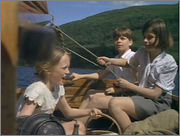
Mary Soan with Jill and Jim Searle on the Teasel, towing the Titmouse on South Walsham

Jim and Jill Searle of the Norfolk Country Sailing Base in Ludham helped us find traditional boats for the BBC adaptation of Coot Club and The Big Six set on the Norfolk Broads. Jill kindly sent me a copy of this photo taken of Lullaby just after she was chosen to play the Teasel back in 1983. Her costume consisted of a false transom, which is still at Hunter’s Yard in Ludham today.

'TEASEL'
The Teasel’s transom ~ photo: Roger Wardale

Roger Wardale took this photograph included in his book,  Arthur Ransome on the Broads , which Amberley Publishing brought out in full colour. He tells of Arthur Ransome’s half-dozen or so holidays on hired yachts and of the young people who sailed in the fleet, including Titty and Taqui Altounyan.

Roger found out that the Ransomes hired a 23′ Fairway’  yacht from Jack Powles of Wroxham. This had a Primus stove with a special cooking locker in the well. It sounds well kitted out with a wash-basin and self-emptying WC in a separate compartment. The three Somnus spring-berths had drawers underneath and there was even a wardrobe. Like the Teasel, she was built of mahogany with a ‘bright varnish finish’ and, given a fair wind, would have zipped along at quite a speed.

Roger said that he spent six days trying to find places Arthur Ransome visited that had not changed since the 1930’s. He found it difficult. What he did discover was the dinghy used to play Titmouse in the BBC TV series. She can still be visited at Hunter’s Yard.

'TITMOUSE'
The Titmouse at Hunter’s Yard in Ludham ~ photo: Roger Wardale

It is still possible to hire the mahogany hulled, gunter-rigged yachts much as Arthur Ransome and his wife did in the 1930’s, together with a sailing dinghy or rowing boat. There are fourteen sailing cruisers in the Hunter’s fleet and none have an engine. They have lifting cabin tops so you have more headroom when you moor up. Lullaby, built in 1932, is 28ft long with four berths. Her mast can be lowered with counter weights so she can be taken under bridges with a clearance of six foot.

Roger Wardale says that in the 1930’s, many of the yachts had a ‘self-acting’ jib but Ransome considered it too large. There were times when he lowered it, only to find ‘he sailed better without it!’  They still have self-acting jibs but the size may have been altered.
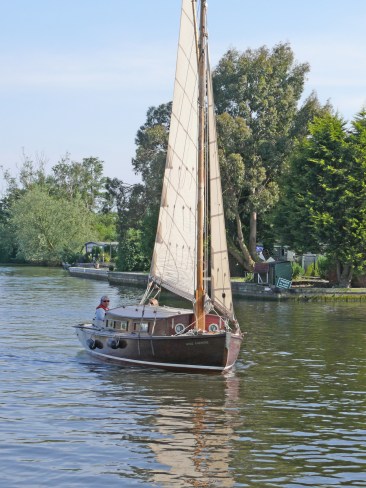
AT HORNING STAITHE
At Horning Staithe today ~ photo: Roger Wardale

Roger also found a cruiser similar to Janca, the 1930’s cruiser who played the part of the Margoletta. She was skippered by Julian Fellowes in his glorious role as a Hullabaloo, the spiteful, arch-baddie of Coot Club.

MARGOLETTA
A large 1930’s Broads cruiser similar to the one we used as the Margoletta in ‘Coot Club’ ~ photo: Roger Wardale

Back in 1983 we were hugely helped by a number of Norfolk boatmen who knew the broads well.

Coot Club - Mark and Brian
Mark Page, who played Bill getting help fixing something

You will have to let me know the name of these gentlemen who spent long hours helping us in the summer of 1983.

Coot Club - local boatmen
The skipper of the vessel used as a camera boat on ‘Swallows and Amazons Forever!’

Filming from one boat to another is tricky and much patience was need. In many ways the easiest boat to film with was the Death and Glory. She can still be found moored somewhere on the Broads.

Coot Club - book cover

I well remember setting up this shot for the cover of the abridged version of the two stories, which was brought out by Puffin to accompany the series. It shows the Death and Glory complete with her green chimney. The big secret was that the interior of the cabin was larger than the exterior. we puzzled over Ransome’s drawings only to decide that he had cheated the measurements too.
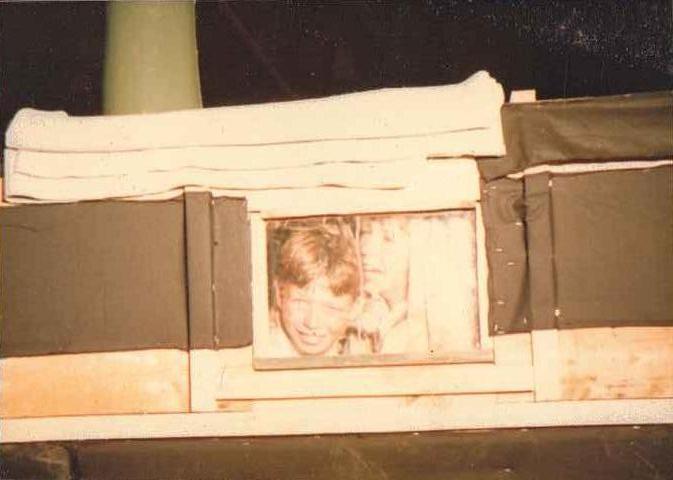
Nicholas Walpole and Jake Coppard looking out of the window of the set that was made to represent the interior of the Death and Glory

Bruce McCaddy and his team built the set inside a modern boat shed where it was kept for ‘rain cover’,  since the interior scenes could always be shot if it was wet. It included ‘camera traps’ or sections that could be removed so the scenes could be shot. I never went inside but the boys loved it. In fact the weather was glorious. We enjoyed such constant sunshine in the later part of the shoot that we filmed the interiors when it was dry and so warm the boys got quite over-heated.

Is ‘Swallows and Amazons’ (1974) one of the 50 Greatest British Films?

Barry Norman 50 greatest films

Nominate your favourite British Film

Here are Barry Norman’s 49 top British films as listed on the Radio Times website:

Barry Lyndon (1975)
Black Narcissus (1947)
The Bridge on the River Kwai (1957)
Brief Encounter (1945)
Chariots of Fire (1981)
A Clockwork Orange (1971)
The Cruel Sea (1952)
The Dam Busters (1954)
Dr No (1958)
Don’t Look Now (1973)
Dracula (1958)
Four Weddings and a Funeral (1994)
The Full Monty (1997)
Gandhi (1982)
Get Carter (1971)
Gladiator (2000)
Great Expectations (1946)
Gregory’s Girl (1980)
Henry V (1944)
I Know Where I’m Going! (1945)
If… (1968)
The Ipcress File (1965)
Kes (1969)
Kind Hearts and Coronets (1949)
The King’s Speech (2010)
The Lady Vanishes (1938)
The Ladykillers (1955)
Lawrence of Arabia (1962)
The Life and Death of Colonel Blimp (1943)
Local Hero (1983)
The Long Good Friday (1979)
A Matter of Life and Death (1946)
Monty Python’s Life of Brian (1979)
Naked (1993)
The Railway Children (1970)
The Red Shoes (1948)
The Remains of the Day (1993)
Saturday Night and Sunday Morning (1960)
Secrets & Lies (1995)
Sense and Sensibility (1995)
The Servant (1963)
Shakespeare in Love (1998)
Skyfall (2012)
The Third Man (1949)
The 39 Steps (1935)
This Sporting Life (1963)
Trainspotting (1995)
Whisky Galore! (1949)
Zulu (1963)

Tell us which film you think is missing from this list.

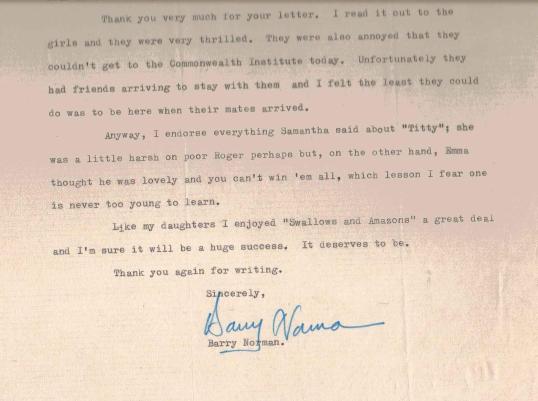
Here is a letter I have from Barry Norman, received back in 1974:

Letter from Barry Norman April 1974

On the set of ‘Coot Club’, the BBC serial made on location in Norfolk in 1983

Coot Club - Sophie Neville with Port and Starboard

All the children who appeared in the BBC serial of  Arthur Ransome’s books ‘Coot Club’ and ‘The Big Six’ were delightful. They were committed to the project and focused on their roles in the drama that was released in 1984 under the strand title Swallows and Amazons Forever!

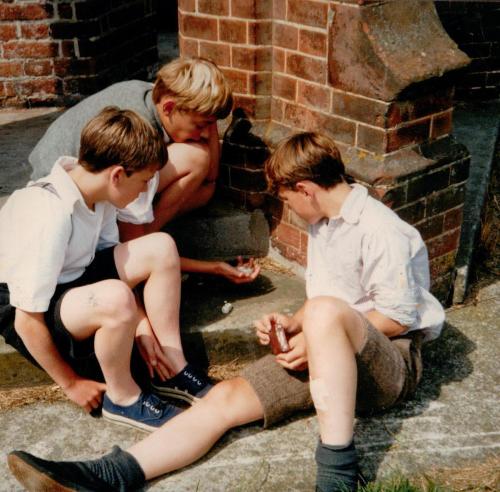
Coot Club - boys playing
Jake Coppard, Mark Page and Nicholas Walpole who played Pete, Bill and Joe – The crew of the Death and Glory

They enjoyed the process of putting the story together but we were filming on location in Norfolk for three months, which is a long stretch for anyone. It is a very long time when you are aged thirteen.

Coot Club - Jake Coppard reading
Jake Coppard in the role of Pete

It can be difficult hanging around on set, waiting for the crew to set up, especially when you have to keep quiet and reasonably still, avoiding the perils of sunburn and scratches. In many ways it’s the most challenging aspect of being an actor, especially when you are constricted by your costume that has to be kept clean and dry.

Coot Club - the camera crew watched by Richard
Filming the Death and Glory at Gay Staithe in Norfolk. Peter Markham, Bruce McCaddie, Alec Curtis and his assistant with the 16mm camera, are being observed by Richard Walton, who played Dick Callum

Watching the film crew record a scene was interesting, and in many ways good work experience, but it was not always possible as they were often out on the water.

Coot Club - Henry Dimbleby reading to the others
Claire Matthews, Henry Dimbleby & Richard Walton whilst filming of ‘Coot Club’

Once the school summer holidays started, we bid farewell to Angela Scott who had given the children lessons while they were on location. She’d been teaching them on a boat most of the time – the blue fibre glass cruiser in the photograph above.  It was part of my job to make sure the children rested and were quietly entertained when they weren’t in front of the camera. I thought it important to let them be themselves and build friendships.

Coot Club - boys playing boule
Mark Page, Nicholas Walpole and others during the filming

I was very strict – I had to be when we were near water or traffic, but the girls were naturally self-disciplined and boys team spirited.

Coot Club - boys playing in Norfolk

Joe Waters, who was producing the drama, said that the sun always shone for him. It certainly did. The summer of 1983 was scorching. We had a few rainy days, but the actors where wonderful at helping to keep up moral. The boys adored Sam Kelly, Captain of the Catchalot, who the British public knew so well from his role as Bunny Warren in Porridge and the German Officer in the WWII sit-com ‘Allo ‘Allo. We only had to look his way and we’d all collapse laughing. Sam Kelly is probably now best known for his recent roles in Nanny McPhee and the Big Bang , in which he played Maggie Smith’s husband Mr Docherty, and for taking the role of Grandad in the new Mike Leigh comedy  A Running Jump, 2012 but on that far off summer on the Norfolk Broads there were quite a few terrible take-offs of  Captain Geering’s German accent. One of his later episodes of ‘Allo ‘Allo was titled ‘Up the Crick Without a Piddle’   which aptly described that particular day in East Anglia.

Coot Club - Sam Kelly and Jake Coppard
Sam Kelly with Jake Coppard either in the Catchalot or our support boat

Sam Kelly playing Captain of the Catchalot with Jake Coppard

In the end it was the boys who kept us amused. They were inventive and used whatever they could find and whatever opportunity came along to make me laugh.

Coot Club - boys in the rain1
Jake Coppard, Nicholas Walpole and Mark page under my umbrella on one of the few rainy days, whilst filming in Norfolk.

You can read more about the making of Coot Club and The Big Six in the DVD extras of this 30th Anniversary edition.

 Swallows And Amazons Forever! (Coot Club & The Big Six) SPECIAL EDITION [DVD]

The boats used for filming the BBC drama ‘Coot Club’ on the Norfolk Broads in 1983 ~

Norfolk County Sailing Base, Ludham
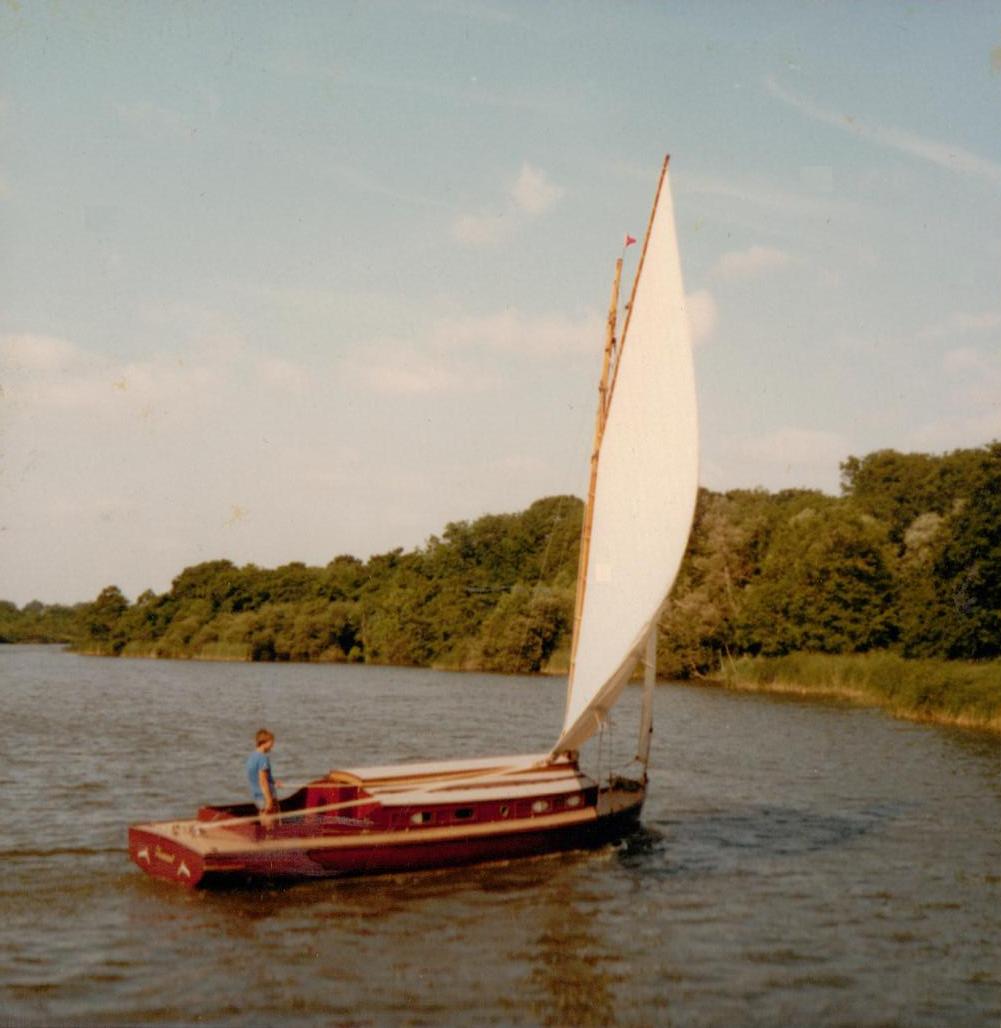
The ‘Titmouse’ under sail in 1983

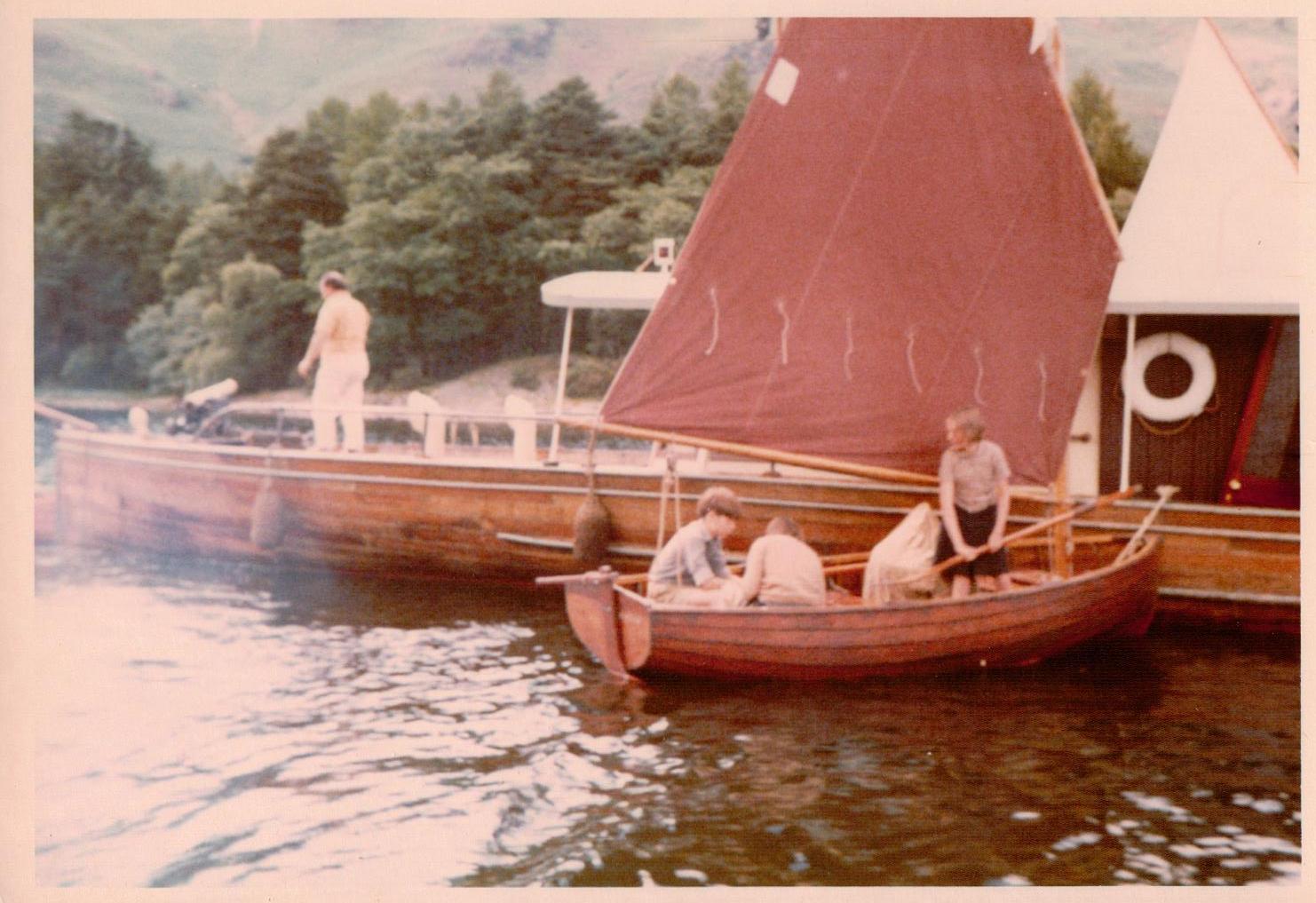
Jim Searle must have given me this lovely photograph of  Titmouse, taken when the boys from Norfolk who played the Death and Glorys were given sailing lessons prior to filming in the summer of 1983.

Sophie Neville and Titmouse

Titmouse has recently been renovated by Hunter’s Yard at Ludham in Norfolk, which was used as a film location in the series and restored to her sea-worthy condition.

Henry Dimbleby resting between takes in the 'Dreadnaught'
Henry Dimbleby resting between takes in the ‘Dreadnaught’.

Tom Dudgeon’s punt, Dreadnaught can also be found at Hunter’s Yard. Henry Dimbleby can be seen here, sitting on the life jacket he was obliged to wear during rehearsals, despite the fact that he jumped into the water in the action to avoid being spotted by the Hullabaloos, the holiday makers who had hired the Margoletta, in reality the Norfolk cruiser Janca.

Coot Club - Bruce McCaddie the designer
Bruce McCaddie, our Designer with Prop Master Ricky King in the ‘Cachalot’

This must be the Catchalot. It looks as if our designer, Bruce McCaddie, is sorting out a fishing rod used by the actor Sam Kelly, who was fishing for pike.

Coot Club - the camera boat
Norfolk teacher Angela Scott with the ‘Catchalot’

This is  the only other shot I have of the Catchalot, which looks as if it might have been taken up near Horsey Mere. It shows Angela Scott, the children’s tutor making a funny face at the end of the day. You can just see the make-up artist, Penny Fergusson, and what could be Mary Soan on board.  Jill Searle may have been there too. She became a great friend of Liz Mace, our Production Manager who had always been keen on sailing.

Pat Simpson of Stalham Yacht Services said that during the filming they one had to take a boat from Regan to Horning overnight when the film schedule changed. I have a feeling it was the Catchalot.

The Death and Glory at Gay Staithe

One of the jobs Bruce McCaddie gave to his construction team was to build the cabin on the Death and Glory, with its flower pot of a chimney. He transformed the look by adding rigging from the mast.

Bruce Mackadie
Our Set Designer, Bruce McCaddie using a dressing boat to approach the ‘Death and Glory’ complete with her cabin. Is the ‘Titmouse’ moored alongside?

In terms of set design ‘Coot Club’ and ‘The Big Six’ were rather unusual productions to work on but Bruce loved boats. Instead of being an extra person on the vessel used by the film crew, he would take a period dinghy to gain access to his sets – which of course were often other boats. This run-around boat could then but used in the back to shot, especially if he needed to hide something modern.

The Death and Glory visiting the Norfolk Broad Yacht Club in 2018

An old German Lifeboat found by Pat Simpson washed up on the beach at Southwold was used for the Death and Glory. After the filming, Pat kept it for his sons until 1989 when Professor John Farrington from the School of Geo-Science at Aberdeen University came across it. He took his two children, a boy and a girl aged ten and eleven, down to the yard one half-term as the loved the books and television serial.

‘Get on,’ he said.

‘But what about the owners?’ they asked.

‘You are the owners.’ He’d bought it for them. One New Year they rowed from Stalham to Sutton and back. John Farrington first visited the Broads  on a family holiday in 1956 and wanted his children to have the same experience. They now have children of their own and still treasure the Death and Glory.

The Death and Glory with her newly added cabin

The Teasel was played by Lullaby. Roger Wardale tells me she is  a mahogany hulled crusier, a gunter-rigged, 4-berth ‘Lustre’ class yacht built in 1932 and kept at Hunter’s Yard in Ludham, where she is still available for hire.

Coot Club - Lullaby as the Teasel undersail
Lullaby undersail, playing the Teasel with her stage name painted on a false transome

She is similar to the 3-berthed ‘Fairway’ yachts that Arthur Ransome and his wife would hire for holidays on the Broads  in the 1930’s.

The Teasel towing the Titmouse
The Teasel towing the Titmouse – click on this photo to see a close-up of the cockpit

One of the secrets of filming ‘Coot Club’ is that although this looks as if Mrs Barrable is sailing the Teasel, it is not Rosemary Leach but a young man from Hunter’s Yard wearing her costume. Caroline Downer, who played Dorothea Callum, Richard Walton, who played Dick, and Henry Dimbleby who played Tom Dudgeon are in the cockpit, but we also used ‘doubles’ on that day to play Port and Starboard.  I found girls two girls from Norwich, Julia Cawdron and Claire Dixon, who played the twins for a day.

The reason for this was that sailing scenes are time-consuming to film and quite tricky to edit together. While our Director, Andrew Morgan, was busy filming the scenes at the Farland’s house with the actor Andrew Burt and the twins, Sarah and Claire Matthews, accompanied by their mother, I was on a second unit headed up by the Producer Joe Waters. Although Joe had directed a huge number of dramas he asked his film editor, Tariq Anwar, up to direct the sequences, knowing that he would be cutting the shots together.  He came up to the location with his wife and we took most shots from the camera boat, Camelot.

Tariq Anwar went on to edit Vivaldi, based on Antiono Vivaldi’s early life, starring Elle Fanning, Neve Campbell and Brian Cox. His latest credits include Great Expectations and The King’s Speech as well Down the River featuring Joe Henry, Tom Jones and Hugh Laurie. I haven’t seen the documentary but presume it must include the odd boat.

The great thing is that you can still find some of these vessels today –

Sophie Neville with Titmouse in Norfolk
Sophie Neville with Titmouse in Norfolk – photo Diana Dicker

While giving a talk at the Norfolk Broads Yacht Club, I was given a list of the boats that they know appeared in the series:

  • Teasel – owned and kept at Hunter’s Yard, Ludham on the Norfolk Broads
  • Titmouse – owned and kept at Hunter’s Yard, Ludham
  • Dreadnaught -owned and kept at Hunter’s Yard, Ludham
  • Death and Glory – owned by the Farringtons – kept at Gerry Hermer’s boat yard on the Norfolk Broads
  • Sir Gernet – a Norfolk Wherry The Albion

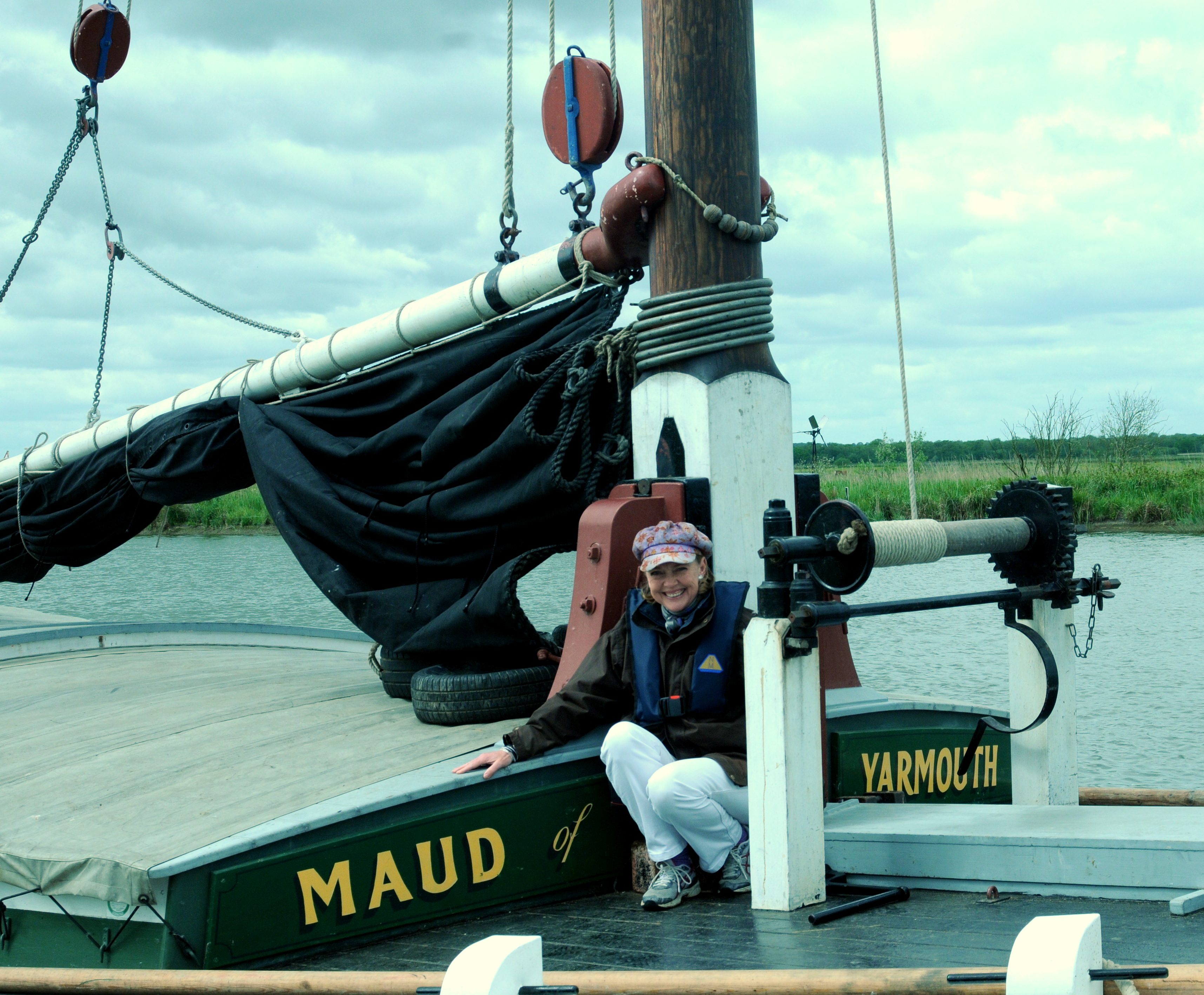
Aboard Maud photo Diana
Aboard Wherry Maud – photo Diana Dicker

Other boats featured include:

  • Water Rail – Herbert Woods Delight Class B owned by Liz Goodyear
  • Joan B – a skiff set adrift at Horning owned by Pat Simpson
  • Pippa – yacht set adrift at Horning owned by Geoff Angell kept at the Norfolk Boards Yacht Club.
  • Goldfish 9 – a one-off yacht
  • Swallow 4 – a one-off river cruise yacht
  • Starlight Lady 322
  • John Boswell’s boat was used at the Catchalot

Sophie Neville with the yacht 'Goldfish'

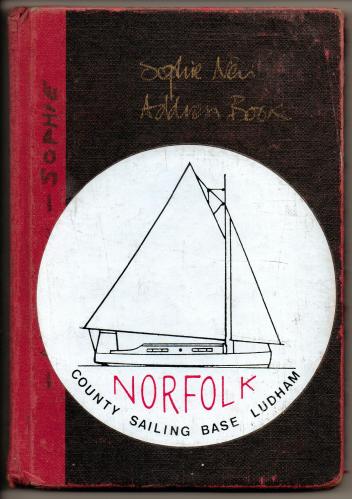
Do write in the comments below if you can fill me in on the names of those who helped us with the boats for the series.  My address book lists: Jim and Jill Searle, Rupert Latham, Pat Simpson of Stalham Yacht Services, Richardson’s of Stalham, Lawrence Monkhouse, Keith King of Feny Boatyard and the Steam boat Association. I still have a certain sticker on the front of my BBC address book ~

Coot Club - My Address Book

Boats of the Norfolk Broads ~

Sailing on the Norfolk Broads

I recently found a family photograph album with pages illustrating holidays spent under sail in the 1930’s.

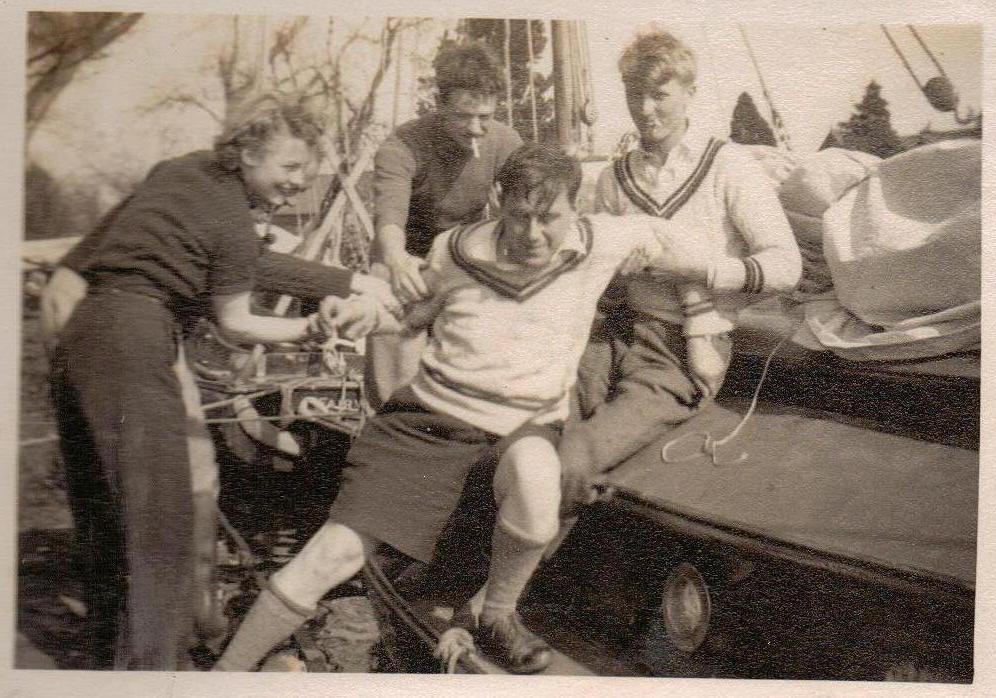
Breakfast on the Norfolk Broads ~ Easter 1939
Joan with her friends having breakfast on the Norfolk Broads ~ Easter 1939

Not all the black and white photographs are as horizontal or as sharply in focus as one might wish but they show the glorious boats available for hire.

Sailing on the Norfolk Broads - Easter 1939

They also reflect what fun was had out on the water.

Joan Hampton - Norfolk Broads - Friends1

We were rather shocked by the cigarettes held in the mouths of the young men but Joan, who is pictured with them, was still agile at the age of ninety-nine.

Martin Neville on the Norfolk Broads
Martin Neville sailing on the Norfolk Broads with friends in the early 1950s

Having sailed up to Horsey Mere with friends, my father hired a Hullabaloo boat to take us out on the Boards when we were little.

Sophie Neville with her sisters on the Norfolk Broads

We went out of season, when boat hire was cheaper. As there was no one on the water my father let me take the helm mile after mile, despite the fact that I was only about seven years old.

Sophie Neville on the Norfolk Broads
Sophie Neville wearing a life jacket c. 1968

 We loved living aboard and were often surrounded by wild geese.

Sophie Neville on the Norfolk Broads

It seems Arthur Ransome, who had fished on the Broads with Titty’s father, Ernest Altounyan, in 1923, also enjoyed cruising in the spring. His biographer, Roger Wardale, said that ‘Both the Ransomes liked to visit the Broads just after Easter, before most of the motor cruisers had started the season and it was the best time of year for birdlife.’ He went on to describe how Arthur Ransome kept a log of his three weeks spent in a Fairway yacht, the essence of which he used to write Coot Club in 1933/34. ‘As well as visiting Roy’s of Wroxham, tying up at Horning Hall Farm and watching the racing boats go by, towing through bridges, mooring beside a Thames barge at Beccles and watching a fisherman catching eels with a bab, there are numerous details that combine to make Coot Club a valuable account of the social and natural history of the Broads as they were more than 70 years ago.’ 

Roger Wardale illustrated his book Arthur Ransome Master Stroyteller, using wonderful photographs and sketches by Arthur Ransome, including a very jolly one of the Hullabaloos that had not been published before. Do get hold of a copy of the book, to read the chapter on Coot Club for yourself.

I’ve written a little about working on the BBC adaptation of ‘Coot Club’ and the ‘Big Six’ for the DVD Extras for re-mastered 30th Anniversary DVD of the series which has this cover: 

Swallows and Amazons Forever
Swallows And Amazons Forever! (Coot Club & The Big Six) SPECIAL EDITION [DVD]

I have written about appearing in the original film of Swallows and Amazons here, where you can read the first section free of charge:

‘How did appearing in ‘Swallows and Amazons’ affect your life?’

Wheetabix commercial
Sophie Neville appearing in a Wheetabix commercial directed by Claude Whatham in 1973

I am often asked what impact Swallows and Amazons has had on my life. Because I had been given the lead in a feature film, it naturally lead to ‘more work’, as any actor would put it. I had not expected this, but things seemed to come our way. Sadly not riches, as I was still paid as a child, but it was fun and I learnt a great deal.

Wheetabix Commercial with Claude Whatham looking through the camera
Claude Whatham looking down the 35mm camera, giving direction to Ruth Shields and Percy Baxter, while Perry and Tamzin Neville stand by in the foreground.

I think Claude Whatham must have accepted a contract to direct commercials for Wheetabix even before he finished editing the Arthur Ransome movie, because in the summer of 1973, my sisters and I appeared in three lovely period films – each about three minutes long – that he made in Gloucestershire at harvest time.

Wheetabix Commercial with Tamzin and Perry
Girls in a Cotswold corn field harvesting stocks of wheat ~ Photo: Martin Neville

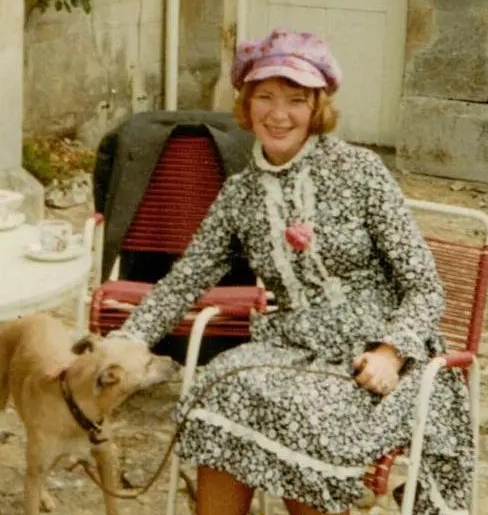
Claude had a cottage near Sten Grendon’s house in the Cotswolds. The location can not have been far from where we all lived as I recognise some of the Extras, who my mother gathered together including Percy Baxter, Ruth Shields, my younger sisters, Perry and Tamzin, and my father, Martin Neville. I can’t remember Sten being on the set but I have a photograph of our erst-while chaperone Jane Grendon in period costume.

Wheetabix Commercial with Jane Grendon
An unknown gentleman with Daphne Neville and Jane Grendon in Gloucestershire while filming a commercial for Claude Whatham in August 1973

We didn’t actually have to eat breakfast cereal. In my film there was simply a shot of me climbing over a gate to discover a cornfield with the voice track, ‘When I was young…’ over a shot of me and my brother, played by Nicholas Newman, eating individual grains of corn. This was not in the script. We just behaved as children do.

Wheetabix Commercial directed by Claude Whatham
Nicholas Newman and Sophie Neville eating grains of wheat.

Claude asked me just to stand in the crop and ended the film with a shot of me spinning around, enjoying the feel the ripe heads of corn as they hit my hands, captured against the low light of the setting sun. It was undirected action. Despite having endless lengths of track, the latest camera mounts and a massive 35mm Claude was letting us behave completely naturally – experimenting with improvised drama without even asking us to improvise.

My mother could not appear in the advertisement herself, as she had already been in a Television commercial for cereal and her agent did not want her to accept ‘Extra work’. She was represented by Bryan Drew, whose assistant Wendy Noel found Mum featured roles in a wide range of television commercials, which paid very well as the repeat fees were good. I remember going with Mum to their office in Shaftesbury Avenue when Brian Drew lent back in his chair, casually agreeing to represent me.

Sophie Neville in 1976

I went to a number of interviews – rather than auditions – to appear in feature films that I don’t think were ever made. Inflation was running at 17% in the mid-1970s and money for movies must have been tight in the UK.  This was probably why Richard Pilbrow couldn’t get the financing for an adaptation of Great Northern? 

When I was fifteen, I decided that the old black and white promotion photographs of me playing Titty had become out-dated and arranged for my own Spotlight photograph to be taken by an old professional – the husband of rather an unpopular teacher at school. I decided exactly what I would wear and how I would sit. My friends and the teacher were amazed, but it did the trick. On the strength of this one photograph, and obviously my experience gained on Swallows and Amazons, I was given the leading role of Liz Peters, an archery champion in a CFF adventure movie titled, The ‘Copter Kids alongside Sophie Ward and Jonathan Scott-Taylor.

Sophie Neville in The 'Copter Kids
Jonathan Scott-Taylor, Sophie Neville, Daphne Neville and Sophie Ward in a family adventure movie called ‘The Copter Kids’, 1976

This time my mother played our mother, wearing her red mac and rather tight jeans. Derek Fowlds played our father, an oil prospecting helicopter pilot. At the time he was only really well-known as ‘Mr Derek’, the straight guy for Basil Brush. I was actually asked at the audition whether I thought that girls my age would find him attractive. I was too polite to say that we all preferred Basil. Basil Brush was a fox puppet, but so enormously amusing and spontaneous, he was adored by the whole nation.

What happened during the filming was that we all fell in love with the stunt men, Vic Armstrong and Marc Boyle, who were acting in their own right as the Baker Brother baddies. How could we not? Vic spent years playing Harrison Ford’s double. He was the real Indiana Jones. His numerous film credits include Thor, Robin Hood, The Golden Compass, Charlie’s Angels and Empire of the Sun. He is currently working as the stunt coordinator on Jack Ryan, directed by Kenneth Branagh and starring Chris Pine, Keira Knightley and Kevin Costner. Marc Boyle worked on Star Wars – return of the Jedi, Batman and Alien 3, as well as supervising the stunts on the Bond movie Licence to Kill.

Derek Fowlds went on to do incredibly well, famous for playing Bernard alongside (or under) the late Paul Eddington and Nigel Hawthorne in the classic BBC TV comedies Yes Minister and Yes, Prime Minister that ran from 1980-1988 and are still adored. Sophie Ward, who played my sister Jill, was so very beautiful that she became a top model, the face of Laura Ashley, before she was sixteen and has never stopped working as an actress, starring in films such as The Young Sherlock Holmes and the TV movie of Joanna Trollop’s novel The Village Affair. Recently, she appeared as Lady Ellen Hoxley in Land Girls and as Rosie Miller in Secret State.

A star-studded cast, but should you rush off to order a DVD of The Copter Kids? Please don’t. It was a dreadful film. One of the stage school children who appeared in the crowd scenes floored me by asking, ‘What’s it like being a film star?’ I became self-conscious, which killed the sparkle and enthusiasm I needed for the role of teenage heroine. And I didn’t even shoot very well. You would be appalled. It was probably only made because being a charity, CFF  – The Childrens Film Foundation,  did have a bit of money in the coffers. A little bit. I was paid so meagerly that Bryan Drew waivered his agent’s commission.

What the press said after ‘Swallows and Amazons’ was released in 1974

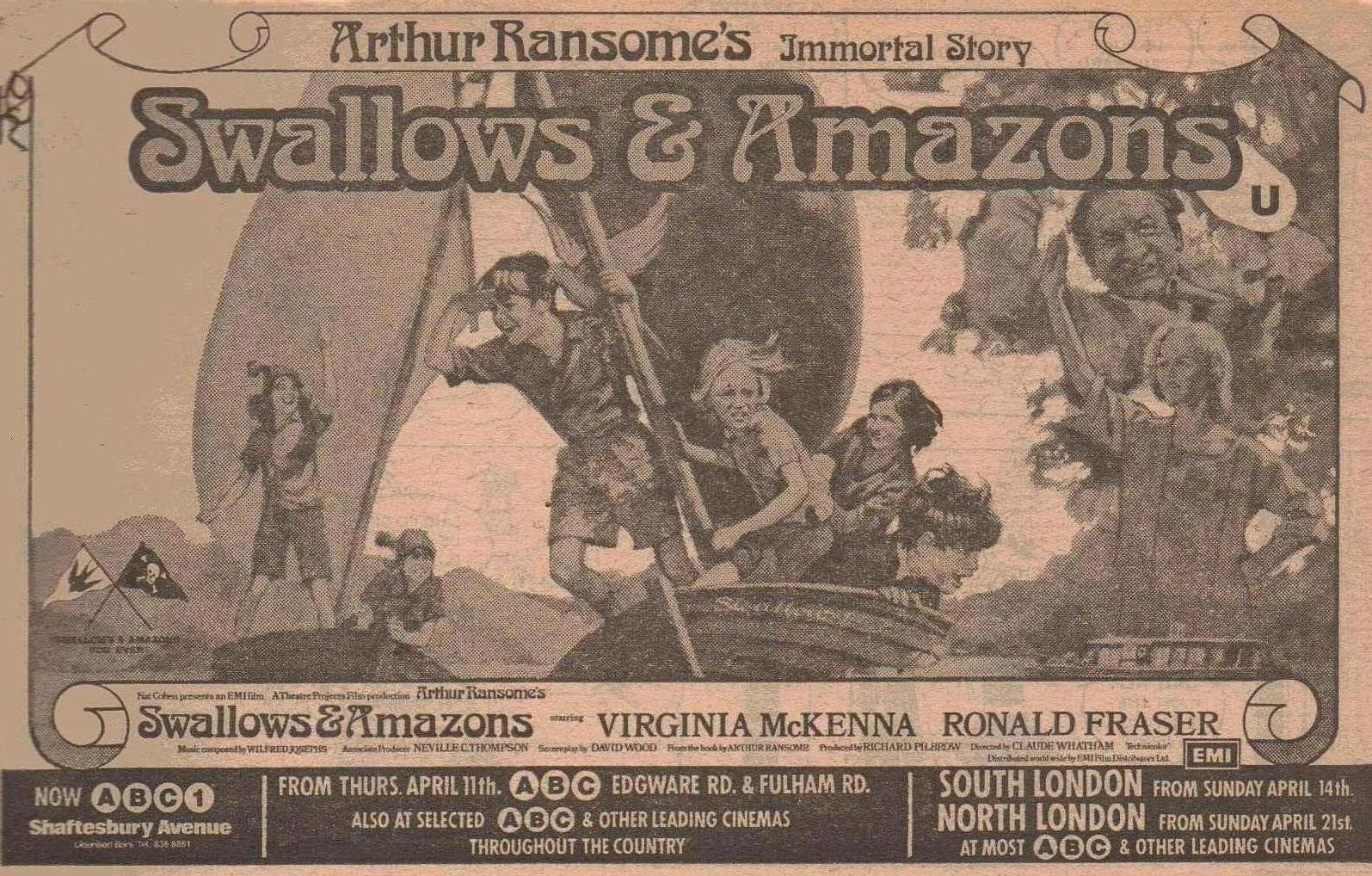
Kit Seymour, Lesley Bennett, Simon West, Sophie Neville, Stephen Grendon, Ronald Fraser and Virginia McKenna on the newspaper advertisement for ‘Swallows and Amazons’ released in April 1974

A school friend of mine sent me this advertisement. She had found it in a teenage magazine we all read at the time called Tammy and Sandy. There was a similar one in The Sunday Times newspaper – and no doubt many others. Film posters hung in the London Underground and at cinemas throughout the country. Swallows and Amazons was to come out, on general release for the Easter Holidays.

My mother subscribed to a press clippings agency called Durrant’s ~ Durrant’s of Herbal Hill London ECI ~ who, for a fee of £50, sent her all the articles written about the film.  The Prince of Wales told a friend of mine that he never reads the newspapers. I know why. Reading about yourself is upsetting – or can be, especially if the facts are incorrect.  My mother didn’t mind.  She highlighted the bits about me, filling four albums.

After entertaining the Daily Express so nicely in the Lake District this is what they printed about the film. I would  think this is written by Ian Christie (1927-2010) the jazz clarinetist, who had formed the Christie Brothers Stompers with his brother Keith, and became a member of Humphrey Lyttelton’s band. He worked as a theater and film critic for the Daily Express for twenty-six years. Born in Blackpool and a habitue of Fleet Street pubs he held fiercely Left-wing views.

‘Kids won’t swallow this watery old tale’ was not good publicity. The same black and white photograph of me appeared on the front cover of The Daily Telegraph with the title ‘One Swallow won’t make a Summer’. Were they right?  The Scotsman said:

The Scotsman ~ 1st July 1974

However, Russell Davies of The Observer, another jazz musician who now presents Brain of Britain on BBC Radio 4,  saw that the film of Swallows and Amazons  had niche. (If you click on the article it will enlarge).

Jack Woolgar, Simon West, Suzanna Hamilton, Sophie Neville and Stephen Grendon in a review by Russell Davies in The Observer 7th April 1974

Others recognised it as an innocent nostalgia trip ~

Others just loved it:

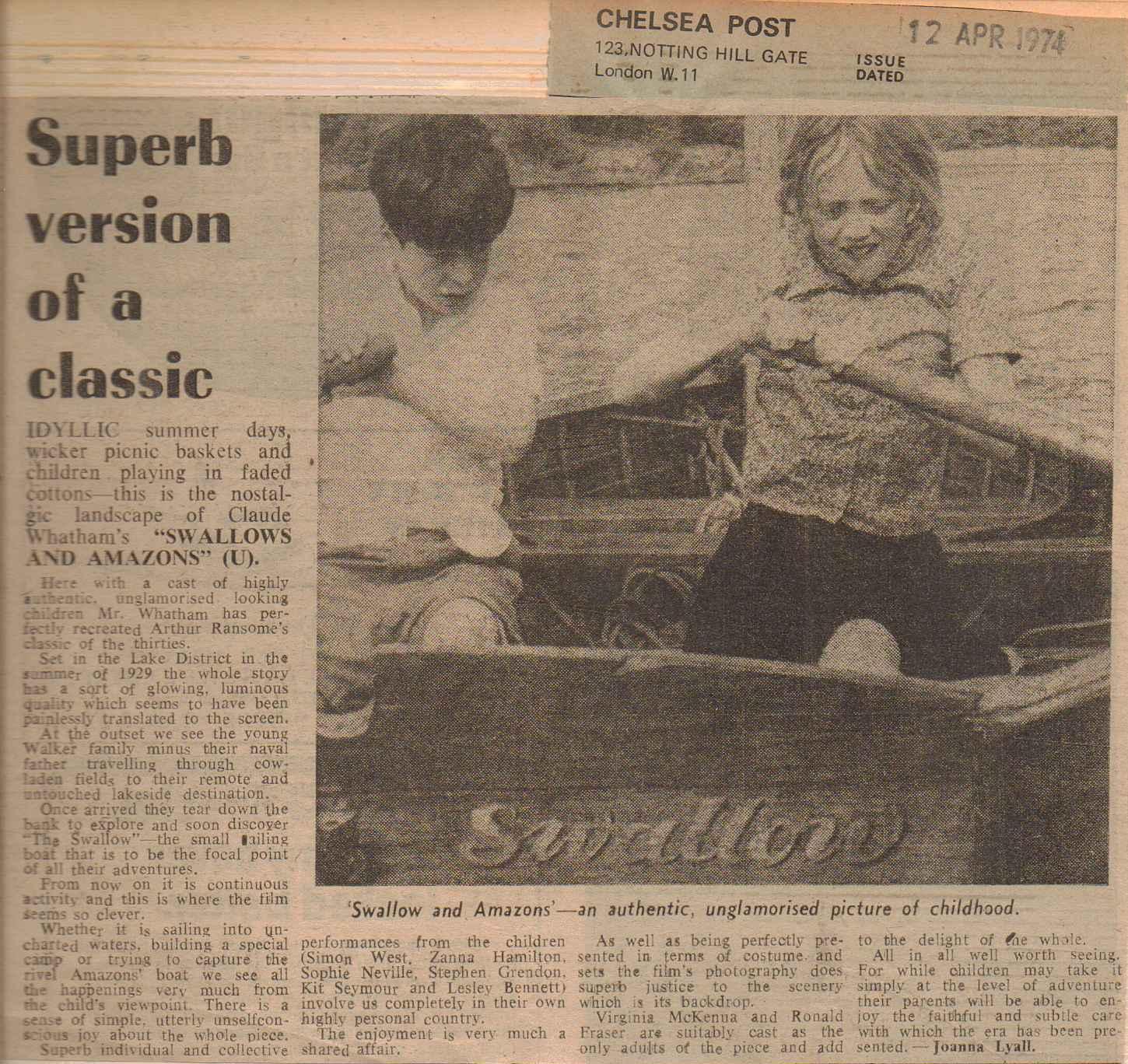
Stephen Grendon and Sophie Neville appearing in Chelsea Post 12th April 1974

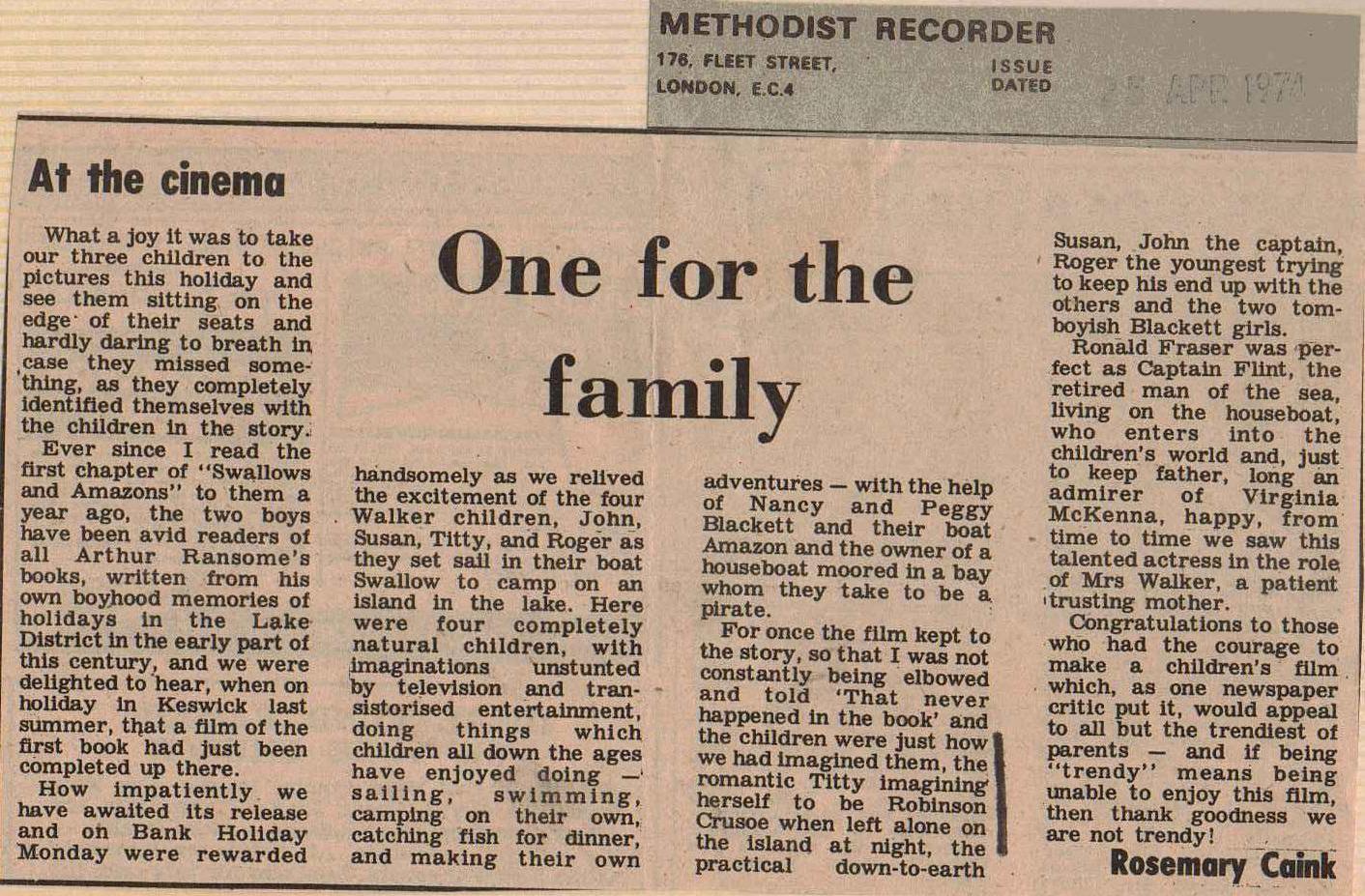
Rosemary Caink said that her three children, ‘completely identified themselves with the children in the story.’

My favorite article wasn’t found by Durrant’s. It was written in The Brownie and must have been sent to me by a fan.

Suzanna Hamilton, Stephen Grendon, Sophie Neville and Simon West, appearing in an article published in ‘The Brownie’ ~ 27th March 1974
Please click on the article to find out more about the Brownies.

I have many more articles ~ please let me know in the Comment box if you would like to see more. Otherwise I will move on to write about how the public responded and what happened next.

The dangers of filming discussed during our last days making ‘Swallows and Amazons’ on 10th July 1973

Claude Whatham showing the 16mm camera to Simon West and Sophie Neville. Sue Merry and Denis Lewiston.
Director Claude Whatham letting Simon West and Sophie Neville handle the 35mm Ariflex. Sue Merry and Denis Lewiston can be seen behind us.

When Suzanna Hamilton brought me the diary she kept during the filming of Swallows and Amazons we had time to reflect on the seven weeks we spent together in the Lake District during that far off summer of 1973.

‘We were beautifully looked after,’ she said. ‘I mean we were really well cared for. Look – Jane took me fell walking.’  Our diaries record that our local driver Jane McGill also went to endless lengths to make things fun for us – ever with safety afore-thought.

Jane Grendon, Sten’s mother and one of our two chaperones who took us fell walking.

She was right. Jane Grendon, who was Sten’s mother, and Daphne Neville, my mother, were our official chaperones. They worked day and night with very little time to themselves.

Daphne Neville in 1973

Both had left younger children and animals at home in Gloucestershire with their husbands, which can’t have been easy.

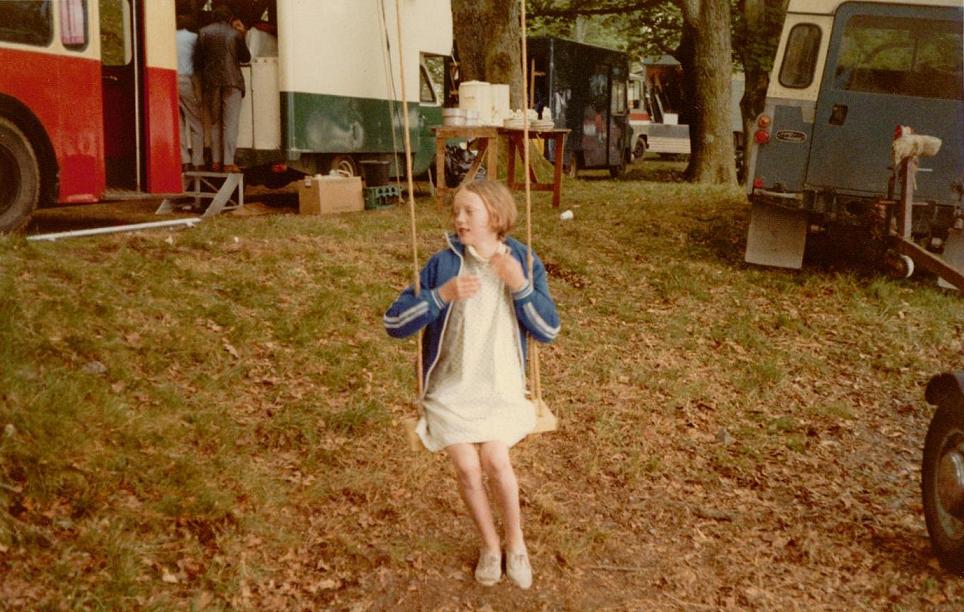
Sophie Neville on location film Swallows and Amazons in 1973
A photo taken of the swing at our unit base opposite Peel Island earlier in the filming when the school bus and caterers were still around

Mum later wrote an article for Woman magazine saying that being a chaperone was ‘Fascinating, Fattening and Fun’, but it must have been exhausting. It would have been quite a trial preventing us from getting sunburnt let alone keeping us entertained.

Daphne Neville, having organised Sophie Neville and Simon West into track-suits, life jackets, sun hats and the safety boat in 1973

When we had to do anything scary or unpleasant during the filming of Swallows and Amazons, such as walk through scratchy brambles, Claude Whatham would assuage any moans by awarding us ‘Danger Money’.  It was a huge encouragement. He gave me £2.00 for being good about diving into the chilly water for the swimming scenes.  It was a lot of money back then. My mother would make a careful note of it whilst we were still in costume.

A list of who had earned Danger Money written by my mother on the back of a Script Revision page

We spent our gains in Ambleside buying presents to take back for the stay-at-homes. I think we might have received a little more after Swallow was nearly mown down by the Windermere Steamer, an incident which had actually been dangerous. I am not sure what Kit and Lesley had been doing to receive £1 each. They may have just got wet and cold sailing.

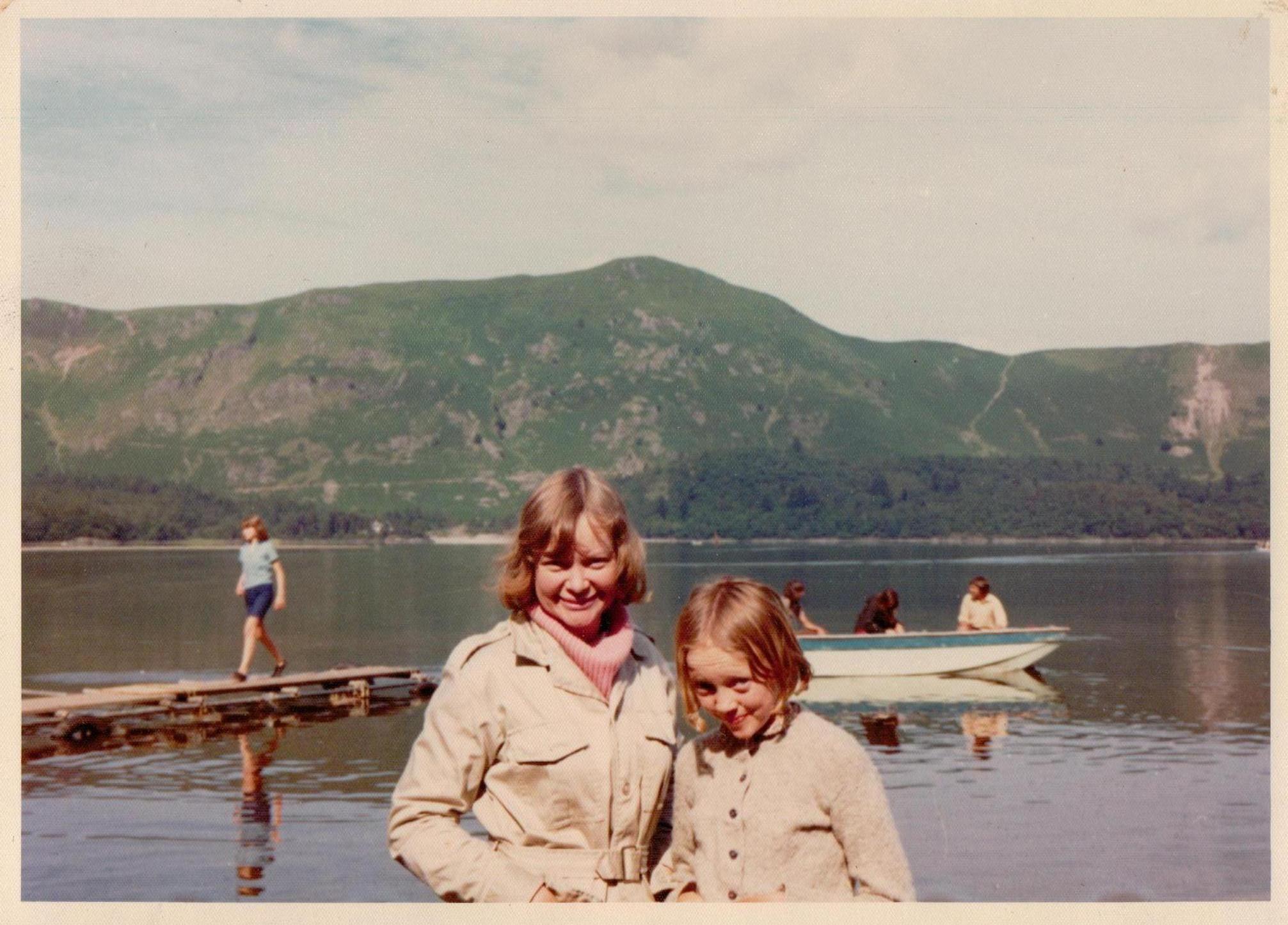
Daphne Neville with Sophie Neville while filming 'Swallows and Amazons' in Cumbria
Daphne Neville with Sophie Neville while filming ‘Swallows and Amazons’ in Cumbria. Kit Seymour is walking along the jetty in the background.

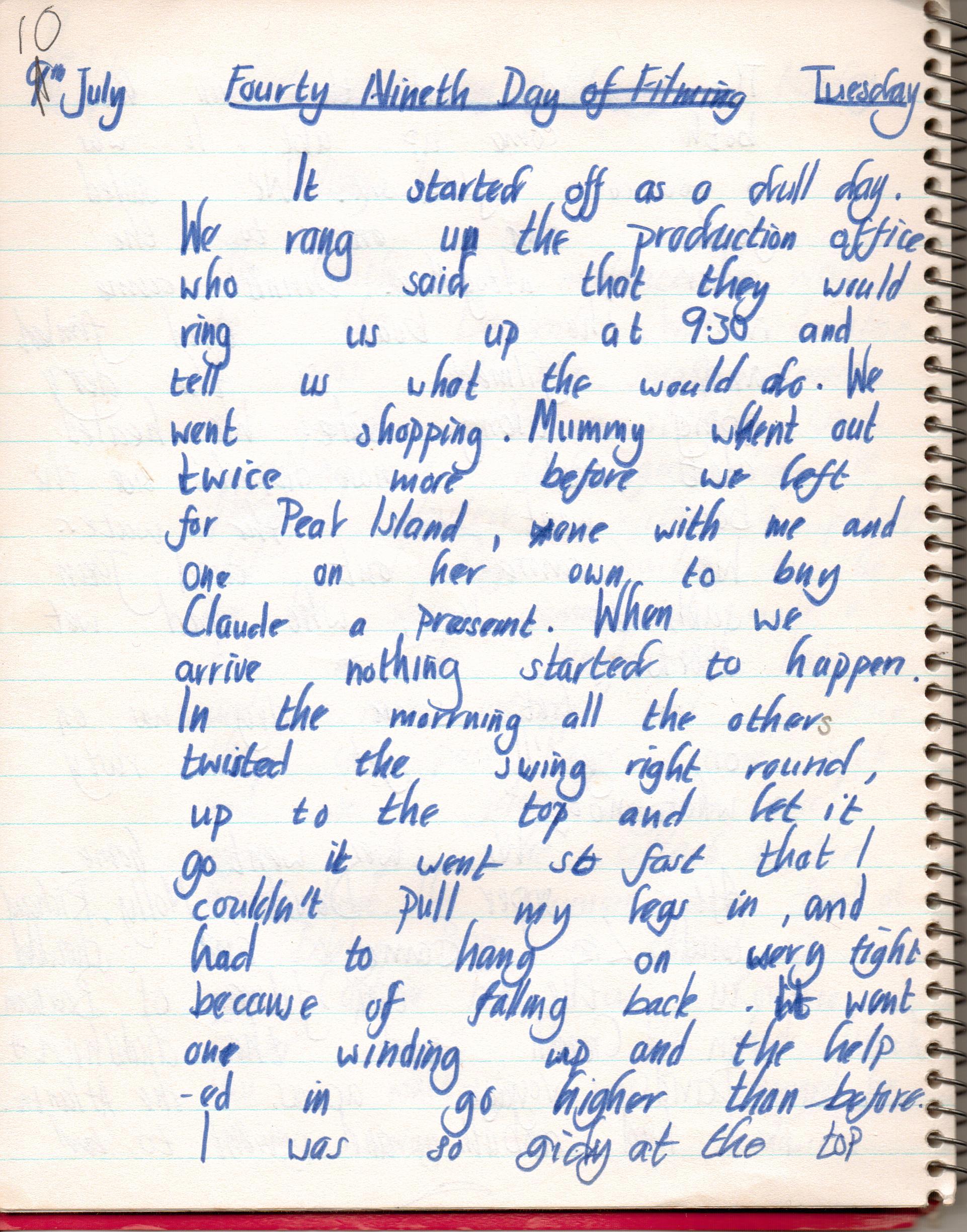
After all the rushing about in boats, the risks taken clambering from one vessel to another and inevitable dangers that we faced out on the water, it was the boredom involved in filming that proved most dangerous; children’s games that went terribly wrong ~

My diary on the filming of the moive 'Swallows and Amazaons' in the Lake District, Cumbria kept in 1973

My diary on the filming of the moive 'Swallows and Amazaons' in the Lake District, Cumbria kept in 1973

My diary on the filming of the moive 'Swallows and Amazaons' in the Lake District, Cumbria kept in 1973

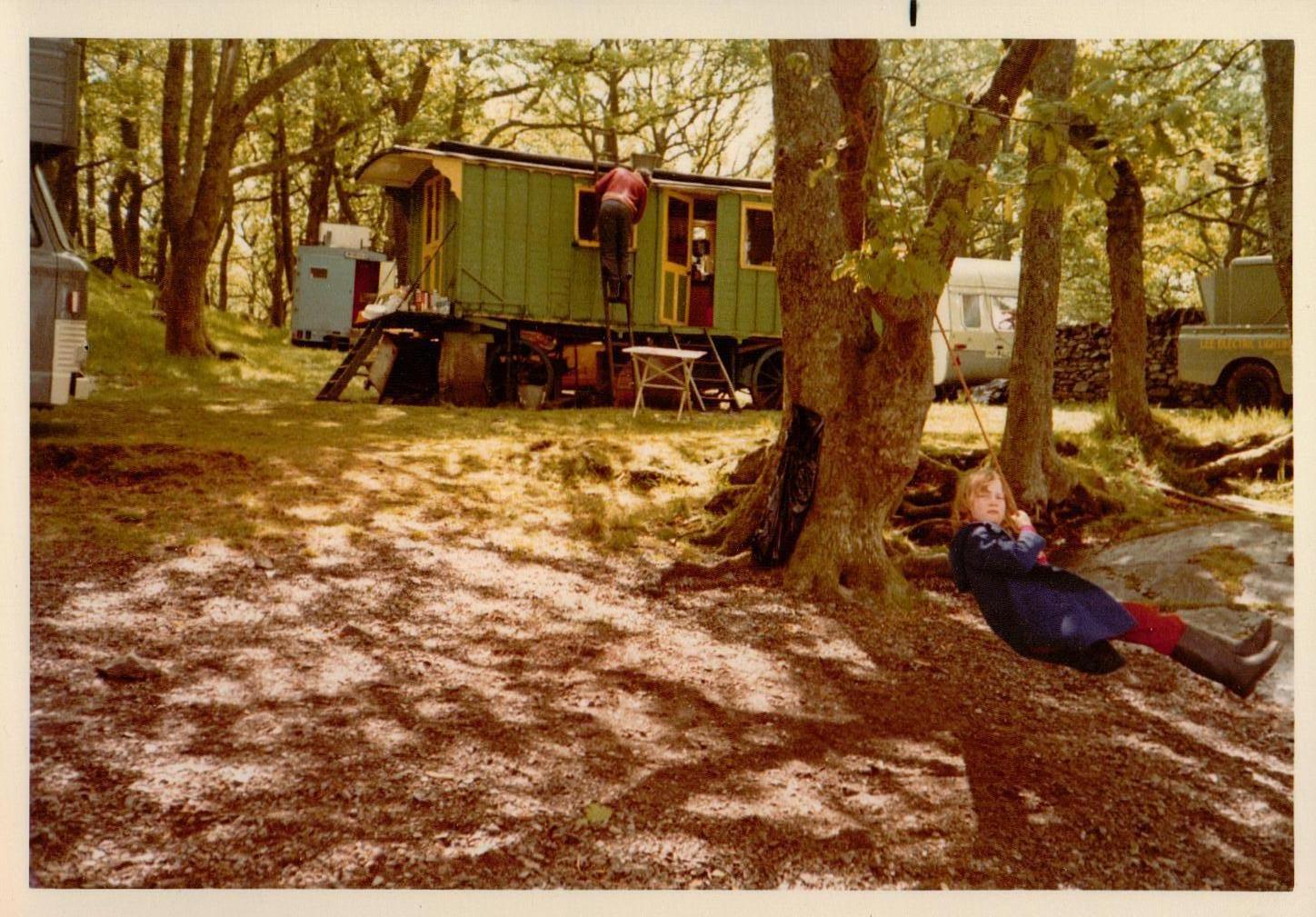
This was the swing in question, strung from a tree on the shores of Coniston Water opposite Peel Island where a couple were living in a wooden caravan. The white ‘Make-Up’ caravan, that had previously been used as a dressing room for Virginia McKenna, and later Ronald Fraser, is parked beside it. It was there that I was sent to lie down.

A snap shot taken earlier in the year of my little sister on the swing at the Unit Base opposite Peel Island ~ photo: Martin Neville

It was a shame that the baseball game Molly organised ended so abruptly. We enjoying it and longed to keep playing but she realised that it could so easily have been one of us who ended up with a black-eye.

Stephen Grendon, longing to climb a tree whilst in costume

At one stage we all got into whittling wood. Bod Hedges, the property master, made a number of props on location. Different versions of the Amazons’ bows and arrows were carved from hazel on the banks of Coniston Water. He also made forked uprights for the fireplace and various stakes for the charcoal burners’ scene. Suzanna bought a penknife with her Danger Money and became quite a keen carver until the knife slipped. Jean treated the cut finger with such a massive bandage that Claude put a firm stop to any future whittling. It had been the one thing that kept us quiet. We were active children yet not allowed to climb trees or get wet. Instead Lesley Bennet plucked away at a tapestry and I painted pictures.

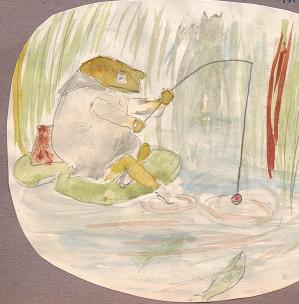
A bad copy of Beatrix Potter’s Jeremy Fisher Frog, looking not unlike Arthur Ransome.

Possibly the biggest danger was getting too fond of the primary objective – catching the bug that is film-making. Richard and Claude still had a few vital scenes to record and yet the weather forecast was bleak.

Richard Pilbrow and Claude Whatham at The Secret Harbour on Peel Island, Coniston Water
Producer Richard Pilbrow with Director Claude Whatham in their wet weather gear at The Secret Harbour on Peel Island, Coniston Water

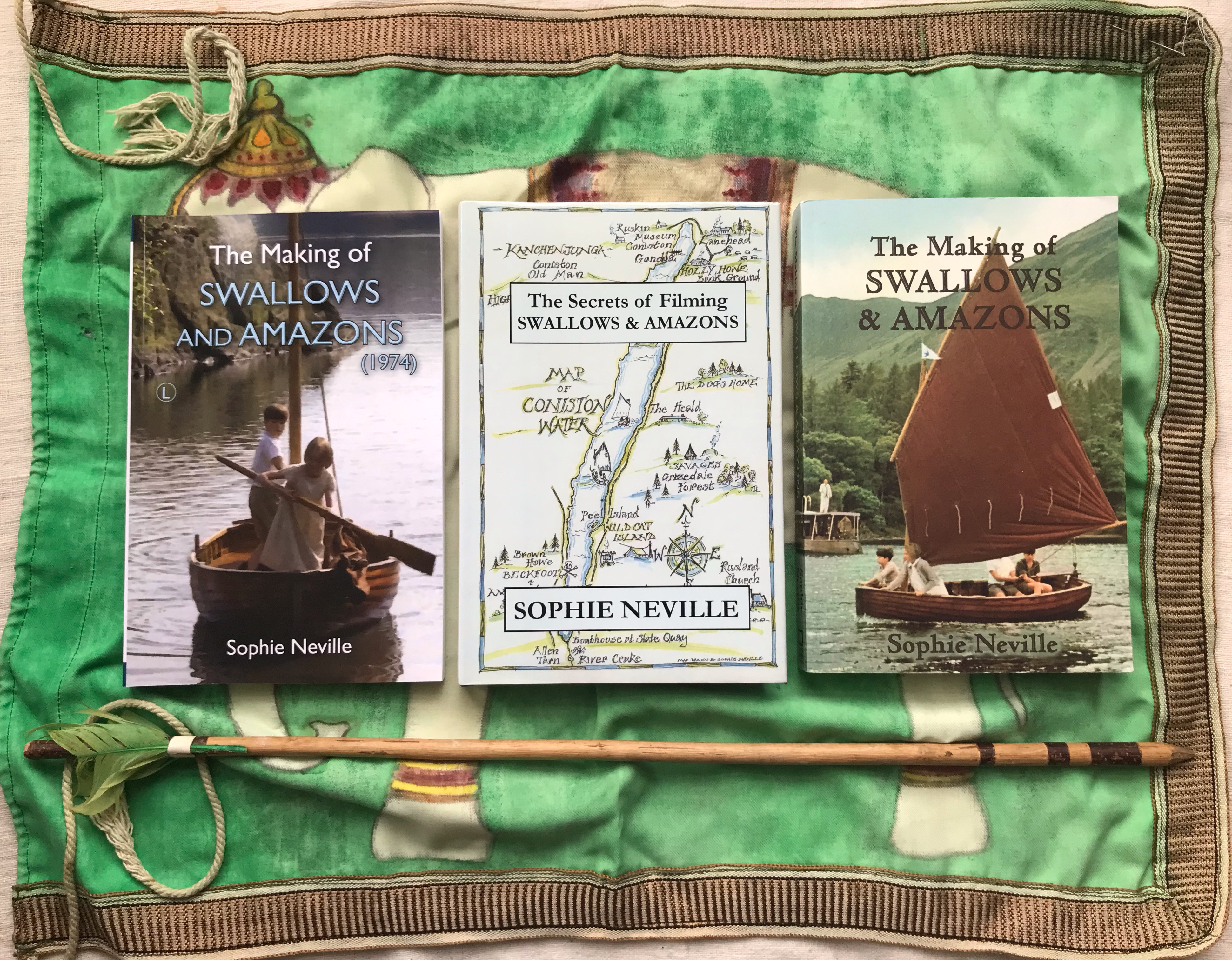
You can read more in ‘The Making of Swallows and Amazons’ available in different versions that can be for sale online here

'The Making of Swallows and Amazons (1974) by Sophie Neville'
Different editions of ‘The Making of Swallows and Amazons (1974) by Sophie Neville’

‘We sailed the length of the lake’ ~ filming Swallows and Amazons on Derwentwater on 9th July 1973

Sophie Neville as Titty Walker with Stephen Grendon as the Boy Roger and Simon West playing Captain John Walker on Derwentwater
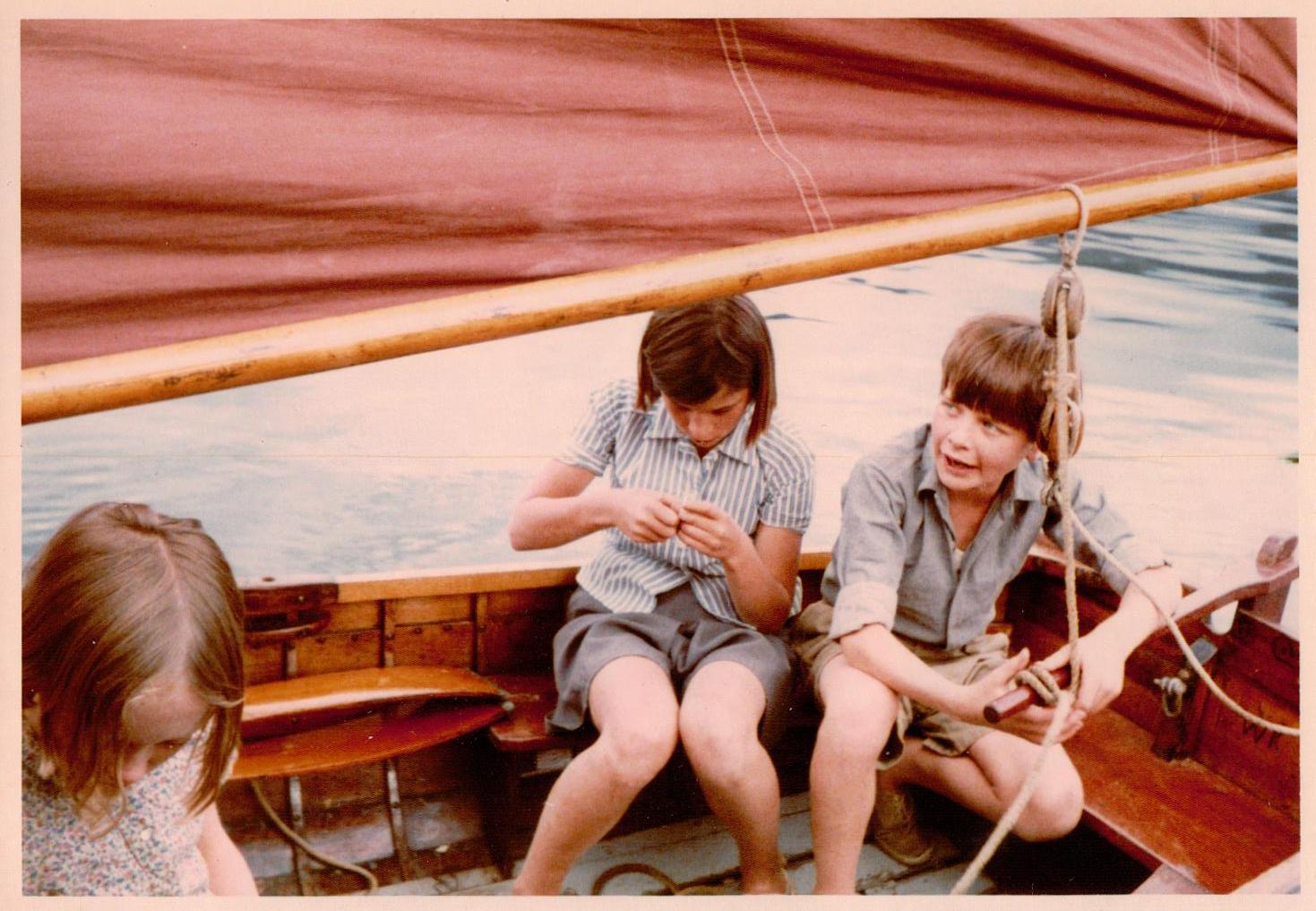
Sten Grendon as the Boy Roger, Sophie Neville as Able-seaman Titty and Simon West playing Captain John, Derwentwater in 1973 ~ photo: Daphne Neville

Monday morning on Derwentwater in the Lake District and we had no lessons. The Cumbrian schools had broken-up for the summer holidays, so we were free to play, or as freely as you can be when you are wearing a costume that can not under any circumstances get wet or dirty.

Terry Smith, Sophie Neville and Daphne Neville on location in the Lake District
Behind-the-scenes: wardrobe master Terry Smith with Sophie Neville and her chaperone outside the Make-up caravan on location near Keswick.

Although Claude Whatham was operating with a skeleton crew our wardrobe master Terry Smith was still getting us into the right kit for each scene. My mother said that he either got muddled or distracted at one point as a whole sequence was shot with all of us wearing the wrong costumes. It caused quite a fuss. It would have been expensive in time and money. She thought he had been given the sack, but this doesn’t appear to have been the case.

Simon West, Stephen Grendon and Sophie Neville whilst on location in the Lake District in 1973 ~ photo: Daphne Neville

One of the secrets of filming ‘Swallows and Amazons’ is that, on this day, Terry Smith adapted Ronald Fraser’s costume and white colonial pith helmet for our property master Bob Hedges to wear. It was he that fired the cannon on the houseboat.

You can tell which shots of the voyage to the island were taken that day as I was missing an eyetooth. One moment it’s there.  In the next shot it’s missing.

The secrets of filming Swallows and Amazons in 1973

A boatman working on Derwent Water in 1973
Clive Stewart our boatman with the houseboat and the dinghies, Amazon and Swallow, on Derwentwater in 1973 ~ photo Daphne Neville

Clive Stewart of the Keswick Launch Co. was one of a number of Cumbrian boatman who worked on the support crew for the filming of Swallows and Amazons in 1973. They played a vital role not only ferrying us to the location but acting as safety boats and keeping modern boats out of shot.

Titty John and Susan on the voyage
Sophie Neville, Simon West and Suzanna Hamilton sailing Swallow

The boatmen were certainly busy once the wind got up on this particular day. Claude Whatham handed over the direction of montage sequence of the Swallows’ first voyage to the island to David Blagden, our sailing director. At last we had the sun and wind for it – if not too much wind. By now were were pretty experienced but the little ship was challenged to the full as wind gusted down from Cat Bells.

Suzanna Hamilton wrote in her diary that, ‘…it was very rough. We thought we were going to do a Chinese jibe but it was OK. We sailed the whole length of the lake.’  What must have been tricky for Simon West was that he had Denis Lewiston, the lighting-cameraman, on board with a 16mm camera, as well as all our clumsy camping equipment. You can see me heaving the crockery basket past the camera on the movie. The result was probably the most exciting sequence in the film, or so my father later declared.

Filming the voyage to the island in Swallow

Jean McGill, our unit nurse and driver, was ever around to scoop us up and keep everyone cheerful when we came in feeling a bit chilly.

Terry Smith and Jean McGill on Derwentwater
Wardrobe master Terry Smith wearing the safety officer’s wetsuit with unit nurse and driver Jean McGill on Derwentwater. Kit Seymour is sitting behind them to their right ~ photo: Daphne Neville

In the evening Richard Pilbrow, his girl-friend Molly Friedel and his assistant Liz Lomax came up to our guesthouse in Ambleside to show us the cine footage they took on the sailing weekend that had been the final audition for our parts. This had taken place in March at sailing town of Burnham-on-Crouch in the Maldon District of Essex when were stayed on board a moored vessel and went out sailing with David Blagden in quite grey, chilly weather. The conditions had been pretty rough then. I remember telling Claude that we ‘helmed like anything’.  I felt terribly embarrassed later when I realised that ‘helmed’ was not exactly what I had meant to say but I don’t think Claude was familiar with sailing terminology at the time.  He would have like the spirit of what I said.

Sophie Neville playing Titty in 1974
Titty’s missing tooth

It had been choppy but none of our days had been as rough as David Blagden’s Atlantic crossing, famously made in his tiny orange-hulled 19 foot yacht Willing Griffin.  I wonder if the footage of this still exists?

Richard Pilbrow must put me right on this, but the theory is that he acquired Swallow that weekend. We were told at the London Boat Show that she was originally the all-purpose run-around dinghy built by and for William King & Sons’ boatyard at Burnham-on-Crouch in the 1930s.  She has the initials WK carved on her transom. They designed her well – a stable little ship with plenty of room inside and no centre-board to worry about. You can see detailed photographs of her on the Sailing Swallow website.

The story continues…. you can read more in The Secrets of Filming Swallows and Amazons available as an ebook for about £2.99 on all the usual platforms:

‘Four out of six missed him and hit me’ ~ filming ‘Swallows and Amazons’ on 8th July 1973.

Sten Grendon irriating Ronnie Fraser
Stephen Grendon sitting on top of Ronald Fraser during a break in the filming of ‘Swallows and Amazons’ on Derwentwater ~ photo: Daphne Neville

I am sure that as children we could be intensely irritating, especially when we were hanging around with not enough to do. Although we had found our lessons tiresome, they’d kept us occupied and out of mischief. It was now a Sunday, right the end of the summer term and the red double-decker school bus was no longer with us. Neither was the large camera box that the crew put Sten in to keep him quiet.

Sten Grendon in the camera box
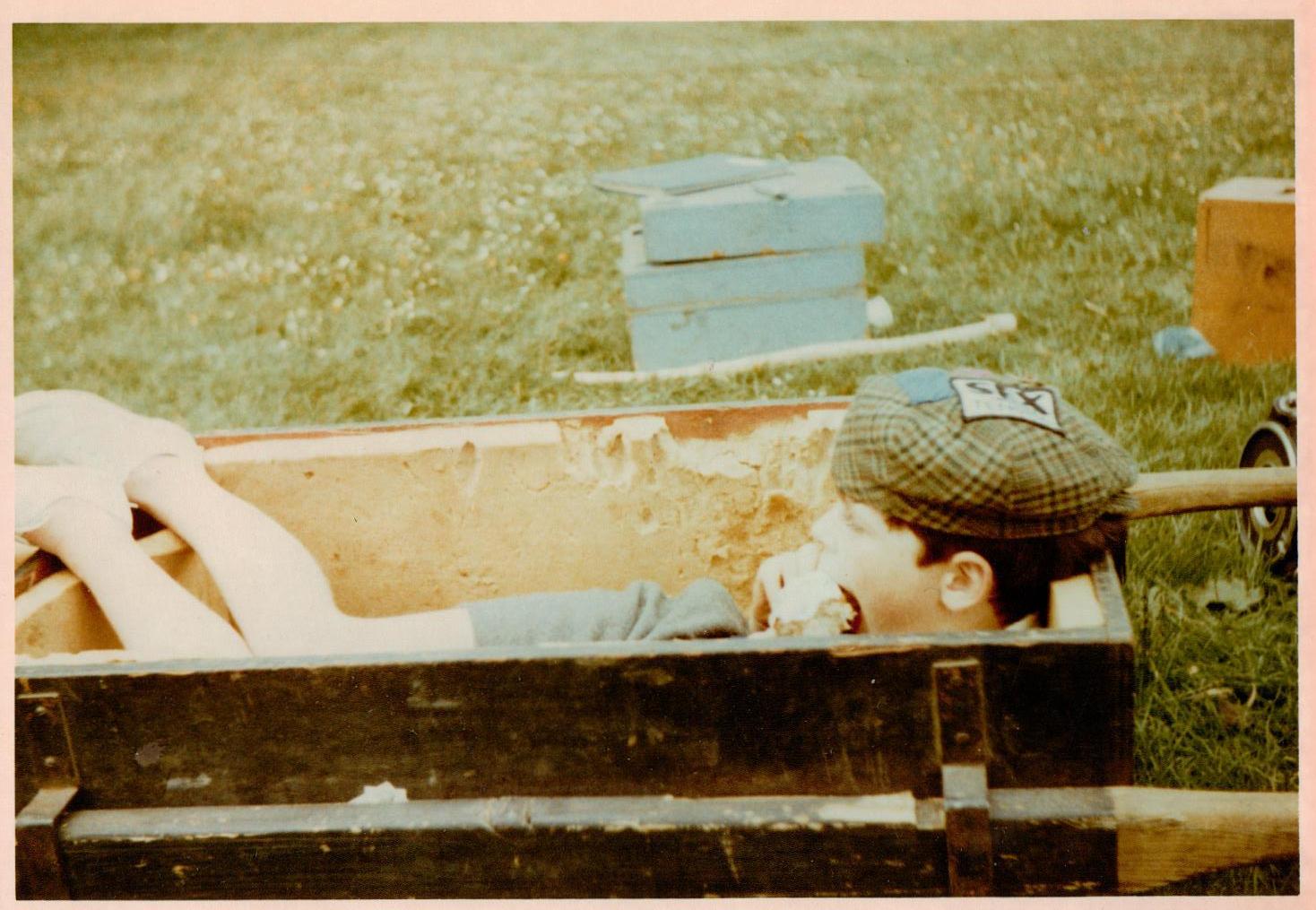
Stephen Grendon resting between set-ups in the Panavision camera box, wearing the Grip’s cap and eating a bun ~ photo: Daphne Neville

Although  the day was full of essential activity, there was no major scene to focus on. It was the last day Ronald Fraser could be with us. Claude Whatham must have had vital shots to pick up so that the scenes set in the houseboat would cut together. It was probably just as well there was no dialogue to record. Ronnie, it has to be said, was a little the worse for wear. Although he managed to play the accordion as Swallow and Amazon sailed into the distance, Uncle Jim was still drunk from the wrap party two days before.

Diary of a young girl on a film set kept in 1973

Then, as a twelve-year-old I wrote:

“…now and again Captain Flint played his accordion to camera. They told us to lie on the floor. Ronald Fraser started throwing books at Sten. Four out of six missed him and hit me. One hit me in the face and the cover fell off. The others he hit. Then he threw all the parrot’s food over us. Plus the tin. ”  Scandalous!

The diary of a young movie actress

No animals were harmed. When the parrot’s cage was lowered into Swallow there was no parrot inside. Instead there were four children finding sunflower seed that had made its way inside their costumes.

Simon West, Suzanna Hamilton and Sophie Neville in Swallow about to leave Captain Flint’s Houseboat. Property Master Bob Hedges is on deck approaching the cannon. Amazon’s white sail can be seen the other side ~ photo: Daphe Neville

My father was not pleased to hear that Ronnie Fraser had flung books around the cabin, hitting me in the face. ‘They were valuable first editions!’

Stephen Grendon, Sophie Neville, Suzanna Hamilton and Simon West with the parrot's cage
Stephen Grendon, Sophie Neville, Suzanna Hamilton and Simon West with the parrot’s cage, standing-by to sail away from the Houseboat ~ photo: Daphne Neville

Our little ship still had much work to do. David Blagden was with us, making plans with Claude and Denis Lewiston to film more shots of us sailing in, what we hoped, would be sunny weather.

The Swallows about to lower sail having come alongside Captain Flint's Houseboat
The Swallows about to lower sail having come alongside Captain Flint’s Houseboat ~ photo: Daphne Neville

Claude was desperate to get the shot of us arriving for the first time at the Peak of Darien ~ Friar’s Craig on Derwent Water. He wanted to capture this just before the sun went down. Peter Robb-King, the Make-up Artist was insistent that the tans we had naturally gained over the summer be toned down.  He had no help and preparation time had not been scheduled. Dabbing the four of us with a tiny sponge took ages. I don’t know why he bothered with my legs, as I really hadn’t changed colour, but he was a perfectionist. Mum kept saying that it was getting so dark no one would ever notice. ‘Who’s going to be looking at your legs?’ as Nancy Mitford’s nanny would have said.

By the time we were ready the sun had set. Claude missed the chance to film this vital scene. Again. It was the second time we had arrived too late for it to be captured.

Did we feel silly travelling back to Ambleside in full costume? We were cheeky and full of beans one minute, shy the next. It is difficult to reach the balance between becoming confident and being over confident when you are twelve years old. But, we were learning, and we learnt a great deal on those days spent out on the water in the Lake District.

This home-movie footage my mother shot shows the actors and crew relaxing after lunch on the shore of Derwentwater in Cumbria. Suzanna Hamilton, Kit Seymour, Simon West and Sophie Neville wait for Ronald Fraser, playing Captain Flint, who walks down the jetty and leaves for his houseboat with hair stylist Ronnie Cogan and make-up artist Peter Robb-King. Sophie Neville can be briefly seen sitting in the motor boat wearing the yellow Donny Osmond hat. Daphne Neville appears at the end presumably having handed her camera to someone else.

You can read more about our adventures in different edition of ‘The Making of Swallows and Amazons’ available online and from Waterstones. Do, please leave a review.

'The Making of Swallows and Amazons (1974) by Sophie Neville'
Different editions of ‘The Making of Swallows and Amazons (1974) by Sophie Neville’

Sophie Neville will be giving talks on the making of Swallows and Amazons at the Southampton International Boat Show this September.

Southampton International Boat Show 2023