If you want to see what Sophie Neville, who played Titty Walker has been doing, please click here.
Sophie Neville in ‘Swallows and Amazons’ (1974) by the film poster artist Arnaldo Putzu
If you are interested in the BBC serial of ‘Coot Club’ and ‘The Big Six’, originally titled ‘Swallows and Amazons Forever’ please read on.
Caroline Downer, Rosemary Leach and Henry Dimbelby
It is almost thirty years since we made the BBC adaptation of Arthur Ransome’s books Coot Club and The Big Six on the Norfolk Broads. The eight-part drama serial was filmed over three months during long hot summer of 1983. You can see from our faces how everyone made the whole experience enjoyable. It was ten years after we had made the movie ‘Swallow & Amazons’ but the atmosphere and the camaraderie felt similar.
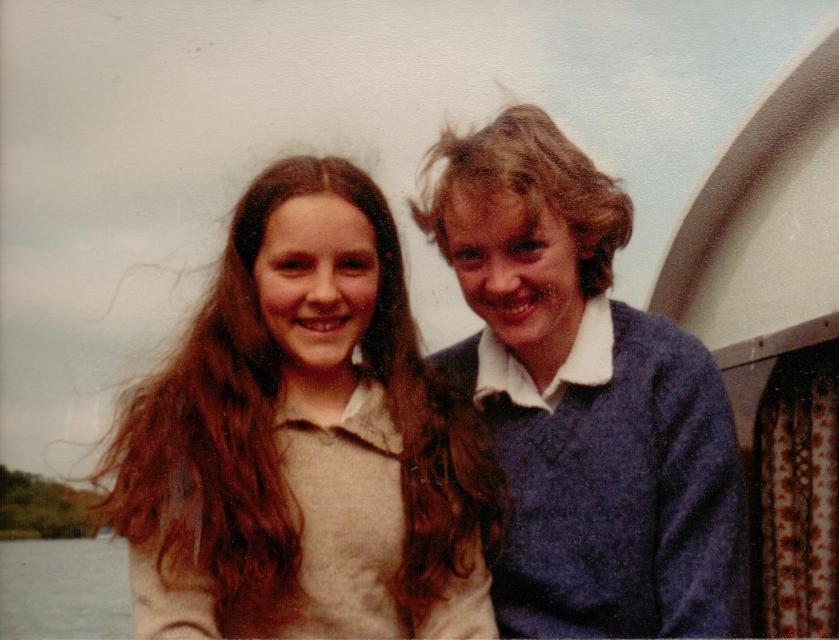
Caroline Downer, who played Dorothea with Sophie Neville who played Titty Walker in the 1974 movie of ‘Swallows and Amazons’, seen here in 1983
Caroline Downer, who played Dorothea Callum so professionally, finally took out her plaits for good and returned to school – her real school rather than the boat where she had received lessons whist we were filming. She had done so well, holding her own with a cast made up predominantly of boys by the time we started filming The Big Six. A year or so after the series was broadcast she wrote to me of her plans for the future. I am ashamed to say that I was so busy working on Doctor Who that I didn’t reply. I can’t think why I tarried. She was far more important to me than Doctor Who. Caroline now teaches drama, is an LRAM examiner and puts on the most wonderful musicals. Hopefully she can draw on something of what she learnt during those months in East Anglia spent working with so many great British actors.
Henry Dimbelby while playing Tom Dudgeon in 1983
Despite the pressures and stress of filming, nothing flustered Henry Dimbelby. He was easy-going and optimistic – great fun to have around. He had no ambition to act but did such a good job. His parents were wonderful. Instead of going to Devon, where they kept a gaff-rigged boat, they rented a house on the North Coast of Norfolk for their summer holiday in 1983 so as to be near our locations. I remember driving Caroline and Henry up on a unit day off only to find Jonathan Dimbelby there too, with his wife Bel Mooney who I chatted to when we went for a walk before lunch. On the kitchen table back at the house was a huge colourful sausage and pasta salad made by Josceline Dimbelby, Henry’s mother. It was the first home-cooked meal I’d had for weeks, and was hugely appreciated. I was mesmerised by the colours and textures, the whole inventiveness of a salad made for a large family.
While Henry’s grandfather, Richard Dimbelby the World War II correspondent, went into newspapers and his father, David Dimbelby, worked for the BBC as a News reporter, presenter and commentator, you could say that Henry followed his mother. He trained as a chef – and became an innovative one, producing books on food and appearing on the occasional cookery program. In 2004 he opened Leon, the restaurant in Carnaby Street in central London that specialises in serving seasonal fast-food that is both delicious and good for you. Founded with Allegra McEvedy and John Vincent, Leon soon became popular. It was awarded ‘Best New Restaurant’ at the Observer Food Monthly Awards six months after opening. I believe Henry and his partners now have a chain of ten outlets and that their recipe books are an inspiration to many.
Claire Matthews as she appeared in ‘Coot Club’
Claire and Sarah Matthews, the twins who played Port and Starboard in Coot Club, went on to play Eve and Alexandra in the 1984 TV mini series Master of the Game , which starred Angharad Rees, David Suchet and Fernando Allende. They still live in Sussex and are very close. Claire has taken up running in all weathers.
Mrs Julie Walpole (centre) with her daughter, appearing as Extras in the drama
The Walpoles have written in! It was so good to hear from them. Nicholas Walpole, who played Joe, joined the Royal Navy and served on HMS Roebuck from 1989-90 as a survey recorder. A friend of his said he was teased mercilessly on board about his acting background. Many-a-time a chorus of ‘Swallows and Amazons forever’ would ring out when he walked into the Mess. Nik is now married, lives in Coventry and has three grown up children, one of whom wants to act. His mother still enjoys living in rural Norfolk. You can read their comments at the bottom of previous posts.
Simon Hawes who played George Owden, seen here in a Health and Safety helmet I made him wear while filming at Horsey Mill in 1983
I am afraid that I haven’t seen Simon Hawes, who played George Owden, or the other boys from Norfolk since we finished filming. They did so well. Playing a baddie isn’t easy even with Make-up and Hair Department straining to help.
Richard Walton, who played Dick Callum, now lives in Los Angeles – he has written in, below. Mark Page, who played Bill, now lives on the coast of Turkey. I wonder if taking part in the BBC serial influenced their decisions to emigrate.
Richard Walton who played Dick Callum, walking barefoot in a field behind the station
We spent long days together, often out on the water. Someone once explained to me that when you are camping and gadding about in boats, generally leading an Arthur Ramsome style life, you tend to laugh more. As a result more endocrines get released into your system, relationships are forged and bonds made. It has to be said that the boy who made us laugh more than anyone else on the film crew was Jake Coppard, who played Pete, the shortest of the Death and Glory boys. Although the character he played could be serious Jake was always finding something amusing or someone to imitate. Sam Kelly got on with him particularly well, helping him through the scene when Pete falls in.
Jake was such a talented actor. I gather he went on to appear as Charlie in a television drama directed by Tony Virgo called Travellers by Night (1985) , which featured Neil Morrissey who became so well known when the comedy series Men Behaving Badly proved a success. The lead role of Mrs Baker in Travellers of the Night was played by Jo Rowbottom who, by coincidence, had played Katie Leigh, Simon West’s mother in Sam and the River back in 1975.
Mary Soan with Jill and Jim Searle on the Teasel, towing the Titmouse on South Walsham
Jim and Jill Searle of the Norfolk Country Sailing Base in Ludham helped us find traditional boats for the BBC adaptation of Coot Club and The Big Six set on the Norfolk Broads. Jill kindly sent me a copy of this photo taken of Lullaby just after she was chosen to play the Teasel back in 1983. Her costume consisted of a false transom, which is still at Hunter’s Yard in Ludham today.
The Teasel’s transom ~ photo: Roger Wardale
Roger Wardale took this photograph included in his book, Arthur Ransome on the Broads , which Amberley Publishing brought out in full colour. He tells of Arthur Ransome’s half-dozen or so holidays on hired yachts and of the young people who sailed in the fleet, including Titty and Taqui Altounyan.
Roger found out that the Ransomes hired a 23′ Fairway’ yacht from Jack Powles of Wroxham. This had a Primus stove with a special cooking locker in the well. It sounds well kitted out with a wash-basin and self-emptying WC in a separate compartment. The three Somnus spring-berths had drawers underneath and there was even a wardrobe. Like the Teasel, she was built of mahogany with a ‘bright varnish finish’ and, given a fair wind, would have zipped along at quite a speed.
Roger said that he spent six days trying to find places Arthur Ransome visited that had not changed since the 1930’s. He found it difficult. What he did discover was the dinghy used to play Titmouse in the BBC TV series. She can still be visited at Hunter’s Yard.
The Titmouse at Hunter’s Yard in Ludham ~ photo: Roger Wardale
It is still possible to hire the mahogany hulled, gunter-rigged yachts much as Arthur Ransome and his wife did in the 1930’s, together with a sailing dinghy or rowing boat. There are fourteen sailing cruisers in the Hunter’s fleet and none have an engine. They have lifting cabin tops so you have more headroom when you moor up. Lullaby, built in 1932, is 28ft long with four berths. Her mast can be lowered with counter weights so she can be taken under bridges with a clearance of six foot.
Roger Wardale says that in the 1930’s, many of the yachts had a ‘self-acting’ jib but Ransome considered it too large. There were times when he lowered it, only to find ‘he sailed better without it!’ They still have self-acting jibs but the size may have been altered.
At Horning Staithe today ~ photo: Roger Wardale
Roger also found a cruiser similar to Janca, the 1930’s cruiser who played the part of the Margoletta. She was skippered by Julian Fellowes in his glorious role as a Hullabaloo, the spiteful, arch-baddie of Coot Club.
A large 1930’s Broads cruiser similar to the one we used as the Margoletta in ‘Coot Club’ ~ photo: Roger Wardale
Back in 1983 we were hugely helped by a number of Norfolk boatmen who knew the broads well.
Mark Page, who played Bill getting help fixing something
You will have to let me know the name of these gentlemen who spent long hours helping us in the summer of 1983.
The skipper of the vessel used as a camera boat on ‘Swallows and Amazons Forever!’
Filming from one boat to another is tricky and much patience was need. In many ways the easiest boat to film with was the Death and Glory. She can still be found moored somewhere on the Broads.
I well remember setting up this shot for the cover of the abridged version of the two stories, which was brought out by Puffin to accompany the series. It shows the Death and Glory complete with her green chimney. The big secret was that the interior of the cabin was larger than the exterior. we puzzled over Ransome’s drawings only to decide that he had cheated the measurements too.
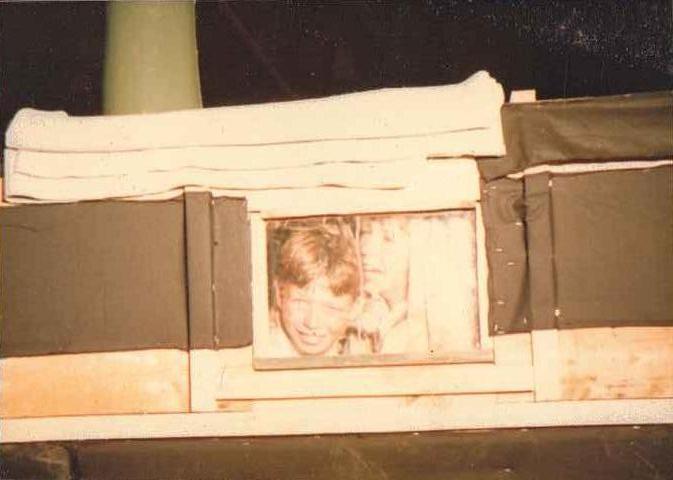
Nicholas Walpole and Jake Coppard looking out of the window of the set that was made to represent the interior of the Death and Glory
Bruce McCaddy and his team built the set inside a modern boat shed where it was kept for ‘rain cover’, since the interior scenes could always be shot if it was wet. It included ‘camera traps’ or sections that could be removed so the scenes could be shot. I never went inside but the boys loved it. In fact the weather was glorious. We enjoyed such constant sunshine in the later part of the shoot that we filmed the interiors when it was dry and so warm the boys got quite over-heated.
Henry Dimbleby, Rosemary Leach, Caroline Downer, Richard Walton with Sarah and Claire Matthews in ‘Coot Club’
If there was a sequence we all enjoyed putting together more than any other, whilst filming Arthur Ransome’s ‘Coot Club’, it was the scene when Williams the pug dog is weighted on the scales outside Beccles Post Office. This was shot, not in Beccles, but in the market square called Church Plain in Worstead, near North Walsham, a village in Norfolk.
The shop was actually a family home belonging to the Howard family, which the design team dressed to look like a Post Office, with jars of sweets installed in the two front windows. It had once been a Post Office, a building with a rounded end between Back Street and Front Street boasting the New Inn, now called The White Lady.
Rebecca Howard, who was 16 at the time, wrote in to say: ‘Our house was called ‘The Old Post Office’. It was a post office in a previous life before we moved there. At the time of filming the post office was on Back Street – part of the house at the other end of the island between Front and Back Street, which also used to be a garage/service station on the Front Street side. The crew were modeling our house on my mum’s birthday – 12 August – they bought her a box of chocolates.’
Either Claire or Sarah Matthews with Joe Water’s secretary Jane
In the story, Port and Starboard surprise the crew of the Teasle by arriving unexpectedly on the back of a motorbike, having hitched rides across Norfolk on a series of historic craft including the Albion. Andrew Morgan, our Director was keen to end the scene with a high shot of the bustling market town, portraying East Anglian life as it was in the early 1930’s.
Rebecca says, ‘The pink house in the photo (with crew pictured) was the village shop, known as ‘Top Shop’ by locals. It closed years ago, but would have been trading at that time.’
Director Andrew Morgan with film cameraman Alec Curtis and his assistant and designer Bruce McCaddie. Production Managers Peter Markham and Liz Mace stand below
Apart from creating the Post Office so beautifully that we were convinced it had always been there, Bruce McCaddie our designer had television ariels taken off houses and yellow lines on the roads obliterated. He also commissioned his Prop Buyer, Dave Privett, to find a number of period vehicles that could be driven through the town.
BBC Prop Buyer David Privett ~ photo taken at a later date
Our Producer Joe Waters was keen on what was refered to in television as production value. ‘Always put your money in front of the camera’, he told me. David Privet did that for him, going to endless trouble to source steam rollers and hay wagons, charabangs and river cruisers to bring life and colour to a period drama. I learnt later when we all worked together on ‘My Family and Other Animals’ shot on location in Corfu what a complete perfectionist Dave was.
Caroline Downer, Sarah Matthews and Henry Dimbleby waiting for the shot to be set up. The camera was on top the mobile generator from Fenners behind them.
Busy crowd scenes are rewarding and look wonderful on screen, but they do take a while to set up. All the drivers had to have short back-and-sides haircuts and change into period costumes. On top of the motor-cycle and side car, which Port and Starboard arrived in, Dave had found a 1929 delivery lorry and several bicycles aswell as vintage motorcars. We also had various passers-by and towns people dressed in costume, armed as you’d expect with shopping baskets or prams. This was all pretty much as you’d expect. I’m not sure who decided that we should add a herd of sheep, but we also had sheep. Black-faced sheep to add a bit of rural life. The idea was they they would be driven through the market square at the end of the scene. Bruce sensibly had portable wooden fencing out-of-vision between the houses so they couldn’t escape.
Henry Dimbleby, Richard Walton, Claire and Sarah Matthews, Caroline Downer and Rosemary Leach with the delivery lorry outside the Post Office.
Our leading lady, Rosemary Leach, took up her position outside the Post Office with the children, and we set up to go for a take with all the vehicles in their start positions. As you can see from the low light in my photographs we were getting to the end of a long day. Everyone on the crew was tired, tempers were getting short and the twins were the only ones left with any energy. But the camera turned over and the Director shouted, ‘Action!’ The vehicles set off. There was then the curious sound of heavy rain. Sheep came not walking but galloping into the market square.
‘Cut!’ yelled the director. The vehicles came to a halt. Bruce and his prop men sprung up, ready with the hurdles. The sheep took one look at them and panicked further. The Dave Privett rushed in to help. There was no where for the sheep to go. They ended up following each other, running round and around a large black motor in the middle of the square. Dave was pinned against the rear bumper. He couldn’t move. The sheep kept on running, round and round. Alec Curtis, having a dry sense of humour, kept the camera running too. The whole sequence was caught on 16mm film.
Ricky King, Dave Privett, Peter Markham and Mary Soan filming ‘Coot Club’, or trying to
Jake Coppard, as Pete, after he fell in the water, enacting Arthur Ransome’s story of ‘The Big Six’
What is the best way to entertain someone who enjoys acting?
Jake Coppard wearing my coat and hat in our support boat on the Norfolk Broads
Even when we had very little space or were waiting around for hours out on the water during the filming of ‘Coot Club’ and ‘The Big Six’, one thing that kept everyone amused was the game of charades. Simply imitating each other also proved hilarious and kept up moral whatever the weather. Since the children who appeared in the drama all enjoyed acting, they proved natural entertainers both on and off-screen.
Mark Page, who played Bill, as ‘Blackadder’.
The experienced actors entered into the spirit of this in a trice.
June Ellis finding a way of being a green parrot whilst in her 1934 costume
The great thing about miming is that it is silent, which was just as well, when we had to keep quiet on set.
Colin Baker as Dr Dudgeon on location in Norfolk
The film crew were wonderful, ever inventive and terribly good at charades.
Make-up designer Sue Bide being a swallow with the help of Paul Higton from the Wardrobe Department
No one was limited by taking themselves too seriously.
Sound Recordist Colin March wearing my hat over his ear phones
Some members of the production team made a tremendous effort to keep up our spirits.
Script Supervisor Di Brooks towards the end of our three month shoot in Norfolk with Henry Dimbleby who played Tom Dudgeon in the 1984 BBC serial of ‘Coot Club’
Julian Fellowes, who played Jerry, told me recently that he so admired Henry Dimbleby for taking part in Swallows and Amazons Forever purely because it was fun, rather than because he wanted to be an actor. I appreciated his indestructible good nature and the fact that he made the three months we spent on location enjoyable, in many ways leading the team, even though he was only thirteen years old.
Of course, what is most amusing, is when the unexpected happens. That is what I will attempt to relate in the next post.
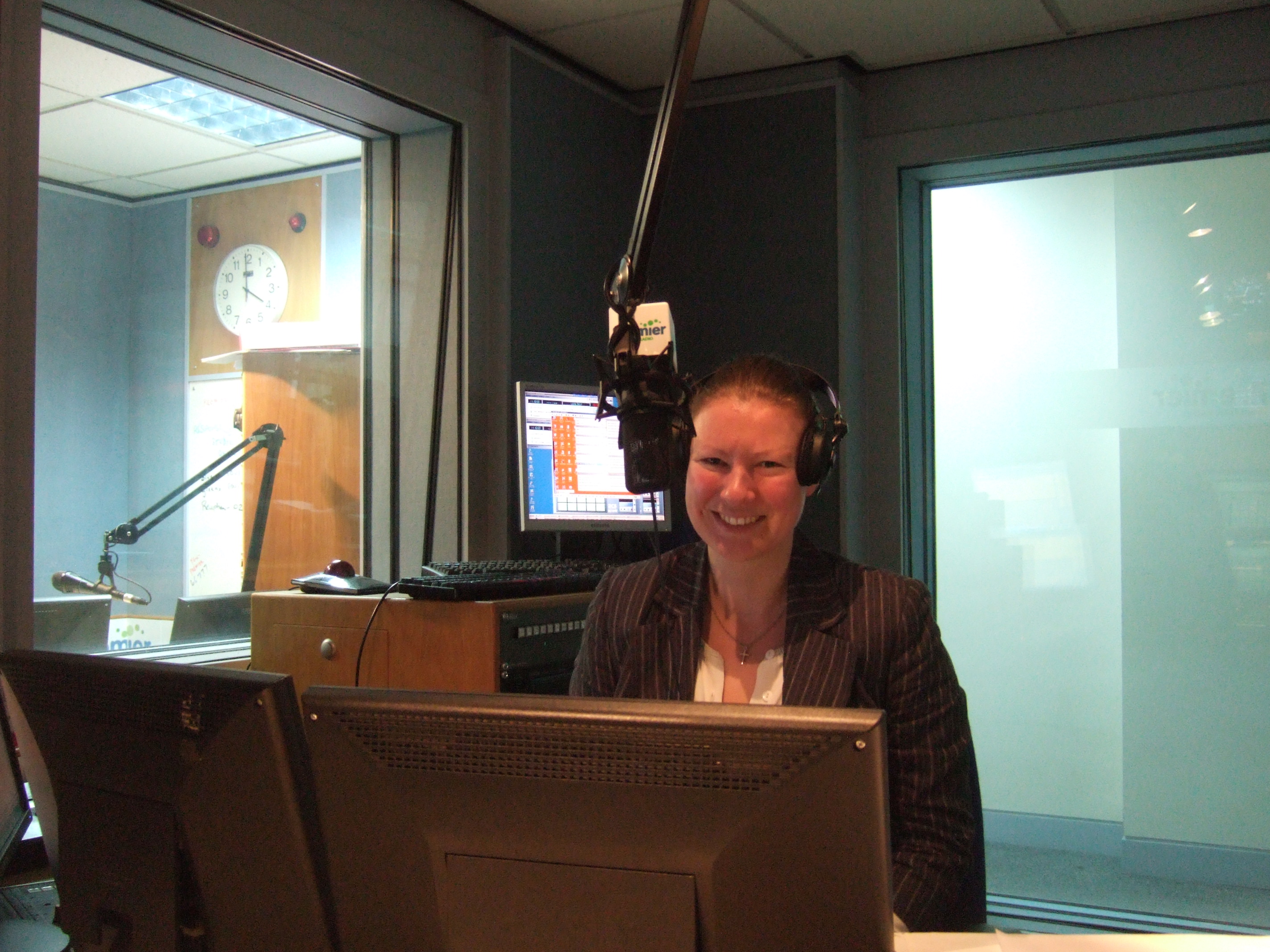
On January 24th I was invited to speak on ‘Woman to Woman’ on Premier Radio. The recorded interview can be heard here. Around ten minutes in, there is a technical fault for a few minutes when a previous show overlapped my recording! Although it could be heard in the background on air, luckily I couldn’t hear it in the studio. Such are the hazards of Live broadcasting. It doesn’t last long.
You can listen to my interview by clicking on this link ~ you will need to use Internet Explorer, or the newest versions of Chrome or Firefox.
All the children who appeared in the BBC serial of Arthur Ransome’s books ‘Coot Club’ and ‘The Big Six’ were delightful. They were committed to the project and focused on their roles in the drama that was released in 1984 under the strand title Swallows and Amazons Forever!
Jake Coppard, Mark Page and Nicholas Walpole who played Pete, Bill and Joe – The crew of the Death and Glory
They enjoyed the process of putting the story together but we were filming on location in Norfolk for three months, which is a long stretch for anyone. It is a very long time when you are aged thirteen.
Jake Coppard in the role of Pete
It can be difficult hanging around on set, waiting for the crew to set up, especially when you have to keep quiet and reasonably still, avoiding the perils of sunburn and scratches. In many ways it’s the most challenging aspect of being an actor, especially when you are constricted by your costume that has to be kept clean and dry.
Filming the Death and Glory at Gay Staithe in Norfolk. Peter Markham, Bruce McCaddie, Alec Curtis and his assistant with the 16mm camera, are being observed by Richard Walton, who played Dick Callum
Watching the film crew record a scene was interesting, and in many ways good work experience, but it was not always possible as they were often out on the water.
Claire Matthews, Henry Dimbleby & Richard Walton whilst filming of ‘Coot Club’
Once the school summer holidays started, we bid farewell to Angela Scott who had given the children lessons while they were on location. She’d been teaching them on a boat most of the time – the blue fibre glass cruiser in the photograph above. It was part of my job to make sure the children rested and were quietly entertained when they weren’t in front of the camera. I thought it important to let them be themselves and build friendships.
Mark Page, Nicholas Walpole and others during the filming
I was very strict – I had to be when we were near water or traffic, but the girls were naturally self-disciplined and boys team spirited.
Joe Waters, who was producing the drama, said that the sun always shone for him. It certainly did. The summer of 1983 was scorching. We had a few rainy days, but the actors where wonderful at helping to keep up moral. The boys adored Sam Kelly, Captain of the Catchalot, who the British public knew so well from his role as Bunny Warren in Porridge and the German Officer in the WWII sit-com ‘Allo ‘Allo. We only had to look his way and we’d all collapse laughing. Sam Kelly is probably now best known for his recent roles in Nanny McPhee and the Big Bang , in which he played Maggie Smith’s husband Mr Docherty, and for taking the role of Grandad in the new Mike Leigh comedy A Running Jump, 2012 but on that far off summer on the Norfolk Broads there were quite a few terrible take-offs of Captain Geering’s German accent. One of his later episodes of ‘Allo ‘Allo was titled ‘Up the Crick Without a Piddle’ which aptly described that particular day in East Anglia.
Sam Kelly with Jake Coppard either in the Catchalot or our support boat
Sam Kelly playing Captain of the Catchalot with Jake Coppard
In the end it was the boys who kept us amused. They were inventive and used whatever they could find and whatever opportunity came along to make me laugh.
Jake Coppard, Nicholas Walpole and Mark page under my umbrella on one of the few rainy days, whilst filming in Norfolk.
You can read more about the making of Coot Club and The Big Six in the DVD extras of this 30th Anniversary edition.
Swallows And Amazons Forever! (Coot Club & The Big Six) SPECIAL EDITION [DVD]
Jim Searle must have given me this lovely photograph of Titmouse, taken when the boys from Norfolk who played the Death and Glorys were given sailing lessons prior to filming in the summer of 1983.
Titmouse has recently been renovated by Hunter’s Yard at Ludham in Norfolk, which was used as a film location in the series and restored to her sea-worthy condition.
Henry Dimbleby resting between takes in the ‘Dreadnaught’.
Tom Dudgeon’s punt, Dreadnaught can also be found at Hunter’s Yard. Henry Dimbleby can be seen here, sitting on the life jacket he was obliged to wear during rehearsals, despite the fact that he jumped into the water in the action to avoid being spotted by the Hullabaloos, the holiday makers who had hired the Margoletta, in reality the Norfolk cruiser Janca.
Bruce McCaddie, our Designer with Prop Master Ricky King in the ‘Cachalot’
This must be the Catchalot. It looks as if our designer, Bruce McCaddie, is sorting out a fishing rod used by the actor Sam Kelly, who was fishing for pike.
Norfolk teacher Angela Scott with the ‘Catchalot’
This is the only other shot I have of the Catchalot, which looks as if it might have been taken up near Horsey Mere. It shows Angela Scott, the children’s tutor making a funny face at the end of the day. You can just see the make-up artist, Penny Fergusson, and what could be Mary Soan on board. Jill Searle may have been there too. She became a great friend of Liz Mace, our Production Manager who had always been keen on sailing.
Pat Simpson of Stalham Yacht Services said that during the filming they one had to take a boat from Regan to Horning overnight when the film schedule changed. I have a feeling it was the Catchalot.
The Death and Glory at Gay Staithe
One of the jobs Bruce McCaddie gave to his construction team was to build the cabin on the Death and Glory, with its flower pot of a chimney. He transformed the look by adding rigging from the mast.
Our Set Designer, Bruce McCaddie using a dressing boat to approach the ‘Death and Glory’ complete with her cabin. Is the ‘Titmouse’ moored alongside?
In terms of set design ‘Coot Club’ and ‘The Big Six’ were rather unusual productions to work on but Bruce loved boats. Instead of being an extra person on the vessel used by the film crew, he would take a period dinghy to gain access to his sets – which of course were often other boats. This run-around boat could then but used in the back to shot, especially if he needed to hide something modern.
The Death and Glory visiting the Norfolk Broad Yacht Club in 2018
An old German Lifeboat found by Pat Simpson washed up on the beach at Southwold was used for the Death and Glory. After the filming, Pat kept it for his sons until 1989 when Professor John Farrington from the School of Geo-Science at Aberdeen University came across it. He took his two children, a boy and a girl aged ten and eleven, down to the yard one half-term as the loved the books and television serial.
‘Get on,’ he said.
‘But what about the owners?’ they asked.
‘You are the owners.’ He’d bought it for them. One New Year they rowed from Stalham to Sutton and back. John Farrington first visited the Broads on a family holiday in 1956 and wanted his children to have the same experience. They now have children of their own and still treasure the Death and Glory.
The Death and Glory with her newly added cabin
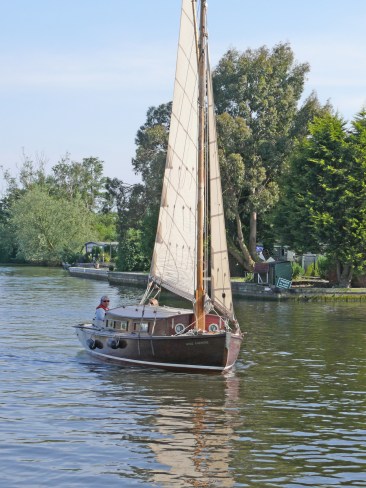
The Teasel was played by Lullaby. Roger Wardale tells me she isa mahogany hulled crusier, a gunter-rigged, 4-berth ‘Lustre’ class yacht built in 1932 and kept at Hunter’s Yard in Ludham, where she is still available for hire.
Lullaby undersail, playing the Teasel with her stage name painted on a false transome
She is similar to the 3-berthed ‘Fairway’ yachts that Arthur Ransome and his wife would hire for holidays on the Broads in the 1930’s.
The Teasel towing the Titmouse – click on this photo to see a close-up of the cockpit
One of the secrets of filming ‘Coot Club’ is that although this looks as if Mrs Barrable is sailing the Teasel, it is not Rosemary Leach but a young man from Hunter’s Yard wearing her costume. Caroline Downer, who played Dorothea Callum, Richard Walton, who played Dick, and Henry Dimbleby who played Tom Dudgeon are in the cockpit, but we also used ‘doubles’ on that day to play Port and Starboard. I found girls two girls from Norwich, Julia Cawdron and Claire Dixon, who played the twins for a day.
The reason for this was that sailing scenes are time-consuming to film and quite tricky to edit together. While our Director, Andrew Morgan, was busy filming the scenes at the Farland’s house with the actor Andrew Burt and the twins, Sarah and Claire Matthews, accompanied by their mother, I was on a second unit headed up by the Producer Joe Waters. Although Joe had directed a huge number of dramas he asked his film editor, Tariq Anwar, up to direct the sequences, knowing that he would be cutting the shots together. He came up to the location with his wife and we took most shots from the camera boat, Camelot.
Tariq Anwar went on to edit Vivaldi, based on Antiono Vivaldi’s early life, starring Elle Fanning, Neve Campbell and Brian Cox. His latest credits include Great Expectations and The King’s Speech as well Down the River featuring Joe Henry, Tom Jones and Hugh Laurie. I haven’t seen the documentary but presume it must include the odd boat.
The great thing is that you can still find some of these vessels today –
Sophie Neville with Titmouse in Norfolk – photo Diana Dicker
Teasel – owned and kept at Hunter’s Yard, Ludham on the Norfolk Broads
Titmouse – owned and kept at Hunter’s Yard, Ludham
Dreadnaught -owned and kept at Hunter’s Yard, Ludham
Death and Glory – owned by the Farringtons – kept at Gerry Hermer’s boat yard on the Norfolk Broads
Sir Gernet – a Norfolk Wherry The Albion
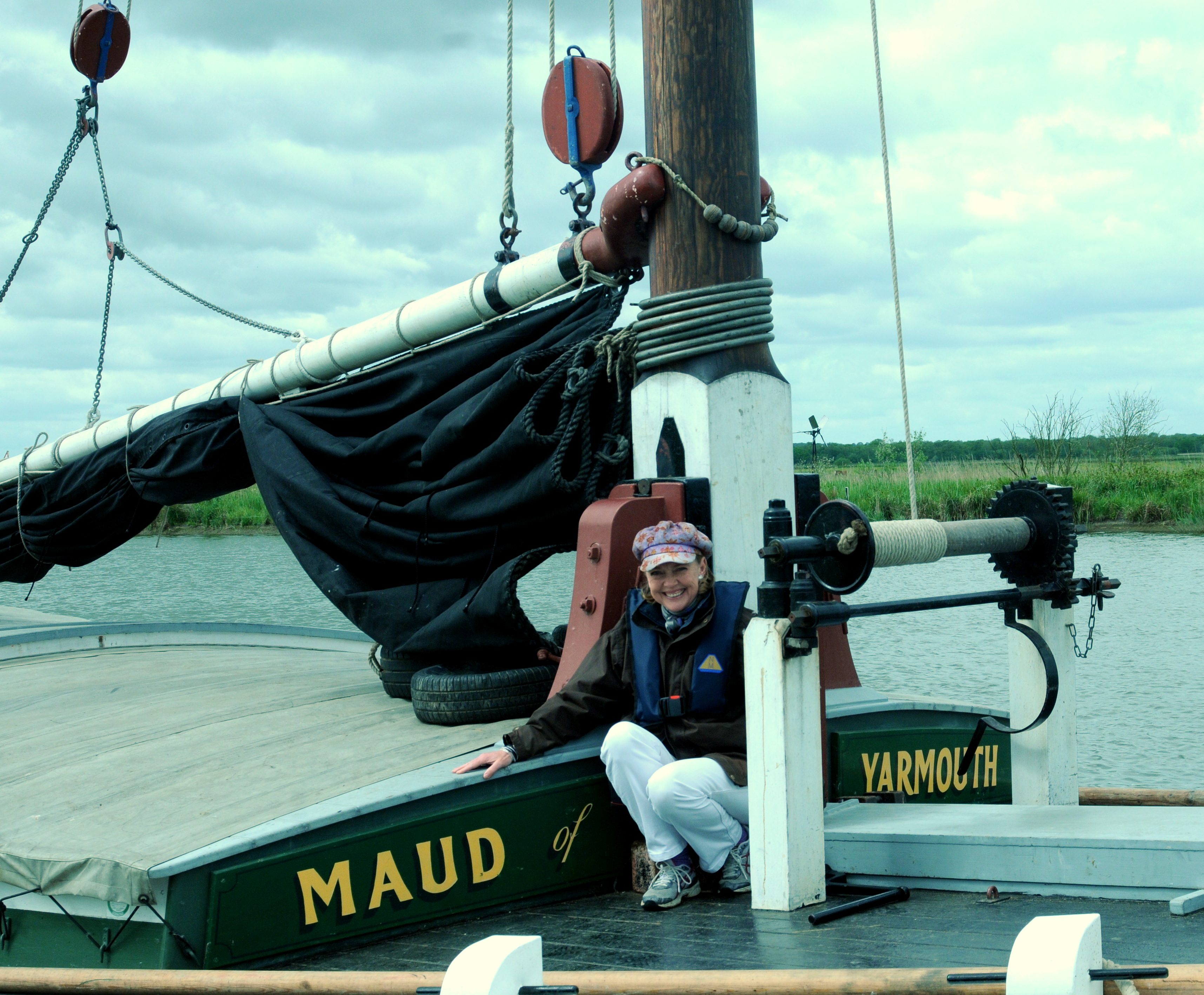
Aboard Wherry Maud – photo Diana Dicker
Other boats featured include:
Water Rail – Herbert Woods Delight Class B owned by Liz Goodyear
Joan B – a skiff set adrift at Horning owned by Pat Simpson
Pippa – yacht set adrift at Horning owned by Geoff Angell kept at the Norfolk Boards Yacht Club.
Goldfish 9 – a one-off yacht
Swallow 4 – a one-off river cruise yacht
Starlight Lady 322
John Boswell’s boat was used at the Catchalot
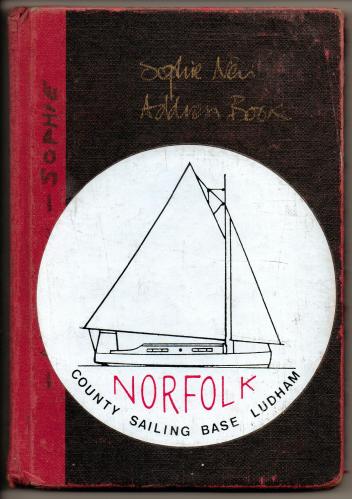
Do write in the comments below if you can fill me in on the names of those who helped us with the boats for the series. My address book lists: Jim and Jill Searle, Rupert Latham, Pat Simpson of Stalham Yacht Services, Richardson’s of Stalham, Lawrence Monkhouse, Keith King of Feny Boatyard and the Steam boat Association. I still have a certain sticker on the front of my BBC address book ~
I recently found a family photograph album with pages illustrating holidays spent under sail in the 1930’s.
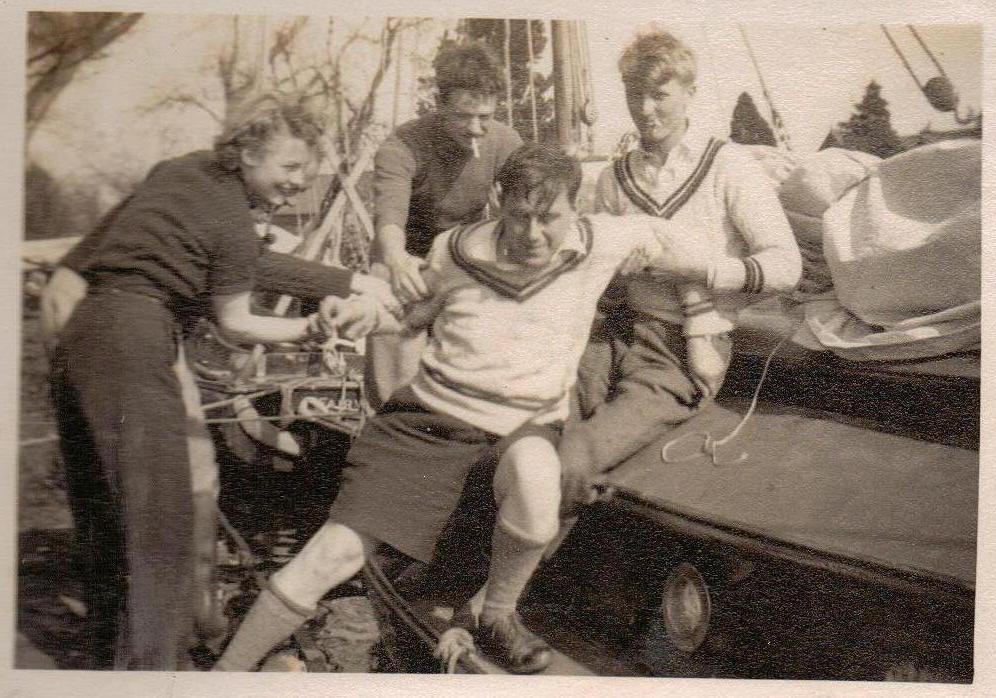
Joan with her friends having breakfast on the Norfolk Broads ~ Easter 1939
Not all the black and white photographs are as horizontal or as sharply in focus as one might wish but they show the glorious boats available for hire.
They also reflect what fun was had out on the water.
We were rather shocked by the cigarettes held in the mouths of the young men but Joan, who is pictured with them, was still agile at the age of ninety-nine.
Martin Neville sailing on the Norfolk Broads with friends in the early 1950s
Having sailed up to Horsey Mere with friends, my father hired a Hullabaloo boat to take us out on the Boards when we were little.
We went out of season, when boat hire was cheaper. As there was no one on the water my father let me take the helm mile after mile, despite the fact that I was only about seven years old.
Sophie Neville wearing a life jacket c. 1968
We loved living aboard and were often surrounded by wild geese.
It seems Arthur Ransome, who had fished on the Broads with Titty’s father, Ernest Altounyan, in 1923, also enjoyed cruising in the spring. His biographer, Roger Wardale, said that ‘Both the Ransomes liked to visit the Broads just after Easter, before most of the motor cruisers had started the season and it was the best time of year for birdlife.’ He went on to describe how Arthur Ransome kept a log of his three weeks spent in a Fairway yacht, the essence of which he used to write Coot Club in 1933/34. ‘As well as visiting Roy’s of Wroxham, tying up at Horning Hall Farm and watching the racing boats go by, towing through bridges, mooring beside a Thames barge at Beccles and watching a fisherman catching eels with a bab, there are numerous details that combine to make Coot Club a valuable account of the social and natural history of the Broads as they were more than 70 years ago.’
Roger Wardale illustrated his book Arthur Ransome Master Stroyteller, using wonderful photographs and sketches by Arthur Ransome, including a very jolly one of the Hullabaloos that had not been published before. Do get hold of a copy of the book, to read the chapter on Coot Club for yourself.






















 Sophie Neville