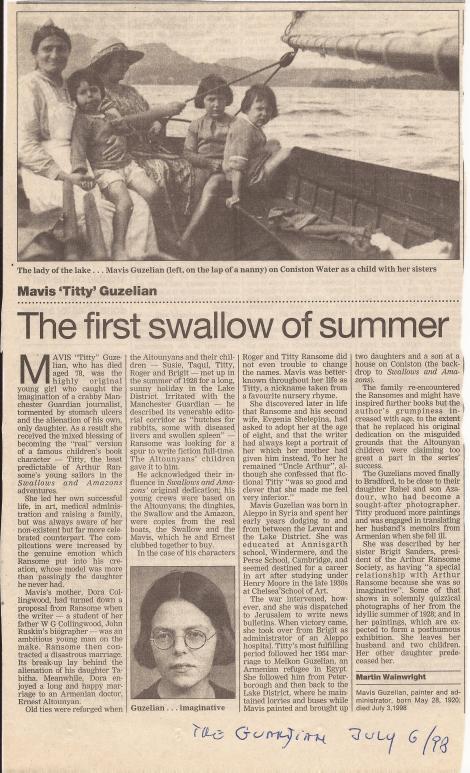
Titty was the name of an imaginative and ‘highly original’ little girl who Arthur Ransome first got to know in the Lake District when she was aged eight. When I met her niece Barbara Altounyan, she was most amused to hear that I had once played her Auntie Titty.
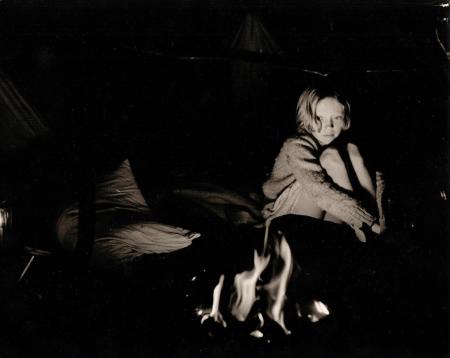
~Sophie Neville playing Titty Altounyan in the 1974 film ‘Swallows & Amazons’. Official photograph taken a Bank Ground Farm above Coniston Water copyright: StudioCanal~
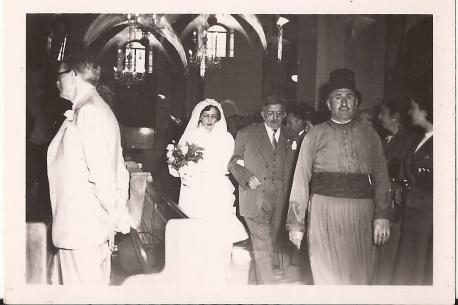
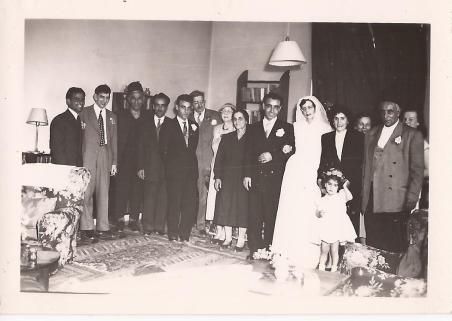
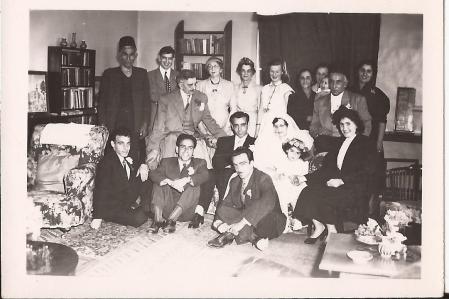
I’d brought Barbara some long lost family photographs that included some of Titty’s wedding in Aleppo. They are beautiful.
Titty on the arm of her father, Dr Ernest Altounyan in Aleppo, 1954
Titty on her wedding day with her husband Melkon Guzelian, her sister-in-law, her father Ernest Altounyan, her mother Dora and brother Roger, far right. You can also see Roger, Ernest and Dora below, with Roger’s wife standing far right.
There is also a more informal shot.
‘Don’t you want to know about Titty?’ Barbara asked me. ‘She was a very detailed person and quite a perfectionist.’ I knew she was a wonderful artist who had studied under Henry Moore at the Chealsea School of Art. Although she produced a lot of colourful art, she was unwilling to ever attempt to sell her work. I was also told she also had long legs. I only hope that I have represented her well.
Titty and her siblings had dark hair, but I was told that Mrs Ransome wanted the children playing the Swallows to have have blonde hair. She insisted that Titty was played by ‘an English Rose.’
Titty Altounyan at her sister Brigit’s wedding to John Sanders in 1953
(NB: Ransome did not write ‘Swallows and Amazons’ while on holiday on Coniston Water as was stated in the programme. To see a photograph of Low Ludderburn, the house above Windermere where Arthur Ransome lived and wrote ‘Swallows and Amazons’ please click here and scroll down.)
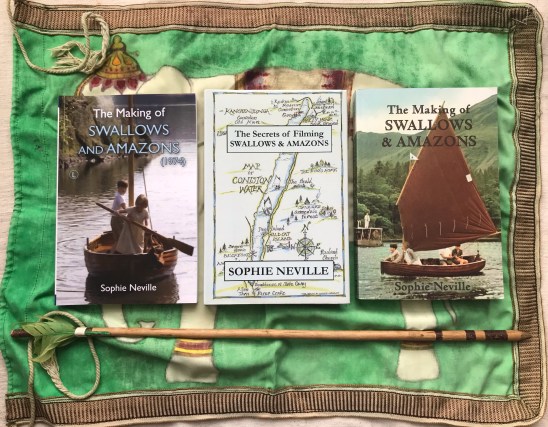
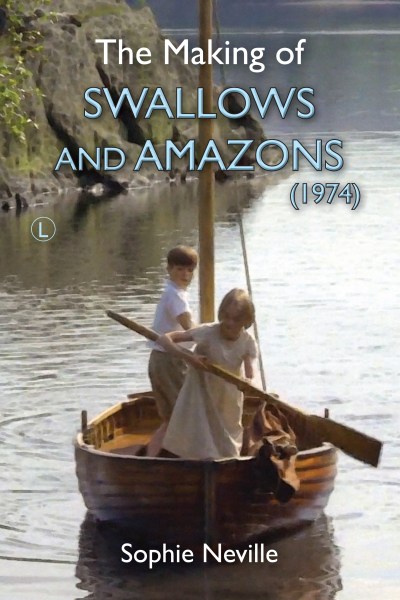
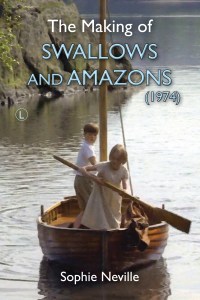
You can read about what it was like to play the part of Able Seaman Titty in the original film of ‘Swallows and Amazons’ in this illustrated paperback, available online or to order from libraries worldwide:
David Stott has written in to say, “When l got the job driving for ‘Swallows and Amazons’ l think I took over the production car when Jean McGill started driving you children around in the mini-bus.” This must have been in May 1973 when the original film of Arthur Ransome’s classic book was being made in Westmorland.
David has all sorts of memories of filming ‘Swallows & Amazons’ in the Lake District that I knew nothing about.
“Jean mentioned that she took Ronnie Fraser for an early morning glass of champagne to get him going. I remember having to take him to the Lodore Swiss Hotel in Borrowdale while filming on Derwentwater. He would order what he called, ‘A Frazer’, which was some sort of vodka cocktail.”
David was only about seventeen at the time. Driving Ronald Fraser around must have been something of an eye-opener.
“I remember bringing him back to film ‘walking the plank’ and he was very drunk at the time. Expect he needed it for the cold water. He could be a little difficult when he had had a few.”
“I was rather star struck when l was driving Virginia McKenna,” he admitted. “On one occasion I had to drive her from the farmhouse on Coniston to Grange railway station. She was telling me all about filming ‘Born Free’ with the lions and I drove a bit slowly as l was enjoying her company. We arrived rather late and l had to throw her and her luggage onto the train just as it was leaving.” I asked Virginia about this but she couldn’t remember ever being late for the train. I can only imagine that David must have coped well.
“On another occasion I think l had Richard Pilbrow in the car,” he was the producer of the film. “We were driving back from Derwentwater when a cow jumped off a bank and landed on the bonnet, causing quite a lot of damage. I was dreading going back to Browns Motors and telling Alan Faulkener the owner what had happened.” Richard is still alive and well.
David, who now owns Crossways Hotel near Glynebourne, comes from an old Cumbrian family. His grandmother lived at High Green Gate, the farm next door to Beatrice Potter at Hilltop.
“My great grandfather was Farmer Potatoes in the ‘Tale of Samuel Whiskers’. It was sketched from a photograph that my mother still has.” Indeed, there was an article in Cumbria Magazine about Beatrice Potter’s relationship with the Postlethwaite family.
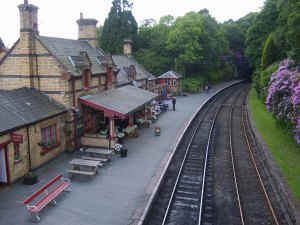
One of our locations – Haverthwaite Station today
“My father was the local joiner in Ambleside. He also kept about 1000 hens and delivered eggs around the hotels at the weekends. My brother and l would often help him on a Saturday morning.” David obviously knew the roads of Cumbria well.
David explained that, although he lived in Ambleside at the time, he has not seen Jean since the filming, so enjoyed reading that I had been in touch with her. “Jean’s Mum was called Girlie and she used to run a nursing home on Lake Road. Jean had a brother who was nicknamed Blondie. We would often have a cup of tea with Girlie in the nursing home kitchen.”
“It’s Jean!” It was Jean McGill ringing from Bowness in Cumbria. She had been our driver and the unit nurse on the film of ‘Swallows & Amazons’ made in the Lake District from May to July 1973, released a year later in 1974.
Jean McGill our unit driver and location nurse with Sophie Neville ~ photo:Martin Neville
“I’ve never seen the film,” Jean declared, “but I loved your book about making it. It brought back such memories.” I urged her to tell me more. “I remember when Suzanna Hamilton cut her hand whittling wood. It was bleeding like anything. I bandaged it up nicely but the director was horrified and made me take the dressing off again.” I think this was when we were in the middle of filming on Peel Island. The accident put an end to our wood carving hobby, which was a shame. We’d been using a Swiss Army knife to make our own bows and arrows with Bob Hedges the prop man.
Ronnie Fraser outside the dining bus on location with a paper cup of champagne
” You children persuaded me to go out to dinner with Ronnie Fraser! Why I went, I haven’t the foggiest. He was a rough character – very coarse.” Ronald Fraser was the movie actor playing Captain Flint. “I used to have to drive him to the local hotel in the mornings and order champagne to sober him up.”
“How would champagne have helped to sober him?”
“I don’t know. He told me it would.”
“I think he’d been divorced for a while at the time.”
“I wouldn’t have married him in the first place,” Jean assured me.
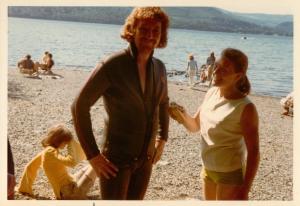
Terry Smith wearing the safety officer’s wetsuit with unit nurse and driver Jean McGill
Jean had been taken on as the unit nurse after the first nurse proved rather out of her depth. I thought she was a State Registered Nurse but she corrected me. She had 26 years experience in nursing becoming a hospital sister but was never an SRN. “I was a driver for Browns (of Ambleside)” and as such was paid to work on the film. “I wasn’t paid to be the unit nurse. It didn’t matter, I wouldn’t have missed it for the world.”
I only found out recently that my mother hadn’t been paid to be a chaperone either, despite the responsibility as well as her legal obligations. It was hardly a big budget movie. Like Jean, she was simply thanked with a bouquet of flowers at the end of the filming.
Jean was one of the few local people who worked on the film throughout the seven weeks we were on location. Her local knowledge made all the difference as she knew the roads well, took short cuts to avoid the traffic and knew the best swimming spots when the weather warmed up.
Suzanna Hamliton, Simon West, Claude Whatham Sophie Neville, Kit Seymour, Jean McGill with Daphne Neville (kneeling) Blackpool, 1973
I reminded Jean about the early 1970s – what we ate and how we dressed. ” I bought a pair of jeans for the first time in my life. It was so hot that I changed into shorts while we were on set. You children took the jeans and stitched a big red heart on the backside.” There was a craze for adding embroidered patches to denim clothing. These were expensive to buy but we persuaded to Sten Grendon’s mother to make red hearts for everyone’s jeans. “It made walking through Ambleside very embarrassing.” Jean sounded as if she was still recovering from the indignity 43 years later. “It mucked me up!”
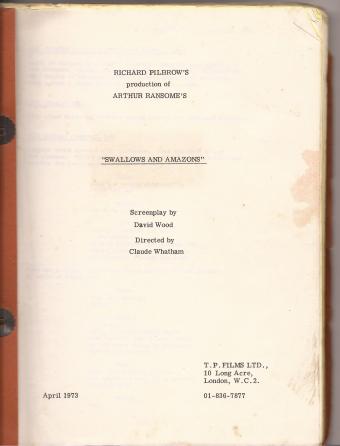
Jean went on to drive for Mountain Goat Tours in Cumbria and worked in a doctor’s surgery before becoming a registrar for ‘hatches, matches and dispatches’. “I’m a coffin-kicker now,” Jean told me cheerfully. She never worked on another film but kept a copy of the original screenplay and other memorabilia.
Not long after I spoke to her a brown paper package arrived in the post. It contained an envelope with the writing,
FOR THE ATTENTION OF TITTY
‘Still looking for the photographs. Will send to you when I find them. 43 years old? It was this tatty when I got same! Jean.’
And this is what the envelope contained:
Here is Jean in her red top talking to my mother in her Donny Osmond hat:
Since Classic TV Press published ‘The Making of Swallows & Amazons’ in 2014, a number of facts have floated to the surface. The most amazing recollection was one that occurred to my mother.
‘The letter inviting you to come for an interview for a part in the film was addressed to your father. He was working abroad when it arrived. I never, ever opened his mail but something urged me to open that one envelope. It was a good thing I did as he was away for three weeks and we would have missed the opportunity altogether.’ She was amazed by the contents and replied at once, sending a photograph to Theatre Projects. I think it was this rather miserable one of me wearing a Laura Ashley dress.
Sophie Neville in 1972
A date was made to meet the director. I now remember that I was taken up to Long Acre in the West End to meet Claude Whatham very soon after Dad arrived back from his business trip. We walked through Soho and visited a Chinese grocery store on the way home.
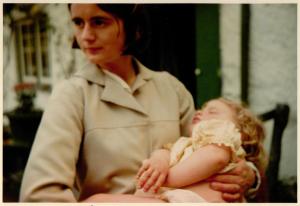
Daphne Neville on HTV in 1973
‘I was never paid to work on the set as chaperone,’ Mum told me. ‘Neither was Jane. We were just happy that our expenses were covered but it ended up costing me quite a bit as I had to travel back to Bristol to work now and again.’ She was working for HTV as a television presenter alongside Jan Leeming, who is currently appearing on ‘The Real Marigold Hotel’. For the photo of them both on an HTV West show, please click here
Jean McGill said she didn’t get paid for acting as the Unit Nurse, as far as she could remember, ‘But I wouldn’t have missed it for the world.’
Kerry Darbishire playing Nurse
The most exciting thing was meeting Kerry Darbyshire, who played Vicky’s nurse, at Zeffirelli’s cinema in Ambleside for the 40th Anniversary screening of the film. I learnt to my horror that I had mis-spelt her name in the credits I gave the actors. All I had to go on was her signature in the back of my copy of the hardback book of ‘Swallows and Amazons’ where I’d collected autographs.
Kerry Darbishire’s signature
Kerry laughed, telling me, ‘I should have had more legible handwriting.’ She appeared in the film quite a bit. ‘It was a pity I wasn’t able to bring my own child. She was the exact same age and colouring as the little girl they found to play baby Vicky.’ Kerry was with us in the compartment of the train on day one of the shoot. ‘I found it very difficult to laugh with you when the train went into the tunnel.’ I couldn’t think what she meant at first but it was the laughter that followed Virginia McKenna’s line: ‘He’d say, “Just look at that scenery”.’ at the moment the train goes into a dark tunnel. ‘You children found it no problem at all, but I couldn’t laugh. I was too shy.’ Zeffirelli’s are next screening ‘Swallows & Amazons’ (1974) at 7.30pm on 2nd March.
I never knew the name of the snake wrangler – who brought the charcoal burners’ adder along, but Ken Foster wrote in recently to say it was his father, John Foster whose family farmed near Satterthwaite. He was once employed as an assistant at the fresh-water biology research establishment at Windermere and became a biological specimen supplier. You can read more about his unusual occupation here
To read more about the day the adder arrived on location, please click here.
John Foster & the charcoal burners’ adder
Simon West, who played Captain John, remembered that Claude Whatham often used to take us for a quick run before going for a take. It freshened us up and was appropriate when we had to run into shot, slightly out of breath.
One little girl wrote to tell me how she pulls her dress over her knees just as I did when I played Titty, as I got rather cold in a scene when were were first sailing Swallow to the island.
Sophie Neville with Terry Needham
George Marshall, the veteran film accountant, assured me we had a very talented film crew. Mark Birmingham, a film producer currently working on the bio-pic of Noel Coward, knew quite a few of the individuals working on ‘Swallows & Amazons’ and told me of the amazing careers they went on to lead. ‘Your Best Boy, Denis Carrigan, went on to run Sherperton Studios.’ Denis worked closely with Ridley Scott who made many great films there. ‘Sadly one of the other electricians died when he grabbed a live cable.’
Other people have written with interesting stories relating to the film locations.
‘The shop in Woodland Road was my grandfather Tom Kirkbride’s cobblers shop from 1930s to 1956,’ Brian Salisbury wrote. ‘After he retired, the wooden building became Stan Cropper’s sweet shop doing a roaring trade with the boys at St Mary’s Boys School just along the road and the newly built Droomer Estate.’ This was the shop where we bought rope for the Light House Tree that is now a barber’s in Windermere. To read more about this location and others in Windermere, please click here
Is there anything you would like to add?
Daphne Neville, Stephen Grendon, Suzanna Hamilton, Sophie Neville, Jane Grendon and Simon West.
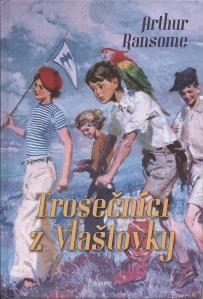
Albatros Media in the Czech Republic have re-published a hardback edition of ‘Swallowdale’ by Arthur Ransome, illustrated by the great Czech artist Zdenek Burian.
The Foreword has been written by me, Sophie Nevilleová.
I was commissioned by Ondřej Müller, Fiction Program Director, thanks to an introduction by Petr Korbel, a feature writer in Prague. My somewhat daunting task was to introduce the well-loved story that comes with classic illustrations.
I took the opportunity to recommend that readers book a holiday in Cumbria. It’s always exciting to find the actual locations described in a novel, particularly one you know well, although I believe finding Swallowdale is quite a challenge.
Of all Arthur Ransome’s books, it was Swallowdale that inspired me to go camping. I have since pitched my tent all over the world from Papua New Guinea in the Pacific to Patagonia, which I crossed on horseback. I once spent six months driving down through Africa, sleeping in a tent and using all I had learnt from this beautifully written book. Not long after this expedition, I started to draw maps in the hope that I that might encourage others to travel and explore the world as the Swallows did.
Back in 1973 I had the great privilege of playing the part of Titty in the movie of ‘Swallows & Amazons’ that has been translated into Czech twice. Throughout my life I have received letters from people telling me how Arthur Ransome’s books have given them direction in life, encouraging them to set sail and explore unchartered waters.
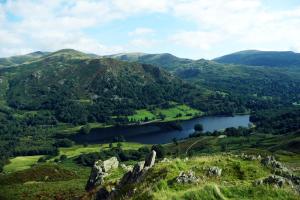
If you ever visit the English Lake District take the charcoal burners’ advice and keep a good lookout for adders but in searching for Swallowdale one thing is for sure, you will be walking in Arthur Ransome’s footsteps. He was taken to the summit of Old Man Coniston, the mountain known in the book as Kanchenjunga, as a small baby and rowed into the secret harbour of Peel Island, or Wild Cat Island as the Swallows called it, when he was a boy.
The people of Cumbria still welcome visitors, indeed you can stay at the farm known as Holly Howe and it is possible to take a boat out on the lake below it. Coniston Water is not an exact replica of the map in the book, but you can enjoy looking for Horseshoe Cove and the Amazon boathouse. Rio can be found on Windermere where you might also find the Peak of Darien along with native steamers. Titty would encourage you to let your imagination take you further and I am sure Roger would suggest you take a fishing rod.
Even if travelling does not appeal to you, ‘Swallowdale’ is such a vivid story that you will sail back in time to 1931 quite effortlessly. This classic book is a full of wonderful imagery from ‘black wretched thoughts…crowding in like cormorants coming to roost’, to potatoes being in bad mood. It is enjoyable on many levels. I laughed when Titty decided, ‘Miss Turner could hardly be dead if she was complaining of cold plates’ and was uplifted by her joy at discovering, ‘the most secret valley that ever there was in the world.’
I am so pleased that Albatros Media are able to bring you this beautifully illustrated edition, to read, enjoy and perhaps pass on to others.
Burian’s version of the Swallows and Amazons flags
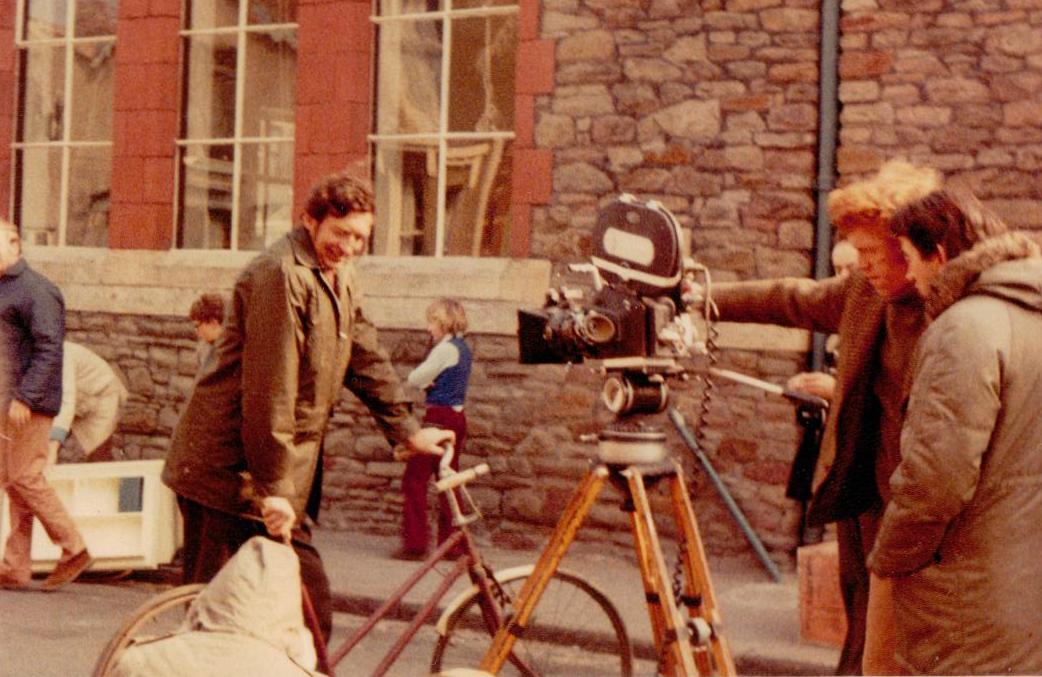
If you see men walking down the street with a telephone box it is probably an indication that there is a film crew nearby.
This was a distinctive director with red hair called John Prowse filming a drama serial called The Changes on location in Bristol in back 1975 when wooden tripods were used with 16mm cameras and portable monitors hadn’t been developed.
The Changes was a BBC adaptation of the books by Peter Dickinson written and produced by Anna Home. It starred Victoria Williams, Keith Ashton and Rafiq Anwar. Jack Watson was in four episodes and my mother had what one might call a cameo role as a villager. She can be seen in the photo above in the pink headscarf.
Sonia Graham appeared in this scene wearing a long red cloak. I later worked with her on the vet series One by One.
The story explored the concept of a time when machines ground to a halt and all cars became useless. Vehicles still seemed to be used as camera mounts. John Prowes is standing on top of a doramobile in this photograph.
Does anyone remember seeing the outcome of all this toil?
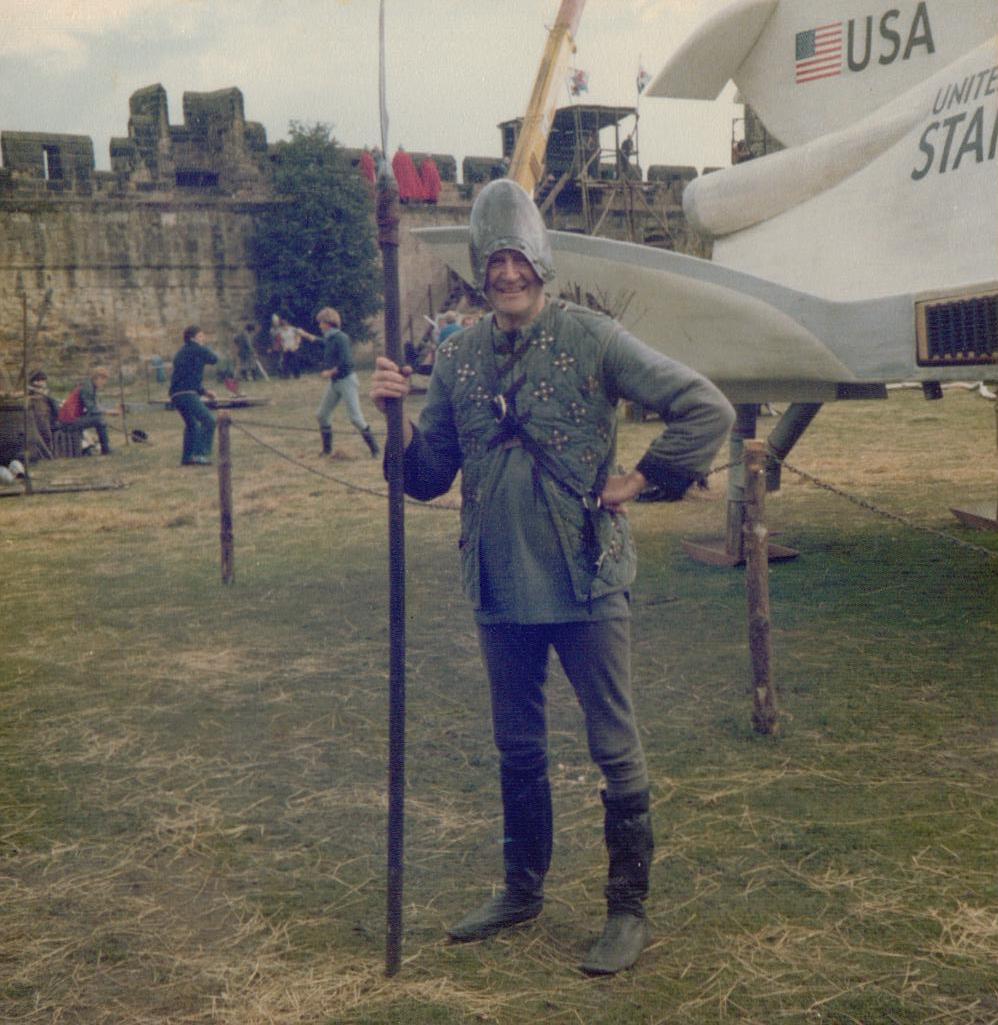
In 1978, my parents decided to take a holiday looking at castles in Northumberland and came across this scene:
They ended up appearing in a Walt Disney movie called Unidentified Flying Oddball. Here is the evidence:
The film’s original title had been The Spaceship and King Arthur, billed as a family adventure. It was an adaptation of A Connecticut Yankee in King Arthur’s Court and was shot at Alnwick Castle, the seat of the Duke of Northumberland where the Harry Potter films were later made.
It was released on an unsuspecting public in 1979, but was shot in the summer of 1978. I’m not sure how advanced Visual Effects were at the time but there were no Computer Generated Images. It looks to me as if this little airborne stunt was for real.
Life before the advent of CGI
Absolutely terrifying. While Kenneth Moore played King Arthur, Dad’s distant cousin John le Mesurier was Sir Gawain. Ron Moody played Merlin and Jim Dale starred as Sir Mordred with Dennis Dugan who played Tom Trimble. Rodney Bewes, who we knew as one of the Likely Lads had the role of Clarence. My father was hired for five days as a weapon bearer. This was simply so Mum had license to watch the filming.
Dennis Dugan on location in Northumberland
Pat Roach, 6’5″ tall British actor, later in all three Indiana Jones films, was Oaf. Mum hadn’t seen Jim Dale with permed hair before. She was used the lovable innocent he tended to play in Carry On films, but there he was looking fashionable on location in Northumberland, in the Duchess’s garden at that.
Jim Dale at Alnwick Castle
Jim Dale is known for the Harry Potter audiobooks in the USA, winning several high-profile awards for them, and for narrating the Harry Potter video games such as the Hogwart’s Challenge and Wizarding World. I wonder if they transported him back to Alnwick Castle?
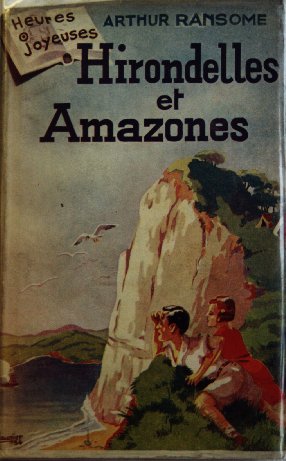
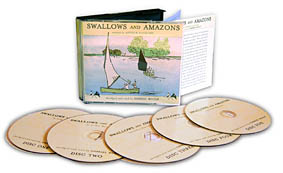
If you know anyone who loves the original film of Swallows and Amazons, and is now learning French, why not buy a copy of the DVD that has been dubbed into the French language:
If you live in France you can order a Kindle copy of ‘The Secrets of Filming Swallows & Amazons’ – which is full of behind-the-scenes photos and links to home-movie footage taken on location, although the text is in English. The paperback makes a good present for students of Media Studies, Drama or Film:
The website All Things Ransome have links for of the Arthur Ransome’s book in French here with a useful list providing translations of names here.
The translation of the telegram BETTER DROWNED THAN DUFFERS IF NOT DUFFERS WONT DROWN is Préfère les savoir noyés que stupides. Si pas stupides pas noyés.
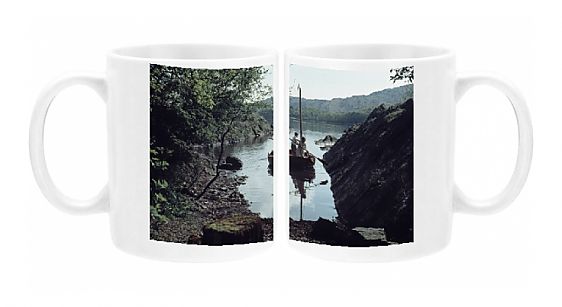
You too can find the locations and sail Swallow:
If you would like to stay at Holly Howe ~ contact Jonathan Batty at Bank Ground Farm
Swallows & Amazons tours of the Lake District ~ including a trip on the steam train, led by Peter Walker of Mountain Goat in Windermere can be booked for groups by request. A must for overseas visitors. To read about this do go to: ‘In Search of our old Film Locations’. For booking details please click here.
Swallow, the dinghy used in the film, is currently in East Anglia. For opportunities to sail her yourself please click here
It has been handmade out of recycled materials with pages from old books and can be purchased direct from House of Ismay
A small brown paper package tied up with string arrived in the post today, stamped in red with the words Thank you and containing four wooden postcards featuring Arthur Ransome’s illustrations. I think it makes a wonderful stocking-filler or thank you gift from The Wooden Postcard Company
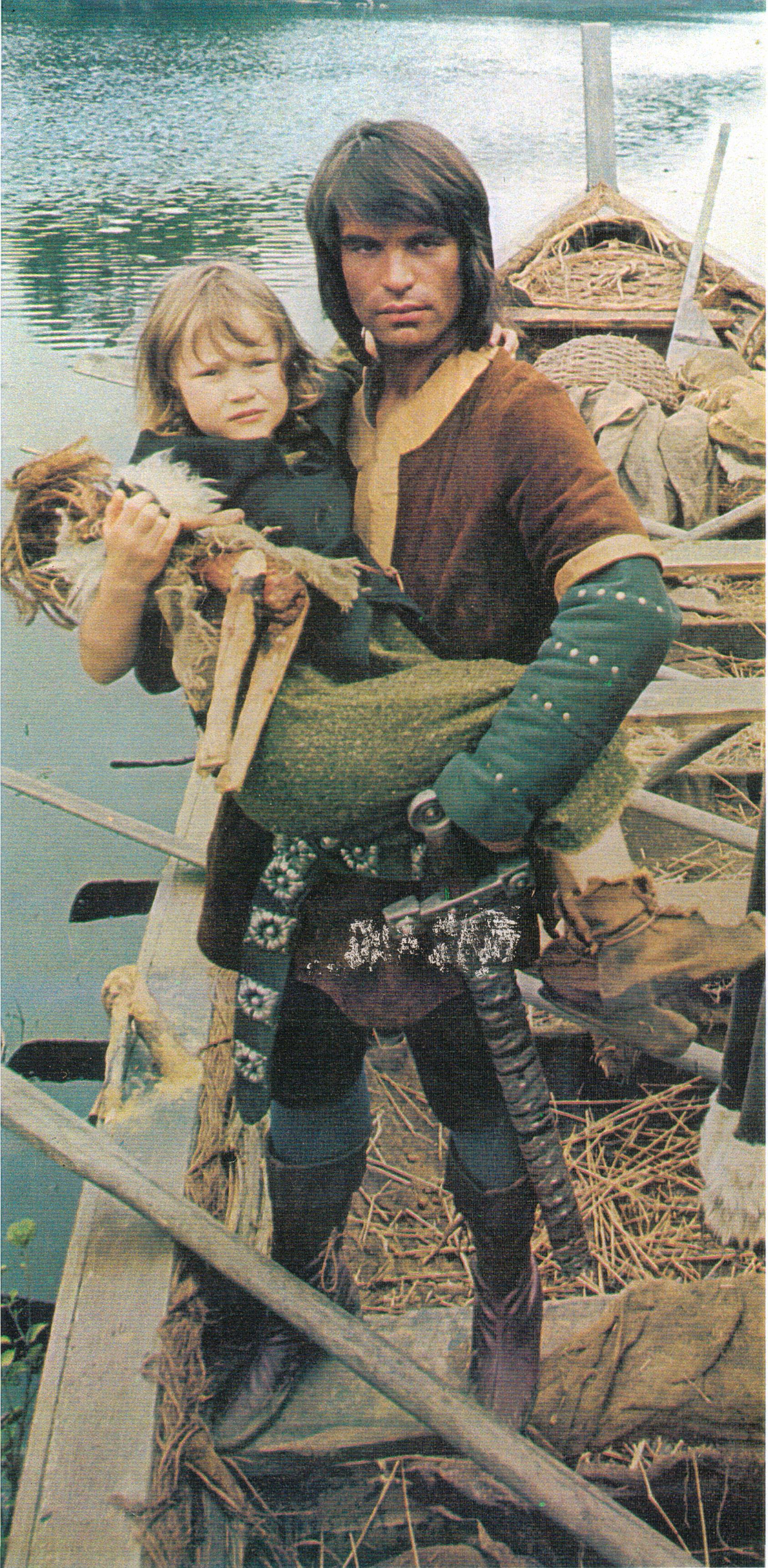
Much of Arthur of the Britonswas shot at Woodchester Mansion where HTV constructed the huge lathe and wattle hall which comprised King Arthur’s seat.
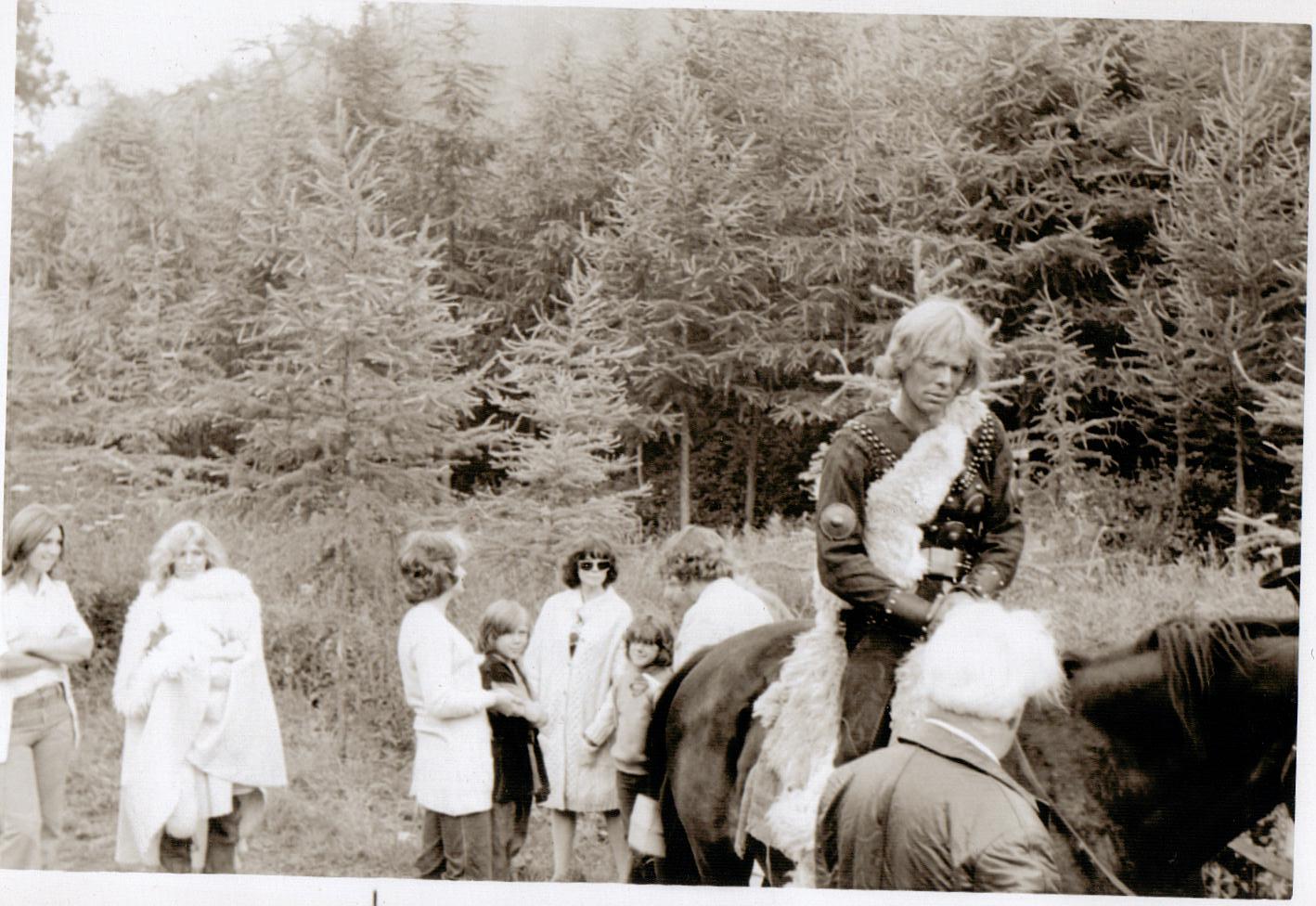
Oliver Tobias as Arthur and Michael Gothard as Kai can just been seen standing outside the doors of the hall
We went to watch the filming soon after the fire scene, which opens the episode entitled ‘The Gift of Life’. My sister Tamzin was cast as Elka, the little Saxon girl who arrived unexpectedly by longboat with her brother Krist.
In the story, this was spotted drifting down the river – which is in reality the lake at Woodchester. Arthur insists they should be returned to their own people by Kai, portrayed by Michael Gothard, who rides off with them on his horse.
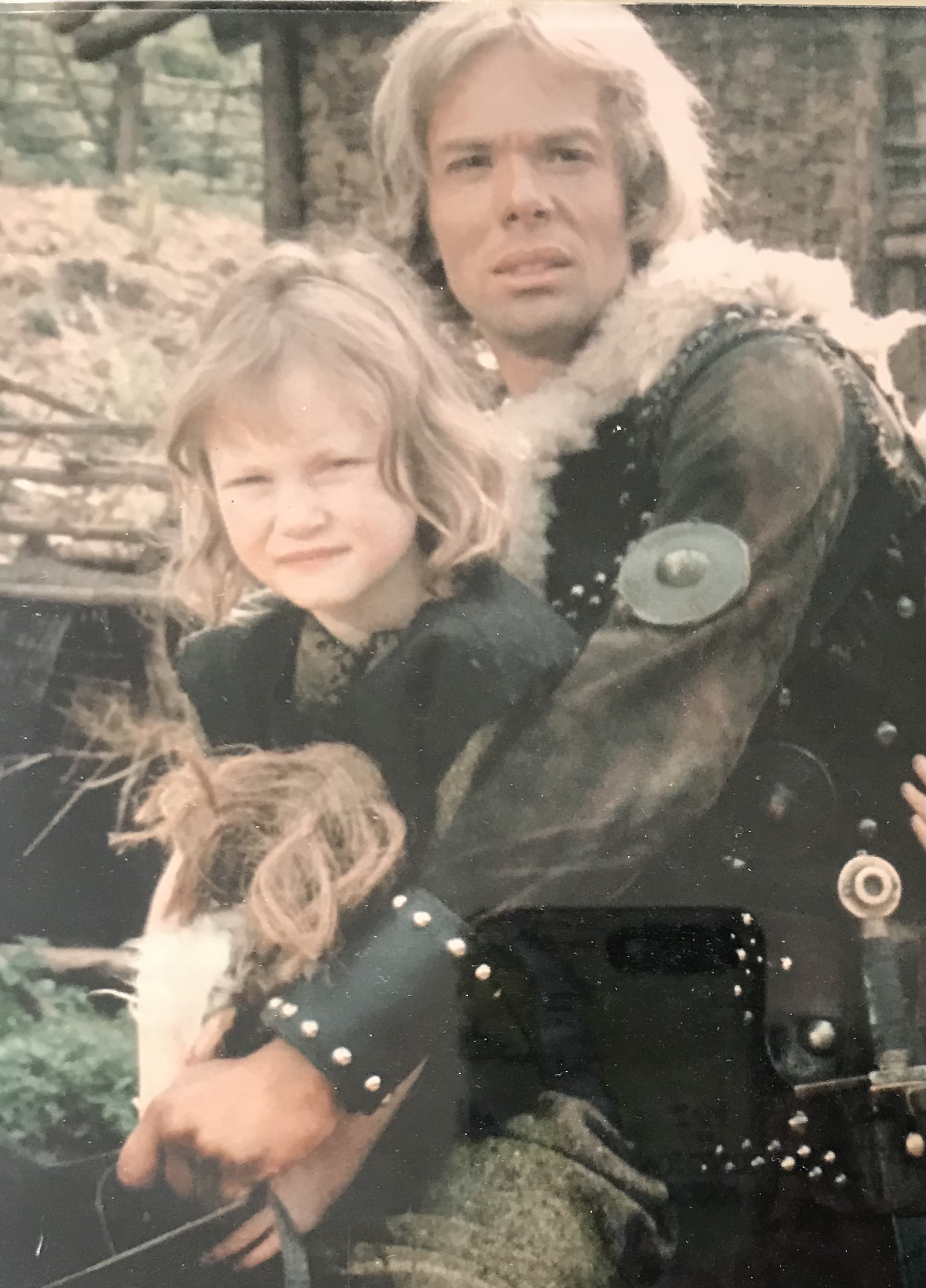
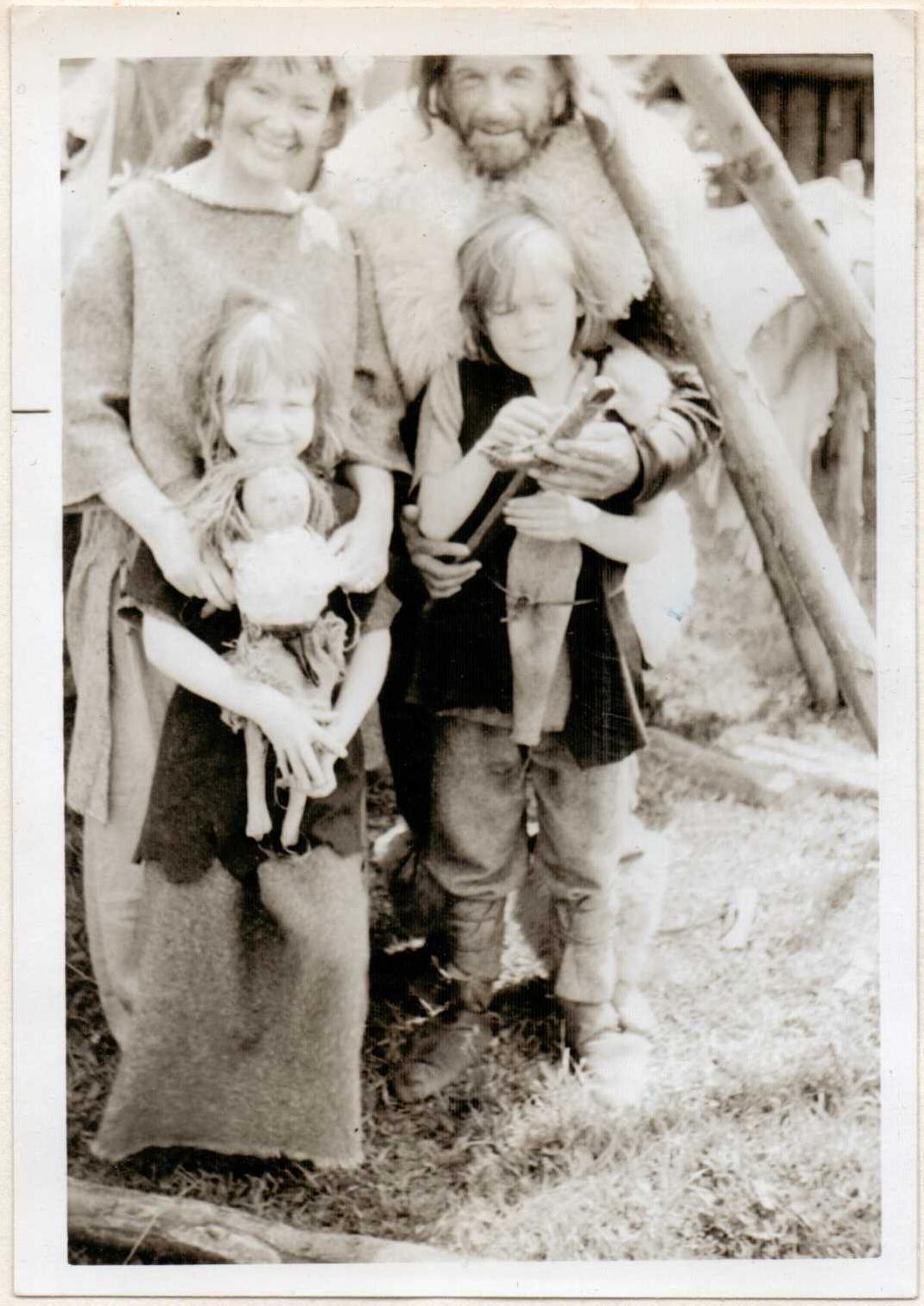
Shaun Fleming as Krist, Micheal Gothard as Kai, Tamzin Neville and Elka and Kerig the hideous doll whose head kept falling off
We were able to watch the episode being shot.
‘I want to feed the squirrels,’ Tamzin declared after they had been riding for a while. It was a line few have forgotten.
‘Oh, no!’
‘Oh, yes.’
‘Why couldn’t you feed the squirrels before you left?’
‘I did, but now I want to feed them again.’
I was fascinated in her costume, including her shoes which were made of hessian sacking.
Sophie and Perry Neville watching their sister Tamzin having her dirty face seen to by a make-up artist during the filming of ‘Arthur of the Britons’ being made on location in Gloucestershire in 1972. Michael Gothard waits, seated on his horse.
I am not sure whether Michael Gothard had worked with children before but he seemed able to cope. No one had asked Tamzin if she could ride. It was a good thing she was used to large horses and had a naughty pony of her own. They set off at speed and her hessian dress was not exactly ideal riding wear.
Shaun Fleming was excellent as her brother and managed to cling on behind the saddle as they charged across the hills, which can’t have been easy. The secret was that he acted under his mother’s maiden name instead of his real surname.
Daphne Neville with her daughter Tamzin Neville who played Elka and Geoffrey Adams who played Hald with Shaun Fleming as Krist in ‘The Gift of Life’
Tamzin was then asked if she could whistle while she was ‘feeding the squirrels’, or having a pee as we would say now. It was demanded by the script.
No one had asked her in advance if she could whistle. This was tricky as the tooth fairy had recently visited her in a big way.
‘I couldn’t even whistle when I had all my teeth.’
I appeared as the Saxon girl with blonde curly hair seen working in the fields with Heather Wright when the children returned to the Saxon village. While Heather was in lime green, I wore a gold-ish coloured top and plum skirt with no shoes. You can see me hobbling across the end of the field which was full of thistles.
My other sister, Perry, was barefoot too. My mother, as a Saxon woman with short fair hair, (photographed above) virtually carried her into the village after Tamzin and Shaun.
It had been decided that, on the whole, Saxons were blonde, Celts were dark-haired like Oliver Tobias, who played King Arthur. It wasn’t until I did an Ancestry.com DNA test in 2022 that I discovered my heritage was almost 100% Celtic – Scots/Cornish/Irish/Welsh with a little Danish thrown in.
There were a number of weapons on set that intrigued us as children. We all wanted to learn how to use them. Oliver Tobias began to teach us sword fighting, however there was an accident on set which put a stop to this. One of the actors was having his boots sorted out by a wardrobe assistant when he casually swung his axe. Although it was just a blunt prop, with no edge to the blade, it went into her head, resulting in a four inch gash across her scalp. He was devastated. It was a complete accident. The wardrobe assistant recovered but it was a sobering incident and great care was taken when handling the props afterwards, even though they seemed blunt and harmless.
Fifty years later this series is still treasured by many. It had such a strong cast. Heather Wright went on to star in The Bellstone Fox with Bill Travers and Dennis Waterman and in the 1976 movie Shout at the Devil with Lee Marvin, Roger Moore and Ian Holm.
Geoffrey Adams was terribly well known at the time, as for years he’d played the part of Detective Constable Lauderdale in the long-running BBC Police series Dixon of Dock Green appearing with Jack Warner in nearly 300 episodes.
Shaun (Fleming) Dromgoole went to work in film production on a number of well known movies including American Gothic and The Woman He Loved, about which starred Anthony Andrews and Olivia de Havilland and Jane Seymour as Wallis Simpson.
Woodchester Mansion, the vast house built of cut stone yet left half-finished, was eventually sold for £1 to Stroud District Council. My father became a Trustee of the Board that decided its future.
To read more about Tamzin’s acting career please see this previous post.
Shaun Fleming, Tamzin Neville, Sophie Neville , Jenny Fleming, Kerig the doll and Daphne Neville in 1972
The producer, Patrick Dromgoole was absolutely prolific, producing a huge number of classic television dram serials including The She Wolf of London and The Clifton House Mystery, which my mother appeared in as well as Robin of Sherwood . Her drama pupil Robert Addie played Sir Guy of Gisbourne so convincingly in that series he became hated throughout the UK. For more photographs of Mum please see flick down though various posts on my blog for Funnily Enough.
Do please add additional information or memories in the comments below.




 David has all sorts of memories of filming ‘Swallows & Amazons’ in the Lake District that I knew nothing about.




























 Sophie Neville