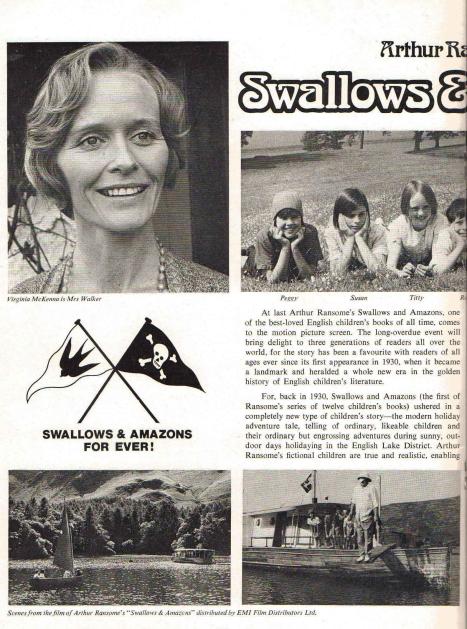
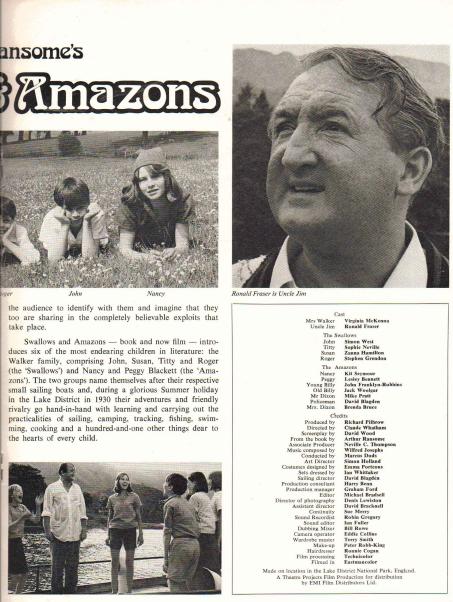
Virginia McKenna, Lesley Bennett, Suzanna Hamilton, Sophie Neville, Stephen Grendon and Ronald Fraser appearing in the film premiere programme
I opened the pages of the programme at the film premiere to find one of the publicity photographs of us taken at Bank Ground Farm. I wasn’t sure the face Simon was making would sell a cinema ticket.
Simon West, Kit Seymour, Ronald Fraser, Sophie Neville and Suzanna Hamilton with half of Stephen Grendon on the second page of the premier programme
But the film was now out. It had to sell itself. Everyone was waiting to hear what critics from within the movie industry felt about it.
Would this photograph ever sell the film?
I think my mother must have written to Barry Norman, inviting him to bring his daughters to one of the promotional events held at the Commonwealth Institute. I wonder if she met him at the Preview of the Premiere. He was then presenting BBC Television’s Film 74 and writing a weekly column in The Guardian newspaper. Here is his reply:
Barry Norman enjoyed it! The Radio Times says that he was looking at ‘films for the family over the Easter holidays’. Film 74 was shown on BBC TWO at 10.15pm – and repeated on Fridays even later so he must have been speaking to parents. Here’s his theme tune.
One thing that strikes me when I open the March 1974 copy of ‘Films and Filming’, kept by my mother, is that ‘Swallows and Amazons’ has to be one of the most enduring movies to come out at the time. Sean Connery opted to appear with Charlotte Rampling in ‘Zardoz’. I’ve neither seen or heard of it. Why couldn’t he have played Captain Flint with us? I did see Steve McQueen in ‘Papillon’ but had no desire to watch it more than once. Richard Lester’s version of ‘The Three Musketeers’ was also made in 1973. Even though it stared Oliver Reed, Raquel Welch, Richard Chamberlain, Michael York and dear Spike Milligan I don’t think it can have been broadcast on television as many times as ‘Swallows and Amazons’.
The magazine goes on to review ‘The Optimists of Nine Elms’ starring Peter Sellers, ‘Magnum Force’ starring Clint Eastwood, ‘Herbie Rides Again’starring Stephanie Powers and many others, films I have never heard of. ‘American Graffiti’ came out in the States, directed by George Lucas starring Richard Dreyfuss, Ron Howard, Paul Le Mat and Harrison Ford. It made gross profits of more than U$200 million becoming one of the most profitable films of all time, but I wonder how many times it has been shown on British television this year? Do your children know anything about it? Has it been projected in the pouring rain for loyal fans sitting on a lake shore?
I his book, ‘A Theatre Project’ Richard Pilbrow says, ‘We had a success.’ He quotes Variety magazine, “Charming, delightful, beautifully made film,” but said it was, ‘Not a hit but a reasonable success that continues to play, principally on television, around the world.’ Richard goes on to quantify how it did financially. ‘The world of film finance is a distinct mystery. Our production costs were just under £300,000. Over the years, income trickled in from an international market. Curiously the costs inexorably rose to match the income. The costs of marketing the movie always seemed to equal receipts at the box office. In 2004 our film actually recouped. That’s why I have the temerity to call it a success.
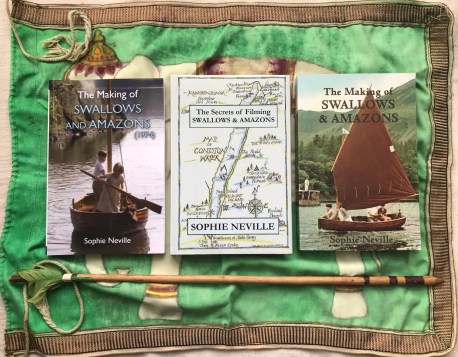
Not all the newspapers thought so in 1974. You can read how much we hated the publicity in any of the books on how the film was made:
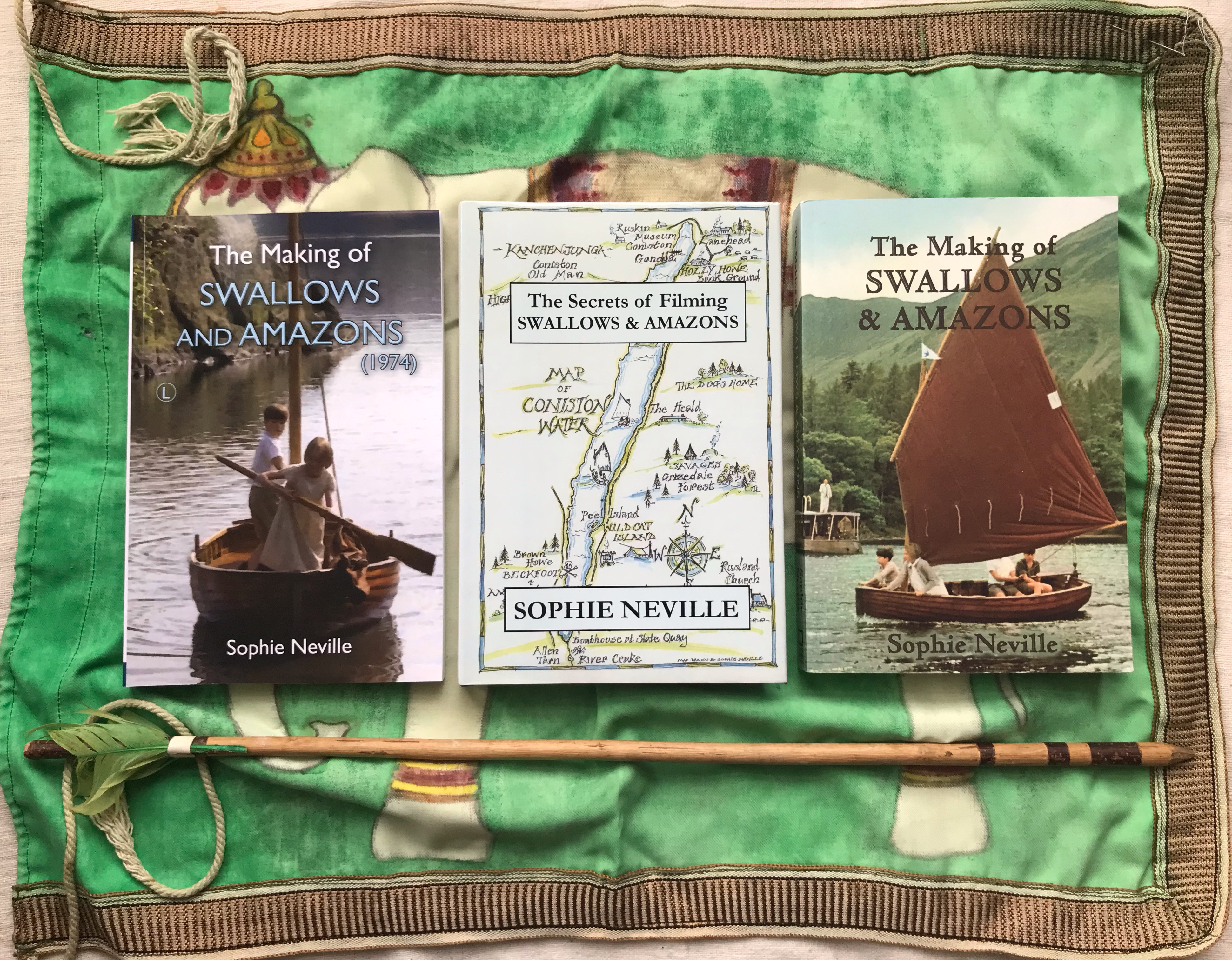
Different editions of ‘The Making of Swallows and Amazons (1974) by Sophie Neville’
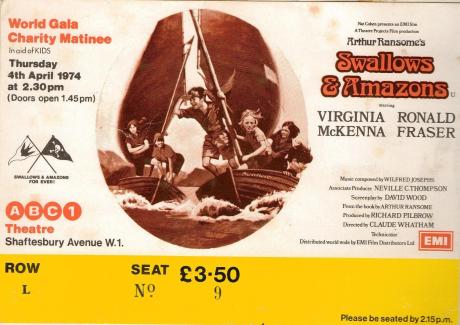
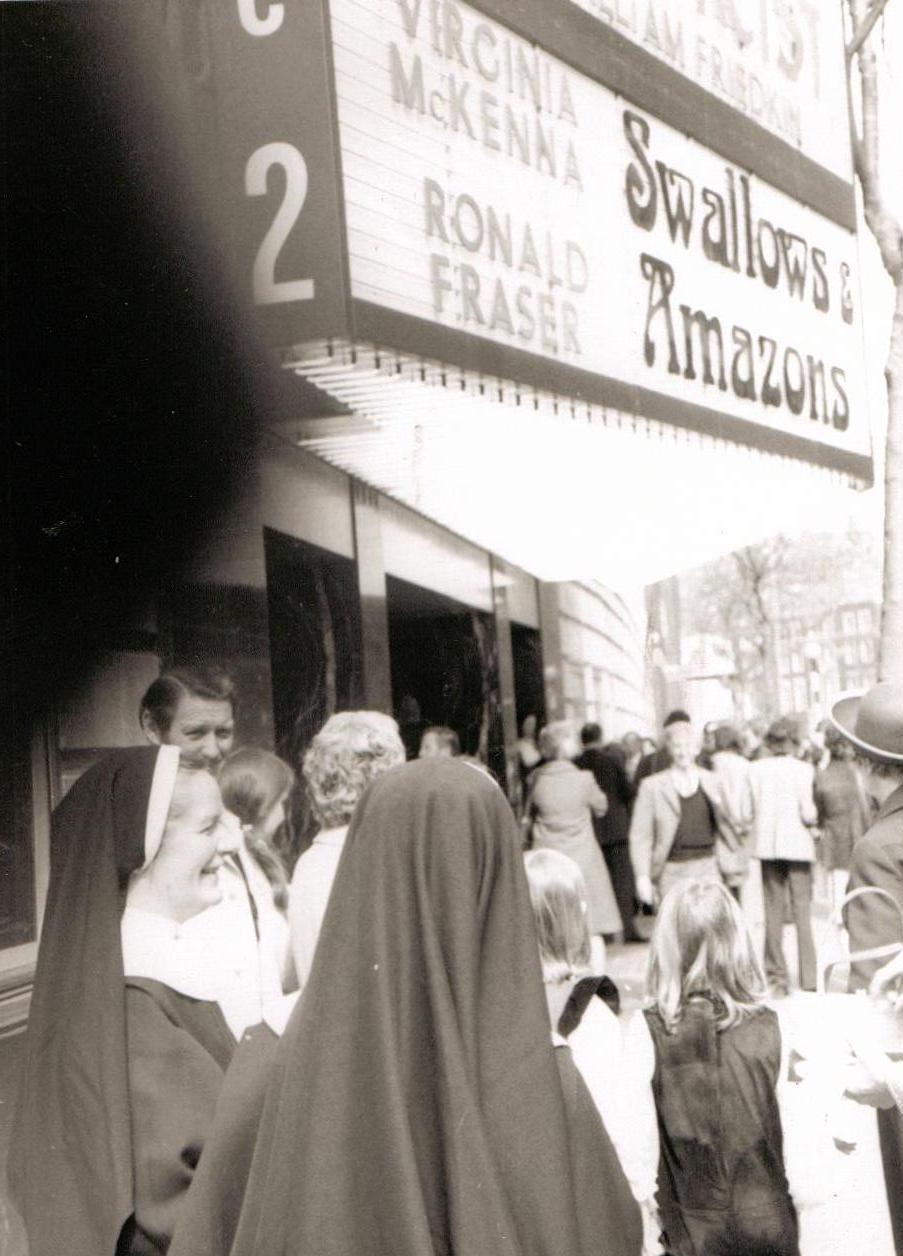
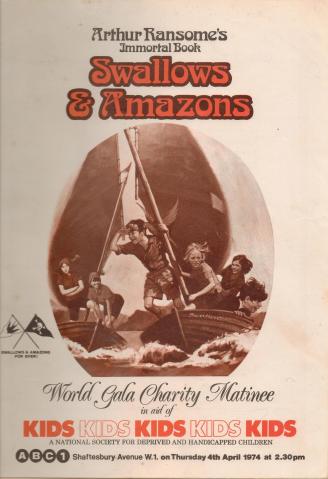
The Premiere of Richard Pilbrow’s movie ‘Swallows and Amazons’ was held at the ABC Shaftesbury Avenue on 4th April 1974. Can you imagine the shock of finding a picture of myself on the cinema tickets when they arrived in the post?
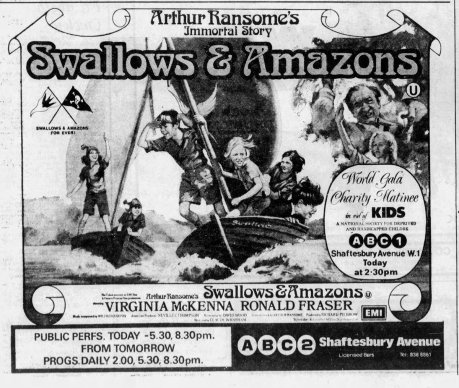
There were adverts in the newspapers. It was to be a Royal Gala charity matinee in aid of the charity KIDS.
I didn’t know what to wear. I wished that we’d been able to put on our costumes but it was clear I had to find an appropriate dress. Sadly, I had grown out of the trendy one we bought in Carnaby Street. Shoes were another problem.
Sophie Neville at home in Gloucestershire in April 1974 ~ photo: Martin Neville
Nowadays one would be inundated by offers of designer dresses to model on the red carpet. As it was, my mother bought me green pinafore dress that I agreed would work for an afternoon event. I was not so happy about wearing ballet shoes. Please note these were real ballet shoes and I was now thirteen. I would have preferred court shoes with buckles. Ironically these zoomed out of fashion whilst ballet shoes have been loved by all ever since. My bobbed hair had grown out but Mummy put it in Carmen rollers. I am not sure the result was that successful but I liked it at the time.
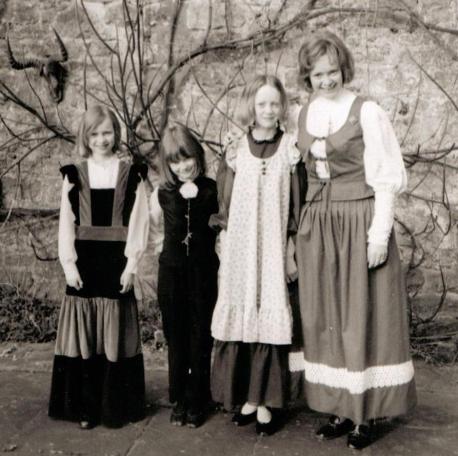
The Neville girls modelling the fashions of 1974 ~ photo: Martin Neville
My sisters were terribly brave and wore velvet with their ballet shoes. The dress from Carnaby Street was slightly large for Perry, seen here on the left, but she coped. At least it was fashionable. Mum bought herself a blue outfit that was deemed the height of fashion. When I arrived in London I found Suzanna had found a Laura Ashley pinafore whilst the Amazons had both got away with wearing trousers. They looked far more sophisticated.
There was an awful lot of fuss about who should or could come and who couldn’t . Mum had insisted on bringing, not friends of mine, but two of the nuns from my school.
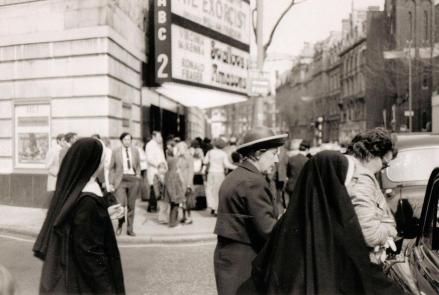
Outside the ABC in Shaftesbury Avenue, London in 1974 ~ photo: Martin Neville
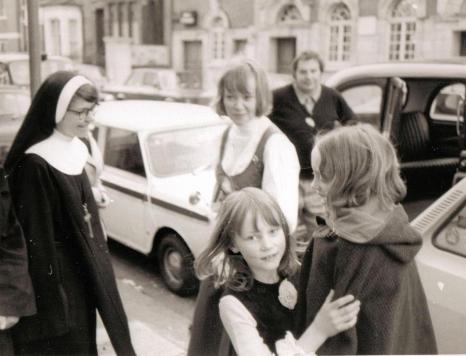
So, I went off to my first premiere with my headmistress, Sister Ann-Julian and my housemistress, Sister Allyne. Not very cool in a thirteen year old’s world. The Exorcist was out at the same time. They made no comment.
Sister Allyne, Daphne Neville, Tamzin Neville and Sophie Neville
In fact Sister Allyne proved the very best person to take. She was a performer herself. I am pretty sure she had been Australia’s foremost flautist. She must have understood the turmoil in my little head and was undoubtedly praying for me. I would not be surprise to learn that spiritual protection was granted by her presence alone. She would have been an exorcist in her own right – a real one. Perry remembers that she had been sick in the taxi. This was probably because she didn’t travel much.
Claude Whatham defied any plans my mother might have made by taking the six of us in the cast, and only the six of us, out to lunch at a wonderful bistro where we able to order beef-burgers, relax and enjoy ourselves.
Sophie Neville, Suzanna Hamilton in Laura Ashley and her mother
There was no red carpet when we arrived at the cinema in Shaftesbury Avenue but rather smart programmes were sold, one of which I still have. Until that point I had no idea that it was to be a Royal Gala held in aid of charity.
I was suddenly acutely aware of how I came across on the big screen. As the film was shown I groaned inwardly. It was like seeing endless photographs of oneself which were not exactly glamorous. I cringed. All Sister Allyne said was how much she enjoyed seeing the owl – a natural history shot that was added after all our hard work and effort on the drama.
The premier – as reported in Cinema TV Today
My mother was terribly impressed by the special guests. Princess Helena Moutafian was present with Earl Compton, chairman of the charity KIDS. I’m afraid I don’t remember meeting them but was interested to hear that she later became patron of the Young ME Sufferers Trust.
We walked down onto the stage with Ronnie Fraser to be presented to the audience. Sadly Virginia McKenna could not be there, although she sent her eldest children – Will and Louise Travers. Bobby Moore, who’d played for England came with his family, as did Mrs Spike Milligan. The Hollywood star Patricia Neal, who won an Oscar for her leading role in the Paul Newman film Hud and appeared in Breakfast at Tiffany’s , brought her sweet little girls. Julie Ege was a lovely Norwegian actress who appeared as Voluptua in Up Pompeii with Frankie Howard. I think Richard Pilbrow might have known her as he had produced the West End version. She was known as a Bond Girl since she’d appeared in ‘On her Magesty’s Secret Service’ with Diana Rigg when George Lazenby played Bond and Telly Savalas was Bolfeld. We didn’t know any of this but I think having a Bond Girl at your premier was quite the thing.
I have a few precious posters of the film. The colour poster, which hung in the London Underground is still on the cover of some of the DVD’s. I always quite liked the design, except for the rather jarring colour of my blouse, which for some reason is pink. Far more attractive were the huge sepia posters hung outside cinemas. They were very special. I still have one but it’s enormous and I am unsure what to do with it.
What the papers had to say about the film was a different matter. The first time we saw Swallows and Amazons was not at the film the premiere but at ‘The Preview’. This was held at a viewing theatre in London to which I assume journalists were invited. I only wish they’d been asked to bring their children. The cast was re-united, meeting up with various members of the production team, to see the film for the very first time. We were utterly amazed at how sunny everything looked. Denis Lewiston’s insistence that we should wait for clouds to pass, while we shivered, had paid off. It was wonderful to see how the film had been put together. We had not known that Claude would add shots of wildlife, which add so much to the movie. I loved the scene he included of cattle standing in the still lake at dawn.
You can read about how we made the film and find more photos in these publications available online or to order from libraries.
Different editions of ‘The Making of Swallows and Amazons (1974) by Sophie Neville’
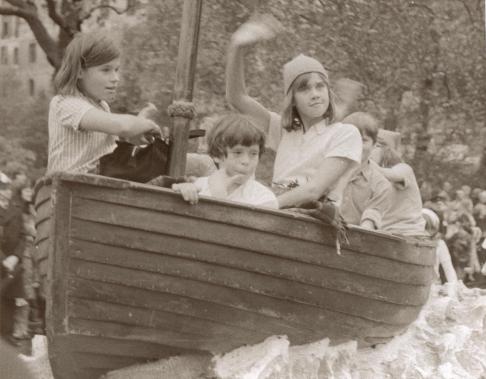
Suzanna Hamilton, Stephen Grendon, Leslie Bennett, Simon West and Kit Seymour sailing the streets of London on polystyrene waves.
Our first major public appearance for the promotion of ‘Swallows and Amazons’ was The Lord Mayor’s Show . For the first time since the filming we climbed into our costumes and then into Swallow who had been mounted on low-loader. Afloat on a float, we made ready to sail through the City of London.
Sophie Neville, Suzanna Hamilton and Lesley Bennett
It must have been early November and was so very cold before we set off that we needed to keep our own coats on. We were anxious this would spoil things for people. I’m sure it would not have made much difference. Did anyone know who we were? The film hadn’t come out. We were riding on the wave that Arthur Ransome and his books were so well loved by the people of our nation.
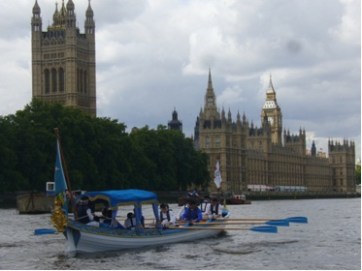
Stephen Grendon, Suzanna Hamilton, Lesley Bennett, Simon West, Kit Seymour and Sophie Neville in Swallow. What is the building behind us?
What was fun, if a little odd, was that it was the first time, indeed the only time, that the Swallows and the Amazons had been in a dinghy together. As we were taken through the streets of London passers-by started to wave at us and we waved back. Soon it was waves all round. Being Titty, I had Swallow’s flag to fly. John let Nancy take the tiller.
Kit Seymour, Sophie Neville, Simon West and Suzanna Hamilton together with huge crowds of Londoners ~ photo: Daphne Neville
We were amazed to find huge crowds of people had gathered and that it was all rather fun. I don’t know why but Sten must have joined my mother on the pavement by the time this shot was taken. I can see the back of his head in this next photograph. He is wearing the tartan hat Claude Whatham bought him at Blackpool fun-fair.
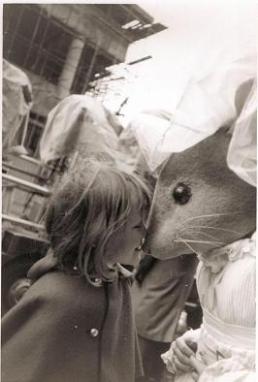
Jeremy Fisher Frog was leaping about in front of us, which was rather amazing. With him danced other representatives from the Tales of Beatrix Potter, The Royal Ballet’s wonderful feature film that also came out in 1973/4. We were marking the 35th anniversary of EMI, whilst bringing the Lake District to London Town, which is something we all could celebrate.
Tamzin Neville meeting Mrs Tittlemouse
Since we didn’t have to talk to anyone, we were able to enjoy being involved in the pageant, which included so many icons of British Life.
I hadn’t met a Pearly Queen before, but there was a whole clan of them in their glorious suits, lovingly embroidered with mother of pearl buttons. I resolved to collect enough to adorn my own jacket. My favorite view was of HM the Queen’s gold state coach pulled by her lovely white horses, six in hand. I’d been to see them at the Royal Mews when we came up for my first interview at Theatre Projects offices in Longacre when I first met our director Claude Whatham.
My mother took a photograph of the Queen’s Drum Horse. Much later she found that he was a stallion, on offer as part of a British Horse Society breeding improvement scheme. He was brought over to service her Irish mare Gerty. The result was a lanky skewbald called Nimrod, an enormous gelding who Andrew Parker Bowles rejected on behalf of the British Army. This proved an error. Like most heavy horses Nimrod was just slow to grow. He eventually became a national dressage champion, although not in our hands.
The Queen’s drum horse who sired our foal, Nimrod
We have one last photograph which shows that the float in front of us depicted an EMI film crew, with 2K lights, a camera and technicians. It is studing this photograph that made me feel that we were not in Swallow as the transom seems so differnet. I don’t suppose anyone else noticed.
Funnily enough I was in a boat for the Lord Mayor’s Show this year. We rowed up the Thames in the Lord Mayor’s procession on Saturday 12th November.
I am on the crew of the Drapers’ Barge, Royal Thamesis a 33 foot shallop, which I last rowed on the tideway for the re-creation of Nelson’s funeral covered by Sky TV. You may have seen her taking part as the in the Queen’s Jubilee Pageants. We have been asked to take part in the procession of boats that heralds the Lord Mayor’s Show this coming November.
The Drapers’ Barge ‘Royal Thamesis’ taking part in the Lord Mayor’s Show
This colour footage shows various aspects of the Lord Mayor’s procession in 1973 including the Queen’s Gold State Coach built in 1762 and a float with Daleks, which must represent Doctor Who, a series I worked on about ten years later when at the BBC.
Sten Grendon as the Boy Roger, Sophie Neville as Able-seaman Titty and Simon West playing Captain John, Derwentwater in 1973 ~ photo: Daphne Neville
Monday morning on Derwentwater in the Lake District and we had no lessons. The Cumbrian schools had broken-up for the summer holidays, so we were free to play, or as freely as you can be when you are wearing a costume that can not under any circumstances get wet or dirty.
Behind-the-scenes: wardrobe master Terry Smith with Sophie Neville and her chaperone outside the Make-up caravan on location near Keswick.
Although Claude Whatham was operating with a skeleton crew our wardrobe master Terry Smith was still getting us into the right kit for each scene. My mother said that he either got muddled or distracted at one point as a whole sequence was shot with all of us wearing the wrong costumes. It caused quite a fuss. It would have been expensive in time and money. She thought he had been given the sack, but this doesn’t appear to have been the case.
Simon West, Stephen Grendon and Sophie Neville whilst on location in the Lake District in 1973 ~ photo: Daphne Neville
One of the secrets of filming ‘Swallows and Amazons’ is that, on this day, Terry Smith adapted Ronald Fraser’s costume and white colonial pith helmet for our property master Bob Hedges to wear. It was he that fired the cannon on the houseboat.
You can tell which shots of the voyage to the island were taken that day as I was missing an eyetooth. One moment it’s there. In the next shot it’s missing.
Clive Stewart our boatman with the houseboat and the dinghies, Amazon and Swallow, on Derwentwater in 1973 ~ photo Daphne Neville
Clive Stewart of the Keswick Launch Co. was one of a number of Cumbrian boatman who worked on the support crew for the filming of Swallows and Amazons in 1973. They played a vital role not only ferrying us to the location but acting as safety boats and keeping modern boats out of shot.
Sophie Neville, Simon West and Suzanna Hamilton sailing Swallow
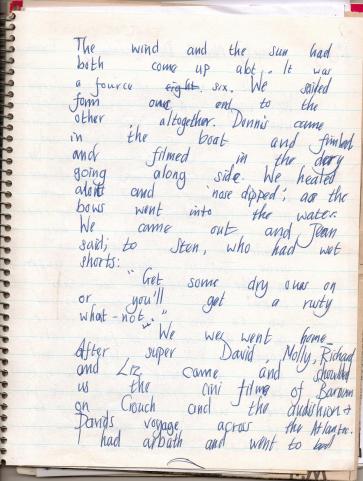
The boatmen were certainly busy once the wind got up on this particular day. Claude Whatham handed over the direction of montage sequence of the Swallows’ first voyage to the island to David Blagden, our sailing director. At last we had the sun and wind for it – if not too much wind. By now were were pretty experienced but the little ship was challenged to the full as wind gusted down from Cat Bells.
Suzanna Hamilton wrote in her diary that, ‘…it was very rough. We thought we were going to do a Chinese jibe but it was OK. We sailed the whole length of the lake.’ What must have been tricky for Simon West was that he had Denis Lewiston, the lighting-cameraman, on board with a 16mm camera, as well as all our clumsy camping equipment. You can see me heaving the crockery basket past the camera on the movie. The result was probably the most exciting sequence in the film, or so my father later declared.
Jean McGill, our unit nurse and driver, was ever around to scoop us up and keep everyone cheerful when we came in feeling a bit chilly.
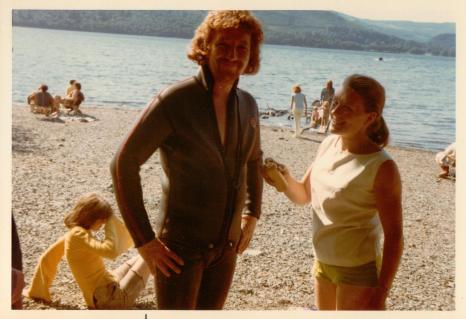
Wardrobe master Terry Smith wearing the safety officer’s wetsuit with unit nurse and driver Jean McGill on Derwentwater. Kit Seymour is sitting behind them to their right ~ photo: Daphne Neville
In the evening Richard Pilbrow, his girl-friend Molly Friedel and his assistant Liz Lomax came up to our guesthouse in Ambleside to show us the cine footage they took on the sailing weekend that had been the final audition for our parts. This had taken place in March at sailing town of Burnham-on-Crouch in the Maldon District of Essex when were stayed on board a moored vessel and went out sailing with David Blagden in quite grey, chilly weather. The conditions had been pretty rough then. I remember telling Claude that we ‘helmed like anything’. I felt terribly embarrassed later when I realised that ‘helmed’ was not exactly what I had meant to say but I don’t think Claude was familiar with sailing terminology at the time. He would have like the spirit of what I said.
Titty’s missing tooth
It had been choppy but none of our days had been as rough as David Blagden’s Atlantic crossing, famously made in his tiny orange-hulled 19 foot yacht Willing Griffin. I wonder if the footage of this still exists?
Richard Pilbrow must put me right on this, but the theory is that he acquired Swallow that weekend. We were told at the London Boat Show that she was originally the all-purpose run-around dinghy built by and for William King & Sons’ boatyard at Burnham-on-Crouch in the 1930s. She has the initials WK carved on her transom. They designed her well – a stable little ship with plenty of room inside and no centre-board to worry about. You can see detailed photographs of her on the Sailing Swallow website.
The story continues…. you can read more in The Secrets of Filming Swallows and Amazons available as an ebook for about £2.99 on all the usual platforms:
If you ever see a cormorant you must sing out, ‘They’ve got India-rubber necks!’
And then, if you are on a long journey you can add, ‘ Cormorants. We must be near the coast of China. The Chinese have cormorants. They train them to catch fish for them. Daddy sent me a picture.’
Sophie Neville, Suzanna Hamilton and Simon West as the Walker children sailing to Wild Cat Island in Swallow
If you ever get lost – or the journey really is a long one, you can say,
‘Here we are intrepid explorers making the first ever voyage into unchartered waters. What mysteries will they hold for us? What dark secrets will be revealed?’
They were most complicated speeches to deliver afloat, ones I had to learn. In the end the second part was heard OOV – out of vision. I could have read the lines. But then they wouldn’t have stayed in my head forever, as they have.
Stephen Grendon, Sophie Neville, Suzanna Hamilton and Simon West on the voyage to Wild Cat Island, scenes shot on Derwentwater in 1973
If, on your journey, you happen to see a man sitting in a chair writing notes you score high and can say, ‘What’s that man doing? He’s probably a retired pirate working on his devilish crimes.’
Filming Swallows and Amazons (1974) from a camera pontoon
(I’m a bit hesitant about that one because my Aunt Hermione really was approached by pirates when she was sailing round the world. The Daily Mail published her dairy chronicling the adventure; a full page double- spread with photographs no less. Rather sadly they ran headline ‘Intrepid Pensioners…’ What a swizz. She should have lied about her age and said she was 27 instead of 60. Well, perhaps 57, what with the photos.)
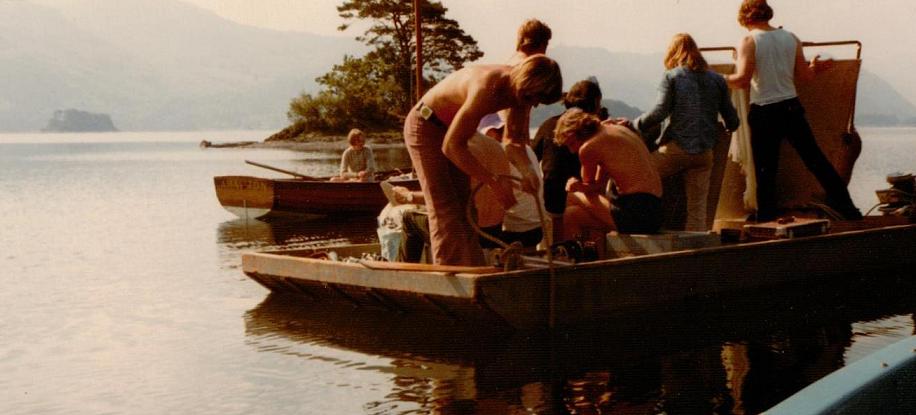
The scene behind the camera that day on Derwentwater was rather different from from the scene in front of it.
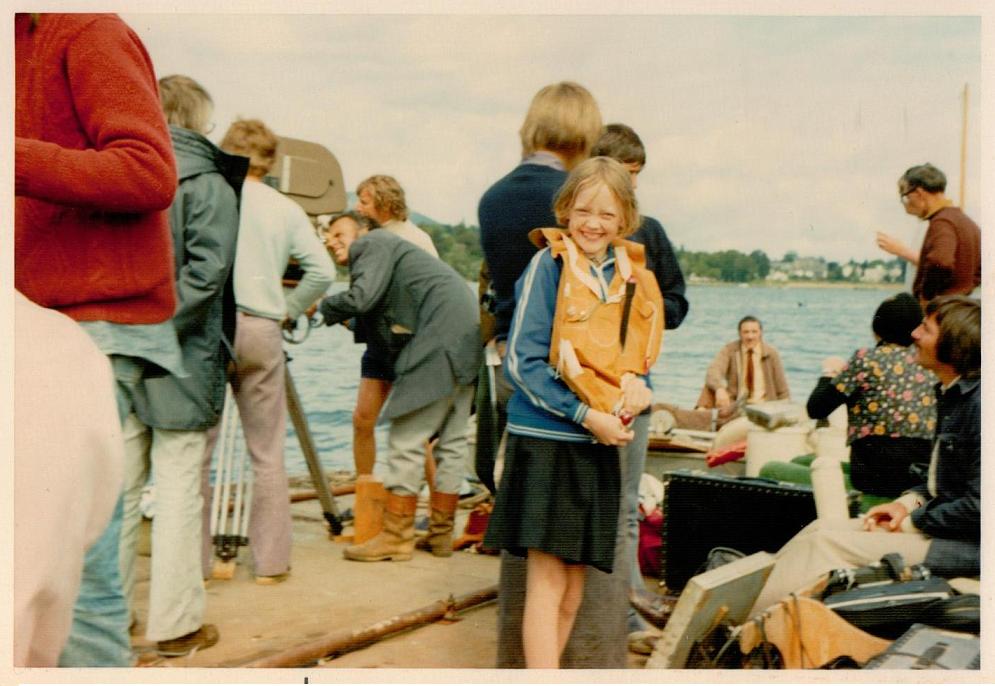
I got cold sailing but it was a glorious sunny day with a fair wind. We achieved a huge amount even if Cedric fell in. Some of the boatmen and crew wore life jackets, others did not – including my mother.
We wore BOAC life jackets for rehearsals but Swallow is a safe little boat – her keel ensuring we didn’t capsize if we happened to jibe and we never fell in. The pontoon was really rather more dangerous being a raft with no gunwale. Any one could have misjudged their step and plopped overboard. Luckily we were not stifled by Health and Safety in those days – only the rigorous demands of movie insurance companies.
This shows the camera crew climbing aboard the pontoon in order to film Swallow sailing. Daphne Neville sits in the Dory safety boat in the foreground. A reflector board, wrapped camera mount and microphone are already on board.
I’m sure we had already shot the first two scenes of the day when I was in Amazon, setting the anchor and later hearing the robbers. I expect Claude needed to re-shoot for technical reasons. Day-for-Night filming requires clear, sunny days and he would have needed still water.
John and Susan find Titty has moored the Amazon off Cormorant Island
I have some of my father’s 16mm footage showing us at around this stage in the filming. It was shot on a different day but shows us on the shores of Derwentwater, waiting around before rushing off across the lake in motor boats to finish filming before Claude lost the light. You see the pontoon and a safety boat towing Swallow, me snapping bossily at Roger to get a move-on, (unforgiveable but I was 3 years older than him and irritated to distraction), the third assistant Gareth Tandy in blue with glasses, our sound recordist Robin Gregory throwing his arms wide open, Kit Seymour and Lesley Bennett by the lake shore, David Blagden with his short hair-cut splicing rope, me in my Harry Potter-ish blue nylon track-suit top with Albert Clarke the stills photographer, Swallow and some mallard duckings.
If you are enjoying this blog, please find an expanded version of the story in the ebook, available from all online retailers such as Amazon Kindle for £2.99 and on Goodreads here It has also been published in two illustrated paperback versions, which make good presents.
Different editions of ‘The Making of Swallows and Amazons (1974) by Sophie Neville’
‘Here we are, intrepid explorers, making the first ever voyage into unchartered waters. What mysteries will they hold for us? What dark secrets shall be revealed?
As we set off from the Lakeside Railway Station on the southern shore of Windermere to explore Arthur Ransome’s world, I began wondering how many signs of ‘Swallows and Amazons’ we would find. Would we see the crossed flags that have become a symbol of the bestseller he wrote back in 1929?
We found the first sign the East of Lake road above Coniston Water. And there was Holly Howe where the Walker Family came for their holidays. It is so exciting to know that you can stay there too, or go for tea, and run down the field full of buttercups to dip your hands in the lake, just as the real Altounyan children – the real Swallows – must have done. We passed Lanehead, their grandparents’ house next-door as we drove down to Coniston. I gather it is for sale.
Coniston Old Man or Kanchenjunga, as the Swallows and Amazons called the mountain, was snoozing under a thick blanket of cloud but the challenge of climbing to the summit was for another day. Below the village, mooring up to the jetty at the Bluebird Cafe, was Ransome, the Coniston Launch. Peter Walker introduced us to the Captain who welcomed us aboard. He asked after Swallow the little ship from the film that we had re-launched from the very same jetty in April 2011. If you join The Arthur Ransome Society you can sail Swallow on Coniston this summer.
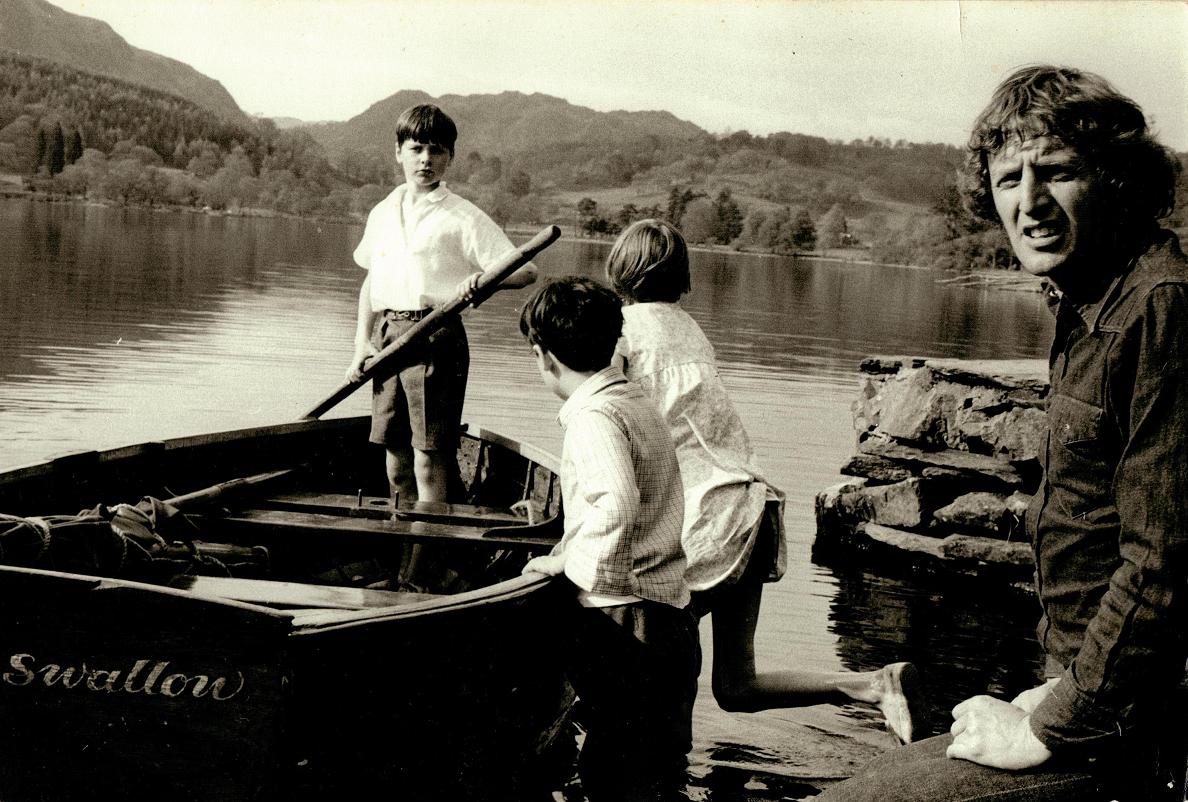
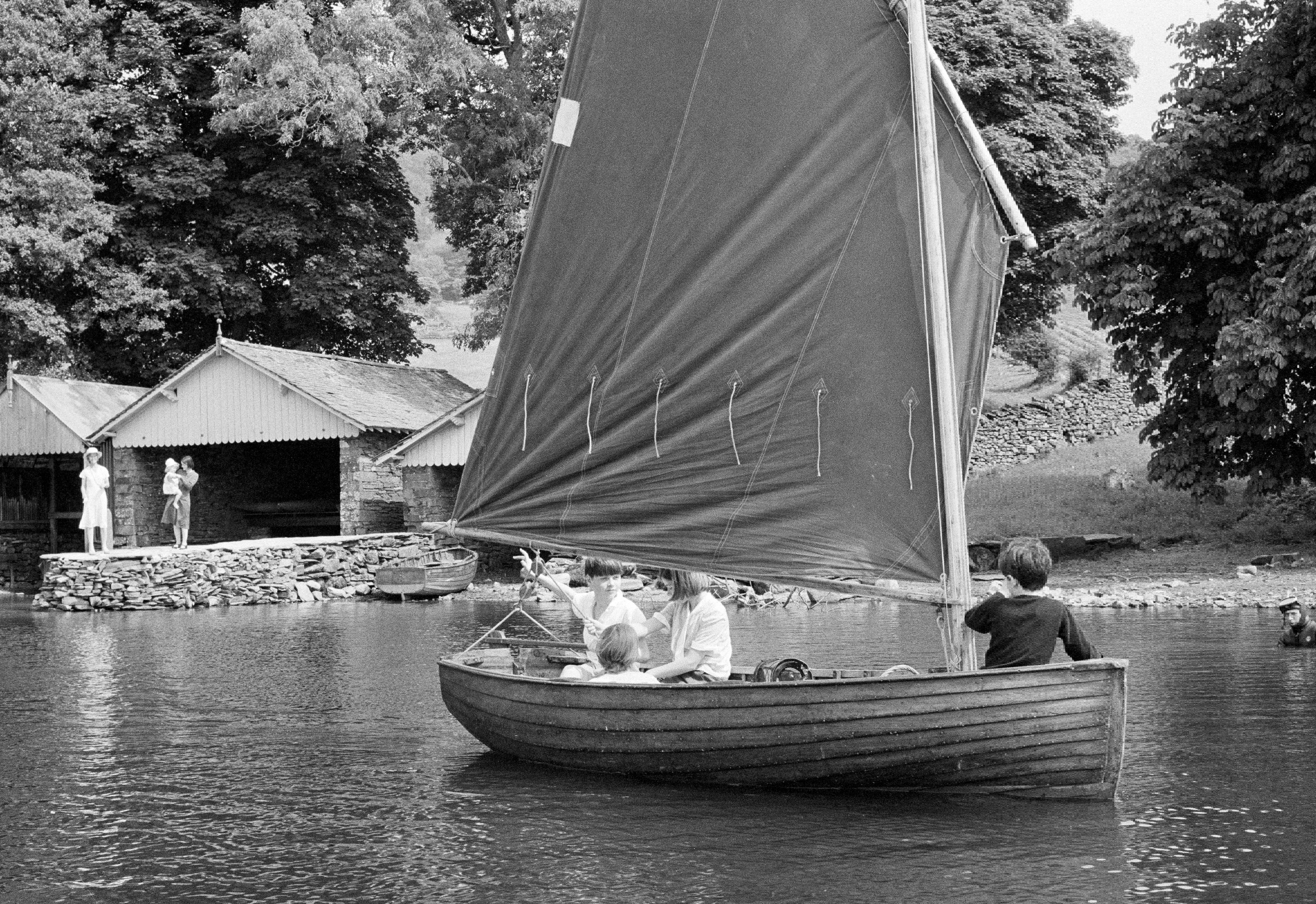
As we set off across the lake we could see Swallow’s boatshed clearly from the Coniston launch. It has been renovated and repaired but the old stone jetty is still there, below the huge horse chestnut trees. I remember how cold the water was when we first brought Swallow out from the depths of that shed in May 1973 to shoot the opening scenes of the movie. Two sheep came down to see what we were doing. Richard Pilbrow, the Producer, gave me this black and white photograph that, unusually, shows Claude Whatham the Director setting up the shot. I was letting water drain from my shoe.
Simon West as Captain John standing in ‘Swallow’ at the stone boatshed jetty on Coniston Water with Ableseaman Titty and The Boy Roger. Director Claude Whatham knew how cold the water was that day in May 1973
The Coniston Launch can take you right down the lake to Wild Cat Island or Peel Island as it is really called. You can see the Secret Harbour best from a boat and imagine Titty trying to get out through the rocks in Amazon, in the dark, when she captured her from the terrifying Amazon Pirates.
We actually disembarked at Brantwood, John Ruskin’s House. It was here that the Altounyan children’s grandfather WH Collingwood worked as Ruskin’s private secretary. He painted him at his desk there. My niece has just graduated from The Ruskin School of Art in Oxford.
Peter Walker met us and drove us on down the lake to show us The Heald, a bungalow above the road where Arthur Ransome lived with his Russian wife, Evgenia and his dinghy, Coch-y-bonddhu. It was here that he wrote Picts and Martyrs. Coch-y-bonddhu played the part of Dick and Dot’s boat Scarab. The original ‘Dogs Home’ can be found in the woods above the house. Rob Boden is very keen to restore it.
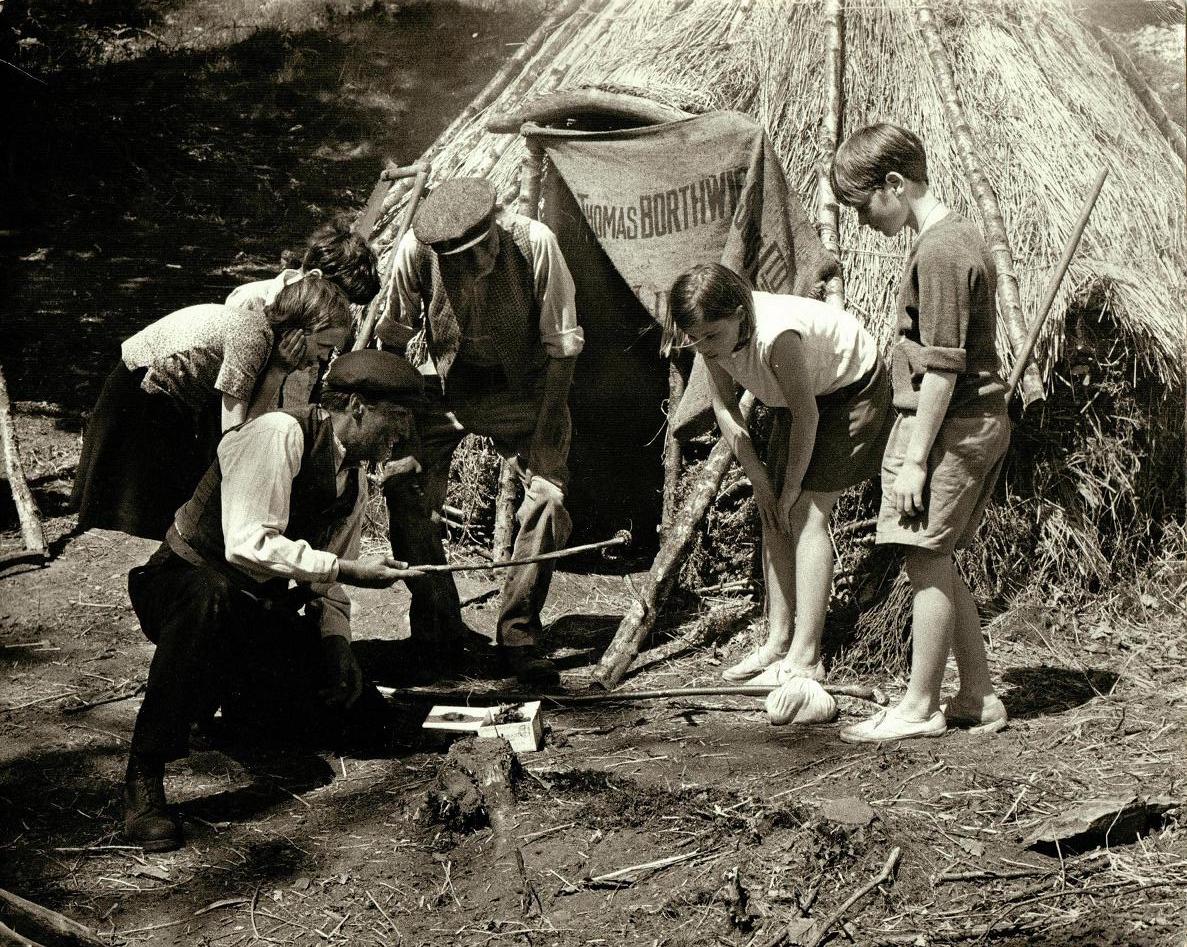
It was in the Grizedale Forest that we went to see the charcoal burners and met the real men in the process. And an adder. It was real too.
John Franklyn-Robbins, as Young Billy who is showing his adder to Sophie Neville, Stephen Grendon, Jack Woolgar, Suzanna Hamilton and Simon West at a location in the Grizedale Forest above Coniston Water
I looked back at the island where I spent so much of my childhood. It was difficult to imagine how a location catering wagon let alone two Route-master London double-decker buses could have driven down the winding East of Lake road. They parked in the field opposite the islands so the crew could at least eat lunch in the dry and we could have our lessons. The National Parks Authority had to ask the Production Manager to drape wartime camouflage netting over them. You must have been able to see the red buses for miles.
The hat is a purple ode to the early 1970’s. My mother bought it at great expense in Carnaby Street. It is very good at keeping off the rain.
As you drive south you can look over the water to see Brown Howe, the house that we used as a location for Beckfoot in the film of Swallows and Amazons and shortly after, the Edwardian boathouse, which Claude Whatham used for the Amazons. I don’t think this was the one Ransome envisaged. His was at the mouth of the Amazon River – a reedy place. The pictures in the illustrations show a building with a low-pitched roof.
Peter took us down to a farm the south of Coniston Water where the real Ransome children spent their summer holidays. You can walk down the footpath they must have taken to dip their hands in the lake. And there I found what must be the real Amazon boat house.
Sophie Neville as Titty about to discover the Captain Flint’s trunk hidden on Cormorant Island ~ photo: Daphne Neville
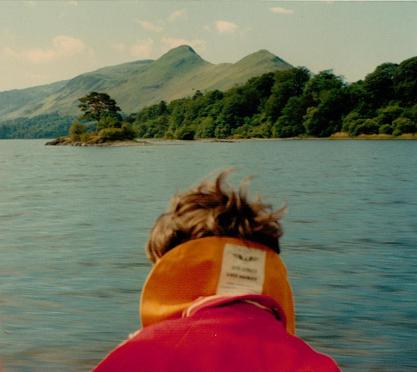
Stephen Grendon on Derwent Water looking out to ‘Cormorant Island’ ~ photo: Daphne Neville
What a day!
A bright sunny day on Derwentwater. I wore what was my favourite costume, not least because I had the option of wearing a vest beneath the blouse and I didn’t have to worry about the divided skirt. I went to such an old fashioned school that I owned a pair of grey flannel culottes myself, to wear on the games field, and thought them very much the sort of thing Titty would have worn.
My mother in a skirt with her sister wearing a divided skirt in 1953
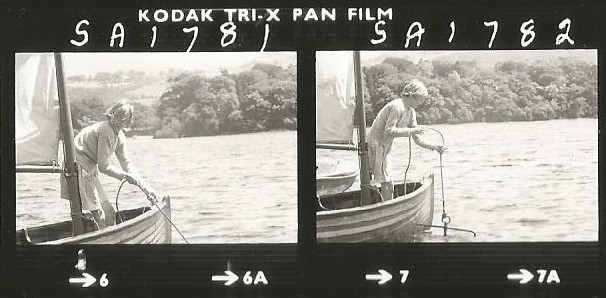
The cotton dress and buttoned up grey cardigan were a bit crumpled by the time I dropped Amazon’s anchor off Cormortant Island.
Roger, meanwhile was in long shorts or knickerbockers as the real Altounyan children would have called them, kept up with a snake belt. His even longer underwear was an item requested by Claude Whatham the director who, being born in the 1920s himself, had worn exactly the same sort of underpants as a child. As the day warmed up Claude stripped down to a pair of navy blue tailored shorts and sailing shoes. We were on a desert island after all. Even if it was a desert island in the Lake District.
Amazon moored near Cormortant Island on Derwentwater with the pontoon and safety boats. What is the real name of the island used for the location?
In Arthur Ransome’s book of ‘Swallows and Amazons’ the hunt for the treasure is slightly different and Captain Flint’s trunk lies buried under rocks. I wasn’t expecting the set-up with the tree trunk, although I think it works well and looks good, giving movement to the sequence. The only hesitation was that Claude didn’t want me to get hit by the rocks as they slid off. This was a pity as I would have jumped aside.
Long shots of sailing Swallows and Amazon on Derwentwater in 1973
I am not sure why the Amazon had not been bailed out. I can remember having to lie in the bilge water, which proved cold and uncomfortable. Perhaps it gave my performance an edge. Titty would have been cold and stiff after a night wrapped in the sail. Great grey clouds were gathering by then and we were all getting tired.
Sophie Neville playing Titty Walker in the captured Amazon, with David Cadwallader, Bobby Sitwell, Eddie Collins, Claude Whatham and two electricians holding reflector boards on the camera punt: Photo ~ Daphne Neville
Being together in a confined space becomes difficult to endure after while, not least when the space is a pontoon on a lake with not much to sit on. Small boys tend to muck about and become annoying when they are bored. The time had come when someone was going to crack – and they did. The result was silence. A sobering moment. And one very wet pair of knickerbockers.
In the end three of us went home in wet underwear. Gareth Tandy, the third assistant director – who I think was only about 18 – was pushed in to the lake, this time to great hilarity.
John and Susan find Titty has moored the Amazon off Cormorant Island
The big question, of course, it what is the name of the island on Derwentwater that we used as the location for Cormorant Island? Duncan Hall has written in to suggest it is called Lingholm Island (or possibly One Tree Island). What is the name of the larger island, seen in the background of shots, that represents Wildcat Island? Is it Rampsholme Island?
The pontoon on Derwentwater with Richard Pilbrow, Bobby Sitwell, Denis Lewiston, Claude Whatham, David Cadwalader and Sophie Neville aged 12 playing Titty. Cameraman Eddie Collins looks on ~ photo: Daphne Neville
I have one behind-the-scenes clip of the crew on the pontoon – shot on a sunny day. It looks most bizarre. It was. You can see how cramped and overloaded we were and guess at the patience demanded of us all. Imagine how long it took to set up shots, while exposed to the elements. It was quite a stable raft but when we went for a take it was vital that everyone kept completely still or there would have been camera wobble. We used a conventional boat with a cabin when we filmed ‘Coot Club’ and ‘The Big Six’ on the Norfolk Broads ten years later in 1983. It proved much easier – but had more wobble.
The ebook on ‘The Secrets of Filming Swallows and Amazons (1974)’ is available on Amazon Kindle and other platforms. You can read the first section for free here:
Suzanna Hamilton as Susan with Sophie Neville as Titty busy writing the ship’s log
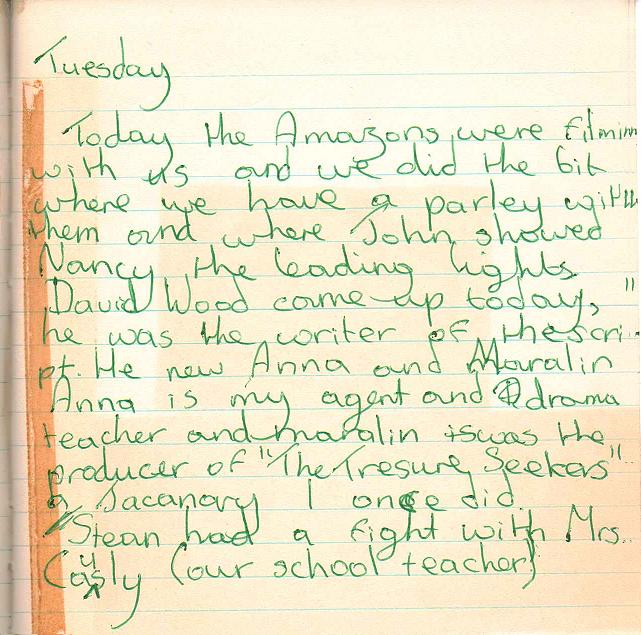
Something very exciting happened last week. Suzanna Hamilton came to see me, bringing the photographs that she was given during the filming of Swallows and Amazons along with a bundle of papers. I immediately recognised the blue bound diary that she had kept. Her God-given sense of humour fills the pages.
Although Titty was the one who always kept the ship’s log in Arthur Ransome’s stories, we children all kept journals during the filming as part of our school work. It was quite a task.
Suzanna’s diary gives the story of making the film of Swallows and Amazons from the perspective of an actress, the actress she was then and ever more will be. Even before we began filming she was getting as excited as Susan about grog and molasses, calling us by our charcter names as Claude Whatham suggested.
Anna Scher ran the most wonderful children’s theatre club in Islington, which Zanna went to after school, along with Pauline Quirke and Linda Robson. I visited Anna Scher’s Theatre Club ten years later when I was casting children for the BBC drama serial of ‘Coot Club’ and ‘The Big Six’. Although I didn’t find anyone there who could sail I held Anna Scher in huge admiration and respect, using her exercises when I was auditioning kids in Norfolk. She did so much for the young people of east London, giving children confidence with self-discipline aquired during their drama lessons and workshops.
David Wood, who wrote the screenplay of Swallows and Amazons, was already well known as an actor. Mum was rather in awe of him since he had played Johnny in Z Cars and had starred the feature film ‘If…’ alongside Malcolm McDowell. He had been a storyteller on the BBC Childrens Television programme we all adored called Jackanory. Suzanna had been involved in the same series when E.Nesbit’s ‘The Treasure Seekers’ had been read. She had also appeared in ‘The Edwardians’ form the book by E.Nesbit directed by James Cellan Jones in 1972. By coincidence Pauline Quirke played Eliza in ‘The Story of the Treasure Seekers’ in 1982 and I worked with her a few years later on Rockliffe’s Babies. My mother appeared in a pantomine David Wood wrote called The Gingerbread Man when it was produced at The Everyman Theatre in Cheltenham. She wore red with a pill-box hat as Miss Ginger.
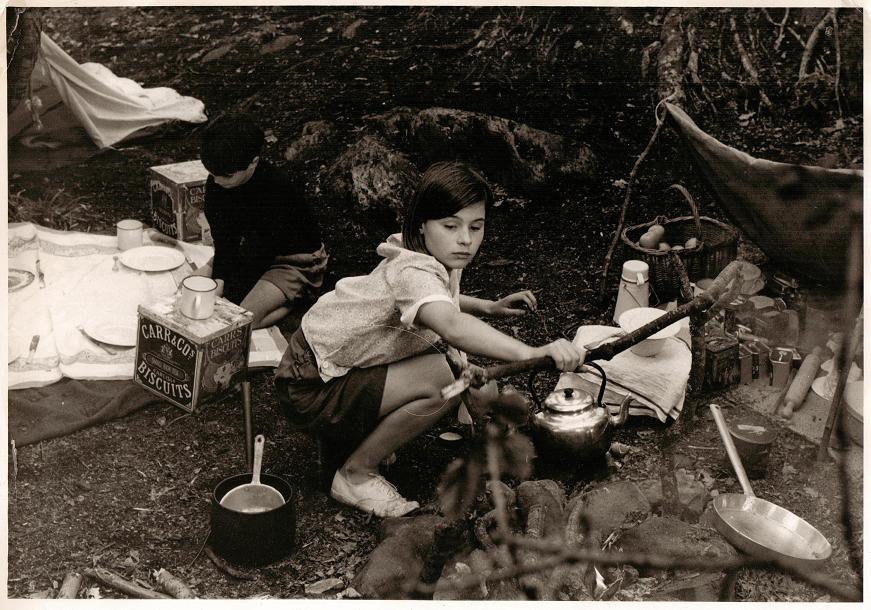
Suzanna Hamilton playing Susan Walker with Stephen Grendon as Roger Walker camping on Peel Island, Coniston Water in Cumbria, the Lake District
You can read more in the ebook ‘The Secrets of Filming Swallows and Amazons (1974) available from Amazon Kindle and all ebook retailers.
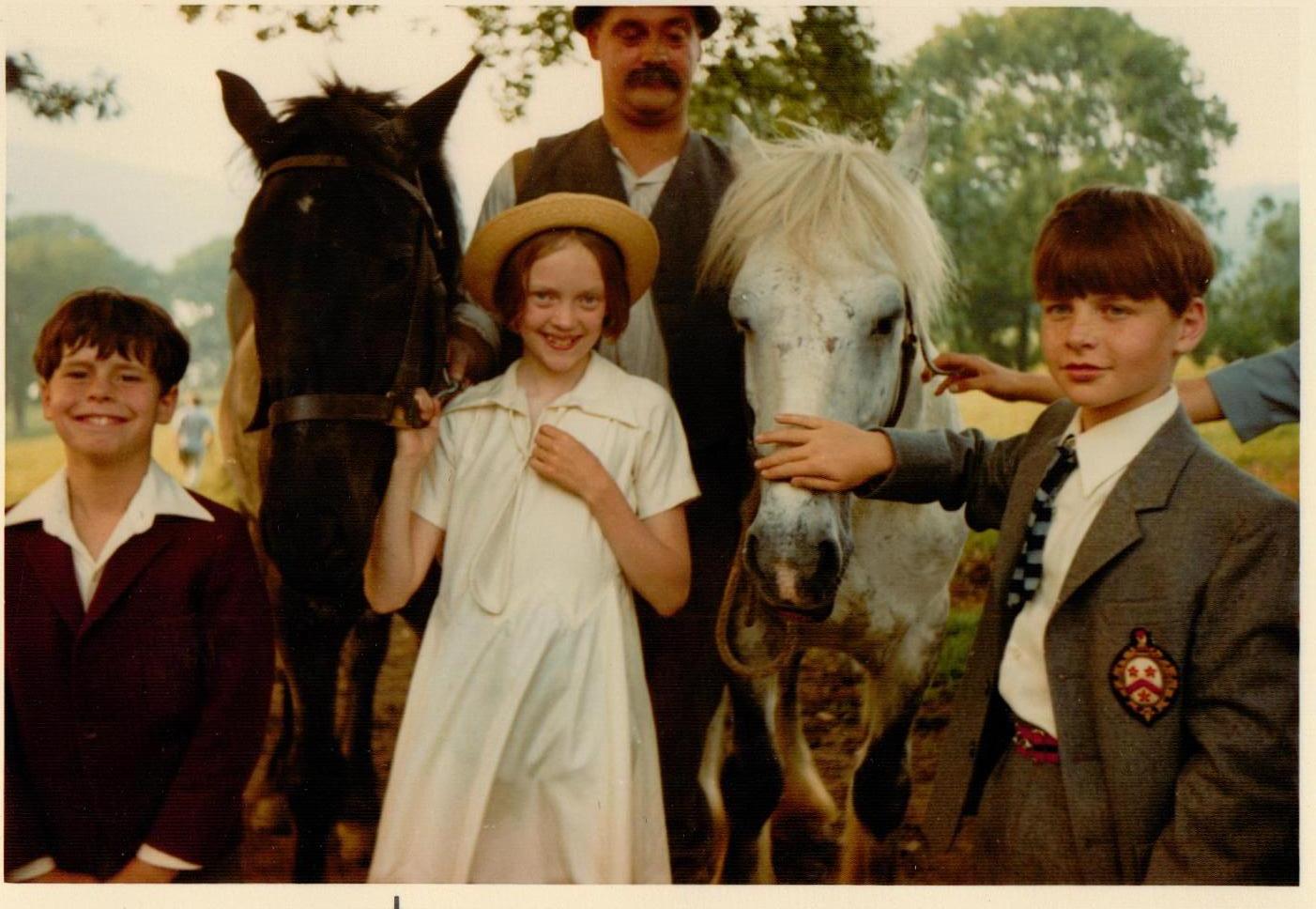
Fifty one years ago this day, we were filming with Dame Virginia McKenna at the location used for Arthur Ransome’s Holly Howe above Coniston Water. It was a day of days – the sunshiny day that we had all be waiting for.
Dame Virginia McKenna at the other side of the boat houses at Bank Ground Farm in 1973 ~ photo: Daphne Neville (c)
First Assistant Director David Bracknell standing-in (or kneeling-in) for Roger with Dame Virginia McKenna at Bank Ground Farm. The great trees in the background are sadly no longer there ~ photo: Daphne Neville (c)
The gift of a day when buttercups and daisies were still out in the field that flows from Holly Howe to the lake. Roger was able to tack up the meadow to receive the ‘despatches’ from Mrs Walker, described in the opening pages of Arthur Ransome’s book.
Dame Virginia McKenna reading the IF NOT DUFFERS telegram to Sten Grendon as Roger
‘…Each crossing of the field brought him nearer to the farm. The wind was against him, and he was tacking up against it to the farm, where at the gate his patient mother was awaiting him.’
Dame Virginia McKenna having her hair adjusted by Ronnie Cogan ~ photo:Daphne Neville (c)
I don’t think you can tell that this section of the scene was recorded seven whole days later than the sequence that runs directly on from this when the Boy Roger delivers the very same ‘If not duffers’ telegram to Captain John.
The hole that had been dug for the camera alongside our picnic had been filled in. You can see this from Mother’s perspective when I was milling about near the lake looking towards the island I couldn’t actually see.
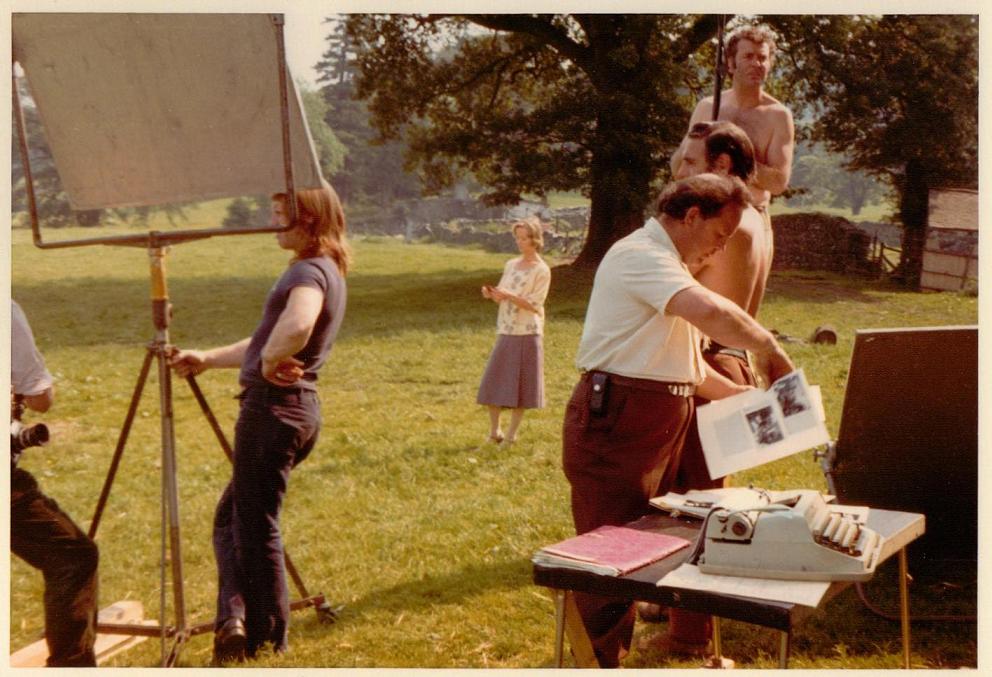
Dame Virginia McKenna on location at Bank Ground Farm (Holly Howe) in the Lake District. Property Master Bob Hedges is working in the foreground. Lee Electric lighting assistants stand-by with reflector boards while Assistant Sound Recordist Gay Lawley-Wakelin waits on a box with the boom ~ photo: Daphne Neville (c)
Poor Sten, he had to run up the field on what proved to be our hottest day in a sleeveless sweater. I remember Jean McGill, the Unit Nurse ministering cool drinks and a flannel soaked in cool eau de Cologne to make sure he did not get dehydrated. We all wanted a go with the cool cloth on the back of our necks at lunch time.
The Walker Family ~ Suzanna Hamilton playing Susan, Stephen Grendon as Roger, Sophie Neville as Titty, Dame Virginia McKenna as Mother and Simon West as John. photo: Daphne Neville (c)
It was good to escape the heat by getting out on the water. We shot the scene set on the old stone jetty at the boat houses below the farm when Titty leads ‘Good Queen Bess’ down to the harbour to inspect her ship. I didn’t realise she had a large box of matches in her hand. Virginia kept it a surprise from us in real life. I was excited to find out that Simon Holland, the Designer had painted the branded cover by hand.
Farewell and adieu to you fair Spanish ladies
As the call sheet specifies, our dinghy Swallow had been loaded with all the tents and camping equipment that had been on Peel Island the day before. I didn’t realise at the time quite how often the design team had struck camp and made it up again. I just sat on top of the equipment singing Adieu and Farewell, not very well, as we sailed out onto Coniston Water, waving goodbye to our Fair Spanish Ladies.
Claude Whatham with Dame Virginia McKenna. Mrs Jackson stands patinetly at the door ~ photo: Daphne Neville (c)
I am sure that we had already recorded the scene in David Wood’s screenplay when the Walker family arrive at Holly Howe, but Claude decided to take advantage of the golden light and shoot it again. I am sure this was a good decision. It had been a long day and we were tired but the excitement of our arrival is tangible.
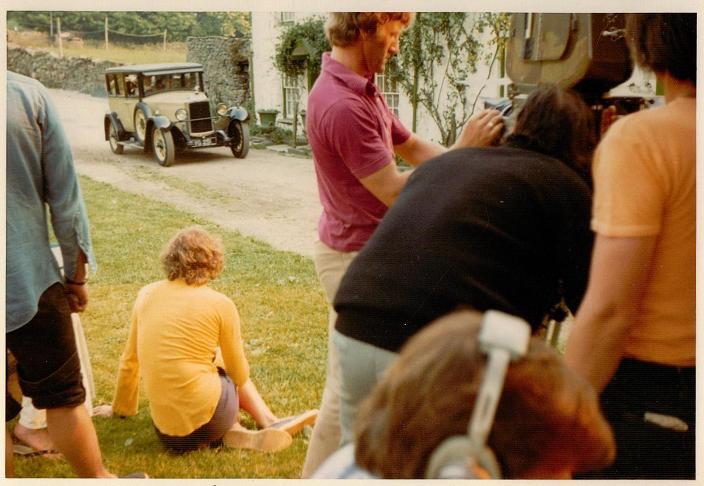
Director Claude Whatham, in a 1970s yellow long-sleeved t-shirt, watching the taxi drive up to Mrs Jackson’s front door in 1929. DoP Dennis Lewiston sets up the shot with Focus-puller Bobby Sitwell ~ photo: Daphne Neville (c)
Nurse with Baby Vicky, the ship’s baby at Holly Howe ~ photo: Daphne Neville(c)
My mother observed that Mrs and Mrs Jackson, Mrs Walker’s nurse and Vicky the ship’s baby, who were listed as Extras on the call sheet, were particularly well cast. Kerry Darbishire, who played the nurse, told me later that she had a daughter of the same age as Tiffany Smith seen here as Vicky. She could have brought her along. It was important they were there, playing ‘The stay-at-homes.’ Vicky anchored Mrs Walker to the farm, making it impossible for her to sail to the island with the Swallows.
Stephen Grendon, Sophie Neville and Simon West with Mr Jackson at Holly Howe~ photo: Daphne Neville
It must have been a long day for the little girl. It was a long hot day for all of us, but a happy day.
Simon West, Stephen Grendon, Suzanna Hamilton & Sophie Neville playing the Walker children in ‘Swallows and Amazons’ 1973 ~photo: Daphne Neville(c)
The women who had been taken on as our stand-ins the day before did not seem to be around to help limit the hours we spent on set. David Bracknell, the first assistant director stood in for Roger. One of the women later claimed that she played Virginia McKenna in long-shots but the only long shot was taken of the Spanish Ladies on the jetty and I’m pretty sure that is Dame Virginia herself.
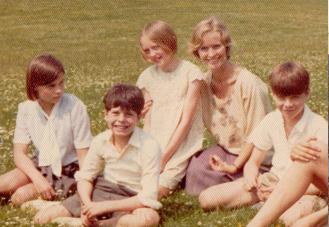
Stephen Grendon, Simon West, Dame Virginia McKenna, Suzanna Hamilton and Sophie Neville, trying not to look as tall as she was in 1973 ~ photo: Daphne Neville(c)
What I really did not know, until I watched the documentary broadcast last Sunday, was that Mrs Batty, who held the lease on Bank Ground Farm, had locked out the crew. She explained that when she was originally asked if we could film on her property she did not quite realise the scale of operations and only asked for – or accepted – a location fee of £75.
Lesley Bennett’s photo of the double decker buses at Bank Ground Farm in 1973
The arrival of the two red double-decker buses, the Lee Electric van, the generator and other lorries, not to mention the Make-up caravan rather daunted her, as did the furniture moving activities involved at the start of the filming when we shot the interior scenes. The idea that the film would bless her Bed & Breakfast and Tearoom business for the next fifty years alluded her. She said that she decided that £75 was not enough, padlocked her front gate and wouldn’t let the crew back in until they agreed to pay her £1,000. It was a lot of money, more than double the fee I received.
Sophie Neville with Lucy Batty at Bank Ground Farm in 1973 ~ photo: Daphne Neville(c)
You may have seen the BBC documentary about the making of Swallows and Amazons, when Ben Fogle interviewed Suzanna Hamiltonand myself at Bank Ground Farm for ‘Big Screen Britain’. This was re-packaged on a programme called Country Tracks. My father’s 16mm footage had been skillfully inter-cut with an interview with our Director, Claude Whatham.I did not know that it was being broadcast but was able to watch on-line.~The Author Sophie Neville at the boatshed in 2013~
If you would like to read more, ‘The Secrets of Filming Swallows and Amazons (1974)’ is available on Amazon Kindle and all ebook platforms and the paperback on ‘The Making of Swallows and Amazons’ can be found in Waterstones from all online stockists.
Sophie Neville, Simon West and Suzanna Hamilton with Ronald Fraser playing Captain Flint in the 1973 film of Arthur Ransome’s ‘Swallows and Amazons’
Ronald Fraser! veteran of World War II movies who had won an award for playing Basil Allenby-Johnson in The Misfits, had arrived on the shore of Coniston Water in two-tone shoes. Curiously so had two stand-ins. A short lady for me, who had dark hair, and a lady with blonde hair for Suzanna Hamilton. I have blonde hair and Suzanna is dark, but that is how it was.
The other four actors didn’t have stand-ins, which seemed odd. Kit Seymour, who played Nancy Blackett, and Lesley Bennett in the role of Peggy, rehearsed as usual. The two boys, Simon West and Sten Grendon, were younger than us but never had stand-ins, so that seemed odder. We didn’t think the ladies would be very comfortable on Peel Island. There wasn’t exactly a powder room there.
Director Claude Whatham and Bobby Sitwell with Suzanna Hamilton playing Susan Walker and Ronald Fraser as Jim Turner aka Captain Flint
And we were some way into the filming, used to handling props that the stand-ins found alien. However they were very excited about coming over to Peel Island. They sat in our positions and read our lines back to Ronald Fraser whilst the scene at the camp site was lit, and returned to stand-in for us later when his close-ups were shot. Somehow they managed to do this in scanty summer clothing despite a brewing storm.
My stand-in. I liked her very much and was most interested in her tapestry, since I was doing one myself. Lots of the men in the crew were interested in her tapestry too. They hadn’t noticed mine.
Our stand-ins got a lot of help from the crew as they went from ship to shore. We didn’t, but then we were agile and wore life-jackets. Mummy didn’t wear a life-jacket, but she has always been surprising good at getting in and out of boats. Her comment on the matter of my stand-in was, ‘Most unsuitable for a children’s film.’ Mum became increasingly concise: ‘I don’t think that woman was invited. She just turned up.’
Enthused by our Stand-in, Lesley Bennett and I went into Ambleside that evening to buy more wool for our own tapestries.
The recording of our scene with Captain Flint on Peel Island went smoothly, and Claude Whatham the Director was happy with the result, but my diary reports that a Force 8 gale blew in. This spun the poor production team into a quandary.
The call sheet for Thursday 20th June documents how truly unpredictable the weather could be. We had a ‘Fine Weather Call’, an ‘Alternative Dull Weather Call’, ‘Rain Cover’ in the Houseboat cabin, and a pencilled-in end-plan entitled ‘Peel Island’, which is where we’d ended up. Richard Pilbrow, the Producer, had a 1970s embroidered patch sewn to his jeans which read: THE DECISION IS MAYBE AND THAT’S FINAL.
The Call Sheet that never-was for 20th June 1973. We ended up on Peel Island.
In Arthur Ransome’s book Swallows and Amazons there is a dramatic storm with lashing rain. We were rather disappointed that it was not included in David Wood’s screenplay. It could have been shot that afternoon, but this was not to be. I can remember Mum saying, ‘You can’t have everything.’
What had been good about the 20th June was that we, the Swallows and the
Amazons, were all together, not sailing but on Wild Cat Island, with the novelty of working with Captain Flint for the first time. Kit and Lesley had been so patient, waiting day after day for their scenes to come up. They were stuck having lessons with our tutor Mrs Causey in the red double-decker bus most of the time. But the fact that they were on stand-by was helpful to the production manager who had to wrestle with the film schedule and call sheets.
As it was, the storm blew hard but cleared the dull-weather clouds and the next day was glorious, one to remember forever…
You can read more in the paperback or ebook here. There is also an audiobook narrated by me, Sophie Neville.



































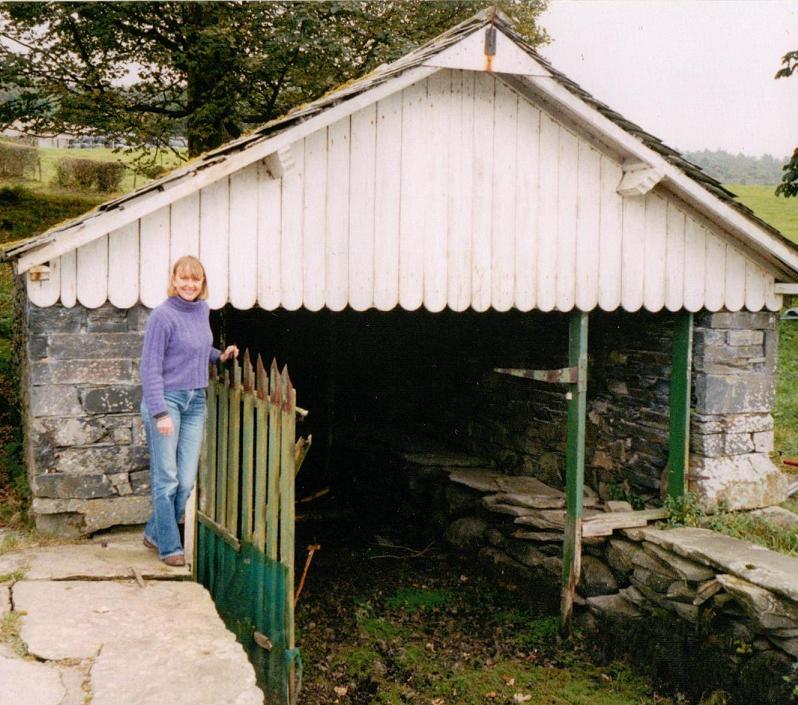 ~The Author Sophie Neville at the boatshed in 2013~
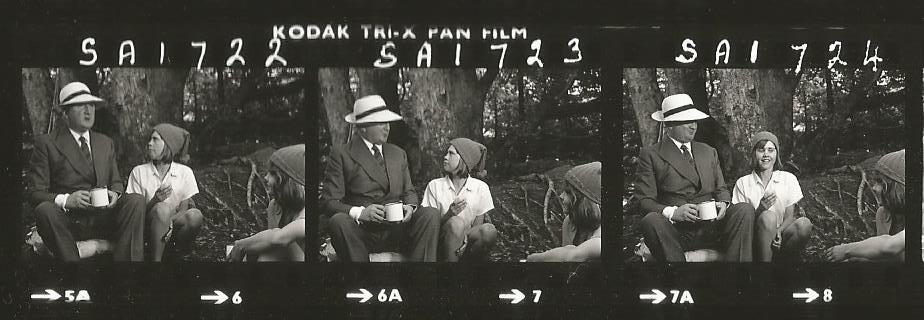


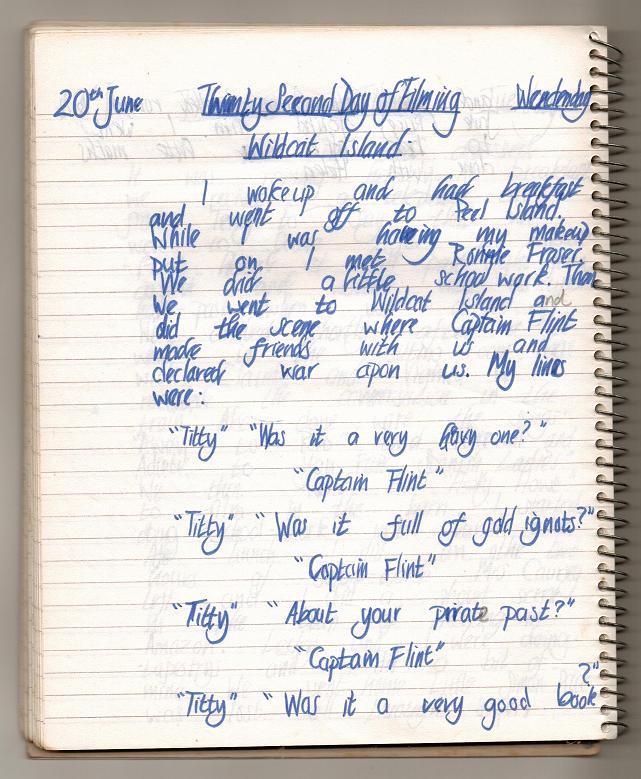

 The recording of our scene with Captain Flint on Peel Island went smoothly, and Claude Whatham the Director was happy with the result, but my diary reports that a Force 8 gale blew in. This spun the poor production team into a quandary.
 Amazons, were all together, not sailing but on Wild Cat Island, with the novelty of working with Captain Flint for the first time. Kit and Lesley had been so patient, waiting day after day for their scenes to come up. They were stuck having lessons with our tutor Mrs Causey in the red double-decker bus most of the time. But the fact that they were on stand-by was helpful to the production manager who had to wrestle with the film schedule and call sheets.
 Sophie Neville