~ In today’s Daily Mail and Mail Online – third article down on the website ~
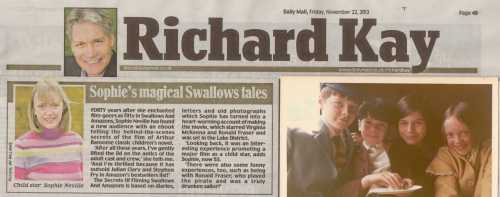
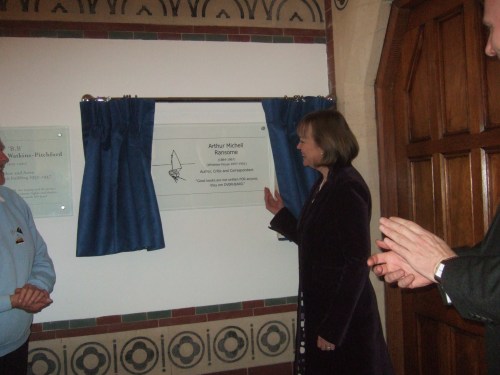
While I was at Rugby School unveiling the commemorative plaque in honour of Arthur Ransome, invited as President Elect of The Arthur Ransome Society, Richard Kay’s office at the Daily Mail was desperately trying to reach me.
They were keen to ask about ‘The Secrets of Filming Swallows & Amazons’, which had already started to outsell Stephen Fry and Julian Clary in the category of Stage & Theatre memoirs on Amazon Kindle. It has also outranked pre-orders of June Brown’s autobiography ‘Before the Year Dot’ about her life as an actress. I worked with her on Eastenders when the soap opera first started back in the 1980s.
I woke up this morning to find an email from Hayley Dixon of The Telegraph saying that she had seen that my new behind-the-scenes book of Swallows & Amazons was out, and asking me to ring her. By one o’clock her article appeared in The Telegraph online, featuring my book trailer.
I then heard from Paul Kendall of the Sunday Telegraph’s magazine, Seven, who had read about my book launch in Richard Kay’s column today. Hayley had told me it was in the Daily Mail, but I had only just bought a copy myself.
Paul wrote:
“Would you be able to send me a copy of the book? We might be able to do a nice extract in the magazine!”
It has been a very exciting day – and thanks to all of your hugely valued support I am now at #1 in Stage & Theatre memoirs!
Simon West and Sophie Neville as brother and sister on Peel Island in 1973
I had dinner with Captain John last night. It was extraordinary meeting up after forty years; a lifetime had whizzed by.
Tall, with dark hair, Simon West is no longer recognisable as John Walker but he looks back fondly on our time making the film ofArthur Ransome’s book Swallows and Amazons in 1973, when we spent seven weeks of the summer term on location in the Lake District. To my surprise he doesn’t remember being cold at all. I claim that he was given a few more clothes to wear than me and had more to concentrate on. He was at the helm whilst I was a mere able-seaman in Swallow. He said that he hated it when she was wired to the pontoon and he had to pretend he was sailing.
Simon West and Suzanna Hamilton sailing Swallow from Peel Island where Sophie Neville stands shivering on the shore. Was this shot filmed from a camera pontoon?
Simon thought that I probably remember more about the experience than he did because my mother was there, chatting about what was going on every evening and naturally re-enforcing the shared experience.
‘I must have kept a diary, as it was part of our schoolwork, but I haven’t seen it since. I’ll look in my parent’s attic.’ Simon thought that it was his mother who put together an album from the black and white photos that Richard Pilbrow gave us after the filming.
Simon West as Captain John sailing Swallow near Peel Island on Coniston Water. Sten Grendon plays the Boy Roger in the bows.
Simon said that he remembers more about filming the six-part BBC serial, ‘Sam and the River’, in which he had the title role in 1974. Much of it was shot on the Thames Tideway east of London. ‘Of course all those places have changed enormously since then, whilst the Lakes are very much the same. I have never been able to find a copy of that series, which is a shame. I’d love to see it.’ We can’t find a copy in English, but there is a version in German entitled ‘Tom und die Themse’ currently for sale on DVD here.
Simon’s own children grew up watching Swallows & Amazons, which is still broadcast once or twice a year on television. He said that when they went to see the Warner Bros. Studios in Hertfordshire where much of the Harry Potter movies were made he felt hugely appreciative of the fact that we had been out on location the whole time, rather than boxed up on a film stage, acting against a green back ground.
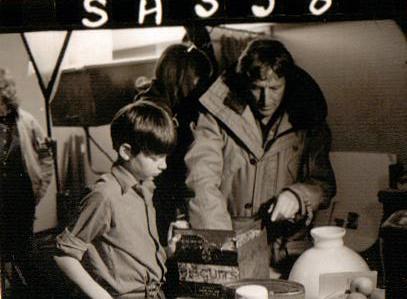
Claude Whatham wearing his American Parker coat, as Dennis Lewiston and Eddie Collins line up a shot over Derwentwater at dawn
Simon did remember the great Parker coats that Richard and Claude found to cope with the Cumbrian weather. So do I. My father bought one too. They were blue-grey and enormous, lined with fake sheepskin, their hoods edged with Eskimo-like fake fur.
‘They had recently come over from America,’ he explained, ‘And were a real innovation. Before that we just had tweed coats.’
‘And Mackintoshes. Dennis Lewsiton wore a blue Mac.’
‘Those dreadful nylon anoraks,’
‘That are back in fashion.’
‘The American Parkers are fashionable now too – all that fake fur around the hood. Uggh.’
Suddenly the cogs of close association clicked in. Simon tossed his head in a certain way that I recognised as his own expression of humour. He said that he was really pleased that Bobby Moore chatted to him at the film Premier at Shaftesbury Avenue.
‘Sir Booby Moore? Was he there? Did we meet him?’
‘Yes.’
I’d totally forgotten.
Simon said that he had become very attached to his Parker fountain pen from Aspreys, engraved with the words ‘Swallows & Amazons- 1973’, that Claude Whatham gave to each of us as a gift after the filming. ‘Stupidly I left in the boot of my car when I was in Paris, aged about twenty-seven. It was stolen with a load of other things.’ I had lost mine too. I dropped it on a footpath somewhere in Durham.
‘What did you spend your fee on?’
‘Oh, sailing dinghies. It was good to know I had £500 in the bank around the time I was heading towards the British Championships. You know, at first we had ply board hulls but the time came when I needed to buy a fibreglass boat.’ It was with this that he became the National Optimist Champion. We agreed it was money put to good use.
After the age of about sixteen, Simon’s family became interested in orienteering. Maps seems to have had a strong influence on both our lives.
Simon West as John Walker studying the chart at Holly Howe before the voyage.
Simon and his wife now have four grown children. ‘We are split down the middle: three of us sail, three of us do not.’ But every year he takes the family up to the Lake District to go fell walking, something they all enjoy very much.
If anyone sees a brushed steel Parker pen on eBay engraved with the words ‘Swallows & Amazons 1973’ please let me know. I’d love to be able to return it to Captain John.
Here you can see Simon appearing in ‘Sam and the River’(1975). This is the German version entitled Tom und die Themse:
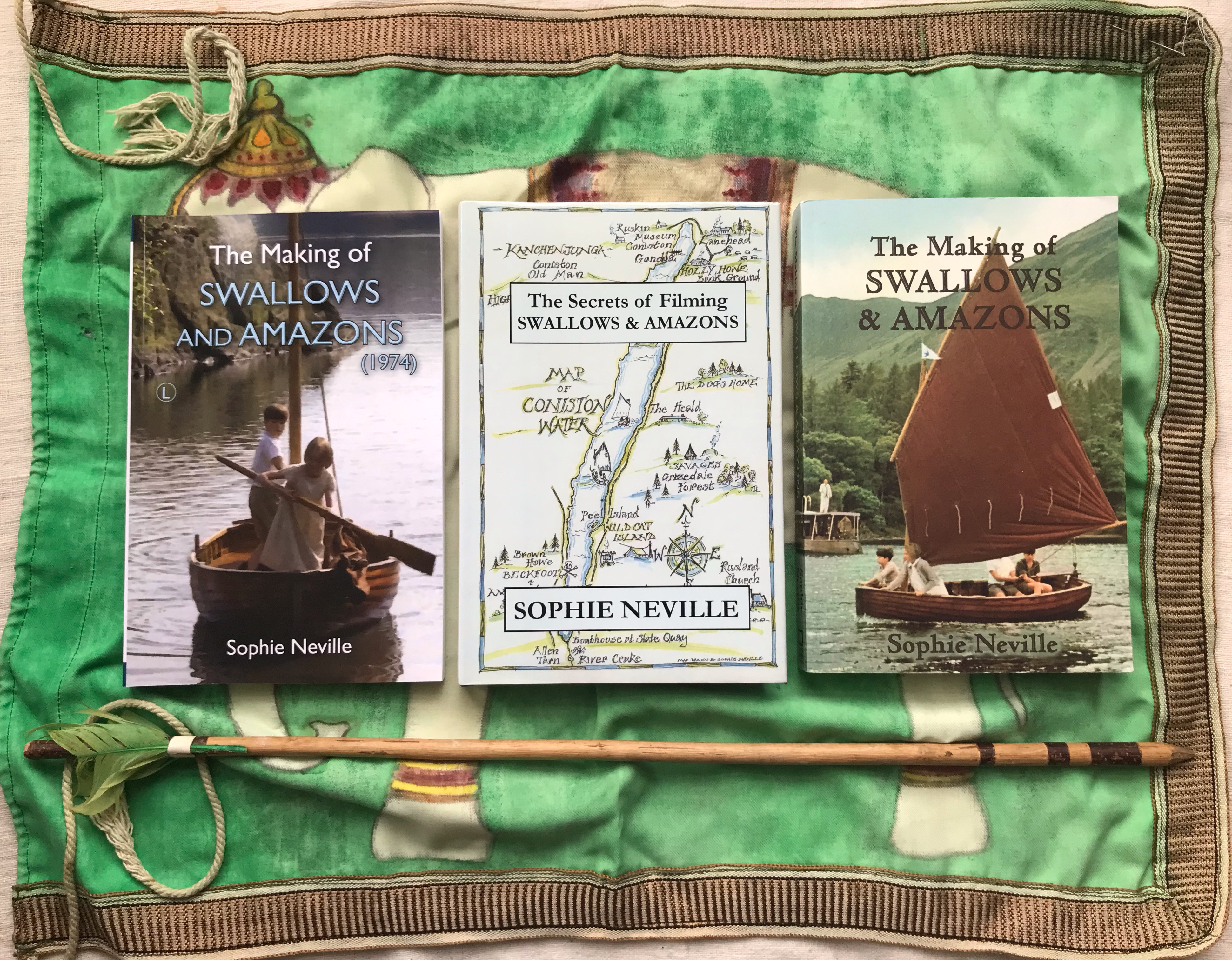
You can read more about our adventures making Swallows and Amazons in these books, available online:
Different editions of ‘The Making of Swallows and Amazons (1974) by Sophie Neville’
Arthur Ransome first visited the Lake District as a tiny baby. He said that his father, ‘carried me up to the top of Coniston Old Man at such an early age that I think no younger human being can ever have been there.’ Thereafter the family traveled up by train every summer, from 1884 – 1897, to stay on the Swainson’s farm at High Nibthwaite at the southern end of Coniston Water.
The four children were allowed to run wild in the hills or slide down the knickerbocker-breaker rocks above the farm whilst their mother painted and their father fished the River Crake. They had the use of a rowing boat, which they would take a mile up the lake to Peel Island for a picnic.
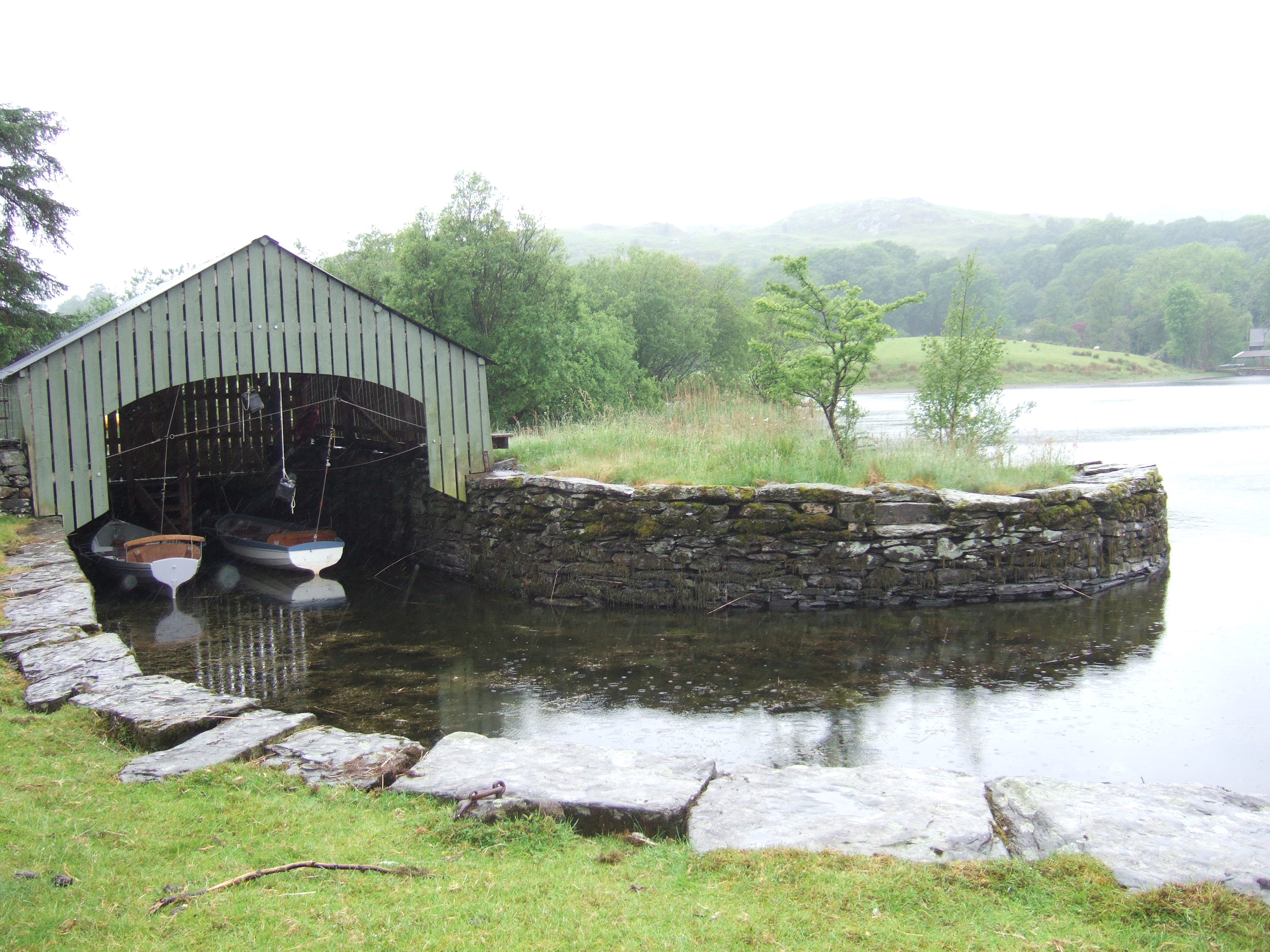
Peel Island on Coniston Water, which you can visit by boat.
I’d love to take my family to spend a week at Low Water End, a holiday cottage at the southern tip of Coniston Water, which has boats, lake frontage and a small slipway.
Another lovely place to stay is Hill Top Farm, a traditional Lakeland house built in the 1700s and now owned by Martin Altounyan, son of Roger Altounyan and grandson of Dora Collingwood who was such a great friend of Arthur Ransome’s. They say you can see the Crake estuary from the garden. It is near Penny Bridge village, four miles from Coniston Water and just three miles away from Hill Top at Haverthwaite where Arthur Ransome lived at the end of his life.
As a young man Ransome escaped from London for a holiday in Coniston village and found himself invited to stay nearby at Lanehead by WG Collingwood, Dora’s father. Ransome writes in his autobiography that had originally meet the family in 1896 on Peel Island. ‘Mrs Collingwood told me that she remembered that meeting on the island and her surprise that my mother, who was a very pretty young woman, could have a family of such very ugly children.’
The rocks at the end of Peel Island where the Collingwood family traditionally had picnics
By 1904 Arthur Ransome was being taught to sail by Dora, Barbara, and Robin Collingwood in a heavy old dinghy called Swallow that they were able to take out on Coniston Water. He later stayed at Low Yewdale at the north end of Coniston, which I believe still offers Bed and Breakfast or a self-catering cottage. Ransome would set up ‘a tent on a small mound close to Yewdale Beck a hundred yards up the valley’ so that he could sleep outside when it was fine. In her guide-book,In the Footsteps of the Swallows and Amazons Claire Kendall-Price shows you how you can walk from Low Yewdale to Ambleside via The Drunken Duck, a pub you can now stay at that I believe Ransome visited.
It is easy to see how all this experience, the houses Ransome loved and places he knew of since childhood were poured into his Swallows and Amazons series of books. You will have to tell me which of his stories were written here:
After many adventures in Russia and the Baltic, Arthur Ransome bought his second wife Evgenia to live at Low Ludderburn on Cartmell Fell above Windermere where they lived from 1925 until 1935. He loved the work room made for him at the top of the grey barn outside. They moved to Suffolk for a while but returned during WWII to live at The Heald, which overlooks Coniston Water.
The Heald above Coniston Water where Arthur Ransome lived between 1940 and 1945 ~ photo: Peter Walker
It was here that Ransome wrote The Picts and The Martyrs. They had a jetty there where he kept his boat Coch-y-bonddhu, which is used as the model for the Scarab, a sailing dinghy bought for Dick and Dorothea Callum in the novel. The gardener’s cottage to The Heald has recently been rebuilt and is for sale.
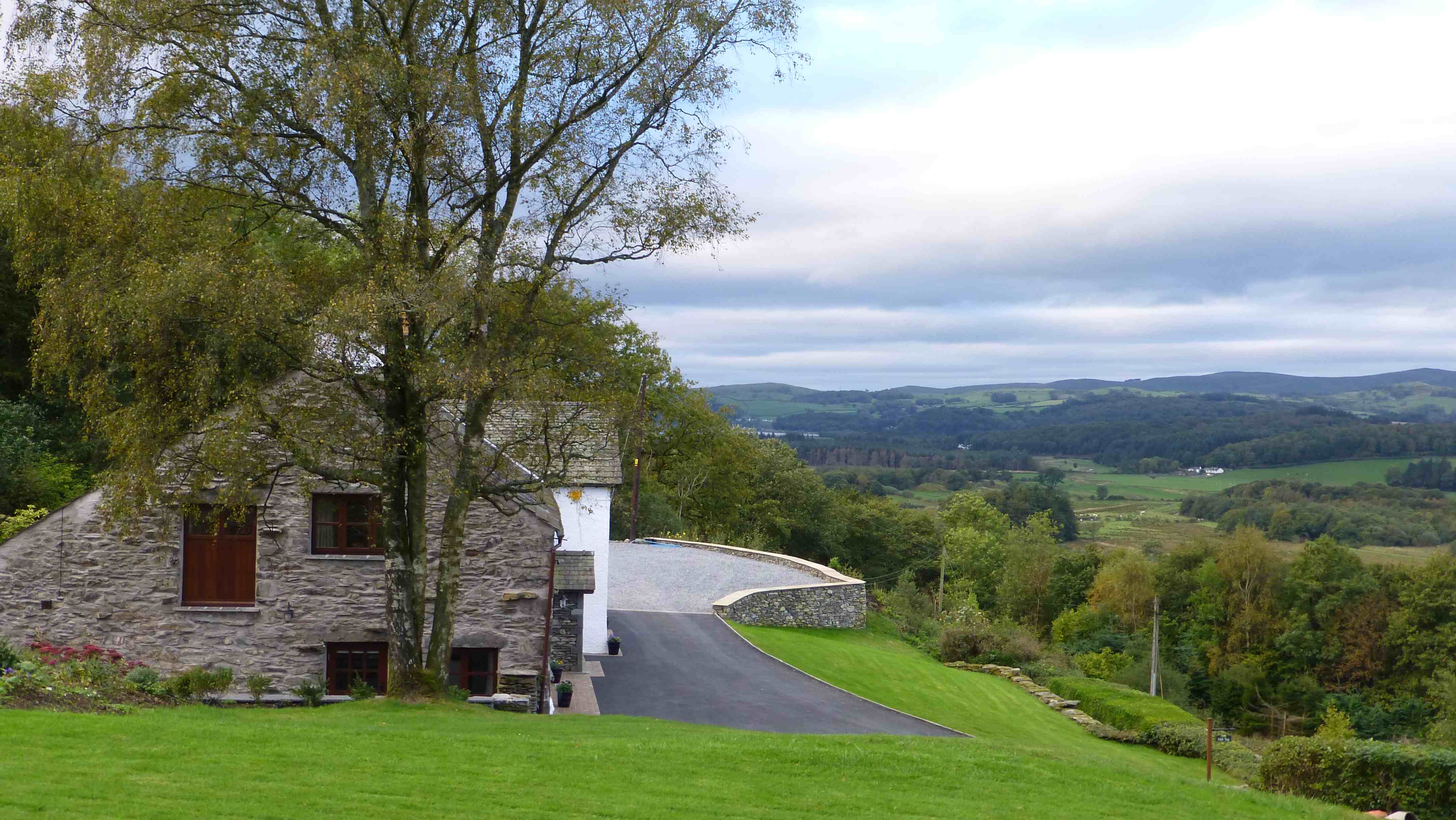
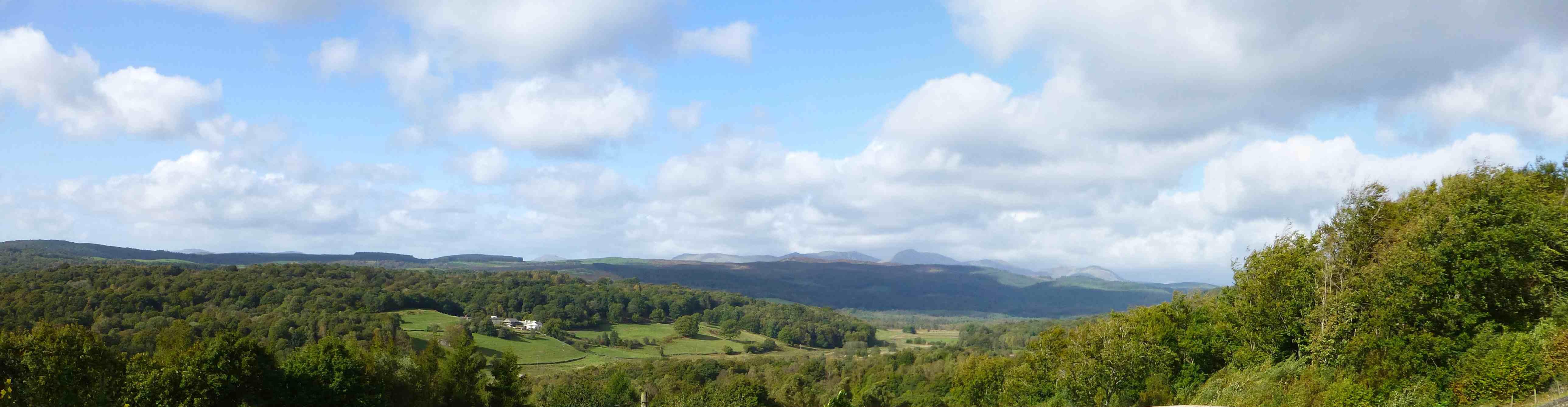
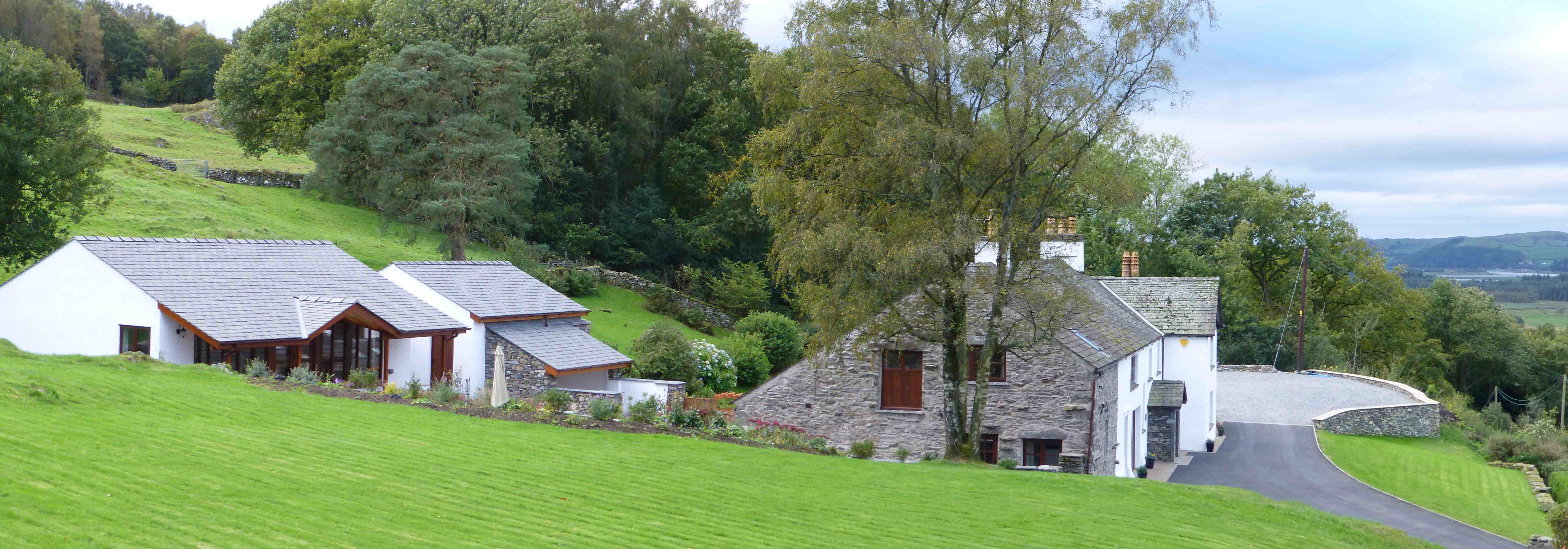
In their later years, the Ransome’s loved at Hill Top Farm near Ealingshearth, where the views are stunning. It has been renovated but retains many of the original features.
Hill Top, the 17th century farmhouse at Ealingsheath, a tiny hamlet near Haverthwaite in Cumbria, where Arthur and Evgenia Ransome lived in the 1960s enjoys lovely view across the Lakeland fells.
In the Epilogue to Arthur Ransome’s autobiography, Rupert Hart-Davis wrote: ‘In 1960 the Ransomes bought the little derelict farmhouse in the Lakes which they had rented for the last four years as a holiday cottage. Repairs and alternations took longer than expected, and it was not until November 1963 that they moved into their home, Hill Top, Haverthwaite, near Newby Bridge. They both loved the house, and the buzzards, redstarts and deer by which it seemed to be surrounded… ‘ Arthur Ransome celebrated his eightieth birthday there, although by then ‘…he was confined to a wheel chair on the upper floor of the house.’
The present owners, Stephen and Janine Sykes, who bought Hill Top in 2012, have converted the garage/barn-end into a holiday cottage. You can read about the story in the Mail Online entitled: ‘A home full of Swallows & Amazons…’ As they say, it’s a good base for exploring the locations described in book and used in the 1974 movie of ‘Swallows and Amazons’, which the Mail describes as, ‘A perfect adventure.’ I’ve described doing so myself in previous posts.
Stephen Sykes says, ‘The picture used was actually of “The Pavilion” – a games room.’ It was converted from a substantial former kennel.
.
.
‘We demolished another kennel of 1,000sf (now a courtyard garden) and we’re just finishing the conversion of another to an office/store room! We’ve spent a lot of time, effort and money in “de-kennelling” Hill Top and returning it to domestic use! Needless to say, the guest accommodation, “The Cottage at Hill Top”, forms a self-contained part of Hill Top itself.’
.
.
Stephen added, ‘Cumbria Life are coming to photograph Hill Top today for a feature in their Christmas issue.’ The house certainly looks wonderful.
.
.
Stephen and Janine are more than happy to take direct bookings – please ring: 01539 531 452. The last three digits of their phone number are the same as in Ransome’s time. They offer a 10% discount to TARS members.
.
.
Stephen Sykes is an investment analyst and author of The Last Witness who studied astrophysics at UCL in the days when men were landing on the moon. He previously wrote to tell me that they have a number of old photographs and, ‘… a collection of most books by and about Arthur Ransome. Obviously, we’ve made it our job to learn much about the Ransomes and… visited the Brotherton Library at the University of Leeds to look through Arthur Ransome Collection where there are dozens of photographs of Hill Top from the late 1950s to c. 1963. I now have digital copies of most of these, including a number of good quality colour slides of Arthur and Evgenia. I guess it’s rather unusual for someone to find a treasure trove of photos of their house from half a century ago and see how its then famous owner transformed it!
.
‘Astonishingly, the Lake District National Park Authority indicated that they had absolutely no interest in the Ransome connection and even moaned that if Hill Top were to become a “tourist attraction” it would merely create traffic problems!’ Stephen added.
.
When I last passed Hill Top with Mountain Goat no one else was using the lane that runs in front of the house even though it is not so very far from the southern end of Lake Windermere and the Haverthwaite Railway Station where the steam train comes in and the Windermere steamers dock.
.
…………..
If you would like to read the ebook about the making of the original film of ‘Swallows and Amazons’, please click here.
Behind-the-scenes while filming ‘Swallows & Amazons’ in 1973
The classic movie of Swallows & Amazons is often broadcast on BBC TV. If you would like to know more about how the film was made you can find the details on this site or leave any questions in the comments box below.
To read about our first day’s filming at Haverthwaite Railway Station click here and keep reading.
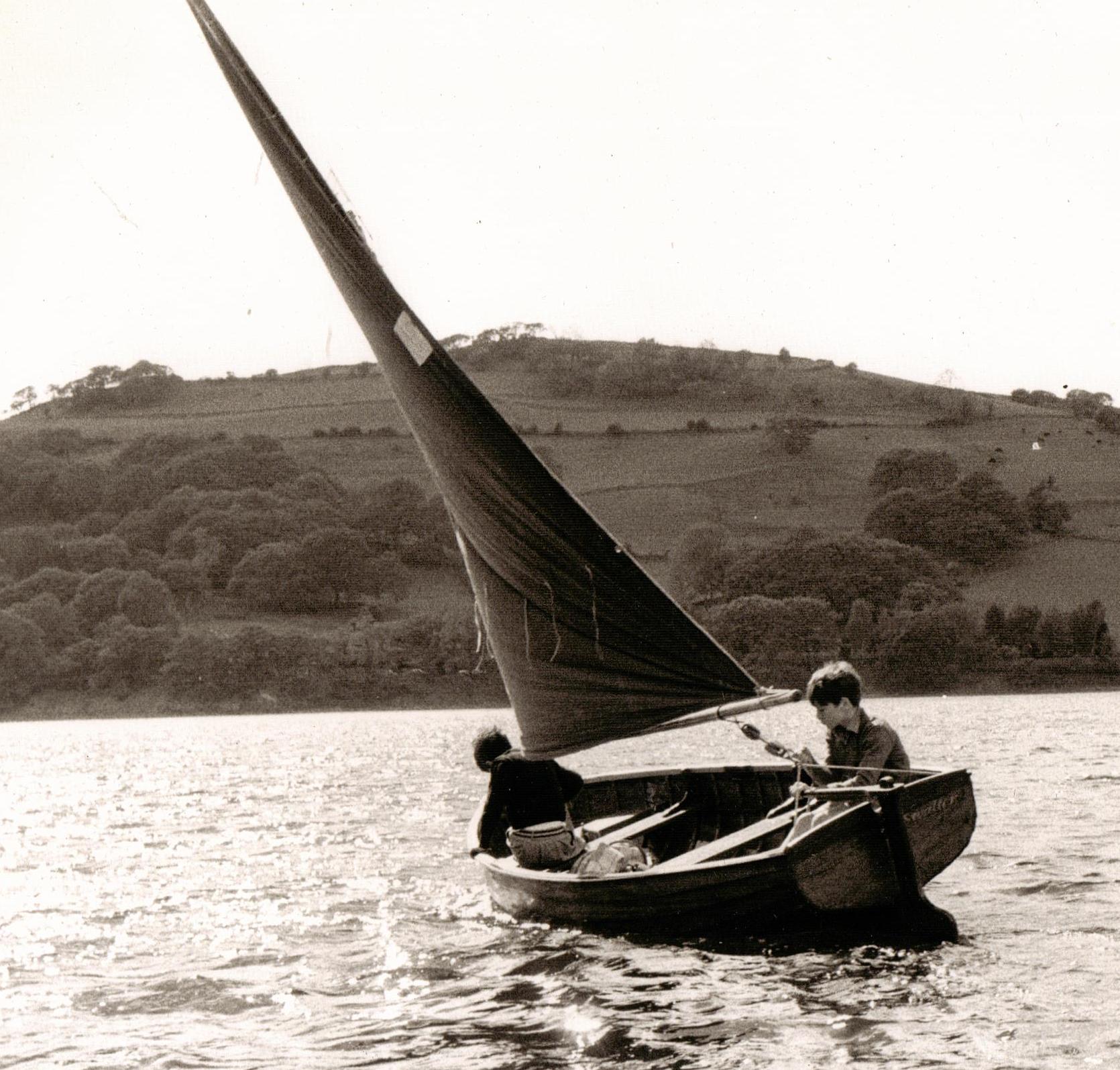
Sophie Neville having her hair cut on location for the part of Titty Walker in 1973
Do you know what lake we were on in the photograph below? We were busy loading urns of tea into a run-around boat to take out to the film crew who might have been on Cormorant Island. If you click on the photo you will get to the page of my diary, kept in June 1973, which describes this day.
Wardrobe Master Terry Smith and Sophie Neville in her costume to play Titty. But what is the name of the boatman? Does anybody know?
There are still many questions about the making of the movie that remain unanswered.
Does anyone know the name of this journalist who visited us on Peel Island?
This shot was taken while setting up the scene at Peel Island when Captain Flint brings Sammy the Policeman to question the Swallows. If you click on the photo you will find the photograph that the journalist ended up with. Titty’s hand is still on Captain Flint’s arm.
Making a movie is very different from watching one. Here is a record of Titty rehearsing the shot when she moves the camping equipment for fear of a tidal wave. It was a cold day on Coniston Water. The jersey came off when they went for a take.
Here you can see Lesley Bennett, playing Peggy Blackett, careening Amazon at Beckfoot. The same 35mm Panavision camera was focused on Kit Seymour, playing Captain Nancy.
Lesley Bennett as Peggy: Claude Whatham directing the scene with Kit Seymour
The location used for Beckfoot and the Amazon boathouse can be found at Brown Howe on the western bank of Coniston Water. If you click on the photograph of Peggy you can read more about what happened that day.
Kit Seymour playing Nancy Blackett and Lesley Bennett playing Peggy Blackett
If you would like to get future posts, please click the Follow button at the bottom of the side-bar.
You can read the full story about the making of Swallows and Amazons here:
David Wood, who wrote the screenplay for SWALLOWS & AMAZONS in 1973, has recently told me about his work adapting other Arthur Ransome books – GREAT NORTHERN?, PIGEON POST, WE DIDN’T MEAN TO GO TO SEA and WINTER HOLIDAY – all for Richard Pilbrow of Theatre Project Films.
.
Producer Richard Pilbrow with Director Claude Whatham in their wet weather gear at The Secret Harbour on Peel Island, Coniston Water
.
‘It was decided that GREAT NORTHERN? should be the follow-up to the SWALLOWS film, because it was ‘different’, being the only book set in Scotland. Also, the villainous birds’ egg collector was a strong adult role – Peter Sellers was mentioned….. We had great fun looking for locations, swooping around in a helicopter over Harris, Lewis etc.
Sophie Neville, Suzanna Hamilton & Sten Grendon with David Wood and Claude Whatham in 1973
.
‘Word got out that I was working on GREAT NORTHERN? and I had a very firm letter from Mrs Ransome saying that no permission had been granted to work on this title, and that it would not be granted!! No reason was given. Years later, the Ransome autobiography suggested that Mrs R didn’t like GREAT NORTHERN? and criticised it to Ransome’s face. Also, he used sometimes to swan off to the Highlands with his friend, Quiller-Couch (I think) to fish, leaving Evgenia on her own back in the Lake District. The only communication from him would be the occasional delivery on a horse and cart from the railway station of a salmon, caught in Scotland the day before! Maybe she resented Scotland for luring him away! But she was determined that GREAT NORTHERN? the movie would never see the light of day!! But I still wrote a complete screenplay! I did a film treatment for WINTER HOLIDAY, that never got off the ground either.’
The script of the movie ‘Swallows and Amazons’ that I never saw until 2011
.
PIGEON POST was to be a six-part serial, a BBC-Theatre Projects co-production. David remembers that they got as far as looking for locations in the Lake District. I started making preparations to cast the children for this drama which Joe Waters wanted to produce in 1983, directly after making COOT CLUB and THE BIG SIX under the generic title SWALLOWS AND AMAZONS FOREVER! that had been adapted for television by Michael Robson.
.
‘WE DIDN’T MEAN TO GO TO SEA was also to be a serial. I did a treatment, visited Pin Mill and other locations, and met the man who built one of Ransome’s boats, or maybe worked on it with his father. All the materials and scripts still exist, but they are probably a bit too ‘straight’ for contemporary taste.’
.
David Wood’s numerous other forthcoming events and theatrical releases are listed on his website.
.
Can you help us? Was Quiller-Couch the friend who whisked Arthur Ransome off to fish in the Hebrides? Does anyone know where they went?
You can read more about the adventures we had whilst making Swallows and Amazons is these books, available to order online here
.
Different editions of ‘The Making of Swallows and Amazons (1974) by Sophie Neville’
I have been writing about life in England fifty years ago, reflecting on how our lives have changed. Can you help me?
Sophie Neville at the EMI Elstree Studios in 1973
The big change seems to be in communications. In 1973 we were still queuing up to using coin operated telephone boxes in the street, asking the operator for Ambleside 2232. Letters and notes were written by hand. I learnt italic writing, so as to be clear. Manual type-writers used black and red stripped tape. Mistakes were obvious.
I’d love to receive comments (below) on how you remember aspects of growing up in the early 1970s. What did you eat then? Where did you go on holiday? What was it about 1973 that impacted you?
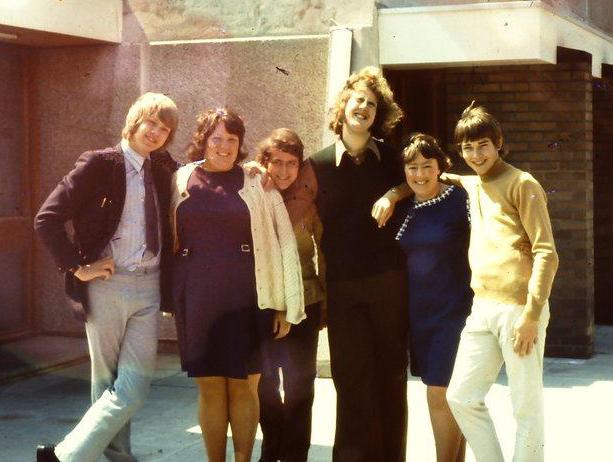
Jean McGill, Jane Grendon, Stephen Grendon, Kit Seymour, Sophie Neville, Claude Whatham, Simon West, Lesley Bennett, Suzanna Hamilton, Ronnie Cogan in 1973
My husband remembers long hair, flared trousers and shirts with massive curved collars. I always longed for an embroidered t-shirt with wide sleeves or a cheese-cloth shirt but loathed the feel of acrylic jumpers and ribbed polo-necks. Stripy ones. The fabric could be so vile, we didn’t feel each other as much as we do now. There was much less hugging.
Mum wearing a fluffy Donny Osmond hat
The food was pretty applauding. My friend Suzanna has just reminded me about the innovation of Italian cooking. Spaghetti was the highlight of our lives; a treat that we might have on Saturdays or for a party when red candles would be pushed into wine bottles and checked paper table cloths could enhance a Bistro image. However prawn cocktail was the pinnacle of popular aspiration, although us children preferred picking of the shells off prawns ourselves.
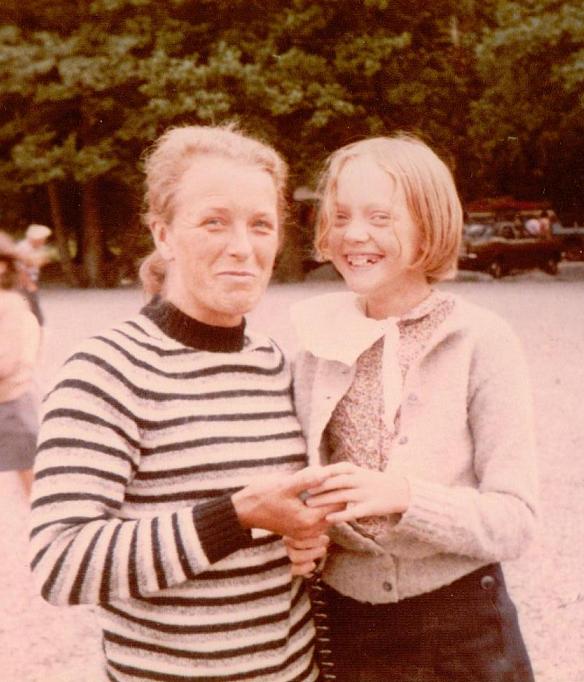
Daphne Neville in 1973
At parties you’d be offered chunks of cheese and pineapple on cocktail sticks stuck into a half a melon that had been covered in tin foil. I always rather longed for the melon. Homemade beer was regrettably all the rage, along with freezing your own runner beans. The process was quite fun (we enjoyed sucking air out of the freezer bags with a straw) but the beans were stringy and disgusting.
My family thought having to bring-a-bottle to parties was a great idea but we loathed the fact that cigarettes were smoked everywhere you went. Unless you were in the garden where abysmal furniture design spoilt the view.
Colour televisions were only just beginning to invade people’s homes. They were terribly expensive. We had to make do with our crackly black and white screen, watching Blue Peter,Animal Magic and Tony Hart presenting Vision On with cartoons such as Marine Boy until Childrens’ Television ended with The Magic Roundabout just before Daddy came home from the Works in time for the 6 O’Clock News. I then bored myself rigid watching Points West and Nationwide before It’s A Knockout.
We were allowed to stay up to watch Dick Emery , Benny Hill, and ‘Titter ye not’, Frankie Howerd along with dramas such as The Onedin Line. There was one sit com starring Wendy Craig entitled Not in front of the Children, which of course we all wanted to watch. What influence did this have on our young minds?
Mum appearing as a member of the Salvation Army on ‘The Dick Emery Show’
Mummy worked for HTV West presenting an afternoon programme called Women Only with Jan Jeeming. She also read the letters on Any Answers?, which was produced by BBC Radio Bristol by Carole Stone. I was so impressed – amazed – to meet a female radio producer. Carole was one of the few who worked her way up from being a BBC secretary to producing Any Questions.
HTV West Christmas Show presented by Bruce Hocking, Jan Leeming & Daphne Neville
Our holidays were spent camping in Wales. Packing for this took two weeks. We used drag an orange dome tent out of the airing cupboard and slept on fold-up sun-loungers from the garden.
Sailing was all about Mirror dinghies, which you could buy in kit form and make out of plywood in the diningroom. We couldn’t afford one, but in the late 1970’s Dad bought a fibre-glass Topper, which was the height of cool. He called it Earwig.
We had our photos developed at the chemist or sent them off to Tripleprint, so we could share the small version with others. Although they were bought by Bonusprint in 1979, I was a loyal customer until well into the 1990s and remain plagued by small photos I can’t quite bring myself to chuck away. We stuck them in scrapbooks made of green and blue paper. Here is a page of mine from the making of Swallows and Amazons.
My family were very keen on taking home movies. Dad usually took slides when we went on holiday, which were viewed along with the supper-8 footage at Christmas time when he pushed the furniture back, took down a painting and projected our memories onto the wall.
What have I forgotten? Do post your own recollections, especially of sailing and camping in the early seventies, in the comments below.
My mother, Daphne Neville, who worked on the crew of Swallows & Amazons (1974) is appearing in Summer in February, which is now out on DVD. Although she’s a hustler, invitations to take part in both films arrived out of the blue. Here she is 40 years on with Dan Stevens and Dominic Cooper ~
Dan Stevens, Daphne Neville and Dominic Cooper on location in Cornwall
Hillary Warwick from Bolton-le-Sands near Carnforth rang in to say that her grandma owned the green parrot, telling us that he was called ‘Beauty’. They used the £25 appearance fee to buy him a new cage. Hilary’s gran, Elizabeth Proctor, had been quite a character. She’d walk around Kendal with Beauty on her shoulder. He was known to be a one-woman bird and Hilary was quite impressed that I managed to stroke him and keep him on my shoulder as he was liable to nip. She was quite wary of him!
Do you live in the Lake District?
Did you take part in the film in anyway?
If so do write in using the comments box below!
~ click on the image to enlarge ~
Here is another newspaper article from 1973 that mentions Lakeland people involved in the filming, including a photograph of Mrs Lucy Batty and her grandson Peter and Margaret Causey who taught the children in the movie, pictured below with Lesley Bennett, Kit Seymour, Sten Grendon, Sophie Neville and Mark Hedges – who didn’t appear in the film but came up over half-term as his Dad, Bob Hedges was working as the property master.
Virginia McKenna is photographed above talking to Ian Whittaker, the set dresser who went on to win a number of Oscars.
An extract from this article of Brenda Colton’s reads:
‘When Mrs Lucy Batty was asked if her house could be used for the setting of the film Swallows and Amazons, with guest star Virginia McKenna, she was delighted. After all, her home, Bank Ground Farm on the east side of Coniston Water, near Brantwood, was the setting chosen by Arthur Ransome for his children’s book Swallows and Amazons.
Mrs Batty thought it a good idea that the story should be filmed in an authentic location, and she felt she should be able to put up with a few cameras and film men for a while. But she just did not realise the scale of a “medium budget” film like this one, or what the production staff could do to her house. It was not the two double-decker buses coming down the path and parking on the farm that she minded, nor the numerous vans, lorries, cars and caravans. It was not even the difficulty of having 80 men and women wandering round the farmhouse carrying equipment here, there and everywhere.But when art director Simon Holland started tearing up her lino and carpet in the kitchen to get to the bare stone floor, she did get a little annoyed. Especially when he removed all the electric sockets, lights and switches, pushed all the kitchen furniture into the larder and whitewashed the newly papered walls.
“Have you seen the kitchen?” Mrs Batty said to me. “The larder is piled high with my furniture; and you would not believe the tip my lounge is in. But they are a funny lot. I asked if I could wash the beams in the kitchen for them, and they said ‘Oh no, we want them to look old.’ I have even had to hunt out a lot of old pottery from the cellar for them.
“But I have given up now. I have just left them to it.”
14th May 2023 will mark the 50th Anniversary of filming Richard Pilbrow’s classic movie ‘Swallows and Amazons’ on location in the Lake District that was premiered the year after on 4th April 1974.
The 40th Anniversary of the release of the original film ‘Swallows and Amazons'(1974) was marked by a number of events around the UK:
Dulwich Film screened ‘Swallows & Amazons’(1974), produced by Richard Pilbrow and directed by Claude Whatham. The programme was introduced by Sophie Neville, Suzanna Hamilton and Sten Grendon who played the Swallows. They answered questions about how it was made after the screening at the Michael Croft Theatre.
Michael Croft founded the National Youth Theatre. One of his students was Simon Ward, who went on to star as James Herriot in the film version of‘All Creatures Great and Small’, which Claude Whatham directed in 1974 after finishing ‘Swallows & Amazons’. Sophie Neville had been invited to watch the filming in Yorkshire, meeting Anthony Hopkins and members of the cast and crew who had worked on Swallows & Amazonsin 1973. Brenda Bruce played Mrs Harbottle and Wilfred Josephs composed the music, Terry Needham was the Location Manager and Ronnie Cogan the Hairdresser.
‘I didn’t meet James Herriot until I worked in production at the BBC on Russell Harty in 1982. He was charming – an incredibly confident man. I don’t remember his wife being interviewed but she came with him to the studio and struck me as being terribly nice. She wore a proper dress, which is more than could be said for anyone else in the Green Room.’
A year later Sophie Neville appeared with Simon Ward’s daughter Sophie Ward in the adventure movie ‘The Copter Kids’when they played sisters. Simon brought his family to watch the filming on location near Gerrards Cross. In September there will be a special tribute to Simon Ward at the Michael Croft Theatre when they will be screening ‘Young Winston’.
Sophie Neville gave a 40th anniversary talk on ‘Filming Swallows & Amazons in 1973′ for members of The Arthur Ransome Society gathering for their AGMat Brockenhurst College in the New Forest. ‘Swallow’ , the dinghy from the 1974 film,was moored at Buckler’s Hard on the Beaulieu River for members to sail.
Arthur Ransome’s cutter the Nancy Blackett
Arthur Ransome’s boat The Nancy Blackett ~ The Goblin in Arthur Ransome’s book ‘We didn’t Mean to Go to Sea’ was also the Solent for this event and for the Old Gaffers Yogaff regatta at Yarmouth, Isle of Wight
Meanwhile in the Lake District there was an outdoor screening of the movie Swallows & Amazons at Holly Howe (Bank Ground Farm) on the shores of Coniston Water, with Captain Flint’s Houseboat, SY Gondola, in attendance.