When people see the Steam Yacht Gondola on Coniston today, in all her re-built glory, she seems rather plush to have been cast by Arthur Ransome as Captain Flint’s houseboat in Swallows and Amazons. The main reason for assuming that she was used as the model for the illustrations is because Arthur Ransome grabbed a post card of the Gondola and drew on it to give the first illustrators of Swallows and Amazons some idea of his vision. However Ransome’s biographer Roger Wardale told me that it was a former steamer on Windermere that he had in mind: the S.Y. Esperance. Ransome was known to have been spotted looking through her cabin windows and much admired her distinctive bow, designed to cut through cat ice on her way to Lakeside Railway station.
Esperance in Rayrigg Bay, Windemere ~ photographed by Martin Neville in about 1963
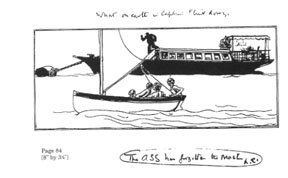
When I was first taken up to the Lake District in 1963, my father found what he thought was houseboat bay on Windermere and took this shot of SL Esperance moored in Rayrigg Bay. She does look very like the first professional drawing submitted to illustrate Swallows and Amazons.
Stephen Spurrier’s unused illustration of Swallow sailing past Captain Flint’s houseboat
Arthur Ransome’s terse note reads: ‘The ass has forgotten the mast’. I went to see the Esperance when she was lying at the Steamboat Museum on Windermere with the film producer Nick Barton in 2011. Built at Rutherglen in 1869 she is nearly 65 foot long with a 10 foot beam.
SL Esperance at the Windermere Steamboat Museum in 2011
She did not always have such a traditional appearance. Roger Wardale kindly sent me this photograph showing what she looked like in the 1930s.
‘Esperance’ in the 1930s when she was owned by Sir Oliver Scott.
The cabin has since been removed from her rear end.
SY Esperance at the Windermere Steamboat Museum in 2011
SY Esperance now looks more like this illustration – or could do. Although she has a setting for a mast the reality is that she has seven windows, whereas Clifford Webb’s illustration shows her with only six.
Clifford Webb’s illustration of Captain Flint’s houseboat
I have no idea if anyone could film aboard her today when marine safety regulations are so strict. We couldn’t in 1973.
Claude Whatham took advantage of the larger cabin windows in the Lady Derwentwater whilst filming ‘Swallows & Amazons’ in 1973 ~ photo: Daphne Neville
When we made the original film of ‘Swallows and Amazons’, the producer Richard Pilbrow was obliged to use the Lady Derwentwater, owned by the Keswick Launch Co. She has quite a different stern from the illustrations but was licensed to carry 90 passengers, which must have allowed him to take a seventy-strong film crew on board. At least she was given a mast. You can envisage Ronald Fraser, as Captain Flint, angrily stamping out the firework on the roof.
One advantage of the Lady Derwentwater was that the windows of her cabin enabled the director to get a good view of the lake, which he made use of when Captain John rowed over from Peel Island to visit Captain Flint and pass on the charcoal burners’ warning. She couldn’t be moved to another lake, but Derwentwater is surrounded by such dramatic fells that the director, Claude Whatham used this to his advantage during the final scenes of the classic film. The Lady Derwentwater has been given a transome but is still in commission and you can take a trip on her today.
Sophie Neville at the Windermere Steamboat Museum
Was the Gondola so very different? Ransome had known the steam launch since spending his own childhood holidays on Coniston, when she was in service. While staying at Nibthwaite he became a good friend of the Captain, or so the story goes. Back in 1973 the Gondola looked like this – her roof too curved to run along, her bow rising up a little too dramatically to accommodate the foredeck of a retired pirate busy writing up his devilish crimes while his a cannon lies glinting in the sunlight, ready to fire.
Photograph of the Gondola on Coniston Water taken by Martin Neville in 1973
For more about the Steamboat Museum with a photograph of SY Esperance, please click here
For a lovely photo of SY Esperance and to read more, from another perspective please click here
The full story of the making of the classic film Swallows and Amazons (1974)’ can be read in this ebook costing £2.99. You can read the first section for free here:
Behind-the-scenes while filming ‘Swallows & Amazons’ in 1973
The classic movie of Swallows & Amazons is often broadcast on BBC TV. If you would like to know more about how the film was made you can find the details on this site or leave any questions in the comments box below.
To read about our first day’s filming at Haverthwaite Railway Station click here and keep reading.
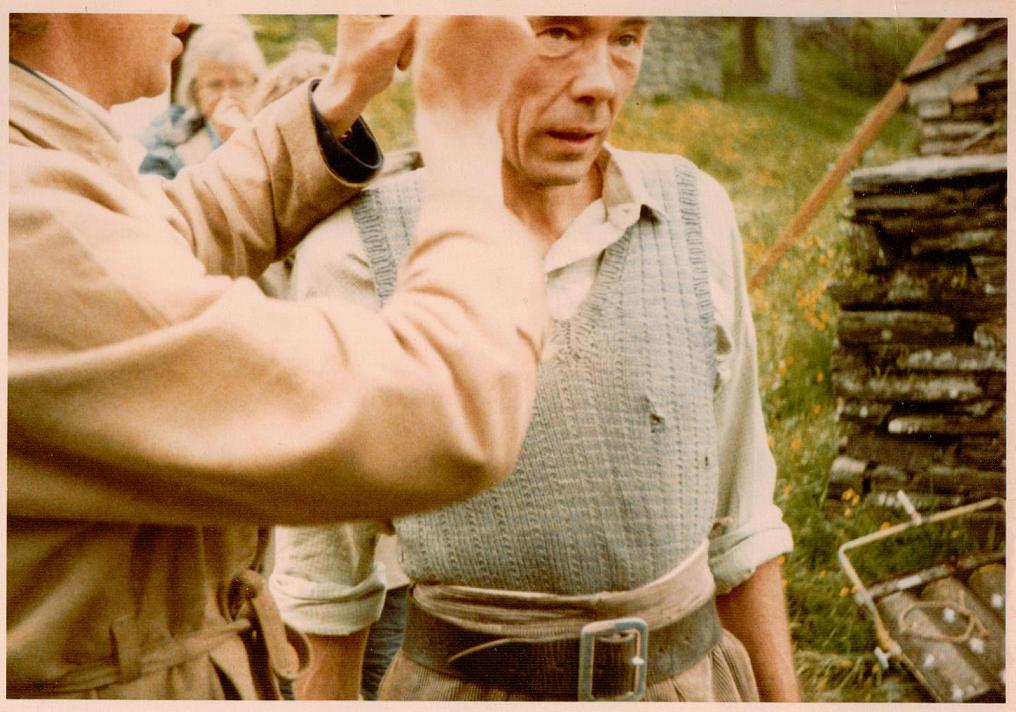
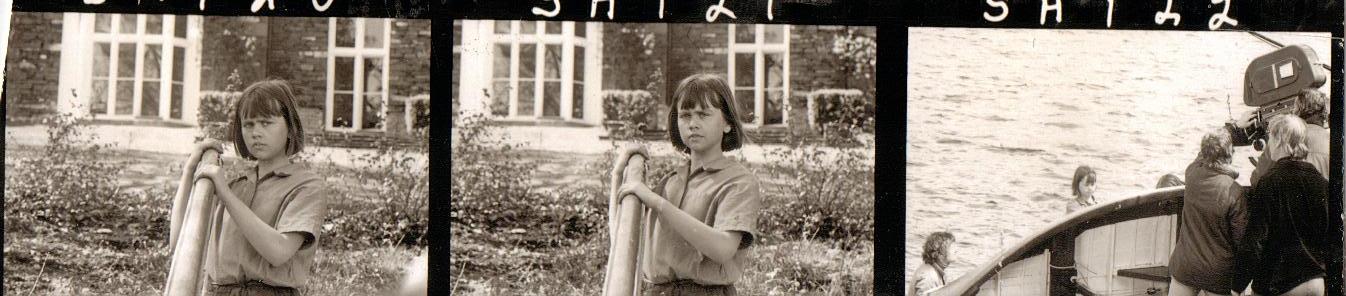
Sophie Neville having her hair cut on location for the part of Titty Walker in 1973
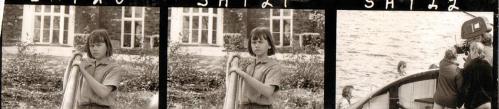
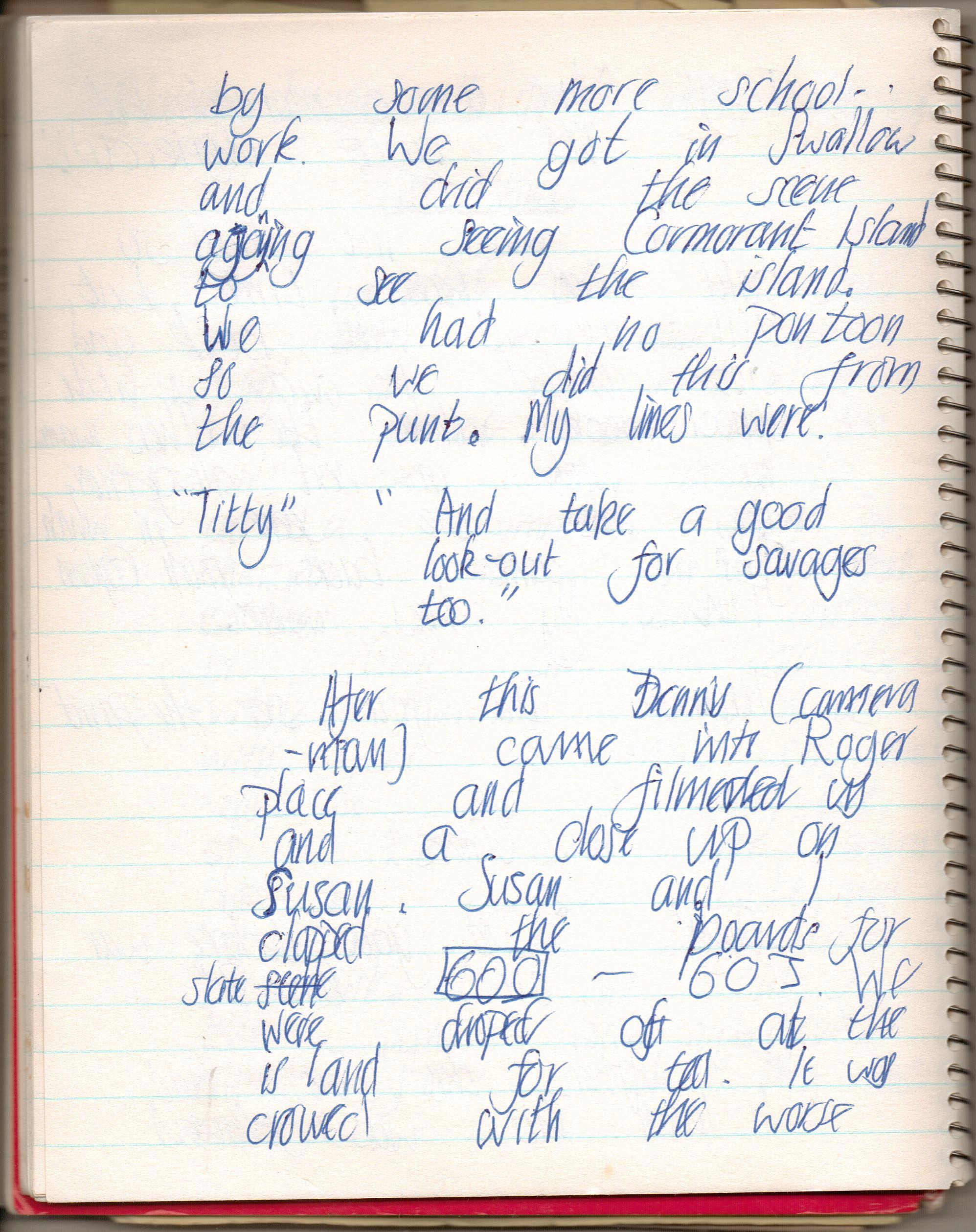
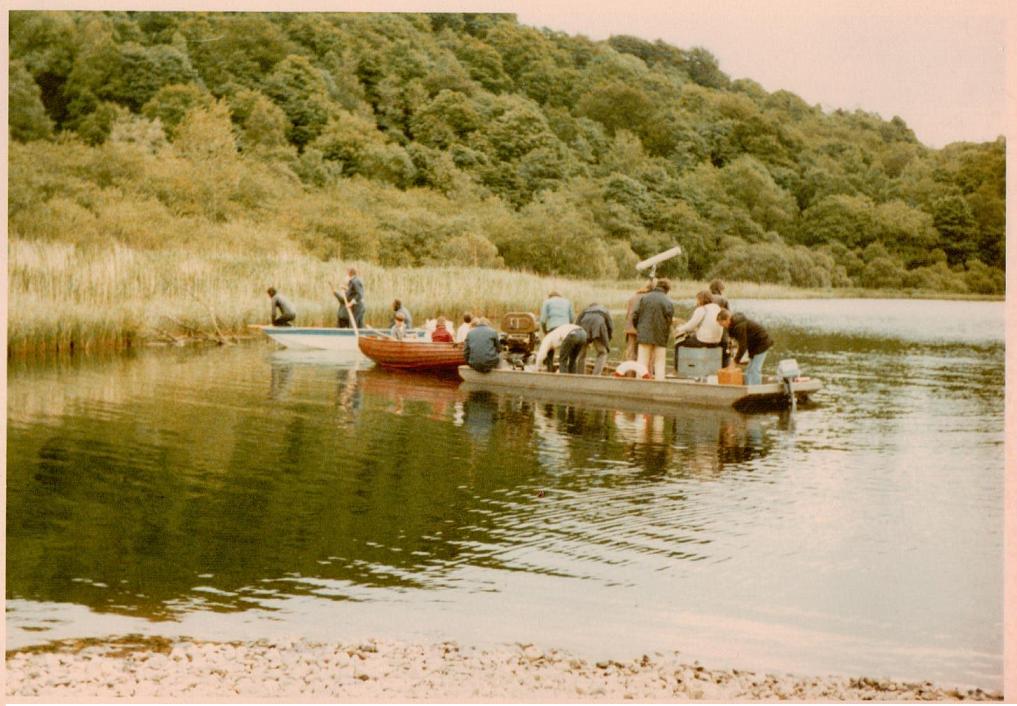
Do you know what lake we were on in the photograph below? We were busy loading urns of tea into a run-around boat to take out to the film crew who might have been on Cormorant Island. If you click on the photo you will get to the page of my diary, kept in June 1973, which describes this day.
Wardrobe Master Terry Smith and Sophie Neville in her costume to play Titty. But what is the name of the boatman? Does anybody know?
There are still many questions about the making of the movie that remain unanswered.
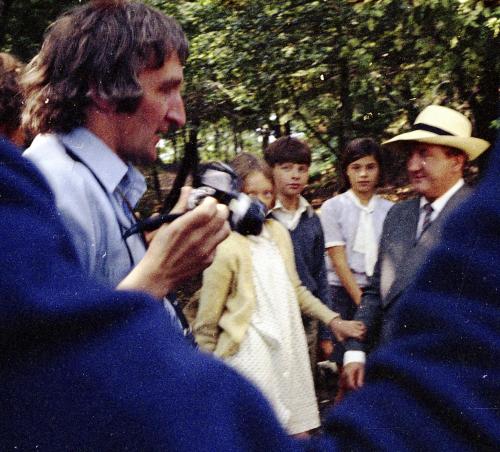
Does anyone know the name of this journalist who visited us on Peel Island?
This shot was taken while setting up the scene at Peel Island when Captain Flint brings Sammy the Policeman to question the Swallows. If you click on the photo you will find the photograph that the journalist ended up with. Titty’s hand is still on Captain Flint’s arm.
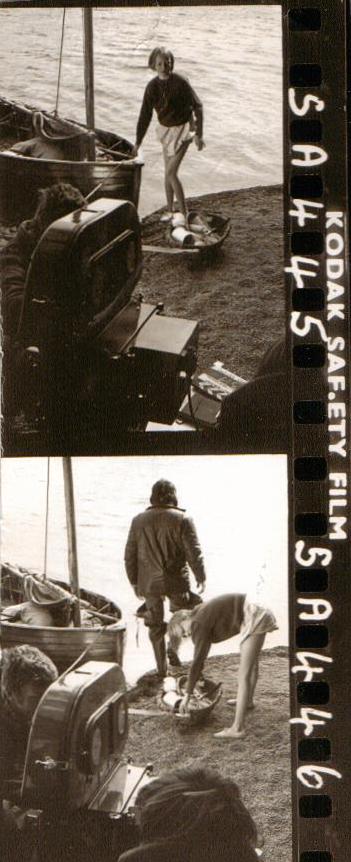
Making a movie is very different from watching one. Here is a record of Titty rehearsing the shot when she moves the camping equipment for fear of a tidal wave. It was a cold day on Coniston Water. The jersey came off when they went for a take.
Here you can see Lesley Bennett, playing Peggy Blackett, careening Amazon at Beckfoot. The same 35mm Panavision camera was focused on Kit Seymour, playing Captain Nancy.
Lesley Bennett as Peggy: Claude Whatham directing the scene with Kit Seymour
The location used for Beckfoot and the Amazon boathouse can be found at Brown Howe on the western bank of Coniston Water. If you click on the photograph of Peggy you can read more about what happened that day.
Kit Seymour playing Nancy Blackett and Lesley Bennett playing Peggy Blackett
If you would like to get future posts, please click the Follow button at the bottom of the side-bar.
You can read the full story about the making of Swallows and Amazons here:
Hillary Warwick from Bolton-le-Sands near Carnforth rang in to say that her grandma owned the green parrot, telling us that he was called ‘Beauty’. They used the £25 appearance fee to buy him a new cage. Hilary’s gran, Elizabeth Proctor, had been quite a character. She’d walk around Kendal with Beauty on her shoulder. He was known to be a one-woman bird and Hilary was quite impressed that I managed to stroke him and keep him on my shoulder as he was liable to nip. She was quite wary of him!
Do you live in the Lake District?
Did you take part in the film in anyway?
If so do write in using the comments box below!
~ click on the image to enlarge ~
Here is another newspaper article from 1973 that mentions Lakeland people involved in the filming, including a photograph of Mrs Lucy Batty and her grandson Peter and Margaret Causey who taught the children in the movie, pictured below with Lesley Bennett, Kit Seymour, Sten Grendon, Sophie Neville and Mark Hedges – who didn’t appear in the film but came up over half-term as his Dad, Bob Hedges was working as the property master.
Virginia McKenna is photographed above talking to Ian Whittaker, the set dresser who went on to win a number of Oscars.
An extract from this article of Brenda Colton’s reads:
‘When Mrs Lucy Batty was asked if her house could be used for the setting of the film Swallows and Amazons, with guest star Virginia McKenna, she was delighted. After all, her home, Bank Ground Farm on the east side of Coniston Water, near Brantwood, was the setting chosen by Arthur Ransome for his children’s book Swallows and Amazons.
Mrs Batty thought it a good idea that the story should be filmed in an authentic location, and she felt she should be able to put up with a few cameras and film men for a while. But she just did not realise the scale of a “medium budget” film like this one, or what the production staff could do to her house. It was not the two double-decker buses coming down the path and parking on the farm that she minded, nor the numerous vans, lorries, cars and caravans. It was not even the difficulty of having 80 men and women wandering round the farmhouse carrying equipment here, there and everywhere.But when art director Simon Holland started tearing up her lino and carpet in the kitchen to get to the bare stone floor, she did get a little annoyed. Especially when he removed all the electric sockets, lights and switches, pushed all the kitchen furniture into the larder and whitewashed the newly papered walls.
“Have you seen the kitchen?” Mrs Batty said to me. “The larder is piled high with my furniture; and you would not believe the tip my lounge is in. But they are a funny lot. I asked if I could wash the beams in the kitchen for them, and they said ‘Oh no, we want them to look old.’ I have even had to hunt out a lot of old pottery from the cellar for them.
“But I have given up now. I have just left them to it.”
Sten Gredon as Roger Walker being taught to swim by Suzanna Hamilton playing his sister Susan Walker on location at Peel Island on Coniston in 1973
Roger still couldn’t swim, but he was trying to. Very hard. The production manager had kindly scheduled the second of our swimming scenes as late in the summer as possible. The weather was warmer – we’d elected to go bathing in a river up near Rydal Water on our day off – but it was still pretty chilly out on Coniston.
Whilst we tried to acclimatise by running around in our swimming costumes the crew were all in their thick coats as you can see from this home movie footage shot by my mother. We had bought her 8mm camera by saving up Green Shield stamps. (Can you remember collecting Green Shield stamps from petrol stations? They were an icon of the early 1970s all by themselves.) I remember someone on the crew calling out ‘Second unit!’ as Mum lifted what looked like a grey and white toy to her face. It was a bit noisy so she was not able to record during a take. You only see us before and after the sequences in the film, but her footage shows quite a few of the members of the crew – all smoking away, even when they were trying to warm us up after each sequence. You can watch Jean McGill, from Cumbria, our unit nurse who was dressed in red, popping Dextrose into our mouths and giving us hot drinks to warm us up. Jean made Gareth Tandy, the third assistant, who was aged about 18, wear a sun hat because he had previously suffered from sun stroke. David Blagden can be glimpsed as the one other man with short hair.
The camera pontoon must have been left up on Derwentwater. Claude was obliged to shoot these scenes from what we called the camera punt, which was smaller but quite useful. Richard Pilbrow sent me a picture. He has included others in a book that he has written about his career, including a section on the making of ‘Swallows and Amazons’ called ‘A Theatre Project’
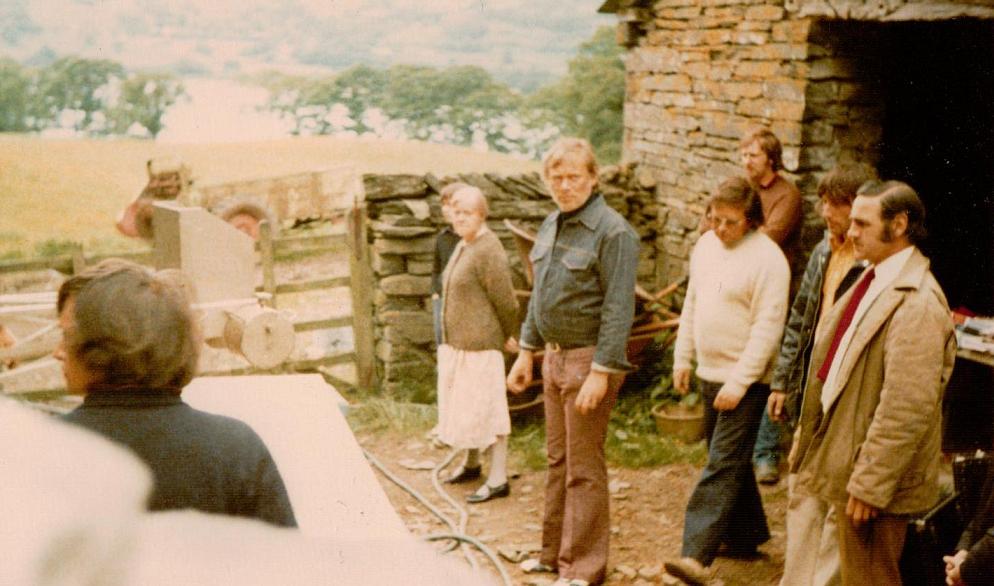
First assistant David Bracknell, director Claude Whatham, grip David Cadwallader and DoP Dennis Lewiston (seated) with three local boatmen ~ photo: Richard Pilbrow
Do please let me know if you can tell me the names of the three Cumbrian boatmen featured in this photograph who helped us. Others are featured in the home-movie footage. They all look like pirates. Real ones.
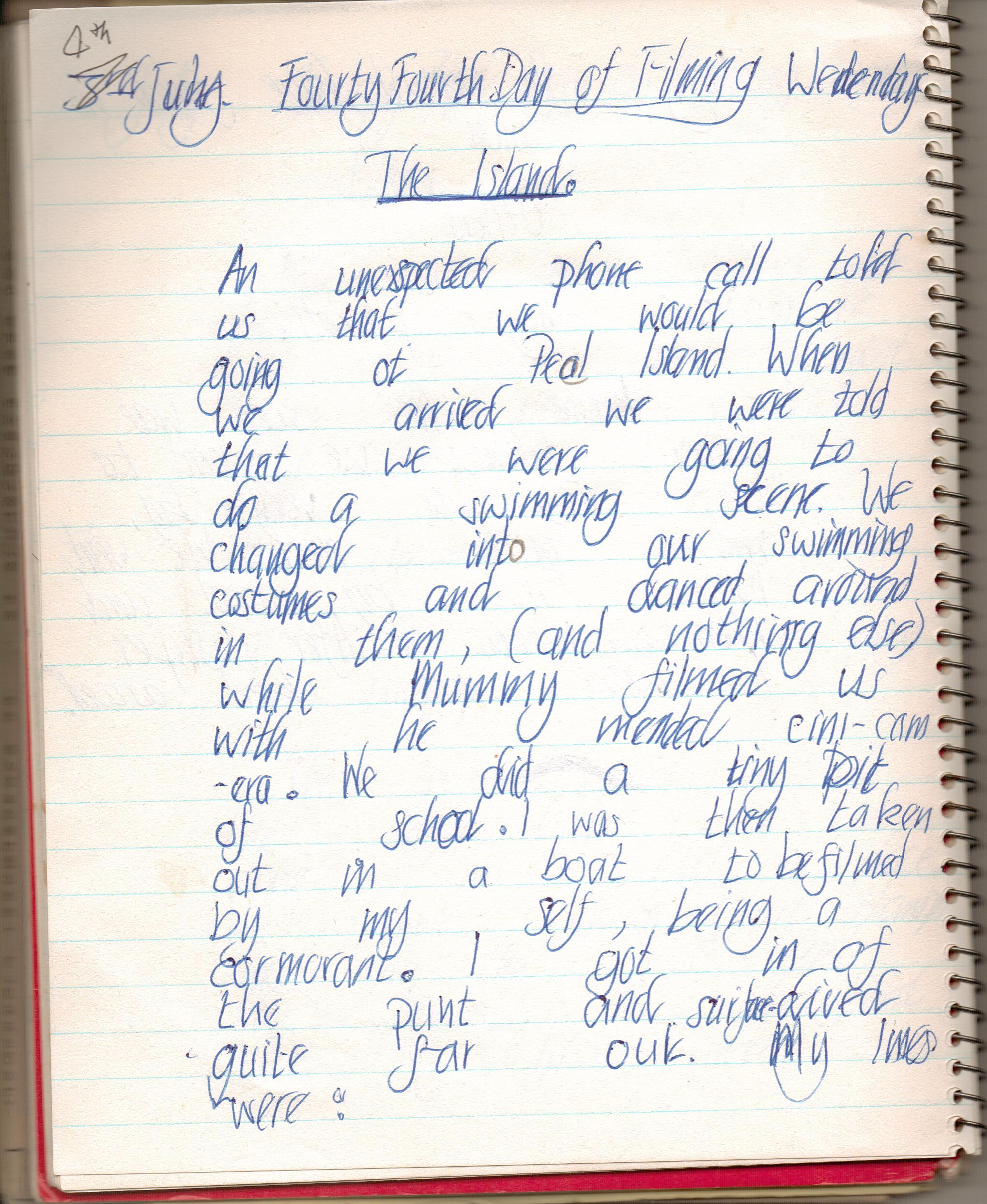
Goodness knows that Health and Safety would say about that punt today. The DoP managed to get two sizeable electric lights, on stands, into a boat already overloaded with personnel and expensive equipment. You can see for yourself. Were these ‘Filler’ lights powered by portable batteries? The Lee Electric generator was on the shore. I was in the water. Busy being a cormorant.
We had an interesting afternoon filming with both dinghies. At one point we had the camera with us in Swallow. I found these photographs of us on the internet.
Sophie Neville, Simon West and Suzanna Hamilton
I was given the honour of clapping the clapper-board and calling out, ‘Shot 600, Take one!’ for a close-up of Suzanna Hamilton.
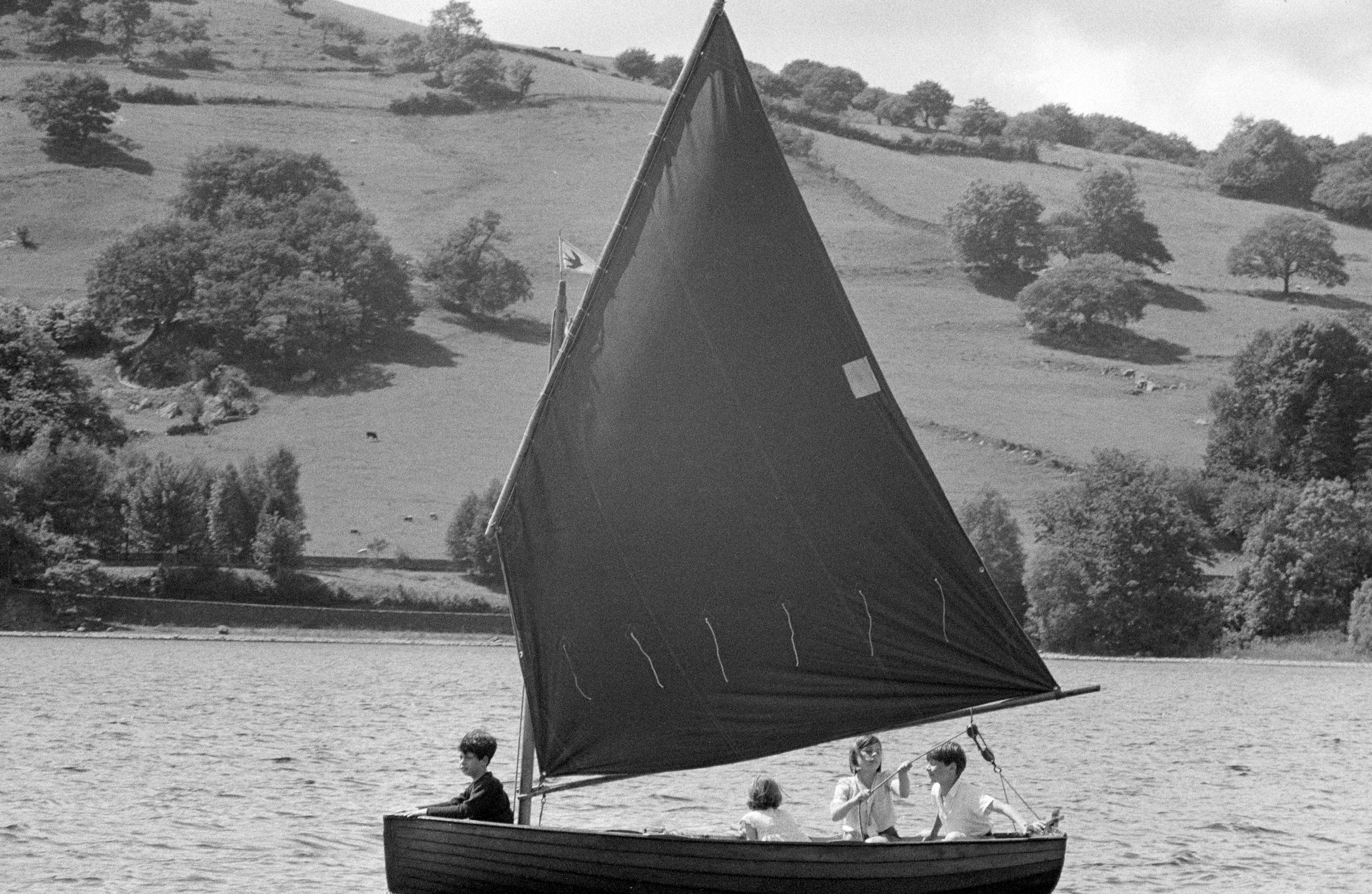
Suzanna Hamilton as Susan Walker sailing Swallow on Coniston Water in 1973
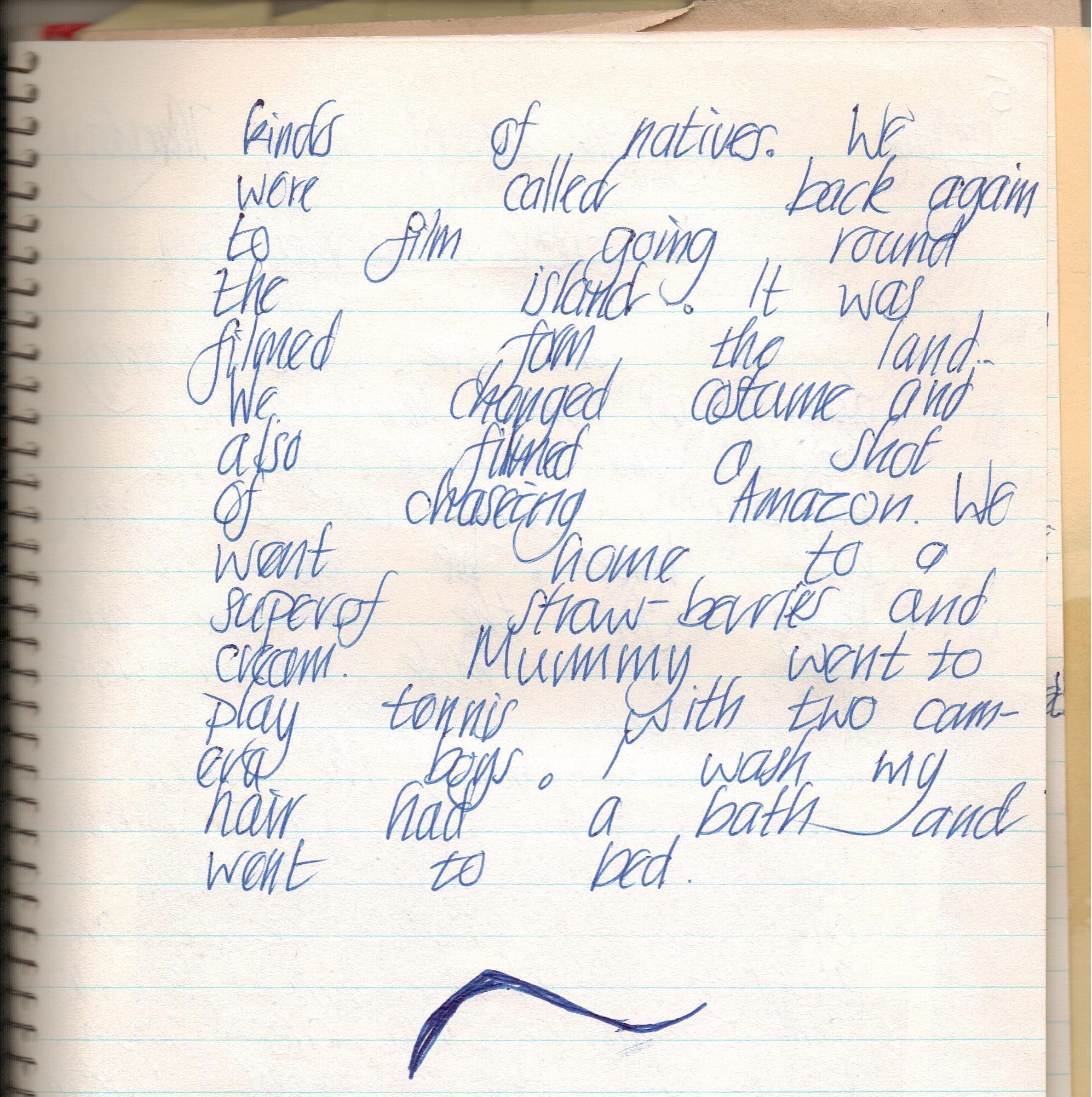
‘The worse possible kinds of natives’… Tourists were beginning to arrive for their summer holidays in the Lake District and we still had quite a bit more to film.
Sophie Neville, Suzanna Hamilton and Simon West sailing Swallow in 1973
You can read more about the adventures we had making the original film of Swallows and Amazons here:
If you ever see a cormorant you must sing out, ‘They’ve got India-rubber necks!’
And then, if you are on a long journey you can add, ‘ Cormorants. We must be near the coast of China. The Chinese have cormorants. They train them to catch fish for them. Daddy sent me a picture.’
Sophie Neville, Suzanna Hamilton and Simon West as the Walker children sailing to Wild Cat Island in Swallow
If you ever get lost – or the journey really is a long one, you can say,
‘Here we are intrepid explorers making the first ever voyage into unchartered waters. What mysteries will they hold for us? What dark secrets will be revealed?’
They were most complicated speeches to deliver afloat, ones I had to learn. In the end the second part was heard OOV – out of vision. I could have read the lines. But then they wouldn’t have stayed in my head forever, as they have.
Stephen Grendon, Sophie Neville, Suzanna Hamilton and Simon West on the voyage to Wild Cat Island, scenes shot on Derwentwater in 1973
If, on your journey, you happen to see a man sitting in a chair writing notes you score high and can say, ‘What’s that man doing? He’s probably a retired pirate working on his devilish crimes.’
Filming Swallows and Amazons (1974) from a camera pontoon
(I’m a bit hesitant about that one because my Aunt Hermione really was approached by pirates when she was sailing round the world. The Daily Mail published her dairy chronicling the adventure; a full page double- spread with photographs no less. Rather sadly they ran headline ‘Intrepid Pensioners…’ What a swizz. She should have lied about her age and said she was 27 instead of 60. Well, perhaps 57, what with the photos.)
The scene behind the camera that day on Derwentwater was rather different from from the scene in front of it.
I got cold sailing but it was a glorious sunny day with a fair wind. We achieved a huge amount even if Cedric fell in. Some of the boatmen and crew wore life jackets, others did not – including my mother.
We wore BOAC life jackets for rehearsals but Swallow is a safe little boat – her keel ensuring we didn’t capsize if we happened to jibe and we never fell in. The pontoon was really rather more dangerous being a raft with no gunwale. Any one could have misjudged their step and plopped overboard. Luckily we were not stifled by Health and Safety in those days – only the rigorous demands of movie insurance companies.
This shows the camera crew climbing aboard the pontoon in order to film Swallow sailing. Daphne Neville sits in the Dory safety boat in the foreground. A reflector board, wrapped camera mount and microphone are already on board.
I’m sure we had already shot the first two scenes of the day when I was in Amazon, setting the anchor and later hearing the robbers. I expect Claude needed to re-shoot for technical reasons. Day-for-Night filming requires clear, sunny days and he would have needed still water.
John and Susan find Titty has moored the Amazon off Cormorant Island
I have some of my father’s 16mm footage showing us at around this stage in the filming. It was shot on a different day but shows us on the shores of Derwentwater, waiting around before rushing off across the lake in motor boats to finish filming before Claude lost the light. You see the pontoon and a safety boat towing Swallow, me snapping bossily at Roger to get a move-on, (unforgiveable but I was 3 years older than him and irritated to distraction), the third assistant Gareth Tandy in blue with glasses, our sound recordist Robin Gregory throwing his arms wide open, Kit Seymour and Lesley Bennett by the lake shore, David Blagden with his short hair-cut splicing rope, me in my Harry Potter-ish blue nylon track-suit top with Albert Clarke the stills photographer, Swallow and some mallard duckings.
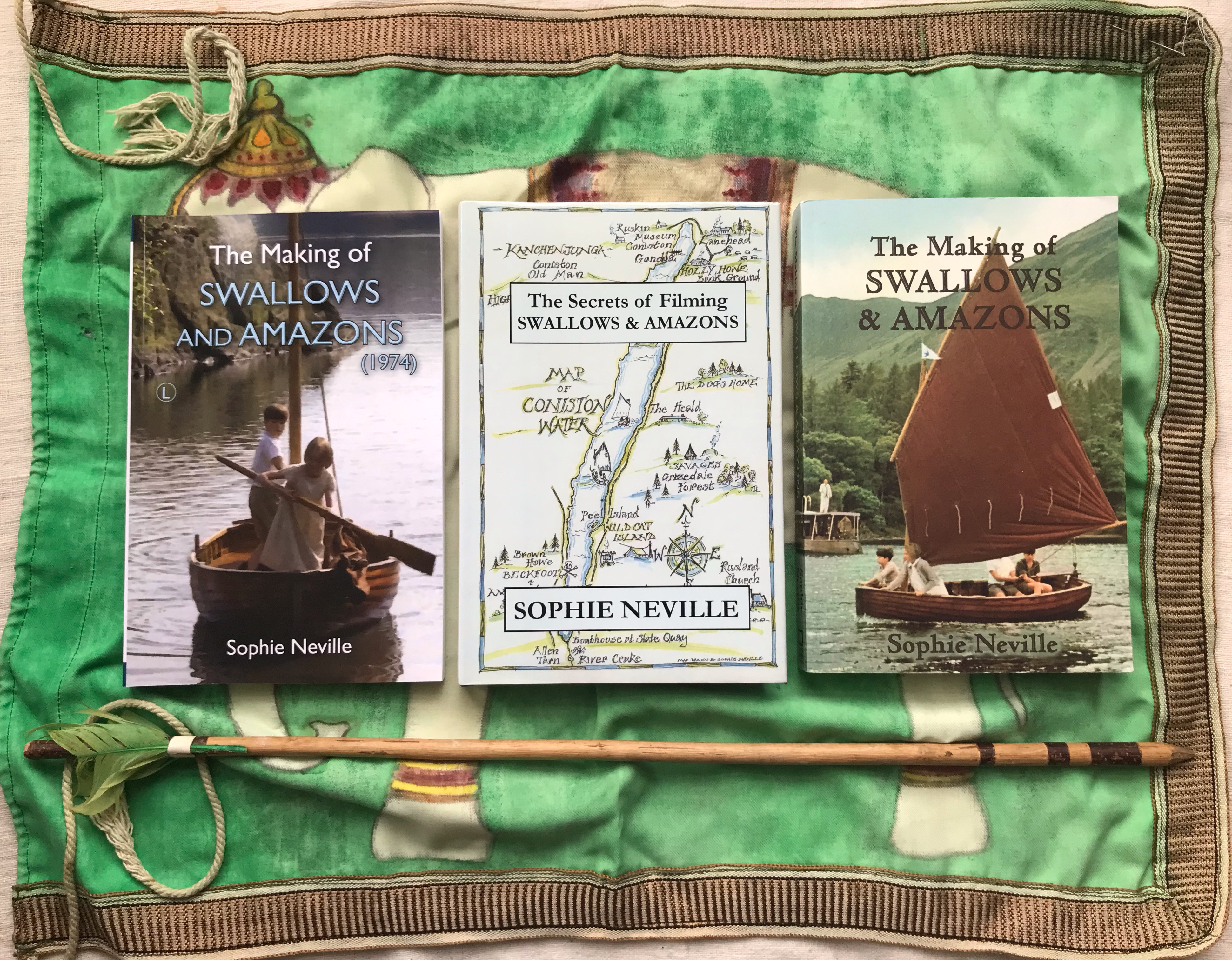
If you are enjoying this blog, please find an expanded version of the story in the ebook, available from all online retailers such as Amazon Kindle for £2.99 and on Goodreads here It has also been published in two illustrated paperback versions, which make good presents.
Different editions of ‘The Making of Swallows and Amazons (1974) by Sophie Neville’
Ronald Fraser with Wardrobe Master Terry Smith being transported to the Houseboat played by The Lady Derwentwater
Ronald Fraser being transported to the Houseboat with Terry Smith
My diary entry for 24th June 1973 is not exactly revealing. As it was raining steadily in the Lake District, I was given a second day off. ‘We had a quirte (sic) morning,’ I wrote. I am sure I needed one. After a heavy week’s filming I’d spent the official ‘Unit Day Off’ writing five end-of-year exam papers, answering correspondence from school friends and going to Kit Seymour’s thirteenth Birthday party. I must have been exhausted. Legally children are meant to have two days off a week while filming. This was the first time it had been possible.
Suzanna Hamilton’s diary adds little more, but my mother was on set, as was a journalist from The Guardian, so I can tell you what happened. I can even tell you what the location caterers from Pinewood cooked that day: Melon, followed by roast beef with Yorkshire pudding, boiled or roast potatoes, peas and carrots with apple crumble or tinned peaches served with custard or evaporated milk. It was a Sunday. Suzanna noted that we had ‘salad for super’, her favorite food.
Set dresser Ian Whittaker, Ronald Fraser and one of the Prop Men on the houseboat ~ photo: Daphne Neville
“The houseboat has been converted from a pleasure steamer,” wrote Michael McNay in the Features section of The Guardian, “the whole of the superstructure fore faked up by props, the cabin aft converted into a retired colonist’s sittingroom – African rug, flowery curtains, assegais on the walls, an ebony elephant with silver howdah and trappings, a walnut wireless cabinet, tall brass oil lamps, a pile of 78rpm records, a silver mounted cricket ball (presented to G.Gumbleton, 1899, for the highest individual score of the season), a chest, a writing desk and an ancient upright Imperial.” I have typed this up exactly as it was published on 7th July 1973.
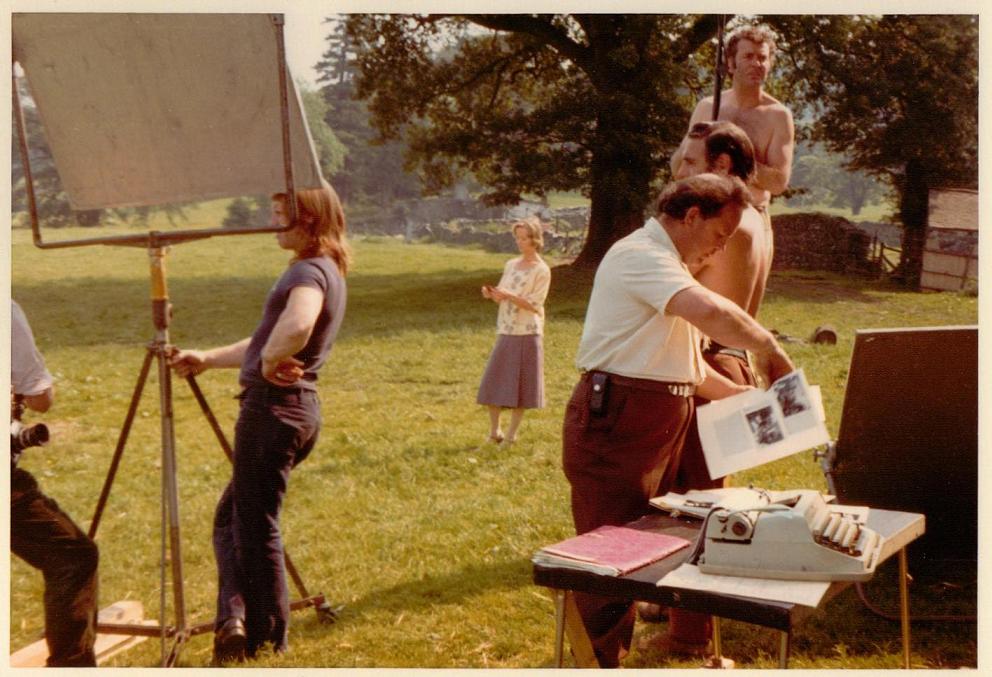
By props, I don’t think Michael McNay meant pit-props. He was talking about the work of the design team headed by Simon Holland. Ian Whittaker, who later won an Oscar for set dressing, helped Simon to create Captain Flint’s cabin with one of the Prop men who is photographed here. Does anyone know his name? I think it might be Terry Wells. I expect the cane chairs and side table were being temporally stored on the roof when this snap shot was taken so as to make space for camera and lights. The gaffer and camera crew would have been in the process of setting up inside the cabin. Sound would not have settled in yet. How do I know that after all these years? I can see the recordist’s arm at the left of the photograph. I still remember his coat.
“Ronald Fraser, alias Uncle Jim, is tapping away at a book.” Michael continues. “Last minute panic: who can type out quickly a folio of copy to leave nonchantly in the roller?” That would have been Sue Merry, the continuity girl. The first scene was probably the one in which Uncle Jim is typing with the green parrot on his shoulder when a firework goes off on his cabin roof. I wonder if Arthur Ransome had ever been disturbed by the Altounyan children in such a way. Did he use an Imperial typewriter?
The film crew were on location on Derwentwater. “By now, the houseboat has been moved and moored to the western shore just off a promontory that is being faked up as one end of Wild Cat Island.” The houseboat, really one of the stars of the movie, was being played by a long-time resident of Cumbria, The Lady Derwentwater. A 56 foot motor launch, owned by the Keswick Launch Company since 1935, she returned to real life after the filming, rather like I did. She still carries up to 90 passengers. You can go out on her today.
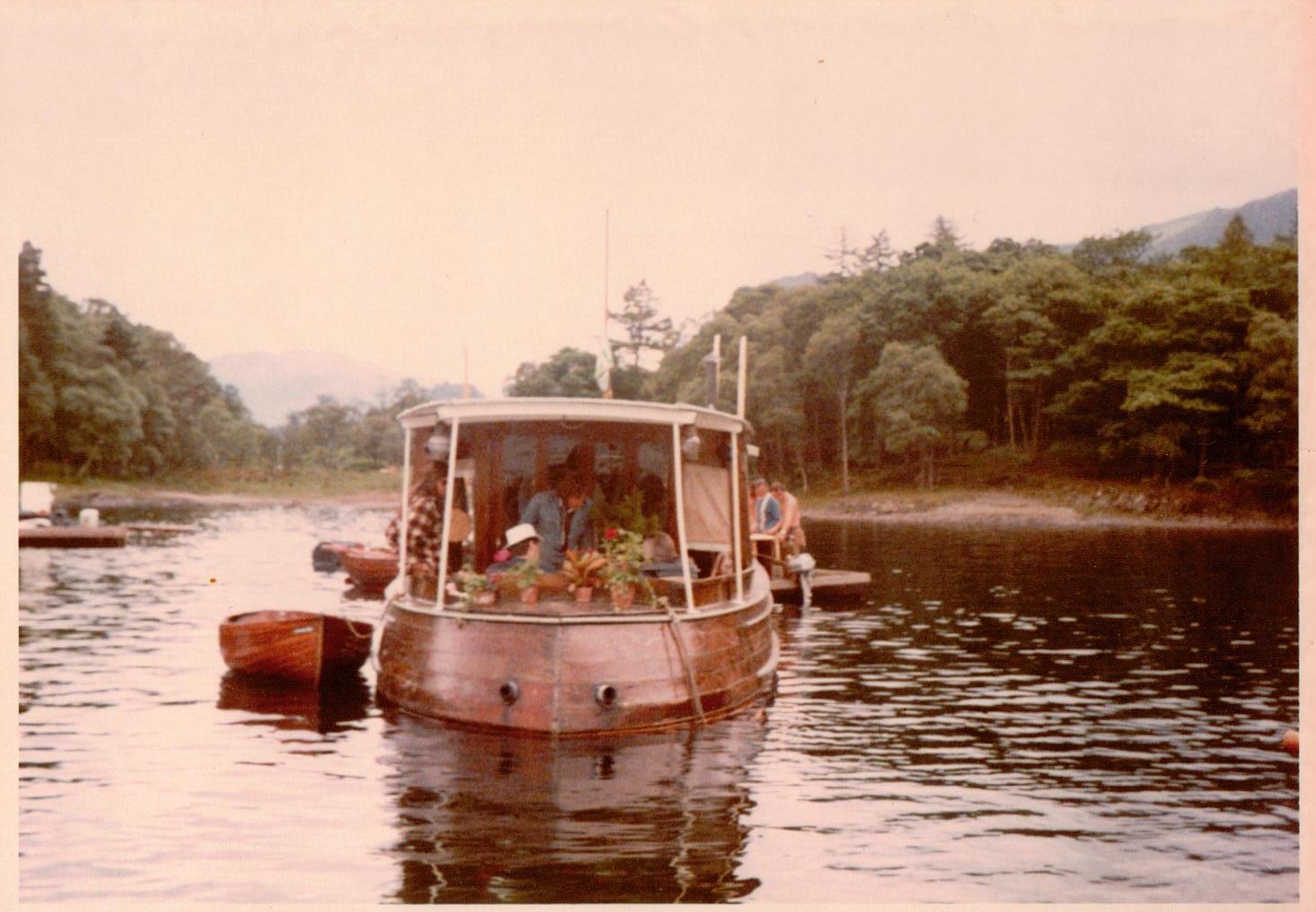
Was this the houseboat Arthur Ransome had in mind? The photograph was taken by Martin Neville in 1973
My father, who is keen on steamboats, had been off to find the real houseboat that Arthur Ransome had in mind. Am I right in thinking this must have been the original Gondola? I expect she was too un-seaworthy for the production team to contemplate using in 1973. A reliable, water-tight boat that could be towed into the location used for Houseboat Bay was needed. Last year we went to see TSSY Esperance at the Windermere Steamboat Museum in Cumbria, which is another Victorian steam yacht envisaged by Ransome as a possible model for Captain Flint’s houseboat. It is a beauty but we did get a better view of the lake from of the cabin windows in the Lady Derwentwater.
TSSY Esperance, the 1869 Steam Yacht, at the Windermere Steamboat Museum, Cumbria in Apirl 2011
“The rain has stopped, the mist is lifting from the 1,500 foot ridge of Cat Bells. Fraser climbs gingerly aboard, awkward in co-respondent’s brown and white shoes, rosy make-up and moves into the aft cabin.” McNay continues. He is describing the main scene to be shot that day. “John, alias Simon West, is in a rowing boat 15 feet away… The problem this time is that the rowing boat has to remain anchored but look as though Simon is pulling steadily in towards the houseboat and the anchor rope has to remain hidden.” This must have been so that Swallow could be lined up accurately and remain in focus for the camera. It is one of the secrets of making the film that I have been asked about directly.
“Simon shows Claude Whatham how he’ll manage it. Quick rehearsal inside the cabin. Ronald Fraser on his knees by the chest folding a white pullover, catches sight of approaching boat, mimes angry surprise. Told not to jerk head so far back. Instead jerks eyebrows up. The cabin is no more than eight foot by ten and contains besides Fraser and the props, four men on a camera, one on lights, and the continuity girl.” McNay had not included Claude the director, who I know would have squeezed in since these were the days before monitors from the camera feed. And he was small. The sound recordist was bigger but may have just planted a microphone on the desk.
“On the small aft deck Pilbrow is for the next few minutes going to be redundant.” This is Richard Pilbrow, who now lives in Conneticut and I am sure will read this post. “He is a mild, inoffensive looking man producing his first film. He is 40… looks like your friendly local antiques dealer. He and Whatham are a good team: Whatham is slight, energetic and calm. He has time, even as a sequence is being set up, to ask the Press if they can see enough of what’s going on from the crampt aft deck of the houseboat. It’s a cheerful crew, (Denis Lewiston the DOP) watching clouds overhead with benign suspicion, taking light meter readings inside and out-side the cabin every 30 seconds.
‘Stand-by Simon.’
‘Action,’ said quietly into the cabin.
‘ACTION,’ across the lake to Simon. The clapperboard shows 461 take 1. Fraser folds the pullover, looks up, jerks eyebrows in angry surprise, camera swings round to follow Fraser’s gaze through the window, Simon pulls on left oar, keeps the rope hidden.
‘Once more please. Stand by. Action. ACTION (461 take 3) …. CUT.’
There’s a consensus that the third take was best. Ten minute break while the succeeding sequence is prepared: Fraser rushes out on deck and tells Simon to clear off. That too is filmed in triplicate. The time is 12.45. They started work at 6.30, began filming at 12.25 and they’ve got maybe 45 seconds in the can. Everybody seems pleased.”
The Gondola on Coniston Water today, re-built and restored by the National Trust, powered by steam and taking passengers down the lake from April to November.
You can read more about the adventures had making the original film of Swallows and Amazons in any one of these editions of Sophie Neville’s filmography available from Amazon and all the other usual places. You can read a little more about them on this website here.
Different editions of ‘The Making of Swallows and Amazons (1974) by Sophie Neville’
Sophie Neville by Elterwater in 1973 ~ photo: DJ Neville
My mother was very excited about meeting the actress Brenda Bruce who Claude had engaged to play Mrs Dixon. She had arrived on 10th June whilst we were filming the fishing scene at Elterwater where she found Claude keeping up our moral by wearing my mother’s Donny Osmond hat. I think he needed it for warmth. It was unexpectedly cold.
I can remember being worried that Brenda Bruce would be chilly as she was only wearing a blouse and flip-flops. Now I understand that she ‘was of a certain age’ and didn’t feel the cold quite so much as skinny twelve-year-olds with opinions.
Brenda Bruce had been born in Prestwich in Lancashire. I’d had no idea that she was so well-known, that BAFTA ~ the British Academy for Television Awards had named her Best Actress in 1963. “Yes, you do!” Mum said. “She was the White Queen in Alice Through the Looking Glass.” She’d actually worked for Claude quite a bit and he trusted her to play a small part well. brought her son with her.
I shouldn’t have been worried about Mrs Dixon. She looked wonderful in the film – was wonderful – and very comfortable in her nice clean dairy.
When I look back on Swallows and Amazons, I can see that Claude made sure it didn’t become chocolate-boxy. You can tell by glancing at Mike Pratt’s costume.
Mike Pratt who played Mr Dixon the provider of worms for our fishing bait, the lovely Lakeland colours of his garments contrasting with the harsh blues and reds of the 1970’s clothes worn by the crew.
Brenda Bruce as Mrs Dixon with Claude Whatham
I can’t remember exactly where Dixon’s Farm was filmed. The scenes set at Jackson’s Farm, Arthur Ransome’s ‘Holly Howe’ were shot at Bank Ground Farm by Coniston Water, but all I know about the location for Dixon’s Farm is that our tutor got terribly lost trying to find it…
Geraint Lewis of the Arthur Ransome Trust wrote to confirm Kevin Burn’s theory about the location we used for Mrs Dixon’s dairy. ‘I had a long conversation once with Lucy Batty about her recollections of filming at Bank Ground in the house, barn, etc. She confirmed that they used the buildings shown as Tent Lodge Cottages on Google Maps – as Dixon’s Farm. That certainly seems to fit from the view of the lake and shoreline trees in the background.’
What Richard Pilbrow and Claude Whatham did want to make the most of was the Westmorland scenery. In many ways they were making a landscape movie. I think what they most enjoyed was finding all the locations to put together Arthur Ransome’s imaginary lake as depicted in the end pages of Swallows and Amazons and I am often asked where the waterfall is.
“It must be Niagara!” No, Sophie. It’s somewhere near Elterwater.
‘It’s Niagra!’ Titty declared. Stephen Grendon, Suzanna Hamilton, Simon West and Sophie Neville as the Swallows on their way to visit the charcoal burners
Kevin Burn sent me some suggestions with photos which made me feel pretty sure the actual waterfall is Skelwith Force. But Roger Wardale, who is an expert on Arthur Ransome’s locations, thinks not. “I don’t think it’s Skelwith Force which is more a series of rocky rapids in fairly level ground. I watched the film again yesterday and was reminded of the waterfall at Glen Mary (otherwise known as Tom Gill) the outlet for Tarn Hows dropping down to the Coniston-Ambleside road 4 miles from Skelwith Bridge.” So – any ideas most welcome!
You can read more about the film locations and our antics in ‘The Secrets of Filming Swallows and Amazons’ available on Amazon Kindle and from all ebook providers:
Sophie Neville and Simon West on the cover of ‘Swallows and Amazons’ pub by the Daily Mail
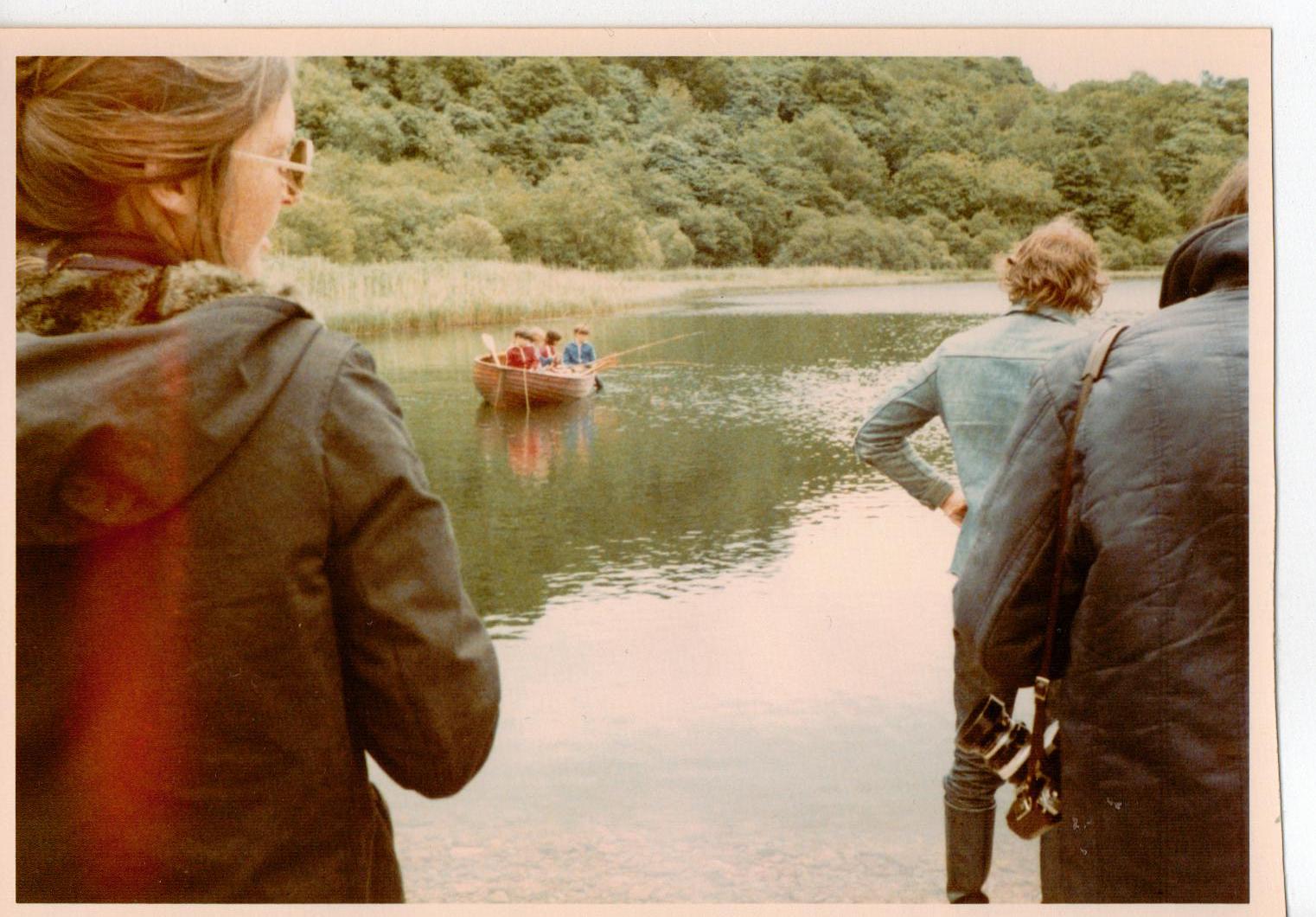
Of all the wonderful days we spent filming Swallows and Amazons in 1973, the fishing scene, shot in a reedy bay on Elterwater was one I enjoyed most. It was a cold, rather wet morning but the Third Assistant, Gareth Tandy, taught us how to use our rods and we were soon absorbed in a way that Arthur Ransome would have understood well.
Our fragile bamboo fishing rods, one with a wooden reel, were supplied by a keen fisherman called Leslie Borwick, who brought up his own daughter and grandchildren on Arthur Ransome’s books. He kept the rods, which still belong to the family, who now lived near Sedburgh.
Filming the fishing scene from the camera punt on Elterwater
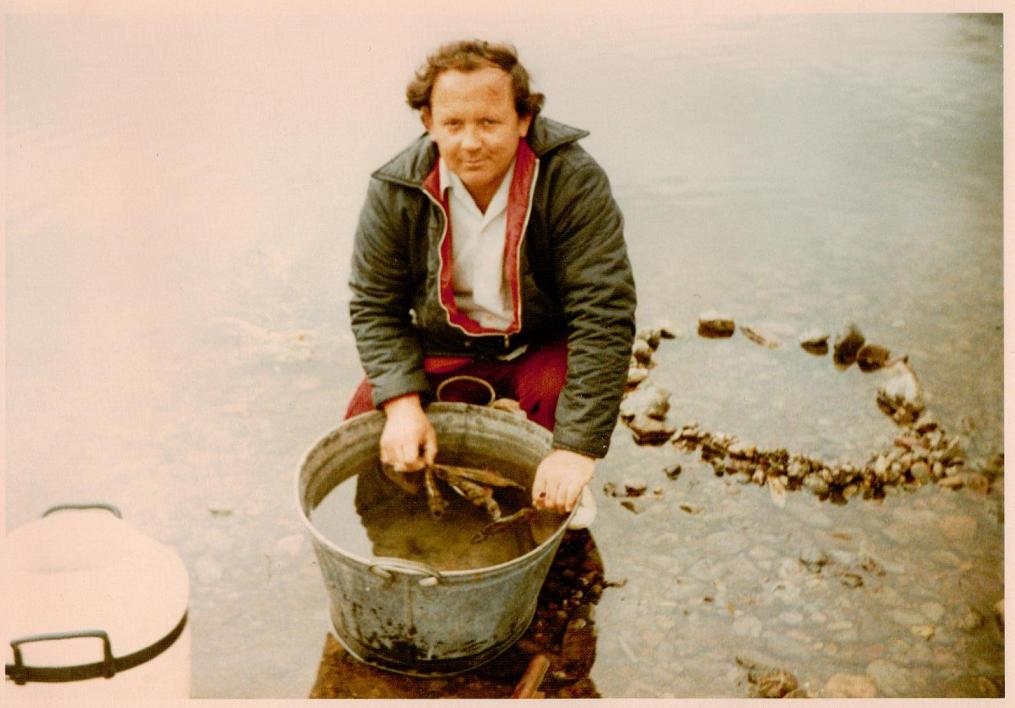
The only problem we had that day was keeping the fish alive. Bob Hedges our property master, the designer Simon Holland and Ian Whittaker, the set dresser, took it upon themselves to keep the perch as happy as they could, until they were – very carefully – attached to our hooks. Titty doesn’t catch one but Captain John did. Despite everyone’s best efforts it wasn’t a very lively perch.
Property Master Bob Hedges keeping the perch alive ~ photo: Daphne Neville
The big challenge was Roger’s great fish – a massive pike that meant to be snapping and ferocious. I’ve been told that it ended up being resuscitated in Keswick Hospital ICU – the Intensive Care Unit.
The local fisherman, Ian Whittaker, Simon Holland and Gareth Tandy with the fish photo: Daphne Neville
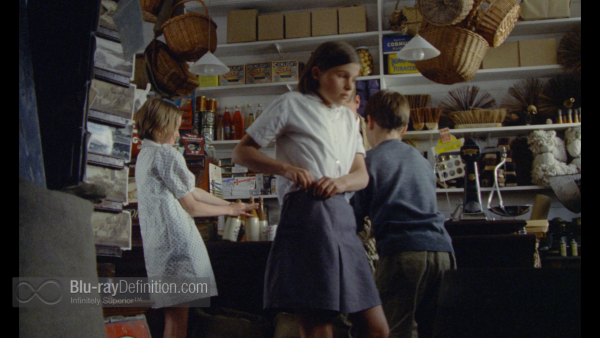
Sadly this is the only photograph we have of the set designers at work together. Later that afternoon we went to one of the few interiors of the film – the general store in Rio or Bowness-on-Windermere where we bought the rope for the lighthouse tree and four bottles of grog. In reality it was a sweet shop in the ‘seventies. It was later a barber shop and became a showroom for wood-burning stoves. Pigs were once kept around the back.
The Swallows in Woodland Road, Windermere in 1973
Back in 1973, Ian dressed the interior with boxes of wooden dolly pegs and other things you’d buy in brown paper bags. A wonderful 1920’s radio set and two purring cats really made the scene come alive, especially since, being in reticent explorer mode, we were a bit gruff in our communications with Mr Turner, the native shop keeper.
Sophie Neville in Rio with four bottles of grog ~ photo: Daphne Neville
Ian Whittaker struck me as being rather different from everyone else on the crew. He was a very nice looking man and a gentleman of the old school. I remember him telling me that he’d originally set out to be an actor but had found it so difficult to get work that he grabbed a chance to become a set-dresser or designer’s assistant. He found he rather enjoyed it, and stuck to the job despite his family thinking it was not much of a career. He proved them wrong. By 1971 he was working for Ken Russell on The Boy Friend – a musical about a musical starring Twiggy with Christopher Gable and Max Adian that I’d seen at school.
Woodland Road, Windermere
After Swallows and Amazons Ian worked on Ridley Scott’s film Alien with Sigourney Weaver, Tom Skerritt and John Hurt and was nominated for an Oscar with the others on the design team. Eventually he won an Oscar for Best Art Direction-Set Decoration with the designer Luciana Arrighi for Howards End – the movie of EM Forster’s book starring Anthony Hopkins, Vanessa Redgrave, Emma Thompson and Helena Bonham-Carter.
In 1994 Ian was nominated again, this time for Remains of the Day directed by James Ivory. After that he worked on Sense and Sensibility, Emma Thompson’s movie of the Jane Austen classic that launched Kate Winslet’s career, some of which was shot at Montacute in Somerset where my great-grandmother once lived. Ian Whittaker received another Oscar nomination for Anna and the King in 2000 and a nomination for an Emmy Award for the TV movie Into the Storm in 2009.
So, it was rather a waste that Ian spent his time just building little stone walls in the lake to keep the perch alive on our set, but I think he enjoyed the fishing scene as much as I.
You can read more in ‘The Making of Swallows and Amazons (1974)’ available online, from Waterstones and your local library. It is suitable for all ages of readers.
In Arthur Ransome’s book Swallows and Amazons Titty is left keeping watch on an island, so small it is little more than a rock, whilst the Swallows sail into Rio Bay in search of the Amazons. Luckily for me, this is not so in the film. Susan declares, ‘They must be making for Rio’ and the scene cuts to a band playing in the municipal park at Bowness-on-Windermere. John rows into the bay pretty sure that the Amazons have given them the slip, Susan suggests that we could explore Rio and I happily declare, ‘We could buy rope for the lighthouse tree.’ And that is what we did – leaving the boy Roger in charge of Swallow. It was such a hot day I whipped off my grey cardigan before I leapt out of the boat, no doubt causing havoc for the Film Editor.
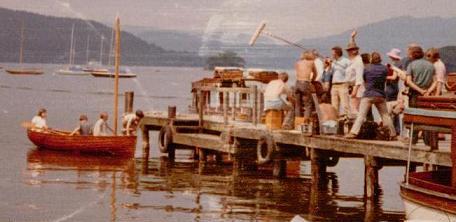
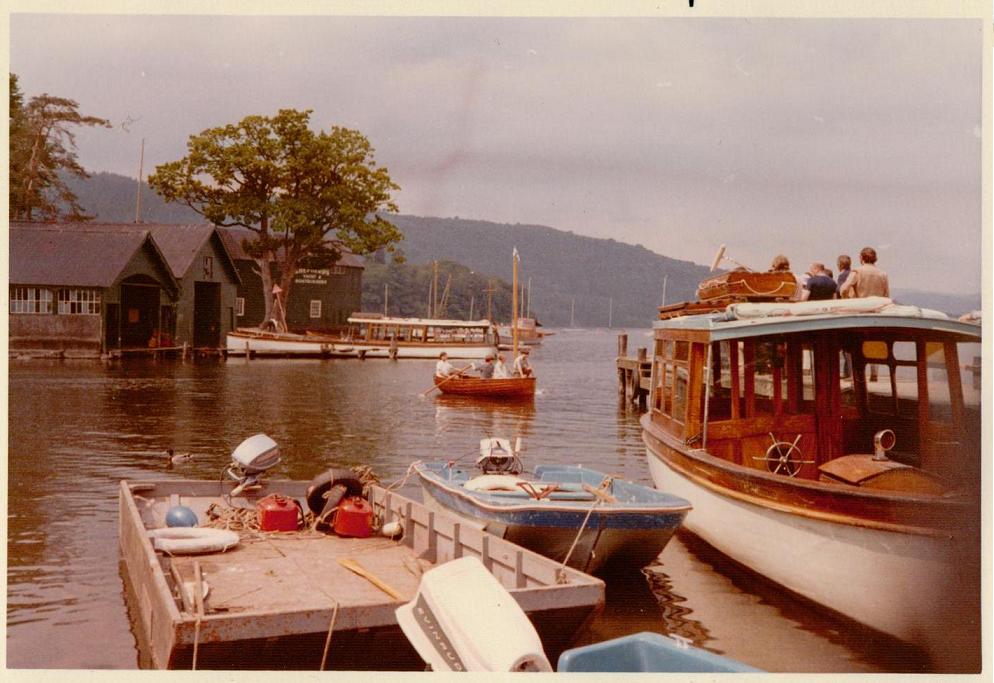
The Swallows approach the jetty in Rio. Empty camera boats are moored in the foreground beside a period launch. Are those green boatsheds still standing today?
Simon Holland, the Set Designer on Swallows and Amazons had transformed the busy Bowness of 1973 into a Lakeland town of 1929. To do this he must have had a huge amount of glass fibre boats moved. These were replaced by the beautiful wooden launches and skiffs of the period.
You can see my father in white flannel trousers, his dark hair cut short, standing on the jetty in front of the lovely old green boathouses that then overlooked the bay. He is talking to the owner of the launch with the green and white striped awning.
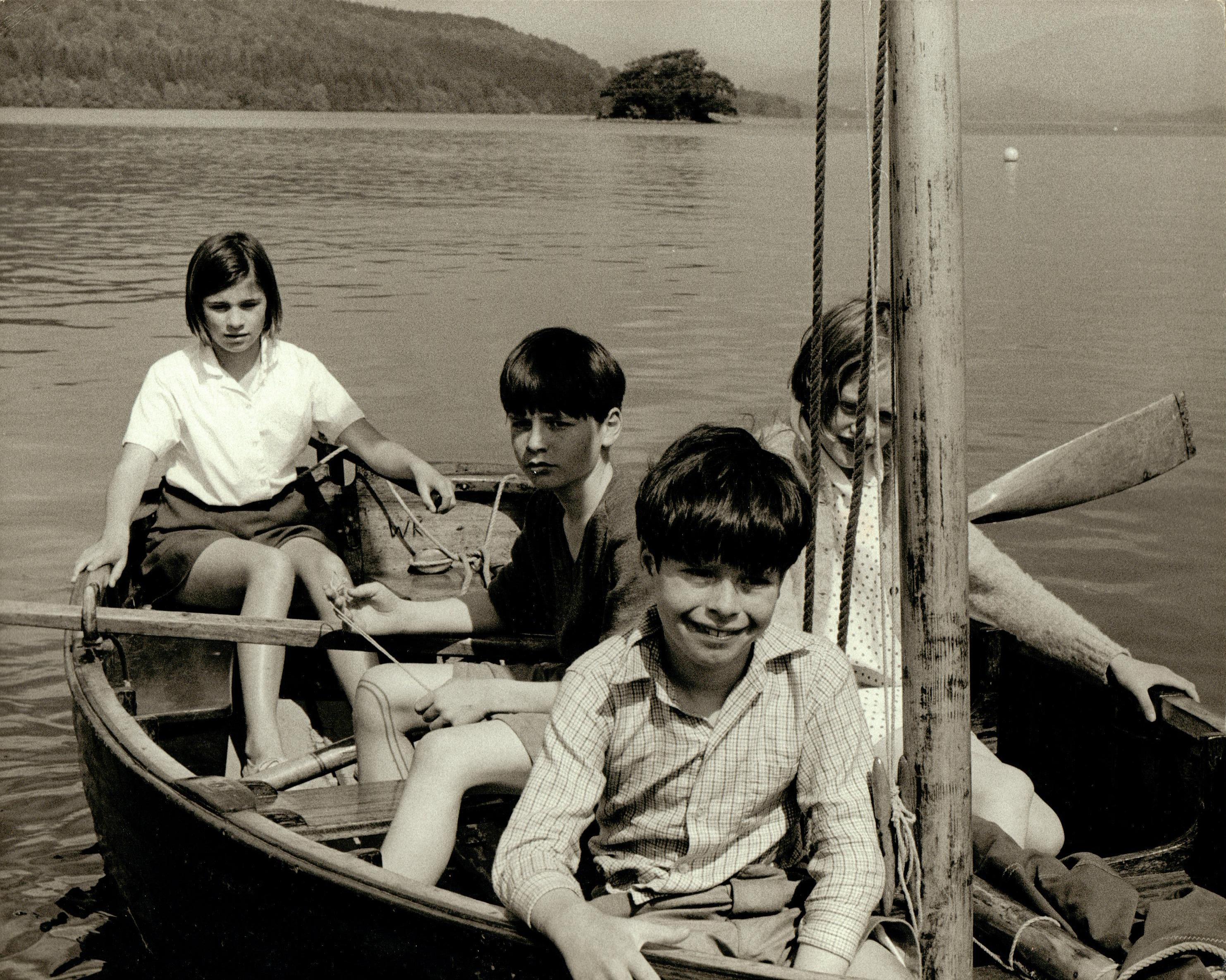
Much of the first part of this sequence was filmed from the grey punt used as a camera boat. It seems that Simon West, who played John was towing this as he rowed up to the jetty. It was a hot day and for once we were all feeling the heat.
Kit Seymour and Jane Grendon watch the filming on the jetty whilst Tamzin and Perry Neville eat ice creams with the one man in Cumbria willing to have a short-back-and-sides. You can just see the period cars parked in the background
Although the Swallows spurned the conventional attractions of tripperdom, we spotted the Stop-me-and-by-one ice cream cart like lightening. I was entranced by the old cars, the pony and trap and the number of people dressed to populate Rio. They were organised and directed by Terry Needham, the Second Assistant Director. To our delight we found Gareth Tandy, the Third Assistant, was dressed in period costume too, his Motorola hidden under a stripy blazer so he could cue the Supporting Artists and keep back the general public without having to worry about appearing in vision himself. To his dismay he had had to have his hair cut. We all thought this a distinct improvement. He looked so handsome! I’m not sure if you can see him in the distance when we are climbing out of Swallow. You can just see my sisters walking towards the town at this point with Pandora Doyle, Brain Doyle’s daughter.
The Price children, Perry Neville, Jane Grendon, Tamzin Neville and Pandora Doyle in their 1929 costumes on the shore of Lake Windermere at Bowness in 1973 ~ all photos on this page : Martin Neville
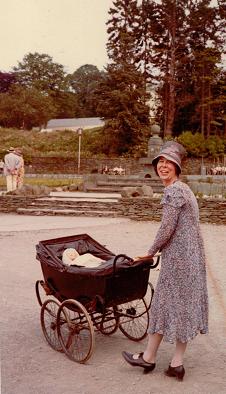
Jane Grendon, our chaperone looked fabulous in her 1929 costume. It was the one and only time I saw her in a dress.
Jane Grendon as a Passer-by with her pram in Rio Bay ~ photo: Daphne Neville
She was wonderful. Being in costume enabled her to keep an eye on all the children playing on the beach. I know she would have kept them going and maintained safety as they flung pebbles into the water or rushed about with the donkeys that were giving rides along the shore – no one wearing helmets of course.
Another excitement of the day was that Claude Whatham had given Mr Price, the owner of the Oaklands Guest House where we were staying, the part of the native. The native who says, ‘That’s a nice little ship you’ve got there.’ Mum said that Kit Seymour, Suzanna Hamilton and Lesley Bennett had spied him, pacing the garden at Oaklands trying out every possible way of saying this line. ‘That’s a nice little ship you’ve got there.’ Then, ‘That’s a nice little ship you’ve got there,’ leaving the girls in fits of giggles.
John Susan and Titty walking past the hotel
After we leave the general stores, me clutching bottles of grog, you can see Tamzin in a pink dress and straight back riding a chocolate coloured donkey along the beach while Dad is pushing out a rowing skiff with a log oar. Roger looks on from the Jetty to see Perry riding another donkey in a yellow dress while Tamzin walks by in the opposite direction with none other than Mr Price, in his striped blazer, who is walking along towards the boathouses holding a little boy’s hand. I am sure it was one of his own children but it looks a bit dodgy because while Roger watches my sisters and Pandora throwing stones into the lake from the beach were the skiffs are pulled up, David Price comes walking along the jetty and delivers his line: ‘That’s a nice little ship you’ve got there.’ It’s shot in rather a creepy way. John did warn Roger to ‘Beware of natives.’
The film crew of ‘Swallows and Amazons’ wait with Swallow and Stephen Grendon at the end of the jetty while Simon West, Suzanna Hamilton and Sophie Neville line up by the launch
A moment later Pandora and my sisters are surrounding the ice cream man while John, Susan and Titty return, striding along the jetty like the three wise men, carrying rope, buns and bottles of grog.
My father’s all time passion in the form of a very graceful steam launch passes, almost silently, in the foreground. A happy, happy day. They only sad thing was that we didn’t have time to film inside the bun shop, which was such a pity as it looked glorious. Claude had been obliged to re-take a scene when some ladies – real life ladies in 1970’s garments and bouffant hairdos – had come scootling out of the Public Conveniences in the middle of a take.
What none of us knew was that is was nearly our last day on earth. The same Supporting Artists, including my father, had been booked for the next morning…
My father added:
‘George Pattinson, the man who revived the steamboat world, along with Roger Mallinson, was the character in Elisabeth the little steamer.’
George Pattinson in his steam launch Elisabeth ~ photo: Martin Neville
‘The Bowness skiffs were not like the Thames version. The outriggers caught the oars and allowed a fisherman to let go of the grip if and when he caught an Arctic char, the Windermere fish, the oars were retained. A heavy boat.
I remember the rope was huge, fat and unsuitable! Daphne was not around as she had to go south to present Women Only for HTV. She was devastated to leave the donkey scene.’
You can read more about our antics in the paperback or ebook of ‘The making of Swallows and Amazons’ available from online retailers, good bookshops, and libraries worldwide. You can read more on Amazon here.
Sophie Neville who played Titty in ‘Swallows and Amazons’, eating icecream at Brown Howe, the location used for Beckfoot and the Amazon Boathouse ~ photo: Martin Neville
A hot sunny day in the Lake District, at last. This was 1973 and Mum had a blue sunhat firmly wedged onto my head. I suppose this was so that I wouldn’t go pink. It was lovely to be able to eat lunch outside under the rhododendrons with my sisters but I started to roast in my stripy acrylic polo-neck jersey and begged to be able to wear something cooler. Terry Smith the wardrobe aaster was not pleased when he found me wearing one of Suzanna Hamilton’s costumes, especially since I was eating a choc-ice in it.
Lesley Bennett as Peggy at Beckfoot
Mrs Causey, our long suffering tutor, was helping me to swot for my summer exams we knew being sent north from my convent. These were taken very seriously. My father was still paying my fees. They amounted to as much as I was earning for appearing in the film.
Kit Seymour with Claude Whatham, 1973
I don’t think my little sisters had any formal education at all that week. I can only suppose that they learnt a little more about being in films even though this was the one day that I didn’t appear in Swallows and Amazons.
Property Master Bob Hedges keeping the perch alive
Who were the boys? The lad in the film clip with a Motorola and cigarette, who seems to have taken off his shirt for the first time that summer, is Gareth Tandy, the Third Assistant. The boys mentioned in my diary were slightly older. Why did we call them ‘prop-boys’? Is it something left over from the theatre? I know Bobby-Props (Bob Hedges the property master) must have been over forty and was regarded as the father figure of the unit. He worked out of a lorry with a sunshiny roof with John Leuenberger, Terry Wells and Bill Hearn the carpenter. Dad caught them on film when they were having lunch. I think they must have later gone off to Bowness-on-Windermere to help set up for our big scene the next day and kindly returned with ice-creams and Coco-cola, which would have been a great treat. They were generous to a fault.
Property Master Bob Hedges with his assistant Terry Wells
The prop-men who worked on Swallows and Amazons have movie credits to their names which would delight any actor. They never seemed to stop working. Claude Whatham may well have asked for them to join us as they’d all been on the crew of his first film That’ll be the Day. Bobby Hedges later worked with some of the others on The Rocky Horror Picture Show,Julia,The Shout and Midnight Express. John Leuenberger went on to work on Stardust, Bugsy Malone,Chariots of Fire and Superman III. Terry Wells is listed as having been the property master on epic movies such as The Mission, Braveheart, Quadrophenia, Cry Freedom, Full Metal Jacket, Troy, 101 Dalmatians and Robin Hood starring Russell Crowe and Cate Blanchett, as well as big TV series such as Holby City and The Increasingly Poor Decisions of Todd Margaret.
Property Master Bob Hedges is working in the foreground ~ photo: Daphne Neville
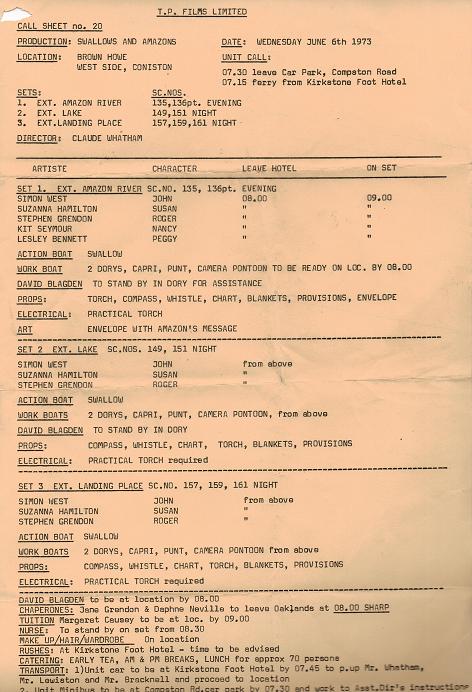
If you look at our call sheet for the day you can see at a glance how important the property master’s job was. Swallows and Amazons was a technically unusual film as the dinghies were action props. Swallow had to be kitted out with exactly the same rigging – plus the same ‘continuity props’ – the torch, compass, whistle, charts, blankets and provisions, originally listed by Arthur Ransome, that were in the little ship when she left Wildcat Island in the scene when John gave me the telescope.
In Scene: 135, the envelope containing the Amazon’s message is key to the action, thus an ‘action prop’. If we’d seen it before it would have been known as a ‘continuity action prop’. You can see it pinned to the post in the short film clip. Simon Holland, our set designer r art director, to whom the prop-men were working, had a number of identical envelopes made. Lesley Bennett, who played Peggy Blackett, wrote the message in her clear, italic writing quite a few times so that there would be replacements for re-takes after John scrunched up the first one and flung it in the water. There are times when a continuity action prop such as our telescope, which was irreplaceable, becomes very precious indeed. Had it been forgotten or lost it would have caused major disruption to the day’s filming.
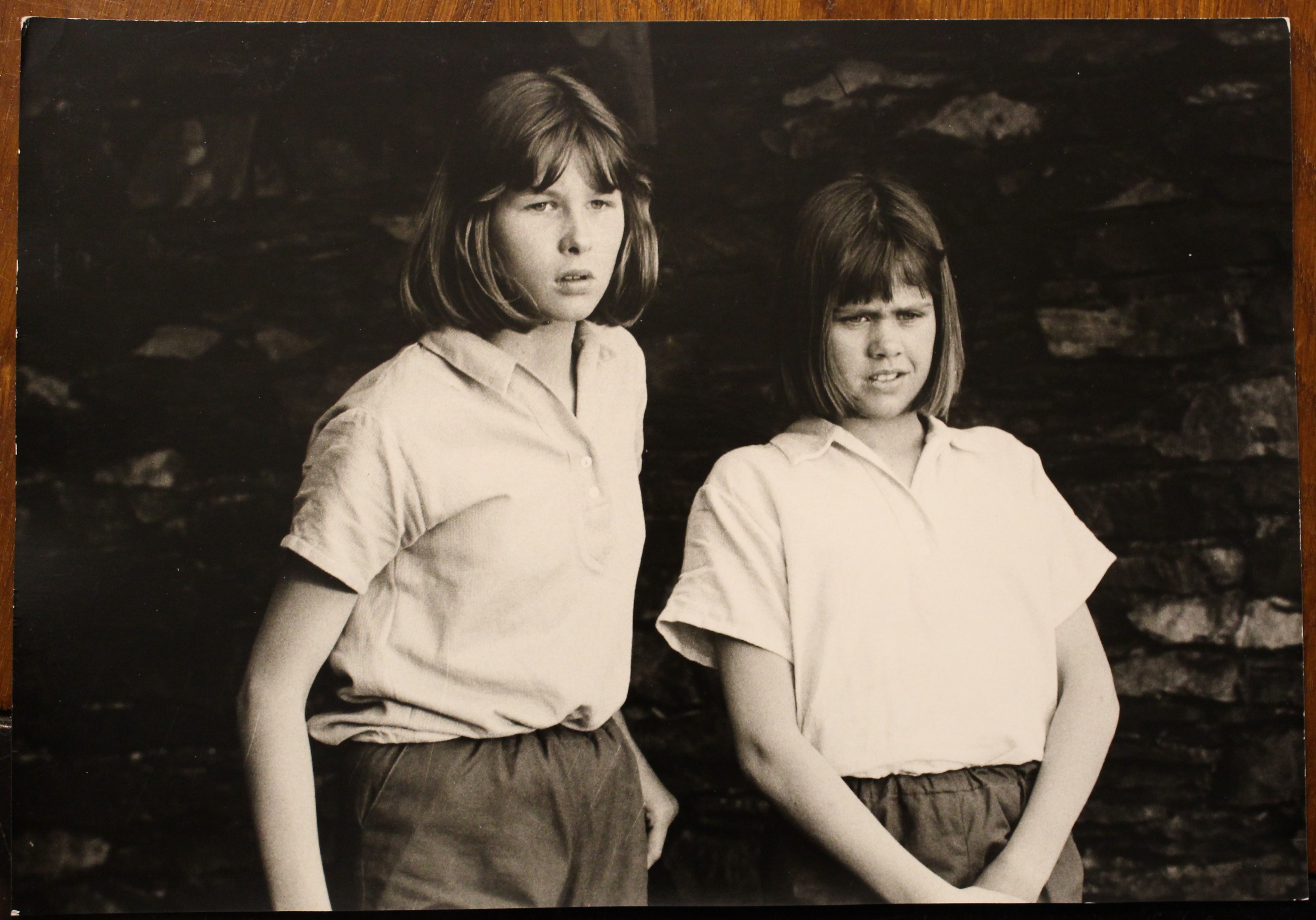
Kit Seymour and Lesley Bennett playing the Amazons
There was very little ‘set dressing’ for these scenes but you can understand that it was crucial that the guys mounted Captain Nancy’s scull and crossbones on the Amazon boathouse. They would have taken this off at the end of the day and stored it in case re-takes were needed, which is why the carpenter returned from Bowness with a long ladder in the lorry and ice creams for us all.
We loved the props as children. I treasured the few items that Bobby made on the set and gave me at the end of the filming, such as his prototype flags. When I became an Assistant Floor Manager, the BBC’s equivalent to a Second Assistant Director, I found myself responsible for the action props with one or two prop men working with me. The few times that continuity props were forgotten or mislaid are painfully etched on my memory. That awful feeling, when a lost item effects so many people, like losing a wallet or your car keys, is magnified hugely when filming is so costly and involves so many. Despite always being terribly careful I had a continuity prop stolen from the Eastenders’ studio (see my ‘Career’ page and scroll down until you find the section with William the pug dog).
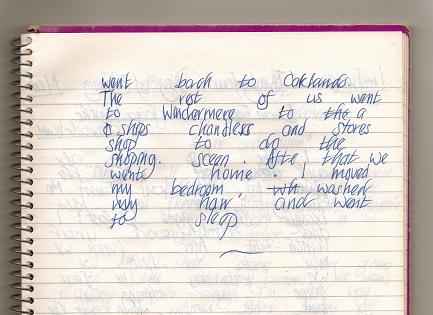
Someone once stole the soap from the set of Bluebell. I can’t think why. It was a miserable little piece for a scene set in Bescancon Internment Camp. Prisoner of war soap. The prop-buyer got very angry. I quickly made up something that looked like the original but I couldn’t do the same when our prop-man lost Gerald Durrell’s pre-war binoculars on the island of Corfu. I remember him turning out his van in despair before finding them carefully stored in bubble-wrap behind his seat. I don’t think any of the props were mislaid on Swallows and Amazons, despite all the rushing around in boats, but Mum says that we shot a scene wearing the wrong costumes. We are not sure which this was but no doubt it will be recoded in the later pages of my diary, which you can read here…
































 Sophie Neville