Thanks to the encouragement and help of my blog followers and Arthur Ransome enthusiasts around the world, I have managed to put my diaries, letters, old photographs and documents together into a 70,000-word memoir.
“Sometimes extraordinary things do happen to ordinary people. Little girls can find themselves becoming film stars. Long ago, and quite unexpectedly, I found myself appearing in the EMI feature film of Arthur Ransome’s book Swallows and Amazons, made for a universal international audience. I played Able-seaman Titty, one of the four Swallows. Perhaps it would be more accurate to say that I became Titty for a while, wearing thin cotton dresses and elasticated navy blue gym knickers, which the camera crew soon referred to as passion killers. The book was written in 1929 and although the film adaptation was made in the early 1970s it had an ageless quality and has been repeated on television year after year, typically on a Bank Holiday between movies starring Rock Hudson or Doris Day.
I got the part of Titty because I could play the piano. Although I had no ambition to be an actress, at the age of ten I was cast in a BBC dramatisation of Cider with Rosie. They needed a little girl to accompany the eleven-year-old Laurie Lee when he played his violin at the village concert. I plodded through Oh, Danny Boy at an agonising pace.
‘Do you think you could play a little faster?’ the Director asked.
‘No,’ I said, flatly. ‘These are crotchets, they don’t go any faster.’
Claude Whatham must have remembered my crotchets, for two years later, in March 1973, my father received a letter. It arrived completely out of the blue, from a company called Theatre Projects.
We are at present casting for a film version of SWALLOWS AND AMAZONS which Mr Whatham is going to direct. We were wondering if you would be interested in your daughter being considered for one of the parts in this film.
Amazing!”
From ‘The Secrets of Filming Swallows & Amazons’ by Sophie Neville
Preview copies of ‘The Secrets of Filming Swallows & Amazons’ at the Cruising Association dinner at the Water’s Edge Bar and Restaurant, Mermaid Marina on the River Hamble.
“This heart-warming memoir is illustrated with colour photographs, most of them taken at the time by Sophie’s family, and contains links to behind-the-scenes home movie footage for readers with browser-enabled tablets. It delivers a double helping of nostalgia for both fans of the era of Arthur Ransome, and the groovy times of the early 70’s.” ~ from the Amazon Kindle description
Also available for other reading devices on Smashwords
Thanks to those of you who contributed comments, questions, and aspects of local history on this blog. I would love to know what you think of the book!
If you would like a copy but don’t have a Kindle, you can download a free Kindle app.
Richard Pilbrow, Denis Lewiston, Claude Whatham, David Cadwallader and Sophie Neville aged 12 playing Titty ~ photo: Daphne Neville
I recently found a family photograph album with pages illustrating holidays spent under sail in the 1930’s.
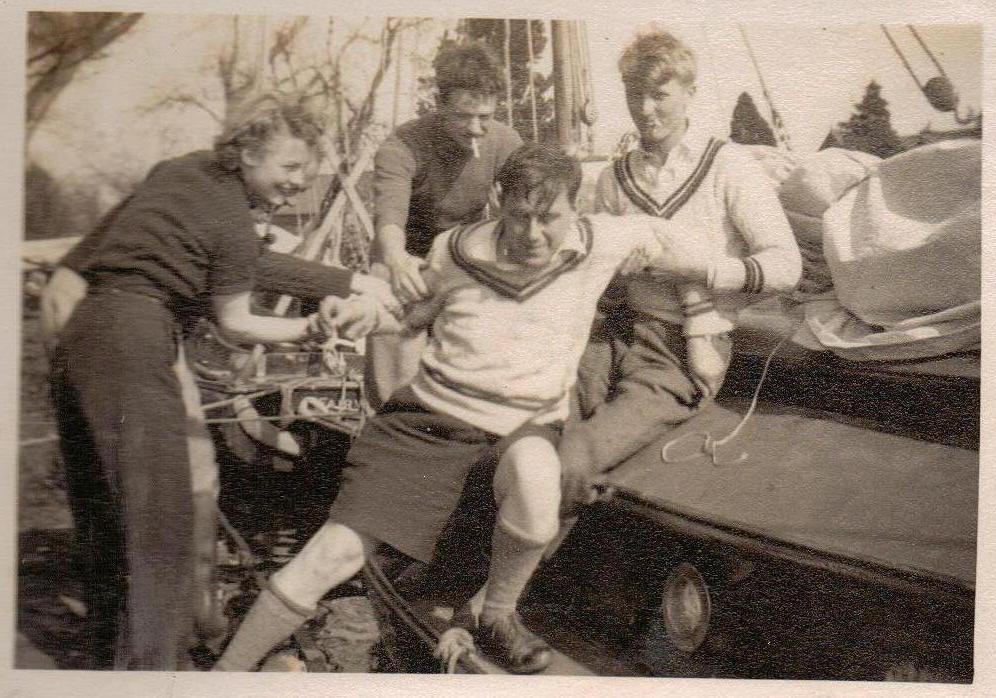
Joan with her friends having breakfast on the Norfolk Broads ~ Easter 1939
Not all the black and white photographs are as horizontal or as sharply in focus as one might wish but they show the glorious boats available for hire.
They also reflect what fun was had out on the water.
We were rather shocked by the cigarettes held in the mouths of the young men but Joan, who is pictured with them, was still agile at the age of ninety-nine.
Martin Neville sailing on the Norfolk Broads with friends in the early 1950s
Having sailed up to Horsey Mere with friends, my father hired a Hullabaloo boat to take us out on the Boards when we were little.
We went out of season, when boat hire was cheaper. As there was no one on the water my father let me take the helm mile after mile, despite the fact that I was only about seven years old.
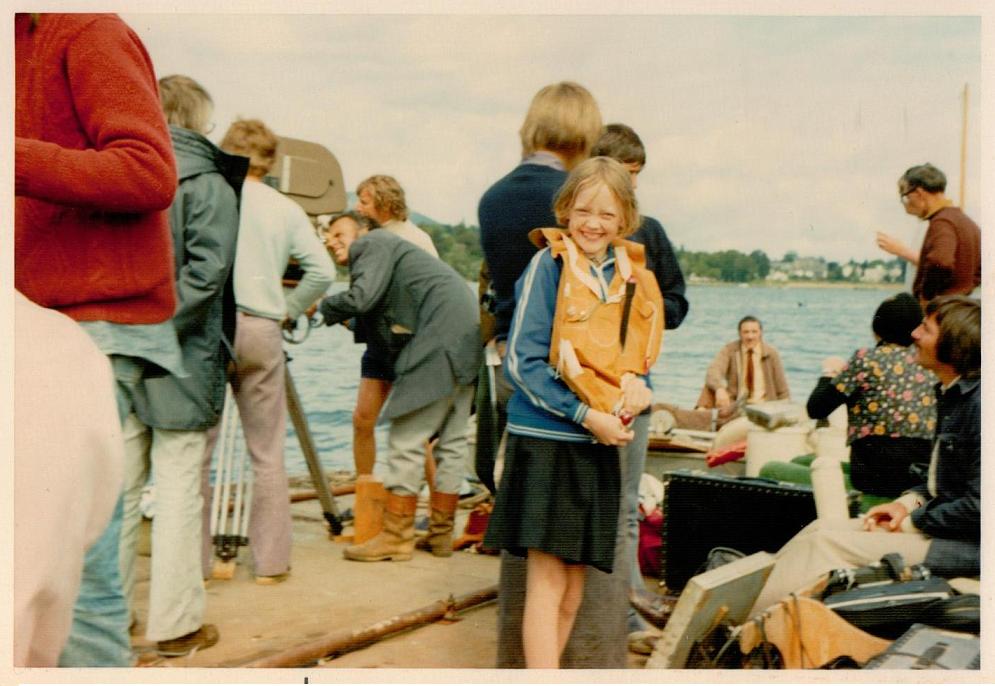
Sophie Neville wearing a life jacket c. 1968
We loved living aboard and were often surrounded by wild geese.
It seems Arthur Ransome, who had fished on the Broads with Titty’s father, Ernest Altounyan, in 1923, also enjoyed cruising in the spring. His biographer, Roger Wardale, said that ‘Both the Ransomes liked to visit the Broads just after Easter, before most of the motor cruisers had started the season and it was the best time of year for birdlife.’ He went on to describe how Arthur Ransome kept a log of his three weeks spent in a Fairway yacht, the essence of which he used to write Coot Club in 1933/34. ‘As well as visiting Roy’s of Wroxham, tying up at Horning Hall Farm and watching the racing boats go by, towing through bridges, mooring beside a Thames barge at Beccles and watching a fisherman catching eels with a bab, there are numerous details that combine to make Coot Club a valuable account of the social and natural history of the Broads as they were more than 70 years ago.’
Roger Wardale illustrated his book Arthur Ransome Master Stroyteller, using wonderful photographs and sketches by Arthur Ransome, including a very jolly one of the Hullabaloos that had not been published before. Do get hold of a copy of the book, to read the chapter on Coot Club for yourself.
Sophie Neville appearing in a Wheetabix commercial directed by Claude Whatham in 1973
I am often asked what impact Swallows and Amazons has had on my life. Because I had been given the lead in a feature film, it naturally lead to ‘more work’, as any actor would put it. I had not expected this, but things seemed to come our way. Sadly not riches, as I was still paid as a child, but it was fun and I learnt a great deal.
Claude Whatham looking down the 35mm camera, giving direction to Ruth Shields and Percy Baxter, while Perry and Tamzin Neville stand by in the foreground.
I think Claude Whatham must have accepted a contract to direct commercials for Wheetabix even before he finished editing the Arthur Ransome movie, because in the summer of 1973, my sisters and I appeared in three lovely period films – each about three minutes long – that he made in Gloucestershire at harvest time.
Girls in a Cotswold corn field harvesting stocks of wheat ~ Photo: Martin Neville
Claude had a cottage near Sten Grendon’s house in the Cotswolds. The location can not have been far from where we all lived as I recognise some of the Extras, who my mother gathered together including Percy Baxter, Ruth Shields, my younger sisters, Perry and Tamzin, and my father, Martin Neville. I can’t remember Sten being on the set but I have a photograph of our erst-while chaperone Jane Grendon in period costume.
An unknown gentleman with Daphne Neville and Jane Grendon in Gloucestershire while filming a commercial for Claude Whatham in August 1973
We didn’t actually have to eat breakfast cereal. In my film there was simply a shot of me climbing over a gate to discover a cornfield with the voice track, ‘When I was young…’ over a shot of me and my brother, played by Nicholas Newman, eating individual grains of corn. This was not in the script. We just behaved as children do.
Nicholas Newman and Sophie Neville eating grains of wheat.
Claude asked me just to stand in the crop and ended the film with a shot of me spinning around, enjoying the feel the ripe heads of corn as they hit my hands, captured against the low light of the setting sun. It was undirected action. Despite having endless lengths of track, the latest camera mounts and a massive 35mm Claude was letting us behave completely naturally – experimenting with improvised drama without even asking us to improvise.
My mother could not appear in the advertisement herself, as she had already been in a Television commercial for cereal and her agent did not want her to accept ‘Extra work’. She was represented by Bryan Drew, whose assistant Wendy Noel found Mum featured roles in a wide range of television commercials, which paid very well as the repeat fees were good. I remember going with Mum to their office in Shaftesbury Avenue when Brian Drew lent back in his chair, casually agreeing to represent me.
I went to a number of interviews – rather than auditions – to appear in feature films that I don’t think were ever made. Inflation was running at 17% in the mid-1970s and money for movies must have been tight in the UK. This was probably why Richard Pilbrow couldn’t get the financing for an adaptation of Great Northern?
When I was fifteen, I decided that the old black and white promotion photographs of me playing Titty had become out-dated and arranged for my own Spotlight photograph to be taken by an old professional – the husband of rather an unpopular teacher at school. I decided exactly what I would wear and how I would sit. My friends and the teacher were amazed, but it did the trick. On the strength of this one photograph, and obviously my experience gained on Swallows and Amazons, I was given the leading role of Liz Peters, an archery champion in a CFF adventure movie titled, The ‘Copter Kids alongside Sophie Ward and Jonathan Scott-Taylor.
Jonathan Scott-Taylor, Sophie Neville, Daphne Neville and Sophie Ward in a family adventure movie called ‘The Copter Kids’, 1976
This time my mother played our mother, wearing her red mac and rather tight jeans. Derek Fowlds played our father, an oil prospecting helicopter pilot. At the time he was only really well-known as ‘Mr Derek’, the straight guy for Basil Brush. I was actually asked at the audition whether I thought that girls my age would find him attractive. I was too polite to say that we all preferred Basil. Basil Brush was a fox puppet, but so enormously amusing and spontaneous, he was adored by the whole nation.
What happened during the filming was that we all fell in love with the stunt men, Vic Armstrong and Marc Boyle, who were acting in their own right as the Baker Brother baddies. How could we not? Vic spent years playing Harrison Ford’s double. He was the real Indiana Jones. His numerous film credits include Thor, Robin Hood, The Golden Compass, Charlie’s Angels and Empire of the Sun. He is currently working as the stunt coordinator on Jack Ryan, directed by Kenneth Branagh and starring Chris Pine, Keira Knightley and Kevin Costner. Marc Boyle worked on Star Wars – return of the Jedi, Batman and Alien 3, as well assupervising the stunts on the Bond movie Licence to Kill.
Derek Fowlds went on to do incredibly well, famous for playing Bernard alongside (or under) the late Paul Eddington and Nigel Hawthorne in the classic BBC TV comedies Yes Minister and Yes, Prime Minister that ran from 1980-1988 and are still adored. Sophie Ward, who played my sister Jill, was so very beautiful that she became a top model, the face of Laura Ashley, before she was sixteen and has never stopped working as an actress, starring in films such as The Young Sherlock Holmes and the TV movie of Joanna Trollop’s novel The Village Affair. Recently, she appeared as Lady Ellen Hoxley in Land Girls and as Rosie Miller in Secret State.
A star-studded cast, but should you rush off to order a DVD of The Copter Kids? Please don’t. It was a dreadful film. One of the stage school children who appeared in the crowd scenes floored me by asking, ‘What’s it like being a film star?’ I became self-conscious, which killed the sparkle and enthusiasm I needed for the role of teenage heroine. And I didn’t even shoot very well. You would be appalled. It was probably only made because being a charity, CFF – The Childrens Film Foundation, did have a bit of money in the coffers. A little bit. I was paid so meagerly that Bryan Drew waivered his agent’s commission.
Simon West, Stephen Grendon, Suzanna Hamilton and Sophie Neville playing the Walker children, as they arrived at Holly Howe at the start of their summer holiday in the Lake District ~ photo: Daphne Neville
While I had been at home with my family, Claude Whatham had been busy in the film editing suite putting ‘Swallows and Amazons’ together with Michael Bradsell. They had previously worked together on ‘That’ll be the Day’. Our Continuity supervisor Sue Merry must have known Michael too, as he’d edited Ken Russell’s film ‘The Boyfriend’. Claude found that they definitely needed the sequence when the Walker children run up to the Peak at Darien and see Wild Cat Island for the very first time.
It is the scene that heralds the start of the adventure and indeed the opening titles of the movie. Richard Pilbrow had always wanted it to be shot at Friar’s Craig on Derwent Water. There is a postcard of this headland with notes written on it by Arthur Ransome who labelled it for the first illustrator of the Jonathan Cape edition of the book, and it seemed just right for the Peak of Darien despite being a long way from Bank Ground Farm. Although there had been two attempts made to record the handful of shots needed as the evening light lit up the islands across the water, we had always been held up and reached the spot too late in the day.
Richard must have already been over budget but the money was found to mount a pick-up shoot at Runnymede near Egham in Surrey on Saturday 8th September. We were told that King John signed the Magna Carta under an oak tree there.
We loved the idea of meeting up again. Claude said he made an effort to get as many members of the same crew together as possible so it wouldn’t seem strange.
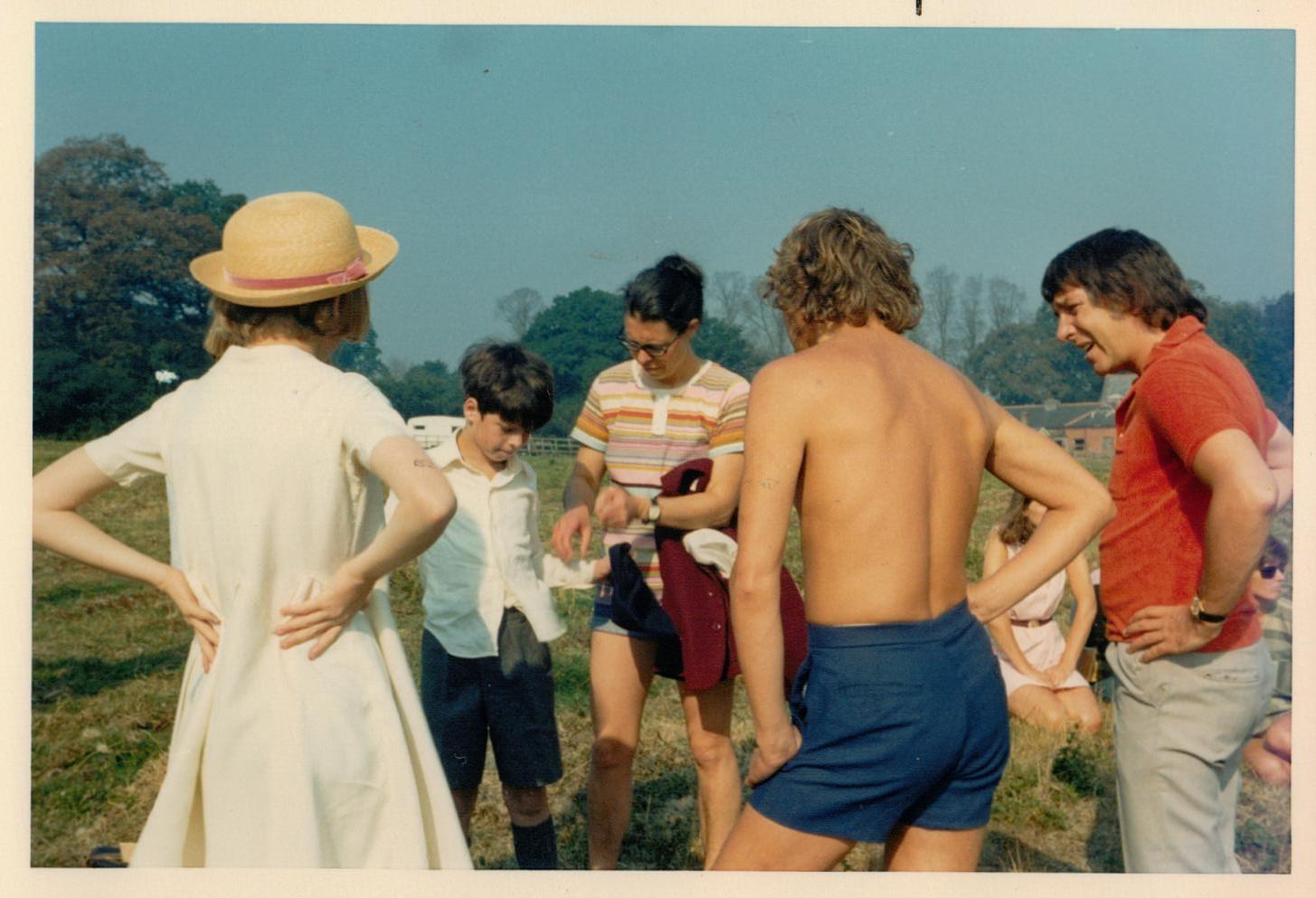
Sophie Neville looks on as Stephen Grendon organises his costume helped by Jane Grendon with Claude Whatham and Neville C Thompson.
The one thing that was striking was how much our hair had grown. We all needed a trim. Sten needed a full hair cut. Luckily Ronnie Cogan was free.
Stephen Grendon playing Roger Walker having his hair cut by Ronnie Cogan
Neville Thompson had even managed to book the same Make-up caravan. It was here that Peter Robb-King the make-up designer toned down our summer tans in an effort to match the skins of the pale Walker children who’d been sitting in the railway compartment with their mother at the beginning of the film.
Ronnie Cogan giving Sten Grendon a hair-cut. I was in the Make-up caravan beyond.
The ironic thing was that it was Make-up that held us up when we were first failed to record the scene in the Lake District. It took so long for Peter Robb-King to sponge down all four of us with pale foundation that the sun had set before we arrived on location. I can remember my mother hurrying him along, claiming it was ridiculous as it was too dark to see our freckles anyway. I was keen on the importance of continuity and had contradicted her. Claude couldn’t believe how long it had taken us to change. He had been furious when we turned up late but tried hard not to let us think it had been the fault of us children.
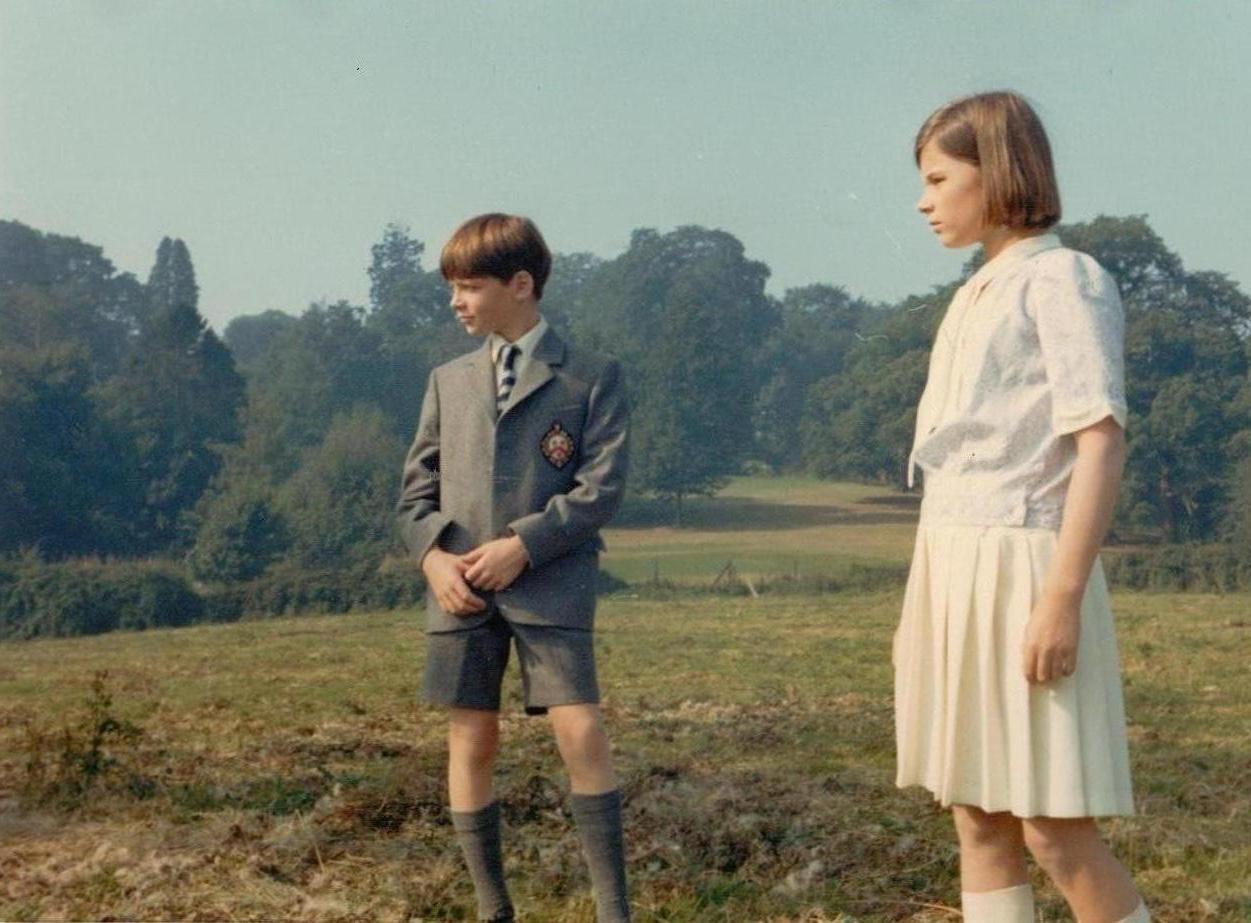
Simon West playing John Walker and Suzanna Hamilton as Susan Walker
There was no Peak of Darien at the farm in Surrey, but a field had been found where we could run up to an oak tree. We just had to pretend we were looking out over the lake.
If you click on the shot below it should take you to a post I wrote on the opening locations of the film. Scroll down and you’ll see the shot of us running down the meadow at Bank Ground farm. This was the shot Claude had to cut from to the sequence that we were currently filming. Scroll right down to the end of the post and you’ll see me on Friar’s crag looking exhausted after a long day’s filming. I am so glad we were not able to continue that day.
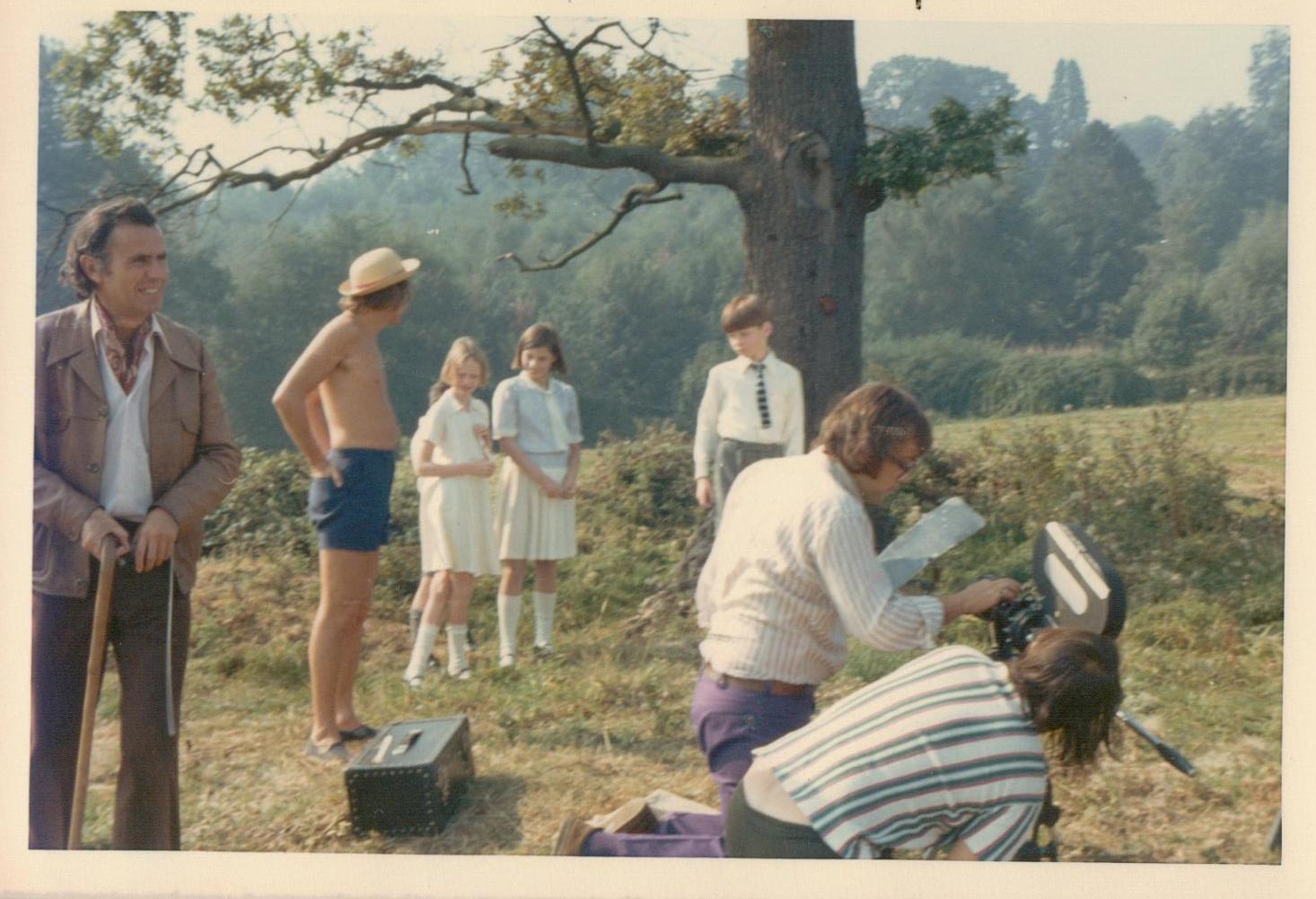
Director Claude Whatham with Sophie Neville, Stephen Grendon, Suzanna Hamilton and Simon West. Producer Richard Pilbow looks on ~ photo: Daphne Neville
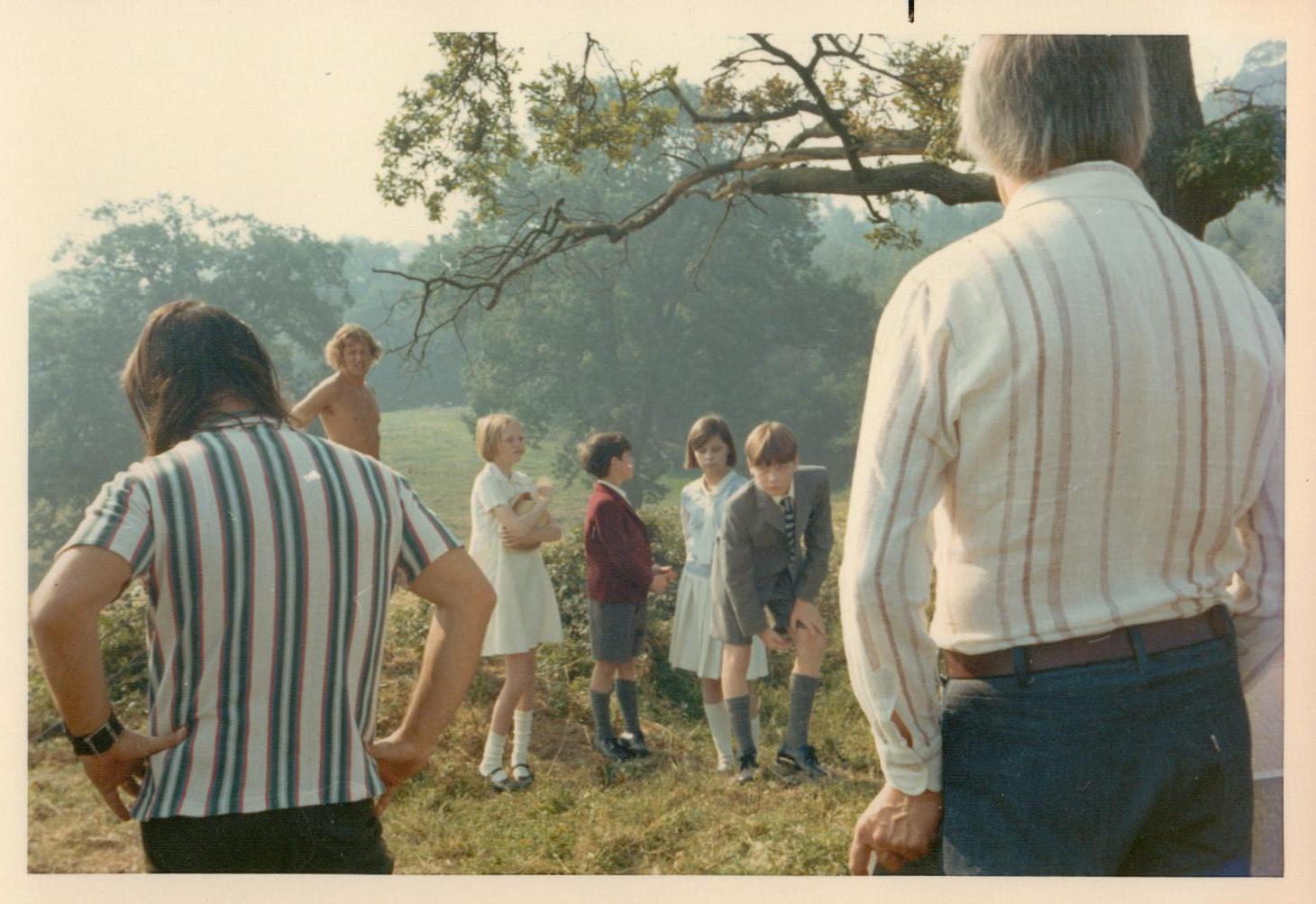
Although he had a freelance camera operator in a stripy shirt who we did not know, we met our Director of Photography Denis Lewiston who was setting up the shot with Claude under the oak tree, using a 35mm Arriflex camera on ‘short legs’.
If you click on the photo above you should get to a Post written about a location that was set on Derwentwater near Friar’s Crag – or on part of Friar’s crag that will give you an idea of what the real Peak of Darien would look like. However, the day in September in Egham was hotter than any day we’d experienced in Cumbria. Claude was soon wearing my straw hat.
DoP Denis Lewiston, Claude Whatham, Sophie Neville, Suzanna Hamilton and Simon West with Gordon Hayman behind the 35mm Arriflex Camera ~ photo: D.Neville
If you click on the photo above it will take you to the day on 8th July when we had tried and failed to shoot this scene despite rushing around.
Although we look a bit hot and stiff in these photographs that my mother took when we were lining up the shots I think that the movie was probably made by this scene. We had learnt how to magic-up performances by this stage. If you watch the finished film our faces can be seen glowing with excitement. This was also partly because we were happy to be together again, on a sunny day in a lovely place.
Sophie Neville playing Titty Walker with Stephen Grendon as Roger Walker with Gordon Hayman, Denis Lewiston and Claude Whatham behind the camera
I’ve just realised this image of Titty, clutching her school hat as she looked out over an entirely imaginary lake, was the last actual shot recorded. Soon my close-up was ‘in the can’ and ‘a wrap’ was called. It had been the 1003rd slate of the movie. We celebrated with tins of Fanta rather than champagne.
Since the first shot in the compartment of the steam train as it travelled between Haverthwaite Station and Windermere, recorded back in May, I had put on about seven pounds and grown taller than my elder brother and sister.
Daphne Neville with Stephen Grendon, Suzanna Hamilton, Sophie Neville, Jane Grendon and Simon West
I can’t help thinking that this photograph is symbolic of the futures we were to step into. Sten Grendon is holding an apple, Suzanna seems to have a framed photograph and I’d been given a roll of camera tape. What Simon West is holding is something of a mystery, but it is tightly clasped.
Simon West writing his address for me on a scrap of paper
Soon it was time to go. We changed back into our own clothes and said goodbye. Mummy took me on to see Robin Clarke, a music editor we had met on holiday who had worked on the movie Chitty Chitty Bang Bang.
It wasn’t long before we saw Claude again. Once he’d finished editing the film we were called to the work on the sound. The movie was still in the making.
Sophie Neville saying goodbye to director Claude Whatham. The film actress Teresa Graves is speaking to Neville Thompson in the back ground.
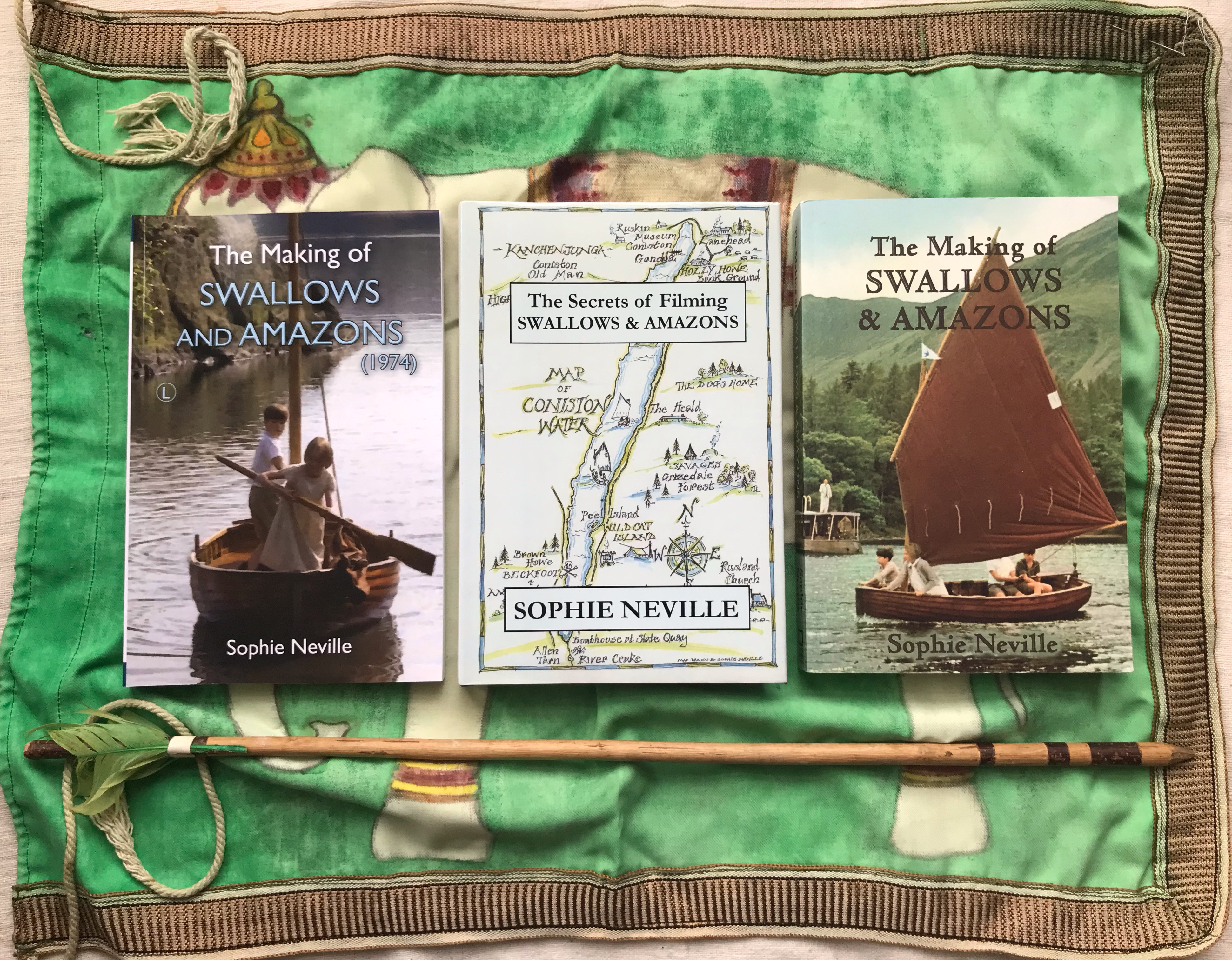
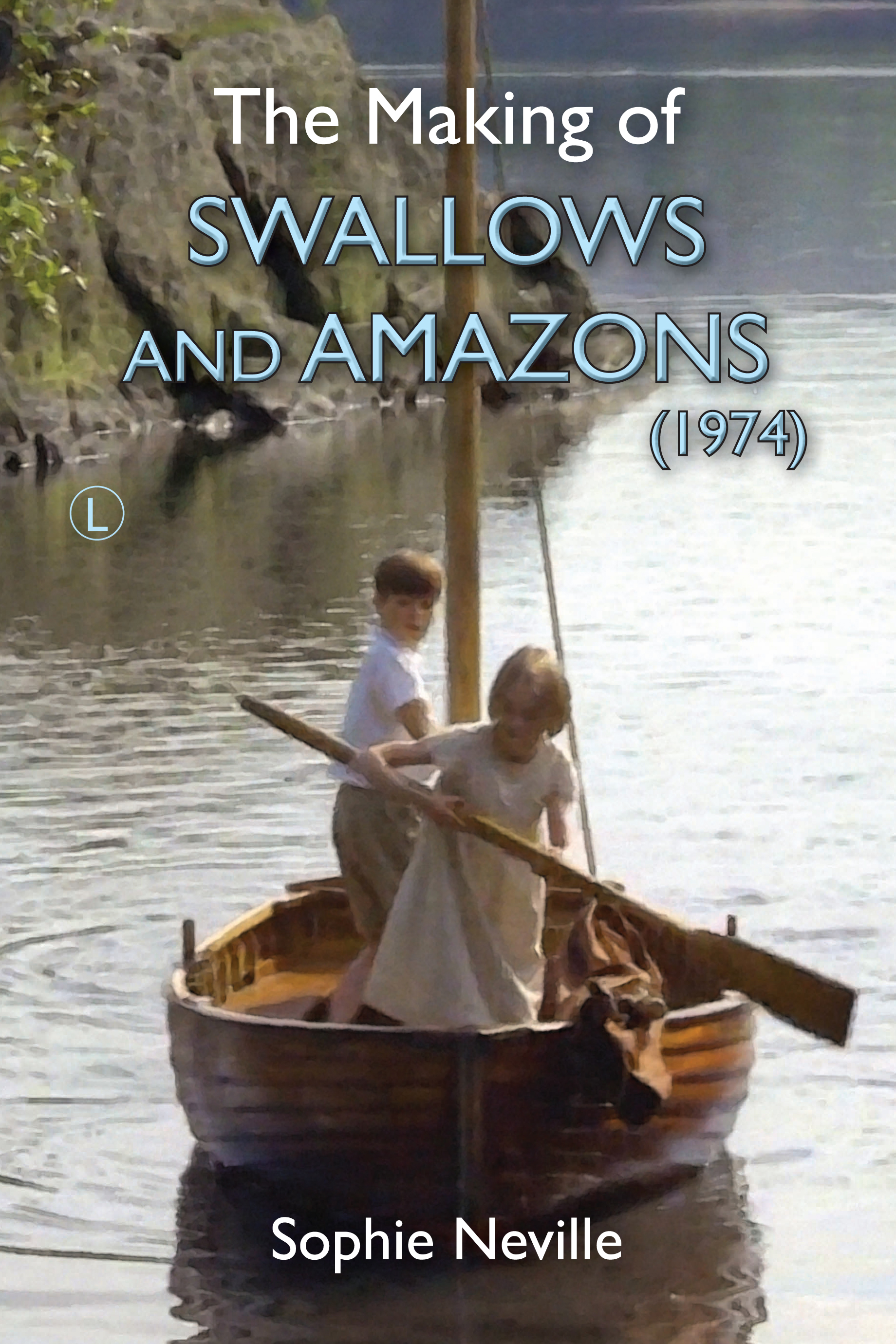
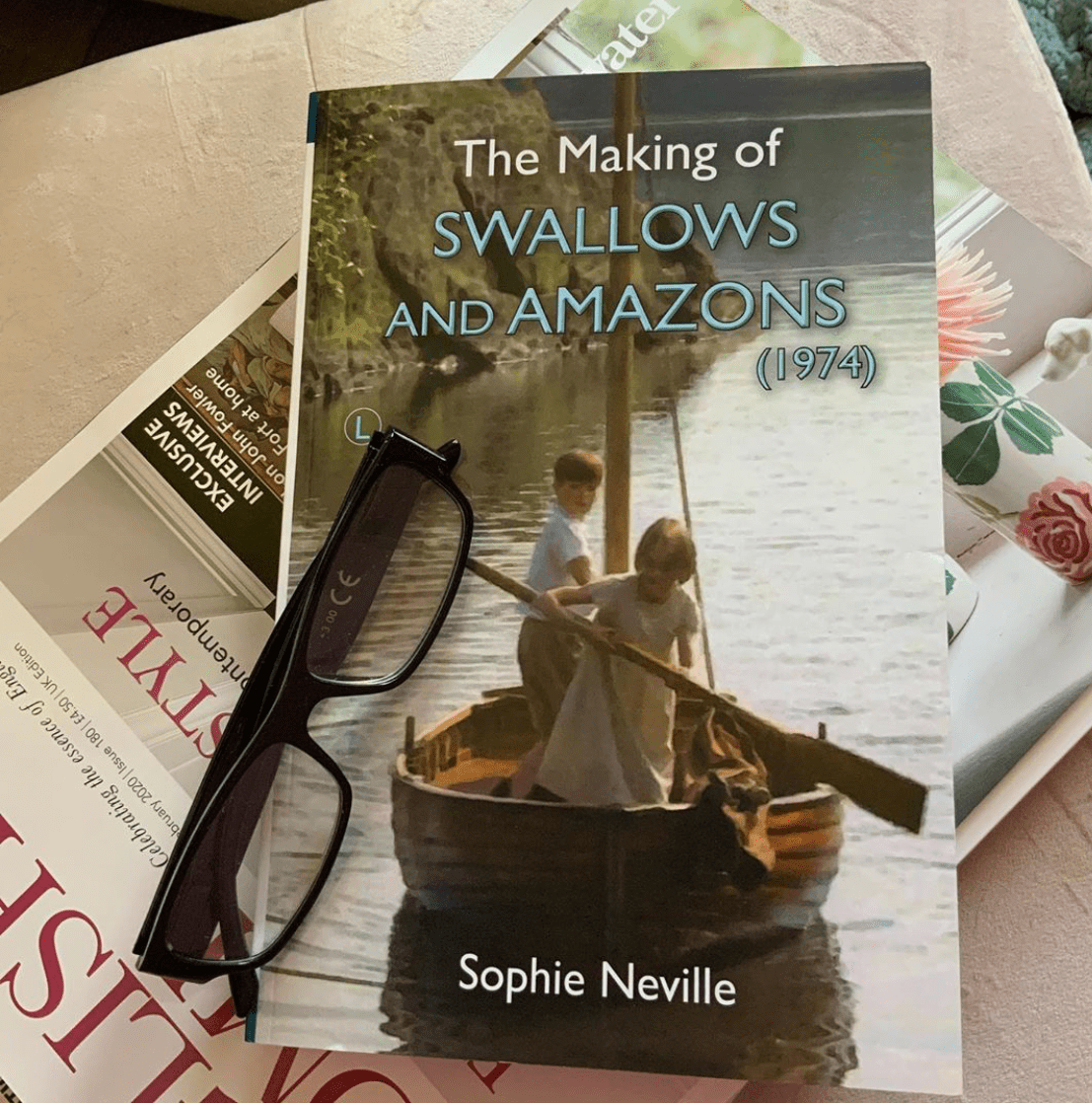
There are now three editions of the illustrated book on ‘The Making of Swallows and Amazons’, all available from online retailers and libraries worldwide .
Different editions of ‘The Making of Swallows and Amazons (1974) by Sophie Neville’
You can read the first three chapters for free here:
Producer Richard Pilbrow with production associate Neville C Thompson on Derwentwater in the Lake District in 1973
This photograph of Richard and Neville sitting on the deck of Captain Flint’s houseboat in the pouring rain must epitomize the struggles they went through to work around the weather and bring ‘Swallows and Amazons’ in on budget.
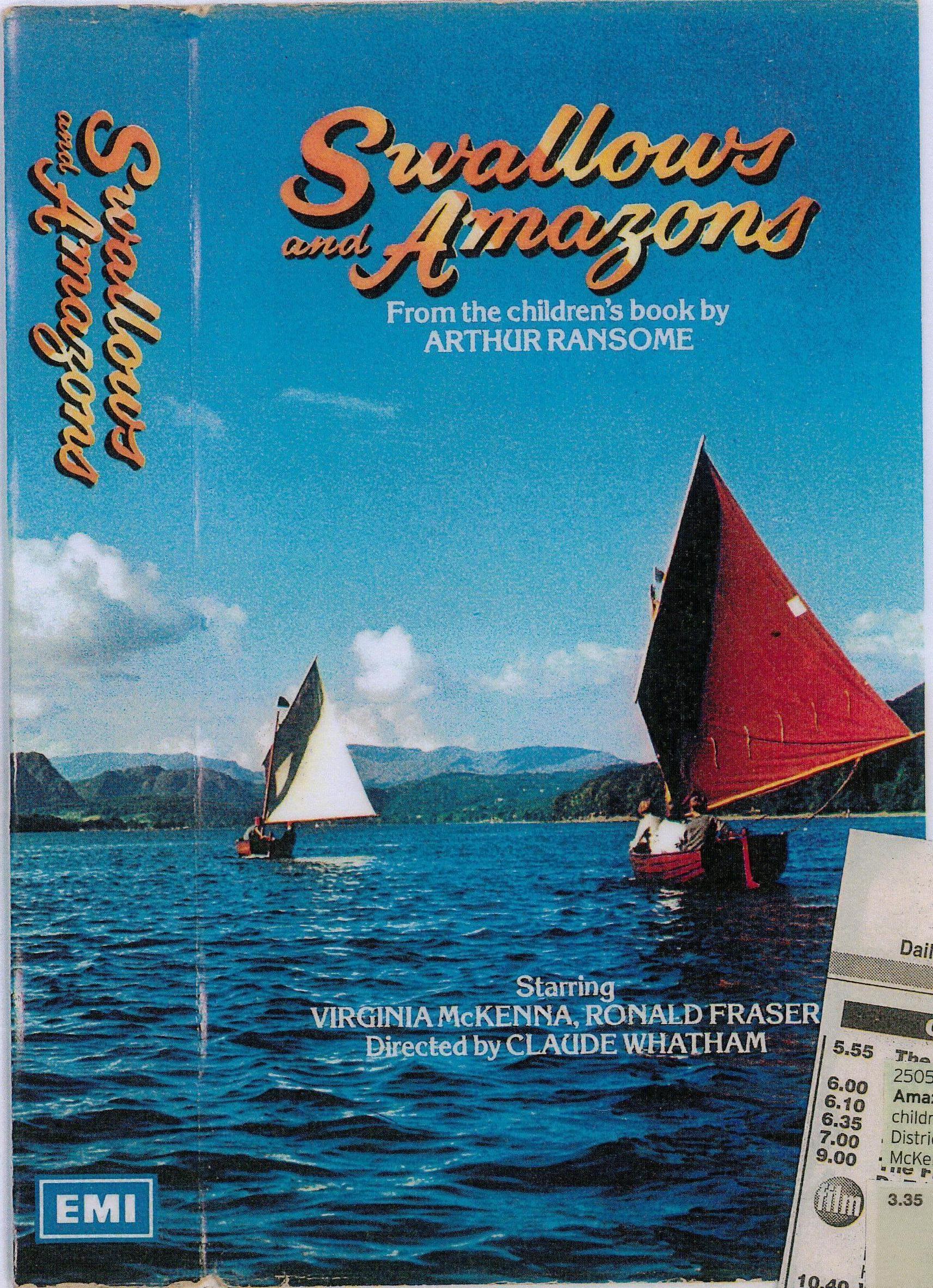
It was Claude Whatham’s dream to end the movie with an aerial shot of Swallow and Amazon sailing away from Captain Flint’s houseboat. He had a helicopter pilot standing-by with a special cameraman, but it wasn’t to be. He needed bright sunshine for the shot to cut with our farewell sequence after the battle. We waited three days but the weather was too dull and wet to film anything useful. I’m so glad. Claude ended up freezing the simple shot that captures Arthur Ransome’s book completely. It was used on the front of one of the first VHS copies of the movie.
The Amazons, played by Kit Seymour, Lesley Bennet and the Swallows, played by Sophie Neville, Suzanna Hamilton, Simon West and Stephen Grendon on the cover of the original VHS version of ‘Swallows and Amazons’
I’m afraid we hung about the very nice Waterhead Hotel in Ambleside getting bored and precocious, or so the evidence suggests. Since John and Margaret, our location caterers, had returned to Pinewood Studios, we were taken to the hotel restaurant for lunch.
We loved the cinema in Ambleside. Was it the same then as Zeffirellis, the cinema in Compston Road operating today? The adults must have found it a good means of keeping us peacefully entertained, but then again they were all film-makers who loved movies. Zanna didn’t come to the cinema that afternoon. She walked four miles up Wanstell Pike with Jane Grendon.
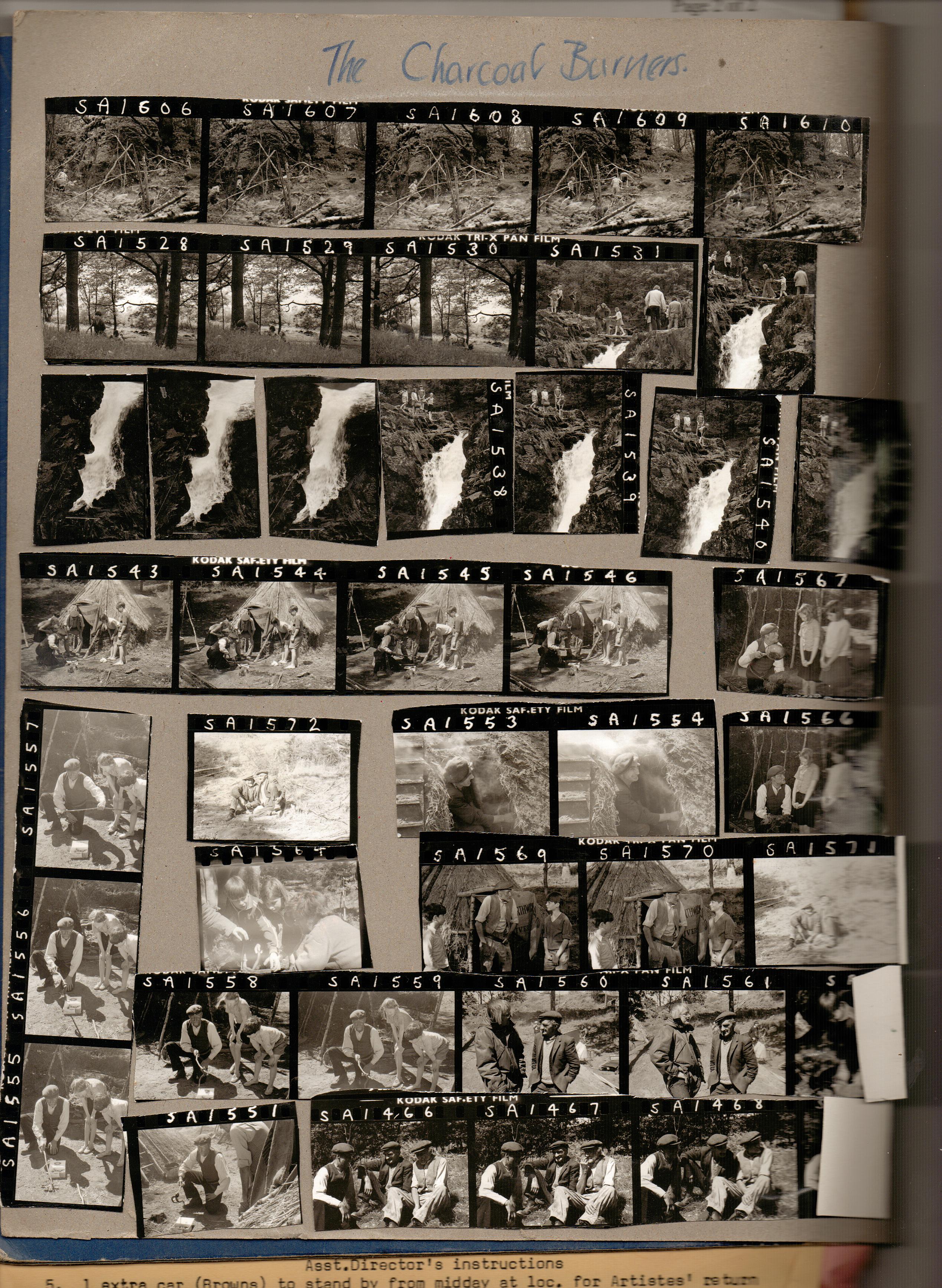
Albert Clarke, the stills photographer on the film crew, had given us contact sheets of the black and white photographs that he had taken during the filming. I spent my time at the Kirkstone Foot Hotel, where Claude and Richard were staying, with a tube of Copydex ~ or ‘rubber solution glue’, as they kept saying on Blue Peter, sticking the tiny photographs into the scrap books that I had been keeping.
Richard Pilbrow kindly let us choose large 10’x 8′ versions of the photographs, which we are able to take home to our families. I kept mine all these years, never using them for anything, but treasuring them as a memory of those happy, fulfilling days spent in Cumbria in 1973.
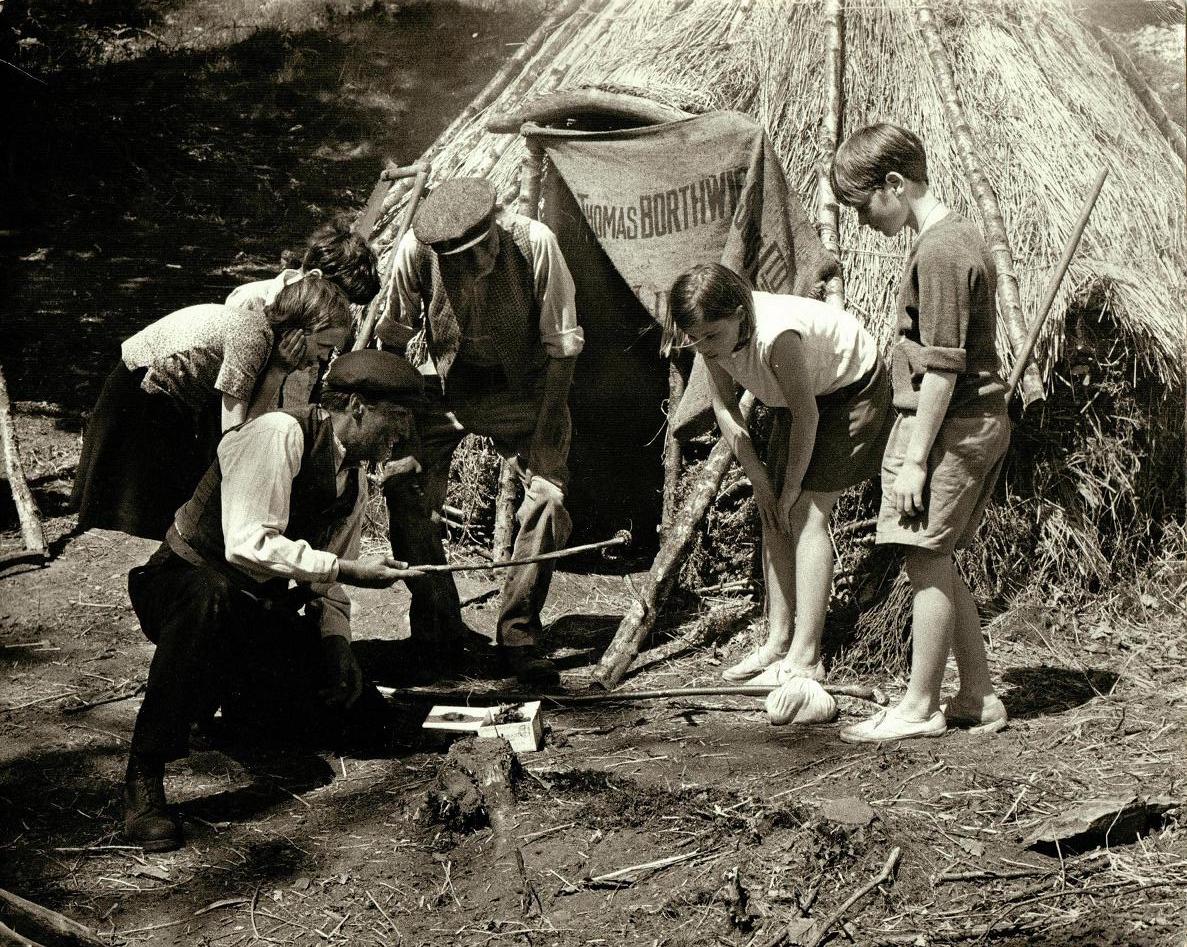
‘It’s Niagara!’ Titty declared. ‘We could get a barrel and bounce down it.’ Sten Grendon, Suzanna Hamilton, Simon West and Sophie Neville as the Swallows on their way to visit the charcoal burners
The secret was out; ‘his anecdotes are many, o u t r a g e o u s, and largely unrepeatable.’ Whilst we had been busy filming on a smelly lily pond the ‘joker’s joker’ had been languishing in the bar of the Kirkstone Foot Hotel just outside Ambleside saying that, ‘he was a lousy lover but loved to practice.’ Oh deary me. Worse was to come.
‘…baby, you’ve got to be a bit dotty.’ At least we were described as ‘bright and vivacious’.
We loved going to the cinema in Ambleside. David Blagden, our sailing director, had a small part of a prison officer in the movie Kidnapped, that we went to watch. It starred Michael Caine, Trevor Howard and Lawrence Douglas, with Jack Hawkins, Donald Pleasence and Gordon Jackson, but sadly not Ronald Fraser. He was still in the bar.
Suzanna Hamilton’s perspective on the day is not so very different but it is in purple.
Mediculs. A sure sign that our movie was both over-schedule and over budget, with nothing much anyone could do about it but keep going. We still had to capture the houseboat. And make that splendid gentleman walk the plank.
The distinguished actor Ronald Fraser fishing with Kit Seymour, Lesley Bennett, Suzanna Hamilton, Simon West, Sophie Neville and Stephen Grendon whilst filming on location in the Lake District ~ photo: Daphne Neville
If you would like to read more, Sophie’s diary is included within her ebook of ‘The Secrets of Making Swallows and Amazons (1974)’ available from online retailers and Amazon Kindle for £2.99 here
‘The rain poured down.’ Cumbria was covered in cloud, the Lake District dark and dismal. What a nightmare for Richard Pilbrow and his production team. We were behind schedule, Lesley Bennett who played Peggy was ill in bed and we had run out of ‘rain cover’.
Sten Grendon, Simon West and Suzanna Hamilton in Swallow
There was one sequence left that could be recorded in dull weather. Today was the day Claude Whatham shot the haunting scenes of Octopus Lagoon. After finishing our school work Kit Seymour and I sat watching the filming from the sloping field above the beautiful but rather smelly lily pond.
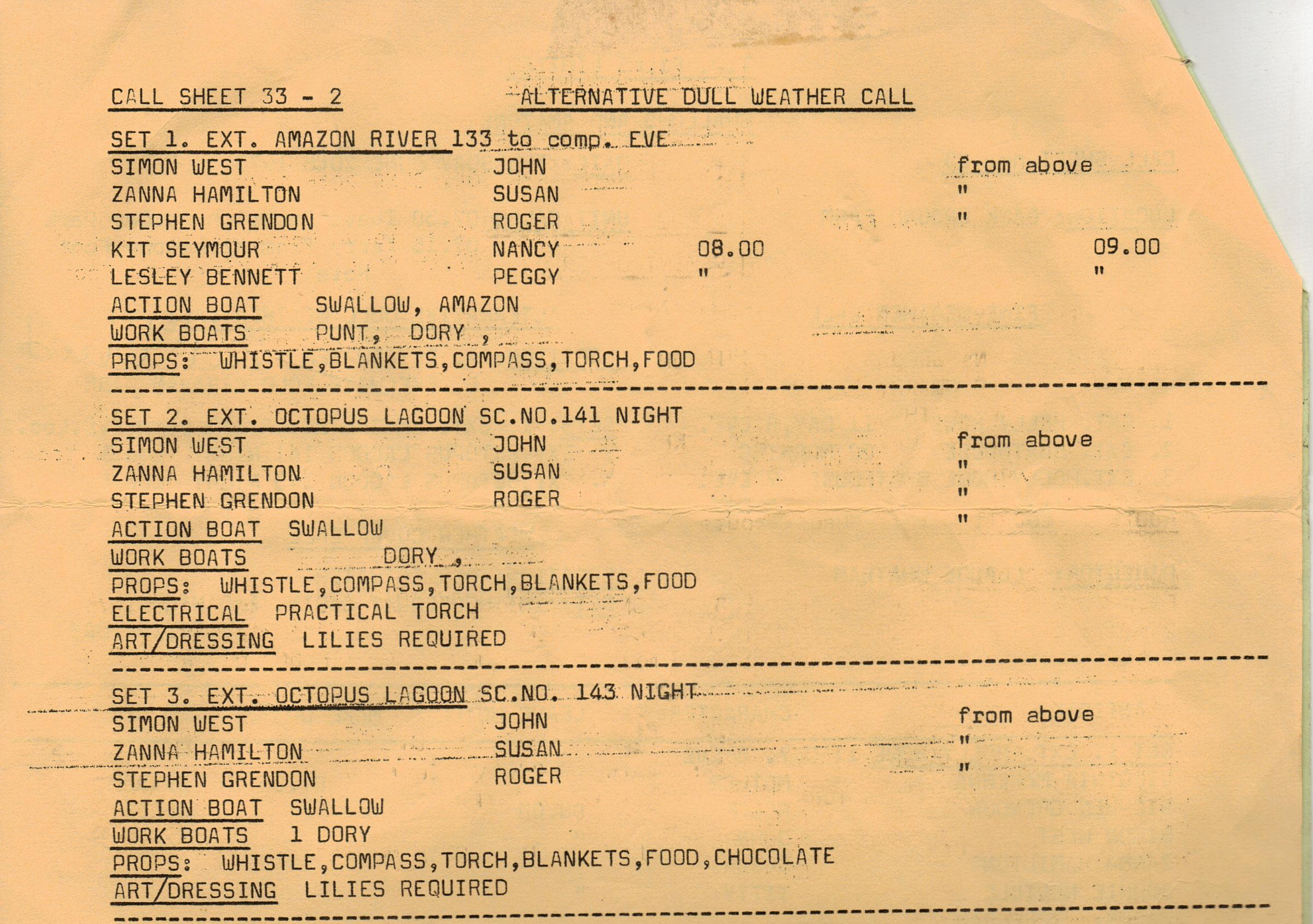
I do not have the Call Sheet for 29th June 1973 but have an extract from this earlier one detailing the ‘Alternative Dull Weather Call’:
I can’t say whether the weather allowed for the scene set on the Amazon River to be shot. Lesley had ‘flu so they would have had to somehow manage without her. I think Claude devoted his time to capture the conundrum and challenges faced by Captain John in the lagoon.
I remember looking down on the location, which was on private property near Skelwith Fold Caravan Park – possibly Slew Tarn.
Is this Slew Tran above Skelwith Fold?
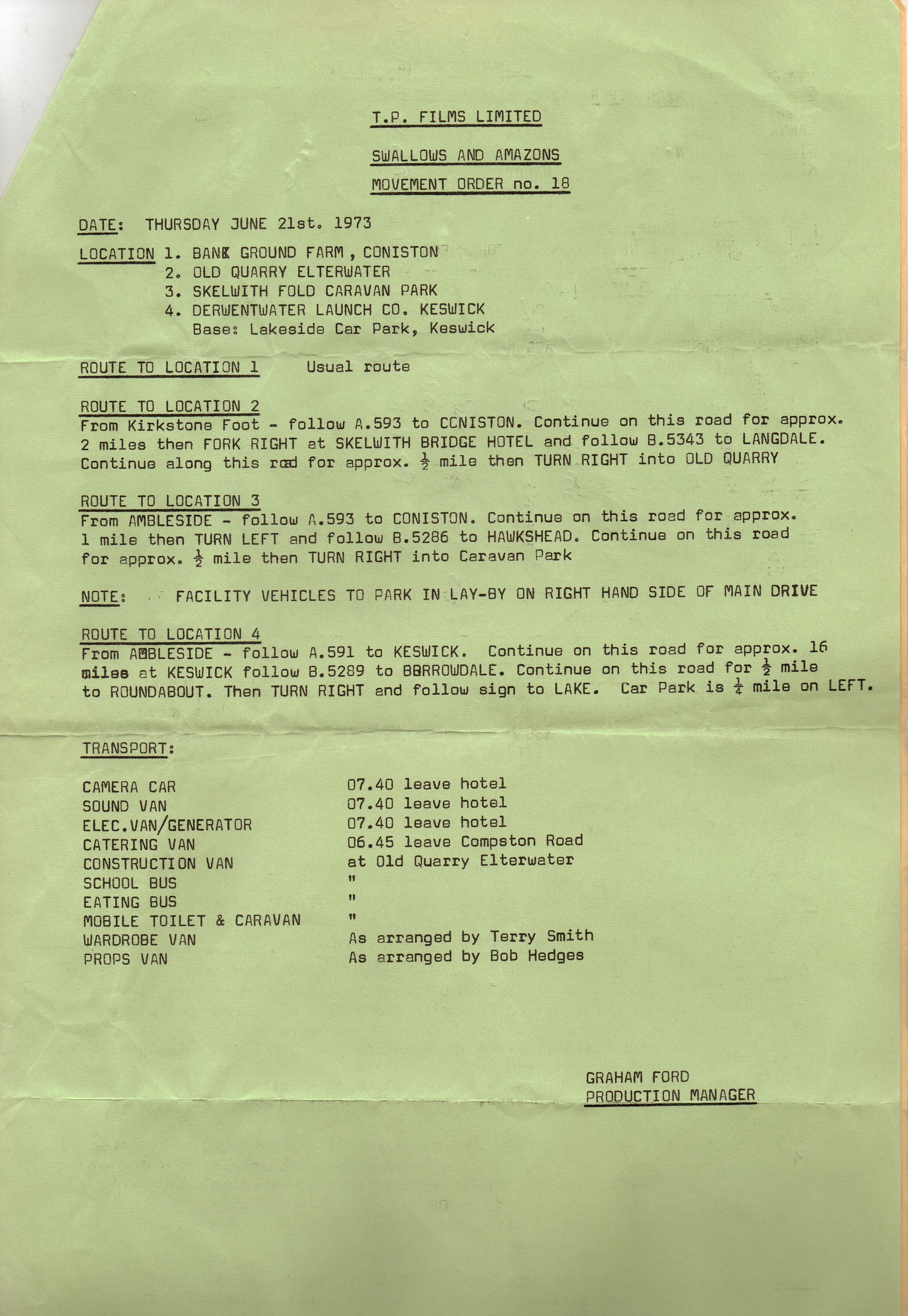
Those who are interested in finding the film locations used might find this old hand-typed ‘Movement Order’ useful:
Roger Wardale sites Octopus Lagoon as being Allan Tarn a short distance up the River Crake at the Southern end of Coniston Water, near High Nibthwaite. This is the place Arthur Ransome had in mind. He spent time there with is brother and sisters as a child when they spent their summers on Swainson’s Farm at Nibthwaite nearby. His father went there to fish for pike. It you have a shallow bottomed boat you can get there but it is not exactly on a footpath. The lily pond we used was in a high sided dip, which made it appropriately dark and gloomy. It was also more accessible for the film crew.
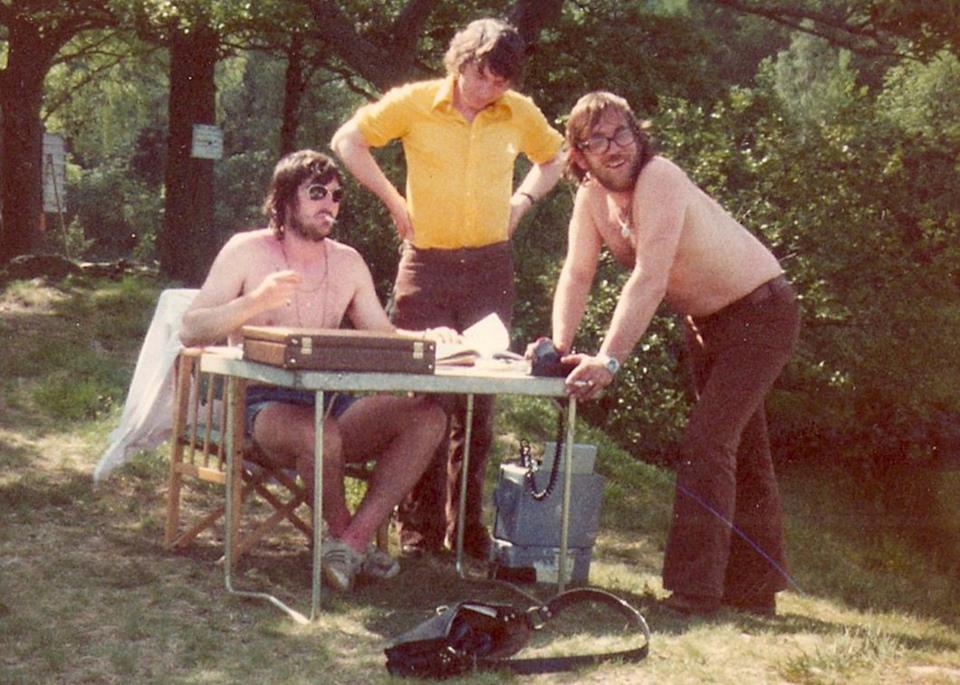
Graham Ford, who signed the Movement Order was our Production Manager. I only have a photograph of him taken on a sunnier day.
Second Assistant Terry Needham, Associate Producer Neville C Thompson and Production Manager Graham Ford with the unit radio on a sunny day in June 1973
Graham Ford would have been responsible for the film schedule, putting together the whole logistical jigsaw puzzle posed by factors such as the availability of leading actors and locations with the movement of vehicles and boats, including the massive camera pontoon. It was Graham who took the stress of problems caused by wet weather. I guess that he also took on the responsibilities of managing the locations, negotiating with owners and the Lake District National Park, something that authors such as Arthur Ransome would not have had to face.
Although young, Graham was pretty experienced. He had previously worked as an assistant director on such classic films as Steptoe and Son and had been the Unit Manager on The Devils, a film that starred Vanessa Redgrave and Oliver Reed. After Swallows he went on to work as Production Manager on S.O.S Titanic, The Honorary Consul and Princess Daisy as well as Time Bandits and Brazil directed by Terry Gilliam starring Jonathan Pryce, Kim Greist and Robert de Niro. Imagine being Terry Gilliam’s right hand man. He was a Location Manager for David Lynch on The Elephant Man and for Richard Attenborough on Ghandi in 1982. Graham’s career progressed. He produced The Nightmare Years and A Connecticut Yankee in King Arthur’s Court in the late 1980s before working on Gettysburg, the massive four hour long movie about the American civil war, in 1993. A life in film. He died in Ontario in 1994 aged only 48.
If you would like to read more, the story of the filming can be read in a paperback entitled ‘The Making of Swallows and Amazons (1976)’ available from libraries worldwide or from online stockist and good bookshops. The Nancy Blackett Trust have signed copies available here with proceeds going to the trust. These are illustrated so cost £15 but make good presents.
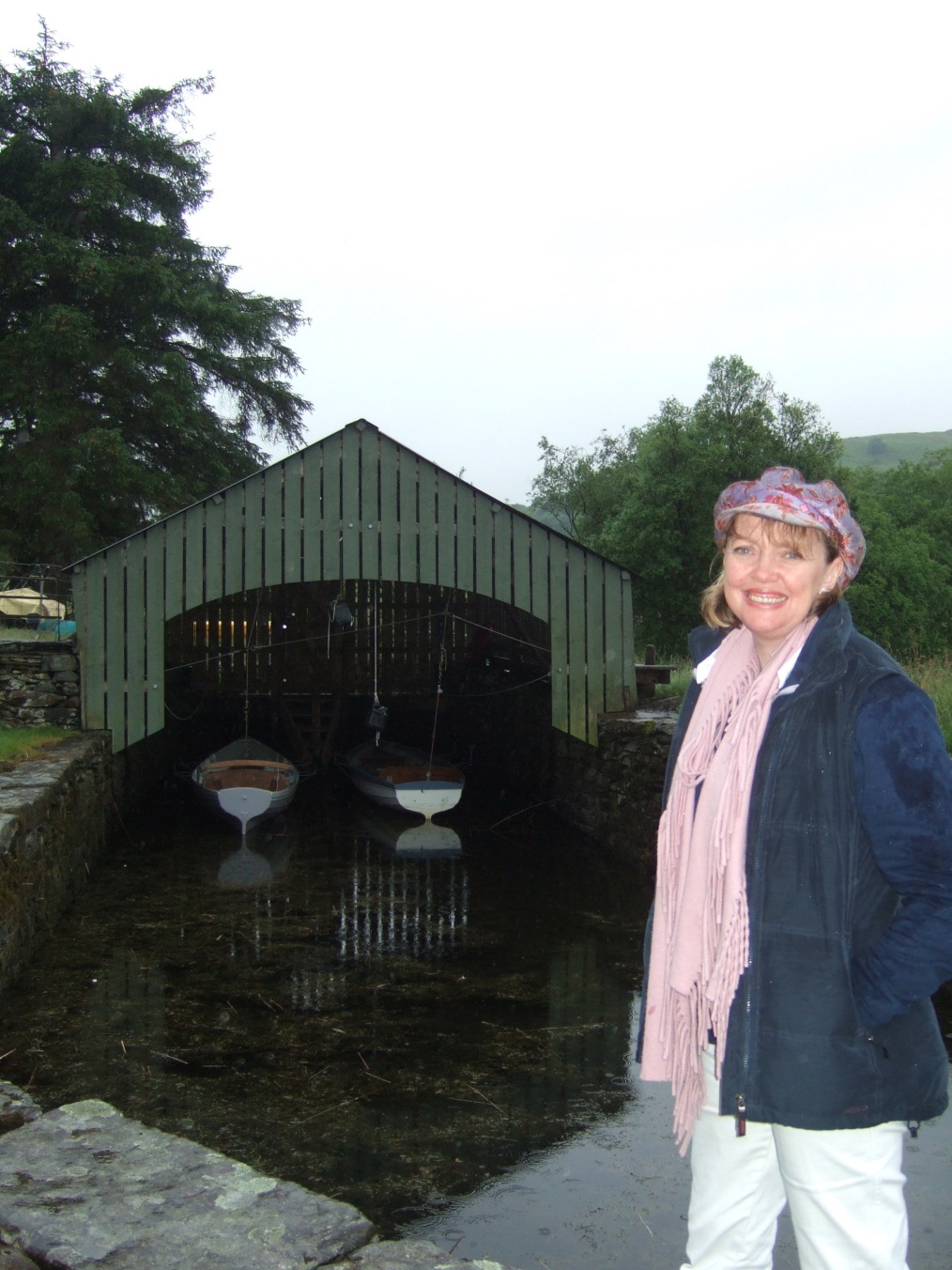
The boathouse at the Slate Quay where Arthur Ransome came on holiday as a child sits at the southern end of Coniston Water. How wise he was to write about the places, the culture and experiences that he knew so well.
As you walk down the footpath from the lane, you come across interesting artwork, although it would not have been around in Ransome’s day.
~ Sculpture at Slate Quay by Andy Gormsly~
The boathouse came to be owned by Bridgit Sanders, nee Altounyan, who was the inspiration for the youngest of the Swallows Vicky, the ship’s baby, and went on to become the first president of The Arthur Ransome Society. She lived with her family in the house nearby, teaching her children and grandchildren to sail on Coniston Water. After having children, Roger Altounyan rented half the house and would take them sailing in Mavis, the model for Amazon, bailing like mad.
~Coniston Water~
Arthur’s father would venture up the River Crake to fish in Allan Tarn, which may well be the location of Octopus Lagoon, first mentioned in ‘Swallows and Amazons’.
Whilst fish enjoy the reedy habitat, small boys are reputed to enjoy the ‘Knickerbockerbreaker’ rocks that rise above what must be Swainson’s Farm at High Nibthwaite, featured in Swallowdale, which you can find by the road nearby.
We pressed on in search of other places that made an impression on Ransome’s life. Although we had a very good driver this was not always as easy as one might imagine.
But I did find another representation of the crossed flags. Can anyone guess where?
~Kneeler embroidered by Jean Hopkins~
We drove through the gentle countryside south of Coniston Water passing a house called New Hall, once rented by Arthur Ransome and his wife, and on, climbing up past Gummer’s How and wiggling down to reach The Mason’s Arms, which I gather this was one of his favorite pubs.
Then, seemingly in the middle of no where, we came across the Holy Grail: Low Ludderburn and the erstwhile grey barn where Ransome wrote ‘Swallows and Amazons’. He had a writing room on the first floor. Roger Wardale says he kept his car, the ‘Rattletrap’ in the wooden garage that you can see just in front of the building. It was private then, and is a private house now, but you can catch a glimpse of it from the lane that runs up and on, eventually taking you down to Blake Holme on Windermere, which he named as partly the inspiration for Wildcat Island.
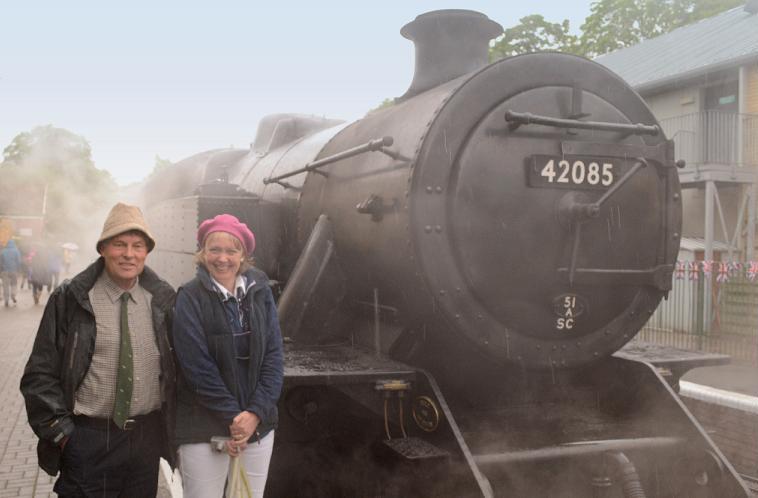
I’ve always thought that Arthur Ransome must have been completly impervious to the damp, to cold and wet weather. I am not. By now it was raining so hard that my husband was wearing my pink beret, but we were still in good spirits.
In a recent letter to The New York Times Frank Phelan from Albuquerque wrote to say,
It was not just British children who were saturated with the “Swallows and Amazons” novels of Arthur Ransome, as the review of “The Last Englishman,” by Roland Chambers, suggests (May 27). I grew up hundreds of miles from the ocean in Pittsburgh, wanting to be like Ransome’s characters. I wrote to him asking which of the English lakes was the right one. He sent me a postcard saying that it was “Windermere, with a few touches of Coniston, for the sake of disguise.” He ended with “You’ll be sailing some day!” and I lived on that.
So back to Windermere, and a long hot bath at Miller Howe, a lovely hotel that had a Jonathan Cape copy of Swallows and Amazons on the hall table. In the morning cloud was sitting on the high fells looking just like snow. I ran down to the lake to put my hands in the water, thinking, ‘This is the place for Winter Holiday’. But that is another book.
You can find maps showing these locations in ‘The Making of Swallows and Amazons’ or the ebook of ‘The Secrets of Filming Swallows and Amazons (1974)’ available from Amazon Kindle and other ebook platforms.
‘Here we are, intrepid explorers, making the first ever voyage into unchartered waters. What mysteries will they hold for us? What dark secrets shall be revealed?
As we set off from the Lakeside Railway Station on the southern shore of Windermere to explore Arthur Ransome’s world, I began wondering how many signs of ‘Swallows and Amazons’ we would find. Would we see the crossed flags that have become a symbol of the bestseller he wrote back in 1929?
We found the first sign the East of Lake road above Coniston Water. And there was Holly Howe where the Walker Family came for their holidays. It is so exciting to know that you can stay there too, or go for tea, and run down the field full of buttercups to dip your hands in the lake, just as the real Altounyan children – the real Swallows – must have done. We passed Lanehead, their grandparents’ house next-door as we drove down to Coniston. I gather it is for sale.
Coniston Old Man or Kanchenjunga, as the Swallows and Amazons called the mountain, was snoozing under a thick blanket of cloud but the challenge of climbing to the summit was for another day. Below the village, mooring up to the jetty at the Bluebird Cafe, was Ransome, the Coniston Launch. Peter Walker introduced us to the Captain who welcomed us aboard. He asked after Swallow the little ship from the film that we had re-launched from the very same jetty in April 2011. If you join The Arthur Ransome Society you can sail Swallow on Coniston this summer.
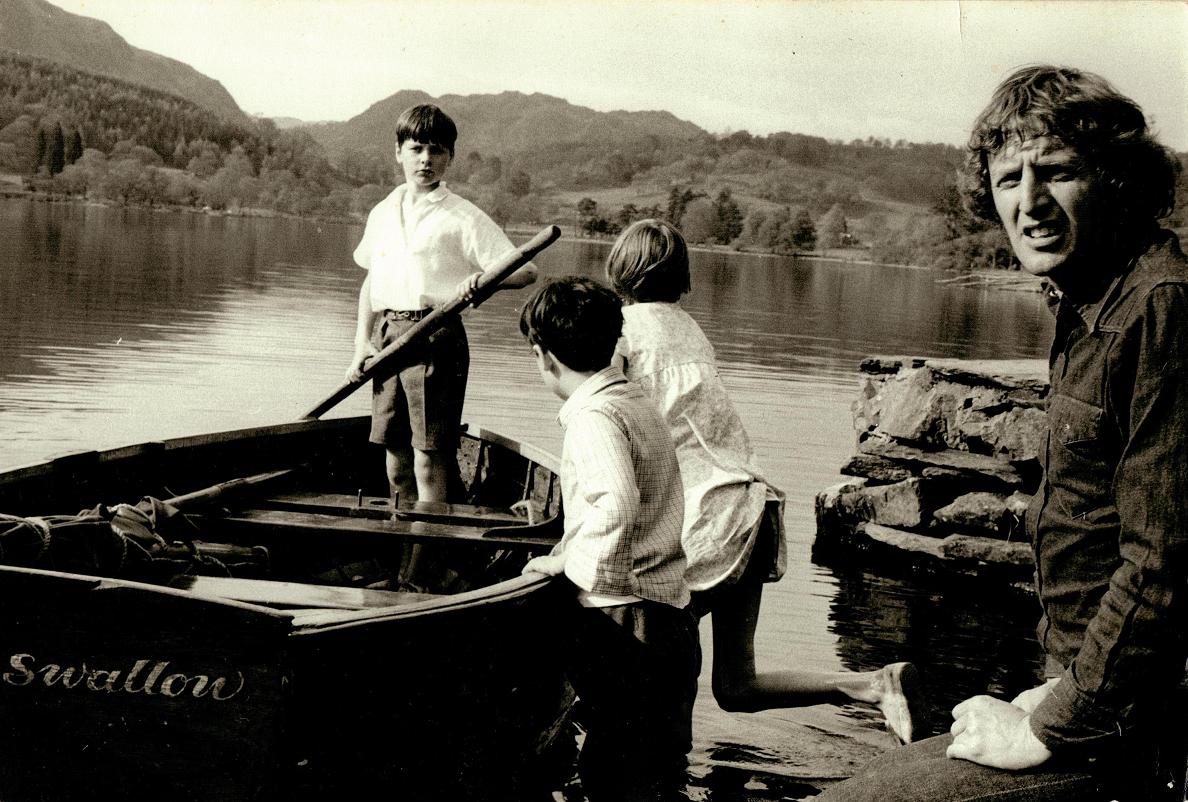
As we set off across the lake we could see Swallow’s boatshed clearly from the Coniston launch. It has been renovated and repaired but the old stone jetty is still there, below the huge horse chestnut trees. I remember how cold the water was when we first brought Swallow out from the depths of that shed in May 1973 to shoot the opening scenes of the movie. Two sheep came down to see what we were doing. Richard Pilbrow, the Producer, gave me this black and white photograph that, unusually, shows Claude Whatham the Director setting up the shot. I was letting water drain from my shoe.
Simon West as Captain John standing in ‘Swallow’ at the stone boatshed jetty on Coniston Water with Ableseaman Titty and The Boy Roger. Director Claude Whatham knew how cold the water was that day in May 1973
The Coniston Launch can take you right down the lake to Wild Cat Island or Peel Island as it is really called. You can see the Secret Harbour best from a boat and imagine Titty trying to get out through the rocks in Amazon, in the dark, when she captured her from the terrifying Amazon Pirates.
We actually disembarked at Brantwood, John Ruskin’s House. It was here that the Altounyan children’s grandfather WH Collingwood worked as Ruskin’s private secretary. He painted him at his desk there. My niece has just graduated from The Ruskin School of Art in Oxford.
Peter Walker met us and drove us on down the lake to show us The Heald, a bungalow above the road where Arthur Ransome lived with his Russian wife, Evgenia and his dinghy, Coch-y-bonddhu. It was here that he wrote Picts and Martyrs. Coch-y-bonddhu played the part of Dick and Dot’s boat Scarab. The original ‘Dogs Home’ can be found in the woods above the house. Rob Boden is very keen to restore it.
It was in the Grizedale Forest that we went to see the charcoal burners and met the real men in the process. And an adder. It was real too.
John Franklyn-Robbins, as Young Billy who is showing his adder to Sophie Neville, Stephen Grendon, Jack Woolgar, Suzanna Hamilton and Simon West at a location in the Grizedale Forest above Coniston Water
I looked back at the island where I spent so much of my childhood. It was difficult to imagine how a location catering wagon let alone two Route-master London double-decker buses could have driven down the winding East of Lake road. They parked in the field opposite the islands so the crew could at least eat lunch in the dry and we could have our lessons. The National Parks Authority had to ask the Production Manager to drape wartime camouflage netting over them. You must have been able to see the red buses for miles.
The hat is a purple ode to the early 1970’s. My mother bought it at great expense in Carnaby Street. It is very good at keeping off the rain.
As you drive south you can look over the water to see Brown Howe, the house that we used as a location for Beckfoot in the film of Swallows and Amazons and shortly after, the Edwardian boathouse, which Claude Whatham used for the Amazons. I don’t think this was the one Ransome envisaged. His was at the mouth of the Amazon River – a reedy place. The pictures in the illustrations show a building with a low-pitched roof.
Peter took us down to a farm the south of Coniston Water where the real Ransome children spent their summer holidays. You can walk down the footpath they must have taken to dip their hands in the lake. And there I found what must be the real Amazon boat house.
A few years ago, on a wet but beautiful day in Cumbria, we set off on a quest to find some of the locations used in Richard Pilbrow’s 1974 film of ‘Swallows and Amazons’.
To my delight our journey started with a drive down through the streets of Rio (Bowness) and along the east shore of Windermere to the Lakeside and Haverthwaite Railway Station at the southern end of the lake (or Antarctica as Titty labelled the region). It was here that we spent our very first day filming ‘Swallows and Amazons’ in May 1973. I had not been there since.
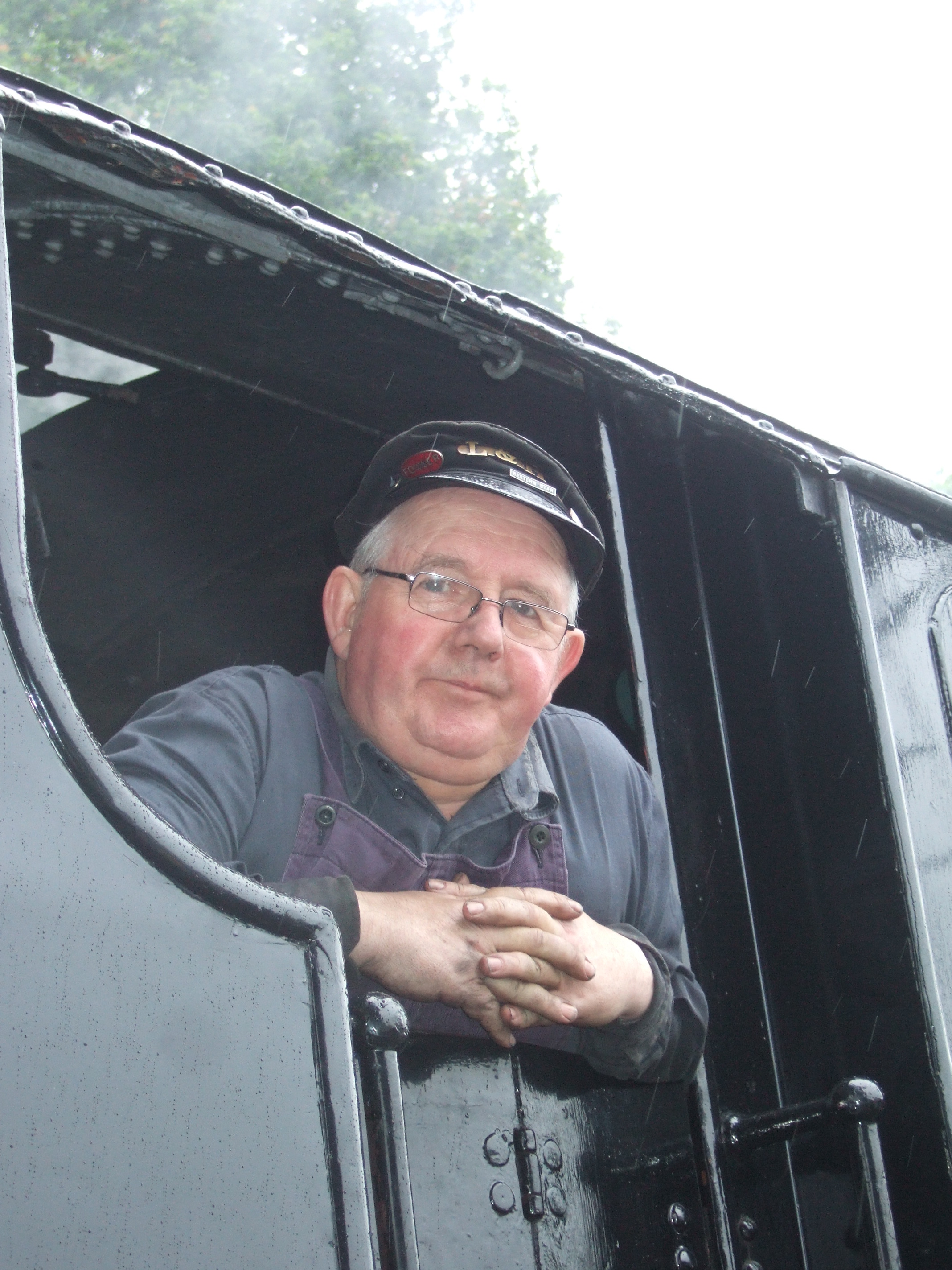
We had a chat to the train driver who explained that they now run six journeys a day. From Haverthwaite, the steam locomotives run alongside the River Leven to Lakeside Station. From here you can take a native steamer back up to Rio (the Bowness pier) or to the Far North (Ambleside, which is the town at the head of the lake where we lived whilst filming in that long distant summer when I was twelve years old.)
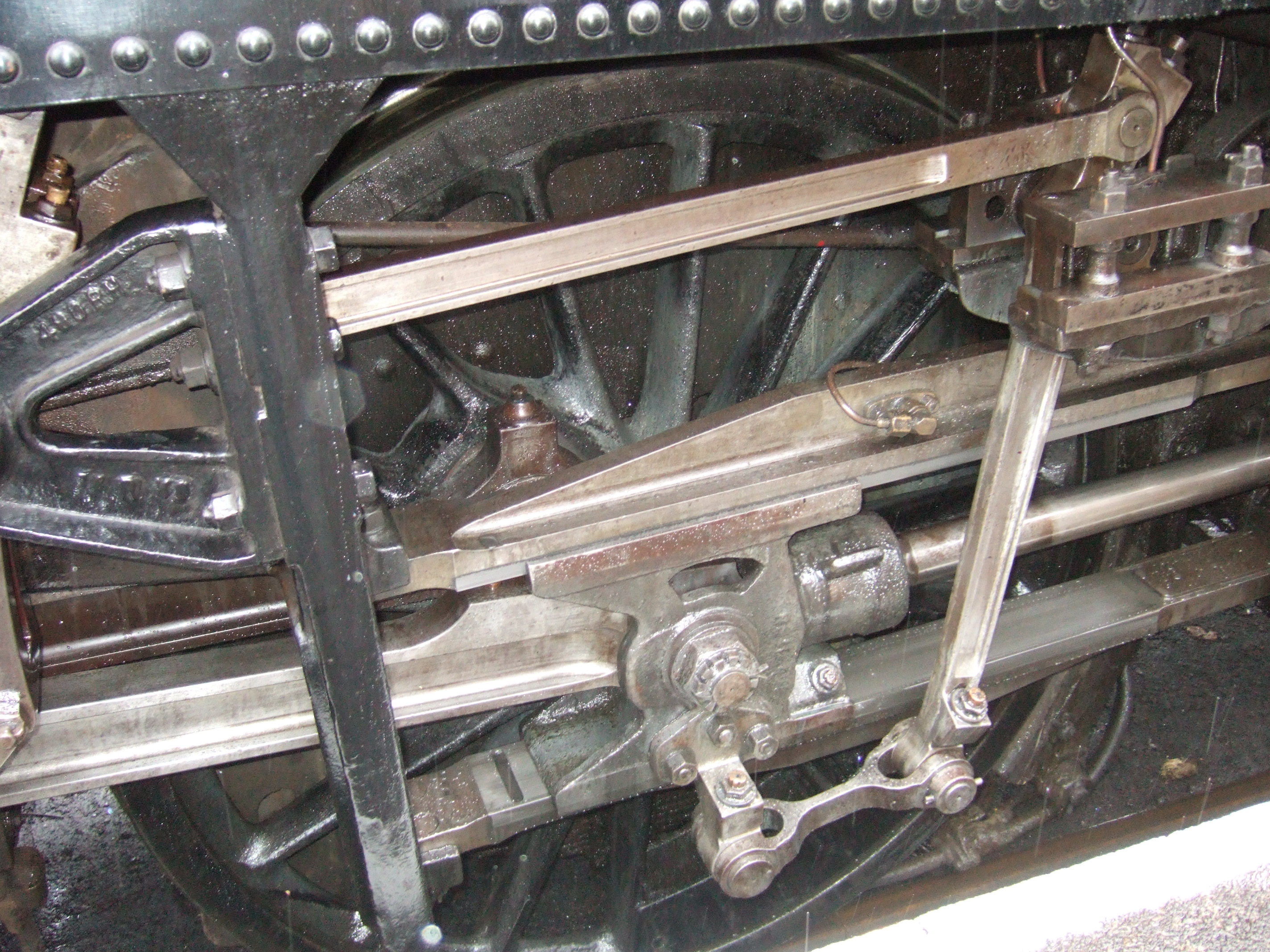
Whilst we used engine number 2073 in the movie, this steam locomotive 42085 was built in 1951. It uses about two tons of coal a day but it utterly magnificent. The driver probably uses rather a lot of steam oil too. It’s a smell I relish, familiar since childhood days spent on steamboats. I remember it from the SBA steamboat rally held on Windermere in 1991, which I describe in Funnily Enough.
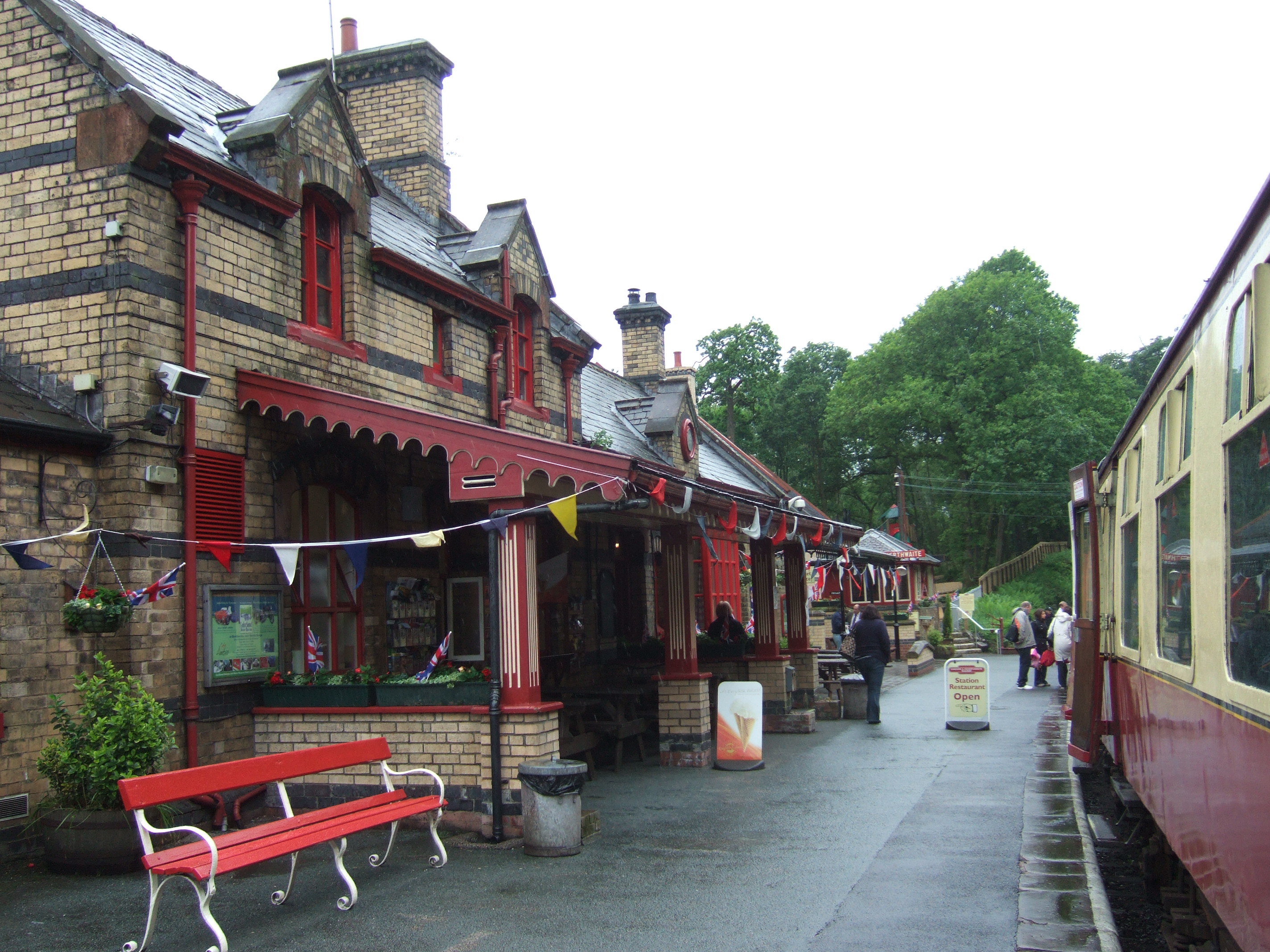
Curiously, Haverthwaite Railway Station looked cleaner and shinier than when we used it as a film location in 1973. I can only suppose it was still in the process of being restored back then, when Simon Holland our set designer cluttered it up with push bikes and luggage trolleys. Much to our surprise, the yellow taxi we were transported in during the filming was actually driven along the platform.
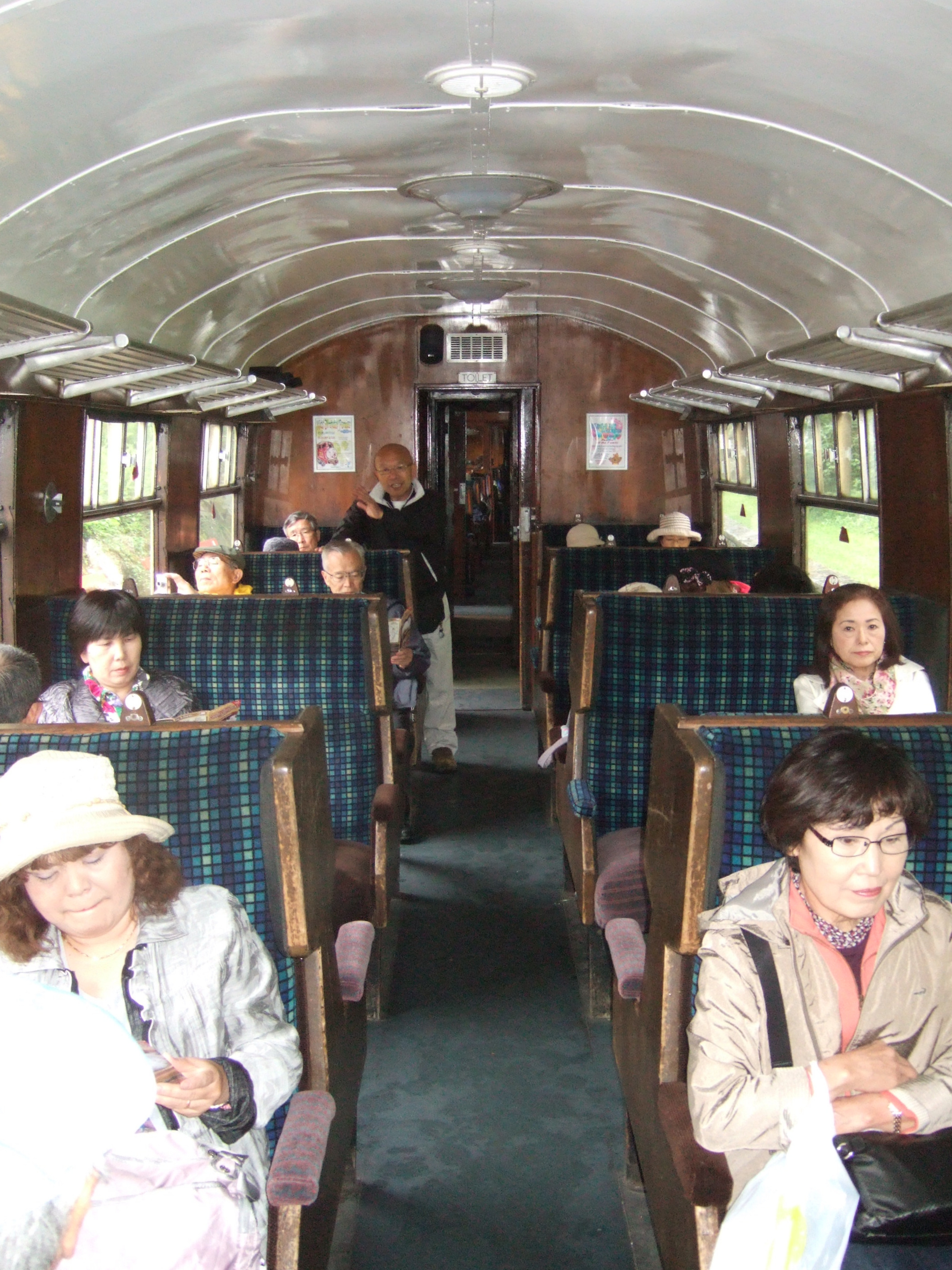
We climbed aboard the train and I explored, as Titty would have done, discovering people seated inside from far distant lands.
David Wood’s screenplay for the film of Swallows and Amazons, directed by Claude Whatham, opens to find the Walker family cooped up in a railway carriage compartment as they travel north for their holidays.
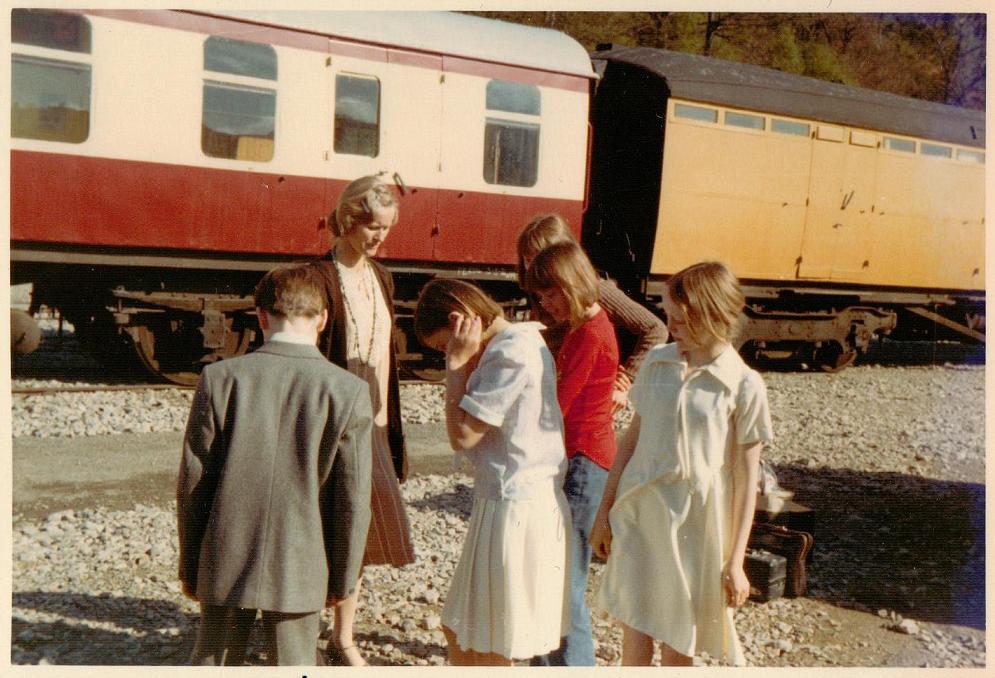
Viginia McKenna at the Haverthwaite Railway Station in Cumbria soon after it re-opened in May 1973. Simon West, Suzanna Hamilton, Lesley Bennet, Kit Seymour and Sophie Neville are with her. The carridge with compartments is in the background ~ photo: Daphne Neville
We saw this distinctive carriage in a siding as we steamed down the valley. Funnily enough when I reached home, later the next day, I came across a photograph on the internet I had never seen before. It was of Virginia McKenna, playing Mrs Walker, reading a magazine inside the compartment. Strangely it turned up when I Googled my own name – Sophie Neville.
Virginia McKenna playing Mary Walker, mother of the Swallows in the EMI feature film of ‘Swallows and Amazons’ made in 1973
The train is not included in Arthur Ransome’s book of Swallows and Amazons, written in 1929, but he does feature locomotives in his later novels, notably Pigeon Post. I clearly remember filming the BBC adaptation of Coot Club at what must have been The Poppy Line, a steam railway in north Norfolk when Henry Dimbley, playing Tom Dudgeon, jumped aboard the moving train and met Dick and Dorothea.
Peter Walker of Mountain Goat with Sophie Neville at Lakeside Station, Windermere.
I jumped off the train at the Lakeside Station to meet up with Peter Walker of Mountain Goat. Peter has carefully researched and put together a Swallows and Amazons tour, exploring ‘High Greenland’, the ‘Forest’ and ‘High Hills’ to discover the places where Arthur Ransome lived. We set off in search of the places where he fished, wrote, and drank beer. It was fascinating – and proved an excellent way to spend a day in the Lake District despite the rain.
You can read more about the locations used in the original film of ‘Swallows and Amazons'(1974) in the paperback ‘The Making of Swallows and Amazons’ available from libraries, bookshops or online here.
There is also a similar ebook, entitled ‘The Secrets of Filming Swallows & Amazons (1974)’ available from all ebook distributors including Amazon


 Preview copies of ‘The Secrets of Filming Swallows & Amazons’ at the Cruising Association dinner at the Water’s Edge Bar and Restaurant, Mermaid Marina on the River Hamble.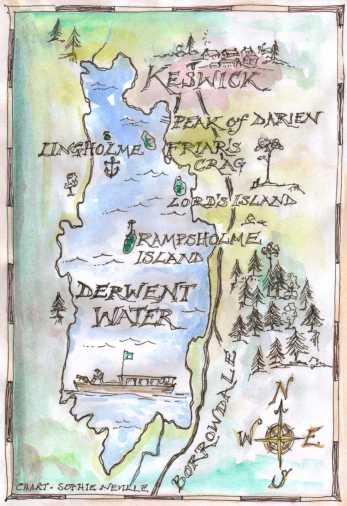


























 Sophie Neville
