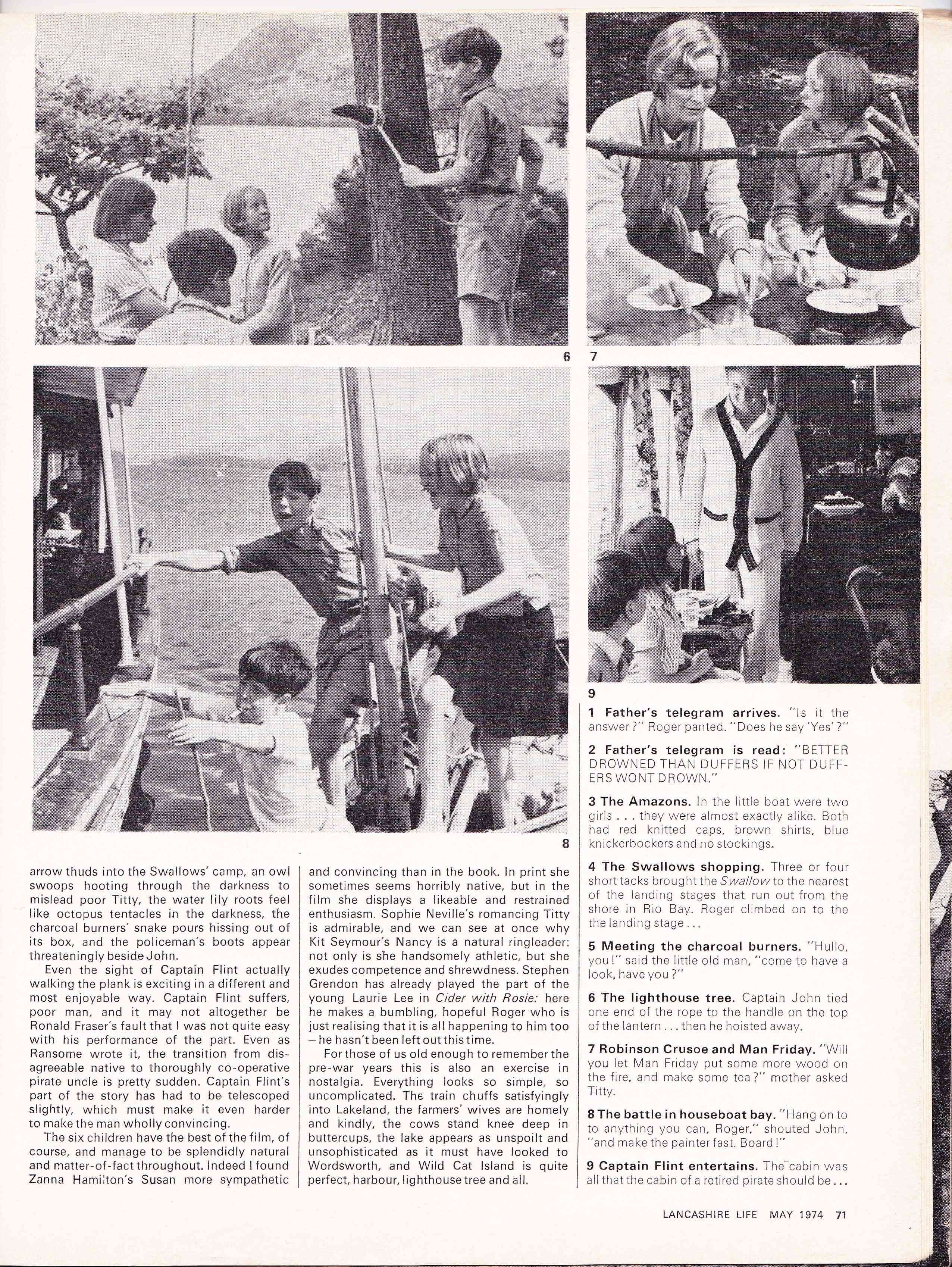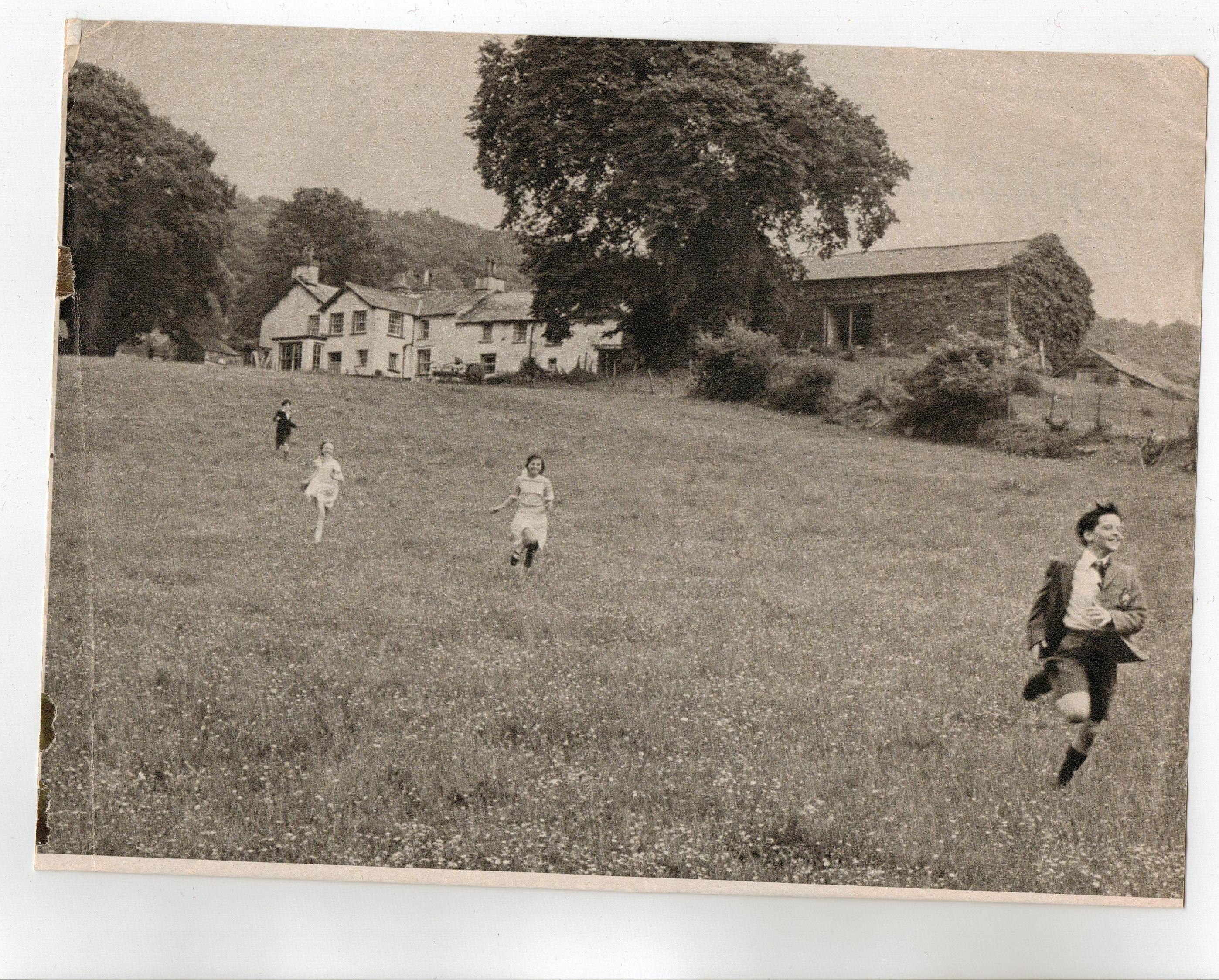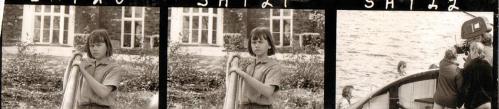
The Guardian published this photograph, taken on the set of ‘Swallows & Amazons’ when the original film of Arthur Ransome’s well-known book was being shot at Bowness-on-Windermere in the Lake District on 7th June 1973.
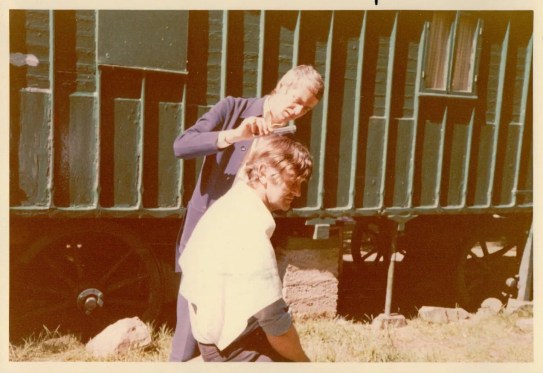
The story was set in 1929. The production team battled to find local men to appear as film extras. None of them wanted a short-back-and-sides hair cut. The ladies of the Lake District found this most amusing. Many of them wore their hair shorter than the men.
To see more photographs and footage taken behind-the-scenes on this day, with diary extracts, please click here
Ronnie Cogan cutting Martin Neville’s hair for ‘Swallows and Amazons’
For more photographs and a description of what happened please click here
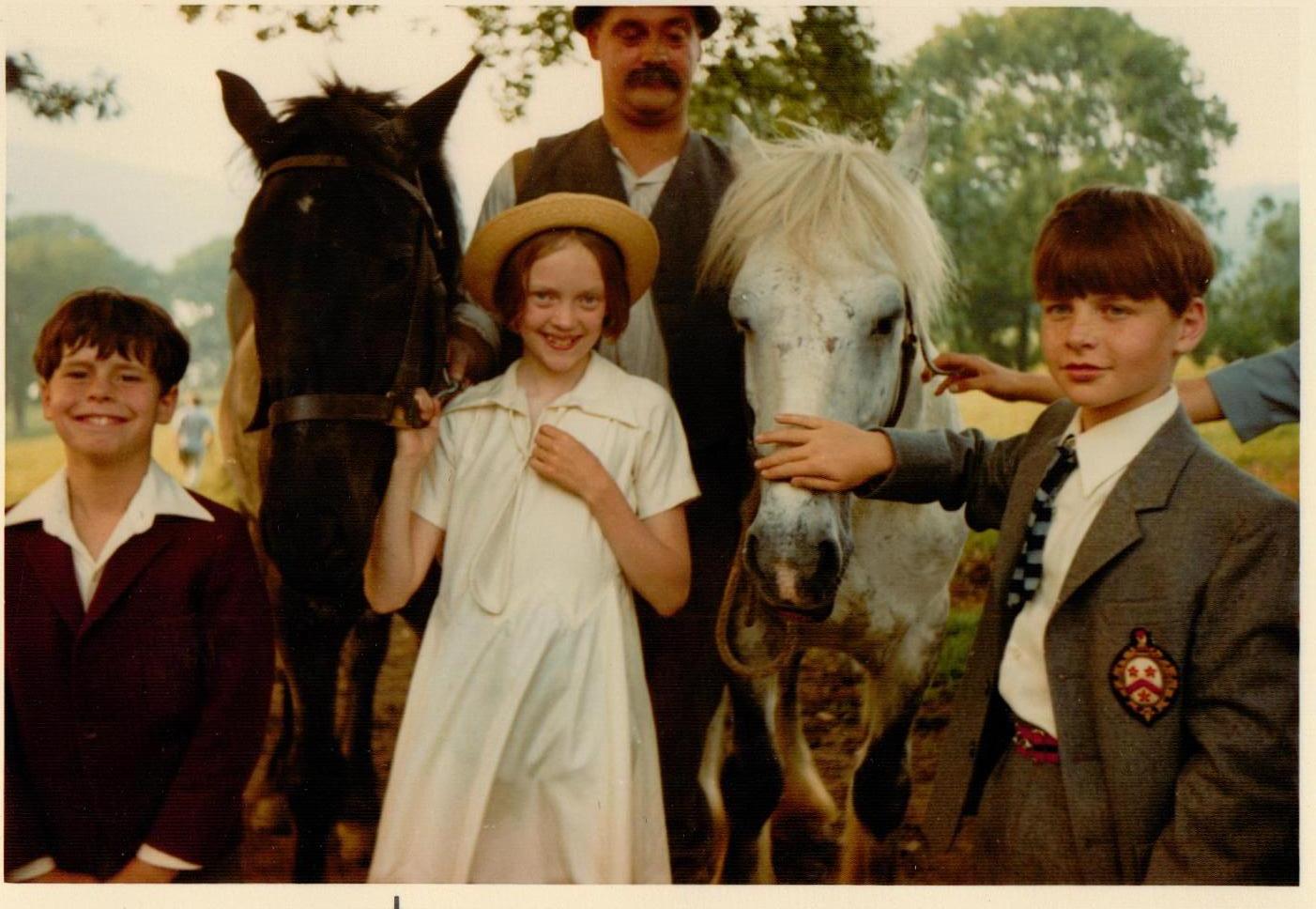
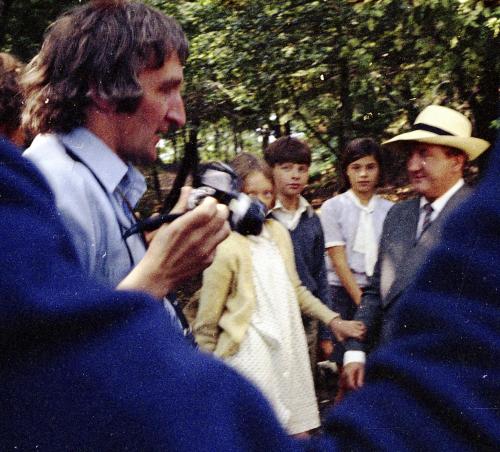
Jane Price, Perry Neville, Jane Grendon, Tamzin Neville and Pandora Doyle in 1929 costumes at Bowness in 1973
It was Pandora Doyle, seen in this photo as a little girl in a blue dress on the right, who sent me the newspaper clipping from the Guardian pasted above. Her father Brian Doyle was the Publicity Manager on the film. She kept all his files with notes from all the film stars he’d worked with. Do leave a comment below to let us know what you were doing in June 1973.
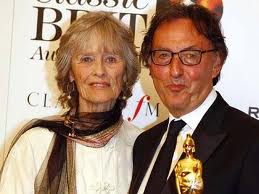
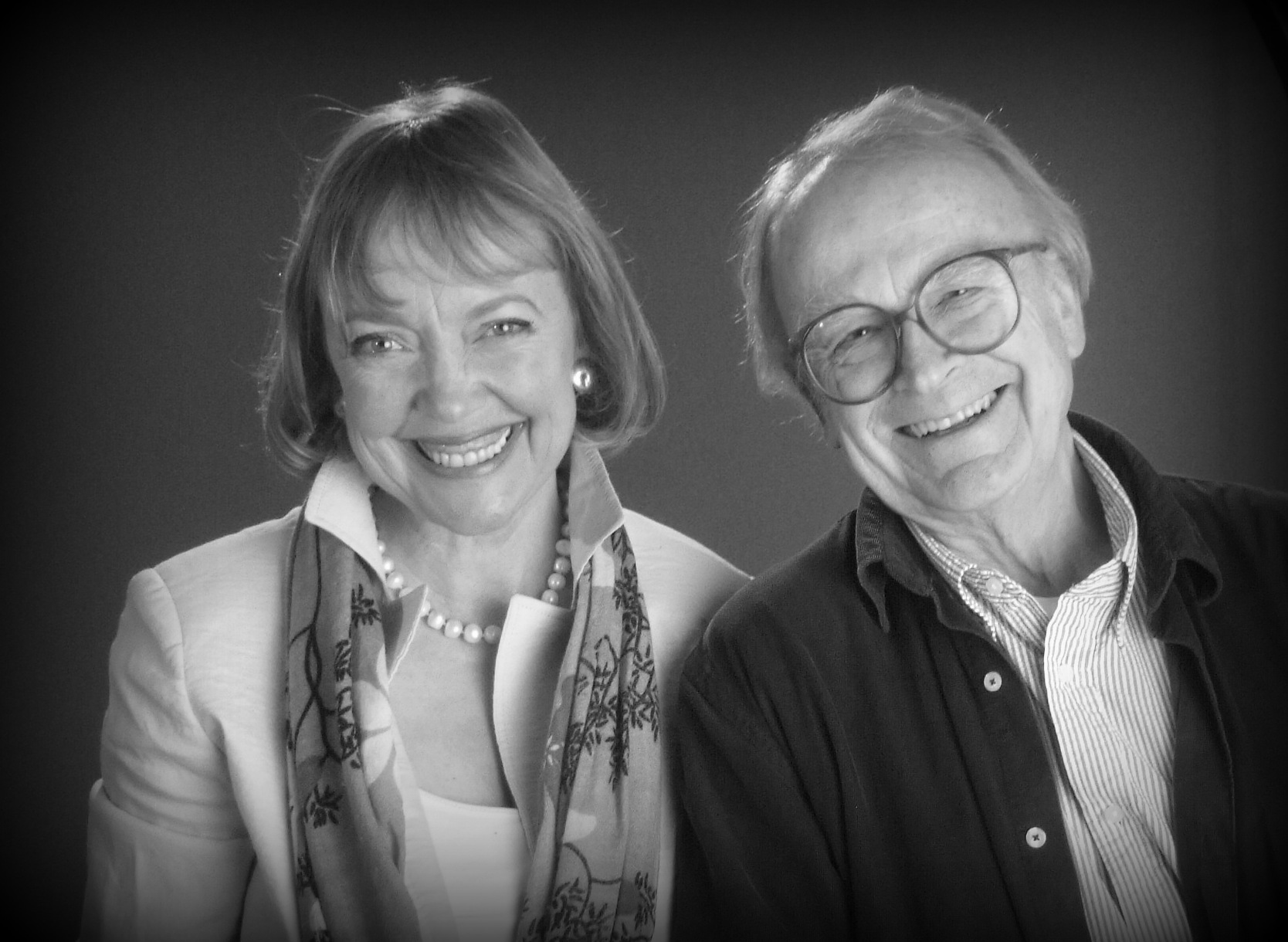
Brian Doyle, the film publicist on ‘Swallows and Amazons’ (1974)
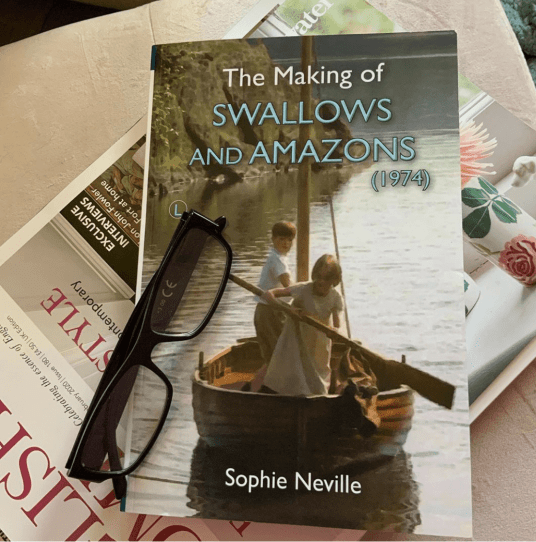
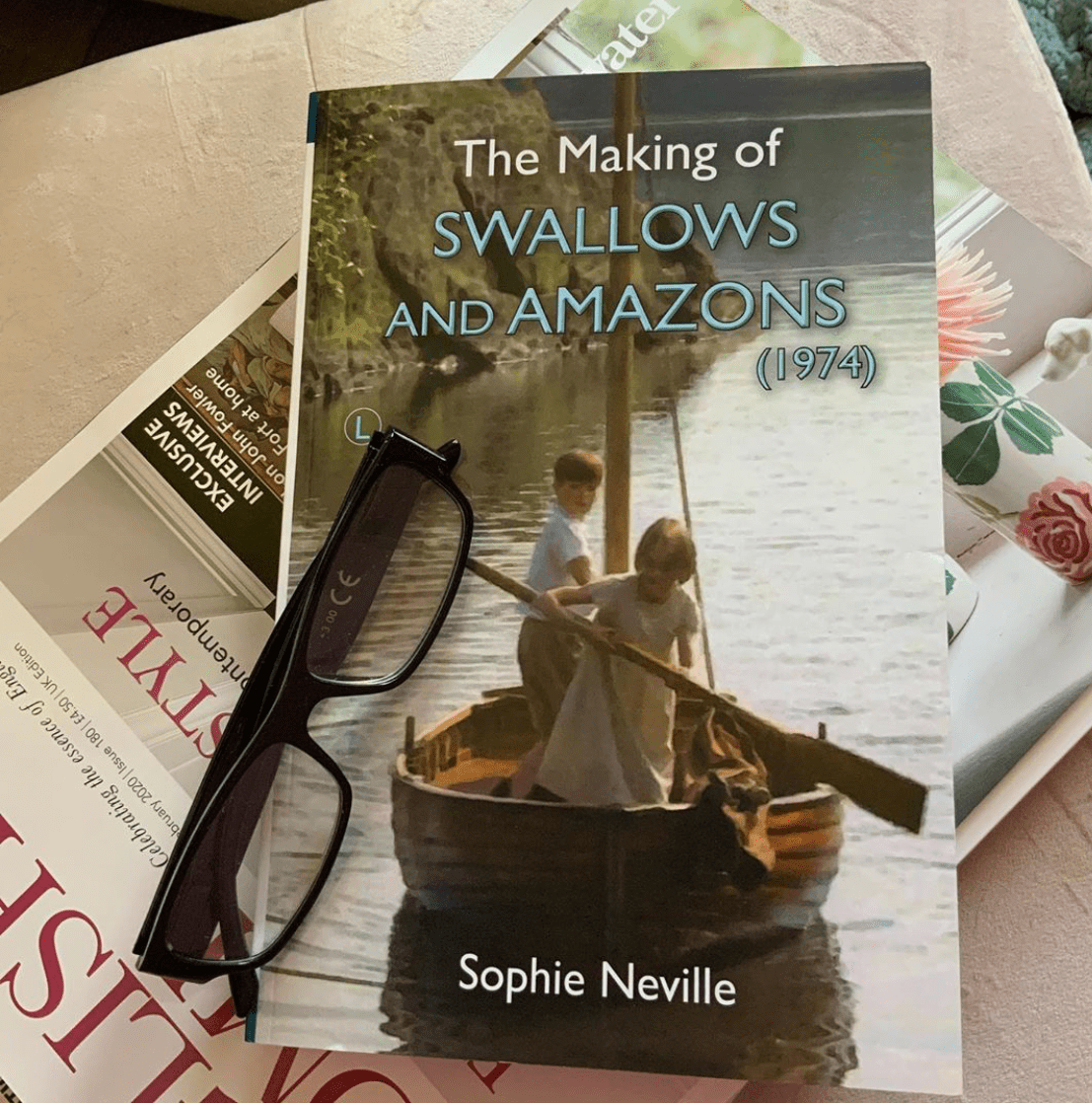
You can read the whole story about how the film was made in Cumbria in ‘The Making of Swallows and Amazons (1974)’ available to order from libraries or online retailers worldwide.
‘The 1974 Swallows and Amazons film is a classic, and this is a really enjoyable look behind the scenes, written by the actress who (for me, at least) gave the stand-out performance as Titty Walker. If the film recaptured the lost world of 1929, then the book recaptures the lost world of 1973, when rules on child actors were strict (chaperones and schoolwork absolute requirements) but regulations on health and safety a bit more lax, even when on water. We even learn the truth behind that strange scene on the jetty in Rio where Roger is left minding Swallow. Highly recommended.’ P. Stevens, Bath, UK
‘Every now and again in cinematic history a classic is born. It doesn’t have to be a multi-billion pound blockbuster featuring legendary names, sometimes something timeless and endlessly endearing is born and this is most definitely the case with ‘Swallows and Amazons’.
‘This film has become an old friend to me; I must have watched it a thousand times and I never tire of it! It brings back memories of a summer childhood spent in wonder-filled Cumbria, in particular Windermere, Ambleside, Derwent and Coniston Water; places we’d visit as a family before the fates would, sadly intervene.
‘Sophie Neville’s excellent book recaptures again the halcyon days of youth in a summer-land of mountains, fells and shimmering lakes. She writes beautifully and with an easy style that’s a joy to read. The love for her subject is very evident, as is her passion for the work of Arthur Ransome. She takes you behind the scenes of the making of the film and the realities of filming on the water; how the director and crew worked tirelessly to bring out the best in the young actors and the splendours of the landscape. So glad I made this purchase. Pride of place on the old bookshelf.’ Allen Fairhurst
‘Sophie has lost none of her infectious enthusiasm and this shines through on every page.’ Julian Lovelock in Mixed Moss, the journal of The Arthur Ransome Society. ‘As well as using her own diary Sophie has mined the recollections and scrapbooks of a number of cast and crew.’
‘The book itself is indeed a delight. I have long been a fan of Swallows and Amazons. I am delighted with the film which was made and Sophie’s account of the making of it adds a very charming and interesting dimension. I loved the account and I fully recommend any fan of Swallows and Amazons to get a copy for themselves.’
You can read about how the original film of ‘Swallows and Amazons’ was made and find the complete collection of behind-the-scenes photos in this ebook available from Kobo, Smashwords, iTunes and on Kindle for £2.99
The screening of Swallows & Amazons (1974) on Sunday afternoon was sold out. 250 tickets. They were endlessly turning people away. ‘We should have shown it again in the 6.00pm slot,’ I told the manager. ‘Oh, we have American Snipper on then.’ It stars Bradley Cooper and Sienna Miller. ‘How many have booked to see it?’ ‘Three.’
All age groups were represented in the audience who came to the event – a fundraiser in aid of the Nancy Blackett Trust. About 70% had seen the film of Swallows & Amazons before. Some knew it well.
Everyone loved seeing the original white elephant flag flown on Captain Flint’s houseboat that had been sent to me from America by the producer.
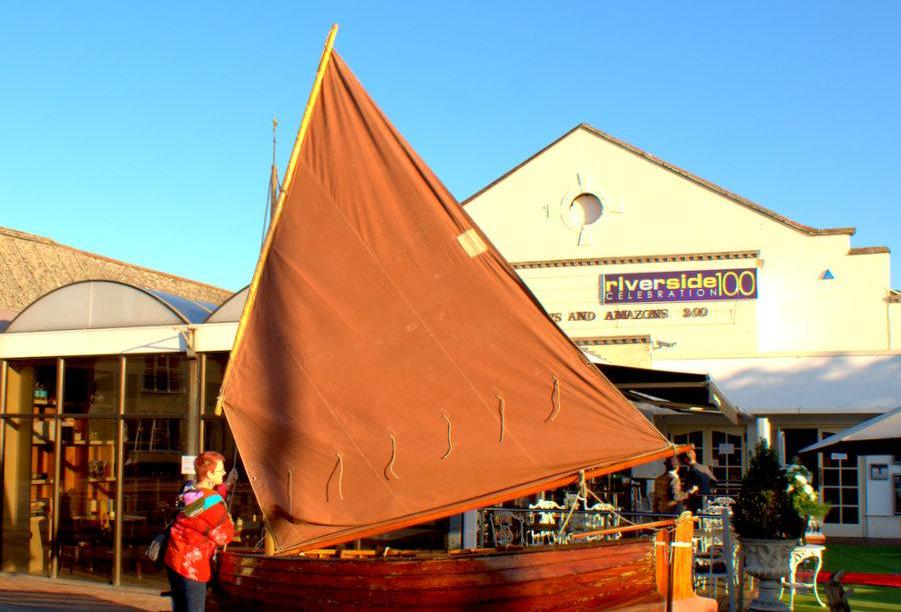
Swallow, the clinker built dinghy, originally built by William King and Sons at Burnham-on-Crouch and used in the 1974 film, was rigged up outside the cinema for everyone to meet. She has been appearing at a number of The Arthur Ransome Society’sevents in Suffolk and Essex.
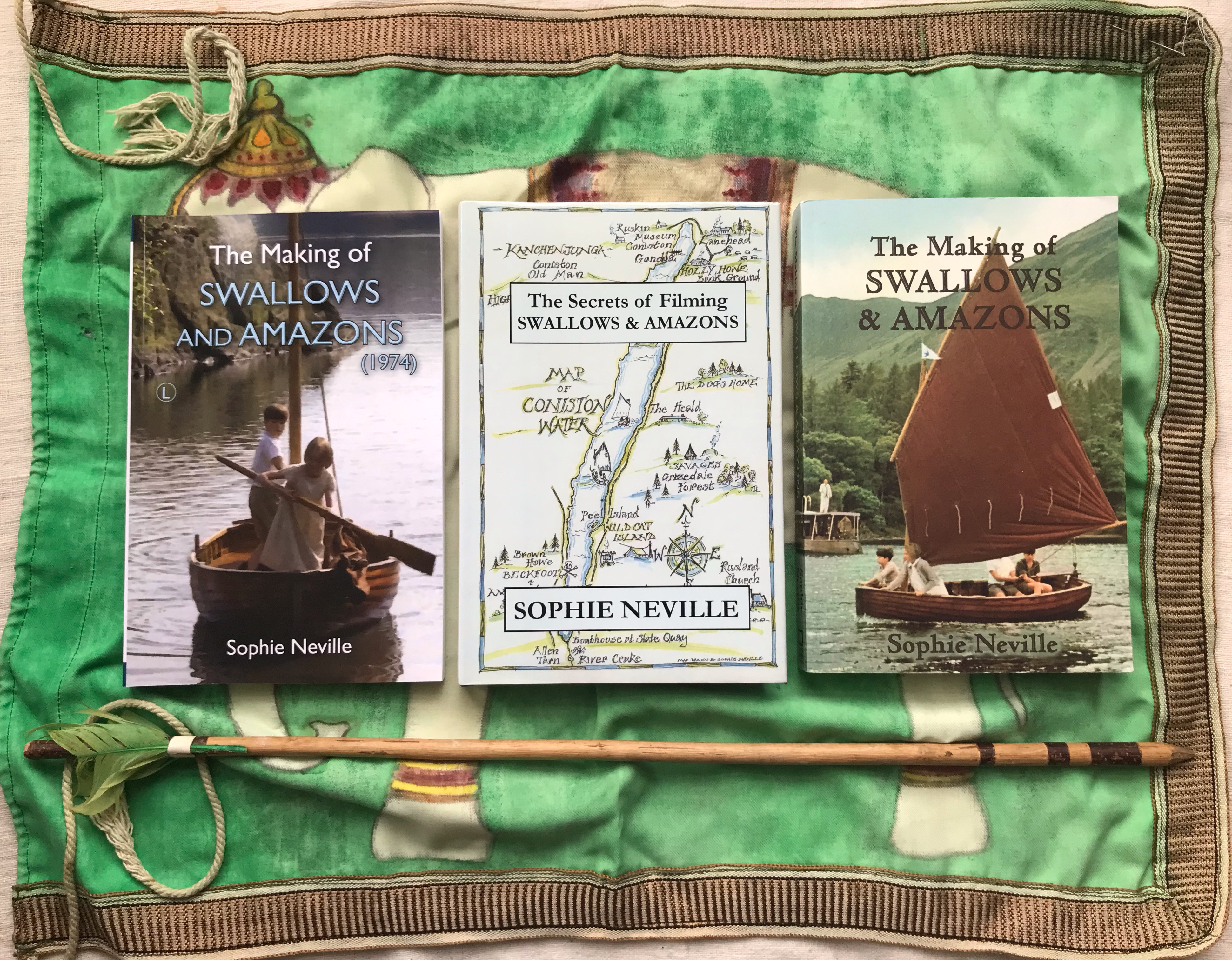
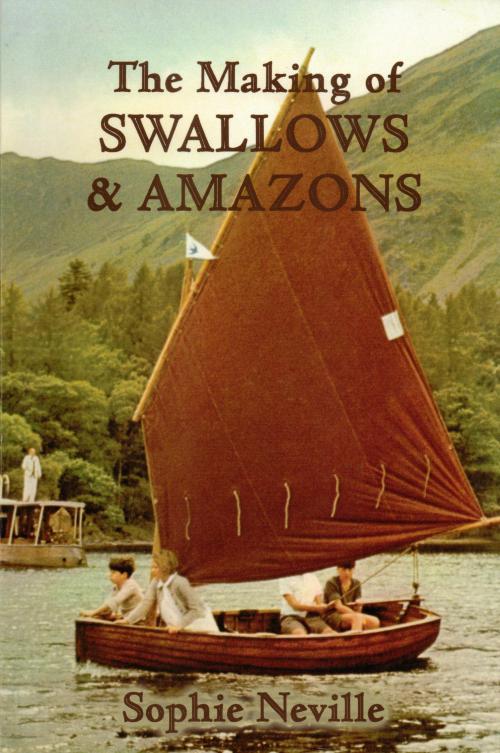
We used the best photo of Swallow under sail for the cover of the paperback on how the film was made, which was on display in the cinema lobby after the film. It is now available online or from the Aldebrugh Bookshop in Suffolk.
Someone asked if we had any disasters while making the film.
‘Swallow’s mast broke, we nearly sailed under the Windermere steamer and a cow fell down a bank onto the producer’s car.’ I couldn’t think of anything utterly disastrous from my own perspective except that I lost a tooth halfway through shooting a scene with Virginia McKenna, which was embarrassing. I can list other questions asked by the audience in the next post.
The Riverside Cinema in Woodbridge are thinking of showing Swallows & Amazons again in September to help them celebrate their centenary ~ ‘100 Years of Film’. Do add a comment in the box below if you would like to organise a screening of the film at a cinema near you.
You can read about the adventures had making the original film of Swallows and Amazons in these editions available online:
Different editions of ‘The Making of Swallows and Amazons (1974) by Sophie Neville’
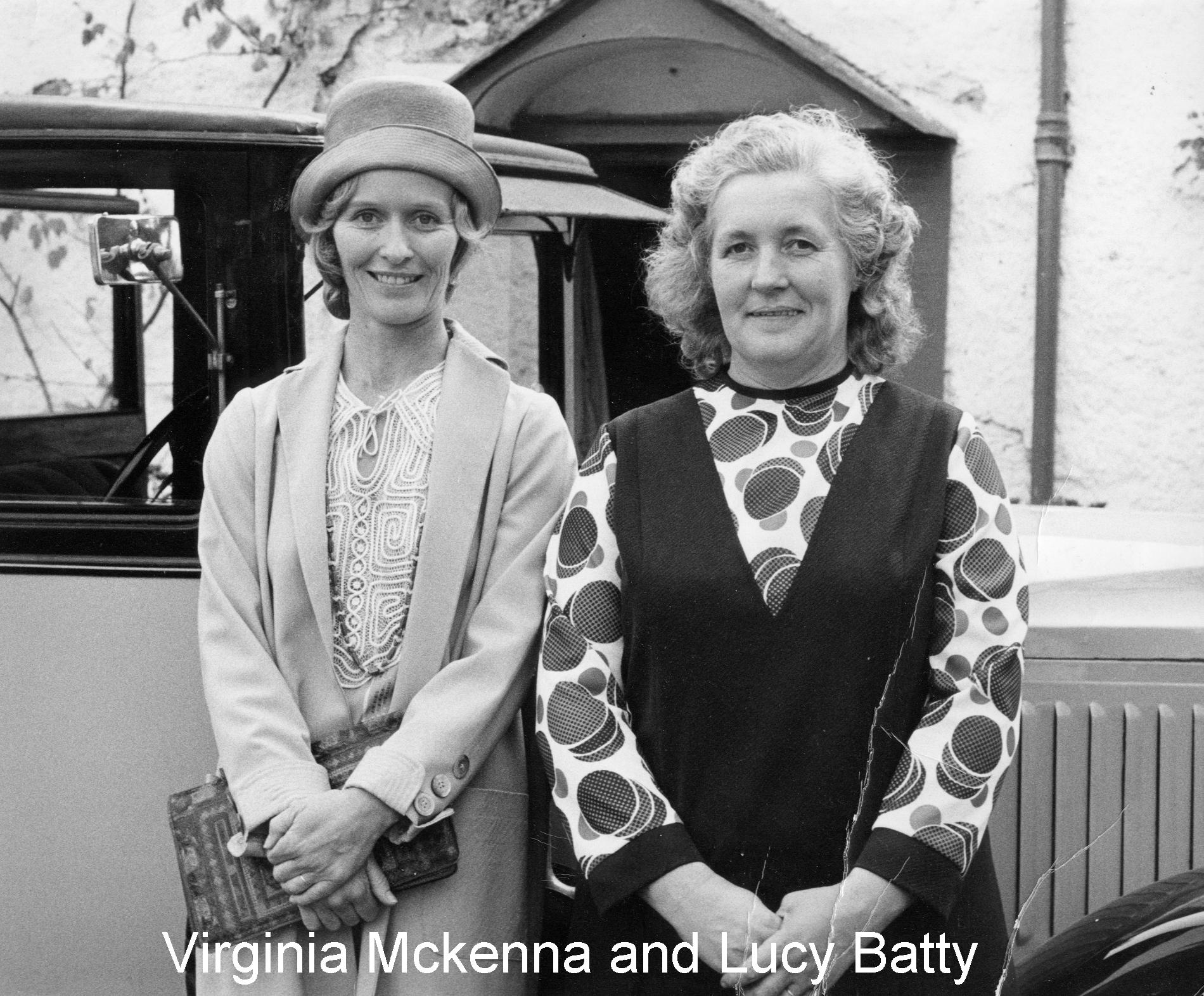
Virginia McKenna with Lucy Batty at Bank Ground Farm on 15th May 1973
We were sad to hear that Lucy Batty has passed away. She was 87. Our thoughts are with her family. She will be fondly remembered by visitors from all over the world who were made so welcome at Bank Ground Farm above Coniston Water in the Lake District, which she ran as a guest house for many years. It was also used as a film location, becoming known as ‘Holly Howe’ in Richard Pilbrow’s 1974 movie, Swallows & Amazons.
Bank Ground Farm in the Lake District
I first met Mrs Batty when we filmed in her home back in 1973 and returned to stay with her in 2003 when the BBC asked Suzanna Hamilton and myself if we would appear in Countryfile, which they were filming at Bank Ground Farm with Ben Fogle. It was then that she had time to show me her photo albums. What a life she led! She was very proud of having brought up seven children on the farm, “Two of my own and five that came with my husband,” she explained. “Getting them all off to school in the mornings was such hard work that my in-laws came to help on my first day.They all wanted bread and dripping for breakfast, with sugar sprinkled on top.”
~ Sophie Neville with Lucy Batty in 1973~
“A magistrate once asked me what running a B&B entailed. ‘It’s much like looking after cattle,’ I told him. ‘You bring ‘um in, feed ‘um, see they’re bedded down, turn ’em out and muck’um out.’ He flung back his head and roared with laughter.”
She had a great sense of humour. I have a cutting from an article in The News written by Brenda Colton and published on 25th May 1973. It reads:
‘When Mrs Lucy Batty was asked if her house could be used for the setting of the film Swallows and Amazons, with guest star Virginia McKenna, she was delighted. After all, her home, Bank Ground Farm on the east side of Coniston Water, near Brantwood, was the setting chosen by Arthur Ransome for his children’s book Swallows and Amazons.
Mrs Batty thought it a good idea that the story should be filmed in an authentic location, and she felt she should be able to put up with a few cameras and film men for a while. But she just did not realise the scale of a “medium budget” film like this one, or what the production staff could do to her house. It was not the two double-decker buses coming down the path and parking on the farm that she minded, nor the numerous vans, lorries, cars and caravans. It was not even the difficulty of having 80 men and women wandering round the farmhouse carrying equipment here, there and everywhere.But when art director Simon Holland started tearing up her lino and carpet in the kitchen to get to the bare stone floor, she did get a little annoyed. Especially when he removed all the electric sockets, lights and switches, pushed all the kitchen furniture into the larder and whitewashed the newly papered walls.
“Have you seen the kitchen?” Mrs Batty said to me. “The larder is piled high with my furniture; and you would not believe the tip my lounge is in. But they are a funny lot. I asked if I could wash the beams in the kitchen for them, and they said ‘Oh no, we want them to look old.’ I have even had to hunt out a lot of old pottery from the cellar for them.
“But I have given up now. I have just left them to it.”
What I really did not know, until I watched the BBC documentary ‘Country Tracks’, was that Mrs Batty reached the point when she locked out the crew. She explained that when she was originally asked if we could film on her property she did not quite realise the scale of operations and only asked for – or accepted – a location fee of £75. She said that she decided that £75 was not enough, padlocked her front gate and wouldn’t let them back in until they agreed to pay her £1,000. It was a lot of money, more than double the fee I received for acting in the whole movie.
To read a little more about filming of Swallows & Amazons at Bank Ground Farm, please click here.
Sten Grendon, Sophie Neville & Simon West with Mr Jackson at Holly Howe
I am sure many people reading this have their own memories of Mrs Batty who was such a great character. Please do add them to the Comments box below. I feel it would be a tribute to all the hard work and love she put into making Bank Ground available over the decades for so many to enjoy.
The farmhouse as Holly Howe in 1973
You can read more about the adventures we had making the original film Swallows and Amazons here:
On 21st March and 28th March, the new CBBC TV show ‘Cinemaniacs’ included guest appearances from Sophie Neville and from David Wood, who wrote the screenplay for ‘Swallows & Amazons’ back in 1973.
Oli White, the vlogger and presenter of ‘Cinemaniacs’, asks a number of people involved in movies about making their first film. Others featured include Michael Sheen, Sir Ian McKellen and Matthew Lewis famous for playing Neville Longbottom in all eight Harry Potter movies.
To find out more about how the film ‘Swallows & Amazons’ (1974) was made, along with how the children’s parts were cast, please see earlier posts or read the book! It includes more than 120 photographs taken on location in the Lake District.
Sophie Neville outside the school bus on location with her sister Tamzin Neville in 1973 ~ photo: Martin Neville
A reader has written in, saying: ‘Much of what one hears about life behind the scenes for younger actors has to do with schooling on set. Did you have tutors all the time or only if you were shooting during the school year? And were you able to keep up with your fellow pupils at “regular” school?
If children under the age of 16 are involved in filming they only have to keep up with their schoolwork during term time. The film company will normally comply with this by employing a tutor at the film studio or on location.
When filming Swallows & Amazons in 1973 we were often in such remote areas that a double-decker bus was hired for us to use as a mobile classroom. It could be seen wobbling along the narrow lanes of the Lake District from Bank Ground Farm at one end of Coniston Water down to Peel Island or over to Brown Howe the other side of the lake depending on instructions given the night before.
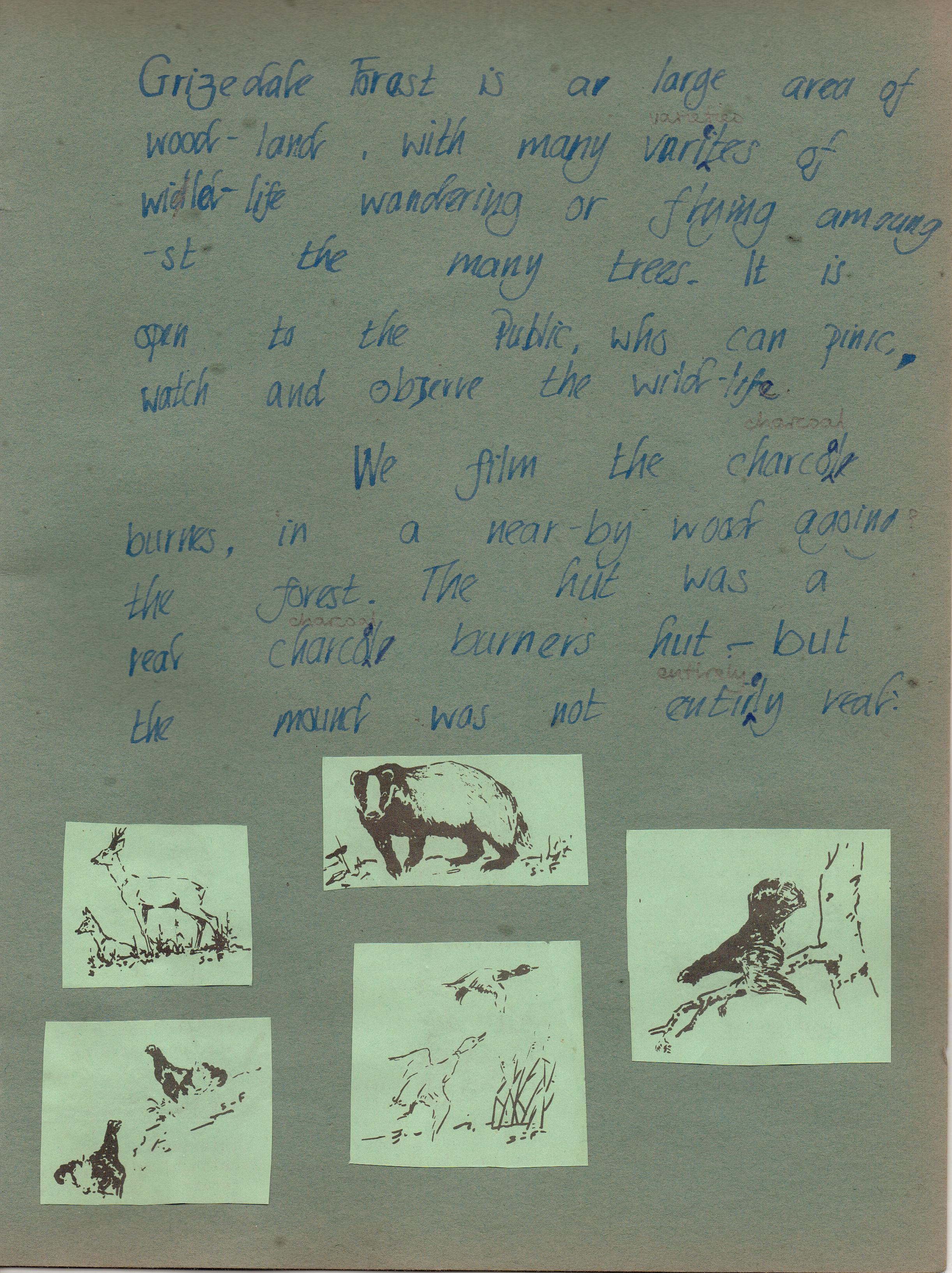
We were legally obliged to complete three hours of school work a day but my mother thought it would be OK if we managed fifteen hours a week. I am pretty sure we kept working through half term to achieve this, although I did record that we had Witsun Bank Holiday Monday as a formal Day Off. When I look back at my school work I only notice that I would have benefited from higher quality waterclours, brushes and paper.
Our tutor, a local education supply teacher called Mrs Causey, believed in dictation; masses of it:
We were also taught about the history, geography and topography of the Lake District. This was worked into our own records of filming:
A sample of school work completed whilst filming in the Lake District in 1973
I certainly kept up with my friends at school. One wrote recently to say, ‘I do remember the lovely illustrated diary you wrote at the time, as you brought it back to school for us to look at.’
I only missed seven weeks of the summer term to make Swallows & Amazons. What was amazing was that I was obliged to sit the end of year exams in Ambleside. The results would not have been as good as normal, particularly in Maths and Science but I eventually caught up.
There was quite a bit of discussion about whether or not I should miss more schooling. I was only ever offered further film work during school holidays but as I went to a boarding school making arrangements to go to London for auditions could be a nuisance.
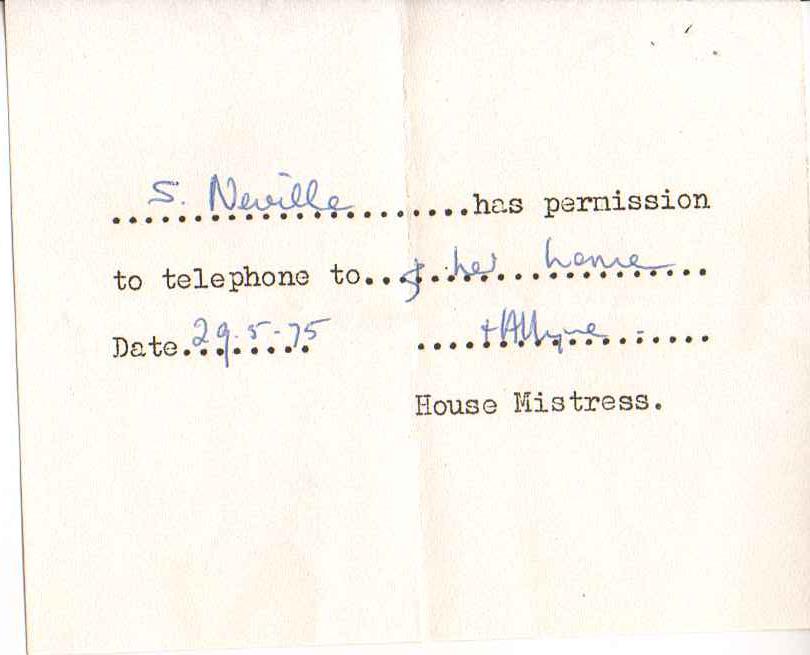
I’d get messages to phone home and letters detailing complicated plans.
This ‘picture’ turned out to be an adventure movie called ‘The Copter Kids’. Mum was obviously going off to lunch with Virginia McKenna and reading the letters on the Radio 4 programme Any Answers whilst I was busy sitting summer exams.
My sister Tamzin did a great deal more acting that I did as a child. She didn’t mind missing school altogether or having a tutor. What she hated was being sent to a large comprehensive school in London for a term so that she could rehearse in North Acton. That didn’t do her any good at all.
Lights, camera, action: working as a child in television
You can read more about ‘The making of ‘Swallows and Amazons’ (1974) on Kindle, in paperback or listen to the new audiobook, all available to purchase online.
‘Forty years after she enchanted film-goers as Titty in Swallows and Amazons, Sophie Neville has found a new audience… telling the behind-the-scenes secrets of the film of Arthur Ransome’s classic novel.’ The Daily Mail The Making of Swallows & Amazons ‘…is based on diaries, letters and old photographs which Sophie has turned into a heart-warming account of making the movie, which starred Virginia McKenna and Ronald Fraser.’
The Telegraph~ Culture: ‘Set in the Lake District in 1929, the film follows four young adventurers who sail a dinghy around Lake Coniston, cook for themselves over campfires and sleep in makeshift campsites.’
‘…The occasional chaos and terrible weather during filming contributed to the eventual popularity of the extraordinary and very much loved film.’ The Times
‘The film Swallows & Amazons is 40 years old, but thanks to its careful period evocation, its respect for Arthur Ransome’s original book and the performances of its child actors, it’s become a timeless classic. One of those children was Sophie Neville, who played Titty, and who kept a diary during the filming. That diary, with her adult recollections, is this book. It’s a fascinating insight into filming on location in the Lake District…’ Classic Boat
‘… The result is compulsive reading as she recalls that cold wet summer, while the camera crew wrapped up warm and she shivered in her skimpy dress as Able Seaman Titty Walker. Sophie brings to life all the many memorable characters who worked on the film and in particular the other children, the Director Claude Whatham who developed a great relationship with his young cast and the stars Virginia McKenna and Ronald Fraser. Nor are the other young actors forgotten for there are diary contributions from Suzanna Hamilton who played Susan, Stephen Grendon who played the Boy Roger and Kit Seymour who played Nancy Blackett. The text is supported by numerous illustrations showing life on and off the set.’ Roger Wardale, author of Arthur Ransome: Master Storytellerand other books
‘You don’t need to be a Swallows & Amazons fan to enjoy this book – it’s universal!’ Winifred Wilson, Librarian of The Arthur Ransome Society
‘This was a most unusual and interesting book. I picked it up expecting to browse through it, and found myself so drawn in to Sophie Neville’s detailed, amusing and insightful description of film making in the 1970’s that I was unable to put her book down. As Arthur Ransome fans, my family and I have always loved the film, and felt that Sophie Neville was ‘just right’ as Titty. What fun it has been to be introduced to the young twelve year old Sophie with her intelligent awareness of the challenges facing the production crew while she shivered in her cotton dresses. The many photographs and illustrations contribute richly to bringing the 1970s setting to life. Sophie recorded her experiences beautifully, and in so doing, added one more valuable book to the cultural heritage of all Arthur Ransome fans.’ Juliet Calcott, English teacher,South Africa
Lots of photos throughout the book bring the scenes to life – a delightful read.’ Celia Lewis author of An Illustrated Country Year
Sophie Neville has been chatting to Mark Forrest on The Evening Show.
The second edition of this paperback is published by The Lutterworth Press, available online here
This Christmas has been marked by a number of amusing cards, emails and comments that have come in from people who remember making the film of Swallows & Amazons in 1973.
David Stott has already sent in his memories of working as Ronald Fraser’s driver at the age of 19 while Peter Walker remembers literally bumping into him in a pub in Ambleside. Various journalists added their recollections online below an article in the Telegraph. I hope to have gathered enough photographs to post a few more in the new year.
If you can remember anything about the filming of Swallows & Amazons, can recollect going to see it in the cinema when it was first released, or have memories about anyone connected to the movie, add a comment below or contact me on sophie@sophieneville.co.uk.
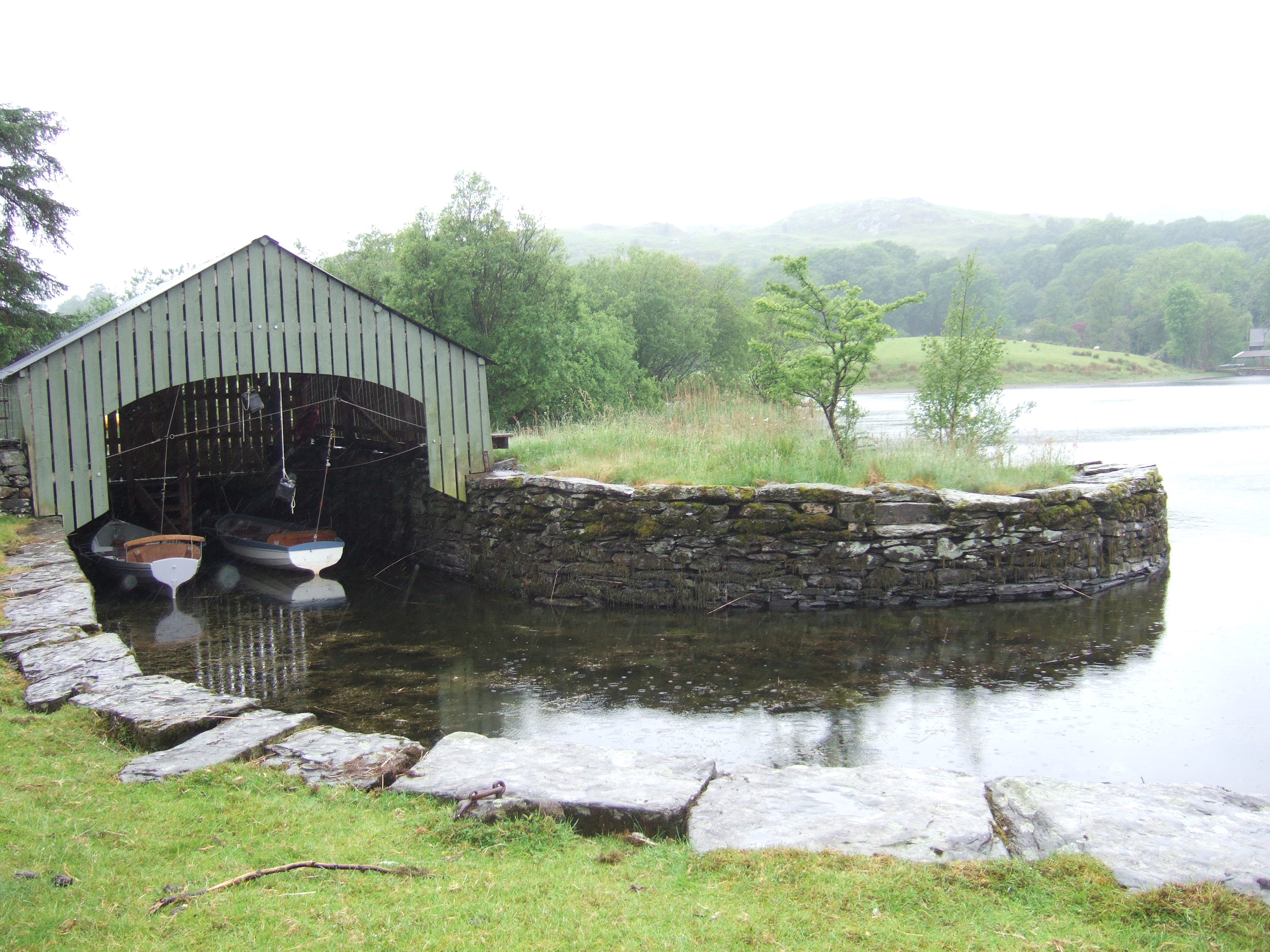
The Amazon boathouse on Coniston Water
I have a list of those who appeared as supporting artists in the film that I would love to add to. Can you help me with more details and full names? It would be awful if I had incorrect spellings.
Kerry Dartisnine ~ Nurse
Tiffany Smith ~ Baby Vicky
Moira Late ~ Mrs Jackson
Brian Robey Jones ~ Mr Jackson
Mr Turner ~ Shopkeeper
Mr Price ~ Native on the Rio jetty
Mrs Price ~ Visitor at Haverthwaite Railway Station
Martin Neville ~ Native on the steamer
George Pattinson ~ Steamboat owner
Stanley Wright ~ Motorboat mechanic
James Stelfox ~ Boat mechanic
Herbert Barton ~ Casual holiday-maker
L. Lucas Dews ~ Man just returned from abroad
Jane Price ~ Girl at Rio
Simon Price ~ Boy at Rio
Tamzin Neville ~ Girl at Rio
Perry Neville ~ Girl at Rio
Pandora Doyle ~ Girl at Rio
Alan Smith ~ Boy at Rio
Jane Grendon ~ Rio visitor
Janet Hadwin ~ Rio visitor
Peggy Drake ~ Rio visitor
William Drake ~ Rio visitor
Mrs Jill Jackson ~ Rio visitor
Lindsay Jackson ~ Rio visitor
Nicola Jackson ~ Rio visitor
Fiona Jackson ~ Rio visitor
Shane Jackson ~ Rio visitor
Zena Khan ~ Rio Visitor
Lorna Khan ~ Lady on the Tern
Sarah Boom ~ Cyclist at Rio
Jack Hadwin ~ Motorcyclist
Kendal Borough Band
Beauty Proctor ~ Polly, the green parrot
The following people worked on the crew of Swallows & Amazons but I am not sure of their exact job titles:
Gay Lawley-Wakelin, Richard Daniel, John Slater, Lee Apsey, Craig Hillier, Les Philips, Ron Baker, John Pullen, Harry Heeks, Graham Orange, Mike Henley, Joe Ballerino, Ted Elliot, Eddie Cook, John Engelman, John Mills, Ernie Russell, Clive Stewart, Toni Turner, Phyllis B, Pinewood Caterers John and Margaret ……, Robert Wakeling, David Stott. and other Drivers: Browns of Ambleside
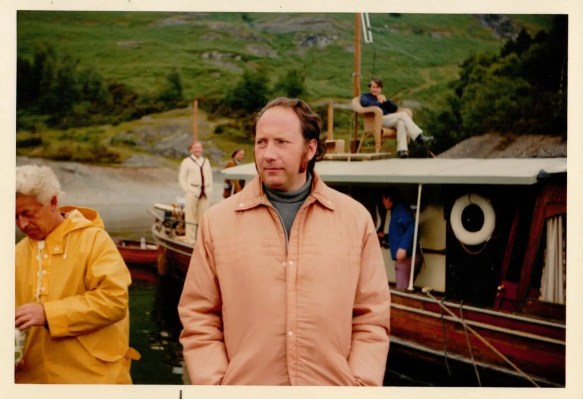
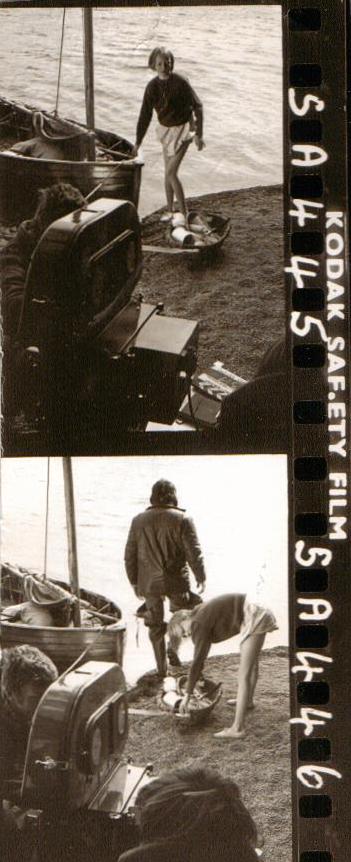
Behind-the-scenes while filming ‘Swallows & Amazons’ in 1973
The classic movie of Swallows & Amazons is often broadcast on BBC TV. If you would like to know more about how the film was made you can find the details on this site or leave any questions in the comments box below.
To read about our first day’s filming at Haverthwaite Railway Station click here and keep reading.
Sophie Neville having her hair cut on location for the part of Titty Walker in 1973
Do you know what lake we were on in the photograph below? We were busy loading urns of tea into a run-around boat to take out to the film crew who might have been on Cormorant Island. If you click on the photo you will get to the page of my diary, kept in June 1973, which describes this day.
Wardrobe Master Terry Smith and Sophie Neville in her costume to play Titty. But what is the name of the boatman? Does anybody know?
There are still many questions about the making of the movie that remain unanswered.
Does anyone know the name of this journalist who visited us on Peel Island?
This shot was taken while setting up the scene at Peel Island when Captain Flint brings Sammy the Policeman to question the Swallows. If you click on the photo you will find the photograph that the journalist ended up with. Titty’s hand is still on Captain Flint’s arm.
Making a movie is very different from watching one. Here is a record of Titty rehearsing the shot when she moves the camping equipment for fear of a tidal wave. It was a cold day on Coniston Water. The jersey came off when they went for a take.
Here you can see Lesley Bennett, playing Peggy Blackett, careening Amazon at Beckfoot. The same 35mm Panavision camera was focused on Kit Seymour, playing Captain Nancy.
Lesley Bennett as Peggy: Claude Whatham directing the scene with Kit Seymour
The location used for Beckfoot and the Amazon boathouse can be found at Brown Howe on the western bank of Coniston Water. If you click on the photograph of Peggy you can read more about what happened that day.
Kit Seymour playing Nancy Blackett and Lesley Bennett playing Peggy Blackett
If you would like to get future posts, please click the Follow button at the bottom of the side-bar.
You can read the full story about the making of Swallows and Amazons here:
I have been writing about life in England fifty years ago, reflecting on how our lives have changed. Can you help me?
Sophie Neville at the EMI Elstree Studios in 1973
The big change seems to be in communications. In 1973 we were still queuing up to using coin operated telephone boxes in the street, asking the operator for Ambleside 2232. Letters and notes were written by hand. I learnt italic writing, so as to be clear. Manual type-writers used black and red stripped tape. Mistakes were obvious.
I’d love to receive comments (below) on how you remember aspects of growing up in the early 1970s. What did you eat then? Where did you go on holiday? What was it about 1973 that impacted you?
Jean McGill, Jane Grendon, Stephen Grendon, Kit Seymour, Sophie Neville, Claude Whatham, Simon West, Lesley Bennett, Suzanna Hamilton, Ronnie Cogan in 1973
My husband remembers long hair, flared trousers and shirts with massive curved collars. I always longed for an embroidered t-shirt with wide sleeves or a cheese-cloth shirt but loathed the feel of acrylic jumpers and ribbed polo-necks. Stripy ones. The fabric could be so vile, we didn’t feel each other as much as we do now. There was much less hugging.
Mum wearing a fluffy Donny Osmond hat
The food was pretty applauding. My friend Suzanna has just reminded me about the innovation of Italian cooking. Spaghetti was the highlight of our lives; a treat that we might have on Saturdays or for a party when red candles would be pushed into wine bottles and checked paper table cloths could enhance a Bistro image. However prawn cocktail was the pinnacle of popular aspiration, although us children preferred picking of the shells off prawns ourselves.
Daphne Neville in 1973
At parties you’d be offered chunks of cheese and pineapple on cocktail sticks stuck into a half a melon that had been covered in tin foil. I always rather longed for the melon. Homemade beer was regrettably all the rage, along with freezing your own runner beans. The process was quite fun (we enjoyed sucking air out of the freezer bags with a straw) but the beans were stringy and disgusting.
My family thought having to bring-a-bottle to parties was a great idea but we loathed the fact that cigarettes were smoked everywhere you went. Unless you were in the garden where abysmal furniture design spoilt the view.
Colour televisions were only just beginning to invade people’s homes. They were terribly expensive. We had to make do with our crackly black and white screen, watching Blue Peter,Animal Magic and Tony Hart presenting Vision On with cartoons such as Marine Boy until Childrens’ Television ended with The Magic Roundabout just before Daddy came home from the Works in time for the 6 O’Clock News. I then bored myself rigid watching Points West and Nationwide before It’s A Knockout.
We were allowed to stay up to watch Dick Emery , Benny Hill, and ‘Titter ye not’, Frankie Howerd along with dramas such as The Onedin Line. There was one sit com starring Wendy Craig entitled Not in front of the Children, which of course we all wanted to watch. What influence did this have on our young minds?
Mum appearing as a member of the Salvation Army on ‘The Dick Emery Show’
Mummy worked for HTV West presenting an afternoon programme called Women Only with Jan Jeeming. She also read the letters on Any Answers?, which was produced by BBC Radio Bristol by Carole Stone. I was so impressed – amazed – to meet a female radio producer. Carole was one of the few who worked her way up from being a BBC secretary to producing Any Questions.
HTV West Christmas Show presented by Bruce Hocking, Jan Leeming & Daphne Neville
Our holidays were spent camping in Wales. Packing for this took two weeks. We used drag an orange dome tent out of the airing cupboard and slept on fold-up sun-loungers from the garden.
Sailing was all about Mirror dinghies, which you could buy in kit form and make out of plywood in the diningroom. We couldn’t afford one, but in the late 1970’s Dad bought a fibre-glass Topper, which was the height of cool. He called it Earwig.
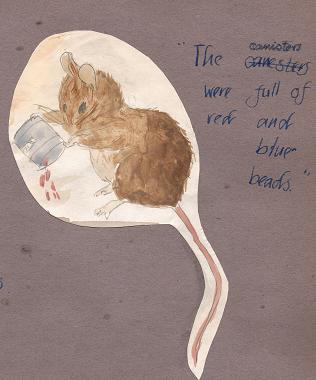
We had our photos developed at the chemist or sent them off to Tripleprint, so we could share the small version with others. Although they were bought by Bonusprint in 1979, I was a loyal customer until well into the 1990s and remain plagued by small photos I can’t quite bring myself to chuck away. We stuck them in scrapbooks made of green and blue paper. Here is a page of mine from the making of Swallows and Amazons.
My family were very keen on taking home movies. Dad usually took slides when we went on holiday, which were viewed along with the supper-8 footage at Christmas time when he pushed the furniture back, took down a painting and projected our memories onto the wall.
What have I forgotten? Do post your own recollections, especially of sailing and camping in the early seventies, in the comments below.