Arthur Ransome first visited the Lake District as a tiny baby. He said that his father, ‘carried me up to the top of Coniston Old Man at such an early age that I think no younger human being can ever have been there.’ Thereafter the family traveled up by train every summer, from 1884 – 1897, to stay on the Swainson’s farm at High Nibthwaite at the southern end of Coniston Water.
The four children were allowed to run wild in the hills or slide down the knickerbocker-breaker rocks above the farm whilst their mother painted and their father fished the River Crake. They had the use of a rowing boat, which they would take a mile up the lake to Peel Island for a picnic.
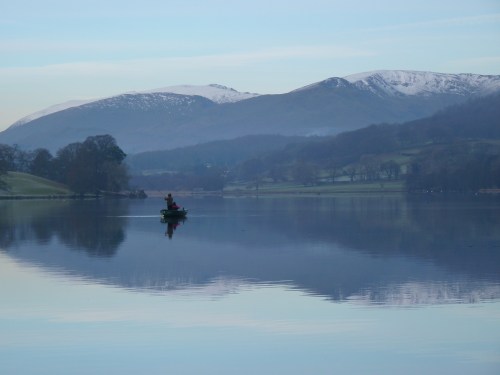
Peel Island on Coniston Water, which you can visit by boat.
I’d love to take my family to spend a week at Low Water End, a holiday cottage at the southern tip of Coniston Water, which has boats, lake frontage and a small slipway.
Another lovely place to stay is Hill Top Farm, a traditional Lakeland house built in the 1700s and now owned by Martin Altounyan, son of Roger Altounyan and grandson of Dora Collingwood who was such a great friend of Arthur Ransome’s. They say you can see the Crake estuary from the garden. It is near Penny Bridge village, four miles from Coniston Water and just three miles away from Hill Top at Haverthwaite where Arthur Ransome lived at the end of his life.
As a young man Ransome escaped from London for a holiday in Coniston village and found himself invited to stay nearby at Lanehead by WG Collingwood, Dora’s father. Ransome writes in his autobiography that had originally meet the family in 1896 on Peel Island. ‘Mrs Collingwood told me that she remembered that meeting on the island and her surprise that my mother, who was a very pretty young woman, could have a family of such very ugly children.’
The rocks at the end of Peel Island where the Collingwood family traditionally had picnics
By 1904 Arthur Ransome was being taught to sail by Dora, Barbara, and Robin Collingwood in a heavy old dinghy called Swallow that they were able to take out on Coniston Water. He later stayed at Low Yewdale at the north end of Coniston, which I believe still offers Bed and Breakfast or a self-catering cottage. Ransome would set up ‘a tent on a small mound close to Yewdale Beck a hundred yards up the valley’ so that he could sleep outside when it was fine. In her guide-book,In the Footsteps of the Swallows and Amazons Claire Kendall-Price shows you how you can walk from Low Yewdale to Ambleside via The Drunken Duck, a pub you can now stay at that I believe Ransome visited.
It is easy to see how all this experience, the houses Ransome loved and places he knew of since childhood were poured into his Swallows and Amazons series of books. You will have to tell me which of his stories were written here:
After many adventures in Russia and the Baltic, Arthur Ransome bought his second wife Evgenia to live at Low Ludderburn on Cartmell Fell above Windermere where they lived from 1925 until 1935. He loved the work room made for him at the top of the grey barn outside. They moved to Suffolk for a while but returned during WWII to live at The Heald, which overlooks Coniston Water.
The Heald above Coniston Water where Arthur Ransome lived between 1940 and 1945 ~ photo: Peter Walker
It was here that Ransome wrote The Picts and The Martyrs. They had a jetty there where he kept his boat Coch-y-bonddhu, which is used as the model for the Scarab, a sailing dinghy bought for Dick and Dorothea Callum in the novel. The gardener’s cottage to The Heald has recently been rebuilt and is for sale.
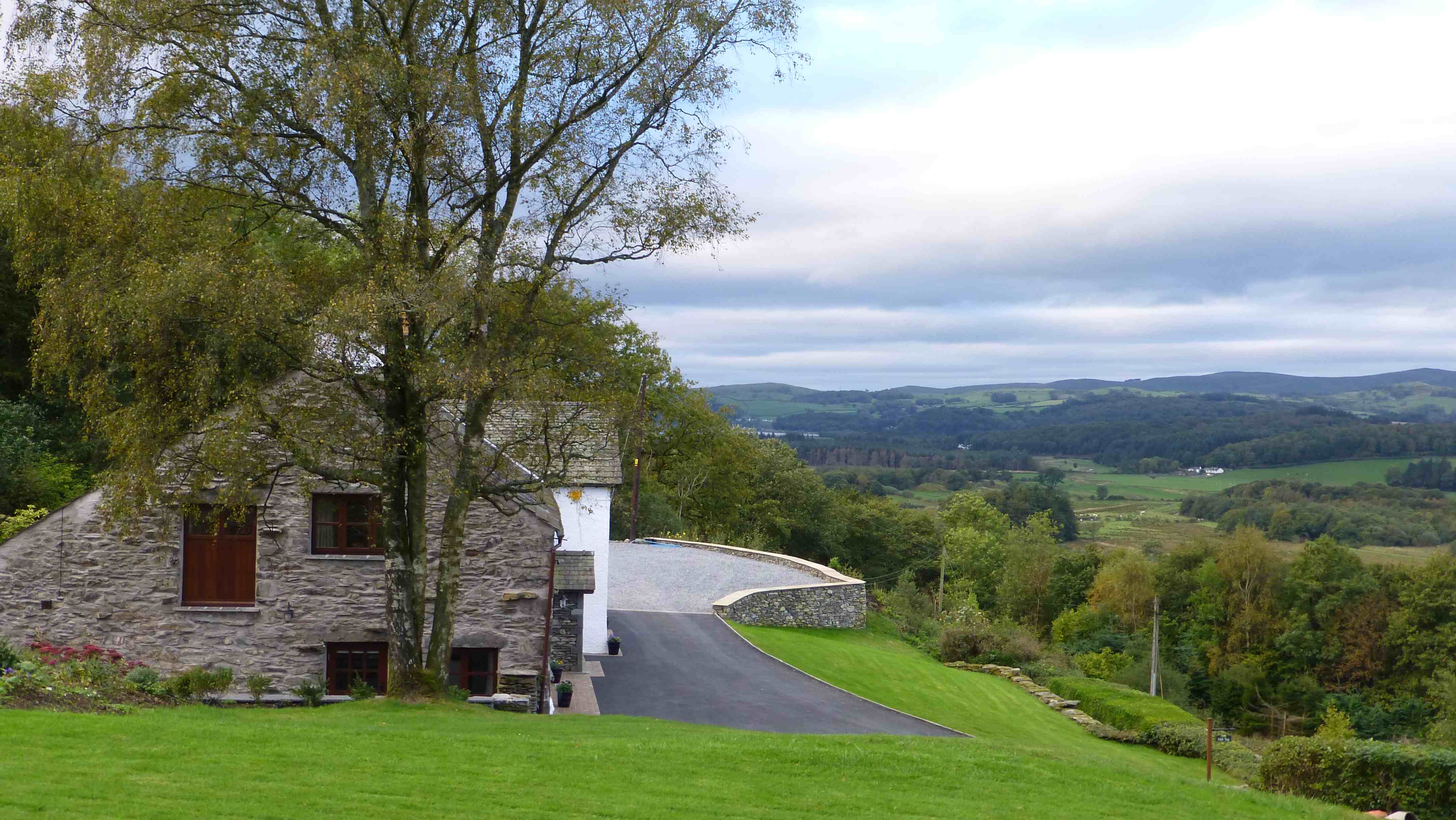
In their later years, the Ransome’s loved at Hill Top Farm near Ealingshearth, where the views are stunning. It has been renovated but retains many of the original features.
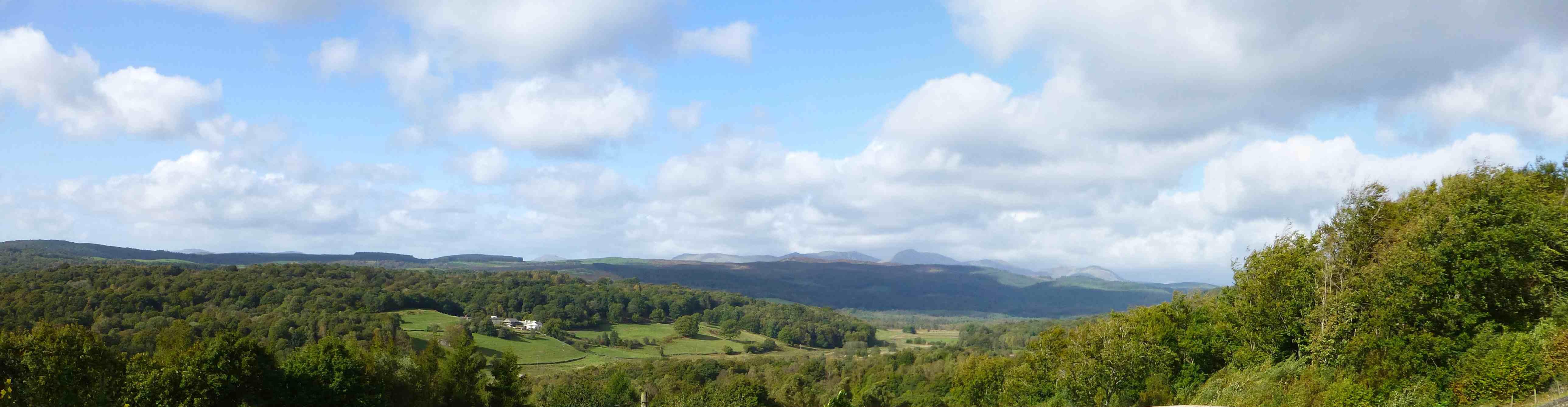
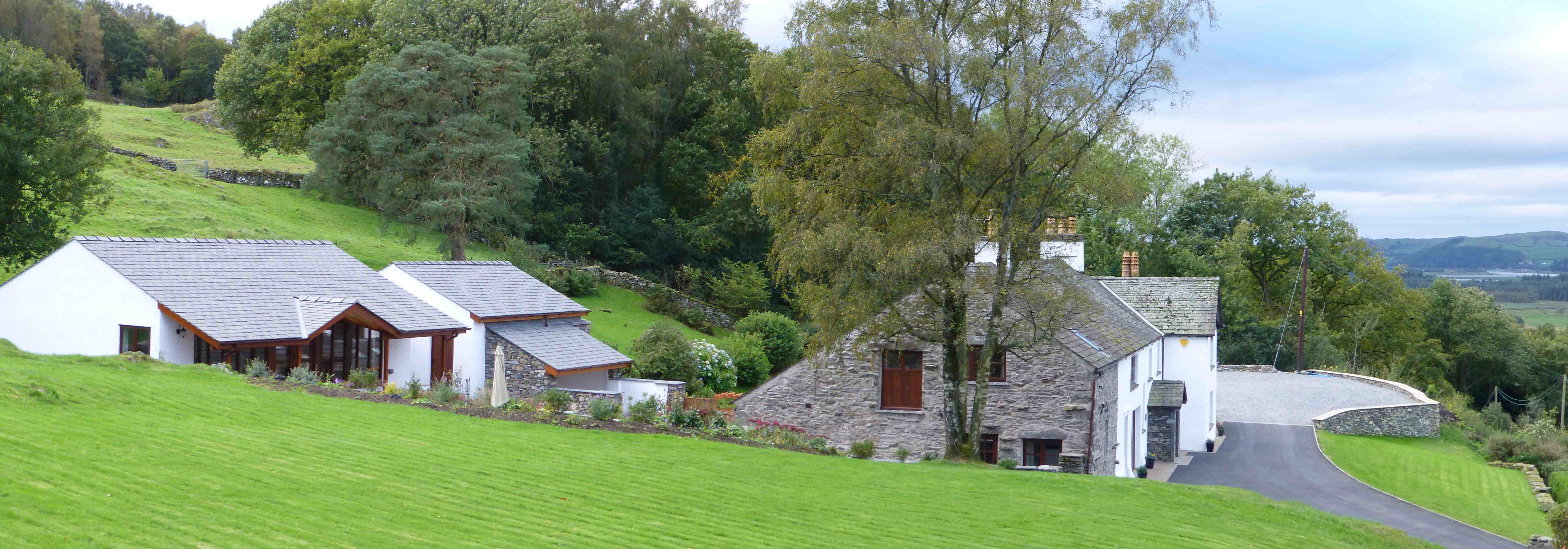
Hill Top, the 17th century farmhouse at Ealingsheath, a tiny hamlet near Haverthwaite in Cumbria, where Arthur and Evgenia Ransome lived in the 1960s enjoys lovely view across the Lakeland fells.
In the Epilogue to Arthur Ransome’s autobiography, Rupert Hart-Davis wrote: ‘In 1960 the Ransomes bought the little derelict farmhouse in the Lakes which they had rented for the last four years as a holiday cottage. Repairs and alternations took longer than expected, and it was not until November 1963 that they moved into their home, Hill Top, Haverthwaite, near Newby Bridge. They both loved the house, and the buzzards, redstarts and deer by which it seemed to be surrounded… ‘ Arthur Ransome celebrated his eightieth birthday there, although by then ‘…he was confined to a wheel chair on the upper floor of the house.’
The present owners, Stephen and Janine Sykes, who bought Hill Top in 2012, have converted the garage/barn-end into a holiday cottage. You can read about the story in the Mail Online entitled: ‘A home full of Swallows & Amazons…’ As they say, it’s a good base for exploring the locations described in book and used in the 1974 movie of ‘Swallows and Amazons’, which the Mail describes as, ‘A perfect adventure.’ I’ve described doing so myself in previous posts.
Stephen Sykes says, ‘The picture used was actually of “The Pavilion” – a games room.’ It was converted from a substantial former kennel.
.
.
‘We demolished another kennel of 1,000sf (now a courtyard garden) and we’re just finishing the conversion of another to an office/store room! We’ve spent a lot of time, effort and money in “de-kennelling” Hill Top and returning it to domestic use! Needless to say, the guest accommodation, “The Cottage at Hill Top”, forms a self-contained part of Hill Top itself.’
.
.
Stephen added, ‘Cumbria Life are coming to photograph Hill Top today for a feature in their Christmas issue.’ The house certainly looks wonderful.
.
.
Stephen and Janine are more than happy to take direct bookings – please ring: 01539 531 452. The last three digits of their phone number are the same as in Ransome’s time. They offer a 10% discount to TARS members.
.
.
Stephen Sykes is an investment analyst and author of The Last Witness who studied astrophysics at UCL in the days when men were landing on the moon. He previously wrote to tell me that they have a number of old photographs and, ‘… a collection of most books by and about Arthur Ransome. Obviously, we’ve made it our job to learn much about the Ransomes and… visited the Brotherton Library at the University of Leeds to look through Arthur Ransome Collection where there are dozens of photographs of Hill Top from the late 1950s to c. 1963. I now have digital copies of most of these, including a number of good quality colour slides of Arthur and Evgenia. I guess it’s rather unusual for someone to find a treasure trove of photos of their house from half a century ago and see how its then famous owner transformed it!
.
‘Astonishingly, the Lake District National Park Authority indicated that they had absolutely no interest in the Ransome connection and even moaned that if Hill Top were to become a “tourist attraction” it would merely create traffic problems!’ Stephen added.
.
When I last passed Hill Top with Mountain Goat no one else was using the lane that runs in front of the house even though it is not so very far from the southern end of Lake Windermere and the Haverthwaite Railway Station where the steam train comes in and the Windermere steamers dock.
.
…………..
If you would like to read the ebook about the making of the original film of ‘Swallows and Amazons’, please click here.
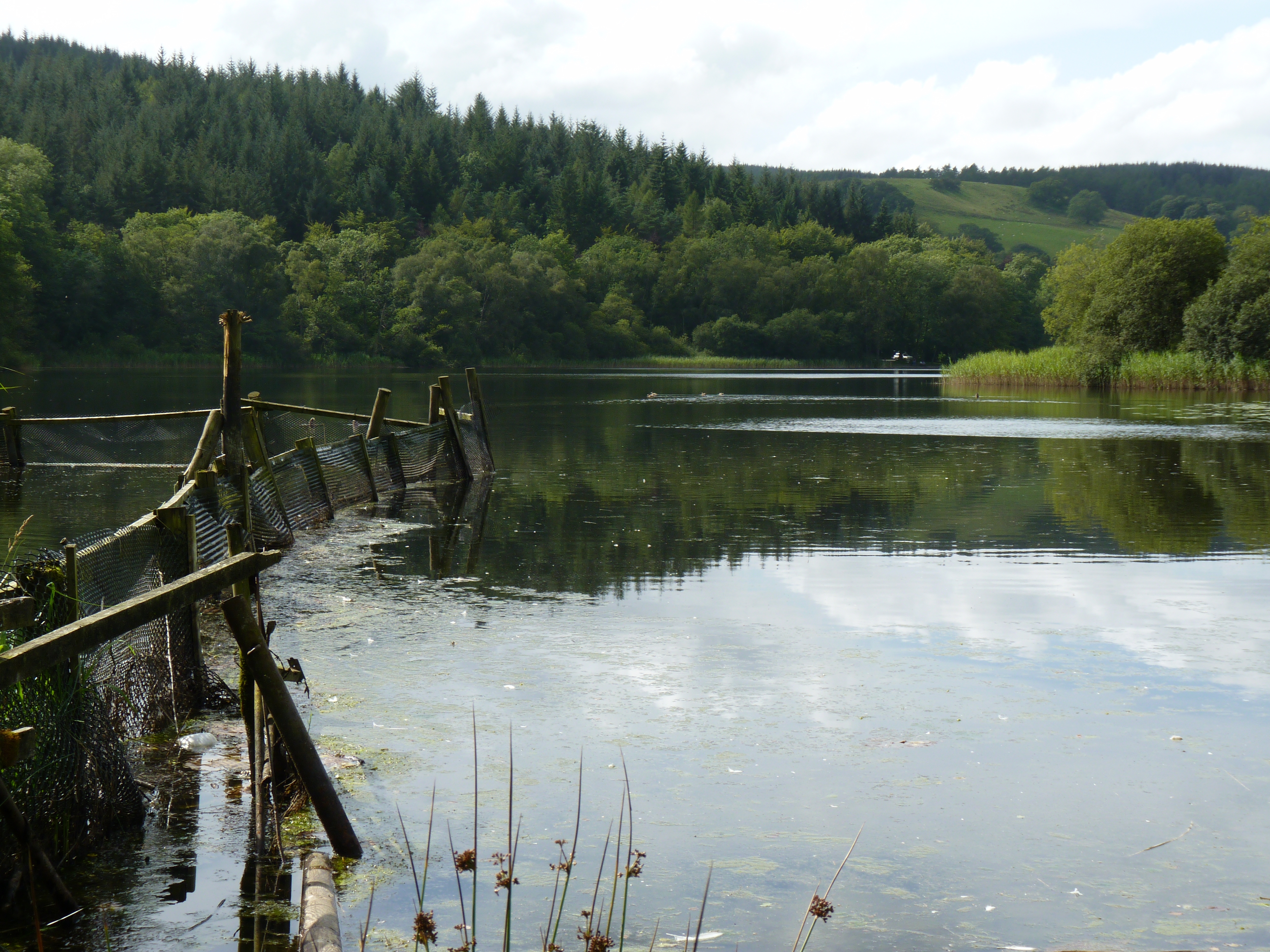
Esthwaite Water in the Lake District where Arthur Ransome loved to fish
When Peter Walker took me on his Swallows and Amazons tour of the Lake District we stopped at Esthwaite Water where Arthur Ransome often went fishing. I wonder if he had it is mind when he wrote about Roger’s great fish, the terrifying pike hooked in Shark Bay.
‘I understand Ransome fished it with his friend the Vicar of Finsthwaite.’ Peter went on to explain that Ransome’s last book Mainly about Fishing is dedicated to Rev. Roland Pedder of Finsthwaite – whose father was the Rev John Wilson Pedder of Garstang.
Peter wrote from Kendal to tell me that Esthwaite Water was up for sale on eBay – for £300,000. This did not seem a great deal as it covers some 280 acres, but this was the price for a 15 year lease. Apparently the trout and pike fishing is excellent. The full details appeared on this lakeforsale site
As I looked out through the reedy habitat I could just imagine Jeremy Fisher frog also in residence. I felt sure that Beatrix Potter must have painted him there. Although originally set on the River Tay in Scotland, Peter tells me that the final illustrations for The Tale of Mr Jeremy Fisher were sketched from the shore of Esthwaite Water in 1906. The original cover for the little book certainly looks as if she must have enjoyed doing this.
Tom Murphy of the Westmorland Gazette said that it was indeed Beatrix Potter’s favorite lake. It is just below Hill Top, the farm where she lived. Please click here for his article.
Behind-the-scenes while filming ‘Swallows & Amazons’ in 1973
The classic movie of Swallows & Amazons is often broadcast on BBC TV. If you would like to know more about how the film was made you can find the details on this site or leave any questions in the comments box below.
To read about our first day’s filming at Haverthwaite Railway Station click here and keep reading.
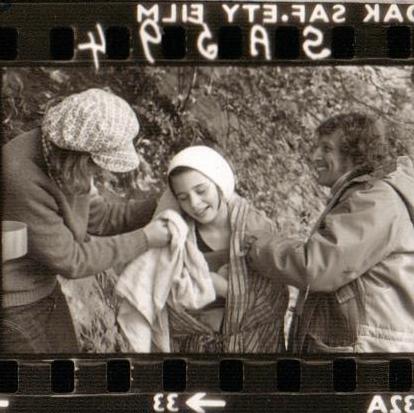
Sophie Neville having her hair cut on location for the part of Titty Walker in 1973
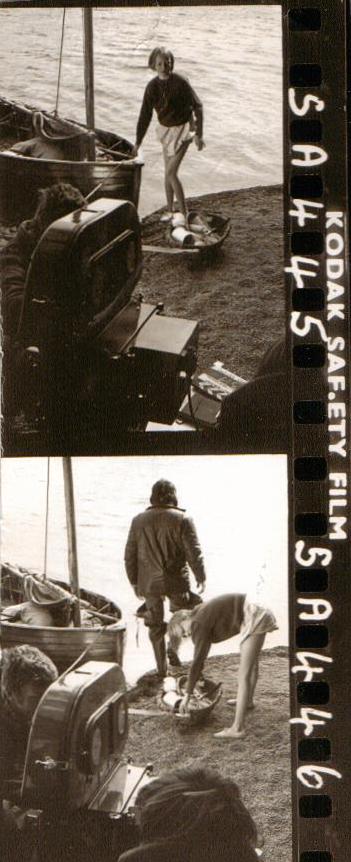
Do you know what lake we were on in the photograph below? We were busy loading urns of tea into a run-around boat to take out to the film crew who might have been on Cormorant Island. If you click on the photo you will get to the page of my diary, kept in June 1973, which describes this day.
Wardrobe Master Terry Smith and Sophie Neville in her costume to play Titty. But what is the name of the boatman? Does anybody know?
There are still many questions about the making of the movie that remain unanswered.
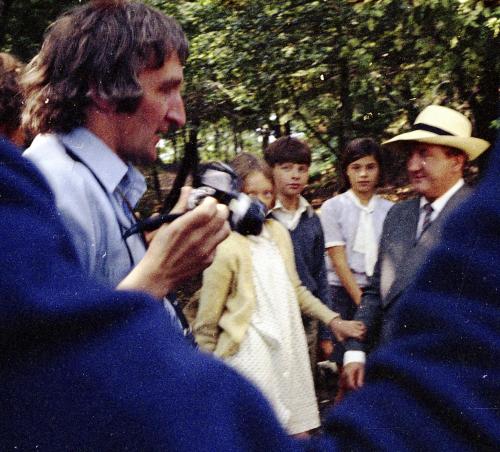
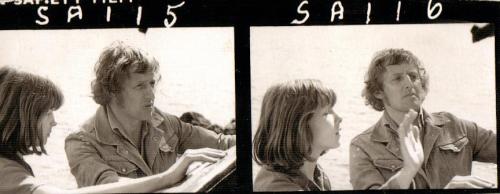
Does anyone know the name of this journalist who visited us on Peel Island?
This shot was taken while setting up the scene at Peel Island when Captain Flint brings Sammy the Policeman to question the Swallows. If you click on the photo you will find the photograph that the journalist ended up with. Titty’s hand is still on Captain Flint’s arm.
Making a movie is very different from watching one. Here is a record of Titty rehearsing the shot when she moves the camping equipment for fear of a tidal wave. It was a cold day on Coniston Water. The jersey came off when they went for a take.
Here you can see Lesley Bennett, playing Peggy Blackett, careening Amazon at Beckfoot. The same 35mm Panavision camera was focused on Kit Seymour, playing Captain Nancy.
Lesley Bennett as Peggy: Claude Whatham directing the scene with Kit Seymour
The location used for Beckfoot and the Amazon boathouse can be found at Brown Howe on the western bank of Coniston Water. If you click on the photograph of Peggy you can read more about what happened that day.
Kit Seymour playing Nancy Blackett and Lesley Bennett playing Peggy Blackett
If you would like to get future posts, please click the Follow button at the bottom of the side-bar.
You can read the full story about the making of Swallows and Amazons here:
David Wood, who wrote the screenplay for SWALLOWS & AMAZONS in 1973, has recently told me about his work adapting other Arthur Ransome books – GREAT NORTHERN?, PIGEON POST, WE DIDN’T MEAN TO GO TO SEA and WINTER HOLIDAY – all for Richard Pilbrow of Theatre Project Films.
.
Producer Richard Pilbrow with Director Claude Whatham in their wet weather gear at The Secret Harbour on Peel Island, Coniston Water
.
‘It was decided that GREAT NORTHERN? should be the follow-up to the SWALLOWS film, because it was ‘different’, being the only book set in Scotland. Also, the villainous birds’ egg collector was a strong adult role – Peter Sellers was mentioned….. We had great fun looking for locations, swooping around in a helicopter over Harris, Lewis etc.
Sophie Neville, Suzanna Hamilton & Sten Grendon with David Wood and Claude Whatham in 1973
.
‘Word got out that I was working on GREAT NORTHERN? and I had a very firm letter from Mrs Ransome saying that no permission had been granted to work on this title, and that it would not be granted!! No reason was given. Years later, the Ransome autobiography suggested that Mrs R didn’t like GREAT NORTHERN? and criticised it to Ransome’s face. Also, he used sometimes to swan off to the Highlands with his friend, Quiller-Couch (I think) to fish, leaving Evgenia on her own back in the Lake District. The only communication from him would be the occasional delivery on a horse and cart from the railway station of a salmon, caught in Scotland the day before! Maybe she resented Scotland for luring him away! But she was determined that GREAT NORTHERN? the movie would never see the light of day!! But I still wrote a complete screenplay! I did a film treatment for WINTER HOLIDAY, that never got off the ground either.’
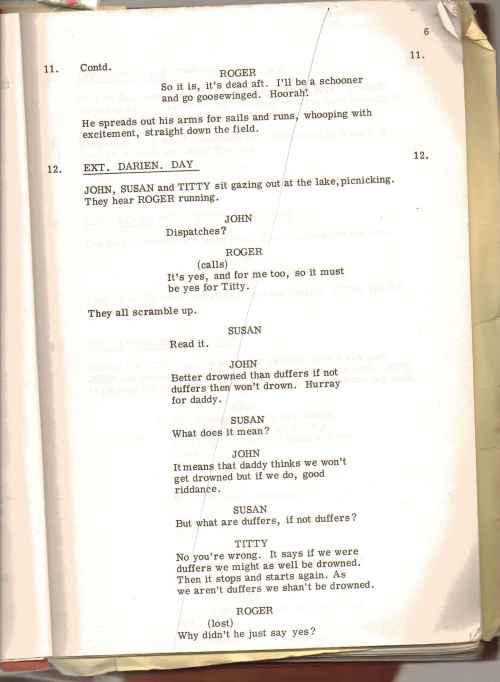
The script of the movie ‘Swallows and Amazons’ that I never saw until 2011
.
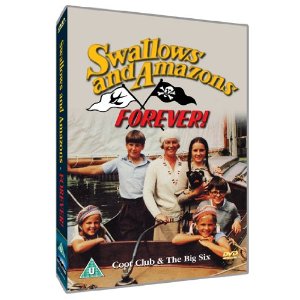
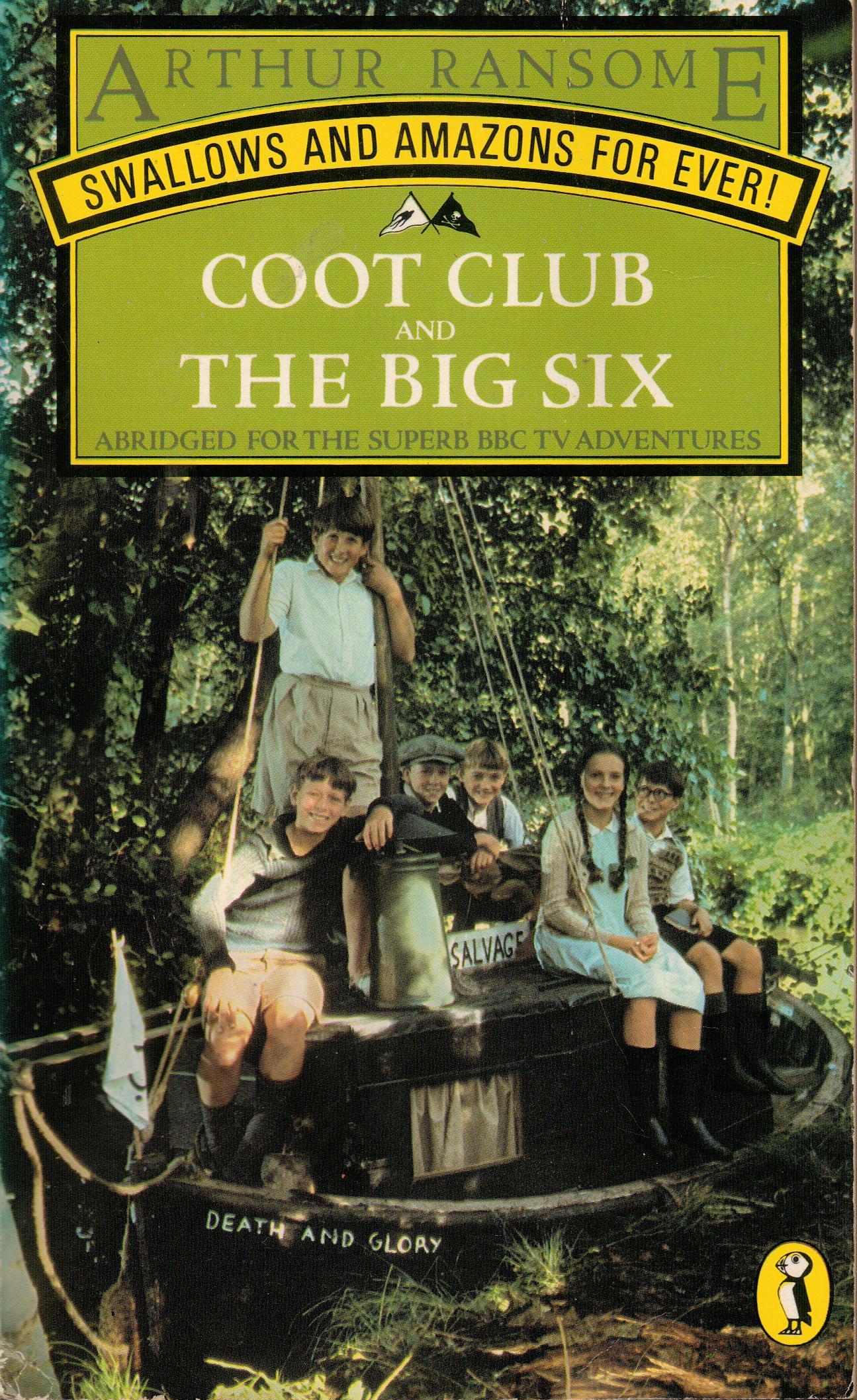
PIGEON POST was to be a six-part serial, a BBC-Theatre Projects co-production. David remembers that they got as far as looking for locations in the Lake District. I started making preparations to cast the children for this drama which Joe Waters wanted to produce in 1983, directly after making COOT CLUB and THE BIG SIX under the generic title SWALLOWS AND AMAZONS FOREVER! that had been adapted for television by Michael Robson.
.
‘WE DIDN’T MEAN TO GO TO SEA was also to be a serial. I did a treatment, visited Pin Mill and other locations, and met the man who built one of Ransome’s boats, or maybe worked on it with his father. All the materials and scripts still exist, but they are probably a bit too ‘straight’ for contemporary taste.’
.
David Wood’s numerous other forthcoming events and theatrical releases are listed on his website.
.
Can you help us? Was Quiller-Couch the friend who whisked Arthur Ransome off to fish in the Hebrides? Does anyone know where they went?
You can read more about the adventures we had whilst making Swallows and Amazons is these books, available to order online here
.
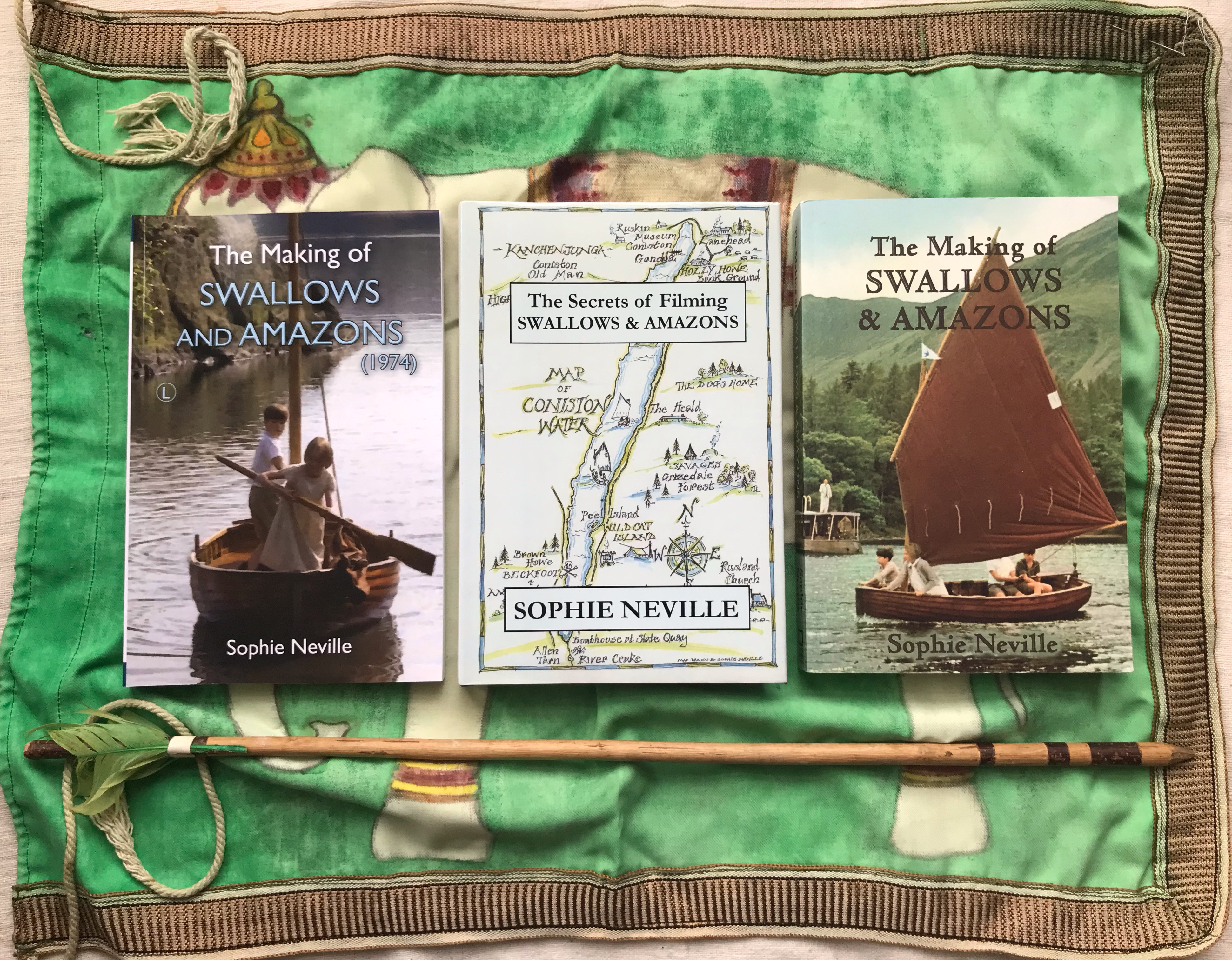
Different editions of ‘The Making of Swallows and Amazons (1974) by Sophie Neville’
David Wood, who originally worked with Evgenia Ransome to adapt her husband’s book Swallows & Amazons for the big screen in 1973, has recently written to tell me:
‘Several attempts were made to follow up SWALLOWS. I did a screenplay of GREAT NORTHERN?, plus detailed treatments of WINTER HOLIDAY (for film) and WE DIDN’T MEAN TO GO TO SEA (for television), plus a six-part serial based on PIGEON POST. But all of them bit the dust!!!
Claude is the only director for whom I worked as an actor on film (SWEET WILLIAM), television (CHERI, DISRAELI) and stage (VOYAGE ROUND MY FATHER), as well as working with him as a writer (SWALLOWS and a film that never got made called THE HEYDAY).
.
.
Claude Whatham must have made the BBC adaptation of Colette’s novel Cherijust before Swallows & Amazons as it was broadcast in April 1973. Brenda Bruce, who I knew as Mrs Dixon, played Charlotte whilst David was Desmond, supporting Scott Anthony and Yvonne Mitchell as the lovers Cheri and Lea.
.
David Wood played Lord Derby in the 1978 BBC costume drama Disreali that Claude Whatham directed. Whilst Ian McShane had the title role, the part of Queen Victoria was given to Rosemary Leach, who later played Mrs Barrable in the BBC serial of Coot Club and The Big Six. Suzanna Hamilton appeared in it too as one of the princesses. She must have been about seventeen – a good age to be zooming about in a crinoline with scooped up hair. It would have been quite a contrast to playing Mate Susan on Peel Island in the Lake District.
.
.
When he was in his twenties David starred in the feature film if…. with Malcolm McDowell. You can get it on DVD or watch the Youtube pasted in the Comments below. I’d love to see the wartime drama Aces High, the movie directed by Jack Gold in which David played Lt Tommy Thompson opposite Simon Ward, Peter Firth and Christopher Plumber as well as Malcomb McDowell. John Gielgud played the Headmaster in scenes shot at Eton in this film, while Arthur Lowe played his house master in if… I am not sure which school they used. You will have to let me know. Arundel?
.
In 2004 David was awarded an OBE for services to literature and drama. I was not surprised. His output has been prolific. To find out more about his work as an author and playwright do watch this short BBC documentary Meet the Authorpresented by Nick Higham.
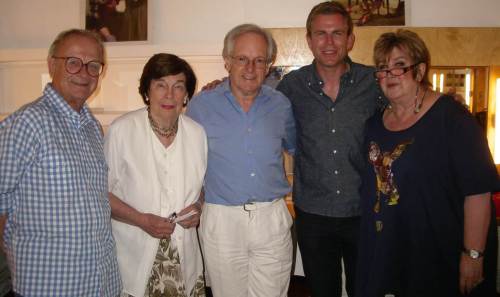
David Wood on Peel Island in 1973 with Claude Whatham, Sten Grendon, Suzanna Hamilton and Sophie Neville who is wearing David’s velvet hat.
On 19th August 2013, David Wood, who wrote the screenplay of Swallows & Amazons in 1973, took part on the Radio 4 show Quote…Unquote presented by Nigel Rees, an old friend of his from Oxford University. His fellow panelists were Matt Barbet, Katherine Whitehorn and Jenni Murray of Woman’s Hour. The programme can be heard on BBC i-Player and will be repeated on Saturday 24th August.
The reference to Arthur Ransome is 17 minutes in. David does a wonderful impression of Evgenia Ransome with whom he met for a number of script meetings whilst working on the adaptation. Her husband had died in 1967 and her grasp on his literary estate was legendary.
Here is the exact page of the script they were referring to:
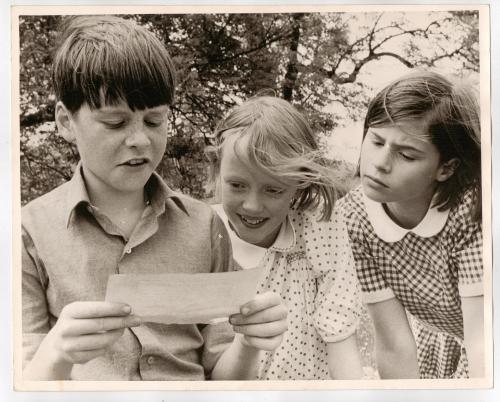
This was shot on location in the field below Bank Ground Farm in the Lake District. Richard Pilbrow, the producer, gave me a copy of this still, part of which was used on the front cover of both the Express and Daily Telegraph after the film was released in 1974.
Simon West as John Walker, Sophie Neville as Titty and Suzanna Hamilton playing Susan in Richard Pilbrow’s movie ‘Swallows & Amazons’ released by EMI in 1974
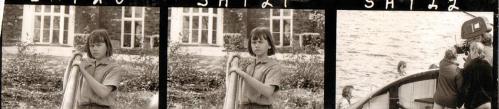
Suzanna Hamilton wrote in her diary that David Wood came to visit us on location in Cumbria on 29th May 1973, as you can see in the contact-sheet photo above. She had appeared in photo-captions illustrating a story called The Treasure Seekers that she thought he had narrated on the BBC Children’s programme Jackanory. David is not so sure, although he narrated three other series of Jackanony including The Hobbit, which is about to be released as a BBC CD.
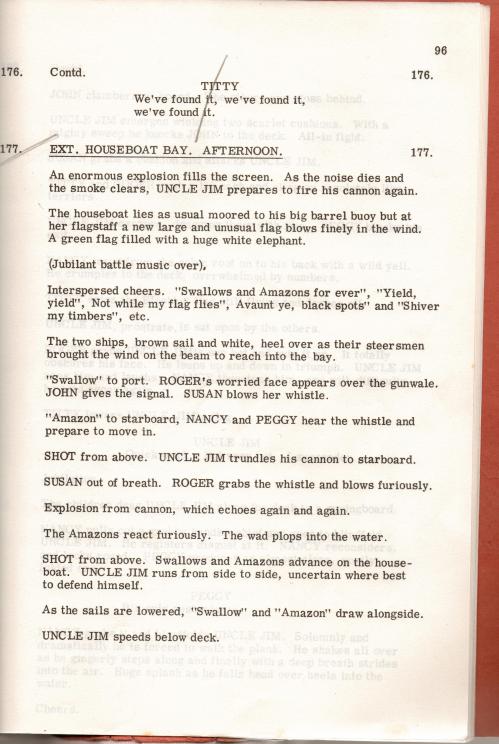
Here is another page from the screenplay of Swallows & Amazons (1974) with more stage directions than dialogue.
At the beginning of Nigel Rees’ radio programme there is a reference to The Gingerbread Man, one of David’s original theatre plays written for children. This was premiered at the Swan Theatre, Worcester in 1976. My mother appeared as Miss Pepper in a subsequent production at the Everyman Theatre in Cheltenham.
A production of ‘The Gingerbread Man’ at the Everyman Theatre in Cheltenham, 1976
Peter Walker with Sophie Neville at Lakeside Station on Lake Windermere
Peter Walker has just written from Kendal to tell me that Arthur Ransome has been heard speaking on BBC Radio Cumbria.
A newly cleaned up archive recording of the author reading from his classic book on fishing ‘Rod and Line’ in 1956 was featured 25 minutes into Emma Borthwick’s programme for an item recorded by Jennie Dennett at Hill Top, the Ransome’s house above Haverthwaite, part of which the new owners, Stephen Sykes and his wife Janine, have opened for holiday accommodation
Peter Walker’s excellent ‘Swallows and Amazons’ tour gives one an insight and understanding of Arthur Ransome’s life in the Lake District. For more information please click here.
The Mountain Goat bus built for explorers. It enables you to look out over the dry stone walls of Cumbria as you travel along.
I believe that the middle boathouse in this photograph was the one up for sale.
If you visit the ITV News website, you can watch a story about the boathouse originally belonging to the Collingwood family of Lanehead which inspired Arthur Ransome when writing Swallows and Amazons. It includes a short clip of the fishing scene from our film.
The reporter from Border Television didn’t get all his facts right. We are not sure who Arthur J Ransome is. The author was called Arthur Mitchell Ransome.
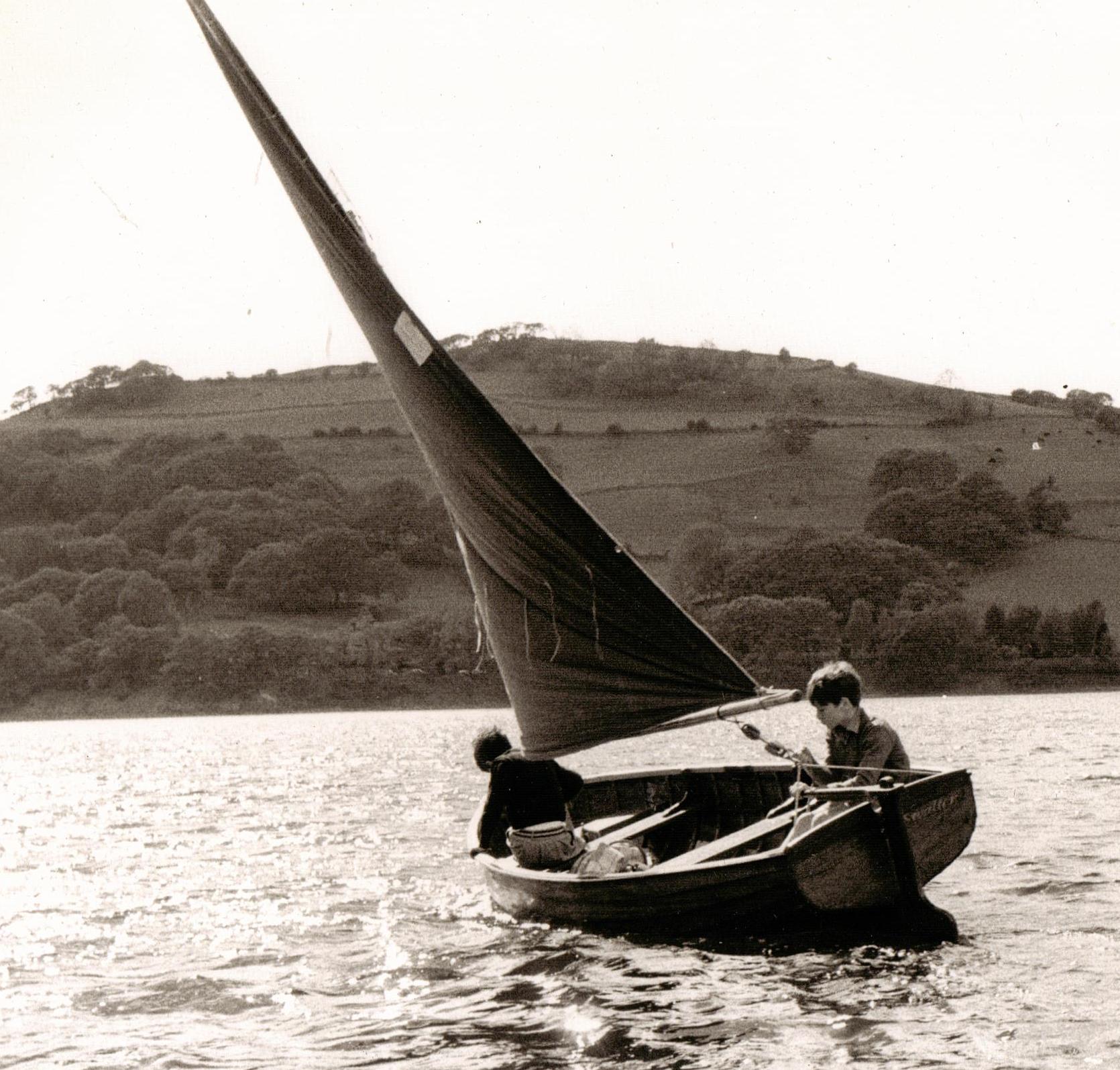
Here we were, intrepid explorers, finding Swallow at Holly Howe in May 1973. The water was freezing. You can see the lovely view from the boathouses.
If you have ever wondered what Nancy Blackett is doing now – here she is. Built by Hillyards of Littlehampton in 1931 she was bought by Arthur Ransome with royalties from Swallows and Amazons and became both the inspiration and model for his book about the Swallows’ unplanned voyage to Holland ~ We Didn’t Mean to go to Sea, in which she was known as the Goblin. She also appears in Secret Water.
I was at the Royal Harwich Yacht Club to give a talk on making the BBC adaptations of two other Arthur Ransome books set in East Anglia, Coot Club and The Big Six.
I was sure that people would rather be out in the sunshine but it was well attended.
After watching a clip of Ginger and Rosa, the BFI/BBC feature film directed by Sally Potter that starred Nancy Blackett, we wandered down to the jetty in front of the new club house, and grabbed a chance to go out on the Orwell.
Soon sails were being hoisted and we were underway, sailing down river in the evening light.
Conditions were perfect for Nancy, a 28 foot Bermurdan cutter.
I took the helm, whilst the others did the hard work.
We were soon sailing past Pin Mill, which also features in the book.
Some members of the crew were experienced sailors,
others had previously managed to avoid spending much time on the water, but we all had a wonderful experience and were sad when the sails were stowed for the night.
We saw a couple of Thames barges also coming in, as Nancy settled down after a successful day. Think of joining The Nancy Blackett Trust and sailing her yourself.