David Wood, who originally worked with Evgenia Ransome to adapt her husband’s book Swallows & Amazons for the big screen in 1973, has recently written to tell me:
‘Several attempts were made to follow up SWALLOWS. I did a screenplay of GREAT NORTHERN?, plus detailed treatments of WINTER HOLIDAY (for film) and WE DIDN’T MEAN TO GO TO SEA (for television), plus a six-part serial based on PIGEON POST. But all of them bit the dust!!!
Claude is the only director for whom I worked as an actor on film (SWEET WILLIAM), television (CHERI, DISRAELI) and stage (VOYAGE ROUND MY FATHER), as well as working with him as a writer (SWALLOWS and a film that never got made called THE HEYDAY).
.
.
Claude Whatham must have made the BBC adaptation of Colette’s novel Cherijust before Swallows & Amazons as it was broadcast in April 1973. Brenda Bruce, who I knew as Mrs Dixon, played Charlotte whilst David was Desmond, supporting Scott Anthony and Yvonne Mitchell as the lovers Cheri and Lea.
.
David Wood played Lord Derby in the 1978 BBC costume drama Disreali that Claude Whatham directed. Whilst Ian McShane had the title role, the part of Queen Victoria was given to Rosemary Leach, who later played Mrs Barrable in the BBC serial of Coot Club and The Big Six. Suzanna Hamilton appeared in it too as one of the princesses. She must have been about seventeen – a good age to be zooming about in a crinoline with scooped up hair. It would have been quite a contrast to playing Mate Susan on Peel Island in the Lake District.
.
.
When he was in his twenties David starred in the feature film if…. with Malcolm McDowell. You can get it on DVD or watch the Youtube pasted in the Comments below. I’d love to see the wartime drama Aces High, the movie directed by Jack Gold in which David played Lt Tommy Thompson opposite Simon Ward, Peter Firth and Christopher Plumber as well as Malcomb McDowell. John Gielgud played the Headmaster in scenes shot at Eton in this film, while Arthur Lowe played his house master in if… I am not sure which school they used. You will have to let me know. Arundel?
.
In 2004 David was awarded an OBE for services to literature and drama. I was not surprised. His output has been prolific. To find out more about his work as an author and playwright do watch this short BBC documentary Meet the Authorpresented by Nick Higham.
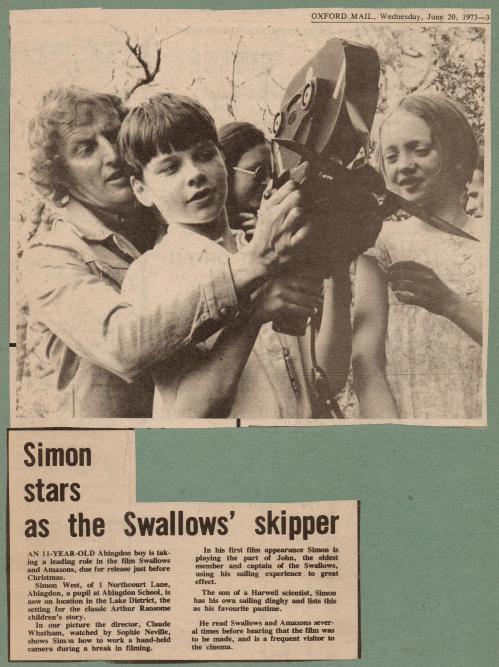
David Wood on Peel Island in 1973 with Claude Whatham, Sten Grendon, Suzanna Hamilton and Sophie Neville who is wearing David’s velvet hat.
On 19th August 2013, David Wood, who wrote the screenplay of Swallows & Amazons in 1973, took part on the Radio 4 show Quote…Unquote presented by Nigel Rees, an old friend of his from Oxford University. His fellow panelists were Matt Barbet, Katherine Whitehorn and Jenni Murray of Woman’s Hour. The programme can be heard on BBC i-Player and will be repeated on Saturday 24th August.
The reference to Arthur Ransome is 17 minutes in. David does a wonderful impression of Evgenia Ransome with whom he met for a number of script meetings whilst working on the adaptation. Her husband had died in 1967 and her grasp on his literary estate was legendary.
Here is the exact page of the script they were referring to:
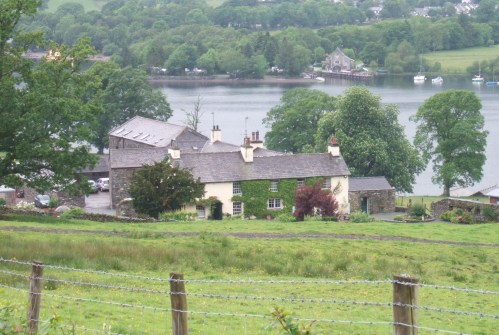
This was shot on location in the field below Bank Ground Farm in the Lake District. Richard Pilbrow, the producer, gave me a copy of this still, part of which was used on the front cover of both the Express and Daily Telegraph after the film was released in 1974.
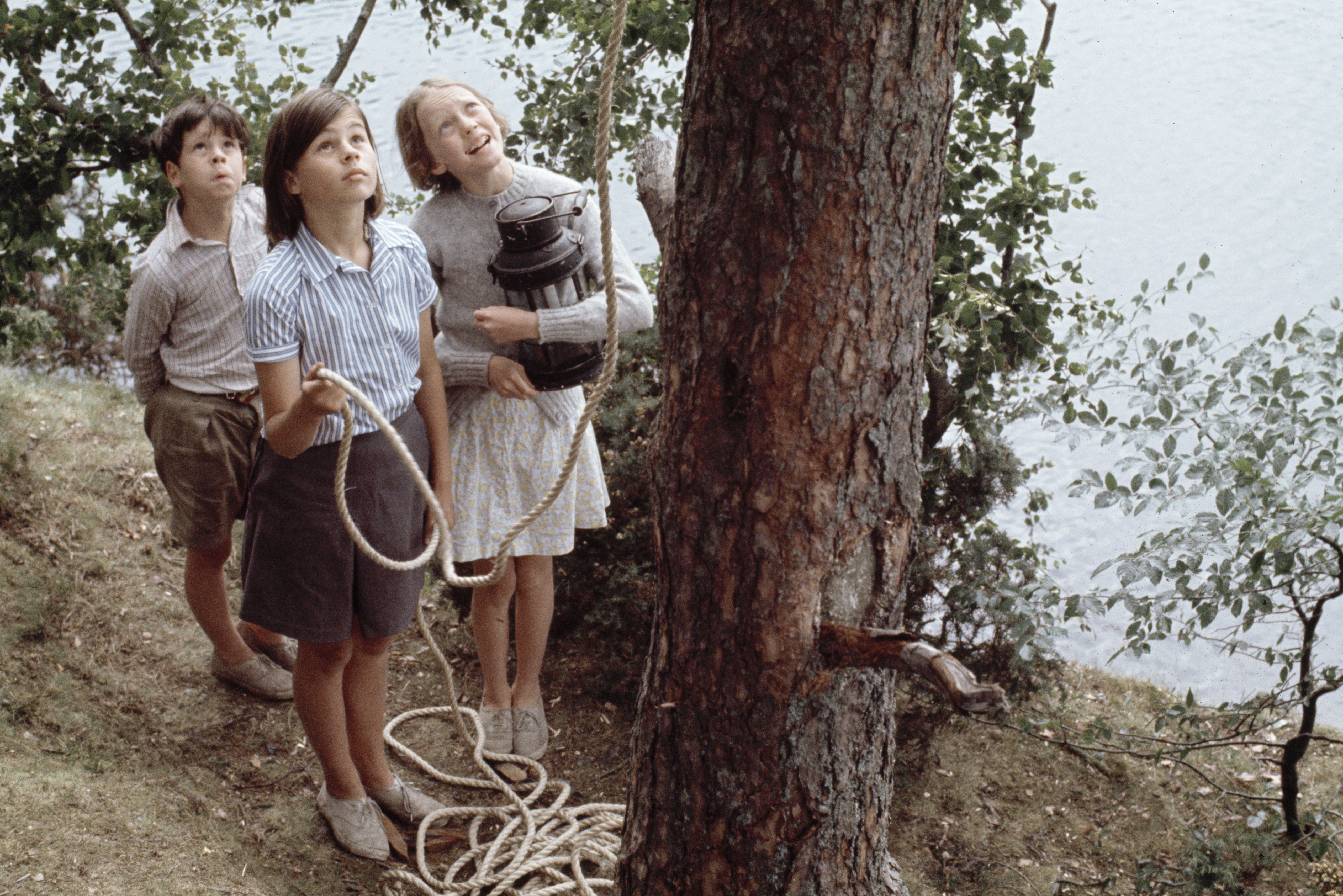
Simon West as John Walker, Sophie Neville as Titty and Suzanna Hamilton playing Susan in Richard Pilbrow’s movie ‘Swallows & Amazons’ released by EMI in 1974
Suzanna Hamilton wrote in her diary that David Wood came to visit us on location in Cumbria on 29th May 1973, as you can see in the contact-sheet photo above. She had appeared in photo-captions illustrating a story called The Treasure Seekers that she thought he had narrated on the BBC Children’s programme Jackanory. David is not so sure, although he narrated three other series of Jackanony including The Hobbit, which is about to be released as a BBC CD.
Here is another page from the screenplay of Swallows & Amazons (1974) with more stage directions than dialogue.
At the beginning of Nigel Rees’ radio programme there is a reference to The Gingerbread Man, one of David’s original theatre plays written for children. This was premiered at the Swan Theatre, Worcester in 1976. My mother appeared as Miss Pepper in a subsequent production at the Everyman Theatre in Cheltenham.
A production of ‘The Gingerbread Man’ at the Everyman Theatre in Cheltenham, 1976
Sophie Neville, Suzanna Hamilton, Sten Grendon, Lesley Bennett, Kit Seymour, Simon West with Daphne Neville at a Puffin Club event for the new edition of ‘Swallows and Amazons’ organised by Kaye Webb in London photo: Woman Magazine
When I look back on our lives as they were fifty years ago, I can’t help smiling. Whilst one is impacted by fashions that were too unfortunate to be revived – those collars we thought so groovy – other things haven’t changed at all. I don’t think sailing shoes or jean jackets have ever been out of circulation.
Every day clothes in 1973
In July 1973 Claude Whatham, pictured above in his Levis, had my sisters and I in a series of three Weetabix commercials that depicted life in 1933, forty years before, when the Great British breakfast cereal was first launched on the market.
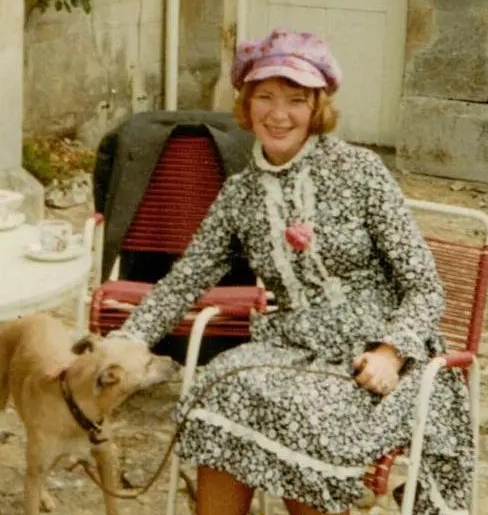
Meanwhile, my mother was presenting her afternoon television programme for HTV West called ‘Women Only’ – dressed in her Donny Osmond hat.
I would happily wear her suede coat today and can often be seen in the hat. The lace-up boots looked good recently with a Wonder Woman fancy dress outfit but were terribly uncomfortable. My sister still hasn’t forgiven me for giving them away.
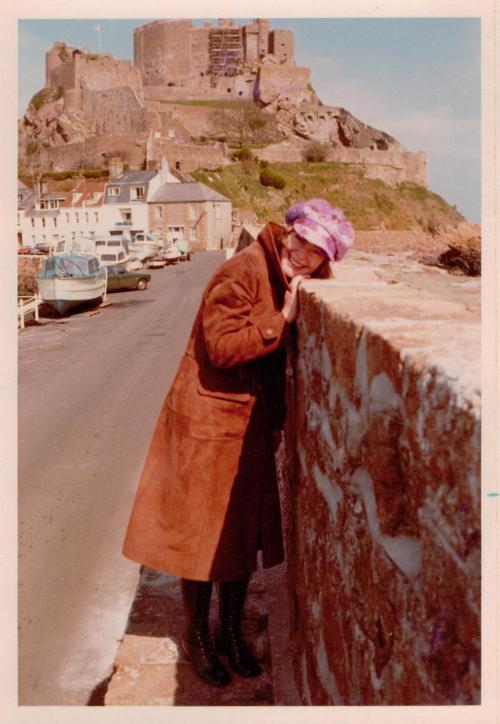
Daphne Neville on location in Jersey while presenting ‘Women Only’ in 1973
As always, well made things of quality have endured, and those faithful goods from Land Rovers to Levi jeans, Puffin Books and Weetabix are, thankfully, still being produced.
We collected Greenshield stamps, saving up zilions to buy a Super 8 movie camera. The results were wobbly but they give a glimpse into the way we were:
I have been writing about life in England fifty years ago, reflecting on how our lives have changed. Can you help me?
Sophie Neville at the EMI Elstree Studios in 1973
The big change seems to be in communications. In 1973 we were still queuing up to using coin operated telephone boxes in the street, asking the operator for Ambleside 2232. Letters and notes were written by hand. I learnt italic writing, so as to be clear. Manual type-writers used black and red stripped tape. Mistakes were obvious.
I’d love to receive comments (below) on how you remember aspects of growing up in the early 1970s. What did you eat then? Where did you go on holiday? What was it about 1973 that impacted you?
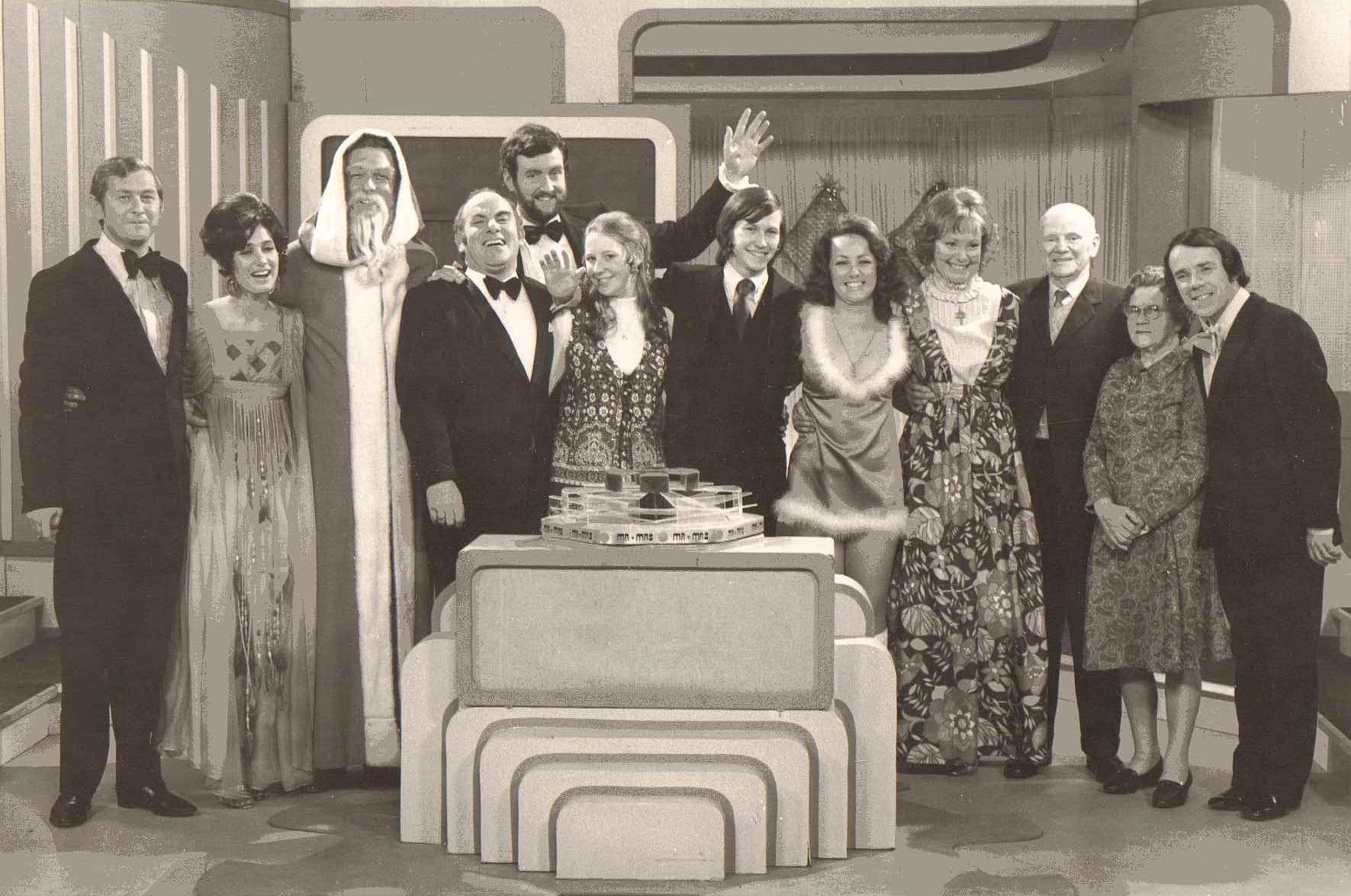
Jean McGill, Jane Grendon, Stephen Grendon, Kit Seymour, Sophie Neville, Claude Whatham, Simon West, Lesley Bennett, Suzanna Hamilton, Ronnie Cogan in 1973
My husband remembers long hair, flared trousers and shirts with massive curved collars. I always longed for an embroidered t-shirt with wide sleeves or a cheese-cloth shirt but loathed the feel of acrylic jumpers and ribbed polo-necks. Stripy ones. The fabric could be so vile, we didn’t feel each other as much as we do now. There was much less hugging.
Mum wearing a fluffy Donny Osmond hat
The food was pretty applauding. My friend Suzanna has just reminded me about the innovation of Italian cooking. Spaghetti was the highlight of our lives; a treat that we might have on Saturdays or for a party when red candles would be pushed into wine bottles and checked paper table cloths could enhance a Bistro image. However prawn cocktail was the pinnacle of popular aspiration, although us children preferred picking of the shells off prawns ourselves.
Daphne Neville in 1973
At parties you’d be offered chunks of cheese and pineapple on cocktail sticks stuck into a half a melon that had been covered in tin foil. I always rather longed for the melon. Homemade beer was regrettably all the rage, along with freezing your own runner beans. The process was quite fun (we enjoyed sucking air out of the freezer bags with a straw) but the beans were stringy and disgusting.
My family thought having to bring-a-bottle to parties was a great idea but we loathed the fact that cigarettes were smoked everywhere you went. Unless you were in the garden where abysmal furniture design spoilt the view.
Colour televisions were only just beginning to invade people’s homes. They were terribly expensive. We had to make do with our crackly black and white screen, watching Blue Peter,Animal Magic and Tony Hart presenting Vision On with cartoons such as Marine Boy until Childrens’ Television ended with The Magic Roundabout just before Daddy came home from the Works in time for the 6 O’Clock News. I then bored myself rigid watching Points West and Nationwide before It’s A Knockout.
We were allowed to stay up to watch Dick Emery , Benny Hill, and ‘Titter ye not’, Frankie Howerd along with dramas such as The Onedin Line. There was one sit com starring Wendy Craig entitled Not in front of the Children, which of course we all wanted to watch. What influence did this have on our young minds?
Mum appearing as a member of the Salvation Army on ‘The Dick Emery Show’
Mummy worked for HTV West presenting an afternoon programme called Women Only with Jan Jeeming. She also read the letters on Any Answers?, which was produced by BBC Radio Bristol by Carole Stone. I was so impressed – amazed – to meet a female radio producer. Carole was one of the few who worked her way up from being a BBC secretary to producing Any Questions.
HTV West Christmas Show presented by Bruce Hocking, Jan Leeming & Daphne Neville
Our holidays were spent camping in Wales. Packing for this took two weeks. We used drag an orange dome tent out of the airing cupboard and slept on fold-up sun-loungers from the garden.
Sailing was all about Mirror dinghies, which you could buy in kit form and make out of plywood in the diningroom. We couldn’t afford one, but in the late 1970’s Dad bought a fibre-glass Topper, which was the height of cool. He called it Earwig.
We had our photos developed at the chemist or sent them off to Tripleprint, so we could share the small version with others. Although they were bought by Bonusprint in 1979, I was a loyal customer until well into the 1990s and remain plagued by small photos I can’t quite bring myself to chuck away. We stuck them in scrapbooks made of green and blue paper. Here is a page of mine from the making of Swallows and Amazons.
My family were very keen on taking home movies. Dad usually took slides when we went on holiday, which were viewed along with the supper-8 footage at Christmas time when he pushed the furniture back, took down a painting and projected our memories onto the wall.
What have I forgotten? Do post your own recollections, especially of sailing and camping in the early seventies, in the comments below.
Suzanna Hamilton, Sten Grendon, Sophie Neville and Simon West as the Swallows
I have been sent a newspaper clipping dated 15th June 1973, which appears to have been published in The Mirror, a national daily newspaper here in the UK. It describes a scene shot for Swallows & Amazons (1974) that was never used in the finished film and proved something of a discovery for me.
Whilst on their way to visit the charcoal-burners, Captain John shows the crew of the Swallow how to lay a patteran, a secret gypsy sign, usually made from twigs or vegetation, to point the way. I remember the scene from Arthur Ransome’s book with affection but I have no recollection of filming this in the Lake District.
~ click on the image to enlarge ~
I do recall that our director, Claude Whatham would take us on a quick run just before shooting a scene so that we would be both energised and genuinely breathless as we delivered our lines. I expect it was his secret way of obtaining natural performances out of us children. Here we can be seen in rehearsal wearing our Harry Potter-like nylon track-suit tops for warmth, while the big old 35mm Panavision camera was tilted down on us. Claude can be seen holding the script we never read. We were much more interested in the patterans.
Claude loved running. When he retired from film making he would regularly run around Anglesey in North Wales, where he lived, covering miles each day even in his early eighties. I have always been more excited about galumphing, the art of running down hill, taking leaps as you go to cover more ground. Arthur Ransome must have tried this as a boy on holiday in the Lake District as he has the Swallows galumphing like anything at this stage in the story, on their way back from visiting the charcoal-burners. They get so carried away that some of them miss the patterans that had been so carefully laid on their way up the hill. There must simply have not been enough time to include this detail in the finished movie. I wonder if the original footage still exists.
Sophie Neville as Titty in the original film ‘Swallows and Amazons’ (c)StudioCanal
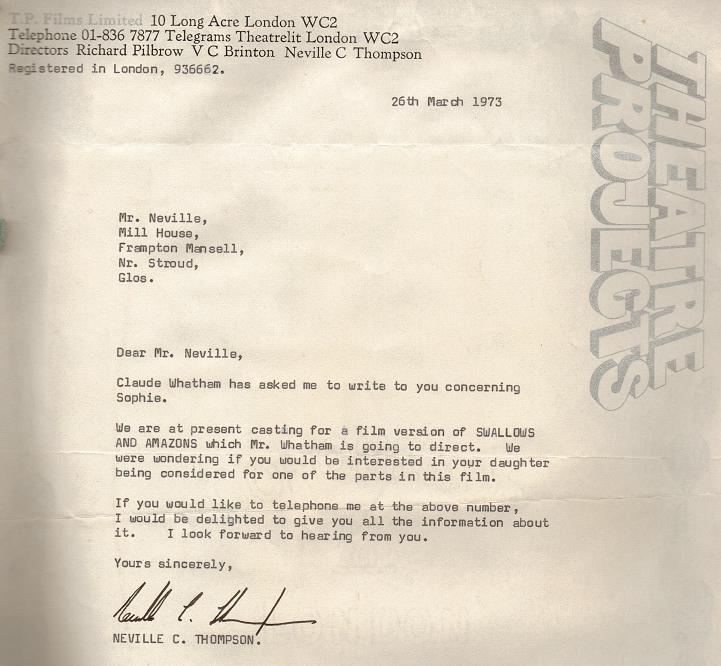
People often ask what auditioning for the original film of ‘Swallows and Amazons’ was like for us, back in 1973, long before the advent of email and Youtube when casting directors only ever worked in Hollywood.
For me, the process was pretty quick. I had worked for the Director, Claude Whatham before, when I had a small part in the BBC film of Laurie Lee’s book, ‘Cider with Rosie’. He must have remembered me, as a letter arrived in the post:
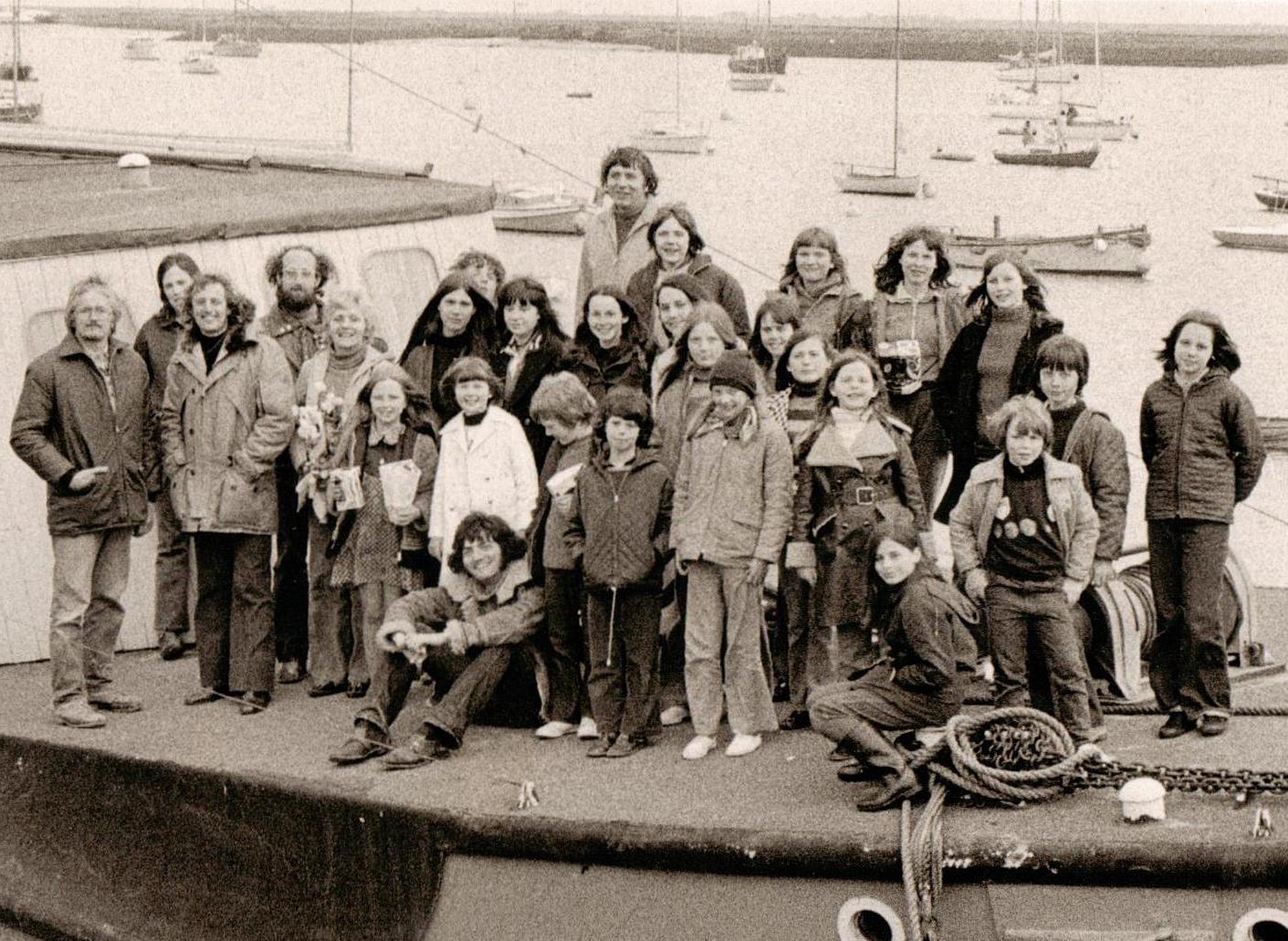
After meeting Claude again at an interview held at Richard Pilbrow’s Theatre Project’s offices in Long Acre on a sunny day in March 1973, I was invited to go to Burnham-on-Crouch for a sailing weekend that was to constitute the final audition. This proved something of an endurance test. It was miles from where we lived. The weather was awful with driving rain and rough seas. The only warm piece of clothing I had was a knitted hat. We slept in cabins aboard a permanently moored Scout Boat with flowery orange curtains. There were no parents around to boost our moral. The sailing was challenging and I felt bitterly cold.
Our producer Richard Pilbrow bought his two children, Abigail and Fred. With him was Neville Thompson, director Claude Whatham, and David Blagden who was to be the sailing director. He told us that he had read ‘Swallows and Amazons’ forty-two times, which sounded daunting. I had read all the books but could not see myself as Titty. She had thick dark hair in all the pictures and I was bossy – far more like Mate Susan. We didn’t read from a script. We weren’t asked to improvise or act out a scene. There was no film-test, but 8mm movie footage was taken. I wonder if it still exists.
Out of an initial 1,800 who applied, twenty-two children were short-listed for the six parts of the Swallows and the Amazons. While there were only two or three boys up for the role of Roger there were five girls auditioning to play Titty. At one stage Claude had a chat with all five of us in our cabin, all the Tittys. The others were all so sweet that I didn’t think I stood a chance. I was undeniably gangly and felt that I kept saying the wrong thing.
‘Did you take the helm?’
‘Oh, we all helmed like any-thing.’
One of the other girls auditioning for Titty looked incredibly together. She had pretty, fashionable clothes and would make a point of brushing her hair and wearing jewelry, just as Mummy would have liked me to have done. While I was used to boats my sailing wasn’t up to much. I was completely in awe of Kit Seymour’s seamanship and how the fast she got the dinghies to whizz through the driving rain.
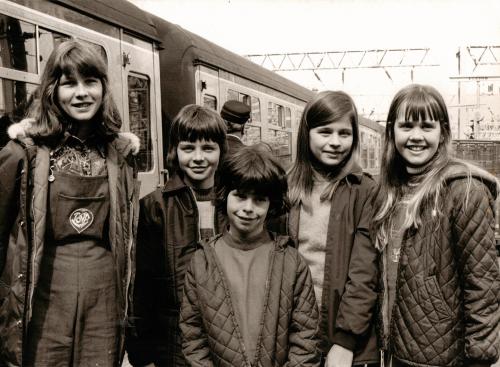
A photograph taken for the Evening Standard of the cast at Euston Station on their way to the Lake District, before haircuts. Suzanna said, ‘We all felt right twits.’
A decision must have been made pretty quickly as all local education authorities demanded at least six weeks to process our licences to work on a film. It was 1973, casting time must have been scarce and I’m afraid the children finally cast all ended up coming from the south of England: Middlesex, Berkshire, Gloucestershire and London. None of us went to stage schools or had theatrical agents, apart from Suzanna Hamilton who went to the Anna Scher after-school Drama Club in Islington. But before we knew it our hair was cut, transporting us back to 1929 and we were out on Lake Windermere realising the dream.
The Swallows, wearing ex-BOAC buoyancy aids, on Coniston Water
‘Did you have a pushy Mum?’ I am asked.
‘Oh, yes!’ She was brought up reading Noel Streatfield’s ‘Ballet Shoes’, longed to act herself and so was keen for me to be in ‘Cider with Rosie’. She made the effort to take me along to a drama club and to a huge audition in the Stroud Subscription Rooms, however I only got the little part of Elieen Brown was because I could play the piano. My mother did force me to take my music to the third audition, which of course enabled me to out-shine the others. I was not a hugely talented pianist and ended up having to practice for eight hours a day before I could master the accompaniment to ‘Oh, Danny Boy’ featured in the film. It was shear hard work that won through in the end.
We were all lucky to be the right age at the right time. I was perhaps the most fortunate because at twelve I was really too tall for the part of Titty. I was a year older and a good two inches taller than Simon West who played my elder brother, but Claude must have known that he could cheat this on-screen.
‘Are you glad you did it?’
Yes, it was fun – wonderful to spend a summer in the Lake District. A chance grabbed. I had not been yearning to act but took a great interest in how the movie was made. In the end the experience set me up for something of a career in television behind the camera and gave me the confidence to a number of things that might otherwise have remained a dream.
You can read about the adventures we had making the film of Swallows and Amazonshere:
On 7th June 1973 the seventy-strong crew busy making the movie ‘Swallows & Amazons’ arrived at Bowness-on-Windermere in Cumbria to film the scenes when the Swallows decide to explore Rio, the ‘native settlement’ due north east of Wildcat Island. The weather was glorious.
The Art Director, Simon Holland and Set Dresser Ian Whittaker gathered a number of vintage boats to give the old grteen boatsheds and jettys a 1929 feel.
I was sent a scrap-book that contains a clipping from the Evening News, when reporter Terry Bromley joined the film crew for a day. He lists many of the forty or so local people who either appeared as supporting artists in the scenes or provided action props such as vintage cars and traditional boats. Everyone, including the drivers and boatmen, were dressed in costumes from 1929, only forty-four years before 1973.
The caption reads: “Susan and Titty rush past some of the local extras in a scene filmed on Bowness jetty.”
“Below, Mrs Jill Jackson, of Kendal, takes her family, Fiona, 9, Lindsay, 13, Nicola, 9 and Shane,11, for a donkey ride.”
“Four jovial extras from Ambleside with other members of the cast. They are Stanley Wright who plays a motorboat mechanic, Herbert Barton (casual holiday maker), James Stelfox (boat mechanic) and L.Lucas Dews (a man just returned from abroad).” James Stelfox had appeared as a station master in an earlier scene set at the Haverthwaite Steam Railway Station.
They were dressed by Wardrobe Master Terry Smith, while other period details were organised by the Art Director Simon Holland, his Set Dresser Ian Whittacker and crew of prop men lead by Bob Hedges.
“Sarah Boom of Bowness with a period cycle, a member of the Kendal Borough Band and a member of the Ambleside Players, Mrs Peggy Drake, with her 13-year-old son William.” I know that the Kendal Band wore their own, original 1020’s uniforms as they played in the bandstand.
The caption reads: ‘Janet Hadwin and her father, Jack Hadwin, stand by an Austin car and BSA motor cycle of the period.’ The photograph below it shows Sophie Neville, Simon West, Suzanna Hamilton and Sten Grendon in a pony trap during a break in the filming.
For a full list of actors and supporting artists who were involved in the filming please see the second edition of ‘The Making of Swallows and Amazons (1974)’, published by The Lutterworth Press, which can be purchased on-line or ordered from your local bookshop or library.
If you would like to see more behind-the-scenes photos and home movie footage taken in Bowness on 7th June 1973 please go to earlier posts:
Sten Grendon, Suzanna Hamilton and Sophie Neville as the Walker children in 1973
In this morning’s despatches ~ via the Royal Mail ~ a letter arrived saying, ‘I’m sure we would all love to know how the recent screening of the film went and how you enjoyed the experience.’
Last Sunday, Suzanna Hamilton and Sten Grendon joined me at the Michael Croft Theatre for a specialscreening of Richard Pilbrow’s 1974 adaption of ‘Swallows & Amazons’ put on for an audience of excited children by Dulwich Film. We hadn’t watched the movie together since the premiere at the ABC in Shaftesbury Avenue in 1974. I hadn’t even seen Sten since that year. As we walked into the darkened auditorium, Sten’s girlfriend, who struck me as being rather special, insisted that we sat together to watch the film.
Blurred memories do come rushing back. I never managed to produce a real owl hoot. Simon could – and I am sure Captain Nancy was adept, but it was all the trying to that brought us together.
Director Claude Whatham at the Landing Place on Wild Cat Island with Suzanna Hamilton, Simon West, Sten Grendon and Sophie Neville
And as I watched the one thing that really struck me was, ‘How big Landing Place beach was then!’ I found myself leaning over and whispering to Sten that it has all but washed away. He didn’t know that the beach had been especially constructed for the film. It had been kept a secret.
Rehearsing a scene on the Landing Place with Swallow
Our experience of making the film in 1973 was really quite technical. It was a wet summer and we had something of a battle against the elements to complete the scenes scheduled for each day. Back then, the aim was to capture enough footage to make the equivalent of 4 minutes of film in the final edit. You’d think this would be easy but each frame had to bear scrutiny on the big screen. Since attention to detail was paramount, even making scrambled eggs in front of the camera was a demanding task.
As the wind blew north up Coniston Water we joined in the concentration required for the task of film-making. We were in Cumbria to work back then, even if working in the Lake District was something of an adventure, something we did for fun.
Sten Grendon on set with Claude Whatham and Suzanna Hamilton
So when we relax back and watch the film now we have a huge appreciation of what Claude Whatham put together. We laughed out loud, appreciating the humour. Much of this was generated by the serious expression on Roger’s face when he was picking up the why and wherefore of how something worked for the first time. It’s been a rare and ageless form of comedy that children loved forty years ago and evidently still love today. They always notice, ‘the bit when Roger doesn’t realise the cap is on the telescope.’ Adults love the fact that Roger always seems to be eating.
‘Oh yes!’ Sten remembered afterwards. ‘That pork pie I ate standing in the Amazon River. I was offered the choice of eating a meat pie or an apple. Well, I chose the pie, but it wasn’t so great when I had to eat another for the second take, and then another two for a different camera set-up.’
Isn’t it funny how well one can remember food?
Sten Grendon as Roger Walker and Suzanna Hamilton as Susan Walker on Peel Island
‘Are you really old?’
‘Not so very old, by I was younger then,’ as Virginia McKenna said in the guise of Mrs Walker remembering her days camping in homemade tents. I bet someone asked Arthur Ransome the very same question.
I grew taller and had my teeth put straight. Same straggly hair. Sten still has all his thick dark hair and is quite tall himself. He works as a gardener now. Suzanna still has the biggest smile. She is the one who now needs to stand on a camera box but then she is the only one of us who does. What I mean to say is that she is the professional actress. We just turn up for fun.
‘And the others?’
I don’t know. Really, I don’t know. I’d love to see them again but am quietly waiting for them to contact me. I hope they do. I have the first proof of a book to send them – it’s the diary I kept whilst making the film, forty years ago.
Sophie Neville, Suzanna Hamilton and Sten Grendon in 2013
On Sunday 21st April I took the train to Waterloo, not to run the London Marathon, but to watch ‘Swallows & Amazons’, which was being shown by Dulwich Film at the Michael Croft Theatre. Suzanna Hamilton, who played Susan and Sten Grendon, who played Roger, joined us to celebrate the fact that forty years ago, in April 1973, we embarked on the adventure of making the movie.
I had been asked to introduce the film and answer questions about how it was made after the screening. Members of the audience were keen to know what lakes had been used as locations and if we had enjoyed our time on set. One family flew back from Spain especially so that they could come, even though they had seen the DVD of the film fifteen times. The children in the audience, who I guess were aged from about 4 to 10 years, sat in complete silence, totally absorbed.
14th May 2023 will mark the 50th Anniversary of filming Richard Pilbrow’s classic movie ‘Swallows and Amazons’ on location in the Lake District that was premiered the year after on 4th April 1974.
The 40th Anniversary of the release of the original film ‘Swallows and Amazons'(1974) was marked by a number of events around the UK:
Dulwich Film screened ‘Swallows & Amazons’(1974), produced by Richard Pilbrow and directed by Claude Whatham. The programme was introduced by Sophie Neville, Suzanna Hamilton and Sten Grendon who played the Swallows. They answered questions about how it was made after the screening at the Michael Croft Theatre.
Michael Croft founded the National Youth Theatre. One of his students was Simon Ward, who went on to star as James Herriot in the film version of‘All Creatures Great and Small’, which Claude Whatham directed in 1974 after finishing ‘Swallows & Amazons’. Sophie Neville had been invited to watch the filming in Yorkshire, meeting Anthony Hopkins and members of the cast and crew who had worked on Swallows & Amazonsin 1973. Brenda Bruce played Mrs Harbottle and Wilfred Josephs composed the music, Terry Needham was the Location Manager and Ronnie Cogan the Hairdresser.
‘I didn’t meet James Herriot until I worked in production at the BBC on Russell Harty in 1982. He was charming – an incredibly confident man. I don’t remember his wife being interviewed but she came with him to the studio and struck me as being terribly nice. She wore a proper dress, which is more than could be said for anyone else in the Green Room.’
A year later Sophie Neville appeared with Simon Ward’s daughter Sophie Ward in the adventure movie ‘The Copter Kids’when they played sisters. Simon brought his family to watch the filming on location near Gerrards Cross. In September there will be a special tribute to Simon Ward at the Michael Croft Theatre when they will be screening ‘Young Winston’.
Sophie Neville gave a 40th anniversary talk on ‘Filming Swallows & Amazons in 1973′ for members of The Arthur Ransome Society gathering for their AGMat Brockenhurst College in the New Forest. ‘Swallow’ , the dinghy from the 1974 film,was moored at Buckler’s Hard on the Beaulieu River for members to sail.
Arthur Ransome’s cutter the Nancy Blackett
Arthur Ransome’s boat The Nancy Blackett ~ The Goblin in Arthur Ransome’s book ‘We didn’t Mean to Go to Sea’ was also the Solent for this event and for the Old Gaffers Yogaff regatta at Yarmouth, Isle of Wight
Meanwhile in the Lake District there was an outdoor screening of the movie Swallows & Amazons at Holly Howe (Bank Ground Farm) on the shores of Coniston Water, with Captain Flint’s Houseboat, SY Gondola, in attendance.















 Sophie Neville