If you are keen on dinghy sailing and looking for adventure, this is a book to accompany you through the summer months ahead. It is full of sound advice from Roger Barnes who learnt to sail on Windermere in Cumbria and is now President of the Dinghy Cruising Association. He has written for Classic Boat, Watercraft,Dinghy Sailing Magazine and currently writes for Classic Sailor.
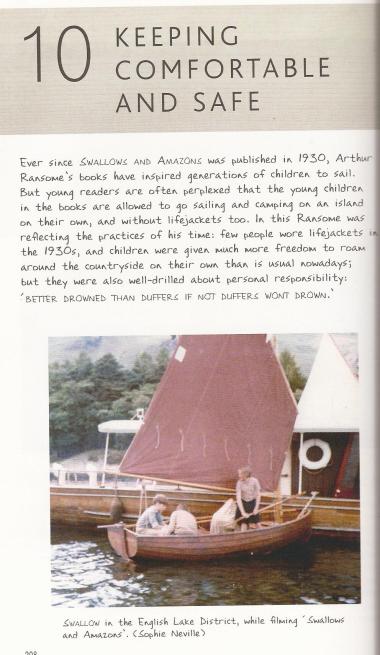
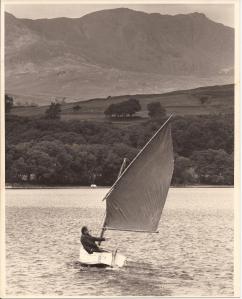
Roger emailed me to ask if I had a photograph of us sailing Swallow without life jackets. I supplied him with this shot my mother took in 1973 since I am standing in the dinghy. I am not sure how we managed to go about when we sailed off, as it also contained the parrot’s cage.
I will certainly take The Dinghy Cruising Companion with me if I manage to get Swallow to Brittany in the near future. As you can see from the cover Roger often takes his own boat to regattas in France.
I bought my copy of Roger’s paperback online but it’s available from all good bookshops. To find out about sailing Swallow, the dinghy used in the 1974 film of Swallows and Amazons, please click here for Sail Ransome.
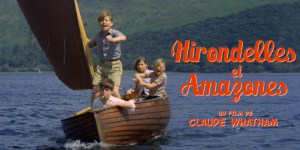
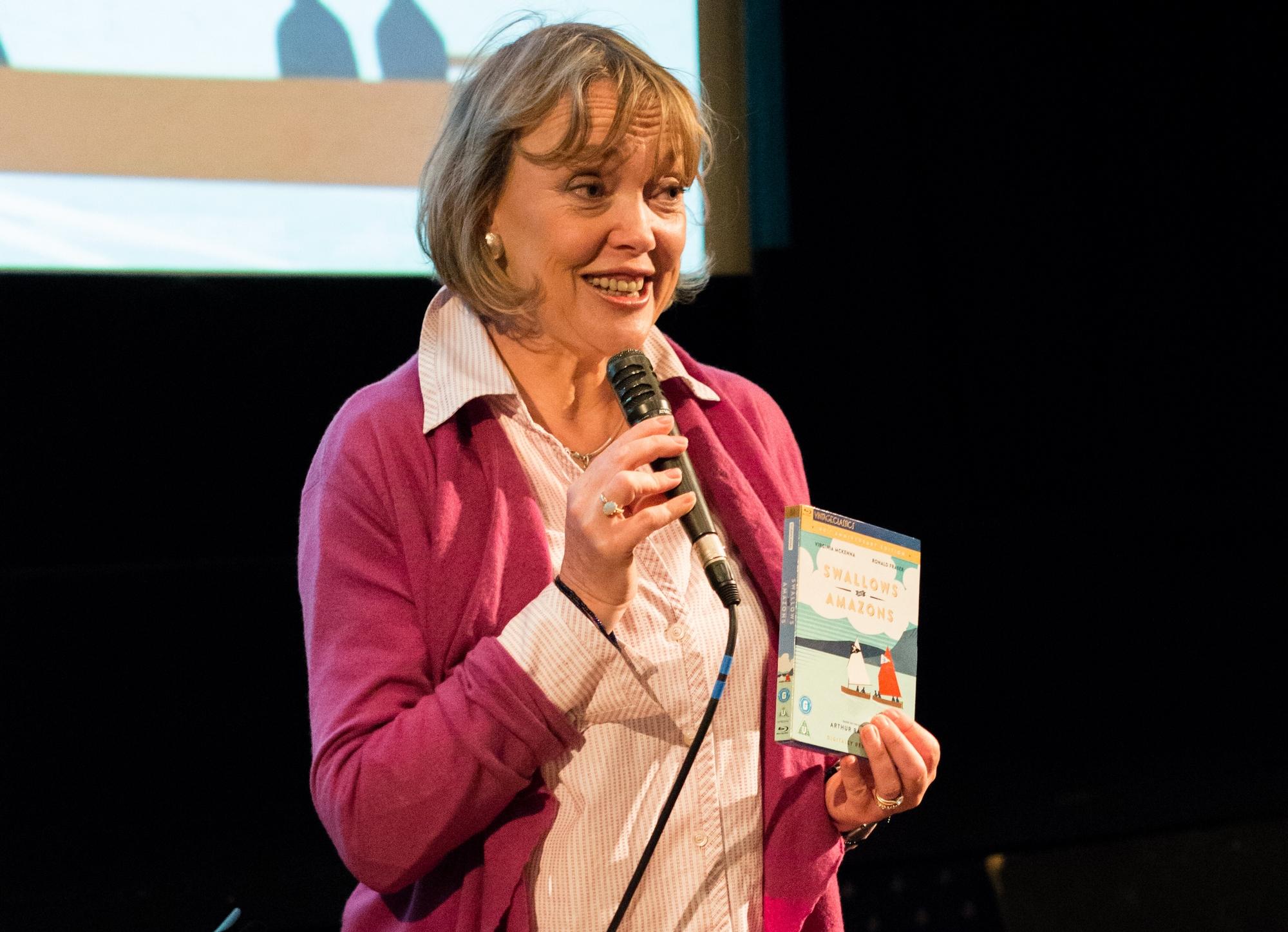
If you know anyone who loves the original film of Swallows and Amazons, and is now learning French, why not buy a copy of the DVD that has been dubbed into the French language:
If you live in France you can order a Kindle copy of ‘The Secrets of Filming Swallows & Amazons’ – which is full of behind-the-scenes photos and links to home-movie footage taken on location, although the text is in English. The paperback makes a good present for students of Media Studies, Drama or Film:
The website All Things Ransome have links for of the Arthur Ransome’s book in French here with a useful list providing translations of names here.
The translation of the telegram BETTER DROWNED THAN DUFFERS IF NOT DUFFERS WONT DROWN is Préfère les savoir noyés que stupides. Si pas stupides pas noyés.
You too can find the locations and sail Swallow:
If you would like to stay at Holly Howe ~ contact Jonathan Batty at Bank Ground Farm
Swallows & Amazons tours of the Lake District ~ including a trip on the steam train, led by Peter Walker of Mountain Goat in Windermere can be booked for groups by request. A must for overseas visitors. To read about this do go to: ‘In Search of our old Film Locations’. For booking details please click here.
Swallow, the dinghy used in the film, is currently in East Anglia. For opportunities to sail her yourself please click here
‘Paddling with Peter Duck’, John McCarthy’s documentary for BBC Radio 4, portrays the boats owned by the author Arthur Ransome and includes extracts read by Kate Taylor from his classic book Swallows and Amazons.
Peter Willis in the Nancy Blackett with John McCarthy
While the broadcast is a portrayal of Arthur Ransome and his boats, it touches on his friendship with the Altounyan family who inspired him to embark on writing the series of twelve Swallows and Amazons books. It is easy to understand this when looking at their photographs.
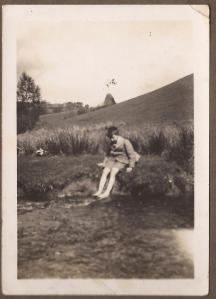
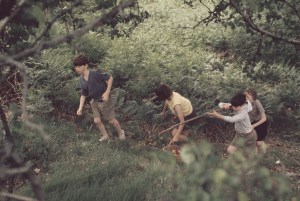
The Altounyan children with friends in Syria.
The girls seem to be Taqui, Brigit and Titty
Could it possibly be Arthur Ransome sitting on the right? He visited the family in Syria in 1932, when he must have been about forty-eight, but was never known to have worn shorts, although it would have been exceptionally hot in the Middle East. Click on the photos to enlarge.
Is this Arthur Ransome ? sitting on the bow of Peter Duck in Syria, the chap wearing the same hat and clothes as in the photo above? He took this dinghy out to Syria as a gift for the Altounyan children and wrote his novel Peter Duck while he and his wife Evgenia were staying with the family in Aleppo.
Possibly Arthur Ransome sailing Beetle II the Altounyans’ gunter-rigged dinghy at Amouk in Syria
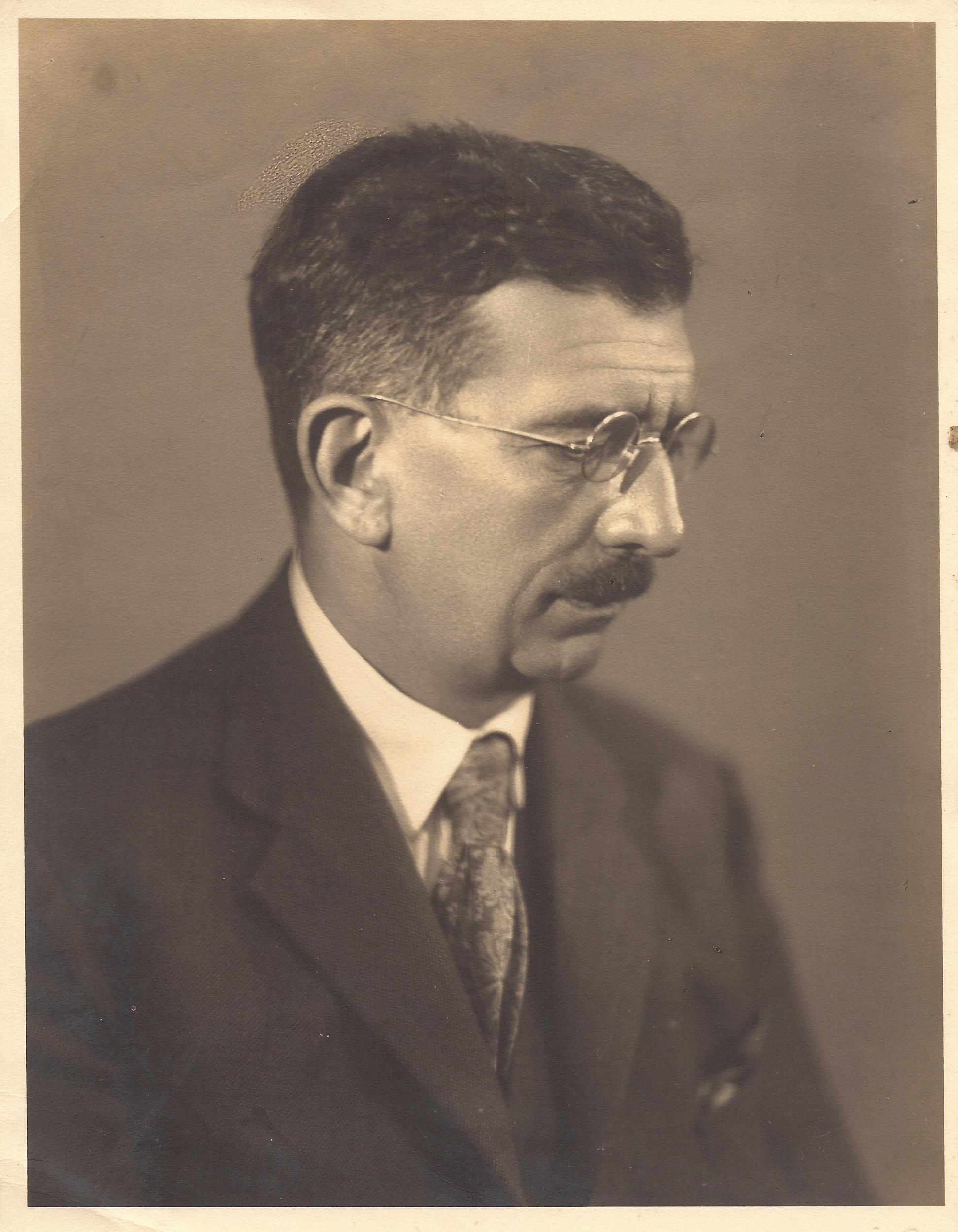
Ransome’s friend Dr Ernest Altounyan in 1935
Dora Altounyan (nee Collingwood) in 1935
Was Dora the model for Mary Walker, the Swallows’ mother who grew up in Australia?
Sadly there is no sign of the original Swallow bought at the same time as Mavis by Arthur Ransome and Ernest Altounyan in Barrow-in-Furness, and later sailed by the Ransomes on Windermere. Mavis was later re-named Amazon by Brigit Altounyan, the youngest of the five Altounyan children, known as The Ship’s Baby.
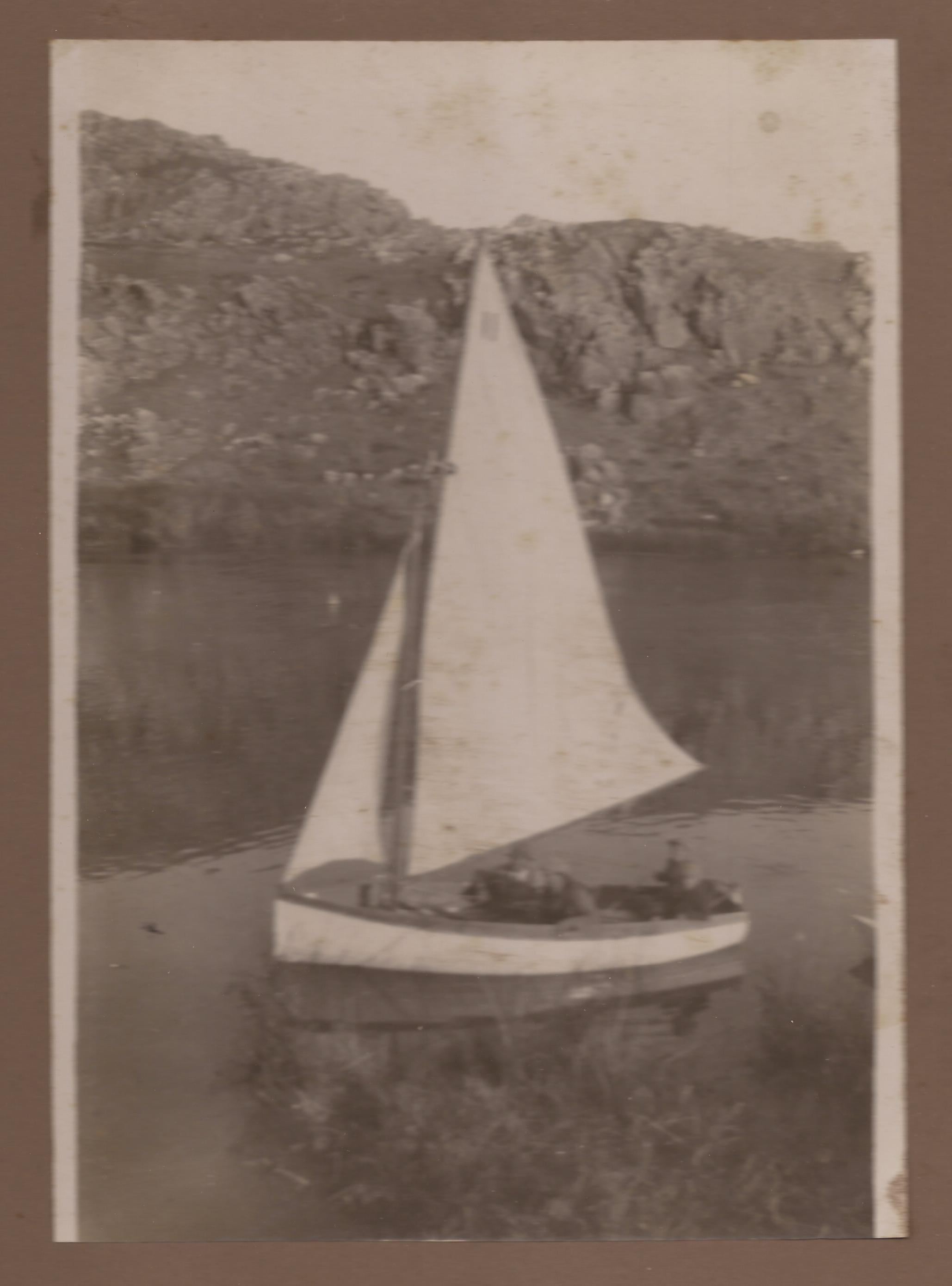
Dr Ernest Altounyan on Coniston Water with ‘Mavis’, one of the dinghies that inspired ‘Swallows and Amazons’
These unique photographs were recently found in Cheshire by the antiques dealer John Jukes who asked me if I could return them to the Altounyan family. This I have done and show them here by kind permission of Roger’s daughter, Barbara Altounyan. Please do not copy these photos.
The Nancy Blackett Trust presented another screening of the classic film ‘Swallows & Amazons’ (1974) at the Riverside in Woodbridge. The cinema was celebrating 100 years of film and were thrilled to welcome a large and enthusiastic audience of 250, made up of children and Arthur Ransome enthusiasts one of whom told us he saw the film in Shaftesbury Avenue when it first came out.
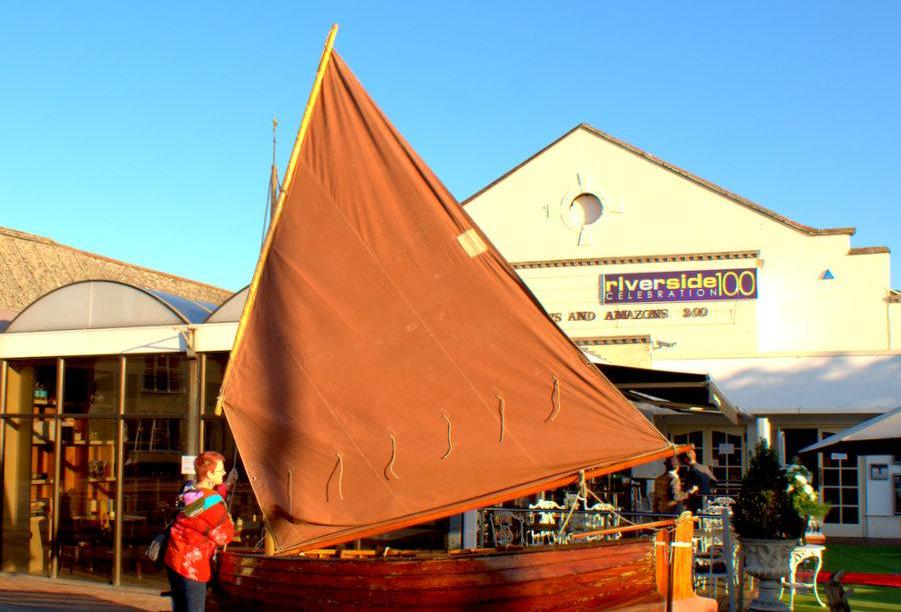
Swallow, the original dinghy used in the film was on display outside the cinema and I went along to answer questions about how the movie was made. Here are some of those asked by children in the audience:
Had you ever been on a boat before you started filming? Yes, my father was a great sailor and I’d crewed for him. As Titty, I had to row quite a bit – back from the charcoal burners, later when I captured Amazon and alongside Roger when we went to find the treasure on Cormorant Island.
How did you do the night time? We used Mrs Batty’s barn at Bank Ground Farm as a studio.
Which lake did you film on? Arthur Ransome wrote about an imaginary lake based on real places that we found on Windermere, Coniston Water, Derwentwater, Elterwater and a smelly lilly pond. the great thing is that you can go and find them too.
Did you enjoy filming? Yes, very much, but it could be chilly.
How long did it take to film? Forty-five days in all. It’s a 90 minute film so you can work out just how much we managed to film per day. It was well under the 4 minutes-a-day scheduled.
Did Titty actually keep the parrot? Titty did in the story but the parrot in the film was rather savage and had to be returned to Mrs Proctor of Kendal. However my parents bought a very tame green parrot called Chico who would sit on my shoulder, even when I went rowing.
Were you cold when you we filming the swimming scenes? Yes! We nearly passed out.
Why didn’t you wear life jackets? The film was set eighty-six years ago in 1929 when children didn’t wear life-jackets. We wore BOAC life-vests during rehearsals and when being taken out to the location.
What are the children doing now? Working! Suzanna Hamilton is the only one of us to kept acting. She’s appeared in two feature films this year including ‘My Feral Heart’. Simon West has an engineering company that invents machines, Sten Grendon is a gardener, Kit Seymour is spending this year in Australia and I believe Lesley Bennett lives in the Netherlands, but I’m not sure. I’d love to make contact with her. Virginia McKenna is still acting as well as figure-heading her charity Born Free that does so much to relieve the suffering of animals.
In reality, how old were you all when you acted? Roger was 8, I was aged 12 pretending to be aged 9, Susan was 12 and John 11. Nancy was about the right age as she celebrated her 13th birthday towards the end of the filming. The secret was that Peggy was the eldest at 13.
Do you have a cameo role in the new film? You might just see me on the platform of the railway station but I am wearing a wig!
Why is Swallow’s flag brown? Because it a little elderly.
The camping kit – was it all packed in Swallow? We children didn’t know it at the time but it didn’t all fit in, although they did keep taking the tents down. Why we had a rolling pin on board, I do not know.
What happened to Amazon? The Amazon Arthur Ransome knew, which was originally called Mavis, can be seen at the Coniston Museum. The dinghy we used in the film was also used in the black and white BBC TV serial made in 1962. She is now in Kent – and still sailing. You can see her on ‘Country Tracks’ by clicking here.
After the film screening, I was told that students on the Open University Children’s Literature course with study Arthur Ransome’s classic book ‘Swallows and Amazons’, which is good news, especially since the BBC News headline rang out the question: Do children still need to read the classics of English Literature? Declaring, ‘Gone from bedroom bookshelves are the Famous Five, The Chronicles of Narnia,and the adventures of the Swallows and Amazons.’
Is this true? Do leave your comments below – or contact the BBC!
The Telegraph listed ‘Swallows & Amazons’ as Film of the Week when it was broadcast on ITV3 in the UK recently. It was also shown on GEM television in Australia last Friday. Sophie has been answering questions about making the film ‘Swallows & Amazons’ at the Curious Arts Festival. If you have one, please use the comments box below.
On 26th July Sophie Neville, spoke to Dan Damon on the BBC Radio 4 Sunday morning programme ‘Broadcasting House’ about the enduring success of the film. To read more, please click here.
‘The 1974 Swallows and Amazons film is a classic, and this is a really enjoyable look behind the scenes, written by the actress who (for me, at least) gave the stand-out performance as Titty Walker. If the film recaptured the lost world of 1929, then the book recaptures the lost world of 1973, when rules on child actors were strict (chaperones and schoolwork absolute requirements) but regulations on health and safety a bit more lax, even when on water. We even learn the truth behind that strange scene on the jetty in Rio where Roger is left minding Swallow. Highly recommended.’ P. Stevens, Bath, UK
‘Every now and again in cinematic history a classic is born. It doesn’t have to be a multi-billion pound blockbuster featuring legendary names, sometimes something timeless and endlessly endearing is born and this is most definitely the case with ‘Swallows and Amazons’.
‘This film has become an old friend to me; I must have watched it a thousand times and I never tire of it! It brings back memories of a summer childhood spent in wonder-filled Cumbria, in particular Windermere, Ambleside, Derwent and Coniston Water; places we’d visit as a family before the fates would, sadly intervene.
‘Sophie Neville’s excellent book recaptures again the halcyon days of youth in a summer-land of mountains, fells and shimmering lakes. She writes beautifully and with an easy style that’s a joy to read. The love for her subject is very evident, as is her passion for the work of Arthur Ransome. She takes you behind the scenes of the making of the film and the realities of filming on the water; how the director and crew worked tirelessly to bring out the best in the young actors and the splendours of the landscape. So glad I made this purchase. Pride of place on the old bookshelf.’ Allen Fairhurst
‘Sophie has lost none of her infectious enthusiasm and this shines through on every page.’ Julian Lovelock in Mixed Moss, the journal of The Arthur Ransome Society. ‘As well as using her own diary Sophie has mined the recollections and scrapbooks of a number of cast and crew.’
‘The book itself is indeed a delight. I have long been a fan of Swallows and Amazons. I am delighted with the film which was made and Sophie’s account of the making of it adds a very charming and interesting dimension. I loved the account and I fully recommend any fan of Swallows and Amazons to get a copy for themselves.’
You can read about how the original film of ‘Swallows and Amazons’ was made and find the complete collection of behind-the-scenes photos in this ebook available from Kobo, Smashwords, iTunes and on Kindle for £2.99
The screening of Swallows & Amazons (1974) on Sunday afternoon was sold out. 250 tickets. They were endlessly turning people away. ‘We should have shown it again in the 6.00pm slot,’ I told the manager. ‘Oh, we have American Snipper on then.’ It stars Bradley Cooper and Sienna Miller. ‘How many have booked to see it?’ ‘Three.’
All age groups were represented in the audience who came to the event – a fundraiser in aid of the Nancy Blackett Trust. About 70% had seen the film of Swallows & Amazons before. Some knew it well.
Everyone loved seeing the original white elephant flag flown on Captain Flint’s houseboat that had been sent to me from America by the producer.
Swallow, the clinker built dinghy, originally built by William King and Sons at Burnham-on-Crouch and used in the 1974 film, was rigged up outside the cinema for everyone to meet. She has been appearing at a number of The Arthur Ransome Society’sevents in Suffolk and Essex.
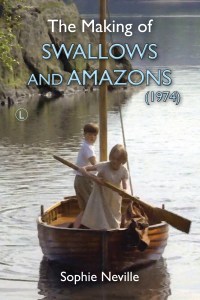
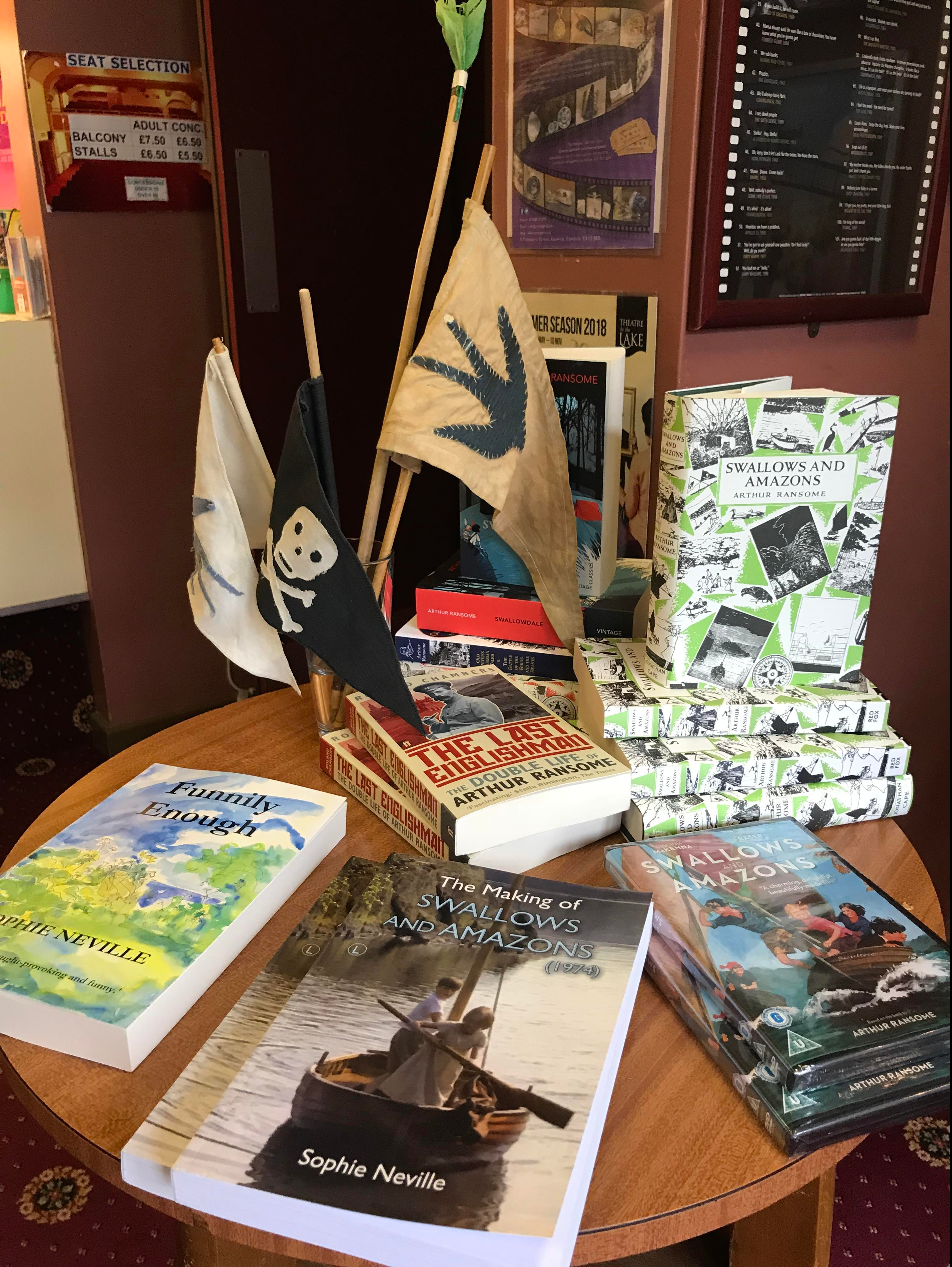
We used the best photo of Swallow under sail for the cover of the paperback on how the film was made, which was on display in the cinema lobby after the film. It is now available online or from the Aldebrugh Bookshop in Suffolk.
Someone asked if we had any disasters while making the film.
‘Swallow’s mast broke, we nearly sailed under the Windermere steamer and a cow fell down a bank onto the producer’s car.’ I couldn’t think of anything utterly disastrous from my own perspective except that I lost a tooth halfway through shooting a scene with Virginia McKenna, which was embarrassing. I can list other questions asked by the audience in the next post.
The Riverside Cinema in Woodbridge are thinking of showing Swallows & Amazons again in September to help them celebrate their centenary ~ ‘100 Years of Film’. Do add a comment in the box below if you would like to organise a screening of the film at a cinema near you.
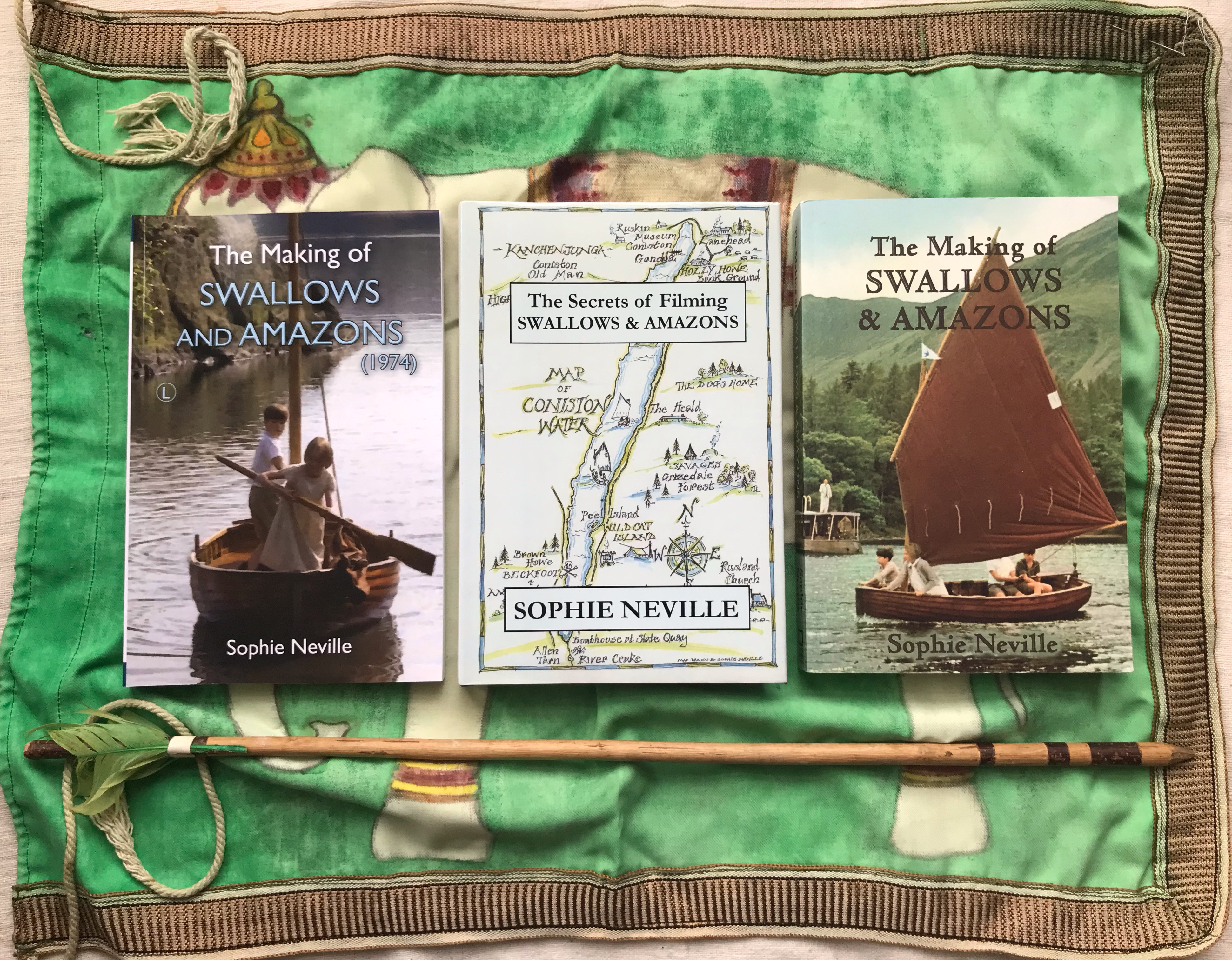
You can read about the adventures had making the original film of Swallows and Amazons in these editions available online:
Different editions of ‘The Making of Swallows and Amazons (1974) by Sophie Neville’
For some time now we have been doing a variety of things to raise interest in Arthur Ransome and his books, particularly the ‘Swallows and Amazons’ series originally written for children.
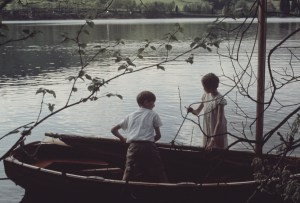
Sten Grendon as Roger and Sophie Neville as Titty rowing Swallow (c)StudioCanal
SailRansome have made Swallow, the original clinker built dinghy used in the film, available for families to use there.
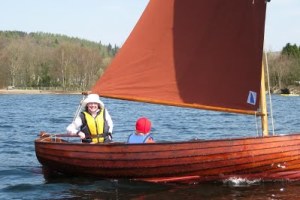
Swallow, the dinghy used in the 1974 film on Ullswater this summer
We’ve been using the Draper’s shallop to teach children how to row on the River Lee under the auspices of Countryside Live. We have now taught hundreds of children most of whom have never been in a boat before. The idea is to inspire them to join the Sea Scouts or a local rowing or canoeing club.
Countryside Live at Lee Valley 2014
Another boat you can sail is the Nancy Blackett portrayed as Goblin from We Didn’t Mean To Go To Sea and Secret Water.
Arthur Ransome’s cutter the Nancy Blackett sailing on the Orwell
It only costs £25 a year to join the Nancy Blackett Trust. This is wonderful for anyone living near the Orwell as Ransome once did.
Sophie Neville with Titmouse in Norfolk – photo Diana Dicker
I’ve also been promoting StudioCanal’s re-release of the 1974 film of Swallows & Amazons on Radio Cumbria, Premier Radio, Lakeland Radio and Channel 5’s live TV programme The Wright Stuff. There’s a lot going on in the media with pictorials in Country Life, The Lady, Cotswold Life and Practical Boat Owner magazine as well as newspapers and colour supplements.
Q&A with a large cinema audience in Kendal this August
We brought the original film of Swallows & Amazons back to cinemas in London, Ambleside, Kendal and to Hastings on Pirate Day. I took Captain Flint’s trunk along and wore a tricorn hat only to be told by one little boy in the audience, ‘I hate pirates. They are my enemies.’ Other children asked, ‘Did you enjoy being in the film?’ and ‘Were the spiders in your tent real?’
When we were in Kendal, the curator of the Museum of Lakeland Life gave a talk to the cinema audience bringing along the actual red slippers given to Arthur Ransome by the Altounyan children in 1929 which inspired him to write Swallows and Amazons.
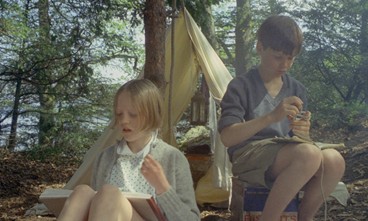
An official still from the film of ‘Swallows & Amazons’ (c) StudioCanal
Some schools have Swallows and Amazons as a set book. I was invited to give a talk at Walhampton School who claim a ‘Swallows and Amazons ethos’. They aspire to giving their pupils as much of an exciting outdoor education as possible with sailing and exploring on the curriculum. School House magazine backs this up saying, ‘There is a distinct ‘Swallows and Amazons’ spirit that burns brightly here.’
Swallow sailing from Wild Cat Island (C) StudioCanal
What could you do to keep Ransome’s writing on book shop shelves?
Could you organise an event at your local sailing club? Or request a screening of newly restored version of the film at your local cinema? One is being planned in Oxford with hopefully another at Wolverstone. PictureHouse cinemas are particularly open to the idea of screening classic family films.
I am planning ‘An Arthur Ransome Day’ at my local Waterstones and another at our library. How can we make this special and attract people off the street?
Do add your ideas to the comments below.
Easy things you can do right now to help promote the books:
When I appeared on Channel 5 recently Matthew Wright asked, “… if it’s possible to have a Swallows and Amazons childhood these days – and if today’s kids would actually have the skills to survive.”
I received so many interesting comments on Twitter and Facebook that I thought I should copy them here, hoping it is OK by those who took the time to write in.
“Would they survive? Hmm. Better drowned than duffers…” Fergus
“Of course it’s possible – we do it every time we are on holiday at www.lowwaterend.co.uk real Swallows and Amazons location. Our kids love it….” Kate
“I think few parents would look at a small sailboat & Coniston Water or Windermere, and give the go-ahead for children ages 12-7 to sail & camp by themselves. However, there are a lot of really wonderful parents who sail & camp WITH their children, and then allow independent exploration with help nearer at hand.” Elizabeth (USA)
“OK – so we cheat a little – in that we stay in the cottage rather than in tents on Wild Cat Island – but it has got a little busy there of late. Trying to bring a boat or canoe into the secret harbour is more like trying to park in a multi national supermarket car park, but very little has truly changed on the island and if you can see past the bright orange and red buoyancy aids of the temporary visitors, one can still imagine being the Walker children. And if you get the island to yourselves – it’s pure joy. We frequently issue the owl hoot just to let our kids know that food is ready! As for the lagoon downstream – it’s still there – our kids have taken to canoeing as far downstream as they can – wading in low water and paddling down rapids where they can. They take no mobiles, IT equipment etc – and they are gone for hours making maps of the stream and naming the shores, fallen trees etc.” Kate
“I’ve just been reading my daughter the bit in Winter Holiday where Dick rescues the cragfast sheep by inching his way along a rock ledge. “Would you be able to do that?” I asked her. “No, I’d be much too scared!” she replied. And I said “Good!”.” Valerie
“Some risks are too high, too likely to leave the child unable to enjoy a normal life afterwards. Examples: diving into rivers with rocks, driving way above the speed limit, using illegal drugs/binge drinking. There are risks that simply have too high a chance of a serious bad outcome. I like the “Roots & Wings” approach. While they are young, you teach how to make a reasonable decision about any given risk, then as they mature, let the child figure out more on their own.” Elizabeth
“It isn’t only duffers who come to grief, and even if it was, duffers deserve to be protected from their own stupidity. So, I prefer the idea of teaching children what the risks are and how to manage risk so that they can then do things that look highly risky without there being any great risk. What is wrong is to shut children’s lives down instead of teaching them how to be safe and free, and that’s the most dangerous route of all because it sets them up for empty lives which will lead them on into a prolonged and deep exploration of alcohol and drugs. Freedom is essential for good mental health and needs to be maximized, but learning about risk management is a crucial part of that. So, how do you teach risk management without it being dull? Get out there with your children and join in with the play. Point out the possible dangers along the way, not in a lecturing way, but simply by telling little stories about idiots who came to grief by making mistakes. It doesn’t take long to make a dangerous environment safe for children to play in by putting ideas in their heads as to all the easy ways to be killed or injured by the apparatus at hand. If they know what the unexpected dangers are, they will be armed against making them. If they die after that, then it will be against the odds – it would have been more dangerous not to let them out.” David
“Agree 100%. In my mind, risk-averseness is one of the great failings of my fellow modern Americans. Never be sorry for a might-have-been.” Sandy
If you have views on the subject, or want to see more on outdoor pursuits discussed on the programme, send an email to: wrightstuff@channel5.com
Over the next few days I am going to be giving Q&A sessions at cinemas screening StudioCanal’s newly restored version of Richard Pilbrow’s movie ‘Swallows & Amazons’ (U) to celebrate the 40th anniversary of the film’s release in 1974.
Ronald Fraser on the cover of the VHS
Sten Grendon, Simon West, Suzanna Hamilton and Sophie Neville as the Swallows making Ronald Fraser walk the plank. Where are the Amazons?
If you can come, please do bring a question. I am always very interested in those asked by the children. They can be quite difficult to answer:
‘What did it feel like to be alone on the island?’
Titty leaving her tent on Wild Cat Island
‘Where you really able to keep the parrot?’
Kit Seymour with Sophie Neville and Polly in the Houseboat
‘How long did it take to film?’ is another question I am often asked. The answer is quite complicated.
Then I ask, ‘Would you like to know about the mistake I made?’
The crew of the Swallow leaving Holly Howe
I started singing, ‘Adieu and Farewell’, when the sea shanty Spanish Ladiesis always sung: ‘Farewell and Adieu…
Farewell and adieu to you fair Spanish ladies,
Farewell and adieu to you, ladies of Spain;
For we’re under orders
For to sail to old England,
And we may ne’er see you fair ladies again.
We’ll rant and we’ll roar, like true British sailors,
We’ll range and we’ll roam all on the salt seas;
Until we strike soundings
In the Channel of old England,
From Ushant to Scilly ’tis thirty-five leagues.
Virginia McKenna watches the Swallows sail from the jetty at Bank Ground Farm on Coniston Water. Can you spot the safety officer – a frogman just visible right of shot?
I noticed that one inconsistency made by the design team was that the swallow flew down our flag whereas it always flies up Swallow’s burgee in Arthur Ransome book illustrations. I count it as a subtle differentiation that I reproduce whenever I draw the crossed flags myself.
When I was writing ‘The Making of Swallows & Amazons’ I noticed that, while the title of the book is ‘Swallows and Amazons’, the graphic designer working on the film always used an ampersand, making it SWALLOWS & AMAZONS in the 1974 film.
There is another odd thing right at the end of the film, as the credits roll. See if you can spot what it is.
There are often screenings at cinemas in Cumbria:
Royalty Cinema Bowness-on-Windermere, the Roxy Cinema Ulverston and the Alhambra in Keswick where we held a Q&A
























 Sophie Neville
