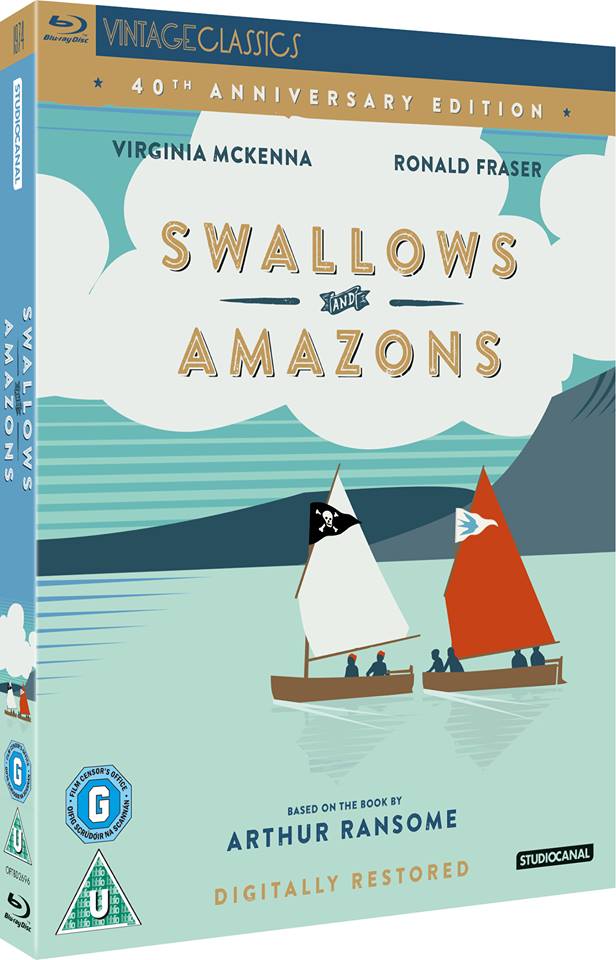
The Nancy Blackett Trust presented another screening of the classic film ‘Swallows & Amazons’ (1974) at the Riverside in Woodbridge. The cinema was celebrating 100 years of film and were thrilled to welcome a large and enthusiastic audience of 250, made up of children and Arthur Ransome enthusiasts one of whom told us he saw the film in Shaftesbury Avenue when it first came out.
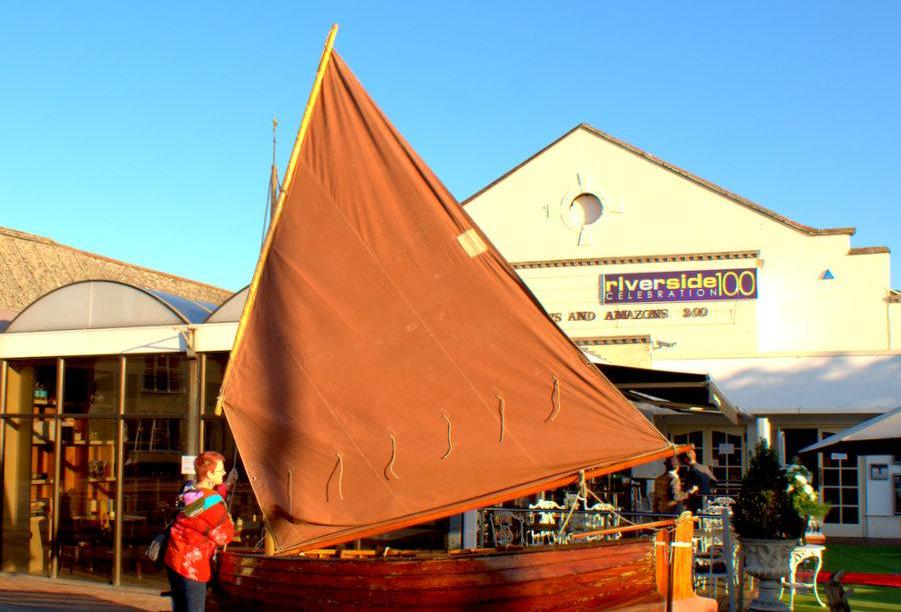
Swallow, the original dinghy used in the film was on display outside the cinema and I went along to answer questions about how the movie was made. Here are some of those asked by children in the audience:
Had you ever been on a boat before you started filming? Yes, my father was a great sailor and I’d crewed for him. As Titty, I had to row quite a bit – back from the charcoal burners, later when I captured Amazon and alongside Roger when we went to find the treasure on Cormorant Island.
How did you do the night time? We used Mrs Batty’s barn at Bank Ground Farm as a studio.
Which lake did you film on? Arthur Ransome wrote about an imaginary lake based on real places that we found on Windermere, Coniston Water, Derwentwater, Elterwater and a smelly lilly pond. the great thing is that you can go and find them too.
Did you enjoy filming? Yes, very much, but it could be chilly.
How long did it take to film? Forty-five days in all. It’s a 90 minute film so you can work out just how much we managed to film per day. It was well under the 4 minutes-a-day scheduled.
Did Titty actually keep the parrot? Titty did in the story but the parrot in the film was rather savage and had to be returned to Mrs Proctor of Kendal. However my parents bought a very tame green parrot called Chico who would sit on my shoulder, even when I went rowing.
Were you cold when you we filming the swimming scenes? Yes! We nearly passed out.
Why didn’t you wear life jackets? The film was set eighty-six years ago in 1929 when children didn’t wear life-jackets. We wore BOAC life-vests during rehearsals and when being taken out to the location.
What are the children doing now? Working! Suzanna Hamilton is the only one of us to kept acting. She’s appeared in two feature films this year including ‘My Feral Heart’. Simon West has an engineering company that invents machines, Sten Grendon is a gardener, Kit Seymour is spending this year in Australia and I believe Lesley Bennett lives in the Netherlands, but I’m not sure. I’d love to make contact with her. Virginia McKenna is still acting as well as figure-heading her charity Born Free that does so much to relieve the suffering of animals.
In reality, how old were you all when you acted? Roger was 8, I was aged 12 pretending to be aged 9, Susan was 12 and John 11. Nancy was about the right age as she celebrated her 13th birthday towards the end of the filming. The secret was that Peggy was the eldest at 13.
Do you have a cameo role in the new film? You might just see me on the platform of the railway station but I am wearing a wig!
Why is Swallow’s flag brown? Because it a little elderly.
The camping kit – was it all packed in Swallow? We children didn’t know it at the time but it didn’t all fit in, although they did keep taking the tents down. Why we had a rolling pin on board, I do not know.
What happened to Amazon? The Amazon Arthur Ransome knew, which was originally called Mavis, can be seen at the Coniston Museum. The dinghy we used in the film was also used in the black and white BBC TV serial made in 1962. She is now in Kent – and still sailing. You can see her on ‘Country Tracks’ by clicking here.
After the film screening, I was told that students on the Open University Children’s Literature course with study Arthur Ransome’s classic book ‘Swallows and Amazons’, which is good news, especially since the BBC News headline rang out the question: Do children still need to read the classics of English Literature? Declaring, ‘Gone from bedroom bookshelves are the Famous Five, The Chronicles of Narnia,and the adventures of the Swallows and Amazons.’
Is this true? Do leave your comments below – or contact the BBC!
For some time now we have been doing a variety of things to raise interest in Arthur Ransome and his books, particularly the ‘Swallows and Amazons’ series originally written for children.
Sten Grendon as Roger and Sophie Neville as Titty rowing Swallow (c)StudioCanal
SailRansome have made Swallow, the original clinker built dinghy used in the film, available for families to use there.
Swallow, the dinghy used in the 1974 film on Ullswater this summer
We’ve been using the Draper’s shallop to teach children how to row on the River Lee under the auspices of Countryside Live. We have now taught hundreds of children most of whom have never been in a boat before. The idea is to inspire them to join the Sea Scouts or a local rowing or canoeing club.
Countryside Live at Lee Valley 2014
Another boat you can sail is the Nancy Blackett portrayed as Goblin from We Didn’t Mean To Go To Sea and Secret Water.
Arthur Ransome’s cutter the Nancy Blackett sailing on the Orwell
It only costs £25 a year to join the Nancy Blackett Trust. This is wonderful for anyone living near the Orwell as Ransome once did.
Sophie Neville with Titmouse in Norfolk – photo Diana Dicker
I’ve also been promoting StudioCanal’s re-release of the 1974 film of Swallows & Amazons on Radio Cumbria, Premier Radio, Lakeland Radio and Channel 5’s live TV programme The Wright Stuff. There’s a lot going on in the media with pictorials in Country Life, The Lady, Cotswold Life and Practical Boat Owner magazine as well as newspapers and colour supplements.
Q&A with a large cinema audience in Kendal this August
We brought the original film of Swallows & Amazons back to cinemas in London, Ambleside, Kendal and to Hastings on Pirate Day. I took Captain Flint’s trunk along and wore a tricorn hat only to be told by one little boy in the audience, ‘I hate pirates. They are my enemies.’ Other children asked, ‘Did you enjoy being in the film?’ and ‘Were the spiders in your tent real?’
When we were in Kendal, the curator of the Museum of Lakeland Life gave a talk to the cinema audience bringing along the actual red slippers given to Arthur Ransome by the Altounyan children in 1929 which inspired him to write Swallows and Amazons.
An official still from the film of ‘Swallows & Amazons’ (c) StudioCanal
Some schools have Swallows and Amazons as a set book. I was invited to give a talk at Walhampton School who claim a ‘Swallows and Amazons ethos’. They aspire to giving their pupils as much of an exciting outdoor education as possible with sailing and exploring on the curriculum. School House magazine backs this up saying, ‘There is a distinct ‘Swallows and Amazons’ spirit that burns brightly here.’
Swallow sailing from Wild Cat Island (C) StudioCanal
What could you do to keep Ransome’s writing on book shop shelves?
Could you organise an event at your local sailing club? Or request a screening of newly restored version of the film at your local cinema? One is being planned in Oxford with hopefully another at Wolverstone. PictureHouse cinemas are particularly open to the idea of screening classic family films.
I am planning ‘An Arthur Ransome Day’ at my local Waterstones and another at our library. How can we make this special and attract people off the street?
Do add your ideas to the comments below.
Easy things you can do right now to help promote the books:
When people see the Steam Yacht Gondola on Coniston today, in all her re-built glory, she seems rather plush to have been cast by Arthur Ransome as Captain Flint’s houseboat in Swallows and Amazons. The main reason for assuming that she was used as the model for the illustrations is because Arthur Ransome grabbed a post card of the Gondola and drew on it to give the first illustrators of Swallows and Amazons some idea of his vision. However Ransome’s biographer Roger Wardale told me that it was a former steamer on Windermere that he had in mind: the S.Y. Esperance. Ransome was known to have been spotted looking through her cabin windows and much admired her distinctive bow, designed to cut through cat ice on her way to Lakeside Railway station.
Esperance in Rayrigg Bay, Windemere ~ photographed by Martin Neville in about 1963
When I was first taken up to the Lake District in 1963, my father found what he thought was houseboat bay on Windermere and took this shot of SL Esperance moored in Rayrigg Bay. She does look very like the first professional drawing submitted to illustrate Swallows and Amazons.
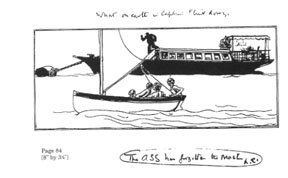
Stephen Spurrier’s unused illustration of Swallow sailing past Captain Flint’s houseboat
Arthur Ransome’s terse note reads: ‘The ass has forgotten the mast’. I went to see the Esperance when she was lying at the Steamboat Museum on Windermere with the film producer Nick Barton in 2011. Built at Rutherglen in 1869 she is nearly 65 foot long with a 10 foot beam.
SL Esperance at the Windermere Steamboat Museum in 2011
She did not always have such a traditional appearance. Roger Wardale kindly sent me this photograph showing what she looked like in the 1930s.
‘Esperance’ in the 1930s when she was owned by Sir Oliver Scott.
The cabin has since been removed from her rear end.
SY Esperance at the Windermere Steamboat Museum in 2011
SY Esperance now looks more like this illustration – or could do. Although she has a setting for a mast the reality is that she has seven windows, whereas Clifford Webb’s illustration shows her with only six.
Clifford Webb’s illustration of Captain Flint’s houseboat
I have no idea if anyone could film aboard her today when marine safety regulations are so strict. We couldn’t in 1973.
Claude Whatham took advantage of the larger cabin windows in the Lady Derwentwater whilst filming ‘Swallows & Amazons’ in 1973 ~ photo: Daphne Neville
When we made the original film of ‘Swallows and Amazons’, the producer Richard Pilbrow was obliged to use the Lady Derwentwater, owned by the Keswick Launch Co. She has quite a different stern from the illustrations but was licensed to carry 90 passengers, which must have allowed him to take a seventy-strong film crew on board. At least she was given a mast. You can envisage Ronald Fraser, as Captain Flint, angrily stamping out the firework on the roof.
One advantage of the Lady Derwentwater was that the windows of her cabin enabled the director to get a good view of the lake, which he made use of when Captain John rowed over from Peel Island to visit Captain Flint and pass on the charcoal burners’ warning. She couldn’t be moved to another lake, but Derwentwater is surrounded by such dramatic fells that the director, Claude Whatham used this to his advantage during the final scenes of the classic film. The Lady Derwentwater has been given a transome but is still in commission and you can take a trip on her today.
Sophie Neville at the Windermere Steamboat Museum
Was the Gondola so very different? Ransome had known the steam launch since spending his own childhood holidays on Coniston, when she was in service. While staying at Nibthwaite he became a good friend of the Captain, or so the story goes. Back in 1973 the Gondola looked like this – her roof too curved to run along, her bow rising up a little too dramatically to accommodate the foredeck of a retired pirate busy writing up his devilish crimes while his a cannon lies glinting in the sunlight, ready to fire.
Photograph of the Gondola on Coniston Water taken by Martin Neville in 1973
For more about the Steamboat Museum with a photograph of SY Esperance, please click here
For a lovely photo of SY Esperance and to read more, from another perspective please click here
The full story of the making of the classic film Swallows and Amazons (1974)’ can be read in this ebook costing £2.99. You can read the first section for free here:
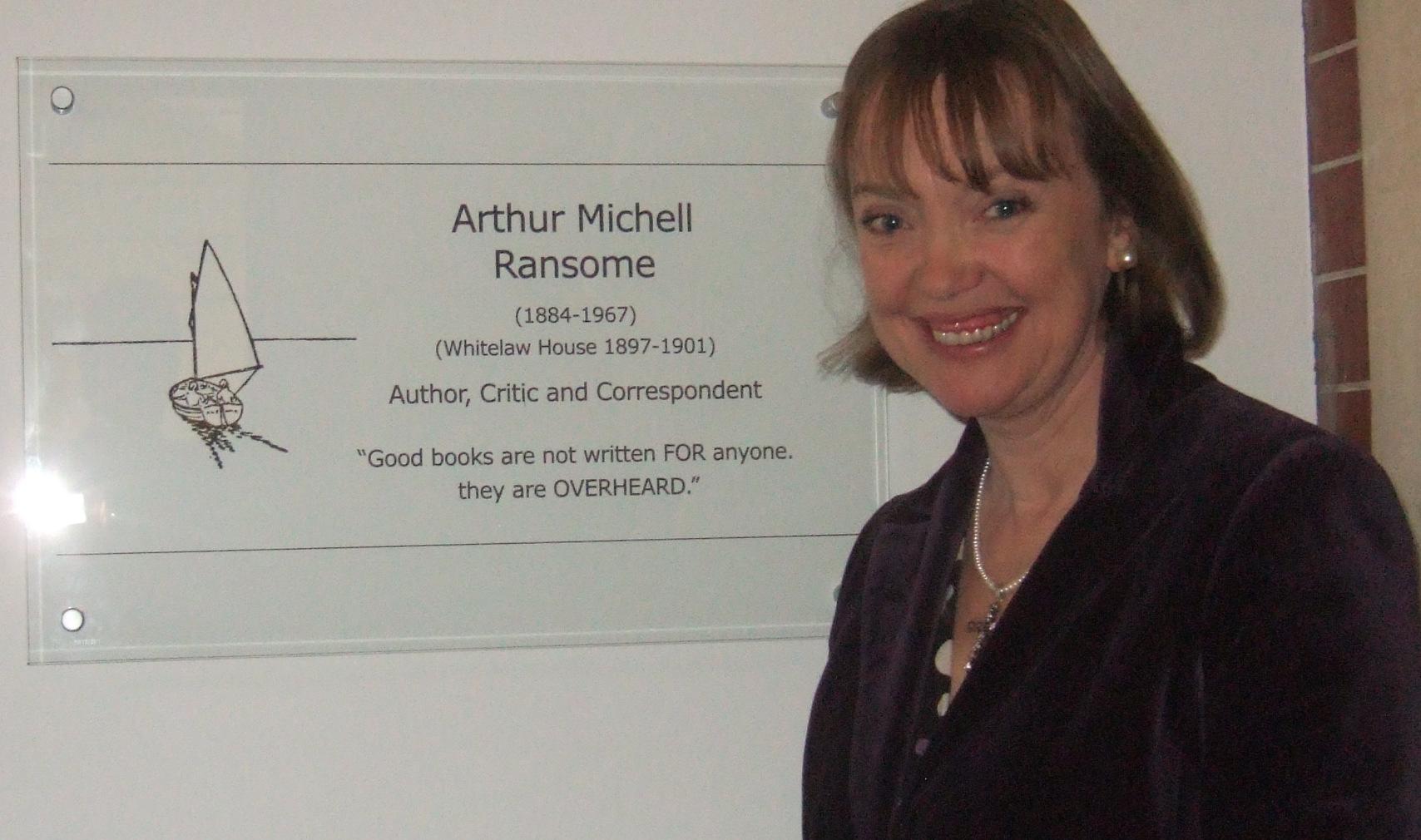
Arthur Ransome was born in on 18th January 1884. Those who loved his books will be celebrating his birthday from Giggleswick in North Yorkshire to the Orwell where the Ransomes spent so much time sailing.
Pamela Copley has just written from Australia to say:
‘There is a celebration of AR’s birthday in a suburb of Melbourne on Saturday – straight after the AGM. There will be a member from the UK group too.
Cheryl Paget tells me that, ‘In New Zealand members have met in Auckland for a weekend of Ransome inspired activities. We have sailed under the Auckland Harbour Bridge in a 57ft ketch rigged deck scow, toured the historic naval town of Devonport and walked to the top of the dormant volcano of Rangitoto.’
Mikako Tarashima wrote from the Arthur Ransome Club in Japan to say:
‘We would like to have a small exhibition in this year.’ In 2014, publication of new Japanese translation of Ransome saga was complete.’
I ask the question: How has Arthur Ransome influenced your life? What impact have his classic books, or the adaptations of Swallows and Amazons for film, television or the theatre, had on your family? Do add a line or two to the Comments below.
Arthur Ransome’s cutter the Nancy Blackett on the Orwell in July 2013
I am guilty of denial. When people asked, ‘How has Swallows & Amazons influenced your life?’ I’m afraid I used not to be that forth-coming, because I had moved on from acting in films. If you had asked me in 2010 I would have shrugged and said, ‘Not much.’
But then I stopped and thought again.
How much time I have spent exploring wilderness areas? I’d forgotten that it was the maps in Ransome’s books that attracted me to reading Cartography at university. I went to draw numerous maps all over the world.
I love living outdoors. I love fell walking, mud-flats, and being out on the high seas. I would drop everything to sail to China or the Caribbean tomorrow. I put this down to the fact that my father took us sailing and camping even before I read Ransome’s books. But who influenced Dad? Born in 1929, he was an avid reader of Arthur Ransome and would eagerly wait for the next book about the Swallows and the Amazons to be published. It would be a longed-for Christmas present.
It then occurred to me that John’s careful planning, Susan’s packing, Titty’s log and Roger’s humour still steer my life. The food, the phrases, the urge to travel, became part of my life long ago. I’ve lived under Swallow’s flag.
I for one, sail into the year ahead with Titty’s words still singing in my ears,
‘Here we are, intrepid explorers, making the first ever voyage into uncharted waters? What mysteries will it hold for us, what dark secrets shall me revealed?’
Aboard the Nancy Blackett at Buckler’s Hard on the Beaulieu River
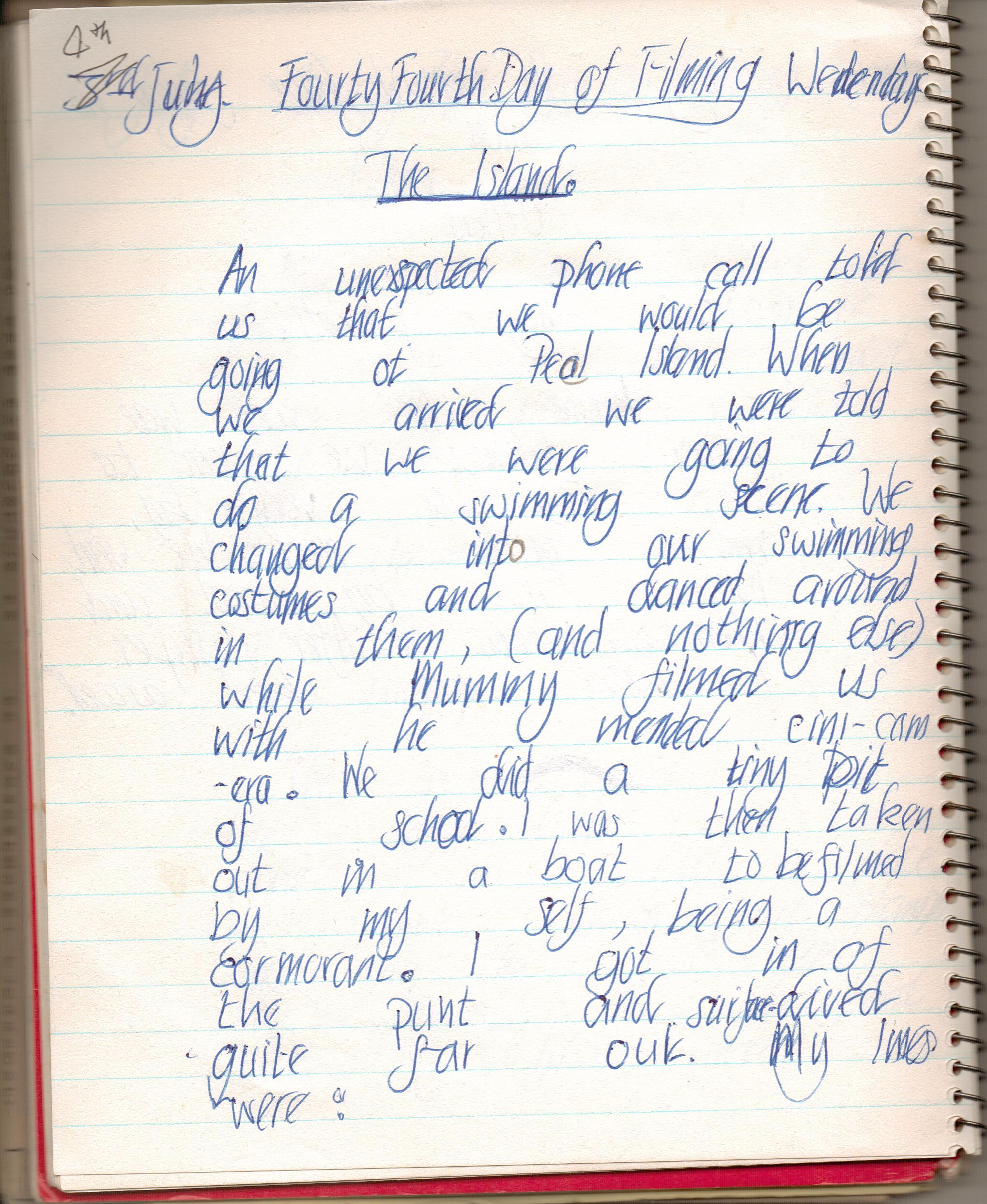
Sten Gredon as Roger Walker being taught to swim by Suzanna Hamilton playing his sister Susan Walker on location at Peel Island on Coniston in 1973
Roger still couldn’t swim, but he was trying to. Very hard. The production manager had kindly scheduled the second of our swimming scenes as late in the summer as possible. The weather was warmer – we’d elected to go bathing in a river up near Rydal Water on our day off – but it was still pretty chilly out on Coniston.
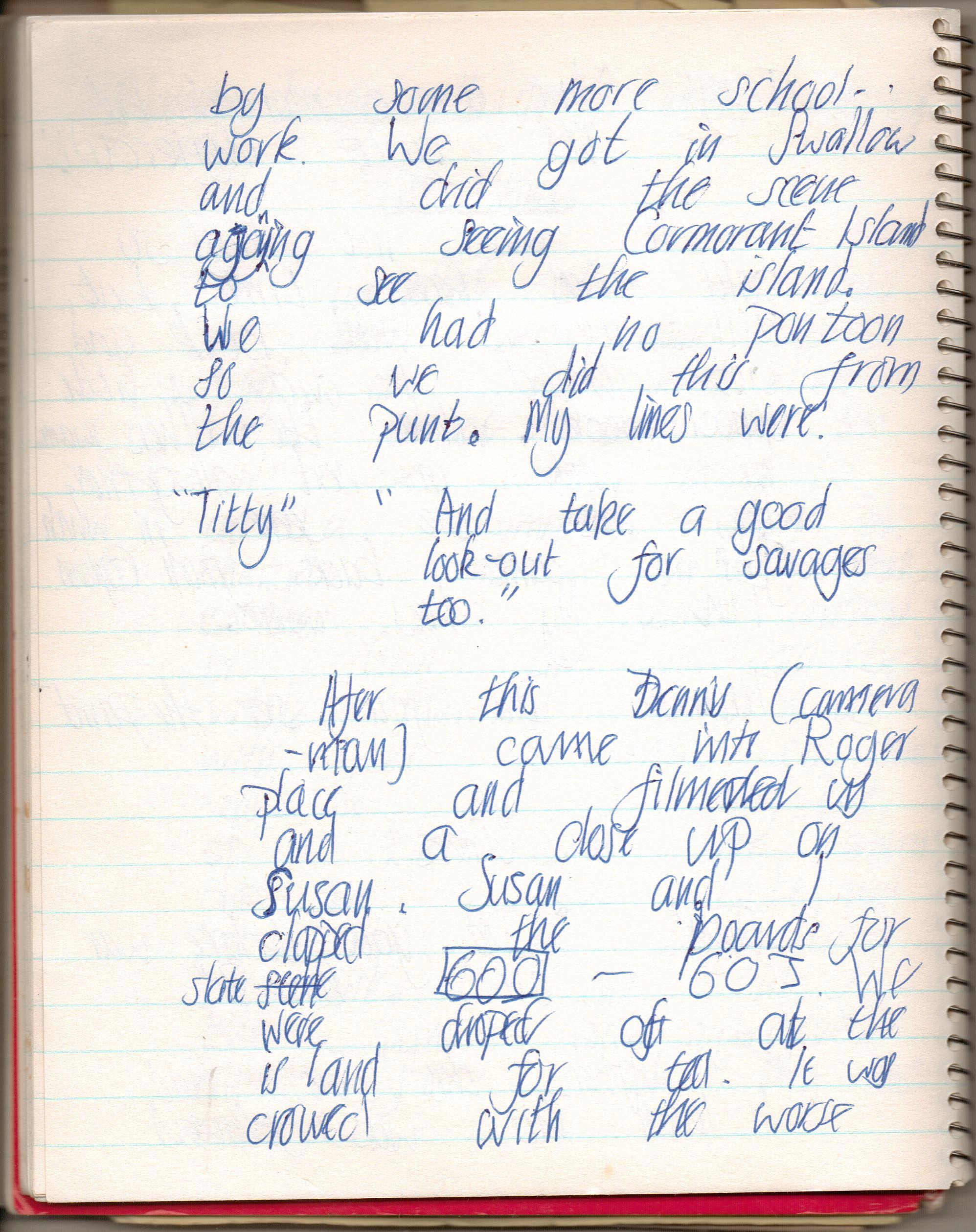
Whilst we tried to acclimatise by running around in our swimming costumes the crew were all in their thick coats as you can see from this home movie footage shot by my mother. We had bought her 8mm camera by saving up Green Shield stamps. (Can you remember collecting Green Shield stamps from petrol stations? They were an icon of the early 1970s all by themselves.) I remember someone on the crew calling out ‘Second unit!’ as Mum lifted what looked like a grey and white toy to her face. It was a bit noisy so she was not able to record during a take. You only see us before and after the sequences in the film, but her footage shows quite a few of the members of the crew – all smoking away, even when they were trying to warm us up after each sequence. You can watch Jean McGill, from Cumbria, our unit nurse who was dressed in red, popping Dextrose into our mouths and giving us hot drinks to warm us up. Jean made Gareth Tandy, the third assistant, who was aged about 18, wear a sun hat because he had previously suffered from sun stroke. David Blagden can be glimpsed as the one other man with short hair.
The camera pontoon must have been left up on Derwentwater. Claude was obliged to shoot these scenes from what we called the camera punt, which was smaller but quite useful. Richard Pilbrow sent me a picture. He has included others in a book that he has written about his career, including a section on the making of ‘Swallows and Amazons’ called ‘A Theatre Project’
First assistant David Bracknell, director Claude Whatham, grip David Cadwallader and DoP Dennis Lewiston (seated) with three local boatmen ~ photo: Richard Pilbrow
Do please let me know if you can tell me the names of the three Cumbrian boatmen featured in this photograph who helped us. Others are featured in the home-movie footage. They all look like pirates. Real ones.
Goodness knows that Health and Safety would say about that punt today. The DoP managed to get two sizeable electric lights, on stands, into a boat already overloaded with personnel and expensive equipment. You can see for yourself. Were these ‘Filler’ lights powered by portable batteries? The Lee Electric generator was on the shore. I was in the water. Busy being a cormorant.
We had an interesting afternoon filming with both dinghies. At one point we had the camera with us in Swallow. I found these photographs of us on the internet.
Sophie Neville, Simon West and Suzanna Hamilton
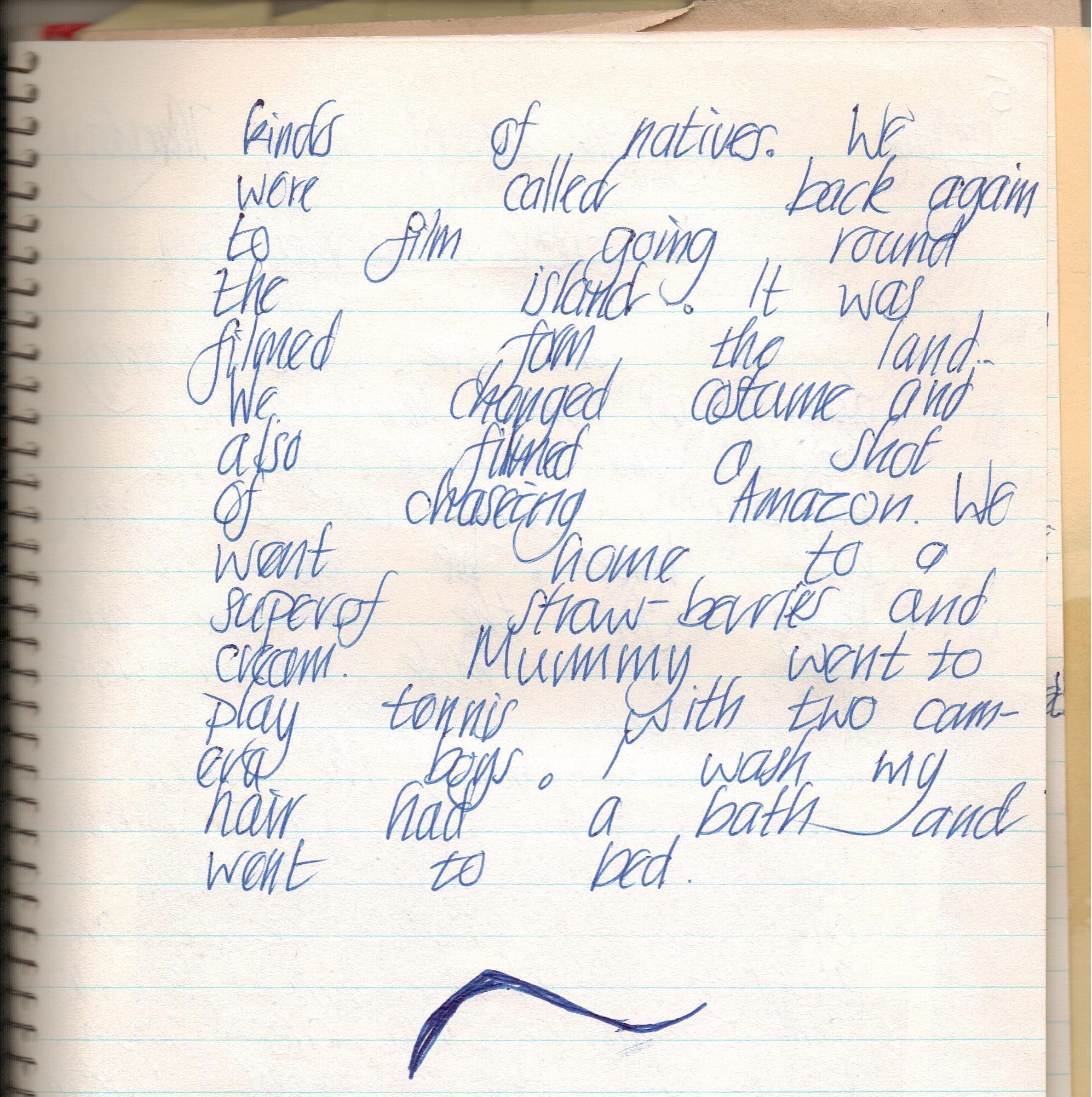
I was given the honour of clapping the clapper-board and calling out, ‘Shot 600, Take one!’ for a close-up of Suzanna Hamilton.
Suzanna Hamilton as Susan Walker sailing Swallow on Coniston Water in 1973
‘The worse possible kinds of natives’… Tourists were beginning to arrive for their summer holidays in the Lake District and we still had quite a bit more to film.
Sophie Neville, Suzanna Hamilton and Simon West sailing Swallow in 1973
You can read more about the adventures we had making the original film of Swallows and Amazons here:
If you ever see a cormorant you must sing out, ‘They’ve got India-rubber necks!’
And then, if you are on a long journey you can add, ‘ Cormorants. We must be near the coast of China. The Chinese have cormorants. They train them to catch fish for them. Daddy sent me a picture.’
Sophie Neville, Suzanna Hamilton and Simon West as the Walker children sailing to Wild Cat Island in Swallow
If you ever get lost – or the journey really is a long one, you can say,
‘Here we are intrepid explorers making the first ever voyage into unchartered waters. What mysteries will they hold for us? What dark secrets will be revealed?’
They were most complicated speeches to deliver afloat, ones I had to learn. In the end the second part was heard OOV – out of vision. I could have read the lines. But then they wouldn’t have stayed in my head forever, as they have.
Stephen Grendon, Sophie Neville, Suzanna Hamilton and Simon West on the voyage to Wild Cat Island, scenes shot on Derwentwater in 1973
If, on your journey, you happen to see a man sitting in a chair writing notes you score high and can say, ‘What’s that man doing? He’s probably a retired pirate working on his devilish crimes.’
Filming Swallows and Amazons (1974) from a camera pontoon
(I’m a bit hesitant about that one because my Aunt Hermione really was approached by pirates when she was sailing round the world. The Daily Mail published her dairy chronicling the adventure; a full page double- spread with photographs no less. Rather sadly they ran headline ‘Intrepid Pensioners…’ What a swizz. She should have lied about her age and said she was 27 instead of 60. Well, perhaps 57, what with the photos.)
The scene behind the camera that day on Derwentwater was rather different from from the scene in front of it.
I got cold sailing but it was a glorious sunny day with a fair wind. We achieved a huge amount even if Cedric fell in. Some of the boatmen and crew wore life jackets, others did not – including my mother.
We wore BOAC life jackets for rehearsals but Swallow is a safe little boat – her keel ensuring we didn’t capsize if we happened to jibe and we never fell in. The pontoon was really rather more dangerous being a raft with no gunwale. Any one could have misjudged their step and plopped overboard. Luckily we were not stifled by Health and Safety in those days – only the rigorous demands of movie insurance companies.
This shows the camera crew climbing aboard the pontoon in order to film Swallow sailing. Daphne Neville sits in the Dory safety boat in the foreground. A reflector board, wrapped camera mount and microphone are already on board.
I’m sure we had already shot the first two scenes of the day when I was in Amazon, setting the anchor and later hearing the robbers. I expect Claude needed to re-shoot for technical reasons. Day-for-Night filming requires clear, sunny days and he would have needed still water.
John and Susan find Titty has moored the Amazon off Cormorant Island
I have some of my father’s 16mm footage showing us at around this stage in the filming. It was shot on a different day but shows us on the shores of Derwentwater, waiting around before rushing off across the lake in motor boats to finish filming before Claude lost the light. You see the pontoon and a safety boat towing Swallow, me snapping bossily at Roger to get a move-on, (unforgiveable but I was 3 years older than him and irritated to distraction), the third assistant Gareth Tandy in blue with glasses, our sound recordist Robin Gregory throwing his arms wide open, Kit Seymour and Lesley Bennett by the lake shore, David Blagden with his short hair-cut splicing rope, me in my Harry Potter-ish blue nylon track-suit top with Albert Clarke the stills photographer, Swallow and some mallard duckings.
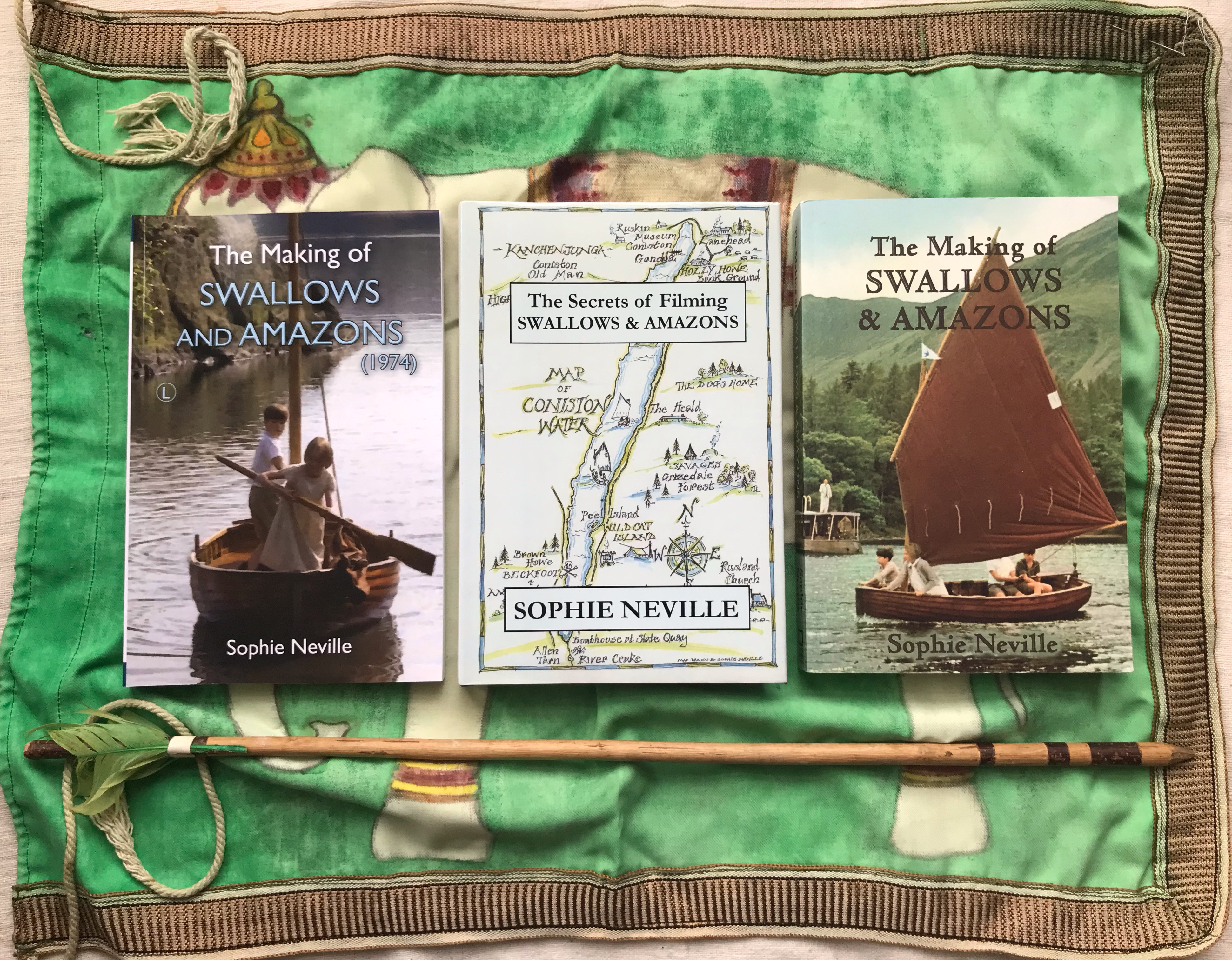
If you are enjoying this blog, please find an expanded version of the story in the ebook, available from all online retailers such as Amazon Kindle for £2.99 and on Goodreads here It has also been published in two illustrated paperback versions, which make good presents.
Different editions of ‘The Making of Swallows and Amazons (1974) by Sophie Neville’
Ronald Fraser with Wardrobe Master Terry Smith being transported to the Houseboat played by The Lady Derwentwater
Ronald Fraser being transported to the Houseboat with Terry Smith
My diary entry for 24th June 1973 is not exactly revealing. As it was raining steadily in the Lake District, I was given a second day off. ‘We had a quirte (sic) morning,’ I wrote. I am sure I needed one. After a heavy week’s filming I’d spent the official ‘Unit Day Off’ writing five end-of-year exam papers, answering correspondence from school friends and going to Kit Seymour’s thirteenth Birthday party. I must have been exhausted. Legally children are meant to have two days off a week while filming. This was the first time it had been possible.
Suzanna Hamilton’s diary adds little more, but my mother was on set, as was a journalist from The Guardian, so I can tell you what happened. I can even tell you what the location caterers from Pinewood cooked that day: Melon, followed by roast beef with Yorkshire pudding, boiled or roast potatoes, peas and carrots with apple crumble or tinned peaches served with custard or evaporated milk. It was a Sunday. Suzanna noted that we had ‘salad for super’, her favorite food.
Set dresser Ian Whittaker, Ronald Fraser and one of the Prop Men on the houseboat ~ photo: Daphne Neville
“The houseboat has been converted from a pleasure steamer,” wrote Michael McNay in the Features section of The Guardian, “the whole of the superstructure fore faked up by props, the cabin aft converted into a retired colonist’s sittingroom – African rug, flowery curtains, assegais on the walls, an ebony elephant with silver howdah and trappings, a walnut wireless cabinet, tall brass oil lamps, a pile of 78rpm records, a silver mounted cricket ball (presented to G.Gumbleton, 1899, for the highest individual score of the season), a chest, a writing desk and an ancient upright Imperial.” I have typed this up exactly as it was published on 7th July 1973.
By props, I don’t think Michael McNay meant pit-props. He was talking about the work of the design team headed by Simon Holland. Ian Whittaker, who later won an Oscar for set dressing, helped Simon to create Captain Flint’s cabin with one of the Prop men who is photographed here. Does anyone know his name? I think it might be Terry Wells. I expect the cane chairs and side table were being temporally stored on the roof when this snap shot was taken so as to make space for camera and lights. The gaffer and camera crew would have been in the process of setting up inside the cabin. Sound would not have settled in yet. How do I know that after all these years? I can see the recordist’s arm at the left of the photograph. I still remember his coat.
“Ronald Fraser, alias Uncle Jim, is tapping away at a book.” Michael continues. “Last minute panic: who can type out quickly a folio of copy to leave nonchantly in the roller?” That would have been Sue Merry, the continuity girl. The first scene was probably the one in which Uncle Jim is typing with the green parrot on his shoulder when a firework goes off on his cabin roof. I wonder if Arthur Ransome had ever been disturbed by the Altounyan children in such a way. Did he use an Imperial typewriter?
The film crew were on location on Derwentwater. “By now, the houseboat has been moved and moored to the western shore just off a promontory that is being faked up as one end of Wild Cat Island.” The houseboat, really one of the stars of the movie, was being played by a long-time resident of Cumbria, The Lady Derwentwater. A 56 foot motor launch, owned by the Keswick Launch Company since 1935, she returned to real life after the filming, rather like I did. She still carries up to 90 passengers. You can go out on her today.
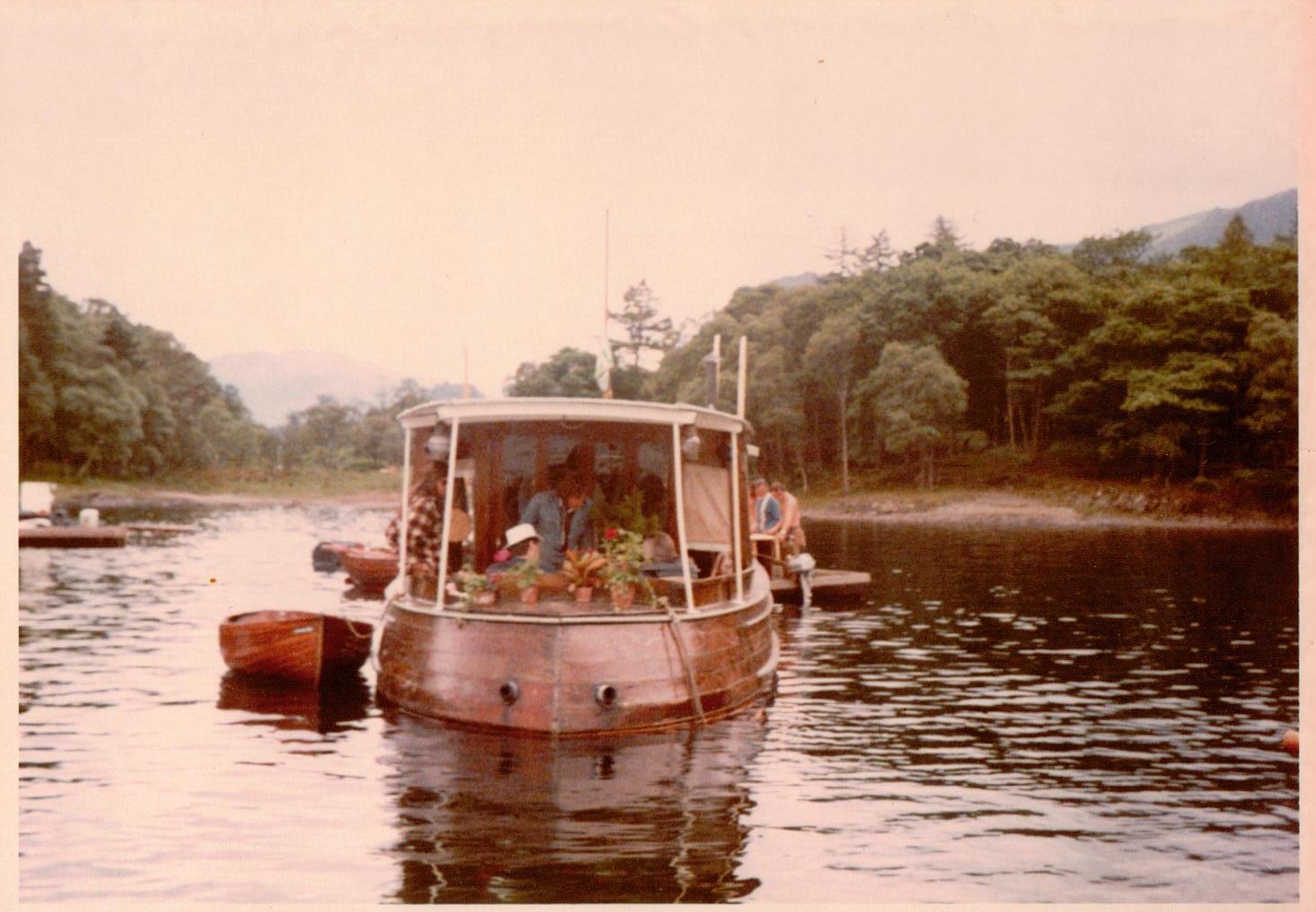
Was this the houseboat Arthur Ransome had in mind? The photograph was taken by Martin Neville in 1973
My father, who is keen on steamboats, had been off to find the real houseboat that Arthur Ransome had in mind. Am I right in thinking this must have been the original Gondola? I expect she was too un-seaworthy for the production team to contemplate using in 1973. A reliable, water-tight boat that could be towed into the location used for Houseboat Bay was needed. Last year we went to see TSSY Esperance at the Windermere Steamboat Museum in Cumbria, which is another Victorian steam yacht envisaged by Ransome as a possible model for Captain Flint’s houseboat. It is a beauty but we did get a better view of the lake from of the cabin windows in the Lady Derwentwater.
TSSY Esperance, the 1869 Steam Yacht, at the Windermere Steamboat Museum, Cumbria in Apirl 2011
“The rain has stopped, the mist is lifting from the 1,500 foot ridge of Cat Bells. Fraser climbs gingerly aboard, awkward in co-respondent’s brown and white shoes, rosy make-up and moves into the aft cabin.” McNay continues. He is describing the main scene to be shot that day. “John, alias Simon West, is in a rowing boat 15 feet away… The problem this time is that the rowing boat has to remain anchored but look as though Simon is pulling steadily in towards the houseboat and the anchor rope has to remain hidden.” This must have been so that Swallow could be lined up accurately and remain in focus for the camera. It is one of the secrets of making the film that I have been asked about directly.
“Simon shows Claude Whatham how he’ll manage it. Quick rehearsal inside the cabin. Ronald Fraser on his knees by the chest folding a white pullover, catches sight of approaching boat, mimes angry surprise. Told not to jerk head so far back. Instead jerks eyebrows up. The cabin is no more than eight foot by ten and contains besides Fraser and the props, four men on a camera, one on lights, and the continuity girl.” McNay had not included Claude the director, who I know would have squeezed in since these were the days before monitors from the camera feed. And he was small. The sound recordist was bigger but may have just planted a microphone on the desk.
“On the small aft deck Pilbrow is for the next few minutes going to be redundant.” This is Richard Pilbrow, who now lives in Conneticut and I am sure will read this post. “He is a mild, inoffensive looking man producing his first film. He is 40… looks like your friendly local antiques dealer. He and Whatham are a good team: Whatham is slight, energetic and calm. He has time, even as a sequence is being set up, to ask the Press if they can see enough of what’s going on from the crampt aft deck of the houseboat. It’s a cheerful crew, (Denis Lewiston the DOP) watching clouds overhead with benign suspicion, taking light meter readings inside and out-side the cabin every 30 seconds.
‘Stand-by Simon.’
‘Action,’ said quietly into the cabin.
‘ACTION,’ across the lake to Simon. The clapperboard shows 461 take 1. Fraser folds the pullover, looks up, jerks eyebrows in angry surprise, camera swings round to follow Fraser’s gaze through the window, Simon pulls on left oar, keeps the rope hidden.
‘Once more please. Stand by. Action. ACTION (461 take 3) …. CUT.’
There’s a consensus that the third take was best. Ten minute break while the succeeding sequence is prepared: Fraser rushes out on deck and tells Simon to clear off. That too is filmed in triplicate. The time is 12.45. They started work at 6.30, began filming at 12.25 and they’ve got maybe 45 seconds in the can. Everybody seems pleased.”
The Gondola on Coniston Water today, re-built and restored by the National Trust, powered by steam and taking passengers down the lake from April to November.
You can read more about the adventures had making the original film of Swallows and Amazons in any one of these editions of Sophie Neville’s filmography available from Amazon and all the other usual places. You can read a little more about them on this website here.
Different editions of ‘The Making of Swallows and Amazons (1974) by Sophie Neville’
The boathouse at the Slate Quay where Arthur Ransome came on holiday as a child sits at the southern end of Coniston Water. How wise he was to write about the places, the culture and experiences that he knew so well.
As you walk down the footpath from the lane, you come across interesting artwork, although it would not have been around in Ransome’s day.
~ Sculpture at Slate Quay by Andy Gormsly~
The boathouse came to be owned by Bridgit Sanders, nee Altounyan, who was the inspiration for the youngest of the Swallows Vicky, the ship’s baby, and went on to become the first president of The Arthur Ransome Society. She lived with her family in the house nearby, teaching her children and grandchildren to sail on Coniston Water. After having children, Roger Altounyan rented half the house and would take them sailing in Mavis, the model for Amazon, bailing like mad.
~Coniston Water~
Arthur’s father would venture up the River Crake to fish in Allan Tarn, which may well be the location of Octopus Lagoon, first mentioned in ‘Swallows and Amazons’.
Whilst fish enjoy the reedy habitat, small boys are reputed to enjoy the ‘Knickerbockerbreaker’ rocks that rise above what must be Swainson’s Farm at High Nibthwaite, featured in Swallowdale, which you can find by the road nearby.
We pressed on in search of other places that made an impression on Ransome’s life. Although we had a very good driver this was not always as easy as one might imagine.
But I did find another representation of the crossed flags. Can anyone guess where?
~Kneeler embroidered by Jean Hopkins~
We drove through the gentle countryside south of Coniston Water passing a house called New Hall, once rented by Arthur Ransome and his wife, and on, climbing up past Gummer’s How and wiggling down to reach The Mason’s Arms, which I gather this was one of his favorite pubs.
Then, seemingly in the middle of no where, we came across the Holy Grail: Low Ludderburn and the erstwhile grey barn where Ransome wrote ‘Swallows and Amazons’. He had a writing room on the first floor. Roger Wardale says he kept his car, the ‘Rattletrap’ in the wooden garage that you can see just in front of the building. It was private then, and is a private house now, but you can catch a glimpse of it from the lane that runs up and on, eventually taking you down to Blake Holme on Windermere, which he named as partly the inspiration for Wildcat Island.
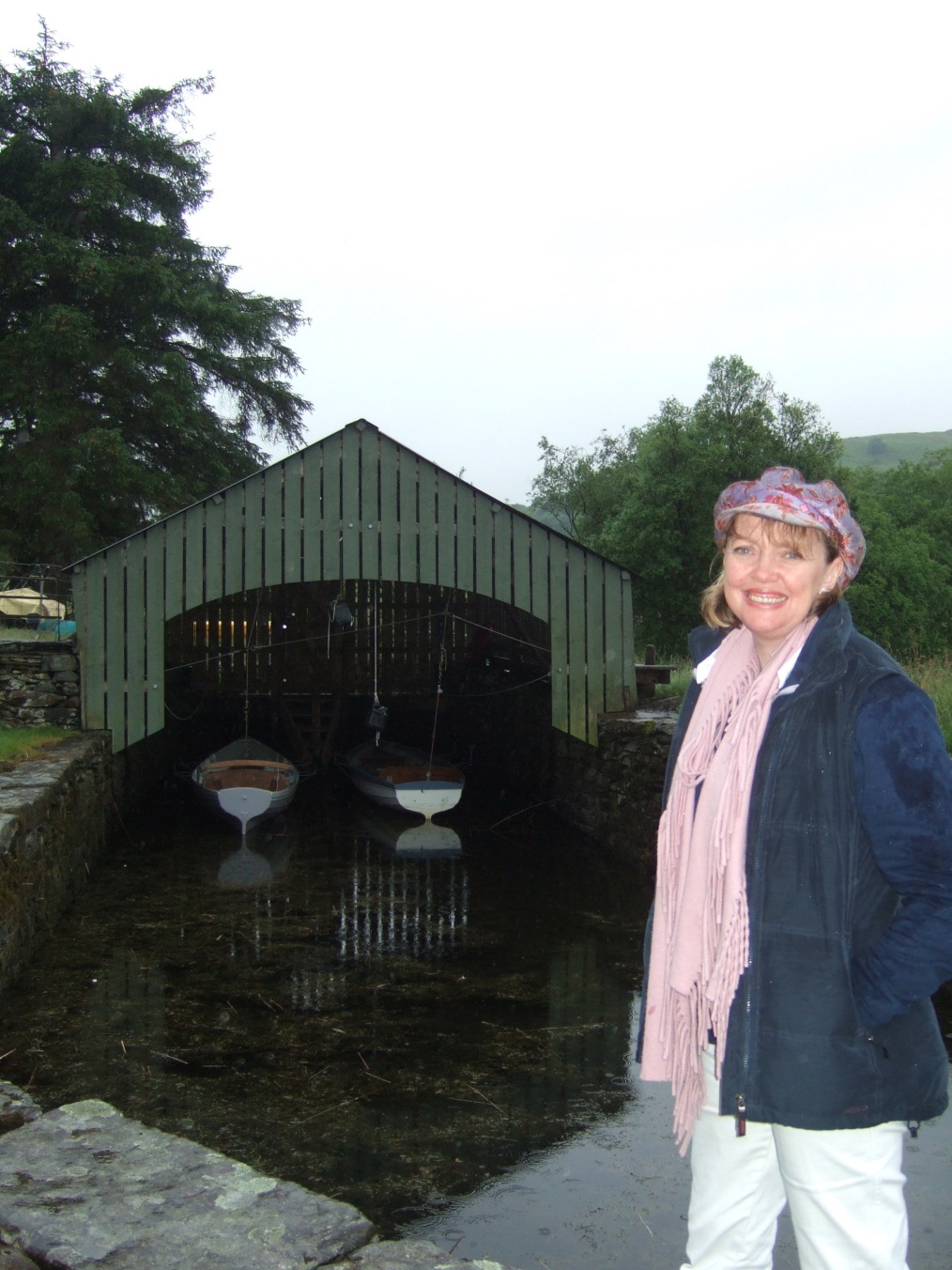
I’ve always thought that Arthur Ransome must have been completly impervious to the damp, to cold and wet weather. I am not. By now it was raining so hard that my husband was wearing my pink beret, but we were still in good spirits.
In a recent letter to The New York Times Frank Phelan from Albuquerque wrote to say,
It was not just British children who were saturated with the “Swallows and Amazons” novels of Arthur Ransome, as the review of “The Last Englishman,” by Roland Chambers, suggests (May 27). I grew up hundreds of miles from the ocean in Pittsburgh, wanting to be like Ransome’s characters. I wrote to him asking which of the English lakes was the right one. He sent me a postcard saying that it was “Windermere, with a few touches of Coniston, for the sake of disguise.” He ended with “You’ll be sailing some day!” and I lived on that.
So back to Windermere, and a long hot bath at Miller Howe, a lovely hotel that had a Jonathan Cape copy of Swallows and Amazons on the hall table. In the morning cloud was sitting on the high fells looking just like snow. I ran down to the lake to put my hands in the water, thinking, ‘This is the place for Winter Holiday’. But that is another book.
You can find maps showing these locations in ‘The Making of Swallows and Amazons’ or the ebook of ‘The Secrets of Filming Swallows and Amazons (1974)’ available from Amazon Kindle and other ebook platforms.
Ronnie Cogan having a cigarette with one of the Supporting Artistes. Terry Smith the Wardrobe Master is going below in the background. photo: Martin Neville.
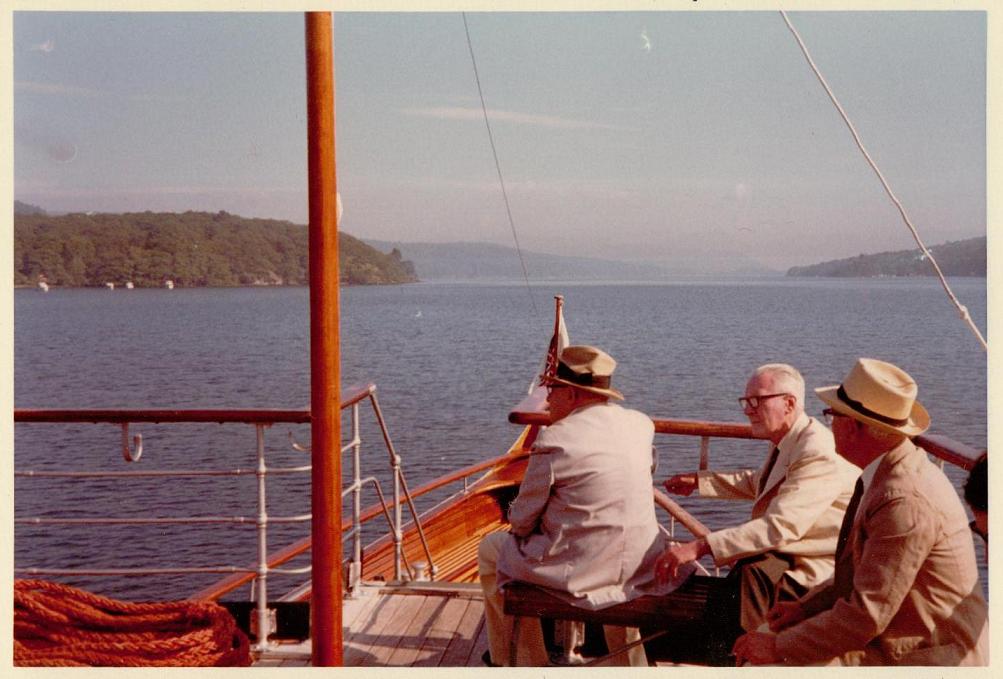
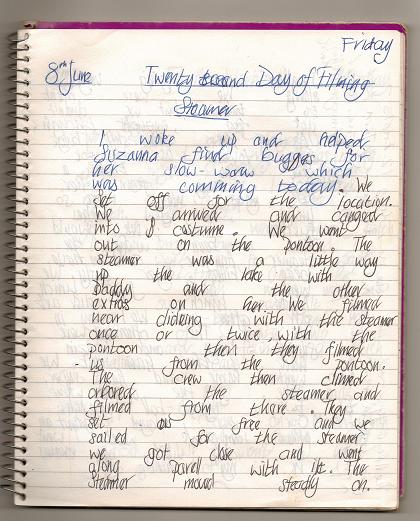
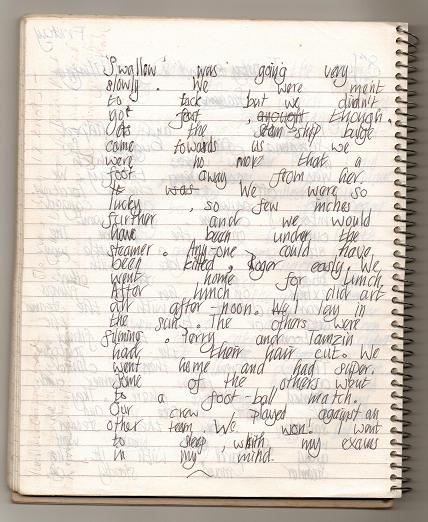
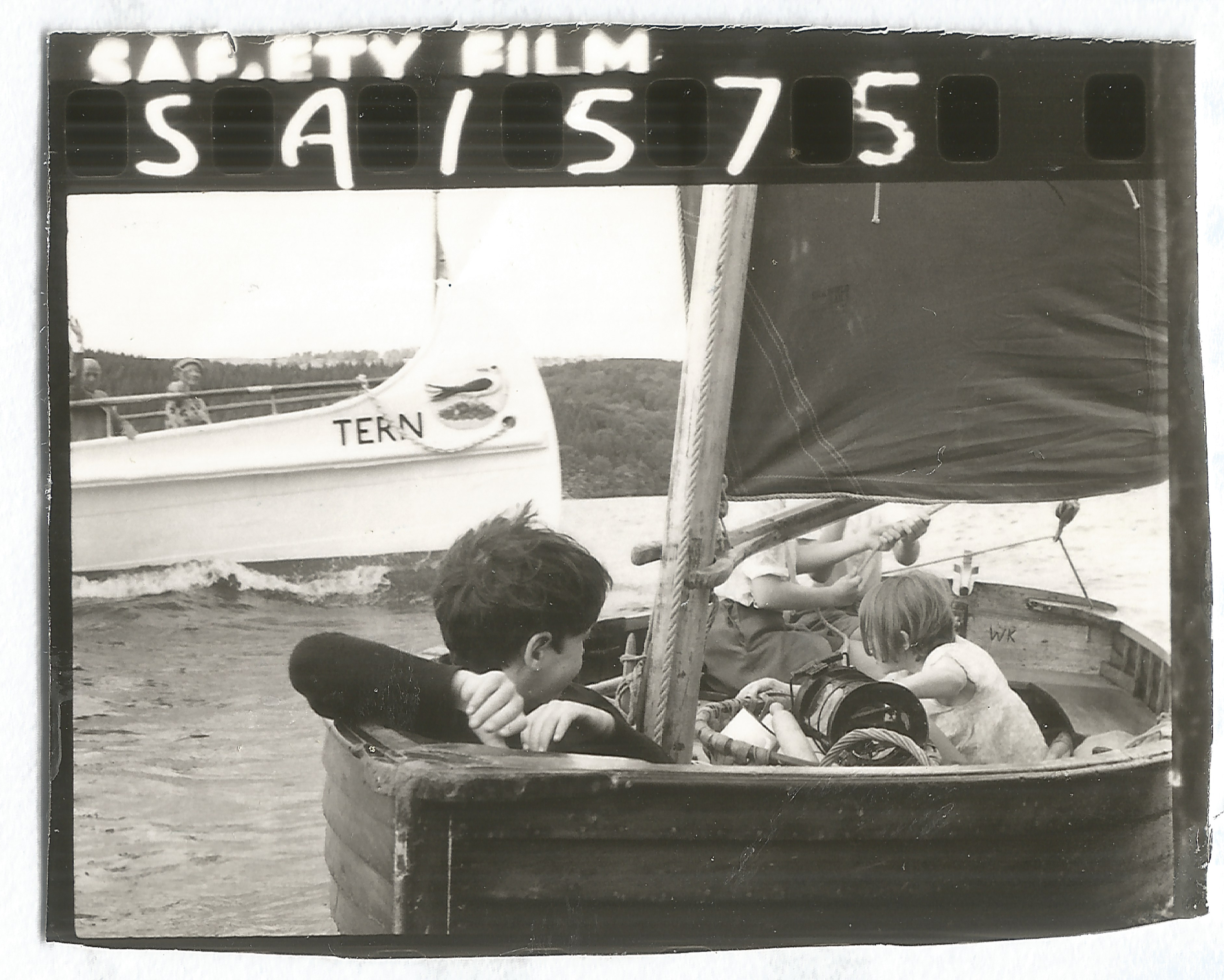
It was a glorious summer day to film on Windermere. Conditions were perfect. My father had been asked to appear as a film extra in the scene in Swallows and Amazons when the the crew of Swallow narrowly miss colliding with a Lakeland steamer, that transporting tourists up and down the lake.
Martin Neville wearing 1929 costume aboard MV Tern on Windermere in 1973
He was the tall dark native in a blazer and white flannels aboard the elegant MV Tern. A lovely way to spend a sunny morning in the Lake District. Until your daughter nearly drowns.
MV Tern on Windermere was built in 1890 with a steam engine, converted to diesel in the 1950s, and is still operating today.
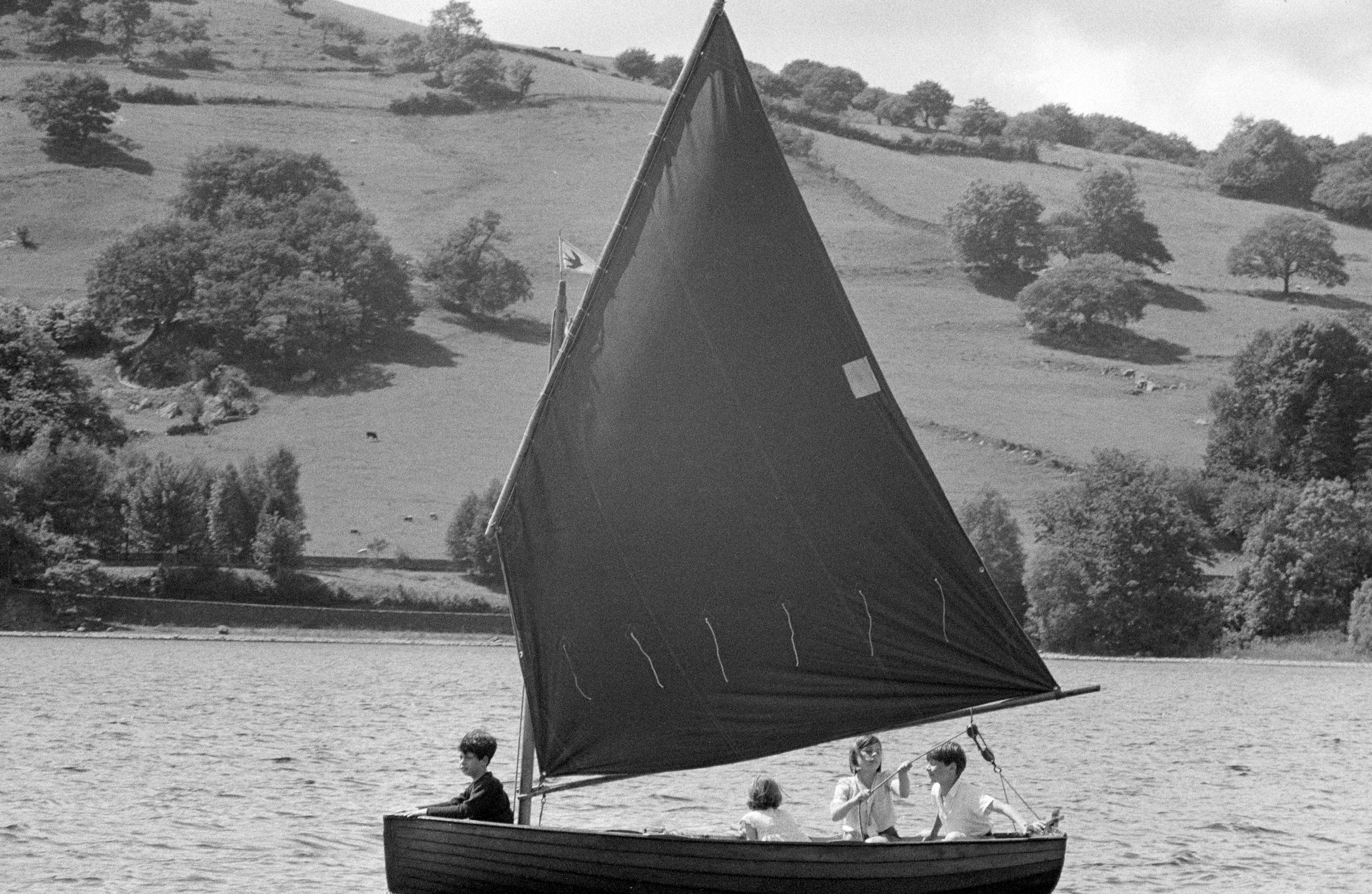
Simon West, Suzanna Hamilton, Sten Grendon and I were sailing the Swallow, on our voyage to the island. The twelve-foot dinghy was laden with camping gear and had no buoyancy. We did not wear life jackets.
At the start of the day, Swallow was attached to the camera pontoon so that Claude Whatham, the film director, could capture our dialogue on film. The camera crew then went aboard the Tern and we sailed free, with the safety boat some distance away, behind the camera. Other boats were keeping modern boats clear of the shot.
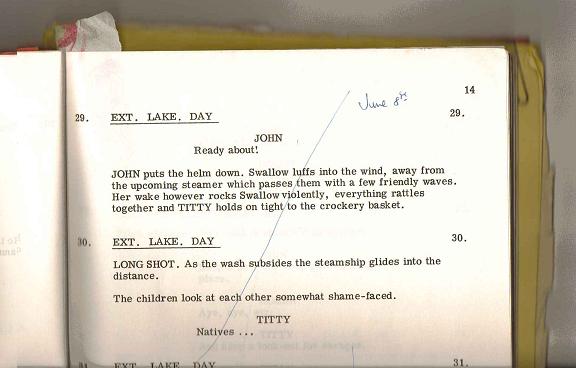
In the script Roger is down to say, ‘Steamship on the port bow’. I think what came out was, ‘Look John! Over there – steamer ahead!’
The Tern had a young, inexperienced skipper who was coping with a notch throttle, as you can see if you watch the movie.
The screenplay of David Wood’s adaptation of Arthur Ransome’s classic book ‘Swallows and Amazons’ set in the Lake District in 1929
My mother, who normally looked after us, had been obliged to drive to Bristol as she presented a weekly programme for HTV with Jan Leeming called Women Only and had been summons to promote the channel at the Bath and West Show. Dad must have been acting as our chaperone, responsible for our safety. A sailor with years of experience racing on the Solent, he took a keen interest in all the boating scenes, but I’m sure he didn’t have a chaperone’s licence. As we sailed towards him, on an intentional collision course, he foresaw that the larger vessel would take our wind.
Three men of Cumbria who were happy to have short-back-and-sides haircuts on the deck of the MV Tern on Windermere in 1973 ~ photo: Martin Neville
My father watched from above as we only just turned in time, missing the steamer by a mere nine inches as her bow wave bounced us away and we sailed on. Ronnie Cogan had to buy him a whisky. They knew Sten could hardly swim, that any of us could have been entangled in the ropes and camping gear if Swallow had gone over. Clinker-built dinghies can sink quickly. It was a sunny day but the water was icy and very deep.
We did not know it at the time, but Dad nearly took me off the film. He had a meeting with the producer when he tested the BOAC life jackets we rehearsed in. Mine did not inflate.
Phil Brown, who belongs to the Arthur Ransome Group, said: “Tern was re-engined in 1957 with two diesel engines. Interestingly she was to have been named SWALLOW, but after a last-minute change, she was launched in June 1891 as TERN.”
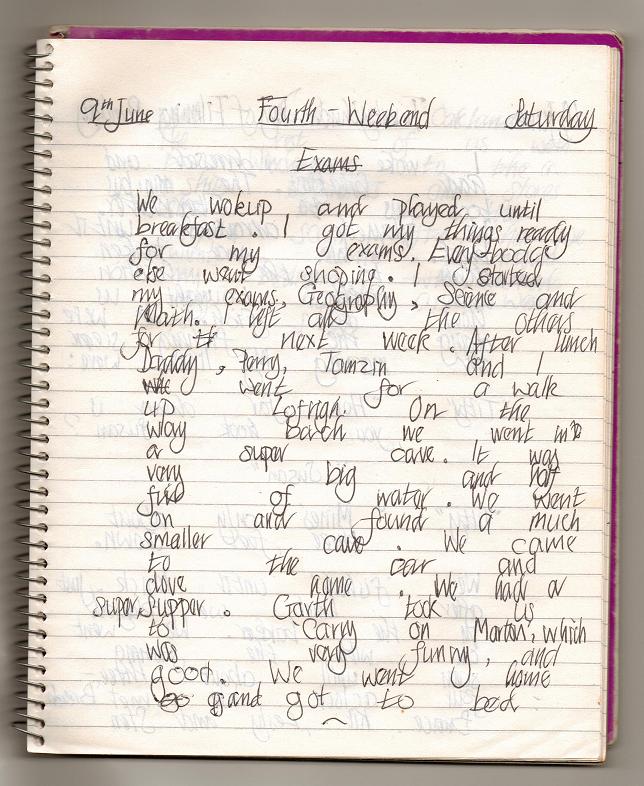
It is said that children bounce. The next day, I sat school exams: geography, science and maths.
…‘Carry on Matron’. I wonder what near disasters they had on that film.
You can read more in the ebook ‘The Secrets of Filming Swallows and Amazons (1974)’ available from Amazon Kindle, Kobo, iTunes and all other online retailers:
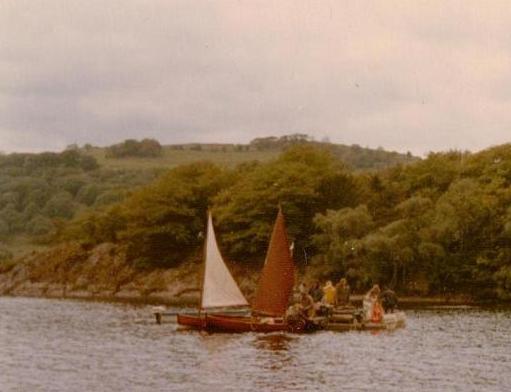
The dinghies Swallow and Amazon with the camera pontoon at Peel Island on Coniston Water ~ photo: Martin Neville
How do you film two girls sailing a thirteen foot dinghy talking to their brothers sailing along in another small dinghy while calling out to two other girls in red bobble hats dancing about on a wooded island which both the small boats are approaching?
The scene looks so simple on paper. It is the one when the Swallows sail back to Wild Cat Island with the captured Amazon to find Nancy ‘dancing with rage’ and Peggy anxious to get home before breakfast. One page of script.
Claude Whatham soon discovered that he was shooting the most complicated of sailing scenes. On a cold grey day in the Lake District.
It is extremely difficult to describe how he managed this, but I will attempt to do so.
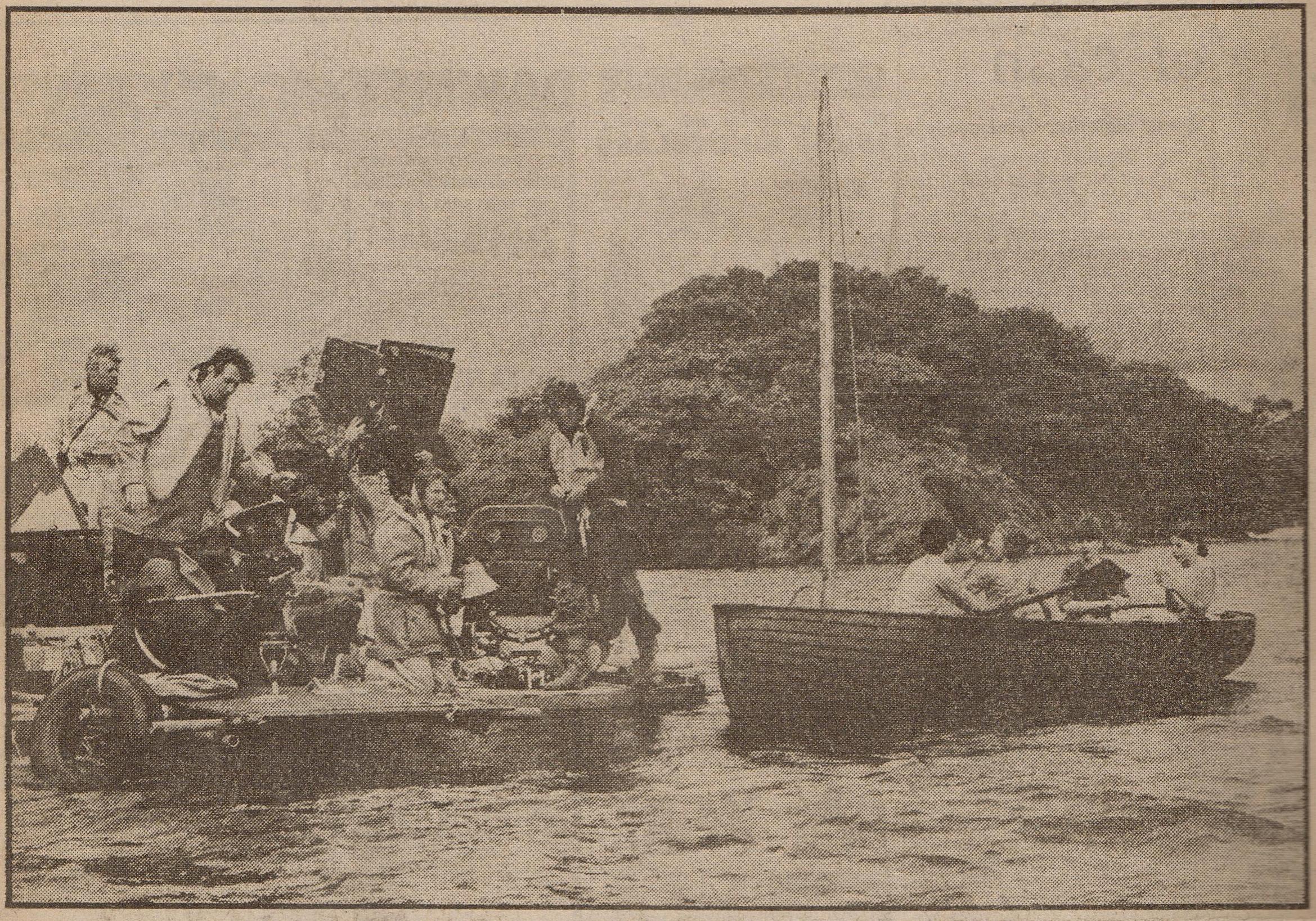
There was no room in the dinghy Amazon to film Susan and Titty sailing. This had to be done from a boat or vessel lashed along side. The production had a pontoon hired from Mike Turk in Twickenham and managed with the help of Nick Newby at Nicole End Marine near Keswick. It was a sizeable raft equipped with four outboard engines and surfaced with a number of flat ‘camera boards’.
Basically rectangular, it had arms added on either side. The idea of this cross-shaped platform was to enable Claude to film us either side-on, from astern or across the bows of the dinghy, which was wired by its keel to the pontoon. The camera was normally on a tripod. The original idea was that it could be mounted on a short section of track but I don’t think this ever happened. Electric lighting was not something that could be used on this pontoon but two large reflector boards were used to light our faces instead.
The result was a shot used on the cover of a book and a DVD marketed by the Daily Mail in 2008.
As well as the director and camera crew, the sound recordist and ‘boom swinger’ were on board the pontoon along with Sue the continuity girl. Costume, make-up and our chaperone would be in a separate safety boat, in this case a Capri. This would mill about with the life jackets, sunhats and warm clothes that we wore between set ups. The crew all started off wearing life jackets, but as you can see they were soon discarded. They were dangerous things, old BOAC ‘life vests’ with so many flappy straps that you were at risk of being trapped under water by them.
The pontoon was operated by two boat men under the eye of David Blagden, the sailing director. They had to work with Claude and the wind so that when we were sailing, while the pontoon travelled with us. This was tricky enough on open water. If we were near the shore it could become more difficult. As you can imagine the dinghy could easily start to sail away from the clumsy pontoon – or worse. Our mast socket broke that first day. They needed my father on that pontoon. He there, quietly was watching from the shore.
The camera pontoon on Coniston Water with Amazon attached to it and Swallow sailing to the other side of Peel Island during the filming of ‘Swallows and Amazons’ in 1973~ photo: Martin Neville
Although we had all read the book of Swallows and Amazons, and were devoted to adhering to every detail, no one remembered that John and Titty sailed the captured Amazon back to Wild Cat Island. She had a centre board which was a new thing for the Walkers so John decided to let Susan helm their familiar boat. I wish this had been detailed in the script. In the film, John was with Roger in Swallow whilst Susan and I were in the Amazon, which was a pity. I can only imagine that Claude decided this because he was trying to achieve a very difficult ‘three shot’. He was relying on John – on Simon West, who was aged eleven – to keep sailing Swallow in the right position, whilst out on the water between Amazon and Wild Cat Island.
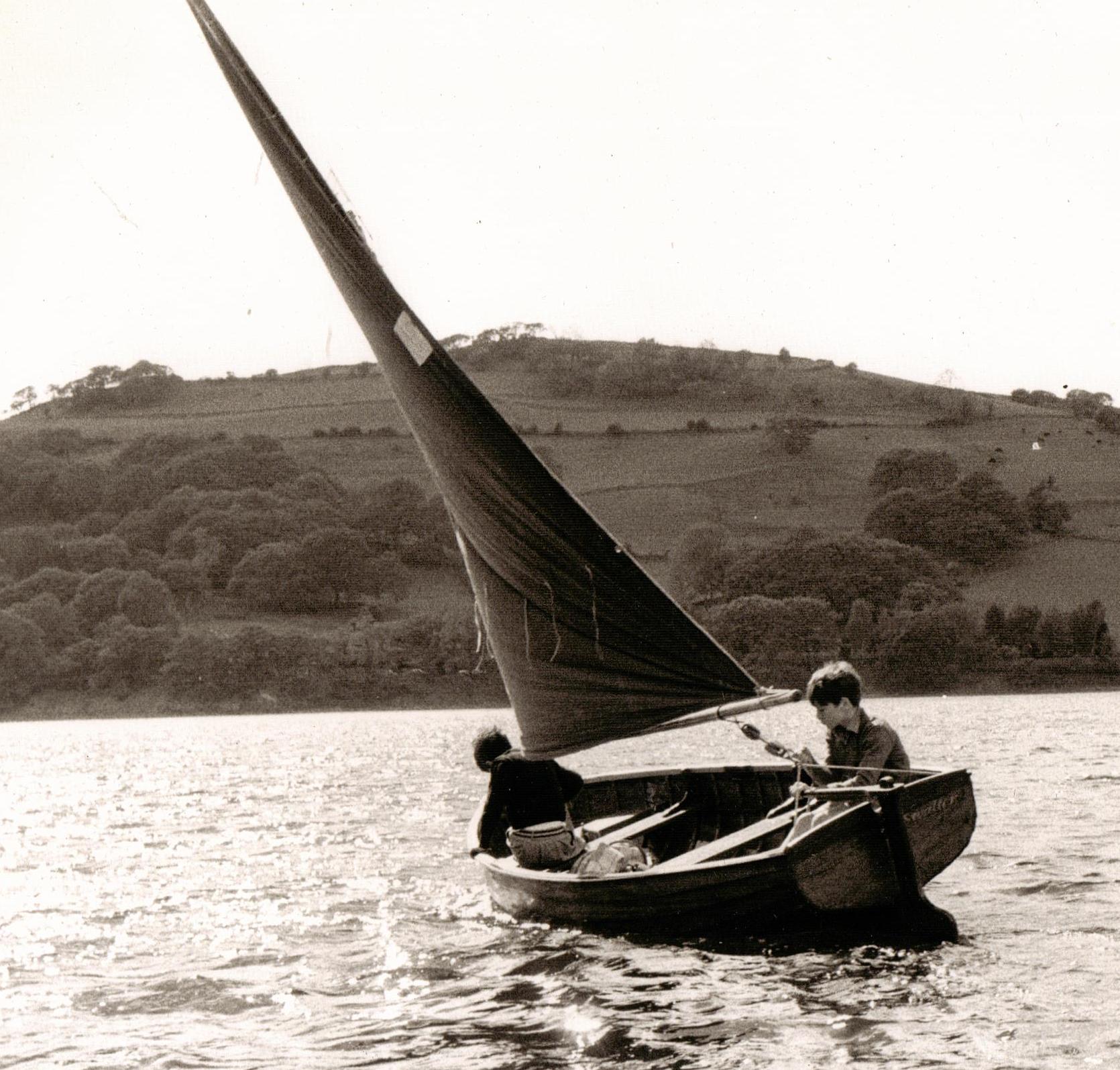
Simon West as Captain John sailing Swallow . Sten Grendon plays the Boy Roger in the bows
This wasn’t as easy as it looks. You can see from this photographs that Swallow kept racing ahead of the pontoon. It can be gusty around Peel Island and the rocks can be lethal. Roger was on lookout but he also had to deliver his lines. Having no centre board and a shallow 1920’s rudder Swallow can be difficult to turn or get going if the wind slacks. This wasn’t actually a problem; Simon had wind and he did brilliantly. Suzanna Hamilton did too. She had no previous experience of sailing the Amazon. No one had remembered this sequence when we practiced before the filming began.
Molly Pilbrow and her dog with my sister, watching the camera pontoon from the shore of Coniston Water ~ photo: Martin Neville
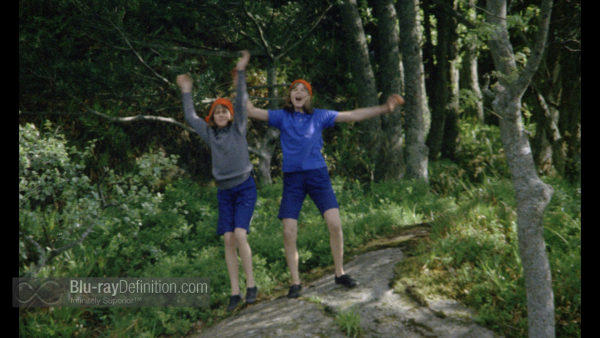
Meanwhile Gareth Tandy, the third assistant director, was standing-by (probably for hours) on Peel Island with Nancy and Peggy. He had hide in the bushes and cue them at just the right time. They did so well. They had to deliver their lines while jumping from rock to slippery rock to keep up with both the Swallow, the camera and the story.
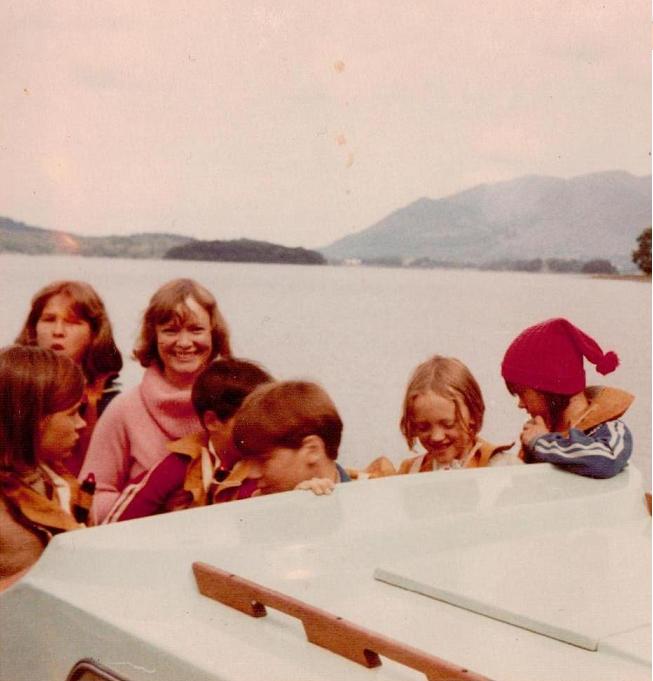
The Swallows and The Amazons in the Capri ~ Suzannah Hamilton, Kit Seymour, Daphne Neville, Stephen Grendon, Simon West, Sophie Neville and Lesley Bennett ~ photo: Martin Neville
When we filmed two of Arthur Ransome’s other books, Coot Club and The Big Six, on the Norfolk Broads in 1983, the BBC producer Joe Waters used a 35 foot river cruiser as camera boat. It could be difficult keeping it stable during a take, especially with so many people on board, but being a proper boat it was much easier to manoeuvre than the pontoon. And faster. Andrew Morgan, the director still managed to get his camera angles and it had the advantage of a cabin where sensitive equipment such as film stock and lenses could be stored. I can remember the camera assistant changing the film on board. I don’t know if the boat had heads. May be.
On both productions we had the inevitable problem of modern boats coming into shot. We had to have one of two men in zoomy motorboats that could zip across the open water to ask them to move clear of the shot. Even with this control you can imagine what happens. You line up your shot with all your boats in position, the sun comes out and a modern motorboat roars across the lake leaving you all rocking in its wake. Then it rains.
The good thing about having a safety officer in a frog-suit is that they can carry you to shore at the end of a long day. You don’t have to get your feet wet.
The Safety Officer and me, with Dennis Lewiston and Claude Whatham still standing in the Amazon ~ photo: Martin Neville
The question is – Did the DOP and the director get carried ashore too?
























 Basically rectangular, it had arms added on either side. The idea of this cross-shaped platform was to enable Claude to film us either side-on, from astern or across the bows of the dinghy, which was wired by its keel to the pontoon. The camera was normally on a tripod. The original idea was that it could be mounted on a short section of track but I don’t think this ever happened. Electric lighting was not something that could be used on this pontoon but two large reflector boards were used to light our faces instead.