David Wood, who originally worked with Evgenia Ransome to adapt her husband’s book Swallows & Amazons for the big screen in 1973, has recently written to tell me:
‘Several attempts were made to follow up SWALLOWS. I did a screenplay of GREAT NORTHERN?, plus detailed treatments of WINTER HOLIDAY (for film) and WE DIDN’T MEAN TO GO TO SEA (for television), plus a six-part serial based on PIGEON POST. But all of them bit the dust!!!
Claude is the only director for whom I worked as an actor on film (SWEET WILLIAM), television (CHERI, DISRAELI) and stage (VOYAGE ROUND MY FATHER), as well as working with him as a writer (SWALLOWS and a film that never got made called THE HEYDAY).
.
.
Claude Whatham must have made the BBC adaptation of Colette’s novel Cherijust before Swallows & Amazons as it was broadcast in April 1973. Brenda Bruce, who I knew as Mrs Dixon, played Charlotte whilst David was Desmond, supporting Scott Anthony and Yvonne Mitchell as the lovers Cheri and Lea.
.
David Wood played Lord Derby in the 1978 BBC costume drama Disreali that Claude Whatham directed. Whilst Ian McShane had the title role, the part of Queen Victoria was given to Rosemary Leach, who later played Mrs Barrable in the BBC serial of Coot Club and The Big Six. Suzanna Hamilton appeared in it too as one of the princesses. She must have been about seventeen – a good age to be zooming about in a crinoline with scooped up hair. It would have been quite a contrast to playing Mate Susan on Peel Island in the Lake District.
.
.
When he was in his twenties David starred in the feature film if…. with Malcolm McDowell. You can get it on DVD or watch the Youtube pasted in the Comments below. I’d love to see the wartime drama Aces High, the movie directed by Jack Gold in which David played Lt Tommy Thompson opposite Simon Ward, Peter Firth and Christopher Plumber as well as Malcomb McDowell. John Gielgud played the Headmaster in scenes shot at Eton in this film, while Arthur Lowe played his house master in if… I am not sure which school they used. You will have to let me know. Arundel?
.
In 2004 David was awarded an OBE for services to literature and drama. I was not surprised. His output has been prolific. To find out more about his work as an author and playwright do watch this short BBC documentary Meet the Authorpresented by Nick Higham.
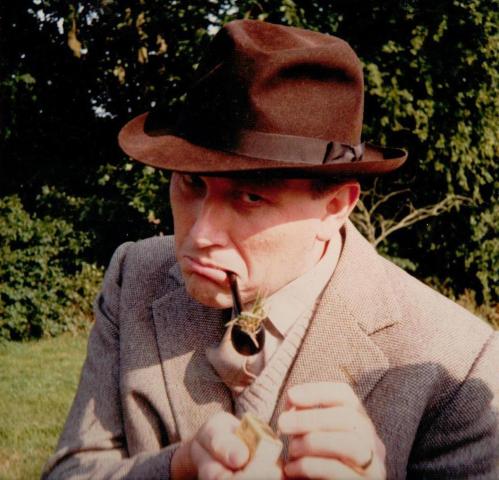
David Wood on Peel Island in 1973 with Claude Whatham, Sten Grendon, Suzanna Hamilton and Sophie Neville who is wearing David’s velvet hat.
On 19th August 2013, David Wood, who wrote the screenplay of Swallows & Amazons in 1973, took part on the Radio 4 show Quote…Unquote presented by Nigel Rees, an old friend of his from Oxford University. His fellow panelists were Matt Barbet, Katherine Whitehorn and Jenni Murray of Woman’s Hour. The programme can be heard on BBC i-Player and will be repeated on Saturday 24th August.
The reference to Arthur Ransome is 17 minutes in. David does a wonderful impression of Evgenia Ransome with whom he met for a number of script meetings whilst working on the adaptation. Her husband had died in 1967 and her grasp on his literary estate was legendary.
Here is the exact page of the script they were referring to:
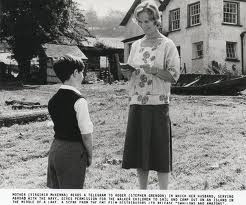
This was shot on location in the field below Bank Ground Farm in the Lake District. Richard Pilbrow, the producer, gave me a copy of this still, part of which was used on the front cover of both the Express and Daily Telegraph after the film was released in 1974.
Simon West as John Walker, Sophie Neville as Titty and Suzanna Hamilton playing Susan in Richard Pilbrow’s movie ‘Swallows & Amazons’ released by EMI in 1974
Suzanna Hamilton wrote in her diary that David Wood came to visit us on location in Cumbria on 29th May 1973, as you can see in the contact-sheet photo above. She had appeared in photo-captions illustrating a story called The Treasure Seekers that she thought he had narrated on the BBC Children’s programme Jackanory. David is not so sure, although he narrated three other series of Jackanony including The Hobbit, which is about to be released as a BBC CD.
Here is another page from the screenplay of Swallows & Amazons (1974) with more stage directions than dialogue.
At the beginning of Nigel Rees’ radio programme there is a reference to The Gingerbread Man, one of David’s original theatre plays written for children. This was premiered at the Swan Theatre, Worcester in 1976. My mother appeared as Miss Pepper in a subsequent production at the Everyman Theatre in Cheltenham.
A production of ‘The Gingerbread Man’ at the Everyman Theatre in Cheltenham, 1976
Thanks to the support of readers and reviewers I was brave enough to share my story, ‘Funnily Enough’ with the panel of judges at The International Rubery Book Award. I now have a cut glass trophy, which has its own silk-lined box.
Sophie Neville, Suzanna Hamilton, Sten Grendon, Lesley Bennett, Kit Seymour, Simon West with Daphne Neville at a Puffin Club event for the new edition of ‘Swallows and Amazons’ organised by Kaye Webb in London photo: Woman Magazine
When I look back on our lives as they were fifty years ago, I can’t help smiling. Whilst one is impacted by fashions that were too unfortunate to be revived – those collars we thought so groovy – other things haven’t changed at all. I don’t think sailing shoes or jean jackets have ever been out of circulation.
Every day clothes in 1973
In July 1973 Claude Whatham, pictured above in his Levis, had my sisters and I in a series of three Weetabix commercials that depicted life in 1933, forty years before, when the Great British breakfast cereal was first launched on the market.
Meanwhile, my mother was presenting her afternoon television programme for HTV West called ‘Women Only’ – dressed in her Donny Osmond hat.
I would happily wear her suede coat today and can often be seen in the hat. The lace-up boots looked good recently with a Wonder Woman fancy dress outfit but were terribly uncomfortable. My sister still hasn’t forgiven me for giving them away.
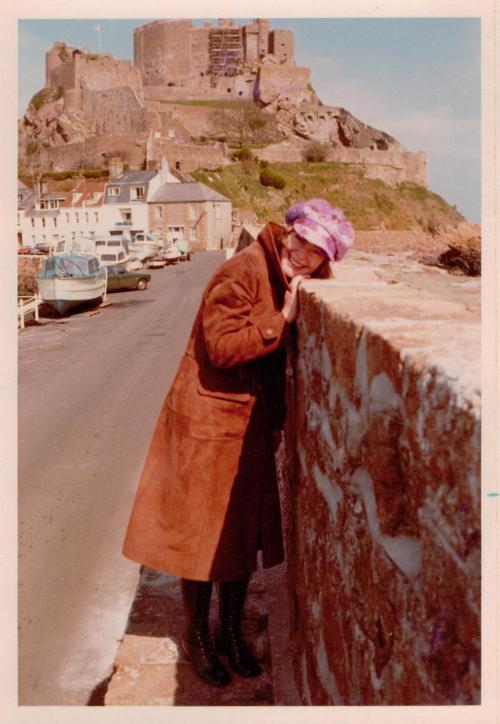
Daphne Neville on location in Jersey while presenting ‘Women Only’ in 1973
As always, well made things of quality have endured, and those faithful goods from Land Rovers to Levi jeans, Puffin Books and Weetabix are, thankfully, still being produced.
We collected Greenshield stamps, saving up zilions to buy a Super 8 movie camera. The results were wobbly but they give a glimpse into the way we were:
I have been writing about life in England fifty years ago, reflecting on how our lives have changed. Can you help me?
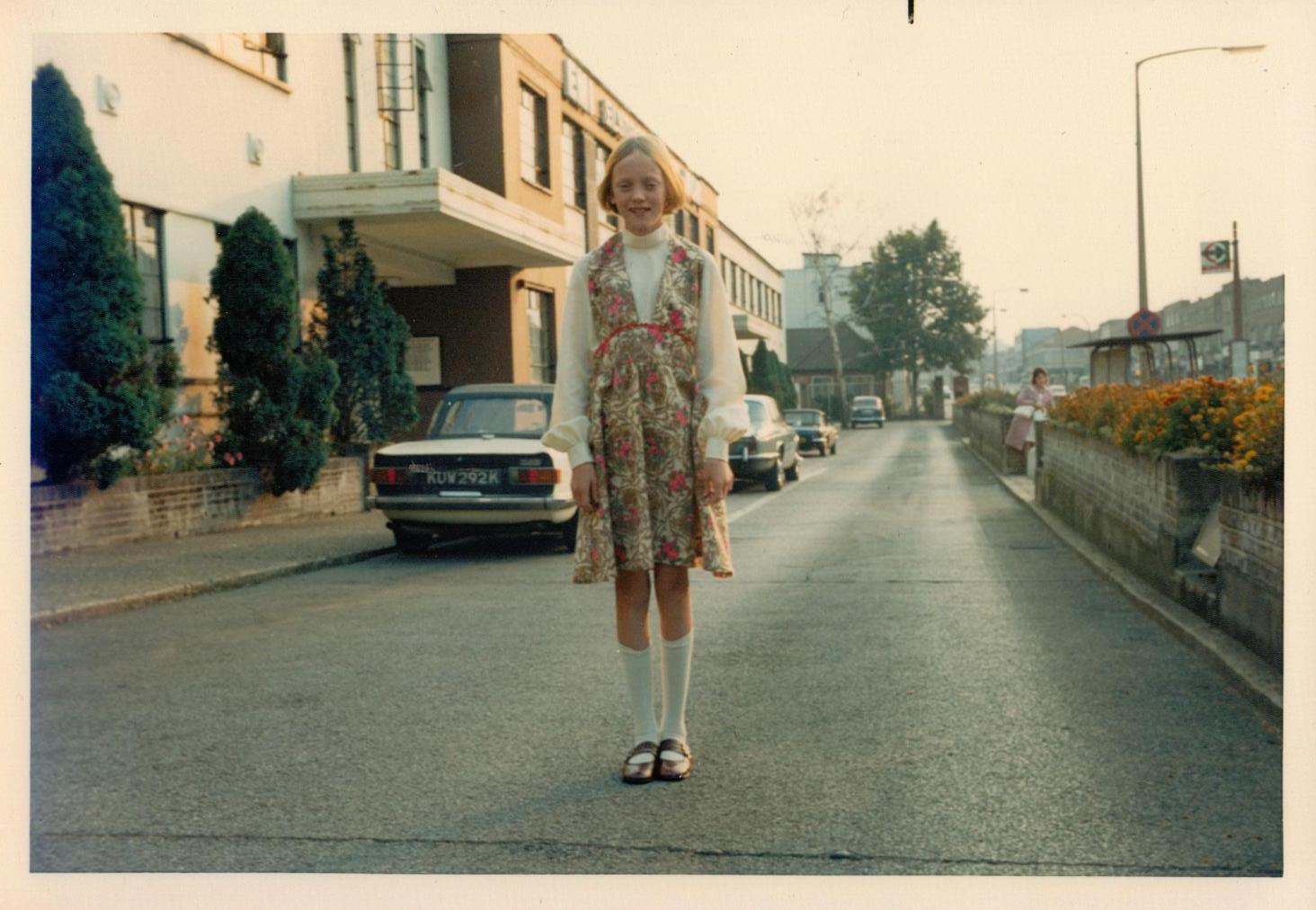
Sophie Neville at the EMI Elstree Studios in 1973
The big change seems to be in communications. In 1973 we were still queuing up to using coin operated telephone boxes in the street, asking the operator for Ambleside 2232. Letters and notes were written by hand. I learnt italic writing, so as to be clear. Manual type-writers used black and red stripped tape. Mistakes were obvious.
I’d love to receive comments (below) on how you remember aspects of growing up in the early 1970s. What did you eat then? Where did you go on holiday? What was it about 1973 that impacted you?
Jean McGill, Jane Grendon, Stephen Grendon, Kit Seymour, Sophie Neville, Claude Whatham, Simon West, Lesley Bennett, Suzanna Hamilton, Ronnie Cogan in 1973
My husband remembers long hair, flared trousers and shirts with massive curved collars. I always longed for an embroidered t-shirt with wide sleeves or a cheese-cloth shirt but loathed the feel of acrylic jumpers and ribbed polo-necks. Stripy ones. The fabric could be so vile, we didn’t feel each other as much as we do now. There was much less hugging.
Mum wearing a fluffy Donny Osmond hat
The food was pretty applauding. My friend Suzanna has just reminded me about the innovation of Italian cooking. Spaghetti was the highlight of our lives; a treat that we might have on Saturdays or for a party when red candles would be pushed into wine bottles and checked paper table cloths could enhance a Bistro image. However prawn cocktail was the pinnacle of popular aspiration, although us children preferred picking of the shells off prawns ourselves.
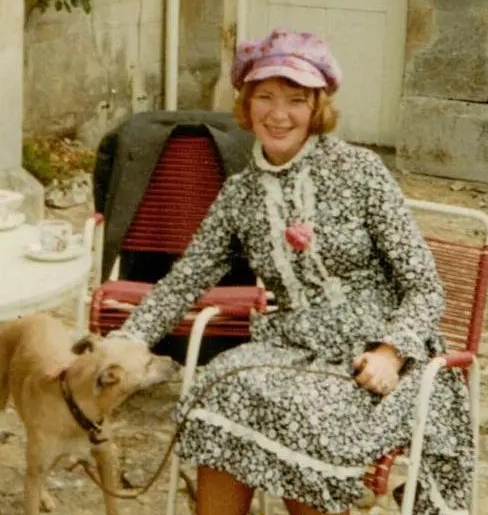
Daphne Neville in 1973
At parties you’d be offered chunks of cheese and pineapple on cocktail sticks stuck into a half a melon that had been covered in tin foil. I always rather longed for the melon. Homemade beer was regrettably all the rage, along with freezing your own runner beans. The process was quite fun (we enjoyed sucking air out of the freezer bags with a straw) but the beans were stringy and disgusting.
My family thought having to bring-a-bottle to parties was a great idea but we loathed the fact that cigarettes were smoked everywhere you went. Unless you were in the garden where abysmal furniture design spoilt the view.
Colour televisions were only just beginning to invade people’s homes. They were terribly expensive. We had to make do with our crackly black and white screen, watching Blue Peter,Animal Magic and Tony Hart presenting Vision On with cartoons such as Marine Boy until Childrens’ Television ended with The Magic Roundabout just before Daddy came home from the Works in time for the 6 O’Clock News. I then bored myself rigid watching Points West and Nationwide before It’s A Knockout.
We were allowed to stay up to watch Dick Emery , Benny Hill, and ‘Titter ye not’, Frankie Howerd along with dramas such as The Onedin Line. There was one sit com starring Wendy Craig entitled Not in front of the Children, which of course we all wanted to watch. What influence did this have on our young minds?
Mum appearing as a member of the Salvation Army on ‘The Dick Emery Show’
Mummy worked for HTV West presenting an afternoon programme called Women Only with Jan Jeeming. She also read the letters on Any Answers?, which was produced by BBC Radio Bristol by Carole Stone. I was so impressed – amazed – to meet a female radio producer. Carole was one of the few who worked her way up from being a BBC secretary to producing Any Questions.
HTV West Christmas Show presented by Bruce Hocking, Jan Leeming & Daphne Neville
Our holidays were spent camping in Wales. Packing for this took two weeks. We used drag an orange dome tent out of the airing cupboard and slept on fold-up sun-loungers from the garden.
Sailing was all about Mirror dinghies, which you could buy in kit form and make out of plywood in the diningroom. We couldn’t afford one, but in the late 1970’s Dad bought a fibre-glass Topper, which was the height of cool. He called it Earwig.
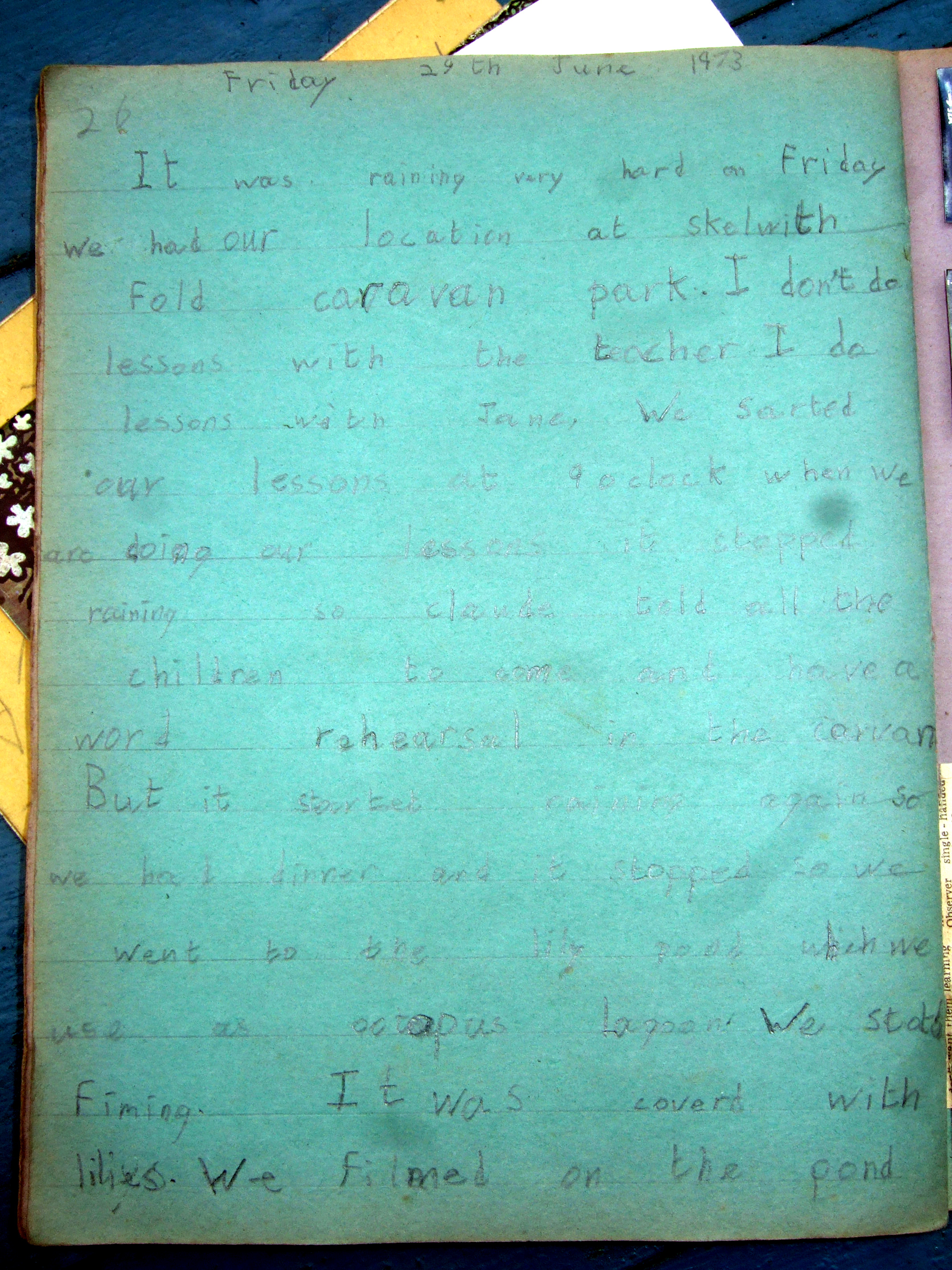
We had our photos developed at the chemist or sent them off to Tripleprint, so we could share the small version with others. Although they were bought by Bonusprint in 1979, I was a loyal customer until well into the 1990s and remain plagued by small photos I can’t quite bring myself to chuck away. We stuck them in scrapbooks made of green and blue paper. Here is a page of mine from the making of Swallows and Amazons.
My family were very keen on taking home movies. Dad usually took slides when we went on holiday, which were viewed along with the supper-8 footage at Christmas time when he pushed the furniture back, took down a painting and projected our memories onto the wall.
What have I forgotten? Do post your own recollections, especially of sailing and camping in the early seventies, in the comments below.
If you have ever wondered what Nancy Blackett is doing now – here she is. Built by Hillyards of Littlehampton in 1931 she was bought by Arthur Ransome with royalties from Swallows and Amazons and became both the inspiration and model for his book about the Swallows’ unplanned voyage to Holland ~ We Didn’t Mean to go to Sea, in which she was known as the Goblin. She also appears in Secret Water.
I was at the Royal Harwich Yacht Club to give a talk on making the BBC adaptations of two other Arthur Ransome books set in East Anglia, Coot Club and The Big Six.
I was sure that people would rather be out in the sunshine but it was well attended.
After watching a clip of Ginger and Rosa, the BFI/BBC feature film directed by Sally Potter that starred Nancy Blackett, we wandered down to the jetty in front of the new club house, and grabbed a chance to go out on the Orwell.
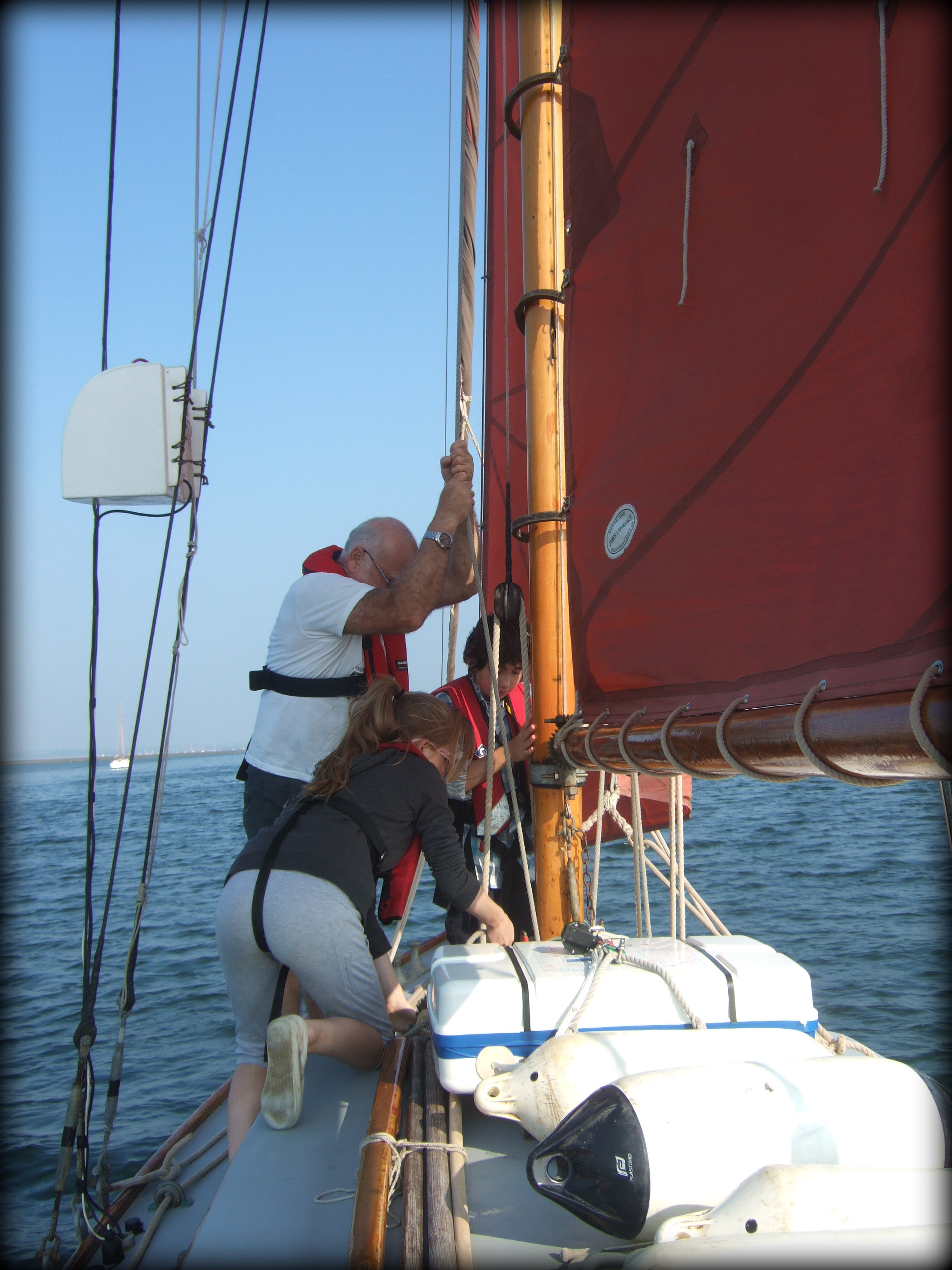
Soon sails were being hoisted and we were underway, sailing down river in the evening light.
Conditions were perfect for Nancy, a 28 foot Bermurdan cutter.
I took the helm, whilst the others did the hard work.
We were soon sailing past Pin Mill, which also features in the book.
Some members of the crew were experienced sailors,
others had previously managed to avoid spending much time on the water, but we all had a wonderful experience and were sad when the sails were stowed for the night.
We saw a couple of Thames barges also coming in, as Nancy settled down after a successful day. Think of joining The Nancy Blackett Trust and sailing her yourself.
Unbelievably, thirty years have passed since we started filming the BBC adaptations of Coot Club and The Big Six on location in Norfolk. We drove up to Norwich on 17th June 1983 and by 3rd July would have been in full swing. It had been my job to cast the children who I was now looking after on location.
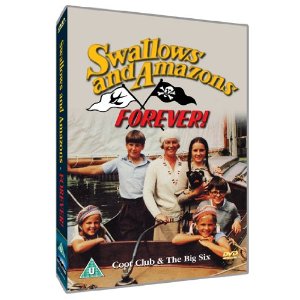
Amazingly, we were to able enjoy three months of almost solid sunshine and had the most wonderful time. The eight-part serial, produced by Joe Waters, was first broadcast in 1984 under the generic title of Swallows and Amazons Forever! This was because Joe was hoping to dramatise other Arthur Ransome books, but sadly they proved too expensive.
The Death and Glory Boys weighing their great fish with Sam Kelly
I gave an illustrated talk about how the series was made at the Royal Harwich Yacht Club on the River Orwell for the Nancy Blackett Trust Annual Meeting, explaining how Rosemary Leach and I had both appeared in the BBC drama Cider with Rosie back in 1971. Having starred as Laurie Lee’s mother, she had the lead part of Mrs Barrable, the Admiral in Coot Club.
BBC TV’s adapation of ‘Coot Club’ and ‘The Big Six’
The drama, set in the early 1930’s, was nominated for a BAFTA. It had an exceptionally talented cast including Rosemary Leach, John Woodvine, Sam Kelly and Henry Dimbleby. I’m not sure if you can spot him that easily on the cover of the DVD, but one of the characters in the story soon became a household name. It was William, Mrs Barrable’s fawn pug dog. He was soon known nationally – if not internationally – as Little Willie, Ethel’s pet dog in the soap opera Eastenders.
The puppy we chose to play Williams who later starred as Little Willie in ‘Eastenders’
While Jack Watson was at the helm of the Sir Garnet, Julian Fellowes played Jerry, self-appointed skipper of the Margoletta and the leader of the Hullabaloos. Whilst with us on the Norfolk Broads he forged a creative partnership with our director Andrew Morgan that launched his career as a writer. They were soon working together on adaptations of classic books such as The Prince and the Pauper and Little Lord Fauntleroy.
Julian Fellowes as Jerry in ‘Coot Club’
Looking back, I can see a number of connections between Coot Club and Doctor Who. You will see we had not one but two Time Lords with us in the guise of The Eel Man, who was played by Patrick Troughton, and Dr Dudgeon, played by Colin Baker, who went on to become a later incarnation of the Doctor.
Patrick Troughton as The Eel Man in ‘The Big Six’
A number of the crew worked behind the scenes on Doctor Who including our Visual Effects Designer, Andy Lazell and the writer Mervyn Haismen. I found myself working on Vengeance on Varos a year later when Colin Baker swapped his Norfolk tweeds for the multi-coloured coat he wore in the TARDIS.
Colin Baker as Dr Dudgeon in ‘Coot Club’ and ‘The Big Six’
However, I expect the members of the Nancy Blackett Trust will want to know most about the beautiful period boats that appeared in the series, some of which members of the Arthur Ransome Society have been tracking down. Sadly some, such as the Catchalot seem to have deteriorated but the Janca, who played the Margoletta has been restored, and the Death & Glory is still on the Broads.
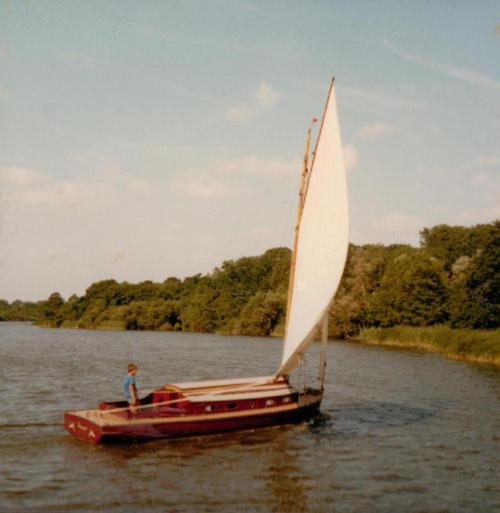
Lullaby under sail, playing the Teasel with her stage name painted on a false transom
The wonderful thing is that you can still hire the yacht we used to play the Teasel and take the same route through the Broads as Arthur Ransome took with his wife in the 1930’s when he was absorbing experience from which to write. What I did not know until recently was that Titty Altounyan ~ the real Titty portrayed in Swallows and Amazons ~ accompanied them one year, but I will leave that story for a future post.
I remember setting up this photograph for Puffin at Gay’s Staithe on the Broads
For more information on Saturday’s talk please click here
The Boy Roger in Secret Harbour on Wild Cat Island played by Sten Grendon in 1973
Sten Grendon grew up in the Whiteway Colony near Stroud in Gloucestershire. Partly thinks to the kindness of his teacher, he was spotted by Claude Whatham in 1970 and asked to play young Laurie Lee in the BBC adaptation of ‘Cider with Rosie’, when I was given the part of Eileen Brown.
Sten Grendon in 1970, after playing Laurie Lee in ‘Cider with Rosie’ for BBC TV with Director Claude Whatham
Sten was eight-and-a-half when he found himself in the Lake District playing Roger in Arthur Ransome’s well-loved story, Swallows & Amazons. His drawing of learning to swim from Peel Island somehow seems to reflect the weather conditions on Coniston Water rather well.
Whilst on location in Cumbria we usually received tuition from Margaret Causey, but on 29th June 1973 Sten spent the morning with his mother, Jane, writing:
It was raining very hard on Friday. We had our location at Skelwith Fold caravan park. I don’t do lessons with the teacher. I do lessons with Jane. We started our lesson at 9 o’clock when we are doing our lessons it stopped raining so Claude could call the children to come and have a word rehearsal in the caravan. But it started raining again so we had dinner and it stopped so we went to the lily pond which we use as Octopus Lagoon. We started fiming. It was covered with lilies. We filmed on the pond.
And that was it. A highly accurate account of the day spent recording the scene when the Swallows go up river to look for the Amazon but find themselves thwarted by waterlilies in Octopus Lagoon.
‘Perhaps they are octopuses. Titty read out of a book how they can grab people out of boats.’
‘Shut-up Roger, they’re only flowers.’
Sten went on to draw a very detailed picture showing what it was like to make a movie in the Lake District, when the weather was so important to our work.
When I rang Sten yesterday he grabbed his phone and said,
‘Just a moment, I’ll go into the greenhouse – it’s just started to rain.’
Sten still lives in the hills above Stroud in the Cotswolds. After playing Roger in Swallows & Amazons he appeared in a Weetabix commercial for Claude and an industrial film for Rank as a school boy in a story a-kin to the Seven Ages of Man. A countryman by nature, he left acting behind him and literally moved on. After years spent travelling around France, Spain and Morocco, often fruit-picking or working in vineyards, he used his training at Pershore College of Horticulture to work locally as a gardener. Forty years on he still has the same thick dark hair and sudden smile.
This year, while Swallows & Amazons (1974) was shown on the big screen in London, Cider with Rosie was shown to a local audience at the Whiteway Village Hall – double helpings of nostalgia for those who were able to re-live their own childhood as well as Laurie Lee’s.
Suzanna Hamilton, Sten Grendon, Sophie Neville and Simon West as the Swallows
I have been sent a newspaper clipping dated 15th June 1973, which appears to have been published in The Mirror, a national daily newspaper here in the UK. It describes a scene shot for Swallows & Amazons (1974) that was never used in the finished film and proved something of a discovery for me.
Whilst on their way to visit the charcoal-burners, Captain John shows the crew of the Swallow how to lay a patteran, a secret gypsy sign, usually made from twigs or vegetation, to point the way. I remember the scene from Arthur Ransome’s book with affection but I have no recollection of filming this in the Lake District.
~ click on the image to enlarge ~
I do recall that our director, Claude Whatham would take us on a quick run just before shooting a scene so that we would be both energised and genuinely breathless as we delivered our lines. I expect it was his secret way of obtaining natural performances out of us children. Here we can be seen in rehearsal wearing our Harry Potter-like nylon track-suit tops for warmth, while the big old 35mm Panavision camera was tilted down on us. Claude can be seen holding the script we never read. We were much more interested in the patterans.
Claude loved running. When he retired from film making he would regularly run around Anglesey in North Wales, where he lived, covering miles each day even in his early eighties. I have always been more excited about galumphing, the art of running down hill, taking leaps as you go to cover more ground. Arthur Ransome must have tried this as a boy on holiday in the Lake District as he has the Swallows galumphing like anything at this stage in the story, on their way back from visiting the charcoal-burners. They get so carried away that some of them miss the patterans that had been so carefully laid on their way up the hill. There must simply have not been enough time to include this detail in the finished movie. I wonder if the original footage still exists.
Hillary Warwick from Bolton-le-Sands near Carnforth rang in to say that her grandma owned the green parrot, telling us that he was called ‘Beauty’. They used the £25 appearance fee to buy him a new cage. Hilary’s gran, Elizabeth Proctor, had been quite a character. She’d walk around Kendal with Beauty on her shoulder. He was known to be a one-woman bird and Hilary was quite impressed that I managed to stroke him and keep him on my shoulder as he was liable to nip. She was quite wary of him!
Do you live in the Lake District?
Did you take part in the film in anyway?
If so do write in using the comments box below!
~ click on the image to enlarge ~
Here is another newspaper article from 1973 that mentions Lakeland people involved in the filming, including a photograph of Mrs Lucy Batty and her grandson Peter and Margaret Causey who taught the children in the movie, pictured below with Lesley Bennett, Kit Seymour, Sten Grendon, Sophie Neville and Mark Hedges – who didn’t appear in the film but came up over half-term as his Dad, Bob Hedges was working as the property master.
Virginia McKenna is photographed above talking to Ian Whittaker, the set dresser who went on to win a number of Oscars.
An extract from this article of Brenda Colton’s reads:
‘When Mrs Lucy Batty was asked if her house could be used for the setting of the film Swallows and Amazons, with guest star Virginia McKenna, she was delighted. After all, her home, Bank Ground Farm on the east side of Coniston Water, near Brantwood, was the setting chosen by Arthur Ransome for his children’s book Swallows and Amazons.
Mrs Batty thought it a good idea that the story should be filmed in an authentic location, and she felt she should be able to put up with a few cameras and film men for a while. But she just did not realise the scale of a “medium budget” film like this one, or what the production staff could do to her house. It was not the two double-decker buses coming down the path and parking on the farm that she minded, nor the numerous vans, lorries, cars and caravans. It was not even the difficulty of having 80 men and women wandering round the farmhouse carrying equipment here, there and everywhere.But when art director Simon Holland started tearing up her lino and carpet in the kitchen to get to the bare stone floor, she did get a little annoyed. Especially when he removed all the electric sockets, lights and switches, pushed all the kitchen furniture into the larder and whitewashed the newly papered walls.
“Have you seen the kitchen?” Mrs Batty said to me. “The larder is piled high with my furniture; and you would not believe the tip my lounge is in. But they are a funny lot. I asked if I could wash the beams in the kitchen for them, and they said ‘Oh no, we want them to look old.’ I have even had to hunt out a lot of old pottery from the cellar for them.
“But I have given up now. I have just left them to it.”

























 Sophie Neville