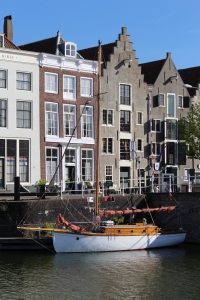
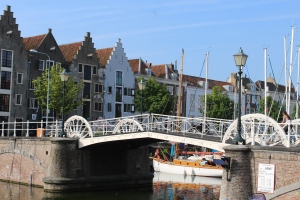
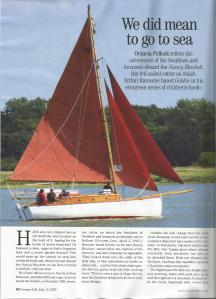
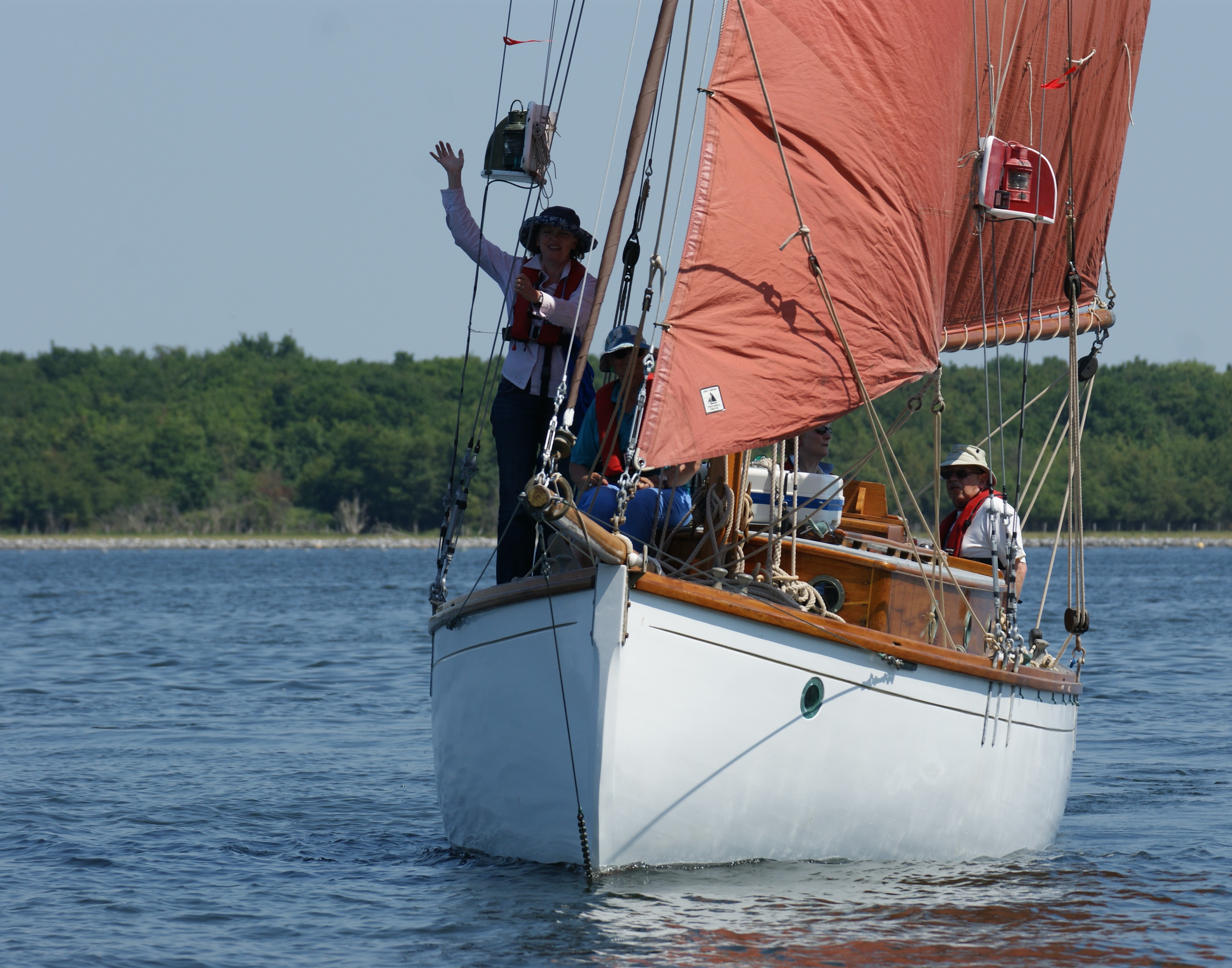
One summer, I grabbed the chance to sail Arthur Ransome’s favourite little ship, the Nancy Blackett.

If you recognise her, it might be because she was his model for the Goblin in ‘We Didn’t Mean To Go To Sea‘, possibly the most exciting and touching of the Swallows and Amazons series of books. I re-read it while we were in Dutch waters aboard the main character herself.
~ Beach End Buoy at the mouth of the River Orwell in Suffolk ~
In the story, the Swallows – John, Susan, Titty and Roger Walker – promise their mother that they will not go to sea, but disaster strikes when the Goblin slips her anchor in thick fog, while her owner is ashore, and gets swept out past the Beach End Buoy at Harwich. The wind rises and the children find themselves sailing across the North Sea in a terrific storm before a friendly Dutch pilot guides them into Flushing.
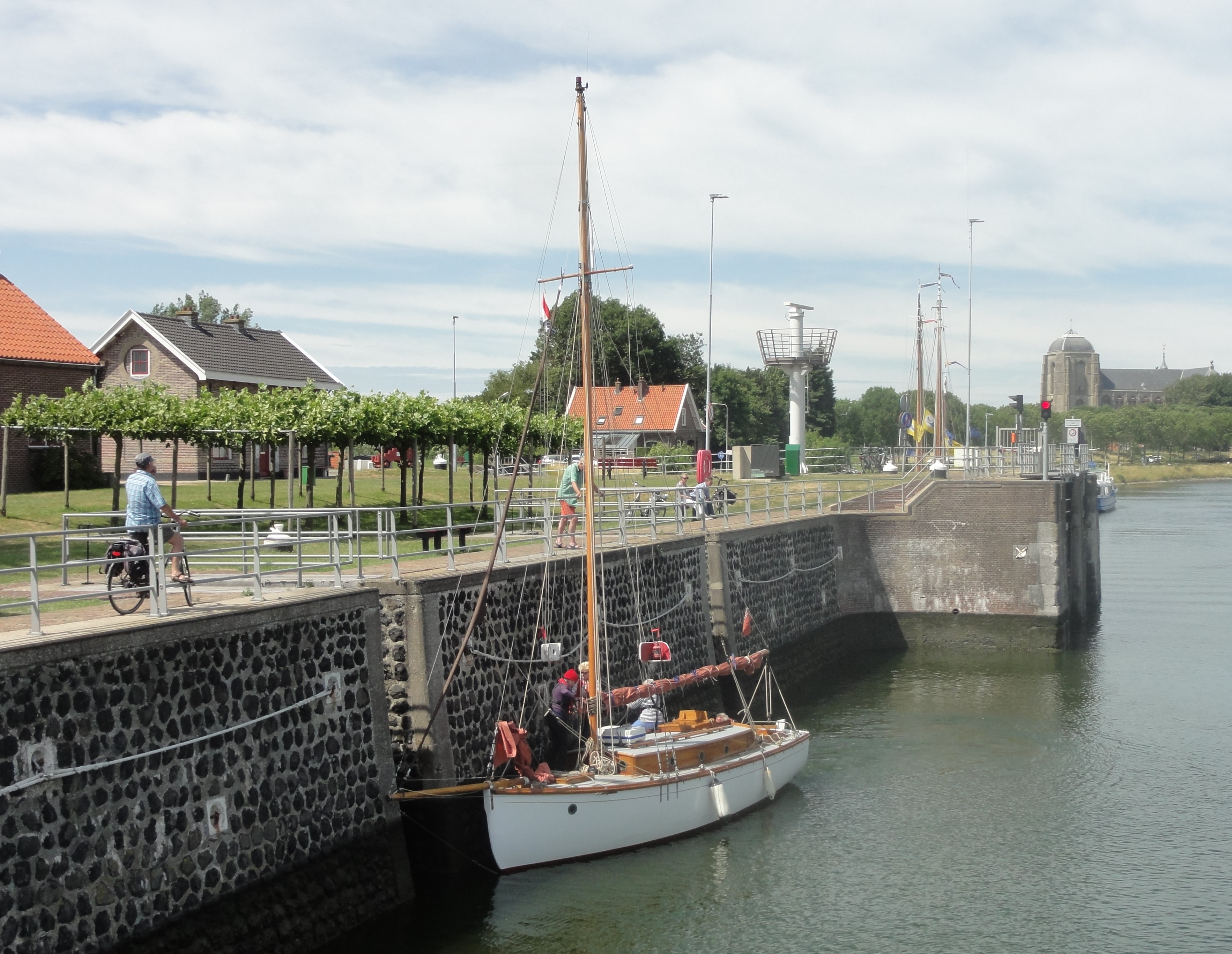
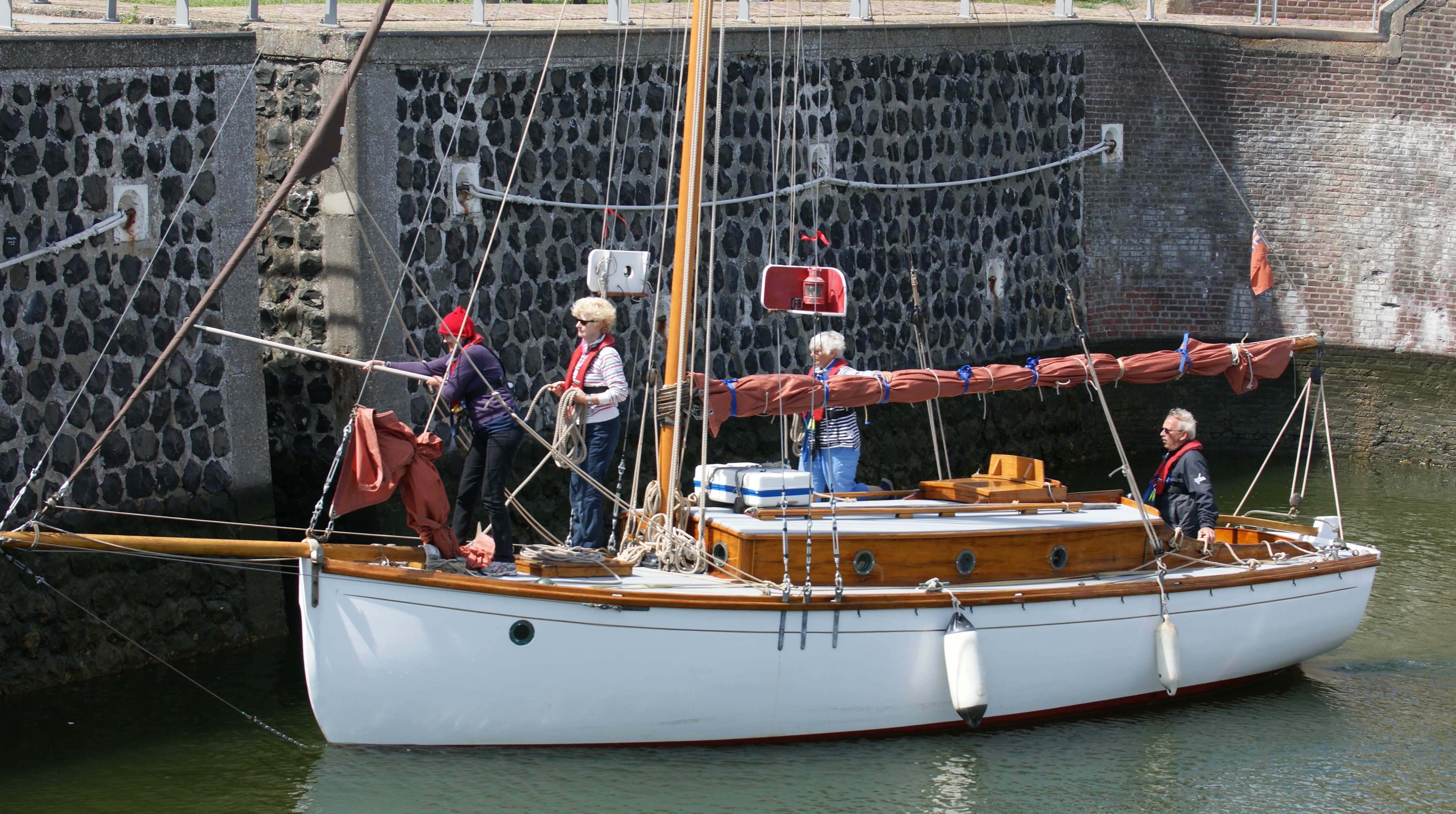
~ Nancy in the old lock at near the medieval port of Veere ~
I was able to join Nancy when she had already made the crossing to the Netherlands but did take her through an old lock built in the same style as the one the Swallows encountered, all be it at the other end of the Dutch canal. It was as if we had sailed into the pages of the book and lived out the adventure ourselves, learning about ropes and reefing each nautical mile.
Mooring up could be tricky, especially since Nancy is an old lady with a bow-sprit, but unlike Susan and Titty, I never felt sea-sick for a moment.
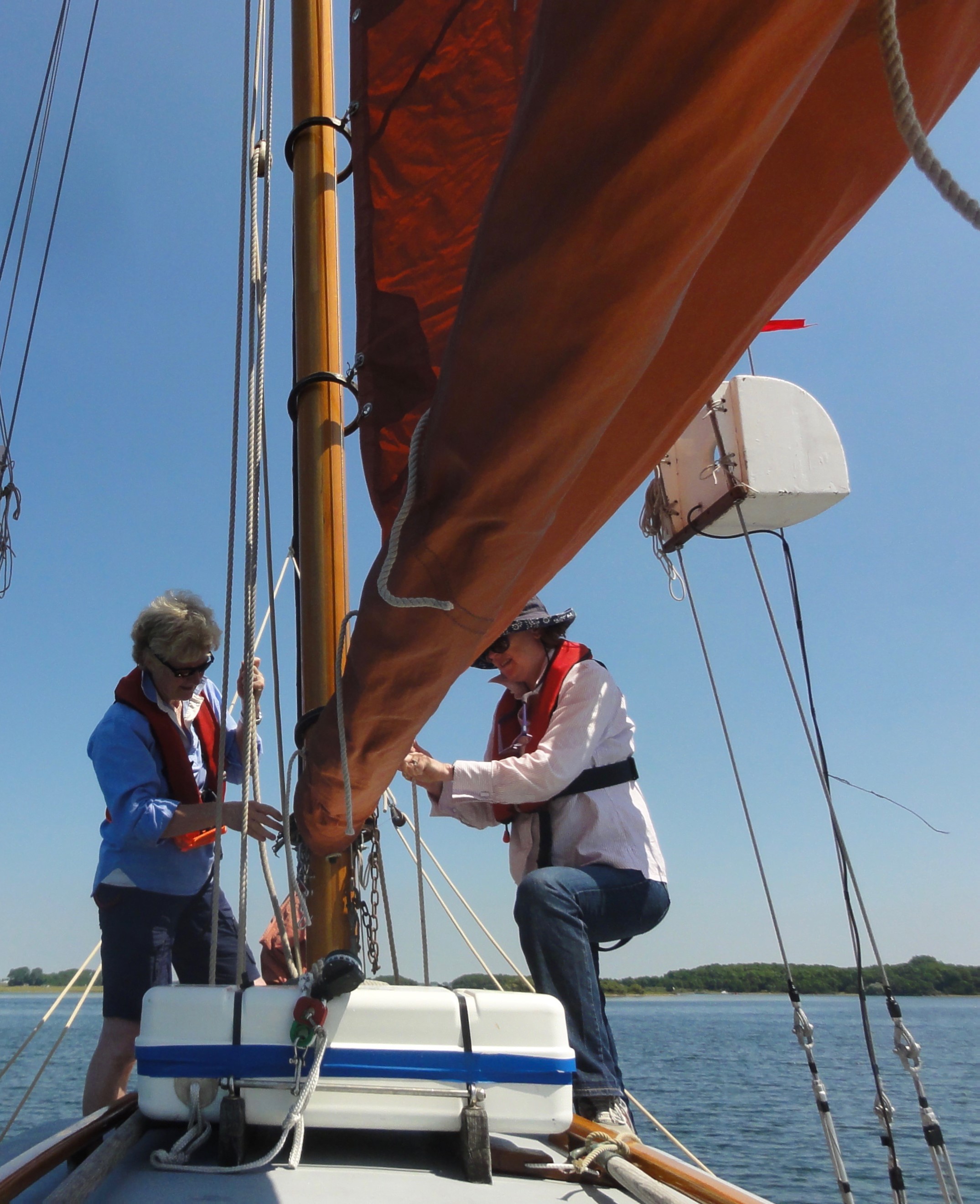
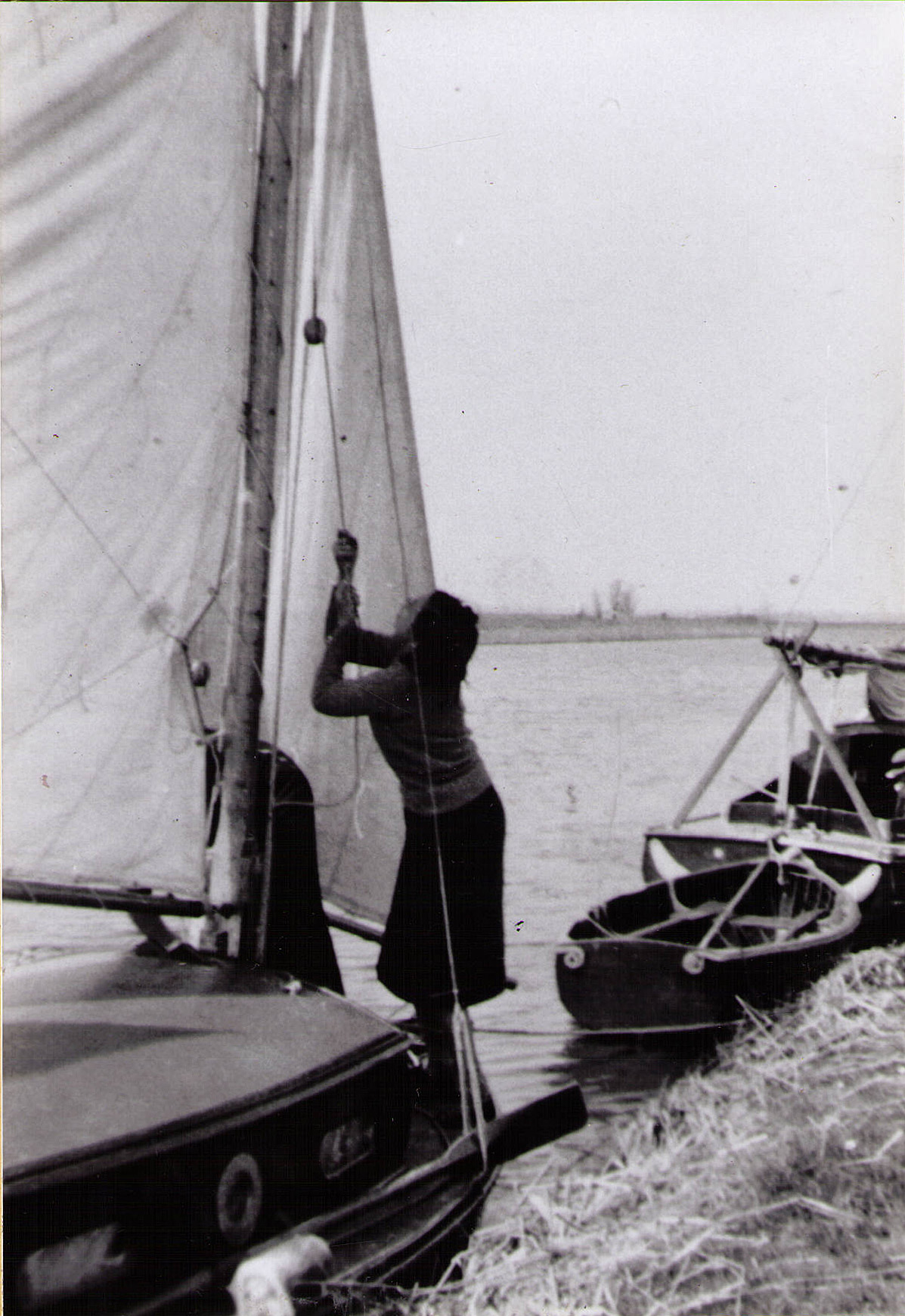
~ Learning how to hoist the mainsail ~

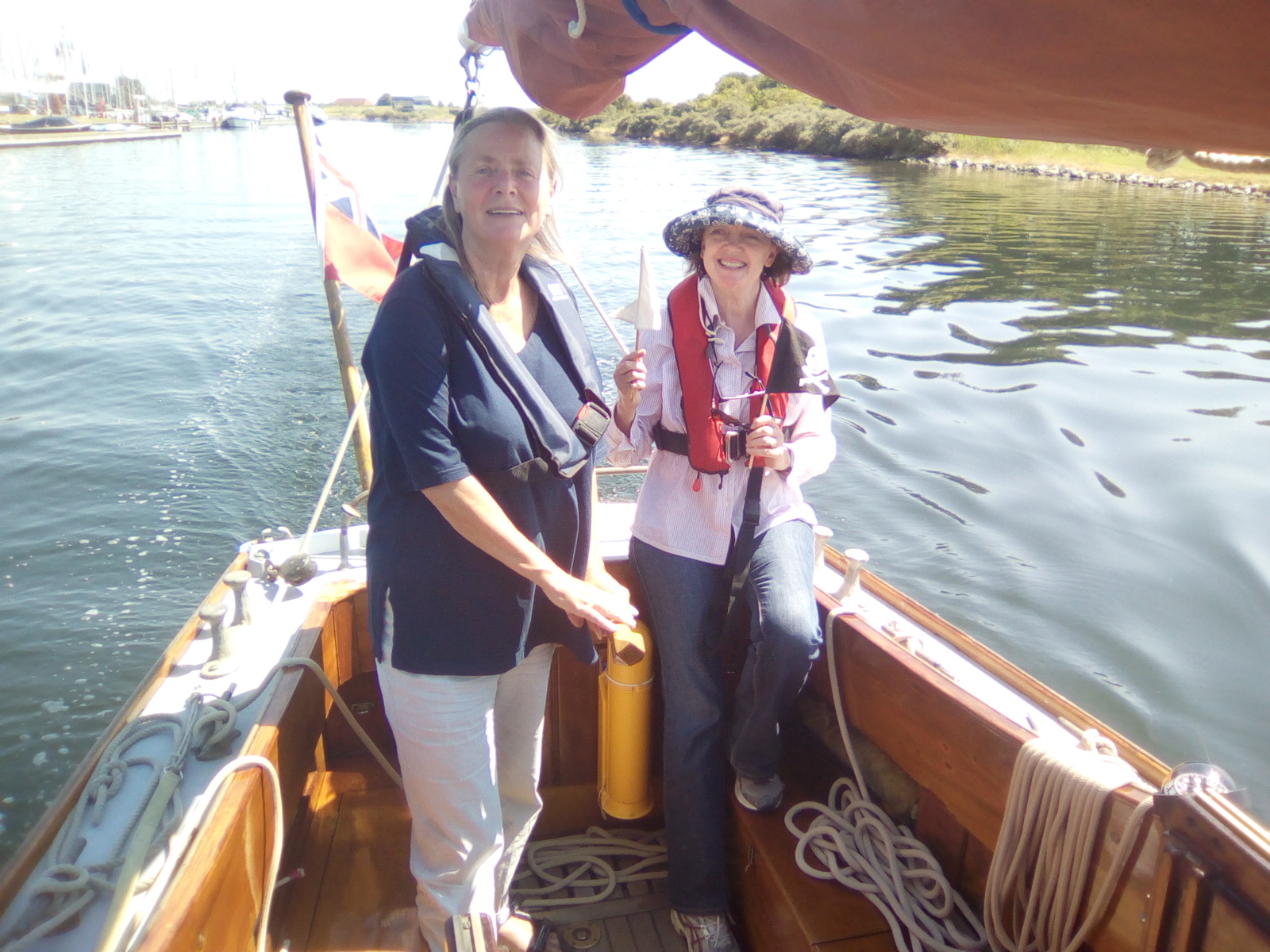
~ Sophie sailing in salt water ~
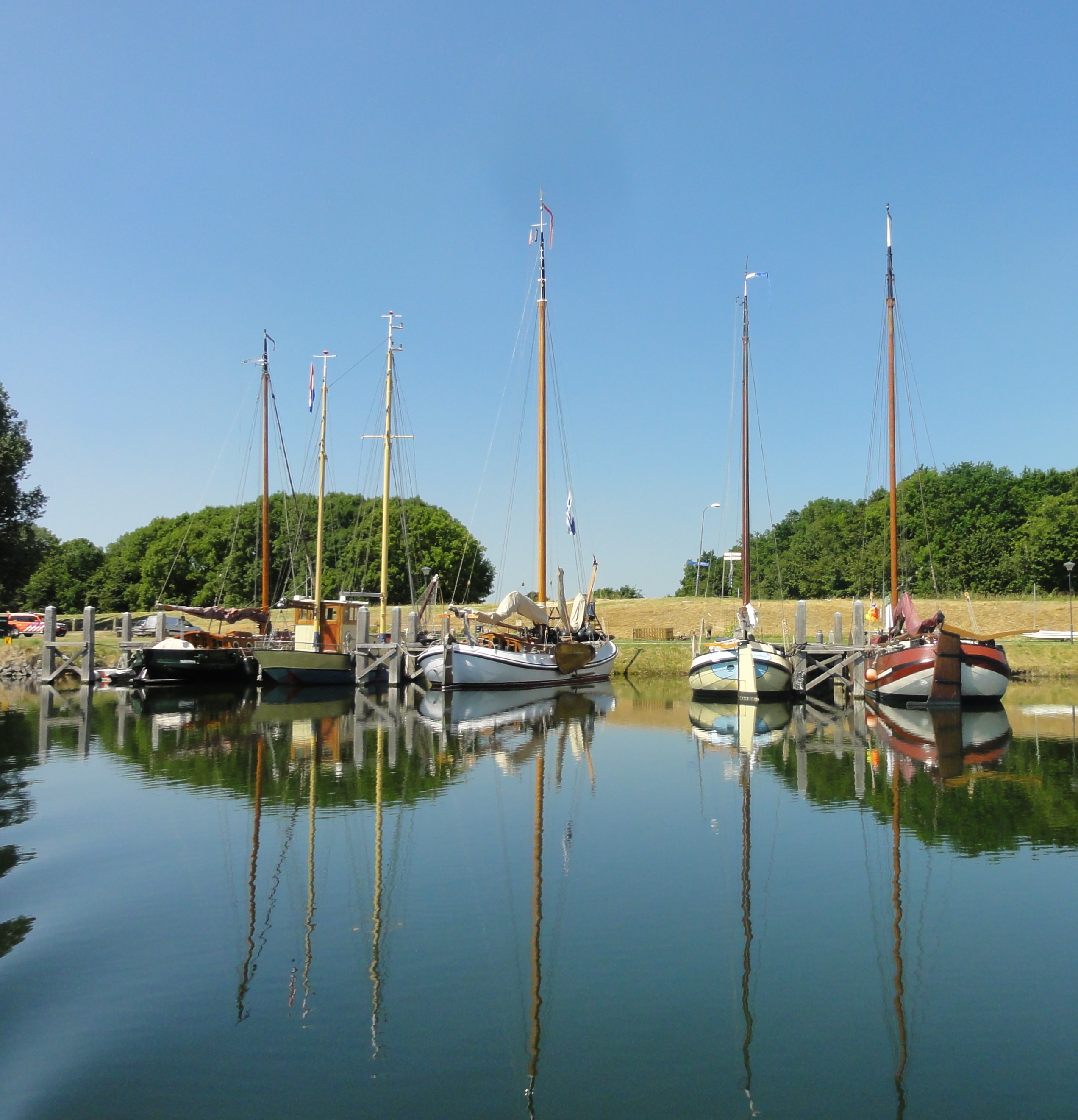
~ Keeping a look out for Dutch barges ~
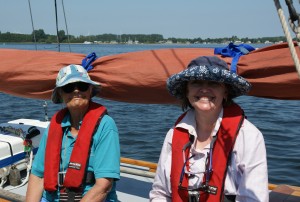
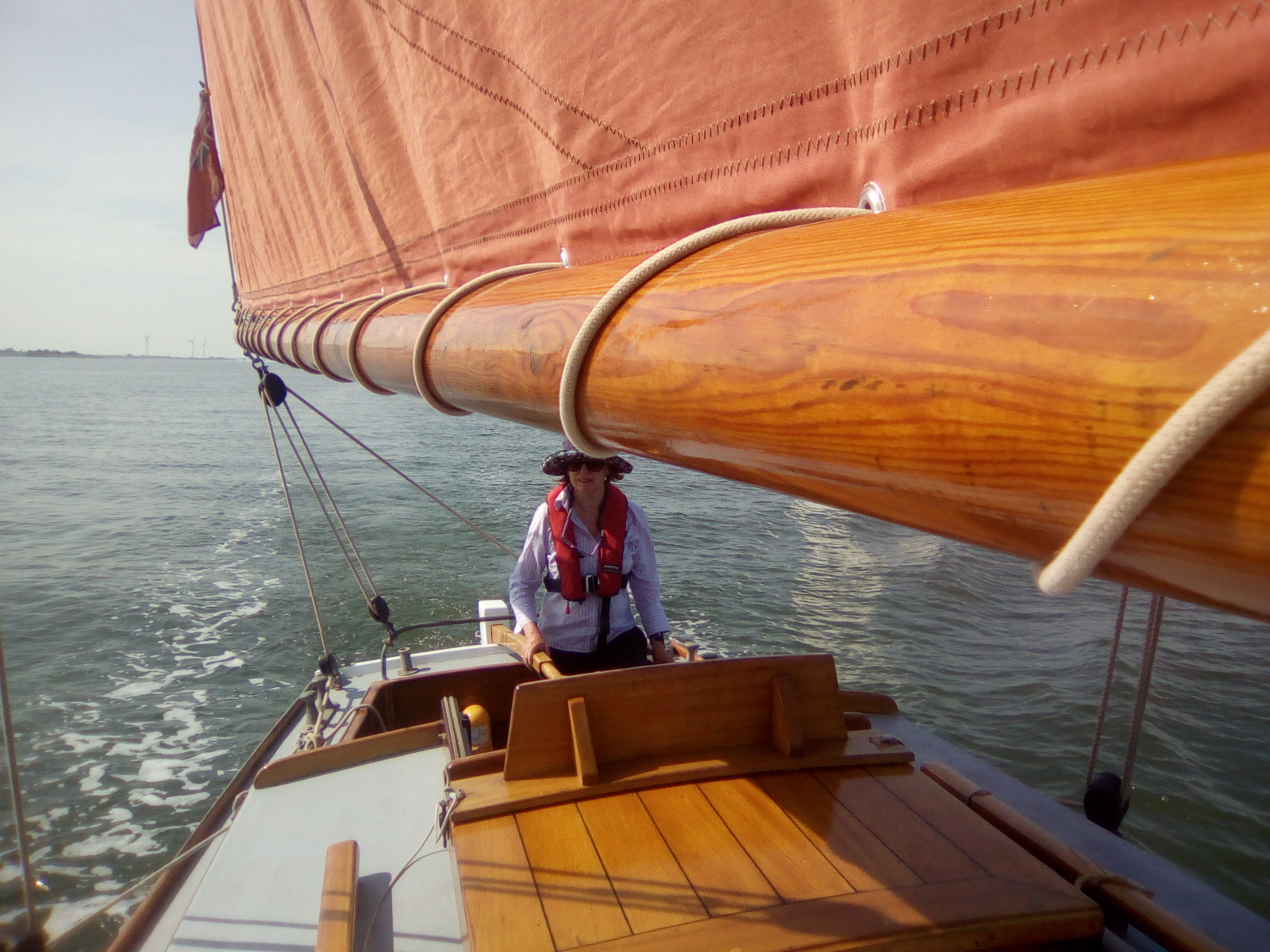
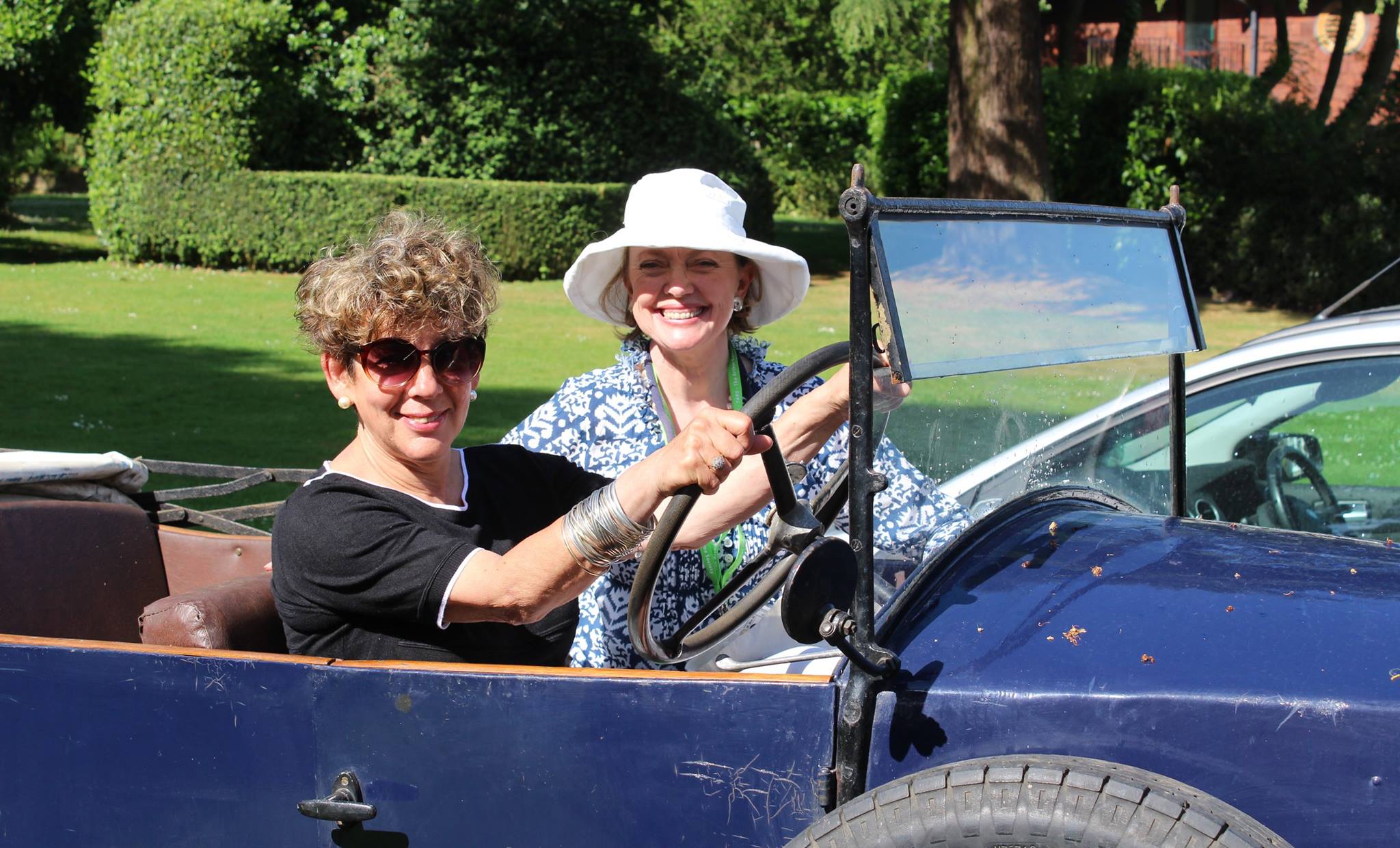
Local author Veronica Frenks came out one morning, taking us up a creek to see the traditional Dutch barges and historic ships that she often writes about. She soon made plans to write about Arthur Ransome for Spiegel der Zeilvaart, a Dutch periodical. Here she is with me, at the helm:
To read about sailing Nancy on the River Orwell in Suffolk, where she is based. please click here.
To read about sailing Nancy on the Beaulieu River and the Solent, please click here
If you would like to grab a chance to sail Nancy or find out more about the Nancy Blackett Trust, please click here

Holding an outdoor party with a Swallows and Amazons theme is a great idea, especially if your guests are up for bringing their own tents. A (sensible) campfire and either swimming or archery with geo-cashing or a treasure hunt will keep your guests occupied. Everyone can dress up as explorers or pirates.
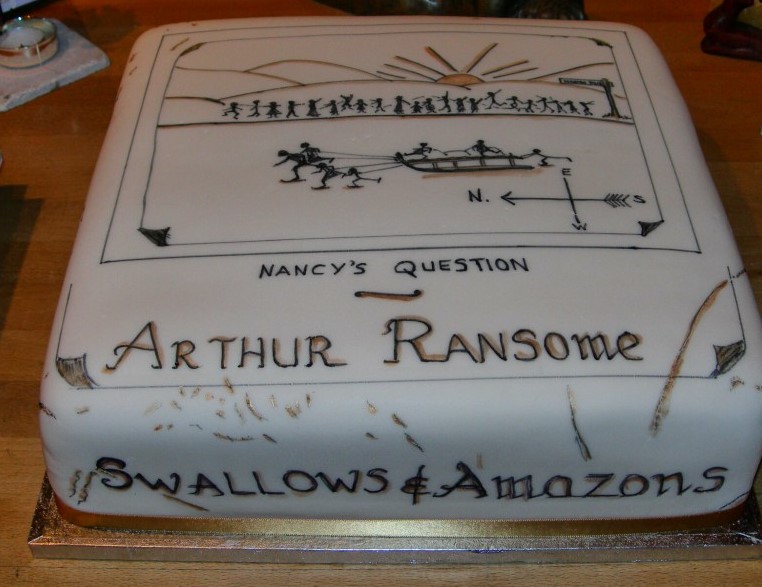
There have been some wonderful cake designs posted on Facebook. This impressive creation was put together by Evie and Sam Rose:
Over the years the most amazing ‘Swallows and Amazons’ creations have become quite famous. I have put up a few more ideas on Pinterest here
The cookery book writer and ‘Great British Bake Off’ finalist Miranda Gore Browne transformed her garden into Wild Cat Island, served iced buns and a cake worthy of a pirate feast, sending everyone home with old-fashioned sweets in a tin mug. You can see some of her wonderful party ideas here

You could hang ‘Swallows and Amazons’ flags or bunting. The Gingerbread House show you how to make these:
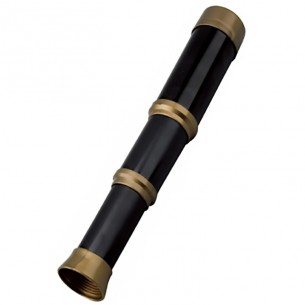
Pippa Middelton and her family, who are related to Arthur Ransome, have a company called Party Pieces who have loads of ideas for Pirate Parties on their blog here. They cater for the younger age group but do sell chocolate pieces of eight and a retractable telescope very like Titty’s is available from their website for only £2.99. I liked the idea of an inflatable parrot, although properly it should be a green one.
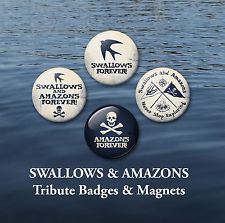
I found these 38mm badges and fridge magnets for sale on eBay. They’ve used my own drawing of the crossed flags, without permission, but never mind. They might be something fun to award as prizes for games such as ‘Walk the Plank’ or catching crabs, which you could do literally if you live by the sea. You might find a few ideas for party games here.
I’ve been collecting further ideas for Swallows and Amazons presents. The Nancy Blackett Trust shop has some great things for sale, stocking these porcelain mugs, T-shirts and hats for Amazon pirates of all ages, sometimes stocking these:
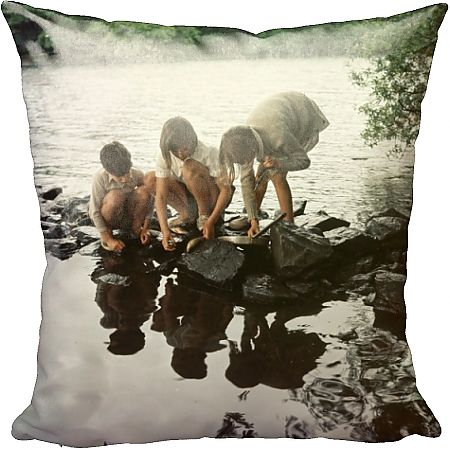
StudioCanal have broadened their collection of movie memorabilia on offer to include cushions. They also sell mugs, mouse mats, prints and 400-piece jigsaw puzzels. I like these 300 piece jigsaws.

I once found this lovely design for Swallows and Amazons bags made by Rachel:

I’ve listed more gift ideas here
A year’s subscription of Classic Sailor magazine makes a good present for adults as it keeps coming all year.
Why not give a year’s membership to The Arthur Ransome Society? For information please click here.
Or chose a book. They always make good presents.

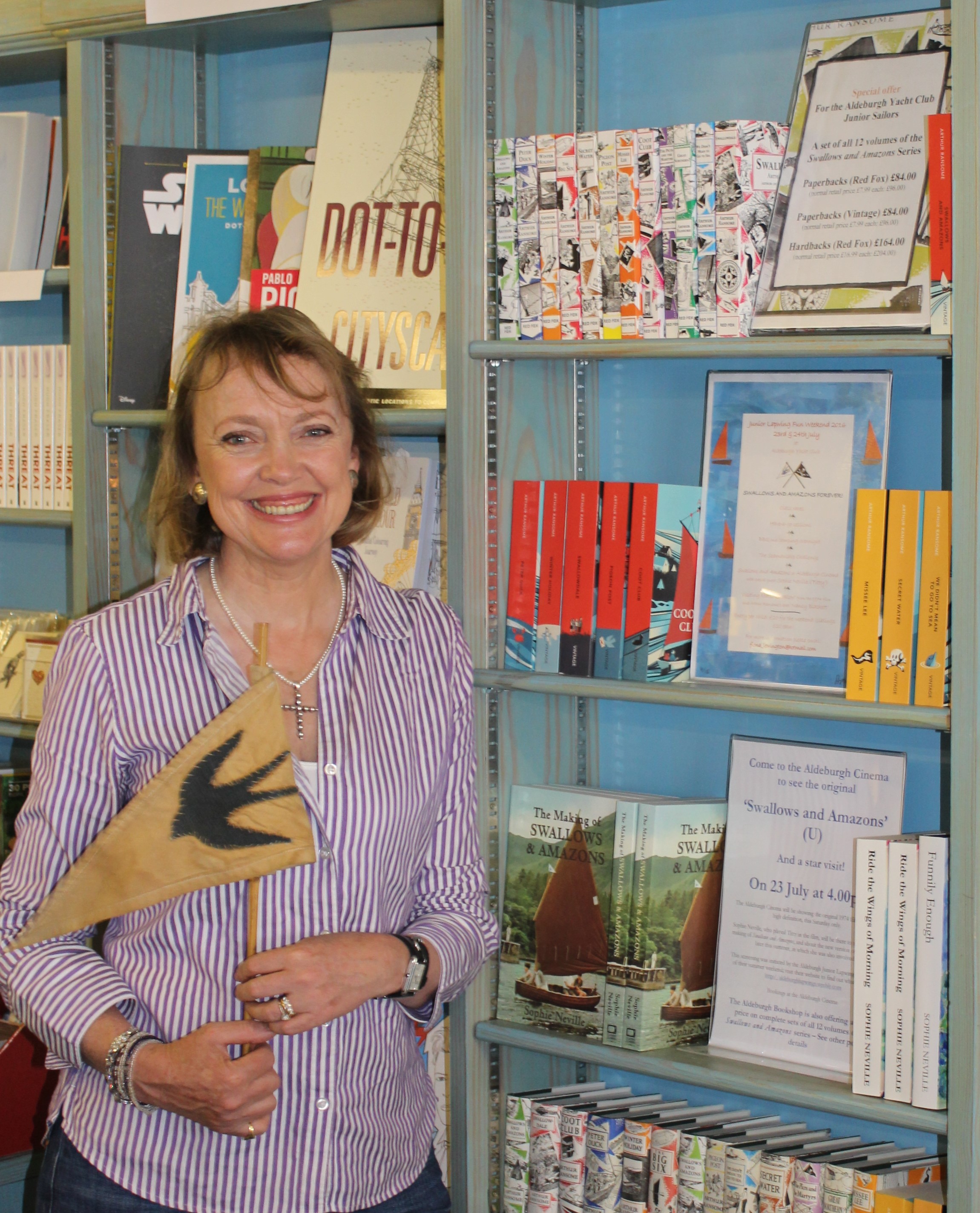
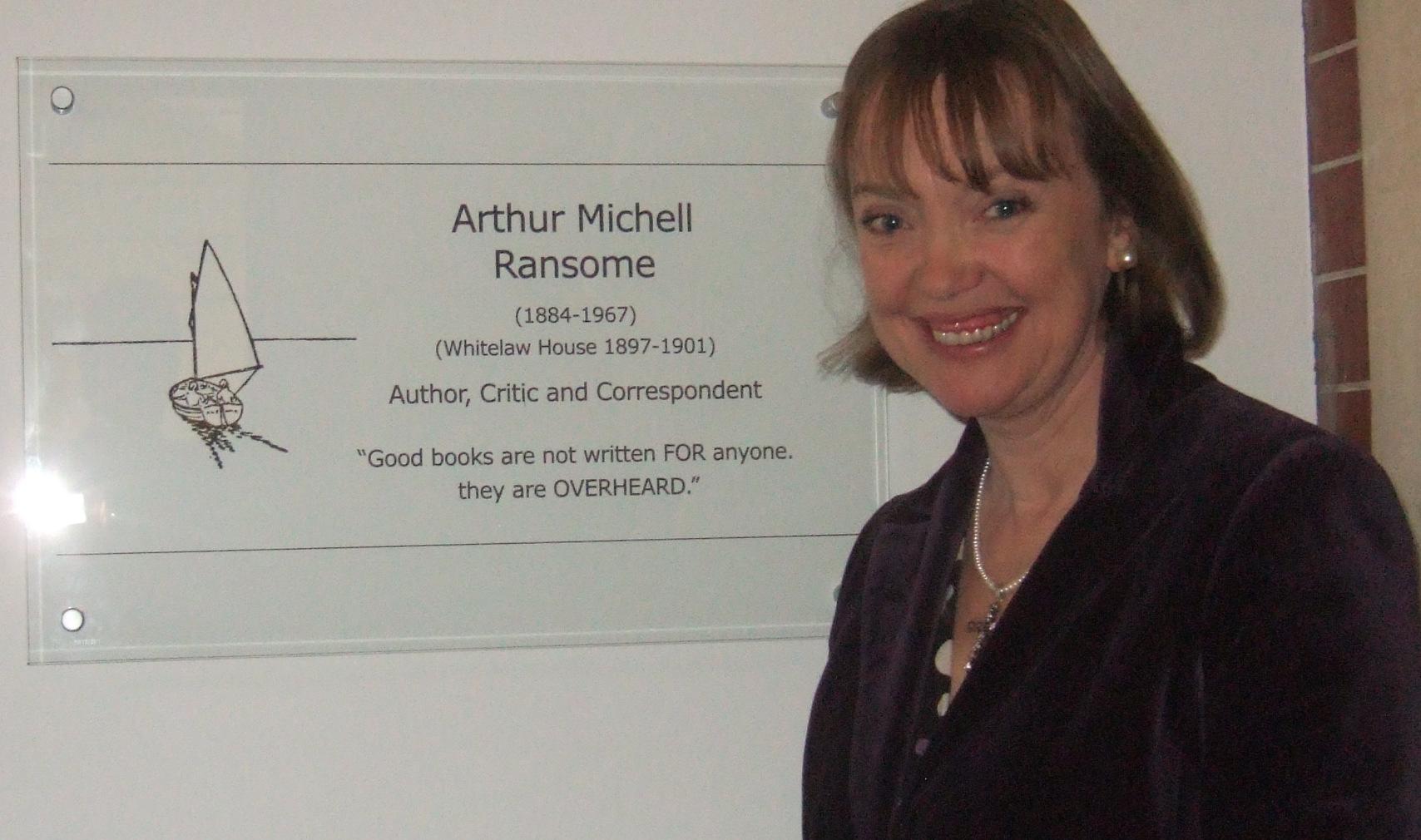
~Sophie Neville at Aldeburgh Bookshop~

One year, not so very long ago, members of the Nancy Blackett Trust hosted an Arthur Ransome Jamboree at Pin Mill in Suffolk. It was a day to remember.

Although Ransome is remembered for his ‘Swallows and Amazons’ books set in the Lake District, he moved to the east coast of Suffolk in 1935 where he set a number of other books in the series. It seemed fitting to mark the 80th anniversary of the publication of his inspirational sailing book ‘We Didn’t Mean to Go to Sea’ that begins at Pin Mill.

It is possible go aboard the Goblin, since she was modelled on Ransome’s own favourite little yacht, the Nancy Blackett. I joined her at The Royal Harwich Yacht Club where she was moored alongside Peter Duck one of his other much-loved yachts, named after the adventurous book he wrote that begins in Lowestoft. I met up with Octavia Pollock, a feature writer from Country Life, and walked down the riverside to enjoy supper at the Butt and Oyster in Pin Mill where Ransome himself often ate.

Soon after leaving university, I worked behind the camera on the BBC TV adaptations of ‘Coot Club’ and ‘The Big Six’, Ransome’s two books set on the Norfolk Broads, in which the Coots also visit Beccles in Suffolk.
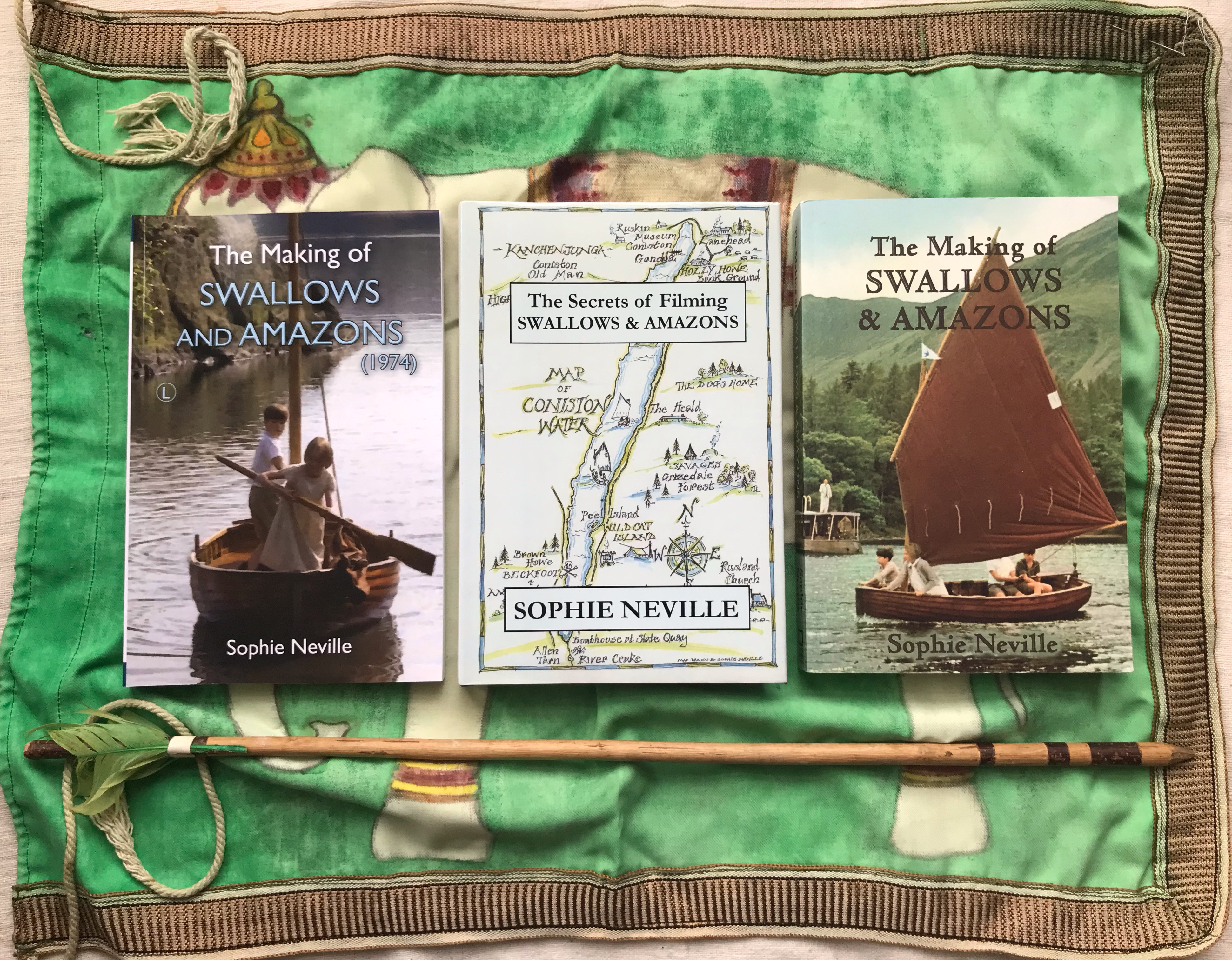
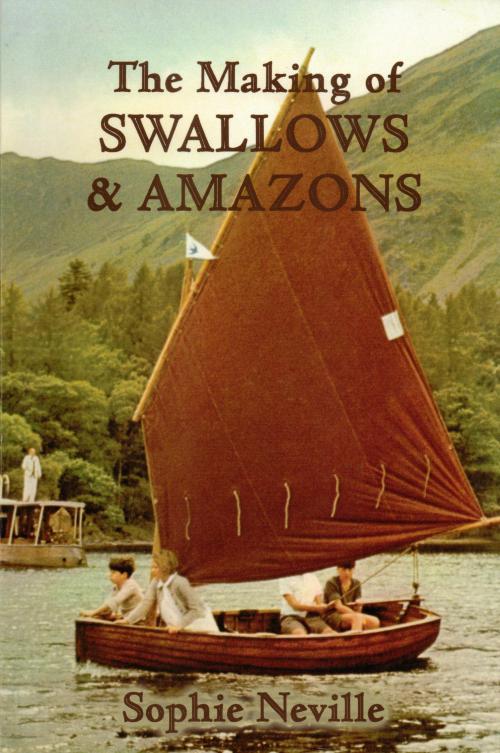
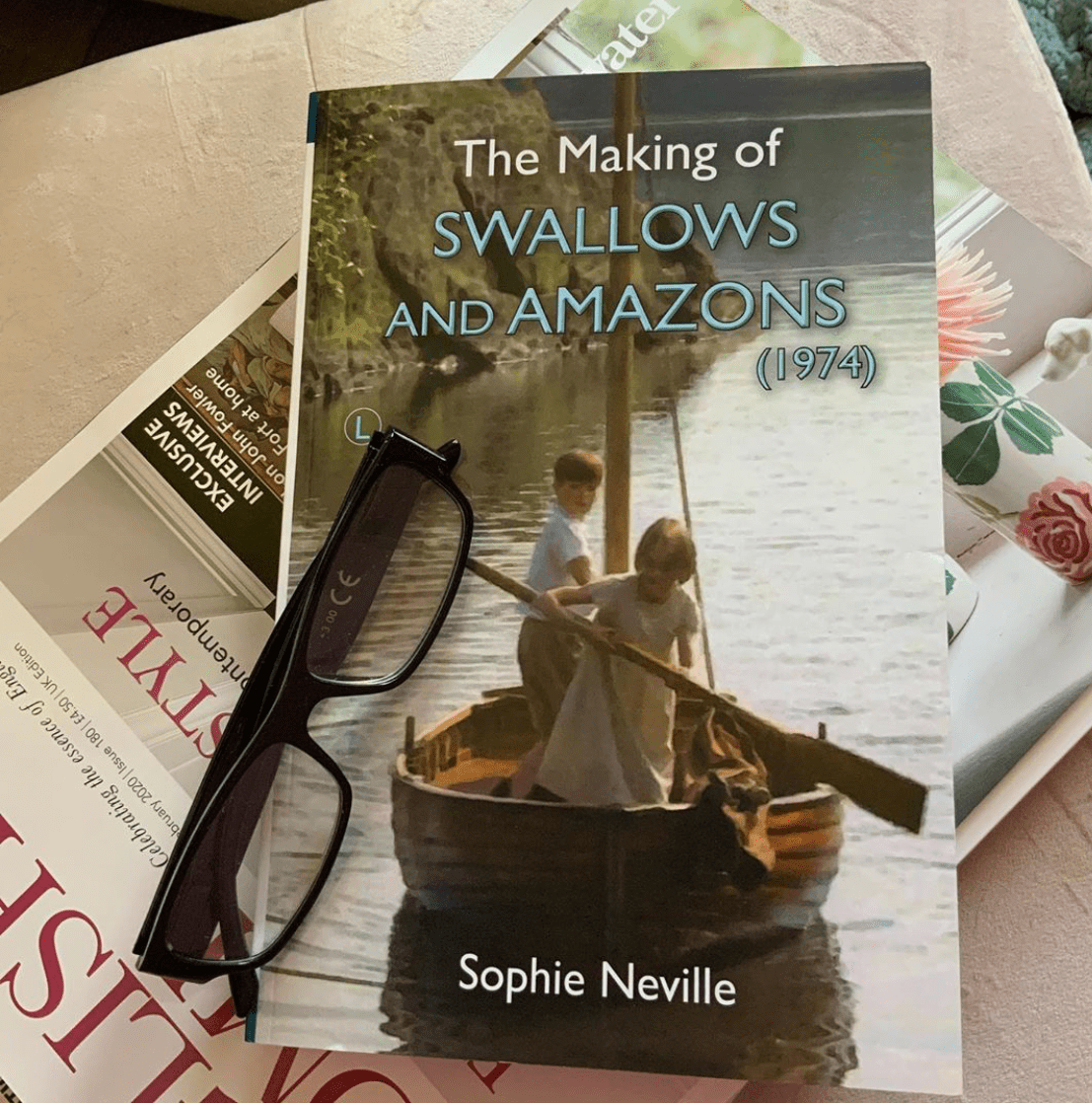
It was the Swallows who made it to Pin Mill. I first went there when The Arthur Ransome Society asked me to give a talk about making the BBC TV serial entitled, ‘Swallows and Amazons Forever!’ and signed copies of ‘The Making of SWALLOWS and AMAZONS – 1974’.

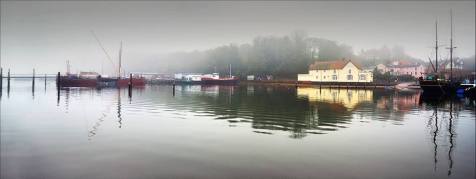
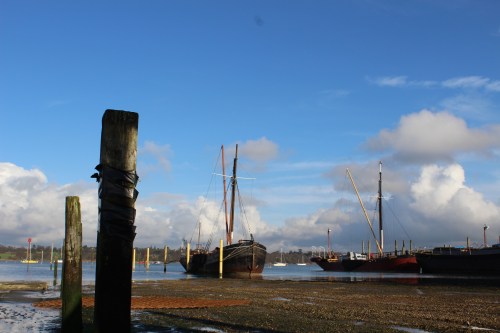
~The Orwell at Low tide~
During the Jamboree celebrations, Arthur Ransome’s biographer Professor Hugh Brogan was interviewed by erstwhile BBC reporter Tim Fenton at the Pin Mill Sailing Club.
Hugh spoke eloquently, telling me that he was motivated by rage to write The Life of Arthur Ransome after a Fleet Street reviewer of the original film ‘Swallows & Amazons’ described him as ‘right-wing’.
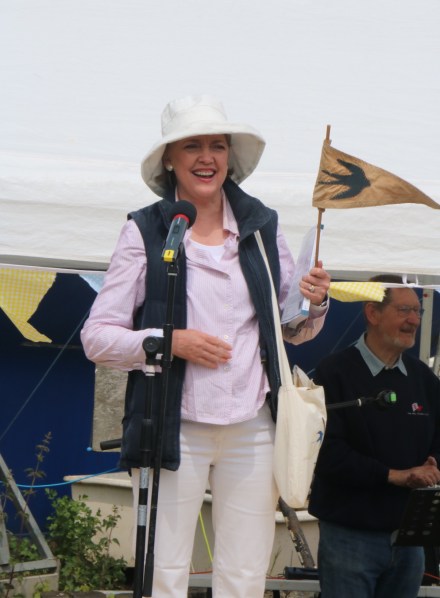
~ Sophie Neville ~
This VisitEngland event was great fun. There was a geo-caching route along the footpath from Shotley to Pin Mill. Marine artists Claudia Myatt and Christine Bryant hosted drop-in sessions on the riverside where visitors could also find the Rabble Chorus singing, while the author Julia Jones spoke about her children’s books set on the Orwell at the sailing club.

~Mugs with artwork by Claudia Myatt sold in aid of the Nancy Blackett Trust~
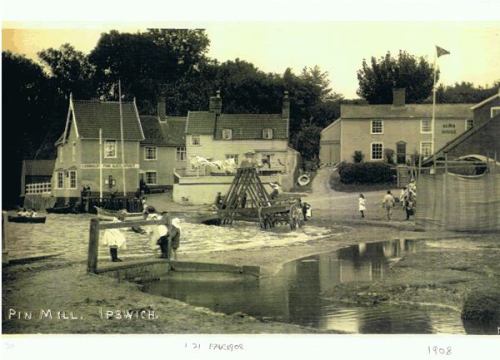
There was an outdoor installation of old Pin Mill images enabling you to look back in time. These were taken by Arthur Ransome himself of the building of his boat Selina King at King’s boatyard nearby. It was the first public exhibition of these pictures ever seen and was appreciate by the hundreds of visitors who turned up.

The Pin Mill Studio also hosted an exhibition of photographs from the restoration of Melissa, a barge restored to her former glory by Webb’s boatyard, with additional archive images of Pin Mill from the early 1900’s.
The Vintage Mobile Cinema, as seen on BBC Television’s Reel History of Britain, screened unique archive film of Pin Mill and Shotley.

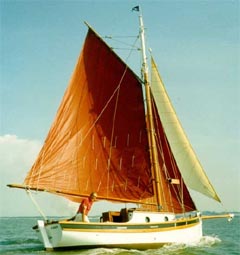
~The Nancy Blackett in her 85th year~
A Pin Mill ‘Wooden Boat’ race was held along the stream leading down to the river and you could take a ride on the Victorian swing boats on the Common as in years gone by. There was a ‘pirates and seafarers’ fancy dress competition for children and an Arthur Ransome lookalike competition (pipe and moustache) along with stalls and sideshows from local groups, charities and organisations.
Live music, including shanties from Pin Mill favourites, High Water Mark and a performance of We Didn’t Mean to go to Sea by pupils from Holbrook Academy who entertained visitors while cream teas, a barbecue and refreshments were served at the Butt and Oyster and Pin Mill Sailing Club.
T-shirts celebrating this special anniversary were sold along with gifts to generate funds for The Nancy Blackett Trust, who celebrate their 20th anniversary this year.
Do let us know if you came along by leaving a comment!
To read more please visit the Nancy Blackett website by clicking here.

You can read about the making of the original film of Swallows and Amazons here:

Guy Willson, a reader from Papua New Guinea, has written to say: ‘I have read your book and I really liked it. I could see behind the scenes and often read between your lines as well.’
‘When you were making the movie (in 1973) I was on my way to Norfolk Island as a starting point of my adventures in the South Seas; so I never knew of the release of your film until much later when I had children of my own that had reached the age to go ‘avasting’ and ‘timber shivering’, when we were living in Rye in the 1990’s.’
‘Some years ago I restored a 13ft clinker dinghy and after adding a false keel, added a standing lugsail and trailed her up to Coniston for my children to sail… I had in mind an article from Classic Boat on the Swallow, how the Altounyan children preferred Swallow as a boat because they could stow more things in her and she could still sail well. I had noticed on a drawing in the article that Ransome had given her an extra 2 or 3 inches of false keel and this helped tremendously in reducing her leeway. I added a piece of oak to do the same thing but gave her an extra 9” aft and planed it down to a feather edge forward so the she would go about a bit easier. Well, it worked and Eaglet would have done the original Swallow proud.’

Swallow – the 12′ dinghy used in the film
‘If you would permit me a little correction: you described the rig as being gaff rig, but this is not so. Both the boats, originals and the ones you sailed were in fact luggers. The nearest thing to a gaffer among the luggers is the Gunter Rig which has jaws at the front of the yard but is hauled up by a single halyard. You can see this in the Mirror dinghy (in truth it is about halfway between the two). However the lug rig of Swallow is known as a ‘standing lug’ and it can be used to go about freely. After hauling up the sail on its traveller; the peak of the yard is raised by the downhaul line (usually attached to the bottom of the boom). This tightens the luff of the sail and lifts the outer end of the boom as well giving the best efficiency to the sail.’

A gaff rigged cutter
‘Lugsails were the working sails of England for most boats less than 60ft but they were usually rigged with a ‘dipping’ lug as the mail sail and a standing lug aft. This dipping lug had to be dropped and the yard hauled round behind the mast every time they went about. It was a powerful sail and they found their best expressions in the three masted Bisquines which used to raid British shipping in Napoleonic days. You can still see them at the classic boat events at Douarnenez and Brests, where I took the gaff schooner Soteria in 2006.’

Soteria at Douarnenez
‘If you had had a gaff rig you would most probably have needed a jib to balance it (unlike the American catboats which have their masts right up in the bow, not even a space for the Boy Roger on those! Thanks for writing a lovely book which I will pass on to my daughter.’

‘You did such a grand job as Titty and I am not really surprised to find that you are a bit of a wordsmith. I am a missionary (uneaten) in Papua New Guinea and we are planning to sail back there in our steel schooner see www.livingwatermission.org On our return we will be calling in at Erromanga in Vanuaatu where ‘x’ was the spot where two missionaries were eaten. Recently the descendant of one of them, John Williams, went to Erromanga for a service of reconciliation.’
If you have noticed any errors in ‘The Making of SWALLOWS & AMAZONS’ please use the Comments box to let us know so that we can make corrections! We might be able to bring out a third edition. Readers who already have a Kindle edition will be able to update it free of charge.

What strikes me about Arthur Ransome’s whole series of ‘Swallows and Amazons’ books is that they are set almost exclusively outside in the open – or afloat. When we made the film in 1973 it rained so much in the Lake District that the producer must have longed for the existence of a few more interior scenes. As it was, the longest one ended up on the cutting-room floor. Is this because the essence and appeal of the stories is that they occur beyond the confines of domestic realms?
‘If not duffers, won’t drown.’ Simon West, Sophie Neville and Suzanna Hamilton in ‘Swallows & Amazons’ (1974)
When I appeared on Channel 5 last year I learnt the most depressing facts about the decline in the amount of time children spend outdoors. Recent research shows that children tend to stay indoors, watching television, playing computer games or even spend time doing homework, rather than go out to play. Kids today play outside for less than five hours a day at weekends and only for an hour or so during the week, which is half the time their parents spent outdoors, whatever the weather. You’d have thought they must have had higher levels of vitamin D. Apparently only 21% children today play outside near their homes, as compared to 71% of their own parents when they were young.
However:
Apparently parents have forgotten how to play with their kids. While nine of ten parents recognise that it is vital for children to use their imaginations, 16 per cent of parents say they have no idea how to make up stories or create imaginative play. What would Titty say?
‘X marks the spot where they ate six missionaries!’ Simon West, Sophie Neville, Suzanna Hamilton and Sten Grendon on Peel Island in the English Lake District.
So what’s changed?
The Arthur Ransome Society have organised a number of activities for families this summer, including a camp at Cobnor Point on Chichester Harbour from Friday 14th August to Sunday 16th August. The idea is that you bring your own tent, food, drink and a boat if you have one but the cost is very low at £20 for adults and £10 for children. Activities include nature walks, archery, games, signalling and water divinging with sailing when the weather permits. The cost includes a barbeque on the Saturday evening. Please click here for details.
If you missed Dan Damon’s programme on BBC Radio 4, when I spoke on the appeal of a Swallows and Amazons childhood, you can listen to the full recording on BBC World Update by clicking here.
If you would like to read more about the making of the 1974 film of ‘Swallows and Amazons’, please click here:
An orange flag has been labelling the Vintage paperback edition of ‘Swallows and Amazons’ as a #1 Best Seller in the Amazon UK sales. Not bad for a book written in 1929.
I was giving a talk at the International Annual General Meeting of The Arthur Ransome Society, when I asked learned members, ‘What has made it such an enduring success?’
Is it that ‘Swallows and Amazons’ set in the Lake District where so many of us long to spend our holidays?
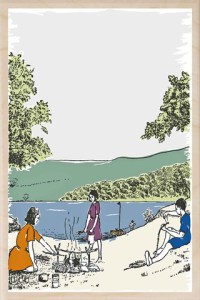
Or that we can buy a set of wooden postcards depicting Ransome’s inspirational illustrations?
Is it because the stories are driven by the characters of the children themselves, as Jill Goulder has observed, and that adults are relegated to native status, featured as little as is possible so that we enter a child’s world?
Do children relish the idea of independence and being in control of all they do, as John and Nancy seem to be? Is it that dressing up as pirates is cool?
Swallows and Amazons is about the importance of listening to children. It’s about integrity. Readers love the fact that Titty, the lowly able-seaman comes out as the unexpected hero. It was, after all, a brave thing to capture the Amazon at night and perhaps braver still to return to Cormorant Island with Roger to look for the treasure no one believed was there.
Could it be because the story is about sailing, and how to handle a simple dinghy? Claude Whatham, who directed the 1974 movie, recognised Ransome’s skill in describing how to make a camp was of huge appeal to children. Do we like to learn without the indignity of being taught?
Arthur Ransome’s style of writing is certainly vivid, drawing you into the world he created having been inspired by reading ‘Robinson Crusoe’, ‘Treasure Island’ and exotic tales himself. Martin Smith, whose comments on this strand have been endlessly interesting, has observed that there is something of ‘The Tempest’ by Shakespeare in the adventures set on Wild Cat Island.
Ransome was able to draw on years of experience as a writer before he launched the Swallows & Amazons series and this shines through. Since virtually only six children and two adults appear in his first book we get to know them well and are ready to welcome others such as Dick and Dorothea when they come along in Winter Holiday.
Is it because, ‘nothing happens in the books that couldn’t really have happened’, as Caroline Lawrence wrote recently in The Outlaw, a magazine written for children who readily identify with the characters. You can certainly enjoy looking for Ransome’s locations yourself. Those who do so are almost certain to buy the books for their own offspring.
Adults read the books, saying they bring great solace, evoking nostalgic memories and taking them back to a carefree childhood when summer days were spent devising camps and imaginary sailing adventures. Perhaps the traditional values act as an anchor in our stormy lives.
One thing is for certain. While many of the forty-two books Arthur Ransome wrote are now seen as obscure, his series of twelve ‘Swallows and Amazons’ novels line the shelves of almost every bookshop in Britain and are ever popular overseas. The Arthur Ransome Society has a thriving membership, enabling families to live the adventures for themselves. You can find out about joining yourself by clicking here.
The new feature film of ‘Swallows and Amazons’ starring Ralph Spall, Andrew Scott and Kelly Macdonald and released in 2016 has hopefully brought the story to the nation’s consciousness. It won awards in the USA where it was released in cinemas by Samuel Goldwyn.
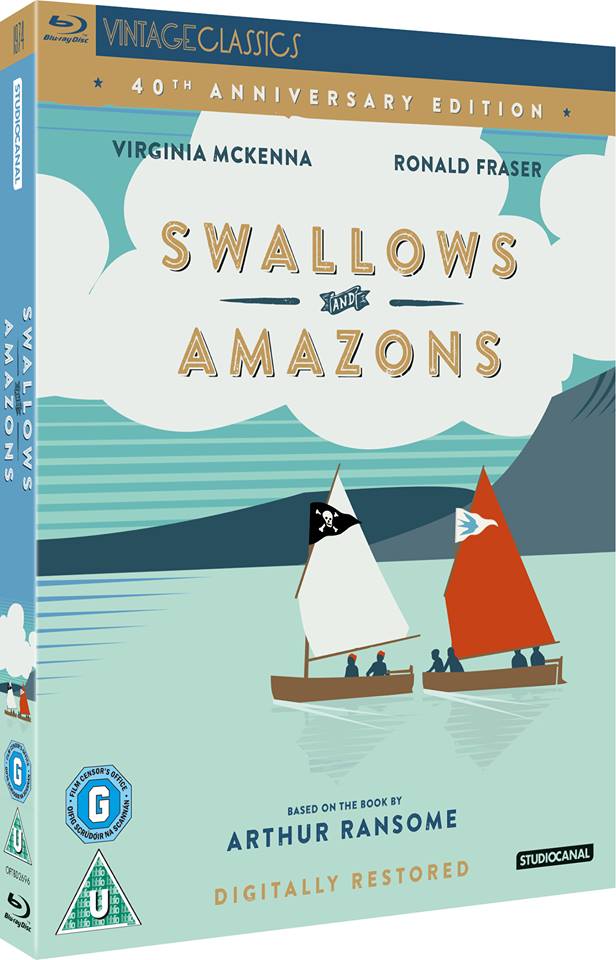
The film adaptation of ‘Swallow & Amazons’ made in 1973 and repeated on television so many times, helped to keep the flags flying. It too has been labelled as ‘a timeless classic’ and ‘an enduring success’. StudioCanal released a 40th Anniversary DVD with footage so beautifully restored that if it wasn’t for the extras package you might think it had been shot last summer.

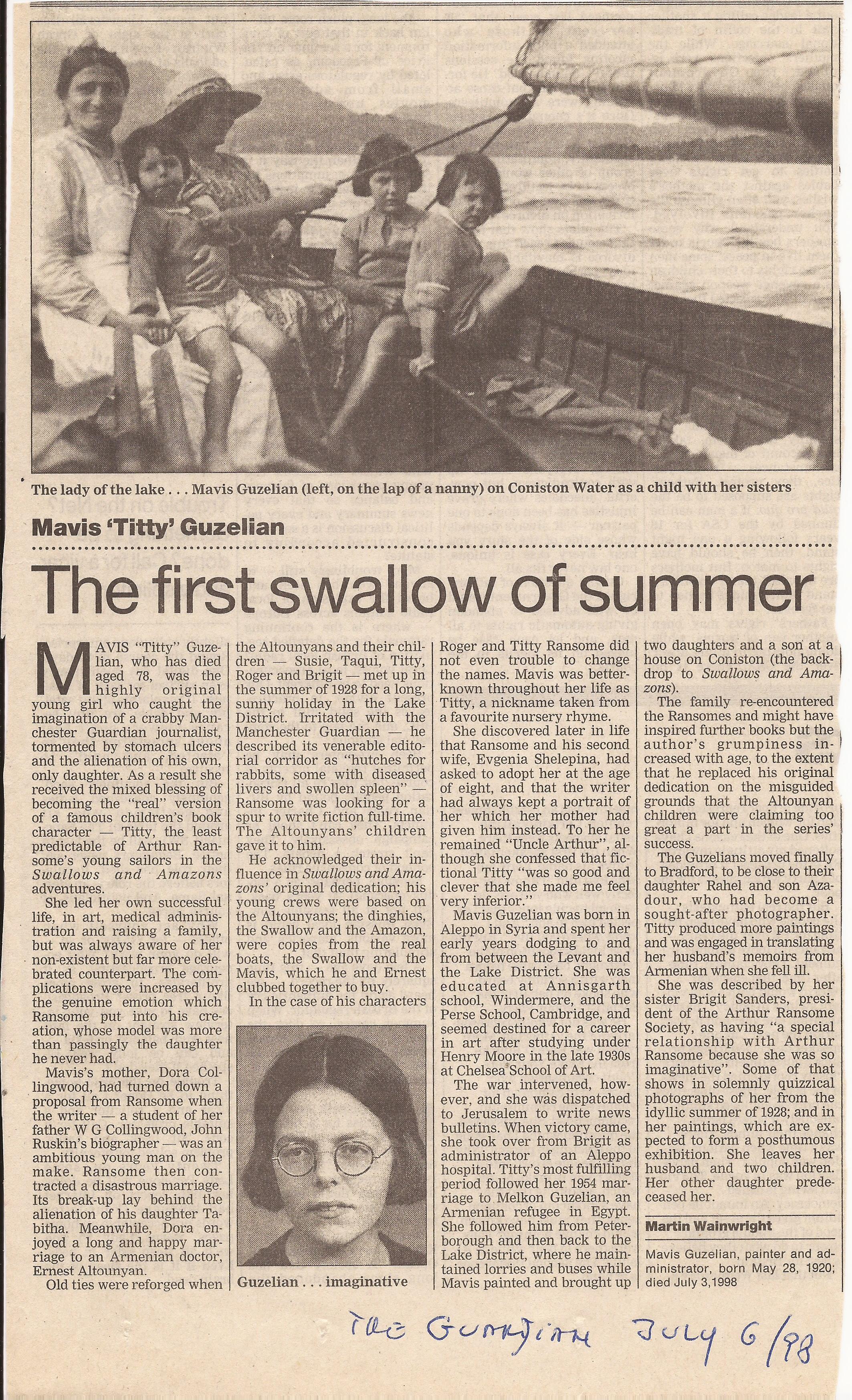
I am assured that Titty’s family will not be offended if I re-publish these news clippings. She has become well-loved by many who I know would like to learn more about her. The Times used her Christian name of Mavis, but she was always known as Titty.

Titty Altounyan was born in Aleppo on 28th May 1920, and would have been aged nine when Arthur Ransome began writing ‘Swallows and Amazons’. She died in Bradford at the age of seventy eight.
Although she was heralded as Arthur Ransome’s muse, I know that Titty Altounyan had no wish to be famous. If anything, she gradually disassociated herself with the character in the books, who struck her as being so good and clever. But Titty was her name.
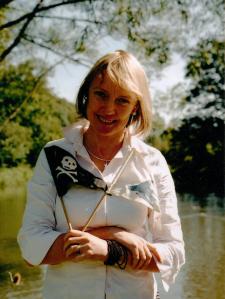
It was a name I have lived with too, for I played the part of Titty in the film of Swallows & Amazons produced by Richard Pilbrow in 1973. Children and adults alike still call me Titty all these years later. One summer, when I was sailing Swallow, the dinghy used in the 1974 film, someone took this shot of me. It is as if I am still flying Titty’s inspirational flag, which I do with humility and with honour.
Sophie Neville lowering Swallow’s sail on Ullswater in 2014
Titty Altounyan with the Ransome’s flotilla on the Norfolk Broads in 1934 (?)
Mrs Ransome wrote to Titty’s mother, Dora Altounyan, from Wroxham. This postcard was kindly shown to us by Ted Alexander who rescued it from certain destruction.
I thought I was far too fair to play Titty but Mrs Ransome approved. Despite Ransome’s book illustrations of girls with dark hair, she was most decisive about casting “An English rose” to play Titty and that the children should have British colouring. The idea was that viewers could easily associate with us. I am of Scots/English/Irish heritage, like three of Titty’s grandmothers, but have no Armenian blood. I rather wish I did. It’s nuisance having such fair skin. My second name is Rose.
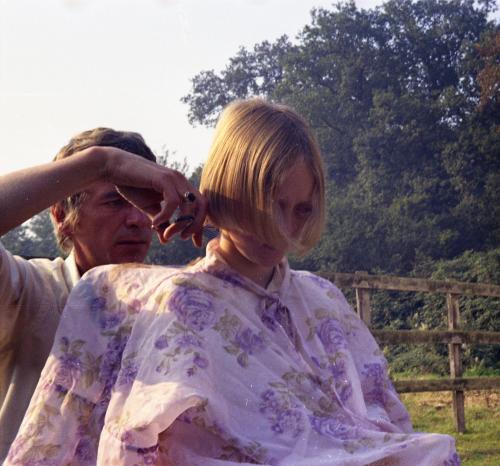
Hairstylist Ronnie Cogan giving Sophie Neville a Titty hair cut on location
I don’t know if Titty ever saw the 1974 film of ‘Swallows and Amazons’. She might have done. I only hope that we captured the sense of adventure experienced by the Altounyans when they were little and went camping on Peel Island during the weeks when they stayed with their grandparents, Mr and Mrs WG Collingwood, at Lane Head at the northern end of Coniston Water.

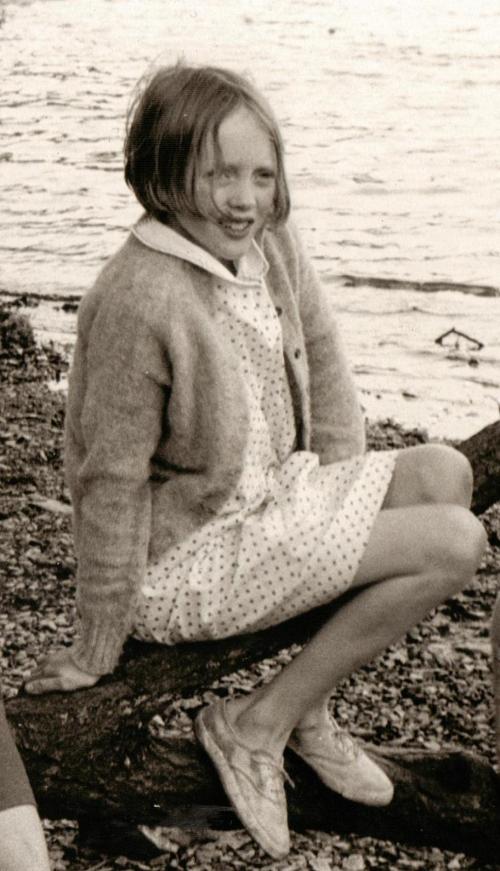
Although they are seen wearing shorts as young children I have been told that the Altounyan girls sailed in dresses, which they tucked up into their knickers if they had to wade ashore, much as I did in the film.
Sophie Neville as Titty (c) StudioCanal
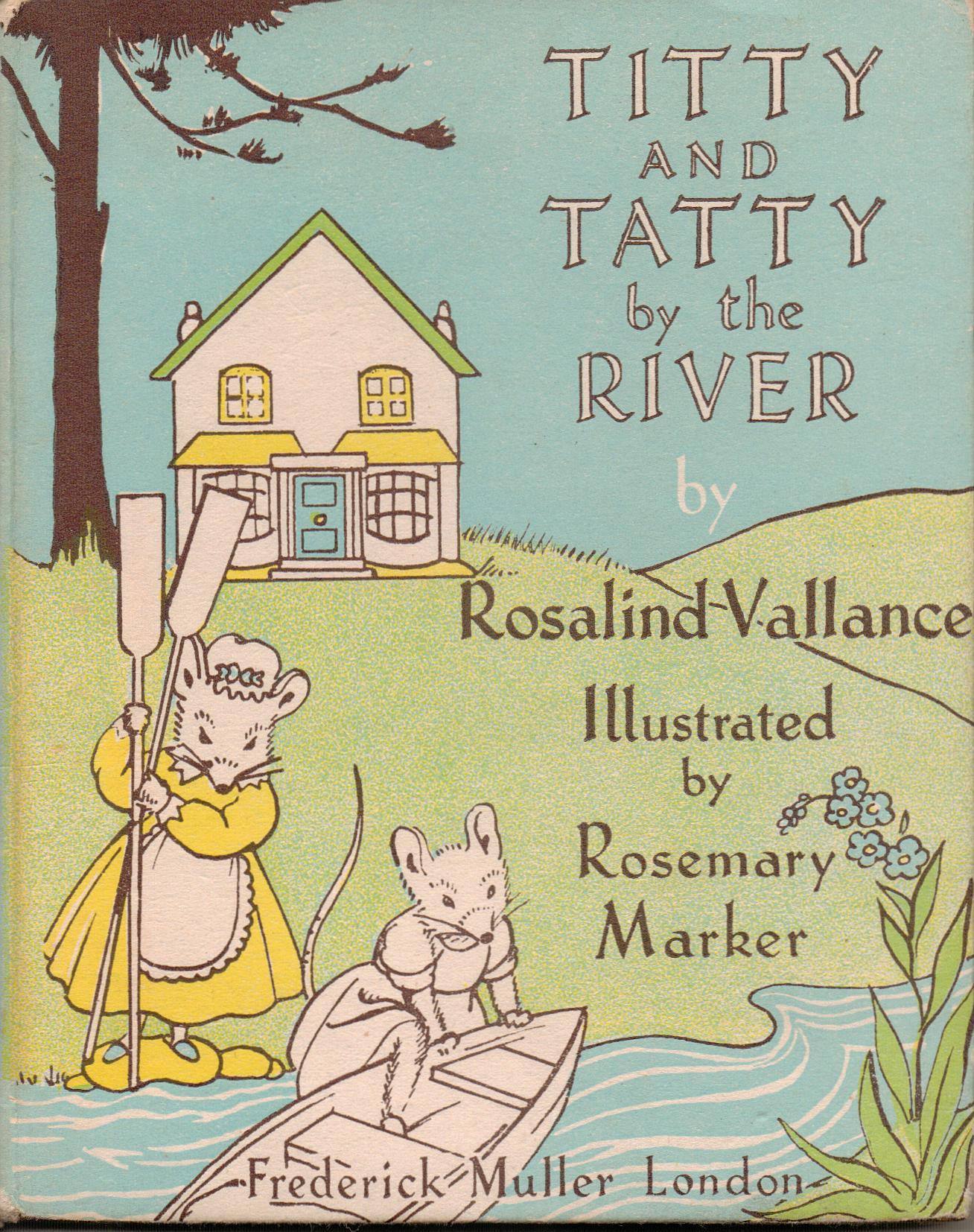
The reference to Titty’s name coming from The Tale of Mrs Tittlemouse in the article feature in The Times above is incorrect. Titty’s name was based on a character in fairy story Titty Mouse and Tatty Mouse by Joseph Jacobs published in 1890, that begins when Titty Mouse and Tatty Mouse go leasing (or gathering) corn. Here is a later edition. Titty ‘never could resist anything in print.’
You can read the original story here
A version of the story published in 1949
With thanks to Roger Wardale who showed me the handwritten letters that Titty sent him. She had the most beautiful writing.

If you would like to read more about the amazing time I had playing Titty in Swallows and Amazons, the first section can be leafed through, free of charge here:
For some time now we have been doing a variety of things to raise interest in Arthur Ransome and his books, particularly the ‘Swallows and Amazons’ series originally written for children.
The Royal London Yacht Club recently hosted a Swallows and Amazons weekend for the combined yacht clubs of Cowes on the Isle of Wight and in doing so raised quite a bit of money for charity.

Glenridding Sailing Centre in Cumbria have been running Swallows & Amazons Adventure Days on Ullswater and promise to hold more.

SailRansome have made Swallow, the original clinker built dinghy used in the film, available for families to use there.

We’ve been using the Draper’s shallop to teach children how to row on the River Lee under the auspices of Countryside Live. We have now taught hundreds of children most of whom have never been in a boat before. The idea is to inspire them to join the Sea Scouts or a local rowing or canoeing club.

Another boat you can sail is the Nancy Blackett portrayed as Goblin from We Didn’t Mean To Go To Sea and Secret Water.

It only costs £25 a year to join the Nancy Blackett Trust. This is wonderful for anyone living near the Orwell as Ransome once did.

The Arthur Ransome Society, known as TARS, is welcoming new members to its six regional branches.

Next year an international gathering is being planned over the May Bank Holiday.
Revelation Films have digitally remastered the serial of Coot Club and The Big Six, which they have available as a new release entitled ‘Swallows & Amazons Forever!’ I’ve been asked to give a talk on how the BBC serial was made.

I’ve also been promoting StudioCanal’s re-release of the 1974 film of Swallows & Amazons on Radio Cumbria, Premier Radio, Lakeland Radio and Channel 5’s live TV programme The Wright Stuff. There’s a lot going on in the media with pictorials in Country Life, The Lady, Cotswold Life and Practical Boat Owner magazine as well as newspapers and colour supplements.

We brought the original film of Swallows & Amazons back to cinemas in London, Ambleside, Kendal and to Hastings on Pirate Day. I took Captain Flint’s trunk along and wore a tricorn hat only to be told by one little boy in the audience, ‘I hate pirates. They are my enemies.’ Other children asked, ‘Did you enjoy being in the film?’ and ‘Were the spiders in your tent real?’

When we were in Kendal, the curator of the Museum of Lakeland Life gave a talk to the cinema audience bringing along the actual red slippers given to Arthur Ransome by the Altounyan children in 1929 which inspired him to write Swallows and Amazons.

Some schools have Swallows and Amazons as a set book. I was invited to give a talk at Walhampton School who claim a ‘Swallows and Amazons ethos’. They aspire to giving their pupils as much of an exciting outdoor education as possible with sailing and exploring on the curriculum. School House magazine backs this up saying, ‘There is a distinct ‘Swallows and Amazons’ spirit that burns brightly here.’

The Arthur Ransome Trust have a range of exhibitions, displays and resource materials. Do check out their website and future events. Meanwhile All Things Ransome have been quietly offering a veritable library of information along with a media vault. The Arthur Ransome Society has a large library of books in Dumfries where the 2016 IAGM will be held.

What could you do to keep Ransome’s writing on book shop shelves?
Could you organise an event at your local sailing club? Or request a screening of newly restored version of the film at your local cinema? One is being planned in Oxford with hopefully another at Wolverstone. PictureHouse cinemas are particularly open to the idea of screening classic family films.
I am planning ‘An Arthur Ransome Day’ at my local Waterstones and another at our library. How can we make this special and attract people off the street?
Do add your ideas to the comments below.
Easy things you can do right now to help promote the books:
Request a book or DVD from your local library.
Add a review to on-line sites. This leads to increased marketing of books, audio books or DVDs. The Imdb site for the 1974 film of Swallows and Amazons welcomes reviews.
Click here for Books by Arthur Ransome on Amazon UK
Add a comment about the DVD of the film. Click here for StudioCanal’s DVD on Amazon UK

Click here for the Amazon UK site for the DVD of the BBC serial of ‘Coot Club and The Big Six’ Look out for the one with this cover:

Other ideas:
Join The Arthur Ransome Group on Facebook. They always have lively discussions.
There are a number of Twitter sites you can follow.
Contact BBC TV to ask for your favourite TV or radio programmes on Arthur Ransome or his books to be repeated: Click here for the site.

You can read about the adventures we had making the original film with Swallow here:
by Sophie Neville who played Titty Walker
‘Forty years after she enchanted film-goers as Titty in Swallows and Amazons, Sophie Neville has found a new audience… telling the behind-the-scenes secrets of the film of Arthur Ransome’s classic novel.’ The Daily Mail The Making of Swallows & Amazons ‘…is based on diaries, letters and old photographs which Sophie has turned into a heart-warming account of making the movie, which starred Virginia McKenna and Ronald Fraser.’
The Telegraph ~ Culture: ‘Set in the Lake District in 1929, the film follows four young adventurers who sail a dinghy around Lake Coniston, cook for themselves over campfires and sleep in makeshift campsites.’
‘…The occasional chaos and terrible weather during filming contributed to the eventual popularity of the extraordinary and very much loved film.’ The Times
‘The film Swallows & Amazons is 40 years old, but thanks to its careful period evocation, its respect for Arthur Ransome’s original book and the performances of its child actors, it’s become a timeless classic. One of those children was Sophie Neville, who played Titty, and who kept a diary during the filming. That diary, with her adult recollections, is this book. It’s a fascinating insight into filming on location in the Lake District…’ Classic Boat
‘… The result is compulsive reading as she recalls that cold wet summer, while the camera crew wrapped up warm and she shivered in her skimpy dress as Able Seaman Titty Walker. Sophie brings to life all the many memorable characters who worked on the film and in particular the other children, the Director Claude Whatham who developed a great relationship with his young cast and the stars Virginia McKenna and Ronald Fraser. Nor are the other young actors forgotten for there are diary contributions from Suzanna Hamilton who played Susan, Stephen Grendon who played the Boy Roger and Kit Seymour who played Nancy Blackett. The text is supported by numerous illustrations showing life on and off the set.’ Roger Wardale, author of Arthur Ransome: Master Storyteller and other books
‘You don’t need to be a Swallows & Amazons fan to enjoy this book – it’s universal!’ Winifred Wilson, Librarian of The Arthur Ransome Society
‘This was a most unusual and interesting book. I picked it up expecting to browse through it, and found myself so drawn in to Sophie Neville’s detailed, amusing and insightful description of film making in the 1970’s that I was unable to put her book down. As Arthur Ransome fans, my family and I have always loved the film, and felt that Sophie Neville was ‘just right’ as Titty. What fun it has been to be introduced to the young twelve year old Sophie with her intelligent awareness of the challenges facing the production crew while she shivered in her cotton dresses. The many photographs and illustrations contribute richly to bringing the 1970s setting to life. Sophie recorded her experiences beautifully, and in so doing, added one more valuable book to the cultural heritage of all Arthur Ransome fans.’ Juliet Calcott, English teacher, South Africa
Lots of photos throughout the book bring the scenes to life – a delightful read.’ Celia Lewis author of An Illustrated Country Year
Sophie Neville has been chatting to Mark Forrest on The Evening Show.

The second edition of this paperback is published by The Lutterworth Press, available online here
**********