Although I knew Claude Whatham well, I had no idea how prolific he was until I read his obituary.
Brenda Bruce as Mrs Dixon with Claude Whatham
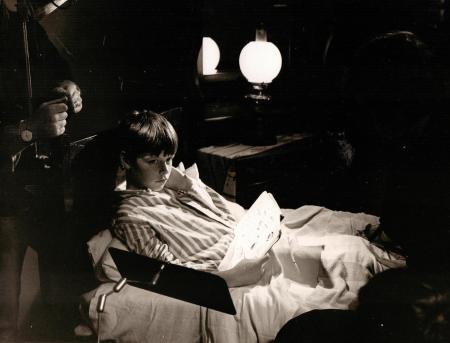
DoP Denis Lewiston and Director Claude Whatham
As an art student, in 1940, he was commissioned to paint murals by the young Princess Elizabeth and Princess Margaret in their rooms at Windsor Castle after their paintings had been removed for safe-keeping during the Blitz. They couldn’t bear the idea of bare walls and asked if he could paint something cheerful.
-The pantomime pictures at Windsor Castle (The Royal Collection Trust)-
As Claude was born in 1927, I thought he must have been too young but he was an evacuee in his first year at art college. You can see more images of the murals and read his own version of how this came to pass if you click here.
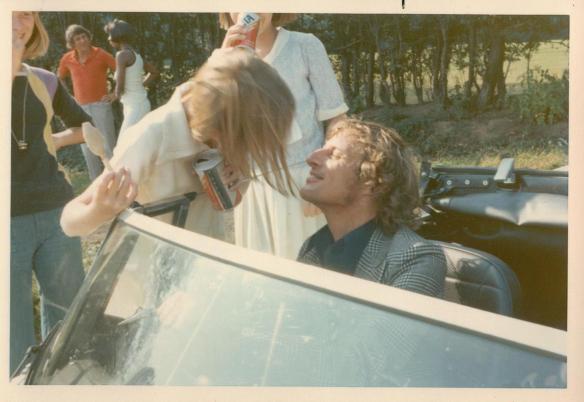
Claude Whatham in 1973 (photo Daphne Neville)
All I can tell you is that Claude Whatham simply had the self-confidence to succeed. We all adored him.
Sophie Neville saying goodbye to director Claude Whatham
After working for a short time as a production designer he became a television director at the age of about thirty – evolving his craft in the early years of Granada Television.
Being both a craftsman and artist he loved innovation and being avant guard.
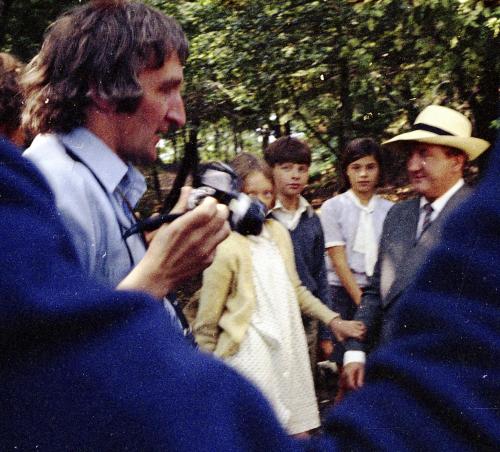
Claude Whatham showing the 16mm camera to Simon West and Sophie Neville. Sue Merry and Denis Lewiston can be seen behind us.
Single-minded and determined, yet usually coming across as relaxed, he moved into directing movies in 1972 with That’ll Be The Day starring David Essex, Ringo Starr and Robert Lindsay, followed by Swallows & Amazons when he was forty-six.
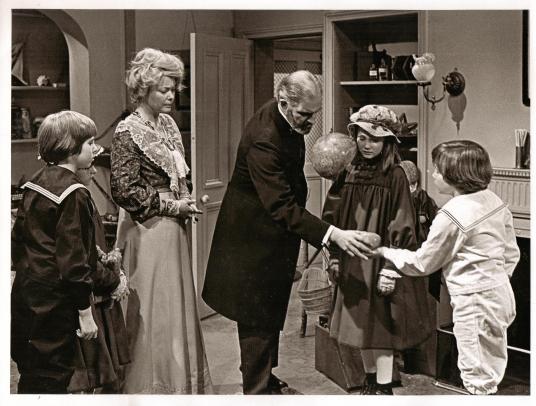
I’d met him in 1971 when he directed the first BBC adaptation of Laurie Lee’s memoir, Cider with Rosie, for which he received a BAFTA nomination. It was made where the book is set at the village of Slad in the Cotswolds, about seven miles from where I grew up.
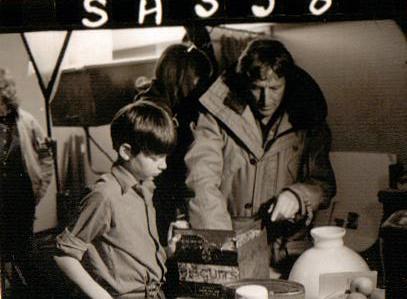
Sophie Neville with Claude Whatham on location at Slad in 1971
Claude lived at 37 Belgrave Gardens, London NW8 but had a Cotswold stone cottage in the hamlet of Camp, also near Stroud in Gloucestershire. After casting me as Eileen Brown, Laurie Lee’s first love, he invited me to play Titty in Swallows and Amazons (1974) and appear as a girl in a Wheatbix advertisement.
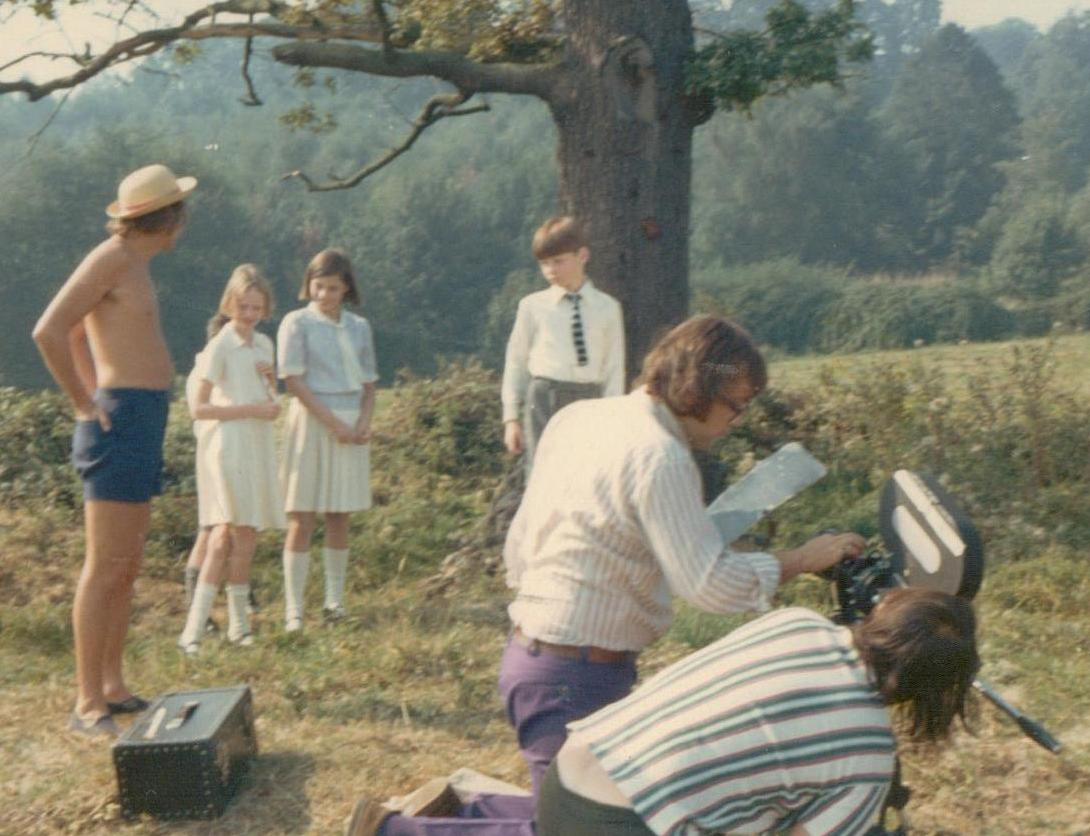
Claude Whatham directing the title sequence of ‘Swallows & Amazons’ on location in Surrey with Sophie Neville, Suzanna Hamilton, Simon West and his camera crew
Claude loved taking his clothes off. It was almost indicative of his style. He wasn’t shy. If you look at what he was wearing you will see that his clothes were both on trend at the time and would still be fashionable today. He would wear Levi jeans, deck shoes or sailing boots and a Parka coat with a fur-lined hood in wet weather. As for headgear, I only ever saw him wearing other people’s hats.
Claude Whatham directing a TV advert (photo: Daphne Neville)
Claude was always happy working outside. Problems did not seem to phase him. I worked with him on location in Gloucestershire, Surrey and Cumbria, visiting him on set in the Yorkshire Dales when he was filming the movie All Creatures Great and Small based on the life of the vet James Herriot, starring Anthony Hopkins and Simon Ward. I was sorry when I heard that he gained a reputation at the BBC for being too detailed and pernickety in the studio. I expect it frustrated him.
Claude’s period films are marked by their enduring quality, they have not dated.
Claude Whatham profiled by Tom E Parkinson in the Oldham Evening Chronicle 18th April 1974
For a full list of Claude’s film and television credits please click here
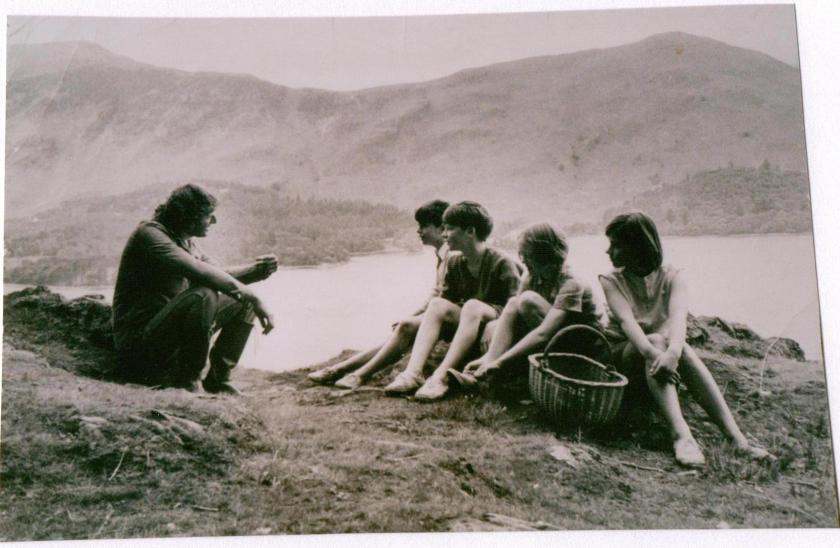
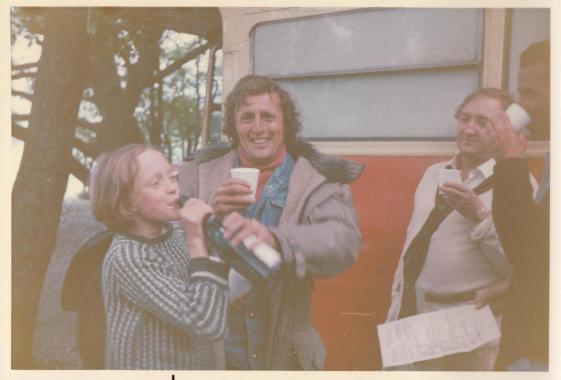
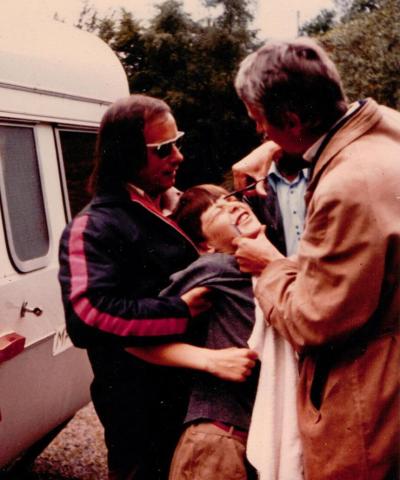
Sophie Neville with director Claude Whatham, Ronald Fraser and DOP Denis Lewiston outside the catering bus parked at Derwentwater in the Lake District ~ photo: Daphne Neville
He was a major contributor to a new book about ‘Play for Today: The First Year’ by Simon Farquhar, which is dedicated to Claude. You can find it here.
Director Claude Whatham talking to Virginia McKenna at Haverthwaite Railway Station
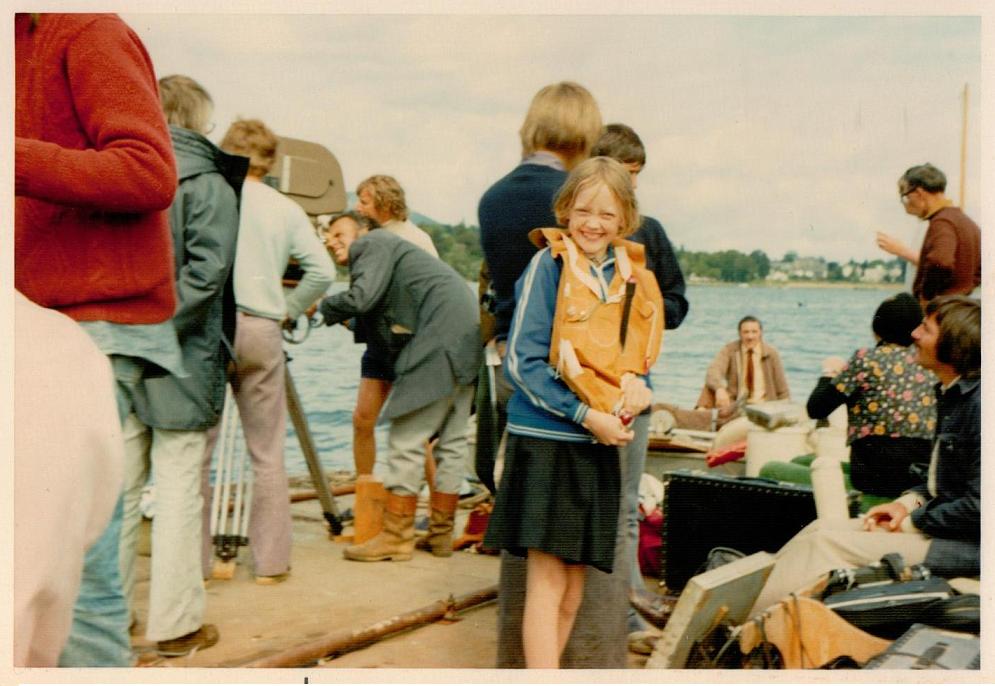
Tamzin eating ice cream in a pink dress whilst appearing as a film extra in ‘Swallows & Amazons’. Kit Seymour and Jane Grendon stand behind her.
It is with some bemusement that I see myself described as a child star in newspapers. I only appeared in two feature films before I grew too tall to do more. It was the little girl here seen eating ice-cream in a pink dress, appearing as a film extra in Swallows & Amazons, who became a brighter starlet than I.
Tamzin appearing with Percy Baxter in a Weetabix advert directed by Claude Whatham in 1973
My sister Tamzin enchanted directors who cast her in one role after another. Her career started in 1972 when she was given the lead role of Elka in an episode of Arthur of the Britons opposite Oliver Tobias who played King Arthur. He later introduced her as his co-star. By this time he was known as The Stud, having starred opposite Joan Collins in the movie of her sister Jackie Collins’ racy novel.
No one asked Tamzin if she could ride a horse. It was a good thing that she was proficient as she was soon cantering up and down hills whilst clutching that medieval doll.
Arthur of the Britons had the most prestigious cast: Brian Blessed, Martin Jarvis, Tom Baker, Catherine Schell, Iain Cuthbertson, Peter Firth, Heather Wright, Michael Gambon and Peter Bowles all appeared in the drama series, some of which was filmed on our parents’ farm. I remember Jack Watson leaping down the bank above our house. Tamzin played most of her scenes opposite Michael Gothard, who became famous for playing the villain Locque in the James Bond movie For Your Eyes Only.
Tamzin was then cast as Anthea in the 1976 BBC adaptation of of E Nesbit’s classic story The Phoenix and the Carpet. I’ve just read that it was a story much admired by Arthur Ransome.
While Mum enjoyed playing the part of Mother, Tamzin’s brother Cyril was played by Gary Russell, who after appearing as Dick in the BBC series of Enid Blyton’s The Famous Five, grew up to become a writer and script editor on Doctor Who. I last saw him at a book launch at the Imperial War Museum.
Sophie Neville with Gary Russell in London in 2012
Here he is with Tamzin in the 1970s:
As she was used to appearing on television, Tamzin wrote in to Blue Peter and soon appeared on the show. She was also featured on Animal Magic and a number of other magazine programmes.
Tamzin soon had another lead role, that of the young Linda in the ITV production of Nancy Mitford’s semi-autobiographical novel Love in a Cold Climate. While Judi Dench and Michael Aldridge starred as her parents, her brother Matt was played by Max Harris who had the role of her brother Robert in The Phoenix and the Carpet. Tamzin can been seen on the trailer wearing a red dressing-gown in the Hons’ cupboard, looking dreamy in a tam o’shanter and jumping a white Arab over a Cotswold stone wall, whilst riding side-saddle.
She went on to take leading roles in episodes of APlay for Today, Crown Court and Screen Two. Ironically she was expelled from Drama College after Mum persuaded her to work professionally one summer vacation. At that, she tossed her head and went on to occupy time more gainfully.
She won’t believe me, but Tamzin is a most amusing writer. You can see for yourself. Her letters are featured in Ride the Wings of Morning.
When I saw Simon West recently he told me that his father would love to see a copy of ‘The Secrets of Filming Swallows & Amazons’.
Nigel West soon wrote to say:
‘…it makes fascinating reading. Simon told me very little in the way of detail about his experiences when filming so your account is very welcome.Simon’s mother, Dorothy, and I only visited the Lake District once during that period and then we only saw Simon fairly briefly and saw nothing of the filming. Things that I can recall about the whole experience I will describe below.
.
‘Our family took up dinghy sailing when I built a Mirror dinghy in our dining room at home. It was built from a flat-pack and took nearly a year to construct, in my spare time, during which the family had to eat meals in the sitting room. I had been sailing on the Norfolk Broads with friends a few times in my college days, which had started my interest in boating. The family joined the Dorchester Sailing Club which was based on an old gravel pit not far from our home. Eventually we also acquired two children’s Optimist dinghies for Virginia and Simon, who spent many weekends racing their boats at open meetings around the country.’
.
.
‘One day at the club a notice appeared on the notice board asking children with sailing experience to audition for acting parts in a film to be made of Swallows and Amazons. Virginia immediately expressed interest and pressured Dorothy and me to take her to the auditions in London. We were reluctant to agree because we thought her chance of success would be so slim with thousands of other applicants, many with acting experience, queueing up for parts. Then, to my surprise, Simon said he was also interested, with his eye on the part of John, but surely, I thought, he would be too young and too short for that part and he had pooh-poohed the idea of trying for Roger.
‘As it happened we were due to visit Dorothy’s sister, who lived south of London, in Sussex, on the Saturday of the auditions, so we decided that a small detour would allow the children to attend without too much problem. Sadly Virginia fell at the first interview while Simon, to our utter amazement, won through that and all the other stages of selection to win the part of John. How pleased we were for him and proud – and sorry for Virginia who took her disappointment so well. You should ask Simon about the later stages of selection that included a long weekend living on an old motor torpedo boat at Burnham-on-Crouch having, among other things, his sailing proficiency assessed.
‘From the few things that Simon did tell us about the filming, I was extraordinarily impressed by the maturity he had so clearly gained in the whole experience. He explained how conscious he was of the crucial part he had to play in getting it right, in front of the camera, because the success of the whole project depended on that. With dozens of adults all working flat out as a team to a tight schedule meant that he had to concentrate on getting it right first time – a very maturing experience for an 11 year-old taking time out from his first year at secondary school.’
.
.
‘With Simon having no acting experience I was intrigued to know how Claude Watham had managed to get what he wanted from his young cast. Simon explained one technique that Claude had used to stop them looking wooden in front of the camera. He would make sure they knew their lines, send the children to run to some point and back again, then shoot the scene while they were still animated from the running.
‘One aspect of the production mentioned in your book is the studio post-sychronisation. I can remember taking Simon up to Elstree Studios in Borehamwood to re-record some of the dialogue, sometime after the filming had been completed. Maybe you did the same. Simon had to wear headphones to listen to the film dialogue, while watching a scene from the film, and to repeat to a microphone the dialogue in exact synchronism with what he heard in the headphones and saw on the film. He said it was an extremely difficult thing to do, to talk over one’s own voice, exactly, and then to give it the right expression. I imagine it needs a lot of practice to get it right. The object was, of course, to dub over recorded dialogue which had either been poorly recorded or which included extraneous noise.
‘Finally, I did manage to watch one scene filmed, but from a great distance, which you do mention in your book, and that was the Darien scene shot at Runnymede sometime much later in the year. In 1973 it was the fashion for all schoolboys to wear their hair indecently long. At Simon’s school the rule was that the hair was just allowed to touch the collar but not an inch longer. Simon’s hair was no exception but he had had it shorn for and throughout the filming and it had just started to grow back when he was summoned to the Runnymede shoot. On our arrival at Runnymede Simon was immediately sat on a chair and had his locks shorn once again. I think he should have been paid a special indignity fee for that day’s work.’
.
.
‘I remember watching the S&A float in the Lord Mayor’s Show pass by but the float passed too quickly to let you all spot our family in the crowd.
‘I also remember attending the film’s premier at the cinema in Shaftesbury Avenue, also attended by some minor member of royalty. It was a grand event and brought home to me that this was not some trivial little children’s entertainment but was a full length feature film of some standing. It must have been shown on British TV a dozen times over the years, particularly at Christmas, so it has stood the test of time by anybody’s standards.
‘That reminds me that at one point we made a half-hearted attempt to get Simon into Equity but without success. The result was that Simon only got paid a daily fee for his work on the film, with no residual payments for TV showings, overseas viewings or video and DVD earnings, to say nothing of his image appearing on a number of jigsaws!
‘You probably know that Simon also acted in a film made for children’s television in 1974, when he took the title role in Sam and the River. This was recorded on film and was shown on BBC TV in the form of six 30 minute episodes. It was before the days of video recorders so we have only ever seen the original transmission. Fifteen years ago I approached the production company to see if I could obtain a copy, but they had been reorganised since the film was shot and had kept no copy, nor record, of the production. I then approached the BBC and they did a search for me but they drew a blank. At one stage the BBC had a Philistine in charge who infamously threw out masses of, now priceless, BBC archives as being a waste of space. One day I hope to put a name to him. Simon has since found that the BFI have an archive copy of Sam and the River so I will approach them, but they do emphasise that they have no authority to make or issue copies of archive films. Might, however, get them to show it to us one day perhaps.’
.
There were four jigsaws issued with the film. There is full image of the jigsaw above on an earlier post.
David Stott, the Ambleside lad who worked as a unit driver on the film of Swallows & Amazons in 1973 after he left college at the age of 19, has written from America:
‘I really enjoyed reliving Swallows & Amazons through your book.’
‘Oh my, what a trip down memory lane it was for me – so much that l had forgotten was rekindled. I cannot believe that it was forty years ago.
‘I think that I started work mid-June, which would fit in with finishing college. From your daily schedule it was when you went back to Coniston with Virginia McKenna on her second visit.’
Map showing film locations around Coniston Water
David remembers the problem of being locked out of Bank Ground Farm by Mrs. Batty. ‘I really could not blame her as the whole place had been turned into a circus and her house ripped apart.’
‘The first morning I met Richard Pilbrow was in his bedroom for some strange reason and remember thinking, ‘What a total mess. How can anybody live like this?’
‘My main contacts were Neville Thompson (the On-line Producer) and Graham Ford (the Production Manager). They were all based at Kirkstone Foot Hotel that was owned by friends of my parents, Simon and Jane Bateman. Others stayed at the Waterhead Hotel down by the lake, where I would pick them up and take them to the location.
‘On arrival at the location I remember well the catering van and the breakfast that awaited us. Having just competed three years studying hotel management at college I was amazed how two people with very limited equipment could produce the number of meals they did. The washing up was done on a trestle table outside the van with bowls of water carried to location in large milk churns.
~ Map of film locations on Derwentwater in the Lake District ~
‘I did not have much contact with you and the other children, as you were under the watchful eye of your Mum and Jean McGill. Jean’s Mum was called Girly McGill and used to run a nursing home in Ambleside. As a child I used to deliver eggs to the home with my Dad. Jean had a brother who I think everybody called Blondie.
‘Sten was a bit of a handful at times and held up shooting on a number of occasions while he was calmed down. I rather envied Simon West; I wished I had the chance he did to act in a film. To this day I’m a frustrated actor.
‘Dennis Lewiston (the Director of Photography) always seemed to be holding a light meter in the air or perhaps he was warding off the clouds. I found him a little unapproachable.
‘My recollection of Sue Merry the continuity girl was setting up her folding table and tapping away on a portable typewriter.
‘Ronnie Cogan the hairdresser and I spent hours chatting. Once the shooting started, we had nothing else to do. He was such a nice man.
Map showing some of the film locations around Windermere
‘I was thrilled when I met Virginia McKenna and had to drive her around. One day I had to drive her to Grange railway station. I was so fascinated by her tales of working with lions in Born Free that I drove slowly to maximise her story-telling time. We almost missed the train and had to run from the car park.
‘One of the wettest days I remember is when the scene of Octopus Lagoon was filmed above Skelwith Fold Caravan Site. I don’t remember the support buses being around that day, but I do remember having to sit in the car for hours on end. Maybe the buses were somewhere else.
‘I know I was invited to the wrap party but cannot remember a thing about it.’
You can read more about the adventures had making Swallows and Amazons here
When Sten Grendon was given the part of Roger in Swallows & Amazons (1974), his mother Jane Grendon came up to the Lake District with him to work as a chaperone, looking after all the children appearing in the movie.
Jane Grendon keeping an eye on the children watching ‘Swallows & Amazons’ being filmed on Coniston Water in 1973 – seen here opposite Peel Island
Jane said that before filming began,
‘…one of the very first things we were asked was, ‘can Sten swim?”
‘I know he could doggy paddle. Neville organised swimming lessons at Pitville Pool, Cheltenham which included jumping off the diving boards. At the time I didn’t know why and I don’t think Sten is a natural in the water and the swimming lessons didn’t prove very successful. Claude told me – at the end of filming I think, when he gave me a copy of he original script – these lessons were because in the original script Roger was to jump in the water after Uncle Jim walked the plank.’
Jane sent me a copy of the page in question. I had not seen it before:
A page of David Wood’s original screenplay: ‘Swallow & Amazons’ (1974)
‘There are some personal memories. An aunt gave me the book for my birthday and I tried reading it but I hated all the technical boating details and I thought the children rather priggish so I didn’t enjoy it one bit and so was rather downhearted for Sten to be part of a story I hadn’t liked.’
Jane and her husband lived deep in the Cotswold countryside, at the rural Whiteway community, near Stroud in Gloucestershire. As I recollect, they had both qualified as teachers.
‘At the time of casting and during all the arrangements we had no phone at home and had to rely on a neighbour and the production team used to hold on while Ros came and fetched me! They must have really been fed up as it must have taken 10 minutes or so sometimes for me to get to the phone!’
Jane hadn’t imagined that she would end up in costume herself, if only for a day. She looked wonderful.
Jane Grendon in 1929 costume whilst filming the Rio scenes for ‘Swallows & Amazons’ at Bowness-on-Windermer in 1973
‘…. so there I was – a naïve, country girl flung into this alien world of a film unit. I was like a fish out of water! But I think it came out in your account that I related to you children better than I did to the adults around.’
Jane’s husband Michael was able to bring Sten’s sister, their little daughter Jo, up to watch the filming over half-term.
Jane Grendon with Martin Neville, taking part in a Weetabix commercial shot on location near Bisley in the Cotswolds in 1973
That summer Jane appeared in costume once more when Claude Whatham asked if Sten Grendon could also appear in a commercial he was directing for Weetabix, back in Gloucestershire at harvest time. This time she found herself on location not far from her own home and was always smiling.
Jane still lives the same house. Her husband Michael has retired from teaching and they have just celebrated their 50th wedding anniversary.
Sophie Neville with Jane Grendon, filming at Runnymede in September 1973
A comment from someone who worked on the film ‘Swallows & Amazons’ in 1973 ~
l had just finished my three years at college and was at a loose end before l started my working life. I was living in Ambleside at the heart of the English Lake District where Arthur Ransome’s children’s story “Swallows and Amazons” was being filmed at the time. I landed myself a job working for the film unit. I was full of my own importance as l was driving the stars and director of the film.
.
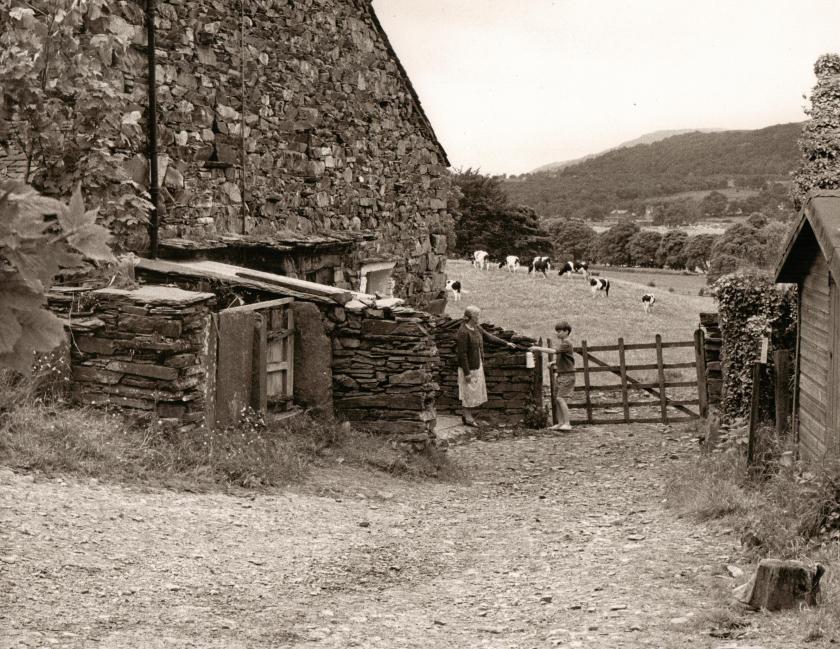
Virginia McKenna as Mrs Walker at Bank Ground Farm above Coniston Water
The stars were Virginia McKenna of “Born Free” fame and Ronald Fraser. I was reminded of this period of my life when l read the headline ‘X-RATED antics of Swallows and Amazons’ in The Times. The title related to the release of an e-book by Sophie Neville one of the child actors in the film. Sophie was 12 at the time and I was 19.
Sophie recalls how Ronnie (Ronald Fraser) was always drunk. Well this is not strictly true. In the morning Ronnie was reasonably sober and for this reason the director Claude Whatham would try and get most of the shooting with Ronnie in the can before the lunch hour came around when I would be summoned to take him to the nearest hostelry. Ronnie would then order his own concoction ‘The Fraser’. I cannot for the life of me remember what it consisted of, but believe you me these disappeared at a rapid rate of knots down Captain Flint’s (his character’s) throat. By the time the liquid lunch came to an end l would have to bundle him into the back of the car and deposit him back on set, much to the dismay of the producer Richard Pilbrow and the director Claude Whatham. Afternoon shooting was often a disaster when Ronnie was involved and I’m sure he frightened the children from time to time.
Well if the children were sometimes scared by Uncle Jim, as Captain Flint is known, then l was scared of the parrot that Uncle Jim had on his boat. The first day that I had to collect the parrot the old lady who owned him travelled with him to the location on Derwent Water. However she soon became bored with all the hanging around and after that she entrusted me with the parrot. Now birds are not really my thing and I really did not like handling him. He would travel to the location in an old shopping bag with a zipper, where l would hand him over and he would be placed in his cage. This was all well and good, then came the day that was so wet they did not use him, but instead he stayed in the production office at the Kirkstone Foot Hotel where the crew were hanging out. I was told he was in the bathroom, l expected him to be in his travel bag, but no he was sat on the edge of the bathtub looking at me. By this time he hated being put in the bag it took me all my time with a towel to catch him, finally after being scratched and bitten I got him home to his Mum.
The hardest thing to stomach was the fact that the parrot was paid more per day than l was.
David Stott
One of the daily unit call sheets issued on ‘Swallows & Amazons’ (1974)
I replied:
Thank you so much for writing in, David. Your story about the green parrot had me roaring with laughter. I am told that he was a male parrot called Beauty, who belonged to Mrs Proctor of Kendal. Her grand-daughter rang in when I was interviewed on Radio Cumbria recently. She told me that her gran, old Mrs Proctor could do anything with him, and was well know for walking around Kendal with him sitting on her arm. I don’t think anyone else dared get close. Since I played the part of Titty, I had to have him sitting on my shoulder in the cabin of the houseboat, while delivering the most important lines in the film. We were then meant to leap about singing, What Shall We Do With the Drunken Sailor? This was a bit ironic since Ronnie was half-plastered by then. He was pretty permanently pickled. In the penultimate shot of the film, while pretending to play the accordion, he was still drunk from the Wrap Party 36 hours before. The parrot was not invited to the party but did receive a fee of £25 for appearing in the film. His owner used this to buy him a bigger cage.
I don’t know who thought up the ‘X-rated’ headline at the Times (which was absurd) but a reporter from the Daily Express provided the receipt for ‘The Fraser’ in 1973 – I have the clipping (above). Geoffrey Mather wrote: ‘A Fraser is a drink of his own invention. It consists of a large vodka with a kiss of lime and a ton of ice, topped up with soda in a large glass’. We all bought the copies of the newspaper in Ambleside. My mother was horrified as instead of being a story about making the film it was a half-page article about Ronnie’s antics in the bar of the Kirkstone Foot Hotel on Windermere.
Sophie Neville, Suzanna Hamilton, Lesley Bennett, Simon West, Sten Grendon and Kit Seymour with Ronald Fraser. Who is operating the boat?
More stories from the making of Swallows and Amazons can be found here:
Outside the ABC in Shaftesbury Avenue at the premier of ‘Swallows & Amazons’ in 1974. The nuns were amused to find ‘The Exorcist’ was on at the same time.
An editor at the Sunday Telegraph magazine asked me recently,
‘Don’t all child actors get into drink and drugs?’
Not I, said the fly. I’m afraid I was far too Swallows and Amazons-ish and sensible. And I lived deep in the countryside, out of the reach of dealers looking for kids with a little bit of money.
Simon West working with Claude Whatham in 1973
Simon West told me that spent the money he earned from appearing in films and television on sailing dinghies. It was a good investment. At the age of about fifteen he won the British Championships in what must have been the new fibreglass model of Optimist. Until that time they had been constructed of plywood.
Suzanna Hamilton looking at her scar while sailing Swallow with Simon West
I remember that Suzanna Hamilton spent the extra cash she was given from being brave about swimming in Coniston Water on a Swiss Army penknife. I had never seen one before. She cut her finger so badly making arrows from hazel saplings with the Property Master that the director banned her from using it. I was rather envious of her scar.
Suzanna wrote to tell me:
‘I wasn’t allowed to spend much of my money until I bought an extremely good oboe. A few pounds (were spent) on some budgies (one lovely male named Ransome and one named Rio – a flighty female). She was a bad influence and they both flew out the window in the end. Ransome used to sit on my head very happily when I only had him.’
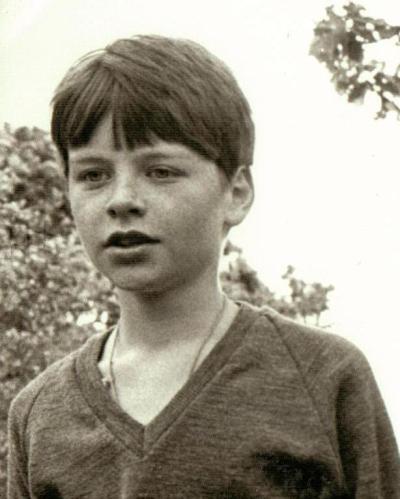
Sten Grendon aged eight, as Roger Walker
We really didn’t earn that much back in 1973, but all children dream of what they could do if they had a little bit of cash. Sten Grendon told me that he spent some of his first BBC fee on a bike. All he wanted to do with his earning from appearing in Swallows & Amazons was to buy the biggest Lego set in the world. His father found one for £20 and put the rest into a savings account.
Any money I made from being in films was immediately locked up in Barclay’s Unicorn Unit Trusts. My riding teacher tried to persuade Mum to let me buy a decent horse I could use to compete with. A very beautiful Palamino was offered. This wasn’t a bad idea, as I would have gained skills and confidence, although I couldn’t see myself as a British Champion.
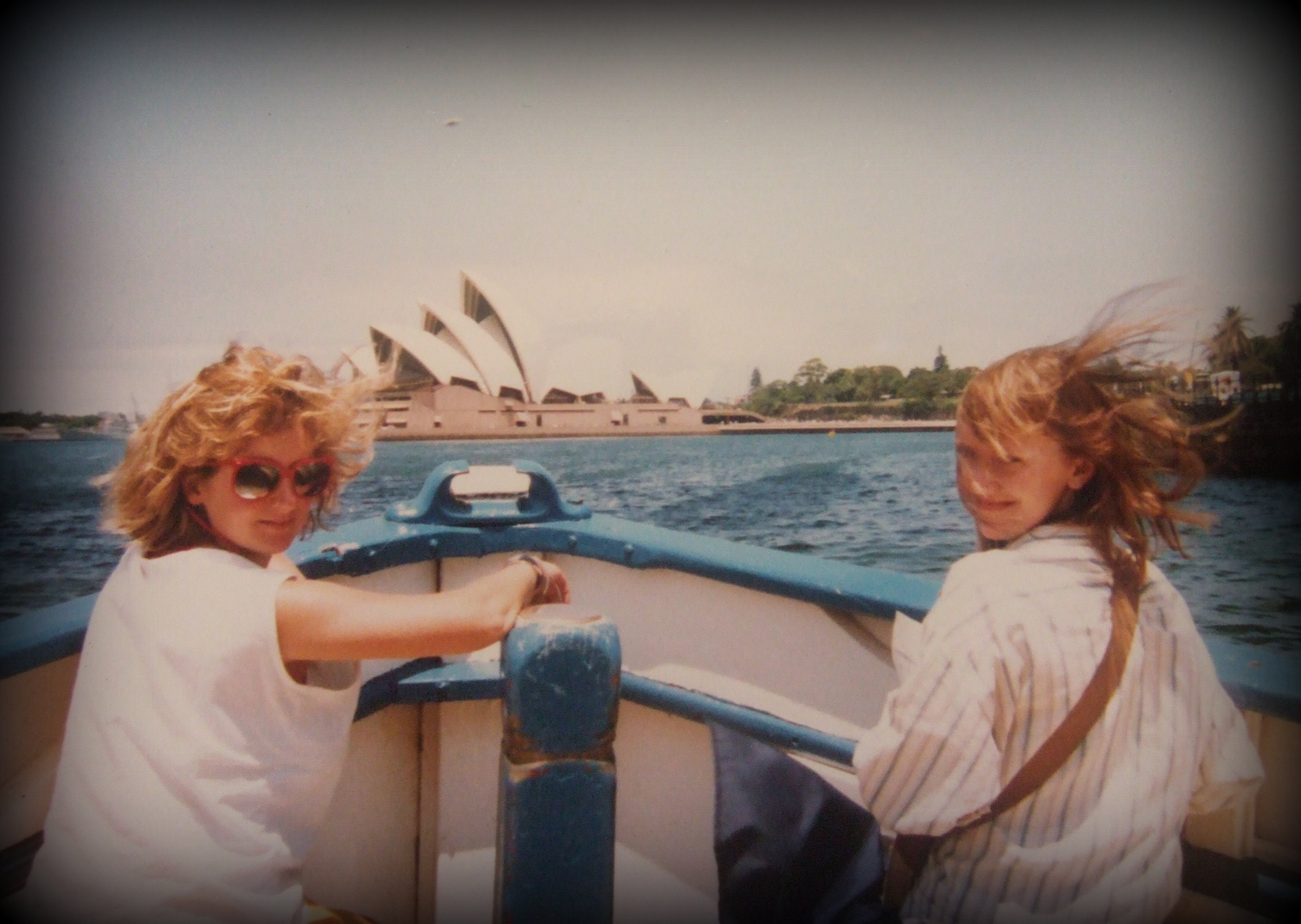
‘The real Queen Bess didn’t grow up on Sydney Harbour’
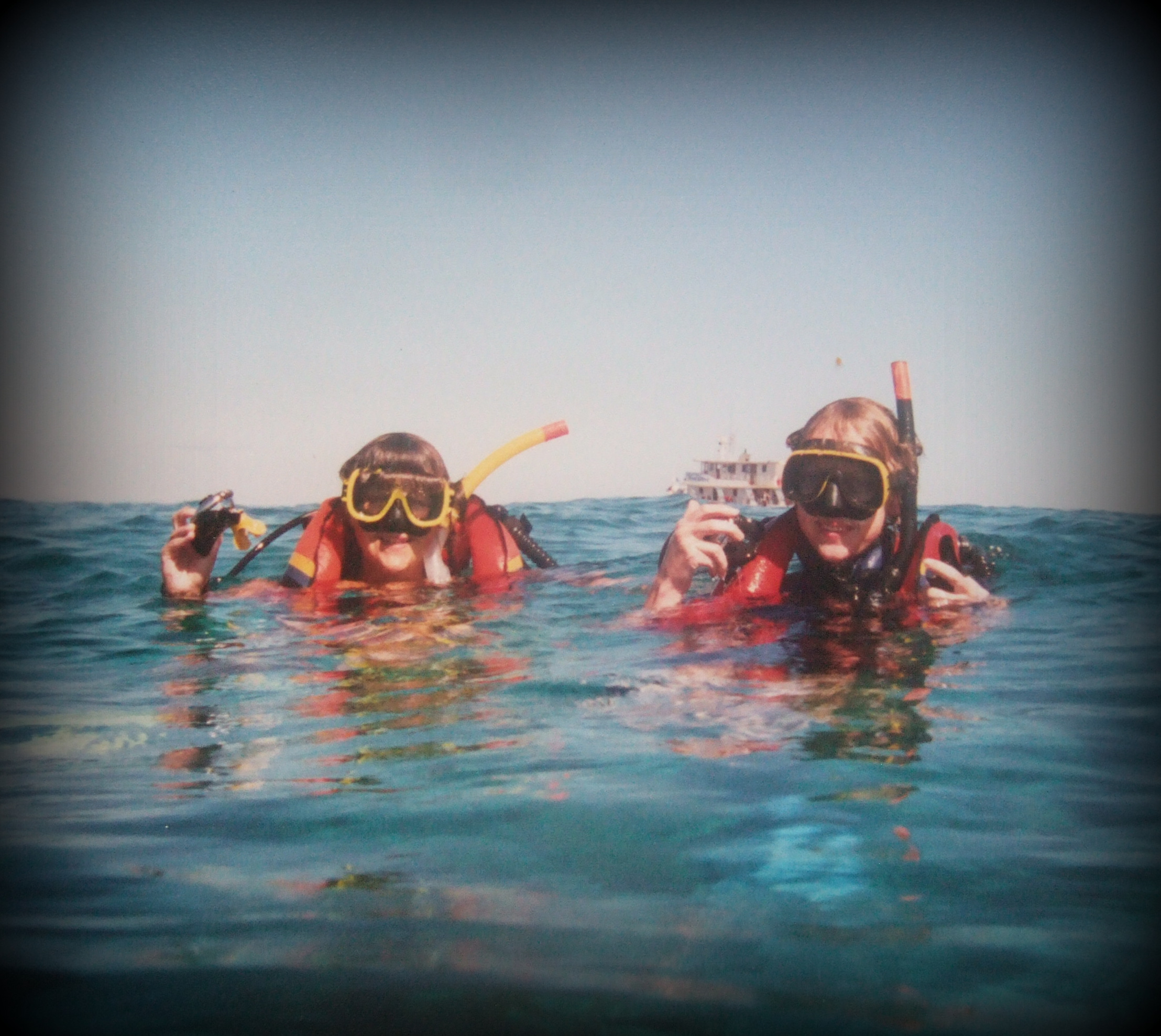
Instead I eventually spent my savings on a ticket to Australia where I took a boat up Sydney Harbour and I learnt to dive on the Great Barrier Reef.
Sophie Neville (right) diving off the east coast of Australia
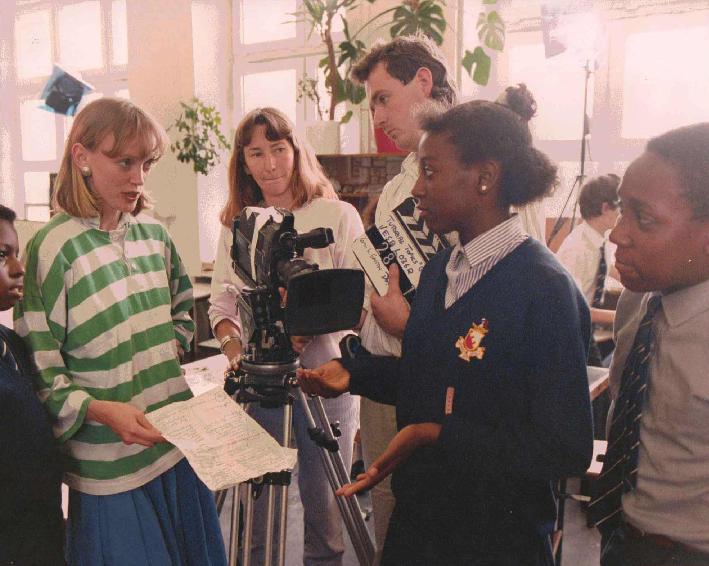
I had just finished directing a drama-documentary that featured children at a west London school. Whilst we were busy filming in the art room a teacher rushed in to tell us not to let anyone go outside. Drug addicts had been mugging kids crossing the playing fields for their dinner money. I was obliged to pay the eleven-year-olds who took the lead roles by sending their parents a decent set of professional photographs. Paying them in cash was too risky.
Sophie Neville directing a sequence with BBC cameraman Lorraine Smith
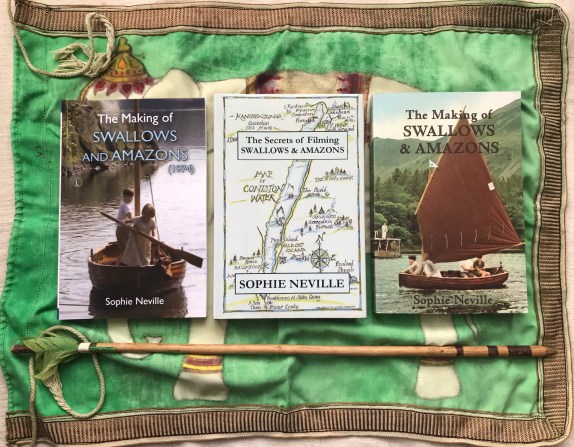
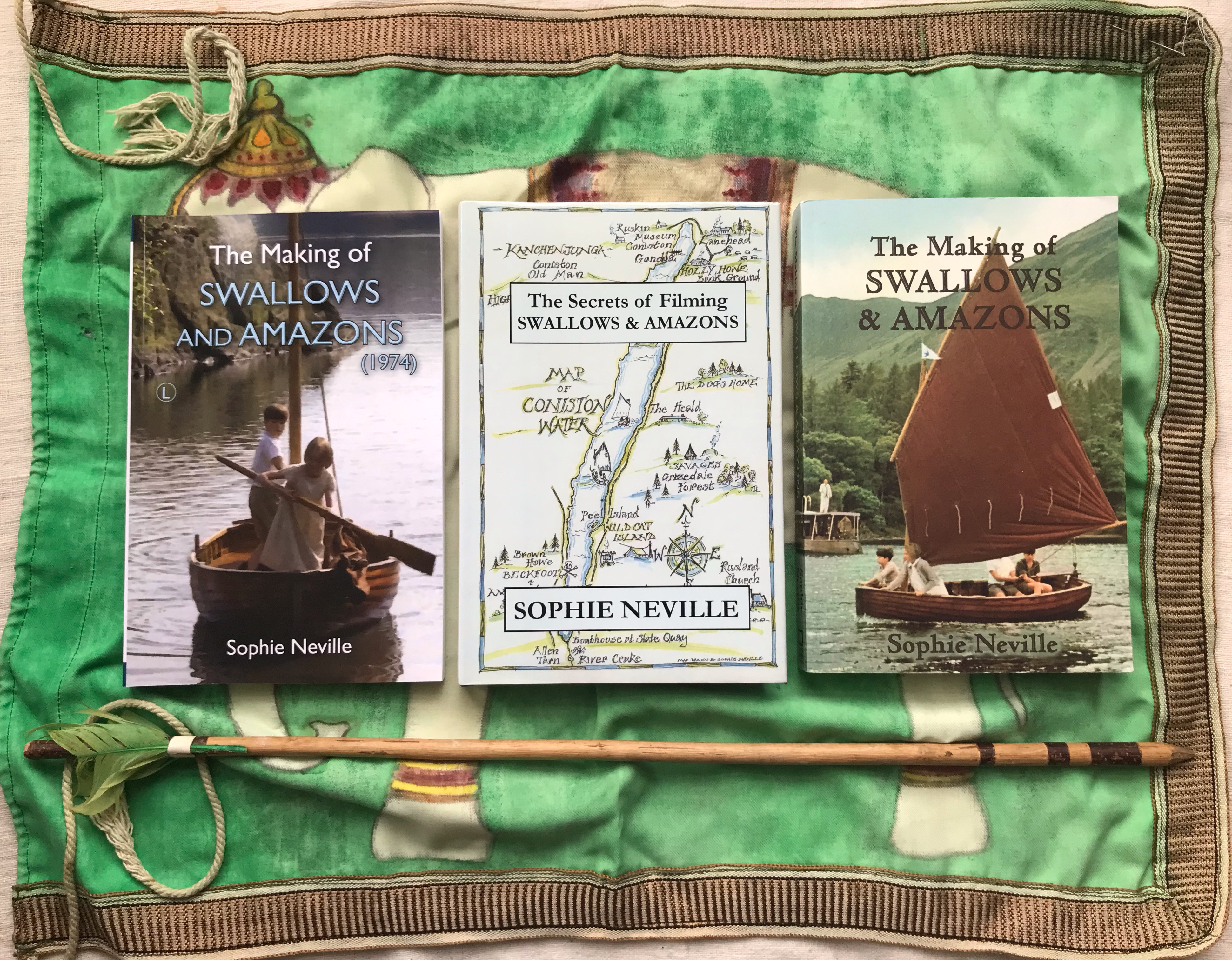
You can read more about what it was like to find ourselves in such extraordinary circumstances in The Secrets of Filming Swallows and Amazons, available as an ebook from all the online retailers or in the paperback entitled, ‘The Making of Swallows and Amazons’.
Different editions of ‘The Making of Swallows and Amazons (1974) by Sophie Neville’
Thanks to the encouragement and help of my blog followers and Arthur Ransome enthusiasts around the world, I have managed to put my diaries, letters, old photographs and documents together into a 70,000-word memoir.
“Sometimes extraordinary things do happen to ordinary people. Little girls can find themselves becoming film stars. Long ago, and quite unexpectedly, I found myself appearing in the EMI feature film of Arthur Ransome’s book Swallows and Amazons, made for a universal international audience. I played Able-seaman Titty, one of the four Swallows. Perhaps it would be more accurate to say that I became Titty for a while, wearing thin cotton dresses and elasticated navy blue gym knickers, which the camera crew soon referred to as passion killers. The book was written in 1929 and although the film adaptation was made in the early 1970s it had an ageless quality and has been repeated on television year after year, typically on a Bank Holiday between movies starring Rock Hudson or Doris Day.
I got the part of Titty because I could play the piano. Although I had no ambition to be an actress, at the age of ten I was cast in a BBC dramatisation of Cider with Rosie. They needed a little girl to accompany the eleven-year-old Laurie Lee when he played his violin at the village concert. I plodded through Oh, Danny Boy at an agonising pace.
‘Do you think you could play a little faster?’ the Director asked.
‘No,’ I said, flatly. ‘These are crotchets, they don’t go any faster.’
Claude Whatham must have remembered my crotchets, for two years later, in March 1973, my father received a letter. It arrived completely out of the blue, from a company called Theatre Projects.
We are at present casting for a film version of SWALLOWS AND AMAZONS which Mr Whatham is going to direct. We were wondering if you would be interested in your daughter being considered for one of the parts in this film.
Amazing!”
From ‘The Secrets of Filming Swallows & Amazons’ by Sophie Neville
Preview copies of ‘The Secrets of Filming Swallows & Amazons’ at the Cruising Association dinner at the Water’s Edge Bar and Restaurant, Mermaid Marina on the River Hamble.
“This heart-warming memoir is illustrated with colour photographs, most of them taken at the time by Sophie’s family, and contains links to behind-the-scenes home movie footage for readers with browser-enabled tablets. It delivers a double helping of nostalgia for both fans of the era of Arthur Ransome, and the groovy times of the early 70’s.” ~ from the Amazon Kindle description
Also available for other reading devices on Smashwords
Thanks to those of you who contributed comments, questions, and aspects of local history on this blog. I would love to know what you think of the book!
If you would like a copy but don’t have a Kindle, you can download a free Kindle app.
Richard Pilbrow, Denis Lewiston, Claude Whatham, David Cadwallader and Sophie Neville aged 12 playing Titty ~ photo: Daphne Neville
Simon West and Sophie Neville as brother and sister on Peel Island in 1973
I had dinner with Captain John last night. It was extraordinary meeting up after forty years; a lifetime had whizzed by.
Tall, with dark hair, Simon West is no longer recognisable as John Walker but he looks back fondly on our time making the film ofArthur Ransome’s book Swallows and Amazons in 1973, when we spent seven weeks of the summer term on location in the Lake District. To my surprise he doesn’t remember being cold at all. I claim that he was given a few more clothes to wear than me and had more to concentrate on. He was at the helm whilst I was a mere able-seaman in Swallow. He said that he hated it when she was wired to the pontoon and he had to pretend he was sailing.
Simon West and Suzanna Hamilton sailing Swallow from Peel Island where Sophie Neville stands shivering on the shore. Was this shot filmed from a camera pontoon?
Simon thought that I probably remember more about the experience than he did because my mother was there, chatting about what was going on every evening and naturally re-enforcing the shared experience.
‘I must have kept a diary, as it was part of our schoolwork, but I haven’t seen it since. I’ll look in my parent’s attic.’ Simon thought that it was his mother who put together an album from the black and white photos that Richard Pilbrow gave us after the filming.
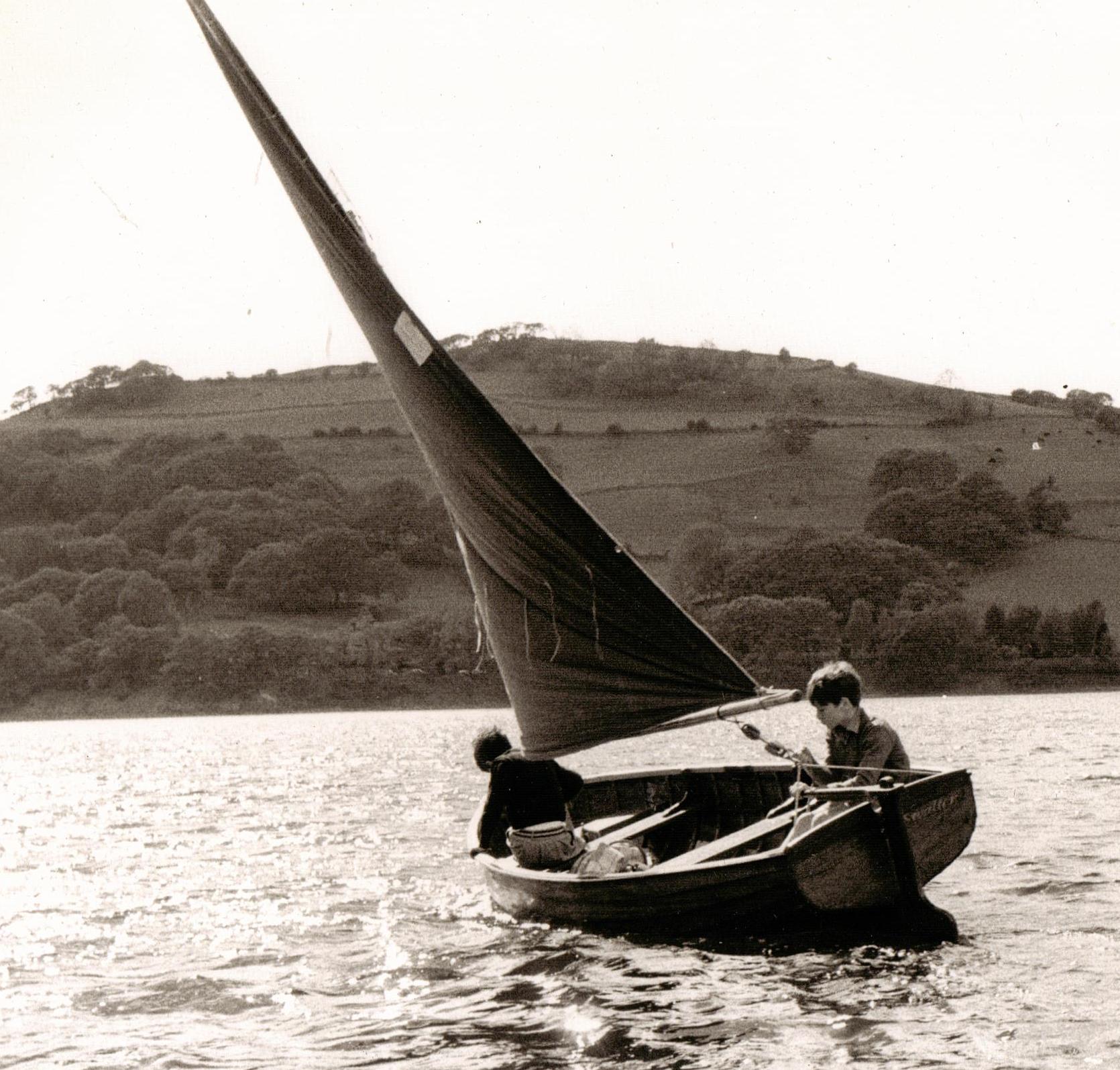
Simon West as Captain John sailing Swallow near Peel Island on Coniston Water. Sten Grendon plays the Boy Roger in the bows.
Simon said that he remembers more about filming the six-part BBC serial, ‘Sam and the River’, in which he had the title role in 1974. Much of it was shot on the Thames Tideway east of London. ‘Of course all those places have changed enormously since then, whilst the Lakes are very much the same. I have never been able to find a copy of that series, which is a shame. I’d love to see it.’ We can’t find a copy in English, but there is a version in German entitled ‘Tom und die Themse’ currently for sale on DVD here.
Simon’s own children grew up watching Swallows & Amazons, which is still broadcast once or twice a year on television. He said that when they went to see the Warner Bros. Studios in Hertfordshire where much of the Harry Potter movies were made he felt hugely appreciative of the fact that we had been out on location the whole time, rather than boxed up on a film stage, acting against a green back ground.
Claude Whatham wearing his American Parker coat, as Dennis Lewiston and Eddie Collins line up a shot over Derwentwater at dawn
Simon did remember the great Parker coats that Richard and Claude found to cope with the Cumbrian weather. So do I. My father bought one too. They were blue-grey and enormous, lined with fake sheepskin, their hoods edged with Eskimo-like fake fur.
‘They had recently come over from America,’ he explained, ‘And were a real innovation. Before that we just had tweed coats.’
‘And Mackintoshes. Dennis Lewsiton wore a blue Mac.’
‘Those dreadful nylon anoraks,’
‘That are back in fashion.’
‘The American Parkers are fashionable now too – all that fake fur around the hood. Uggh.’
Suddenly the cogs of close association clicked in. Simon tossed his head in a certain way that I recognised as his own expression of humour. He said that he was really pleased that Bobby Moore chatted to him at the film Premier at Shaftesbury Avenue.
‘Sir Booby Moore? Was he there? Did we meet him?’
‘Yes.’
I’d totally forgotten.
Simon said that he had become very attached to his Parker fountain pen from Aspreys, engraved with the words ‘Swallows & Amazons- 1973’, that Claude Whatham gave to each of us as a gift after the filming. ‘Stupidly I left in the boot of my car when I was in Paris, aged about twenty-seven. It was stolen with a load of other things.’ I had lost mine too. I dropped it on a footpath somewhere in Durham.
‘What did you spend your fee on?’
‘Oh, sailing dinghies. It was good to know I had £500 in the bank around the time I was heading towards the British Championships. You know, at first we had ply board hulls but the time came when I needed to buy a fibreglass boat.’ It was with this that he became the National Optimist Champion. We agreed it was money put to good use.
After the age of about sixteen, Simon’s family became interested in orienteering. Maps seems to have had a strong influence on both our lives.
Simon West as John Walker studying the chart at Holly Howe before the voyage.
Simon and his wife now have four grown children. ‘We are split down the middle: three of us sail, three of us do not.’ But every year he takes the family up to the Lake District to go fell walking, something they all enjoy very much.
If anyone sees a brushed steel Parker pen on eBay engraved with the words ‘Swallows & Amazons 1973’ please let me know. I’d love to be able to return it to Captain John.
Here you can see Simon appearing in ‘Sam and the River’(1975). This is the German version entitled Tom und die Themse:
You can read more about our adventures making Swallows and Amazons in these books, available online:
Different editions of ‘The Making of Swallows and Amazons (1974) by Sophie Neville’
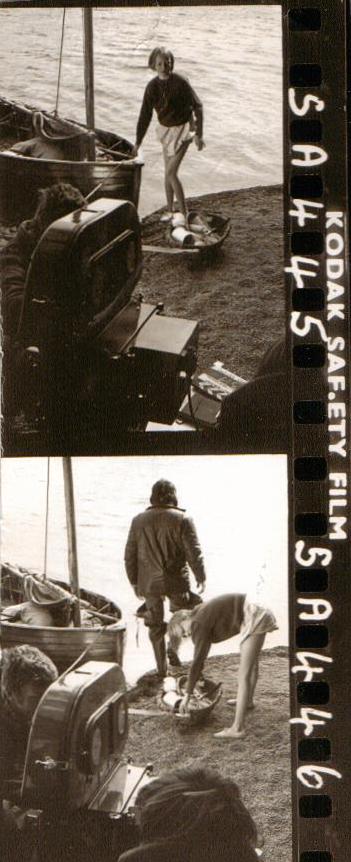
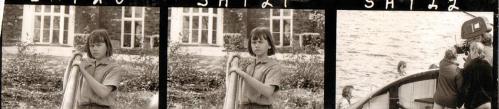
Behind-the-scenes while filming ‘Swallows & Amazons’ in 1973
The classic movie of Swallows & Amazons is often broadcast on BBC TV. If you would like to know more about how the film was made you can find the details on this site or leave any questions in the comments box below.
To read about our first day’s filming at Haverthwaite Railway Station click here and keep reading.
Sophie Neville having her hair cut on location for the part of Titty Walker in 1973
Do you know what lake we were on in the photograph below? We were busy loading urns of tea into a run-around boat to take out to the film crew who might have been on Cormorant Island. If you click on the photo you will get to the page of my diary, kept in June 1973, which describes this day.
Wardrobe Master Terry Smith and Sophie Neville in her costume to play Titty. But what is the name of the boatman? Does anybody know?
There are still many questions about the making of the movie that remain unanswered.
Does anyone know the name of this journalist who visited us on Peel Island?
This shot was taken while setting up the scene at Peel Island when Captain Flint brings Sammy the Policeman to question the Swallows. If you click on the photo you will find the photograph that the journalist ended up with. Titty’s hand is still on Captain Flint’s arm.
Making a movie is very different from watching one. Here is a record of Titty rehearsing the shot when she moves the camping equipment for fear of a tidal wave. It was a cold day on Coniston Water. The jersey came off when they went for a take.
Here you can see Lesley Bennett, playing Peggy Blackett, careening Amazon at Beckfoot. The same 35mm Panavision camera was focused on Kit Seymour, playing Captain Nancy.
Lesley Bennett as Peggy: Claude Whatham directing the scene with Kit Seymour
The location used for Beckfoot and the Amazon boathouse can be found at Brown Howe on the western bank of Coniston Water. If you click on the photograph of Peggy you can read more about what happened that day.
Kit Seymour playing Nancy Blackett and Lesley Bennett playing Peggy Blackett
If you would like to get future posts, please click the Follow button at the bottom of the side-bar.
You can read the full story about the making of Swallows and Amazons here:



























 Sophie Neville