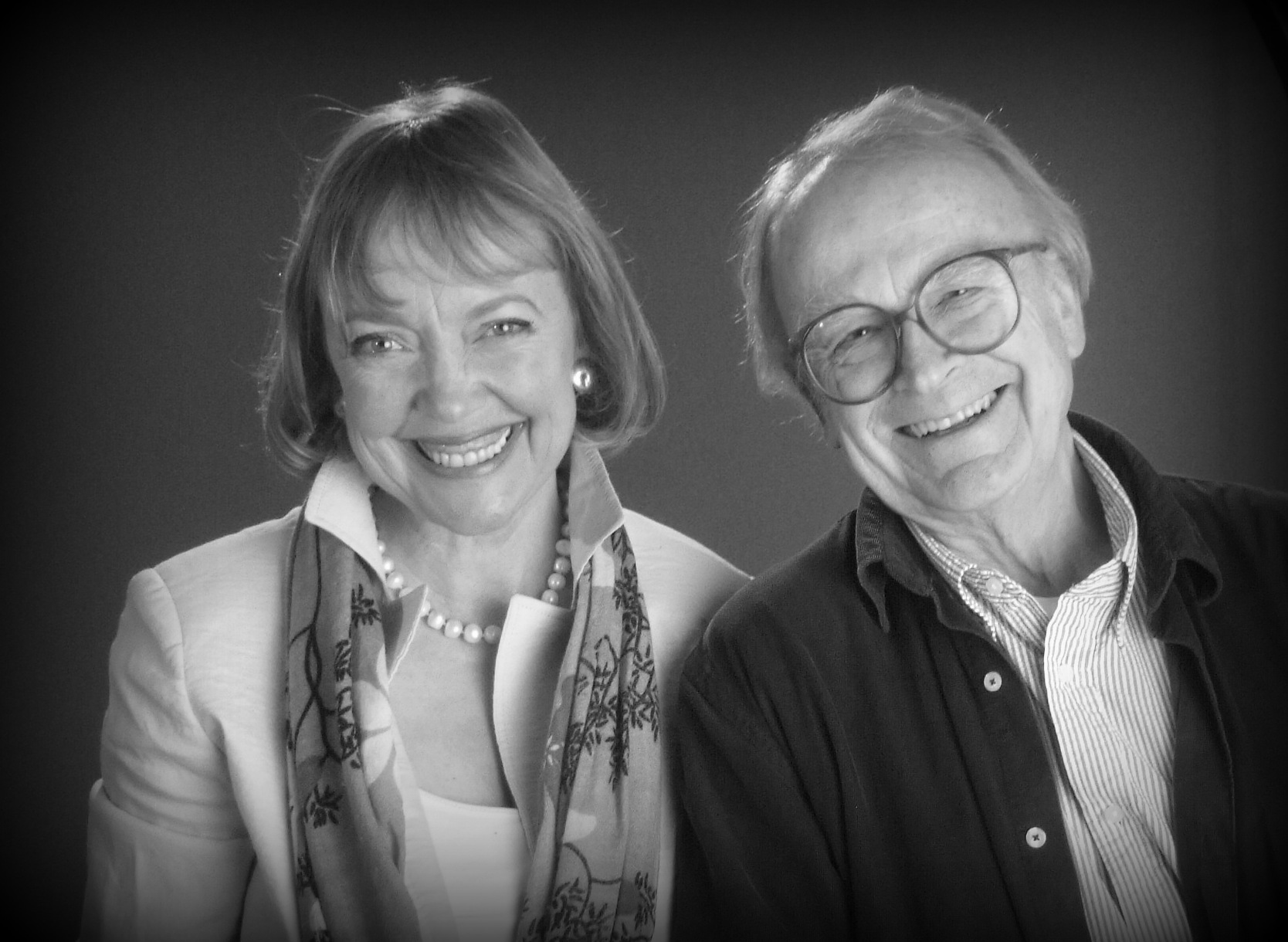
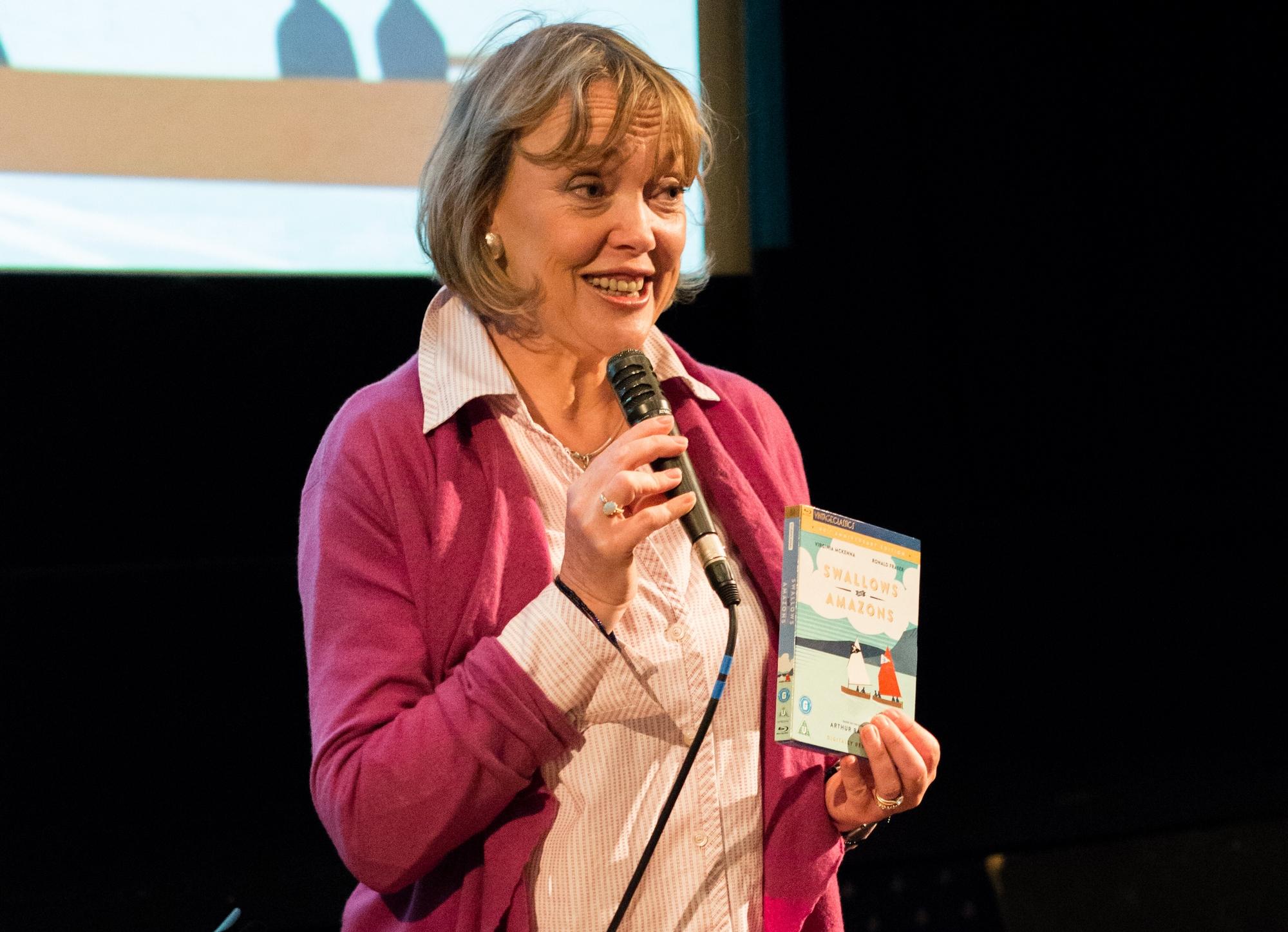
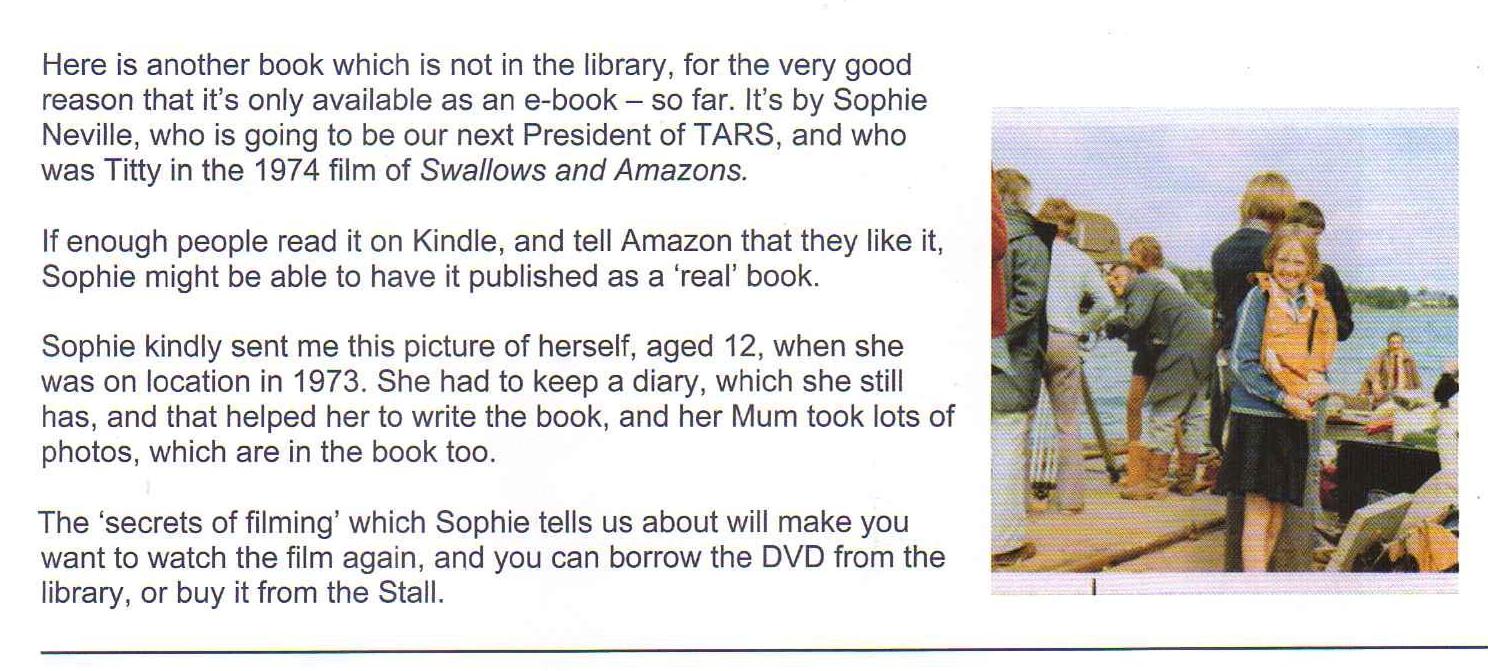
On 21st March and 28th March, the new CBBC TV show ‘Cinemaniacs’ included guest appearances from Sophie Neville and from David Wood, who wrote the screenplay for ‘Swallows & Amazons’ back in 1973.
Oli White, the vlogger and presenter of ‘Cinemaniacs’, asks a number of people involved in movies about making their first film. Others featured include Michael Sheen, Sir Ian McKellen and Matthew Lewis famous for playing Neville Longbottom in all eight Harry Potter movies.
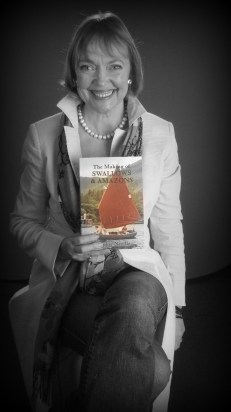
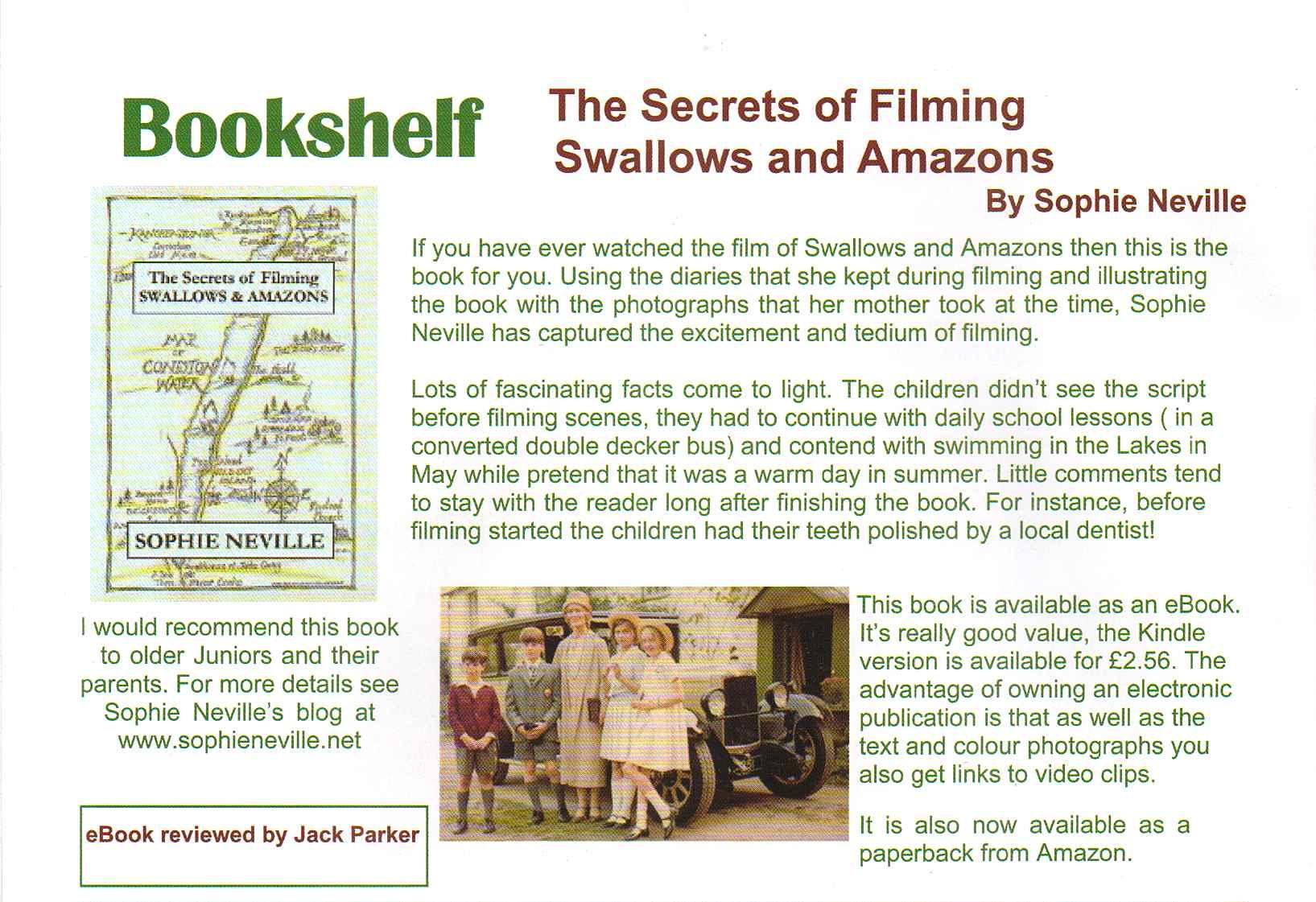
To find out more about how the film ‘Swallows & Amazons’ (1974) was made, along with how the children’s parts were cast, please see earlier posts or read the book! It includes more than 120 photographs taken on location in the Lake District.
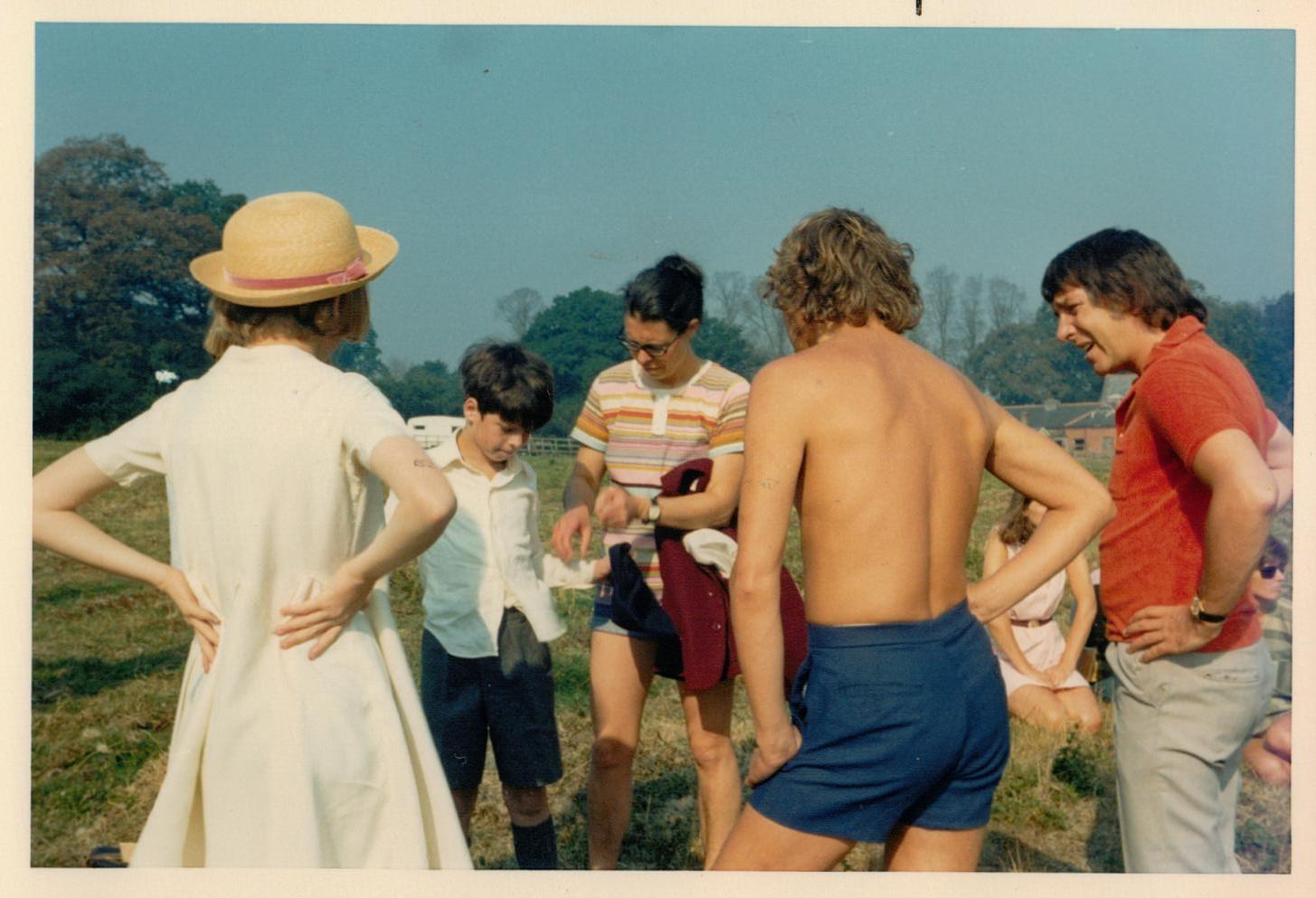
We have just found another reel of 16mm home movie footage shot, not on location in the Lake District, but at Runneymede near Egham in Surrey. It captures the essence of a hot day in September 1973 when we were re-called for pick-up shots after the main body of the film of Swallows & Amazons had already been edited.
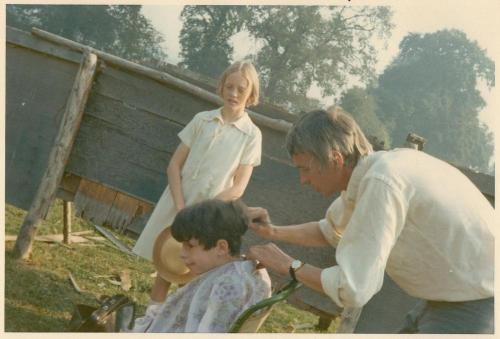
Ronnie Cogan trimming Sophie Neville’s hair for the part of Titty in September 1973
The clip opens with the film hairstylist Ronnie Cogan cutting my hair. It had been a good six weeks since I had last played Titty in front of the camera and I needed a trim to restore it to the same length it had been on 14th May when we had first started filming on the Lakeside and Haverthwaite railway. Suzanna Hamilton’s thick dark hair had grown a great deal, as had Sten Grendon’s.
Sophie Neville watching Ronnie Cogan cut Sten Grendon’s hair.
Peter Robb-King the Make-up artist had been toning down our complexions inside the same Make-up caravan we’d used while on location for seven weeks in Cumbria. I remember it had orange flowery curtains, a pattern much in vogue at the time.
Sophie Neville looks on as Stephen Grendon organises his costume helped by Jane Grendon with Claude Whatham and Neville C Thompson.
Neville C Thompson, the Associate Producer, who was wearing a red shirt that day, seemed happy to be back on location. The film director, Claude Whatham was working, as I will always remember him, in a pair of navy blue shorts and sailing shoes. I loved putting on the school hat and silk dress I’d worn in the train but was difficult for the boys to climb into their woolen costumes on such a bright sunny day.
Richard Pilbrow, the Producer, who you can see wearing a white stripy cheese-cloth shirt so typical of the early 1970’s, seemed rather on edge. Bringing a camera crew along for what amounted to three shots must have been expensive, stretching his budget to the limit.
Gordon Hayman with a 35mm Ariss camera, Sophie Neville, Claude Whatham and Simon West, with Richard Pilbrow in the foreground ~photo:Daphne Neville
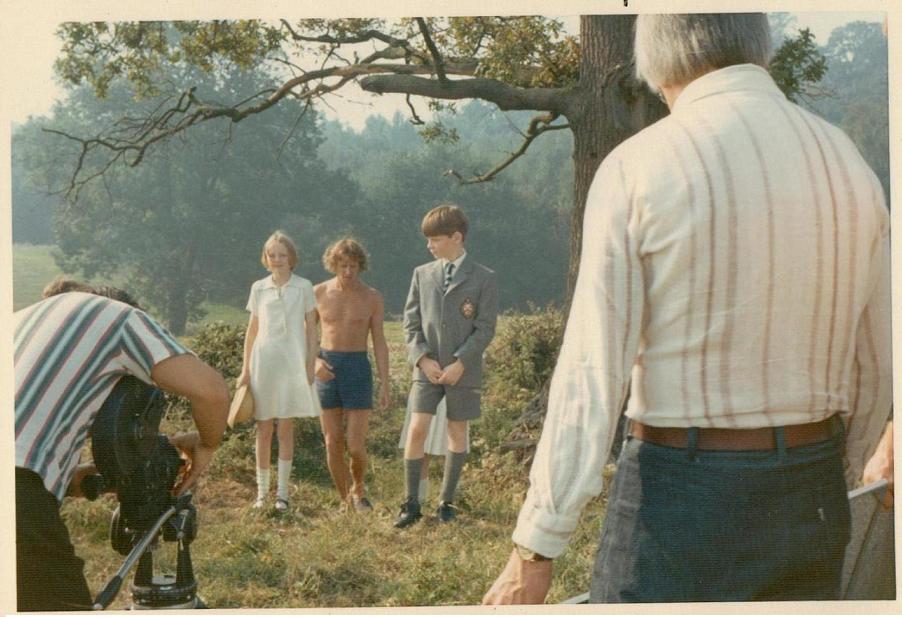
The oak tree, under which the 35mm Arriflex camera was set, was chosen to represent the Peak of Darien from which we looked out over an imaginary lake to an imaginary island. The finished movie cuts from the Walker children’s faces to a shot taken of Derwentwater at sunset with the opening title graphics superimposed over what is in reality Blakeholme, or Wild Cat Island as it is called in Arthur Ransome’s world.
Denis Lewiston, the Director of Photography, was working with the Cameraman Gordon Hayman, using reflector boards to light our faces. At one stage he had me standing on a cream coloured blanket to reflect light from below. You can see it in this shot:
Sophie Neville playing Titty Walker with Stephen Grendon as Roger Walker with Gordon Hayman, Denis Lewiston and Claude Whatham behind the camera
What I had forgotten was that two little girls came along that day to stand-in for us when the shot was being lined up. You can see them in the home-movie footage, one wearing a pale blouse with puffed sleeves.
Claude was very keen on running. He often took us for a short run before going for a shot to aerate our minds and freshen up our faces. In the story we had run down the hill from Holly Howe, so he had us running quite far before we landed on the marks that the cameraman had given us so that we’d be in focus. We had no dialogue, but the expressions on our faces were crucial to engaging the audience.
Denis Lewiston, Claude Whatham, Sophie Neville, Suzanna Hamilton, Simon West and the cameramen
You see a few other people on location, not least Sten’s mother, Jane Grendon, my little sister, Molly Pilbrow and a few others who were watching. My mother had been taking the footage.
Daphne Neville with Stephen Grendon, Suzanna Hamilton, Sophie Neville, Jane Grendon and Simon West
To read about this day from another angle, please click here to visit an earlier post with a few more photos.
On Friday 21st November 2014, I was invited to talk about the making of Swallows & Amazons on the CBBC movie show with David Wood, who wrote the screenplay. I’ll let you know when this will be broadcast. While I was at Novel Entertainment I met Dexter Fletcher and Bonny Langford as well as Justin Johnson from the British Film Institute who is an adviser on the series of 6 x 30 minute programmes.
You can read the whole story of making the film here:
This post comes with a huge thank you to readers who have taken the trouble to write in, send emails or add reviews on Amazon about ‘The Making of Swallows & Amazons’
Sophie Neville and Sten Grendon filming on Peel Island in 1973
‘I very much enjoyed reading about all the background and stories of what is one of mine and my children’s favourite films.’ David Hambelton, Oxford
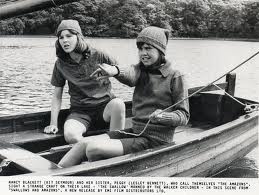
Kit Seymour and Lesley Bennet as the Amazon Pirates
‘…an absolutely fascinating account…about a film we all thought we knew so well. Like so many members of The Arthur Ransome Society I am an utter devotee… I’m finding the background to filming quite fascinating, and if I had thought it possible, yours is the book I have always longed for to exist. I’ve been absorbed in it ever since it arrived, forcing myself to take it slowly and not gobble it up in one go. Of course I’ll be back to it soon, dodging back and forth in tune with your narrative, indenifying particular scenes.’ Jeremy Gibson, Witney
Simon West as John and Sophie Neville as Titty in Swallow
‘If you liked the film, you MUST read this book. “Titty” is enthralling, and the story of the film is almost as exciting as the real story by Arthur Ransome. Essential reading for devotees.’ Chloe Randall, Scotland
Suzanna Hamilton and Simon West on Peel Island
Children still ask me questions that never occurred to me:
‘How did it feel to be on the island by yourself?’ Alex aged 7. The truth of course is that I was never on the island by myself. Perhaps I should have been left there for a while so I could experience it. I would have relished the chance.
DoP Denis Lewiston and Director Claude Whatham in Coniston Water
Another boy asked, ‘How did you do the water?’
This took my breath away for a second. ‘How did we do the water? The water was real, and it was very cold,’ I replied, explaining that we actually shot the film on four different lakes in Cumbria, all of which you can discover for yourself.
Have your children any questions? I’d love to hear them.
Simon West and Sophie Neville on Coniston Water
For more reviews of The Making of Swallows & Amazons on Amazon, please click here.
Very, very many thanks to all those who have taken the trouble to send in feedback about our paperback version of ‘The Making of Swallows & Amazons: Behind the scenes on the Classic Film’.
The publishers have been thrilled to hear what you think, hoping that the will appeal as a good Christmas present.
Here are a few recent comments:
‘Get a glimpse behind the scenes from Sophie Neville, who played Titty, in this gorgeous book, released to celebrate its 40th anniversary.’ Yours magazine.
‘Came home to a wonderful surprise – my copy of The Making of Swallows and Amazons! wonderful.’ Pandora Doyle ‘I love it! So excited. The photos make the book especially the coloured ones. I will be dipping into it all day!’
‘…a delightful book, which tells the behind-the-scenes story of the film. Neville’s account of exploring, sailing, and the green parrot will no doubt have readers reliving childhood memories and falling in love with the Lake District all over again.’ The Lady
‘I can’t wait to read The Making of Swallows and Amazons! My eight year old daughter is also looking forward to it – she has learned to sail on Sydney Harbour just like the Swallows’ mother did! (I learned to sail on other Ransome waters – near Pin Mill in Suffolk!). Thank you so much for sharing your memories of the experience with us – what a magical film!’ Clare Havens, author
‘I ordered two copies, one signed by yourself and one unsigned which is already becoming dog eared {my measure of a good book}.’ Arnold Mostyn
David Bamford: (Antipodes) I am in the middle of reading Sophie’s book about the Making of ‘Swallows and Amazons’ and enjoying every word of it! Now, when I see the stills, I remember her writing about how cold the weather was, and they were dressed in light summer clothes.
Loving @Sophie_Neville ‘s Making of Swallows and Amazons. Technicalities of filming with big unwieldy cameras. Plus lots #ambleside gossip. Eileen Jones @CumbriaPR
‘It was great to read an account of how filming is not as simple as people imagine! Enjoyed it very much.’ Martin Robinson
‘A sort-of layman’s perspective on filming is completely fascinating.’ Nick Archer
‘I enjoyed the book much more than I expected, if that doesn’t sound v strange.’ Tom Morgan. ‘I thought I would enjoy it but I really, really enjoyed it. I… was very impressed by the flow and ease of your writing. My inherent nosiness helped of course.’
‘Great book, I really enjoyed reading it.’ Stephen O’brien
‘Really enjoyed it. Lots of insight into/memories of 70s life (not sorry to have left that behind!!). Very interesting to learn more about your co-stars, and the other people involved in creating the film – my original discovery of your blog was having watched the film, and wondering “where are they now?” That question is comprehensively answered!! Also very interesting to learn about the process of film-making – we take so much for granted with digital video cameras these days. I guess for me the whole thing about learning about you, Suzanna, Lesley etc as people is what most interests me from a human point of view – kind of much the same as learning about the Altounyans and Collingwoods in Hardyment’s book.’ Paul Fernandez.
‘Lovely to meet you in Ambleside, It was a great evening. Book and DVD are brilliant.’ Ali Graham
‘I matched your book to the DVD and the two made a really good present, even though I say so myself!’ Barry Burles
No matter where I am in the world, not a day goes by without someone, somewhere asking a question or sending a message in connection with my writing. I am hugely grateful for the encouragement.
In many ways, ‘The Making of Swallows & Amazons’ was written by popular request, effectively commissioned by hundreds of people who wanted to know how it felt to appear in the film, albeit forty years ago.
It has to be said that was a little apprehensive about the questions I might be asked on Matthew Wright’s show, broadcast live on Channel 5 – for two hours. If you are feeling brave, click here to see a profile on The Wright Stuff.
They wanted to know about the idea of children being allowed the freedom to take risks and enjoy their own adventures away from civilisation.
“… if it’s possible to have a Swallows and Amazons childhood these days – and if today’s kids would actually have the skills to survive. “
If you have views on the subject or want to see more on outdoor pursuits discussed on the programme email: wrightstuff@channel5.com
IF NOT DUFFERS WONT DROWN
You may need Windows 8 to watch it but the whole programme can be viewed here:
Over the next few days I am going to be giving Q&A sessions at cinemas screening StudioCanal’s newly restored version of Richard Pilbrow’s movie ‘Swallows & Amazons’ (U) to celebrate the 40th anniversary of the film’s release in 1974.
Ronald Fraser on the cover of the VHS
Sten Grendon, Simon West, Suzanna Hamilton and Sophie Neville as the Swallows making Ronald Fraser walk the plank. Where are the Amazons?
If you can come, please do bring a question. I am always very interested in those asked by the children. They can be quite difficult to answer:
‘What did it feel like to be alone on the island?’
Titty leaving her tent on Wild Cat Island
‘Where you really able to keep the parrot?’
Kit Seymour with Sophie Neville and Polly in the Houseboat
‘How long did it take to film?’ is another question I am often asked. The answer is quite complicated.
Then I ask, ‘Would you like to know about the mistake I made?’
The crew of the Swallow leaving Holly Howe
I started singing, ‘Adieu and Farewell’, when the sea shanty Spanish Ladiesis always sung: ‘Farewell and Adieu…
Farewell and adieu to you fair Spanish ladies,
Farewell and adieu to you, ladies of Spain;
For we’re under orders
For to sail to old England,
And we may ne’er see you fair ladies again.
We’ll rant and we’ll roar, like true British sailors,
We’ll range and we’ll roam all on the salt seas;
Until we strike soundings
In the Channel of old England,
From Ushant to Scilly ’tis thirty-five leagues.
Virginia McKenna watches the Swallows sail from the jetty at Bank Ground Farm on Coniston Water. Can you spot the safety officer – a frogman just visible right of shot?
I noticed that one inconsistency made by the design team was that the swallow flew down our flag whereas it always flies up Swallow’s burgee in Arthur Ransome book illustrations. I count it as a subtle differentiation that I reproduce whenever I draw the crossed flags myself.
When I was writing ‘The Making of Swallows & Amazons’ I noticed that, while the title of the book is ‘Swallows and Amazons’, the graphic designer working on the film always used an ampersand, making it SWALLOWS & AMAZONS in the 1974 film.
There is another odd thing right at the end of the film, as the credits roll. See if you can spot what it is.
There are often screenings at cinemas in Cumbria:
Royalty Cinema Bowness-on-Windermere, the Roxy Cinema Ulverston and the Alhambra in Keswick where we held a Q&A
‘Forty years after she enchanted film-goers as Titty in Swallows and Amazons, Sophie Neville has found a new audience… telling the behind-the-scenes secrets of the film of Arthur Ransome’s classic novel.’ The Daily Mail The Making of Swallows & Amazons ‘…is based on diaries, letters and old photographs which Sophie has turned into a heart-warming account of making the movie, which starred Virginia McKenna and Ronald Fraser.’
The Telegraph~ Culture: ‘Set in the Lake District in 1929, the film follows four young adventurers who sail a dinghy around Lake Coniston, cook for themselves over campfires and sleep in makeshift campsites.’
‘…The occasional chaos and terrible weather during filming contributed to the eventual popularity of the extraordinary and very much loved film.’ The Times
‘The film Swallows & Amazons is 40 years old, but thanks to its careful period evocation, its respect for Arthur Ransome’s original book and the performances of its child actors, it’s become a timeless classic. One of those children was Sophie Neville, who played Titty, and who kept a diary during the filming. That diary, with her adult recollections, is this book. It’s a fascinating insight into filming on location in the Lake District…’ Classic Boat
‘… The result is compulsive reading as she recalls that cold wet summer, while the camera crew wrapped up warm and she shivered in her skimpy dress as Able Seaman Titty Walker. Sophie brings to life all the many memorable characters who worked on the film and in particular the other children, the Director Claude Whatham who developed a great relationship with his young cast and the stars Virginia McKenna and Ronald Fraser. Nor are the other young actors forgotten for there are diary contributions from Suzanna Hamilton who played Susan, Stephen Grendon who played the Boy Roger and Kit Seymour who played Nancy Blackett. The text is supported by numerous illustrations showing life on and off the set.’ Roger Wardale, author of Arthur Ransome: Master Storytellerand other books
‘You don’t need to be a Swallows & Amazons fan to enjoy this book – it’s universal!’ Winifred Wilson, Librarian of The Arthur Ransome Society
‘This was a most unusual and interesting book. I picked it up expecting to browse through it, and found myself so drawn in to Sophie Neville’s detailed, amusing and insightful description of film making in the 1970’s that I was unable to put her book down. As Arthur Ransome fans, my family and I have always loved the film, and felt that Sophie Neville was ‘just right’ as Titty. What fun it has been to be introduced to the young twelve year old Sophie with her intelligent awareness of the challenges facing the production crew while she shivered in her cotton dresses. The many photographs and illustrations contribute richly to bringing the 1970s setting to life. Sophie recorded her experiences beautifully, and in so doing, added one more valuable book to the cultural heritage of all Arthur Ransome fans.’ Juliet Calcott, English teacher,South Africa
Lots of photos throughout the book bring the scenes to life – a delightful read.’ Celia Lewis author of An Illustrated Country Year
Sophie Neville has been chatting to Mark Forrest on The Evening Show.
The second edition of this paperback is published by The Lutterworth Press, available online here
Many people asked what ‘fell onto the cutting room floor’ after we shot the movie ‘Swallows & Amazons’ in the English Lake District in 1973.
The answer is that there were few scenes excluded from the film.
Virginia McKenna as Mrs Walker with Sophie Neville as Titty
One featured Virginia McKenna and Mrs Batty’s clock, which can still be found at Bank Ground Farm, our location used for Holly Howe. It was shot on the second morning and I fear that our director Claude Whatham might have taken it out because my own performance was rather stilted. I had quite a bit to say, most of which was really rather bizarre:
The pages of my diary written on 15th May 1973
The only other scene from Swallows & Amazons that I know was excluded was when the Swallows lay patterans on their way to visit the charcoal burners. The location was in a beautiful spot up above Derwentwater, the dialogue was straight from Arthur Ransome’s book and our performances would have been fluent by the time we shot the sequence.
Suzanna Hamilton, Sten Grendon, Sophie Neville and Simon West as the Swallows
I can only expect that when the movie came in over-length, these scenes were cut as the action had no influence on the plot.
‘I have always had the feeling that the Amazon’s role in the 1974 film was very much secondary to the Swallows.’ Stephen O’Brien posted. ‘This was probably down to much of the Amazon’s footage ending up on the cutting room floor. What do you think?’
In the original script, the Amazons do not really appear until page 41 – which would equate to nearly half-way into the the film. I thought that there might have been one or two shots of the Amazons sailing that were never used, but I’ve checked the script and nothing that they said was excluded. Not one word. Perhaps David Wood who dramatized the book could somehow have increased the Amazons’ parts. However, as Janet Means points out:
‘…in the book we find out more about what the Swallows think but only about what the Amazons do. There is little about the Amazons except when the Swallows are present too (hiding Amazon in the reeds and Nancy berating Peggy for losing Amazon when Titty’s made off with her). There’s lots about the Swallows without the Amazons.’
Kit Seymour with Lesley Bennett
One scene in the DVD of the film used to be cut out of the television version. The clue is that it comes just before this photo was taken in Bowness-on-Windermere for Lancashire Life kindly sent to be by Stephen Sykes of Hill Top near Haverthwaite.
Sten Grendon, Simon West, Suzanna Hamilton and Sophie Neville as the Swallows in Rio, an official still from the film published in Lancashire Life in 1974
There are a few scenes in the screenplay that were never actually shot, but that takes us on a different tack. To read more, please see: The Secrets of Filming Swallows & Amazons.
Denis Lewiston, director of Photography on ‘Swallows and Amazons’ ~ photo: Richard Pilbrow, taken on Derwentwater in Cumbria, 1973
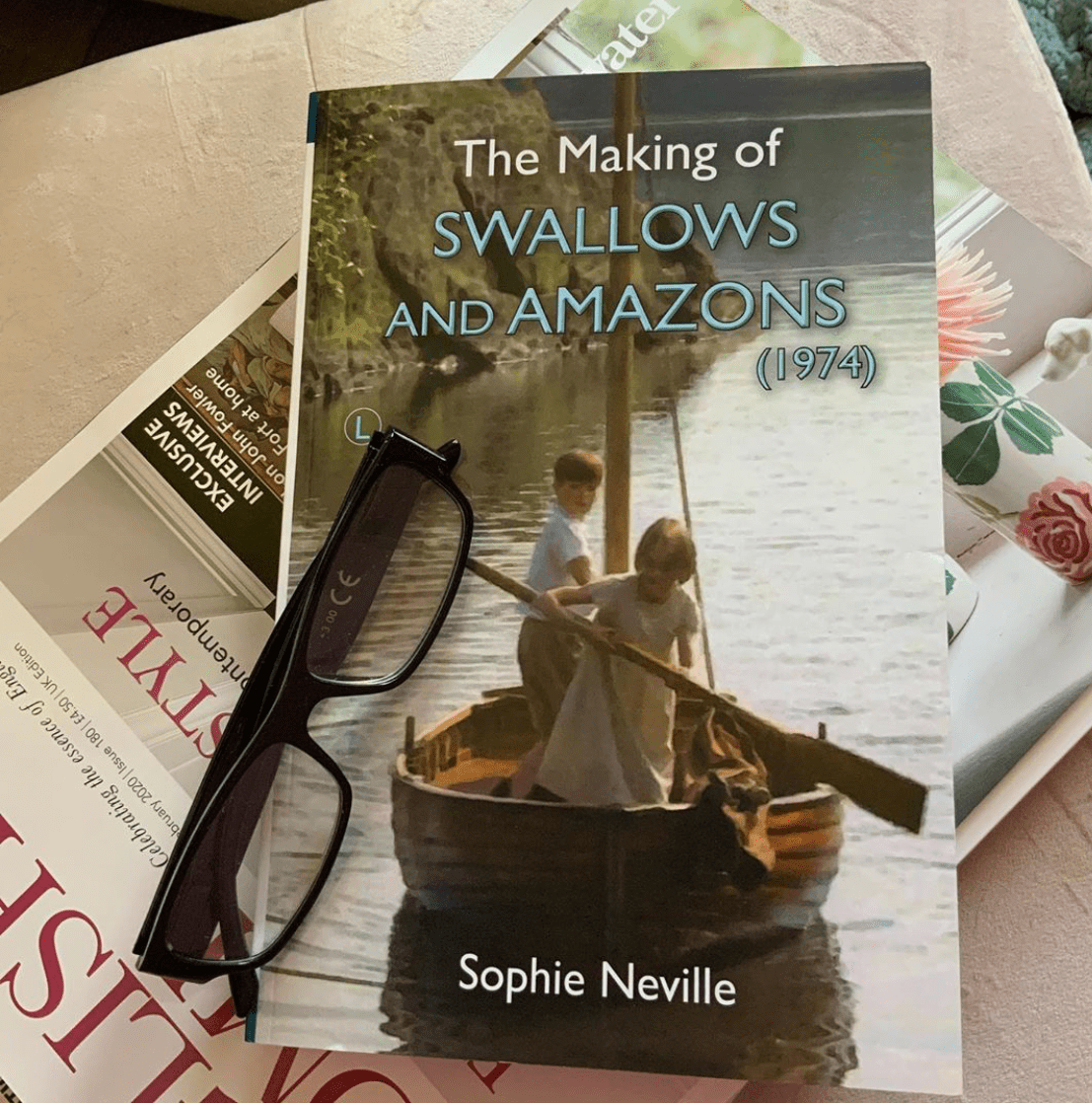
The illustrated paperback entitled ‘The Making of Swallows and Amazons (1974) can be ordered from libraries worldwide or purchased online.
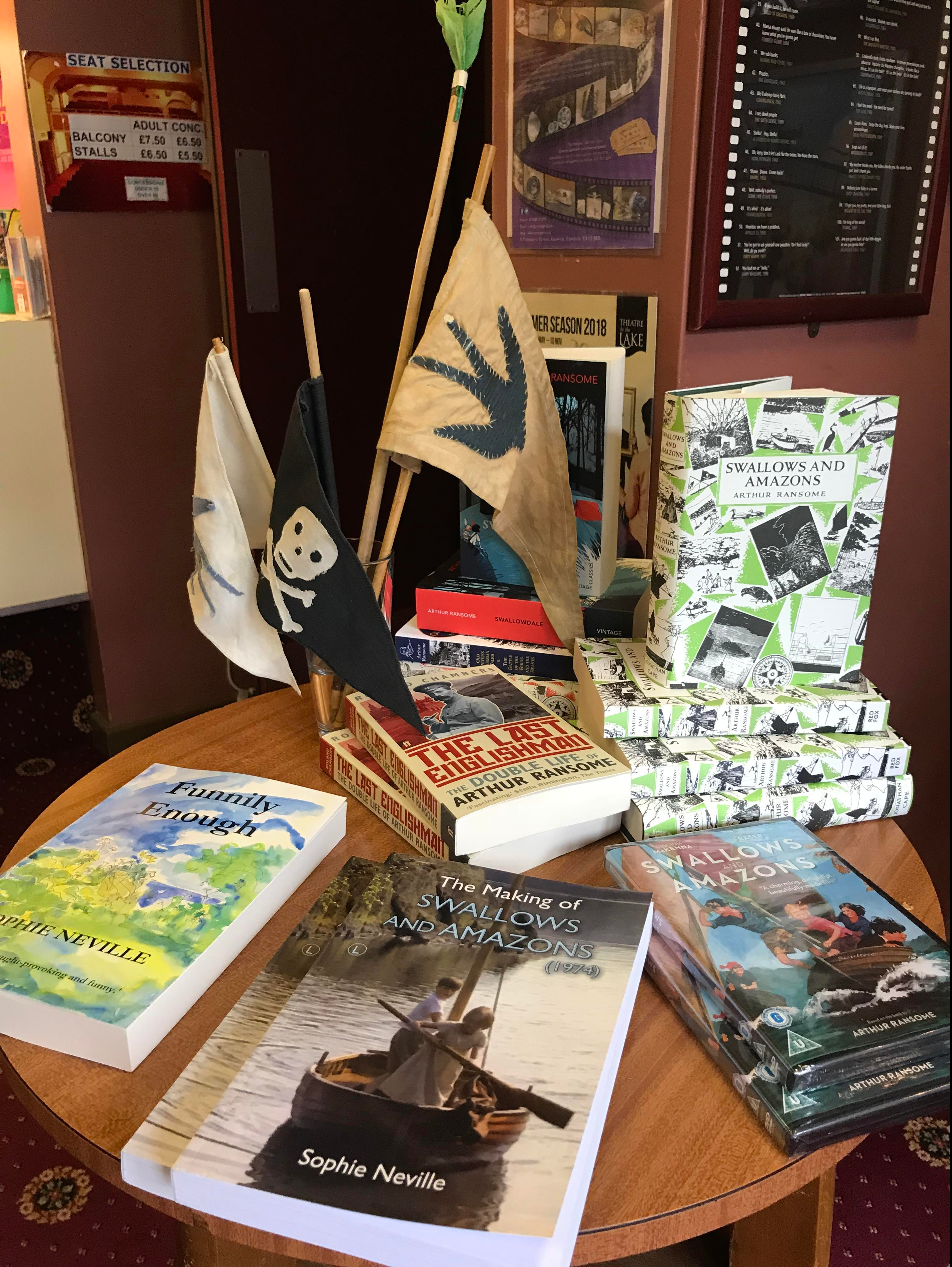
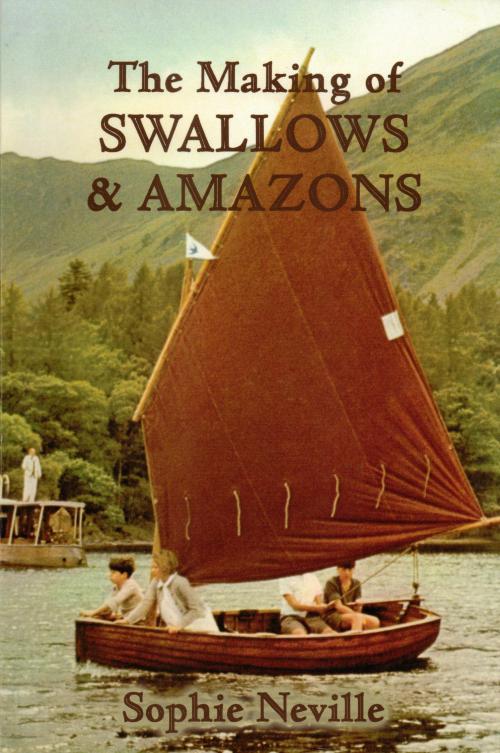
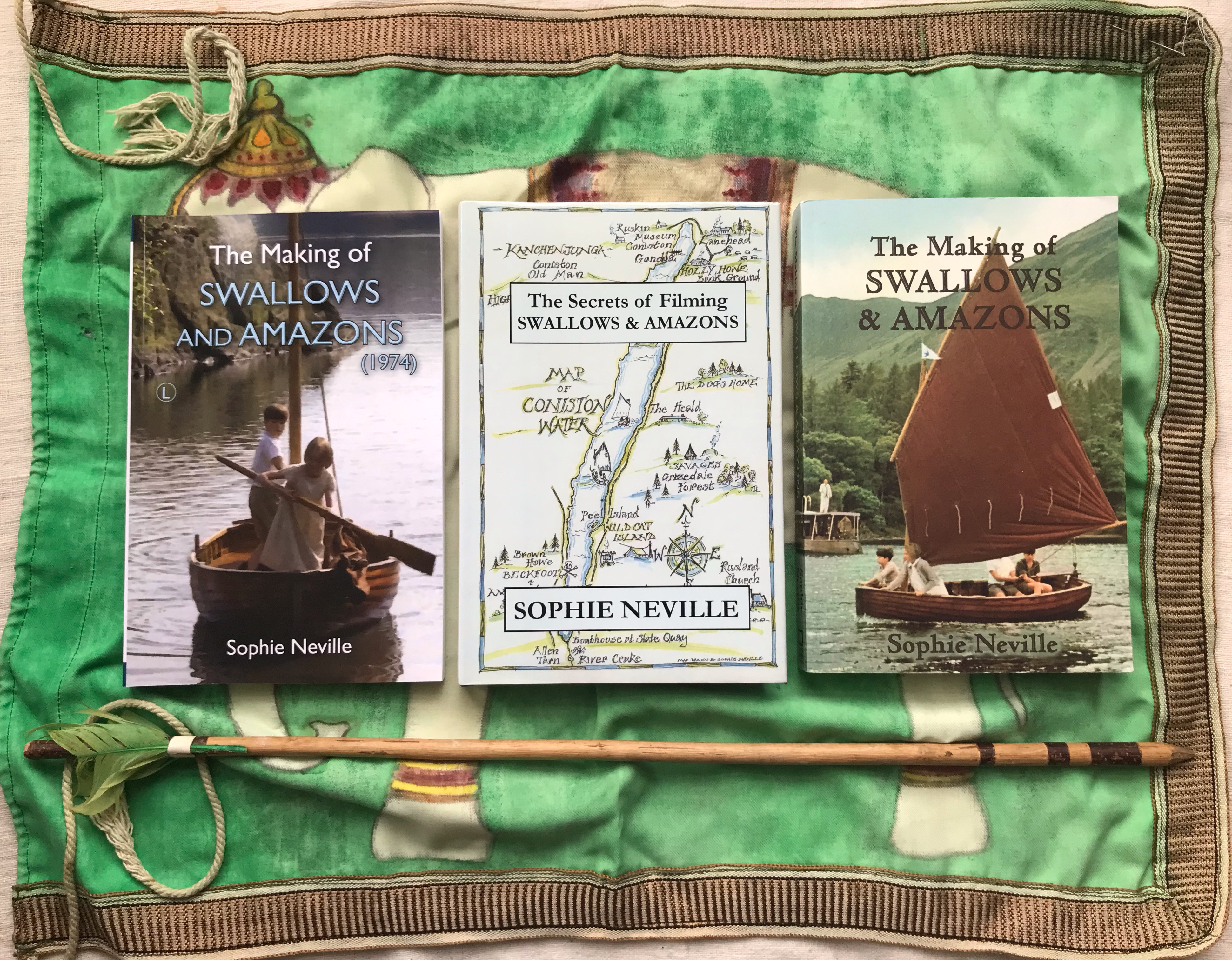
Different editions of ‘The Making of Swallows and Amazons (1974) by Sophie Neville’
~ Sophie Neville with Suzanna Hamilton on Coniston Water in 2003 ~ photo: Gordon Bourne
‘How did Titty capture the Amazon?’
What did the Swallows and Amazons wear?
The Swallows and the Amazons – where are they now?
These are some of the many questions that people type into search-engines. Members of The Arthur Ransome Group on Facebook have also had questions:
Dan Ford asked, ‘I think I heard it said that the four Swallows and two Amazons all wore life-jackets under their clothes whilst filming. If that is so, they were very well concealed, so were they specially made for this use?’
We didn’t wear life jackets under our costumes, we only ever wore buoyancy aids when travelling out to the location. Last time I went out rowing on Coniston Water I didn’t wear a life-jacket either, which was very naughty.
Chris Rosindale asked: ‘What became of ‘Amazon’ from the film? Is she still in existence like ‘Swallow’?
Amazon at Bank Ground in 2003 ~ photo: Geraint Lewis
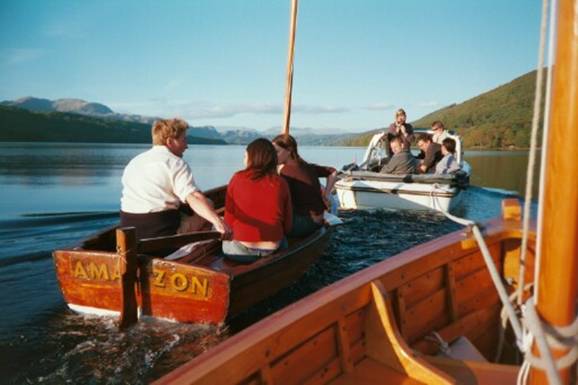
Suzanna Hamilton and I went out on Coniston Water in Amazon in when the BBC invited us to Bank Ground Farm to appear in Countryfile with Ben Fogle. We met her owners who live in Kent. I gather she was the same dinghy used to play Amazon in the 1963 BBC serial of Swallows and Amazons made when Arthur Ransome was still around to comment. Her owner told me, ‘She was built locally on Windermere sometime in the 1930.’
Amazon under sail while filming Countryfile in 2003 ~ photo: Geraint Lewis
Duncan Hall writes, ‘Just before Roger finds the camp, I’m fairly sure I can see a chimney in the background (somebody last said that it was a tree stump but it doesn’t look like a tree stump) – did you film any “on island” sequences on the mainland? Also – I know Rampsholme on Derwent Water was used for some “Wild Cat Island in the distance” shots, but it was mostly Peel Island. Did any Windermere islands get used for Wild Cat Island locations?
The Boy Roger was definitely on Peel Island when he was looking for the camping place. I remember he got rather scratched by brambles. I can see what does look like a chimney in the background but it would have been a stump.
Some of the scenes set on Wild Cat Island were indeed shot on the mainland. This was because there is no light house tree on Peel Island. I don’t think there was one in Ransome’s day. We filmed the light house tree scenes on two different promontories near Friar’s Crag overlooking Derwentwater and the Houseboat Bay. For a description of one location please click here.
‘Peggy Blackett’ & ‘Amazon’ in Secret Harbour on Peel Island: photo Geraint Lewis
Chris Clarke has asked, ‘Were any of you allowed to keep props from the film set as a souvenir? For example, were the Amazons allowed to keep their red hats?’
A number of red hats were made and I think the Amazons may have been able to keep one each. Their hats were initially bright pink, but my mother was insistent they should be red and others were knitted locally. She tried to get ones made more like a finely knitted woolen hat of mine that would have been much more in keeping with Ransome’s original sketches. However this picture was not known of back then and the Wardrobe Master, and the Director went with the design of the ones you see on the screen. Funnily enough the caps do look a bit pink in Mum’s faded photo.
The Amazons sitting with the Walker Family at Holly Howe ~ a scene neither in the book or film of Swallows & Amazons: photo: Daphne Neville
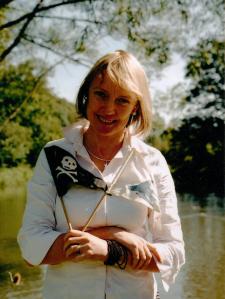
I still have a bow, two arrows with green feathers and a pair of flags used for rehearsal props. I was given one of the pink hats but it meant nothing. I didn’t keep any of my costumes, but Caroline Downer who played Dorothea says that she still has the buttercup yellow dress she wore in either ‘Coot Club’ or ‘The Big Six’.
Scores of people have asked, ‘Where was Swallows & Amazons filmed?’
One of the secrets of filming Swallows & Amazons is that while most of the film was shot on Coniston Water, we also filmed with the dinghies to Derwentwater, Windermere, Elterwater and rather a smelly lily pond.
Ben Fogle making a documentary about the locations used for Swallows & Amazons (1974) – photograph: Geraint Lewis of the Arthur Ransome Trust
Different editions of ‘The Making of Swallows and Amazons (1974) by Sophie Neville’
You can find more answers in ‘The Secrets of Swallows and Amazons’ or ‘The Making of Swallows and Amazons’ available online or to order from your library.
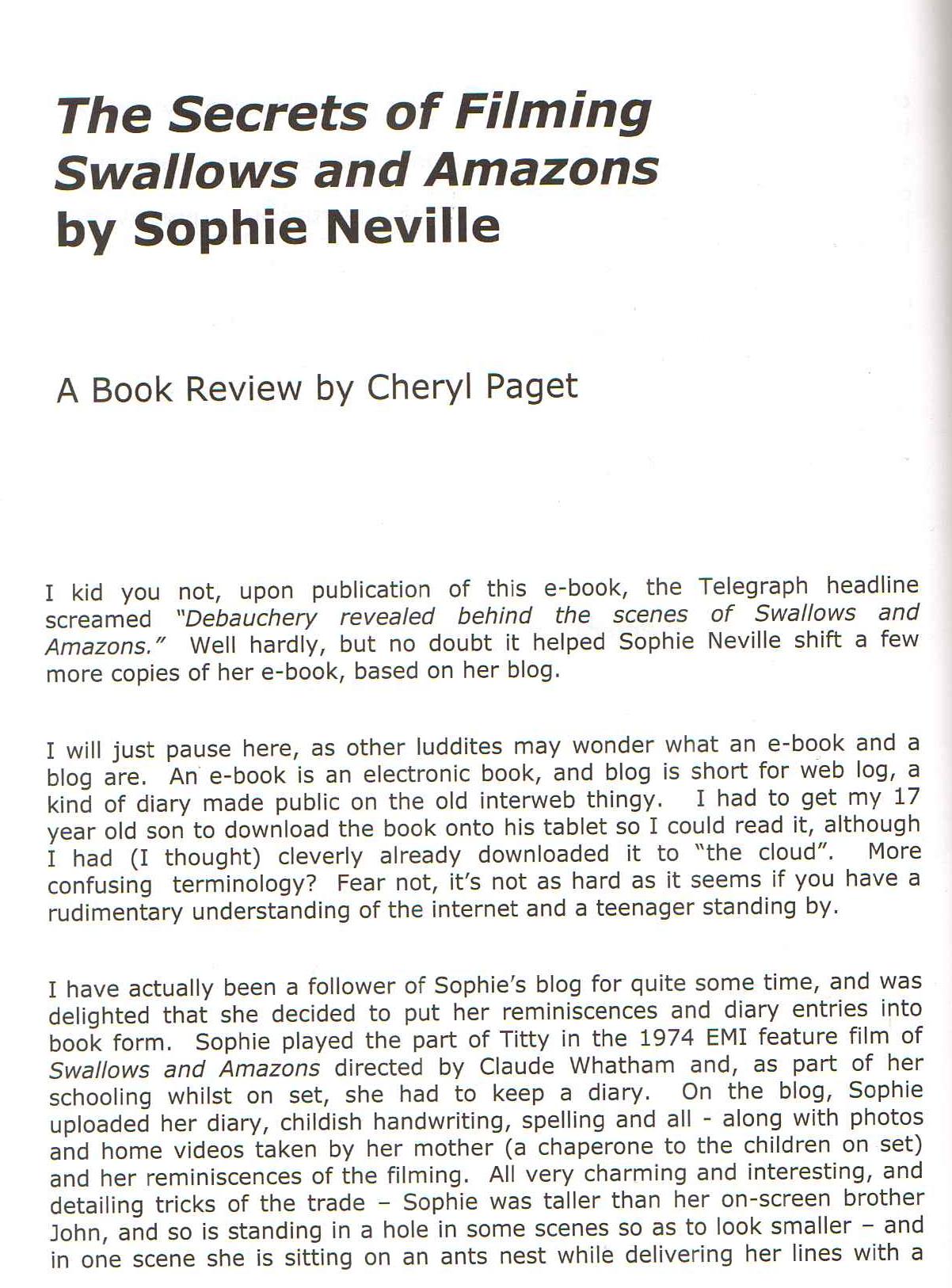
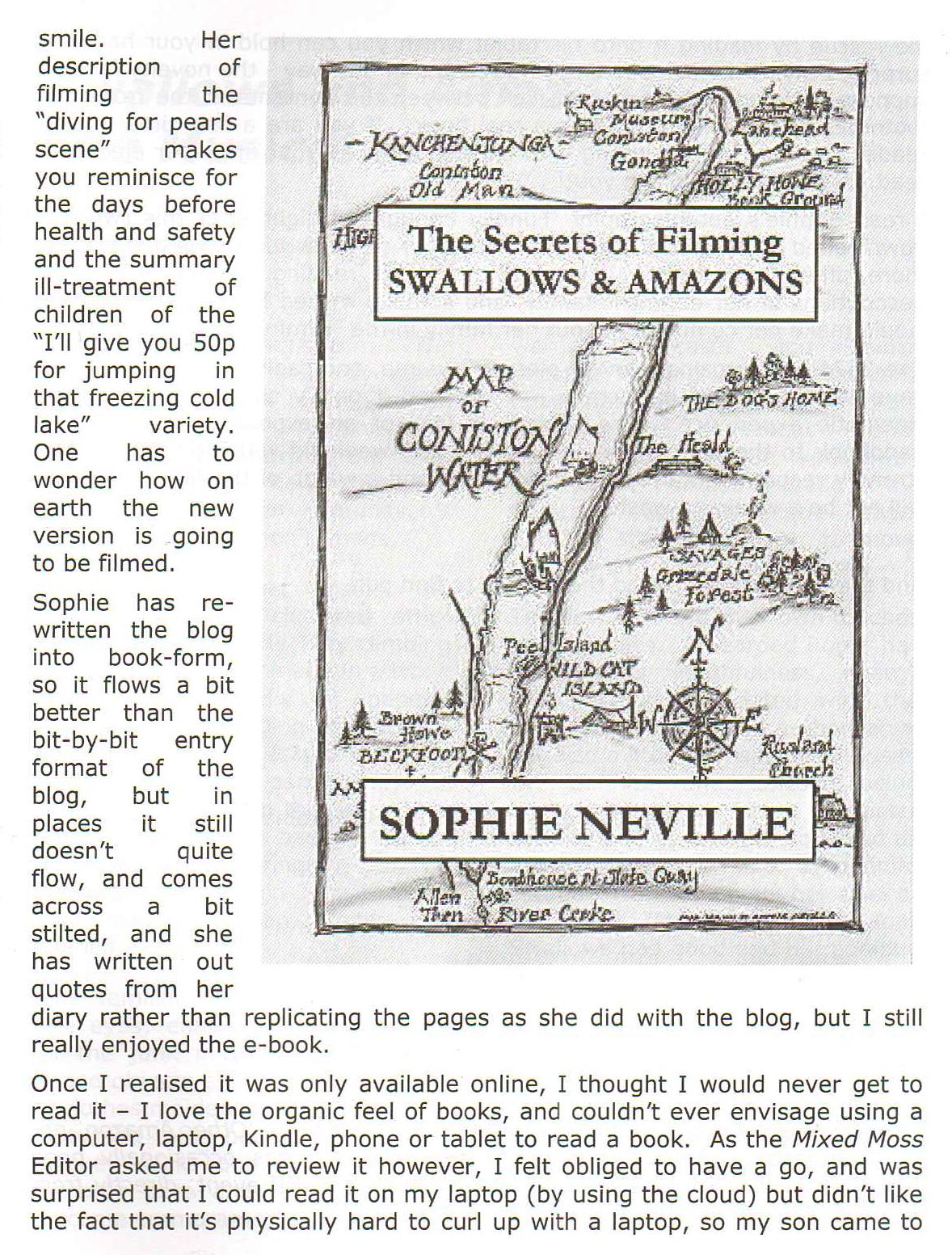
I opened my post to find not one but three reviews of my books, including this article published in The Outlaw and another in Signals, for which I am very grateful. I have pasted them here for fans of the film who do not yet subscribe to these literary magazines.
This review was followed by by a comment from Winifred Wilson, librarian of The Arthur Ransome Society:
The Library Supplement in The magazine of The Arthur Ransome Society gives a full description of all three books:
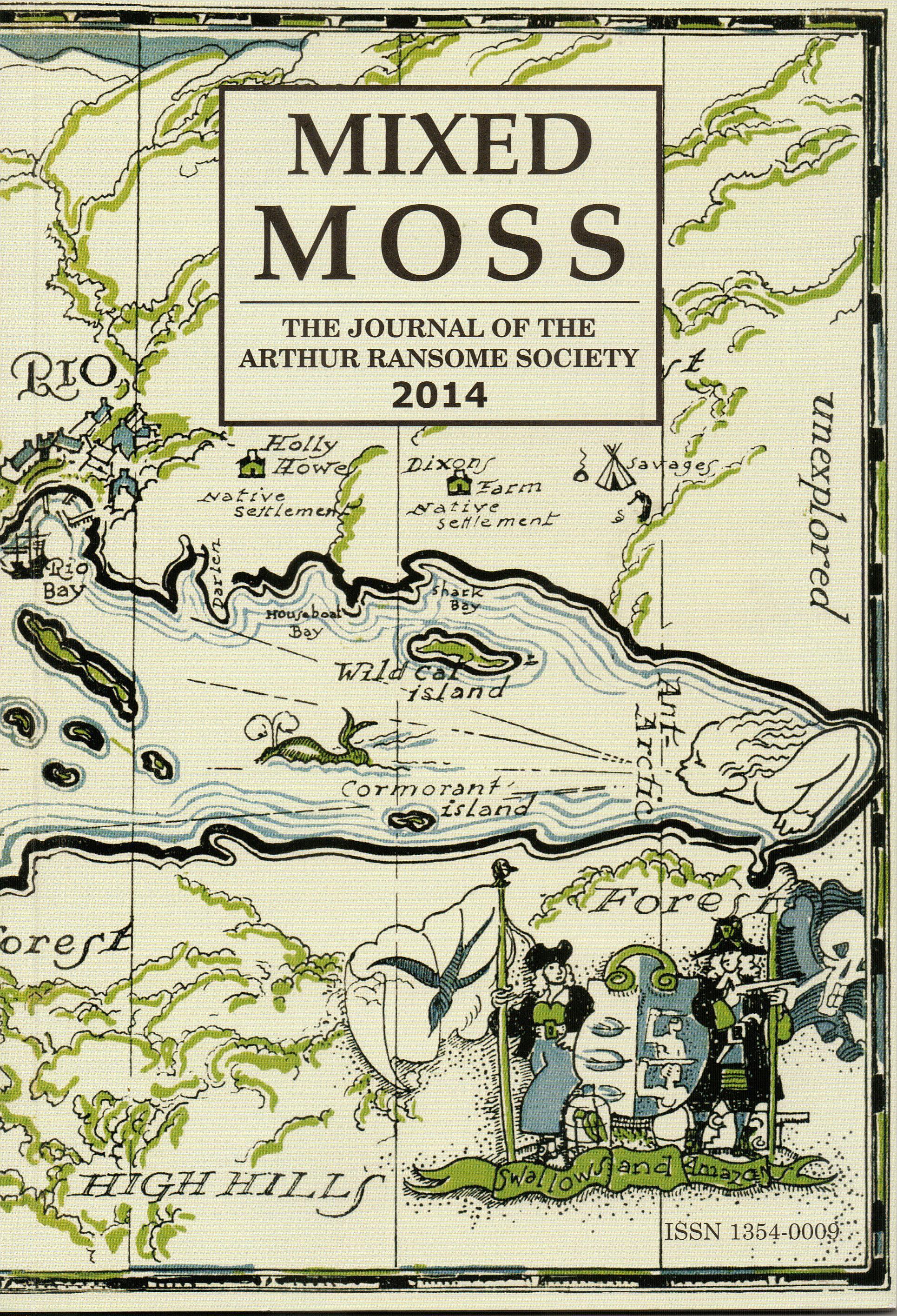
Mixed Moss arrived before Easter with Spurrier’s map on the cover:
I found another review inside, this time from New Zealand:
The News is that The Secrets of Filming Swallows & Amazons has been signed up by the publisher Classic TV Press who plan to bring out a new edition in paperback this July. It will include glossy photographs and additional points of interest. If you would like to order a signed copy please email: classictvpress@live.co.uk
If you are interested in joining the Arthur Ransome Society please click here.
Here is a shot from 1973, capturing some of the deb-archery:
Sophie Neville with Peter Robb-King (Make-Up) and Ronnie Cogan (Hair) watching Lesley Bennett and Kit Seymour trying out their bows and arrows with Terry Smith (Wardrobe) while on location near Peel Island on Coniston Water in the Lake District.
We now have a second edition of ‘The Secrets of Filming Swallows and Amazons’ out as an ebook and two versions of the paperback, which is almost identical but includes film stills and can be ordered from libraries as well as the usual online outlets.
Different editions of ‘The Making of Swallows and Amazons (1974) by Sophie Neville’