Caroline Downer, Henry Dimbleby, Richard Walton weighing William the pug dog
I saw so many children when I was casting Coot Club and The Big Six that I could have left the BBC and set myself up as an independent casting director, but I was twenty-two and all I wanted to do was to join the film crew on location in Norfolk. I was just not sure how.
The script called for a pug dog called William to not only appear with Mrs Barrable, played by Rosemary Leach, but to accompany the children as sailed through the Norfolk Broads aboard the Teasel. He then becomes the hero of the day as he walks across the mud on Breydon Water so a rope can be slung from one boat to another. He ended up needing to sit on weighing scales outside Beccles Post Office. I contacted Janimals, the London animal handlers. They decided it would be best to buy a puppy and train him for the requirements of the story. Naturally he was named William. The delightful young dog was brought into the office for our approval. He was still youthful when he appeared in front of the camera.
Andrew Morgan was a lovely director with two children the same age as those in our cast. To my surprise, I met him with his family one weekend on Port Meadow near Oxford. They had a narrow-boat moored at Bossom’s Boatyard where my father kept his steamboat Daffodil. Arthur Ransome would have approved.
Andrew had previously directed action dramas such as Secret Army, Blakes 7, Buccaneer, Triangle, Kings Royal and two episodes of Squadron, which Joe Waters had produced. Andrew, who was good at delegating, later declared himself, as he cued the steam train on the North Norfolk Railway, to be a director who specialised in films about different forms of transport. He very graciously asked me if I would work on location in the formal role of chaperone to the children whilst preparing their performances for the scenes ahead. He anticipated being out on the water in a boat without enough time to go through the children’s lines with them.
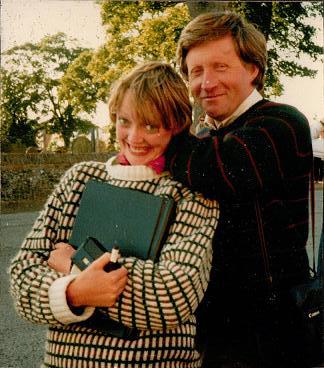
Sophie Neville with Henry’s father David Dimbleby in Norfolk, 1983
Once the casting was complete and licenses for each child safely lodged with various education authorities I took a weeks’ leave before returning to the production office on Shepherd’s Bush Green, where I helped book transport and accommodation. Filming on the Norfolk Broads for three months took quite a bit of preparation. While Joe and Andrew were casting the adult parts, we had to find a local tutor, buy life jackets and make numerous arrangements idiosyncratic to our particular production. The most exciting of these was commissioning the animal handler, Jan Gray of Janimals, to find a pug dog to play William. She bought a puppy so that he could be accustomed to his character name, travelling by boat, working with children and specifically trained to walk across mud. William had no idea of the stardom that awaited him. He ended up spending a great deal of his life in Gretchen Franklin’s arms playing Willy in Eastenders.
The day came when I packed up the little room I had been renting in Shepherd’s Bush from the actress Zelah Clarke and drove to the Dimblebys’ house in Putney to collect Henry. As he had just passed his Common Entrance he’d been let off school earlier than most thirteen-year-olds and we motored up to Norwich in a jubilant mood, singing most of the way. Whilst most of the production team and crew had found holiday cottages, I was to live at Sprowston Manor, the unit hotel with Caroline Downer, Henry and the other actors including the Matthews twins who travelled up with their mother. It was terribly grand. We had small quiet rooms at the back.
One of the Matthews twins having her hair plaited by Make-up Artist Penny Fergusson
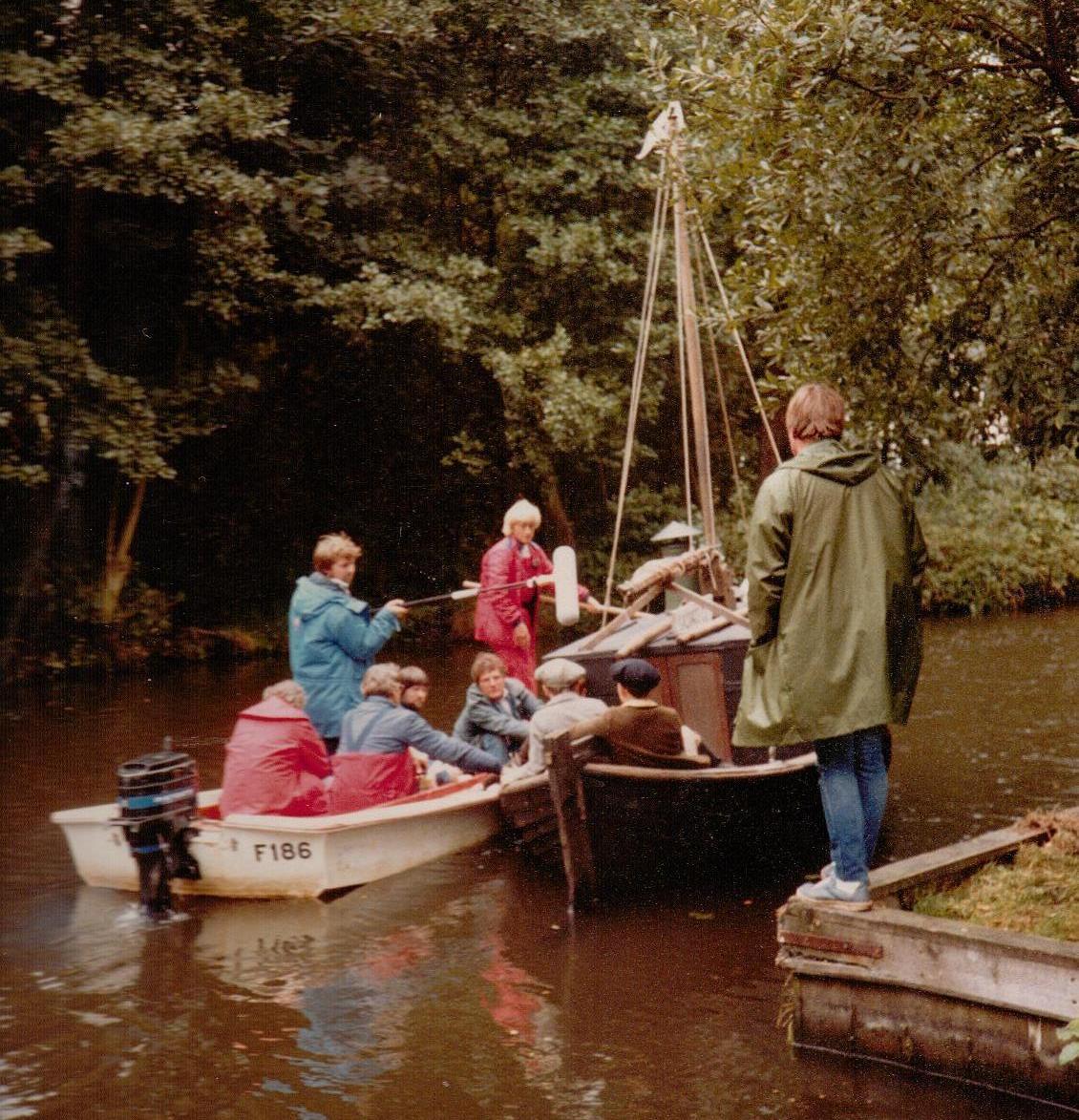
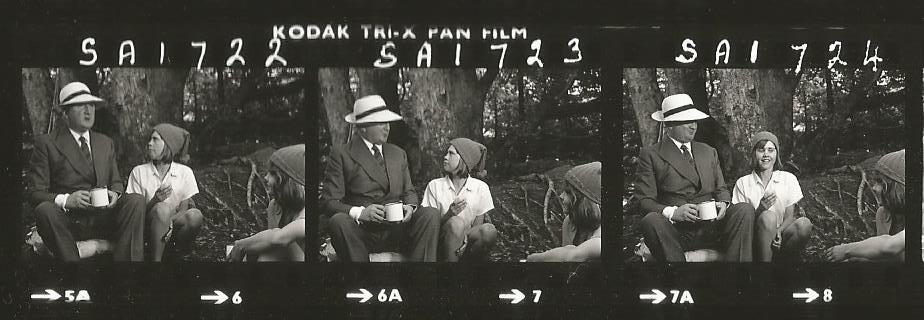
Liz Mace, our production manager, had taken my advice and scheduled ‘running around scenes’ for the first few days of filming, so that the children could get used to working with the film crew. The whole series was shot on 16mm by a wonderful, patient lighting-cameraman called Alec Curtis. We were very lucky to get him. He’d just finished The Kenny Everett Television Show and had worked on a huge number of well known comedy dramas ~ The Rise and Fall of Reginald Perrin with Leonard Rossiter, Fawlty Towers for John Cleese, The Morecambe & Wise Show, Sorry!, To the Manor Born and a BBC thriller called Scorpion. Alec had made God’s Wonderful Railway and was more than happy working with Andrew on the Bluebell Line for the opening scenes of Coot Club. Filming from a boat presented many more challenges, not least simply keeping the camera horizontal, but Alec was ever patient and kind. And always wearing a sun hat.
Mark Page, Nicholas Walpole and Jake Coppard as the crew of the Death and Glory with director Andrew Morgan and Cameraman Alec Curtis, 1983
I had drawn Andrew endless diagrams of Claude Whatham’s camera pontoon, built with a flat surface to accommodate camera track, that used to make Swallows and Amazons in the Lake District. However a more normal and faster vessel was chosen as the camera boat for the Broads. It had to travel around quite a bit since a far greater variety of locations was required than we had in Cumbria. We also had a couple of glass fibre run-around boats which would sometimes be used for the camera, especially in backwaters too shallow for the larger boat.
Alec Curtis and Andrew Morgan filming theDeath and Glory , with Peter Markham as First Assistant ,and Jill Searle looking after the boats, on one of the few rainy days on location at Gays Staithe, 1983
I have been writing about the adventures had whilst filming from one boat to another here:
Director Claude Whatham letting Simon West and Sophie Neville handle the 35mm Ariflex. Sue Merry and Denis Lewiston can be seen behind us.
When Suzanna Hamilton brought me the diary she kept during the filming of Swallows and Amazons we had time to reflect on the seven weeks we spent together in the Lake District during that far off summer of 1973.
‘We were beautifully looked after,’ she said. ‘I mean we were really well cared for. Look – Jane took me fell walking.’ Our diaries record that our local driver Jane McGill also went to endless lengths to make things fun for us – ever with safety afore-thought.
Jane Grendon, Sten’s mother and one of our two chaperones who took us fell walking.
She was right. Jane Grendon, who was Sten’s mother, and Daphne Neville, my mother, were our official chaperones. They worked day and night with very little time to themselves.
Daphne Neville in 1973
Both had left younger children and animals at home in Gloucestershire with their husbands, which can’t have been easy.
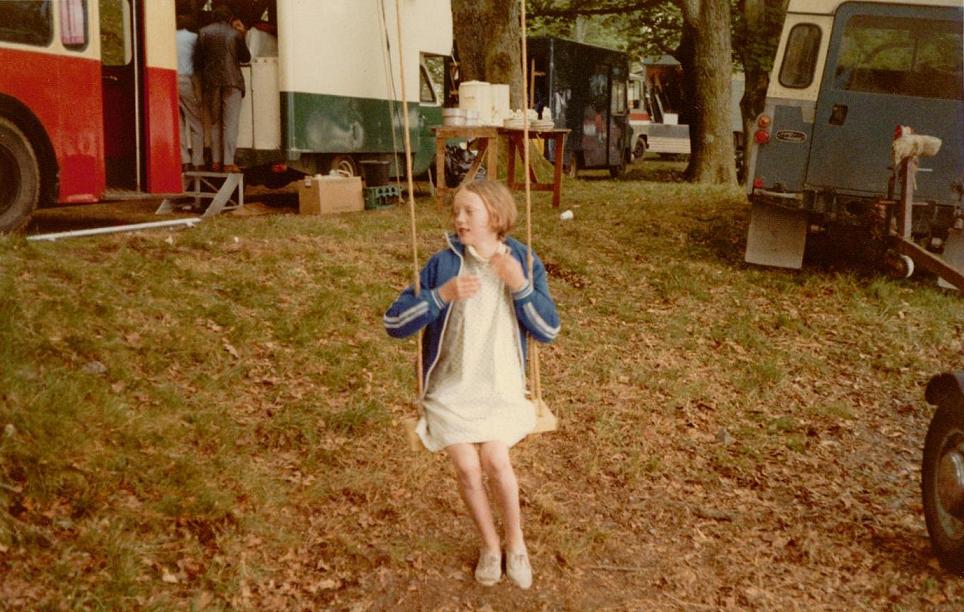
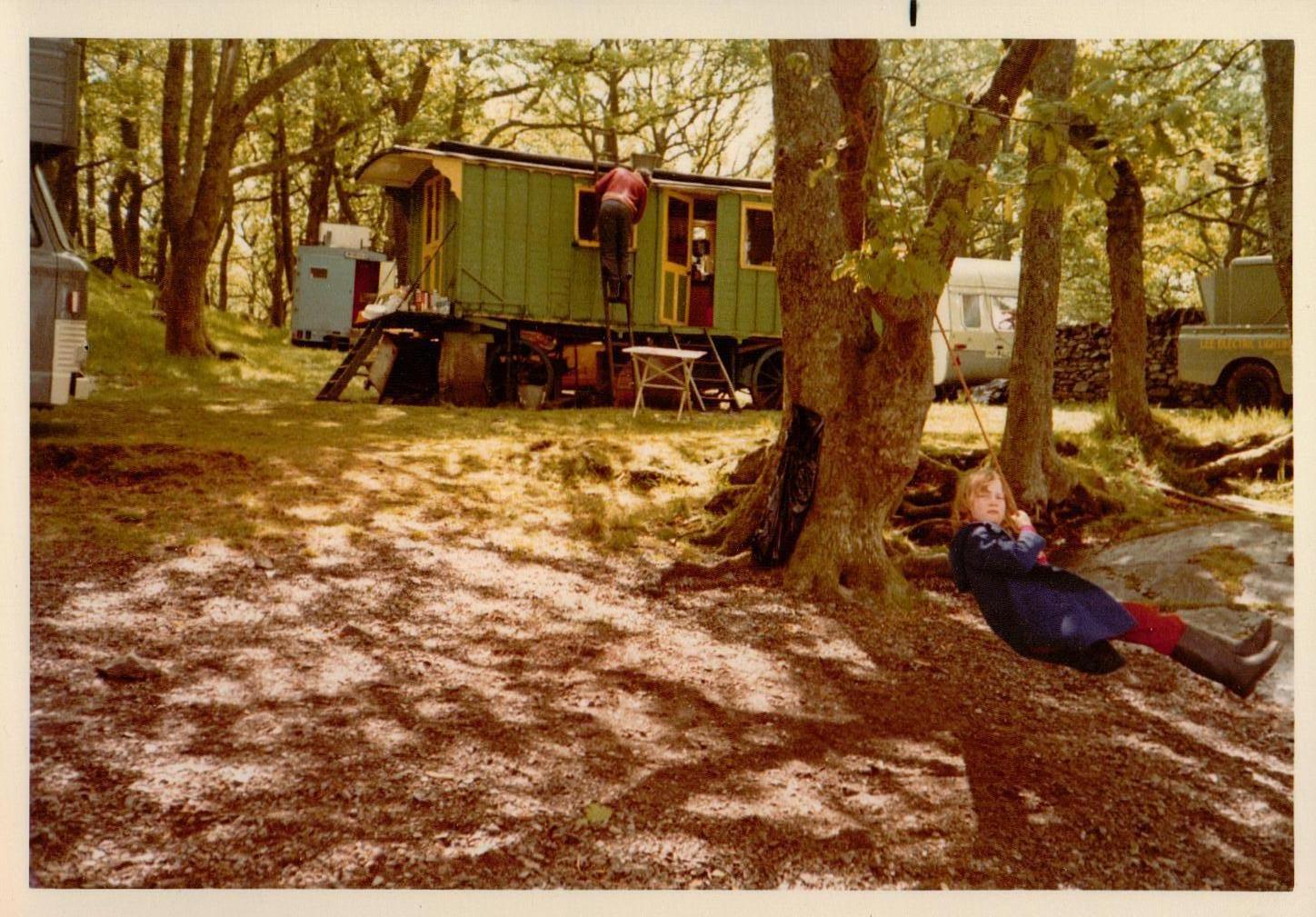
A photo taken of the swing at our unit base opposite Peel Island earlier in the filming when the school bus and caterers were still around
Mum later wrote an article for Woman magazine saying that being a chaperone was ‘Fascinating, Fattening and Fun’, but it must have been exhausting. It would have been quite a trial preventing us from getting sunburnt let alone keeping us entertained.
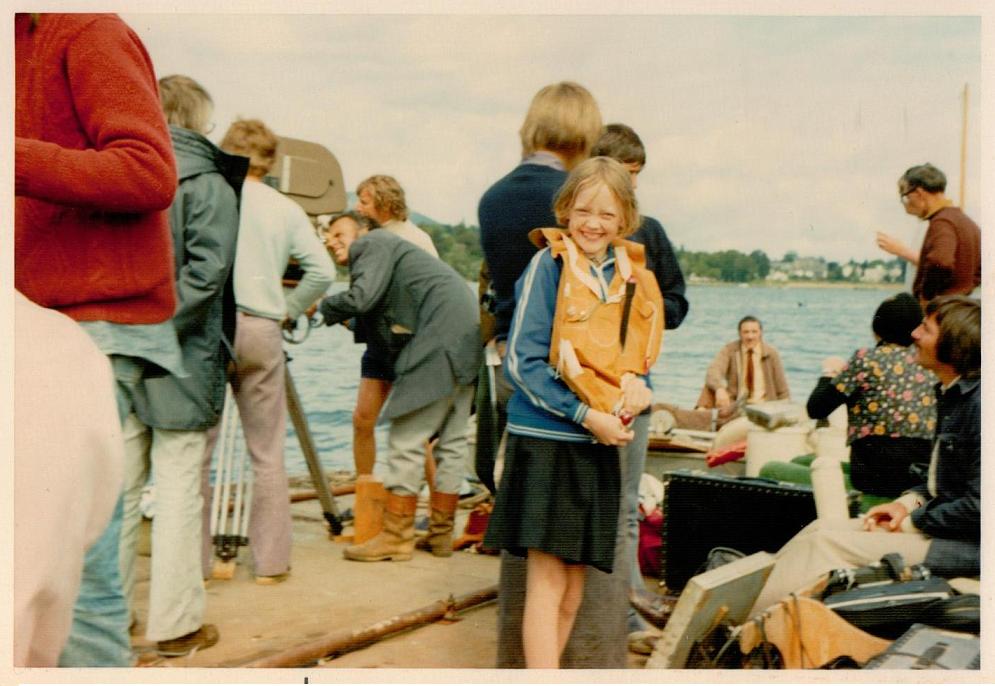
Daphne Neville, having organised Sophie Neville and Simon West into track-suits, life jackets, sun hats and the safety boat in 1973
When we had to do anything scary or unpleasant during the filming of Swallows and Amazons, such as walk through scratchy brambles, Claude Whatham would assuage any moans by awarding us ‘Danger Money’. It was a huge encouragement. He gave me £2.00 for being good about diving into the chilly water for the swimming scenes. It was a lot of money back then. My mother would make a careful note of it whilst we were still in costume.
A list of who had earned Danger Money written by my mother on the back of a Script Revision page
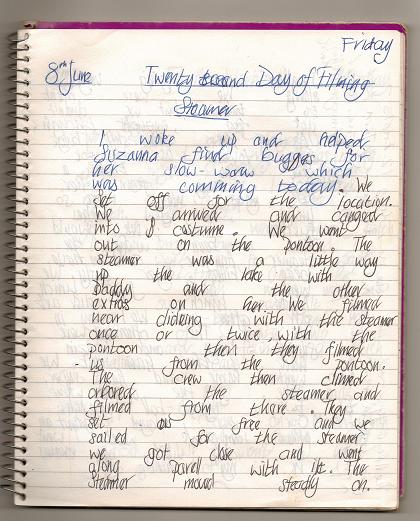
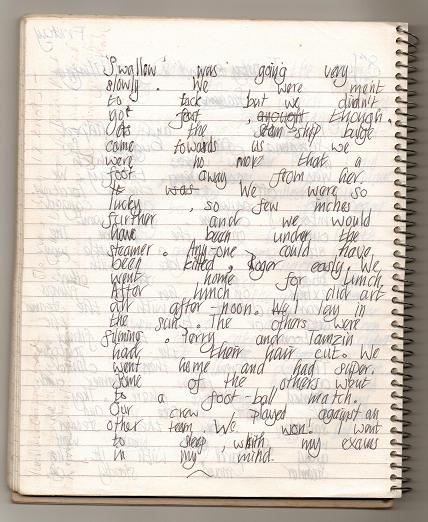
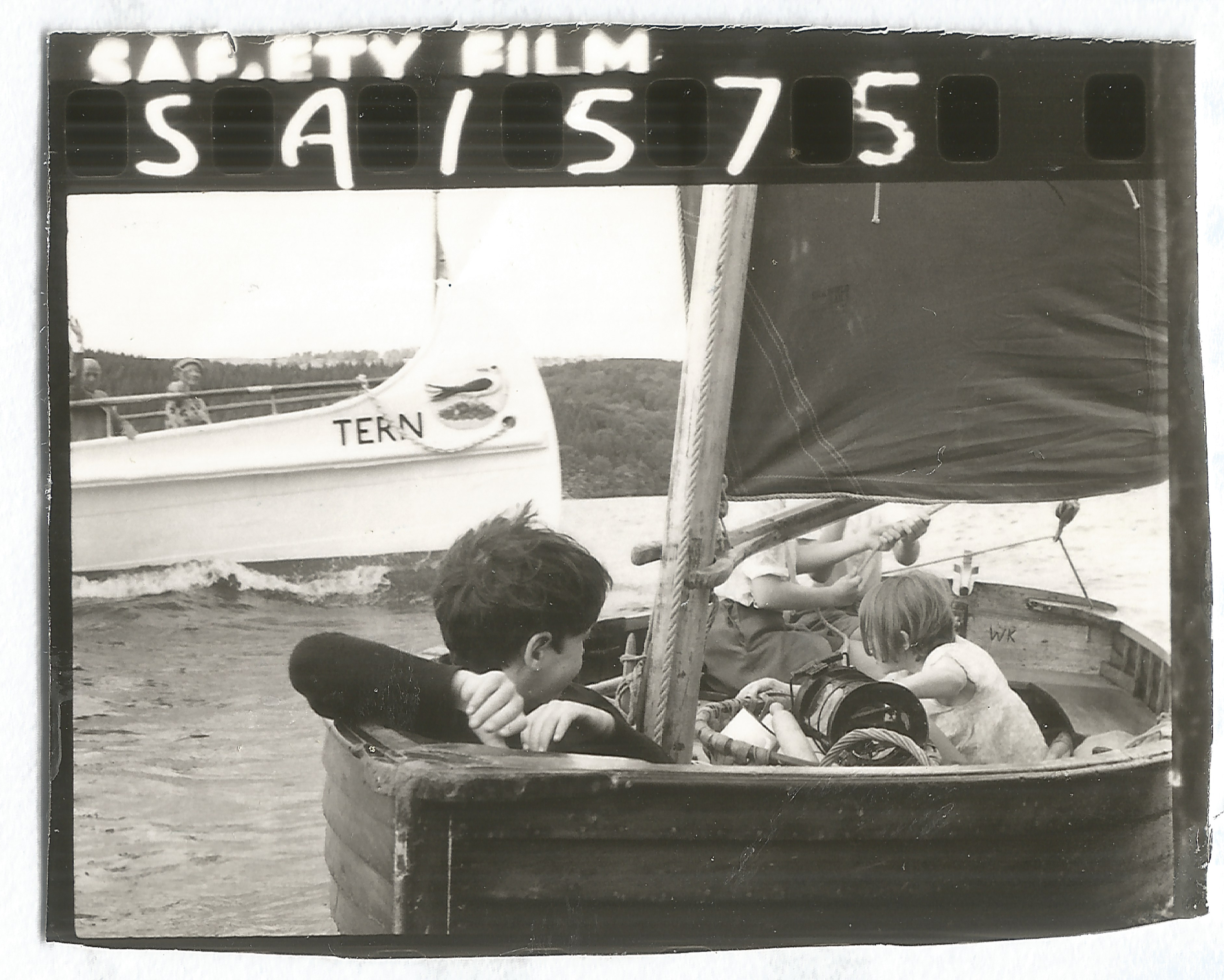
We spent our gains in Ambleside buying presents to take back for the stay-at-homes. I think we might have received a little more after Swallow was nearly mown down by the Windermere Steamer, an incident which had actually been dangerous. I am not sure what Kit and Lesley had been doing to receive £1 each. They may have just got wet and cold sailing.
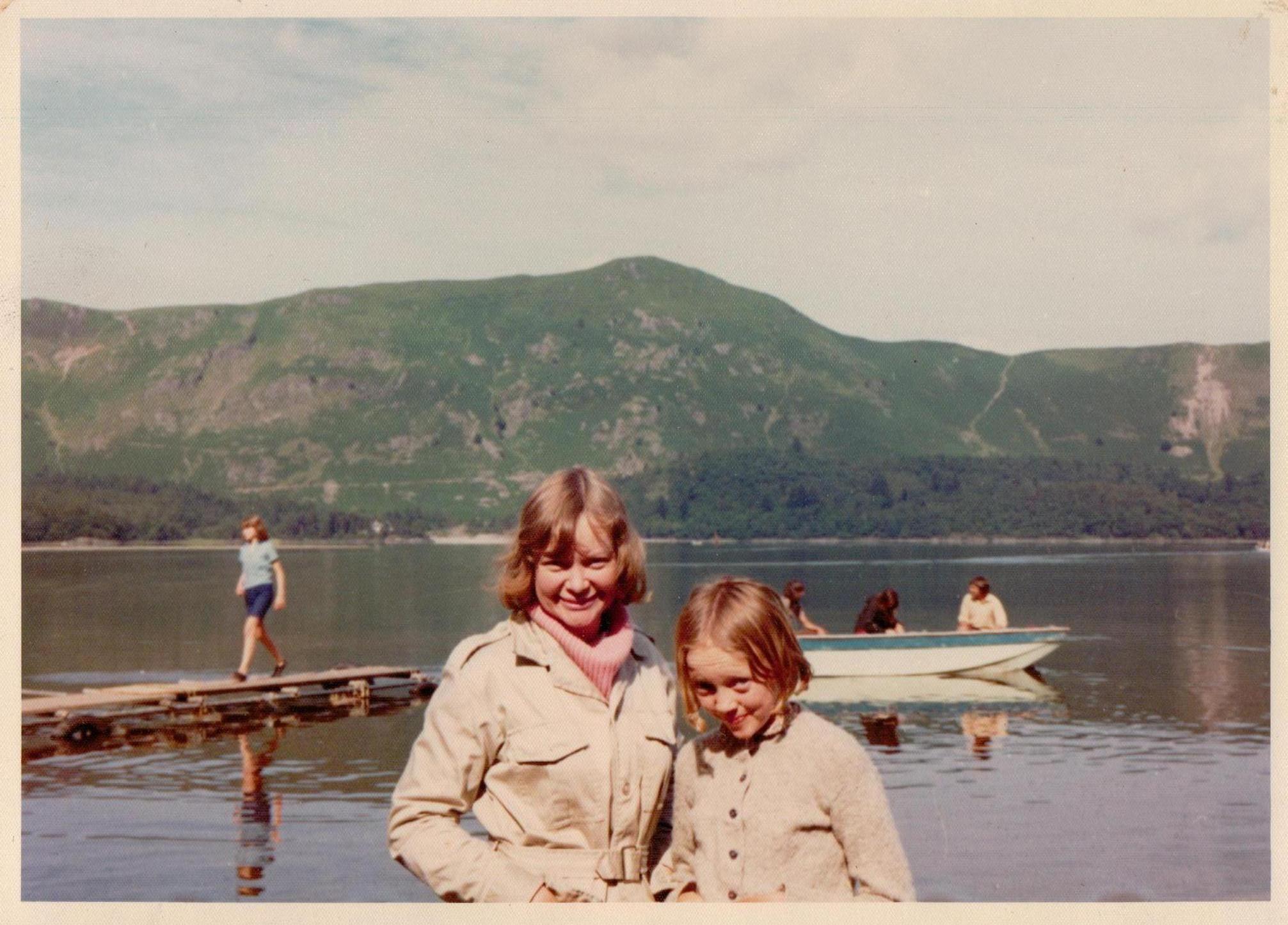
Daphne Neville with Sophie Neville while filming ‘Swallows and Amazons’ in Cumbria. Kit Seymour is walking along the jetty in the background.
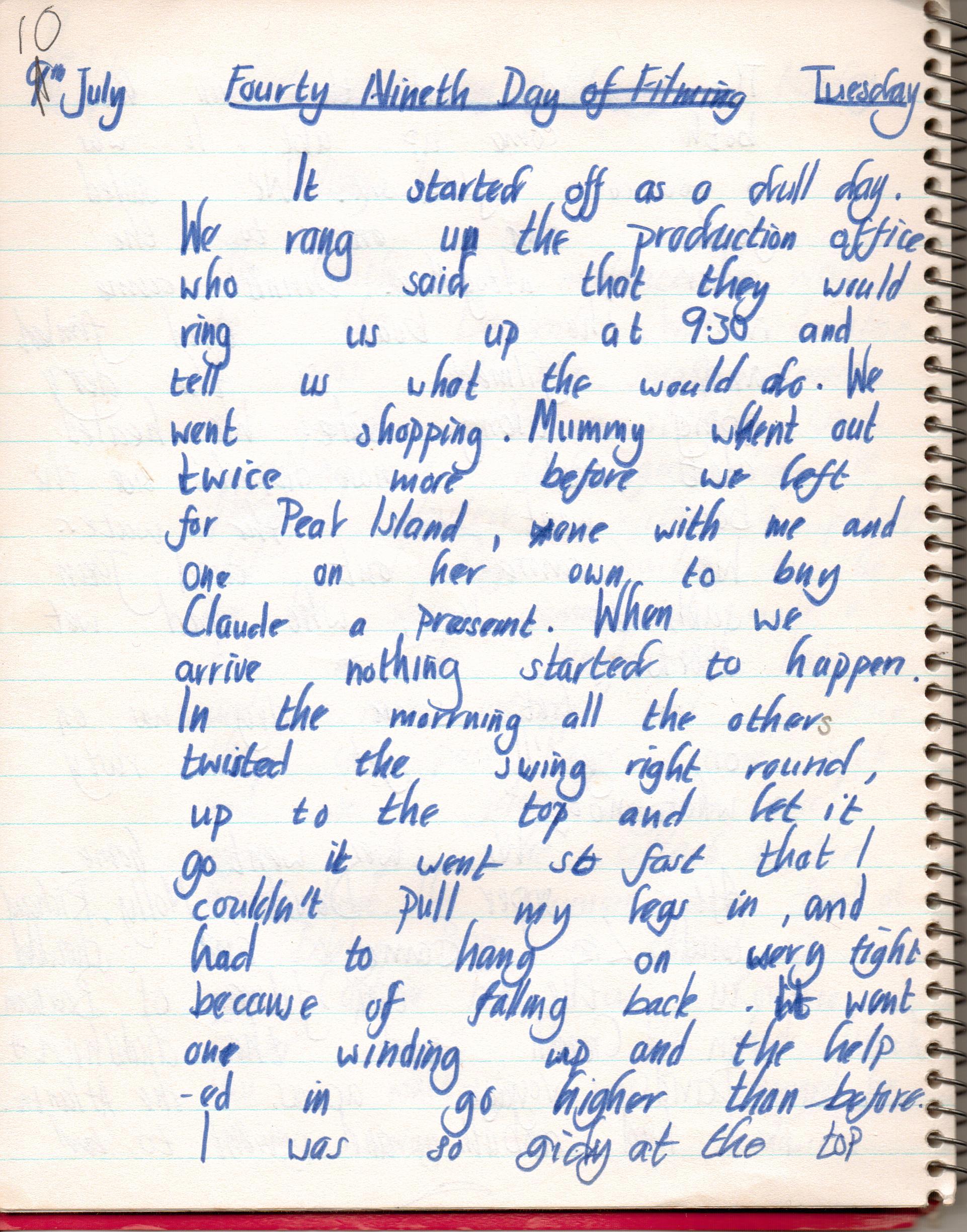
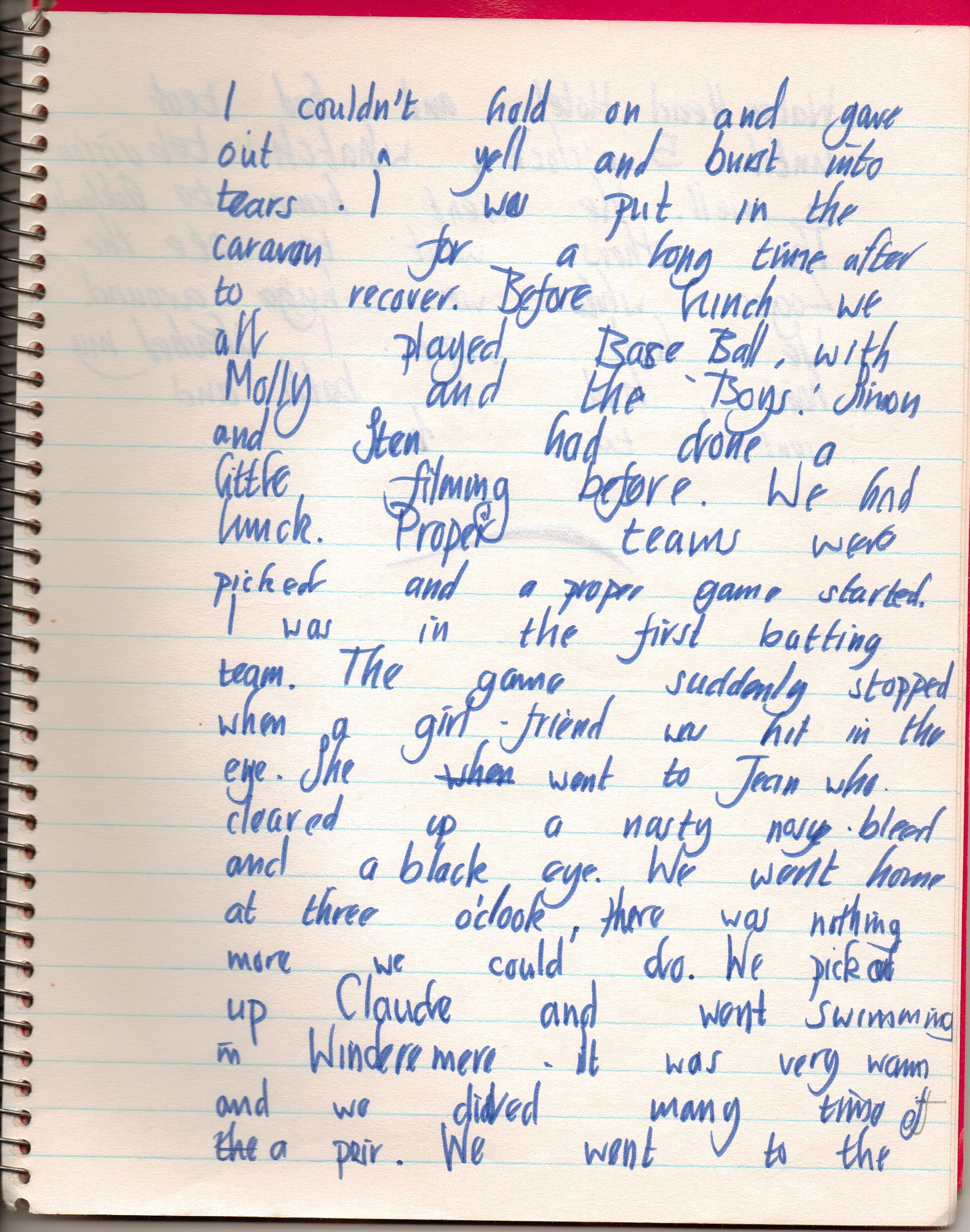
After all the rushing about in boats, the risks taken clambering from one vessel to another and inevitable dangers that we faced out on the water, it was the boredom involved in filming that proved most dangerous; children’s games that went terribly wrong ~
This was the swing in question, strung from a tree on the shores of Coniston Water opposite Peel Island where a couple were living in a wooden caravan. The white ‘Make-Up’ caravan, that had previously been used as a dressing room for Virginia McKenna, and later Ronald Fraser, is parked beside it. It was there that I was sent to lie down.
A snap shot taken earlier in the year of my little sister on the swing at the Unit Base opposite Peel Island ~ photo: Martin Neville
It was a shame that the baseball game Molly organised ended so abruptly. We enjoying it and longed to keep playing but she realised that it could so easily have been one of us who ended up with a black-eye.
Stephen Grendon, longing to climb a tree whilst in costume
At one stage we all got into whittling wood. Bod Hedges, the property master, made a number of props on location. Different versions of the Amazons’ bows and arrows were carved from hazel on the banks of Coniston Water. He also made forked uprights for the fireplace and various stakes for the charcoal burners’ scene. Suzanna bought a penknife with her Danger Money and became quite a keen carver until the knife slipped. Jean treated the cut finger with such a massive bandage that Claude put a firm stop to any future whittling. It had been the one thing that kept us quiet. We were active children yet not allowed to climb trees or get wet. Instead Lesley Bennet plucked away at a tapestry and I painted pictures.
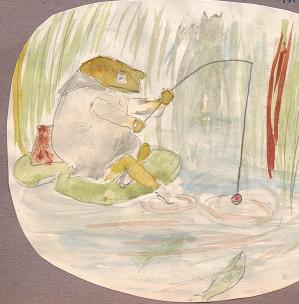
A bad copy of Beatrix Potter’s Jeremy Fisher Frog, looking not unlike Arthur Ransome.
Possibly the biggest danger was getting too fond of the primary objective – catching the bug that is film-making. Richard and Claude still had a few vital scenes to record and yet the weather forecast was bleak.
Producer Richard Pilbrow with Director Claude Whatham in their wet weather gear at The Secret Harbour on Peel Island, Coniston Water
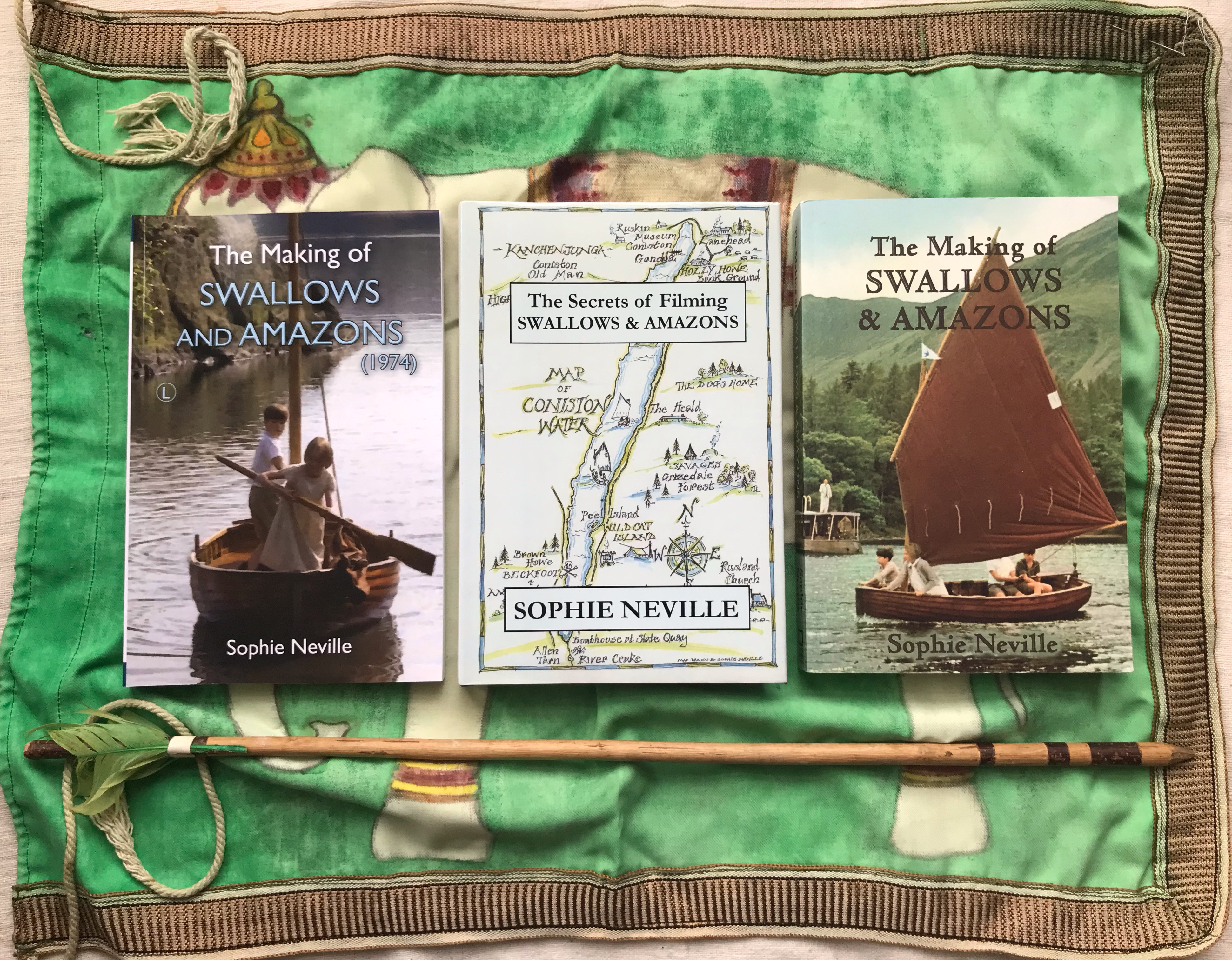
You can read more in ‘The Making of Swallows and Amazons’ available in different versions that can be for sale online here
Different editions of ‘The Making of Swallows and Amazons (1974) by Sophie Neville’
If you ever see a cormorant you must sing out, ‘They’ve got India-rubber necks!’
And then, if you are on a long journey you can add, ‘ Cormorants. We must be near the coast of China. The Chinese have cormorants. They train them to catch fish for them. Daddy sent me a picture.’
Sophie Neville, Suzanna Hamilton and Simon West as the Walker children sailing to Wild Cat Island in Swallow
If you ever get lost – or the journey really is a long one, you can say,
‘Here we are intrepid explorers making the first ever voyage into unchartered waters. What mysteries will they hold for us? What dark secrets will be revealed?’
They were most complicated speeches to deliver afloat, ones I had to learn. In the end the second part was heard OOV – out of vision. I could have read the lines. But then they wouldn’t have stayed in my head forever, as they have.
Stephen Grendon, Sophie Neville, Suzanna Hamilton and Simon West on the voyage to Wild Cat Island, scenes shot on Derwentwater in 1973
If, on your journey, you happen to see a man sitting in a chair writing notes you score high and can say, ‘What’s that man doing? He’s probably a retired pirate working on his devilish crimes.’
Filming Swallows and Amazons (1974) from a camera pontoon
(I’m a bit hesitant about that one because my Aunt Hermione really was approached by pirates when she was sailing round the world. The Daily Mail published her dairy chronicling the adventure; a full page double- spread with photographs no less. Rather sadly they ran headline ‘Intrepid Pensioners…’ What a swizz. She should have lied about her age and said she was 27 instead of 60. Well, perhaps 57, what with the photos.)
The scene behind the camera that day on Derwentwater was rather different from from the scene in front of it.
I got cold sailing but it was a glorious sunny day with a fair wind. We achieved a huge amount even if Cedric fell in. Some of the boatmen and crew wore life jackets, others did not – including my mother.
We wore BOAC life jackets for rehearsals but Swallow is a safe little boat – her keel ensuring we didn’t capsize if we happened to jibe and we never fell in. The pontoon was really rather more dangerous being a raft with no gunwale. Any one could have misjudged their step and plopped overboard. Luckily we were not stifled by Health and Safety in those days – only the rigorous demands of movie insurance companies.
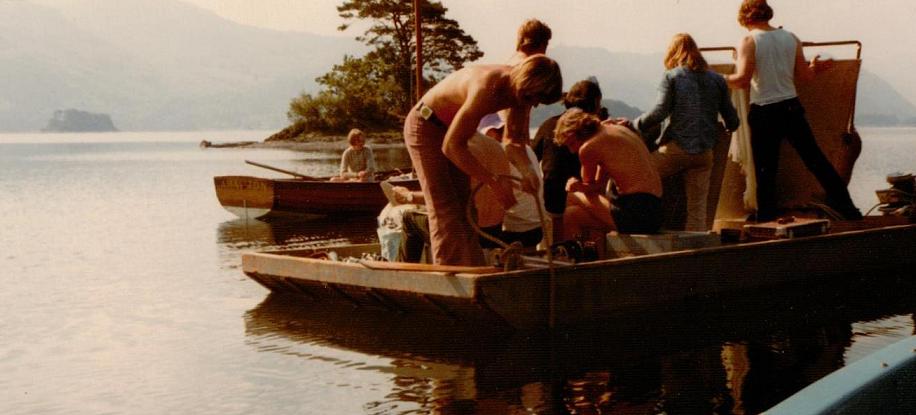
This shows the camera crew climbing aboard the pontoon in order to film Swallow sailing. Daphne Neville sits in the Dory safety boat in the foreground. A reflector board, wrapped camera mount and microphone are already on board.
I’m sure we had already shot the first two scenes of the day when I was in Amazon, setting the anchor and later hearing the robbers. I expect Claude needed to re-shoot for technical reasons. Day-for-Night filming requires clear, sunny days and he would have needed still water.
John and Susan find Titty has moored the Amazon off Cormorant Island
I have some of my father’s 16mm footage showing us at around this stage in the filming. It was shot on a different day but shows us on the shores of Derwentwater, waiting around before rushing off across the lake in motor boats to finish filming before Claude lost the light. You see the pontoon and a safety boat towing Swallow, me snapping bossily at Roger to get a move-on, (unforgiveable but I was 3 years older than him and irritated to distraction), the third assistant Gareth Tandy in blue with glasses, our sound recordist Robin Gregory throwing his arms wide open, Kit Seymour and Lesley Bennett by the lake shore, David Blagden with his short hair-cut splicing rope, me in my Harry Potter-ish blue nylon track-suit top with Albert Clarke the stills photographer, Swallow and some mallard duckings.
If you are enjoying this blog, please find an expanded version of the story in the ebook, available from all online retailers such as Amazon Kindle for £2.99 and on Goodreads here It has also been published in two illustrated paperback versions, which make good presents.
Different editions of ‘The Making of Swallows and Amazons (1974) by Sophie Neville’
Sophie Neville as Titty about to discover the Captain Flint’s trunk hidden on Cormorant Island ~ photo: Daphne Neville
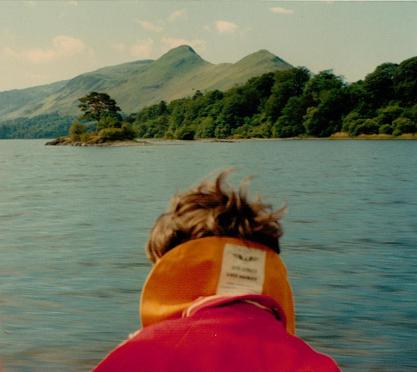
Stephen Grendon on Derwent Water looking out to ‘Cormorant Island’ ~ photo: Daphne Neville
What a day!
A bright sunny day on Derwentwater. I wore what was my favourite costume, not least because I had the option of wearing a vest beneath the blouse and I didn’t have to worry about the divided skirt. I went to such an old fashioned school that I owned a pair of grey flannel culottes myself, to wear on the games field, and thought them very much the sort of thing Titty would have worn.
My mother in a skirt with her sister wearing a divided skirt in 1953
The cotton dress and buttoned up grey cardigan were a bit crumpled by the time I dropped Amazon’s anchor off Cormortant Island.
Roger, meanwhile was in long shorts or knickerbockers as the real Altounyan children would have called them, kept up with a snake belt. His even longer underwear was an item requested by Claude Whatham the director who, being born in the 1920s himself, had worn exactly the same sort of underpants as a child. As the day warmed up Claude stripped down to a pair of navy blue tailored shorts and sailing shoes. We were on a desert island after all. Even if it was a desert island in the Lake District.
Amazon moored near Cormortant Island on Derwentwater with the pontoon and safety boats. What is the real name of the island used for the location?
In Arthur Ransome’s book of ‘Swallows and Amazons’ the hunt for the treasure is slightly different and Captain Flint’s trunk lies buried under rocks. I wasn’t expecting the set-up with the tree trunk, although I think it works well and looks good, giving movement to the sequence. The only hesitation was that Claude didn’t want me to get hit by the rocks as they slid off. This was a pity as I would have jumped aside.
Long shots of sailing Swallows and Amazon on Derwentwater in 1973
I am not sure why the Amazon had not been bailed out. I can remember having to lie in the bilge water, which proved cold and uncomfortable. Perhaps it gave my performance an edge. Titty would have been cold and stiff after a night wrapped in the sail. Great grey clouds were gathering by then and we were all getting tired.
Sophie Neville playing Titty Walker in the captured Amazon, with David Cadwallader, Bobby Sitwell, Eddie Collins, Claude Whatham and two electricians holding reflector boards on the camera punt: Photo ~ Daphne Neville
Being together in a confined space becomes difficult to endure after while, not least when the space is a pontoon on a lake with not much to sit on. Small boys tend to muck about and become annoying when they are bored. The time had come when someone was going to crack – and they did. The result was silence. A sobering moment. And one very wet pair of knickerbockers.
In the end three of us went home in wet underwear. Gareth Tandy, the third assistant director – who I think was only about 18 – was pushed in to the lake, this time to great hilarity.
John and Susan find Titty has moored the Amazon off Cormorant Island
The big question, of course, it what is the name of the island on Derwentwater that we used as the location for Cormorant Island? Duncan Hall has written in to suggest it is called Lingholm Island (or possibly One Tree Island). What is the name of the larger island, seen in the background of shots, that represents Wildcat Island? Is it Rampsholme Island?
The pontoon on Derwentwater with Richard Pilbrow, Bobby Sitwell, Denis Lewiston, Claude Whatham, David Cadwalader and Sophie Neville aged 12 playing Titty. Cameraman Eddie Collins looks on ~ photo: Daphne Neville
I have one behind-the-scenes clip of the crew on the pontoon – shot on a sunny day. It looks most bizarre. It was. You can see how cramped and overloaded we were and guess at the patience demanded of us all. Imagine how long it took to set up shots, while exposed to the elements. It was quite a stable raft but when we went for a take it was vital that everyone kept completely still or there would have been camera wobble. We used a conventional boat with a cabin when we filmed ‘Coot Club’ and ‘The Big Six’ on the Norfolk Broads ten years later in 1983. It proved much easier – but had more wobble.
The ebook on ‘The Secrets of Filming Swallows and Amazons (1974)’ is available on Amazon Kindle and other platforms. You can read the first section for free here:
Sophie Neville at the Bank Ground Farm Boat-houses on Coniston Water in Cumbria for the filming of ‘Big Screen Britain’ presented by Ben Fogle for BBC TV
At last! We have the clip from Country Tracks presented by Ben Fogle, that includes interviews with Director Claude Whatham, Lucy Batty of Bank Ground Farm, Suzanna Hamilton and myself discussing the swimming scenes, with the unique behind-the-scenes footage my father shot on 16mm film, with his Bolex camera back in 1973. You might have seen a longer version of this on Countryfile and Big Screen Britain. I am yet to receive residuals.
If you would like to read about ‘The Secrets of Filming Swallows and Amazons (1974) in detail, the illustrated, multi-media ebook is available on Kindle and from other ebook retailers.
Sophie Neville, Simon West and Suzanna Hamilton with Ronald Fraser playing Captain Flint in the 1973 film of Arthur Ransome’s ‘Swallows and Amazons’
Ronald Fraser! veteran of World War II movies who had won an award for playing Basil Allenby-Johnson in The Misfits, had arrived on the shore of Coniston Water in two-tone shoes. Curiously so had two stand-ins. A short lady for me, who had dark hair, and a lady with blonde hair for Suzanna Hamilton. I have blonde hair and Suzanna is dark, but that is how it was.
The other four actors didn’t have stand-ins, which seemed odd. Kit Seymour, who played Nancy Blackett, and Lesley Bennett in the role of Peggy, rehearsed as usual. The two boys, Simon West and Sten Grendon, were younger than us but never had stand-ins, so that seemed odder. We didn’t think the ladies would be very comfortable on Peel Island. There wasn’t exactly a powder room there.
Director Claude Whatham and Bobby Sitwell with Suzanna Hamilton playing Susan Walker and Ronald Fraser as Jim Turner aka Captain Flint
And we were some way into the filming, used to handling props that the stand-ins found alien. However they were very excited about coming over to Peel Island. They sat in our positions and read our lines back to Ronald Fraser whilst the scene at the camp site was lit, and returned to stand-in for us later when his close-ups were shot. Somehow they managed to do this in scanty summer clothing despite a brewing storm.
My stand-in. I liked her very much and was most interested in her tapestry, since I was doing one myself. Lots of the men in the crew were interested in her tapestry too. They hadn’t noticed mine.
Our stand-ins got a lot of help from the crew as they went from ship to shore. We didn’t, but then we were agile and wore life-jackets. Mummy didn’t wear a life-jacket, but she has always been surprising good at getting in and out of boats. Her comment on the matter of my stand-in was, ‘Most unsuitable for a children’s film.’ Mum became increasingly concise: ‘I don’t think that woman was invited. She just turned up.’
Enthused by our Stand-in, Lesley Bennett and I went into Ambleside that evening to buy more wool for our own tapestries.
The recording of our scene with Captain Flint on Peel Island went smoothly, and Claude Whatham the Director was happy with the result, but my diary reports that a Force 8 gale blew in. This spun the poor production team into a quandary.
The call sheet for Thursday 20th June documents how truly unpredictable the weather could be. We had a ‘Fine Weather Call’, an ‘Alternative Dull Weather Call’, ‘Rain Cover’ in the Houseboat cabin, and a pencilled-in end-plan entitled ‘Peel Island’, which is where we’d ended up. Richard Pilbrow, the Producer, had a 1970s embroidered patch sewn to his jeans which read: THE DECISION IS MAYBE AND THAT’S FINAL.
The Call Sheet that never-was for 20th June 1973. We ended up on Peel Island.
In Arthur Ransome’s book Swallows and Amazons there is a dramatic storm with lashing rain. We were rather disappointed that it was not included in David Wood’s screenplay. It could have been shot that afternoon, but this was not to be. I can remember Mum saying, ‘You can’t have everything.’
What had been good about the 20th June was that we, the Swallows and the
Amazons, were all together, not sailing but on Wild Cat Island, with the novelty of working with Captain Flint for the first time. Kit and Lesley had been so patient, waiting day after day for their scenes to come up. They were stuck having lessons with our tutor Mrs Causey in the red double-decker bus most of the time. But the fact that they were on stand-by was helpful to the production manager who had to wrestle with the film schedule and call sheets.
As it was, the storm blew hard but cleared the dull-weather clouds and the next day was glorious, one to remember forever…
You can read more in the paperback or ebook here. There is also an audiobook narrated by me, Sophie Neville.
Sophie Neville as Titty and Stephen Grendon as Roger rowing to Cormorant Island
‘Pull harder, Roger!’ ~ hardly a line from Shakespeare, but one that has lodged deep in my memory. Titty was even bossier in Arthur Ransome’s books ~
“You keep time with me, Boy,” said the able-seaman.
“All right.”
Sten Grendon as Roger and Sophie Neville as Titty rowing Swallow (c)StudioCanal
Titty lifted her oar from the water. Roger gave one pull.”Boy,” said the able-seaman, “you mustn’t say ‘All right’.”
“Aye, aye, sir,” said the boy.**
When we auditioned for Swallows and Amazons the emphasis was on sailing. Could we sail? In fact I needed to be good at rowing. Titty and Roger row back form the Charcoal Burners, I rowed the Amazon from Wild Cat Island and here we were rowing across Derwentwater to Cormorant Island. This was more difficult than normal as Swallow was wired to the camera pontoon.
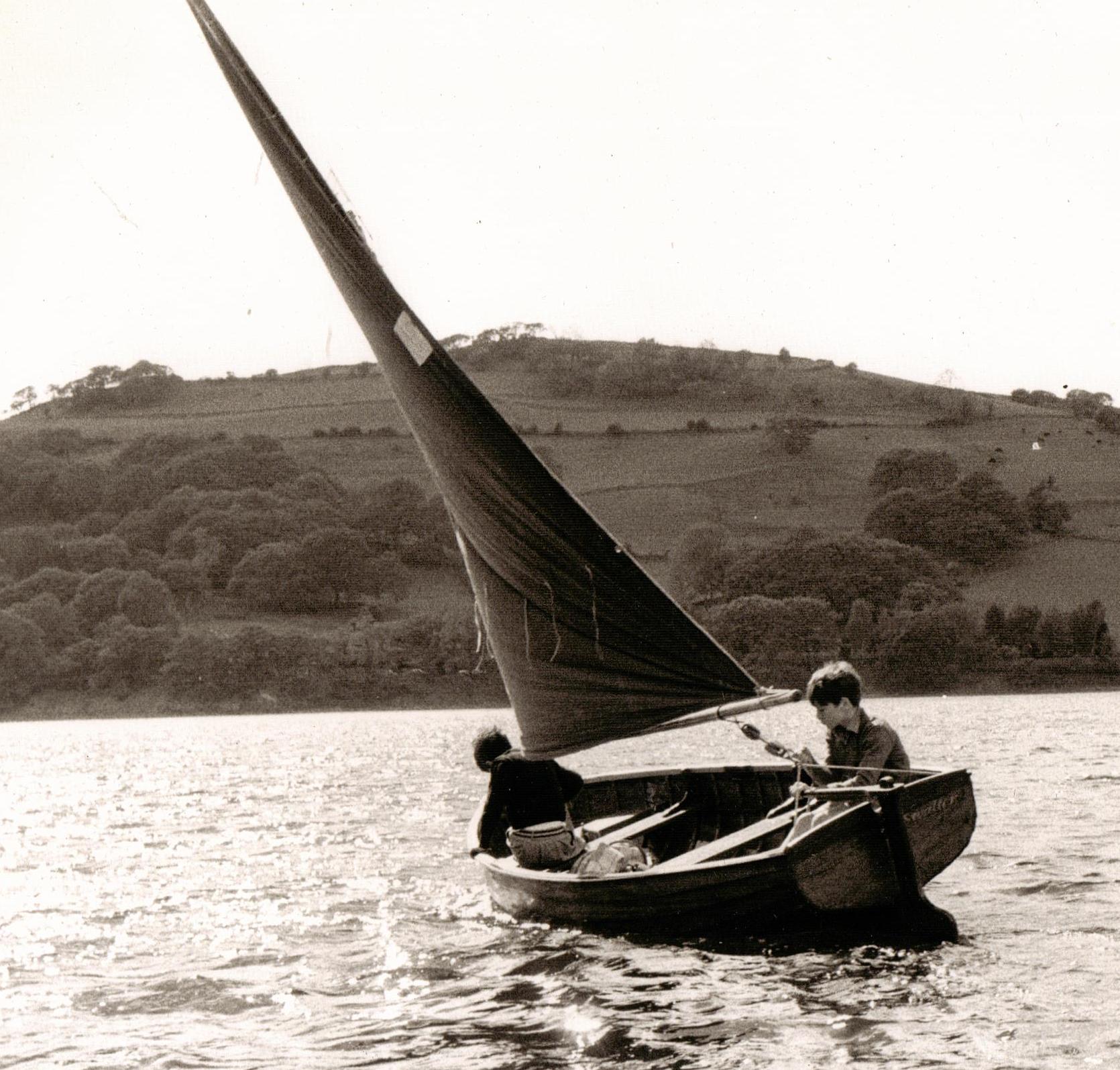
When I look at the 16mm footage my father took of me rowing at home before we left to film in the Lake District, I cringe. My blades were high above the water, hitting the surface with terrible splashes but I seemed to achieve my objective. I managed to fit an improvised mast to our Thames skiff and even made my own sail. It doesn’t look great, but I think Arthur Ransome would have approved.
Swallow finding Amazon anchored near Cormorant Island on Derwent Water with the camera pontoon and safety boat: photo~ Daphne Neville
Simon West and Suzanna Hamilton joined us for the scene when the Swallows lower the Jolly Roger and start to sail the captured the Amazon back to Wild Cat Island. I can only imagine that I changed my costume in one of the support boats. The scene may have been shot with two cameras on different boats.
Sophie Neville playing Titty Walker in the captured Amazon, with David Cadwallader, Bobby Sitwell, Dennis Lewiston, Claude Whatham and two electricians holding reflector boards on the camera punt: Photo ~ Daphne Neville
This shot shows Claude Whatham using the grey punt,* which somehow managed to accommodate Dennis Lewiston, the 35mm Panavision and quite a few crew members, while Richard Pilbrow remained on the camera pontoon with Eddie Collins operating the 16mm camera.
Richard Pilbrow and his film crew on the camera pontoon with Eddie Collins operating the 16mm camera. Simon West and Stephen Grendon sail Swallow. Suzanna Hamilton is climbing aboard the Amazon with Sophie Neville
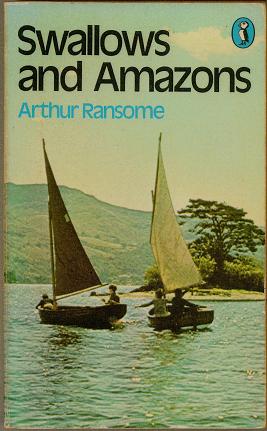
I remember the scene itself as being difficult to achieve in terms of sailing. Swallow has a keel, and Amazon with her centre board is much the faster dinghy. It is not like racing two boats of the same class. After hauling up the anchor Suzanna and I battled to turn the Amazon, not wanting to wiggle the rudder and jeopardise her pins. I remember Simon calling advise over the water. He stalled and we caught up, trying to get close together for the shot. The result was a photograph used on the front cover of the next Puffin edition of the book.
Stephen Grendon, Simon West, Sophie Neville and Suzanna Hamilton on the cover of the 1974 Puffin edition of ‘Swallows and Amazons’
* I may be wrong about these photographs. The still surface of the water in the shot of Titty alone in Amazon suggests that it was taken later on, when we filmed the burglars landing on Cormorant Island with Captain Flint’s trunk, but we probably had a very similar set up on this more sparking day ~ 15th June 1973.
We went on to film various shots of us sailing on to Wild Cat Island, when I think the camera was in Swallow capturing close-ups of a triumphant Captain John. He did indeed do well.
**Swallows and Amazons by Arthur Ransome, 1970 Jonathan Cape edition
Ronnie Cogan having a cigarette with one of the Supporting Artistes. Terry Smith the Wardrobe Master is going below in the background. photo: Martin Neville.
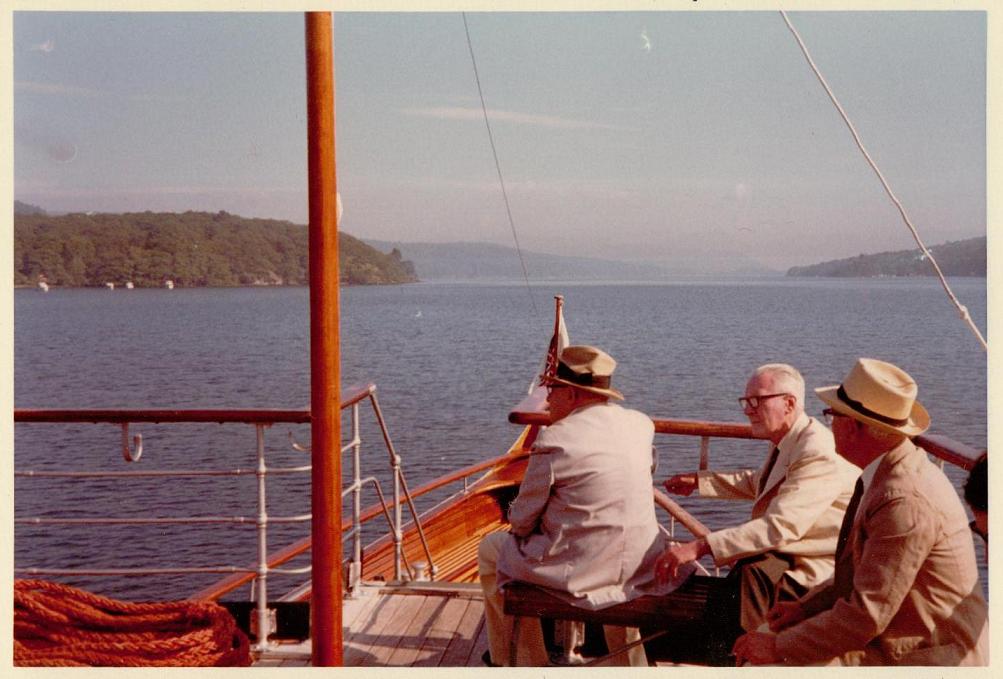
It was a glorious summer day to film on Windermere. Conditions were perfect. My father had been asked to appear as a film extra in the scene in Swallows and Amazons when the the crew of Swallow narrowly miss colliding with a Lakeland steamer, that transporting tourists up and down the lake.
Martin Neville wearing 1929 costume aboard MV Tern on Windermere in 1973
He was the tall dark native in a blazer and white flannels aboard the elegant MV Tern. A lovely way to spend a sunny morning in the Lake District. Until your daughter nearly drowns.
MV Tern on Windermere was built in 1890 with a steam engine, converted to diesel in the 1950s, and is still operating today.
Simon West, Suzanna Hamilton, Sten Grendon and I were sailing the Swallow, on our voyage to the island. The twelve-foot dinghy was laden with camping gear and had no buoyancy. We did not wear life jackets.
At the start of the day, Swallow was attached to the camera pontoon so that Claude Whatham, the film director, could capture our dialogue on film. The camera crew then went aboard the Tern and we sailed free, with the safety boat some distance away, behind the camera. Other boats were keeping modern boats clear of the shot.
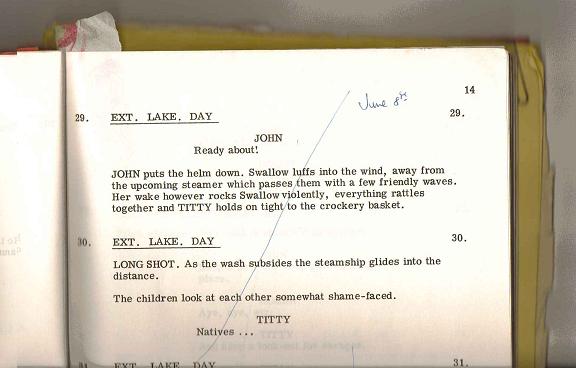
In the script Roger is down to say, ‘Steamship on the port bow’. I think what came out was, ‘Look John! Over there – steamer ahead!’
The Tern had a young, inexperienced skipper who was coping with a notch throttle, as you can see if you watch the movie.
The screenplay of David Wood’s adaptation of Arthur Ransome’s classic book ‘Swallows and Amazons’ set in the Lake District in 1929
My mother, who normally looked after us, had been obliged to drive to Bristol as she presented a weekly programme for HTV with Jan Leeming called Women Only and had been summons to promote the channel at the Bath and West Show. Dad must have been acting as our chaperone, responsible for our safety. A sailor with years of experience racing on the Solent, he took a keen interest in all the boating scenes, but I’m sure he didn’t have a chaperone’s licence. As we sailed towards him, on an intentional collision course, he foresaw that the larger vessel would take our wind.
Three men of Cumbria who were happy to have short-back-and-sides haircuts on the deck of the MV Tern on Windermere in 1973 ~ photo: Martin Neville
My father watched from above as we only just turned in time, missing the steamer by a mere nine inches as her bow wave bounced us away and we sailed on. Ronnie Cogan had to buy him a whisky. They knew Sten could hardly swim, that any of us could have been entangled in the ropes and camping gear if Swallow had gone over. Clinker-built dinghies can sink quickly. It was a sunny day but the water was icy and very deep.
We did not know it at the time, but Dad nearly took me off the film. He had a meeting with the producer when he tested the BOAC life jackets we rehearsed in. Mine did not inflate.
Phil Brown, who belongs to the Arthur Ransome Group, said: “Tern was re-engined in 1957 with two diesel engines. Interestingly she was to have been named SWALLOW, but after a last-minute change, she was launched in June 1891 as TERN.”
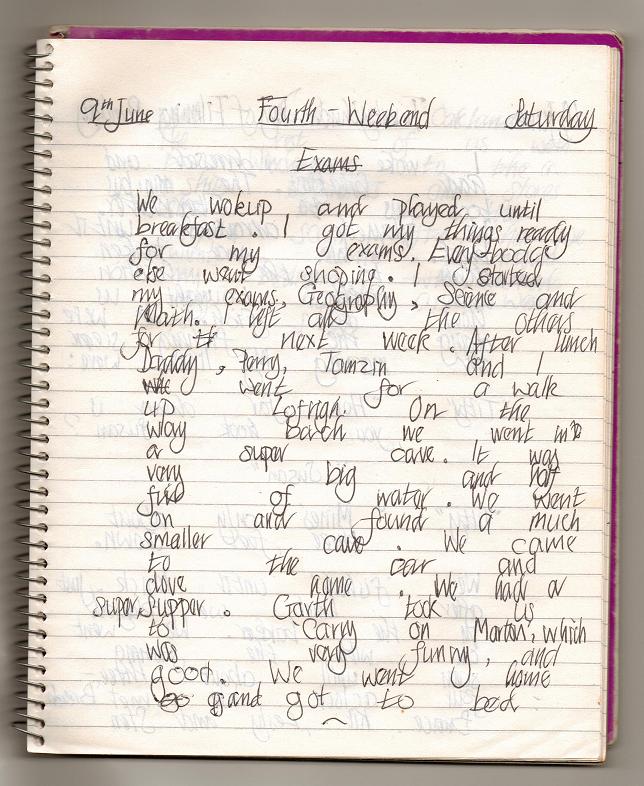
It is said that children bounce. The next day, I sat school exams: geography, science and maths.
…‘Carry on Matron’. I wonder what near disasters they had on that film.
You can read more in the ebook ‘The Secrets of Filming Swallows and Amazons (1974)’ available from Amazon Kindle, Kobo, iTunes and all other online retailers:
The dinghies Swallow and Amazon with the camera pontoon at Peel Island on Coniston Water ~ photo: Martin Neville
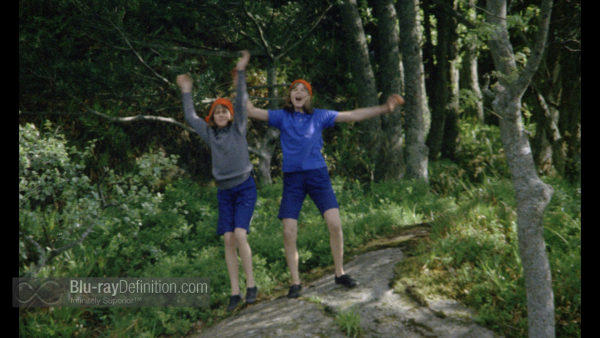
How do you film two girls sailing a thirteen foot dinghy talking to their brothers sailing along in another small dinghy while calling out to two other girls in red bobble hats dancing about on a wooded island which both the small boats are approaching?
The scene looks so simple on paper. It is the one when the Swallows sail back to Wild Cat Island with the captured Amazon to find Nancy ‘dancing with rage’ and Peggy anxious to get home before breakfast. One page of script.
Claude Whatham soon discovered that he was shooting the most complicated of sailing scenes. On a cold grey day in the Lake District.
It is extremely difficult to describe how he managed this, but I will attempt to do so.
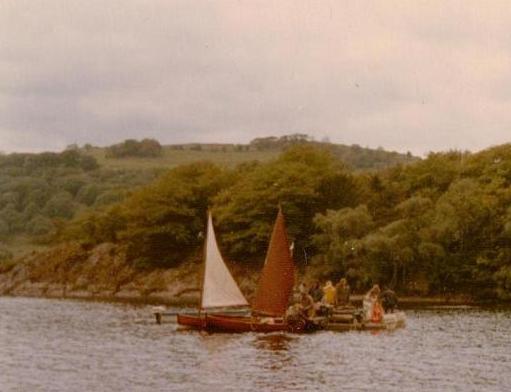
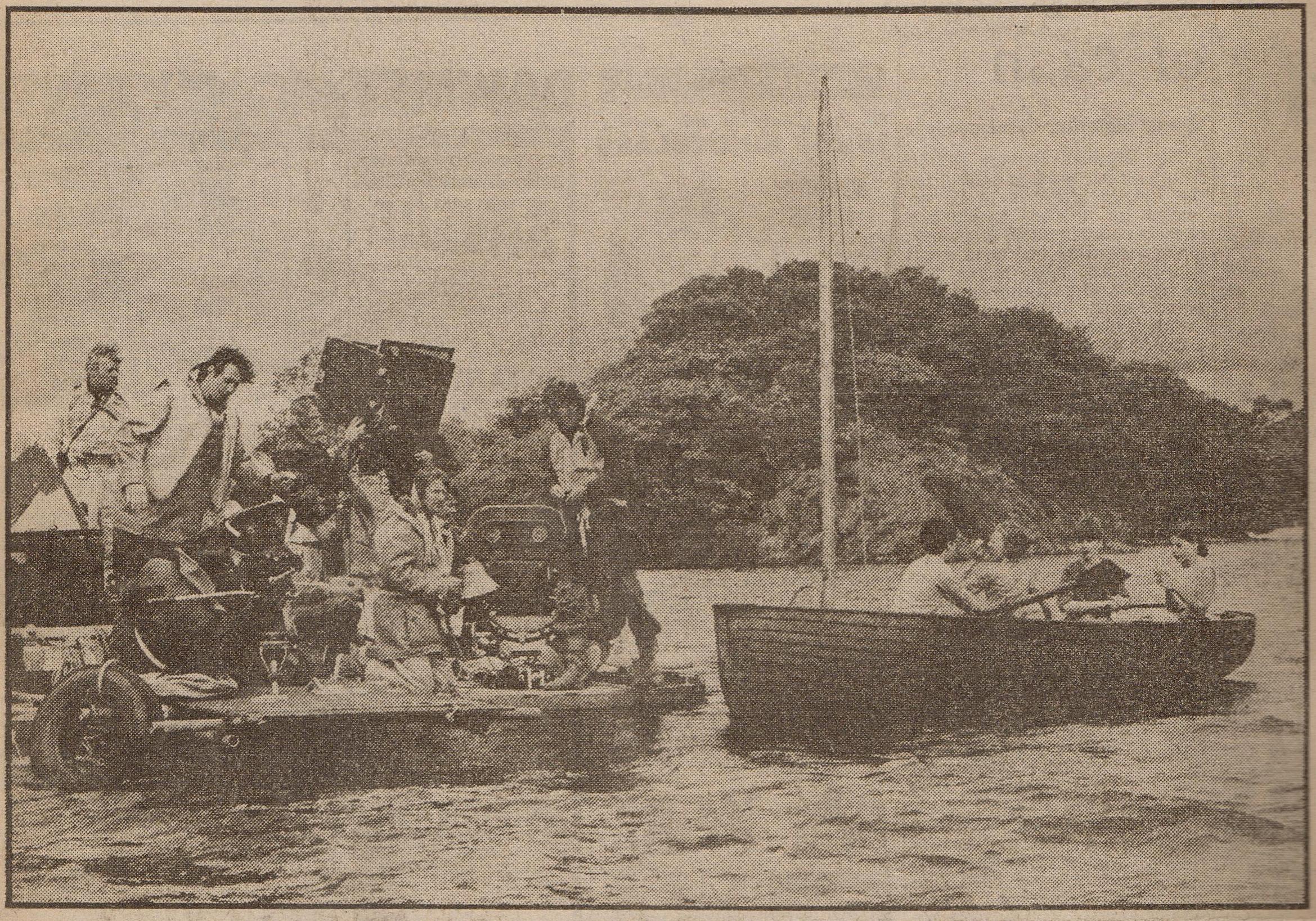
There was no room in the dinghy Amazon to film Susan and Titty sailing. This had to be done from a boat or vessel lashed along side. The production had a pontoon hired from Mike Turk in Twickenham and managed with the help of Nick Newby at Nicole End Marine near Keswick. It was a sizeable raft equipped with four outboard engines and surfaced with a number of flat ‘camera boards’.
Basically rectangular, it had arms added on either side. The idea of this cross-shaped platform was to enable Claude to film us either side-on, from astern or across the bows of the dinghy, which was wired by its keel to the pontoon. The camera was normally on a tripod. The original idea was that it could be mounted on a short section of track but I don’t think this ever happened. Electric lighting was not something that could be used on this pontoon but two large reflector boards were used to light our faces instead.
The result was a shot used on the cover of a book and a DVD marketed by the Daily Mail in 2008.
As well as the director and camera crew, the sound recordist and ‘boom swinger’ were on board the pontoon along with Sue the continuity girl. Costume, make-up and our chaperone would be in a separate safety boat, in this case a Capri. This would mill about with the life jackets, sunhats and warm clothes that we wore between set ups. The crew all started off wearing life jackets, but as you can see they were soon discarded. They were dangerous things, old BOAC ‘life vests’ with so many flappy straps that you were at risk of being trapped under water by them.
The pontoon was operated by two boat men under the eye of David Blagden, the sailing director. They had to work with Claude and the wind so that when we were sailing, while the pontoon travelled with us. This was tricky enough on open water. If we were near the shore it could become more difficult. As you can imagine the dinghy could easily start to sail away from the clumsy pontoon – or worse. Our mast socket broke that first day. They needed my father on that pontoon. He there, quietly was watching from the shore.
The camera pontoon on Coniston Water with Amazon attached to it and Swallow sailing to the other side of Peel Island during the filming of ‘Swallows and Amazons’ in 1973~ photo: Martin Neville
Although we had all read the book of Swallows and Amazons, and were devoted to adhering to every detail, no one remembered that John and Titty sailed the captured Amazon back to Wild Cat Island. She had a centre board which was a new thing for the Walkers so John decided to let Susan helm their familiar boat. I wish this had been detailed in the script. In the film, John was with Roger in Swallow whilst Susan and I were in the Amazon, which was a pity. I can only imagine that Claude decided this because he was trying to achieve a very difficult ‘three shot’. He was relying on John – on Simon West, who was aged eleven – to keep sailing Swallow in the right position, whilst out on the water between Amazon and Wild Cat Island.
Simon West as Captain John sailing Swallow . Sten Grendon plays the Boy Roger in the bows
This wasn’t as easy as it looks. You can see from this photographs that Swallow kept racing ahead of the pontoon. It can be gusty around Peel Island and the rocks can be lethal. Roger was on lookout but he also had to deliver his lines. Having no centre board and a shallow 1920’s rudder Swallow can be difficult to turn or get going if the wind slacks. This wasn’t actually a problem; Simon had wind and he did brilliantly. Suzanna Hamilton did too. She had no previous experience of sailing the Amazon. No one had remembered this sequence when we practiced before the filming began.
Molly Pilbrow and her dog with my sister, watching the camera pontoon from the shore of Coniston Water ~ photo: Martin Neville
Meanwhile Gareth Tandy, the third assistant director, was standing-by (probably for hours) on Peel Island with Nancy and Peggy. He had hide in the bushes and cue them at just the right time. They did so well. They had to deliver their lines while jumping from rock to slippery rock to keep up with both the Swallow, the camera and the story.
The Swallows and The Amazons in the Capri ~ Suzannah Hamilton, Kit Seymour, Daphne Neville, Stephen Grendon, Simon West, Sophie Neville and Lesley Bennett ~ photo: Martin Neville
When we filmed two of Arthur Ransome’s other books, Coot Club and The Big Six, on the Norfolk Broads in 1983, the BBC producer Joe Waters used a 35 foot river cruiser as camera boat. It could be difficult keeping it stable during a take, especially with so many people on board, but being a proper boat it was much easier to manoeuvre than the pontoon. And faster. Andrew Morgan, the director still managed to get his camera angles and it had the advantage of a cabin where sensitive equipment such as film stock and lenses could be stored. I can remember the camera assistant changing the film on board. I don’t know if the boat had heads. May be.
On both productions we had the inevitable problem of modern boats coming into shot. We had to have one of two men in zoomy motorboats that could zip across the open water to ask them to move clear of the shot. Even with this control you can imagine what happens. You line up your shot with all your boats in position, the sun comes out and a modern motorboat roars across the lake leaving you all rocking in its wake. Then it rains.
The good thing about having a safety officer in a frog-suit is that they can carry you to shore at the end of a long day. You don’t have to get your feet wet.
The Safety Officer and me, with Dennis Lewiston and Claude Whatham still standing in the Amazon ~ photo: Martin Neville
The question is – Did the DOP and the director get carried ashore too?






















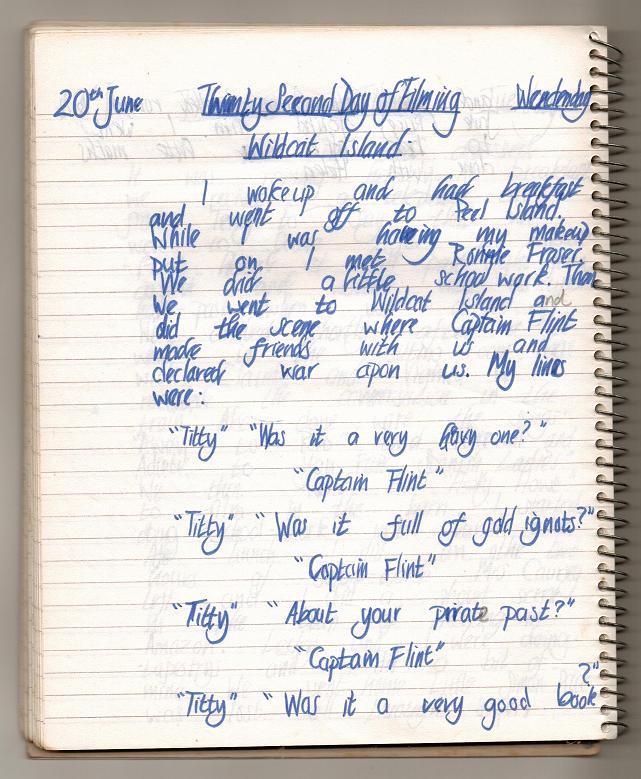

 The recording of our scene with Captain Flint on Peel Island went smoothly, and Claude Whatham the Director was happy with the result, but my diary reports that a Force 8 gale blew in. This spun the poor production team into a quandary.
 Amazons, were all together, not sailing but on Wild Cat Island, with the novelty of working with Captain Flint for the first time. Kit and Lesley had been so patient, waiting day after day for their scenes to come up. They were stuck having lessons with our tutor Mrs Causey in the red double-decker bus most of the time. But the fact that they were on stand-by was helpful to the production manager who had to wrestle with the film schedule and call sheets.


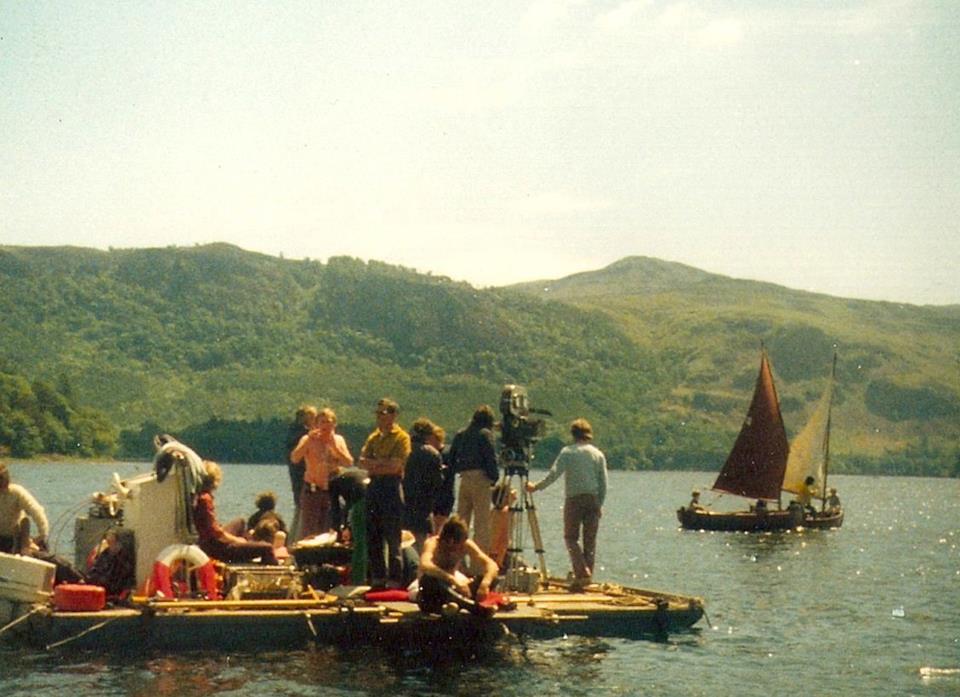







 Basically rectangular, it had arms added on either side. The idea of this cross-shaped platform was to enable Claude to film us either side-on, from astern or across the bows of the dinghy, which was wired by its keel to the pontoon. The camera was normally on a tripod. The original idea was that it could be mounted on a short section of track but I don’t think this ever happened. Electric lighting was not something that could be used on this pontoon but two large reflector boards were used to light our faces instead.



 Sophie Neville