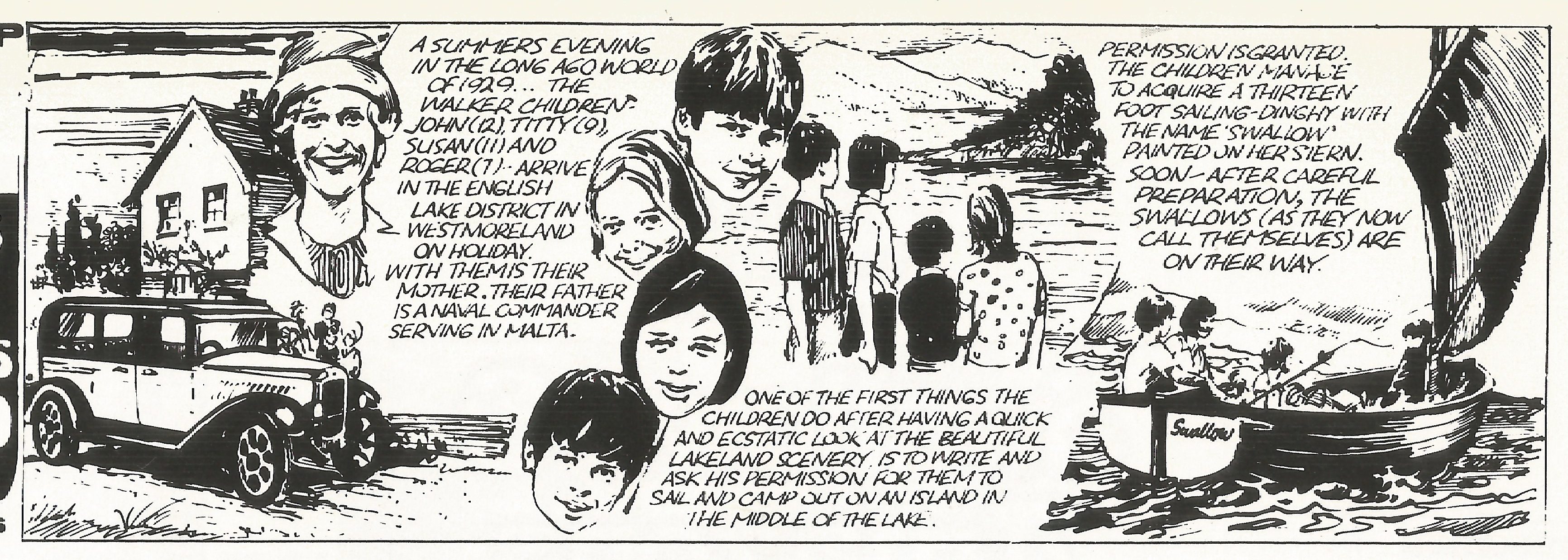
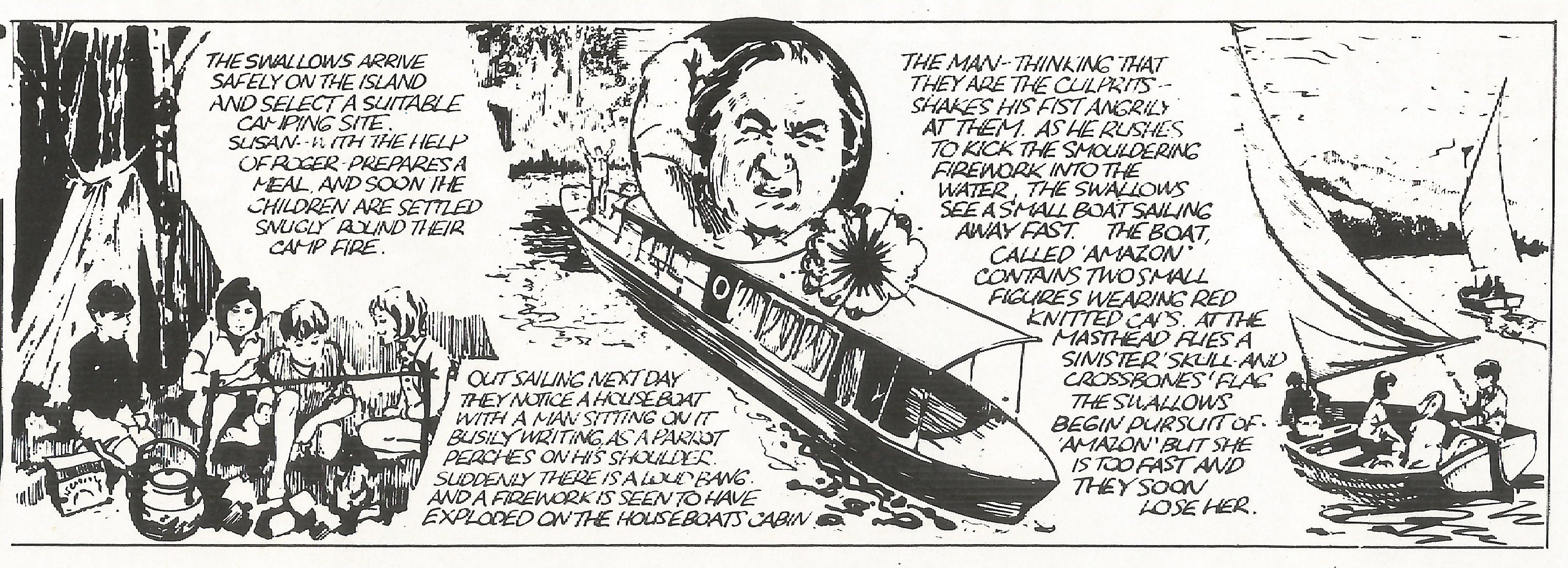
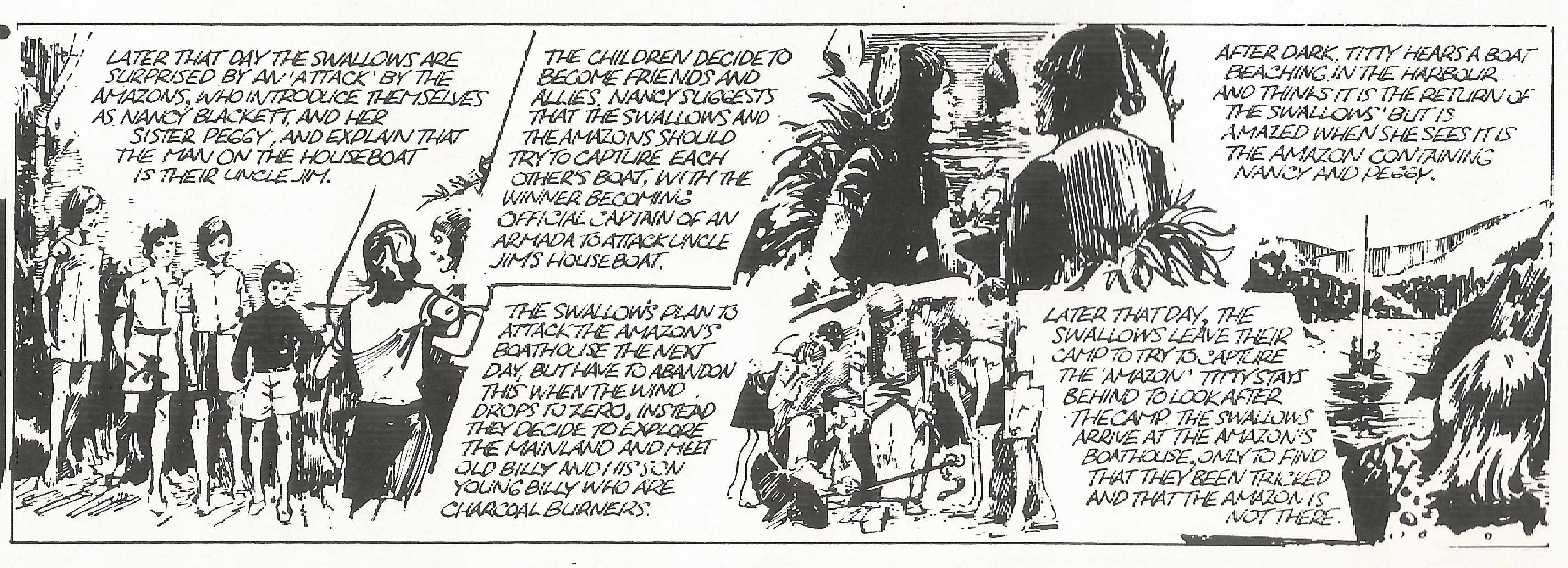
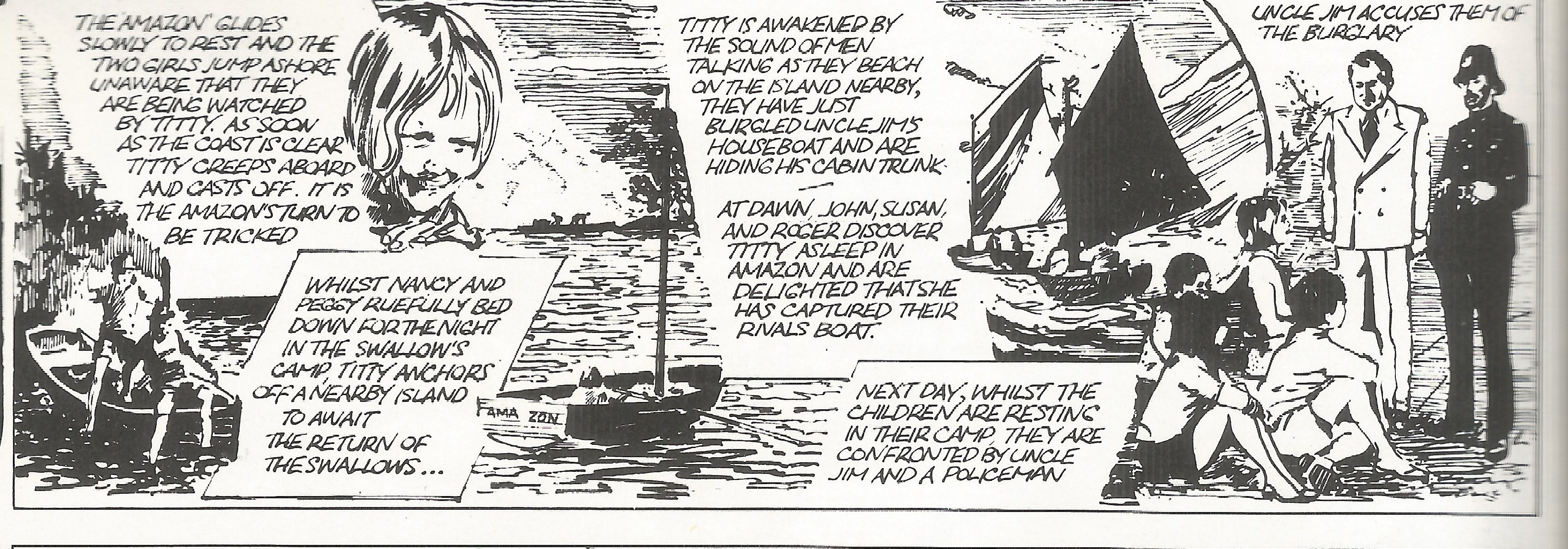
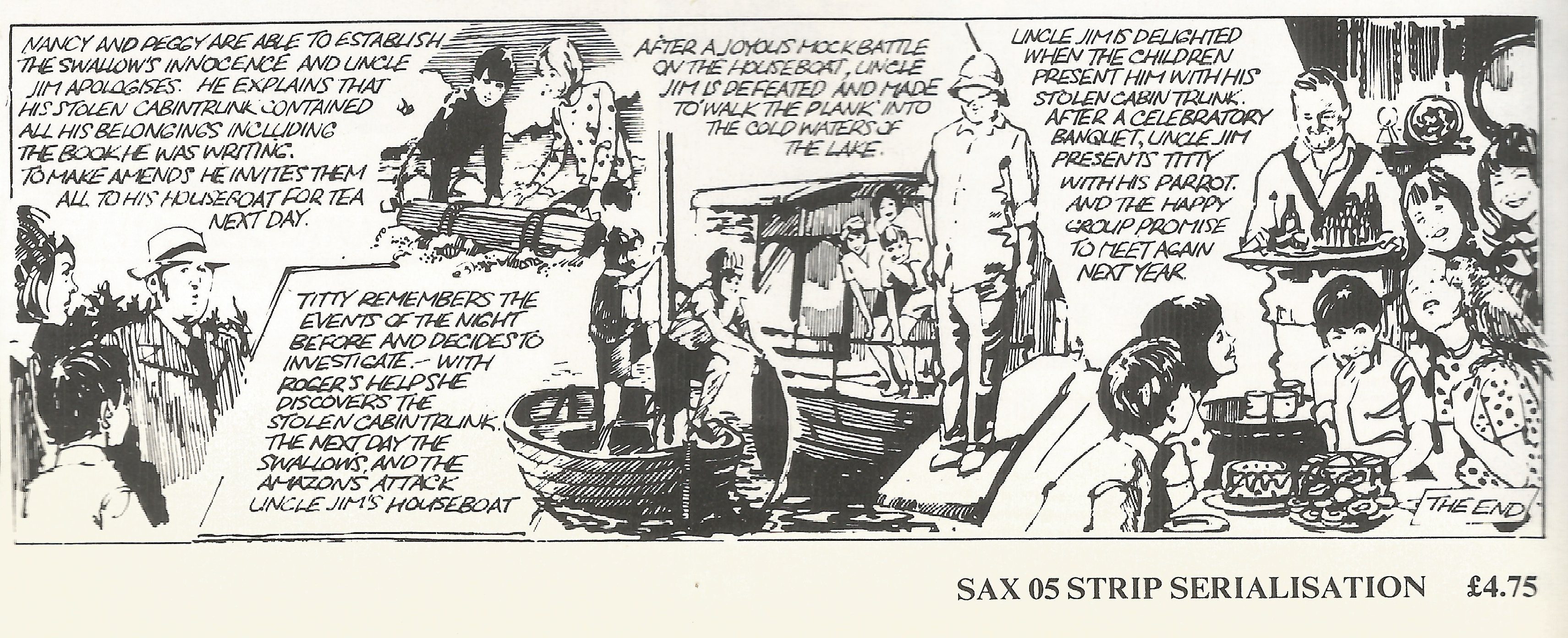
“The graphic novel version of ‘Swallows and Amazons’?” Not exactly. These illustrations made up a five-part “serialisation strip” or “picture strip” provided for cinemas to include in promotional material advertising screenings of the original movie. They were designed to be, “particularly suitable for running on the Children’s Page of your local newspaper for the five days proceeding the film’s premiere.”
These were distributed in April 1974 along with colour photographs, black and white stills and background information on the characters and the actors who played them. The quotes are quite fun: ‘Ronald Fraser has few illusions about either his face or his dramatic abilities. “…it’s the old hooter that does it you know… I read Swallows and Amazons many years ago as a young rip and seem to remember imagining myself as John, leader of the Swallows. Now it turns out that I’m Uncle Jim after all.”‘
Dame Virginia McKenna said how much she loved the books, explaining that she was on a family holiday in Sardinia when she was offered the part of mrs Walker. Her husband, the film actor Bill Travers, accepted on her behalf, knowing she would love working in the Lake District.
The film director, Claude Whatham was also profiled. He had previously made the movie “That’ll Be The Day” with Ringo Starr and David Essex, which was released in cinemas with an LP featuring pop songs of the 1950s.
The LP that accompanied ‘Swallows and Amazons’ was narrated by David Wood, the screenwriter who had adapted Arthur Ransome’s novel. It is rather wonderful to have a recording of Wilfred Joseph’s iconic score. I was amazed to find pictures of myself on the cover.
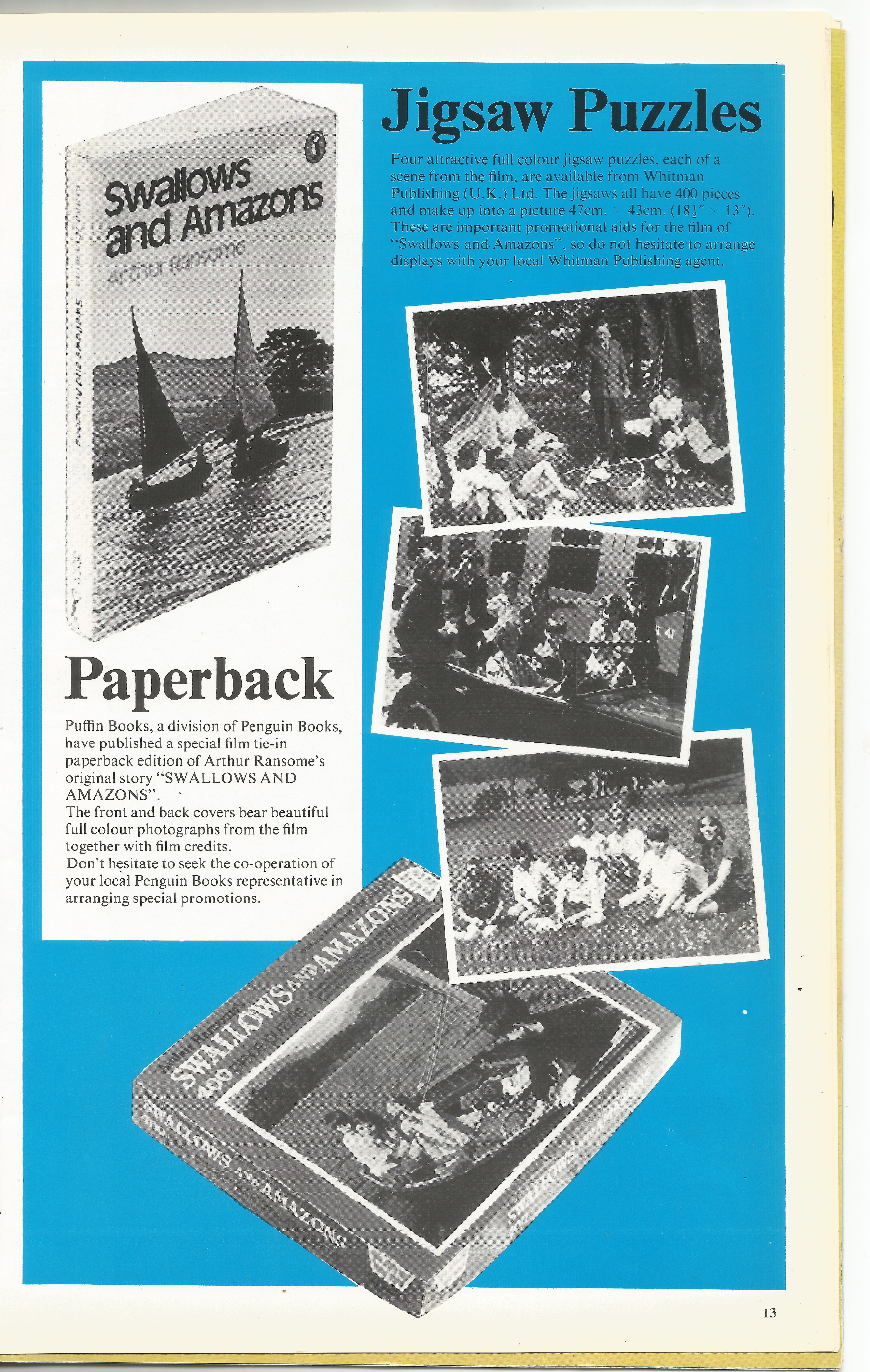
Specialist advertising material such as this, being over fifty years old, is both rare and collectable. Four jigsaw puzzles and the Puffin paperback were produced, featuring film stills taken on location by Albert C Clarke.
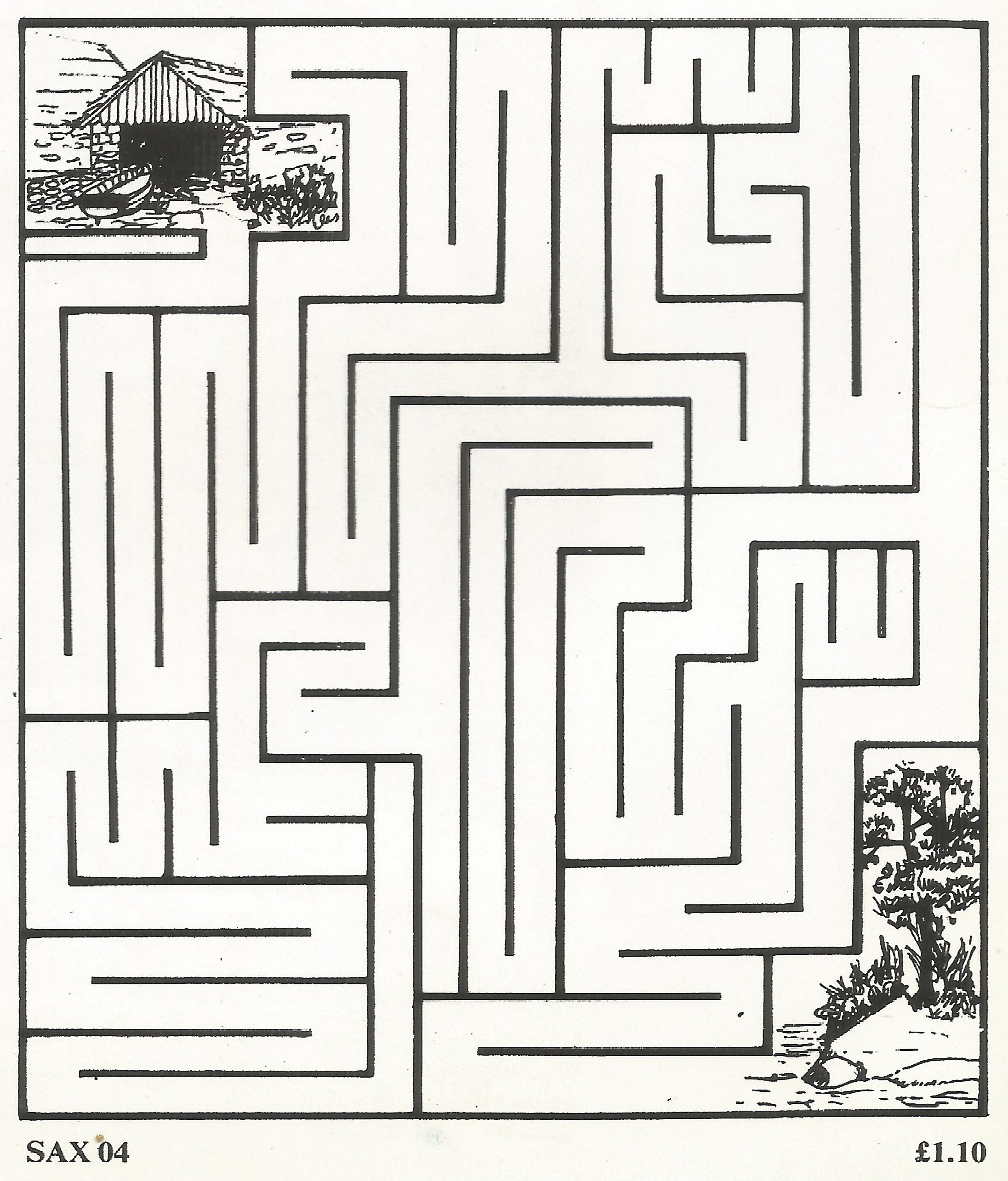
There were puzzels, such as this maze, along with pictures to colour and “spot the difference” blocks, which you can see on an earlier post on this website. All these ideas were probably generated by our wonderful film publicist Brian Doyle. I’ve written about the preview screenings and his work on an eariler post here.
Brian was on location the entire time we were filming, showing around journalists almost every day. You can read the full account of how we made the film in ‘The Making of Swallows and Amazons’, which is now available as an audiobook, narrated by me, Sophie Neville.
I recall being contacted by a friend who had just passed his driving test, and wished to spend a lazy day in the Lake District where he’d insisted on hiring a rowing boat in Bowness on Windermere in order to ‘enjoy the beauty of the lake’. While heading out from the jetty towards the ‘Lily of the valley’ island in rather a clumsy fashion, I was asked. ‘Who do you want to be, the Swallows or the Amazons?’
At a later date I was given the book ‘Swallows and Amazons’ written by Arthur Ransome together with a video and an original vinyl of the music soundtrack. Turning the pages of the 1930 novel was like opening a door to several other worlds for suddenly the lakes swept in like the most refreshing breeze that kindled an inner passion for hills, mountains, lakes, sleepy streams and mists, early morning stillness on the water and sailing adventures.
Watching the film for the first time was a turning point in my rather dull experience of being at school in the north west of England with its drab corridors, gray walls and endless smoking chimneys out to the horizon.
Within a very short time I too have taken a seat on a train en route to the Lake District in 1929 that had a family travelling together in one of those wonderful old carriages consisting of four children and their mother who were to spend a holiday together in a beautiful farmhouse nestling in the trees by the lake.
For some reason William Wordsworth’s immortal words ran through my mind: ‘Beside the lake beneath the trees fluttering and dancing in the breeze.’
The story touches on many human aspects that we all learn to accept as a part of our evolvement into adulthood and which today seems to have got lost in the quest for an increasingly fast world understanding and a computer generated experience.
The joy of the family arriving at the farmhouse and standing there looking out over the glorious Lakeland towards their dream island where it’s hoped they will be able to embark on a camping holiday after receiving permission from their absent father.
The four children, John Susan Titty and Roger Walker, all displayed an individual aspect of evolvement, with Titty engrossed in the book ‘Robinson Crusoe’, using her vivid imagination to create the island realm and keeping a hand written diary, while John seemed to be moving towards a Naval leaning by spending his time learning the basics of Morse code, boat handling and navigation. Young Boy Roger enjoys stuffing himself with anything he can possibly eat, appears to be showing signs of enjoying the great outdoors, and wants more adventure. Susan comes across as the mother figure who thinks about the younger siblings and what they all will be eating while on their adventures.
The story unfolds as the children receive the go ahead in a telegram from their father to sail over to their island to camp in a borrowed dinghy called ‘Swallow’. A burgee is sewn up to fly from the mast depicting a swallow. This news is received with unadulterated delight by the children who immediately begin the preparations.
The lake and mountainous surroundings featured in the film begin to open up as the children undertake their journey to discover sailing rivals in Nancy and Peggy Blackett who live in one of the houses bordering the lake and own a dinghy named ‘Amazon’ that sports a ‘pirate’ burgee.
Initial rivalry erupts between the Walkers and Blacketts, which results in eventual harmony as the two sides join forces to capture a common enemy who just happens to be the Blacketts’ ‘Uncle Jim’ who owns a houseboat on the lake and is busy writing a book.
The Swallows and Amazons decide to host an expedition to capture Jim (‘Captain Flint’) and the houseboat, and, to determine who should be the leader, they make an attempt at capturing each other’s boats.
This requires sailing at night and some pretty shady manoeuvres, which are grievously frowned upon when discovered by the Walkers’ mother when she made a journey to the island to check up on the children and found Titty on her own. John has to confront his mother and explain his reasons to sail in the dark. She reluctantly accepts his explanations but with a proviso that no further actions of this sort will occur again for the remainder of the holiday.
Titty won the day by seizing an opportunity to capture the Amazon boat while the Blackett’s were on Wild Cat Island, making the Walkers the winners. This leads up to the finale where there is a sea battle as the Swallows and Amazons launch an assault on Captain Flint and the houseboat when he is captured and made to walk the plank. The end of the film sees Titty gifted with Flint’s pet parrot who seemed to have taken quite a shine to her, and everyone resolves to be kindred spirits for ever!
After watching this film my mind was transported to the lakes and sharing the beautiful sunny days, crispy clear water and blue skies with the backdrop of the mountains the wooden jetties and a sailing journey into Bowness for supplies. I could sense myself seated in the lugsail rig and feeling the tug on the main sail as the boat crept closer to the wind before going about and heading away onto another tack.
I was carried with the family into that other realm and other time where innocence and responsibility were coming to the fore, where family values were held dear and independence was something young people strove to achieve within the simplicity of their everyday existence. For the brothers and sisters to go camping on a small island in the middle of a lake away from any overseeing adult, and to arrived there by sailing over in a borrowed boat, leaves little to the imagination.
There was a sense of adventure with the children, and a wanting to show they could be responsible and look after themselves, something in today’s society we have to a degree lost touch with. That immortal sense of adventure within a landscape never changes, except within its own light that we know and love today as the Lake District.
This film is a journey into another dimension and another world steeped with love and belonging, adventure and moral understanding, which is shared between a family and accepted.
The characters are bought to life almost as if they are an infinite, integral part of the immortality of the story, each giving that picturesque understanding the viewer finds impossible to explain.
After watching this film one arrives back in real time with a resounding bang! We wonder why such a simple story can create such an iconic understanding, why watching this film can make you feel happy, totally complete and yearning to return again and savour that wonderful, eternal landscape we have all learned to grow and love as The Lakes.
Do think of leaving a review of this film on the International Movie Base site. The link for ‘Swallows and Amazons'(1974) is: https://www.imdb.com/title/tt0072233/
People often write to say how much they have enjoyed the original film ‘Swallows and Amazons’ (U) produced by Richard Pilbrow in 1974, which is currently streaming on Amazon Prime. Being suitable for all ages, it is often screened at outdoor festivals and is on Netflix in Europe.
‘Is it a good movie?’ people enquire of Google.
Helen Fielding mentions the DVD of Swallows & Amazons 1974 in the first edition of ‘Bridget Jones: Mad about the Boy’ claiming it to be more edifying for her children to watch than ‘Beverley Hills Chihuahua 2‘.
Dame Margaret Drabble told Claude Whatham, the director, how much she loved Titty in his filmof Swallows and Amzons, which was a huge compliment.
Sophie Neville as Titty in 1973
Elspeth Huxley CBE – author of thirty books including The Flame Trees of Thika – loved the 1974 film of Swallows and Amazons, reviewing it for The Tatler magazine under her married name, Elspeth Grant.
Simon West, Sophie Neville and Suzanna Hamilton appearing in The Tatler
There is special interest from a number of authors –
Wendy Clarke, who has set some of her psychological thrillers in the Lake District auditioned for the part if Titty in 1973. You can read her story on another post here.
When Catherine Lamont from Australia wrote on Facebook to say, “Just read a 2020 book mentioning ‘Swallows and Amazons’ (someone spotted in a bookshelf belonging to one of the main characters): The Enigma Game, by Elizabeth Wein” the author hrself, Elizabeth Wein, wrote in to say, “Not just in The Enigma Game – I namedropped Swallows & Amazons in my novel Code Name Verity, too! It was given to me by my grandmother’s best friend when I was seven and was one of my favorites. My own children, who never actually read it, were huge fans of the film”.
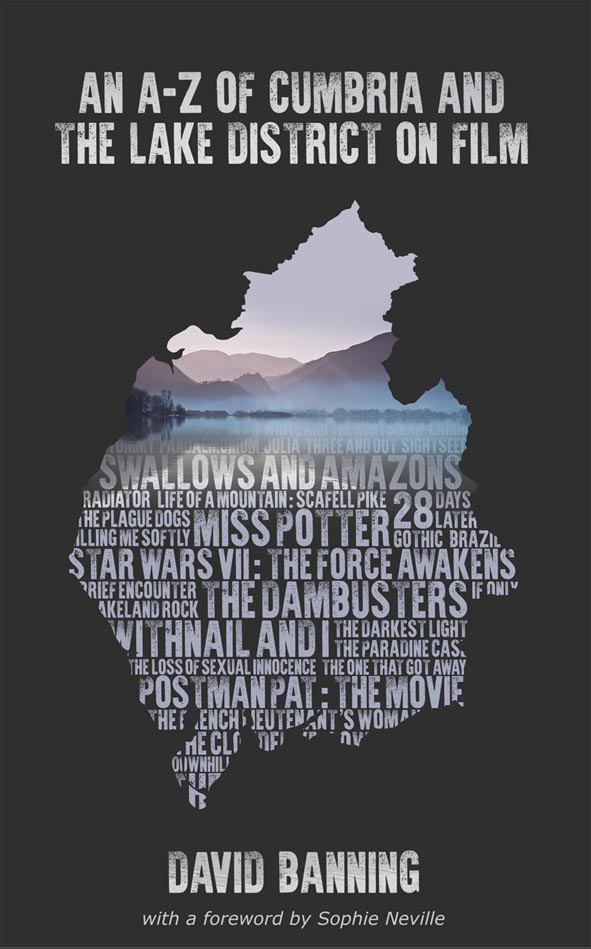
The arts curator David Banning profiled the 1974 movie of Swallows and Amazons in his book on films made in Cumbria and the Lake District, which you can see here.
Trevor Boult, who writes books on ships and sailing, is a great fan. He kindly donated the royalties from his most recent book Boats Yet Sailing to The Arthur Ransome Trust. You can order a copy direct from the publisher here.
For a list of well known people who love the Swallows and Amazons books, please click here
Do you know of any other authors who have written about the film? Please leave any information in the comments section, below.
Wilfred Joesph’s title music for ‘Swallows and Amazons'(1974)
You can read the first section about how the film was made back in 1973, for free, on the Amazon preview of the ebook here:
Sophie Neville playing Titty Walker in the 1974 movie
‘Titty from Swallows and Amazons’ often gets typed into the Goggle search engine but when I attempt to use it as a ‘tag’ a message pops up saying: ‘Sorry, you are not allowed to assign the provided terms.’ I can only conclude that Google lacks literary enlightenment but the BBC were happy for me to talk about Titty on BBC Antiques Roadshow recently.
Sophie Neville on BBC Antiques Roadshow
‘Memory picks and choses,’ as Arthur Ransome said in his autobiography (p.33) but those who love his novels often wonder what would have happened to the characters when they grew up. It dawned on me that this might be one reason why people are interested to know what we all did with our lives. I played Titty Walker in Richard Pilbrow’s 1974 movie of ‘Swallows and Amazons’. In 1962, the film actress Susan George played the same character in the black and white BBC television serial of ‘Swallows and Amazons’ with her hair in pigtails. She was called Kitty, apparently with Arthur Ransome’s approval. BBC Films decided to call the Able seaman ‘Tatty’ in the 2016 movie ‘Swallows and Amazons’, when she was brilliantly played by Teddy-Rose Malleson-Allen who went on to star in ‘Four Kids and It'(2020).
The character was inspired by a real little girl, Titty Altounyan, who stayed at Bank Ground Farm (or Holly Howe) when visiting her grandparents who lived above Coniston Water. In 1939, Miss Joyce Cartmell acquired a signed note from Arthur Ransome explaining that, ‘Titty is short for Tittymouse which is what she was called when she was a baby. Nobody ever calls her anything but Titty now’. It appears that Ransome was also asked for a photograph of himself, to which he responded, ‘Too ugly’.
Edward Thomas (1878-1917) described Arthur Ransome as ‘exuberant, rash and intelligent.’ In 1973, I can only assume the film director Claude Whatham was looking for the same spirit in us children. It was certainly captured by Wilfred Joseph’s nautical film score.
What constantly impacts me is the number of people who write in to say how much they wanted Titty to become their best friend. In many ways the characters from Ransome’s books become friends for life. You can easily gain others who have the same outlook on life by joining The Arthur Ransome Society, who offer activities and grants for young people as well as adults with a literary bent. You too can stay at Bank Ground Farm and run down the field to dip your hands in the lake.
Staying at Bank Ground Farm – ‘Holly Howe’ with TARS
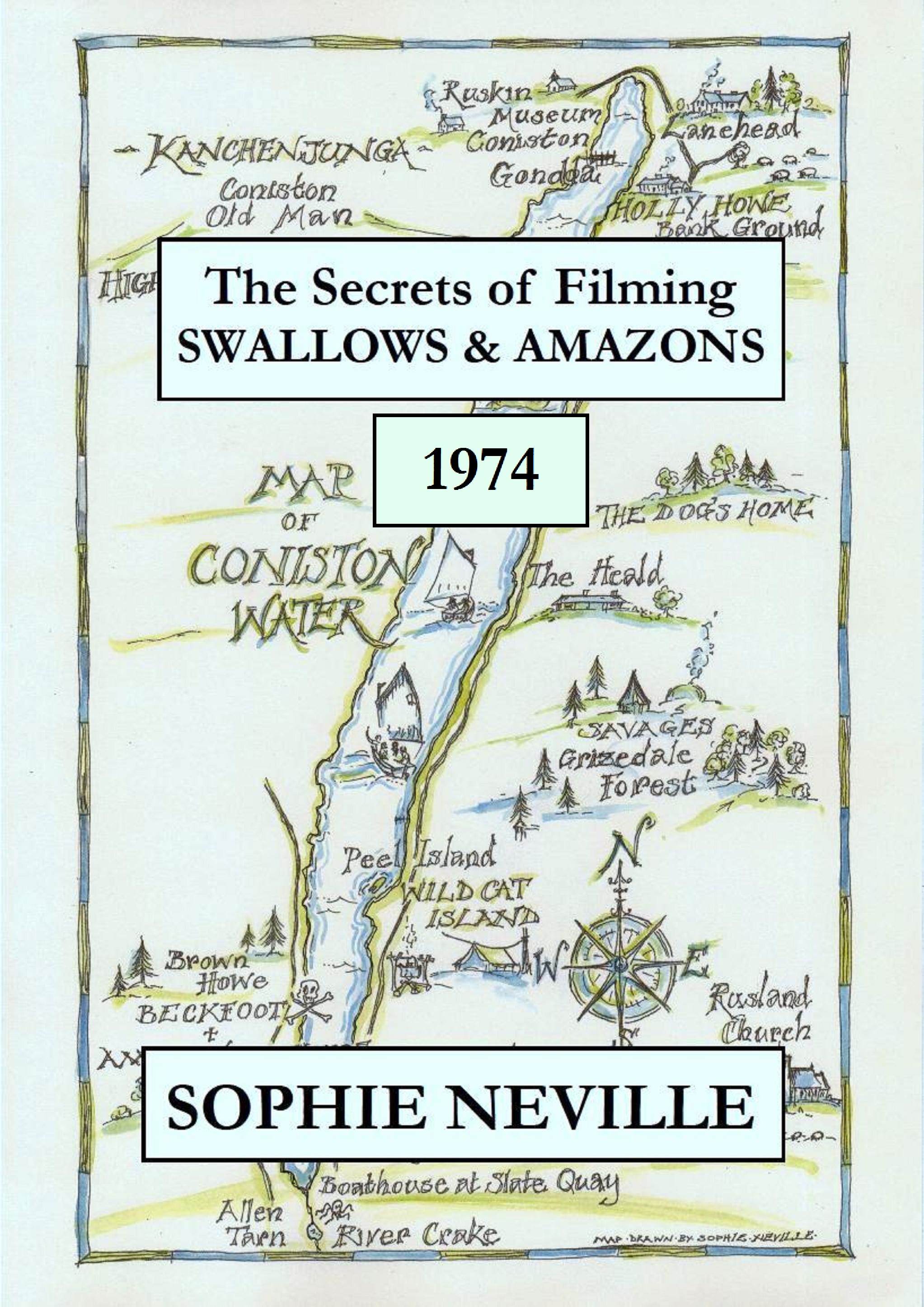
You can read more about making the movie in the multi-media ebook entitled ‘The Secrets of Filming Swallows and Amazons’.
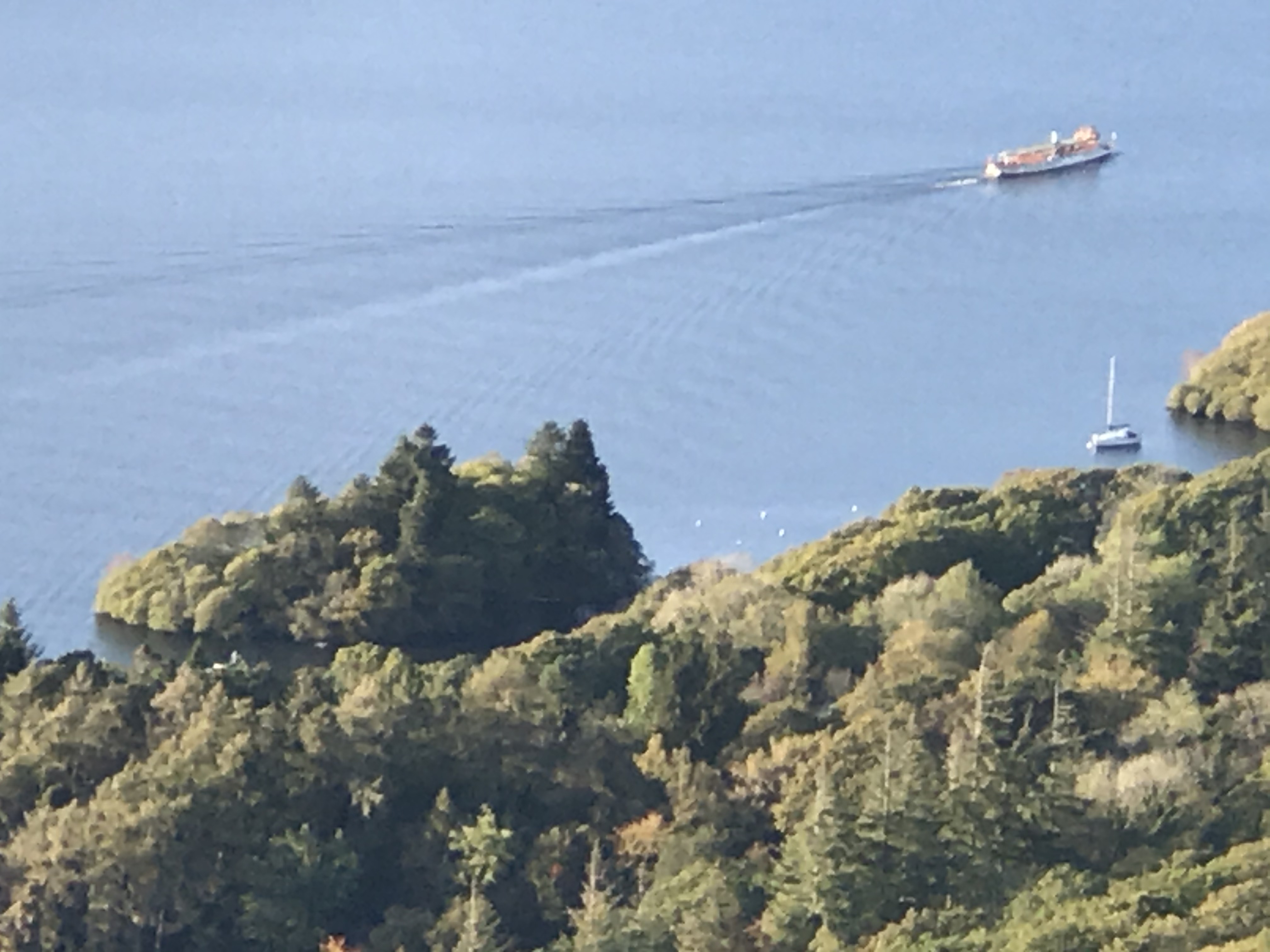
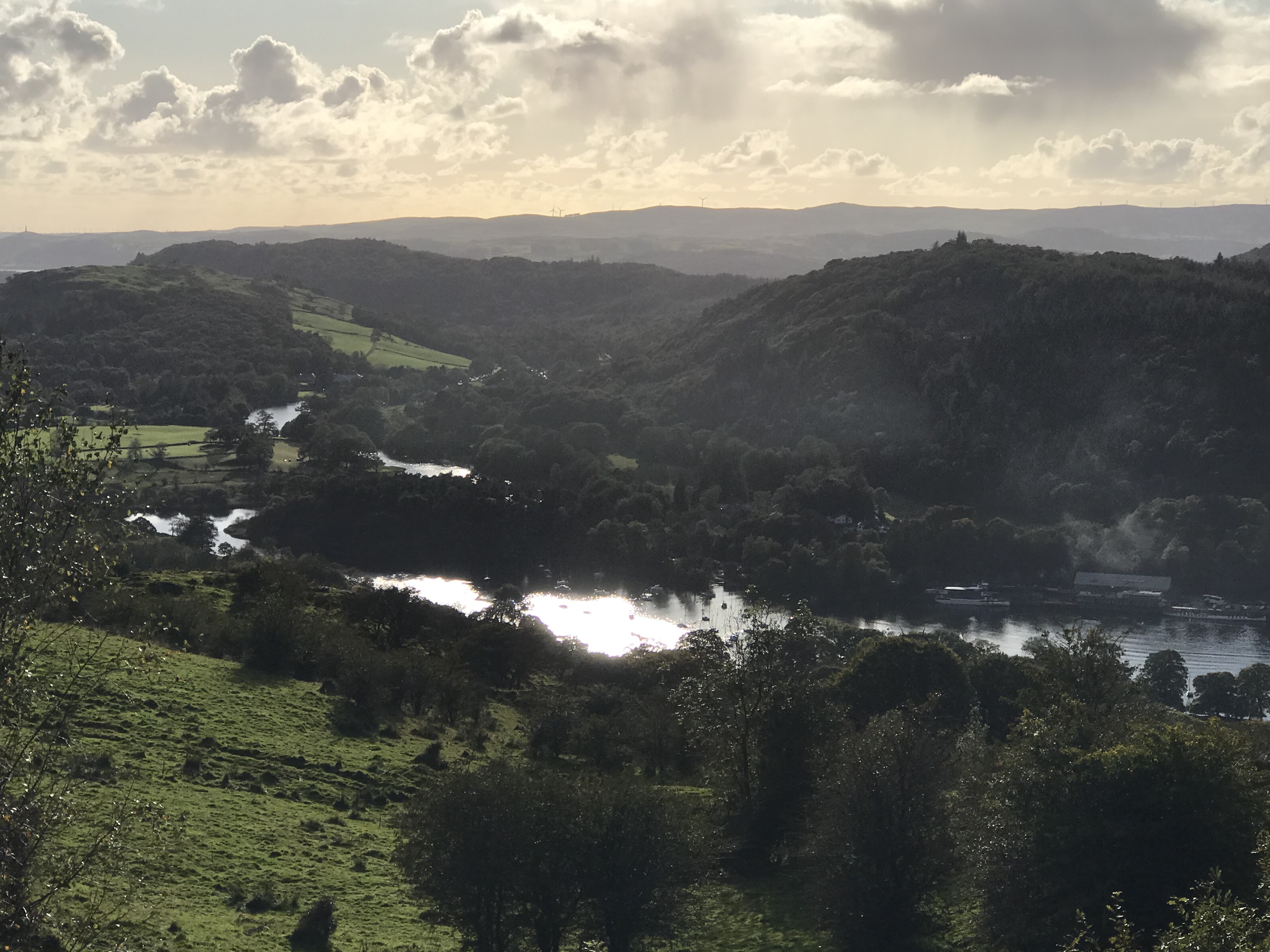
When I was last in the Lake District, I grabbed the chance to climb to the top of Gummer’s Howe to look down on the ‘Great Lake in the North’. Arthur Ransome, who once lived at High Nibthwaite, must have gazed at this exact, same view. ‘Native shipping’ was passing a wooded island and a bay where I could see a yacht was moored. It was like looking down on the chart I once drew for the original film of ‘Swallows and Amazons’ first screened in cinemas forty-seven years ago in April 1974.
Looking to the south, I could see Lakeside Station and the Haverthwaite steam railway running alongside the River Leven where we began filming back in May 1973. The renovated line had only been running for two weeks but we were instantly transported back to 1929, when Ransome wrote the book in a grey barn nearby.
Blake Holme, one of the wooded islands on which Wild Cat Island was modelled
Michael Johnson left a comment on the Arthur Ransome Group Facebook page saying, ‘The Lakeside & Haverthwaite is a lovely line, but frustratingly slow. It’s such a short line that the journey would be over within a few minutes even at a modest speed, like 25mph. Drivers are under standing instructions to drive at little more than walking pace so the journey takes at least 15 minutes. That way everybody thinks they’ve got their money’s worth!’ I hadn’t noticed when travelling on the line myself a few years ago.
The River Leven and southern end of Windermere in Cumbria
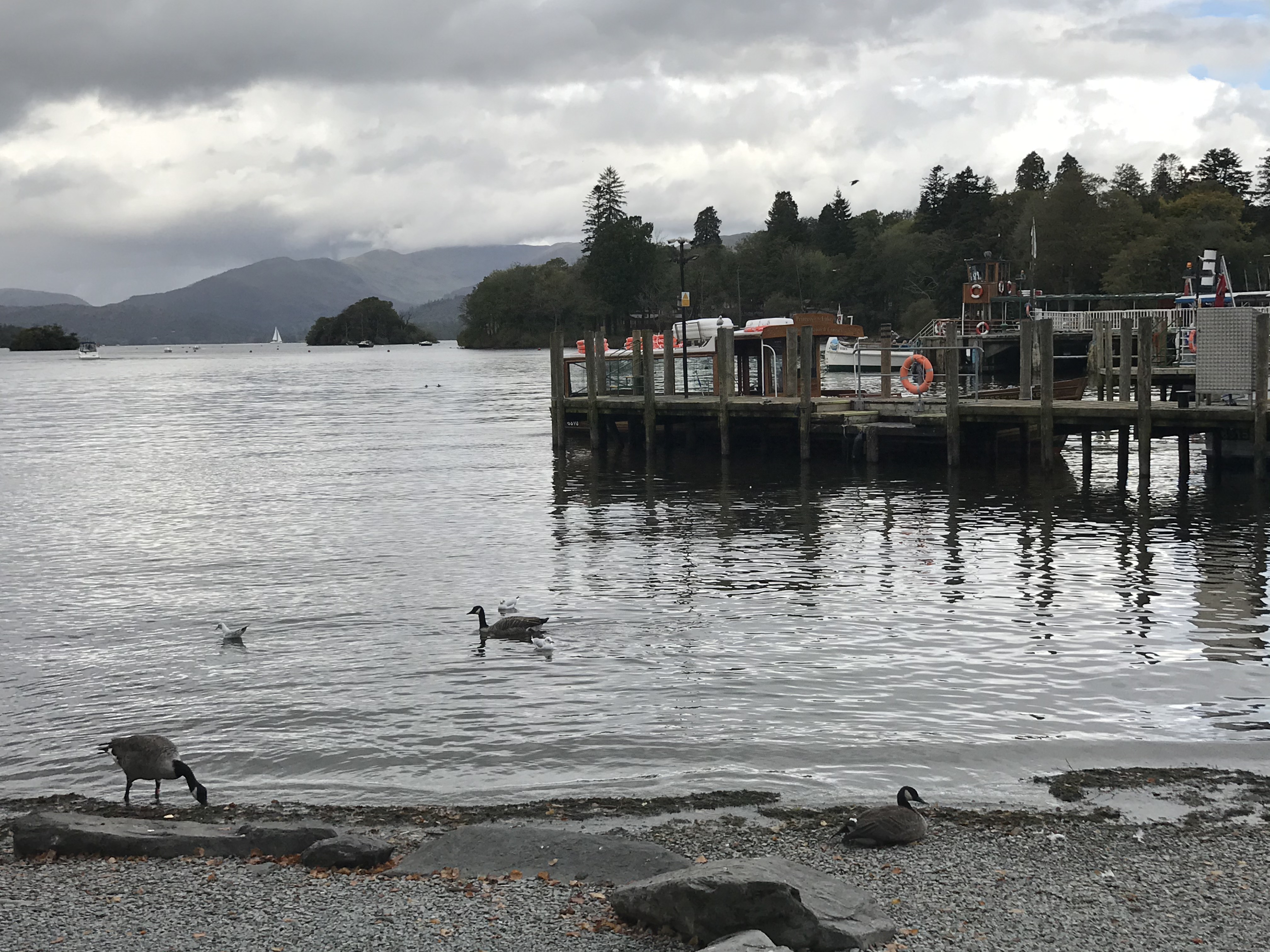
Ransome wrote: ‘Windermere is the lake, a bit disguised’ although he used many locations found on Coniston Water that perhaps he wanted to keep more secret. However, it is clear that Rio is his name for Bowness-on-Windermere, which I was able to explore recently. This was the jetty where the Boy Roger was left guarding Swallow.
Bowness-on-Windermere
Charles Elliot from Bowness remembers us, “filming in the bay with some actors in a rowing boat. There was no security so I walked down the jetty right behind the camera.” Was this captured by the Guardian newspaper here?
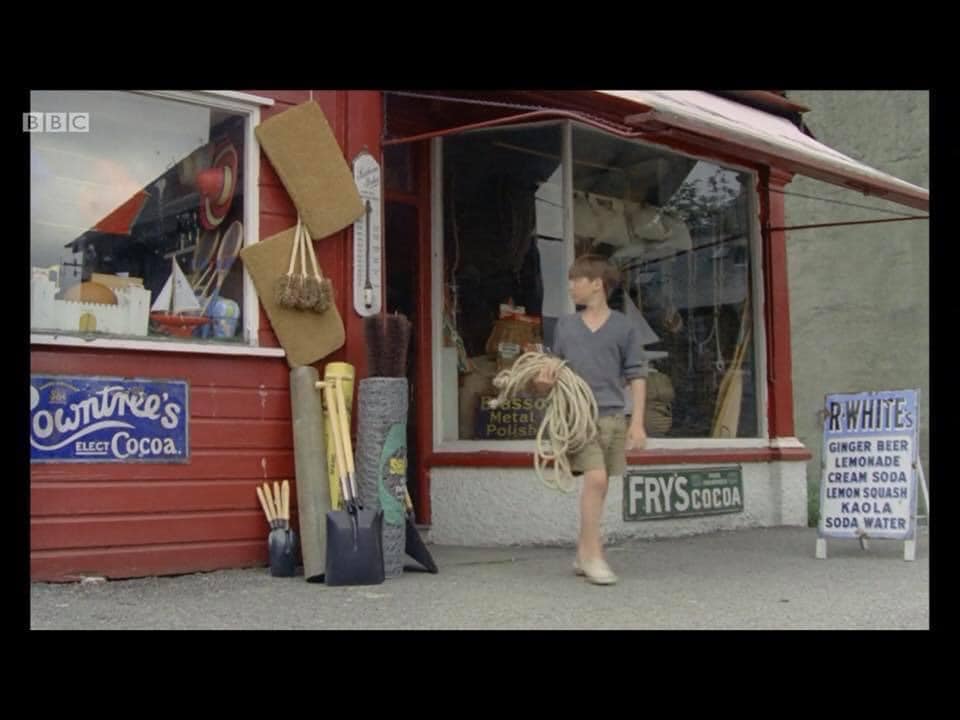
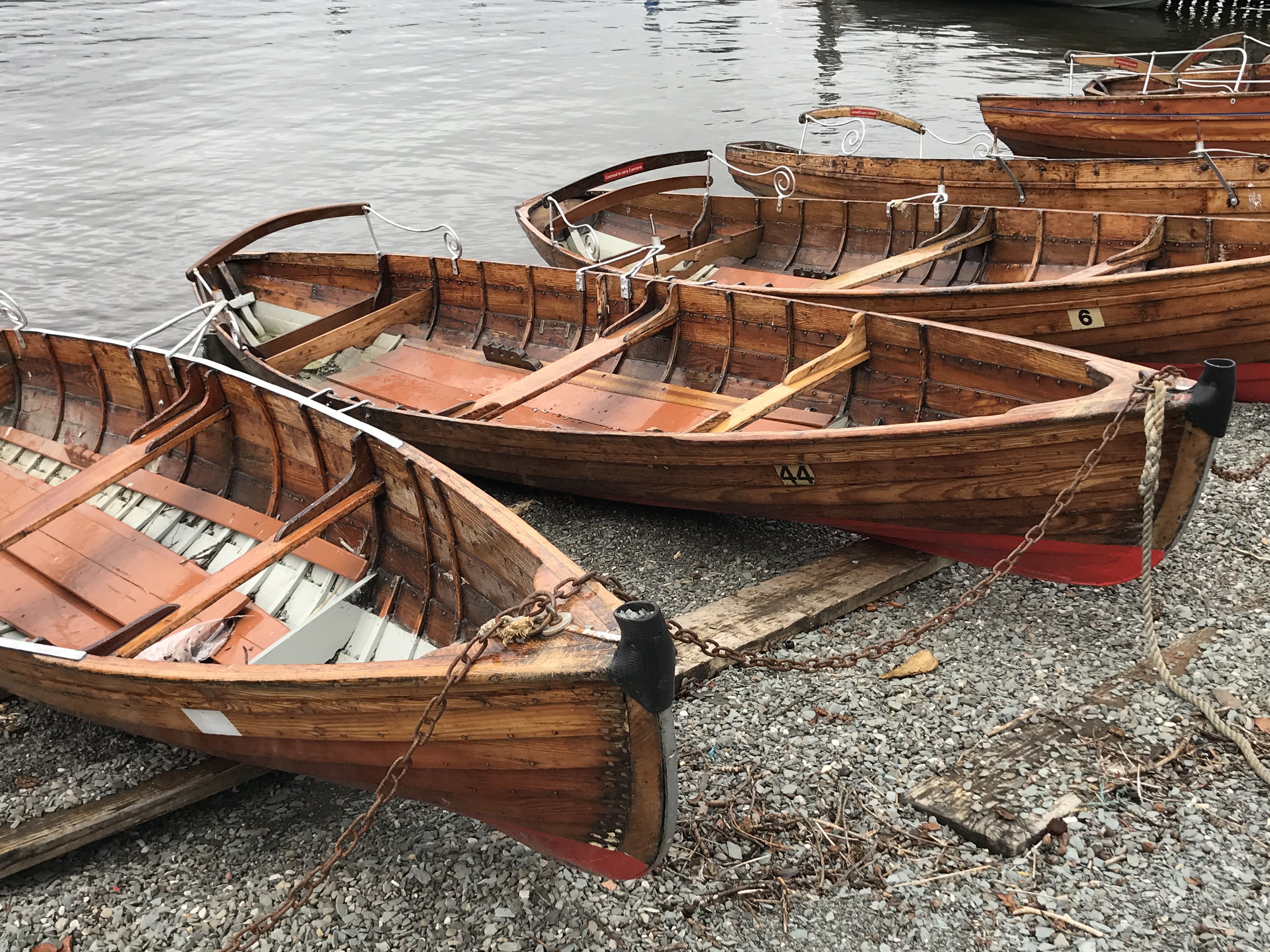
It’s possible find some of the locations and even some of the traditional boats that appeared in the movie. The natives may be able to help you. Brian Salisbury said, “The village store was my grandfather, Tom Kirkbride’s cobblers shop from mid-1930s to mid-1950s.
Woodland Road, Windermere
Stan Cropper took it over and added the LH extension.” He said of our set designer, “They did it up with the original red wooden finish.” The cat was called Rusty.
Simon West as Captain John in ‘Swallows and Amazons’ (1974) – StudioCanal
After he posted this photo on Facebook, Harry Hodgson wrote to say, “I remember looking at all the 1930’s products in the windows.”
This behind-the-scenes cine footage shot by my father in 1973 shows the film extras getting off the coach at Bowness and a scene being shot on the jetty:
Stephen Newton and Phil Procter would go and watch the filming in their dinner break from Borwicks Aquatics. “There was a band playing in the bandstand and a bloke on a pushbike with a front box selling ice cream. You can see this in the film when the kids are on the pier in the background.”
Windermere skiffs at Bowness-on-Windermere
In many ways, the 1974 film ‘Swallows and Amazons’ has become a touchstone to re-set our lives. Nigel Young writes: “On arrival back from touring, I’d get to Oxenholme station and rush home, change into my boots and head to the hills passing through Bowness…. I’d look across the lake and count the trees on the small beach, seven in all? and in my mind’s eye try to place the bandstand which features in the film so prominently. I’d look for the jetty where Roger was confronted by a blazered gent in whitened shoes asking him about his boat and think… ‘What have they done with it?’
Lakeland steamers embarking from Bowness-on-Windermere
“Then I’d look at the landscape and note all the changes since the making of the film before heading home where I’d immediately put the film on, grab a glass of white wine and just sit and watch it, getting transported back in time to another way and another space, but that space still exists in some strange dimension for me, and I feel in touch with the lakes and in touch with a past I can totally relate with. John wears one of those stripy S buckle belts on his shorts. I had one too!
Sophie Neville, Simon West, Suzanna Hamilton and Stephen Grendon in Bowness in the summer of 1973
“You were well cast, almost as if you were a family before you all started and the cinematography, especially where the sailing sequences are concerned, is something out of this world. Whoever shot and edited the footage for the film were totally at one with the story and the locations….. And Ronald Fraser !! …well I would say he really did ‘Swim’ …… I was Principal of an Outdoor Education Centre on Windermere for over a decade and I am aware of just how cold the lake can be in winter or summer….and there goes ‘Ronald’ getting thrown off the plank by you guys into Coniston or Windermere which ever, they are both as cold as each other!”
To read a previous post on finding the film locations and taking the Lakeside and Haverthwaite steam train, please click here
Bowness-on-Windermere
You can read more about the film locations used in ‘Swallows and Amazons'(1974) in ‘The Making of Swallows and Amazons’ published by The Lutterworth Press who can send you a copy.
After a career as a foreign correspondent, which took him to Russia, Egypt and China, Arthur Ransome wrote ‘Swallows and Amazons’ in the hills above Windermere in 1929.
Arthur Ransome portrayed by Dora Collingwood, wife of Dr Ernest Altounyan, on display at the museum
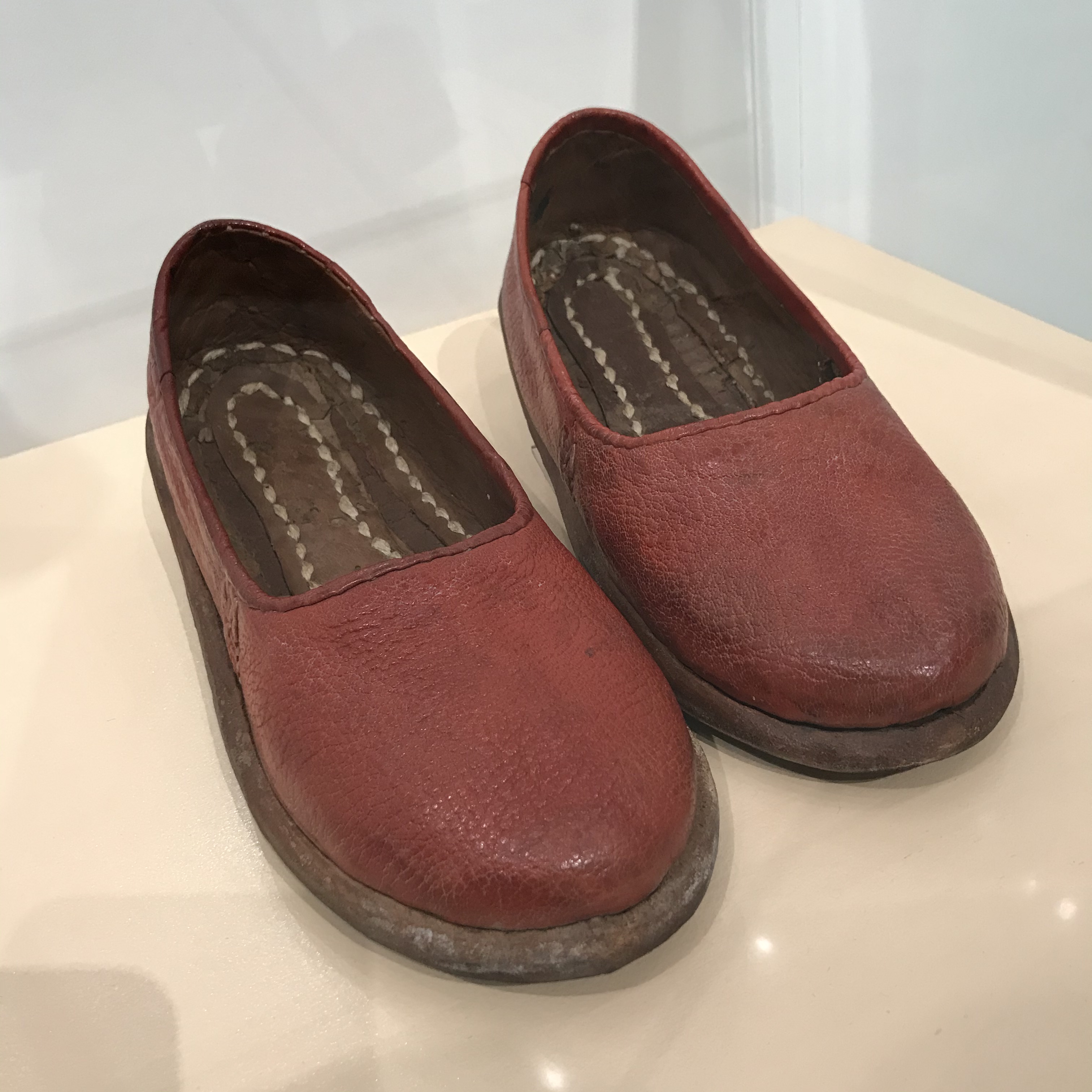
He was inspired partly by his own childhood holidays in the Lake District and partly by the Altounyan children who brought him a pair of red slippers for his birthday to thank him for enabling them to learn to sail on Coniston Water where their grandparents lived.
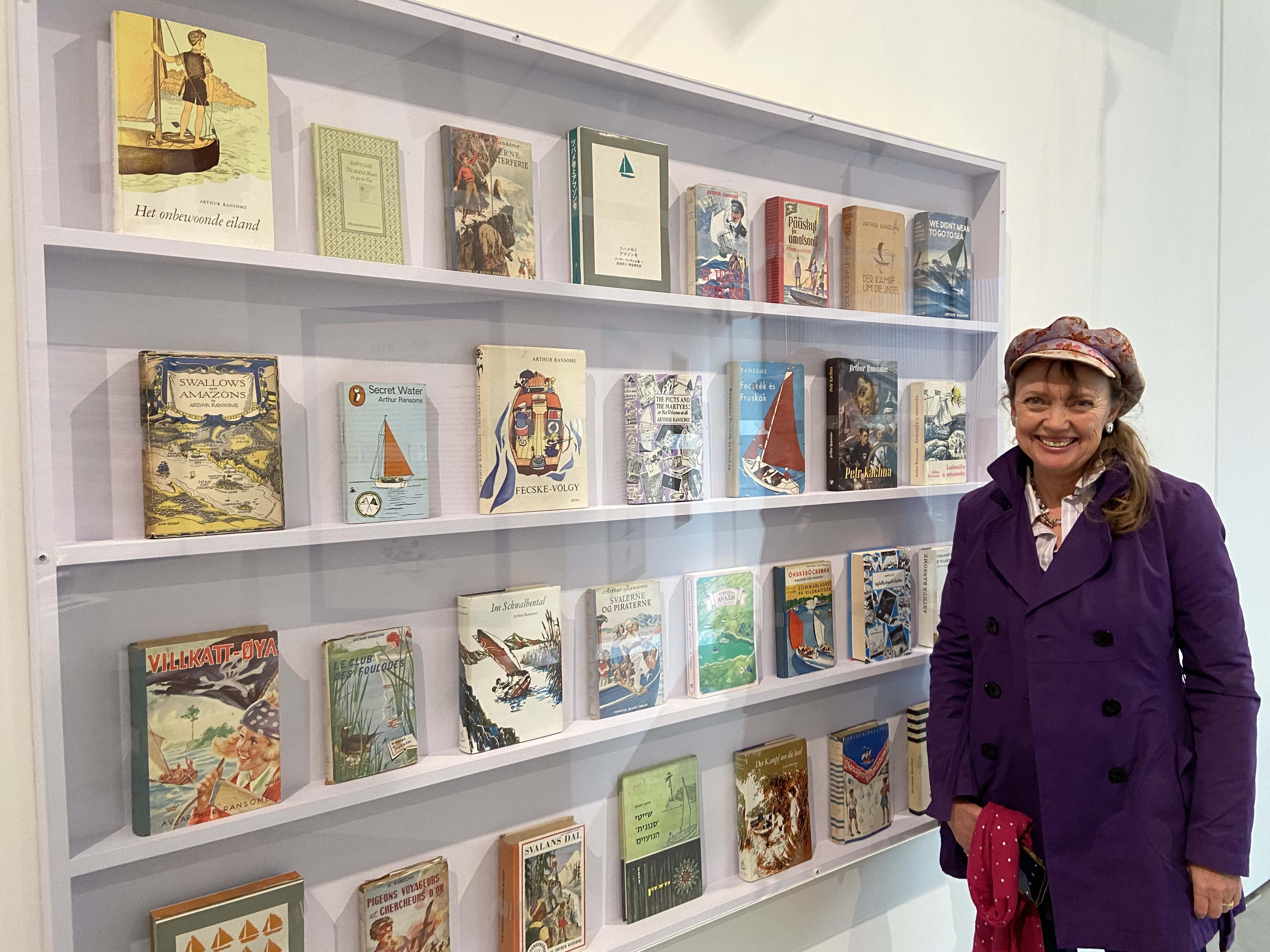
The first edition came out on 21st July 1930, with no illustrations apart from Spurrier’s map on the end papers. The illustrated hardback published by Jonathan Cape came out on 1st December 1930, in time for Christmas. It was followed by another eleven (and one unfinished) book in a series that was to be translated and published all over the world.
Sophie Neville with a collection of Arthur Ransome books on display
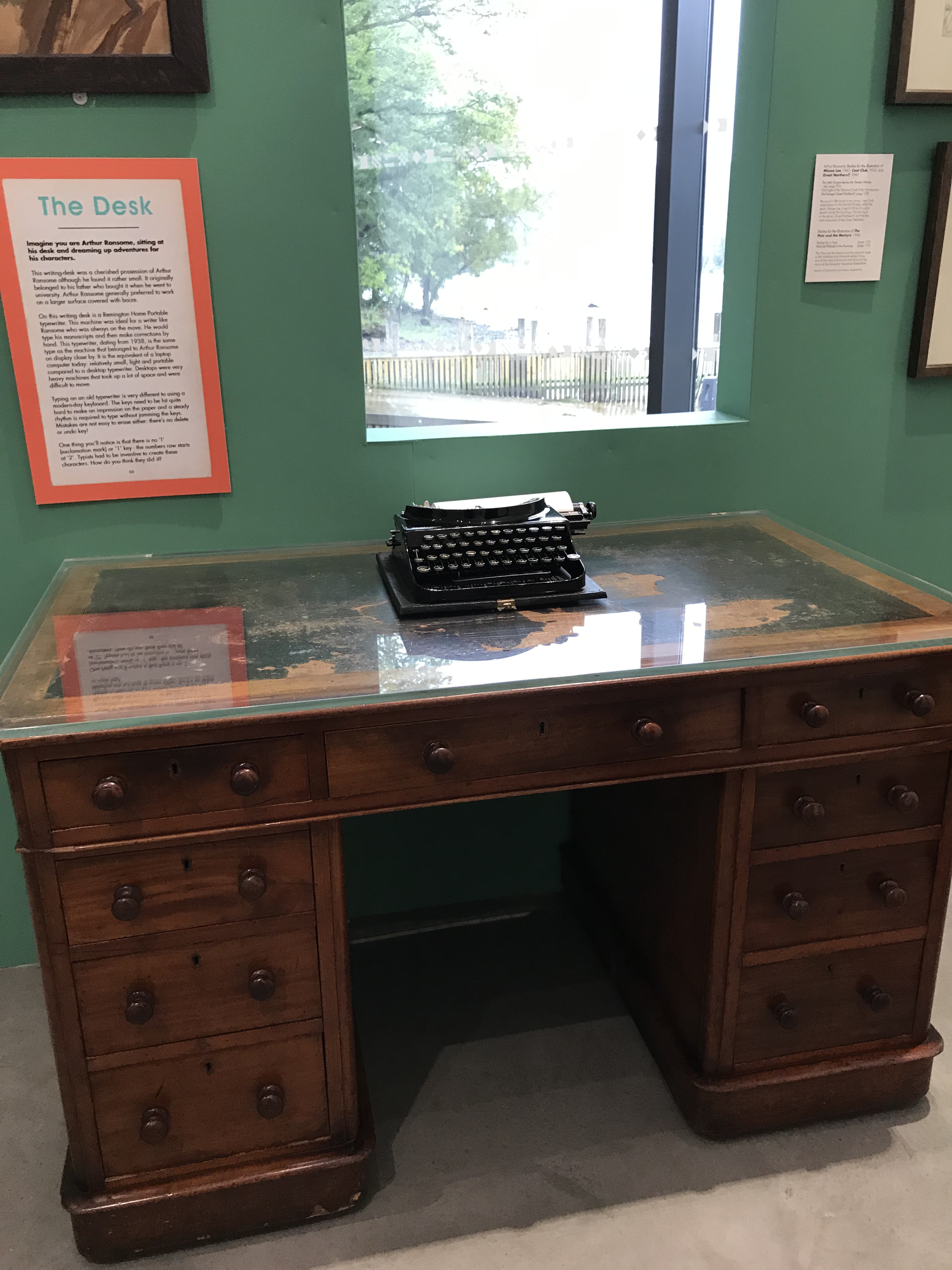
I paid homage to copies at the Windermere Jetty museum where you can find Arthur Ransome’s desk and typewriter on display with a view looking out over the lake.
Arthur Ransome’s desk and typewriter set under a view of Windermere
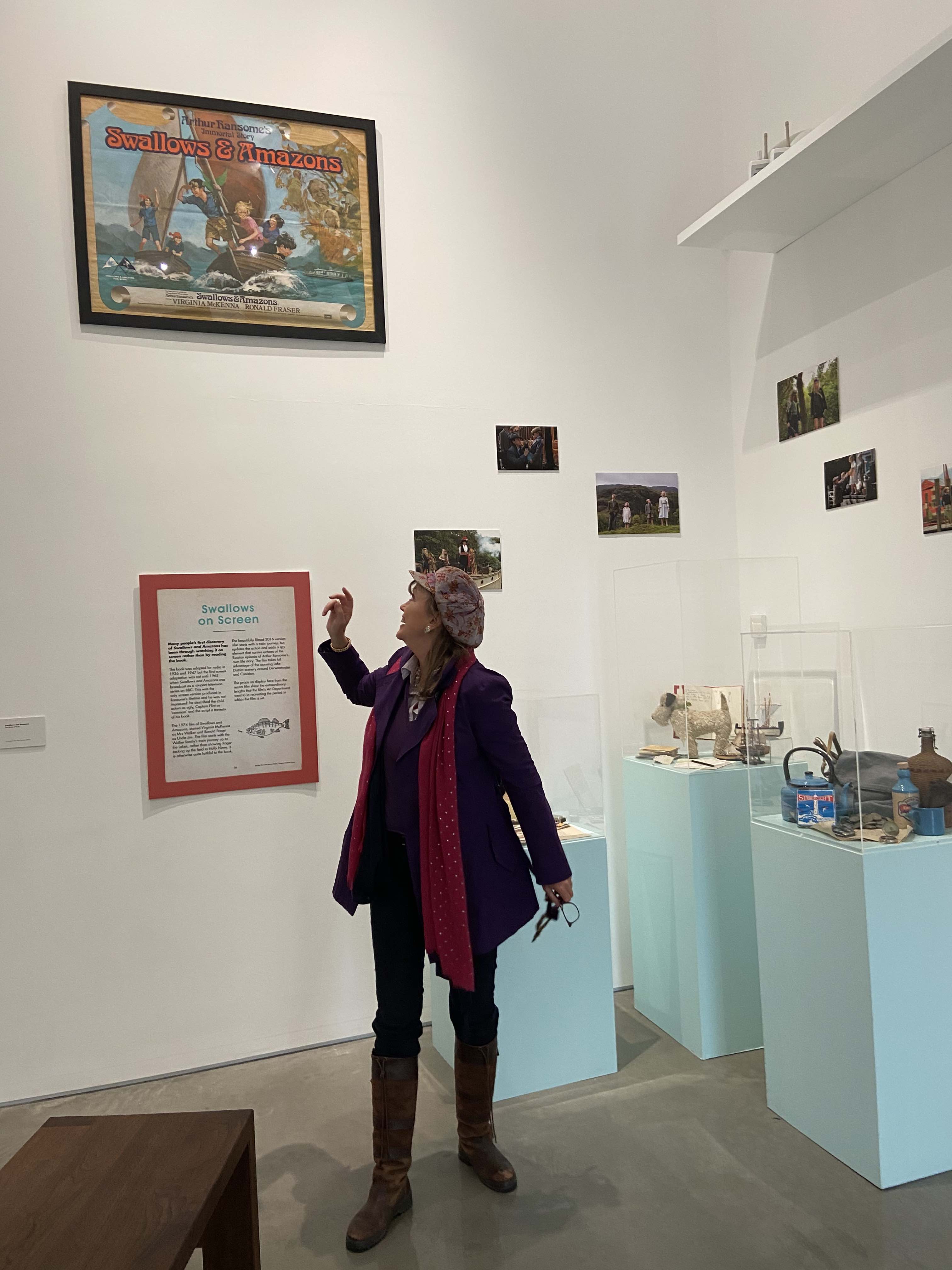
Boats, props and film stills from the 2016 film of ‘Swallows and Amazons’ are on display, along with a poster of the 1974 movie, depicting Titty in a pink blouse.
Sophie Neville spotting the ‘Swallows and Amazons'(1974) movie poster at Windermere Jetty museum
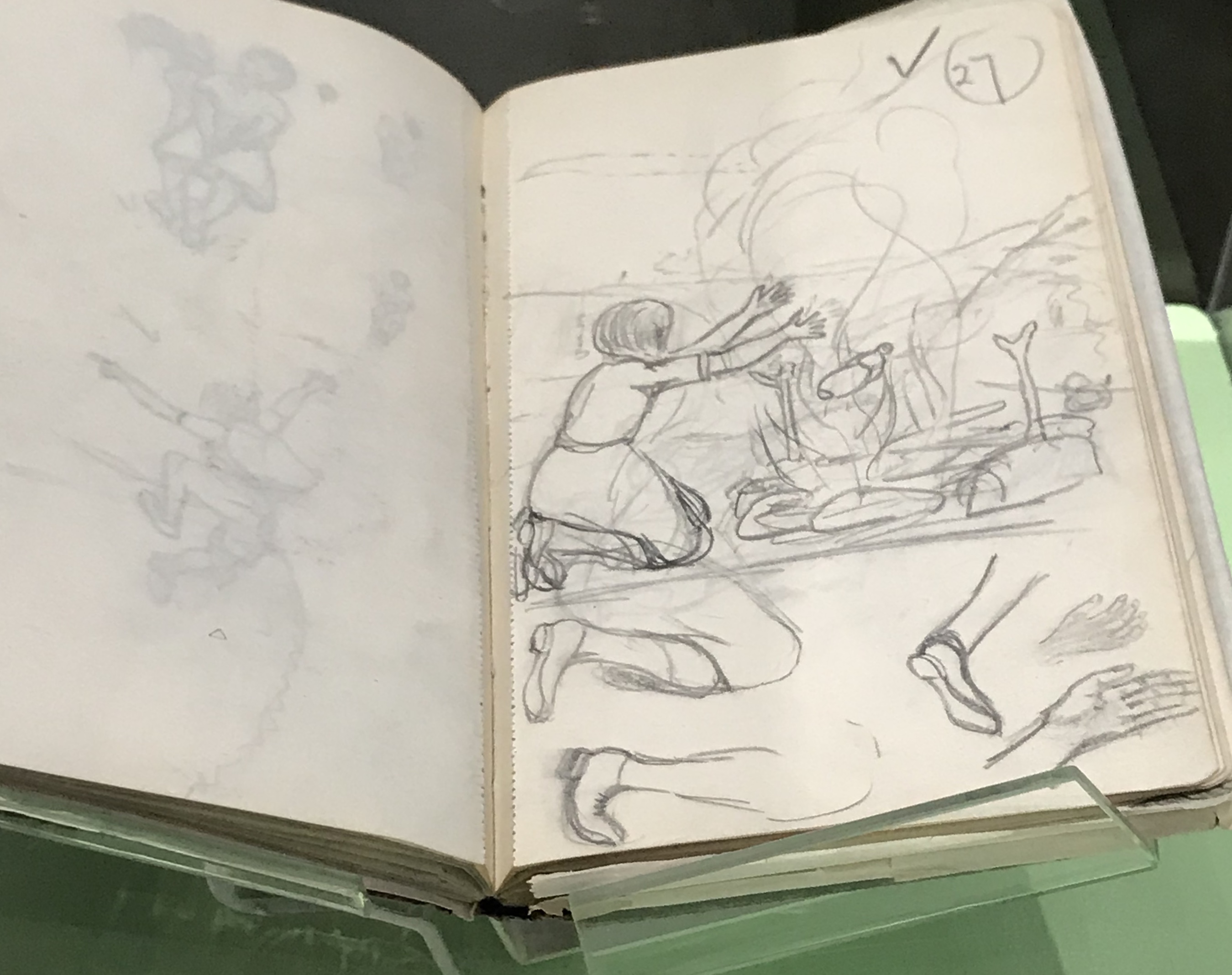
I was fascinated to find sketches of Titty in Arthur Ransome’s notebook.
Arthur Ransome’s original sketches of Titty
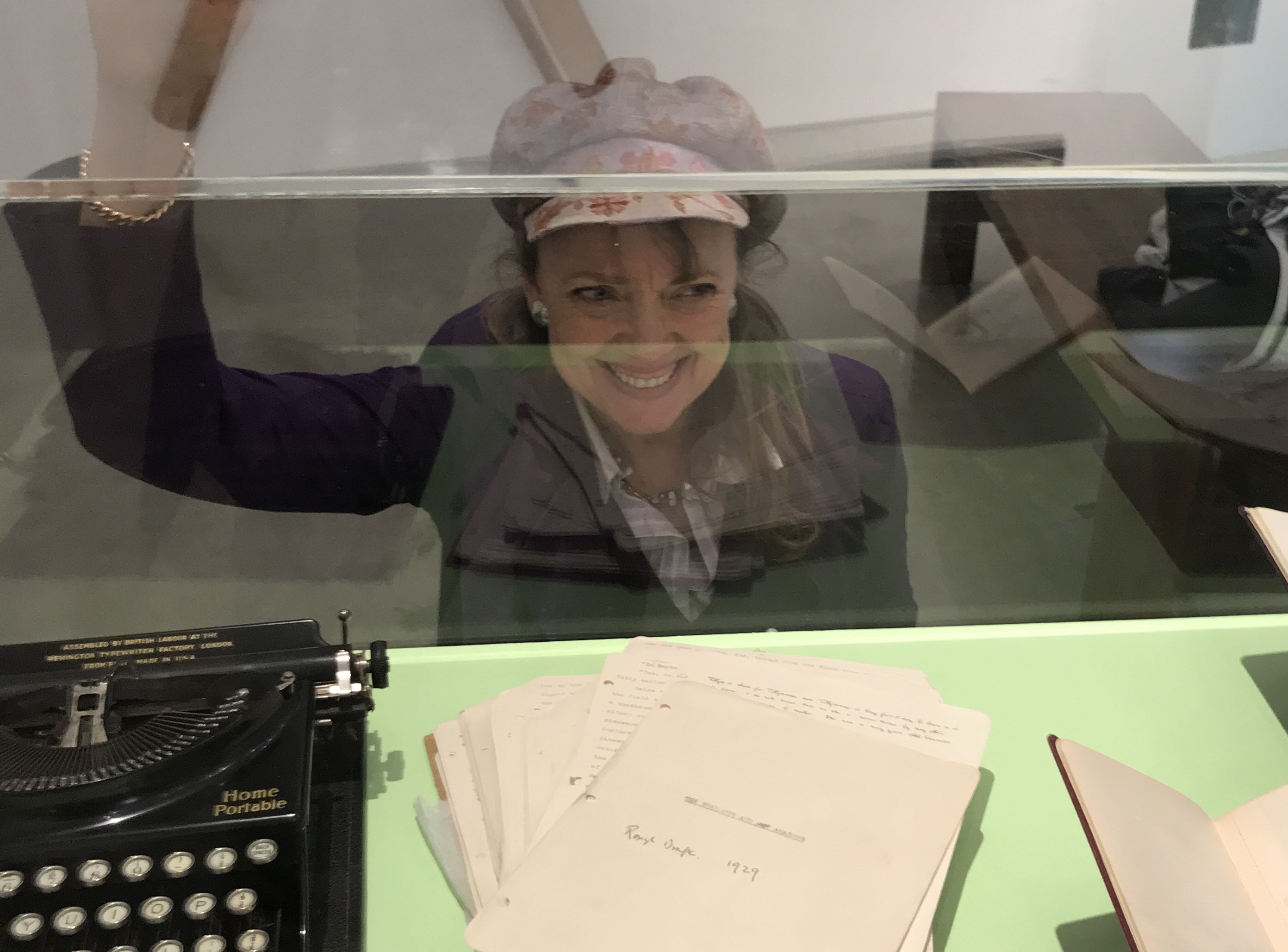
A number of Ransome’s original illustrations were on display and I came across the first draft of ‘Swallows and Amazons’ in a glass case.
Sophie Neville with Arthur Ransome’s typewriter and the original draft of ‘Swallows and Amazons’
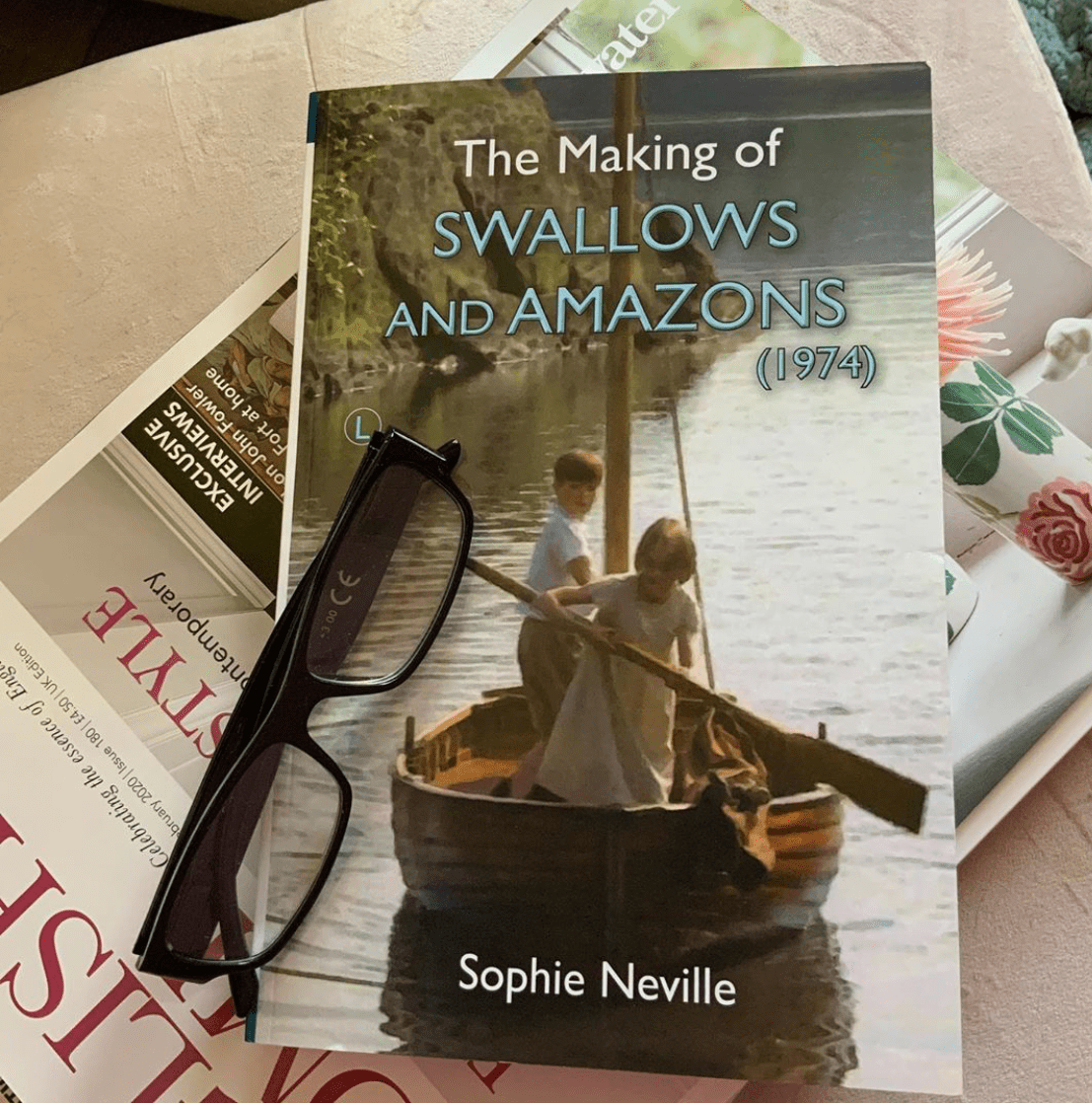
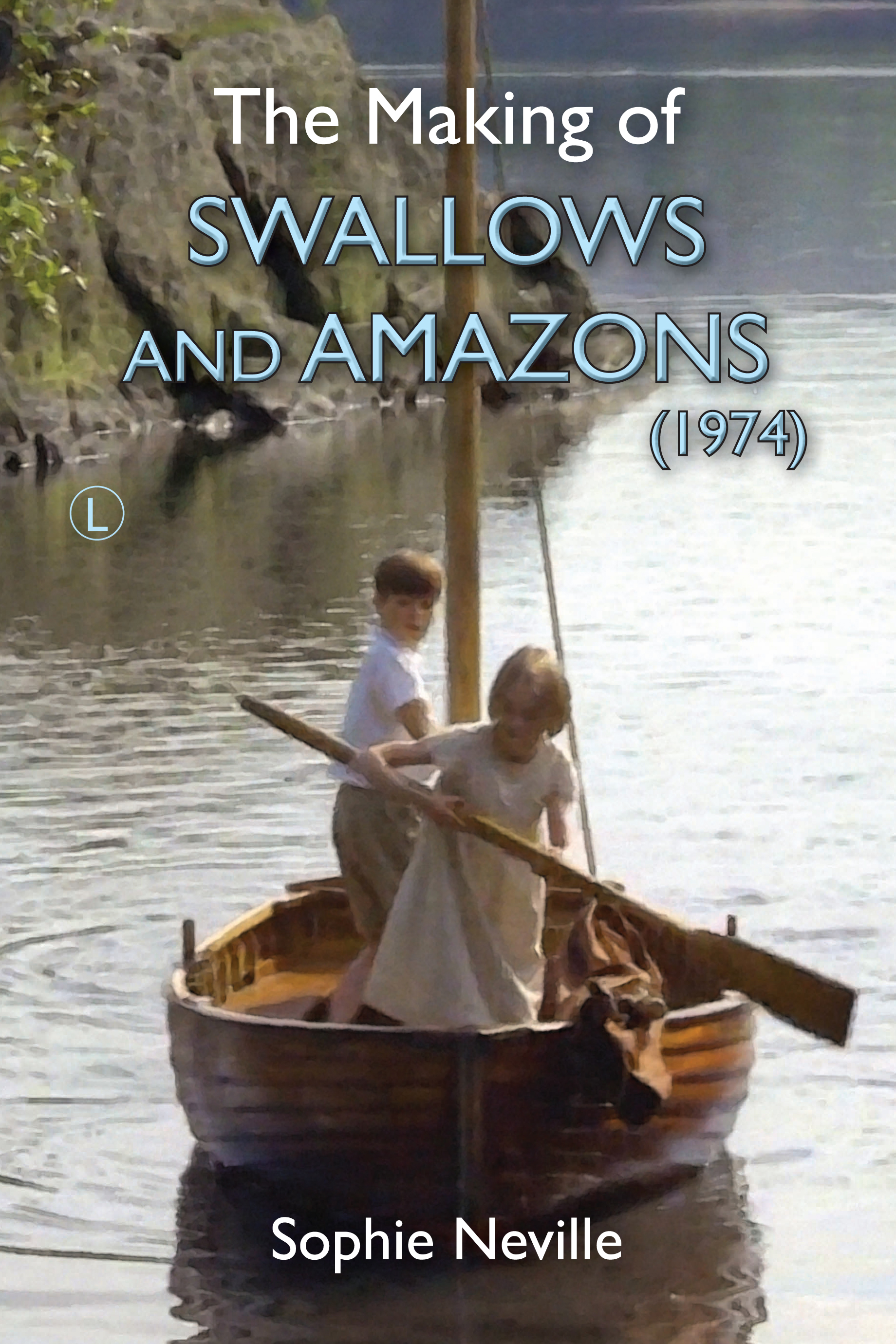
You can read about the making of ‘Swallows and Amazons’ (1974) in this illustrated book by Sophie Neville available online:
Premier ticket for the Gala of ‘Swallows and Amazons’
The premier of the feature film Swallows & Amazons was held at 2.30pm on Thursday 4th April 1974 in Shaftesbury Avenue, in London’s West End when I was aged 13. Those who watch it on television today, or have the DVD, are amazed to hear it was first released more than fifty years ago. Please forgive me if you have seen these photos before but it seems quite a date to celebrate.
I was aghast when the tickets arrived. They were so expensive. Normal cinema tickets cost 80p. However, unknown to me, two families we knew well came along and I still meet others who made the screening, one of whom became a good friend of mine at university.
The ABC in Shaftesbury Avenue in 1974. It is now the Odeon Cinema.
The Royal Gala Matinee was held in aid of the charity KIDS, which works with disabled children, young people and their families. The society is still going strong and has been celebrating its own milestone anniversary recently.
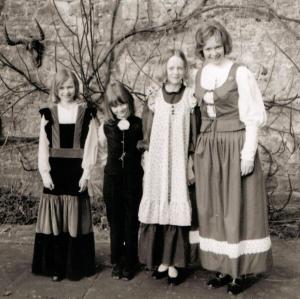
The Neville girls modelling fashions of 1974
I broke up from boarding school on 2nd April and arrived home to find Mummy had bought be a green pinafore dress for the occasion. I still have it. She put my hair in Carmen Rollers and found velvety outfits for my younger sisters Perry and Tamzin who had appeared as film extras in the Rio scenes. She persuaded us all to wear ballet shoes. I felt conscious and would have preferred my clonky school shoes but they were black and had a classic feel. Mum wore a new blue two-piece appropriate for the afternoon screening, with a broach her father had given her. Dad took these black and white photos and drove us to London. Busy at work, he went to Paris the next day, my mother’s 37th birthday.
Arriving by taxi ~ Sister Allyne with Daphne Neville, Tamzin Neville and Sophie Neville
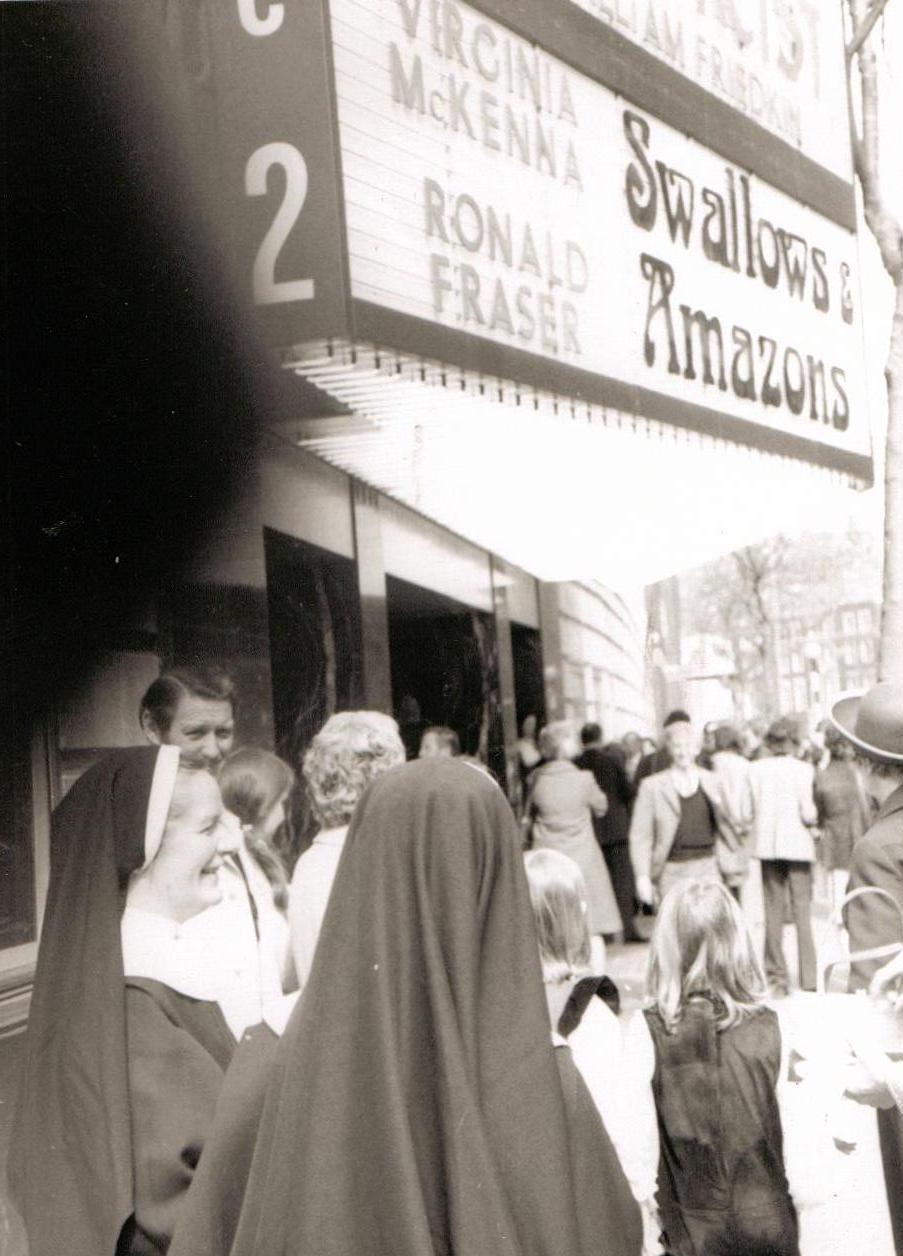
I don’t remember where we met up but we arrived in Shaftesbury Avenue by taxi with my house mistress, Sister Allyne, and head mistress Sister Ann-Julian, who had travelled up from Wantage in Oxfordshire.
Sophie Neville with Daphne Neville outside the ABC Shaftesbury Avenue in 1974
Of all films, they found The Exorcist was showing at the same cinema. I gazed up at the billing outside the entrance, more interested in seeing the names of Virginia McKenna and Ronald Fraser with the romantic design of the graphics spelling out Swallows & Amazons.
The first thing that happened was that I was whisked off for lunch with the five other children in the cast by Claude Whatham, the director. He chose a bistro where I chose hamburgers and chips. It was good to have a chance to catch up with the others and avoid the press. I’m not sure what the rest of my family did, but can only presume they found something to eat.
Sophie Neville, Suzanna Hamilton in Laura Ashley and her mother
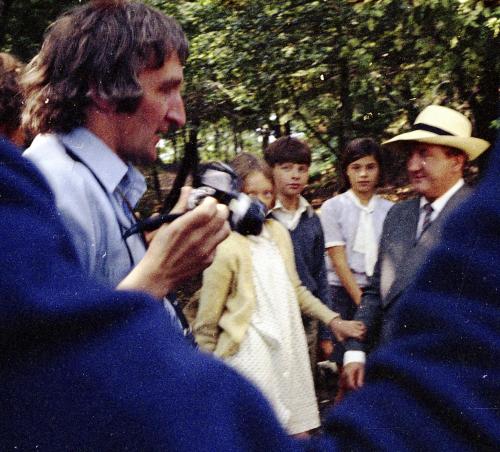
We arrived at the ABC cinema to find they had already taken their seats in the audience. We met up with Ronald Fraser and Richard Pilbrow, the film producer, who introduced us to Princess Helena Moutafian, Patron of KIDS, who the Earl and Countess of Compton had brought to celebrate the film’s release and help raise funds for the charity. Mummy had insisted I made a curtsey to each person I was introduced to. Did this include members of the Press?
Jane Grendon braving the crowds outside the cinema
We also met a number of Ladies: Lady Bridport, Lady Onslow, Lady Nelson of Stafford, Lady Harford and others listed below who must have arrived with their children. It was all quite something.
Please note that Simon West, (to the right in the top photo) was wearing a tie that matched exactly with the floral print of his shirt. This was the height of fashion in 1974, something I have yet to see revived or replicated. While Kit Seymour and Lesely Bennett who played the Amazons both wore jackets with trousers, Suzanna Hamilton wore a Laura Ashley pinafore dress, which would be considered a treasured vintage piece today. My mother was horrified that Ronald Fraser had his collar button undone, but I think that was a nod to trendy-ness. He also wore a badge in support of the charity pinned to his lapel. Badges were all the rage at the time and collected by all.
The premier of Arthur Ransome’s story ‘Swallows & Amazons’ – reported by Cinema TV Today in 1974
As you can see, we met Bobby Moore, the Hollywood actress Patricia Neal, the Norwegian Bond Girl Julie Ege and Spike Milligans’ family. Will Travers, now the CEO of the charity Born Free, came with his sister Louise Travers to represent his mother, Virginia McKenna who sadly couldn’t be with us.
A commemorative programme was being sold with a sepia version of the film poster on the cover:
Inside there were several pages about those who appeared in the film. I still have a copy:
Virginia McKenna, Lesley Bennett, Suzanna Hamilton, Sophie Neville, Sten Grendon and Ronald Fraser appearing in the centre pages of the film premier programme
The opposite page:
Simon West, Kit Seymour, Ronald Fraser, with Sophie Neville, Suzanna Hamilton and Lesley Bennett also appearing in the action photo onboard the houseboat.
It wasn’t until years later that I was shown copies of the stills used to advertise the film inside cinemas.
Sophie Neville holding the original publicity photograph found on eBay ~ photo: Kitty Faulkner
The original film posters, which once hung in the London Underground, have become collector’s items, valued at about £240 each on eBay. Studiocanal, who now own the film rights, have a selection of posters available as framed prints if you click here.
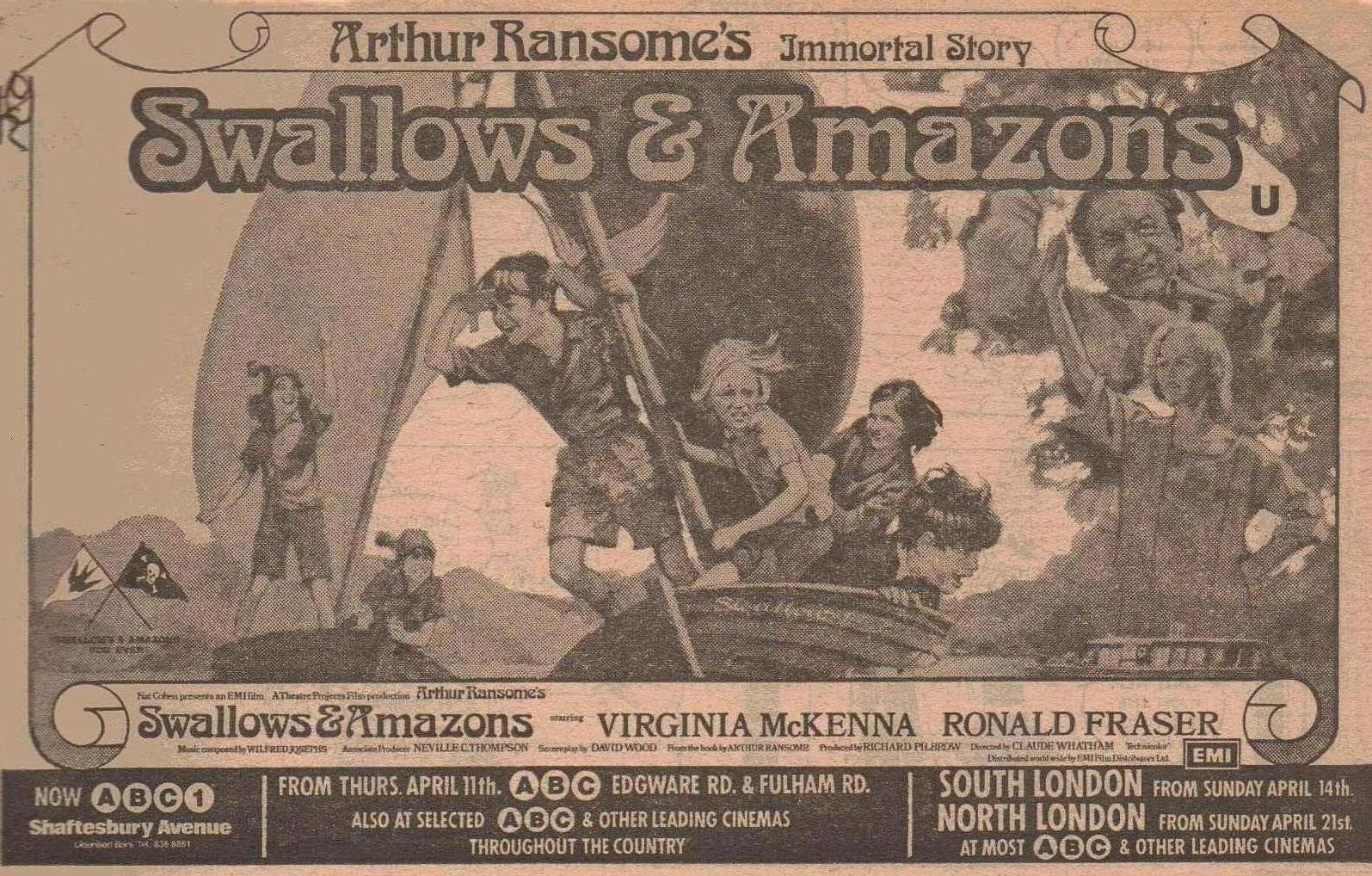
This was the version used as an advertisement in the Sunday Times forty years ago.
Kit Seymour, Lesley Bennett, Simon West, Sophie Neville, Sten Grendon, Ronald Fraser and Virginia McKenna on the newspaper advertisement for ‘Swallows and Amazons’
‘The Secrets of Filming Swallows & Amazons’ is available as an ebook on Amazon Kindle and for other e-readers via Smashwords. It has been described by one reviewer on Amazon as the equivalent of DVD Extras, as it explains how we made the movie in the Lake District, back in the summer of 1973, as well as how the film was promoted and received in the UK.
While the paperback includes a number of illustrations, but this ebook is unique in that it gives links to behind-the-scenes footage shot on location by my parents.
Behind-the-scenes while filming ‘Swallows & Amazons’ in 1973
The classic movie of Swallows & Amazons is often broadcast on BBC TV. If you would like to know more about how the film was made you can find the details on this site or leave any questions in the comments box below.
To read about our first day’s filming at Haverthwaite Railway Station click here and keep reading.
Sophie Neville having her hair cut on location for the part of Titty Walker in 1973
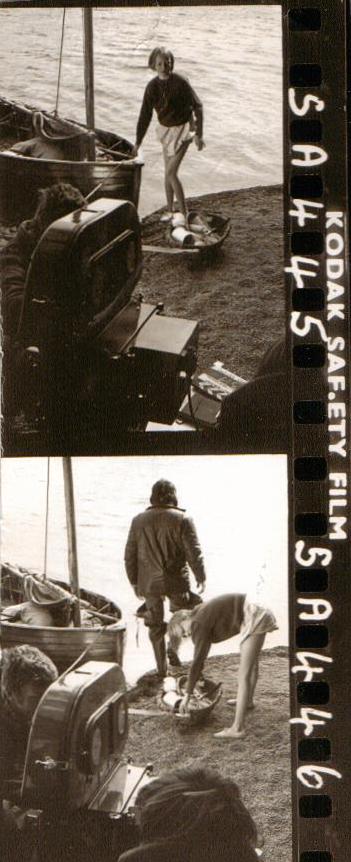
Do you know what lake we were on in the photograph below? We were busy loading urns of tea into a run-around boat to take out to the film crew who might have been on Cormorant Island. If you click on the photo you will get to the page of my diary, kept in June 1973, which describes this day.
Wardrobe Master Terry Smith and Sophie Neville in her costume to play Titty. But what is the name of the boatman? Does anybody know?
There are still many questions about the making of the movie that remain unanswered.
Does anyone know the name of this journalist who visited us on Peel Island?
This shot was taken while setting up the scene at Peel Island when Captain Flint brings Sammy the Policeman to question the Swallows. If you click on the photo you will find the photograph that the journalist ended up with. Titty’s hand is still on Captain Flint’s arm.
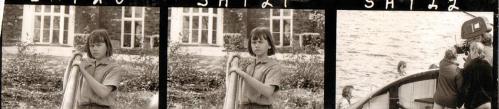
Making a movie is very different from watching one. Here is a record of Titty rehearsing the shot when she moves the camping equipment for fear of a tidal wave. It was a cold day on Coniston Water. The jersey came off when they went for a take.
Here you can see Lesley Bennett, playing Peggy Blackett, careening Amazon at Beckfoot. The same 35mm Panavision camera was focused on Kit Seymour, playing Captain Nancy.
Lesley Bennett as Peggy: Claude Whatham directing the scene with Kit Seymour
The location used for Beckfoot and the Amazon boathouse can be found at Brown Howe on the western bank of Coniston Water. If you click on the photograph of Peggy you can read more about what happened that day.
Kit Seymour playing Nancy Blackett and Lesley Bennett playing Peggy Blackett
If you would like to get future posts, please click the Follow button at the bottom of the side-bar.
You can read the full story about the making of Swallows and Amazons here:
The Premiere of Richard Pilbrow’s movie ‘Swallows and Amazons’ was held at the ABC Shaftesbury Avenue on 4th April 1974. Can you imagine the shock of finding a picture of myself on the cinema tickets when they arrived in the post?
There were adverts in the newspapers. It was to be a Royal Gala charity matinee in aid of the charity KIDS.
I didn’t know what to wear. I wished that we’d been able to put on our costumes but it was clear I had to find an appropriate dress. Sadly, I had grown out of the trendy one we bought in Carnaby Street. Shoes were another problem.
Sophie Neville at home in Gloucestershire in April 1974 ~ photo: Martin Neville
Nowadays one would be inundated by offers of designer dresses to model on the red carpet. As it was, my mother bought me green pinafore dress that I agreed would work for an afternoon event. I was not so happy about wearing ballet shoes. Please note these were real ballet shoes and I was now thirteen. I would have preferred court shoes with buckles. Ironically these zoomed out of fashion whilst ballet shoes have been loved by all ever since. My bobbed hair had grown out but Mummy put it in Carmen rollers. I am not sure the result was that successful but I liked it at the time.
The Neville girls modelling the fashions of 1974 ~ photo: Martin Neville
My sisters were terribly brave and wore velvet with their ballet shoes. The dress from Carnaby Street was slightly large for Perry, seen here on the left, but she coped. At least it was fashionable. Mum bought herself a blue outfit that was deemed the height of fashion. When I arrived in London I found Suzanna had found a Laura Ashley pinafore whilst the Amazons had both got away with wearing trousers. They looked far more sophisticated.
There was an awful lot of fuss about who should or could come and who couldn’t . Mum had insisted on bringing, not friends of mine, but two of the nuns from my school.
Outside the ABC in Shaftesbury Avenue, London in 1974 ~ photo: Martin Neville
So, I went off to my first premiere with my headmistress, Sister Ann-Julian and my housemistress, Sister Allyne. Not very cool in a thirteen year old’s world. The Exorcist was out at the same time. They made no comment.
Sister Allyne, Daphne Neville, Tamzin Neville and Sophie Neville
In fact Sister Allyne proved the very best person to take. She was a performer herself. I am pretty sure she had been Australia’s foremost flautist. She must have understood the turmoil in my little head and was undoubtedly praying for me. I would not be surprise to learn that spiritual protection was granted by her presence alone. She would have been an exorcist in her own right – a real one. Perry remembers that she had been sick in the taxi. This was probably because she didn’t travel much.
Claude Whatham defied any plans my mother might have made by taking the six of us in the cast, and only the six of us, out to lunch at a wonderful bistro where we able to order beef-burgers, relax and enjoy ourselves.
Sophie Neville, Suzanna Hamilton in Laura Ashley and her mother
There was no red carpet when we arrived at the cinema in Shaftesbury Avenue but rather smart programmes were sold, one of which I still have. Until that point I had no idea that it was to be a Royal Gala held in aid of charity.
I was suddenly acutely aware of how I came across on the big screen. As the film was shown I groaned inwardly. It was like seeing endless photographs of oneself which were not exactly glamorous. I cringed. All Sister Allyne said was how much she enjoyed seeing the owl – a natural history shot that was added after all our hard work and effort on the drama.
The premier – as reported in Cinema TV Today
My mother was terribly impressed by the special guests. Princess Helena Moutafian was present with Earl Compton, chairman of the charity KIDS. I’m afraid I don’t remember meeting them but was interested to hear that she later became patron of the Young ME Sufferers Trust.
We walked down onto the stage with Ronnie Fraser to be presented to the audience. Sadly Virginia McKenna could not be there, although she sent her eldest children – Will and Louise Travers. Bobby Moore, who’d played for England came with his family, as did Mrs Spike Milligan. The Hollywood star Patricia Neal, who won an Oscar for her leading role in the Paul Newman film Hud and appeared in Breakfast at Tiffany’s , brought her sweet little girls. Julie Ege was a lovely Norwegian actress who appeared as Voluptua in Up Pompeii with Frankie Howard. I think Richard Pilbrow might have known her as he had produced the West End version. She was known as a Bond Girl since she’d appeared in ‘On her Magesty’s Secret Service’ with Diana Rigg when George Lazenby played Bond and Telly Savalas was Bolfeld. We didn’t know any of this but I think having a Bond Girl at your premier was quite the thing.
I have a few precious posters of the film. The colour poster, which hung in the London Underground is still on the cover of some of the DVD’s. I always quite liked the design, except for the rather jarring colour of my blouse, which for some reason is pink. Far more attractive were the huge sepia posters hung outside cinemas. They were very special. I still have one but it’s enormous and I am unsure what to do with it.
What the papers had to say about the film was a different matter. The first time we saw Swallows and Amazons was not at the film the premiere but at ‘The Preview’. This was held at a viewing theatre in London to which I assume journalists were invited. I only wish they’d been asked to bring their children. The cast was re-united, meeting up with various members of the production team, to see the film for the very first time. We were utterly amazed at how sunny everything looked. Denis Lewiston’s insistence that we should wait for clouds to pass, while we shivered, had paid off. It was wonderful to see how the film had been put together. We had not known that Claude would add shots of wildlife, which add so much to the movie. I loved the scene he included of cattle standing in the still lake at dawn.
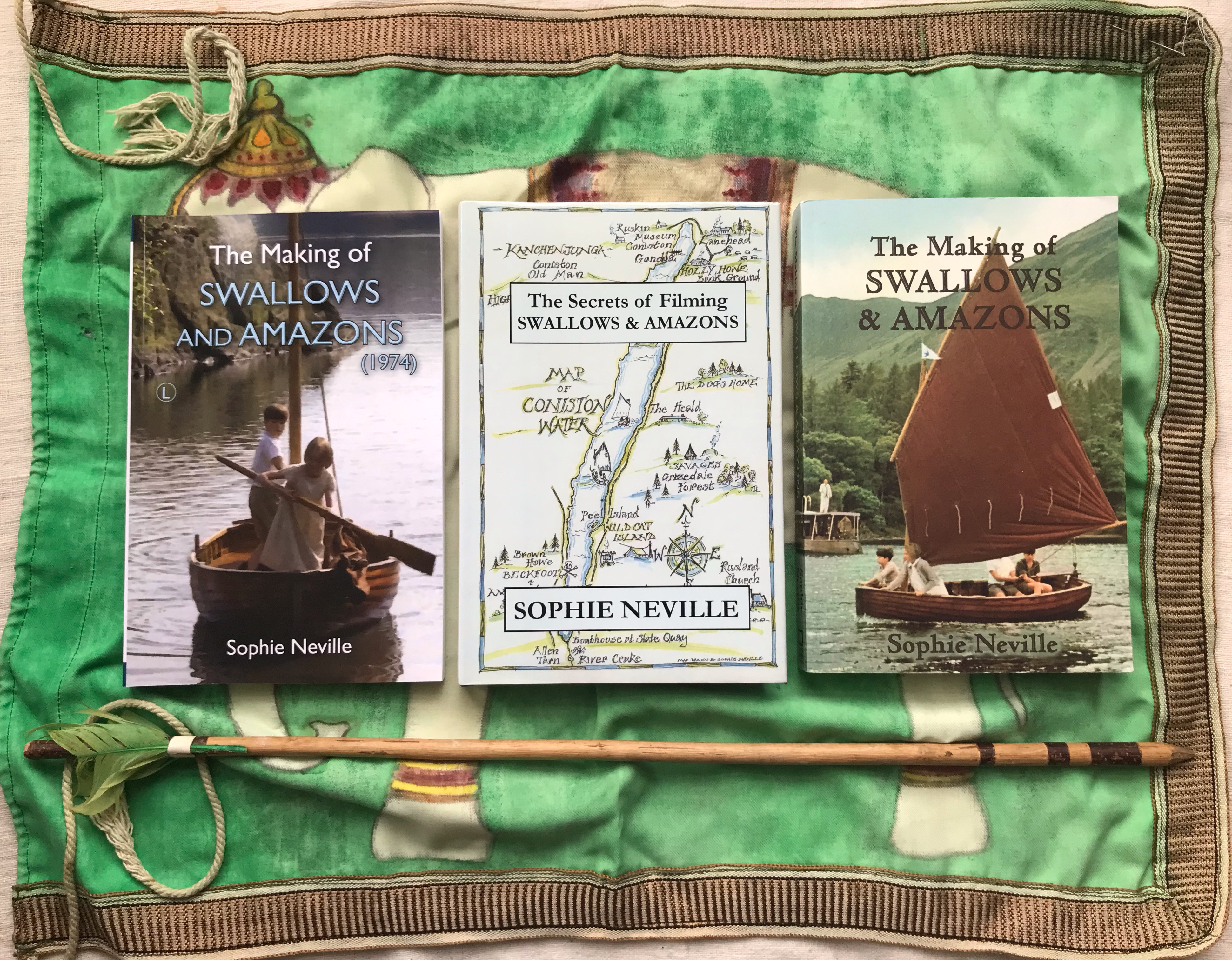
You can read about how we made the film and find more photos in these publications available online or to order from libraries.
Different editions of ‘The Making of Swallows and Amazons (1974) by Sophie Neville’























 Sophie Neville