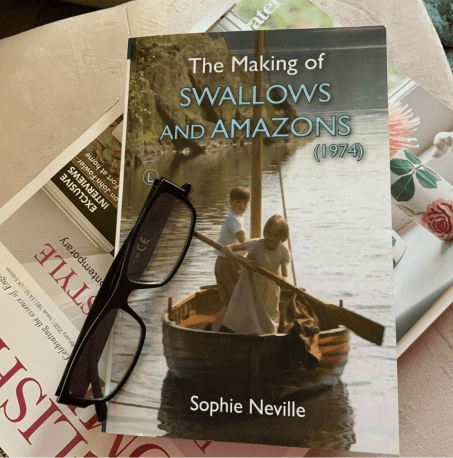
Very, very many thanks to all those who have taken the trouble to send in feedback about our paperback version of ‘The Making of Swallows & Amazons: Behind the scenes on the Classic Film’.
The publishers have been thrilled to hear what you think, hoping that the will appeal as a good Christmas present.
Here are a few recent comments:
‘Get a glimpse behind the scenes from Sophie Neville, who played Titty, in this gorgeous book, released to celebrate its 40th anniversary.’ Yours magazine.
‘Came home to a wonderful surprise – my copy of The Making of Swallows and Amazons! wonderful.’ Pandora Doyle ‘I love it! So excited. The photos make the book especially the coloured ones. I will be dipping into it all day!’
‘…a delightful book, which tells the behind-the-scenes story of the film. Neville’s account of exploring, sailing, and the green parrot will no doubt have readers reliving childhood memories and falling in love with the Lake District all over again.’ The Lady
‘I can’t wait to read The Making of Swallows and Amazons! My eight year old daughter is also looking forward to it – she has learned to sail on Sydney Harbour just like the Swallows’ mother did! (I learned to sail on other Ransome waters – near Pin Mill in Suffolk!). Thank you so much for sharing your memories of the experience with us – what a magical film!’ Clare Havens, author
‘I ordered two copies, one signed by yourself and one unsigned which is already becoming dog eared {my measure of a good book}.’ Arnold Mostyn
David Bamford: (Antipodes) I am in the middle of reading Sophie’s book about the Making of ‘Swallows and Amazons’ and enjoying every word of it! Now, when I see the stills, I remember her writing about how cold the weather was, and they were dressed in light summer clothes.
Loving @Sophie_Neville ‘s Making of Swallows and Amazons. Technicalities of filming with big unwieldy cameras. Plus lots #ambleside gossip. Eileen Jones @CumbriaPR
‘It was great to read an account of how filming is not as simple as people imagine! Enjoyed it very much.’ Martin Robinson
‘A sort-of layman’s perspective on filming is completely fascinating.’ Nick Archer
‘I enjoyed the book much more than I expected, if that doesn’t sound v strange.’ Tom Morgan. ‘I thought I would enjoy it but I really, really enjoyed it. I… was very impressed by the flow and ease of your writing. My inherent nosiness helped of course.’
‘Great book, I really enjoyed reading it.’ Stephen O’brien
‘Really enjoyed it. Lots of insight into/memories of 70s life (not sorry to have left that behind!!). Very interesting to learn more about your co-stars, and the other people involved in creating the film – my original discovery of your blog was having watched the film, and wondering “where are they now?” That question is comprehensively answered!! Also very interesting to learn about the process of film-making – we take so much for granted with digital video cameras these days. I guess for me the whole thing about learning about you, Suzanna, Lesley etc as people is what most interests me from a human point of view – kind of much the same as learning about the Altounyans and Collingwoods in Hardyment’s book.’ Paul Fernandez.
‘Lovely to meet you in Ambleside, It was a great evening. Book and DVD are brilliant.’ Ali Graham
‘I matched your book to the DVD and the two made a really good present, even though I say so myself!’ Barry Burles
When I appeared on Channel 5 recently Matthew Wright asked, “… if it’s possible to have a Swallows and Amazons childhood these days – and if today’s kids would actually have the skills to survive.”
I received so many interesting comments on Twitter and Facebook that I thought I should copy them here, hoping it is OK by those who took the time to write in.
“Would they survive? Hmm. Better drowned than duffers…” Fergus
“Of course it’s possible – we do it every time we are on holiday at www.lowwaterend.co.uk real Swallows and Amazons location. Our kids love it….” Kate
“I think few parents would look at a small sailboat & Coniston Water or Windermere, and give the go-ahead for children ages 12-7 to sail & camp by themselves. However, there are a lot of really wonderful parents who sail & camp WITH their children, and then allow independent exploration with help nearer at hand.” Elizabeth (USA)
“OK – so we cheat a little – in that we stay in the cottage rather than in tents on Wild Cat Island – but it has got a little busy there of late. Trying to bring a boat or canoe into the secret harbour is more like trying to park in a multi national supermarket car park, but very little has truly changed on the island and if you can see past the bright orange and red buoyancy aids of the temporary visitors, one can still imagine being the Walker children. And if you get the island to yourselves – it’s pure joy. We frequently issue the owl hoot just to let our kids know that food is ready! As for the lagoon downstream – it’s still there – our kids have taken to canoeing as far downstream as they can – wading in low water and paddling down rapids where they can. They take no mobiles, IT equipment etc – and they are gone for hours making maps of the stream and naming the shores, fallen trees etc.” Kate
“I’ve just been reading my daughter the bit in Winter Holiday where Dick rescues the cragfast sheep by inching his way along a rock ledge. “Would you be able to do that?” I asked her. “No, I’d be much too scared!” she replied. And I said “Good!”.” Valerie
“Some risks are too high, too likely to leave the child unable to enjoy a normal life afterwards. Examples: diving into rivers with rocks, driving way above the speed limit, using illegal drugs/binge drinking. There are risks that simply have too high a chance of a serious bad outcome. I like the “Roots & Wings” approach. While they are young, you teach how to make a reasonable decision about any given risk, then as they mature, let the child figure out more on their own.” Elizabeth
“It isn’t only duffers who come to grief, and even if it was, duffers deserve to be protected from their own stupidity. So, I prefer the idea of teaching children what the risks are and how to manage risk so that they can then do things that look highly risky without there being any great risk. What is wrong is to shut children’s lives down instead of teaching them how to be safe and free, and that’s the most dangerous route of all because it sets them up for empty lives which will lead them on into a prolonged and deep exploration of alcohol and drugs. Freedom is essential for good mental health and needs to be maximized, but learning about risk management is a crucial part of that. So, how do you teach risk management without it being dull? Get out there with your children and join in with the play. Point out the possible dangers along the way, not in a lecturing way, but simply by telling little stories about idiots who came to grief by making mistakes. It doesn’t take long to make a dangerous environment safe for children to play in by putting ideas in their heads as to all the easy ways to be killed or injured by the apparatus at hand. If they know what the unexpected dangers are, they will be armed against making them. If they die after that, then it will be against the odds – it would have been more dangerous not to let them out.” David
“Agree 100%. In my mind, risk-averseness is one of the great failings of my fellow modern Americans. Never be sorry for a might-have-been.” Sandy
If you have views on the subject, or want to see more on outdoor pursuits discussed on the programme, send an email to: wrightstuff@channel5.com
No matter where I am in the world, not a day goes by without someone, somewhere asking a question or sending a message in connection with my writing. I am hugely grateful for the encouragement.
In many ways, ‘The Making of Swallows & Amazons’ was written by popular request, effectively commissioned by hundreds of people who wanted to know how it felt to appear in the film, albeit forty years ago.
It has to be said that was a little apprehensive about the questions I might be asked on Matthew Wright’s show, broadcast live on Channel 5 – for two hours. If you are feeling brave, click here to see a profile on The Wright Stuff.
They wanted to know about the idea of children being allowed the freedom to take risks and enjoy their own adventures away from civilisation.
“… if it’s possible to have a Swallows and Amazons childhood these days – and if today’s kids would actually have the skills to survive. “
If you have views on the subject or want to see more on outdoor pursuits discussed on the programme email: wrightstuff@channel5.com
IF NOT DUFFERS WONT DROWN
You may need Windows 8 to watch it but the whole programme can be viewed here:
‘Forty years after she enchanted film-goers as Titty in Swallows and Amazons, Sophie Neville has found a new audience… telling the behind-the-scenes secrets of the film of Arthur Ransome’s classic novel.’ The Daily Mail The Making of Swallows & Amazons ‘…is based on diaries, letters and old photographs which Sophie has turned into a heart-warming account of making the movie, which starred Virginia McKenna and Ronald Fraser.’
The Telegraph~ Culture: ‘Set in the Lake District in 1929, the film follows four young adventurers who sail a dinghy around Lake Coniston, cook for themselves over campfires and sleep in makeshift campsites.’
‘…The occasional chaos and terrible weather during filming contributed to the eventual popularity of the extraordinary and very much loved film.’ The Times
‘The film Swallows & Amazons is 40 years old, but thanks to its careful period evocation, its respect for Arthur Ransome’s original book and the performances of its child actors, it’s become a timeless classic. One of those children was Sophie Neville, who played Titty, and who kept a diary during the filming. That diary, with her adult recollections, is this book. It’s a fascinating insight into filming on location in the Lake District…’ Classic Boat
‘… The result is compulsive reading as she recalls that cold wet summer, while the camera crew wrapped up warm and she shivered in her skimpy dress as Able Seaman Titty Walker. Sophie brings to life all the many memorable characters who worked on the film and in particular the other children, the Director Claude Whatham who developed a great relationship with his young cast and the stars Virginia McKenna and Ronald Fraser. Nor are the other young actors forgotten for there are diary contributions from Suzanna Hamilton who played Susan, Stephen Grendon who played the Boy Roger and Kit Seymour who played Nancy Blackett. The text is supported by numerous illustrations showing life on and off the set.’ Roger Wardale, author of Arthur Ransome: Master Storytellerand other books
‘You don’t need to be a Swallows & Amazons fan to enjoy this book – it’s universal!’ Winifred Wilson, Librarian of The Arthur Ransome Society
‘This was a most unusual and interesting book. I picked it up expecting to browse through it, and found myself so drawn in to Sophie Neville’s detailed, amusing and insightful description of film making in the 1970’s that I was unable to put her book down. As Arthur Ransome fans, my family and I have always loved the film, and felt that Sophie Neville was ‘just right’ as Titty. What fun it has been to be introduced to the young twelve year old Sophie with her intelligent awareness of the challenges facing the production crew while she shivered in her cotton dresses. The many photographs and illustrations contribute richly to bringing the 1970s setting to life. Sophie recorded her experiences beautifully, and in so doing, added one more valuable book to the cultural heritage of all Arthur Ransome fans.’ Juliet Calcott, English teacher,South Africa
Lots of photos throughout the book bring the scenes to life – a delightful read.’ Celia Lewis author of An Illustrated Country Year
Sophie Neville has been chatting to Mark Forrest on The Evening Show.
The second edition of this paperback is published by The Lutterworth Press, available online here
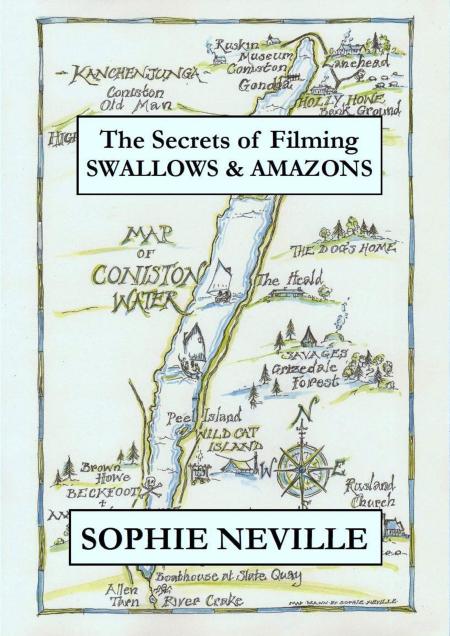
If you would like to know how the movie of Swallows & Amazons (1974) was made and know where the real locations can be found, ‘The Secrets of Filming Swallows & Amazons(1974)’ is currently available as an ebook on Amazon and Smashwords for £2.99. The paperback was launched to mark the 40th anniversary of the film’s release and is available online here.
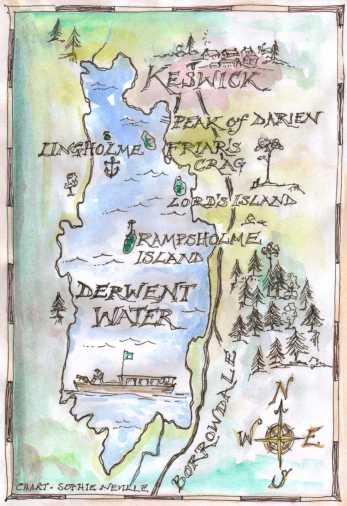
Do you know where the Peak of Darien can be found?
The paperback, which is suitable for any age group, is based on the diary that I kept when I played the part of Titty Walker in 1973. It is illustrated with behind-the-scenes photographs and memorabilia such as one of the tickets to the Royal Gala premier in Shaftesbury Avenue held on 4th April 1974. You will also find out what the actors who played the Walker family ~ the Swallows ~ are doing now.
The joy of the ebook is that it includes a number of home-movie clips that my parents took of life behind the scenes that you can play wherever you have internet access.
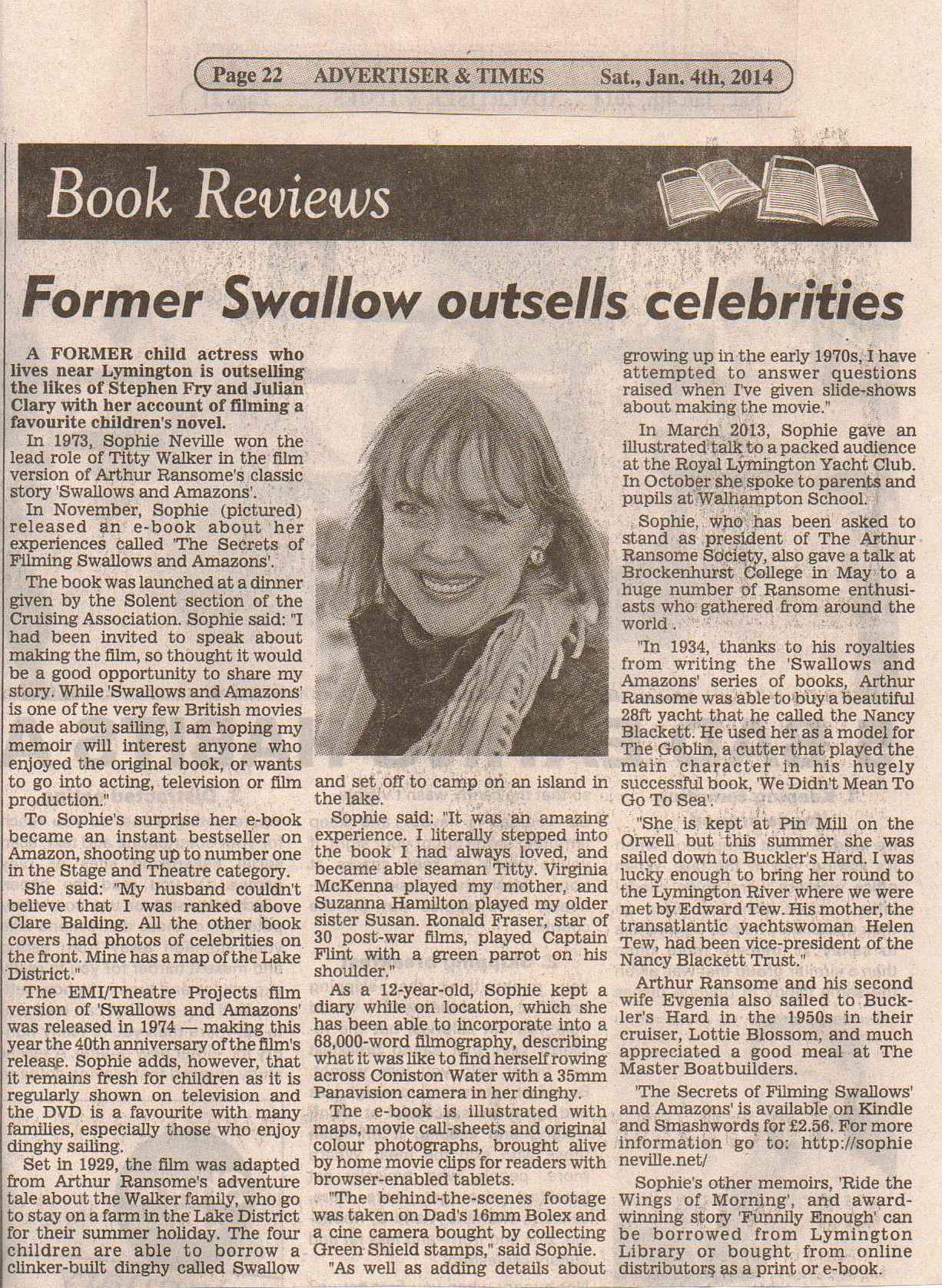
A review of the ebook in Classic Boat magazine ~ Feburary 2014
If you have any questions about making the film, please add them to the comments below, and I will get back to you.
A review of ‘the Secrets of Filming Swallows & Amazons’ in Richard Kay’s column in the Daily Mail ~
There were rather over-excited headlines in the Times and Telegraph when the ebook was launched but they only spoke of the legendary drinking of Ronald Fraser. Please don’t worry – there is nothing X-rated about the book – it is just the price one pays for half a page in a daily newspaper, especially since it came out on a Saturday.
The ebook has been doing well in the Amazon charts and hit Number 1 in the category ‘Stage and Theatre’.
A preview of what the book holds in store can be watched here:
Very many thanks to all those who have left customer reviews on Amazon. It is always exciting to find out how the book has impacted others, especially those who love the Arthur Ransome books.
When I saw Simon West recently he told me that his father would love to see a copy of ‘The Secrets of Filming Swallows & Amazons’.
Nigel West soon wrote to say:
‘…it makes fascinating reading. Simon told me very little in the way of detail about his experiences when filming so your account is very welcome.Simon’s mother, Dorothy, and I only visited the Lake District once during that period and then we only saw Simon fairly briefly and saw nothing of the filming. Things that I can recall about the whole experience I will describe below.
.
‘Our family took up dinghy sailing when I built a Mirror dinghy in our dining room at home. It was built from a flat-pack and took nearly a year to construct, in my spare time, during which the family had to eat meals in the sitting room. I had been sailing on the Norfolk Broads with friends a few times in my college days, which had started my interest in boating. The family joined the Dorchester Sailing Club which was based on an old gravel pit not far from our home. Eventually we also acquired two children’s Optimist dinghies for Virginia and Simon, who spent many weekends racing their boats at open meetings around the country.’
.
.
‘One day at the club a notice appeared on the notice board asking children with sailing experience to audition for acting parts in a film to be made of Swallows and Amazons. Virginia immediately expressed interest and pressured Dorothy and me to take her to the auditions in London. We were reluctant to agree because we thought her chance of success would be so slim with thousands of other applicants, many with acting experience, queueing up for parts. Then, to my surprise, Simon said he was also interested, with his eye on the part of John, but surely, I thought, he would be too young and too short for that part and he had pooh-poohed the idea of trying for Roger.
‘As it happened we were due to visit Dorothy’s sister, who lived south of London, in Sussex, on the Saturday of the auditions, so we decided that a small detour would allow the children to attend without too much problem. Sadly Virginia fell at the first interview while Simon, to our utter amazement, won through that and all the other stages of selection to win the part of John. How pleased we were for him and proud – and sorry for Virginia who took her disappointment so well. You should ask Simon about the later stages of selection that included a long weekend living on an old motor torpedo boat at Burnham-on-Crouch having, among other things, his sailing proficiency assessed.
‘From the few things that Simon did tell us about the filming, I was extraordinarily impressed by the maturity he had so clearly gained in the whole experience. He explained how conscious he was of the crucial part he had to play in getting it right, in front of the camera, because the success of the whole project depended on that. With dozens of adults all working flat out as a team to a tight schedule meant that he had to concentrate on getting it right first time – a very maturing experience for an 11 year-old taking time out from his first year at secondary school.’
.
.
‘With Simon having no acting experience I was intrigued to know how Claude Watham had managed to get what he wanted from his young cast. Simon explained one technique that Claude had used to stop them looking wooden in front of the camera. He would make sure they knew their lines, send the children to run to some point and back again, then shoot the scene while they were still animated from the running.
‘One aspect of the production mentioned in your book is the studio post-sychronisation. I can remember taking Simon up to Elstree Studios in Borehamwood to re-record some of the dialogue, sometime after the filming had been completed. Maybe you did the same. Simon had to wear headphones to listen to the film dialogue, while watching a scene from the film, and to repeat to a microphone the dialogue in exact synchronism with what he heard in the headphones and saw on the film. He said it was an extremely difficult thing to do, to talk over one’s own voice, exactly, and then to give it the right expression. I imagine it needs a lot of practice to get it right. The object was, of course, to dub over recorded dialogue which had either been poorly recorded or which included extraneous noise.
‘Finally, I did manage to watch one scene filmed, but from a great distance, which you do mention in your book, and that was the Darien scene shot at Runnymede sometime much later in the year. In 1973 it was the fashion for all schoolboys to wear their hair indecently long. At Simon’s school the rule was that the hair was just allowed to touch the collar but not an inch longer. Simon’s hair was no exception but he had had it shorn for and throughout the filming and it had just started to grow back when he was summoned to the Runnymede shoot. On our arrival at Runnymede Simon was immediately sat on a chair and had his locks shorn once again. I think he should have been paid a special indignity fee for that day’s work.’
.
.
‘I remember watching the S&A float in the Lord Mayor’s Show pass by but the float passed too quickly to let you all spot our family in the crowd.
‘I also remember attending the film’s premier at the cinema in Shaftesbury Avenue, also attended by some minor member of royalty. It was a grand event and brought home to me that this was not some trivial little children’s entertainment but was a full length feature film of some standing. It must have been shown on British TV a dozen times over the years, particularly at Christmas, so it has stood the test of time by anybody’s standards.
‘That reminds me that at one point we made a half-hearted attempt to get Simon into Equity but without success. The result was that Simon only got paid a daily fee for his work on the film, with no residual payments for TV showings, overseas viewings or video and DVD earnings, to say nothing of his image appearing on a number of jigsaws!
‘You probably know that Simon also acted in a film made for children’s television in 1974, when he took the title role in Sam and the River. This was recorded on film and was shown on BBC TV in the form of six 30 minute episodes. It was before the days of video recorders so we have only ever seen the original transmission. Fifteen years ago I approached the production company to see if I could obtain a copy, but they had been reorganised since the film was shot and had kept no copy, nor record, of the production. I then approached the BBC and they did a search for me but they drew a blank. At one stage the BBC had a Philistine in charge who infamously threw out masses of, now priceless, BBC archives as being a waste of space. One day I hope to put a name to him. Simon has since found that the BFI have an archive copy of Sam and the River so I will approach them, but they do emphasise that they have no authority to make or issue copies of archive films. Might, however, get them to show it to us one day perhaps.’
.
There were four jigsaws issued with the film. There is full image of the jigsaw above on an earlier post.
Arthur Ransome was born in on 18th January 1884. Those who loved his books will be celebrating his birthday from Giggleswick in North Yorkshire to the Orwell where the Ransomes spent so much time sailing.
Pamela Copley has just written from Australia to say:
‘There is a celebration of AR’s birthday in a suburb of Melbourne on Saturday – straight after the AGM. There will be a member from the UK group too.
Cheryl Paget tells me that, ‘In New Zealand members have met in Auckland for a weekend of Ransome inspired activities. We have sailed under the Auckland Harbour Bridge in a 57ft ketch rigged deck scow, toured the historic naval town of Devonport and walked to the top of the dormant volcano of Rangitoto.’
Mikako Tarashima wrote from the Arthur Ransome Club in Japan to say:
‘We would like to have a small exhibition in this year.’ In 2014, publication of new Japanese translation of Ransome saga was complete.’
I ask the question: How has Arthur Ransome influenced your life? What impact have his classic books, or the adaptations of Swallows and Amazons for film, television or the theatre, had on your family? Do add a line or two to the Comments below.
Arthur Ransome’s cutter the Nancy Blackett on the Orwell in July 2013
I am guilty of denial. When people asked, ‘How has Swallows & Amazons influenced your life?’ I’m afraid I used not to be that forth-coming, because I had moved on from acting in films. If you had asked me in 2010 I would have shrugged and said, ‘Not much.’
But then I stopped and thought again.
How much time I have spent exploring wilderness areas? I’d forgotten that it was the maps in Ransome’s books that attracted me to reading Cartography at university. I went to draw numerous maps all over the world.
I love living outdoors. I love fell walking, mud-flats, and being out on the high seas. I would drop everything to sail to China or the Caribbean tomorrow. I put this down to the fact that my father took us sailing and camping even before I read Ransome’s books. But who influenced Dad? Born in 1929, he was an avid reader of Arthur Ransome and would eagerly wait for the next book about the Swallows and the Amazons to be published. It would be a longed-for Christmas present.
It then occurred to me that John’s careful planning, Susan’s packing, Titty’s log and Roger’s humour still steer my life. The food, the phrases, the urge to travel, became part of my life long ago. I’ve lived under Swallow’s flag.
I for one, sail into the year ahead with Titty’s words still singing in my ears,
‘Here we are, intrepid explorers, making the first ever voyage into uncharted waters? What mysteries will it hold for us, what dark secrets shall me revealed?’
Aboard the Nancy Blackett at Buckler’s Hard on the Beaulieu River
Thanks to the encouragement and help of my blog followers and Arthur Ransome enthusiasts around the world, I have managed to put my diaries, letters, old photographs and documents together into a 70,000-word memoir.
“Sometimes extraordinary things do happen to ordinary people. Little girls can find themselves becoming film stars. Long ago, and quite unexpectedly, I found myself appearing in the EMI feature film of Arthur Ransome’s book Swallows and Amazons, made for a universal international audience. I played Able-seaman Titty, one of the four Swallows. Perhaps it would be more accurate to say that I became Titty for a while, wearing thin cotton dresses and elasticated navy blue gym knickers, which the camera crew soon referred to as passion killers. The book was written in 1929 and although the film adaptation was made in the early 1970s it had an ageless quality and has been repeated on television year after year, typically on a Bank Holiday between movies starring Rock Hudson or Doris Day.
I got the part of Titty because I could play the piano. Although I had no ambition to be an actress, at the age of ten I was cast in a BBC dramatisation of Cider with Rosie. They needed a little girl to accompany the eleven-year-old Laurie Lee when he played his violin at the village concert. I plodded through Oh, Danny Boy at an agonising pace.
‘Do you think you could play a little faster?’ the Director asked.
‘No,’ I said, flatly. ‘These are crotchets, they don’t go any faster.’
Claude Whatham must have remembered my crotchets, for two years later, in March 1973, my father received a letter. It arrived completely out of the blue, from a company called Theatre Projects.
We are at present casting for a film version of SWALLOWS AND AMAZONS which Mr Whatham is going to direct. We were wondering if you would be interested in your daughter being considered for one of the parts in this film.
Amazing!”
From ‘The Secrets of Filming Swallows & Amazons’ by Sophie Neville
Preview copies of ‘The Secrets of Filming Swallows & Amazons’ at the Cruising Association dinner at the Water’s Edge Bar and Restaurant, Mermaid Marina on the River Hamble.
“This heart-warming memoir is illustrated with colour photographs, most of them taken at the time by Sophie’s family, and contains links to behind-the-scenes home movie footage for readers with browser-enabled tablets. It delivers a double helping of nostalgia for both fans of the era of Arthur Ransome, and the groovy times of the early 70’s.” ~ from the Amazon Kindle description
Also available for other reading devices on Smashwords
Thanks to those of you who contributed comments, questions, and aspects of local history on this blog. I would love to know what you think of the book!
If you would like a copy but don’t have a Kindle, you can download a free Kindle app.
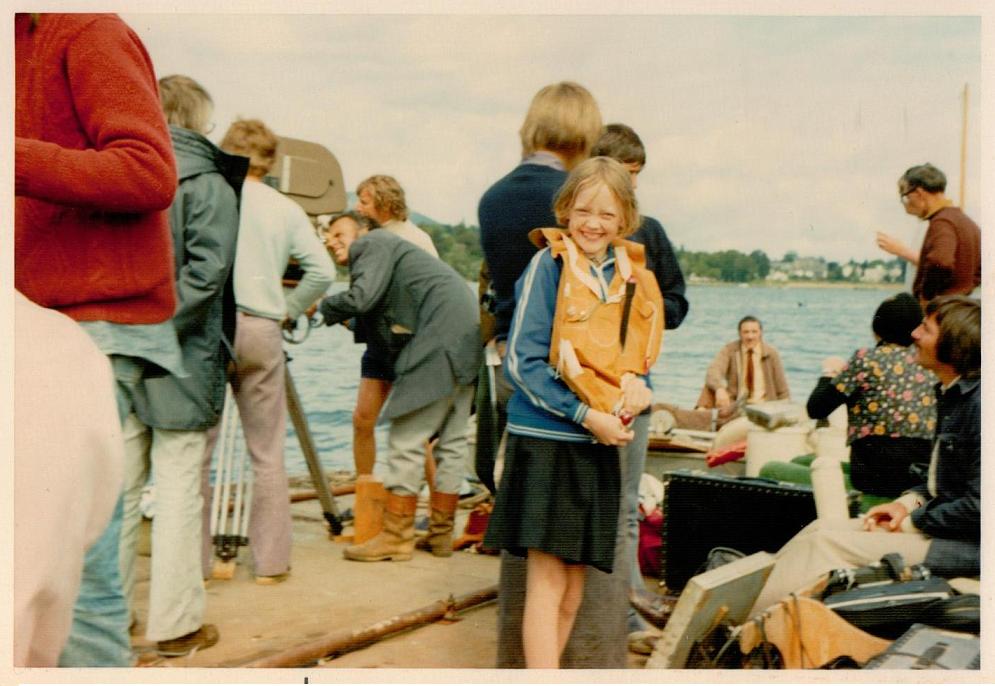
Richard Pilbrow, Denis Lewiston, Claude Whatham, David Cadwallader and Sophie Neville aged 12 playing Titty ~ photo: Daphne Neville
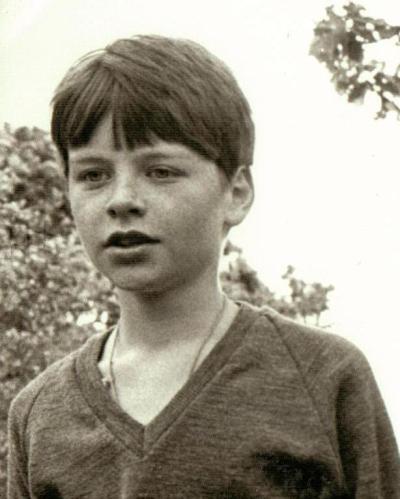
Simon West and Sophie Neville as brother and sister on Peel Island in 1973
I had dinner with Captain John last night. It was extraordinary meeting up after forty years; a lifetime had whizzed by.
Tall, with dark hair, Simon West is no longer recognisable as John Walker but he looks back fondly on our time making the film ofArthur Ransome’s book Swallows and Amazons in 1973, when we spent seven weeks of the summer term on location in the Lake District. To my surprise he doesn’t remember being cold at all. I claim that he was given a few more clothes to wear than me and had more to concentrate on. He was at the helm whilst I was a mere able-seaman in Swallow. He said that he hated it when she was wired to the pontoon and he had to pretend he was sailing.
Simon West and Suzanna Hamilton sailing Swallow from Peel Island where Sophie Neville stands shivering on the shore. Was this shot filmed from a camera pontoon?
Simon thought that I probably remember more about the experience than he did because my mother was there, chatting about what was going on every evening and naturally re-enforcing the shared experience.
‘I must have kept a diary, as it was part of our schoolwork, but I haven’t seen it since. I’ll look in my parent’s attic.’ Simon thought that it was his mother who put together an album from the black and white photos that Richard Pilbrow gave us after the filming.
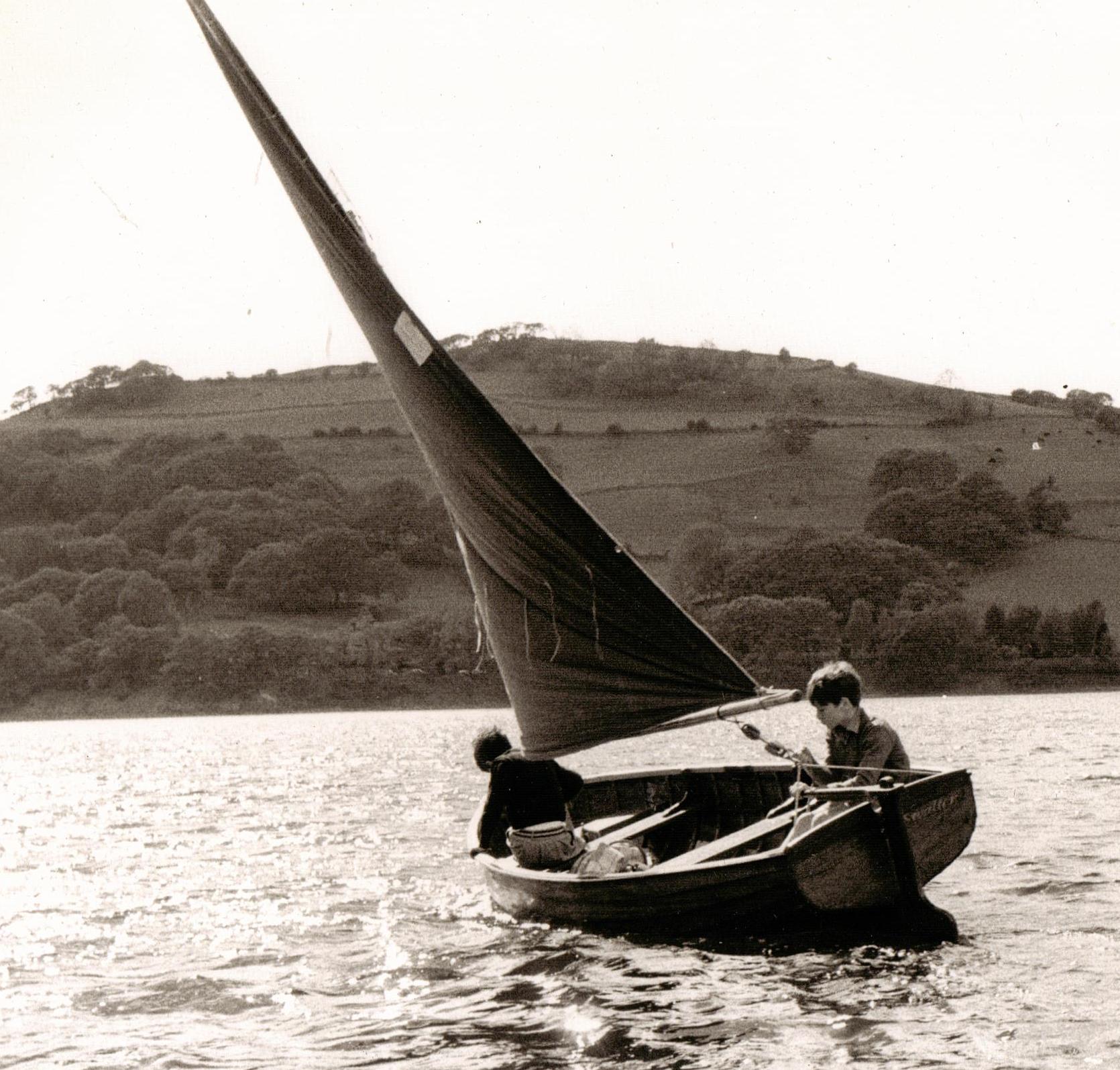
Simon West as Captain John sailing Swallow near Peel Island on Coniston Water. Sten Grendon plays the Boy Roger in the bows.
Simon said that he remembers more about filming the six-part BBC serial, ‘Sam and the River’, in which he had the title role in 1974. Much of it was shot on the Thames Tideway east of London. ‘Of course all those places have changed enormously since then, whilst the Lakes are very much the same. I have never been able to find a copy of that series, which is a shame. I’d love to see it.’ We can’t find a copy in English, but there is a version in German entitled ‘Tom und die Themse’ currently for sale on DVD here.
Simon’s own children grew up watching Swallows & Amazons, which is still broadcast once or twice a year on television. He said that when they went to see the Warner Bros. Studios in Hertfordshire where much of the Harry Potter movies were made he felt hugely appreciative of the fact that we had been out on location the whole time, rather than boxed up on a film stage, acting against a green back ground.
Claude Whatham wearing his American Parker coat, as Dennis Lewiston and Eddie Collins line up a shot over Derwentwater at dawn
Simon did remember the great Parker coats that Richard and Claude found to cope with the Cumbrian weather. So do I. My father bought one too. They were blue-grey and enormous, lined with fake sheepskin, their hoods edged with Eskimo-like fake fur.
‘They had recently come over from America,’ he explained, ‘And were a real innovation. Before that we just had tweed coats.’
‘And Mackintoshes. Dennis Lewsiton wore a blue Mac.’
‘Those dreadful nylon anoraks,’
‘That are back in fashion.’
‘The American Parkers are fashionable now too – all that fake fur around the hood. Uggh.’
Suddenly the cogs of close association clicked in. Simon tossed his head in a certain way that I recognised as his own expression of humour. He said that he was really pleased that Bobby Moore chatted to him at the film Premier at Shaftesbury Avenue.
‘Sir Booby Moore? Was he there? Did we meet him?’
‘Yes.’
I’d totally forgotten.
Simon said that he had become very attached to his Parker fountain pen from Aspreys, engraved with the words ‘Swallows & Amazons- 1973’, that Claude Whatham gave to each of us as a gift after the filming. ‘Stupidly I left in the boot of my car when I was in Paris, aged about twenty-seven. It was stolen with a load of other things.’ I had lost mine too. I dropped it on a footpath somewhere in Durham.
‘What did you spend your fee on?’
‘Oh, sailing dinghies. It was good to know I had £500 in the bank around the time I was heading towards the British Championships. You know, at first we had ply board hulls but the time came when I needed to buy a fibreglass boat.’ It was with this that he became the National Optimist Champion. We agreed it was money put to good use.
After the age of about sixteen, Simon’s family became interested in orienteering. Maps seems to have had a strong influence on both our lives.
Simon West as John Walker studying the chart at Holly Howe before the voyage.
Simon and his wife now have four grown children. ‘We are split down the middle: three of us sail, three of us do not.’ But every year he takes the family up to the Lake District to go fell walking, something they all enjoy very much.
If anyone sees a brushed steel Parker pen on eBay engraved with the words ‘Swallows & Amazons 1973’ please let me know. I’d love to be able to return it to Captain John.
Here you can see Simon appearing in ‘Sam and the River’(1975). This is the German version entitled Tom und die Themse:
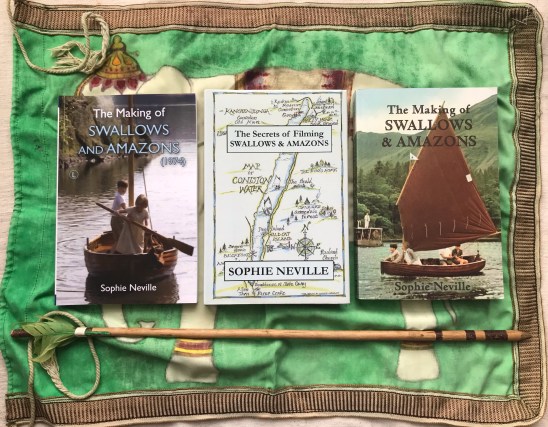
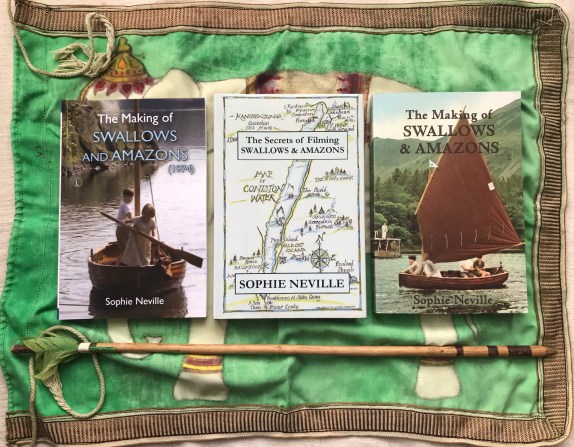
You can read more about our adventures making Swallows and Amazons in these books, available online:
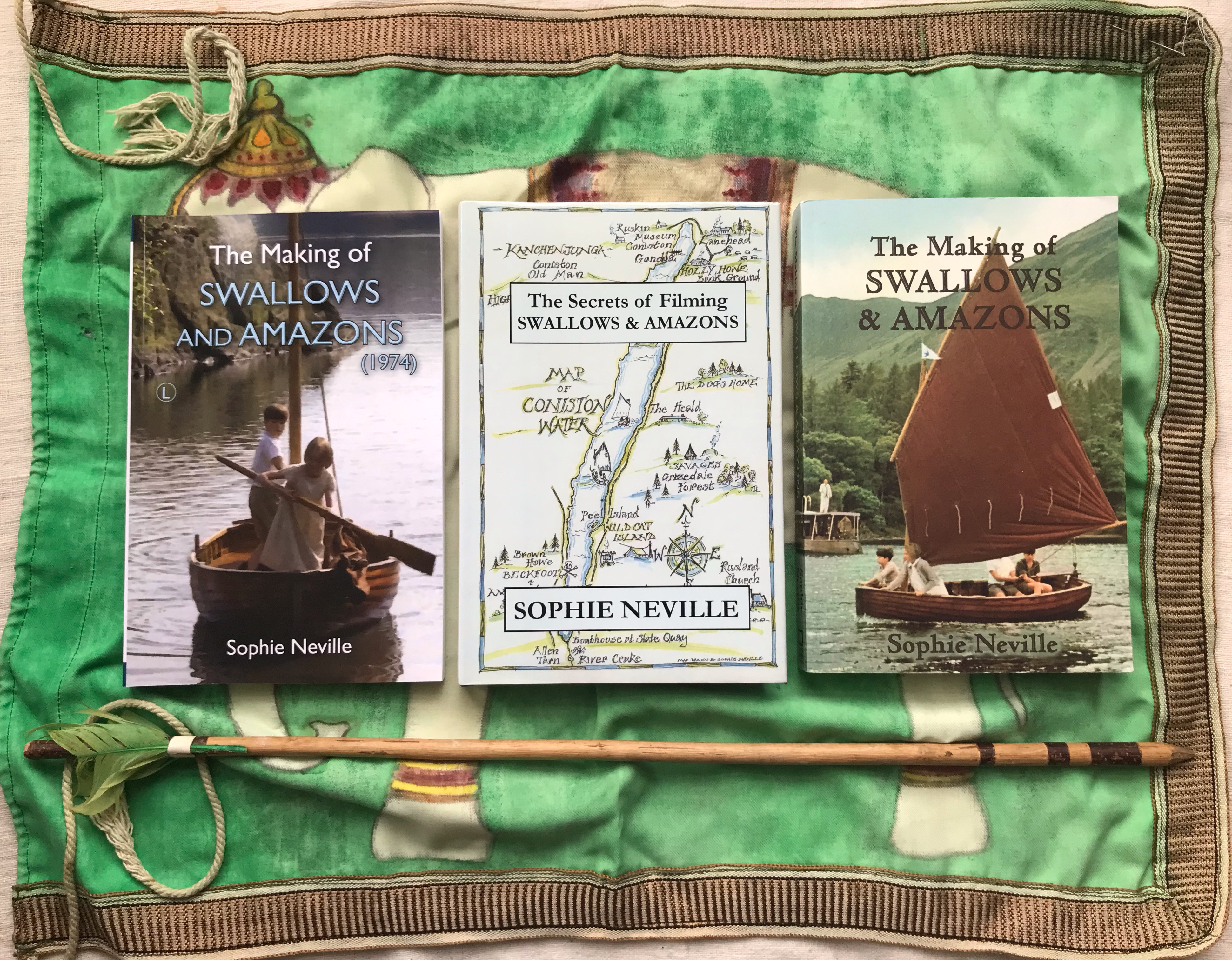
Different editions of ‘The Making of Swallows and Amazons (1974) by Sophie Neville’
Arthur Ransome first visited the Lake District as a tiny baby. He said that his father, ‘carried me up to the top of Coniston Old Man at such an early age that I think no younger human being can ever have been there.’ Thereafter the family traveled up by train every summer, from 1884 – 1897, to stay on the Swainson’s farm at High Nibthwaite at the southern end of Coniston Water.
The four children were allowed to run wild in the hills or slide down the knickerbocker-breaker rocks above the farm whilst their mother painted and their father fished the River Crake. They had the use of a rowing boat, which they would take a mile up the lake to Peel Island for a picnic.
Peel Island on Coniston Water, which you can visit by boat.
I’d love to take my family to spend a week at Low Water End, a holiday cottage at the southern tip of Coniston Water, which has boats, lake frontage and a small slipway.
Another lovely place to stay is Hill Top Farm, a traditional Lakeland house built in the 1700s and now owned by Martin Altounyan, son of Roger Altounyan and grandson of Dora Collingwood who was such a great friend of Arthur Ransome’s. They say you can see the Crake estuary from the garden. It is near Penny Bridge village, four miles from Coniston Water and just three miles away from Hill Top at Haverthwaite where Arthur Ransome lived at the end of his life.
As a young man Ransome escaped from London for a holiday in Coniston village and found himself invited to stay nearby at Lanehead by WG Collingwood, Dora’s father. Ransome writes in his autobiography that had originally meet the family in 1896 on Peel Island. ‘Mrs Collingwood told me that she remembered that meeting on the island and her surprise that my mother, who was a very pretty young woman, could have a family of such very ugly children.’
The rocks at the end of Peel Island where the Collingwood family traditionally had picnics
By 1904 Arthur Ransome was being taught to sail by Dora, Barbara, and Robin Collingwood in a heavy old dinghy called Swallow that they were able to take out on Coniston Water. He later stayed at Low Yewdale at the north end of Coniston, which I believe still offers Bed and Breakfast or a self-catering cottage. Ransome would set up ‘a tent on a small mound close to Yewdale Beck a hundred yards up the valley’ so that he could sleep outside when it was fine. In her guide-book,In the Footsteps of the Swallows and Amazons Claire Kendall-Price shows you how you can walk from Low Yewdale to Ambleside via The Drunken Duck, a pub you can now stay at that I believe Ransome visited.
It is easy to see how all this experience, the houses Ransome loved and places he knew of since childhood were poured into his Swallows and Amazons series of books. You will have to tell me which of his stories were written here:
After many adventures in Russia and the Baltic, Arthur Ransome bought his second wife Evgenia to live at Low Ludderburn on Cartmell Fell above Windermere where they lived from 1925 until 1935. He loved the work room made for him at the top of the grey barn outside. They moved to Suffolk for a while but returned during WWII to live at The Heald, which overlooks Coniston Water.
The Heald above Coniston Water where Arthur Ransome lived between 1940 and 1945 ~ photo: Peter Walker
It was here that Ransome wrote The Picts and The Martyrs. They had a jetty there where he kept his boat Coch-y-bonddhu, which is used as the model for the Scarab, a sailing dinghy bought for Dick and Dorothea Callum in the novel. The gardener’s cottage to The Heald has recently been rebuilt and is for sale.
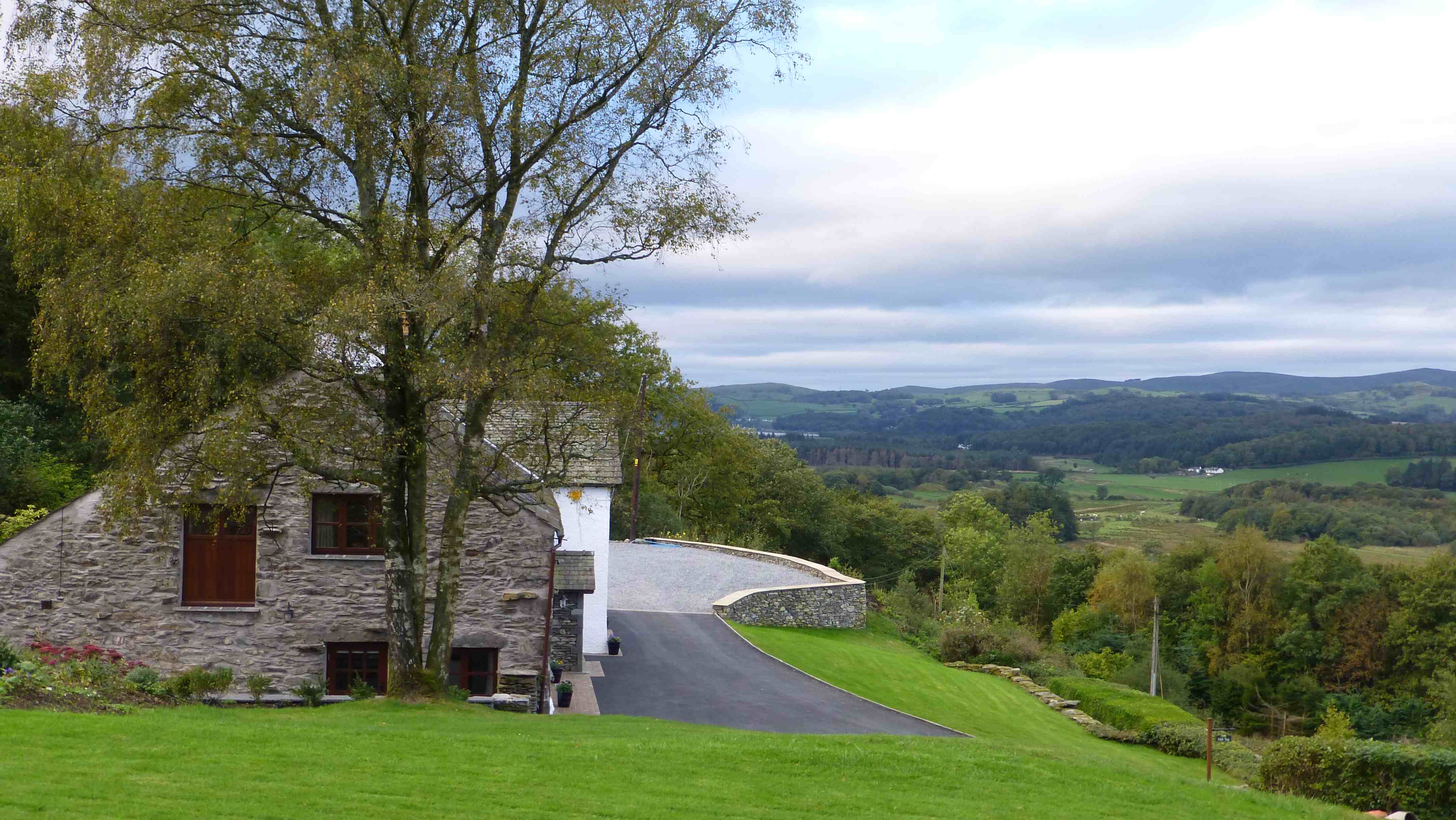
In their later years, the Ransome’s loved at Hill Top Farm near Ealingshearth, where the views are stunning. It has been renovated but retains many of the original features.

















 Sophie Neville