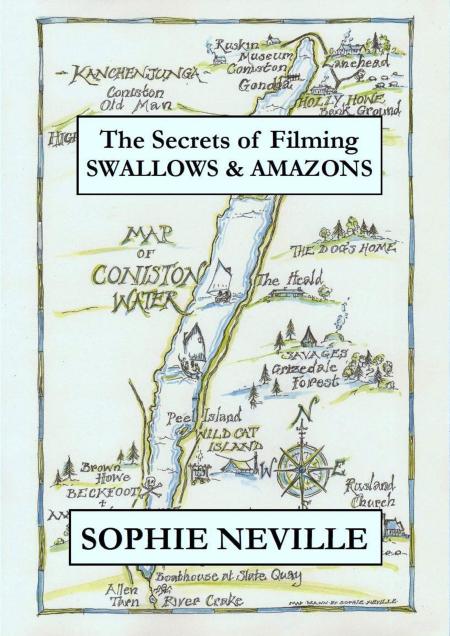
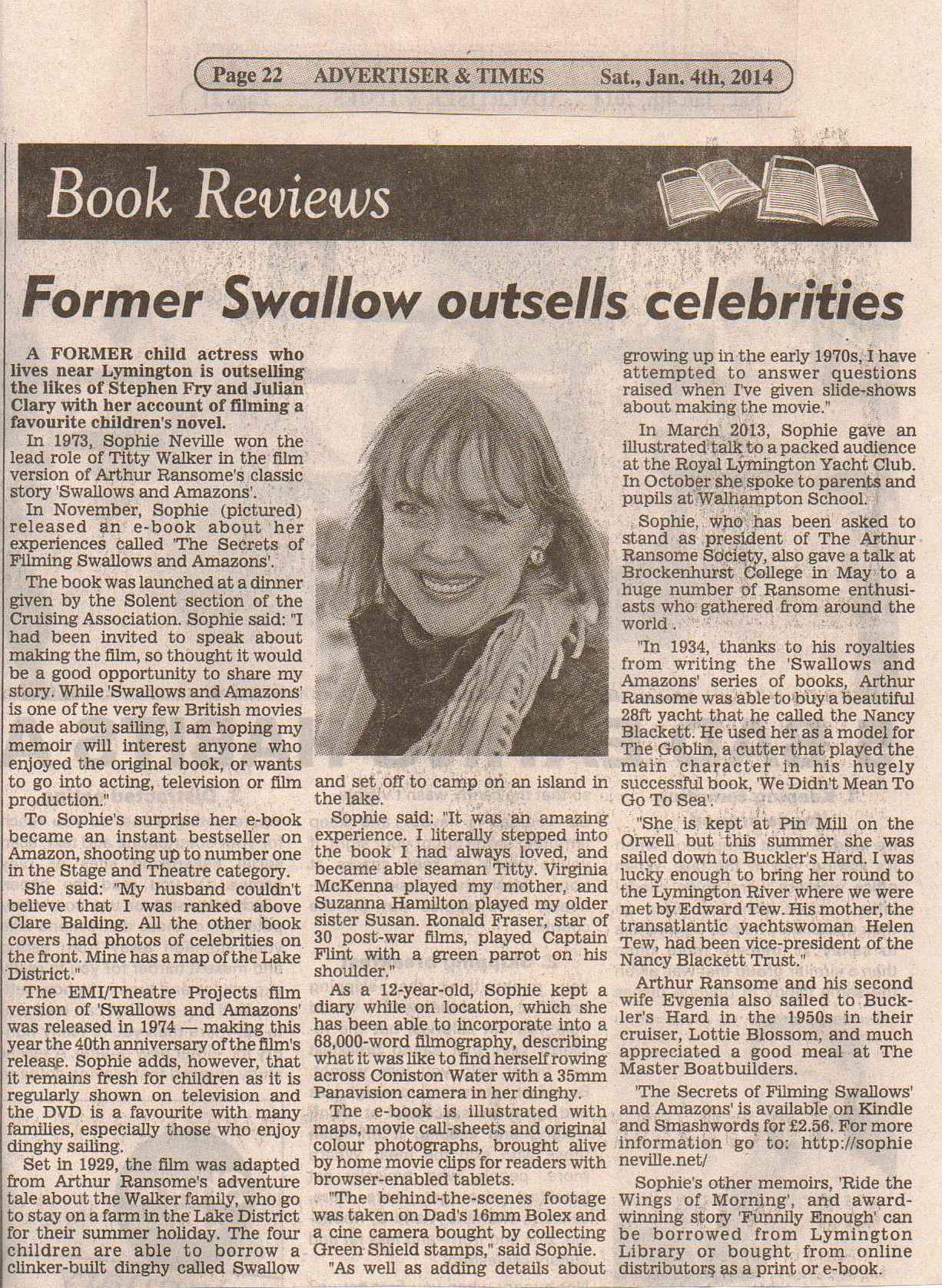
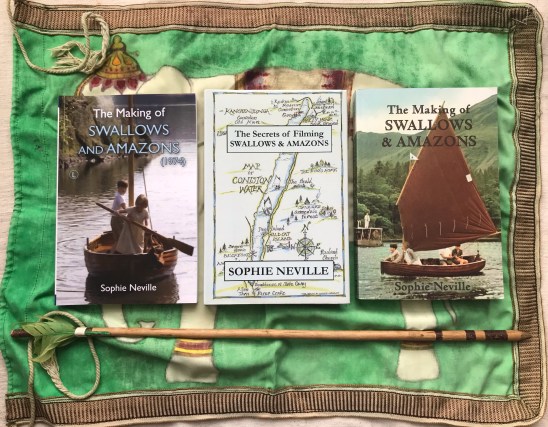
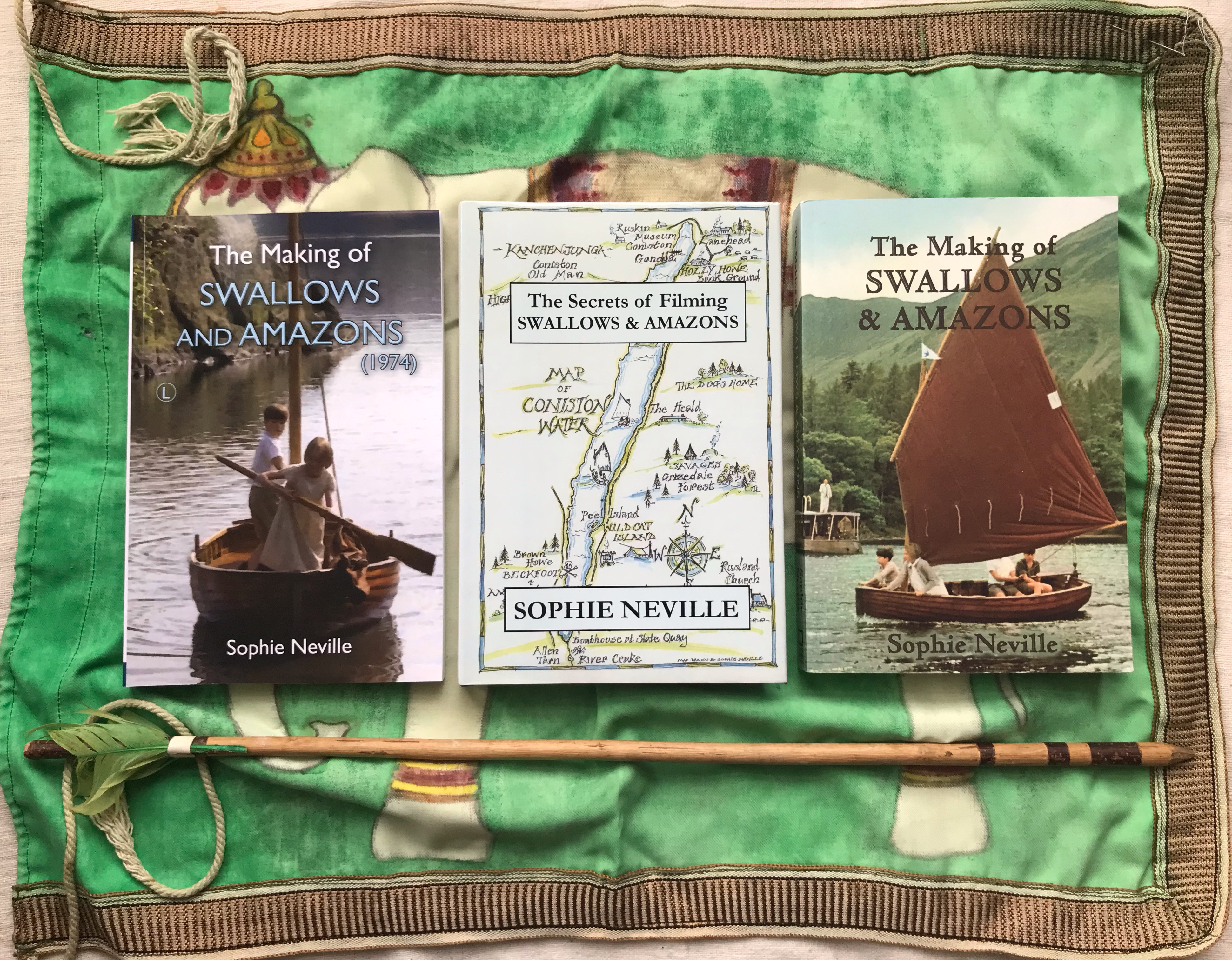
If you would like to know how the movie of Swallows & Amazons (1974) was made and know where the real locations can be found, ‘The Secrets of Filming Swallows & Amazons(1974)’ is currently available as an ebook on Amazon and Smashwords for £2.99. The paperback was launched to mark the 40th anniversary of the film’s release and is available online here.
Do you know where the Peak of Darien can be found?
The paperback, which is suitable for any age group, is based on the diary that I kept when I played the part of Titty Walker in 1973. It is illustrated with behind-the-scenes photographs and memorabilia such as one of the tickets to the Royal Gala premier in Shaftesbury Avenue held on 4th April 1974. You will also find out what the actors who played the Walker family ~ the Swallows ~ are doing now.
The joy of the ebook is that it includes a number of home-movie clips that my parents took of life behind the scenes that you can play wherever you have internet access.
A review of the ebook in Classic Boat magazine ~ Feburary 2014
If you have any questions about making the film, please add them to the comments below, and I will get back to you.
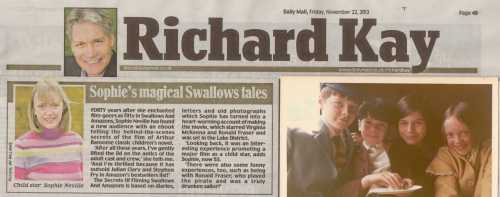
A review of ‘the Secrets of Filming Swallows & Amazons’ in Richard Kay’s column in the Daily Mail ~
There were rather over-excited headlines in the Times and Telegraph when the ebook was launched but they only spoke of the legendary drinking of Ronald Fraser. Please don’t worry – there is nothing X-rated about the book – it is just the price one pays for half a page in a daily newspaper, especially since it came out on a Saturday.
The ebook has been doing well in the Amazon charts and hit Number 1 in the category ‘Stage and Theatre’.
A preview of what the book holds in store can be watched here:
Very many thanks to all those who have left customer reviews on Amazon. It is always exciting to find out how the book has impacted others, especially those who love the Arthur Ransome books.
When people see the Steam Yacht Gondola on Coniston today, in all her re-built glory, she seems rather plush to have been cast by Arthur Ransome as Captain Flint’s houseboat in Swallows and Amazons. The main reason for assuming that she was used as the model for the illustrations is because Arthur Ransome grabbed a post card of the Gondola and drew on it to give the first illustrators of Swallows and Amazons some idea of his vision. However Ransome’s biographer Roger Wardale told me that it was a former steamer on Windermere that he had in mind: the S.Y. Esperance. Ransome was known to have been spotted looking through her cabin windows and much admired her distinctive bow, designed to cut through cat ice on her way to Lakeside Railway station.
Esperance in Rayrigg Bay, Windemere ~ photographed by Martin Neville in about 1963
When I was first taken up to the Lake District in 1963, my father found what he thought was houseboat bay on Windermere and took this shot of SL Esperance moored in Rayrigg Bay. She does look very like the first professional drawing submitted to illustrate Swallows and Amazons.
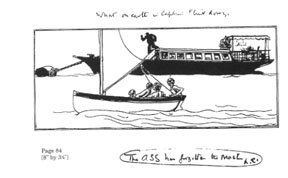
Stephen Spurrier’s unused illustration of Swallow sailing past Captain Flint’s houseboat
Arthur Ransome’s terse note reads: ‘The ass has forgotten the mast’. I went to see the Esperance when she was lying at the Steamboat Museum on Windermere with the film producer Nick Barton in 2011. Built at Rutherglen in 1869 she is nearly 65 foot long with a 10 foot beam.
SL Esperance at the Windermere Steamboat Museum in 2011
She did not always have such a traditional appearance. Roger Wardale kindly sent me this photograph showing what she looked like in the 1930s.
‘Esperance’ in the 1930s when she was owned by Sir Oliver Scott.
The cabin has since been removed from her rear end.
SY Esperance at the Windermere Steamboat Museum in 2011
SY Esperance now looks more like this illustration – or could do. Although she has a setting for a mast the reality is that she has seven windows, whereas Clifford Webb’s illustration shows her with only six.
Clifford Webb’s illustration of Captain Flint’s houseboat
I have no idea if anyone could film aboard her today when marine safety regulations are so strict. We couldn’t in 1973.
Claude Whatham took advantage of the larger cabin windows in the Lady Derwentwater whilst filming ‘Swallows & Amazons’ in 1973 ~ photo: Daphne Neville
When we made the original film of ‘Swallows and Amazons’, the producer Richard Pilbrow was obliged to use the Lady Derwentwater, owned by the Keswick Launch Co. She has quite a different stern from the illustrations but was licensed to carry 90 passengers, which must have allowed him to take a seventy-strong film crew on board. At least she was given a mast. You can envisage Ronald Fraser, as Captain Flint, angrily stamping out the firework on the roof.
One advantage of the Lady Derwentwater was that the windows of her cabin enabled the director to get a good view of the lake, which he made use of when Captain John rowed over from Peel Island to visit Captain Flint and pass on the charcoal burners’ warning. She couldn’t be moved to another lake, but Derwentwater is surrounded by such dramatic fells that the director, Claude Whatham used this to his advantage during the final scenes of the classic film. The Lady Derwentwater has been given a transome but is still in commission and you can take a trip on her today.
Sophie Neville at the Windermere Steamboat Museum
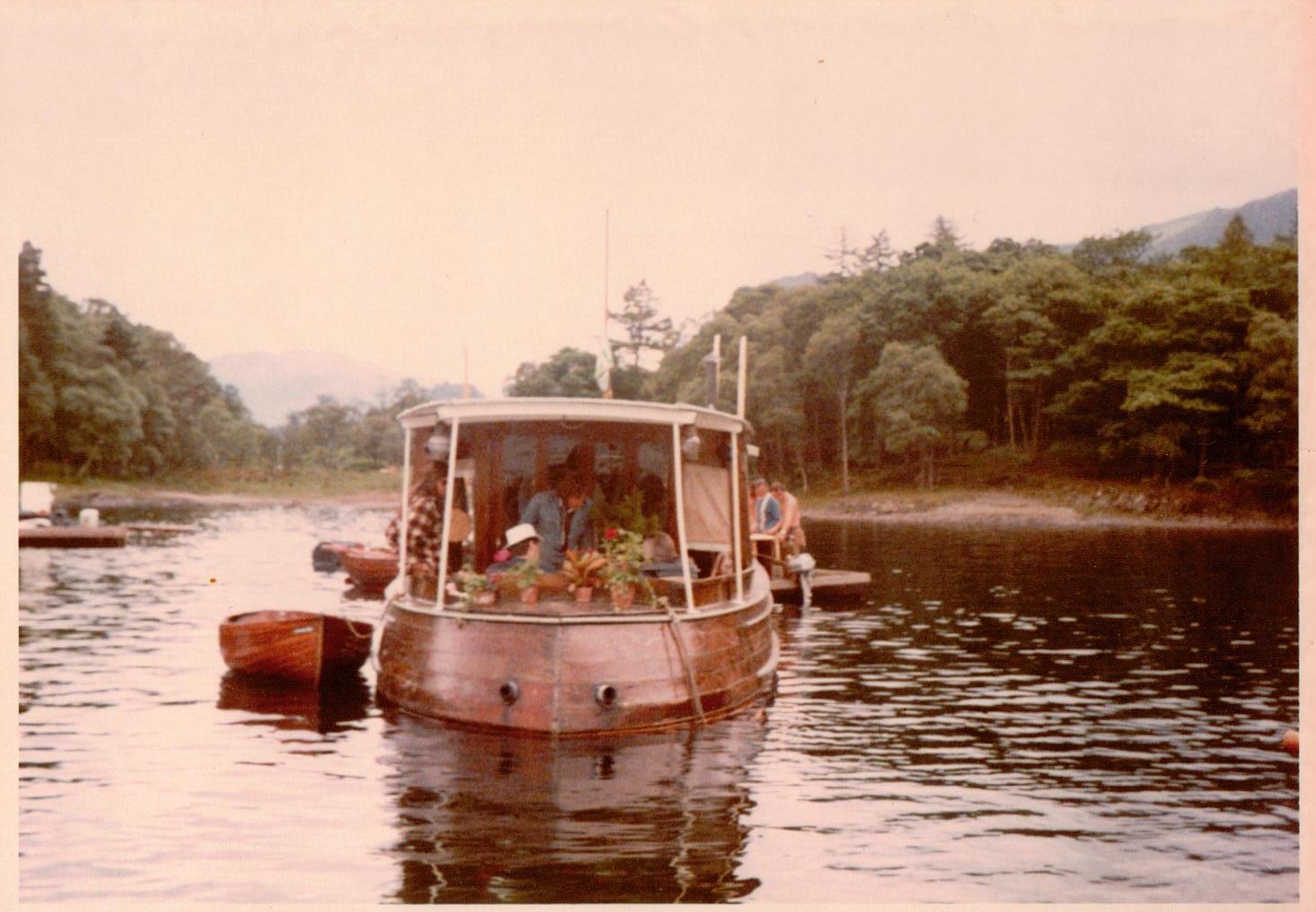
Was the Gondola so very different? Ransome had known the steam launch since spending his own childhood holidays on Coniston, when she was in service. While staying at Nibthwaite he became a good friend of the Captain, or so the story goes. Back in 1973 the Gondola looked like this – her roof too curved to run along, her bow rising up a little too dramatically to accommodate the foredeck of a retired pirate busy writing up his devilish crimes while his a cannon lies glinting in the sunlight, ready to fire.
Photograph of the Gondola on Coniston Water taken by Martin Neville in 1973
For more about the Steamboat Museum with a photograph of SY Esperance, please click here
For a lovely photo of SY Esperance and to read more, from another perspective please click here
The full story of the making of the classic film Swallows and Amazons (1974)’ can be read in this ebook costing £2.99. You can read the first section for free here:
When the BBC announced plans to recreate the classic outdoor children’s sailing adventure Swallows and Amazons it was hailed as a blockbusting antidote to the health and safety culture of the mollycoddled video-game generation…
However, previously unread diaries of its creator, Arthur Ransome, reveal that the author considered the corporation’s last attempt to bring his much-loved story to life to be a “ghastly mess” marred by “dreadful ham” acting. The diaries reveal how Ransome clashed repeatedly with BBC executives in the early 1960s when the BBC commissioned a six-part dramatisation for television, starring Susan George, then aged 12, as Kitty (changed from the original Titty) Walker.
Ransome, then in declining health, was living in virtual retirement in his remote Cumbrian cottage Hill Top overlooking the spectacular Rusland valley with his wife Evgenia – the former secretary to Leon Trotsky, whom he met while working as a foreign correspondent and spying for Britain in revolutionary Russia. It was a spartan existence, often with no electricity or running water.
In a series of brusque entries at odds with his generally affable demeanour, he describes how he repeatedly fought with BBC executives over attempts to introduce two new characters – Ernie and Sam – to the story. Both he and his wife attempted to rewrite the script after concluding that one episode was “bad beyond belief”.
At his home Hill Top with his publisher Rupert Hart-Davies
“I have agreed to Genia’s proposal that we shall wash our hands of the film leaving it to Mr Walls [of the BBC] to play the farceur as much as he likes. They may be right in thinking that vulgar ham acting is what the T.V. gapers want,” he wrote in July 1962.
Ransome was particularly unimpressed with the performance of popular British actor John Paul as Captain Flint – the character… said to be based on Ransome himself – describing it as “dreadful HAM”.
On attending a screening at the Hammer Theatre in Wardour Street, central London in October 1962, he concluded: “Saw the ghastly mess they have made of poor old Swallows and Amazons … MacCullogh [his friend Derek MacCullogh, former head of children’s broadcasting at the BBC who was also known as the presenter Uncle Mac] did not come possibly to avoid trouble with his employers.” It was eventually broadcast the following year.
Stephen Sykes now owns Hill Top and has restored the Ransomes’ former home. He is also helping transcribe the author’s sparsely detailed diaries from his years at Hill Top, which are kept at Leeds University’s Brotherton Library. Sykes said the writer received £3,500 for agreeing to the BBC broadcast – a considerable amount of money. “He was clearly making a very good living out of the rights to Swallows and Amazons. This was his baby and he had obviously pored over it. It is a very leanly written story and it was pretty clear it was written by a journalist because of its clarity, because there is nothing extraneous,” he said.
Hill Top in the Lake District today
“He is extremely protective of his own work. He felt he didn’t want a word changing, and that he had honed the story down and it was what it was,” he added.
Swallows and Amazons was first published in 1930. It recounts the adventures of the children from two families who while away an idyllic summer getting into scrapes sailing their dinghies across Coniston Water and Lake Windermere. As well as the television series, many theatrical and musical adaptations have been staged, and the story was made into a film in 1974 staring Ronald Fraser and Sophie Neville.
When the latest project was announced in 2011, head of BBC Films Christine Langan said it would seek to encapsulate a forgotten era of childhood adventure “from the pre-health and safety generation”.
Producer Nick Barton of Harbour Pictures, who is collaborating on the film with the BBC, the Arthur Ransome Society and the author’s literary estate, said it had not been decided yet whether the children would be shown sailing without their life jackets.
But he said viewers could expect to experience the full majesty of the book’s setting. “The lakes and the mountains are very big and we are keen to recreate that grandeur of the scenery in the film,” he said. A spokeswoman for BBC Films said: “The film is still in development.”
When I saw Simon West recently he told me that his father would love to see a copy of ‘The Secrets of Filming Swallows & Amazons’.
Nigel West soon wrote to say:
‘…it makes fascinating reading. Simon told me very little in the way of detail about his experiences when filming so your account is very welcome.Simon’s mother, Dorothy, and I only visited the Lake District once during that period and then we only saw Simon fairly briefly and saw nothing of the filming. Things that I can recall about the whole experience I will describe below.
.
‘Our family took up dinghy sailing when I built a Mirror dinghy in our dining room at home. It was built from a flat-pack and took nearly a year to construct, in my spare time, during which the family had to eat meals in the sitting room. I had been sailing on the Norfolk Broads with friends a few times in my college days, which had started my interest in boating. The family joined the Dorchester Sailing Club which was based on an old gravel pit not far from our home. Eventually we also acquired two children’s Optimist dinghies for Virginia and Simon, who spent many weekends racing their boats at open meetings around the country.’
.
.
‘One day at the club a notice appeared on the notice board asking children with sailing experience to audition for acting parts in a film to be made of Swallows and Amazons. Virginia immediately expressed interest and pressured Dorothy and me to take her to the auditions in London. We were reluctant to agree because we thought her chance of success would be so slim with thousands of other applicants, many with acting experience, queueing up for parts. Then, to my surprise, Simon said he was also interested, with his eye on the part of John, but surely, I thought, he would be too young and too short for that part and he had pooh-poohed the idea of trying for Roger.
‘As it happened we were due to visit Dorothy’s sister, who lived south of London, in Sussex, on the Saturday of the auditions, so we decided that a small detour would allow the children to attend without too much problem. Sadly Virginia fell at the first interview while Simon, to our utter amazement, won through that and all the other stages of selection to win the part of John. How pleased we were for him and proud – and sorry for Virginia who took her disappointment so well. You should ask Simon about the later stages of selection that included a long weekend living on an old motor torpedo boat at Burnham-on-Crouch having, among other things, his sailing proficiency assessed.
‘From the few things that Simon did tell us about the filming, I was extraordinarily impressed by the maturity he had so clearly gained in the whole experience. He explained how conscious he was of the crucial part he had to play in getting it right, in front of the camera, because the success of the whole project depended on that. With dozens of adults all working flat out as a team to a tight schedule meant that he had to concentrate on getting it right first time – a very maturing experience for an 11 year-old taking time out from his first year at secondary school.’
.
.
‘With Simon having no acting experience I was intrigued to know how Claude Watham had managed to get what he wanted from his young cast. Simon explained one technique that Claude had used to stop them looking wooden in front of the camera. He would make sure they knew their lines, send the children to run to some point and back again, then shoot the scene while they were still animated from the running.
‘One aspect of the production mentioned in your book is the studio post-sychronisation. I can remember taking Simon up to Elstree Studios in Borehamwood to re-record some of the dialogue, sometime after the filming had been completed. Maybe you did the same. Simon had to wear headphones to listen to the film dialogue, while watching a scene from the film, and to repeat to a microphone the dialogue in exact synchronism with what he heard in the headphones and saw on the film. He said it was an extremely difficult thing to do, to talk over one’s own voice, exactly, and then to give it the right expression. I imagine it needs a lot of practice to get it right. The object was, of course, to dub over recorded dialogue which had either been poorly recorded or which included extraneous noise.
‘Finally, I did manage to watch one scene filmed, but from a great distance, which you do mention in your book, and that was the Darien scene shot at Runnymede sometime much later in the year. In 1973 it was the fashion for all schoolboys to wear their hair indecently long. At Simon’s school the rule was that the hair was just allowed to touch the collar but not an inch longer. Simon’s hair was no exception but he had had it shorn for and throughout the filming and it had just started to grow back when he was summoned to the Runnymede shoot. On our arrival at Runnymede Simon was immediately sat on a chair and had his locks shorn once again. I think he should have been paid a special indignity fee for that day’s work.’
.
.
‘I remember watching the S&A float in the Lord Mayor’s Show pass by but the float passed too quickly to let you all spot our family in the crowd.
‘I also remember attending the film’s premier at the cinema in Shaftesbury Avenue, also attended by some minor member of royalty. It was a grand event and brought home to me that this was not some trivial little children’s entertainment but was a full length feature film of some standing. It must have been shown on British TV a dozen times over the years, particularly at Christmas, so it has stood the test of time by anybody’s standards.
‘That reminds me that at one point we made a half-hearted attempt to get Simon into Equity but without success. The result was that Simon only got paid a daily fee for his work on the film, with no residual payments for TV showings, overseas viewings or video and DVD earnings, to say nothing of his image appearing on a number of jigsaws!
‘You probably know that Simon also acted in a film made for children’s television in 1974, when he took the title role in Sam and the River. This was recorded on film and was shown on BBC TV in the form of six 30 minute episodes. It was before the days of video recorders so we have only ever seen the original transmission. Fifteen years ago I approached the production company to see if I could obtain a copy, but they had been reorganised since the film was shot and had kept no copy, nor record, of the production. I then approached the BBC and they did a search for me but they drew a blank. At one stage the BBC had a Philistine in charge who infamously threw out masses of, now priceless, BBC archives as being a waste of space. One day I hope to put a name to him. Simon has since found that the BFI have an archive copy of Sam and the River so I will approach them, but they do emphasise that they have no authority to make or issue copies of archive films. Might, however, get them to show it to us one day perhaps.’
.
There were four jigsaws issued with the film. There is full image of the jigsaw above on an earlier post.
Arthur Ransome was born in on 18th January 1884. Those who loved his books will be celebrating his birthday from Giggleswick in North Yorkshire to the Orwell where the Ransomes spent so much time sailing.
Pamela Copley has just written from Australia to say:
‘There is a celebration of AR’s birthday in a suburb of Melbourne on Saturday – straight after the AGM. There will be a member from the UK group too.
Cheryl Paget tells me that, ‘In New Zealand members have met in Auckland for a weekend of Ransome inspired activities. We have sailed under the Auckland Harbour Bridge in a 57ft ketch rigged deck scow, toured the historic naval town of Devonport and walked to the top of the dormant volcano of Rangitoto.’
Mikako Tarashima wrote from the Arthur Ransome Club in Japan to say:
‘We would like to have a small exhibition in this year.’ In 2014, publication of new Japanese translation of Ransome saga was complete.’
I ask the question: How has Arthur Ransome influenced your life? What impact have his classic books, or the adaptations of Swallows and Amazons for film, television or the theatre, had on your family? Do add a line or two to the Comments below.
Arthur Ransome’s cutter the Nancy Blackett on the Orwell in July 2013
I am guilty of denial. When people asked, ‘How has Swallows & Amazons influenced your life?’ I’m afraid I used not to be that forth-coming, because I had moved on from acting in films. If you had asked me in 2010 I would have shrugged and said, ‘Not much.’
But then I stopped and thought again.
How much time I have spent exploring wilderness areas? I’d forgotten that it was the maps in Ransome’s books that attracted me to reading Cartography at university. I went to draw numerous maps all over the world.
I love living outdoors. I love fell walking, mud-flats, and being out on the high seas. I would drop everything to sail to China or the Caribbean tomorrow. I put this down to the fact that my father took us sailing and camping even before I read Ransome’s books. But who influenced Dad? Born in 1929, he was an avid reader of Arthur Ransome and would eagerly wait for the next book about the Swallows and the Amazons to be published. It would be a longed-for Christmas present.
It then occurred to me that John’s careful planning, Susan’s packing, Titty’s log and Roger’s humour still steer my life. The food, the phrases, the urge to travel, became part of my life long ago. I’ve lived under Swallow’s flag.
I for one, sail into the year ahead with Titty’s words still singing in my ears,
‘Here we are, intrepid explorers, making the first ever voyage into uncharted waters? What mysteries will it hold for us, what dark secrets shall me revealed?’
Aboard the Nancy Blackett at Buckler’s Hard on the Beaulieu River
When Sten Grendon was given the part of Roger in Swallows & Amazons (1974), his mother Jane Grendon came up to the Lake District with him to work as a chaperone, looking after all the children appearing in the movie.
Jane Grendon keeping an eye on the children watching ‘Swallows & Amazons’ being filmed on Coniston Water in 1973 – seen here opposite Peel Island
Jane said that before filming began,
‘…one of the very first things we were asked was, ‘can Sten swim?”
‘I know he could doggy paddle. Neville organised swimming lessons at Pitville Pool, Cheltenham which included jumping off the diving boards. At the time I didn’t know why and I don’t think Sten is a natural in the water and the swimming lessons didn’t prove very successful. Claude told me – at the end of filming I think, when he gave me a copy of he original script – these lessons were because in the original script Roger was to jump in the water after Uncle Jim walked the plank.’
Jane sent me a copy of the page in question. I had not seen it before:
A page of David Wood’s original screenplay: ‘Swallow & Amazons’ (1974)
‘There are some personal memories. An aunt gave me the book for my birthday and I tried reading it but I hated all the technical boating details and I thought the children rather priggish so I didn’t enjoy it one bit and so was rather downhearted for Sten to be part of a story I hadn’t liked.’
Jane and her husband lived deep in the Cotswold countryside, at the rural Whiteway community, near Stroud in Gloucestershire. As I recollect, they had both qualified as teachers.
‘At the time of casting and during all the arrangements we had no phone at home and had to rely on a neighbour and the production team used to hold on while Ros came and fetched me! They must have really been fed up as it must have taken 10 minutes or so sometimes for me to get to the phone!’
Jane hadn’t imagined that she would end up in costume herself, if only for a day. She looked wonderful.
Jane Grendon in 1929 costume whilst filming the Rio scenes for ‘Swallows & Amazons’ at Bowness-on-Windermer in 1973
‘…. so there I was – a naïve, country girl flung into this alien world of a film unit. I was like a fish out of water! But I think it came out in your account that I related to you children better than I did to the adults around.’
Jane’s husband Michael was able to bring Sten’s sister, their little daughter Jo, up to watch the filming over half-term.
Jane Grendon with Martin Neville, taking part in a Weetabix commercial shot on location near Bisley in the Cotswolds in 1973
That summer Jane appeared in costume once more when Claude Whatham asked if Sten Grendon could also appear in a commercial he was directing for Weetabix, back in Gloucestershire at harvest time. This time she found herself on location not far from her own home and was always smiling.
Jane still lives the same house. Her husband Michael has retired from teaching and they have just celebrated their 50th wedding anniversary.
Sophie Neville with Jane Grendon, filming at Runnymede in September 1973
President of The Arthur Ransome Society at Rugby School
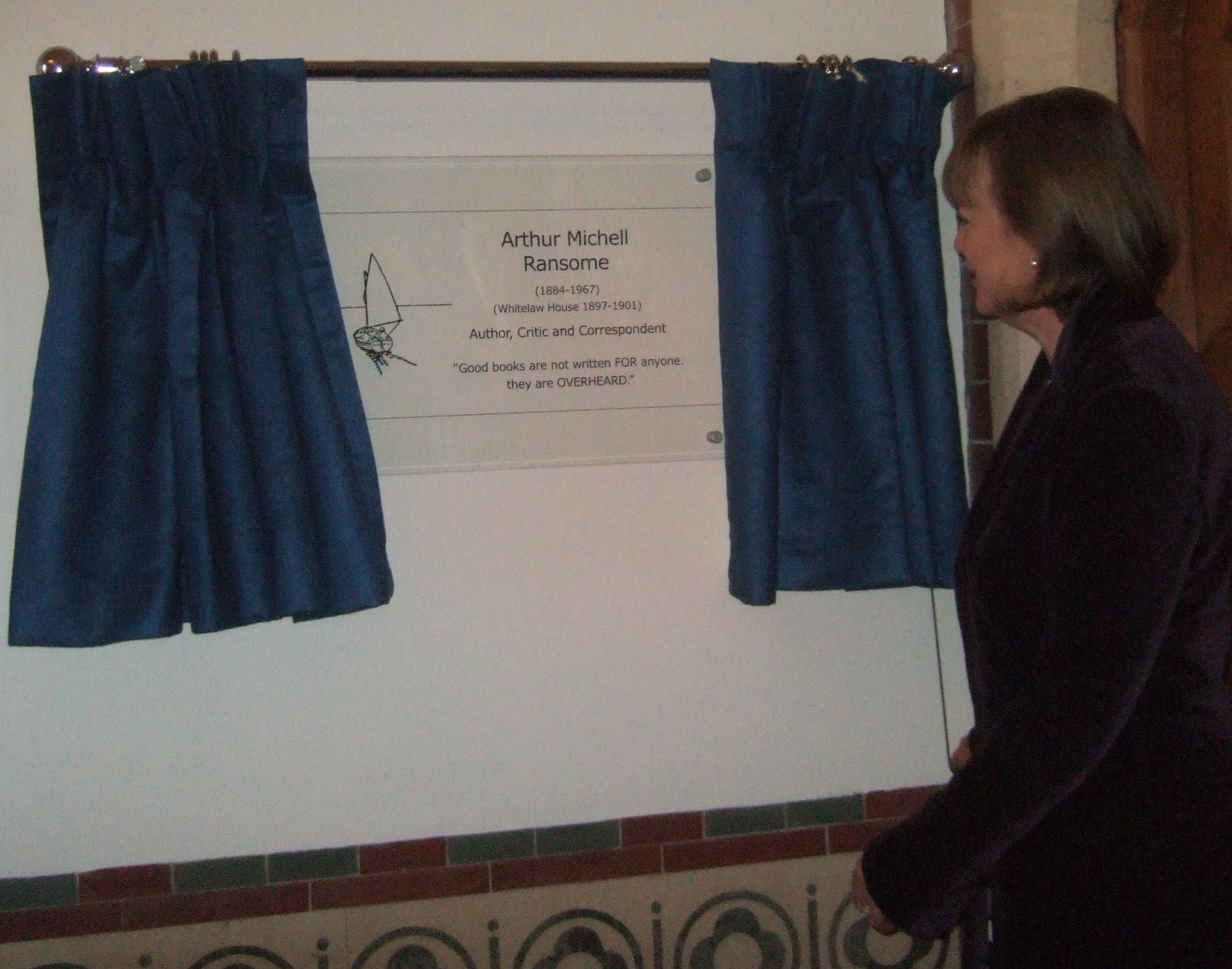
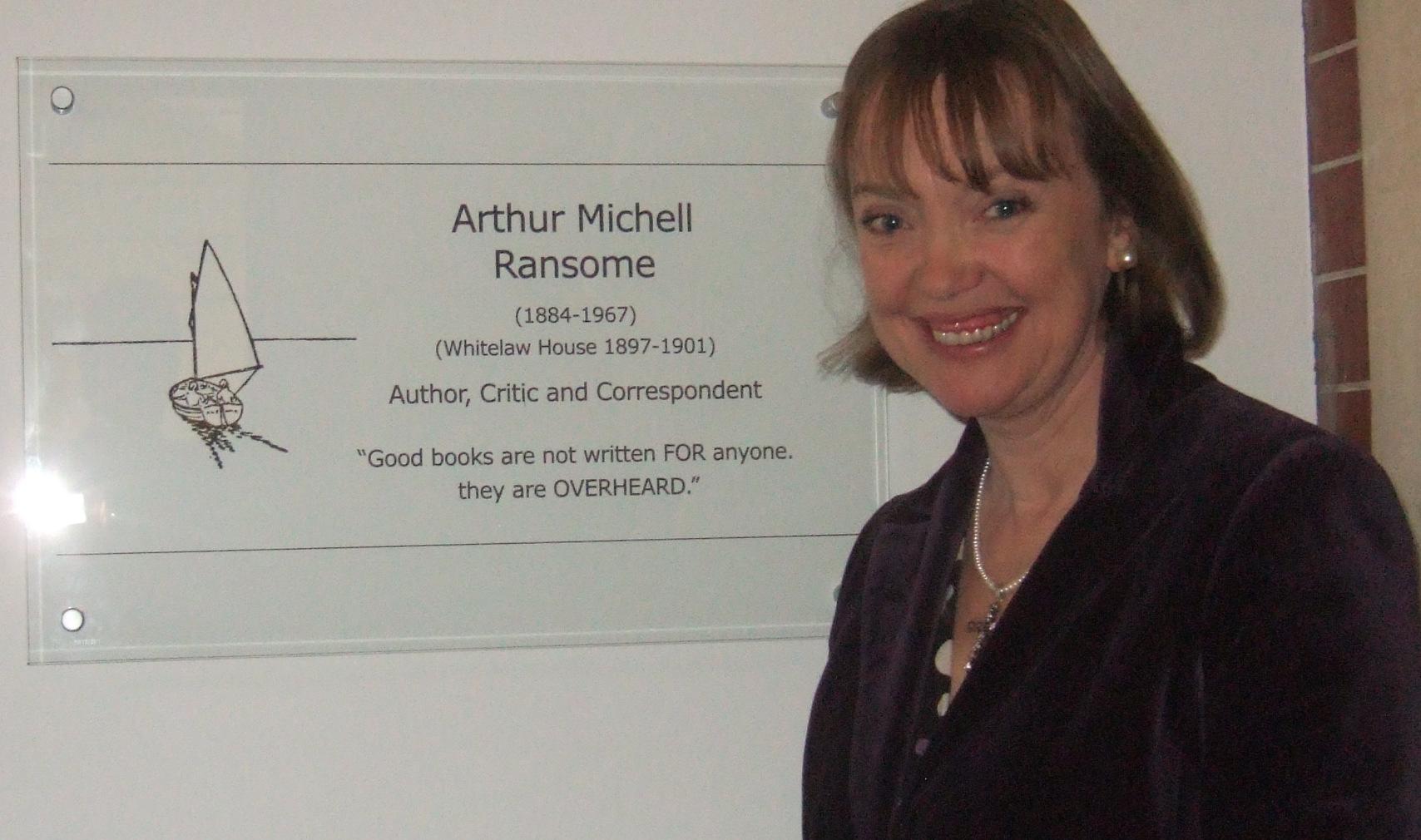
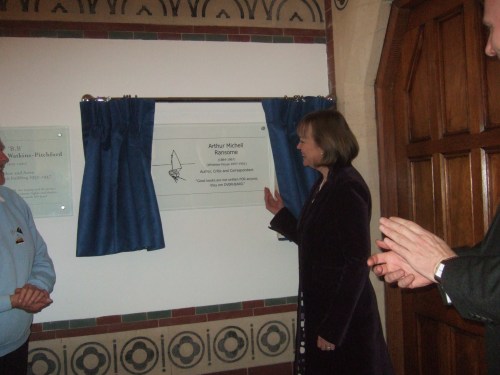
I had always wondered what it would feel like to pull a cord that unveiled a commemorative plaque. The truth is that it does not take long, but is jolly tricky subject for the press to photograph when the plaque is made of glass.
For one moment, some thought that Arthur Ransome’s second name had been spelled incorrectly but Michell (with no T) had been a family friend.
The line-drawing is a copy of one of his illustrations from the first of his twelve well-loved ‘Swallows and Amazons’ books, which so influenced my life, encouraging me to read, draw, sail and explore wild places. I think Arthur Ransome would have been pleased by the fact that he was referred to as a correspondent, rather than a journalist, and would be happy with the position. This is at the top of the stairs, directly opposite the Temple Reading Room.
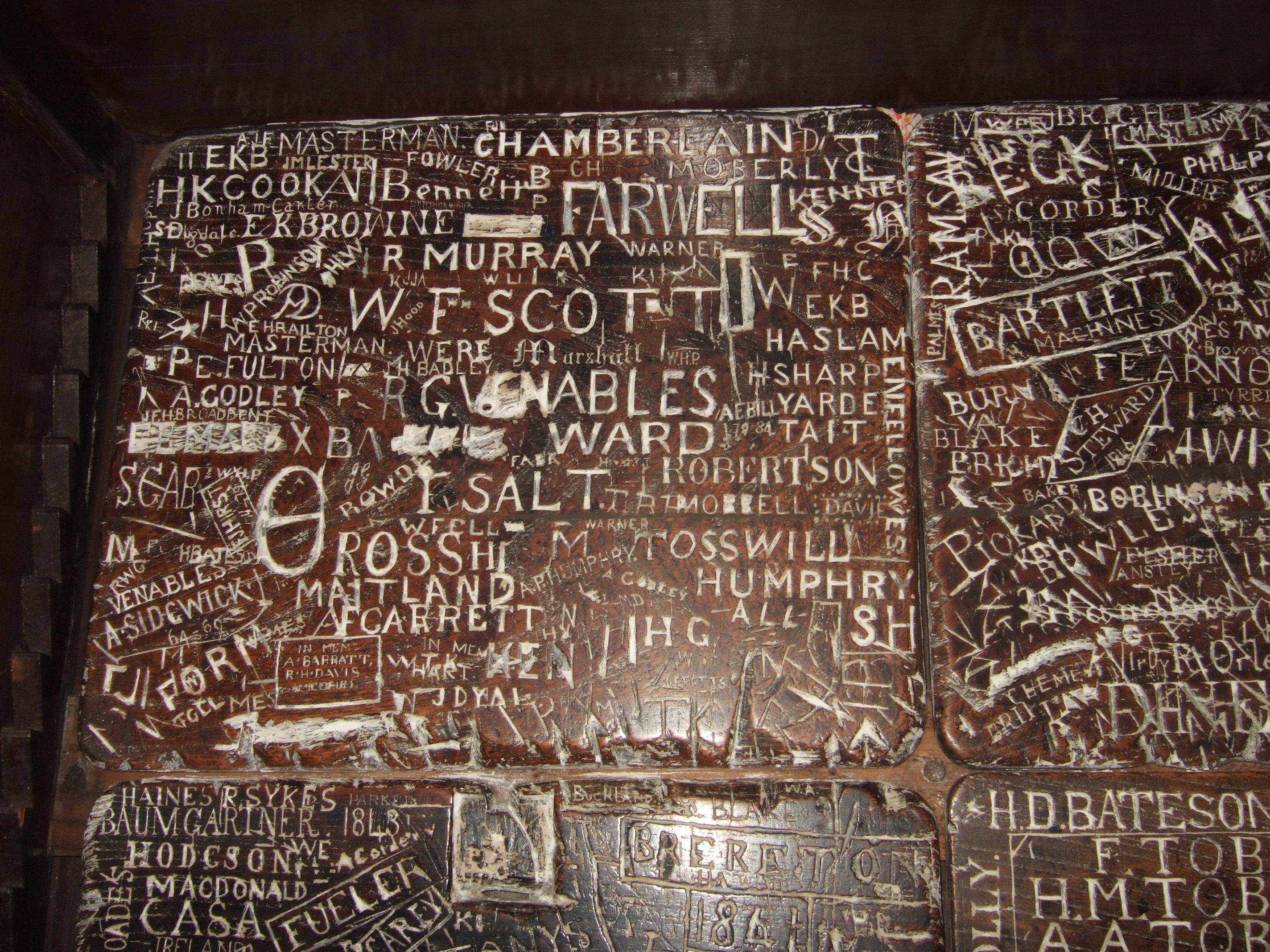
Neville Chamberlain carved his name into the top of this table top
What had not occurred to me was just how many well known and inspirational people had also been pupils at Rugby or taught at the school. My own education was expanded as we were shown around.
Charles Lutwidge Dodgson otherwise known as Lewis Carroll
We found Lewis Carroll’s plaque along with many others in the chapel. Arthur Ransome had been allocated his old study.
Rupert Brooks, poet of the First World War who died in 1915, is also commemorated in the chapel ~
I gather Arthur Ransome didn’t like the rugger pitch much but it was on this field that they first picked up the ball and ran with it.
To read the excellent article in the Rugby and Lutterworth Observerplease click here.
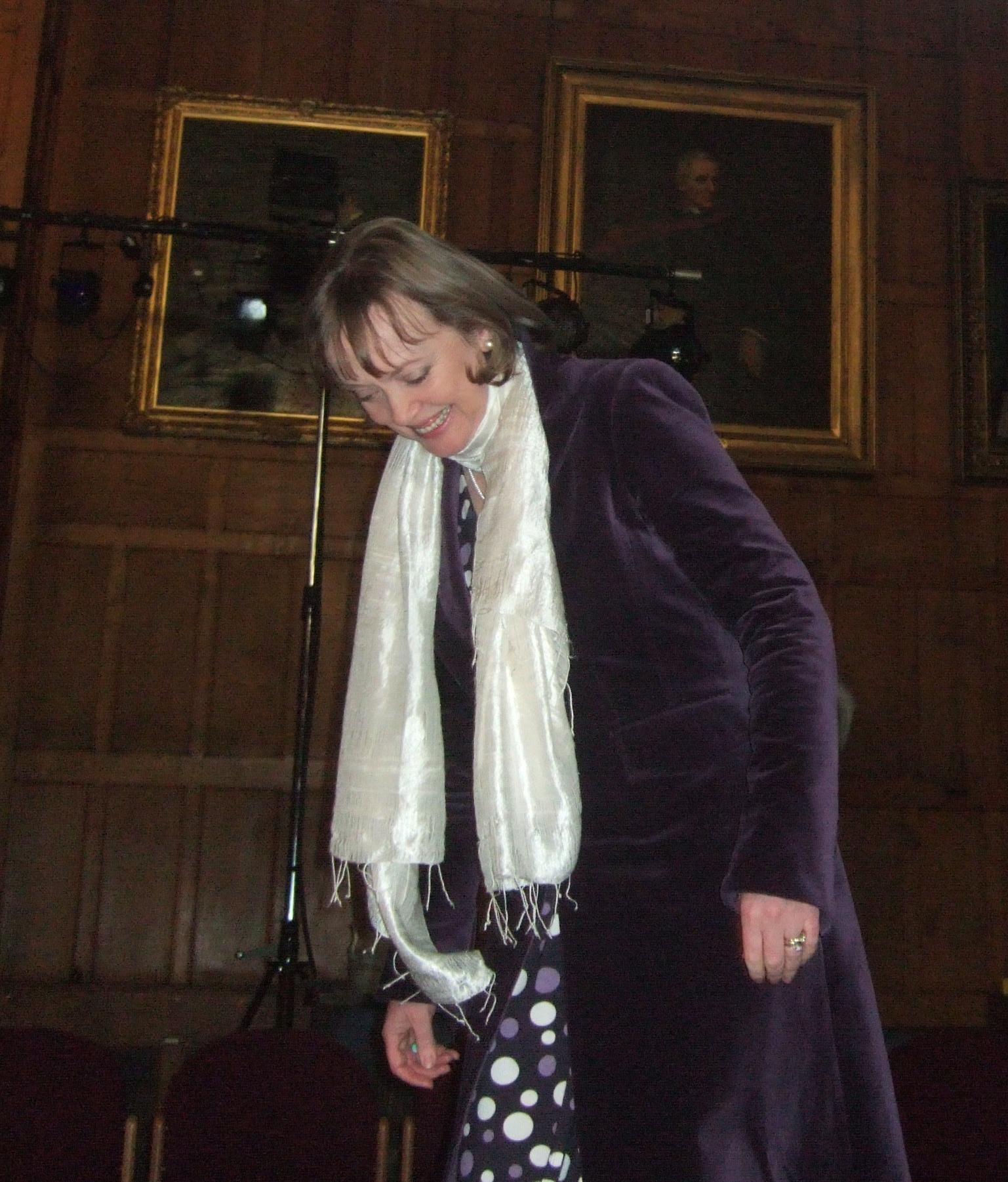
Sophie Neville beneath the portrait of Dr Matthew Arnold at Rugby School
The Times. What author would not be thrilled to have their ebook profiled in a Saturday feature article? But look at the headline. I shall never live it down. Far from being scandalous, my story is appropriate reading for any age group.
‘The Secrets of Filming Swallows & Amazons’ by Sophie Neville, featured in The Times
Richard Kay’s piece in the Daily Mail seems to have sparked off quite a bush fire. A News journalist from the Telegraph rang, as mentioned in my last post. Before I knew it, there was an over-excited headline on the internet
I was told-off by our Church Warden, who then handed me a clipping from the Saturday Telegraph, which read: ‘Swallows and Amazons a debauched adventure’. I didn’t dare look in the tabloids.
I was worried that I would be asked to step down as President of The Arthur Ransome Society but some of the members think it’s hilarious. The Arthur Ransome Group on Facebook have been busy thinking up Newspaper headlines for his novels, such as ‘Soviet agent indoctrinates all British children’.
*
Ronald Fraser, Make-up artist Peter Robb-King & Set Dresser Ian Whitaker on Captain Flint’s houseboat
Anecdotes about Ronald Fraser’s legendary drinking habits are mounting up. Spare me from being a prattler, but Ronnie would have loved this. Star of thirty post-war movies and numerous television programmes, he liked nothing more than to sit in a pub sharing scandalous stories with his friends from the press. A showman to the end, his coffin was carried by Sean Connery, Peter O’Tool, Simon Ward and Chris Evans.
Can anyone tell me who took this photo? If you click on the shot you will get to my Swallows & Amazons page which has a photo of the photographer.
Peter Walker e-mailed me from Cumbria:
In 1973 I worked for Post Office Telecommunications (now BT) as a local maintenance engineer. One summer’s day I had been given the job of repairing a fault on the payphone in the White Lion Hotel in the centre of Ambleside. As I pushed open the door to the bar it slipped out of my hand and the handle caught a customer in the back who happened to be taking delivery of a large drink.
I apologised, and he said “No damage done my boy… haven’t spilt a drop!”
I said I was referring to his back, “Don’t worry,” he said, “being stabbed in the back is normal in my line of business!”
Ronald Fraser on the cover of the VHS
A wonderful story that I have already added to the ebook:
…long after the filming, when Ronald Fraser was having a pint with his friends, he was fond of muttering ‘Natives!’ especially if someone ate the last of his crisps.(As you probably know, this was one of Titty’s lines in the film used when the Swallows were nearly run down by a Windermere steamer.)
Ronnie Fraser and DoP Denis Lewiston with paper cups of champagne in 1973
His fans and old drinking pals added comments below the online feature in Friday’s Telegraph:
Ronald Fraser sounds like he was well cast for the part, the black sheep of the family who was also the favourite uncle and usually totally p-ss-ed.
Ronald Fraser – a joy and wonderfully in-character as the freeloading drunk on the trans-Atlantic liner in the original TV adaptation of Brideshead.
“Debauchery” implies REAL shenanigans. Ronnie was usually too plastered to do more than stand, let alone move, let alone “do” anything. I assume the word is used ironically.
I had the pleasure of meeting Ronnie Fraser several times in the Richard Steele on Haverstock Hill in 1969/70, and of conversing and drinking with him. He was a total lush, but charming, funny and scandalous. His fund of acting stories was endless. I’m surprised he made it safely through S&A! (Swallows and Amazons)
I also remember Ronnie Fraser from the Richard Steele. One evening he was serving behind the bar, in his cups he served me 4 drinks and instead of adding up the price he just said “that looks about 10 shillings worth to me!”
The Richard Steele was a proper boozer with a mixed clientele which included Anthony Booth, Rupert Davies and Eric Sykes. And a great selection of posters on the walls. I went back in there a couple of years ago and it has lost the buzz it had back in those days.
he also was in the star in st.johns wood too dont think i ever saw him sober either.that would be about 1975 -1979
Yep. I too drank with him in The Richard Steele in 1976/7. Total gentleman and a great character. He used to drink with Alan Browning. Glynn Owen was another regular and one or two others of note.
I loved that film and thought it very faithful to the source book. My sister has met Ronald Fraser and as well as being a boozer he was also apparently something of a swordsman.
I thought that Ronald Fraser was miscast – he was too much the buffoon and his speech impediment wasn’t appropriate to the role.
With Ronald Fraser in 1973
General comments about the film were also added to the Telegraph site:
I had a slightly surreal experience 10 or 12 years after it came out. It was on TV and I sat happily through it, then I put in the video of the John Hurt movie 1984. In it, the girl I’d just been watching playing Susan as a 12 year old instantly aged 10 years.
It was raining in the Lake District- that’s a major surprise. One place there has recorded 200 inches of rain in a year!
It’s good to find someone else who shared those lovely £sd days!! I remember the posters vividly.
It was indeed largely a time of great adventure for a child at that time. As kid’s, at weekends & holidays, we often wouldn’t be seen from morning ’till evening, off exploring our surroundings. Totally unlike the generally mollycoddled, world wrapped in cotton wool that you usually see with today’s parents and their children.
Great book and an excellent, very English film! Pity that Arthur Ransome was a traitorous Communistic Guardian hack! I imagine that Soviet Commissars, used to Black Sea dachas, would have found The South Lakes far too drizzly for a summer holiday. No doubt Mr Ransome would have been keen to host them.
Well, you have to admit it was excellent cover for his job of reporting everything the Bolsheviks did to MI6.
Your comments are invited below.
For those who have not already seen it, here is some behind the scenes footage of filming on that houseboat in 1973.
~ In today’s Daily Mail and Mail Online – third article down on the website ~
While I was at Rugby School unveiling the commemorative plaque in honour of Arthur Ransome, invited as President Elect of The Arthur Ransome Society, Richard Kay’s office at the Daily Mail was desperately trying to reach me.
They were keen to ask about ‘The Secrets of Filming Swallows & Amazons’, which had already started to outsell Stephen Fry and Julian Clary in the category of Stage & Theatre memoirs on Amazon Kindle. It has also outranked pre-orders of June Brown’s autobiography ‘Before the Year Dot’ about her life as an actress. I worked with her on Eastenders when the soap opera first started back in the 1980s.
I woke up this morning to find an email from Hayley Dixon of The Telegraph saying that she had seen that my new behind-the-scenes book of Swallows & Amazons was out, and asking me to ring her. By one o’clock her article appeared in The Telegraph online, featuring my book trailer.
I then heard from Paul Kendall of the Sunday Telegraph’s magazine, Seven, who had read about my book launch in Richard Kay’s column today. Hayley had told me it was in the Daily Mail, but I had only just bought a copy myself.
Paul wrote:
“Would you be able to send me a copy of the book? We might be able to do a nice extract in the magazine!”
It has been a very exciting day – and thanks to all of your hugely valued support I am now at #1 in Stage & Theatre memoirs!
Thanks to the encouragement and help of my blog followers and Arthur Ransome enthusiasts around the world, I have managed to put my diaries, letters, old photographs and documents together into a 70,000-word memoir.
“Sometimes extraordinary things do happen to ordinary people. Little girls can find themselves becoming film stars. Long ago, and quite unexpectedly, I found myself appearing in the EMI feature film of Arthur Ransome’s book Swallows and Amazons, made for a universal international audience. I played Able-seaman Titty, one of the four Swallows. Perhaps it would be more accurate to say that I became Titty for a while, wearing thin cotton dresses and elasticated navy blue gym knickers, which the camera crew soon referred to as passion killers. The book was written in 1929 and although the film adaptation was made in the early 1970s it had an ageless quality and has been repeated on television year after year, typically on a Bank Holiday between movies starring Rock Hudson or Doris Day.
I got the part of Titty because I could play the piano. Although I had no ambition to be an actress, at the age of ten I was cast in a BBC dramatisation of Cider with Rosie. They needed a little girl to accompany the eleven-year-old Laurie Lee when he played his violin at the village concert. I plodded through Oh, Danny Boy at an agonising pace.
‘Do you think you could play a little faster?’ the Director asked.
‘No,’ I said, flatly. ‘These are crotchets, they don’t go any faster.’
Claude Whatham must have remembered my crotchets, for two years later, in March 1973, my father received a letter. It arrived completely out of the blue, from a company called Theatre Projects.
We are at present casting for a film version of SWALLOWS AND AMAZONS which Mr Whatham is going to direct. We were wondering if you would be interested in your daughter being considered for one of the parts in this film.
Amazing!”
From ‘The Secrets of Filming Swallows & Amazons’ by Sophie Neville
Preview copies of ‘The Secrets of Filming Swallows & Amazons’ at the Cruising Association dinner at the Water’s Edge Bar and Restaurant, Mermaid Marina on the River Hamble.
“This heart-warming memoir is illustrated with colour photographs, most of them taken at the time by Sophie’s family, and contains links to behind-the-scenes home movie footage for readers with browser-enabled tablets. It delivers a double helping of nostalgia for both fans of the era of Arthur Ransome, and the groovy times of the early 70’s.” ~ from the Amazon Kindle description
Also available for other reading devices on Smashwords
Thanks to those of you who contributed comments, questions, and aspects of local history on this blog. I would love to know what you think of the book!
If you would like a copy but don’t have a Kindle, you can download a free Kindle app.
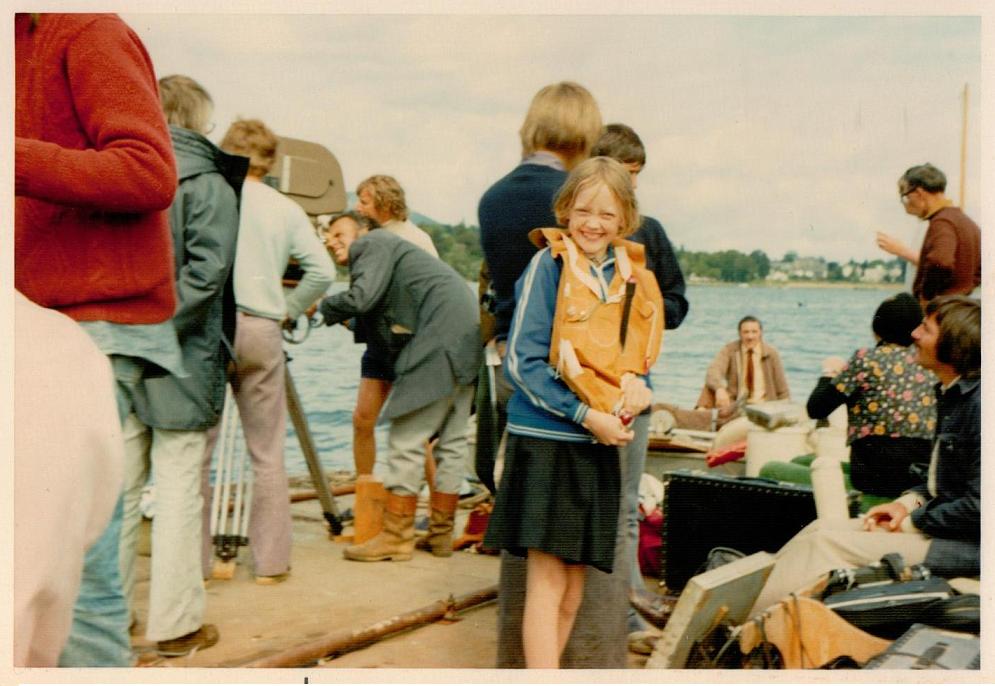
Richard Pilbrow, Denis Lewiston, Claude Whatham, David Cadwallader and Sophie Neville aged 12 playing Titty ~ photo: Daphne Neville























 Sophie Neville