Casting children for the BBC adaptations of Arthur Ransome’s books ‘Coot Club’ & ‘The Big Six’ in 1983 ~

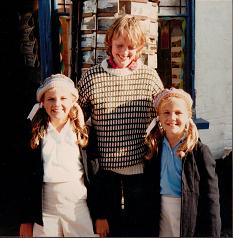
Sophie Neville with Port and Starboard in 'Coot Club'
Sophie Neville with Port and Starboard in ‘Coot Club’

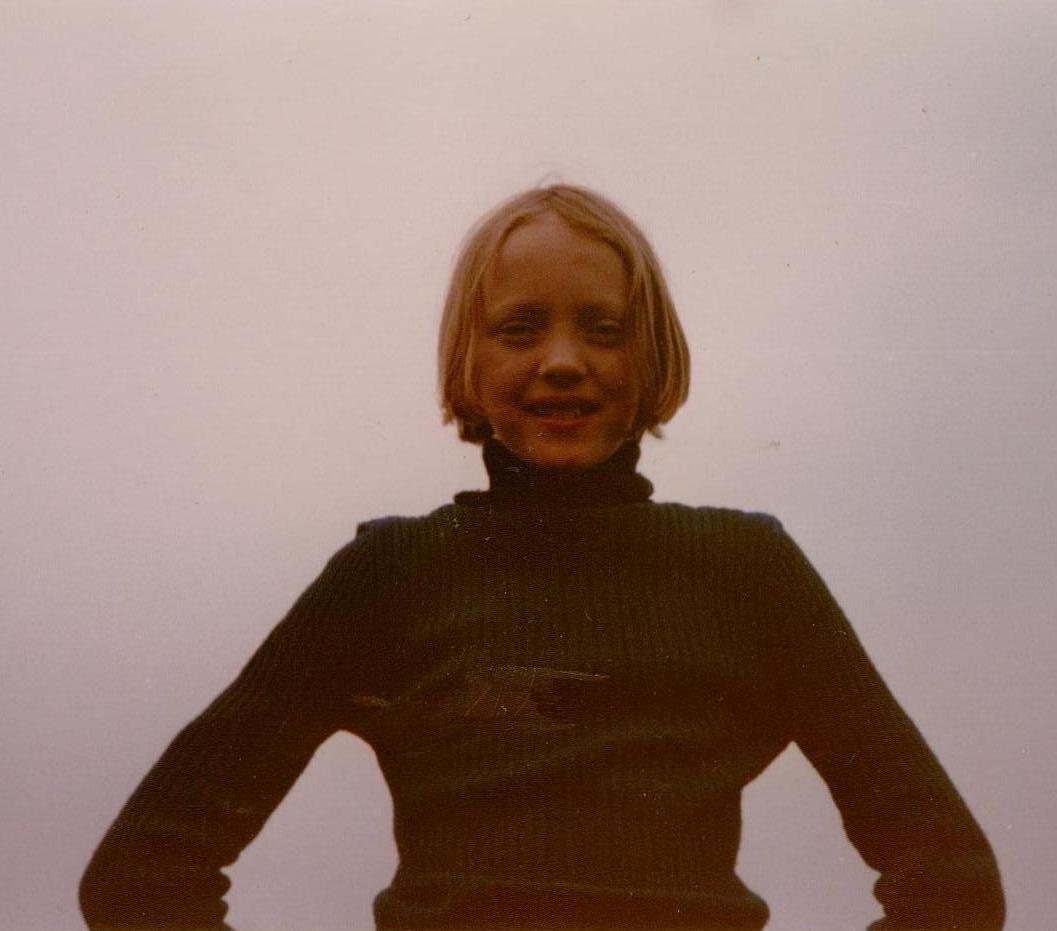
Looking back, it was a complete miracle that I able to work on the BBC adaptations of the Arthur Ransome books, but in 1983 I spent nine months working on Coot Club and The Big Six, released in 1984 as an eight-part drama serial under the generic title ‘Swallows and Amazons Forever’ . Awarded a BAFTA nomination, it is available on DVD today.

Swallows and Amazons Forever
Swallows And Amazons Forever! (Coot Club & The Big Six) SPECIAL EDITION [DVD]

In 1982 I graduated from university and entered the BBC as a researcher on the General Traineee Scheme. I had so enjoyed working for Ronnie Barker on The Two Ronnies that my initial aim was to go into the Department of Light Entertainment.  I joined the Russell Harty team, which had a series of thirty-minute shows broadcast live from a studio at London Bridge. I actually invited Susan George on the show without realising she had played Kitty Walker (Titty) in the black and white BBC drama serial of Swallows and Amazons in 1963.  Since The Russell Harty Show ended at the same time as my contract, I started looking around for a programme strand that was right for me.

The Unit Manager on our team heard that BBC Drama Series and Serials had acquired the rights to the Arthur Ransome books and suggested I went to see the  Producer, Joe Waters.  I knew we’d get on well as soon as I spoke to him on the phone.  Joe was always laughing. Although he’d made numerous episodes of The Enigma Files and Squadron, as well as Police series such as Z-Cars and Dixon of Dock Green, Joe had never filmed with boats and was interested to see the photographs of the camera pontoon devised for Claude Whatham in the Lake District. Joe explained that he had plans to film a number of the Arthur Ransome books but decided to start with the pair set in Norfolk and already had scripts adapted by Michael Robson.

The first miracle was that, although he had a full production team booked, Joe needed someone to help find children who could handle boats confidently on the Norfolk Broads. In the 1980’s drama directors at the BBC were expected to do their own casting, but Joe’s director, Andrew Morgan, was still editing another series and wasn’t going to have enough time to cast the children’s parts.  This had to be settled at least seven weeks before filming as Education Authorities request six weeks to process licenses required for children to work as actors. The second miracle was that Marcia Wheeler, the BBC Department Manager would not have given the job to me had I not been able to point out that the Graduate Trainee Scheme was paying my salary.  It was January and she had a choice of permanent staff available.
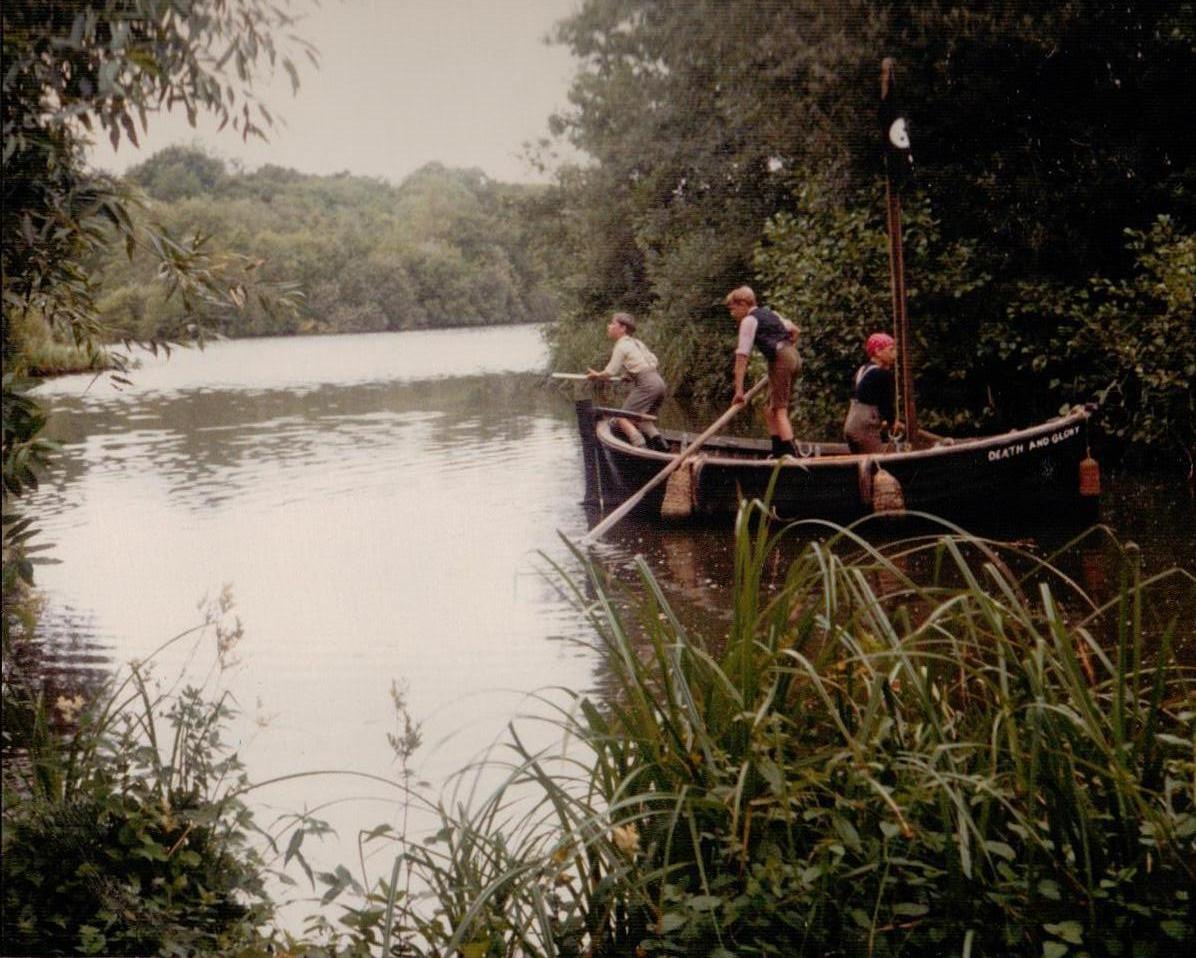
Coot Club - Death and Glories
~Jake Coppard, Mark Page and Nicholas Walpole as the Death and Glory boys ~ photo: Sophie Neville 1983

I set to work, scouring the schools of Norfolk, as we needed boys with local accents to play Pete, Joe and Bill – the Death and Glory boys, as well Roger, little Malcomb and youths who could take on the roles of George Owden and his side-kick Ralph as well as Brian and Rob.
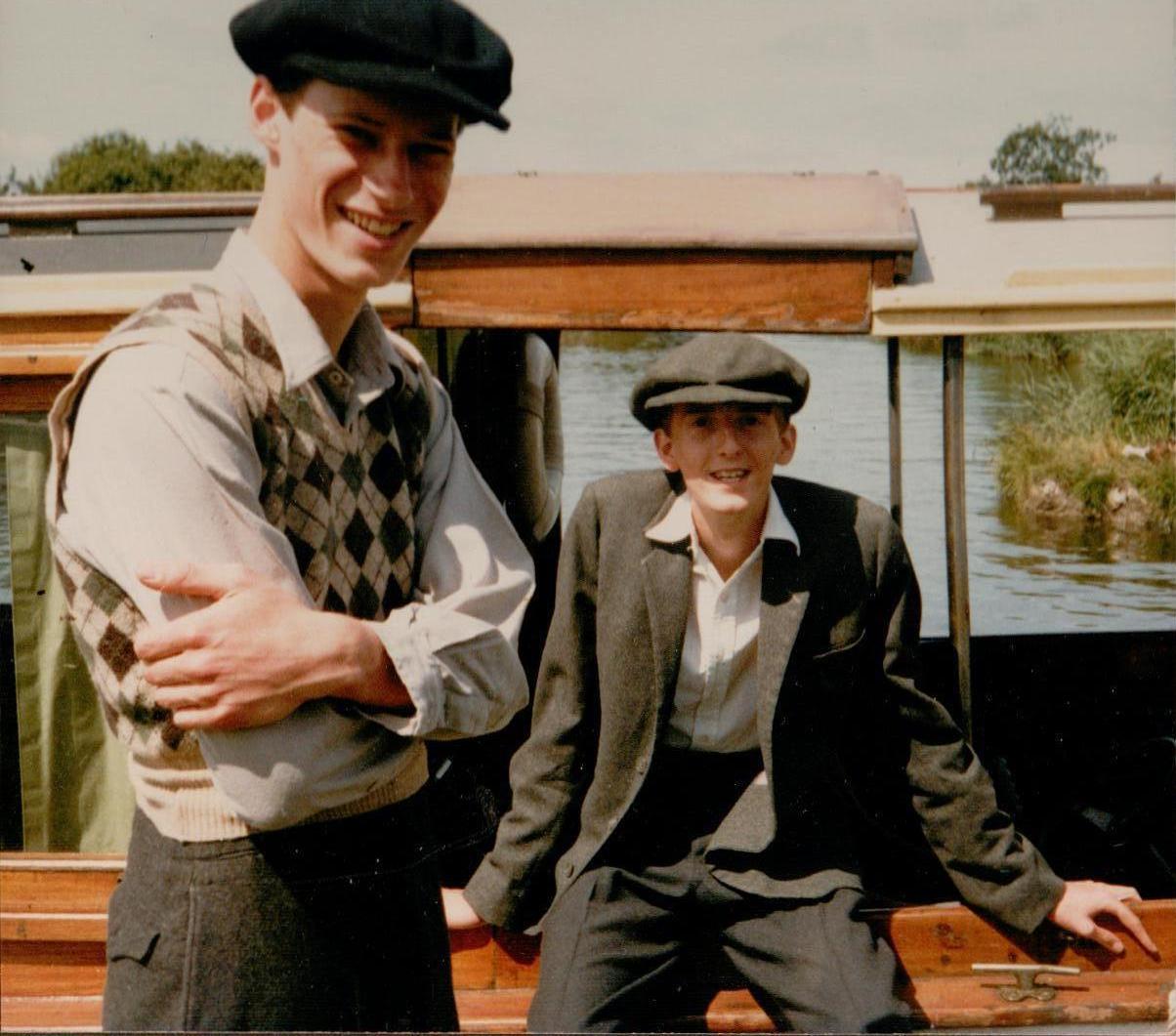
Coot Club Baddies
Boys virtually cast for me by the teachers of Norfolk ~ Dean Harkness who played Brian and Sy Rainsbury who played Rob

I must have written to the Head teachers of every single secondary school in the country, and visited most of them. I managed to find really bright boy to play Dick Callum up in Norfolk, but although I auditioned a number of girls in Norwich, Caroline Downer, who played Dot Callum, and the Farland twins were represented by a London agent.
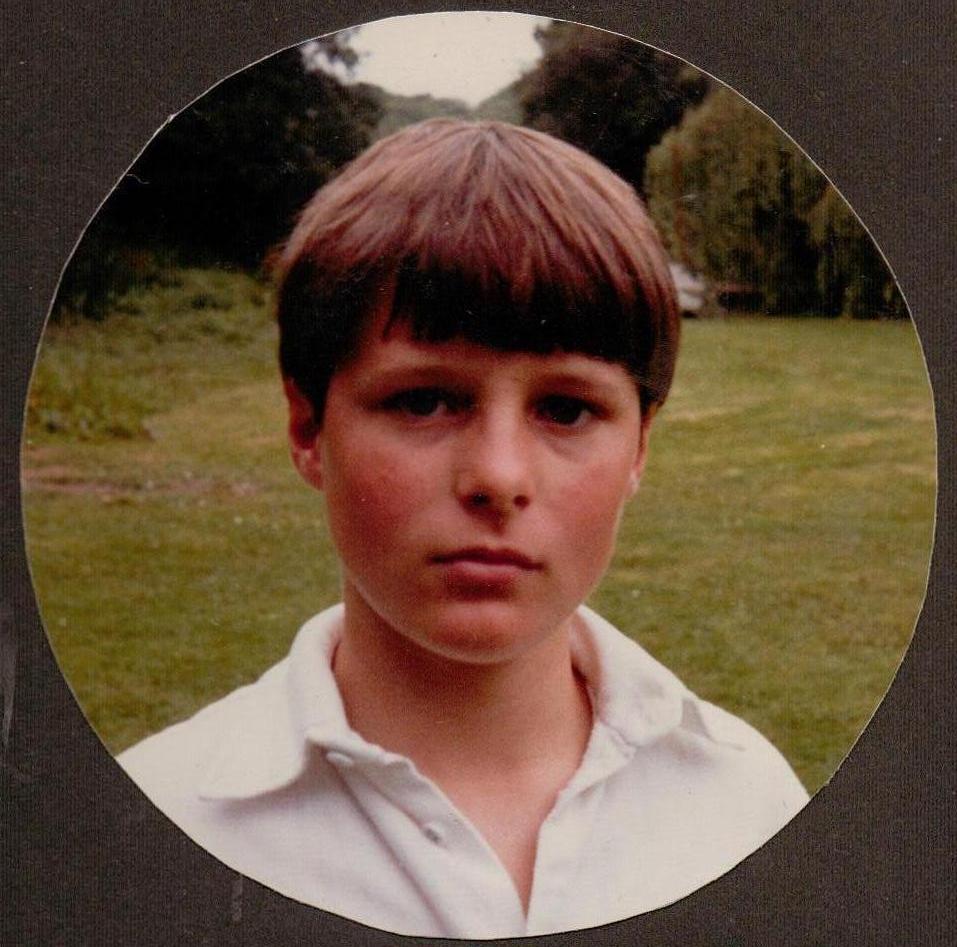
Coot Club - Richard Walton
Richard Walton, who was cast as Dick Callum, in Norfolk in 1983

You wouldn’t expect it to be difficult, but I couldn’t find a boy to taking the leading role of Tom Dudgeon. It was essential he was out-going and could sail well. I dredged school after school, meeting literally hundreds of children. Joe had found a very nice lad who went to a London stage school but he was fifteen and had never been in a boat. He rather wanted to give the part to Jason Lake, Diana Dor’s son, but he too, admitted that he couldn’t sail. We were getting very close to the deadline and I was almost in despair when I took my cousin to see a musical in the West End. During the interval I turned round and saw a boy, perfect for the part of Tom, sitting right behind me.

‘Do you by any chance sail?’ I asked.

‘Oh, yes,’ he replied, ‘We’ve got a cabin cruiser. I often take the helm.’

I went to meet his parents and found myself looking up at David Dimbleby, asking if his son would consider taking the lead in the Arthur Ransome series.
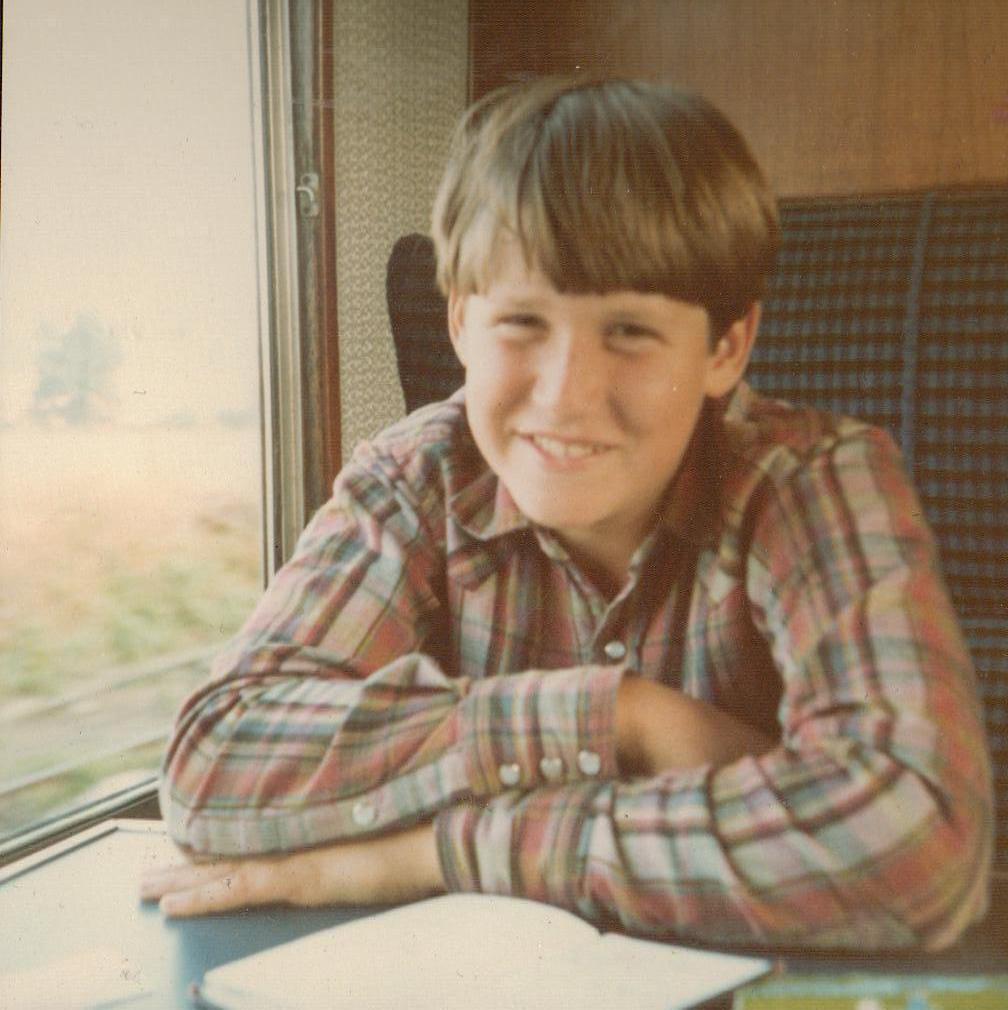
Henry Dimbleby in 1983
Henry Dimbleby who played Tom Dudgeon in 1983 ~ photo: Sophie Neville

Casting parts for book adaptations is never easy.  Arthur Ransome described Dot as having ‘straw-coloured plaits’ and portrayed Port and Starboard as being robust Tom-boys. Every detail may not have  fulfilled but in the end the right girls for the parts floated to the surface. Andrew Morgan was thrilled, appreciative of the fact that finding identical twins of the right age who could swim, sail and act convincingly was not easy. Caroline was the only girl I had met with hair long enough and thick enough to make into the plaits Ransome had drawn in his illustrations of Dorothea. She was dark and had no experience of boats but convinced us she was right in so many other ways that we offered her the part and sent her off to learn how to sail. She sailed across the Solent, single-handed and alone on her first lesson, gaining enough confidence to easily cope on the Norfolk Broads.
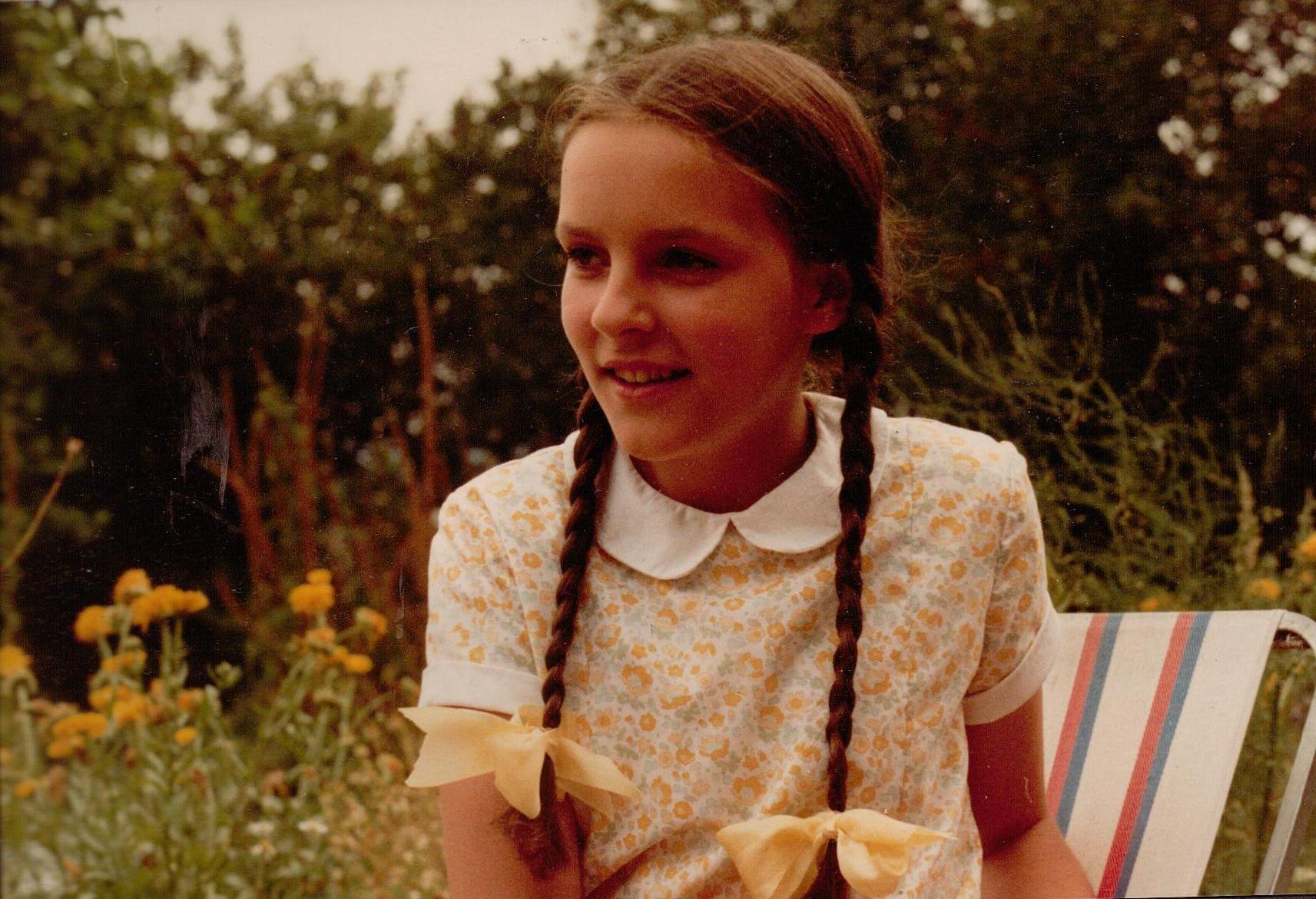
Caroline Downer as Dot Callum
Caroline Downer as Dorothea Callum in ‘Coot Club’ and ‘The Big Six’, 1983

Since we were scheduled to make nearly four hours of television, we had three months of filming ahead of us. The six children who had leading parts in both books, legally had to be over the age of thirteen to work for such a long period of time. My job had been to find thirteen-year-olds who looked younger.  During the audition period, Andrew and Joe needed to see how well the children could act in the space of a few minutes. I had Anna Scher to thank for teaching me how to demonstrate this.

Anna Scher had been Suzanna Hamilton’s drama teacher and agent. In 1968 she’d started a wonderful after-school theatre for children, based in Islington, north London.  I knew Claude Whatham had respected her enormously and asked if I could sit in on some of her classes. Anna worked fast, getting her students to concentrate and giving them a number of improvisation exercises. I had directed plays at university, so was used to getting good performances out of young people, but she was an expert, explaining that conflict was the key, ‘Drama is conflict!’ she’d declare.
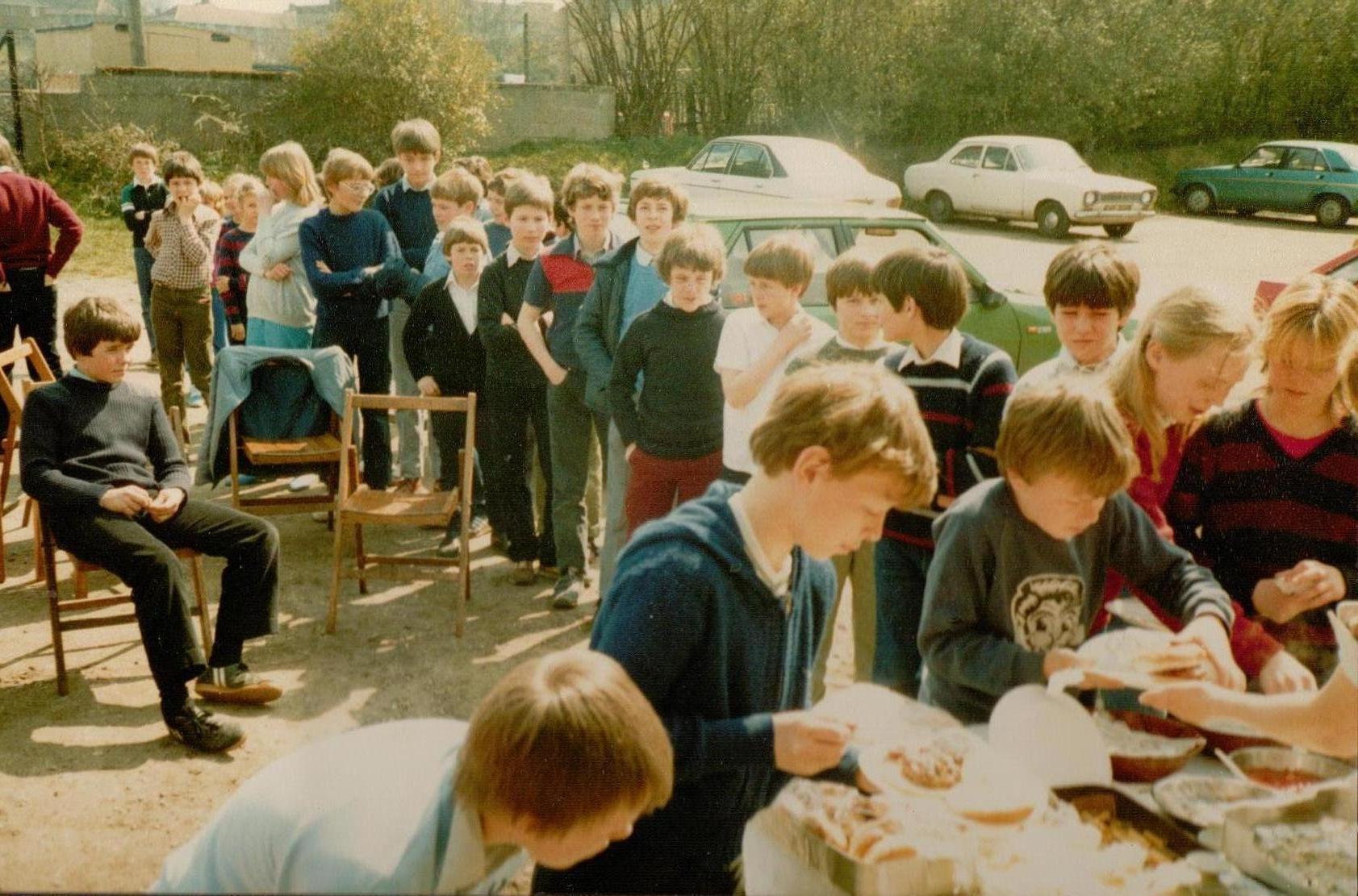
Coot Club Audition
Children who were short-listed for parts in ‘Coot Club’ having lunch at a final audition held in Norwich in 1983. The boys who played Joe and Pete are in the foreground.

When I auditioned children, I extended this by telling them they had to be able to list ten issues for the argument they were putting forward and that I wanted to see each point worked into the drama. For example,

‘You walk into your brother’s room and catch him smoking. I want you to try to persuade him it is stupid and give him ten reasons why he should quit.’

The boy playing the brother had to find ten reasons why he should be able to smoke if he wanted to. Joe Waters hadn’t seen this before but agreed that it worked much better than asking children to read scripts. It amused him. The kids who ended up playing Bill, Pete and Joe of the Death and Glory, responded well both to Joe’s laughter and exercises that required their own input. Despite never having had drama lessons they were able to prove themselves capable of delivering convincing performances.

But, would they be able to get the lines of a script out, whilst handling a boat on open water?
Coot Club - Joe Waters with Henry DimbJleby
Producer Joe Waters with Henry Dimbleby who played Tom Dudgeon in ‘Coot Club’ & ‘the Big Six’ ~ photo: Sophie Neville

One secret was that I asked all the children from Norfolk who were short-listed if they would like to work as Extras on the series even if they didn’t land a part. These children were issued with licences and could have been called upon if any of the cast had to back down at the last-minute.  If you look carefully you can see them  in some of the busier scenes.
How children responded to the film of ‘Swallows and Amazons’ in 1974

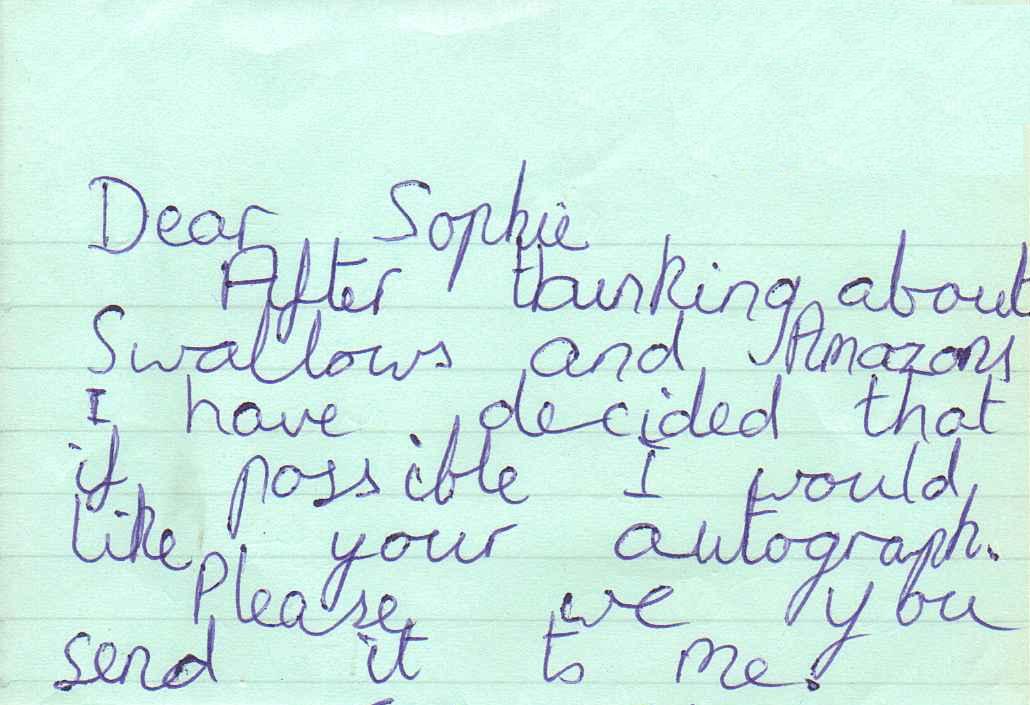
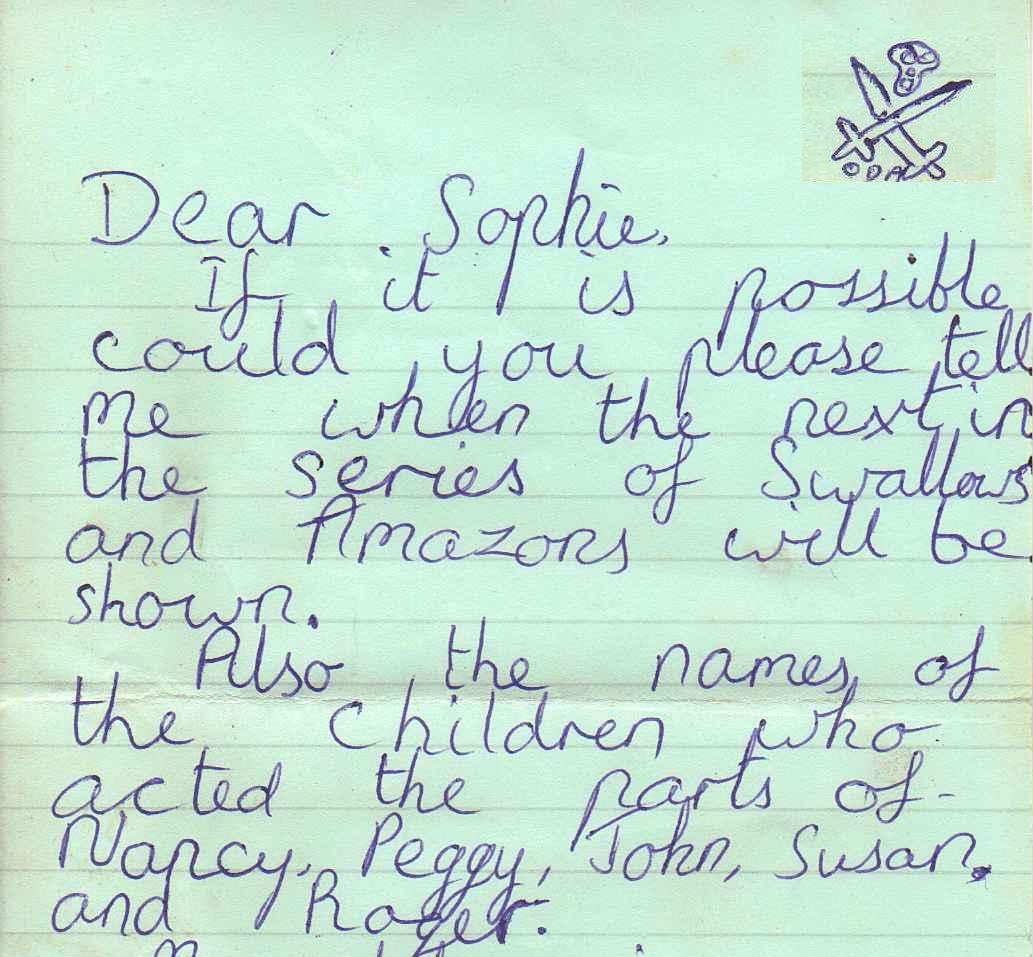
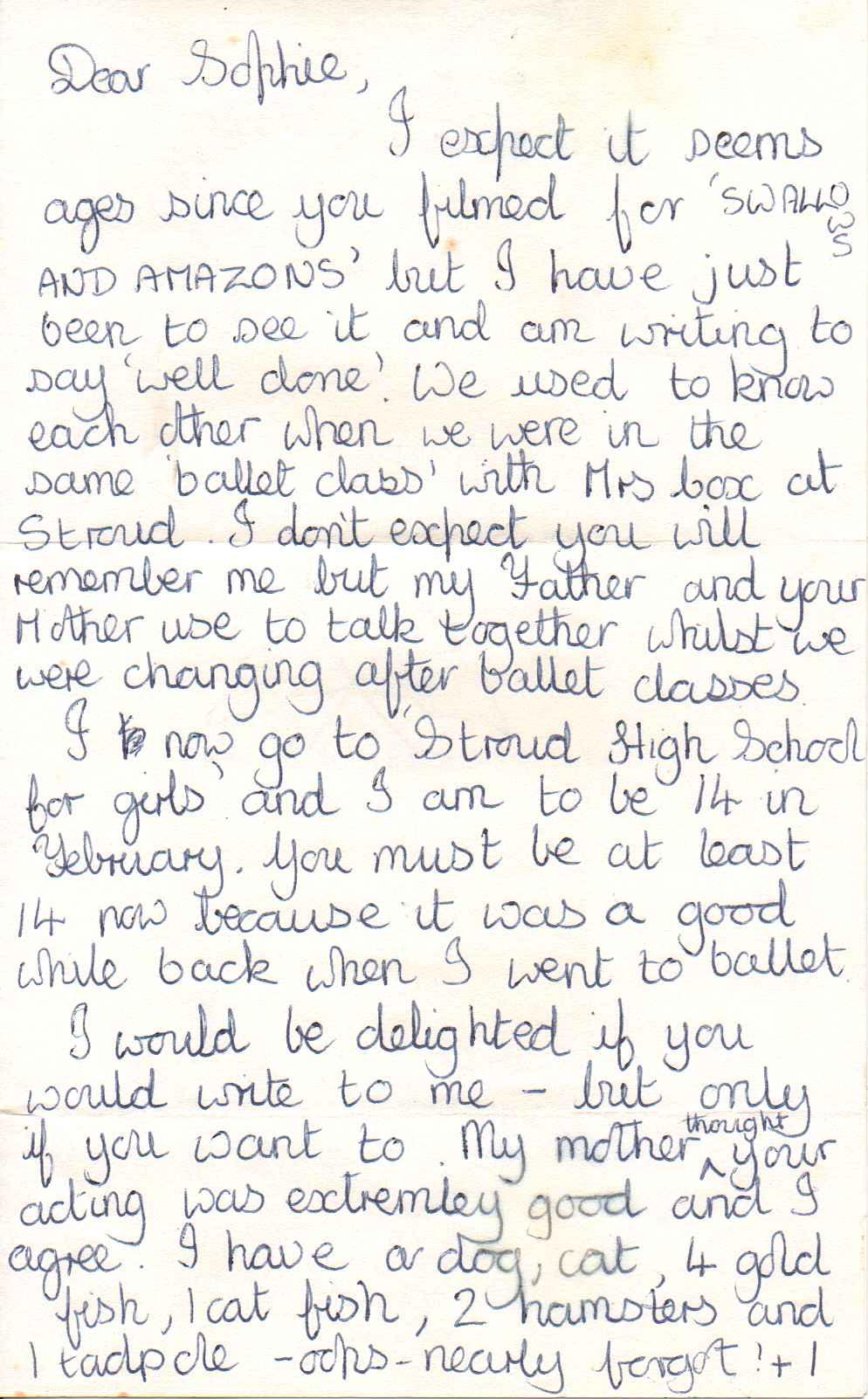
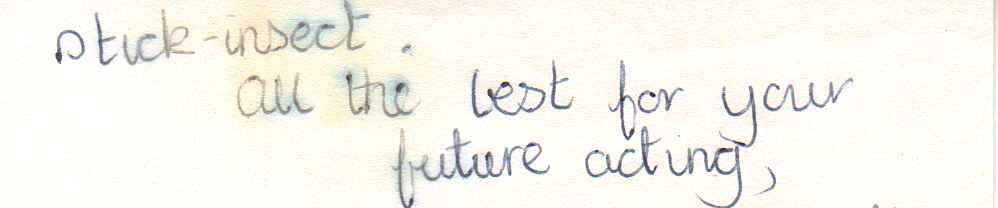
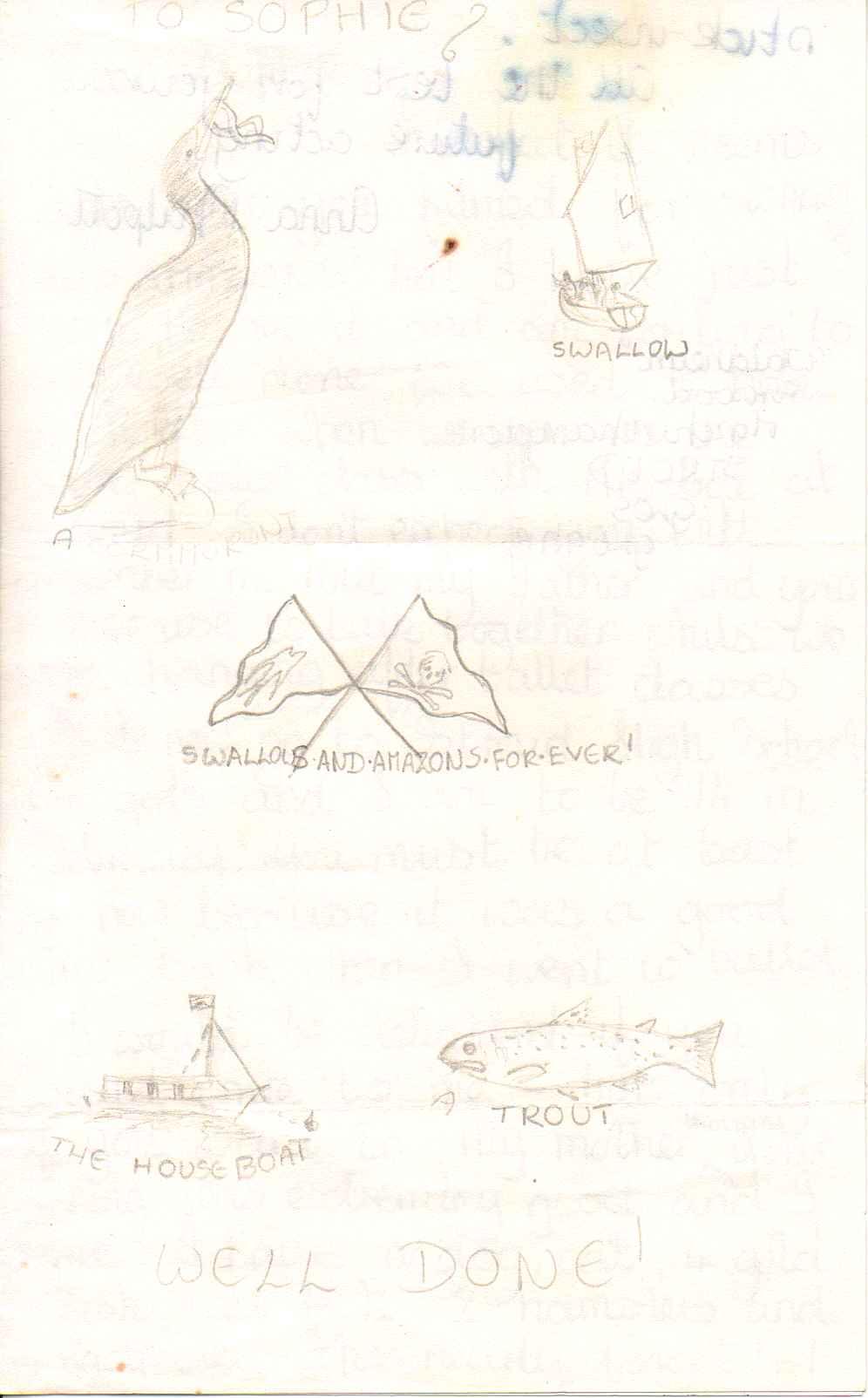
A fan letter!

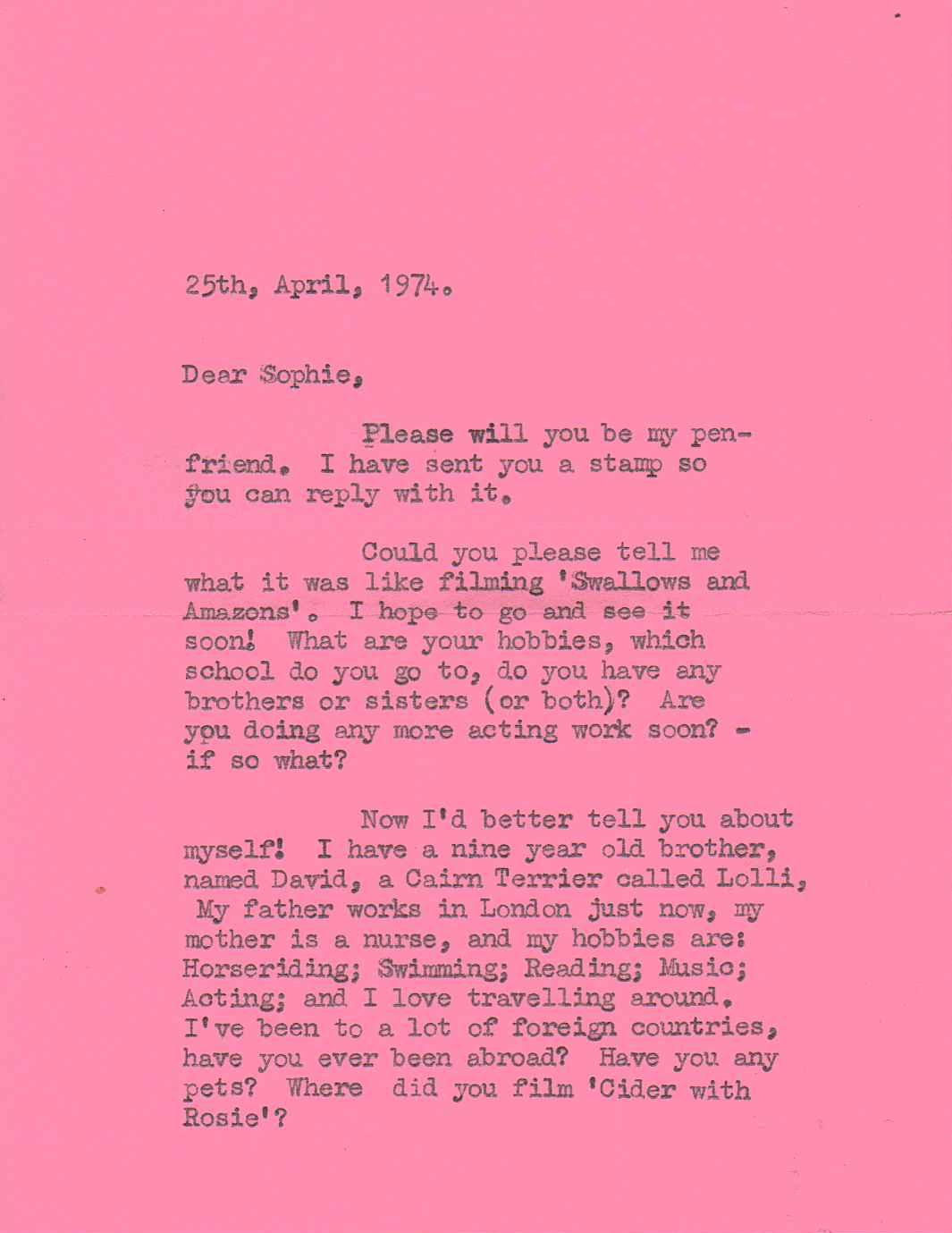
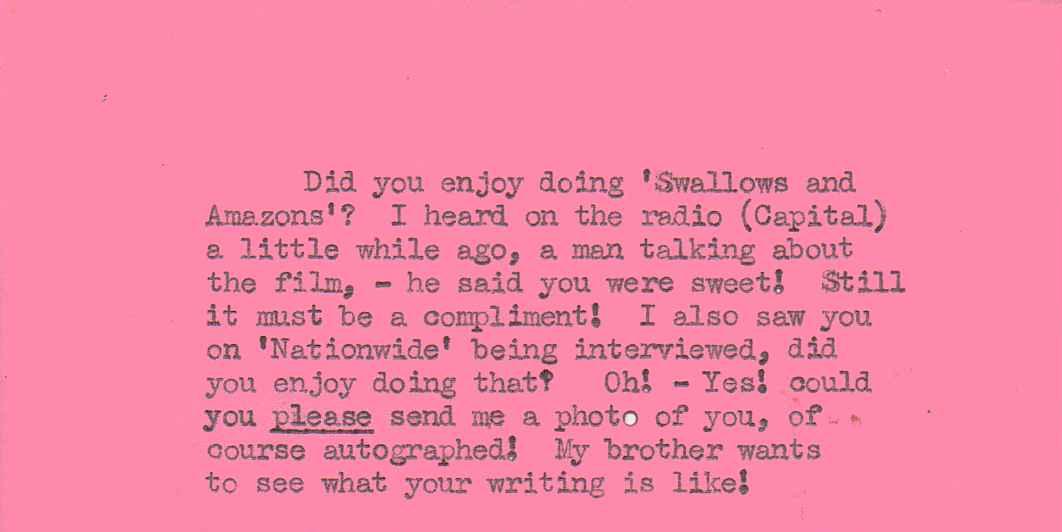
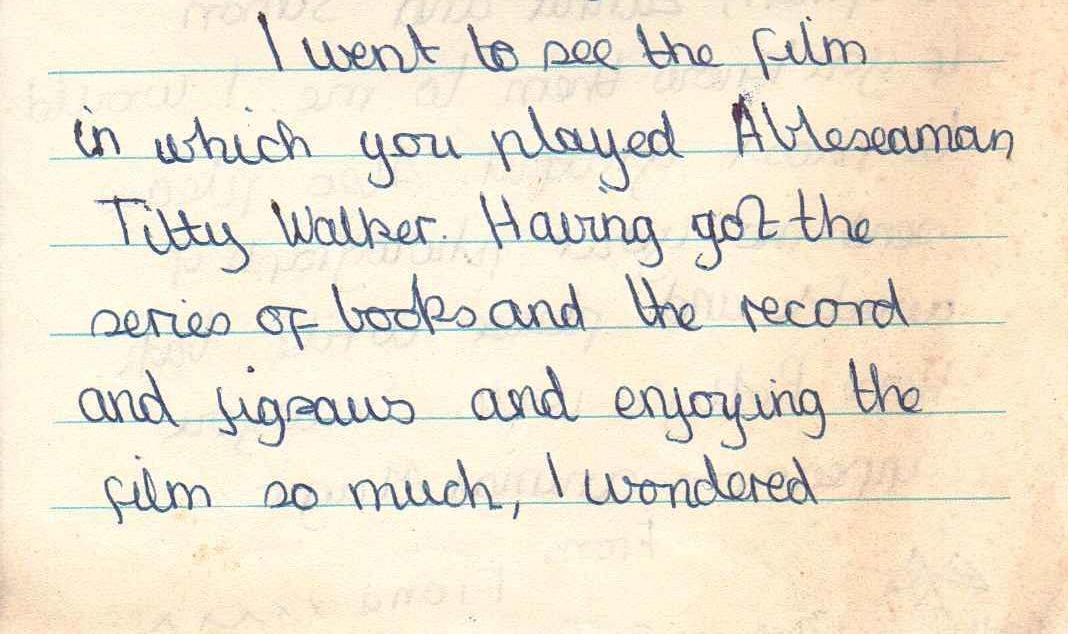
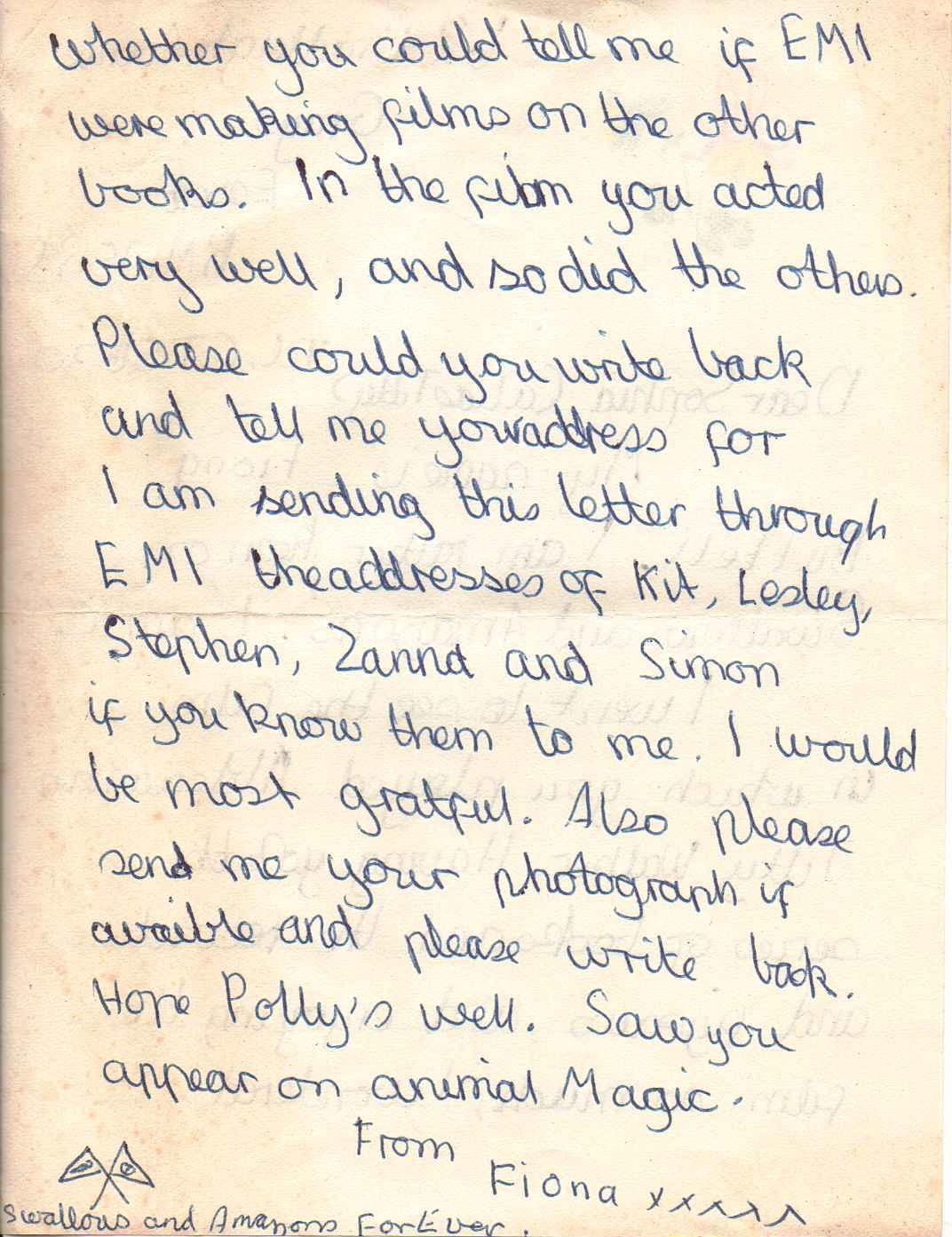
The last thing that I had expected was to receive fan letters! They came pouring in. My mother kept them all. Because most of them were written to me by children I have cut out the names and addresses on the letters copied here, but since we are all thirty-eight years older,  I am sure everyone can cope with seeing their own handwriting. This letter cames from someone who, despite living half way across the world, now happens to be a friend of mine on Facebook.

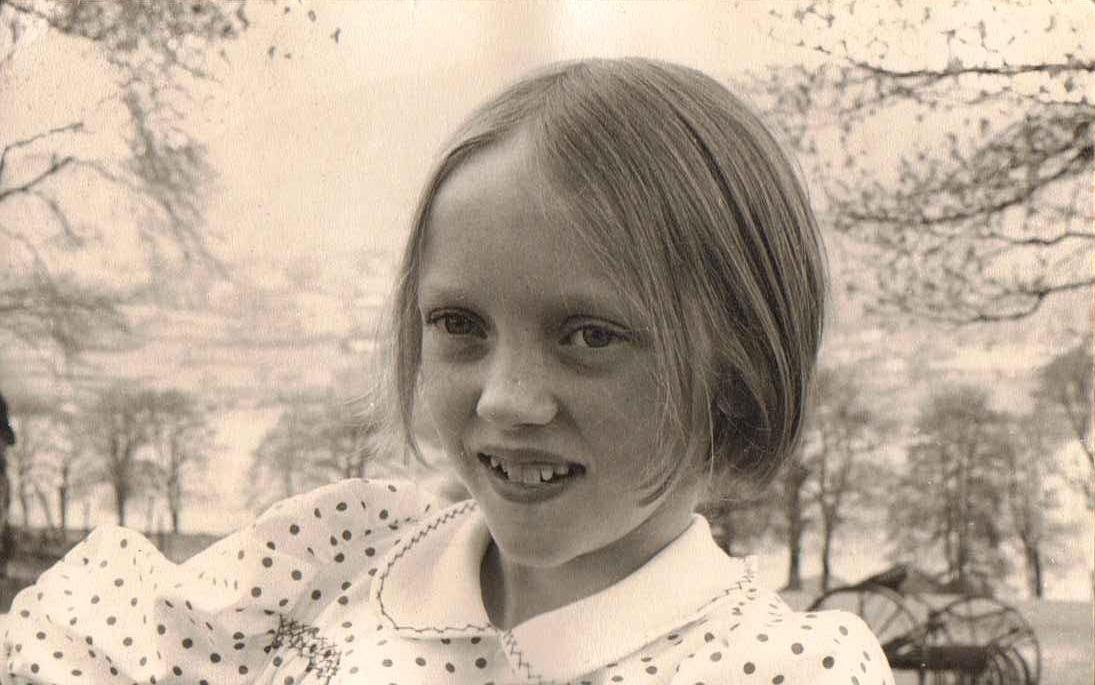
EMI sent me these photographs of myself to sign and send on. I’m afraid I didn’t like them one bit. They had been taken as publicity shots and it still shows. The staged pose was exactly what Claude Whatham had been working hard to avoid. Sadly he hadn’t been around to direct this shot. I look like a Woodetop and Spot the Dog rolled into one.

Sophie Neville as Titty Walker in 'Swallows and Amazons'
Sophie Neville swinging on a gate at Bank Ground Farm above Coniston Water in 1973

However, sending a photograph was not aways enough. I had the hard work of replying to the letters.

A fan letter

There were so many questions to answer.

A fan letter

And I felt beholden to reply immediately.

And once I replied, yet more letters arrived:

A fan letter

This was a good question, of course.

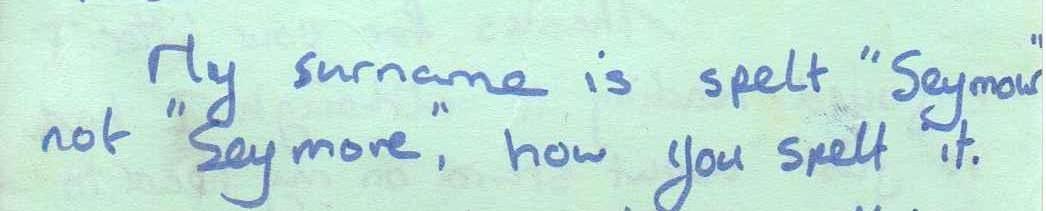
Fiona was 10. Everyone wanted to know if a sequel was coming out. I have a letter from Kit –

Kit Seymour, who seemed to know about Richard Pilbrow’s plans to adapt Arthur Ransome’s book ‘Great Northern?’ set in the Outer Hebrides.  She must have sent me this second letter in about January 1974 – between Christmas and the premiere.
I wish we had made ‘Great Northern?’  It was my favorite Arthur Ransome book. Dramatising it would have been such fun. I don’t know why I was so negative, but I remember writing to Richard Pilbrow and telling him that Ransome was mistaken and had his facts about Great Northern Divers quite wrong. I had looked up information in an ancient bird book belonging to my father and wrote the most facetious letter about their geographical distribution. I hope it didn’t put him off. I should had used my time to persuade my fans to write enthusiastic letters to EMI Films.  I’m sure this viewer would have convinced Nat Cohen.

It was clear that what children wanted was more of the same. I think it is true today. Parents tell me that even though the movie of ‘Swallows and Amazons’ has no really terrifying moments or spectacular visual effects, children tend to snuggle down peacefully and identify with the characters. The outcome, especially if they are taken to the real locations, is that they often take on our names for themselves, enjoying the fun of camping and swimming, fishing and sailing in the Lake District.

If you can read about how we made the film and what happened as a result here

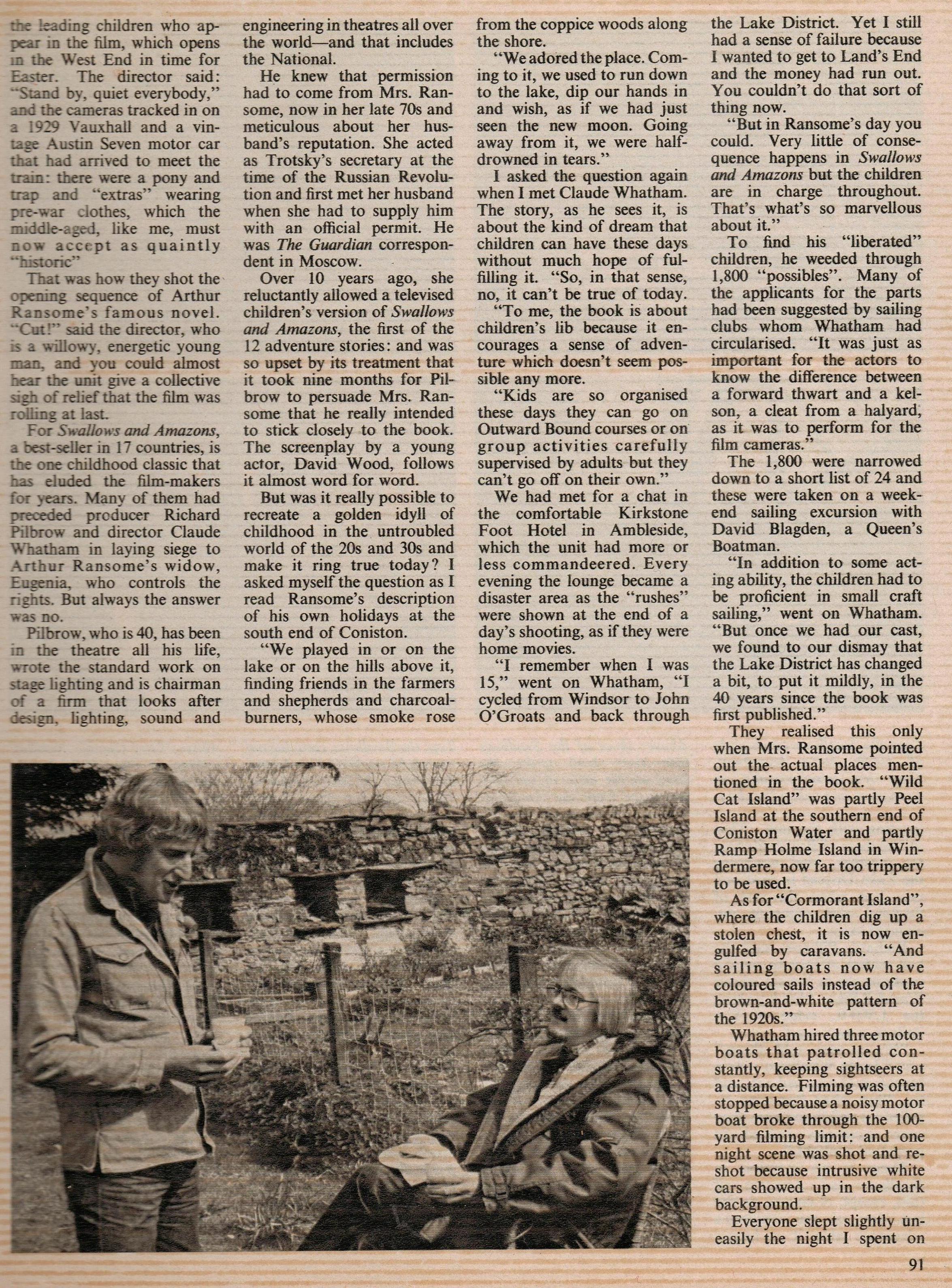
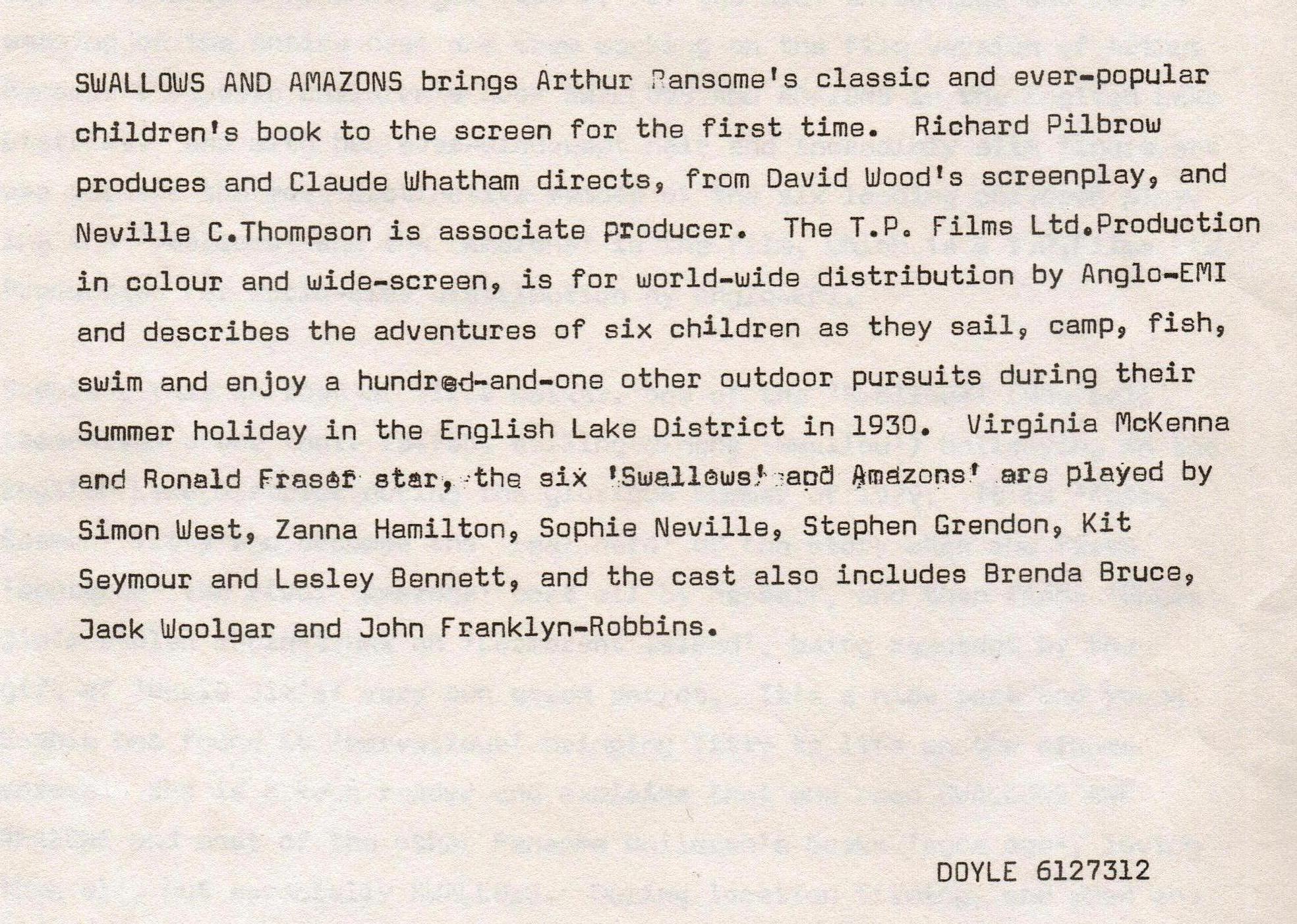
Magazine articles written about ‘Swallows and Amazons’ in 1974

Kit Seymour, Stephen Grendon, Sophie Neville, Lesley Bennett, Virginia McKenna, Simon West Suzanna Hamilton and the station master of the Haverthwaite Steam Railway in Westmorland, appearing in the April edition of Homes and Garden 1974

Newspapers are read one day and on the kitchen floor the next. Back in 1974 they might have been used to wrap up fish and chips. Either way, an article in the ‘paper is soon forgotten. Not so a feature in a magazine. They tend to hang around in hotel foyers and doctor’s surgeries for waiting to have their pages turned for months, if not years.  The judgement they cast on our movie was important.

Director Claude Whatham and Producer Richard Pilbrow on location in the summer of 1973 in the Lake District

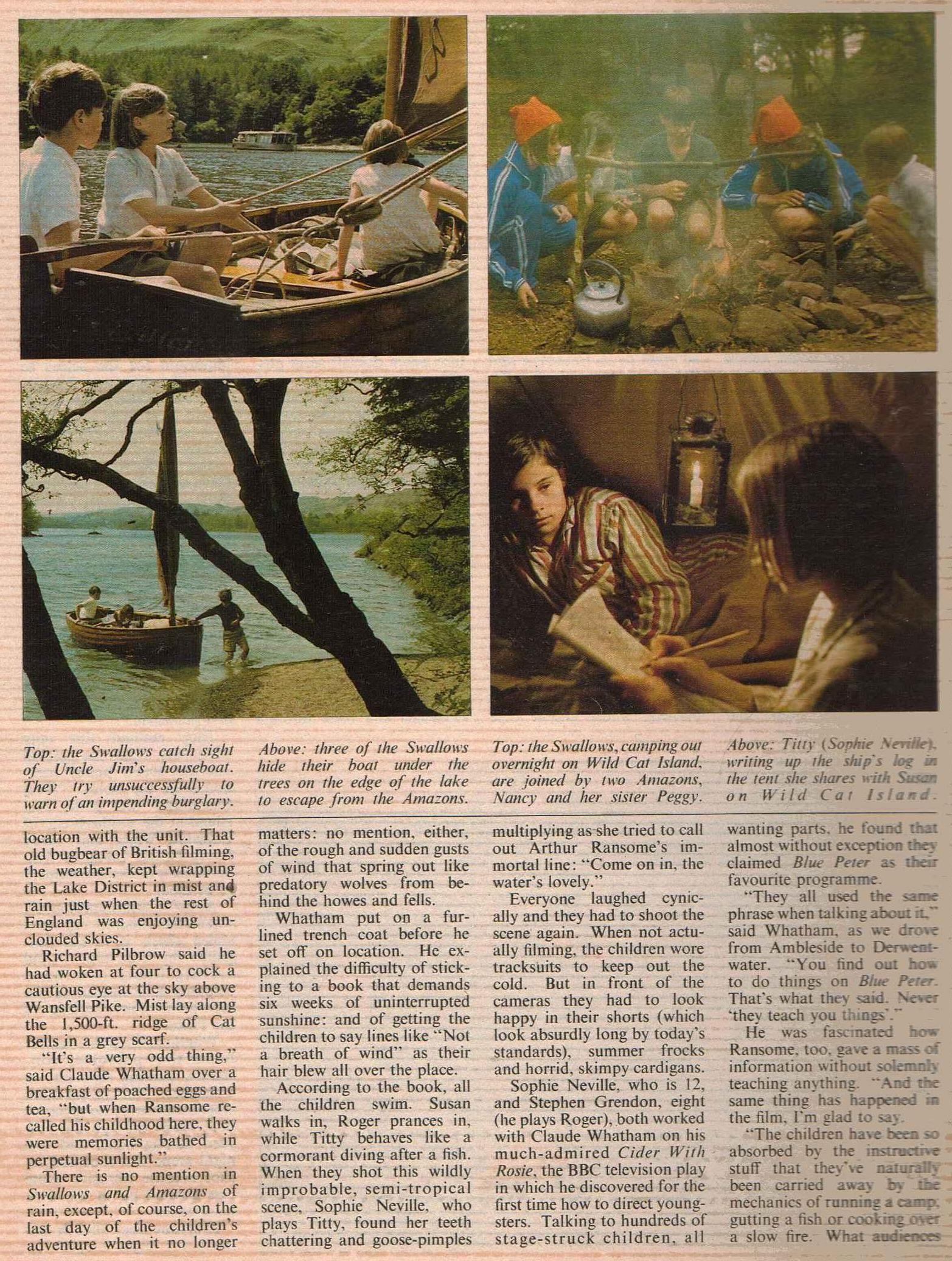
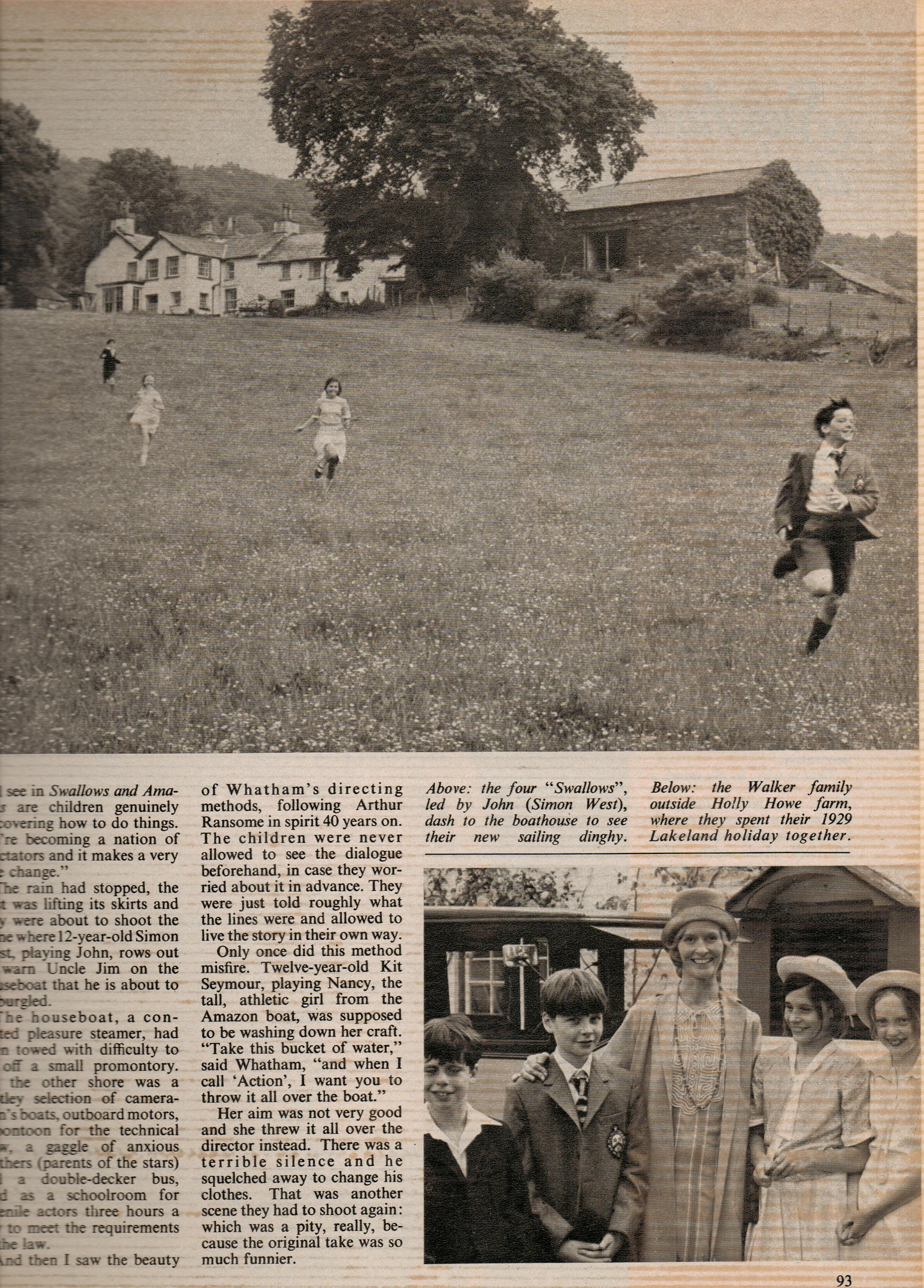
To my surprise I found an article about how we spent the summer of 1973 in ‘Homes and Garden’ magazine.

Photographs featuring Simon West, Suzanna Hamilton, Sophie Neville, Stephen Grendon, Lesley Bennett and Kit Seymour in the EMI film of ‘Swallows and Amazons’.

What amazed me was that the black and white photographs taken on the film set had been colour tinted. Please forgive my scanning – the pages were stuck in albums long ago and the  images blur at the edge.

Stephen Grendon, Simon West, Virginia McKenna, Suzanna Hamilton and Sophie Neville on location at Bank Ground Farm in Cumbria

Surely she was the journalist also known by her married name of Elspeth Huxley, the author who had written The Flame Trees of Thika and so many other books?  She wasn’t quite right in saying the film was shot entirely on location in the Lake District, but still. She was not to know about our day at Runnymede.

Simon West, Sophie Neville and Suzanna Hamilton appearing in The Tatler

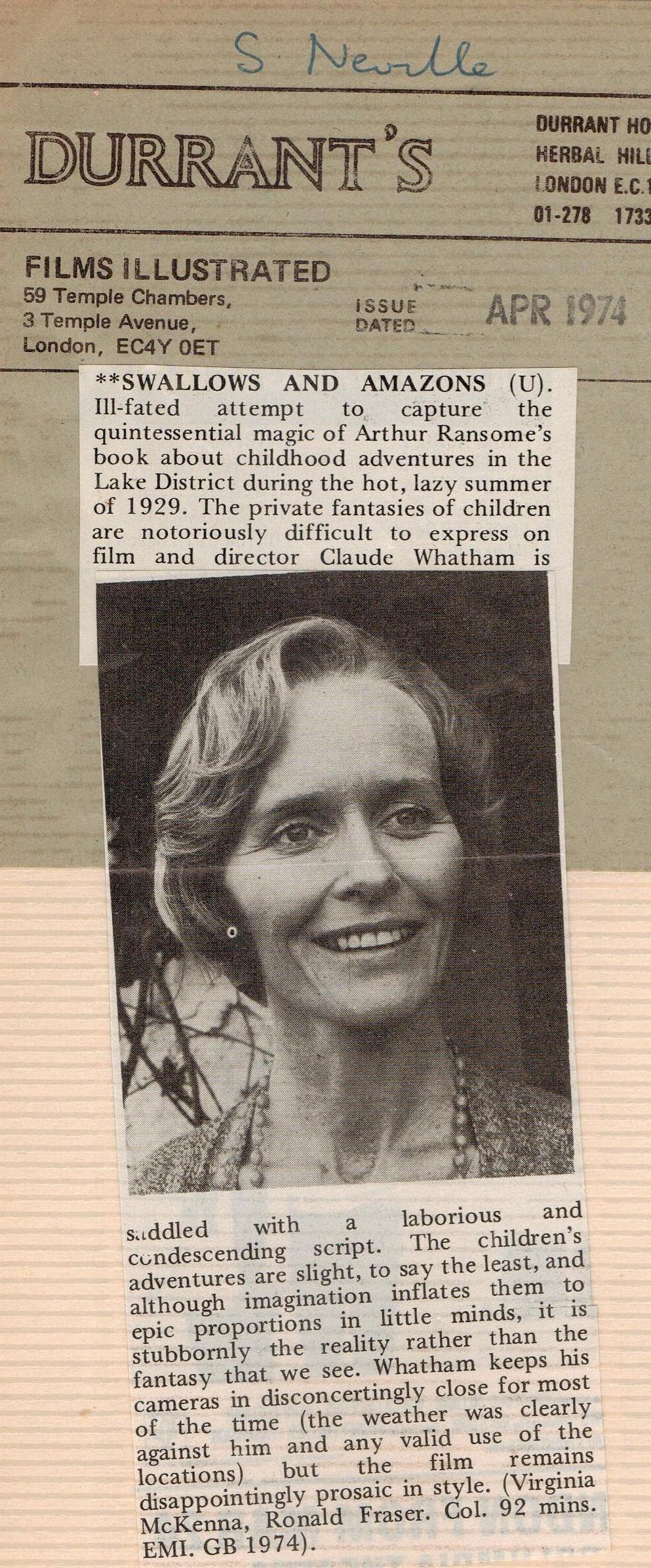
Virginia McKenna in an article in Films Illustrated, April 1974

We were in both Punch and The Sunday People. My mother saved them all, scratching lines alongside the paragraphs in which I was mentioned.

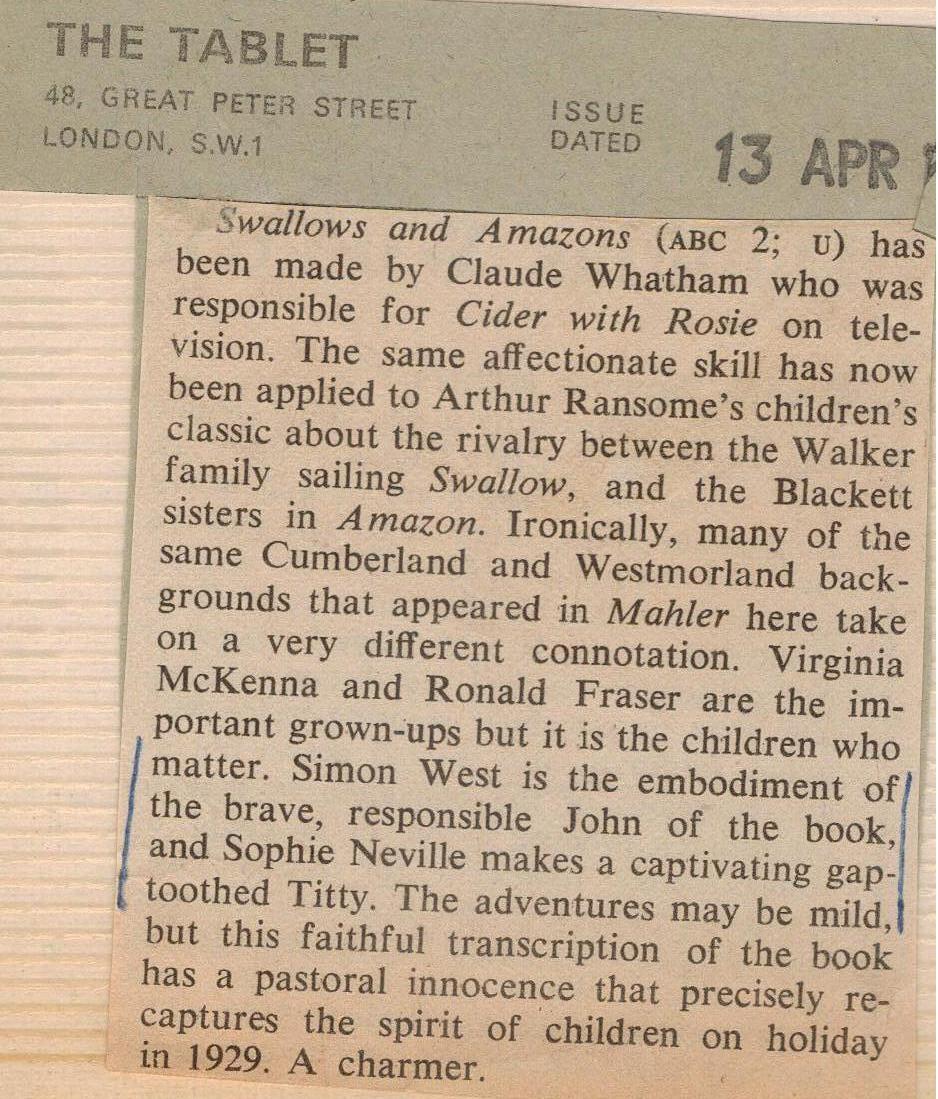
and The Tablet.

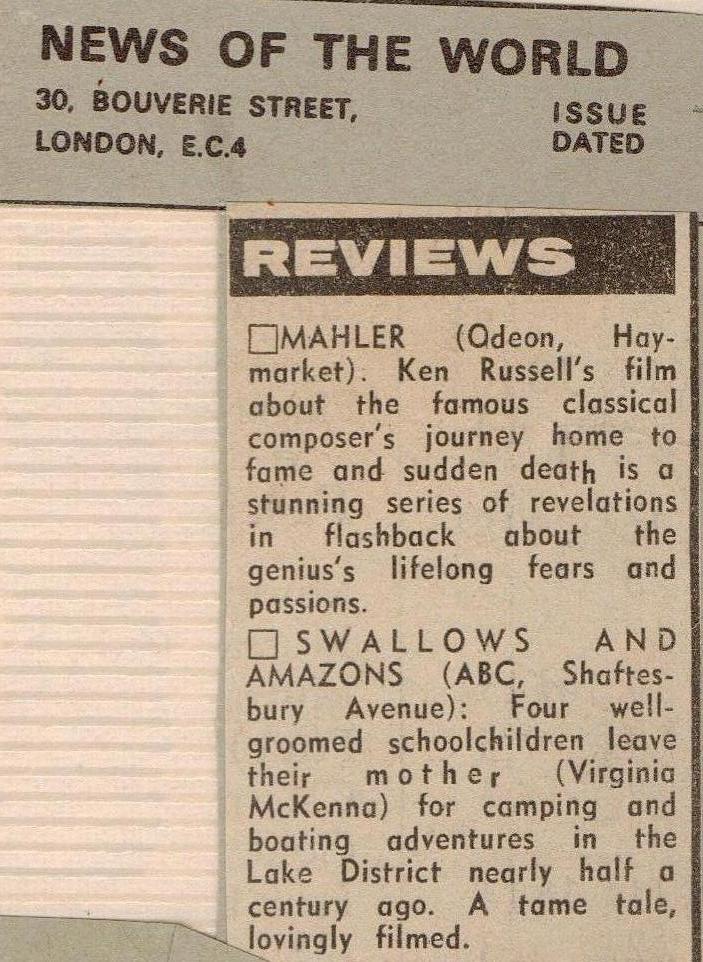
What’s On and the News of the World:

Kit Seymour and Lesley Bennett sailing Amazon on Derwentwater

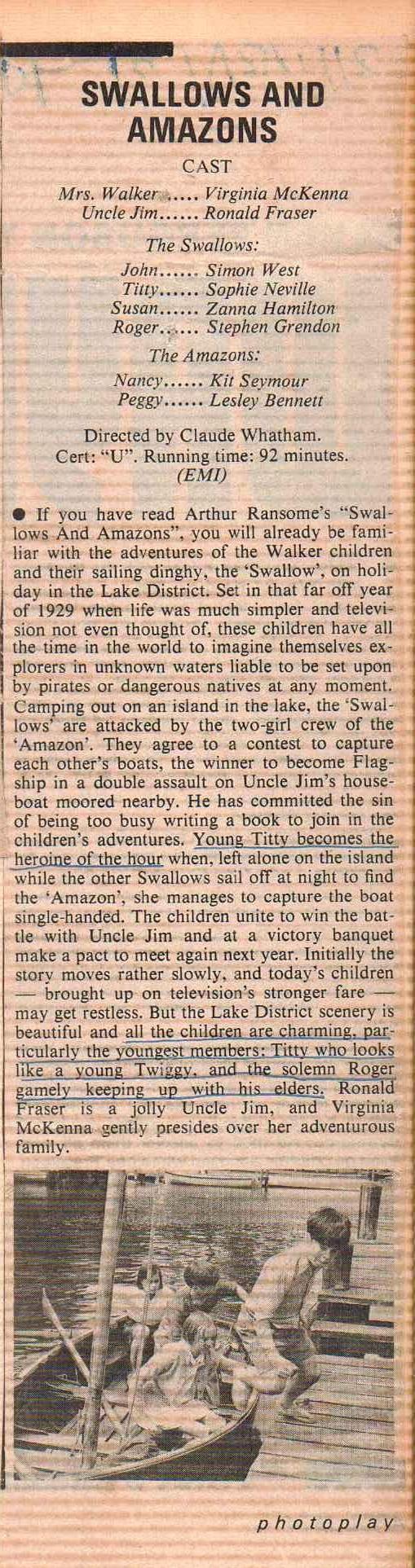
The April addition of the film fan magazine Photoplay, which featured Steve McQueen on the cover. It cost 20p in those days.

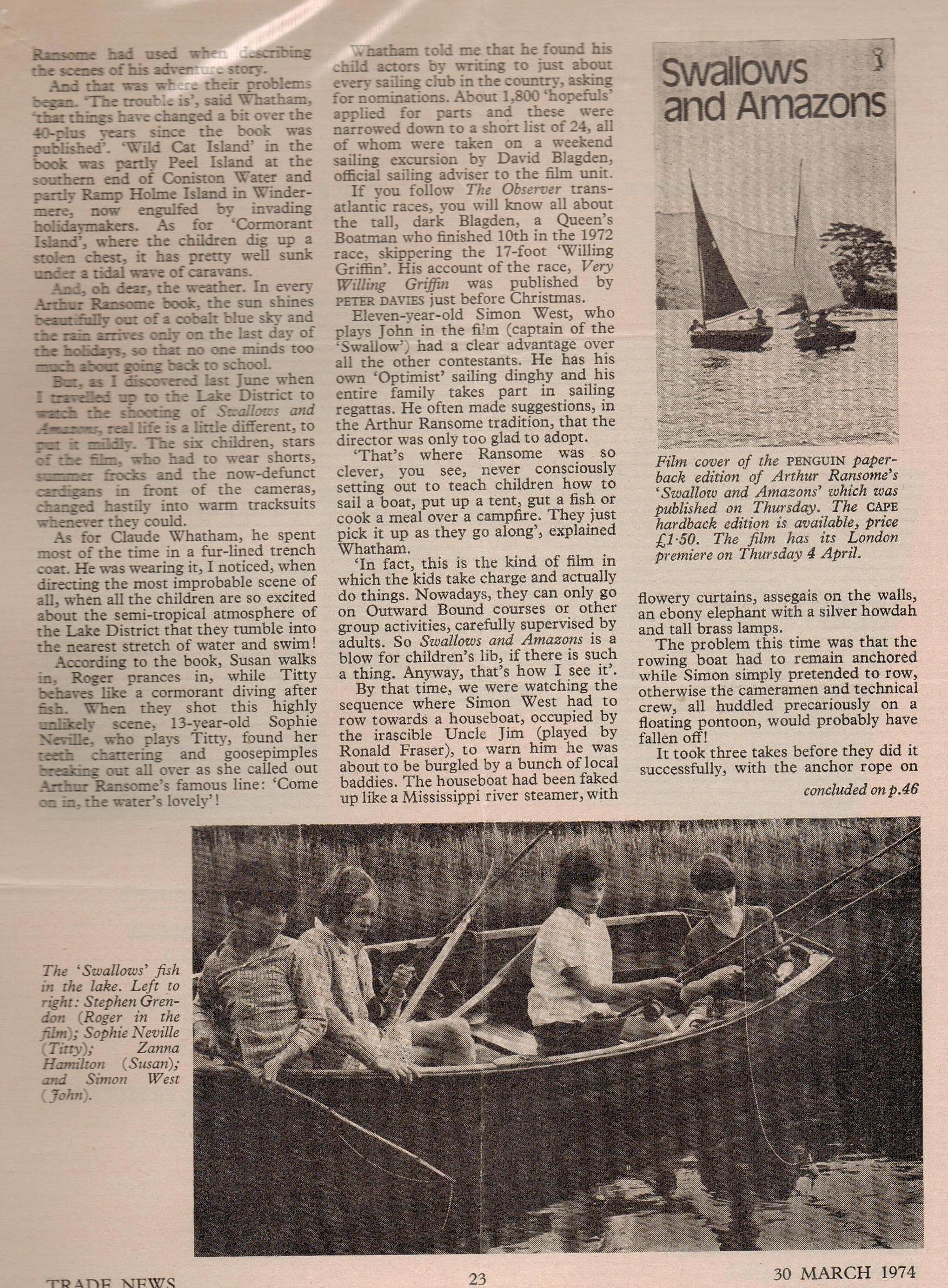
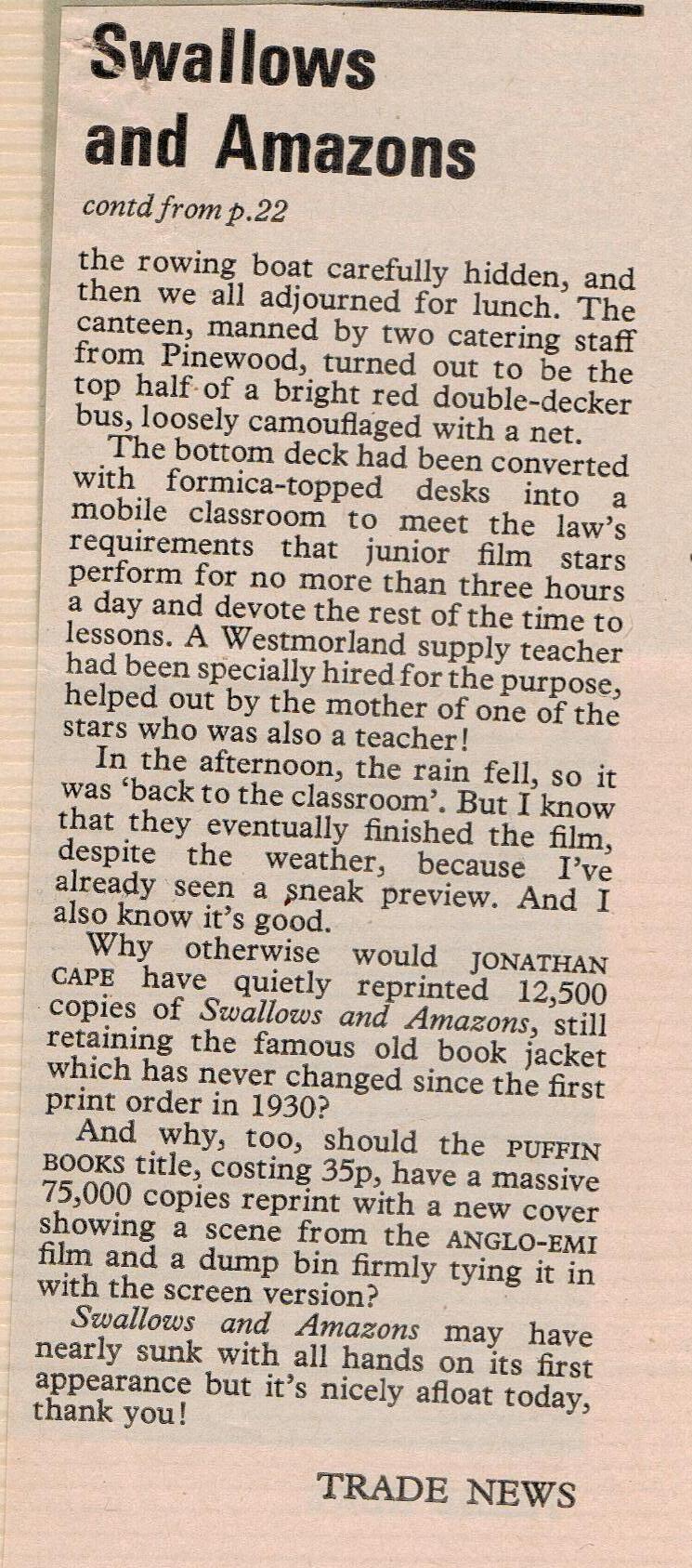
and a publishing magazine I hadn’t heard of called Smith’s Trade News ~

Virginia McKenna eating a banana with Claude Whatham outside the catering bus with quite a good photo of Swallow wired to the camera pontoon

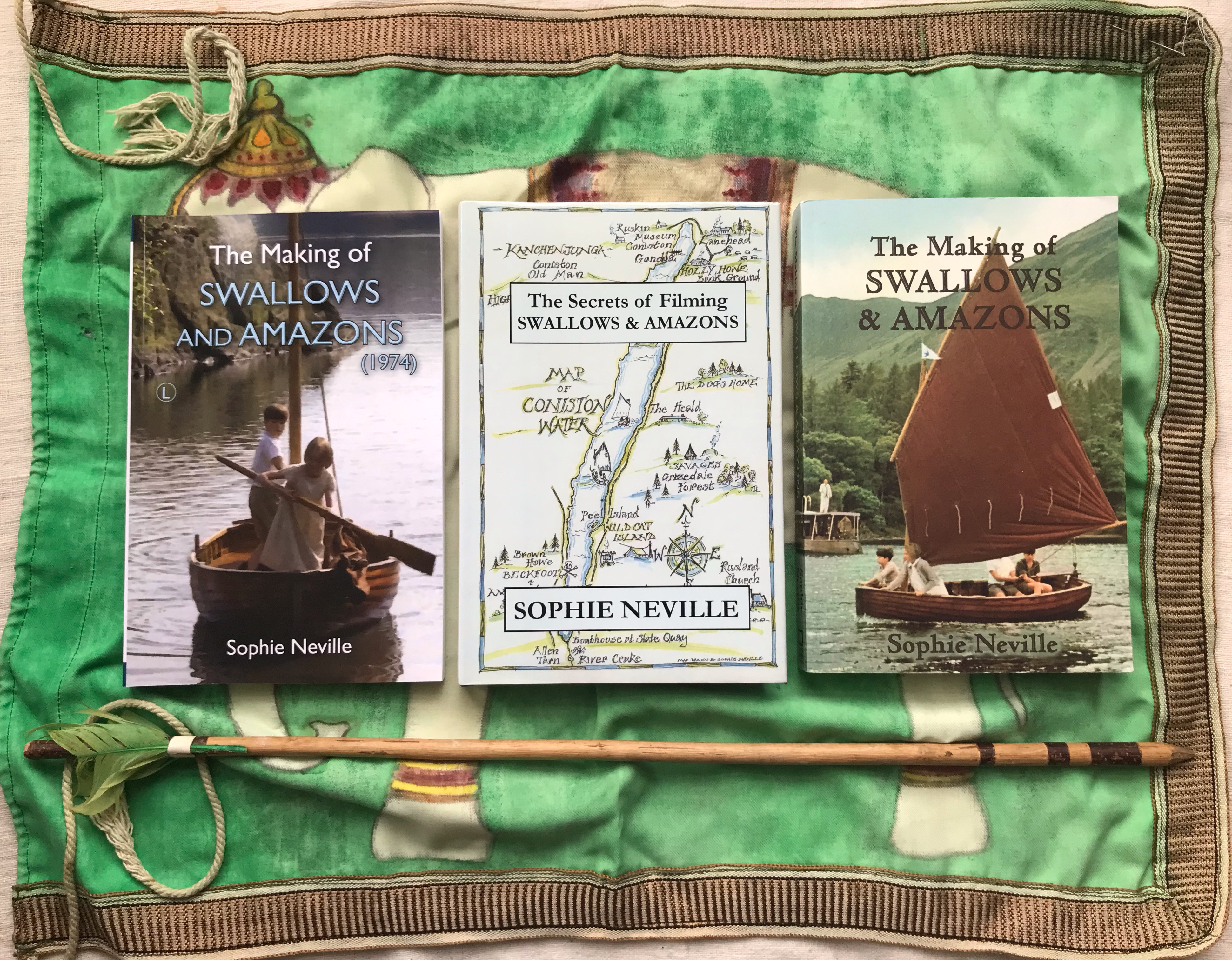
The true story is told in ‘The Making of Swallows and Amazons’ available online in different formats including an audiobook.

'The Making of Swallows and Amazons (1974) by Sophie Neville'
Different editions of ‘The Making of Swallows and Amazons (1974) by Sophie Neville’

What the press said after ‘Swallows and Amazons’ was released in 1974

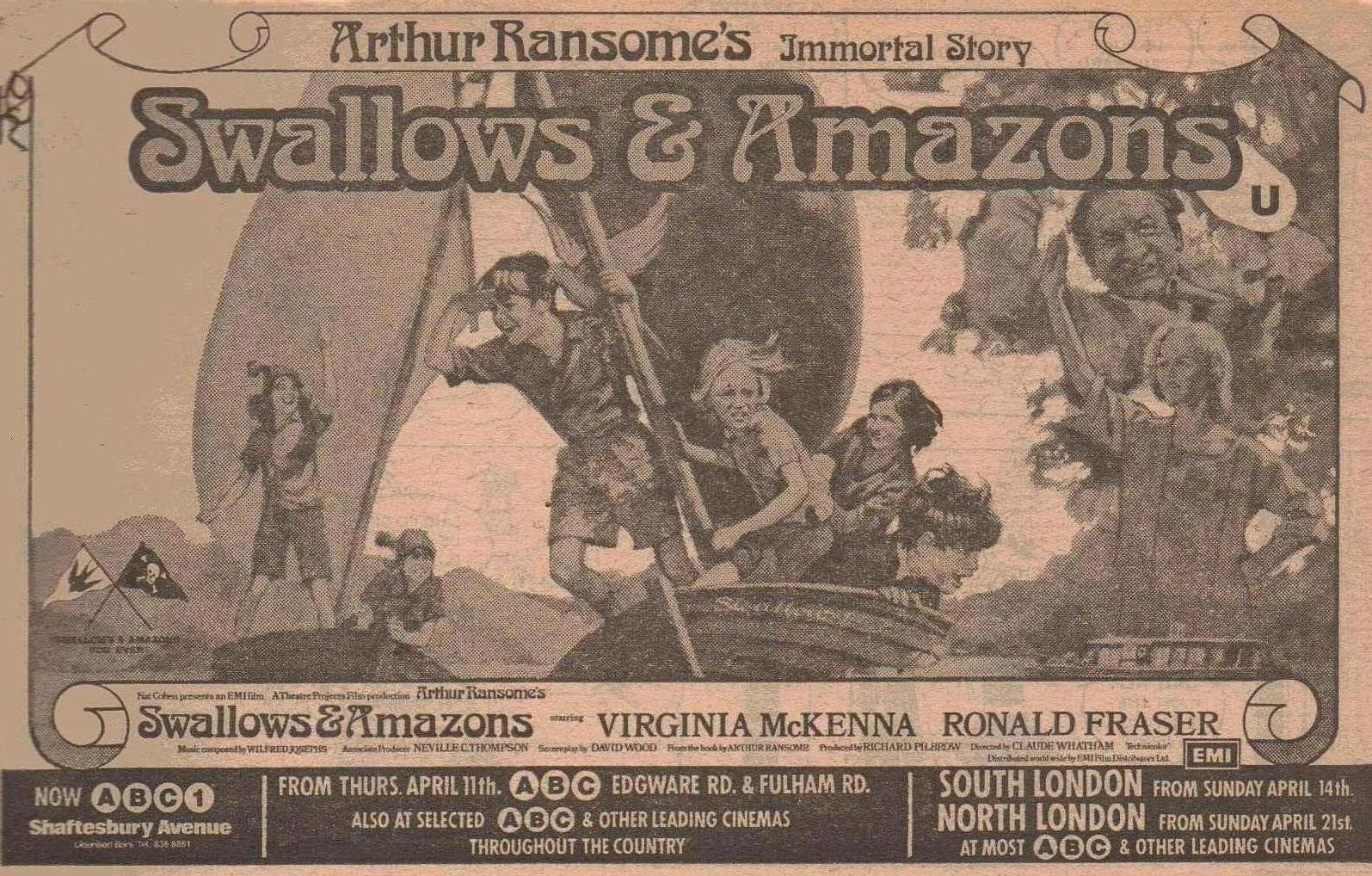
Kit Seymour, Lesley Bennett, Simon West, Sophie Neville, Stephen Grendon, Ronald Fraser and Virginia McKenna on the newspaper advertisement for ‘Swallows and Amazons’ released in April 1974

A school friend of mine sent me this advertisement. She had found it in a teenage magazine we all read at the time called Tammy and Sandy. There was a similar one in The Sunday Times newspaper – and no doubt many others. Film posters hung in the London Underground and at cinemas throughout the country. Swallows and Amazons was to come out, on general release for the Easter Holidays.

My mother subscribed to a press clippings agency called Durrant’s ~ Durrant’s of Herbal Hill London ECI ~ who, for a fee of £50, sent her all the articles written about the film.  The Prince of Wales told a friend of mine that he never reads the newspapers. I know why. Reading about yourself is upsetting – or can be, especially if the facts are incorrect.  My mother didn’t mind.  She highlighted the bits about me, filling four albums.

After entertaining the Daily Express so nicely in the Lake District this is what they printed about the film. I would  think this is written by Ian Christie (1927-2010) the jazz clarinetist, who had formed the Christie Brothers Stompers with his brother Keith, and became a member of Humphrey Lyttelton’s band. He worked as a theater and film critic for the Daily Express for twenty-six years. Born in Blackpool and a habitue of Fleet Street pubs he held fiercely Left-wing views.

‘Kids won’t swallow this watery old tale’ was not good publicity. The same black and white photograph of me appeared on the front cover of The Daily Telegraph with the title ‘One Swallow won’t make a Summer’. Were they right?  The Scotsman said:

The Scotsman ~ 1st July 1974

However, Russell Davies of The Observer, another jazz musician who now presents Brain of Britain on BBC Radio 4,  saw that the film of Swallows and Amazons  had niche. (If you click on the article it will enlarge).

Jack Woolgar, Simon West, Suzanna Hamilton, Sophie Neville and Stephen Grendon in a review by Russell Davies in The Observer 7th April 1974

Others recognised it as an innocent nostalgia trip ~

Others just loved it:

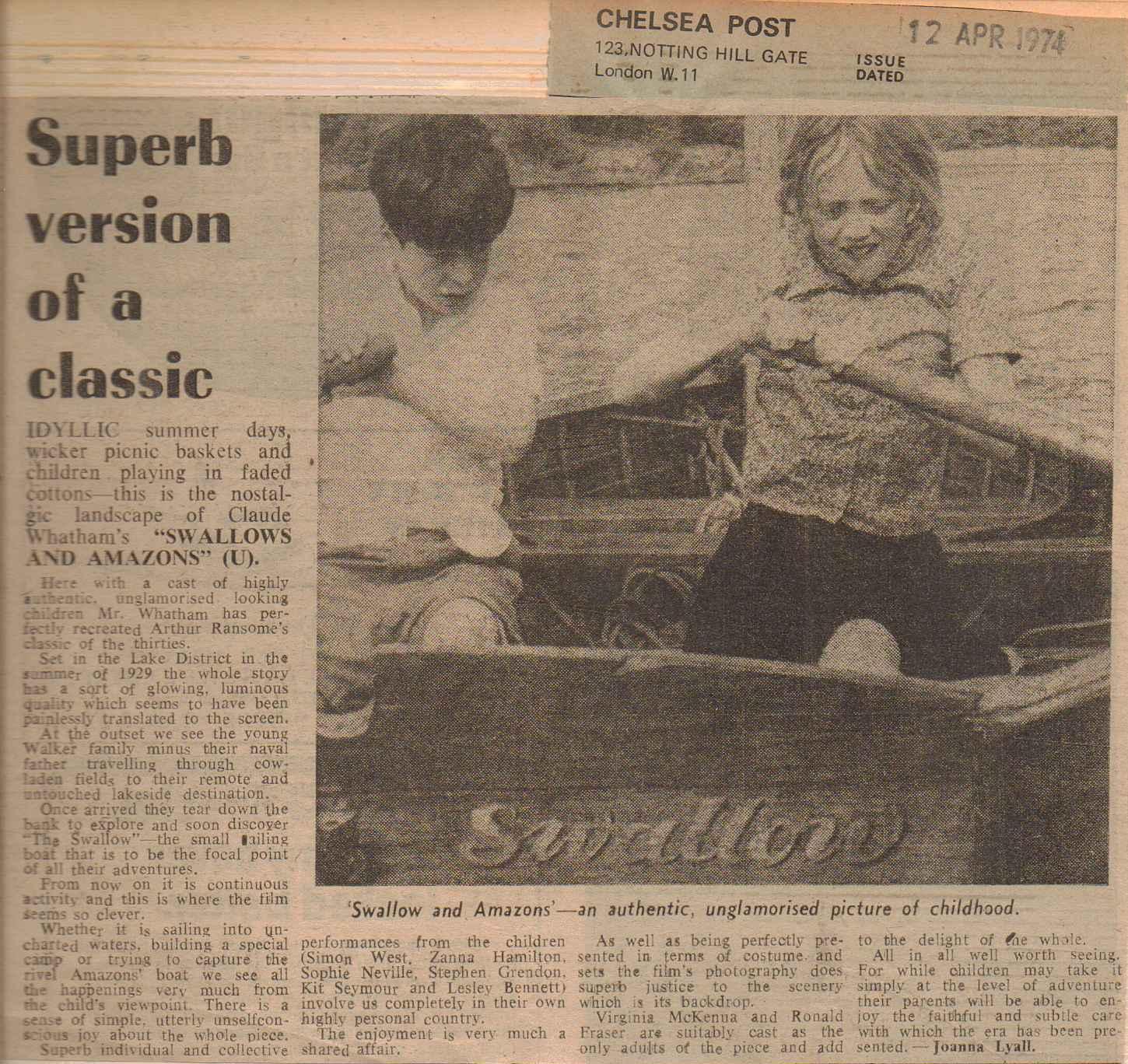
Stephen Grendon and Sophie Neville appearing in Chelsea Post 12th April 1974

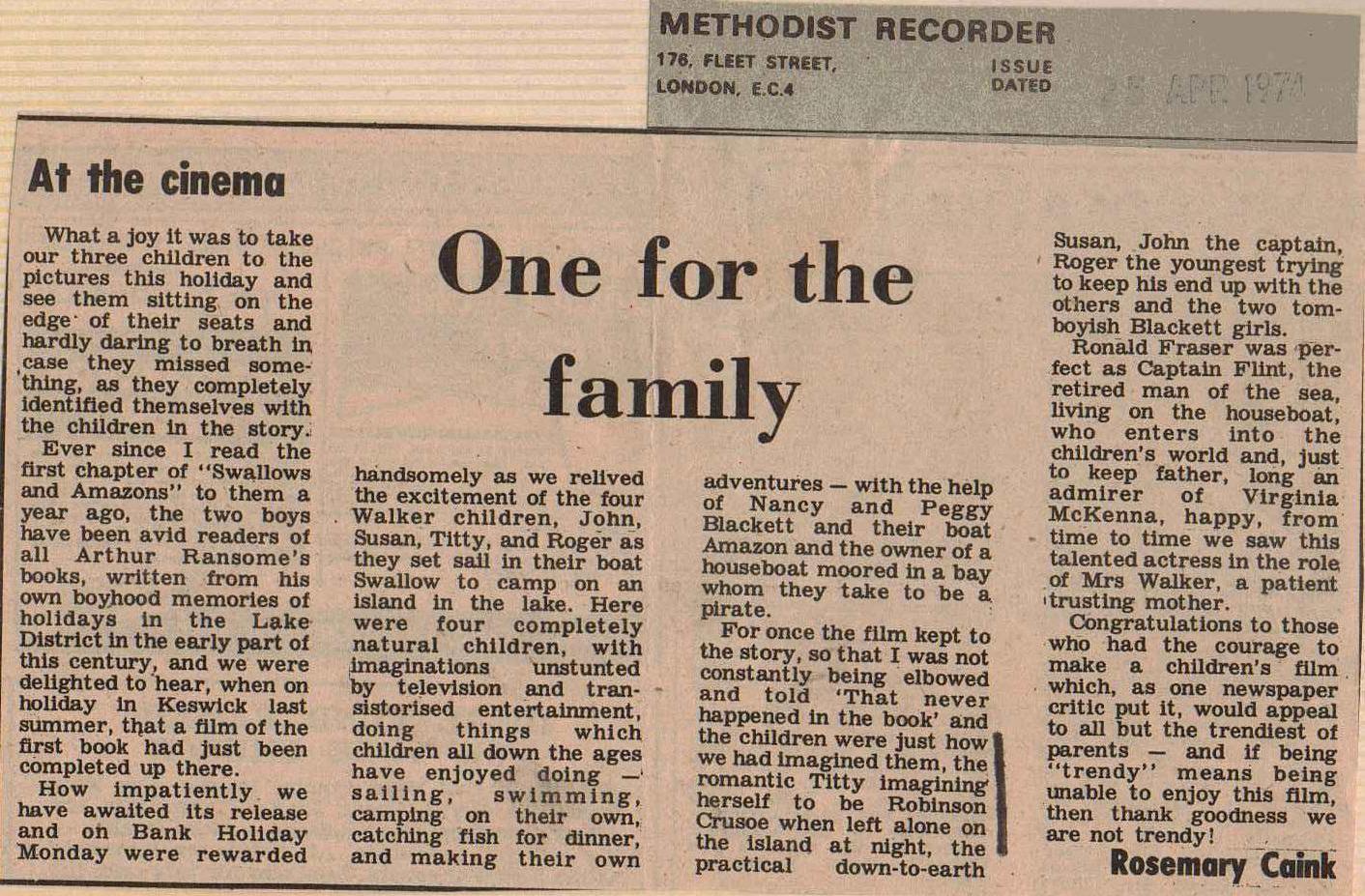
Rosemary Caink said that her three children, ‘completely identified themselves with the children in the story.’

My favorite article wasn’t found by Durrant’s. It was written in The Brownie and must have been sent to me by a fan.

Suzanna Hamilton, Stephen Grendon, Sophie Neville and Simon West, appearing in an article published in ‘The Brownie’ ~ 27th March 1974
Please click on the article to find out more about the Brownies.

I have many more articles ~ please let me know in the Comment box if you would like to see more. Otherwise I will move on to write about how the public responded and what happened next.

Riding the waves of film critics ~ after the release of ‘Swallows and Amazons’ in 1974

Virginia McKenna, Lesley Bennett, Suzanna Hamilton, Sophie Neville, Stephen Grendon and Ronald Fraser appearing in the film premiere programme

I opened the pages of the programme at the film premiere to find one of the publicity photographs of us taken at Bank Ground Farm. I wasn’t sure the face Simon was making would sell a cinema ticket.

Simon West, Kit Seymour, Ronald Fraser, Sophie Neville and Suzanna Hamilton with half of Stephen Grendon on the second page of the premier programme

But the film was now out. It had to sell itself. Everyone was waiting to hear what critics from within the movie industry felt about it.

Would this photograph ever sell the film?

I think my mother must have written to Barry Norman, inviting him to bring his daughters to one of the promotional events held at the Commonwealth Institute. I wonder if she met him at the Preview of the Premiere.  He was then presenting BBC Television’s Film 74  and writing a weekly column in The Guardian newspaper. Here is his reply:

Barry Norman enjoyed it!  The Radio Times says that he was looking at ‘films for the family over the Easter holidays’.  Film 74 was shown on BBC TWO  at 10.15pm – and repeated on Fridays even later so he must have been speaking to parents. Here’s his theme tune.

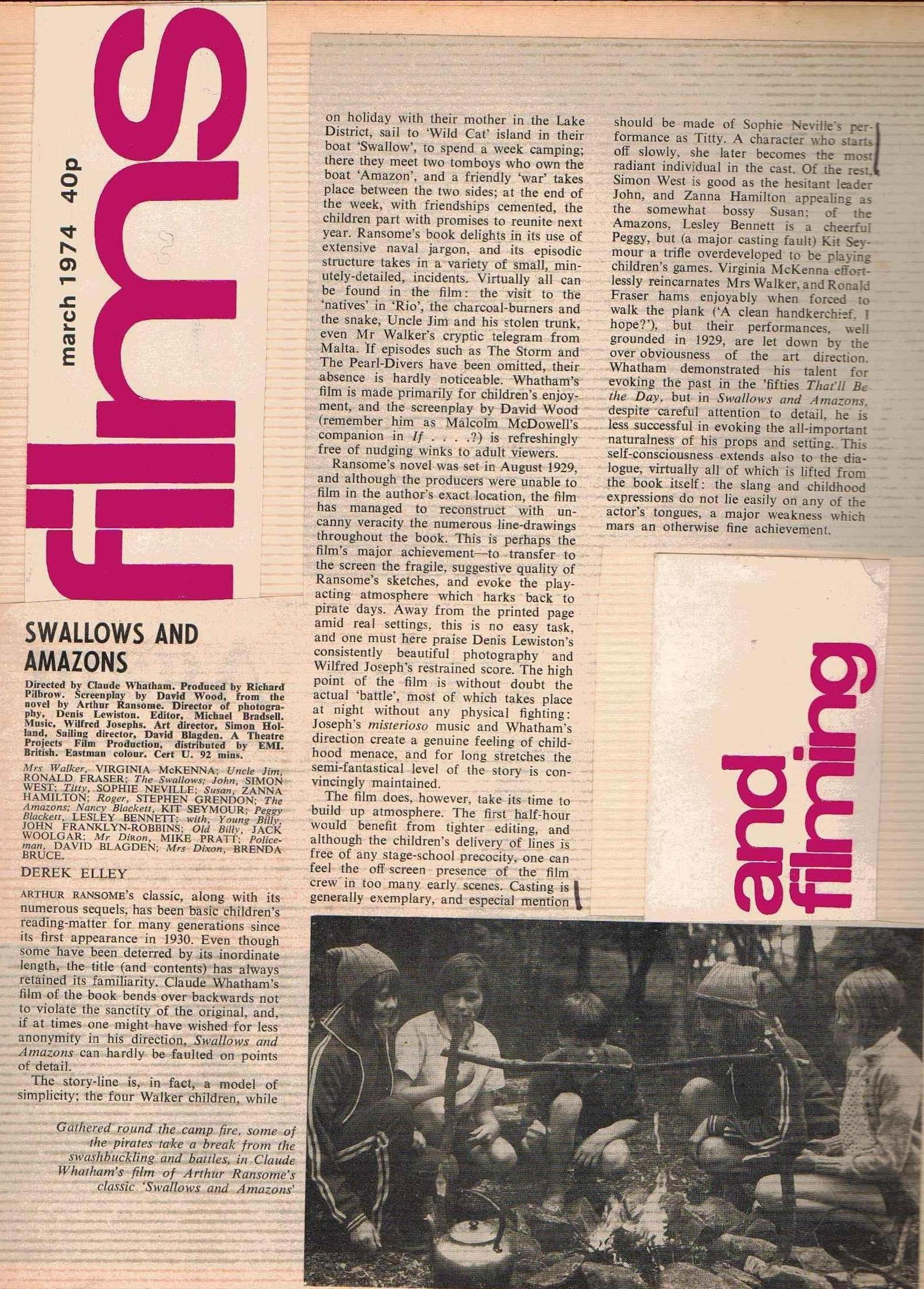
One thing that strikes me when I open the March 1974 copy of ‘Films and Filming’, kept by my mother, is that ‘Swallows and Amazons’ has to be one of the most enduring movies to come out at the time. Sean Connery opted to appear with Charlotte Rampling in Zardoz’. I’ve neither seen or heard of it. Why couldn’t he have played Captain Flint with us? I did see Steve McQueen in  ‘Papillon’  but had no desire to watch it more than once. Richard Lester’s version of ‘The Three Musketeers’ was also made in 1973. Even though it stared Oliver Reed, Raquel Welch, Richard Chamberlain, Michael York and dear Spike Milligan I don’t think it can have been broadcast on television as many times as ‘Swallows and Amazons’. 

The magazine goes on to review ‘The Optimists of Nine Elms’ starring Peter Sellers, ‘Magnum Force’ starring Clint Eastwood, ‘Herbie Rides Again’ starring Stephanie Powers and many others, films I have never heard of. ‘American Graffiti’ came out in the States, directed by George Lucas starring Richard Dreyfuss, Ron Howard, Paul Le Mat and Harrison Ford. It made gross profits of more than U$200 million becoming one of the most profitable films of all time,  but I wonder how many times it has been shown on British television this year? Do your children know anything about it? Has it been projected in the pouring rain for loyal fans sitting on a lake shore?

I his book, ‘A Theatre Project’ Richard Pilbrow says, ‘We had a success.’ He quotes Variety magazine, “Charming, delightful, beautifully made film,” but said it was, ‘Not a hit but a reasonable success that continues to play, principally on television, around the world.’ Richard goes on to quantify how it did financially. ‘The world of film finance is a distinct mystery. Our production costs were just under £300,000. Over the years, income trickled in from an international market. Curiously the costs inexorably rose to match the income. The costs of marketing the movie always seemed to equal receipts at the box office. In 2004 our film actually recouped. That’s why I have the temerity to call it a success.

Not all the newspapers thought so in 1974. You can read how much we hated the publicity in any of the books on how the film was made:

'The Making of Swallows and Amazons (1974) by Sophie Neville'
Different editions of ‘The Making of Swallows and Amazons (1974) by Sophie Neville’

Publicity photographs used to promote ‘Swallows and Amazons’ in the early 1970s – or how we hated having our photographs taken.

Lesley Bennett, Suzanna Hamilton, Stephen Grendon, Sophie Neville, Virginia McKenna, Simon West and Kit Seymour gathered at Bank Ground Farm above Coniston Water for a publicity photograph. This one was taken by Daphne Neville.

When a television drama is ready to be transmitted there is a little publicity, but not much. Photographs might be taken for the cover of the Radio Times or a book to accompany the series, there might be a Preview at BAFTA to which journalists from the colour supplements and daily newspapers are invited, but, because the programme can be advertised on air, the actors are not intensively involved in the promotion. A feature film is very different.

Whilst we didn’t mind our photographs being taken while we were acting, and were fine about Mum clicking away with her little instamatic, we all hated having promotional photographs taken for ‘Swallows and Amazons’. They were usually so posed, set up by strangers who had no idea of the story. Virginia McKenna tried to make it fun for us but this is what we all felt about this photo-call:

Virginia McKena, Lesley Bennett, Stephen Grendon, Suzanna Hamilton, Sophie Neville, Simon West, Kit Seymour for 'Swallows and Amazons'
~ How not to set up a publicity shot for a feature film ~

Why were the Amazons at Holly Howe? Why weren’t we with any of the boats? It was all terribly hot and difficult to squint into the sunshine. Only Mrs Batty’s dog seemed to be enjoying the attention.

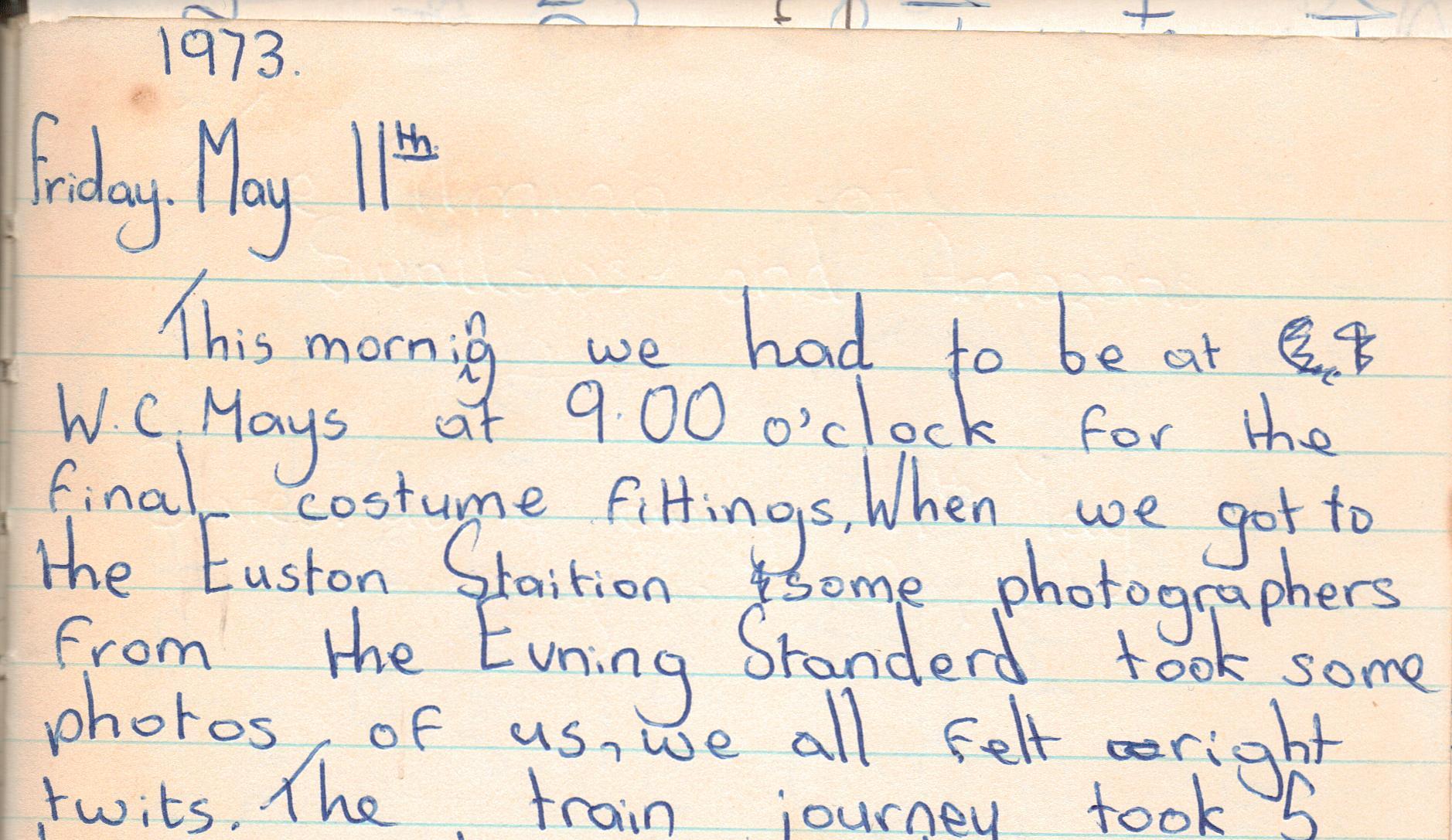
The glare of the flash bulbs had started on day one. As Suzanna said in her diary, it made us feel ‘right twits.’

Claude Whatham was very good at explaining things to children. Looking back I wish that he had explained why the publicity was so important, but of course this was not his job and he would have been busy setting up the next shot. Certainly once the filming had finished we needed to know how important it was to promote the film. Richard Pilbrow really wanted to make a sequel, particularly an adaptation of Ransome’s twelfth book in the series – ‘Great Northern?’  He loves the Outer Hebrides and has a house on Col. I think we might have been a little keener about publicity shots if we had been told that the out-come could have been going up there for another summer. We would have been able to look forward to the possibility, but I don’t suppose he was at leave to even suggest it.

Journalists were introduced to us and looked after by our unit publicist Brian Doyle.  Brian had worked on Straw Dogs’ in 1971, the thriller that starred Dustin Hoffman, Susan George and Peter Vaughan. Susan George had of course played Titty, or ‘Kitty’ in the black and white BBC adaptation of Swallows and Amazons in the early 1960s. She was now regarded as glamorous sex symbol in British cinema – setting me rather a daunting example. Much easier for Brian to publicise her then me. She had a gorgeous figure with beautiful, thick, blonde, hair. I had what my sister still calls ‘tendrils’ and my mother calls ‘bits’. And was skinny with crooked teeth.

Brian was a lovely man. He had an amazing career, going on to work on films such as Ken Russell’s Valentino with Rudolf Nureyev and Leslie Caron, The Wild Geese, Alien, Educating Rita starring Michael Caine and Julie Walters and the James Bond movie For Your Eyes Only – with Roger Moore in the lead role . He even has his name on the credits of one of George Lucas’ Star Wars films.

This was the profile he wrote for me:

Brian adored Children’s literature. His own children came up to stay on location over their half-term and spent hours playing with my sisters, indeed they all appeared together as extras in the scenes shot at Bowness, and can be seen playing on the beach. Sadly Brian died, very suddenly, in 2008. His daughter told me that he left a collection of 35,000 books.

I still have Brian’s announcement:

At this the journalists moved in. From all over the place!

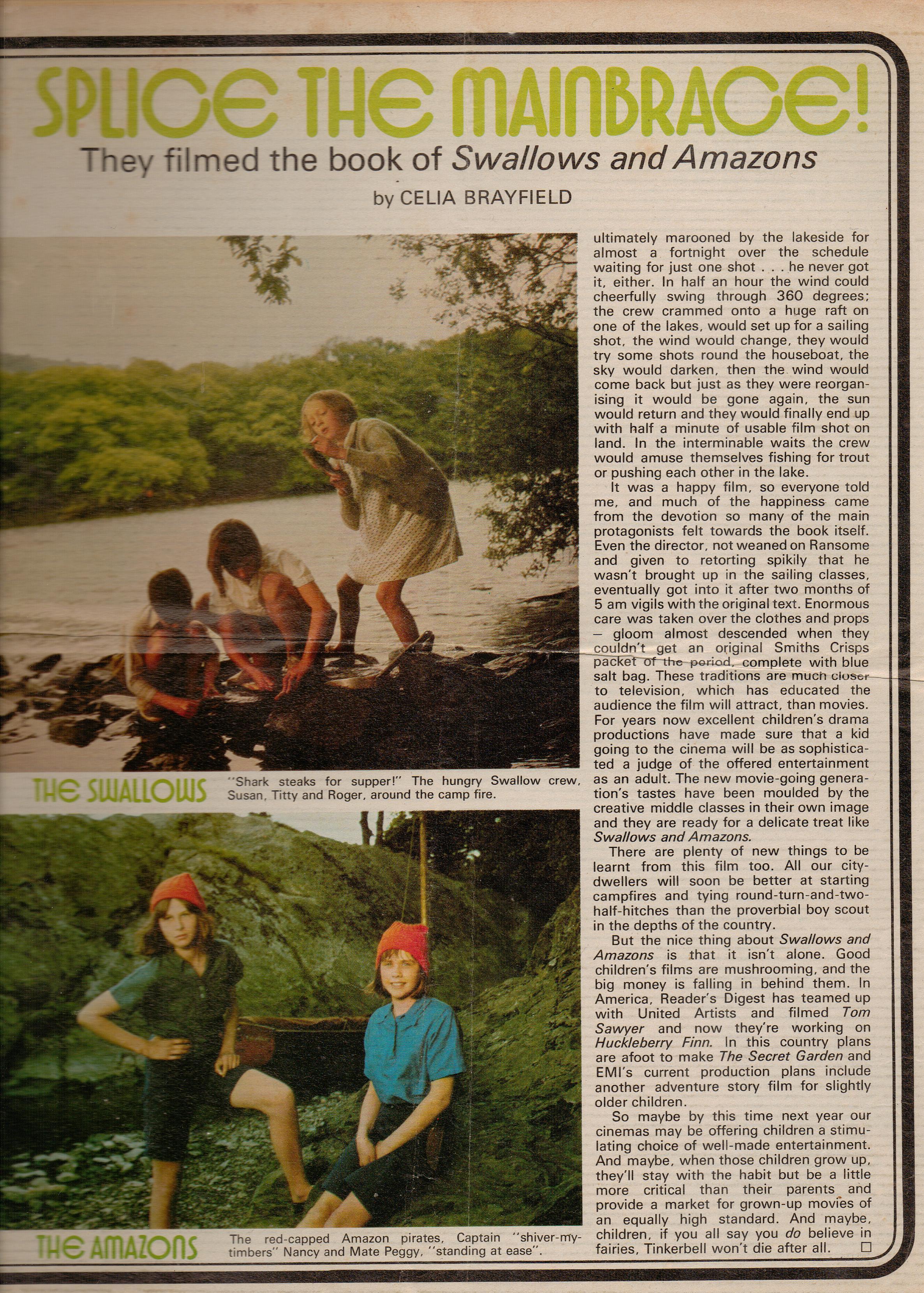
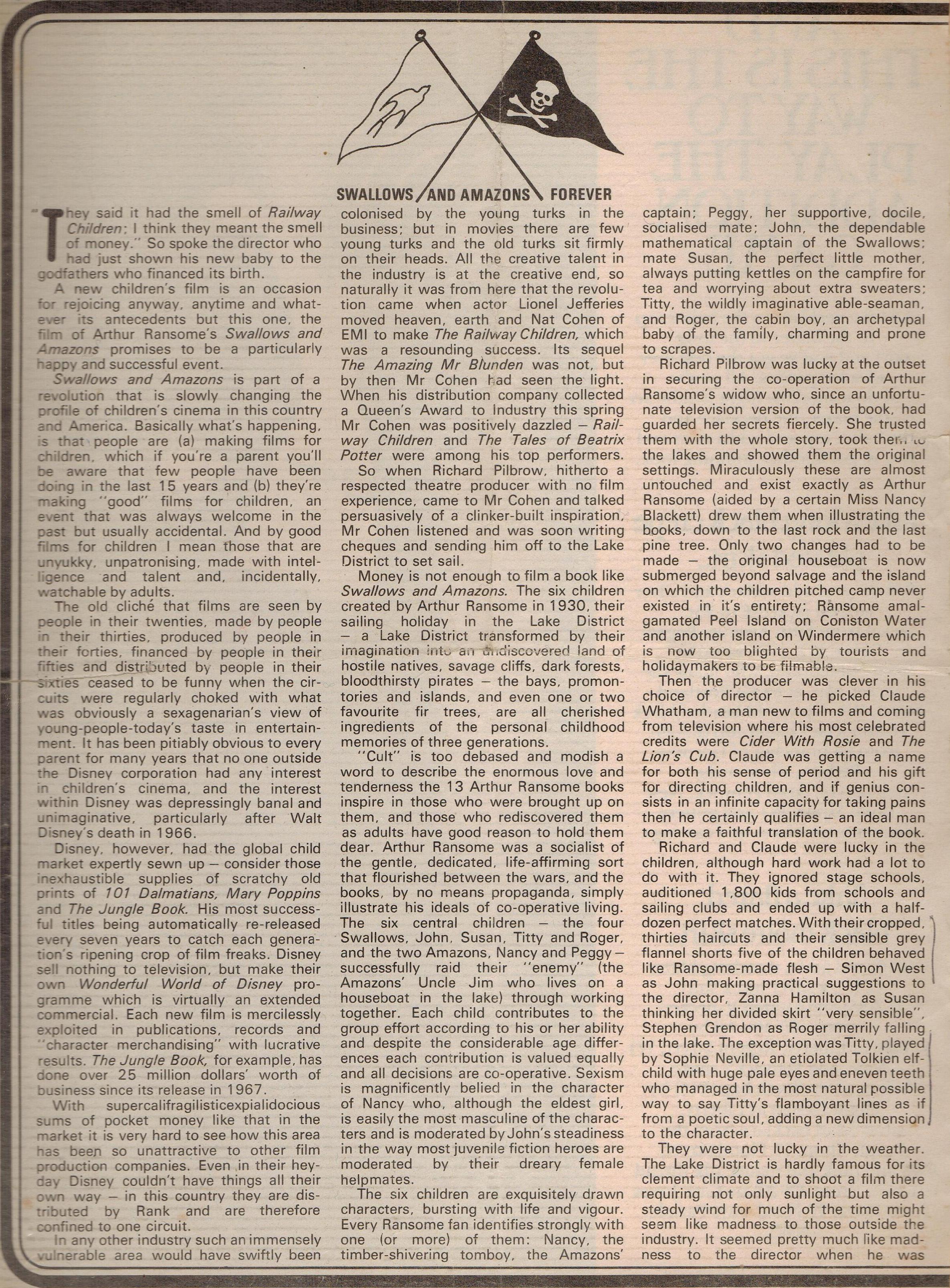
There was a very trendy women’s magazine in the early 1970s called Over 21, which the senior girls at school used to read. My mother was thrilled to find that Celia Brayfield had written a double page feature. I was amazed. I didn’t mind the picture of us gutting fish, but started reading with trepidation.

(If you can read this, I’m afraid page one comes second.)

Over 21 ~ December 1973

I read it, looked up the word etiolated in the dictionary and burst into tears.

Far worse was to come.

Off to Elstree Studios ~ to dub ‘Swallows and Amazons’ in 1973

Sophie Neville at Elstree Studios in 1973

The process of editing a film can be terrifying for a director. There is always the prospect of finding a sequence that will not cut together. But working with a good film editor is hugely creative and fulfilling. Problems do arise but great things can happen. Richard Pilbrow says in his new book, A Theatre Project  that he was completely captivated by the process. ‘Moving a few frames from here to there, could change the whole emphasis of a scene.’  On the whole editing is an exciting, yet more relaxing time for the director than having to lead a massive crew out on location. And the actors are never around.

Sadly I never met Michael Bradsell who edited Swallows and Amazons. Like many others on our film crew he’d worked with Claude Whatham before on the movie That’ll be the Day. He went to on edit many great movies; Local Hero for Bill Forsyth and  David Puttman,  Henry V for Kenneth Branagh and Wilde, which starred Stephen Fry. Oh, to think that he hauled my image over his Steenbeck.

I remember that when I saw Henry V at the Curzon Cinema in Mayfair, in 1989, there was something terribly wrong with the projection. The lip-sync was out. Kenneth Branagh’s voice was delivered after his lips started moving. It was most off-putting. I knew all about lip-sync because I had been involved in dubbing movies since I was twelve. For, it was back in 1973, when Claude Whatham was working on the sound track for Swallows and Amazons that, rather unusually, I was summons to the EMI Elstreee Studios.

Sophie Neville at the EMI Elstree Studios on Friday 20th July 1973

Visiting Elstree Studios was exciting. I remember meeting the Dubbing Mixer and being there with the other Swallows, but I don’t think we saw anyone else in the cast. Suzanna came along with her nine-year-old cousin who was called Seymour – a very bright boy who was wearing stripey canvas trousers like a deck chair. Mummy had bought me a smart new dress that was the height of fashion. Looking at the photograph I rather wish she hadn’t bothered.

We were led into a huge dubbing theater hung with long black drapes around a high white screen. Claude explained that he needed to re-record our dialogue for various sequences. This was because the original soundtrack had been spoilt by the sound of motorboats, car horns or simply the wind. At first we were handed dubbing scripts, but it was difficult to look at them as well as the screen. As we could still remember our lines we didn’t need them. Instead, we stood in front of microphones on spindly stands and sung out the words we knew as sections of the film were projected. To help up a thick black cue-line would pass across the scene. When it hit one side it was time to start speaking. This was to ensure that our voices would be in sync with out lips. It could help, it could be off-putting. In the end we just went for it naturally. After each ‘take’ the film would be re-wound and we would go-again. There is a scene in at the Amazon Boathouse when John scrunches up the Amazon’s message and throws it in the water. It amused us to see this in reverse.

The post-syncing was a chance to improve on our performances and diction. Some time was spent in re-recording our sea shanty, Adieu and Farewell to you Fair Spanish Ladies. I made a mistake here that I have always regretted. Instead of singing sweetly and true I went for volume, which was not only unnecessary, but disastrous. It is acceptable on the film when you can see I am singing out on the water but sounds horrid on the LP. We had no idea at the time that EMI were going to bring out an album to accompany the movie, but they did.

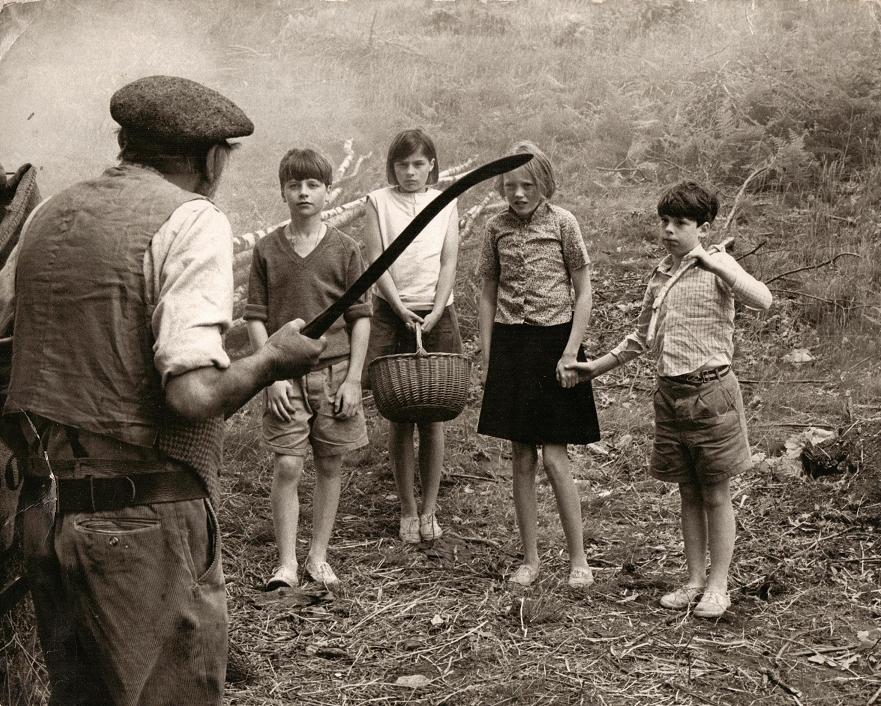
Jack Woolgar as Old Billy confronting Simon West, Suzanna Hamilton, Sophie Neville and Stephen Grendon as the Swallows who were visiting the charcoal burners.

The one line that I simply could not replicate was the dialogue Titty delivered when saying goodbye to the charcoal burners: ‘Thank you so much for letting us see your lovely serpent.’  We went over it again and again, but Jack Woolgar wasn’t at the dubbing studio and I couldn’t do it without looking at him. The charm and sincerity of the moment was not something I could reproduce. In the end Claude said he just had to use the original despite the sound of the roaring wind.

I remember being at Elstree for a week. Mum has 20th July, 2nd and 3rd August (although that looks crossed out,) then EMI 6th and 7th August, marked in her diary. At lunch time we were shown around the back lot, where Sten refused to leave the wreckage of a WWII plane and the film stages. David Niven was playing Count Dracula in Vimpira, literally kissing the lovely actress Teresa Graves in the coffin as we watched from the edge of the set.

After we had left Elstree, sound effects would have been added. Richard Pilbrow said that, ‘Bill Rowe was our masterful sound mixer, working magic with birdsong, a rustle of leaves, a broken twig – all the tiniest details that went into making the story spring to life.’ When I watch the film of Swallows and Amazons now I so admire the technique of using sound to illustrate the soaring of Titty’s imagination. The storm bell on Robinson Crusoe’s ship heralds the roaring wind and lends reality to scene when I play the shipwrecked sailor, dragging my parched body towards the island campsite. You can hear parrots and monkeys in the palm trees. I am sure Arthur Ransome would have approved.

Bill Rowe, I read, was the director of Post Production and Sound at Elstree Studios until he died at the age of sixty in 1992.  He’d worked on an amazing number of movies winning an Oscar for The Last Emperor and BAFTAs for The Killing Fields, The French Lieutenant’s Woman and Alien with nominations for Chariots of Fire, A Clockwork Orange, The Mission and Batman. And to think, we had been playing Hide and Seek behind his sound drapes.

Simon West and Suzanna Hamilton at the helm of Swallow with Stephen Grendon in the bows, while Sophie Neville looks on from the shore of Peel Island, where she has been left alone with the telescope. Sound of Swallow’s moving parts was added later by the dubbing editor Bill Rowe at Elstree Studios.

One thing that really worried me was that I saw Swallow lying outside Elstree Studios. She looked forlorn, a ship out of water. Looking back on it they must have needed her to record sound effects.  I was concerned that we would not see her again, but we did. The next time we Swallows gathered was to publicize the film. We found ourselves climbing aboard Swallows again, albeit in a very different location from the Lake District. And this I will write about in my next post.

Sophie Neville not at 10 Downing Street but on the lot at Elstree Studios
Not at 10 Downing Street but on the Lot at Elstree Studios for the BBC Drama Directors’ studio course. I am wearing green.

Later in life, when I worked in television production, I spent many months at Elstree Studios at Borehamwood. However these were the BBC Studios on the other side of the road where we recorded endless episodes of  Eastenders and the wartime romance Bluebell, programmes that were never post-synced.

'Bluebell' the BAFTA award winning BBC serial
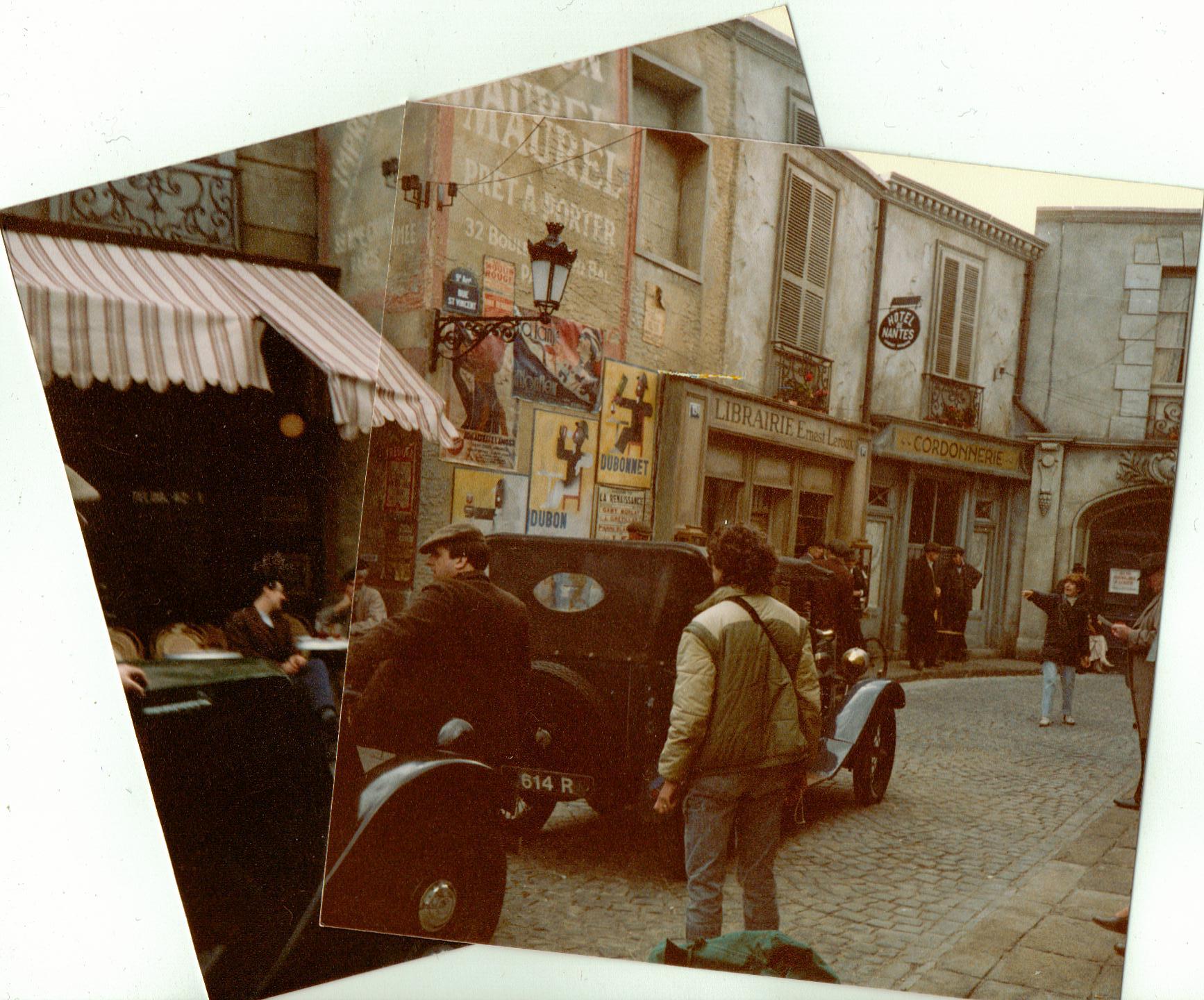
Working on the Parisian set of ‘Bluebell’ constructed on the lot at Elstree.

I’d drive past the old EMI/ATV Studios and never breathe a word that I’d worked there once as an actress.

Sophie Neville, in striped top, on the BBC Studio Director’s Course at the BBC Elstree Studios, Borehamwood in 1990

Sophie’s books about working in film and television  are available online.

Swallows in Egham ~ a pick-up day, filming ‘Swallows and Amazons’ in 1973

Simon West, Stephen Grendon, Suzanna Hamilton and Sophie Neville as the Walker children dressed as they arrived at Holly Howe at the start of their holiday in the Lake District
Simon West, Stephen Grendon, Suzanna Hamilton and Sophie Neville playing the Walker children, as they arrived at Holly Howe at the start of their summer holiday in the Lake District ~ photo: Daphne Neville

While I had been at home with my family, Claude Whatham had been busy in the film editing suite putting ‘Swallows and Amazons’ together with Michael Bradsell.  They had previously worked together on ‘That’ll be the Day’.  Our Continuity supervisor Sue Merry must have known Michael too, as he’d edited Ken Russell’s film ‘The Boyfriend’.  Claude found that they definitely needed the sequence when the Walker children run up to the Peak at Darien and see Wild Cat Island for the very first time.

It is the scene that heralds the start of the adventure and indeed the opening titles of the movie. Richard Pilbrow had always wanted it to be shot at Friar’s Craig on Derwent Water.  There is a postcard of this headland with notes written on it by Arthur Ransome who labelled it for the first illustrator of the Jonathan Cape edition of the book, and it seemed just right for the Peak of Darien despite being a long way from Bank Ground Farm.  Although there had been two attempts made to record the handful of shots needed as the evening light lit up the islands across the water, we had always been held up and reached the spot too late in the day.

Richard must have already been over budget but the money was found to mount a pick-up shoot at Runnymede near Egham in Surrey on Saturday 8th September. We were told that King John signed the Magna Carta under an oak tree there.

We loved the idea of meeting up again. Claude said he made an effort to get as many members of the same crew together as possible so it wouldn’t seem strange.

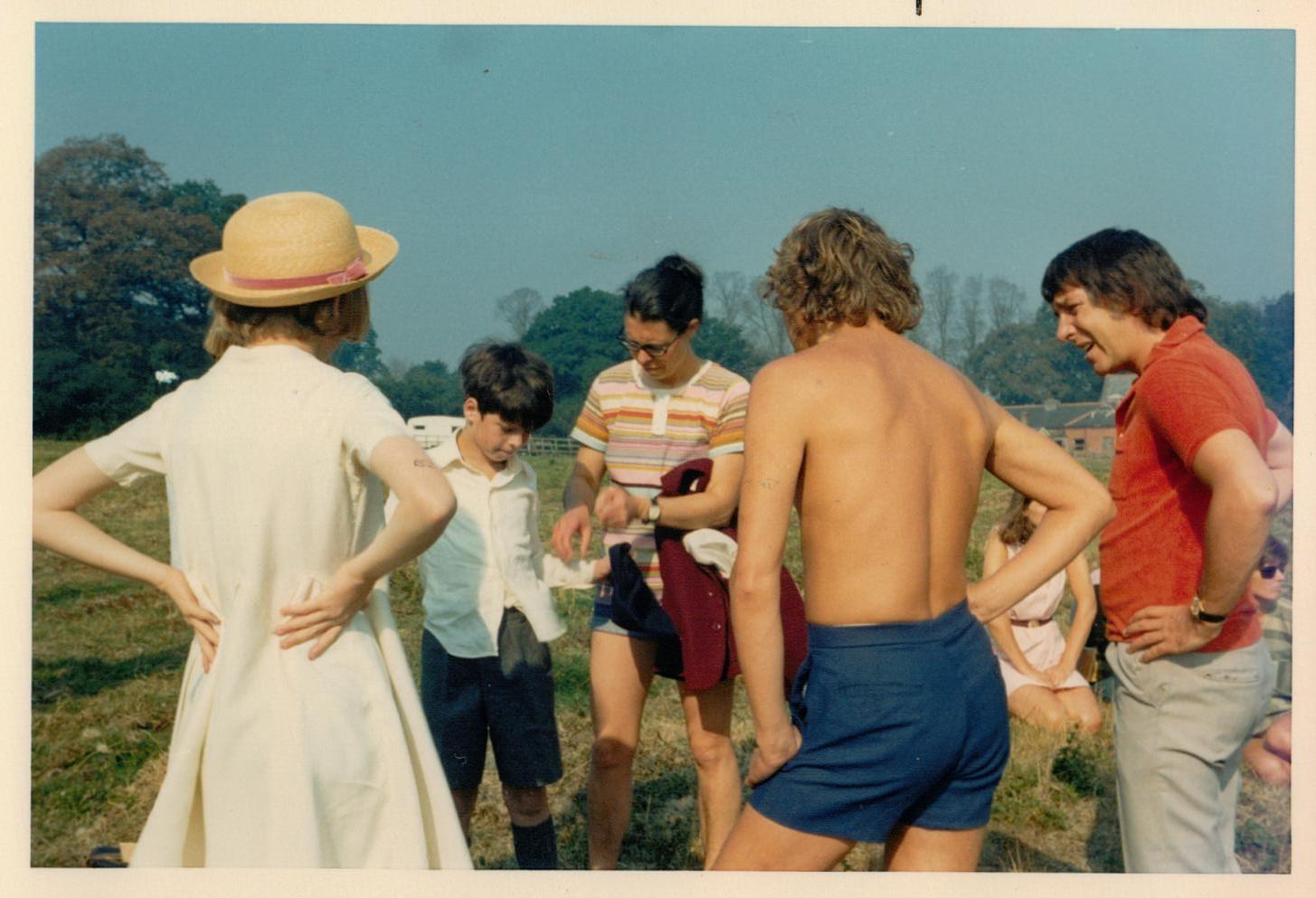
Sophie Neville with Sten Grendon, Jane Grendon, Claude Whatham and Neville Thompson
Sophie Neville looks on as Stephen Grendon organises his costume helped by Jane Grendon with Claude Whatham and Neville C Thompson.

The one thing that was striking was how much our hair had grown. We all needed a trim. Sten needed a full hair cut. Luckily Ronnie Cogan was free.

Stephen Grendon playing Roger Walker having his hair cut by Ronnie Cogan

Neville Thompson had even managed to book the same Make-up caravan. It was here that Peter Robb-King the make-up designer toned down our summer tans in an effort to match the skins of the pale Walker children who’d been sitting in the railway compartment with their mother at the beginning of the film.

Photograph of movie hair-stylist Ronnie Cogan giving a boy a short back and sides hair cut
Ronnie Cogan giving Sten Grendon a hair-cut. I was in the Make-up caravan beyond.

The ironic thing was that it was Make-up that held us up when we were first failed to record the scene in the Lake District. It took so long for Peter Robb-King to sponge down all four of us with pale foundation that the sun had set before we arrived on location. I can remember my mother hurrying him along, claiming it was ridiculous as it was too dark to see our freckles anyway. I was keen on the importance of continuity and had contradicted her. Claude couldn’t believe how long it had taken us to change. He had been furious when we turned up late but tried hard not to let us think it had been the fault of us children.

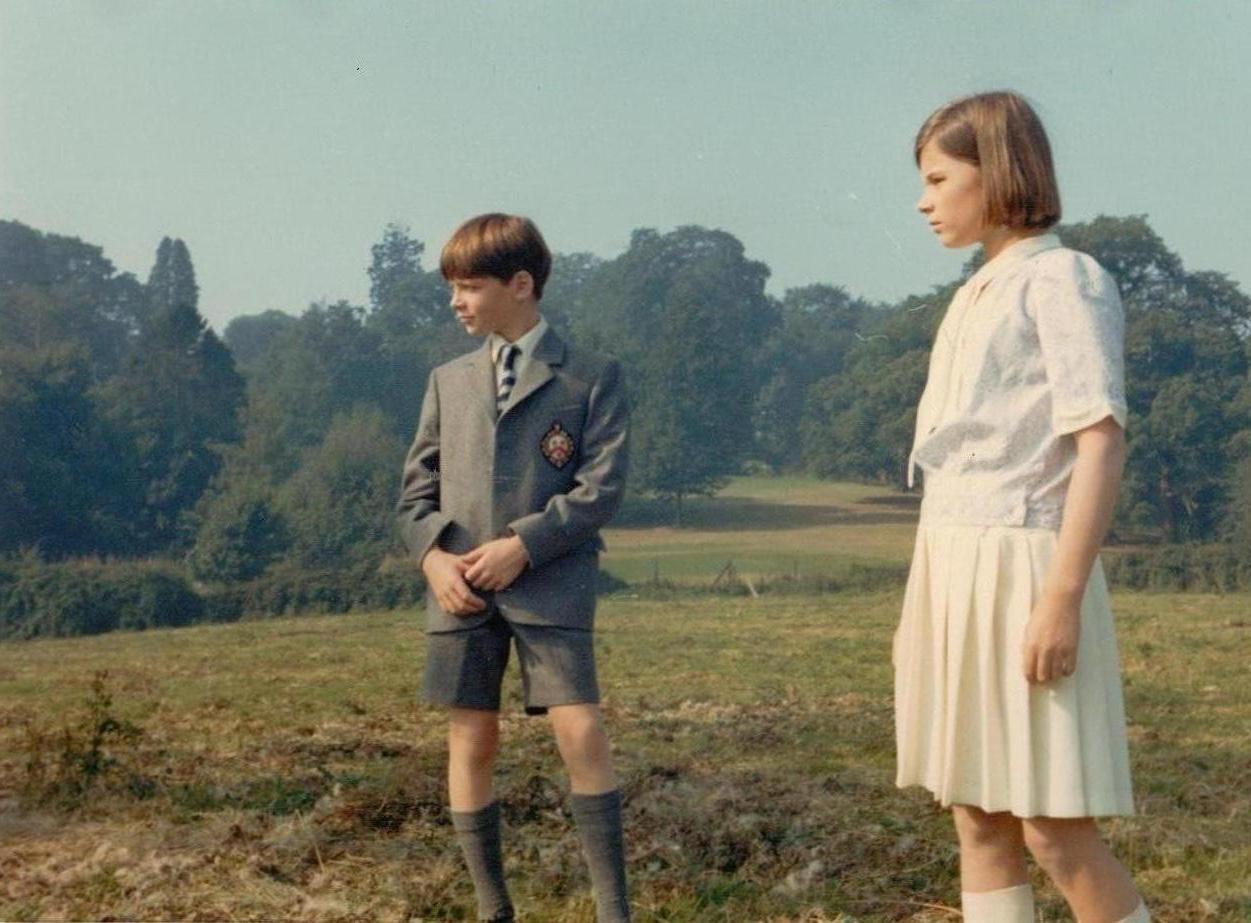
Simon West playing John Walker and Suzanna Hamilton as Susan Walker

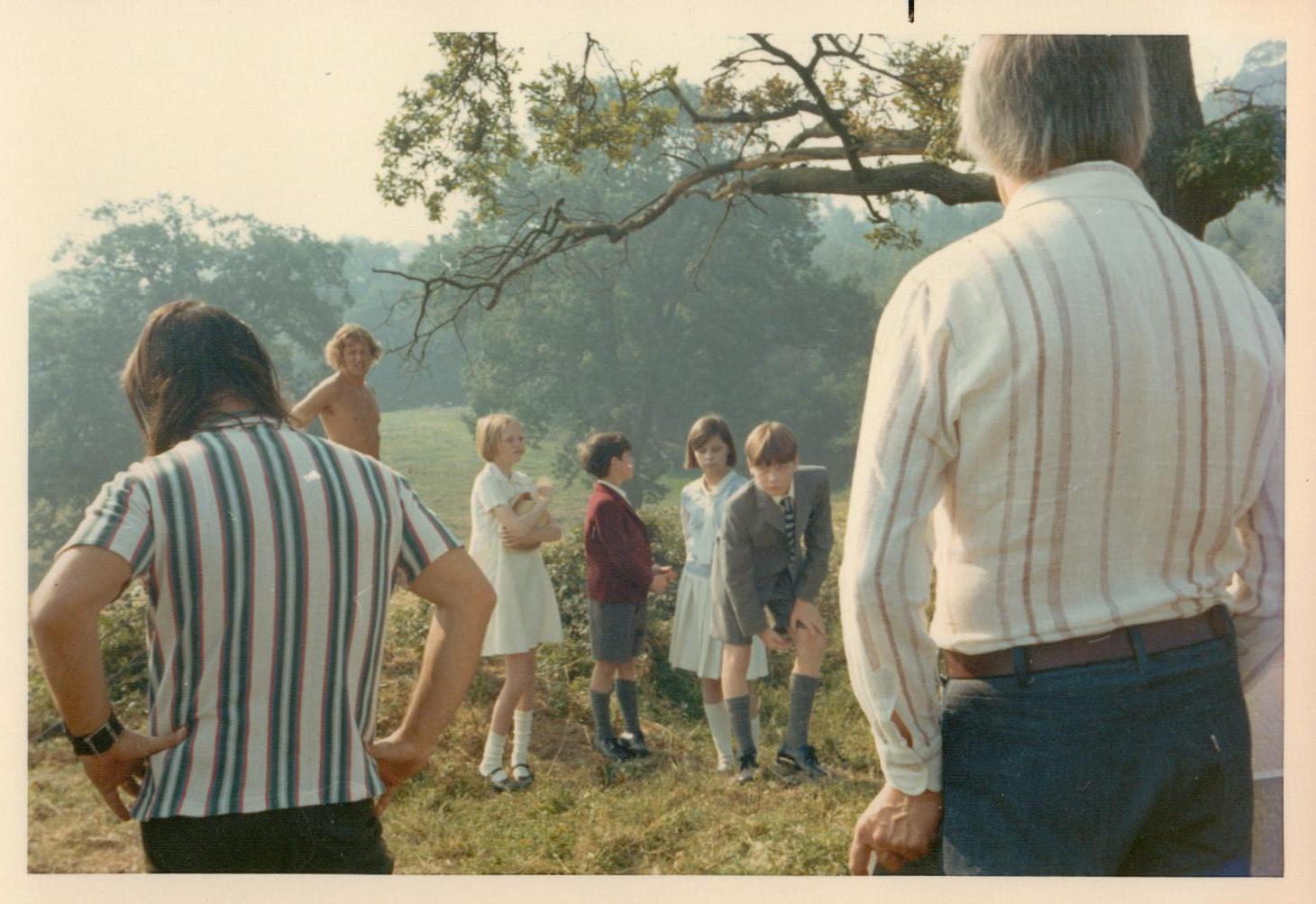
There was no Peak of Darien at the farm in Surrey, but a field had been found where we could run up to an oak tree. We just had to pretend we were looking out over the lake.

If you click on the shot below it should take you to a post I wrote on the opening locations of the film. Scroll down and you’ll see the shot of us running down the meadow at Bank Ground farm. This was the shot Claude had to cut from to the sequence that we were currently filming. Scroll right down to the end of the post and you’ll see me on Friar’s crag looking exhausted after a long day’s filming. I am so glad we were not able to continue that day.

Director Claude Whatham with Sophie Neville, Stephen Grendon, Suzanna Hamilton and Simon West. Producer Richard Pilbow looks on ~ photo: Daphne Neville

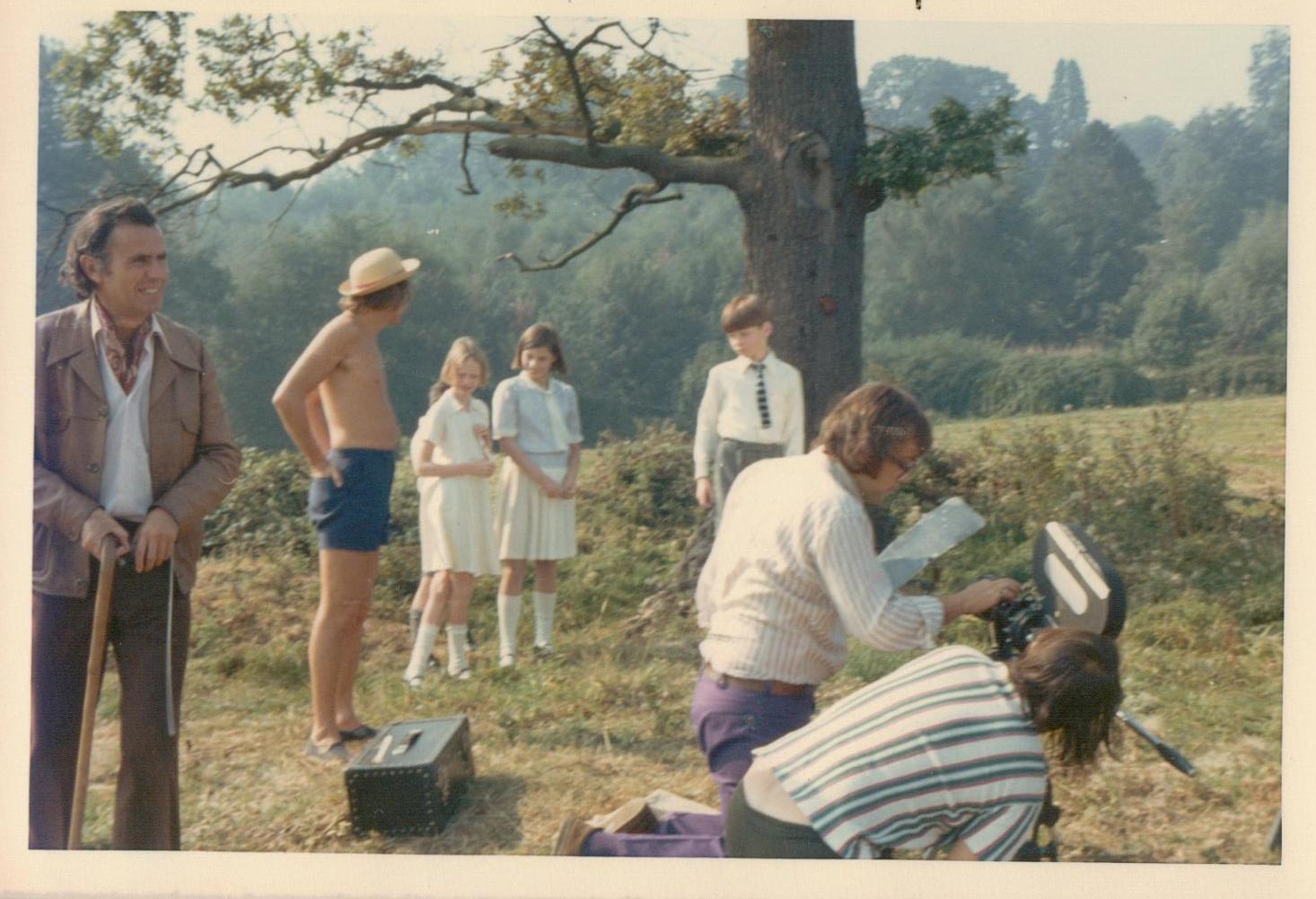
Although he had a freelance camera operator in a stripy shirt who we did not know, we met our Director of Photography Denis Lewiston who was setting up the shot with Claude under the oak tree, using a 35mm Arriflex camera on ‘short legs’.

If you click on the photo above you should get to a Post written about a location that was set on Derwentwater near Friar’s Crag – or on part of Friar’s crag that will give you an idea of what the real Peak of Darien would look like. However, the day in September in Egham was hotter than any day we’d experienced in Cumbria. Claude was soon wearing my straw hat.

DoP Denis Lewiston, Claude Whatham, Sophie Neville, Suzanna Hamilton and Simon West with Gordon Hayman behind the 35mm Arriflex Camera ~ photo: D.Neville

If you click on the photo above it will take you to the day on 8th July when we had tried and failed to shoot this scene despite rushing around.

Although we look a bit hot and stiff in these photographs that my mother took when we were lining up the shots I think that the movie was probably made by this scene. We had learnt how to magic-up performances by this stage. If you watch the finished film our faces can be seen glowing with excitement. This was also partly because we were happy to be together again, on a sunny day in a lovely place.

Sophie Neville playing Titty Walker with Stephen Grendon as Roger Walker with Gordon Hayman, Denis Lewiston and Claude Whatham behind the camera

I’ve just realised this image of Titty, clutching her school hat as she looked out over an entirely imaginary lake, was the last actual shot recorded. Soon my close-up was ‘in the can’ and ‘a wrap’ was called. It had been the 1003rd slate of the movie. We celebrated with tins of Fanta rather than champagne.

Since the first shot in the compartment of the steam train as it travelled between Haverthwaite Station and Windermere, recorded back in May, I had put on about seven pounds and grown taller than my elder brother and sister.

Daphne Neville with Stephen Grendon, Suzanna Hamilton, Sophie Neville, Jane Grendon and Simon West

I can’t help thinking that this photograph is symbolic of the futures we were to step into. Sten Grendon is holding an apple, Suzanna seems to have a framed photograph and I’d been given a roll of camera tape. What Simon West is holding is something of a mystery, but it is tightly clasped.

Simon West writing his address for me on a scrap of paper

Soon it was time to go. We changed back into our own clothes and said goodbye. Mummy took me on to see Robin Clarke, a music editor we had met on holiday who had worked on the movie Chitty Chitty Bang Bang.

It wasn’t long before we saw Claude again. Once he’d finished editing the film we were called to the work on the sound. The movie was still in the making.

Sophie Neville saying goodbye to director Claude Whatham. The film actress Teresa Graves is speaking to Neville Thompson in the back ground.

There are now three editions of the illustrated book on ‘The Making of Swallows and Amazons’, all available from online retailers and libraries worldwide .

'The Making of Swallows and Amazons (1974) by Sophie Neville'
Different editions of ‘The Making of Swallows and Amazons (1974) by Sophie Neville’

You can read the first three chapters for free here:

The food we ate whilst filming ‘Swallows and Amazons’ in 1973

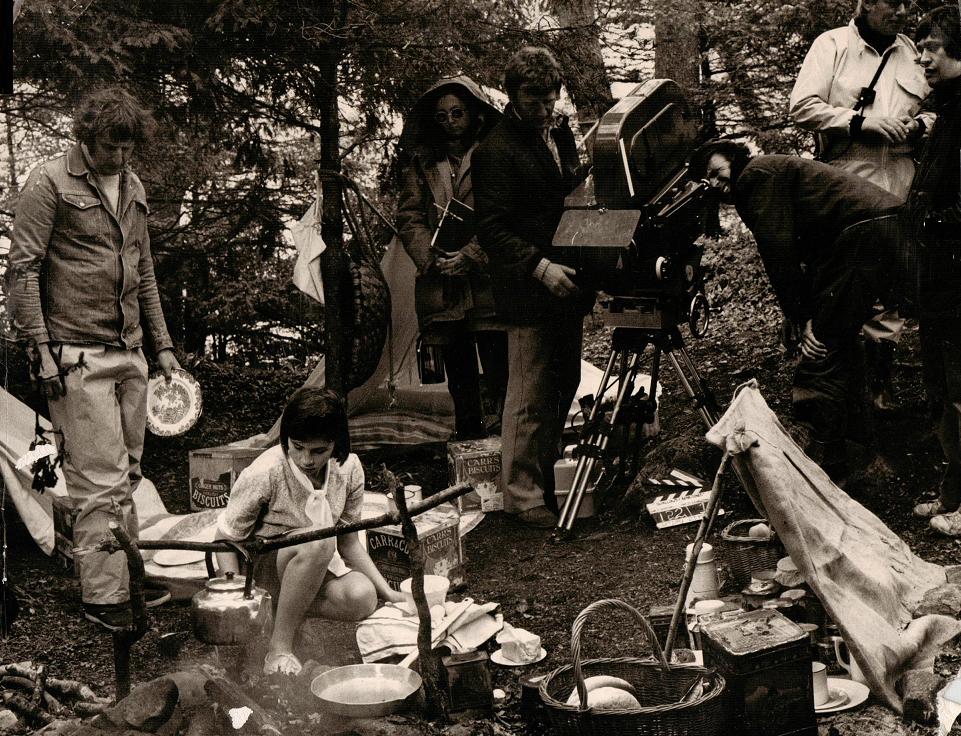
Suzanna Hamilton as The Mate Susan, cooking buttered eggs on the camp fire on Wild Cat Island. Director Claude Whatham, Sue Merry, Bobby Sitwell and DoP Denis Lewiston look on, clad in wet weather gear.
Suzanna Hamilton as The Mate Susan, cooking buttered eggs with tea on the camp fire on Wild Cat Island. Director Claude Whatham, Sue Merry, Bobby Sitwell and DoP Denis Lewiston look on, clad in wet weather gear.

One of the questions I was asked when we returned from filming ‘Swallows and Amazons’ in 1973 was about the food. This could only properly be answered by going into considerable detail.

The location caterers from Pinewood
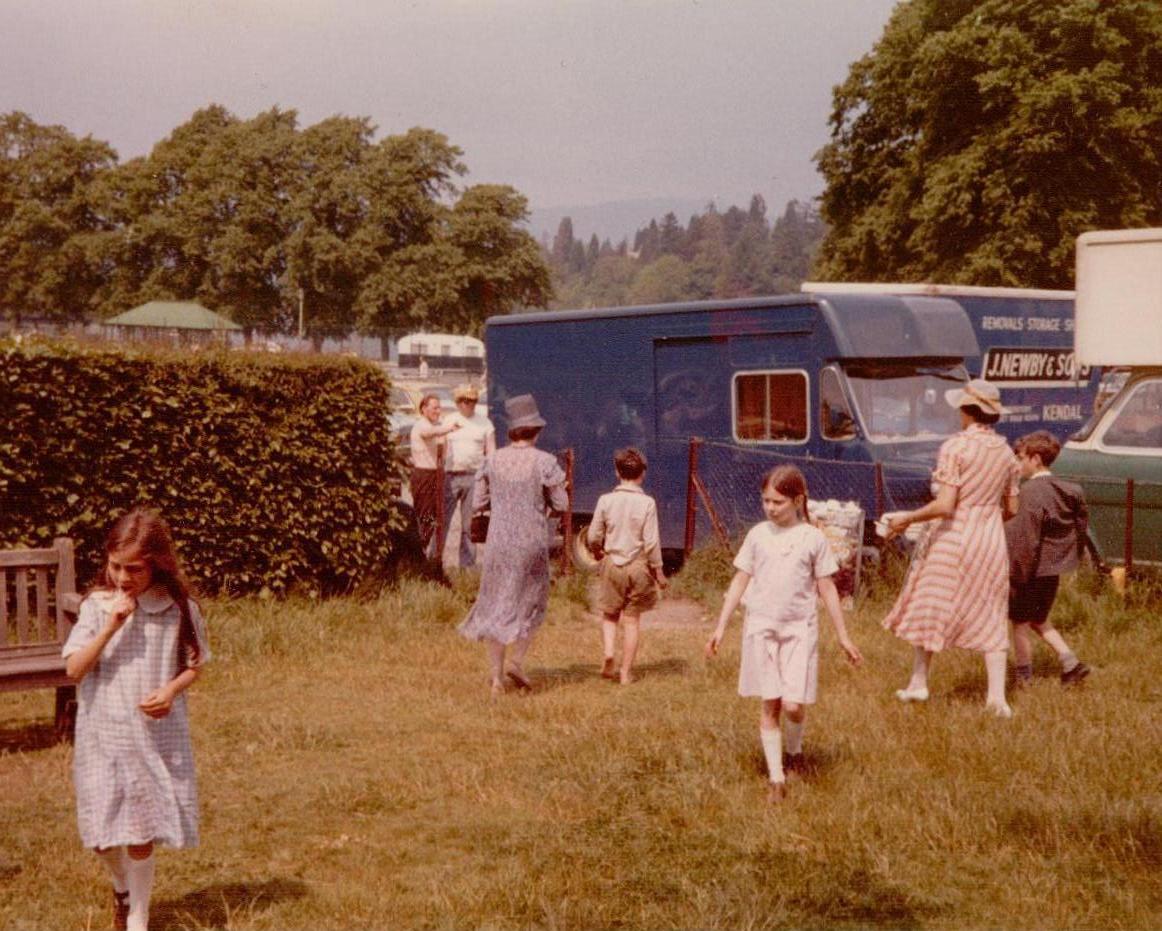
Jane and Sten Grendon walk, in costume, towards John and Margaret’s location catering wagon parked at Bowness-on-Windermere ~ photo: Daphne Neville

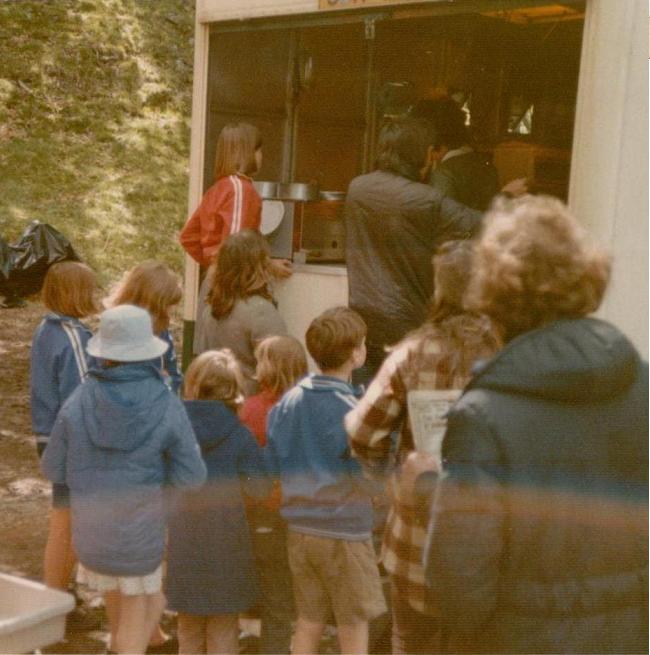
When on location, our breakfast, coffee, lunch and tea were provided every day from the back of a location catering van staffed by a couple called John and Margaret who had come up from Pinewood. My mother always referred to their van as ‘The Chuck Wagon’. There wasn’t perhaps as wide a choice as there is with location catering today, but good hot meals were produced on time, whatever the weather and wherever we might be.

If we ever filmed on a Sunday there would be a full roast meal. At other times they would enchant us with a choice that might include spaghetti, a dish that was new to England – or at least where we lived – in 1973. It was the kind of special meal that my mother would cook for a dinner party, served with a spoon and fork so you could swirl the pasta properly. As children we were allowed to go to the head of the queue so that we could avoid having to queue up in the rain. We’d take out plates to tables in one of the  red  double-decker buses. You could help yourself to knives and forks and paper napkins on the way in. We had to be careful not to get food on our costumes.

I remember when location caterers first started providing salad buffets in addition to hot lunches in the 1980s. It was such a relief not having to queue. Salads were not regarded as food for the working man back in the early 1970s  but Suzanna thought otherwise. Indeed she would eat little else.

Despite the fact that Suzanna often only ate tomato sandwiches for lunch, the catering budget must have been considerable. The call sheet always seemed to specify ‘LUNCH for approx 70 persons’.

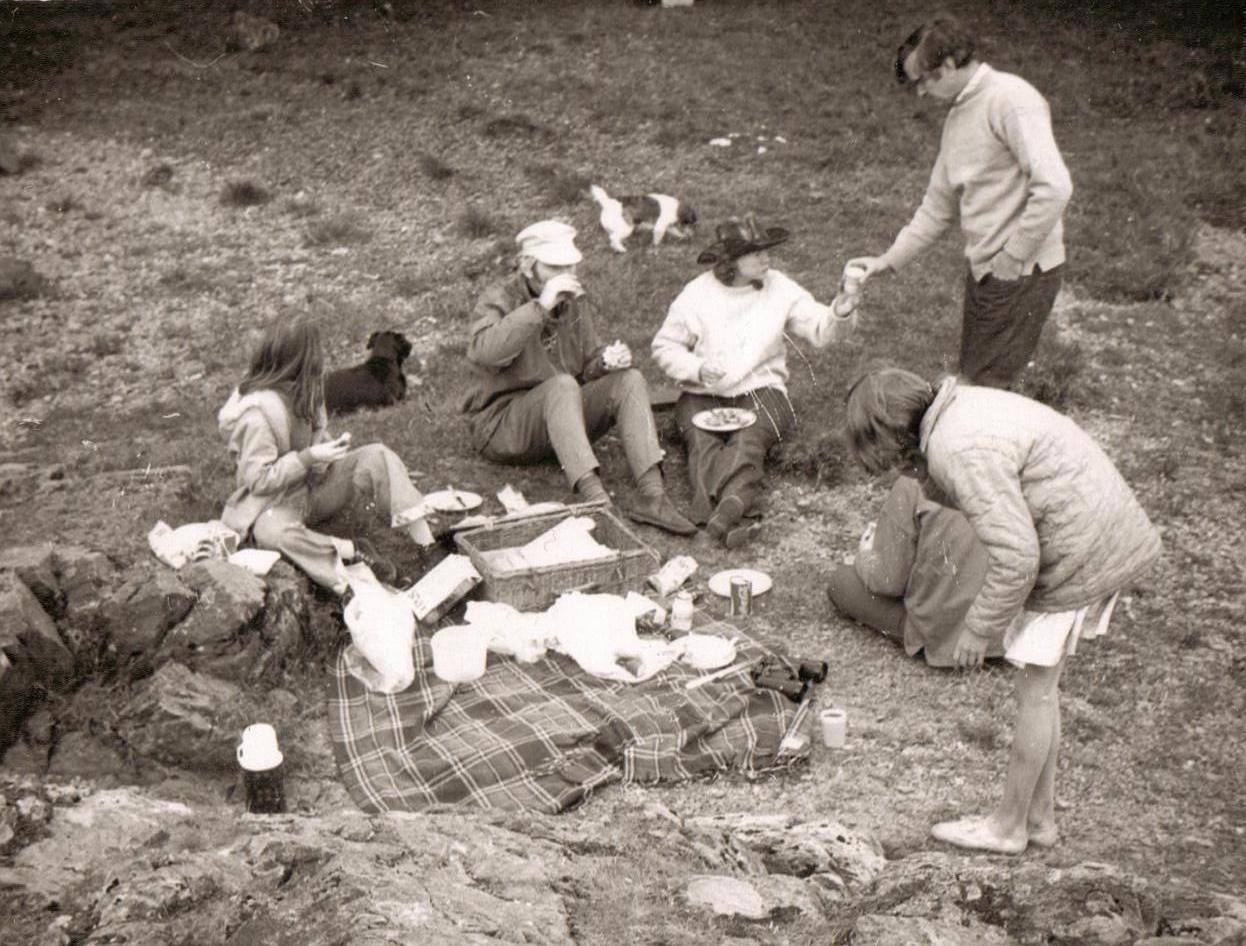
When friends came to visit us on location my parents were sensitive to this and bought a picnic, which was very much how we lived normally. This was always carried in a wicker basket and set out on a car rug, cold squash in one thermos flask, hot coffee in another. Triangles of processed cheese with ham and pickle sandwiches. No cool bags or bottles of wine. You couldn’t buy ready-made sandwiches from petrol stations or supermarkets then but if you went to a bakery they would make you a filled bap while you waited.

A family picnic on the banks of Coniston Water, Cumbria in 1973
Daphne and Martin Neville having a picnic with their friends on the banks of Coniston Water in 1973. Sophie Neville wears an anorak over her costume.

As anyone who has read Arthur Ransomes’ books will know, the Swallows were very organised when it came to provisions. Milk from the farm, buttered eggs, seed cake, apples, molasses (toffees) and grog – I loved it all. I wasn’t too sure about fried perch but the pemmican and potato cakes cooked by Man Friday with a great knob of butter were utterly delicious. And I loved the buns from Rio. We didn’t have peas to shell on the film. Apples must have seemed a realistic alternative.

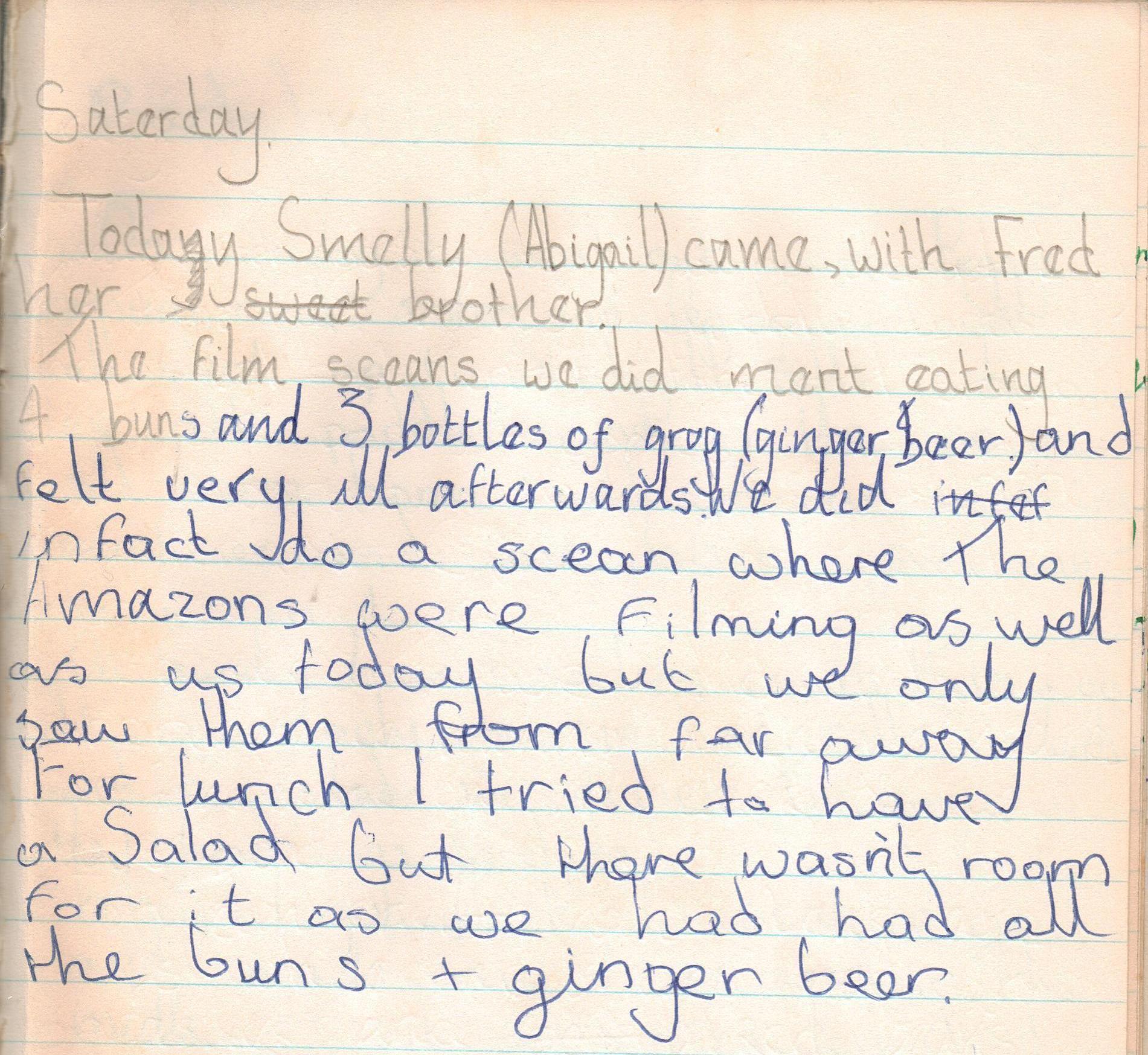
Again we have to rely on The Mate Susan for details. Surely she was modeled on Ransome’s own efficient wife Evgenia? In this extract from her diary Suzanna mentions that Richard Pilbrow’s two children came to watch the filming. She knew Abigail from London.

Mum became worried quite early on that Suzanna wasn’t eating enough. The solution came when she was taken out to dinner at a restaurant where she was able to chose from a wide menu.

As a result Suzanna was often given steak for supper back at the Oakland’s Guest House while the rest of us had whatever was on offer, which was a bit of a swizz.

Eating apples
‘Sailors die from it like flies’ Stephen Grendon, Suzanna Hamilton, Sophie Neville and Simon West as The Swallows eating apples to fend off scurvy.

Suzanna was of course completely right about insisting on eating salads and fresh fruit. She chivvied, encouraged and begged both the caterers and Mrs Price for more and more fresh raw food. She loved strawberries. Virginia McKenna won her heart by bringing her two boxes of fresh strawberries when she was ill with tonsillitis at the start of the filming. These would have been early English strawberries and a great treat in 1973.  John and Margaret managed to find enough for us all later in the summer. They were presented in a manner that would have pleased the men working on the film crew but Mate Susan wasn’t so happy about this.

I’ve included this photograph before but it provides proof that food was an important issue. Please note that Mate Susan is first in line, inspecting everything on offer.

Location catering
Suzanna Hamilton, in her red tracksuit top, seeing what the location caterers had for lunch on the set of ‘Swallows and Amazons’ by Coniston Water

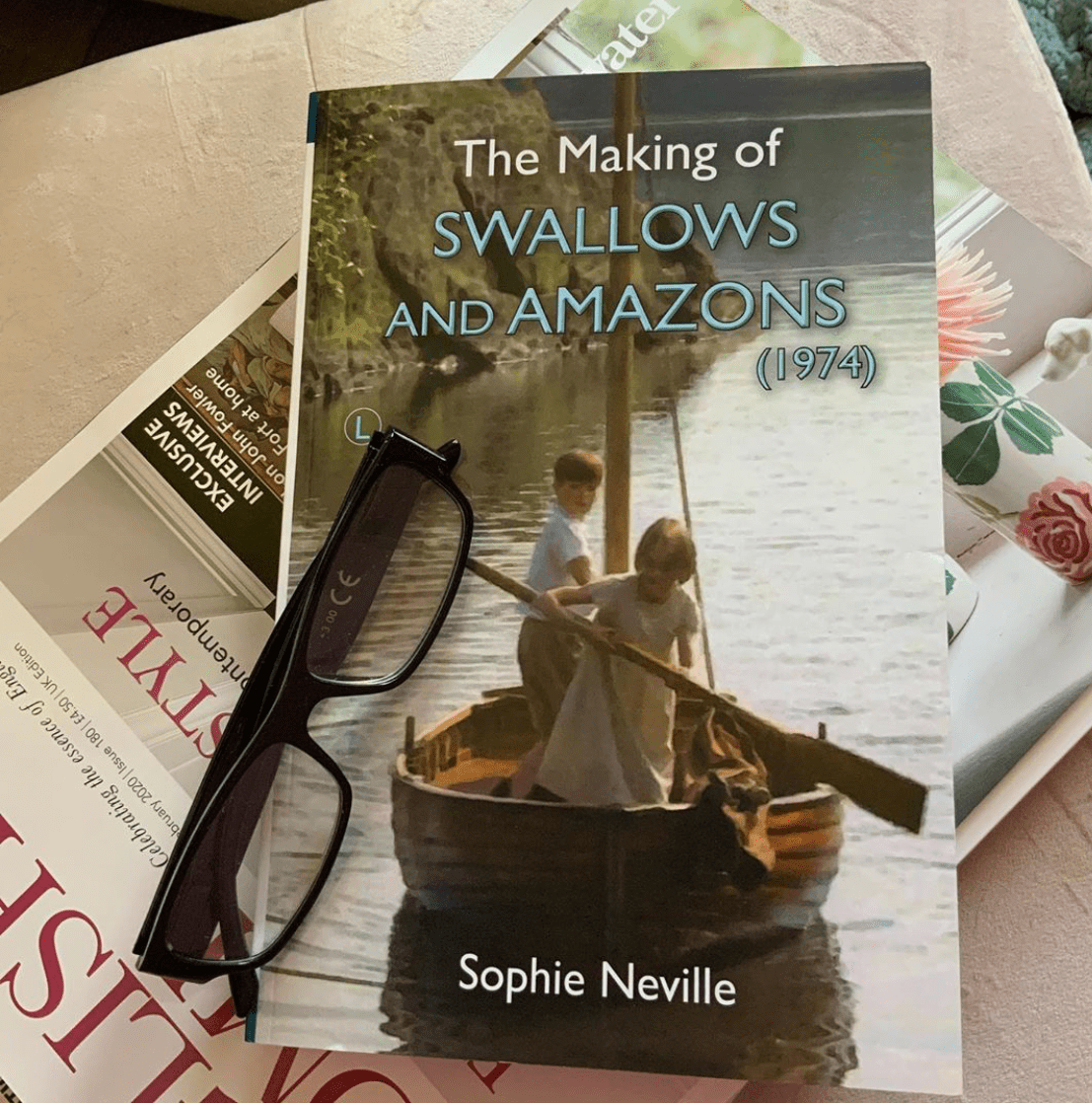
If you would like to read more about what it felt like to appear in Swallows and Amazons, I have bought out a paperback: ‘The Making of Swallows and Amazons’ for sale online or available from any library worldwide.

Screenshot of The Making of Swallows and Amazons book cover on Instagram

‘What was it like?’ ~ adjusting to life at home after filming ‘Swallows and Amazons’ in 1973

Newspaper articles about 'Swallows and Amazons' in 1973
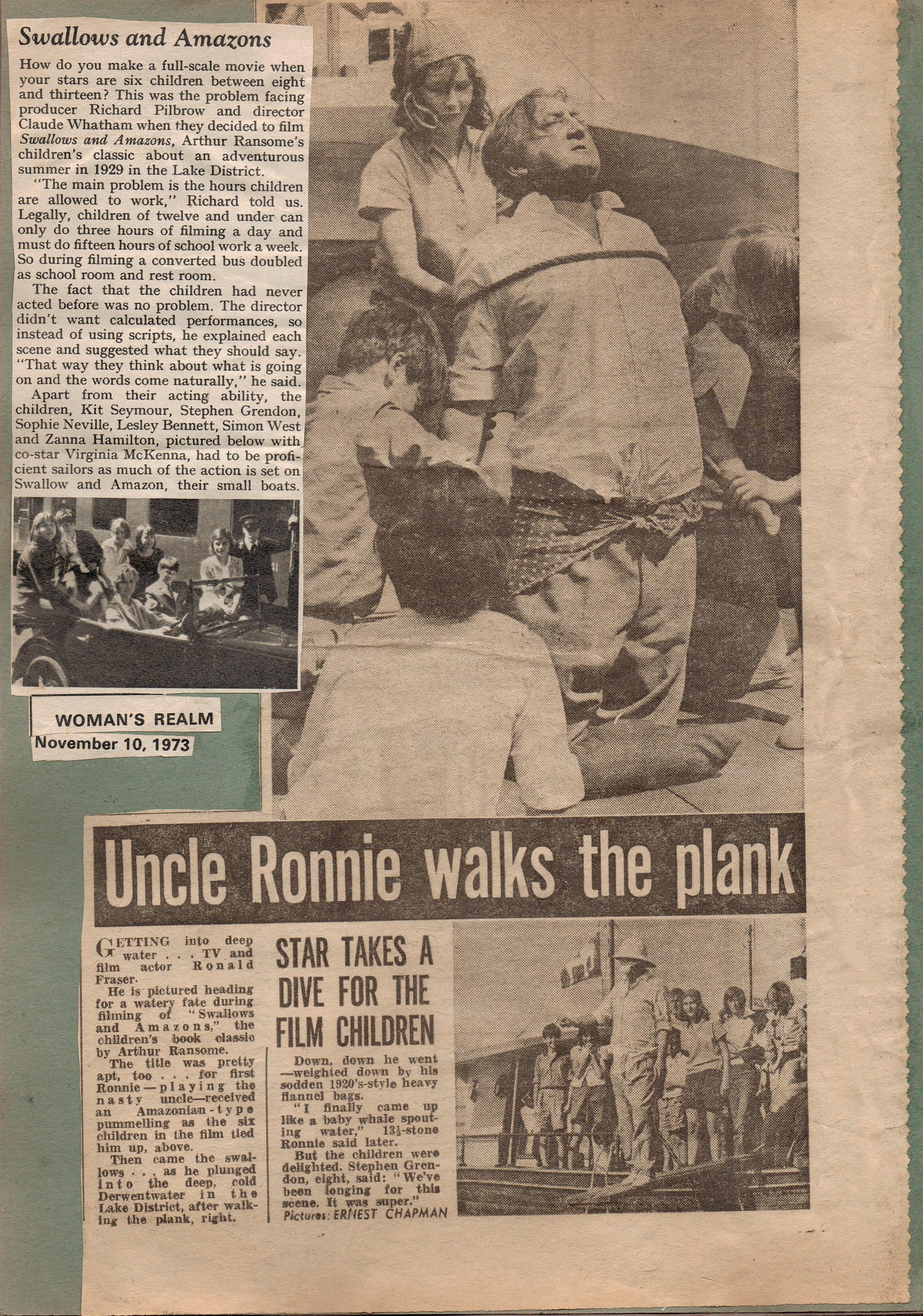
A newspaper article by Ernest Chapman that came out in July 1973. The main photo features Ronald Fraser as Captain Flint with Sophie Neville, Stephen Grendon, Simon West and Kit Seymour

Being back at home for the summer holidays was lovely. I must have been pretty tired. But, adjusting to real life when articles like this one appeared in Woman’s Realm was tricky. Everyone seemed to be reading about me in their dentist’s surgery.

‘What was it like?’ I was often asked.

How could I begin to describe working like this ~

Sophie Neville with the cast and crew of 'Swallows and Amazons in 1973
The cast and crew of ‘Swallows and Amazons’ filming on the jetty at Rio in 1973

‘Did you have lots of lines to learn?’

How could I explain that this is how we worked on the dialogue?

Filming the movie 'Swallows and Amazons' in 1973
Rehearsing with Claude Whatham out on the lake

‘What were the others like?’

How could I tell people about the whole crew, that I’d had working relationships with so many adults?

Talking to Martin Evans the Gaffer and Terry Smith the wardrobe master while leaning on a lighting stand at Bowness-on-Windermere

Technical questions were much easier to answer than, ‘How did you feel?’  No one wanted to know that most of the time I felt cold.

‘Did you have to wear make-up?’  This was a difficult one, as we didn’t wear conventional make up but my legs were regularly coated in a layer of foundation so as not to appear shockingly white. You can see the smooth effect in the photograph above. Suzanna was amusing about this in her diary. She hated being sponged down with a matt base and sun-bathed whenever she could so as to avoid it in the near future.

‘What did you wear?’

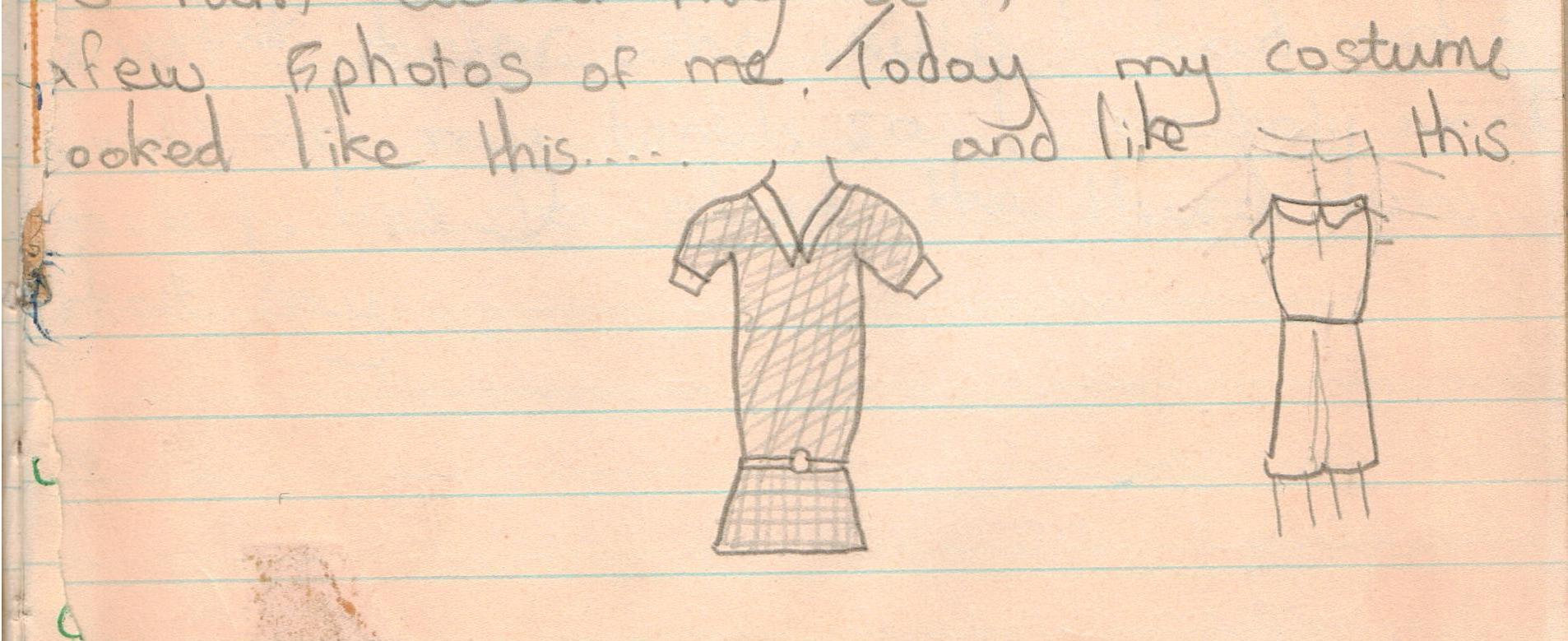
Suzanna drew pictures of the two dresses she wore at Bank Ground Farm. I always rather liked her blue gingham one. Unlike the Duchess of Cambridge I have never worn a yellow dress apart from the sleeveless one I had to climb into to play Titty. It was really too short for 1929. I remember the costume designer, Emma Porteus, confiding in Mum that they would cheat on the length a bit. Hem-lines were very much above the knee in 1973. Arthur Ransome would have turned in is grave. Luckily Titty’s dresses just look a little out-grown.

Suzanna Hamilton's costumes for scenes set at Holly Howe
Suzanna Hamilton’s drawings of her costumes for scenes set at Holly Howe

‘How did they film you sailing?’

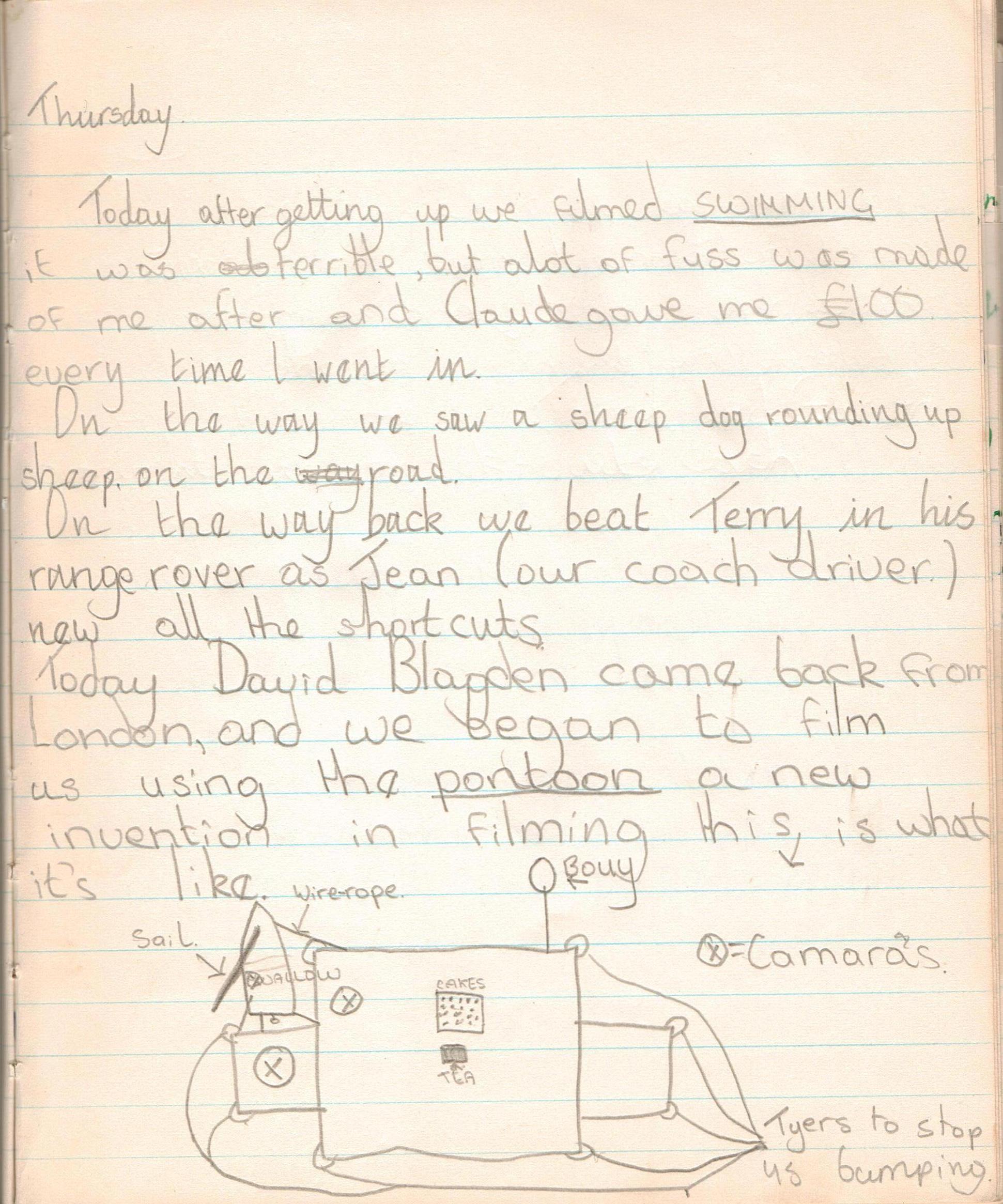
Again Suzanna provided wonderful graphics of this. I don’t think I’ve yet published this page of her diary.

Suzanna Hamilton's diary about using a camera pontoon on Coniston Water
Suzanna Hamilton’s diary about using the camera pontoon on Coniston Water. If you click on the picture you should get through to Ben Fogel’s documentary where Claude Whatham describes this in further detail.

‘What was Virginia McKenna like?’

This question was easy. ‘She was lovely.’

The Walker family played by Suzanna Hamilton Stephen Grendon, Sophie Neville, Virginnia McKenna and Simon West at Bank Ground Farm in Cumbria
The Walker family played by Suzanna Hamilton Stephen Grendon, Sophie Neville, Virginia McKenna and Simon West at Bank Ground Farm in Cumbria

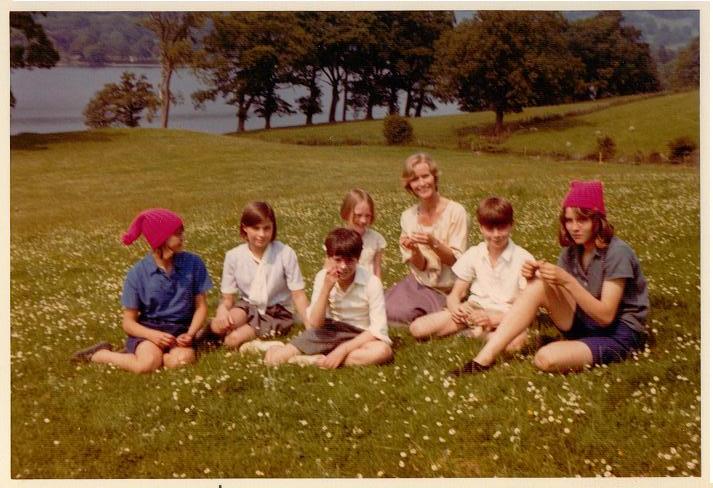
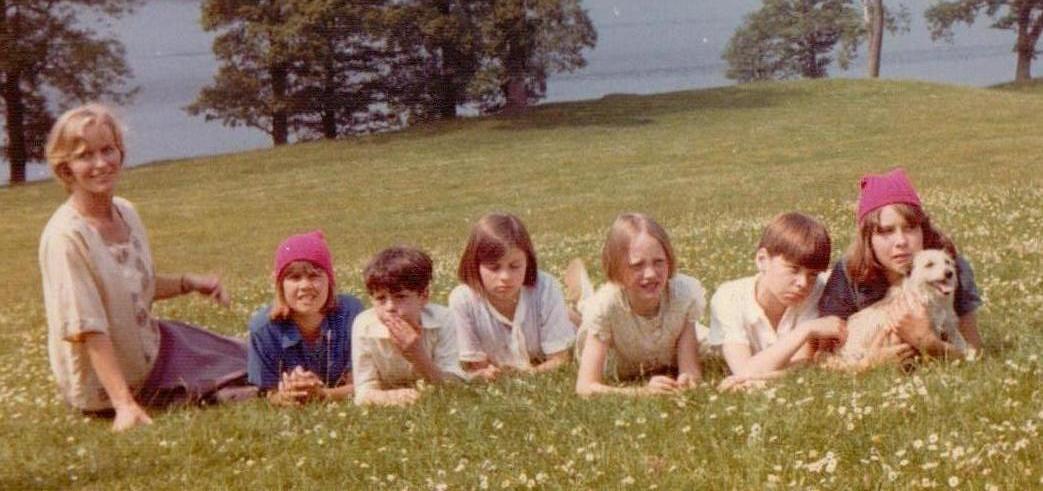
Many years have gone since we sat amongst the daisies at Bank Ground Farm. I am now happy to talk about anything. Do click on the comment box below or go on a Facebook page to ask any questions you might have about the filming of ‘Swallows and Amazons’.

You can read more in ‘The Secrets of Filming Swallows and Amazons’ available online for £2.99

The Secrets of Filming Swallows & Amazons