Much of Arthur of the Britonswas shot at Woodchester Mansion where HTV constructed the huge lathe and wattle hall which comprised King Arthur’s seat.
Oliver Tobias as Arthur and Michael Gothard as Kai can just been seen standing outside the doors of the hall
We went to watch the filming soon after the fire scene, which opens the episode entitled ‘The Gift of Life’. My sister Tamzin was cast as Elka, the little Saxon girl who arrived unexpectedly by longboat with her brother Krist.
In the story, this was spotted drifting down the river – which is in reality the lake at Woodchester. Arthur insists they should be returned to their own people by Kai, portrayed by Michael Gothard, who rides off with them on his horse.
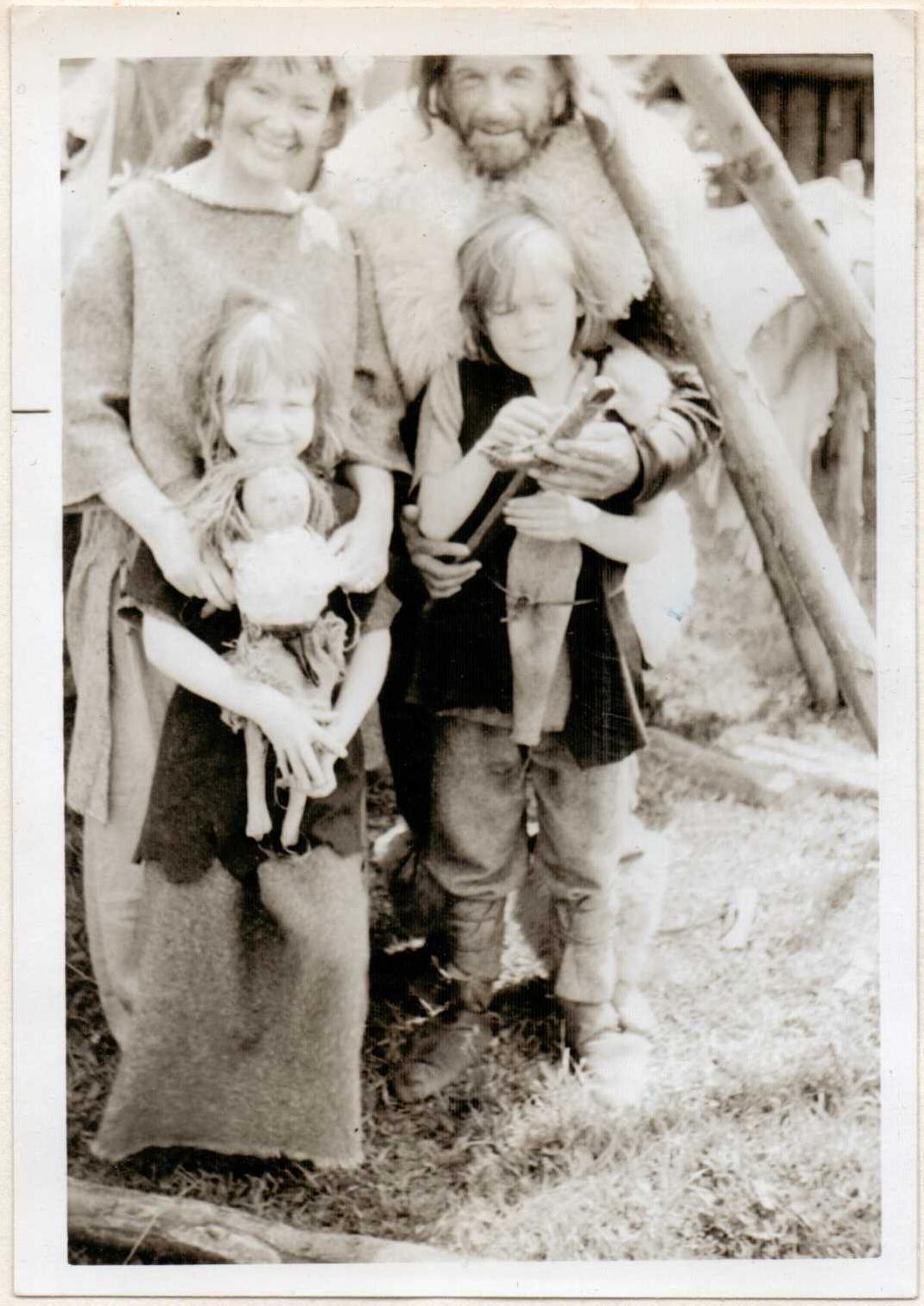
Shaun Fleming as Krist, Micheal Gothard as Kai, Tamzin Neville and Elka and Kerig the hideous doll whose head kept falling off
We were able to watch the episode being shot.
‘I want to feed the squirrels,’ Tamzin declared after they had been riding for a while. It was a line few have forgotten.
‘Oh, no!’
‘Oh, yes.’
‘Why couldn’t you feed the squirrels before you left?’
‘I did, but now I want to feed them again.’
I was fascinated in her costume, including her shoes which were made of hessian sacking.
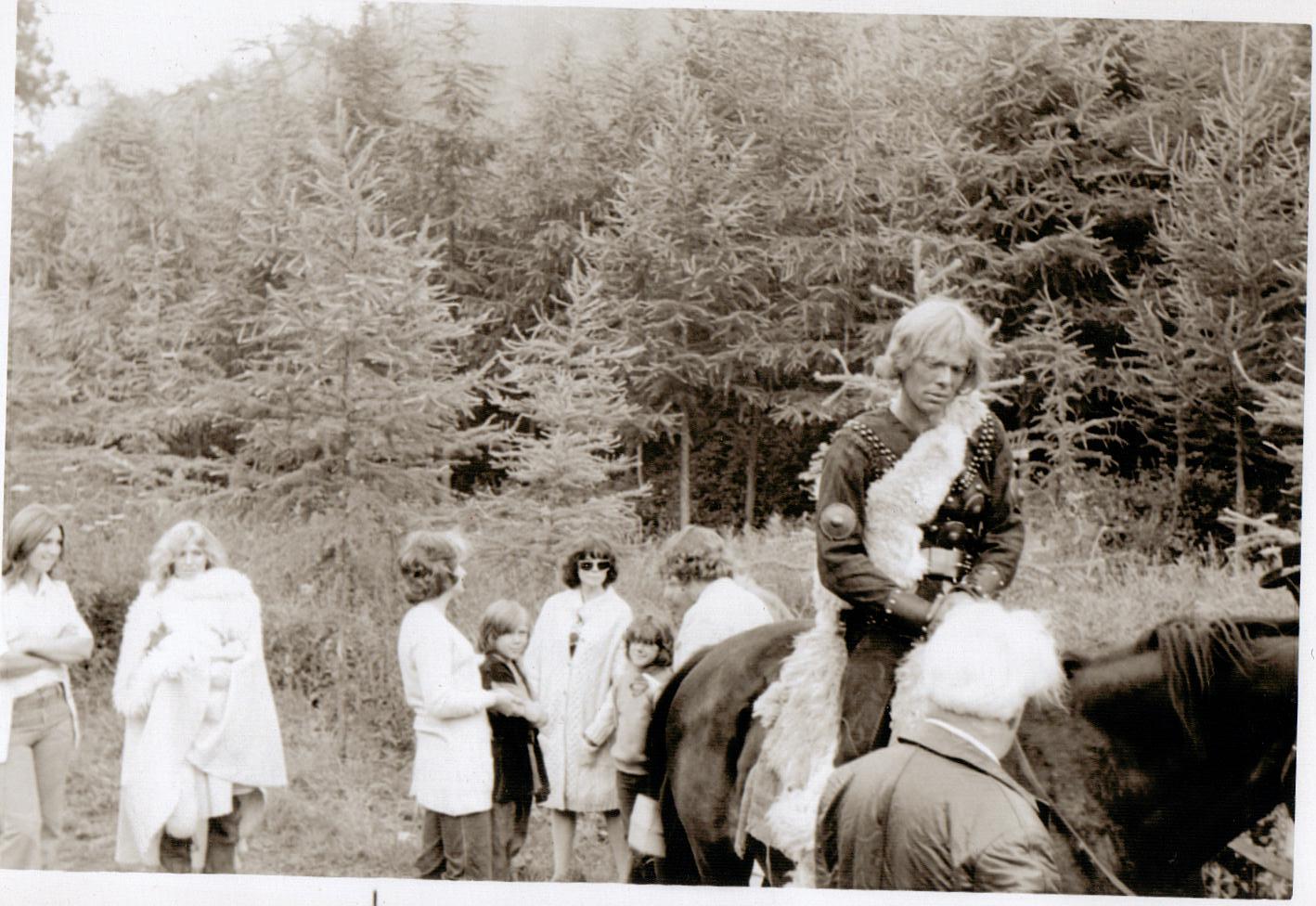
Sophie and Perry Neville watching their sister Tamzin having her dirty face seen to by a make-up artist during the filming of ‘Arthur of the Britons’ being made on location in Gloucestershire in 1972. Michael Gothard waits, seated on his horse.
I am not sure whether Michael Gothard had worked with children before but he seemed able to cope. No one had asked Tamzin if she could ride. It was a good thing she was used to large horses and had a naughty pony of her own. They set off at speed and her hessian dress was not exactly ideal riding wear.
Shaun Fleming was excellent as her brother and managed to cling on behind the saddle as they charged across the hills, which can’t have been easy. The secret was that he acted under his mother’s maiden name instead of his real surname.
Daphne Neville with her daughter Tamzin Neville who played Elka and Geoffrey Adams who played Hald with Shaun Fleming as Krist in ‘The Gift of Life’
Tamzin was then asked if she could whistle while she was ‘feeding the squirrels’, or having a pee as we would say now. It was demanded by the script.
No one had asked her in advance if she could whistle. This was tricky as the tooth fairy had recently visited her in a big way.
‘I couldn’t even whistle when I had all my teeth.’
I appeared as the Saxon girl with blonde curly hair seen working in the fields with Heather Wright when the children returned to the Saxon village. While Heather was in lime green, I wore a gold-ish coloured top and plum skirt with no shoes. You can see me hobbling across the end of the field which was full of thistles.
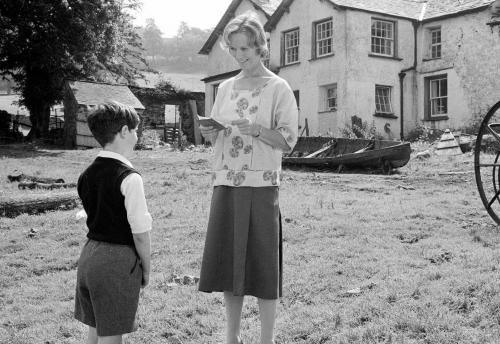
My other sister, Perry, was barefoot too. My mother, as a Saxon woman with short fair hair, (photographed above) virtually carried her into the village after Tamzin and Shaun.
It had been decided that, on the whole, Saxons were blonde, Celts were dark-haired like Oliver Tobias, who played King Arthur. It wasn’t until I did an Ancestry.com DNA test in 2022 that I discovered my heritage was almost 100% Celtic – Scots/Cornish/Irish/Welsh with a little Danish thrown in.
There were a number of weapons on set that intrigued us as children. We all wanted to learn how to use them. Oliver Tobias began to teach us sword fighting, however there was an accident on set which put a stop to this. One of the actors was having his boots sorted out by a wardrobe assistant when he casually swung his axe. Although it was just a blunt prop, with no edge to the blade, it went into her head, resulting in a four inch gash across her scalp. He was devastated. It was a complete accident. The wardrobe assistant recovered but it was a sobering incident and great care was taken when handling the props afterwards, even though they seemed blunt and harmless.
Fifty years later this series is still treasured by many. It had such a strong cast. Heather Wright went on to star in The Bellstone Fox with Bill Travers and Dennis Waterman and in the 1976 movie Shout at the Devil with Lee Marvin, Roger Moore and Ian Holm.
Geoffrey Adams was terribly well known at the time, as for years he’d played the part of Detective Constable Lauderdale in the long-running BBC Police series Dixon of Dock Green appearing with Jack Warner in nearly 300 episodes.
Shaun (Fleming) Dromgoole went to work in film production on a number of well known movies including American Gothic and The Woman He Loved, about which starred Anthony Andrews and Olivia de Havilland and Jane Seymour as Wallis Simpson.
Woodchester Mansion, the vast house built of cut stone yet left half-finished, was eventually sold for £1 to Stroud District Council. My father became a Trustee of the Board that decided its future.
To read more about Tamzin’s acting career please see this previous post.
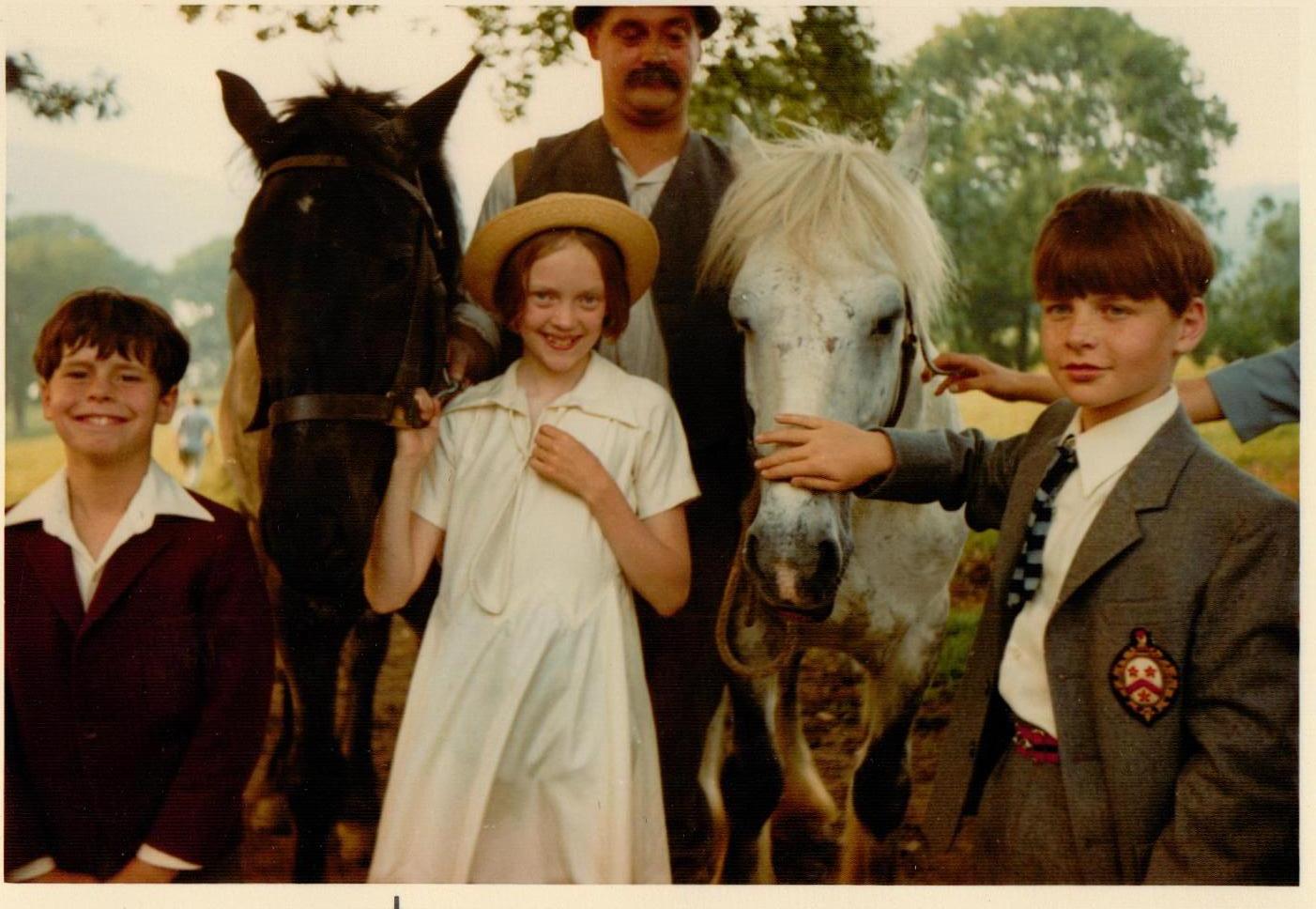
Shaun Fleming, Tamzin Neville, Sophie Neville , Jenny Fleming, Kerig the doll and Daphne Neville in 1972
The producer, Patrick Dromgoole was absolutely prolific, producing a huge number of classic television dram serials including The She Wolf of London and The Clifton House Mystery, which my mother appeared in as well as Robin of Sherwood . Her drama pupil Robert Addie played Sir Guy of Gisbourne so convincingly in that series he became hated throughout the UK. For more photographs of Mum please see flick down though various posts on my blog for Funnily Enough.
Do please add additional information or memories in the comments below.
I have been writing about my experiences behind-the-scenes in film and television. There is one series in particular that still has a strong following, particularly those interested in British medieval history.
Dressing up in medieval garb as children at Sudley Castle in about 1970
As children, back in 1971, we were all excited to hear that HTV was planning to film a series about King Arthur near where we lived in Gloucestershire. We were keen on dressing up and I was already interested in medieval history.
The Arthurian legend had always been portrayed with ladies in pointy conical hats and knights in chain mail riding around with lances, however expectations of turreted castles were soon to be dashed.
We woke up one morning to find this tent in the field beyond our house, with a full English breakfast being served by location caterers from the back of a two-tone bus. The final scenes of Episode One of the series Arthur of the Britons, entitled Arthur is Dead,starring Oliver Tobias in the title role,was to be filmed on our farm.
The unit base for HTV’s drama serial ‘Arthur of the Britons’ being shot on our farm in the Cotswolds in 1972
We learnt that the drama series, Arthur of the Britions was to be quite different from traditional renditions of the well-loved stories. Apart from anything else the actors had long hair and wore rough hessian garments or sheepskins to reflect the culture of Iron Age England. Everyone was excited about the idea, which seemed more authentic and certainly held more sex-appeal than the Hollywood idyl lodged in our consciousness.
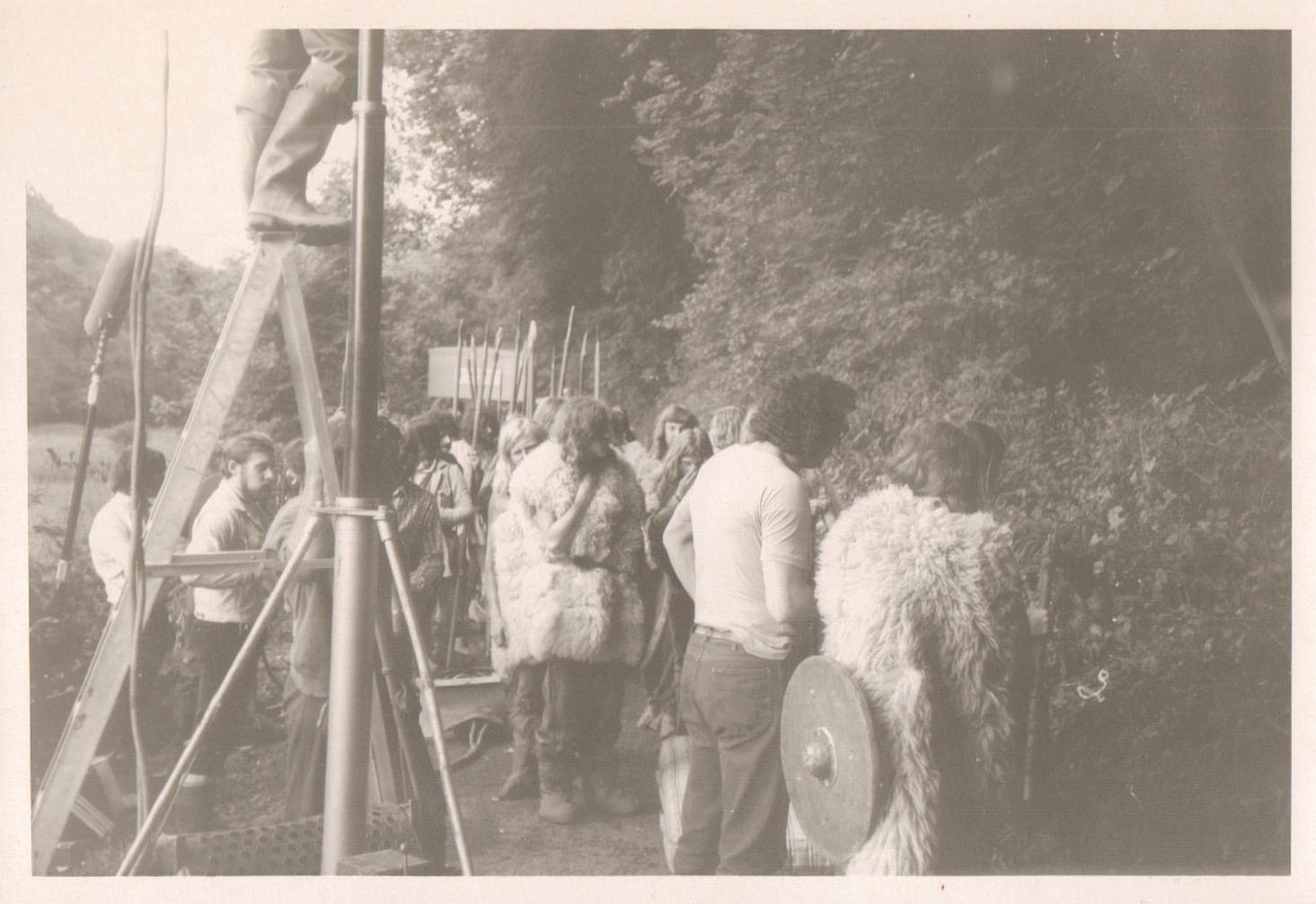
While the lane below the wood that ran along the sides of our valley was closed to traffic, HTV ran cables and moved in with their lights, camera equipment and props amounting to bundles of swords, spears, shields and other weaponry.
Here you can see the Gulliver’s Prop lorry as well as costume and make-up artists with their kit-bags attending to the actors and supporting artistes. Please remind me of the name of the character to the left of shot and who played him. ***
It must have been dark under the trees, as there would have been have been a large 2K light on this tripod. The crew set up carefully and were finally ready to go for a take, recording the battle in the woods on 16mm.
After a short skirmish, Arthur pretends to retreat, leading his men downhill. They are soon followed by the Saxon hordes. The reality was that the wood was much steeper than it came across on television. The actors ended up tumbling down the bank.
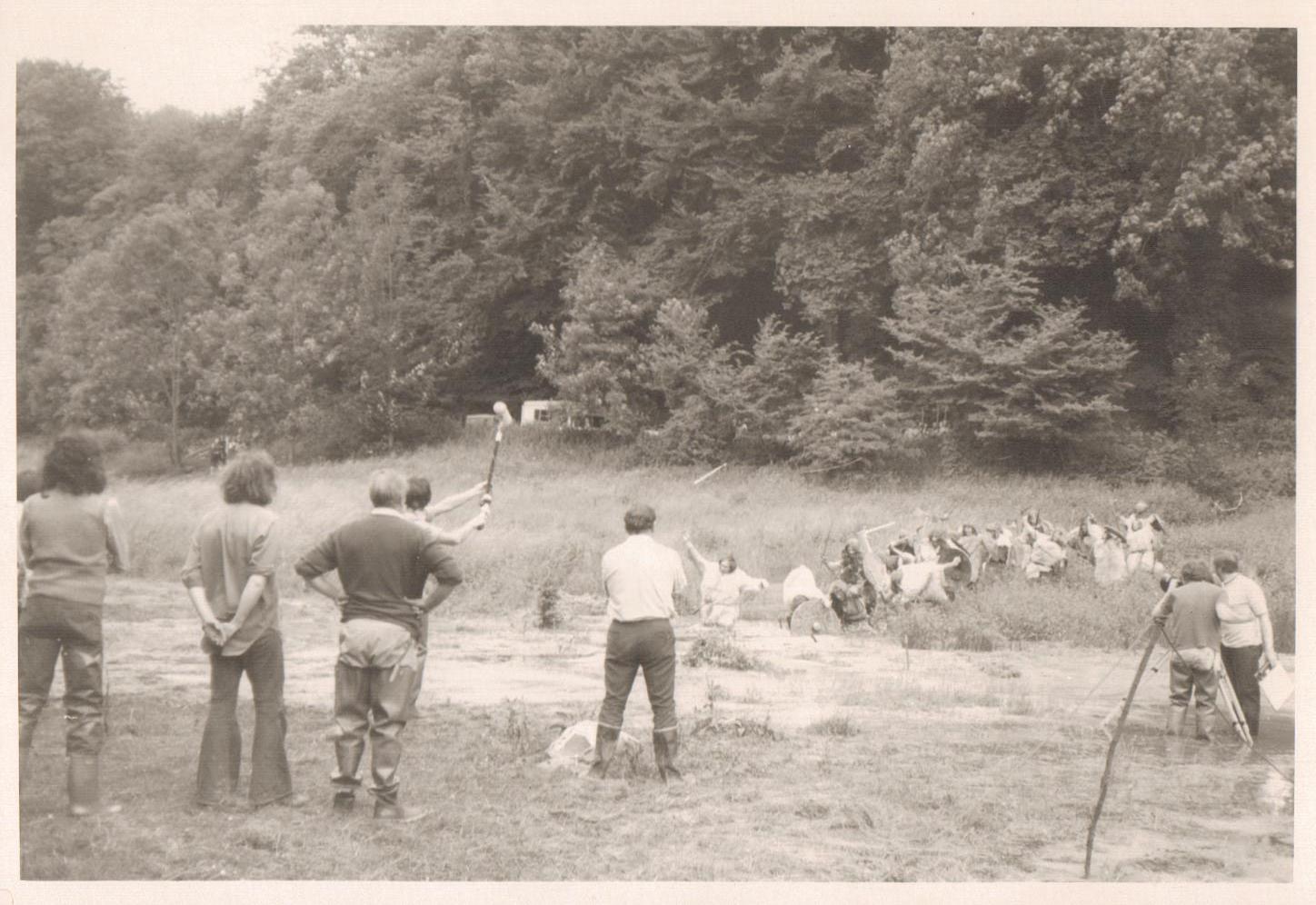
We were waiting in the open field in the valley floor. Although naturally marshy, this had been made much wetter by damming the stream that flowed down from the woods. Our local road engineer Percy Baxter dug pits that filled with water and acted as a trap for the Saxons who did not know the secret way through the marshes.
My sisters and our sheepdog with Percy Baxter who dug great holes in the field before allowing them to fill up with spring water. Members of the crew work beyond.
We knew of the legend and were fascinated to see how the sequence would come together.
As the scene was difficult to replicate it was shot with two cameras, seen here set on wooden tripods. The result was exciting.
For photos of the location on the Arthur of the Britons website please click here.
Scroll to 19.50 towards the end of the episode to watch the scene here on Youtube:
***Post script: This email arrived recently. I have been given permission to feature it:
“Browsing the web the other day, I came across your website and photos relating to filming ‘Arthur of the Britons’. One photo in particular interested me, the one in which the request, ‘Please remind me of the name of the character to the left of shot and who played him’ appears.
Looking at that photo stirred many memories…
Back in 60’s Bristol, my old chum Bob Baker was trying his hand at script-writing for the media, somehow he got involved with a BBC Children’s series entitled ‘Pegasus’: of which meager entries appear online and actual footage seems non existent.
Bob and I enlisted as extras for a shoot at Berkeley Castle, much fun, beautifully authentic Napoleonic Infantry costumes, several closeups, a hard in-character slap on the face for Bob and a shot of me firing a rifle at an imaginary ‘Pegasus’, the eponymous hot air balloon, as it took off from the castle courtyard carrying the escapee heroes of the plot. An excellent tight closeup only marred by myself who, having fired and watched the imaginary effect of my bullet, lowered the rifle and stared up intently, for what seemed minutes (at nothing) finally relaxed… as my eye was drawn inexorably towards the huge camera lens inches from my face. ‘Christ! He just looked straight into the camera! Cut!’ I was particularly stung by a co-extras unconcealed schadenfreude as he muttered, ‘Shame about that Rog, they liked the look of you, blown your chances now.’ But it was too good to waste and, edited, made it into the final cut: it was however the last close-up I got.
The final location work called for a night shoot, it was raining intermittently and shooting was sporadic, Bob and I spent most of the night in the canteen, drinking wine with our old mate Keith Floyd who had managed to land the catering job – in many ways, the start of his career and of course he went on to considerable success, fame and several television series of his own. Bob and I ran out of cigarettes so, fully accoutered and armed with cocked hats, swords, rifles and bayonets, we strolled down into Berkeley village and went into The Boar’s Head just at closing time, startling the small group of locals, and ordered two pints and some fags. A stunned silence descended as without a word, Bob and I drained our pints and left as suddenly as we had appeared. I wonder if the legend of the two thirsty apparitions from La Grande Armée is told there still?
Bob and co-writer Dave Martin had written a well-researched film script about King Arthur. They knocked on many doors, Hollywood was mentioned; even Charlton Heston was reported to be interested, but finally, in 1973, it was HTV who eventually picked it up, though I see Bob actually gets credit only for the first episode ‘People of the Plough’. Of course, he went on to write many of the scripts for ‘Dr Who’ and ‘Wallace and Grommit’ but this was his first, if modest, success.
I was on my summer vacation and Bob mentioned HTV were looking for extras for ‘Arthur’ if I was interested. When I arrived on set it seemed that half of Bristol was there including many of my drinking mates from Clifton, most of whom had arrived equipped with cider and beer and it became fairly apparent the direction things would take. A few years ago I was reminiscing about those days with one of them, Mike Dauncey, who went on to become a respected BBC Cameraman, but who sadly, recently died. He told me he spent most of his time in the actors tent, along with a few other reprobates, smoking pot. I recall seeing him at the time but had no idea what was going on, though I remember enjoying plenty of the extraordinary amounts of alcohol that seemed to be around. I’m pretty sure Mike is the guy in the patterned doublet with his back to the camera, extreme right.
Vaguely, I recall lots of nonsense, involving charging down hills waving swords and yelling, mock fighting in in the river and defending a primitive ‘Saxon Village’ that had been constructed on a river bank. As always, shooting was a bit piecemeal, scenes being shot out of sequence and us extras standing around as background whilst Oliver Tobias, Jack Watson and, by the end of the shoot, the Celts, had taken the village. Not terribly dramatic at the time, presumably any attendant pillage and rapine was the subject of a different shoot, though I recall a fair amount of fake blood waiting in readiness. Finally the script called for the Celts to set fire to the village. And thus I got my big starring role, as employing all my acting skills, dressed in a ‘bloody’ sheepskin and in closeup, I was required to play a dead Saxon.
Unfortunately it had been steadily raining all day and the ‘village’, built largely from straw and dummy plastic wickerwork, refused to ignite. I was lying very close to the ‘village’ and began to get a bit concerned as, from my worms eye view, I watched the crew enthusiastically chucking gallons of petrol over the village to get things going. It all seemed to take a long time and as I lay there in the rain, I remember hoping they hadn’t forgotten that the dead Saxon was actually an extra and not a prop. More time went by setting up the shots but eventually the scene was in readiness. Action! shouted the director and with cameras rolling, three ‘Celtic horsemen’ with flaming torches galloped down on the village, narrowly avoiding trampling me, threw the torches at the ‘buildings’ and galloped off. For several seconds nothing happened, then suddenly with a huge WHOOMPH! all that petrol just went off, The heat where I was lying was incredible, the grass between me and the village began to steam then turn yellow and smoke, I began to smell wet, then burning wool, as my sheepskin began to smoulder, fortunately too sodden and thick to actually catch fire, but lying there, I discovered an earnest empathy for those Guy Fawkes dummies I had chucked on bonfires as a kid. The crew were oblivious to my plight as the director called for several takes and the scene took over an hour to shoot until eventually the flames died down and a wrap was called.
Months later the series appeared on TV, I saw very little of it but did see that scene; by modern standards it looked fairly amateurish, obviously phoney as you could see the plastic ‘wickerwork’ melting, but my closeup was excellent, I looked just like a corpse, very realistic, despite gently steaming.
Bob and Dave Martin always referred to the series as ‘Arthur in The Stinging Nettles’ but what struck me about that photo is that it looks more like the set for some fey setting of Lothlórien. What a bunch of fairies!
So back to that plea, who was the character on the left? Well, if it’s the guy having his face touched-up on the extreme left, I’m afraid it was no actor, just an extra that played a corpse. Me.
I seem to have banged on a bit, strange how a photograph brings it all back, apologies if it just seems like some old blokes boring memories – but then again, that’s exactly what it is!
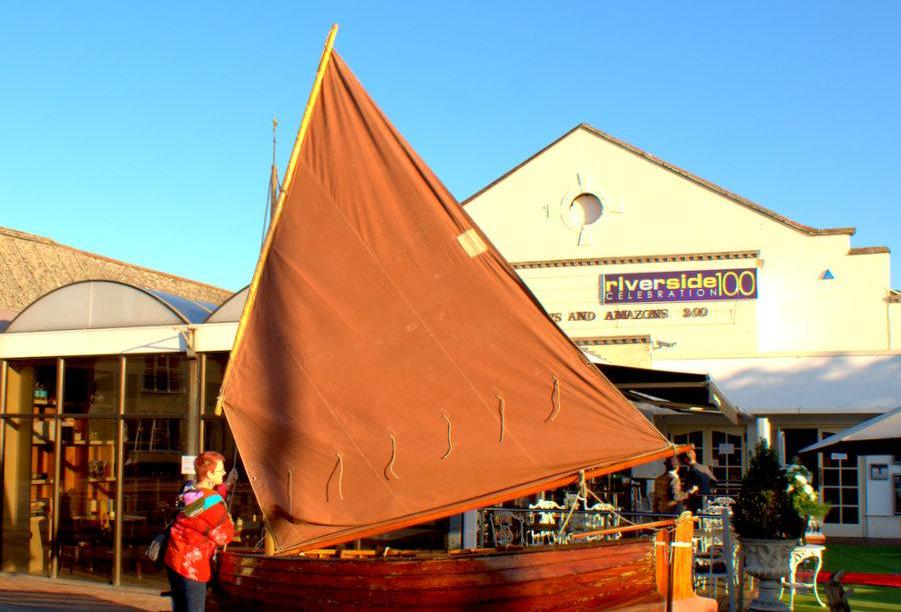
The Nancy Blackett Trust presented another screening of the classic film ‘Swallows & Amazons’ (1974) at the Riverside in Woodbridge. The cinema was celebrating 100 years of film and were thrilled to welcome a large and enthusiastic audience of 250, made up of children and Arthur Ransome enthusiasts one of whom told us he saw the film in Shaftesbury Avenue when it first came out.
Swallow, the original dinghy used in the film was on display outside the cinema and I went along to answer questions about how the movie was made. Here are some of those asked by children in the audience:
Had you ever been on a boat before you started filming? Yes, my father was a great sailor and I’d crewed for him. As Titty, I had to row quite a bit – back from the charcoal burners, later when I captured Amazon and alongside Roger when we went to find the treasure on Cormorant Island.
How did you do the night time? We used Mrs Batty’s barn at Bank Ground Farm as a studio.
Which lake did you film on? Arthur Ransome wrote about an imaginary lake based on real places that we found on Windermere, Coniston Water, Derwentwater, Elterwater and a smelly lilly pond. the great thing is that you can go and find them too.
Did you enjoy filming? Yes, very much, but it could be chilly.
How long did it take to film? Forty-five days in all. It’s a 90 minute film so you can work out just how much we managed to film per day. It was well under the 4 minutes-a-day scheduled.
Did Titty actually keep the parrot? Titty did in the story but the parrot in the film was rather savage and had to be returned to Mrs Proctor of Kendal. However my parents bought a very tame green parrot called Chico who would sit on my shoulder, even when I went rowing.
Were you cold when you we filming the swimming scenes? Yes! We nearly passed out.
Why didn’t you wear life jackets? The film was set eighty-six years ago in 1929 when children didn’t wear life-jackets. We wore BOAC life-vests during rehearsals and when being taken out to the location.
What are the children doing now? Working! Suzanna Hamilton is the only one of us to kept acting. She’s appeared in two feature films this year including ‘My Feral Heart’. Simon West has an engineering company that invents machines, Sten Grendon is a gardener, Kit Seymour is spending this year in Australia and I believe Lesley Bennett lives in the Netherlands, but I’m not sure. I’d love to make contact with her. Virginia McKenna is still acting as well as figure-heading her charity Born Free that does so much to relieve the suffering of animals.
In reality, how old were you all when you acted? Roger was 8, I was aged 12 pretending to be aged 9, Susan was 12 and John 11. Nancy was about the right age as she celebrated her 13th birthday towards the end of the filming. The secret was that Peggy was the eldest at 13.
Do you have a cameo role in the new film? You might just see me on the platform of the railway station but I am wearing a wig!
Why is Swallow’s flag brown? Because it a little elderly.
The camping kit – was it all packed in Swallow? We children didn’t know it at the time but it didn’t all fit in, although they did keep taking the tents down. Why we had a rolling pin on board, I do not know.
What happened to Amazon? The Amazon Arthur Ransome knew, which was originally called Mavis, can be seen at the Coniston Museum. The dinghy we used in the film was also used in the black and white BBC TV serial made in 1962. She is now in Kent – and still sailing. You can see her on ‘Country Tracks’ by clicking here.
After the film screening, I was told that students on the Open University Children’s Literature course with study Arthur Ransome’s classic book ‘Swallows and Amazons’, which is good news, especially since the BBC News headline rang out the question: Do children still need to read the classics of English Literature? Declaring, ‘Gone from bedroom bookshelves are the Famous Five, The Chronicles of Narnia,and the adventures of the Swallows and Amazons.’
Is this true? Do leave your comments below – or contact the BBC!
On Saturday 26th September at 3.00pm the original film of Arthur Ransome’s book ‘Swallows and Amazons’ was screened at the Riverside cinema in Woodbridge, Suffolk as part of their celebration of ‘100 Years of Film’.
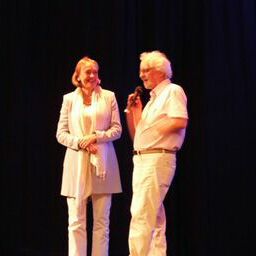
I was on stage to answer questions about how we made the film after the screening. Swallow, the dinghy we used on the movie was rigged up outside the cinema and admired by many.
Back in April, I was invited to a similar screening of ‘Swallows & Amazons’ (1974) also held to raise funds for the up-keep of Arthur Ransome’s yacht Nancy Blackett. As the film ended I was invited up on stage to answer questions about how it was made. Marc Grimston sent a list of these, so I could answer them here for those unable to get cinema seats.
As a child were you like Titty? In 1973, I was aged twelve and at five-foot two, was really too old and too tall for the role of Titty but it was easy enough to pretend to be nine years old. I was on-screen a great deal so it probably a good thing that I was old enough to cope with long filming days. I thought I was much more like Mate Susan but perhaps that made it easier for me to play Titty.
How many tried for the role of Titty? About 1,800 children originally auditioned for the six parts in ‘Swallows & Amazons’. Claude Whatham, the director, wrote inviting me to an interview. In the end there were five girls up for the part of Titty. You can read more about the final audition here.
Sophie Neville on stage with Peter Willis, President of the Nancy Blackett Trust
Had you read the books before? I had read most of the books in the series and loved them, so it was very easy to take on the part. We never had to sit down and learn lines because we knew what to say from reading the book.
Sophie Neville taking about Swallows & Amazons
Were they any disasters during filming? Swallow’s mast broke!
How did you stay safe with the snake? It was a real adder, but quite a tame one. I think they lowered its metabolism by keeping it cool.
How did they make the lion noises? It was a recording of a real lion.
When you filmed the approach to the houseboat it seamed as if Amazon was coming in fast, was she? Yes, she hit it quite hard!
How long did it take to film? We spent forty six days onset in total, which meant spending about seven weeks in the Lake District.
Do you still have the parrot? I don’t. The green parrot belonged to Mrs Proctor of Kendal where the residents were terrified of him.
What happened to Amazon? She is owned by a family living in Kent who love sailing her in the lakes. She was the same Amazon as used in the BBC serial of ‘Swallows and Amazons’ made in 1962, when Susan George played Kitty.
Have you been back to the island? Yes! I last returned with Nick Barton who is planning a new film adaptation of ‘Swallows and Amazons’.
Are there adaptations of any other Swallows and Amazon books? Yes, in 1983 I was able to work on the BBC serialisation of ‘Coot Club and The Big Six’, starring Rosemary Leach, Colin Baker, Henry Dimbleby and Julian Fellowes as one of the Hullabaloos. It was my job to cast the children and look after them during the three months we spent on location, which was great fun.
The 2014 Blu-ray of ‘Swallows & Amazons’ (c) StudioCanal
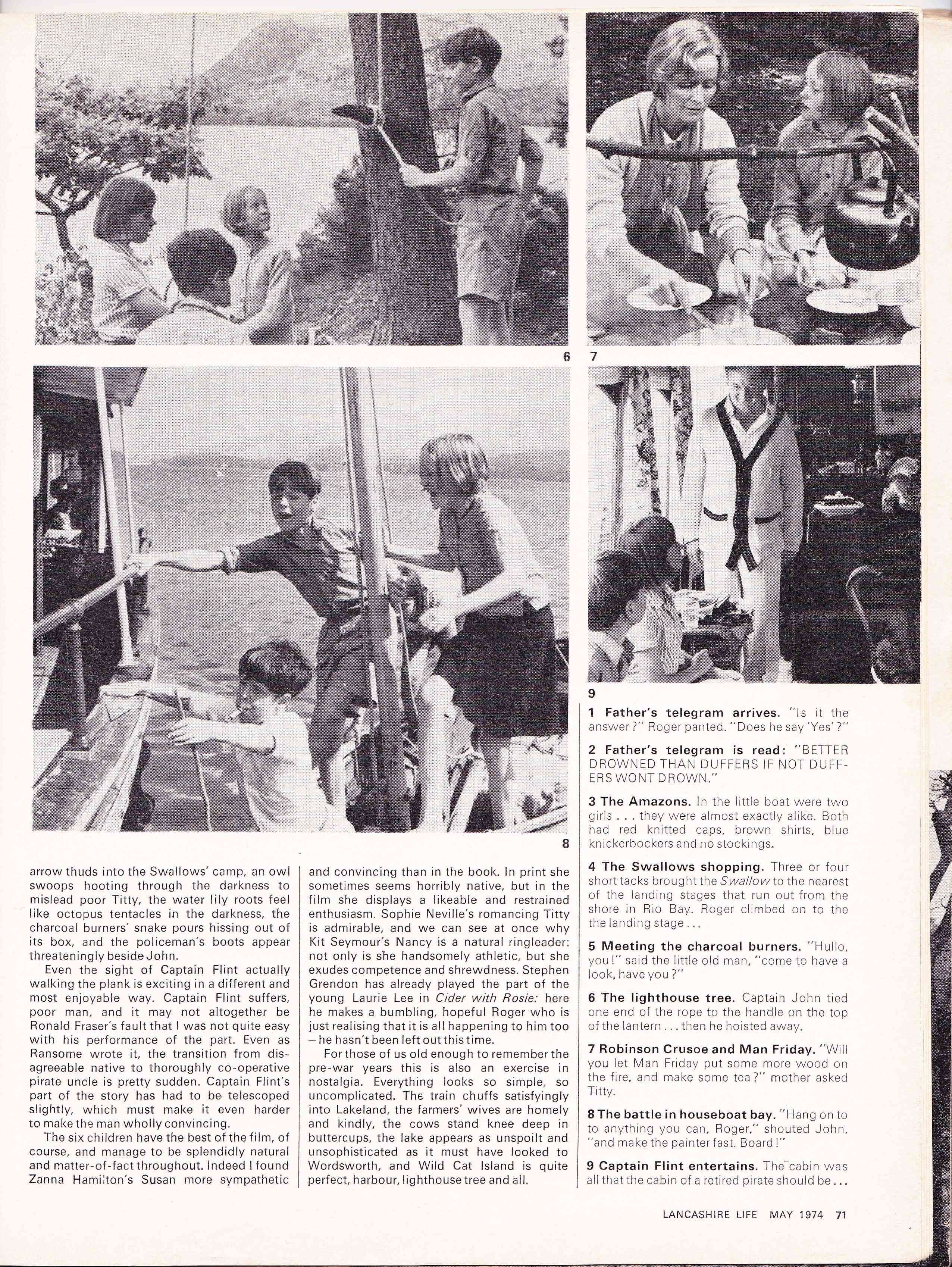
This shot of Virginia McKenna valiantly playing Man Friday, was taken as she rowed away from what I had decided was a desert island. It was 1973 and we were filming on Coniston Water in the Lake District. She was playing my mother, concerned about leaving a small girl alone as the evening drew in. I’ve been set a copy of Lancashire Life, published in 1974, which describes the filming at length. Quite fun. You can see a still of Man Friday and I cooking Pemmican cakes for supper on the camp fire, top right.
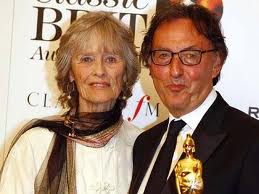
Being awarded an OBE in 2004 for services to wildlife and the arts, Virginia has since become a national treasure. She will quickly deny this but you will find photographs of her at the National Gallery, along with Suzanna Hamilton, who played her daughter – and my sister, Susan in Swallows & Amazons (1974).
‘Stars of the British Screen’ by Norman Parkinson. Virginia McKenna sits bottom centre, Suzanna Hamilton bottom right, either side of Susannah York.
Having just celebrated her 84th birthday Virginia has also been heralded as one who inspires others. I concur. ‘Do one thing at a time,’ was her advice to me, ‘Otherwise you can’t do anything well.’
Virginia McKenna with ‘Born Free’ composer John Barry
If you interview her now, Virginia is more likely to talk about wildlife than acting. She uses her name to promote kindness. And to stop the slaughter of elephants. One of her latest missions is to urge schools to teach children about conservation. She has recently become patron of Shropshire Cat Rescue’s Purr project. Arthur Ransome helped finance a similar project himself.
2015 marks the thirty-first anniversary of the Born Free Foundation, which Virginia established with her son Will Travers to help big cats and other large mammals held in captivity. She still travels the world to raise awareness and alleviate suffering, drawing on all she learned from George Adamson whilst filming Born Free in Kenya back in 1966, and An Elephant Called Slowly in 1970. You can read more about her work by clicking here.
Virginia has written about her career and conservation work in a number of books including Into the Blue and an autobiography entitled The Life in My Years available online from the Born Free shop.
Sophie Neville with Virginia McKenna in about 2001
‘The 1974 Swallows and Amazons film is a classic, and this is a really enjoyable look behind the scenes, written by the actress who (for me, at least) gave the stand-out performance as Titty Walker. If the film recaptured the lost world of 1929, then the book recaptures the lost world of 1973, when rules on child actors were strict (chaperones and schoolwork absolute requirements) but regulations on health and safety a bit more lax, even when on water. We even learn the truth behind that strange scene on the jetty in Rio where Roger is left minding Swallow. Highly recommended.’ P. Stevens, Bath, UK
‘Every now and again in cinematic history a classic is born. It doesn’t have to be a multi-billion pound blockbuster featuring legendary names, sometimes something timeless and endlessly endearing is born and this is most definitely the case with ‘Swallows and Amazons’.
‘This film has become an old friend to me; I must have watched it a thousand times and I never tire of it! It brings back memories of a summer childhood spent in wonder-filled Cumbria, in particular Windermere, Ambleside, Derwent and Coniston Water; places we’d visit as a family before the fates would, sadly intervene.
‘Sophie Neville’s excellent book recaptures again the halcyon days of youth in a summer-land of mountains, fells and shimmering lakes. She writes beautifully and with an easy style that’s a joy to read. The love for her subject is very evident, as is her passion for the work of Arthur Ransome. She takes you behind the scenes of the making of the film and the realities of filming on the water; how the director and crew worked tirelessly to bring out the best in the young actors and the splendours of the landscape. So glad I made this purchase. Pride of place on the old bookshelf.’ Allen Fairhurst
‘Sophie has lost none of her infectious enthusiasm and this shines through on every page.’ Julian Lovelock in Mixed Moss, the journal of The Arthur Ransome Society. ‘As well as using her own diary Sophie has mined the recollections and scrapbooks of a number of cast and crew.’
‘The book itself is indeed a delight. I have long been a fan of Swallows and Amazons. I am delighted with the film which was made and Sophie’s account of the making of it adds a very charming and interesting dimension. I loved the account and I fully recommend any fan of Swallows and Amazons to get a copy for themselves.’
You can read about how the original film of ‘Swallows and Amazons’ was made and find the complete collection of behind-the-scenes photos in this ebook available from Kobo, Smashwords, iTunes and on Kindle for £2.99
One of the questions asked by fans of the film Swallows & Amazons, produced by Richard Pilbrow for EMI Films in1974, is, ‘Did any of the scenes written by David Wood ever hit the cutting-room floor?’
Simon West and Sophie Neville on Peel Island in 1973
Although I had a lead part, I wasn’t allowed to read the script as a child, only Arthur Ransome’s book on which the movie was based. I never gave it a thought, and for years, but looking back through the original screenplay I can see that the answer is, ‘Not many.’
The shots of finding Swallow in the boatshed, bringing her out and raising her flag were moved forward and set under the voice-over of the Walker children reading out the letters written to their father. This moved the story along.
Simon West talking to director Claude Whatham with Sophie Neville
There is a scene in the book set at Holly Howe when medical supplies are being packed for the voyage. This was shot with Virginia McKenna at Bank Ground Farm above Coniston Water, but must have slowed down the pace of the film as it was replaced by a more exciting montage of shots, that also progressed what is a pretty gentle start to an adventure story.
Virginia McKenna as Mother with Sophie Neville as Titty making Swallow’s flag
Making patterans on the way to the charcoal burners, was a lovely scene from the book that was recorded but never included in the film. Captain John can been seen explaining how gypsies use them as secret markers in this black and white still.It was shot on a mossy bank in oak woodland so very characteristic of the Lake District and profiled by the Guardian newspaper the author Arthur Ransome had once worked for.
It was at this dramatic location, high above Derwentwater, that my favourite behind-the-scenes shot of the director, Claude Whatham was taken. You can see Cat Bells in the background.
Claude Whatham talking to his cast: Sten Grendon, Simon West, Sophie Neville & Suzanna Hamilton
Mrs Ransome, who worked closely with the screenwriter, had agreed that the storm scene on Wild Cat Island would not to be included in the screenplay. We children thought a great pity. Such a violent gale blew in one day when we were filming on Peel Island that we would have had the right weather conditions, but you can not include everything. It was only a 90 minute movie.
Jane Grendon, whose son Sten played Roger, wrote to tell me that before filming began, ‘…one of the very first things we were asked was, ‘can Sten swim?” ‘I know he could doggy paddle,’ she continued. ‘Neville (Thompson, the online Producer) organised swimming lessons at Pitville Pool, Cheltenham which included jumping off the diving boards. At the time I didn’t know why and I don’t think Sten is a natural in the water and the swimming lessons didn’t prove very successful. Claude (Whatham) told me – at the end of filming I think, when he gave me a copy of he original script – these lessons were because in the original script Roger was to jump in the water after Uncle Jim walked the plank.’ Jane sent me a copy of the page in question. I had not seen it before: It was a page of the script we never had time to shoot. I am so glad. It wasn’t needed. We just made sure Captain Flint had no access to a rope ladder for a while.
I’m often asked if any scenes involving the Amazons were cut, but none were left out. Nancy and Peggy simply do not appear in the book as much as one might remember.
Please leave any questions about the making of ‘Swallows & Amazons’ in the comments below.
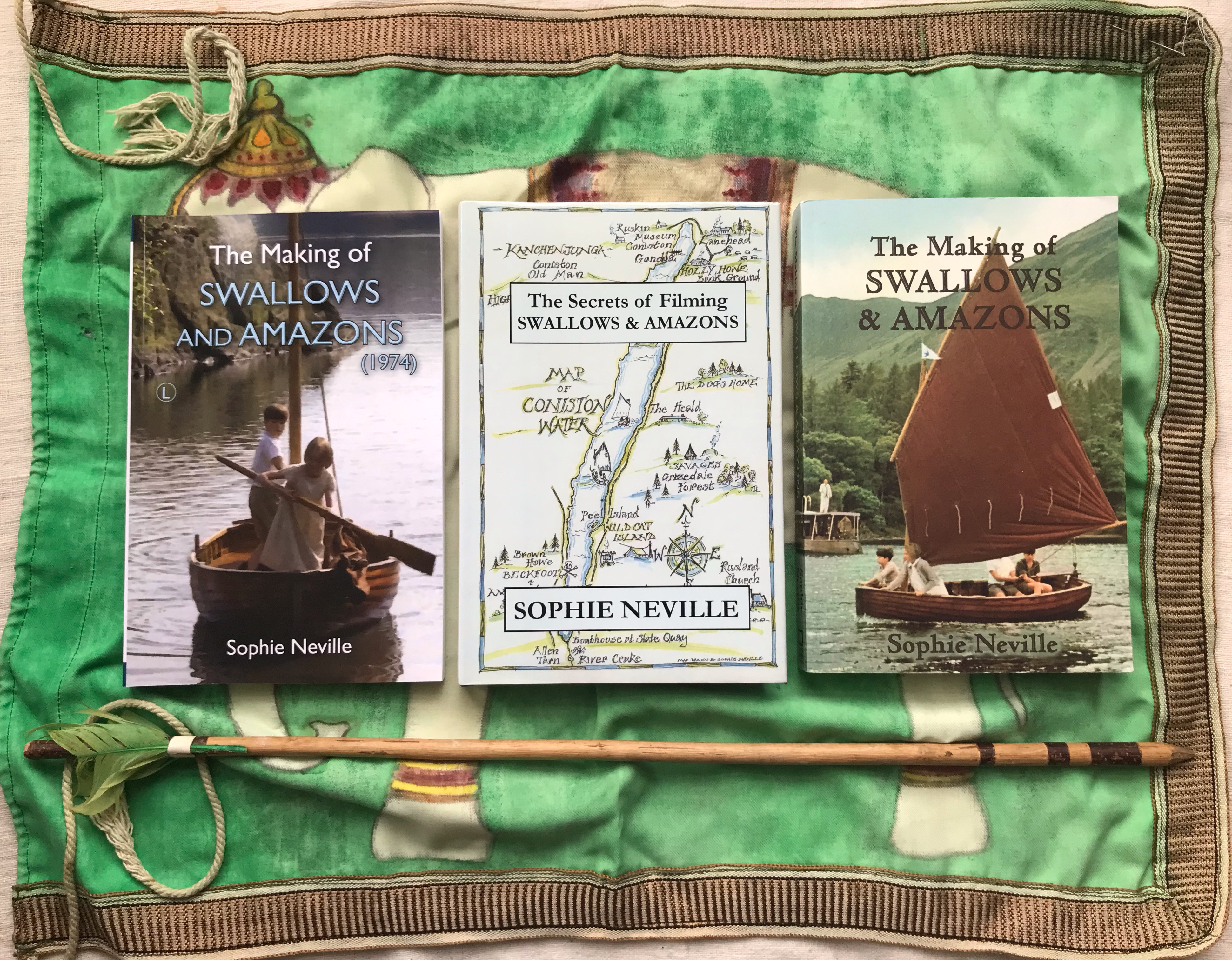
You can read the full story of the making of Swallows and Amazons (1974) in one of the editions listed online here:
Different editions of ‘The Making of Swallows and Amazons (1974) by Sophie Neville’
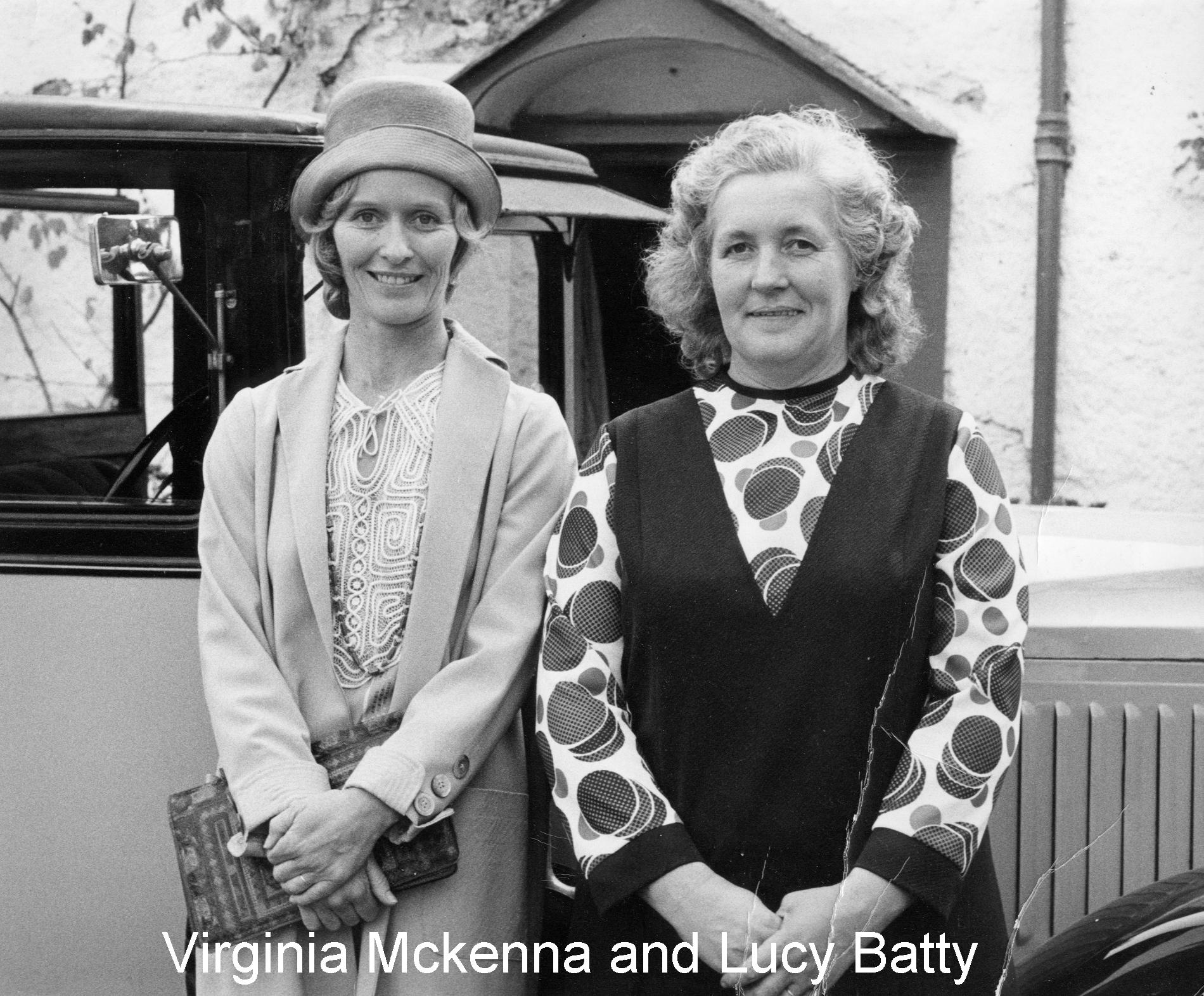
Virginia McKenna with Lucy Batty at Bank Ground Farm on 15th May 1973
We were sad to hear that Lucy Batty has passed away. She was 87. Our thoughts are with her family. She will be fondly remembered by visitors from all over the world who were made so welcome at Bank Ground Farm above Coniston Water in the Lake District, which she ran as a guest house for many years. It was also used as a film location, becoming known as ‘Holly Howe’ in Richard Pilbrow’s 1974 movie, Swallows & Amazons.
Bank Ground Farm in the Lake District
I first met Mrs Batty when we filmed in her home back in 1973 and returned to stay with her in 2003 when the BBC asked Suzanna Hamilton and myself if we would appear in Countryfile, which they were filming at Bank Ground Farm with Ben Fogle. It was then that she had time to show me her photo albums. What a life she led! She was very proud of having brought up seven children on the farm, “Two of my own and five that came with my husband,” she explained. “Getting them all off to school in the mornings was such hard work that my in-laws came to help on my first day.They all wanted bread and dripping for breakfast, with sugar sprinkled on top.”
~ Sophie Neville with Lucy Batty in 1973~
“A magistrate once asked me what running a B&B entailed. ‘It’s much like looking after cattle,’ I told him. ‘You bring ‘um in, feed ‘um, see they’re bedded down, turn ’em out and muck’um out.’ He flung back his head and roared with laughter.”
She had a great sense of humour. I have a cutting from an article in The News written by Brenda Colton and published on 25th May 1973. It reads:
‘When Mrs Lucy Batty was asked if her house could be used for the setting of the film Swallows and Amazons, with guest star Virginia McKenna, she was delighted. After all, her home, Bank Ground Farm on the east side of Coniston Water, near Brantwood, was the setting chosen by Arthur Ransome for his children’s book Swallows and Amazons.
Mrs Batty thought it a good idea that the story should be filmed in an authentic location, and she felt she should be able to put up with a few cameras and film men for a while. But she just did not realise the scale of a “medium budget” film like this one, or what the production staff could do to her house. It was not the two double-decker buses coming down the path and parking on the farm that she minded, nor the numerous vans, lorries, cars and caravans. It was not even the difficulty of having 80 men and women wandering round the farmhouse carrying equipment here, there and everywhere.But when art director Simon Holland started tearing up her lino and carpet in the kitchen to get to the bare stone floor, she did get a little annoyed. Especially when he removed all the electric sockets, lights and switches, pushed all the kitchen furniture into the larder and whitewashed the newly papered walls.
“Have you seen the kitchen?” Mrs Batty said to me. “The larder is piled high with my furniture; and you would not believe the tip my lounge is in. But they are a funny lot. I asked if I could wash the beams in the kitchen for them, and they said ‘Oh no, we want them to look old.’ I have even had to hunt out a lot of old pottery from the cellar for them.
“But I have given up now. I have just left them to it.”
What I really did not know, until I watched the BBC documentary ‘Country Tracks’, was that Mrs Batty reached the point when she locked out the crew. She explained that when she was originally asked if we could film on her property she did not quite realise the scale of operations and only asked for – or accepted – a location fee of £75. She said that she decided that £75 was not enough, padlocked her front gate and wouldn’t let them back in until they agreed to pay her £1,000. It was a lot of money, more than double the fee I received for acting in the whole movie.
To read a little more about filming of Swallows & Amazons at Bank Ground Farm, please click here.
Sten Grendon, Sophie Neville & Simon West with Mr Jackson at Holly Howe
I am sure many people reading this have their own memories of Mrs Batty who was such a great character. Please do add them to the Comments box below. I feel it would be a tribute to all the hard work and love she put into making Bank Ground available over the decades for so many to enjoy.
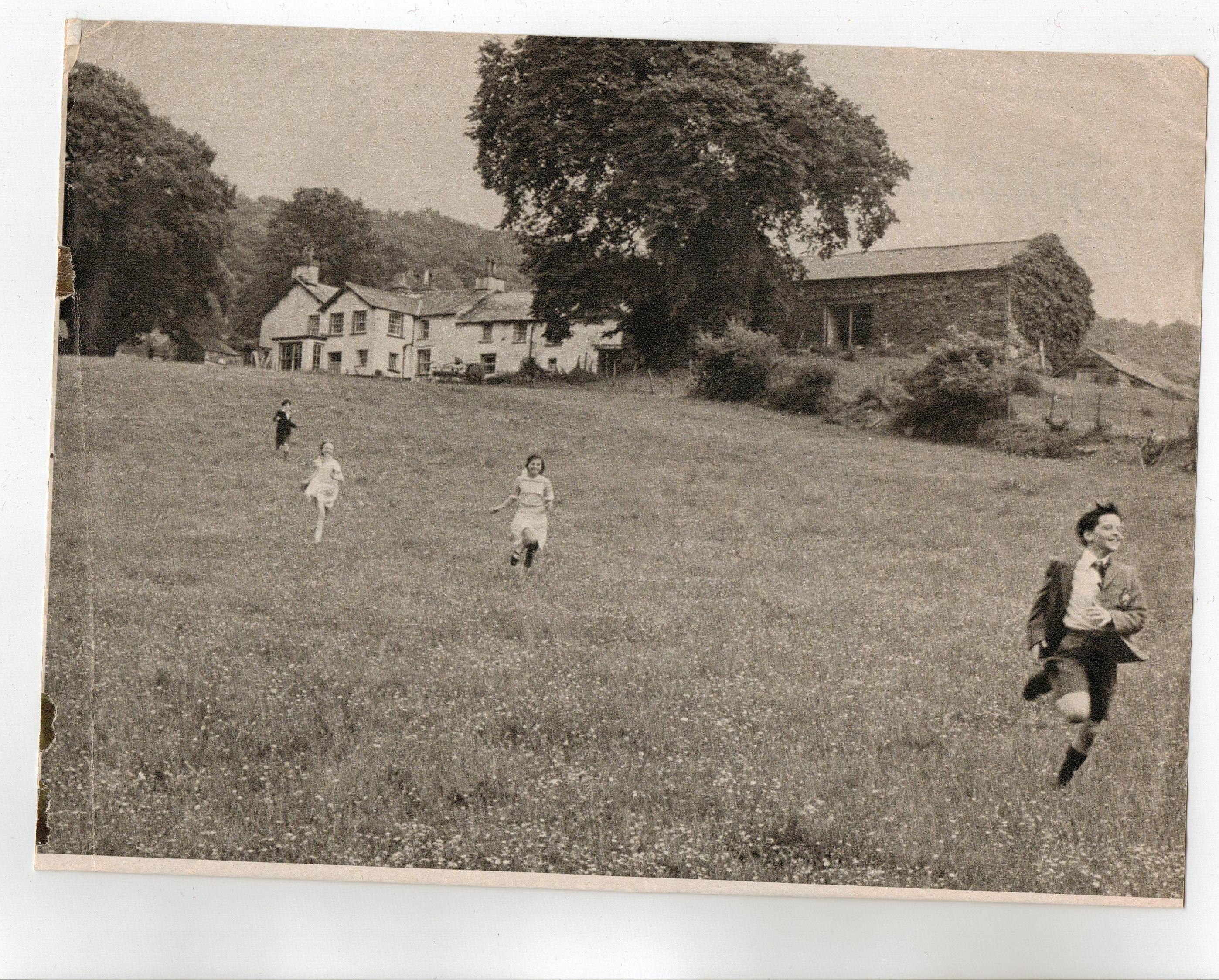
The farmhouse as Holly Howe in 1973
You can read more about the adventures we had making the original film Swallows and Amazons here:
On 21st March and 28th March, the new CBBC TV show ‘Cinemaniacs’ included guest appearances from Sophie Neville and from David Wood, who wrote the screenplay for ‘Swallows & Amazons’ back in 1973.
Oli White, the vlogger and presenter of ‘Cinemaniacs’, asks a number of people involved in movies about making their first film. Others featured include Michael Sheen, Sir Ian McKellen and Matthew Lewis famous for playing Neville Longbottom in all eight Harry Potter movies.
To find out more about how the film ‘Swallows & Amazons’ (1974) was made, along with how the children’s parts were cast, please see earlier posts or read the book! It includes more than 120 photographs taken on location in the Lake District.
I have been deliberating upon points where fiction touches reality. The most significant in my own life is the story behind my fictional brother, Roger Walker, one of the lead characters in ‘Swallows and Amazons’. The real Boy Roger was responsible for saving me from acute misery. Whilst I was asthmatic as a child, Dr Roger Altounyan was behind the invention of the Intal spin inhaler, which bought me instant relief.
About ten years ago I met Dr Bill Frankland, a former POW to the Japanese who became a Harley Street allergist and president of the British Allergy Association, now the British Society for Allergy and Clinical Immunology. Bill told me that Roger Altounyan had been a good friend ever since they worked together on the Intal project. Roger introduced him to his sister Titty who, as a child had been in the inspiration for the character I played in the film ofSwallows & Amazons.
I’d had known that Roger Altounyan had been in the RAF during World War II, but not that he had qualified as a doctor and become an allergist. Bill told me that he used his knowledge of propellers to develop the Intal spin-inhaler and effectively treat asthma.
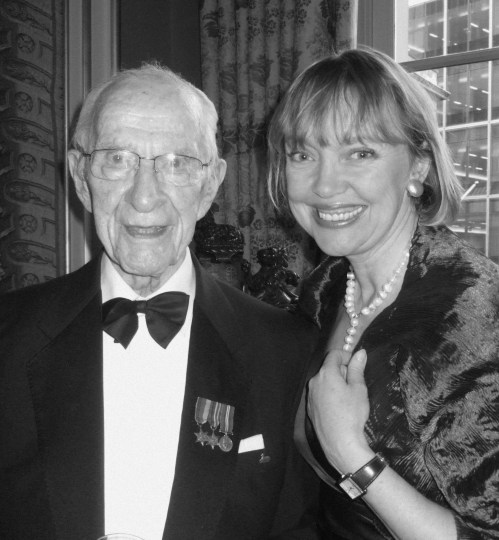
Dr Bill Frankland celebrating his 100th Birthday in 2012 with Sophie Neville
Dr Frankland gave me a set of photos taken at Roger Altounyan’s going-away party in Cumbria when he took his family and friends up Coniston Water on the Gondola. He said that Roger insisted on smoking a pipe even though he was reliant on oxygen and explained that the experimentation was partly responsible for his early death in 1987.
I will explain the connection in further depth.
The well-loved book Swallows and Amazons was written by Arthur Ransome for the children of friends of his after they brought him a pair of red slippers for his forty-fifth birthday in January 1929. He based his main characters, the crew of the Swallow, on these five real Altounyan children who had been staying at Bank Ground Farm in the Lake District,
The character Roger Walker, known when he first started sailing as the Boy Roger, was inspired by Roger Altounyan then about six years old. As a consequence he was obliged to live out his school days under Swallow’s flag, as it where. This may have become tedious, although it was much the same for Sten Grendon who played the part of Roger in the 1974 film.
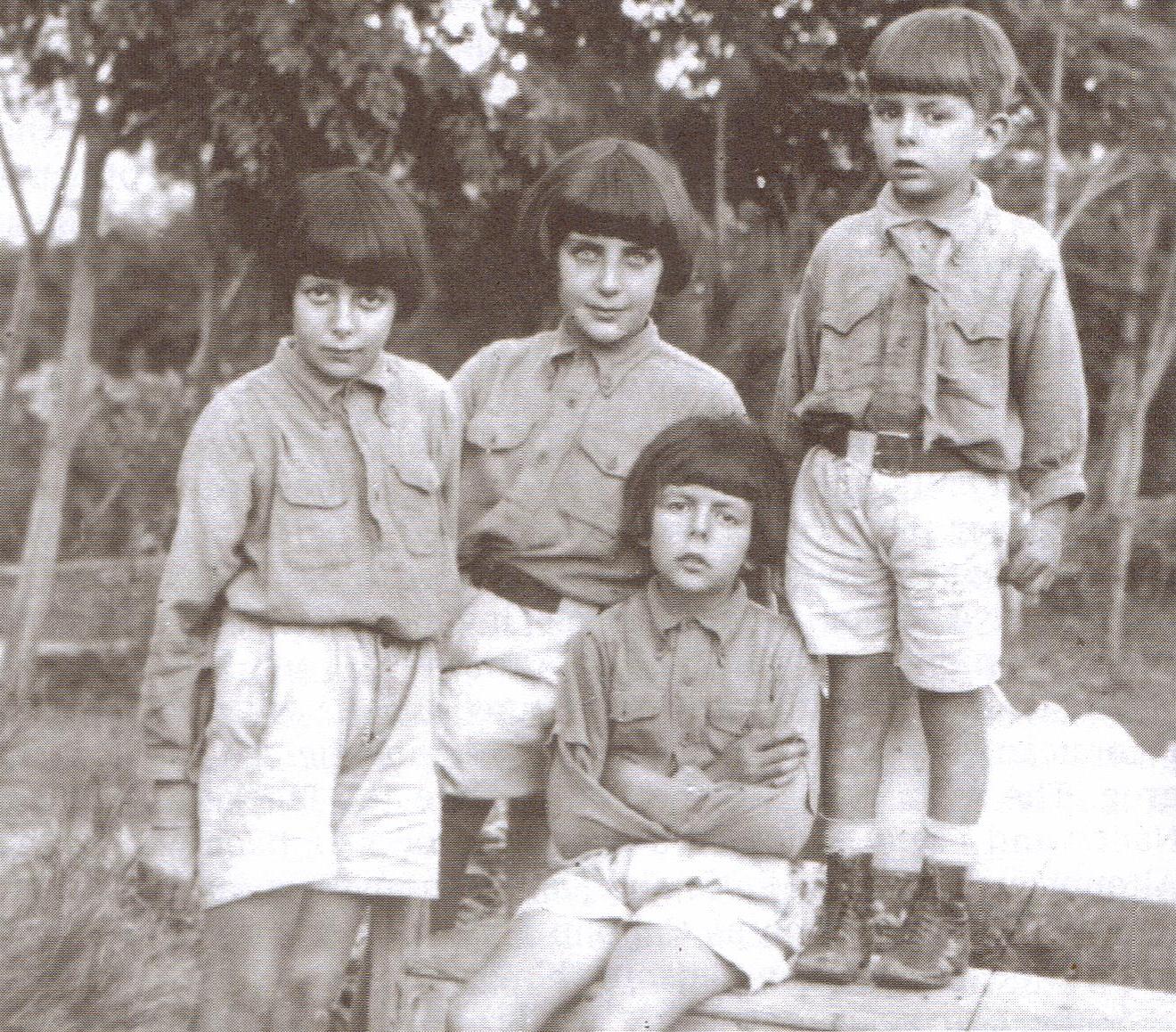
The well-known photograph of the four eldest Altounyan children – Susie, Taqui, Titty (seated) and Roger (copyright ???)
Roger is seen here with three of his four sisters, and below as a boy along with Arthur Ransome obviously playing tennis (copyright: Brotherton Library, Leeds). The story of his family is told by Jeremy Collingwood in his recent book, A Lakeland Saga.
Did we depict Roger Walker accurately in the film? May be not! Richard Pilbrow, the producer of Swallows & Amazons told me that Mrs Ransome was furious that Claude Whatham had cast a boy with dark hair, but she never explained why. She did not like the photograph she had been sent but it was taken before Sten’s received a short back-and-sides.
Sten Grendon as Roger Walker with Virginia McKenna playing his mother
Luckily, when Evgenia Ransome visited the location and actually saw Sten running around at Bank Ground Farm she seemed happy enough and said nothing more. Perhaps Virginia McKenna somehow managed to make everything alright.
What I didn’t know until recently was that Roger Altounyan was an asthmatic himself.
Roger was specifically allergic to guinea pigs and would routinely experiment on himself. He would not have been allowed to do this by today’s regulations, which some say would have held back the testing indefinitely. I gather from reading Rodney Dingle’s biography that the model inhaler that he made with a piece of hose pipe worked well, whilst the prototype made professionally did not. If you use an inhaler you will hear that the propeller has to be able wiggle in order for the medication to be successfully diffused into the patient’s mouth and lungs. The discovery was portrayed by David Suchet in a documentary entitled Hair Soup.
I was allergic to feathers, not parrot’s feathers, but old pillows and eider-downs. I may owe my life to Roger and his spin-inhaler. The medication certainly helped me enormously and has always given me the peace of mind that it will give me relief if I do get wheezy.
Further reading: Roger: The Life and Distinguished Achievements of Dr Roger Altounyan, by Rodney Dingle. It is difficult to get hold of but Kirkland Books in Kendal have a copy.
















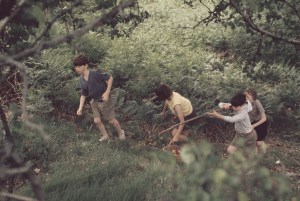
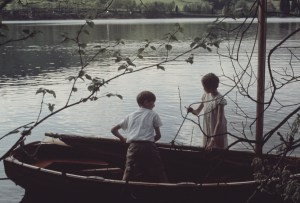
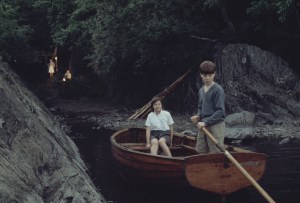


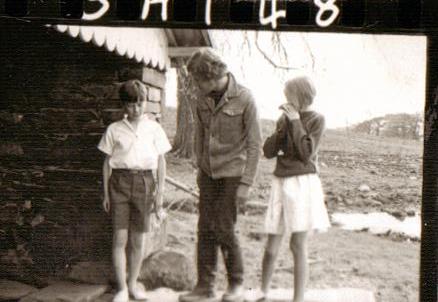

 It was shot on a mossy bank in oak woodland so very characteristic of the Lake District and profiled by the Guardian newspaper the author Arthur Ransome had once worked for.










 Sophie Neville