In search of Arthur Ransome’s locations ~ Part Two

Arthur Ransome must surely have fished here

‘Here we are, intrepid explorers, making the first ever voyage into unchartered waters. What mysteries will they hold for us?  What dark secrets shall be revealed?

As we set off from the Lakeside Railway Station on the southern shore of Windermere to explore Arthur Ransome’s world, I began wondering how many signs of ‘Swallows and Amazons’ we would find. Would we see the crossed flags that have become a symbol of the bestseller he wrote back in 1929?

Swallows and Amazons Tearoom ~ photo: Sophie Neville

We found the first sign the East of Lake road above Coniston Water. And there was Holly Howe where the Walker Family came for their holidays. It is so exciting to know that you can stay there too, or go for tea, and run down the field full of buttercups to dip your hands in the lake, just as the real Altounyan children – the real Swallows – must have done. We passed Lanehead, their grandparents’ house next-door as we drove down to Coniston. I gather it is for sale.
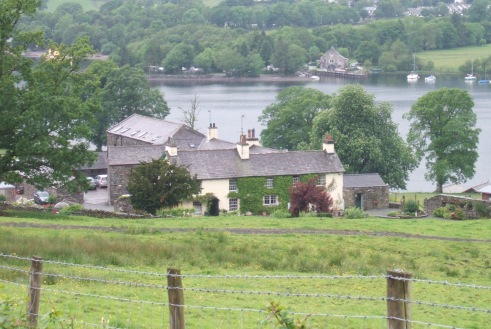
Bank Ground Farm the location used for Holly Howe

Coniston Old Man or Kanchenjunga, as the Swallows and Amazons called the mountain, was snoozing under a thick blanket of cloud but the challenge of climbing to the summit was for another day. Below the village, mooring up to the jetty at the Bluebird Cafe, was Ransome, the Coniston Launch. Peter Walker introduced us to the Captain who welcomed us aboard. He asked after Swallow the little ship from the film that we had re-launched from the very same jetty in April 2011. If you join The Arthur Ransome Society you can sail Swallow on Coniston this summer.

The Boatsheds at Bank Ground Farm

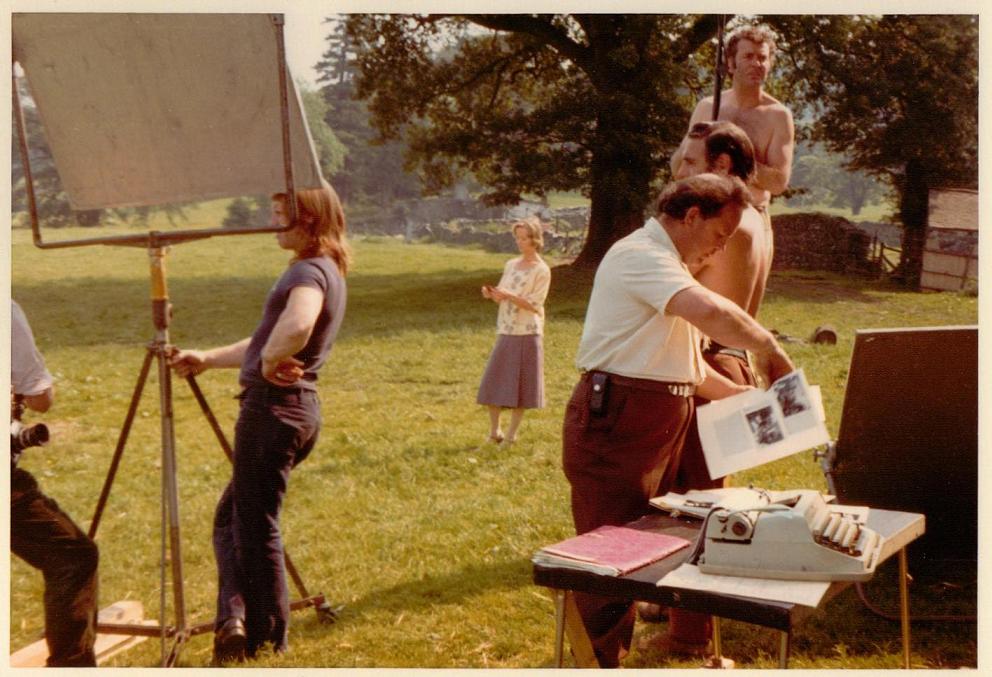
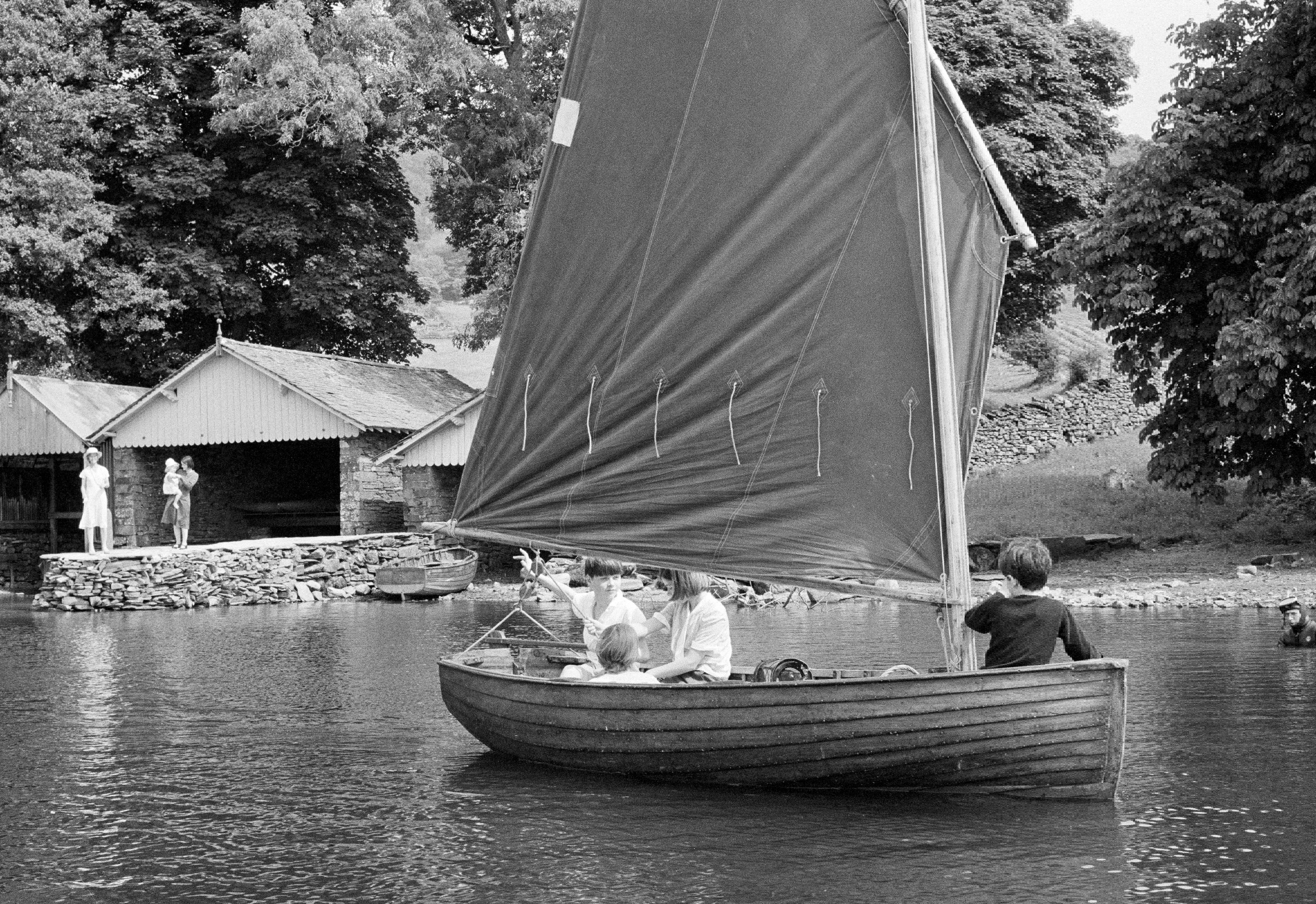
As we set off across the lake we could see Swallow’s boatshed clearly from the Coniston launch.  It has been renovated and repaired but the old stone jetty is still there, below the huge horse chestnut trees. I remember how cold the water was when we first brought Swallow out from the depths of that shed in May 1973 to shoot the opening scenes of the movie. Two sheep came down to see what we were doing. Richard Pilbrow, the Producer, gave me this black and white photograph that, unusually, shows Claude Whatham the Director setting up the shot. I was letting water drain from my shoe.

Finding Swallow
Simon West as Captain John standing in ‘Swallow’ at the stone boatshed jetty on Coniston Water with Ableseaman Titty and The Boy Roger. Director Claude Whatham knew how cold the water was that day in May 1973

The Coniston Launch can take you right down the lake to Wild Cat Island or Peel Island as it is really called. You can see the Secret Harbour best from a boat and imagine Titty trying to get out through the rocks in Amazon, in the dark, when she captured her from the terrifying Amazon Pirates.

We actually disembarked at Brantwood, John Ruskin’s House. It was here that the Altounyan children’s grandfather WH Collingwood worked as Ruskin’s private secretary. He painted him at his desk there. My niece has just graduated from The Ruskin School of Art in Oxford.

Peter Walker met us and drove us on down the lake to show us The Heald, a bungalow above the road where Arthur Ransome lived with his Russian wife, Evgenia and his dinghy, Coch-y-bonddhu. It was here that he wrote Picts and Martyrs Coch-y-bonddhu played the part of Dick and Dot’s boat Scarab. The original ‘Dogs Home’ can be found in the woods above the house. Rob Boden is very keen to restore it.

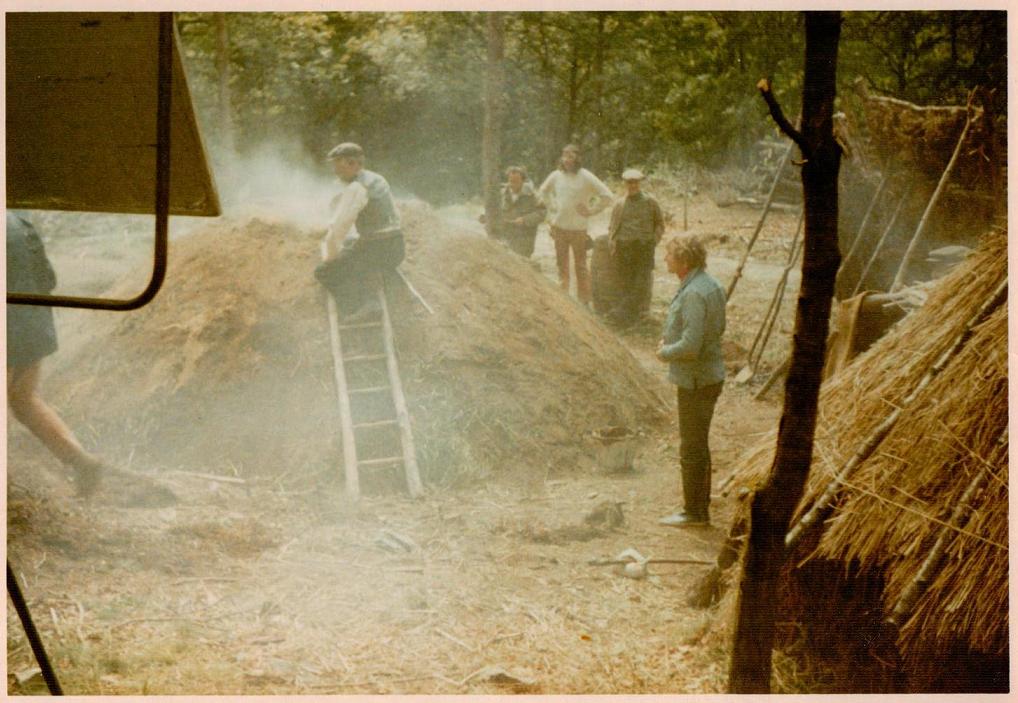
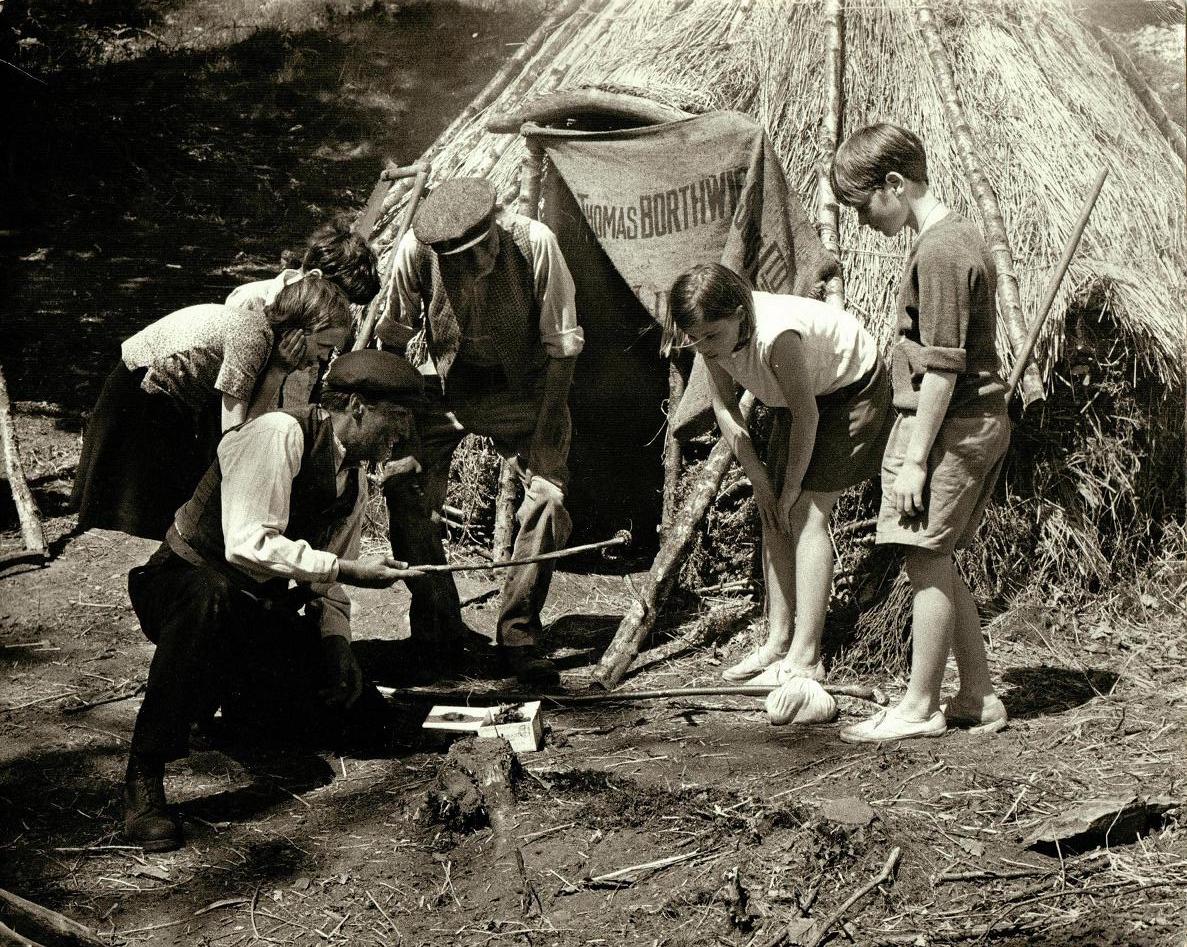
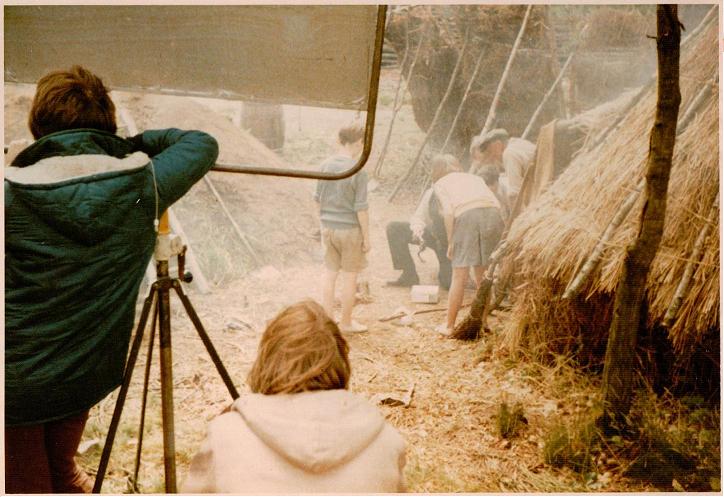
It was in the Grizedale Forest that we went to see the charcoal burners and met the real men in the process. And an adder. It was real too.

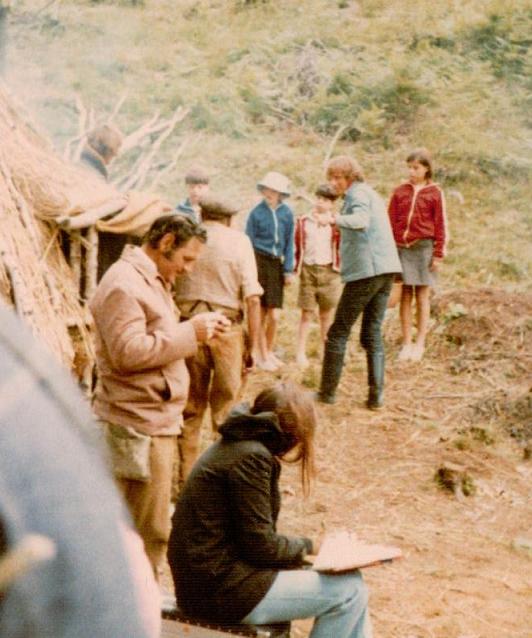
John Franklyn-Robbins, as Young Billy who is showing his adder to Sophie Neville, Stephen Grendon, Jack Woolgar, Suzanna Hamilton and Simon West at a location in the Grizedale Forest above Coniston Water

I looked back at the island where I spent so much of my childhood. It was difficult to imagine how a location catering wagon let alone two Route-master London double-decker buses could have driven down the winding East of Lake road. They parked in the field opposite the islands so the crew could at least eat lunch in the dry and we could have our lessons. The National Parks Authority had to ask the Production Manager to drape wartime camouflage netting over them. You must have been able to see the red buses for miles.

Sophie Neville on Coniston Water with Peel Island
The hat is a purple ode to the early 1970’s. My mother bought it at great expense in Carnaby Street. It is very good at keeping off the rain.

As you drive south you can look over the water to see Brown Howe, the house that we used as a location for Beckfoot in the film of Swallows and Amazons and shortly after, the Edwardian boathouse, which Claude Whatham used for the Amazons. I don’t think this was the one Ransome envisaged. His was at the mouth of the Amazon River – a reedy place. The pictures in the illustrations show a building with a low-pitched roof.

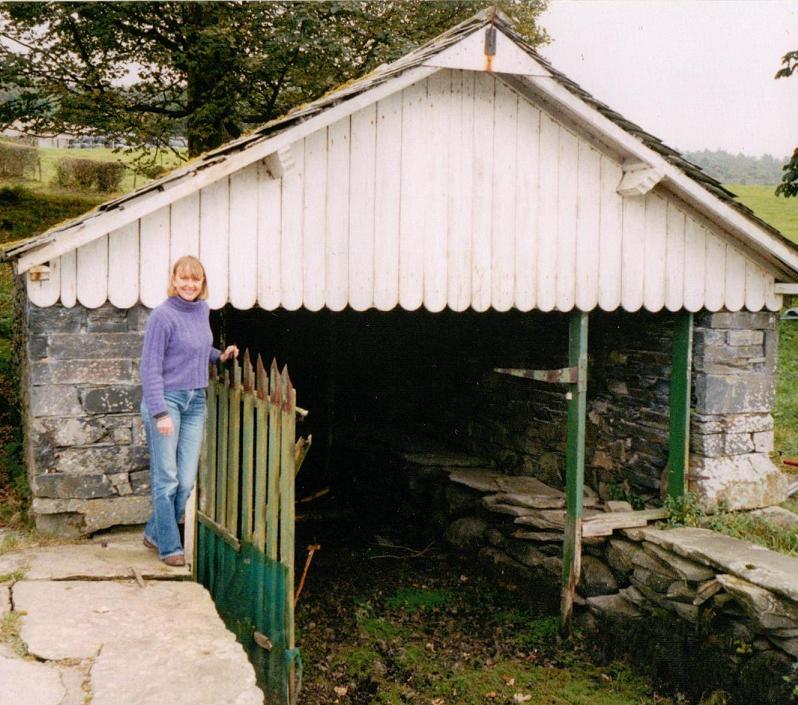
Peter took us down to a farm the south of Coniston Water where the real Ransome children spent their summer holidays. You can walk down the footpath they must have taken to dip their hands in the lake. And there I found what must be the real Amazon boat house.

The Slate Quay on Coniston Water ~ photo: Sophie Neville
Is this the real Amazon Boathouse?

Continued here…

or read the full account in the ebook:

Filming Swallows and Amazons on 22nd June 1973 when one of the camera crew cracked off Cormorant Island

Cormorant Island - Sophie Neville as Titty filming 'Swallows and Amazons' 1973
Sophie Neville as Titty about to discover the Captain Flint’s trunk hidden on Cormorant Island ~ photo: Daphne Neville

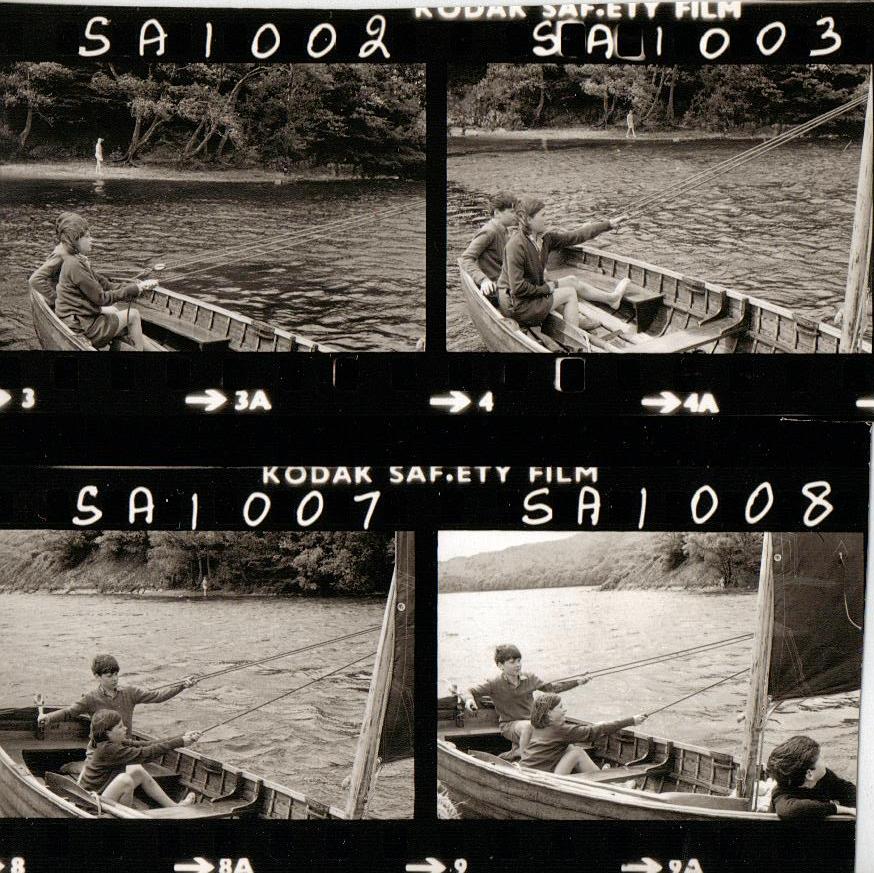
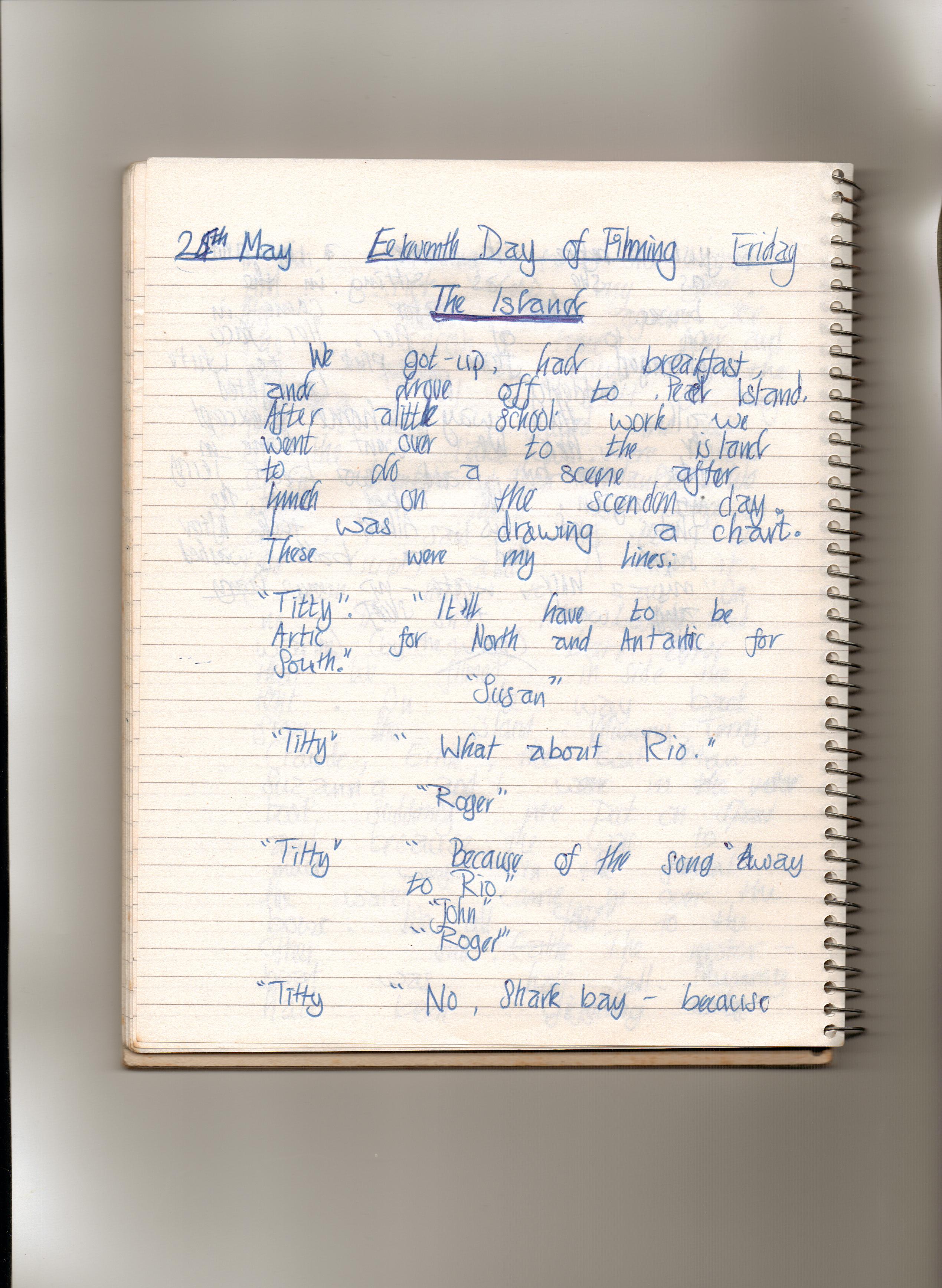
22nd June - my diary - filming 'Swallows and Amazons' 1973Contact sheet - Sten Grendon and Sophie Neville on Cormorant Island

22nd June - my diary page two - filming 'Swallows and Amazons' 1973

on Derwent Water looking out to 'Cormorant Island'
Stephen Grendon on Derwent Water looking out to ‘Cormorant Island’ ~ photo: Daphne Neville

22nd June - my diary - page three - filming 'Swallows and Amazons' in 1973

What a day!

A bright sunny day on Derwentwater. I wore what was my favourite costume, not least because I had the option of wearing a vest beneath the blouse and I didn’t have to worry about the divided skirt. I went to such an old fashioned school that I owned a pair of grey flannel culottes  myself, to wear on the games field, and thought them very much the sort of thing Titty would have worn.

DOC230623-0001-038 Daphne and Hermione
My mother in a skirt with her sister wearing a divided skirt in 1953

The cotton dress and buttoned up grey cardigan were a bit crumpled by the time I dropped Amazon’s anchor off Cormortant Island.

Contact sheet - Sophie Neville with Amazon's anchor

Roger, meanwhile was in long shorts or knickerbockers as the real Altounyan children would have called them, kept up with a snake belt. His even longer underwear was an item requested by Claude Whatham the director who, being born in the 1920s himself, had worn exactly the same sort of underpants as a child. As the day warmed up Claude stripped down to a pair of navy blue tailored shorts and sailing shoes. We were on a desert island after all. Even if it was a desert island in the Lake District.

Amazon moored near Cormortant Island on Derwentwater with the pontoon and safety boats. What is the real name of the island used for the location?

In Arthur Ransome’s book of ‘Swallows and Amazons’ the hunt for the treasure is slightly different and Captain Flint’s trunk lies buried under rocks. I wasn’t expecting the set-up with the tree trunk, although I think it works well and looks good, giving movement to the sequence. The only hesitation was that Claude didn’t want me to get hit by the rocks as they slid off. This was a pity as I would have jumped aside.

Long shots of sailing Swallows and Amazon on Derwentwater in 1973

I am not sure why the Amazon had not been bailed out. I can remember having to lie in the bilge water, which proved cold and uncomfortable. Perhaps it gave my performance an edge. Titty would have been cold and stiff after a night wrapped in the sail. Great grey clouds were gathering by then and we were all getting tired.

Cormorant Island3 trimmed
Sophie Neville playing Titty Walker in the captured Amazon, with David Cadwallader, Bobby Sitwell, Eddie Collins, Claude Whatham and two electricians holding reflector boards on the camera punt: Photo ~ Daphne Neville

Being together in a confined space becomes difficult to endure after while, not least when the space is a pontoon on a lake with not much to sit on. Small boys tend to muck about and become annoying when they are bored. The time had come when someone was going to crack – and they did. The result was silence. A sobering moment. And one very wet pair of knickerbockers.

Burgulars approaching Cormorant Island

In the end three of us went home in wet underwear. Gareth Tandy, the third assistant director – who I think was only about 18 – was pushed in to the lake, this time to great hilarity.

John and Susan find Titty has moored the Amazon off Cormorant Island

The big question, of course, it what is the name of the island on Derwentwater that we used as the location for Cormorant Island? Duncan Hall has written in to suggest it is called Lingholm Island (or possibly One Tree Island). What is the name of the larger island, seen in the background of shots, that represents Wildcat Island? Is it Rampsholme Island?

Sophie Neville on the pontoon during the filming of 'Swallows and Amazons'
The pontoon on Derwentwater with Richard Pilbrow, Bobby Sitwell, Denis Lewiston, Claude Whatham, David Cadwalader and Sophie Neville aged 12 playing Titty. Cameraman Eddie Collins looks on ~ photo: Daphne Neville

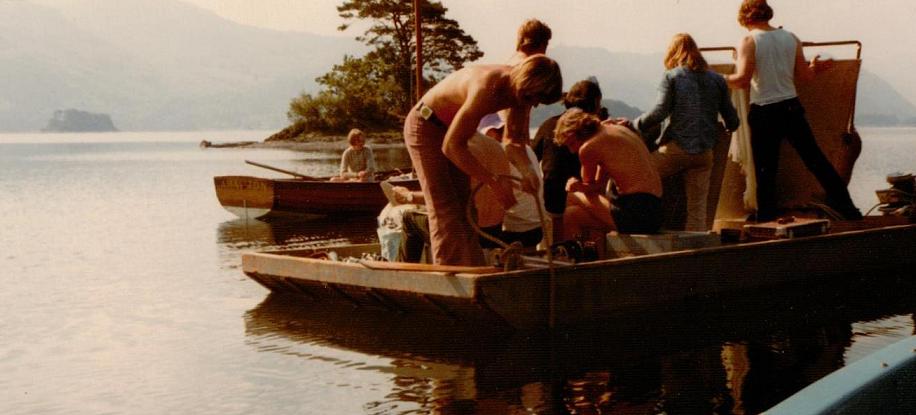
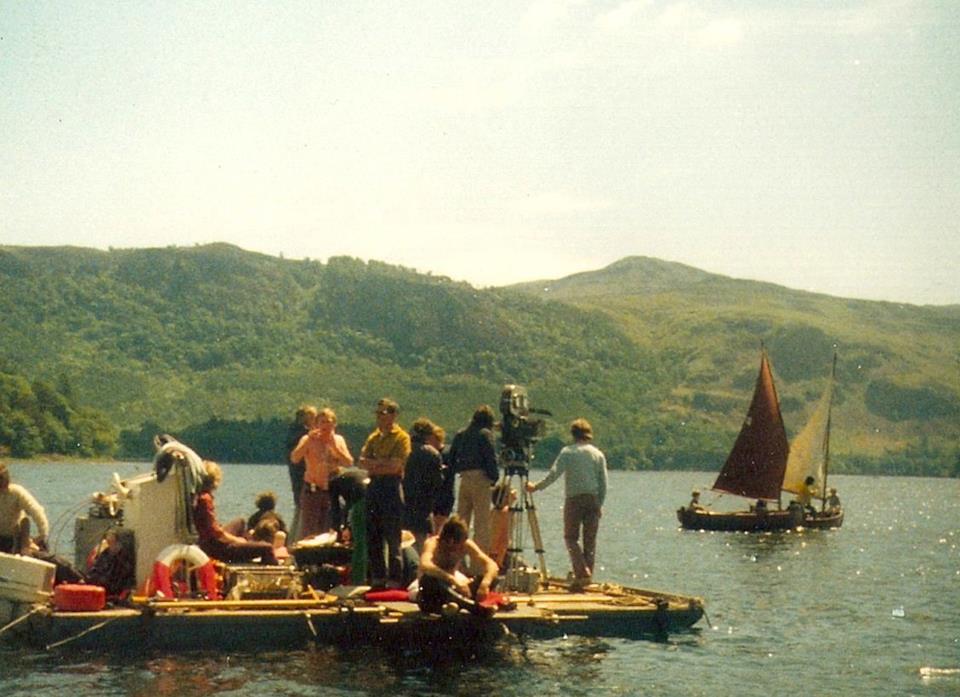
I have one behind-the-scenes clip of the crew on the pontoon – shot on a sunny day. It looks most bizarre. It was. You can see how cramped and overloaded we were and guess at the patience demanded of us all. Imagine how long it took to set up shots, while exposed to the elements. It was quite a stable raft but when we went for a take it was vital that everyone kept completely still or there would have been camera wobble. We used a conventional boat with a cabin when we filmed ‘Coot Club’ and ‘The Big Six’ on the Norfolk Broads ten years later in 1983. It proved much easier – but had more wobble.

You can read more about ‘The Making of Swallows an Amazons’ direct from the publishers.

the-making-of-swallows-and-amazons-audiobook-cover

The ebook on ‘The Secrets of Filming Swallows and Amazons (1974)’ is available on Amazon Kindle and other platforms. You can read the first section for free here:

Filming with Dame Virginia McKenna at Bank Ground Farm, Cumbria ~ on 21st June 1973

Fifty one years ago this day, we were filming with Dame Virginia McKenna at the location used for Arthur Ransome’s Holly Howe above Coniston Water. It was a day of days – the sunshiny day that we had all be waiting for.

Virginia McKenna at Bank Ground Farm
Dame Virginia McKenna at the other side of the boat houses at Bank Ground Farm in 1973 ~ photo: Daphne Neville (c)

David Bracknell with Virginia McKenna at Bank Ground Farm
First Assistant Director David Bracknell standing-in (or kneeling-in) for Roger with Dame Virginia McKenna at Bank Ground Farm. The great trees in the background are sadly no longer there ~ photo: Daphne Neville (c)

The gift of a day when buttercups and daisies were still out in the field that flows from Holly Howe to the lake. Roger was able to tack up the meadow to receive the ‘despatches’ from Mrs Walker, described in the opening pages of Arthur Ransome’s book.

Dame Virginia McKenna reading the IF NOT DUFFERS telegram
Dame Virginia McKenna reading the IF NOT DUFFERS telegram to Sten Grendon as Roger

‘…Each crossing of the field brought him nearer to the farm. The wind was against him, and he was tacking up against it to the farm, where at the gate his patient mother was awaiting him.’

Virginia McKenna with Hairdresser Ronnie Cogan
Dame Virginia McKenna having her hair adjusted by Ronnie Cogan ~ photo:Daphne Neville (c)

I don’t think you can tell that this section of the scene was recorded seven whole days later than the sequence that runs directly on from this when the Boy Roger delivers the very same ‘If not duffers’ telegram to Captain John. 

Virginia McKenna as Mother in Swallows and Amazons 1

The hole that had been dug for the camera alongside our picnic had been filled in. You can see this from Mother’s perspective when I was milling about near the lake looking towards the island I couldn’t actually see.

Dame Virginia McKenna on location at Bank Ground Farm (Holly Howe) in the Lake District. Property Master Bob Hedges is working in the foreground. Lee Electric lighting assistants stand-by with reflector boards while Assistant Sound Recordist Gay Lawley-Wakelin waits on a box with the boom ~ photo: Daphne Neville (c)

Poor Sten, he had to run up the field on what proved to be our hottest day in a sleeveless sweater. I remember Jean McGill, the Unit Nurse ministering cool drinks and a flannel soaked in cool eau de Cologne to make sure he did not get dehydrated. We all wanted a go with the cool cloth on the back of our necks at lunch time.

With Virginia McKenna at Bank Ground Farm
The Walker Family ~ Suzanna Hamilton playing Susan, Stephen Grendon as Roger, Sophie Neville as Titty, Dame Virginia McKenna as Mother and Simon West as John. photo: Daphne Neville (c)

It was good to escape the heat by getting out on the water. We shot the scene set on the old stone jetty at the boat houses below the farm when Titty leads ‘Good Queen Bess’ down to the harbour to inspect her ship. I didn’t realise she had a large box of matches in her hand. Virginia kept it a surprise from us in real life. I was excited to find out that Simon Holland, the Designer had painted the branded cover by hand.

Dame Virginia McKenna bids the Swallows farewell
Farewell and adieu to you fair Spanish ladies

As the call sheet specifies, our dinghy Swallow had been loaded with all the tents and camping equipment that had been on Peel Island the day before. I didn’t realise at the time quite how often the design team had struck camp and made it up again. I just sat on top of the equipment singing Adieu and Farewell, not very well, as we sailed out onto Coniston Water, waving goodbye to our Fair Spanish Ladies.

Arriving at Holly Howe
Claude Whatham with Dame Virginia McKenna. Mrs Jackson stands patinetly at the door ~ photo: Daphne Neville (c)

I am sure that we had already recorded the scene in David Wood’s screenplay when the Walker family arrive at Holly Howe, but Claude decided to take advantage of the golden light and shoot it again.  I am sure this was a good decision. It had been a long day and we were tired but the excitement of our arrival is tangible.

Arriving at Holly Howe
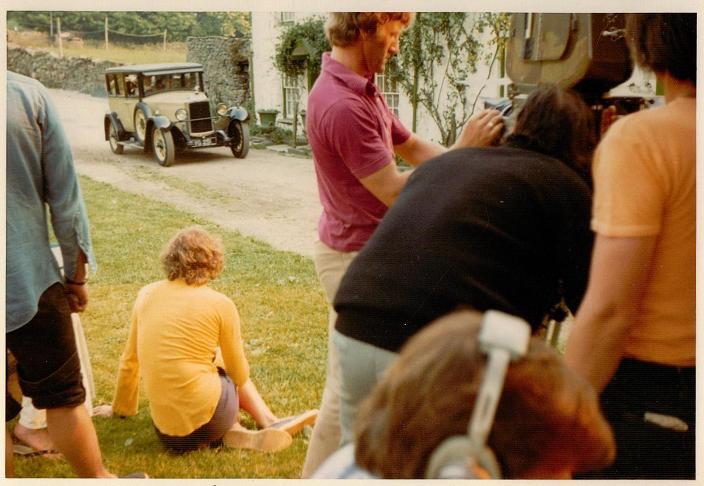
Director Claude Whatham, in a 1970s yellow long-sleeved t-shirt, watching the taxi drive up to Mrs Jackson’s front door in 1929. DoP Dennis Lewiston sets up the shot with Focus-puller Bobby Sitwell ~ photo: Daphne Neville (c)


Nurse with Baby Vicky, the ship's baby
Nurse with Baby Vicky, the ship’s baby at Holly Howe ~ photo: Daphne Neville(c)

My mother observed that Mrs and Mrs Jackson, Mrs Walker’s nurse and Vicky the ship’s baby, who were listed as Extras on the call sheet, were particularly well cast. Kerry Darbishire, who played the nurse, told me later that she had a daughter of the same age as Tiffany Smith seen here as Vicky. She could have brought her along. It was important they were there, playing ‘The stay-at-homes.’ Vicky anchored Mrs Walker to the farm, making it impossible for her to sail to the island with the Swallows. 

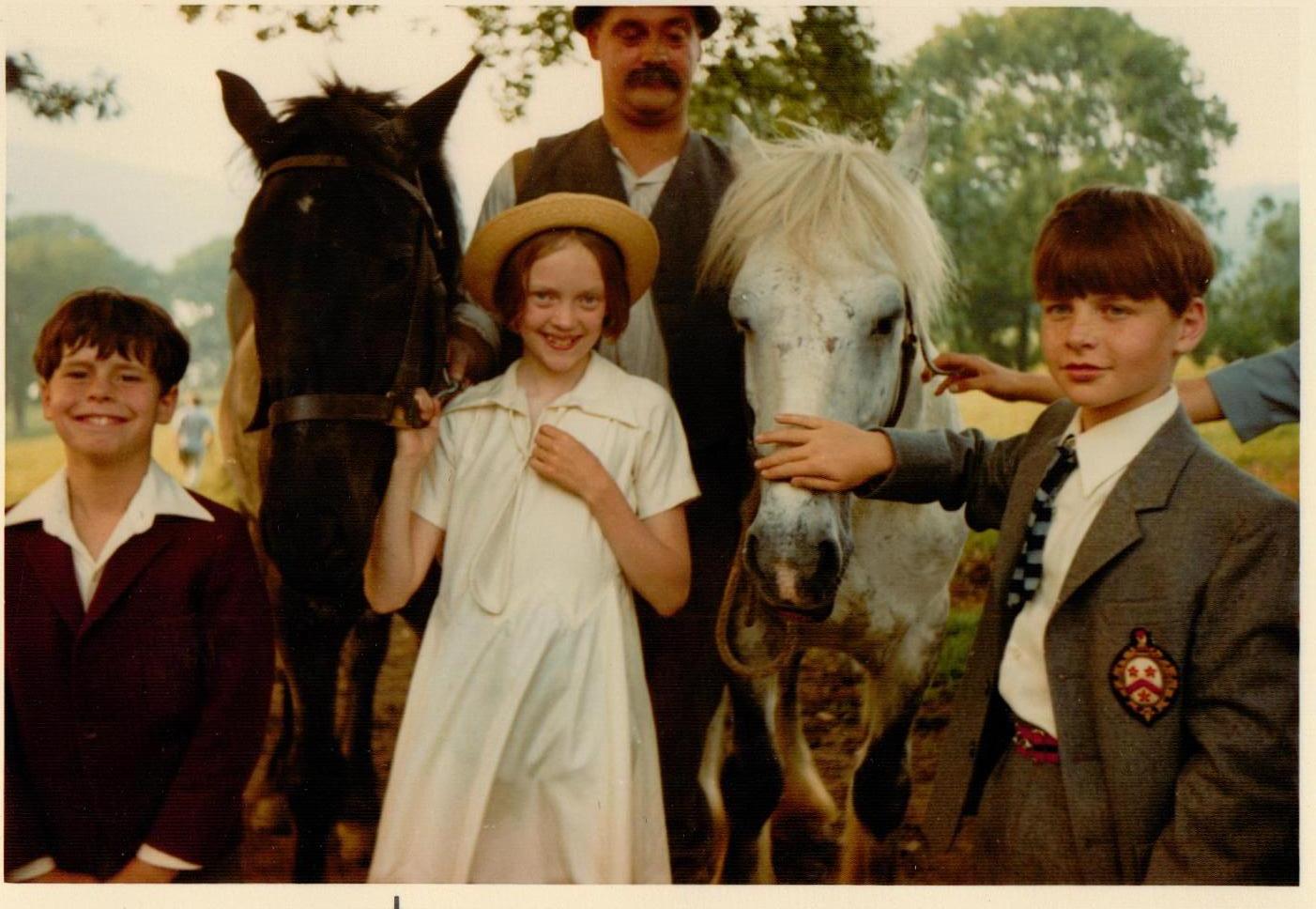
Sophie Neville holding the horses
Stephen Grendon, Sophie Neville and Simon West with Mr Jackson at Holly Howe~ photo: Daphne Neville

It must have been a long day for the little girl. It was a long hot day for all of us, but a happy day.

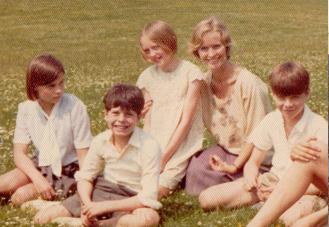
Simon West, Stephen Grendon, Suzanna Hamilton and Sophie Neville
Simon West, Stephen Grendon, Suzanna Hamilton & Sophie Neville playing the Walker children in ‘Swallows and Amazons’ 1973 ~photo: Daphne Neville(c)

The women who had been taken on as our stand-ins the day before did not seem to be around to help limit the hours we spent on set. David Bracknell, the first assistant director stood in for Roger. One of the women later claimed that she played Virginia McKenna in long-shots but the only long shot was taken of the Spanish Ladies on the jetty and I’m pretty sure that is Dame Virginia herself. 

Stephen Grendon, Simon West, Dame Virginia McKenna, Suzanna Hamilton and Sophie Neville, trying not to look as tall as she was in 1973 ~ photo: Daphne Neville(c)

What I really did not know, until I watched the documentary broadcast last Sunday, was that Mrs Batty, who held the lease on Bank Ground Farm, had locked out the crew. She explained that when she was originally asked if we could film on her property she did not quite realise the scale of operations and only asked for – or accepted – a location fee of £75.

Lesley Bennett's photo of the double decker buses at Bank Ground Farm in 1973
Lesley Bennett’s photo of the double decker buses at Bank Ground Farm in 1973

The arrival of the two red double-decker buses, the Lee Electric van, the generator and other lorries, not to mention the Make-up caravan rather daunted her, as did the furniture moving activities involved at the start of the filming when we shot the interior scenes. The idea that the film would bless her Bed & Breakfast and Tearoom business for the next fifty years alluded her. She said that she decided that £75 was not enough, padlocked her front gate and wouldn’t let the crew back in until they agreed to pay her £1,000. It was a lot of money, more than double the fee I received.

Sophie Neville with Lucy Batty at Bank Ground Farm in 1973 ~ photo: Daphne Neville(c)

You may have seen the BBC documentary about the making of Swallows and Amazons, when Ben Fogle interviewed Suzanna Hamilton and myself at Bank Ground Farm for ‘Big Screen Britain’. This was  re-packaged on a programme called Country TracksMy father’s 16mm footage had been skillfully inter-cut with an interview with our Director, Claude Whatham. I did not know that it was being broadcast but was able to watch on-line.Sophie Neville at the Bank Ground Farm Boathouses ~The Author Sophie Neville at the boatshed in 2013~
If you would like to read more, ‘The Secrets of Filming Swallows and Amazons (1974)’ is available on Amazon Kindle and all ebook platforms and the paperback on ‘The Making of Swallows and Amazons’ can be found in Waterstones from all online stockists.

Ronald Fraser arrives in the Lake District to play Captain Flint ~ on 20th June 1973

Sophie Neville and Simon West with Ronald Fraser playing Captain Flint
Sophie Neville, Simon West and Suzanna Hamilton with Ronald Fraser playing Captain Flint in the 1973 film of Arthur Ransome’s ‘Swallows and Amazons’

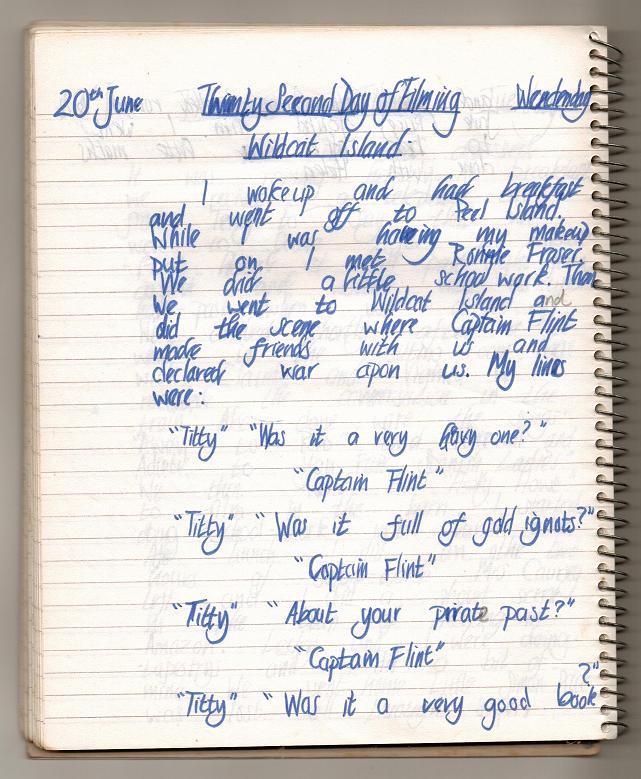
Ronald Fraser! veteran of World War II movies who had won an award for playing Basil Allenby-Johnson in The Misfits, had arrived on the shore of Coniston Water in two-tone shoes. Curiously so had two stand-ins. A short lady for me, who had dark hair, and a lady with blonde hair for Suzanna Hamilton. I have blonde hair and Suzanna is dark, but that is how it was.

Contact sheet - Ronald Fraser with Lesley Bennett

The other four actors didn’t have stand-ins, which seemed odd. Kit Seymour, who played Nancy Blackett, and Lesley Bennett in the role of Peggy, rehearsed as usual. The two boys, Simon West and Sten Grendon, were younger than us but never had stand-ins, so that seemed odder. We didn’t think the ladies would be very comfortable on Peel Island. There wasn’t exactly a powder room there.

Suzanna Hamilton and the crew with Ronal Fraser
Director Claude Whatham and Bobby Sitwell with Suzanna Hamilton playing Susan Walker and Ronald Fraser as Jim Turner aka Captain Flint

And we were some way into the filming, used to handling props that the stand-ins found alien. However they were very excited about coming over to Peel Island. They sat in our positions and read our lines back to Ronald Fraser whilst the scene at the camp site was lit, and returned to stand-in for us later when his close-ups were shot. Somehow they managed to do this in scanty summer clothing despite a brewing storm.

My stand-in. I liked her very much and was most interested in her tapestry, since I was doing one myself. Lots of the men in the crew were interested in her tapestry too. They hadn’t noticed mine.

Our stand-ins got a lot of help from the crew as they went from ship to shore. We didn’t, but then we were agile and wore life-jackets. Mummy didn’t wear a life-jacket, but she has always been surprising good at getting in and out of boats.  Her comment on the matter of my stand-in was, ‘Most unsuitable for a children’s film.’ Mum became increasingly concise: ‘I don’t think that woman was invited. She just turned up.’

Enthused by our Stand-in, Lesley Bennett and I went into Ambleside that evening to buy more wool for our own tapestries.

Ronald Fraser on Peel IslandThe recording of our scene with Captain Flint on Peel Island went smoothly, and Claude Whatham the Director was happy with the result, but my diary reports that a Force 8 gale blew in. This spun the poor production team into a quandary.

The call sheet for Thursday 20th June documents how truly unpredictable the weather could be. We had a ‘Fine Weather Call’, an ‘Alternative Dull Weather Call’, ‘Rain Cover’ in the Houseboat cabin, and a pencilled-in end-plan entitled ‘Peel Island’, which is where we’d ended up. Richard Pilbrow, the Producer, had a 1970s embroidered patch sewn to his jeans which read: THE DECISION IS MAYBE AND THAT’S FINAL.

The Call Sheet that never-was for 20th June 1973. We ended up on Peel Island.

In Arthur Ransome’s book Swallows and Amazons there is a dramatic storm with lashing rain. We were rather disappointed that it was not included in David Wood’s screenplay. It could have been shot that afternoon, but this was not to be. I can remember Mum saying, ‘You can’t have everything.’

What had been good about the 20th June was that we, the Swallows and the

Captian Flint challenges us to capture his houseboatAmazons, were all together, not sailing but on Wild Cat Island, with the novelty of working with Captain Flint for the first time. Kit and Lesley had been so patient, waiting day after day for their scenes to come up. They were stuck having lessons with our tutor Mrs Causey in the red double-decker bus most of the time. But the fact that they were on stand-by was helpful to the production manager who had to wrestle with the film schedule and call sheets.
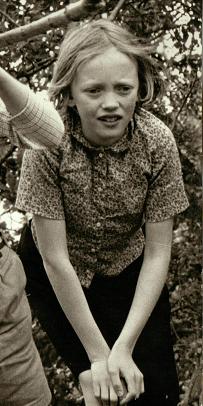
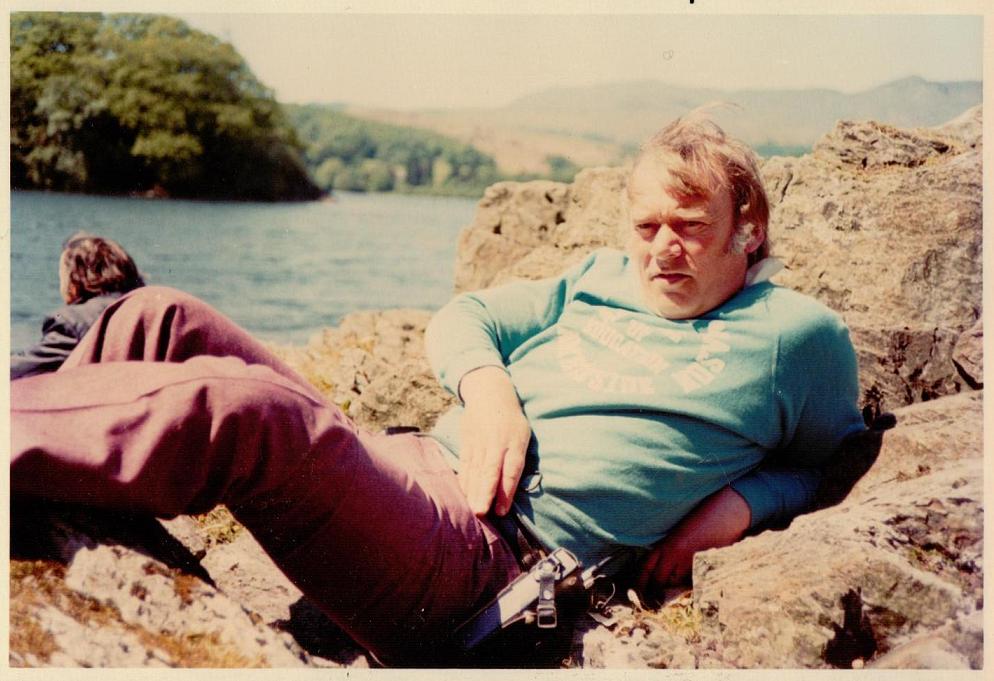
Blu-ray Sophie Neville with Ronald Fraser

As it was, the storm blew hard but cleared the dull-weather clouds and the next day was glorious, one to remember forever…

You can read more in the paperback or ebook here. There is also an audiobook narrated by me, Sophie Neville.

Filming the night scenes for ‘Swallows and Amazons’ on 19th June 1973

Sophie Neville as Titty Walker

The Lake District is very beautiful. The problem about filming there is that it can rain quite hard – ‘heavily’ – was the word I used in 1973.

By this stage in the filming of Swallows and Amazons Claude Whatham only had one ‘rain cover’ option. We were kept busy recording sea shanties with Virginia McKenna at the Kirkstone Foot Hotel by Lake Windermere while Dennis Lewiston, the DOP, lit Mrs Batty’s barn at Bank Ground Farm above Coniston Water.

Arthur Ransome must have done much to revive the songs of the sea: 

Farewell and adieu to you, fair Spanish ladies, Farewell and adieu to you, ladies of Spain; For we’ve under orders for to sail for old England, And we may never see you fair ladies again.

We never got as far as the ranting and roaring bit in the film.

No one really knows how old this naval song is. The Oxford Book of Sea Songs, mentions it in the logbook of the Nellie of 1796, long before shanties really came established as a genre. All I know is that Titty loved it and was still singing it in Peter Duck when the song became quite useful for navigating the English Channel.

‘The first land we sighted was called the Dodman, Next Rame Head off Plymouth, Start, Portland and Wight; We sailed by Beachy, by Fairlight and Dover, And then we bore up for the South Foreland light,’  or sort of.

Walking into Mrs Batty’s barn that day was hugely exciting. Simon Holland, the art director or set designer, had rebuilt the camp there, lighting a real fire.

Sophie Neville as Titty in Swallows and Amazons
Sophie Neville as Titty

Swallow was nmounted on a cradle so that she could be rocked, as if by water, as the scenes of her sailing at night were shot.  It was brilliant, she even went about. Moonlight wasn’t not a problem. Richard Pilbrow can correct me, but I think it was produced by a lamp called a ‘tall blonde’. I don’t think we had a wind machine. The Prop Men used a large sheet of cardboard to produce a breeze.

Contact sheet - Simon West and Suzanna Hamilton night sailing

‘Wouldn’t Titty have liked this?’

‘Liked what?’

‘Sailing like this in the dark.’

’57, 58, 60, 61…’

‘What’s the matter?’

‘Can’t you hear it? The wind in the trees?  We must be near the bank. Quick, Susan lower the sail! Roger, catch the yard as it comes down!’ Then there is a crunch as the Swallows hit a landing stage. All mocked up. Quite fun.

‘What about Titty?’

Amazon was placed on the same mounting. I climbed aboard and started wrapping myself up in her white sail.

Children always love the irony of John saying, ‘She’s at the camp. She’ll be alright. She’s got a tent,’ when the shot cuts to me looking damp and uncomfortable about sleeping in Amazon, anchored out on the water.

Burgulars approaching Cormorant Island

Later I wake up and come out from under the sail to hear the burglars heaving  Captain Flint’s trunk across Cormorant Island. All in all we achieved quite a bit on that wet day in Westmorland. Much safer and easier than being out on the water.  Because the cradle was at waist height Claude was able to get lower angle shots than when out on the camera pontoon. Simon West, who played John, did really well.  He managed to convince me that he was really sailing when I watched the film and I knew he wasn’t.

I’m pretty sure this scene of us inside a tent at night was actually shot on Peel Island but I may be wrong. We had a fire in the barn. If you look closely you can see an electric cable going into the lantern to boost light from the candle. The night scenes were tricky to light and shoot, but there was something about them that was intimate and exciting for children. I assume they would normally be in bed but it was the summer holiday and excitement was afoot.

Sophie Neville in the tent at night

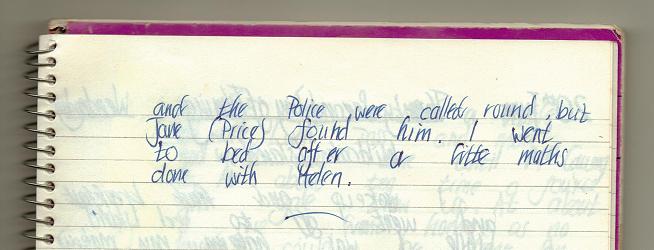
Back at our guest house in Ambleside there was a real life drama. Little Simon Price had gone missing.  He was the small boy last seen on the beach at Rio, having his shorts pulled up by his sister. The Police were called and everything. But as in a lot of real life situations, things were sorted out, and we returned to the mundane world of maths lessons. I was tutored by Helen, one of the students at the Charlotte Mason College of Education who was also lodging at Oaklands as Mrs Causey, our teacher, could not ‘do modern Maths.’

You can read more here:

Rowing to Cormorant Island ~ filming ‘Swallows and Amazons’ on Derwentwater on 15th June 1973

Sophie Neville rowing to Cormorant Island
Sophie Neville as Titty and Stephen Grendon as Roger rowing to Cormorant Island

‘Pull harder, Roger!’ ~ hardly a line from Shakespeare, but one that has lodged deep in my memory. Titty was even bossier in Arthur Ransome’s books ~

“You keep time with me, Boy,” said the able-seaman.

“All right.”

Official film still from StudioCanal
Sten Grendon as Roger and Sophie Neville as Titty rowing Swallow (c)StudioCanal

Titty lifted her oar from the water. Roger gave one pull.”Boy,” said the able-seaman, “you mustn’t say ‘All right’.”

“Aye, aye, sir,” said the boy.**

When we auditioned for Swallows and Amazons the emphasis was on sailing. Could we sail? In fact I needed to be good at rowing. Titty and Roger row back form the Charcoal Burners, I rowed the Amazon from Wild Cat Island and here we were rowing across Derwentwater to Cormorant Island. This was more difficult than normal as Swallow was wired to the camera pontoon.

Cormorant Island

When I look at the 16mm footage my father took of me rowing at home before we left to film in the Lake District, I cringe. My blades were high above the water, hitting the surface with terrible splashes but I seemed to achieve my objective.  I managed to fit an improvised mast to our Thames skiff and even made my own sail. It doesn’t look great, but I think Arthur Ransome would have approved.

Cormorant Island and the camera boats
Swallow finding Amazon anchored near Cormorant Island on Derwent Water with the camera pontoon and safety boat: photo~ Daphne Neville

Simon West and Suzanna Hamilton joined us for the scene when the Swallows lower the Jolly Roger and start to sail the captured the Amazon back to Wild Cat Island.  I can only imagine that I changed my costume in one of the support boats. The scene may have been shot with two cameras on different boats.

Sophie Neville playing Titty Walker in the captured Amazon, with David Cadwallader, Bobby Sitwell, Dennis Lewiston, Claude Whatham and two electricians holding reflector boards on the camera punt: Photo ~ Daphne Neville

This shot shows Claude Whatham using the grey punt,* which somehow managed to accommodate Dennis Lewiston, the 35mm Panavision and quite a few crew members, while Richard Pilbrow remained on the camera pontoon with Eddie Collins operating the 16mm camera.

Richard Pilbrow and his film crew on the camera pontoon with Eddie Collins operating the 16mm camera. Simon West and Stephen Grendon sail Swallow. Suzanna Hamilton is climbing aboard the Amazon with Sophie Neville

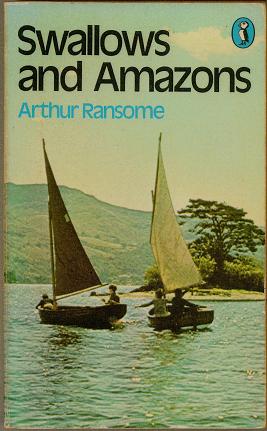
I remember the scene itself as being difficult to achieve in terms of sailing. Swallow has a keel, and Amazon with her centre board is much the faster dinghy. It is not like racing two boats of the same class. After hauling up the anchor Suzanna and I battled to turn the Amazon, not wanting to wiggle the rudder and jeopardise her pins. I remember Simon calling advise over the water. He stalled and we caught up, trying to get close together for the shot. The result was a photograph used on the front cover of the next Puffin edition of the book.

Swallows and Amazons book cover 1974
Stephen Grendon, Simon West, Sophie Neville and Suzanna Hamilton on the cover of the 1974 Puffin edition of ‘Swallows and Amazons’

* I may be wrong about these photographs. The still surface of the water in the shot of Titty alone in Amazon suggests that it was taken later on, when we filmed the burglars landing on Cormorant Island with Captain Flint’s trunk, but we probably had a very similar set up on this more sparking day ~ 15th June 1973.

Contact sheet - sailing Swallow & Amazon on Derwentwater

We went on to film various shots of us sailing on to Wild Cat Island, when I think the camera was in Swallow capturing close-ups of a triumphant Captain John. He did indeed do well.

Sailing Swallow & Amazon by Cormorant Island

**Swallows and Amazons by Arthur Ransome, 1970 Jonathan Cape edition

You can read more about our adventures here:

Visiting the Charcoal Burners ~ filming ‘Swallows and Amazons’ on 13th June 1973

The Charcoal Burners - Swallows and Amazons
Jack Woolgar as Old Billy with Simon West, Suzanna Hamilton,   Sophie Neville and Stephen Grendon ~ photo: Daphne Neville

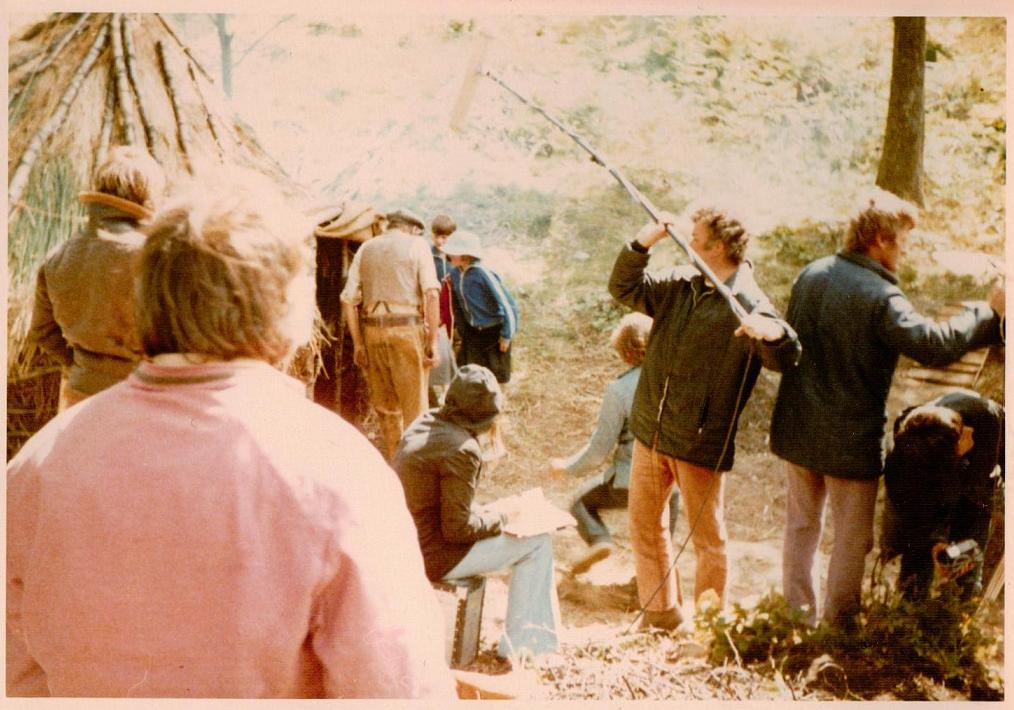
‘Let’s just run though our lines, shall we?’ Old Jack Woolgar said, in a gentle Lancashire accent. We were waiting about for some reason, so did just that, sitting by a woodstack.  Titty had a lot to say in the scene where we went to see the charcoal burners, but the dialogue was straight out of Arthur Ransome’s book so it was easy. Or I thought so, until there was Old Billy saying – ‘Ehh, then you’ll be climbing into that mini-bus and off back to Ambleside, I expect.’

I thought, ‘That’s not in Swallows and Amazons! That’s real life.’

‘Eee, lass! You forgot to come in on your cue.’ I had too. I was so entranced by Old Billy, so lulled by the music of his voice, that I had simply gone on listening to him.

Jack Woolgar, Simon West, Sophie Neville, Stephen Grendon and Suzanna Hamilton with Director Claude Whatham. Sue Merry is seated in the foreground with her continuity sheets ~ photo: Daphne Neville

We were still having problems with the weather. It was cold and grey at first but grew to be a bright sunny day in Cumbria, with a gale blowing that was knocking the tops of the trees about and making life hard for Graham Ford, the sound recordist. This was all a bit difficult as it was meant to be dead calm in the story.

‘It’s blowing up a bit,’ Old Billy put in. I don’t think anyone watching would have noticed if we’d left it at that but our hair was blowing about so madly that Young Billy had a few savage-like words with John about why we weren’t sailing. These are not in the book.

Charcoal Burners 2
Filming the scene ~ Sound Recordist Graham Ford in the foreground, Grip David Cadwallader. Actors Jack Woolgar, Simon West and Sophie Neville, Continuity Sue Merry seated, Director Claude Whatham kneeling, Boom Swinger, Focus Puller Bob Blues and Camera Operator Eddie Collins ~ photo: Chaperone Daphne Neville

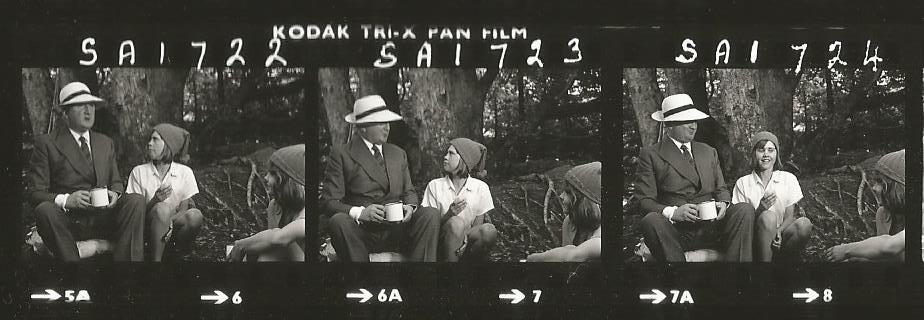
I think Mum did well with her photographs. She only had a small camera but she tried to capture what it was like to be on set, involved in the filming, rather than just focusing on the story. Because her camera made a clicking noise she was only really able to take shots when we were in rehearsal, wearing our Harry Potter-like nylon tracksuit tops, me in a sun-hat, the rest of the crew wrapped up in their warm jackets.
When I watch this scene I notice one technical bit about acting that is never talked about much. You have to hit your mark. Without this being obvious. No looking down. Your mark is the exact position established when the shot is lined up.  The camera focus, certainly back then, required actors to be consistent and hit the same position in each take as established in the rehearsal. Look at the opening shot at the top of this post and you can see it is carefully composed – a nice triangle, with all our faces in vision. The important bit – Roger holding my hand is not masked. Do I spoil the magic if I say we are standing on our marks?

Sophie Neville at the Charcoal Burners
Sophie Neville looking at the adder with Stephen Grendon and Jack Woolgar

If feet can’t be seen a piece of tape was usually placed on the floor in front of the actors’ toes to provide a mark. I used to use different coloured tape for different artistes later on when I was an assistant director. We used chalk on tarmac roads. Tape didn’t stick to most of the locations on Swallows and Amazons, so we used sticks or tree bark, taking quite a pride in disguising  them. Sometimes a box would be placed on the ground so we could feel it and not have to look down. This could not be done at the charcoal burners’. We all came out of their dark wigwam blinking in the bright sunlight shuffling onto our secret marks, Suzanna glancing down quickly to check she was on hers.

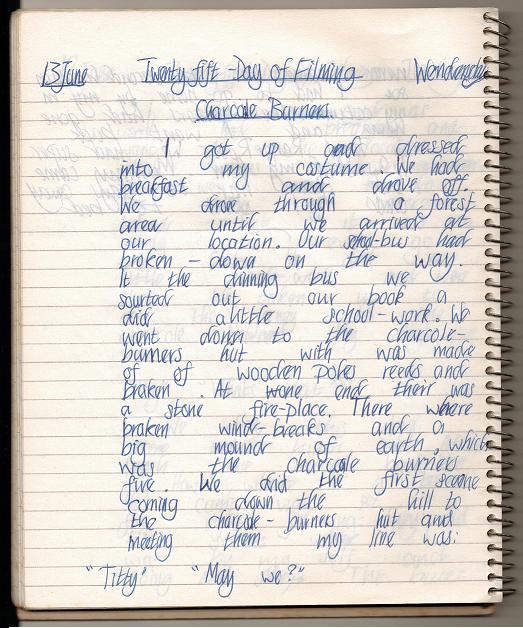
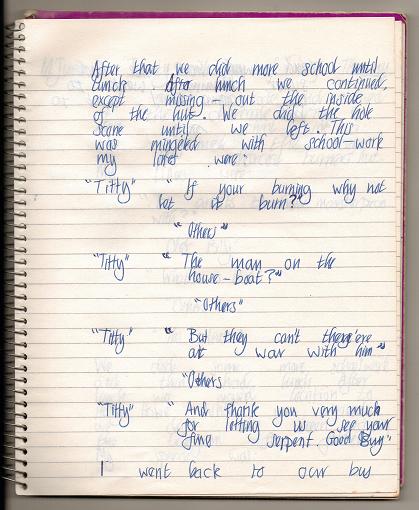
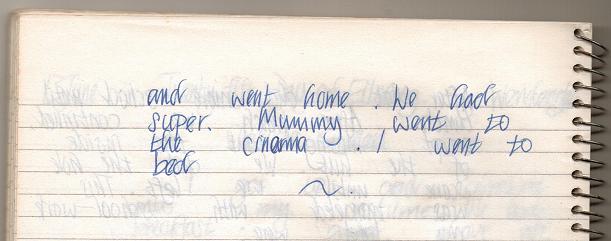
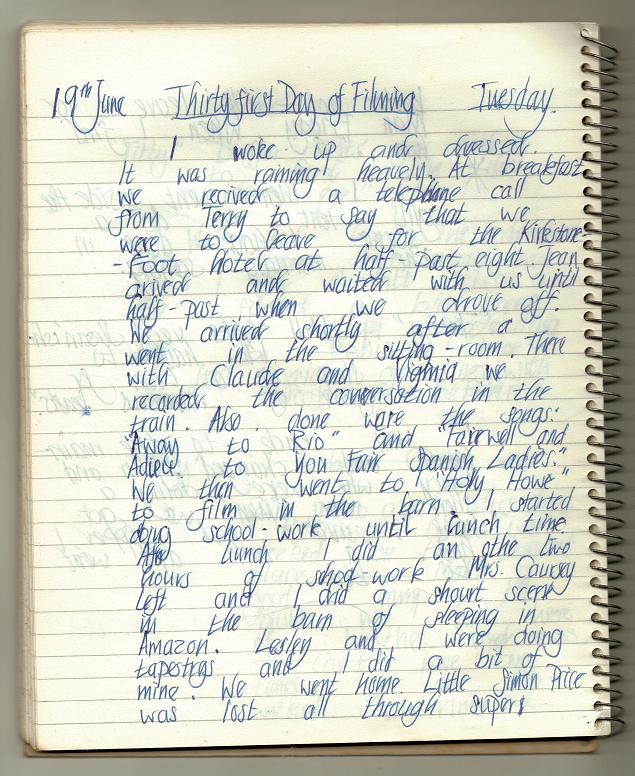
My diary read:

13th June - My diary page one

13th June - My Diary page two

13th June - My Diary page three

John Franklyn-Robbins as Young Billy with Director Claude Whatham. Prop men stand in the background with the real charcoal burner ~ photo: Daphne Neville

Was the charcoal heap was a real one? I’m afraid I think, since that hole had to start smoking on cue, that it was constructed for us with a prop man called Terry inside with a smoke gun. I know he suffered rather from getting too much smoke in his eyes and had to be treated by the nurse. There was certainly a great deal of smoke around, which had a wonderful effect.

Charcoal Burners' Adder
Robert Forster who supplied the Charcoal Burner’s adder

Molly Friedel watching Robin Gregory plant a microphone for the adder. Claude Wahtham is hidden by a reflector board, Suzanna Hamilton, Sophie Neville and Jack Woolgar wait on their marks while the real charcoal burner looks on ~ photo: Daphne Neville

We could all see the adder but the sound recordist wanted to hear her so he buried one at our feet. She was a lovely serpent.  Suzanna, who loves snakes with a passion, got close to touching it. She was very disappointed that you can’t see this in the movie. I was a bit scared. Ransome had added that frisson of danger – real life danger – there for us to see.

Sophie Neville, Sten Grendon, John Franklin-Robbins, Jack Wolgar, Suzanna Hamilton and Simon West in Swallows and Amazons (1974)
Sophie Neville, Sten Grendon, John Franklin-Robbins, Jack Woolgar, Suzanna Hamilton & Simon West

Jean Woodhouse wrote to say, ‘I came to watch Swallows and Amazons being filmed. It was the charcoal burner’s scene. We walked down from our village Primary School (Satterthwaite) but the scene was actually just down the road from where I lived… we were all terrified re-the snake.’ She was about 10 years-old at the time. ‘…because I used to go up and down through the wood each day, I knew the real charcoal burners who worked in there and so that scene in the film has always felt quite special to me.’

Filming the Scene: Simon West, John Frankiln-Robbins, Suzanna Hamilton and Jack Woolgar. Designer Simon Holland sits in the foreground. ~ photo: Daphne Neville

One of the most magical things for my mother was meeting the real charcoal burners. There are more photos of them in the nest post as we returned on 14th June.

The Real Charcoal Burners 2
John Franklin-Robbins playing Young Billy with Sophie Neville, Stephen Grendon and the adder.

You can find out the name of the snake wrangler and read more about the filming in the ebook ‘The secrets of filming Swallows and Amazons (1974)’

Setting sail from Wild Cat Island during the filming of Swallows and Amazons 0n 2nd June 1973

If it is tricky navigating in and out of the Secret Harbour on Peel Island, leaving from the Landing Place under sail in a clinker built dinghy can prove even more hazardous. You need a decent shove to get going so you can catch the wind, escape from snaring tree branches and avoid the danger of flat rocks lurking just under the surface of Coniston Water. This was my job on a rainy, grey day in the Lake District in 1973. With a telescope in one hand.

On the filming of 'Swallows and Amazons' in 1973

In the finished film you don’t see the shot when I slipped in the water up to my waist, and kept on shoving.  The “Don’t forget about the lights, Titty ” scene had to be re-shot on a sunnier day.

bw Susan sailing past Peel Island2
Simon West and Suzanna Hamilton at the helm of Swallow with Stephen Grendon in the bows, while Sophie Neville looks on from the shore of Peel Island.

What you see is a long-shot, on a grey day, with Titty waving furiously from the shore, as Swallow leaves Wild Cat Island. You can not see that her dress is soaking wet but the trees on the island indicate just how windy it is. While Susan is waving back, Roger is looking out for rocks for all he is worth. John is sailing hard, running with the wind, with the boom right out and white water on his bow. He hung on, as he had to, until Swallow passed the big rock, before coping with a dramatic jibe. You see him rise to handle this, while Susan ducks. She needed to. It was so violent the mast nearly broke, but John ‘scandalised’, spilling excess wind and sailed on. The film cuts to two closer shots of the jibe taken on the sunny day, then cuts back to the long shot when Susan bobs up and Swallow sails at speed, north up Coniston towards grey clouds and rain over Langdale.

BW Swallow about to jibe

My father watched all this from the shore, knowing the risks, knowing Stephen Grendon aged nine, who played Roger couldn’t swim well. But Simon West was proving himself yet again as a very good sailor. He was totally confident. You can tell – even from a distance – how calm he was, how instinctively he read the wind. He knew it would hit him with force as he left the lee of the island.

Swallow on Coniston


These wet windy days in the Lake District were a worry to the Producer and a challenge for the crew. They had already lost a number of days to rain. Whilst Claude Whatham, the Director was always trying to find a way of making the best use of his time, David Bracknell, his First Assistant Director had to make things happen. The practicalities of each day rested on his shoulders.

David Bracknell, First Assistant Director on ‘Swallows and Amazons’ on the shore of Coniston Water near Peel Island ~ photo: Martin Neville

Just co-ordinating our transport out to Peel Island, so that we while the camera crew were never waiting for us we were not missing time at our lessons – would have been difficult. Getting the tea urns out there twice a day, must have been a struggle. I’m not sure what we did about anyone wanting the loo. There wasn’t even a bucket on the island. 

Claude Whatham and his crew on the camera punt
First assistant David Bracknell, director Claude Whatham, grip David Cadwallader and DoP Dennis Lewiston (seated) with three local boatmen ~ photo: Richard Pilbrow

Working in purple trousers, with a Motor-roller on his hip, David kept things safe and kept things going whatever the weather. He would call for ‘Quiet’, before each take, calling, ‘Camera? Sound? then: Mark it!’  The clapper board would be named and snapped shut before Claude the Director shouted ‘Action!’  Then off we’d go.  And the rule was to keep going – whatever happened – come the hell of slippery rocks or high water – until the Director shouted ‘Cut!’ David would then take over command and set up either for a re-take or a subsequent shot. Once a scene was completed he’d move the crew on for a new sequence.

The cast of ‘Swallows and Amazons’ setting off in the Capri for Peel Island, my mother in her bobble hat, a journalist taking photographs and Brian Doyle, the film Publicist, wrapped up warm ~ photo: Martin Neville

David Bracknell was very experienced. He’d worked on a number of hugely popular Carry-on movies, which according to Maureen Lipman, were made at terrific speed. Prior to Swallows and Amazons his credits included Carry on Abroad, Carry on at your Convenience, (I’d seen this at school; it’s all about lavortaries) Carry on Henry and Carry on Loving with Kenneth Williams, Sid James and Charles Hawtrey.  He’d worked on Far from the Madding Crowd  with Julie Christie, Alan Bates and Trevor Stamp, A Day in the Death of Joe Egg with Janet Suzman and Peter Bowles, Bless this House with Sid James, Diana Coupland and Sally Geeson and Battle of Britain, which starred Michael Caine, Trevor Howard and Harry Andrews, Ian McShane, Susannah York and Laurance Olivier. By 1984 he was working on Indiana Jones and the Temple of Doom, in 1986 on Shaka Zulu with Edward Fox, Robert Powell and Trevor Howard again.  We were in capable hands.

My father recognised this, watching patiently from the base camp with Perry and Tamzin, my younger sisters. I fear it must have been terribly dull for them, especially on the cold grey days, but we were all together and did have a chance to explore Westmorland, as you will see when I reach tomorrow.

My sister Perry Neville on the shore of Coniston Water in Cumbria with Stephen Grendon and Peel Island beyond~ photo: Martin Neville

You can read more about the making of Swallows and Amazons here:

25th May 1973 ~ When I first started drawing maps

Sophie Neville as Titty working on her chart

I did not know it at the time but Titty’s chart had a profound influence on my life.

Titty working on the chart - copyright StudioCanal

I loved drawing the map. I had prepared it earlier with Simon Holland, the Art Director, and always regret pressing too hard. If you look very carefully you can see that I had already written ‘Rio’ and rubbed it out, only to write Rio again when it came to the take.  I also wish that I had been taught the song Away to Rio before this scene as I would had said that line differently. Never mind.

swallows and amazons map tea towel

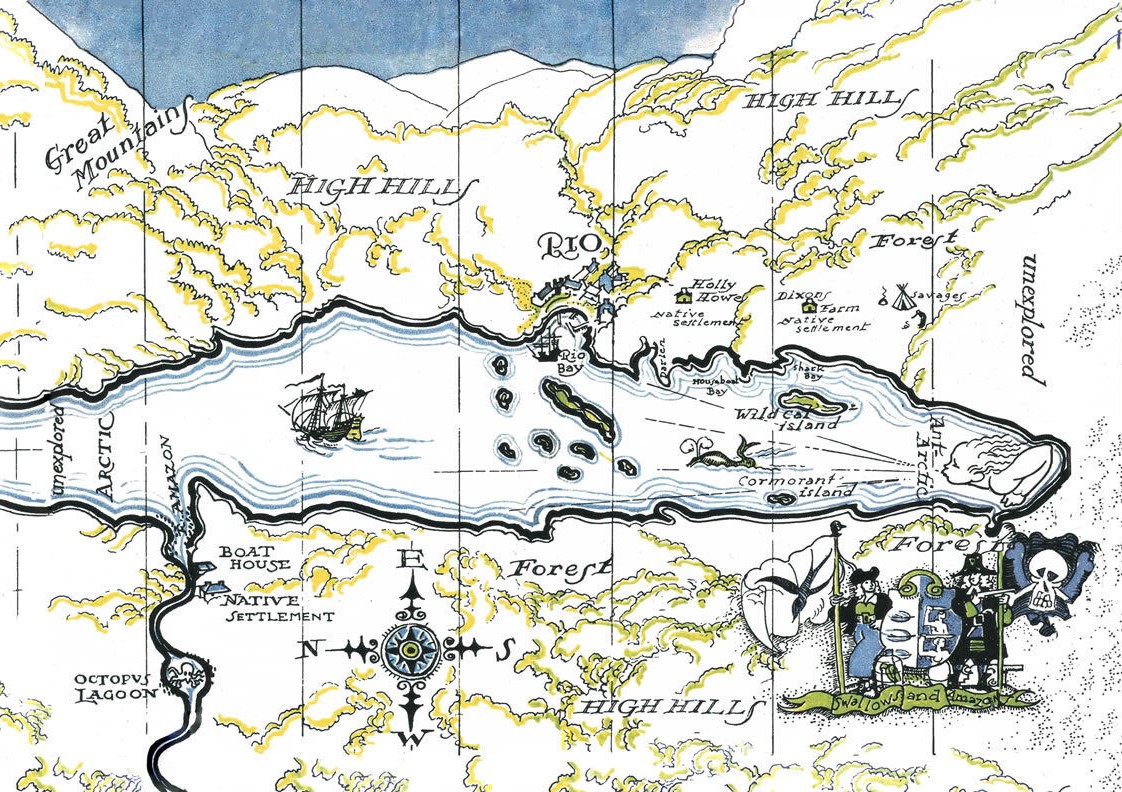
 The map on the end papers of Arthur Ransome’s book of Swallows and Amazons, originally drawn by Steven Spurrier, is an inspiration to millions. I’ve gazed and gazed at it.

When I grew up and went to university, I took a course in cartography that was to stand me in good stead.  In the spring of 1992, I migrated to Southern Africa with the swallows and soon started drawing decorative maps.

colour elephant map

I added small pictures of settlements, trees, animals, and always a compass with a black and white border to give the scale. In the process I was able to explore the most wonderful country. Most of my commissions have been of game reserves or great swathes of Africa.

Macatoo Camp in the Okavango Delta, Botswana
A map by Sophie Neville depicting the area around Macatoo Camp in the Okavango Delta in Botswana where you find wild parrots

I have mapped areas of the Okavango Delta in Botswana and the Waterberg Plateau in South Africa.

Map of Jembisa

I travelled miles to complete one of the Malilangwe Conservation Trust in Zimbabwe and a map showing how to cross the Namib Desert on a horse.

Reit Safaris Horse Trails Map

I’ve mapped Jembisa Game Reserve, Triple B Ranch  and Ongava on the Etosha border. I have also drawn maps of military zones, ski resorts and stately homes.

Map of Four Ashes Hall by Sophie Neville

Some have been for charities such as Save the Rhino Trust, others for books, others for marketing holidays.

Map of Chamonix

They all gave me the excuse to go on living a Swallows and Amazons life, camping in wild places and exploring wilderness areas – uncharted territory.

Horseback Safaris 2 Map

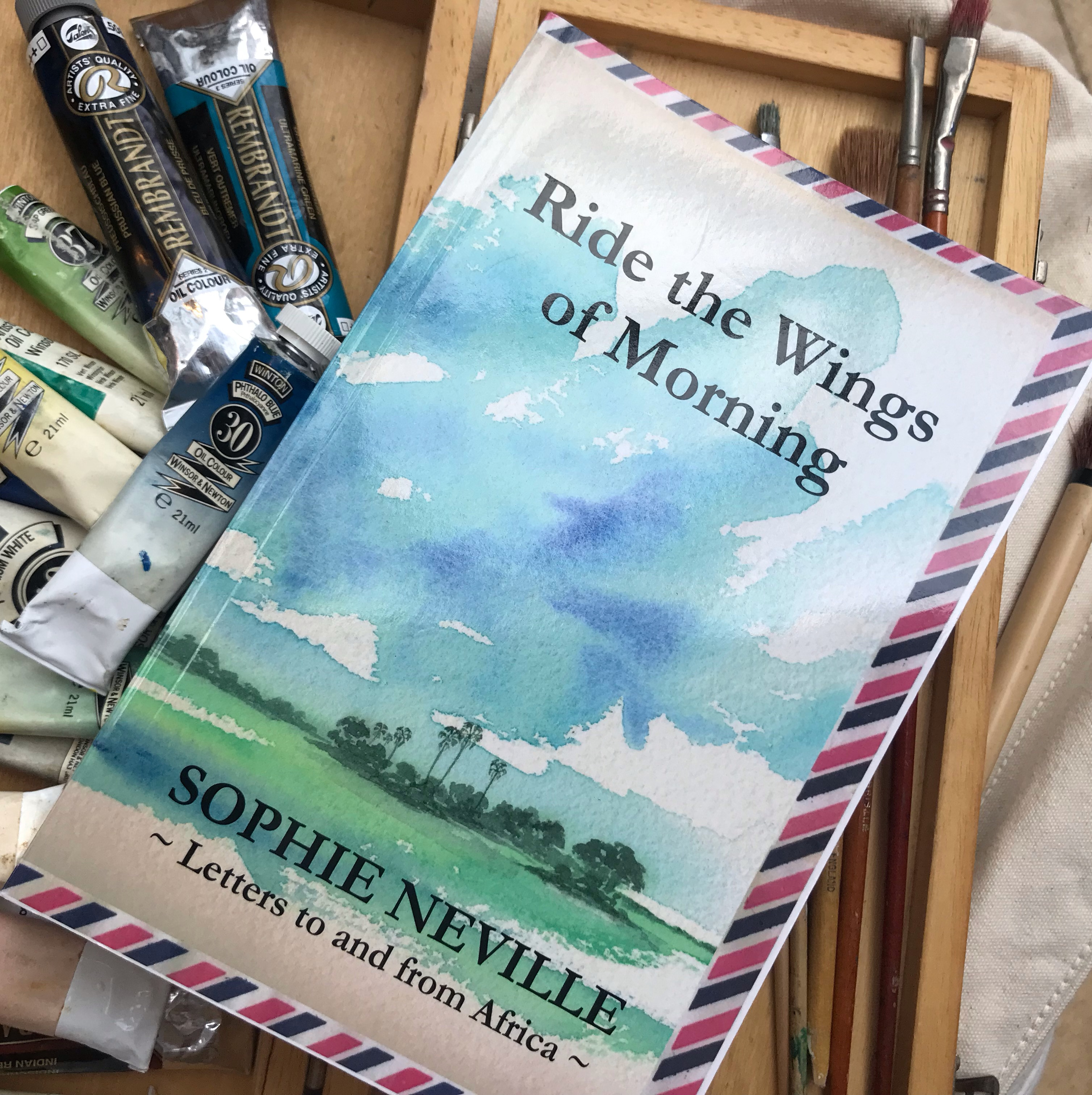
As I expect Titty would have done, I have been writing about these maps and the adventures I had in making them, putting everything together in an illustrated  travel book call Ride the Wings of Morning.

Ride the Wings of Morning by Sophie Neville

I have a couple of very early maps in my first book Funnily Enough. These were just sketched in my diary but one is of Windermere, where I went with my father and the Steam Boat Association, so should be of interest to Arthur Ransome enthusiasts.

A map of Windermere sketched in Sophie Neville’s Diary of 1991 published as the book ‘Funnily Enough’

I have since reproduced some of my own Swallows and Amazons maps on mugs, t-shirts and other items that make useful presents. You can find a selection here.
Swallows and Amazons mugs
Mugs printed with maps used to illustrate Sophie’s books

The mugs are good quality – you can order this one here

I used this map of the Swallows and Amazons locations on the front of the ebook on how we made the film, which has more within. It sells for about £2.99:

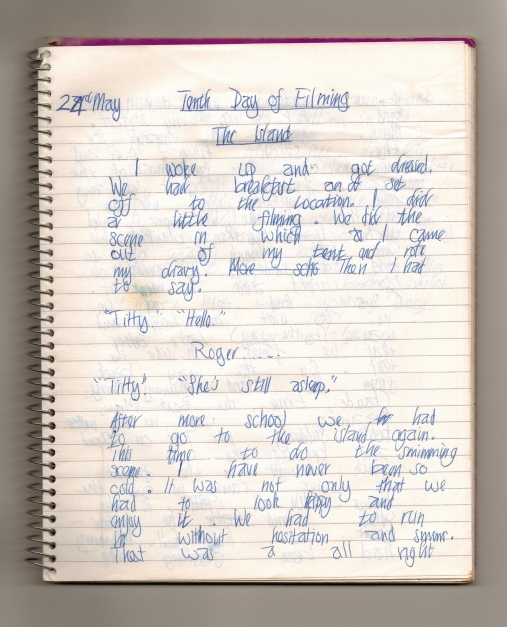
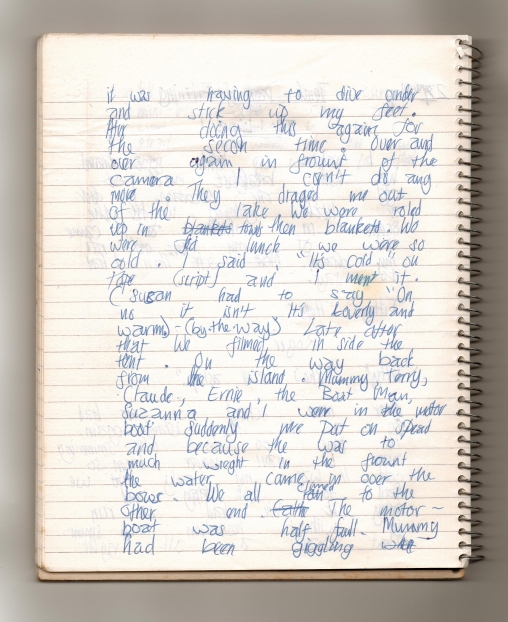
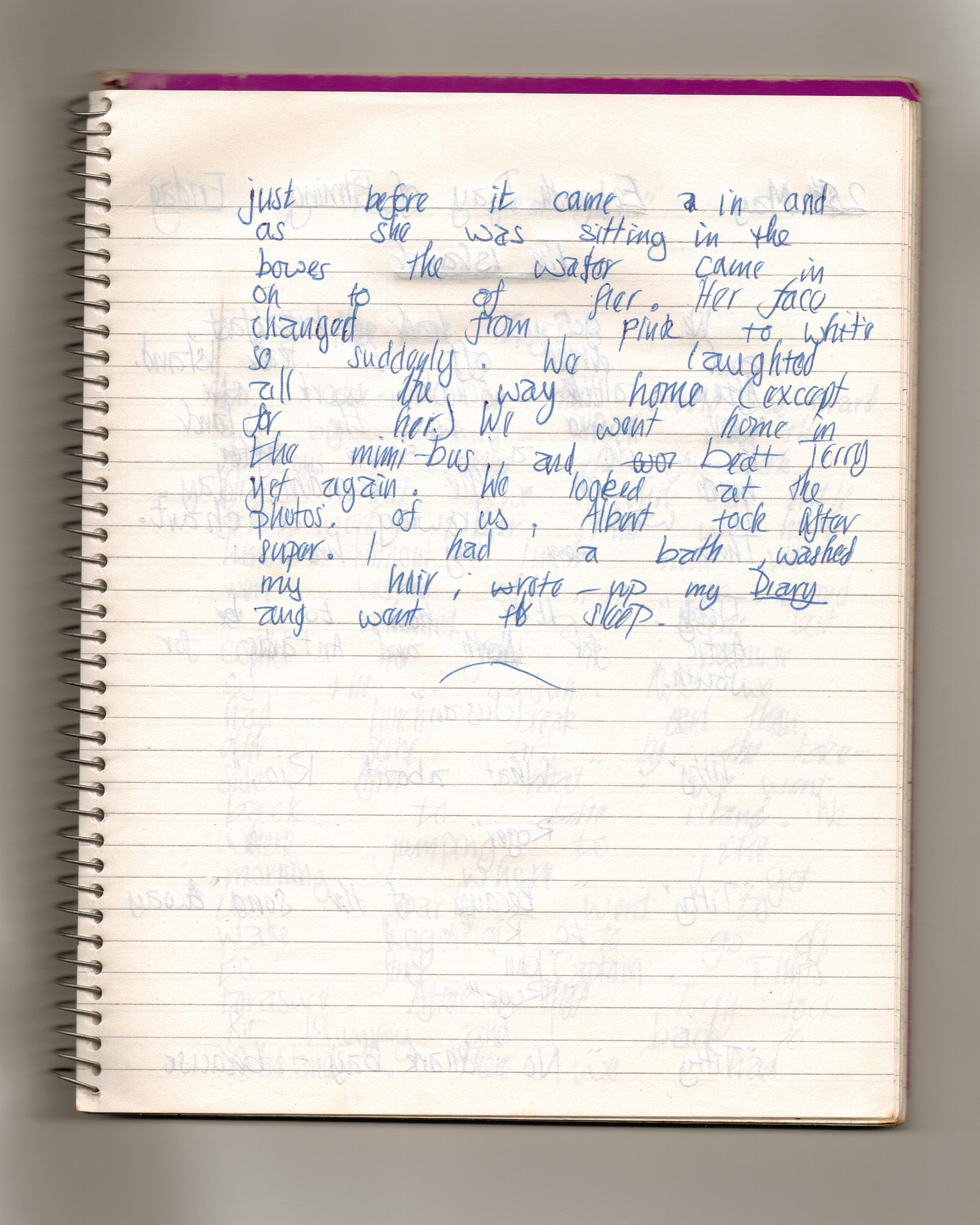
“It was really horrible” ~ filming the swimming scenes for ‘Swallows and Amazons’ ~ 24th May 1973

bw Susan teaching Roger to Swim
Sten Grendon as Roger Walker being taught to swim by Suzanna Hamilton playing his elder sister Susan Walker on location at Peel Island on Coniston Water in 1973

“…it was really horrible,” I told Tim Devlin, of The Times. “We had to run into the water and enjoy it. It was icy. I had to try to be a cormorant with my feet  in the air. Then I had to step water as Susan taught Roger to swim.  We were in for about three minutes and they had to do two takes of the scene. It was horrible.”   This was the day when we shot the swimming scenes ~

24th May 1973

24th May 19731

24th May 19732

The first scene of the day was actually was the one when Titty emerged from her tent in her pyjamas, wiped the dew off the top of a large biscuit tin and started writing her diary. I always regret writing Titania Walker on the cover but I had been contracted to play the part of TITANIA WALKER. My mother, Daphne Neville, who is quite theatrical, loved Shakespeare’s Midsummer Night’s Dream and encouraged me to write out the full name, but I do wish I had simply labelled by notebook ‘Ship’s Log’.

bw Susan and Titty in their tent
Suzanna Hamilton playing Susan with Sophie Neville as Titty busy writing the ship’s log

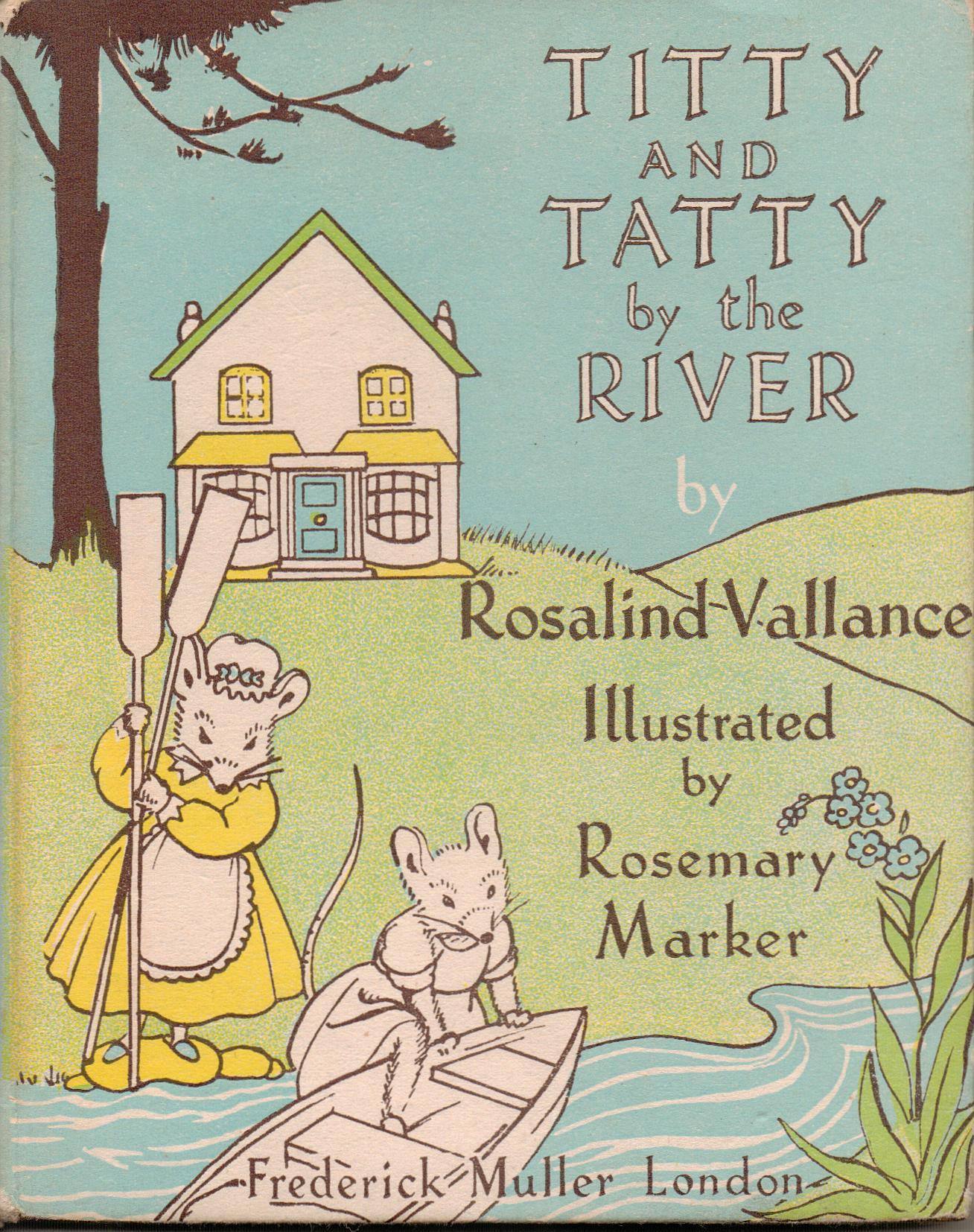
I am told that the real little girl who inspired my character, Titty Altounyan, was given the nickname after reading a horrible story of mousey death entitled Titty mouse and Tatty mouse’  from English Fairy Tales by Joseph Jacobs.  Her family called her Titty mouse, then Titty for short. People were concerned that I would be teased for being associated with a name like Titty, but I never was. It’s a sweet name. However, it seems Arthur Ransome did not object when the BBC altered it to Kitty in 1962, when Susan George played the part. When the 2016 version of ‘Swallows and Amazons’ was made Titty became Tatty and the press had a field day.

Titty and Tatty book

Our knitted swimming costumes, with their little legs were a real novelty to us. I do wish mine hadn’t been red. It was such a cold, grey day I went blue. I remember the entire crew were clad in overcoats – even parkers with fur lined hoods. Looking back it was silly to have gone ahead with the scene in May. Child cruelty.

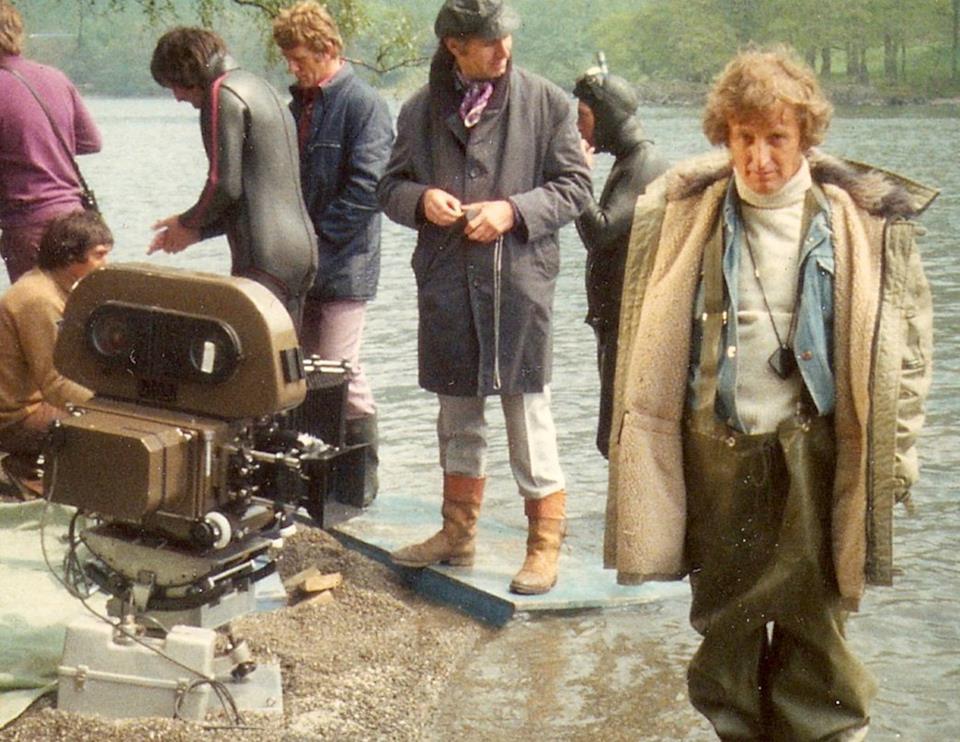
35m Panasonic, Eddie Collins the Camera Operator in (wet suit), Dennis Lewiston the DOP (in cap) Claude Whatham the Director (in waders) on Peel Island, Coniston Water ~ photo: Richard Pilbrow

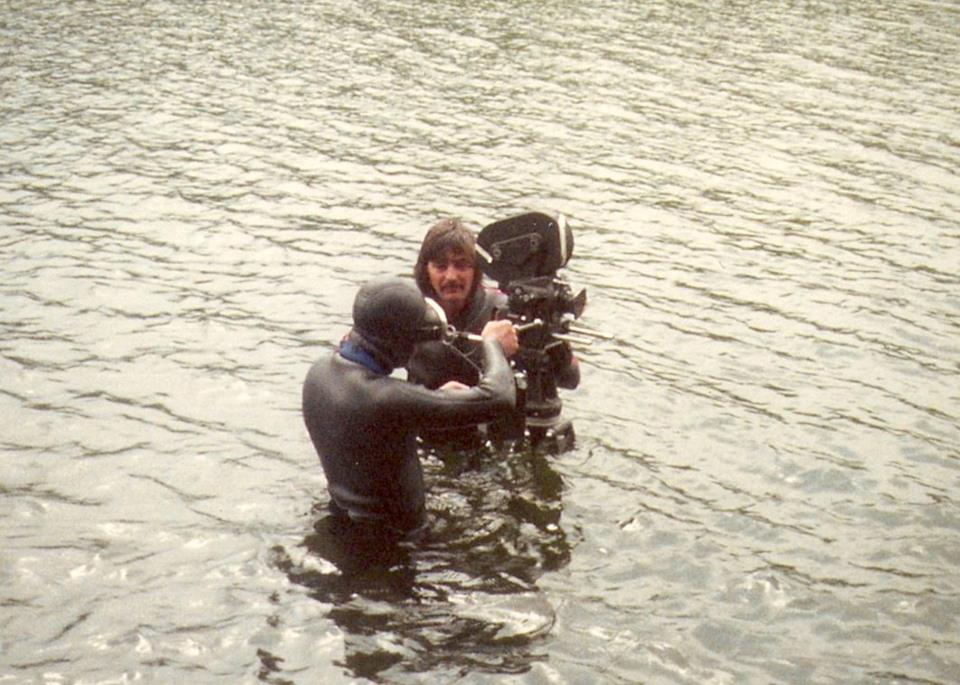
The director, Claude Whatham shot the scene using two cameras. The continuity would have been impossible otherwise. Eddie Collins the camera operator had a 16mm camera in the water with us. He was being steadied by another chap in a full wet-suit. Fitted neoprene was quite an unusual sight back then when divers were known as frogmen.

Filming the swimming scene
Eddie Collins operating the 16mm camera to capture the pearl diving scene ~photo: Richard Pilbrow

Suzanna Hamilton, who played Susan, did well but it simply wasn’t possible to pretend we were enjoying ourselves.  My rictus smile was not convincing. Later on in the summer the Lake District became so hot that we begged to be taken swimming in rivers on our day off. I wish we had re-shot the scene in July with an underwater camera capturing my pearl diving antics. I was a good swimmer. I still love snorkelling – but only in warm seas. As it was, I had to be extracted from Coniston Water by Eddie’s frogman. I’d almost passed out.

Sophie Neville in 1973 attempting to strangle Terry Smith the Wardrobe Master on ‘Swallows and Amazons’

Quite a few people almost learnt how cold we had been for themselves later that day in May. The boats used to ferry us back and forward to the island were blue Dorys with outboard motors. You don’t want to have too much weight in the bows of those boats. Water can come in very quickly.

You can read the whole story here: