The Duchess of Cambridge cooking on a campfire in Cumbria
“The Duchess of Cambridge,” as she was known in March 2013, “showed she was fully prepared when she braved the snowy weather to visit a Scout camp in the Lake District today.”
“Her Royal Highness, who is a volunteer in the Scout Association, joined fellow adult volunteers as they trained to work with Beaver and Cub Scouts at the Great Tower Scout Camp near Newby Bridge in Cumbria. She used her training to help look after a group of Cub Scouts from Cumbria and Manchester taking part in a pack holiday event at the 250-acre activity centre close to Lake Windermere. As part of their programme, the Cub Scouts will get a chance to try outdoor cooking, fire-lighting and tree-climbing under the guidance of The Duchess and the other volunteers.”
According to Claudia Joseph’s biography of Kate ‘Princess in Waiting’, the Duchess is distantly related both to Beatrix Potter and Arthur Ransome. The link is explained by the Daily Mail here
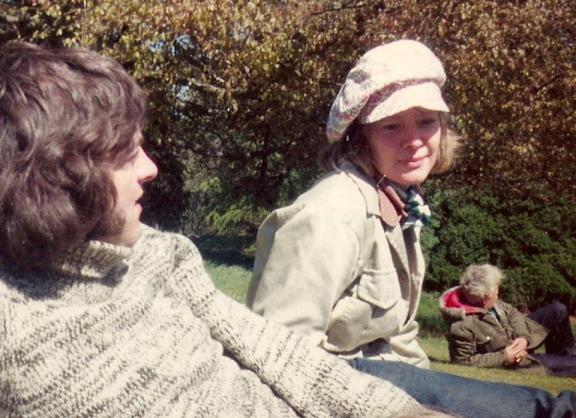
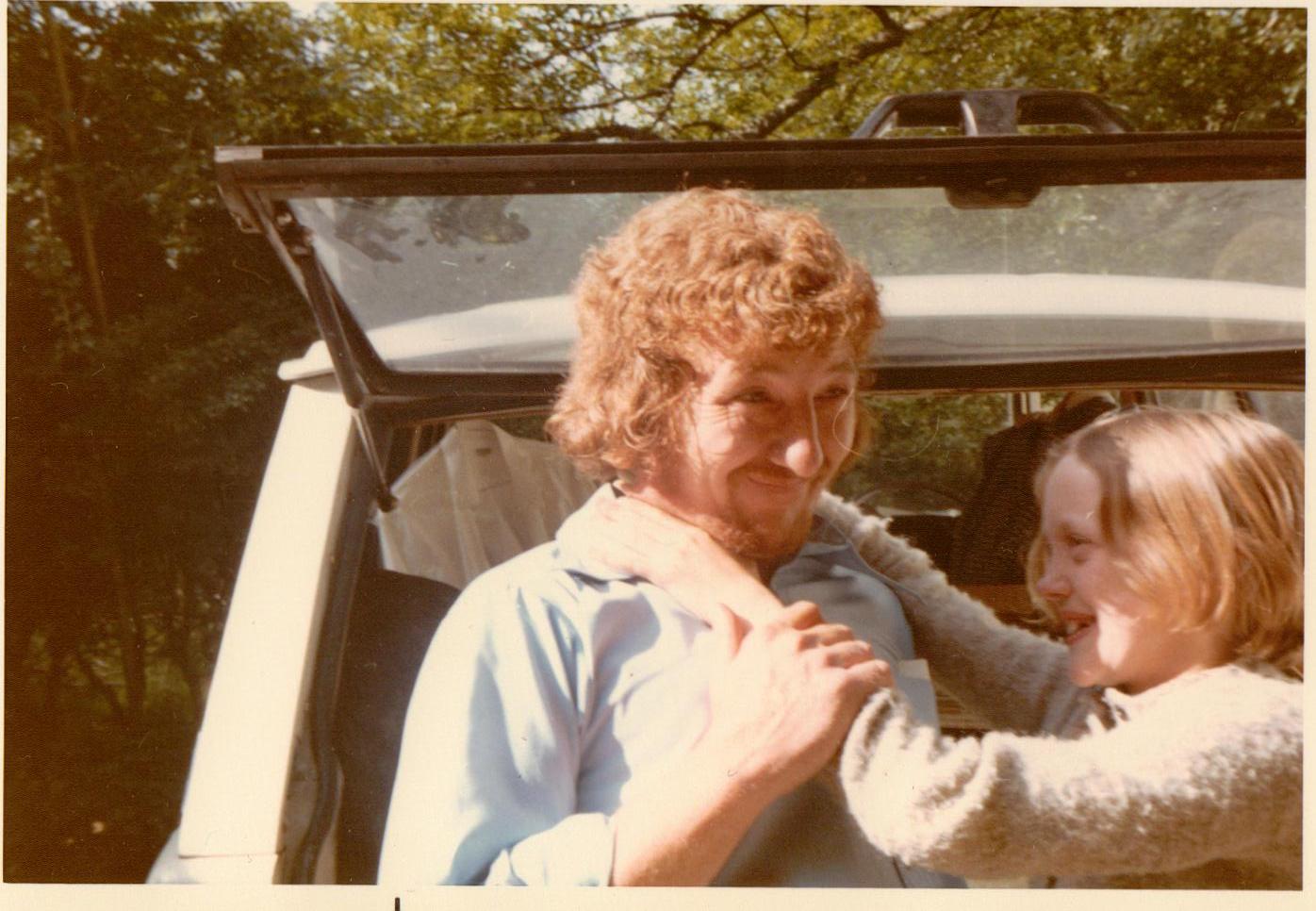
My mother, Daphne Neville wearing a Donny Osmond hat in 1973 on location in the Lake District filming Richard Pilbrow’s movie SWALLOWS & AMAZONS
The Duchess is obviously fond of Donny Osmond hats. My mother wore one on location in the Lake District whilst filming SWALLOWS & AMAZONS (1974) . She can be seen here teaching Lesley Bennett, who played Peggy Blackett,to shoot with a bow and arrow for the scene on Wild Cat Island when the Amazons attack the Swallows who are occupying their camp.
Claude Whatham in Mum’s hat with Brenda Bruce
Our Director, Claude Whatham took a shine to it and would put it on to amuse us, although in this instance he was wearing it for warmth, probably like the Duchess on Friday. Click on the photo above to see me wearing the original purple velvet, 1973 winter season designer version, bought in Carnaby Street. I wear it all the time. It is very useful in this weather.
Peter Walker has found more photos of the Duchess in Cumbria in the Westmorland Gazette ~ she was visiting a scout camp next door to Low Ludderburn where Arthur Ransome wrote ‘Swallows and Amazons’ about a mile above Blakeholme, the island on Windermere he originally envisaged as Wild Cat Island.
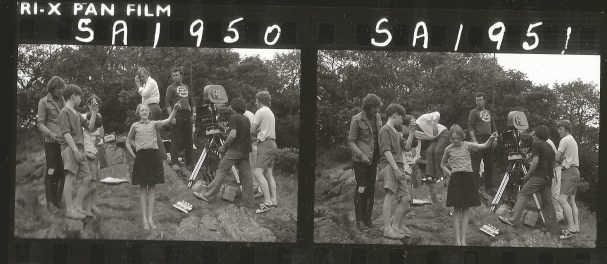
Director Claude Whatham and Bobby Sitwell with Suzanna Hamilton playing Susan Walker and Ronald Fraser as Jim Turner aka Captain Flint in 1973
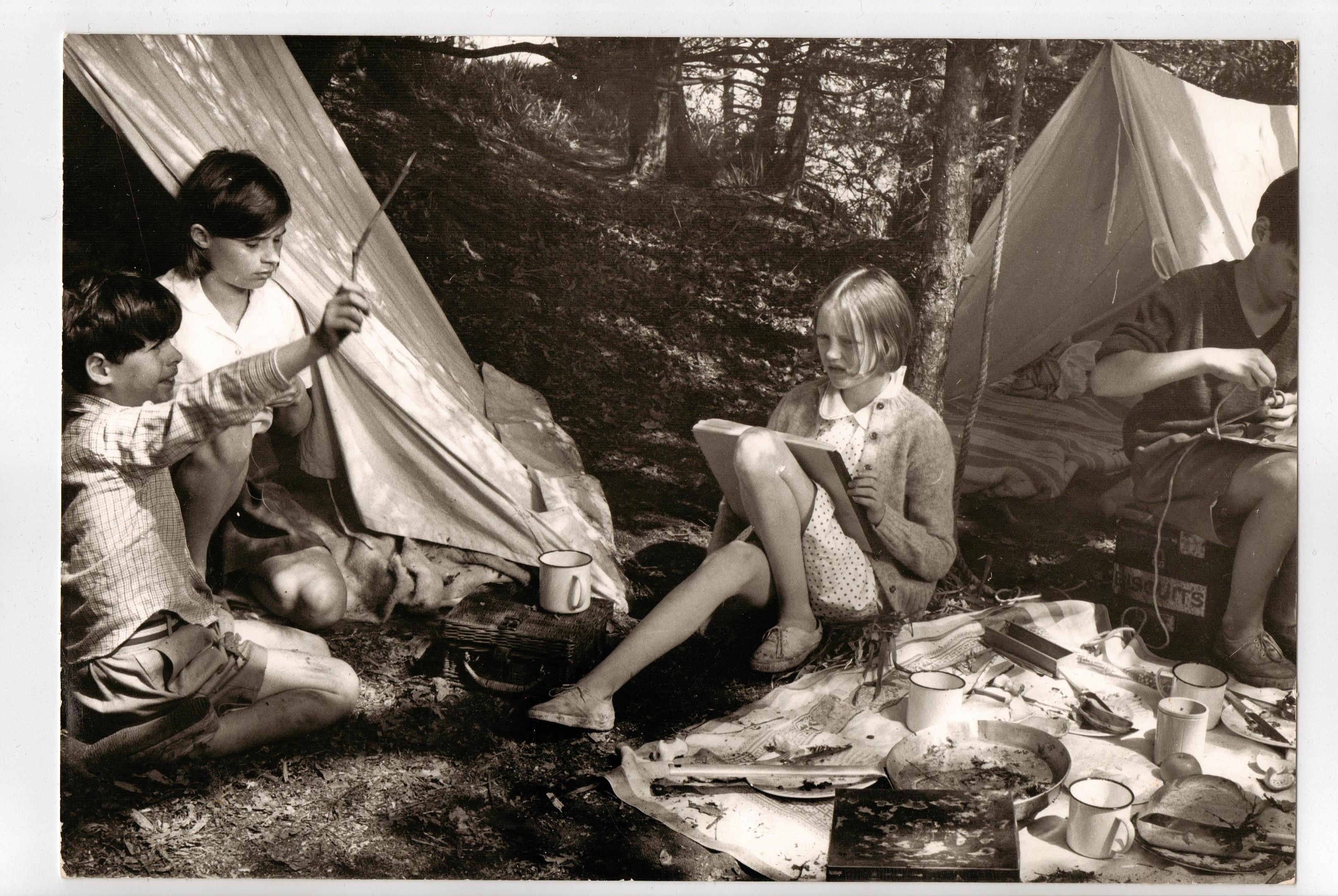
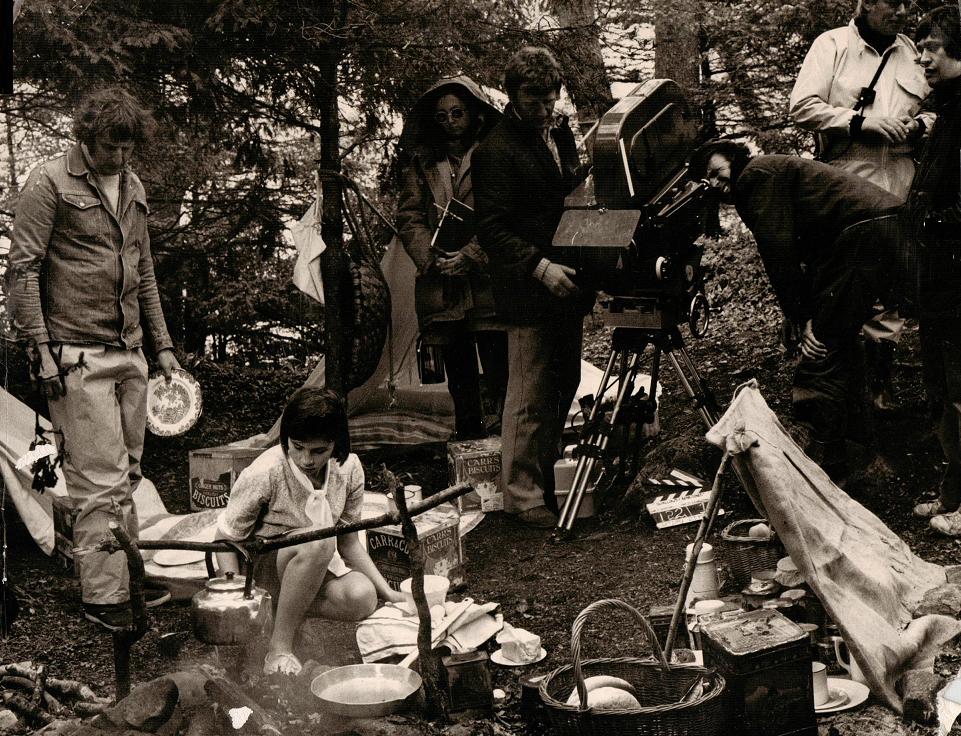
I love this photograph of Suzanna with Claude Whatham and the Bobby the focus puller. It somehow captures the atmosphere of filming on Peel Island back in 1973. I was meant to be sitting on the biscuit tin where I have left my empty cup, but Claude must have been reading my lines as he took Suzanna Hamilton’s close-ups. I was never sure about the blouse she is wearing. We hadn’t heard of Margaret Thatcher at the time but it now seems to be edging a little too close to her style. I doubt if she took inspiration from us but, along with the gym shoes, it’s very much in style now.
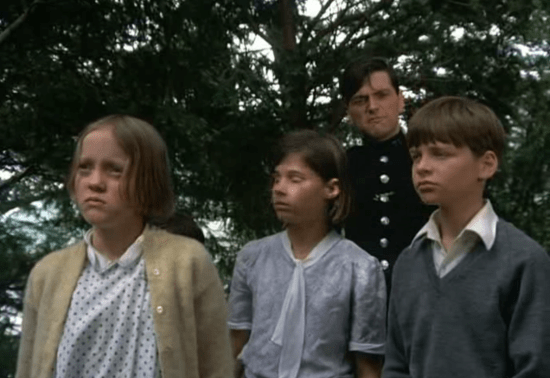
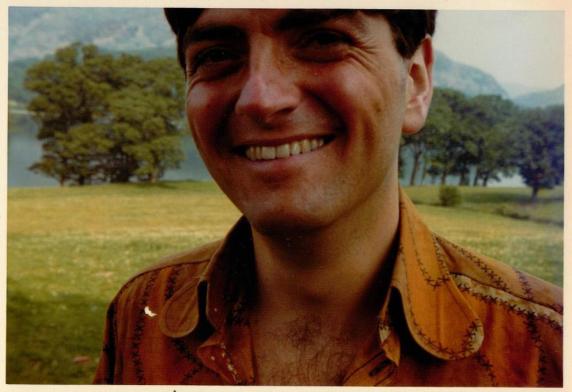
‘It was quite a nice day weather-wise,’ one of the others had noted, but obviously not the solid sunshine needed for the big scenes yet to be shot out on the lakes. However our sailing director David Blagden was back with us, his hair cut short in order to appear in vision as Sammy the Policeman, a part he played beautifully. Although there is a cheerful photograph of him taken straight after he gained a short-back-and-sides we can only find rather a distant and visually confused one of him in uniform at the camp site on Wild Cat Island. He was so desolate to have had his hair cut short that he took off his helmet during the scene to prove that he really had been shorn.
David Blagden as Sammy the Policeman
We were excited that David was on the set, in costume. He’d always been behind the camera before. But he made a very serious Policemen and didn’t let the persona of his character fall whilst he was in uniform.
David Blagden as Sammy the Policeman
What works best in the film is the edit. ‘No more trouble of any kind, ‘ Virginia McKenna insists – and the shot cuts to the boots of a Policemen arriving in camp.
David Blagden who played Sammy the Policman ~ photo: Daphne Neville
It looks as if this was one long scene – but the section where the content of Uncle Jim’s book was discussed while we sipped tea had been shot a week previously when Ronald Frazer first arrived in the Lake District.
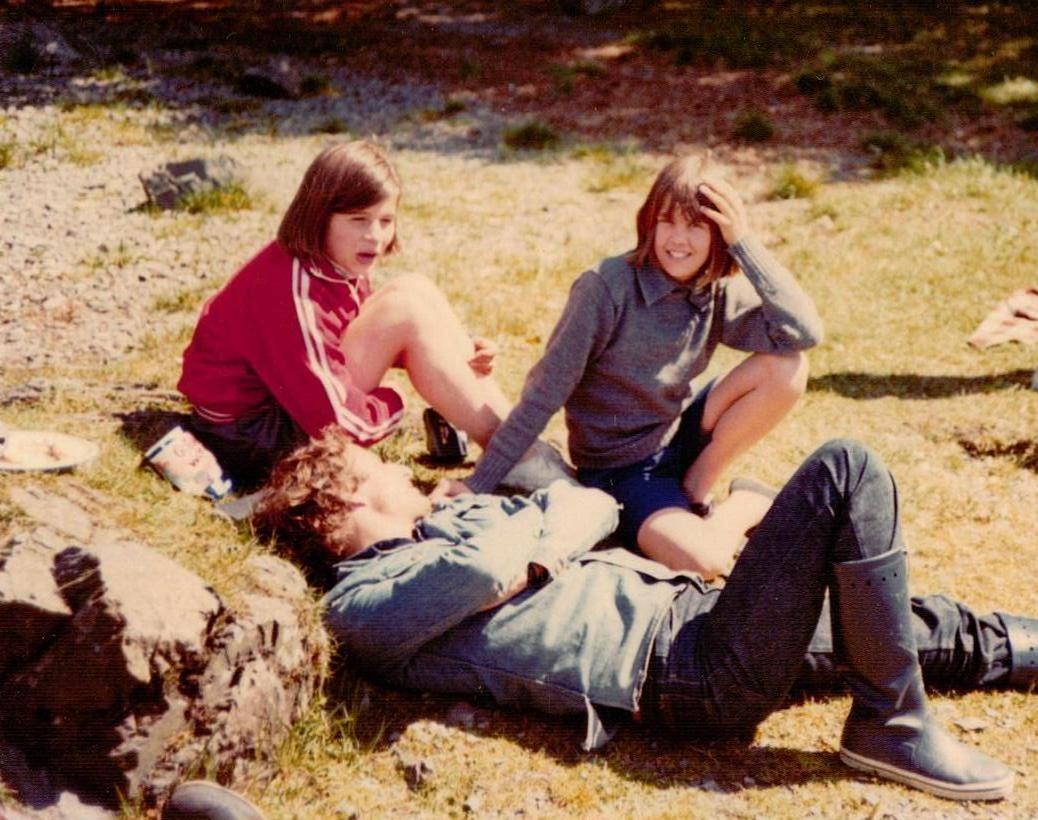
The clapper-loader, Sophie Neville and David Blagden as the Policeman on Peel Island ~ photo: Daphne NevilleDirector Claude Whatham having lunch with his leading ladies, Suzanna Hamilton and Lesley Bennett ~ photo: Daphne Neville
It was a long day, but a happy one. Any secrets? It was really in the scene when John declares ‘a dead calm’ and we decide to visit the charcoal burners that it became apparent that I was taller than my elder brother played by Simon West.
A box was provided for him to stand on so that I look shorter when I run into shot. It was a shot I remember we did in one take – despite being fairly complicated. Everyone was amazed that we moved on so quickly. We needed to.
The Swallows on Wild Cat Island
The pre-occupation of the producer was that, since the bad weather had caused delays, we still had an awful lot to film. We must have been about a week behind schedule – a huge worry for Richard Pilbrow. The next day we just had to get out on the water come what may.
The huge sadness was that David Blagden, so vibrant and good looking with so much to live for, lost his life to the sea in the late 1970s.
David Blagden, the Sailing Director before he had his hair cut to play the Policeman, and my mother Daphne Neville, Chaperone to the six children acting in ‘Swallows and Amazons’
After Swallows and Amazons he presented an ITV series broadcast on Sundays called ‘Plain Sailing’. It featured Willing Griffin the 19′ Hunter in which he’d crossed the Atlantic despite horrific weather in 1972 and the survey of a 39′ wooden boat I think he intended to take on another crossing. Apparently he set off in this yawl from Alderney in a Force 11 gale and was never seen again. The harbour master had begged him not to go. They found his girlfriend’s body and parts of the boat but there was no trace David.
The cover of ‘Very Willing Griffin’ by David Blagden. ‘An exciting adventure of pursuing and living a dream against many odds’, this sort after book was reviewed in The Journal of Navigation. His obituary in a school magazine is desperately sad. It was posted on the Arthur Ransome Group Facebook page.
You can read more in ‘The making of Swallows and Amazons’ published by The Lutterworth Press and available online or from Waterstones
Suzanna Hamilton as Susan with Sophie Neville as Titty busy writing the ship’s log
Something very exciting happened last week. Suzanna Hamilton came to see me, bringing the photographs that she was given during the filming of Swallows and Amazons along with a bundle of papers. I immediately recognised the blue bound diary that she had kept. Her God-given sense of humour fills the pages.
Although Titty was the one who always kept the ship’s log in Arthur Ransome’s stories, we children all kept journals during the filming as part of our school work. It was quite a task.
Suzanna’s diary gives the story of making the film of Swallows and Amazons from the perspective of an actress, the actress she was then and ever more will be. Even before we began filming she was getting as excited as Susan about grog and molasses, calling us by our charcter names as Claude Whatham suggested.
Anna Scher ran the most wonderful children’s theatre club in Islington, which Zanna went to after school, along with Pauline Quirke and Linda Robson. I visited Anna Scher’s Theatre Club ten years later when I was casting children for the BBC drama serial of ‘Coot Club’ and ‘The Big Six’. Although I didn’t find anyone there who could sail I held Anna Scher in huge admiration and respect, using her exercises when I was auditioning kids in Norfolk. She did so much for the young people of east London, giving children confidence with self-discipline aquired during their drama lessons and workshops.
David Wood, who wrote the screenplay of Swallows and Amazons, was already well known as an actor. Mum was rather in awe of him since he had played Johnny in Z Cars and had starred the feature film ‘If…’ alongside Malcolm McDowell. He had been a storyteller on the BBC Childrens Television programme we all adored called Jackanory. Suzanna had been involved in the same series when E.Nesbit’s ‘The Treasure Seekers’ had been read. She had also appeared in ‘The Edwardians’ form the book by E.Nesbit directed by James Cellan Jones in 1972. By coincidence Pauline Quirke played Eliza in ‘The Story of the Treasure Seekers’ in 1982 and I worked with her a few years later on Rockliffe’s Babies. My mother appeared in a pantomine David Wood wrote called The Gingerbread Man when it was produced at The Everyman Theatre in Cheltenham. She wore red with a pill-box hat as Miss Ginger.
Suzanna Hamilton playing Susan Walker with Stephen Grendon as Roger Walker camping on Peel Island, Coniston Water in Cumbria, the Lake District
You can read more in the ebook ‘The Secrets of Filming Swallows and Amazons (1974) available from Amazon Kindle and all ebook retailers.
‘Here we are, intrepid explorers making our way into uncharted waters. What mysteries will they hold for us? What dark secrets shall be revealed?’
The dark secret was that the inky black night scenes had to be shot in Mrs Batty’s barn. At Bank Ground Farm. During the day. A rainy day.
The design team strung up thick light-proof drapes and made the dusty out-building into a studio. The director, Claude Whatham had no choice. We had quickly run out of interior scenes and the weather was so bad that we could do little else.
Producer Richard Pilbrow with director Claude Whatham in their wet weather gear on Peel Island, Coniston Water
‘While the rest of England melted in a heat wave, the Lakes seemed wrapped in mist and rain,’ Richard Pilbrow the producer remembers. I have a press cutting from The Guardian dated 7th July 1973, which opens with the words:
‘THE WEATHER report follows in half a minute. Richard Pilbrow is obsessed with the weather. Every morning he wakes around 4 o’clock and crosses his room at the Kirkstone Foot Hotel to cock a weather eye at the sky above Wansfell Pike. Most mornings it is the same story… Pilbrow looks out of the window. Raining. ‘
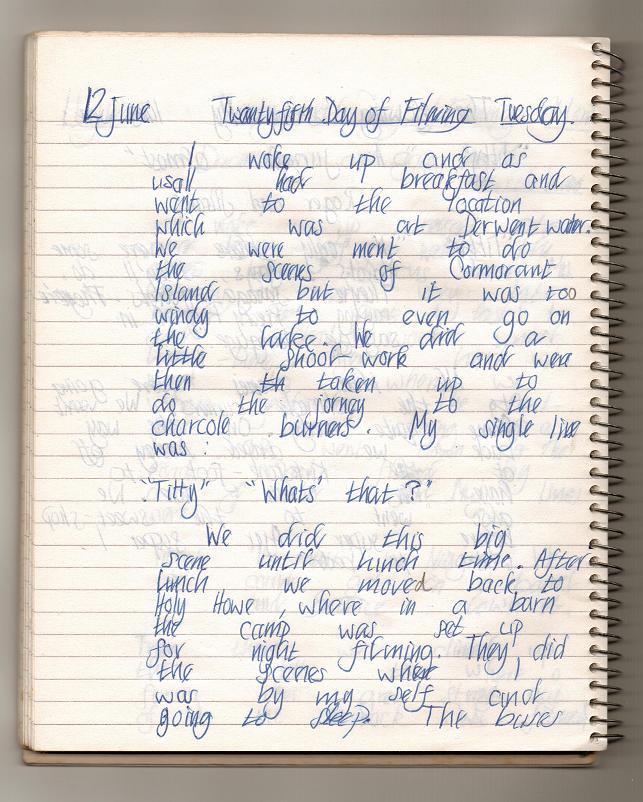
What a worry and concern that rain was. Swallows and Amazons is firmly set in an idyllic childhood summer, August of 1929, when the water was warm enough to swim daily and the only disappointment was a total lack of wind. When we arrived to start filming at Derwentwater on 12th June 1973 it was too windy to even go out on the lake.
I loved filming in the barn. The Third Assistant, Gareth Tandy, lead me through the high wooden doors and into a magical version of our camp on Peel Island, beautifully recreated by Ian Whittaker the set dresser. A real camp fire was burning. Blankets (goatskins in Titty’s imagination) and pillows from our tents had been laid out so that I could be ‘shrouded in my cloak’ whilst waiting up for the Swallows to return from the Amazon River. The scene was beautifully lit with branches held in stands in front of the lights with a gentle wind produced by the prop men wafting a board to lift my hair at the right moment. I don’t think there was an owl hoot for me to hear. I had to imagine that so they could add a real owl call later. Someone has written in to ask if I learnt how to make an answering hoot. I’m afraid not. I tried and tried. I still can’t. John could do it but Claude asked us both to just pretend so that he could lay the sound on afterwards.
Director Claude Whatham with his cast of Swallows in 1973
What we gained, despite or perhaps because of the weather, was a camaraderie that formed a foundational basis to the film. We had to be stoic and get on with filming despite getting cold and wet. Rain doesn’t show up on screen unless it is really pelting down. You can see the effects – wet hair and soggy costumes, but you actually have to use rain machines if you want to show rain in a drama. We could film our trek up the hill to visit the charcoal burners without a problem but going out on the lake was impossible. You’d have seen the rain drops falling on the water. And it was too windy. As it was, we had a brilliant director of photography who used what light he had to capture that limpid quality you find in the Lakes, so quintessentially English it draws you in, reeling back to childhood days when we had time to make camps and rush about in the woods.
Suzanna Hamilton, Sten Grendon, Sophie Neville and Simon West in a scene cut from the film
I’m pretty sure that the big scene I referred to was one that was cut from the final film. It was about leaving paterrans in the woods, as detailed in the books but not essential to the story. It must have been covered by the journalist from the Guardian as I found this cutting:
The rain did deter my mother from taking photographs. She didn’t have a flash to use in the barn but she took lots – masses – the following day…
Dressed for the Cumbrian weather: Daphne Neville with Liz Lomas, Richard’s assistant at Theatre Projects in London ~ photo: Richard Pilbrow
Other scenes that hit the cutting room floor are detailed here
If you would like to read more, ‘The Secrets of Filming Swallows and Amazons’ is available as on Amazon Kindle and other ebook platforms.
Peel Island on Coniston Water in the English Lake District whilst we were filming ‘Swallows and Amazons’ in the summer of 1973 ~ photo: Martin Neville
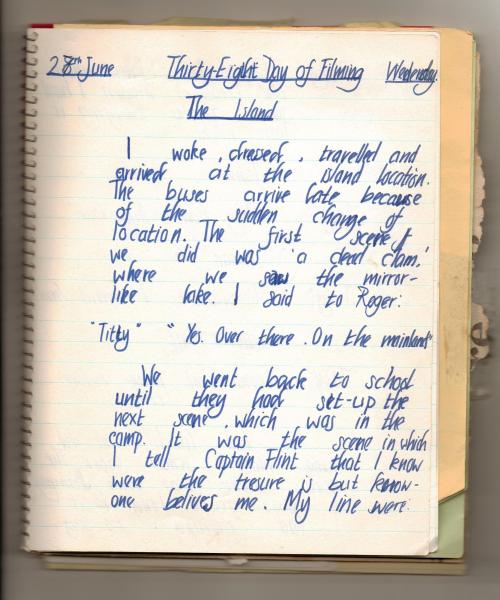
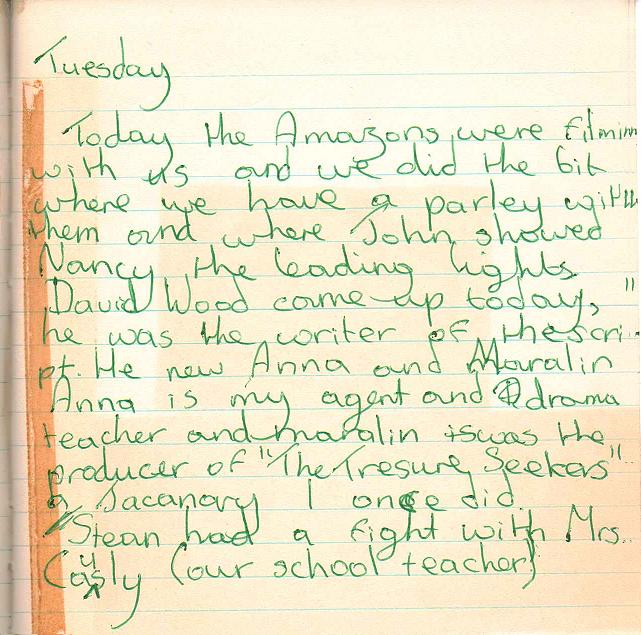
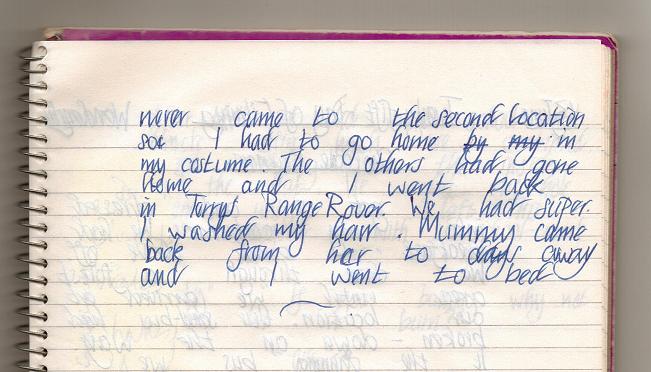
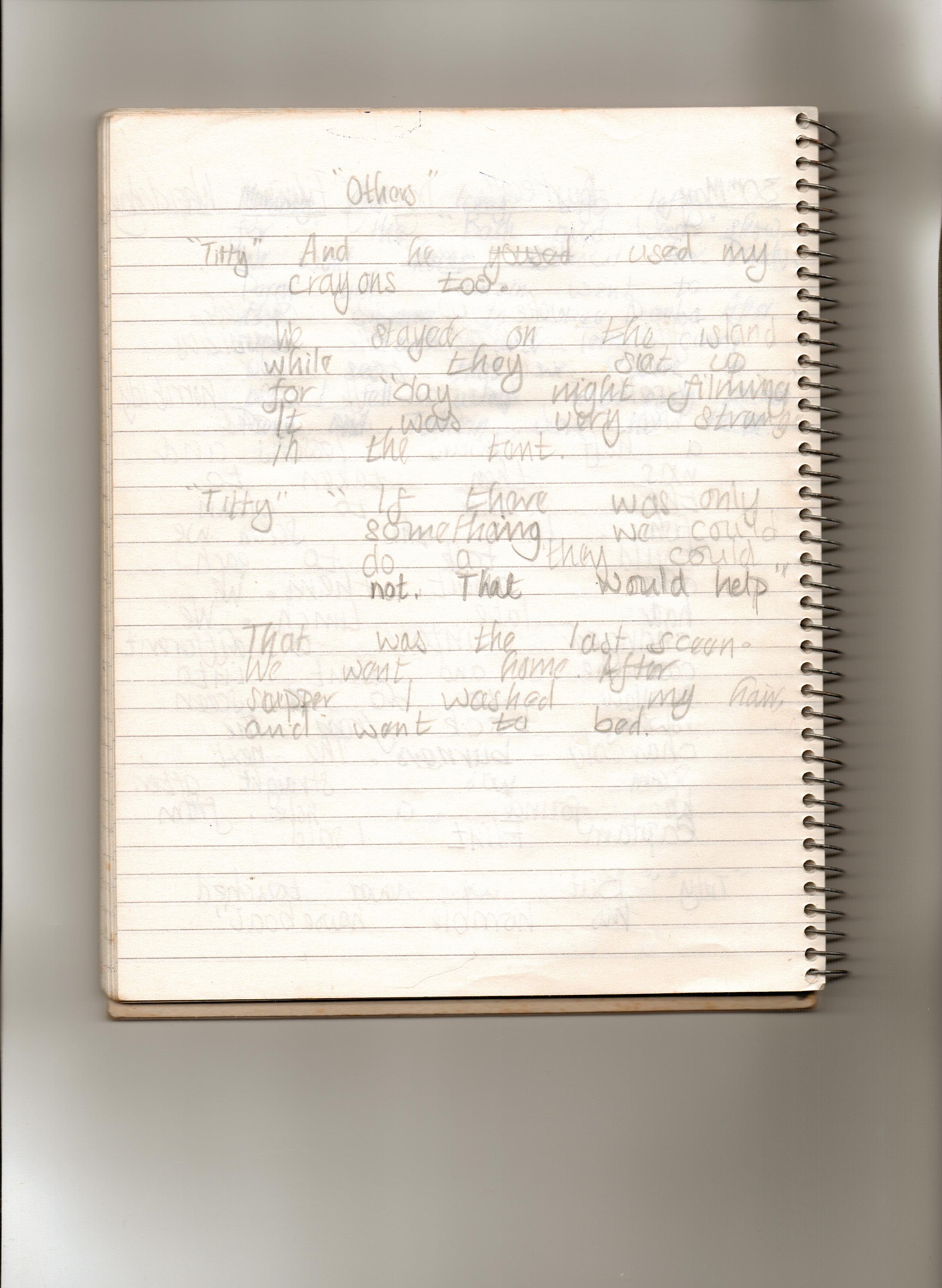
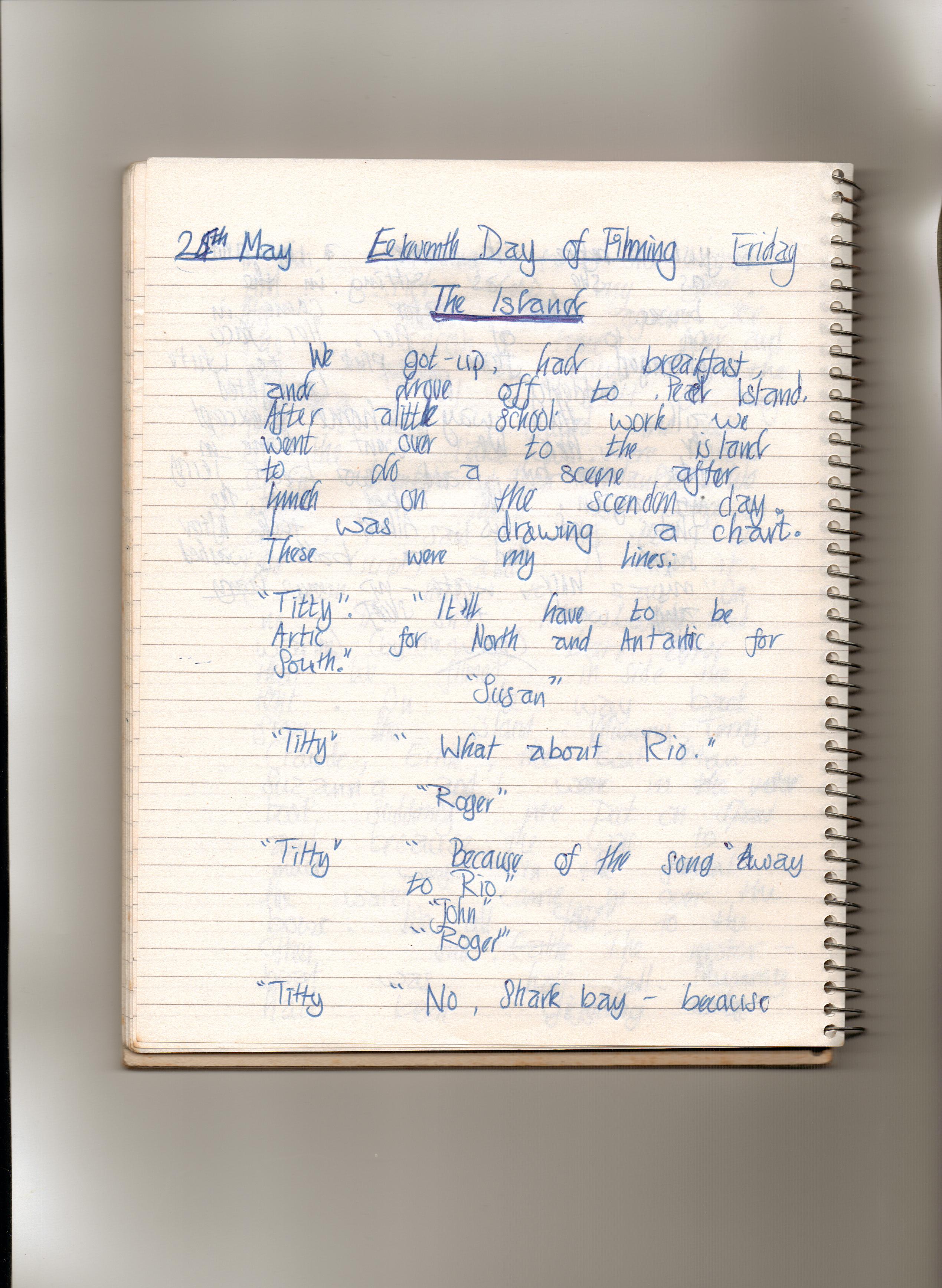
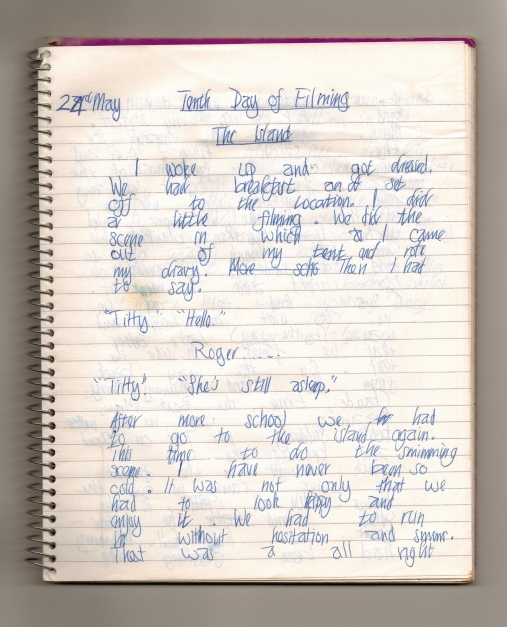
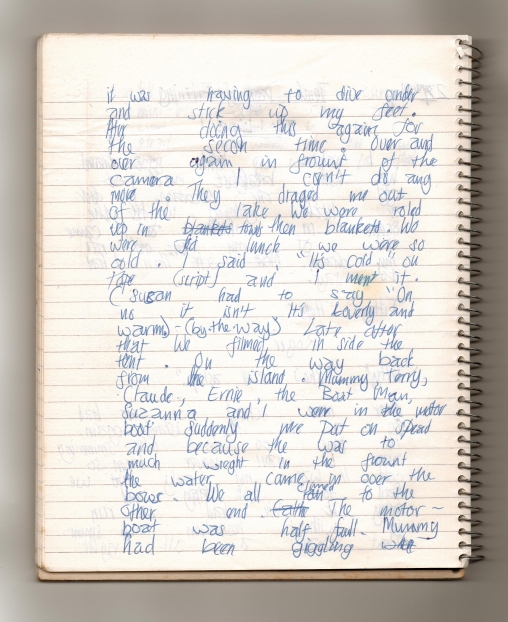
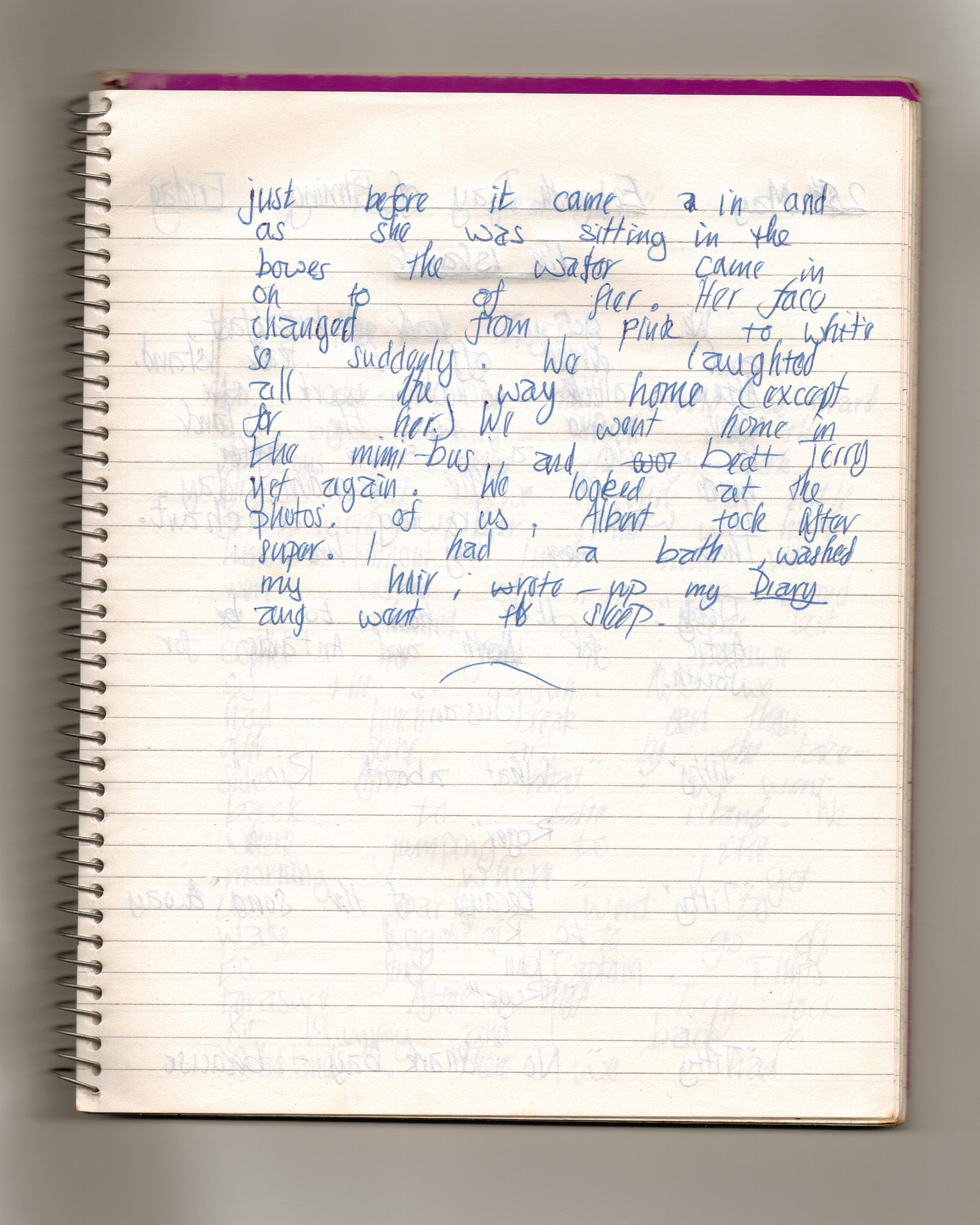
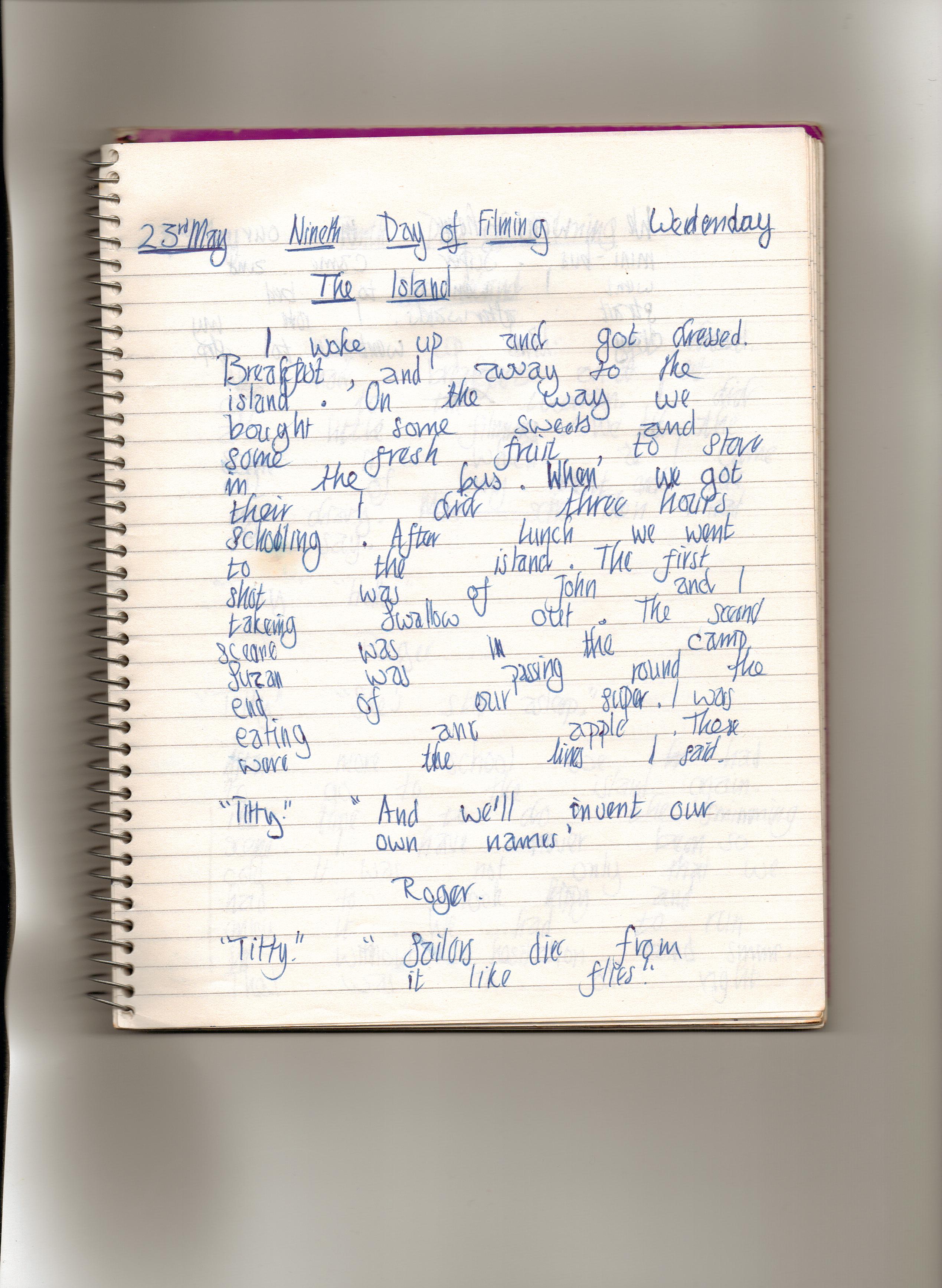
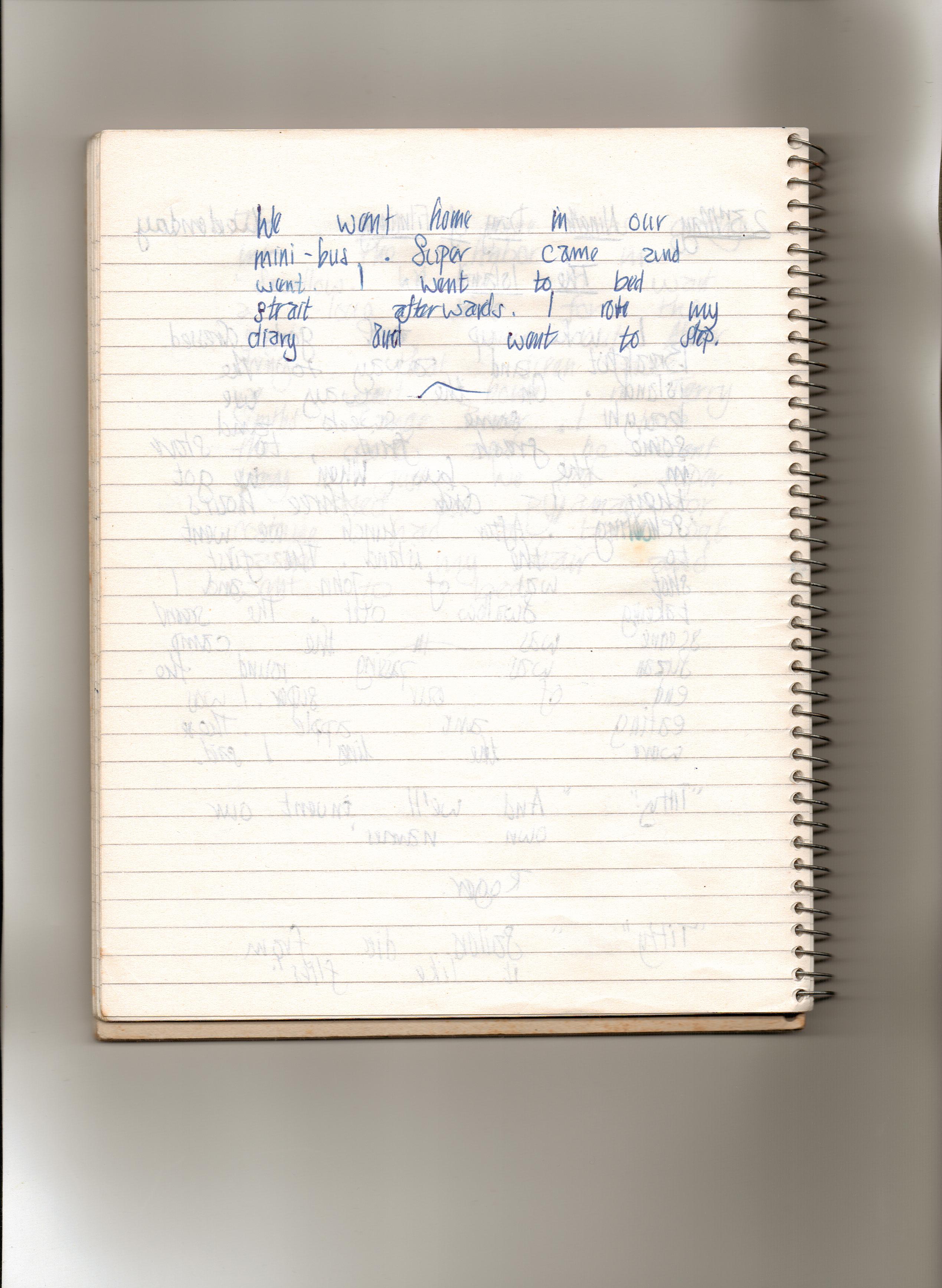
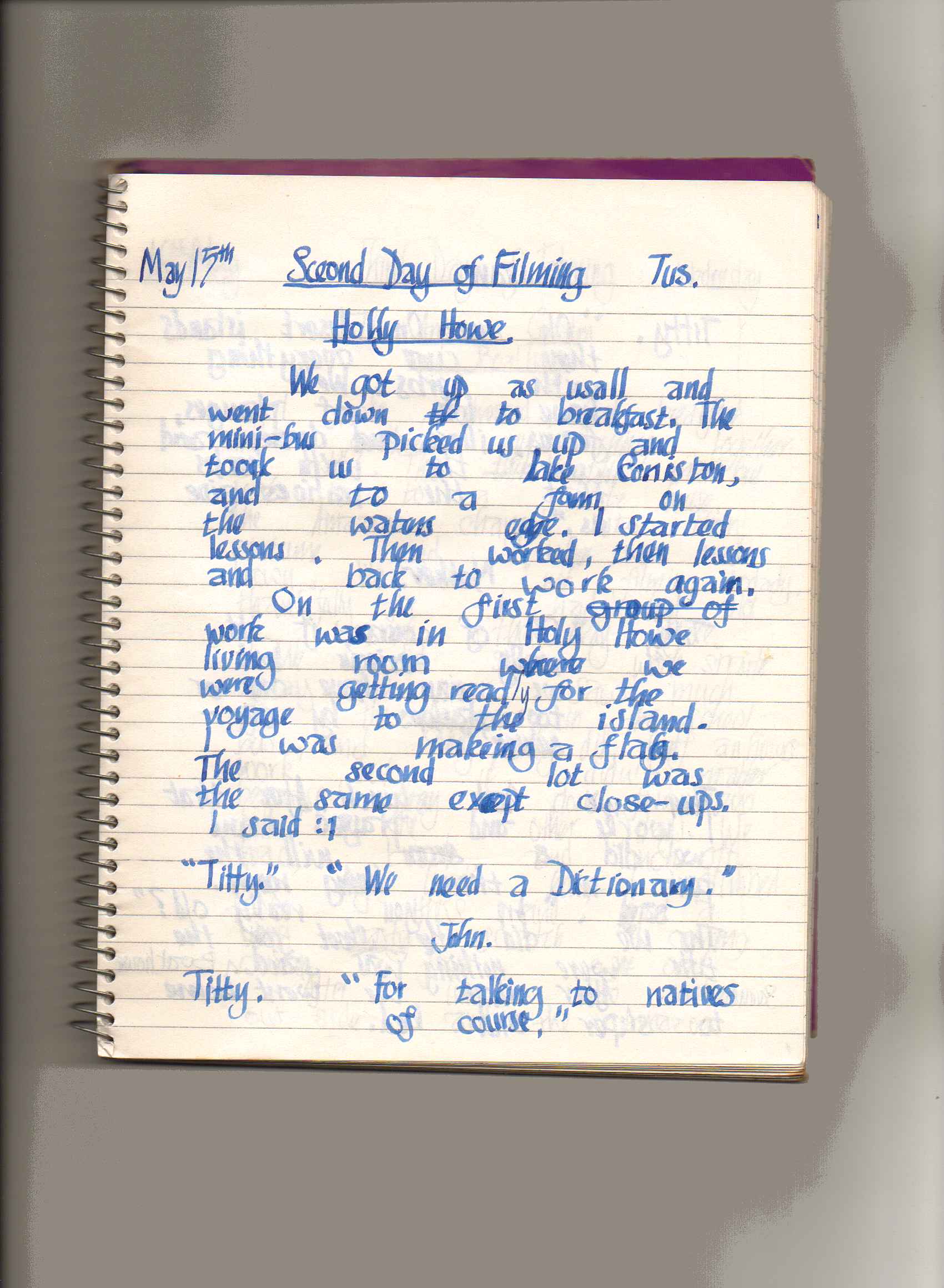
An extract from the journal I kept aged twelve:
Stephen Grendon, Suzannah Hamilton and Sophie Neville on the cover of the LP of the film ‘Swallows and Amazons’
I must have lost my pen on this wet day in May 1973, for the diary on the making of the film ‘Swallows & Amazons’ is written in pencil. I don’t know if Claude Whatham, the Director, ever remembered me writing but when the film ended he kindly sent me an engraved Parker pen and propelling pencil. I loved the pen and wrote all my essays at university with it. Sadly I lost it just before my Finals but I still have the pencil. Somewhere.
Although we had a late start it was a good day, a day when Claude encouraged us to improvise. The dialogue in the little scene when we were gutting fish is our own. I’ve always thought improvisation can be magical. When I started to direct at the BBC we were very conscious of the cost of film stock – the footage – so were reticent about taking chances, but I made a drama on school bullies that turned out to be very powerful, purely because I let the children improvise. The only problem was that it came across as almost too frighteningly real. I found that although short scenes worked well, I had to write the story as a whole as I went along, which was a bit daunting. When I went on a BBC Studio Director’s Course I tried improvising a scene where a couple go camping in true Mike Leigh style. I asked the actors to erect a tent in the studio, and left them at it while I spoke to the cameramen via inter-com with the vision-mixer at my side. She also improvised. The scene was to end with the couple going inside the tent, which then collapses on top of them. I used a dome tent of my own and I showed them just how easy it was for them to collapse it. It was quite fun, and worked surprisingly well. Up to a point. The problem was that I was working with actors and the actors, being actors, enjoyed themselves so much they didn’t want the scene to end. It nearly didn’t end at all. And I ended up with the longest studio show reel of all time.
Sophie Neville, Suzanna Hamilton, Stephen Grendon, Lesley Bennett and Kit Seymour with David Blagden on Peel Island on Coniston
Suzanna Hamilton was very good at gutting fish. She is not a remotely squeamish person, in fact she loves snakes and other reptiles. A stoic, who would valiant be ’gainst all disaster, she is probably the most gutsy film actress there is. No fuss or over long scenes for her.
I was more interested in examining the the high dorsal fin of the perch and could have spent all morning standing on the rock. I seem wired to illustrate stories. I am sure Arthur Ransome used a line drawing of one of the perch he caught. Is it in Swallows and Amazons?
Claude Whatham, the Director of ‘Swallows and Amazons’, on the shore of Coniston Water ~ photo: Daphne Neville
Claude did not shoot many ‘takes’. His aim was to get fresh performances. By this time he had started to film the rehearsal, and then one ‘take’ as a back-up, to give the film editor an option. Then he would change the camera angle. It is probably a good policy when filming with children – as charm is difficult to replicate. When I started to direct on Beta-cam I attempted to shoot quite long scenes on one shot by using ‘jib-arms’, small cranes or camera track to move the camera. This was all the rage in the late 1980s. I remember using one long shot for the opening scene of a comedy drama called Thinkabout Science that starred Patsy Bryne ~ she who had become known to the nation as Nursie in the BBC sitcom Blackadder.
‘Thinkabout’ with Patsy Byrne
Patsy played a grandmother collecting two sisters and their friends from school. The children poured out of the front door, down some steps, met their granny and chatted to her as they skipped along the pavement. I had about 120 metres of camera track laid down the street, far more than any scene on Swallows and Amazons. We had a rehearsal and shot the three minute scene. It worked perfectly. It was fresh and funny and active. I was all set to move the whole crew to the next location when my producer descended from the Scanner, a truck where she was watching on three monitors, to tell me that one of the Extras had waved at the camera. I should have recorded the rehearsal. After that, it took us twelve more takes to get the scene right. Luckily Beta tape costs were negligible – certainly in comparison with the 35mm Technicolor stock that Claude was using.
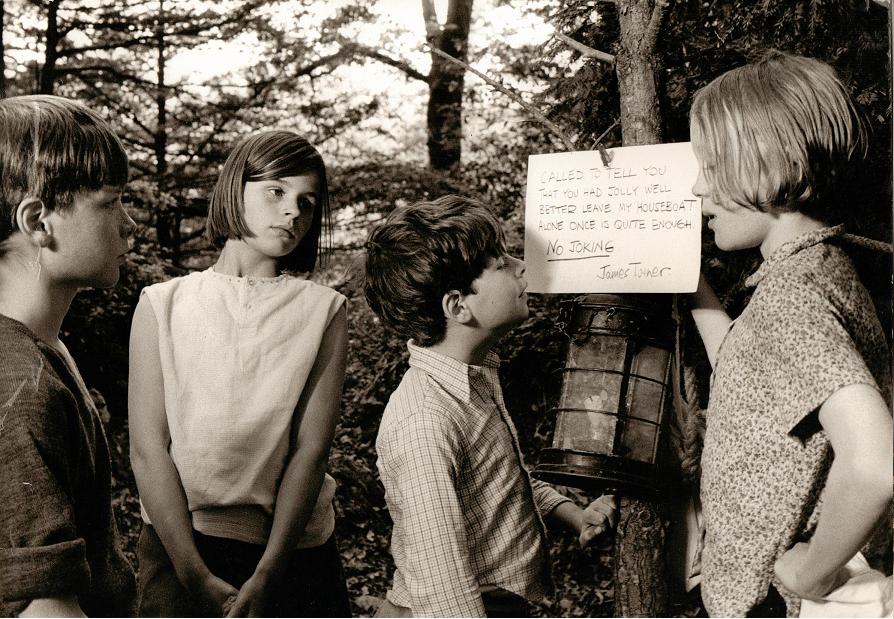
Richard Pilbrow must have been pleased to hear that we gained a reputation as ‘One take Wonders’ on Swallows. When it came to the scene when we returned to the camp to find the abrupt note from Captain Flint, Claude took me to one side and suggested I added a line of dialogue at the end when it came to the take, without letting the others know. He told me to say, ‘And he used my crayons too.’ I wish he had edited it out. I didn’t deliver the line well. I think Suzanna would have said it perfectly but the secret made me too self-conscious.
Simon West, Suzanna Hamilton, Stephen Grendon and Sophie Neville in ‘Swallows and Amazons’ filmed on location in the English Lake District in 1973
I did not know it at the time but Titty’s chart had a profound influence on my life.
I loved drawing the map. I had prepared it earlier with Simon Holland, the Art Director, and always regret pressing too hard. If you look very carefully you can see that I had already written ‘Rio’ and rubbed it out, only to write Rio again when it came to the take. I also wish that I had been taught the song Away to Rio before this scene as I would had said that line differently. Never mind.
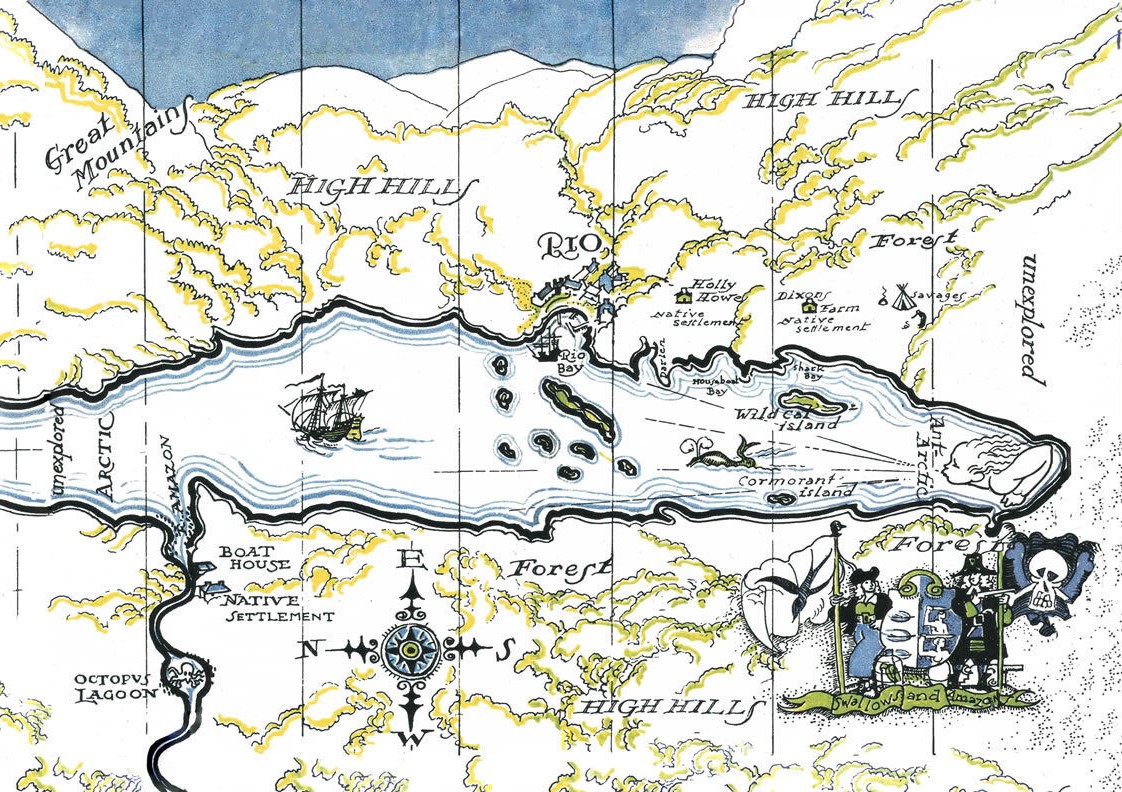
The map on the end papers of Arthur Ransome’s book of Swallows and Amazons, originally drawn by Steven Spurrier, is an inspiration to millions. I’ve gazed and gazed at it.
When I grew up and went to university, I took a course in cartography that was to stand me in good stead. In the spring of 1992, I migrated to Southern Africa with the swallows and soon started drawing decorative maps.
I added small pictures of settlements, trees, animals, and always a compass with a black and white border to give the scale. In the process I was able to explore the most wonderful country. Most of my commissions have been of game reserves or great swathes of Africa.
A map by Sophie Neville depicting the area around Macatoo Camp in the Okavango Delta in Botswana where you find wild parrots
Some have been for charities such as Save the Rhino Trust, others for books, others for marketing holidays.
They all gave me the excuse to go on living a Swallows and Amazons life, camping in wild places and exploring wilderness areas – uncharted territory.
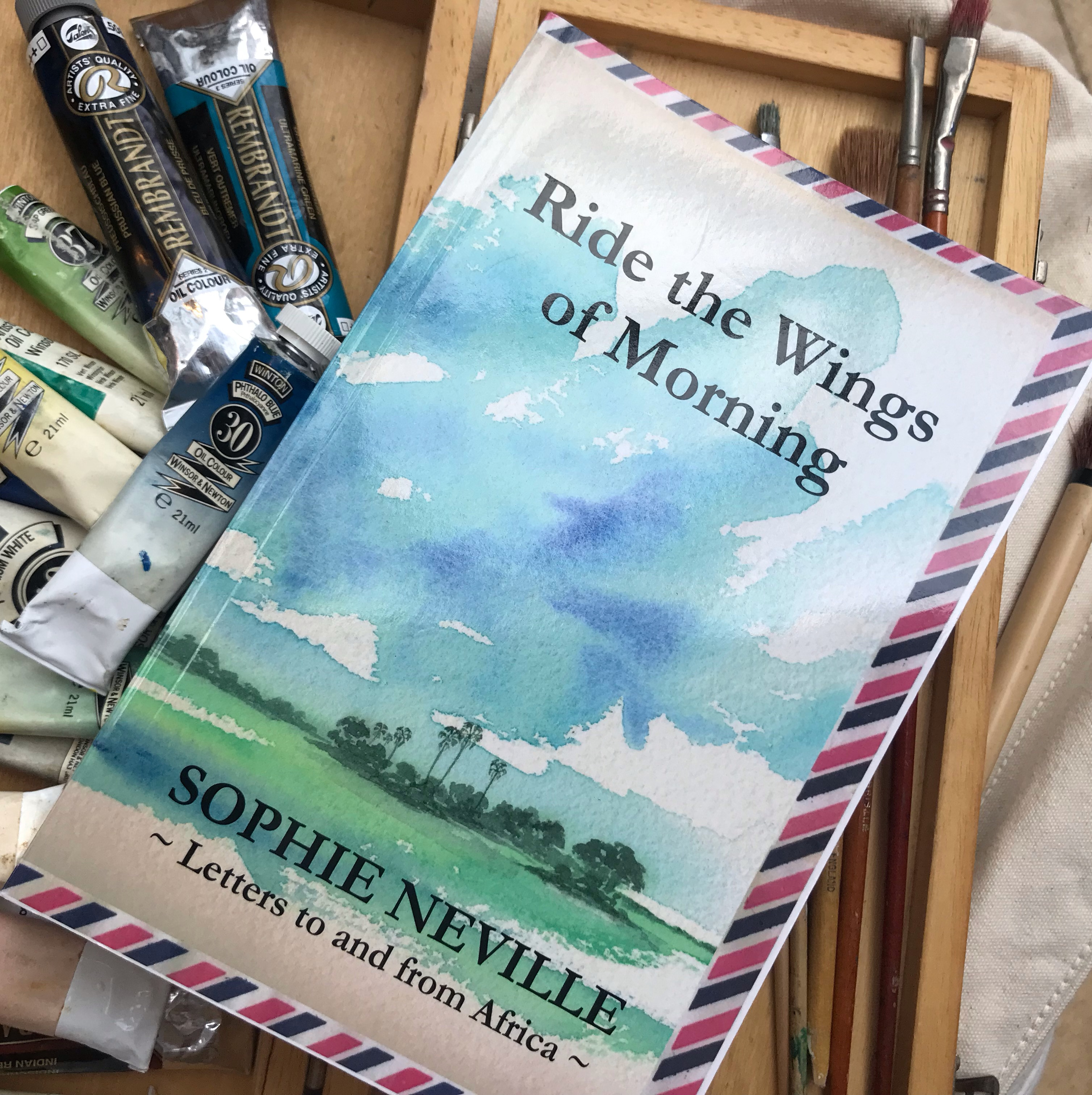
As I expect Titty would have done, I have been writing about these maps and the adventures I had in making them, putting everything together in an illustrated travel book call Ride the Wings of Morning.
I have a couple of very early maps in my first book Funnily Enough. These were just sketched in my diary but one is of Windermere, where I went with my father and the Steam Boat Association, so should be of interest to Arthur Ransome enthusiasts.
A map of Windermere sketched in Sophie Neville’s Diary of 1991 published as the book ‘Funnily Enough’
I have since reproduced some of my own Swallows and Amazons maps on mugs, t-shirts and other items that make useful presents. You can find a selection here.
Mugs printed with maps used to illustrate Sophie’s books
I used this map of the Swallows and Amazons locations on the front of the ebook on how we made the film, which has more within. It sells for about £2.99:
Sten Grendon as Roger Walker being taught to swim by Suzanna Hamilton playing his elder sister Susan Walker on location at Peel Island on Coniston Water in 1973
“…it was really horrible,” I told Tim Devlin, of The Times. “We had to run into the water and enjoy it. It was icy. I had to try to be a cormorant with my feet in the air. Then I had to step water as Susan taught Roger to swim. We were in for about three minutes and they had to do two takes of the scene. It was horrible.” This was the day when we shot the swimming scenes ~
The first scene of the day was actually was the one when Titty emerged from her tent in her pyjamas, wiped the dew off the top of a large biscuit tin and started writing her diary. I always regret writing Titania Walker on the cover but I had been contracted to play the part of TITANIA WALKER. My mother, Daphne Neville, who is quite theatrical, loved Shakespeare’s Midsummer Night’s Dream and encouraged me to write out the full name, but I do wish I had simply labelled by notebook ‘Ship’s Log’.
Suzanna Hamilton playing Susan with Sophie Neville as Titty busy writing the ship’s log
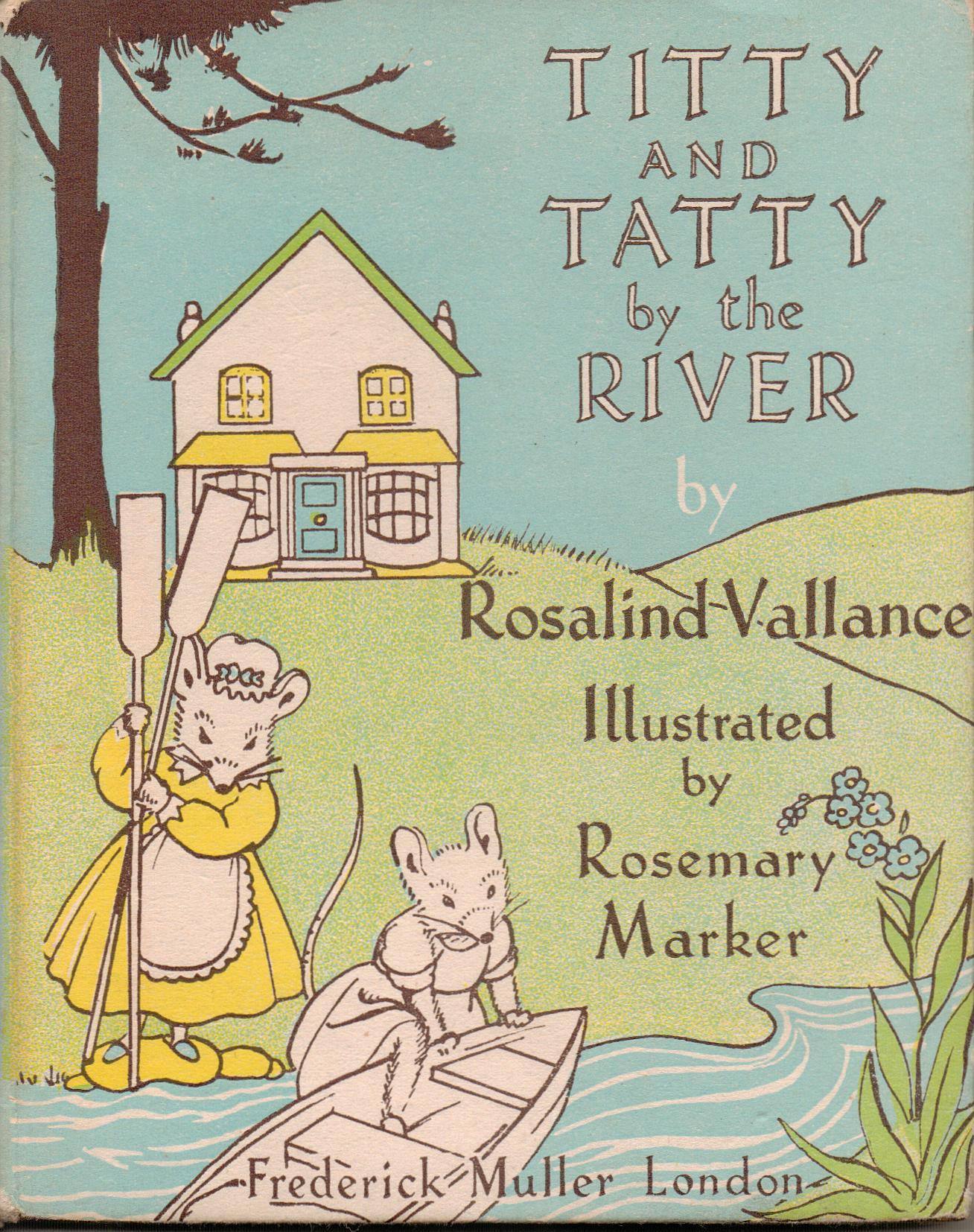
I am told that the real little girl who inspired my character, Titty Altounyan, was given the nickname after reading a horrible story of mousey death entitled ‘Titty mouse and Tatty mouse’ from English Fairy Tales by Joseph Jacobs. Her family called her Titty mouse, then Titty for short. People were concerned that I would be teased for being associated with a name like Titty, but I never was. It’s a sweet name. However, it seems Arthur Ransome did not object when the BBC altered it to Kitty in 1962, when Susan George played the part. When the 2016 version of ‘Swallows and Amazons’ was made Titty became Tatty and the press had a field day.
Our knitted swimming costumes, with their little legs were a real novelty to us. I do wish mine hadn’t been red. It was such a cold, grey day I went blue. I remember the entire crew were clad in overcoats – even parkers with fur lined hoods. Looking back it was silly to have gone ahead with the scene in May. Child cruelty.
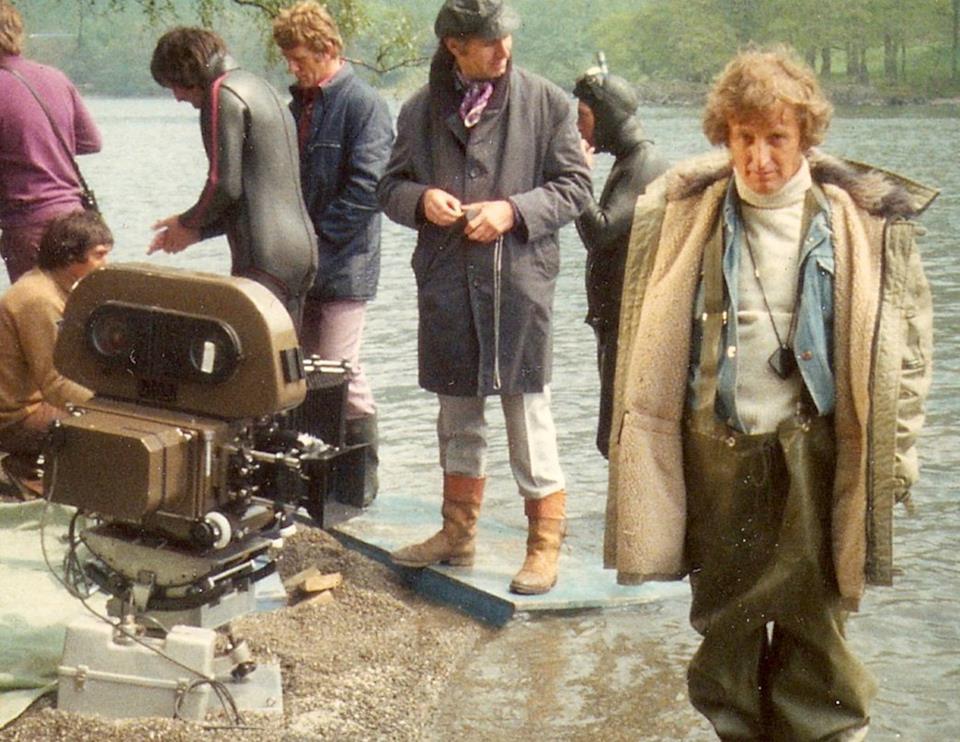
35m Panasonic, Eddie Collins the Camera Operator in (wet suit), Dennis Lewiston the DOP (in cap) Claude Whatham the Director (in waders) on Peel Island, Coniston Water ~ photo: Richard Pilbrow
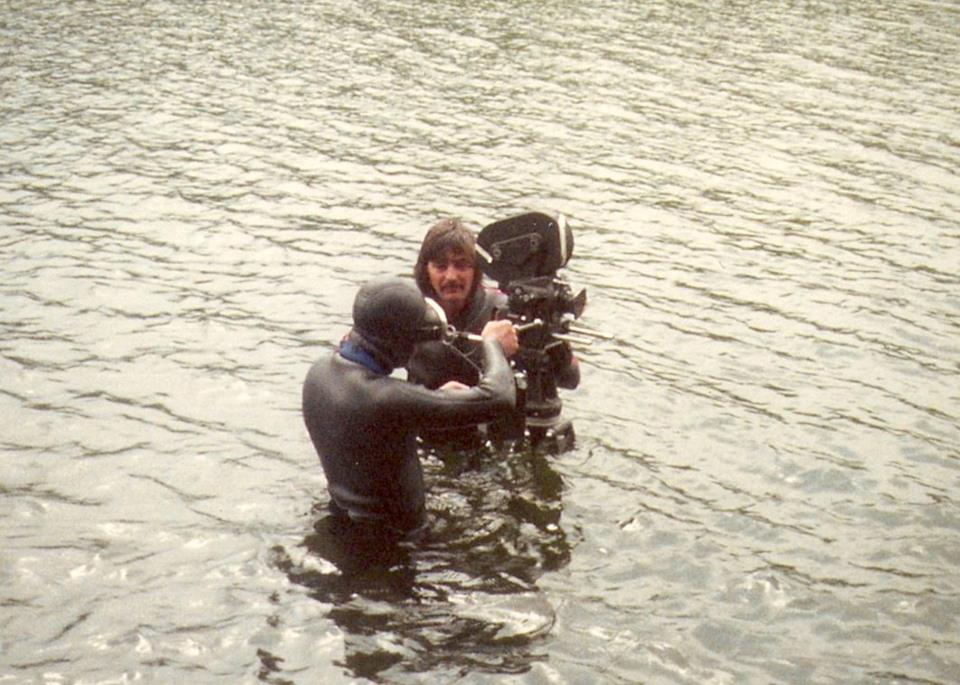
The director, Claude Whatham shot the scene using two cameras. The continuity would have been impossible otherwise. Eddie Collins the camera operator had a 16mm camera in the water with us. He was being steadied by another chap in a full wet-suit. Fitted neoprene was quite an unusual sight back then when divers were known as frogmen.
Eddie Collins operating the 16mm camera to capture the pearl diving scene ~photo: Richard Pilbrow
Suzanna Hamilton, who played Susan, did well but it simply wasn’t possible to pretend we were enjoying ourselves. My rictus smile was not convincing. Later on in the summer the Lake District became so hot that we begged to be taken swimming in rivers on our day off. I wish we had re-shot the scene in July with an underwater camera capturing my pearl diving antics. I was a good swimmer. I still love snorkelling – but only in warm seas. As it was, I had to be extracted from Coniston Water by Eddie’s frogman. I’d almost passed out.
Sophie Neville in 1973 attempting to strangle Terry Smith the Wardrobe Master on ‘Swallows and Amazons’
Quite a few people almost learnt how cold we had been for themselves later that day in May. The boats used to ferry us back and forward to the island were blue Dorys with outboard motors. You don’t want to have too much weight in the bows of those boats. Water can come in very quickly.
Sten Grendon, Suzanna Hamilton, Sophie Neville and Simon West appearing in the original movie ‘Swallows & Amazons’
If you drive south down the narrow East of Lake road along by Coniston Water, passing Bank Ground Farm, Brantwood and a cottage where Arthur Ransome once lived, you will eventually see Peel Island. It is not that far from the shore.
Sophie Neville finding Peel Island on Coniston Water a few years ago
Richard Pilbrow had permission from the Lake District National Park for his film crew to gain access and use the fields and woodland opposite Peel Island as a base. One proviso was that our two red double-decker buses had to be swathed with camouflage netting in an attempt to make them less conspicuous. As a result they looked comic – like huge monsters from Doctor Who. In addition to these we had a caravan for Make-up and Hair, the caterers’ mobile kitchen or chuck-wagon, a prop lorry, a lorry belonging to Lee Electric who provided the lighting and huge reflector boards, the Lee Electric generator and the regrettable and very basic mobile loos. I cannot remember what kind of vehicle David Cadwallader the Grip used but I half remember a Land Rover. In addition to all this would be parked our mini-bus, the unit mini-bus, everyone’s cars and the boat trailers. Mum thinks that Terry Smith’s Range Rover could have been orange. ‘He was a very orange man.’ It was white.
It must have been a bit of an effort to avoid getting the whole entourage in shot when John and I launched Swallow and rowed around to the harbour. You can tell that it was a greyer day than the one before.
Sophie Neville as Titty and Simon West as John rowing Swallow towards Peel Island on Coniston Water in the Lake District National Park in 1973
A temporary jetty made from scaffold and planks had been built out into the water so that we could climb into any boat going to the island without getting wet. It must have been quite something lugging the 35mm Panavision camera over. It travelled in a big black wooden box lined with foam rubber, with handles at either end, transported by two men like the Arc of the Covenant , holy and revered. Once on the island it would be set on the complex mounting, which enabled it to pan and tilt. This in turn usually sat on sections of track so that moving shots could be achieved.
Denis Lewiston, the Director of Photography, had a Camera Operator but insisted on doing most of the camera work himself. If you watch the scenes of the Swallows making up camp you can see that he must have just followed what Susan and Roger were doing. It has a wonderful, busy natural quality with the result that all one wants to do is to leave real life behind and go camping. I imagine that the scenes when the kettle is being filled were shot in the morning, while I was at my lessons, but I joined them after lunch.
Simon West and Sophie Neville on Coniston Water
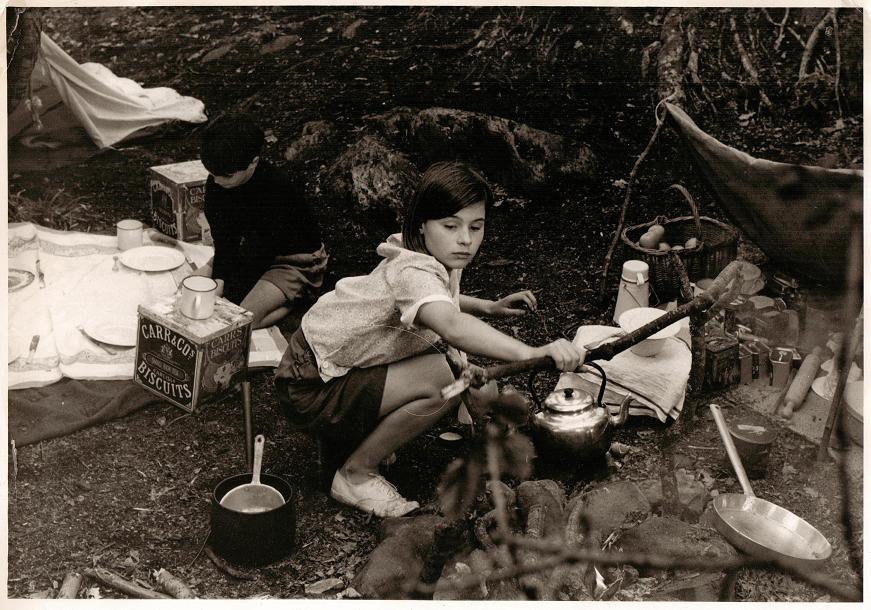
We loved shooting any scene at our camp on the island, especially when we were eating. As I think I have said before, when Suzanna swung her frying pan of buttered eggs she really did burn Roger on the knee. He was very brave about it. It was a heavy pan.
David Cadwallader continued working as a grip, operating the crane on the 2011 movie of Jane Eyre, which stared Mia Wasikowska as Jane, Michael Fassbender as Mr Rochester and Judi Dench as Mrs Fairfax. I’d been reading Jane Eyre on that day in May 1973. It was my set book. My set book for school and the book I read on set. I should have been reading Robinson Crusoe.
****************************
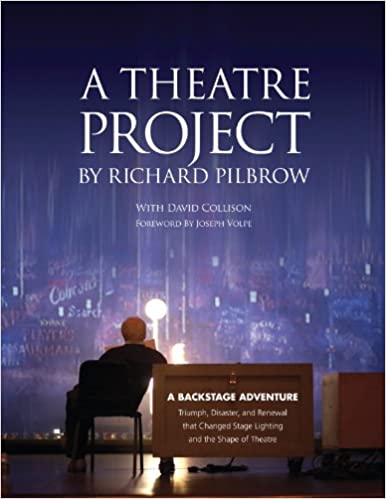
Richard Pilbrow has just written from Connecticut to say, ‘You can read my side of the story, if you care to, in ‘A THEATRE PROJECT’, that you can get from Amazon.uk.’
Sophie Neville, Simon West, Suzanna Hamilton and Sten Grendon on Wildcat Island in the scene where the Swallows find a place to camp
Arthur Ransome’s description of Wild Cat Island is based on at least two real islands. The landing place and open grassy camp site illustrated in the books can be found at Blake Holme on Windermere but when Richard Pilbrow went there in 1972 he was so disappointed by the sight of caravans, and the fact it was near the shore, that he decided to make the film almost entirely on Peel Island where you find Ransome’s Secret Harbour. We never went to Blake Holme.
Simon West and Suzanna Hamilton with Sten Grendon in the bows, while Sophie Neville looks on from the shore of Peel Island
It was at Peel Island on Coniston Water that Ransome met the Collingwood family when he was a boy. The Collingwood grandchildren, Taqui, Susie, Titty, Roger and Brigit Altounyan, later camped there getting slugs in their hair. Roger Altounyan told my old friend Bill Frankland that he secretly spent the first three nights of his honeymoon there. It must have been magical.
We loved crossing to the island – it was hugely exciting, even in the rain. There is something about the sheer rock faces, which makes it like a fortress, the ancient Viking settlement WD Collingwood believed it to be. Getting us back for lessons and lunch can’t have been easy and there was no loo.
The Swallows on Wild Cat Island
Had I been producing Swallows and Amazons I might have used Peel island for the unique Secret Harbour but tried to use ‘Near Peel Far’ on the mainland for the landing place. There is a nice open beach there and one wouldn’t have had to lug all the heavy paraphernalia of filming over the water – you can imagine time and effort involved in taking a 35mm Panavision camera across with its mountings and track. I don’t know how they powered the arc lamps we needed to light the campsite, which was quite dark beneath the trees. They must have run the cables under water.
Suzanna Hamilton as Susan, cooking buttered eggs on the camp fire on Wild Cat Island. Director Claude Whatham, Sue Merry, Bobby Sitwell and DoP Denis Lewiston look on, clad in wet weather gear.
But – the wonderful thing is that now, when children reach the island, most of the places featured in the film are there. The Landing Place has nearly washed away. We never knew it at the time, but one great secret is that the beach was created especially for the film. They must have dumped a huge amount of shingle there. The other secret is that there weren’t actually enough trees for the Swallows to erect the tents their mother had made for them. Two had to be added by the construction team.
Arthur Ransome’s tents are not as easy to put up as you’d imagine. It is difficult for children to get the rope taut enough between the trees to take the weight of the canvas. You need to use wagon knots or twist it with a stick. If you tie the rope too high the tents ruck up. The reality was that Suzanna had Bobby-the-prop-man to help her.
Suzanna Hamilton playing Susan with Sten Grendon as Roger camping on Peel Island
One thing that is not a secret, but can take you unawares, is that there never seems to be any firewood on Wildcat Island. It is the reason why the Swallows went to the mainland in the book.
Roger really did struggle to find sticks to pick up on that wet day in May. Mine were carefully set out for me to find by the designer but Sten really did fall over and he did get quite badly scratched by thorns. Claude gave him a bit of ‘Danger Money’ for being brave and not complaining.
Stephen Grendon playing young Laurie in the BBC Play ‘Cider with Rosie’
I’m not sure if Sten had ever received Danger Money when he played Laurie Lee in Cider with Rosie, which Claude had made two years before. We watched it that night when it was broadcast on television. It must have been shown quite late as it was was labelled as avant garde but we stayed up as of course VHS machines had not been heard of.
Rosemary Leach played Laurie’s long-suffering mother, Mrs Lee, quite beautifully. She was later to take the role of Mrs Barrable in the BBC series Coot Club, which I worked on in 1983. Mike Pratt, who played Mr Dixon in Swallows and Amazons, played Uncle Ray, and Young Billy – John Franklin-Robbins was The Stranger. Claude cast me as a little girl from Slad called Eileen Brown, who Laurie Lee always said was the first person he fell in love with. He was a friend of Mum’s and was around during the filming, since he still had a cottage in Slad. I’d been to a village school in the Cotswolds myself and enjoyed being in the classroom scenes, despite have to wear rather an itchy green dress.
Sophie Neville with Claude Whatham on location at Slad in 1971
I was too shy to put myself forward when Claude asked if anyone knew the chants to playground skipping games, but I did work hard to prepare for my big scene. I had to play quite a difficult piece on the piano, accompanying the ten-year-old Laurie Lee as he sawed away on his violin at the village concert. Rosemary Leach looked on with tears in her eyes. I was only given the music three days before the filming and had to practice eight hours a day, for those three days, before I got it right. We plodded through Oh, Danny Boy but were both so relieved to get it right that our smiles were real enough. At one point Claude took a deep breath and said, ‘Do you think you could play a little faster?’ I looked at him and replied, ‘They’re crochets. They don’t go any faster.’ He claimed that he didn’t know what a crotchet was.
Sophie Neville as Eileen Brown and Philip Hawkes as Laurie Lee in ‘Cider with Rosie’ directed by Claude Whatham in 1971.
I have written more about appearing in ‘Cider With Rosie’ here. It was pivotable as Claude Whatham invited Sten and I to appear as Roger and Titty in ‘Swallows and Amazons’ as he ‘had worked with us before’. He knew how we would react in front of the camera. I happened to have had a bit of experience crewing dinghies but the hard work I put into playing Eileen Brown gained me the role of Titty in the feature film now distributed by StudioCanal.
Sophie Neville playing Eileen Brown
You can read more in one of the editions of ‘The Making of Swallows and Amazons’ available online here and in paperback from Waterstones.
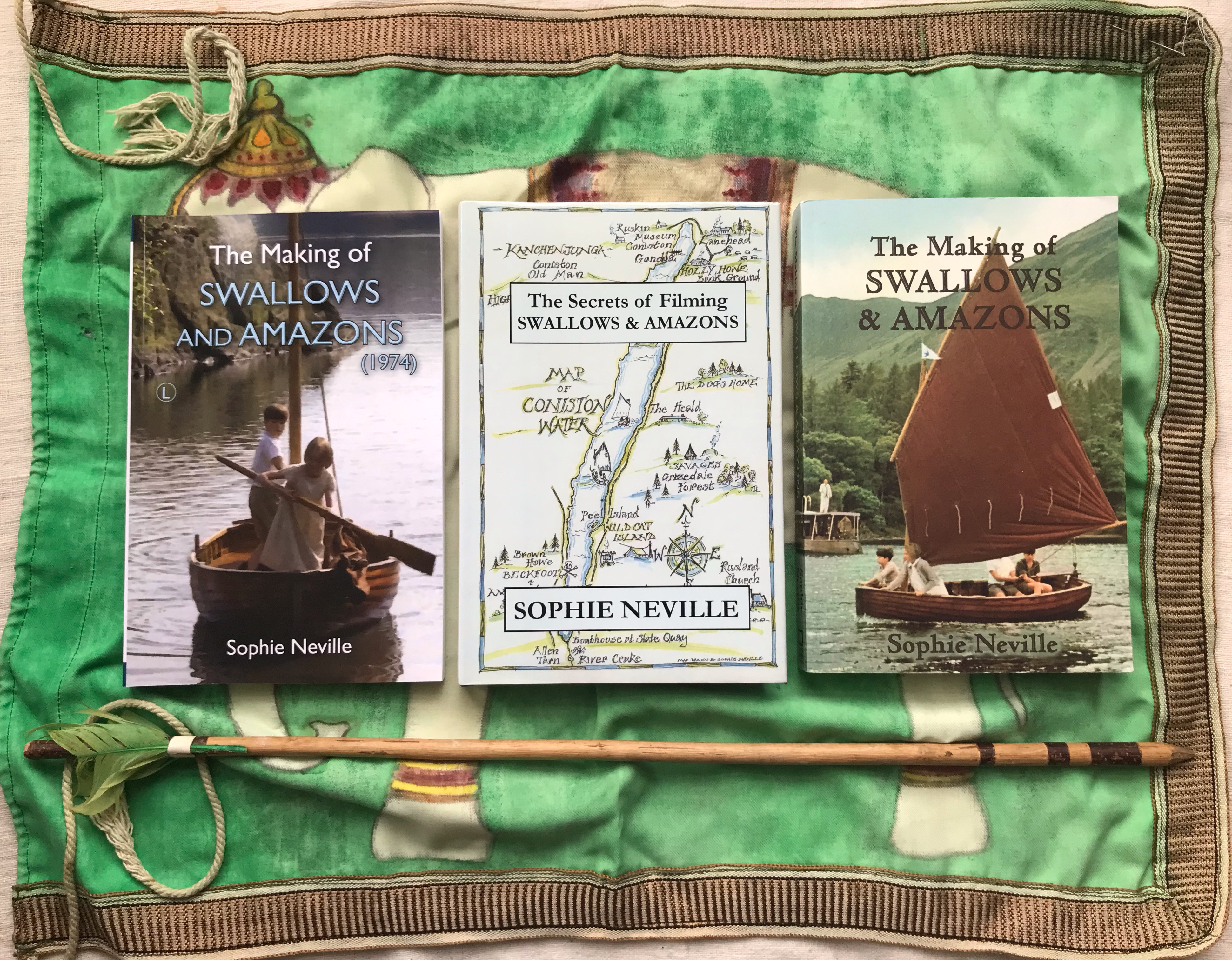
Different editions of ‘The Making of Swallows and Amazons (1974) by Sophie Neville’
If you take the East of the Lake road along Coniston Water you will find Bank Ground Farm. It lies between Brantwood, John Ruskin’s former home, and Lanehead where Arthur Ransome’s friends the Collingwoods lived. Ransome was particularly good friends of Dora Collingwood, who married an Irish-Armenian doctor keen on sailing called Ernest Altounyan. They went to live in Syria but every five years or so would bring their children to visit their Grandparents for the holidays, once staying at Bank Ground Farm next door. Ernest bought two 14 foot sailing dinghies called Swallow and Mavis in which his family learnt to sail.
It was for the five Altounyan children, Taqui, Susie, Titty , Roger – and Bridget, the ships’s baby, that Arthur Ransome wrote Swallows and Amazons after they gave him a pair of bright scarlet Turkish slippers as a birthday present. I don’t think I knew that Titty was a real girl when I played her in the film, but I did know her character in the books and felt rather bad that I didn’t have her thick dark hair evident in Ransome’s illustrations.
Claude Whatham with Virginia McKenna ~ photo: Daphne Neville
Bank Ground Farm is much smarter now. Lucy Batty, who let us take over her home in 1973, has passed on but the farm is run by her grandson Jonathan. You can stay in the main house, where there is a lovely corner bedroom with views down Langdale, or take a self-catering flat, since they have been able to convert the barn and stables into further accommodation.
I’ve just received post from Peter Willis of The Nancy Blackett Trust who said, “I stayed at Bank Ground in the summer – it was utterly lovely, exactly as it ought to be – Jonathan Batty and his wife are really hospitable, and one of the great pleasures was the friendliness and interstingness of the other guests, who included a Japanese Ransome fan. Do have dinner if they’re doing it. Food’s great, but so’s the sociable atmosphere.”
Int: Holly Howe ~ Bank Ground Farm near Coniston
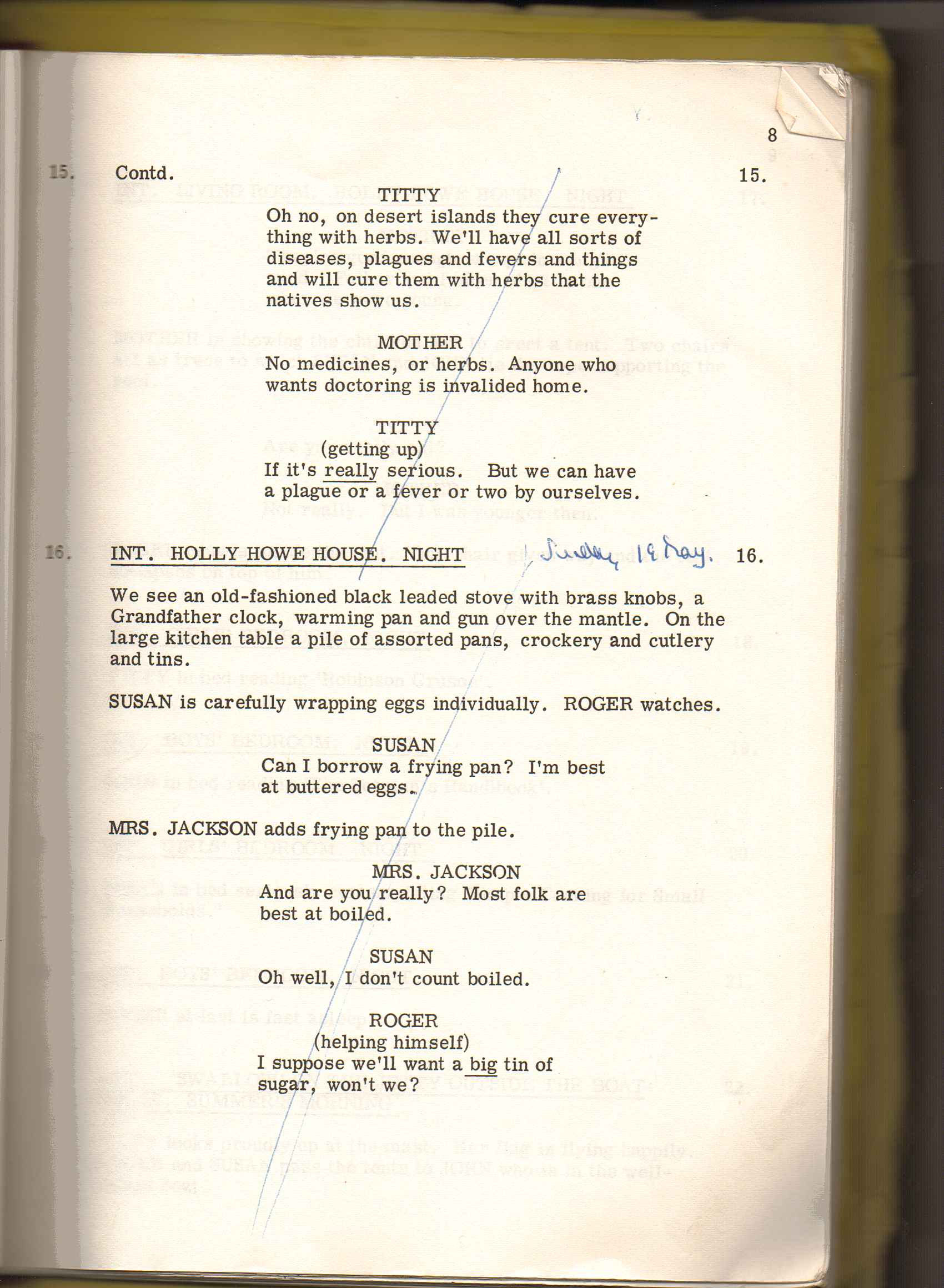
It was grey and raining in the Lake District on 15th May 1973. Instead of filming the scene when Roger tacks up the field, Denis Lewiston, the Director of Photography, lit Mrs Batty’s living room at Bank Ground Farm for an evening scene. Simon Holland, the art director, had dressed the room in the style of a Cumbrian farmhouse in the 192os with working oil lamps. Bob Hedges, the prop master, brought in all the camping gear we were to be packing while Virginia McKenna was having her hair done up and we had lessons in our red double-decker bus. Then we recorded a scene, the dialogue of which was never used in the finished film.
The Screenplay: David Wood’s adaptation of Arthur Ransome’s book ‘Swallows and Amazons’
You do see Susan packing bars of soap and me making heavy weather of sewing our flag, my hair pinned back in a hideous way, with rather a modern reel of white cotton lying on the desk. John packed the telescope in a biscuit tin, which now seems a mistake as we used it on the voyage, very much not in a tin, but then one always re-packs many times before an important trip.
Virginia McKenna, as Mary Walker with Sophie Neville playing her daughter Titty Walker busy stiching Swallow’s new flag in preparation for the voyage to the island
After lunch, we shot the scene when Mother is teaching us how to erect a tent on rocky ground, as she did with Father when they were young. Titty asks if she is really old.
‘Not really. But I was younger then,’ Virginia McKenna replied looking dubious.
This is rather how I feel now, all these years later, especially when I walk into a room when people are expecting me as Titty. I’m not really old, but I do look different from when I was only twelve. This always happens when I return to Bank Ground Farm. Everyone is a bit taken back by my height but say I sound just the same. And I am married now with a family of my own. It is a bit like when Peter Pan flew back to see Wendy and found she looked just like her mother – not least because in the play the adult Wendy is always played by the actress who formerly takes the role of Mrs Darling.
Simon West, Sophie Neville and Suzanna Hamilton in the 1974 film of ‘Swallows and Amazons’
I was standing outside the front door of Bank Ground once, talking to Lucy Batty, when two Japanese girls arrived to stay at the farm. Fans of the film, they looked up at me and declared, ‘Ooo Titty!’ clasping their hands together in greeting. They had come from the other side of the world and yet recognised me immediately. Perhaps I haven’t changed that much after all.
The weather must have cleared up a bit by teatime on 15th May as we recorded the scenes in the boat house when John discovers Swallow, brings her out to the stone jetty and steps the mast. They must have had to take the generator down to the lakeside as I’m pretty sure that the sunlight comes from an arc-lamp. Suzanna got her shorts wet as she pushed out the clinker-built dinghy but we loved being by the water.
You can read more in ‘The Making of Swallows and Amazons’ available online and to order from bookshops and libraries. It is now available as an audiobook.
Different editions of ‘The Making of Swallows and Amazons (1974) by Sophie Neville’






































 Sophie Neville