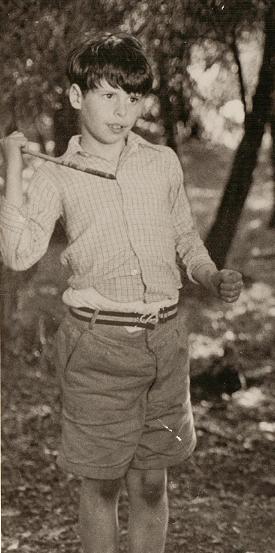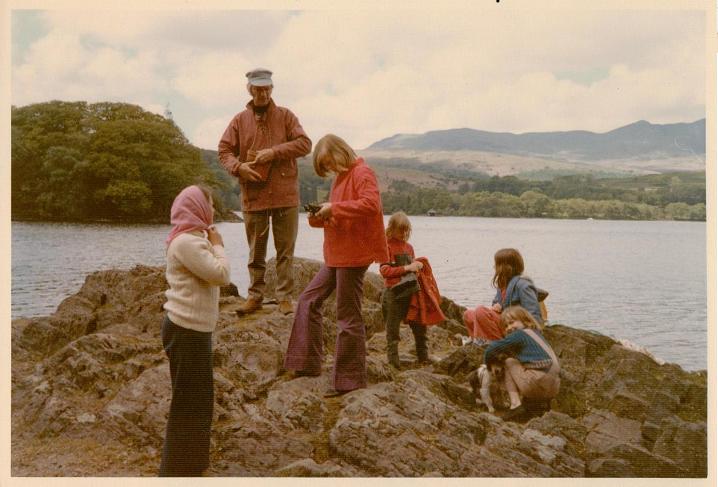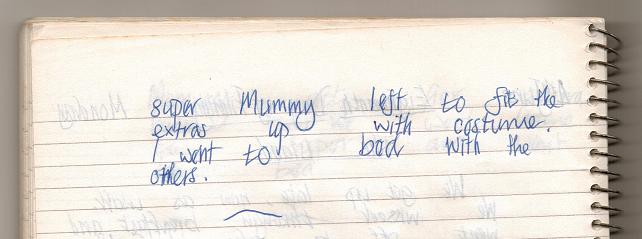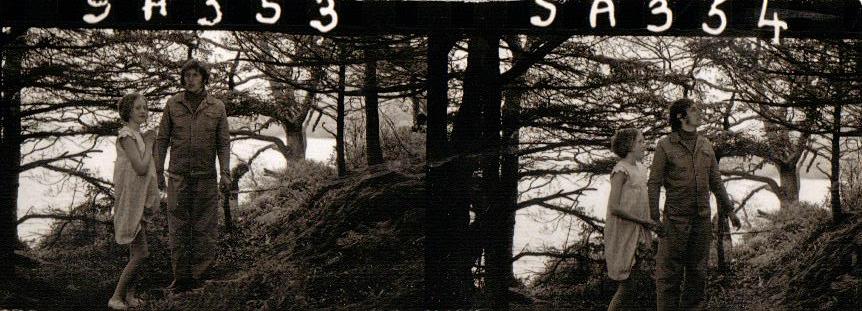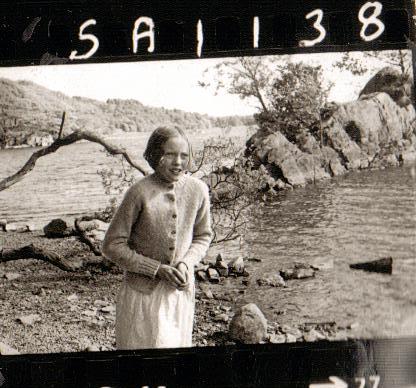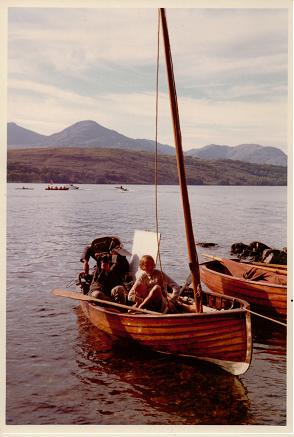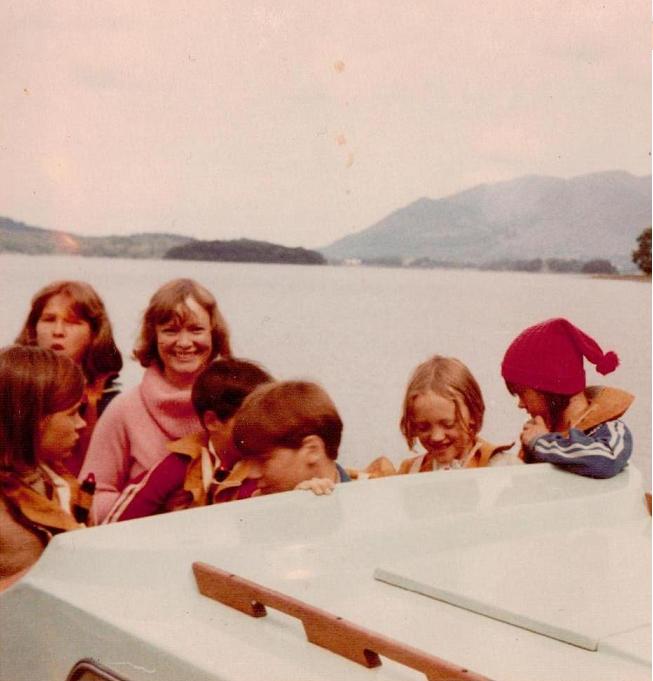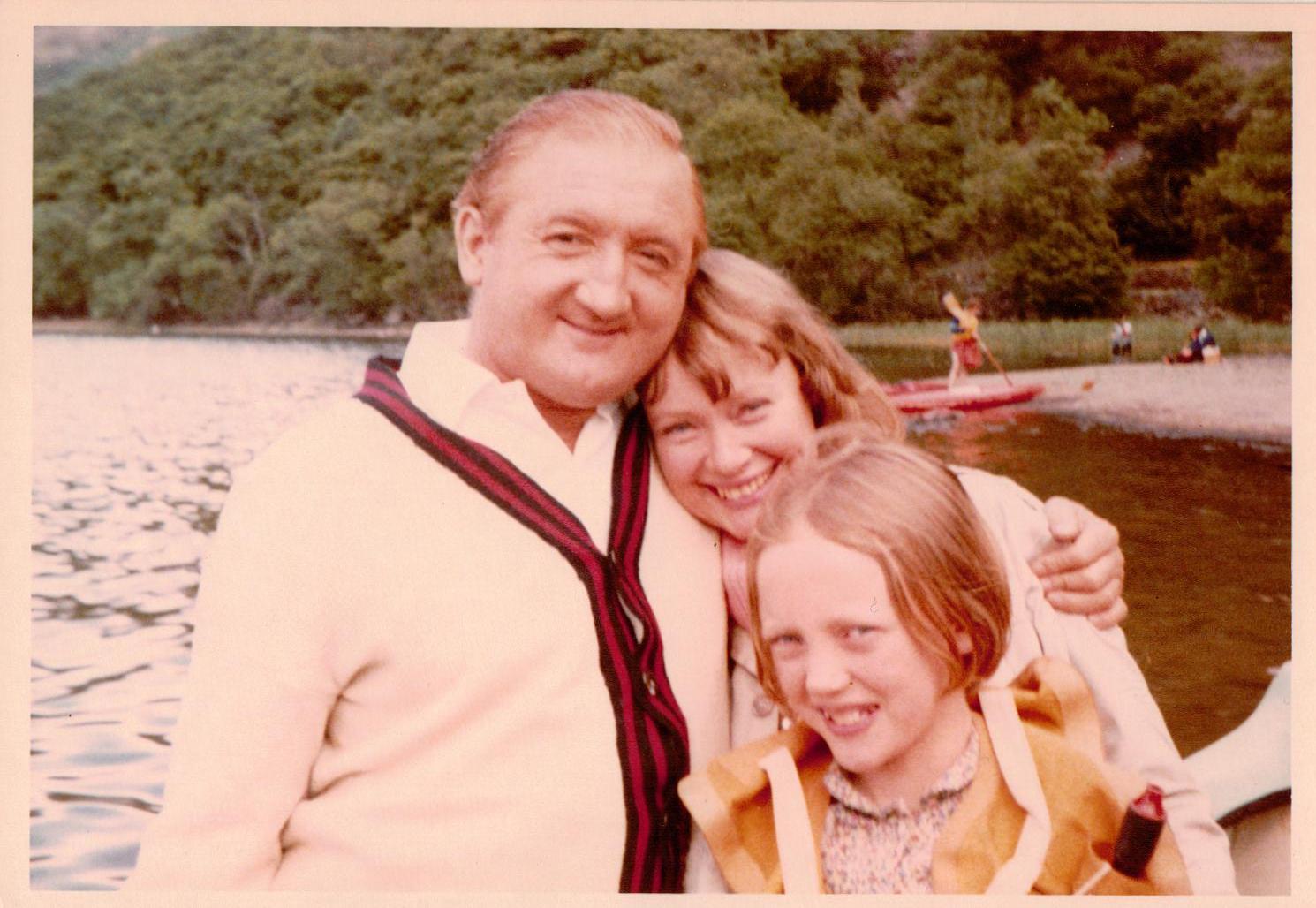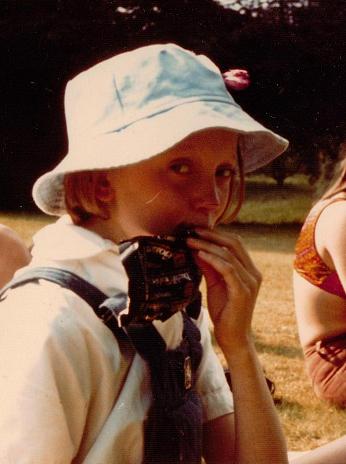
At the location used as Beckfoot when filming ‘Swallows and Amazons’ on 6th June 1973

Sophie Neville at Beckfoot
Sophie Neville who played Titty in ‘Swallows and Amazons’, eating icecream at Brown Howe, the location used for Beckfoot and the Amazon Boathouse ~ photo: Martin Neville

A hot sunny day in the Lake District, at last. This was 1973 and Mum had a blue sunhat firmly wedged onto my head. I suppose this was so that I wouldn’t go pink. It was lovely to be able to eat lunch outside under the rhododendrons with my sisters but I started to roast in my stripy acrylic polo-neck jersey and begged to be able to wear something cooler. Terry Smith the wardrobe aaster was not pleased when he found me wearing one of Suzanna Hamilton’s costumes, especially since I was eating a choc-ice in it.
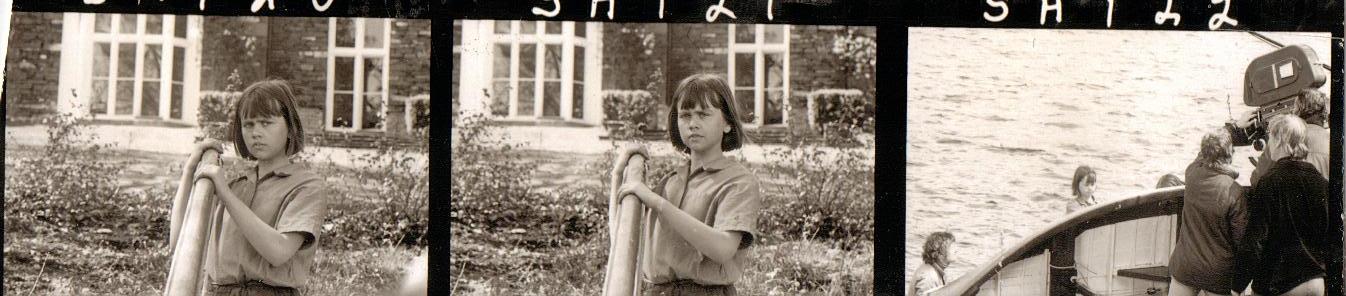
Beckfoot
Lesley Bennett as Peggy at Beckfoot

Mrs Causey, our long suffering tutor, was helping me to swot for my summer exams we knew being sent north from my convent. These were taken very seriously. My father was still paying my fees. They amounted to as much as I was earning for appearing in the film.

Kit Seymour with Claude Whatham, 1973

I don’t think my little sisters had any formal education at all that week. I can only suppose that they learnt a little more about being in films even though this was the one day that I didn’t appear in Swallows and Amazons.
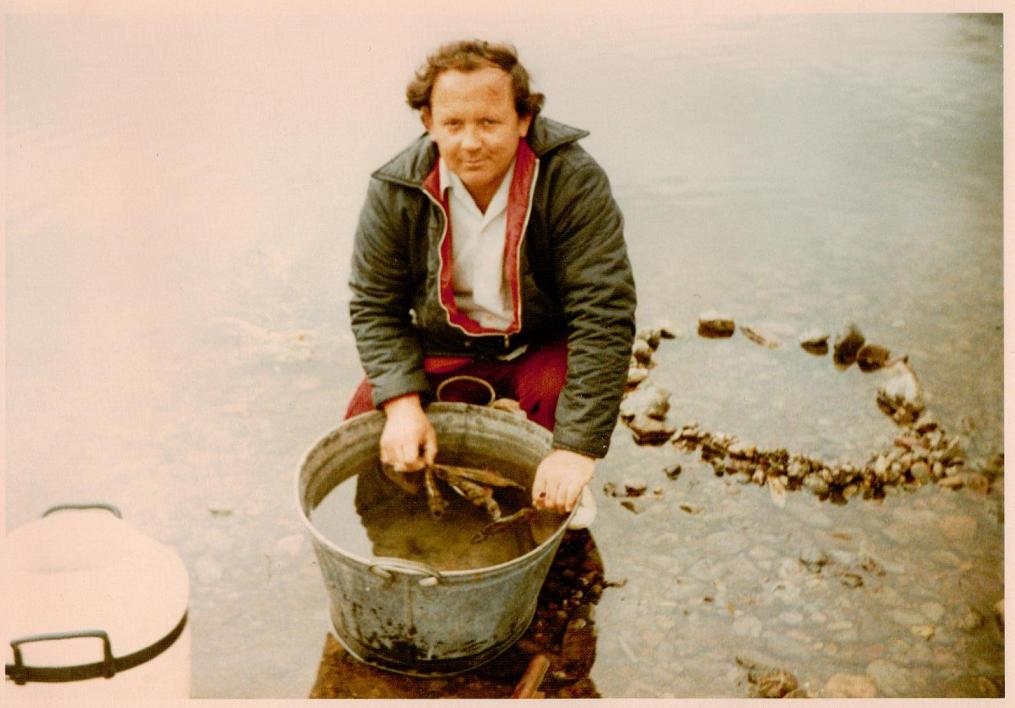
Fishing Scene
Property Master Bob Hedges keeping the perch alive

Who were the boys?  The lad in the film clip with a Motorola and cigarette, who seems to have taken off his shirt for the first time that summer, is Gareth Tandy, the Third Assistant. The boys mentioned in my diary were slightly older. Why did we call them ‘prop-boys’? Is it something left over from the theatre? I know Bobby-Props (Bob Hedges the property master) must have been over forty and was regarded as the father figure of the unit. He worked out of a lorry with a sunshiny roof with John Leuenberger, Terry Wells and Bill Hearn the carpenter. Dad caught them on film when they were having lunch. I think they must have later gone off to Bowness-on-Windermere to help set up for our big scene the next day and kindly returned with ice-creams and Coco-cola, which would have been a great treat. They were generous to a fault.

The parrot being taken to the Houseboat
Property Master Bob Hedges with his assistant Terry Wells

The prop-men who worked on Swallows and Amazons have movie credits to their names which would delight any actor. They never seemed to stop working. Claude Whatham may well have asked for them to join us as they’d all been on the crew of  his first film That’ll be the Day.  Bobby Hedges later worked with some of the others on The Rocky Horror Picture Show, Julia, The Shout and Midnight Express. John Leuenberger went on to work on Stardust, Bugsy Malone, Chariots of Fire and Superman III.  Terry Wells is listed as having been the property master on epic movies such as The Mission, Braveheart, Quadrophenia, Cry Freedom, Full Metal Jacket, Troy, 101 Dalmatians and Robin Hood starring Russell Crowe and Cate Blanchett, as well as big TV series such as Holby City and The Increasingly Poor Decisions of Todd Margaret.
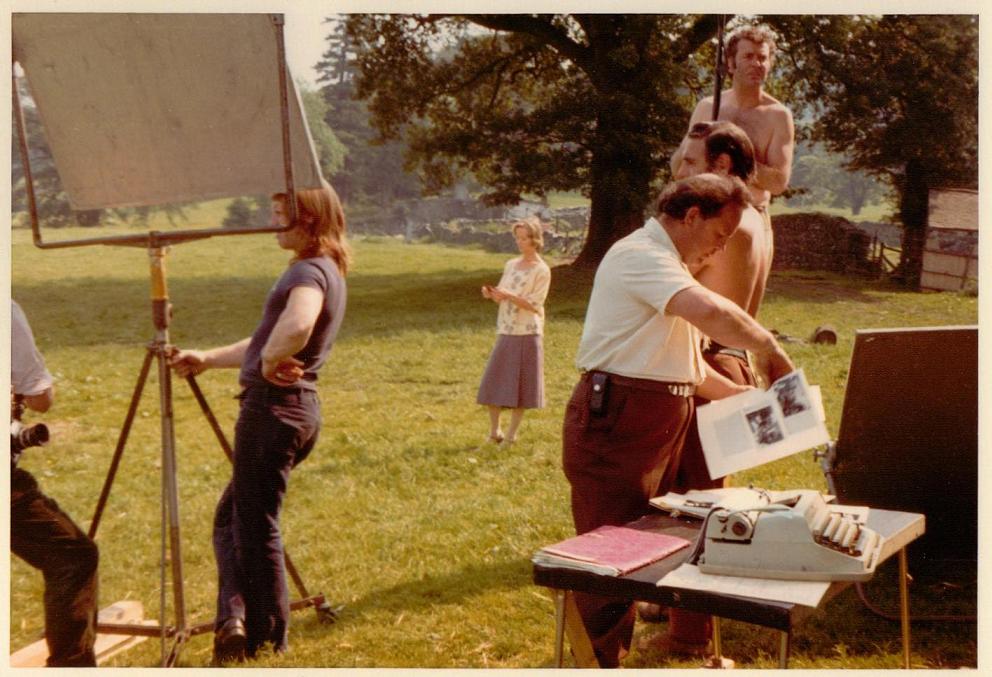
Virginia McKenna holding the telegramme
Property Master Bob Hedges is working in the foreground ~ photo: Daphne Neville

If you look at our call sheet for the day you can see at a glance how important the property master’s job was. Swallows and Amazons was a technically unusual film as the dinghies were action props. Swallow had to be kitted out with exactly the same rigging – plus the same ‘continuity props’ – the torch, compass, whistle, charts, blankets and provisions, originally listed by Arthur Ransome, that were in the little ship when she left Wildcat Island in the scene when John gave me the telescope.
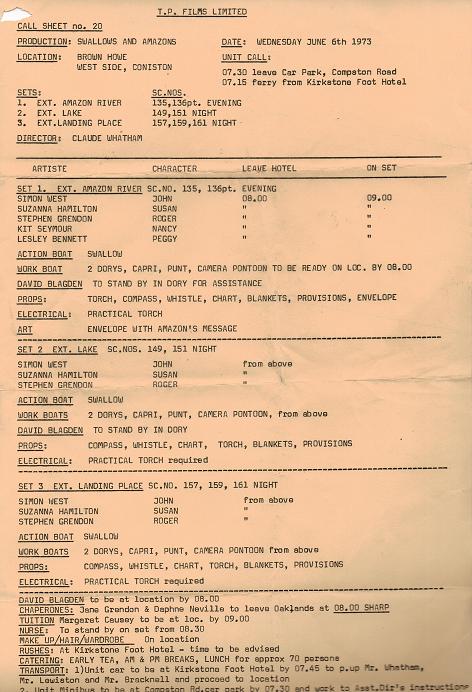
In Scene: 135, the envelope containing the Amazon’s message is key to the action, thus an ‘action prop’. If we’d seen it before it would have been known as a ‘continuity action prop’. You can see it pinned to the post in the short film clip. Simon Holland, our set designer r art director, to whom the prop-men were working, had a number of identical envelopes made. Lesley Bennett, who played Peggy Blackett, wrote the message in her clear, italic writing quite a few times so that there would be replacements for re-takes after John scrunched up the first one and flung it in the water. There are times when a continuity action prop such as our telescope, which was irreplaceable, becomes very precious indeed.  Had it been forgotten or lost it would have caused major disruption to the day’s filming.
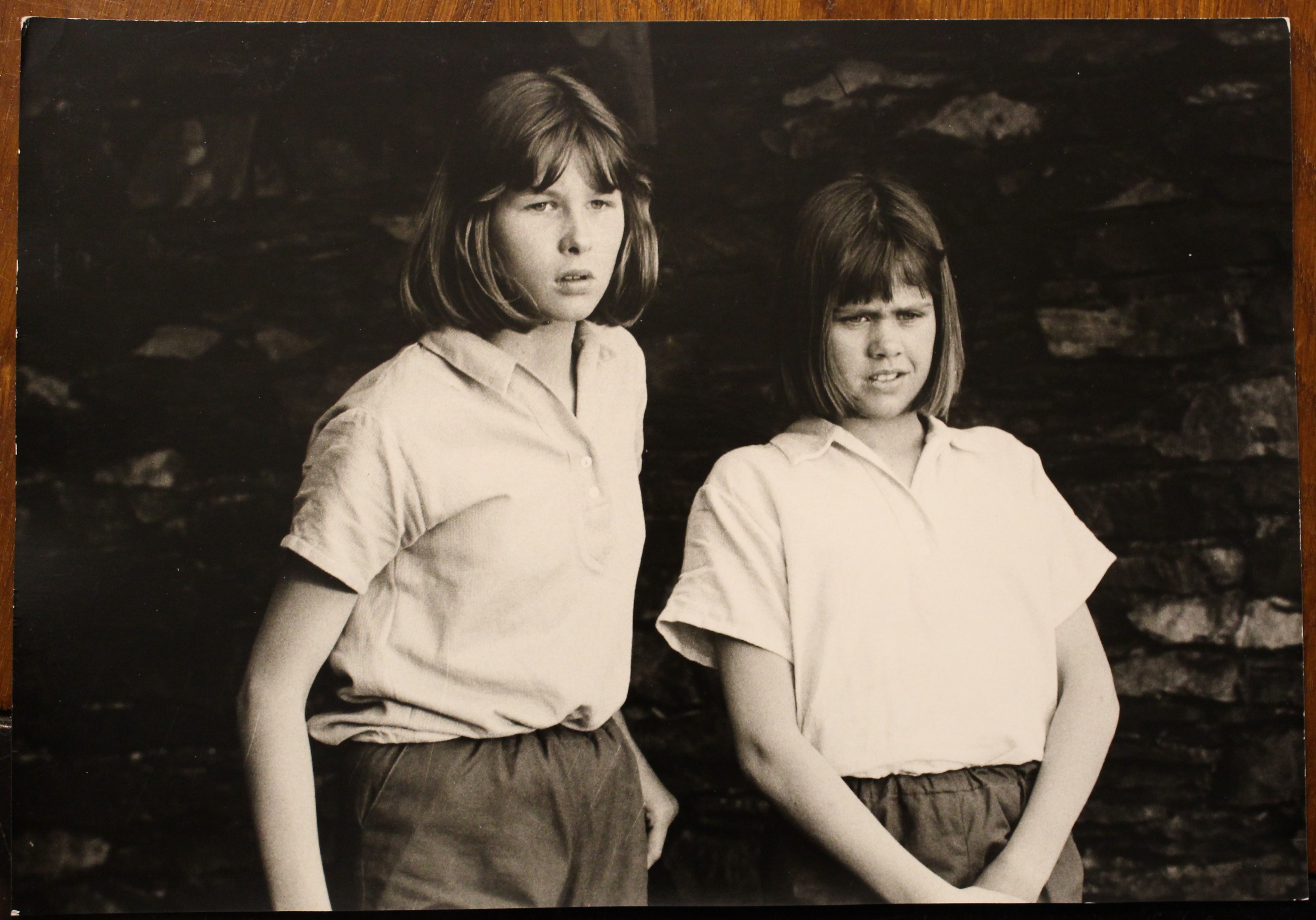
Kit Seymour and Lesely Bennett
Kit Seymour and Lesley Bennett playing the Amazons

There was very little ‘set dressing’ for these scenes but you can understand that it was crucial that the guys mounted Captain Nancy’s scull and crossbones on the Amazon boathouse. They would have taken this off at the end of the day and stored it in case re-takes were needed, which is why the carpenter returned from Bowness with a long ladder in the lorry and ice creams for us all.

Amazon Boathouse

We loved the props as children. I treasured the few items that Bobby made on the set and gave me at the end of the filming, such as his prototype flags. When I became an Assistant Floor Manager, the BBC’s equivalent to a Second Assistant Director, I found myself responsible for the action props with one or two prop men working with me. The few times that continuity props were forgotten or mislaid are painfully etched on my memory. That awful feeling, when a lost item effects so many people, like losing a wallet or your car keys, is magnified hugely when filming is so costly and involves so many. Despite always being terribly careful I had a continuity prop stolen from the Eastenders’ studio (see my ‘Career’ page and scroll down until you find the section with William the pug dog).  

Someone once stole the soap from the set of Bluebell. I can’t think why. It was a miserable little piece for a scene set in Bescancon Internment Camp. Prisoner of war soap. The prop-buyer got very angry. I quickly made up something that looked like the original but I couldn’t do the same when our prop-man lost Gerald Durrell’s pre-war binoculars on the island of Corfu. I remember him turning out his van in despair before finding them carefully stored in bubble-wrap behind his seat. I don’t think any of the props were mislaid on Swallows and Amazons, despite all the rushing around in boats, but Mum says that we shot a scene wearing the wrong costumes.  We are not sure which this was but no doubt it will be recoded in the later pages of my diary, which you can read here…
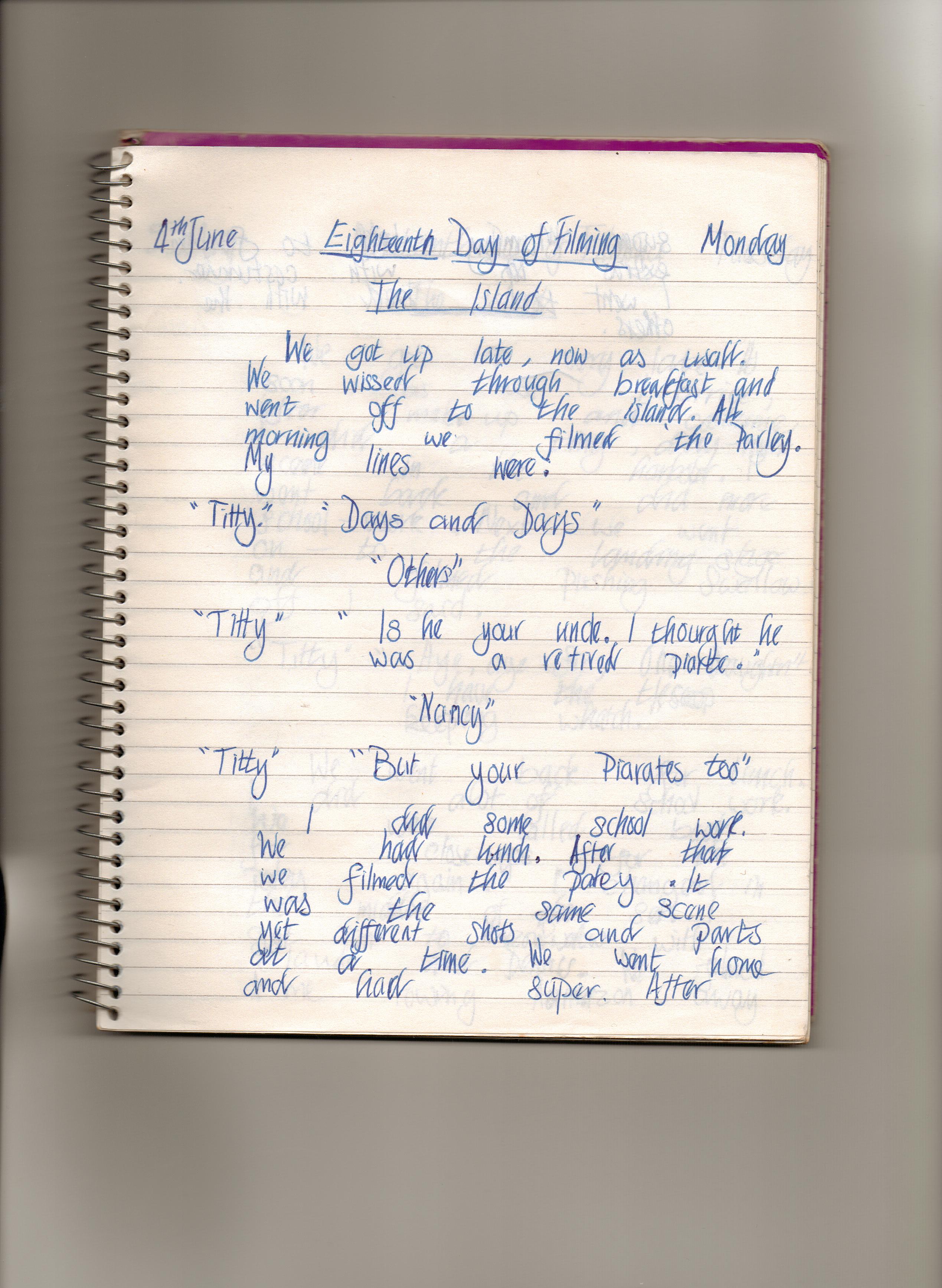
‘I thought he was a retired Pirate’ ~ filming with Amazons on Wild Cat Island and Mrs Ransome’s fears of Disneyization.

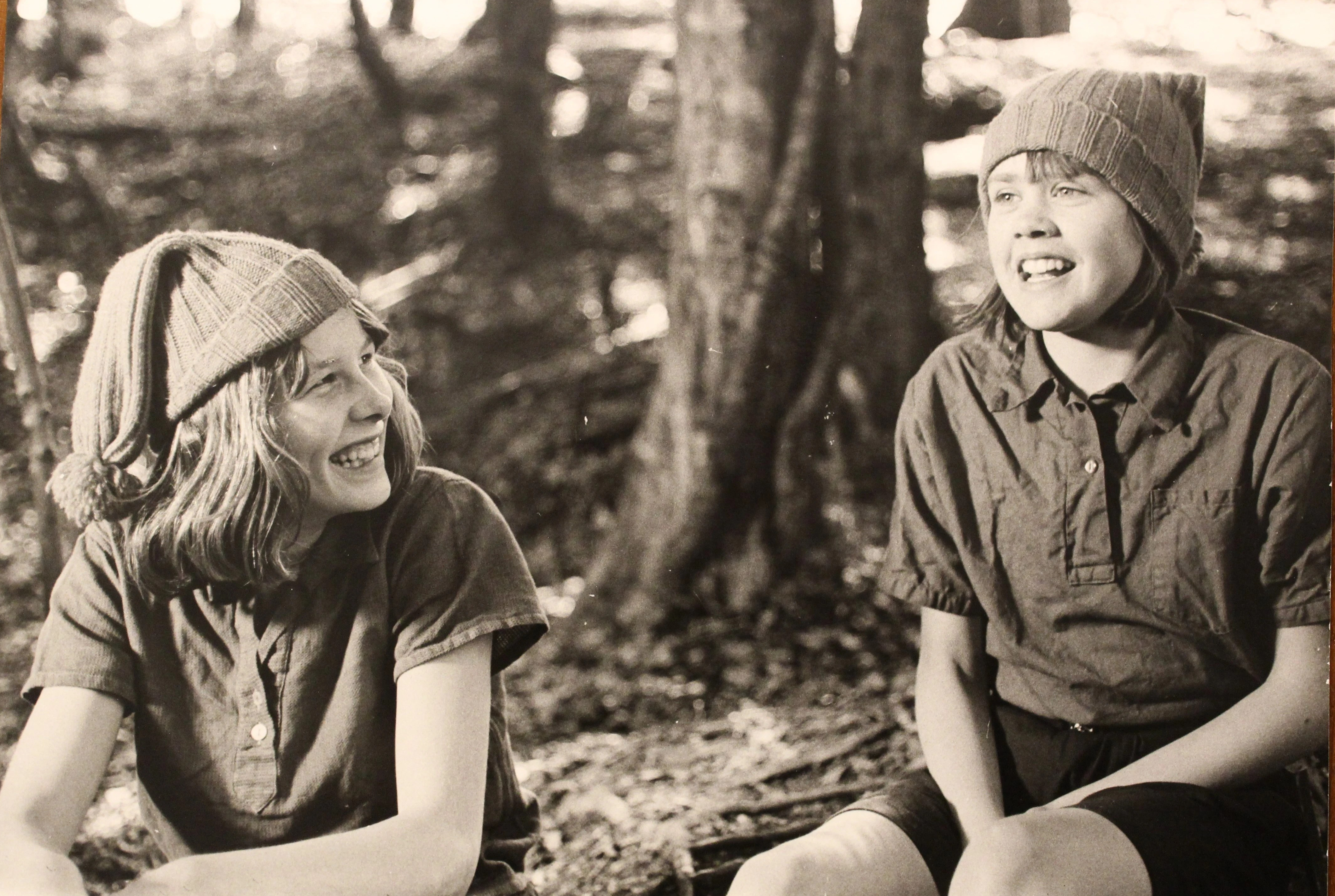
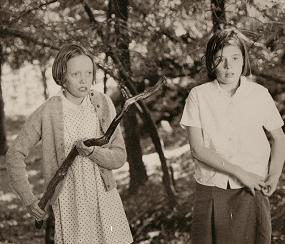
Sophie Neville and Suzanna Hamilton confronting the Amazon Pirates on Wildcat Island in Swallows and Amazons

Richard Pilbow says that the fantastic thing about filming Swallows and Amazons was that breakfast was served on location every morning, without fail, sending ‘a wonderful aroma across the set.’ Huge English breakfasts were dished up by John and Margaret, who worked for a location catering company from Pinewood, and greeted the film crew every morning, with bacon and eggs, mushrooms, sausages and tomatoes. And the fried bread was well fried.

It didn’t really matter that we missed breakfast at the Oaklands Guest House in Ambleside. A bacon butty would we placed into my hand as soon as we reached the base camp on Coniston Water. I only wish our guest house had been nearer Peel Island where we spent so much of our time filming.

Daphne Neville and Ricahrd Pilbrow on Peel Island on Coniston Water in 1973
Daphne Neville and Richard Pilbrow on Peel Island on Coniston Water in 1973 Amazons

I do believe my mother is still eating in the picture above. We all ate hugely to stave off the cold. You can see in the movie how much we enjoyed the iced buns before the Amazons attacked.

I remember the Parley Scene as being of importance to Mrs Ransome, who was still living at the time. Arthur Ransome had died in 1967 but his formidable widow owned the copyright to his books. And she did not want there to be any sexual frison between John and Nancy.

Kit Seymour (Nancy) and Lesley Bennett (Peggy) on Peel Island 1973

Richard Pilbrow had had quite a job of persuading her to give him the rights to the film at all. He know that Tom Maschler, the head of Jonathan Cape, had already had to turn down many movie offers. The Ransomes feared ‘a Disney-ization of the story, a vulgarization.’ They had vocally disliked the 1960s cartoon version of ‘Winnie the Pooh’. Whilst we children loved Disneyfications, we only wanted to bring the book the life. 

Neither Arthur Ransome nor his wife, Evgenia, had liked the black and white BBC version of Swallows and Amazons made in 1962 when Susan George played the part of Kitty, rather than Titty. I watched it with Joe Waters at the BBC library in 1983. I reported that it was terribly boring and rather badly made but it was simply of its time, with rather a floral performance from Mrs Walker and comic scenes being given to the burglars. We enjoyed watching the whole series at a weekend of The Arthur Ransome Society. Susan George had such beautiful long plaits. 

Daphne Neville with Richard Pilbrow1
Molly and Richard Pilbrow in 1973

In his recently published book A Theatre Project, Richard describes how, by vowing to be true to the book, he finally persuaded Mrs Ransome to let him have the film rights. But life wasn’t easy. At the very last minute, just as we were about to start shooting, she put her oar in.

Sten Grendon

‘She took a violent dislike to the casting of Roger… He was dark haired. “This is outrageous; he has to be fair,” she protested.’  It was too late for Claude Whatham to re-cast. Richard admits that with regret he had to over-ride her.

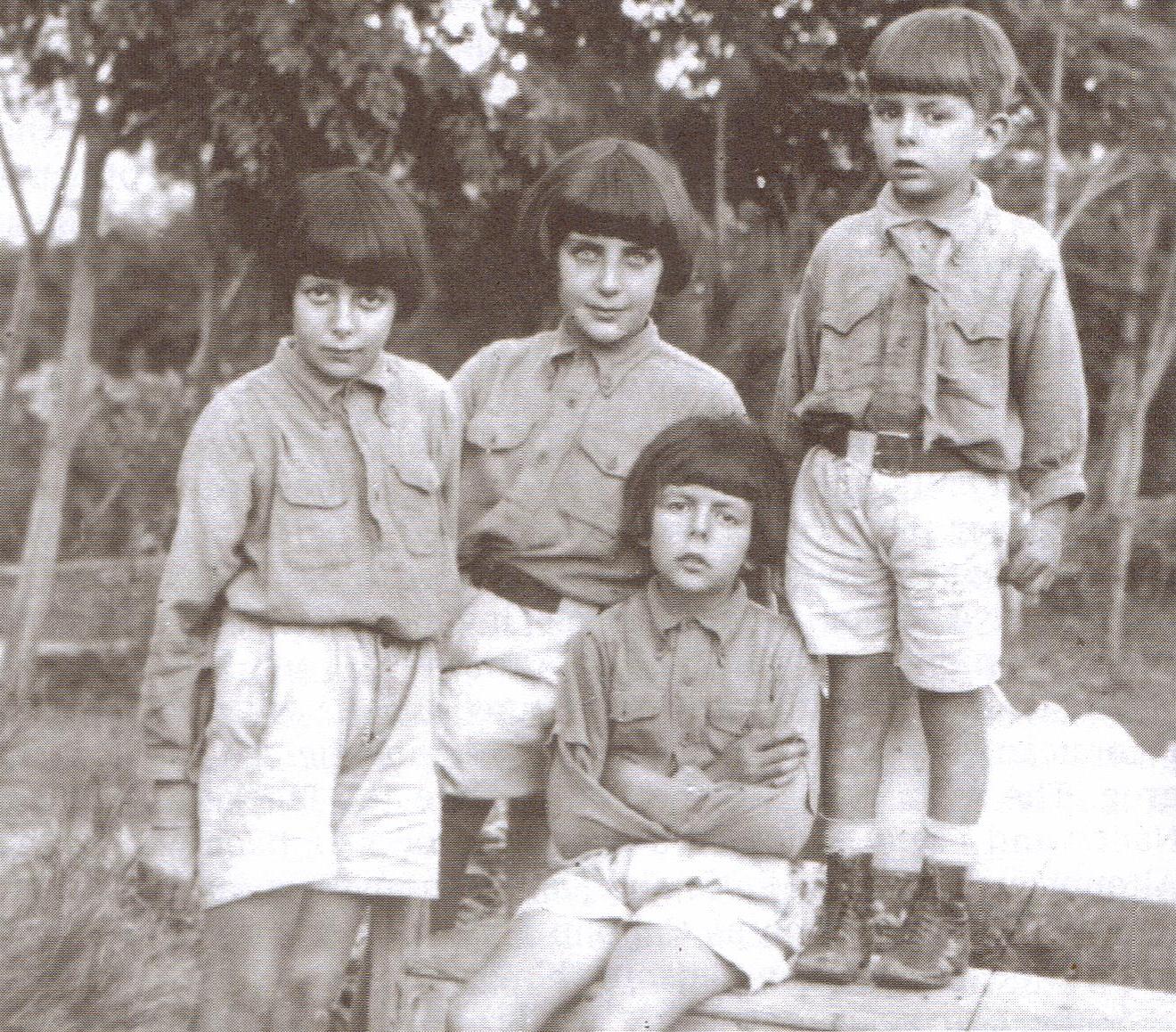
I was amazed when I heard about it, since all the Swallows in Arthur Ransome’s drawings had very dark hair – as did the real children – the Altounyans, whose father was of Irish/Scottish and Armenian descent.  

Altounyan Children - Susie, Taqui, Titty (seated) and Roger
Altounyan Children – Susie, Taqui, Titty (seated) and Roger

They lived in Aleppo, in Syria where Ernest Altounyan was working in his father’s hospital as a surgeon, and all looked quite tanned in the old photos.

I though that, if anything, Mrs Ransome would have objected to me being too blonde but apparently she wanted ‘an English rose’ to play Titty. David Wood told us that she wanted all the Swallows to have blond hair.

Once the books became well known, the Altounyans didn’t want people identifying the Walkers too closely with their children. There was a bit of an upset after the Ransomes’ offered to adopt Titty after which the dedication to ‘Swallows and Amazons’ was altered and maybe Mrs Ransome took umbridge.

Altounyan family with Ransome
Ransome with the Altounyans

The writer Roger Wardale, said that Arthur Ransome’s intention was to keep the appearance of his characters vague so that any child could easily associate with them and imagine themselves in their place. He originally described the Amazons as having curly hair, but edited this out.

Stephen Grendon playing Roger

Although we loved filming on Peel Island, our real families, who had come up to the Lake District to be with us over half-term, couldn’t watch. This probably made it easier for us to concentrate but must have been disappointing for our friends. Our friends the Selbys, with whom I had learnt to sail, had driven up to Cumbria from Chelmsford and yet probably saw nothing except for the bedraggled crew and me at lunch time.

Jane, Michael, Clare and Lucy Selby on the shore of Coniston Water talking to my sisters, Perry and Tamzin who is holding their dog, Minnie ~ photo: Martin Neville

Other members of the crew had been joined by their children. Brian Doyle noted in his diary that took his daughter Pandora off to Beatrix Potter’s farmhouse Hill Top, travelling in Dad’s car with my sisters Perry and Tamzin.

Although it was good to be on Coniston Water hanging around at the base camp all day would have been terribly dull for them. This, however was about to change.  That evening Mum went to help Terry Smith, the Wardrobe Master, sort out costumes to fit the Supporting Artistes. My sisters were about to earn their own breakfasts and be able to watch every shot being made . They were to become Film Extras.

You can read more here:

The diary I kept whilst filming ‘Swallows and Amazons’ on the 3rd June 1973, when I spent a day off exploring Cumbria with my family

It was Sunday and a much needed, formal day off for the crew of Swallows and Amazons. It was also a day of rest for the ‘Artistes’ as Claude Whatham, the Director called us.  The crew called us ‘Saucepans’. Saucepan lids : kids.  It is Cockney rhyming slang. There was a lot of that about in Ambleside that year.

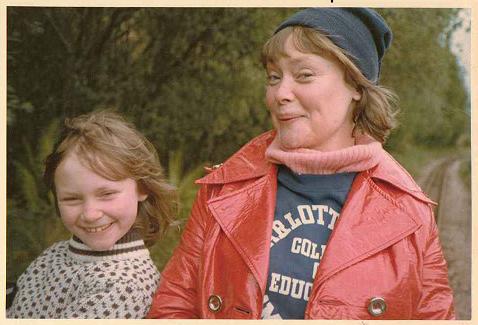
Sophie Neville with her mother on a scenic railway in Cumbria during a break in the filming of Swallows and Amazons in 1973 ~ photo: Martin Neville

My parents were still in bed, exhausted on that Sunday morning.  To keep me busy, Mum had me writing letters to my Headmistress, Sister Ann-Julian and to my Housemistress, Sister Allyne. Amazingly I wrote them.

My father’s idea of a day out in Westmorland was to drive up the Hard Knott Pass taking car rugs, a picnic and his volcano. This is a brilliant item of equipment with which you can boil enough water to make a cup of tea using an old newspaper. I’ve read that Arthur Ransome had one…  I think my mother just pulled on her Charlotte Mason College of Education sweatshirt and came too.

The highlight of the day was a trip on the Ravenglass and Eskdale Railway, through the National Park to the coast and back. You can still do this today. The historic line was opened in 1875 to ferry iron ore from the mine near Boot to the coast at Ravensglass by steam locomotive. They say that nowadays:

“Four steam locomotives are currently in regular service, ranging from River Irt, the oldest working 15″ gauge locomotive in the world, to Northern Rock, one of the most powerful. The locomotives names, with one obvious exception, are those of the local rivers, the Esk, Mite and Irt, the last mentioned flowing from Wastwater just a few miles away from the railway.”

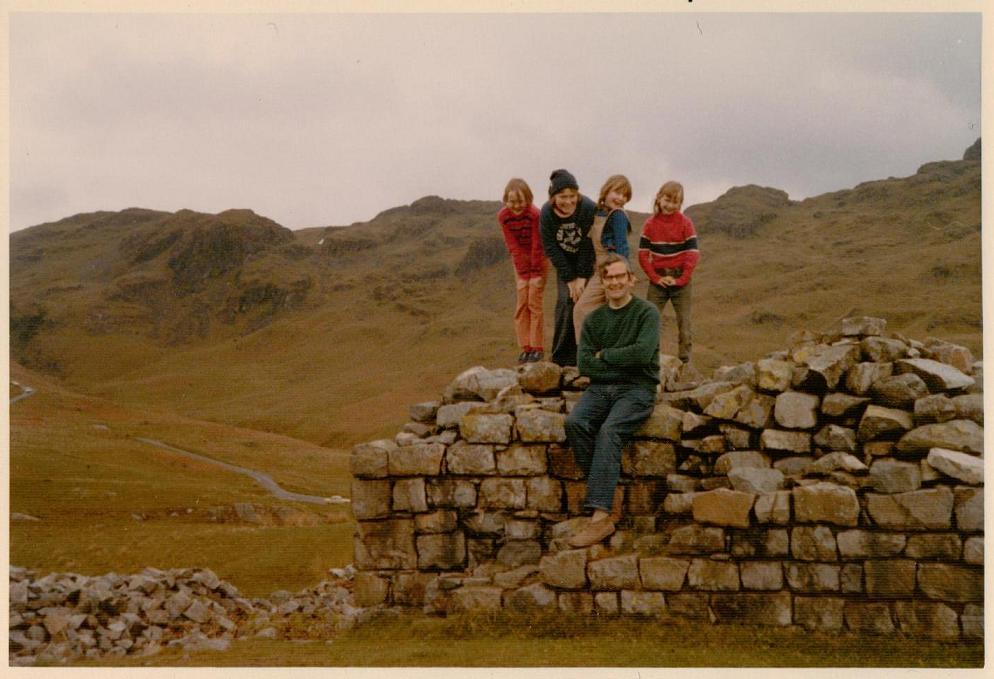
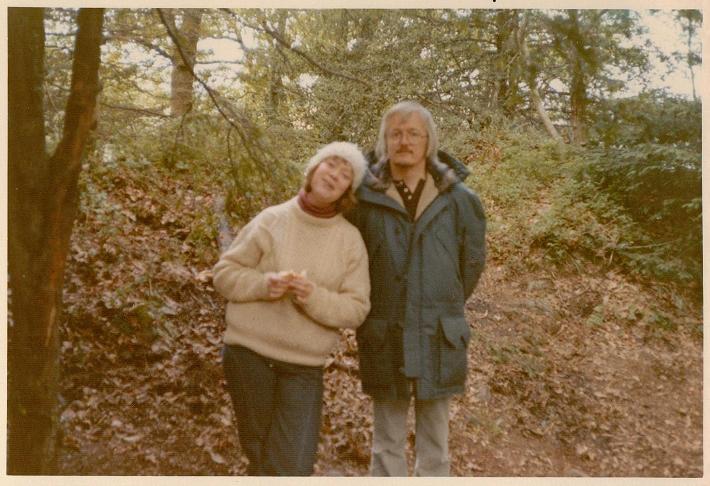
My father has always loved steam.  He’s also rather enjoyed using the self-timer on his new camera.

The Nevilles in the Lake District in 1973

We were standing on part of the Hard Knott Roman Fort near Boot with the fells behind. Built between AD120 and AD138 at the Eskdale end of the Hard Knott Pass it must have been one of the furthermost outposts of the Roman Empire. It had been studied and excavated by Arthur Ransome’s mentor WG Collingwood, whose novel Thorstein of the Mere is set on Peel Island where we had just spent the week. The fort was known to the Romans as Mediobogdum, which has to be one of the all-time great names. If only the film crew had known.

As children we had grown up watching Frankie Howerd on television when he was dressed in a Roman tunic, assuring us that ‘A Funny Thing Happened on the Way to the Forum’.  We didn’t know at the time, but the producer of ‘Swallows and Amazons’, Richard Pilbrow, had brought the theatre production from New York to the West End, where it ran for two years.

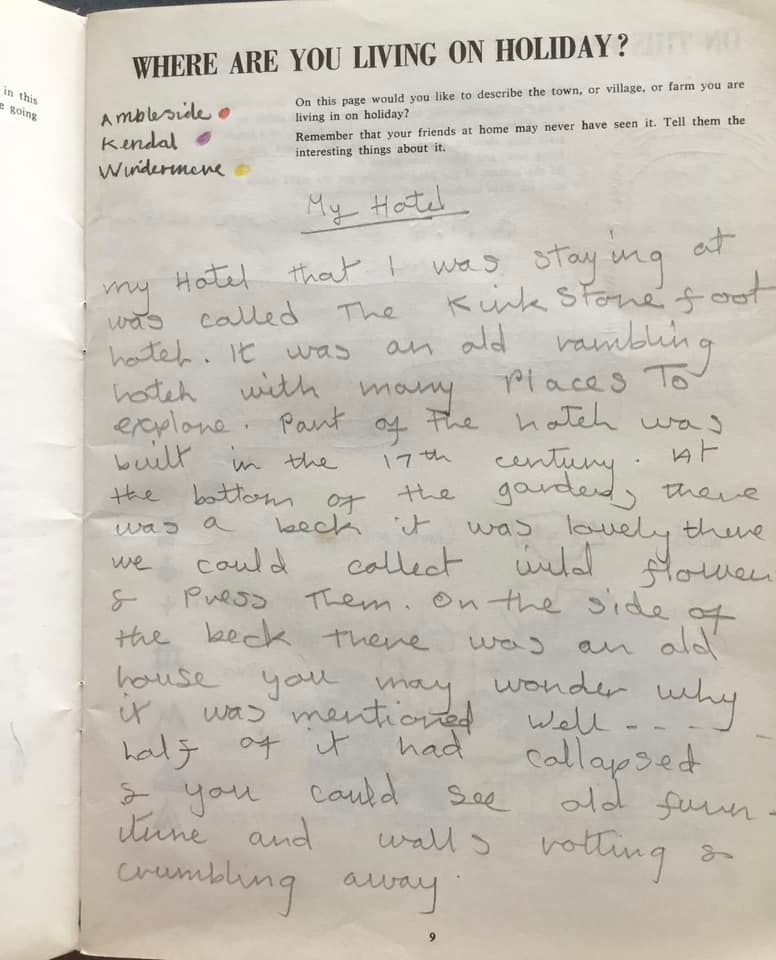
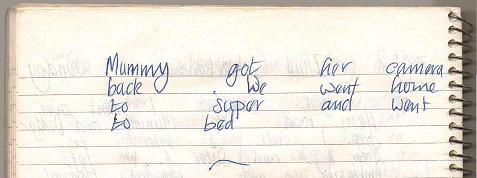
The hotel I mention was the Kirkstone Foot Hotel, at the top of Windermere, in Ambleside where Richard Pilbrow and the senior members of the film crew were staying. Mum must have left her camera there.

The Kirkstone Foot Hotel Ambleside in 1973
The Kirkstone Foot Hotel, Ambleside in 1973

Pandora Doyle, whose father Brian Doyle was handling the publicity for Swallows and Amazons, kept a record of her half-term holiday, marking her room at the Kirkstone Foot (telephone: Ambleside 2232). She wrote about it quite beautifully:

Pandora on the unit hotel

I’m pretty sure the film company used the coach-house block for their production office. The green parrot was once released in the bathroom where it spent a day waiting to be used in a scene, presumably on the houseboat. Pandora pointed out the hole-protector she had added when filing her scrapbook. I’d totally forgotten about such things and yet I must have stuck on hundreds. ‘Ring-binders’ were the thing but I never had red ones.

We didn’t know it, but Arthur Ransome had died on this day, 3rd June in 1967, six years previously. I feel he would have enjoyed our day out.

Tamzin Neville and Daphne Neville in 1973

You can read the full account of making the film here:

The Secret of Secret Harbour ~ where ‘Swallows and Amazons’ was filmed on 1st June 1973

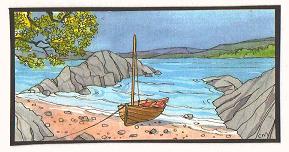
Claudia Myatt's painting of Swallow in the Secret Harbour
Claudia Myatt’s painting of Swallow in the Secret Harbour

The Secret Harbour on Peel Island looks south over Coniston Water to the hills of Cumbria. It has to be one of my favourite places on Earth. Bringing a small dinghy in there gives you a special feeling either of exploration or of coming home. You need to go when no one else is about. On the 1st June 1973 we spent a whole day filming there with a crew of sixty or more people. It was still a magical place.

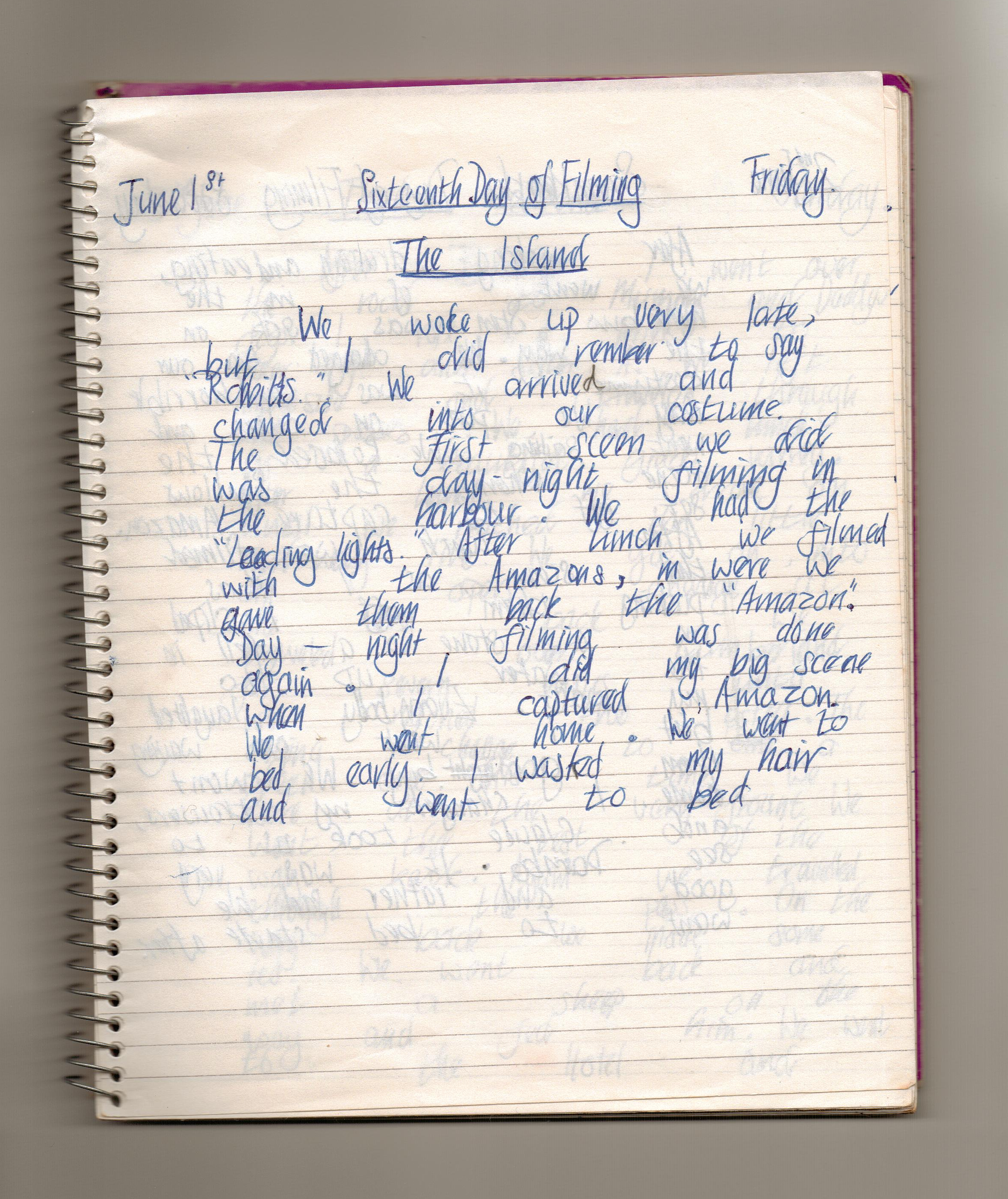
1st June 1973 ~ My Diary

Our secret of Secret Harbour was that although many of the scenes in Arthur Ransome’s story are set there at night, back in 1973 we only ever filmed them during the day. This was achieved by using the technique of Day-Night, or Day-for-Night filming, the use of filters over the camera lens so that we could film a scene that would come across as being dark even though it was shot in broad daylight.  This had obvious advantages. Filming at night is amazing, but very tiring. It demands considerable lighting set ups, which would have been impossible on Peel Island as they could not get a generator out there.

Sophie Neville with Claude Whatham

The sun wouldn’t have set until very late on 1st June in the Lake District where mid-summer nights are short. Children are only permitted to work certain hours and need to be given rest days afterwards, so filming exteriors at night just wasn’t feasible. And yet, much of Swallows and Amazons, including the most dramatic of scenes,  is set at night.

Secret Harbour on the southern end of Peel Island when we were returning for lunch in the Capri whilst Richard Pilbrow’s dog looked on from the temporary jetty constructed by the crew: photo ~ Martin Neville

I remember Claude Whatham, the Director of the film ‘Swallows & Amazons’ (1974) and Dennis Lewiston, our Lighting Cameraman or Director of Photography, being intensely absorbed in perfecting our Day-for-Night sequences. This was particularly tricky for them as many were set out on the water. Having already shot one night scene on Peel Island when we were in the girls’ tent, Dennis now started the day with a scene which was set on the island, yet looked out over the water. He explained that ideally he needed constant, bright sunlight, which would look like moonlight reflected on the ripples of the water. What he didn’t like were cloud banks. And for this we would wait. And waiting for children, while out on the water or in a confided space can be hard.

In the scene where the Swallows set up the leading lights Dennis accepted the clouds. It looks fine, as it’s appropriate for it to be getting dark. The little fluffy clouds in the scene where the Amazons arrive aren’t so great as they landed on Wild Cat Island in the dead of night.

Sophie Neville in Secret Harbour

Even on land the Day-for-Night shots would take some time to line up. The candle lanterns had to be boosted with battery operated light bulbs. If you look at the lantern in Susan’s tent you can see a black electric wire coming off it, and even a bulb on the Big Screen. You don’t notice this because your attention is on the dialogue but it can easily be spotted.  You might think it would be a distraction for us children but we were all quite down-to-earth and the technical detail kept our interest and our minds on our work.

BW Sophie Neville in Secret Harbour

These were our favourite scenes, set in our favourite place. It was the Amazons’ big day with Kit Seymour emanating leadership as she portrayed Nancy Blackett ‘terror of the seas’, with all the confidence, grace and rugged beauty Arthur Ransome must have either known or envisaged. ‘By Gum, Able-seaman – I wish you were on my crew.’

There was much dialogue for Lesley Bennett who played Peggy. She did well, but acting opposite Suzanna Hamilton is always easy. It’s like rowing in a crew led my an excellent stroke or having a good man at the helm. The part of the practical Susan was not a charismatic one but Suzanna anchored us all. Her own performance is absolutely faultless. I had much to react to but not much to say. I did manage to handle the Amazon by myself and the long shot when I captured her was achieved in one take. A triumph at the end of a long day.

‘There are more of us Swallows…’ Sten Grendon, playing Roger and Simon West, playing Captain John in the Secret Harbour on Wildcat Island during the filming of ‘Swallows and Amazons’ in 1973

There was much dialogue for Lesley Bennett who played Peggy. She did well, but acting opposite Suzanna Hamilton is easy. It’s like rowing in a crew led by an Olympic oarsman or having an experienced skipper at the helm. The part of the practical Susan was not a charismatic one but Suzanna anchored us all. Her own performance is absolutely faultless. I had much to react to but not much to say. I did manage to handle the Amazon by myself and the long shot when I captured her was achieved in one take. A triumph at the end of a long day.

Sophie Neville in the Amazon with the Denis Lewiston and the 16mm camera1
Sophie Neville in The Amazon with DOP Denis Lewiston, his 16mm camera and a reflector board ~ photo: Martin Neville

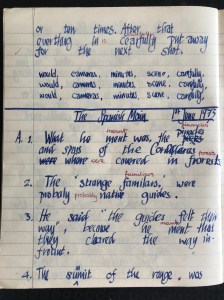
I must somehow have spent time in the school bus with my tutor on 1st June as I was learning about the Spanish Main:

You can read more about the filming here:

Filming The Swallow and The Amazon from a pontoon out on Coniston Water ~ 31st May 1973

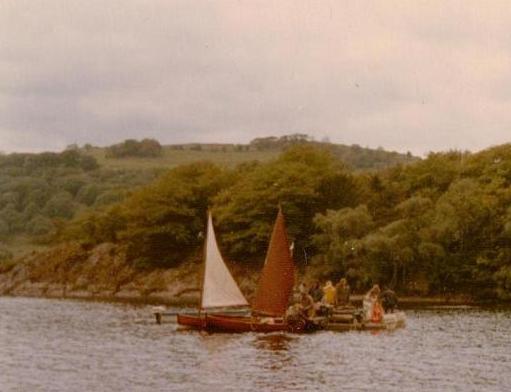
The dinghies Swallow and Amazon with the camera pontoon at Peel Island on Coniston Water ~ photo: Martin Neville

How do you film two girls sailing a thirteen foot dinghy talking to their brothers sailing along in another small dinghy while calling out to two other girls in red bobble hats dancing about on a wooded island which both the small boats are approaching?

The scene looks so simple on paper.  It is the one when the Swallows sail back to Wild Cat Island with the captured Amazon to find Nancy ‘dancing with rage’ and Peggy anxious to get home before breakfast. One page of script.

Claude Whatham soon discovered that he was shooting the most complicated of sailing scenes. On a cold grey day in the Lake District.

It is extremely difficult to describe how he managed this, but I will attempt to do so.

31st May 1973 ~ My diary

Sophie Neville's diary 1974

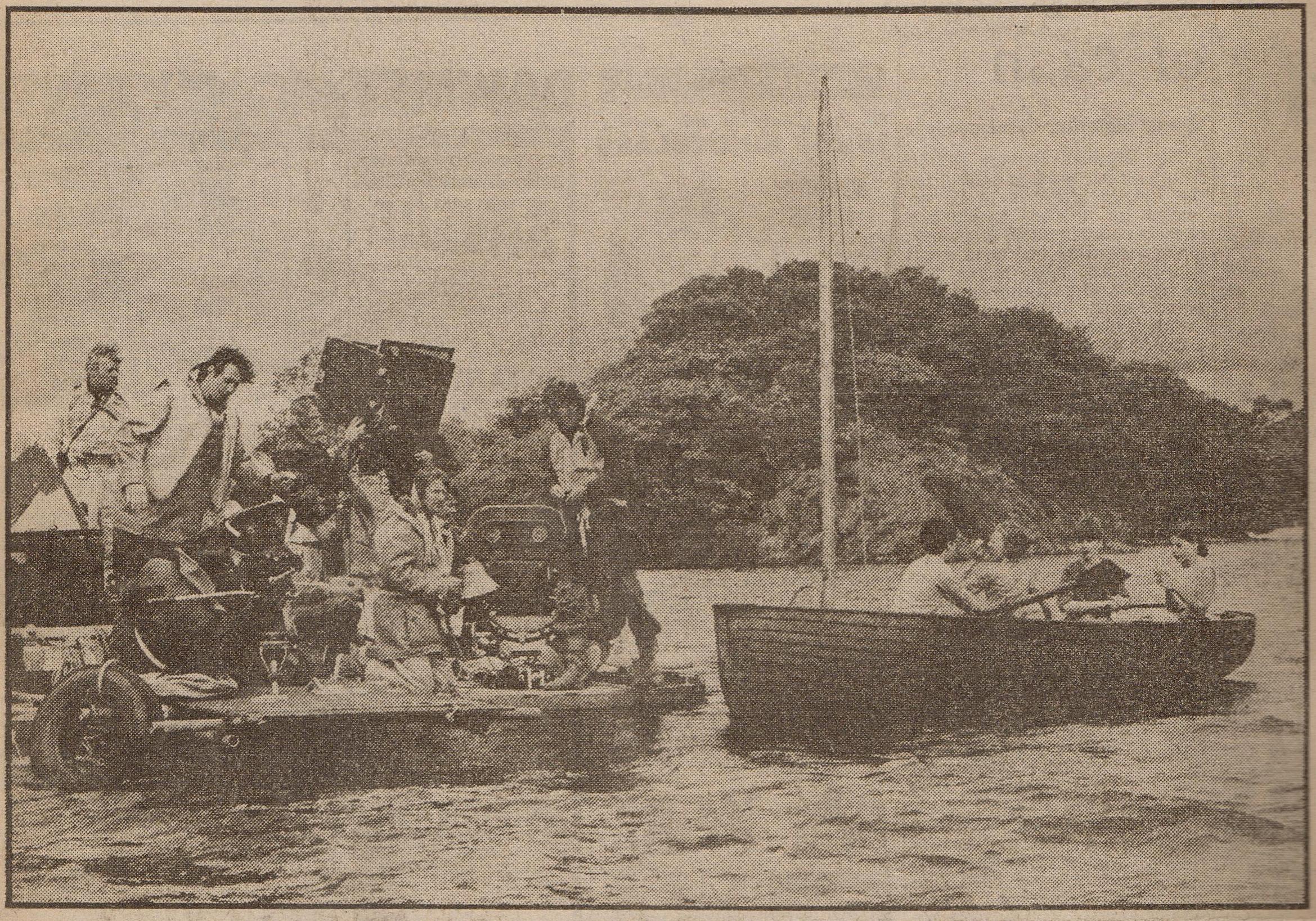
There was no room in the dinghy Amazon to film Susan and Titty sailing. This had to be done from a boat or vessel lashed along side. The production had a pontoon hired from Mike Turk in Twickenham and managed with the help of Nick Newby at Nicole End Marine near Keswick. It was a sizeable raft equipped with four outboard engines and surfaced with a number of flat ‘camera boards’.

Swallow and the pontoonBasically rectangular, it had arms added on either side. The idea of this cross-shaped platform was to enable Claude to film us either side-on, from astern or across the bows of the dinghy, which was wired by its keel to the pontoon. The camera was normally on a tripod. The original idea was that it could be mounted on a short section of track but I don’t think this ever happened. Electric lighting was not something that could be used on this pontoon but two large reflector boards were used to light our faces instead.
The result was a shot used on the cover of a book and a DVD marketed by the Daily Mail in 2008.

Sophie Neville on the cover of the Daily Mail DVD

As well as the director and camera crew, the sound recordist and ‘boom swinger’ were on board the pontoon along with Sue the continuity girl. Costume, make-up and our chaperone would be in a separate safety boat, in this case a Capri. This would mill about with the life jackets, sunhats and warm clothes that we wore between set ups. The crew all started off wearing life jackets, but as you can see they were soon discarded. They were dangerous things, old BOAC ‘life vests’ with so many flappy straps that you were at risk of being trapped under water by them.

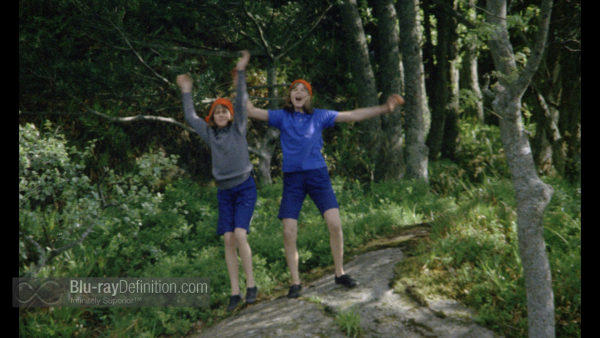
Blu-ray Amazon Pirates

The pontoon was operated by two boat men under the eye of David Blagden, the sailing director. They had to work with Claude and the wind so that when we were sailing, while the pontoon travelled with us. This was tricky enough on open water. If we were near the shore it could become more difficult. As you can imagine the dinghy could easily start to sail away from the clumsy pontoon – or worse. Our mast socket broke that first day.  They needed my father on that pontoon. He there, quietly was watching from the shore.

The camera pontoon on Coniston Water with Amazon attached to it and Swallow sailing to the other side of Peel Island during the filming of ‘Swallows and Amazons’ in 1973~ photo: Martin Neville

Although we had all read the book of Swallows and Amazons, and were devoted to adhering to every detail, no one remembered that John and Titty sailed the captured Amazon back to Wild Cat Island. She had a centre board which was a new thing for the Walkers so John decided to let Susan helm their familiar boat. I wish this had been detailed in the script. In the film, John was with Roger in Swallow whilst Susan and I were in the Amazon, which was a pity. I can only imagine that Claude decided this because he was trying to achieve a very difficult ‘three shot’. He was relying on John – on Simon West, who was aged eleven – to keep sailing Swallow in the right position, whilst out on the water between Amazon and Wild Cat Island.

Simon West sailing Swallow - trimmed
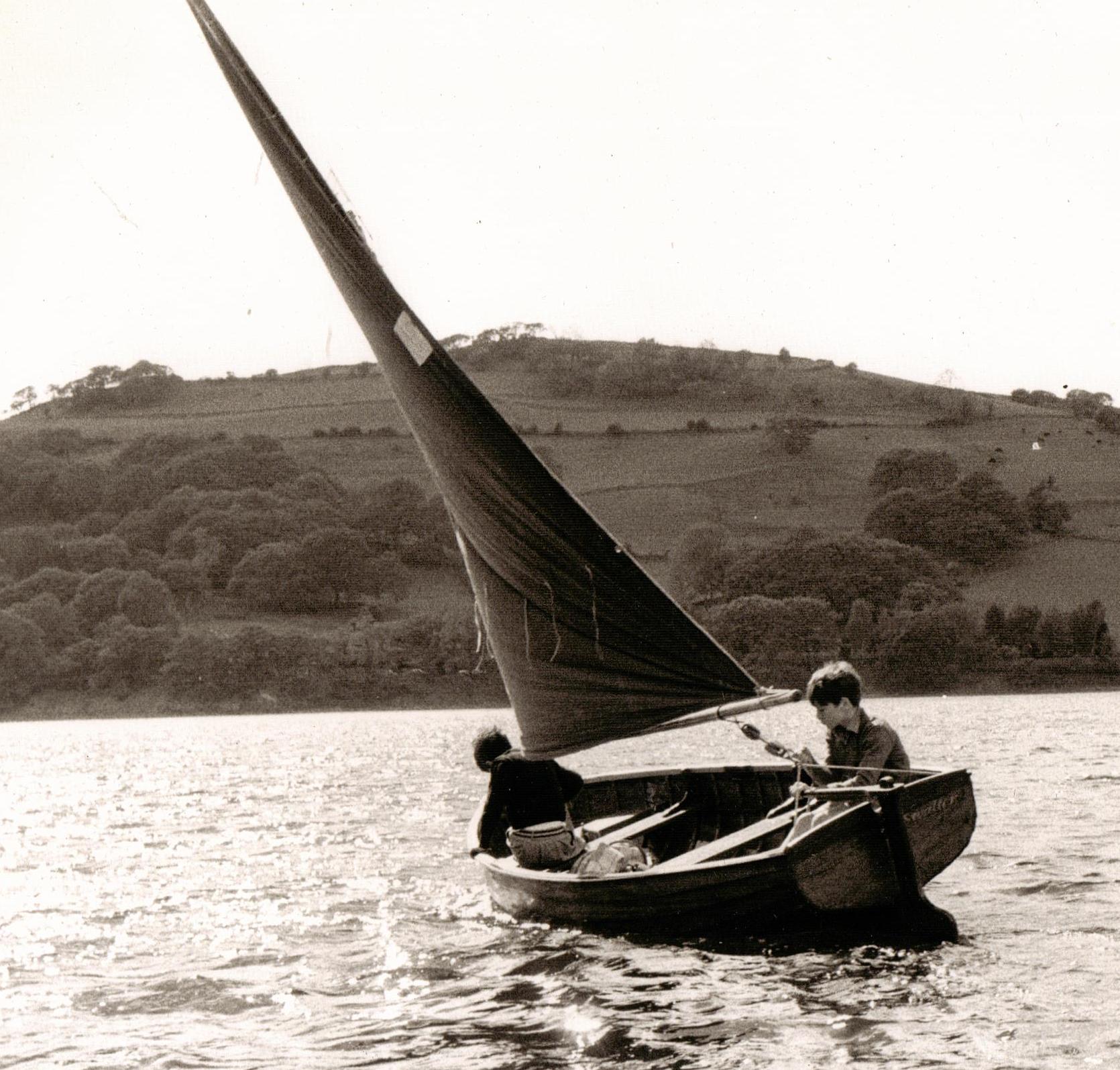
Simon West as Captain John sailing Swallow . Sten Grendon plays the Boy Roger in the bows

This wasn’t as easy as it looks. You can see from this photographs that Swallow kept racing ahead of the pontoon. It can be gusty around Peel Island and the rocks can be lethal. Roger was on lookout but he also had to deliver his lines.  Having no centre board and a shallow 1920’s rudder Swallow can be difficult to turn or get going if the wind slacks. This wasn’t actually a problem; Simon had wind and he did brilliantly. Suzanna Hamilton did too. She had no previous experience of sailing the Amazon. No one had remembered this sequence when we practiced before the filming began.

Molly Pilbrow and her dog with my sister, watching the camera pontoon from the shore of Coniston Water ~ photo: Martin Neville

Meanwhile Gareth Tandy, the third assistant director, was standing-by (probably for hours) on Peel Island with Nancy and Peggy. He had hide in the bushes and cue them at just the right time. They did so well. They had to deliver their lines while jumping from rock to slippery rock to keep up with both the Swallow, the camera and the story.

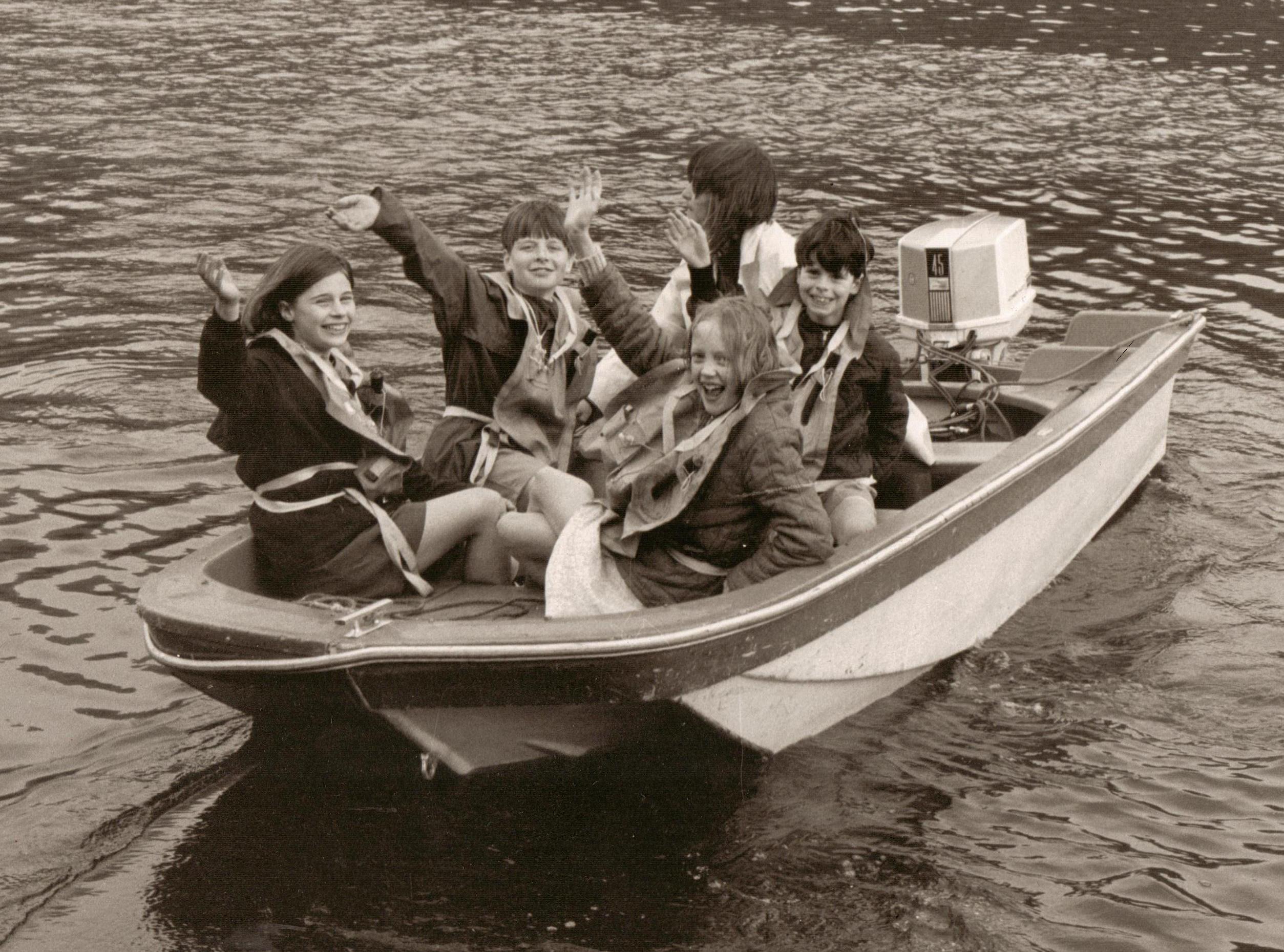
The Swallows and The Amazons in the Capri ~ Suzannah Hamilton, Kit Seymour, Daphne Neville, Stephen Grendon, Simon West, Sophie Neville and Lesley Bennett ~ photo: Martin Neville

When we filmed two of Arthur Ransome’s other books, Coot Club and The Big Six, on the Norfolk Broads in 1983, the BBC producer Joe Waters used a 35 foot river cruiser as camera boat. It could be difficult keeping it stable during a take, especially with so many people on board, but being a proper boat it was much easier to manoeuvre than the pontoon. And faster. Andrew Morgan, the director still managed to get his camera angles and it had the advantage of a cabin where sensitive equipment such as film stock and lenses could be stored. I can remember the camera assistant changing the film on board. I don’t know if the boat had heads. May be.

On both productions we had the inevitable problem of modern boats coming into shot. We had to have one of two men in zoomy motorboats that could zip across the open water to ask them to move clear of the shot. Even with this control you can imagine what happens. You line up your shot with all your boats in position, the sun comes out and a modern motorboat roars across the lake leaving you all rocking in its wake.  Then it rains.

The good thing about having a safety officer in a frog-suit is that they can carry you to shore at the end of a long day. You don’t have to get your feet wet.

The Safety Officer and me, with Dennis Lewiston and Claude Whatham still standing in the Amazon ~ photo: Martin Neville

The question is – Did the DOP and the director get carried ashore too?

You can read more here:

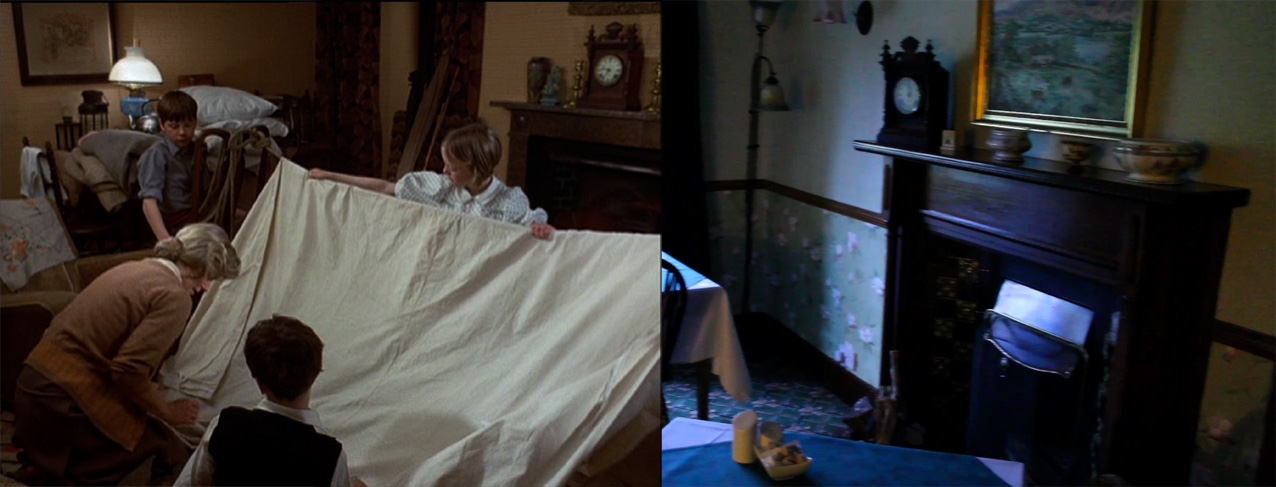
The clock is, indeed, still on the mantelpiece at Bank Ground Farm

It is aways wonderful to hear how the film of Swallows and Amazons has effected people’s lives.  I have just had such an interesting e-mail from Australia. I only wish that Claude Whatham was alive to read it.

Did anyone else know about the the clock on the mantelpiece at Bank Ground Farm?

In the film – and in real life
Dear Sophie,
      I can not tell you how much I am enjoying your website. I’ve searched for scraps of material regarding the making of Swallows and Amazons for decades, but you post more information in one day than I gleaned in a lifetime. It’s a fabulous insight, and one I really appreciate.
      I became a film-maker largely because of Swallows and Amazons. I’ve written a small piece about this, which is going to be published in a promo for one of my film-making books. As a nine year old, I stumbled across Wild Cat Island just days after seeing the film. I was so thrilled to be standing where the film had been made, and so excited to see how clever use of the camera could exaggerate the feeling of a location and capture the magic of performance, that I set out to discover everything I could about film. It was a life-changing moment.
      My daughters (5 and 7) adore Titty, and we are all impressed by your acting. I’ve directed my girls in a couple of things, and I know they gained confidence from having seen you perform. When Tabitha, my eldest daughter, saw the film for the first time, she burst into tears at the end. It was a release of pure joy, and is testament to the quality of the film.
      I live in Australia now, but returned to the island in 2010 with Tabitha and Harriet (rowing all the way from the other end of the lake). We stayed at Bank Ground Farm. This months we went back and were lucky enough to sail Swallow into the Secret Harbour. It was a windy October day, and quite a frantic sail, but I can honestly say it was one of the highlights of my life.
      When reading your recent post about set dressing at Bank Ground Farm, I wondered if you’d noticed that the clock on the mantlepiece is still there. It’s on the other mantlepiece, I believe, but it is still there. I have no idea whether it is a prop that was left behind, or whether the film-makers used the clock that belonged to the farm.
Thanks again.
Best wishes,
Chris
Christopher Kenworthy

Art Director Simon Holland
Art Director Simon Holland painting labels for cans of Pemican on Mrs Batty’s lawn at Bank Ground Farm in 1973 ~ photo: Daphne Neville

    Our set designer or ‘Art Director’ on Swallows and Amazons was Simon Holland. He worked tirelessly with his assistant Ian Whittaker and team of prop men, making every effort to use absolutely authentic props and set dressing. It must have involved quite a bit of research. Holly Howe, for instance would not have had mains electricity or back in 1929, so he made sure oil lamps were on set. These would have been modified by the Sparks so that it looked as if they lit the room in those evening scenes when we were busy packing.
    The people of the Lake District still remember Simon asking if he could buy old tins of food. It seemed such an unusual request. When it came to making labels for the cans of ‘Pemmican’ he painted them himself ~
      Simon had worked as the set dresser on the thriller Callan starring Edward Woodward, that we all saw in 1974. He had earlier been the Art Director on Bartleby, which featured Paul Scholfield with John McEnery in the title role Swallows and Amazons must have been one of his first features. He was only thirty-two that summer of 1973.
      Simon Holland went to to work on well known movies such as Equus, Greystoke, Quadrophenia, The Sleeping Dictionary set in Sarawakand Tales of the Riverbank which starred Stephen Fry as the Owl and Miranda Hart as Miss March. He sadly died in 2010 at the age of 70 but will be remembered fondly by us all.
      I have found the entry that Suzanna wrote in her diary at this time when we were filming at Bank Ground Farm. She drew a picture of the blue and white checked dress she wore and described an interview with a reporter.

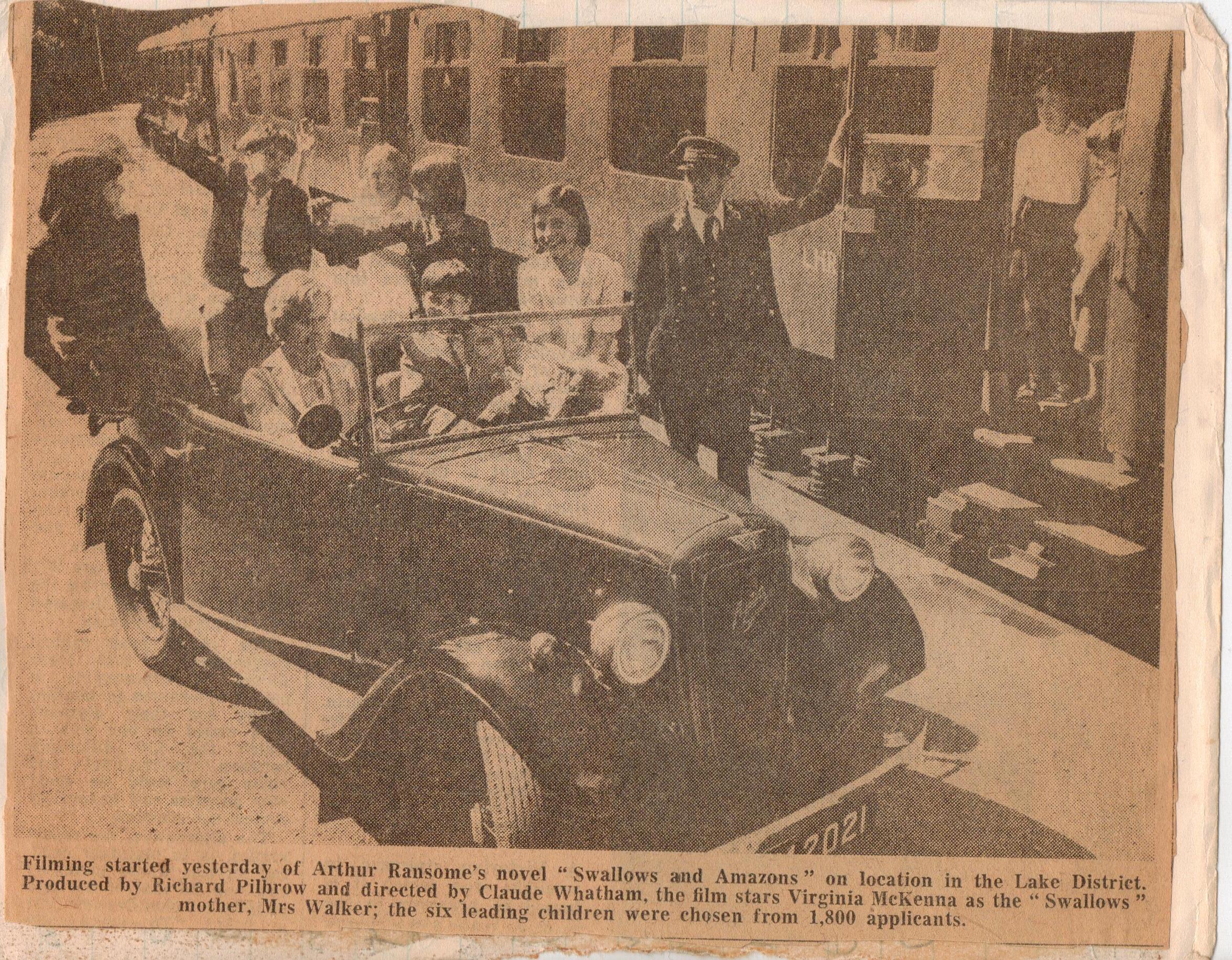
This is the newspaper clipping that Suzanna stuck in her dairy that featured Virginia McKenna and the six of us children in one of the old motors that Simon Holland found to dress the Railway Platform set at Haverthwaite Station on the first day of filming.

A clipping from The Guardian Newspaper 15th May 1973

You can read more here:

Secret Waters ~ or Swallows and Amazons Forever!

Sophie Neville speaking after dinner at a literary weekend
Sophie Neville speaking about ‘Swallows and Amazons’

‘When you went to see the charcoal burners, did Susan really leave her basket behind?’

‘Yes, she did!’  I’d totally forgotten, but she left it behind by mistake.

I was invited to speak after dinner at the 11th Arthur Ransome Society Literary Weekend held at Willis Hall, Bristol University. It was a joy and delight to meet the organisers and delegates, of which there were about 150. All seemed interested in learning more about the making of Swallows and Amazons, the feature film of Arthur Ransome’s book produced  in 1973 by Richard Pilbrow of Theatre Projects and distributed by EMI in 1974.

The 1974 film Swallows and Amazons

Director Claude Whatham with his cast of Swallows and their basket

‘How old were you all?’ I was asked.

‘Ahh, that is rather a secret,’ I had to admit. When the filming began I was twelve, yet playing the part of Titty who was meant to be only nine. I managed to pretend to be much younger but the reality was that, although skinny, I was a tall child with long legs, so tall that in some shots you can see that I am taller than my elder brother John.  Claude Whatham, the director, seemed unconcerned but had either holes dug for me or a box produced for John to stand on when were side by side. At other times he simply had John in a higher position.

Sophie Neville and Simon West in Swallows and Amazons 1973
Titty appearing to be much shorter than her elder brother John

John was played by Simon West, who even aged eleven was a true leader and excellent sailor. He became a National Optimist champion in 1975. Suzanna Hamilton, who played my elder sister Susan, was aged twelve. Lesley Bennett, who played Peggy was actually the eldest aged thirteen, and Kit Seymour turned thirteen during the filming. But, unlike at school, it didn’t seemed to matter to us. We all felt the same age and got on well as a result. Sten Grendon, who played the seven-year-old Roger was actually aged nine. He couldn’t swim well, but somehow survived.

Biographies of those who appeared in Swallows and Amazons

I do remember that Roger received more danger money than any of us. Claude would compensate us for getting scratched by brambles – as poor Roger was – by handing out extra pocket money. I think we earned £2 each for enduring the icy waters of Coniston when the swimming scene was shot on a grey day in May. The water was so cold that it was agony and the money hard earned.  Titty, who was keen on imitating cormorants, had to dive underwater. I nearly passed out.  I am not very good at being wet and cold or when it comes to heights either, so it was encouraging to be rewarded after climbing trees, ‘For fear of ravenous beats.’ 

When you watch the film you can see that Susan inadvertently burnt Roger with the large flat frying pan, which she’d just taken off the camp fire. He flinches and she muttered ‘Sorry’, before ploughing on with the scene. The moment was captured in the film.

The Swallows camp on Wildcat Island
The frying pan that burnt Roger

One problem encountered when filming with children is that they can unexpectedly lose their milk teeth. I did. People still comment on this today.  I lost an eye tooth.  In some scenes it is there, then it will suddenly vanish only to re-appear again.  

Sophie Neville playing Titty in 1974
Titty’s tooth is obviously missing on the voyage to the island.


Claude was not very pleased that his continuity was blown and there was definitely no tooth fairy. He wasn’t very pleased when I grazed my leg falling off a swing at lunch time either. Suzanna cut her hand whittling wood. Bobby, the Props man seemed so happy and absorbed making bows and arrows for the Amazons, out of local hazel saplings, that we all wanted to try for ourselves and started carving. I bought a penknife with my danger money and made a bow, which I still have today. This occupation kept us all quiet until of course Suzanna nearly chopped a finger off and ended up with such a big bandage that Claude howled with dismay. We were banned from whittling after that, but I did learn to shoot with the bow and arrow. This proved providential since I gained the part of an archery champion in the next feature film I appeared in. Years later I met the man who became my husband at an archery event. He was chairman of the society. I might never have met him if I hadn’t learnt to shoot for the feature films.

The Swallows on their voyage to Wildcat Island

‘Here we are, intrepid explorers, making the first ever voyage into uncharted waters. What mysteries will they hold for us?  What dark secrets shall be revealed?’ Titty uttered dramatically as she looked out towards Wildcat Island. In fact we weren’t that intrepid. Our dinghy was wired to a pontoon on which was a 35mm Panasonic camera, a few yards of track and an entire film crew: sound, camera, lighting, wardrobe g et al.

The Swallow and the pontoon
The Swallow wired to the camera pontoon. Here we are rehearsing the scene where Titty and Roger row to Cormorant Island

The little bit of extra money Claude gave us was indeed compensation for encountering grave danger on one occasion. I don’t remember there being anything about it in Arthur Ransome’s book, but in the film there is a sequence when the Swallows nearly collide with the Tern, an elegant steamer that has taken tourists up and down Windermere since 1891. There is rather a large difference between the shot of the dinghy with the Tern coming towards her when Susan calls, ‘Look John! Steamer ahead!’  which was shot when Swallow was attached to the floating pontoon, and the next shot, a top shot, which was taken from the steamer when we were sailing free.

That is when things went wrong. The Tern turned, John lost his wind in the lee of the larger vessel and we four children came perilously close to ending up in a very Duffer-ish state.  Swallow had no centre board, only a keel and a shallow rudder, so she was difficult to turn at the best of times. We were acutely aware that Roger couldn’t swim, we had no buoyancy and I was perched on a pile of heavy old camping equipment. My father, who is a good dinghy sailor with years of experience racing in the Solent, was watching from the deck of the steamer, helpless. He could foresee the problem and yet was able to do nothing. Although we just managed to avoid a true collision he was so shaken someone had to find him a glass of whisky.

MV Tern on Windermere today

You can read more about the making of ‘Swallows and Amazons’ (1974) here:

‘Swallows and Amazons’ but no life jackets

Sophie Neville appearing on the cover of Swallows and Amazons published by the Daily Mail

When Harbour Pictures, in association with BBC Films, announced at the Cannes Film Festival that they were planing to re-make Swallows and Amazons based on Arthur Ransome’s iconic book that was written in 1929, a debate broke out as to whether the characters should wear life jackets.

Ironically Sophie Neville, who played Titty in the 1974 feature film of Swallows and Amazons nearly drowned one Easter because she was wearing a buoyancy aid. ‘My sister insisted I wore a big old fashioned life-jacket as an example to her children. When I capsized it trapped me inside my canoe. I’d lost my paddle and hung upside down, in the cold water, unable to get out. I was literally plugged inside and couldn’t get free.’

The EMI film of Arthur Ransome’s book Swallows and Amazons was made entirely on location in the Lake District 1973. ‘It can get quite gusty on Coniston Water but we never fell in,’ Sophie remembers. ‘We had a wonderful time.’

Ronald Fraser as Captain Flint with Daphne Neville and Sophie Neville playing Titty Walker on Derwentwater in 1973
Ronald Fraser as Captain Flint with Daphne Neville and Sophie Neville playing Titty Walker 

Ten years later the BBC made the drama series Swallows and Amazons Forever! an adaptation of Ransome’s later books Coot Club and The Big Six, which are set on the Norfolk Boards. Julian Fellows featured as a Hullabaloo, an enraged tourist driving a motor cruiser.

In both the film and television series the decision was made to be true the 1930s period in which the books are set and let characters – adults and children alike (plus pug dog), go out on the water without life vests. They carried knives, lit fires and sailed at night without lights in boats that had no buoyancy aids.

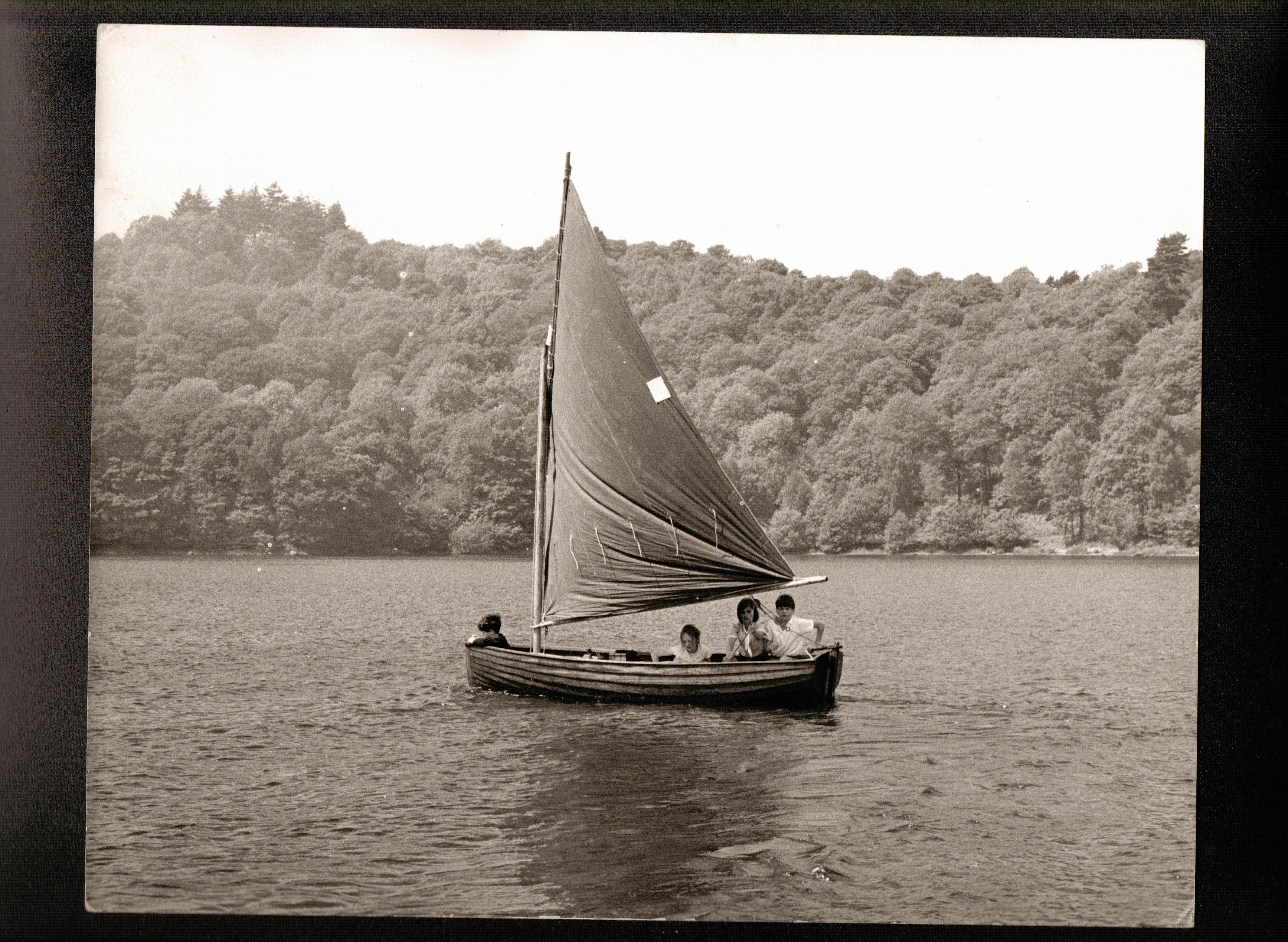
Swallow on Coniston

Lanterns were hung in tents and arrows were fired at other children. The boys in Norfolk also rode bikes without helmets, but that is how life was led in the 1930s. No one had safety belts in cars. Not much safety gear had been invented. ‘You wouldn’t film Elizabeth the Golden Years with Cate Blanchett in a BHS riding hat, or Russell Crow playing Robin Hood in a jockey’s helmet. No one moans about that. When filming Swallows and Amazons we wore life jackets when setting up shots and had a lifeguard in a zoomy rubber boat on constant stand-by when filming, but you wear period costumes in a period film and that is it.’

BW Wearing Life Jackets in the Safety Boat - trimmed
Suzanna Hamilton, Simon West, Sophie Neville and Sten Grendon wearing BOAC lifejackets in 1973

Sophie worked for the BBC behind the camera on the crew of Coot Club and The Big Six. She said what concerned her in Norfolk was the thought of someone getting trapped between a moored boat and the staithe wall or getting bashed when boats passed under the famously low bridges. ‘This situation won’t exist in the Lake District when Swallows and Amazons is made into a film again. They will have a wonderful – inspirational – time.’

Meanwhile if you are planning on going canoeing – sign up for a safety course first and wear the proper gear. This is the year 2015 and buoyancy aids are available…

Sophie Neville with Swallow

Sophie Neville with Swallow by Coniston Water, holding an original publicity still from the EMI feature film of Swallows and Amazons. Photo credit: Kitty Faulkner ©Sophie Neville

You can read more about how the original film of ‘Swallows and Amazons’ was made on location here:

the-making-of-swallows-and-amazons-1974-by-sophie-neville

Serendipity

Serendipity [ser-uh n-dip-i-tee] an aptitude or faculty for making desirable discoveries by accident

Serendipity indeed.  The word has been quoted to me so many times that I’ve started to take note.  The serendipit in question connects me to a rather large, bald man with massive moustaches called Arthur Ransome.

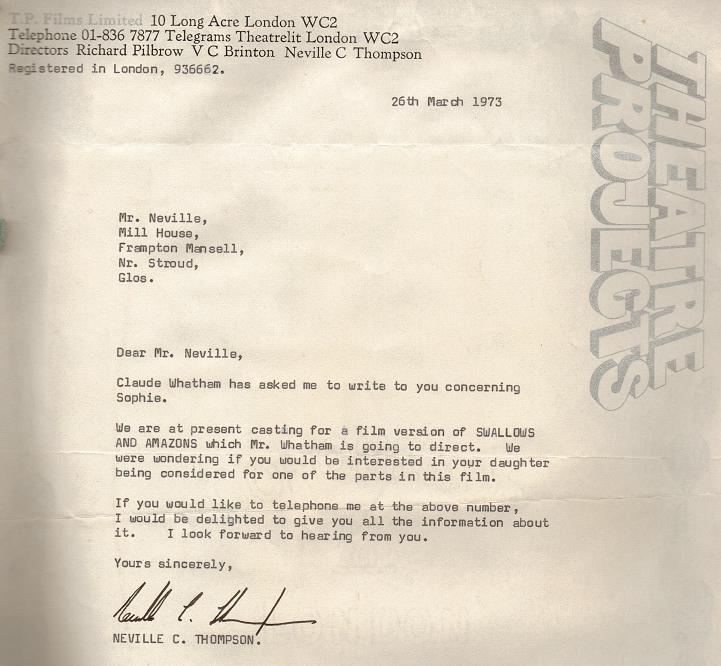
In March 1973 my father was sent a letter, completely out of the blue:

We are at present casting for a film version of SWALLOWS AND AMAZONS which Mr Whatham is going to direct. We were wondering if you would be interested in your daughter being considered for one of the parts in this film.  Amazing!

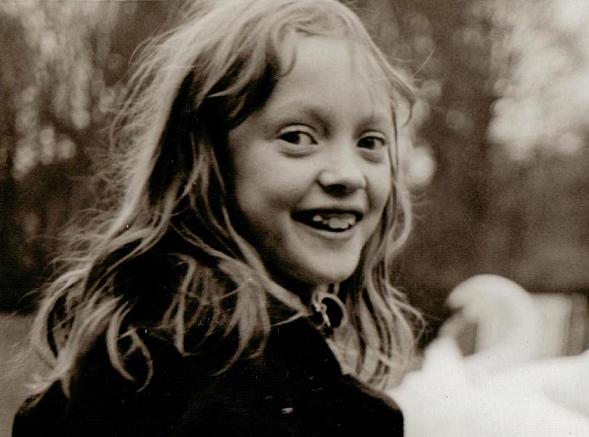
Sophie Neville as a child
Sophie Neville as a child ~ photo: Martin Neville

To gain a part I had to be able to swim well. I think this was to do with ensuring I was unlikely to drown. As it happened I could row, sail and swim. My parents had taught me but I can’t remember Claude Whatham asking me about this when he interviewed me. He wanted to know what my favourite Television programme was.

Blue Peter!’

‘Why?’,

‘Because they show you how to do things.’

It was exactly what Mr Whatham wanted to hear. Why? Because that is what Arthur Ransome does in his books. He doesn’t tell. He shows his readers how to sail. And how to camp. By the age of twelve I had already read about seven books in the series and loved the stories. What I didn’t know then was the effect they would have on the rest of my life.

By May 1973 I was on my way up to the Lake District to play Titty Walker in the feature film being produced by Theatre Projects and distributed by EMI. I didn’t think I was right as Titty at all. In real life Titty had been Anglo-Armenian and grew up in Syria. The illustrations show her with dark hair, cut in a bob. And I thought of myself as far more like the practical Susan, Titty’s older sister.  However I was assured that I could play Titty and I did. Able seaman Titty, crew of the Swallow. Thankfully they cut my straggly blonde hair and I sang out the dialogue that I already knew off by heart from reading the book, ‘I expect someone hid on the island hundreds and hundreds of years ago.’

Sophie Neville with Suzannah Hamilton and Simon West sailing Swallow 1973 ~ photo copyright Canal et Image

How the real parrot arrived on my shoulder I can’t quite remember but within months of returning from Coniston Water I had a green and yellow parrot of my own. I think he had outlived his owner and was given to us to keep. He was good company and very chatty. I adored him and could take him anywhere. When I was asked to be in Animal Magic to talk about the film he sat on my shoulder while I was rowing a boat, and I think did most of the talking.What I didn’t realise was how themes from Arthur Ransome’s life would follow me through the rest of my life.

Swallows and Amazons LP

When the time came for me to matriculate I went to Collingwood College at the University of Durham.  The name resonated later when I discovered that W.D. Collingwood’s grandchildren were the real Swallows. W.D. Collingwood was an archaeologist living above Coniston Water, where the books are set, and had excavated Peel Island– or Wild Cat Island– finding the remains of a Viking settlement there. Some one had hidden there hundred of years ago.  WD Collingwood Titty’s grandfather studied at the Slade, as did my own grandfather, HW Neville. He may have been there at the same time as Titty’s mother Dora Collingwood.

Arthur Ransome won a Kitchener Scholarship. Years later these rare awards have been won by both my niece and my nephew. When Arthur Ransome first lived in London, he had digs in Hollywood Road. When I moved to London I shared flats with friends, first in Tregunter Road, then Harcourt Terrance, which ware merely extensions of Hollywood Road, which is off the Fulham Road in West Brompton. I had gained a graduate traineeship at the BBC. The first drama series that I worked on was Swallows and Amazons Forever! an adaptation of Arthur Ransome’s books set on the Norfolk Broads, Coot Club and The Big Six. It was not a chance thing, I contacted the Producer and asked if I could work on the series, but the fact that I’d heard about it was unusual, and amazing really that it was made that year when I was available to join the production team. I had first worked with Rosemary Leach, who played The Admiral – Mrs Barrable, when she starred, not as Missee Lee, but as Mrs Lee in Cider with Rosie. I later found myself working with William the Pug dog on Eastenders when he featured as Ethel’s ‘Little Willie’ . It was such fun to see him again. He was a playful little dog with a great sense of fun.
Swallows and Amazons Coot Club and The Big Six
Coot Club and The Big Six

The first documentary I directed for the BBC involved an adder. I was filming in at a Nature Reserve in Dorset with a group of children who came across one immediately. It was huge, a black adder. The Billies would have declared this a great sign of luck. I’m not sure I thought much about Swallows and Amazons, over the next few years but I did film at a school in Cumbria and loved being back in the Lakes.

After working at the BBC for eight years I fell ill and, much like Arthur Ransome, had to abandon my full time job to work from home.  Like him I had a yearning to spend as much time as possible in the great outdoors and chose to live in the wilderness. I spent my time exploring southern Africa, camping and cooking on fires.  Of the subjects I’d studied at university the ones I most enjoyed were cartography and water-colours. I started to earn my living by drawing birds, animals and decorative maps.  The maps usually depicted game reserves and involved giving names to landmarks as places of interest, just like Titty’s maps. I must have drawn forty maps in the style of those on the original cover of Swallows and Amazons, using the same borders and style of lettering. And I kept diaries, writing just as Titty would have done. I also worked freelance for the BBC, mainly setting up wildlife programmes.  A rye smile did pass my lips when I was asked to find South African items for Blue Peter. I was thinking back to my first interview at Theatre Projects with Claude. They came to South Africa for their summer expedition one year, and it was I who sent them off to film the Outspan harvest and wild dog puppies in the Kruger National Park.  After a while I fell into the pattern of flying back to England at Easter time and returning to Africa in the autumn.  This was partly through choice, partly to comply with visa regulations and work commitments. I’d migrate every year with the swallows.

When we were making the feature film of Swallows and Amazons my mother looked after all six children. The girls playing the Amazons, Nancy and Peggy Blackett, needed to learn how to shoot with a bow and arrow.  My mother taught them.  She had learnt how to draw a long bow when she was first married, and was encouraged by an ex-Olympian called Bertie. I became interested too, which stood me in good stead as the next part I had in a feature film was playing Liz Peters, a fictional archery champion.

Thirty years after the premier of Swallows and Amazons I had flown back from Africa and was staying at my parents’ house, when a lady arrived from Korea.  She timidly knocked on the door, explaining that she was translating Swallows and Amazons into Chinese and would love to talk to me about the book.  She came bearing gifts: a hand-quilted wedding bedspread and a pile of silk garments amounting to a bride’s trousseaux.  It was a week after I had met my husband-to-be. At that stage he had not even asked me out and I had no idea we would marry. I’d met him at the archery – shooting with my bow and arrow. He was Bertie’s grandson. My three sisters have never been a bit interested in archery. If I hadn’t been enthused by Swallows and Amazons, and consequently taken it up to play Liz Peters, I would never have met my husband. I still have the wedding quilt.

Sophie with her husband on the coast of South Africa

And then I met Dr Frankland, a Harley Street Consultant who was to become an historical adviser on a script I was developing.  I soon learnt that Bill Frankland had been a good friend of Roger Altounyan and knew his sister Titty.  As young  men they both worked for Alexander Flemming.

Roger, Titty and their elder sisters Susie and Taqui were W.D.Collingwood’s grandchildren,  the real characters on which Arthur Ransome based the Swallows.  What I didn’t know was that Roger Altounyan became an allergist.  He developed the spin-inhaler, experimenting on himself.  Dr Frankland explained that he eventually died as a result. I was allergic to feathers as a child and prone to horrific asthma attacks. Not from parrot’s feathers but old pillows and eiderdowns. The Ventolin inhaler is something to which I probably owe my life. Dr Frankland, who is to celebrate his 100th birthday this March, still works as a Harley Street allergist and is often called upon to make broadcasts on Radio 4.  He instigated the pollen count, numbered Saddam Hussein as one of his most grateful patients and has been the expert witness at a number of murder trials.

Bertie’s Olympic bow now hangs on my stairs. I am still sailing dinghies, still drawing maps but thankfully no longer suffer from asthma. Harbour Pictures with BBC Films are now planning a new film adaptation of Swallows and Amazons. A whole new generation of children will be shown how to sail and camp and cook on open fires. I couldn’t be more thrilled.