‘The rain poured down.’ Cumbria was covered in cloud, the Lake District dark and dismal. What a nightmare for Richard Pilbrow and his production team. We were behind schedule, Lesley Bennett who played Peggy was ill in bed and we had run out of ‘rain cover’.
Sten Grendon, Simon West and Suzanna Hamilton in Swallow
There was one sequence left that could be recorded in dull weather. Today was the day Claude Whatham shot the haunting scenes of Octopus Lagoon. After finishing our school work Kit Seymour and I sat watching the filming from the sloping field above the beautiful but rather smelly lily pond.
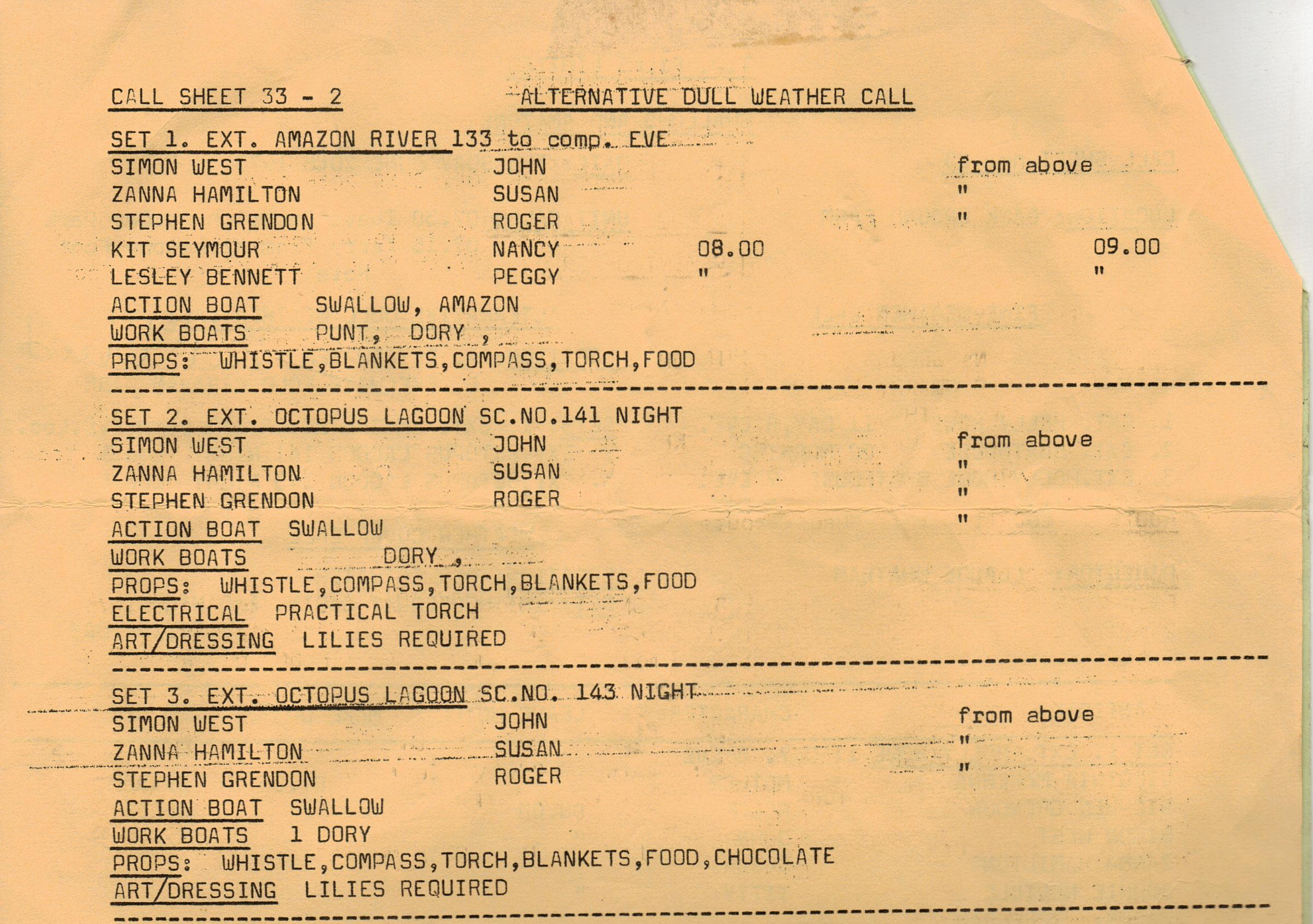
I do not have the Call Sheet for 29th June 1973 but have an extract from this earlier one detailing the ‘Alternative Dull Weather Call’:
I can’t say whether the weather allowed for the scene set on the Amazon River to be shot. Lesley had ‘flu so they would have had to somehow manage without her. I think Claude devoted his time to capture the conundrum and challenges faced by Captain John in the lagoon.
I remember looking down on the location, which was on private property near Skelwith Fold Caravan Park – possibly Slew Tarn.
Is this Slew Tran above Skelwith Fold?
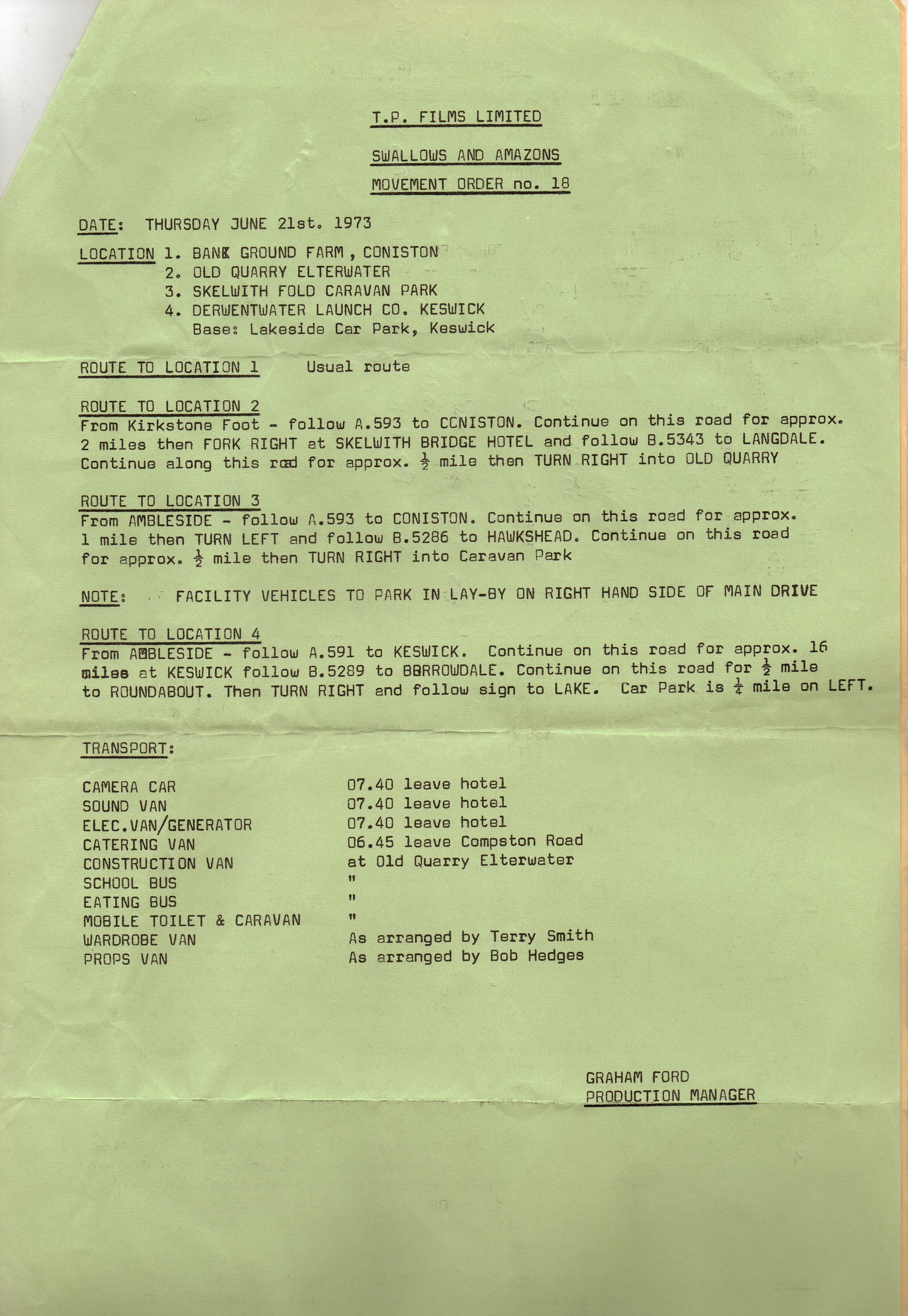
Those who are interested in finding the film locations used might find this old hand-typed ‘Movement Order’ useful:
Roger Wardale sites Octopus Lagoon as being Allan Tarn a short distance up the River Crake at the Southern end of Coniston Water, near High Nibthwaite. This is the place Arthur Ransome had in mind. He spent time there with is brother and sisters as a child when they spent their summers on Swainson’s Farm at Nibthwaite nearby. His father went there to fish for pike. It you have a shallow bottomed boat you can get there but it is not exactly on a footpath. The lily pond we used was in a high sided dip, which made it appropriately dark and gloomy. It was also more accessible for the film crew.
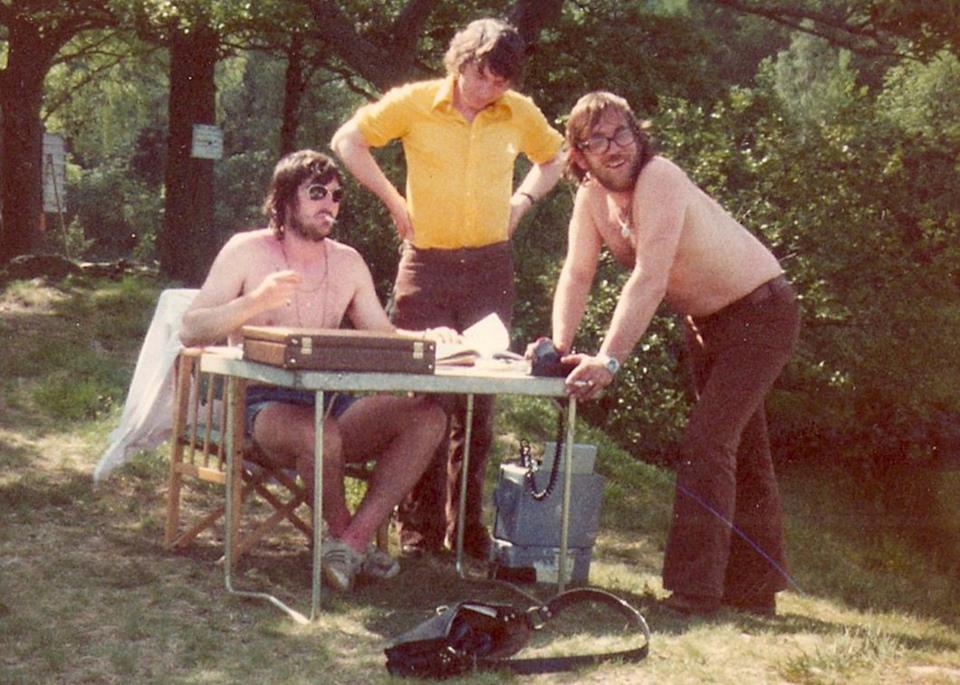
Graham Ford, who signed the Movement Order was our Production Manager. I only have a photograph of him taken on a sunnier day.
Second Assistant Terry Needham, Associate Producer Neville C Thompson and Production Manager Graham Ford with the unit radio on a sunny day in June 1973
Graham Ford would have been responsible for the film schedule, putting together the whole logistical jigsaw puzzle posed by factors such as the availability of leading actors and locations with the movement of vehicles and boats, including the massive camera pontoon. It was Graham who took the stress of problems caused by wet weather. I guess that he also took on the responsibilities of managing the locations, negotiating with owners and the Lake District National Park, something that authors such as Arthur Ransome would not have had to face.
Although young, Graham was pretty experienced. He had previously worked as an assistant director on such classic films as Steptoe and Son and had been the Unit Manager on The Devils, a film that starred Vanessa Redgrave and Oliver Reed. After Swallows he went on to work as Production Manager on S.O.S Titanic, The Honorary Consul and Princess Daisy as well as Time Bandits and Brazil directed by Terry Gilliam starring Jonathan Pryce, Kim Greist and Robert de Niro. Imagine being Terry Gilliam’s right hand man. He was a Location Manager for David Lynch on The Elephant Man and for Richard Attenborough on Ghandi in 1982. Graham’s career progressed. He produced The Nightmare Years and A Connecticut Yankee in King Arthur’s Court in the late 1980s before working on Gettysburg, the massive four hour long movie about the American civil war, in 1993. A life in film. He died in Ontario in 1994 aged only 48.
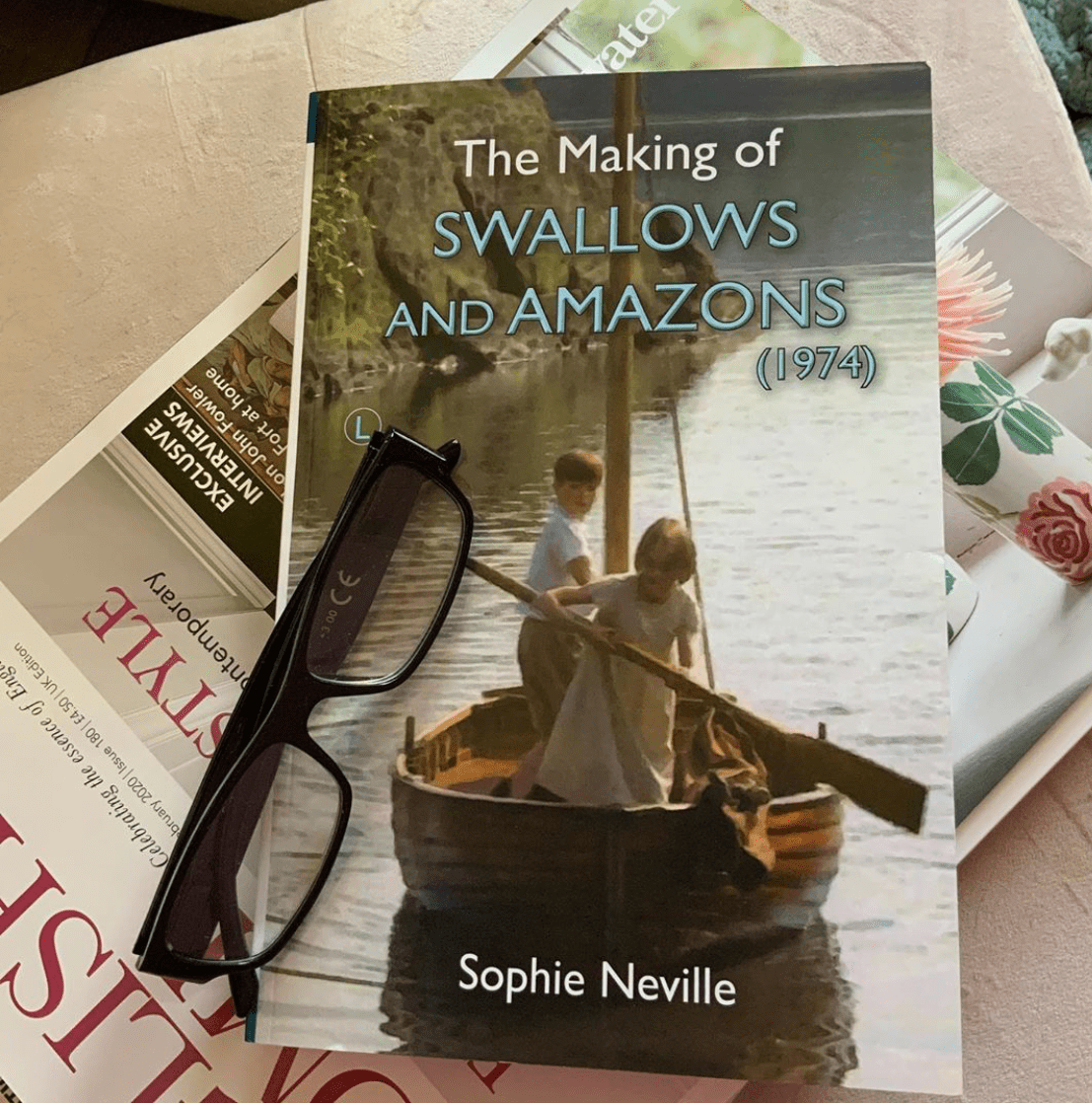
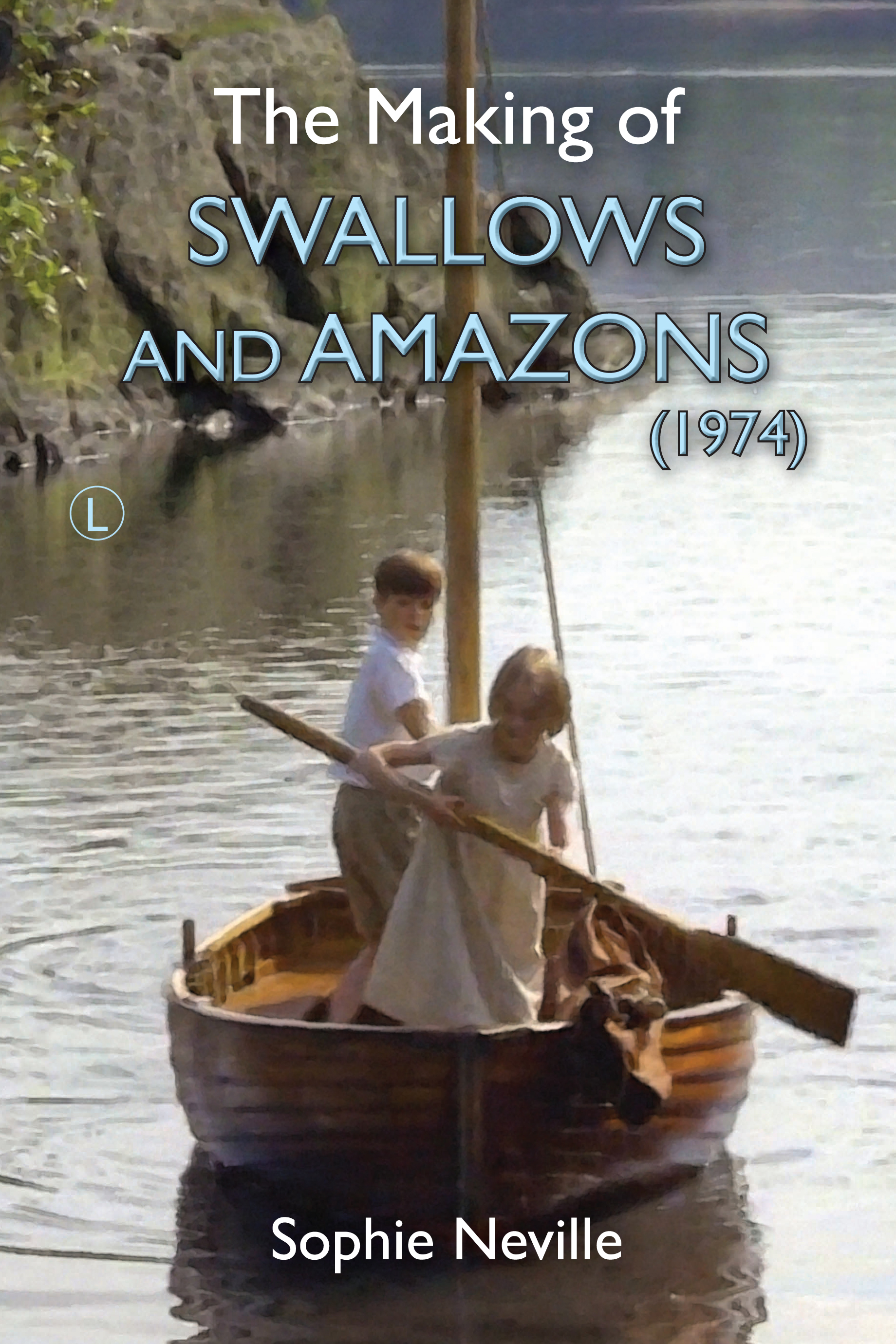
If you would like to read more, the story of the filming can be read in a paperback entitled ‘The Making of Swallows and Amazons (1976)’ available from libraries worldwide or from online stockist and good bookshops. The Nancy Blackett Trust have signed copies available here with proceeds going to the trust. These are illustrated so cost £15 but make good presents.
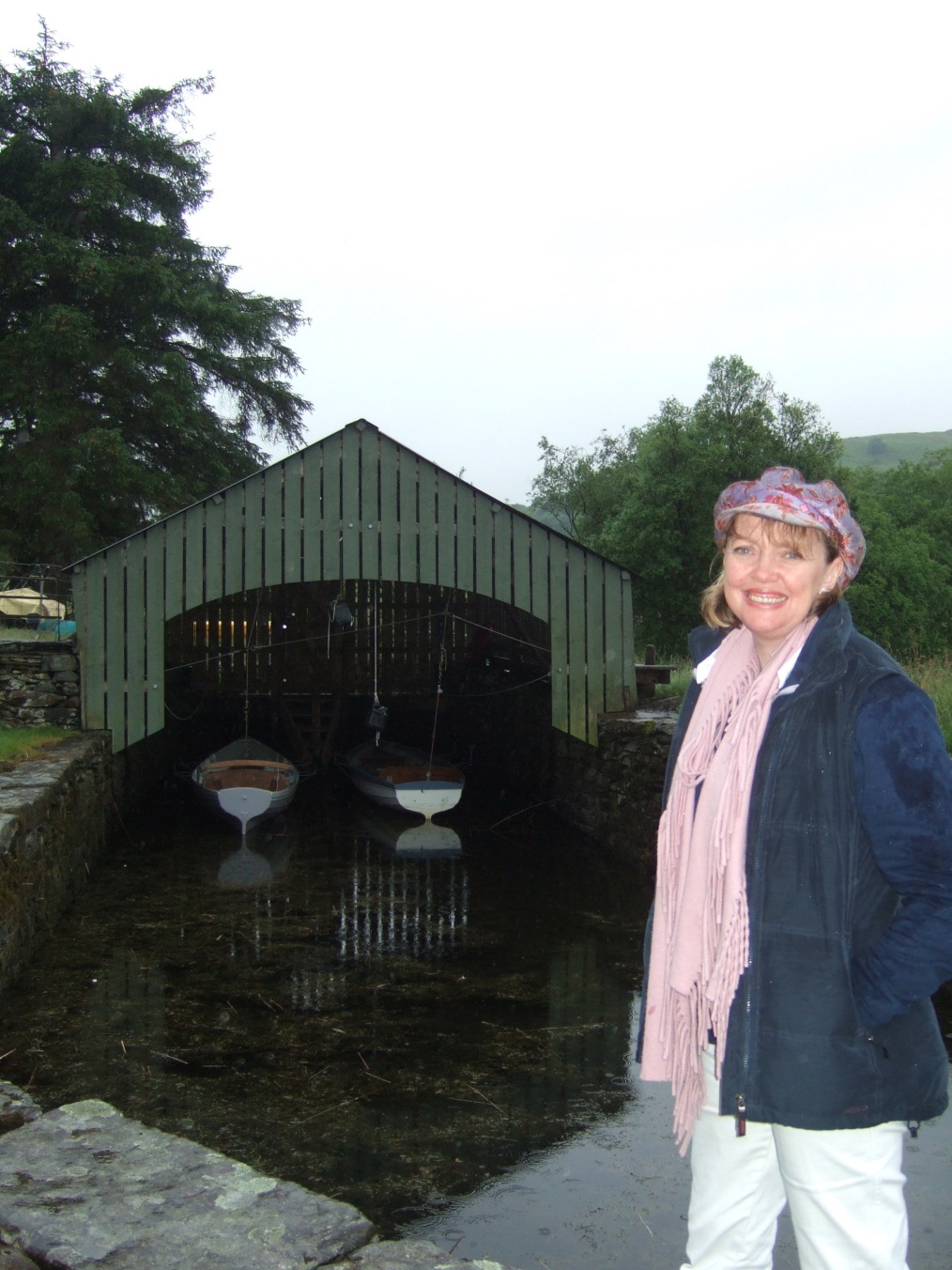
The boathouse at the Slate Quay where Arthur Ransome came on holiday as a child sits at the southern end of Coniston Water. How wise he was to write about the places, the culture and experiences that he knew so well.
As you walk down the footpath from the lane, you come across interesting artwork, although it would not have been around in Ransome’s day.
~ Sculpture at Slate Quay by Andy Gormsly~
The boathouse came to be owned by Bridgit Sanders, nee Altounyan, who was the inspiration for the youngest of the Swallows Vicky, the ship’s baby, and went on to become the first president of The Arthur Ransome Society. She lived with her family in the house nearby, teaching her children and grandchildren to sail on Coniston Water. After having children, Roger Altounyan rented half the house and would take them sailing in Mavis, the model for Amazon, bailing like mad.
~Coniston Water~
Arthur’s father would venture up the River Crake to fish in Allan Tarn, which may well be the location of Octopus Lagoon, first mentioned in ‘Swallows and Amazons’.
Whilst fish enjoy the reedy habitat, small boys are reputed to enjoy the ‘Knickerbockerbreaker’ rocks that rise above what must be Swainson’s Farm at High Nibthwaite, featured in Swallowdale, which you can find by the road nearby.
We pressed on in search of other places that made an impression on Ransome’s life. Although we had a very good driver this was not always as easy as one might imagine.
But I did find another representation of the crossed flags. Can anyone guess where?
~Kneeler embroidered by Jean Hopkins~
We drove through the gentle countryside south of Coniston Water passing a house called New Hall, once rented by Arthur Ransome and his wife, and on, climbing up past Gummer’s How and wiggling down to reach The Mason’s Arms, which I gather this was one of his favorite pubs.
Then, seemingly in the middle of no where, we came across the Holy Grail: Low Ludderburn and the erstwhile grey barn where Ransome wrote ‘Swallows and Amazons’. He had a writing room on the first floor. Roger Wardale says he kept his car, the ‘Rattletrap’ in the wooden garage that you can see just in front of the building. It was private then, and is a private house now, but you can catch a glimpse of it from the lane that runs up and on, eventually taking you down to Blake Holme on Windermere, which he named as partly the inspiration for Wildcat Island.
I’ve always thought that Arthur Ransome must have been completly impervious to the damp, to cold and wet weather. I am not. By now it was raining so hard that my husband was wearing my pink beret, but we were still in good spirits.
In a recent letter to The New York Times Frank Phelan from Albuquerque wrote to say,
It was not just British children who were saturated with the “Swallows and Amazons” novels of Arthur Ransome, as the review of “The Last Englishman,” by Roland Chambers, suggests (May 27). I grew up hundreds of miles from the ocean in Pittsburgh, wanting to be like Ransome’s characters. I wrote to him asking which of the English lakes was the right one. He sent me a postcard saying that it was “Windermere, with a few touches of Coniston, for the sake of disguise.” He ended with “You’ll be sailing some day!” and I lived on that.
So back to Windermere, and a long hot bath at Miller Howe, a lovely hotel that had a Jonathan Cape copy of Swallows and Amazons on the hall table. In the morning cloud was sitting on the high fells looking just like snow. I ran down to the lake to put my hands in the water, thinking, ‘This is the place for Winter Holiday’. But that is another book.
You can find maps showing these locations in ‘The Making of Swallows and Amazons’ or the ebook of ‘The Secrets of Filming Swallows and Amazons (1974)’ available from Amazon Kindle and other ebook platforms.
A few years ago, on a wet but beautiful day in Cumbria, we set off on a quest to find some of the locations used in Richard Pilbrow’s 1974 film of ‘Swallows and Amazons’.
To my delight our journey started with a drive down through the streets of Rio (Bowness) and along the east shore of Windermere to the Lakeside and Haverthwaite Railway Station at the southern end of the lake (or Antarctica as Titty labelled the region). It was here that we spent our very first day filming ‘Swallows and Amazons’ in May 1973. I had not been there since.
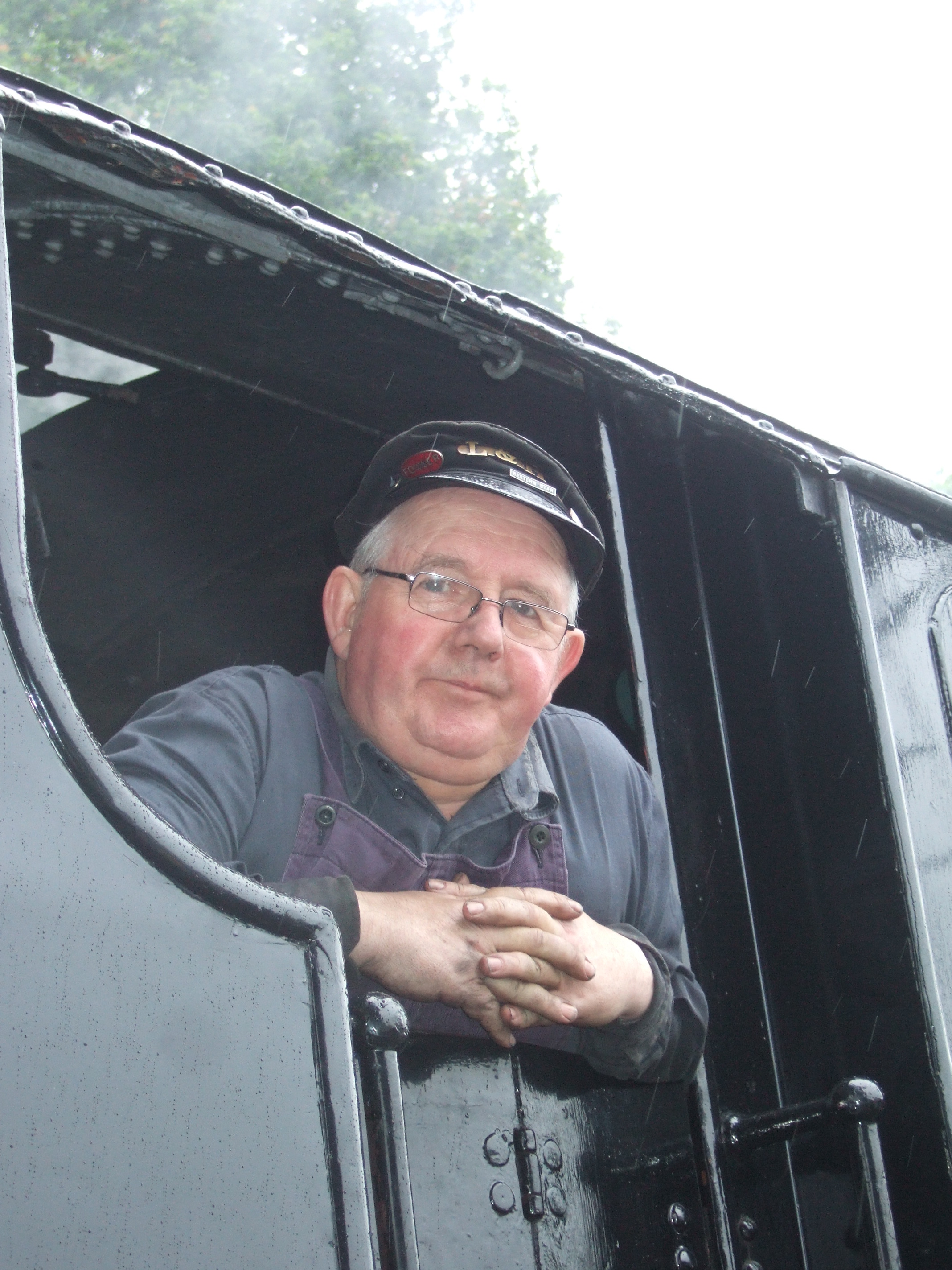
We had a chat to the train driver who explained that they now run six journeys a day. From Haverthwaite, the steam locomotives run alongside the River Leven to Lakeside Station. From here you can take a native steamer back up to Rio (the Bowness pier) or to the Far North (Ambleside, which is the town at the head of the lake where we lived whilst filming in that long distant summer when I was twelve years old.)
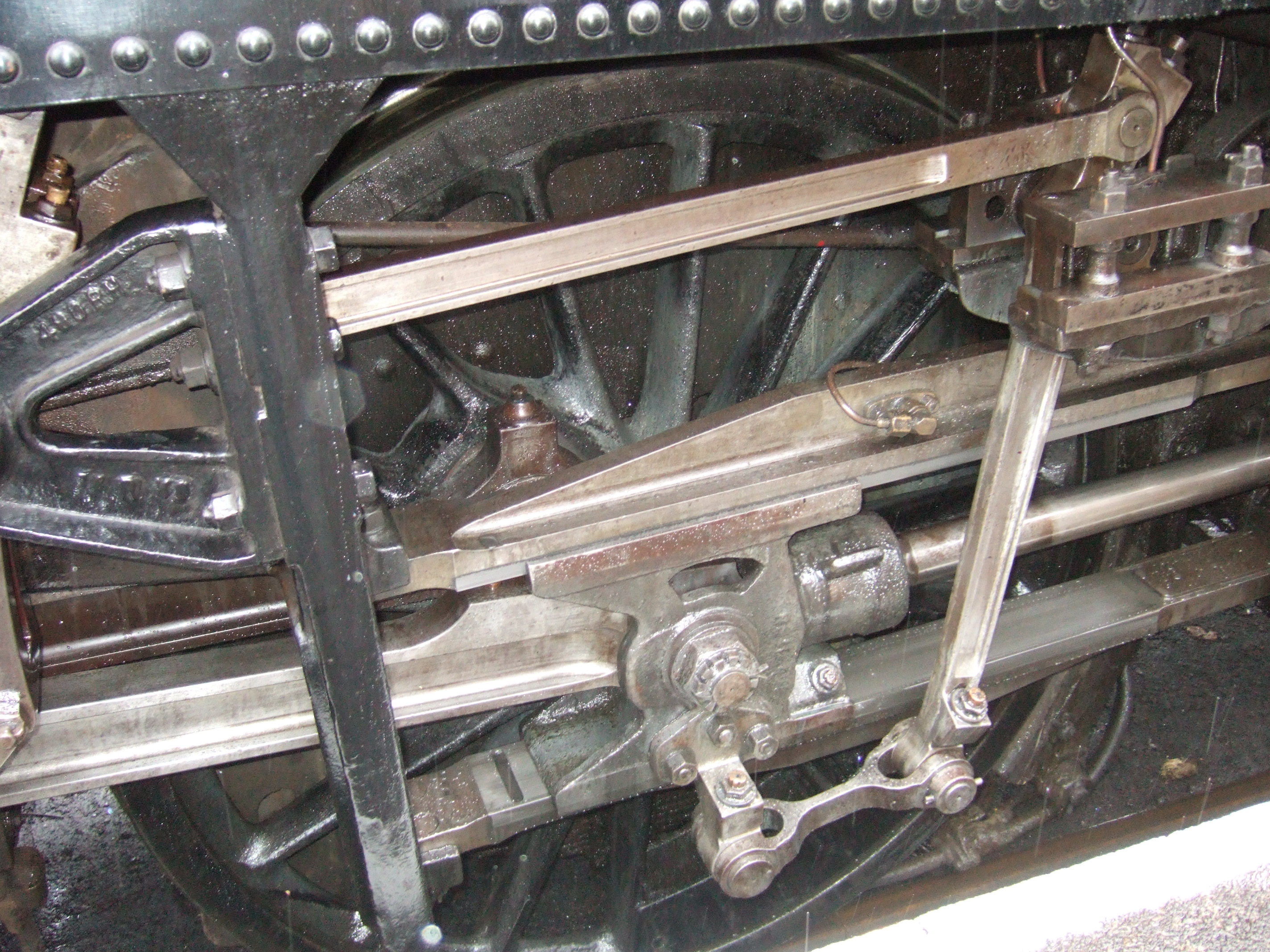
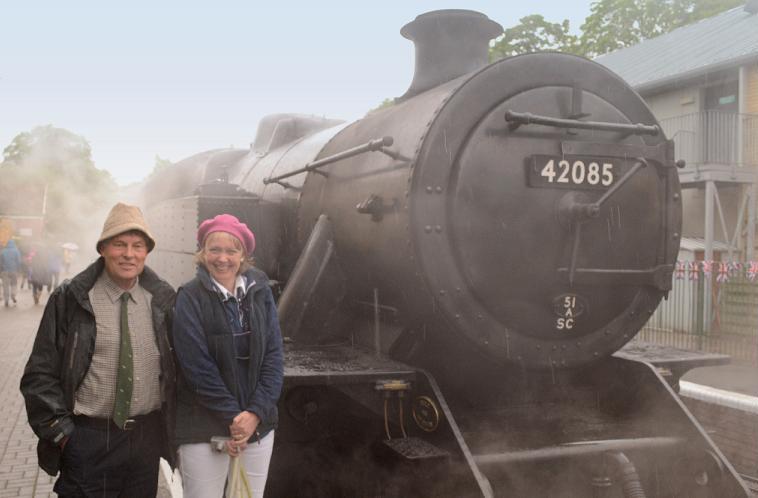
Whilst we used engine number 2073 in the movie, this steam locomotive 42085 was built in 1951. It uses about two tons of coal a day but it utterly magnificent. The driver probably uses rather a lot of steam oil too. It’s a smell I relish, familiar since childhood days spent on steamboats. I remember it from the SBA steamboat rally held on Windermere in 1991, which I describe in Funnily Enough.
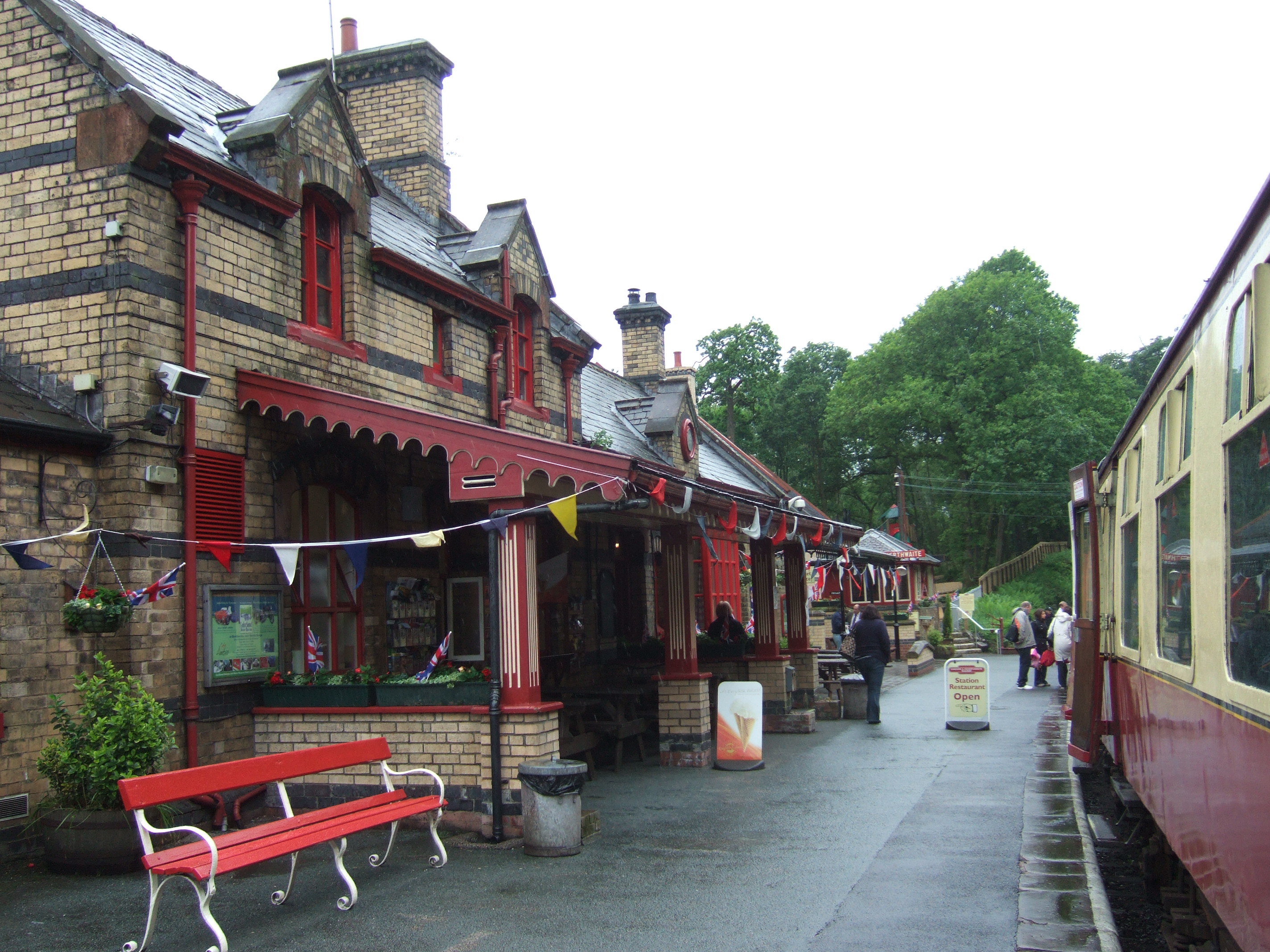
Curiously, Haverthwaite Railway Station looked cleaner and shinier than when we used it as a film location in 1973. I can only suppose it was still in the process of being restored back then, when Simon Holland our set designer cluttered it up with push bikes and luggage trolleys. Much to our surprise, the yellow taxi we were transported in during the filming was actually driven along the platform.
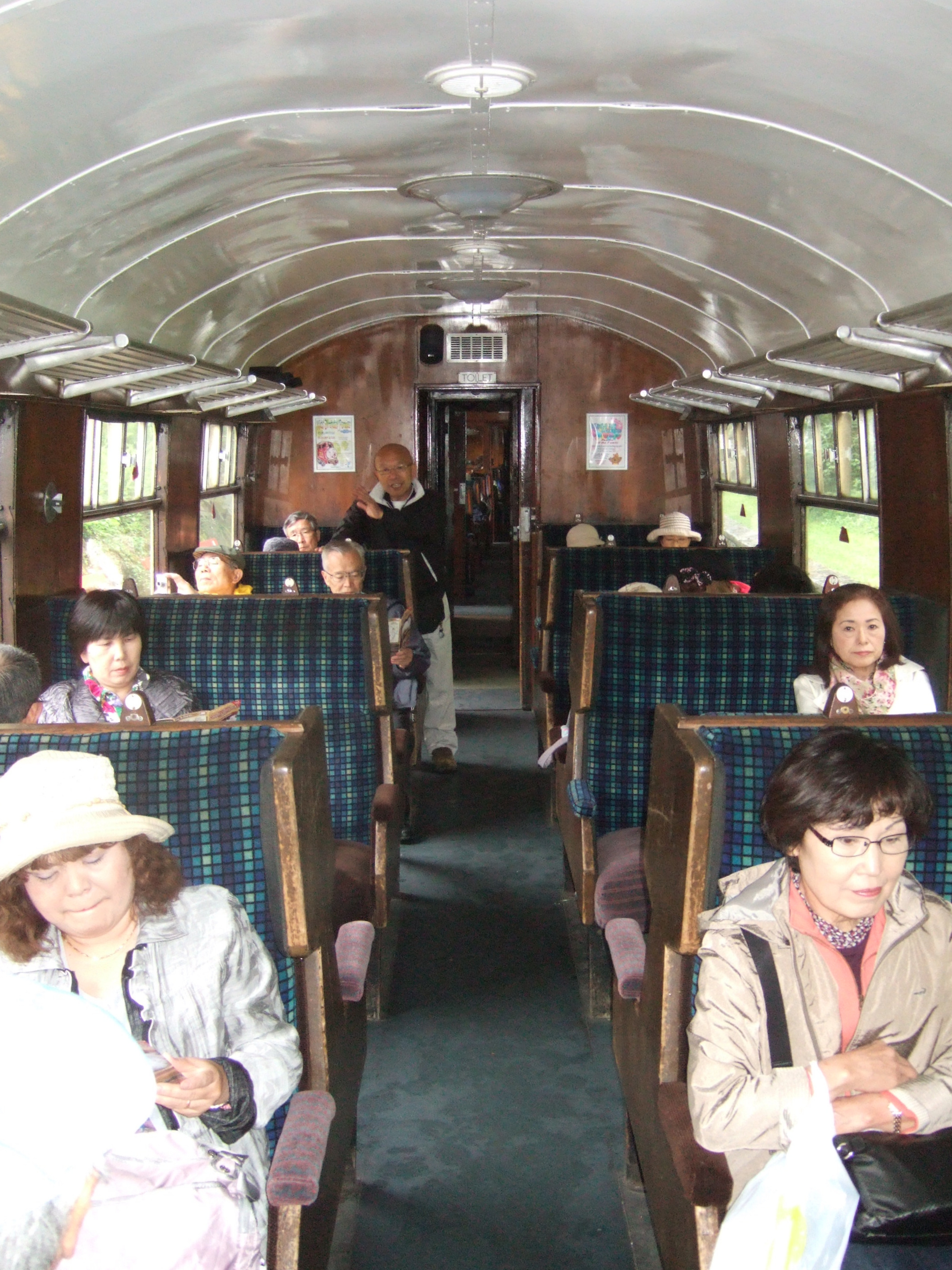
We climbed aboard the train and I explored, as Titty would have done, discovering people seated inside from far distant lands.
David Wood’s screenplay for the film of Swallows and Amazons, directed by Claude Whatham, opens to find the Walker family cooped up in a railway carriage compartment as they travel north for their holidays.
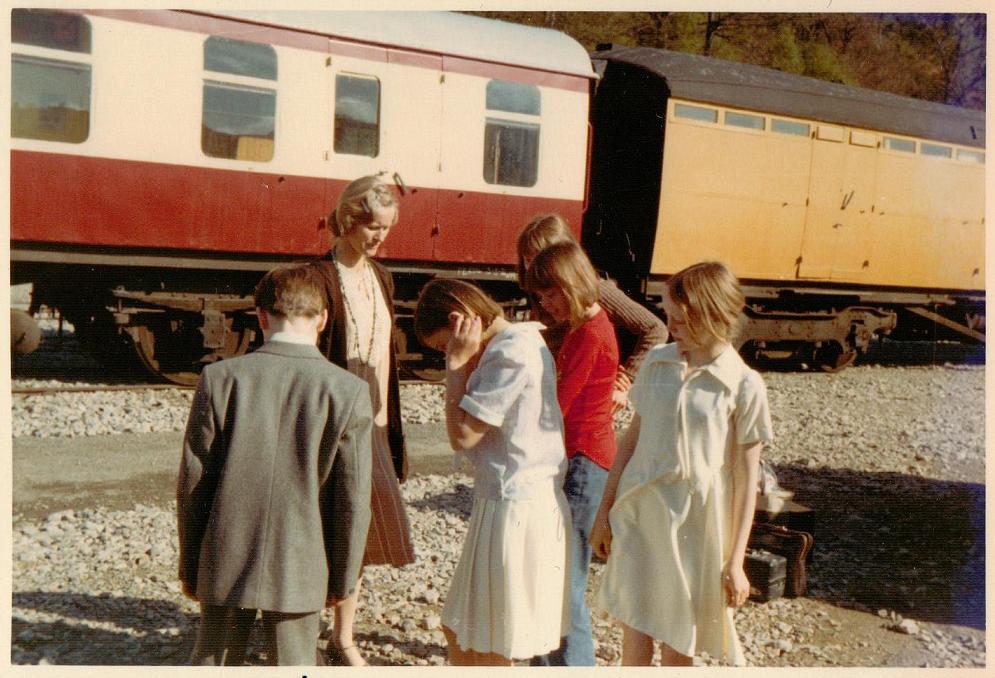
Viginia McKenna at the Haverthwaite Railway Station in Cumbria soon after it re-opened in May 1973. Simon West, Suzanna Hamilton, Lesley Bennet, Kit Seymour and Sophie Neville are with her. The carridge with compartments is in the background ~ photo: Daphne Neville
We saw this distinctive carriage in a siding as we steamed down the valley. Funnily enough when I reached home, later the next day, I came across a photograph on the internet I had never seen before. It was of Virginia McKenna, playing Mrs Walker, reading a magazine inside the compartment. Strangely it turned up when I Googled my own name – Sophie Neville.
Virginia McKenna playing Mary Walker, mother of the Swallows in the EMI feature film of ‘Swallows and Amazons’ made in 1973
The train is not included in Arthur Ransome’s book of Swallows and Amazons, written in 1929, but he does feature locomotives in his later novels, notably Pigeon Post. I clearly remember filming the BBC adaptation of Coot Club at what must have been The Poppy Line, a steam railway in north Norfolk when Henry Dimbley, playing Tom Dudgeon, jumped aboard the moving train and met Dick and Dorothea.
Peter Walker of Mountain Goat with Sophie Neville at Lakeside Station, Windermere.
I jumped off the train at the Lakeside Station to meet up with Peter Walker of Mountain Goat. Peter has carefully researched and put together a Swallows and Amazons tour, exploring ‘High Greenland’, the ‘Forest’ and ‘High Hills’ to discover the places where Arthur Ransome lived. We set off in search of the places where he fished, wrote, and drank beer. It was fascinating – and proved an excellent way to spend a day in the Lake District despite the rain.
You can read more about the locations used in the original film of ‘Swallows and Amazons'(1974) in the paperback ‘The Making of Swallows and Amazons’ available from libraries, bookshops or online here.
There is also a similar ebook, entitled ‘The Secrets of Filming Swallows & Amazons (1974)’ available from all ebook distributors including Amazon
The Lake District is very beautiful. The problem about filming there is that it can rain quite hard – ‘heavily’ – was the word I used in 1973.
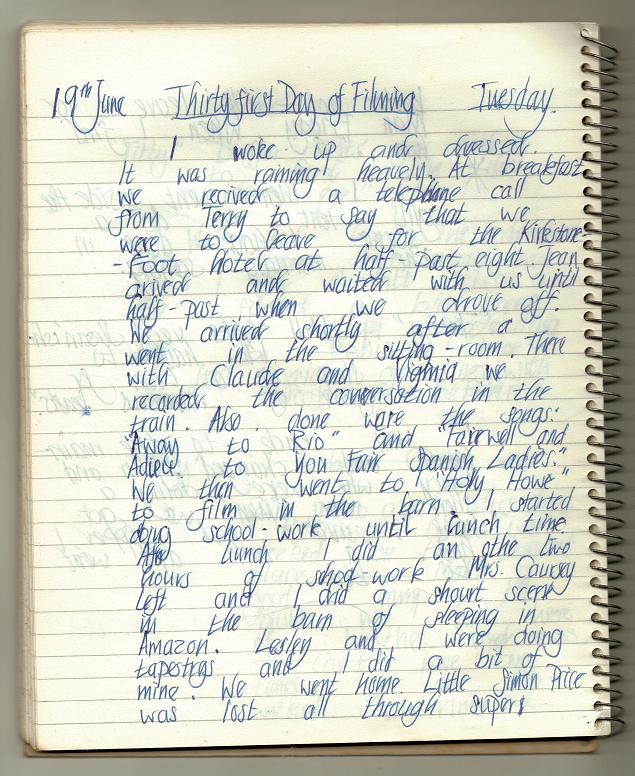
By this stage in the filming of Swallows and Amazons Claude Whatham only had one ‘rain cover’ option. We were kept busy recording sea shanties with Virginia McKenna at the Kirkstone Foot Hotel by Lake Windermere while Dennis Lewiston, the DOP, lit Mrs Batty’s barn at Bank Ground Farm above Coniston Water.
Arthur Ransome must have done much to revive the songs of the sea:
Farewell and adieu to you, fair Spanish ladies, Farewell and adieu to you, ladies of Spain; For we’ve under orders for to sail for old England, And we may never see you fair ladies again.
We never got as far as the ranting and roaring bit in the film.
No one really knows how old this naval song is. The Oxford Book of Sea Songs, mentions it in the logbook of the Nellie of 1796, long before shanties really came established as a genre. All I know is that Titty loved it and was still singing it in Peter Duck when the song became quite useful for navigating the English Channel.
‘The first land we sighted was called the Dodman, Next Rame Head off Plymouth, Start, Portland and Wight; We sailed by Beachy, by Fairlight and Dover, And then we bore up for the South Foreland light,’ or sort of.
Walking into Mrs Batty’s barn that day was hugely exciting. Simon Holland, the art director or set designer, had rebuilt the camp there, lighting a real fire.
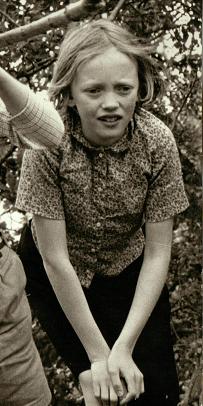
Sophie Neville as Titty
Swallow was nmounted on a cradle so that she could be rocked, as if by water, as the scenes of her sailing at night were shot. It was brilliant, she even went about. Moonlight wasn’t not a problem. Richard Pilbrow can correct me, but I think it was produced by a lamp called a ‘tall blonde’. I don’t think we had a wind machine. The Prop Men used a large sheet of cardboard to produce a breeze.
‘Wouldn’t Titty have liked this?’
‘Liked what?’
‘Sailing like this in the dark.’
’57, 58, 60, 61…’
‘What’s the matter?’
‘Can’t you hear it? The wind in the trees? We must be near the bank. Quick, Susan lower the sail! Roger, catch the yard as it comes down!’ Then there is a crunch as the Swallows hit a landing stage. All mocked up. Quite fun.
‘What about Titty?’
Amazon was placed on the same mounting. I climbed aboard and started wrapping myself up in her white sail.
Children always love the irony of John saying, ‘She’s at the camp. She’ll be alright. She’s got a tent,’ when the shot cuts to me looking damp and uncomfortable about sleeping in Amazon, anchored out on the water.
Later I wake up and come out from under the sail to hear the burglars heaving Captain Flint’s trunk across Cormorant Island. All in all we achieved quite a bit on that wet day in Westmorland. Much safer and easier than being out on the water. Because the cradle was at waist height Claude was able to get lower angle shots than when out on the camera pontoon. Simon West, who played John, did really well. He managed to convince me that he was really sailing when I watched the film and I knew he wasn’t.
I’m pretty sure this scene of us inside a tent at night was actually shot on Peel Island but I may be wrong. We had a fire in the barn. If you look closely you can see an electric cable going into the lantern to boost light from the candle. The night scenes were tricky to light and shoot, but there was something about them that was intimate and exciting for children. I assume they would normally be in bed but it was the summer holiday and excitement was afoot.
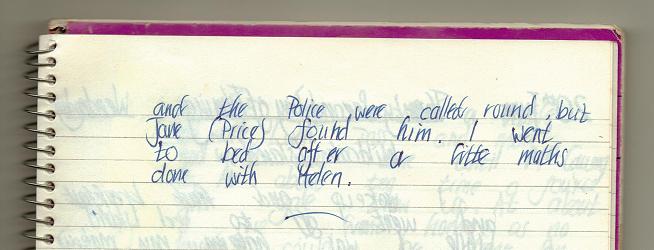
Back at our guest house in Ambleside there was a real life drama. Little Simon Price had gone missing. He was the small boy last seen on the beach at Rio, having his shorts pulled up by his sister. The Police were called and everything. But as in a lot of real life situations, things were sorted out, and we returned to the mundane world of maths lessons. I was tutored by Helen, one of the students at the Charlotte Mason College of Education who was also lodging at Oaklands as Mrs Causey, our teacher, could not ‘do modern Maths.’
Sophie Neville and Simon West on the cover of ‘Swallows and Amazons’ pub by the Daily Mail
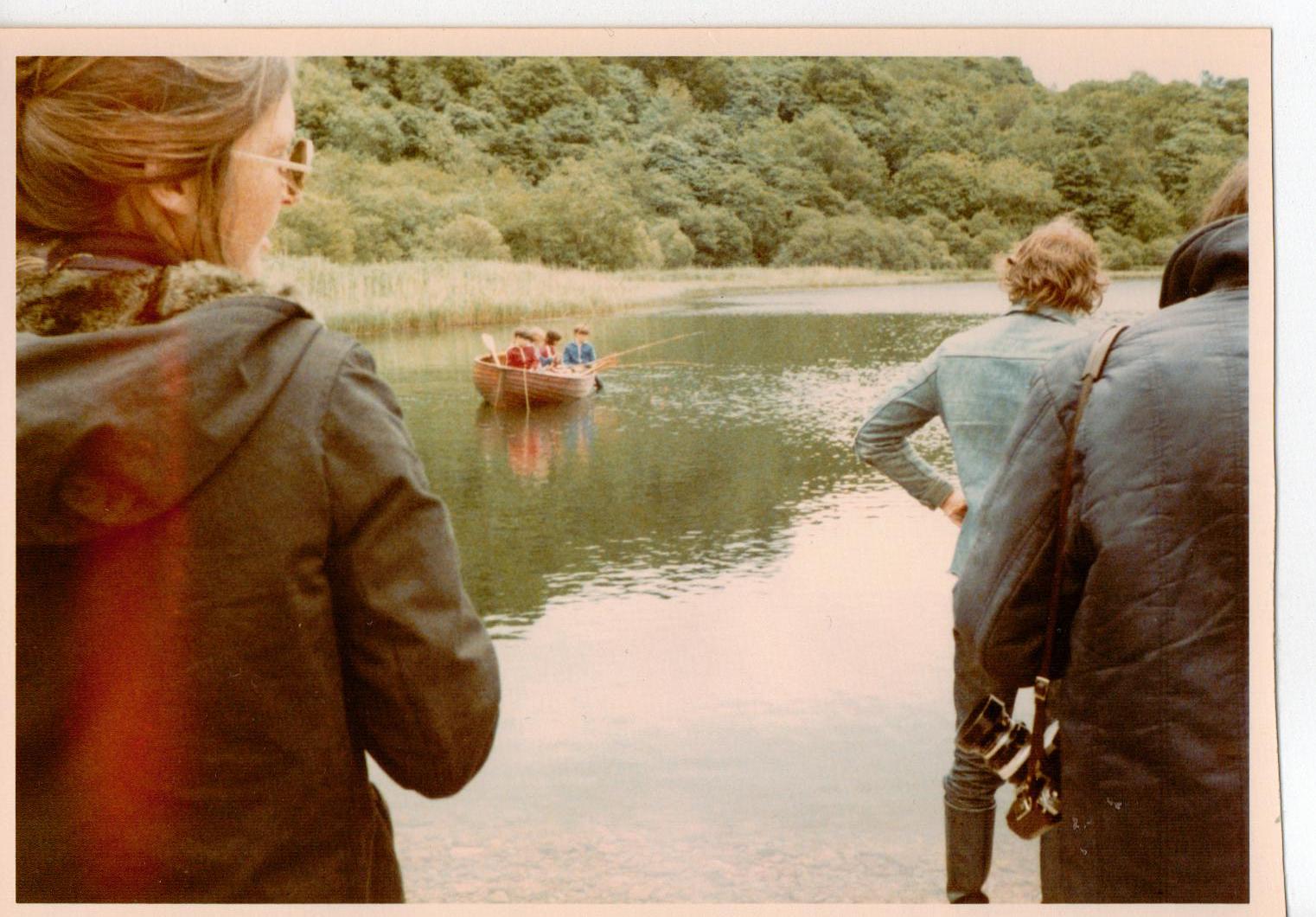
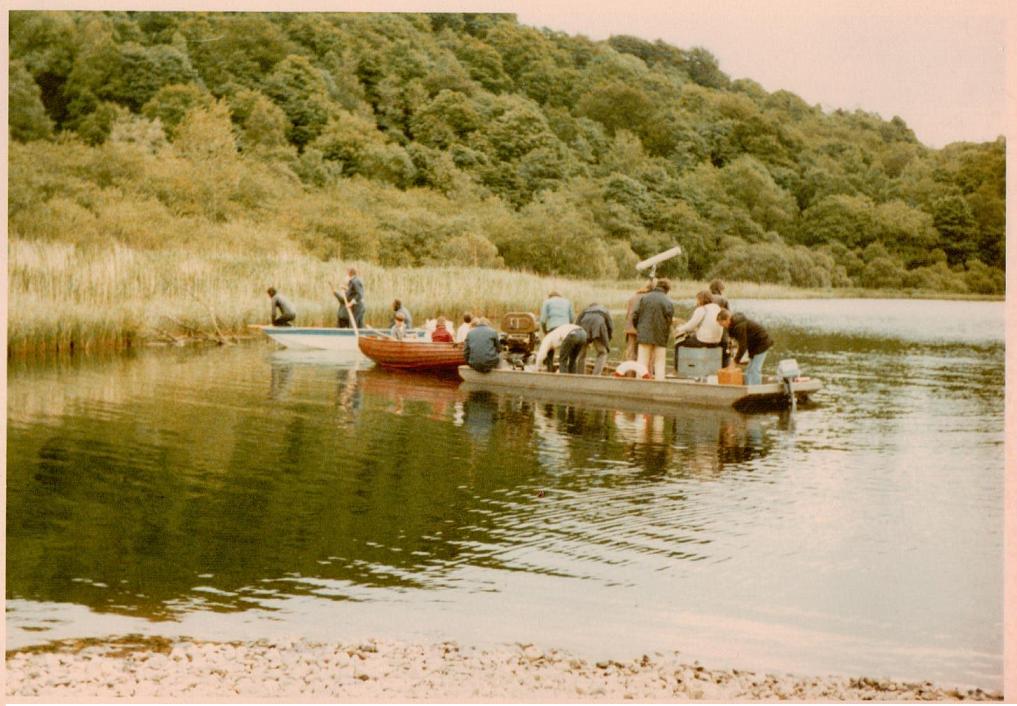
Of all the wonderful days we spent filming Swallows and Amazons in 1973, the fishing scene, shot in a reedy bay on Elterwater was one I enjoyed most. It was a cold, rather wet morning but the Third Assistant, Gareth Tandy, taught us how to use our rods and we were soon absorbed in a way that Arthur Ransome would have understood well.
Our fragile bamboo fishing rods, one with a wooden reel, were supplied by a keen fisherman called Leslie Borwick, who brought up his own daughter and grandchildren on Arthur Ransome’s books. He kept the rods, which still belong to the family, who now lived near Sedburgh.
Filming the fishing scene from the camera punt on Elterwater
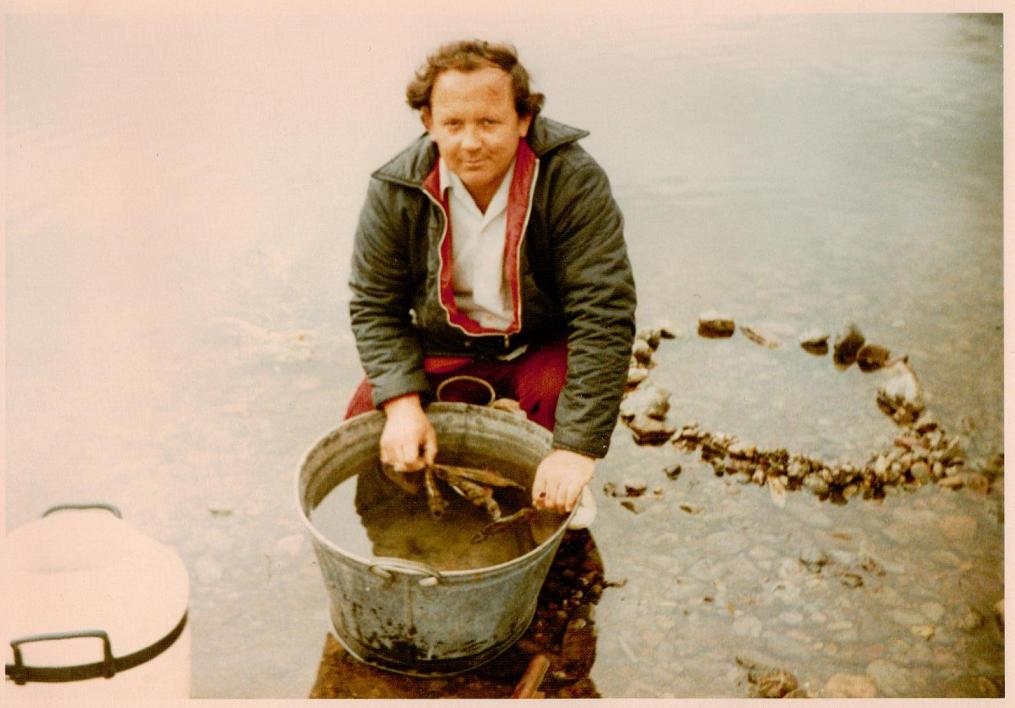
The only problem we had that day was keeping the fish alive. Bob Hedges our property master, the designer Simon Holland and Ian Whittaker, the set dresser, took it upon themselves to keep the perch as happy as they could, until they were – very carefully – attached to our hooks. Titty doesn’t catch one but Captain John did. Despite everyone’s best efforts it wasn’t a very lively perch.
Property Master Bob Hedges keeping the perch alive ~ photo: Daphne Neville
The big challenge was Roger’s great fish – a massive pike that meant to be snapping and ferocious. I’ve been told that it ended up being resuscitated in Keswick Hospital ICU – the Intensive Care Unit.
The local fisherman, Ian Whittaker, Simon Holland and Gareth Tandy with the fish photo: Daphne Neville
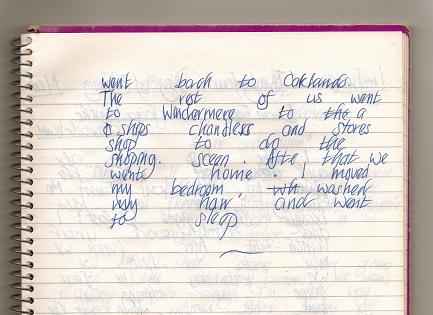
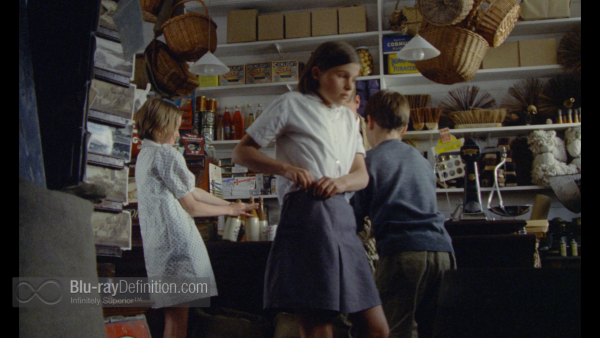
Sadly this is the only photograph we have of the set designers at work together. Later that afternoon we went to one of the few interiors of the film – the general store in Rio or Bowness-on-Windermere where we bought the rope for the lighthouse tree and four bottles of grog. In reality it was a sweet shop in the ‘seventies. It was later a barber shop and became a showroom for wood-burning stoves. Pigs were once kept around the back.
The Swallows in Woodland Road, Windermere in 1973
Back in 1973, Ian dressed the interior with boxes of wooden dolly pegs and other things you’d buy in brown paper bags. A wonderful 1920’s radio set and two purring cats really made the scene come alive, especially since, being in reticent explorer mode, we were a bit gruff in our communications with Mr Turner, the native shop keeper.
Sophie Neville in Rio with four bottles of grog ~ photo: Daphne Neville
Ian Whittaker struck me as being rather different from everyone else on the crew. He was a very nice looking man and a gentleman of the old school. I remember him telling me that he’d originally set out to be an actor but had found it so difficult to get work that he grabbed a chance to become a set-dresser or designer’s assistant. He found he rather enjoyed it, and stuck to the job despite his family thinking it was not much of a career. He proved them wrong. By 1971 he was working for Ken Russell on The Boy Friend – a musical about a musical starring Twiggy with Christopher Gable and Max Adian that I’d seen at school.
Woodland Road, Windermere
After Swallows and Amazons Ian worked on Ridley Scott’s film Alien with Sigourney Weaver, Tom Skerritt and John Hurt and was nominated for an Oscar with the others on the design team. Eventually he won an Oscar for Best Art Direction-Set Decoration with the designer Luciana Arrighi for Howards End – the movie of EM Forster’s book starring Anthony Hopkins, Vanessa Redgrave, Emma Thompson and Helena Bonham-Carter.
In 1994 Ian was nominated again, this time for Remains of the Day directed by James Ivory. After that he worked on Sense and Sensibility, Emma Thompson’s movie of the Jane Austen classic that launched Kate Winslet’s career, some of which was shot at Montacute in Somerset where my great-grandmother once lived. Ian Whittaker received another Oscar nomination for Anna and the King in 2000 and a nomination for an Emmy Award for the TV movie Into the Storm in 2009.
So, it was rather a waste that Ian spent his time just building little stone walls in the lake to keep the perch alive on our set, but I think he enjoyed the fishing scene as much as I.
You can read more in ‘The Making of Swallows and Amazons (1974)’ available online, from Waterstones and your local library. It is suitable for all ages of readers.
Ronnie Cogan having a cigarette with one of the Supporting Artistes. Terry Smith the Wardrobe Master is going below in the background. photo: Martin Neville.
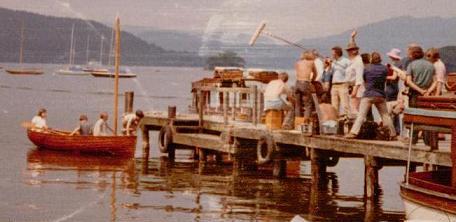
It was a glorious summer day to film on Windermere. Conditions were perfect. My father had been asked to appear as a film extra in the scene in Swallows and Amazons when the the crew of Swallow narrowly miss colliding with a Lakeland steamer, that transporting tourists up and down the lake.
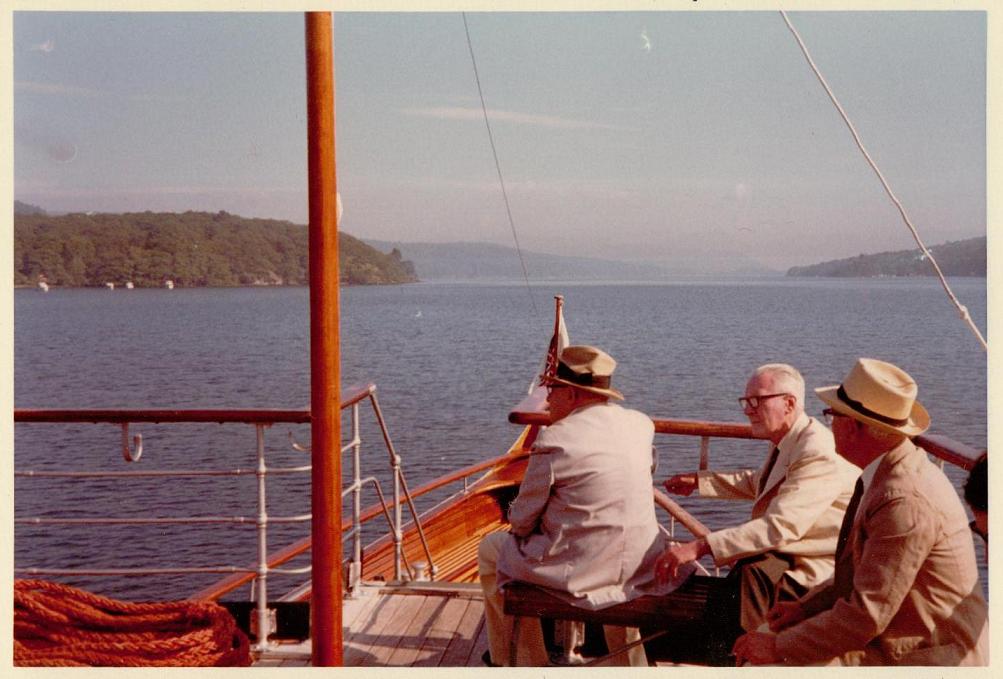
Martin Neville wearing 1929 costume aboard MV Tern on Windermere in 1973
He was the tall dark native in a blazer and white flannels aboard the elegant MV Tern. A lovely way to spend a sunny morning in the Lake District. Until your daughter nearly drowns.
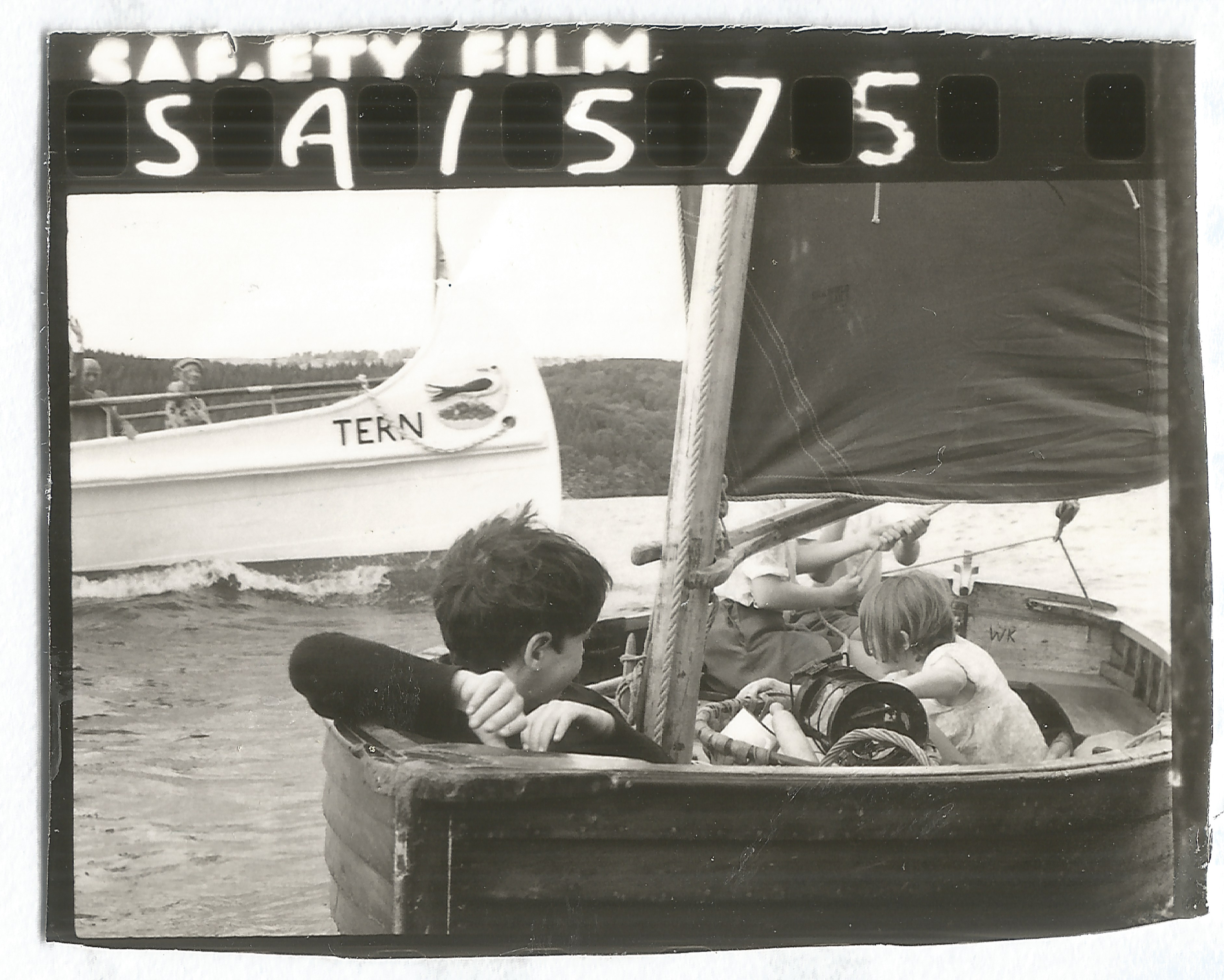
MV Tern on Windermere was built in 1890 with a steam engine, converted to diesel in the 1950s, and is still operating today.
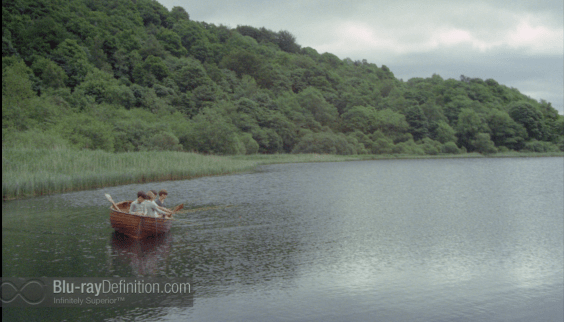
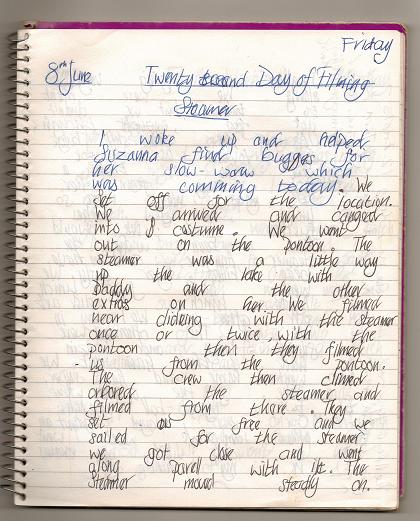
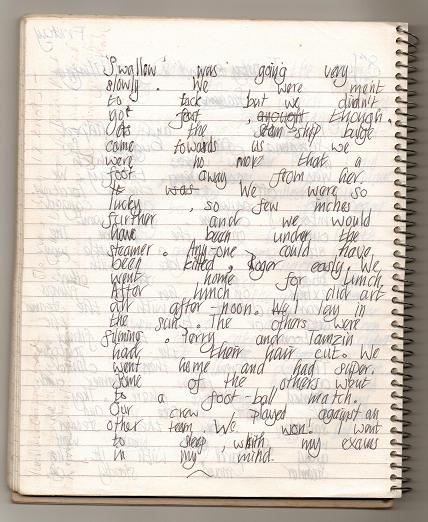
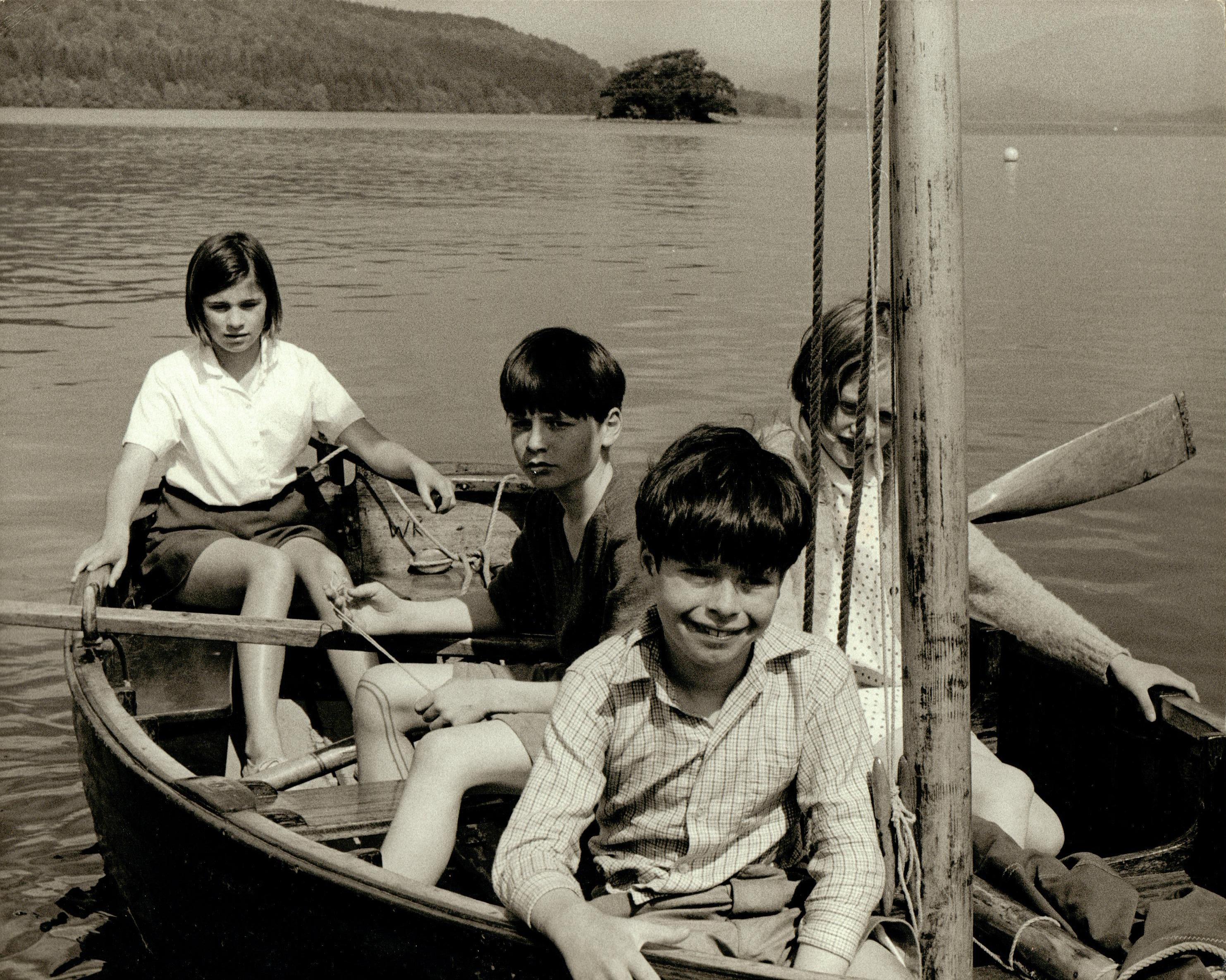
Simon West, Suzanna Hamilton, Sten Grendon and I were sailing the Swallow, on our voyage to the island. The twelve-foot dinghy was laden with camping gear and had no buoyancy. We did not wear life jackets.
At the start of the day, Swallow was attached to the camera pontoon so that Claude Whatham, the film director, could capture our dialogue on film. The camera crew then went aboard the Tern and we sailed free, with the safety boat some distance away, behind the camera. Other boats were keeping modern boats clear of the shot.
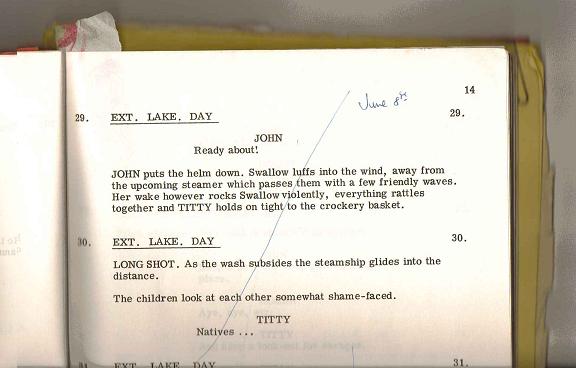
In the script Roger is down to say, ‘Steamship on the port bow’. I think what came out was, ‘Look John! Over there – steamer ahead!’
The Tern had a young, inexperienced skipper who was coping with a notch throttle, as you can see if you watch the movie.
The screenplay of David Wood’s adaptation of Arthur Ransome’s classic book ‘Swallows and Amazons’ set in the Lake District in 1929
My mother, who normally looked after us, had been obliged to drive to Bristol as she presented a weekly programme for HTV with Jan Leeming called Women Only and had been summons to promote the channel at the Bath and West Show. Dad must have been acting as our chaperone, responsible for our safety. A sailor with years of experience racing on the Solent, he took a keen interest in all the boating scenes, but I’m sure he didn’t have a chaperone’s licence. As we sailed towards him, on an intentional collision course, he foresaw that the larger vessel would take our wind.
Three men of Cumbria who were happy to have short-back-and-sides haircuts on the deck of the MV Tern on Windermere in 1973 ~ photo: Martin Neville
My father watched from above as we only just turned in time, missing the steamer by a mere nine inches as her bow wave bounced us away and we sailed on. Ronnie Cogan had to buy him a whisky. They knew Sten could hardly swim, that any of us could have been entangled in the ropes and camping gear if Swallow had gone over. Clinker-built dinghies can sink quickly. It was a sunny day but the water was icy and very deep.
We did not know it at the time, but Dad nearly took me off the film. He had a meeting with the producer when he tested the BOAC life jackets we rehearsed in. Mine did not inflate.
Phil Brown, who belongs to the Arthur Ransome Group, said: “Tern was re-engined in 1957 with two diesel engines. Interestingly she was to have been named SWALLOW, but after a last-minute change, she was launched in June 1891 as TERN.”
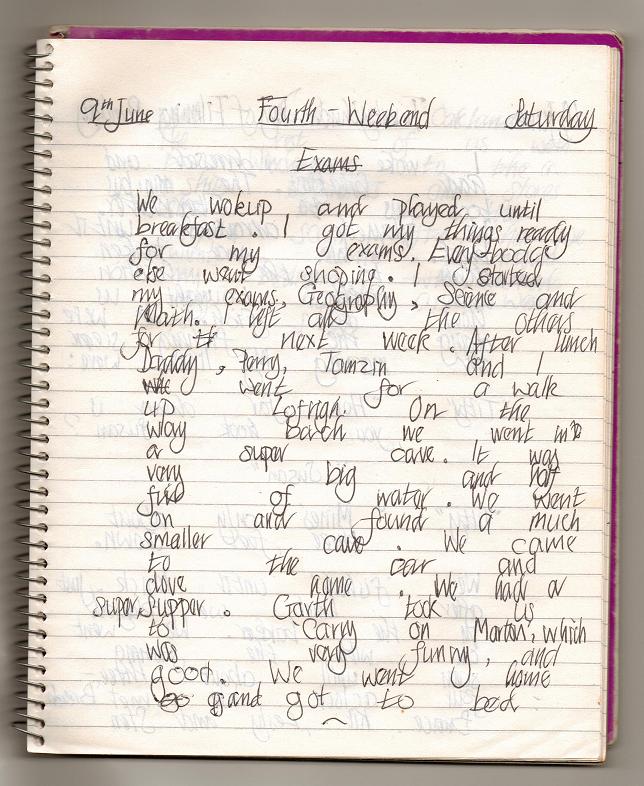
It is said that children bounce. The next day, I sat school exams: geography, science and maths.
…‘Carry on Matron’. I wonder what near disasters they had on that film.
You can read more in the ebook ‘The Secrets of Filming Swallows and Amazons (1974)’ available from Amazon Kindle, Kobo, iTunes and all other online retailers:
In Arthur Ransome’s book Swallows and Amazons Titty is left keeping watch on an island, so small it is little more than a rock, whilst the Swallows sail into Rio Bay in search of the Amazons. Luckily for me, this is not so in the film. Susan declares, ‘They must be making for Rio’ and the scene cuts to a band playing in the municipal park at Bowness-on-Windermere. John rows into the bay pretty sure that the Amazons have given them the slip, Susan suggests that we could explore Rio and I happily declare, ‘We could buy rope for the lighthouse tree.’ And that is what we did – leaving the boy Roger in charge of Swallow. It was such a hot day I whipped off my grey cardigan before I leapt out of the boat, no doubt causing havoc for the Film Editor.
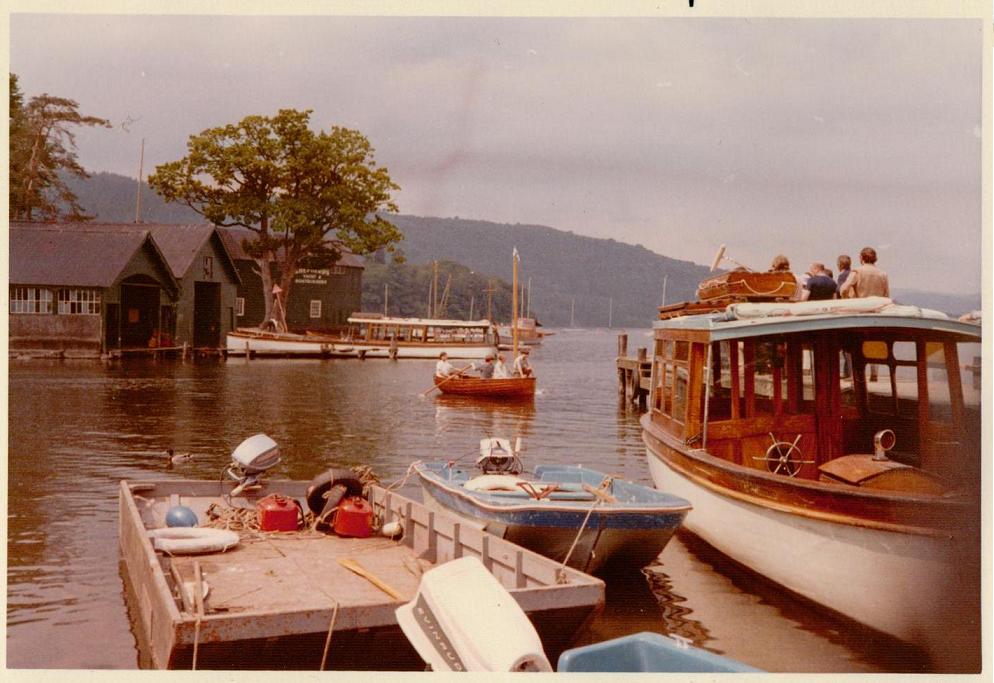
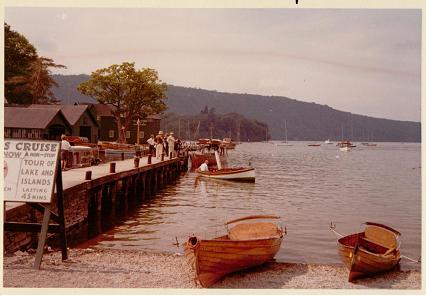
The Swallows approach the jetty in Rio. Empty camera boats are moored in the foreground beside a period launch. Are those green boatsheds still standing today?
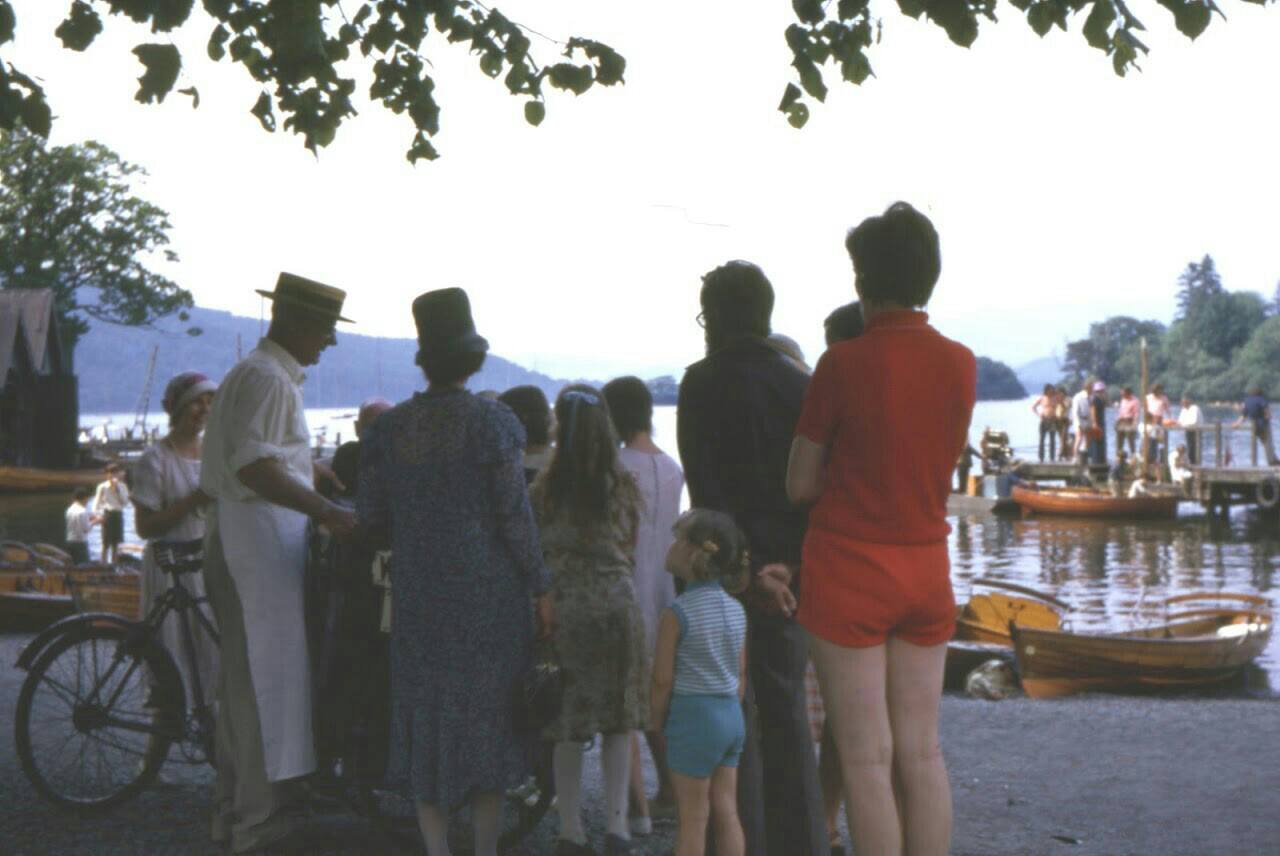
Simon Holland, the Set Designer on Swallows and Amazons had transformed the busy Bowness of 1973 into a Lakeland town of 1929. To do this he must have had a huge amount of glass fibre boats moved. These were replaced by the beautiful wooden launches and skiffs of the period.
You can see my father in white flannel trousers, his dark hair cut short, standing on the jetty in front of the lovely old green boathouses that then overlooked the bay. He is talking to the owner of the launch with the green and white striped awning.
Much of the first part of this sequence was filmed from the grey punt used as a camera boat. It seems that Simon West, who played John was towing this as he rowed up to the jetty. It was a hot day and for once we were all feeling the heat.
Kit Seymour and Jane Grendon watch the filming on the jetty whilst Tamzin and Perry Neville eat ice creams with the one man in Cumbria willing to have a short-back-and-sides. You can just see the period cars parked in the background
Although the Swallows spurned the conventional attractions of tripperdom, we spotted the Stop-me-and-by-one ice cream cart like lightening. I was entranced by the old cars, the pony and trap and the number of people dressed to populate Rio. They were organised and directed by Terry Needham, the Second Assistant Director. To our delight we found Gareth Tandy, the Third Assistant, was dressed in period costume too, his Motorola hidden under a stripy blazer so he could cue the Supporting Artists and keep back the general public without having to worry about appearing in vision himself. To his dismay he had had to have his hair cut. We all thought this a distinct improvement. He looked so handsome! I’m not sure if you can see him in the distance when we are climbing out of Swallow. You can just see my sisters walking towards the town at this point with Pandora Doyle, Brain Doyle’s daughter.
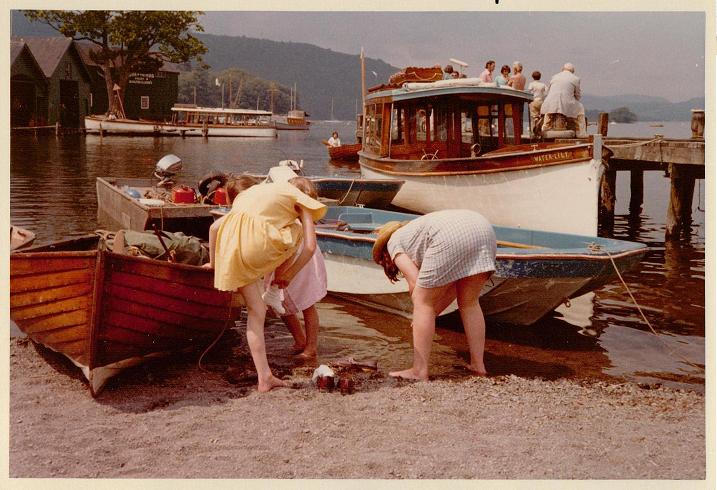
The Price children, Perry Neville, Jane Grendon, Tamzin Neville and Pandora Doyle in their 1929 costumes on the shore of Lake Windermere at Bowness in 1973 ~ all photos on this page : Martin Neville
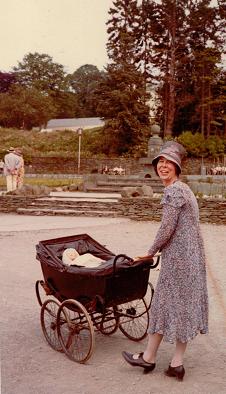
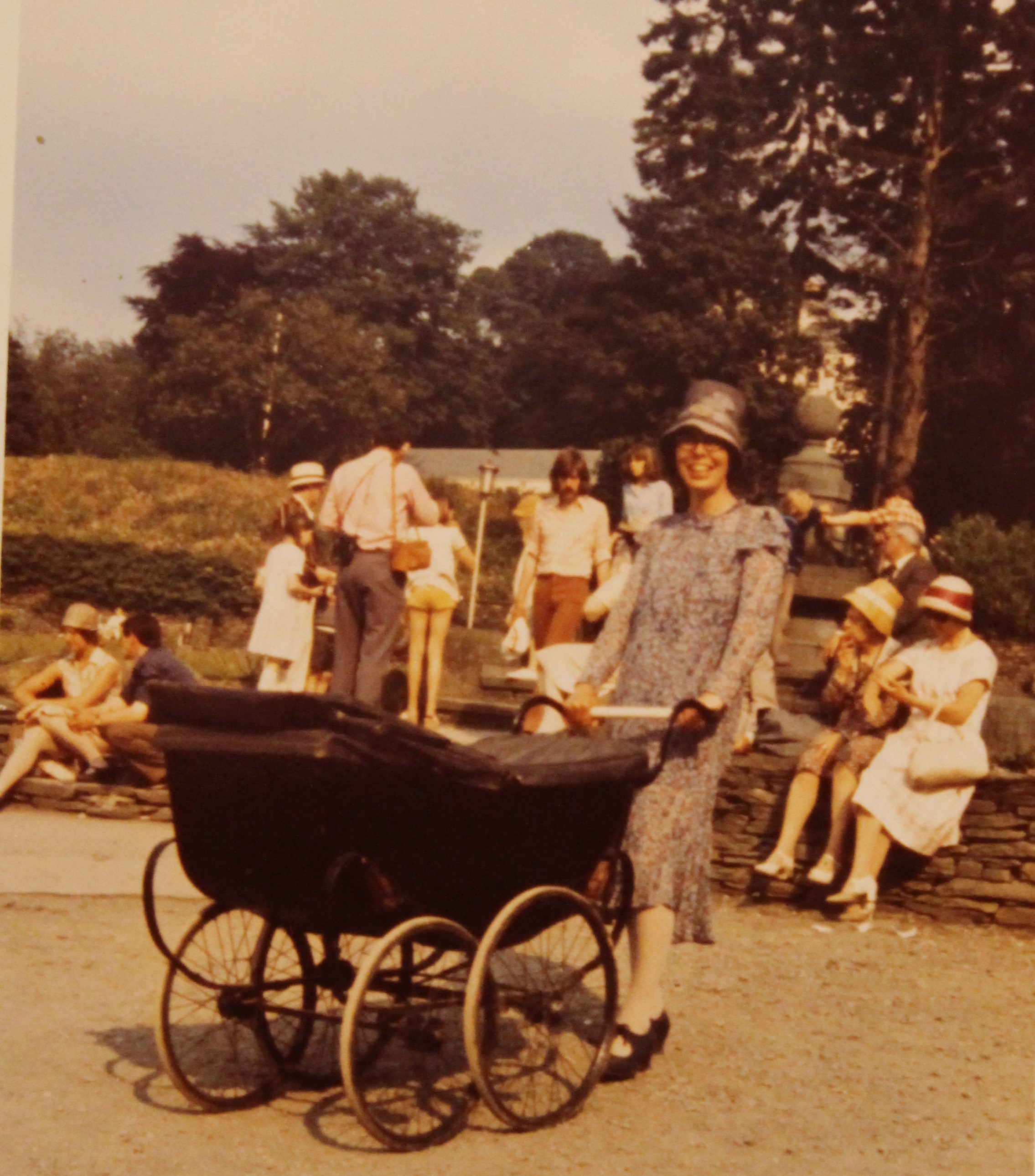
Jane Grendon, our chaperone looked fabulous in her 1929 costume. It was the one and only time I saw her in a dress.
Jane Grendon as a Passer-by with her pram in Rio Bay ~ photo: Daphne Neville
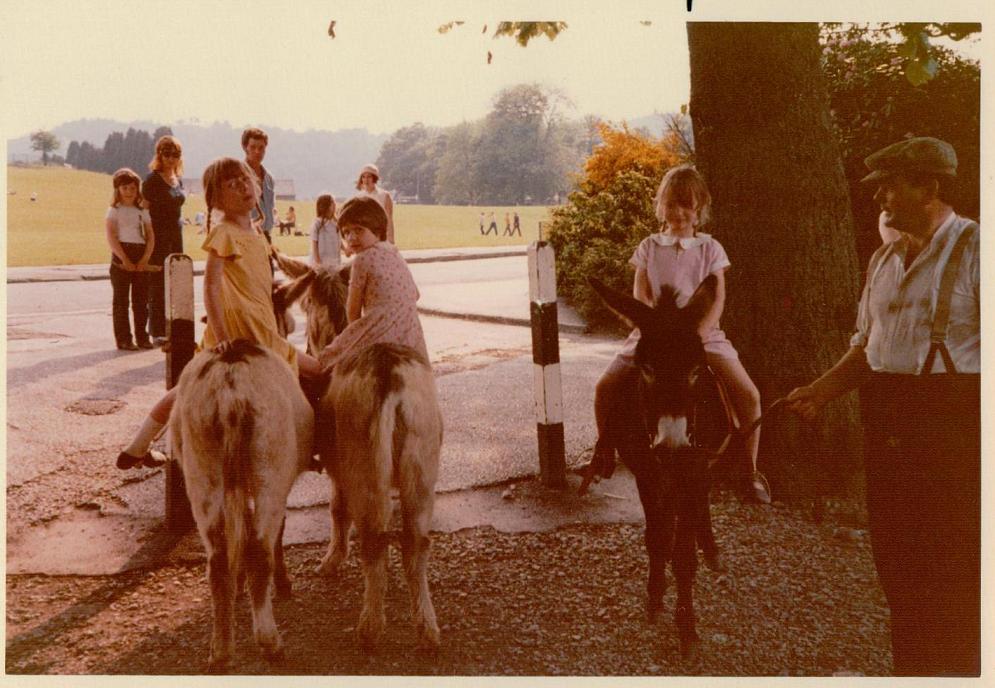
She was wonderful. Being in costume enabled her to keep an eye on all the children playing on the beach. I know she would have kept them going and maintained safety as they flung pebbles into the water or rushed about with the donkeys that were giving rides along the shore – no one wearing helmets of course.
Another excitement of the day was that Claude Whatham had given Mr Price, the owner of the Oaklands Guest House where we were staying, the part of the native. The native who says, ‘That’s a nice little ship you’ve got there.’ Mum said that Kit Seymour, Suzanna Hamilton and Lesley Bennett had spied him, pacing the garden at Oaklands trying out every possible way of saying this line. ‘That’s a nice little ship you’ve got there.’ Then, ‘That’s a nice little ship you’ve got there,’ leaving the girls in fits of giggles.
John Susan and Titty walking past the hotel
After we leave the general stores, me clutching bottles of grog, you can see Tamzin in a pink dress and straight back riding a chocolate coloured donkey along the beach while Dad is pushing out a rowing skiff with a log oar. Roger looks on from the Jetty to see Perry riding another donkey in a yellow dress while Tamzin walks by in the opposite direction with none other than Mr Price, in his striped blazer, who is walking along towards the boathouses holding a little boy’s hand. I am sure it was one of his own children but it looks a bit dodgy because while Roger watches my sisters and Pandora throwing stones into the lake from the beach were the skiffs are pulled up, David Price comes walking along the jetty and delivers his line: ‘That’s a nice little ship you’ve got there.’ It’s shot in rather a creepy way. John did warn Roger to ‘Beware of natives.’
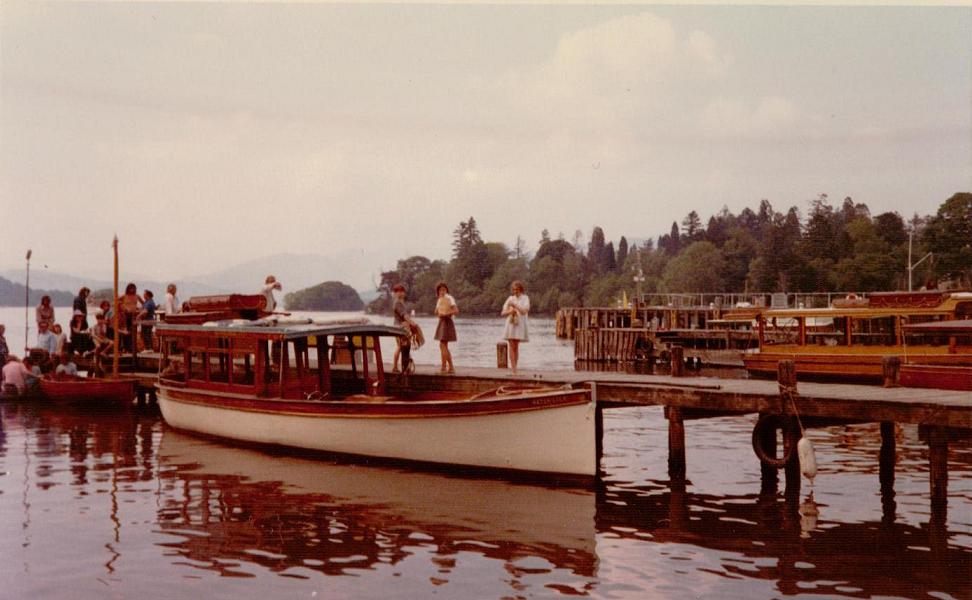
The film crew of ‘Swallows and Amazons’ wait with Swallow and Stephen Grendon at the end of the jetty while Simon West, Suzanna Hamilton and Sophie Neville line up by the launch
A moment later Pandora and my sisters are surrounding the ice cream man while John, Susan and Titty return, striding along the jetty like the three wise men, carrying rope, buns and bottles of grog.
My father’s all time passion in the form of a very graceful steam launch passes, almost silently, in the foreground. A happy, happy day. They only sad thing was that we didn’t have time to film inside the bun shop, which was such a pity as it looked glorious. Claude had been obliged to re-take a scene when some ladies – real life ladies in 1970’s garments and bouffant hairdos – had come scootling out of the Public Conveniences in the middle of a take.
What none of us knew was that is was nearly our last day on earth. The same Supporting Artists, including my father, had been booked for the next morning…
My father added:
‘George Pattinson, the man who revived the steamboat world, along with Roger Mallinson, was the character in Elisabeth the little steamer.’
George Pattinson in his steam launch Elisabeth ~ photo: Martin Neville
‘The Bowness skiffs were not like the Thames version. The outriggers caught the oars and allowed a fisherman to let go of the grip if and when he caught an Arctic char, the Windermere fish, the oars were retained. A heavy boat.
I remember the rope was huge, fat and unsuitable! Daphne was not around as she had to go south to present Women Only for HTV. She was devastated to leave the donkey scene.’
You can read more about our antics in the paperback or ebook of ‘The making of Swallows and Amazons’ available from online retailers, good bookshops, and libraries worldwide. You can read more on Amazon here.
It was a hot, humid day but great fun, preserved on film forever more. My mother had driven to Gloucestershire the night before to appear on the HTV magazine programme ‘Women Only’ with Jan Leeming. She interviewed someone about potted plans and presented an item on peg dolls. This was a pity as she would have loved seeing the donkeys. Later that year her only donkey mare, Lucy, gave birth to a spotted foal she called Leopard.
Perry Neville, in yellow and Tamzin Neville, in pink riding donkeys in Rio Bay ~ photo: Daphne Neville
‘So lucky the old Victorian boatsheds were still there then.’
It was Sunday and a much needed, formal day off for the crew of Swallows and Amazons. It was also a day of rest for the ‘Artistes’ as Claude Whatham, the Director called us. The crew called us ‘Saucepans’. Saucepan lids : kids. It is Cockney rhyming slang. There was a lot of that about in Ambleside that year.
Sophie Neville with her mother on a scenic railway in Cumbria during a break in the filming of Swallows and Amazons in 1973 ~ photo: Martin Neville
My parents were still in bed, exhausted on that Sunday morning. To keep me busy, Mum had me writing letters to my Headmistress, Sister Ann-Julian and to my Housemistress, Sister Allyne. Amazingly I wrote them.
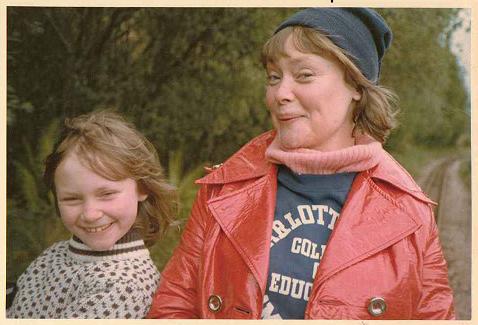
My father’s idea of a day out in Westmorland was to drive up the Hard Knott Pass taking car rugs, a picnic and his volcano. This is a brilliant item of equipment with which you can boil enough water to make a cup of tea using an old newspaper. I’ve read that Arthur Ransome had one… I think my mother just pulled on her Charlotte Mason College of Education sweatshirt and came too.
The highlight of the day was a trip on the Ravenglass and Eskdale Railway, through the National Park to the coast and back. You can still do this today. The historic line was opened in 1875 to ferry iron ore from the mine near Boot to the coast at Ravensglass by steam locomotive. They say that nowadays:
“Four steam locomotives are currently in regular service, ranging from River Irt, the oldest working 15″ gauge locomotive in the world, to Northern Rock, one of the most powerful. The locomotives names, with one obvious exception, are those of the local rivers, the Esk, Mite and Irt, the last mentioned flowing from Wastwater just a few miles away from the railway.”
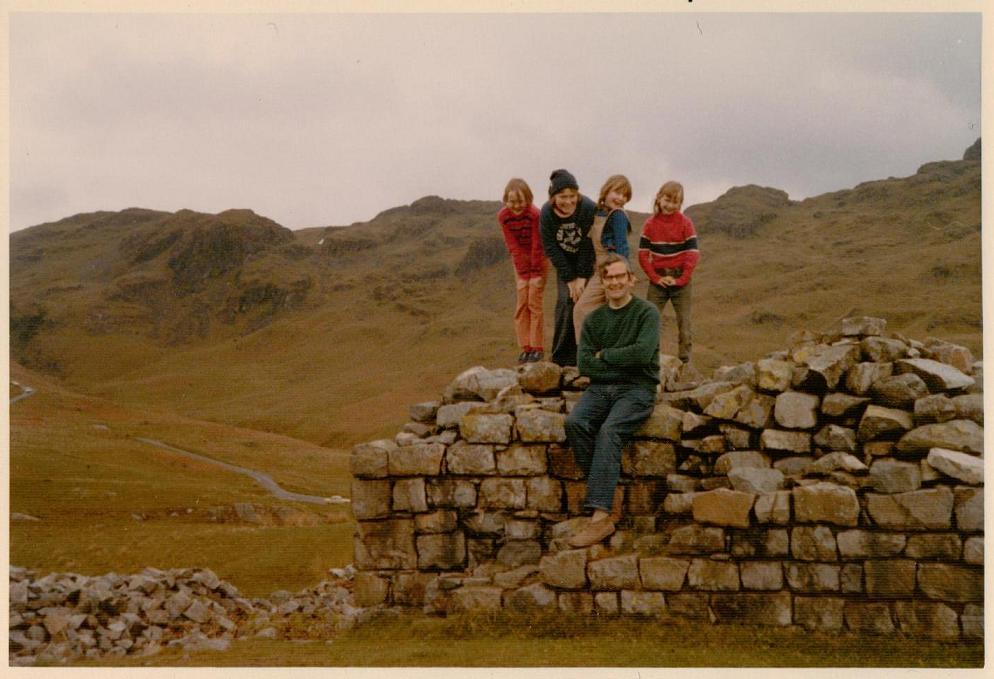
My father has always loved steam. He’s also rather enjoyed using the self-timer on his new camera.
The Nevilles in the Lake District in 1973
We were standing on part of the Hard Knott Roman Fort near Boot with the fells behind. Built between AD120 and AD138 at the Eskdale end of the Hard Knott Pass it must have been one of the furthermost outposts of the Roman Empire. It had been studied and excavated by Arthur Ransome’s mentor WG Collingwood, whose novel Thorstein of the Mere is set on Peel Island where we had just spent the week. The fort was known to the Romans as Mediobogdum, which has to be one of the all-time great names. If only the film crew had known.
As children we had grown up watching Frankie Howerd on television when he was dressed in a Roman tunic, assuring us that ‘A Funny Thing Happened on the Way to the Forum’. We didn’t know at the time, but the producer of ‘Swallows and Amazons’, Richard Pilbrow, had brought the theatre production from New York to the West End, where it ran for two years.
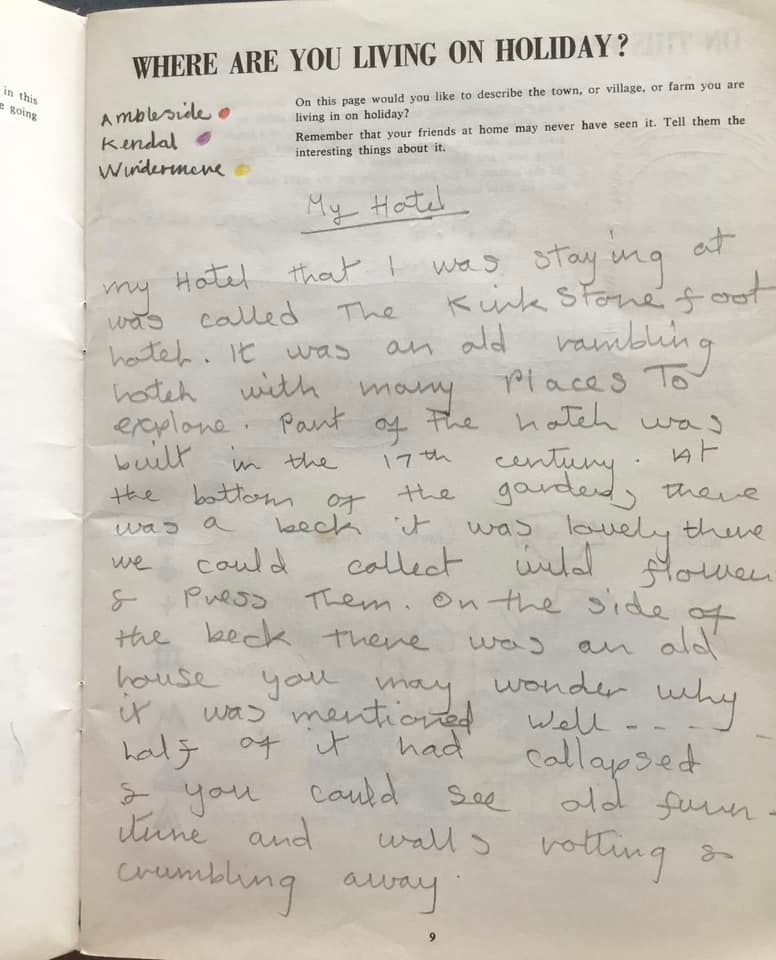
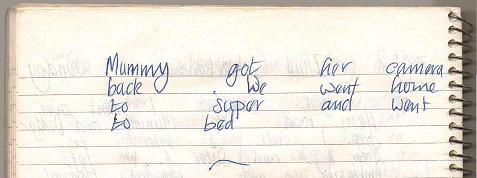
The hotel I mention was the Kirkstone Foot Hotel, at the top of Windermere, in Ambleside where Richard Pilbrow and the senior members of the film crew were staying. Mum must have left her camera there.
The Kirkstone Foot Hotel, Ambleside in 1973
Pandora Doyle, whose father Brian Doyle was handling the publicity for Swallows and Amazons, kept a record of her half-term holiday, marking her room at the Kirkstone Foot (telephone: Ambleside 2232). She wrote about it quite beautifully:
I’m pretty sure the film company used the coach-house block for their production office. The green parrot was once released in the bathroom where it spent a day waiting to be used in a scene, presumably on the houseboat. Pandora pointed out the hole-protector she had added when filing her scrapbook. I’d totally forgotten about such things and yet I must have stuck on hundreds. ‘Ring-binders’ were the thing but I never had red ones.
We didn’t know it, but Arthur Ransome had died on this day, 3rd June in 1967, six years previously. I feel he would have enjoyed our day out.
Tamzin Neville and Daphne Neville in 1973
You can read the full account of making the film here:






























 Sophie Neville
