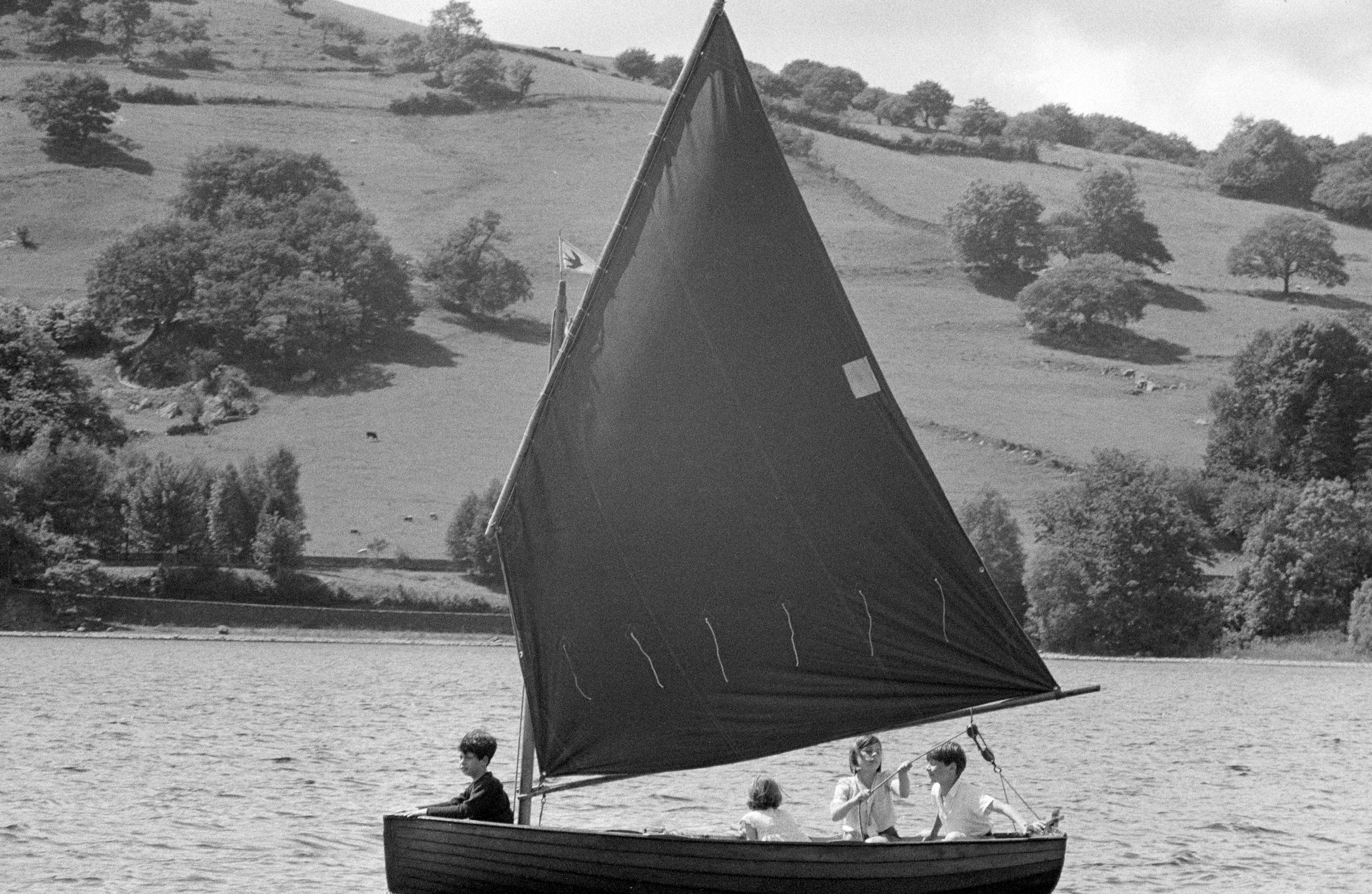
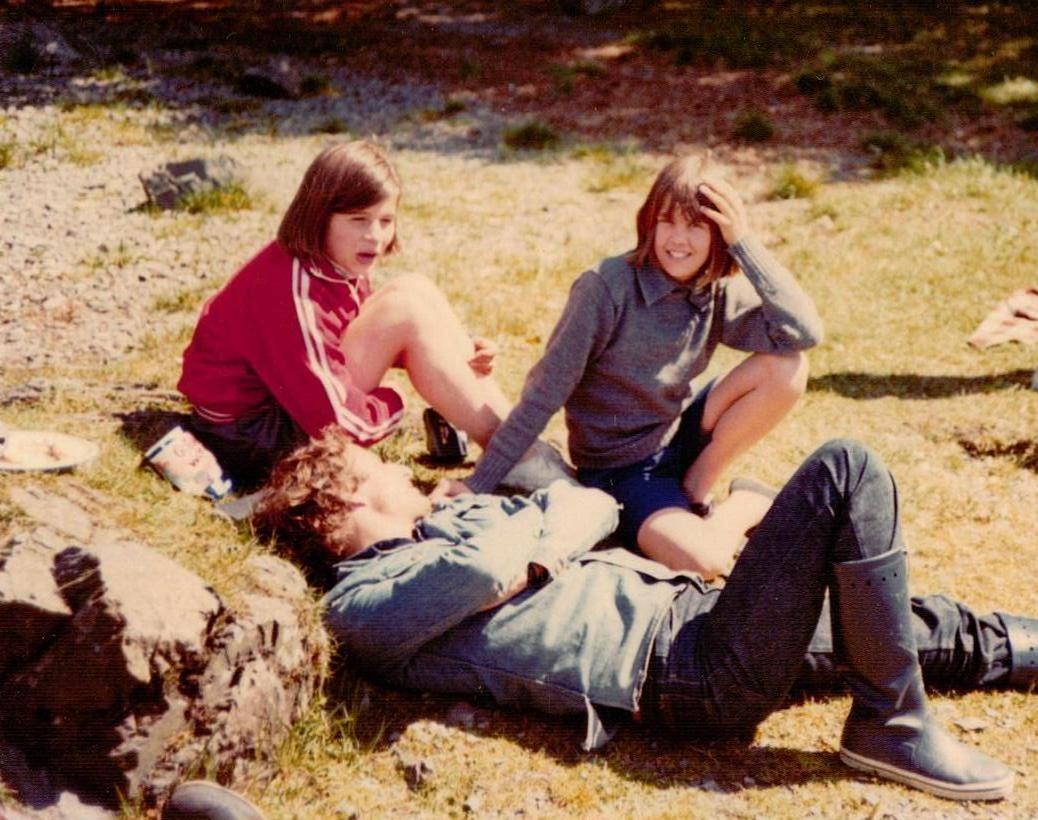
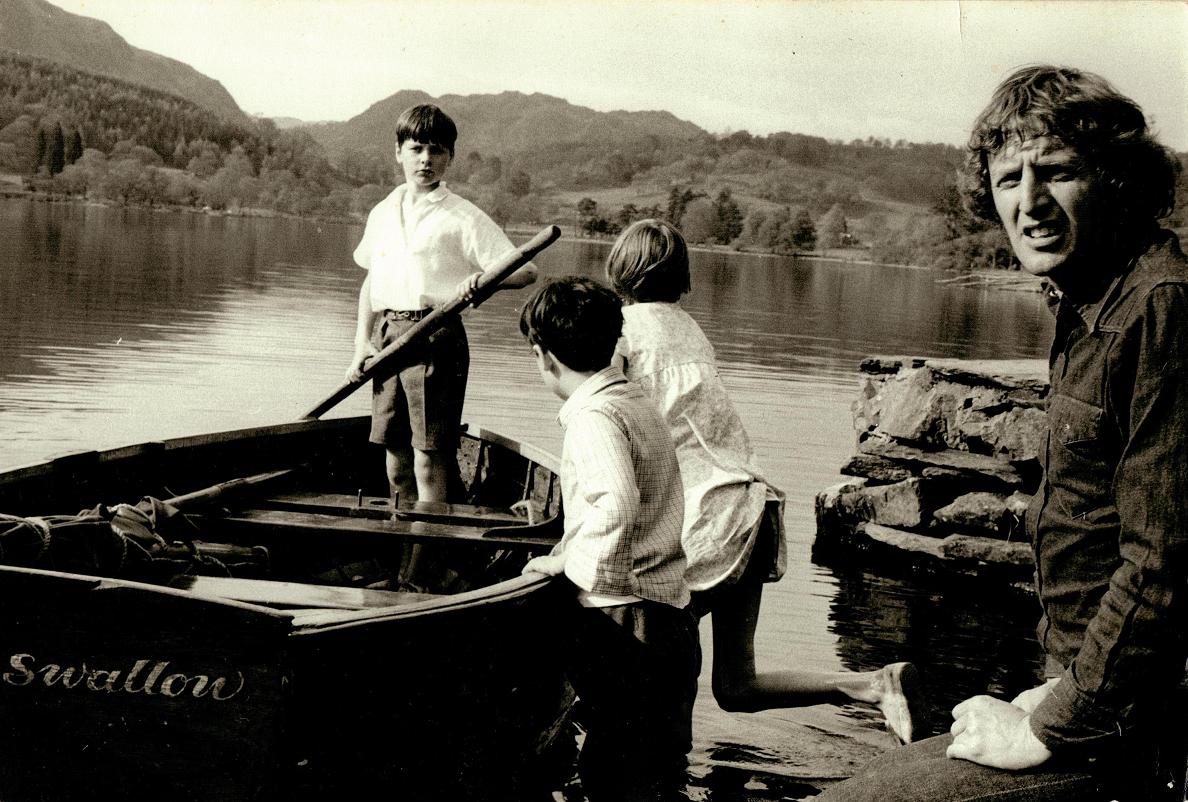
Publicity photographs used to promote ‘Swallows and Amazons’ in the early 1970s – or how we hated having our photographs taken.

Lesley Bennett, Suzanna Hamilton, Stephen Grendon, Sophie Neville, Virginia McKenna, Simon West and Kit Seymour gathered at Bank Ground Farm above Coniston Water for a publicity photograph. This one was taken by Daphne Neville.

When a television drama is ready to be transmitted there is a little publicity, but not much. Photographs might be taken for the cover of the Radio Times or a book to accompany the series, there might be a Preview at BAFTA to which journalists from the colour supplements and daily newspapers are invited, but, because the programme can be advertised on air, the actors are not intensively involved in the promotion. A feature film is very different.

Whilst we didn’t mind our photographs being taken while we were acting, and were fine about Mum clicking away with her little instamatic, we all hated having promotional photographs taken for ‘Swallows and Amazons’. They were usually so posed, set up by strangers who had no idea of the story. Virginia McKenna tried to make it fun for us but this is what we all felt about this photo-call:

Virginia McKena, Lesley Bennett, Stephen Grendon, Suzanna Hamilton, Sophie Neville, Simon West, Kit Seymour for 'Swallows and Amazons'
~ How not to set up a publicity shot for a feature film ~

Why were the Amazons at Holly Howe? Why weren’t we with any of the boats? It was all terribly hot and difficult to squint into the sunshine. Only Mrs Batty’s dog seemed to be enjoying the attention.

The glare of the flash bulbs had started on day one. As Suzanna said in her diary, it made us feel ‘right twits.’

Claude Whatham was very good at explaining things to children. Looking back I wish that he had explained why the publicity was so important, but of course this was not his job and he would have been busy setting up the next shot. Certainly once the filming had finished we needed to know how important it was to promote the film. Richard Pilbrow really wanted to make a sequel, particularly an adaptation of Ransome’s twelfth book in the series – ‘Great Northern?’  He loves the Outer Hebrides and has a house on Col. I think we might have been a little keener about publicity shots if we had been told that the out-come could have been going up there for another summer. We would have been able to look forward to the possibility, but I don’t suppose he was at leave to even suggest it.

Journalists were introduced to us and looked after by our unit publicist Brian Doyle.  Brian had worked on Straw Dogs’ in 1971, the thriller that starred Dustin Hoffman, Susan George and Peter Vaughan. Susan George had of course played Titty, or ‘Kitty’ in the black and white BBC adaptation of Swallows and Amazons in the early 1960s. She was now regarded as glamorous sex symbol in British cinema – setting me rather a daunting example. Much easier for Brian to publicise her then me. She had a gorgeous figure with beautiful, thick, blonde, hair. I had what my sister still calls ‘tendrils’ and my mother calls ‘bits’. And was skinny with crooked teeth.

Brian was a lovely man. He had an amazing career, going on to work on films such as Ken Russell’s Valentino with Rudolf Nureyev and Leslie Caron, The Wild Geese, Alien, Educating Rita starring Michael Caine and Julie Walters and the James Bond movie For Your Eyes Only – with Roger Moore in the lead role . He even has his name on the credits of one of George Lucas’ Star Wars films.

This was the profile he wrote for me:
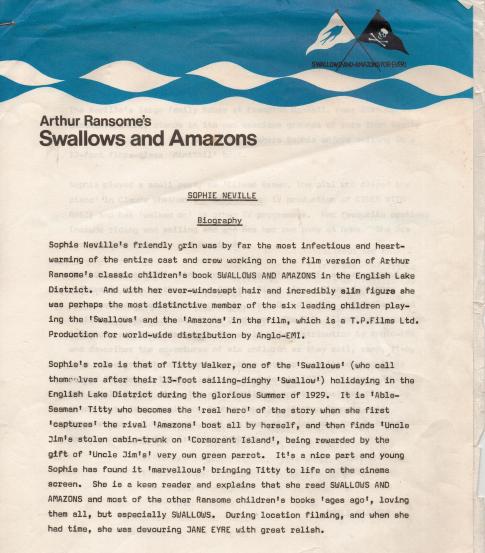
Brian adored Children’s literature. His own children came up to stay on location over their half-term and spent hours playing with my sisters, indeed they all appeared together as extras in the scenes shot at Bowness, and can be seen playing on the beach. Sadly Brian died, very suddenly, in 2008. His daughter told me that he left a collection of 35,000 books.

I still have Brian’s announcement:

At this the journalists moved in. From all over the place!

There was a very trendy women’s magazine in the early 1970s called Over 21, which the senior girls at school used to read. My mother was thrilled to find that Celia Brayfield had written a double page feature. I was amazed. I didn’t mind the picture of us gutting fish, but started reading with trepidation.

(If you can read this, I’m afraid page one comes second.)

Over 21 ~ December 1973

I read it, looked up the word etiolated in the dictionary and burst into tears.

Far worse was to come.

The food we ate whilst filming ‘Swallows and Amazons’ in 1973

Suzanna Hamilton as The Mate Susan, cooking buttered eggs on the camp fire on Wild Cat Island. Director Claude Whatham, Sue Merry, Bobby Sitwell and DoP Denis Lewiston look on, clad in wet weather gear.
Suzanna Hamilton as The Mate Susan, cooking buttered eggs with tea on the camp fire on Wild Cat Island. Director Claude Whatham, Sue Merry, Bobby Sitwell and DoP Denis Lewiston look on, clad in wet weather gear.

One of the questions I was asked when we returned from filming ‘Swallows and Amazons’ in 1973 was about the food. This could only properly be answered by going into considerable detail.

The location caterers from Pinewood
Jane and Sten Grendon walk, in costume, towards John and Margaret’s location catering wagon parked at Bowness-on-Windermere ~ photo: Daphne Neville

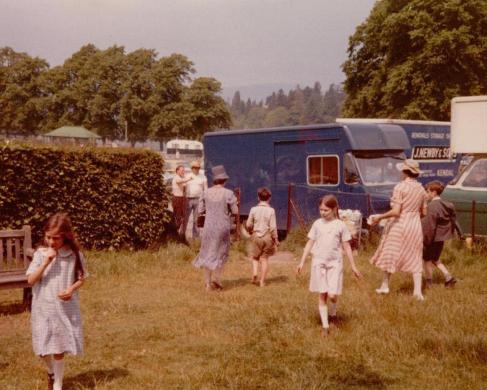
When on location, our breakfast, coffee, lunch and tea were provided every day from the back of a location catering van staffed by a couple called John and Margaret who had come up from Pinewood. My mother always referred to their van as ‘The Chuck Wagon’. There wasn’t perhaps as wide a choice as there is with location catering today, but good hot meals were produced on time, whatever the weather and wherever we might be.

If we ever filmed on a Sunday there would be a full roast meal. At other times they would enchant us with a choice that might include spaghetti, a dish that was new to England – or at least where we lived – in 1973. It was the kind of special meal that my mother would cook for a dinner party, served with a spoon and fork so you could swirl the pasta properly. As children we were allowed to go to the head of the queue so that we could avoid having to queue up in the rain. We’d take out plates to tables in one of the  red  double-decker buses. You could help yourself to knives and forks and paper napkins on the way in. We had to be careful not to get food on our costumes.

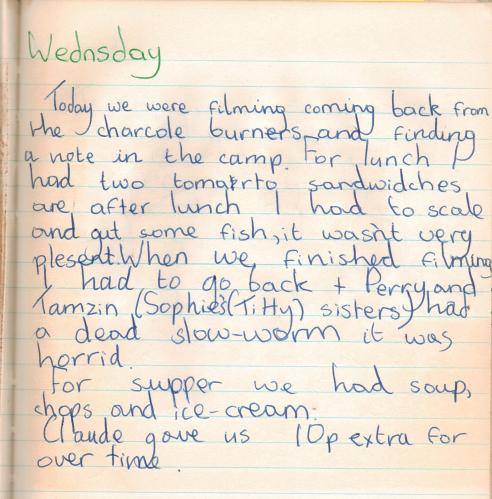
I remember when location caterers first started providing salad buffets in addition to hot lunches in the 1980s. It was such a relief not having to queue. Salads were not regarded as food for the working man back in the early 1970s  but Suzanna thought otherwise. Indeed she would eat little else.

Despite the fact that Suzanna often only ate tomato sandwiches for lunch, the catering budget must have been considerable. The call sheet always seemed to specify ‘LUNCH for approx 70 persons’.

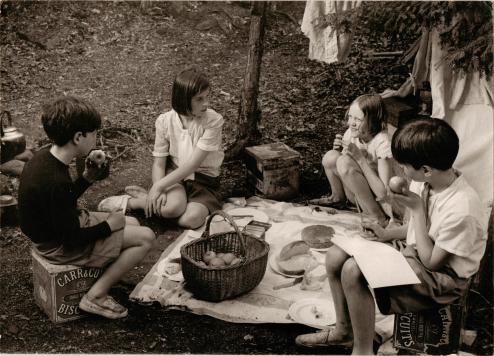
When friends came to visit us on location my parents were sensitive to this and bought a picnic, which was very much how we lived normally. This was always carried in a wicker basket and set out on a car rug, cold squash in one thermos flask, hot coffee in another. Triangles of processed cheese with ham and pickle sandwiches. No cool bags or bottles of wine. You couldn’t buy ready-made sandwiches from petrol stations or supermarkets then but if you went to a bakery they would make you a filled bap while you waited.

A family picnic on the banks of Coniston Water, Cumbria in 1973
Daphne and Martin Neville having a picnic with their friends on the banks of Coniston Water in 1973. Sophie Neville wears an anorak over her costume.

As anyone who has read Arthur Ransomes’ books will know, the Swallows were very organised when it came to provisions. Milk from the farm, buttered eggs, seed cake, apples, molasses (toffees) and grog – I loved it all. I wasn’t too sure about fried perch but the pemmican and potato cakes cooked by Man Friday with a great knob of butter were utterly delicious. And I loved the buns from Rio. We didn’t have peas to shell on the film. Apples must have seemed a realistic alternative.

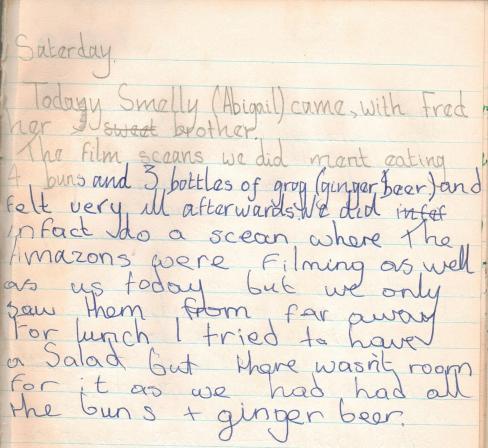
Again we have to rely on The Mate Susan for details. Surely she was modeled on Ransome’s own efficient wife Evgenia? In this extract from her diary Suzanna mentions that Richard Pilbrow’s two children came to watch the filming. She knew Abigail from London.

Mum became worried quite early on that Suzanna wasn’t eating enough. The solution came when she was taken out to dinner at a restaurant where she was able to chose from a wide menu.

As a result Suzanna was often given steak for supper back at the Oakland’s Guest House while the rest of us had whatever was on offer, which was a bit of a swizz.

Eating apples
‘Sailors die from it like flies’ Stephen Grendon, Suzanna Hamilton, Sophie Neville and Simon West as The Swallows eating apples to fend off scurvy.

Suzanna was of course completely right about insisting on eating salads and fresh fruit. She chivvied, encouraged and begged both the caterers and Mrs Price for more and more fresh raw food. She loved strawberries. Virginia McKenna won her heart by bringing her two boxes of fresh strawberries when she was ill with tonsillitis at the start of the filming. These would have been early English strawberries and a great treat in 1973.  John and Margaret managed to find enough for us all later in the summer. They were presented in a manner that would have pleased the men working on the film crew but Mate Susan wasn’t so happy about this.

I’ve included this photograph before but it provides proof that food was an important issue. Please note that Mate Susan is first in line, inspecting everything on offer.

Location catering
Suzanna Hamilton, in her red tracksuit top, seeing what the location caterers had for lunch on the set of ‘Swallows and Amazons’ by Coniston Water

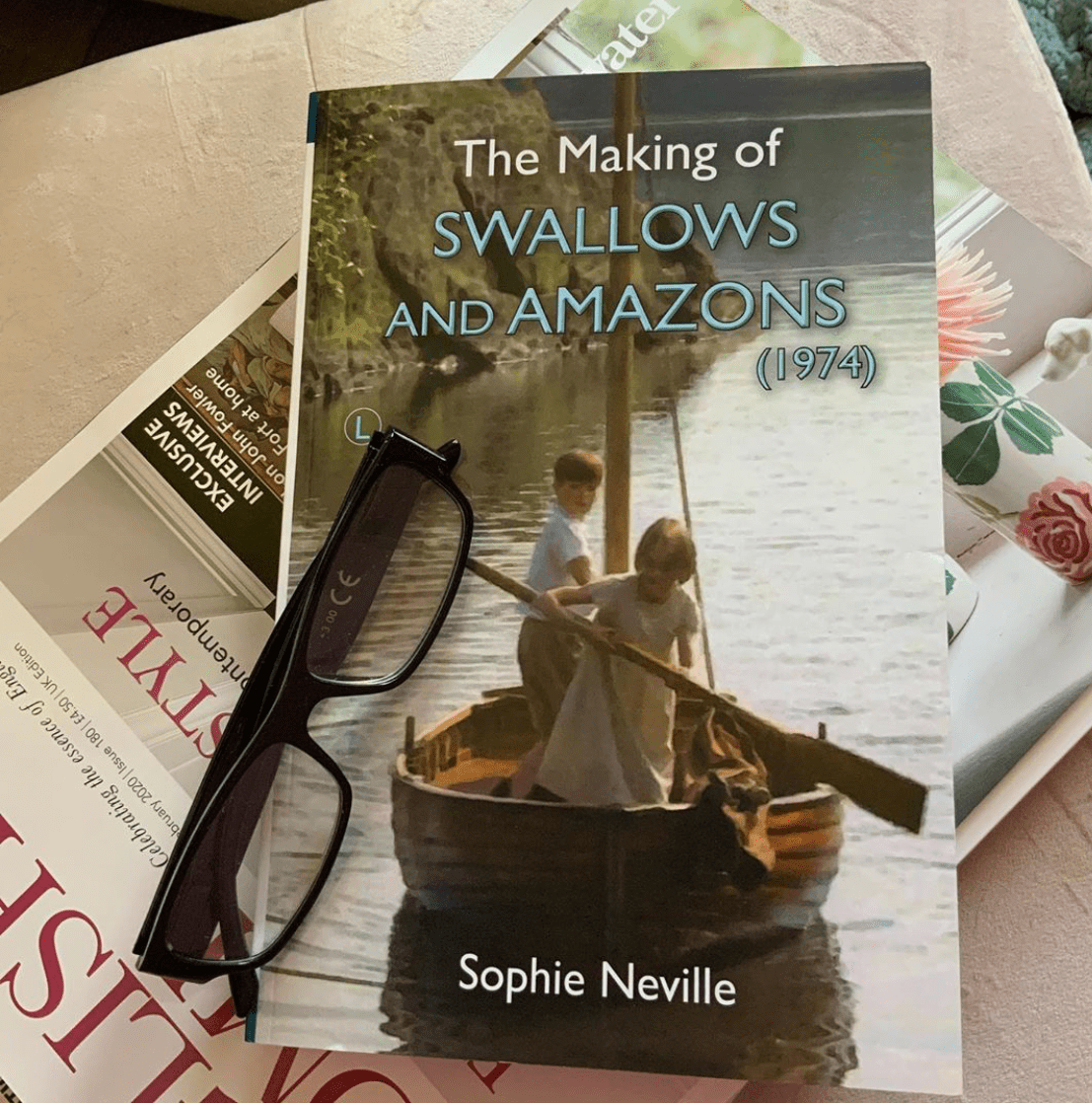
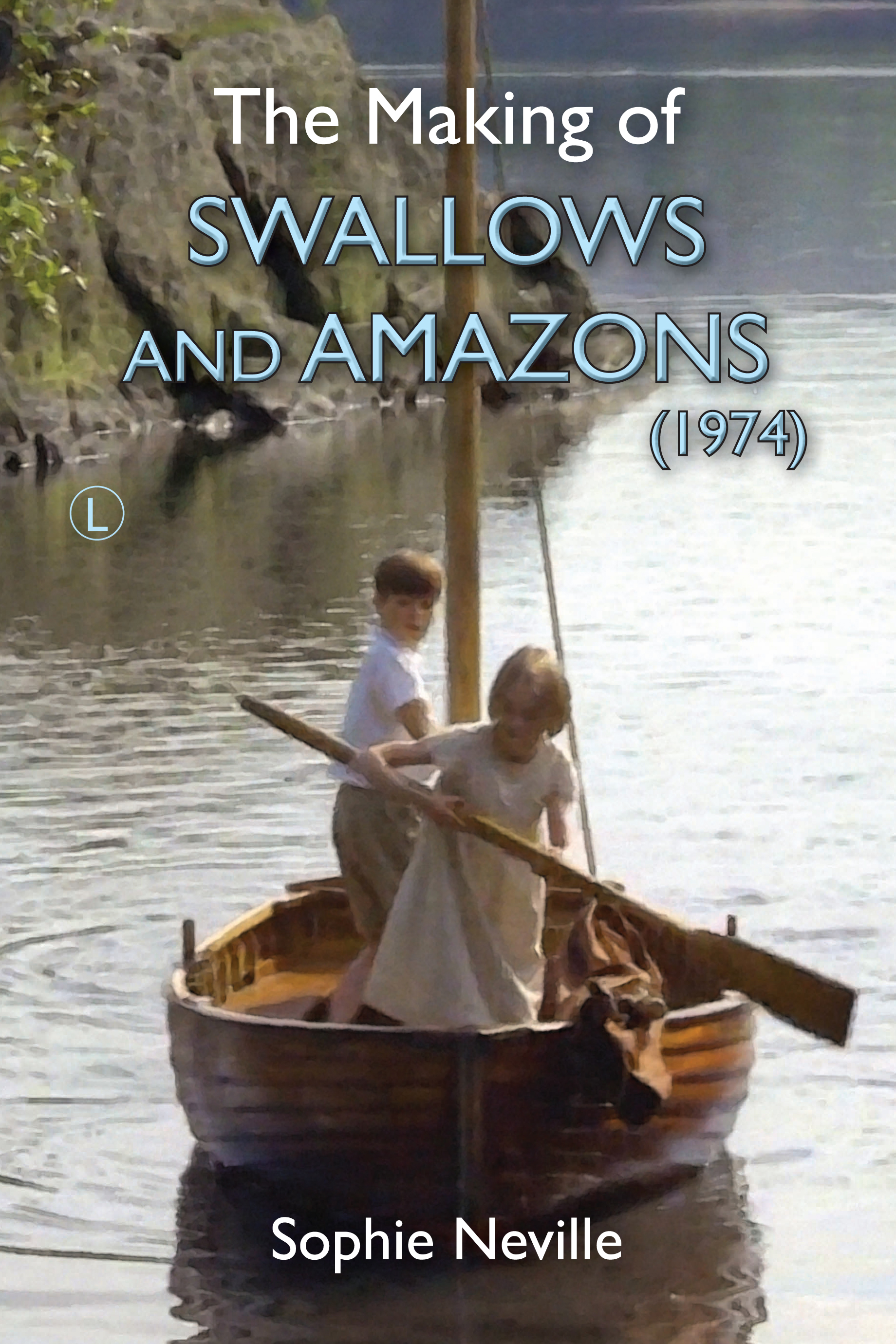
If you would like to read more about what it felt like to appear in Swallows and Amazons, I have bought out a paperback: ‘The Making of Swallows and Amazons’ for sale online or available from any library worldwide.

Screenshot of The Making of Swallows and Amazons book cover on Instagram

Leaving the Lake District after spending 50 days filming ‘Swallows and Amazons’~ 13th July 1973

Daphne Neville with Sophie Neville while filming 'Swallows and Amazons' in Cumbria

 It was time to say goodbye. We’d had the most wonderful seven weeks filming on the Lakes but the end had drawn in with the clouds. It was time to go home.

Since we lived in Gloucestershire it was a long drive south. I’m not sure how Jane and Sten Grendon got back, as I don’t think Jane drove, but we must have dropped off some of their things on our way past their village.

I remember seeing my real sisters and walking around the garden in the afternoon sunshine, looking at all that had changed. We’d left in early May, now it was full summer and the school holidays. I don’t know how I had the energy left to write up my diary.

Sophie Neville in 1973, in the garden at home with a swan
Back in the garden at home with a swan

‘Shall we go and put flowers on Luppy’s grave?’ Perry asked. I hadn’t heard that our dear old dog, the sheep dog I had known all my life, had died while we were away. I was inconsolable. Mum explained that they hadn’t wanted to tell me when it happened as we were filming, she thought that the sadness on my face would have come through on camera. I understood this but was still desolate. Having had to cope with the grief of losing Luppy, on top of the heartbreak of leaving everyone I had grown so close to in the Lake District, I was not in a good way.

One of the most treasured things that I had returned with – apart from the lump of Cumbrian slate Jean McGill had given me – was a hard-back copy of ‘Swallows and Amazons’ signed by the entire cast and crew.

Signatures of the cast, director and producer of the movie 'Swallows and Amazons' in my hardback copy of Arthur Ransome's book
Signatures of the cast, director and producer of the movie ‘Swallows and Amazons’ in my hardback copy of Arthur Ransome’s book

Here you can see inscriptions from Virginia McKenna who had played my mother and Ronald Fraser who obviously saw himself as Uncle Jim rather than Captain Flint.

Virginia McKenna as Mother in Swallows and Amazons 1

Mike Pratt and Brenda Bruce who appeared as Mr and Mrs Dixon, Jack Wolgar and John Franklyn-Robbins who embodied the Charcoal Burners with Brian Robylas (sp?) and Moria Late who played Mr and Mrs Jackson.

Sophie Neville holding the horses
Stephen Grendon, Sophie Neville and Simon West with Brian Robylas ~ photo: Daphne Neville

It is interesting that all the children signed their character names with their real names in brackets. We must have grown to associate ourselves more with the characters names than with our own.

Claude Whatham in 1973

Claude Whatham wrote, with thanks, and Richard Pilbrow enchanted me by drawing a picture of Wild Cat Island at night.

Daphne Neville with Richard Pilbrow1
Molly and Richard Pilbrow in 1973

Sadly, we didn’t manage to nab everyone on the crew, but collected a few signatures.

Brian Doyle, the publicity manager on 'Swallows and Amazons'
Brian Doyle, the film publicist on ‘Swallows and Amazons’ (1974)

The only other signature on this page is from Brian Doyle, Mum’s friend the publicity manager on the movie who encouraged us to collect the autographs.

Signatures of the rest of the cast and crew of 'Swallows and Amazons' in the back of my Jonathan Cape edition of Arthur Ransome's book
Signatures of the rest of the cast and crew of ‘Swallows and Amazons’ in the back of my Jonathan Cape edition of Arthur Ransome’s book

At the back of the book David Blagden, who played Sammy the Policeman as well as overseeing the sailing.

David Blagden who played Sammy the Policeman
David Blagden who played Sammy the Policeman ~ photo: Daphne Neville

David drew me a picture of what must be a vision of himself, sailing into the sunset in his little yacht Willing Griffin that had taken him across the Atlantic.

David Blagden's signature and sketch

Phyllis B was my tapestry-making stand-in. Simon Holland our art director (set designer) drew me a wonderful set of crossed flags that were also paint brushes ~ a logo for my life.

Art Director Simon Holland
Art Director Simon Holland at Bank Ground Farm in 1973 ~ photo: Daphne Neville

I have a signature from Kerry Darbishire (I thought she’d written Dartisnine) who played Bridget’s Nurse, our Fair Spanish Lady. Like the actors who played the Jacksons, she was not credited on the movie but played a significant part. She still lives in Cumbria.

Nurse with Baby Vicky, the ship's baby
Nurse with Baby Vicky, the ship’s baby at Holly Howe

We left Jean McGill, our driver and unit nurse, in Bowness-on-Windermere.

Jean with sophie
Jean our driver and location nurse operating the radio with Sophie Neville ~ photo:Martin Neville

Eddie Collins was the camera operator,  Ronnie Cogan our hairdresser, Joni Turner was a local lady who worked on a few days as Suzanna’s stand-in.

Sophie with Martin Evans the Gaffer and Terry Smith the wardrobe master
Talking to Martin Evans the Gaffer and Terry Smith the wardrobe master while leaning on a lighting stand at Bowness-on-Windermere

Terry Smith was the wardrobe master, Albert Stills is Albert Clarke who took the black and white photographs day after day. Terry Needham was our long-suffering second assistant director.

Sophie Neville with Terry Needham in 1973
Sophie Neville with Terry Needham and the unit radio at Derwentwater ~ photo: Daphne Neville

On the last page I have a very classy signature from Robert – who I think was one of the Keswick boatmen looking after the Lady Derwentwater.

A boatman working on Derwent Water in 1973
Our boatman and the houseboat in 1973 ~ photo Daphne Neville

Denis Lewiston the DoP also left his mark on my life.

Dennis Lewiston, director of Photography on 'Swallows and Amazons' ~photo:Richard Pilbrow
Dennis Lewiston, director of Photography on ‘Swallows and Amazons’ ~photo:Richard Pilbrow

Peter Robb-King signed himself ‘Make-up for the Stars’ and Gareth Tandy as ‘The Whip-cracker’, which surprised me as I had never seen his whip. Graham Ford obviously didn’t want me to change and Margaret Causey, our tutor, sent her love. We’d been though so much together and in such confined spaces.

The film crew set up in Rio Bay
Swallow and the film crew setting up at Bowness-on-Windermere ~ photo: Richard Pilbrow

Interestingly, I also have an inscription from Ian Fuller the sound editor listed as if he was around on location. I am sure he was the chap I would have met next. Claude and Richard would have gone straight down to the cutting rooms to edit the film. It is not usual for actors to enter such territory but our adventure was to continue. We were soon to be summons to the Elstree Studios of EMI at Borehamwood in Hertfordshire, just off the A1.

The crew as I remember them filming with Swallow and Amazon from the pontoon ~ photo: Richard Pilbrow
The crew as I remember them filming with Swallow and Amazon from the pontoon ~ photo: Richard Pilbrow taken on Derwentwater in 1973

You can read more in the ebook ‘The secrets of filming Swallows and Amazons’ or paperback entitled ‘The Making of Swallows and Amazons’ available from all online retailers.

The Making of Swallows and Amazons by Sophie Neville
Different editions of ‘The Making of Swallows and Amazons’ by Sophie Neville

Desperation, music and laughter ~ the filming of ‘Swallows and Amazons’, 12th July 1973

Director Claude Whatham

Our director, Claude Whatham had a problem. Despite two attempts he had failed to shoot the key scene when the Walker children – who had just arrived at Holly Howe – discover the Peak at Darien and look out over the lake to spot Wild Cat Island for the very first time. He saw it as crucial to the motivation of the story.

Claude had shot the sequence of us running down the field at Bank Ground Farm in the evening light. He had what would technically be called our POV (point of view) of the island. He had nothing in between. There was no dialogue but without the right light the sequence would not cut together. And now it was raining, endlessly. We waited around all day, yet again,  hoping for the weather to clear. It did not.

12th July ~ my revised diary

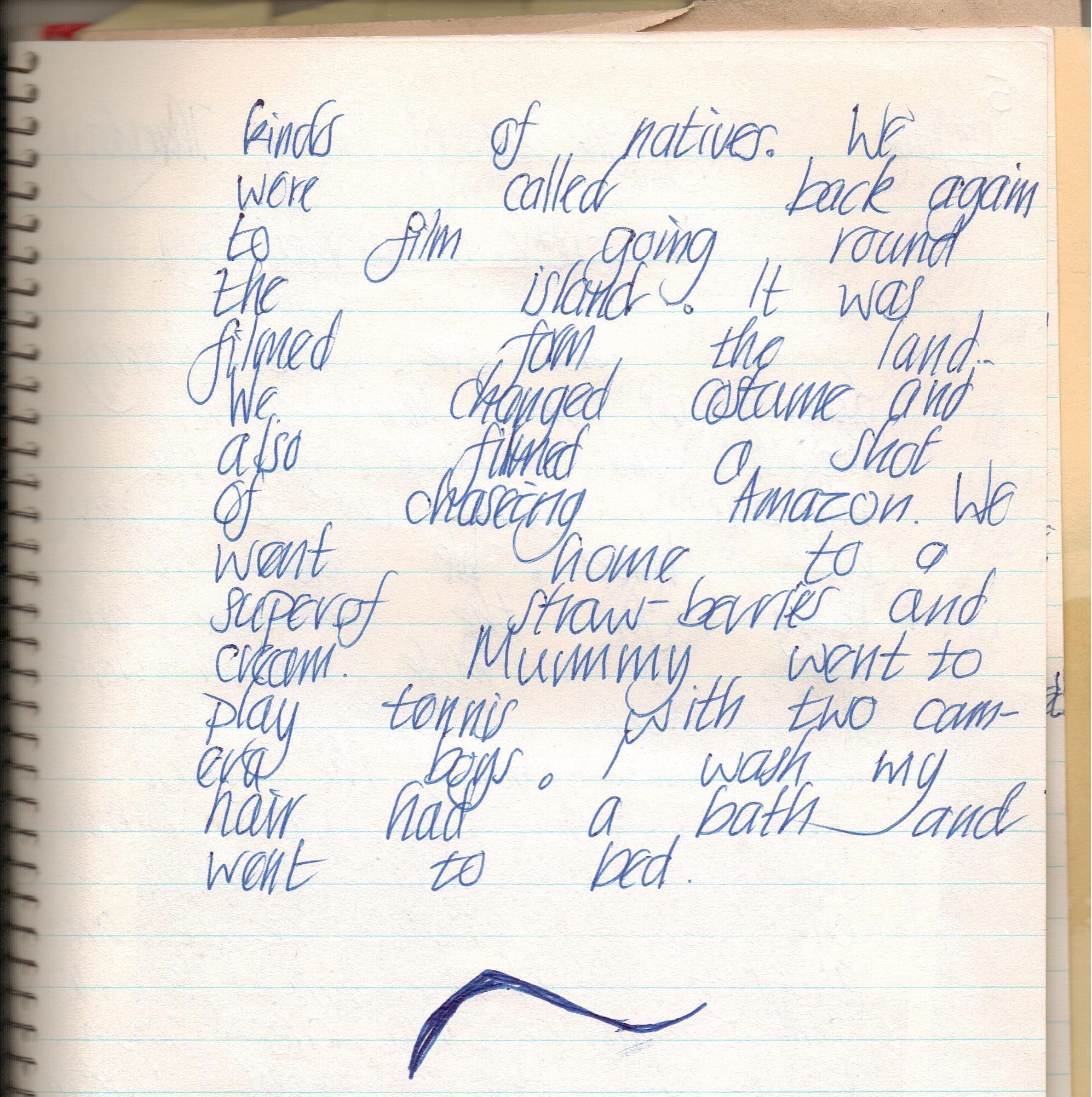
I can’t believe that we went, what would now be termed, wild swimming in the Lake District after making such a fuss about recording the swimming scenes at Peel Island. Even if it was raining the water must have been fairly warm. I don’t suppose we were in for that long. I’m now rather shocked that we dried our hair by sticking our heads out of the windows of the mini-bus. We could have all been decapitated.

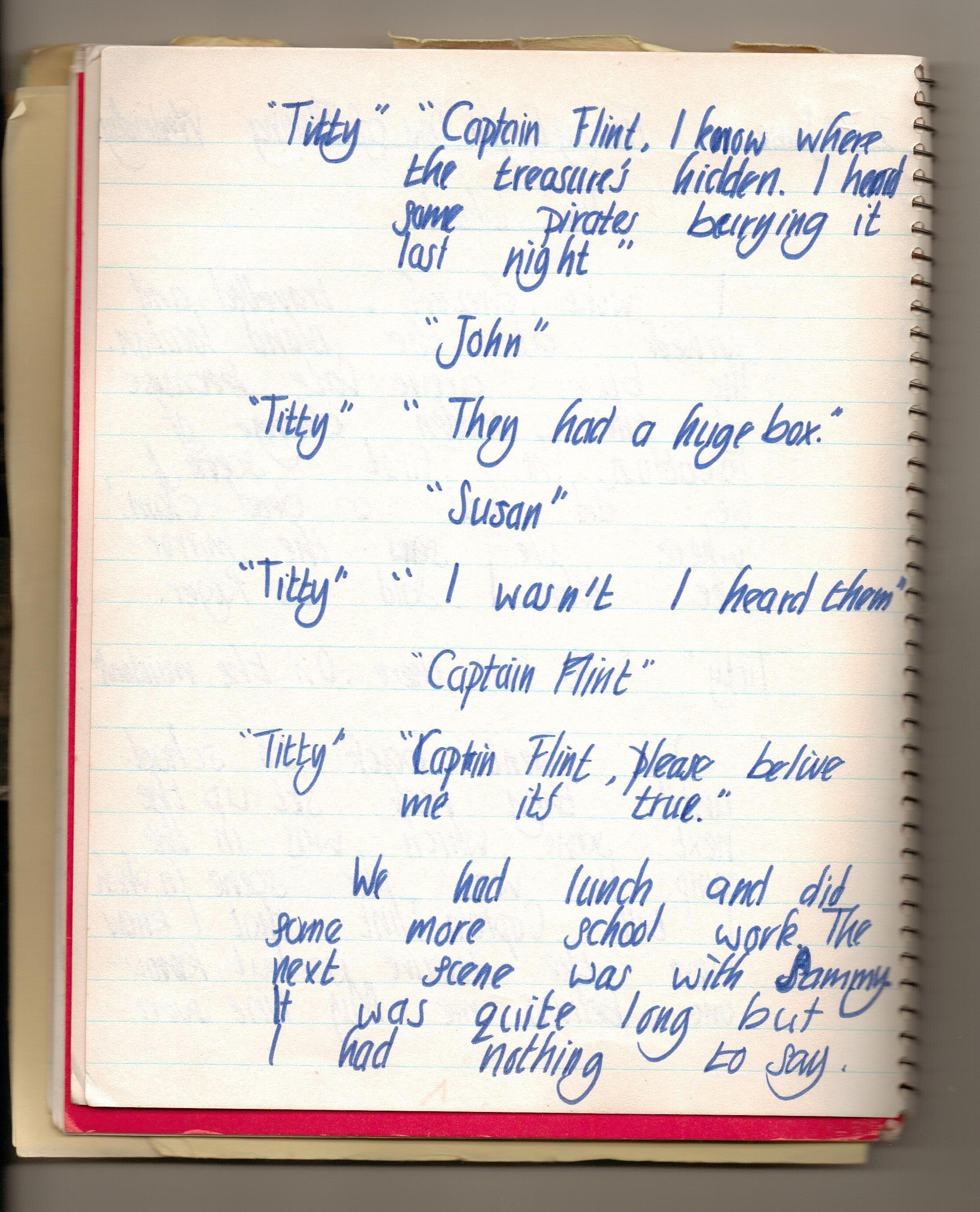
While Claude was busy looking at the sky I spent the rest of the day industriously sticking small photographs into my scrap-book. Mum had her camera films developed by Triple Print so that she had some to give away.  This was the result:

Photographs in a child's scrapbook

Two of these tiny photographs show us sitting in the Grizedale Forest with Wilfred Josephs who composed the music for Swallows and Amazons.  He had visited us on location when we were shooting the charcoal burners scenes. If I blow up this tiny photograph you can see a little more of him.

Wilfred Josephs

Wilfred had written a canon with the idea that he could do something musical with our voices. Our efforts were being recorded by Robin and his assistant when Mum took these snap shots. The words went in a round, like this:

Swallows:  ‘Swallows sail the ocean-wide, Natives we can not abide.’  (Sung in a high register)

Amazons:  ‘We are the Amazons.’ (Sung beneath us in a low register)

What Wilfred soon discovered was that, apart from Lesley Bennett, we were all pretty useless at holding a tune. Whatever was recorded on that day near the charcoal burners’ hut never made it to the final sound track – or even the LP that EMI brought out to accompany the movie.

Wilfred Josephs on location in Cumbria
Composer Wilfred Josephs with Sophie Neville, Lesley Bennett, Claude Whatham, Kit Seymour, Simon West and sound recordist Robin Gregory ~ photo: Daphne Neville

Mum was thrilled to meet Wilfred Josephs. He was fantastically talented, with a huge list of credits to his name. Born in 1927, he qualified as a dentist at the Universtity of Durham ~ where I also studied ~ before becoming a full-time composer in the early 1960s. His career was launched when his Requiem in memory of the Jews who were lost to the Holocaust won La Scala. He went on to compose 12 symphonies, 22 concertos and was  commissioned to write a number of overtures, ballets, operas and other vocal works.  In the field of television he is perhaps most well know for producing the theme music for I,Claudius, Enemy at the Door, The Prisoner and Pollyanna. He worked for Claude Whatham on the movie score for All Creatures Great and Small that starred Anthony Hopkins and Simon Ward, as well as the television drama W.Somerset Maugham and the serial Disraeli, which Suzanna Hamilton appeared in.

In the early 1970s Wilfred had also composed the theme music for Claude’s BBC play of Laurie Lee’s auto-biography Cider with Rosie, which Sten and I had acted in. Wilfred Josephs sadly died at the age of seventy, but I found that someone has put his haunting composition for Cider with Rosie onto YouTube. It was so good to hear it again. It comes with colourful cider-making images but – unless passionate about cider – you can have a look at more of my scrapbook while you listen to it. Like the film-score to Swallows and Amazons the orchestra was conducted by Marcus Dods.

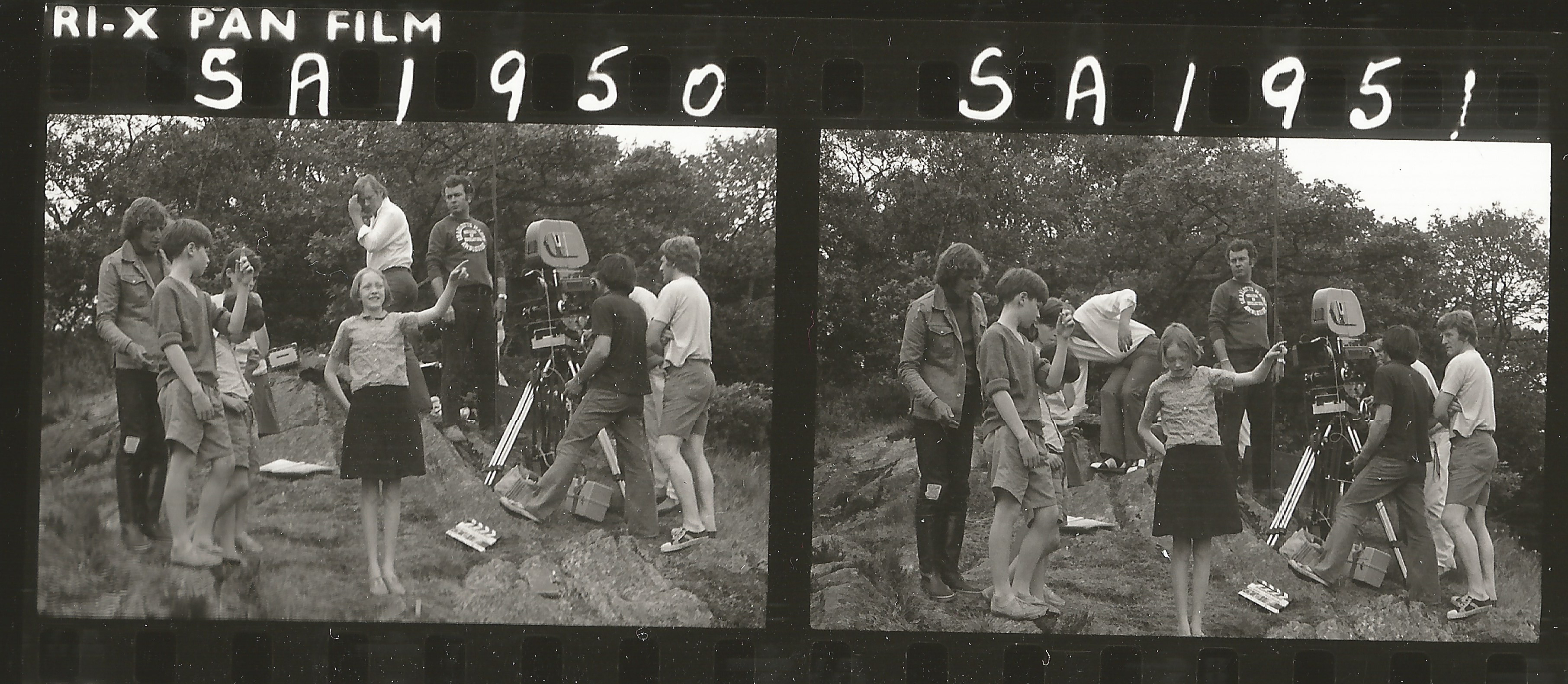
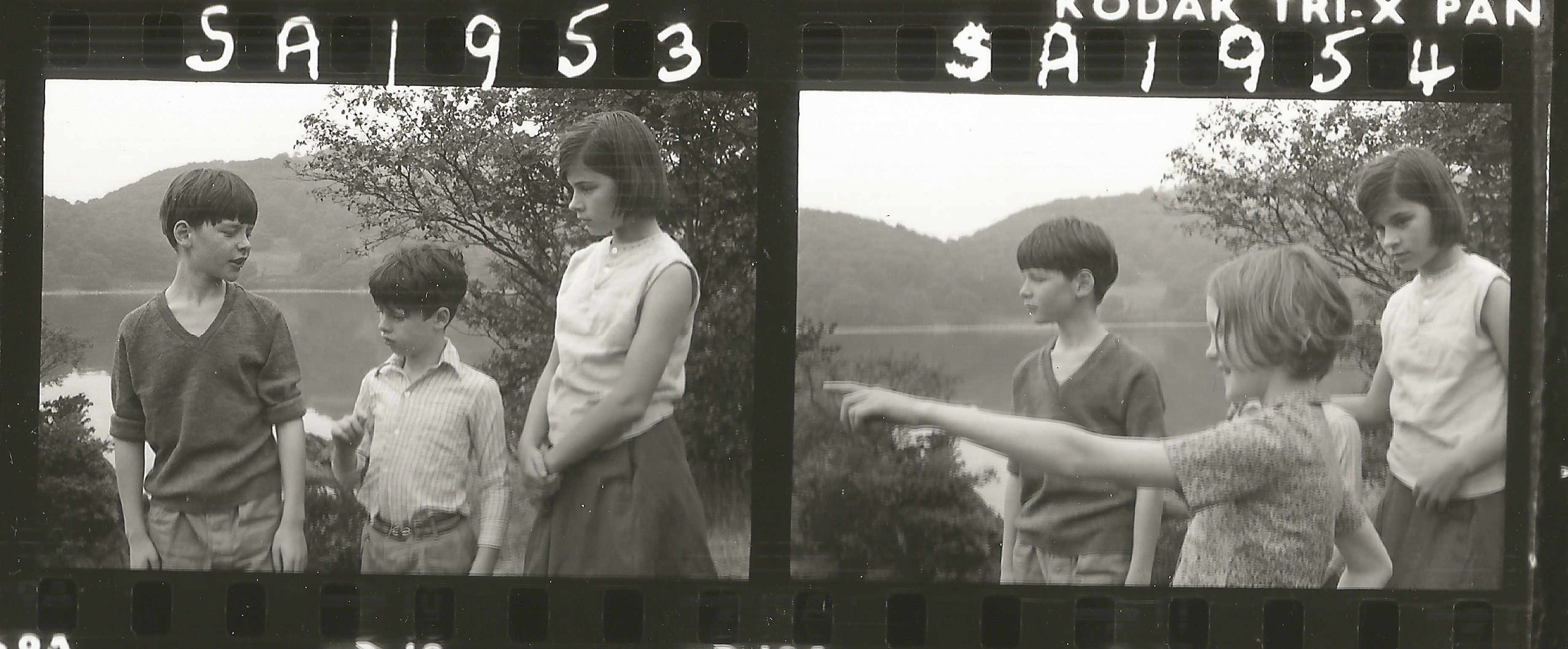
Some of these tiny photographs from the contact sheets that Richard Pilbrow gave us are fascinating.

You can read more about making the film in the ebook entitled ‘The Secrets of Making Swallows and Amazons’ here:

You can listen to Wilfred Owen’s haunting music for ‘Cider With Rosie’ here

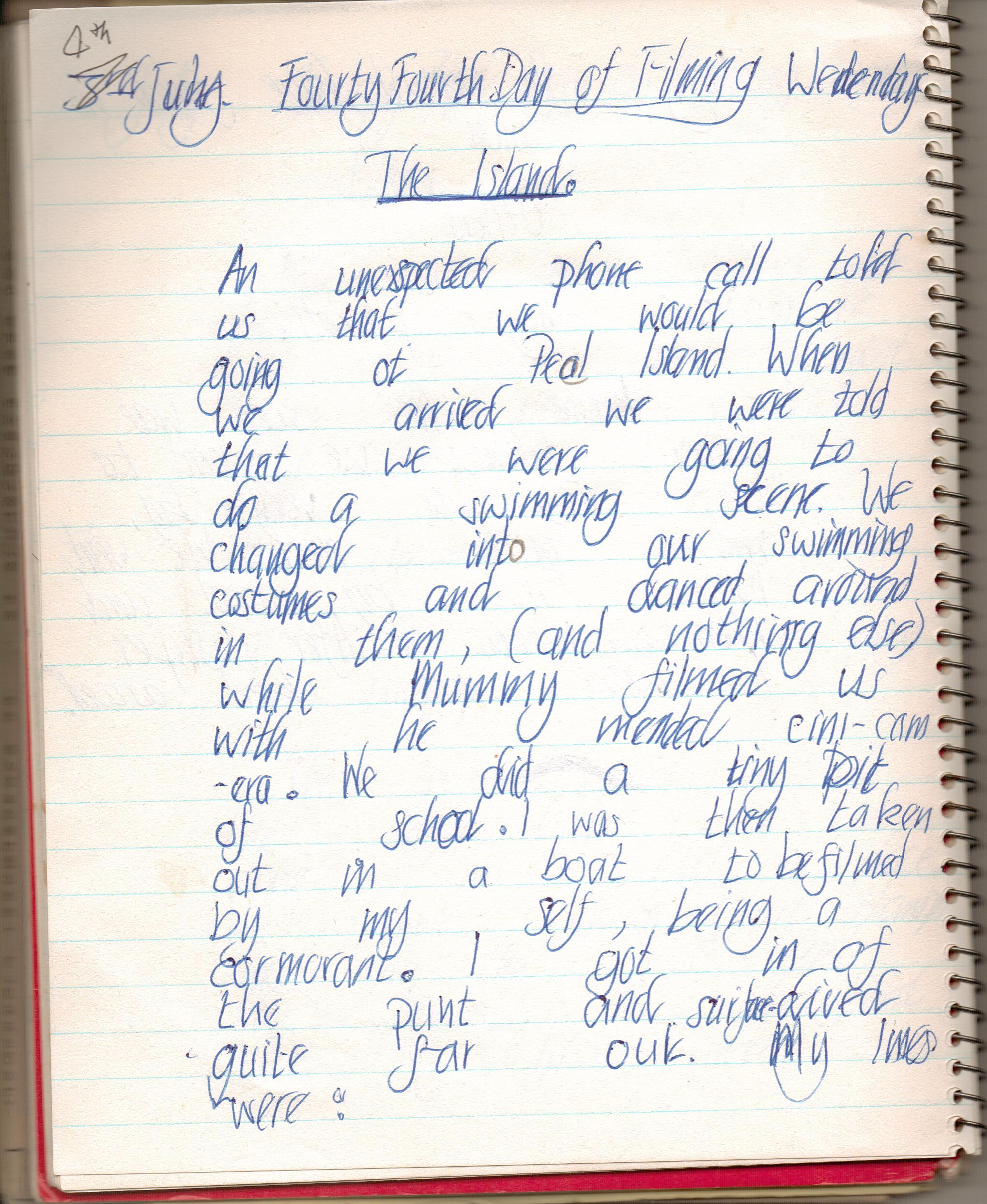
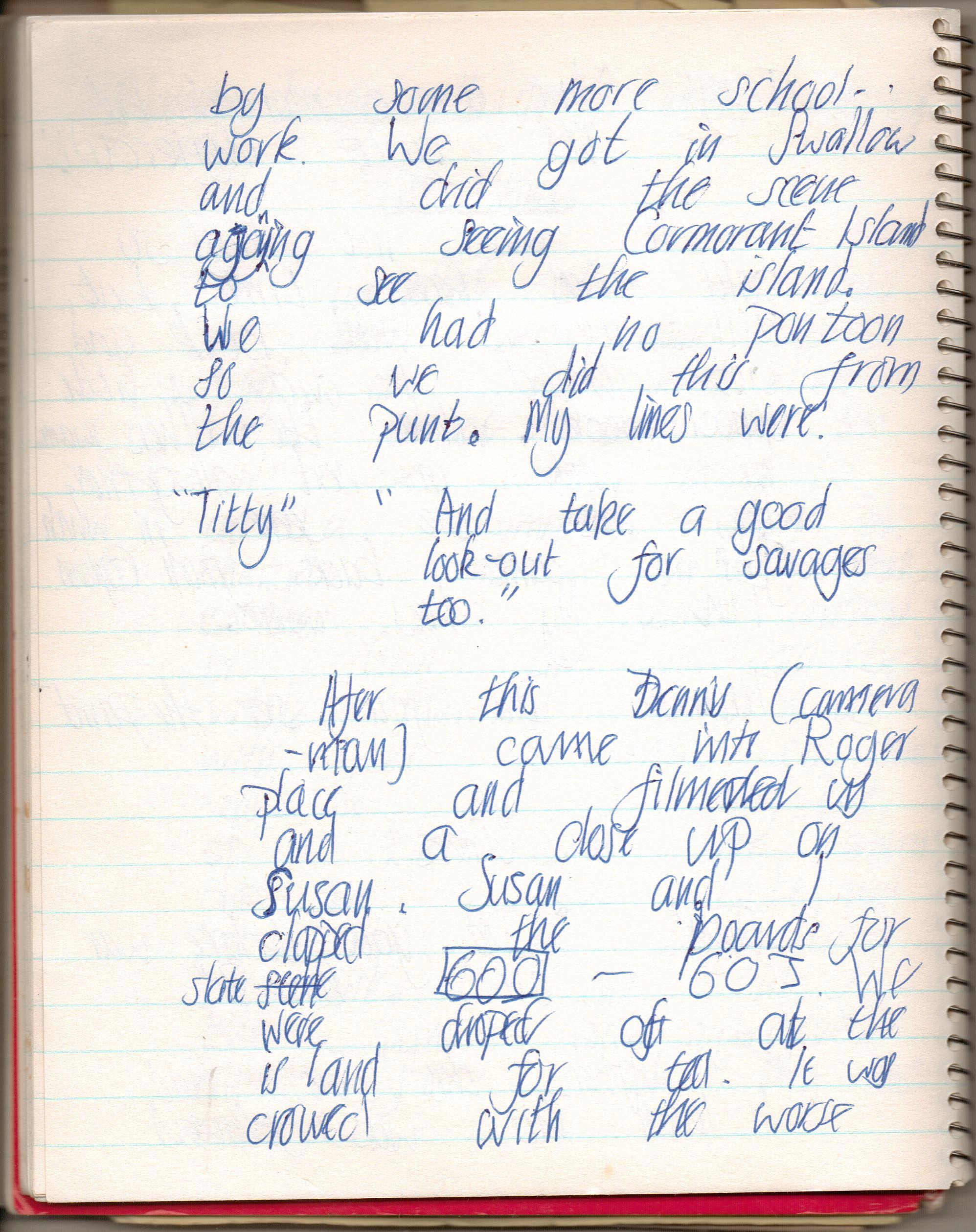
Being a cormorant ~ filming more swimming scenes for Swallows and Amazons on 4th July 1973

Sten Gredon as Roger Walker being taught to swim by Suzanna Hamilton playing his sister Susan Walker on location at Peel Island on Coniston in 1973

Roger still couldn’t swim, but he was trying to. Very hard.  The production manager had kindly scheduled the second of our swimming scenes as late in the summer as possible. The weather was warmer – we’d elected to go bathing in a river up near Rydal Water on our day off – but it was still pretty chilly out on Coniston.

swa_bw_neg_ 045

Whilst we tried to acclimatise by running around in our swimming costumes the crew were all in their thick coats as you can see from this home movie footage shot by my mother. We had bought her 8mm camera by saving up Green Shield stamps. (Can you remember collecting Green Shield stamps from petrol stations? They were an icon of the early 1970s all by themselves.) I remember someone on the crew calling out ‘Second unit!’ as Mum lifted what looked like a grey and white toy to her face. It was a bit noisy so she was not able to record during a take. You only see us before and after the sequences in the film, but her footage shows quite a few of the members of the crew – all smoking away, even when they were trying to warm us up after each sequence. You can watch Jean McGill, from Cumbria, our unit nurse who was dressed in red, popping Dextrose into our mouths and giving us hot drinks to warm us up. Jean made Gareth Tandy, the third assistant, who was aged about 18, wear a sun hat because he had previously suffered from sun stroke. David Blagden can be glimpsed as the one other man with short hair.

The camera pontoon must have been left up on Derwentwater. Claude was obliged to shoot these scenes from what we called the camera punt, which was smaller but quite useful. Richard Pilbrow sent me a picture. He has included others in a book that he has written about his career, including a section on the making of ‘Swallows and Amazons’ called ‘A Theatre Project’

Claude Whatham and his crew on the camera punt
First assistant David Bracknell, director Claude Whatham, grip David Cadwallader and DoP Dennis Lewiston (seated) with three local boatmen ~ photo: Richard Pilbrow

Do please let me know if you can tell me the names of the three Cumbrian boatmen featured in this photograph who helped us. Others are featured in the home-movie footage. They all look like pirates. Real ones.

Goodness knows that Health and Safety would say about that punt today. The DoP managed to get two sizeable electric lights, on stands, into a boat already overloaded with personnel and expensive equipment. You can see for yourself. Were these ‘Filler’ lights powered by portable batteries?  The Lee Electric generator was on the shore. I was in the water. Busy being a cormorant.

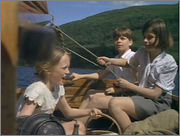
We had an interesting afternoon filming with both dinghies. At one point we had the camera with us in Swallow. I found these photographs of us on the internet.

Sophie Neville, Simon West and Suzanna Hamilton

I was given the honour of clapping the clapper-board and calling out, ‘Shot 600, Take one!’ for a close-up of Suzanna Hamilton.

Suzanna Hamilton as Susan Walker sailing Swallow on Coniston Water in 1973

‘The worse possible kinds of natives’… Tourists were beginning to arrive for their summer holidays in the Lake District and we still had quite a bit more to film.

Sophie Neville, Suzanna Hamilton and Simon West sailing Swallow in 1973

You can read more about the adventures we had making the original film of Swallows and Amazons here:

‘They’re Pirates!’ ~ secrets of filming Swallows and Amazons on 3rd July 1973

Captian Flint on the houseboat with Swallow
Ronald Fraser as Captain Flint on his houseboat with Stephen Grendon, Sophie Neville, Suzanna Hamilton and Simon West in Swallow on Derwentwater, 1973

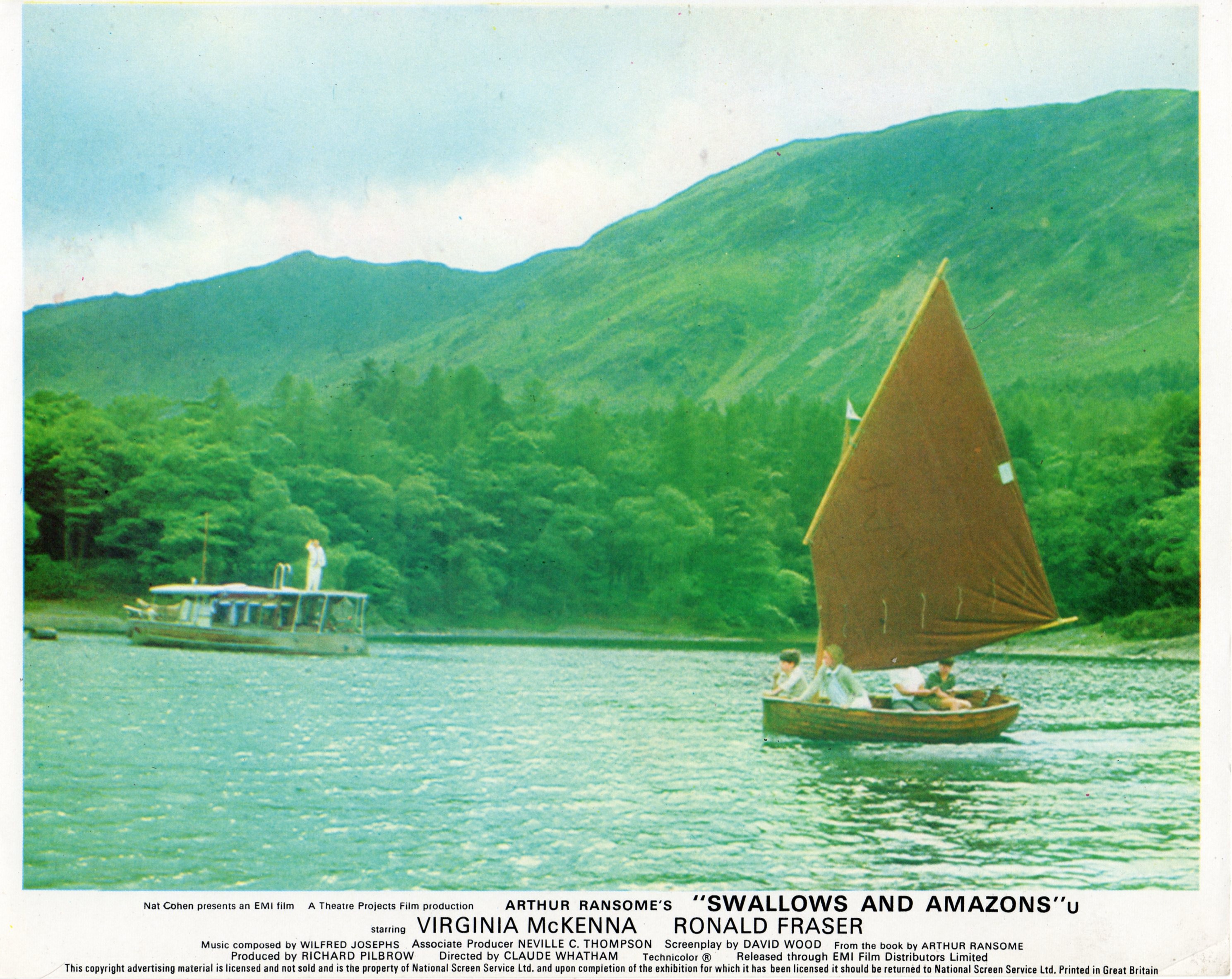
It was found on e-bay and brought to Coniston Water when we re-launched Swallow at the Bluebird Cafe in 2011. Everyone was fascinated. I’d never seen this hand-coloured print used to publicise the movie in cinema foyers, but it has memories of a good day, spent not on Coniston but further north on Derwentwater.

The movie Swallows and Amazons (1974) Swallow sailing past the houseboat
Swallow sailing past the houseboat on Derwentwater


When Richard Pilbrow’s movie of Swallows and Amazons was first shown on British television in 1977, ITV made a trailer to advertise it. This started with the shot of me saying, ‘They’re pirates!’ People loved it. Everyone was going around saying, ‘They’re pirates!’

If it was my best performance it was because I had been lying on a red ant’s nest – and they stung us.

The other secret is that that lighthouse tree in this shot is not a tree. Not one that was growing. It was a big log that Bobby Props had stuck in the ground making the ants very angry indeed.

Sophie Neville as Titty Walker in Swallows and Amazons
Sophie Neville as Titty Walker in the ITV trailer for the movie of ‘Swallows and Amazons’ when it was first shown on television in 1977

This was the second location that we used for ‘Lookout Point on Wild Cat Island’. It was on a promontory that overlooks the bay where the houseboat was moored on Derwentwater. There were bushes but no sadly big pine trees. The log was planted so that our director Claude Whatham could get what is called a two-shot of the Swallows watching Nancy sail past Captain Flint’s houseboat, while Peggy raises the skull and crossbones. As we were keeping low the height of the lighthouse tree was not an issue.

The Swallows at the Lighthouse tree Lookout point
Simon West, Suzanna Hamilton, Sophie Neville and Stephen Grendon as the Swallows at the Lookout Point on Wild Cat Island

Just prior to this scene when we spot the Amazons for the first time, I was working on the chart while Susan was sewing a button onto Roger’s shirt. The needle stuck into him as he flung himself down on the grass beneath the lighthouse tree.

Stephen Grendon as Roger having a button sewn back on by Suzanna Hamilton playing Susan Walker in the previous scene.

Since needles are small you can hardly see what is happening but I think it is a detail that Arthur Ransome would have appreciated. I wonder if the same sort of thing had happened to him as a child? He used his memories of Annie Swainson throwing boys across her lap to darn their knickerbockers whilst they remained on him, just as Mary Swainson frequently darns Roger’s shorts after sliding down the Knickerbockerbreaker rockface in Swallowdale. Claire Kendall-Price describes this and where it all happened beautifully.

Here is the diary entry I kept for that day in the Lake District ~

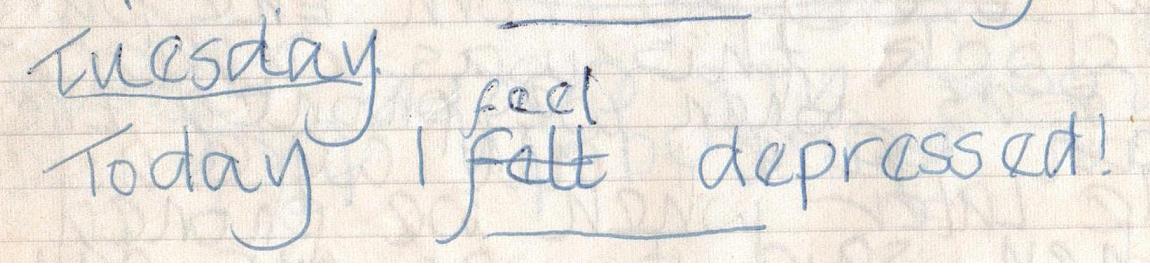
Suzanna’s diary is more succinct ~

I don’t know why she felt depressed. Perhaps it was the ants. She was on more of them than me and they were not waving. They were very angry.

So, the secret of Wild Cat Island is that the lighthouse tree sequences were shot in two different places. Although we were mainly on Peel Island on Coniston Water, Rampsholme, an island on Derwentwater is depicted in the opening titles. This is faithful in that Arthur Ransome annotated postcards to show that wanted this view and the fells beyond as a backdrop for his story.  In her book, In the footsteps of the ‘Swallows and Amazons’,  Claire Kendall-Price provides a wonderful map and guide showing how you can walk from Keswick to find some of the locations.

We didn’t use the island known as Blake Holme on Windermere at all even though Arthur Ransome had envisaged the camp fire as being there. Richard Pilbrow told us it had become a real camp site by 1973 with caravans on the nearest shore.

Sophie Neville with Swallow outside the Bluebird Cafe on Coniston Water
Sophie Neville in 2011 holding the original photograph in front of the newly restored dinghy at the Bluebird Cafe on Coniston Water. If you look carefully you can see that Swallow is being inspected by a modern day pirate ~ photo: Kitty Faulkner

The “They’re pirates”  shot was used in the movie trailer, which you can watch on Amazon Prime here

The iconic photograph of Swallow sailing past the houseboat was used on the first edition of ‘The Making of Swallows and Amazons (1974)’ which has become a collector’s item but can still be found online.

The Making of SWALLOWS & AMAZONS

The Lutterworth Press bought out an improved 2nd edition and this multi-media ebook is available everywhere for £2.99:

Octopus Lagoon ~ the trials of filming ‘Swallows and Amazons’ fifty years ago on 29th June 1973

Coniston Water in the rain

‘The rain poured down.’ Cumbria was covered in cloud, the Lake District dark and dismal. What a nightmare for Richard Pilbrow and his production team. We were behind schedule, Lesley Bennett who played Peggy was ill in bed and we had run out of ‘rain cover’.

Sten Grendon, Simon West and Suzanna Hamilton in Swallow

There was one sequence left that could be recorded in dull weather. Today was the day Claude Whatham shot the haunting scenes of Octopus Lagoon. After finishing our school work Kit Seymour and I sat watching the filming from the sloping field above the beautiful but rather smelly lily pond.

Sophie's diary about filming 'Swallows and Amazons' in 1973

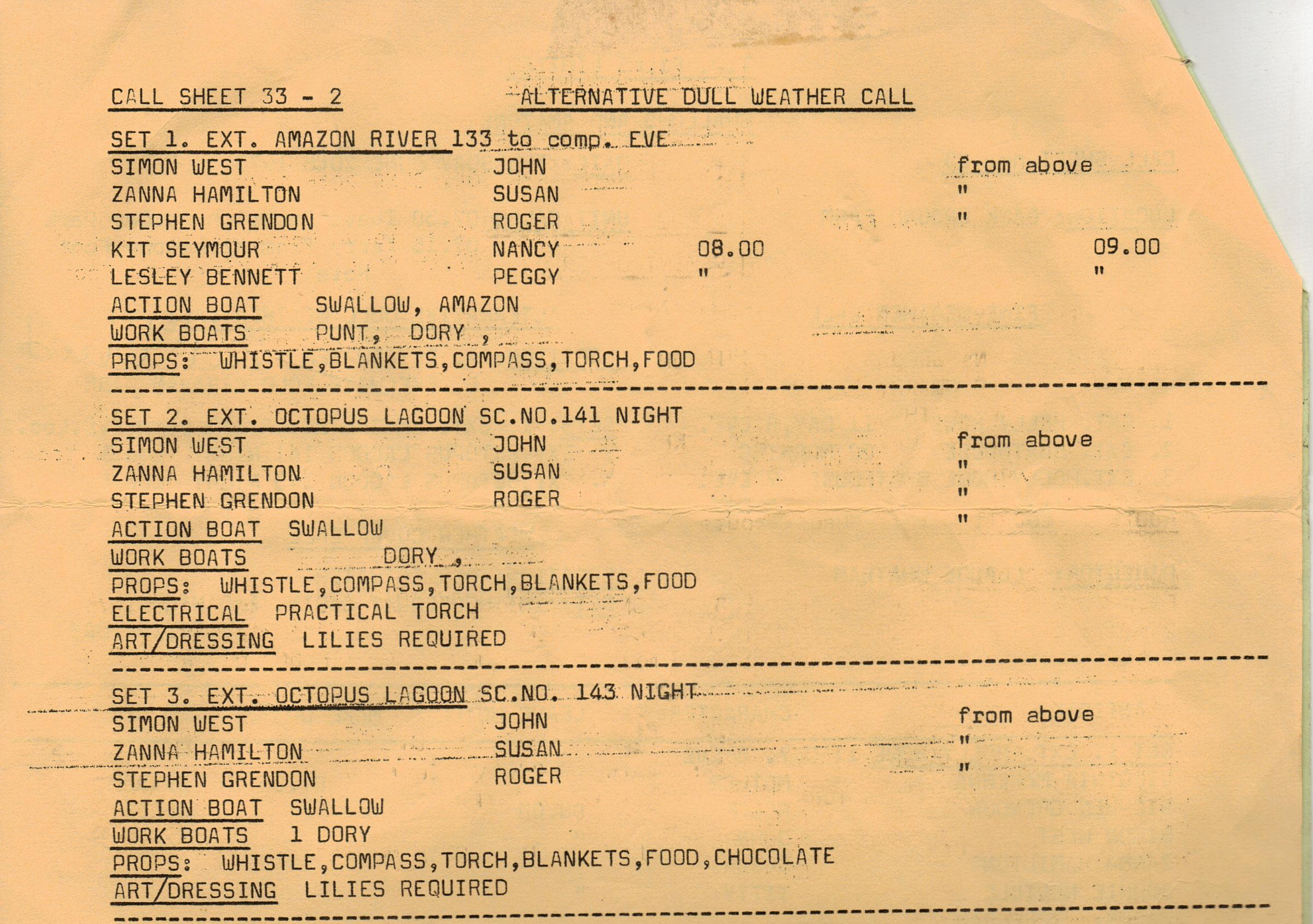
I do not have the Call Sheet for 29th June 1973 but have an extract from this earlier one detailing the ‘Alternative Dull Weather Call’:

Call Sheet for Octopus Lagoon filming Swallows and Amazons in 1973

I can’t say whether the weather allowed for the scene set on the Amazon River to be shot. Lesley had ‘flu so they would have had to somehow manage without her. I think Claude devoted his time to capture the conundrum and challenges faced by Captain John in the lagoon. 

I remember looking down on the location, which was on private property near Skelwith Fold Caravan Park – possibly Slew Tarn.

Slew Tarn, the location of octopus lagoon
Is this Slew Tran above Skelwith Fold?

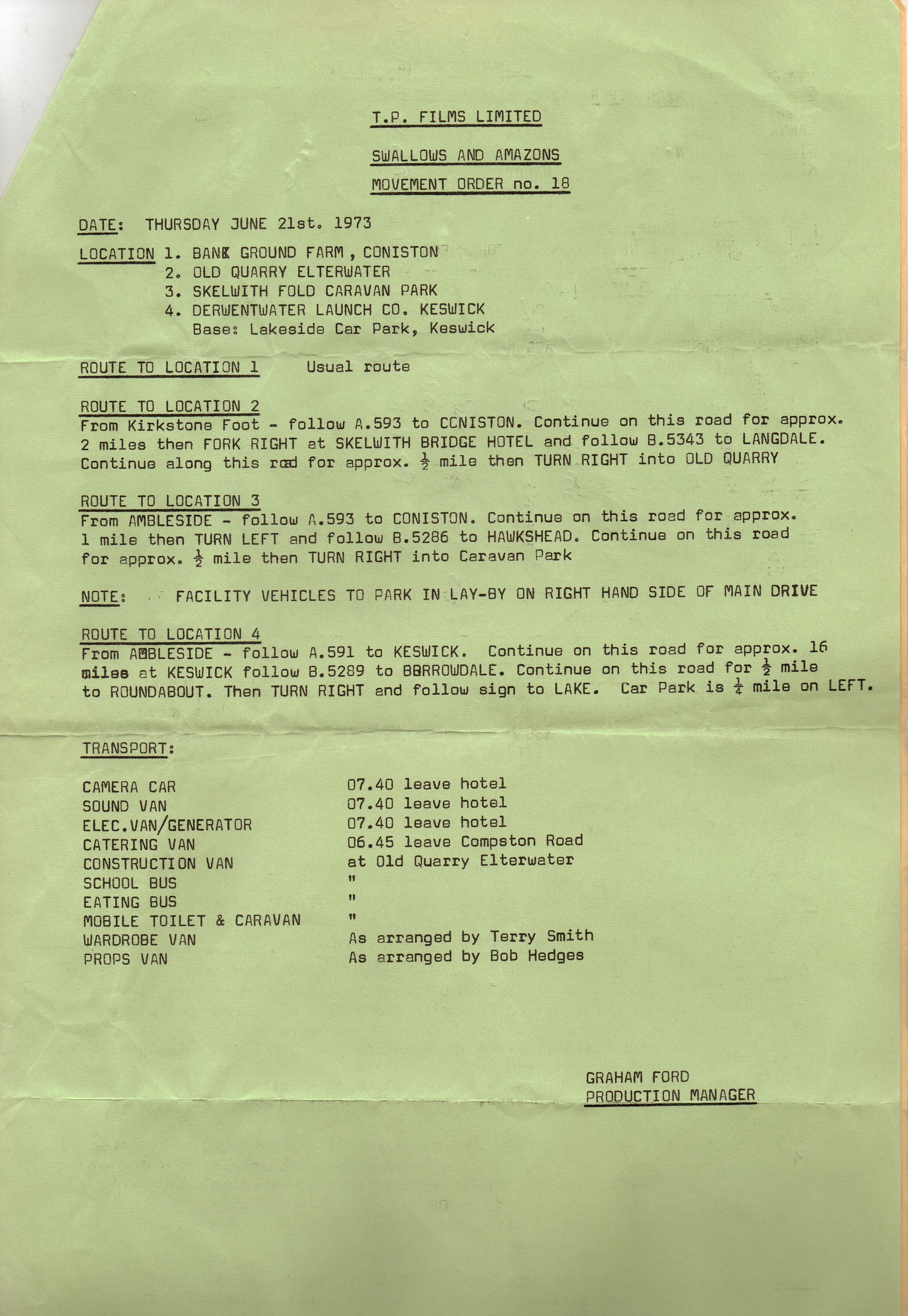
Those who are interested in finding the film locations used might find this old hand-typed ‘Movement Order’ useful:

Addresses of rural locations used for the film of 'Swallows and Amazons'

Roger Wardale sites Octopus Lagoon as being Allan Tarn a short distance up the River Crake at the Southern end of Coniston Water, near High Nibthwaite. This is the place Arthur Ransome had in mind. He spent time there with is brother and sisters as a child when they spent their summers on Swainson’s Farm at Nibthwaite nearby. His father went there to fish for pike. It you have a shallow bottomed boat you can get there but it is not exactly on a footpath. The lily pond we used was in a high sided dip, which made it appropriately dark and gloomy. It was also more accessible for the film crew.

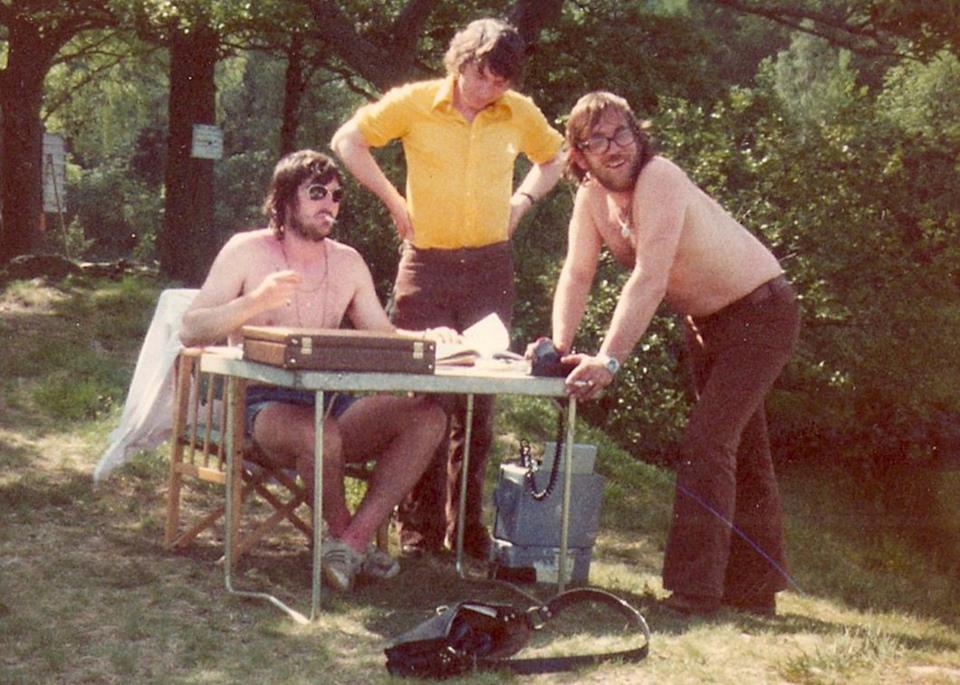
Graham Ford, who signed the Movement Order was our Production Manager. I only have a photograph of him taken on a sunnier day.

The Production Team on 'Swallows and Amazons' in 1973
Second Assistant Terry Needham, Associate Producer Neville C Thompson and Production Manager Graham Ford with the unit radio on a sunny day in June 1973

Graham Ford would have been responsible for the film schedule, putting together the whole logistical jigsaw puzzle posed by factors such as the availability of leading actors and locations with the movement of vehicles and boats, including the massive camera pontoon. It was Graham who took the stress of problems caused by wet weather.  I guess that he also took on the responsibilities of managing the locations, negotiating with owners and the Lake District National Park, something that authors such as Arthur Ransome would not have had to face.

Graham Ford in Derwentwater

Although young, Graham was pretty experienced. He had previously worked as an assistant director on such classic films as Steptoe and Son and had been the Unit Manager on The Devils, a film that starred Vanessa Redgrave and Oliver Reed. After Swallows he went on to work as Production Manager on S.O.S Titanic, The Honorary Consul and Princess Daisy as well as Time Bandits and Brazil directed by Terry Gilliam starring Jonathan Pryce, Kim Greist and Robert de Niro. Imagine being Terry Gilliam’s right hand man. He was a Location Manager for David Lynch on The Elephant Man and for Richard Attenborough on Ghandi in 1982. Graham’s career progressed. He produced The Nightmare Years and A Connecticut Yankee in King Arthur’s Court in the late 1980s before working on Gettysburg, the massive four hour long movie about the American civil war, in 1993. A life in film. He died in Ontario in 1994 aged only 48.

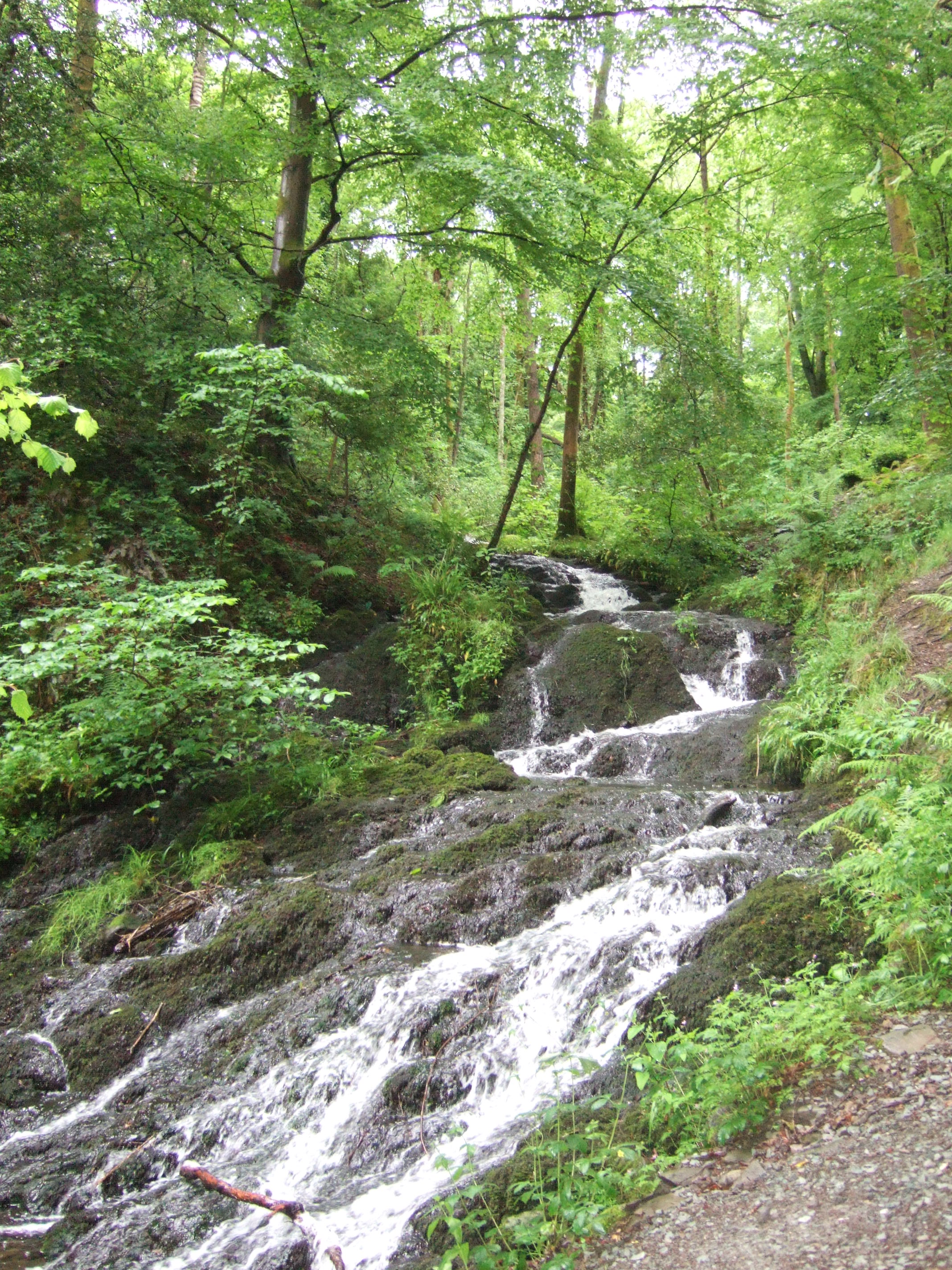
Waterfall above Windermere in the Lake District

If you would like to read more, the story of the filming can be read in a paperback entitled ‘The Making of Swallows and Amazons (1976)’ available from libraries worldwide or from online stockist and good bookshops. The Nancy Blackett Trust have signed copies available here with proceeds going to the trust. These are illustrated so cost £15 but make good presents.

A photo sent in by a happy reader

‘Now then, Miss Nancy’ filming ‘Swallows and Amazons’ on Wild Cat Island on 27th June 1973

Suzanna Hamilton and the crew with Ronal Fraser
Director Claude Whatham and Bobby Sitwell with Suzanna Hamilton playing Susan Walker and Ronald Fraser as Jim Turner aka Captain Flint in 1973

I love this photograph of Suzanna with Claude Whatham and the Bobby the focus puller. It somehow captures the atmosphere of filming on Peel Island back in 1973. I was meant to be sitting on the biscuit tin where I have left my empty cup, but Claude must have been reading my lines as he took Suzanna Hamilton’s close-ups. I was never sure about the blouse she is wearing. We hadn’t heard of Margaret Thatcher at the time but it now seems to be edging a little too close to her style. I doubt if she took inspiration from us but, along with the gym shoes, it’s very much in style now.

‘It was quite a nice day weather-wise,’ one of the others had noted, but obviously not the solid sunshine needed for the big scenes yet to be shot out on the lakes. However our sailing director David Blagden was back with us, his hair cut short in order to appear in vision as Sammy the Policeman, a part he played beautifully. Although there is a cheerful photograph of him taken straight after he gained a short-back-and-sides we can only find rather a distant and visually confused one of him in uniform at the camp site on Wild Cat Island. He was so desolate to have had his hair cut short that he took off his helmet during the scene to prove that he really had been shorn.

David Blagden as Sammy the Policeman in 'Swallows and Amazons' (1974)
David Blagden as Sammy the Policeman

We were excited that David was on the set, in costume. He’d always been behind the camera before. But he made a very serious Policemen and didn’t let the persona of his character fall whilst he was in uniform.

David Blagden as Sammy the Policeman

What works best in the film is the edit. ‘No more trouble of any kind, ‘ Virginia McKenna insists – and the shot cuts to the boots of a Policemen arriving in camp.

David Blagden who played Sammy the Policeman
David Blagden who played Sammy the Policman ~ photo: Daphne Neville

It looks as  if this was one long scene – but the section where the content of Uncle Jim’s book was discussed while we sipped tea had been shot a week previously when Ronald Frazer first arrived in the Lake District.

The clapper-loader, Sophie Neville and David Blagden as the Policeman on Peel Island ~ photo: Daphne Neville

Director Claude Whatham having lunch with his leading ladies, Suzanna Hamilton and Lesley Bennett ~ photo: Daphne Neville

It was a long day, but a happy one. Any secrets?  It was really in the scene when John declares ‘a dead calm’ and we decide to visit the charcoal burners that it became apparent that I was taller than my elder brother played by Simon West.

Claude Whatham directing Swallows and Amazons 1974 with Simon West and Sophie Neville

A box was provided for him to stand on so that I look shorter when I run into shot. It was a shot I remember we did in one take – despite being fairly complicated. Everyone was amazed that we moved on so quickly. We needed to.

Filming Swallows and Amazons on Peel Island in 1973
The Swallows on Wild Cat Island

The pre-occupation of the producer was that, since the bad weather had caused delays, we still had an awful lot to film. We must have been about a week behind schedule – a huge worry for Richard Pilbrow. The next day we just had to get out on the water come what may.

The huge sadness was that David Blagden, so vibrant and good looking with so much to live for,  lost his life to the sea in the late 1970s.

Mum and David Blagden
David Blagden, the Sailing Director before he had his hair cut to play the Policeman, and my mother Daphne Neville, Chaperone to the six children acting in ‘Swallows and Amazons’

After Swallows and Amazons he presented an ITV series broadcast on Sundays called ‘Plain Sailing’. It featured Willing Griffin the 19′ Hunter in which he’d crossed the Atlantic despite  horrific weather in 1972 and the survey of a 39′ wooden boat I think he intended to take on another crossing.  Apparently he set off in this yawl from Alderney in a Force 11 gale and was never seen again. The harbour master had begged him not to go.  They found his girlfriend’s body and parts of the boat but there was no trace David.

Very Willing Griffin by David Blagden sailing director on 'Swallows and Amazons'

The cover of ‘Very Willing Griffin’ by David Blagden. ‘An exciting adventure of pursuing and living a dream against many odds’, this sort after book was reviewed in The Journal of Navigation.  His obituary in a school magazine is desperately sad. It was posted on the Arthur Ransome Group Facebook page.

You can read more in ‘The making of Swallows and Amazons’ published by The Lutterworth Press and available online or from Waterstones

'The Making of Swallows and Amazons (1974)'

In search of the real ‘Swallows and Amazons’ ~ Part Three

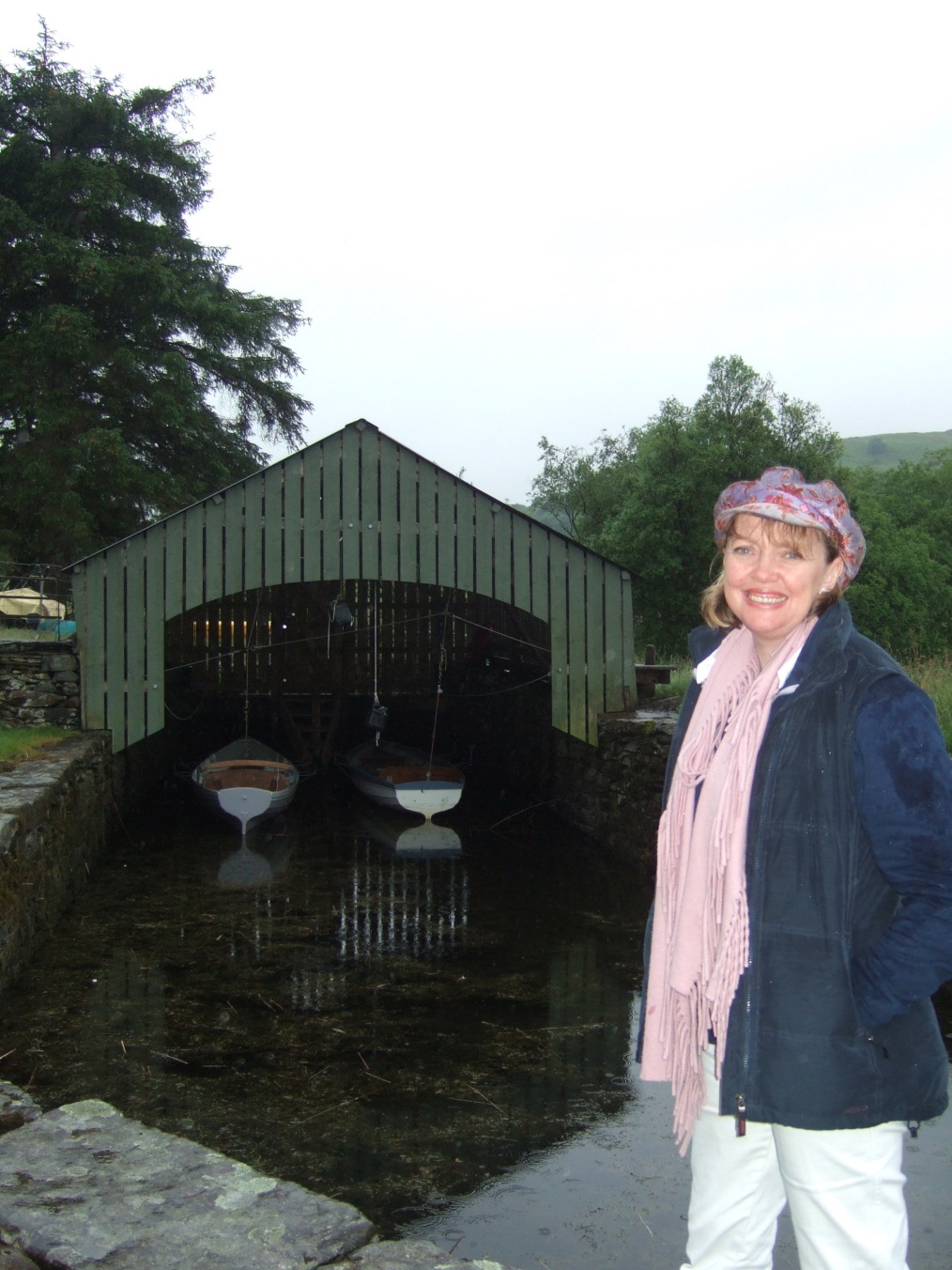
Sophie Neville at the real Amazon Boathouse

~Sophie Neville at the real Amazon boathouse~

The boathouse at the Slate Quay where Arthur Ransome came on holiday as a child sits at the southern end of Coniston Water. How wise he was to write about the places, the culture and experiences that he knew so well.

As you walk down the footpath from the lane, you come across interesting artwork, although it would not have been around in Ransome’s day.

Sophie and Mr Gormely

~ Sculpture at Slate Quay by Andy Gormsly~ 

The boathouse came to be owned by Bridgit Sanders, nee Altounyan, who was the inspiration for the youngest of the Swallows Vicky, the ship’s baby, and went on to become the first president of The Arthur Ransome Society. She lived with her family in the house nearby, teaching her children and grandchildren to sail on Coniston Water. After having children, Roger Altounyan rented half the house and would take them sailing in Mavis, the model for Amazon, bailing like mad.

Coniston Water

~Coniston Water~

Arthur’s father would venture up the River Crake to fish in Allan Tarn, which may well be the location of Octopus Lagoon, first mentioned in ‘Swallows and Amazons’. 

Whilst fish enjoy the reedy habitat, small boys are reputed to enjoy the ‘Knickerbockerbreaker’ rocks that rise above what must be Swainson’s Farm at High Nibthwaite, featured in Swallowdale, which you can find by the road nearby.

We pressed on in search of other places that made an impression on Ransome’s life. Although we had a very good driver this was not always as easy as one might imagine.

'Cows blocking the road' ~ photo by Wendy Willis

But I did find another representation of the crossed flags. Can anyone guess where?

Arthur Ransome's symbol

~Kneeler embroidered by Jean Hopkins~

We drove through the gentle countryside south of Coniston Water passing a house called New Hall, once rented by Arthur Ransome and his wife, and on, climbing up past Gummer’s How and wiggling down to reach The Mason’s Arms, which I gather this was one of his favorite pubs.

 The barn where Arthur Ransome wrote 'Swallows and Amazons'

Then, seemingly in the middle of no where, we came across the Holy Grail: Low Ludderburn and the erstwhile grey barn where Ransome wrote ‘Swallows and Amazons’.  He had a writing room on the first floor. Roger Wardale says he kept his car, the ‘Rattletrap’ in the wooden garage that you can see just in front of the building.  It was private then, and is a private house now, but you can catch a glimpse of it from the lane that runs up and on, eventually taking you down to Blake Holme on Windermere, which he named as partly the inspiration for Wildcat Island.

I’ve always thought that Arthur Ransome must have been completly impervious to the damp, to cold and wet weather.  I am not. By now it was raining so hard that my husband was wearing my pink beret, but we were still in good spirits.

Foxgloves in the Lake District

In a recent letter to The New York Times Frank Phelan from Albuquerque wrote to say,

  • It was not just British children who were saturated with the “Swallows and Amazons” novels of Arthur Ransome, as the review of “The Last Englishman,” by Roland Chambers, suggests (May 27). I grew up hundreds of miles from the ocean in Pittsburgh, wanting to be like Ransome’s characters. I wrote to him asking which of the English lakes was the right one. He sent me a postcard saying that it was “Windermere, with a few touches of Coniston, for the sake of disguise.” He ended with “You’ll be sailing some day!” and I lived on that.

So back to Windermere, and a long hot bath at Miller Howe, a lovely hotel that had a Jonathan Cape copy of Swallows and Amazons on the hall table. In the morning cloud was sitting on the high fells looking just like snow. I ran down to the lake to put my hands in the water, thinking, ‘This is the place for Winter Holiday’.  But that is another book.

You can find maps showing these locations in ‘The Making of Swallows and Amazons’ or the ebook of ‘The Secrets of Filming Swallows and Amazons (1974)’ available from Amazon Kindle and other ebook platforms.

In search of Arthur Ransome’s locations ~ Part Two

Arthur Ransome must surely have fished here

‘Here we are, intrepid explorers, making the first ever voyage into unchartered waters. What mysteries will they hold for us?  What dark secrets shall be revealed?

As we set off from the Lakeside Railway Station on the southern shore of Windermere to explore Arthur Ransome’s world, I began wondering how many signs of ‘Swallows and Amazons’ we would find. Would we see the crossed flags that have become a symbol of the bestseller he wrote back in 1929?

Swallows and Amazons Tearoom ~ photo: Sophie Neville

We found the first sign the East of Lake road above Coniston Water. And there was Holly Howe where the Walker Family came for their holidays. It is so exciting to know that you can stay there too, or go for tea, and run down the field full of buttercups to dip your hands in the lake, just as the real Altounyan children – the real Swallows – must have done. We passed Lanehead, their grandparents’ house next-door as we drove down to Coniston. I gather it is for sale.

Bank Ground Farm the location used for Holly Howe

Coniston Old Man or Kanchenjunga, as the Swallows and Amazons called the mountain, was snoozing under a thick blanket of cloud but the challenge of climbing to the summit was for another day. Below the village, mooring up to the jetty at the Bluebird Cafe, was Ransome, the Coniston Launch. Peter Walker introduced us to the Captain who welcomed us aboard. He asked after Swallow the little ship from the film that we had re-launched from the very same jetty in April 2011. If you join The Arthur Ransome Society you can sail Swallow on Coniston this summer.

The Boatsheds at Bank Ground Farm

As we set off across the lake we could see Swallow’s boatshed clearly from the Coniston launch.  It has been renovated and repaired but the old stone jetty is still there, below the huge horse chestnut trees. I remember how cold the water was when we first brought Swallow out from the depths of that shed in May 1973 to shoot the opening scenes of the movie. Two sheep came down to see what we were doing. Richard Pilbrow, the Producer, gave me this black and white photograph that, unusually, shows Claude Whatham the Director setting up the shot. I was letting water drain from my shoe.

Finding Swallow
Simon West as Captain John standing in ‘Swallow’ at the stone boatshed jetty on Coniston Water with Ableseaman Titty and The Boy Roger. Director Claude Whatham knew how cold the water was that day in May 1973

The Coniston Launch can take you right down the lake to Wild Cat Island or Peel Island as it is really called. You can see the Secret Harbour best from a boat and imagine Titty trying to get out through the rocks in Amazon, in the dark, when she captured her from the terrifying Amazon Pirates.

We actually disembarked at Brantwood, John Ruskin’s House. It was here that the Altounyan children’s grandfather WH Collingwood worked as Ruskin’s private secretary. He painted him at his desk there. My niece has just graduated from The Ruskin School of Art in Oxford.

Peter Walker met us and drove us on down the lake to show us The Heald, a bungalow above the road where Arthur Ransome lived with his Russian wife, Evgenia and his dinghy, Coch-y-bonddhu. It was here that he wrote Picts and Martyrs Coch-y-bonddhu played the part of Dick and Dot’s boat Scarab. The original ‘Dogs Home’ can be found in the woods above the house. Rob Boden is very keen to restore it.

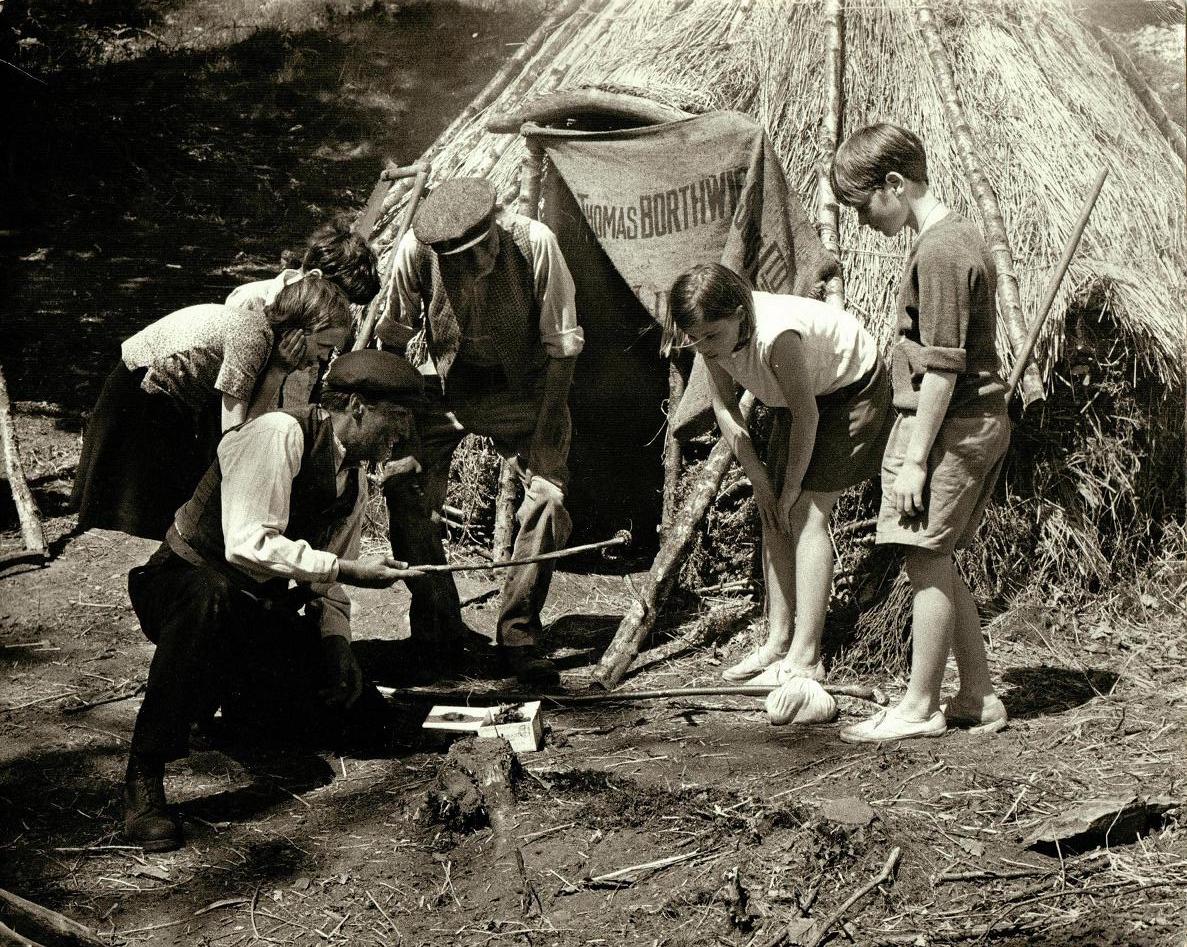
It was in the Grizedale Forest that we went to see the charcoal burners and met the real men in the process. And an adder. It was real too.

John Franklyn-Robbins, as Young Billy who is showing his adder to Sophie Neville, Stephen Grendon, Jack Woolgar, Suzanna Hamilton and Simon West at a location in the Grizedale Forest above Coniston Water

I looked back at the island where I spent so much of my childhood. It was difficult to imagine how a location catering wagon let alone two Route-master London double-decker buses could have driven down the winding East of Lake road. They parked in the field opposite the islands so the crew could at least eat lunch in the dry and we could have our lessons. The National Parks Authority had to ask the Production Manager to drape wartime camouflage netting over them. You must have been able to see the red buses for miles.

Sophie Neville on Coniston Water with Peel Island
The hat is a purple ode to the early 1970’s. My mother bought it at great expense in Carnaby Street. It is very good at keeping off the rain.

As you drive south you can look over the water to see Brown Howe, the house that we used as a location for Beckfoot in the film of Swallows and Amazons and shortly after, the Edwardian boathouse, which Claude Whatham used for the Amazons. I don’t think this was the one Ransome envisaged. His was at the mouth of the Amazon River – a reedy place. The pictures in the illustrations show a building with a low-pitched roof.

Peter took us down to a farm the south of Coniston Water where the real Ransome children spent their summer holidays. You can walk down the footpath they must have taken to dip their hands in the lake. And there I found what must be the real Amazon boat house.

The Slate Quay on Coniston Water ~ photo: Sophie Neville
Is this the real Amazon Boathouse?

Continued here…

or read the full account in the ebook: