What viewers thought of the BBC serial ‘Swallows and Amazons Forever!’

Coot Club - The Teasel sailed by a double
William the Hero – who later appeared as Little Willie in ‘Eastenders’

The BBC drama series Swallows and Amazons Forever! was first broadcast at a very odd time. Instead of being mainstream BBC One Saturday night viewing in the run up to Christmas as we expected, it was moored in a by-water,  shown on BBC Two at 6.30pm on Tuesday evenings. Very few people saw it. This was odd, especially since it was a big budget production with a strong cast. Perhaps it was because Colin Baker who played Dr Dudgeon had just been cast as Doctor Who.

Coot Club - The Bike Shop
Jake Coppard as Pete, Mark Page as Bill and Henry Dimbleby as Tom Dudgeon outside Itteringham Shop ~ click on the photo to see what it looks like today

However, when the series was released on video it was treasured by many:

‘This video is a delight!’ wrote Dr Duncan Hall from North Yorkshire. ‘…the animated credit sequence and the music are both a delight and you won’t get tired of them! The stories themselves are amongst the best ever written for young people and they are brought to life with relish by the director and excellent cast. The locations are all spot-on; anybody who has ever had a magical holiday on the broads will love this video for that alone! And the wildlife photography is fantastic as well. A last point: it is true there are no Swallows and Amazons in the programme – but the two books were part of Ransome’s famous ‘Swallows and Amazons’ series of books, so the title does not seem TOO inappropriate to me.  Buy it!!! 
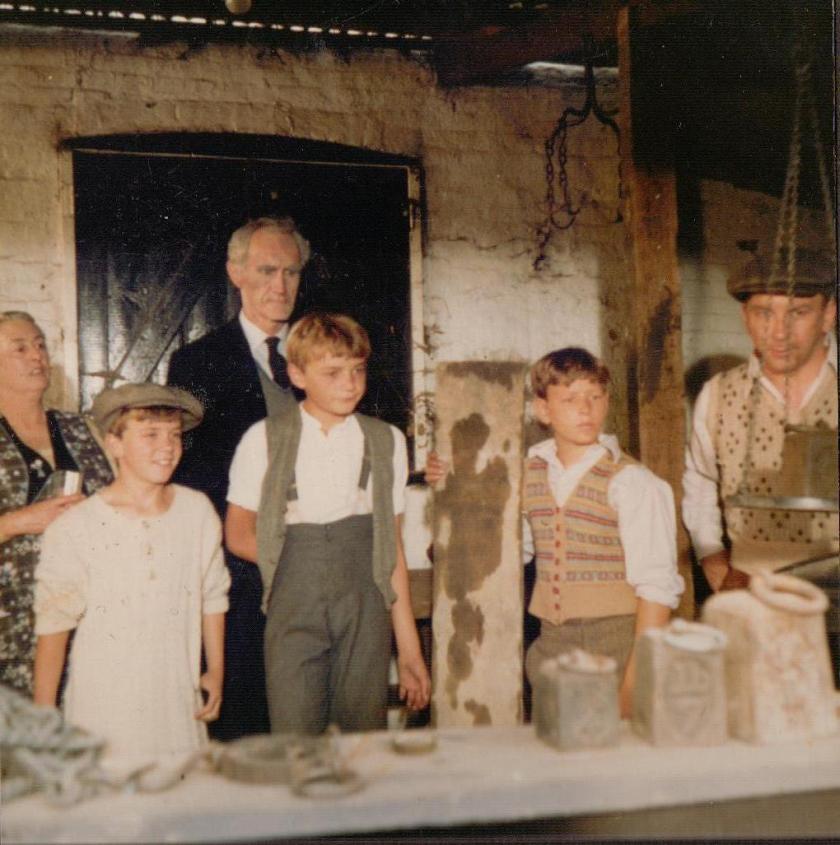
Weighing the fish
Jake Coppard, Mark Page and Nicholas Walpole as the Death and Glory boys with Sam Kelly of the Catchalot, weighing the fish in ‘the Big Six’

The drama serial was soon released on DVD ~ which was hugely appreciated:

This is a beautiful adaptation of Ransome’s ‘Coot Club’ & ‘The Big Six’. The child actors/actresses are excellent. There is almost an historical element as the DVD charts childhood without mobile phones and electronic games. Simply gentle and innocent yet a good degree of drama. 5 out of 5 stars Excellent

Coot Club - Henry and Sarah

Mike Souter said, ‘ So pleased I bought this. I interviewed Henry Dimbleby on location in the 1980’s and seeing the episodes again brought back many happy memories. Charming series.’

Some viewers wrote to say they thought the twins playing Port and Starboard should have been aged eleven. They, in fact, were (both) eleven-years-old.

Coot Club - PC Tedder's garden
The Death and Glory boys weeding PC Tedder’s garden with Colin March, the sound recordist, setting up the microphones.

‘If you like nature, sailing, kids and bad plots this fits the bill. I have sailed on the Norfolk Broads and this series captures the atmosphere perfectly. The sailing is technically accurate too. I’m old enough to remember England in earlier times. Once again the atmosphere has been captured nicely. The unusual Norfolk regional accent is evident and sometimes realistic. This is a classic and fully in the spirit of the Swallows and Amazons books.’ 5 out of 5 stars -Wonderful ~ C Bauers, Suffolk

‘We really enjoyed this adventure it has inspired my kids to do a sailing course!!’ ~ David Francis, France

‘Watched the series as a child and have loved it my whole life. A family favourite, simply charming! Very indulging to sit back with a cup of tea and lose myself in the antics of some wonderful characters. I love it.’

‘Highly recommended entertainment for the whole family. Good old fashioned fun that children use to have before computer games were invented.’ J.Kennedy ~ Sydney,  Australia

Lullaby
The Broads cruiser Lullaby in her starring role as the Teasel

‘Just spent a week on a Broads cruiser with three granddaughters and played the DVD on the third night. It was quite magical that we had cruised to all the places mentioned in the films, and the girls were able to identify the filming locations, including the swing railway bridge at Reedham. We tried very hard not to have the radio too loud the next day for fear of becoming Hullaballoos, and kept well clear of coots nests. As with all films, these do not copy the books word for word, but I think Arthur Ransome would have been pleased with the result. Pity the TV companies don’t produce more films from the other books in the Swallows and Amazons series.’

291-8

We were hoping to keep going and adapt all the Arthur Ransome books. While I started casting children for Swallowdale and Picts and Martyrs, our Producer Joe Waters went up to Cumbria on a recce to find the main locations and to estimate a budget the next series. He returned looking crest-fallen. Filming on National Trust property in the Lake Distinct, when he was quoted fees of £1,000 a day – back then, even for open moorland –  was simply going to be too expensive.  Plans to adapt the Arthur Ransome books were put on hold. Indefinitely.

However, the original movie ‘Swallows and Amazons'(1974) is streaming on Amazon. You can read about how it was made in a choice of books available online here.

'The Making of Swallows and Amazons (1974) by Sophie Neville'
Different editions of ‘The Making of Swallows and Amazons (1974) by Sophie Neville’

A funny thing happened whilst filming at ‘Beccles Post Office’ in Norfolk~

Henry Dimbleby, Rosemary Leach, Caroline Downer, Richard Walton with Sarah and Calire Matthews in 'Coot Club'
Henry Dimbleby, Rosemary Leach, Caroline Downer, Richard Walton with Sarah and Claire Matthews in ‘Coot Club’

If there was a sequence we all enjoyed putting together more than any other, whilst filming Arthur Ransome’s ‘Coot Club’, it was the scene when Williams the pug dog is weighted on the scales outside Beccles Post Office. This was shot, not in Beccles, but in the market square called Church Plain in Worstead, near North Walsham, a village in Norfolk.

The shop was actually a family home belonging to the Howard family, which the design team dressed to look like a Post Office, with jars of sweets installed in the two front windows. It had once been a Post Office, a building with a rounded end between Back Street and Front Street boasting the New Inn, now called The White Lady.

Rebecca Howard, who was 16 at the time, wrote in to say: ‘Our house was called ‘The Old Post Office’.  It was a post office in a previous life before we moved there.  At the time of filming the post office was on Back Street – part of the house at the other end of the island between Front and Back Street, which also used to be a garage/service station on the Front Street side.  The crew were modeling our house on my mum’s birthday – 12 August – they bought her a box of chocolates.’
Coot Club ~ Jane
Either Claire or Sarah Matthews with Joe Water’s secretary Jane

In the story, Port and Starboard surprise the crew of the Teasle by arriving unexpectedly on the back of a motorbike, having hitched rides across Norfolk on a series of historic craft including the Albion.  Andrew Morgan, our Director was keen to end the scene with a high shot of the bustling market town, portraying East Anglian life as it was in the early 1930’s.

Rebecca says, ‘The pink house in the photo (with crew pictured) was the village shop, known as ‘Top Shop’ by locals.  It closed years ago, but would have been trading at that time.’

Director Andrew Morgan with film carmeraman Alec Curtis and his assistant and designer Brue McCaddie. Production Managers Peter Markham and Liz Mace stand below
Director Andrew Morgan with film cameraman Alec Curtis and his assistant and designer Bruce McCaddie. Production Managers Peter Markham and Liz Mace stand below

Apart from creating the Post Office so beautifully that we were convinced it had always been there, Bruce McCaddie our designer had television ariels taken off houses and yellow lines on the roads obliterated. He also commissioned his Prop Buyer, Dave Privett, to find a number of period vehicles that could be driven through the town.

Coot Club - Dave Privett
BBC Prop Buyer David Privett ~ photo taken at a later date

Our Producer Joe Waters was keen on what was refered to in television as production value. ‘Always put your money in front of the camera’, he told me. David Privet did that for him, going to endless trouble to source steam rollers and hay wagons, charabangs and river cruisers to bring life and colour to a period drama. I learnt later when we all worked together on ‘My Family and Other Animals’ shot on location in Corfu what a complete perfectionist Dave was.

Coot Club - The sheep
Caroline Downer, Sarah Matthews and Henry Dimbleby waiting for the shot to be set up. The camera was on top the mobile generator from Fenners behind them.

Busy crowd scenes are rewarding and look wonderful on screen, but they do take a while to set up. All the drivers had to have short back-and-sides haircuts and change into period costumes. On top of the motor-cycle and side car, which Port and Starboard arrived in, Dave had found a 1929 delivery lorry and several bicycles aswell as vintage motorcars. We also had various passers-by and towns people dressed in costume, armed as you’d expect with shopping baskets or prams. This was all pretty much as you’d expect. I’m not sure who decided that we should add a herd of sheep, but we also had sheep. Black-faced sheep to add a bit of rural life. The idea was they they would be driven through the market square at the end of the scene. Bruce sensibly had portable wooden fencing out-of-vision between the houses so they couldn’t escape.

Coot Club - Rosemary Leach in Beccles
Henry Dimbleby, Richard Walton, Claire and Sarah Matthews, Caroline Downer and Rosemary Leach with the delivery lorry outside the Post Office.

Our leading lady, Rosemary Leach, took up her position outside the Post Office with the children, and we set up to go for a take with all the vehicles in their start positions. As you can see from the low light in my photographs we were getting to the end of a long day. Everyone on the crew was tired, tempers were getting short and the twins were the only ones left with any energy. But the camera turned over and the Director shouted, ‘Action!’  The vehicles set off. There was then the curious sound of heavy rain. Sheep came not walking but galloping into the market square.

‘Cut!’ yelled the director. The vehicles came to a halt. Bruce and his prop men sprung up, ready with the hurdles. The sheep took one look at them and panicked further. The Dave Privett rushed in to help. There was no where for the sheep to go. They ended up following each other, running round and around a large black motor in the middle of the square. Dave was pinned against the rear bumper. He couldn’t move. The sheep kept on running, round and round. Alec Curtis, having a dry sense of humour, kept the camera running too. The whole sequence was caught on 16mm film.

Ricky King, Dave Privett, Peter Markham and Mary Soan filming 'Coot Club', or trying to
Ricky King, Dave Privett, Peter Markham and Mary Soan filming ‘Coot Club’, or trying to

Is ‘Swallows and Amazons’ (1974) one of the 50 Greatest British Films?

Barry Norman 50 greatest films

Nominate your favourite British Film

Here are Barry Norman’s 49 top British films as listed on the Radio Times website:

Barry Lyndon (1975)
Black Narcissus (1947)
The Bridge on the River Kwai (1957)
Brief Encounter (1945)
Chariots of Fire (1981)
A Clockwork Orange (1971)
The Cruel Sea (1952)
The Dam Busters (1954)
Dr No (1958)
Don’t Look Now (1973)
Dracula (1958)
Four Weddings and a Funeral (1994)
The Full Monty (1997)
Gandhi (1982)
Get Carter (1971)
Gladiator (2000)
Great Expectations (1946)
Gregory’s Girl (1980)
Henry V (1944)
I Know Where I’m Going! (1945)
If… (1968)
The Ipcress File (1965)
Kes (1969)
Kind Hearts and Coronets (1949)
The King’s Speech (2010)
The Lady Vanishes (1938)
The Ladykillers (1955)
Lawrence of Arabia (1962)
The Life and Death of Colonel Blimp (1943)
Local Hero (1983)
The Long Good Friday (1979)
A Matter of Life and Death (1946)
Monty Python’s Life of Brian (1979)
Naked (1993)
The Railway Children (1970)
The Red Shoes (1948)
The Remains of the Day (1993)
Saturday Night and Sunday Morning (1960)
Secrets & Lies (1995)
Sense and Sensibility (1995)
The Servant (1963)
Shakespeare in Love (1998)
Skyfall (2012)
The Third Man (1949)
The 39 Steps (1935)
This Sporting Life (1963)
Trainspotting (1995)
Whisky Galore! (1949)
Zulu (1963)

Tell us which film you think is missing from this list.

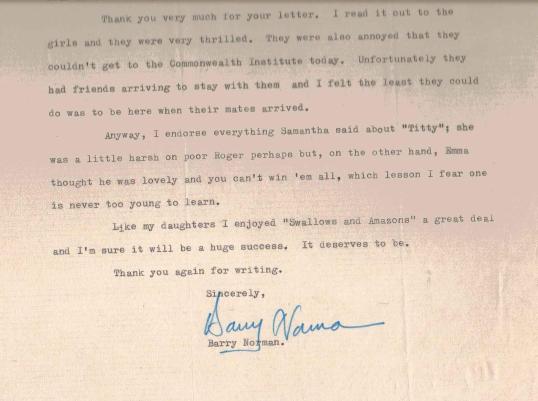
Here is a letter I have from Barry Norman, received back in 1974:

Letter from Barry Norman April 1974

On the set of ‘Coot Club’, the BBC serial made on location in Norfolk in 1983

Coot Club - Sophie Neville with Port and Starboard

All the children who appeared in the BBC serial of  Arthur Ransome’s books ‘Coot Club’ and ‘The Big Six’ were delightful. They were committed to the project and focused on their roles in the drama that was released in 1984 under the strand title Swallows and Amazons Forever!

Coot Club - boys playing
Jake Coppard, Mark Page and Nicholas Walpole who played Pete, Bill and Joe – The crew of the Death and Glory

They enjoyed the process of putting the story together but we were filming on location in Norfolk for three months, which is a long stretch for anyone. It is a very long time when you are aged thirteen.

Coot Club - Jake Coppard reading
Jake Coppard in the role of Pete

It can be difficult hanging around on set, waiting for the crew to set up, especially when you have to keep quiet and reasonably still, avoiding the perils of sunburn and scratches. In many ways it’s the most challenging aspect of being an actor, especially when you are constricted by your costume that has to be kept clean and dry.

Coot Club - the camera crew watched by Richard
Filming the Death and Glory at Gay Staithe in Norfolk. Peter Markham, Bruce McCaddie, Alec Curtis and his assistant with the 16mm camera, are being observed by Richard Walton, who played Dick Callum

Watching the film crew record a scene was interesting, and in many ways good work experience, but it was not always possible as they were often out on the water.

Coot Club - Henry Dimbleby reading to the others
Claire Matthews, Henry Dimbleby & Richard Walton whilst filming of ‘Coot Club’

Once the school summer holidays started, we bid farewell to Angela Scott who had given the children lessons while they were on location. She’d been teaching them on a boat most of the time – the blue fibre glass cruiser in the photograph above.  It was part of my job to make sure the children rested and were quietly entertained when they weren’t in front of the camera. I thought it important to let them be themselves and build friendships.

Coot Club - boys playing boule
Mark Page, Nicholas Walpole and others during the filming

I was very strict – I had to be when we were near water or traffic, but the girls were naturally self-disciplined and boys team spirited.

Coot Club - boys playing in Norfolk

Joe Waters, who was producing the drama, said that the sun always shone for him. It certainly did. The summer of 1983 was scorching. We had a few rainy days, but the actors where wonderful at helping to keep up moral. The boys adored Sam Kelly, Captain of the Catchalot, who the British public knew so well from his role as Bunny Warren in Porridge and the German Officer in the WWII sit-com ‘Allo ‘Allo. We only had to look his way and we’d all collapse laughing. Sam Kelly is probably now best known for his recent roles in Nanny McPhee and the Big Bang , in which he played Maggie Smith’s husband Mr Docherty, and for taking the role of Grandad in the new Mike Leigh comedy  A Running Jump, 2012 but on that far off summer on the Norfolk Broads there were quite a few terrible take-offs of  Captain Geering’s German accent. One of his later episodes of ‘Allo ‘Allo was titled ‘Up the Crick Without a Piddle’   which aptly described that particular day in East Anglia.

Coot Club - Sam Kelly and Jake Coppard
Sam Kelly with Jake Coppard either in the Catchalot or our support boat

Sam Kelly playing Captain of the Catchalot with Jake Coppard

In the end it was the boys who kept us amused. They were inventive and used whatever they could find and whatever opportunity came along to make me laugh.

Coot Club - boys in the rain1
Jake Coppard, Nicholas Walpole and Mark page under my umbrella on one of the few rainy days, whilst filming in Norfolk.

You can read more about the making of Coot Club and The Big Six in the DVD extras of this 30th Anniversary edition.

 Swallows And Amazons Forever! (Coot Club & The Big Six) SPECIAL EDITION [DVD]

The boats used for filming the BBC drama ‘Coot Club’ on the Norfolk Broads in 1983 ~

Norfolk County Sailing Base, Ludham
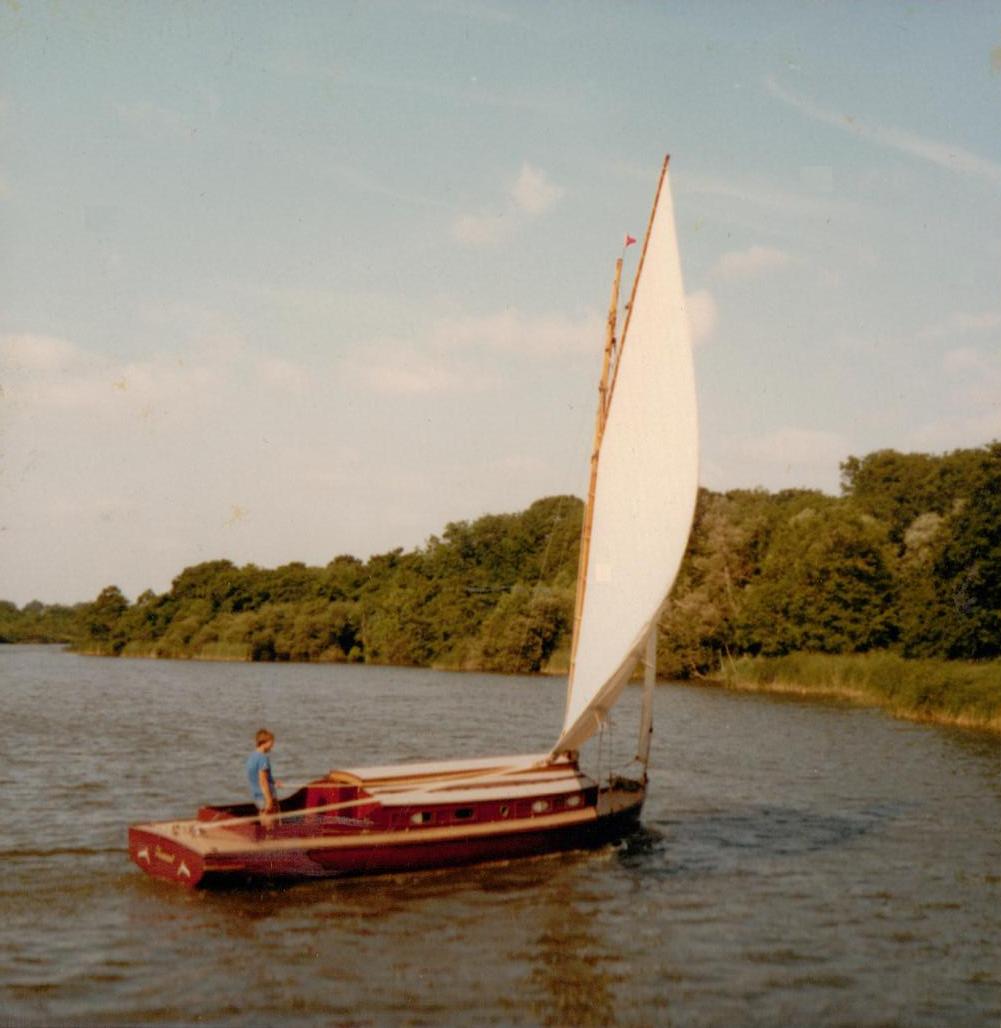
The ‘Titmouse’ under sail in 1983

Jim Searle must have given me this lovely photograph of  Titmouse, taken when the boys from Norfolk who played the Death and Glorys were given sailing lessons prior to filming in the summer of 1983.

Sophie Neville and Titmouse

Titmouse has recently been renovated by Hunter’s Yard at Ludham in Norfolk, which was used as a film location in the series and restored to her sea-worthy condition.

Henry Dimbleby resting between takes in the 'Dreadnaught'
Henry Dimbleby resting between takes in the ‘Dreadnaught’.

Tom Dudgeon’s punt, Dreadnaught can also be found at Hunter’s Yard. Henry Dimbleby can be seen here, sitting on the life jacket he was obliged to wear during rehearsals, despite the fact that he jumped into the water in the action to avoid being spotted by the Hullabaloos, the holiday makers who had hired the Margoletta, in reality the Norfolk cruiser Janca.

Coot Club - Bruce McCaddie the designer
Bruce McCaddie, our Designer with Prop Master Ricky King in the ‘Cachalot’

This must be the Catchalot. It looks as if our designer, Bruce McCaddie, is sorting out a fishing rod used by the actor Sam Kelly, who was fishing for pike.

Coot Club - the camera boat
Norfolk teacher Angela Scott with the ‘Catchalot’

This is  the only other shot I have of the Catchalot, which looks as if it might have been taken up near Horsey Mere. It shows Angela Scott, the children’s tutor making a funny face at the end of the day. You can just see the make-up artist, Penny Fergusson, and what could be Mary Soan on board.  Jill Searle may have been there too. She became a great friend of Liz Mace, our Production Manager who had always been keen on sailing.

Pat Simpson of Stalham Yacht Services said that during the filming they one had to take a boat from Regan to Horning overnight when the film schedule changed. I have a feeling it was the Catchalot.

The Death and Glory at Gay Staithe

One of the jobs Bruce McCaddie gave to his construction team was to build the cabin on the Death and Glory, with its flower pot of a chimney. He transformed the look by adding rigging from the mast.

Bruce Mackadie
Our Set Designer, Bruce McCaddie using a dressing boat to approach the ‘Death and Glory’ complete with her cabin. Is the ‘Titmouse’ moored alongside?

In terms of set design ‘Coot Club’ and ‘The Big Six’ were rather unusual productions to work on but Bruce loved boats. Instead of being an extra person on the vessel used by the film crew, he would take a period dinghy to gain access to his sets – which of course were often other boats. This run-around boat could then but used in the back to shot, especially if he needed to hide something modern.

The Death and Glory visiting the Norfolk Broad Yacht Club in 2018

An old German Lifeboat found by Pat Simpson washed up on the beach at Southwold was used for the Death and Glory. After the filming, Pat kept it for his sons until 1989 when Professor John Farrington from the School of Geo-Science at Aberdeen University came across it. He took his two children, a boy and a girl aged ten and eleven, down to the yard one half-term as the loved the books and television serial.

‘Get on,’ he said.

‘But what about the owners?’ they asked.

‘You are the owners.’ He’d bought it for them. One New Year they rowed from Stalham to Sutton and back. John Farrington first visited the Broads  on a family holiday in 1956 and wanted his children to have the same experience. They now have children of their own and still treasure the Death and Glory.

The Death and Glory with her newly added cabin

The Teasel was played by Lullaby. Roger Wardale tells me she is  a mahogany hulled crusier, a gunter-rigged, 4-berth ‘Lustre’ class yacht built in 1932 and kept at Hunter’s Yard in Ludham, where she is still available for hire.

Coot Club - Lullaby as the Teasel undersail
Lullaby undersail, playing the Teasel with her stage name painted on a false transome

She is similar to the 3-berthed ‘Fairway’ yachts that Arthur Ransome and his wife would hire for holidays on the Broads  in the 1930’s.

The Teasel towing the Titmouse
The Teasel towing the Titmouse – click on this photo to see a close-up of the cockpit

One of the secrets of filming ‘Coot Club’ is that although this looks as if Mrs Barrable is sailing the Teasel, it is not Rosemary Leach but a young man from Hunter’s Yard wearing her costume. Caroline Downer, who played Dorothea Callum, Richard Walton, who played Dick, and Henry Dimbleby who played Tom Dudgeon are in the cockpit, but we also used ‘doubles’ on that day to play Port and Starboard.  I found girls two girls from Norwich, Julia Cawdron and Claire Dixon, who played the twins for a day.
The reason for this was that sailing scenes are time-consuming to film and quite tricky to edit together. While our Director, Andrew Morgan, was busy filming the scenes at the Farland’s house with the actor Andrew Burt and the twins, Sarah and Claire Matthews, accompanied by their mother, I was on a second unit headed up by the Producer Joe Waters. Although Joe had directed a huge number of dramas he asked his film editor, Tariq Anwar, up to direct the sequences, knowing that he would be cutting the shots together.  He came up to the location with his wife and we took most shots from the camera boat, Camelot.

Tariq Anwar went on to edit Vivaldi, based on Antiono Vivaldi’s early life, starring Elle Fanning, Neve Campbell and Brian Cox. His latest credits include Great Expectations and The King’s Speech as well Down the River featuring Joe Henry, Tom Jones and Hugh Laurie. I haven’t seen the documentary but presume it must include the odd boat.

The great thing is that you can still find some of these vessels today –

Sophie Neville with Titmouse in Norfolk
Sophie Neville with Titmouse in Norfolk – photo Diana Dicker

While giving a talk at the Norfolk Broads Yacht Club, I was given a list of the boats that they know appeared in the series:

  • Teasel – owned and kept at Hunter’s Yard, Ludham on the Norfolk Broads
  • Titmouse – owned and kept at Hunter’s Yard, Ludham
  • Dreadnaught -owned and kept at Hunter’s Yard, Ludham
  • Death and Glory – owned by the Farringtons – kept at Gerry Hermer’s boat yard on the Norfolk Broads
  • Sir Gernet – a Norfolk Wherry The Albion

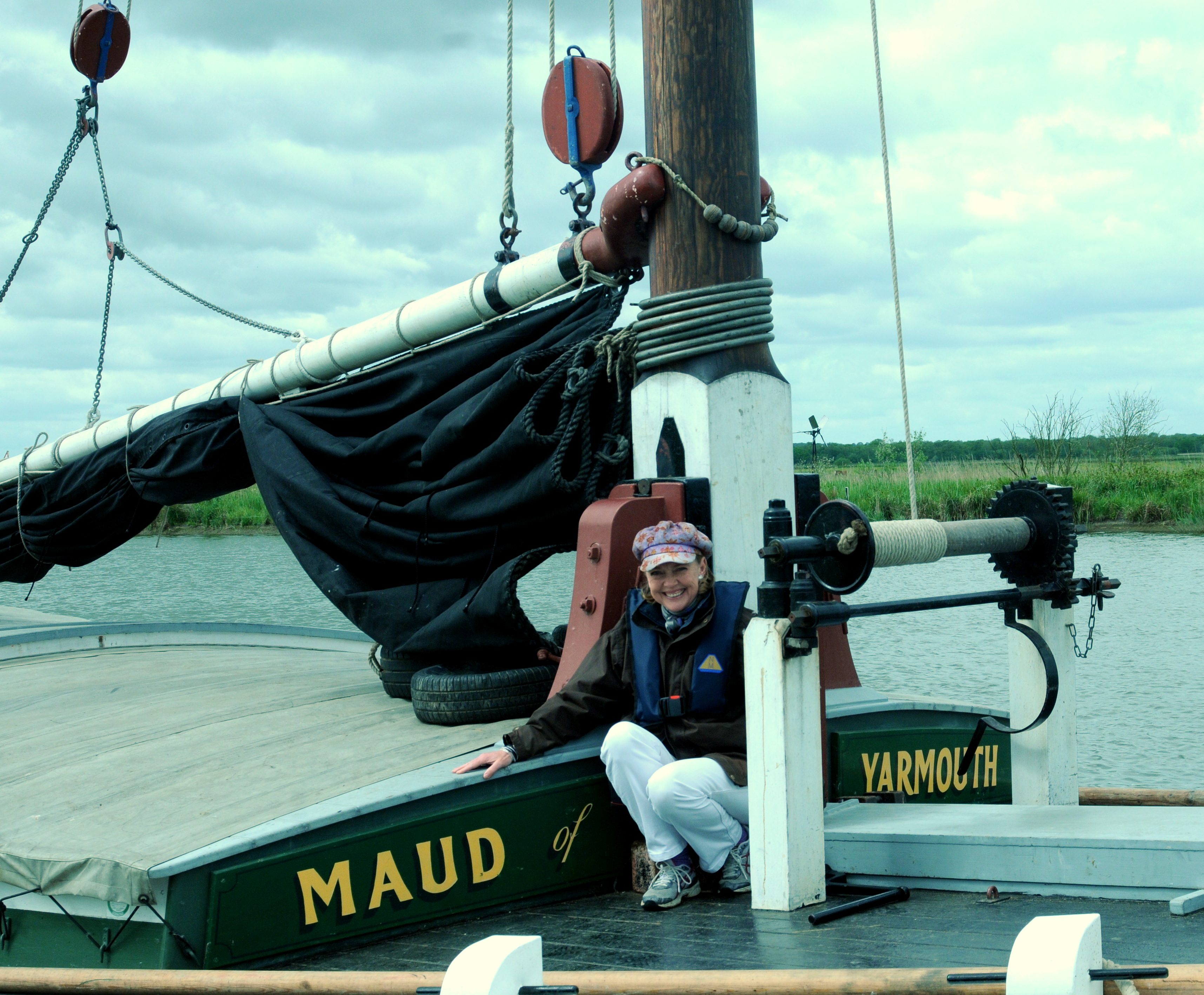
Aboard Maud photo Diana
Aboard Wherry Maud – photo Diana Dicker

Other boats featured include:

  • Water Rail – Herbert Woods Delight Class B owned by Liz Goodyear
  • Joan B – a skiff set adrift at Horning owned by Pat Simpson
  • Pippa – yacht set adrift at Horning owned by Geoff Angell kept at the Norfolk Boards Yacht Club.
  • Goldfish 9 – a one-off yacht
  • Swallow 4 – a one-off river cruise yacht
  • Starlight Lady 322
  • John Boswell’s boat was used at the Catchalot

Sophie Neville with the yacht 'Goldfish'

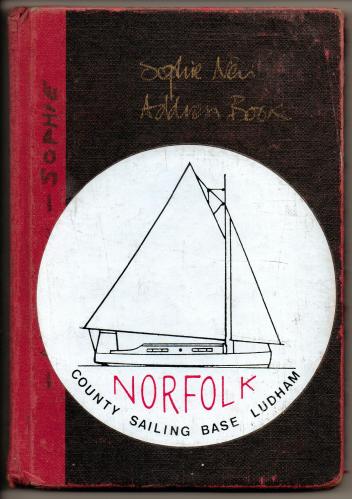
Do write in the comments below if you can fill me in on the names of those who helped us with the boats for the series.  My address book lists: Jim and Jill Searle, Rupert Latham, Pat Simpson of Stalham Yacht Services, Richardson’s of Stalham, Lawrence Monkhouse, Keith King of Feny Boatyard and the Steam boat Association. I still have a certain sticker on the front of my BBC address book ~

Coot Club - My Address Book

The ‘Doctor Who’ connection

One viewer has observed that, in the BBC serialisation of Coot Club and The Big Six, we had not one but two Doctors in the cast, Time Lords at that. This is true. We arrived on location one morning to find that Patrick Troughton had  transmogrified into Harry Bangate the Eel Man.

Patrick Troughton as the eel man
Patrick Troughton playing The Eel Man in ‘The Big Six’, 1983

He had led the most fascinating life. A Naval Officer during World War II, and the first actor to play Robin Hood on television, Patrick Troughton played The Doctor in 128 episodes of Doctor Who. But would he be drawn? If we asked him about his life he just started talking about eels in a broad Norfolk accent. He’d worked for our director Andrew Morgan on Kings Royal and for Joe Waters on Z Cars, but for us, in the summer of 1983, he was the eel man.

Coot Club - Jake Coppard - playing Pete
Jake Coppard playing Pete at the eel man’s hut

Colin Baker first appeared in Doctor Who (a story entitled Arc of Infinity) in the role of Commander Maxil, when he actually shot the 5th Time Lord, who was being played by Peter Davison. It was not until after he arrived in Norfolk to play Arthur Ransome’s tweed-clad Dr Dudgeon, that he realised his full destiny and donned a multi-coloured dream coat to take on the 6th incarnation of The Doctor in the long-running BBC science fiction series.  I went on to work as an Assistant Floor Manager on a two-part story called Vengeance on Varos when the Tardis had to make an emergency landing on a most unattractive planet. Once established at the North Acton rehearsal rooms I persuaded Colin to teach me all the correct jargon about transmogrifiers but it has since washed from my brain.

Colin Baker as Dr Dudgeon in 'Coot Club' and 'The Big Six'
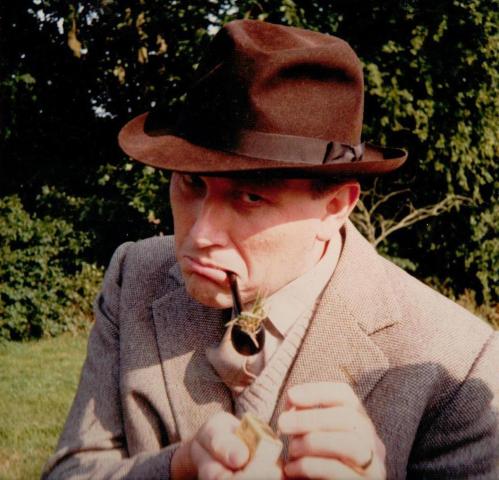
Colin Baker as Dr Dudgeon amusing us by smoking grass

I can’t remember whether Colin Baker was cast as Dr Dudgeon in Coot Club before or after Henry Dimbleby was given the part of his son Tom Dudgeon, but he did not look unlike Henry’s real father back then.

David Dimbelby with us on location in Norfolk, 1983

There were various other members of our film crew who were also familiar with the Tardis. (We were meant to refer to it as  ‘T.A.R.D.I.S.’ short for ‘Time And Relative Dimension In Space’).  John Woodvine ,who played PC Tedder, had preciously taken the role of the Marshall in ‘The Armageddon Factor’, opposite Tom Baker and Mary Tamm in 1979.

John Gill who we knew as Old Bob of the Comealong had the part of Oak in Fury from the Deep, made in Patrick Troughton’s time. Alan Lake played Herrick in four episodes entitled Underworld first broadcast in 1978. Andrew Burt played Valgard in Terminus during Peter Davison’s era and Tim Barlow, the distinctive looking actor who played the old man at the Roaring Donkey was Tyssan in Destiny of the Daleks. Sam Kelly, our Captain of the Catchalot appeared in the audio dramas of Doctor Who titled The Holy Terror and Return to the Web Planet.

Andrew Morgan directed both Time and the Rani and Remembrance of the Daleks. Tariq Anwar our film editor on Coot Club, worked on two stories while  Andy Lazell, the visual effects designer responsible for creating so much fake fog on Breydon Water had worked on ‘The Leisure Hive’ and ‘Snakedance’, eight episodes of Doctor Who first broadcast in the early 1980s. I went on to work on Vengeance on Varos when Colin Baker played The Doctor. I’ve a feeling he learnt that he’s been cast in the role while he was on location with us in Norfolk. Andrew was thrilled for him and opened the champagne.

Colin March, our sound recordist worked on the film sound or ‘Planet of Evil’ in 1975 and ‘The Two Doctors’, with both Colin Baker and Patrick Troughton. It was broadcast in 1985. Liz Mace, had been the production manager on ‘Time-Flight’.  Diana Brookes, our script supervisor – or production assistant as the job was then known – had worked with Colin Baker on the four-part Doctor Who story ‘Arc of Infinity’ in 1982/3. Perhaps it was she who thought of him for Dr Dudgeon. I have just learnt that she sadly died in New Zealand 2024.

Diana Brookes in Beccles with Richard Walton who played Dick in 'Coot Club'
Di Brookes in Beccles with Richard Walton who played Dick in ‘Coot Club’

The part of the tall and elegant Hullabaloo, Livy, was played by Sarah Crowden. Her father, the actor Graham Crowden who I always think of as Tom Ballard in his Sit-com Waiting For God, was offered the part of the fourth Doctor Who , after Jon Pertwee but he turned down the opportunity as it was such a commitment. Instead he played Soldeed in The Horns of Nimon in 1980 after Tom Baker had being playing the fourth Doctor for some time.

The person working on our series who had had a huge input on Doctor Who was Mervyn Haisman, our Script Editor. He’d written at least seventeen episodes including the series entitled The Dominators, writing under the name Norman Ashby. Mervyn never appeared on location but it was he who steered the adaptation of Arthur Ransome’s novels, breaking them down into four episodes each, whilst remaining faithful to the original stories.

You can read more about the making of ‘Coot Club’ here

The Costumes for the BBC serialisation of Arthur Ransome’s books ‘Coot Club’ and ‘The Bix Six’

Sophie Neville in 1983, during the filming of 'Swallows and Amazons Forever!'
Sophie Neville in 1983, during the filming of ‘Coot Club’

Julian Fellowes recently introduced me to friends, explaining that we had worked together when I had been a Consultant on ‘Swallows and Amazons Forever!’ ~ the overall title given to the BBC serialisation of ‘Coot Club’ and ‘The Big Six’. This was very kind. Apart from a fact or two about Arthur Ransome, my consultant-ish-ness consisted mainly in suggesting the children wore warm clothes when they were out on the water. I need not have worried. Our Producer, Joe Waters, appointed the most wonderful costume designer, who knew all about thermal underwear and hats. ‘I love hats,’ she told me. ‘Everyone wore hats in the 1930s. They give the whole production a period feel.’

Coot Club Susannah BNuxton and Henry Dimbelby
Susannah Buxton and Henry Dimbleby on location in Norfolk in 1983

Everyone on the unit – certainly all the children in the cast, adored Susannah Buxton. She was only about thirty-three and had not been a costume designer long. A tall red-head, she admitted to often struggling to her feet on set when the Lighting-Camera man called for a certain light.

Rosemary Leach as Mrs Barrable in a hat suitable for an Admiral

I’ve just read a review on Amazon.co.uk  about ‘Coot Club’, which said, ‘Wonderful attention to period detail. Even the film’s colours are right for the period.’ They certainly were. Susannah managed to source a huge number of original hand-knitted garments.

Nicholas Walpole as Joe with Sam Kelly in 'The Big Six' ~ photo Sophie Neville
Nicholas Walpole as Joe with Sam Kelly in ‘The Big Six’

While she was dressing the children, deciding what they should wear at the beginning of a new day in the story, Susannah explained that she was keen that they didn’t look too chocolate-boxy. The girls playing Dorothea and the Farland twins were all so pretty it would have been easy to go over the top. She carefully combined elements of school uniform with 1930’s clothes that children would have worn in their summer holidays. I can’t remember any member of the cast being uncomfortable – either two cold or two hot, even though we spent three months filming on the Norfolk Broads.

‘How did you become a designer?’ I asked her.

She explained that she loved clothes and it was what she always wanted to do. She’d been working freelance as an assistant in Bristol, thinking she wouldn’t get to design on a television production for years, when the phone rang. ‘I was asked if I could take on the role of costume designer, so I took a deep breath and said, “Yes.”‘  Here I have to explain that many members of the crew had come up from BBC Bristol, which then had a regional crews available to work on period dramas. Our Producer was very pleased about this. He used a crew from BBC Bristol again when we made ‘My Family and Other Animals’ on Corfu  a few years later. Susannah had a wonderful assistant called Helena and at least three dressers, including Paul Higton and Lesley Bowling, who were not only meticulous but great fun.

Coot Club - Lesley Bowling
Lesley Bowling on location in 1983. The hand belongs to Paul Higton.

The size of the costume department reflected the difference between the 1974 feature film of  ‘Swallows and Amazons’, which was shot in the Lake District with a small cast and very few crowd scenes – when the one Wardrobe Master was helped only by my mother – and our BBC TV adaptations of Arthur Ransome’s books set in Norfolk.  ‘Coot Club’ and ‘The Big Six’ had much bigger casts, with many more roles for adults and supporting artistes.

Coot Club - the hay wagon
A hot day in Norfolk on the set of ‘Coot Club’

I was looking after the eight children in the lead parts and another six or seven boys in supporting roles, not to mention children who appeared as extras in the village scenes.  It was Paul and Lesley’s humour that oiled the wheels that kept us running smoothly. ‘The Big Six’  had to be taken through costume and make-up almost every day for three months and these were costumes that had to stay clean all day. The children were obliged to wear life-jackets when they were near water, right up until the time when the director went for a take. Obviously, these had to go straight back on after each camera set-up. I can still see Paul Higton with an armful of colourful life-jackets he was handing back to five boys at a time.  He went on to become the costume designer on forty-eight episodes of Dangerfield and more than 825 episodes of the TV series Doctors.

Jake Coppard receiving a soaking from Paul Higton while Nicholas Walpole and Make Page escape getting wet.
Jake Coppard receiving a soaking from Paul Higton while Nicholas Walpole and Mark Page escape getting wet.

Susannah Buxton went on to have the most dazzling career. I last saw her when she was striding along the South Bank in London one evening. I didn’t know that she had worked on so many movies. These have included,  Millions, 2004, directed by Danny Boyle, ‘As you like it’, directed by Kenneth Branagh and ‘Death defying Acts’, which starred Catherine Zeta-Jones. She won a BAFTA award for ‘Mr Wroe’s Virgins’, directed by Danny Boyle, an RTS award for ‘Shooting the Past’, which was directed by Stephen Poliakoff, and a number of awards for ‘Downton Abbey’, including an Emmy for Outstanding Costume Design.  I’m not sure she imagined all this would be in store for her when she was busy loading costumes into a boat on Horning Staithe back in 1983.

A steam roller in Horning for the 1983 BBC drama serial of ‘Swallows and Amazons Forever!’

 
Mary Soan, Susannah Buxton, Sam Kelly and Penny Fergusson in 1983
 
Assistant director Mary Soan, Costume designer Susannah Buxton, Actor Sam Kelly and Make-up artist Penny Fergusson when filming on location in Norfolk in 1983
 
“I had a telephone call one day from a man working for the B.B.C. he said he had heard I had a steam roller, if so could I take it to Horning to appear in a film they were about to shoot in the broads area.”

I was sent this extract, copied word-for-word from Jimmy Nicholson’s autobiography I kept a Troshin’ originally published in 1989 by S.J. Nicholson.

“The title was ‘Swallows and Amazons’ which was shown on B.B.C.2.  So on the appointed day I loaded the roll onto our low loader and Geoffrey, our lorry driver, took it to Horning.  I unloaded it near the Swan Hotel about eight thirty, some of the people were already there, the people in charge rolled up about nine.  Then a coach load came, there was also a coach full of costumes. The young lady who was helping to organise things said I had better change some of my things into old time dress, as the film was supposed to have been in older times.  So I went in the bus where all these costumes hung. The young lady in there said I had better change my shirt and boots and wear another hat, an old fashioned cap. So I pulled my shirt off she handed me one of these old ones. I said, ‘What about my trousers, do you want me to take them off!’
She laughed and said, ‘No I think yours will do.’
I thought what a shame.
Another young lady said she thought I should have my hair cut. So I sat on a chair on the Swan car park and had a hair do. The next thing they were queueing up for breakfast from a mobile canteen. The lady in charge said, ‘Come on Jimmy.’ she had learned my name by now. I said, ‘I’ve had mine.’
She said, ‘Never mind have another one. ‘Which I did and had a full English breakfast.
By the time they wanted me to start operating it was time to stop for coffee and other drinks. When I did start I had to drive the roll up the road passed the cameras. I did this about a dozen times, I had to time this with some children running down a side road to see me go passed. By now it was lunch time so I joined the queue again and had another cooked meal.
After having a pint in the Swan the lady in charge said, ‘I think we’ve finished with you now.’
I thought what a shame,  I could put up with this for a week.”
 

Jimmy was obviously very much taken by the girls working for BBC television on the drama serial of Arthur Ransome’s books ‘Coot Club’ and ‘The Big Six’. When we made the EMI movie of ‘Swallows and Amazons’ in 1973, the only female member of the actual film crew had been the ‘Continuity Girl’ or script supervisor. In ten years things had changed. Joe Waters, our producer, aimed at having a 50/50 ratio of men and women on his production team and crew. This created an atmosphere that was full of fun and the children acting in the series thrived.

The young lady ‘who was helping to organise things’ would have been our efficient AFM, or Assistant Floor Manager, Mary Soan (known as a ‘Second Assistant Director’ on a feature film). I should explain that, in BBC Drama, stage management roles had evolved from equivalent in the theatre, so her job also involved being responsible for the ‘action props’ and action vehicles – in this case a 1930’s steam roller. I am sure Jimmy would have been quite taken by Mary – she was very pretty, with thick blonde hair, an ever radiant smile on her face. Whilst I went on to direct television programmes for the BBC in the late ’80s, Mary became a Production Manager. It wasn’t long before she went freelance as a First Assistant Director and started working on the most incredible movies ~ Pearl Harbor (2001), Bridget Jones’s Diary (2001), The Chronicles of Narnia (2005), Stardust (2007) and Skin (2008) as well as TV mini-series such as Place of Execution(2008).

Coot Club - Helena
Helena on the Norfolk Boards in 1983

‘The young lady’ in the costume bus, who was happy for Jimmy to keep his own trousers on, must have been Helena, the assistant costume designer, while the young lady who thought he should have a 1930’s short-back and sides, would have been our ever laughing Make-up Assistant Penny Fergusson.

Assistant Make-up Designer Penny Fergusson with John Woodvine who played PC Tedder in 'Coot Club', 1983
Assistant Make-up Designer Penny Fergusson with John Woodvine who played PC Tedder in ‘Coot Club’, 1983

Penny Fergusson originally trained at the Royal Ballet School. What would Jimmy have said had he known he was having his hair cut by a girl who had performed at the Royal Opera House and the Venice Film Festival before dancing her way across Europe with Pan’s People?

‘The lady in charge’, who gave Jimmy permission to go was Liz Mace, our senior Production Manager. Sadly I don’t have a photograph of her, but she was in charge of our film schedule, logistics and locations as well as Health and Safety on set. You will have seen her name on the end-credits of BBC drama serials such as The Ondein Line, When the Boat Comes In, Secret Army, on Doctor Who, the Police series Juliet Bravo and All Creatures Great and Small. In 1991, I worked with her in Ealing on a series of Thinkabout Science before she returned to work at Elstree Studios making numerous episodes of the soap opera Eastenders.

Jimmy concluded his tale by adding:

“When the film was shown on television you could just see the roll go passed and that was it, but I did enjoy myself and I enjoyed it even more when I received a cheque for the job.”

Coot Club - the cycle shop
Mark Page, Jake Coppard, Richard Walton & Henry Dimbleby filming at Itteringham Village Shop in Norfolk in 1983. Click on the photo to see the location today.


How Julian Fellowes and Andrew Morgan launched a creative partnership in 1983 ~

Julian Fellowes as Jerry in the BBC TV Movie of Arthur Ransome's 'Coot Club', 1983 ~ photo: Sophie Neville
Julian Fellowes playing Jerry in the BBC adaptation of Arthur Ransome’s ‘Coot Club’

Julian Fellowes’ finest moment as an actor was playing Jerry, one of the hated Hullabaloos, in the BBC adaptation of Arthur Ransome’s book Coot Club, or that is how I’d cast my vote. He stood on the bows of the Margoletta, as she motored at speed towards the camera, relishing every moment as the leader of the callous and nouveau-riche baddies of the Norfolk Broads. He did so, wearing the most revolting mustache.

John Harding with Sarah Crowden ~ photo: Sophie Neville
John Harding as Ronald and Sarah Crowden as Livy, Hullabaloos in ‘Coot Club’

Julian was flanked on one side by the incredibly tall glamorous actors, John Harding and Sarah Crowden, and on the other by David Timson and Angela Curran who, it has to be said, are both on the short side.

Coot Club - a Hullabaloo
David Timson resting whilst playing James, the Hullabaloo in ‘Coot Club’

Descending into the cabin of the Margoletta, and seeing them altogether in their fabulous 1930’s boating costumes was breathtaking and comic all at once. On the first day they were called, the Hullabaloos were all made-up and ready for a scene that we never had time to shoot. Andrew Morgan walked along the river bank at the end of the day, in his  sweatshirt and jeans, to join us in the Margoletta, apologising deeply for putting them out. But nobody minded. We’d spent a lovely afternoon, moored in the reeds near Horsey Mere, just getting to know one another. David Dimbleby had come up to see how his son Henry was doing and everyone was full of chatter.

David Dimbleby and Henry Dimbleby with one of the Matthews twins
David Dimbleby with his son Henry Dimbleby and one of the Matthews twins, lying on the river bank next to the Margoletta up near Horsey Mere in 1983

Julian Fellowes’ time spent bobbing about on the Norfolk Broads was pivotal, because, as I understand it, the working relationship forged with our director Andrew Morgan led to great things. In 1987 Andrew cast Julian as Brother Hugo in his Si-Fi adventure series  Knights of God . John Woodvine and Patrick Troughton, who were with us on the Broads appearing in Swallows and Amazons Forever!,  also had leading parts in this, but it was Julian who started to write.

In about 1990 Andrew and Julian began to work together as director and writer on a number of costume dramas for Anna Home at BBC Childrens Television, designed for early Sunday evening viewing.  Little Sir Nicholas was followed by a very successful adaptation of Frances Hodgson Burnett’s novel Little Lord Fauntleroy  in 1994/5. We had lunch with them when they were filming at Eastnor Castle in Herefordshire. I was mildly surprised to find a writer on location but it was clear Julian was adding more to the story than just typed pages of script. When he held up an antique powder- compact and started telling Andrew about the cultural history of women applying make-up in public, I realised there was obviously a creative partnership in operation. This serial did well in both Britain and America, where it was nominated for an Emmy.

Thanks to this success they collaborated on a similar BBC book adaptation, producing a six-part drama serial of Mark Twain’s book, The Prince and the Pauper, broadcast in 1996. For this, Andrew and Julian were nominated for a BAFTA Children’s Award. The success of these period dramas established Julian as a producer and screen writer. His next hit was the movie Gosford Park, 2001 for which he was rightly awarded an Oscar. Since then the screenplays have tumbled out: Vanity Fair, Piccadilly Jim, Separate Lies, The Young Victoria, From Time to Time, Romeo and Juliet, Crocked House and Titanic for television. Did it really all start on the Margoletta, up near Horsey Mere?

Sarah Crowden appeared in Downton Abbey as Lady Manville in 2012. Isn’t it wonderful how things come round? If you go to see the film, Quartet, you’ll see quite a bit of Sarah sitting at various pianos. As the credits role they show pictures of the musicians in their heyday. A beautiful black and white photograph of Sarah comes up with the caption ‘Swallows and Amazons Forever!’.

You can read more in Andrew Morgan’s autobiography ‘And Action! My Life in Television’ published by Telos

Here is the Hullabaloos song: 

Filming ‘Coot Club’ & ‘The Big Six’ for BBC TV in 1983 ~

Coot Club
Caroline Downer, Henry Dimbleby, Richard Walton weighing William the pug dog

I saw so many children when I was casting Coot Club and The Big Six that I could have left the BBC and set myself up as an independent casting director, but I was twenty-two and all I wanted to do was to join the film crew on location in Norfolk. I was just not sure how.

The script called for a pug dog called William to not only appear with Mrs Barrable, played by Rosemary Leach, but to accompany the children as sailed through the Norfolk Broads aboard the Teasel. He then becomes the hero of the day as he walks across the mud on Breydon Water so a rope can be slung from one boat to another. He ended up needing to sit on weighing scales outside Beccles Post Office. I contacted Janimals, the London animal handlers. They decided it would be best to buy a puppy and train him for the requirements of the story. Naturally he was named William. The delightful young dog was brought into the office for our approval. He was still youthful when he appeared in front of the camera.

Coot Club - The Teasel sailed by a double

Andrew Morgan was a lovely director with two children the same age as those in our cast. To my surprise, I met him with his family one weekend on Port Meadow near Oxford. They had a narrow-boat moored at Bossom’s Boatyard where my father kept his steamboat Daffodil. Arthur Ransome would have approved.

Andrew had previously directed action dramas such as Secret Army, Blakes 7, Buccaneer, Triangle, Kings Royal and two episodes of Squadron, which Joe Waters had produced. Andrew, who was good at delegating, later declared himself, as he cued the steam train on the North Norfolk Railway, to be a director who specialised in films about different forms of transport. He very graciously asked me if I would work on location in the formal role of chaperone to the children whilst preparing their performances for the scenes ahead. He anticipated being out on the water in a boat without enough time to go through the children’s lines with them.

Coot Club -Sophie Neville with David Dimbleby
Sophie Neville with Henry’s father David Dimbleby in Norfolk, 1983

Once the casting was complete and licenses for each child safely lodged with various education authorities I took a weeks’ leave before returning to the production office on Shepherd’s Bush Green, where I helped book transport and accommodation. Filming on the Norfolk Broads for three months took quite a bit of preparation. While Joe and Andrew were casting the adult parts, we had to find a local tutor, buy life jackets and make numerous arrangements idiosyncratic to our particular production. The most exciting of these was commissioning the animal handler, Jan Gray of Janimals, to find a pug dog to play William. She bought a puppy so that he could be accustomed to his character name, travelling by boat, working with children and specifically trained to walk across mud. William had no idea of the stardom that awaited him. He ended up spending a great deal of his life in Gretchen Franklin’s arms playing Willy in Eastenders.

The day came when I packed up the little room I had been renting in Shepherd’s Bush from the actress Zelah Clarke  and drove to the Dimblebys’ house in Putney to collect Henry. As he had just passed his Common Entrance he’d been let off school earlier than most thirteen-year-olds and we motored up to Norwich in a jubilant mood, singing most of the way. Whilst most of the production team and crew had found holiday cottages, I was to live at Sprowston Manor, the unit hotel with Caroline Downer, Henry and the other actors including the Matthews twins who travelled up with their mother. It was terribly grand. We had small quiet rooms at the back.

Coot Club
One of the Matthews twins having her hair plaited by Make-up Artist Penny Fergusson

Liz Mace, our production manager, had taken my advice and scheduled ‘running around scenes’ for the first few days of filming, so that the children could get used to working with the film crew. The whole series was shot on 16mm by a wonderful, patient lighting-cameraman called Alec Curtis. We were very lucky to get him. He’d just finished The Kenny Everett Television Show and  had worked on a huge number of well known comedy dramas ~ The Rise and Fall of Reginald Perrin with Leonard Rossiter, Fawlty Towers for John Cleese, The Morecambe & Wise Show, Sorry!, To the Manor Born and a BBC thriller called Scorpion. Alec had made God’s Wonderful Railway and was more than happy working with Andrew on the Bluebell Line for the opening scenes of Coot Club. Filming from a boat presented many more challenges, not least simply keeping the camera horizontal, but Alec was ever patient and kind. And always wearing a sun hat.

'The Big Six' - The D&Gs with Andrew Morgan
Mark Page, Nicholas Walpole and Jake Coppard as the crew of the Death and Glory with director Andrew Morgan and Cameraman Alec Curtis, 1983

I had drawn Andrew endless diagrams of Claude Whatham’s camera pontoon, built with a flat surface to accommodate camera track, that used to make Swallows and Amazons in the Lake District. However a more normal and faster vessel was chosen as the camera boat for the Broads. It had to travel around quite a bit since a far greater variety of locations was required than we had in Cumbria. We also had a couple of glass fibre run-around boats which would sometimes be used for the camera, especially in backwaters too shallow for the larger boat.

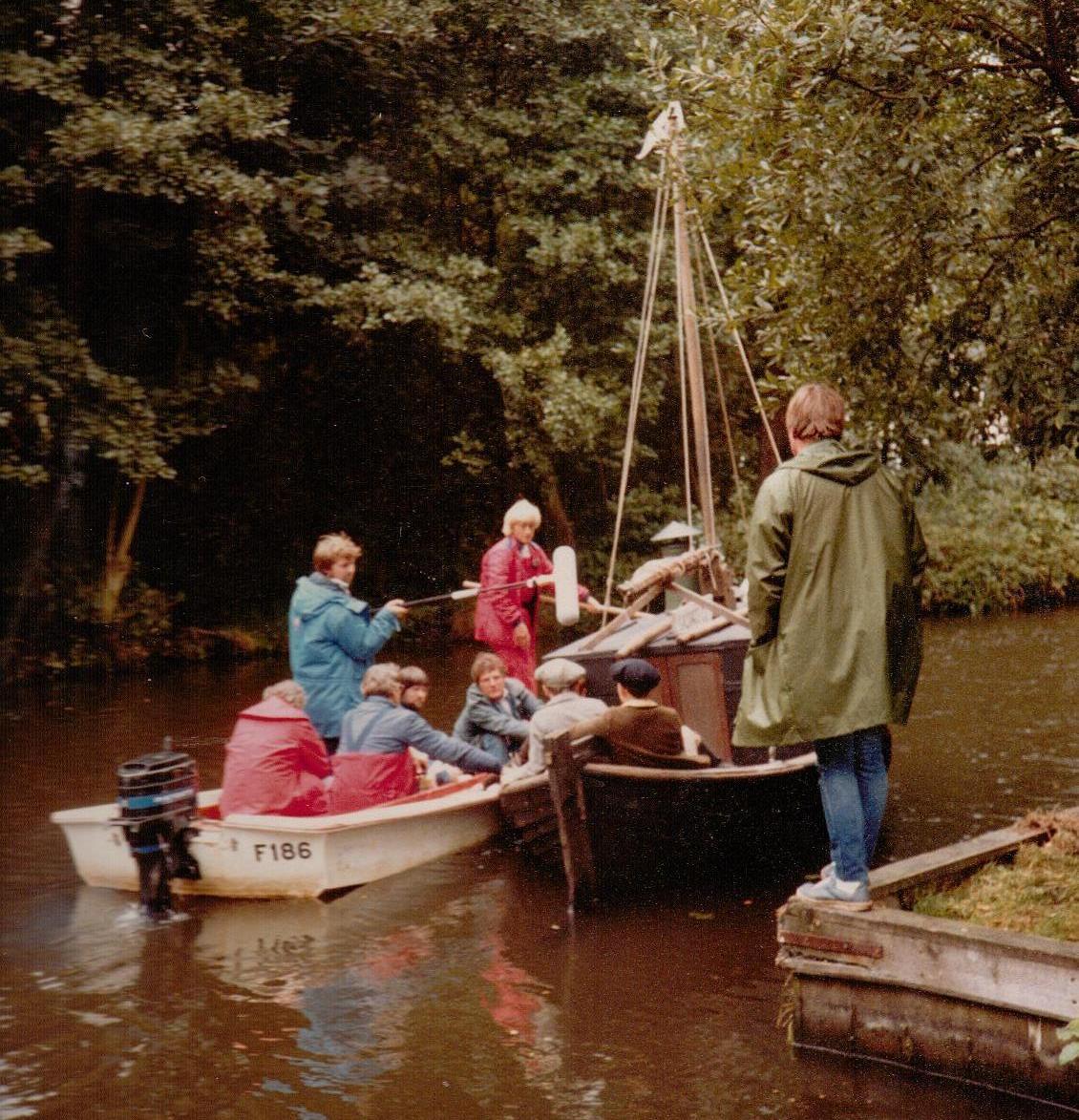
The Big Six - showing the runaround boat ~ photo: Sophie Neville
Alec Curtis and Andrew Morgan filming theDeath and Glory , with Peter Markham as First Assistant ,and Jill Searle looking after the boats, on one of the few rainy days on location at Gays Staithe, 1983


I have been writing about the adventures had whilst filming from one boat to another here: