The Arthur Ransome Jamboree at Pin Mill in Suffolk

Arthur Ransome Pin Mill Jamboree

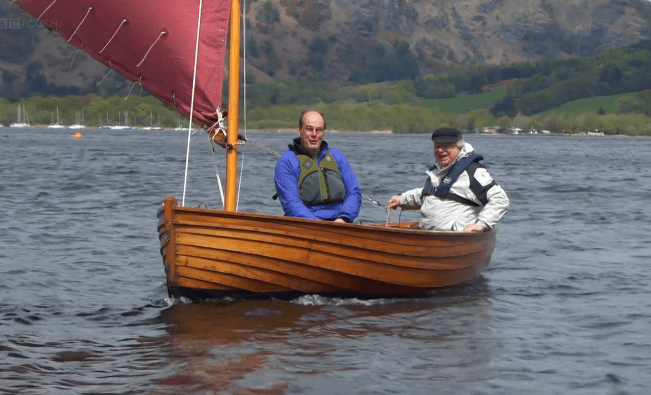
One year, not so very long ago, members of the Nancy Blackett Trust hosted an Arthur Ransome Jamboree at Pin Mill in Suffolk. It was a day to remember.

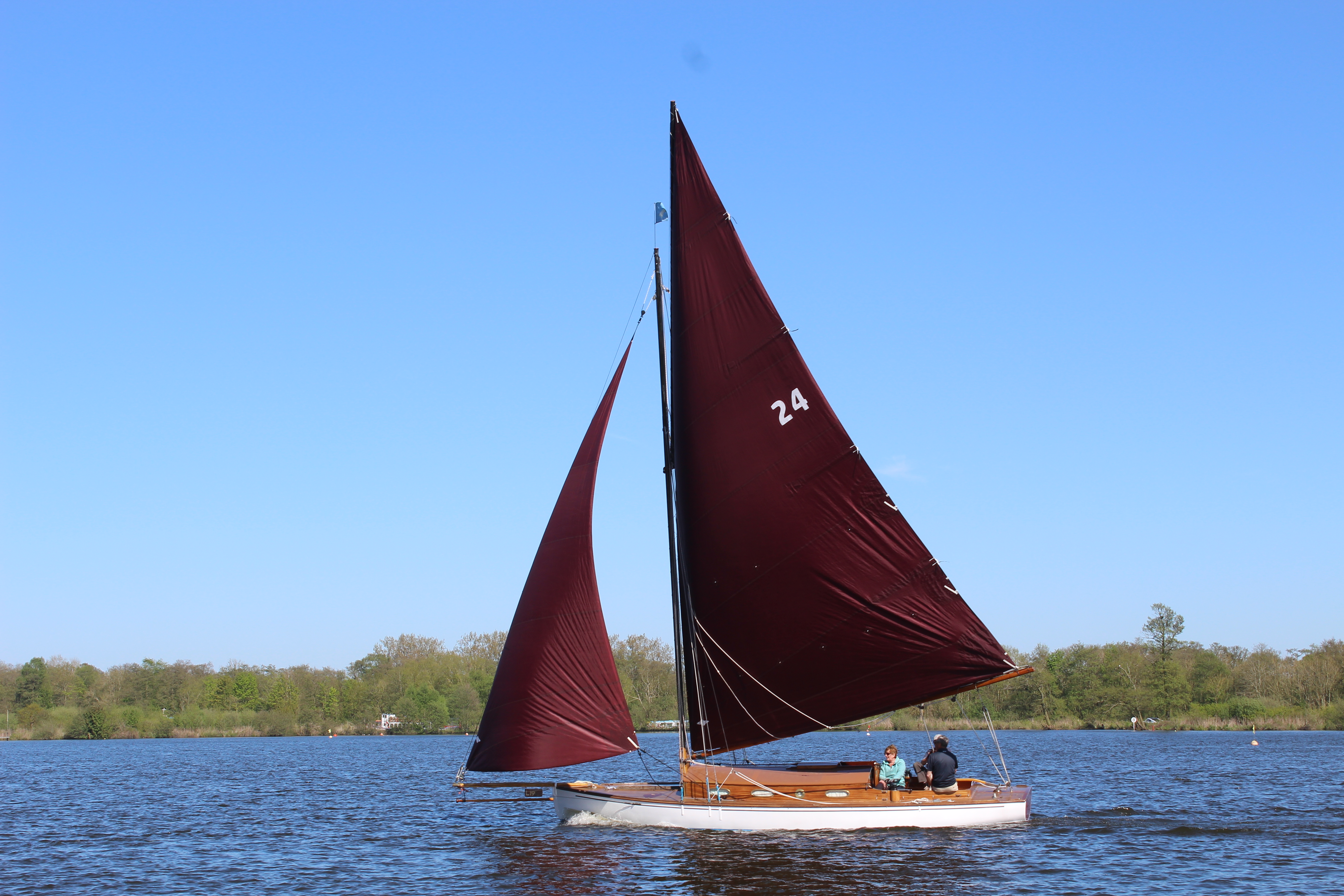
Pin Mill from the Water

Although Ransome is remembered for his ‘Swallows and Amazons’ books set in the Lake District, he moved to the east coast of Suffolk in 1935 where he set a number of other books in the series. It seemed fitting to mark the 80th anniversary of the publication of his inspirational sailing book ‘We Didn’t Mean to Go to Sea’ that begins at Pin Mill.

Sophie Neville with Nancy Blackett

It is possible go aboard the Goblin, since she was modelled on Ransome’s own favourite little yacht, the Nancy Blackett. I joined her at The Royal Harwich Yacht Club where she was moored alongside Peter Duck one of his other much-loved yachts, named after the adventurous book he wrote that begins in Lowestoft. I met up with Octavia Pollock, a feature writer from Country Life, and walked down the riverside to enjoy supper at the Butt and Oyster in Pin Mill where Ransome himself often ate.

Map of the Jamboree

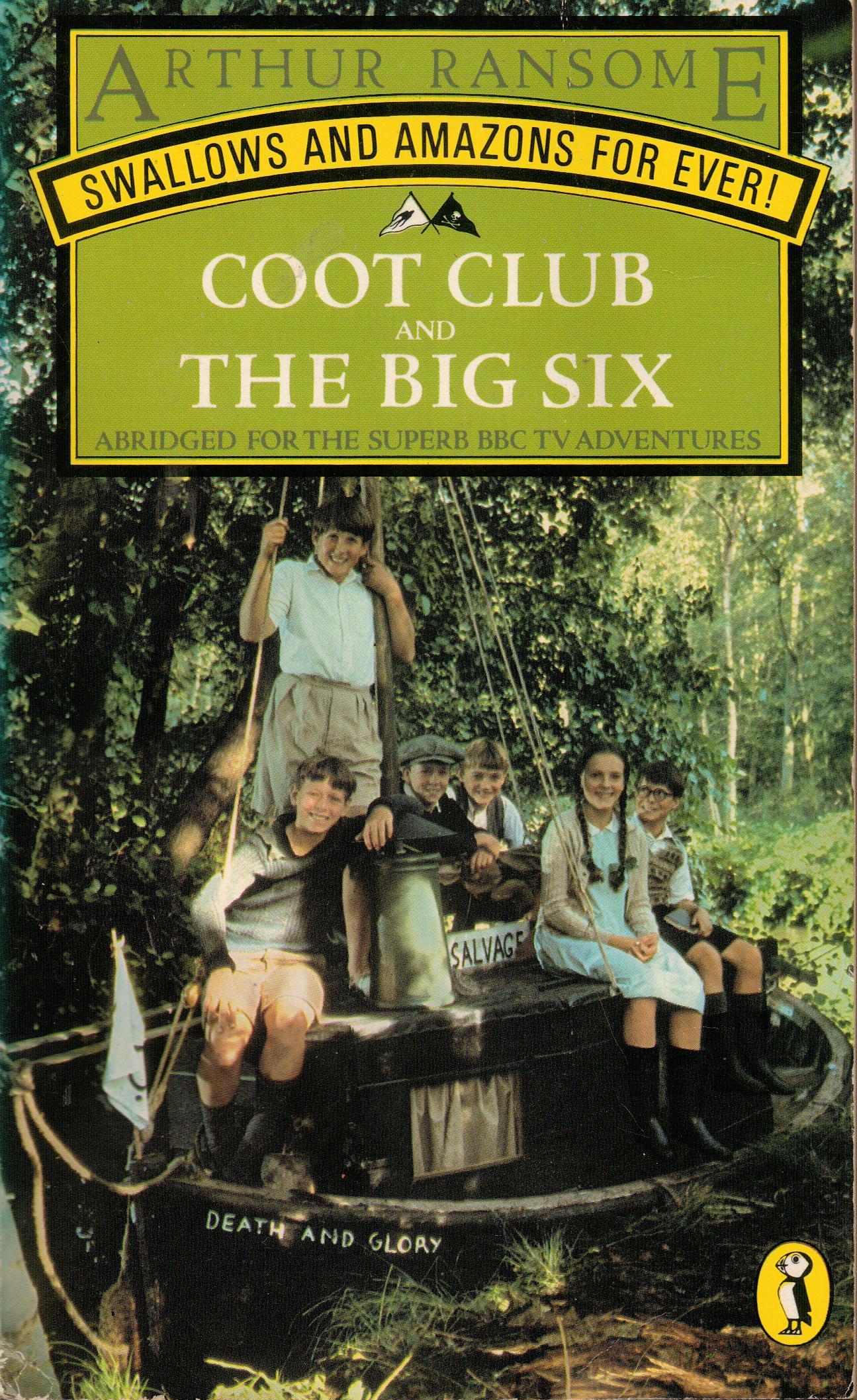
Soon after leaving university, I worked behind the camera on the BBC TV adaptations of ‘Coot Club’ and ‘The Big Six’, Ransome’s two books set on the Norfolk Broads, in which the Coots also visit Beccles in Suffolk.

It was the Swallows who made it to Pin Mill. I first went there when The Arthur Ransome Society asked me to give a talk about making the BBC TV serial entitled, ‘Swallows and Amazons Forever!’ and signed copies of ‘The Making of SWALLOWS and AMAZONS – 1974’.

Pin Mill

~The Orwell at Low tide~

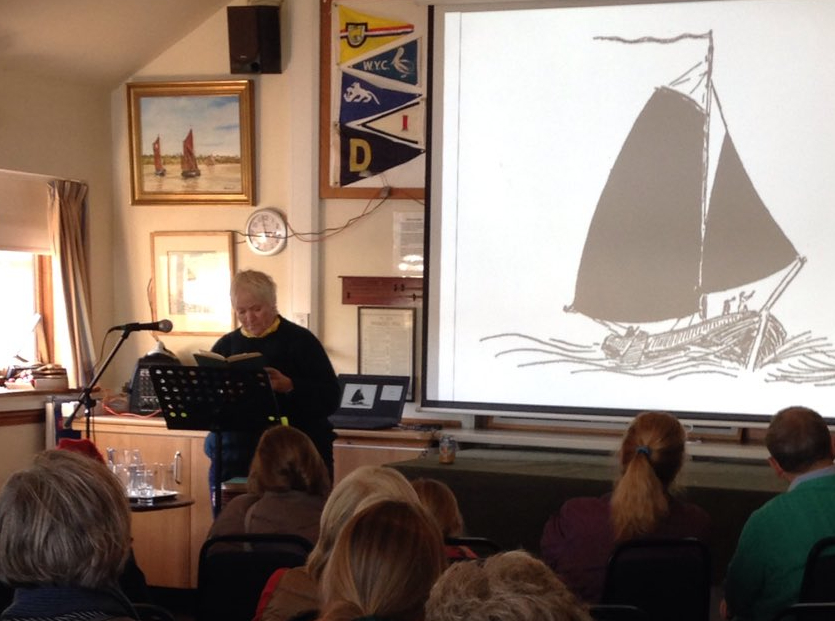
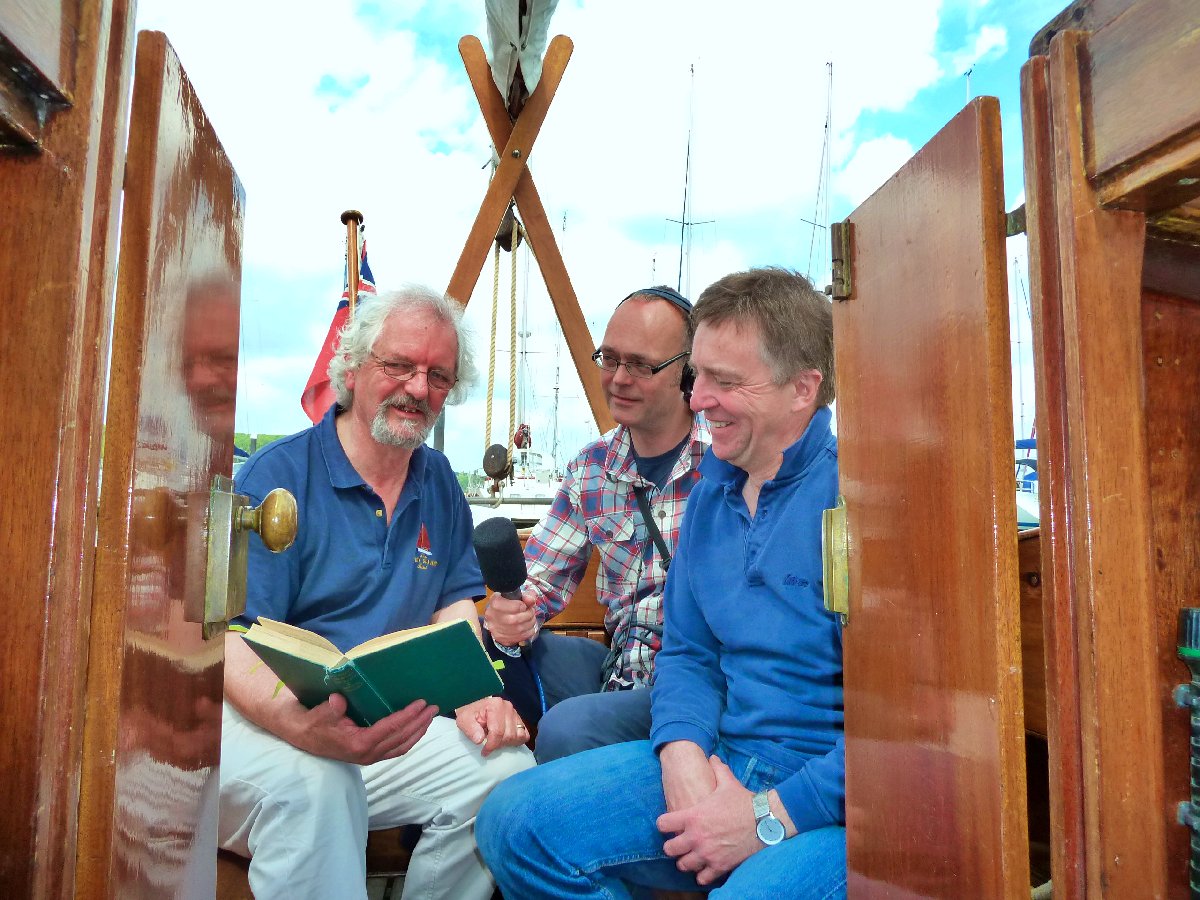
During the Jamboree celebrations, Arthur Ransome’s biographer Professor Hugh Brogan was interviewed by erstwhile BBC reporter Tim Fenton at the Pin Mill Sailing Club. 

the-life-of-arthur-ransome-by-hugh-broganHugh spoke eloquently, telling me that he was motivated by rage to write The Life of Arthur Ransome after a Fleet Street reviewer of the original film ‘Swallows & Amazons’ described him as ‘right-wing’.
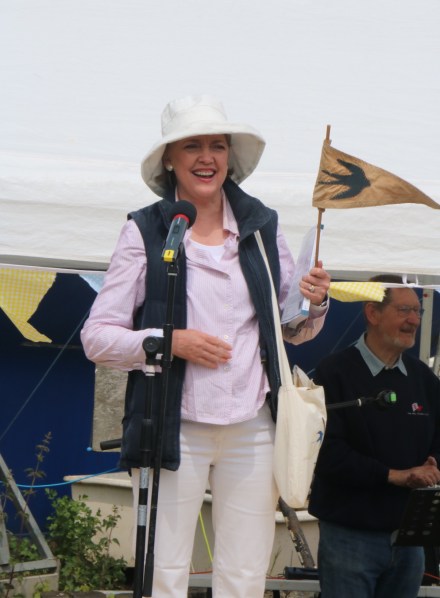
Sophie Neville opening the Arthur Ransome Jamboree at Pin Mill~ Sophie Neville ~

This VisitEngland event was great fun. There was a geo-caching route along the footpath from Shotley to Pin Mill. Marine artists Claudia Myatt and Christine Bryant hosted drop-in sessions on the riverside where visitors could also find the Rabble Chorus singing, while the author Julia Jones spoke about her children’s books set on the Orwell at the sailing club.

Nancy blackett product shop

~Mugs with artwork by Claudia Myatt sold in aid of the Nancy Blackett Trust~

There was an outdoor installation of old Pin Mill images enabling you to look back in time. These were taken by Arthur Ransome himself of the building of his boat Selina King at King’s boatyard nearby. It was the first public exhibition of these pictures ever seen and was appreciate by the hundreds of visitors who turned up.

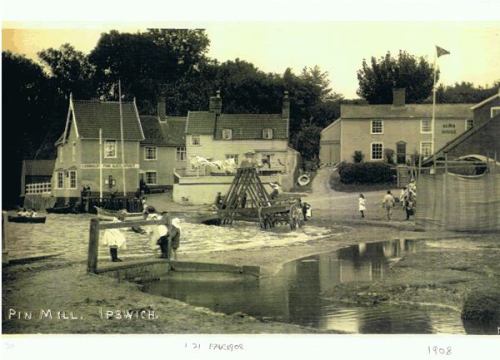
Pin Mill archive photo

The Pin Mill Studio also hosted an exhibition of photographs from the restoration of Melissa, a barge restored to her former glory by Webb’s boatyard, with additional archive images of Pin Mill from the early 1900’s.

The Vintage Mobile Cinema, as seen on BBC Television’s Reel History of Britain, screened unique archive film of Pin Mill and Shotley.

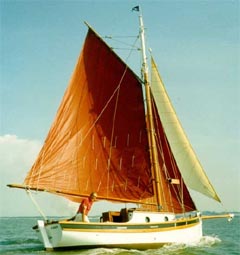
The Nancy Blackett

~The Nancy Blackett in her 85th year~

A Pin Mill ‘Wooden Boat’ race was held along the stream leading down to the river and you could take a ride on the Victorian swing boats on the Common as in years gone by. There was a ‘pirates and seafarers’ fancy dress competition for children and an Arthur Ransome lookalike competition (pipe and moustache) along with stalls and sideshows from local groups, charities and organisations.

Live music, including shanties from Pin Mill favourites, High Water Mark and a performance of We Didn’t Mean to go to Sea by pupils from Holbrook Academy who entertained visitors while cream teas, a barbecue and refreshments were served at the Butt and Oyster and Pin Mill Sailing Club.

T-shirts celebrating this special anniversary were sold along with gifts to generate funds for The Nancy Blackett Trust, who celebrate their 20th anniversary this year.

Do let us know if you came along by leaving a comment!

To read more please visit the Nancy Blackett website by clicking here.

The Nancy Blackett by Claudia Myatt

You can read about the making of the original film of Swallows and Amazons here:

A ‘Swallows and Amazons’ sailing weekend in Aldeburgh


Sophie Neville with Lapwing kids

‘Unlike other films, ‘Swallows and Amazons’ is within children’s reach,’ I’ve been told. It’s true. Any child can pretend that their bed is a sailing dinghy taking them to a deserted island. And when you are a little bit older – it’s not impossible to join a sailing club or go camping.

Aldeburgh Junior LapwingsWe took Swallow to join the Aldeburgh Junior Lapwings on the River Alde in Suffolk.

Boys with their Lapwing

One intrepid sailor had bought her own Lapwing for £100, raising the money by busking in Aldeburgh High Street. Tilly renovated and varnished the clinker-built dinghy herself.

Owl hoots

She can be seen here teaching the younger children how to owl hoot, playing ‘What Shall We Do With The Drunken Sailor’ on her thumbs.

Learning how to owl hoot

The children went fishing for crabs, which they later raced down the slipway.

A crab

They went in search of treasure – if that is what you call a scavenger hunt –

Scavenger Huntbefore sailing back to camp by the mud flats, cooking out in the open and sleeping in tents.

Junior LapwingThey launched their dinghies, raised their red sails

Boys with their Lapwings

and headed off, catching the tide.

Sailing on the River Alde, Suffolk

Swallow, the dinghy used in the 1974 film ‘Swallows & Amazons’ acted as flag ship.

You can find ideas for Swallows and Amazons themed parties and presents here.

Swallow on the Alde

You can read about the adventures we had making the original movie of ‘Swallows and Amazons’ in these illustrated publications available online:

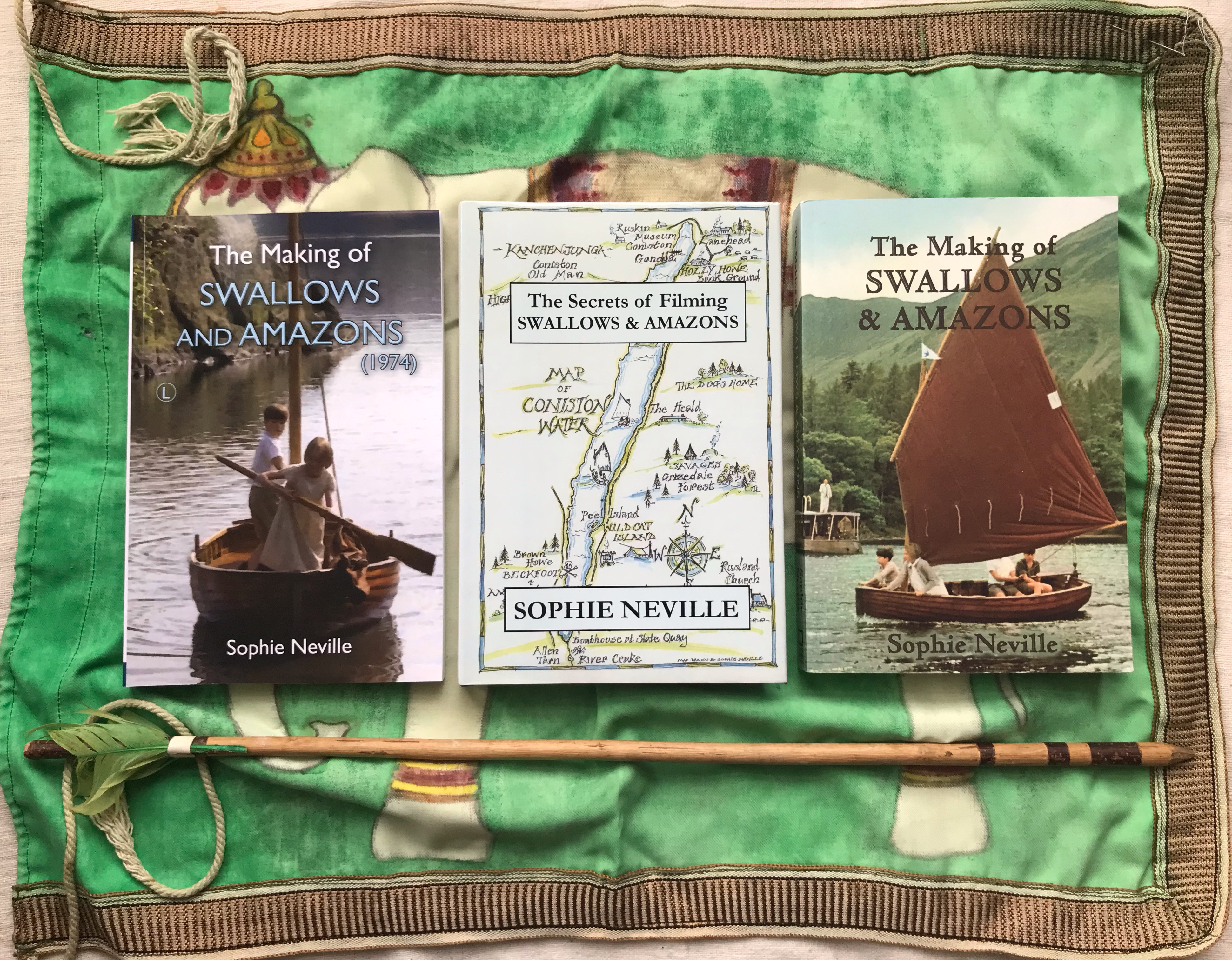
'The Making of Swallows and Amazons (1974) by Sophie Neville'
Different editions of ‘The Making of Swallows and Amazons (1974) by Sophie Neville’

1 error 2 many – notes for a third edition of ‘The Making of SWALLOWS & AMAZONS’

The Making of SWALLOWS & AMAZONS

Guy Willson, a reader from Papua New Guinea, has written to say: ‘I have read your book and I really liked it.  I could see behind the scenes and often read between your lines as well.’

‘When you were making the movie (in 1973) I was on my way to Norfolk Island as a starting point of my adventures in the South Seas; so I never knew of the release of your film until much later when I had children of my own that had reached the age to go ‘avasting’ and ‘timber shivering’, when we were living in Rye in the 1990’s.’

‘Some years ago I restored a 13ft clinker dinghy and after adding a false keel, added a standing lugsail and trailed her up to Coniston for my children to sail… I had in mind an article from Classic Boat on the Swallow, how the Altounyan children preferred Swallow as a boat because they could stow more things in her and she could still sail well.  I had noticed on a drawing in the article that Ransome had given her an extra 2 or 3 inches of false keel and this helped tremendously in reducing her leeway.  I added a piece of oak to do the same thing but gave her an extra 9” aft and planed it down to a feather edge forward so the she would go about a bit easier. Well, it worked and Eaglet would have done the original Swallow proud.’

Swallow on Coniston

Swallow – the 12′ dinghy used in the film

‘If you would permit me a little correction: you described the rig as being gaff rig, but this is not so.  Both the boats, originals and the ones you sailed were in fact luggers.  The nearest thing to a gaffer among the luggers is the Gunter Rig which has jaws at the front of the yard but is hauled up by a single halyard. You can see this in the Mirror dinghy (in truth it is about halfway between the two). However the lug rig of Swallow is known as a ‘standing lug’ and it can be used to go about freely.  After hauling up the sail on its traveller; the peak of the yard is raised by the downhaul line (usually attached to the bottom of the boom).  This tightens the luff of the sail and lifts the outer end of the boom as well giving the best efficiency to the sail.’

image005

A gaff rigged cutter

‘Lugsails were the working sails of England for most boats less than 60ft but they were usually rigged with a ‘dipping’ lug as the mail sail and a standing lug aft.  This dipping lug had to be dropped and the yard hauled round behind the mast every time they went about.  It was a powerful sail and they found their best expressions in the three masted Bisquines which used to raid British shipping in Napoleonic days.  You can still see them at the classic boat events at Douarnenez and Brests, where I took the gaff schooner Soteria in 2006.’

image002

Soteria at Douarnenez

‘If you had had a gaff rig you would most probably have needed a jib to balance it (unlike the American catboats which have their masts right up in the bow, not even a space for the Boy Roger on those! Thanks for writing a lovely book which I will pass on to my daughter.’

Blu-ray X marks the spot
“X marks the spot where they ate six missionaries”

‘You did such a grand job as Titty and I am not really surprised to find that you are a bit of a wordsmith. I am a missionary (uneaten) in Papua New Guinea and we are planning to sail back there in our steel schooner see www.livingwatermission.org  On our return we will be calling in at Erromanga in Vanuaatu where ‘x’ was the spot where two missionaries were eaten.  Recently the descendant of one of them, John Williams, went to Erromanga for a service of reconciliation.’

If you have noticed any errors in ‘The Making of SWALLOWS & AMAZONS’ please use the Comments box to let us know so that we can make corrections! We might be able to bring out a third edition. Readers who already have a Kindle edition will be able to update it free of charge.

'The Making of Swallows and Amazons (1974) by Sophie Neville'
Different editions of ‘The Making of Swallows and Amazons (1974) by Sophie Neville’

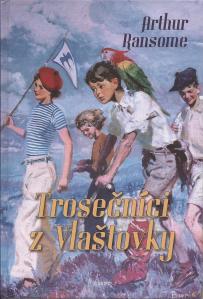
Sophie Nevilleova’s foreward to ‘Swallowdale’ by Arthur Ransome illustrated by Zdenek Burian

Albatros Media in the Czech Republic have re-published a hardback edition of ‘Swallowdale’ by Arthur Ransome, illustrated by the great Czech artist Zdenek Burian.

Sophie Nevilleova

The Foreword has been written by me, Sophie Nevilleová.

I was commissioned by Ondřej Müller, Fiction Program Director, thanks to an introduction by Petr Korbel, a feature writer in Prague. My somewhat daunting task was to introduce the well-loved story that comes with classic illustrations.

I took the opportunity to recommend that readers book a holiday in Cumbria. It’s always exciting to find the actual locations described in a novel, particularly one you know well, although I believe finding Swallowdale is quite a challenge.

Do tell any Czech friends or collectors of Ransome’s books about this publication. Click here for  the sales site.

Albatros Media bookmark

Here is the English version of my contribution:

Of all Arthur Ransome’s books, it was Swallowdale that inspired me to go camping. I have since pitched my tent all over the world from Papua New Guinea in the Pacific to Patagonia, which I crossed on horseback. I once spent six months driving down through Africa, sleeping in a tent and using all I had learnt from this beautifully written book. Not long after this expedition, I started to draw maps in the hope that I that might encourage others to travel and explore the world as the Swallows did.

Back in 1973 I had the great privilege of playing the part of Titty in the movie of ‘Swallows & Amazons’ that has been translated into Czech twice. Throughout my life I have received letters from people telling me how Arthur Ransome’s books have given them direction in life, encouraging them to set sail and explore unchartered waters.

If you ever visit the English Lake District take the charcoal burners’ advice and keep a good lookout for adders but in searching for Swallowdale one thing is for sure, you will be walking in Arthur Ransome’s footsteps. He was taken to the summit of Old Man Coniston, the mountain known in the book as Kanchenjunga, as a small baby and rowed into the secret harbour of Peel Island, or Wild Cat Island as the Swallows called it, when he was a boy.

The people of Cumbria still welcome visitors, indeed you can stay at the farm known as Holly Howe and it is possible to take a boat out on the lake below it. Coniston Water is not an exact replica of the map in the book, but you can enjoy looking for Horseshoe Cove and the Amazon boathouse. Rio can be found on Windermere where you might also find the Peak of Darien along with native steamers. Titty would encourage you to let your imagination take you further and I am sure Roger would suggest you take a fishing rod.

Even if travelling does not appeal to you, ‘Swallowdale’ is such a vivid story that you will sail back in time to 1931 quite effortlessly. This classic book is a full of wonderful imagery from ‘black wretched thoughts…crowding in like cormorants coming to roost’, to potatoes being in bad mood. It is enjoyable on many levels. I laughed when Titty decided, ‘Miss Turner could hardly be dead if she was complaining of cold plates’ and was uplifted by her joy at discovering, ‘the most secret valley that ever there was in the world.’

I am so pleased that Albatros Media are able to bring you this beautifully illustrated edition, to read, enjoy and perhaps pass on to others. 

Czech skull logo

Burian’s version of the Swallows and Amazons flags

If you are in North America and are looking for a copy of ‘Swallowdale’ in English, Capital One have copies on sale for U$15.77.

Swallows & Amazons flags for book

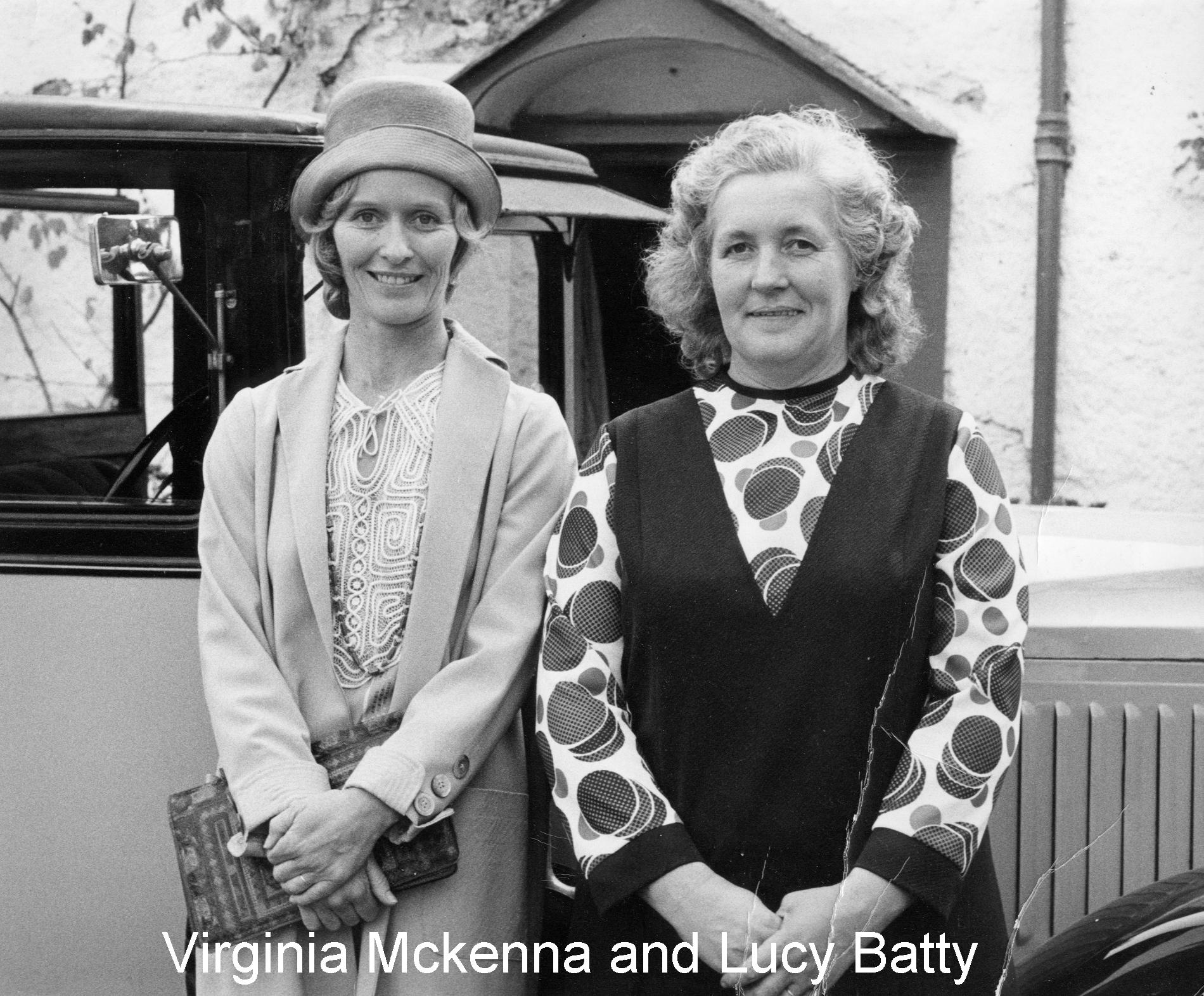
Lucy Batty of Bank Ground Farm

lucy batty
Virginia McKenna with Lucy Batty at Bank Ground Farm on 15th May 1973

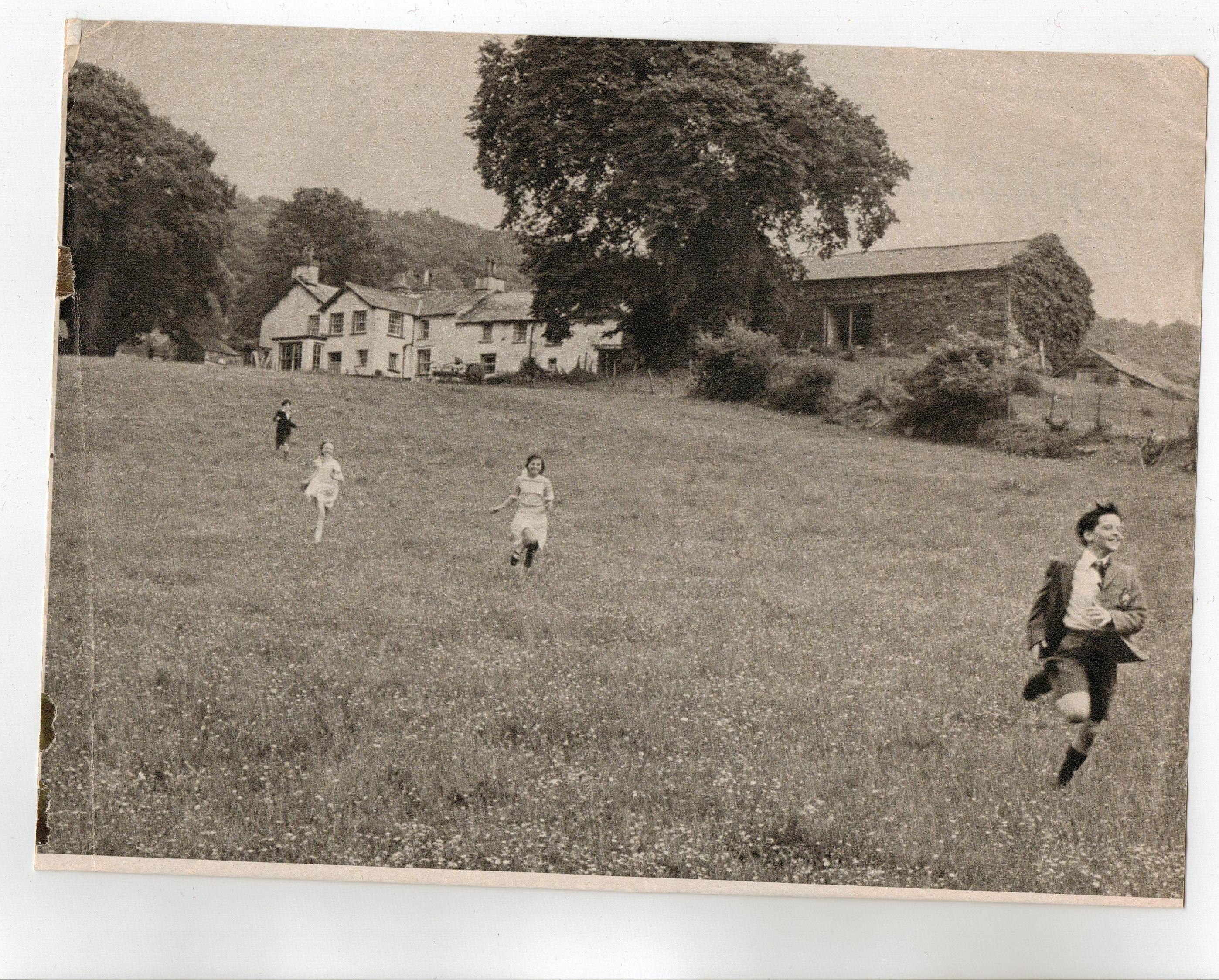
We were sad to hear that Lucy Batty has passed away. She was 87. Our thoughts are with her family. She will be fondly remembered by visitors from all over the world who were made so welcome at Bank Ground Farm above Coniston Water in the Lake District, which she ran as a guest house for many years. It was also used as a film location, becoming known as ‘Holly Howe’ in Richard Pilbrow’s 1974 movie, Swallows & Amazons.

Bankground Farm
Bank Ground Farm in the Lake District

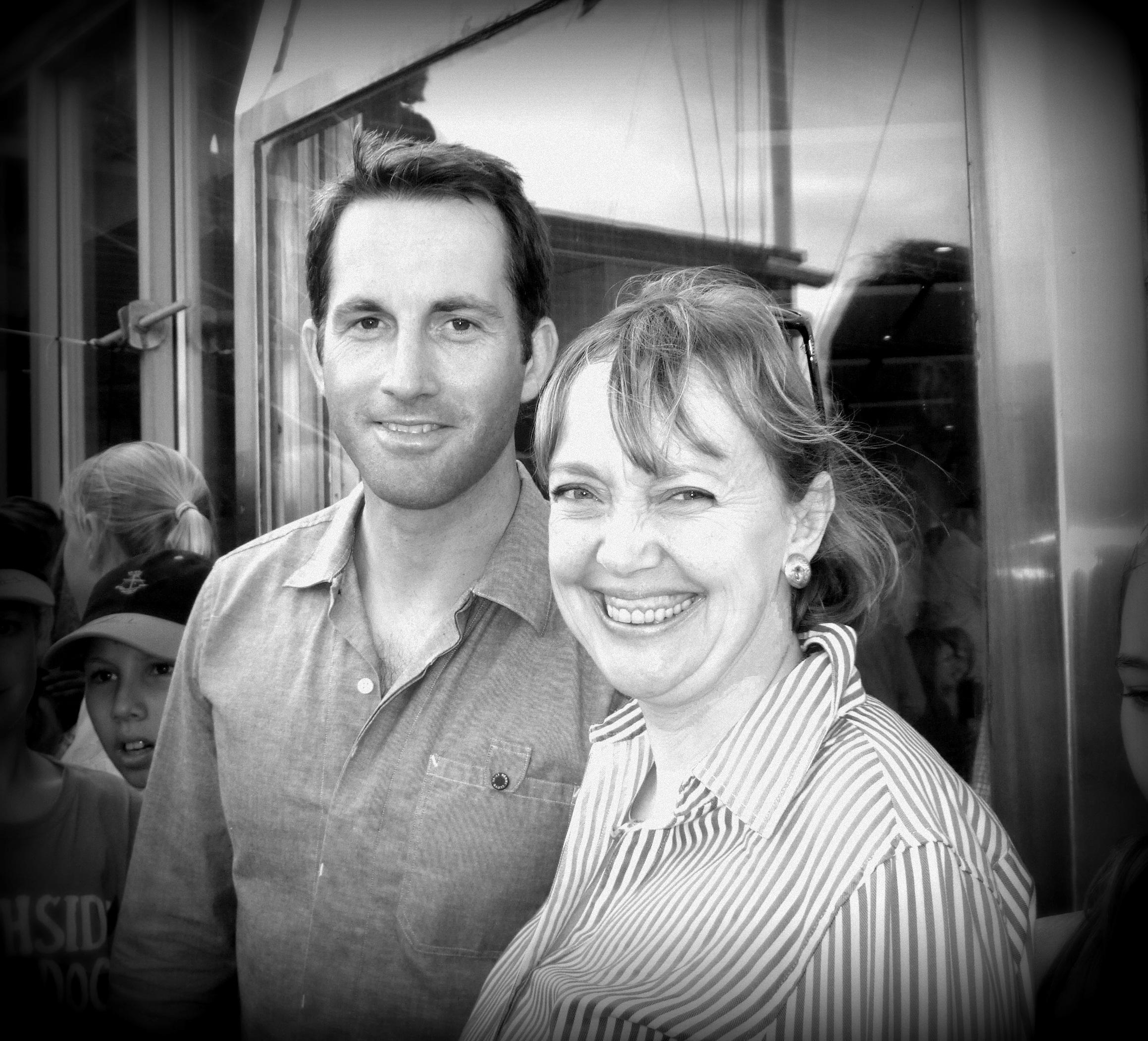
I first met Mrs Batty when we filmed in her home back in 1973 and returned to stay with her in 2003 when the BBC asked Suzanna Hamilton and myself if we would appear in Countryfile, which they were filming at Bank Ground Farm with Ben Fogle. It was then that she had time to show me her photo albums. What a life she led! She was very proud of having brought up seven children on the farm, “Two of my own and five that came with my husband,” she explained. “Getting them all off to school in the mornings was such hard work that my in-laws came to help on my first day.They all wanted bread and dripping for breakfast, with sugar sprinkled on top.”

Sophie Neville with Lucy Batty at Bank Ground Farm, Westmorland in 1973 ~ photo: Daphne Neville
~ Sophie Neville with Lucy Batty  in 1973~

“A magistrate once asked me what running a B&B entailed. ‘It’s much like looking after cattle,’ I told him. ‘You bring ‘um in, feed ‘um, see they’re bedded down, turn ’em out and muck’um out.’ He flung back his head and roared with laughter.”

She had a great sense of humour. I have a cutting from an article in The News written by Brenda Colton and published on 25th May 1973. It reads:

‘When Mrs Lucy Batty was asked if her house could be used for the setting of the film Swallows and Amazons, with guest star Virginia McKenna, she was delighted. After all, her home, Bank Ground Farm on the east side of Coniston Water, near Brantwood, was the setting chosen by Arthur Ransome for his children’s book Swallows and Amazons.

Mrs Batty thought it a good idea that the story should be filmed in an authentic location, and she felt she should be able to put up with a few cameras and film men for a while. But she just did not realise the scale of a “medium budget” film like this one, or what the production staff could do to her house. It was not the two double-decker buses coming down the path and parking on the farm that she minded, nor the numerous vans, lorries, cars and caravans. It was not even the difficulty of having 80 men and women wandering round the farmhouse carrying equipment here, there and everywhere. But when art director Simon Holland started tearing up her lino and carpet in the kitchen to get to the bare stone floor, she did get a little annoyed. Especially when he removed all the electric sockets, lights and switches, pushed all the kitchen furniture into the larder and whitewashed the newly papered walls.

Have you seen the kitchen?” Mrs Batty said to me. “The larder is piled high with my furniture; and you would not believe the tip my lounge is in. But they are a funny lot. I asked if I could wash the beams in the kitchen for them, and they said ‘Oh no, we want them to look old.’ I have even had to hunt out a lot of old pottery from the cellar for them.

But I have given up now. I have just left them to it.”

What she never knew was that Ian Whittaker the set dresser went on to win an Oscar for set design and received Academy Nominations on three other classic movies.

The News article on Swallows

What I really did not know, until I watched the BBC documentary ‘Country Tracks’, was that Mrs Batty reached the point when she locked out the crew. She explained that when she was originally asked if we could film on her property she did not quite realise the scale of operations and only asked for – or accepted – a location fee of £75. She said that she decided that £75 was not enough, padlocked her front gate and wouldn’t let them back in until they agreed to pay her £1,000. It was a lot of money, more than double the fee I received for acting in the whole movie.

To read a little more about filming of Swallows & Amazons at Bank Ground Farm, please click here.

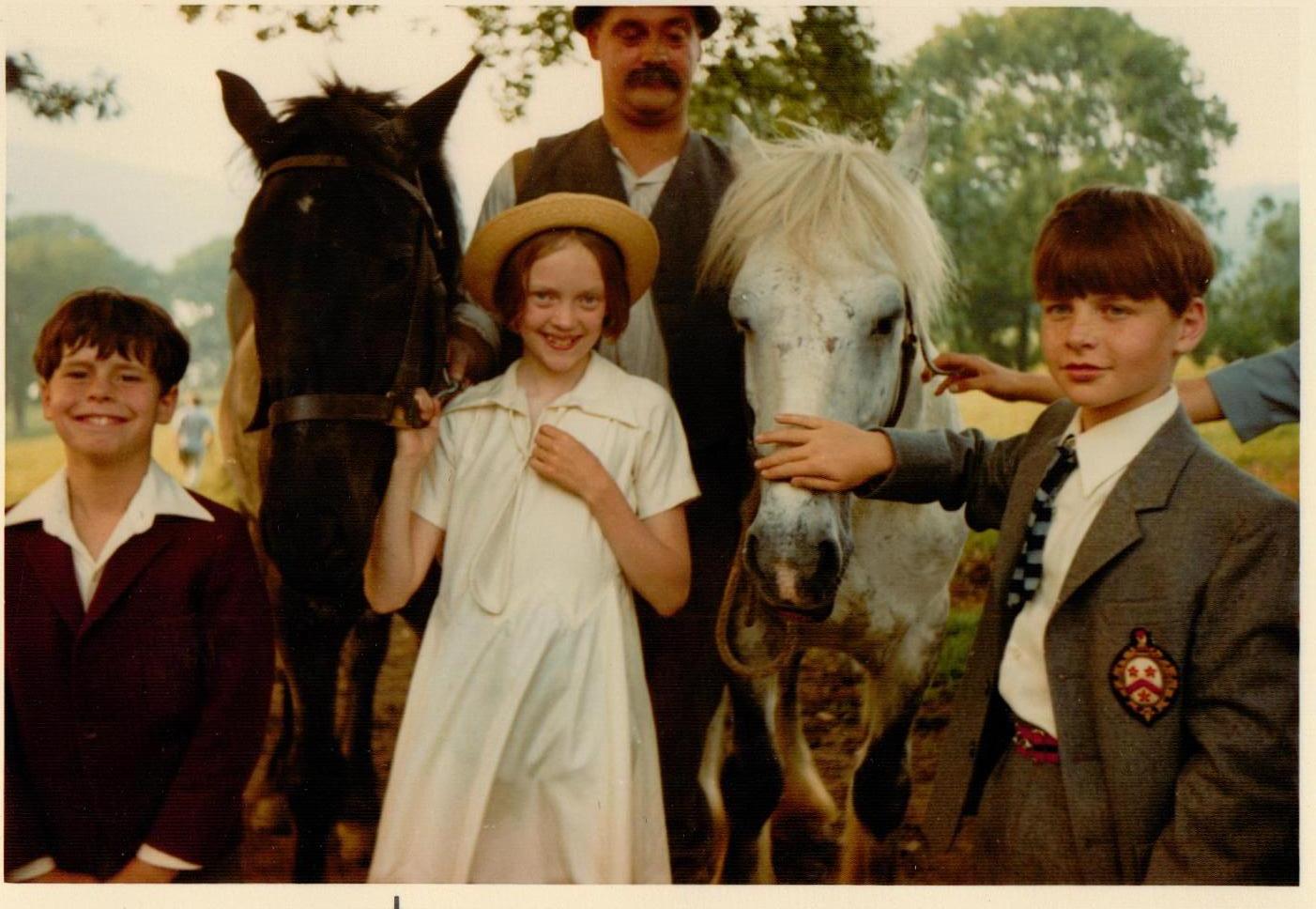
Sophie Neville holding the horses
Sten Grendon, Sophie Neville & Simon West with Mr Jackson at Holly Howe

For the amusing clip of Lucy Batty being interviewed by Ben Fogle about hosting the film company please click here and fast forward.

Bank Ground Farm the location used for Holly HoweFor Bank Ground Farm’s website please click here

I am sure many people reading this have their own memories of Mrs Batty who was such a great character. Please do add them to the Comments box below. I feel it would be a tribute to all the hard work and love she put into making Bank Ground available over the decades for so many to enjoy.

Stephen Grendon, Simon West, Virginia McKenna, Suzanna Hamilton and Sophie Neville, trying not to look as tall as she was in 1973 ~ photo: Daphne Neville
The farmhouse as Holly Howe in 1973

You can read more about the adventures we had making the original film Swallows and Amazons here:

Questions I am asked about being in Swallows & Amazons

Sophie Neville - a portrait by Sylvain Guenot

I am always interested by the questions I am asked on the making the feature film of the 1974 film of ‘Swallows & Amazons’, in which I played the part of Titty  when I was twelve years old.

Did you have to wear make-up?

What did you do about school?

Did you still live in a tent?

These are some of the questions I’ve been asked recently by a journalist:

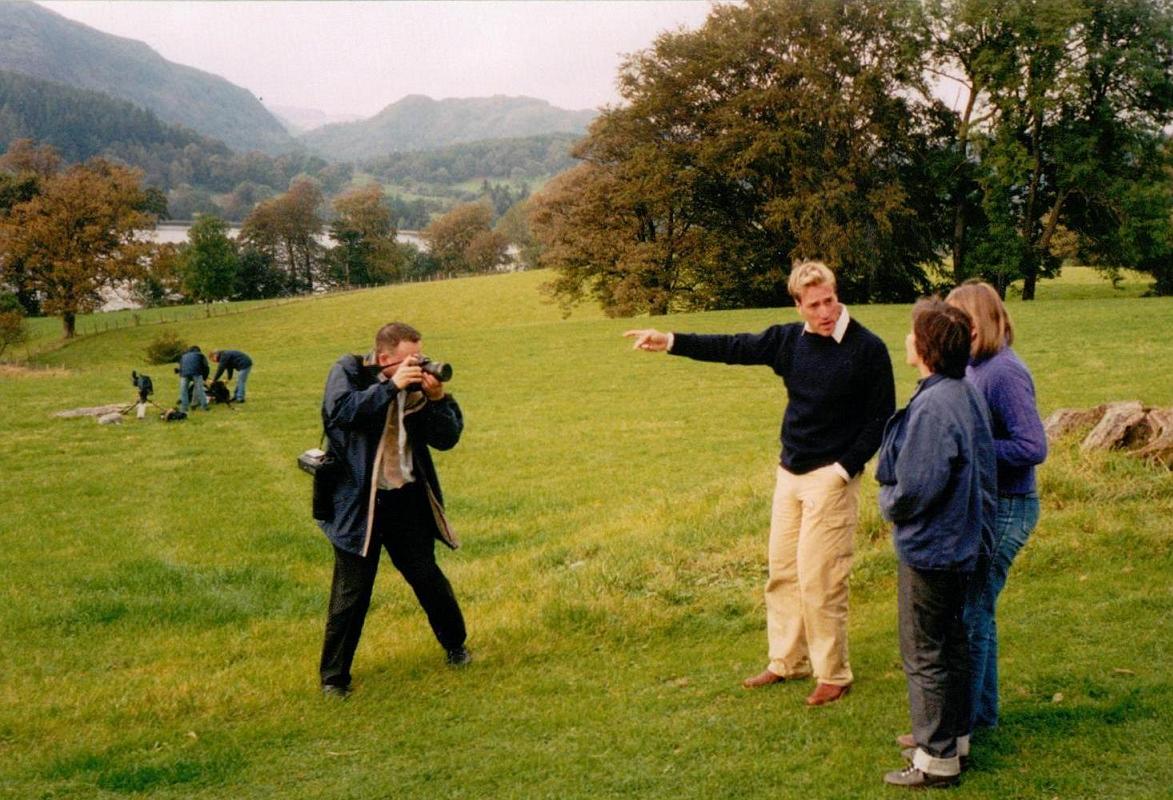
How different do you think your life would have been if you had not been in Swallows & Amazons?  I am not an actress but working on Swallows & Amazons, as well as a subsequent adventure movie called The Copter Kids, gave me enough experience to gain a graduate placement at the BBC and work behind the scenes on interesting television dramas including the adaptations of ‘Coot Club’ and ‘The Big Six’, written of course by Arthur Ransome.  Funnily enough, it was only when I was producing a documentary in Cumbria that anyone recognised me as Titty.

How different do you think your life would have been without the publicity that the film has brought you? While publicity generated by the film did not count one jot amongst my peers in television production, it does help me as an author since fans of the film appreciate the books I’ve written and often invite me to give talks.

Sophie Neville

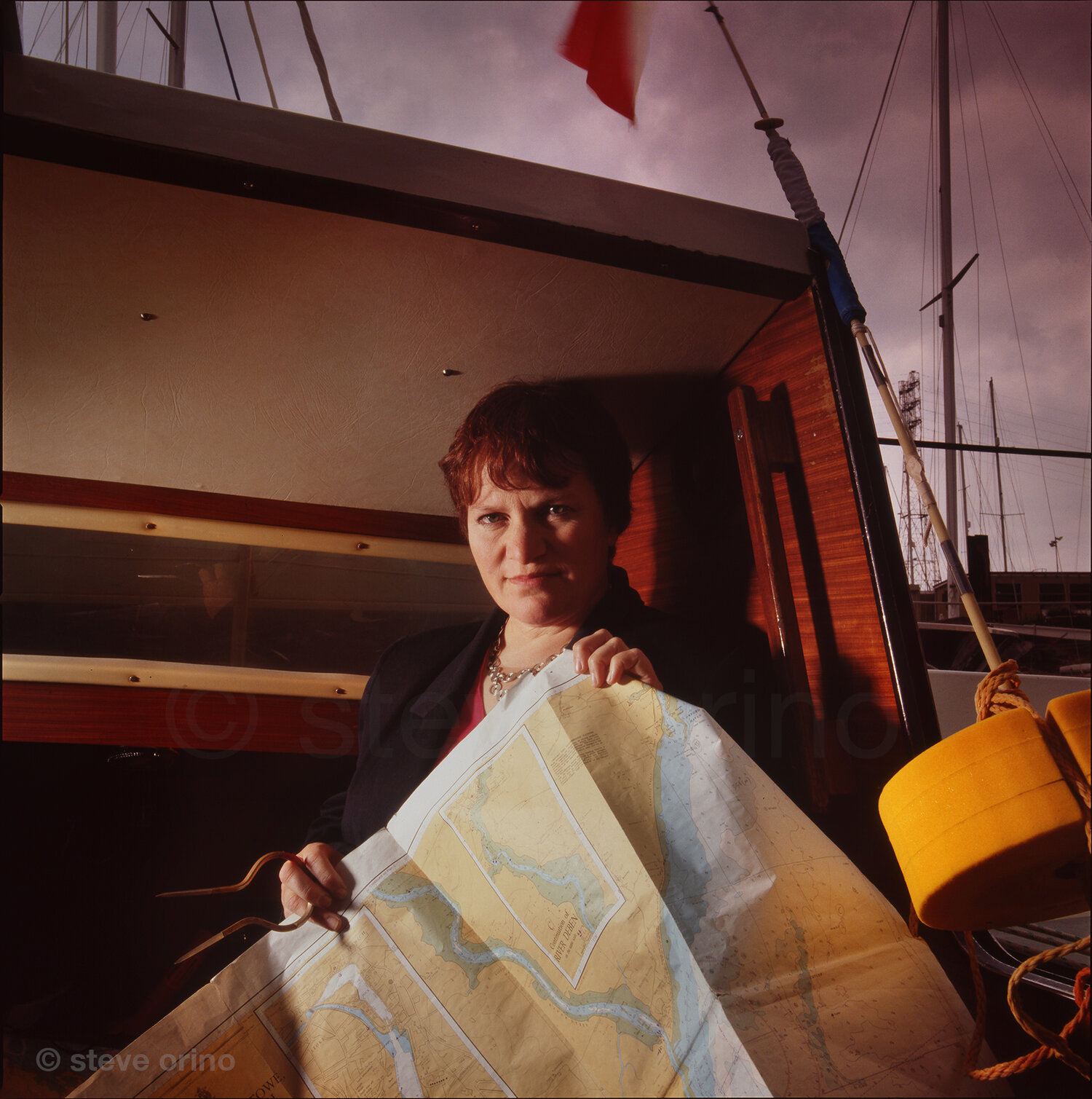
Do people expect you to be an expert on Arthur Ransome? Are you?  I’ve just been elected President of The Arthur Ransome Society, which is a great honour. Although I have read many biographies about Arthur Ransome and grew up reading his series of twelve Swallows and Amazons books, I only claim unique knowledge of the 1974 film and the BBC series ‘Coot Club’ and ‘The Big Six’, which I worked on as an adult over nine months in 1983.

There is huge interest in how these adaptations of the well-loved stories were made, especially since both are being restored and re-leased on DVD this summer. Being a landscape movie, Richard Pilbrow’s movie of Swallows & Amazons looks amazing on the big screen will be shown in cinemas from July in celebration of its 40th Anniversary.

Sophie Neville - a portrait by Sylvain Guenot - May 2014 JPG

Are you surprised that there’s still such an interest in the film?  The film of Swallows & Amazons has gained in popularity over the years. This seems unusual but parents, and now grandparents, want their children to see the same film they loved growing up. They trust it as a baby-sitting DVD.

I hope its popularity has kept Arthur Ransome on the shelves of bookshops as they are truly inspirational. Together, the film and books seem to have figure-headed a ‘Swallows and Amazons lifestyle’ advocated in magazines, along with camping and picnic food, themes for weddings, knit-wear and even cat-walk fashion. ‘Very Swallows and Amazons…’ is the often used phrase, alongside a black and white photograph of me as a little girl, heaving on an oar.

Tomboy style icons in the Telegraph Magazine
Telegraph Magazine

Are you surprised that you are still so involved in it?  I wasn’t much involved until we clubbed together to buy Swallow, the original dinghy used in the film. After displaying her glorious new coat of varnish at the London Boat Show in 2011 there has been an endless stream of requests to know more about how the film was made. Looking back through my diaries there were a surprising number of film-making secrets. I’ve only just remembered the funniest one.

Sophie Neville - a portrait by Sylvain Guenot taken 2014

What’s it like to be famous?  This is the most difficult question as I always dreaded becoming celebrity. We all loathed publicity as children and found projecting ourselves excruciating. I now wish that it had been explained to us that it was part of our work to sell the film as I could have understood the need for that. Instead I felt desperately self-conscious about appearing on television or radio,  especially as I wasn’t a glamorous actress and didn’t want to be one.  It’s my character that is well-known. Titty is loved worldwide. Forty years on, I am still receiving fan mail, more so than ever since the advent of social media. I have just received a sweet tweet saying:  hello titty :o) the family are enjoying the book, thank you. We have watched the film, conservative estimate, 20 times.

If you have any questions, please ask them in the comments blog below.

To read Sallie Eden’s review of ‘The Secrets of Filming Swallows & Amazons’ please click here

Portrait photographs by Sylvain Guenot

You can read about what it was like to take part in the original film of Swallows and Amazons here:

Questions about my writing

Sophie Neville by Sylvain Guenot (trimmed)

Sallie Eden contacted me when she was staying at Bank Ground Farm last month, requesting an interview. I have pasted a few of her questions here:

  • Where do you write? In solitude? At home? I find it much easier to write the first draft of my book if I retreat to an African hut in the middle of no-where, which I managed to do in February and March of this year. However, much of writing is re-writing, which I do at any and every opportunity. Most of my books have to be checked by experts and get re-drafted a great many times while I improve the flow of the narrative. It’s hard work and takes time but I see it as vital. Even when a book is based on a dairy I might re-draft it 100 times, drawing on skills gained as a painter and when editing my own films. I have learnt to be unoffendable, preferring to laugh at my own mistakes rather than have them displayed in print.
  • What authors do you admire? I have been inspired by authors of amusing true life stories: Anne Lamott and Monica Dickens, James Herriot, Gerald Durrell and Helene Hanff, who wrote 84 Charing Cross Road from letters she’d received from a book shop in London. Gerald Durrell told me how he’d edited the story of his years spent on Corfu, making the construction of his book seem easy, when of course it must have been soul wrenching. I love CS Lewis and follow his advice on writing the book I would like to read that is not there.
  • Sophie Neville
    How do you describe yourself when people ask what you do?  I’ve managed to live about five lives professionally, working interchangeably as a writer, producer, artist, actress and horseback safari guide. All require practice to gain fluency and do well. None are much good a making money. Many people assume that we receive substantial residuals from Swallows & Amazons but we only earned £7.50 a day whist working on the film and nothing at all from VHS or DVD sales. The parrot earned £25 and he didn’t speak. I wish I was better at raising funds for charity. The need is so great. In the year 2000 I helped to set up the Waterberg Welfare Society in a corner of rural South Africa to help combat the pandemic HIV/AIDS. You can see some of the mad things we do help finance their work here:    
  • Do you need a trigger to start writing – to give you an idea? Good stories will always call out to be written and to be read. Getting down to illustrate them would be difficult if the drawings were not already waiting. I started putting together Ride the Wings of Morning when I was living in Africa but only added the illustrations once it was formatted, filling natural gaps between the letters which make up the book with sketches and paintings. I ended up using about 120 graphics, accumulated over the twelve previous years. Someday I am hoping that a version will be produced in full colour as a coffee-table book that will motivate others to get out into the wild and start painting. You can read about Ride the Wings of Morning here

For the full interview with Sallie Eden please click here

For Sallie Eden’s review of ‘The Secrets of Filming Swallows & Amazons’ please click here

There are now three edition of Sophie’s book on The Making of Swallows and Amazons, available online here

'The Making of Swallows and Amazons (1974) by Sophie Neville'
Different editions of ‘The Making of Swallows and Amazons (1974) by Sophie Neville’

Portrait photographs by Sylvain Guenot

If you enjoyed watching ‘Swallows and Amazons'(1974) on television

The Secrets of Filming Swallows & Amazons

If you would like to know how the movie of Swallows & Amazons (1974) was made and know where the real locations can be found, ‘The Secrets of Filming Swallows & Amazons(1974)’ is currently available as an ebook on Amazon and Smashwords for £2.99.  The paperback was launched to mark the 40th anniversary of the film’s release and is available online here.

Do you know where the Peak of Darien can be found? photo: Roger Wardale
Do you know where the Peak of Darien can be found?

The paperback, which is suitable for any age group, is based on the diary that I kept when I played the part of Titty Walker in 1973. It is illustrated with behind-the-scenes photographs and memorabilia such as one of the tickets to the Royal Gala premier in Shaftesbury Avenue held on 4th April 1974. You will also find out what the actors who played the Walker family ~ the Swallows ~ are doing now.

The joy of the ebook is that it includes a number of home-movie clips that my parents took of life behind the scenes that you can play wherever you have internet access.

Classi Boat magazine Books ~ Feb 2014
A review of the ebook in Classic Boat magazine ~ Feburary 2014

If you have any questions about making the film, please add them to the comments below, and I will get back to you.

Richard Kay's column in Daily Mail Friday Nov 22nd1
A review of ‘the Secrets of Filming Swallows & Amazons’ in Richard Kay’s column in the Daily Mail ~

There were rather over-excited headlines in the Times and Telegraph when the ebook was launched but they only spoke of the legendary drinking of Ronald Fraser. Please don’t worry – there is nothing X-rated about the book – it is just the price one pays for half a page in a daily newspaper, especially since it came out on a Saturday.

The Times Sat 23 Nov 20131

The ebook has been doing well in the Amazon charts and hit Number 1 in the category ‘Stage and Theatre’.

Lymington Times 4th Jan 2014

A preview of what the book holds in store can be watched here:

‘The Secrets of Filming Swallows & Amazons’ – the book trailer

Very many thanks to all those who have left customer reviews on Amazon. It is always exciting to find out how the book has impacted others, especially those who love the Arthur Ransome books.

To read more reviews please click here

'The Making of Swallows and Amazons (1974) by Sophie Neville'
Different editions of ‘The Making of Swallows and Amazons (1974) by Sophie Neville’

The premiere of ‘Swallows and Amazons’, held at the ABC Shafestbury Avenue on 4th April 1974

The Premiere of Richard Pilbrow’s movie ‘Swallows and Amazons’ was held at the ABC Shaftesbury Avenue on 4th  April 1974. Can you imagine the shock of finding a picture of myself on the cinema tickets when they arrived in the post?

There were adverts in the newspapers. It was to be a Royal Gala charity matinee in aid of the charity KIDS.

Swallows and Amazons premier

I didn’t know what to wear.  I wished that we’d been able to put on our costumes but it was clear I had to find an appropriate dress. Sadly, I had grown out of the trendy one we bought in Carnaby Street. Shoes were another problem.

Sophie Neville at home in Gloucestershire in April 1974 ~ photo: Martin Neville

Nowadays one would be inundated by offers of designer dresses to model on the red carpet. As it was, my mother bought me green pinafore dress that I agreed would work for an afternoon event. I was not so happy about wearing ballet shoes. Please note these were real ballet shoes and I was now thirteen. I would have preferred court shoes with buckles. Ironically these zoomed out of fashion whilst ballet shoes have been loved by all ever since. My bobbed hair had grown out but Mummy put it in Carmen rollers. I am not sure the result was that successful but I liked it at the time.

The Neville girls modelling the fashions of 1974 ~ photo: Martin Neville

My sisters were terribly brave and wore velvet with their ballet shoes. The dress from Carnaby Street was slightly large for Perry, seen here on the left, but she coped. At least it was fashionable. Mum bought herself a blue outfit that was deemed the height of fashion. When I arrived in London I found Suzanna had found a Laura Ashley pinafore whilst the Amazons had both got away with wearing trousers. They looked far more sophisticated.

There was an awful lot of fuss about who should or could come and who couldn’t . Mum had insisted on bringing, not friends of mine, but two of the nuns from my school.

Outside the ABC in Shaftesbury Avenue, London in 1974 ~ photo: Martin Neville

So, I went off to my first premiere with my headmistress, Sister Ann-Julian and my housemistress, Sister Allyne. Not very cool in a thirteen year old’s world.  The Exorcist was out at the same time. They made no comment.

Sister Allyne, Daphne Neville, Tamzin Neville and Sophie Neville

In fact Sister Allyne proved the very best person to take. She was a performer herself. I am pretty sure she had been Australia’s foremost flautist.  She must have understood the turmoil in my little head and was undoubtedly praying for me. I would not be surprise to learn that spiritual protection was granted by her presence alone. She would have been an exorcist in her own right – a real one.  Perry remembers that she had been sick in the taxi. This was probably because she didn’t travel much.

Claude Whatham defied any plans my mother might have made by taking the six of us in the cast, and only the six of us, out to lunch at a wonderful bistro where we able to order beef-burgers, relax and enjoy ourselves.

Sophie Neville, Suzanna Hamilton in Laura Ashley and her mother

There was no red carpet when we arrived at the cinema in Shaftesbury Avenue but rather smart programmes were sold, one of which I still have. Until that point I had no idea that it was to be a Royal Gala held in aid of charity.

I was suddenly acutely aware of how I came across on the big screen. As the film was shown I groaned inwardly. It was like seeing endless photographs of oneself which were not exactly glamorous. I cringed. All Sister Allyne said was how much she enjoyed seeing the owl – a natural history shot that was added after all our hard work and effort on the drama.

The premier – as reported in Cinema TV Today

My mother was terribly impressed by the special guests. Princess Helena Moutafian was present with Earl Compton, chairman of the charity KIDS. I’m afraid I don’t remember meeting them but was interested to hear that she later became patron of the Young ME Sufferers Trust.

We walked down onto the stage with Ronnie Fraser to be presented to the audience. Sadly Virginia McKenna could not be there, although she sent her eldest children – Will and Louise Travers. Bobby Moore, who’d played for England came with his family, as did Mrs Spike Milligan. The Hollywood star  Patricia Neal, who won an Oscar for her leading role in the Paul Newman film Hud and appeared in Breakfast at Tiffany’s , brought her sweet little girls.  Julie Ege was a lovely Norwegian actress who appeared as Voluptua in Up Pompeii with Frankie Howard. I think Richard Pilbrow might have known her as he had produced the West End version.  She was known as a Bond Girl since she’d appeared in ‘On her Magesty’s Secret Service’ with Diana Rigg when George Lazenby played Bond and Telly Savalas was Bolfeld. We didn’t know any of this but I think having a Bond Girl at your premier was quite the thing.

I have a few precious posters of the film. The colour poster, which hung in the London Underground is still on the cover of some of the DVD’s.  I always quite liked the design, except for the rather jarring colour of my blouse, which for some reason is pink. Far more attractive were the huge sepia posters hung outside cinemas. They were very special. I still have one but it’s enormous and I am unsure what to do with it.

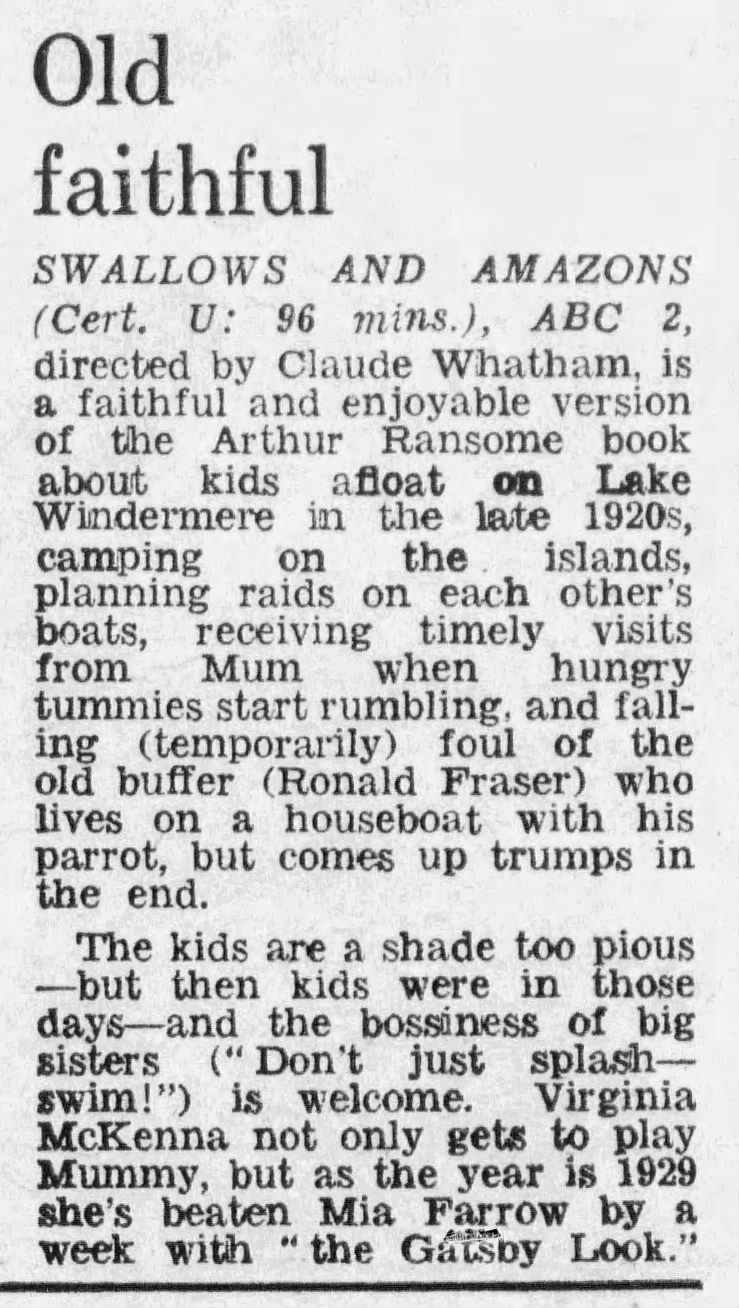
What the papers had to say about the film was a different matter. The first time we saw Swallows and Amazons was not at the film the premiere but at ‘The Preview’. This was held at a viewing theatre in London to which I assume journalists were invited. I only wish they’d been asked to bring their children. The cast was re-united, meeting up with various members of the production team, to see the film for the very first time. We were utterly amazed at how sunny everything looked. Denis Lewiston’s insistence that we should wait for clouds to pass, while we shivered, had paid off. It was wonderful to see how the film had been put together. We had not known that Claude would add shots of wildlife, which add so much to the movie. I loved the scene he included of cattle standing in the still lake at dawn.

You can read about how we made the film and find more photos in these publications available online or to order from libraries.

'The Making of Swallows and Amazons (1974) by Sophie Neville'
Different editions of ‘The Making of Swallows and Amazons (1974) by Sophie Neville’

Leaving the Lake District after spending 50 days filming ‘Swallows and Amazons’~ 13th July 1973

Daphne Neville with Sophie Neville while filming 'Swallows and Amazons' in Cumbria

 It was time to say goodbye. We’d had the most wonderful seven weeks filming on the Lakes but the end had drawn in with the clouds. It was time to go home.

Since we lived in Gloucestershire it was a long drive south. I’m not sure how Jane and Sten Grendon got back, as I don’t think Jane drove, but we must have dropped off some of their things on our way past their village.

I remember seeing my real sisters and walking around the garden in the afternoon sunshine, looking at all that had changed. We’d left in early May, now it was full summer and the school holidays. I don’t know how I had the energy left to write up my diary.

Sophie Neville in 1973, in the garden at home with a swan
Back in the garden at home with a swan

‘Shall we go and put flowers on Luppy’s grave?’ Perry asked. I hadn’t heard that our dear old dog, the sheep dog I had known all my life, had died while we were away. I was inconsolable. Mum explained that they hadn’t wanted to tell me when it happened as we were filming, she thought that the sadness on my face would have come through on camera. I understood this but was still desolate. Having had to cope with the grief of losing Luppy, on top of the heartbreak of leaving everyone I had grown so close to in the Lake District, I was not in a good way.

One of the most treasured things that I had returned with – apart from the lump of Cumbrian slate Jean McGill had given me – was a hard-back copy of ‘Swallows and Amazons’ signed by the entire cast and crew.

Signatures of the cast, director and producer of the movie 'Swallows and Amazons' in my hardback copy of Arthur Ransome's book
Signatures of the cast, director and producer of the movie ‘Swallows and Amazons’ in my hardback copy of Arthur Ransome’s book

Here you can see inscriptions from Virginia McKenna who had played my mother and Ronald Fraser who obviously saw himself as Uncle Jim rather than Captain Flint.

Virginia McKenna as Mother in Swallows and Amazons 1

Mike Pratt and Brenda Bruce who appeared as Mr and Mrs Dixon, Jack Wolgar and John Franklyn-Robbins who embodied the Charcoal Burners with Brian Robylas (sp?) and Moria Late who played Mr and Mrs Jackson.

Sophie Neville holding the horses
Stephen Grendon, Sophie Neville and Simon West with Brian Robylas ~ photo: Daphne Neville

It is interesting that all the children signed their character names with their real names in brackets. We must have grown to associate ourselves more with the characters names than with our own.

Claude Whatham in 1973

Claude Whatham wrote, with thanks, and Richard Pilbrow enchanted me by drawing a picture of Wild Cat Island at night.

Daphne Neville with Richard Pilbrow1
Molly and Richard Pilbrow in 1973

Sadly, we didn’t manage to nab everyone on the crew, but collected a few signatures.

Brian Doyle, the publicity manager on 'Swallows and Amazons'
Brian Doyle, the film publicist on ‘Swallows and Amazons’ (1974)

The only other signature on this page is from Brian Doyle, Mum’s friend the publicity manager on the movie who encouraged us to collect the autographs.

Signatures of the rest of the cast and crew of 'Swallows and Amazons' in the back of my Jonathan Cape edition of Arthur Ransome's book
Signatures of the rest of the cast and crew of ‘Swallows and Amazons’ in the back of my Jonathan Cape edition of Arthur Ransome’s book

At the back of the book David Blagden, who played Sammy the Policeman as well as overseeing the sailing.

David Blagden who played Sammy the Policeman
David Blagden who played Sammy the Policeman ~ photo: Daphne Neville

David drew me a picture of what must be a vision of himself, sailing into the sunset in his little yacht Willing Griffin that had taken him across the Atlantic.

David Blagden's signature and sketch

Phyllis B was my tapestry-making stand-in. Simon Holland our art director (set designer) drew me a wonderful set of crossed flags that were also paint brushes ~ a logo for my life.

Art Director Simon Holland
Art Director Simon Holland at Bank Ground Farm in 1973 ~ photo: Daphne Neville

I have a signature from Kerry Darbishire (I thought she’d written Dartisnine) who played Bridget’s Nurse, our Fair Spanish Lady. Like the actors who played the Jacksons, she was not credited on the movie but played a significant part. She still lives in Cumbria.

Nurse with Baby Vicky, the ship's baby
Nurse with Baby Vicky, the ship’s baby at Holly Howe

We left Jean McGill, our driver and unit nurse, in Bowness-on-Windermere.

Jean with sophie
Jean our driver and location nurse operating the radio with Sophie Neville ~ photo:Martin Neville

Eddie Collins was the camera operator,  Ronnie Cogan our hairdresser, Joni Turner was a local lady who worked on a few days as Suzanna’s stand-in.

Sophie with Martin Evans the Gaffer and Terry Smith the wardrobe master
Talking to Martin Evans the Gaffer and Terry Smith the wardrobe master while leaning on a lighting stand at Bowness-on-Windermere

Terry Smith was the wardrobe master, Albert Stills is Albert Clarke who took the black and white photographs day after day. Terry Needham was our long-suffering second assistant director.

Sophie Neville with Terry Needham in 1973
Sophie Neville with Terry Needham and the unit radio at Derwentwater ~ photo: Daphne Neville

On the last page I have a very classy signature from Robert – who I think was one of the Keswick boatmen looking after the Lady Derwentwater.

A boatman working on Derwent Water in 1973
Our boatman and the houseboat in 1973 ~ photo Daphne Neville

Denis Lewiston the DoP also left his mark on my life.

Dennis Lewiston, director of Photography on 'Swallows and Amazons' ~photo:Richard Pilbrow
Dennis Lewiston, director of Photography on ‘Swallows and Amazons’ ~photo:Richard Pilbrow

Peter Robb-King signed himself ‘Make-up for the Stars’ and Gareth Tandy as ‘The Whip-cracker’, which surprised me as I had never seen his whip. Graham Ford obviously didn’t want me to change and Margaret Causey, our tutor, sent her love. We’d been though so much together and in such confined spaces.

The film crew set up in Rio Bay
Swallow and the film crew setting up at Bowness-on-Windermere ~ photo: Richard Pilbrow

Interestingly, I also have an inscription from Ian Fuller the sound editor listed as if he was around on location. I am sure he was the chap I would have met next. Claude and Richard would have gone straight down to the cutting rooms to edit the film. It is not usual for actors to enter such territory but our adventure was to continue. We were soon to be summons to the Elstree Studios of EMI at Borehamwood in Hertfordshire, just off the A1.

The crew as I remember them filming with Swallow and Amazon from the pontoon ~ photo: Richard Pilbrow
The crew as I remember them filming with Swallow and Amazon from the pontoon ~ photo: Richard Pilbrow taken on Derwentwater in 1973

You can read more in the ebook ‘The secrets of filming Swallows and Amazons’ or paperback entitled ‘The Making of Swallows and Amazons’ available from all online retailers.

The Making of Swallows and Amazons by Sophie Neville
Different editions of ‘The Making of Swallows and Amazons’ by Sophie Neville