Lucy Batty of Bank Ground Farm

lucy batty
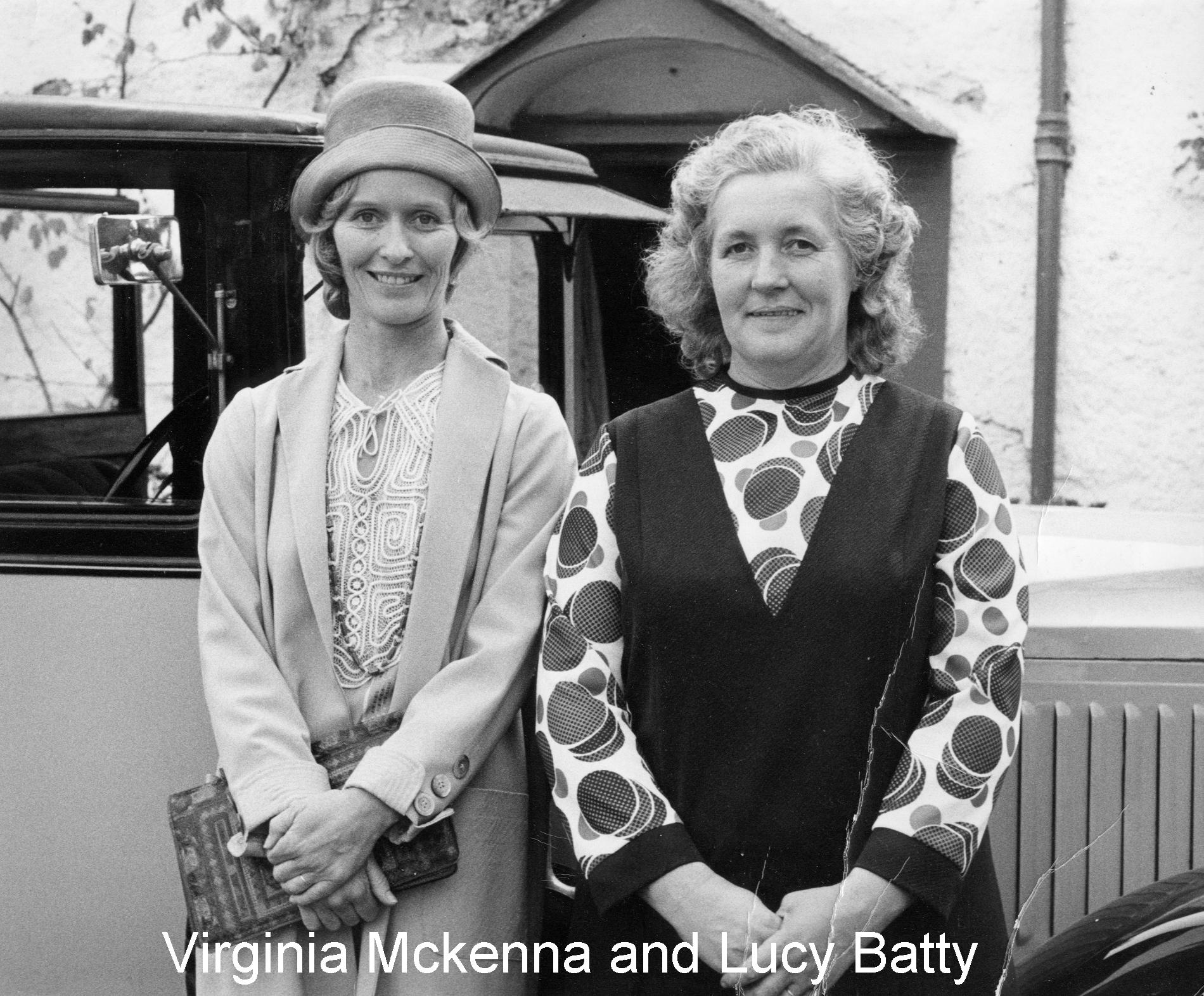
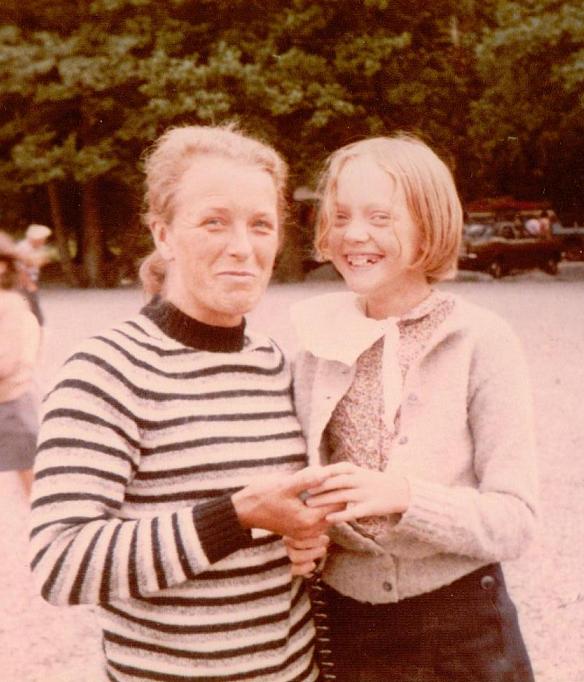
Virginia McKenna with Lucy Batty at Bank Ground Farm on 15th May 1973

We were sad to hear that Lucy Batty has passed away. She was 87. Our thoughts are with her family. She will be fondly remembered by visitors from all over the world who were made so welcome at Bank Ground Farm above Coniston Water in the Lake District, which she ran as a guest house for many years. It was also used as a film location, becoming known as ‘Holly Howe’ in Richard Pilbrow’s 1974 movie, Swallows & Amazons.

Bankground Farm
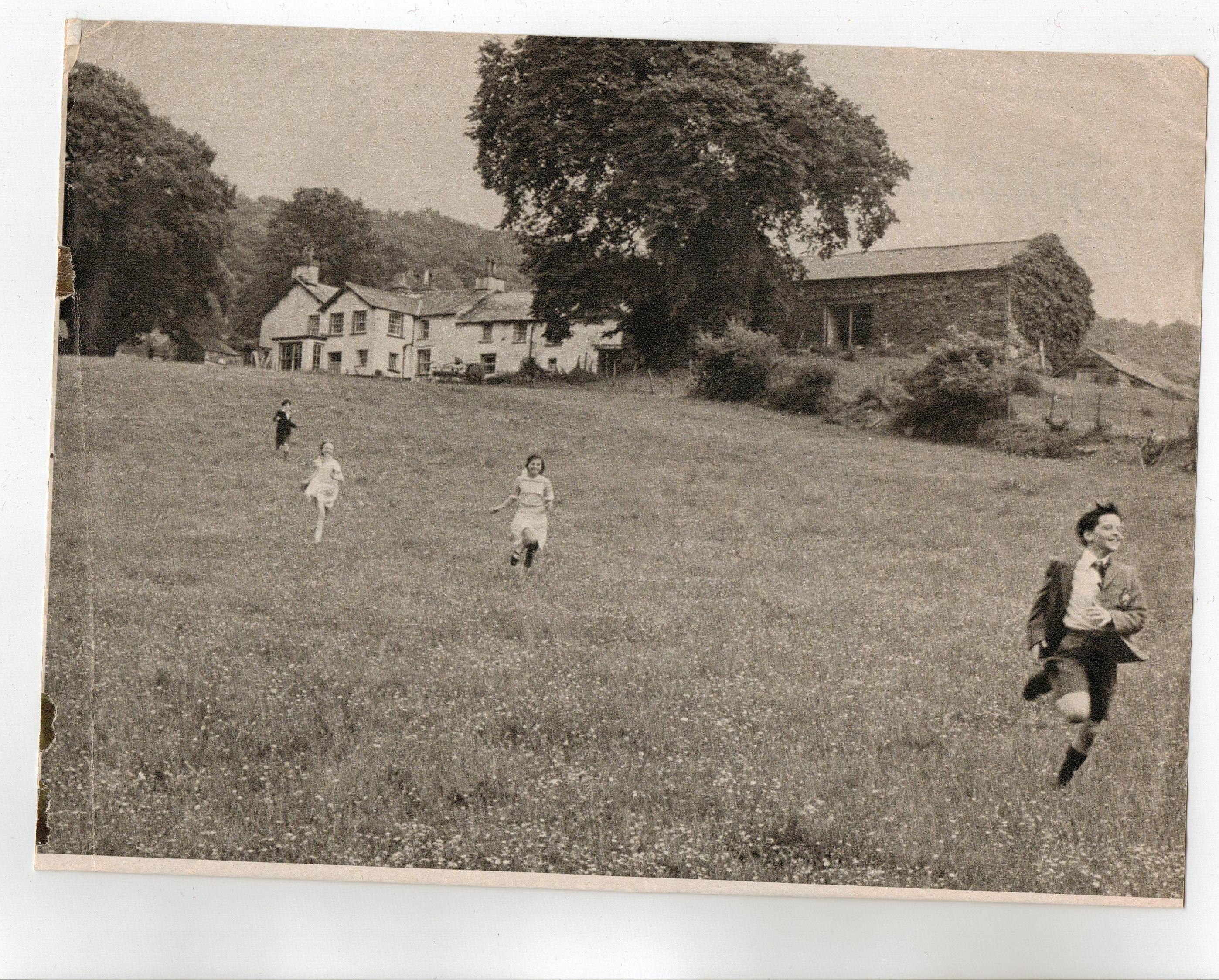
Bank Ground Farm in the Lake District

I first met Mrs Batty when we filmed in her home back in 1973 and returned to stay with her in 2003 when the BBC asked Suzanna Hamilton and myself if we would appear in Countryfile, which they were filming at Bank Ground Farm with Ben Fogle. It was then that she had time to show me her photo albums. What a life she led! She was very proud of having brought up seven children on the farm, “Two of my own and five that came with my husband,” she explained. “Getting them all off to school in the mornings was such hard work that my in-laws came to help on my first day.They all wanted bread and dripping for breakfast, with sugar sprinkled on top.”

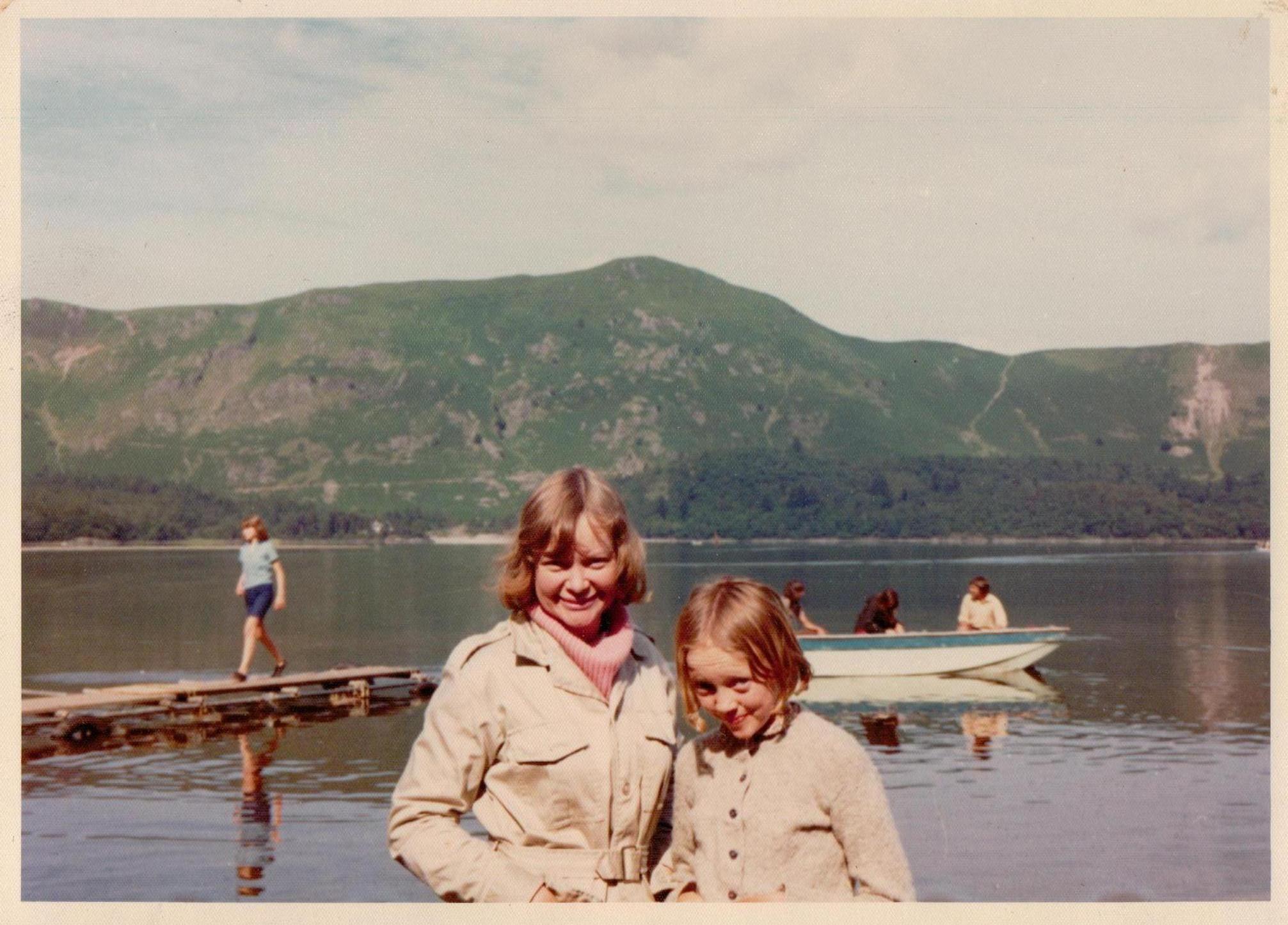
Sophie Neville with Lucy Batty at Bank Ground Farm, Westmorland in 1973 ~ photo: Daphne Neville
~ Sophie Neville with Lucy Batty  in 1973~

“A magistrate once asked me what running a B&B entailed. ‘It’s much like looking after cattle,’ I told him. ‘You bring ‘um in, feed ‘um, see they’re bedded down, turn ’em out and muck’um out.’ He flung back his head and roared with laughter.”

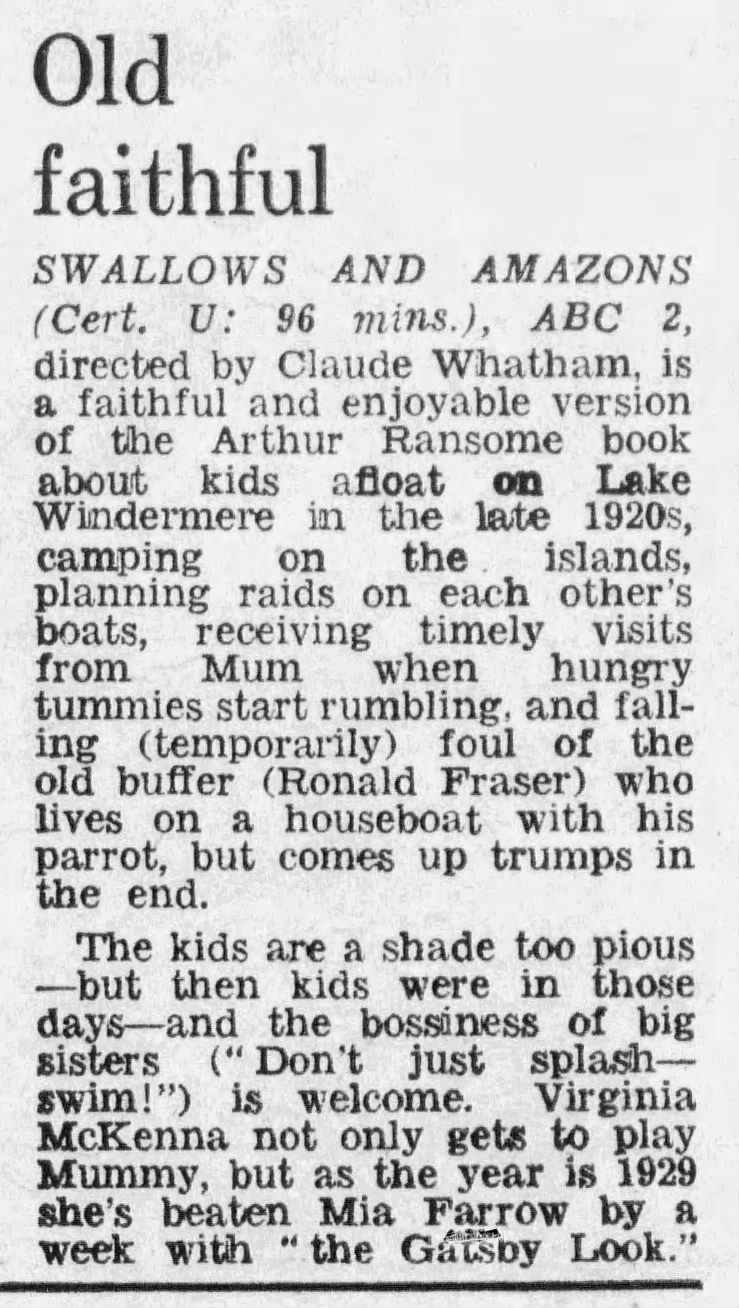
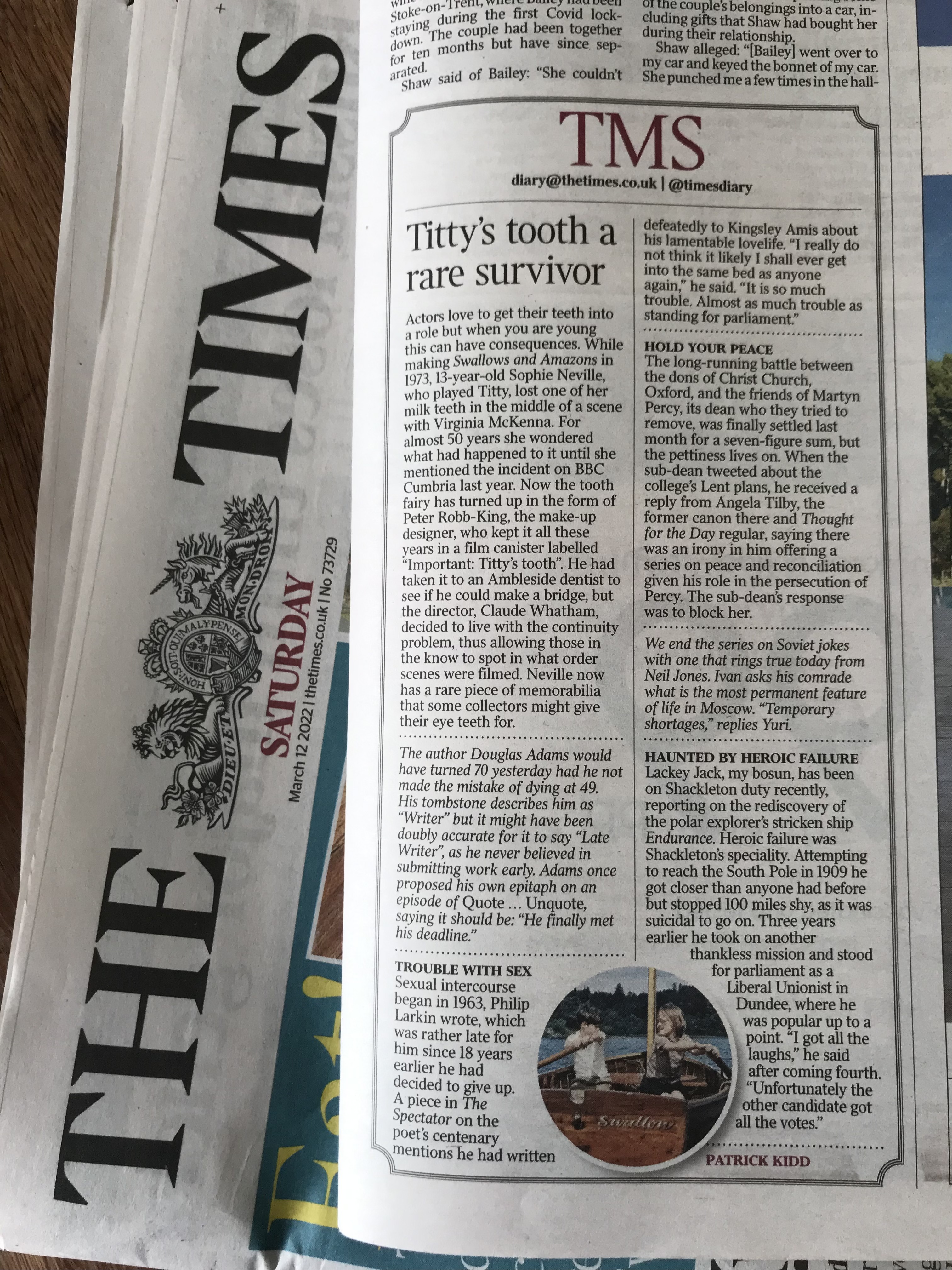
She had a great sense of humour. I have a cutting from an article in The News written by Brenda Colton and published on 25th May 1973. It reads:

‘When Mrs Lucy Batty was asked if her house could be used for the setting of the film Swallows and Amazons, with guest star Virginia McKenna, she was delighted. After all, her home, Bank Ground Farm on the east side of Coniston Water, near Brantwood, was the setting chosen by Arthur Ransome for his children’s book Swallows and Amazons.

Mrs Batty thought it a good idea that the story should be filmed in an authentic location, and she felt she should be able to put up with a few cameras and film men for a while. But she just did not realise the scale of a “medium budget” film like this one, or what the production staff could do to her house. It was not the two double-decker buses coming down the path and parking on the farm that she minded, nor the numerous vans, lorries, cars and caravans. It was not even the difficulty of having 80 men and women wandering round the farmhouse carrying equipment here, there and everywhere. But when art director Simon Holland started tearing up her lino and carpet in the kitchen to get to the bare stone floor, she did get a little annoyed. Especially when he removed all the electric sockets, lights and switches, pushed all the kitchen furniture into the larder and whitewashed the newly papered walls.

Have you seen the kitchen?” Mrs Batty said to me. “The larder is piled high with my furniture; and you would not believe the tip my lounge is in. But they are a funny lot. I asked if I could wash the beams in the kitchen for them, and they said ‘Oh no, we want them to look old.’ I have even had to hunt out a lot of old pottery from the cellar for them.

But I have given up now. I have just left them to it.”

What she never knew was that Ian Whittaker the set dresser went on to win an Oscar for set design and received Academy Nominations on three other classic movies.

The News article on Swallows

What I really did not know, until I watched the BBC documentary ‘Country Tracks’, was that Mrs Batty reached the point when she locked out the crew. She explained that when she was originally asked if we could film on her property she did not quite realise the scale of operations and only asked for – or accepted – a location fee of £75. She said that she decided that £75 was not enough, padlocked her front gate and wouldn’t let them back in until they agreed to pay her £1,000. It was a lot of money, more than double the fee I received for acting in the whole movie.

To read a little more about filming of Swallows & Amazons at Bank Ground Farm, please click here.

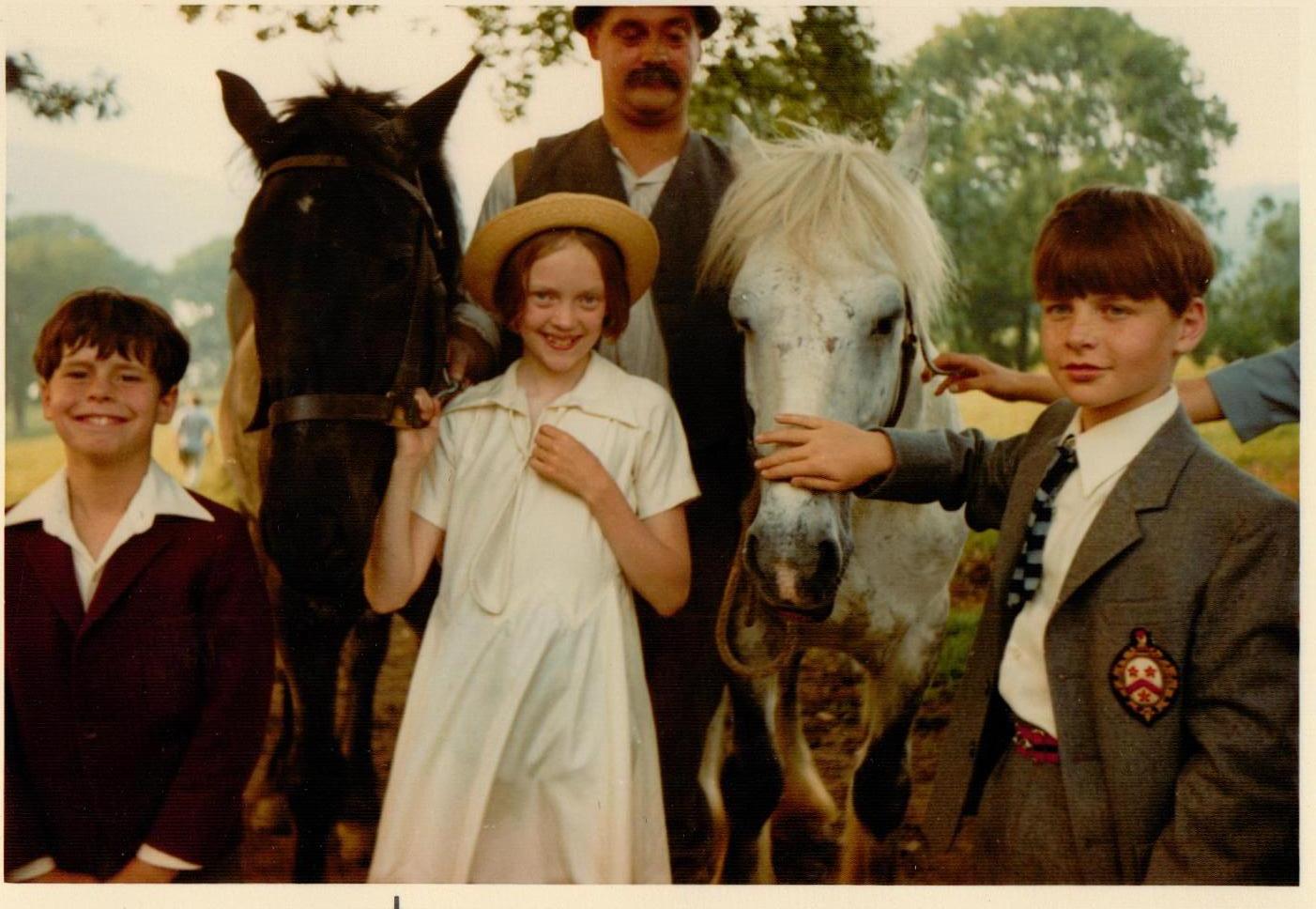
Sophie Neville holding the horses
Sten Grendon, Sophie Neville & Simon West with Mr Jackson at Holly Howe

For the amusing clip of Lucy Batty being interviewed by Ben Fogle about hosting the film company please click here and fast forward.

Bank Ground Farm the location used for Holly HoweFor Bank Ground Farm’s website please click here

I am sure many people reading this have their own memories of Mrs Batty who was such a great character. Please do add them to the Comments box below. I feel it would be a tribute to all the hard work and love she put into making Bank Ground available over the decades for so many to enjoy.

Stephen Grendon, Simon West, Virginia McKenna, Suzanna Hamilton and Sophie Neville, trying not to look as tall as she was in 1973 ~ photo: Daphne Neville
The farmhouse as Holly Howe in 1973

You can read more about the adventures we had making the original film Swallows and Amazons here:

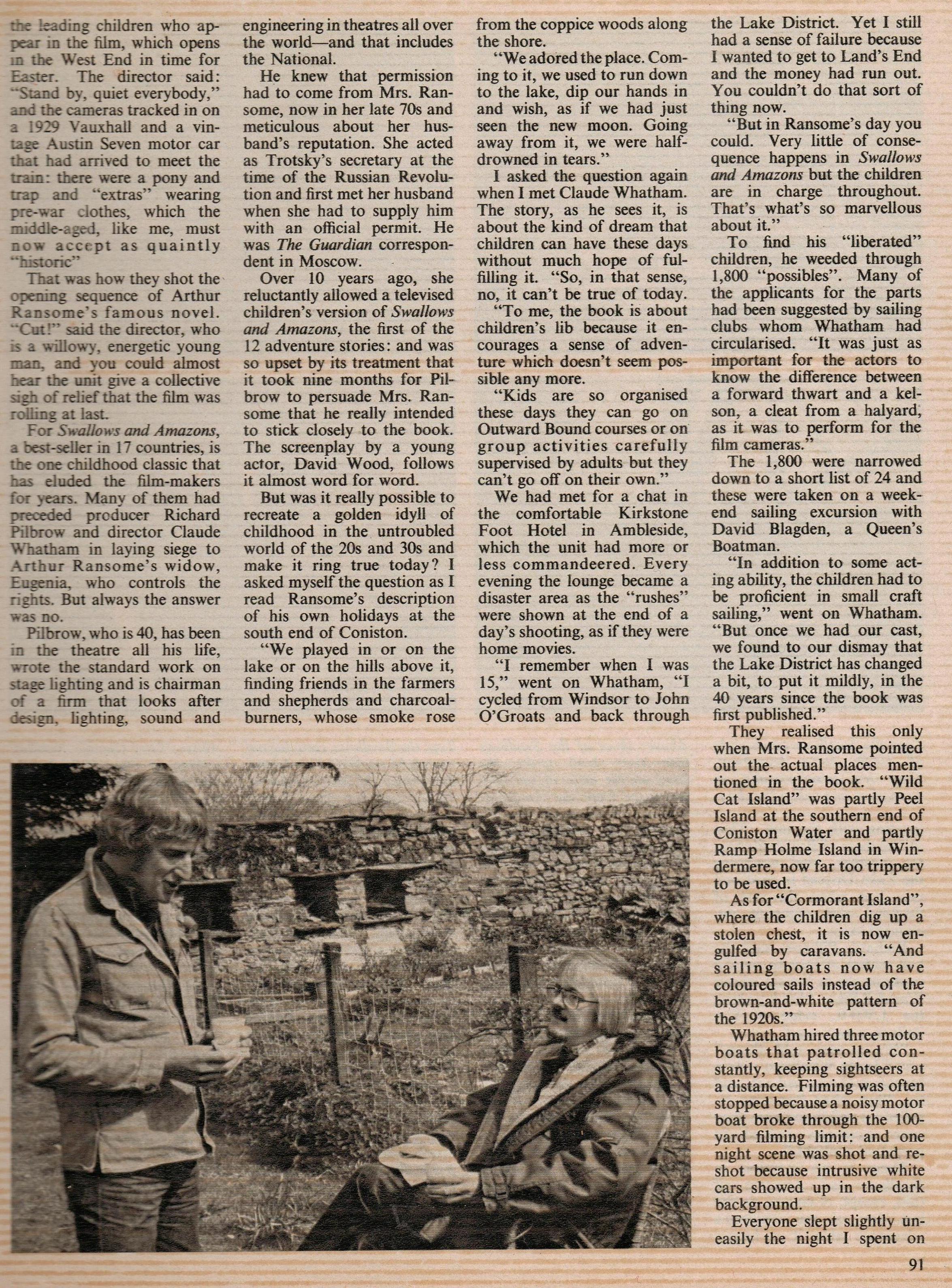
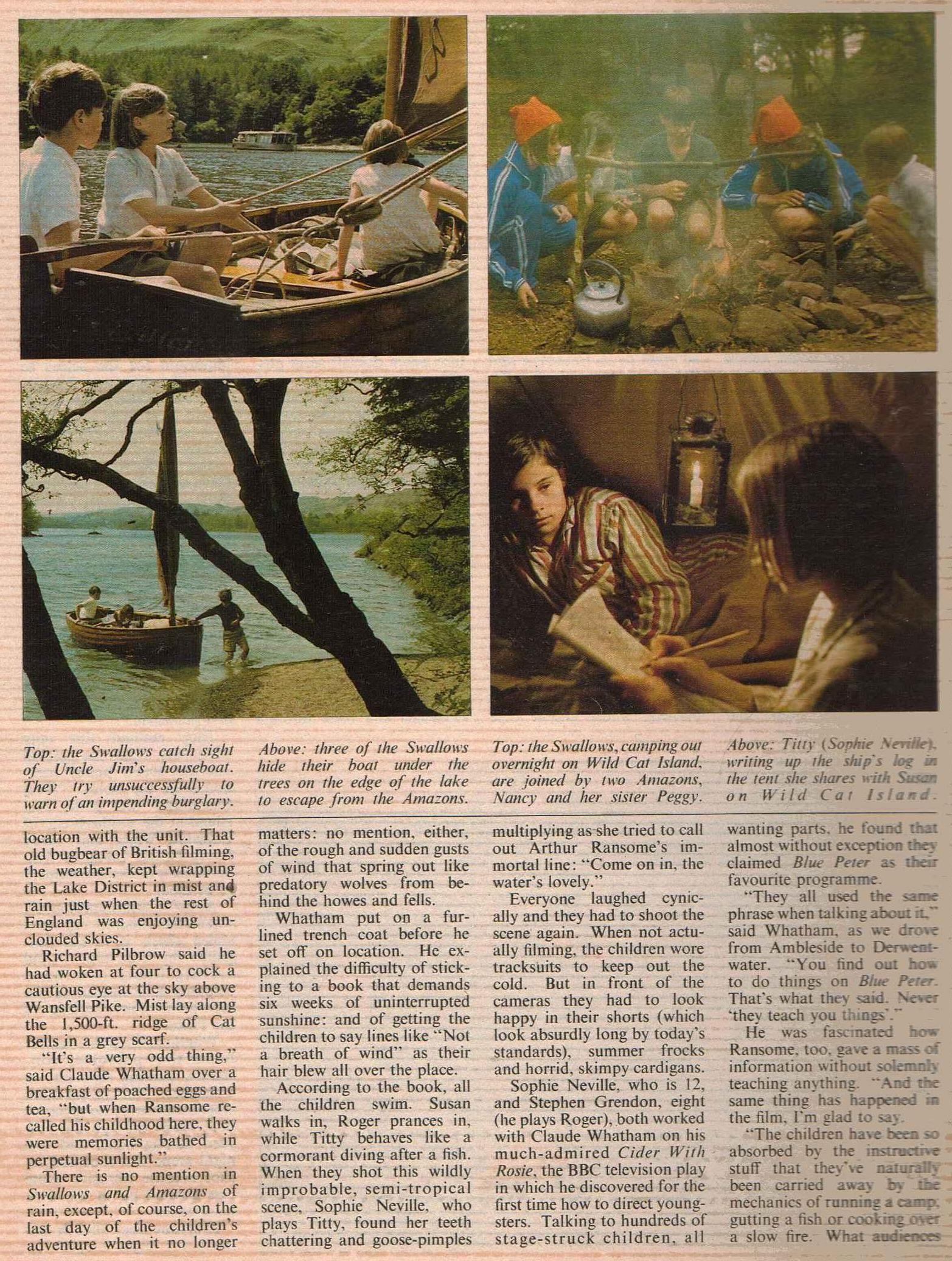
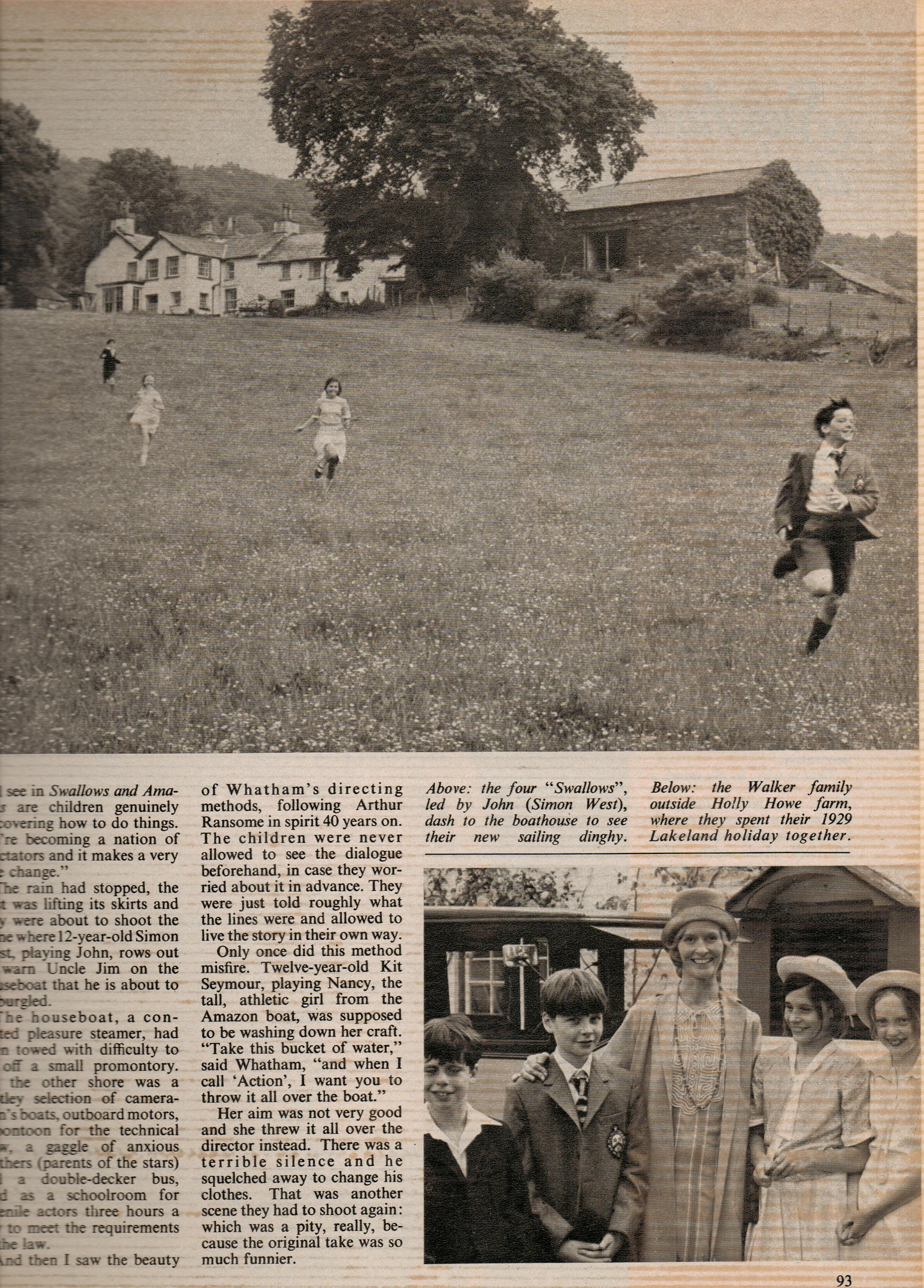
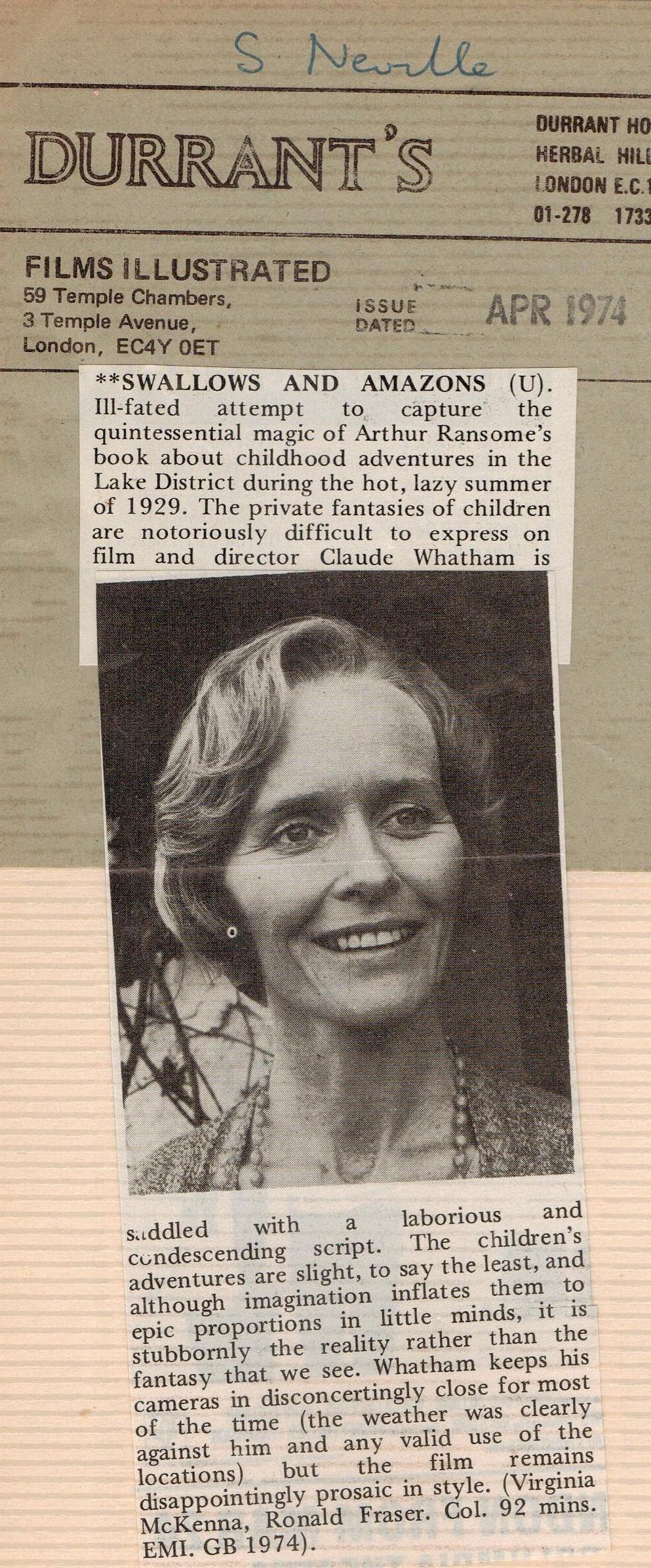
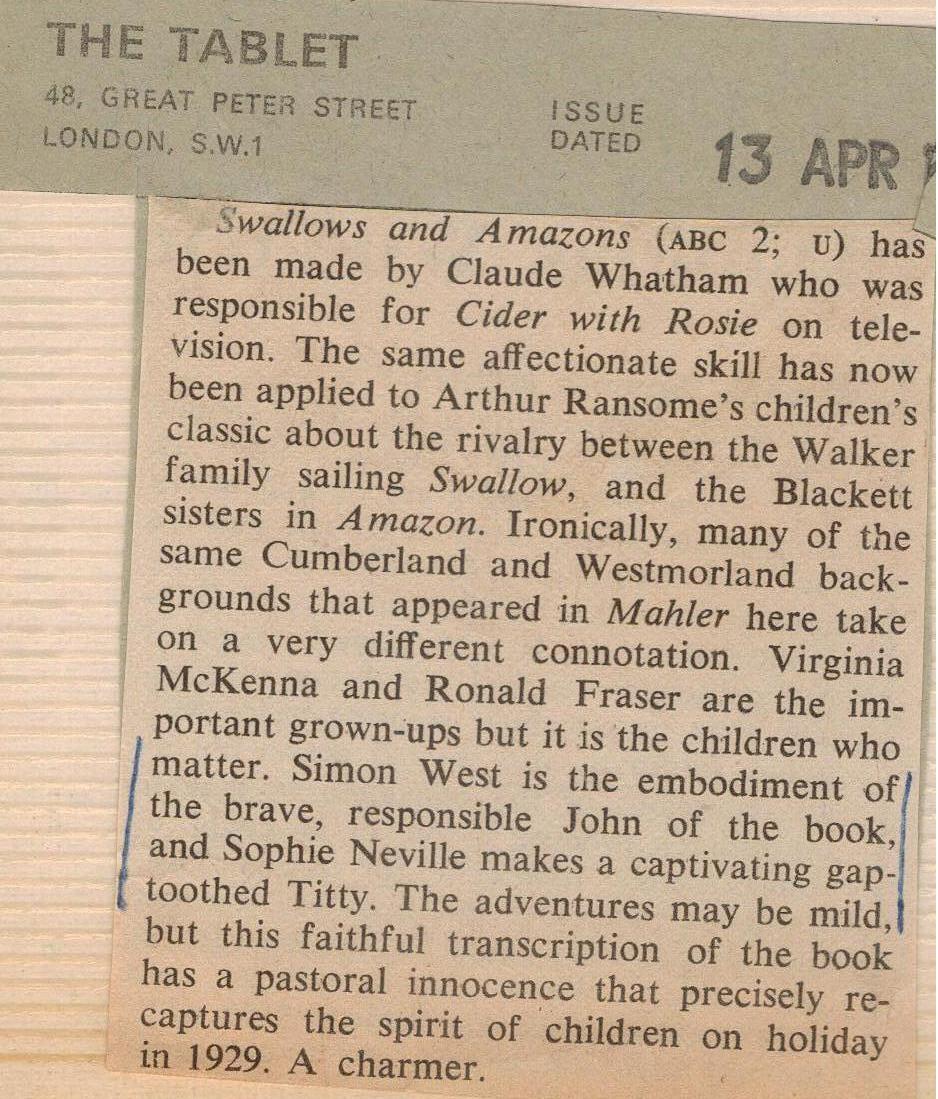
Magazine articles written about ‘Swallows and Amazons’ in 1974

Kit Seymour, Stephen Grendon, Sophie Neville, Lesley Bennett, Virginia McKenna, Simon West Suzanna Hamilton and the station master of the Haverthwaite Steam Railway in Westmorland, appearing in the April edition of Homes and Garden 1974

Newspapers are read one day and on the kitchen floor the next. Back in 1974 they might have been used to wrap up fish and chips. Either way, an article in the ‘paper is soon forgotten. Not so a feature in a magazine. They tend to hang around in hotel foyers and doctor’s surgeries for waiting to have their pages turned for months, if not years.  The judgement they cast on our movie was important.

Director Claude Whatham and Producer Richard Pilbrow on location in the summer of 1973 in the Lake District

To my surprise I found an article about how we spent the summer of 1973 in ‘Homes and Garden’ magazine.

Photographs featuring Simon West, Suzanna Hamilton, Sophie Neville, Stephen Grendon, Lesley Bennett and Kit Seymour in the EMI film of ‘Swallows and Amazons’.

What amazed me was that the black and white photographs taken on the film set had been colour tinted. Please forgive my scanning – the pages were stuck in albums long ago and the  images blur at the edge.

Stephen Grendon, Simon West, Virginia McKenna, Suzanna Hamilton and Sophie Neville on location at Bank Ground Farm in Cumbria

Surely she was the journalist also known by her married name of Elspeth Huxley, the author who had written The Flame Trees of Thika and so many other books?  She wasn’t quite right in saying the film was shot entirely on location in the Lake District, but still. She was not to know about our day at Runnymede.

Simon West, Sophie Neville and Suzanna Hamilton appearing in The Tatler
Virginia McKenna in an article in Films Illustrated, April 1974

We were in both Punch and The Sunday People. My mother saved them all, scratching lines alongside the paragraphs in which I was mentioned.

and The Tablet.

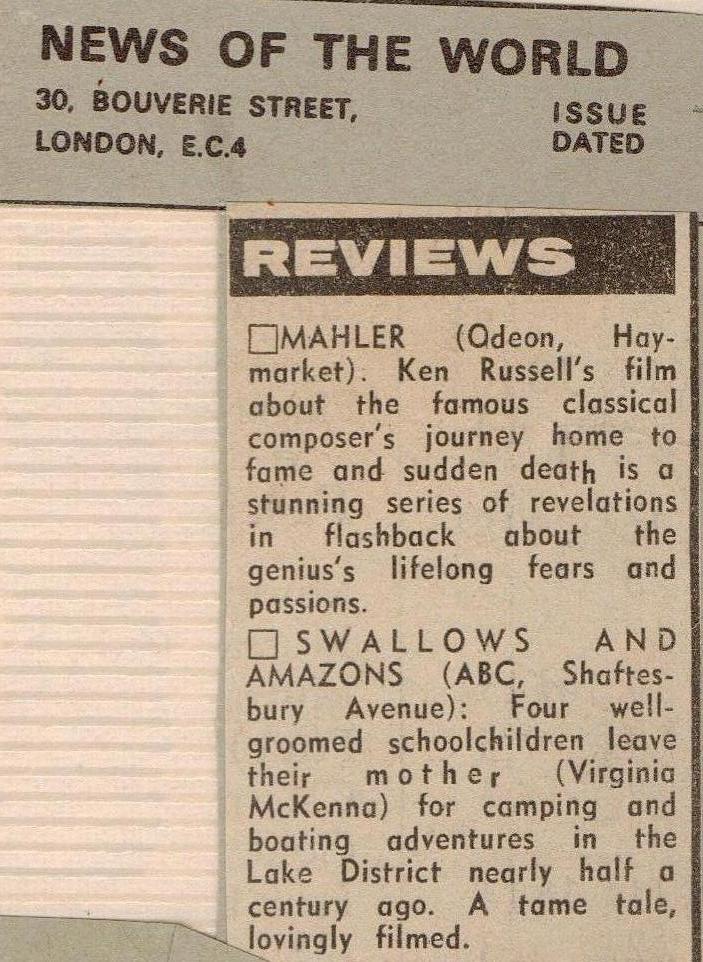
What’s On and the News of the World:

Kit Seymour and Lesley Bennett sailing Amazon on Derwentwater

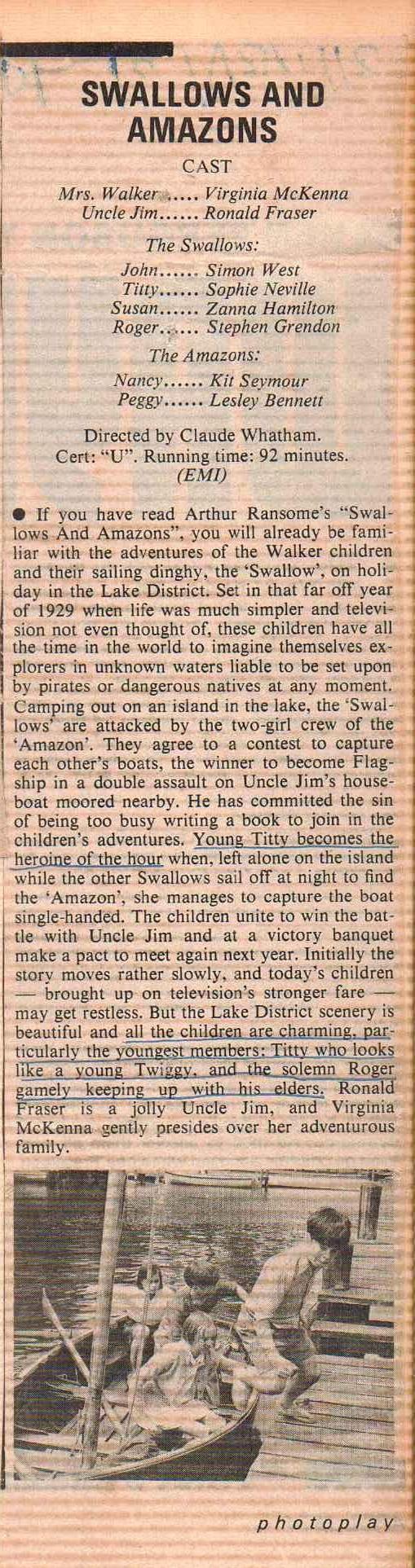
The April addition of the film fan magazine Photoplay, which featured Steve McQueen on the cover. It cost 20p in those days.

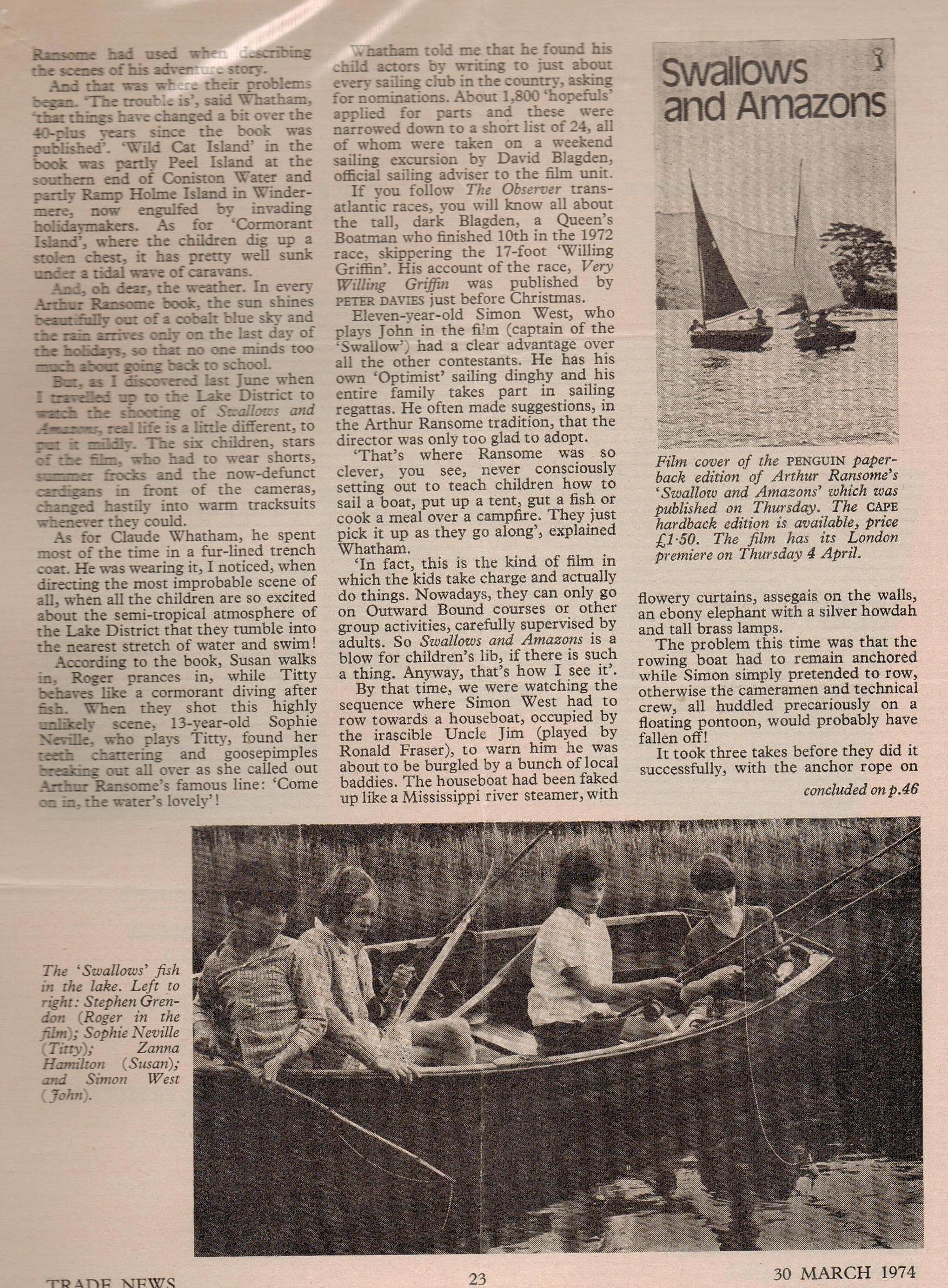
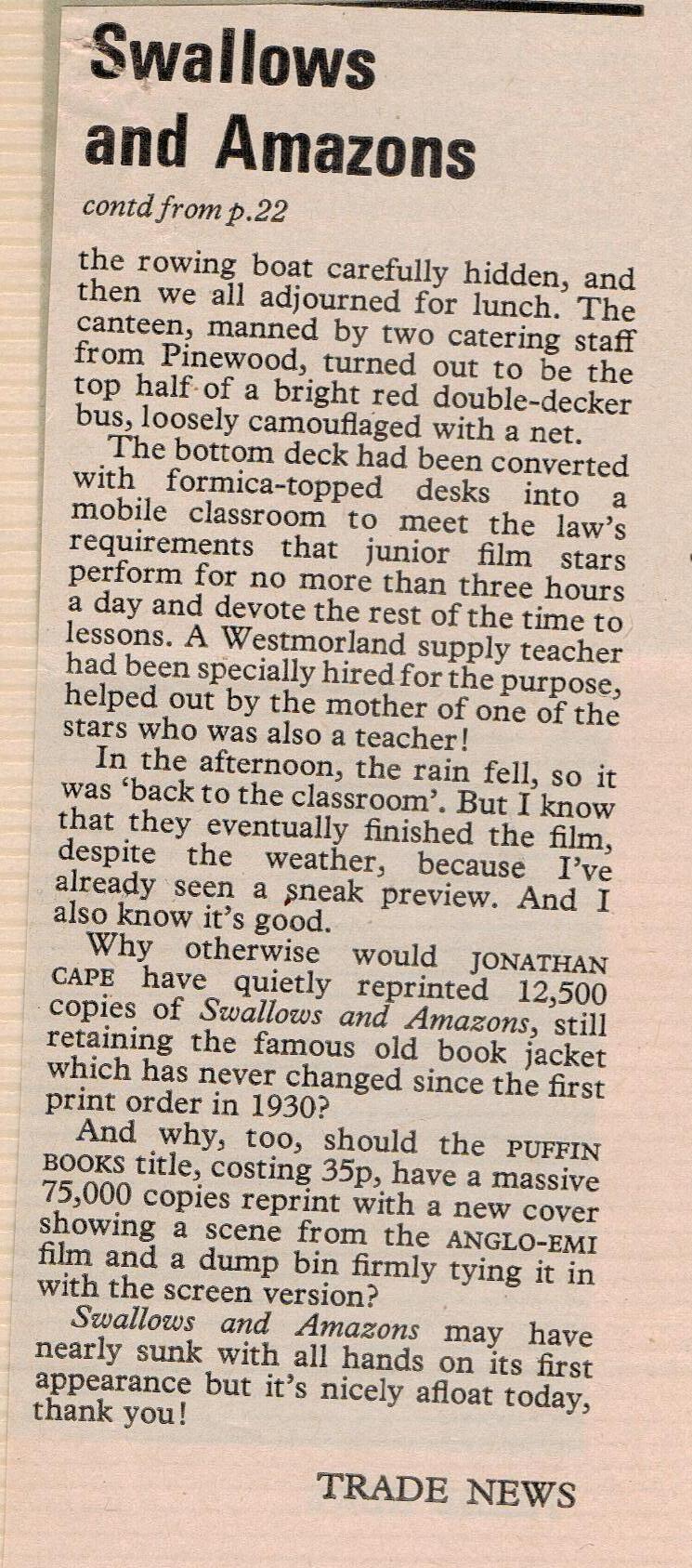
and a publishing magazine I hadn’t heard of called Smith’s Trade News ~

Virginia McKenna eating a banana with Claude Whatham outside the catering bus with quite a good photo of Swallow wired to the camera pontoon

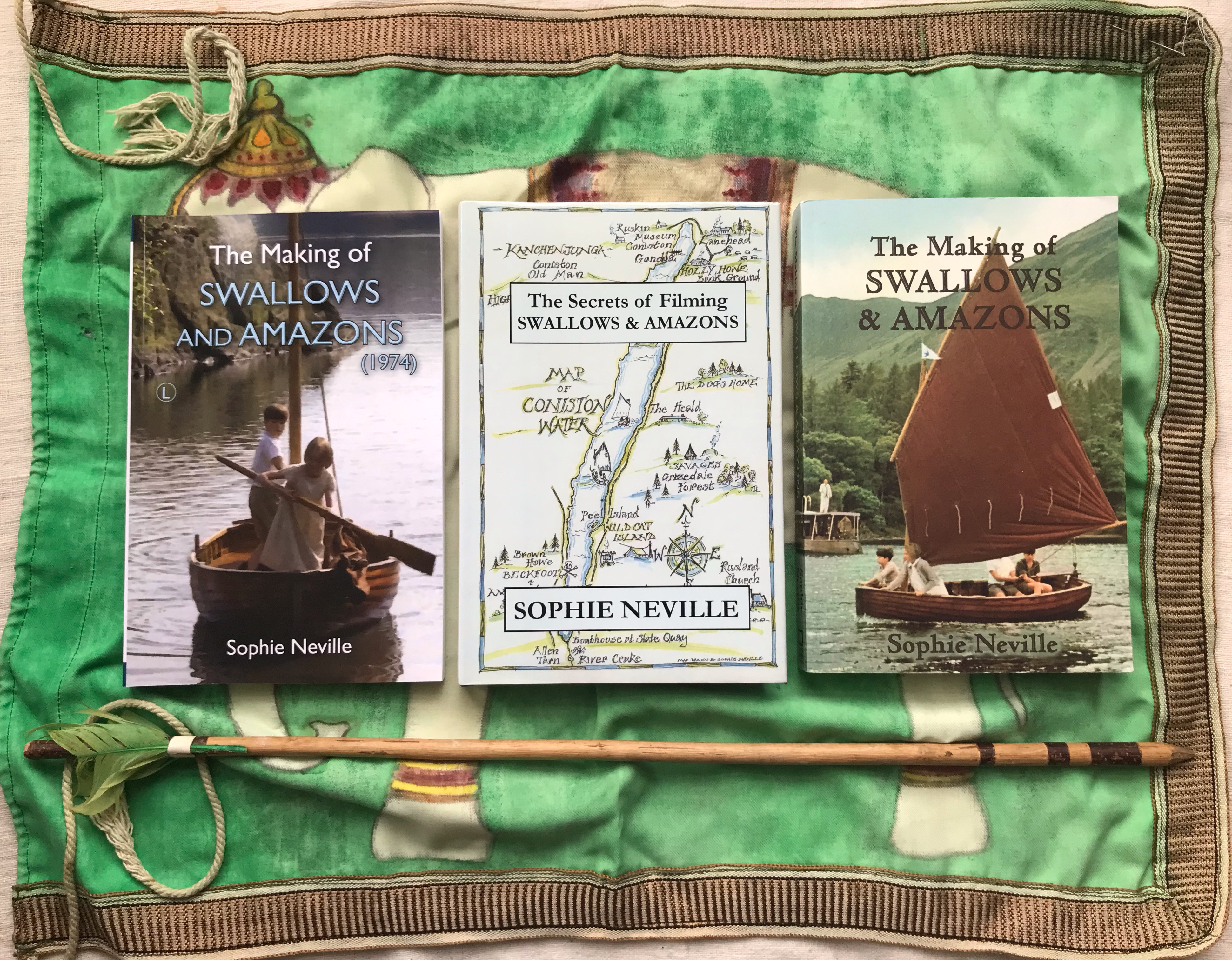
The true story is told in ‘The Making of Swallows and Amazons’ available online in different formats including an audiobook.

'The Making of Swallows and Amazons (1974) by Sophie Neville'
Different editions of ‘The Making of Swallows and Amazons (1974) by Sophie Neville’

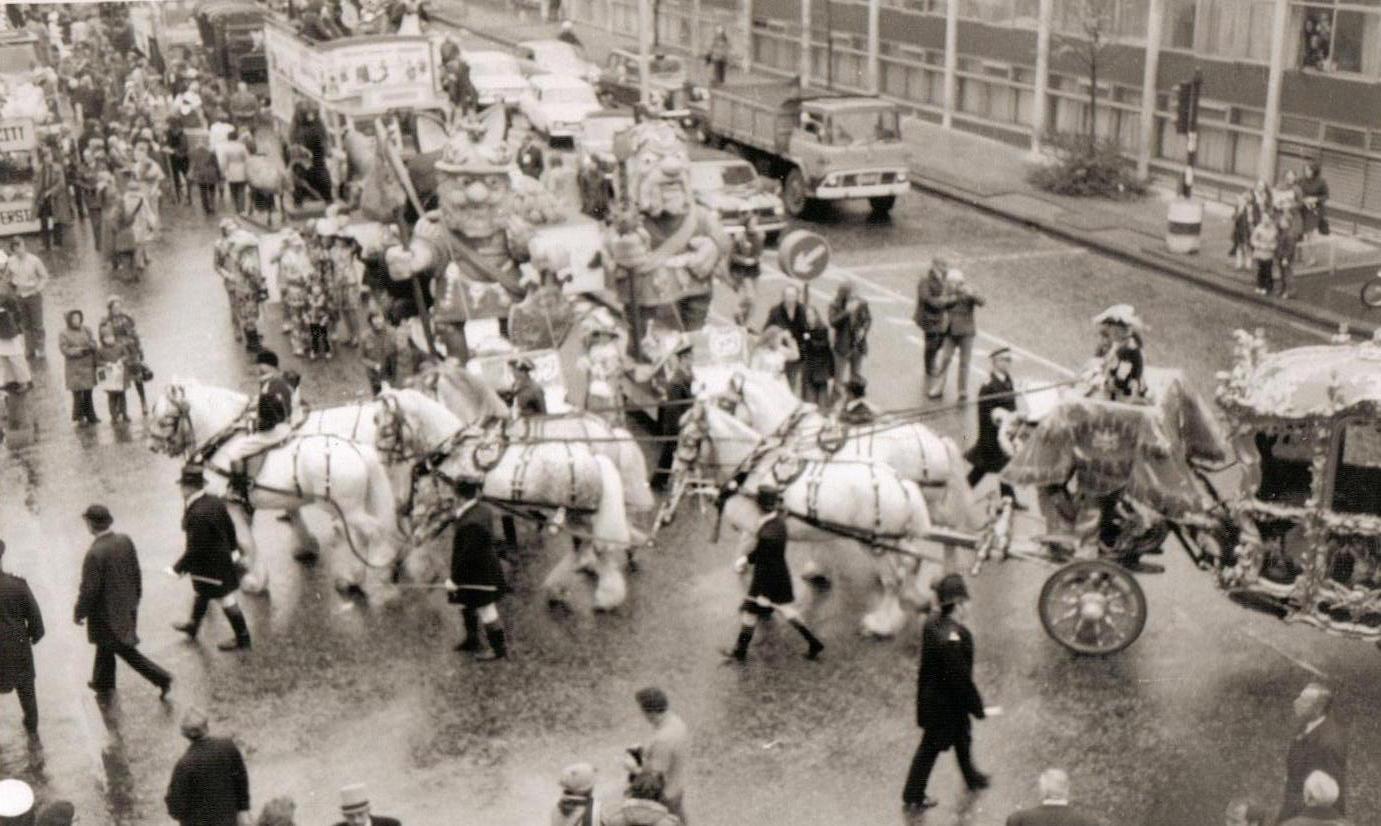
Promoting the original film of ‘Swallows and Amazons'(1974) at the Lord Mayor’s Show fifty years ago.

Suzanna Hamilton, Stephen Grendon, Leslie Bennett, Simon West and Kit Seymour sailing the streets of London in 'Swallow'
Suzanna Hamilton, Stephen Grendon, Leslie Bennett, Simon West and Kit Seymour sailing the streets of London on polystyrene waves.

Our first major public appearance for the promotion of ‘Swallows and Amazons’ was The Lord Mayor’s Show . For the first time since the filming we climbed into our costumes and then into Swallow who had been mounted on low-loader.  Afloat on a float, we made ready to sail through the City of London.

Sophie Neville, Suzanna Hamilton and Lesley Bennett

It must have been early November and was so very cold before we set off that we needed to keep our own coats on. We were anxious this would spoil things for people. I’m sure it would not have made much difference. Did anyone know who we were?  The film hadn’t come out. We were riding on the wave that Arthur Ransome and his books were so well loved by the people of our nation.

Stephen Grendon, Suzanna Hamilton, Lesley Bennett, Simon West, Kit Seymour and Sophie Neville in Swallow. What is the building behind us?

What was fun, if a little odd, was that it was the first time, indeed the only time, that the Swallows and the Amazons had been in a dinghy together. As we were taken through the streets of London passers-by started to wave at us and we waved back. Soon it was waves all round. Being Titty, I had Swallow’s flag to fly. John let Nancy take the tiller.

Kit Seymour, Sophie Neville, Simon West and Suzanna Hamilton together with huge crowds of Londoners ~ photo: Daphne Neville

We were amazed to find huge crowds of people had gathered and that it was all rather fun. I don’t know why but Sten must have joined my mother on the pavement by the time this shot was taken. I can see the back of his head in this next photograph. He is wearing the tartan hat Claude Whatham bought him at Blackpool fun-fair.

Jeremy Fisher Frog was leaping about in front of us, which was rather amazing. With him danced other representatives from the Tales of Beatrix Potter, The Royal Ballet’s wonderful feature film that also came out in 1973/4.  We were marking the 35th anniversary of EMI, whilst bringing the Lake District to London Town, which is something we all could celebrate.

Tamzin Neville meeting Mrs Tittlemouse

Since we didn’t have to talk to anyone, we were able to enjoy being involved in the pageant, which included so many icons of British Life.

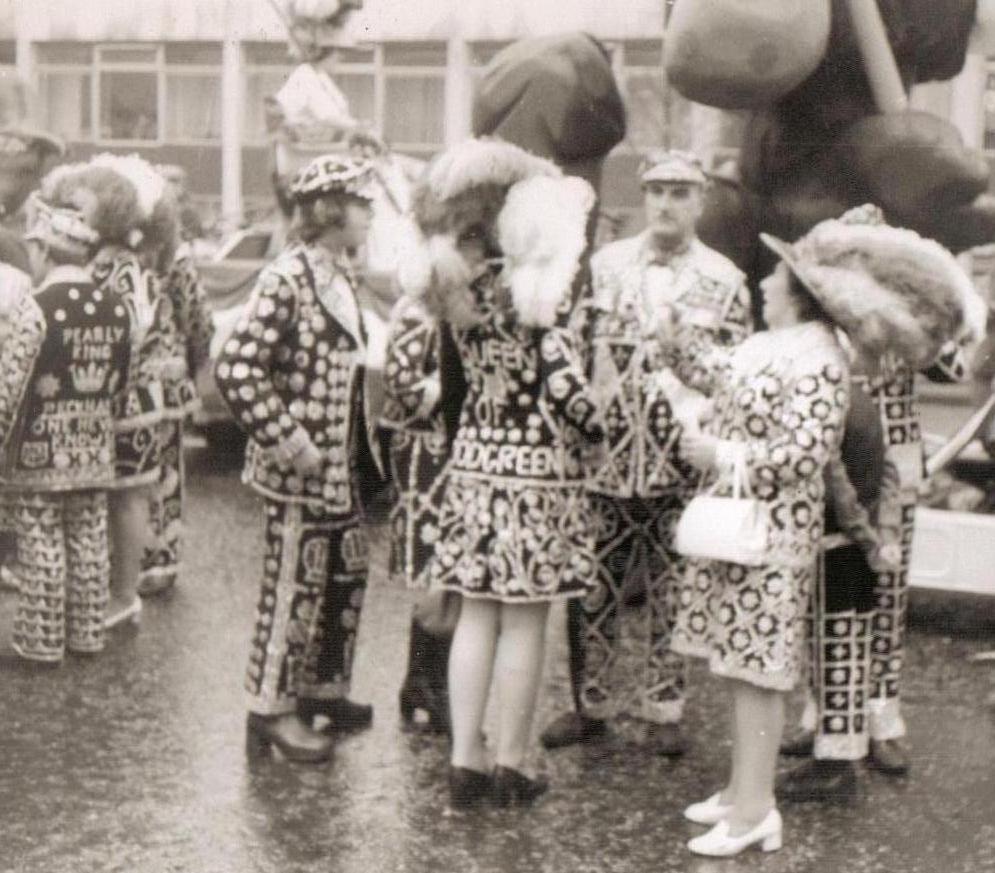
I hadn’t met a Pearly Queen before, but there was a whole clan of them in their glorious suits, lovingly embroidered with mother of pearl buttons. I resolved to collect enough to adorn my own jacket. My favorite view was of HM the Queen’s gold state coach pulled by her lovely white horses, six in hand. I’d been to see them at the Royal Mews when we came up for my first interview at Theatre Projects offices in Longacre when I first met our director Claude Whatham.

My mother took a photograph of the Queen’s Drum Horse. Much later she found that he was a stallion, on offer as part of a British Horse Society breeding improvement scheme. He was brought over to service her Irish mare Gerty. The result was a lanky skewbald called Nimrod, an enormous gelding who Andrew Parker Bowles rejected on behalf of the British Army. This proved an error. Like most heavy horses Nimrod was just slow to grow. He eventually became a national dressage champion, although not in our hands.

The Queen’s drum horse who sired our foal, Nimrod

We have one last photograph which shows that the float in front of us depicted an EMI film crew, with 2K lights, a camera and technicians. It is studing this photograph that made  me feel that we were not in Swallow as the transom seems so differnet. I don’t suppose anyone else noticed.

Funnily enough I was in a boat for the Lord Mayor’s Show this year.  We rowed up the Thames in the Lord Mayor’s procession on Saturday 12th November.

I am on the crew of the Drapers’ Barge, Royal Thamesis a 33  foot shallop, which I last rowed on the tideway for the re-creation of Nelson’s funeral covered by Sky TV. You may have seen her taking part as the in the Queen’s Jubilee Pageants. We have been asked to take part in the procession of boats that heralds the Lord Mayor’s Show this coming November.

Sophie Neville rowing The Drapers Barge
The Drapers’ Barge ‘Royal Thamesis’ taking part in the Lord Mayor’s Show

This colour footage shows various aspects of the Lord Mayor’s procession in 1973 including the Queen’s Gold State Coach built in 1762 and a float with Daleks, which must represent Doctor Who, a series I worked on about ten years later when at the BBC.

Leaving the Lake District after spending 50 days filming ‘Swallows and Amazons’~ 13th July 1973

Daphne Neville with Sophie Neville while filming 'Swallows and Amazons' in Cumbria

 It was time to say goodbye. We’d had the most wonderful seven weeks filming on the Lakes but the end had drawn in with the clouds. It was time to go home.

Since we lived in Gloucestershire it was a long drive south. I’m not sure how Jane and Sten Grendon got back, as I don’t think Jane drove, but we must have dropped off some of their things on our way past their village.

I remember seeing my real sisters and walking around the garden in the afternoon sunshine, looking at all that had changed. We’d left in early May, now it was full summer and the school holidays. I don’t know how I had the energy left to write up my diary.

Sophie Neville in 1973, in the garden at home with a swan
Back in the garden at home with a swan

‘Shall we go and put flowers on Luppy’s grave?’ Perry asked. I hadn’t heard that our dear old dog, the sheep dog I had known all my life, had died while we were away. I was inconsolable. Mum explained that they hadn’t wanted to tell me when it happened as we were filming, she thought that the sadness on my face would have come through on camera. I understood this but was still desolate. Having had to cope with the grief of losing Luppy, on top of the heartbreak of leaving everyone I had grown so close to in the Lake District, I was not in a good way.

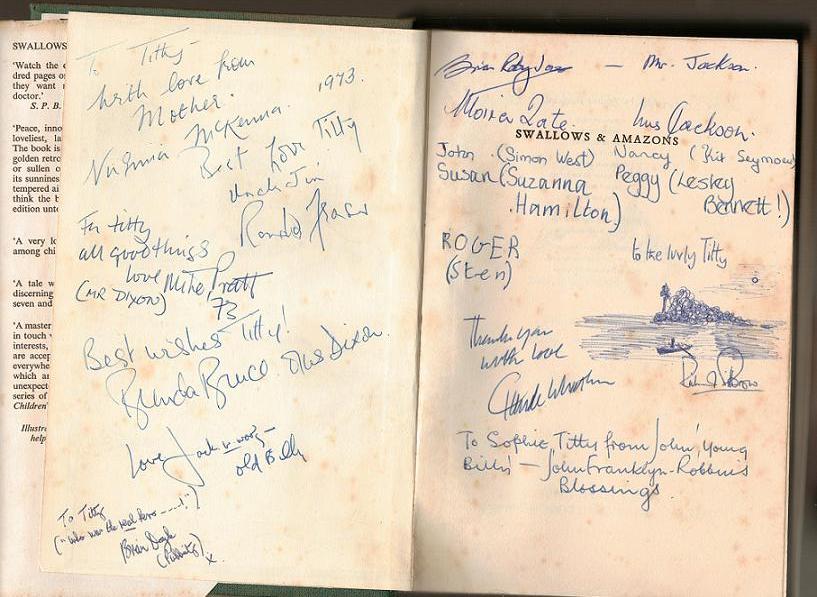
One of the most treasured things that I had returned with – apart from the lump of Cumbrian slate Jean McGill had given me – was a hard-back copy of ‘Swallows and Amazons’ signed by the entire cast and crew.

Signatures of the cast, director and producer of the movie 'Swallows and Amazons' in my hardback copy of Arthur Ransome's book
Signatures of the cast, director and producer of the movie ‘Swallows and Amazons’ in my hardback copy of Arthur Ransome’s book

Here you can see inscriptions from Virginia McKenna who had played my mother and Ronald Fraser who obviously saw himself as Uncle Jim rather than Captain Flint.

Virginia McKenna as Mother in Swallows and Amazons 1

Mike Pratt and Brenda Bruce who appeared as Mr and Mrs Dixon, Jack Wolgar and John Franklyn-Robbins who embodied the Charcoal Burners with Brian Robylas (sp?) and Moria Late who played Mr and Mrs Jackson.

Sophie Neville holding the horses
Stephen Grendon, Sophie Neville and Simon West with Brian Robylas ~ photo: Daphne Neville

It is interesting that all the children signed their character names with their real names in brackets. We must have grown to associate ourselves more with the characters names than with our own.

Claude Whatham in 1973

Claude Whatham wrote, with thanks, and Richard Pilbrow enchanted me by drawing a picture of Wild Cat Island at night.

Daphne Neville with Richard Pilbrow1
Molly and Richard Pilbrow in 1973

Sadly, we didn’t manage to nab everyone on the crew, but collected a few signatures.

Brian Doyle, the publicity manager on 'Swallows and Amazons'
Brian Doyle, the film publicist on ‘Swallows and Amazons’ (1974)

The only other signature on this page is from Brian Doyle, Mum’s friend the publicity manager on the movie who encouraged us to collect the autographs.

Signatures of the rest of the cast and crew of 'Swallows and Amazons' in the back of my Jonathan Cape edition of Arthur Ransome's book
Signatures of the rest of the cast and crew of ‘Swallows and Amazons’ in the back of my Jonathan Cape edition of Arthur Ransome’s book

At the back of the book David Blagden, who played Sammy the Policeman as well as overseeing the sailing.

David Blagden who played Sammy the Policeman
David Blagden who played Sammy the Policeman ~ photo: Daphne Neville

David drew me a picture of what must be a vision of himself, sailing into the sunset in his little yacht Willing Griffin that had taken him across the Atlantic.

David Blagden's signature and sketch

Phyllis B was my tapestry-making stand-in. Simon Holland our art director (set designer) drew me a wonderful set of crossed flags that were also paint brushes ~ a logo for my life.

Art Director Simon Holland
Art Director Simon Holland at Bank Ground Farm in 1973 ~ photo: Daphne Neville

I have a signature from Kerry Darbishire (I thought she’d written Dartisnine) who played Bridget’s Nurse, our Fair Spanish Lady. Like the actors who played the Jacksons, she was not credited on the movie but played a significant part. She still lives in Cumbria.

Nurse with Baby Vicky, the ship's baby
Nurse with Baby Vicky, the ship’s baby at Holly Howe

We left Jean McGill, our driver and unit nurse, in Bowness-on-Windermere.

Jean with sophie
Jean our driver and location nurse operating the radio with Sophie Neville ~ photo:Martin Neville

Eddie Collins was the camera operator,  Ronnie Cogan our hairdresser, Joni Turner was a local lady who worked on a few days as Suzanna’s stand-in.

Sophie with Martin Evans the Gaffer and Terry Smith the wardrobe master
Talking to Martin Evans the Gaffer and Terry Smith the wardrobe master while leaning on a lighting stand at Bowness-on-Windermere

Terry Smith was the wardrobe master, Albert Stills is Albert Clarke who took the black and white photographs day after day. Terry Needham was our long-suffering second assistant director.

Sophie Neville with Terry Needham in 1973
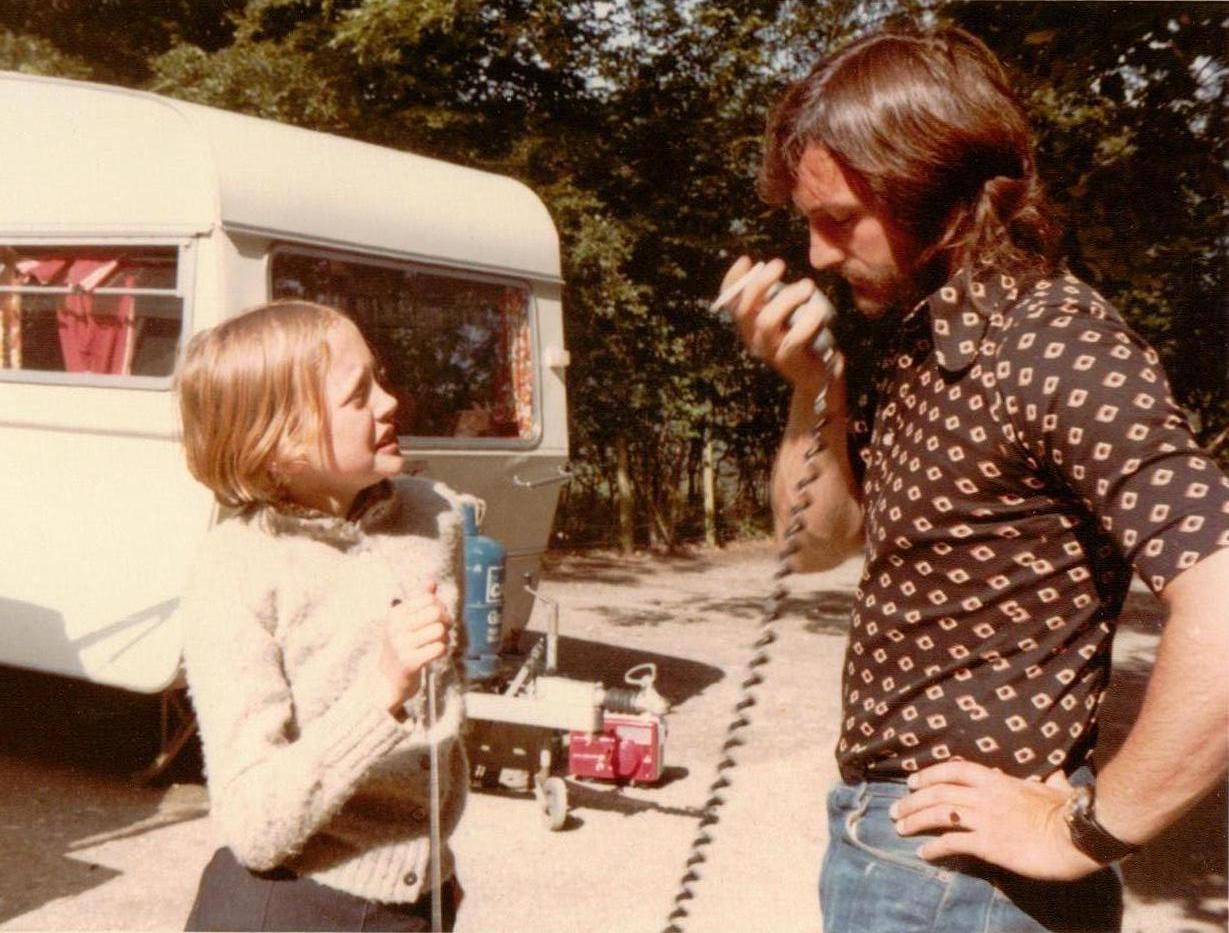
Sophie Neville with Terry Needham and the unit radio at Derwentwater ~ photo: Daphne Neville

On the last page I have a very classy signature from Robert – who I think was one of the Keswick boatmen looking after the Lady Derwentwater.

A boatman working on Derwent Water in 1973
Our boatman and the houseboat in 1973 ~ photo Daphne Neville

Denis Lewiston the DoP also left his mark on my life.

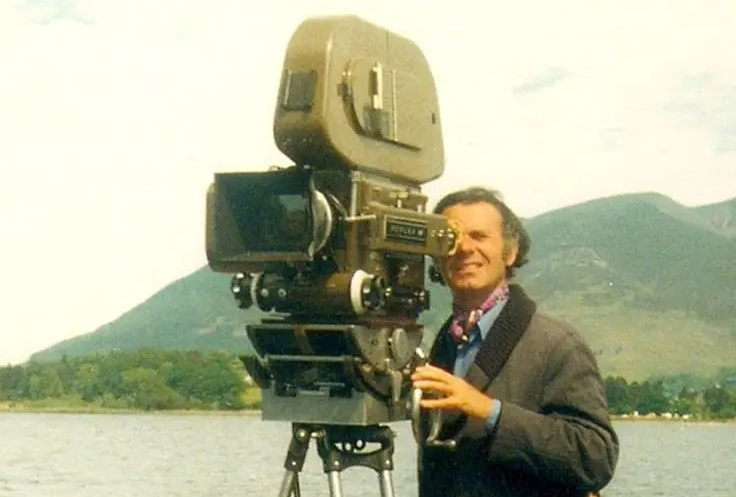
Dennis Lewiston, director of Photography on 'Swallows and Amazons' ~photo:Richard Pilbrow
Dennis Lewiston, director of Photography on ‘Swallows and Amazons’ ~photo:Richard Pilbrow

Peter Robb-King signed himself ‘Make-up for the Stars’ and Gareth Tandy as ‘The Whip-cracker’, which surprised me as I had never seen his whip. Graham Ford obviously didn’t want me to change and Margaret Causey, our tutor, sent her love. We’d been though so much together and in such confined spaces.

The film crew set up in Rio Bay
Swallow and the film crew setting up at Bowness-on-Windermere ~ photo: Richard Pilbrow

Interestingly, I also have an inscription from Ian Fuller the sound editor listed as if he was around on location. I am sure he was the chap I would have met next. Claude and Richard would have gone straight down to the cutting rooms to edit the film. It is not usual for actors to enter such territory but our adventure was to continue. We were soon to be summons to the Elstree Studios of EMI at Borehamwood in Hertfordshire, just off the A1.

The crew as I remember them filming with Swallow and Amazon from the pontoon ~ photo: Richard Pilbrow
The crew as I remember them filming with Swallow and Amazon from the pontoon ~ photo: Richard Pilbrow taken on Derwentwater in 1973

You can read more in the ebook ‘The secrets of filming Swallows and Amazons’ or paperback entitled ‘The Making of Swallows and Amazons’ available from all online retailers.

The Making of Swallows and Amazons by Sophie Neville
Different editions of ‘The Making of Swallows and Amazons’ by Sophie Neville

Filming Swallows and Amazons on 24th June 1973 with Ronald Fraser and the Houseboat on Derwentwater

Ronald Fraser being transported to the Houseboat

Ronald Fraser with Wardrobe Master Terry Smith being transported to the Houseboat played by The Lady Derwentwater

Ronald Fraser being transported to the Houseboat on Derwentwater on 24th June 1973
Ronald Fraser being transported to the Houseboat with Terry Smith

My diary entry for 24th June 1973 is not exactly revealing. As it was raining steadily in the Lake District, I was given a second day off. ‘We had a quirte (sic) morning,’ I wrote. I am sure I needed one. After a heavy week’s filming I’d spent the official ‘Unit Day Off’ writing five end-of-year exam papers, answering correspondence from school friends and going to Kit Seymour’s thirteenth Birthday party. I must have been exhausted. Legally children are meant to have two days off a week while filming. This was the first time it had been possible.

24th June ~ my diary

Suzanna Hamilton’s diary adds little more, but my mother was on set, as was a journalist from The Guardian, so I can tell you what happened. I can even tell you what the location caterers from Pinewood cooked that day: Melon, followed by roast beef with Yorkshire pudding, boiled or roast potatoes, peas and carrots with apple crumble or tinned peaches served with custard or evaporated milk. It was a Sunday. Suzanna noted that we had ‘salad for super’, her favorite food.

Set dresser Ian Whittaker, Ronald Fraser and one of the Prop Men on the houseboat ~ photo: Daphne Neville

“The houseboat has been converted from a pleasure steamer,” wrote Michael McNay in the Features section of The Guardian, “the whole of the superstructure fore faked up by props, the cabin aft converted into a retired colonist’s sittingroom – African rug, flowery curtains, assegais on the walls, an ebony elephant with silver howdah and trappings, a walnut wireless cabinet, tall brass oil lamps, a pile of 78rpm records, a silver mounted cricket ball (presented to G.Gumbleton, 1899, for the highest individual score of the season), a chest, a writing desk and an ancient upright Imperial.” I have typed this up exactly as it was published on 7th July 1973.

By props, I don’t think Michael McNay meant pit-props. He was talking about the work of the design team headed by Simon Holland. Ian Whittaker, who later won an Oscar for set dressing, helped Simon to create Captain Flint’s cabin with one of the Prop men who is photographed here. Does anyone know his name? I think it might be Terry Wells. I expect the cane chairs and side table were being temporally stored on the roof when this snap shot was taken so as to make space for camera and lights. The gaffer and camera crew would have been in the process of setting up inside the cabin. Sound would not have settled in yet. How do I know that after all these years? I can see the recordist’s arm at the left of the photograph. I still remember his coat.

“Ronald Fraser, alias Uncle Jim, is tapping away at a book.” Michael continues. “Last minute panic: who can type out quickly a folio of copy to leave nonchantly in the roller?”  That would have been Sue Merry, the continuity girl.  The first scene was probably the one in which Uncle Jim is typing with the green parrot on his shoulder when a firework goes off on his cabin roof. I wonder if Arthur Ransome had ever been disturbed by the Altounyan children in such a way. Did he use an Imperial typewriter?

The film crew were on location on Derwentwater. “By now, the houseboat has been moved and moored to the western shore just off a promontory that is being faked up as one end of Wild Cat Island.” The houseboat, really one of the stars of the movie,  was being played by a long-time resident of Cumbria, The Lady Derwentwater. A 56 foot motor launch, owned by the Keswick Launch Company since 1935, she returned to real life after the filming, rather like I did. She still carries up to 90 passengers. You can go out on her today.

Was this the houseboat Arthur Ransome had in mind?  The photograph was taken by Martin Neville in 1973

My father, who is keen on steamboats, had been off to find the real houseboat that Arthur Ransome had in mind. Am I right in thinking this must have been the original Gondola? I expect she was too un-seaworthy for the production team to contemplate using in 1973.  A reliable, water-tight boat that could be towed into the location used for Houseboat Bay was needed. Last year we went to see TSSY Esperance   at the Windermere Steamboat Museum in Cumbria, which is another Victorian steam yacht envisaged by Ransome as a possible model for Captain Flint’s houseboat. It is a beauty but we did get a better view of the lake from of the cabin windows in the Lady Derwentwater.

TSSY Esperance, the 1869 Steam Yacht, at the Windermere Steamboat Museum, Cumbria in Apirl 2011

“The rain has stopped, the mist is lifting from the 1,500 foot ridge of Cat Bells. Fraser climbs gingerly aboard, awkward in co-respondent’s brown and white shoes, rosy make-up and moves into the aft cabin.” McNay continues. He is describing the main scene to be shot that day. “John, alias Simon West, is in a rowing boat 15 feet away… The problem this time is that the rowing boat has to remain anchored but look as though Simon is pulling steadily in towards the houseboat and the anchor rope has to remain hidden.” This must have been so that Swallow could be lined up accurately and remain in focus for the camera.  It is one of the secrets of making the film that I have been asked about directly.

“Simon shows Claude Whatham how he’ll manage it. Quick rehearsal inside the cabin. Ronald Fraser on his knees by the chest folding a white pullover, catches sight of approaching boat, mimes angry surprise. Told not to jerk head so far back. Instead jerks eyebrows up. The cabin is no more than eight foot by ten and contains besides Fraser and the props, four men on a camera, one on lights, and the continuity girl.” McNay had not included Claude the director, who I know would have squeezed in since these were the days before monitors from the camera feed. And he was small. The sound recordist was bigger but may have just planted a microphone on the desk.

“On the small aft deck Pilbrow is for the next few minutes going to be redundant.” This is Richard Pilbrow, who now lives in Conneticut and I am sure will read this post. “He is a mild, inoffensive looking man producing his first film. He is 40… looks like your friendly local antiques dealer.  He and Whatham are a good team: Whatham is slight, energetic and calm. He has time, even as a sequence is being set up, to ask the Press if they can see enough of what’s going on from the crampt aft deck of the houseboat. It’s a cheerful crew, (Denis Lewiston the DOP) watching clouds overhead with benign suspicion, taking light meter readings inside and out-side the cabin every 30 seconds.

‘Stand-by Simon.’

‘Action,’ said quietly into the cabin.

‘ACTION,’ across the lake to Simon. The clapperboard shows 461 take 1. Fraser folds the pullover, looks up, jerks eyebrows in angry surprise, camera swings round to follow Fraser’s gaze through the window, Simon pulls on left oar, keeps the rope hidden.

‘CUT.’

Pause.

‘Stand by. Quiet everybody. Action. ACTION (461 take 2) … CUT.’

‘Once more please. Stand by. Action. ACTION (461 take 3) …. CUT.’

There’s a consensus that the third take was best. Ten minute break while the succeeding sequence is prepared: Fraser rushes out on deck and tells Simon to clear off. That too is filmed in triplicate. The time is 12.45. They started work at 6.30, began filming at 12.25 and they’ve got maybe 45 seconds in the can. Everybody seems pleased.”

The Gondola
The Gondola on Coniston Water today, re-built and restored by the National Trust, powered by steam and taking passengers down the lake from April to November.

You can read more about the adventures had making the original film of Swallows and Amazons in any one of these editions of Sophie Neville’s filmography available from Amazon and all the other usual places. You can read a little more about them on this website here.

'The Making of Swallows and Amazons (1974) by Sophie Neville'
Different editions of ‘The Making of Swallows and Amazons (1974) by Sophie Neville’

Setting sail from Wild Cat Island during the filming of Swallows and Amazons 0n 2nd June 1973

If it is tricky navigating in and out of the Secret Harbour on Peel Island, leaving from the Landing Place under sail in a clinker built dinghy can prove even more hazardous. You need a decent shove to get going so you can catch the wind, escape from snaring tree branches and avoid the danger of flat rocks lurking just under the surface of Coniston Water. This was my job on a rainy, grey day in the Lake District in 1973. With a telescope in one hand.

On the filming of 'Swallows and Amazons' in 1973

In the finished film you don’t see the shot when I slipped in the water up to my waist, and kept on shoving.  The “Don’t forget about the lights, Titty ” scene had to be re-shot on a sunnier day.

bw Susan sailing past Peel Island2
Simon West and Suzanna Hamilton at the helm of Swallow with Stephen Grendon in the bows, while Sophie Neville looks on from the shore of Peel Island.

What you see is a long-shot, on a grey day, with Titty waving furiously from the shore, as Swallow leaves Wild Cat Island. You can not see that her dress is soaking wet but the trees on the island indicate just how windy it is. While Susan is waving back, Roger is looking out for rocks for all he is worth. John is sailing hard, running with the wind, with the boom right out and white water on his bow. He hung on, as he had to, until Swallow passed the big rock, before coping with a dramatic jibe. You see him rise to handle this, while Susan ducks. She needed to. It was so violent the mast nearly broke, but John ‘scandalised’, spilling excess wind and sailed on. The film cuts to two closer shots of the jibe taken on the sunny day, then cuts back to the long shot when Susan bobs up and Swallow sails at speed, north up Coniston towards grey clouds and rain over Langdale.

BW Swallow about to jibe

My father watched all this from the shore, knowing the risks, knowing Stephen Grendon aged nine, who played Roger couldn’t swim well. But Simon West was proving himself yet again as a very good sailor. He was totally confident. You can tell – even from a distance – how calm he was, how instinctively he read the wind. He knew it would hit him with force as he left the lee of the island.

Swallow on Coniston


These wet windy days in the Lake District were a worry to the Producer and a challenge for the crew. They had already lost a number of days to rain. Whilst Claude Whatham, the Director was always trying to find a way of making the best use of his time, David Bracknell, his First Assistant Director had to make things happen. The practicalities of each day rested on his shoulders.

David Bracknell, First Assistant Director on ‘Swallows and Amazons’ on the shore of Coniston Water near Peel Island ~ photo: Martin Neville

Just co-ordinating our transport out to Peel Island, so that we while the camera crew were never waiting for us we were not missing time at our lessons – would have been difficult. Getting the tea urns out there twice a day, must have been a struggle. I’m not sure what we did about anyone wanting the loo. There wasn’t even a bucket on the island. 

Claude Whatham and his crew on the camera punt
First assistant David Bracknell, director Claude Whatham, grip David Cadwallader and DoP Dennis Lewiston (seated) with three local boatmen ~ photo: Richard Pilbrow

Working in purple trousers, with a Motor-roller on his hip, David kept things safe and kept things going whatever the weather. He would call for ‘Quiet’, before each take, calling, ‘Camera? Sound? then: Mark it!’  The clapper board would be named and snapped shut before Claude the Director shouted ‘Action!’  Then off we’d go.  And the rule was to keep going – whatever happened – come the hell of slippery rocks or high water – until the Director shouted ‘Cut!’ David would then take over command and set up either for a re-take or a subsequent shot. Once a scene was completed he’d move the crew on for a new sequence.

The cast of ‘Swallows and Amazons’ setting off in the Capri for Peel Island, my mother in her bobble hat, a journalist taking photographs and Brian Doyle, the film Publicist, wrapped up warm ~ photo: Martin Neville

David Bracknell was very experienced. He’d worked on a number of hugely popular Carry-on movies, which according to Maureen Lipman, were made at terrific speed. Prior to Swallows and Amazons his credits included Carry on Abroad, Carry on at your Convenience, (I’d seen this at school; it’s all about lavortaries) Carry on Henry and Carry on Loving with Kenneth Williams, Sid James and Charles Hawtrey.  He’d worked on Far from the Madding Crowd  with Julie Christie, Alan Bates and Trevor Stamp, A Day in the Death of Joe Egg with Janet Suzman and Peter Bowles, Bless this House with Sid James, Diana Coupland and Sally Geeson and Battle of Britain, which starred Michael Caine, Trevor Howard and Harry Andrews, Ian McShane, Susannah York and Laurance Olivier. By 1984 he was working on Indiana Jones and the Temple of Doom, in 1986 on Shaka Zulu with Edward Fox, Robert Powell and Trevor Howard again.  We were in capable hands.

My father recognised this, watching patiently from the base camp with Perry and Tamzin, my younger sisters. I fear it must have been terribly dull for them, especially on the cold grey days, but we were all together and did have a chance to explore Westmorland, as you will see when I reach tomorrow.

My sister Perry Neville on the shore of Coniston Water in Cumbria with Stephen Grendon and Peel Island beyond~ photo: Martin Neville

You can read more about the making of Swallows and Amazons here:

Filming The Swallow and The Amazon from a pontoon out on Coniston Water ~ 31st May 1973

The dinghies Swallow and Amazon with the camera pontoon at Peel Island on Coniston Water ~ photo: Martin Neville

How do you film two girls sailing a thirteen foot dinghy talking to their brothers sailing along in another small dinghy while calling out to two other girls in red bobble hats dancing about on a wooded island which both the small boats are approaching?

The scene looks so simple on paper.  It is the one when the Swallows sail back to Wild Cat Island with the captured Amazon to find Nancy ‘dancing with rage’ and Peggy anxious to get home before breakfast. One page of script.

Claude Whatham soon discovered that he was shooting the most complicated of sailing scenes. On a cold grey day in the Lake District.

It is extremely difficult to describe how he managed this, but I will attempt to do so.

31st May 1973 ~ My diary

Sophie Neville's diary 1974

There was no room in the dinghy Amazon to film Susan and Titty sailing. This had to be done from a boat or vessel lashed along side. The production had a pontoon hired from Mike Turk in Twickenham and managed with the help of Nick Newby at Nicole End Marine near Keswick. It was a sizeable raft equipped with four outboard engines and surfaced with a number of flat ‘camera boards’.

Swallow and the pontoonBasically rectangular, it had arms added on either side. The idea of this cross-shaped platform was to enable Claude to film us either side-on, from astern or across the bows of the dinghy, which was wired by its keel to the pontoon. The camera was normally on a tripod. The original idea was that it could be mounted on a short section of track but I don’t think this ever happened. Electric lighting was not something that could be used on this pontoon but two large reflector boards were used to light our faces instead.

The result was a shot used on the cover of a book and a DVD marketed by the Daily Mail in 2008.

Sophie Neville on the cover of the Daily Mail DVD

As well as the director and camera crew, the sound recordist and ‘boom swinger’ were on board the pontoon along with Sue the continuity girl. Costume, make-up and our chaperone would be in a separate safety boat, in this case a Capri. This would mill about with the life jackets, sunhats and warm clothes that we wore between set ups. The crew all started off wearing life jackets, but as you can see they were soon discarded. They were dangerous things, old BOAC ‘life vests’ with so many flappy straps that you were at risk of being trapped under water by them.

Blu-ray Amazon Pirates

The pontoon was operated by two boat men under the eye of David Blagden, the sailing director. They had to work with Claude and the wind so that when we were sailing, while the pontoon travelled with us. This was tricky enough on open water. If we were near the shore it could become more difficult. As you can imagine the dinghy could easily start to sail away from the clumsy pontoon – or worse. Our mast socket broke that first day.  They needed my father on that pontoon. He there, quietly was watching from the shore.

The camera pontoon on Coniston Water with Amazon attached to it and Swallow sailing to the other side of Peel Island during the filming of ‘Swallows and Amazons’ in 1973~ photo: Martin Neville

Although we had all read the book of Swallows and Amazons, and were devoted to adhering to every detail, no one remembered that John and Titty sailed the captured Amazon back to Wild Cat Island. She had a centre board which was a new thing for the Walkers so John decided to let Susan helm their familiar boat. I wish this had been detailed in the script. In the film, John was with Roger in Swallow whilst Susan and I were in the Amazon, which was a pity. I can only imagine that Claude decided this because he was trying to achieve a very difficult ‘three shot’. He was relying on John – on Simon West, who was aged eleven – to keep sailing Swallow in the right position, whilst out on the water between Amazon and Wild Cat Island.

Simon West sailing Swallow - trimmed
Simon West as Captain John sailing Swallow . Sten Grendon plays the Boy Roger in the bows

This wasn’t as easy as it looks. You can see from this photographs that Swallow kept racing ahead of the pontoon. It can be gusty around Peel Island and the rocks can be lethal. Roger was on lookout but he also had to deliver his lines.  Having no centre board and a shallow 1920’s rudder Swallow can be difficult to turn or get going if the wind slacks. This wasn’t actually a problem; Simon had wind and he did brilliantly. Suzanna Hamilton did too. She had no previous experience of sailing the Amazon. No one had remembered this sequence when we practiced before the filming began.

Molly Pilbrow and her dog with my sister, watching the camera pontoon from the shore of Coniston Water ~ photo: Martin Neville

Meanwhile Gareth Tandy, the third assistant director, was standing-by (probably for hours) on Peel Island with Nancy and Peggy. He had hide in the bushes and cue them at just the right time. They did so well. They had to deliver their lines while jumping from rock to slippery rock to keep up with both the Swallow, the camera and the story.

The Swallows and The Amazons in the Capri ~ Suzannah Hamilton, Kit Seymour, Daphne Neville, Stephen Grendon, Simon West, Sophie Neville and Lesley Bennett ~ photo: Martin Neville

When we filmed two of Arthur Ransome’s other books, Coot Club and The Big Six, on the Norfolk Broads in 1983, the BBC producer Joe Waters used a 35 foot river cruiser as camera boat. It could be difficult keeping it stable during a take, especially with so many people on board, but being a proper boat it was much easier to manoeuvre than the pontoon. And faster. Andrew Morgan, the director still managed to get his camera angles and it had the advantage of a cabin where sensitive equipment such as film stock and lenses could be stored. I can remember the camera assistant changing the film on board. I don’t know if the boat had heads. May be.

On both productions we had the inevitable problem of modern boats coming into shot. We had to have one of two men in zoomy motorboats that could zip across the open water to ask them to move clear of the shot. Even with this control you can imagine what happens. You line up your shot with all your boats in position, the sun comes out and a modern motorboat roars across the lake leaving you all rocking in its wake.  Then it rains.

The good thing about having a safety officer in a frog-suit is that they can carry you to shore at the end of a long day. You don’t have to get your feet wet.

The Safety Officer and me, with Dennis Lewiston and Claude Whatham still standing in the Amazon ~ photo: Martin Neville

The question is – Did the DOP and the director get carried ashore too?

You can read more here:

Filming with Swallow and on Peel Island in the Lake District ~ 23rd May 1973

Sten Grendon, Suzanna Hamilton, Sophie Neville and Simon West in 'Swallows and Amazons'
Sten Grendon, Suzanna Hamilton, Sophie Neville and Simon West appearing in the original movie ‘Swallows & Amazons’

If you drive south down the narrow East of Lake road along by Coniston Water, passing Bank Ground Farm, Brantwood and a cottage where Arthur Ransome once lived, you will eventually see Peel Island. It is not that far from the shore.

Sophie Neville at Peel Island on Coniston
Sophie Neville finding Peel Island on Coniston Water a few years ago


Richard Pilbrow had permission from the Lake District  National Park for his film crew to gain access and use the fields and woodland opposite Peel Island as a base. One proviso was that our two red double-decker buses had to be swathed with camouflage netting in an attempt to make them less conspicuous. As a result they looked comic – like huge monsters from Doctor Who. In addition to these we had a caravan for Make-up and Hair, the caterers’ mobile kitchen or chuck-wagon, a prop lorry, a lorry belonging to Lee Electric who provided the lighting and huge reflector boards, the Lee Electric generator and the regrettable and very basic mobile loos. I cannot remember what kind of vehicle David Cadwallader the Grip used but I half remember a Land Rover. In addition to all this would be parked our mini-bus, the unit mini-bus, everyone’s cars and the boat trailers. Mum thinks that Terry Smith’s Range Rover could have been orange. ‘He was a very orange man.’ It was white.

It must have been a bit of an effort to avoid getting the whole entourage in shot when John and I launched Swallow and rowed around to the harbour. You can tell that it was a greyer day than the one before.

Sophie Neville as Titty and Simon West as John rowing Swallow towards Peel Island on Coniston Water in the Lake District National Park in 1973

A temporary jetty made from scaffold and planks had been built out into the water so that we could climb into any boat going to the island without getting wet. It must have been quite something lugging the 35mm Panavision camera over.  It travelled in a big black wooden box lined with foam rubber, with handles at either end,  transported by two men like the Arc of the Covenant , holy and revered. Once on the island it would be set on the complex mounting, which enabled it to pan and tilt. This in turn usually sat on sections of track so that moving shots could be achieved.

BW Filming on Peel Island

Denis Lewiston, the Director of Photography, had a Camera Operator but insisted on doing most of the camera work himself. If you watch the scenes of the Swallows making up camp you can see that he must have just followed what Susan and Roger were doing. It has a wonderful, busy natural quality with the result that all one wants to do is to leave real life behind and go camping. I imagine that the scenes when the kettle is being filled were shot in the morning, while I was at my lessons, but I joined them after lunch.

BW Simon West and Sophie Neville on Peel Island
Simon West and Sophie Neville on Coniston Water

We loved shooting any scene at our camp on the island, especially when we were eating. As I think I have said before, when Suzanna swung her frying pan of buttered eggs she really did burn Roger on the knee. He was very brave about it. It was a heavy pan.

Titty working on the chart - copyright StudioCanal

David Cadwallader continued working as a grip, operating the crane on the 2011 movie of Jane Eyre, which stared Mia Wasikowska as Jane, Michael Fassbender as Mr Rochester and Judi Dench as Mrs Fairfax. I’d been reading Jane Eyre on that day in May 1973. It was my set book. My set book for school and the book I read on set. I should have been reading Robinson Crusoe.

****************************

Richard Pilbrow has just written from Connecticut to say, ‘You can read my side of the story, if you care to, in ‘A THEATRE PROJECT’, that you can get from Amazon.uk.’

Filming ‘Swallows and Amazons’ on Peel Island, Coniston Water ~ on 22nd May 1973

Simon West and Sophie Neville
Simon West and Sophie Neville on Peel Island in 1973 Costumes designed by Emma Porteous

Diary kept on a movie set

22nd May My diary1

We had another rather wet day in the Lake District, but what they did shoot was excellent. In the story, it was the day John and I discovered the Secret Harbour and rowed Swallow around from the Landing Place. It must have been worth waiting for the weather to clear in oder to capture those limpid, watery scenes.

The Secret Harbour looks very different over the course of a year.  It is at its most dramatic when the water levels are low and more rocks are exposed, but one thing is certain, it is always a safe haven for a dinghy. I was sad that the sequence in the book where Titty watches a dipper from her rock was never included in the film, but then I have never seen a dipper there. I rather think they prefer shallow, fast flowing streams were caddis fly lavae can be found but if Arthur Ransome wrote about a dipper there must have been one there in 1929.

Simon West as John and Sophie Neville as Titty bring Swallow into Secret Harbour. Photography by Albert Clarke for Theatre Projects and Anglo EMI’s film ‘Swallows and Amazons’

Albert Clarke did not achieve horizontality with this particular photograph but it somehow gives one an idea of Titty’s tippy task. Albert was a sweet man. His task was to take stills of the film and for the film.  This must have been tricky as his large format camera clicked. He had to grab shots while not intruding on the sound track. He was later the Stills Photographer on The Hound of the Baskervilles when Ian Richardson played Sherlock Holmes, Return of the Jedi, and Porridge. Porridge, which starred my all-time hero Ronnie Barker who inspired me to go into television production. When I was a nineteen-year-old student I appeared in Charlie Farley and Piggy Malone, a sort of serial within The Two Ronnies, which he directed and appeared in as both anti-hero and baddie. To my great delight, and his surprise, I put on round glasses, a yash-mak, a Southern American accent borrowed from Molly Friedel and learnt that anything was possible if you really wanted it to happen.

But then some things happen anyway. I never knew that bringing small boat neatly into shore would result in being on the cover of an LP. You can still buy it all these years later from Amazon.  The only question is – Do you have a gramophone or turn-table to play it on?

The mfp Vinyl LP of ‘Swallows and Amazons’ with Sophie Neville and Simon West bringing Swallow into her harbour

I can’t believe Terry let me travel in the front on his white Range Rover, let alone change the gears.  I can only think that Simon and I were taken back after the other children had gone home, and can just imagine us swinging around the lanes on that beautiful road back to Ambleside.

Terry Smith was our Wardrobe Master who must have had an annoying day if gas had been leaking into his bus.  He was the distinctive man with curly red hair and strong, freckled arms in charge of our costumes. Goodness knows where he laundered them. Terry went on to work on some amazing costume dramas, movies that included Chariots of Fire, Lady Jane, Willow and Restoration. Mum’s tame otter Bee was auditioned to be in Willow. I’ve written about it in my book Funnily Enough. Mum was most indignant becasue they wanted her otter to wear a tutu. She didn’t know that Terry Smith was to be the Wardrobe Assistant. It might have made a difference. Instead they featured Val Kilmer in dialogue with a possum.

The actual shot of us discovering Secret Harbour was used on the cover of the new audiobook and paperback of The Making of Swallows and Amazons:

The audiobook of 'The Making of Swallows and Amazons'
The new audiobook

The filmography is also available as multi-media an ebook for £2.99. You can read the first section for free here:

Filming ‘Swallows and Amazons’ in the rain at Bank Ground Farm in Cumbria ~ 20th May 1973

Finding Swallow

It was quite amusing when Mrs Batty’s sheep walked into Swallow’s boatshed, lifting our spirits on that rather gloomy wet day on Coniston, but I have no idea if it was caught on film. Can anyone remember seeing a television programme made up of amusing out-takes from movies prior to the 1980s? I don’t suppose ours were ever kept. It doesn’t matter – seeing them spoils the magic of the story in a way.

Simon West as John Walker taking Swallow out of the boatshed at Holly Howe aided by Suzanna Hamilton, Sten Grendon and Sophie Neville
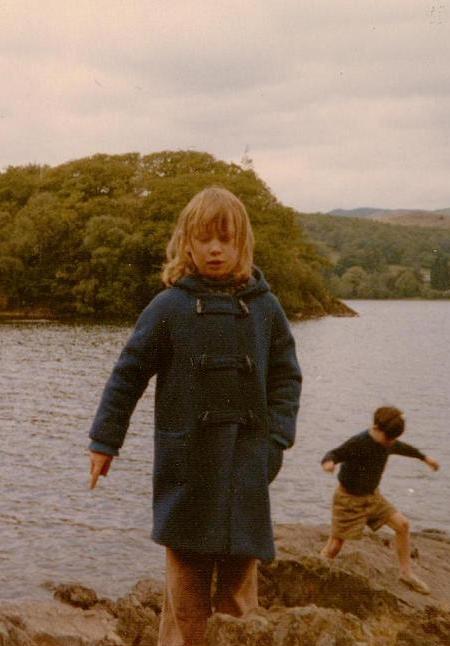
In 1971, Claude Whatham had enjoyed glorious May weather when he made ‘Cider With Rosie’ in Gloucestershire, but it rained so hard in Cumbria that filming anything was proving difficult. He managed to capture one limpid shot of me looking at Swallow’s tatty flag.

Claude Whatham at the Boathouse with Simon West and Sophie Neville

I wrote more enthusiastically about playing Consequences in Bank Ground farmhouse. This is the game that Virginia McKenna had introduced us to and we loved it. This time we must have roped in heads of the Costume, Hair and Make-up Departments. It seems that Emma Porteous, the Costume Designer, was on set with us that wet day in May. I would think that this was when they recorded the scenes inside Holly Howe with Susan and Roger and the wonderful lady who played Mrs Jackson. Someone recently asked why Susan never thanked her for lending her the frying pan, as it seemed out of character, but she still wasn’t feeling very well. Does Susan thank Mrs Jackson in Arthur Ransome’s book?

Suzanna Hamilton's costumes for scenes set at Holly Howe
Suzanna Hamilton’s drawings of her costumes for scenes set at Holly Howe

Ronnie Cogan was the quiet, gentle man usually clad in a grey tweed jacket, responsible for our hair on Swallows and Amazons.  Foregoing the use of wigs, so very much in use on costume dramas at the time, he simply did up Virginia McKenna’s lovely thick hair, and cut ours, giving the whole movie a classic feel.

Mrs Ransome was fussy about Sten’s hair. She had specified didn’t want Richard to cast children with black hair and objected to his photo but acquiesced when she saw him running around at Bank Ground Farm with a short-back-and-sides.   

Virginia McKenna having her hair put up by Ronnie Cogan ~ photo:Daphne Neville

Years later my mother worked with Ronnie on Diana: Her True Story, the bio-epic of epics based on Andrew Morton’s outrageous book. Serena Scott Thomas played Diana Princess of Wales, David Threlfall was Prince Charles, Anthony Calf had the glorious opportunity to play James Hewitt and my mother was given the role of Diana’s nanny, who hit her on the head with a wooden spoon. Mum said that she later bumped into Ronnie in Oxford Street but heard soon afterwards that he had sadly died. He had a wonderful career and must be hugely missed. 

Simon West having his hair cut - trimmed
Simon West having his hair trimmed by Ronnie Cogan. Can anyone tell me the name of the driver holding him still.

He’d worked on classics such as The Boys from Brazil with Sir Laurence Olivier and A Bridge too Far directed by Richard Attenborough – the Lord Attenborough. That must have been quite something. It starred Sean Connery, Michael Caine and Ryan O’Neal who I am sure would have been pretty concerned about having the standard WWII military haircut. Ronnie also worked for Roland Joffe on The Killing Fields and Kenneth Branagh when he had  a pudding basin haircut, for his monumental film of Shakespeare’s Henry V.  It is funny how things inter-connect. Kenneth Branagh played my great uncle AO Neville in the Rabbit-Proof Fence.

Dixons Farm - Mike Pratt
Ronnie Cogan attending to Mike Pratt in the role of Mr Dixon  photo: Daphne Neville

Peter Robb-King had been the Chief Make-up Artist on Diana: her True Story. Having worked on movies such as Indiana Jones and the Temple of Doom, Stars Wars – Return of the Jedi, Batman Begins and The Dark Knight, he is still involved with the most amazing feature films. He has just completed The Cabin in the Woods where he was Sigourney Weaver’s personal make-up artist – and to think! He was once mine.

Sophie Neville as Titty getting her makeup done
Sophie Neville being made up for the part of Titty by Peter Robb-King in 1973

“But, Sophie – you disappoint me! You didn’t wear any make-up to play Titty.” No, but as we filmed out on the water, sun cream became extremely important. If even a tiny bit of us had turned red or peeled the filming would have put in jeopardy. Predicting that we would turn vaguely brown, Peter decided to give us a bit of a tan when scenes where shot out of sequence, as a couple had been that first week. 

Sophie Neville receiving a Titty haircut

Peter and Ronnie were also responsible for the continuity of how we looked so that the shots would cut together. My fly-away hair was well monitored. Mum had to wash it every other day.

Stephen Grendon and Ronnie Cogan
Ronnie Cogan with Sten Grendon. I was in the Make-up caravan beyond.

Sten seemed to be forever having his hair trimmed. There are quite a few photographs of this particular activity in progress.

Sophie Neville with Sten Grendon’s being given a haircut by Ronnie Cogan ~ photo: Daphne Neville

You can read more in ‘The Secrets of Filming Swallows and Amazons’ available as a multi-media ebook illustrated with behind-the-scenes photographs.