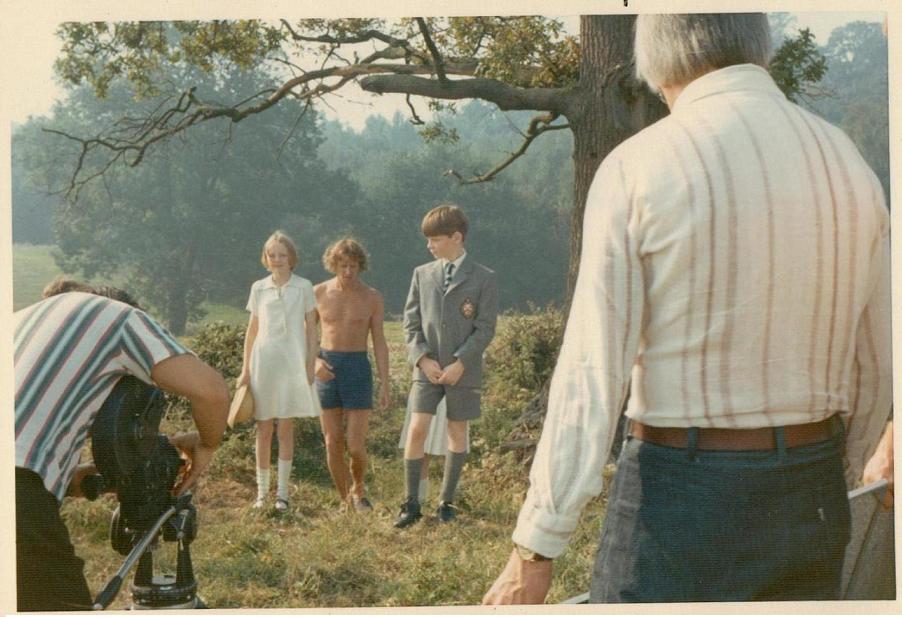
The Guardian published this photograph, taken on the set of ‘Swallows & Amazons’ when the original film of Arthur Ransome’s well-known book was being shot at Bowness-on-Windermere in the Lake District on 7th June 1973.
The story was set in 1929. The production team battled to find local men to appear as film extras. None of them wanted a short-back-and-sides hair cut. The ladies of the Lake District found this most amusing. Many of them wore their hair shorter than the men.
To see more photographs and footage taken behind-the-scenes on this day, with diary extracts, please click here
Ronnie Cogan cutting Martin Neville’s hair for ‘Swallows and Amazons’
For more photographs and a description of what happened please click here
Jane Price, Perry Neville, Jane Grendon, Tamzin Neville and Pandora Doyle in 1929 costumes at Bowness in 1973
It was Pandora Doyle, seen in this photo as a little girl in a blue dress on the right, who sent me the newspaper clipping from the Guardian pasted above. Her father Brian Doyle was the Publicity Manager on the film. She kept all his files with notes from all the film stars he’d worked with. Do leave a comment below to let us know what you were doing in June 1973.
Brian Doyle, the film publicist on ‘Swallows and Amazons’ (1974)
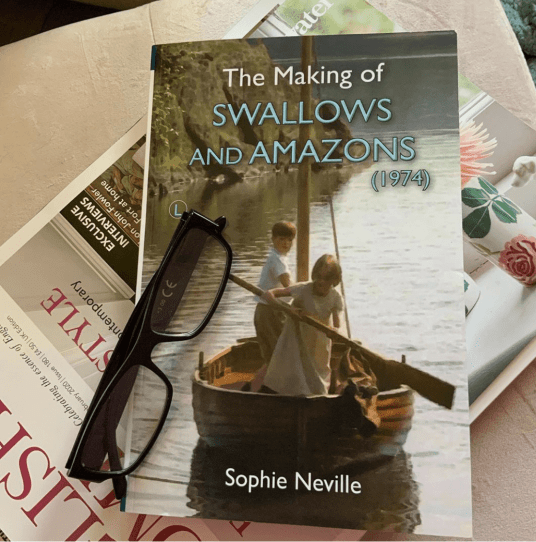
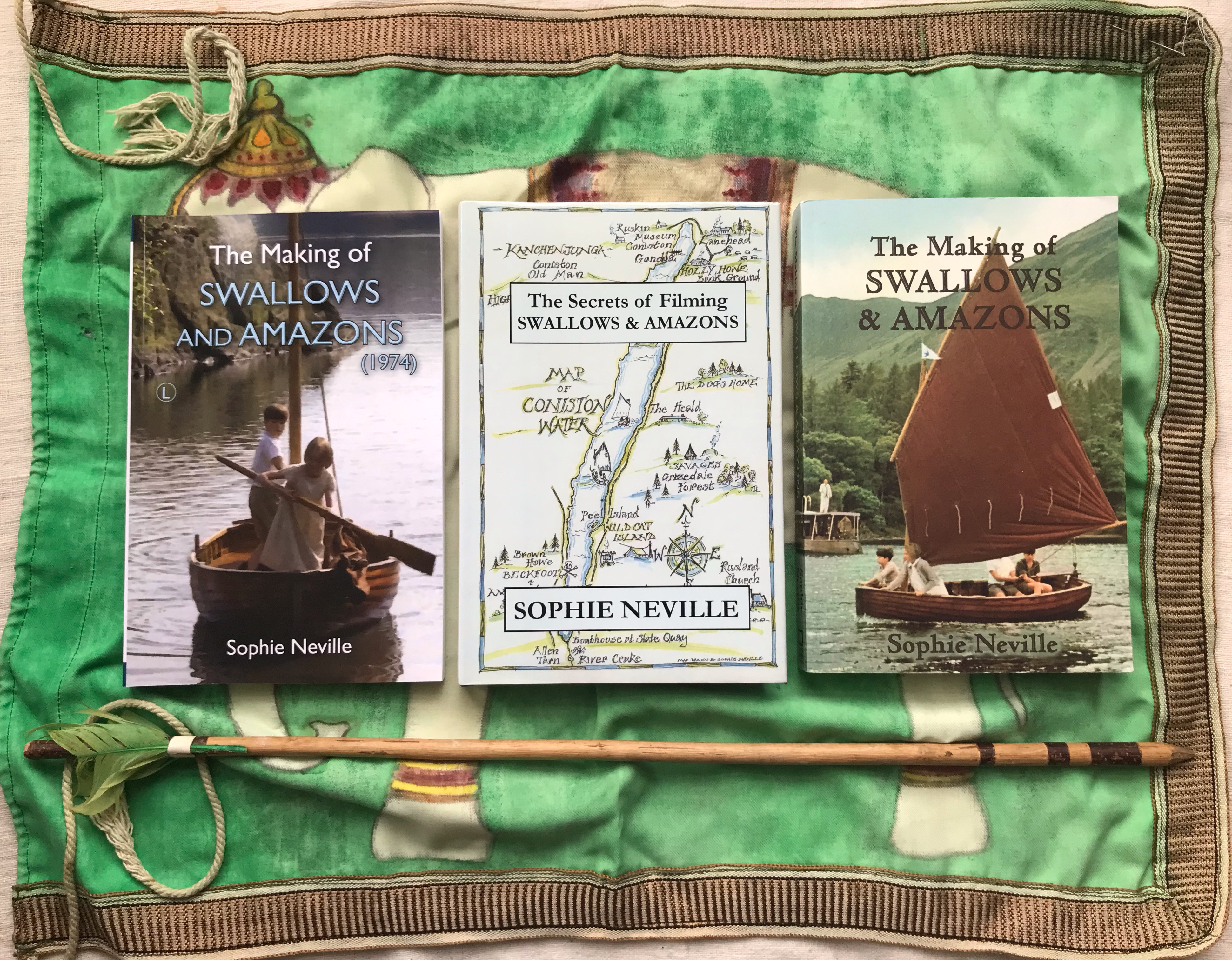
You can read the whole story about how the film was made in Cumbria in ‘The Making of Swallows and Amazons (1974)’ available to order from libraries or online retailers worldwide.
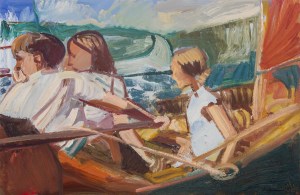
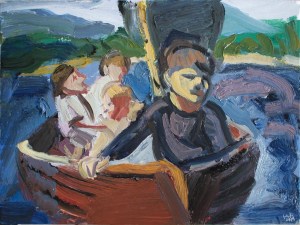
‘John, Titty & Susan on the Swallow’ by Fadi Mikhail
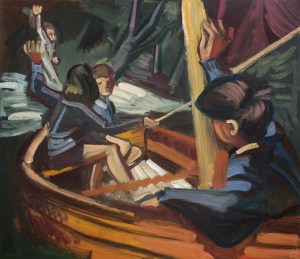
As you can see from these paintings, Fadi Mikhail, the artist famous in the UK for painting one of our Christmas stamps and being commissioned by the Prince of Wales, as well as the Duke and Duchess of Cambridge, was certainly inspired by the film of ‘Swallows & Amazons’ made in 1973. He has kindly let me publish this remarkable series of paintings.
‘Look out! Another boat’ by Fadi Mikhail
Since my last post, comments have flooded in as to why the simple story is so popular:
‘John and Susan coming about’ by Fadi Mikhail
‘…the Swallows don’t own ‘Swallow’ – they’re having a farmhouse holiday and the boat belongs to the farm, and that could just have happened to any of us. Norman Willis… used to rise up against critics who considered that children from poorer backgrounds should read books full of gritty reality related to their daily lives: he pointed out that they wanted to escape from their daily lives for a few precious hours, not always into a zone of dragons and princesses but into an alternative realistic world.’ Jill Goulder of The Arthur Ransome Society.
‘The Swallows in the boat’ by Fadi Mikhail
‘What I liked most about these stories was that the Swallows and Amazons and their friends behaved like real children, but lived in a completely different world from the one I inhabited. I’d camped with the Girl Guides, but the Swallows and Amazons had astounding freedom – camping alone on an island, going out at night and sailing wherever they liked without needing to ask permission.’ Emily Lock ‘…the books gripped my imagination forever’. Please click here to read Emily Lock’s full review.
Titty and John eating apples by Fadi Mikhail
Christopher Tuft thought the enduring success is, ‘Because it’s a wonderful adventure story, with well rounded characters, played out in a beautiful setting, reminding us of a time now gone.’
‘The Swallows in the wood’ by Faid Milhail
‘The combination of practical realism – everything that happens could happen – and the child’s viewpoint makes the story and it’s sister volumes almost unique even now,’ Andrew Craig-Bennett of The Arthur Ransome Group on Facebook.
‘John and Susan hoisting the sail’ by Fadi Mikhail
The whole series of books clearly have a worldwide following popular from one generation to another. ‘I don’t find this surprising. I got my first Arthur Ransome book (Swallowdale) as a present, in 1948. At the time it was a copper-bottomed dead cert as a present for any child, couldn’t be criticised, known to be virtuous, and incidentally known to be good. All that is still true and has been for decades. I don’t think it could fail to be up there. Children may now prefer Star Wars, Lego books or Minecraft (my grandsons certainly do), but books are still *bought* by adults.’ Peter Ceresole ‘The book has lasting appeal, particularly for children, because there is nothing in the adventures of the Swallows and Amazons that readers feel they could not do themselves. They felt they could sail a dinghy like the Swallows. I know, because when adults came aboard Ransome’s restored boat Nancy Blackett in recent years, many had tears in their eyes and said: ‘I learned to sail from the books; and Arthur Ransome was the biggest influence on my life.’ The story is not like so many others an unachievable fantasy. This must stem in part from the fact that the characters are based on real children and on Ransome’s observation of those real children. The quality of the plotting is superb. Ransome was utterly clear about the stories he wrote, sometime writing chapters in the middle of the book before writing earlier ones. His prose is spare and simple and very easy to read, and bears comparison with the writing of Jonathan Swift in Gulliver’s Travels — another writer with appeal to both children and adults.’ Michael Rines Do add your own thoughts in the Comments below.
‘The Swallows chasing the Amazons’ by Fadi Mikhail
Hugh Shelley wrote, in his Bodely Head Monograph of Arthur Ransome, that it is the joy with which the story is written that makes Swallows and Amazons a great book. In many ways it is a reflection of Arthur Ransome’s own childhood holidays with his brother and sisters on Coniston Water. And even today, children can discover the places mentioned for themselves. Holly, aged six, wrote to me recently saying, ‘My Mummy and Daddy took me to Wild Cat Island. It was my favorite day… When I am bigger I want to be like Titty.’
‘Roger ties the Swallow down’ by Fadi Mikhail
While ‘nearly all enduring books do so because of the writing,’ as another reader commented, children enjoy the camaraderie and the action that have been captured in these semi-abstract oils.
‘John, Susan and Roger waving to Titty’ 60x50cms by Fadi Mikhail depicting Sophie Neville, Suzanna Hamilton, Simon West and Sten Grendon in a scene from ‘Swallows & Amazons’ (1974)
‘The 1974 Swallows and Amazons film is a classic, and this is a really enjoyable look behind the scenes, written by the actress who (for me, at least) gave the stand-out performance as Titty Walker. If the film recaptured the lost world of 1929, then the book recaptures the lost world of 1973, when rules on child actors were strict (chaperones and schoolwork absolute requirements) but regulations on health and safety a bit more lax, even when on water. We even learn the truth behind that strange scene on the jetty in Rio where Roger is left minding Swallow. Highly recommended.’ P. Stevens, Bath, UK
‘Every now and again in cinematic history a classic is born. It doesn’t have to be a multi-billion pound blockbuster featuring legendary names, sometimes something timeless and endlessly endearing is born and this is most definitely the case with ‘Swallows and Amazons’.
‘This film has become an old friend to me; I must have watched it a thousand times and I never tire of it! It brings back memories of a summer childhood spent in wonder-filled Cumbria, in particular Windermere, Ambleside, Derwent and Coniston Water; places we’d visit as a family before the fates would, sadly intervene.
‘Sophie Neville’s excellent book recaptures again the halcyon days of youth in a summer-land of mountains, fells and shimmering lakes. She writes beautifully and with an easy style that’s a joy to read. The love for her subject is very evident, as is her passion for the work of Arthur Ransome. She takes you behind the scenes of the making of the film and the realities of filming on the water; how the director and crew worked tirelessly to bring out the best in the young actors and the splendours of the landscape. So glad I made this purchase. Pride of place on the old bookshelf.’ Allen Fairhurst
‘Sophie has lost none of her infectious enthusiasm and this shines through on every page.’ Julian Lovelock in Mixed Moss, the journal of The Arthur Ransome Society. ‘As well as using her own diary Sophie has mined the recollections and scrapbooks of a number of cast and crew.’
‘The book itself is indeed a delight. I have long been a fan of Swallows and Amazons. I am delighted with the film which was made and Sophie’s account of the making of it adds a very charming and interesting dimension. I loved the account and I fully recommend any fan of Swallows and Amazons to get a copy for themselves.’
You can read about how the original film of ‘Swallows and Amazons’ was made and find the complete collection of behind-the-scenes photos in this ebook available from Kobo, Smashwords, iTunes and on Kindle for £2.99
One of the questions asked by fans of the film Swallows & Amazons, produced by Richard Pilbrow for EMI Films in1974, is, ‘Did any of the scenes written by David Wood ever hit the cutting-room floor?’
Simon West and Sophie Neville on Peel Island in 1973
Although I had a lead part, I wasn’t allowed to read the script as a child, only Arthur Ransome’s book on which the movie was based. I never gave it a thought, and for years, but looking back through the original screenplay I can see that the answer is, ‘Not many.’
The shots of finding Swallow in the boatshed, bringing her out and raising her flag were moved forward and set under the voice-over of the Walker children reading out the letters written to their father. This moved the story along.
Simon West talking to director Claude Whatham with Sophie Neville
There is a scene in the book set at Holly Howe when medical supplies are being packed for the voyage. This was shot with Virginia McKenna at Bank Ground Farm above Coniston Water, but must have slowed down the pace of the film as it was replaced by a more exciting montage of shots, that also progressed what is a pretty gentle start to an adventure story.
Virginia McKenna as Mother with Sophie Neville as Titty making Swallow’s flag
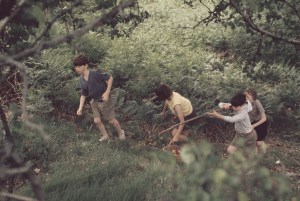
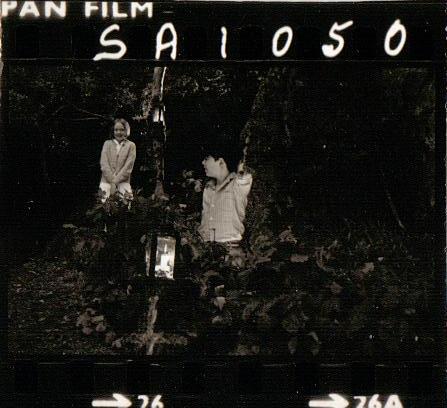
Making patterans on the way to the charcoal burners, was a lovely scene from the book that was recorded but never included in the film. Captain John can been seen explaining how gypsies use them as secret markers in this black and white still.It was shot on a mossy bank in oak woodland so very characteristic of the Lake District and profiled by the Guardian newspaper the author Arthur Ransome had once worked for.
It was at this dramatic location, high above Derwentwater, that my favourite behind-the-scenes shot of the director, Claude Whatham was taken. You can see Cat Bells in the background.
Claude Whatham talking to his cast: Sten Grendon, Simon West, Sophie Neville & Suzanna Hamilton
Mrs Ransome, who worked closely with the screenwriter, had agreed that the storm scene on Wild Cat Island would not to be included in the screenplay. We children thought a great pity. Such a violent gale blew in one day when we were filming on Peel Island that we would have had the right weather conditions, but you can not include everything. It was only a 90 minute movie.
Jane Grendon, whose son Sten played Roger, wrote to tell me that before filming began, ‘…one of the very first things we were asked was, ‘can Sten swim?” ‘I know he could doggy paddle,’ she continued. ‘Neville (Thompson, the online Producer) organised swimming lessons at Pitville Pool, Cheltenham which included jumping off the diving boards. At the time I didn’t know why and I don’t think Sten is a natural in the water and the swimming lessons didn’t prove very successful. Claude (Whatham) told me – at the end of filming I think, when he gave me a copy of he original script – these lessons were because in the original script Roger was to jump in the water after Uncle Jim walked the plank.’ Jane sent me a copy of the page in question. I had not seen it before: It was a page of the script we never had time to shoot. I am so glad. It wasn’t needed. We just made sure Captain Flint had no access to a rope ladder for a while.
I’m often asked if any scenes involving the Amazons were cut, but none were left out. Nancy and Peggy simply do not appear in the book as much as one might remember.
Please leave any questions about the making of ‘Swallows & Amazons’ in the comments below.
You can read the full story of the making of Swallows and Amazons (1974) in one of the editions listed online here:
Different editions of ‘The Making of Swallows and Amazons (1974) by Sophie Neville’
The screening of Swallows & Amazons (1974) on Sunday afternoon was sold out. 250 tickets. They were endlessly turning people away. ‘We should have shown it again in the 6.00pm slot,’ I told the manager. ‘Oh, we have American Snipper on then.’ It stars Bradley Cooper and Sienna Miller. ‘How many have booked to see it?’ ‘Three.’
All age groups were represented in the audience who came to the event – a fundraiser in aid of the Nancy Blackett Trust. About 70% had seen the film of Swallows & Amazons before. Some knew it well.
Everyone loved seeing the original white elephant flag flown on Captain Flint’s houseboat that had been sent to me from America by the producer.
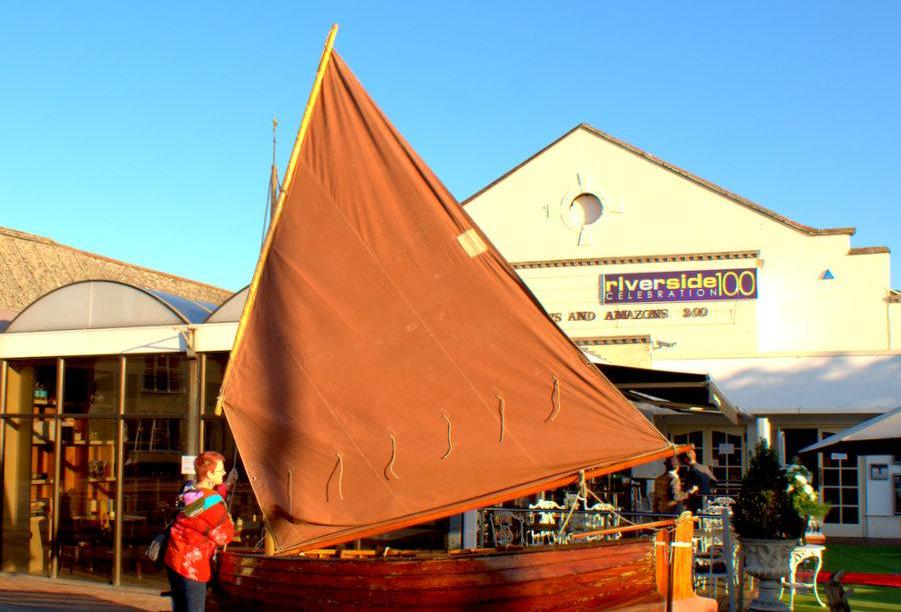
Swallow, the clinker built dinghy, originally built by William King and Sons at Burnham-on-Crouch and used in the 1974 film, was rigged up outside the cinema for everyone to meet. She has been appearing at a number of The Arthur Ransome Society’sevents in Suffolk and Essex.
We used the best photo of Swallow under sail for the cover of the paperback on how the film was made, which was on display in the cinema lobby after the film. It is now available online or from the Aldebrugh Bookshop in Suffolk.
Someone asked if we had any disasters while making the film.
‘Swallow’s mast broke, we nearly sailed under the Windermere steamer and a cow fell down a bank onto the producer’s car.’ I couldn’t think of anything utterly disastrous from my own perspective except that I lost a tooth halfway through shooting a scene with Virginia McKenna, which was embarrassing. I can list other questions asked by the audience in the next post.
The Riverside Cinema in Woodbridge are thinking of showing Swallows & Amazons again in September to help them celebrate their centenary ~ ‘100 Years of Film’. Do add a comment in the box below if you would like to organise a screening of the film at a cinema near you.
You can read about the adventures had making the original film of Swallows and Amazons in these editions available online:
Different editions of ‘The Making of Swallows and Amazons (1974) by Sophie Neville’
On 21st March and 28th March, the new CBBC TV show ‘Cinemaniacs’ included guest appearances from Sophie Neville and from David Wood, who wrote the screenplay for ‘Swallows & Amazons’ back in 1973.
Oli White, the vlogger and presenter of ‘Cinemaniacs’, asks a number of people involved in movies about making their first film. Others featured include Michael Sheen, Sir Ian McKellen and Matthew Lewis famous for playing Neville Longbottom in all eight Harry Potter movies.
To find out more about how the film ‘Swallows & Amazons’ (1974) was made, along with how the children’s parts were cast, please see earlier posts or read the book! It includes more than 120 photographs taken on location in the Lake District.
I have been deliberating upon points where fiction touches reality. The most significant in my own life is the story behind my fictional brother, Roger Walker, one of the lead characters in ‘Swallows and Amazons’. The real Boy Roger was responsible for saving me from acute misery. Whilst I was asthmatic as a child, Dr Roger Altounyan was behind the invention of the Intal spin inhaler, which bought me instant relief.
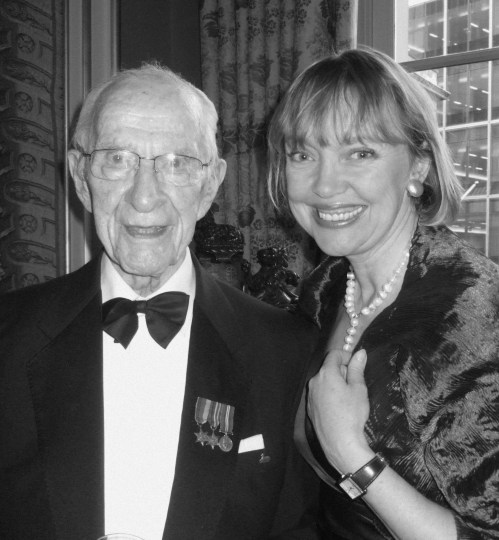
About ten years ago I met Dr Bill Frankland, a former POW to the Japanese who became a Harley Street allergist and president of the British Allergy Association, now the British Society for Allergy and Clinical Immunology. Bill told me that Roger Altounyan had been a good friend ever since they worked together on the Intal project. Roger introduced him to his sister Titty who, as a child had been in the inspiration for the character I played in the film ofSwallows & Amazons.
I’d had known that Roger Altounyan had been in the RAF during World War II, but not that he had qualified as a doctor and become an allergist. Bill told me that he used his knowledge of propellers to develop the Intal spin-inhaler and effectively treat asthma.
Dr Bill Frankland celebrating his 100th Birthday in 2012 with Sophie Neville
Dr Frankland gave me a set of photos taken at Roger Altounyan’s going-away party in Cumbria when he took his family and friends up Coniston Water on the Gondola. He said that Roger insisted on smoking a pipe even though he was reliant on oxygen and explained that the experimentation was partly responsible for his early death in 1987.
I will explain the connection in further depth.
The well-loved book Swallows and Amazons was written by Arthur Ransome for the children of friends of his after they brought him a pair of red slippers for his forty-fifth birthday in January 1929. He based his main characters, the crew of the Swallow, on these five real Altounyan children who had been staying at Bank Ground Farm in the Lake District,
The character Roger Walker, known when he first started sailing as the Boy Roger, was inspired by Roger Altounyan then about six years old. As a consequence he was obliged to live out his school days under Swallow’s flag, as it where. This may have become tedious, although it was much the same for Sten Grendon who played the part of Roger in the 1974 film.
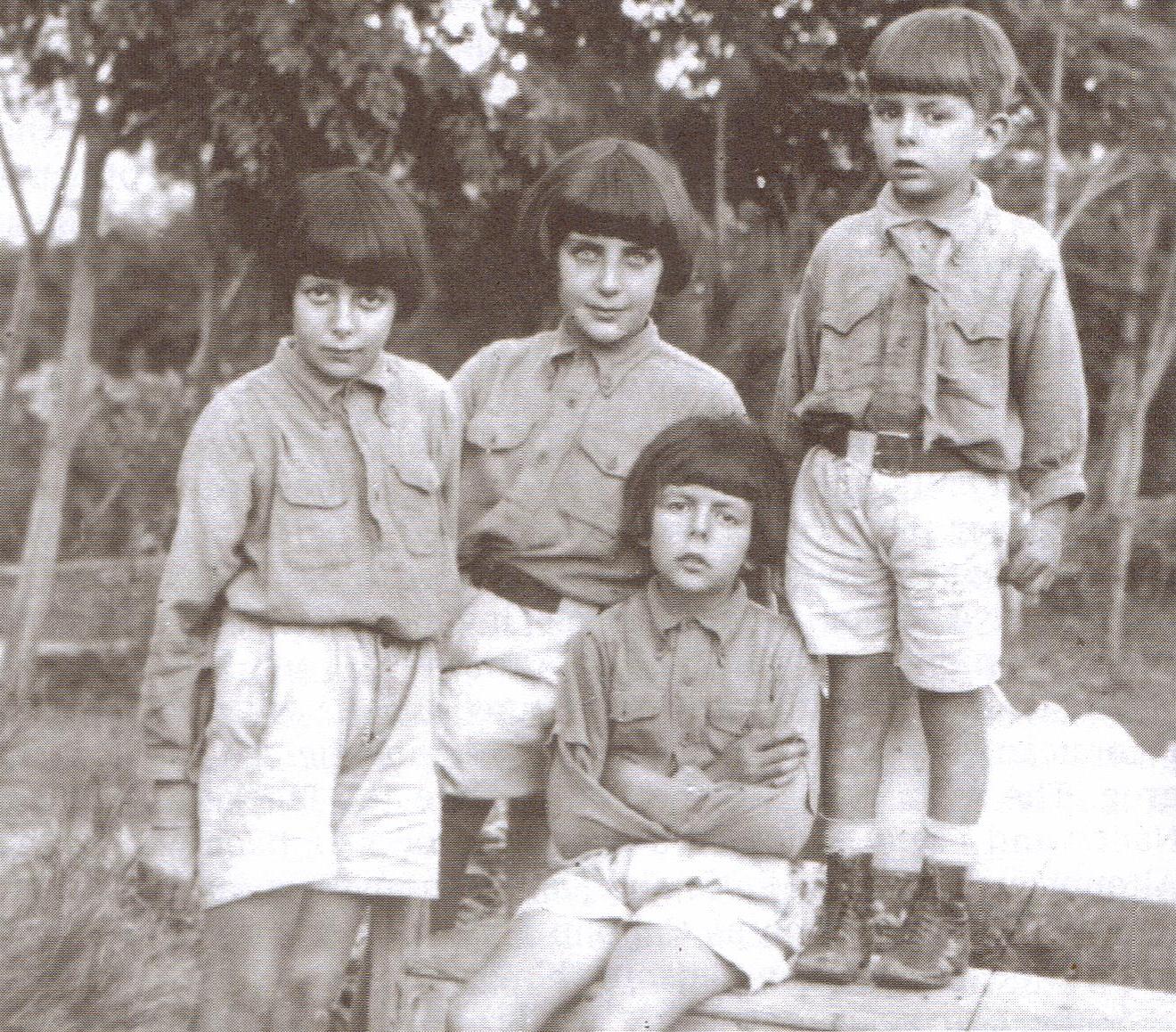
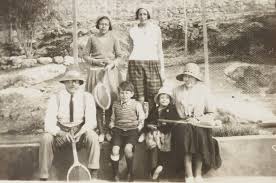
The well-known photograph of the four eldest Altounyan children – Susie, Taqui, Titty (seated) and Roger (copyright ???)
Roger is seen here with three of his four sisters, and below as a boy along with Arthur Ransome obviously playing tennis (copyright: Brotherton Library, Leeds). The story of his family is told by Jeremy Collingwood in his recent book, A Lakeland Saga.
Did we depict Roger Walker accurately in the film? May be not! Richard Pilbrow, the producer of Swallows & Amazons told me that Mrs Ransome was furious that Claude Whatham had cast a boy with dark hair, but she never explained why. She did not like the photograph she had been sent but it was taken before Sten’s received a short back-and-sides.
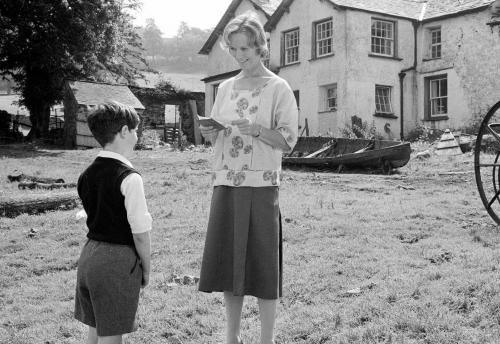
Sten Grendon as Roger Walker with Virginia McKenna playing his mother
Luckily, when Evgenia Ransome visited the location and actually saw Sten running around at Bank Ground Farm she seemed happy enough and said nothing more. Perhaps Virginia McKenna somehow managed to make everything alright.
What I didn’t know until recently was that Roger Altounyan was an asthmatic himself.
Roger was specifically allergic to guinea pigs and would routinely experiment on himself. He would not have been allowed to do this by today’s regulations, which some say would have held back the testing indefinitely. I gather from reading Rodney Dingle’s biography that the model inhaler that he made with a piece of hose pipe worked well, whilst the prototype made professionally did not. If you use an inhaler you will hear that the propeller has to be able wiggle in order for the medication to be successfully diffused into the patient’s mouth and lungs. The discovery was portrayed by David Suchet in a documentary entitled Hair Soup.
I was allergic to feathers, not parrot’s feathers, but old pillows and eider-downs. I may owe my life to Roger and his spin-inhaler. The medication certainly helped me enormously and has always given me the peace of mind that it will give me relief if I do get wheezy.
Further reading: Roger: The Life and Distinguished Achievements of Dr Roger Altounyan, by Rodney Dingle. It is difficult to get hold of but Kirkland Books in Kendal have a copy.
We have just found another reel of 16mm home movie footage shot, not on location in the Lake District, but at Runneymede near Egham in Surrey. It captures the essence of a hot day in September 1973 when we were re-called for pick-up shots after the main body of the film of Swallows & Amazons had already been edited.
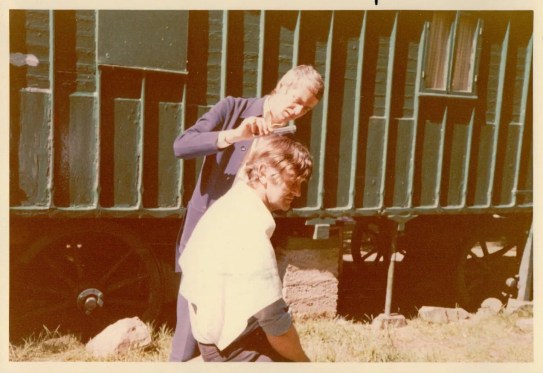
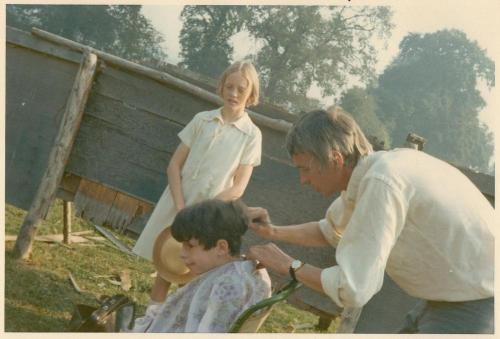
Ronnie Cogan trimming Sophie Neville’s hair for the part of Titty in September 1973
The clip opens with the film hairstylist Ronnie Cogan cutting my hair. It had been a good six weeks since I had last played Titty in front of the camera and I needed a trim to restore it to the same length it had been on 14th May when we had first started filming on the Lakeside and Haverthwaite railway. Suzanna Hamilton’s thick dark hair had grown a great deal, as had Sten Grendon’s.
Sophie Neville watching Ronnie Cogan cut Sten Grendon’s hair.
Peter Robb-King the Make-up artist had been toning down our complexions inside the same Make-up caravan we’d used while on location for seven weeks in Cumbria. I remember it had orange flowery curtains, a pattern much in vogue at the time.
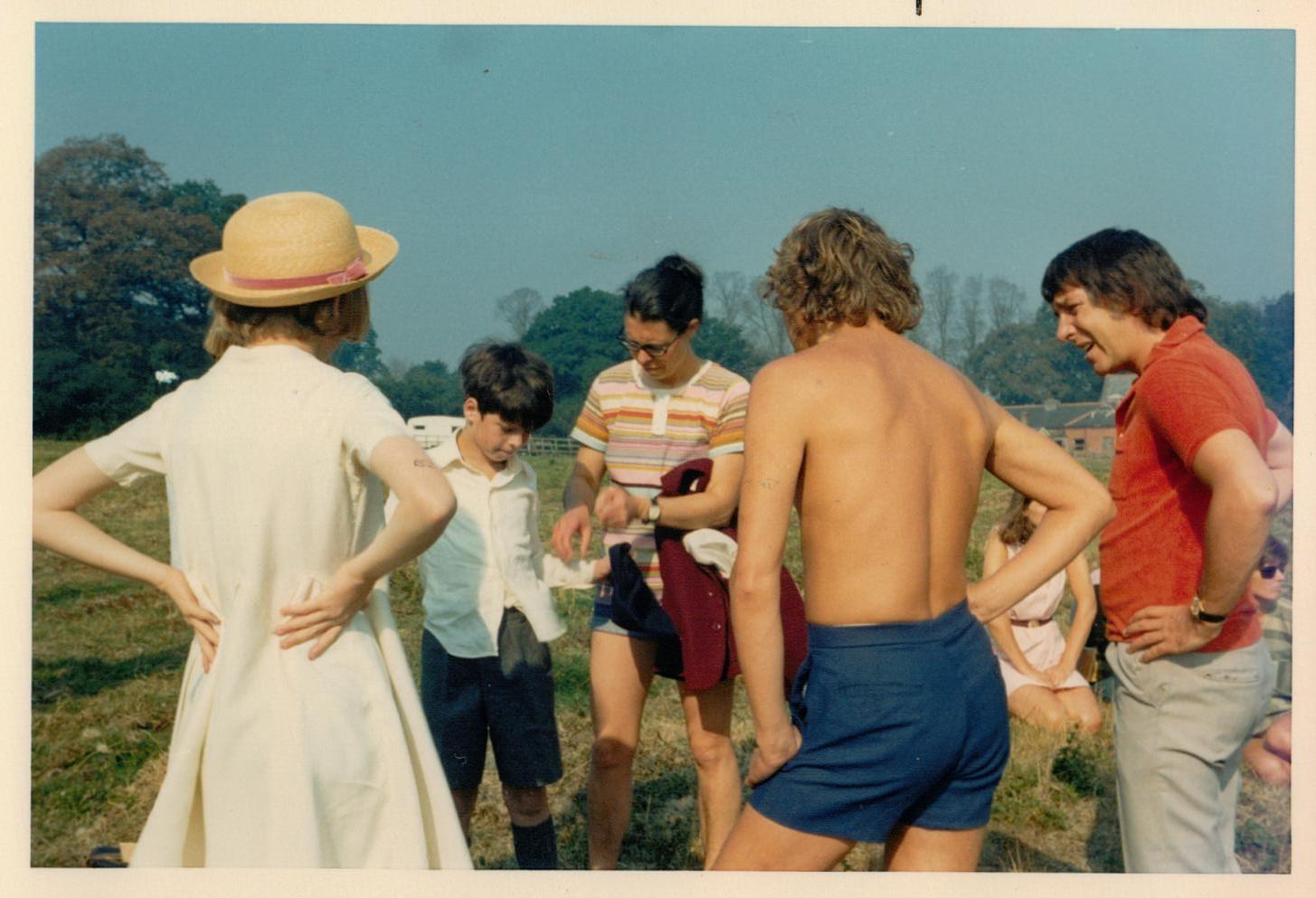
Sophie Neville looks on as Stephen Grendon organises his costume helped by Jane Grendon with Claude Whatham and Neville C Thompson.
Neville C Thompson, the Associate Producer, who was wearing a red shirt that day, seemed happy to be back on location. The film director, Claude Whatham was working, as I will always remember him, in a pair of navy blue shorts and sailing shoes. I loved putting on the school hat and silk dress I’d worn in the train but was difficult for the boys to climb into their woolen costumes on such a bright sunny day.
Richard Pilbrow, the Producer, who you can see wearing a white stripy cheese-cloth shirt so typical of the early 1970’s, seemed rather on edge. Bringing a camera crew along for what amounted to three shots must have been expensive, stretching his budget to the limit.
Gordon Hayman with a 35mm Ariss camera, Sophie Neville, Claude Whatham and Simon West, with Richard Pilbrow in the foreground ~photo:Daphne Neville
The oak tree, under which the 35mm Arriflex camera was set, was chosen to represent the Peak of Darien from which we looked out over an imaginary lake to an imaginary island. The finished movie cuts from the Walker children’s faces to a shot taken of Derwentwater at sunset with the opening title graphics superimposed over what is in reality Blakeholme, or Wild Cat Island as it is called in Arthur Ransome’s world.
Denis Lewiston, the Director of Photography, was working with the Cameraman Gordon Hayman, using reflector boards to light our faces. At one stage he had me standing on a cream coloured blanket to reflect light from below. You can see it in this shot:
Sophie Neville playing Titty Walker with Stephen Grendon as Roger Walker with Gordon Hayman, Denis Lewiston and Claude Whatham behind the camera
What I had forgotten was that two little girls came along that day to stand-in for us when the shot was being lined up. You can see them in the home-movie footage, one wearing a pale blouse with puffed sleeves.
Claude was very keen on running. He often took us for a short run before going for a shot to aerate our minds and freshen up our faces. In the story we had run down the hill from Holly Howe, so he had us running quite far before we landed on the marks that the cameraman had given us so that we’d be in focus. We had no dialogue, but the expressions on our faces were crucial to engaging the audience.
Denis Lewiston, Claude Whatham, Sophie Neville, Suzanna Hamilton, Simon West and the cameramen
You see a few other people on location, not least Sten’s mother, Jane Grendon, my little sister, Molly Pilbrow and a few others who were watching. My mother had been taking the footage.
Daphne Neville with Stephen Grendon, Suzanna Hamilton, Sophie Neville, Jane Grendon and Simon West
To read about this day from another angle, please click here to visit an earlier post with a few more photos.
On Friday 21st November 2014, I was invited to talk about the making of Swallows & Amazons on the CBBC movie show with David Wood, who wrote the screenplay. I’ll let you know when this will be broadcast. While I was at Novel Entertainment I met Dexter Fletcher and Bonny Langford as well as Justin Johnson from the British Film Institute who is an adviser on the series of 6 x 30 minute programmes.
You can read the whole story of making the film here:
For some time now we have been doing a variety of things to raise interest in Arthur Ransome and his books, particularly the ‘Swallows and Amazons’ series originally written for children.
Sten Grendon as Roger and Sophie Neville as Titty rowing Swallow (c)StudioCanal
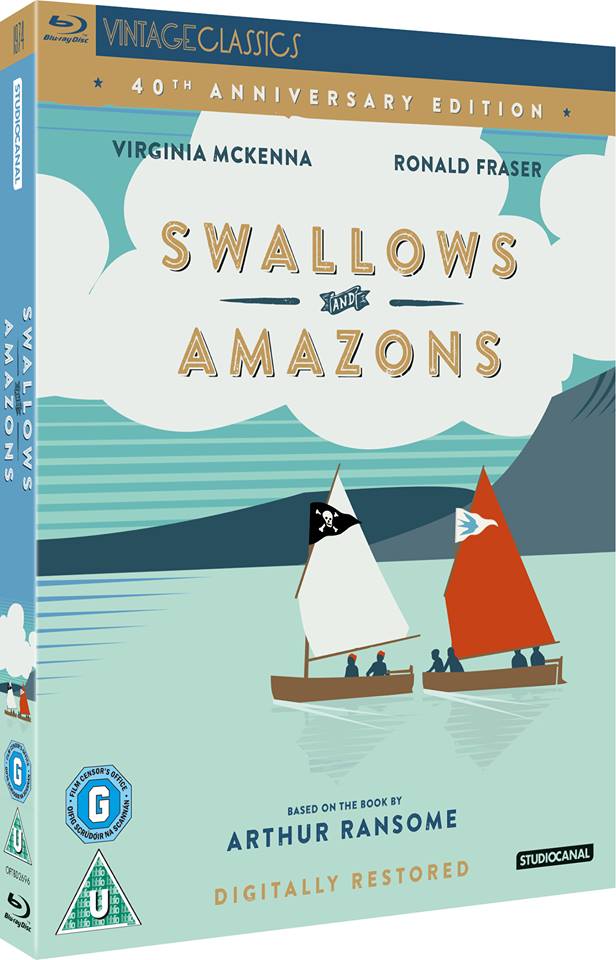
SailRansome have made Swallow, the original clinker built dinghy used in the film, available for families to use there.
Swallow, the dinghy used in the 1974 film on Ullswater this summer
We’ve been using the Draper’s shallop to teach children how to row on the River Lee under the auspices of Countryside Live. We have now taught hundreds of children most of whom have never been in a boat before. The idea is to inspire them to join the Sea Scouts or a local rowing or canoeing club.
Countryside Live at Lee Valley 2014
Another boat you can sail is the Nancy Blackett portrayed as Goblin from We Didn’t Mean To Go To Sea and Secret Water.
Arthur Ransome’s cutter the Nancy Blackett sailing on the Orwell
It only costs £25 a year to join the Nancy Blackett Trust. This is wonderful for anyone living near the Orwell as Ransome once did.
Sophie Neville with Titmouse in Norfolk – photo Diana Dicker
I’ve also been promoting StudioCanal’s re-release of the 1974 film of Swallows & Amazons on Radio Cumbria, Premier Radio, Lakeland Radio and Channel 5’s live TV programme The Wright Stuff. There’s a lot going on in the media with pictorials in Country Life, The Lady, Cotswold Life and Practical Boat Owner magazine as well as newspapers and colour supplements.
Q&A with a large cinema audience in Kendal this August
We brought the original film of Swallows & Amazons back to cinemas in London, Ambleside, Kendal and to Hastings on Pirate Day. I took Captain Flint’s trunk along and wore a tricorn hat only to be told by one little boy in the audience, ‘I hate pirates. They are my enemies.’ Other children asked, ‘Did you enjoy being in the film?’ and ‘Were the spiders in your tent real?’
When we were in Kendal, the curator of the Museum of Lakeland Life gave a talk to the cinema audience bringing along the actual red slippers given to Arthur Ransome by the Altounyan children in 1929 which inspired him to write Swallows and Amazons.
An official still from the film of ‘Swallows & Amazons’ (c) StudioCanal
Some schools have Swallows and Amazons as a set book. I was invited to give a talk at Walhampton School who claim a ‘Swallows and Amazons ethos’. They aspire to giving their pupils as much of an exciting outdoor education as possible with sailing and exploring on the curriculum. School House magazine backs this up saying, ‘There is a distinct ‘Swallows and Amazons’ spirit that burns brightly here.’
Swallow sailing from Wild Cat Island (C) StudioCanal
What could you do to keep Ransome’s writing on book shop shelves?
Could you organise an event at your local sailing club? Or request a screening of newly restored version of the film at your local cinema? One is being planned in Oxford with hopefully another at Wolverstone. PictureHouse cinemas are particularly open to the idea of screening classic family films.
I am planning ‘An Arthur Ransome Day’ at my local Waterstones and another at our library. How can we make this special and attract people off the street?
Do add your ideas to the comments below.
Easy things you can do right now to help promote the books:
This post comes with a huge thank you to readers who have taken the trouble to write in, send emails or add reviews on Amazon about ‘The Making of Swallows & Amazons’
Sophie Neville and Sten Grendon filming on Peel Island in 1973
‘I very much enjoyed reading about all the background and stories of what is one of mine and my children’s favourite films.’ David Hambelton, Oxford
Kit Seymour and Lesley Bennet as the Amazon Pirates
‘…an absolutely fascinating account…about a film we all thought we knew so well. Like so many members of The Arthur Ransome Society I am an utter devotee… I’m finding the background to filming quite fascinating, and if I had thought it possible, yours is the book I have always longed for to exist. I’ve been absorbed in it ever since it arrived, forcing myself to take it slowly and not gobble it up in one go. Of course I’ll be back to it soon, dodging back and forth in tune with your narrative, indenifying particular scenes.’ Jeremy Gibson, Witney
Simon West as John and Sophie Neville as Titty in Swallow
‘If you liked the film, you MUST read this book. “Titty” is enthralling, and the story of the film is almost as exciting as the real story by Arthur Ransome. Essential reading for devotees.’ Chloe Randall, Scotland
Suzanna Hamilton and Simon West on Peel Island
Children still ask me questions that never occurred to me:
‘How did it feel to be on the island by yourself?’ Alex aged 7. The truth of course is that I was never on the island by myself. Perhaps I should have been left there for a while so I could experience it. I would have relished the chance.
DoP Denis Lewiston and Director Claude Whatham in Coniston Water
Another boy asked, ‘How did you do the water?’
This took my breath away for a second. ‘How did we do the water? The water was real, and it was very cold,’ I replied, explaining that we actually shot the film on four different lakes in Cumbria, all of which you can discover for yourself.
Have your children any questions? I’d love to hear them.
Simon West and Sophie Neville on Coniston Water
For more reviews of The Making of Swallows & Amazons on Amazon, please click here.

 The Guardian published this photograph, taken on the set of ‘Swallows & Amazons’ when the original film of Arthur Ransome’s well-known book was being shot at Bowness-on-Windermere in the Lake District on 7th June 1973.







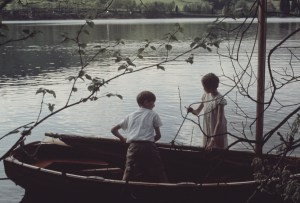
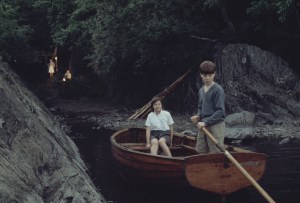


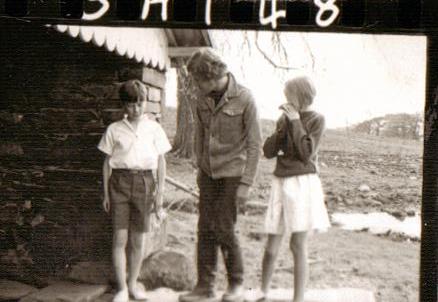

 It was shot on a mossy bank in oak woodland so very characteristic of the Lake District and profiled by the Guardian newspaper the author Arthur Ransome had once worked for.
















 Sophie Neville