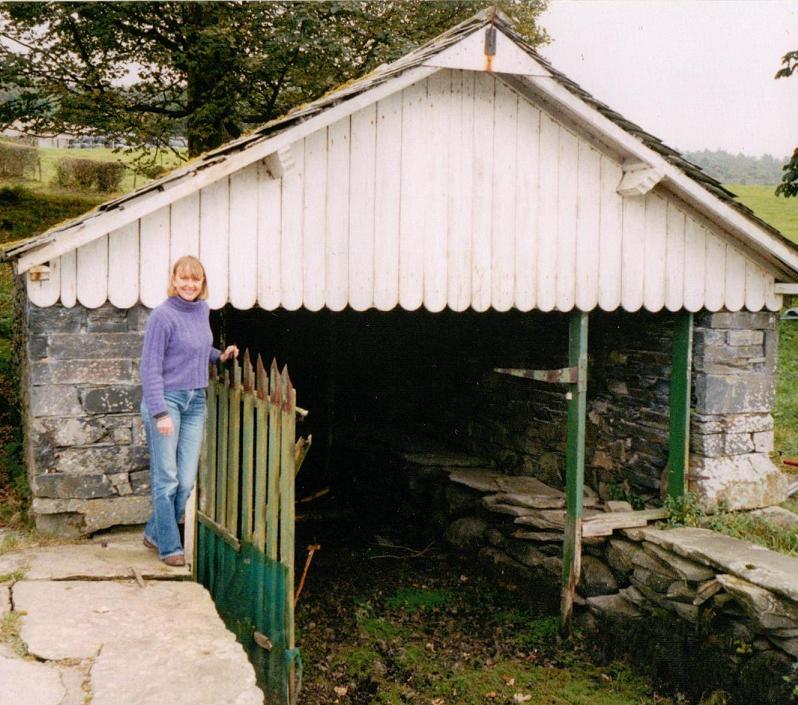
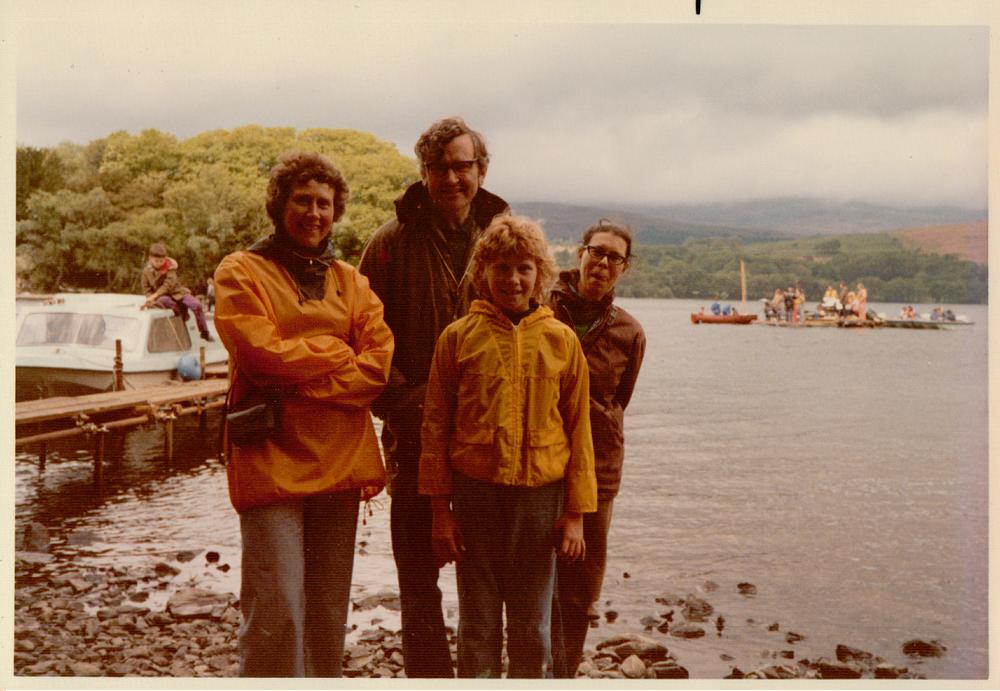
Sophie Neville at the Bank Ground Farm Boat-houses on Coniston Water in Cumbria for the filming of ‘Big Screen Britain’ presented by Ben Fogle for BBC TV
At last! We have the clip from Country Tracks presented by Ben Fogle, that includes interviews with Director Claude Whatham, Lucy Batty of Bank Ground Farm, Suzanna Hamilton and myself discussing the swimming scenes, with the unique behind-the-scenes footage my father shot on 16mm film, with his Bolex camera back in 1973. You might have seen a longer version of this on Countryfile and Big Screen Britain. I am yet to receive residuals.
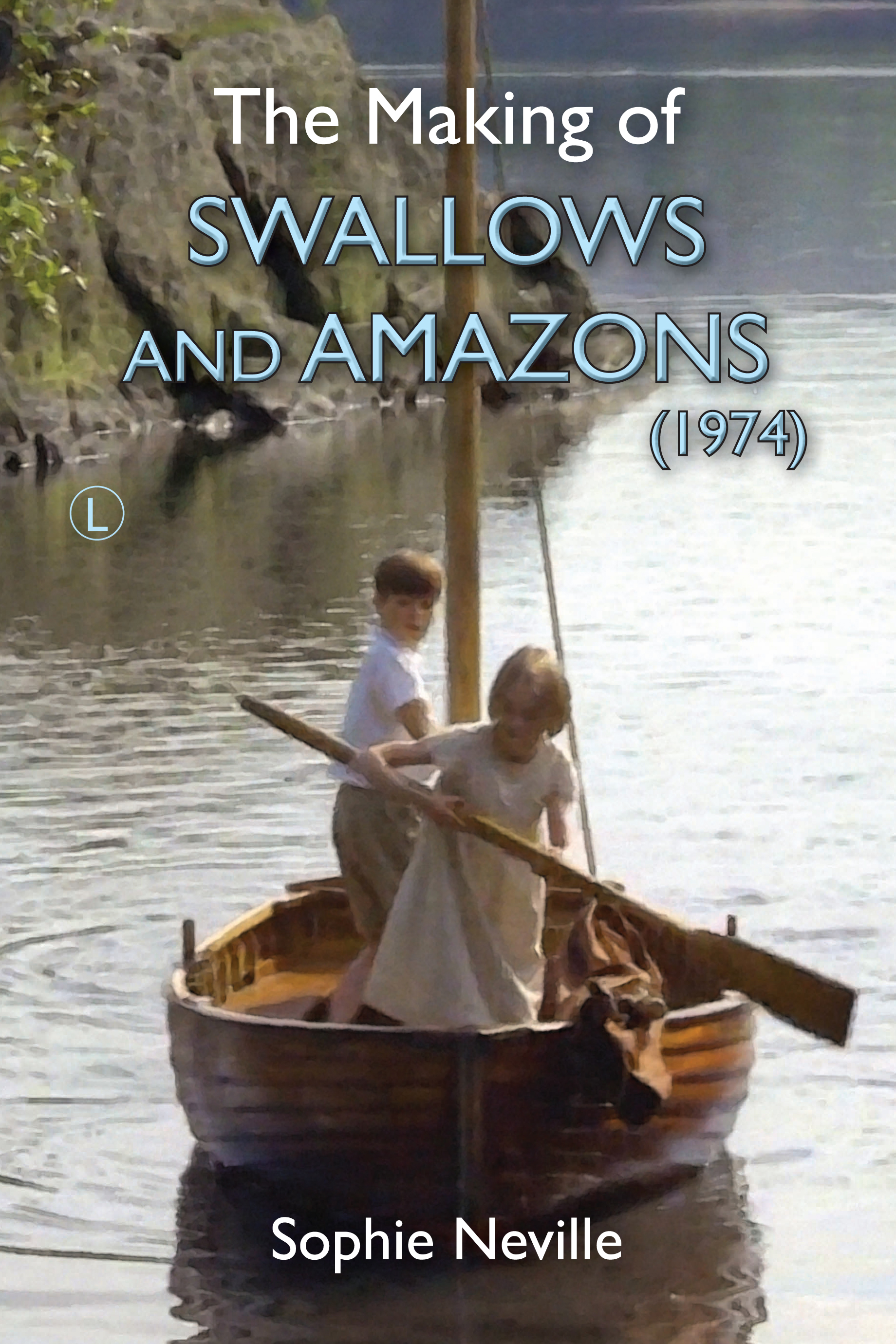
If you would like to read about ‘The Secrets of Filming Swallows and Amazons (1974) in detail, the illustrated, multi-media ebook is available on Kindle and from other ebook retailers.
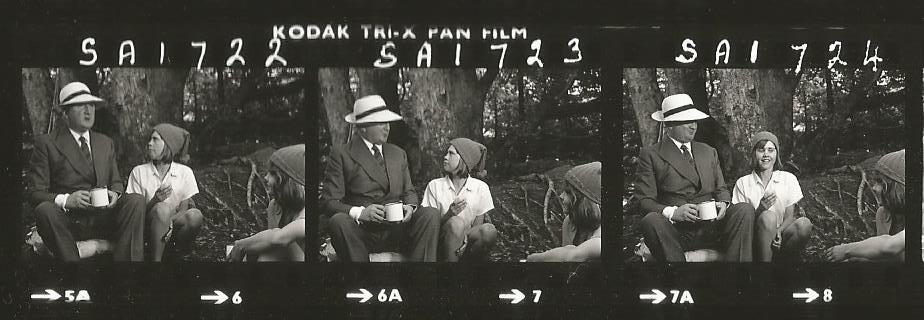
Sophie Neville, Simon West and Suzanna Hamilton with Ronald Fraser playing Captain Flint in the 1973 film of Arthur Ransome’s ‘Swallows and Amazons’
Ronald Fraser! veteran of World War II movies who had won an award for playing Basil Allenby-Johnson in The Misfits, had arrived on the shore of Coniston Water in two-tone shoes. Curiously so had two stand-ins. A short lady for me, who had dark hair, and a lady with blonde hair for Suzanna Hamilton. I have blonde hair and Suzanna is dark, but that is how it was.
The other four actors didn’t have stand-ins, which seemed odd. Kit Seymour, who played Nancy Blackett, and Lesley Bennett in the role of Peggy, rehearsed as usual. The two boys, Simon West and Sten Grendon, were younger than us but never had stand-ins, so that seemed odder. We didn’t think the ladies would be very comfortable on Peel Island. There wasn’t exactly a powder room there.
Director Claude Whatham and Bobby Sitwell with Suzanna Hamilton playing Susan Walker and Ronald Fraser as Jim Turner aka Captain Flint
And we were some way into the filming, used to handling props that the stand-ins found alien. However they were very excited about coming over to Peel Island. They sat in our positions and read our lines back to Ronald Fraser whilst the scene at the camp site was lit, and returned to stand-in for us later when his close-ups were shot. Somehow they managed to do this in scanty summer clothing despite a brewing storm.
My stand-in. I liked her very much and was most interested in her tapestry, since I was doing one myself. Lots of the men in the crew were interested in her tapestry too. They hadn’t noticed mine.
Our stand-ins got a lot of help from the crew as they went from ship to shore. We didn’t, but then we were agile and wore life-jackets. Mummy didn’t wear a life-jacket, but she has always been surprising good at getting in and out of boats. Her comment on the matter of my stand-in was, ‘Most unsuitable for a children’s film.’ Mum became increasingly concise: ‘I don’t think that woman was invited. She just turned up.’
Enthused by our Stand-in, Lesley Bennett and I went into Ambleside that evening to buy more wool for our own tapestries.
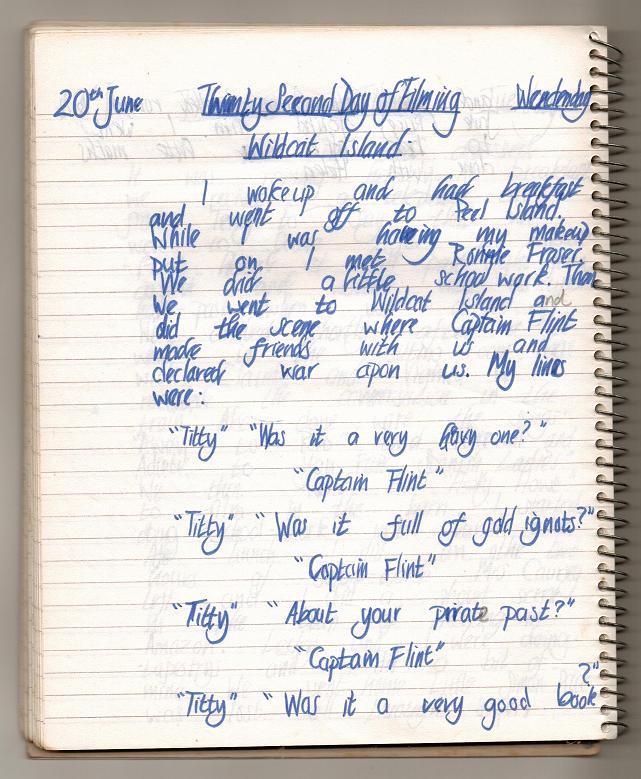
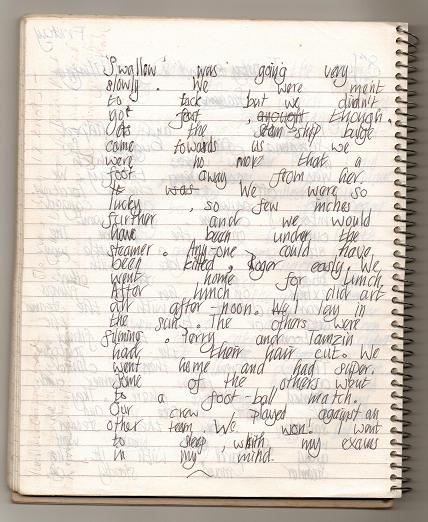
The recording of our scene with Captain Flint on Peel Island went smoothly, and Claude Whatham the Director was happy with the result, but my diary reports that a Force 8 gale blew in. This spun the poor production team into a quandary.
The call sheet for Thursday 20th June documents how truly unpredictable the weather could be. We had a ‘Fine Weather Call’, an ‘Alternative Dull Weather Call’, ‘Rain Cover’ in the Houseboat cabin, and a pencilled-in end-plan entitled ‘Peel Island’, which is where we’d ended up. Richard Pilbrow, the Producer, had a 1970s embroidered patch sewn to his jeans which read: THE DECISION IS MAYBE AND THAT’S FINAL.
The Call Sheet that never-was for 20th June 1973. We ended up on Peel Island.
In Arthur Ransome’s book Swallows and Amazons there is a dramatic storm with lashing rain. We were rather disappointed that it was not included in David Wood’s screenplay. It could have been shot that afternoon, but this was not to be. I can remember Mum saying, ‘You can’t have everything.’
What had been good about the 20th June was that we, the Swallows and the
Amazons, were all together, not sailing but on Wild Cat Island, with the novelty of working with Captain Flint for the first time. Kit and Lesley had been so patient, waiting day after day for their scenes to come up. They were stuck having lessons with our tutor Mrs Causey in the red double-decker bus most of the time. But the fact that they were on stand-by was helpful to the production manager who had to wrestle with the film schedule and call sheets.
As it was, the storm blew hard but cleared the dull-weather clouds and the next day was glorious, one to remember forever…
You can read more in the paperback or ebook here. There is also an audiobook narrated by me, Sophie Neville.
Sophie Neville as Titty and Stephen Grendon as Roger rowing to Cormorant Island
‘Pull harder, Roger!’ ~ hardly a line from Shakespeare, but one that has lodged deep in my memory. Titty was even bossier in Arthur Ransome’s books ~
“You keep time with me, Boy,” said the able-seaman.
“All right.”
Sten Grendon as Roger and Sophie Neville as Titty rowing Swallow (c)StudioCanal
Titty lifted her oar from the water. Roger gave one pull.”Boy,” said the able-seaman, “you mustn’t say ‘All right’.”
“Aye, aye, sir,” said the boy.**
When we auditioned for Swallows and Amazons the emphasis was on sailing. Could we sail? In fact I needed to be good at rowing. Titty and Roger row back form the Charcoal Burners, I rowed the Amazon from Wild Cat Island and here we were rowing across Derwentwater to Cormorant Island. This was more difficult than normal as Swallow was wired to the camera pontoon.
When I look at the 16mm footage my father took of me rowing at home before we left to film in the Lake District, I cringe. My blades were high above the water, hitting the surface with terrible splashes but I seemed to achieve my objective. I managed to fit an improvised mast to our Thames skiff and even made my own sail. It doesn’t look great, but I think Arthur Ransome would have approved.
Swallow finding Amazon anchored near Cormorant Island on Derwent Water with the camera pontoon and safety boat: photo~ Daphne Neville
Simon West and Suzanna Hamilton joined us for the scene when the Swallows lower the Jolly Roger and start to sail the captured the Amazon back to Wild Cat Island. I can only imagine that I changed my costume in one of the support boats. The scene may have been shot with two cameras on different boats.
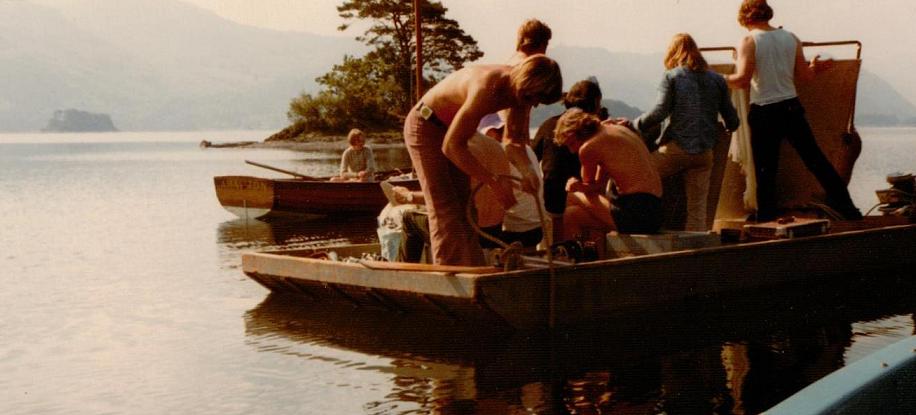
Sophie Neville playing Titty Walker in the captured Amazon, with David Cadwallader, Bobby Sitwell, Dennis Lewiston, Claude Whatham and two electricians holding reflector boards on the camera punt: Photo ~ Daphne Neville
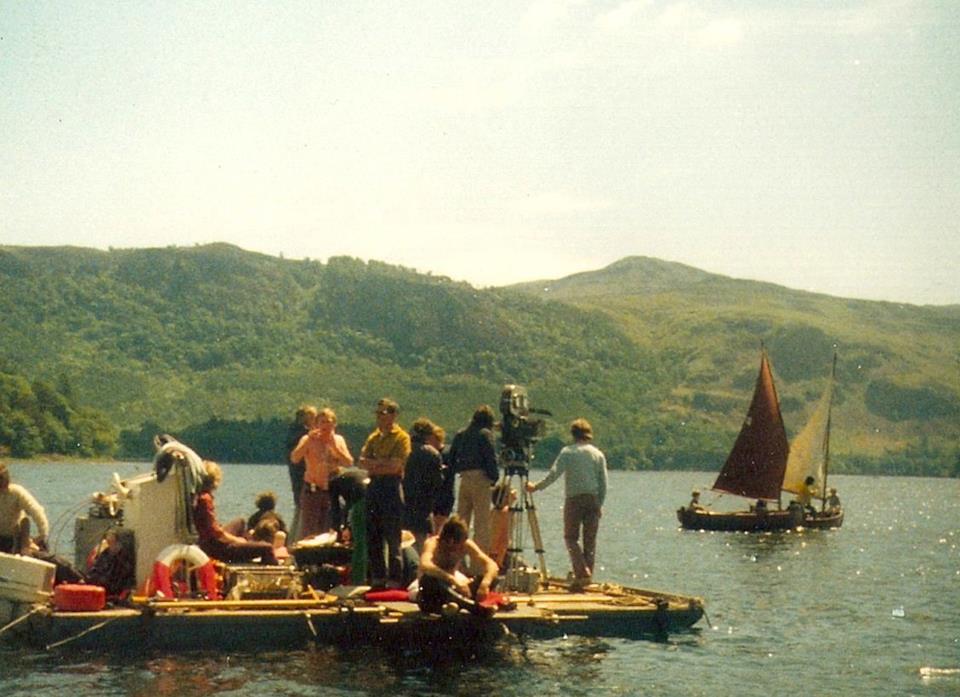
This shot shows Claude Whatham using the grey punt,* which somehow managed to accommodate Dennis Lewiston, the 35mm Panavision and quite a few crew members, while Richard Pilbrow remained on the camera pontoon with Eddie Collins operating the 16mm camera.
Richard Pilbrow and his film crew on the camera pontoon with Eddie Collins operating the 16mm camera. Simon West and Stephen Grendon sail Swallow. Suzanna Hamilton is climbing aboard the Amazon with Sophie Neville
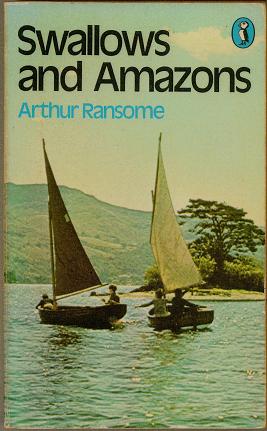
I remember the scene itself as being difficult to achieve in terms of sailing. Swallow has a keel, and Amazon with her centre board is much the faster dinghy. It is not like racing two boats of the same class. After hauling up the anchor Suzanna and I battled to turn the Amazon, not wanting to wiggle the rudder and jeopardise her pins. I remember Simon calling advise over the water. He stalled and we caught up, trying to get close together for the shot. The result was a photograph used on the front cover of the next Puffin edition of the book.
Stephen Grendon, Simon West, Sophie Neville and Suzanna Hamilton on the cover of the 1974 Puffin edition of ‘Swallows and Amazons’
* I may be wrong about these photographs. The still surface of the water in the shot of Titty alone in Amazon suggests that it was taken later on, when we filmed the burglars landing on Cormorant Island with Captain Flint’s trunk, but we probably had a very similar set up on this more sparking day ~ 15th June 1973.
We went on to film various shots of us sailing on to Wild Cat Island, when I think the camera was in Swallow capturing close-ups of a triumphant Captain John. He did indeed do well.
**Swallows and Amazons by Arthur Ransome, 1970 Jonathan Cape edition
Claude Whatham had no Peak of Darien at Bank Ground Farm, Arthur Ransome’s location for Holly Howe. But he did have buttercups and daisies, the flowers so evocative of childhood summers spent in the English countryside. The field that runs down to Coniston Water looked glorious that sunny day in June 1973. It was glowing.
Claude had used wild flowers to good effect when he made Laurie Lee’s memoir Cider with Rosie for the BBC in May 1971. It had been one of those months of endless sunny days in Gloucestershire but we were in Westmorland now, where buttercups bloomed later in the year and sunny days were cherished. This was Claude’s afternoon for low angle shots.
The view from Bank Ground Farm over Lake Coniston as it was in 1973
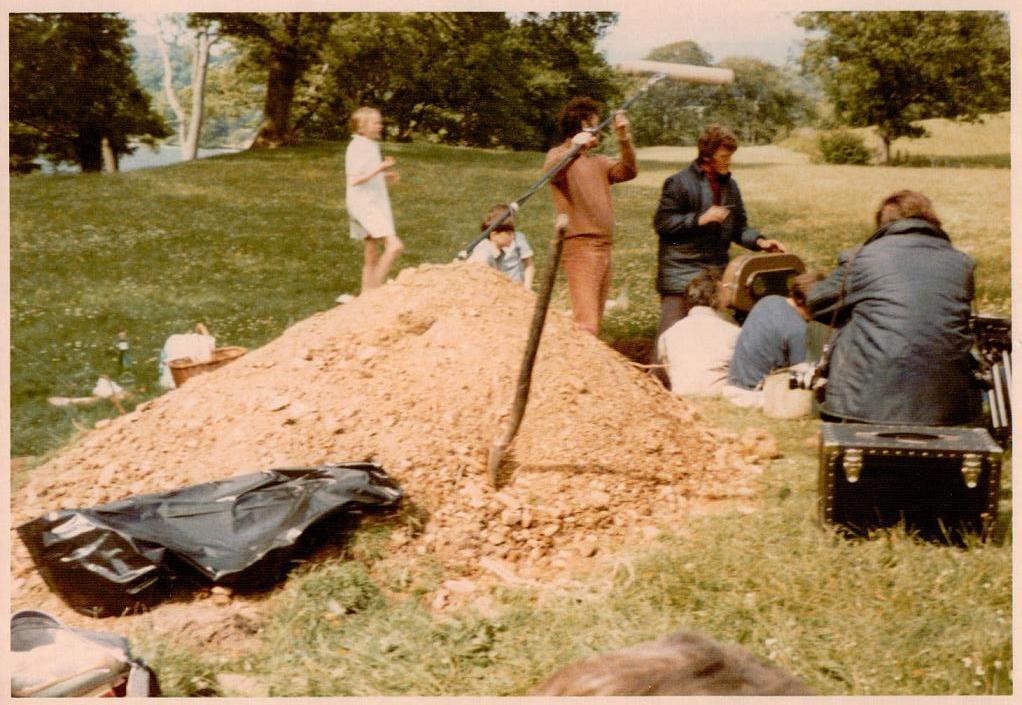
We arrived to find that a huge hole had been dug in the meadow for the camera, with a picnic for us spread out the other side of it. We thought this was very exciting. I’m not sure whether Mrs Batty felt quite the same joy about the excavations in her field. I was sad that we didn’t have a fire with a kettle, as they do in the book of Swallows and Amazons, but that was kept as a feature of island life and camping yet to come.
Sophie Neville, Simon West, Suzanna Hamilton, Gay Lawley Waklin, Bobby Sitwell, Dennis Lewiston, Albert Clark: photo~ Daphne Neville
Roger came sailing down clutching the telegram from our father, reaching out to deliver it over the hole. I understand that this was based on the cryptic telegrams that Ernest Altounyan sent his children Taqui, Susie, Titty and Roger, the children who acted as models for the Swallows. It has become the iconic response to Health and Safety ever since.
Claude Watham having just spoken to Stephen Grendon playing Roger at Bank Ground Farm. Who is in the foregound? : photo~ Daphne Neville
What we ended up saying altered slightly from David Wood’s original screenplay. ‘Dispatches?’ – Ransome spells the word ‘Despatches’ but apparently both spellings are correct.
John referred to Daddy as ‘Father’. I’m not sure why. He did so in his letter. It is daddy in the book, but perhaps Claude considered ‘Father’ as having a more period feel. I stuck more to Ransome’s dialogue, as you can see if you compare the film script with my diary entry above. This was because I knew his book so well, and never saw the script. The acting credit must go to Simon West who sat holding the telegram, graciously absorbing my bossiness, whilst I grappled with the words.
David Wood’s original screenplay of ‘Swallows and Amazons’
Sue Merry typing up continuity notes on location at Bank Ground Farm: photo ~ Daphne Neville
Back in 1973 it was the job of the ‘Continuity Girl’ to take notes on any changes made to the script. Sue Merry, ever present in her dark coat, took on this role. Today she would probably be known as a ‘Script Supervisor’ but her Aviator sunglasses and black polo-necked jersey would be the height of fashion. Sue also took notes technical notes for the film editor and director, indicating which Takes were favoured and which had been spoilt, giving the reason. In those days we had no monitors. The camera lens would be unscrewed after each take and checked carefully. If any fluff was found, Bobby Sitwell the camera assistant would call out, ‘Hair in the gate!’ Sue would quietly note this down and David Bracknell, the first assistant, would call out, ‘Set up to go again’. And we’d go again.
Sue was also responsible for the continuity, and would take numerous Polaroid photographs as an aide-memoir. This scene followed the one of Mother giving Roger the telegram, which had not yet been shot. Virginia McKenna hadn’t arrived back in Cumbria. Looking back, this seems a huge gamble. Would they ever get another sunny day while the buttercups were still blooming, a day to match – exactly – the weather of 14th June?
Sue would sit and type up her notes on location, using a portable typewriter that sometimes was set up for her on a spindly picnic table. This method of working was different from the BBC, when a ‘production assistant’ would type up her notes at the end of each day. Would it have been so that one copy of her notes, typed on triplicate paper, could be sent to the laboratory with the exposed film? It meant that her evenings were free.
We were allowed to help fill in the hole at the end of the day.
Sue Merry had worked for Neville C. Thompson before on The Boyfriend, Ken Russell’s movie that starred Twiggy with Tommy Tune, Barbara Windsor and Glenda Jackson. She later worked on The Wicker Man, Anthony Shaffer’s harrowing film directed by Robin Hardy that featured Edward Woodward, Christopher Lee and Diane Cliento, Britt Ekland and Ingrid Pitt. She went on to work with Dennis Lewiston and other members of our crew on The Rocky Horror Picture Show, the movie that starred Tim Curry, Susan Sarandon and such unexpected artists such as Meatloaf, Christopher Biggins and Prince Andrew’s old flame Koo Stark, who played a bridesmaid. Sue also did the continuity for Nicolas Roeg on The Man Who Fell to Earth, starring David Bowie, before moving into television to work on The Professionals and The Comic Strip Presents… All quite fun!
But on that day in June 1973, she was the girl with the daisies in her hair, wearing a coat thick enough to indicate that although sunny it was still quite chilly in the Lake District.
You can read more in ‘The Secrets of Filming Swallows and Amazons (1974)’
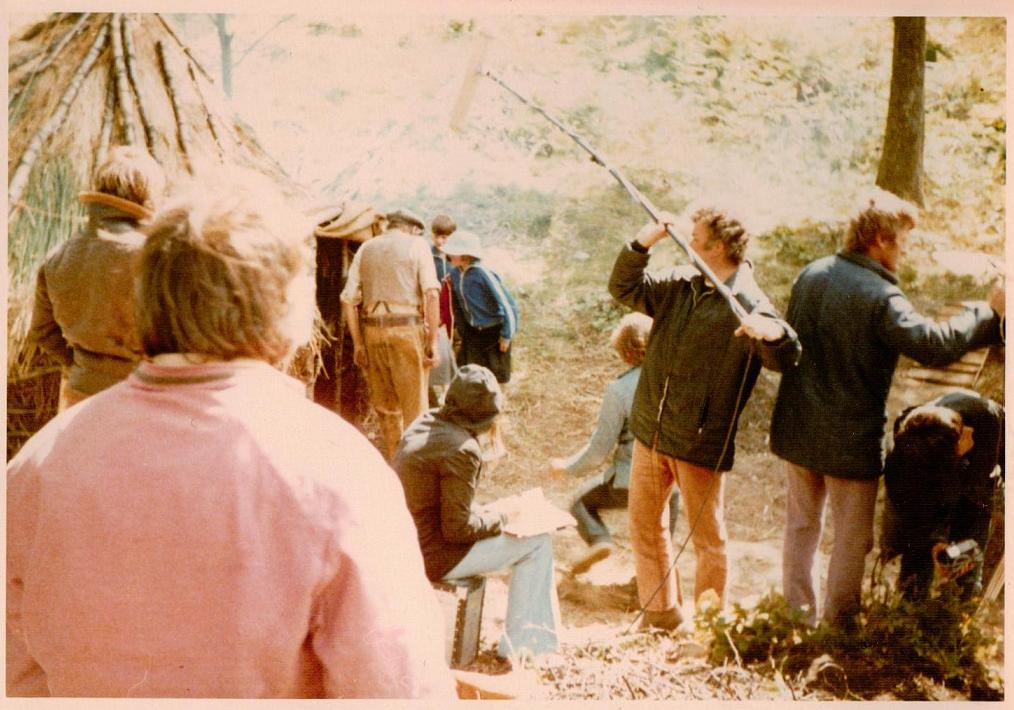
Sophie Neville as Titty Walker visiting the charcoal burners on a cold day in 1973 ~ photo: Daphne Neville
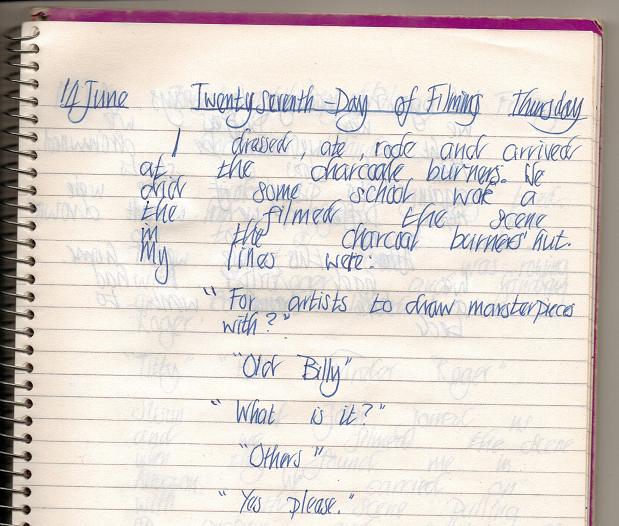
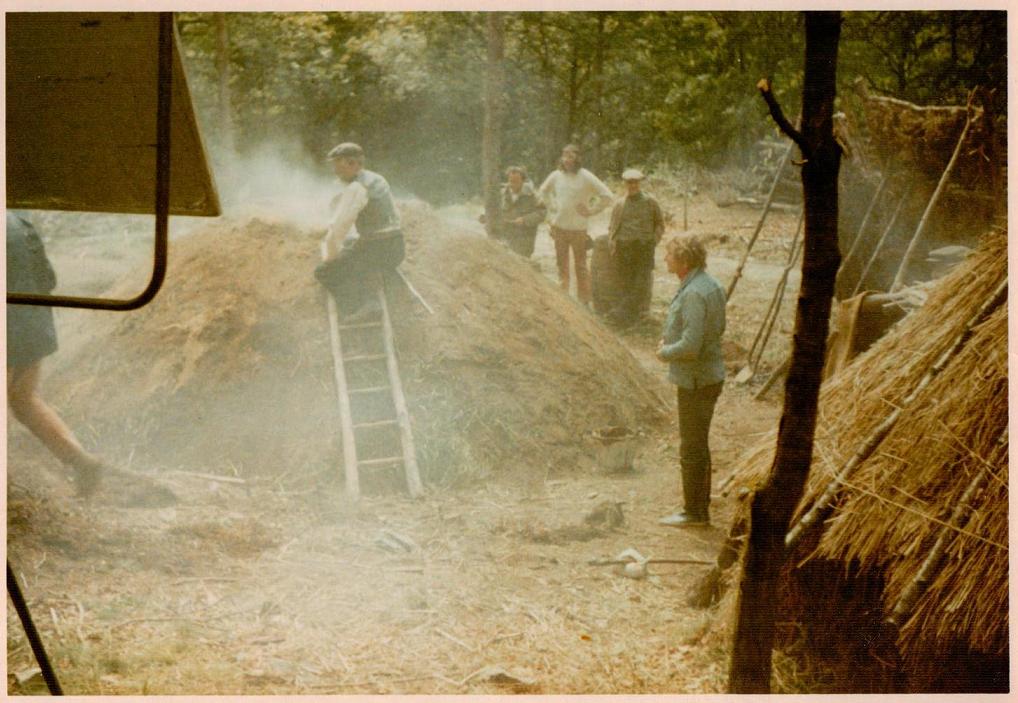
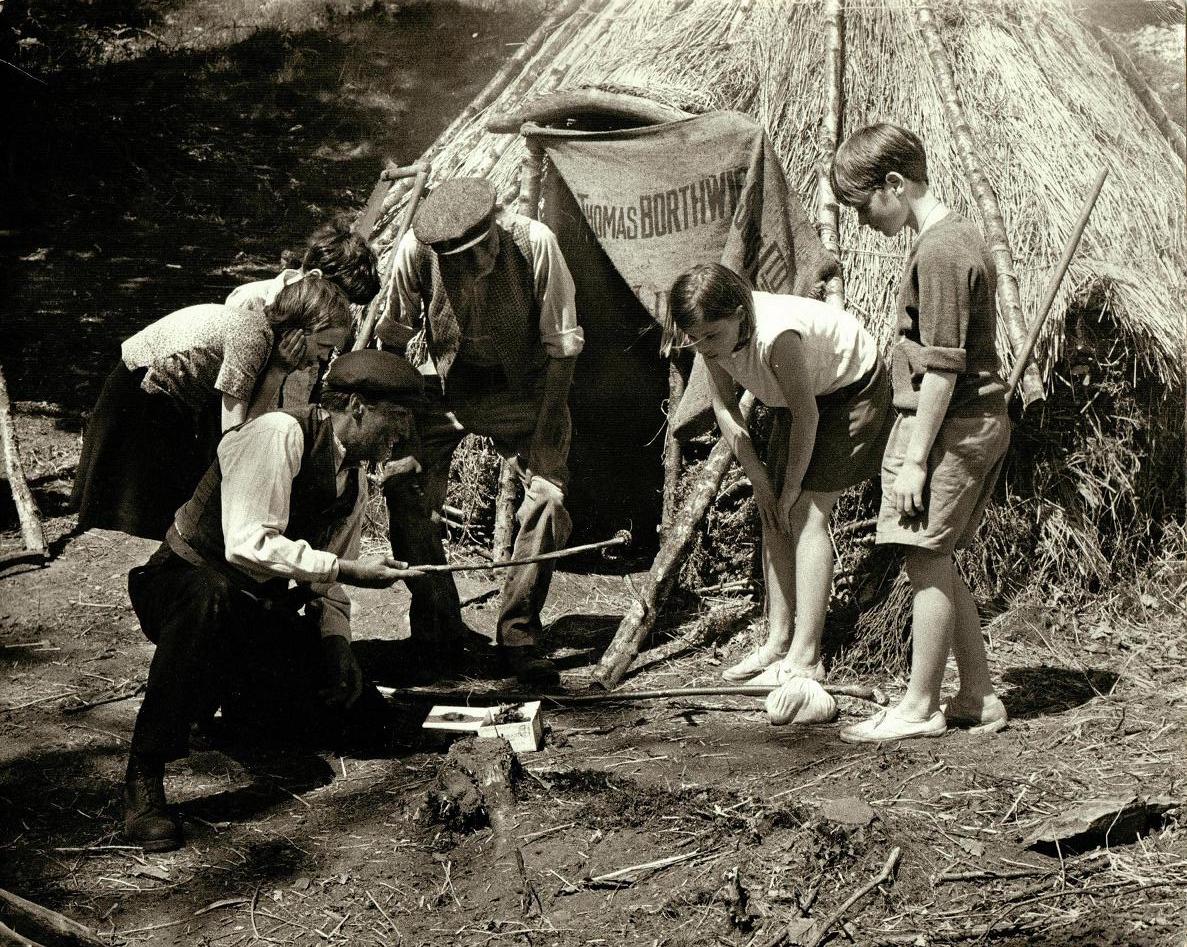
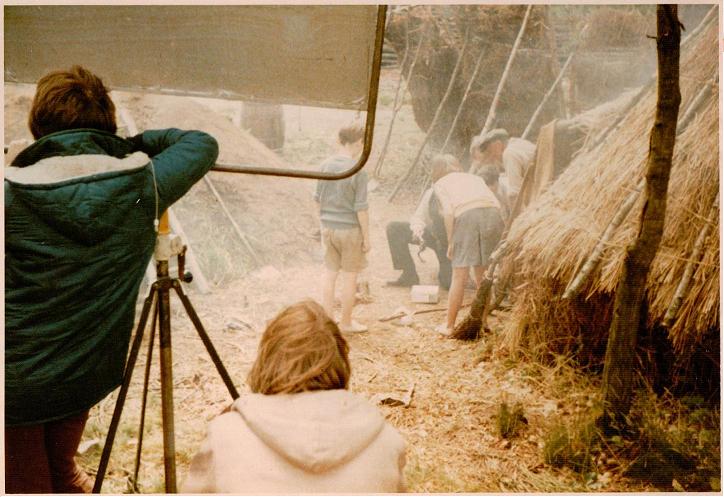
On 14th June we were back at Ickenthwaite Forest, in Cumbria, to film the sequence when the Swallows visit the Charcoal Burners.
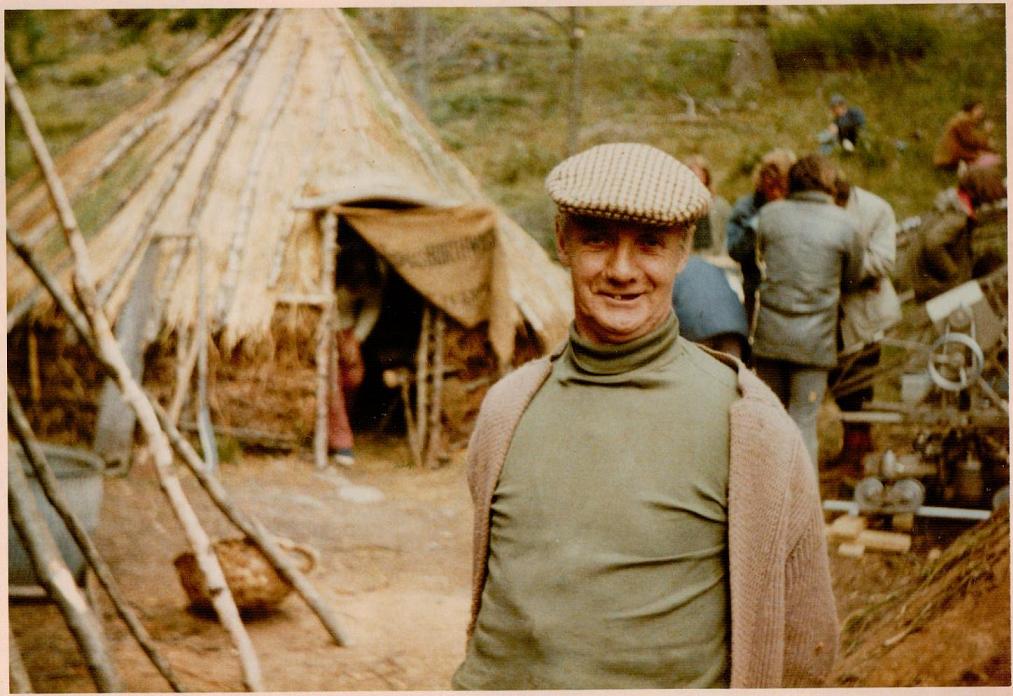
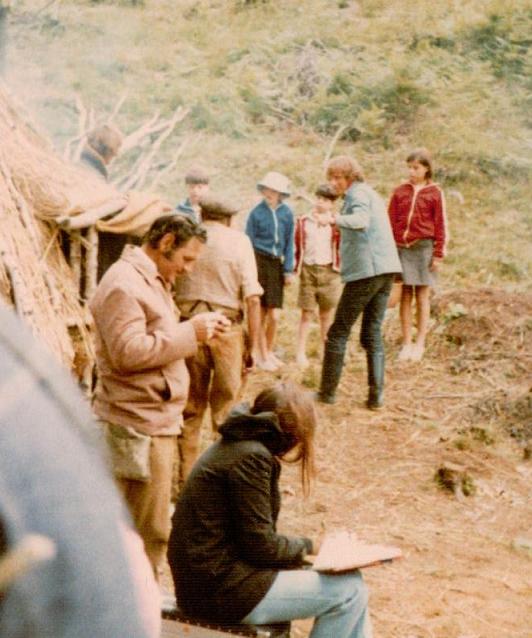
Norman Allonby, the real charcoal burner outside the hut. Behind him the 35mm Panavision camera is being mounted on a small crane and short section of track ~ photo: Daphne Neville
‘He doesn’t look much like a son.’ The real Young Billy was almost indistinguishable from the actor. He seemed to take a wry interest in the filming but what he thought of us, of the crew, I dread to think. We were aliens on his planet. Terribly bossy ones.
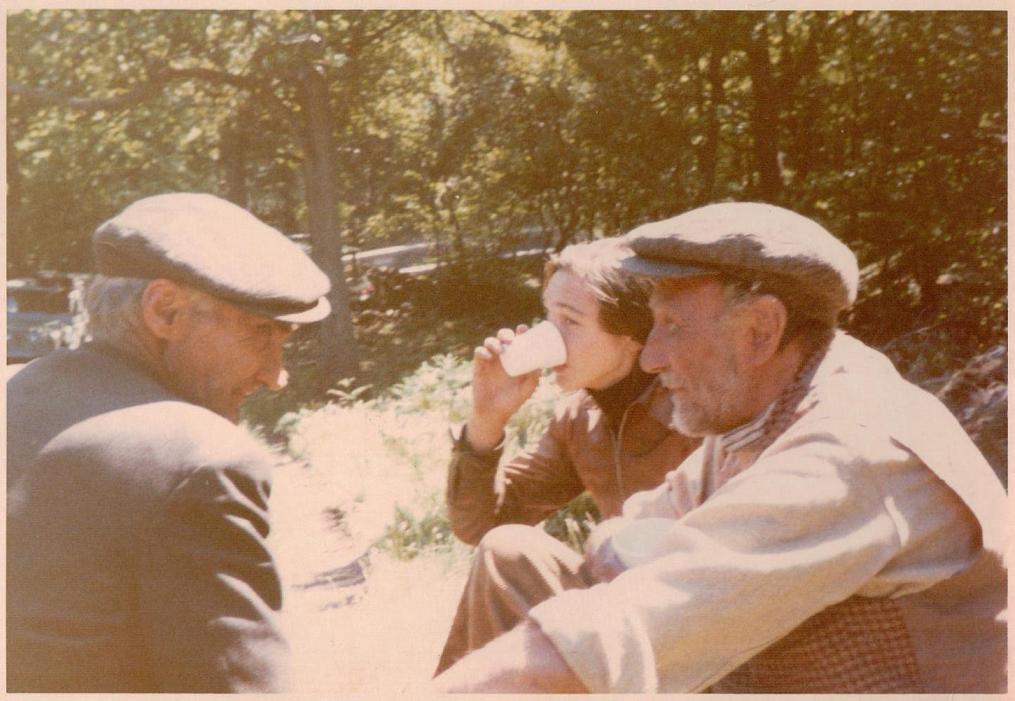
The charcoal burner Jack Allonby chatting to Jack Woolgar playing Old Billy
Our polystyrene coffee cups look so out of place. They were. How much had changed in the art of producing charcoal between 1973 and 1929 when Arthur Ransome set our story?
Jack Woolgar looks as old as the hills. He’d been born in 1913, so must have only been sixty years old, younger than I am now. He’s appeared in ‘Doctor Who’, ‘Emmerdale Farm’ and ‘Coronation Street’. After ‘Swallows and Amazons’ he played Carney in forty-eight episodes of ‘Crossroads’. We knew him as the professor in ‘The Lion, the witch and the Wardrobe’.
John Franklin-Robbins playing Young Billy, chatting to Norman Allonby of Bandrake Head during a coffee break on set ~ photo: Daphne Neville
The Call Sheet for the day scheduled Scene 110 with the adder, but I recorded in my diary that we had completed that the previous day. I must have meant my part in it. The director, Claude Whatham, was probably using the time to pick-up the shots of Young Billy working with his dampened fire.
Much later, when I asked Claude what made a good director he said, ‘You need to use your time well.’ This probably makes you an employable director, but I think Claude had other assets. We all adored him for one thing, and would do anything he asked without question. We knew that he wanted us to keep going, no matter what happened. Susan really did leave her basket behind at the Charcoal Burners’. When Old Billy called her, she was truly taken aback and sweetly ran to collect it. It’s something that rings true, a natural quality that Claude brought to the film.
The interior of the hut must have been tricky to light. I think we had a real fire burning in the stone grate and Claude was keen for the scene to be atmospherically smoky. The wood smoke itself was fine but the crew were working with smoke guns, since they were more directional and considered more controllable. The acrid fumes produced by their oil canisters choked me but Jack Woolgar was absolutely stoic and kept our attention. I loved drawing with the charcoal. I wish I had drawn him. Apart from the amount of smoke it was lovely inside the mossy wigwam. I could have stayed there quite happily. It was nice and warm.
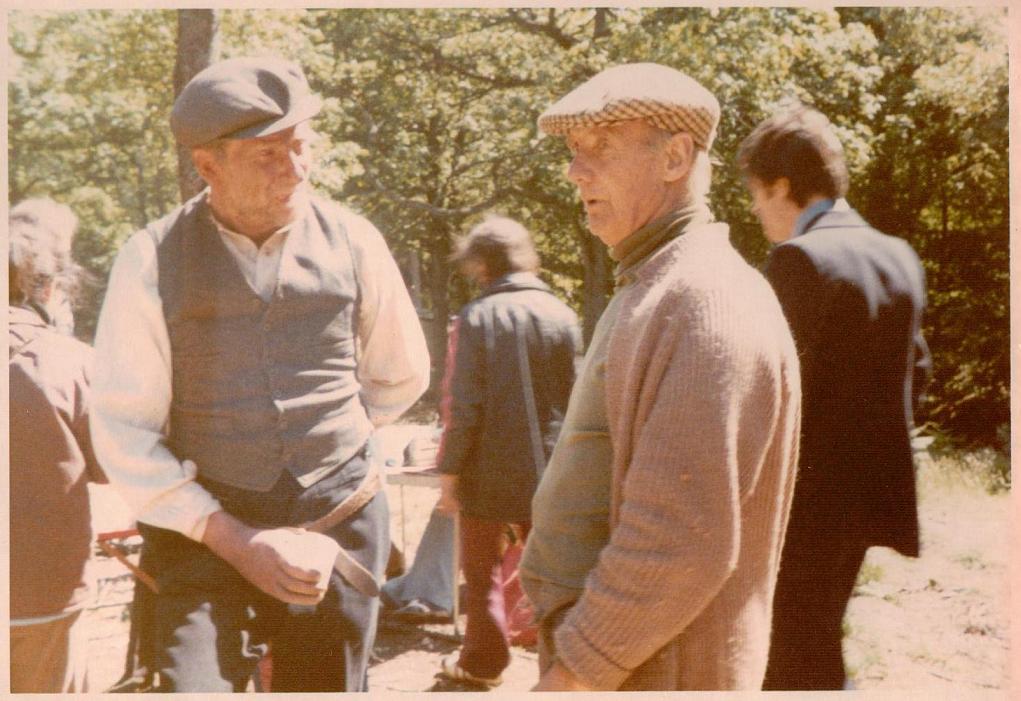
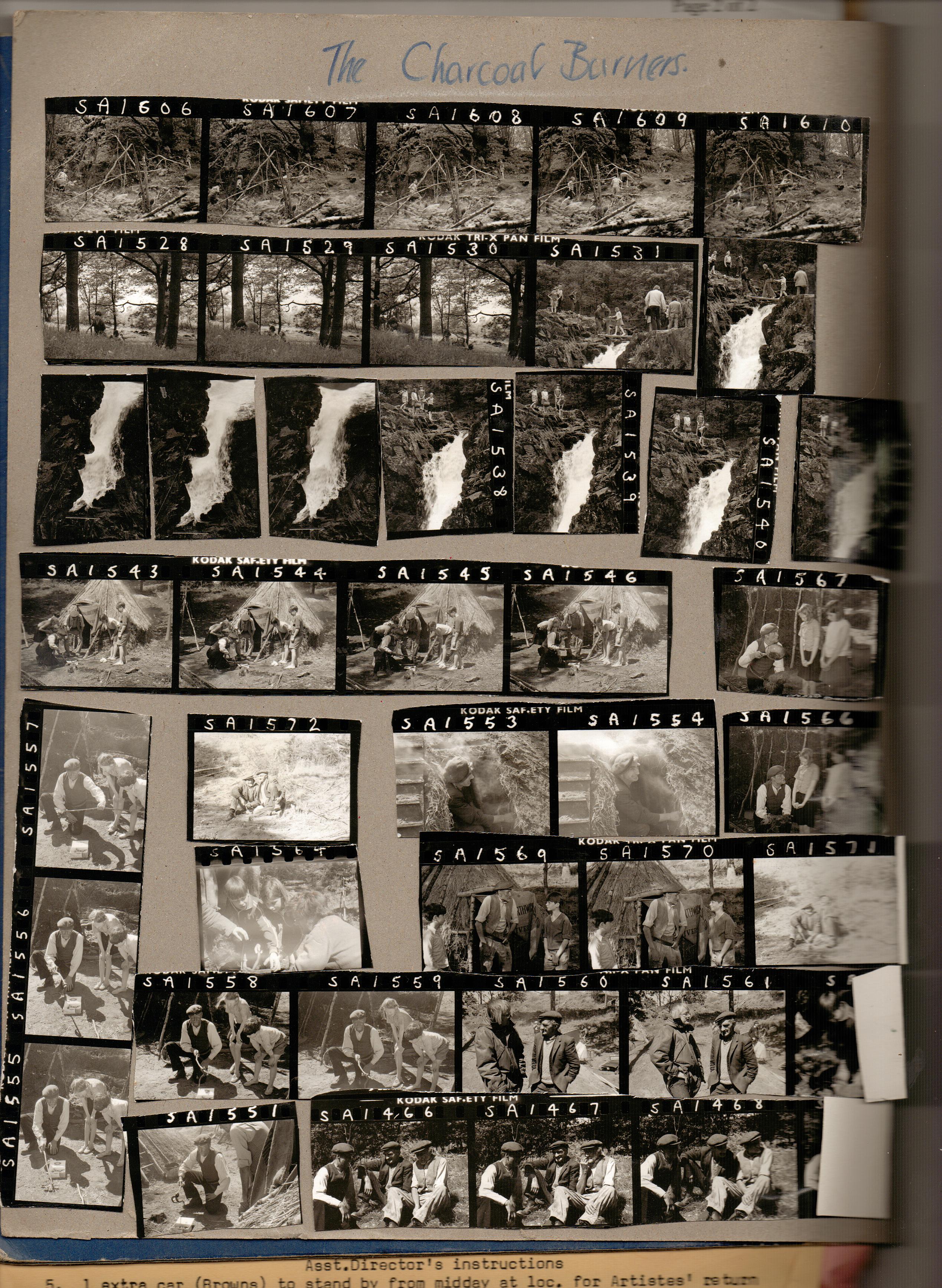
Albert Clarke, our Stills Photographer, later gave us his unwanted contact sheets to stick in the scrap-books we kept of the filming. Amongst them are these photos he took of the Producer Richard Pilbrow with the charcoal burners of Ickenthwaite Forest.
Audrey Steeley told me that the older charcoal burner is Jack Allonby who lived at Spark Bridge, a well known local character. Norman Allonby lived at Bandrake Head.
Bill Norris, was another authority on charcoal burning also from Spark Bridge.
As the Call Sheet decreed, we were scheduled to to move to Bank Ground Farm after lunch to film the receiving of ‘despatches’, a scene I look forward to describing in the next post.
You can see photos and read more in ‘The Making of Swallows and Amazons(1974)’, available online here
I’ve written more about charcoal burning in Cumbria here
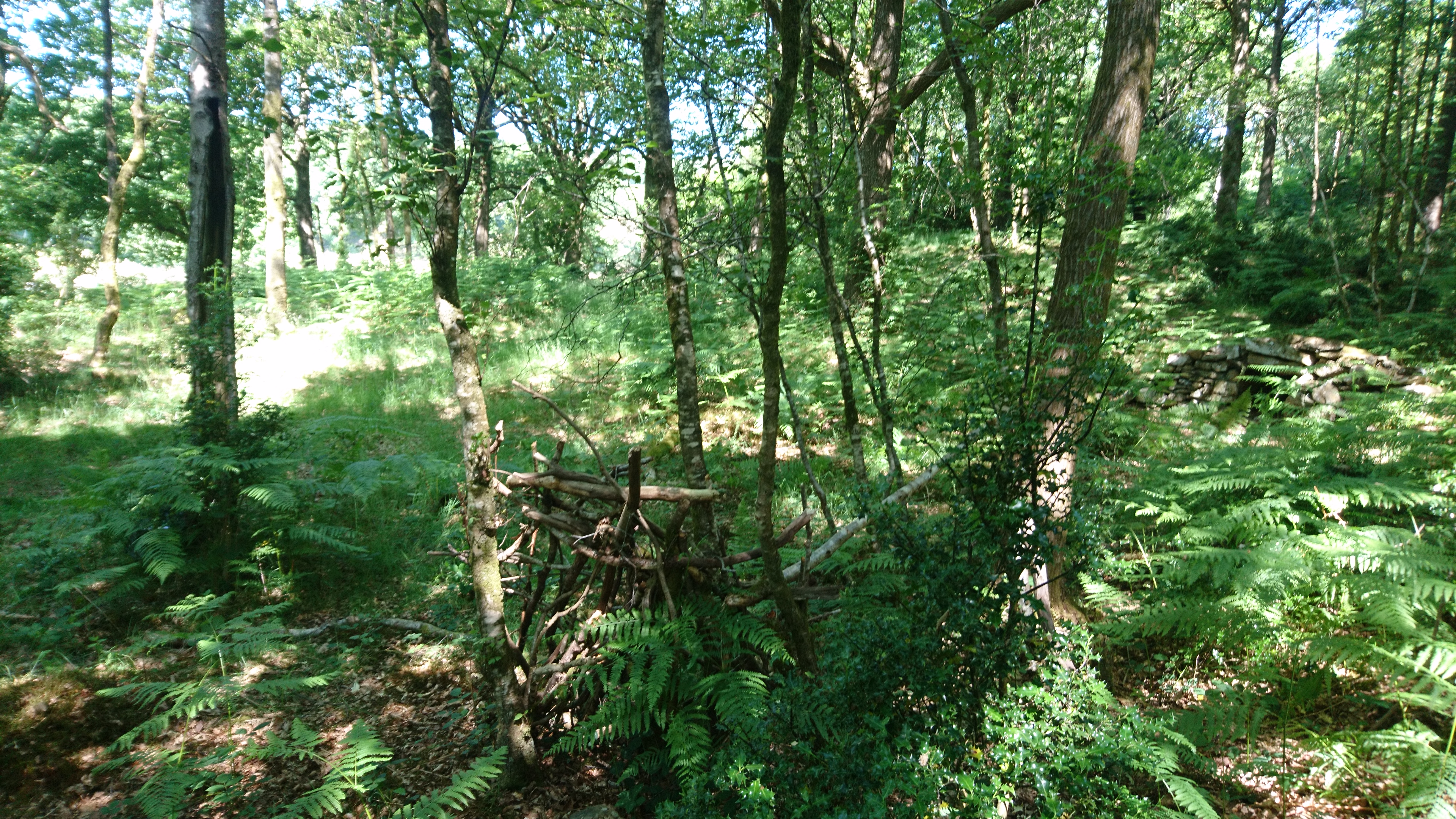
Brian Crawley kindly sent me this shot of what the location looks like today. You can just fee the remains of the fireplace to the right:
One of Brian’s friends remembers watching our Routemaster double-decker buses climbing the twisting track up to the site.
There is evidence of charcoal burnering near Hill Top where Arthur Ransome lived long after he wrote ‘Swallows and Amazons’. You can find the photos on this site here
Jack Woolgar as Old Billy with Simon West, Suzanna Hamilton, Sophie Neville and Stephen Grendon ~ photo: Daphne Neville
‘Let’s just run though our lines, shall we?’ Old Jack Woolgar said, in a gentle Lancashire accent. We were waiting about for some reason, so did just that, sitting by a woodstack. Titty had a lot to say in the scene where we went to see the charcoal burners, but the dialogue was straight out of Arthur Ransome’s book so it was easy. Or I thought so, until there was Old Billy saying – ‘Ehh, then you’ll be climbing into that mini-bus and off back to Ambleside, I expect.’
I thought, ‘That’s not in Swallows and Amazons! That’s real life.’
‘Eee, lass! You forgot to come in on your cue.’ I had too. I was so entranced by Old Billy, so lulled by the music of his voice, that I had simply gone on listening to him.
Jack Woolgar, Simon West, Sophie Neville, Stephen Grendon and Suzanna Hamilton with Director Claude Whatham. Sue Merry is seated in the foreground with her continuity sheets ~ photo: Daphne Neville
We were still having problems with the weather. It was cold and grey at first but grew to be a bright sunny day in Cumbria, with a gale blowing that was knocking the tops of the trees about and making life hard for Graham Ford, the sound recordist. This was all a bit difficult as it was meant to be dead calm in the story.
‘It’s blowing up a bit,’ Old Billy put in. I don’t think anyone watching would have noticed if we’d left it at that but our hair was blowing about so madly that Young Billy had a few savage-like words with John about why we weren’t sailing. These are not in the book.
Filming the scene ~ Sound Recordist Graham Ford in the foreground, Grip David Cadwallader. Actors Jack Woolgar, Simon West and Sophie Neville, Continuity Sue Merry seated, Director Claude Whatham kneeling, Boom Swinger, Focus Puller Bob Blues and Camera Operator Eddie Collins ~ photo: Chaperone Daphne Neville
I think Mum did well with her photographs. She only had a small camera but she tried to capture what it was like to be on set, involved in the filming, rather than just focusing on the story. Because her camera made a clicking noise she was only really able to take shots when we were in rehearsal, wearing our Harry Potter-like nylon tracksuit tops, me in a sun-hat, the rest of the crew wrapped up in their warm jackets.
When I watch this scene I notice one technical bit about acting that is never talked about much. You have to hit your mark. Without this being obvious. No looking down. Your mark is the exact position established when the shot is lined up. The camera focus, certainly back then, required actors to be consistent and hit the same position in each take as established in the rehearsal. Look at the opening shot at the top of this post and you can see it is carefully composed – a nice triangle, with all our faces in vision. The important bit – Roger holding my hand is not masked. Do I spoil the magic if I say we are standing on our marks?
Sophie Neville looking at the adder with Stephen Grendon and Jack Woolgar
If feet can’t be seen a piece of tape was usually placed on the floor in front of the actors’ toes to provide a mark. I used to use different coloured tape for different artistes later on when I was an assistant director. We used chalk on tarmac roads. Tape didn’t stick to most of the locations on Swallows and Amazons, so we used sticks or tree bark, taking quite a pride in disguising them. Sometimes a box would be placed on the ground so we could feel it and not have to look down. This could not be done at the charcoal burners’. We all came out of their dark wigwam blinking in the bright sunlight shuffling onto our secret marks, Suzanna glancing down quickly to check she was on hers.
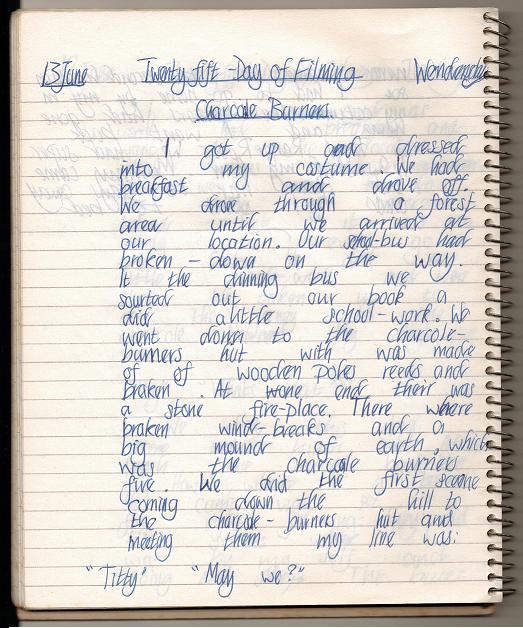
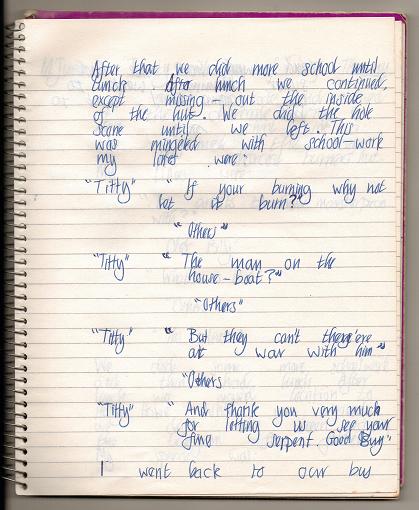
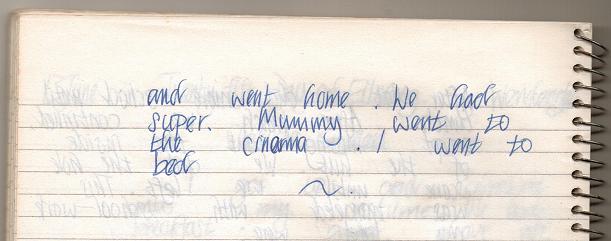
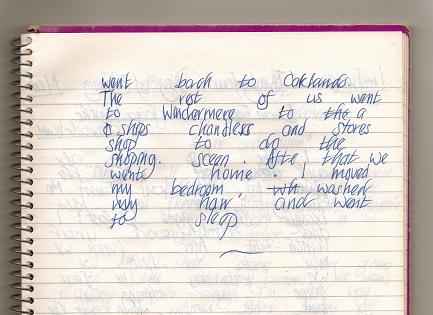
My diary read:
John Franklyn-Robbins as Young Billy with Director Claude Whatham. Prop men stand in the background with the real charcoal burner ~ photo: Daphne Neville
Was the charcoal heap was a real one? I’m afraid I think, since that hole had to start smoking on cue, that it was constructed for us with a prop man called Terry inside with a smoke gun. I know he suffered rather from getting too much smoke in his eyes and had to be treated by the nurse. There was certainly a great deal of smoke around, which had a wonderful effect.
Robert Forster who supplied the Charcoal Burner’s adder
Molly Friedel watching Robin Gregory plant a microphone for the adder. Claude Wahtham is hidden by a reflector board, Suzanna Hamilton, Sophie Neville and Jack Woolgar wait on their marks while the real charcoal burner looks on ~ photo: Daphne Neville
We could all see the adder but the sound recordist wanted to hear her so he buried one at our feet. She was a lovely serpent. Suzanna, who loves snakes with a passion, got close to touching it. She was very disappointed that you can’t see this in the movie. I was a bit scared. Ransome had added that frisson of danger – real life danger – there for us to see.
Sophie Neville, Sten Grendon, John Franklin-Robbins, Jack Woolgar, Suzanna Hamilton & Simon West
Jean Woodhouse wrote to say, ‘I came to watch Swallows and Amazons being filmed. It was the charcoal burner’s scene. We walked down from our village Primary School (Satterthwaite) but the scene was actually just down the road from where I lived… we were all terrified re-the snake.’ She was about 10 years-old at the time. ‘…because I used to go up and down through the wood each day, I knew the real charcoal burners who worked in there and so that scene in the film has always felt quite special to me.’
Filming the Scene: Simon West, John Frankiln-Robbins, Suzanna Hamilton and Jack Woolgar. Designer Simon Holland sits in the foreground. ~ photo: Daphne Neville
One of the most magical things for my mother was meeting the real charcoal burners. There are more photos of them in the nest post as we returned on 14th June.
John Franklin-Robbins playing Young Billy with Sophie Neville, Stephen Grendon and the adder.
You can find out the name of the snake wrangler and read more about the filming in the ebook ‘The secrets of filming Swallows and Amazons (1974)’
‘Here we are, intrepid explorers making our way into uncharted waters. What mysteries will they hold for us? What dark secrets shall be revealed?’
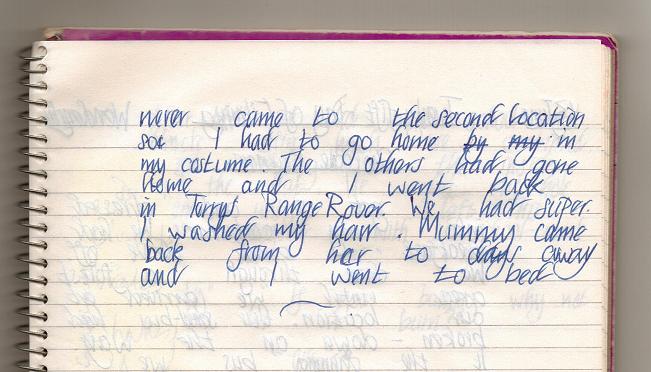
The dark secret was that the inky black night scenes had to be shot in Mrs Batty’s barn. At Bank Ground Farm. During the day. A rainy day.
The design team strung up thick light-proof drapes and made the dusty out-building into a studio. The director, Claude Whatham had no choice. We had quickly run out of interior scenes and the weather was so bad that we could do little else.
Producer Richard Pilbrow with director Claude Whatham in their wet weather gear on Peel Island, Coniston Water
‘While the rest of England melted in a heat wave, the Lakes seemed wrapped in mist and rain,’ Richard Pilbrow the producer remembers. I have a press cutting from The Guardian dated 7th July 1973, which opens with the words:
‘THE WEATHER report follows in half a minute. Richard Pilbrow is obsessed with the weather. Every morning he wakes around 4 o’clock and crosses his room at the Kirkstone Foot Hotel to cock a weather eye at the sky above Wansfell Pike. Most mornings it is the same story… Pilbrow looks out of the window. Raining. ‘
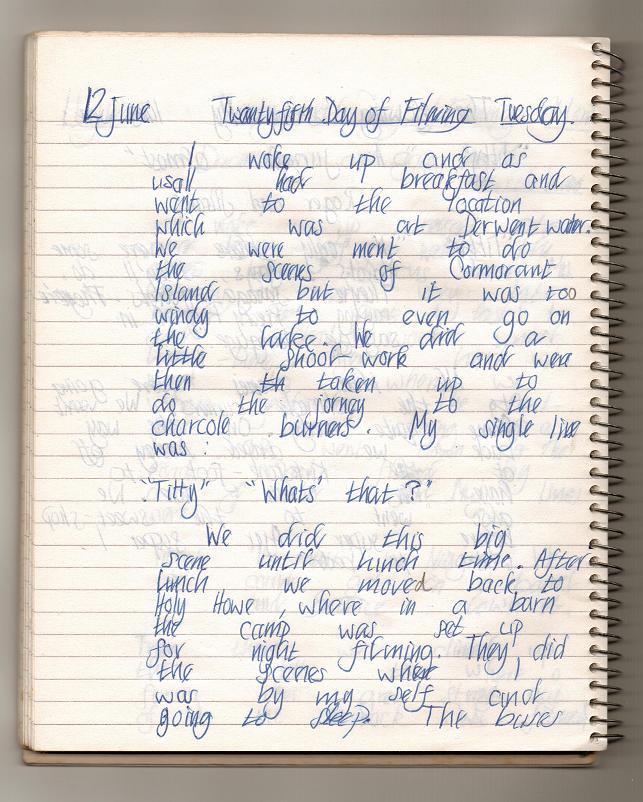
What a worry and concern that rain was. Swallows and Amazons is firmly set in an idyllic childhood summer, August of 1929, when the water was warm enough to swim daily and the only disappointment was a total lack of wind. When we arrived to start filming at Derwentwater on 12th June 1973 it was too windy to even go out on the lake.
I loved filming in the barn. The Third Assistant, Gareth Tandy, lead me through the high wooden doors and into a magical version of our camp on Peel Island, beautifully recreated by Ian Whittaker the set dresser. A real camp fire was burning. Blankets (goatskins in Titty’s imagination) and pillows from our tents had been laid out so that I could be ‘shrouded in my cloak’ whilst waiting up for the Swallows to return from the Amazon River. The scene was beautifully lit with branches held in stands in front of the lights with a gentle wind produced by the prop men wafting a board to lift my hair at the right moment. I don’t think there was an owl hoot for me to hear. I had to imagine that so they could add a real owl call later. Someone has written in to ask if I learnt how to make an answering hoot. I’m afraid not. I tried and tried. I still can’t. John could do it but Claude asked us both to just pretend so that he could lay the sound on afterwards.
Director Claude Whatham with his cast of Swallows in 1973
What we gained, despite or perhaps because of the weather, was a camaraderie that formed a foundational basis to the film. We had to be stoic and get on with filming despite getting cold and wet. Rain doesn’t show up on screen unless it is really pelting down. You can see the effects – wet hair and soggy costumes, but you actually have to use rain machines if you want to show rain in a drama. We could film our trek up the hill to visit the charcoal burners without a problem but going out on the lake was impossible. You’d have seen the rain drops falling on the water. And it was too windy. As it was, we had a brilliant director of photography who used what light he had to capture that limpid quality you find in the Lakes, so quintessentially English it draws you in, reeling back to childhood days when we had time to make camps and rush about in the woods.
Suzanna Hamilton, Sten Grendon, Sophie Neville and Simon West in a scene cut from the film
I’m pretty sure that the big scene I referred to was one that was cut from the final film. It was about leaving paterrans in the woods, as detailed in the books but not essential to the story. It must have been covered by the journalist from the Guardian as I found this cutting:
The rain did deter my mother from taking photographs. She didn’t have a flash to use in the barn but she took lots – masses – the following day…
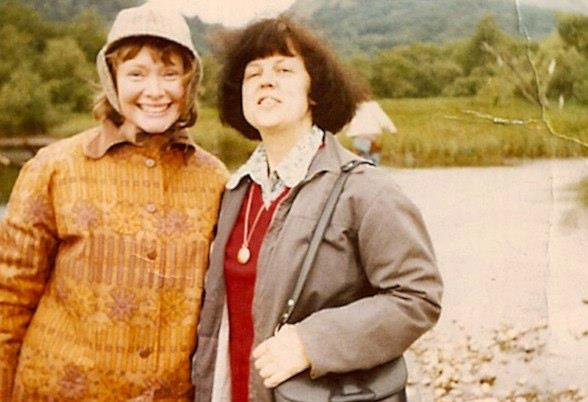
Dressed for the Cumbrian weather: Daphne Neville with Liz Lomas, Richard’s assistant at Theatre Projects in London ~ photo: Richard Pilbrow
Other scenes that hit the cutting room floor are detailed here
If you would like to read more, ‘The Secrets of Filming Swallows and Amazons’ is available as on Amazon Kindle and other ebook platforms.
Sophie Neville and Simon West on the cover of ‘Swallows and Amazons’ pub by the Daily Mail
Of all the wonderful days we spent filming Swallows and Amazons in 1973, the fishing scene, shot in a reedy bay on Elterwater was one I enjoyed most. It was a cold, rather wet morning but the Third Assistant, Gareth Tandy, taught us how to use our rods and we were soon absorbed in a way that Arthur Ransome would have understood well.
Our fragile bamboo fishing rods, one with a wooden reel, were supplied by a keen fisherman called Leslie Borwick, who brought up his own daughter and grandchildren on Arthur Ransome’s books. He kept the rods, which still belong to the family, who now lived near Sedburgh.
Filming the fishing scene from the camera punt on Elterwater
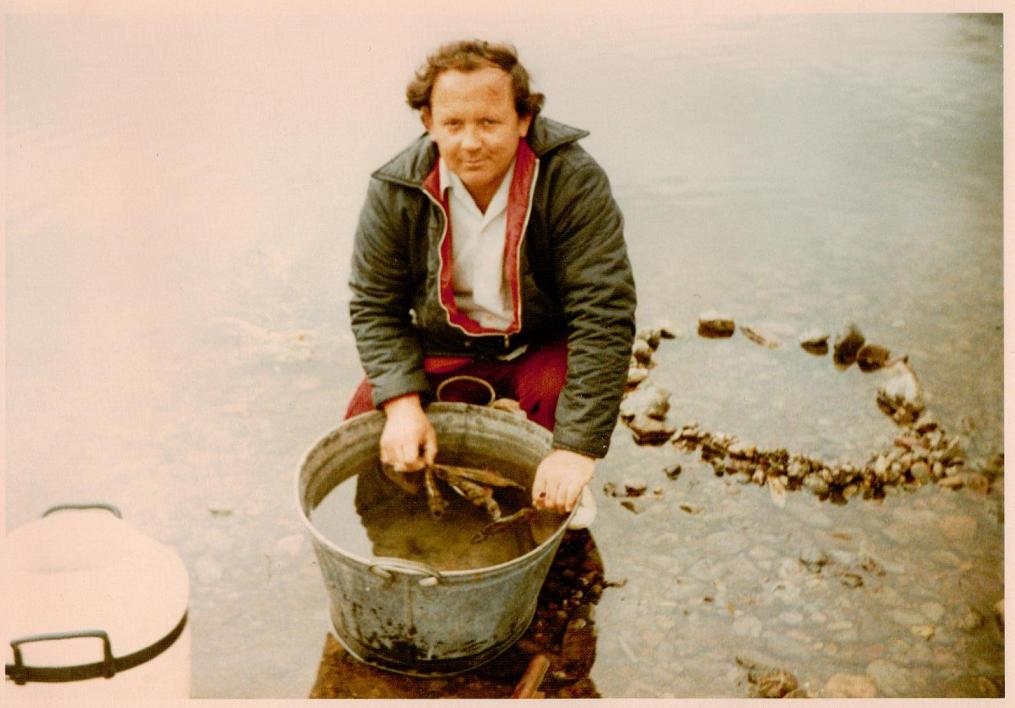
The only problem we had that day was keeping the fish alive. Bob Hedges our property master, the designer Simon Holland and Ian Whittaker, the set dresser, took it upon themselves to keep the perch as happy as they could, until they were – very carefully – attached to our hooks. Titty doesn’t catch one but Captain John did. Despite everyone’s best efforts it wasn’t a very lively perch.
Property Master Bob Hedges keeping the perch alive ~ photo: Daphne Neville
The big challenge was Roger’s great fish – a massive pike that meant to be snapping and ferocious. I’ve been told that it ended up being resuscitated in Keswick Hospital ICU – the Intensive Care Unit.
The local fisherman, Ian Whittaker, Simon Holland and Gareth Tandy with the fish photo: Daphne Neville
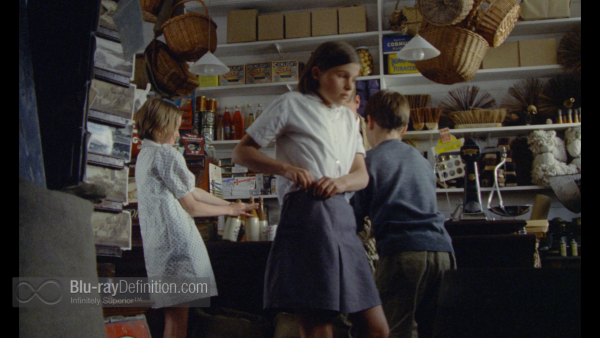
Sadly this is the only photograph we have of the set designers at work together. Later that afternoon we went to one of the few interiors of the film – the general store in Rio or Bowness-on-Windermere where we bought the rope for the lighthouse tree and four bottles of grog. In reality it was a sweet shop in the ‘seventies. It was later a barber shop and became a showroom for wood-burning stoves. Pigs were once kept around the back.
The Swallows in Woodland Road, Windermere in 1973
Back in 1973, Ian dressed the interior with boxes of wooden dolly pegs and other things you’d buy in brown paper bags. A wonderful 1920’s radio set and two purring cats really made the scene come alive, especially since, being in reticent explorer mode, we were a bit gruff in our communications with Mr Turner, the native shop keeper.
Sophie Neville in Rio with four bottles of grog ~ photo: Daphne Neville
Ian Whittaker struck me as being rather different from everyone else on the crew. He was a very nice looking man and a gentleman of the old school. I remember him telling me that he’d originally set out to be an actor but had found it so difficult to get work that he grabbed a chance to become a set-dresser or designer’s assistant. He found he rather enjoyed it, and stuck to the job despite his family thinking it was not much of a career. He proved them wrong. By 1971 he was working for Ken Russell on The Boy Friend – a musical about a musical starring Twiggy with Christopher Gable and Max Adian that I’d seen at school.
Woodland Road, Windermere
After Swallows and Amazons Ian worked on Ridley Scott’s film Alien with Sigourney Weaver, Tom Skerritt and John Hurt and was nominated for an Oscar with the others on the design team. Eventually he won an Oscar for Best Art Direction-Set Decoration with the designer Luciana Arrighi for Howards End – the movie of EM Forster’s book starring Anthony Hopkins, Vanessa Redgrave, Emma Thompson and Helena Bonham-Carter.
In 1994 Ian was nominated again, this time for Remains of the Day directed by James Ivory. After that he worked on Sense and Sensibility, Emma Thompson’s movie of the Jane Austen classic that launched Kate Winslet’s career, some of which was shot at Montacute in Somerset where my great-grandmother once lived. Ian Whittaker received another Oscar nomination for Anna and the King in 2000 and a nomination for an Emmy Award for the TV movie Into the Storm in 2009.
So, it was rather a waste that Ian spent his time just building little stone walls in the lake to keep the perch alive on our set, but I think he enjoyed the fishing scene as much as I.
You can read more in ‘The Making of Swallows and Amazons (1974)’ available online, from Waterstones and your local library. It is suitable for all ages of readers.
Ronnie Cogan having a cigarette with one of the Supporting Artistes. Terry Smith the Wardrobe Master is going below in the background. photo: Martin Neville.
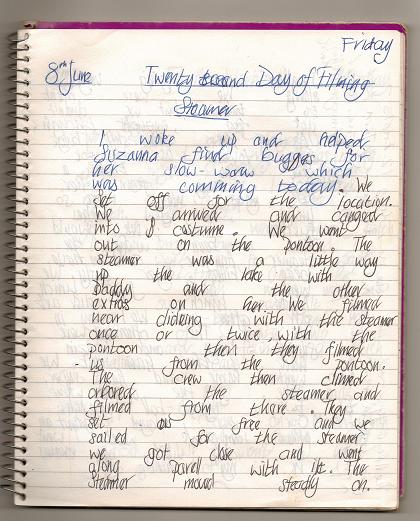
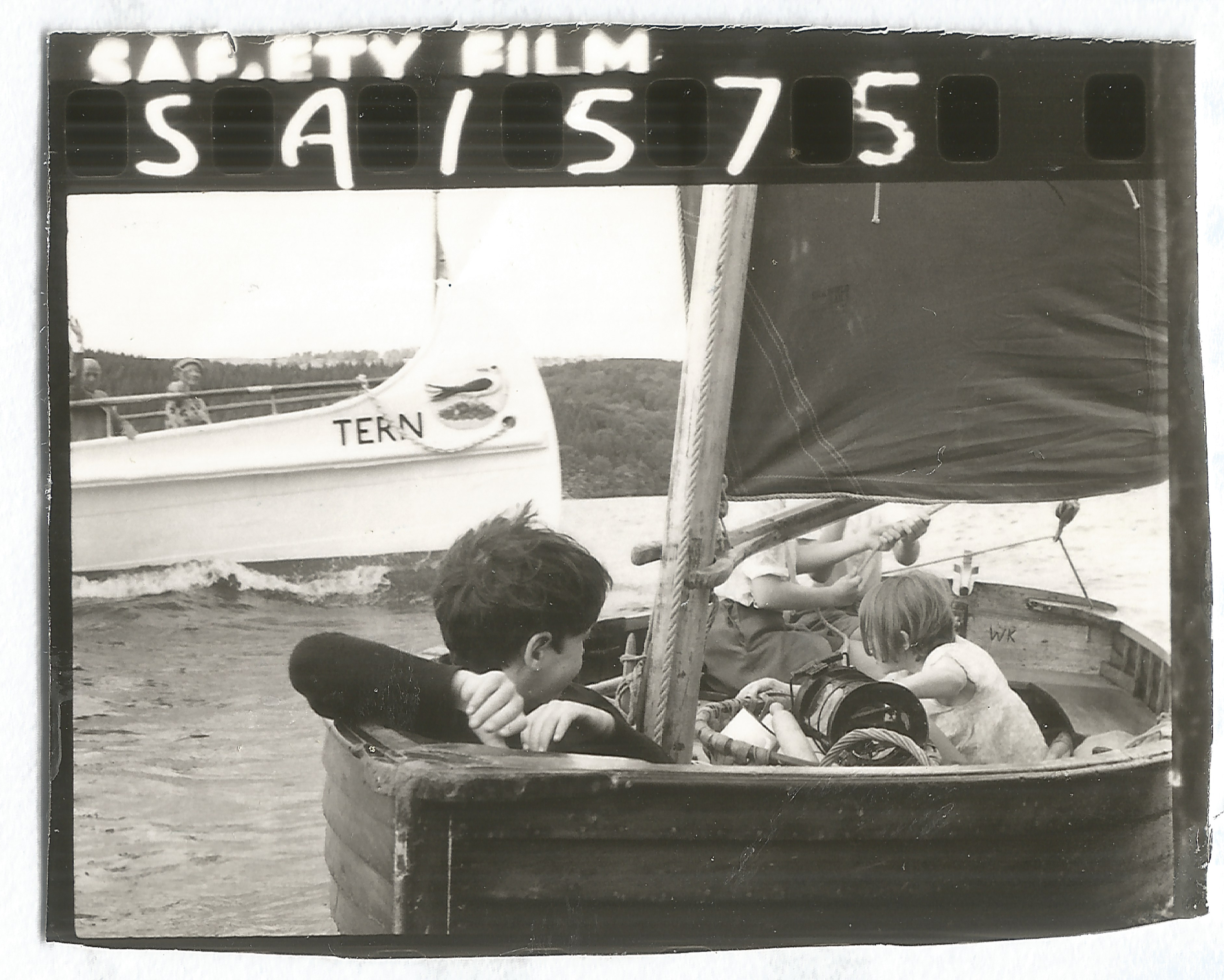
It was a glorious summer day to film on Windermere. Conditions were perfect. My father had been asked to appear as a film extra in the scene in Swallows and Amazons when the the crew of Swallow narrowly miss colliding with a Lakeland steamer, that transporting tourists up and down the lake.
Martin Neville wearing 1929 costume aboard MV Tern on Windermere in 1973
He was the tall dark native in a blazer and white flannels aboard the elegant MV Tern. A lovely way to spend a sunny morning in the Lake District. Until your daughter nearly drowns.
MV Tern on Windermere was built in 1890 with a steam engine, converted to diesel in the 1950s, and is still operating today.
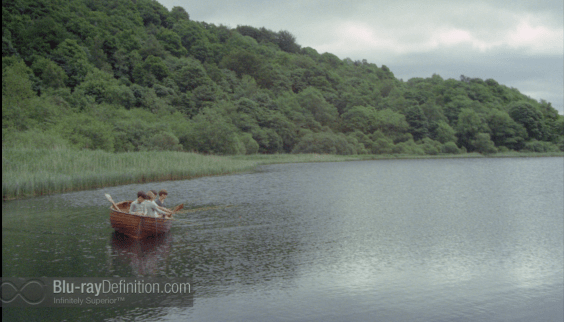
Simon West, Suzanna Hamilton, Sten Grendon and I were sailing the Swallow, on our voyage to the island. The twelve-foot dinghy was laden with camping gear and had no buoyancy. We did not wear life jackets.
At the start of the day, Swallow was attached to the camera pontoon so that Claude Whatham, the film director, could capture our dialogue on film. The camera crew then went aboard the Tern and we sailed free, with the safety boat some distance away, behind the camera. Other boats were keeping modern boats clear of the shot.
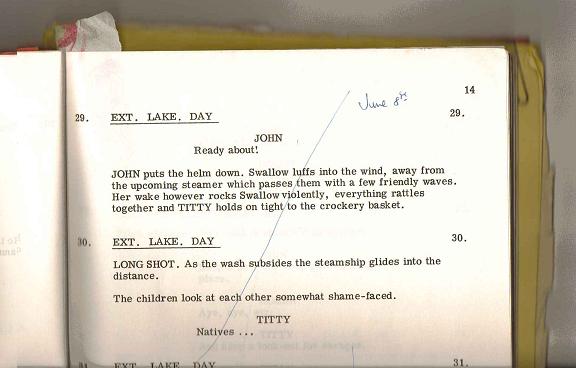
In the script Roger is down to say, ‘Steamship on the port bow’. I think what came out was, ‘Look John! Over there – steamer ahead!’
The Tern had a young, inexperienced skipper who was coping with a notch throttle, as you can see if you watch the movie.
The screenplay of David Wood’s adaptation of Arthur Ransome’s classic book ‘Swallows and Amazons’ set in the Lake District in 1929
My mother, who normally looked after us, had been obliged to drive to Bristol as she presented a weekly programme for HTV with Jan Leeming called Women Only and had been summons to promote the channel at the Bath and West Show. Dad must have been acting as our chaperone, responsible for our safety. A sailor with years of experience racing on the Solent, he took a keen interest in all the boating scenes, but I’m sure he didn’t have a chaperone’s licence. As we sailed towards him, on an intentional collision course, he foresaw that the larger vessel would take our wind.
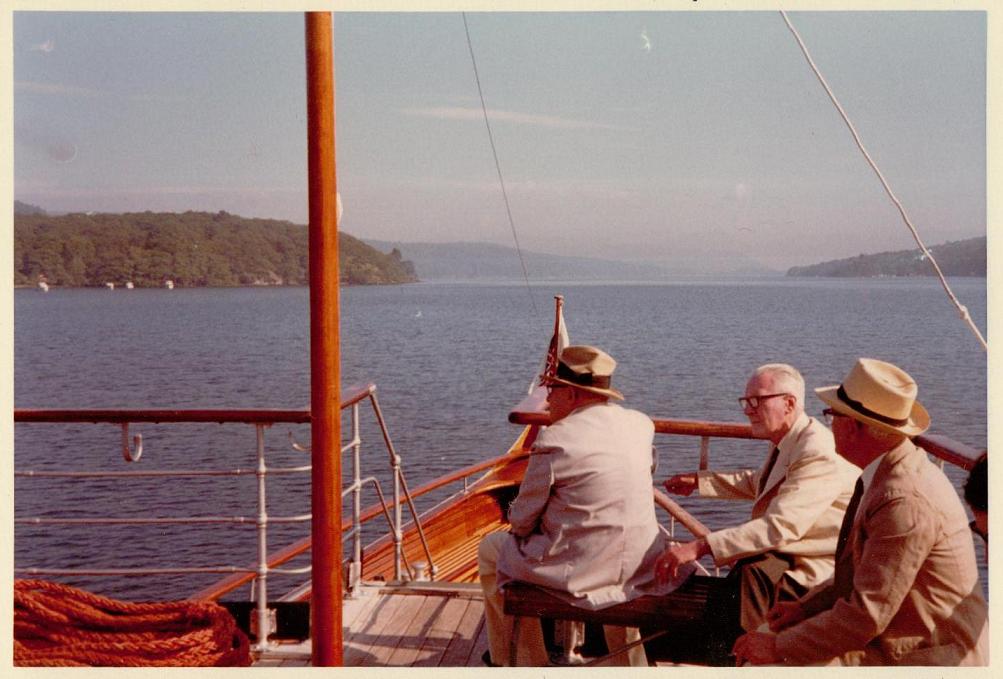
Three men of Cumbria who were happy to have short-back-and-sides haircuts on the deck of the MV Tern on Windermere in 1973 ~ photo: Martin Neville
My father watched from above as we only just turned in time, missing the steamer by a mere nine inches as her bow wave bounced us away and we sailed on. Ronnie Cogan had to buy him a whisky. They knew Sten could hardly swim, that any of us could have been entangled in the ropes and camping gear if Swallow had gone over. Clinker-built dinghies can sink quickly. It was a sunny day but the water was icy and very deep.
We did not know it at the time, but Dad nearly took me off the film. He had a meeting with the producer when he tested the BOAC life jackets we rehearsed in. Mine did not inflate.
Phil Brown, who belongs to the Arthur Ransome Group, said: “Tern was re-engined in 1957 with two diesel engines. Interestingly she was to have been named SWALLOW, but after a last-minute change, she was launched in June 1891 as TERN.”
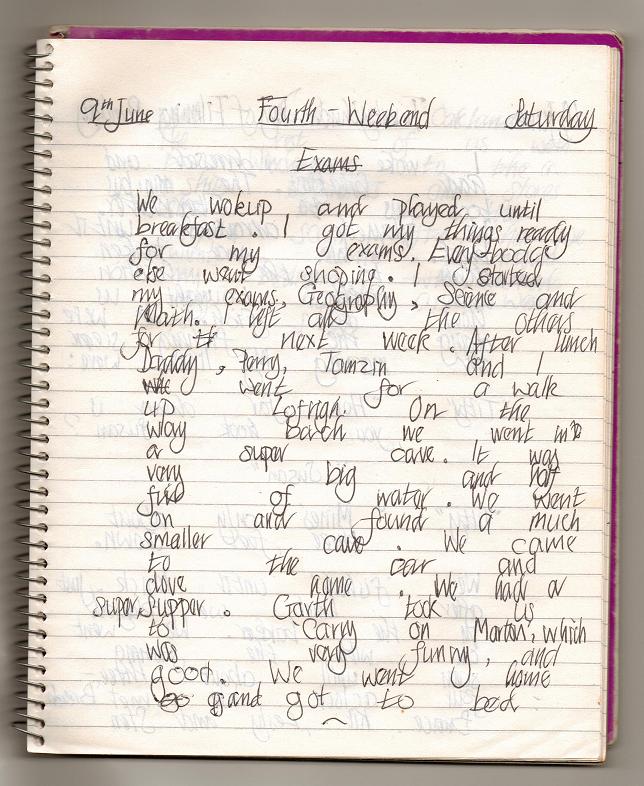
It is said that children bounce. The next day, I sat school exams: geography, science and maths.
…‘Carry on Matron’. I wonder what near disasters they had on that film.
You can read more in the ebook ‘The Secrets of Filming Swallows and Amazons (1974)’ available from Amazon Kindle, Kobo, iTunes and all other online retailers:
Sophie Neville on location in the Lake District ~ photo: Martin Neville
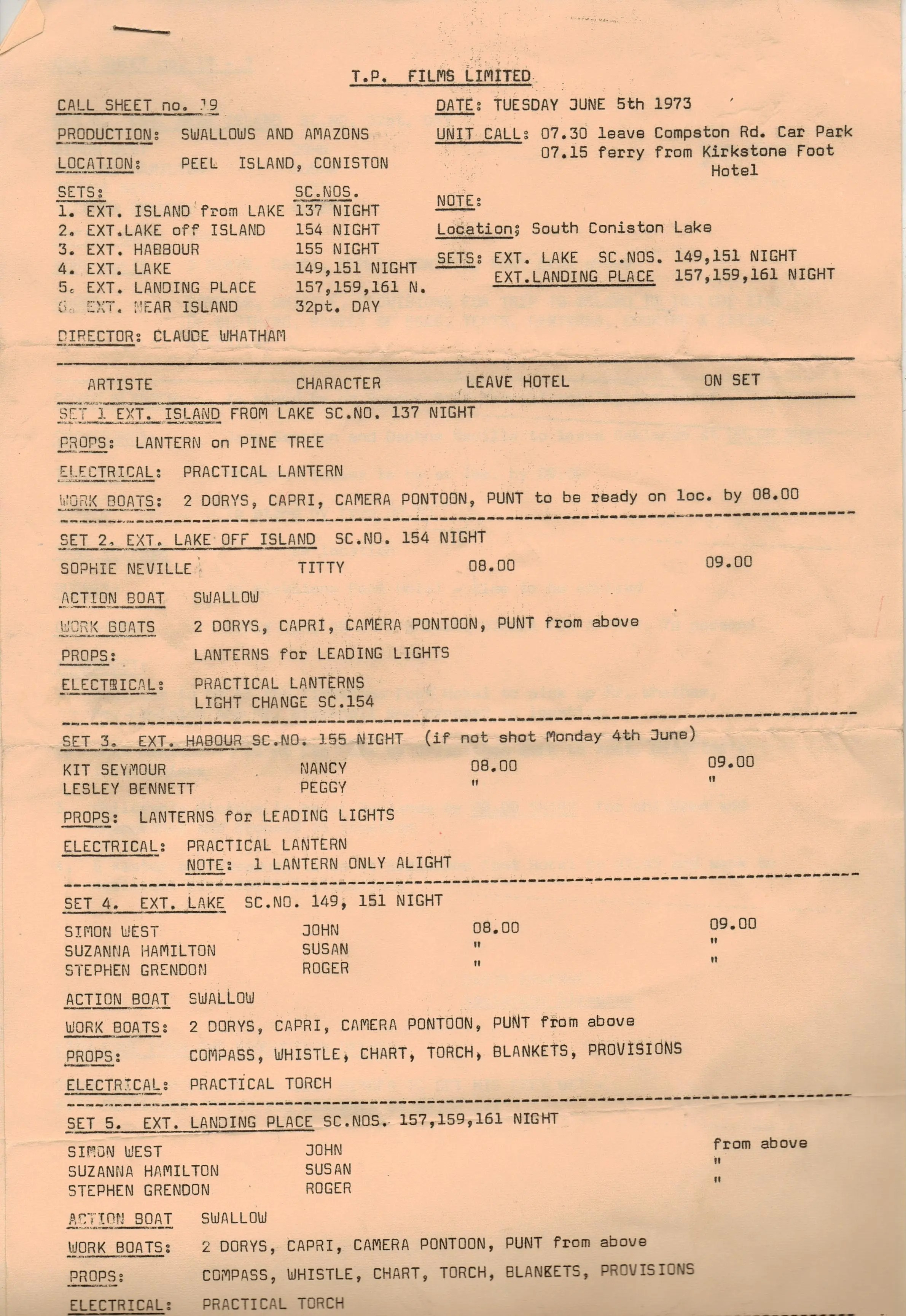
When David Wood constructed the screenplay of Swallows and Amazons he introduced dual action soon after the Swallows arrived at the island. By this I mean that he split us up a bit – John went to fetch the milk from Dixon’s farm whilst Susan and I were teaching Roger to swim. This isn’t quite as Arthur Ransome wrote but it added vitality to the script, moving it along. I reckon the Director, Claude Whatham needed to avoid a gang scenario of Five go to Treasure Island at all costs. It enabled us to get on with our school work since no one actor was in every scene. I was in all the scenes shot on this day 5th June (I wrote 5th May by mistake) but went back to my lessons whilst Claude was out on the pontoon filming John and Susan jibing Swallow – a pick-up shot set into the long shot, when I waved them goodbye from Wildcat Island, recorded on 2nd June.
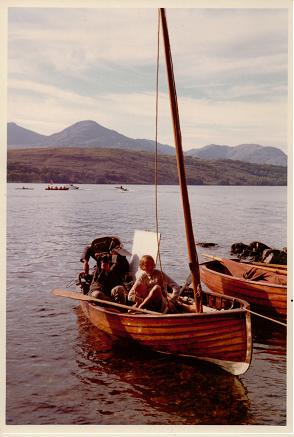
Mrs Bennett, Martin Neville, Lesley Bennett’s sister and Jane Grendon with the film crew on the pontoon filming Suzannah Hamilton, Simon West and Sten Grendon in Swallow just off Peel Island. Who is the boy sitting on the Capri moored to the temporary jetty?
At this stage in the story, Arthur Ransome split the action into three: John, Susan and Roger sail off to find the Amazon river leaving Titty alone on the island with her telescope, while the Amazons are busy plotting and planning at Beckfoot. Up until this time most films followed linear stories – this happened, then that happened – a bit like my diary. My favourite wartime drama A Town like Alice, which stars Virginia McKenna, is an example of this.It’s a road movie. Lovely – but I need to watch it whilst doing my tapestry.
At the Landing Place with Claude and his crew
As it happened, the method of running three storylines at once became all the rage in television dramas of the 1980s and 1990s, so when Swallows and Amazons was first broadcast it felt fresh even though it had been made six or seven years previously. The playwright John Mortimer said that when he first started writing three strands of action for Rumpole of the Bailey it terrified him. Would the audience be able to follow what was going on? Now every detective story breaks into three as soon as possible, while soap operas keep a number of storylines boiling furiously. The technique helps to pace the action, up the suspense and gives the director much more flexibility in the cutting room. Apart from anything else it makes it easier to bring episodes in at the exact length required by the television schedulers. One reason why credits roll after a programme is because the Presentation Department can alter the speed they run at. Did you know this? It means that every story can be made to last exactly 37 mins 30 seconds.
Claude Whatham giving us direction at the Landing Place
Nowadays linear story-telling in movies, such a The Kings Speech seems to be received as more cinemagraphic. Perhaps multiple action just went too far. ‘Flashbacks’ seem dated and running two storylines in different time periods can be confusing. I couldn’t do my embroidery whilst watching A Social Network.
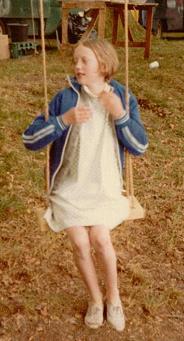
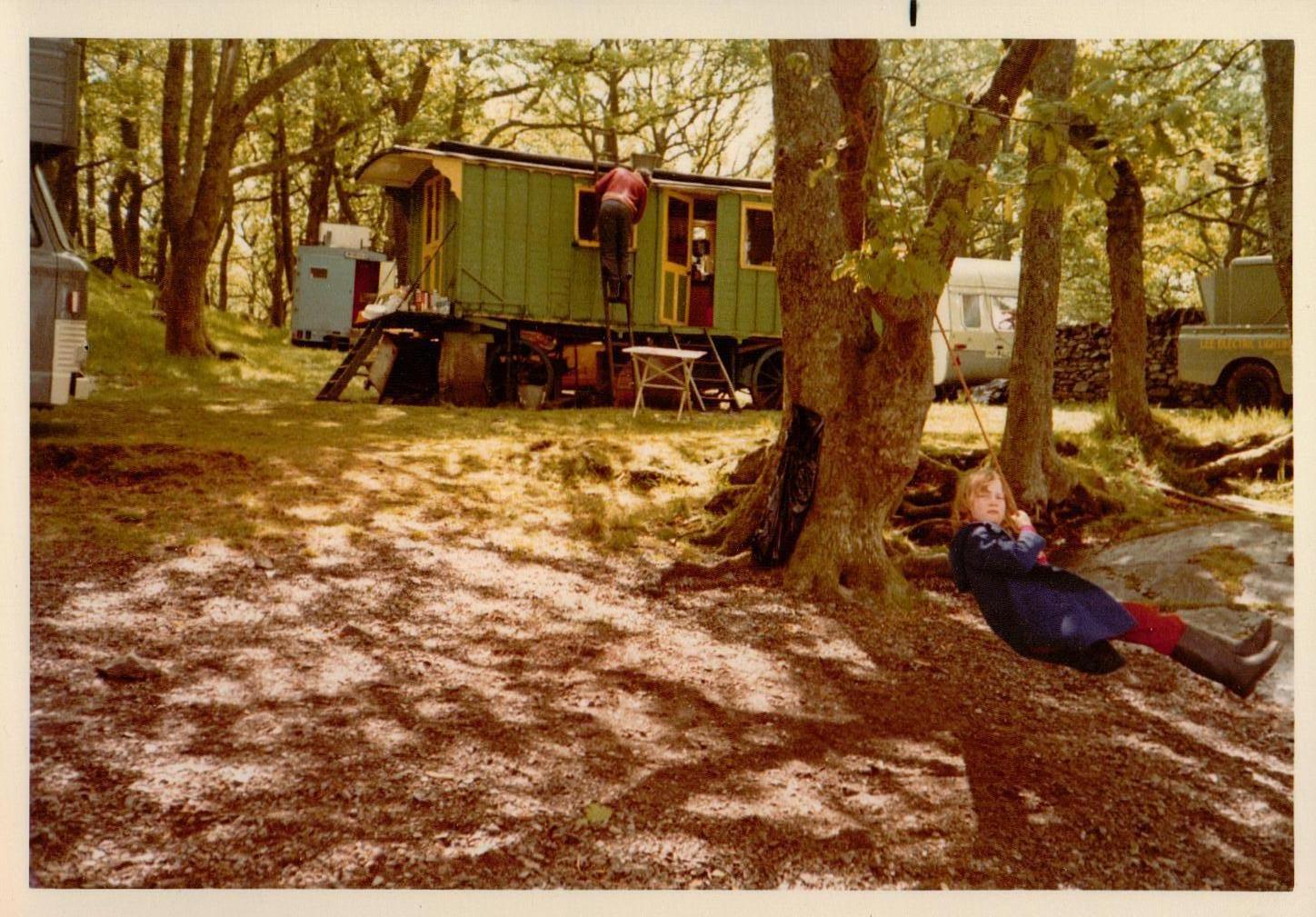
My little sister on the swing at the Unit Base opposite Peel Island ~ photo: Martin Neville
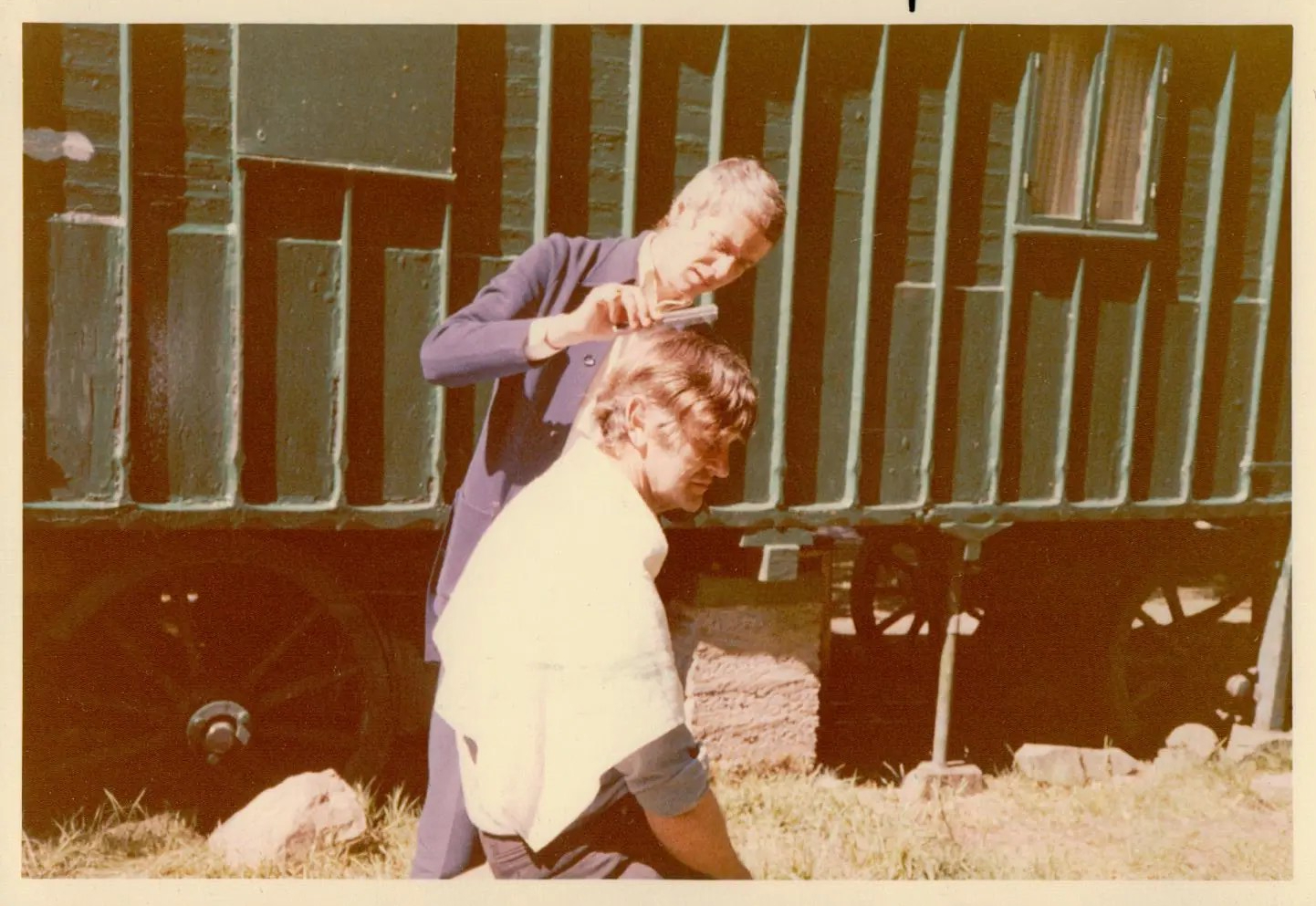
Meanwhile two or three things were happening behind the scenes in the Lake District. Terry Needham, the Second Assistant Director, found that most of the men who had come forward to be Supporting Artists for the scene soon to be shot at Bowness were refusing to have their hair cut. My mother was astonished. They couldn’t portray the Lake District unpopulated by men. Only a few, very elderly gentlemen, who didn’t have much hair anyway, agreed to a short-back-and-sides. And my father. He was more than happy to receive a free hair cut.
Ronnie Cogan cutting Martin Neville’s hair
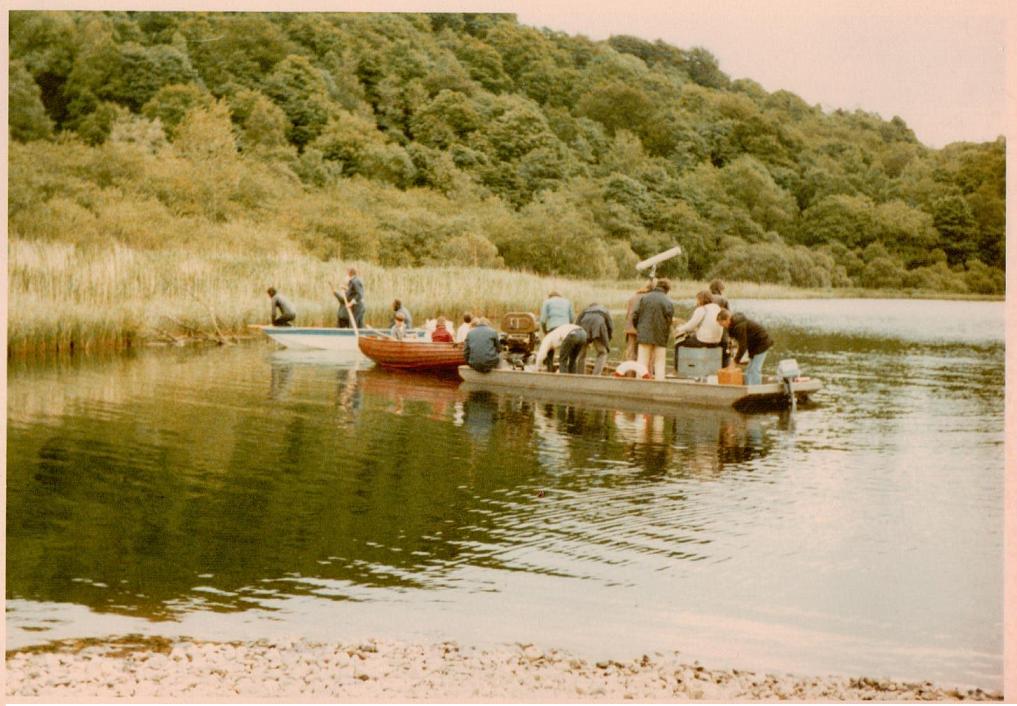
Ronnie Cogan brought out his scissors and snipped away there and then on the shore of Coniston Water. Someone grabbed Dad’s Bolex and took a few shots for posterity:
Dad missed seeing me capture the Amazon. Although it seems I was all alone in my story line, this was not the reality. I rowed away from Peel Island with the DoP Denis Lewiston, his 16mm camera and a reflector board held by Claude Whatham who was also tucked into Amazon’s stern. No wonder I was tired by the end of the day.
Sophie Neville in The Amazon with DOP Denis Lewiston, his 16mm camera and a reflector board ~ photo: Martin Neville
The Call Sheet for 5th June 1973 ~ my diary is titled 5th May but this was an error





 The recording of our scene with Captain Flint on Peel Island went smoothly, and Claude Whatham the Director was happy with the result, but my diary reports that a Force 8 gale blew in. This spun the poor production team into a quandary.
 Amazons, were all together, not sailing but on Wild Cat Island, with the novelty of working with Captain Flint for the first time. Kit and Lesley had been so patient, waiting day after day for their scenes to come up. They were stuck having lessons with our tutor Mrs Causey in the red double-decker bus most of the time. But the fact that they were on stand-by was helpful to the production manager who had to wrestle with the film schedule and call sheets.




























 Sophie Neville