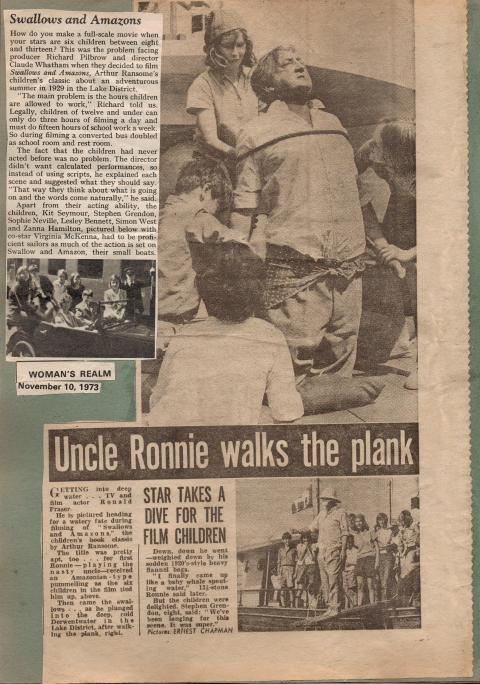
A newspaper article by Ernest Chapman that came out in July 1973. The main photo features Ronald Fraser as Captain Flint with Sophie Neville, Stephen Grendon, Simon West and Kit Seymour
Being back at home for the summer holidays was lovely. I must have been pretty tired. But, adjusting to real life when articles like this one appeared in Woman’s Realm was tricky. Everyone seemed to be reading about me in their dentist’s surgery.
‘What was it like?’ I was often asked.
How could I begin to describe working like this ~
The cast and crew of ‘Swallows and Amazons’ filming on the jetty at Rio in 1973
‘Did you have lots of lines to learn?’
How could I explain that this is how we worked on the dialogue?
Rehearsing with Claude Whatham out on the lake
‘What were the others like?’
How could I tell people about the whole crew, that I’d had working relationships with so many adults?
Talking to Martin Evans the Gaffer and Terry Smith the wardrobe master while leaning on a lighting stand at Bowness-on-Windermere
Technical questions were much easier to answer than, ‘How did you feel?’ No one wanted to know that most of the time I felt cold.
‘Did you have to wear make-up?’ This was a difficult one, as we didn’t wear conventional make up but my legs were regularly coated in a layer of foundation so as not to appear shockingly white. You can see the smooth effect in the photograph above. Suzanna was amusing about this in her diary. She hated being sponged down with a matt base and sun-bathed whenever she could so as to avoid it in the near future.
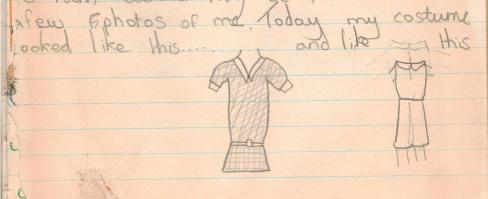
‘What did you wear?’
Suzanna drew pictures of the two dresses she wore at Bank Ground Farm. I always rather liked her blue gingham one. Unlike the Duchess of Cambridge I have never worn a yellow dress apart from the sleeveless one I had to climb into to play Titty. It was really too short for 1929. I remember the costume designer, Emma Porteus, confiding in Mum that they would cheat on the length a bit. Hem-lines were very much above the knee in 1973. Arthur Ransome would have turned in is grave. Luckily Titty’s dresses just look a little out-grown.
Suzanna Hamilton’s drawings of her costumes for scenes set at Holly Howe
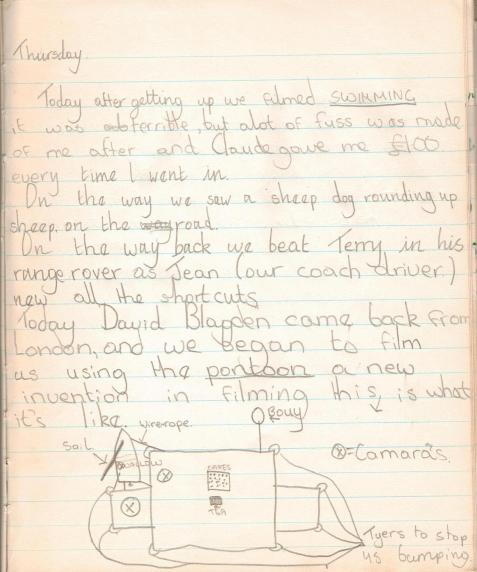
‘How did they film you sailing?’
Again Suzanna provided wonderful graphics of this. I don’t think I’ve yet published this page of her diary.
Suzanna Hamilton’s diary about using the camera pontoon on Coniston Water. If you click on the picture you should get through to Ben Fogel’s documentary where Claude Whatham describes this in further detail.
‘What was Virginia McKenna like?’
This question was easy. ‘She was lovely.’
The Walker family played by Suzanna Hamilton Stephen Grendon, Sophie Neville, Virginia McKenna and Simon West at Bank Ground Farm in Cumbria
Many years have gone since we sat amongst the daisies at Bank Ground Farm. I am now happy to talk about anything. Do click on the comment box below or go on a Facebook page to ask any questions you might have about the filming of ‘Swallows and Amazons’.
It was time to say goodbye. We’d had the most wonderful seven weeks filming on the Lakes but the end had drawn in with the clouds. It was time to go home.
Since we lived in Gloucestershire it was a long drive south. I’m not sure how Jane and Sten Grendon got back, as I don’t think Jane drove, but we must have dropped off some of their things on our way past their village.
I remember seeing my real sisters and walking around the garden in the afternoon sunshine, looking at all that had changed. We’d left in early May, now it was full summer and the school holidays. I don’t know how I had the energy left to write up my diary.
Back in the garden at home with a swan
‘Shall we go and put flowers on Luppy’s grave?’ Perry asked. I hadn’t heard that our dear old dog, the sheep dog I had known all my life, had died while we were away. I was inconsolable. Mum explained that they hadn’t wanted to tell me when it happened as we were filming, she thought that the sadness on my face would have come through on camera. I understood this but was still desolate. Having had to cope with the grief of losing Luppy, on top of the heartbreak of leaving everyone I had grown so close to in the Lake District, I was not in a good way.
One of the most treasured things that I had returned with – apart from the lump of Cumbrian slate Jean McGill had given me – was a hard-back copy of ‘Swallows and Amazons’ signed by the entire cast and crew.
Signatures of the cast, director and producer of the movie ‘Swallows and Amazons’ in my hardback copy of Arthur Ransome’s book
Here you can see inscriptions from Virginia McKenna who had played my mother and Ronald Fraser who obviously saw himself as Uncle Jim rather than Captain Flint.
Mike Pratt and Brenda Bruce who appeared as Mr and Mrs Dixon, Jack Wolgar and John Franklyn-Robbins who embodied the Charcoal Burners with Brian Robylas (sp?) and Moria Late who played Mr and Mrs Jackson.
Stephen Grendon, Sophie Neville and Simon West with Brian Robylas ~ photo: Daphne Neville
It is interesting that all the children signed their character names with their real names in brackets. We must have grown to associate ourselves more with the characters names than with our own.
Claude Whatham in 1973
Claude Whatham wrote, with thanks, and Richard Pilbrow enchanted me by drawing a picture of Wild Cat Island at night.
Molly and Richard Pilbrow in 1973
Sadly, we didn’t manage to nab everyone on the crew, but collected a few signatures.
Brian Doyle, the film publicist on ‘Swallows and Amazons’ (1974)
The only other signature on this page is from Brian Doyle, Mum’s friend the publicity manager on the movie who encouraged us to collect the autographs.
Signatures of the rest of the cast and crew of ‘Swallows and Amazons’ in the back of my Jonathan Cape edition of Arthur Ransome’s book
At the back of the book David Blagden, who played Sammy the Policeman as well as overseeing the sailing.
David Blagden who played Sammy the Policeman ~ photo: Daphne Neville
David drew me a picture of what must be a vision of himself, sailing into the sunset in his little yacht Willing Griffin that had taken him across the Atlantic.
Phyllis B was my tapestry-making stand-in. Simon Holland our art director (set designer) drew me a wonderful set of crossed flags that were also paint brushes ~ a logo for my life.
Art Director Simon Holland at Bank Ground Farm in 1973 ~ photo: Daphne Neville
I have a signature from Kerry Darbishire (I thought she’d written Dartisnine) who played Bridget’s Nurse, our Fair Spanish Lady. Like the actors who played the Jacksons, she was not credited on the movie but played a significant part. She still lives in Cumbria.
Nurse with Baby Vicky, the ship’s baby at Holly Howe
We left Jean McGill, our driver and unit nurse, in Bowness-on-Windermere.
Jean our driver and location nurse operating the radio with Sophie Neville ~ photo:Martin Neville
Eddie Collins was the camera operator, Ronnie Cogan our hairdresser, Joni Turner was a local lady who worked on a few days as Suzanna’s stand-in.
Talking to Martin Evans the Gaffer and Terry Smith the wardrobe master while leaning on a lighting stand at Bowness-on-Windermere
Terry Smith was the wardrobe master, Albert Stills is Albert Clarke who took the black and white photographs day after day. Terry Needham was our long-suffering second assistant director.
Sophie Neville with Terry Needham and the unit radio at Derwentwater ~ photo: Daphne Neville
On the last page I have a very classy signature from Robert – who I think was one of the Keswick boatmen looking after the Lady Derwentwater.
Our boatman and the houseboat in 1973 ~ photo Daphne Neville
Denis Lewiston the DoP also left his mark on my life.
Dennis Lewiston, director of Photography on ‘Swallows and Amazons’ ~photo:Richard Pilbrow
Peter Robb-King signed himself ‘Make-up for the Stars’ and Gareth Tandy as ‘The Whip-cracker’, which surprised me as I had never seen his whip. Graham Ford obviously didn’t want me to change and Margaret Causey, our tutor, sent her love. We’d been though so much together and in such confined spaces.
Swallow and the film crew setting up at Bowness-on-Windermere ~ photo: Richard Pilbrow
Interestingly, I also have an inscription from Ian Fuller the sound editor listed as if he was around on location. I am sure he was the chap I would have met next. Claude and Richard would have gone straight down to the cutting rooms to edit the film. It is not usual for actors to enter such territory but our adventure was to continue. We were soon to be summons to the Elstree Studios of EMI at Borehamwood in Hertfordshire, just off the A1.
The crew as I remember them filming with Swallow and Amazon from the pontoon ~ photo: Richard Pilbrow taken on Derwentwater in 1973
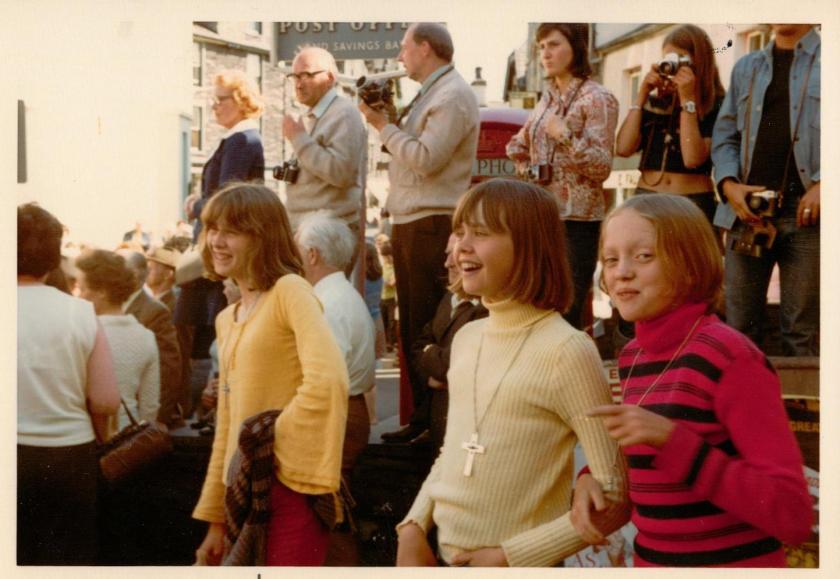
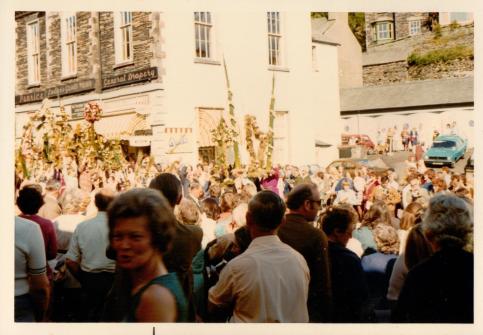
Kit Seymour, Lesley Bennett and Sophie Neville at the Ambleside Rushbearing Festival on 7th July 1973 ~ photo: Daphne Neville
The filming of Swallows and Amazons was coming to a close but what with all the buckets of water being flung about the day before, Mummy had lost Lesley’s ring. It was a gold ring. Since it would not have been appropriate for an Amazon Pirate of 1929, Lesley couldn’t wear it with her costume. Mum slid it onto her little finger to keep it safe for her. It slid off. We looked and looked, but couldn’t find it anywhere.
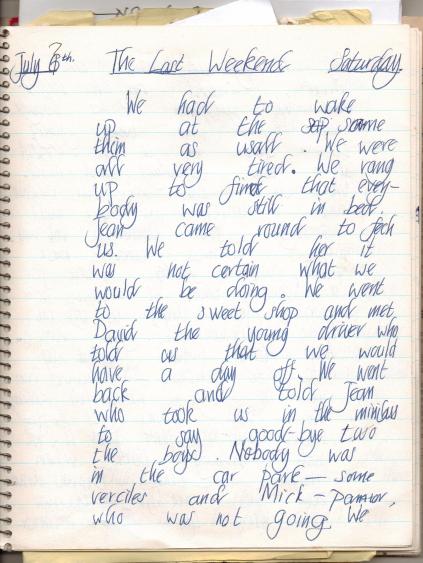
And what with all the nocturnal pushings-in, Graham Ford our production manager, had broken his ankle. Although we were up and about on the morning of 7th July, it became clear that the entire film crew were comatose after the wrap party held at the Langdale Chase Hotel. There was certainly no sign of the director. Since it was also raining, an unexpected day off from filming was called.
Instead of heading for Derwentwater we went exploring the Lake District – in different ways. I made a discovery about Rio, or at least the origin of its name.
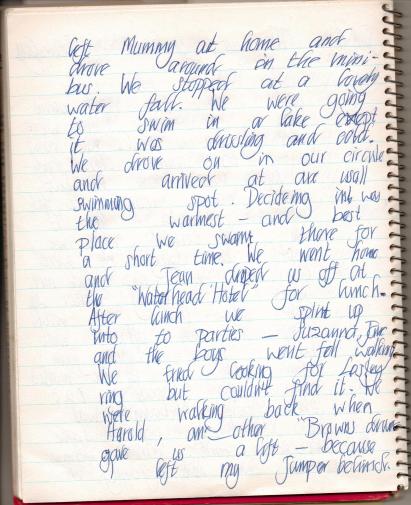
It seemed normal to have lunch at the Waterhead Hotel. It would be a great treat now. We split up into two groups for the afternoon, which is how I came to explore Rio with the Amazon pirates.
It was very kind of Gareth and Jean to give us presents. I wonder what happened to the pendant with the cross? It would be the height of fashion now. I remember Jean explaining that she wanted to give us a little bit of the Lake District to take home. This came in the form of a bedside lamp made out of a chunk of slate. Mine soon had a pink shade on top. I used it for years.
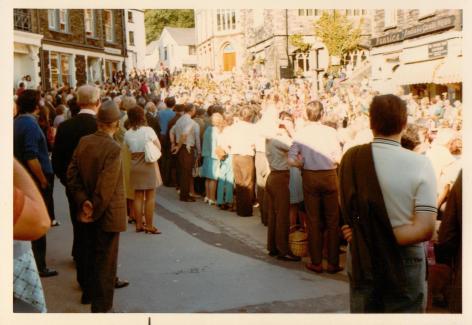
The Ambelside Rushbearing Parade in 1973 ~ photo: Daphne Neville
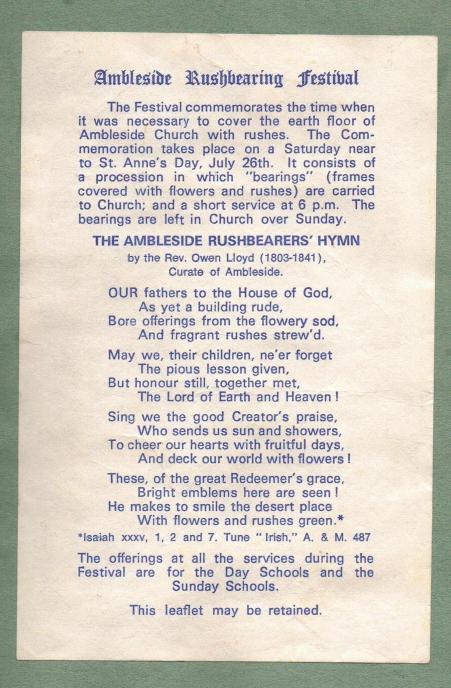
The Ambleside Rushbearing Parade was amazing. I can see exactly why Arthur Ransome thought of Rio as the town on Titty’s chart. The festival was like a colourful Rio carnival. Crowds came out to watch as the procession came down the hill. If you click on the snapshot Mum took above, you will find photographs of what it must have looked like when Ransome was a boy and everyone was out in their best hats as they walked down to St Mary’s Church, accompanied by a brass band.
Again, if you click on the shot above, you will find details of what happens today. The wonderful photographs on the Visit Cumbria site show rushbearing ceremonies are held on saint’s days at different churches in Cumbria throughout the summer.
Traditionally, the children of Ambleside are given a piece of homemade gingerbread if they have carried one of the rushes. We hadn’t done this but we did join in with the hymn and the kind neighbours living next door to the Oakland Guesthouse gave us some gingerbread for tea.
This leaflet was indeed ‘retained’, pasted into my scrapbook
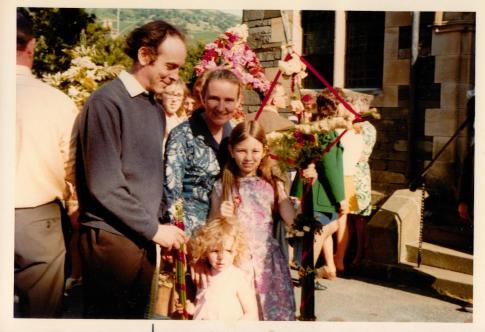
We met the Price family at the festival. The two girls where both carrying dressed reeds. You may recognise Mr Price. He appeared in Swallows and Amazons as the Native who came up to Roger at the jetty in Rio and said, ‘That’s a nice little boat you have there.’ Roger said, ‘Yes.’
Mr Price who played the part of the Native in Rio with his family in Ambleside. They ran Oakland’s Guesthouse where we stayed for 9 weeks ~ photo: Daphne Neville
Mrs Price must have worked so hard. She had three children ~ a little boy as well as the girls ~ and a number of students from the Charlotte Mason College of Education staying at “Oaklands” guesthouse while cooking our breakfast and high tea. The telephone in the hall must have rung the whole time. Her number was Ambleside 2170.
I expect the demands of the filming, what with drivers coming and going, was a little more that she had originally imagined. No one knew what would be happening next. Although most of the crew were leaving ~ going ‘away from Rio’ ~ we knew we had to be back on location the next day.
Here is a snippet of footage Mum took of the festival. Blink and you’ll miss me ~
Sophie Neville as Titty Walker on Derwentwater ~ photo: Daphne Neville
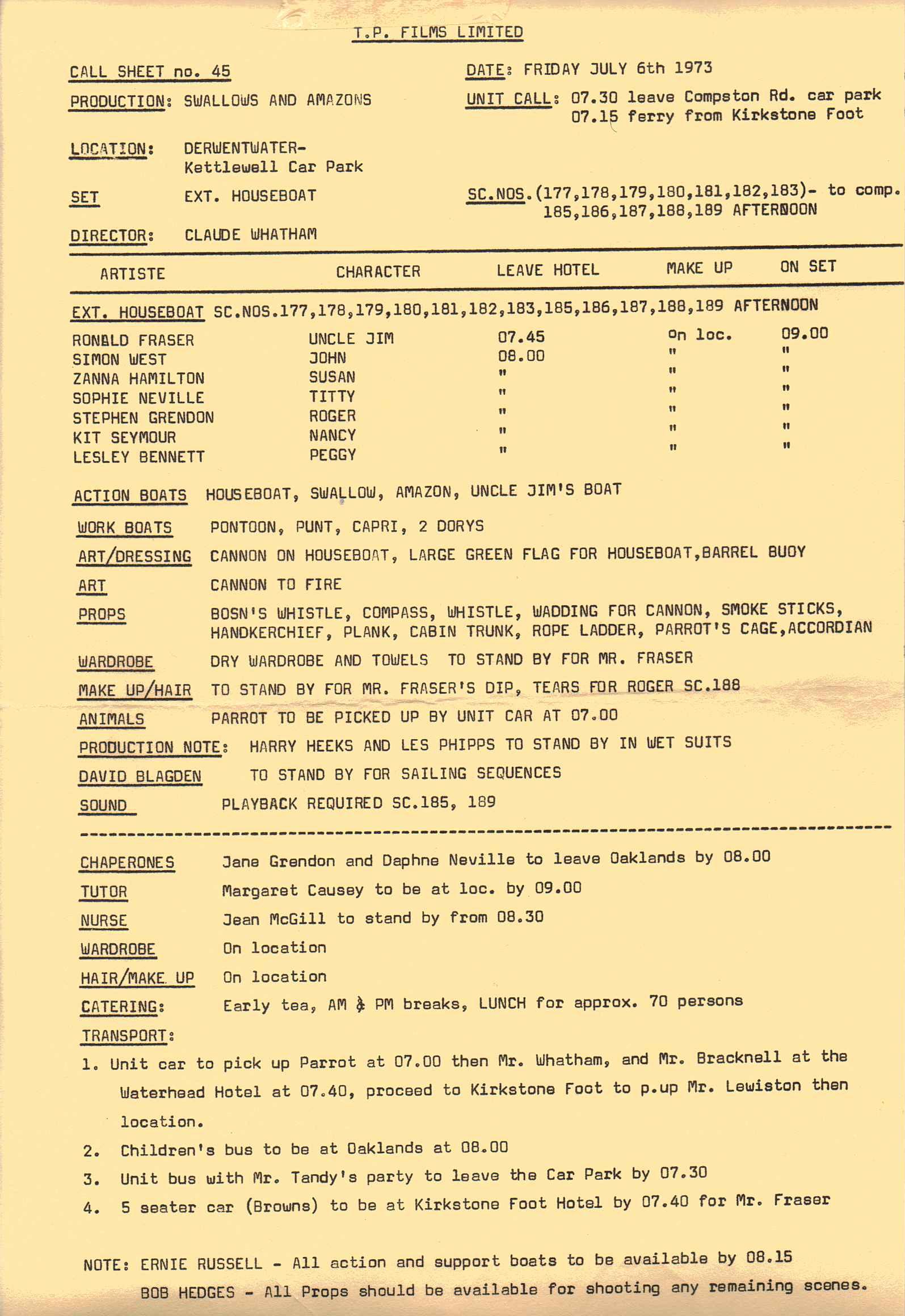
Before Jean McGill arrived at the Oaklands Guesthouse in Ambleside, to transport us to the location, a letter arrived. It was from my Daddy who somehow must have found time to post a quick note while taking my sisters to school. We were, indeed, all looking forward to the wrap party to be held that evening at the Langdale Chase Hotel. There was much to do before it started. Twelve scenes are listed on the Unit Call Sheet and it was pouring with rain.
It was Ernie Russell who was in charge of the action and support boats. Does anyone know where he is now? The day proved difficult and wet, but everyone was in high spirits. It was the last day for most.
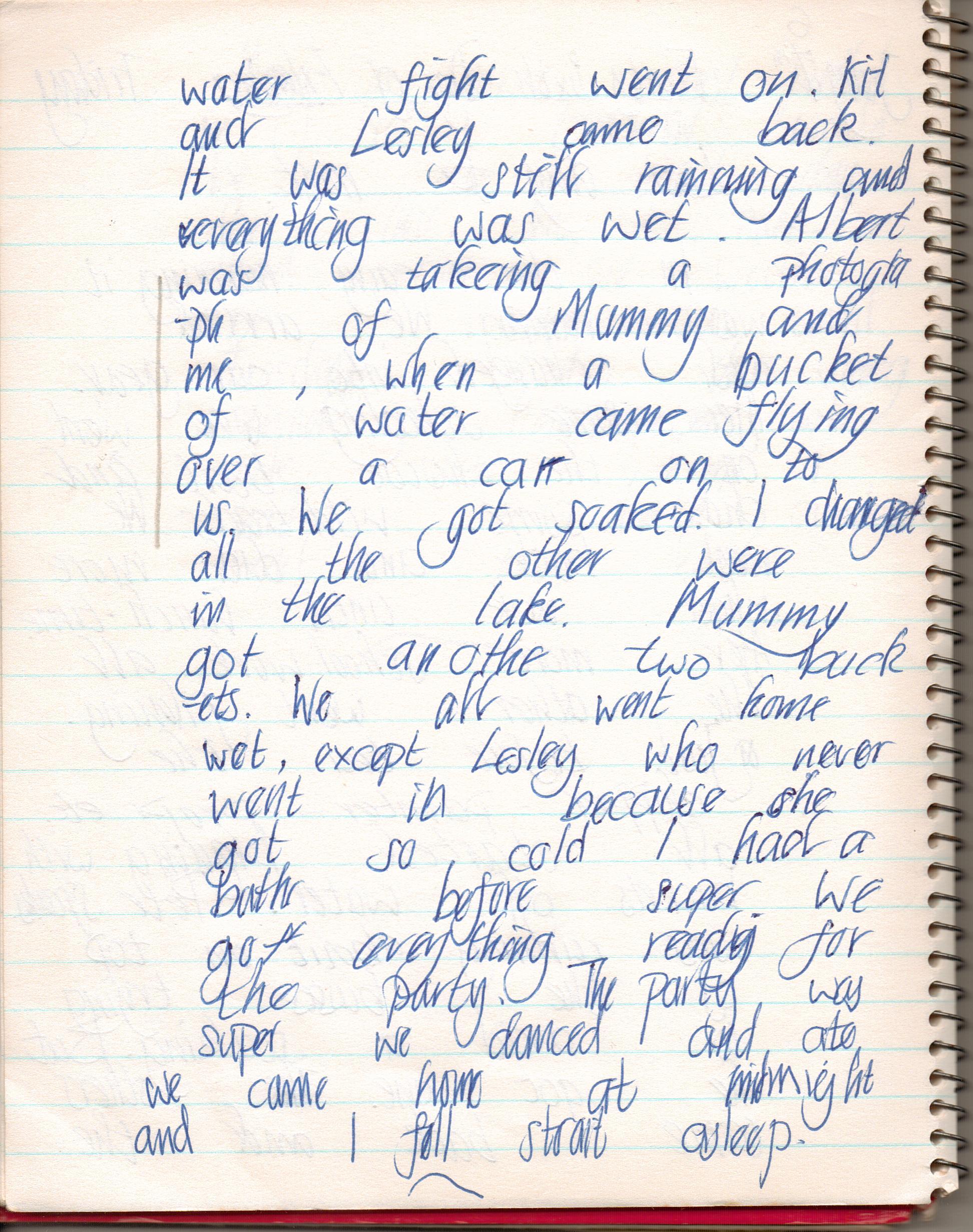
It was a great wrap party. Suzanna noted that it didn’t start until 10 O’clock. 10pm! Very grown up. It must have been the talk of Ambleside. Mum took off her Donny Osmond hat and wore a long high-collared dress in pink gingham. I wore the brown and black velvet pinafore dress Mummy and Daddy had bought me in Carnaby Street when we went up to London for my first interview with Claude Whatham. Everyone was kind and jolly.
For a while the party revolved around us. We enjoyed the dancing so much didn’t want to leave, but it was evident that the adults wanted to start to play. As you can imagine, no one could persuade us to go to bed. Jean McGill saved the evening by organising a conga. Having led a sheltered life I had never danced the conga before and thought it the greatest fun. Luckily the Carnaby Street dress was well designed for the job. We conga-ed around the Langdale Chase Hotel with the entire crew. Somehow we ended up conga-ing into her mini-bus and were whisked back to Oaklands before midnight.
Ronald Fraser as Captain Flint on his houseboat, played by The Lady Derwentwater, with set dresser Ian Whittaker, photographer Albert Clarke and the props guys ~ photo: Daphne Neville
This clip shows Jean McGill (in red) with Sophie Neville (in blue tracksuit top) and Albert Clarke our stills photographer. Our Chaperone, Jane Grendon, is teasing Terry Needham, the second assistant director. Simon West, playing John Walker, stands by Derwentwater in costume. Neville C Thompson (in yellow shirt) smiles at our glamorous tutor Margaret Causey while Graham Ford and others get into a support boat. Actor Ronald Fraser walks towards the lake and waiting boat, followed by hairdresser Ronnie Cogan. You can see Swallow in the background whilst Jean McGill chats to my mother, Daphne Neville who is wearing her yellow, flowery Donny Osmond hat. She originally had a pink flowery version, which Claude admired (and wore himself) but it blew off and sunk to the bottom of the lake.
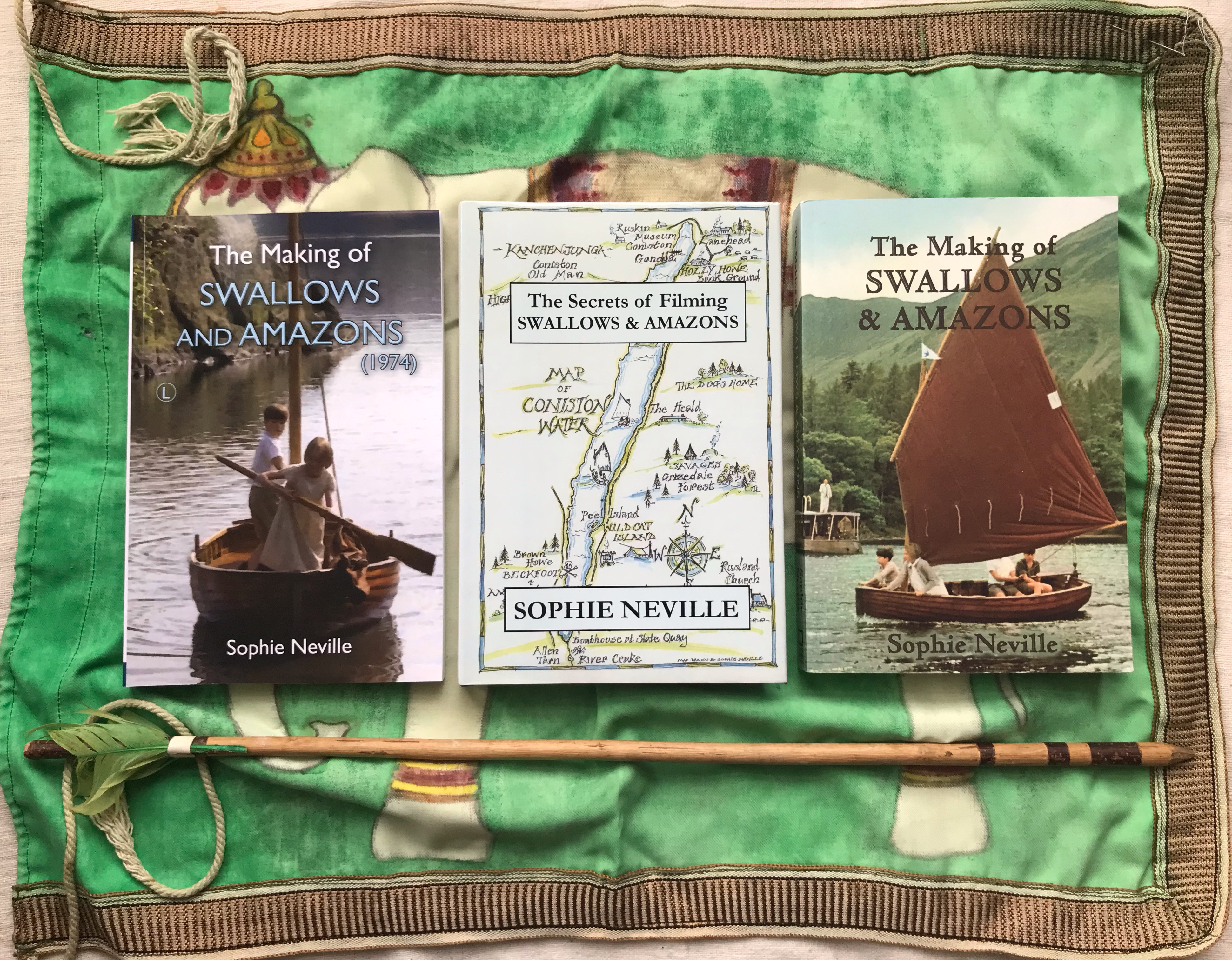
You can read about the adventures we had making the film in one of the editions of ‘The making of Swallows and Amazons’ available online and from Waterstones where it has been reviewed here:
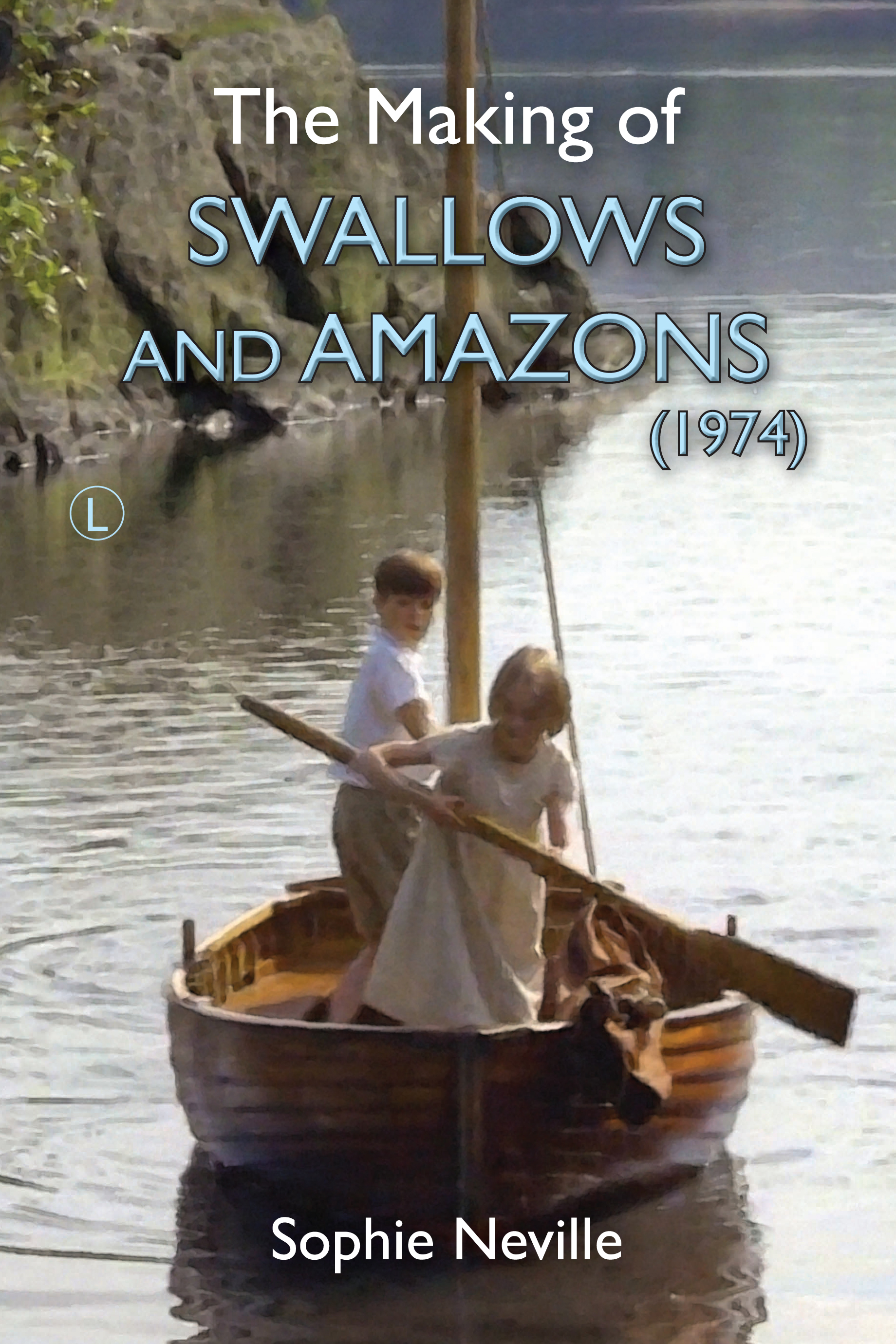
Different editions of ‘The Making of Swallows and Amazons (1974) by Sophie Neville’
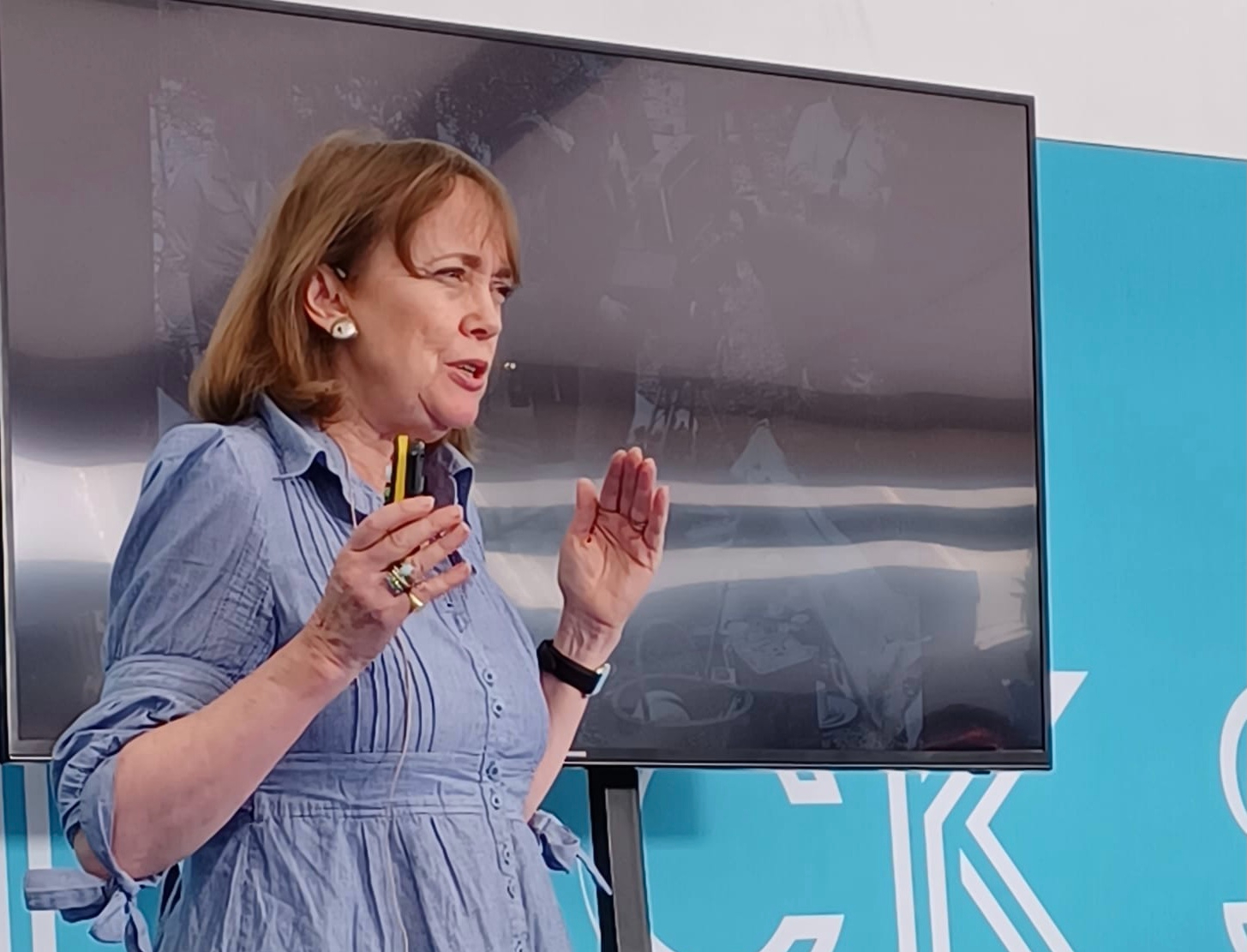
Sophie Neville will be giving illustrated talks about sailing afloat on the Foredeck Stage at the Southampton International Boat Show in September 2023
Our designer Simon Holland was rowing Swallow without his shirt. Producer Richard Pilbrow was hanging on the side of the houseboat clad in denim. Terry Smith, the wardrobe Master, was busy drying off Ronald Fraser’s wet costume on the aft deck. The white pith helmet was being touched up by the unit painter. Unions must have been strict back then.
The original film Swallows and Amazons (1974)
Director Claude Whatham was making the most of the rare but glorious Lake District weather to complete the scene on the foredeck of the houseboat. The Swallows, the Amazons and their Uncle Jim, who had just been made to walk the plank and was now dripping wet, waited patiently while I delivered Titty’s immortal line: ‘Captain Flint – we’ve got a surprise for you.’ Not quite the same as in Arthur Ransome’s book but it worked well.
War cries from everyone…
Kit Seymour, who was playing Nancy, must have dropped on top of us all.
The cabin of the houseboat had been turned into a dressing room for Ronald Fraser.
A long day’s filming out on the lake.
My mother took a series of photographs showing how the crew managed in the limited space:
Director Claude Whatham in blue denim talks to DoP Denis Lewiston. Terry Needham stands on deck ~ Photo: Daphne Neville
The 16mm camera in the grey punt.
The film crew with Director Claude Whatham talking to Simon West, Leseley Bennett, Ronald Fraser and Stephen Grendon on the foredeck ~ photo: Daphne Neville
I think the chap in the swimming trunks is a boatman from Keswick. Does anyone recognise him?
DoP Denis Lewiston with his assistant camerman, Sue Merry in black Claude Whatham and the film cast ~ photo: Daphne Neville
The 16mm camera was noisy. This would have been the shot taken when I said we just went through the movements.
Molly Pilbrow in the plaid jacket with the cast and crew on the houseboat ~ photo: Daphne Neville who was acting as chaperone.
And all the time Molly Pilbrow was keeping an eye on the script. I don’t think there was any room for Graham Ford. He was looking after the base camp:
Production Manager Graham Ford in Derwent Water: photo ~ Daphne Neville
It had been a productive day; a battle well fought, the treasure returned.
You can read the full story in ‘The Making of Swallows and Amazons (1974)’ available from The Nancy Blackett shop.
Sten Gredon as Roger Walker being taught to swim by Suzanna Hamilton playing his sister Susan Walker on location at Peel Island on Coniston in 1973
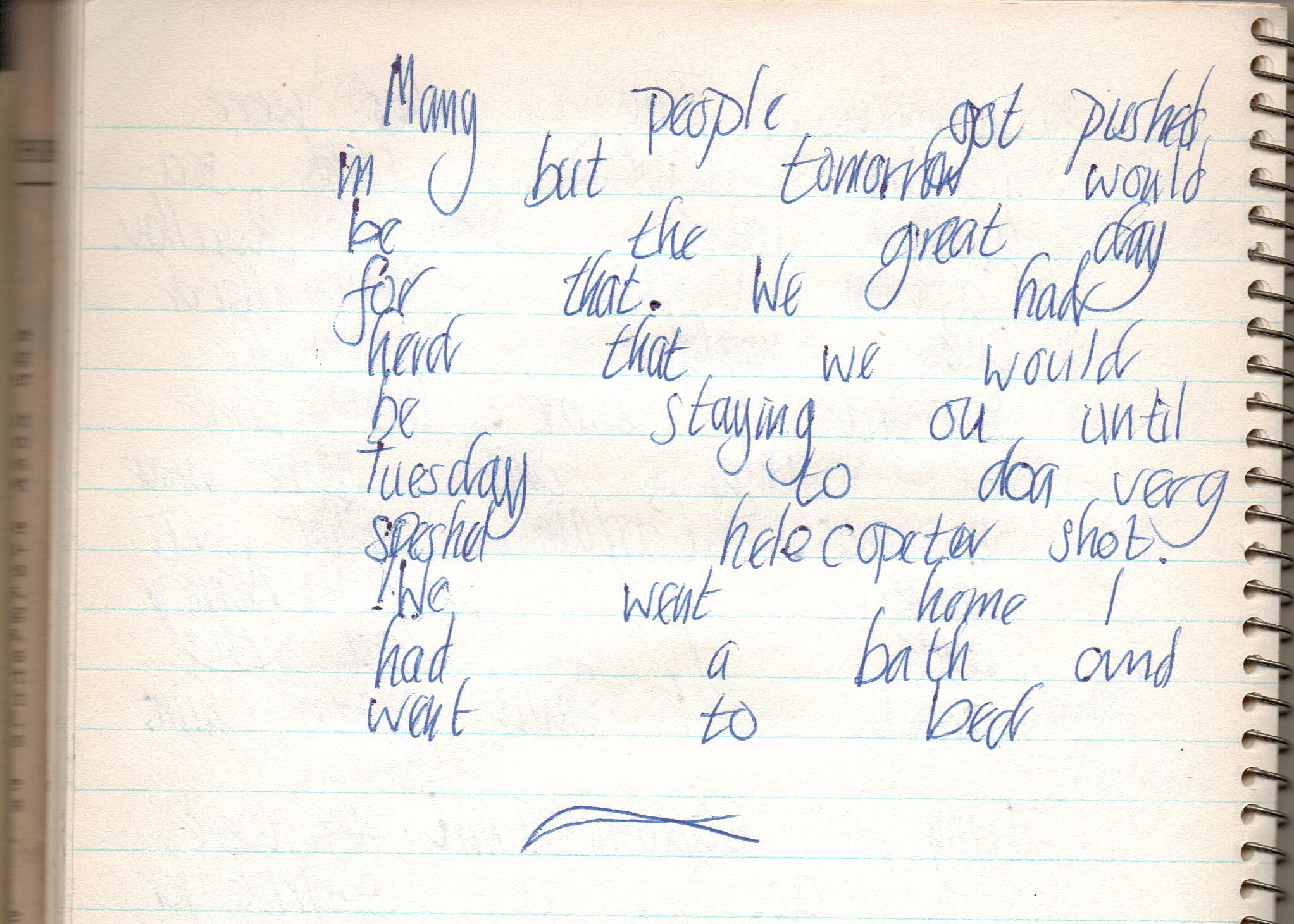
Roger still couldn’t swim, but he was trying to. Very hard. The production manager had kindly scheduled the second of our swimming scenes as late in the summer as possible. The weather was warmer – we’d elected to go bathing in a river up near Rydal Water on our day off – but it was still pretty chilly out on Coniston.
Whilst we tried to acclimatise by running around in our swimming costumes the crew were all in their thick coats as you can see from this home movie footage shot by my mother. We had bought her 8mm camera by saving up Green Shield stamps. (Can you remember collecting Green Shield stamps from petrol stations? They were an icon of the early 1970s all by themselves.) I remember someone on the crew calling out ‘Second unit!’ as Mum lifted what looked like a grey and white toy to her face. It was a bit noisy so she was not able to record during a take. You only see us before and after the sequences in the film, but her footage shows quite a few of the members of the crew – all smoking away, even when they were trying to warm us up after each sequence. You can watch Jean McGill, from Cumbria, our unit nurse who was dressed in red, popping Dextrose into our mouths and giving us hot drinks to warm us up. Jean made Gareth Tandy, the third assistant, who was aged about 18, wear a sun hat because he had previously suffered from sun stroke. David Blagden can be glimpsed as the one other man with short hair.
The camera pontoon must have been left up on Derwentwater. Claude was obliged to shoot these scenes from what we called the camera punt, which was smaller but quite useful. Richard Pilbrow sent me a picture. He has included others in a book that he has written about his career, including a section on the making of ‘Swallows and Amazons’ called ‘A Theatre Project’
First assistant David Bracknell, director Claude Whatham, grip David Cadwallader and DoP Dennis Lewiston (seated) with three local boatmen ~ photo: Richard Pilbrow
Do please let me know if you can tell me the names of the three Cumbrian boatmen featured in this photograph who helped us. Others are featured in the home-movie footage. They all look like pirates. Real ones.
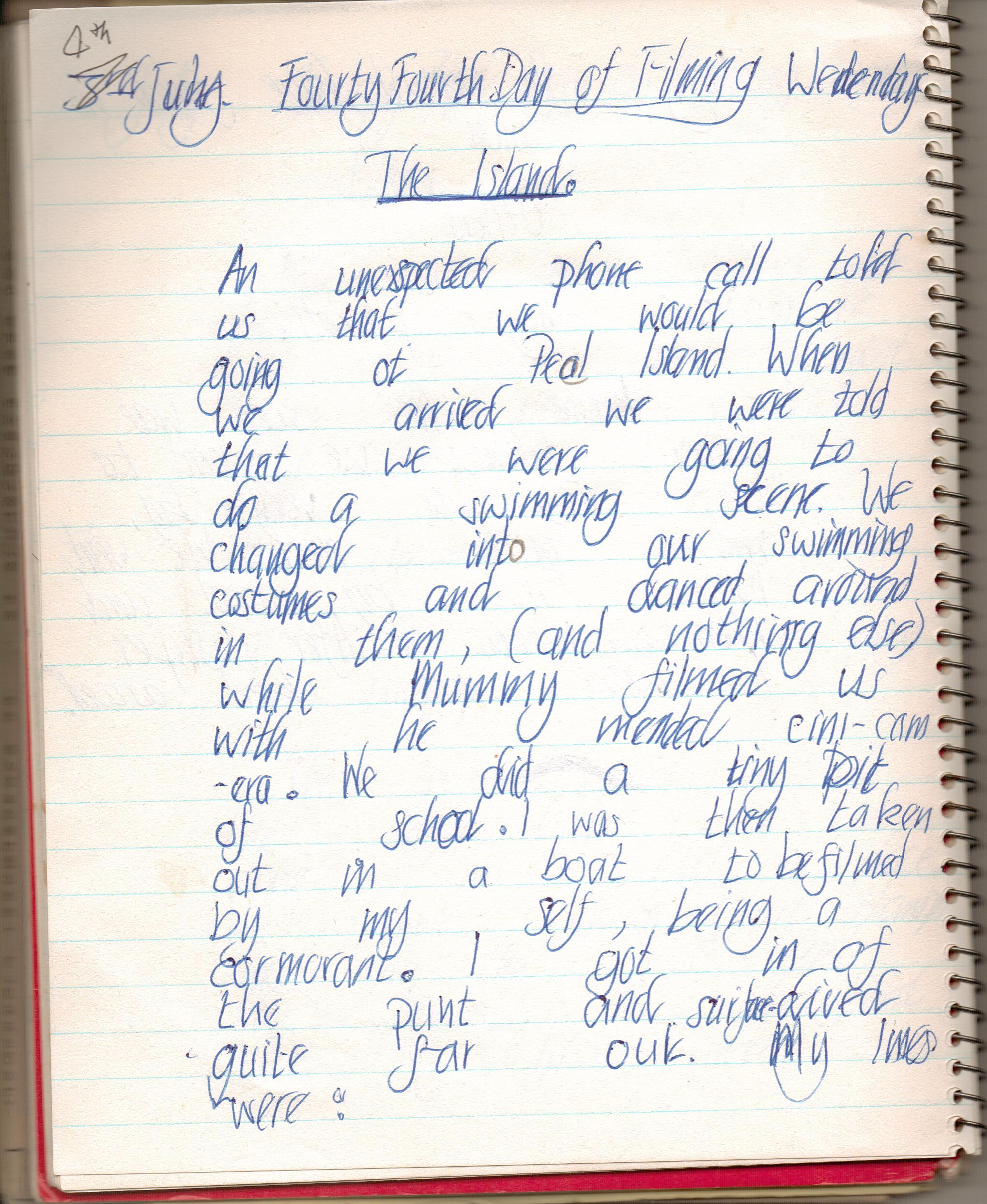
Goodness knows that Health and Safety would say about that punt today. The DoP managed to get two sizeable electric lights, on stands, into a boat already overloaded with personnel and expensive equipment. You can see for yourself. Were these ‘Filler’ lights powered by portable batteries? The Lee Electric generator was on the shore. I was in the water. Busy being a cormorant.
We had an interesting afternoon filming with both dinghies. At one point we had the camera with us in Swallow. I found these photographs of us on the internet.
Sophie Neville, Simon West and Suzanna Hamilton
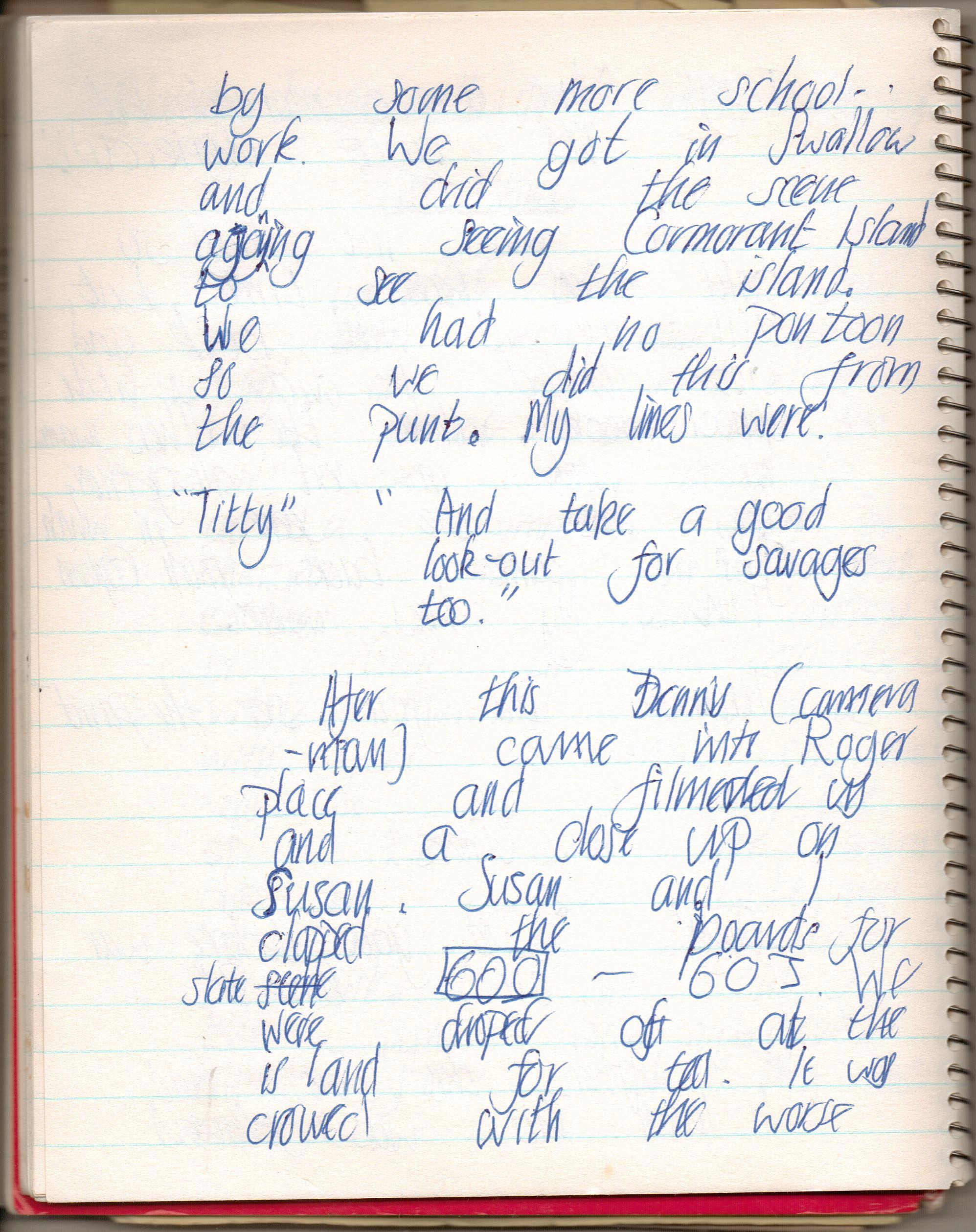
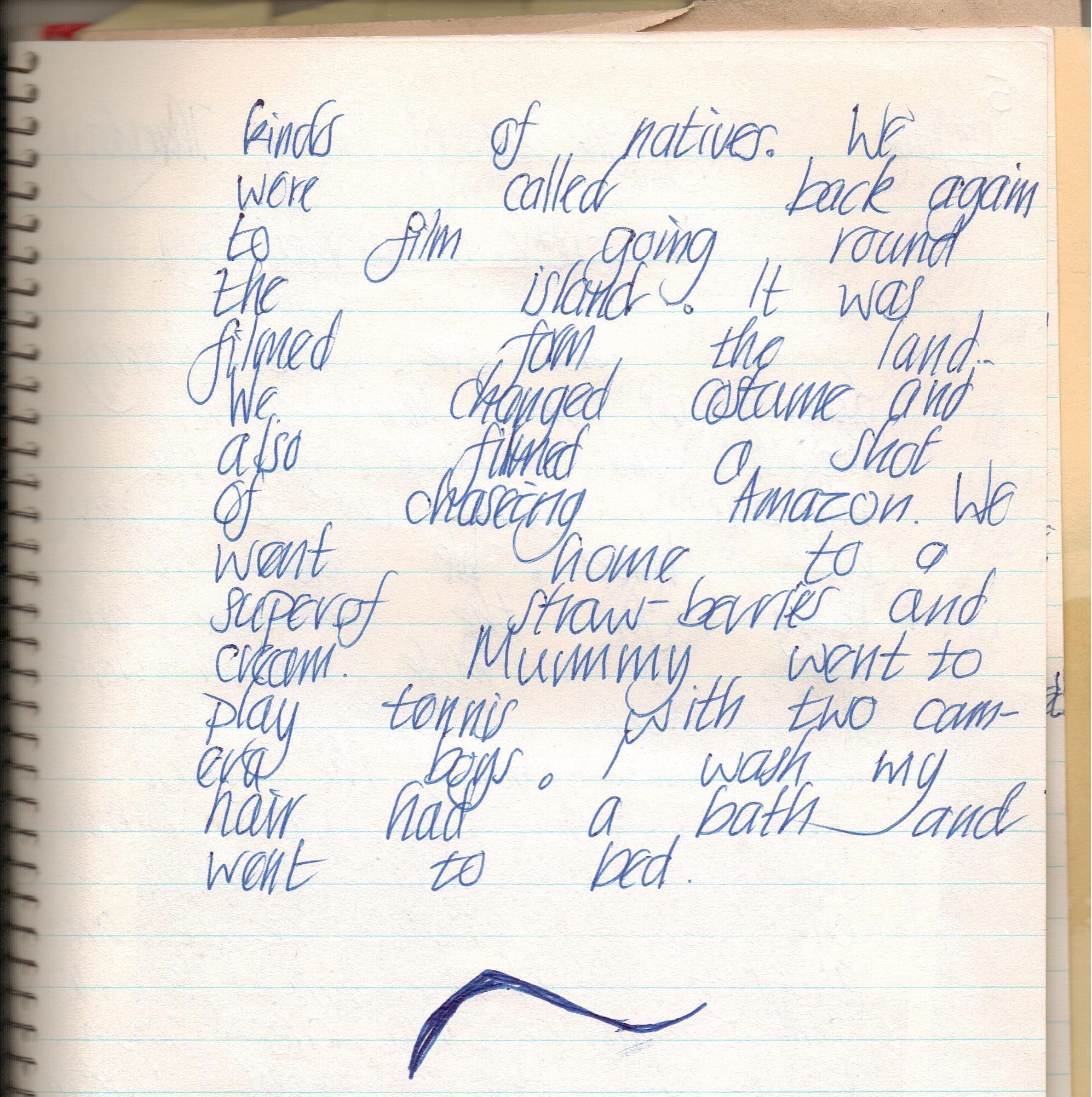
I was given the honour of clapping the clapper-board and calling out, ‘Shot 600, Take one!’ for a close-up of Suzanna Hamilton.
Suzanna Hamilton as Susan Walker sailing Swallow on Coniston Water in 1973
‘The worse possible kinds of natives’… Tourists were beginning to arrive for their summer holidays in the Lake District and we still had quite a bit more to film.
Sophie Neville, Suzanna Hamilton and Simon West sailing Swallow in 1973
You can read more about the adventures we had making the original film of Swallows and Amazons here:
If you ever see a cormorant you must sing out, ‘They’ve got India-rubber necks!’
And then, if you are on a long journey you can add, ‘ Cormorants. We must be near the coast of China. The Chinese have cormorants. They train them to catch fish for them. Daddy sent me a picture.’
Sophie Neville, Suzanna Hamilton and Simon West as the Walker children sailing to Wild Cat Island in Swallow
If you ever get lost – or the journey really is a long one, you can say,
‘Here we are intrepid explorers making the first ever voyage into unchartered waters. What mysteries will they hold for us? What dark secrets will be revealed?’
They were most complicated speeches to deliver afloat, ones I had to learn. In the end the second part was heard OOV – out of vision. I could have read the lines. But then they wouldn’t have stayed in my head forever, as they have.
Stephen Grendon, Sophie Neville, Suzanna Hamilton and Simon West on the voyage to Wild Cat Island, scenes shot on Derwentwater in 1973
If, on your journey, you happen to see a man sitting in a chair writing notes you score high and can say, ‘What’s that man doing? He’s probably a retired pirate working on his devilish crimes.’
Filming Swallows and Amazons (1974) from a camera pontoon
(I’m a bit hesitant about that one because my Aunt Hermione really was approached by pirates when she was sailing round the world. The Daily Mail published her dairy chronicling the adventure; a full page double- spread with photographs no less. Rather sadly they ran headline ‘Intrepid Pensioners…’ What a swizz. She should have lied about her age and said she was 27 instead of 60. Well, perhaps 57, what with the photos.)
The scene behind the camera that day on Derwentwater was rather different from from the scene in front of it.
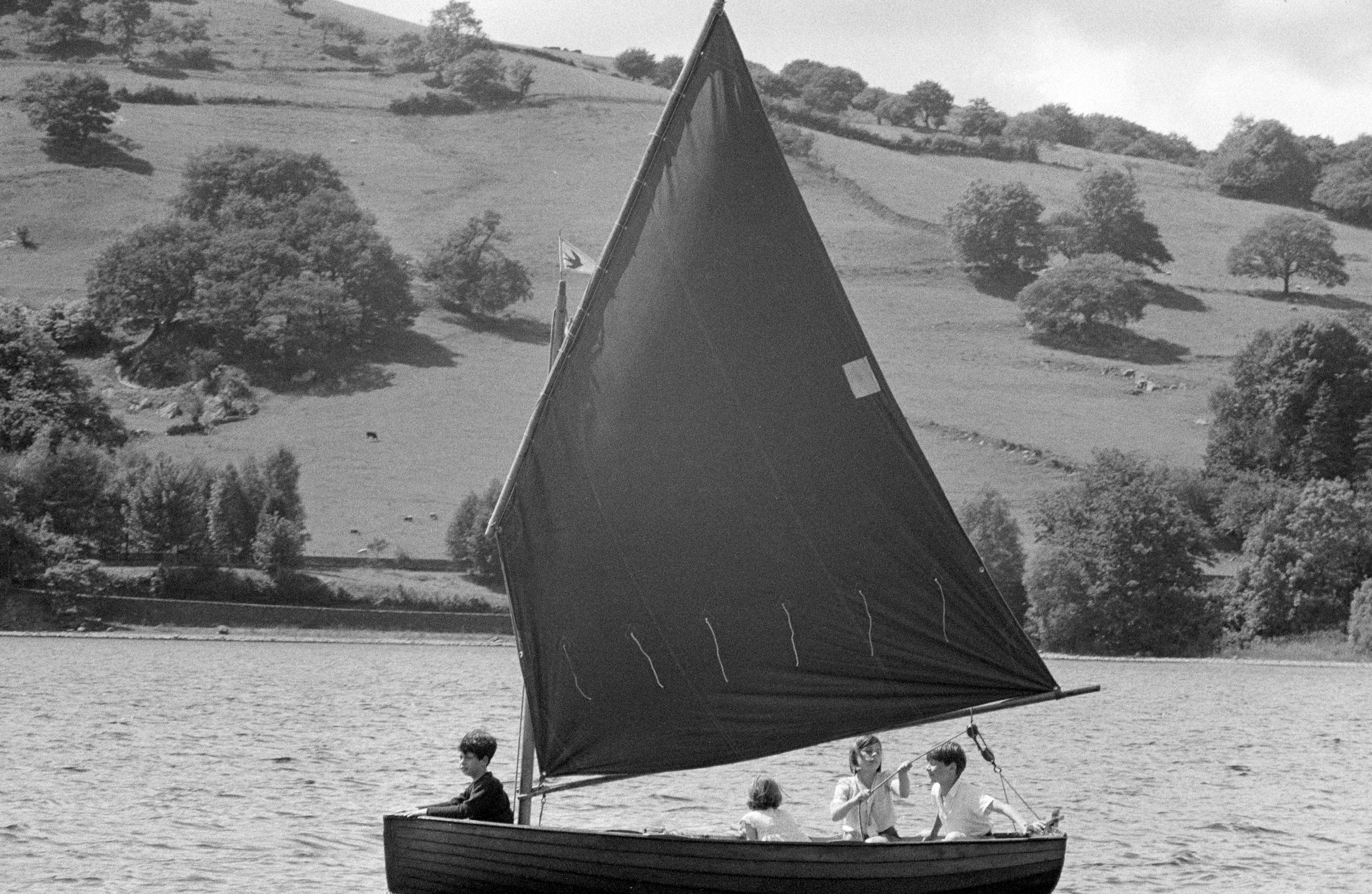
I got cold sailing but it was a glorious sunny day with a fair wind. We achieved a huge amount even if Cedric fell in. Some of the boatmen and crew wore life jackets, others did not – including my mother.
We wore BOAC life jackets for rehearsals but Swallow is a safe little boat – her keel ensuring we didn’t capsize if we happened to jibe and we never fell in. The pontoon was really rather more dangerous being a raft with no gunwale. Any one could have misjudged their step and plopped overboard. Luckily we were not stifled by Health and Safety in those days – only the rigorous demands of movie insurance companies.
This shows the camera crew climbing aboard the pontoon in order to film Swallow sailing. Daphne Neville sits in the Dory safety boat in the foreground. A reflector board, wrapped camera mount and microphone are already on board.
I’m sure we had already shot the first two scenes of the day when I was in Amazon, setting the anchor and later hearing the robbers. I expect Claude needed to re-shoot for technical reasons. Day-for-Night filming requires clear, sunny days and he would have needed still water.
John and Susan find Titty has moored the Amazon off Cormorant Island
I have some of my father’s 16mm footage showing us at around this stage in the filming. It was shot on a different day but shows us on the shores of Derwentwater, waiting around before rushing off across the lake in motor boats to finish filming before Claude lost the light. You see the pontoon and a safety boat towing Swallow, me snapping bossily at Roger to get a move-on, (unforgiveable but I was 3 years older than him and irritated to distraction), the third assistant Gareth Tandy in blue with glasses, our sound recordist Robin Gregory throwing his arms wide open, Kit Seymour and Lesley Bennett by the lake shore, David Blagden with his short hair-cut splicing rope, me in my Harry Potter-ish blue nylon track-suit top with Albert Clarke the stills photographer, Swallow and some mallard duckings.
If you are enjoying this blog, please find an expanded version of the story in the ebook, available from all online retailers such as Amazon Kindle for £2.99 and on Goodreads here It has also been published in two illustrated paperback versions, which make good presents.
Different editions of ‘The Making of Swallows and Amazons (1974) by Sophie Neville’
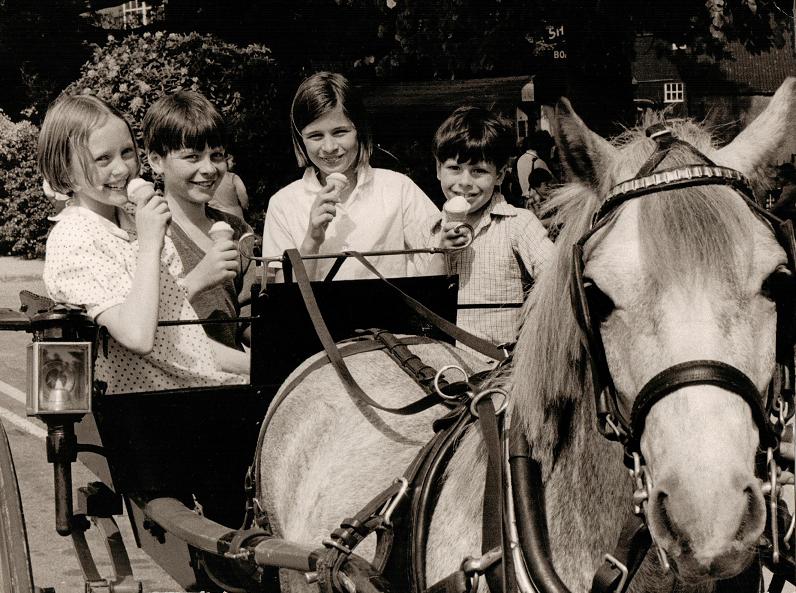
Sophie Neville, Simon West, Suzanna Hamilton and Stephen Grendon in Bowness in the summer of 1973
When I see press photographs like this one, I sigh with resignation. Why were our lives presented to the world thus? It was of course just because they asked us to pose in a pony and trap to add interest, but the ice-creams? It must have been taken the day we went exploring Rio. Our real time off from filming was spent quite differently. I was obliged to take five school exams.
Why did they make me write exams, when I had the responsibility for a feature film on my shoulders? My friends later wrote to assure me that they were quite easy, but I was tired and they were an added stress and a bore.
The letters, these little notes scrawled by friends at school, were a great support. It’s funny that Catherine wrote to me as Titty – none of the others did, but nicknames were a great thing, as was the fact that they were thinking of me that long summer term.
Suzanna had a blast of a day. Her diary is, as ever, quite different from mine.
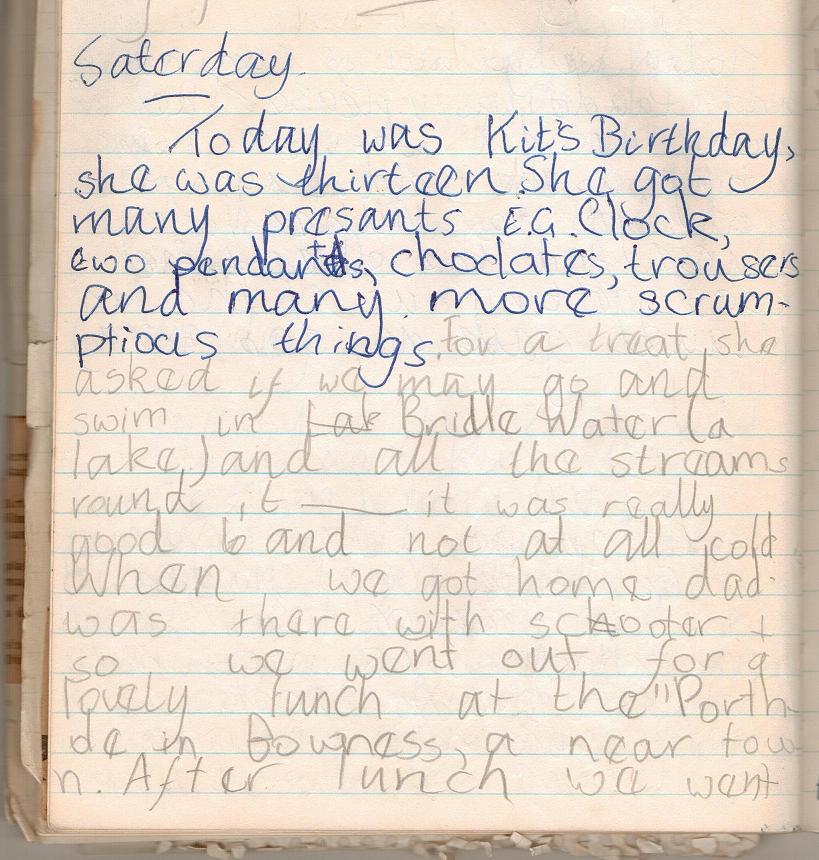
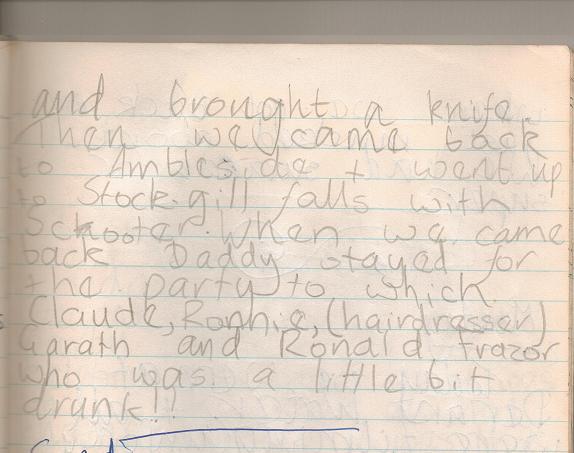
One of the secrets of the film is Lesley Bennett, who played Peggy, was actually older than Kit Seymour, who played her elder sister Nancy Blackett. I don’t think it mattered in the least. Claude Whatham, Ronnie Cogan and Gareth Tandy came to Kit’s Birthday tea with the actor Ronald Fraser, who as Suzanna noted, was a little bit drunk. This can only mean he’d been drinking all day. It was a foreshadow of things to come.
Kit Seymour with Claude Whatham, 1973
Kit had a twin sister, who we had met at the sailing audition at Burnham on Crouch. Her mother sent up half a Birthday cake, which was quite fun, or so my mother thought.
Suzanna Hamilton playing Susan with Sophie Neville as Titty busy writing the ship’s log
Meanwhile I had more letters to reply to. My friends were wonderful, but it was up to me to keep my relationships in the best possible order. Returning to school after the filming was slightly daunting – but I had so much to catch up with that I was soon busy and fully integrated.
I made a point of not talking about the film at all unless I was specifically asked. This wasn’t easy, as I was bubbling over with stories, but I knew that it wasn’t on. Almost anything that I said about ‘Swallows and Amazons’ or even the Lake District, could have been construed as braggish. I did not care to imagine the consequences of this. As it happened I didn’t have to.
You can read more about what we got up to whilst making the movie in these books available from all the usual places. There is now also an audiobook on ‘The Making of Swallows and Amazons’.
Different editions of ‘The Making of Swallows and Amazons (1974) by Sophie Neville’
‘Here we are, intrepid explorers making our way into uncharted waters. What mysteries will they hold for us? What dark secrets shall be revealed?’
The dark secret was that the inky black night scenes had to be shot in Mrs Batty’s barn. At Bank Ground Farm. During the day. A rainy day.
The design team strung up thick light-proof drapes and made the dusty out-building into a studio. The director, Claude Whatham had no choice. We had quickly run out of interior scenes and the weather was so bad that we could do little else.
Producer Richard Pilbrow with director Claude Whatham in their wet weather gear on Peel Island, Coniston Water
‘While the rest of England melted in a heat wave, the Lakes seemed wrapped in mist and rain,’ Richard Pilbrow the producer remembers. I have a press cutting from The Guardian dated 7th July 1973, which opens with the words:
‘THE WEATHER report follows in half a minute. Richard Pilbrow is obsessed with the weather. Every morning he wakes around 4 o’clock and crosses his room at the Kirkstone Foot Hotel to cock a weather eye at the sky above Wansfell Pike. Most mornings it is the same story… Pilbrow looks out of the window. Raining. ‘
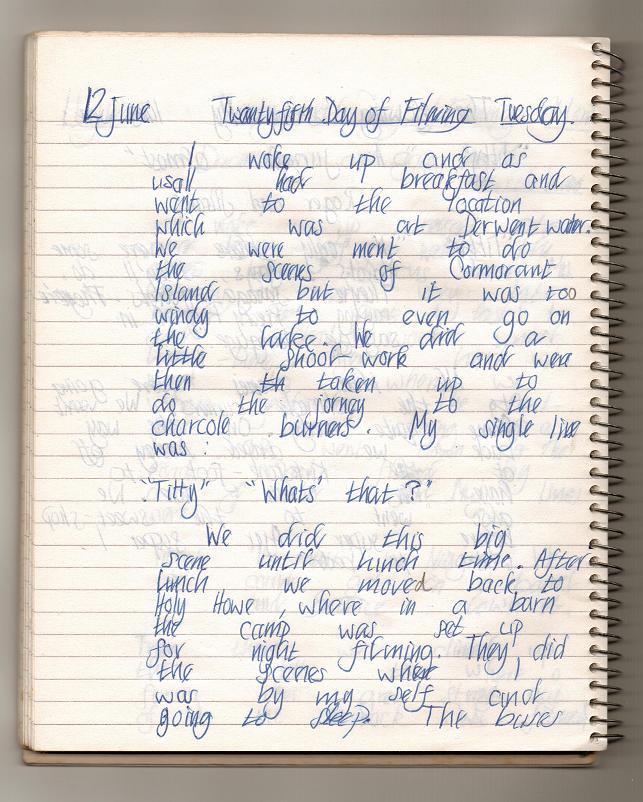
What a worry and concern that rain was. Swallows and Amazons is firmly set in an idyllic childhood summer, August of 1929, when the water was warm enough to swim daily and the only disappointment was a total lack of wind. When we arrived to start filming at Derwentwater on 12th June 1973 it was too windy to even go out on the lake.
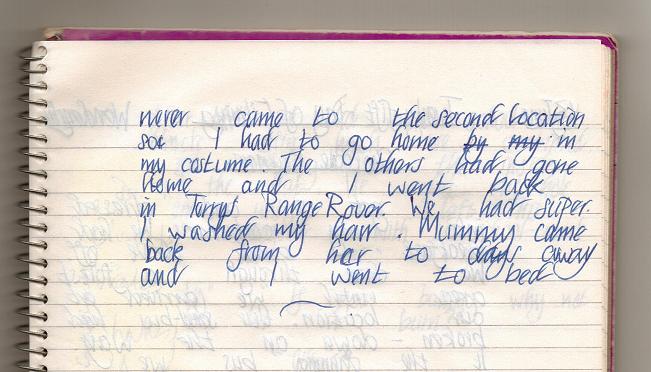
I loved filming in the barn. The Third Assistant, Gareth Tandy, lead me through the high wooden doors and into a magical version of our camp on Peel Island, beautifully recreated by Ian Whittaker the set dresser. A real camp fire was burning. Blankets (goatskins in Titty’s imagination) and pillows from our tents had been laid out so that I could be ‘shrouded in my cloak’ whilst waiting up for the Swallows to return from the Amazon River. The scene was beautifully lit with branches held in stands in front of the lights with a gentle wind produced by the prop men wafting a board to lift my hair at the right moment. I don’t think there was an owl hoot for me to hear. I had to imagine that so they could add a real owl call later. Someone has written in to ask if I learnt how to make an answering hoot. I’m afraid not. I tried and tried. I still can’t. John could do it but Claude asked us both to just pretend so that he could lay the sound on afterwards.
Director Claude Whatham with his cast of Swallows in 1973
What we gained, despite or perhaps because of the weather, was a camaraderie that formed a foundational basis to the film. We had to be stoic and get on with filming despite getting cold and wet. Rain doesn’t show up on screen unless it is really pelting down. You can see the effects – wet hair and soggy costumes, but you actually have to use rain machines if you want to show rain in a drama. We could film our trek up the hill to visit the charcoal burners without a problem but going out on the lake was impossible. You’d have seen the rain drops falling on the water. And it was too windy. As it was, we had a brilliant director of photography who used what light he had to capture that limpid quality you find in the Lakes, so quintessentially English it draws you in, reeling back to childhood days when we had time to make camps and rush about in the woods.
Suzanna Hamilton, Sten Grendon, Sophie Neville and Simon West in a scene cut from the film
I’m pretty sure that the big scene I referred to was one that was cut from the final film. It was about leaving paterrans in the woods, as detailed in the books but not essential to the story. It must have been covered by the journalist from the Guardian as I found this cutting:
The rain did deter my mother from taking photographs. She didn’t have a flash to use in the barn but she took lots – masses – the following day…
Dressed for the Cumbrian weather: Daphne Neville with Liz Lomas, Richard’s assistant at Theatre Projects in London ~ photo: Richard Pilbrow
Other scenes that hit the cutting room floor are detailed here
If you would like to read more, ‘The Secrets of Filming Swallows and Amazons’ is available as on Amazon Kindle and other ebook platforms.
Sophie Neville and Simon West on the cover of ‘Swallows and Amazons’ pub by the Daily Mail
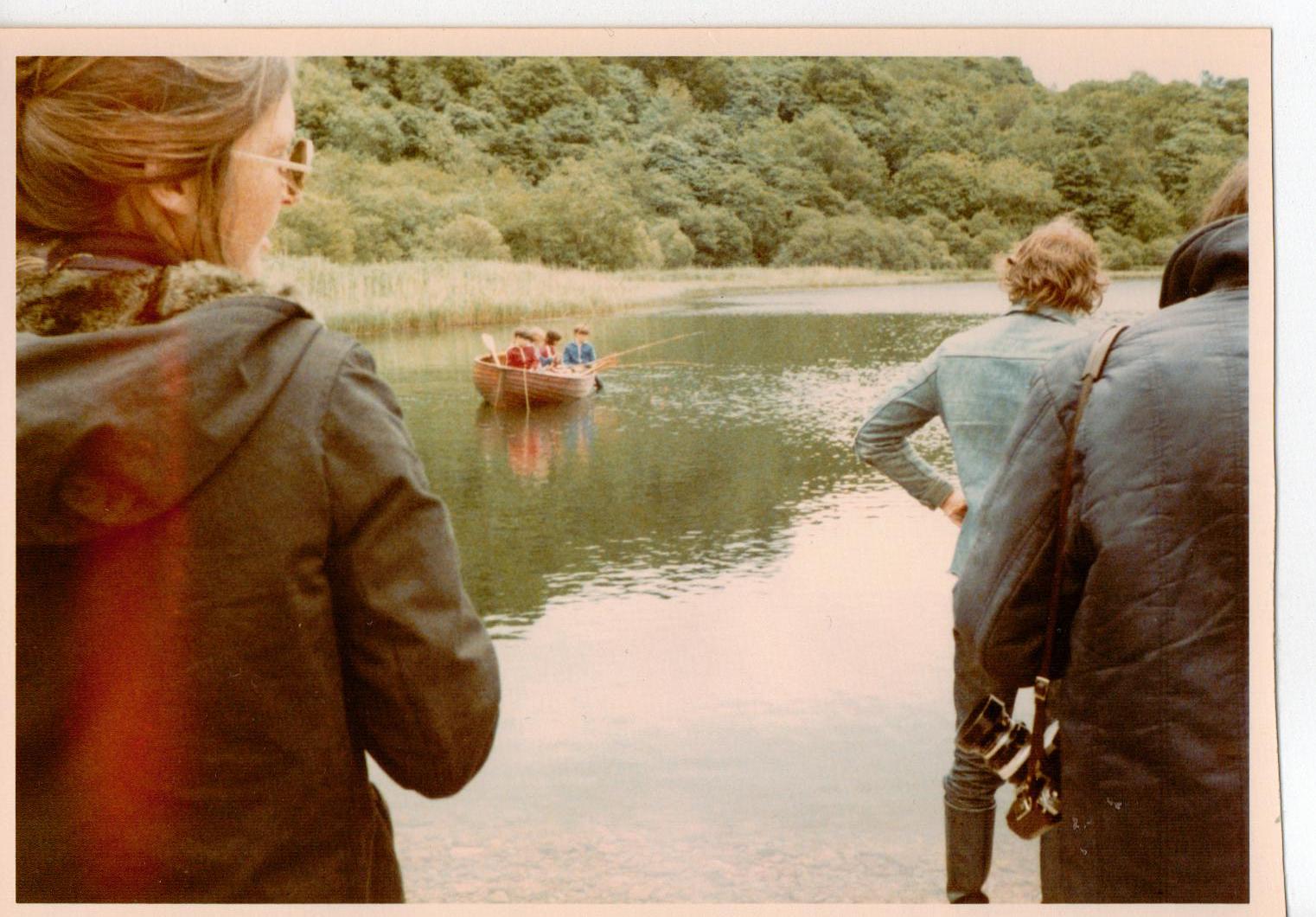
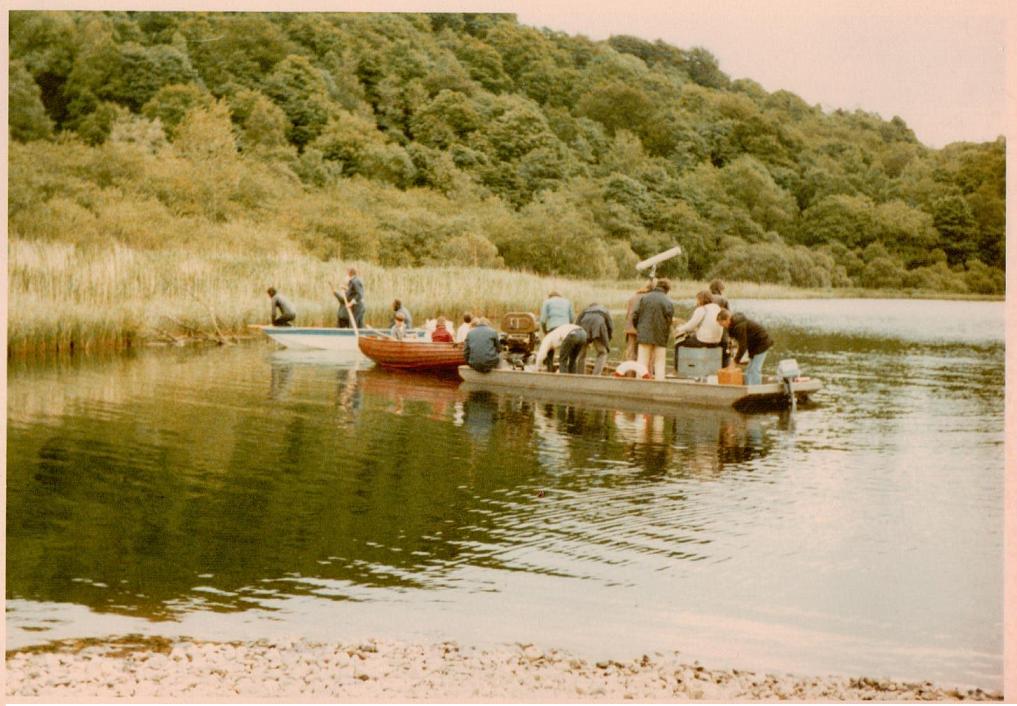
Of all the wonderful days we spent filming Swallows and Amazons in 1973, the fishing scene, shot in a reedy bay on Elterwater was one I enjoyed most. It was a cold, rather wet morning but the Third Assistant, Gareth Tandy, taught us how to use our rods and we were soon absorbed in a way that Arthur Ransome would have understood well.
Our fragile bamboo fishing rods, one with a wooden reel, were supplied by a keen fisherman called Leslie Borwick, who brought up his own daughter and grandchildren on Arthur Ransome’s books. He kept the rods, which still belong to the family, who now lived near Sedburgh.
Filming the fishing scene from the camera punt on Elterwater
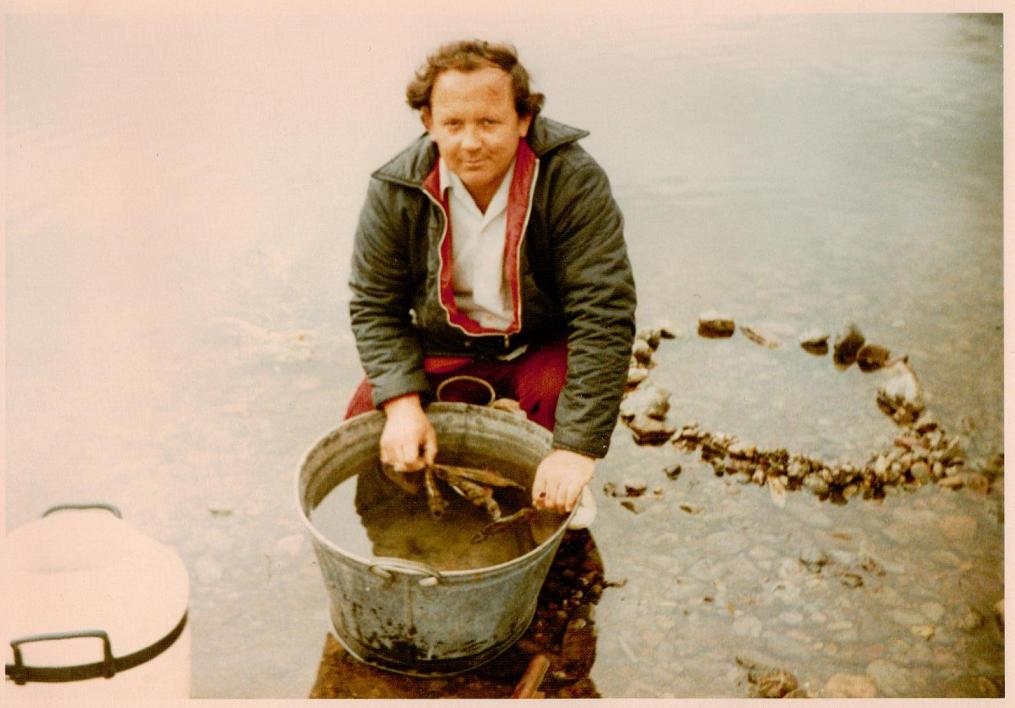
The only problem we had that day was keeping the fish alive. Bob Hedges our property master, the designer Simon Holland and Ian Whittaker, the set dresser, took it upon themselves to keep the perch as happy as they could, until they were – very carefully – attached to our hooks. Titty doesn’t catch one but Captain John did. Despite everyone’s best efforts it wasn’t a very lively perch.
Property Master Bob Hedges keeping the perch alive ~ photo: Daphne Neville
The big challenge was Roger’s great fish – a massive pike that meant to be snapping and ferocious. I’ve been told that it ended up being resuscitated in Keswick Hospital ICU – the Intensive Care Unit.
The local fisherman, Ian Whittaker, Simon Holland and Gareth Tandy with the fish photo: Daphne Neville
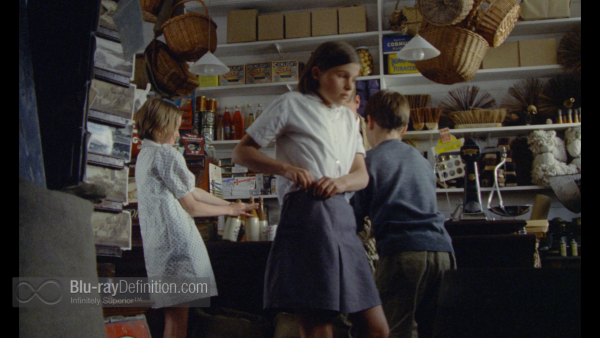
Sadly this is the only photograph we have of the set designers at work together. Later that afternoon we went to one of the few interiors of the film – the general store in Rio or Bowness-on-Windermere where we bought the rope for the lighthouse tree and four bottles of grog. In reality it was a sweet shop in the ‘seventies. It was later a barber shop and became a showroom for wood-burning stoves. Pigs were once kept around the back.
The Swallows in Woodland Road, Windermere in 1973
Back in 1973, Ian dressed the interior with boxes of wooden dolly pegs and other things you’d buy in brown paper bags. A wonderful 1920’s radio set and two purring cats really made the scene come alive, especially since, being in reticent explorer mode, we were a bit gruff in our communications with Mr Turner, the native shop keeper.
Sophie Neville in Rio with four bottles of grog ~ photo: Daphne Neville
Ian Whittaker struck me as being rather different from everyone else on the crew. He was a very nice looking man and a gentleman of the old school. I remember him telling me that he’d originally set out to be an actor but had found it so difficult to get work that he grabbed a chance to become a set-dresser or designer’s assistant. He found he rather enjoyed it, and stuck to the job despite his family thinking it was not much of a career. He proved them wrong. By 1971 he was working for Ken Russell on The Boy Friend – a musical about a musical starring Twiggy with Christopher Gable and Max Adian that I’d seen at school.
Woodland Road, Windermere
After Swallows and Amazons Ian worked on Ridley Scott’s film Alien with Sigourney Weaver, Tom Skerritt and John Hurt and was nominated for an Oscar with the others on the design team. Eventually he won an Oscar for Best Art Direction-Set Decoration with the designer Luciana Arrighi for Howards End – the movie of EM Forster’s book starring Anthony Hopkins, Vanessa Redgrave, Emma Thompson and Helena Bonham-Carter.
In 1994 Ian was nominated again, this time for Remains of the Day directed by James Ivory. After that he worked on Sense and Sensibility, Emma Thompson’s movie of the Jane Austen classic that launched Kate Winslet’s career, some of which was shot at Montacute in Somerset where my great-grandmother once lived. Ian Whittaker received another Oscar nomination for Anna and the King in 2000 and a nomination for an Emmy Award for the TV movie Into the Storm in 2009.
So, it was rather a waste that Ian spent his time just building little stone walls in the lake to keep the perch alive on our set, but I think he enjoyed the fishing scene as much as I.
You can read more in ‘The Making of Swallows and Amazons (1974)’ available online, from Waterstones and your local library. It is suitable for all ages of readers.

































 Sophie Neville