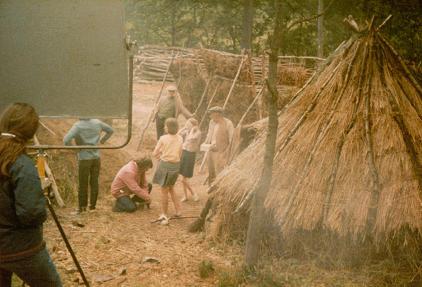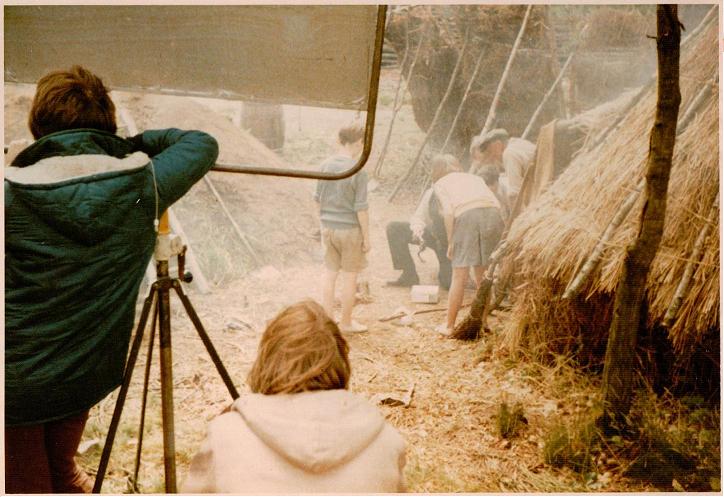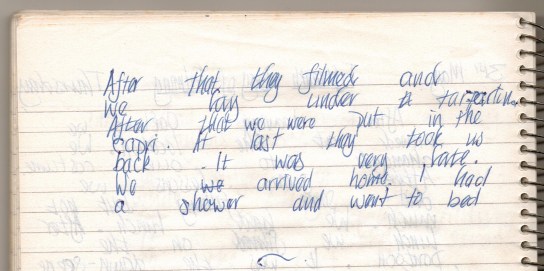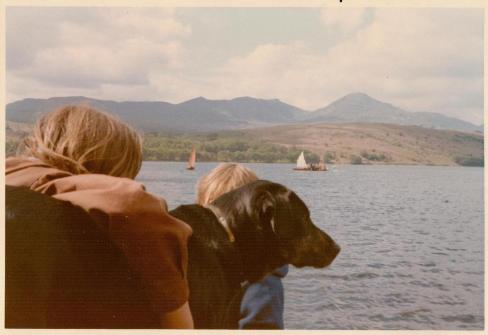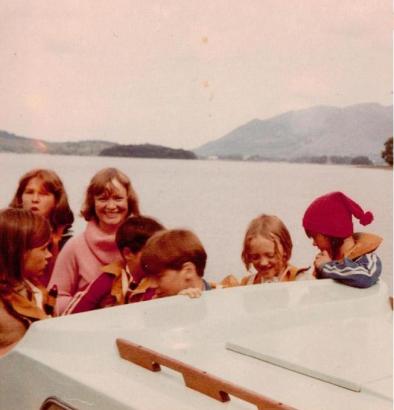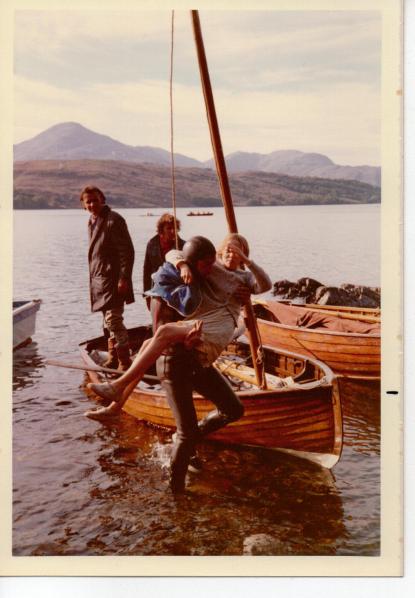
Better drowned than duffers ~ filming ‘Swallows and Amazons’ on the afternoon of 14th June 1973

SSophie Neville on the Daily Telegraph front cover

Sophie Neville as Titty Walker

If not Duffers...

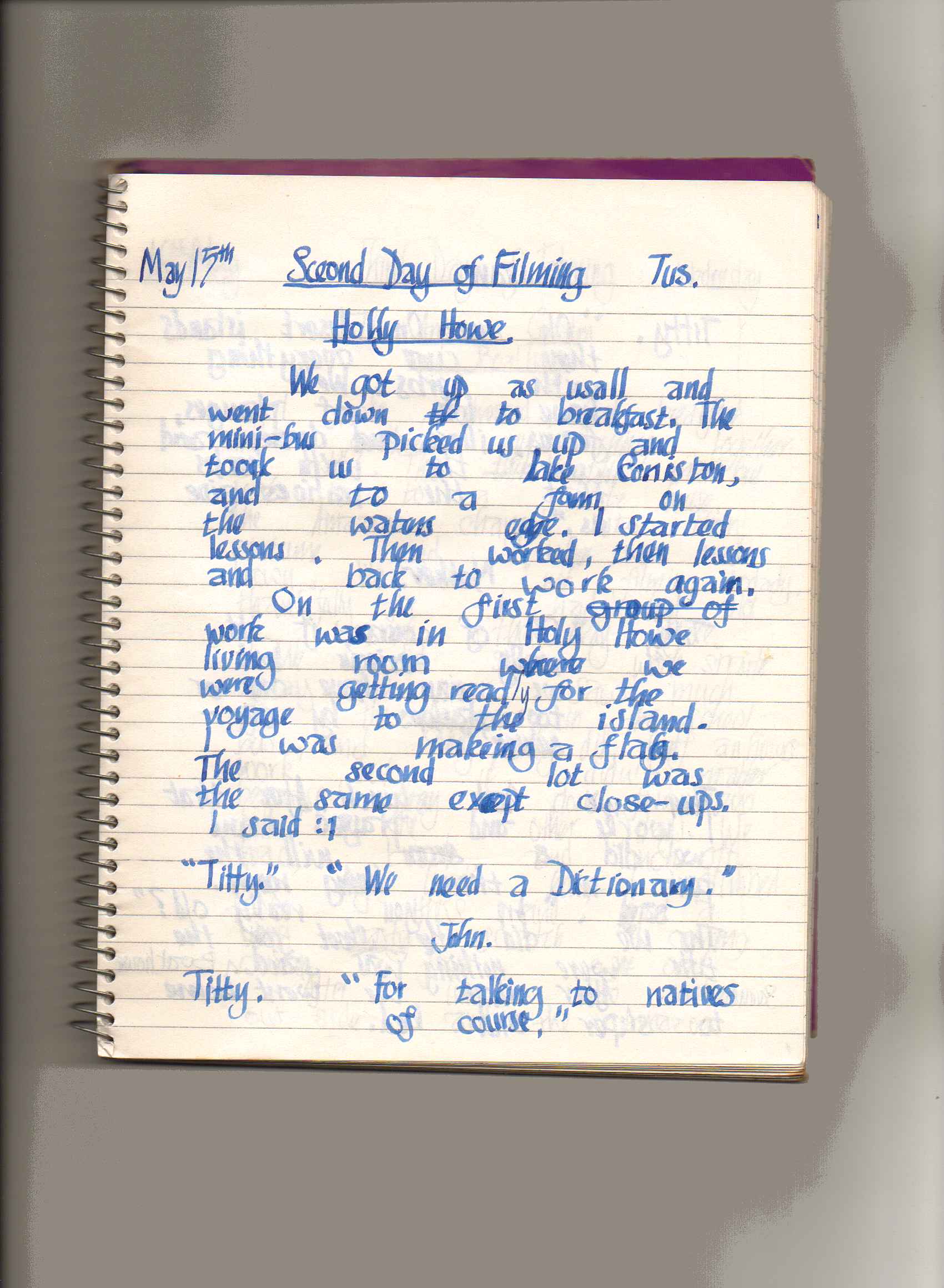
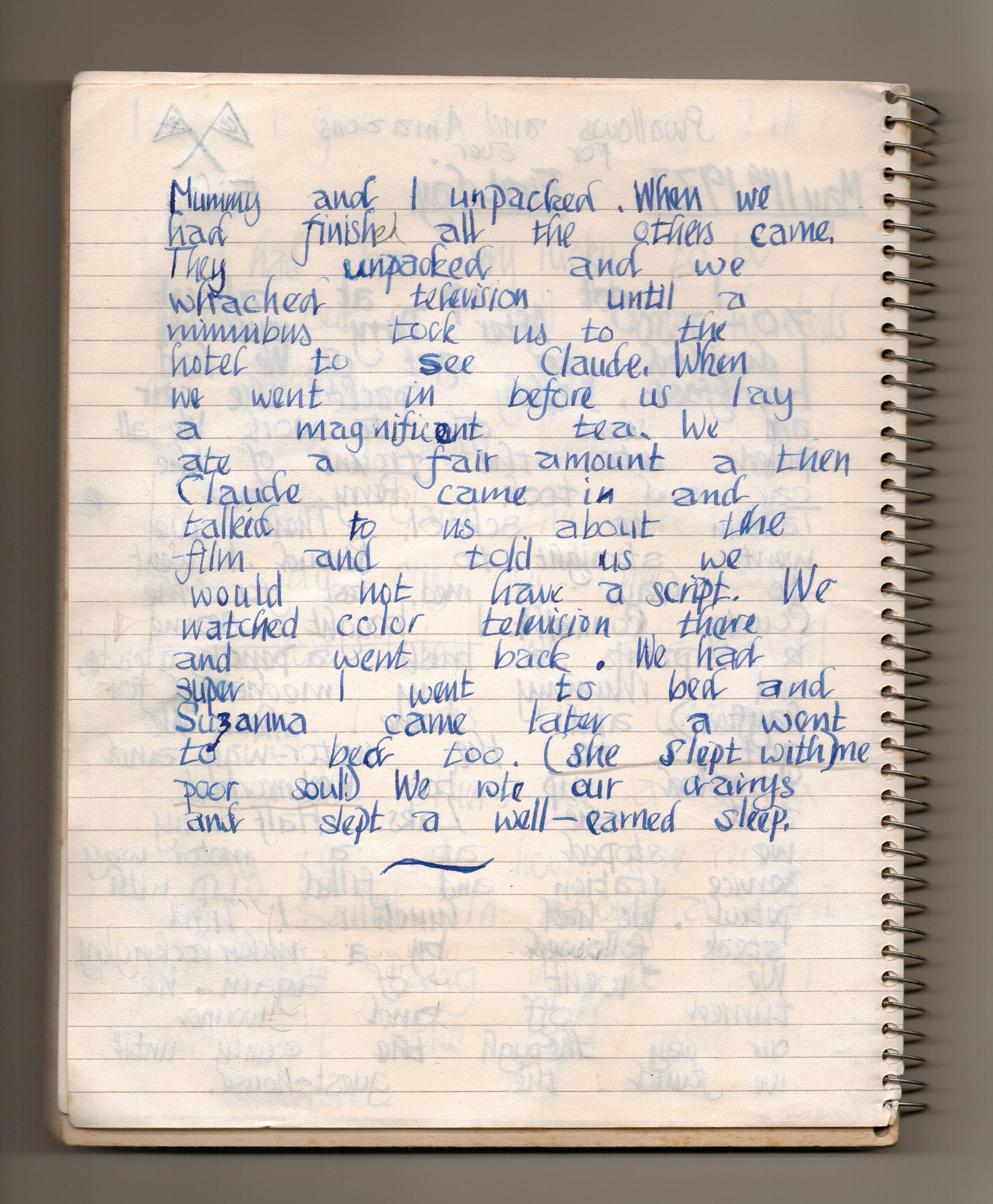
14th June ~ my Diary at Bank Ground Farm

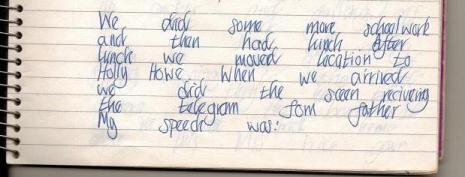
14th June ~ My diary at Bank Gound Farm

Claude Whatham had no Peak of Darien at Bank Ground Farm,  Arthur Ransome’s location for Holly Howe. But he did have buttercups and daisies, the flowers so evocative of childhood summers spent in the English countryside.  The field that runs down to Coniston Water looked glorious that sunny day in June 1973.  It was glowing.

Claude had used wild flowers to good effect when he made Laurie Lee’s memoir Cider with Rosie for the BBC in May 1971. It had been one of those months of endless sunny days in Gloucestershire but we were in Westmorland now, where buttercups bloomed later in the year and sunny days were cherished. This was Claude’s afternoon for low angle shots.
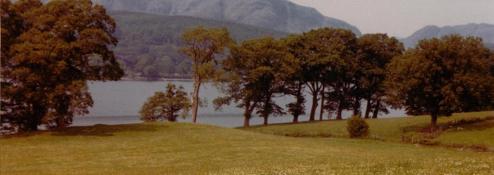
The view from Bank Ground Farm
The view from Bank Ground Farm over Lake Coniston as it was in 1973

We arrived to find that a huge hole had been dug in the meadow for the camera, with a picnic for us spread out the other side of it. We thought this was very exciting. I’m not sure whether Mrs Batty felt quite the same joy about the excavations in her field. I was sad that we didn’t have a fire with a kettle, as they do in the book of Swallows and Amazons, but that was kept as a feature of island life and camping yet to come.
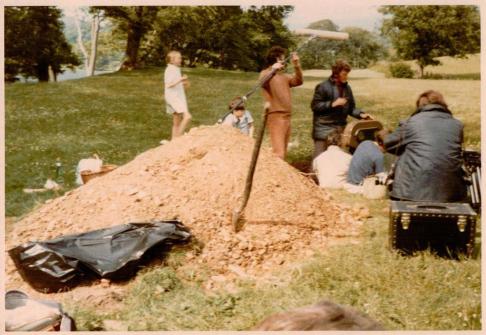
Sophie Neville, Simon West, Suzanna Hamilton, Gay Lawley Waklin, Bobby Sitwell, Dennis Lewiston, Albert Clark: photo~ Daphne Neville

Roger came sailing down clutching the telegram from our father, reaching out to deliver it over the hole. I understand that this was based on the cryptic telegrams that Ernest Altounyan sent his children Taqui, Susie, Titty and Roger, the children who acted as models for the Swallows. It has become the iconic response to Health and Safety ever since.

Bank Ground Farm
Claude Watham having just spoken to Stephen Grendon playing Roger at Bank Ground Farm. Who is in the foregound? : photo~ Daphne Neville

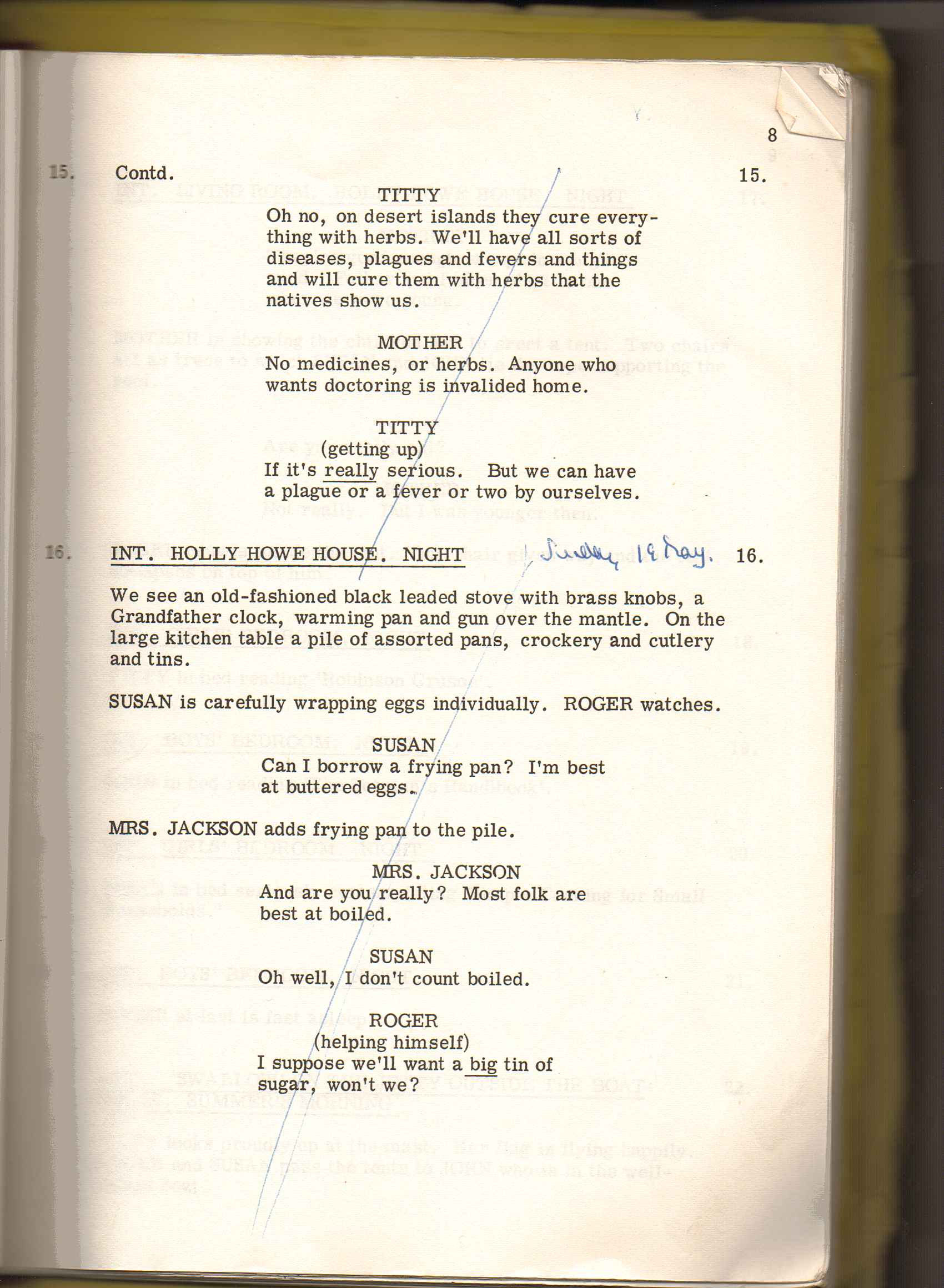
What we ended up saying altered slightly from David Wood’s original screenplay. ‘Dispatches?’ – Ransome spells the word ‘Despatches’ but apparently both spellings are correct.

John referred to Daddy as ‘Father’. I’m not sure why. He did so in his letter. It is daddy in the book, but perhaps Claude considered ‘Father’ as having a more period feel.  I stuck more to Ransome’s dialogue, as you can see if you compare the film script with my diary entry above. This was because I knew his book so well, and never saw the script. The acting credit must go to Simon West who sat holding the telegram, graciously absorbing my bossiness, whilst I grappled with the words.

David Wood's screenplay  of 'Swallows and Amazons'
David Wood’s original screenplay of ‘Swallows and Amazons’
Sue Merry typing up continuity notes on location at Bank Ground Farm: photo ~ Daphne Neville

Back in 1973 it was the job of  the ‘Continuity Girl’ to take notes on any changes made to the script. Sue Merry, ever present in her dark coat, took on this role. Today she would probably be known as a ‘Script Supervisor’ but her Aviator sunglasses and black polo-necked jersey would be the height of fashion. Sue also took notes technical notes for the film editor and director, indicating which Takes were favoured and which had been spoilt, giving the reason. In those days we had no monitors. The camera lens would be unscrewed after each take and checked carefully. If any fluff was found, Bobby Sitwell the camera assistant would call out, ‘Hair in the gate!’  Sue would quietly note this down and David Bracknell, the first assistant, would call out, ‘Set up to go again’. And we’d go again.
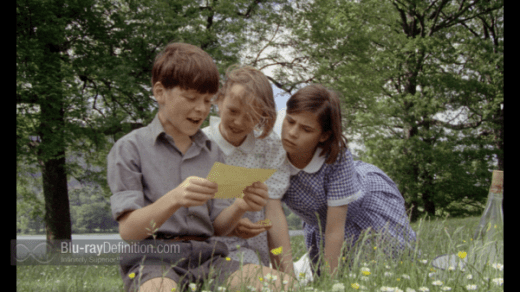
Blu-ray reading telgram

Sue was also responsible for the continuity, and would take numerous Polaroid photographs as an aide-memoir. This scene followed the one of Mother giving Roger the telegram, which had not yet been shot. Virginia McKenna hadn’t arrived back in Cumbria. Looking back, this seems a huge gamble. Would they ever get another sunny day while the buttercups were still blooming, a day to match – exactly – the weather of 14th June?

Sue would sit and type up her notes on location, using a portable typewriter that sometimes was set up for her on a spindly picnic table. This method of working was different from the BBC, when a ‘production assistant’ would type up her notes at the end of each day. Would it have been so that one copy of her notes, typed on triplicate paper, could be sent to the laboratory with the exposed film? It meant that her evenings were free.

Filming Swallows and Amazons in 1973
We were allowed to help fill in the hole at the end of the day.

Sue Merry had worked for Neville C. Thompson before on The Boyfriend, Ken Russell’s movie that starred Twiggy with Tommy Tune, Barbara Windsor and Glenda Jackson. She later worked on The Wicker Man, Anthony Shaffer’s harrowing film directed by Robin Hardy that featured Edward Woodward, Christopher Lee and Diane Cliento, Britt Ekland and Ingrid Pitt. She went on to work with Dennis Lewiston and other members of our crew on The Rocky Horror Picture Show, the movie that starred Tim Curry, Susan Sarandon and such unexpected artists such as Meatloaf, Christopher Biggins and Prince Andrew’s old flame Koo Stark,  who played a bridesmaid. Sue also did the continuity for Nicolas Roeg on The Man Who Fell to Earth, starring David Bowie,  before moving into television to work on The Professionals and The Comic Strip Presents… All quite fun!

But on that day in June 1973, she was the girl with the daisies in her hair, wearing a coat thick enough to indicate that although sunny it was still quite chilly in the Lake District.

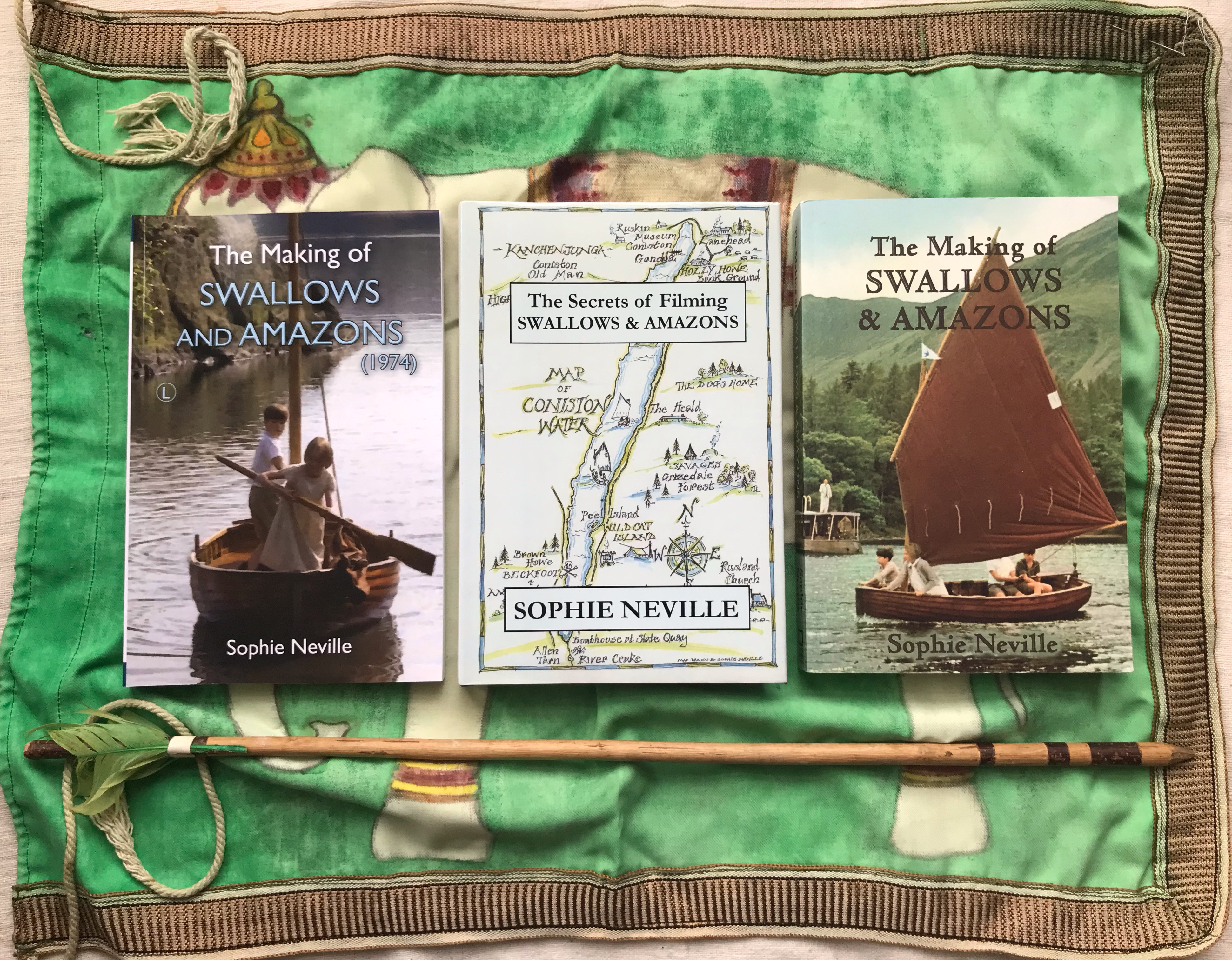
You can read more in ‘The Secrets of Filming Swallows and Amazons (1974)’
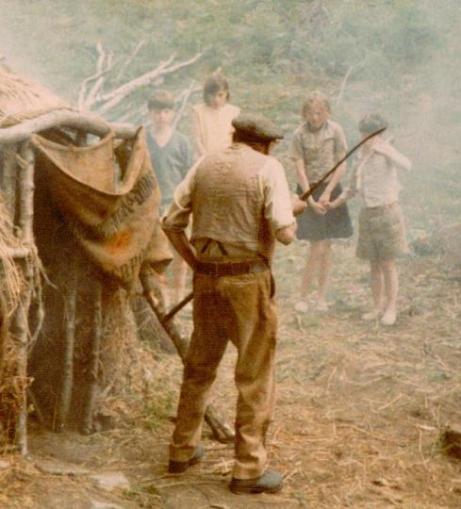
Visiting the Charcoal Burners ~ filming ‘Swallows and Amazons’ on 13th June 1973

The Charcoal Burners - Swallows and Amazons
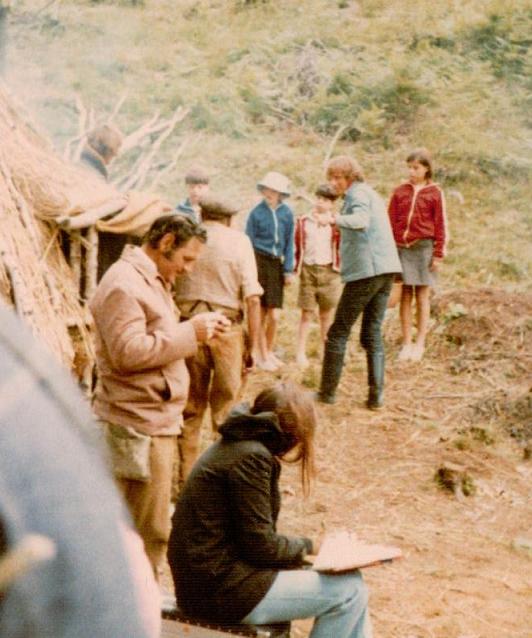
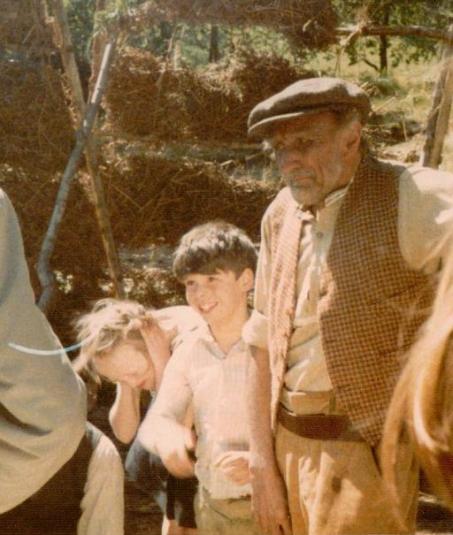
Jack Woolgar as Old Billy with Simon West, Suzanna Hamilton,   Sophie Neville and Stephen Grendon ~ photo: Daphne Neville

‘Let’s just run though our lines, shall we?’ Old Jack Woolgar said, in a gentle Lancashire accent. We were waiting about for some reason, so did just that, sitting by a woodstack.  Titty had a lot to say in the scene where we went to see the charcoal burners, but the dialogue was straight out of Arthur Ransome’s book so it was easy. Or I thought so, until there was Old Billy saying – ‘Ehh, then you’ll be climbing into that mini-bus and off back to Ambleside, I expect.’

I thought, ‘That’s not in Swallows and Amazons! That’s real life.’

‘Eee, lass! You forgot to come in on your cue.’ I had too. I was so entranced by Old Billy, so lulled by the music of his voice, that I had simply gone on listening to him.

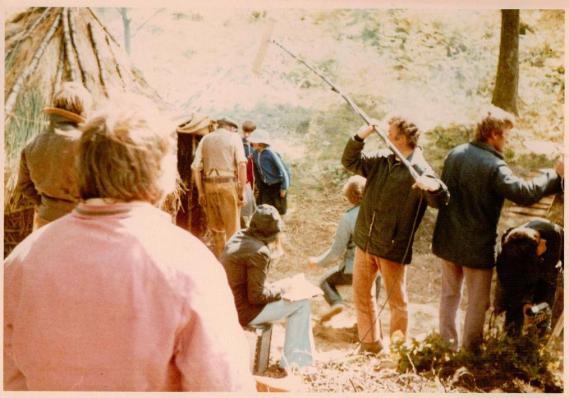
Jack Woolgar, Simon West, Sophie Neville, Stephen Grendon and Suzanna Hamilton with Director Claude Whatham. Sue Merry is seated in the foreground with her continuity sheets ~ photo: Daphne Neville

We were still having problems with the weather. It was cold and grey at first but grew to be a bright sunny day in Cumbria, with a gale blowing that was knocking the tops of the trees about and making life hard for Graham Ford, the sound recordist. This was all a bit difficult as it was meant to be dead calm in the story.

‘It’s blowing up a bit,’ Old Billy put in. I don’t think anyone watching would have noticed if we’d left it at that but our hair was blowing about so madly that Young Billy had a few savage-like words with John about why we weren’t sailing. These are not in the book.

Charcoal Burners 2
Filming the scene ~ Sound Recordist Graham Ford in the foreground, Grip David Cadwallader. Actors Jack Woolgar, Simon West and Sophie Neville, Continuity Sue Merry seated, Director Claude Whatham kneeling, Boom Swinger, Focus Puller Bob Blues and Camera Operator Eddie Collins ~ photo: Chaperone Daphne Neville

I think Mum did well with her photographs. She only had a small camera but she tried to capture what it was like to be on set, involved in the filming, rather than just focusing on the story. Because her camera made a clicking noise she was only really able to take shots when we were in rehearsal, wearing our Harry Potter-like nylon tracksuit tops, me in a sun-hat, the rest of the crew wrapped up in their warm jackets.

When I watch this scene I notice one technical bit about acting that is never talked about much. You have to hit your mark. Without this being obvious. No looking down. Your mark is the exact position established when the shot is lined up.  The camera focus, certainly back then, required actors to be consistent and hit the same position in each take as established in the rehearsal. Look at the opening shot at the top of this post and you can see it is carefully composed – a nice triangle, with all our faces in vision. The important bit – Roger holding my hand is not masked. Do I spoil the magic if I say we are standing on our marks?

Sophie Neville at the Charcoal Burners
Sophie Neville looking at the adder with Stephen Grendon and Jack Woolgar

If feet can’t be seen a piece of tape was usually placed on the floor in front of the actors’ toes to provide a mark. I used to use different coloured tape for different artistes later on when I was an assistant director. We used chalk on tarmac roads. Tape didn’t stick to most of the locations on Swallows and Amazons, so we used sticks or tree bark, taking quite a pride in disguising  them. Sometimes a box would be placed on the ground so we could feel it and not have to look down. This could not be done at the charcoal burners’. We all came out of their dark wigwam blinking in the bright sunlight shuffling onto our secret marks, Suzanna glancing down quickly to check she was on hers.

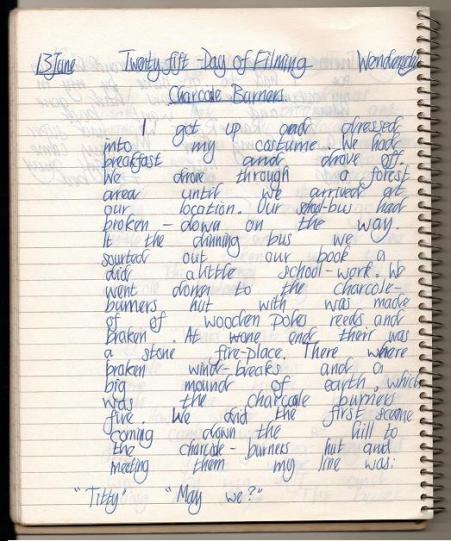
My diary read:

13th June - My diary page one

13th June - My Diary page two

13th June - My Diary page three

John Franklyn-Robbins as Young Billy with Director Claude Whatham. Prop men stand in the background with the real charcoal burner ~ photo: Daphne Neville

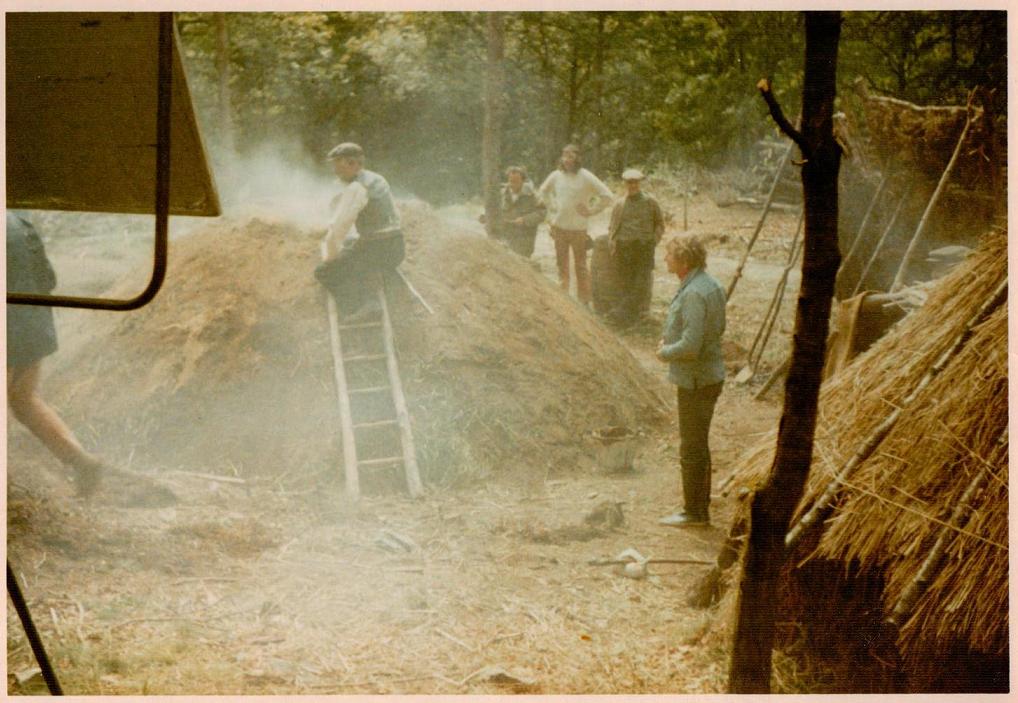
Was the charcoal heap was a real one? I’m afraid I think, since that hole had to start smoking on cue, that it was constructed for us with a prop man called Terry inside with a smoke gun. I know he suffered rather from getting too much smoke in his eyes and had to be treated by the nurse. There was certainly a great deal of smoke around, which had a wonderful effect.

Charcoal Burners' Adder
Robert Forster who supplied the Charcoal Burner’s adder
Molly Friedel watching Robin Gregory plant a microphone for the adder. Claude Wahtham is hidden by a reflector board, Suzanna Hamilton, Sophie Neville and Jack Woolgar wait on their marks while the real charcoal burner looks on ~ photo: Daphne Neville

We could all see the adder but the sound recordist wanted to hear her so he buried one at our feet. She was a lovely serpent.  Suzanna, who loves snakes with a passion, got close to touching it. She was very disappointed that you can’t see this in the movie. I was a bit scared. Ransome had added that frisson of danger – real life danger – there for us to see.

Sophie Neville, Sten Grendon, John Franklin-Robbins, Jack Wolgar, Suzanna Hamilton and Simon West in Swallows and Amazons (1974)
Sophie Neville, Sten Grendon, John Franklin-Robbins, Jack Woolgar, Suzanna Hamilton & Simon West

Jean Woodhouse wrote to say, ‘I came to watch Swallows and Amazons being filmed. It was the charcoal burner’s scene. We walked down from our village Primary School (Satterthwaite) but the scene was actually just down the road from where I lived… we were all terrified re-the snake.’ She was about 10 years-old at the time. ‘…because I used to go up and down through the wood each day, I knew the real charcoal burners who worked in there and so that scene in the film has always felt quite special to me.’

Filming the Scene: Simon West, John Frankiln-Robbins, Suzanna Hamilton and Jack Woolgar. Designer Simon Holland sits in the foreground. ~ photo: Daphne Neville

One of the most magical things for my mother was meeting the real charcoal burners. There are more photos of them in the nest post as we returned on 14th June.

The Real Charcoal Burners 2
John Franklin-Robbins playing Young Billy with Sophie Neville, Stephen Grendon and the adder.

You can find out the name of the snake wrangler and read more about the filming in the ebook ‘The secrets of filming Swallows and Amazons (1974)’
Filming The Swallow and The Amazon from a pontoon out on Coniston Water ~ 31st May 1973

The dinghies Swallow and Amazon with the camera pontoon at Peel Island on Coniston Water ~ photo: Martin Neville

How do you film two girls sailing a thirteen foot dinghy talking to their brothers sailing along in another small dinghy while calling out to two other girls in red bobble hats dancing about on a wooded island which both the small boats are approaching?

The scene looks so simple on paper.  It is the one when the Swallows sail back to Wild Cat Island with the captured Amazon to find Nancy ‘dancing with rage’ and Peggy anxious to get home before breakfast. One page of script.

Claude Whatham soon discovered that he was shooting the most complicated of sailing scenes. On a cold grey day in the Lake District.

It is extremely difficult to describe how he managed this, but I will attempt to do so.

31st May 1973 ~ My diary

Sophie Neville's diary 1974

There was no room in the dinghy Amazon to film Susan and Titty sailing. This had to be done from a boat or vessel lashed along side. The production had a pontoon hired from Mike Turk in Twickenham and managed with the help of Nick Newby at Nicole End Marine near Keswick. It was a sizeable raft equipped with four outboard engines and surfaced with a number of flat ‘camera boards’.

Swallow and the pontoonBasically rectangular, it had arms added on either side. The idea of this cross-shaped platform was to enable Claude to film us either side-on, from astern or across the bows of the dinghy, which was wired by its keel to the pontoon. The camera was normally on a tripod. The original idea was that it could be mounted on a short section of track but I don’t think this ever happened. Electric lighting was not something that could be used on this pontoon but two large reflector boards were used to light our faces instead.

The result was a shot used on the cover of a book and a DVD marketed by the Daily Mail in 2008.

Sophie Neville on the cover of the Daily Mail DVD

As well as the director and camera crew, the sound recordist and ‘boom swinger’ were on board the pontoon along with Sue the continuity girl. Costume, make-up and our chaperone would be in a separate safety boat, in this case a Capri. This would mill about with the life jackets, sunhats and warm clothes that we wore between set ups. The crew all started off wearing life jackets, but as you can see they were soon discarded. They were dangerous things, old BOAC ‘life vests’ with so many flappy straps that you were at risk of being trapped under water by them.

Blu-ray Amazon Pirates

The pontoon was operated by two boat men under the eye of David Blagden, the sailing director. They had to work with Claude and the wind so that when we were sailing, while the pontoon travelled with us. This was tricky enough on open water. If we were near the shore it could become more difficult. As you can imagine the dinghy could easily start to sail away from the clumsy pontoon – or worse. Our mast socket broke that first day.  They needed my father on that pontoon. He there, quietly was watching from the shore.

The camera pontoon on Coniston Water with Amazon attached to it and Swallow sailing to the other side of Peel Island during the filming of ‘Swallows and Amazons’ in 1973~ photo: Martin Neville

Although we had all read the book of Swallows and Amazons, and were devoted to adhering to every detail, no one remembered that John and Titty sailed the captured Amazon back to Wild Cat Island. She had a centre board which was a new thing for the Walkers so John decided to let Susan helm their familiar boat. I wish this had been detailed in the script. In the film, John was with Roger in Swallow whilst Susan and I were in the Amazon, which was a pity. I can only imagine that Claude decided this because he was trying to achieve a very difficult ‘three shot’. He was relying on John – on Simon West, who was aged eleven – to keep sailing Swallow in the right position, whilst out on the water between Amazon and Wild Cat Island.

Simon West sailing Swallow - trimmed
Simon West as Captain John sailing Swallow . Sten Grendon plays the Boy Roger in the bows

This wasn’t as easy as it looks. You can see from this photographs that Swallow kept racing ahead of the pontoon. It can be gusty around Peel Island and the rocks can be lethal. Roger was on lookout but he also had to deliver his lines.  Having no centre board and a shallow 1920’s rudder Swallow can be difficult to turn or get going if the wind slacks. This wasn’t actually a problem; Simon had wind and he did brilliantly. Suzanna Hamilton did too. She had no previous experience of sailing the Amazon. No one had remembered this sequence when we practiced before the filming began.

Molly Pilbrow and her dog with my sister, watching the camera pontoon from the shore of Coniston Water ~ photo: Martin Neville

Meanwhile Gareth Tandy, the third assistant director, was standing-by (probably for hours) on Peel Island with Nancy and Peggy. He had hide in the bushes and cue them at just the right time. They did so well. They had to deliver their lines while jumping from rock to slippery rock to keep up with both the Swallow, the camera and the story.

The Swallows and The Amazons in the Capri ~ Suzannah Hamilton, Kit Seymour, Daphne Neville, Stephen Grendon, Simon West, Sophie Neville and Lesley Bennett ~ photo: Martin Neville

When we filmed two of Arthur Ransome’s other books, Coot Club and The Big Six, on the Norfolk Broads in 1983, the BBC producer Joe Waters used a 35 foot river cruiser as camera boat. It could be difficult keeping it stable during a take, especially with so many people on board, but being a proper boat it was much easier to manoeuvre than the pontoon. And faster. Andrew Morgan, the director still managed to get his camera angles and it had the advantage of a cabin where sensitive equipment such as film stock and lenses could be stored. I can remember the camera assistant changing the film on board. I don’t know if the boat had heads. May be.

On both productions we had the inevitable problem of modern boats coming into shot. We had to have one of two men in zoomy motorboats that could zip across the open water to ask them to move clear of the shot. Even with this control you can imagine what happens. You line up your shot with all your boats in position, the sun comes out and a modern motorboat roars across the lake leaving you all rocking in its wake.  Then it rains.

The good thing about having a safety officer in a frog-suit is that they can carry you to shore at the end of a long day. You don’t have to get your feet wet.

The Safety Officer and me, with Dennis Lewiston and Claude Whatham still standing in the Amazon ~ photo: Martin Neville

The question is – Did the DOP and the director get carried ashore too?

You can read more here:

‘But we never touched his horrible houseboat…’ filming ‘Swallows and Amazons’ on Peel Island 30th May 1973

Peel Island on Coniston Water in the English Lake District whilst we were filming ‘Swallows and Amazons’ in the summer of 1973 ~ photo: Martin Neville

An extract from the journal I kept aged twelve:

Stephen Grendon, Suzannah Hamilton and Sophie Neville on the cover of the LP of the film ‘Swallows and Amazons’

I must have lost my pen on this wet day in May 1973, for the diary on the making of the film ‘Swallows & Amazons’ is written in pencil. I don’t know if Claude Whatham, the Director, ever remembered me writing but when the film ended he kindly sent me an engraved Parker pen and propelling pencil. I loved the pen and wrote all my essays at university with it. Sadly I lost it just before my Finals but I still have the pencil. Somewhere.

Although we had a late start it was a good day, a day when Claude encouraged us to improvise. The dialogue in the little scene when we were gutting fish is our own. I’ve always thought improvisation can be magical. When I started to direct at the BBC we were very conscious of the cost of film stock – the footage – so were reticent about taking chances, but I made a drama on school bullies that turned out to be very powerful, purely because I let the children improvise. The only problem was that it came across as almost too frighteningly real. I found that although short scenes worked well, I had to write the story as a whole as I went along, which was a bit daunting. When I went on a BBC Studio Director’s Course I tried improvising a scene where a couple go camping in true Mike Leigh style. I asked the actors to erect a tent in the studio, and left them at it while I spoke to the cameramen via inter-com with the vision-mixer at my side. She also improvised.  The scene was to end with the couple going inside the tent, which then collapses on top of them. I used a dome tent of my own and I showed them just how easy it was for them to collapse it. It was quite fun, and worked surprisingly well. Up to a point. The problem was that I was working with actors and the actors, being actors, enjoyed themselves so much they didn’t want the scene to end. It nearly didn’t end at all. And I ended up with the longest studio show reel of all time.

sophie008
Sophie Neville, Suzanna Hamilton, Stephen Grendon, Lesley Bennett and Kit Seymour with David Blagden on Peel Island on Coniston

Suzanna Hamilton was very good at gutting fish. She is not a remotely squeamish person, in fact she loves snakes and other reptiles. A stoic, who would valiant be ’gainst all disaster, she is probably the most gutsy film actress there is. No fuss or over long scenes for her.

Blu-ray gutting fish

I was more interested in examining the the high dorsal fin of the perch and could have spent all morning standing on the rock. I seem wired to illustrate stories. I am sure Arthur Ransome used a line drawing of one of the perch he caught. Is it in Swallows and Amazons?

Claude Whatham, the Director of ‘Swallows and Amazons’, on the shore of Coniston Water ~ photo: Daphne Neville

Claude did not shoot many ‘takes’. His aim was to get fresh performances. By this time he had started to film the rehearsal, and then one ‘take’ as a back-up, to give the film editor an option. Then he would change the camera angle. It is probably a good policy when filming with children – as charm is difficult to replicate. When I started to direct on Beta-cam I attempted to shoot quite long scenes on one shot by using ‘jib-arms’, small cranes or camera track to move the camera. This was all the rage in the late 1980s. I remember using one long shot for the opening scene of a comedy drama called Thinkabout Science that starred Patsy Bryne ~ she who had become known to the nation as Nursie in the BBC sitcom Blackadder .

Thinkabout with Patsy Byrne
‘Thinkabout’ with Patsy Byrne

Patsy played a grandmother collecting two sisters and their friends from school. The children poured out of the front door, down some steps, met their granny and chatted to her as they skipped along the pavement. I had about 120 metres of camera track laid down the street, far more than any scene on Swallows and Amazons. We had a rehearsal and shot the three minute scene. It worked perfectly. It was fresh and funny and active. I was all set to move the whole crew to the next location when my producer descended from the Scanner, a truck where she was watching on three monitors, to tell me that one of the Extras had waved at the camera. I should have recorded the rehearsal. After that, it took us twelve more takes to get the scene right. Luckily Beta tape costs were negligible – certainly in comparison with the 35mm Technicolor stock that Claude was using.

Richard Pilbrow must have been pleased to hear that we gained a reputation as ‘One take Wonders’ on Swallows. When it came to the scene when we returned to the camp to find the abrupt note from Captain Flint, Claude took me to one side and suggested I added a line of dialogue at the end when it came to the take, without letting the others know. He told me to say, ‘And he used my crayons too.’  I wish he had edited it out. I didn’t deliver the line well. I think Suzanna would have said it perfectly but the secret made me too self-conscious.

Simon West, Suzanna Hamilton, Stephen Grendon and Sophie Neville in ‘Swallows and Amazons’ filmed on location in the English Lake District in 1973

You can read more here:

The Amazons Attack ~ filming ‘Swallows and Amazons’ on Peel Island ~ 29th May 1973

BW Sophie Neville in Secret Harbour‘But John’s our Captain.’Swallows and Amazons 1974

Sophie Neville's diary written on location while making 'Swallows and Amazons' in 1974

My father said that his first impression of the film crew was, ‘What an awful mess of trucks and weird people!’  He’d just come from his office in the electronics industry where everybody wore suits and ties.  It’s true.  One of the Arthur Ransome Society members took one look at the footage Dad took of the making of Swallows and Amazons and said, ‘It looks like Woodstock.’ Woodstock on wheels. Dad couldn’t bear the notion of hanging around all day but he bought some paints with him to do what he never normally had time for while looking after us.

Daphne Neville's publicity photograph c.1973
Daphne Neville ~ presenter on HTV

My mother, Daphne Neville, had to leave that Tuesday to spend four days at the Bath and West Show ~ a long term commitment that could not be cancelled. By this time she had been working for Harlech Television or HTV, as the station became known, for about four years. She’d started as an ‘In Vision Announcer’, reading the News with Martyn Lewis from the old Harlech Television studio in Cardiff, before moving on to present her own children’s programmes such as It’s Time for Me.

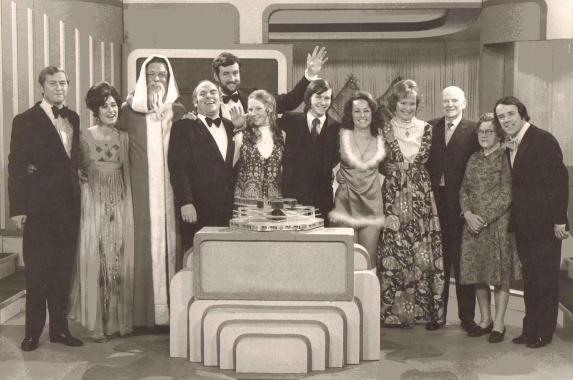
Bruce Hocking, Jan Leeming and Daphne Neville with contestants appearing on an HTV Christmas Special

By 1973, Mum was presenting a women’s afternoon series made in Bristol called Women Only, with Jan Leeming.  No doubt they had to host the HTV stand at the Bath and West agricultural show. These are big events in rural Britain. My parents went on to have stands at about ten or twelve of them every year when they went on to work as wildlife conservationists.

Jan Leeming, Sophie Neville and Daphne Neville
With Jan Leeming and Mum when I was a little older

I have a horrible feeling that in the Woodstock-like atmosphere of our set, I might have taken on my mother’s role and got a little bit too bossy in the school bus. The result was a head-on attack from Sten, who must have been  offended. He not only fought me but would not let go. Perhaps this was a good sign in that we had become like a real family. Perhaps it was because the balance had been tipped by our real families turning up. Sten’s father had arrived with his little sister, my little sisters were playing outside and yet we were not being given time off lessons for half-term. Perhaps it had something to do with the red and yellow sweets we had started eating on the bus. Mum said that Sten was always picking fights. He was an eight-year-old boy.

Sophie Neville in her BOAC life jacket with her sister Tamzin about to leave for the set of ‘Swallows and Amazons’ on Peel Island. Sten Grendon’s father and little sister are in the background ~ photo: Martin Neville

Luckily for Claude, the director, we were filming the scenes on Wildcat Island where the Amazons attack.  ‘When we fell flat on our faces and the Amazons’ arrows flew over our heads.’ We loved this scene and it was great that Nancy and Peggy had at last arrived on Wildcat Island.

Sophie Neville and Suzanna Hamilton in 1973
Sophie Neville and Suzanna Hamilton confronting the Amazon Pirates

I don’t know if Mum had still been around to oversee that particular act of aggression. She had taught the Amazons to shoot.  The photographs I have of her doing so  show her giving Nancy and Peggy archery lessons in the field outside the bus.

Practicing with bows and arrows

They were just using hazel bows made for them on site by Bobby the Property Master, but my parents did know how to use the long bow. When they were first married they joined the Worcestershire Archery Society and went on to win quite a few prizes. I know all about this because the Chairman of that society was to become my father-in-law. I too learnt to shoot and ended up marrying his son, another member of the Worcestershire Archery Society.

Sophie Neville with Suzanna Hamilton

It  looks pretty scary when those arrows, fletched with green parrot feathers, fly over us.  Much to Nancy’s disappointment, these were actually fired by two prop men. They strung up fishing line and attached nylon loops to the arrows to ensure that we would not actually get hit, but it was quite thrilling – and still quite risky.

BW Amazons with bows
Kit Seymour and Lesley Bennet as the Amazon Pirates

I never forgot the trick. When I became a BBC director myself I took much joy in using totally inexpensive visual effects, such as extended use of fishing line. I learnt how to use reflections from a skilled director called Moira Armstrong and picked up on just how much could be achieved by juddering the camera when I worked on Doctor Who.  All that dramatic and complicated-looking Tardis malfunction was achieved simply by vibrating a studio camera.  However,  fishing line was the only visual effect used in the 1973 version of Swallows and Amazons.

Kit Seymour with Claude Whatham, 1973

After being on location for more than two weeks this was the second day that Kit Seymour and Lesley Bennett had appeared in front of the camera. The hanging around must have been pretty frustrating. In 1983, when we were planning to make adaptations of the Arthur Ransome books at the BBC, I was hoping to cast the Amazons – if not all the children – from schools up in the Lake District. I don’t expect Claude had had the time to do that.  Luckily for me.

Kit Seymour (Nancy) and Lesley Bennett (Peggy) on Peel Island 1973

You can read more in ‘The Making of Swallows and Amazons’ on this ebook:

A letter from behind the scenes on the third day of filming ‘Swallows and Amazons’ in 1973

16th May 1973, was the third day of filming the original movie ‘Swallows and Amazons’. My mother wrote a letter to my father who was at home in Gloucestershire with my two younger sisters.

Mum kept all her letters, my diaries and scrapbooks in a smart carrier bag. It once contained an expensive velvet dress bought for me in Carnaby Street when we met Claude Whatham, the director of Swallows and Amazons back in April 1973

1970’s English food ~

The food at our guesthouse was talking its toll. It was not a good idea to feed children on packet soups and baked beans in the days when 35mm film stock was so extremely expensive.  No one realised why, but the ingredients made Sten hyper-active, or as my mother put it, ‘causing a little hoo hah.’ A visiting  journalist wrote, ‘By the end of the day Roger, aged seven, had mown down the entire film crew using a hammer as a mock machine gun. He had fallen down several times and emerged with grazed knees all splattered with mud.’

Location catering ~

Suzanna Hamilton, who was playing Susan, simply refused to eat the revolting food.  Mum said,  “I couldn’t get her to eat anything.” Location catering is excellent now but back in the early 1970’s it could be pretty basic canteen food produced from a ‘chuck wagon’. We’d queue up for a tray of meat and two veg, which was usually consumed in a red London double-decker converted into a dining bus.  There were no salads, no fruit, just a working man’s lunch with coffee in plastic cups and paste sandwiches provided later with tea. The tea was good.

Pinewood location catering ~ Suzanna Hamilton pearing into the chuck wagon ~ photo: Daphne Neville

The fruit bowl in our bus ~

Mum started to order fruit and we relished it. Back then, it was a huge treat to have bananas or melon, oranges and grapes. A bowl sat in our bus where we were given lessons on Formica tables downstairs. The upper deck was used by Terry the Wardrobe Master as as our changing room. It was furnished with bunk beds, which Mum made me rest on after lunch. I don’t think she could pin down the Amazons and I objected at first but I must have needed to lie down and rest properly, especially when it was cold.

Daphne Neville with Richard Pilbrow1
Molly and Richard Pilbrow in 1973

Molly and Richard Pilbrow on location with the two red London Double Decker buses where coffee was being served ~ photo: Daphne Neville

The film crew ~

Apart from Sue Merry, the ‘Continuity Girl’, the film crew consisted entirely of men, forty-five of them. I include the Hair and Make-up Designers, the Wardrobe Master, the Art Director, Set Dresser, Prop Master and Carpenter, Sound Recordist and Boom Operator, the Director of Photography, Camera Operator, Focus Puller and Grips with the Electricians from Lee Electric who looked after the lights and generators, Lorry Drivers and Sailing Director, the Director, three Assistant Directors and the Production Associate and Producer. I think there might have been a Film Accountant and Location Manager. Being a feature film financed by EMI Films we had a permanent Stills Photographer and a Publicity Manager.  And this was a small crew as Terry seemed to cope without Wardrobe Assistants or Dressers. They all knew each other pretty well from being on previous movies. I have a list of where they had digs in Ambleside. It’s quite interesting to see who shared with who.

Whenever we needed boats, six local boatmen could also join the queue for the chuck wagon – and the mobile loos.  Mum wouldn’t let me use them. They were looked after by a ratty looking chap who later managed to persuade one of the Ambleside girls that he was the film’s Producer.

Neville  Thompson, who was effectively the on-line Producer, had a production secretary called Sally Shewing, but she must have been stuck in the office as we never saw her.  Molly Friedel, Richard Pilbrow’s girlfriend and assistant, was often on location. We adored her. She was American, tall with long brown hair and always had time for us. I remember her working on the lighting design for the next Rolling Stones Concert by the shore of Coniston Water whilst we milled about, playing on the rocks.

We had our tutor, Mrs Causey and a wonderful mini-bus driver called Jean McGill. She had been a top air steward but had returned to Cumbria to look after her ailing mother and drove us around the area to keep busy. As soon as we found out that she was also a qualified nursing sister, Mum made sure that Jean was taken on as the official location nurse. This was great as it meant she could be around the whole time and we never had to wait for the bus. We found we soon needed a nurse too. Someone was always hurting themselves.

Jean McGill, our driver and location nurse, operating the radio with Sophie Neville ~ photo:Martin Neville

So in all, with our chaperones there were usually about six women around as well as journalists, friends and relatives who came to watch. It was a huge circus with often eighty people milling about. Certainly the Call Sheet asks the caterers to provide lunch for seventy on normal days. It would be much more when we had crowd scenes such as when we explored Rio.

The male:female ratio on crews is very different today. There are often more women than men, perhaps not on movie sets, but certainly on BBC drama crews. It was already different by 1983 when Richard and Molly Pilbrow came to visit us on the location of  Coot Club in Norfolk, when there were about equal numbers of men and women on location. It made for a better, family atmosphere, certainly more appropriate with so many children involved. Since he still held the rights to Arthur Ransome’s series of Swallows and Amazons books, Richard Pilbrow was the Executive Producer on the BBC serial Joe Waters produced. It was so good to see him again. I gather he is still going strong having just been awarded the Knights of Illumination Lifetime Recognition Award for more than fifty years of work in theatre lighting.

You can read more about ‘The Making of Swallows and Amazons’, now available as an audiobook.

'The Making of Swallows and Amazons (1974) by Sophie Neville'
Different editions of ‘The Making of Swallows and Amazons (1974) by Sophie Neville’

The third day of filming ‘Swallows and Amazons’ in the Lake District in 1973

My diary kept fifty years  ago ~

Day 3 of the diary


Day 3 of the diary  page 2

The Amazon’s time had come. In the script, the short scene where Nancy and Peggy careen their dinghy is set in the Amazon boathouse, but Claude Whatham shot them scrubbing its underside by the lake with Beckfoot beyond, showing their background. Nancy threw a bucket of water over him for his pains. It was a complete accident.  She actually chucked the water onto the bottom of the boat but it splashed back.  He was squatting below the camera to the right and got soaked by what must have been cold lake water. Kit Seymour flung back her head and roared with laughter. He took in it good spirit, but only up to a point. I don’t think he had anything else to wear.

David Blagden the sailing director, David Cadwallader the grip, and David Bracknell the first assistant looking at the Amazon’s bottom with DPO Denis Lewiston with the 35mm Panavision

Kit Seymour wrote in her diary:

‘This is the day I had been waiting for. The Amazons had at last begun filming. We got changed and had to be made up sunburnt. We then rehearsed what to do. We did the second scene. I quite accidently threw a bucket of water at Claude. After lunch we had to film the interior of the boat house. Peggy had to say, ‘Not a breath of wind.’ This was quite funny becasue our hair was flying about everywhere. They had to film this scene quite a lot of times.’   She was quote in The Times newspaper, spelling mistakes and all.

I was a conscientious child and keen not to fall behind with my school work.  Children under the age of sixteen have to be issued with a licence by their local education authority before they can act in films. Mum, who was our legal chaperone on location, decided it would be quite fine if we did fifteen schooling hours a week rather than a minimum of three hours a day, as stipulated in the rule book. I spent my time catching up in our school bus as I had done little the day before as I had been acting with Virginia McKenna.

Mum was equally fluid about the time we spent on set – or indeed on location. Sten Grendon, who played Roger, was aged nine. I now know he was meant to go home every day at 4.30pm but we all returned together whenever it was deemed practical. However, Sten’s mother Jane was with him and if ever there was a child who needed to expend energy it was he. Sending him back to the Oaklands Guest House early could have endangered the people of Ambleside.  It did us a lot of good to work hard, and cope with real, if channelled, responsibility. We were all busting with energy, so much that I grazed my leg badly climbing a tree at lunch time that day. Claude put a stop to any more dangerous activities as a result. He couldn’t risk any of us getting injured.

My sister Tamzin Neville broke her ankle when she was in the middle of playing Anthea, the leading role in a BBC serialisation of E.Nesbit’s  The Phoenix and the Carpet. It could have been a disaster but she wore long Edwardian dresses with petticoats that covered up her splint. My legs were fully on display in Swallows and Amazons. If I hadn’t have been wearing dungarees when I climbed that tree the world would have seen the scratch.

I can remember admiring the large house featured as Beckfoot, the Blackett’s house on the lakeside, and wandering past towering the rhododendrons in the garden, but I have no idea where is is.  Christina Hardyment felt that Arthur Ransome must have modelled Beckfoot on Lanehead, the Collingwoods’ house on the East of Lake road above Coniston, but the film required a big house with lawns going down to a lake. John Ward has written in to say that we used Brown Howe House on the western Shore of Coniston Water south of Peel Island. The boathouse is also there on the edge of the lake.

Here we are at lunchtime, captured on Dad’s cine camera:

You can read more here:

Filming ‘Swallows and Amazons’ at Bank Ground Farm in Cumbria in 1973

If you take the East of the Lake road along Coniston Water you will find Bank Ground Farm. It lies between Brantwood,  John Ruskin’s former home, and Lanehead where Arthur Ransome’s friends the Collingwoods lived. Ransome was particularly good friends of Dora Collingwood, who married an Irish-Armenian doctor keen on sailing called Ernest Altounyan. They went to live in Syria but every five years or so would bring their children to visit their Grandparents for the holidays, once staying at Bank Ground Farm next door. Ernest bought two 14 foot sailing dinghies called Swallow and Mavis in which his family learnt to sail.

It was for the five Altounyan children, Taqui, Susie, Titty , Roger – and Bridget, the ships’s baby, that Arthur Ransome wrote Swallows and Amazons after they gave him a pair of bright scarlet Turkish slippers as a birthday present. I don’t think I knew that Titty was a real girl when I played her in the film, but I did know her character in the books and felt rather bad that I didn’t have her thick dark hair evident in Ransome’s illustrations.

Arriving at Holly Howe
Claude Whatham with Virginia McKenna ~ photo: Daphne Neville

Bank Ground Farm is much smarter now. Lucy Batty, who let us take over her home in 1973, has passed on but the farm is run by her grandson Jonathan. You can stay in the main house, where there is a lovely corner bedroom with views down Langdale, or take a self-catering flat, since they have been able to convert the barn and stables into further accommodation.

Bank Ground Farm the location used for Holly Howe

I’ve just received post from Peter Willis of The Nancy Blackett Trust who said, “I stayed at Bank Ground in the summer – it was utterly lovely, exactly as it ought to be – Jonathan Batty and his wife are really hospitable, and one of the great pleasures was the friendliness and interstingness of the other guests, who included a Japanese Ransome fan. Do have dinner if they’re doing it. Food’s great, but so’s the sociable atmosphere.”

16th May 1973

15th May 1973

Int: Holly Howe ~ Bank Ground Farm near Coniston

It was grey and raining in the Lake District on 15th May 1973. Instead of filming the scene when Roger tacks up the field, Denis Lewiston, the Director of Photography, lit Mrs Batty’s living room at Bank Ground Farm for an evening scene. Simon Holland, the art director, had dressed the room in the style of a Cumbrian farmhouse in the 192os with working oil lamps. Bob Hedges, the prop master, brought in all the camping gear we were to be packing while Virginia McKenna was having her hair done up and we had lessons in our red double-decker bus. Then we recorded a scene, the dialogue of which was never used in the finished film.

Int/Ext: Holly Howe

Int/Ext Holly Howe
The Screenplay: David Wood’s adaptation of Arthur Ransome’s book ‘Swallows and Amazons’

You do see Susan packing bars of soap and me making heavy weather of sewing our flag, my hair pinned back in a hideous way, with rather a modern reel of white cotton lying on the desk.  John packed the telescope in a biscuit tin, which now seems a mistake as we used it on the voyage, very much not in a tin, but then one always re-packs many times before an important trip.

Virginia McKenna with Sophie Neville in 1973
Virginia McKenna, as Mary Walker with Sophie Neville playing her daughter Titty Walker busy stiching Swallow’s new flag in preparation for the voyage to the island

After lunch, we shot the scene when Mother is teaching us how to erect a tent on rocky ground, as she did with Father when they were young. Titty asks if she is really old.

‘Not really. But I was younger then,’ Virginia McKenna replied looking dubious.

This is rather how I feel now, all these years later, especially when I walk into a room when people are expecting me as Titty. I’m not really old, but I do look different from when I was only twelve. This always happens when I return to Bank Ground Farm. Everyone is a bit taken back by my height but say I sound just the same. And I am married now with a family of my own. It is a bit like when Peter Pan flew back to see Wendy and found she looked just like her mother – not least because in the play the adult Wendy is always played by the actress who formerly takes the role of Mrs Darling.

Sophie Neville
Simon West, Sophie Neville and Suzanna Hamilton in the 1974 film of ‘Swallows and Amazons’

I was standing outside the front door of Bank Ground once, talking to Lucy Batty, when two Japanese girls arrived to stay at the farm. Fans of the film, they looked up at me and declared, ‘Ooo Titty!’ clasping their hands together in greeting. They had come from the other side of the world and yet recognised me immediately. Perhaps I haven’t changed that much after all.

The Walker family finding Swallow at Holly Howe

The weather must have cleared up a bit by teatime on 15th May as we recorded the scenes in the boat house when John discovers Swallow, brings her out to the stone jetty and steps the mast. They must have had to take the generator down to the lakeside as I’m pretty sure that the sunlight comes from an arc-lamp. Suzanna got her shorts wet as she pushed out the clinker-built dinghy but we loved being by the water.

You can read more in ‘The Making of Swallows and Amazons’ available online and to order from bookshops and libraries. It is now available as an audiobook.

'The Making of Swallows and Amazons (1974) by Sophie Neville'
Different editions of ‘The Making of Swallows and Amazons (1974) by Sophie Neville’

‘Swallows and Amazons’ ~ haircuts and other preparations for the film back in 1973

Saturday 12th May 1973

Haircuts ~

In the early ’70s most people had long hair.  Ours had to be cut and bobbed to match the 1929 hair styles in Arthur Ransome’s well-known illustrations. I wrote in my diary that, ‘Sten went first and came out looking much older with all his locks cut off!

Simon was next. He looked much the same, except with his ears showing.’  We thought they looked so much better with short-back-and-sides. Mum said that Sten really did have long, flowing hair, which looked extraordianry on a nine year old boy.

Suzanna Hamilton, Lesley Bennett, Sophie Neville, Kit Seymour and Simon West before their hair was cut for ‘Swallows and Amazons’ in 1973. photo~ Daphne Neville

I’ve just been reminded that the production company really struggled to find male Extras to be in Swallows and Amazons because no one wanted this cut. The actors were the same. Mike Pratt, who played Mr Dixon the diary farmer, couldn’t have his hair cut as he was in the middle of filming a television series, The Adventures of Black Beauty, set in the Victorian era – a good excuse to avoid being shorn.  His hair had to be pinned up under a flat cap, which looked weird on the big screen.  You could see the kirby grips.

My mother had huge reservations about my straggly blonde hair being chopped off and said she nearly refused to let them.  I am very glad she didn’t.  It was wonderful having short hair.  My haircut proved such a great success that I believe it set a fashion for having a graduated bob or ‘Titty Haircut’.

Swallows and Amazons preparations for filming

The dentist ~

I am sure that as well as having our teeth cleaned that they were checked over before they caused a problem.  As it was I lost a fairly conspicuous milk tooth during the filming at a time when it caused havoc with the continuity. The director was not pleased but there was nothing he could do.  Because the film could not always be shot in sequence you’ll see a full set of teeth in one shot and one missing in another. People still comment on it today.

The sailing director ~

Because Claude Whatham, the film director, was not a sailor himself he appointed a sailing instructor or ‘Sailing Director’,  David Blagden who took us sailing in both Swallow and Amazon before the filming, as my diary relates.

David Blagden and my mother, Daphne Neville ~ photo: Richard Pilbrow

We needed to get used to handling the dinghies, was great fun. David made it fun. He was a tall, dark, good looking actor who had been in Kidnapped and was given the part of the Sammy the Policeman, which he did very well. ‘Now then, Miss Nancy.’  Having his hair-cut was such a big thing that he took off his helmet during scene to make the most of it, displaying his very short hair to the the world. We all adored David, who was well known for having sailed across the Atlantic. He had come in tenth, out of fifty-nine competitors, in the 1972 Observer Single-handed Transatlantic Race. He made the crossing in Willing Griffin a Hunter 19, the smallest yacht ever to offically participate in a transatlantic race. I’m afraid that my father thought that he over estimated his abilities. He was of the opinion that crossing the ocean was not quite the experience needed for clinker built sailing dinghies, which could jibe viciously without warning when wind blustered down from the fells, and didn’t rate him highly for the job.  Dad was concerned about our safety.  After the film David attempted to cross the Atlantic once more.  He was never seen again.

Daphne Neville with Richard Pilbrow1
Molly and Richard Pilbrow in 1973

Richard Pilbrow and the other boats ~

Richard Pilbrow, who was producing Swallows and Amazons loved boats and was often out on the water with us. It seemed that he came on on this day with us in a motor boat – it was one of those typical glass-fibre ones with a small cabin that were thought quite snazzy at the time.  Along with the gaff-rigged dinghies, Swallow and Amazon there were quite a number of other period boats used during the filming – not least Captain Flint’s Houseboat, one of the Windermere Steamers and the Holly Howe rowing boat, or native canoe, in which Virginia McKenna so gallantly rowed out to the island when as Mother she came to visit her children only to find Robinson Crusoe (me) in residence. Richard loved them all. So did we.

You can read more in the ebook that retails at £2.99

‘Swallows and Amazons’ ~ preparations for the 1973 film

Swallows and Amazons the film diary
My diary entry ~ Friday 11th May 1973

My mother and I reached Ambleside in the Lake District in what must have been Mum’s Renault 5. I know it was packed to the gills. We found the Oaklands Guest House, a solid stone Edwadian house that the film company had booked us into, along with the other children in the cast.

Sophie Neville playing Titty Walker in the film Swallows and Amazons
Sophie Neville playing Titty Walker in the film Swallows and Amazons with her mother Daphne Neville

The cast ~A striking girl called Kit Seymour, who came from London, was playing Nancy Blackett, ‘Captain of the Amazon and terror of the seas.’  Her sister, Peggy Blackett, was played by Lesley Bennett.  Simon West, who was playing my brother John Walker, came from Abingdon. He held a National Optimist title and was an excellent sailor. Suzanna Hamilton, who came from Islington where she went to Anna Scher’s theatre group, took the role of  the very practical Susan. The part of our younger brother Roger had been given to  Sten Grendon, who had played the young Laurie Lee in the BBC Play Cider with Rosie, which I had also been in.  He came up from Gloucestershire with his mother Jane, who was to chaperone us with Mum.

The director ~As my diary relates, were were taken for tea at the Kirkstone Foot Hotel to meet Claude Whatham, who was directing the movie.  He was a small man, habitually clad in jeans, with a denim jacket.  He seemed young and trendy for an adult.  Sten and I had worked for him two years previously on Cider with Rosie  and the others already knew him from the weekend sailing audition.   Claude had just finished making his first feature film, That’ll be the Day, starring David Essex and Ringo Star. He went on to become a revered and prolific director with a long list of credits including the TV mini-series Disreali, Play for Today, Tales of the Unexpected, C.A.T.S. Eyes and the adaptation of  Mary Wesley’s book Jumping the Queue. Mum took me to Yorkshire to watch him making the moive of James Herriots’ vet story All Creatures Great and Small, starring Anthony Hopkins and Simon Ward. He went on to make the feature films Hoodwink (for which he was nominated for an AFI Award), Murder Made Easy and Buddy’s Song, but for all that, Cider with Rosie  (for which he received a BAFTA Nomination) and Swallows and Amazons remain his best known works, with terrific DVD sales. Somehow they never felt dated.

David Wood's screenplay of Swallows and Amazons

I can only think that we were thrilled to hear that we would not be learning lines, never realising it was Claude’s key to gaining natural performances out of us.  His other secret was that he never allowed us to see the ‘rushes’ – film that had just been recored – as  he thought it might make us self concious.  I learnt later in life that he was quite right.  We were also encouraged to start using our character names, which is something we enjoyed. I knew from my parents that Claude had wanted to cast children who didn’t go to stage schools.  I think he chose us for our spiritedness as much as anything else.

The producer had been keen that we could all sail and swim well and  Claude looked for children who were members of sailing clubs. I don’t think he realised until we were out on the lakes in gusty weather how deeply he valued the confidence in sailing dinghies held by the children playing John and Nancy.  They were so good that there were times when they told him what to do.  That amused him.

One thing that amused me intensly was watching the large colour television at the hotel. I’m not sure if I had seen one before.  They were hugely expensive in 1973 and considered a great luxury. The set, which had a wooden veneer, stood on legs and showed all three channels – BBC One, BBC Two and ITV.  We all thought it was amazing. That dates me and the period, doesn’t it?

You can read more here: