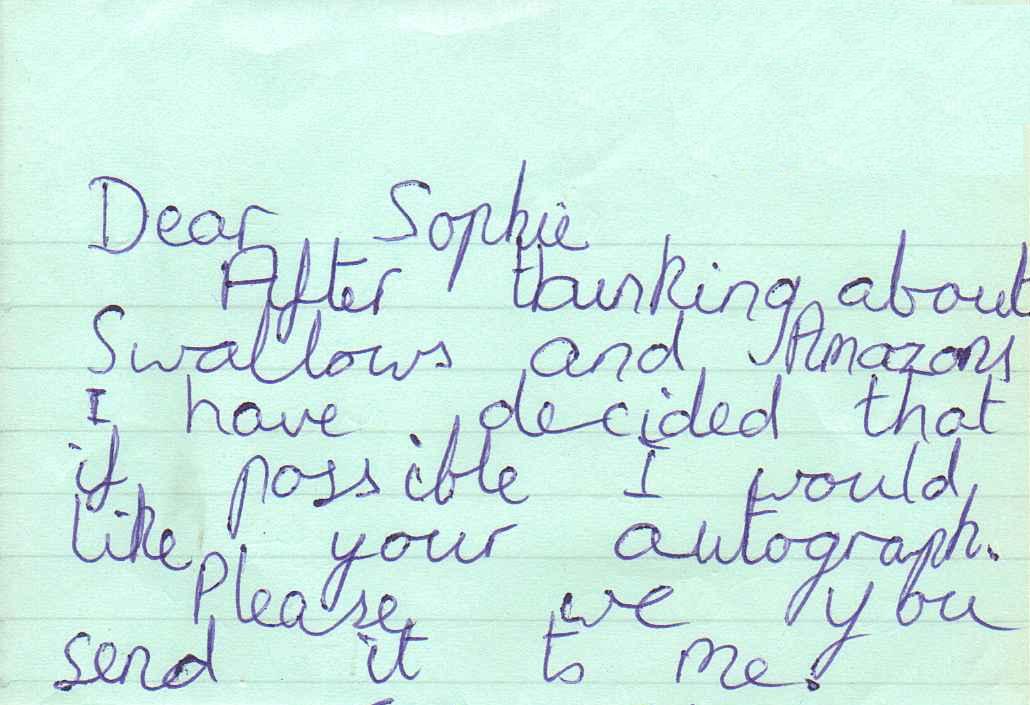
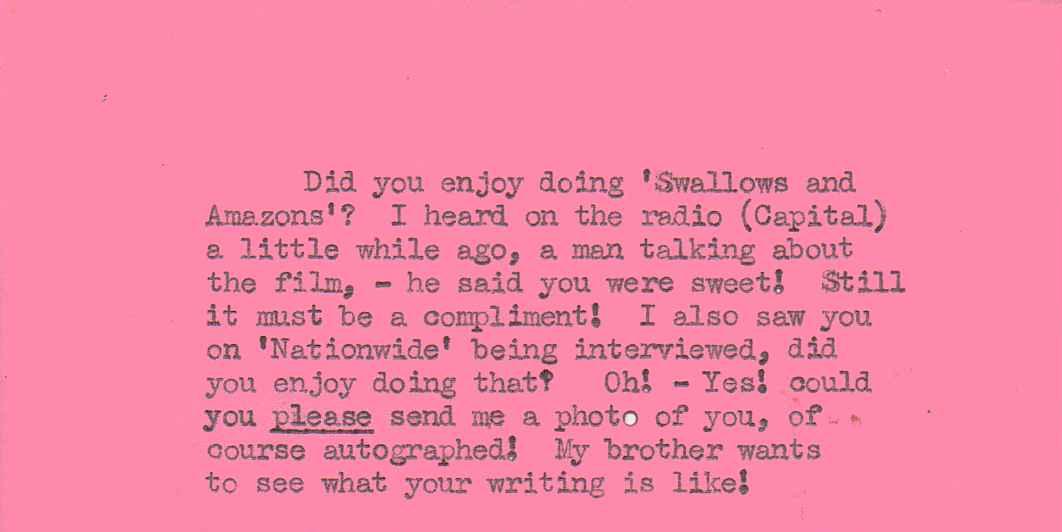
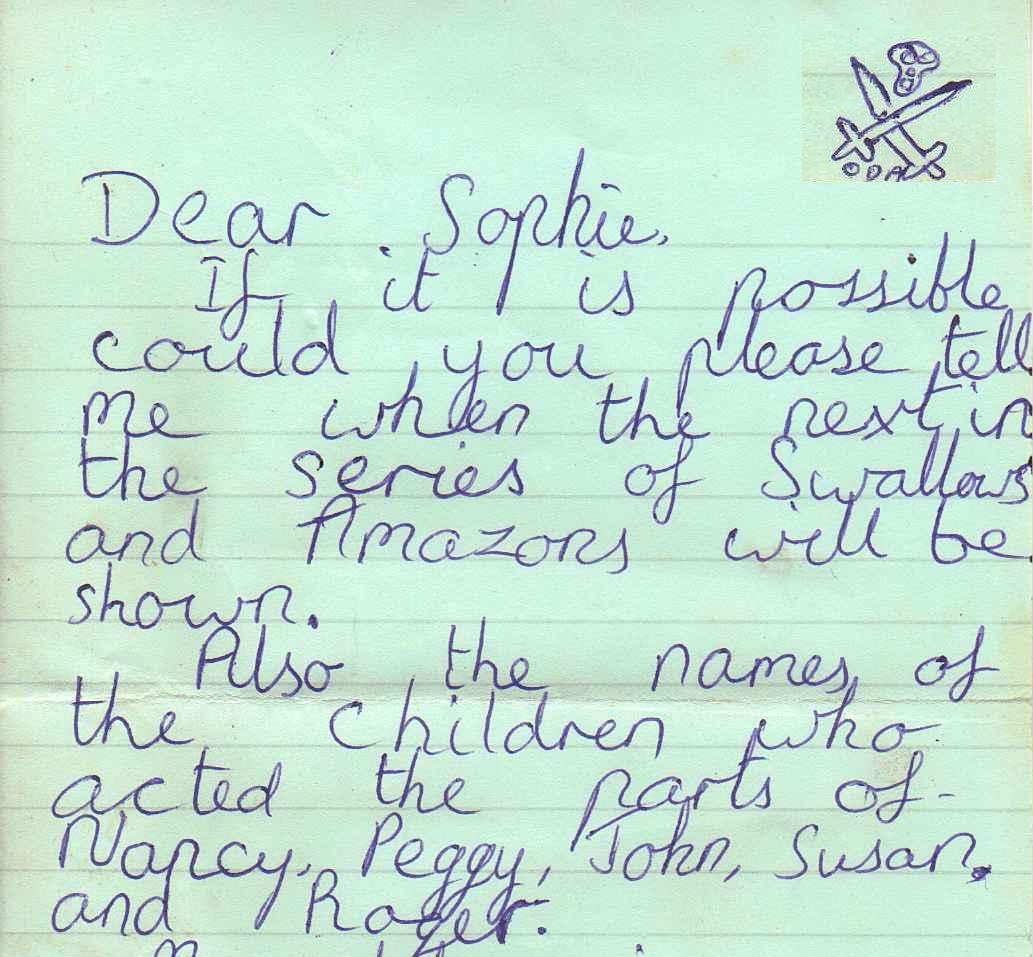
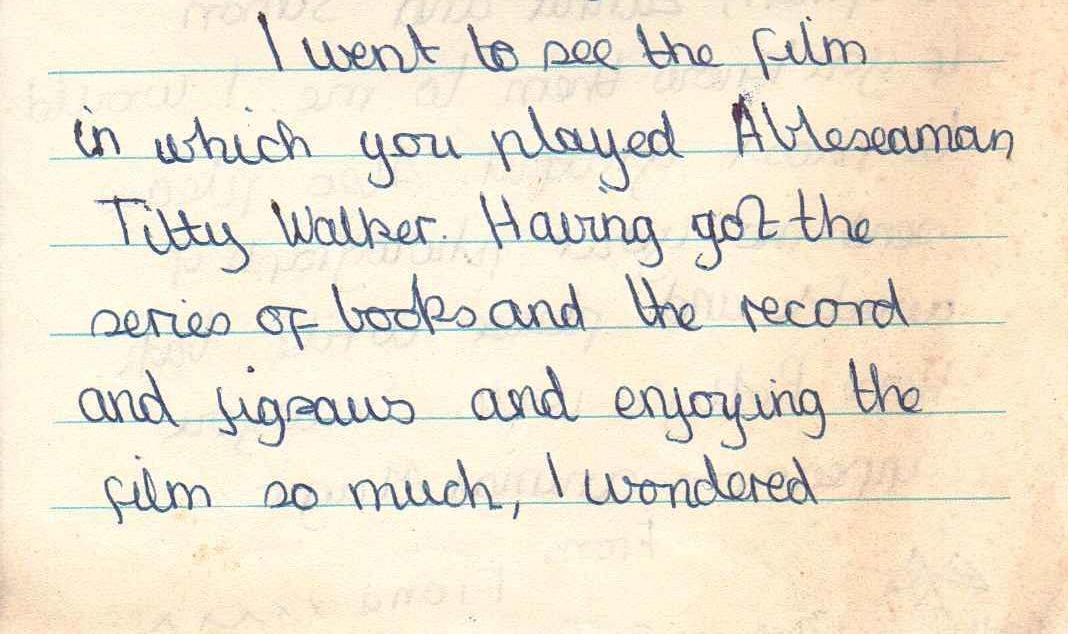
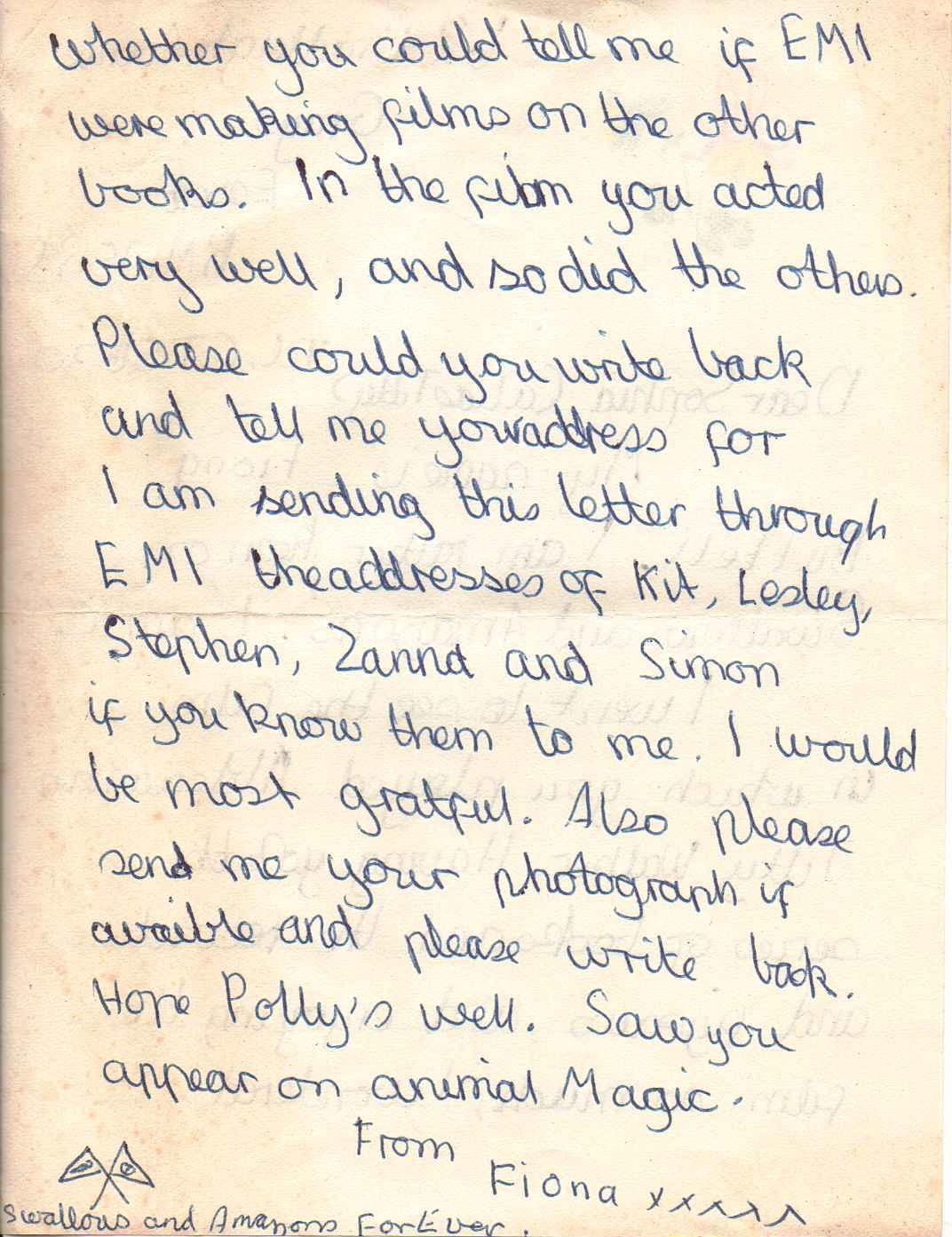
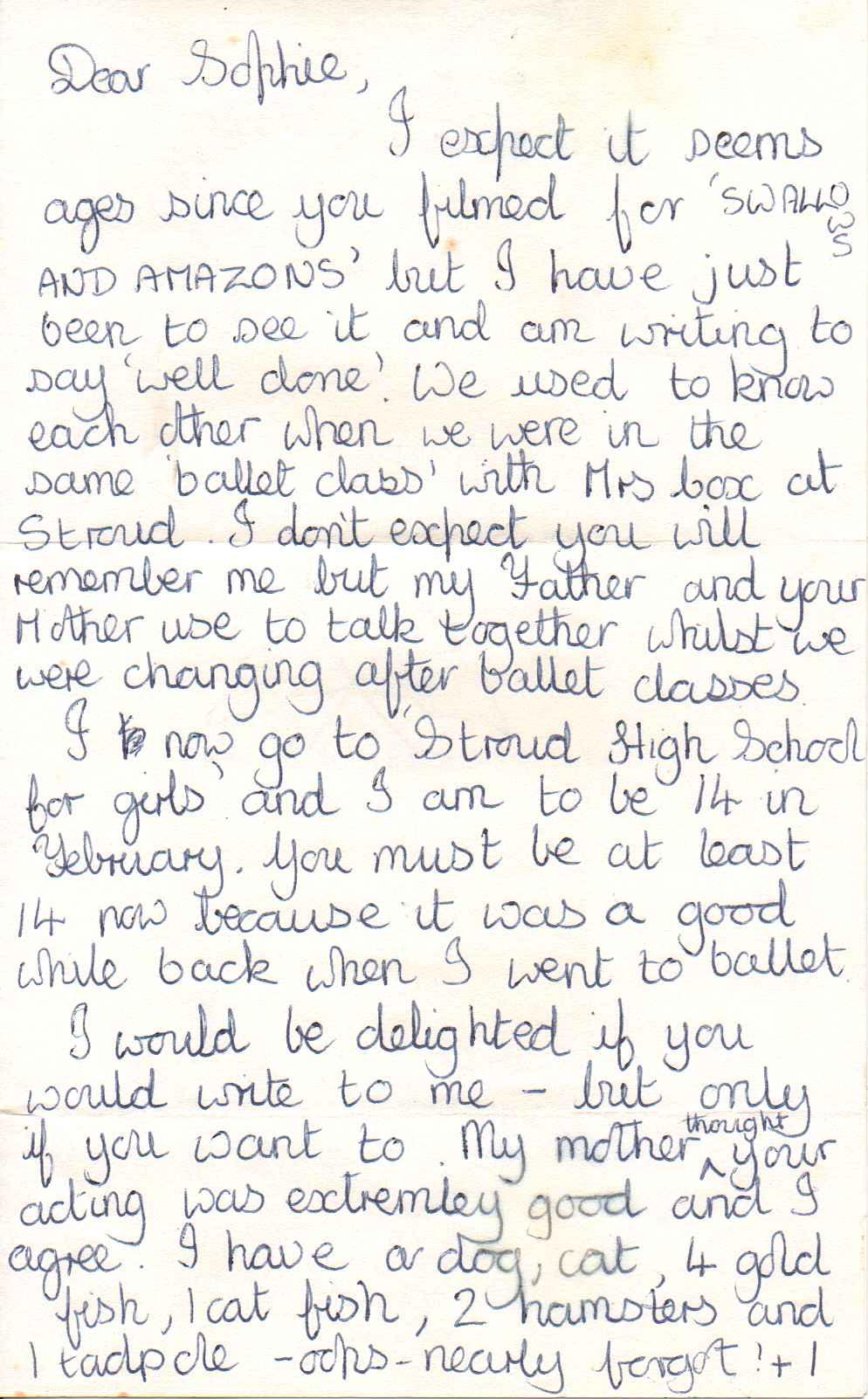
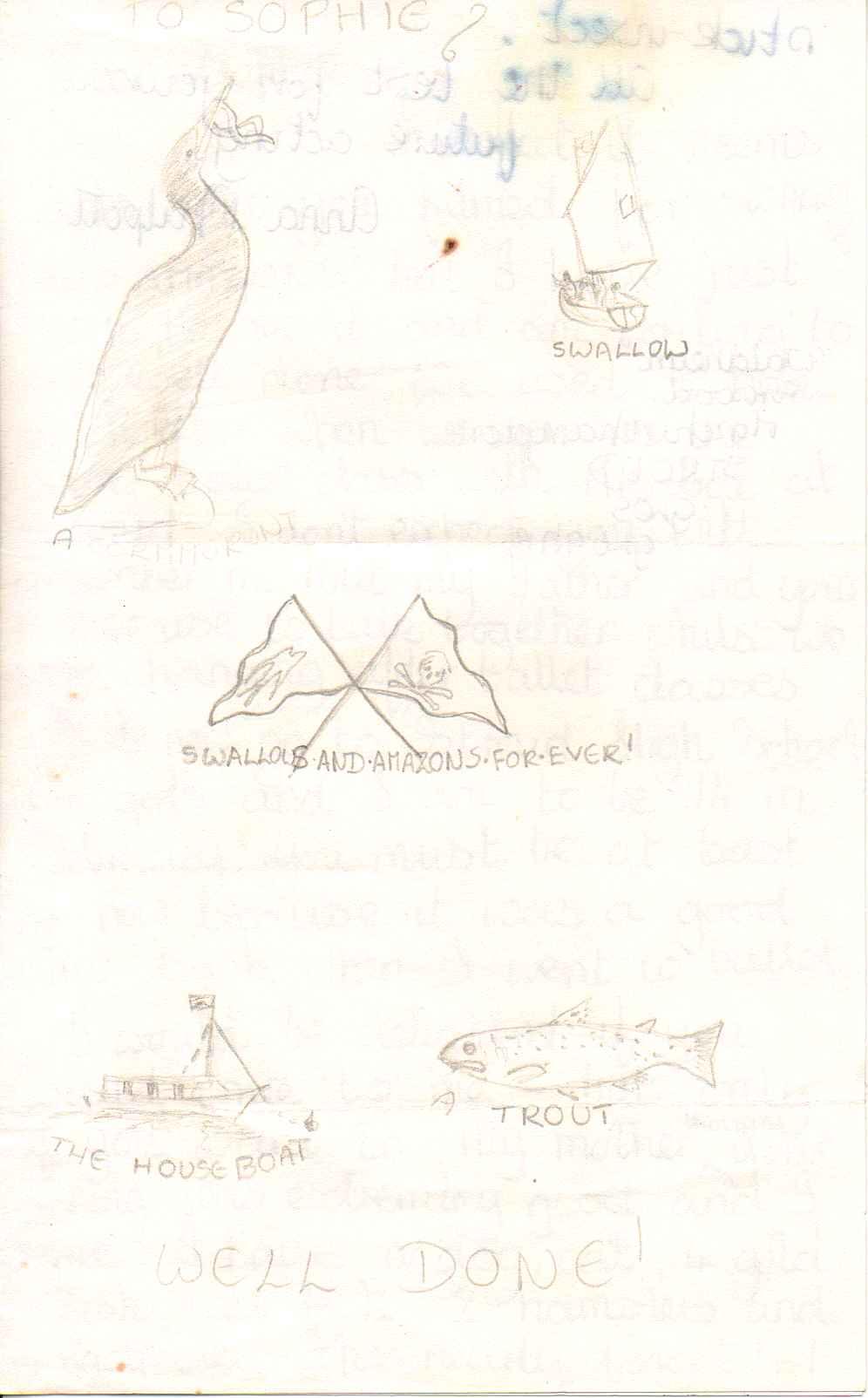
The last thing that I had expected was to receive fan letters! They came pouring in. My mother kept them all. Because most of them were written to me by children I have cut out the names and addresses on the letters copied here, but since we are all thirty-eight years older, I am sure everyone can cope with seeing their own handwriting. This letter cames from someone who, despite living half way across the world, now happens to be a friend of mine on Facebook.
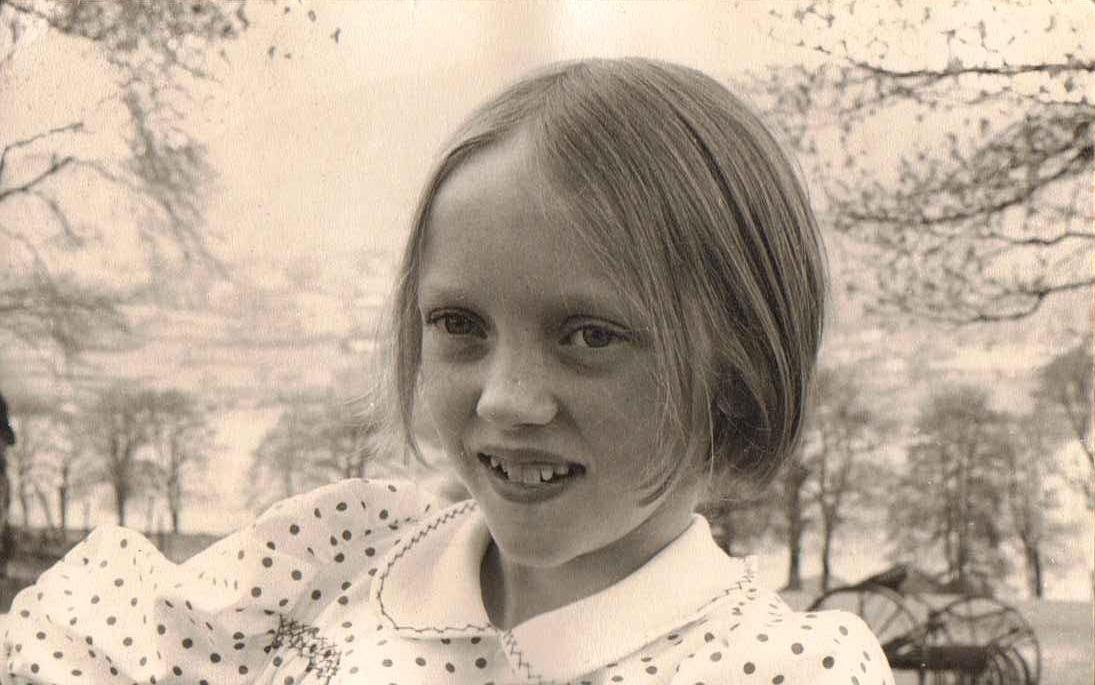
EMI sent me these photographs of myself to sign and send on. I’m afraid I didn’t like them one bit. They had been taken as publicity shots and it still shows. The staged pose was exactly what Claude Whatham had been working hard to avoid. Sadly he hadn’t been around to direct this shot. I look like a Woodetop and Spot the Dog rolled into one.
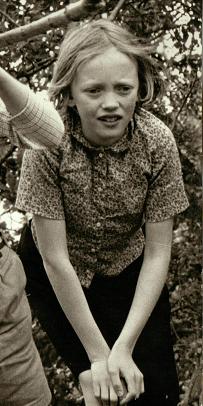
Sophie Neville swinging on a gate at Bank Ground Farm above Coniston Water in 1973
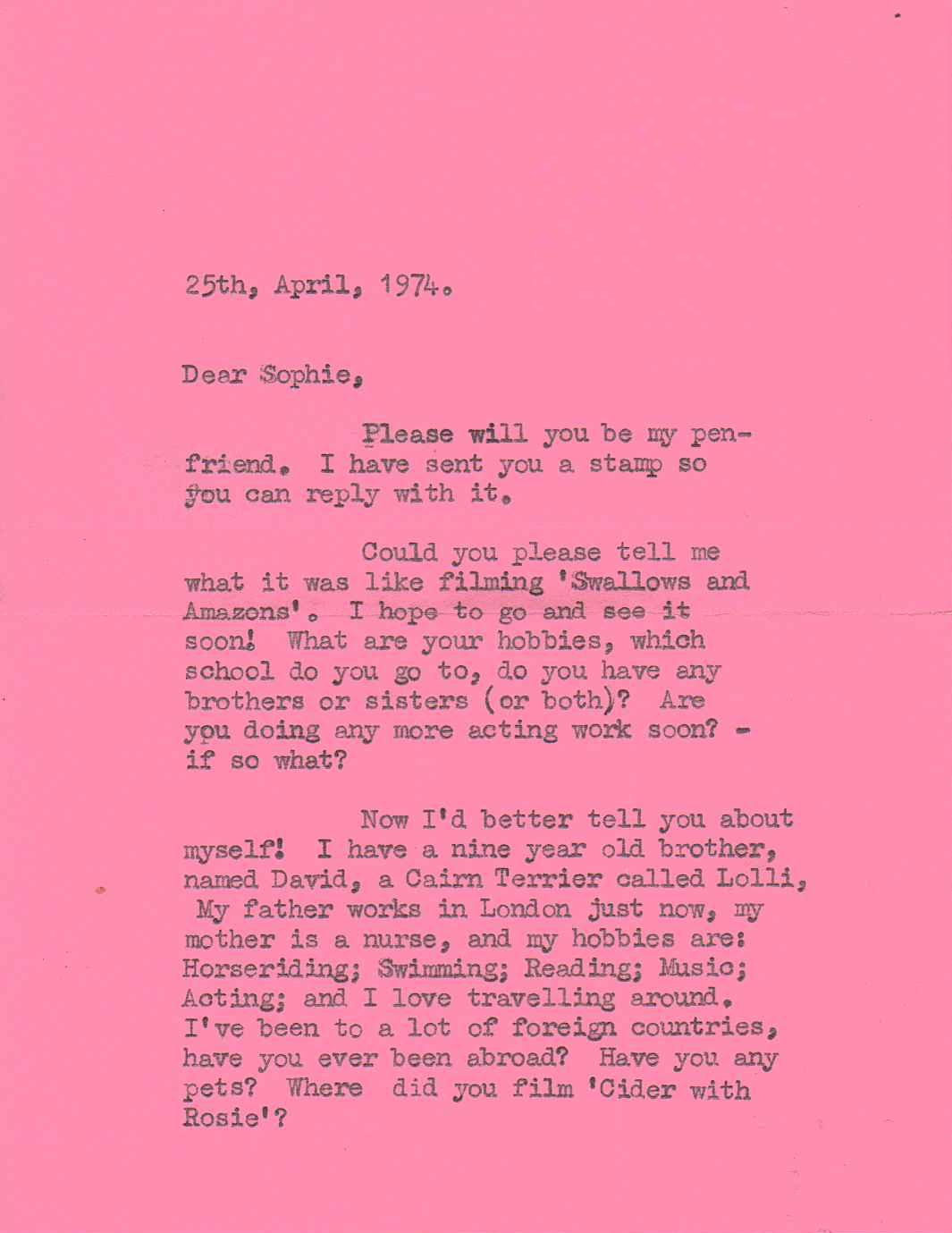
However, sending a photograph was not aways enough. I had the hard work of replying to the letters.
There were so many questions to answer.
And I felt beholden to reply immediately.
And once I replied, yet more letters arrived:
This was a good question, of course.
Fiona was 10. Everyone wanted to know if a sequel was coming out. I have a letter from Kit –
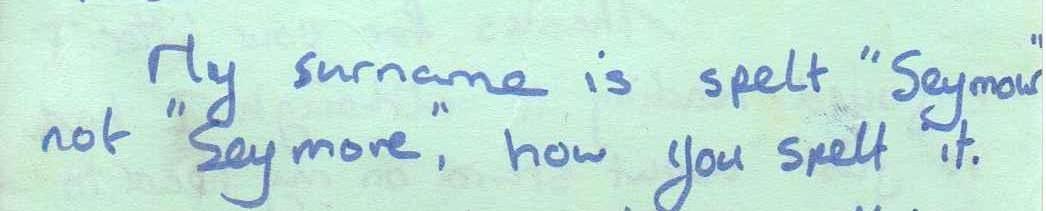
Kit Seymour, who seemed to know about Richard Pilbrow’s plans to adapt Arthur Ransome’s book ‘Great Northern?’ set in the Outer Hebrides. She must have sent me this second letter in about January 1974 – between Christmas and the premiere.
I wish we had made ‘Great Northern?’ It was my favorite Arthur Ransome book. Dramatising it would have been such fun. I don’t know why I was so negative, but I remember writing to Richard Pilbrow and telling him that Ransome was mistaken and had his facts about Great Northern Divers quite wrong. I had looked up information in an ancient bird book belonging to my father and wrote the most facetious letter about their geographical distribution. I hope it didn’t put him off. I should had used my time to persuade my fans to write enthusiastic letters to EMI Films. I’m sure this viewer would have convinced Nat Cohen.
It was clear that what children wanted was more of the same. I think it is true today. Parents tell me that even though the movie of ‘Swallows and Amazons’ has no really terrifying moments or spectacular visual effects, children tend to snuggle down peacefully and identify with the characters. The outcome, especially if they are taken to the real locations, is that they often take on our names for themselves, enjoying the fun of camping and swimming, fishing and sailing in the Lake District.
If you can read about how we made the film and what happened as a result here
Virginia McKenna, Lesley Bennett, Suzanna Hamilton, Sophie Neville, Stephen Grendon and Ronald Fraser appearing in the film premiere programme
I opened the pages of the programme at the film premiere to find one of the publicity photographs of us taken at Bank Ground Farm. I wasn’t sure the face Simon was making would sell a cinema ticket.
Simon West, Kit Seymour, Ronald Fraser, Sophie Neville and Suzanna Hamilton with half of Stephen Grendon on the second page of the premier programme
But the film was now out. It had to sell itself. Everyone was waiting to hear what critics from within the movie industry felt about it.
Would this photograph ever sell the film?
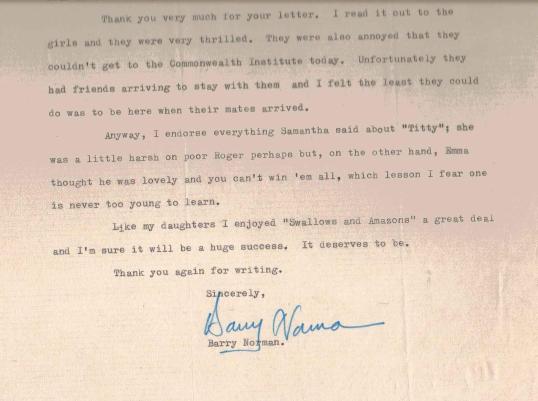
I think my mother must have written to Barry Norman, inviting him to bring his daughters to one of the promotional events held at the Commonwealth Institute. I wonder if she met him at the Preview of the Premiere. He was then presenting BBC Television’s Film 74 and writing a weekly column in The Guardian newspaper. Here is his reply:
Barry Norman enjoyed it! The Radio Times says that he was looking at ‘films for the family over the Easter holidays’. Film 74 was shown on BBC TWO at 10.15pm – and repeated on Fridays even later so he must have been speaking to parents. Here’s his theme tune.
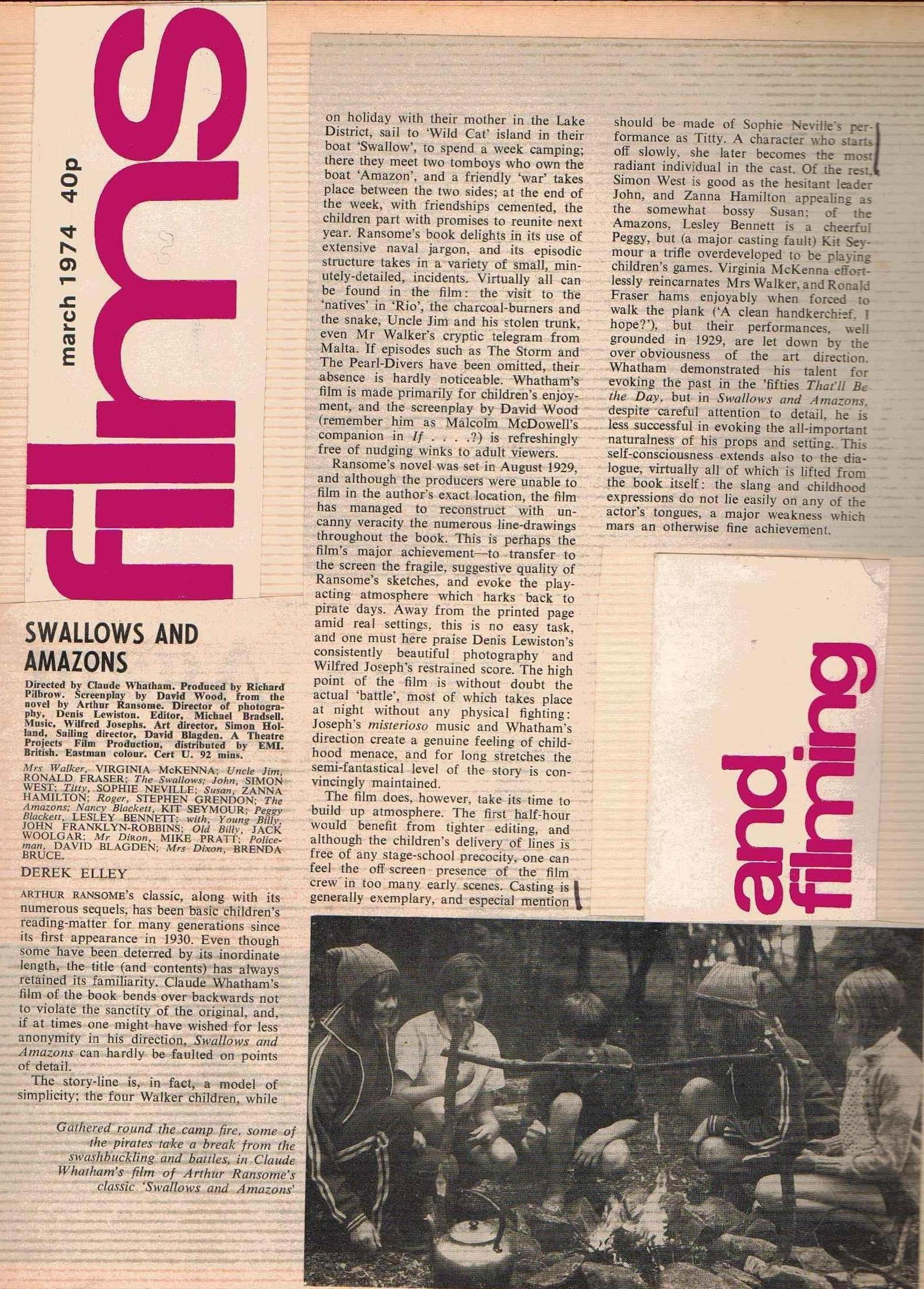
One thing that strikes me when I open the March 1974 copy of ‘Films and Filming’, kept by my mother, is that ‘Swallows and Amazons’ has to be one of the most enduring movies to come out at the time. Sean Connery opted to appear with Charlotte Rampling in ‘Zardoz’. I’ve neither seen or heard of it. Why couldn’t he have played Captain Flint with us? I did see Steve McQueen in ‘Papillon’ but had no desire to watch it more than once. Richard Lester’s version of ‘The Three Musketeers’ was also made in 1973. Even though it stared Oliver Reed, Raquel Welch, Richard Chamberlain, Michael York and dear Spike Milligan I don’t think it can have been broadcast on television as many times as ‘Swallows and Amazons’.
The magazine goes on to review ‘The Optimists of Nine Elms’ starring Peter Sellers, ‘Magnum Force’ starring Clint Eastwood, ‘Herbie Rides Again’starring Stephanie Powers and many others, films I have never heard of. ‘American Graffiti’ came out in the States, directed by George Lucas starring Richard Dreyfuss, Ron Howard, Paul Le Mat and Harrison Ford. It made gross profits of more than U$200 million becoming one of the most profitable films of all time, but I wonder how many times it has been shown on British television this year? Do your children know anything about it? Has it been projected in the pouring rain for loyal fans sitting on a lake shore?
I his book, ‘A Theatre Project’ Richard Pilbrow says, ‘We had a success.’ He quotes Variety magazine, “Charming, delightful, beautifully made film,” but said it was, ‘Not a hit but a reasonable success that continues to play, principally on television, around the world.’ Richard goes on to quantify how it did financially. ‘The world of film finance is a distinct mystery. Our production costs were just under £300,000. Over the years, income trickled in from an international market. Curiously the costs inexorably rose to match the income. The costs of marketing the movie always seemed to equal receipts at the box office. In 2004 our film actually recouped. That’s why I have the temerity to call it a success.
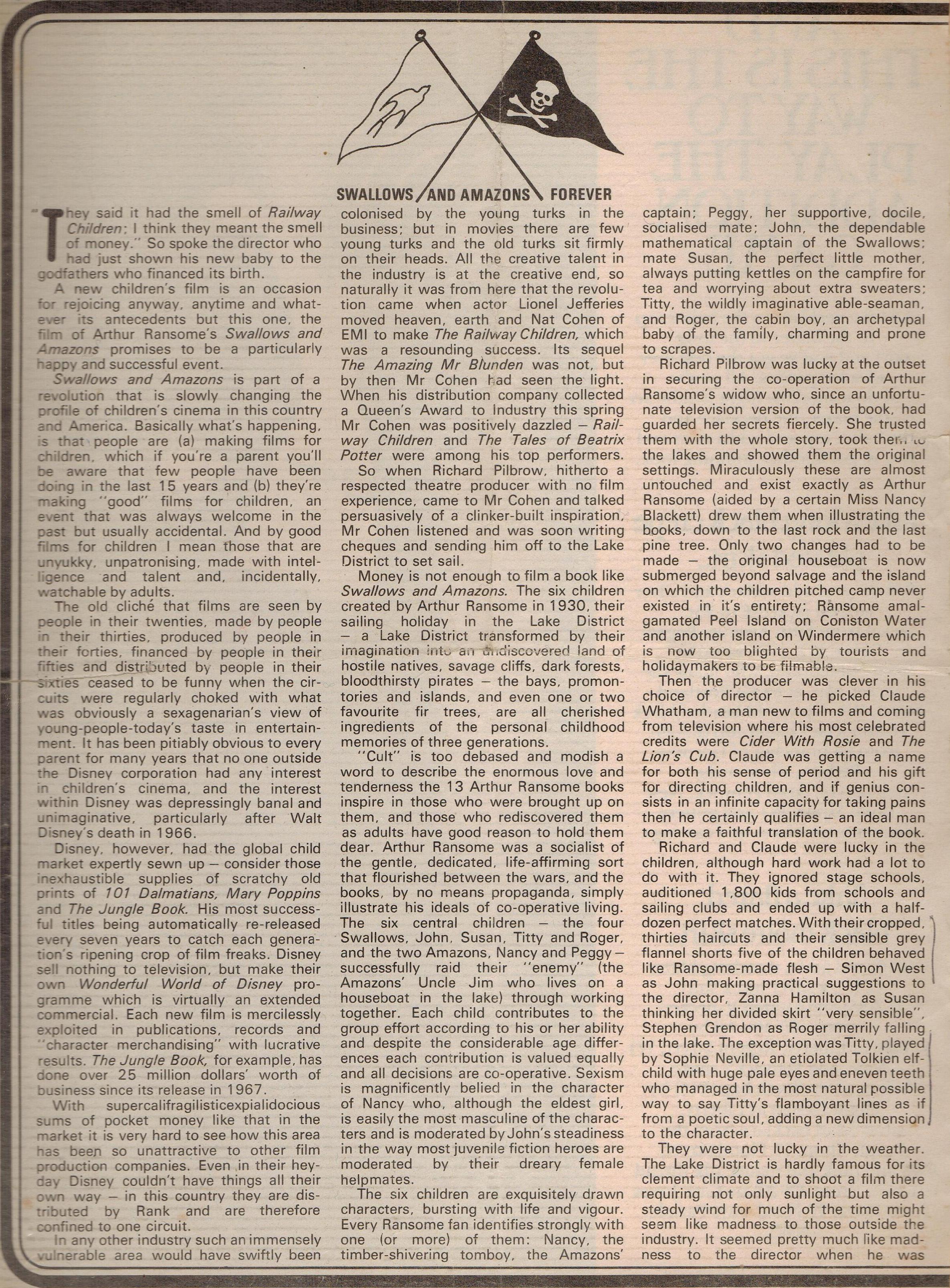
Not all the newspapers thought so in 1974. You can read how much we hated the publicity in any of the books on how the film was made:
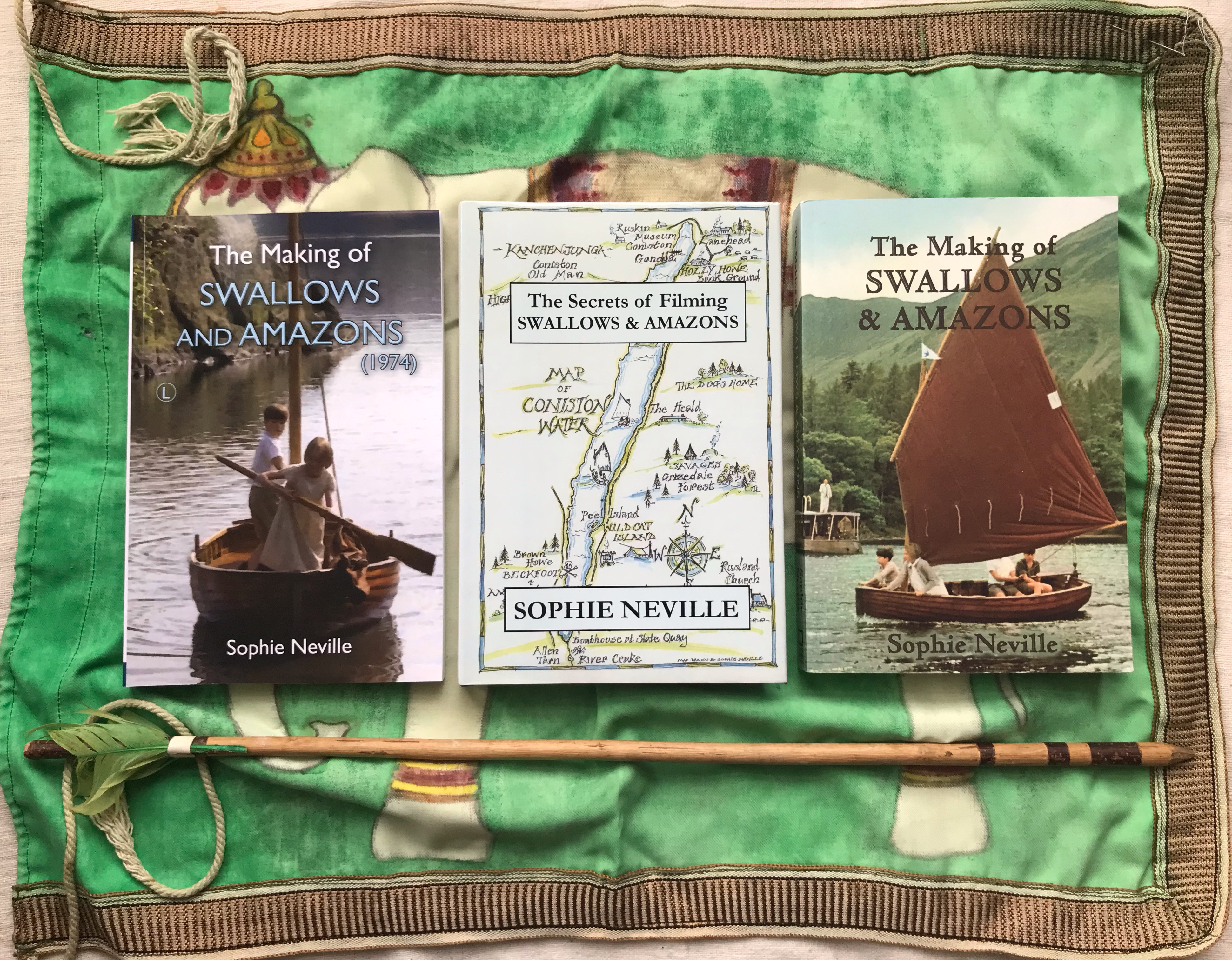
Different editions of ‘The Making of Swallows and Amazons (1974) by Sophie Neville’
Lesley Bennett, Suzanna Hamilton, Stephen Grendon, Sophie Neville, Virginia McKenna, Simon West and Kit Seymour gathered at Bank Ground Farm above Coniston Water for a publicity photograph. This one was taken by Daphne Neville.
When a television drama is ready to be transmitted there is a little publicity, but not much. Photographs might be taken for the cover of the Radio Times or a book to accompany the series, there might be a Preview at BAFTA to which journalists from the colour supplements and daily newspapers are invited, but, because the programme can be advertised on air, the actors are not intensively involved in the promotion. A feature film is very different.
Whilst we didn’t mind our photographs being taken while we were acting, and were fine about Mum clicking away with her little instamatic, we all hated having promotional photographs taken for ‘Swallows and Amazons’. They were usually so posed, set up by strangers who had no idea of the story. Virginia McKenna tried to make it fun for us but this is what we all felt about this photo-call:
~ How not to set up a publicity shot for a feature film ~
Why were the Amazons at Holly Howe? Why weren’t we with any of the boats? It was all terribly hot and difficult to squint into the sunshine. Only Mrs Batty’s dog seemed to be enjoying the attention.
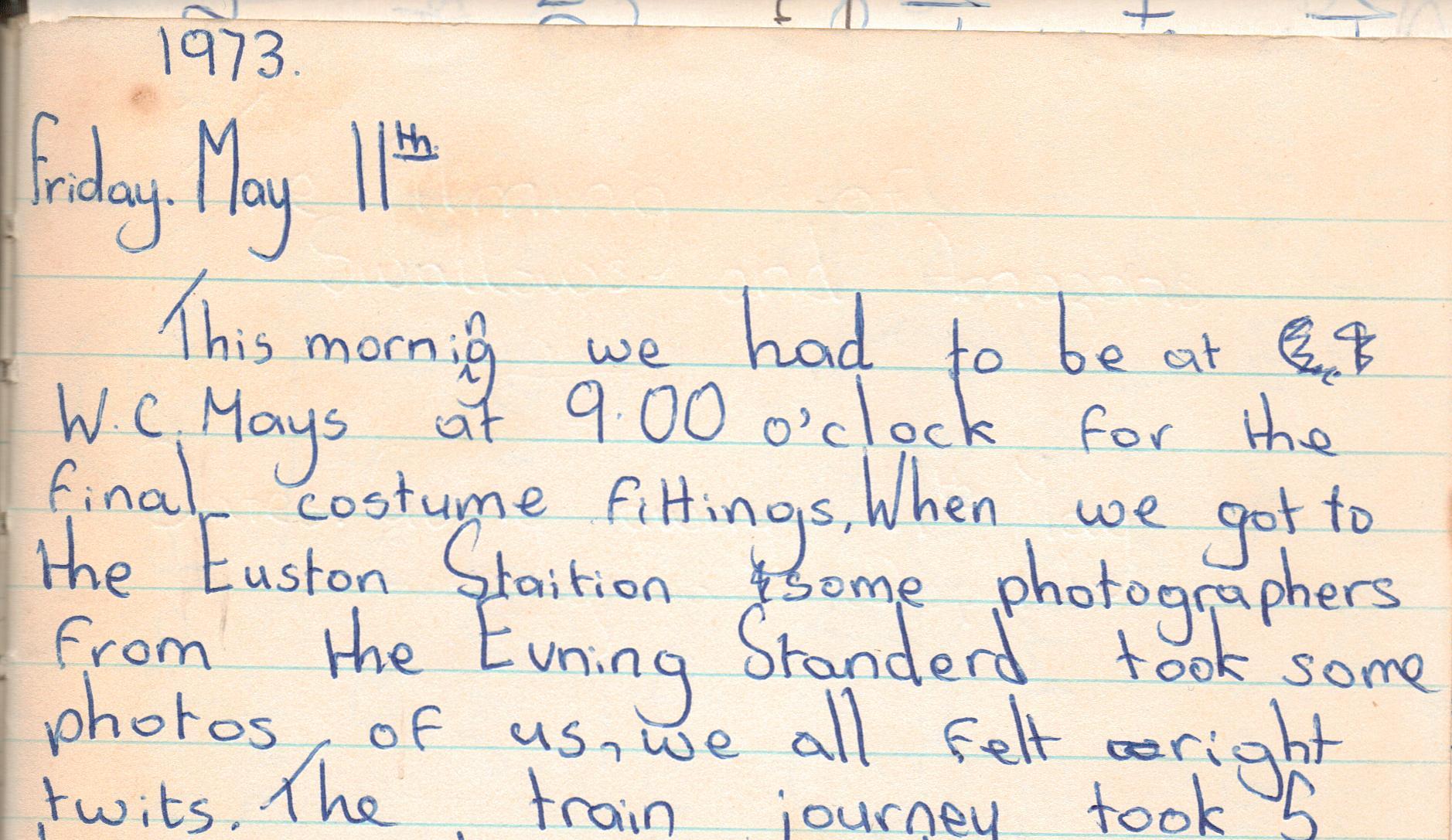
The glare of the flash bulbs had started on day one. As Suzanna said in her diary, it made us feel ‘right twits.’
Claude Whatham was very good at explaining things to children. Looking back I wish that he had explained why the publicity was so important, but of course this was not his job and he would have been busy setting up the next shot. Certainly once the filming had finished we needed to know how important it was to promote the film. Richard Pilbrow really wanted to make a sequel, particularly an adaptation of Ransome’s twelfth book in the series – ‘Great Northern?’He loves the Outer Hebrides and has a house on Col. I think we might have been a little keener about publicity shots if we had been told that the out-come could have been going up there for another summer. We would have been able to look forward to the possibility, but I don’t suppose he was at leave to even suggest it.
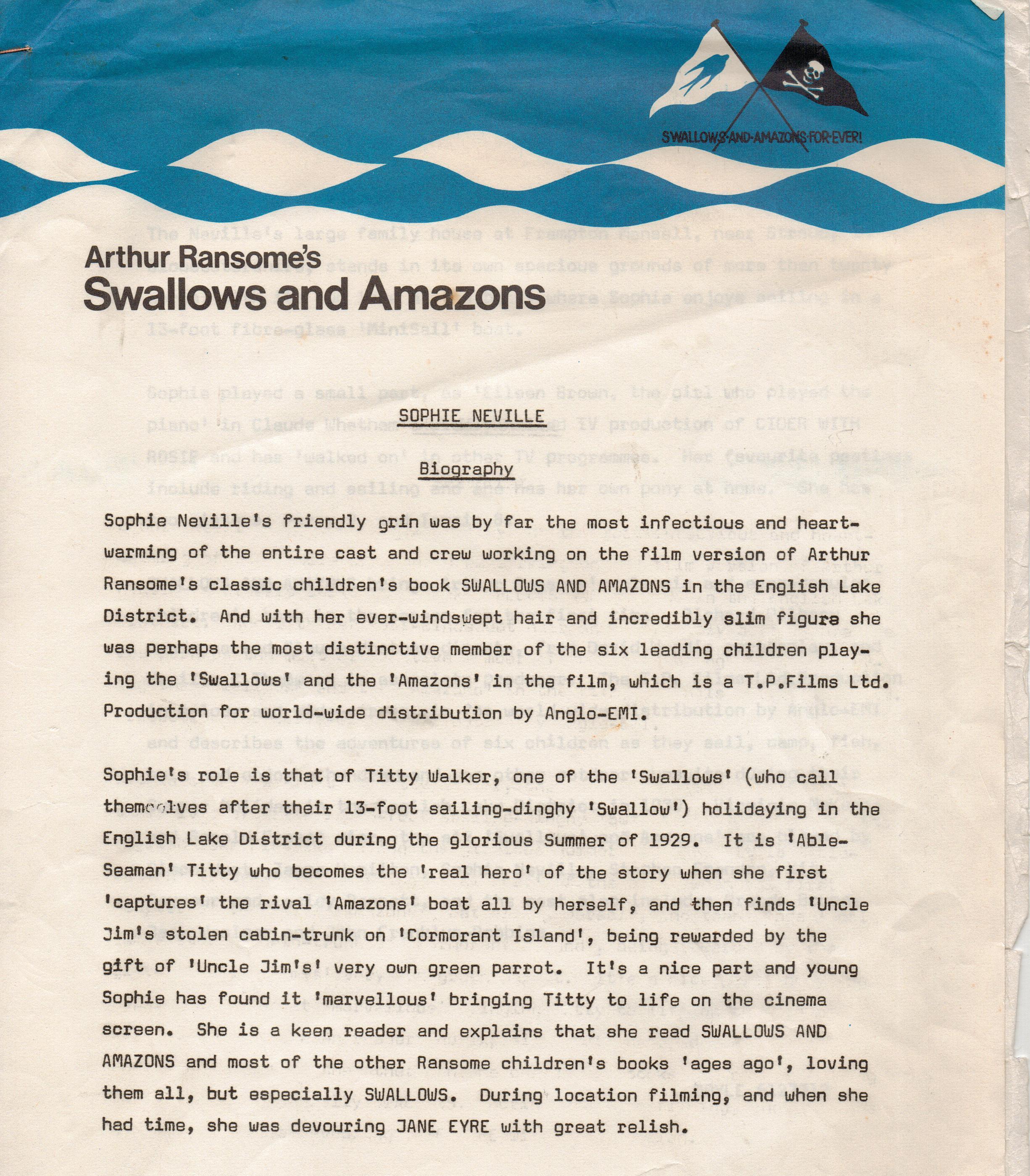
Journalists were introduced to us and looked after by our unit publicist Brian Doyle. Brian had worked on ‘Straw Dogs’ in 1971, the thriller that starred Dustin Hoffman, Susan George and Peter Vaughan.Susan George had of course played Titty, or ‘Kitty’ in the black and white BBC adaptation of Swallows and Amazons in the early 1960s. She was now regarded as glamorous sex symbol in British cinema – setting me rather a daunting example. Much easier for Brian to publicise her then me. She had a gorgeous figure with beautiful, thick, blonde, hair. I had what my sister still calls ‘tendrils’ and my mother calls ‘bits’. And was skinny with crooked teeth.
Brian was a lovely man. He had an amazing career, going on to work on films such as Ken Russell’s Valentino with Rudolf Nureyev and Leslie Caron, The Wild Geese, Alien, Educating Rita starring Michael Caine and Julie Walters and the James Bond movie For Your Eyes Only – with Roger Moore in the lead role . He even has his name on the credits of one of George Lucas’ Star Wars films.
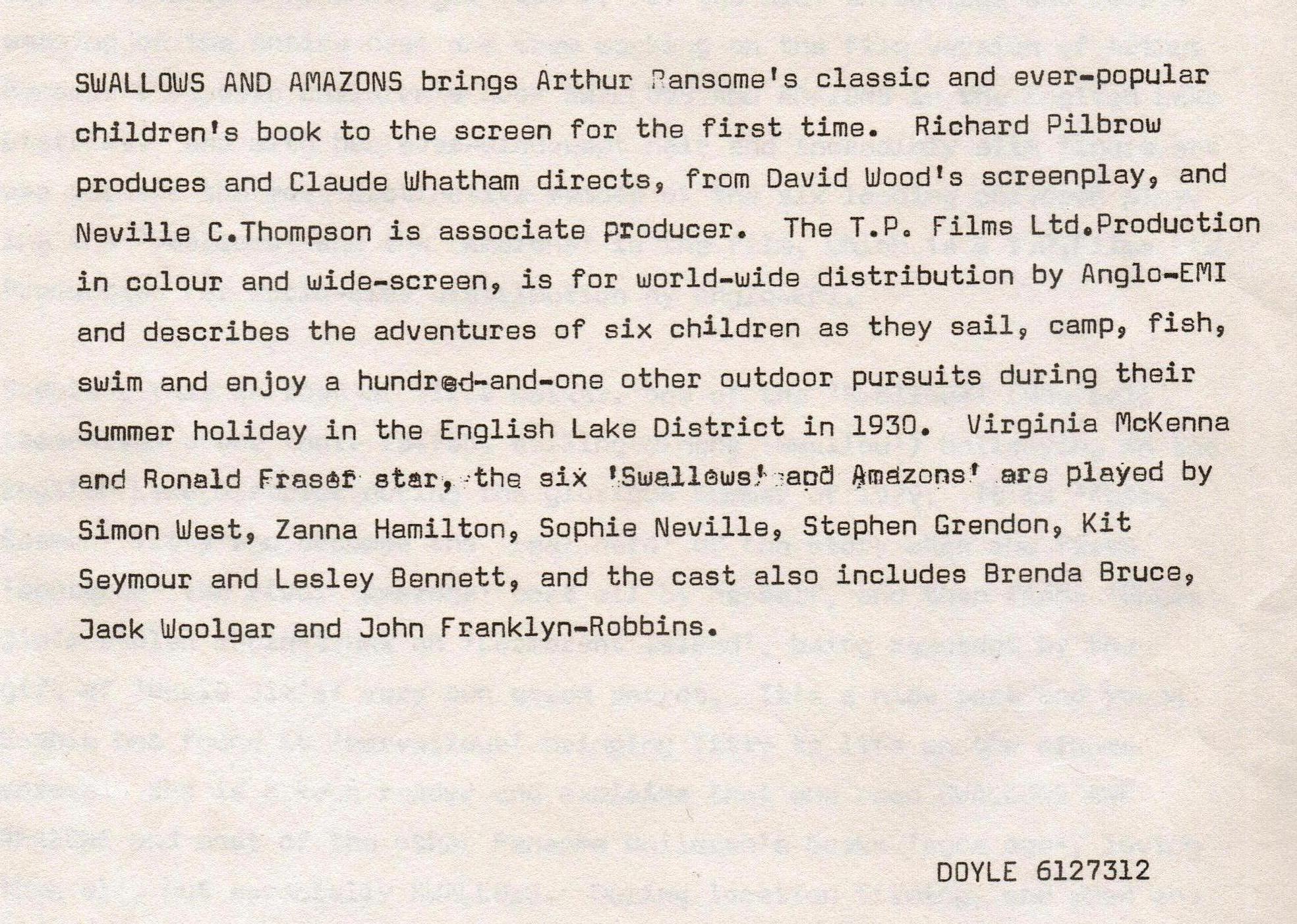
This was the profile he wrote for me:
Brian adored Children’s literature. His own children came up to stay on location over their half-term and spent hours playing with my sisters, indeed they all appeared together as extras in the scenes shot at Bowness, and can be seen playing on the beach. Sadly Brian died, very suddenly, in 2008. His daughter told me that he left a collection of 35,000 books.
I still have Brian’s announcement:
At this the journalists moved in. From all over the place!
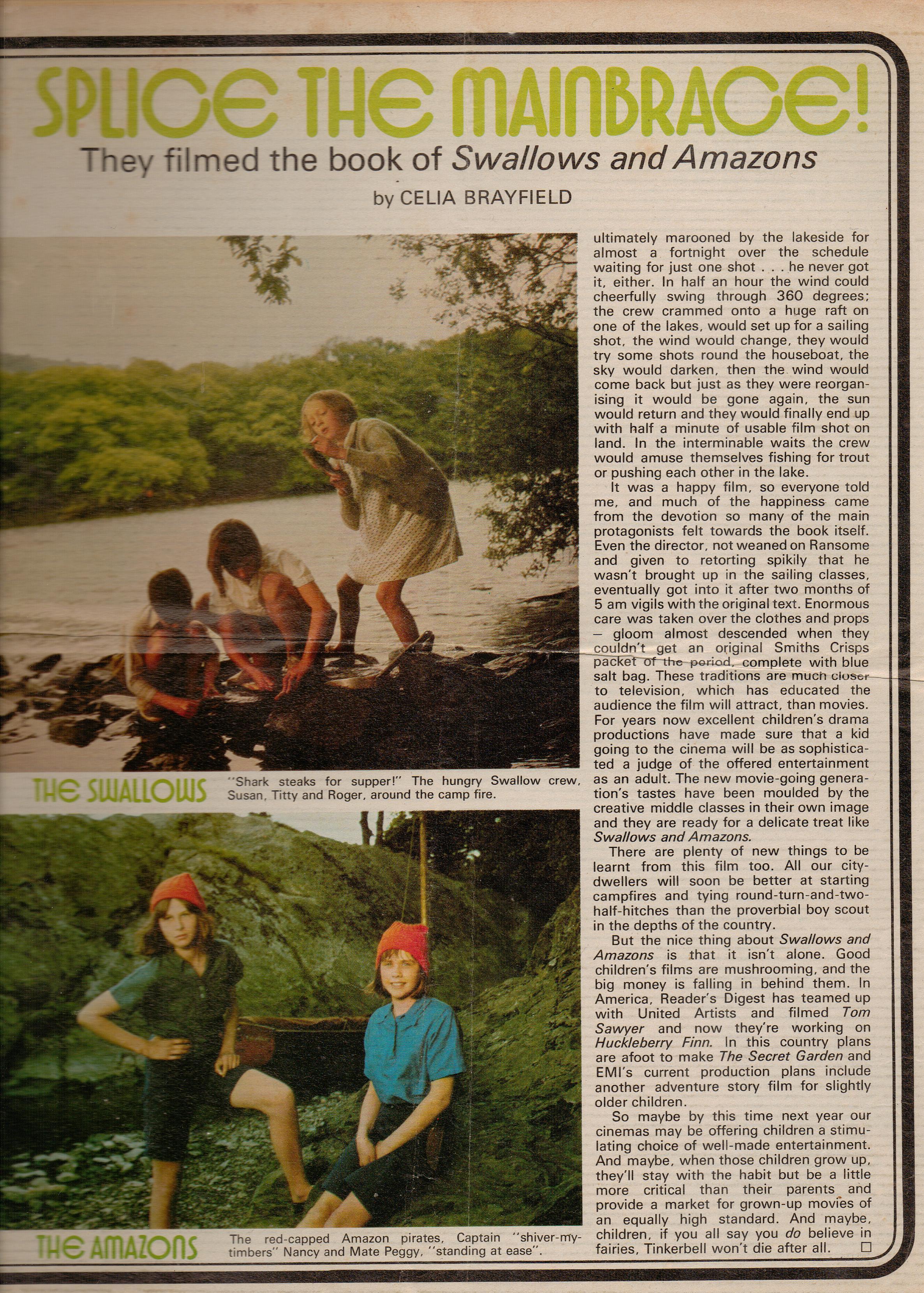
There was a very trendy women’s magazine in the early 1970s called Over 21, which the senior girls at school used to read. My mother was thrilled to find that Celia Brayfield had written a double page feature. I was amazed. I didn’t mind the picture of us gutting fish, but started reading with trepidation.
(If you can read this, I’m afraid page one comes second.)
Over 21 ~ December 1973
I read it, looked up the word etiolated in the dictionary and burst into tears.
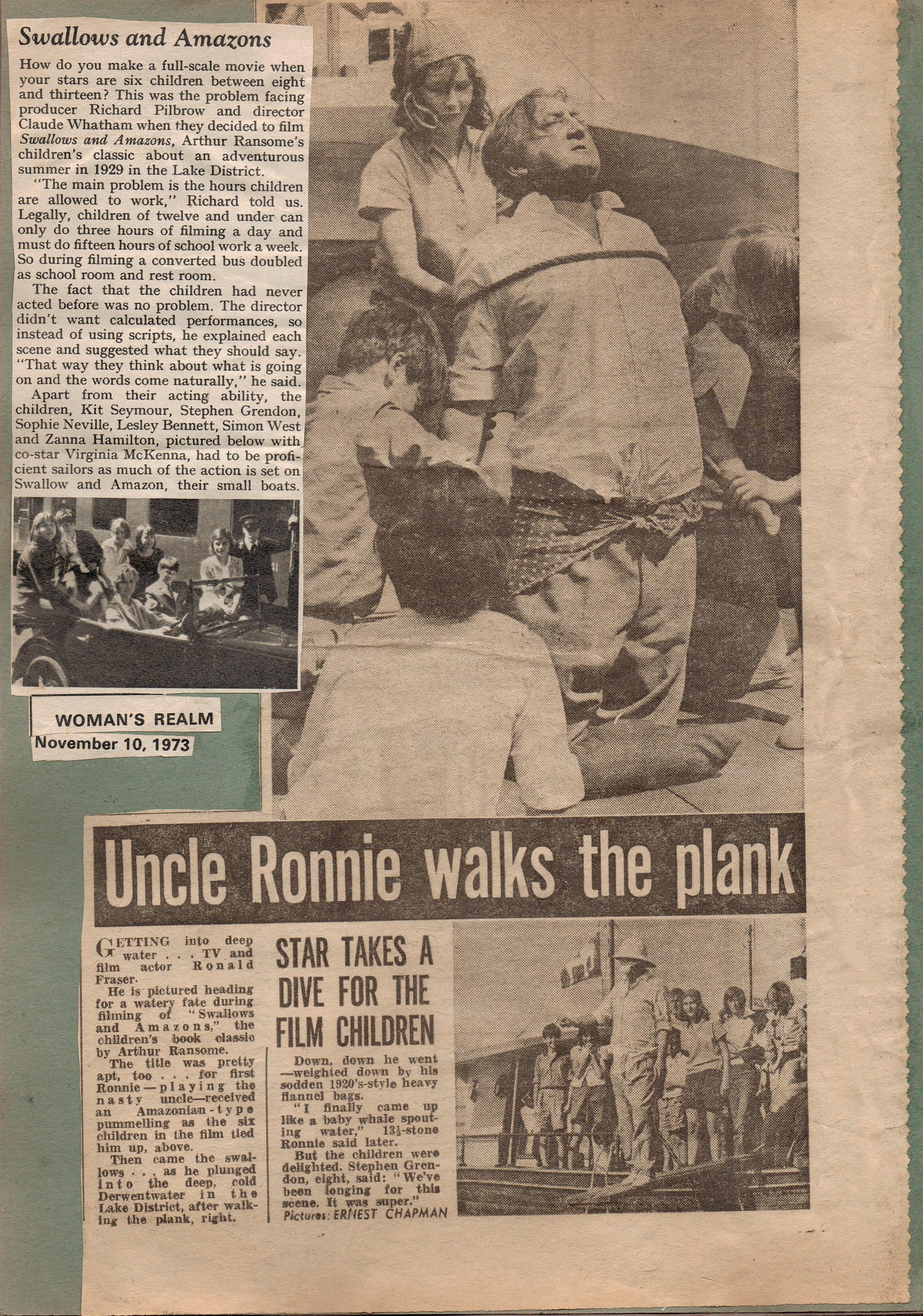
A newspaper article by Ernest Chapman that came out in July 1973. The main photo features Ronald Fraser as Captain Flint with Sophie Neville, Stephen Grendon, Simon West and Kit Seymour
Being back at home for the summer holidays was lovely. I must have been pretty tired. But, adjusting to real life when articles like this one appeared in Woman’s Realm was tricky. Everyone seemed to be reading about me in their dentist’s surgery.
‘What was it like?’ I was often asked.
How could I begin to describe working like this ~
The cast and crew of ‘Swallows and Amazons’ filming on the jetty at Rio in 1973
‘Did you have lots of lines to learn?’
How could I explain that this is how we worked on the dialogue?
Rehearsing with Claude Whatham out on the lake
‘What were the others like?’
How could I tell people about the whole crew, that I’d had working relationships with so many adults?
Talking to Martin Evans the Gaffer and Terry Smith the wardrobe master while leaning on a lighting stand at Bowness-on-Windermere
Technical questions were much easier to answer than, ‘How did you feel?’ No one wanted to know that most of the time I felt cold.
‘Did you have to wear make-up?’ This was a difficult one, as we didn’t wear conventional make up but my legs were regularly coated in a layer of foundation so as not to appear shockingly white. You can see the smooth effect in the photograph above. Suzanna was amusing about this in her diary. She hated being sponged down with a matt base and sun-bathed whenever she could so as to avoid it in the near future.
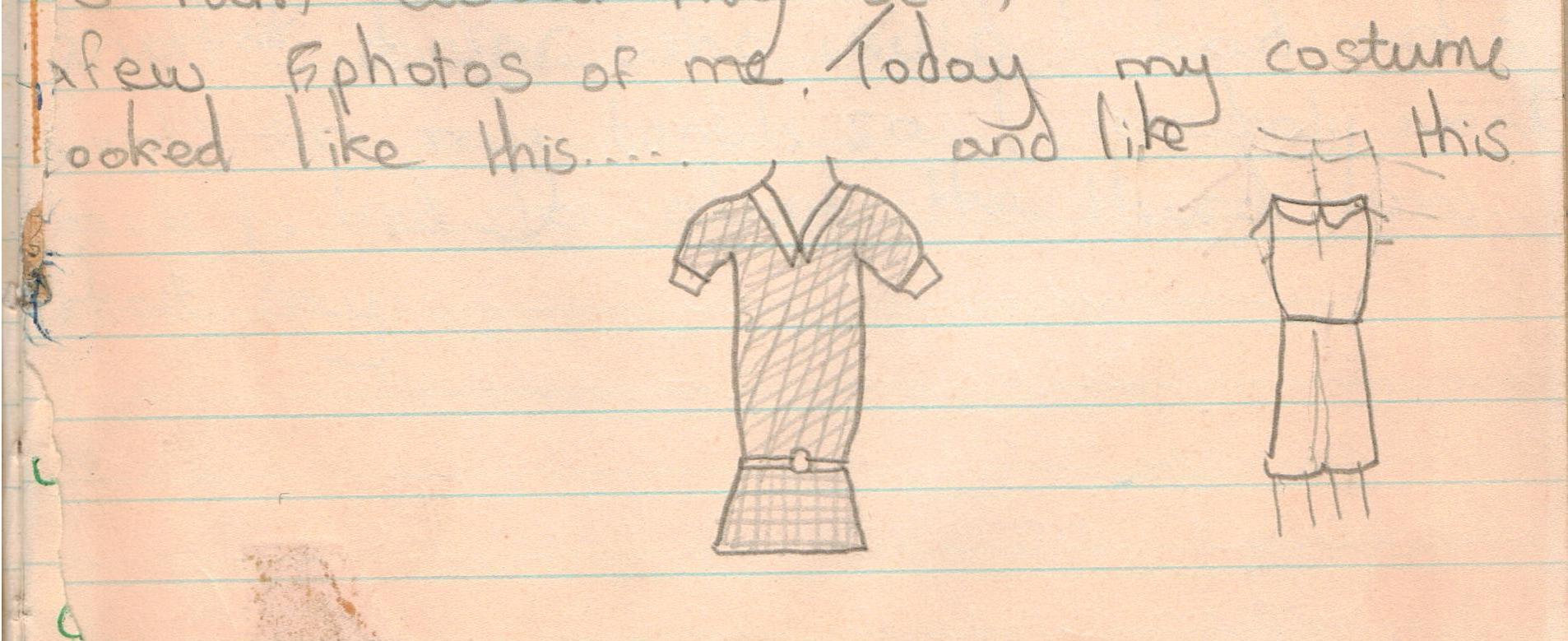
‘What did you wear?’
Suzanna drew pictures of the two dresses she wore at Bank Ground Farm. I always rather liked her blue gingham one. Unlike the Duchess of Cambridge I have never worn a yellow dress apart from the sleeveless one I had to climb into to play Titty. It was really too short for 1929. I remember the costume designer, Emma Porteus, confiding in Mum that they would cheat on the length a bit. Hem-lines were very much above the knee in 1973. Arthur Ransome would have turned in is grave. Luckily Titty’s dresses just look a little out-grown.
Suzanna Hamilton’s drawings of her costumes for scenes set at Holly Howe
‘How did they film you sailing?’
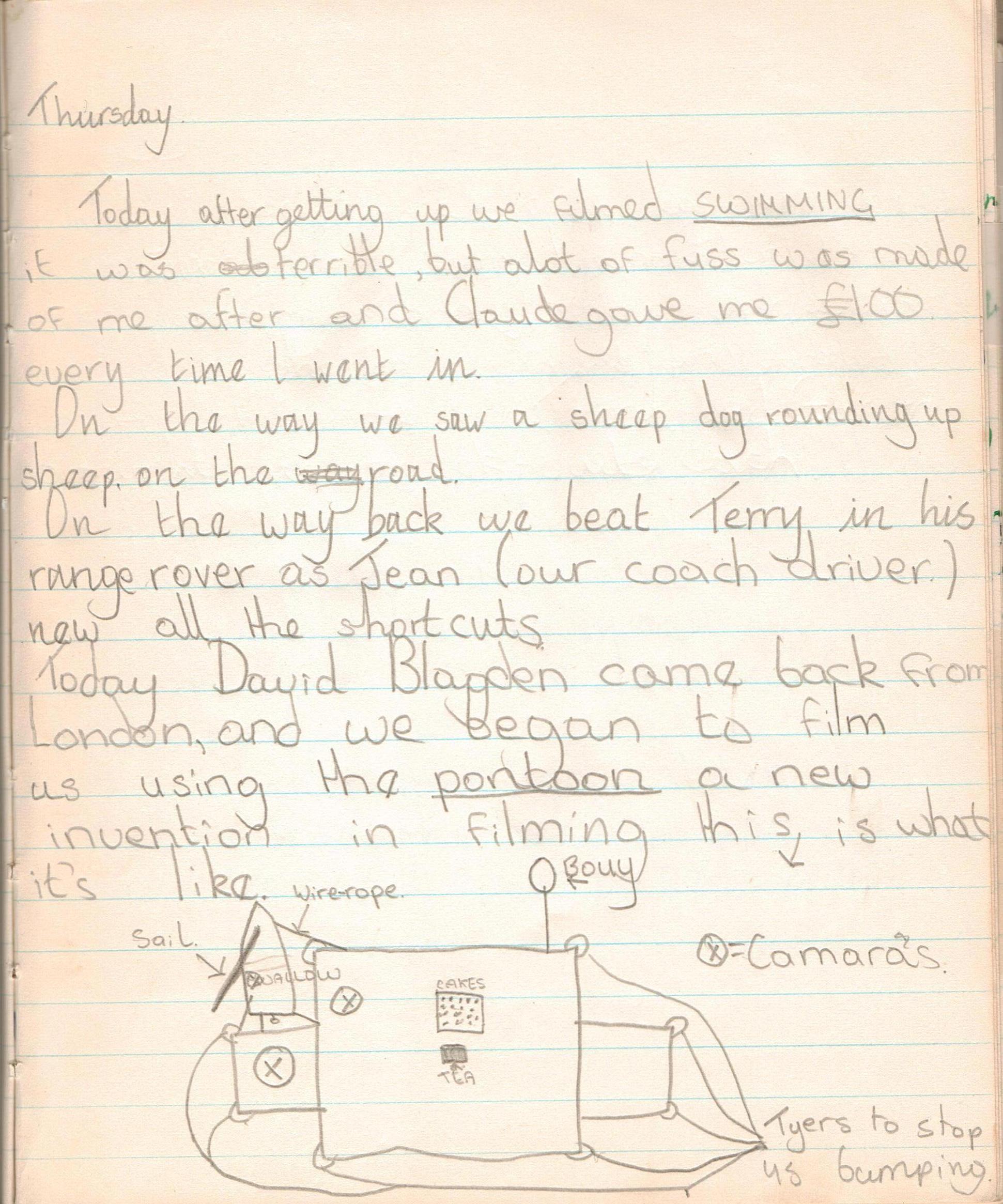
Again Suzanna provided wonderful graphics of this. I don’t think I’ve yet published this page of her diary.
Suzanna Hamilton’s diary about using the camera pontoon on Coniston Water. If you click on the picture you should get through to Ben Fogel’s documentary where Claude Whatham describes this in further detail.
‘What was Virginia McKenna like?’
This question was easy. ‘She was lovely.’
The Walker family played by Suzanna Hamilton Stephen Grendon, Sophie Neville, Virginia McKenna and Simon West at Bank Ground Farm in Cumbria
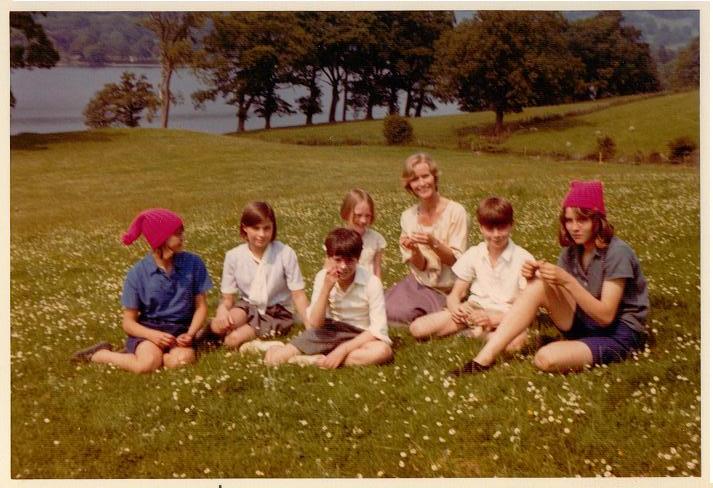
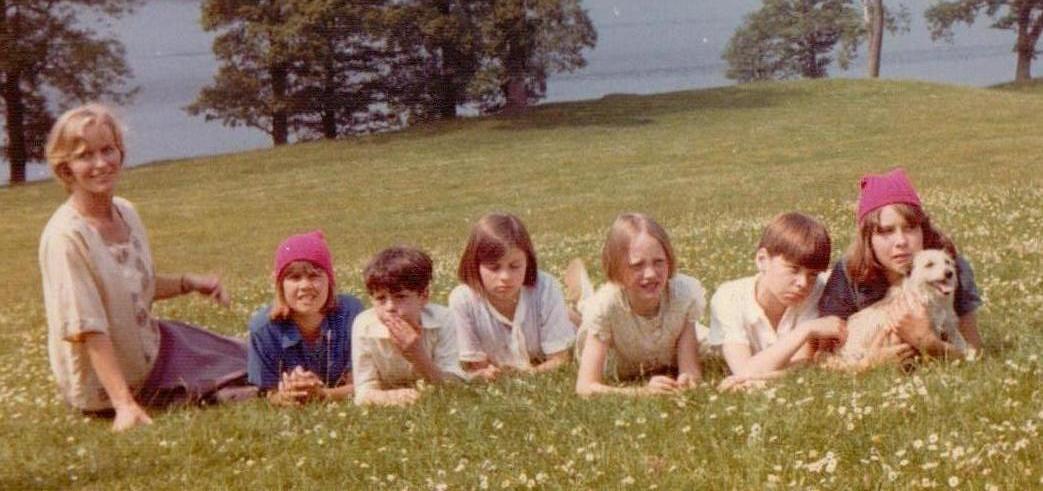
Many years have gone since we sat amongst the daisies at Bank Ground Farm. I am now happy to talk about anything. Do click on the comment box below or go on a Facebook page to ask any questions you might have about the filming of ‘Swallows and Amazons’.
Our director, Claude Whatham had a problem. Despite two attempts he had failed to shoot the key scene when the Walker children – who had just arrived at Holly Howe – discover the Peak at Darien and look out over the lake to spot Wild Cat Island for the very first time. He saw it as crucial to the motivation of the story.
Claude had shot the sequence of us running down the field at Bank Ground Farm in the evening light. He had what would technically be called our POV (point of view) of the island. He had nothing in between. There was no dialogue but without the right light the sequence would not cut together. And now it was raining, endlessly. We waited around all day, yet again, hoping for the weather to clear. It did not.
I can’t believe that we went, what would now be termed, wild swimming in the Lake District after making such a fuss about recording the swimming scenes at Peel Island. Even if it was raining the water must have been fairly warm. I don’t suppose we were in for that long. I’m now rather shocked that we dried our hair by sticking our heads out of the windows of the mini-bus. We could have all been decapitated.
While Claude was busy looking at the sky I spent the rest of the day industriously sticking small photographs into my scrap-book. Mum had her camera films developed by Triple Print so that she had some to give away. This was the result:
Two of these tiny photographs show us sitting in the Grizedale Forest with Wilfred Josephs who composed the music for Swallows and Amazons. He had visited us on location when we were shooting the charcoal burners scenes. If I blow up this tiny photograph you can see a little more of him.
Wilfred had written a canon with the idea that he could do something musical with our voices. Our efforts were being recorded by Robin and his assistant when Mum took these snap shots. The words went in a round, like this:
Swallows: ‘Swallows sail the ocean-wide, Natives we can not abide.’ (Sung in a high register)
Amazons: ‘We are the Amazons.’ (Sung beneath us in a low register)
What Wilfred soon discovered was that, apart from Lesley Bennett, we were all pretty useless at holding a tune. Whatever was recorded on that day near the charcoal burners’ hut never made it to the final sound track – or even the LP that EMI brought out to accompany the movie.
Composer Wilfred Josephs with Sophie Neville, Lesley Bennett, Claude Whatham, Kit Seymour, Simon West and sound recordist Robin Gregory ~ photo: Daphne Neville
Mum was thrilled to meet Wilfred Josephs. He was fantastically talented, with a huge list of credits to his name. Born in 1927, he qualified as a dentist at the Universtity of Durham ~ where I also studied ~ before becoming a full-time composer in the early 1960s. His career was launched when his Requiem in memory of the Jews who were lost to the Holocaust won La Scala. He went on to compose 12 symphonies, 22 concertos and was commissioned to write a number of overtures, ballets, operas and other vocal works. In the field of television he is perhaps most well know for producing the theme music for I,Claudius, Enemy at the Door, The Prisoner and Pollyanna. He worked for Claude Whatham on the movie score for All Creatures Great and Small that starred Anthony Hopkins and Simon Ward, as well as the television drama W.Somerset Maugham and the serial Disraeli, which Suzanna Hamilton appeared in.
In the early 1970s Wilfred had also composed the theme music for Claude’s BBC play of Laurie Lee’s auto-biography Cider with Rosie, which Sten and I had acted in. Wilfred Josephs sadly died at the age of seventy, but I found that someone has put his haunting composition for Cider with Rosie onto YouTube. It was so good to hear it again. It comes with colourful cider-making images but – unless passionate about cider – you can have a look at more of my scrapbook while you listen to it. Like the film-score to Swallows and Amazons the orchestra was conducted by Marcus Dods.
Some of these tiny photographs from the contact sheets that Richard Pilbrow gave us are fascinating.
‘Here we are, intrepid explorers, making the first ever voyage into unchartered waters. What mysteries will they hold for us? What dark secrets shall be revealed?
As we set off from the Lakeside Railway Station on the southern shore of Windermere to explore Arthur Ransome’s world, I began wondering how many signs of ‘Swallows and Amazons’ we would find. Would we see the crossed flags that have become a symbol of the bestseller he wrote back in 1929?
We found the first sign the East of Lake road above Coniston Water. And there was Holly Howe where the Walker Family came for their holidays. It is so exciting to know that you can stay there too, or go for tea, and run down the field full of buttercups to dip your hands in the lake, just as the real Altounyan children – the real Swallows – must have done. We passed Lanehead, their grandparents’ house next-door as we drove down to Coniston. I gather it is for sale.
Coniston Old Man or Kanchenjunga, as the Swallows and Amazons called the mountain, was snoozing under a thick blanket of cloud but the challenge of climbing to the summit was for another day. Below the village, mooring up to the jetty at the Bluebird Cafe, was Ransome, the Coniston Launch. Peter Walker introduced us to the Captain who welcomed us aboard. He asked after Swallow the little ship from the film that we had re-launched from the very same jetty in April 2011. If you join The Arthur Ransome Society you can sail Swallow on Coniston this summer.
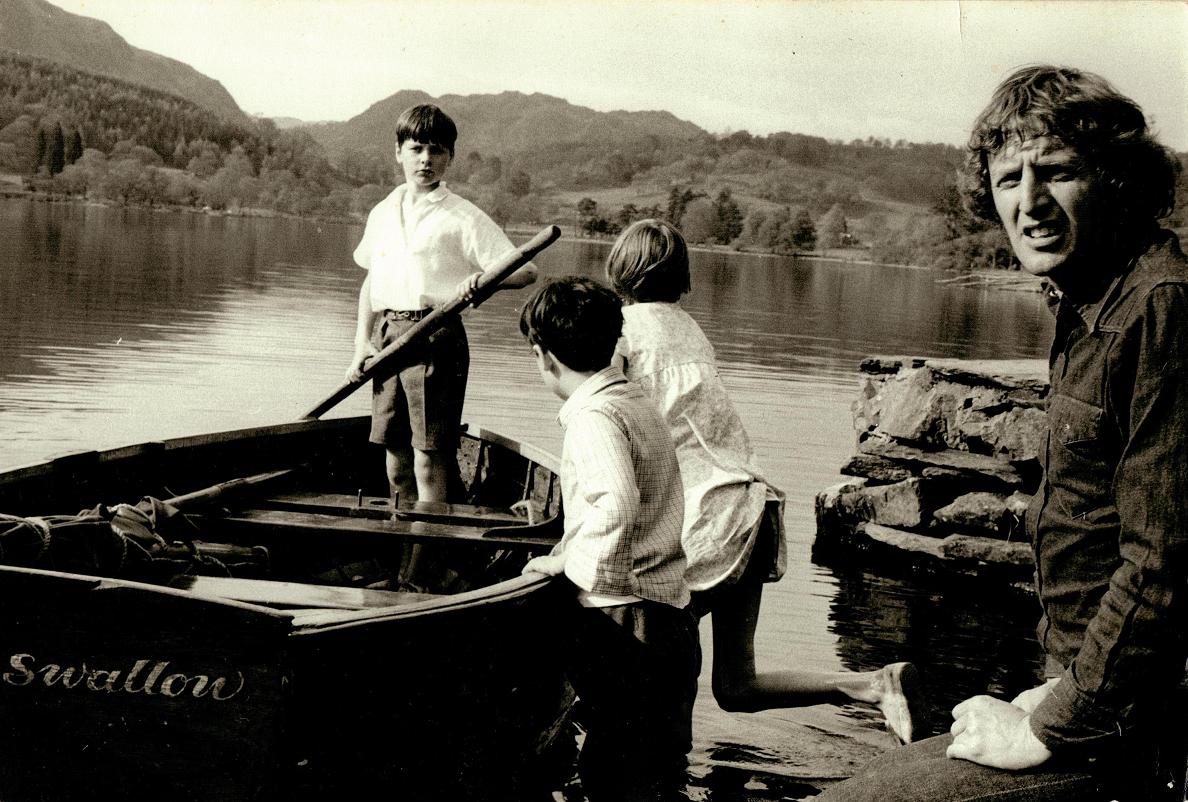
As we set off across the lake we could see Swallow’s boatshed clearly from the Coniston launch. It has been renovated and repaired but the old stone jetty is still there, below the huge horse chestnut trees. I remember how cold the water was when we first brought Swallow out from the depths of that shed in May 1973 to shoot the opening scenes of the movie. Two sheep came down to see what we were doing. Richard Pilbrow, the Producer, gave me this black and white photograph that, unusually, shows Claude Whatham the Director setting up the shot. I was letting water drain from my shoe.
Simon West as Captain John standing in ‘Swallow’ at the stone boatshed jetty on Coniston Water with Ableseaman Titty and The Boy Roger. Director Claude Whatham knew how cold the water was that day in May 1973
The Coniston Launch can take you right down the lake to Wild Cat Island or Peel Island as it is really called. You can see the Secret Harbour best from a boat and imagine Titty trying to get out through the rocks in Amazon, in the dark, when she captured her from the terrifying Amazon Pirates.
We actually disembarked at Brantwood, John Ruskin’s House. It was here that the Altounyan children’s grandfather WH Collingwood worked as Ruskin’s private secretary. He painted him at his desk there. My niece has just graduated from The Ruskin School of Art in Oxford.
Peter Walker met us and drove us on down the lake to show us The Heald, a bungalow above the road where Arthur Ransome lived with his Russian wife, Evgenia and his dinghy, Coch-y-bonddhu. It was here that he wrote Picts and Martyrs. Coch-y-bonddhu played the part of Dick and Dot’s boat Scarab. The original ‘Dogs Home’ can be found in the woods above the house. Rob Boden is very keen to restore it.
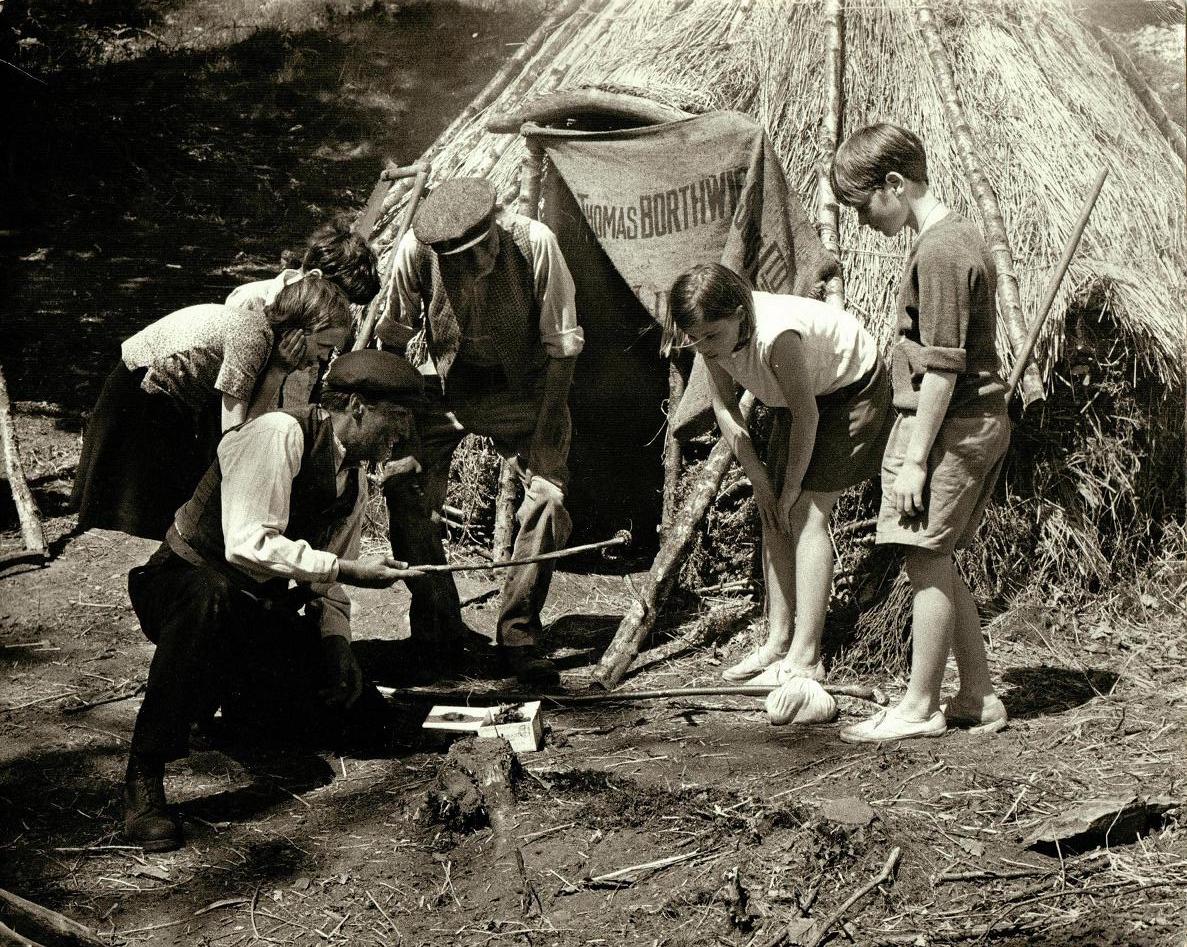
It was in the Grizedale Forest that we went to see the charcoal burners and met the real men in the process. And an adder. It was real too.
John Franklyn-Robbins, as Young Billy who is showing his adder to Sophie Neville, Stephen Grendon, Jack Woolgar, Suzanna Hamilton and Simon West at a location in the Grizedale Forest above Coniston Water
I looked back at the island where I spent so much of my childhood. It was difficult to imagine how a location catering wagon let alone two Route-master London double-decker buses could have driven down the winding East of Lake road. They parked in the field opposite the islands so the crew could at least eat lunch in the dry and we could have our lessons. The National Parks Authority had to ask the Production Manager to drape wartime camouflage netting over them. You must have been able to see the red buses for miles.
The hat is a purple ode to the early 1970’s. My mother bought it at great expense in Carnaby Street. It is very good at keeping off the rain.
As you drive south you can look over the water to see Brown Howe, the house that we used as a location for Beckfoot in the film of Swallows and Amazons and shortly after, the Edwardian boathouse, which Claude Whatham used for the Amazons. I don’t think this was the one Ransome envisaged. His was at the mouth of the Amazon River – a reedy place. The pictures in the illustrations show a building with a low-pitched roof.
Peter took us down to a farm the south of Coniston Water where the real Ransome children spent their summer holidays. You can walk down the footpath they must have taken to dip their hands in the lake. And there I found what must be the real Amazon boat house.
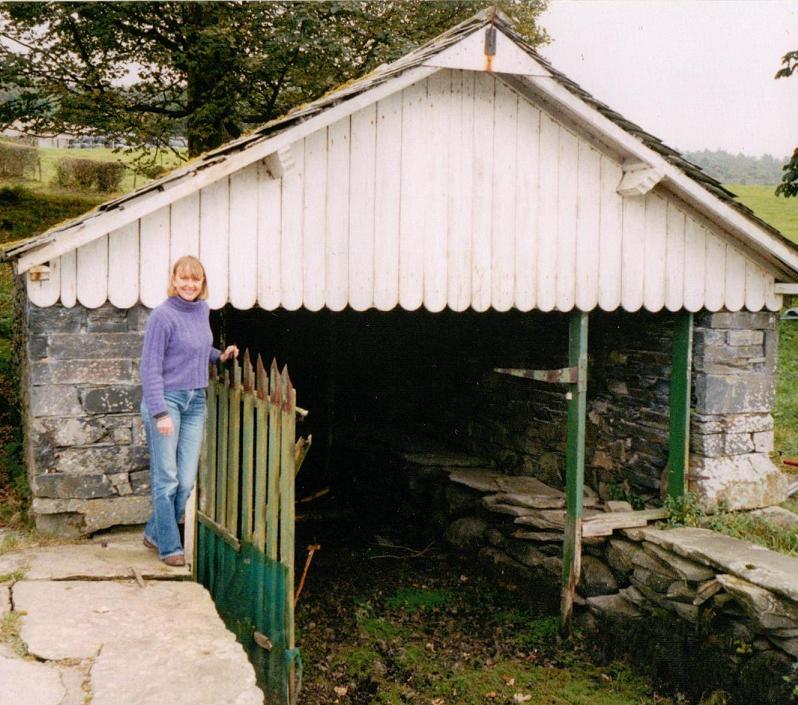
Sophie Neville at the Bank Ground Farm Boat-houses on Coniston Water in Cumbria for the filming of ‘Big Screen Britain’ presented by Ben Fogle for BBC TV
At last! We have the clip from Country Tracks presented by Ben Fogle, that includes interviews with Director Claude Whatham, Lucy Batty of Bank Ground Farm, Suzanna Hamilton and myself discussing the swimming scenes, with the unique behind-the-scenes footage my father shot on 16mm film, with his Bolex camera back in 1973. You might have seen a longer version of this on Countryfile and Big Screen Britain. I am yet to receive residuals.
If you would like to read about ‘The Secrets of Filming Swallows and Amazons (1974) in detail, the illustrated, multi-media ebook is available on Kindle and from other ebook retailers.
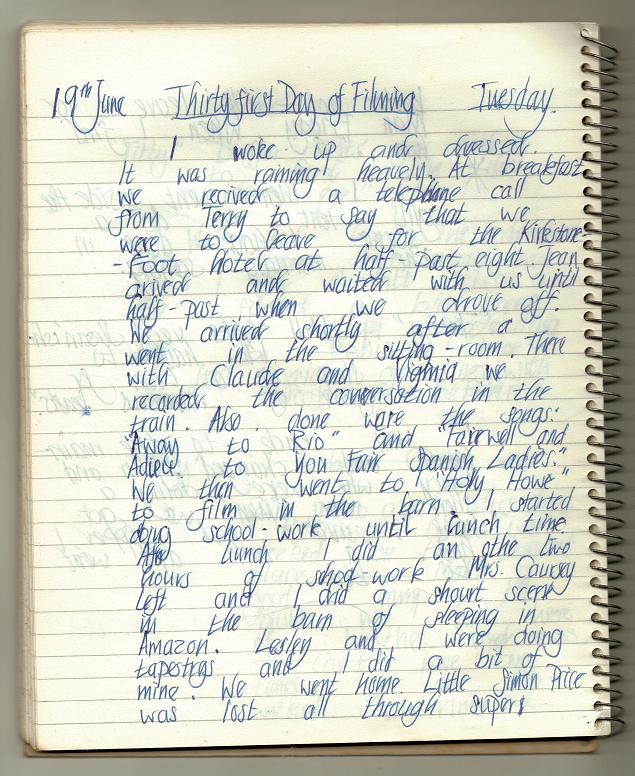
The Lake District is very beautiful. The problem about filming there is that it can rain quite hard – ‘heavily’ – was the word I used in 1973.
By this stage in the filming of Swallows and Amazons Claude Whatham only had one ‘rain cover’ option. We were kept busy recording sea shanties with Virginia McKenna at the Kirkstone Foot Hotel by Lake Windermere while Dennis Lewiston, the DOP, lit Mrs Batty’s barn at Bank Ground Farm above Coniston Water.
Arthur Ransome must have done much to revive the songs of the sea:
Farewell and adieu to you, fair Spanish ladies, Farewell and adieu to you, ladies of Spain; For we’ve under orders for to sail for old England, And we may never see you fair ladies again.
We never got as far as the ranting and roaring bit in the film.
No one really knows how old this naval song is. The Oxford Book of Sea Songs, mentions it in the logbook of the Nellie of 1796, long before shanties really came established as a genre. All I know is that Titty loved it and was still singing it in Peter Duck when the song became quite useful for navigating the English Channel.
‘The first land we sighted was called the Dodman, Next Rame Head off Plymouth, Start, Portland and Wight; We sailed by Beachy, by Fairlight and Dover, And then we bore up for the South Foreland light,’ or sort of.
Walking into Mrs Batty’s barn that day was hugely exciting. Simon Holland, the art director or set designer, had rebuilt the camp there, lighting a real fire.
Sophie Neville as Titty
Swallow was nmounted on a cradle so that she could be rocked, as if by water, as the scenes of her sailing at night were shot. It was brilliant, she even went about. Moonlight wasn’t not a problem. Richard Pilbrow can correct me, but I think it was produced by a lamp called a ‘tall blonde’. I don’t think we had a wind machine. The Prop Men used a large sheet of cardboard to produce a breeze.
‘Wouldn’t Titty have liked this?’
‘Liked what?’
‘Sailing like this in the dark.’
’57, 58, 60, 61…’
‘What’s the matter?’
‘Can’t you hear it? The wind in the trees? We must be near the bank. Quick, Susan lower the sail! Roger, catch the yard as it comes down!’ Then there is a crunch as the Swallows hit a landing stage. All mocked up. Quite fun.
‘What about Titty?’
Amazon was placed on the same mounting. I climbed aboard and started wrapping myself up in her white sail.
Children always love the irony of John saying, ‘She’s at the camp. She’ll be alright. She’s got a tent,’ when the shot cuts to me looking damp and uncomfortable about sleeping in Amazon, anchored out on the water.
Later I wake up and come out from under the sail to hear the burglars heaving Captain Flint’s trunk across Cormorant Island. All in all we achieved quite a bit on that wet day in Westmorland. Much safer and easier than being out on the water. Because the cradle was at waist height Claude was able to get lower angle shots than when out on the camera pontoon. Simon West, who played John, did really well. He managed to convince me that he was really sailing when I watched the film and I knew he wasn’t.
I’m pretty sure this scene of us inside a tent at night was actually shot on Peel Island but I may be wrong. We had a fire in the barn. If you look closely you can see an electric cable going into the lantern to boost light from the candle. The night scenes were tricky to light and shoot, but there was something about them that was intimate and exciting for children. I assume they would normally be in bed but it was the summer holiday and excitement was afoot.
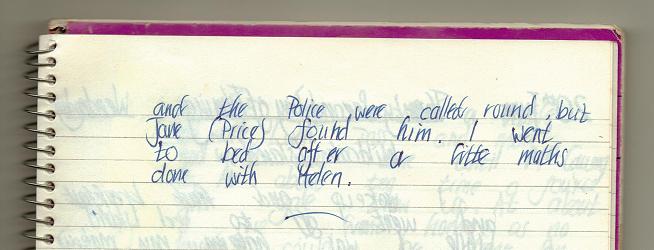
Back at our guest house in Ambleside there was a real life drama. Little Simon Price had gone missing. He was the small boy last seen on the beach at Rio, having his shorts pulled up by his sister. The Police were called and everything. But as in a lot of real life situations, things were sorted out, and we returned to the mundane world of maths lessons. I was tutored by Helen, one of the students at the Charlotte Mason College of Education who was also lodging at Oaklands as Mrs Causey, our teacher, could not ‘do modern Maths.’
Claude Whatham had no Peak of Darien at Bank Ground Farm, Arthur Ransome’s location for Holly Howe. But he did have buttercups and daisies, the flowers so evocative of childhood summers spent in the English countryside. The field that runs down to Coniston Water looked glorious that sunny day in June 1973. It was glowing.
Claude had used wild flowers to good effect when he made Laurie Lee’s memoir Cider with Rosie for the BBC in May 1971. It had been one of those months of endless sunny days in Gloucestershire but we were in Westmorland now, where buttercups bloomed later in the year and sunny days were cherished. This was Claude’s afternoon for low angle shots.
The view from Bank Ground Farm over Lake Coniston as it was in 1973
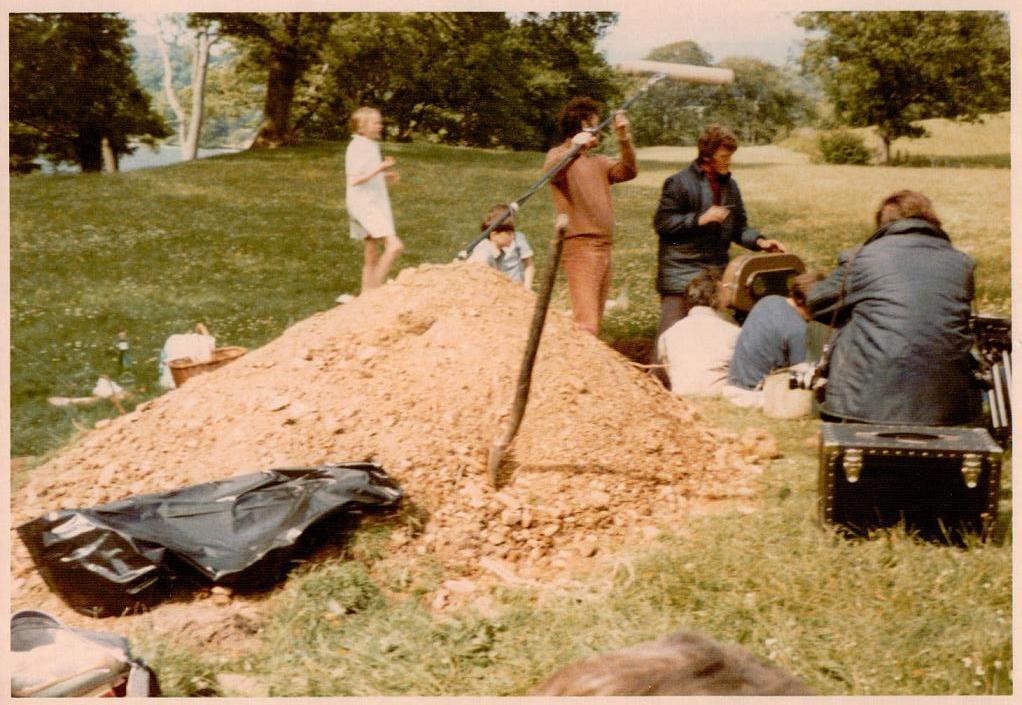
We arrived to find that a huge hole had been dug in the meadow for the camera, with a picnic for us spread out the other side of it. We thought this was very exciting. I’m not sure whether Mrs Batty felt quite the same joy about the excavations in her field. I was sad that we didn’t have a fire with a kettle, as they do in the book of Swallows and Amazons, but that was kept as a feature of island life and camping yet to come.
Sophie Neville, Simon West, Suzanna Hamilton, Gay Lawley Waklin, Bobby Sitwell, Dennis Lewiston, Albert Clark: photo~ Daphne Neville
Roger came sailing down clutching the telegram from our father, reaching out to deliver it over the hole. I understand that this was based on the cryptic telegrams that Ernest Altounyan sent his children Taqui, Susie, Titty and Roger, the children who acted as models for the Swallows. It has become the iconic response to Health and Safety ever since.
Claude Watham having just spoken to Stephen Grendon playing Roger at Bank Ground Farm. Who is in the foregound? : photo~ Daphne Neville
What we ended up saying altered slightly from David Wood’s original screenplay. ‘Dispatches?’ – Ransome spells the word ‘Despatches’ but apparently both spellings are correct.
John referred to Daddy as ‘Father’. I’m not sure why. He did so in his letter. It is daddy in the book, but perhaps Claude considered ‘Father’ as having a more period feel. I stuck more to Ransome’s dialogue, as you can see if you compare the film script with my diary entry above. This was because I knew his book so well, and never saw the script. The acting credit must go to Simon West who sat holding the telegram, graciously absorbing my bossiness, whilst I grappled with the words.
David Wood’s original screenplay of ‘Swallows and Amazons’
Sue Merry typing up continuity notes on location at Bank Ground Farm: photo ~ Daphne Neville
Back in 1973 it was the job of the ‘Continuity Girl’ to take notes on any changes made to the script. Sue Merry, ever present in her dark coat, took on this role. Today she would probably be known as a ‘Script Supervisor’ but her Aviator sunglasses and black polo-necked jersey would be the height of fashion. Sue also took notes technical notes for the film editor and director, indicating which Takes were favoured and which had been spoilt, giving the reason. In those days we had no monitors. The camera lens would be unscrewed after each take and checked carefully. If any fluff was found, Bobby Sitwell the camera assistant would call out, ‘Hair in the gate!’ Sue would quietly note this down and David Bracknell, the first assistant, would call out, ‘Set up to go again’. And we’d go again.
Sue was also responsible for the continuity, and would take numerous Polaroid photographs as an aide-memoir. This scene followed the one of Mother giving Roger the telegram, which had not yet been shot. Virginia McKenna hadn’t arrived back in Cumbria. Looking back, this seems a huge gamble. Would they ever get another sunny day while the buttercups were still blooming, a day to match – exactly – the weather of 14th June?
Sue would sit and type up her notes on location, using a portable typewriter that sometimes was set up for her on a spindly picnic table. This method of working was different from the BBC, when a ‘production assistant’ would type up her notes at the end of each day. Would it have been so that one copy of her notes, typed on triplicate paper, could be sent to the laboratory with the exposed film? It meant that her evenings were free.
We were allowed to help fill in the hole at the end of the day.
Sue Merry had worked for Neville C. Thompson before on The Boyfriend, Ken Russell’s movie that starred Twiggy with Tommy Tune, Barbara Windsor and Glenda Jackson. She later worked on The Wicker Man, Anthony Shaffer’s harrowing film directed by Robin Hardy that featured Edward Woodward, Christopher Lee and Diane Cliento, Britt Ekland and Ingrid Pitt. She went on to work with Dennis Lewiston and other members of our crew on The Rocky Horror Picture Show, the movie that starred Tim Curry, Susan Sarandon and such unexpected artists such as Meatloaf, Christopher Biggins and Prince Andrew’s old flame Koo Stark, who played a bridesmaid. Sue also did the continuity for Nicolas Roeg on The Man Who Fell to Earth, starring David Bowie, before moving into television to work on The Professionals and The Comic Strip Presents… All quite fun!
But on that day in June 1973, she was the girl with the daisies in her hair, wearing a coat thick enough to indicate that although sunny it was still quite chilly in the Lake District.
You can read more in ‘The Secrets of Filming Swallows and Amazons (1974)’




















 Sophie Neville