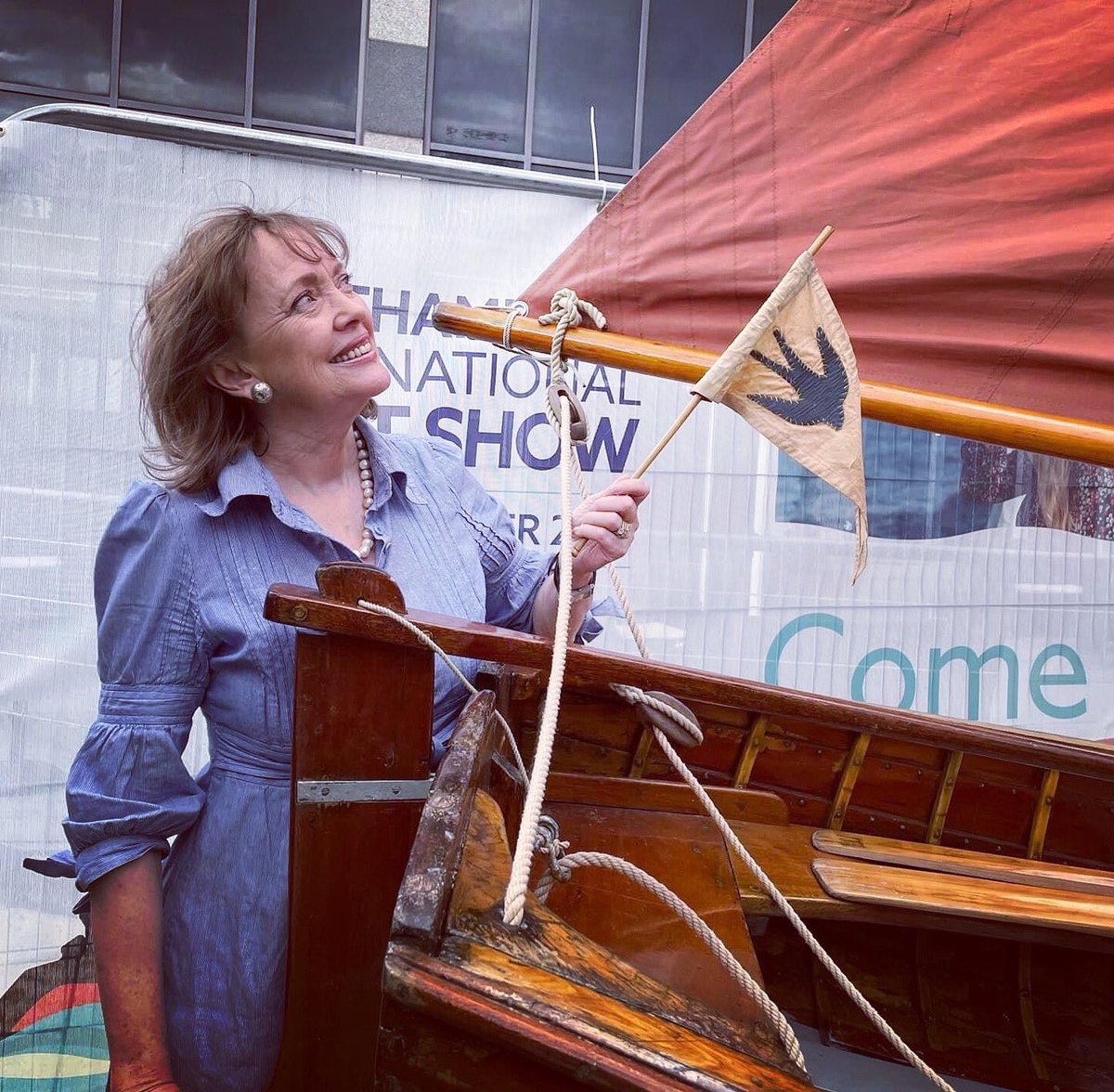
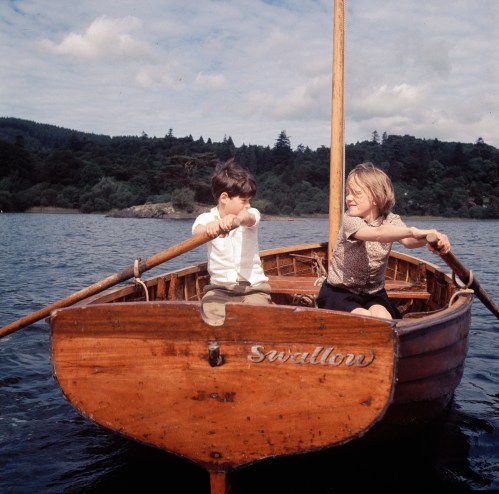
In 2022, Swallow, the dinghy that starred in the original film Swallows and Amazons was on display at the Southampton International Boat Show, greeting families as they arrive.
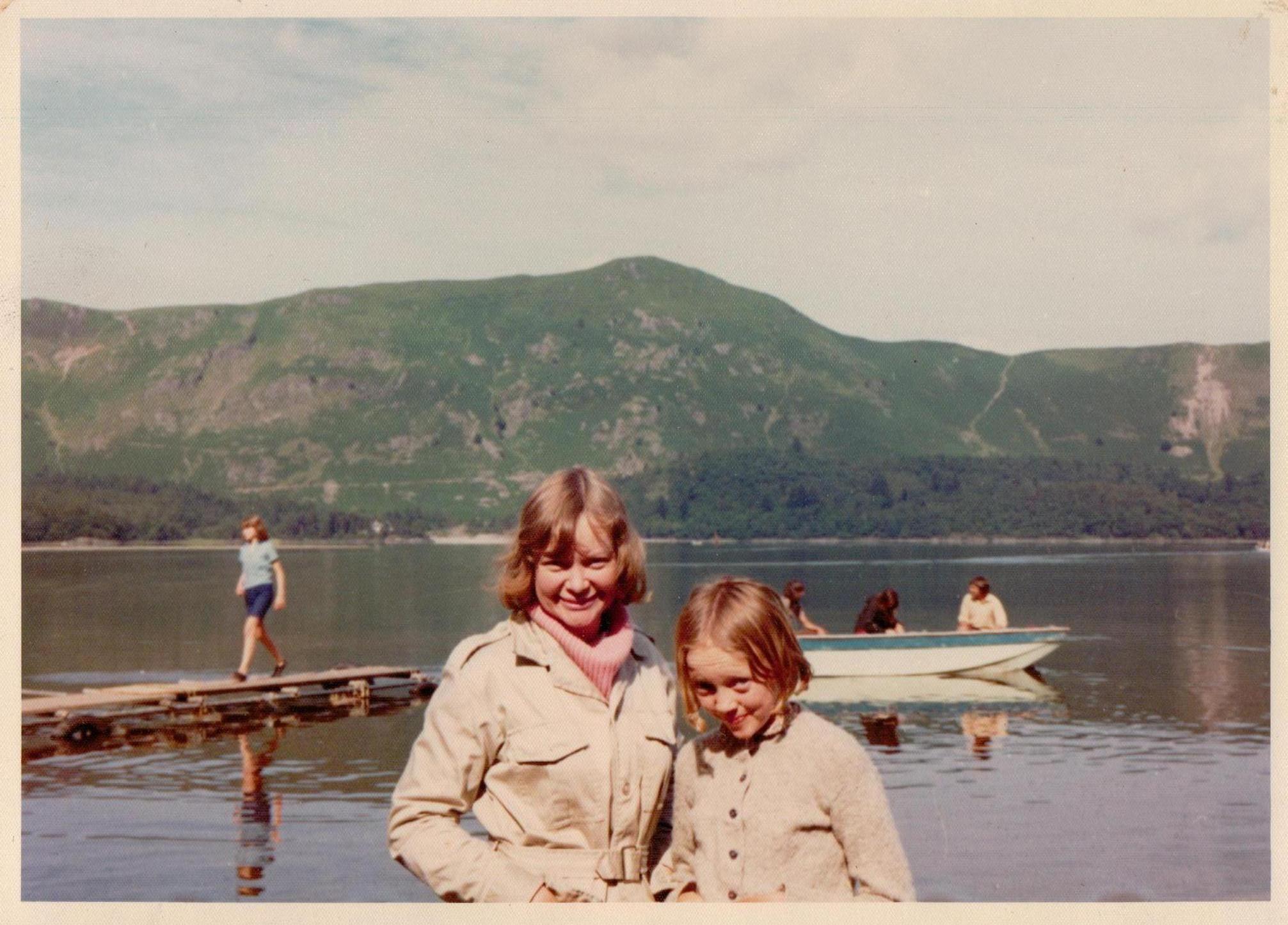
Sophie Neville who once played Titty Walker with her good little ship
Sophie Neville gave talks on filming afloat and the movie was made on location in the Lake District fifty years ago.
Over 103,000 people visit the show. Although busy, it did not feel crowded. There is a lot to see and do.
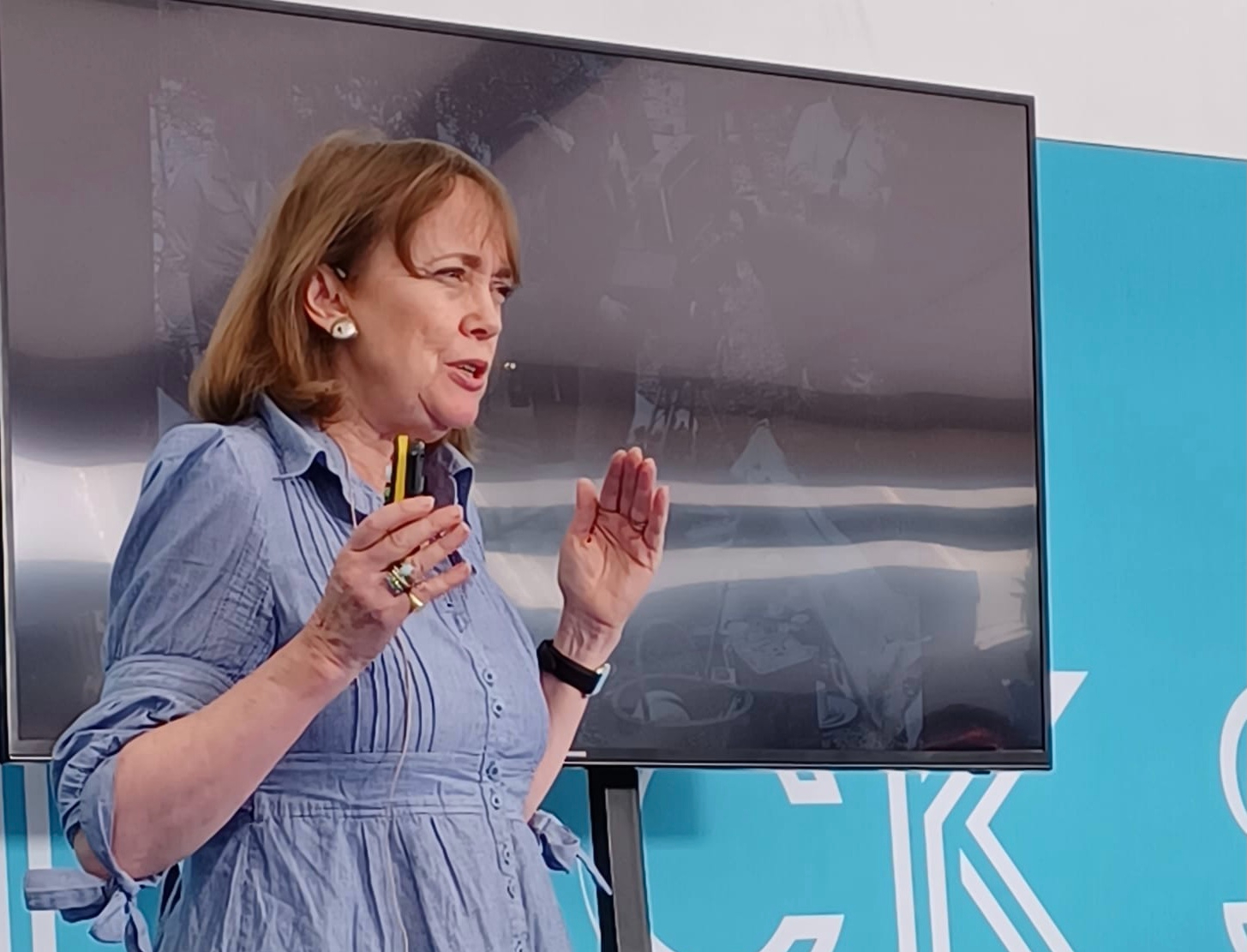
Sophie Neville speaking on the Foredeck Stage at #SIBS22
The school term is over, ‘Swallows and Amazons’ is on BBC iPlayer and Christmas missives are arriving in the post. I have just been sent this homemade card from someone who came to the premier of the original film in 1974, when I was fortunate enough to play Able seaman Titty.
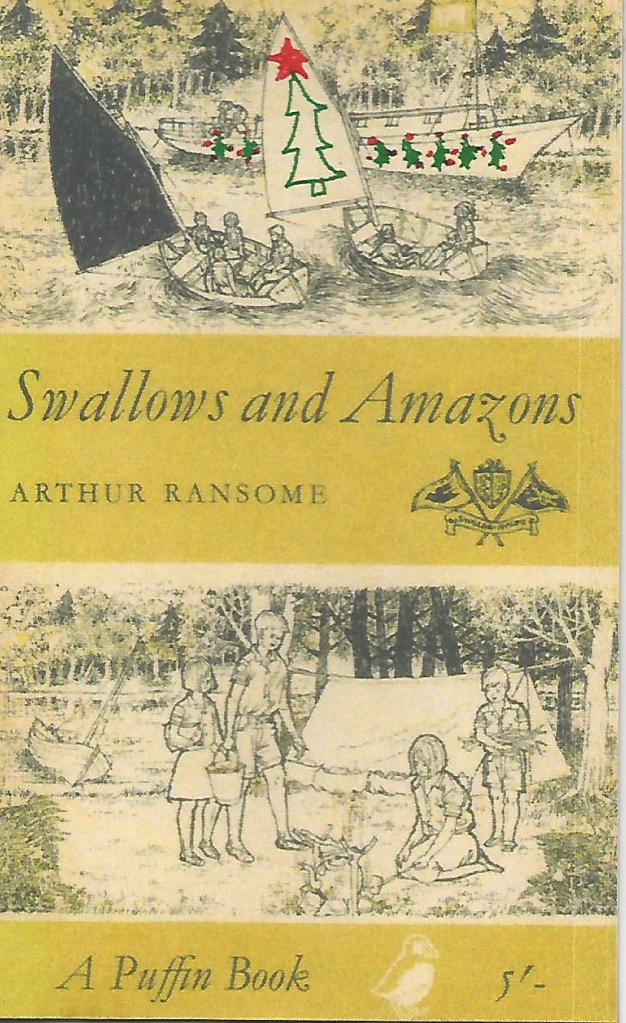
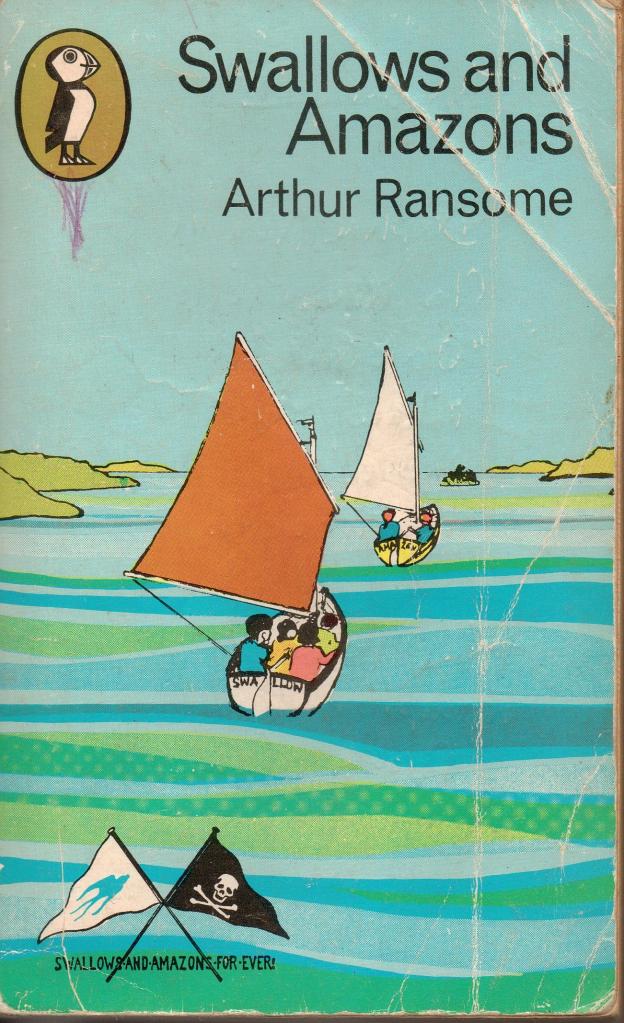
~Captain Flint hanging Christmas decorations around his houseboat on a card made from a Puffin book cover~
I dug out the Puffin paperback of Swallows and Amazons my father gave me when I was a girl and read avidly, along with other books in the series, by the time I was eleven years-old. It is a 1970’s edition in which I’d underlined everything Titty said. I must have re-read this copy when busy preparing for filming the 1974 movie financed by EMI.
Kaye Webb, the editor, had written an introduction saying, ‘This book is about sailing, fishing, swimming, camping, and piratical exploits.’ She wanted to make it available to children, thinking that discovering Swallows and Amazons ‘for the first time must be as exciting as a Christmas morning.’
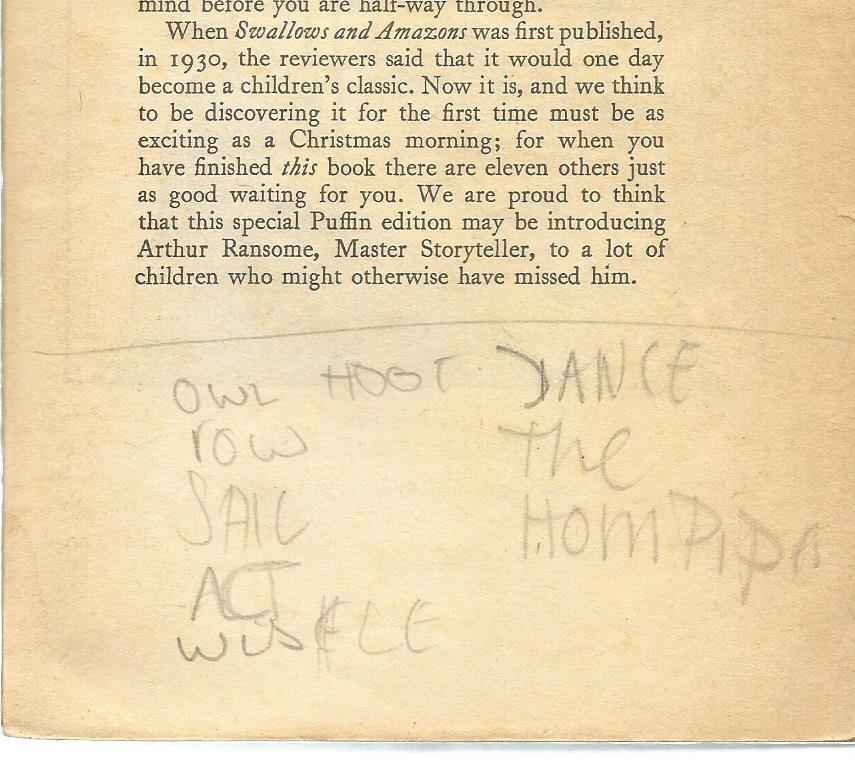
Underneath, I’d noted down the skills I would need to acquire before playing the part of Titty. ‘Owl Hoot’, was one item, ‘wisle’ (sic) another. I was somewhat apprehensive about dancing the Hornpipe but excited about ‘being a cormorant’, having no idea how cold this experience would prove.
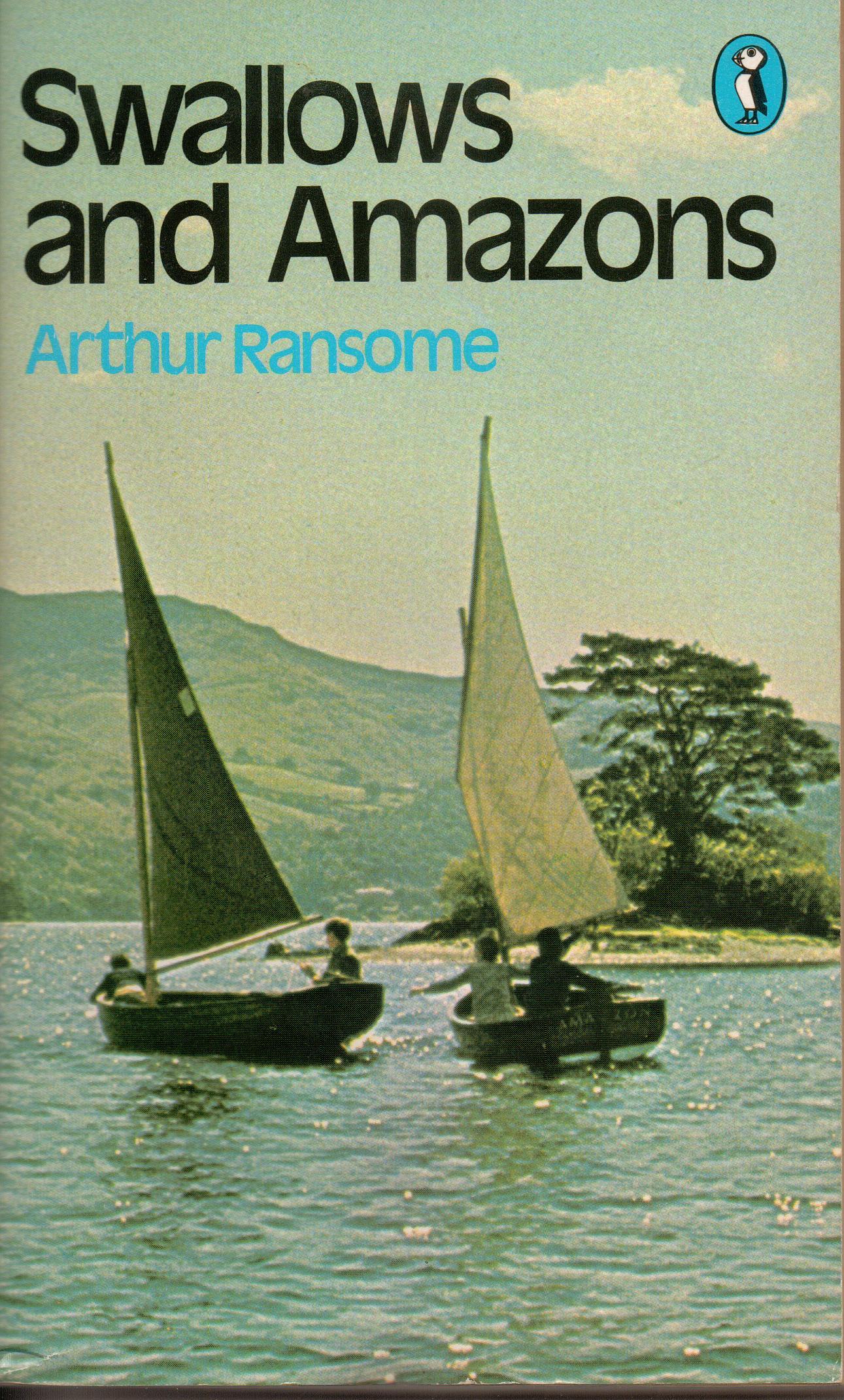
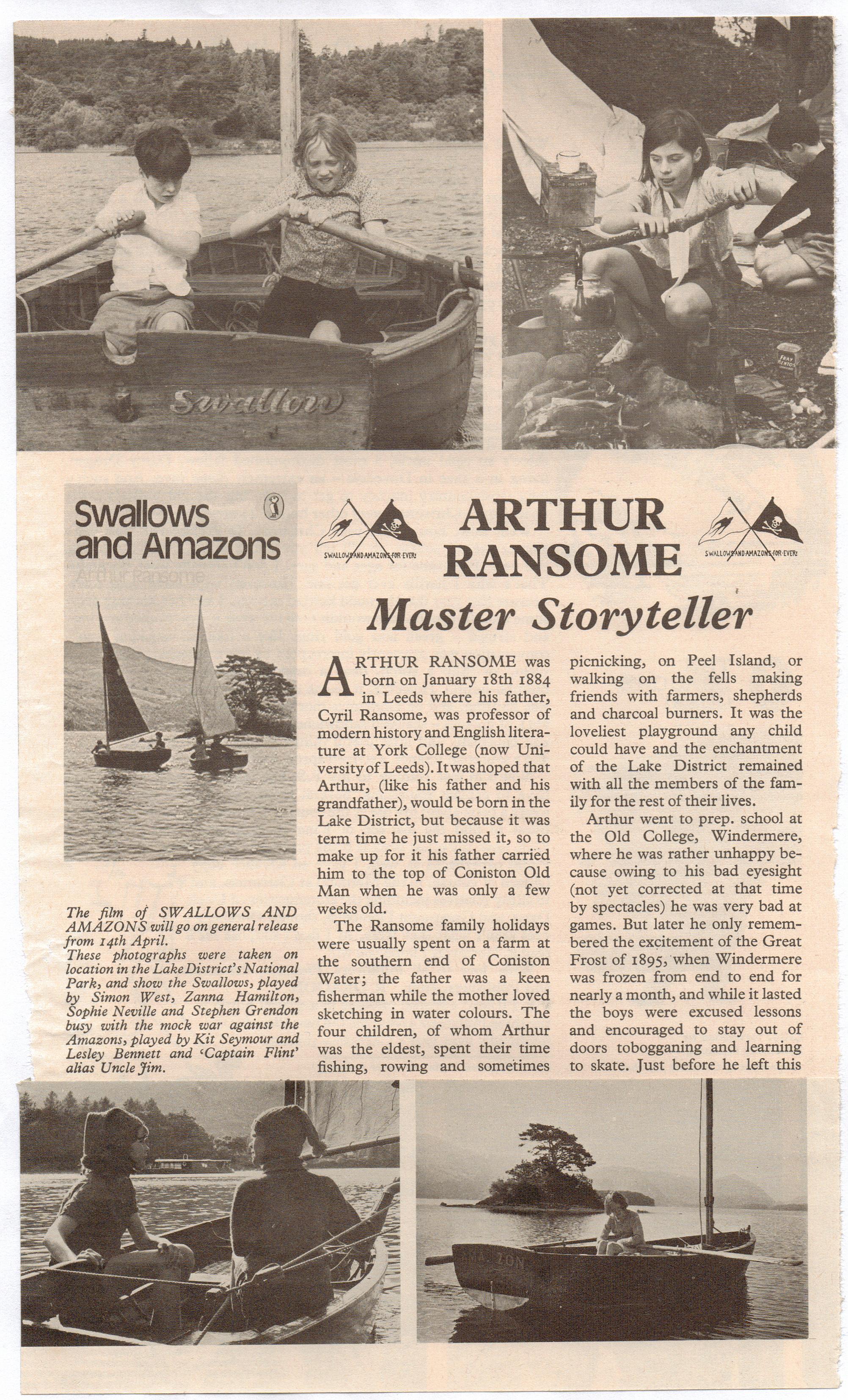
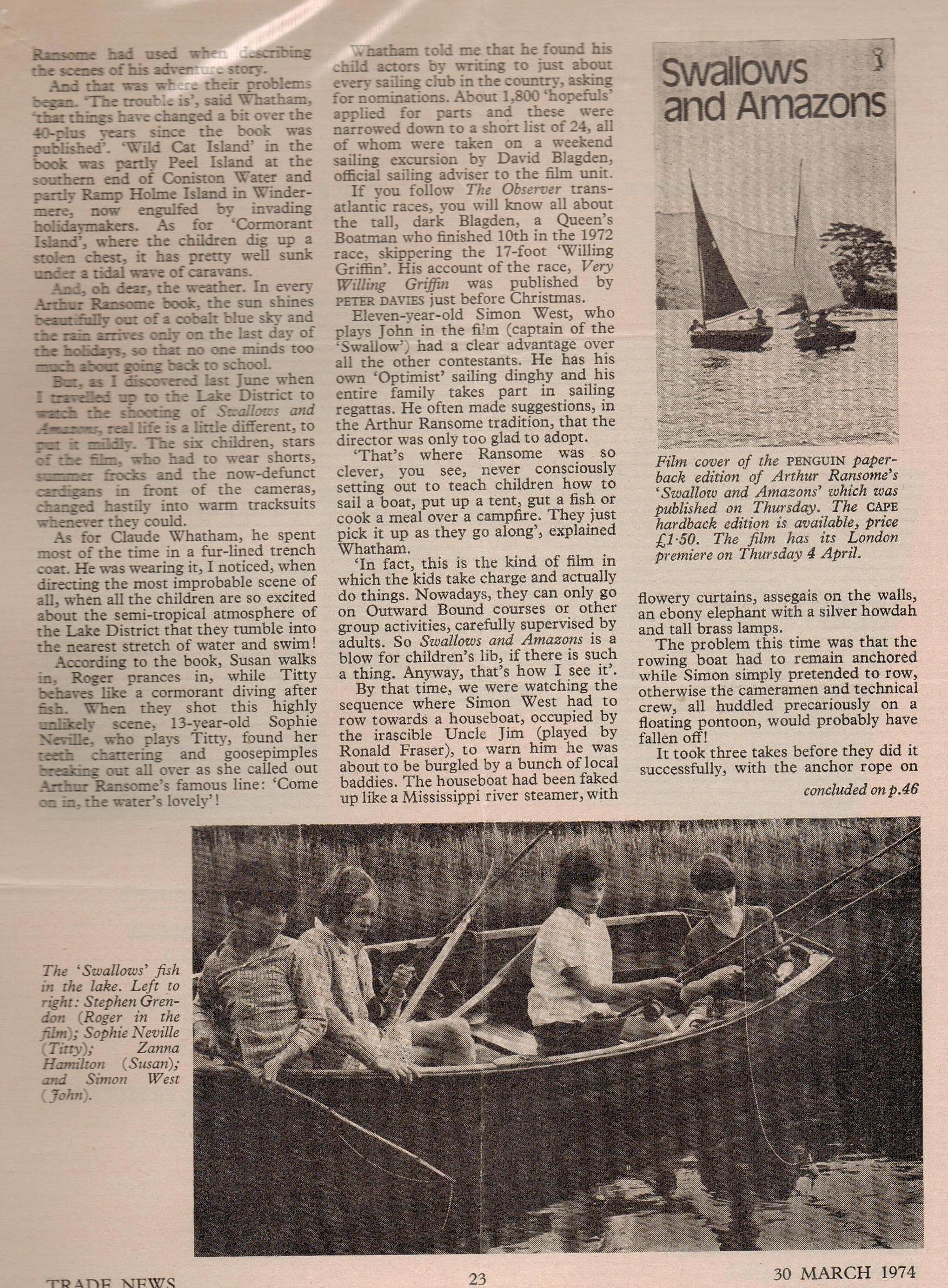
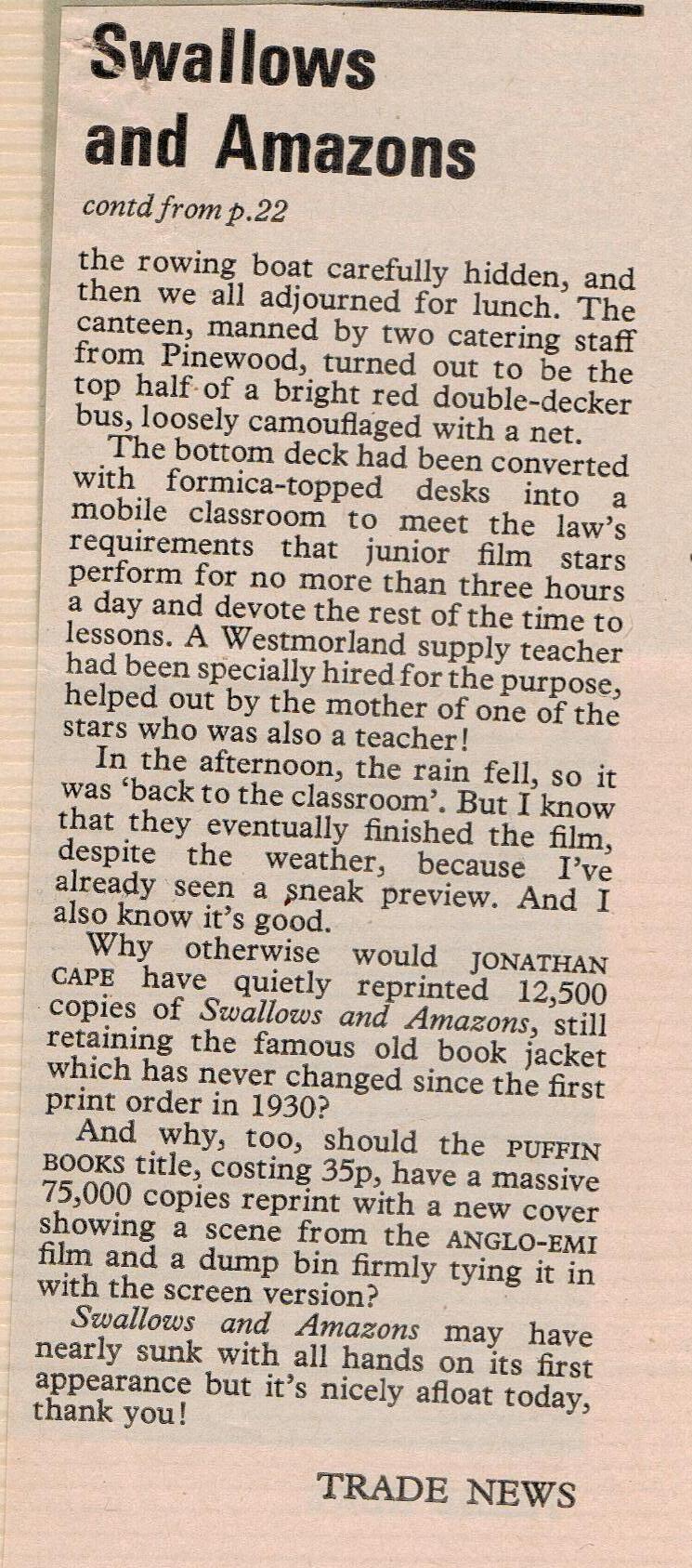
According to Trade News, 75,000 copies of a new Puffin paperback were brought out to accompany the original film. A still was used from the scene where the Swallows sail both dinghies from Cormorant Island. It retailed for 35p. Meanwhile Jonathan Cape printed 12,500 copies with the original dust jacket to accompany the release on 4th April 1974.
Today, I am most interested in Ransome’s prose, amused to find the phrase ‘X marks the spot where they ate six missionaries’ does not appear within the pages of the book. It was given to Titty in 1973 by the screenwriter David Wood. However, there are words of wisdom a-plenty that were not used in the film adaptations:
‘I like cooking,’ said mate Susan.
‘If you want to go on liking it, take my advice and get someone else to do the washing up’, is Mother’s reply. (I wonder who might have said this in reality.)
‘You can be wide awake and not see a thing when you aren’t looking’ is one of Roger’s observations.
John was able to look back to ‘a different, distant life’, which is exactly how it feels when the excitement of Ransome’s world spoils you for the ordinary. It’s true: those involved in outdoor activities develop in leaps and bounds ending up, ‘not at all what they had been.’
What is it about Arthur Ransome’s writing that captures your imagination? Rowing? Sailing? Cooking over a camp fire? Which book has most influenced your life?
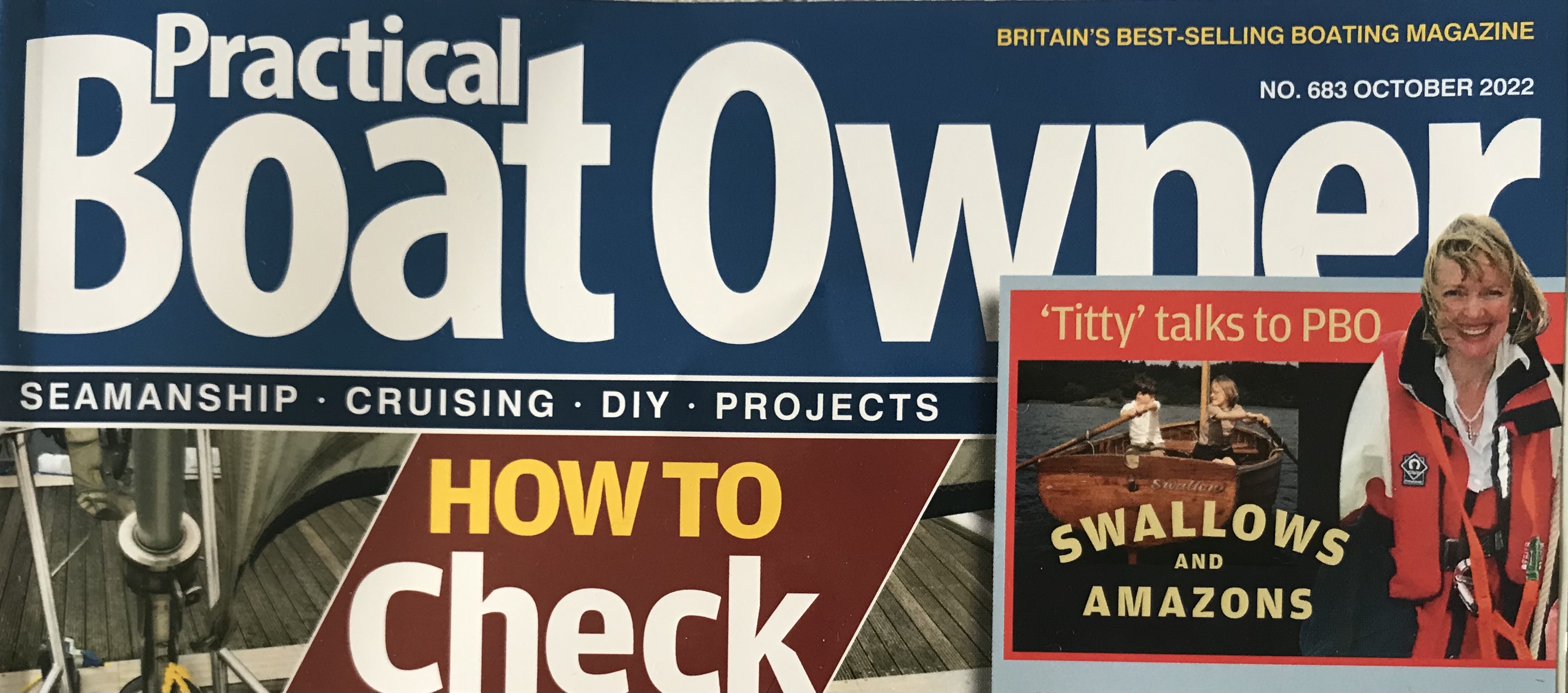
Article on Swallows and Amazons on Puffin Magazine
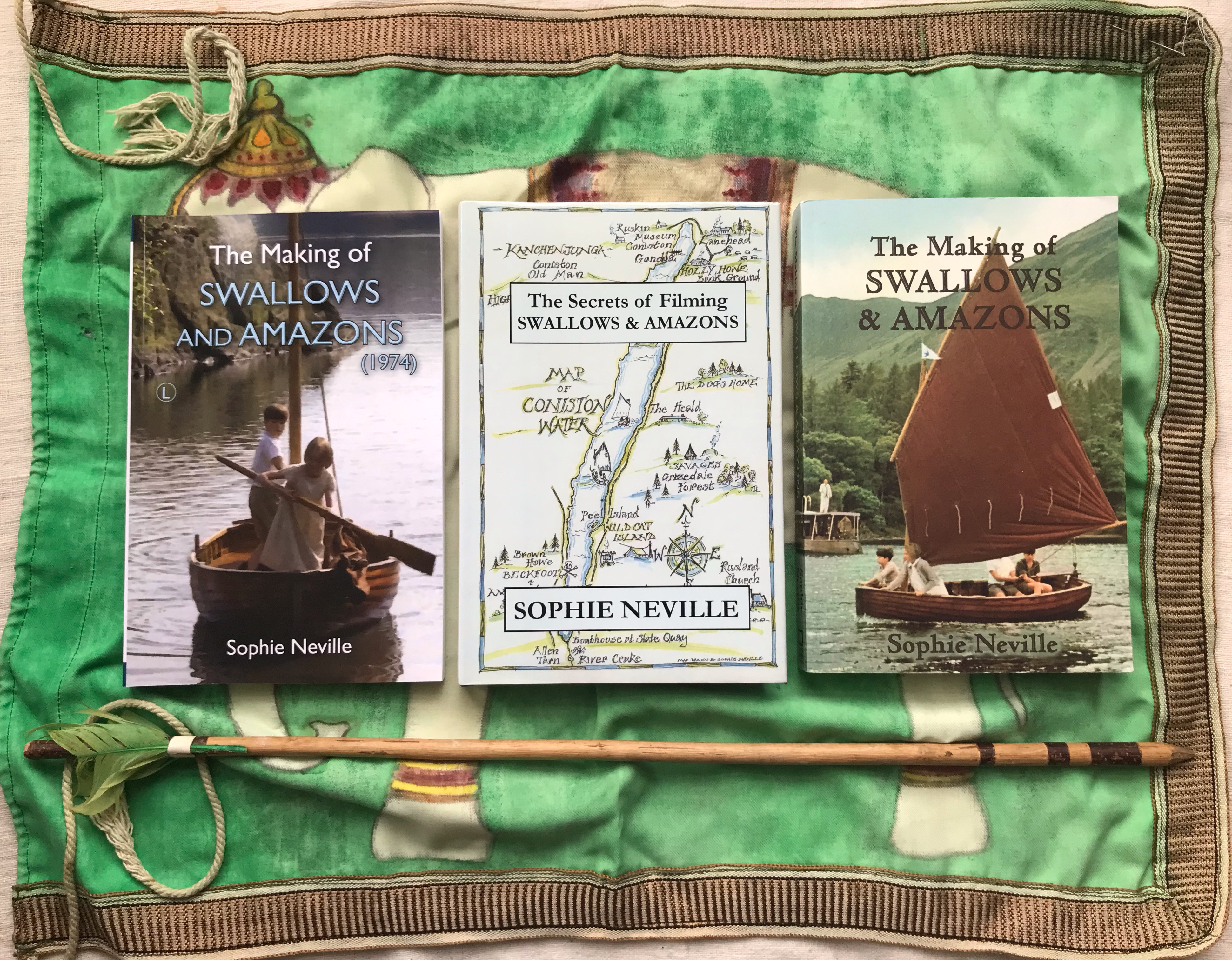
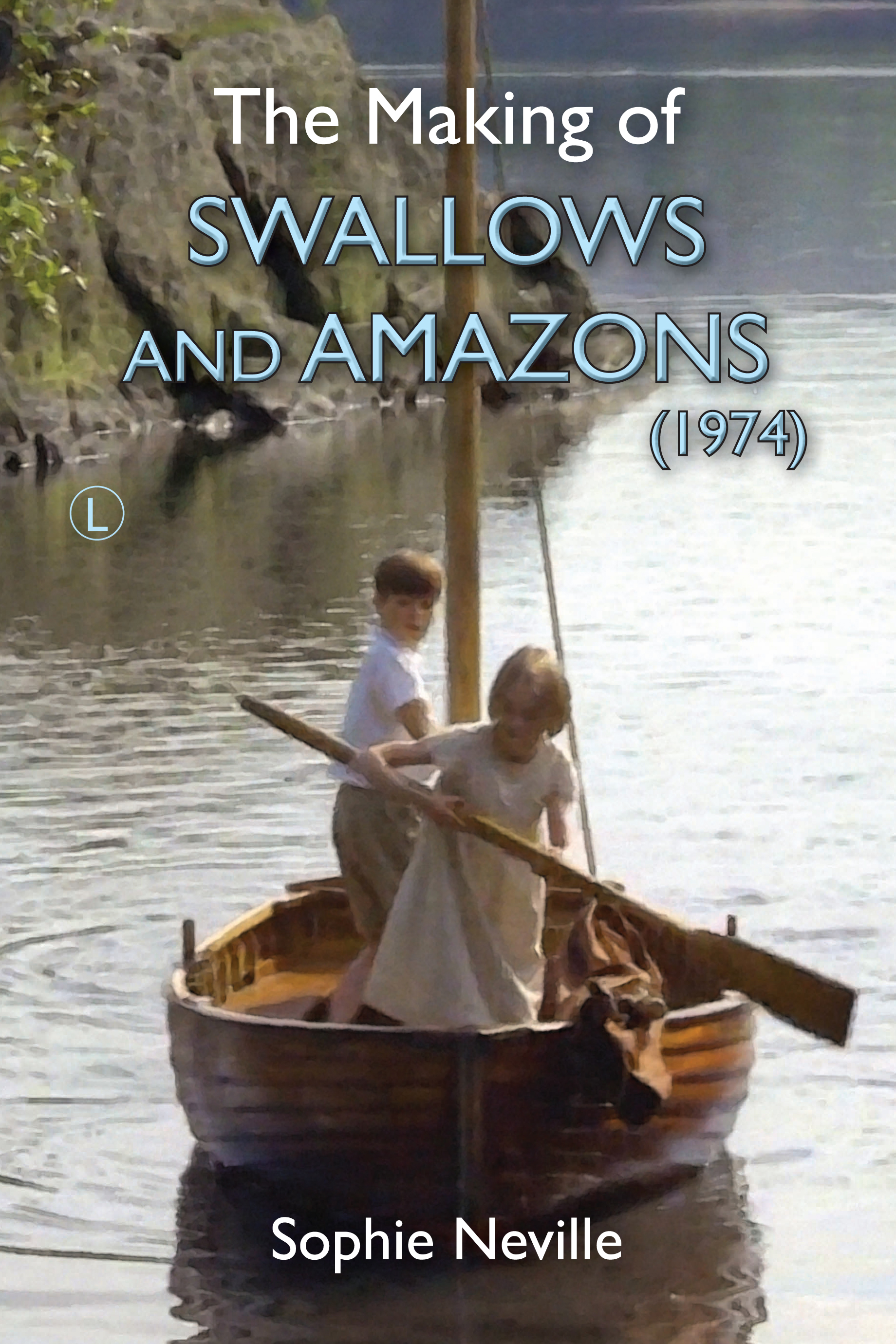
You can read about the adventures we had bringing out the original film in different versions of ‘The Making of Swallows and Amazons (1974)’, which is now available as an audiobook.
Different editions of ‘The Making of Swallows and Amazons (1974) by Sophie Neville’
Guy Willson, a reader from Papua New Guinea, has written to say: ‘I have read your book and I really liked it. I could see behind the scenes and often read between your lines as well.’
‘When you were making the movie (in 1973) I was on my way to Norfolk Island as a starting point of my adventures in the South Seas; so I never knew of the release of your film until much later when I had children of my own that had reached the age to go ‘avasting’ and ‘timber shivering’, when we were living in Rye in the 1990’s.’
‘Some years ago I restored a 13ft clinker dinghy and after adding a false keel, added a standing lugsail and trailed her up to Coniston for my children to sail…I had in mind an article from Classic Boat on the Swallow, how the Altounyan children preferred Swallow as a boat because they could stow more things in her and she could still sail well. I had noticed on a drawing in the article that Ransome had given her an extra 2 or 3 inches of false keel and this helped tremendously in reducing her leeway. I added a piece of oak to do the same thing but gave her an extra 9” aft and planed it down to a feather edge forward so the she would go about a bit easier. Well, it worked and Eaglet would have done the original Swallow proud.’
Swallow – the 12′ dinghy used in the film
‘If you would permit me a little correction: you described the rig as being gaff rig, but this is not so. Both the boats, originals and the ones you sailed were in fact luggers. The nearest thing to a gaffer among the luggers is the Gunter Rig which has jaws at the front of the yard but is hauled up by a single halyard. You can see this in the Mirror dinghy (in truth it is about halfway between the two). However the lug rig of Swallow is known as a ‘standing lug’ and it can be used to go about freely. After hauling up the sail on its traveller; the peak of the yard is raised by the downhaul line (usually attached to the bottom of the boom). This tightens the luff of the sail and lifts the outer end of the boom as well giving the best efficiency to the sail.’
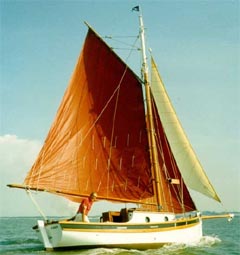
A gaff rigged cutter
‘Lugsails were the working sails of England for most boats less than 60ft but they were usually rigged with a ‘dipping’ lug as the mail sail and a standing lug aft. This dipping lug had to be dropped and the yard hauled round behind the mast every time they went about. It was a powerful sail and they found their best expressions in the three masted Bisquines which used to raid British shipping in Napoleonic days. You can still see them at the classic boat events at Douarnenez and Brests, where I took the gaff schooner Soteria in 2006.’
Soteria at Douarnenez
‘If you had had a gaff rig you would most probably have needed a jib to balance it (unlike the American catboats which have their masts right up in the bow, not even a space for the Boy Roger on those! Thanks for writing a lovely book which I will pass on to my daughter.’
“X marks the spot where they ate six missionaries”
‘You did such a grand job as Titty and I am not really surprised to find that you are a bit of a wordsmith. I am a missionary (uneaten) in Papua New Guinea and we are planning to sail back there in our steel schooner see www.livingwatermission.org On our return we will be calling in at Erromanga in Vanuaatu where ‘x’ was the spot where two missionaries were eaten. Recently the descendant of one of them, John Williams, went to Erromanga for a service of reconciliation.’
If you have noticed any errors in ‘The Making of SWALLOWS & AMAZONS’ please use the Comments box to let us know so that we can make corrections! We might be able to bring out a third edition. Readers who already have a Kindle edition will be able to update it free of charge.
Different editions of ‘The Making of Swallows and Amazons (1974) by Sophie Neville’
‘Swallows & Amazons’ at the Belfast Film Festival ~ photo by Debbie Davidson who said, ‘We had a fab day watching the movie, reliving our childhood.’
The film ‘Swallows & Amazons’ (1974) was screened at the Belfast Film Festival. Curiously, the ‘Terms and Conditions of Entry’ specified:
CHILDREN UNDER 16 MUST BE ACCOMPANIED BY AN ADULT
NO GLASSWARE OR CANS PERMITTED ON SITE
NO BARBEQUES OR NAKED FLAMES
This was ironic since, ‘Swallows and Amazons’ is about children cooking on campfires, eating canned bully beef or ‘pemmican’ while swigging ‘grog’ out of bottles, as far as possible form adult supervision. However, the movie was shown outside – on a huge screen under the trees opposite Belfast City Hall. ‘THIS OUTDOOR EVENT’, they declared, ‘WILL HAPPEN REGARDLESS OF WEATHER CONDITIONS’. Since the story is about camping this did seem apt but as you can see from the photograph above, it was an idyllic sunny summer’s day.
.
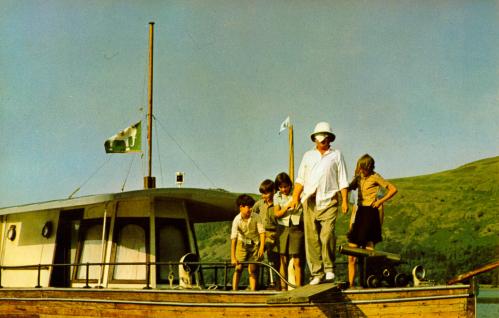
Ronald Fraser walking the plank in ‘Swallows & Amazons’ (1974)
‘How lovely…we love seeing this wonderful film,’ Gerry Spiller said.
‘My Mother took me to see the film when it was first released, it was in a double bill with ‘Born Free’, which also had Virginia McKenna in. In those days you could just sit in the cinema and see the film again if you wanted to. We did.’ Jon Ford
‘Ok, a confession. When I was twelve I was a spoilt little brat. My parents had decided to take my brothers and I out for a surprise. I refused to go until I was told what it was as I hated surprises. My parents wouldn’t tell me so I very nearly didn’t go. I went only after being told by my big brother that if I didn’t he would hit me. The surprise? A trip to the cinema to see Swallows and Amazons! ‘ Marc Grimston, Author
‘Can’t believe how long ago it was. I remember going to see the film at the Aylesbury Odeon and loving it.’ Kate Pearson
‘… the first film I saw in a cinema, Swallows & Amazons, ABC Colchester April 1974. Cinema now a pub.’ Fabian Breckels on Twitter
‘It was on at the local cinema. My son was too young to go so I offered to take a neighbour’s child on condition that the neighbour’s older child baby-sat for me.’ Janet Mearns
‘One of my all time favourite films. Watched it just the other day in fact. I never seem tire of it. Especially after a trip to the Lakes.’ John Heath
Lesley Bennett and Kit Seymour as the Amazons when filming in 1973‘I don’t know why we missed it when it was first shown (I was six at the time)… it came back to the cinema for another showing a few years later and the place was almost empty, so it felt as if they’d put it on specially for us.’ David Cooper
‘Rather like David, missed it as a child. Which makes me rather sad in retrospect. Had no idea it existed until I discovered it through ‘Google’! a few years ago. I now have two copies of it on DVD.’ Paul Thomas
‘I was 11 when the film came out and I was already a huge S&A fan. I loved the film and you, well Titty really, she became my first ever crush. Thank you for the excellent portrayal of Titty. Thanks also on behalf of my own daughters who also fell in love with the film, probably due to my regular screenings!’ Mike Embleton
Sten Grendon and Sophie Neville on Derwentwater in 1973‘I finally got to see it while we stayed at Bank Ground Farm our first visit to England. Loved it, cried over it, was delighted to finally see it after many years of sharing a love of Swallows & Amazons books with my mother, my sisters & my children! Mrs. Batty kindly put it on for us to watch in the farmhouse living room.’ Elizabeth Rondthaler Jolley, USA
‘It was two years ago in my 36th year. I found it somewhere on internet after I have read the first (book) to my son. And then we watched together. It was perfect. In Czech republic where I live, Ransome was in my childhood one of the most favourite authors.’ Jiri Precek, Romania
‘In June 1973 I was 9 months into my 3 year teacher training course at Didsbury Teacher Training College… It was not for many years – probably 15 that I contacted Cape for info about locations – still have the reply !!’
Martin Robinson
Sten Grendon, Simon West, Kit Seymour and Lesley Bennett on Peel Island 1973‘I was 9 in 1974 and saw the film about four times that summer (I think it was shown with Born Free as a double feature) and I had a huge crush on Lesley Bennett! (Where is she now?) I read all the books several times over during the 70’s . Reading your memories made me re-read the book and watch the film for the first time since the 70’s and I have to say the film holds up very well!’ Richard Meads, Worthing, West Sussex
The DVD reviewer Stuart McLean writes: ‘The cast were pretty much the same age as me in 1973 (when it was filmed) and I remember enjoying this tremendously when it came out in 1974, forty years ago. Back then, the idea that four school-kids could take off in a boat for days at a time with no life-jackets seemed perfectly plausible. These days it would be cause for 24 hour rolling news reports.’ Please click here to read on.
Simon Hodkin first went to see Swallows & Amazons in Wales some forty years ago. He kept a scrapbook full of souvenirs, including a letter from Arthur Ransome.
Can you remember the first time you saw the film? Please add to the Comments box.
To watch a filmbeat interview about making the film please click here
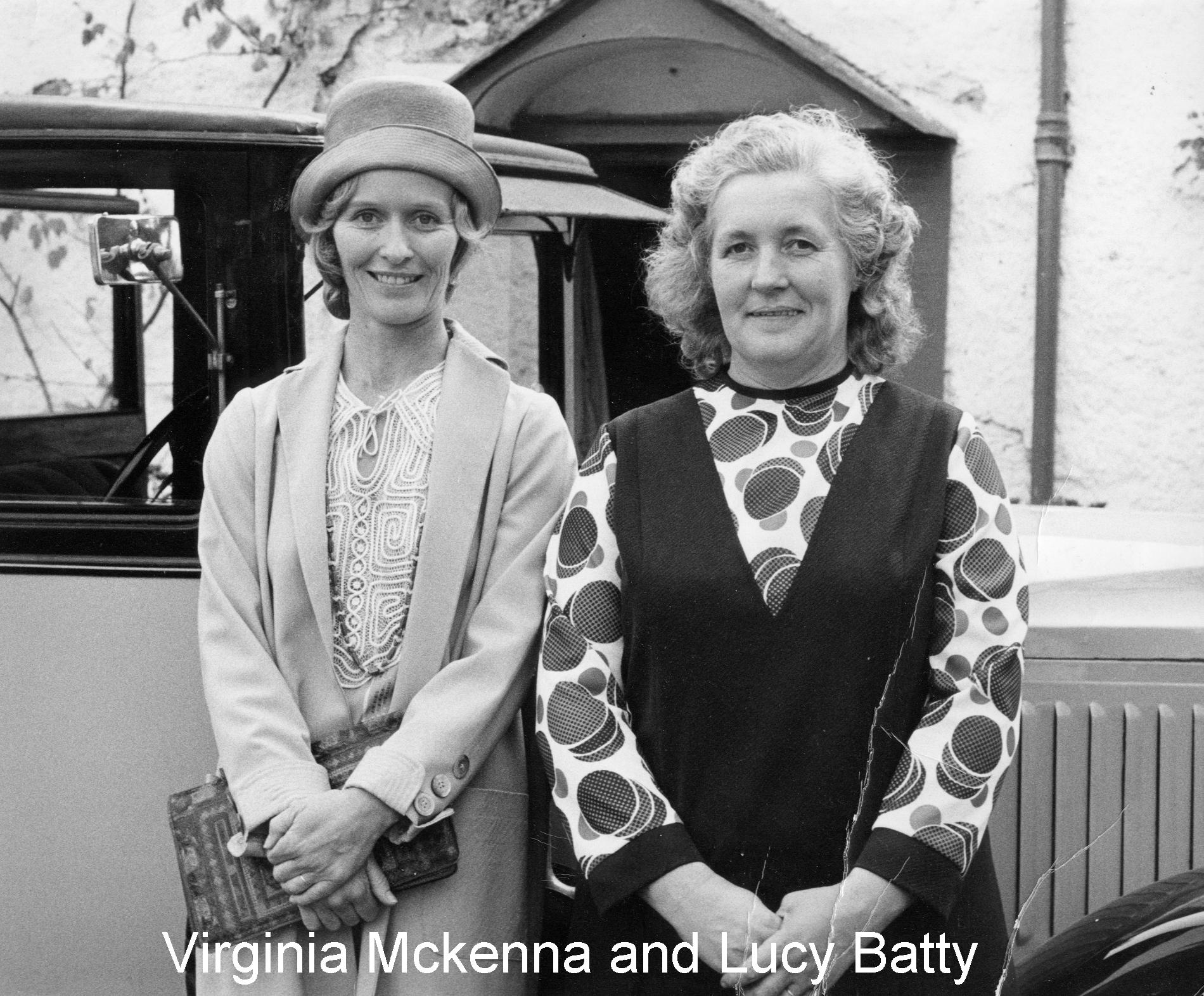
Virginia McKenna with Lucy Batty at Bank Ground Farm on 15th May 1973
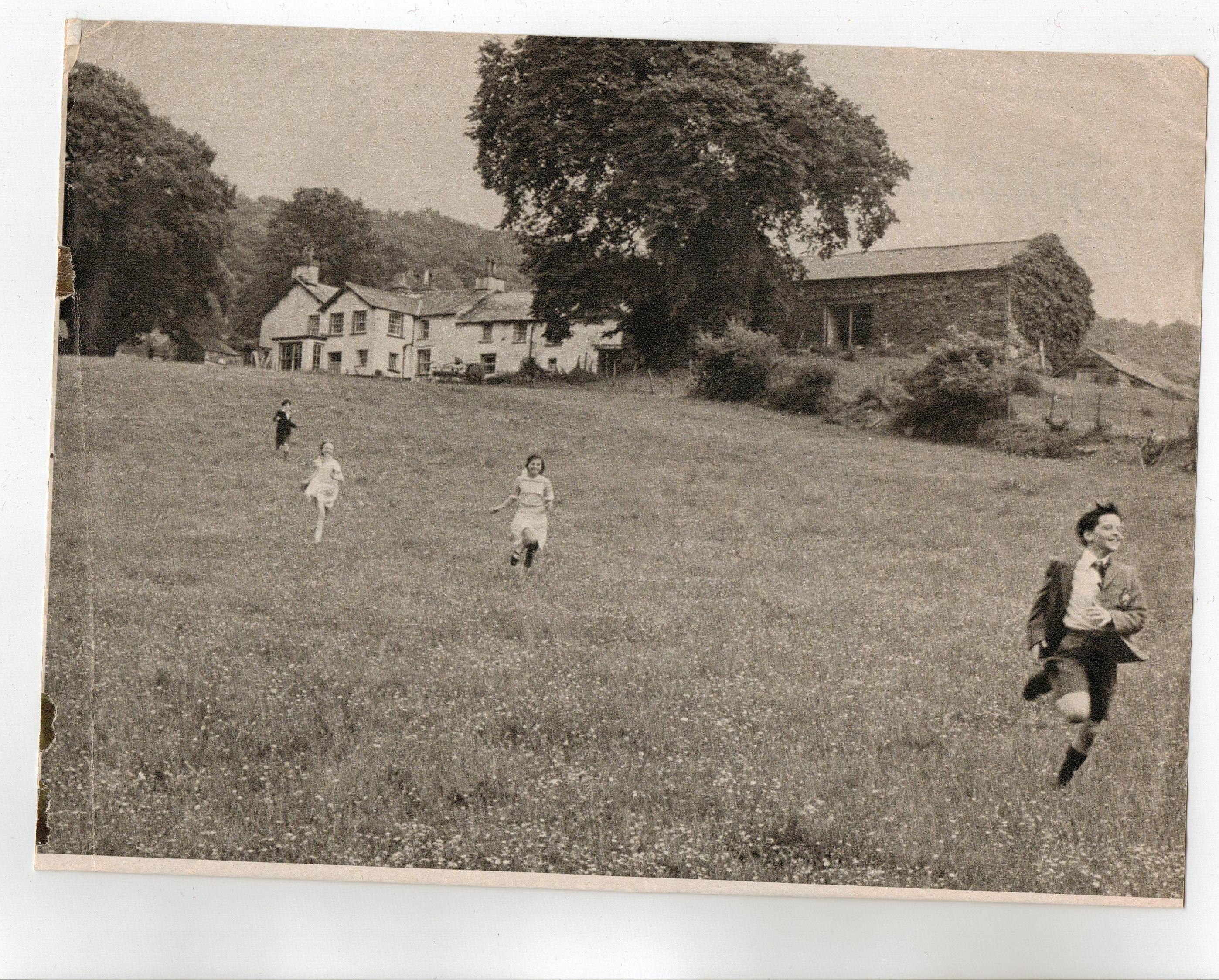
We were sad to hear that Lucy Batty has passed away. She was 87. Our thoughts are with her family. She will be fondly remembered by visitors from all over the world who were made so welcome at Bank Ground Farm above Coniston Water in the Lake District, which she ran as a guest house for many years. It was also used as a film location, becoming known as ‘Holly Howe’ in Richard Pilbrow’s 1974 movie, Swallows & Amazons.
Bank Ground Farm in the Lake District
I first met Mrs Batty when we filmed in her home back in 1973 and returned to stay with her in 2003 when the BBC asked Suzanna Hamilton and myself if we would appear in Countryfile, which they were filming at Bank Ground Farm with Ben Fogle. It was then that she had time to show me her photo albums. What a life she led! She was very proud of having brought up seven children on the farm, “Two of my own and five that came with my husband,” she explained. “Getting them all off to school in the mornings was such hard work that my in-laws came to help on my first day.They all wanted bread and dripping for breakfast, with sugar sprinkled on top.”
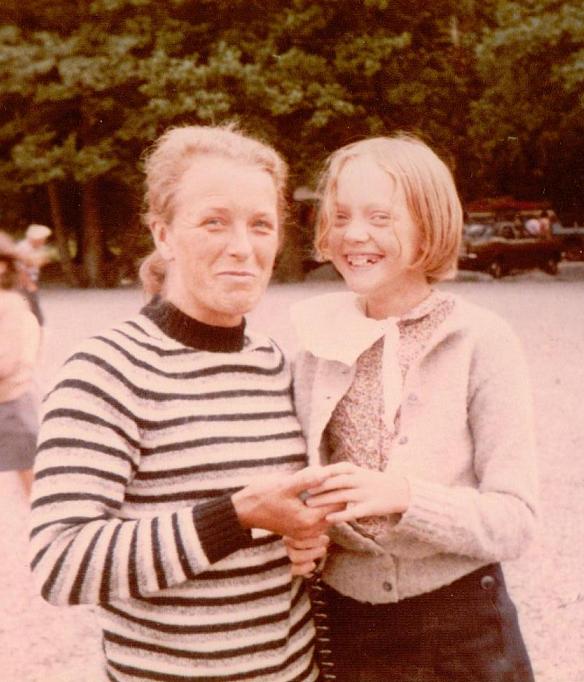
~ Sophie Neville with Lucy Batty in 1973~
“A magistrate once asked me what running a B&B entailed. ‘It’s much like looking after cattle,’ I told him. ‘You bring ‘um in, feed ‘um, see they’re bedded down, turn ’em out and muck’um out.’ He flung back his head and roared with laughter.”
She had a great sense of humour. I have a cutting from an article in The News written by Brenda Colton and published on 25th May 1973. It reads:
‘When Mrs Lucy Batty was asked if her house could be used for the setting of the film Swallows and Amazons, with guest star Virginia McKenna, she was delighted. After all, her home, Bank Ground Farm on the east side of Coniston Water, near Brantwood, was the setting chosen by Arthur Ransome for his children’s book Swallows and Amazons.
Mrs Batty thought it a good idea that the story should be filmed in an authentic location, and she felt she should be able to put up with a few cameras and film men for a while. But she just did not realise the scale of a “medium budget” film like this one, or what the production staff could do to her house. It was not the two double-decker buses coming down the path and parking on the farm that she minded, nor the numerous vans, lorries, cars and caravans. It was not even the difficulty of having 80 men and women wandering round the farmhouse carrying equipment here, there and everywhere.But when art director Simon Holland started tearing up her lino and carpet in the kitchen to get to the bare stone floor, she did get a little annoyed. Especially when he removed all the electric sockets, lights and switches, pushed all the kitchen furniture into the larder and whitewashed the newly papered walls.
“Have you seen the kitchen?” Mrs Batty said to me. “The larder is piled high with my furniture; and you would not believe the tip my lounge is in. But they are a funny lot. I asked if I could wash the beams in the kitchen for them, and they said ‘Oh no, we want them to look old.’ I have even had to hunt out a lot of old pottery from the cellar for them.
“But I have given up now. I have just left them to it.”
What I really did not know, until I watched the BBC documentary ‘Country Tracks’, was that Mrs Batty reached the point when she locked out the crew. She explained that when she was originally asked if we could film on her property she did not quite realise the scale of operations and only asked for – or accepted – a location fee of £75. She said that she decided that £75 was not enough, padlocked her front gate and wouldn’t let them back in until they agreed to pay her £1,000. It was a lot of money, more than double the fee I received for acting in the whole movie.
To read a little more about filming of Swallows & Amazons at Bank Ground Farm, please click here.
Sten Grendon, Sophie Neville & Simon West with Mr Jackson at Holly Howe
I am sure many people reading this have their own memories of Mrs Batty who was such a great character. Please do add them to the Comments box below. I feel it would be a tribute to all the hard work and love she put into making Bank Ground available over the decades for so many to enjoy.
The farmhouse as Holly Howe in 1973
You can read more about the adventures we had making the original film Swallows and Amazons here:
David Stott, the Ambleside lad who worked as a unit driver on the film of Swallows & Amazons in 1973 after he left college at the age of 19, has written from America:
‘I really enjoyed reliving Swallows & Amazons through your book.’
‘Oh my, what a trip down memory lane it was for me – so much that l had forgotten was rekindled. I cannot believe that it was forty years ago.
‘I think that I started work mid-June, which would fit in with finishing college. From your daily schedule it was when you went back to Coniston with Virginia McKenna on her second visit.’
Map showing film locations around Coniston Water
David remembers the problem of being locked out of Bank Ground Farm by Mrs. Batty. ‘I really could not blame her as the whole place had been turned into a circus and her house ripped apart.’
‘The first morning I met Richard Pilbrow was in his bedroom for some strange reason and remember thinking, ‘What a total mess. How can anybody live like this?’
‘My main contacts were Neville Thompson (the On-line Producer) and Graham Ford (the Production Manager). They were all based at Kirkstone Foot Hotel that was owned by friends of my parents, Simon and Jane Bateman. Others stayed at the Waterhead Hotel down by the lake, where I would pick them up and take them to the location.
‘On arrival at the location I remember well the catering van and the breakfast that awaited us. Having just competed three years studying hotel management at college I was amazed how two people with very limited equipment could produce the number of meals they did. The washing up was done on a trestle table outside the van with bowls of water carried to location in large milk churns.
~ Map of film locations on Derwentwater in the Lake District ~
‘I did not have much contact with you and the other children, as you were under the watchful eye of your Mum and Jean McGill. Jean’s Mum was called Girly McGill and used to run a nursing home in Ambleside. As a child I used to deliver eggs to the home with my Dad. Jean had a brother who I think everybody called Blondie.
‘Sten was a bit of a handful at times and held up shooting on a number of occasions while he was calmed down. I rather envied Simon West; I wished I had the chance he did to act in a film. To this day I’m a frustrated actor.
‘Dennis Lewiston (the Director of Photography) always seemed to be holding a light meter in the air or perhaps he was warding off the clouds. I found him a little unapproachable.
‘My recollection of Sue Merry the continuity girl was setting up her folding table and tapping away on a portable typewriter.
‘Ronnie Cogan the hairdresser and I spent hours chatting. Once the shooting started, we had nothing else to do. He was such a nice man.
Map showing some of the film locations around Windermere
‘I was thrilled when I met Virginia McKenna and had to drive her around. One day I had to drive her to Grange railway station. I was so fascinated by her tales of working with lions in Born Free that I drove slowly to maximise her story-telling time. We almost missed the train and had to run from the car park.
‘One of the wettest days I remember is when the scene of Octopus Lagoon was filmed above Skelwith Fold Caravan Site. I don’t remember the support buses being around that day, but I do remember having to sit in the car for hours on end. Maybe the buses were somewhere else.
‘I know I was invited to the wrap party but cannot remember a thing about it.’
You can read more about the adventures had making Swallows and Amazons here
Kit Seymour, Stephen Grendon, Sophie Neville, Lesley Bennett, Virginia McKenna, Simon West Suzanna Hamilton and the station master of the Haverthwaite Steam Railway in Westmorland, appearing in the April edition of Homes and Garden 1974
Newspapers are read one day and on the kitchen floor the next. Back in 1974 they might have been used to wrap up fish and chips. Either way, an article in the ‘paper is soon forgotten. Not so a feature in a magazine. They tend to hang around in hotel foyers and doctor’s surgeries for waiting to have their pages turned for months, if not years. The judgement they cast on our movie was important.
Director Claude Whatham and Producer Richard Pilbrow on location in the summer of 1973 in the Lake District
To my surprise I found an article about how we spent the summer of 1973 in ‘Homes and Garden’ magazine.
Photographs featuring Simon West, Suzanna Hamilton, Sophie Neville, Stephen Grendon, Lesley Bennett and Kit Seymour in the EMI film of ‘Swallows and Amazons’.
What amazed me was that the black and white photographs taken on the film set had been colour tinted. Please forgive my scanning – the pages were stuck in albums long ago and the images blur at the edge.
Stephen Grendon, Simon West, Virginia McKenna, Suzanna Hamilton and Sophie Neville on location at Bank Ground Farm in Cumbria
Surely she was the journalist also known by her married name of Elspeth Huxley, the author who had written The Flame Trees of Thika and so many other books? She wasn’t quite right in saying the film was shot entirely on location in the Lake District, but still. She was not to know about our day at Runnymede.
Simon West, Sophie Neville and Suzanna Hamilton appearing in The Tatler
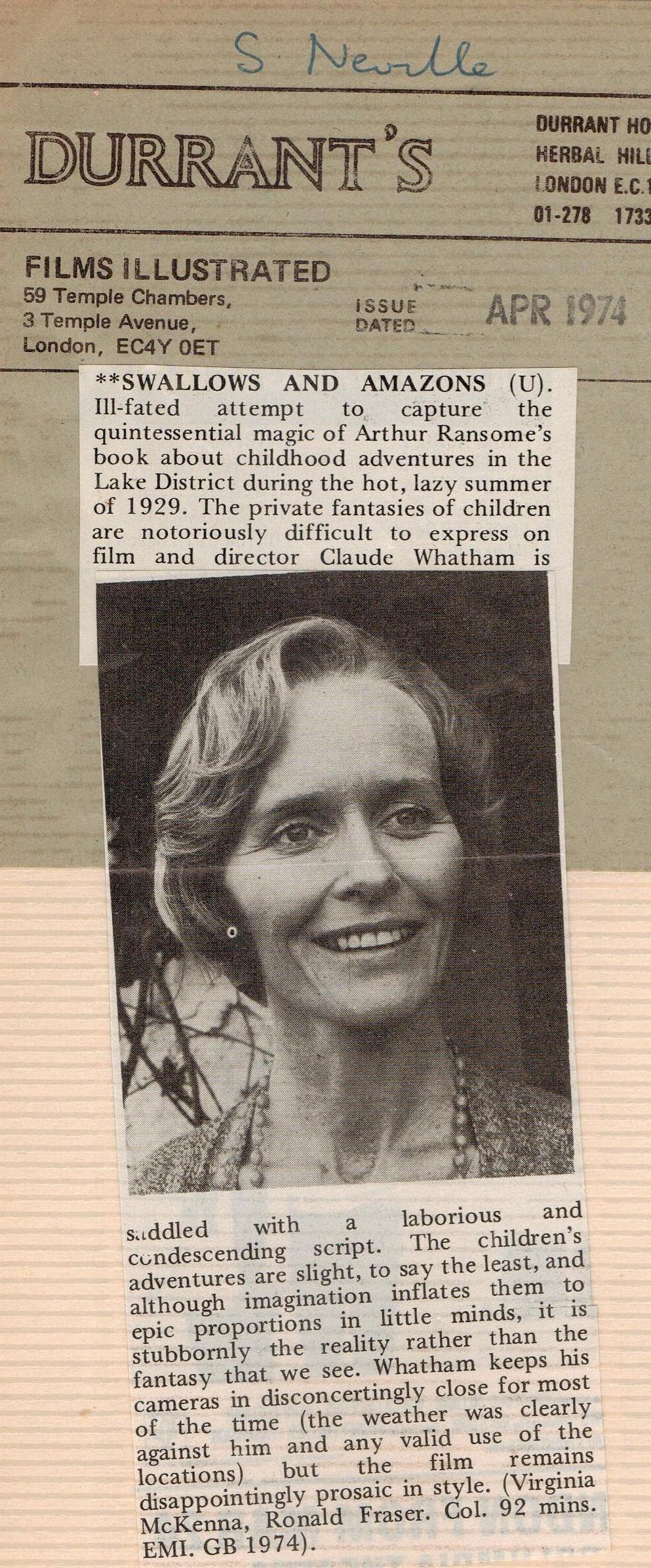
Virginia McKenna in an article in Films Illustrated, April 1974
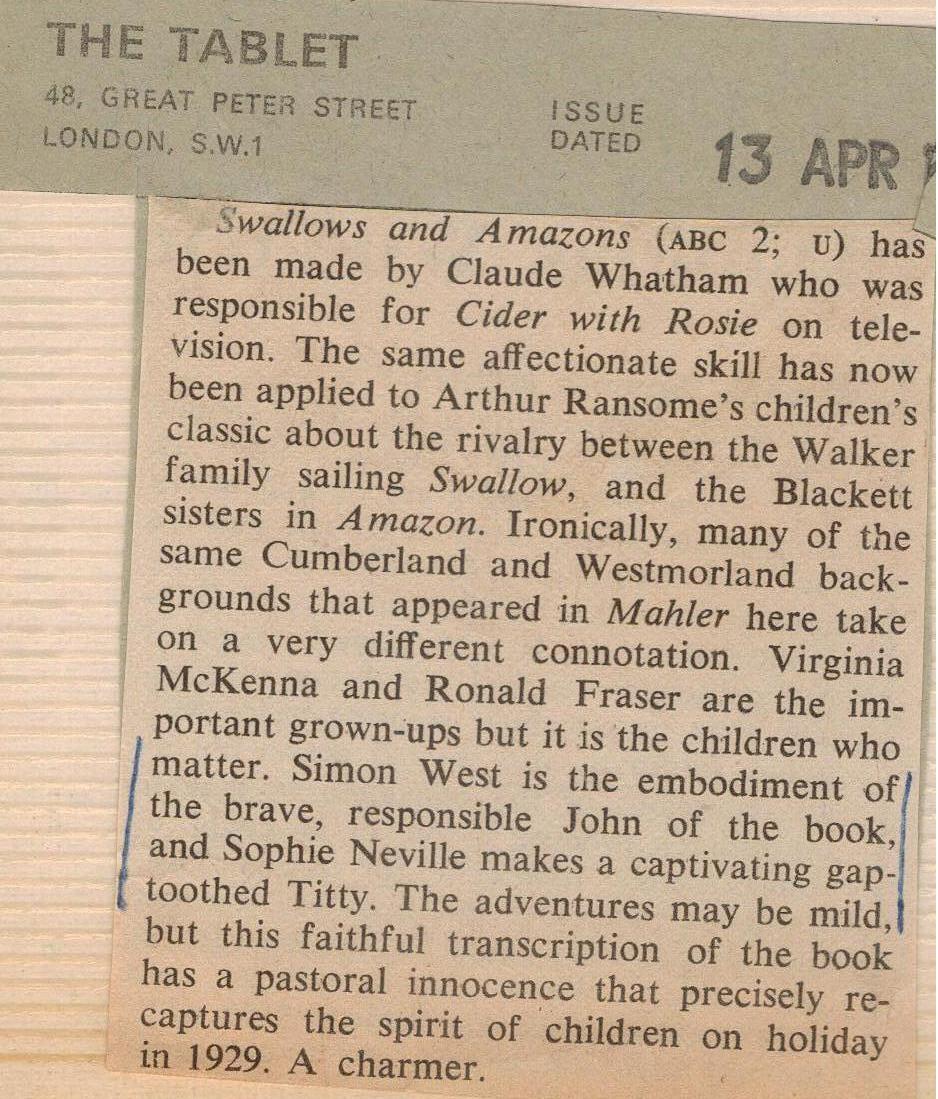
We were in both Punch and The Sunday People. My mother saved them all, scratching lines alongside the paragraphs in which I was mentioned.
and The Tablet.
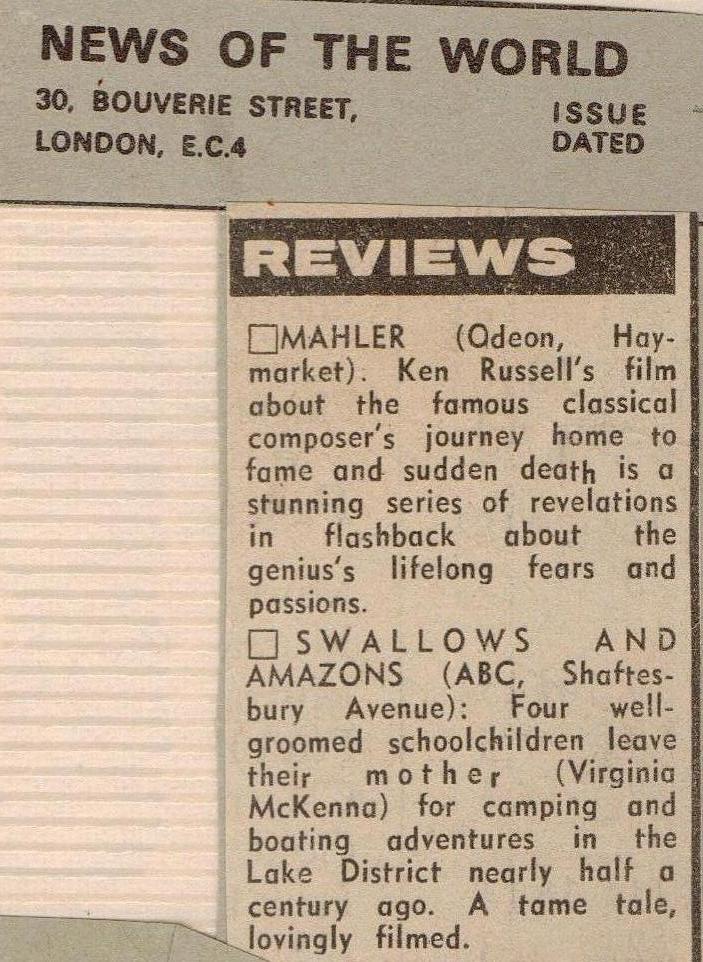
What’s On and the News of the World:
Kit Seymour and Lesley Bennett sailing Amazon on Derwentwater
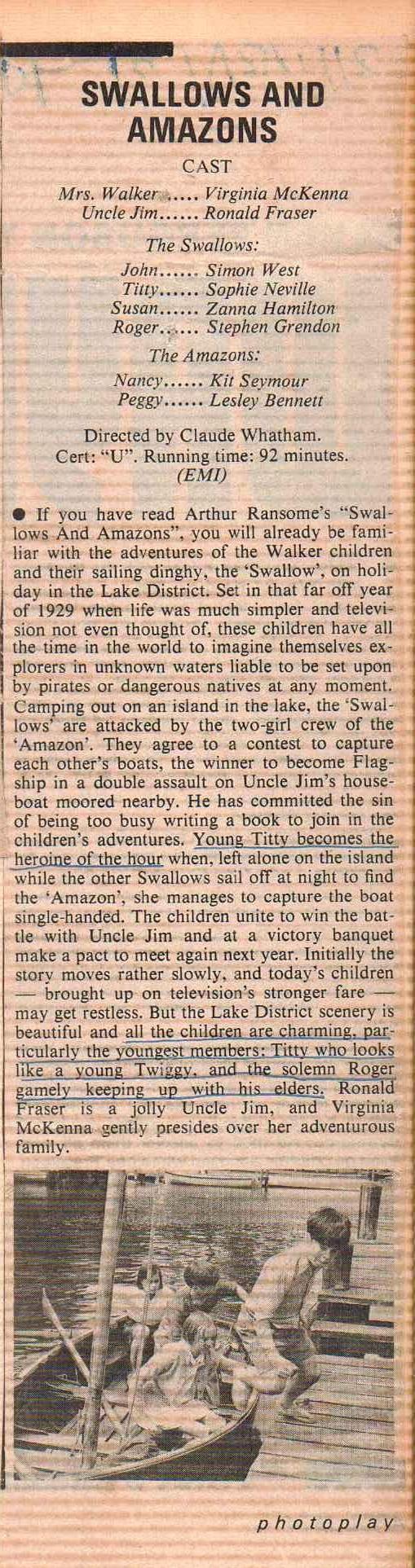
The April addition of the film fan magazine Photoplay, which featured Steve McQueen on the cover. It cost 20p in those days.
and a publishing magazine I hadn’t heard of called Smith’s Trade News ~
Virginia McKenna eating a banana with Claude Whatham outside the catering bus with quite a good photo of Swallow wired to the camera pontoon
Suzanna Hamilton, Stephen Grendon, Leslie Bennett, Simon West and Kit Seymour sailing the streets of London on polystyrene waves.
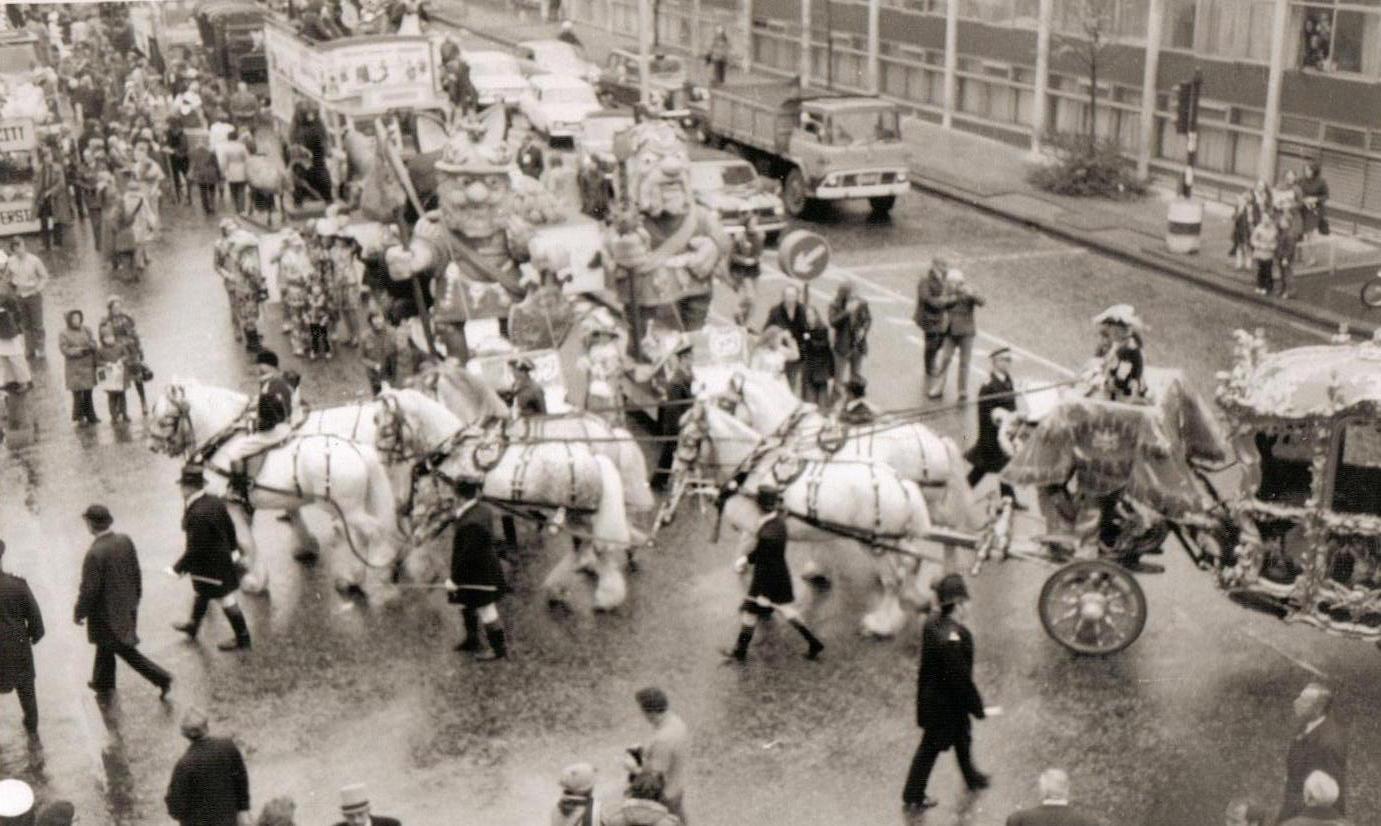
Our first major public appearance for the promotion of ‘Swallows and Amazons’ was The Lord Mayor’s Show . For the first time since the filming we climbed into our costumes and then into Swallow who had been mounted on low-loader. Afloat on a float, we made ready to sail through the City of London.
Sophie Neville, Suzanna Hamilton and Lesley Bennett
It must have been early November and was so very cold before we set off that we needed to keep our own coats on. We were anxious this would spoil things for people. I’m sure it would not have made much difference. Did anyone know who we were? The film hadn’t come out. We were riding on the wave that Arthur Ransome and his books were so well loved by the people of our nation.
Stephen Grendon, Suzanna Hamilton, Lesley Bennett, Simon West, Kit Seymour and Sophie Neville in Swallow. What is the building behind us?
What was fun, if a little odd, was that it was the first time, indeed the only time, that the Swallows and the Amazons had been in a dinghy together. As we were taken through the streets of London passers-by started to wave at us and we waved back. Soon it was waves all round. Being Titty, I had Swallow’s flag to fly. John let Nancy take the tiller.
Kit Seymour, Sophie Neville, Simon West and Suzanna Hamilton together with huge crowds of Londoners ~ photo: Daphne Neville
We were amazed to find huge crowds of people had gathered and that it was all rather fun. I don’t know why but Sten must have joined my mother on the pavement by the time this shot was taken. I can see the back of his head in this next photograph. He is wearing the tartan hat Claude Whatham bought him at Blackpool fun-fair.
Jeremy Fisher Frog was leaping about in front of us, which was rather amazing. With him danced other representatives from the Tales of Beatrix Potter, The Royal Ballet’s wonderful feature film that also came out in 1973/4. We were marking the 35th anniversary of EMI, whilst bringing the Lake District to London Town, which is something we all could celebrate.
Tamzin Neville meeting Mrs Tittlemouse
Since we didn’t have to talk to anyone, we were able to enjoy being involved in the pageant, which included so many icons of British Life.
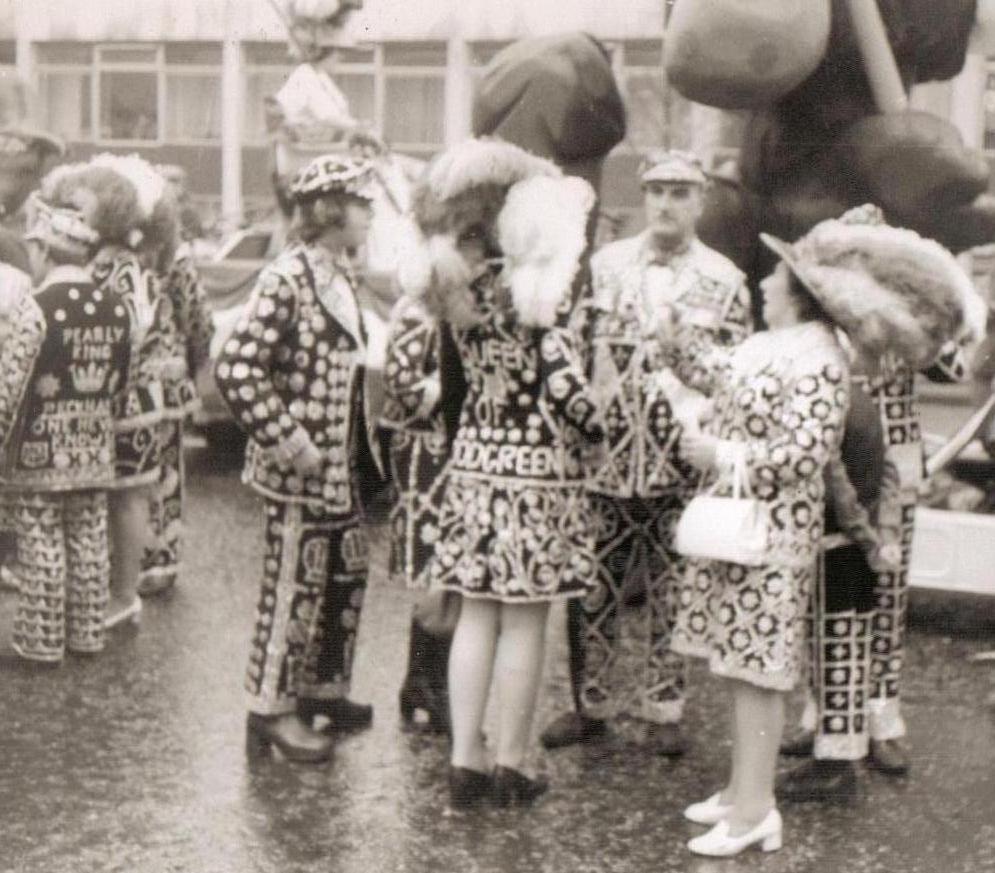
I hadn’t met a Pearly Queen before, but there was a whole clan of them in their glorious suits, lovingly embroidered with mother of pearl buttons. I resolved to collect enough to adorn my own jacket. My favorite view was of HM the Queen’s gold state coach pulled by her lovely white horses, six in hand. I’d been to see them at the Royal Mews when we came up for my first interview at Theatre Projects offices in Longacre when I first met our director Claude Whatham.
My mother took a photograph of the Queen’s Drum Horse. Much later she found that he was a stallion, on offer as part of a British Horse Society breeding improvement scheme. He was brought over to service her Irish mare Gerty. The result was a lanky skewbald called Nimrod, an enormous gelding who Andrew Parker Bowles rejected on behalf of the British Army. This proved an error. Like most heavy horses Nimrod was just slow to grow. He eventually became a national dressage champion, although not in our hands.
The Queen’s drum horse who sired our foal, Nimrod
We have one last photograph which shows that the float in front of us depicted an EMI film crew, with 2K lights, a camera and technicians. It is studing this photograph that made me feel that we were not in Swallow as the transom seems so differnet. I don’t suppose anyone else noticed.
Funnily enough I was in a boat for the Lord Mayor’s Show this year. We rowed up the Thames in the Lord Mayor’s procession on Saturday 12th November.
I am on the crew of the Drapers’ Barge, Royal Thamesis a 33 foot shallop, which I last rowed on the tideway for the re-creation of Nelson’s funeral covered by Sky TV. You may have seen her taking part as the in the Queen’s Jubilee Pageants. We have been asked to take part in the procession of boats that heralds the Lord Mayor’s Show this coming November.
The Drapers’ Barge ‘Royal Thamesis’ taking part in the Lord Mayor’s Show
This colour footage shows various aspects of the Lord Mayor’s procession in 1973 including the Queen’s Gold State Coach built in 1762 and a float with Daleks, which must represent Doctor Who, a series I worked on about ten years later when at the BBC.
It was time to say goodbye. We’d had the most wonderful seven weeks filming on the Lakes but the end had drawn in with the clouds. It was time to go home.
Since we lived in Gloucestershire it was a long drive south. I’m not sure how Jane and Sten Grendon got back, as I don’t think Jane drove, but we must have dropped off some of their things on our way past their village.
I remember seeing my real sisters and walking around the garden in the afternoon sunshine, looking at all that had changed. We’d left in early May, now it was full summer and the school holidays. I don’t know how I had the energy left to write up my diary.
Back in the garden at home with a swan
‘Shall we go and put flowers on Luppy’s grave?’ Perry asked. I hadn’t heard that our dear old dog, the sheep dog I had known all my life, had died while we were away. I was inconsolable. Mum explained that they hadn’t wanted to tell me when it happened as we were filming, she thought that the sadness on my face would have come through on camera. I understood this but was still desolate. Having had to cope with the grief of losing Luppy, on top of the heartbreak of leaving everyone I had grown so close to in the Lake District, I was not in a good way.
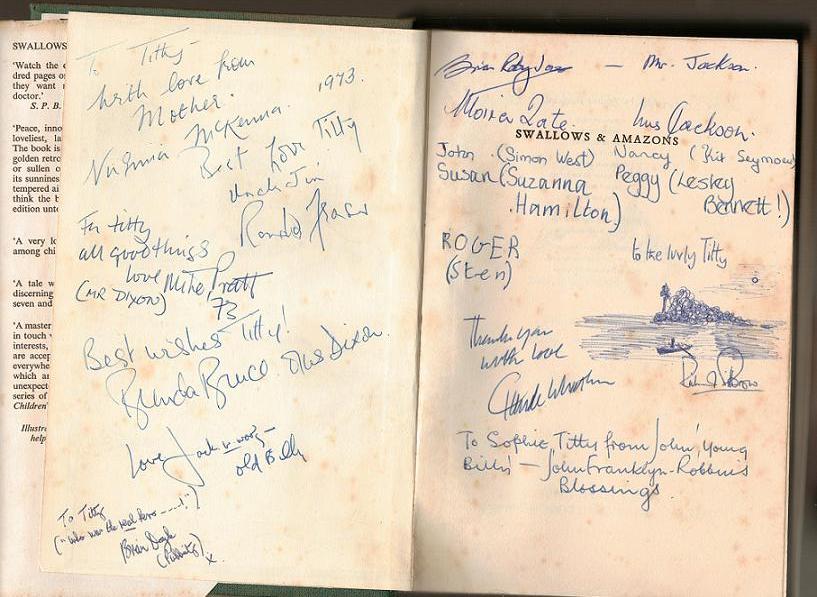
One of the most treasured things that I had returned with – apart from the lump of Cumbrian slate Jean McGill had given me – was a hard-back copy of ‘Swallows and Amazons’ signed by the entire cast and crew.
Signatures of the cast, director and producer of the movie ‘Swallows and Amazons’ in my hardback copy of Arthur Ransome’s book
Here you can see inscriptions from Virginia McKenna who had played my mother and Ronald Fraser who obviously saw himself as Uncle Jim rather than Captain Flint.
Mike Pratt and Brenda Bruce who appeared as Mr and Mrs Dixon, Jack Wolgar and John Franklyn-Robbins who embodied the Charcoal Burners with Brian Robylas (sp?) and Moria Late who played Mr and Mrs Jackson.
Stephen Grendon, Sophie Neville and Simon West with Brian Robylas ~ photo: Daphne Neville
It is interesting that all the children signed their character names with their real names in brackets. We must have grown to associate ourselves more with the characters names than with our own.
Claude Whatham in 1973
Claude Whatham wrote, with thanks, and Richard Pilbrow enchanted me by drawing a picture of Wild Cat Island at night.
Molly and Richard Pilbrow in 1973
Sadly, we didn’t manage to nab everyone on the crew, but collected a few signatures.
Brian Doyle, the film publicist on ‘Swallows and Amazons’ (1974)
The only other signature on this page is from Brian Doyle, Mum’s friend the publicity manager on the movie who encouraged us to collect the autographs.
Signatures of the rest of the cast and crew of ‘Swallows and Amazons’ in the back of my Jonathan Cape edition of Arthur Ransome’s book
At the back of the book David Blagden, who played Sammy the Policeman as well as overseeing the sailing.
David Blagden who played Sammy the Policeman ~ photo: Daphne Neville
David drew me a picture of what must be a vision of himself, sailing into the sunset in his little yacht Willing Griffin that had taken him across the Atlantic.
Phyllis B was my tapestry-making stand-in. Simon Holland our art director (set designer) drew me a wonderful set of crossed flags that were also paint brushes ~ a logo for my life.
Art Director Simon Holland at Bank Ground Farm in 1973 ~ photo: Daphne Neville
I have a signature from Kerry Darbishire (I thought she’d written Dartisnine) who played Bridget’s Nurse, our Fair Spanish Lady. Like the actors who played the Jacksons, she was not credited on the movie but played a significant part. She still lives in Cumbria.
Nurse with Baby Vicky, the ship’s baby at Holly Howe
We left Jean McGill, our driver and unit nurse, in Bowness-on-Windermere.
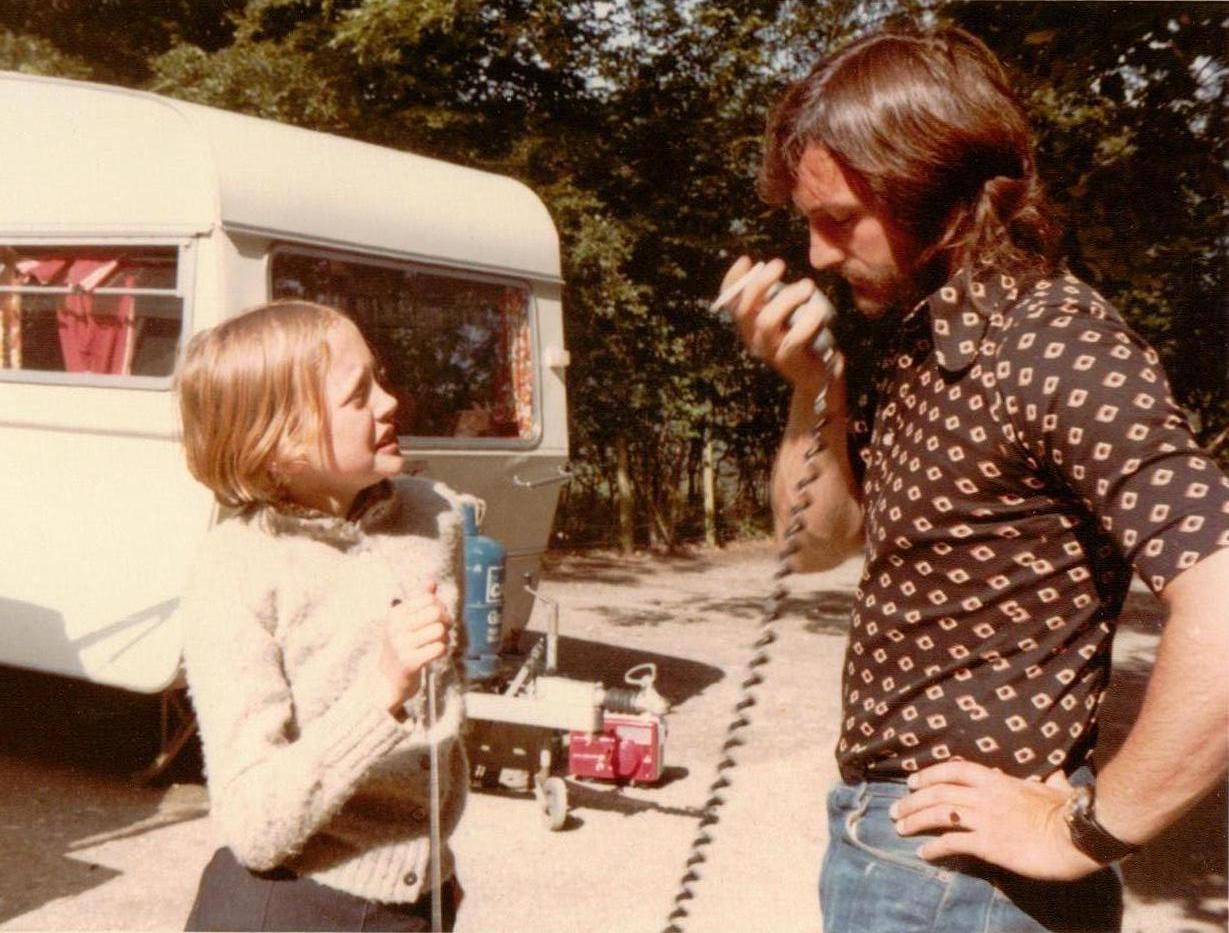
Jean our driver and location nurse operating the radio with Sophie Neville ~ photo:Martin Neville
Eddie Collins was the camera operator, Ronnie Cogan our hairdresser, Joni Turner was a local lady who worked on a few days as Suzanna’s stand-in.
Talking to Martin Evans the Gaffer and Terry Smith the wardrobe master while leaning on a lighting stand at Bowness-on-Windermere
Terry Smith was the wardrobe master, Albert Stills is Albert Clarke who took the black and white photographs day after day. Terry Needham was our long-suffering second assistant director.
Sophie Neville with Terry Needham and the unit radio at Derwentwater ~ photo: Daphne Neville
On the last page I have a very classy signature from Robert – who I think was one of the Keswick boatmen looking after the Lady Derwentwater.
Our boatman and the houseboat in 1973 ~ photo Daphne Neville
Denis Lewiston the DoP also left his mark on my life.
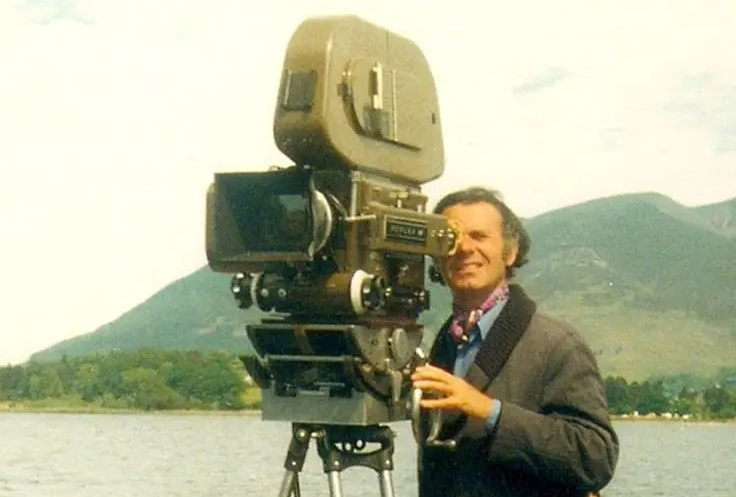
Dennis Lewiston, director of Photography on ‘Swallows and Amazons’ ~photo:Richard Pilbrow
Peter Robb-King signed himself ‘Make-up for the Stars’ and Gareth Tandy as ‘The Whip-cracker’, which surprised me as I had never seen his whip. Graham Ford obviously didn’t want me to change and Margaret Causey, our tutor, sent her love. We’d been though so much together and in such confined spaces.
Swallow and the film crew setting up at Bowness-on-Windermere ~ photo: Richard Pilbrow
Interestingly, I also have an inscription from Ian Fuller the sound editor listed as if he was around on location. I am sure he was the chap I would have met next. Claude and Richard would have gone straight down to the cutting rooms to edit the film. It is not usual for actors to enter such territory but our adventure was to continue. We were soon to be summons to the Elstree Studios of EMI at Borehamwood in Hertfordshire, just off the A1.
The crew as I remember them filming with Swallow and Amazon from the pontoon ~ photo: Richard Pilbrow taken on Derwentwater in 1973
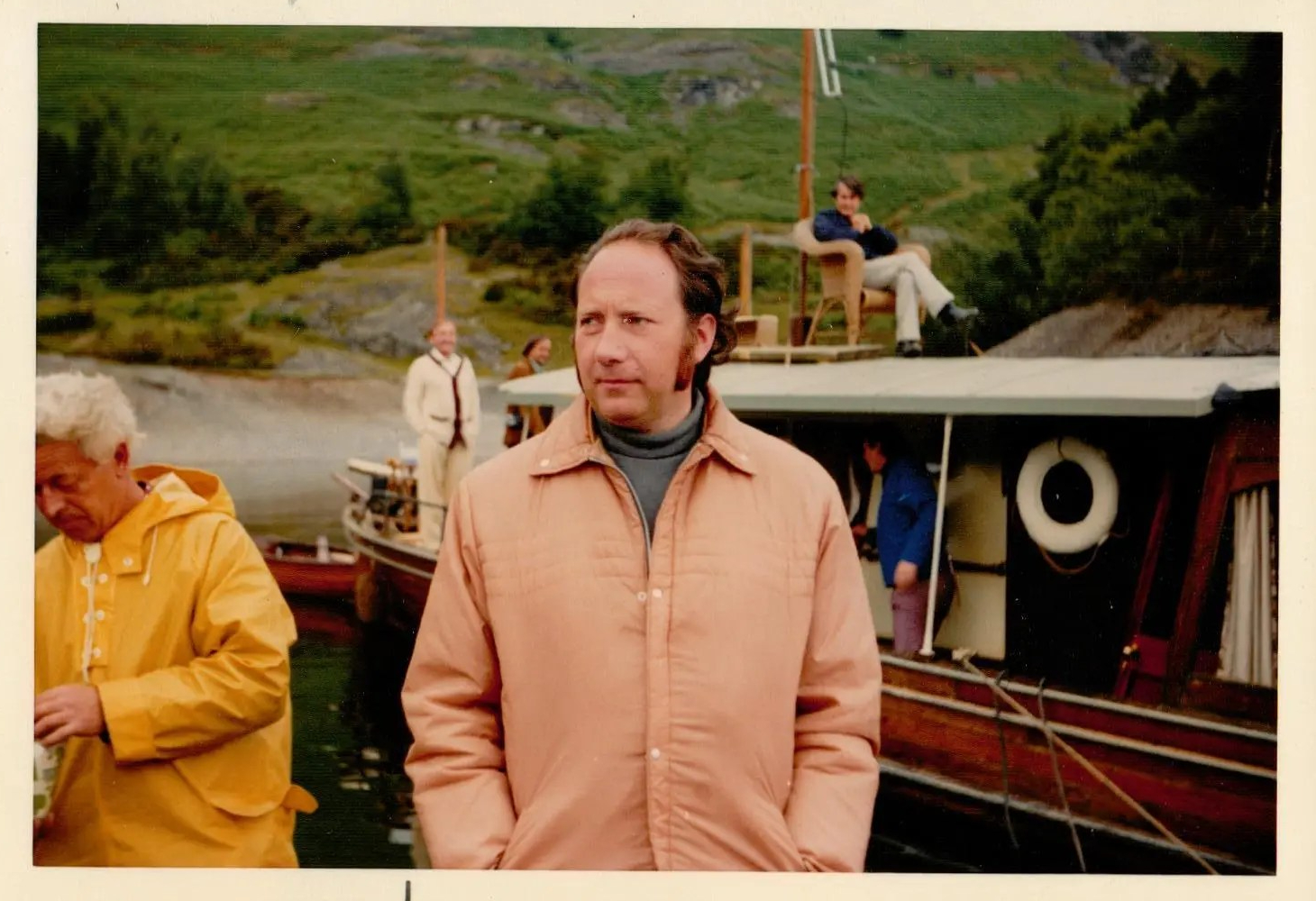
Producer Richard Pilbrow with production associate Neville C Thompson on Derwentwater in the Lake District in 1973
This photograph of Richard and Neville sitting on the deck of Captain Flint’s houseboat in the pouring rain must epitomize the struggles they went through to work around the weather and bring ‘Swallows and Amazons’ in on budget.
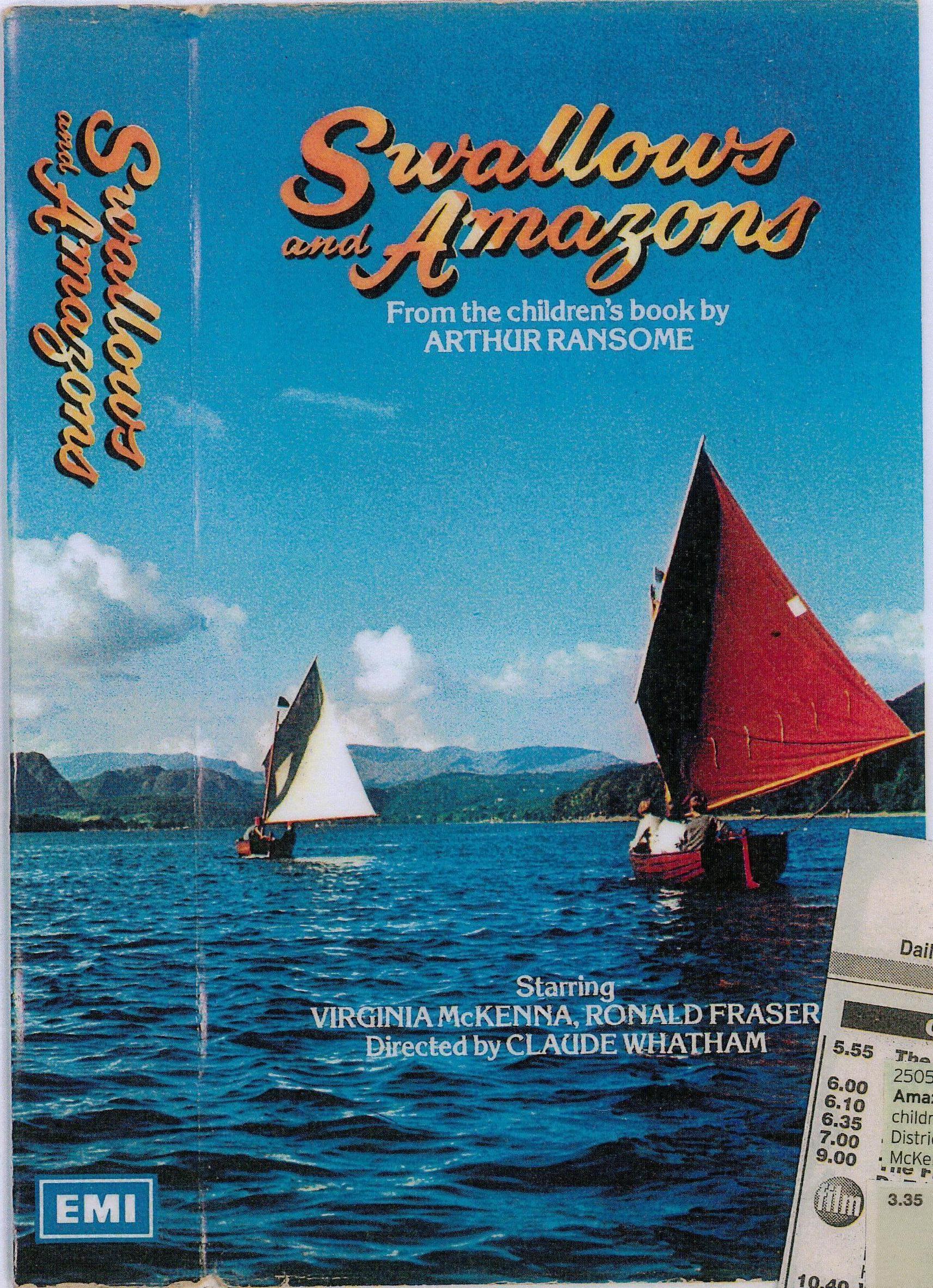
It was Claude Whatham’s dream to end the movie with an aerial shot of Swallow and Amazon sailing away from Captain Flint’s houseboat. He had a helicopter pilot standing-by with a special cameraman, but it wasn’t to be. He needed bright sunshine for the shot to cut with our farewell sequence after the battle. We waited three days but the weather was too dull and wet to film anything useful. I’m so glad. Claude ended up freezing the simple shot that captures Arthur Ransome’s book completely. It was used on the front of one of the first VHS copies of the movie.
The Amazons, played by Kit Seymour, Lesley Bennet and the Swallows, played by Sophie Neville, Suzanna Hamilton, Simon West and Stephen Grendon on the cover of the original VHS version of ‘Swallows and Amazons’
I’m afraid we hung about the very nice Waterhead Hotel in Ambleside getting bored and precocious, or so the evidence suggests. Since John and Margaret, our location caterers, had returned to Pinewood Studios, we were taken to the hotel restaurant for lunch.
We loved the cinema in Ambleside. Was it the same then as Zeffirellis, the cinema in Compston Road operating today? The adults must have found it a good means of keeping us peacefully entertained, but then again they were all film-makers who loved movies. Zanna didn’t come to the cinema that afternoon. She walked four miles up Wanstell Pike with Jane Grendon.
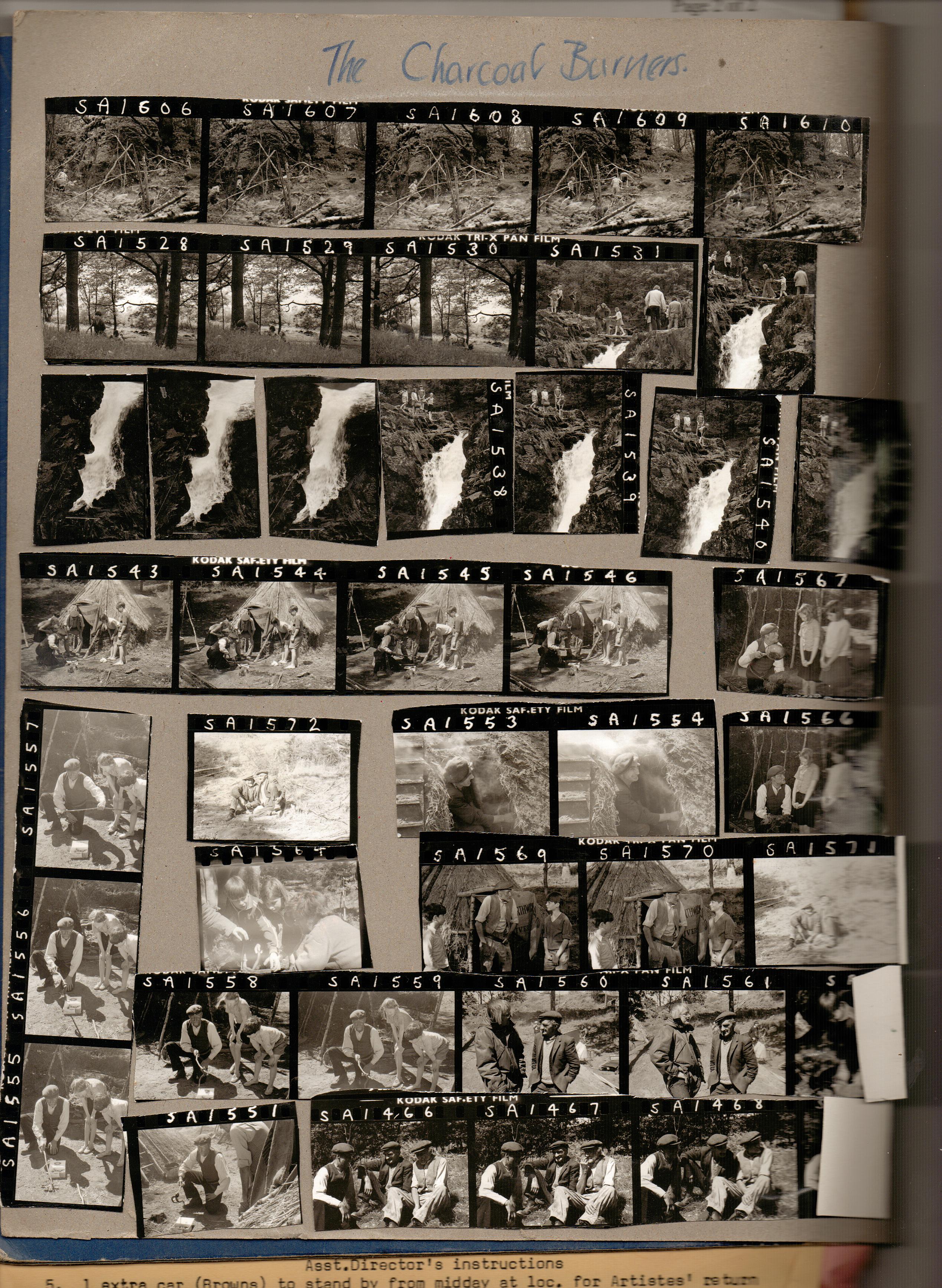
Albert Clarke, the stills photographer on the film crew, had given us contact sheets of the black and white photographs that he had taken during the filming. I spent my time at the Kirkstone Foot Hotel, where Claude and Richard were staying, with a tube of Copydex ~ or ‘rubber solution glue’, as they kept saying on Blue Peter, sticking the tiny photographs into the scrap books that I had been keeping.
Richard Pilbrow kindly let us choose large 10’x 8′ versions of the photographs, which we are able to take home to our families. I kept mine all these years, never using them for anything, but treasuring them as a memory of those happy, fulfilling days spent in Cumbria in 1973.
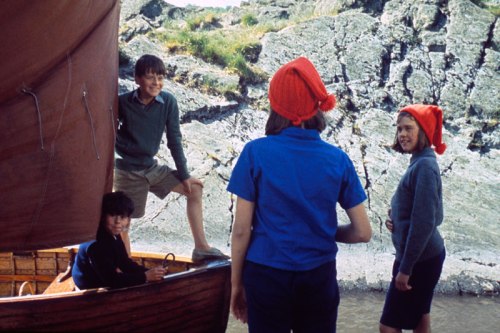
‘It’s Niagara!’ Titty declared. ‘We could get a barrel and bounce down it.’ Sten Grendon, Suzanna Hamilton, Simon West and Sophie Neville as the Swallows on their way to visit the charcoal burners










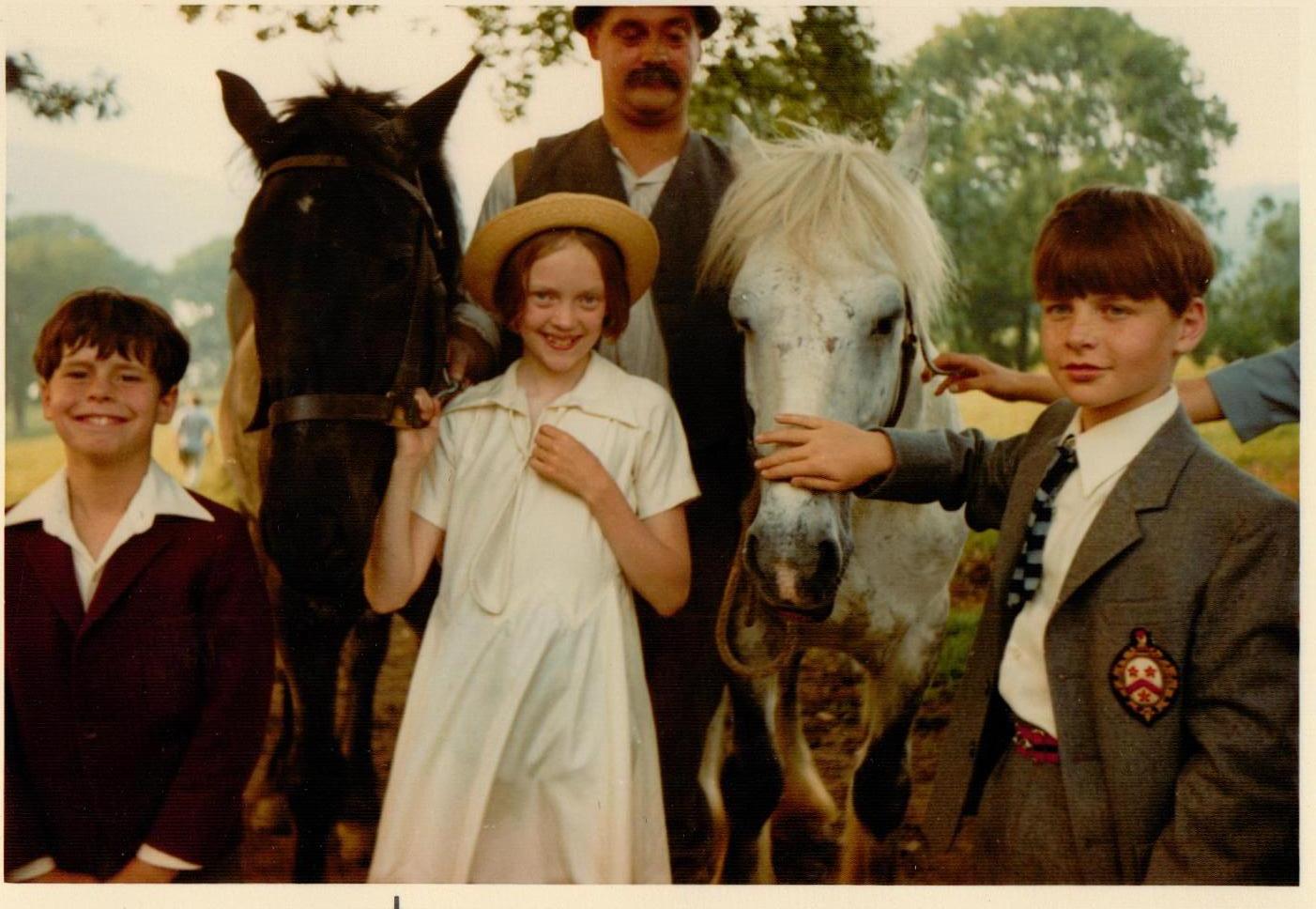


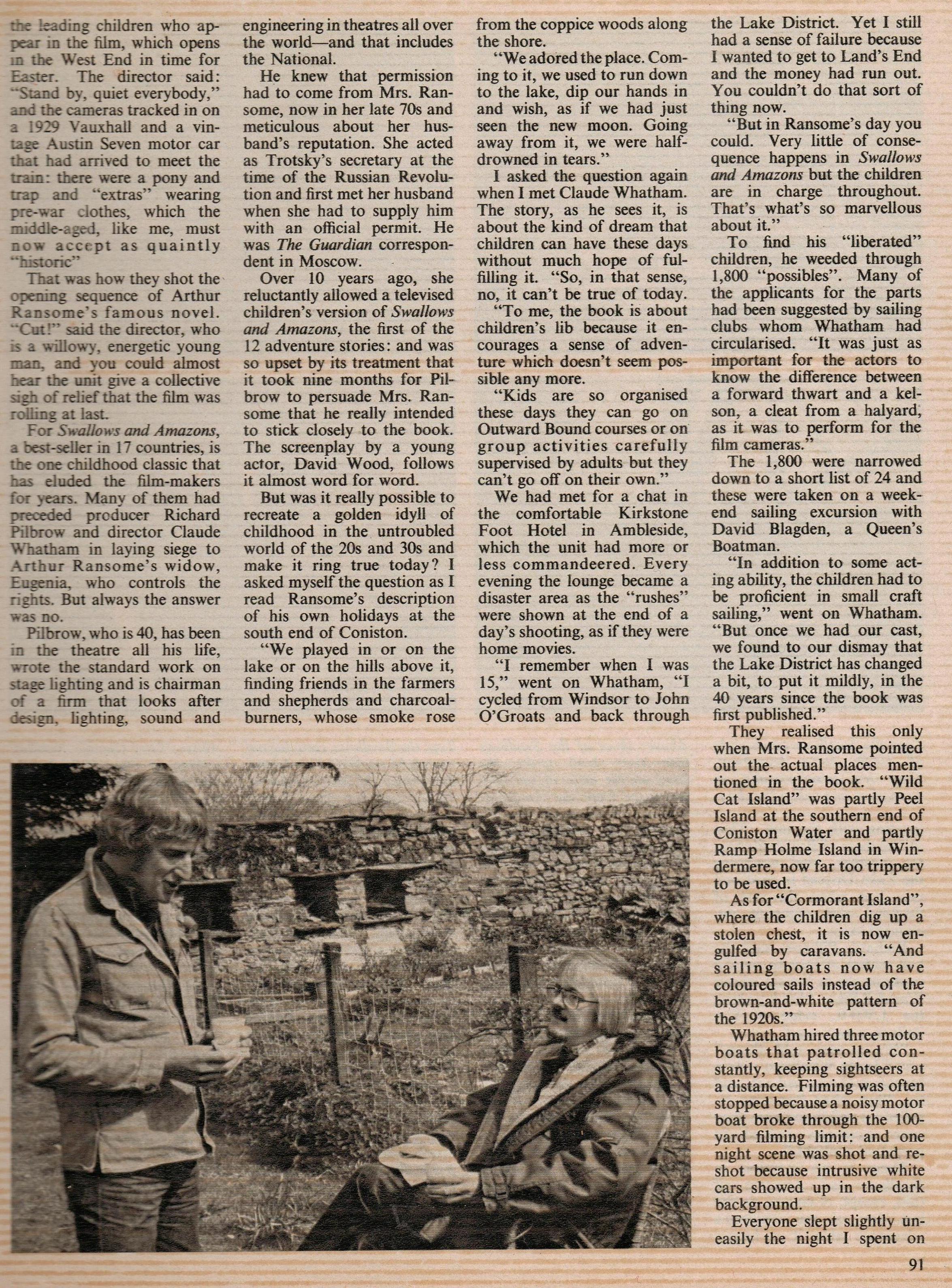
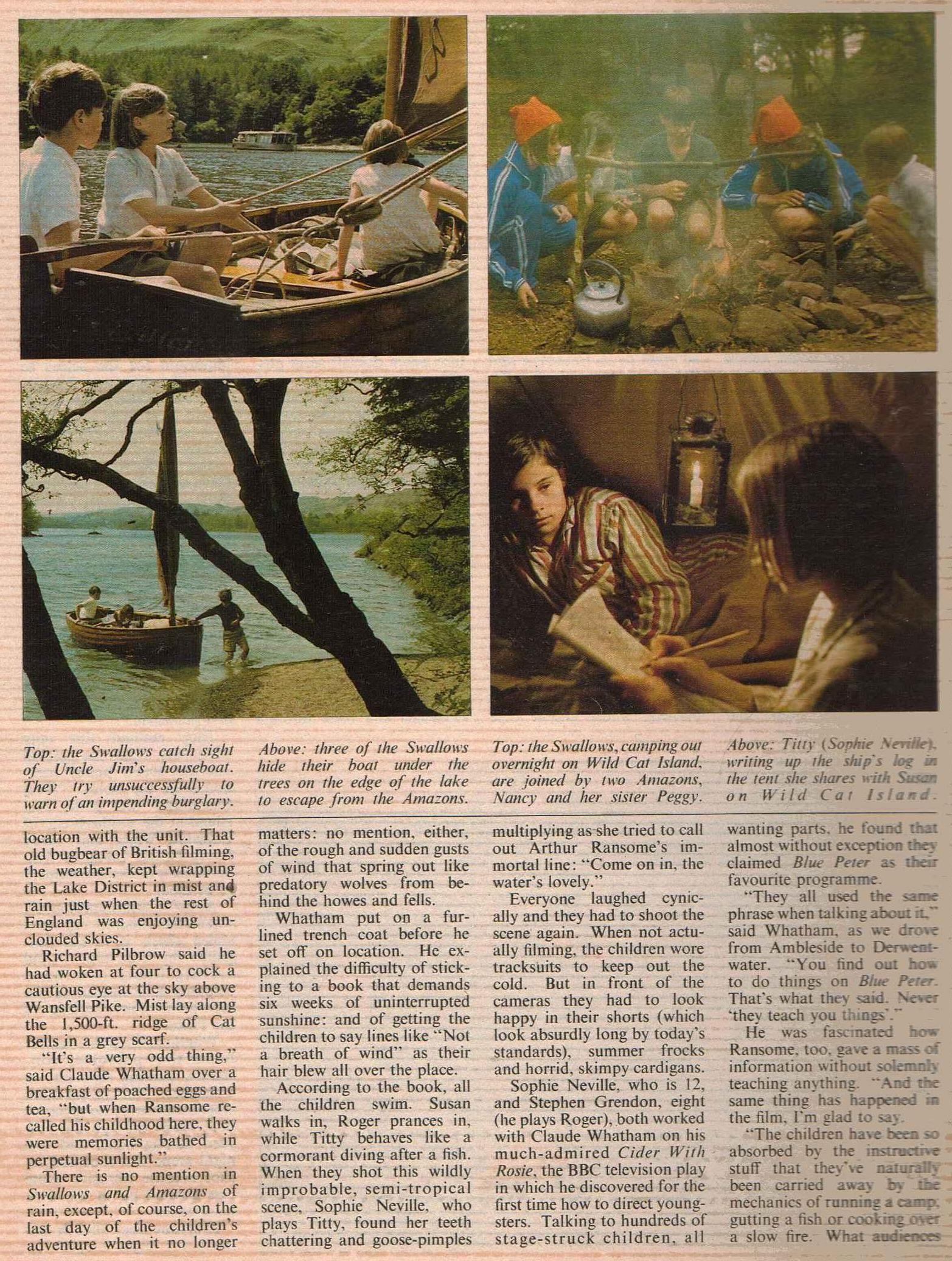
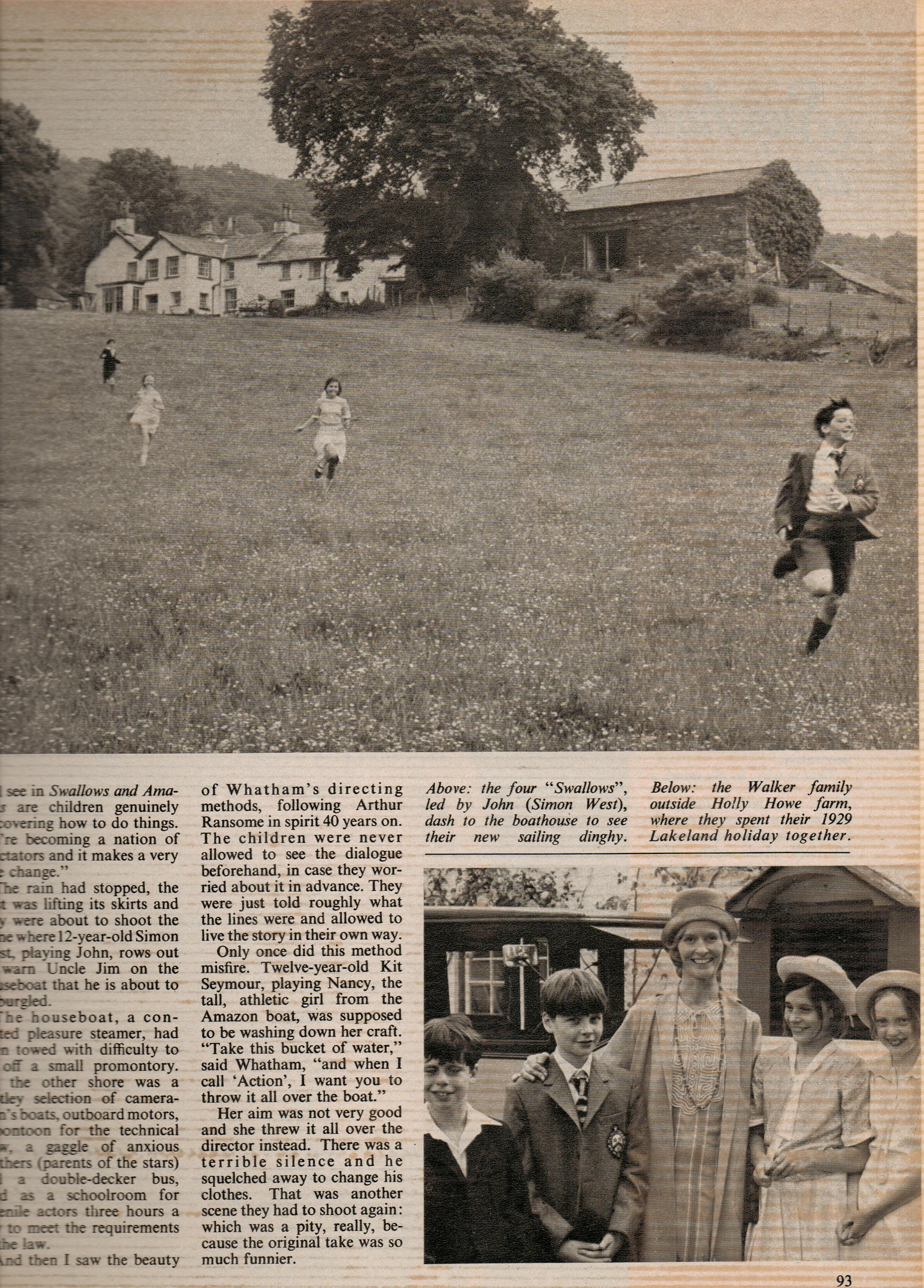





















 Sophie Neville