A book always makes a good Christmas present. Last year, items in the Authors and Illustrators’ auction, raised a total of £24,061 for BBC Children in Need. This year Children in Read has already exceeded this amount and there are four days left to bid.
This annual online charity fundraiser is organised by Children in Read through Jumblebee. co.uk. Taking part is great fun and offers authors a bit of publicity whilst presenting readers with the opportunity to buy a signed and dedicated book or illustration.
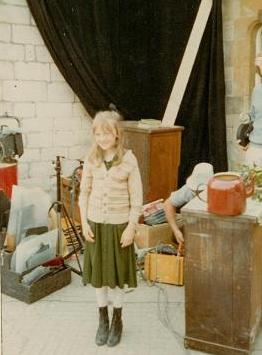
This amused me. It was a non-fiction book, written because the extraordinary story was true. Of all the roles, in all the novels ever written, I was asked to play Titty in Swallows and Amazons, an EMI film made in 1973 for universal distribution.
The offer came out of the blue. Within a year, I, an ordinary schoolgirl, found my image on the front of daily newspapers and on film posters pasted on the walls of the London Underground. All this happened nearly fifty years ago and yet the publicity never ends.
Arthur Ransome, a haunted foreign correspondent, who escaped from Russia with Trotsky’s secretary, wrote Swallows and Amazons in 1929 while suffering from stomach pains so bad they prevented him from travelling. He said that the book wrote itself, but it is clear that he was self-medicating, grieving his own childhood, when he’d been longing to make friends and prove himself to his father who died when he was only thirteen.
Tweed-clad and continuously pipe-smoking, Ransome was oblivious to Lakeland weather. I acted out his almost-real fantasy in nothing but a thin cotton dress and a pair of enormous navy blue elasticated knickers. My book on ‘The Making of Swallows and Amazons’ is not a novel, not a fantasy. It is a true story. The movie is streaming on Amazon Prime where you can watch the trailer.
Why was I cast in the film? Why me? I had loved all the Arthur Ransome books I’d read in the Swallows and Amazons series, imagined myself exploring Wild Cat Island and the Great Lake in the North. Did I ever ask the Lord if I could live out the stories for myself?
The reality began in Stroud, at the Subscription Rooms. I put up my hand when someone asked if there was a ten year-old girl who could play the piano. They didn’t say, “play well.”
A young director called Claude Whatham, who lived in the Cotswold village of Camp, was looking for children to appear in the 1971 BBC adaptation of ‘Cider With Rosie’, based on Laurie Lee’s haunting memoir. He needed to find a little girl who had been to a village school near Stroud. I had attended Oakridge Parochial Church School when it was heated by pot-bellied stoves and the vicar told us Bible Stories.
I was chosen to play Eileen Brown, who shared a desk with Laurie Lee and accompanied him as he played Oh Danny Boy on his violin at the Christmas concert.
Sophie Neville in the 1971 BBC adaptation of ‘Cider with Rosie’, directed by Claude Whatham
My music arrived three days before filming began. It consisted of endless cords – a complicated accompaniment with no tune. To tackle the piece, I’d needed to practice for seven hours a day with the help of my long-suffering piano teacher from Far Oakridge.
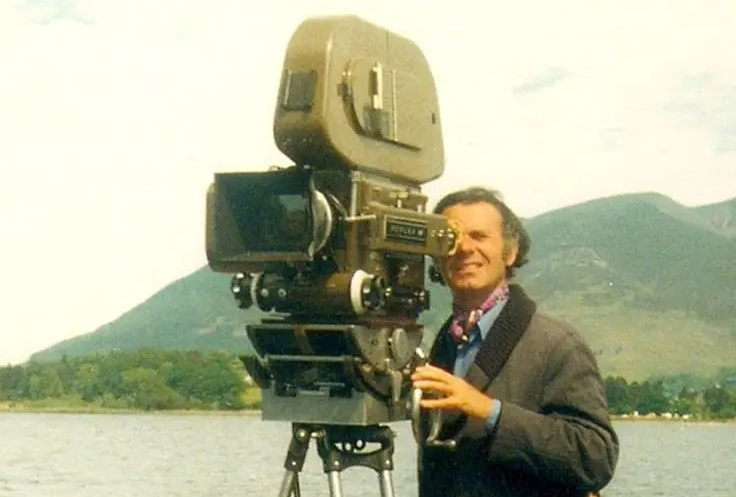
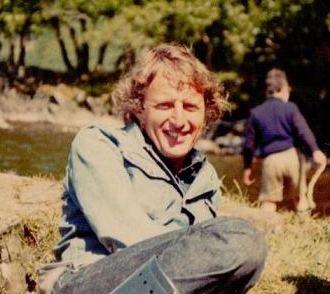
Claude Whatham ~ photo: Daphne Neville
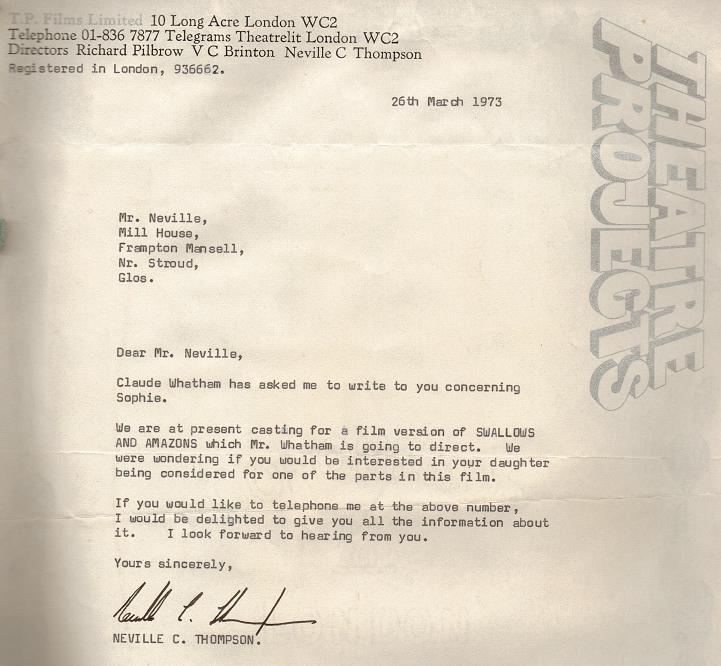
The director must have remembered me as a determined little girl because two years later a letter arrived, addressed to my father, only he was working in South Africa. My mother very nearly didn’t open it, however the words Theatre Projects were embossed on the envelope and she was intrigued.
But she did. We drove up from Gloucestershire to collect Dad from Heathrow and went straight to Long Acre near Leicester Square for an interview with Claude.
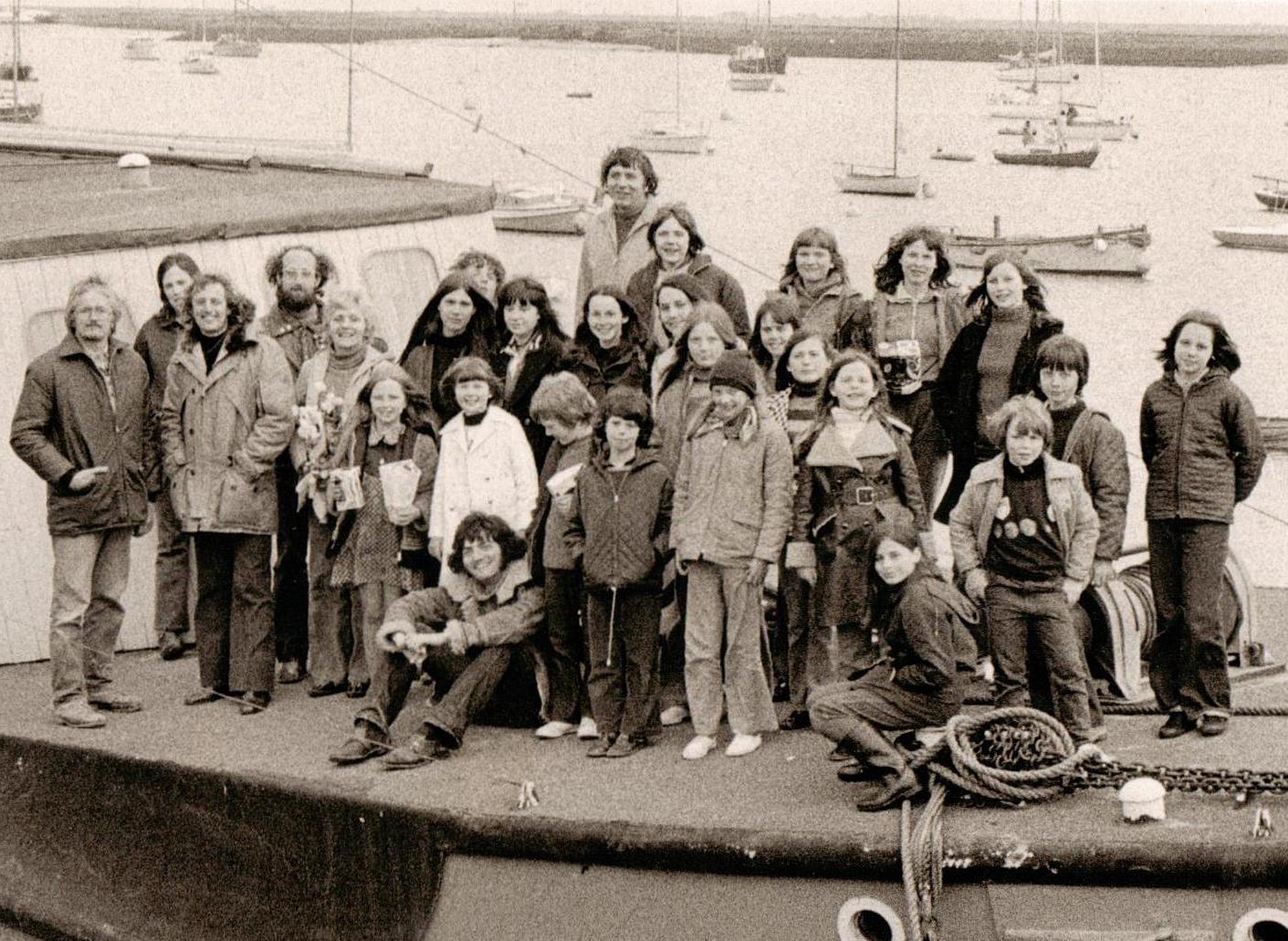
I was then invited to take part in a sailing audition at Burnham-on-Crouch in Essex – miles from the Cotswolds. The producer, Richard Pilbrow, was determined that any child chosen for a part knew how to sail. I had grown up beside one of the few lakes in Gloucestershire and knew how to row a Thames skiff. I’d added my own sail, made from a green dust sheet, but was no expert.
There were four other girls auditioning to play Titty. They were all smaller and prettier than me, with straight teeth. I didn’t think I was in with a chance.
The filming was to commence on 14th May 1973 and continue through the summer term. Our local authority – Gloucester County Council – needed my headmistress’ permission for me to miss five weeks of school.
Only, I didn’t go to school in Gloucestershire. I went to an Anglican convent in Berkshire. The nuns prayed about the proposition. They gave their permission – if I was chosen.
I didn’t think I was right to play Titty at all. I was three years too old and too tall. Ransome’s illustrations in the books portrayed girls with straight, dark hair. I didn’t know it but the character had been inspired by a real little girl called Titty Altounyan. I share her Scots, Irish and English heritage, but she was one quarter Armenian and had dark colouring.
However, unknown to us, Mrs Ransome had asked that ‘an English Rose’ should play Titty. Claude Whatham cast Sten Grendon, who had played Little Laurie Lee, as my younger brother Roger. Mrs Ransome – NB:the lady who once been Trotsky’s private secretary – was not happy that he had black hair. She nearly cancelled the film, but conceded when she saw him with a short-back-and-sides.
Sten Grendon as Roger and Sophie Neville as Titty rowing Swallow (c)StudioCanal
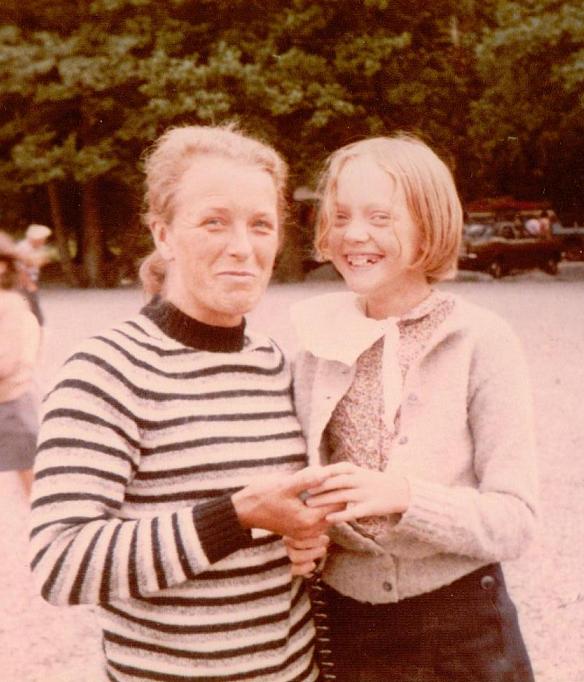
Sten claims we had the best parts. He grew up in the Whiteway Community and later went to school in Eastcombe. He now lives in France but still has family living in the Cotswolds. Back in 1973 his mother Jane, and my mother, Daphne, travelled up to the Lake District to look after us all.
Daphne Neville with Sten Grendon, Suzanna Hamilton, Sophie Neville, Jane Grendon and Simon West
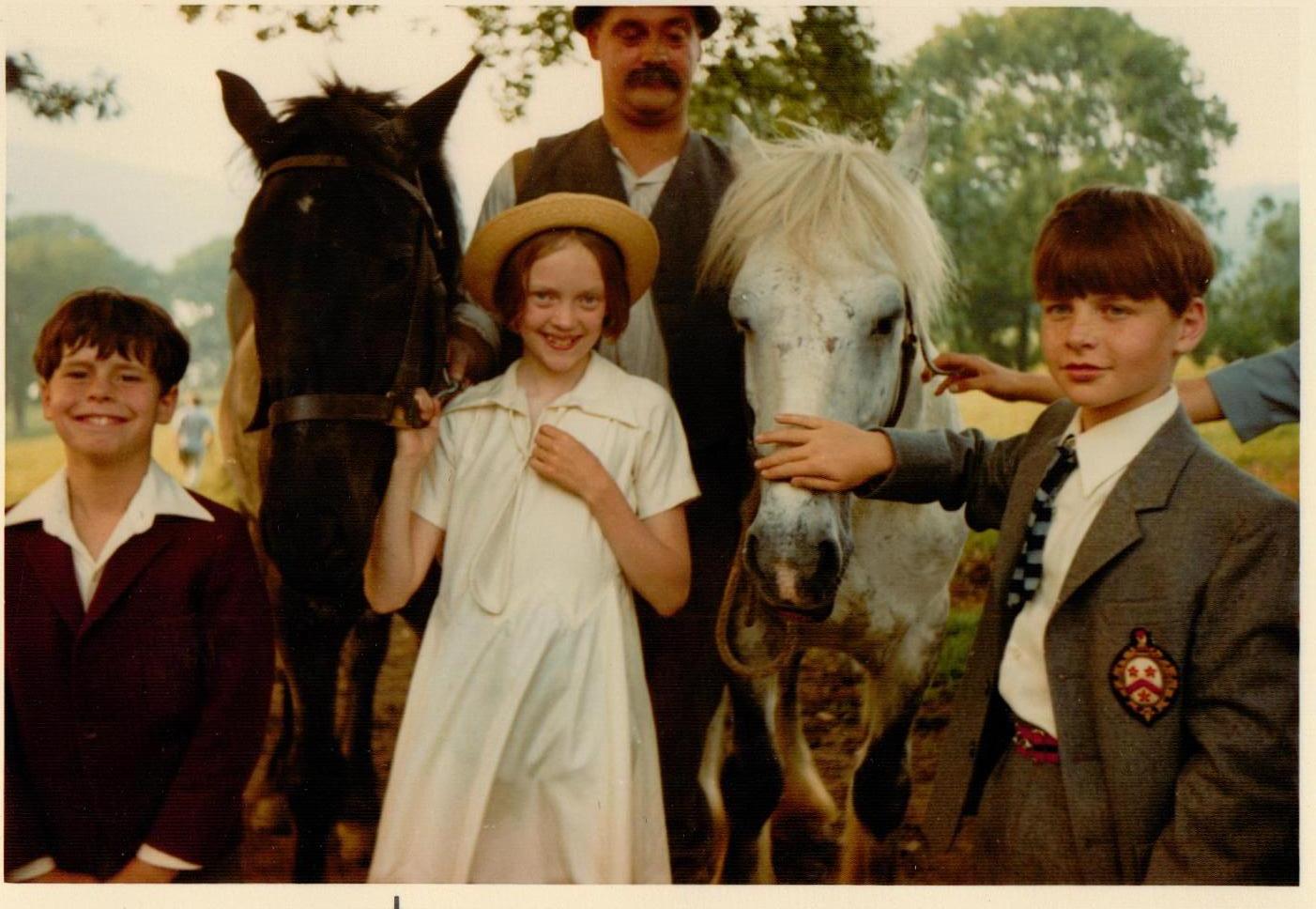
In at the deep end. Whoomph! We literally had to swim for it. The water was icy, but we had plenty of support. I was able to embody my part because Suzanna Hamilton, who played my sister, was so brilliant. She anchored us, as did Simon West, who played John. He was only aged eleven but very bright and a confident sailor.
Stephen Grendon as Roger Walker with Suzanna Hamilton on location in 1973
Making the film was character-building stuff. While it was an inspiration and privilege to work under arc lamps with Virginia McKenna, it was often chilly and involved a lot of hanging around.
Stephen Grendon, Simon West, Virginia McKenna, Suzanna Hamilton and Sophie Neville, trying not to look as tall as she was in 1973 ~ photo: Daphne Neville
Virginia had four children of her own and brought us together as a team. While making things fun, she got us to focus and concentrate as we recorded the first scenes at Bank Ground Farm.
Virginia McKenna at Bank Ground Farm in 1973 ~ photo: Daphne Neville
Arthur Ransome had been inspired as a boy by two of his aunts who left for Peking to serve as missionaries. They must have had great adventures. One even received a Boxer arrow in her bonnet. The story of Swallows and Amazons is about a family of four children on holiday who embark on something of a missionary journey themselves when they are allowed to sail off in a dinghy called Swallow to explore an island on a lake. They are confronted by two local girls, the Amazons, who are behaving badly, as their Uncle Jim has retired to his houseboat so that he can concentrate on writing his memoirs.
There is a strong undercurrent of fatherless-ness. Ransome had lost his own father before he could prove himself. The Swallows, whose father is in the Navy, come alongside the Amazons, who have lost their father and are being ignored by their uncle. They unite, make friends and have a lot of fun, whilst relishing in their independence granted because they are not duffers.
The crisis, in the story, is about the draft of a book being stolen, which I can only think must have been Ransome’s greatest fear. No one believes Titty, the youngest girl, who is sure she heard the burglars, so – in the film – she gets Roger to help her row Swallow to Cormorant Island where she finds it in what looks like a treasure chest.
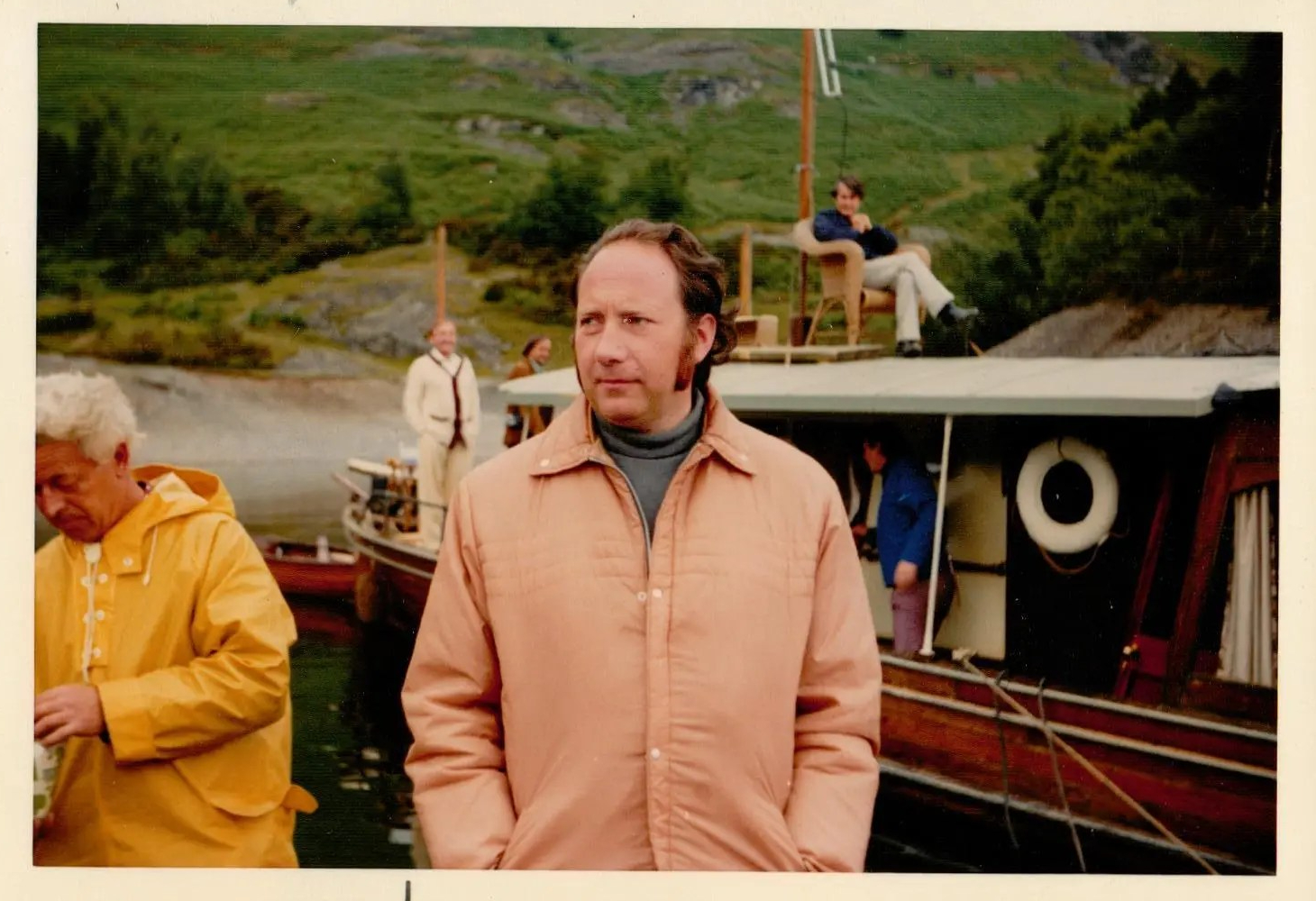
Producer Richard Pilbrow and Production Associate Neville C Thompson on Derwentwater in the Lake District in 1973
Richard Pilbrow and Claude Whatham had a tough time making the movie. Filming in the Lake District with its unpredictable weather and pressure from tourists was not easy. We faced endless problems and over-ran by two weeks.
But Mum was praying, Granny was praying, the nuns must have been praying for me – we needed the covering: I was the only girl who never fell ill. Swallow’s mast broke. I fell in. Water sloshed into a support boat. The rain poured down. We nearly crashed into the Tern. Our life jackets proved useless. There was a gas leak in our bus. We could have had an explosion. Most of the crew smoked continuously.
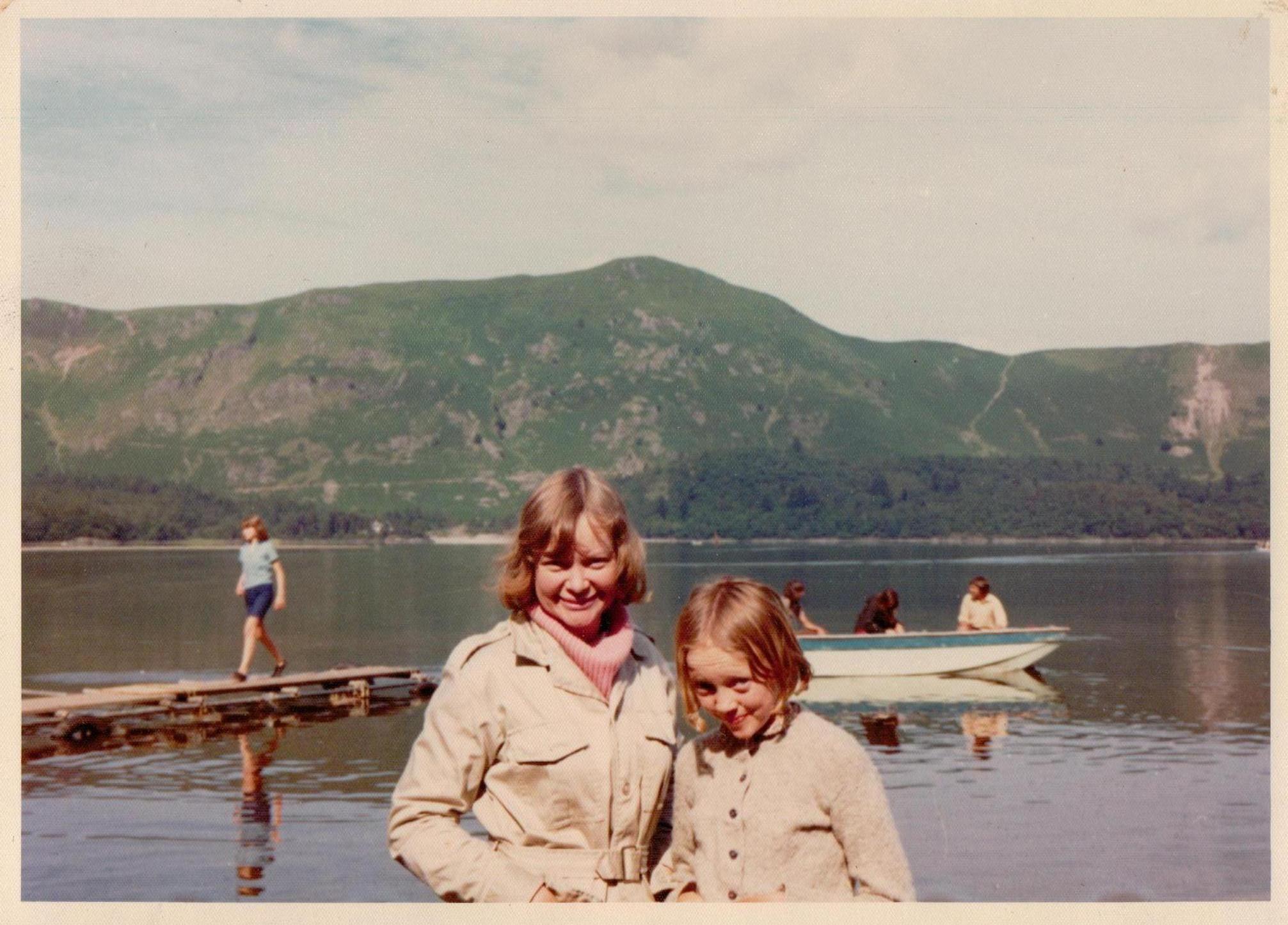
Sophie Neville with Daphne Neville in the Lake District
The behavior of some members of the film crew was pretty toxic. Many drove too fast. A cow fell on to the producer’s car. I fell out of a tree whilst playing. Suzanna cut her finger. Ronald Fraser was almost permanently pickled. Someone got hit in the eye by a baseball. The film set was vandalized and I lost a tooth halfway through filming a scene with Virginia McKenna.
Virginia McKenna with Sophie Neville keeping her mouth shut ~ photo: Daphne Neville
We pushed on. Ran the race with perseverance. Somehow the challenges gave the finished film an edge, an enduring quality that made it into a classic.
Sophie Neville as Titty
The crew began asking if I would go on to act. The big question: was this a calling on my life? I didn’t just play Titty. I’d been part of the production team, suggesting that Ransome-like title graphics were used, that Seymour’s voice was used for Nancy. I didn’t want to act. I wanted to become a film director.
I’d enjoyed the post production work at Elstree Studios but disliked the fuss around the cinema release. Seeing yourself on camera always feels uncomfortable. The premiere of Swallows and Amazons was daunting.
Premier ticket for the Gala of ‘Swallows and Amazons’
It was first screened at the ABC in Shaftesbury Avenue alongside The Exorcist. But look! I literally had two guardians. My mother invited the nuns from school.
The ABC in Shaftesbury Avenue in 1974. It is now the Odeon Cinema.
Sister Allyne came. She didn’t flatter me but she was there.
Sister Allyne, Daphne Neville, Tamzin Neville and Sophie Neville
Like it or not, I ended up promoting the film on television. After I featured in ‘Animal Magic’, an image of me, rowing up the lake at Bakers Mill in the Cotswolds with a green parrot on my shoulder was used to replace the test card.
I grew too tall to continue playing children on screen and there was not much money for film finance in the 1970s when inflation was roaring. Sister Allyne prepared me for a film test for a musical Disney adaptation of ‘The Old Curiosity Shop’ but I wasn’t chosen. The movie flopped. I returned to my lessons.
At the age of fifteen I had a leading part in an adventure film with Vic Armstrong and Sophie Ward, called ‘The Copter Kids’, and I had a few little television parts in serials like ‘The Two Ronnies’ and ‘Crossroads’ while I was a student, but the drive wasn’t there. It was just as well. I didn’t have the bone structure.
Suzanna Hamilton playing Susan with Sophie Neville as Titty busy writing the ship’s log
Suzanna had a strong desire to act professionally and fought for parts. She went on to appear in Tess directed by Polanski, 1984 opposite John Hurt, Out of Africa with Meryl Streep, Whetherby with Vanessa Redgrave, Brimstone and Treacle with Sting, and a number of increasingly dark movies. She survived to appear in Casualty, New Tricks, Eastenders and is still working.
What she hated was the publicity. It’s a difficult part to any job. As she said at the age of twelve, having your photo on the front page of the Evening Standard ‘makes you felt a right twit’. She was furious with me for writing about her under sung talent in the Telegraph even though she looked beautiful in the arms of John Hurt.
I developed a burning desire to direct and went into television production. I made my first documentary for Channel 4 whilst driving from London to Johannesburg. I must have begun directing at the BBC at the age of 27 and produced my first series aged 29, but overdid it and was hammered by ill health. It was a good training. I learnt endurance, how to edit and I grew used to working to deadlines. I understood about moving the audience, cliff-hangers and bringing out books to accompany your work.
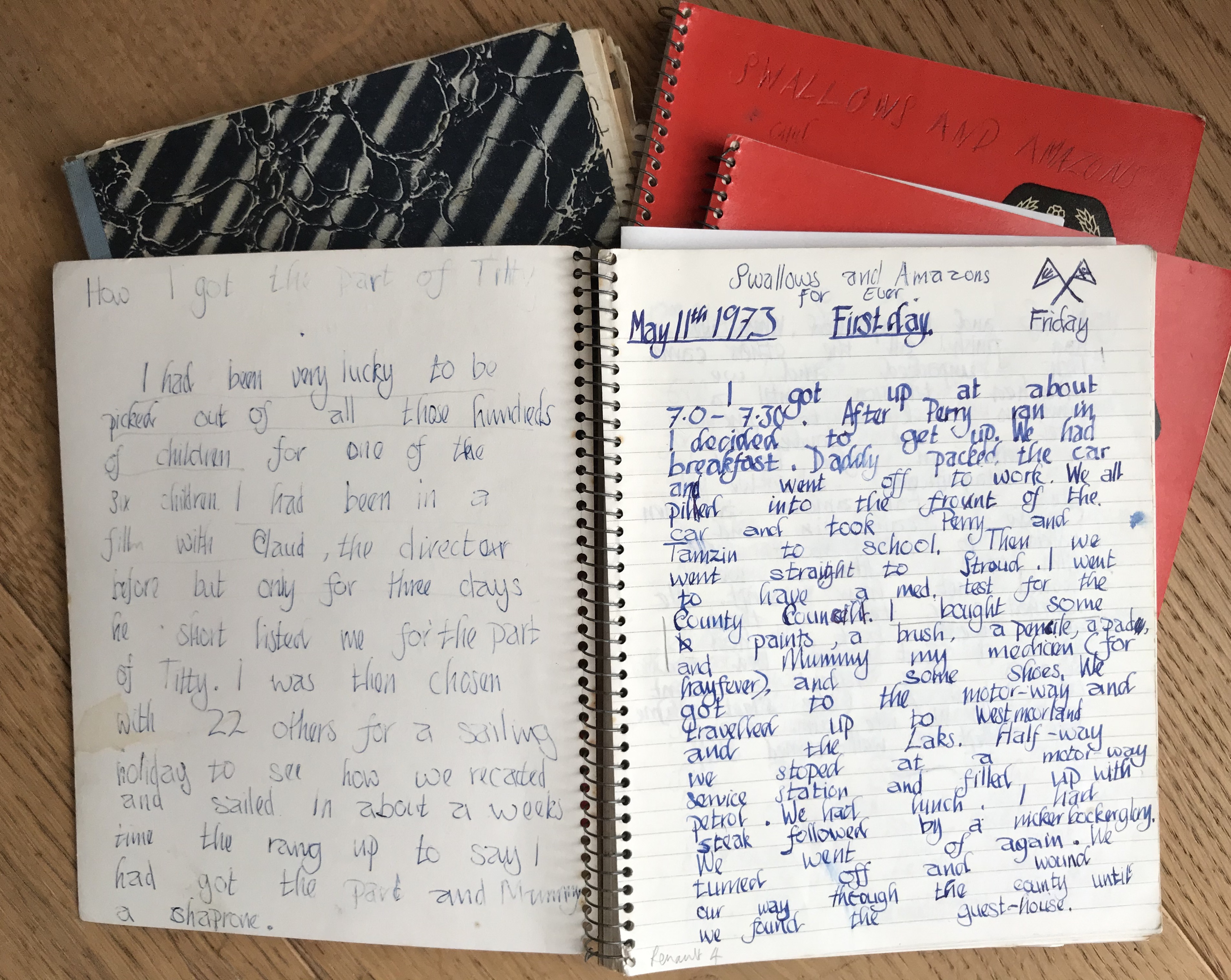
I didn’t learn to embrace the marketing aspect until I worked in the safari industry when I was assured it comprised 50% of the job. This attitude helped when I became and wildlife artist and later an author. After writing two books my readers – and my formatter – implored me to write about the making of Swallows and Amazons, especially once they learned that I had kept a diary whilst making it – as did Suzanna.
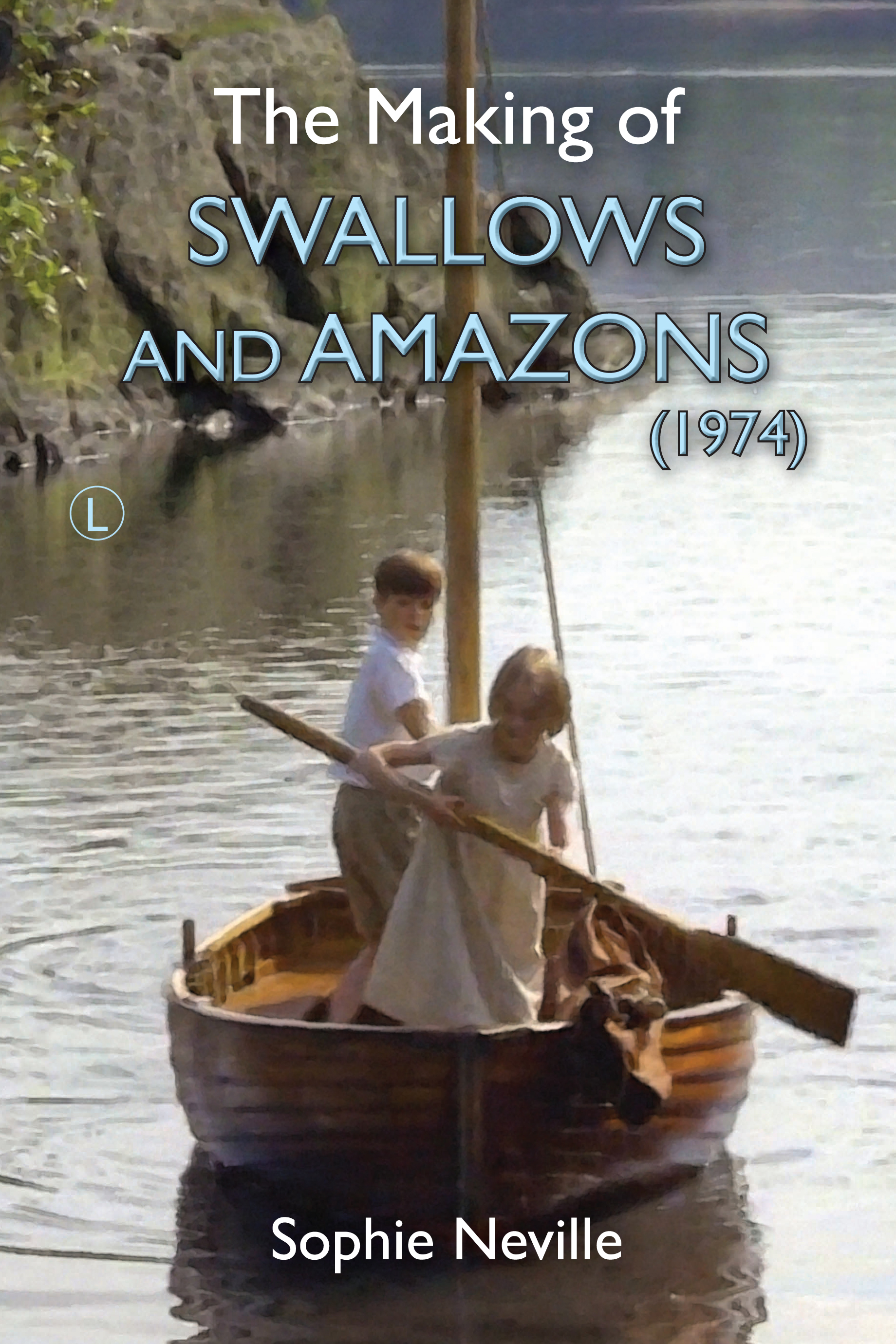
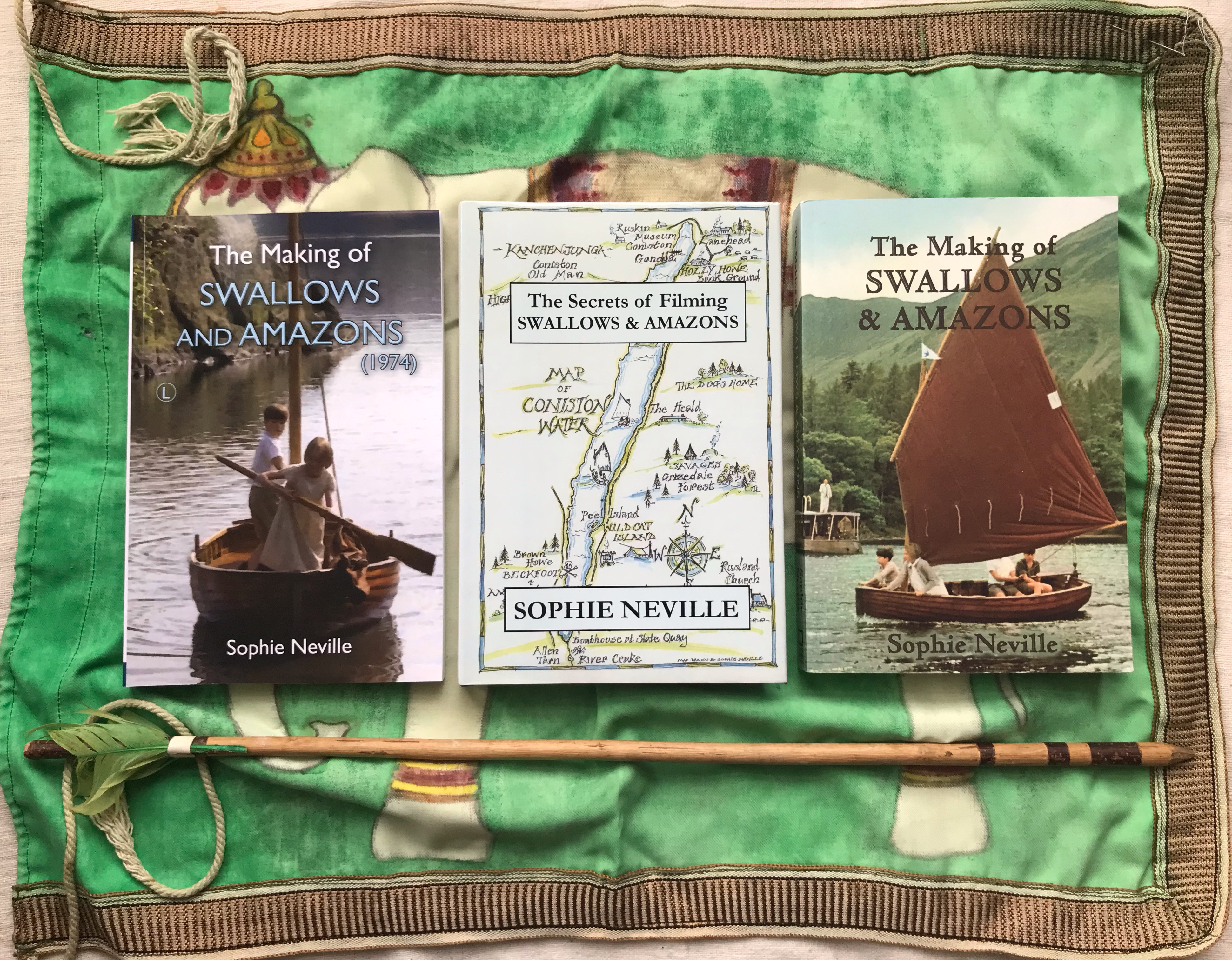
I first brought this out as a multimedia ebook, which is now in its second edition. It includes links to the cine footage my parents took on location. There are two versions of the paperback entitled ‘The Making of Swallows and Amazons’, seen here on the flag we captured.
Different editions of ‘The Making of Swallows and Amazons (1974) by Sophie Neville’
It has been a delight to figurehead a story about sailing, a pillar of childhood that has influenced so many. Parents want me to engender a love for the outdoor life, sailing and exploring the lakes and countryside.
I hope I have helped to attract the right kind of people to the Lake District, that we have been able to inspire young people to read Arthur Ransome’s books, to get out into the countryside and sail, fish, go camping, build friendships, whatever the weather.
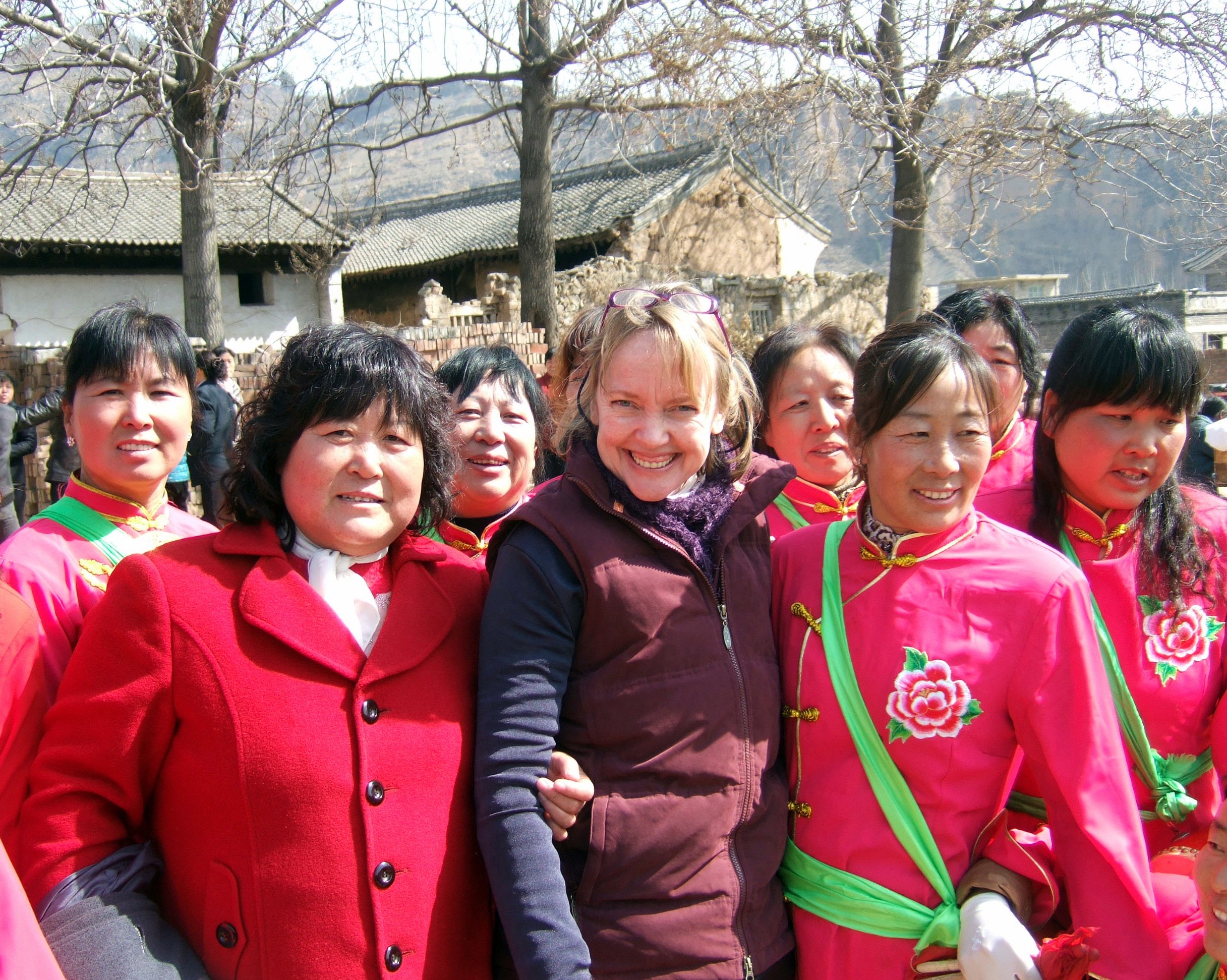
In the footsteps of Ransome’s great aunts, I went on a Bible Society mission to China. The people we met thanked us for coming, saying they hadn’t received European visitors for forty years. ‘But we’ve seen Europeans in town.’ ‘Them? They have just come to make money, not visit us.’
Does the old film shine a light, offer solace? People write in to tell me that the film of Swallows and Amazons carried them through a difficult patch. Some watch it once a week. It exists to remind people that they need not despair.
Does the symbolism still hold? It was my self-appointed job in the screenplay to wait, alone, and light the lantern, to be a light in the darkness that could be seen for miles.
Swallows and Amazons was not made to make money. It wasn’t the producer’s motivation. Richard Pilbrow just loved the books and wanted to bring them to life. We children didn’t do it for the money. There wasn’t very much. I earned £7.50 a day and was given a book token for appearing in the Lord Mayor’s Show. Even today, StudioCanal were reluctant to pay my expenses for re-launching the 40th Anniversary DVD when we were interviewed for the Extras package.
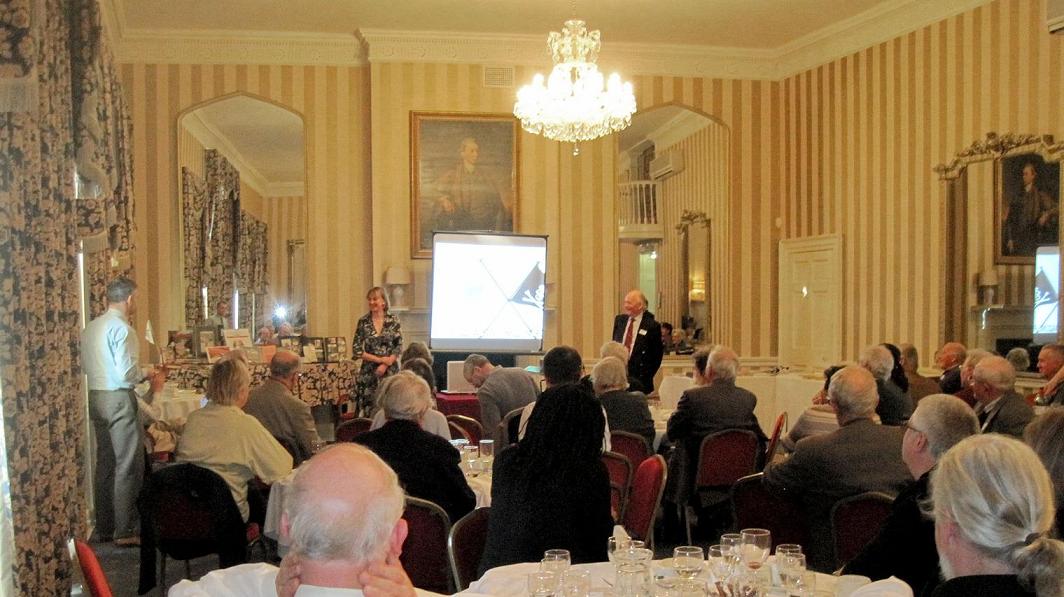
It doesn’t matter. I have been so warmly greeted so warmly by fans of the film. I was invited to become President of the Arthur Ransome Society, and have been offered numerous opportunities to speak about my books. I’ve passed on most of my speaking fees to charity – sending disadvantaged children in South Africa on an environmental course that has literally changed their lives.
Sophie Neville speaking at The Arthur Ransome Society
The treasure Titty found wasn’t pieces of eight. It was heavy to carry, but she was rewarded for her tenacity. She was given her heart’s desire, and parrots live a long time. They can easily outlive their owners.
The author Julia Jones points out that, ‘the treasure that was finally unearthed on Cormorant Island was a book. It might or might not have been a good book but the message of the story is quite clear: if you’re convinced that there’s something hidden under the rocks, all you can do is keep digging.’
An extra ordinary thing happened. When Richard Pilbrow was awarded an honorary degree from he invited Suzanna and I to lunch in London. As we left the restaurant in Covent Garden a group of buskers outside where singing the final sea shanty from the film, What Shall We Do With the Drunken Sailor? What were the chances of that? We hurried on to find transport and found ourselves outside the cinema where the premier had been held.
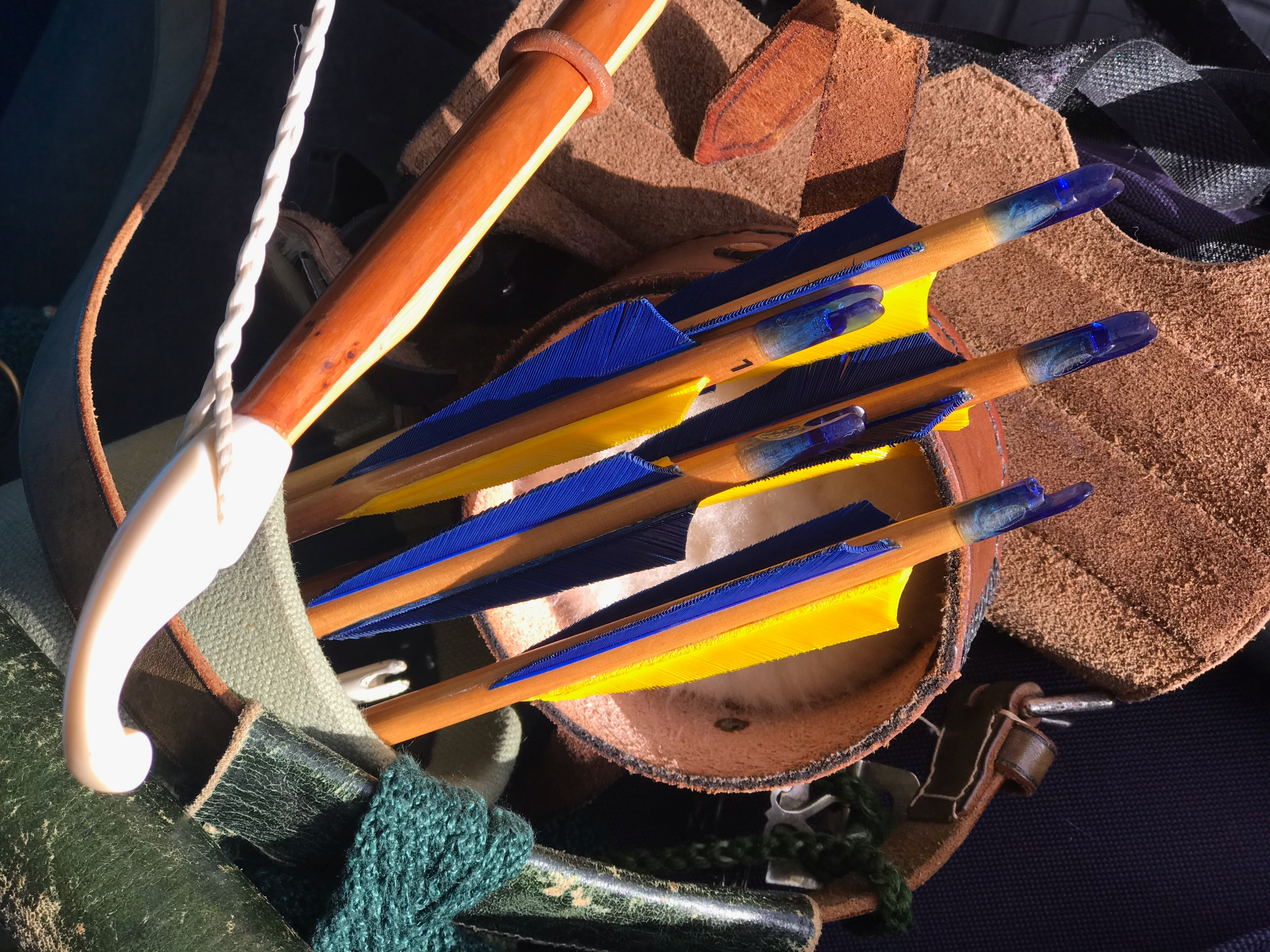
Something else happened to me as a result of Swallows and Amazons. Not what you might expect. We all wanted to learn to shoot with a bow and arrow. The next film role I was offered was as an archery champion. I kept up the sport, and ended up meeting my husband at a long bow meeting in the village where I was born. He was the chairman of the archery society. I won the Best Lady’s Gold. These are my colours:
Proverbs 23-23 talks of wisdom, instruction and insight. My name, Sophia, means wisdom. My hope is that others gain wisdom and insight from what I have written.
You can read more in ‘The Making of Swallows and Amazons’, which is coming out as an audiobook. It will available from all the retailers and is currently on Scribd here.
The school term is over, ‘Swallows and Amazons’ is on BBC iPlayer and Christmas missives are arriving in the post. I have just been sent this homemade card from someone who came to the premier of the original film in 1974, when I was fortunate enough to play Able seaman Titty.
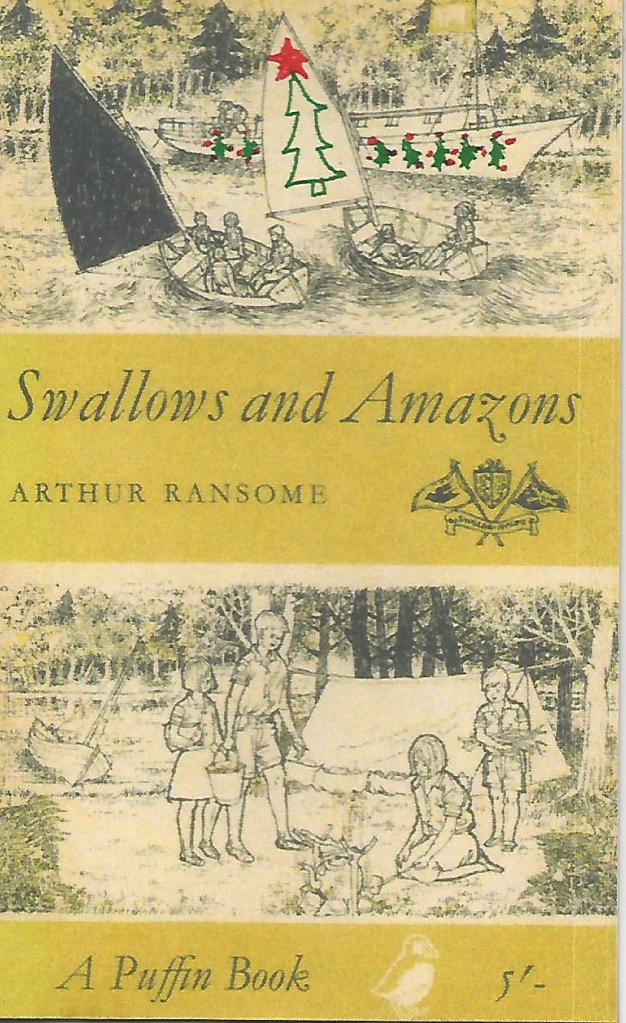
~Captain Flint hanging Christmas decorations around his houseboat on a card made from a Puffin book cover~
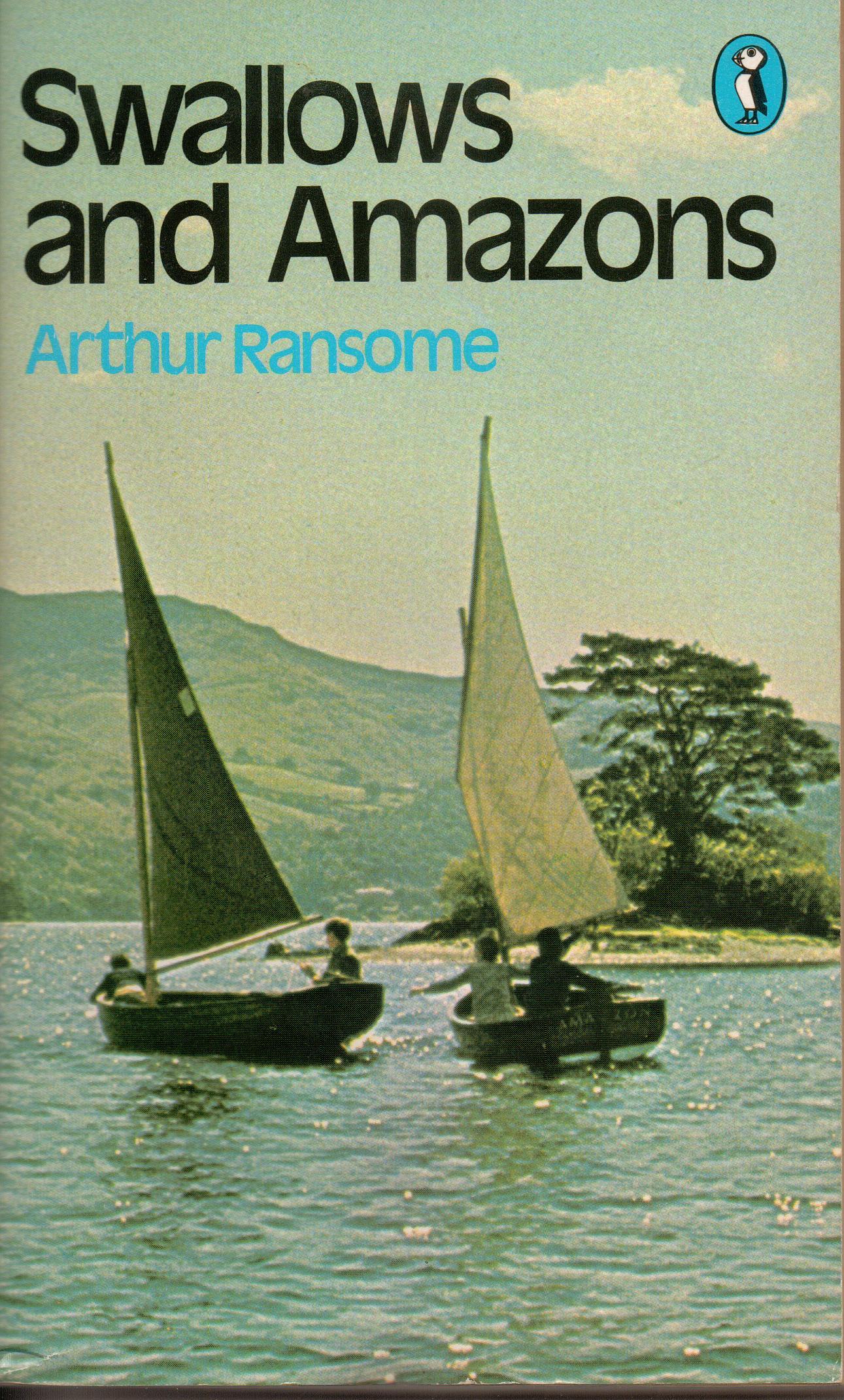
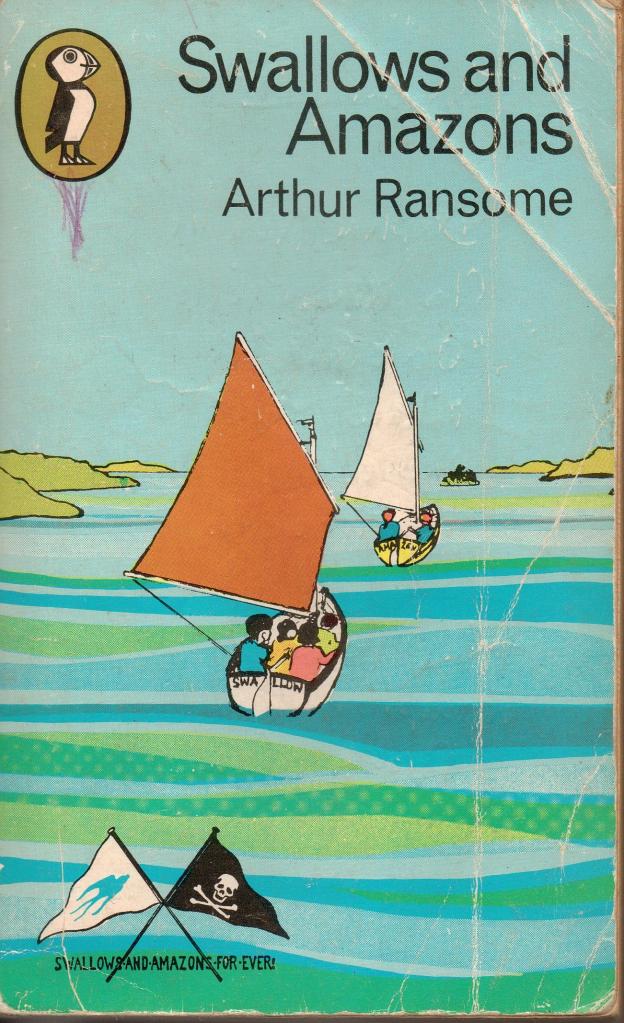
I dug out the Puffin paperback of Swallows and Amazons my father gave me when I was a girl and read avidly, along with other books in the series, by the time I was eleven years-old. It is a 1970’s edition in which I’d underlined everything Titty said. I must have re-read this copy when busy preparing for filming the 1974 movie financed by EMI.
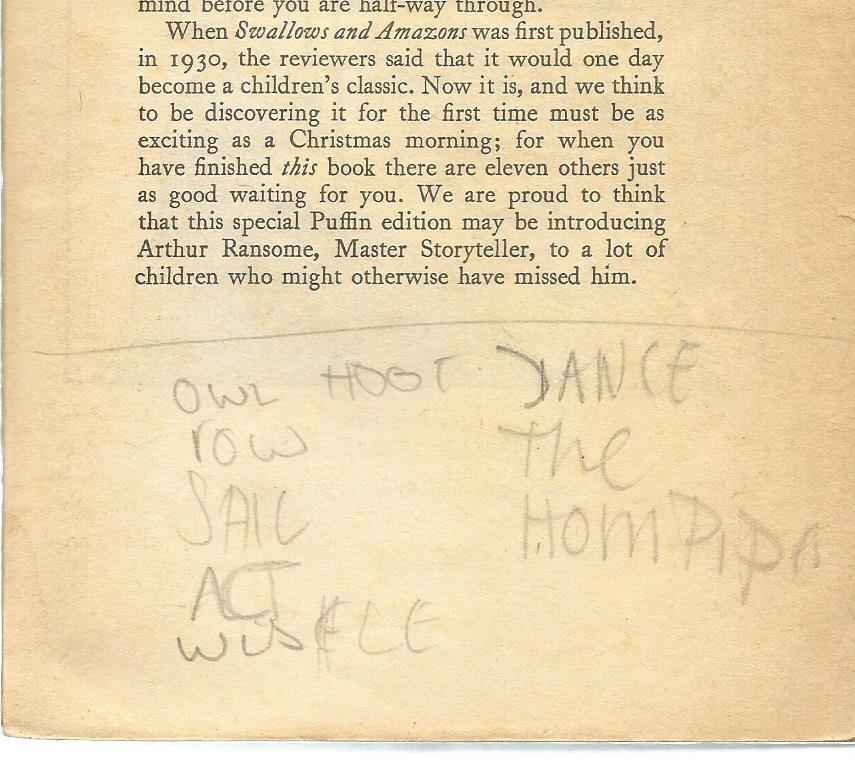
Kaye Webb, the editor, had written an introduction saying, ‘This book is about sailing, fishing, swimming, camping, and piratical exploits.’ She wanted to make it available to children, thinking that discovering Swallows and Amazons ‘for the first time must be as exciting as a Christmas morning.’
Underneath, I’d noted down the skills I would need to acquire before playing the part of Titty. ‘Owl Hoot’, was one item, ‘wisle’ (sic) another. I was somewhat apprehensive about dancing the Hornpipe but excited about ‘being a cormorant’, having no idea how cold this experience would prove.
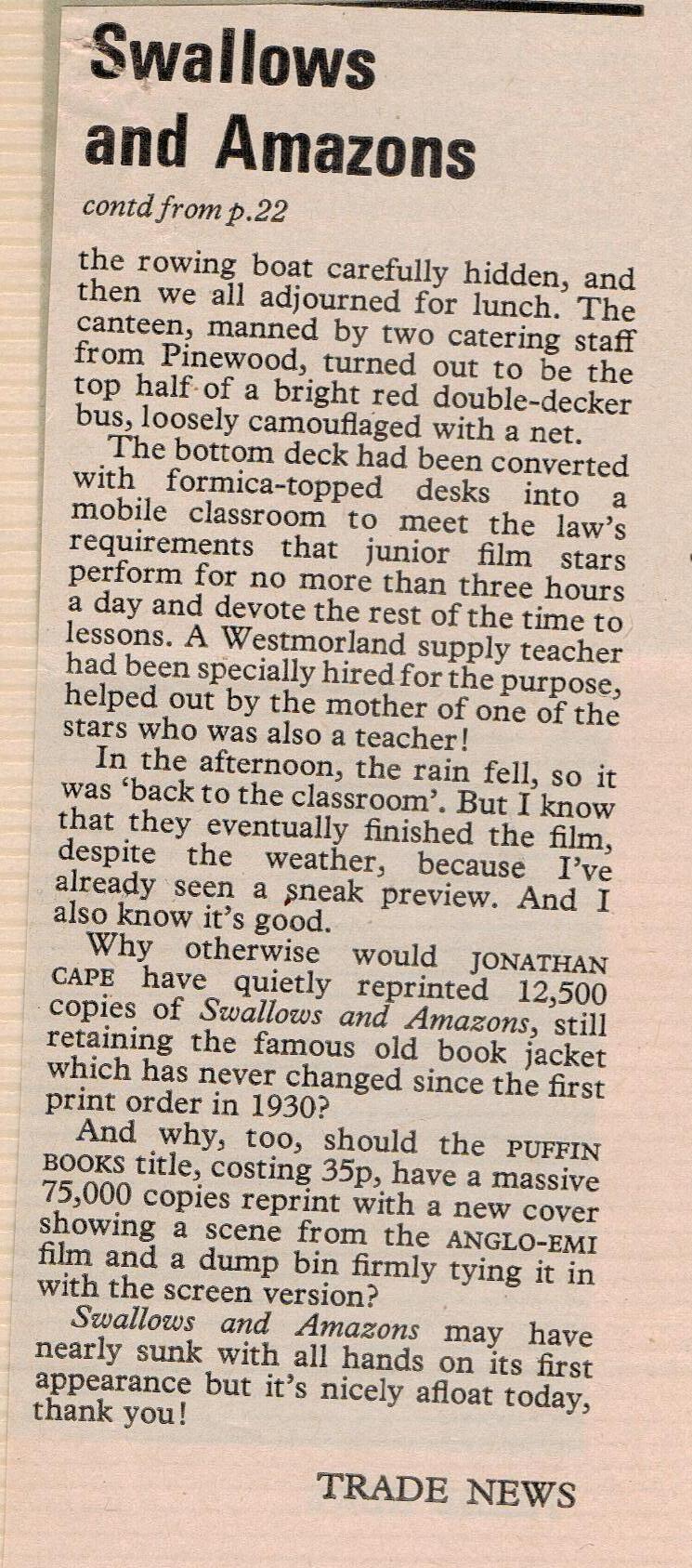
According to Trade News, 75,000 copies of a new Puffin paperback were brought out to accompany the original film. A still was used from the scene where the Swallows sail both dinghies from Cormorant Island. It retailed for 35p. Meanwhile Jonathan Cape printed 12,500 copies with the original dust jacket to accompany the release on 4th April 1974.
Today, I am most interested in Ransome’s prose, amused to find the phrase ‘X marks the spot where they ate six missionaries’ does not appear within the pages of the book. It was given to Titty in 1973 by the screenwriter David Wood. However, there are words of wisdom a-plenty that were not used in the film adaptations:
‘I like cooking,’ said mate Susan.
‘If you want to go on liking it, take my advice and get someone else to do the washing up’, is Mother’s reply. (I wonder who might have said this in reality.)
‘You can be wide awake and not see a thing when you aren’t looking’ is one of Roger’s observations.
John was able to look back to ‘a different, distant life’, which is exactly how it feels when the excitement of Ransome’s world spoils you for the ordinary. It’s true: those involved in outdoor activities develop in leaps and bounds ending up, ‘not at all what they had been.’
What is it about Arthur Ransome’s writing that captures your imagination? Rowing? Sailing? Cooking over a camp fire? Which book has most influenced your life?
Article on Swallows and Amazons on Puffin Magazine
You can read about the adventures we had bringing out the original film in different versions of ‘The Making of Swallows and Amazons (1974)’, which is now available as an audiobook.
Different editions of ‘The Making of Swallows and Amazons (1974) by Sophie Neville’
David Stott has written in to say, “When l got the job driving for ‘Swallows and Amazons’ l think I took over the production car when Jean McGill started driving you children around in the mini-bus.” This must have been in May 1973 when the original film of Arthur Ransome’s classic book was being made in Westmorland.
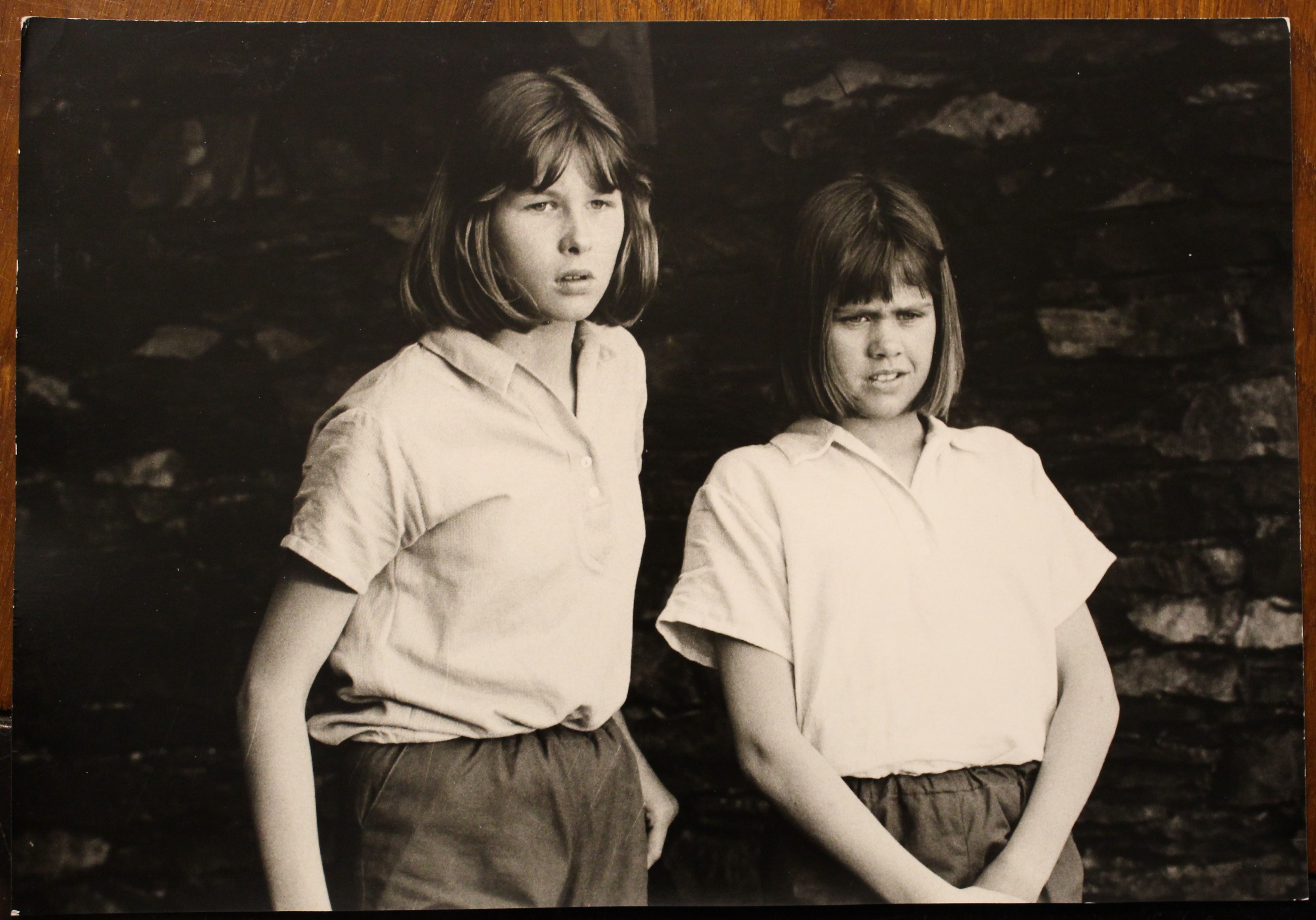
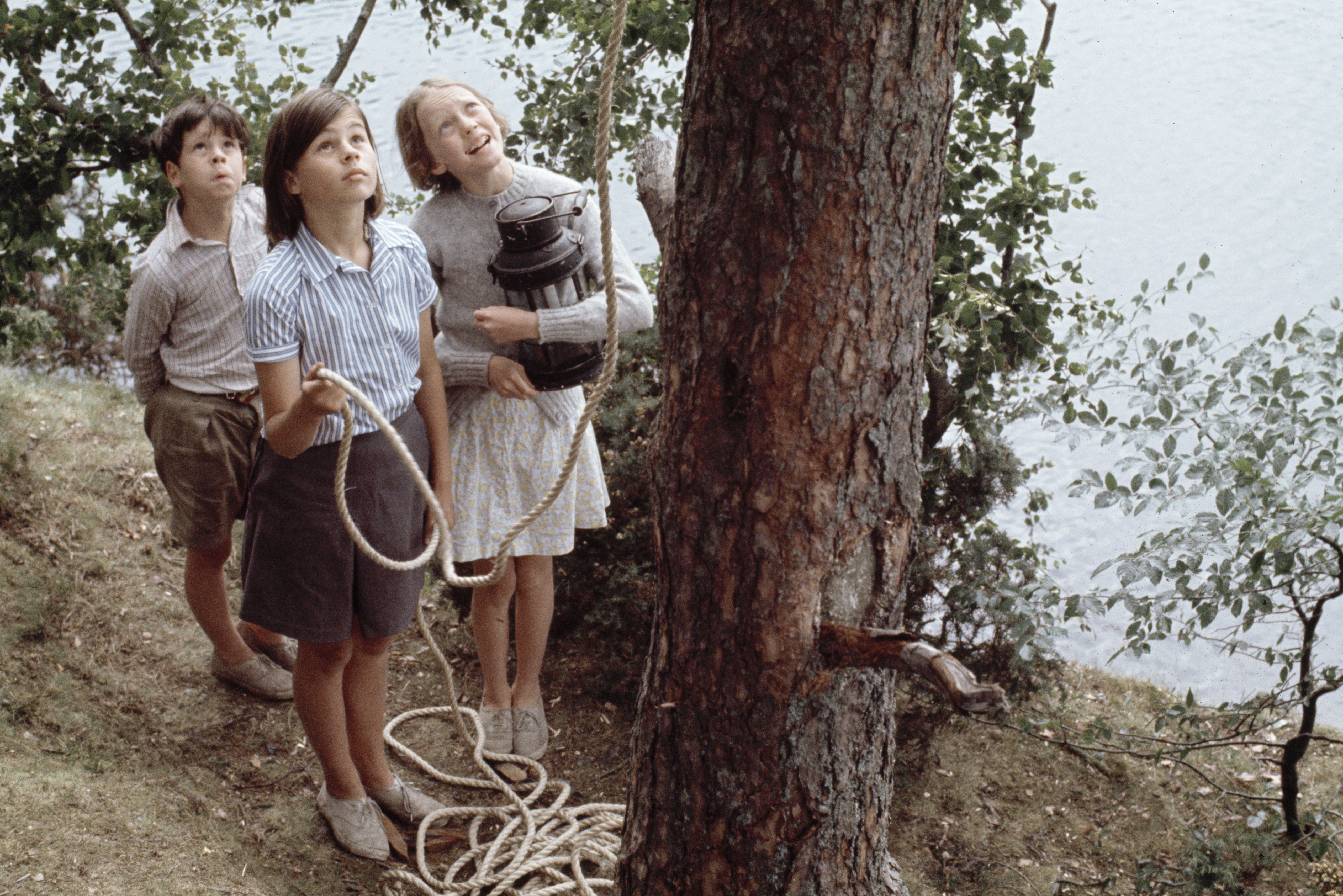
David has all sorts of memories of filming ‘Swallows & Amazons’ in the Lake District that I knew nothing about.
“Jean mentioned that she took Ronnie Fraser for an early morning glass of champagne to get him going. I remember having to take him to the Lodore Swiss Hotel in Borrowdale while filming on Derwentwater. He would order what he called, ‘A Frazer’, which was some sort of vodka cocktail.”
David was only about seventeen at the time. Driving Ronald Fraser around must have been something of an eye-opener.
“I remember bringing him back to film ‘walking the plank’ and he was very drunk at the time. Expect he needed it for the cold water. He could be a little difficult when he had had a few.”
“I was rather star struck when l was driving Virginia McKenna,” he admitted. “On one occasion I had to drive her from the farmhouse on Coniston to Grange railway station. She was telling me all about filming ‘Born Free’ with the lions and I drove a bit slowly as l was enjoying her company. We arrived rather late and l had to throw her and her luggage onto the train just as it was leaving.” I asked Virginia about this but she couldn’t remember ever being late for the train. I can only imagine that David must have coped well.
“On another occasion I think l had Richard Pilbrow in the car,” he was the producer of the film. “We were driving back from Derwentwater when a cow jumped off a bank and landed on the bonnet, causing quite a lot of damage. I was dreading going back to Browns Motors and telling Alan Faulkener the owner what had happened.” Richard is still alive and well.
David, who now owns Crossways Hotel near Glynebourne, comes from an old Cumbrian family. His grandmother lived at High Green Gate, the farm next door to Beatrice Potter at Hilltop.
“My great grandfather was Farmer Potatoes in the ‘Tale of Samuel Whiskers’. It was sketched from a photograph that my mother still has.” Indeed, there was an article in Cumbria Magazine about Beatrice Potter’s relationship with the Postlethwaite family.
One of our locations – Haverthwaite Station today
“My father was the local joiner in Ambleside. He also kept about 1000 hens and delivered eggs around the hotels at the weekends. My brother and l would often help him on a Saturday morning.” David obviously knew the roads of Cumbria well.
David explained that, although he lived in Ambleside at the time, he has not seen Jean since the filming, so enjoyed reading that I had been in touch with her. “Jean’s Mum was called Girlie and she used to run a nursing home on Lake Road. Jean had a brother who was nicknamed Blondie. We would often have a cup of tea with Girlie in the nursing home kitchen.”
Kit Seymour, Stephen Grendon, Sophie Neville, Lesley Bennett, Virginia McKenna, Simon West Suzanna Hamilton and the station master of the Haverthwaite Steam Railway in Westmorland, appearing in the April edition of Homes and Garden 1974
Newspapers are read one day and on the kitchen floor the next. Back in 1974 they might have been used to wrap up fish and chips. Either way, an article in the ‘paper is soon forgotten. Not so a feature in a magazine. They tend to hang around in hotel foyers and doctor’s surgeries for waiting to have their pages turned for months, if not years. The judgement they cast on our movie was important.
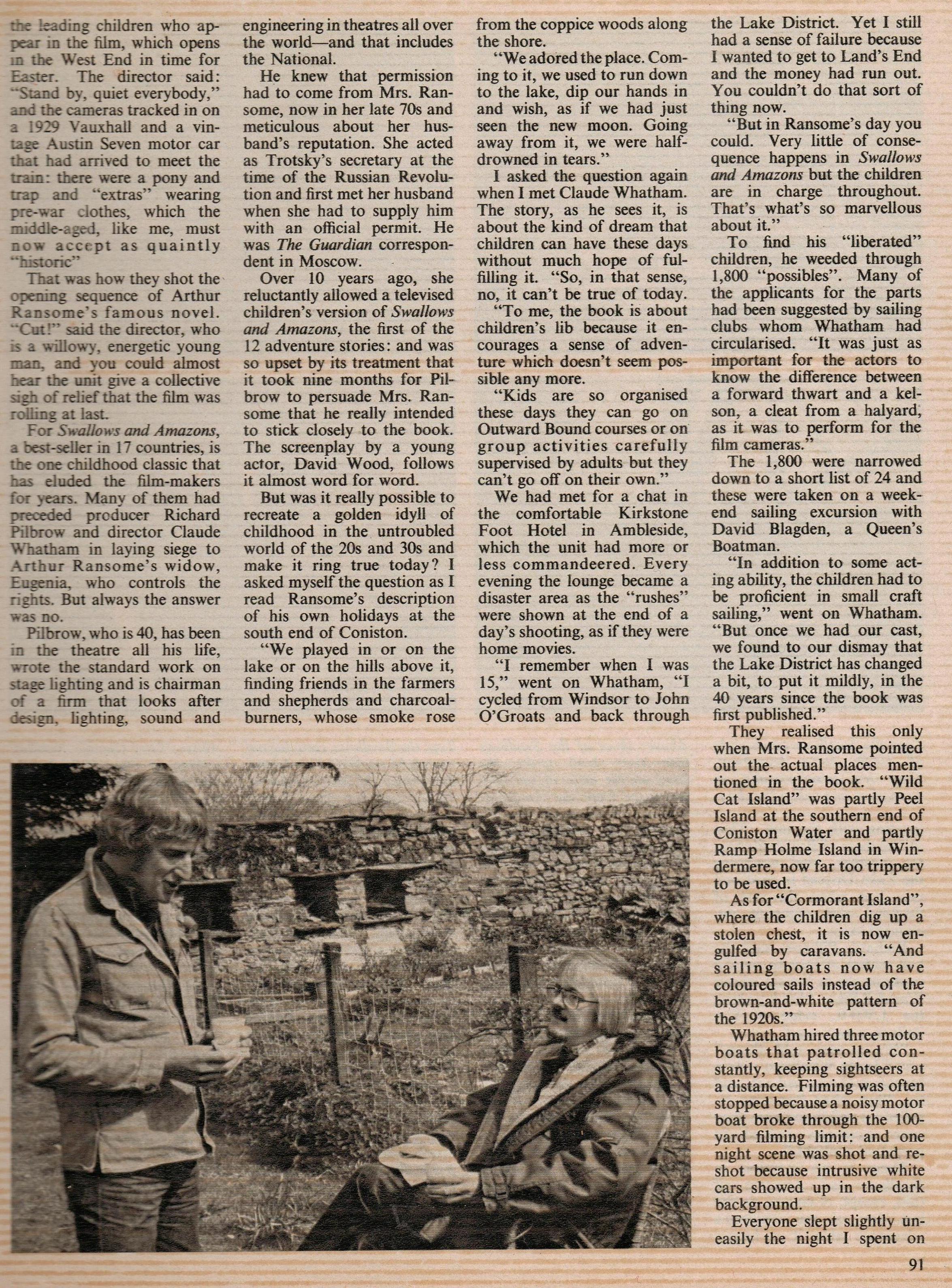
Director Claude Whatham and Producer Richard Pilbrow on location in the summer of 1973 in the Lake District
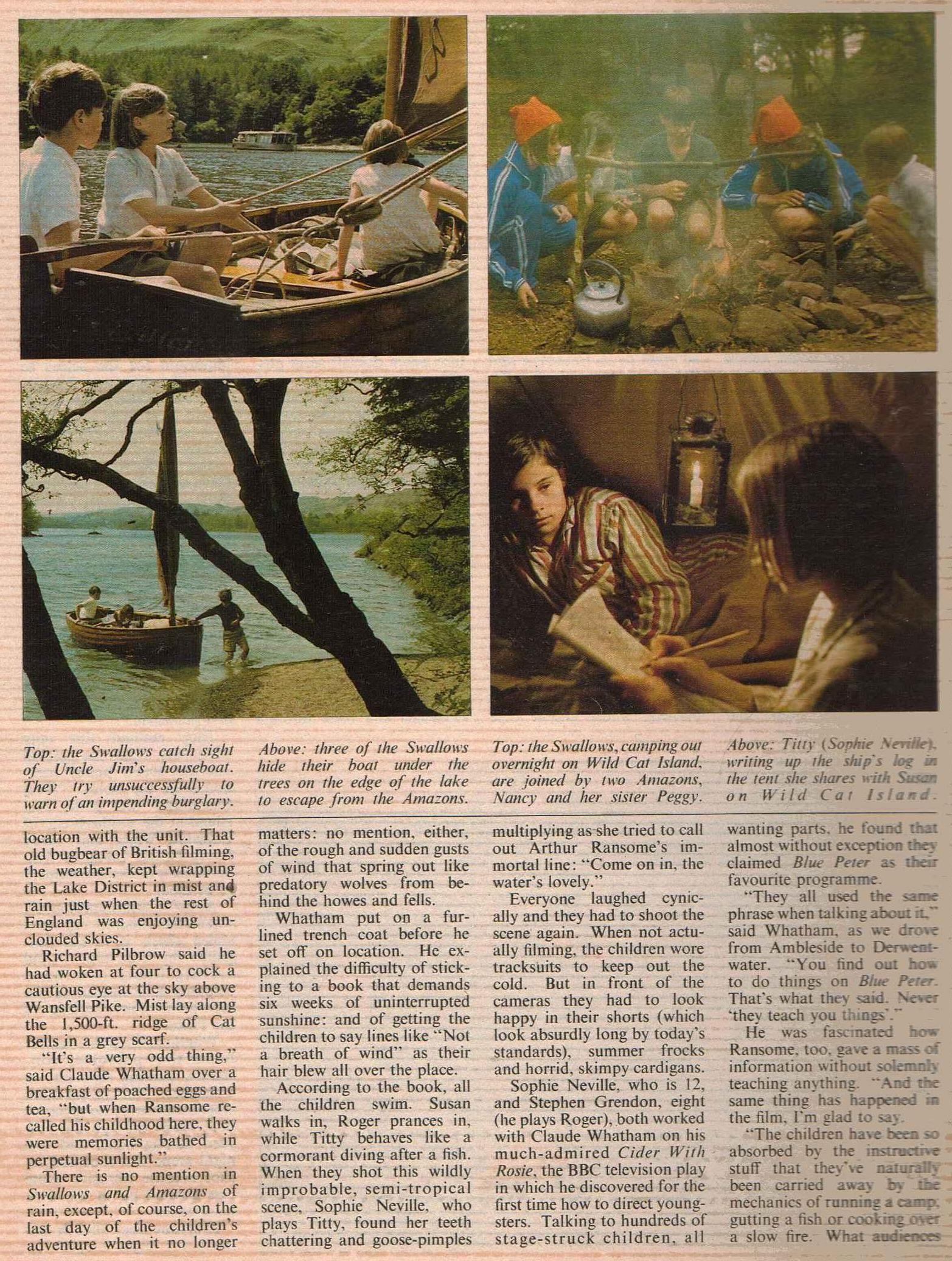
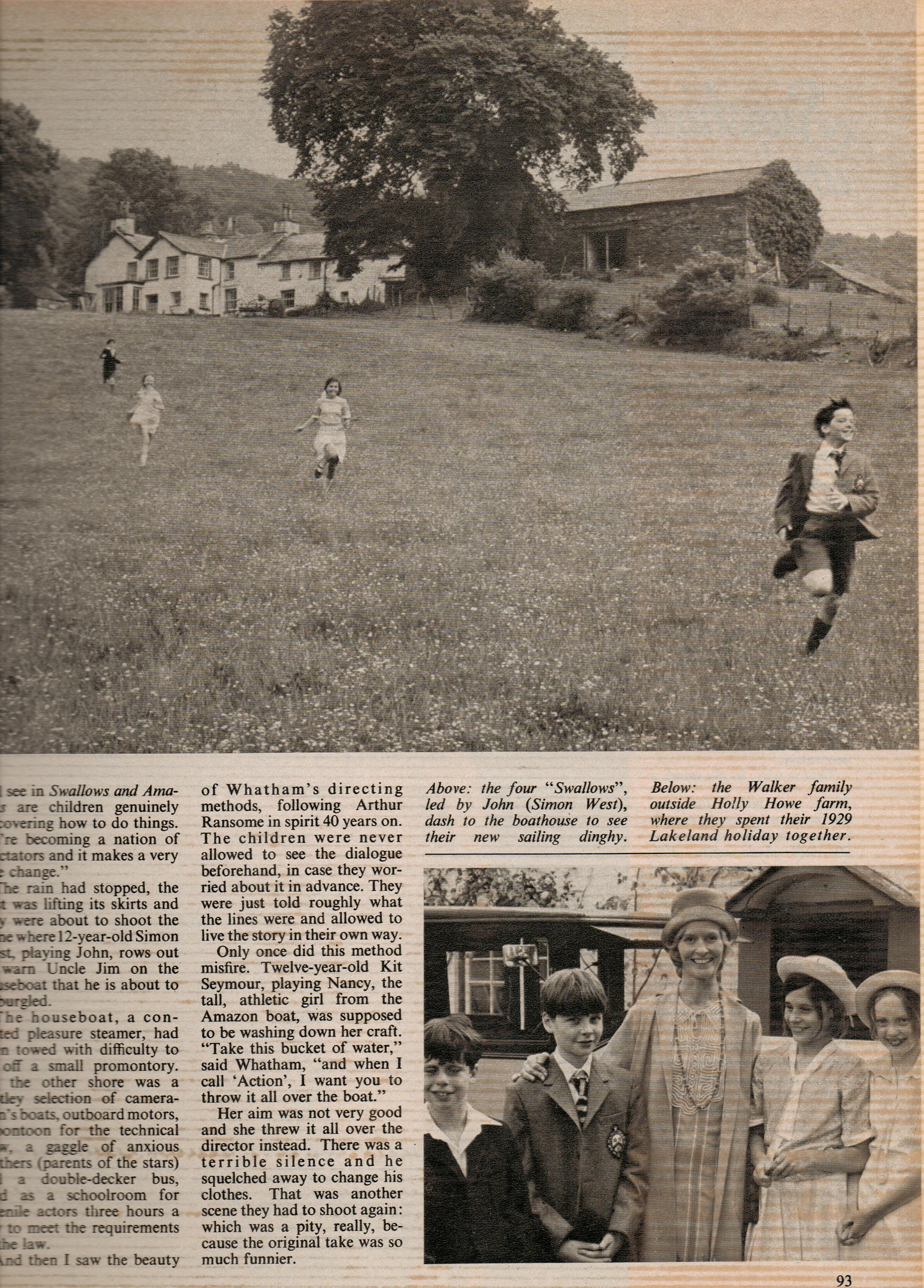
To my surprise I found an article about how we spent the summer of 1973 in ‘Homes and Garden’ magazine.
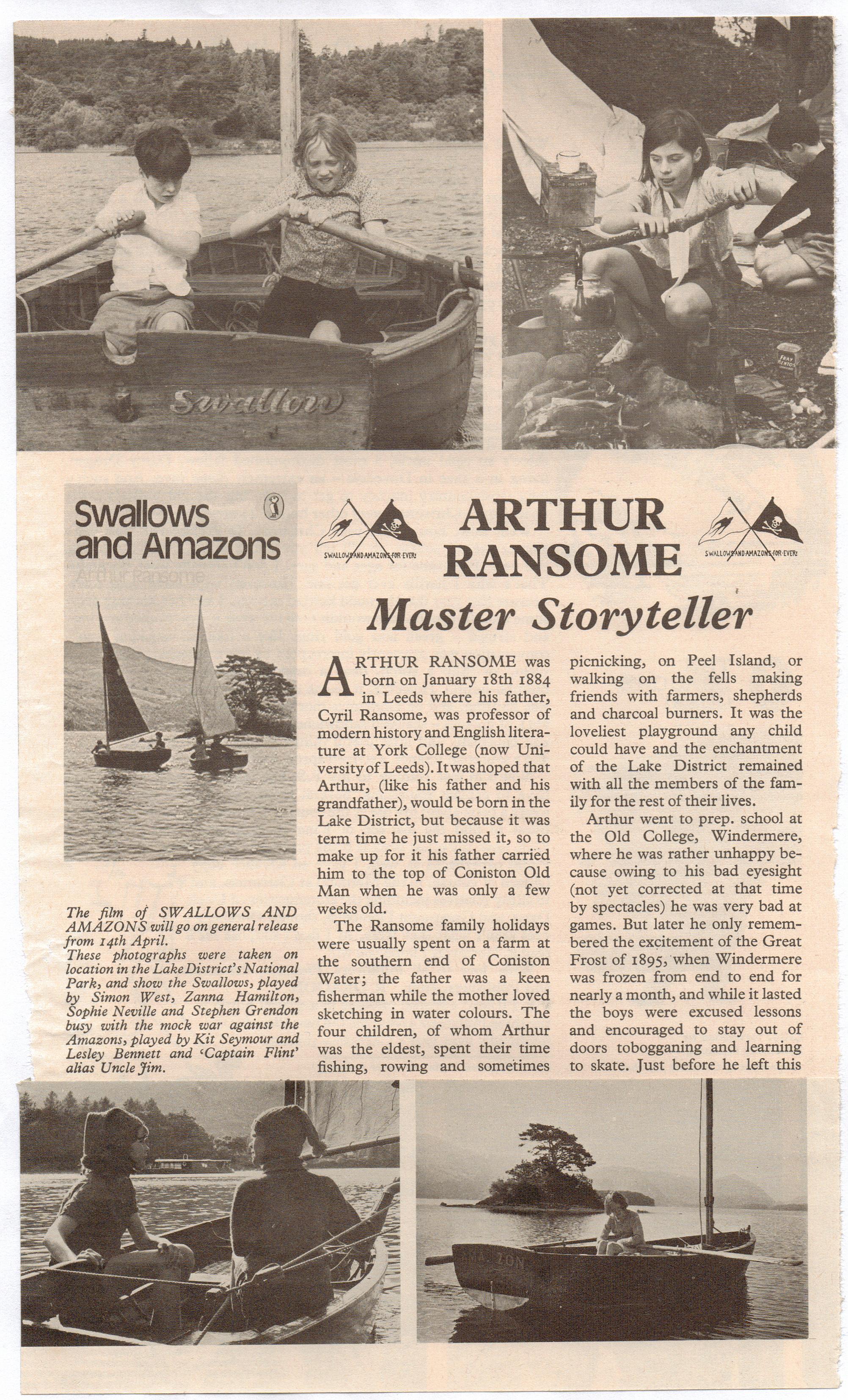
Photographs featuring Simon West, Suzanna Hamilton, Sophie Neville, Stephen Grendon, Lesley Bennett and Kit Seymour in the EMI film of ‘Swallows and Amazons’.
What amazed me was that the black and white photographs taken on the film set had been colour tinted. Please forgive my scanning – the pages were stuck in albums long ago and the images blur at the edge.
Stephen Grendon, Simon West, Virginia McKenna, Suzanna Hamilton and Sophie Neville on location at Bank Ground Farm in Cumbria
Surely she was the journalist also known by her married name of Elspeth Huxley, the author who had written The Flame Trees of Thika and so many other books? She wasn’t quite right in saying the film was shot entirely on location in the Lake District, but still. She was not to know about our day at Runnymede.
Simon West, Sophie Neville and Suzanna Hamilton appearing in The Tatler
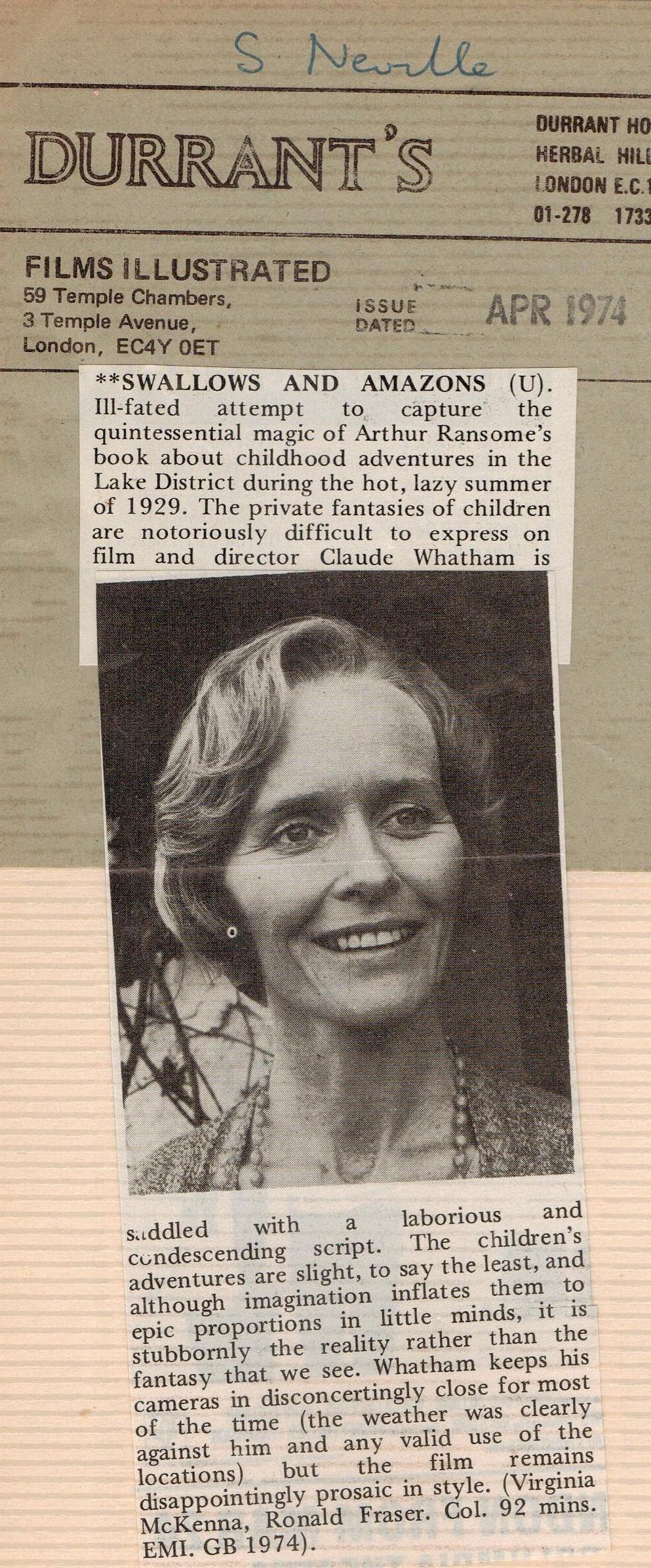
Virginia McKenna in an article in Films Illustrated, April 1974
We were in both Punch and The Sunday People. My mother saved them all, scratching lines alongside the paragraphs in which I was mentioned.
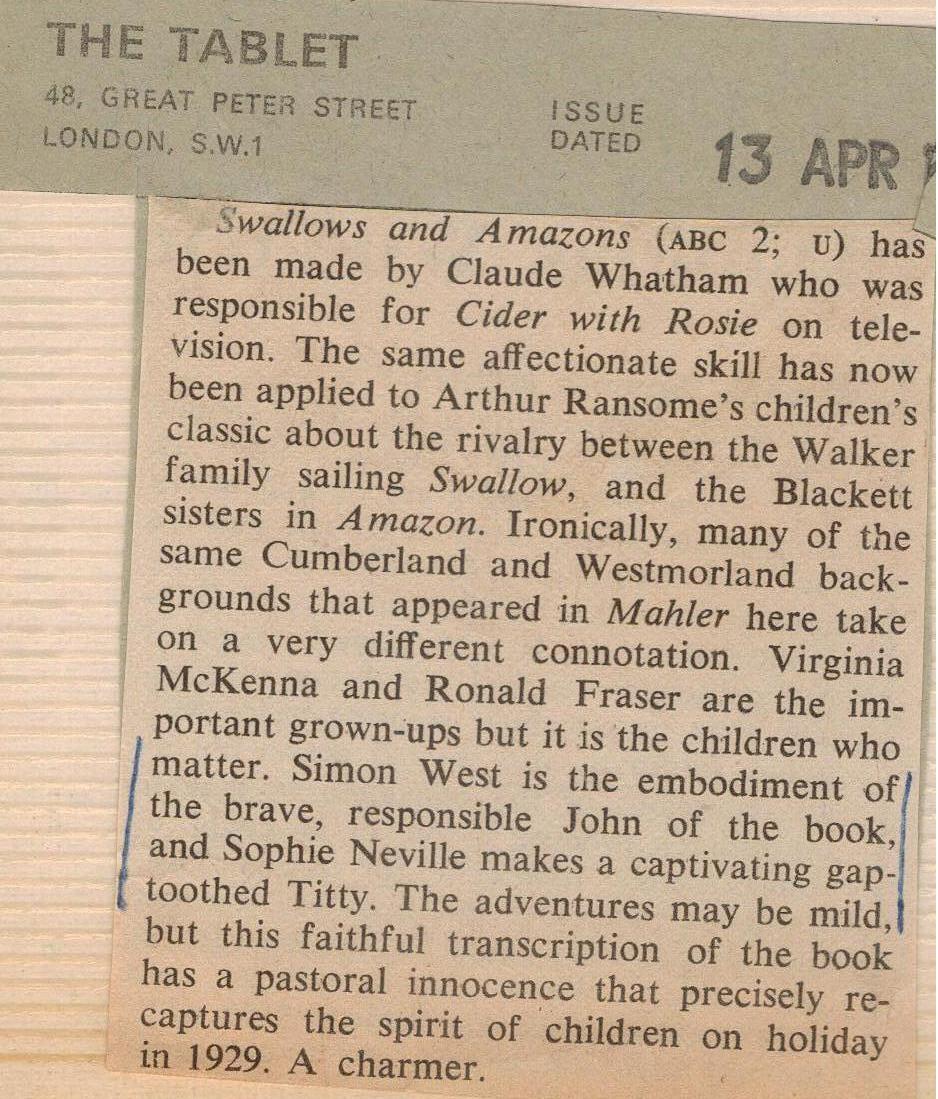
and The Tablet.
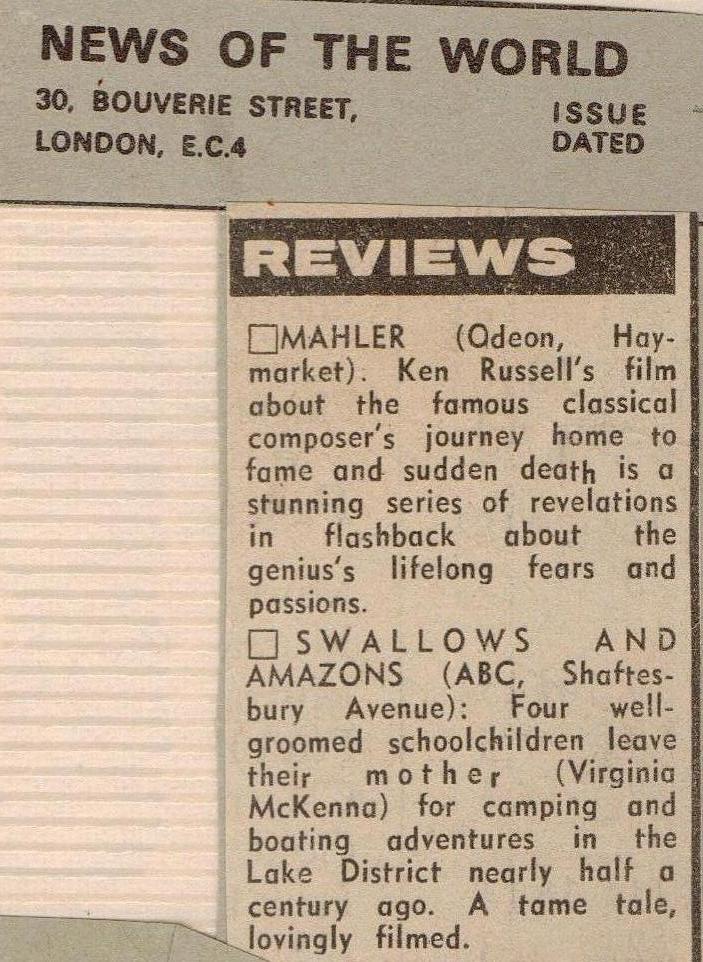
What’s On and the News of the World:
Kit Seymour and Lesley Bennett sailing Amazon on Derwentwater
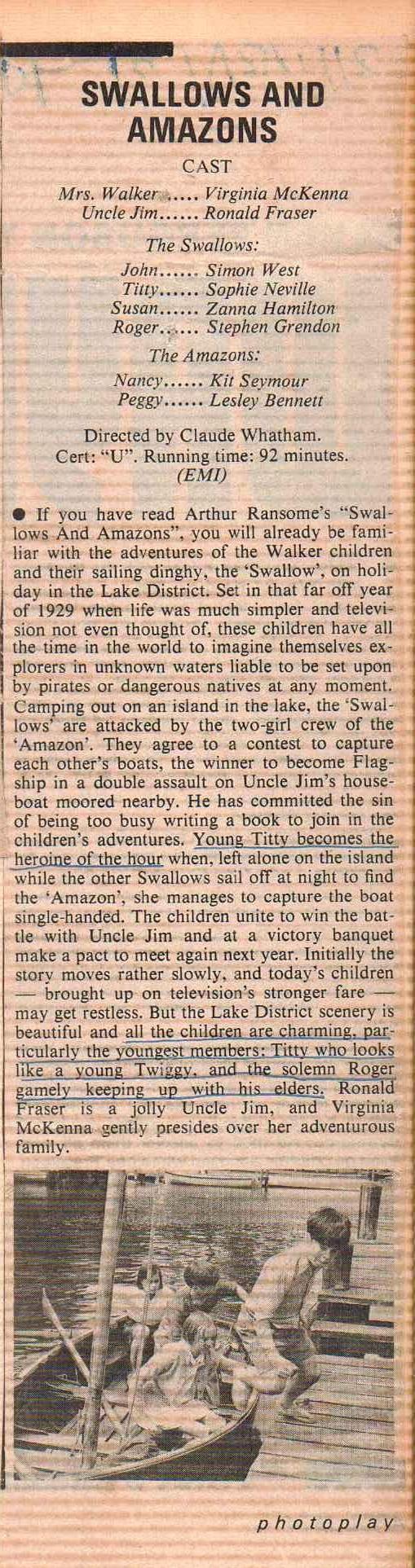
The April addition of the film fan magazine Photoplay, which featured Steve McQueen on the cover. It cost 20p in those days.
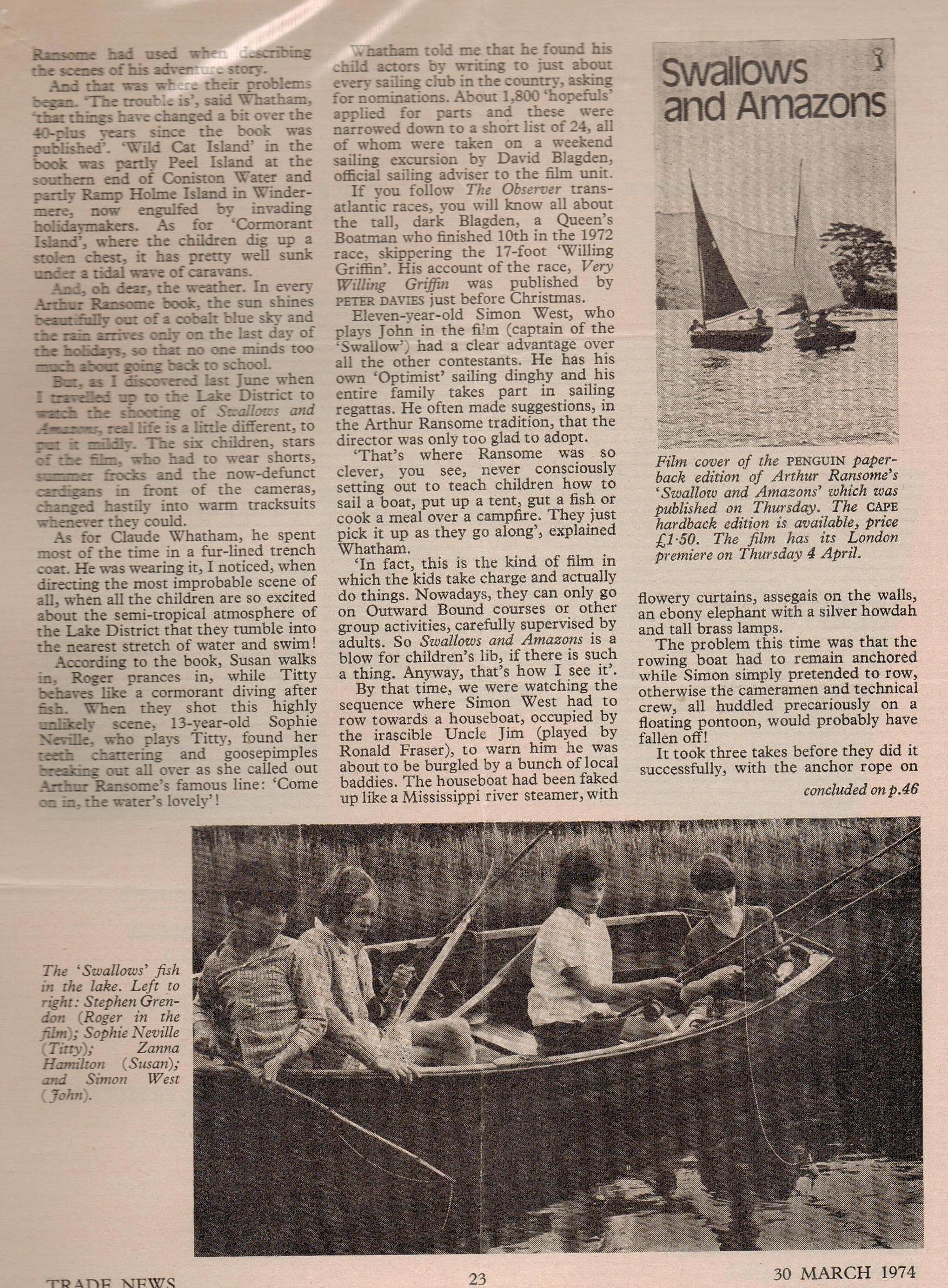
and a publishing magazine I hadn’t heard of called Smith’s Trade News ~
Virginia McKenna eating a banana with Claude Whatham outside the catering bus with quite a good photo of Swallow wired to the camera pontoon
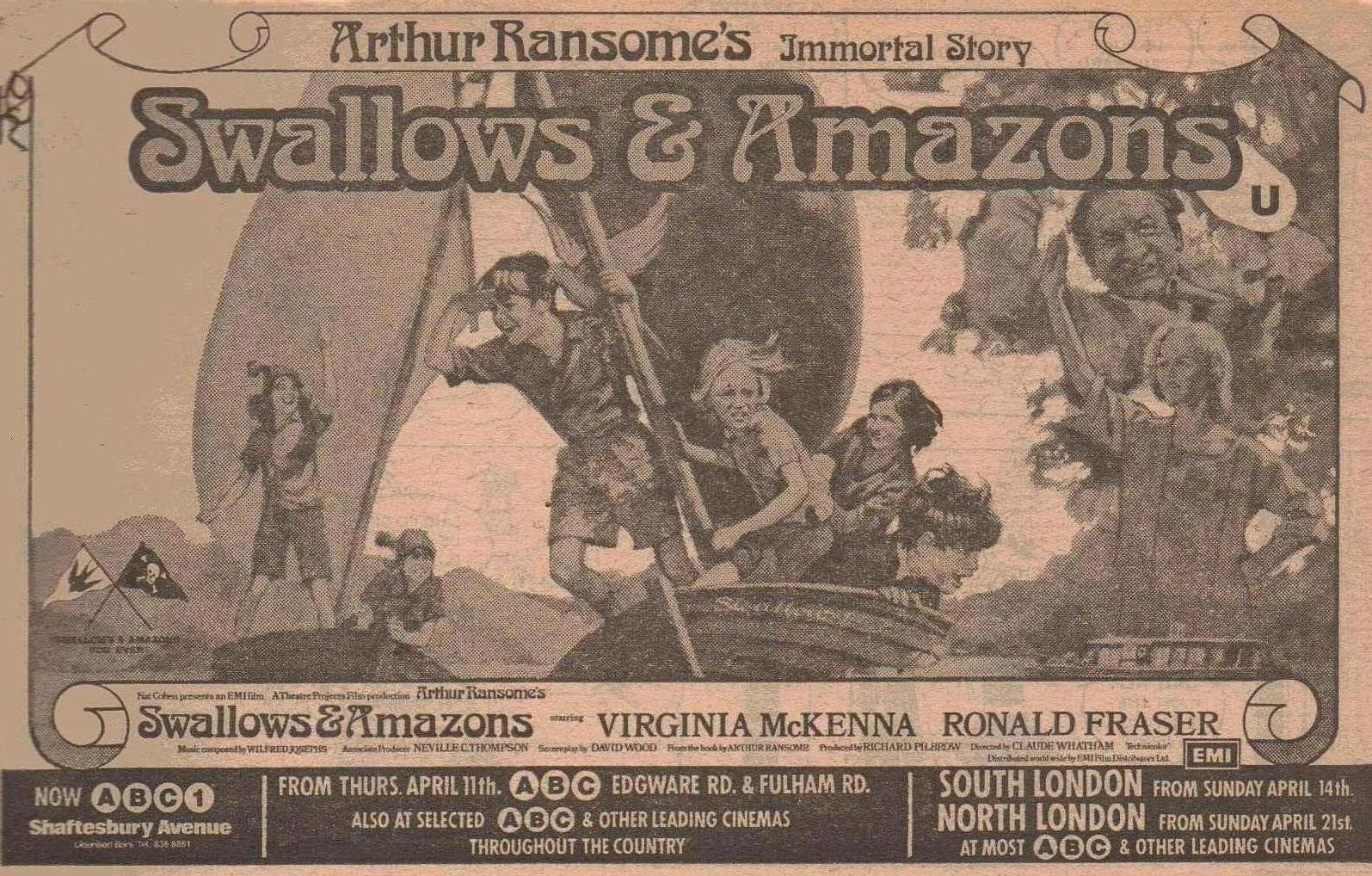
Kit Seymour, Lesley Bennett, Simon West, Sophie Neville, Stephen Grendon, Ronald Fraser and Virginia McKenna on the newspaper advertisement for ‘Swallows and Amazons’ released in April 1974
A school friend of mine sent me this advertisement. She had found it in a teenage magazine we all read at the time called Tammy and Sandy. There was a similar one in The Sunday Times newspaper – and no doubt many others. Film posters hung in the London Underground and at cinemas throughout the country. Swallows and Amazons was to come out, on general release for the Easter Holidays.
My mother subscribed to a press clippings agency called Durrant’s ~ Durrant’s of Herbal Hill London ECI ~ who, for a fee of £50, sent her all the articles written about the film. The Prince of Wales told a friend of mine that he never reads the newspapers. I know why. Reading about yourself is upsetting – or can be, especially if the facts are incorrect. My mother didn’t mind. She highlighted the bits about me, filling four albums.
After entertainingthe Daily Express so nicely in the Lake District this is what they printed about the film. I would think this is written by Ian Christie (1927-2010) the jazz clarinetist, who had formed the Christie Brothers Stompers with his brother Keith, and became a member of Humphrey Lyttelton’s band. He worked as a theater and film critic for the Daily Express for twenty-six years. Born in Blackpool and a habitue of Fleet Street pubs he held fiercely Left-wing views.
‘Kids won’t swallow this watery old tale’ was not good publicity. The same black and white photograph of me appeared on the front cover of The Daily Telegraph with the title ‘One Swallow won’t make a Summer’. Were they right? The Scotsmansaid:
The Scotsman ~ 1st July 1974
However, Russell Davies of The Observer, another jazz musician who now presents Brain of Britain on BBC Radio 4, saw that the film of Swallows and Amazons had niche. (If you click on the article it will enlarge).
Jack Woolgar, Simon West, Suzanna Hamilton, Sophie Neville and Stephen Grendon in a review by Russell Davies in The Observer 7th April 1974
Others recognised it as an innocent nostalgia trip ~
Others just loved it:
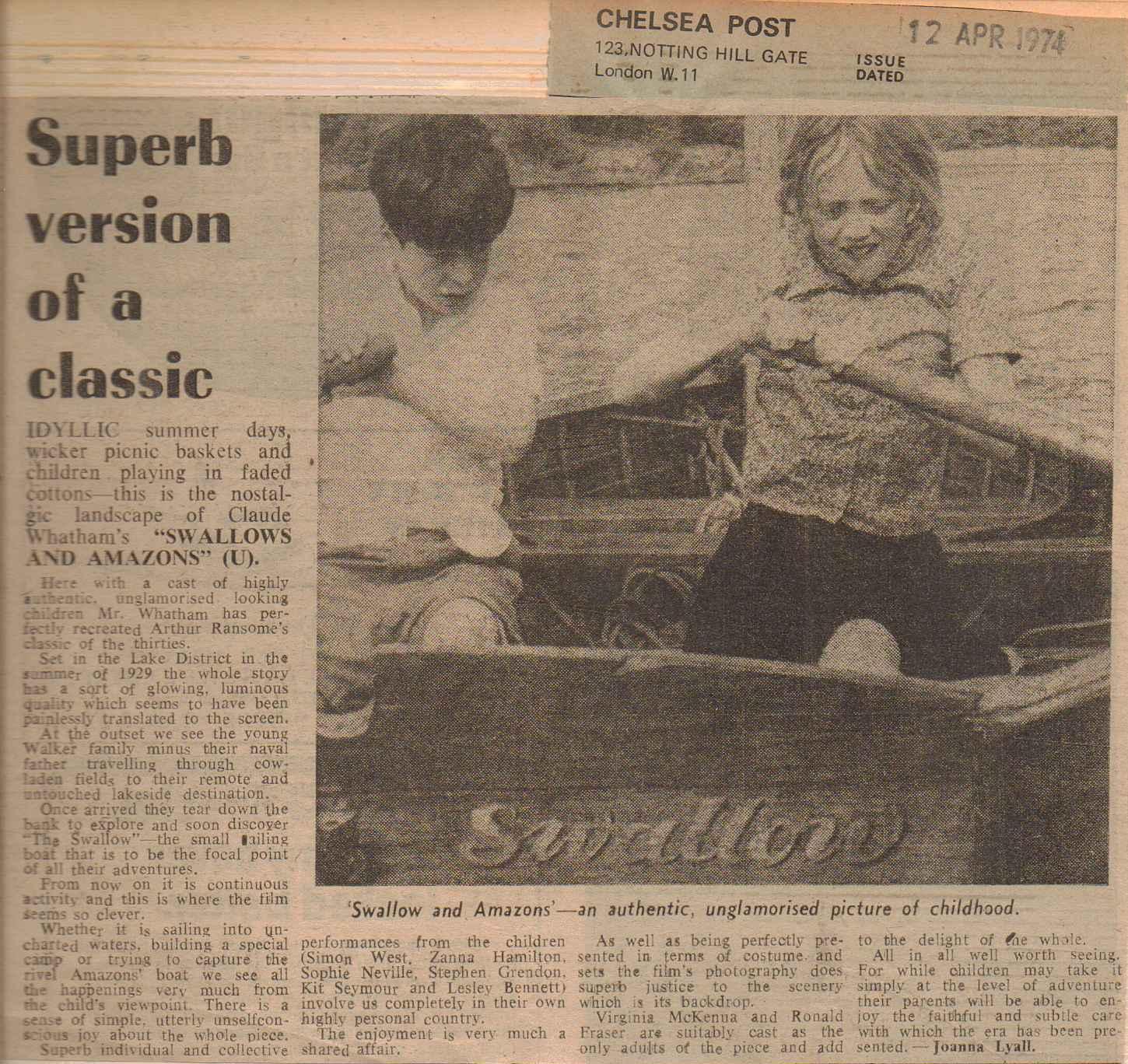
Stephen Grendon and Sophie Neville appearing in Chelsea Post 12th April 1974
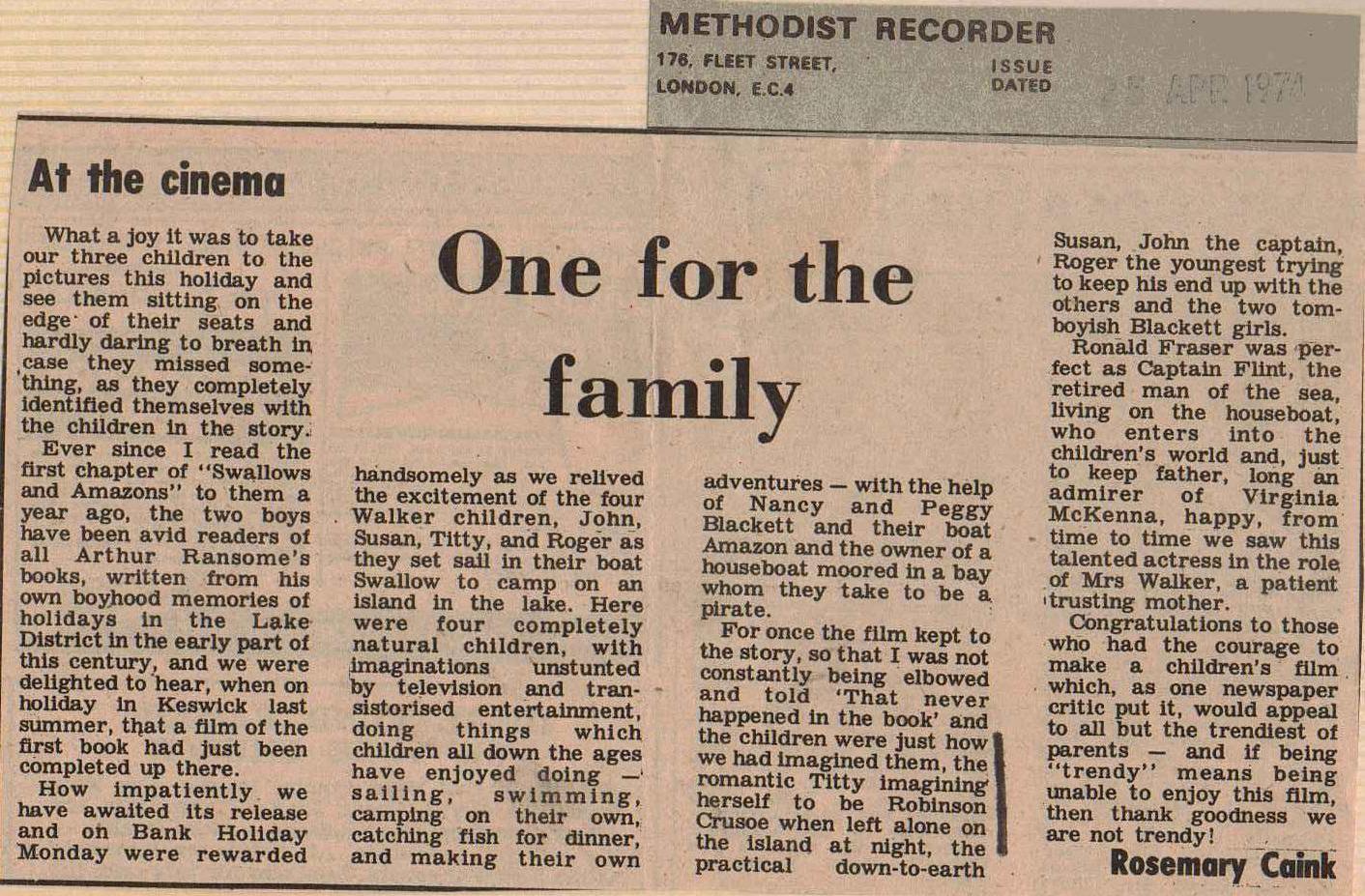
Rosemary Caink said that her three children, ‘completely identified themselves with the children in the story.’
My favorite article wasn’t found by Durrant’s. It was written in The Brownie and must have been sent to me by a fan.
Suzanna Hamilton, Stephen Grendon, Sophie Neville and Simon West, appearing in an article published in ‘The Brownie’ ~ 27th March 1974 Please click on the article to find out more about the Brownies.
I have many more articles ~ please let me know in the Comment box if you would like to see more. Otherwise I will move on to write about how the public responded and what happened next.
It was time to say goodbye. We’d had the most wonderful seven weeks filming on the Lakes but the end had drawn in with the clouds. It was time to go home.
Since we lived in Gloucestershire it was a long drive south. I’m not sure how Jane and Sten Grendon got back, as I don’t think Jane drove, but we must have dropped off some of their things on our way past their village.
I remember seeing my real sisters and walking around the garden in the afternoon sunshine, looking at all that had changed. We’d left in early May, now it was full summer and the school holidays. I don’t know how I had the energy left to write up my diary.
Back in the garden at home with a swan
‘Shall we go and put flowers on Luppy’s grave?’ Perry asked. I hadn’t heard that our dear old dog, the sheep dog I had known all my life, had died while we were away. I was inconsolable. Mum explained that they hadn’t wanted to tell me when it happened as we were filming, she thought that the sadness on my face would have come through on camera. I understood this but was still desolate. Having had to cope with the grief of losing Luppy, on top of the heartbreak of leaving everyone I had grown so close to in the Lake District, I was not in a good way.
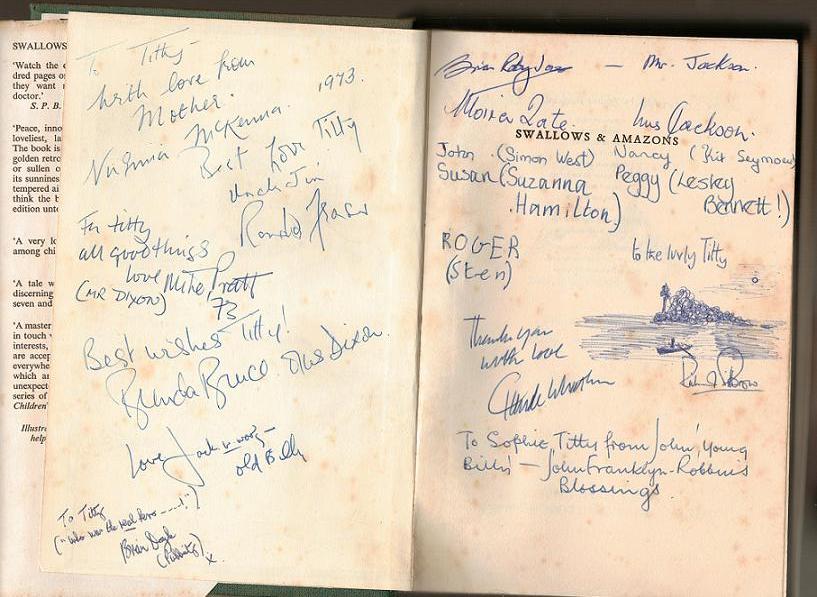
One of the most treasured things that I had returned with – apart from the lump of Cumbrian slate Jean McGill had given me – was a hard-back copy of ‘Swallows and Amazons’ signed by the entire cast and crew.
Signatures of the cast, director and producer of the movie ‘Swallows and Amazons’ in my hardback copy of Arthur Ransome’s book
Here you can see inscriptions from Virginia McKenna who had played my mother and Ronald Fraser who obviously saw himself as Uncle Jim rather than Captain Flint.
Mike Pratt and Brenda Bruce who appeared as Mr and Mrs Dixon, Jack Wolgar and John Franklyn-Robbins who embodied the Charcoal Burners with Brian Robylas (sp?) and Moria Late who played Mr and Mrs Jackson.
Stephen Grendon, Sophie Neville and Simon West with Brian Robylas ~ photo: Daphne Neville
It is interesting that all the children signed their character names with their real names in brackets. We must have grown to associate ourselves more with the characters names than with our own.
Claude Whatham in 1973
Claude Whatham wrote, with thanks, and Richard Pilbrow enchanted me by drawing a picture of Wild Cat Island at night.
Molly and Richard Pilbrow in 1973
Sadly, we didn’t manage to nab everyone on the crew, but collected a few signatures.
Brian Doyle, the film publicist on ‘Swallows and Amazons’ (1974)
The only other signature on this page is from Brian Doyle, Mum’s friend the publicity manager on the movie who encouraged us to collect the autographs.
Signatures of the rest of the cast and crew of ‘Swallows and Amazons’ in the back of my Jonathan Cape edition of Arthur Ransome’s book
At the back of the book David Blagden, who played Sammy the Policeman as well as overseeing the sailing.
David Blagden who played Sammy the Policeman ~ photo: Daphne Neville
David drew me a picture of what must be a vision of himself, sailing into the sunset in his little yacht Willing Griffin that had taken him across the Atlantic.
Phyllis B was my tapestry-making stand-in. Simon Holland our art director (set designer) drew me a wonderful set of crossed flags that were also paint brushes ~ a logo for my life.
Art Director Simon Holland at Bank Ground Farm in 1973 ~ photo: Daphne Neville
I have a signature from Kerry Darbishire (I thought she’d written Dartisnine) who played Bridget’s Nurse, our Fair Spanish Lady. Like the actors who played the Jacksons, she was not credited on the movie but played a significant part. She still lives in Cumbria.
Nurse with Baby Vicky, the ship’s baby at Holly Howe
We left Jean McGill, our driver and unit nurse, in Bowness-on-Windermere.
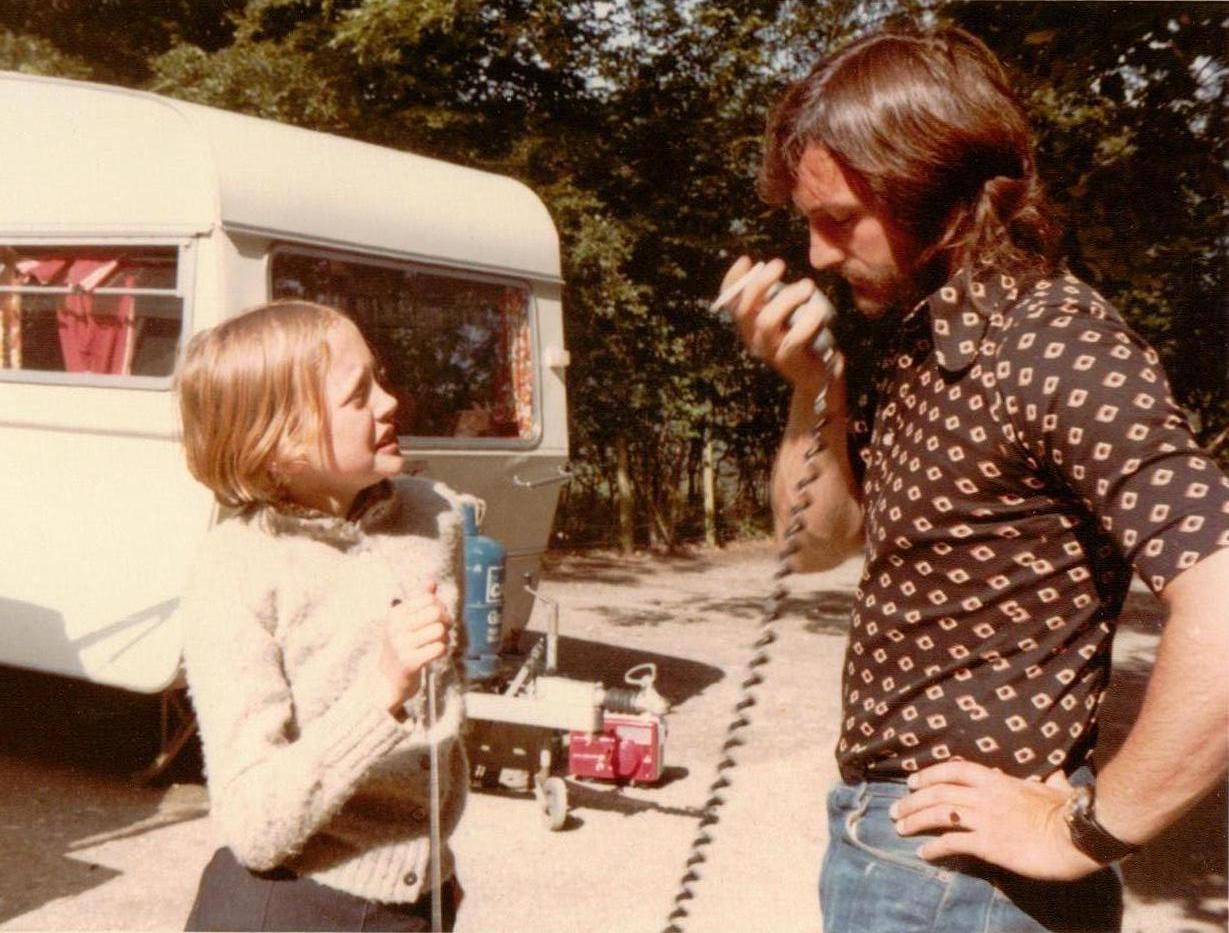
Jean our driver and location nurse operating the radio with Sophie Neville ~ photo:Martin Neville
Eddie Collins was the camera operator, Ronnie Cogan our hairdresser, Joni Turner was a local lady who worked on a few days as Suzanna’s stand-in.
Talking to Martin Evans the Gaffer and Terry Smith the wardrobe master while leaning on a lighting stand at Bowness-on-Windermere
Terry Smith was the wardrobe master, Albert Stills is Albert Clarke who took the black and white photographs day after day. Terry Needham was our long-suffering second assistant director.
Sophie Neville with Terry Needham and the unit radio at Derwentwater ~ photo: Daphne Neville
On the last page I have a very classy signature from Robert – who I think was one of the Keswick boatmen looking after the Lady Derwentwater.
Our boatman and the houseboat in 1973 ~ photo Daphne Neville
Denis Lewiston the DoP also left his mark on my life.
Dennis Lewiston, director of Photography on ‘Swallows and Amazons’ ~photo:Richard Pilbrow
Peter Robb-King signed himself ‘Make-up for the Stars’ and Gareth Tandy as ‘The Whip-cracker’, which surprised me as I had never seen his whip. Graham Ford obviously didn’t want me to change and Margaret Causey, our tutor, sent her love. We’d been though so much together and in such confined spaces.
Swallow and the film crew setting up at Bowness-on-Windermere ~ photo: Richard Pilbrow
Interestingly, I also have an inscription from Ian Fuller the sound editor listed as if he was around on location. I am sure he was the chap I would have met next. Claude and Richard would have gone straight down to the cutting rooms to edit the film. It is not usual for actors to enter such territory but our adventure was to continue. We were soon to be summons to the Elstree Studios of EMI at Borehamwood in Hertfordshire, just off the A1.
The crew as I remember them filming with Swallow and Amazon from the pontoon ~ photo: Richard Pilbrow taken on Derwentwater in 1973
Producer Richard Pilbrow with production associate Neville C Thompson on Derwentwater in the Lake District in 1973
This photograph of Richard and Neville sitting on the deck of Captain Flint’s houseboat in the pouring rain must epitomize the struggles they went through to work around the weather and bring ‘Swallows and Amazons’ in on budget.
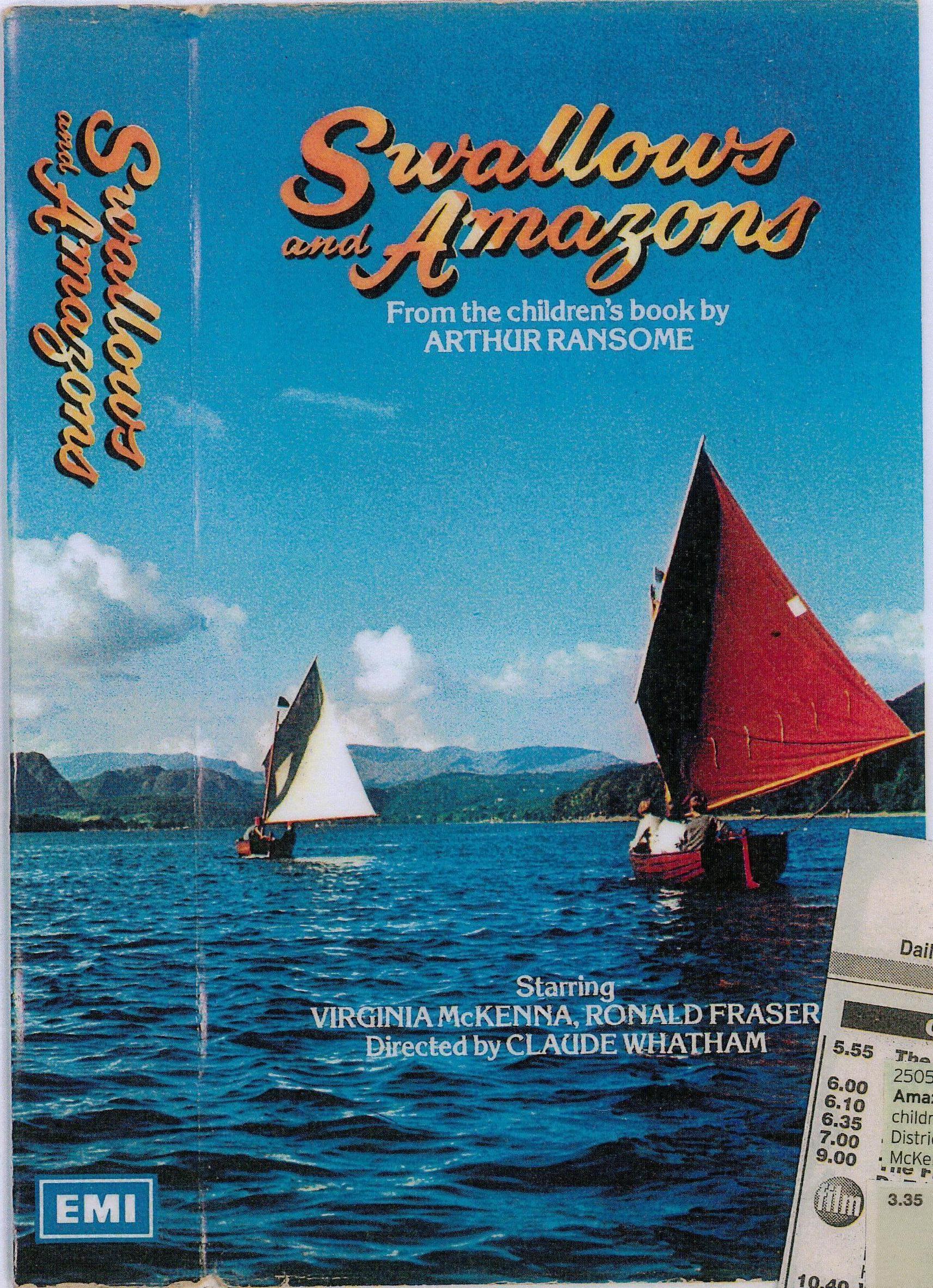
It was Claude Whatham’s dream to end the movie with an aerial shot of Swallow and Amazon sailing away from Captain Flint’s houseboat. He had a helicopter pilot standing-by with a special cameraman, but it wasn’t to be. He needed bright sunshine for the shot to cut with our farewell sequence after the battle. We waited three days but the weather was too dull and wet to film anything useful. I’m so glad. Claude ended up freezing the simple shot that captures Arthur Ransome’s book completely. It was used on the front of one of the first VHS copies of the movie.
The Amazons, played by Kit Seymour, Lesley Bennet and the Swallows, played by Sophie Neville, Suzanna Hamilton, Simon West and Stephen Grendon on the cover of the original VHS version of ‘Swallows and Amazons’
I’m afraid we hung about the very nice Waterhead Hotel in Ambleside getting bored and precocious, or so the evidence suggests. Since John and Margaret, our location caterers, had returned to Pinewood Studios, we were taken to the hotel restaurant for lunch.
We loved the cinema in Ambleside. Was it the same then as Zeffirellis, the cinema in Compston Road operating today? The adults must have found it a good means of keeping us peacefully entertained, but then again they were all film-makers who loved movies. Zanna didn’t come to the cinema that afternoon. She walked four miles up Wanstell Pike with Jane Grendon.
Albert Clarke, the stills photographer on the film crew, had given us contact sheets of the black and white photographs that he had taken during the filming. I spent my time at the Kirkstone Foot Hotel, where Claude and Richard were staying, with a tube of Copydex ~ or ‘rubber solution glue’, as they kept saying on Blue Peter, sticking the tiny photographs into the scrap books that I had been keeping.
Richard Pilbrow kindly let us choose large 10’x 8′ versions of the photographs, which we are able to take home to our families. I kept mine all these years, never using them for anything, but treasuring them as a memory of those happy, fulfilling days spent in Cumbria in 1973.
‘It’s Niagara!’ Titty declared. ‘We could get a barrel and bounce down it.’ Sten Grendon, Suzanna Hamilton, Simon West and Sophie Neville as the Swallows on their way to visit the charcoal burners
Ronald Fraser as Captain Flint with Daphne Neville and Sophie Neville playing Titty Walker on Derwentwater in 1973
Suzanna Hamilton’s first impression of Ronald Fraser was that, ‘he was quite nice but v.fussy.’ It seems to me that he loved three things: acting, ladies and laughter. Whilst he had a small mouth his capacity for alcohol of almost any kind was legendary. Funnily enough this was the day that we all had a drink on set. The clapperboard or slate had snapped shut on the 500th shot of the movie and in, line with tradition, a bottle of champagne was cracked open. Somehow I managed to end up with the dregs. I thought them utterly delicious.
Sophie Neville with director Claude Whatham, Ronald Fraser and DOP Denis Lewiston outside the catering bus at Derwentwater in the Lake District ~ photo: Daphne Neville
I’m not sure exactly what was going through Ronnie Fraser’s mind at this point but Denis Lewiston has a call sheet in one hand, so must have still had his mind on work. I think we’d reached the end of a pretty good day.
The fishing rod was such an excitement. Simon West was very generous and let us all catch fish with it. Arthur Ransome would have been proud of him.
Suzanna added another story ~
Suzanna refers to the 500th take, but she was mistaken. We rarely took more that 3 takes of each shot. It was the 500th slate. I now know that we happened half-way through the filming, since the total came to 1003 slates.
It doesn’t seem much to me now. I went on to work on drama serials with so many episodes that they would have amounted to films four or five hours long.
Sophie Neville on the set of ‘My Family and Other Animals’ shot on Corfu in 1987
I remember operating the clapper-board on this occasion because the entire camera crew were involved in pulling off a 360 degree shot, the cameraman Andrew Dunn up on a crane while a stiff wind was blowing, but that’s another story. I was just the girl saying, ‘Shot one thousand and forty-nine, take three.’ Quite fun.
Did appearing in ‘Swallows and Amazons’ inspire me towards working on a film crew? No, at the time the hanging around aspect of filming bored and frustrated us children. Later, when I did work on productions, any time I was able to relax on set was treasured, absolutely relished. I was an assistant director with a Motorola on my hip and rarely had a chance to take the weight off my feet. And never had to cope with a green parrot.
Sophie Neville as Titty with her parrot
I have just watched the scene shot in the cabin of the houseboat and have noticed an odd thing. We have a travelling chest of drawers exactly like Captain Flint’s and I set a mirror on top of it just as Ian Whittaker the set-dresser had.
Kit Seymour as Nancy, Sophie Neville as Titty and Beauty Proctor the green parrot
One secret of the scene is that, once we start to clap and sing, ‘What shall we do with the drunken sailor?’ Claude Whatham, the director shouted, ‘Go round’, not once but twice. If you listen very carefully you can just hear him the second time. He wanted us to dance around the room. I knew this but couldn’t move much with the parrot, so went up and down. Kit Seymour was absolutely boiling in her red bobble hat and no on else could move much for fear of knocking the furniture. It was left to Suzanna to dance about – a tricky thing to do without seeming self conscious. All in all I think we needed a glass of champagne by the end of that day.
Ronnie Fraser and DoP Denis Lewiston with paper cups of champagne and the call sheet for the next day ~ photo: Daphne Neville
If you are enjoying this blog, please think of buying an updated version of the story, available as a paperback or ebook from all online retailers including Amazon here
Different editions of ‘The Making of Swallows and Amazons’ by Sophie Neville
Ronald Fraser with Wardrobe Master Terry Smith being transported to the Houseboat played by The Lady Derwentwater
Ronald Fraser being transported to the Houseboat with Terry Smith
My diary entry for 24th June 1973 is not exactly revealing. As it was raining steadily in the Lake District, I was given a second day off. ‘We had a quirte (sic) morning,’ I wrote. I am sure I needed one. After a heavy week’s filming I’d spent the official ‘Unit Day Off’ writing five end-of-year exam papers, answering correspondence from school friends and going to Kit Seymour’s thirteenth Birthday party. I must have been exhausted. Legally children are meant to have two days off a week while filming. This was the first time it had been possible.
Suzanna Hamilton’s diary adds little more, but my mother was on set, as was a journalist from The Guardian, so I can tell you what happened. I can even tell you what the location caterers from Pinewood cooked that day: Melon, followed by roast beef with Yorkshire pudding, boiled or roast potatoes, peas and carrots with apple crumble or tinned peaches served with custard or evaporated milk. It was a Sunday. Suzanna noted that we had ‘salad for super’, her favorite food.
Set dresser Ian Whittaker, Ronald Fraser and one of the Prop Men on the houseboat ~ photo: Daphne Neville
“The houseboat has been converted from a pleasure steamer,” wrote Michael McNay in the Features section of The Guardian, “the whole of the superstructure fore faked up by props, the cabin aft converted into a retired colonist’s sittingroom – African rug, flowery curtains, assegais on the walls, an ebony elephant with silver howdah and trappings, a walnut wireless cabinet, tall brass oil lamps, a pile of 78rpm records, a silver mounted cricket ball (presented to G.Gumbleton, 1899, for the highest individual score of the season), a chest, a writing desk and an ancient upright Imperial.” I have typed this up exactly as it was published on 7th July 1973.
By props, I don’t think Michael McNay meant pit-props. He was talking about the work of the design team headed by Simon Holland. Ian Whittaker, who later won an Oscar for set dressing, helped Simon to create Captain Flint’s cabin with one of the Prop men who is photographed here. Does anyone know his name? I think it might be Terry Wells. I expect the cane chairs and side table were being temporally stored on the roof when this snap shot was taken so as to make space for camera and lights. The gaffer and camera crew would have been in the process of setting up inside the cabin. Sound would not have settled in yet. How do I know that after all these years? I can see the recordist’s arm at the left of the photograph. I still remember his coat.
“Ronald Fraser, alias Uncle Jim, is tapping away at a book.” Michael continues. “Last minute panic: who can type out quickly a folio of copy to leave nonchantly in the roller?” That would have been Sue Merry, the continuity girl. The first scene was probably the one in which Uncle Jim is typing with the green parrot on his shoulder when a firework goes off on his cabin roof. I wonder if Arthur Ransome had ever been disturbed by the Altounyan children in such a way. Did he use an Imperial typewriter?
The film crew were on location on Derwentwater. “By now, the houseboat has been moved and moored to the western shore just off a promontory that is being faked up as one end of Wild Cat Island.” The houseboat, really one of the stars of the movie, was being played by a long-time resident of Cumbria, The Lady Derwentwater. A 56 foot motor launch, owned by the Keswick Launch Company since 1935, she returned to real life after the filming, rather like I did. She still carries up to 90 passengers. You can go out on her today.
Was this the houseboat Arthur Ransome had in mind? The photograph was taken by Martin Neville in 1973
My father, who is keen on steamboats, had been off to find the real houseboat that Arthur Ransome had in mind. Am I right in thinking this must have been the original Gondola? I expect she was too un-seaworthy for the production team to contemplate using in 1973. A reliable, water-tight boat that could be towed into the location used for Houseboat Bay was needed. Last year we went to see TSSY Esperance at the Windermere Steamboat Museum in Cumbria, which is another Victorian steam yacht envisaged by Ransome as a possible model for Captain Flint’s houseboat. It is a beauty but we did get a better view of the lake from of the cabin windows in the Lady Derwentwater.
TSSY Esperance, the 1869 Steam Yacht, at the Windermere Steamboat Museum, Cumbria in Apirl 2011
“The rain has stopped, the mist is lifting from the 1,500 foot ridge of Cat Bells. Fraser climbs gingerly aboard, awkward in co-respondent’s brown and white shoes, rosy make-up and moves into the aft cabin.” McNay continues. He is describing the main scene to be shot that day. “John, alias Simon West, is in a rowing boat 15 feet away… The problem this time is that the rowing boat has to remain anchored but look as though Simon is pulling steadily in towards the houseboat and the anchor rope has to remain hidden.” This must have been so that Swallow could be lined up accurately and remain in focus for the camera. It is one of the secrets of making the film that I have been asked about directly.
“Simon shows Claude Whatham how he’ll manage it. Quick rehearsal inside the cabin. Ronald Fraser on his knees by the chest folding a white pullover, catches sight of approaching boat, mimes angry surprise. Told not to jerk head so far back. Instead jerks eyebrows up. The cabin is no more than eight foot by ten and contains besides Fraser and the props, four men on a camera, one on lights, and the continuity girl.” McNay had not included Claude the director, who I know would have squeezed in since these were the days before monitors from the camera feed. And he was small. The sound recordist was bigger but may have just planted a microphone on the desk.
“On the small aft deck Pilbrow is for the next few minutes going to be redundant.” This is Richard Pilbrow, who now lives in Conneticut and I am sure will read this post. “He is a mild, inoffensive looking man producing his first film. He is 40… looks like your friendly local antiques dealer. He and Whatham are a good team: Whatham is slight, energetic and calm. He has time, even as a sequence is being set up, to ask the Press if they can see enough of what’s going on from the crampt aft deck of the houseboat. It’s a cheerful crew, (Denis Lewiston the DOP) watching clouds overhead with benign suspicion, taking light meter readings inside and out-side the cabin every 30 seconds.
‘Stand-by Simon.’
‘Action,’ said quietly into the cabin.
‘ACTION,’ across the lake to Simon. The clapperboard shows 461 take 1. Fraser folds the pullover, looks up, jerks eyebrows in angry surprise, camera swings round to follow Fraser’s gaze through the window, Simon pulls on left oar, keeps the rope hidden.
‘Once more please. Stand by. Action. ACTION (461 take 3) …. CUT.’
There’s a consensus that the third take was best. Ten minute break while the succeeding sequence is prepared: Fraser rushes out on deck and tells Simon to clear off. That too is filmed in triplicate. The time is 12.45. They started work at 6.30, began filming at 12.25 and they’ve got maybe 45 seconds in the can. Everybody seems pleased.”
The Gondola on Coniston Water today, re-built and restored by the National Trust, powered by steam and taking passengers down the lake from April to November.
You can read more about the adventures had making the original film of Swallows and Amazons in any one of these editions of Sophie Neville’s filmography available from Amazon and all the other usual places. You can read a little more about them on this website here.
Different editions of ‘The Making of Swallows and Amazons (1974) by Sophie Neville’










 David has all sorts of memories of filming ‘Swallows & Amazons’ in the Lake District that I knew nothing about.