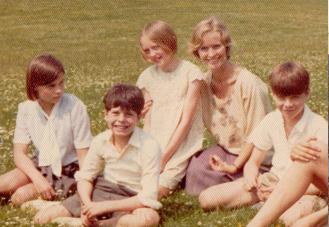
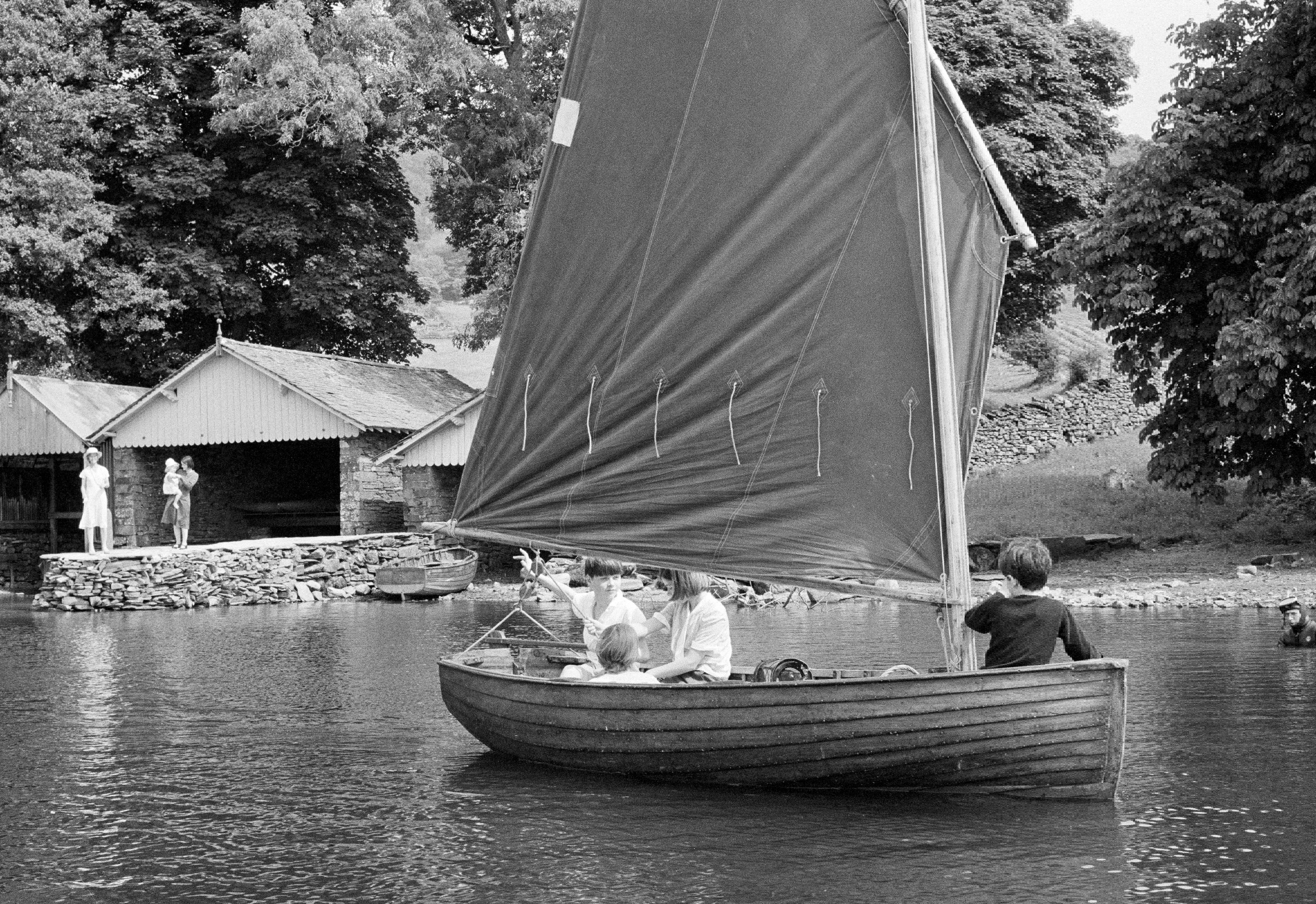
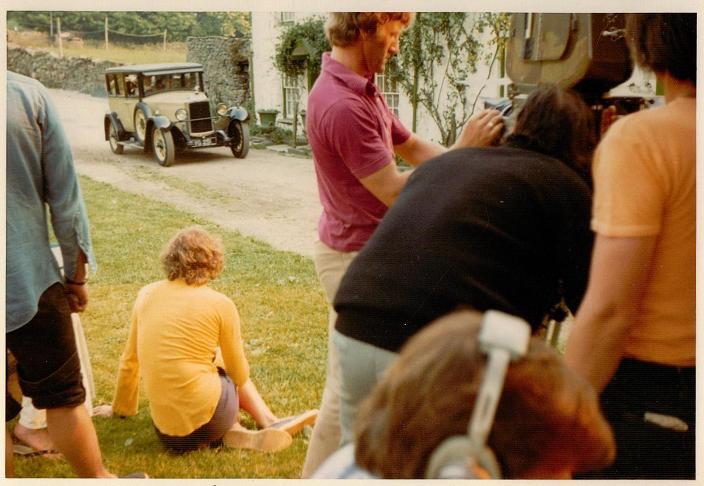
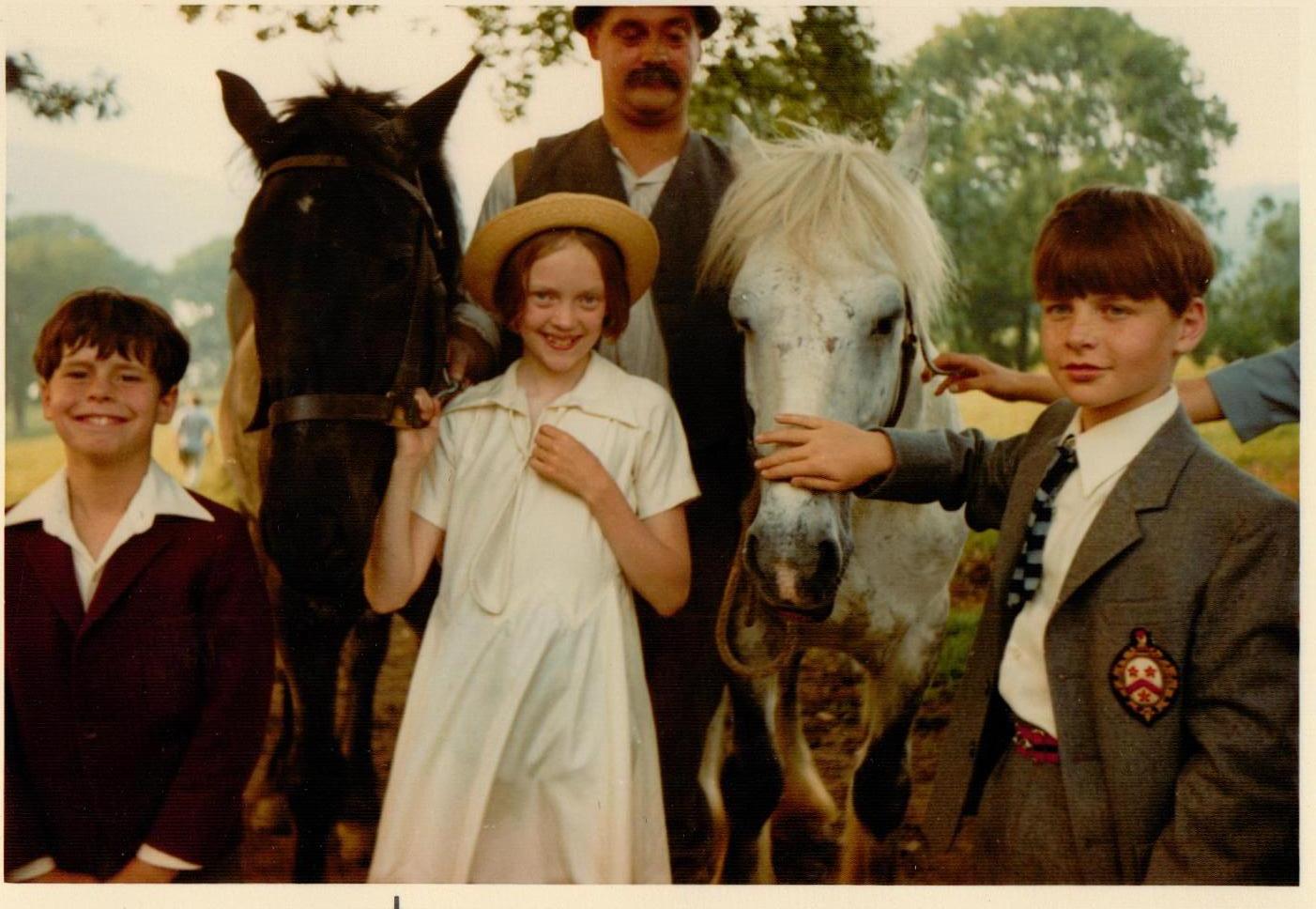
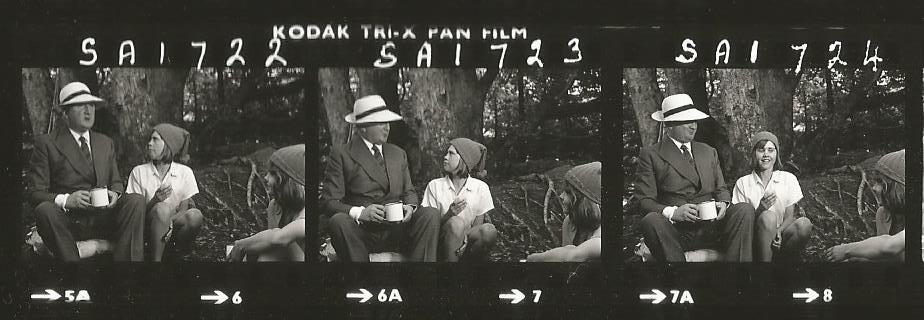
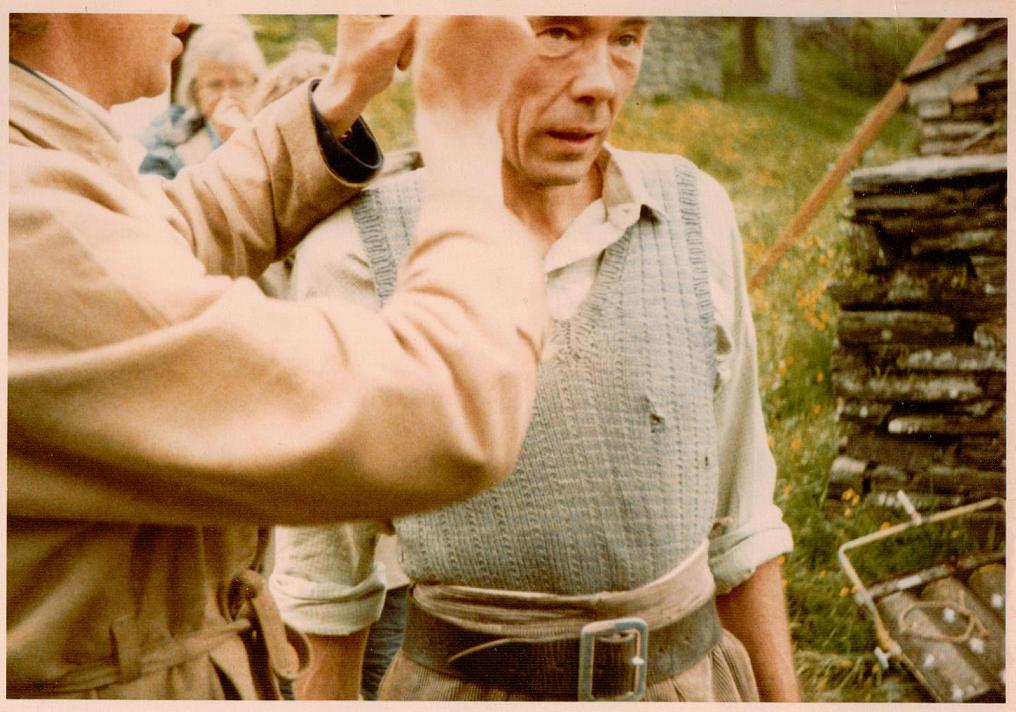
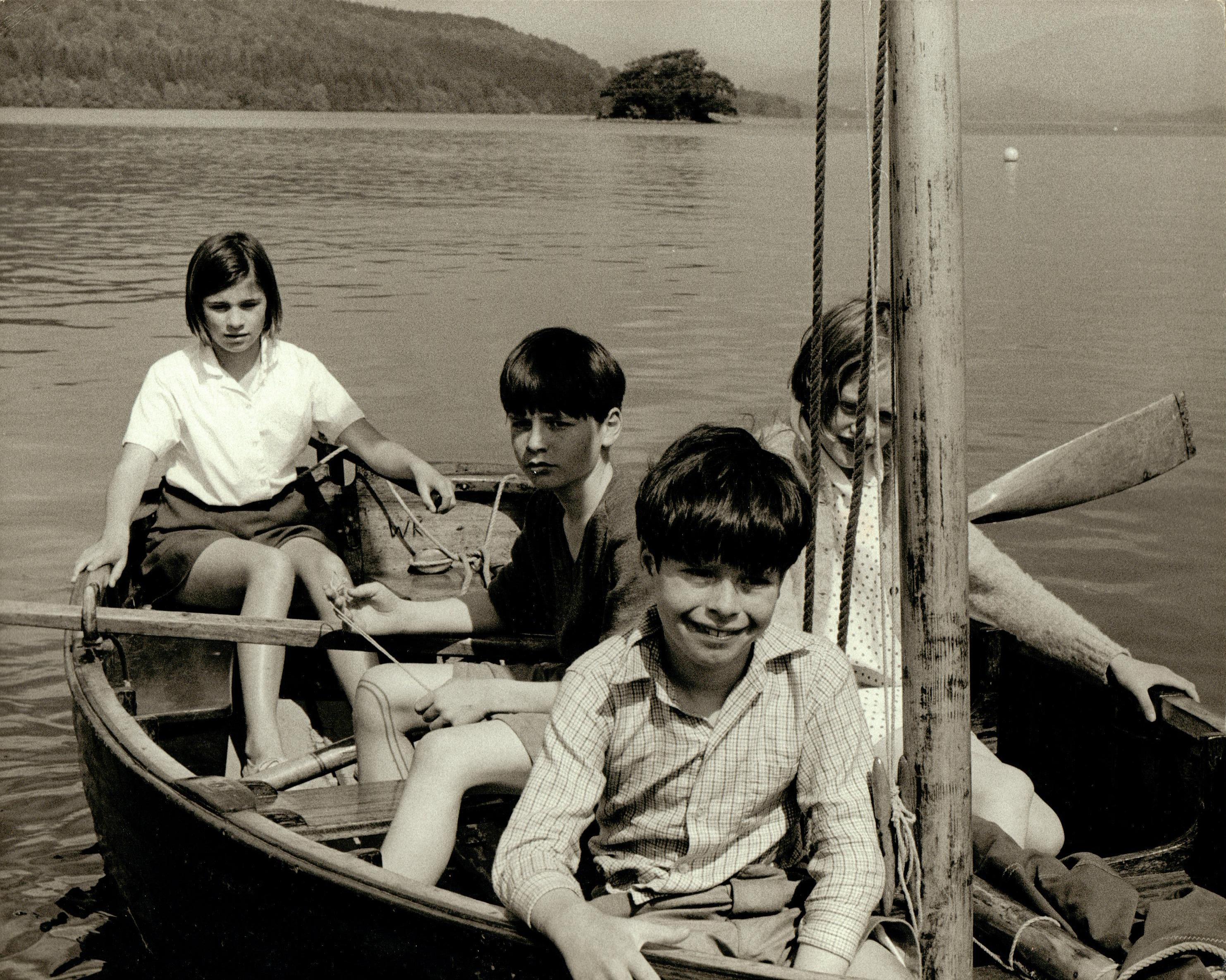
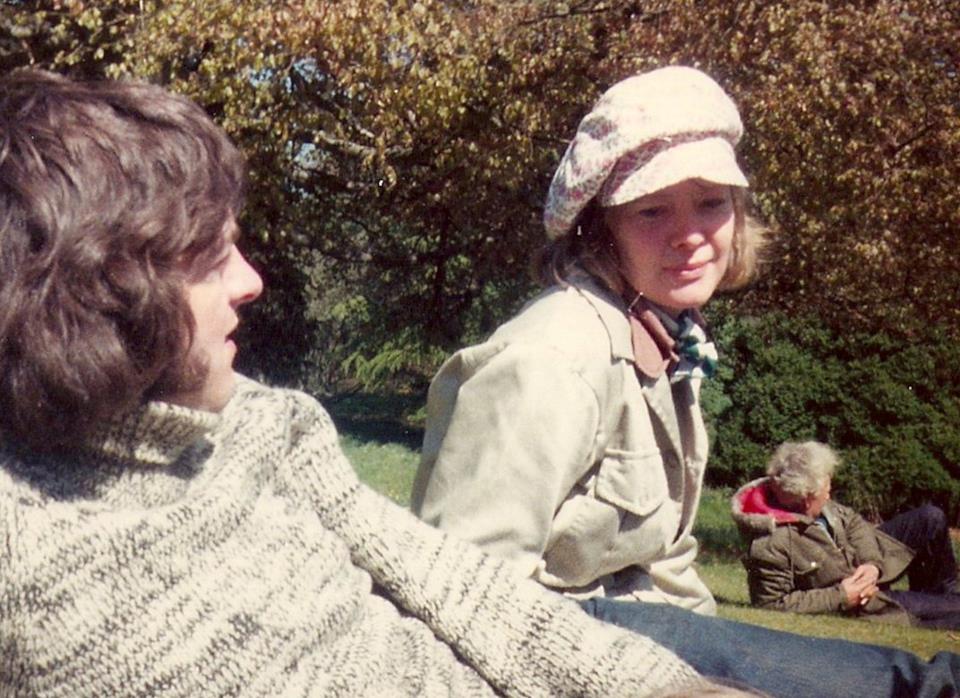
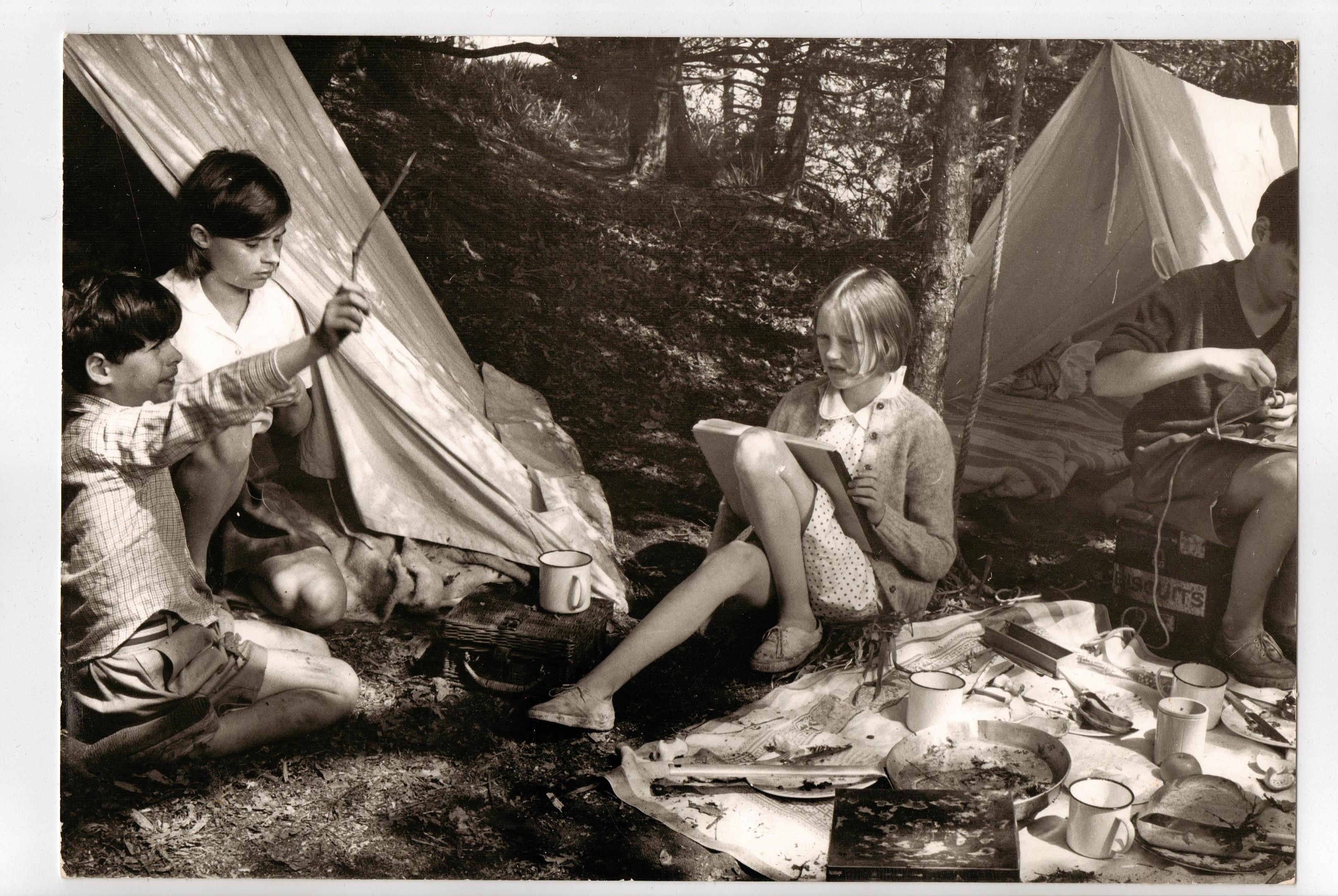
Sophie Neville, Simon West and Suzanna Hamilton with Ronald Fraser playing Captain Flint in the 1973 film of Arthur Ransome’s ‘Swallows and Amazons’
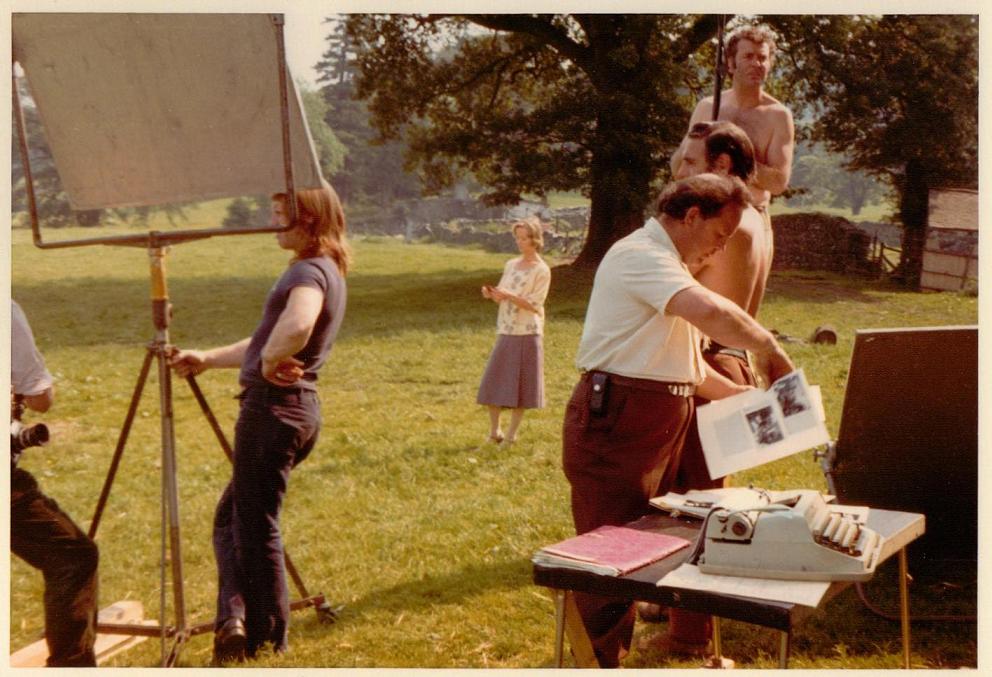
Ronald Fraser! veteran of World War II movies who had won an award for playing Basil Allenby-Johnson in The Misfits, had arrived on the shore of Coniston Water in two-tone shoes. Curiously so had two stand-ins. A short lady for me, who had dark hair, and a lady with blonde hair for Suzanna Hamilton. I have blonde hair and Suzanna is dark, but that is how it was.
The other four actors didn’t have stand-ins, which seemed odd. Kit Seymour, who played Nancy Blackett, and Lesley Bennett in the role of Peggy, rehearsed as usual. The two boys, Simon West and Sten Grendon, were younger than us but never had stand-ins, so that seemed odder. We didn’t think the ladies would be very comfortable on Peel Island. There wasn’t exactly a powder room there.
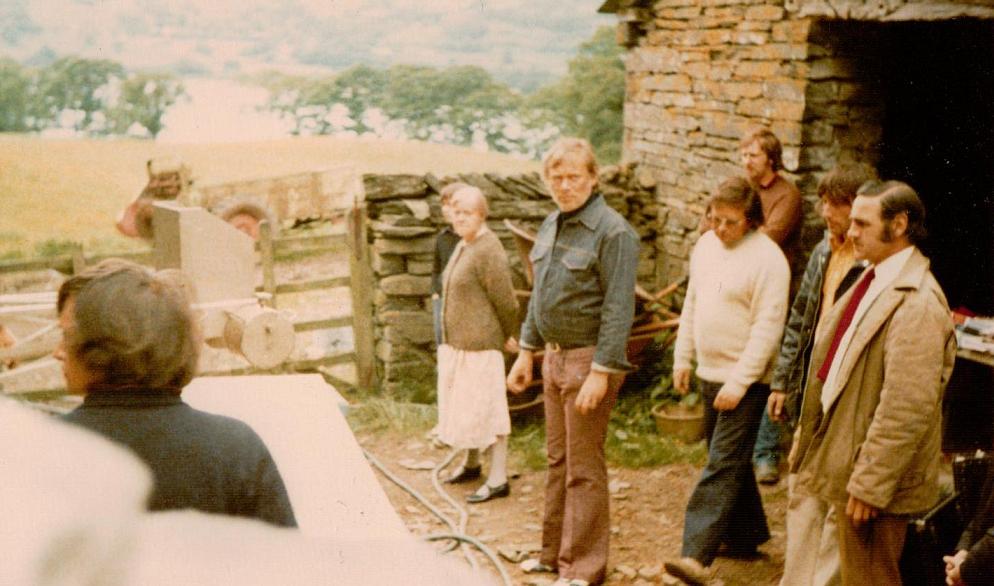
Director Claude Whatham and Bobby Sitwell with Suzanna Hamilton playing Susan Walker and Ronald Fraser as Jim Turner aka Captain Flint
And we were some way into the filming, used to handling props that the stand-ins found alien. However they were very excited about coming over to Peel Island. They sat in our positions and read our lines back to Ronald Fraser whilst the scene at the camp site was lit, and returned to stand-in for us later when his close-ups were shot. Somehow they managed to do this in scanty summer clothing despite a brewing storm.
My stand-in. I liked her very much and was most interested in her tapestry, since I was doing one myself. Lots of the men in the crew were interested in her tapestry too. They hadn’t noticed mine.
Our stand-ins got a lot of help from the crew as they went from ship to shore. We didn’t, but then we were agile and wore life-jackets. Mummy didn’t wear a life-jacket, but she has always been surprising good at getting in and out of boats. Her comment on the matter of my stand-in was, ‘Most unsuitable for a children’s film.’ Mum became increasingly concise: ‘I don’t think that woman was invited. She just turned up.’
Enthused by our Stand-in, Lesley Bennett and I went into Ambleside that evening to buy more wool for our own tapestries.
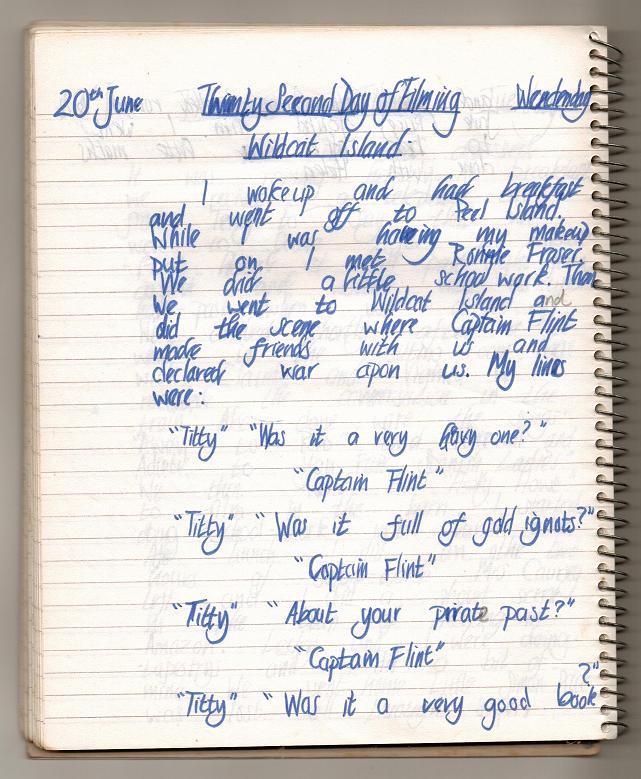
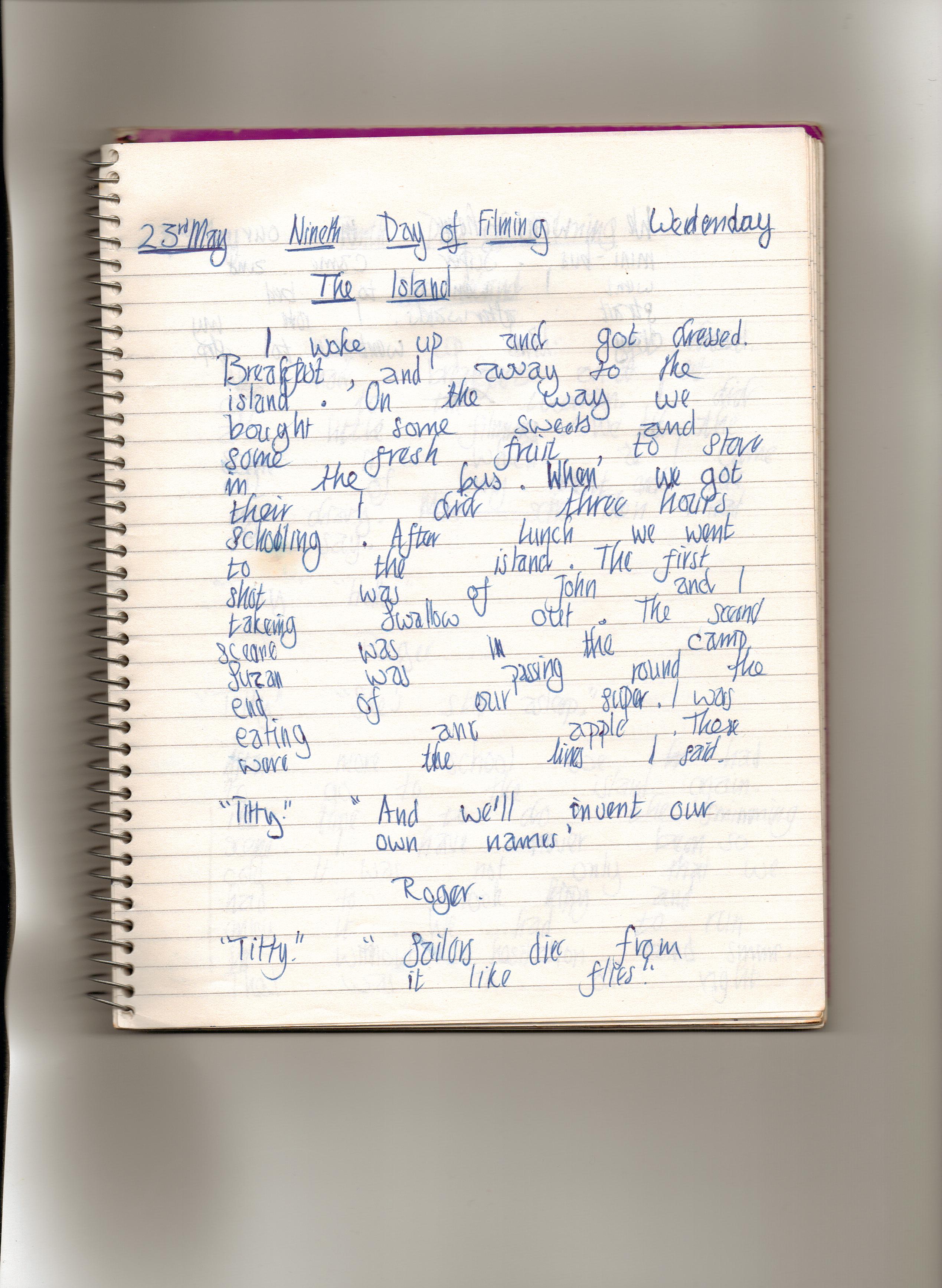
The recording of our scene with Captain Flint on Peel Island went smoothly, and Claude Whatham the Director was happy with the result, but my diary reports that a Force 8 gale blew in. This spun the poor production team into a quandary.
The call sheet for Thursday 20th June documents how truly unpredictable the weather could be. We had a ‘Fine Weather Call’, an ‘Alternative Dull Weather Call’, ‘Rain Cover’ in the Houseboat cabin, and a pencilled-in end-plan entitled ‘Peel Island’, which is where we’d ended up. Richard Pilbrow, the Producer, had a 1970s embroidered patch sewn to his jeans which read: THE DECISION IS MAYBE AND THAT’S FINAL.
The Call Sheet that never-was for 20th June 1973. We ended up on Peel Island.
In Arthur Ransome’s book Swallows and Amazons there is a dramatic storm with lashing rain. We were rather disappointed that it was not included in David Wood’s screenplay. It could have been shot that afternoon, but this was not to be. I can remember Mum saying, ‘You can’t have everything.’
What had been good about the 20th June was that we, the Swallows and the
Amazons, were all together, not sailing but on Wild Cat Island, with the novelty of working with Captain Flint for the first time. Kit and Lesley had been so patient, waiting day after day for their scenes to come up. They were stuck having lessons with our tutor Mrs Causey in the red double-decker bus most of the time. But the fact that they were on stand-by was helpful to the production manager who had to wrestle with the film schedule and call sheets.
As it was, the storm blew hard but cleared the dull-weather clouds and the next day was glorious, one to remember forever…
You can read more in the paperback or ebook here. There is also an audiobook narrated by me, Sophie Neville.
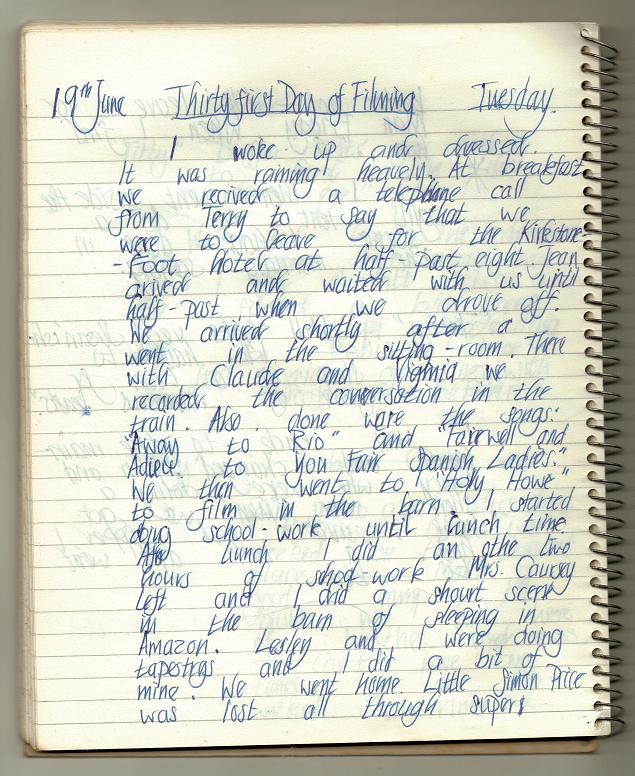
The Lake District is very beautiful. The problem about filming there is that it can rain quite hard – ‘heavily’ – was the word I used in 1973.
By this stage in the filming of Swallows and Amazons Claude Whatham only had one ‘rain cover’ option. We were kept busy recording sea shanties with Virginia McKenna at the Kirkstone Foot Hotel by Lake Windermere while Dennis Lewiston, the DOP, lit Mrs Batty’s barn at Bank Ground Farm above Coniston Water.
Arthur Ransome must have done much to revive the songs of the sea:
Farewell and adieu to you, fair Spanish ladies, Farewell and adieu to you, ladies of Spain; For we’ve under orders for to sail for old England, And we may never see you fair ladies again.
We never got as far as the ranting and roaring bit in the film.
No one really knows how old this naval song is. The Oxford Book of Sea Songs, mentions it in the logbook of the Nellie of 1796, long before shanties really came established as a genre. All I know is that Titty loved it and was still singing it in Peter Duck when the song became quite useful for navigating the English Channel.
‘The first land we sighted was called the Dodman, Next Rame Head off Plymouth, Start, Portland and Wight; We sailed by Beachy, by Fairlight and Dover, And then we bore up for the South Foreland light,’ or sort of.
Walking into Mrs Batty’s barn that day was hugely exciting. Simon Holland, the art director or set designer, had rebuilt the camp there, lighting a real fire.
Sophie Neville as Titty
Swallow was nmounted on a cradle so that she could be rocked, as if by water, as the scenes of her sailing at night were shot. It was brilliant, she even went about. Moonlight wasn’t not a problem. Richard Pilbrow can correct me, but I think it was produced by a lamp called a ‘tall blonde’. I don’t think we had a wind machine. The Prop Men used a large sheet of cardboard to produce a breeze.
‘Wouldn’t Titty have liked this?’
‘Liked what?’
‘Sailing like this in the dark.’
’57, 58, 60, 61…’
‘What’s the matter?’
‘Can’t you hear it? The wind in the trees? We must be near the bank. Quick, Susan lower the sail! Roger, catch the yard as it comes down!’ Then there is a crunch as the Swallows hit a landing stage. All mocked up. Quite fun.
‘What about Titty?’
Amazon was placed on the same mounting. I climbed aboard and started wrapping myself up in her white sail.
Children always love the irony of John saying, ‘She’s at the camp. She’ll be alright. She’s got a tent,’ when the shot cuts to me looking damp and uncomfortable about sleeping in Amazon, anchored out on the water.
Later I wake up and come out from under the sail to hear the burglars heaving Captain Flint’s trunk across Cormorant Island. All in all we achieved quite a bit on that wet day in Westmorland. Much safer and easier than being out on the water. Because the cradle was at waist height Claude was able to get lower angle shots than when out on the camera pontoon. Simon West, who played John, did really well. He managed to convince me that he was really sailing when I watched the film and I knew he wasn’t.
I’m pretty sure this scene of us inside a tent at night was actually shot on Peel Island but I may be wrong. We had a fire in the barn. If you look closely you can see an electric cable going into the lantern to boost light from the candle. The night scenes were tricky to light and shoot, but there was something about them that was intimate and exciting for children. I assume they would normally be in bed but it was the summer holiday and excitement was afoot.
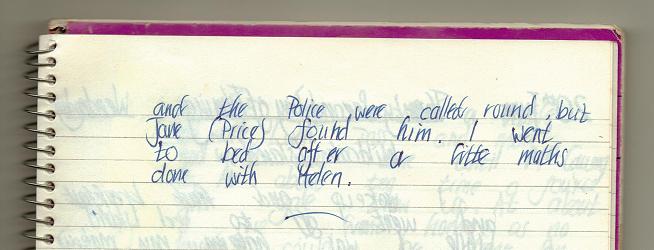
Back at our guest house in Ambleside there was a real life drama. Little Simon Price had gone missing. He was the small boy last seen on the beach at Rio, having his shorts pulled up by his sister. The Police were called and everything. But as in a lot of real life situations, things were sorted out, and we returned to the mundane world of maths lessons. I was tutored by Helen, one of the students at the Charlotte Mason College of Education who was also lodging at Oaklands as Mrs Causey, our teacher, could not ‘do modern Maths.’
Sophie Neville by Elterwater in 1973 ~ photo: DJ Neville
My mother was very excited about meeting the actress Brenda Bruce who Claude had engaged to play Mrs Dixon. She had arrived on 10th June whilst we were filming the fishing scene at Elterwater where she found Claude keeping up our moral by wearing my mother’s Donny Osmond hat. I think he needed it for warmth. It was unexpectedly cold.
I can remember being worried that Brenda Bruce would be chilly as she was only wearing a blouse and flip-flops. Now I understand that she ‘was of a certain age’ and didn’t feel the cold quite so much as skinny twelve-year-olds with opinions.
Brenda Bruce had been born in Prestwich in Lancashire. I’d had no idea that she was so well-known, that BAFTA ~ the British Academy for Television Awards had named her Best Actress in 1963. “Yes, you do!” Mum said. “She was the White Queen in Alice Through the Looking Glass.” She’d actually worked for Claude quite a bit and he trusted her to play a small part well. brought her son with her.
I shouldn’t have been worried about Mrs Dixon. She looked wonderful in the film – was wonderful – and very comfortable in her nice clean dairy.
When I look back on Swallows and Amazons, I can see that Claude made sure it didn’t become chocolate-boxy. You can tell by glancing at Mike Pratt’s costume.
Mike Pratt who played Mr Dixon the provider of worms for our fishing bait, the lovely Lakeland colours of his garments contrasting with the harsh blues and reds of the 1970’s clothes worn by the crew.
Brenda Bruce as Mrs Dixon with Claude Whatham
I can’t remember exactly where Dixon’s Farm was filmed. The scenes set at Jackson’s Farm, Arthur Ransome’s ‘Holly Howe’ were shot at Bank Ground Farm by Coniston Water, but all I know about the location for Dixon’s Farm is that our tutor got terribly lost trying to find it…
Geraint Lewis of the Arthur Ransome Trust wrote to confirm Kevin Burn’s theory about the location we used for Mrs Dixon’s dairy. ‘I had a long conversation once with Lucy Batty about her recollections of filming at Bank Ground in the house, barn, etc. She confirmed that they used the buildings shown as Tent Lodge Cottages on Google Maps – as Dixon’s Farm. That certainly seems to fit from the view of the lake and shoreline trees in the background.’
What Richard Pilbrow and Claude Whatham did want to make the most of was the Westmorland scenery. In many ways they were making a landscape movie. I think what they most enjoyed was finding all the locations to put together Arthur Ransome’s imaginary lake as depicted in the end pages of Swallows and Amazons and I am often asked where the waterfall is.
“It must be Niagara!” No, Sophie. It’s somewhere near Elterwater.
‘It’s Niagra!’ Titty declared. Stephen Grendon, Suzanna Hamilton, Simon West and Sophie Neville as the Swallows on their way to visit the charcoal burners
Kevin Burn sent me some suggestions with photos which made me feel pretty sure the actual waterfall is Skelwith Force. But Roger Wardale, who is an expert on Arthur Ransome’s locations, thinks not. “I don’t think it’s Skelwith Force which is more a series of rocky rapids in fairly level ground. I watched the film again yesterday and was reminded of the waterfall at Glen Mary (otherwise known as Tom Gill) the outlet for Tarn Hows dropping down to the Coniston-Ambleside road 4 miles from Skelwith Bridge.” So – any ideas most welcome!
You can read more about the film locations and our antics in ‘The Secrets of Filming Swallows and Amazons’ available on Amazon Kindle and from all ebook providers:
Sophie Neville and Simon West on the cover of ‘Swallows and Amazons’ pub by the Daily Mail
Of all the wonderful days we spent filming Swallows and Amazons in 1973, the fishing scene, shot in a reedy bay on Elterwater was one I enjoyed most. It was a cold, rather wet morning but the Third Assistant, Gareth Tandy, taught us how to use our rods and we were soon absorbed in a way that Arthur Ransome would have understood well.
Our fragile bamboo fishing rods, one with a wooden reel, were supplied by a keen fisherman called Leslie Borwick, who brought up his own daughter and grandchildren on Arthur Ransome’s books. He kept the rods, which still belong to the family, who now lived near Sedburgh.
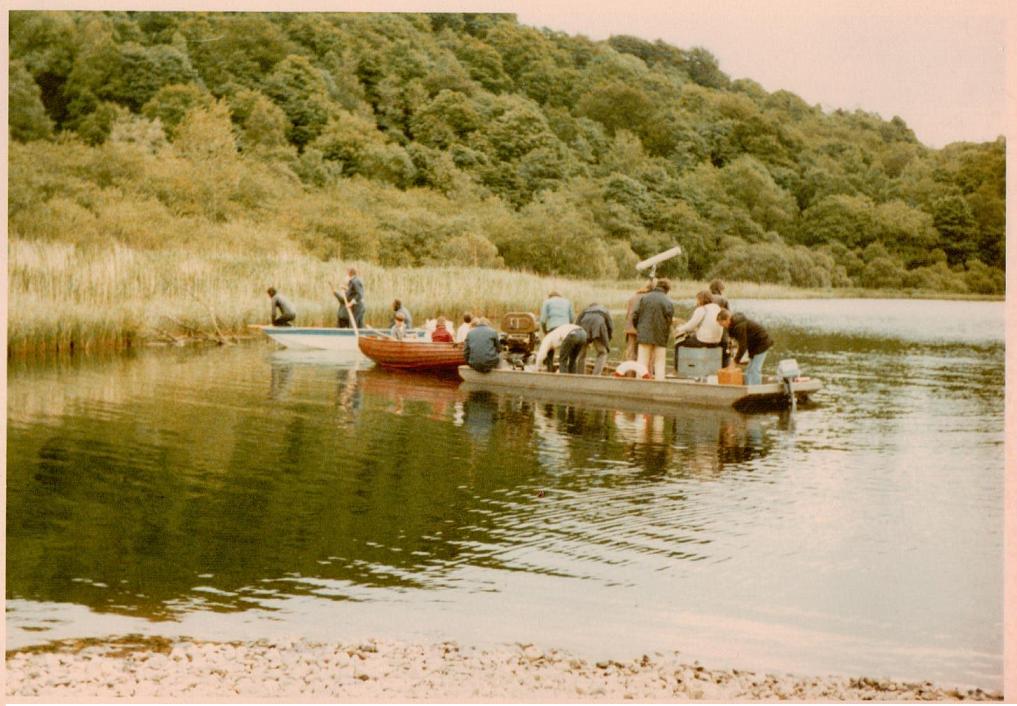
Filming the fishing scene from the camera punt on Elterwater
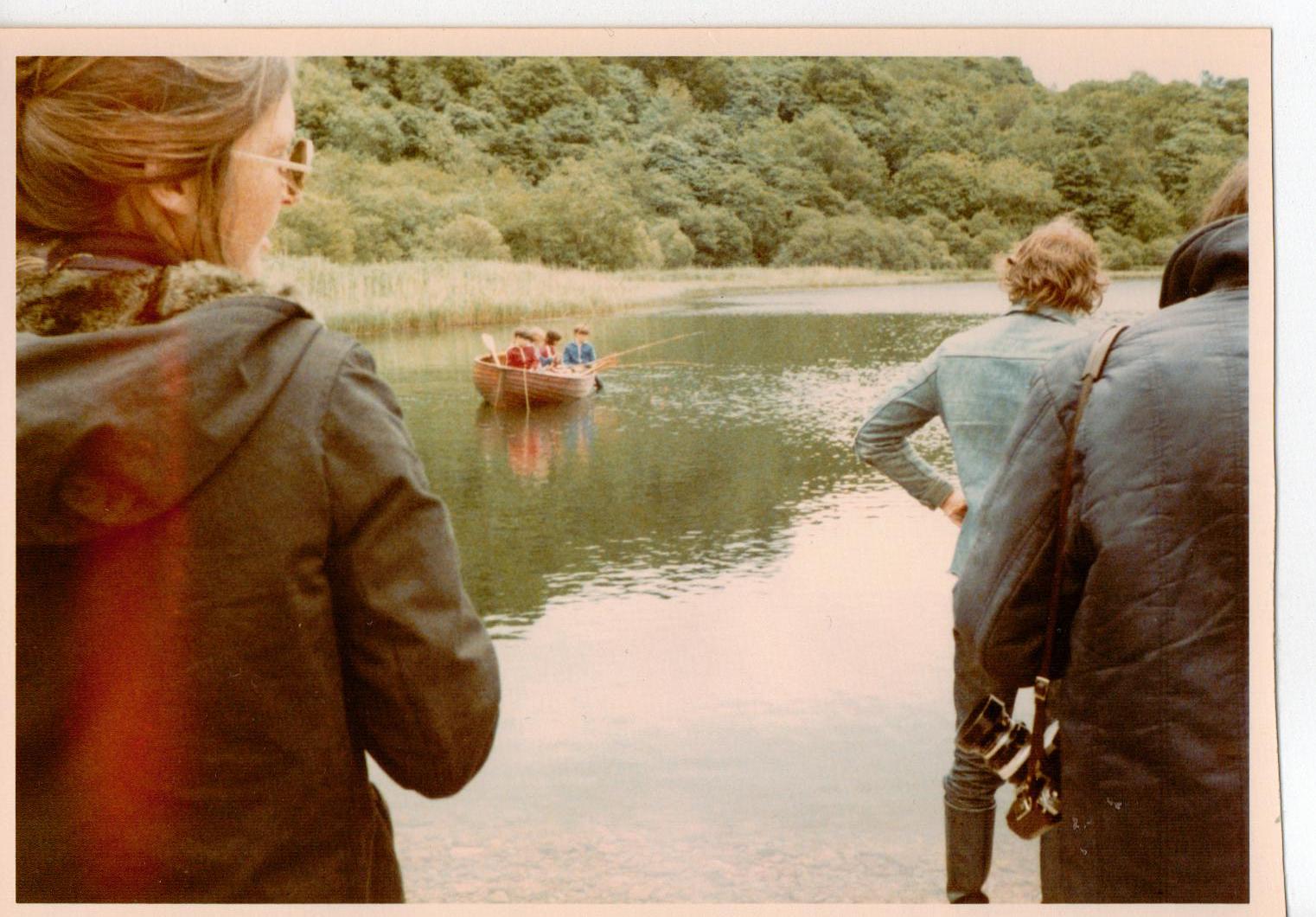
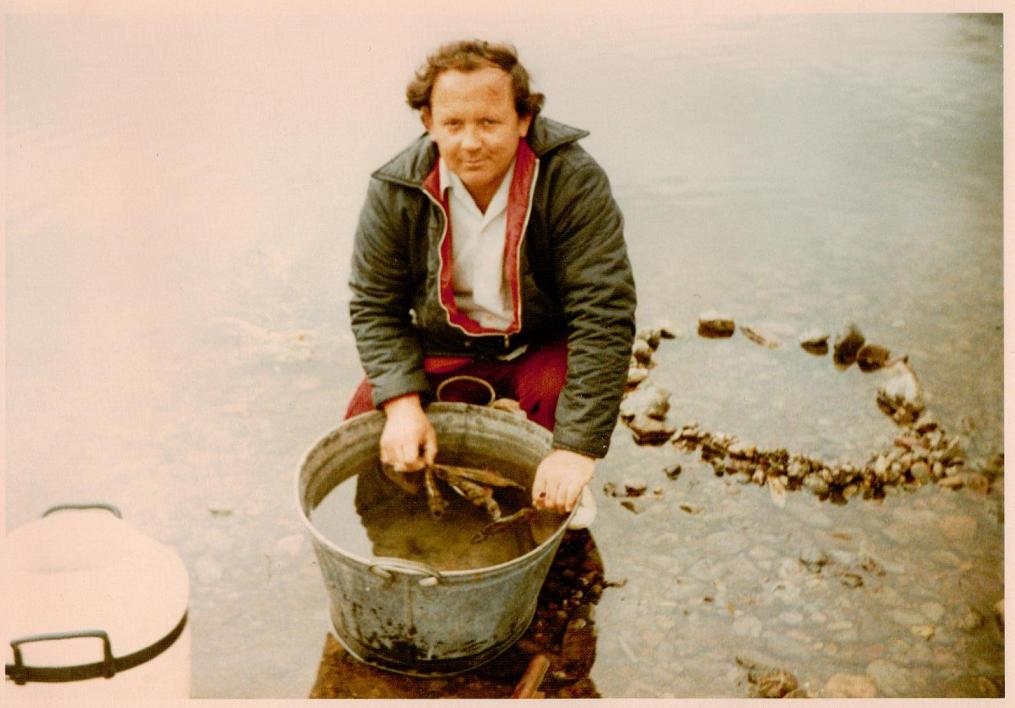
The only problem we had that day was keeping the fish alive. Bob Hedges our property master, the designer Simon Holland and Ian Whittaker, the set dresser, took it upon themselves to keep the perch as happy as they could, until they were – very carefully – attached to our hooks. Titty doesn’t catch one but Captain John did. Despite everyone’s best efforts it wasn’t a very lively perch.
Property Master Bob Hedges keeping the perch alive ~ photo: Daphne Neville
The big challenge was Roger’s great fish – a massive pike that meant to be snapping and ferocious. I’ve been told that it ended up being resuscitated in Keswick Hospital ICU – the Intensive Care Unit.
The local fisherman, Ian Whittaker, Simon Holland and Gareth Tandy with the fish photo: Daphne Neville
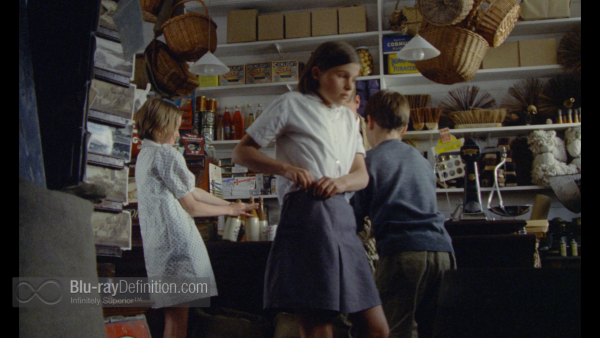
Sadly this is the only photograph we have of the set designers at work together. Later that afternoon we went to one of the few interiors of the film – the general store in Rio or Bowness-on-Windermere where we bought the rope for the lighthouse tree and four bottles of grog. In reality it was a sweet shop in the ‘seventies. It was later a barber shop and became a showroom for wood-burning stoves. Pigs were once kept around the back.
The Swallows in Woodland Road, Windermere in 1973
Back in 1973, Ian dressed the interior with boxes of wooden dolly pegs and other things you’d buy in brown paper bags. A wonderful 1920’s radio set and two purring cats really made the scene come alive, especially since, being in reticent explorer mode, we were a bit gruff in our communications with Mr Turner, the native shop keeper.
Sophie Neville in Rio with four bottles of grog ~ photo: Daphne Neville
Ian Whittaker struck me as being rather different from everyone else on the crew. He was a very nice looking man and a gentleman of the old school. I remember him telling me that he’d originally set out to be an actor but had found it so difficult to get work that he grabbed a chance to become a set-dresser or designer’s assistant. He found he rather enjoyed it, and stuck to the job despite his family thinking it was not much of a career. He proved them wrong. By 1971 he was working for Ken Russell on The Boy Friend – a musical about a musical starring Twiggy with Christopher Gable and Max Adian that I’d seen at school.
Woodland Road, Windermere
After Swallows and Amazons Ian worked on Ridley Scott’s film Alien with Sigourney Weaver, Tom Skerritt and John Hurt and was nominated for an Oscar with the others on the design team. Eventually he won an Oscar for Best Art Direction-Set Decoration with the designer Luciana Arrighi for Howards End – the movie of EM Forster’s book starring Anthony Hopkins, Vanessa Redgrave, Emma Thompson and Helena Bonham-Carter.
In 1994 Ian was nominated again, this time for Remains of the Day directed by James Ivory. After that he worked on Sense and Sensibility, Emma Thompson’s movie of the Jane Austen classic that launched Kate Winslet’s career, some of which was shot at Montacute in Somerset where my great-grandmother once lived. Ian Whittaker received another Oscar nomination for Anna and the King in 2000 and a nomination for an Emmy Award for the TV movie Into the Storm in 2009.
So, it was rather a waste that Ian spent his time just building little stone walls in the lake to keep the perch alive on our set, but I think he enjoyed the fishing scene as much as I.
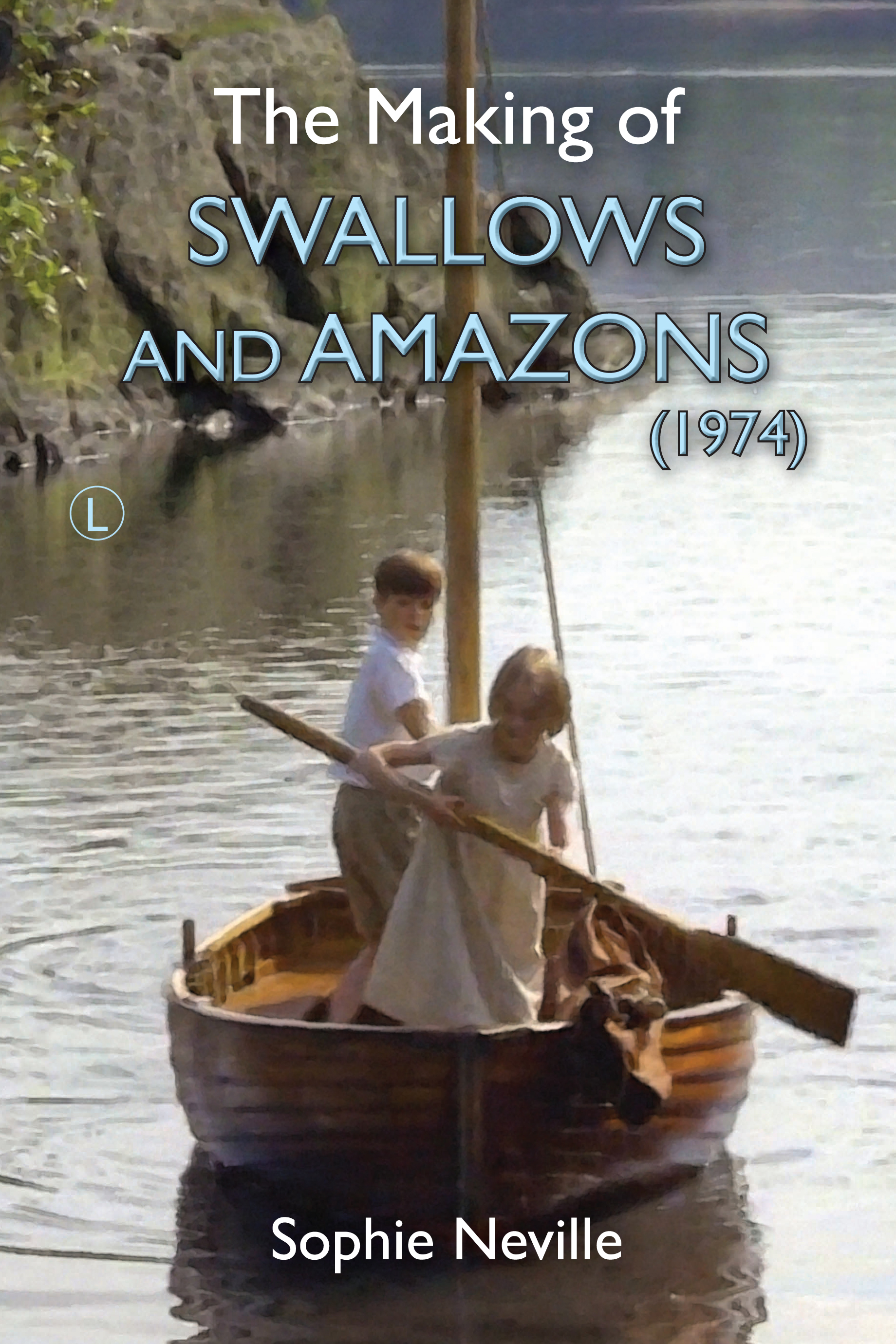
You can read more in ‘The Making of Swallows and Amazons (1974)’ available online, from Waterstones and your local library. It is suitable for all ages of readers.
In Arthur Ransome’s book Swallows and Amazons Titty is left keeping watch on an island, so small it is little more than a rock, whilst the Swallows sail into Rio Bay in search of the Amazons. Luckily for me, this is not so in the film. Susan declares, ‘They must be making for Rio’ and the scene cuts to a band playing in the municipal park at Bowness-on-Windermere. John rows into the bay pretty sure that the Amazons have given them the slip, Susan suggests that we could explore Rio and I happily declare, ‘We could buy rope for the lighthouse tree.’ And that is what we did – leaving the boy Roger in charge of Swallow. It was such a hot day I whipped off my grey cardigan before I leapt out of the boat, no doubt causing havoc for the Film Editor.
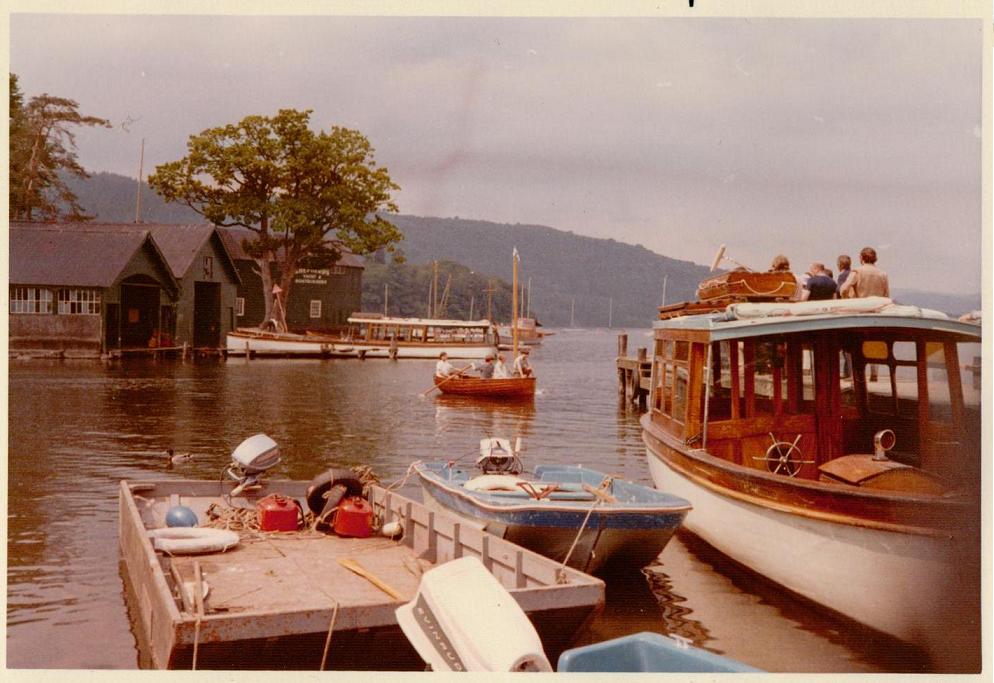
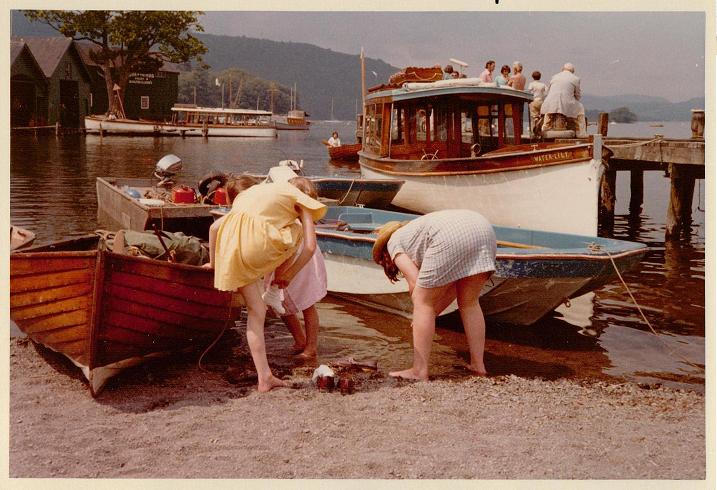
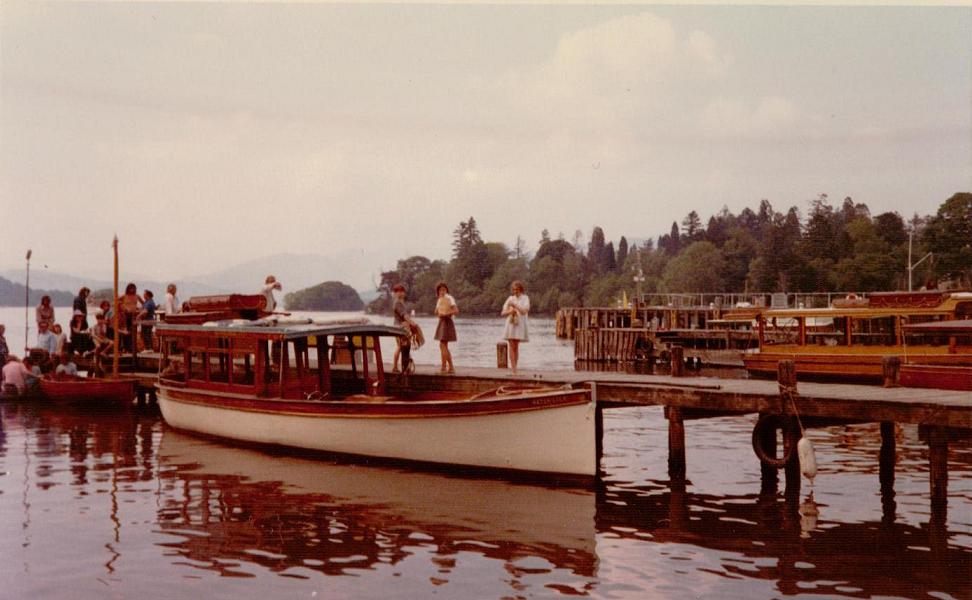
The Swallows approach the jetty in Rio. Empty camera boats are moored in the foreground beside a period launch. Are those green boatsheds still standing today?
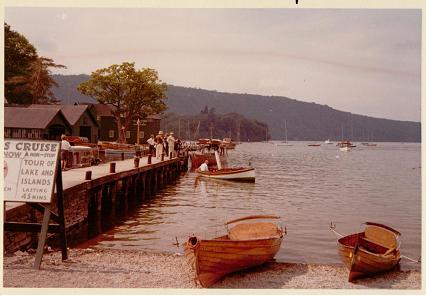
Simon Holland, the Set Designer on Swallows and Amazons had transformed the busy Bowness of 1973 into a Lakeland town of 1929. To do this he must have had a huge amount of glass fibre boats moved. These were replaced by the beautiful wooden launches and skiffs of the period.
You can see my father in white flannel trousers, his dark hair cut short, standing on the jetty in front of the lovely old green boathouses that then overlooked the bay. He is talking to the owner of the launch with the green and white striped awning.
Much of the first part of this sequence was filmed from the grey punt used as a camera boat. It seems that Simon West, who played John was towing this as he rowed up to the jetty. It was a hot day and for once we were all feeling the heat.
Kit Seymour and Jane Grendon watch the filming on the jetty whilst Tamzin and Perry Neville eat ice creams with the one man in Cumbria willing to have a short-back-and-sides. You can just see the period cars parked in the background
Although the Swallows spurned the conventional attractions of tripperdom, we spotted the Stop-me-and-by-one ice cream cart like lightening. I was entranced by the old cars, the pony and trap and the number of people dressed to populate Rio. They were organised and directed by Terry Needham, the Second Assistant Director. To our delight we found Gareth Tandy, the Third Assistant, was dressed in period costume too, his Motorola hidden under a stripy blazer so he could cue the Supporting Artists and keep back the general public without having to worry about appearing in vision himself. To his dismay he had had to have his hair cut. We all thought this a distinct improvement. He looked so handsome! I’m not sure if you can see him in the distance when we are climbing out of Swallow. You can just see my sisters walking towards the town at this point with Pandora Doyle, Brain Doyle’s daughter.
The Price children, Perry Neville, Jane Grendon, Tamzin Neville and Pandora Doyle in their 1929 costumes on the shore of Lake Windermere at Bowness in 1973 ~ all photos on this page : Martin Neville
Jane Grendon, our chaperone looked fabulous in her 1929 costume. It was the one and only time I saw her in a dress.
Jane Grendon as a Passer-by with her pram in Rio Bay ~ photo: Daphne Neville
She was wonderful. Being in costume enabled her to keep an eye on all the children playing on the beach. I know she would have kept them going and maintained safety as they flung pebbles into the water or rushed about with the donkeys that were giving rides along the shore – no one wearing helmets of course.
Another excitement of the day was that Claude Whatham had given Mr Price, the owner of the Oaklands Guest House where we were staying, the part of the native. The native who says, ‘That’s a nice little ship you’ve got there.’ Mum said that Kit Seymour, Suzanna Hamilton and Lesley Bennett had spied him, pacing the garden at Oaklands trying out every possible way of saying this line. ‘That’s a nice little ship you’ve got there.’ Then, ‘That’s a nice little ship you’ve got there,’ leaving the girls in fits of giggles.
John Susan and Titty walking past the hotel
After we leave the general stores, me clutching bottles of grog, you can see Tamzin in a pink dress and straight back riding a chocolate coloured donkey along the beach while Dad is pushing out a rowing skiff with a log oar. Roger looks on from the Jetty to see Perry riding another donkey in a yellow dress while Tamzin walks by in the opposite direction with none other than Mr Price, in his striped blazer, who is walking along towards the boathouses holding a little boy’s hand. I am sure it was one of his own children but it looks a bit dodgy because while Roger watches my sisters and Pandora throwing stones into the lake from the beach were the skiffs are pulled up, David Price comes walking along the jetty and delivers his line: ‘That’s a nice little ship you’ve got there.’ It’s shot in rather a creepy way. John did warn Roger to ‘Beware of natives.’
The film crew of ‘Swallows and Amazons’ wait with Swallow and Stephen Grendon at the end of the jetty while Simon West, Suzanna Hamilton and Sophie Neville line up by the launch
A moment later Pandora and my sisters are surrounding the ice cream man while John, Susan and Titty return, striding along the jetty like the three wise men, carrying rope, buns and bottles of grog.
My father’s all time passion in the form of a very graceful steam launch passes, almost silently, in the foreground. A happy, happy day. They only sad thing was that we didn’t have time to film inside the bun shop, which was such a pity as it looked glorious. Claude had been obliged to re-take a scene when some ladies – real life ladies in 1970’s garments and bouffant hairdos – had come scootling out of the Public Conveniences in the middle of a take.
What none of us knew was that is was nearly our last day on earth. The same Supporting Artists, including my father, had been booked for the next morning…
My father added:
‘George Pattinson, the man who revived the steamboat world, along with Roger Mallinson, was the character in Elisabeth the little steamer.’
George Pattinson in his steam launch Elisabeth ~ photo: Martin Neville
‘The Bowness skiffs were not like the Thames version. The outriggers caught the oars and allowed a fisherman to let go of the grip if and when he caught an Arctic char, the Windermere fish, the oars were retained. A heavy boat.
I remember the rope was huge, fat and unsuitable! Daphne was not around as she had to go south to present Women Only for HTV. She was devastated to leave the donkey scene.’
You can read more about our antics in the paperback or ebook of ‘The making of Swallows and Amazons’ available from online retailers, good bookshops, and libraries worldwide. You can read more on Amazon here.
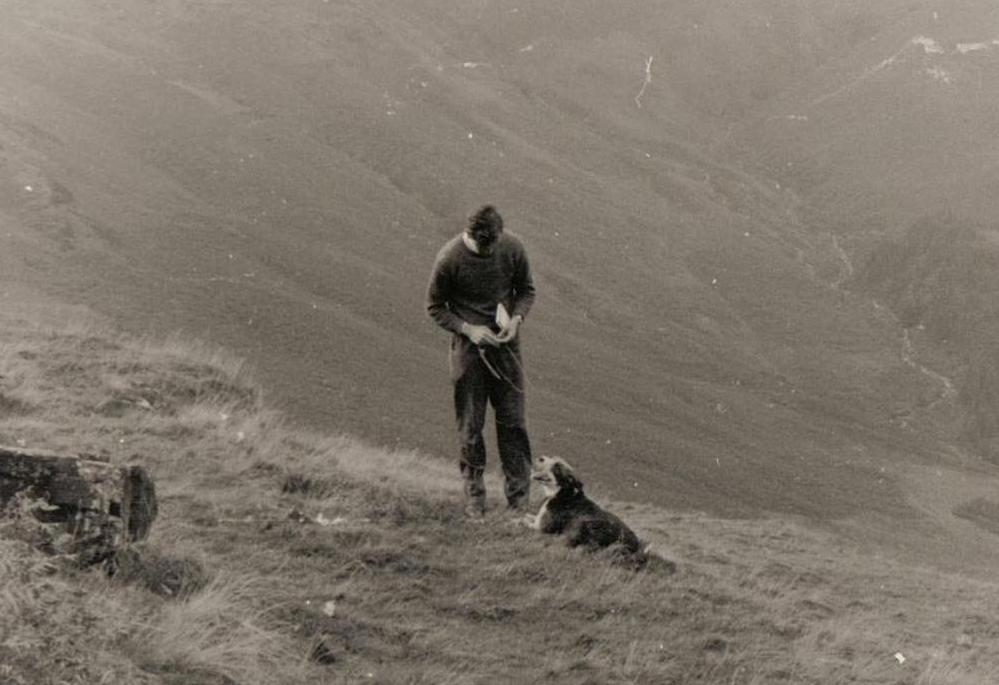
My father has always grabbed a chance to visit the Lake District. As a young man he once took advantage of a military travel warrant to climb the fells and later made it his job to visit the Colfast Button factory in Maryport every month, when he worked for BIP. He would stay at the Pheasant Inn at Bassenthwaite Lake, latching visits onto a weekend, so he could explore Cumbria.
Martin Neville in Cumbria with his dog
This was in the late 1950s. When I came along he took us to stay at Goosemead Farm. We climbed Castle Crag and you only have to glance at the photographs to see how happy I was to be there. We had a sheepdog called Luppy who came too. She was a great character and much loved. Found as a stray before I was born she was still around when I left home to be in Swallows and Amazons.
Sophie Neville aged three in the Lake District with Luppy the sheepdog
Arthur Ransome had been Dad’s favourite author as a boy. He said that he would wait in anticipation for another book to be published. He’d bought me the set of twelve, collecting them from various secondhand shops. I had read seven by the time I was twelve. He set my destiny.
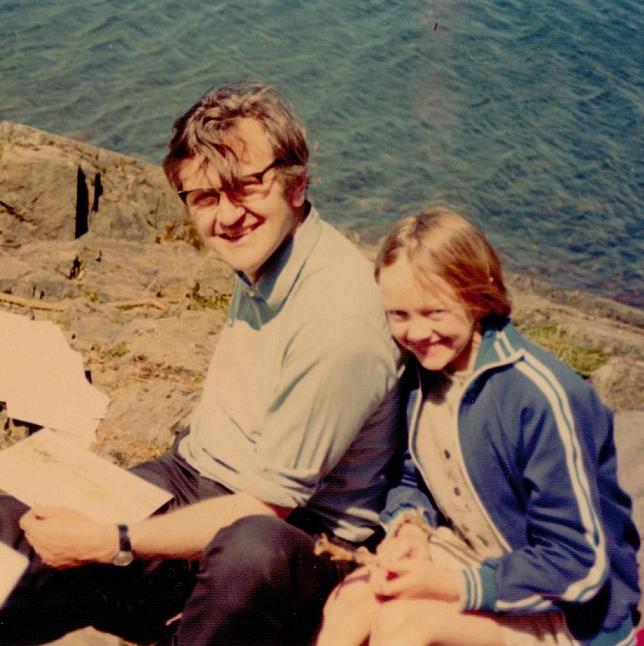
Finding my father Martin Neville the shore of Coniston Water
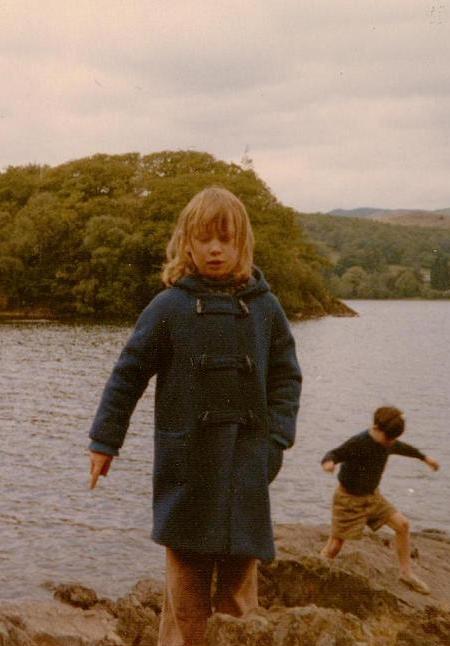
My father left the dogs at home on 26th May so that he could drive my younger sisters up to join us for two weeks and watch the filming. He found Peel Island on Coniston Water and was there to meet us when the boat came in at the end of the day. My sisters stood smiling on the rocks, dressed for the weather in matching red jerseys, duffle coats and gumboots.
My sisters Perry Neville and Tamzin waiting for me on the shore of Coniston Water
My parents had booked a Bed and Breakfast in Ambleside across the road from the Oaklands Guest House. I immediately noticed a sign declaring that you had to pay 10p to have a bath. ”Ten pee!’ Mum glared at me, furious. ‘Do be quiet, they’ll hear you’. I had moved to share Suzanna’s room, since Mrs Price had a long-standing booking for the back room Mum and I had been using. Her guesthouse was full to bursting since she had students from the Charlotte Mason College of Education lodging with her as well as all of us and her own three children. There were only two bathrooms for the twenty-two people living in the house but there were basins in some of the bedrooms. Nylon sheets were provided but the bedding was apt to slide off in the middle of the night.
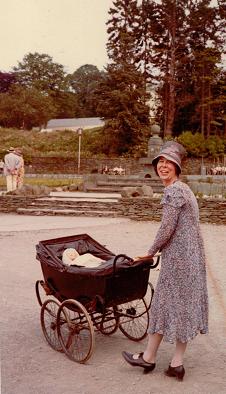
My sister with Sten Grendon, Peel Island behind them
My sisters, Tamzin and Perry, who must have been about eight and nine, struck up an instant rapport with Suzanna Hamilton. She asked them to baby-sit her pet slow-worms. These had come up from London with her in a small glass aquarium, which she had put in the fire place in our room. I don’t know what Mrs Price thought. I wasn’t very keen on handling them, and have no idea how they were fed, but Perry was intrigued. Suzanna had also brought her ukulele. She would sit on her bed playing Ain’t She Sweet, Sunny side of the Street, Playing on my Banjo and other Norman Wisdom numbers, fluently and with great gusto. My sisters were entranced. They may have even shared the room with us and the slow-worms. Mum can’t remember.
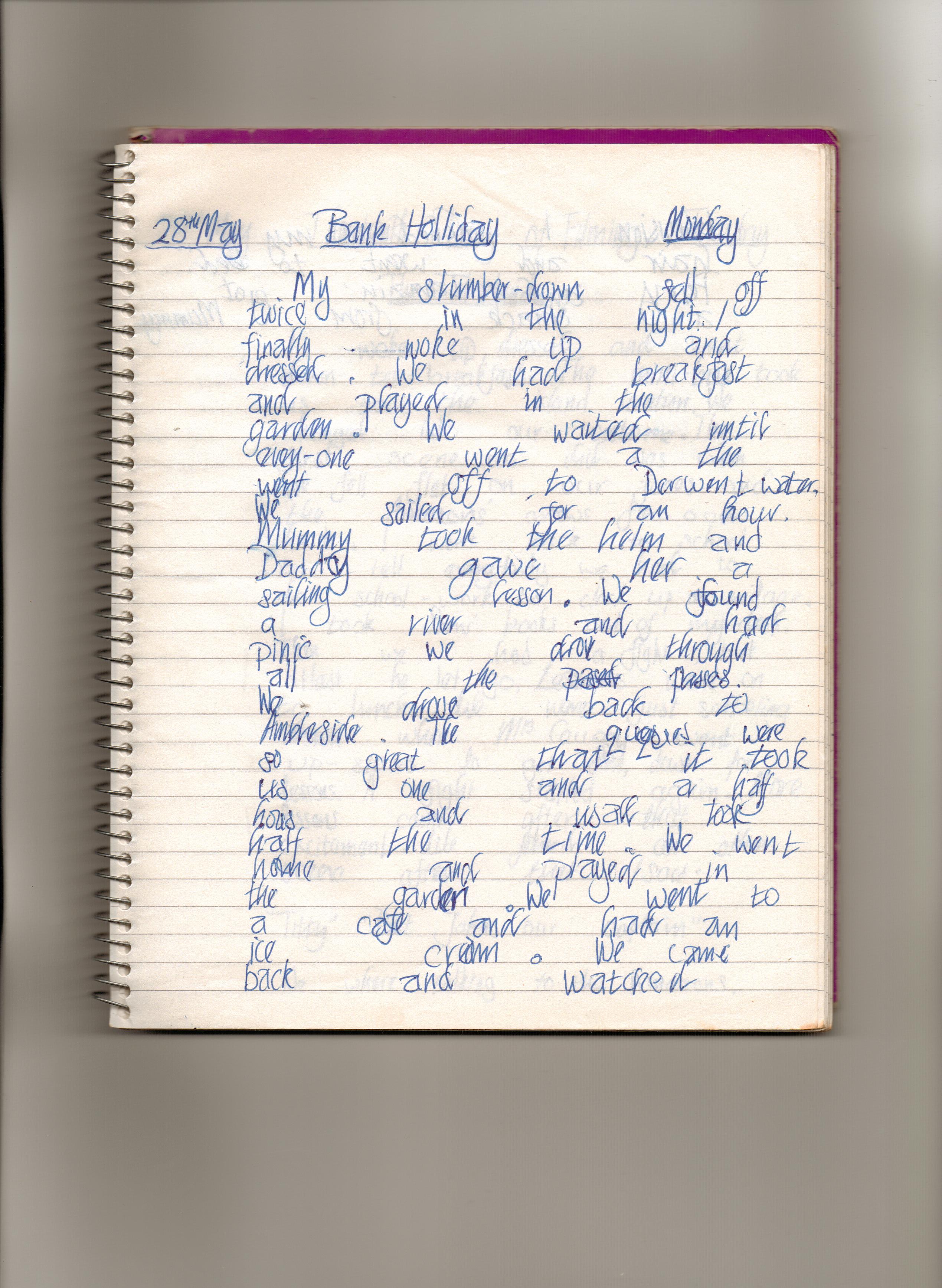
Dad had already made plans for sailing that first Bank Holiday, when Richard Pilbrow had scheduled a break.
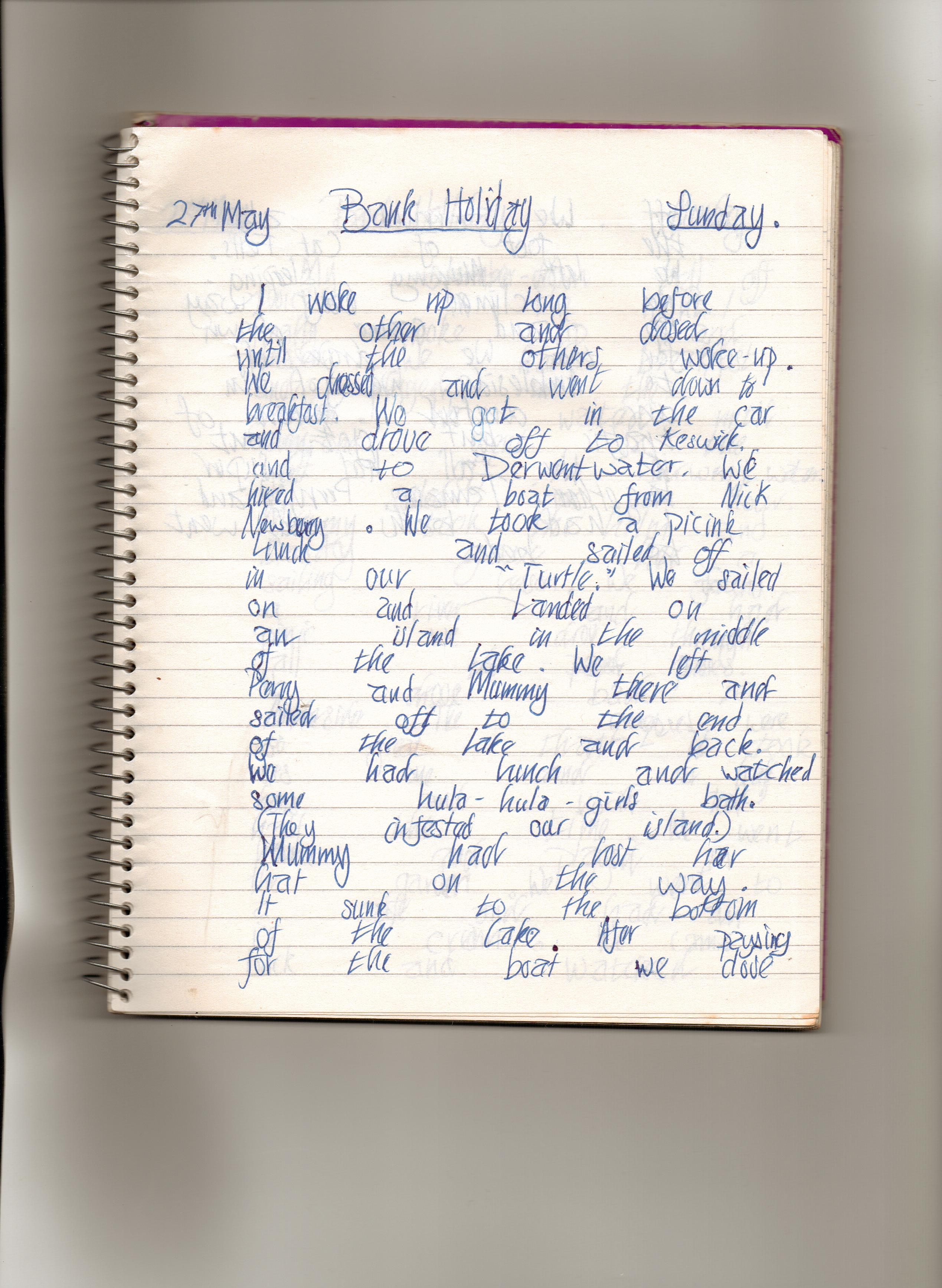
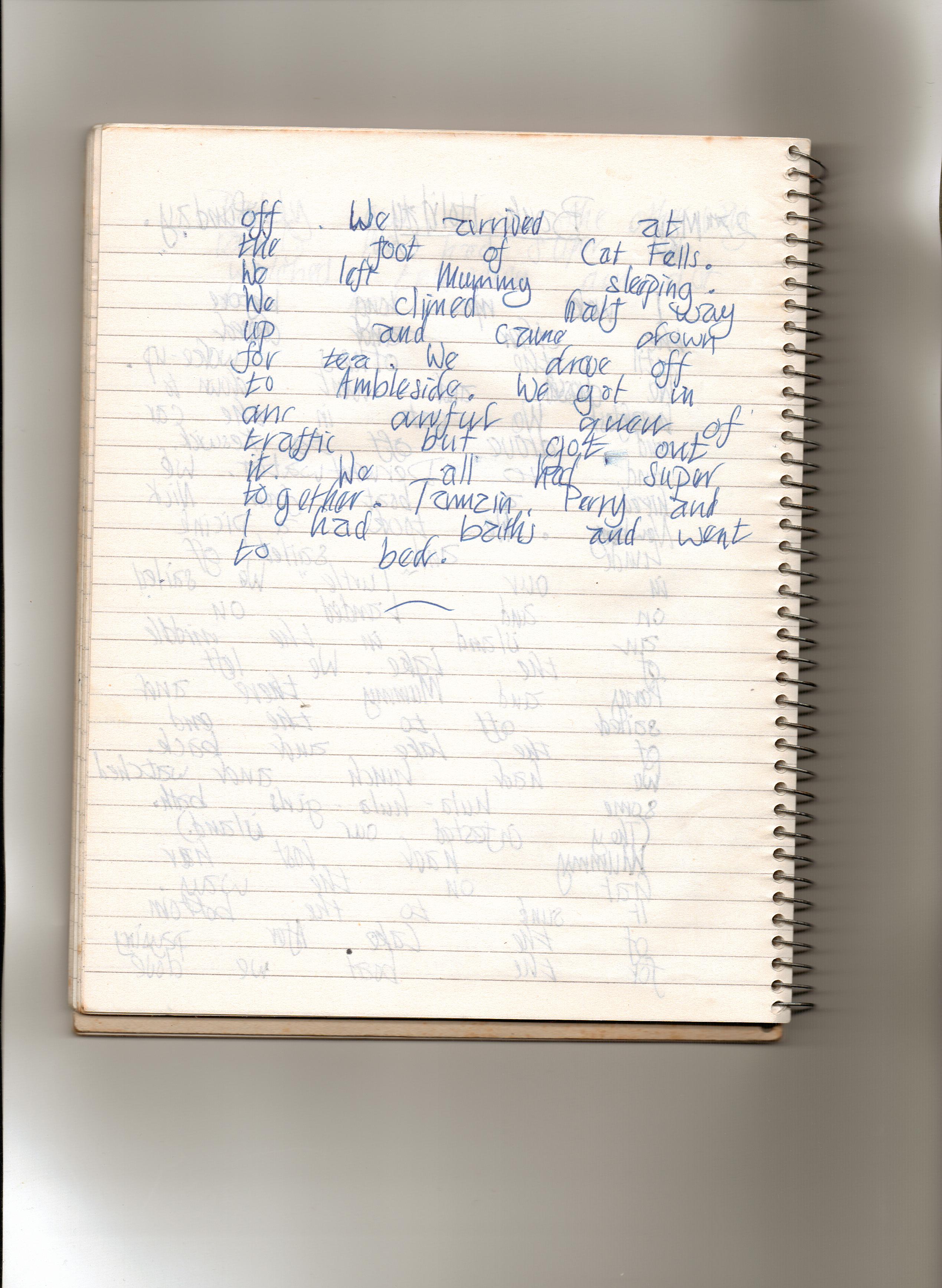
I remember the Hula-hula girls well. Although it was only May they suddenly appeared on what seemed to be a remote, inaccessible island, clad in garish, brightly coloured bikinis – the kind that had little frilly skirts to them. We watched them splash about and swim in complete wonder as, although it was sunny, we knew how cold the water was.
We had seen something of the same kind of savage the day before. I can remember the dismay on the First Assistant’s face when he realised it really was the Saturday of the Bank Holiday. We had had Peel Island to ourselves, indeed it had become ours – our special place, our magical camp, our home. And suddenly it was being invaded by brash women from Manchester who certainly had no respect for anyone making a film. I don’t know how they got out there. they seemed to arrive from no where when we were in the secret harbour, which was suddenly a secret no more. It was their holiday and there was no stopping them or their over-weight and noisy children. They were quite frightening.
The horrific Bank Holiday traffic queues were also unexpected, but my father took us up into the mountains and out on Derwent Water. He must have been trying to teach my mother to sail for decades but she has never begun to get the hang of it.
David Blagden and my mother Daphne Neville in her Donny Osmond cap
Mum was in mourning that weekend as she had watched her favourite hat blow across the water and sink to the bottom of the lake. It was a bulbous pink and white Donny Osmond cap that Claude Whatham had enjoyed wearing on set to amuse us. She was able to find a yellow and white one to replace it but he never liked it as much. Said it didn’t suit his colouring.
You can read more about our adventures making the film here:
‘Natives again. Or cannibals. This marks the spot where they ate six missionaries’ has to be the best line that anyone in the history of film making has ever had to utter. It is not in the book, just that ‘…they might have been killed and eaten by other natives,’ as Titty, having digested huge helpings of Daniel Defoe, declares herself the most ardent imperialist of all time. And she has such fun doing so. I have always liked the talk of ‘the powerful native’ (Mr Jackson the Lakeland farmer) and the savages living around Rio. I always hope it shocks lots of people.
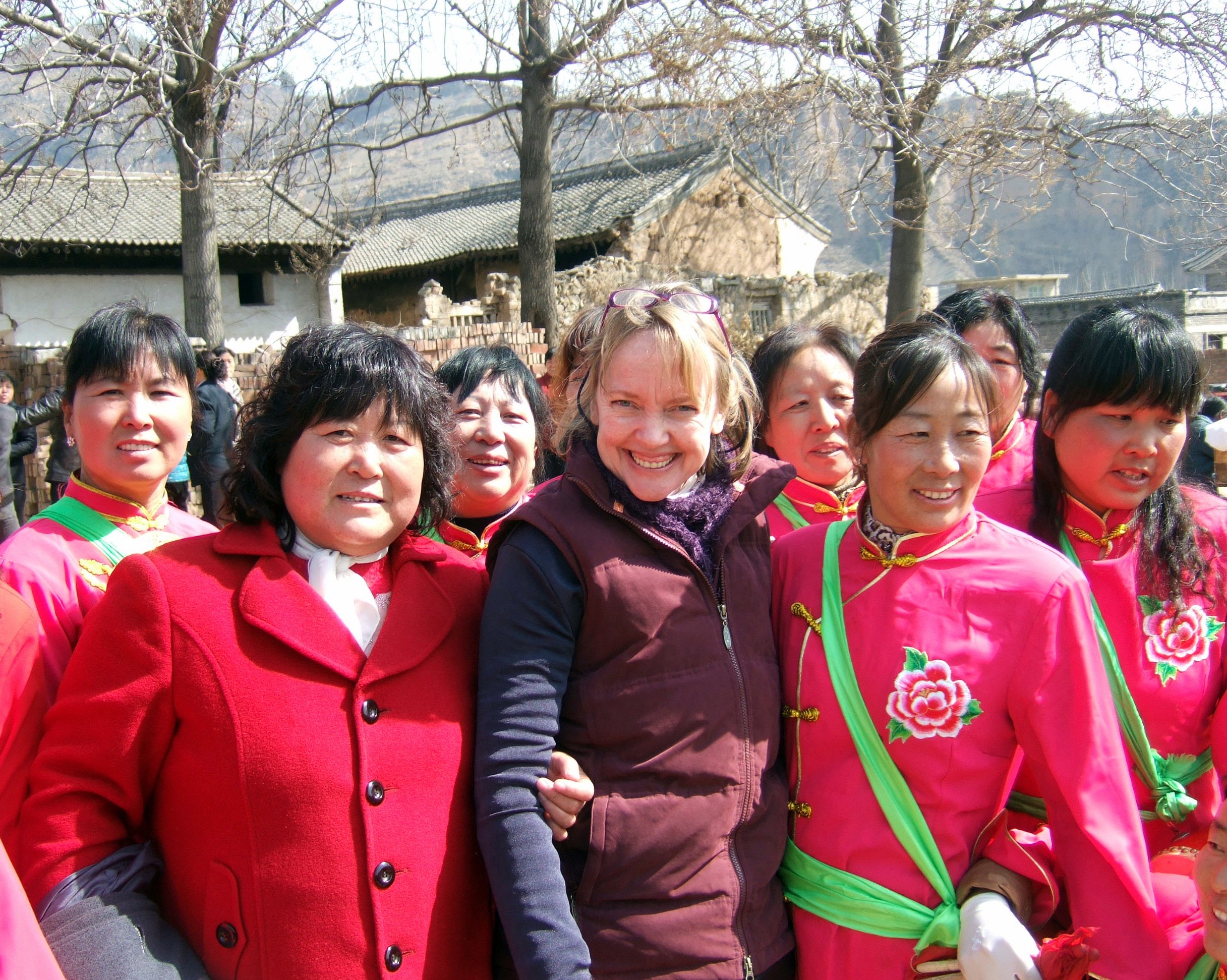
What I have found really does shock people – shocks them so much that they admit to being shocked – is that I was once a missionary. In Africa. And in Australia. I think they think I try to convert the natives but of course it is not like that. You go not knowing what will happen and find yourselves making life a bit more fun for people who belong to God but are battling a bit.
Sophie Neville about to board the high speed train for Shang’hai
It is like this: The Amazons, Nancy and Peggy Blackett, who are energetic tomboys living in the Lake District, had lost their father. It goes unsaid, but Peggy very touchingly lets it out in Swallowdale when they find a hidden tin on the peak of Kanchenjunga. Their mother’s brother, Jim Turner, took them sailing and did things with them with them the first summer but then decided to concentrate on writing his book. Nancy and Peggy feel so rejected they light a firework on the roof of his boat, which enrages him. The Swallows, who know what it was like without a father around, as theirs is in the Navy, travel from afar but somehow manage to come alongside the Amazons and give them a reason to live life to the full. Nancy and Peggy excel – they find life-long friends and do all the things they are meant to do. All sorts of things happen as a result. And the Swallows are challenged and have more fun than if they had ever travelled in a structured way, intent solely on their own enjoyment. They have great adventures and do more things than they ever imagined possible .
I still go on short term missions. We went to China with the Bible Society one year. It was amazing, a mission of encouragement that Titty would have loved. We met people who had not had European visitors for forty years. They were really excited to know that people in the wider world were interested in their welfare and had come to bring them the word of God. The only Europeans – only white people – they had seen before us were there to make money. It’s shocking, isn’t it?
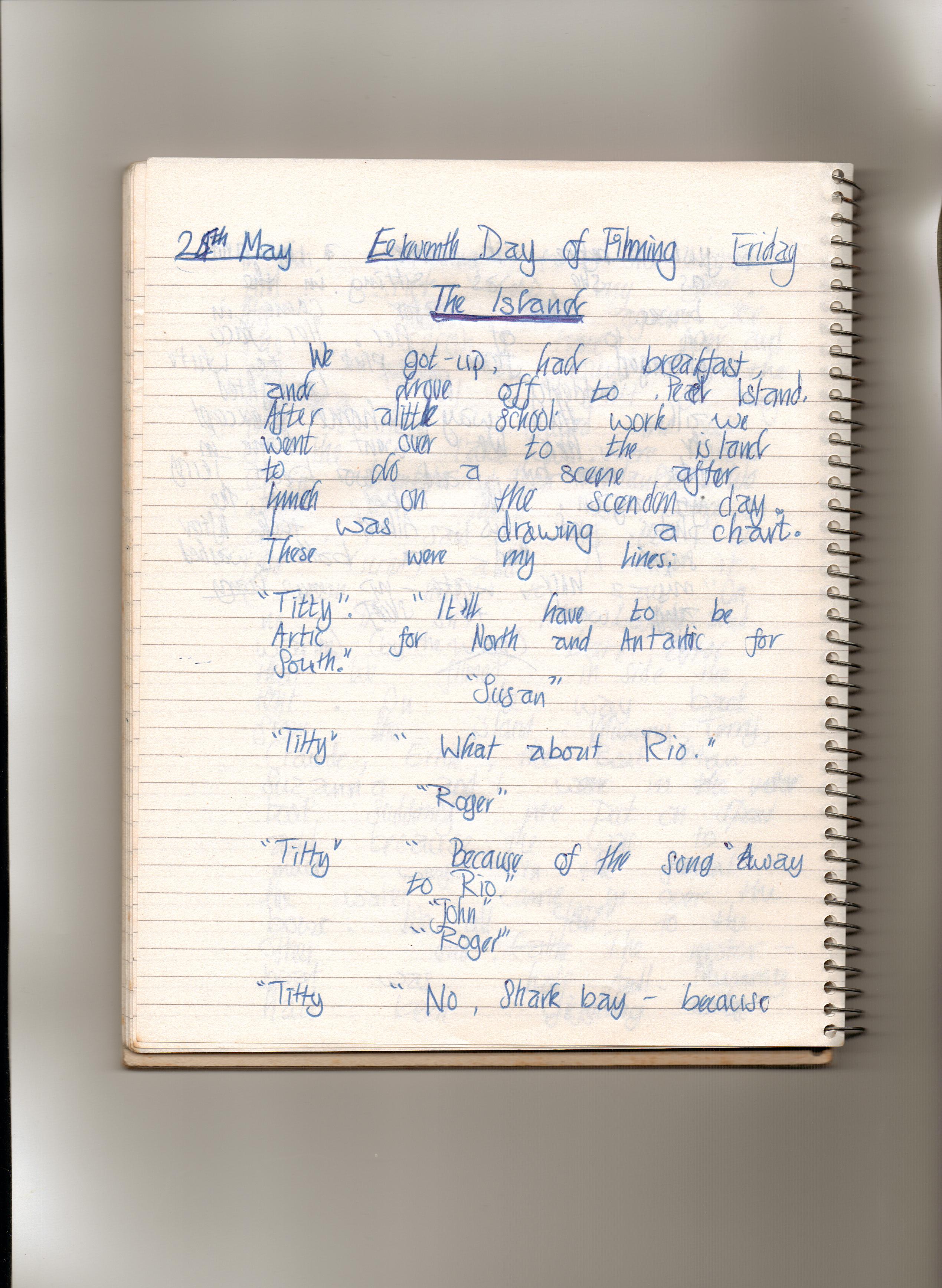
I did not know it at the time but Titty’s chart had a profound influence on my life.
I loved drawing the map. I had prepared it earlier with Simon Holland, the Art Director, and always regret pressing too hard. If you look very carefully you can see that I had already written ‘Rio’ and rubbed it out, only to write Rio again when it came to the take. I also wish that I had been taught the song Away to Rio before this scene as I would had said that line differently. Never mind.
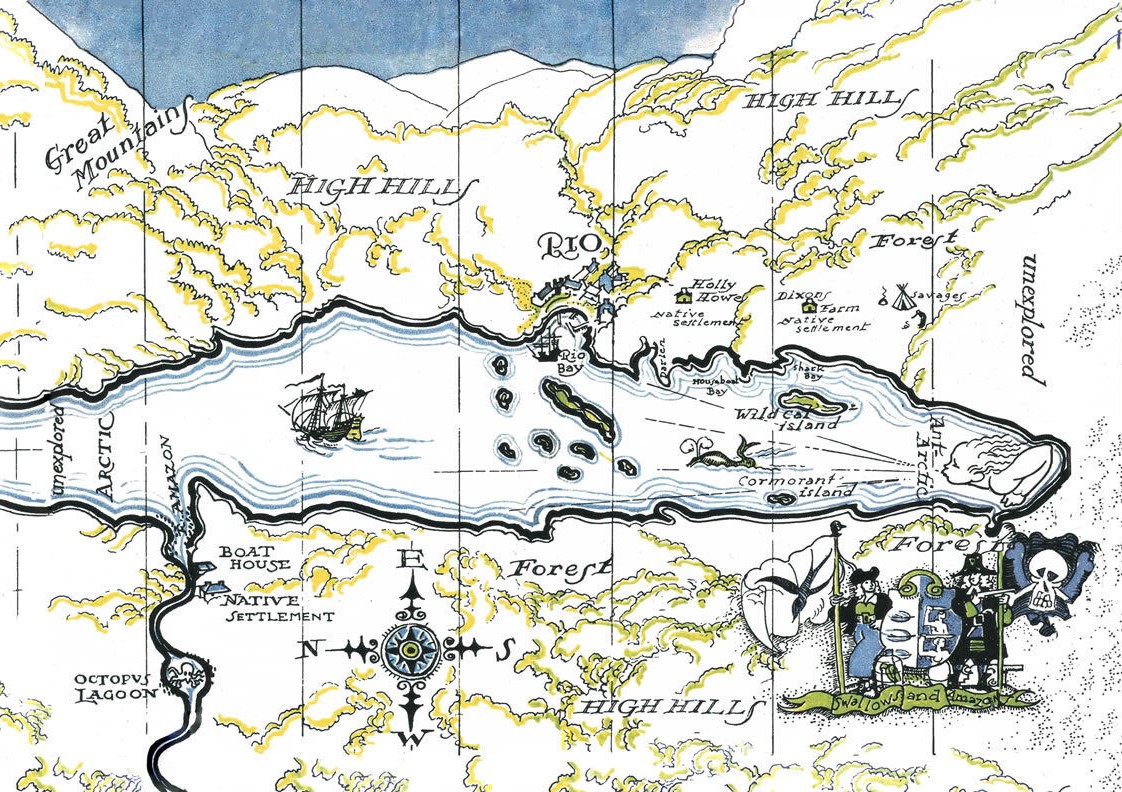
The map on the end papers of Arthur Ransome’s book of Swallows and Amazons, originally drawn by Steven Spurrier, is an inspiration to millions. I’ve gazed and gazed at it.
When I grew up and went to university, I took a course in cartography that was to stand me in good stead. In the spring of 1992, I migrated to Southern Africa with the swallows and soon started drawing decorative maps.
I added small pictures of settlements, trees, animals, and always a compass with a black and white border to give the scale. In the process I was able to explore the most wonderful country. Most of my commissions have been of game reserves or great swathes of Africa.
A map by Sophie Neville depicting the area around Macatoo Camp in the Okavango Delta in Botswana where you find wild parrots
Some have been for charities such as Save the Rhino Trust, others for books, others for marketing holidays.
They all gave me the excuse to go on living a Swallows and Amazons life, camping in wild places and exploring wilderness areas – uncharted territory.
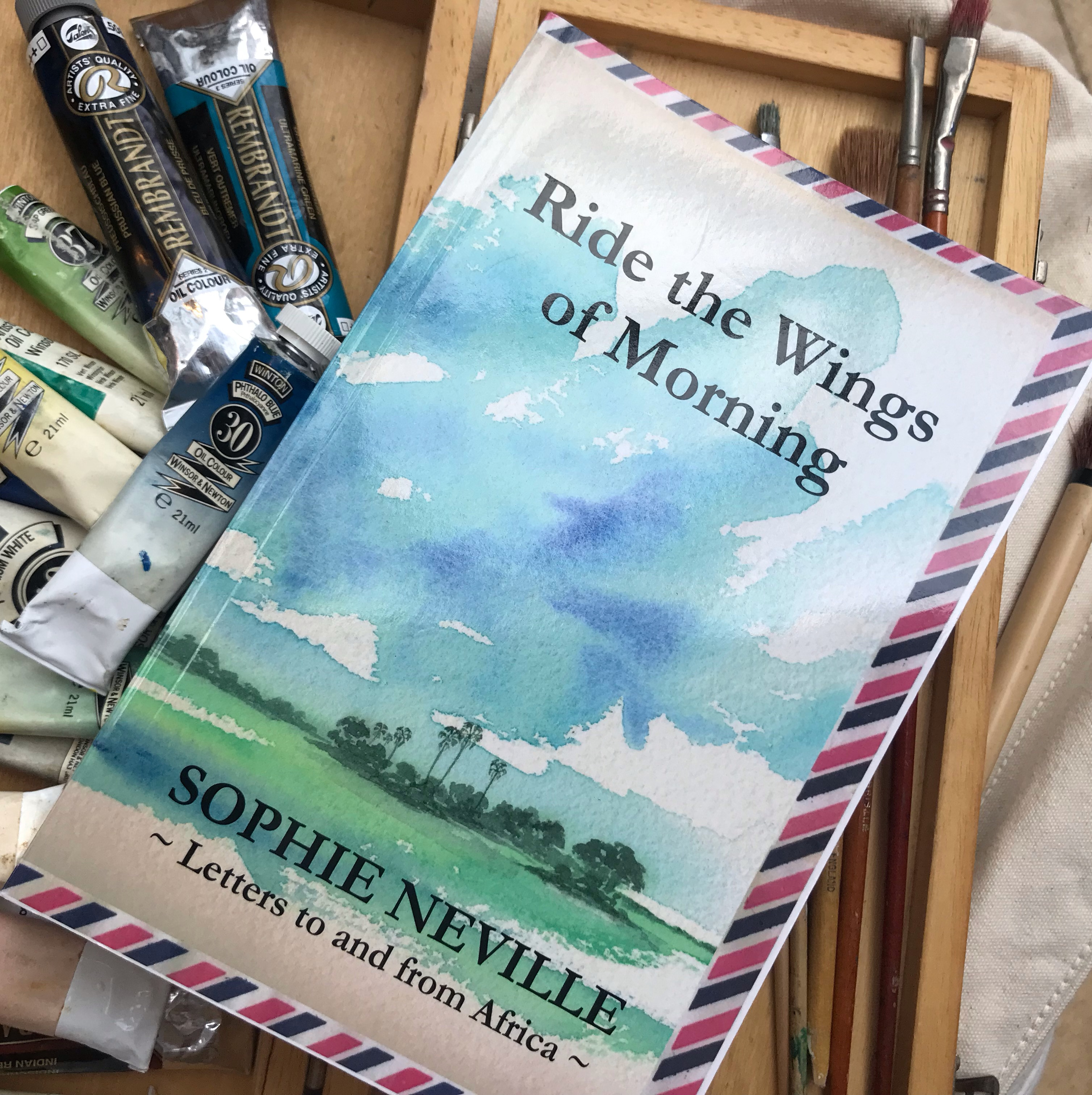
As I expect Titty would have done, I have been writing about these maps and the adventures I had in making them, putting everything together in an illustrated travel book call Ride the Wings of Morning.
I have a couple of very early maps in my first book Funnily Enough. These were just sketched in my diary but one is of Windermere, where I went with my father and the Steam Boat Association, so should be of interest to Arthur Ransome enthusiasts.
A map of Windermere sketched in Sophie Neville’s Diary of 1991 published as the book ‘Funnily Enough’
I have since reproduced some of my own Swallows and Amazons maps on mugs, t-shirts and other items that make useful presents. You can find a selection here.
Mugs printed with maps used to illustrate Sophie’s books
I used this map of the Swallows and Amazons locations on the front of the ebook on how we made the film, which has more within. It sells for about £2.99:
Sten Grendon, Suzanna Hamilton, Sophie Neville and Simon West appearing in the original movie ‘Swallows & Amazons’
If you drive south down the narrow East of Lake road along by Coniston Water, passing Bank Ground Farm, Brantwood and a cottage where Arthur Ransome once lived, you will eventually see Peel Island. It is not that far from the shore.
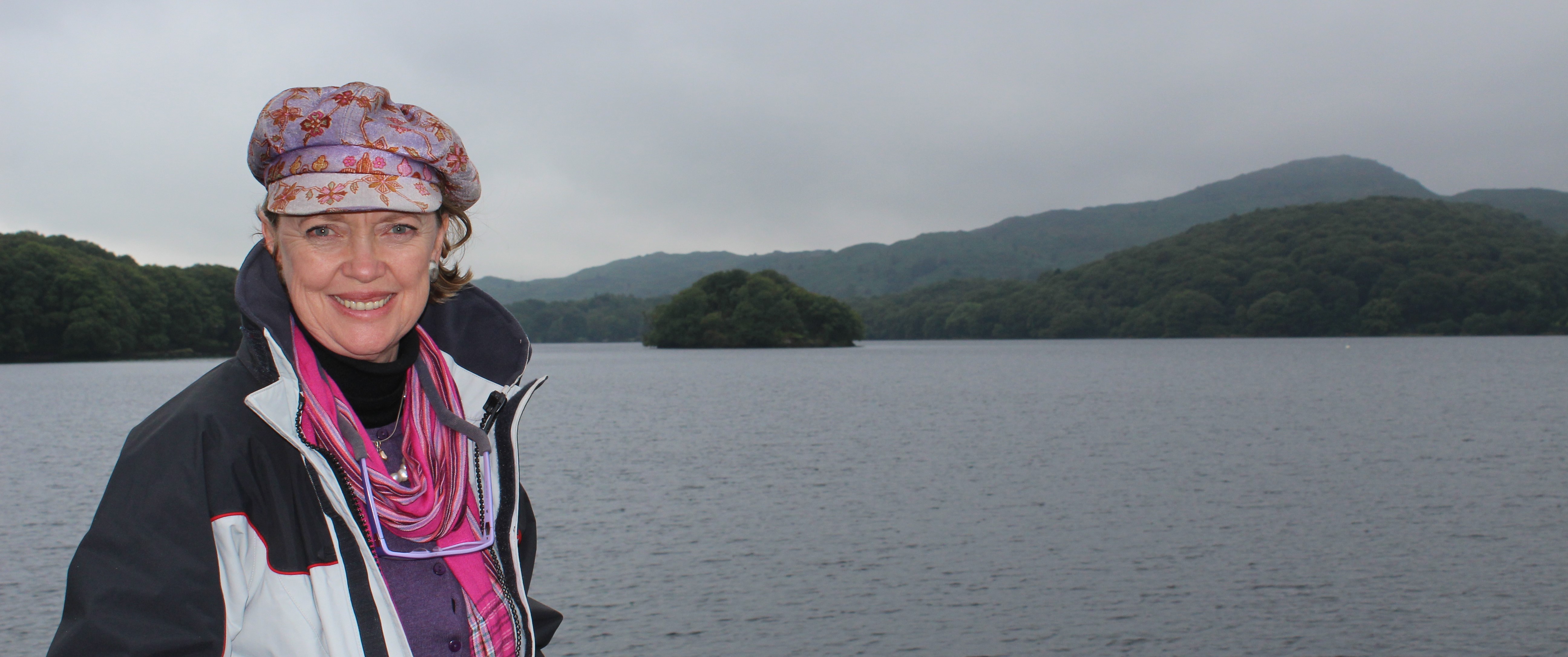
Sophie Neville finding Peel Island on Coniston Water a few years ago
Richard Pilbrow had permission from the Lake District National Park for his film crew to gain access and use the fields and woodland opposite Peel Island as a base. One proviso was that our two red double-decker buses had to be swathed with camouflage netting in an attempt to make them less conspicuous. As a result they looked comic – like huge monsters from Doctor Who. In addition to these we had a caravan for Make-up and Hair, the caterers’ mobile kitchen or chuck-wagon, a prop lorry, a lorry belonging to Lee Electric who provided the lighting and huge reflector boards, the Lee Electric generator and the regrettable and very basic mobile loos. I cannot remember what kind of vehicle David Cadwallader the Grip used but I half remember a Land Rover. In addition to all this would be parked our mini-bus, the unit mini-bus, everyone’s cars and the boat trailers. Mum thinks that Terry Smith’s Range Rover could have been orange. ‘He was a very orange man.’ It was white.
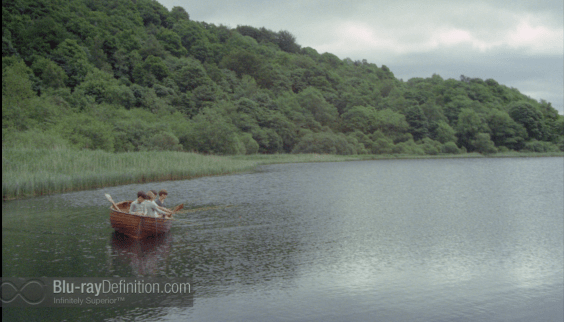
It must have been a bit of an effort to avoid getting the whole entourage in shot when John and I launched Swallow and rowed around to the harbour. You can tell that it was a greyer day than the one before.
Sophie Neville as Titty and Simon West as John rowing Swallow towards Peel Island on Coniston Water in the Lake District National Park in 1973
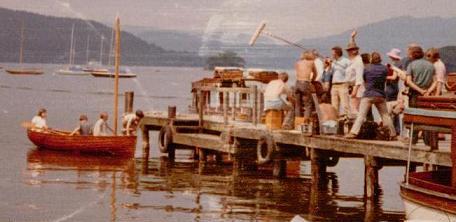
A temporary jetty made from scaffold and planks had been built out into the water so that we could climb into any boat going to the island without getting wet. It must have been quite something lugging the 35mm Panavision camera over. It travelled in a big black wooden box lined with foam rubber, with handles at either end, transported by two men like the Arc of the Covenant , holy and revered. Once on the island it would be set on the complex mounting, which enabled it to pan and tilt. This in turn usually sat on sections of track so that moving shots could be achieved.
Denis Lewiston, the Director of Photography, had a Camera Operator but insisted on doing most of the camera work himself. If you watch the scenes of the Swallows making up camp you can see that he must have just followed what Susan and Roger were doing. It has a wonderful, busy natural quality with the result that all one wants to do is to leave real life behind and go camping. I imagine that the scenes when the kettle is being filled were shot in the morning, while I was at my lessons, but I joined them after lunch.
Simon West and Sophie Neville on Coniston Water
We loved shooting any scene at our camp on the island, especially when we were eating. As I think I have said before, when Suzanna swung her frying pan of buttered eggs she really did burn Roger on the knee. He was very brave about it. It was a heavy pan.
David Cadwallader continued working as a grip, operating the crane on the 2011 movie of Jane Eyre, which stared Mia Wasikowska as Jane, Michael Fassbender as Mr Rochester and Judi Dench as Mrs Fairfax. I’d been reading Jane Eyre on that day in May 1973. It was my set book. My set book for school and the book I read on set. I should have been reading Robinson Crusoe.
****************************
Richard Pilbrow has just written from Connecticut to say, ‘You can read my side of the story, if you care to, in ‘A THEATRE PROJECT’, that you can get from Amazon.uk.’
Simon West and Sophie Neville on Peel Island in 1973 Costumes designed by Emma Porteous
We had another rather wet day in the Lake District, but what they did shoot was excellent. In the story, it was the day John and I discovered the Secret Harbour and rowed Swallow around from the Landing Place. It must have been worth waiting for the weather to clear in oder to capture those limpid, watery scenes.
The Secret Harbour looks very different over the course of a year. It is at its most dramatic when the water levels are low and more rocks are exposed, but one thing is certain, it is always a safe haven for a dinghy. I was sad that the sequence in the book where Titty watches a dipper from her rock was never included in the film, but then I have never seen a dipper there. I rather think they prefer shallow, fast flowing streams were caddis fly lavae can be found but if Arthur Ransome wrote about a dipper there must have been one there in 1929.
Simon West as John and Sophie Neville as Titty bring Swallow into Secret Harbour. Photography by Albert Clarke for Theatre Projects and Anglo EMI’s film ‘Swallows and Amazons’
Albert Clarke did not achieve horizontality with this particular photograph but it somehow gives one an idea of Titty’s tippy task. Albert was a sweet man. His task was to take stills of the film and for the film. This must have been tricky as his large format camera clicked. He had to grab shots while not intruding on the sound track. He was later the Stills Photographer on The Hound of the Baskervilles when Ian Richardson played Sherlock Holmes, Return of the Jedi, and Porridge. Porridge, which starred my all-time hero Ronnie Barker who inspired me to go into television production. When I was a nineteen-year-old student I appeared in Charlie Farley and Piggy Malone, a sort of serial within The Two Ronnies, which he directed and appeared in as both anti-hero and baddie. To my great delight, and his surprise, I put on round glasses, a yash-mak, a Southern American accent borrowed from Molly Friedel and learnt that anything was possible if you really wanted it to happen.
But then some things happen anyway. I never knew that bringing small boat neatly into shore would result in being on the cover of an LP. You can still buy it all these years later from Amazon. The only question is – Do you have a gramophone or turn-table to play it on?
The mfp Vinyl LP of ‘Swallows and Amazons’ with Sophie Neville and Simon West bringing Swallow into her harbour
I can’t believe Terry let me travel in the front on his white Range Rover, let alone change the gears. I can only think that Simon and I were taken back after the other children had gone home, and can just imagine us swinging around the lanes on that beautiful road back to Ambleside.
Terry Smith was our Wardrobe Master who must have had an annoying day if gas had been leaking into his bus. He was the distinctive man with curly red hair and strong, freckled arms in charge of our costumes. Goodness knows where he laundered them. Terry went on to work on some amazing costume dramas, movies that included Chariots of Fire, Lady Jane, Willow and Restoration. Mum’s tame otter Bee was auditioned to be in Willow. I’ve written about it in my book Funnily Enough. Mum was most indignant becasue they wanted her otter to wear a tutu. She didn’t know that Terry Smith was to be the Wardrobe Assistant. It might have made a difference. Instead they featured Val Kilmer in dialogue with a possum.