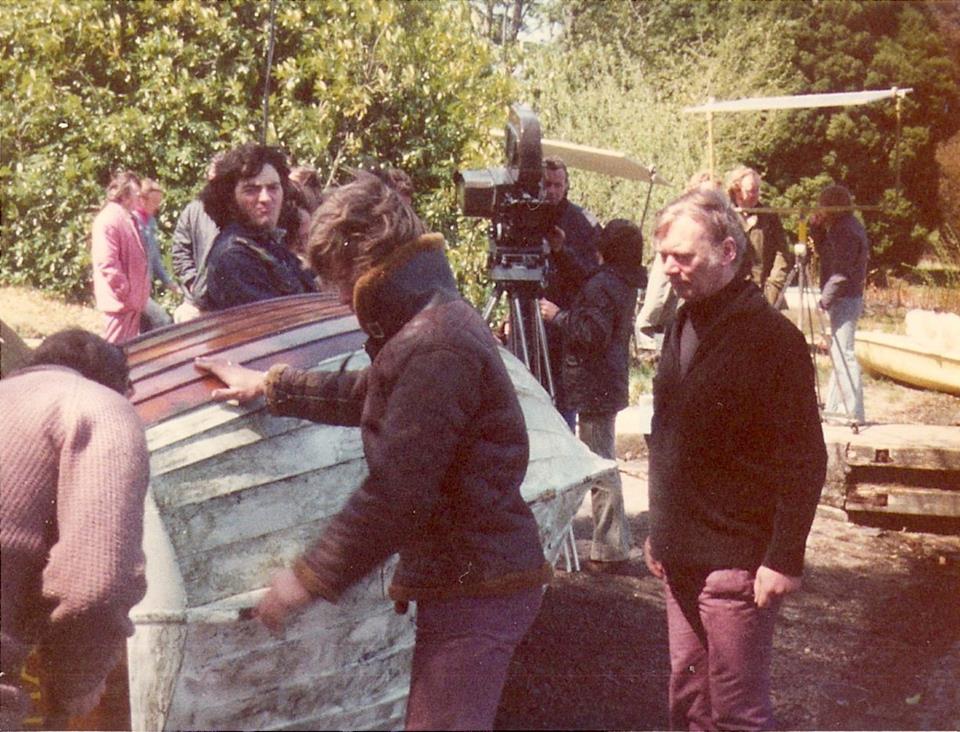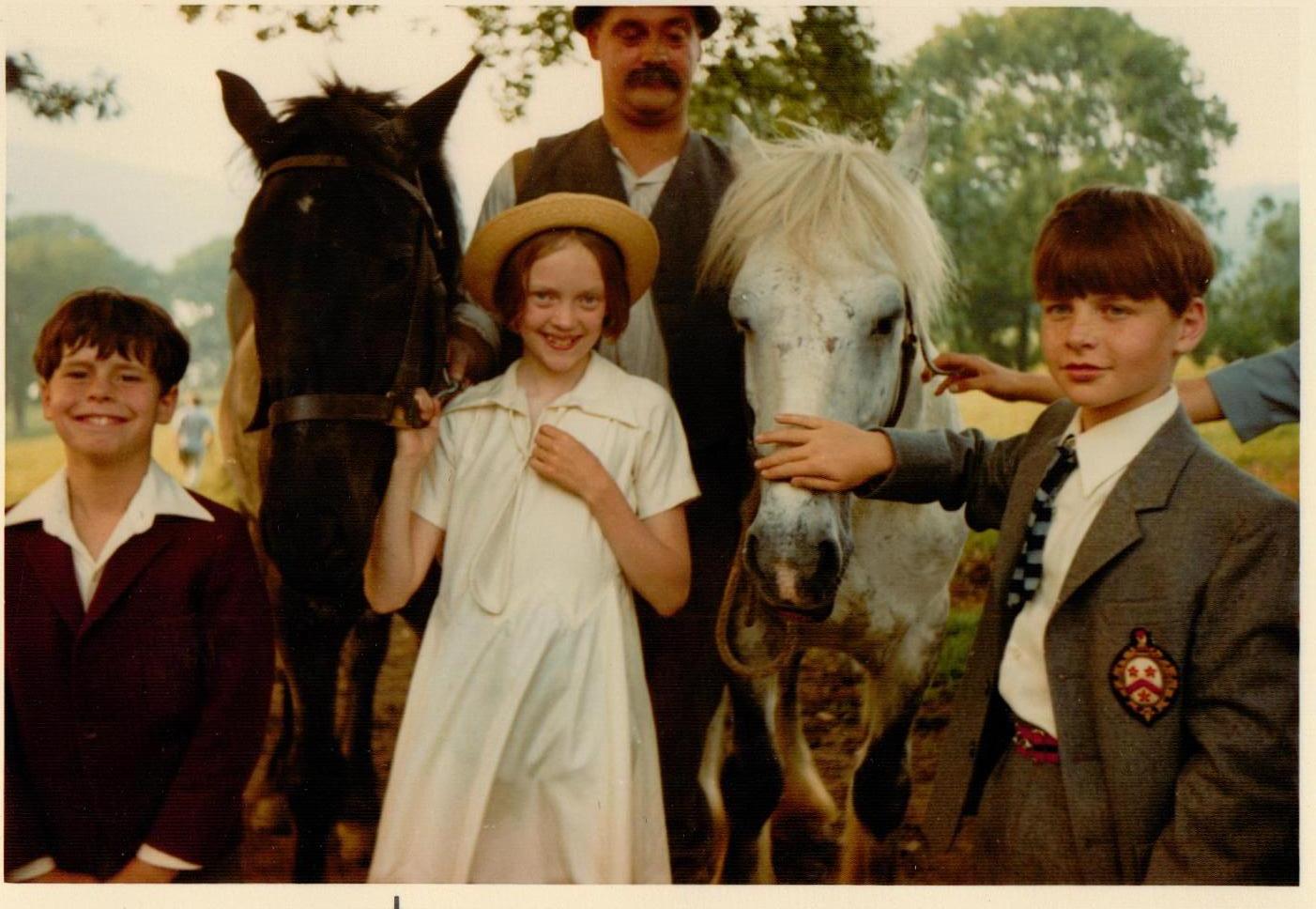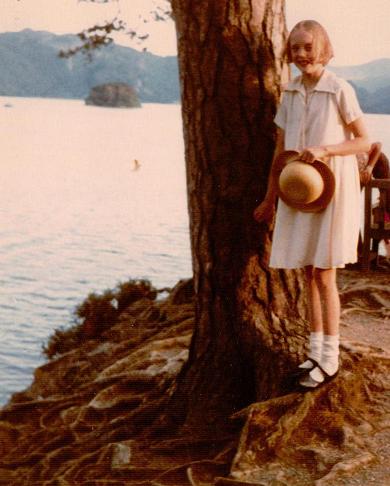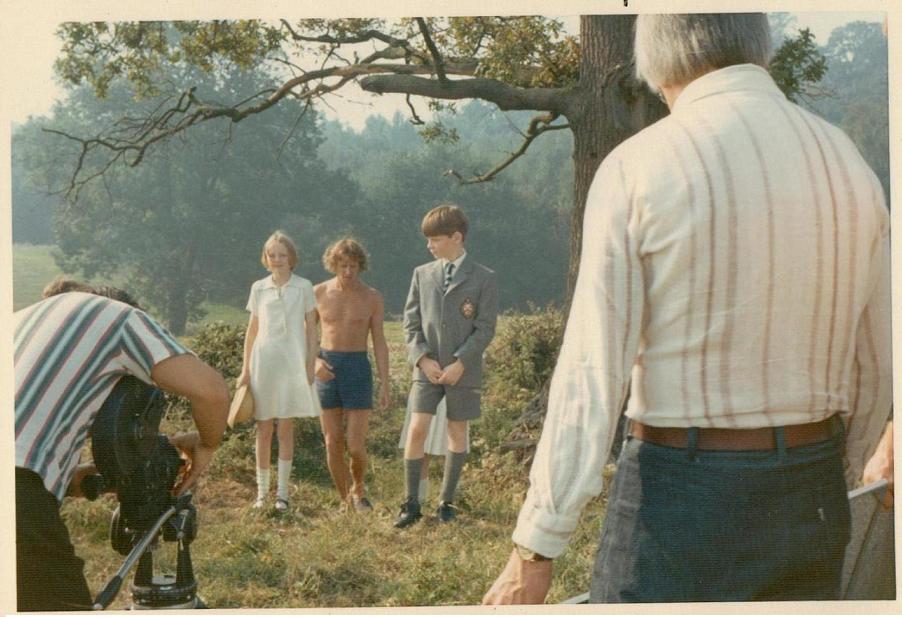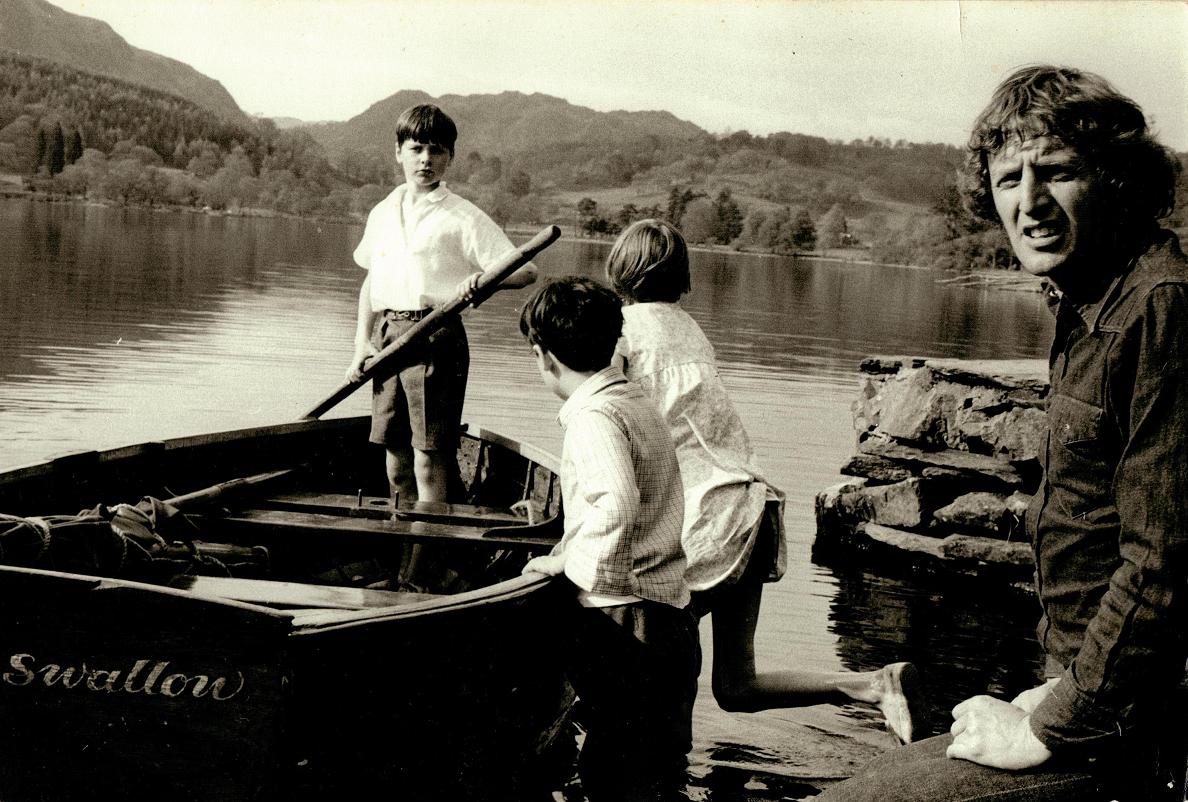
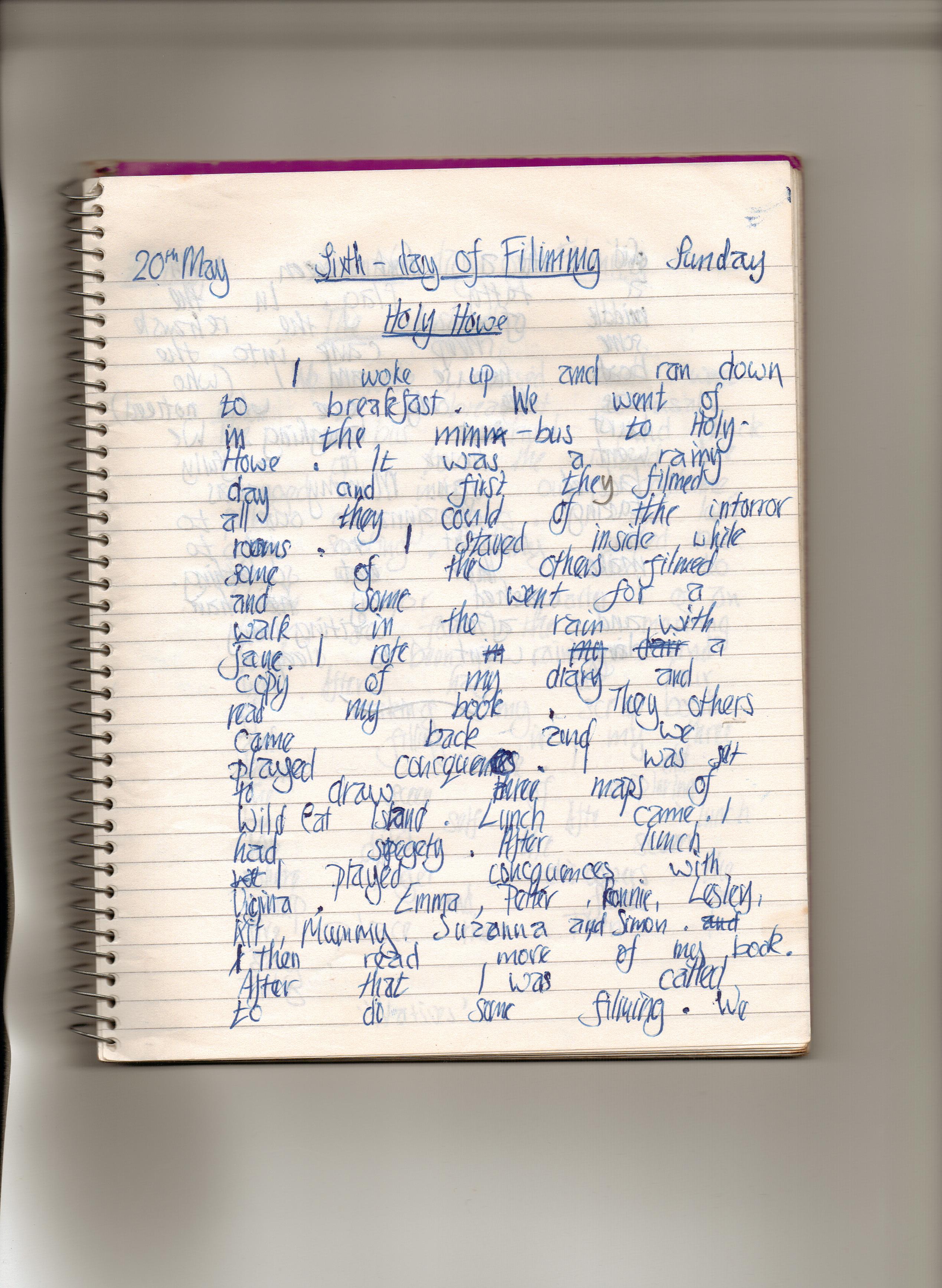
Filming ‘Swallows and Amazons’ in the rain at Bank Ground Farm in Cumbria ~ 20th May 1973

Finding Swallow

It was quite amusing when Mrs Batty’s sheep walked into Swallow’s boatshed, lifting our spirits on that rather gloomy wet day on Coniston, but I have no idea if it was caught on film. Can anyone remember seeing a television programme made up of amusing out-takes from movies prior to the 1980s? I don’t suppose ours were ever kept. It doesn’t matter – seeing them spoils the magic of the story in a way.

Simon West as John Walker taking Swallow out of the boatshed at Holly Howe aided by Suzanna Hamilton, Sten Grendon and Sophie Neville

In 1971, Claude Whatham had enjoyed glorious May weather when he made ‘Cider With Rosie’ in Gloucestershire, but it rained so hard in Cumbria that filming anything was proving difficult. He managed to capture one limpid shot of me looking at Swallow’s tatty flag.
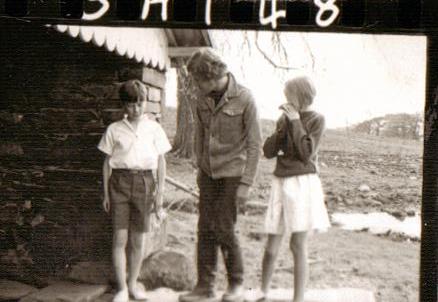
Claude Whatham at the Boathouse with Simon West and Sophie Neville

I wrote more enthusiastically about playing Consequences in Bank Ground farmhouse. This is the game that Virginia McKenna had introduced us to and we loved it. This time we must have roped in heads of the Costume, Hair and Make-up Departments. It seems that Emma Porteous, the Costume Designer, was on set with us that wet day in May. I would think that this was when they recorded the scenes inside Holly Howe with Susan and Roger and the wonderful lady who played Mrs Jackson. Someone recently asked why Susan never thanked her for lending her the frying pan, as it seemed out of character, but she still wasn’t feeling very well. Does Susan thank Mrs Jackson in Arthur Ransome’s book?
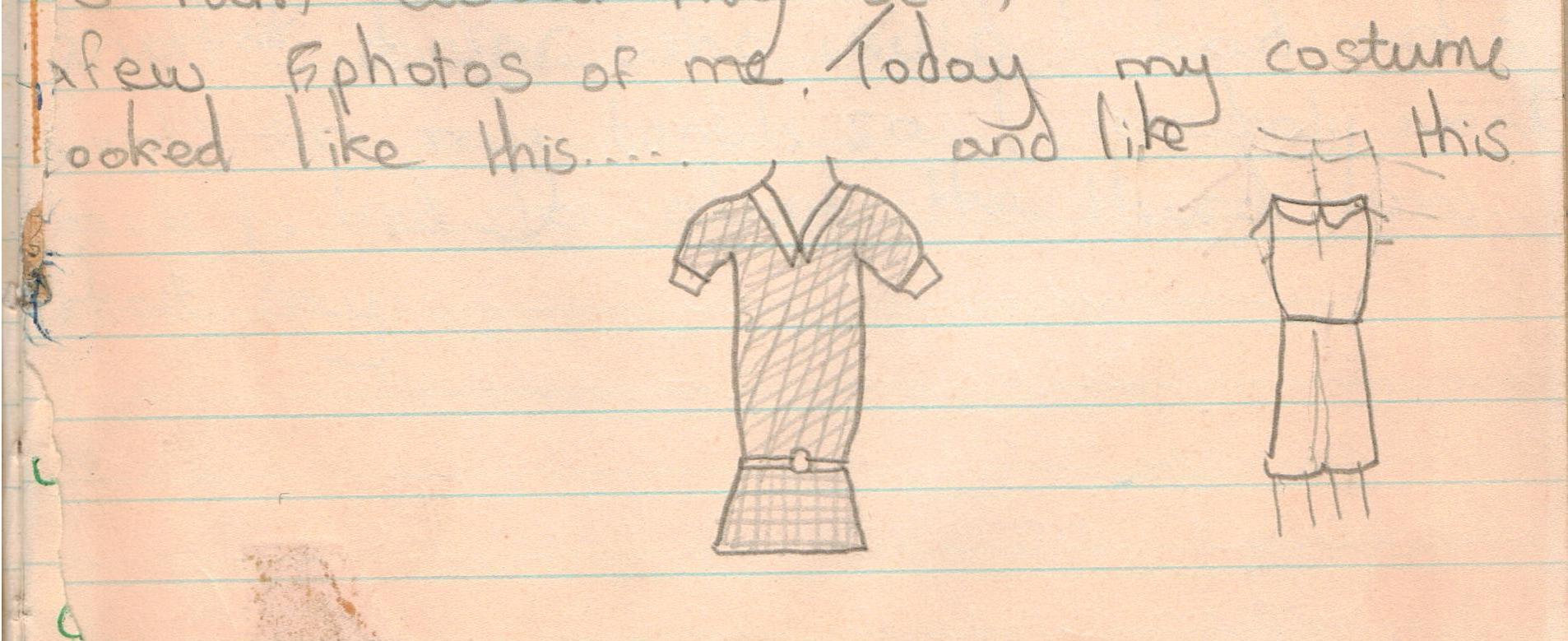
Suzanna Hamilton's costumes for scenes set at Holly Howe
Suzanna Hamilton’s drawings of her costumes for scenes set at Holly Howe

Ronnie Cogan was the quiet, gentle man usually clad in a grey tweed jacket, responsible for our hair on Swallows and Amazons.  Foregoing the use of wigs, so very much in use on costume dramas at the time, he simply did up Virginia McKenna’s lovely thick hair, and cut ours, giving the whole movie a classic feel.

Mrs Ransome was fussy about Sten’s hair. She had specified didn’t want Richard to cast children with black hair and objected to his photo but acquiesced when she saw him running around at Bank Ground Farm with a short-back-and-sides.   

Virginia McKenna having her hair put up by Ronnie Cogan ~ photo:Daphne Neville

Years later my mother worked with Ronnie on Diana: Her True Story, the bio-epic of epics based on Andrew Morton’s outrageous book. Serena Scott Thomas played Diana Princess of Wales, David Threlfall was Prince Charles, Anthony Calf had the glorious opportunity to play James Hewitt and my mother was given the role of Diana’s nanny, who hit her on the head with a wooden spoon. Mum said that she later bumped into Ronnie in Oxford Street but heard soon afterwards that he had sadly died. He had a wonderful career and must be hugely missed. 

Simon West having his hair cut - trimmed
Simon West having his hair trimmed by Ronnie Cogan. Can anyone tell me the name of the driver holding him still.

He’d worked on classics such as The Boys from Brazil with Sir Laurence Olivier and A Bridge too Far directed by Richard Attenborough – the Lord Attenborough. That must have been quite something. It starred Sean Connery, Michael Caine and Ryan O’Neal who I am sure would have been pretty concerned about having the standard WWII military haircut. Ronnie also worked for Roland Joffe on The Killing Fields and Kenneth Branagh when he had  a pudding basin haircut, for his monumental film of Shakespeare’s Henry V.  It is funny how things inter-connect. Kenneth Branagh played my great uncle AO Neville in the Rabbit-Proof Fence.
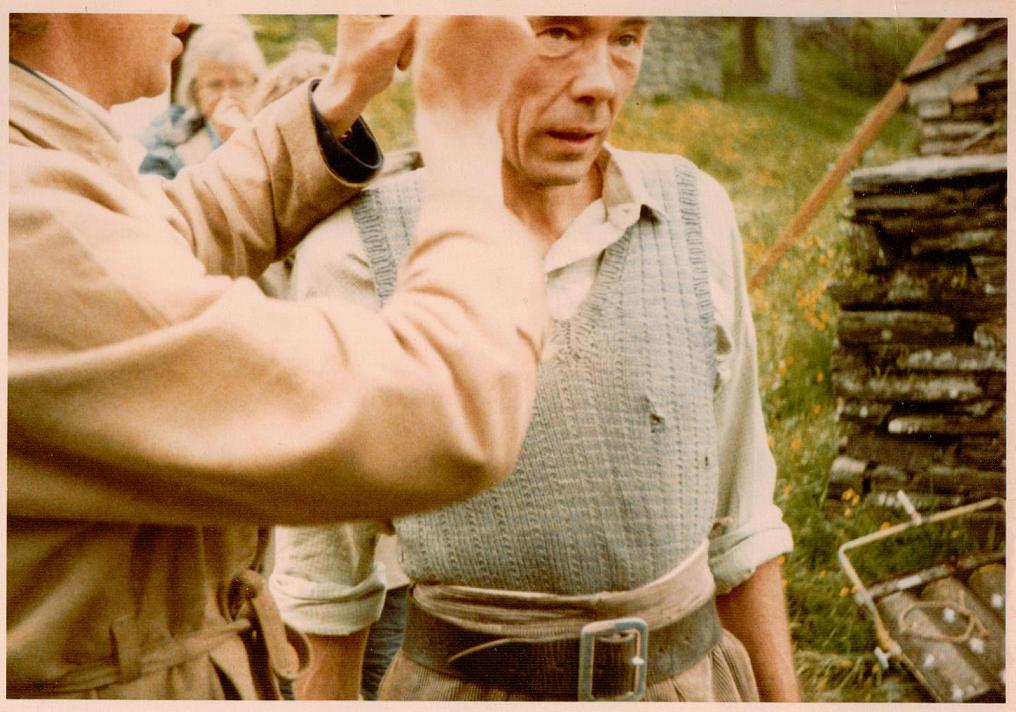
Dixons Farm - Mike Pratt
Ronnie Cogan attending to Mike Pratt in the role of Mr Dixon  photo: Daphne Neville

Peter Robb-King had been the Chief Make-up Artist on Diana: her True Story. Having worked on movies such as Indiana Jones and the Temple of Doom, Stars Wars – Return of the Jedi, Batman Begins and The Dark Knight, he is still involved with the most amazing feature films. He has just completed The Cabin in the Woods where he was Sigourney Weaver’s personal make-up artist – and to think! He was once mine.
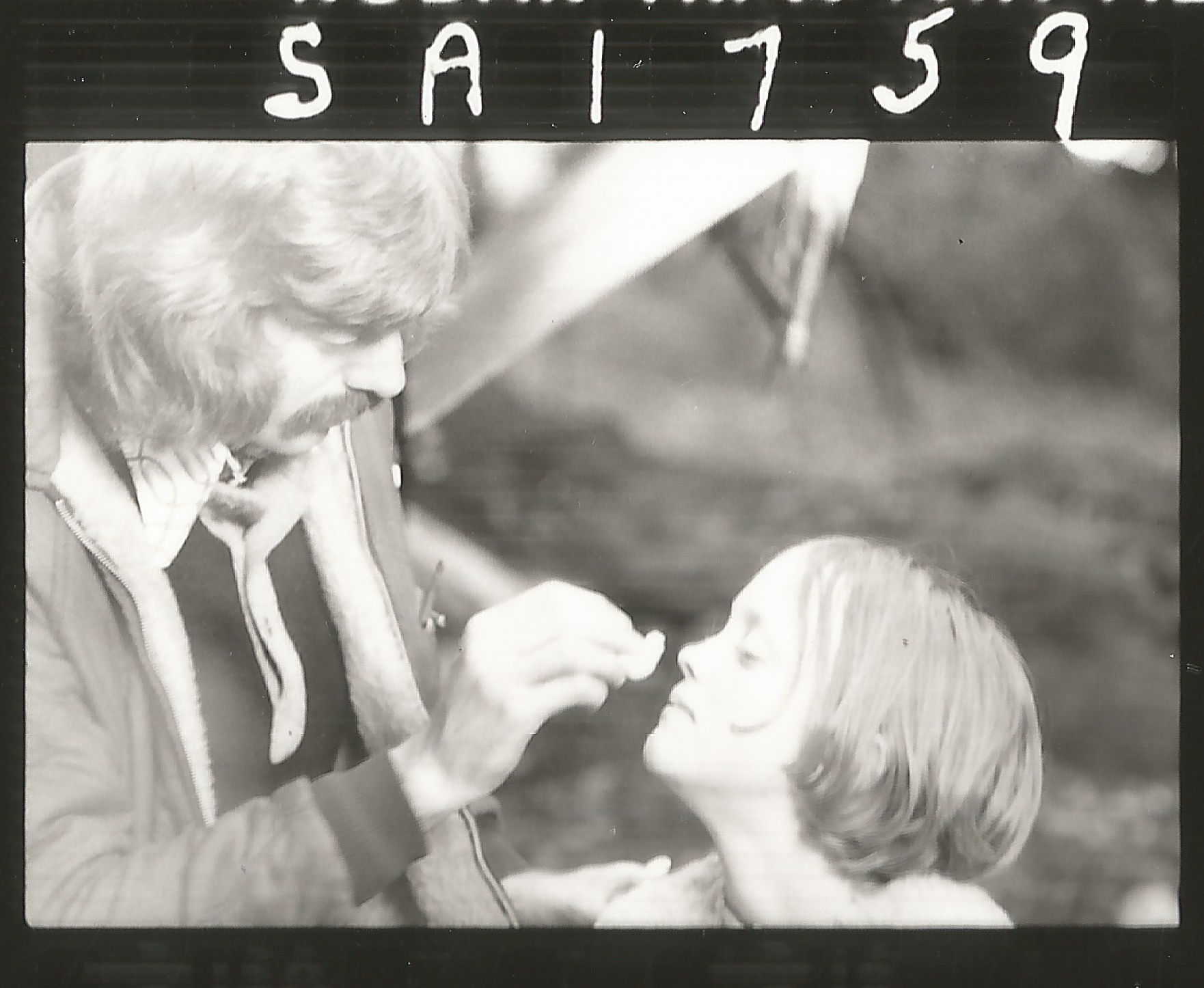
Sophie Neville as Titty getting her makeup done
Sophie Neville being made up for the part of Titty by Peter Robb-King in 1973

“But, Sophie – you disappoint me! You didn’t wear any make-up to play Titty.” No, but as we filmed out on the water, sun cream became extremely important. If even a tiny bit of us had turned red or peeled the filming would have put in jeopardy. Predicting that we would turn vaguely brown, Peter decided to give us a bit of a tan when scenes where shot out of sequence, as a couple had been that first week. 

Sophie Neville receiving a Titty haircut

Peter and Ronnie were also responsible for the continuity of how we looked so that the shots would cut together. My fly-away hair was well monitored. Mum had to wash it every other day.

Stephen Grendon and Ronnie Cogan
Ronnie Cogan with Sten Grendon. I was in the Make-up caravan beyond.

Sten seemed to be forever having his hair trimmed. There are quite a few photographs of this particular activity in progress.

Sophie Neville with Sten Grendon’s being given a haircut by Ronnie Cogan ~ photo: Daphne Neville

You can read more in ‘The Secrets of Filming Swallows and Amazons’ available as a multi-media ebook illustrated with behind-the-scenes photographs.

The end of our first week’s filming ‘Swallows and Amazons’ in 1973 when all was not well ~

Suzanna was ill.  ‘I told Claude that it was because she wouldn’t eat anything,’ my mother said. ‘Oo she was difficult.’ But it can’t have just been that. We’d all got cold filming out on the lake in our flimsy costumes and she went down hill from there.

The Producer, Richard Pilbrow, called a ‘unit day off’. It happened to be a precious, sunny Saturday. Sadly for him, it rained the next day, which the crew were originally scheduled to take off.

Richard Pilbrow and Claude Whatham at The Secret Harbour on Peel Island, Coniston Water
Producer Richard Pilbrow with Director Claude Whatham

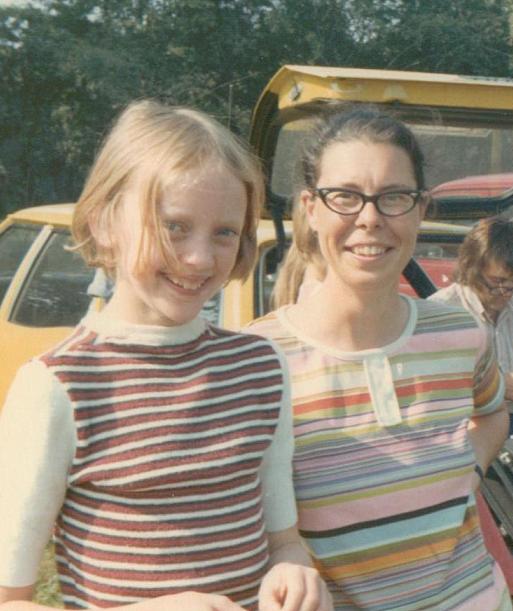
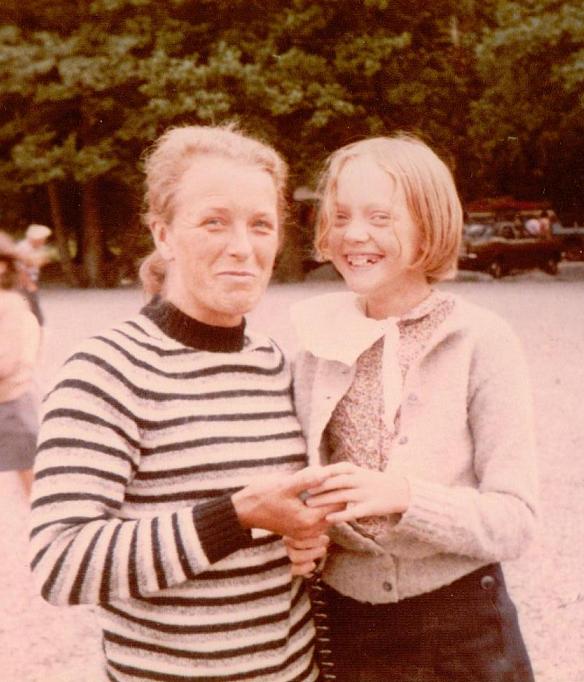
I made the most of it. Mum hardly ever took my sisters and I either shopping or walking when I we were children, but Sten’s mother, Jane Grendon was happy to take us around the craft shops of Ambleside and up into the fells. I am sure it was just what we needed while Mum stayed with Suzanna, and had a snooze herself.  She was the better chaperone on location, where she felt happy and relaxed, Jane enjoyed taking us hill walking and encouraged us to sing on mini-bus journeys through the Lake District.

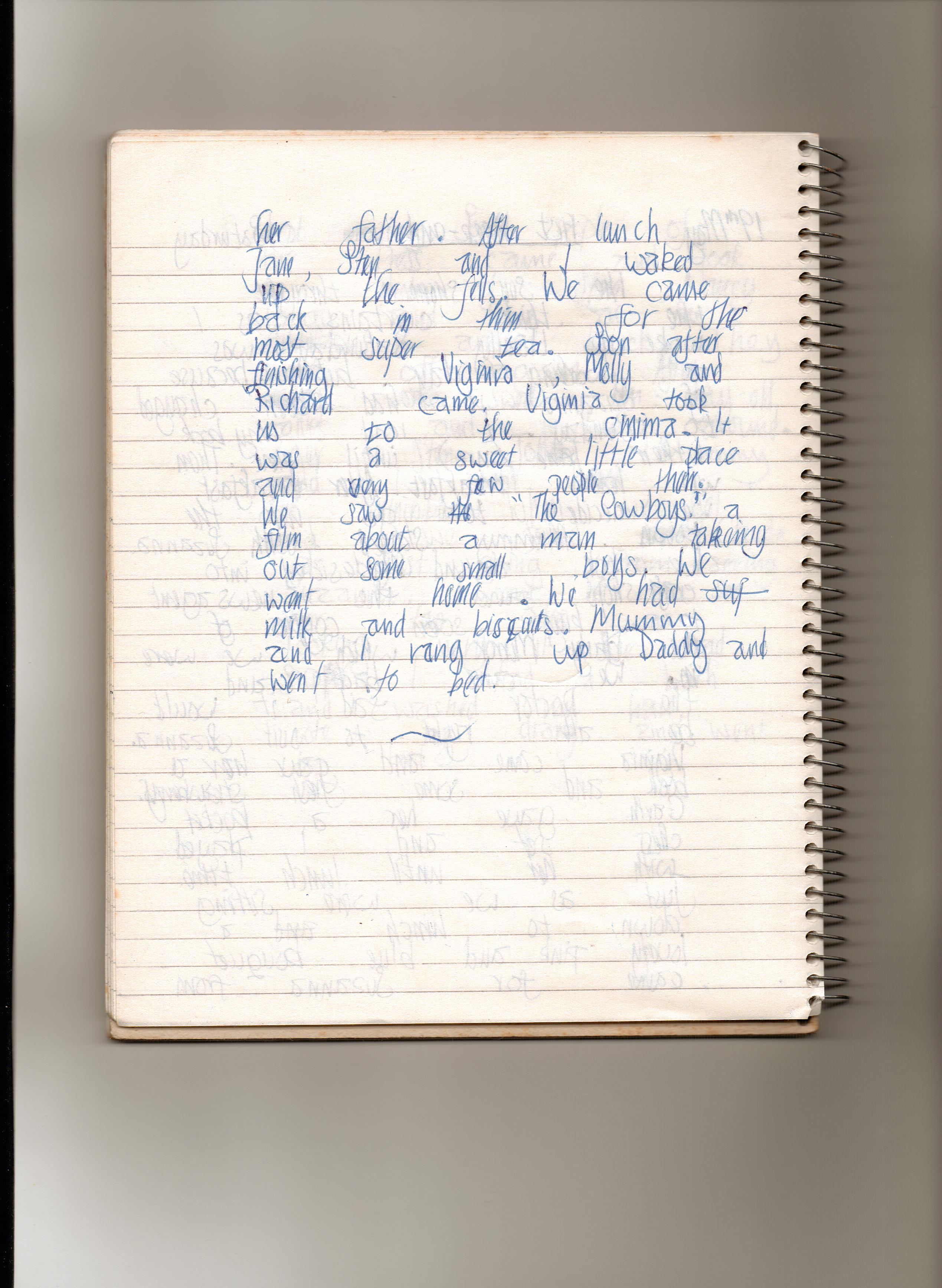
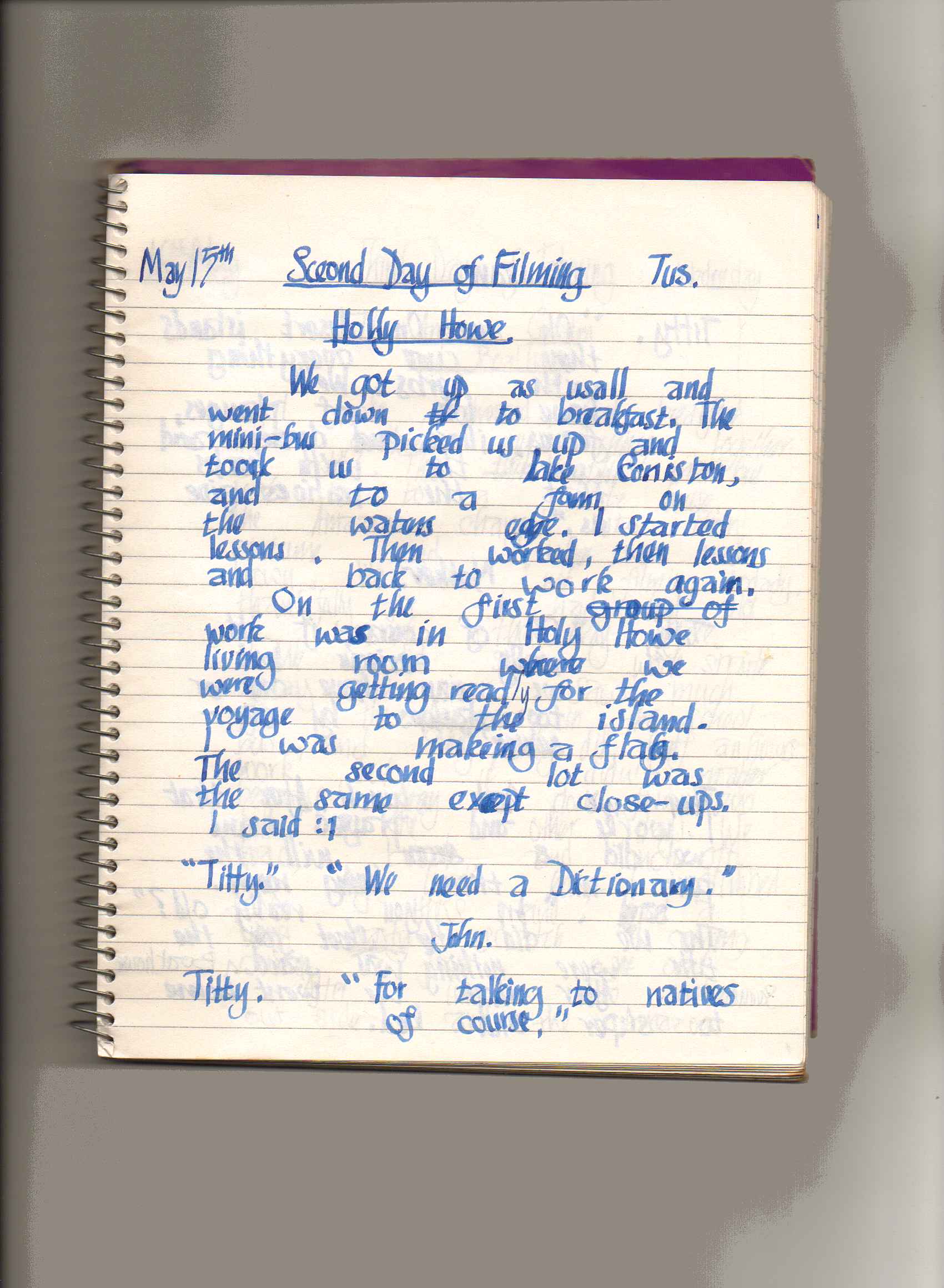
My diary

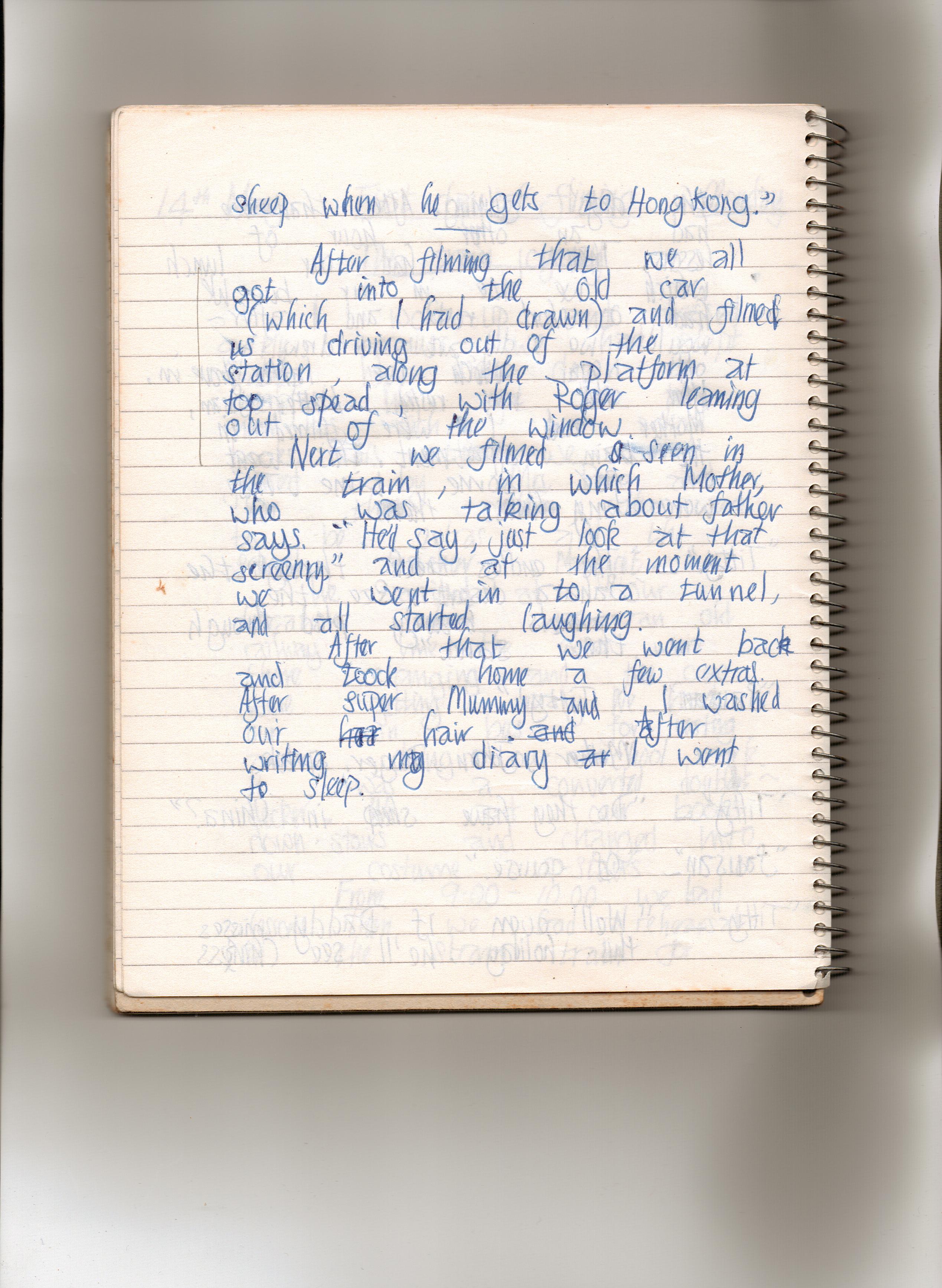
My diary kept during the filming of ‘Swallows and Amazons’ in 1973


My diary 19th May page two

The norm when filming on location is to work six days a week, resting on Sundays. This quite often has to be changed to a Saturday as some locations, such as the police will only give you clearance for tricky sequences when it’s very quiet.  Busy town centres, can only be used on Sundays. We didn’t have any gun fights in Swallows and Amazons (1974) but when I was a location manager myself on Rockcliffe’s Babies I once had to get everyone out on a Sunday morning at 6.00am. We were recording a car chase going the wrong way around the Harrow Road roundabout above Paddington Station in West London with four policemen employed to stop the traffic. We had an actor clinging to the bonnet of the baddies’ car by the windscreen wipers, which were moving.

Dame Virginia McKenna on Windermere in 1973 - photo: Philip Hatfield
Dame Virginia McKenna on Windermere in 1973 – photo: Philip Hatfield

I look back through my diary and am so touched. Virginia McKenna was incredibly kind to take such an interest in us, bringing Suzanna strawberries and talking us all to the cinema in Ambleside. We must have watched ‘The Cowboys’, a 1972 movie starring John Wayne. I wonder if she’d met him in Hollywood. Her husband, Bill Travers had appeared in Rawhide with Clint Eastward and starred in Duel at Diablo with James Garner and Sydney Poitier when he’d been given the line, “Apaches seek revenge that way.” Titty would have loved it.

I wrote that Garth brought a pocket chess set. I’m afraid I couldn’t spell properly. This was meant to read Gareth. I have known two Gareths in my life.  A  Gloucester Old Spot pig, living in North Wales and Gareth Tandy, our third assistant director. His aunt Jessica Tandy was the famous Hollywood actress who had appeared in Alfred Hitchcock dramas such as The Birds. In later life she went on to star in Driving Miss Daisy with Morgan Freeman, Fried Green Tomatoes at the Whistle Stop Cafe and Nobody’s Fool with Paul Newman, Bruce Willis and Melanie Griffith.

Gareth had acted in all sorts of things as a boy from Oliver Twist to Dr. Findlay’s Casebook. If I’m not mistaken, Swallows and Amazons was his first film as an Assistant Director but he made a career of it, going on to work on amazing movies including the original Superman, For Your Eyes Only ~ the Bond film with Roger Moore, Indiana Jones and the Last Crusade, The Bourne Identity with Matt Damon, Charlie and the Chocolate Factory with Johnny Depp, Nanny McPhee, with Emma Thompson and Colin Firth, Johnny English Reborn with Rowan Atkinson and was the First Assistant Director on A Fantastic Fear of Everything.  

Gareth signed himself  ‘The whipcracker’ in my going-away book. It think this was because it had been his job to get us through costume and make-up and onto the set at the right time but I was left puzzled because he had done this with such charm we had never noticed any whips cracking at all. There must have been. Poor Gareth had been the runner with a walky-talky stopping unwanted traffic, cue-ing various boats and lugging tea urns about, but he did this with good grace and we all loved him. And no wonder, seeing as he’d given us a chess set just because Suzanna was ill in bed.

Sophie Neville with Jane Grendon in 1973 ~ photo: Daphne Neville

You can read more in ‘The Making of Swallows and Amazons’ available online,  from Waterstones or direct from the publishers.

the-making-of-swallows-and-amazons-audiobook-cover

Holly Howe on the 5th day of filming ‘Swallows and Amazons’ near Coniston in 1973 ~

Holly Howe or Bank Ground Farm ~

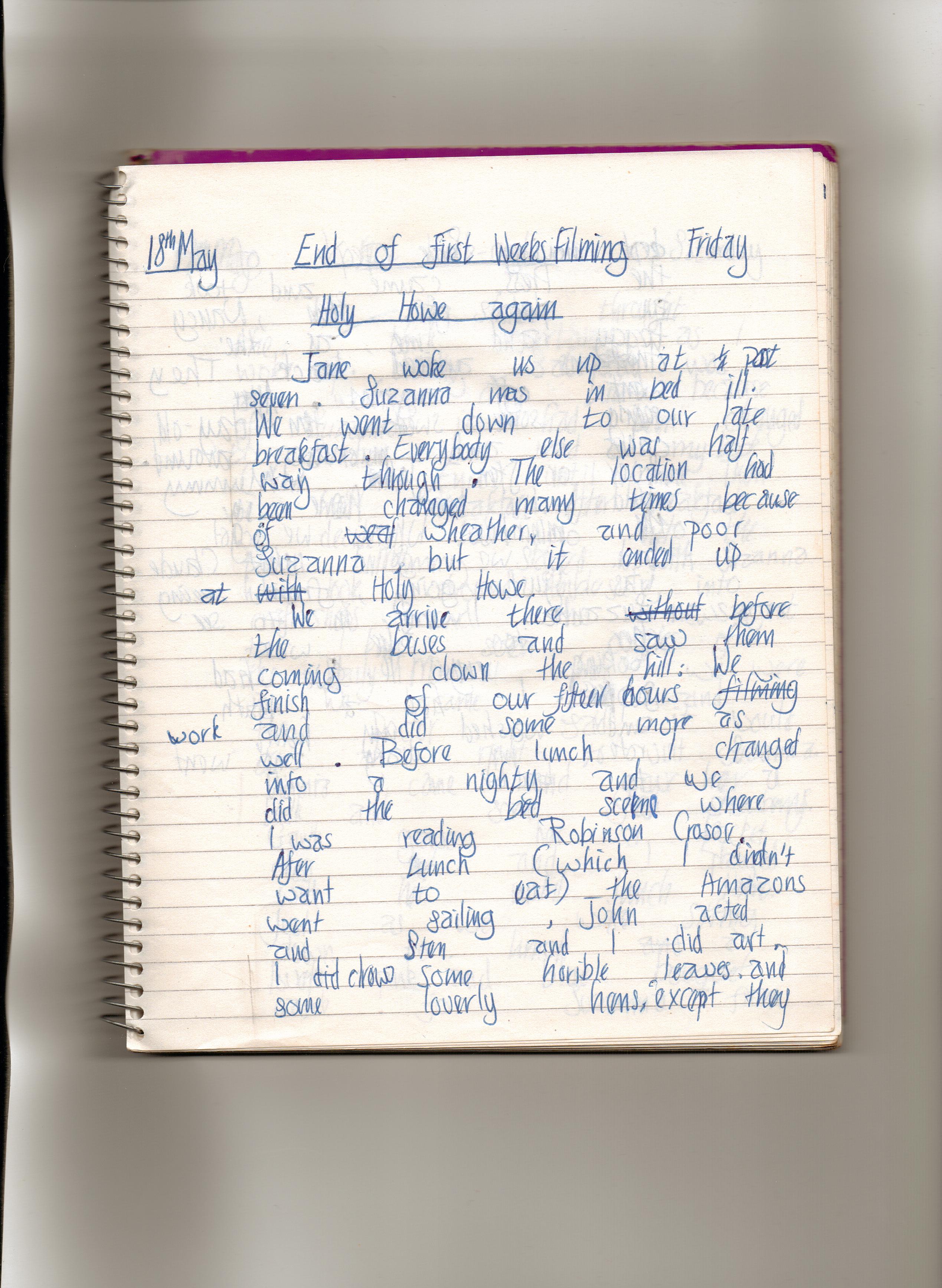
My diary

Lesely Bennett's photo of the double decker buses at Bank Ground Farm in 1973

Fifty years ago in the Lake District

My diary

When you next go to Bank Ground Farm you must stand outside the front door and imagine the sight of two red London Route Master buses making their way down the drive back in 1973. They swayed from side to side.

We thought it comic. I still can’t work out how they managed to avoid how bringing down the dry stone walls. While sheep grazed outside in the rain, we made ourselves comfortable at the Formica tables in one of these converted buses and got down to our lessons.

Bank Ground FArm above Coniston Water in Cumbria

Meanwhile Ian Whittaker, the set dresser, and Simon Holland, the art director on ‘Swallows and Amazons’, transformed Mrs Batty’s upstairs rooms into the Walker children’s bedrooms of 1929. I changed on the top deck of our bus and was rushed through the rain with a coat over my nightie to the magical atmosphere of the film set. This was warmed by arc lights. Everyone became focused what was just in front of the camera: me reading an early edition of Daniel Defoe’s classic book, Robinson Crusoe. The director, Claude Whatham needed to establish that he was Titty’s hero. I can remember having to hold the book in special way so the cover could be seen clearly.

You can see that in my diary, I described this as ‘a bed scene’, which might amuse some actors, especially those who are not at all keen on doing bed-scenes (every actor I know). The beds themselves are probably still at the farm.

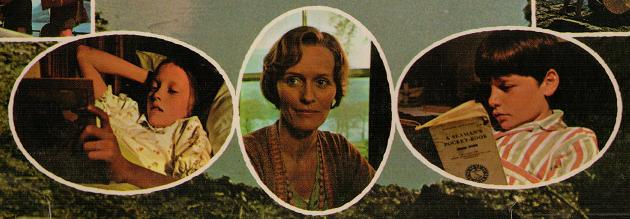
The LP
Sophie Neville, Virginia McKenna and Simon West on the cover of the ‘Swallows and Amazons’ LP, which is still available on Amazon.co.uk

They may have shot the scene where Captain John is learning Morse Code in the same room. Simon West then had to be made very brown indeed, the Make-up Designer dabbing away with a tiny sponge. This was for the uneasy sequence, much later in the story, when he returned to Holly Howe to explain himself to his mother. This was shot with Virginia McKenna writing letters at a desk in the square bay window, with the view of Coniston Water beyond. I had used it when stitching Swallow’s flag in the scene recorded the day before.

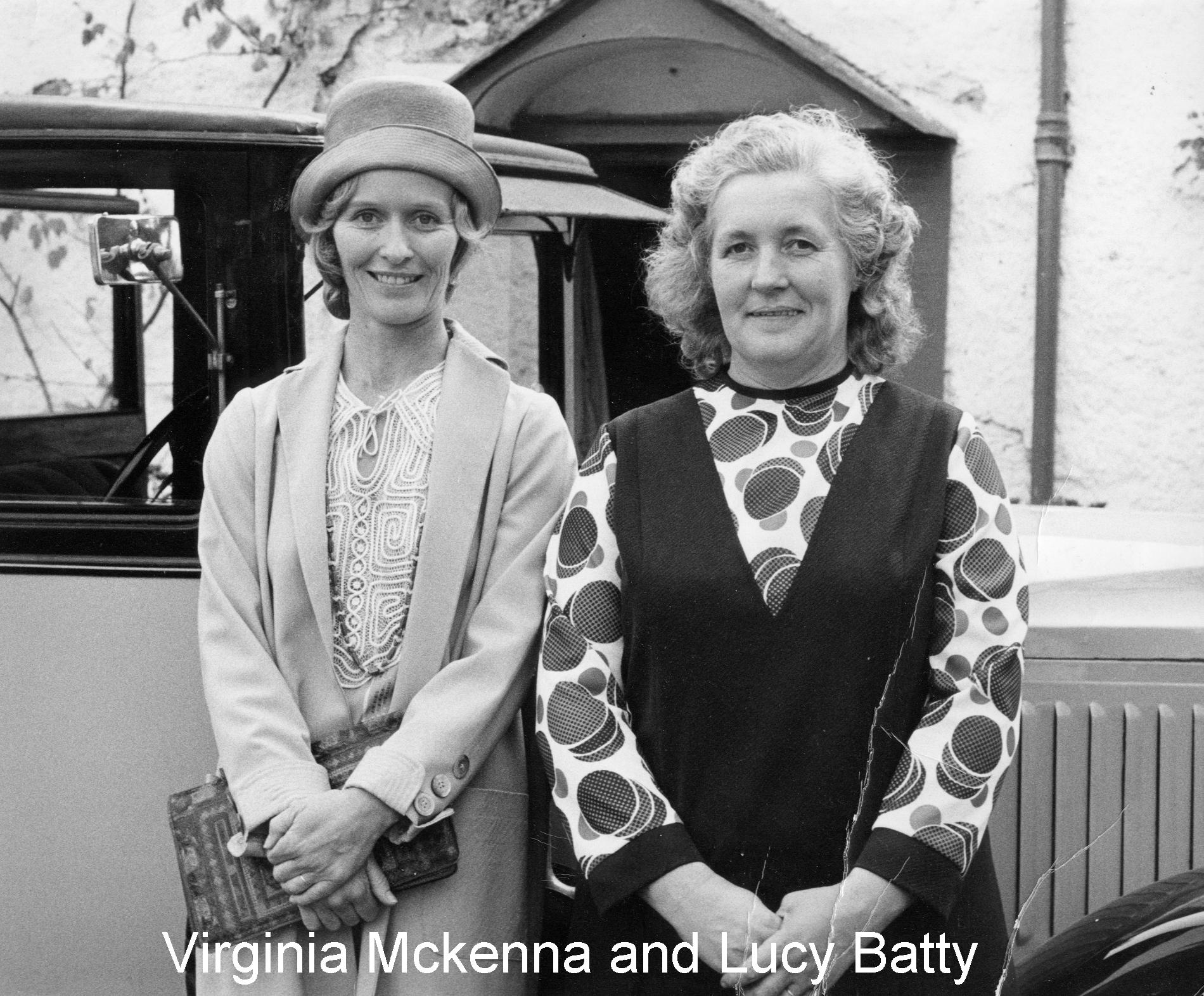
Virginia McKenna and Lucy Batty at Bank Ground Farm on 15th May 1973

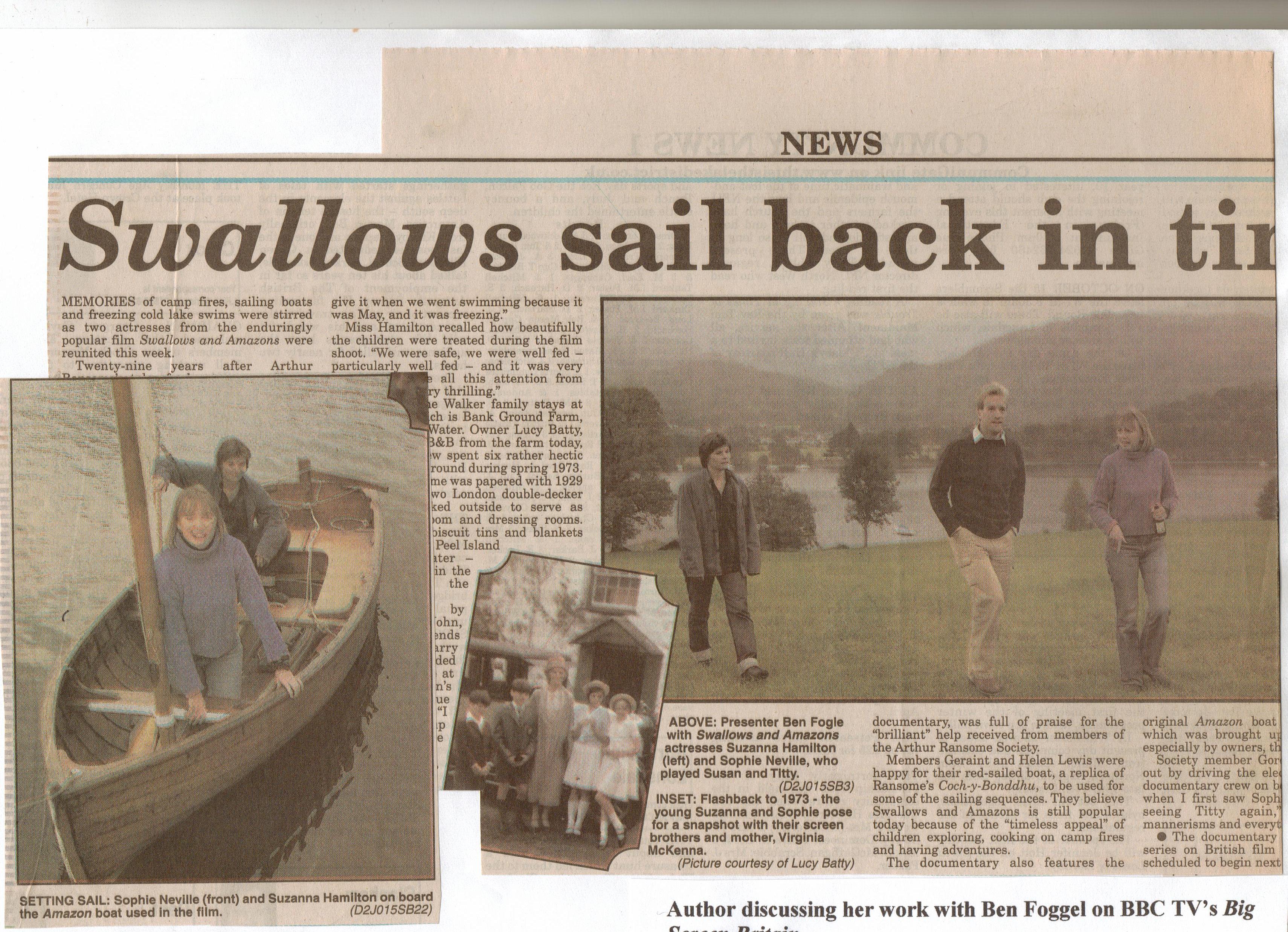
Mrs Batty later told me that the bay window leaked terribly and that she was glad to get rid of it. She built a lounge area in its place, which became a dedicated Swallows and Amazons room. I’d been chatting to her back in 2002 when we were waiting for Ben Fogle and the BBC crew of Countryfile. They had been looking for other locations used in the 1974 film before a planned interview with me and Suzanna Hamilton, who had played my sister Susan. I remember Suzanna’s train had been terribly delayed.

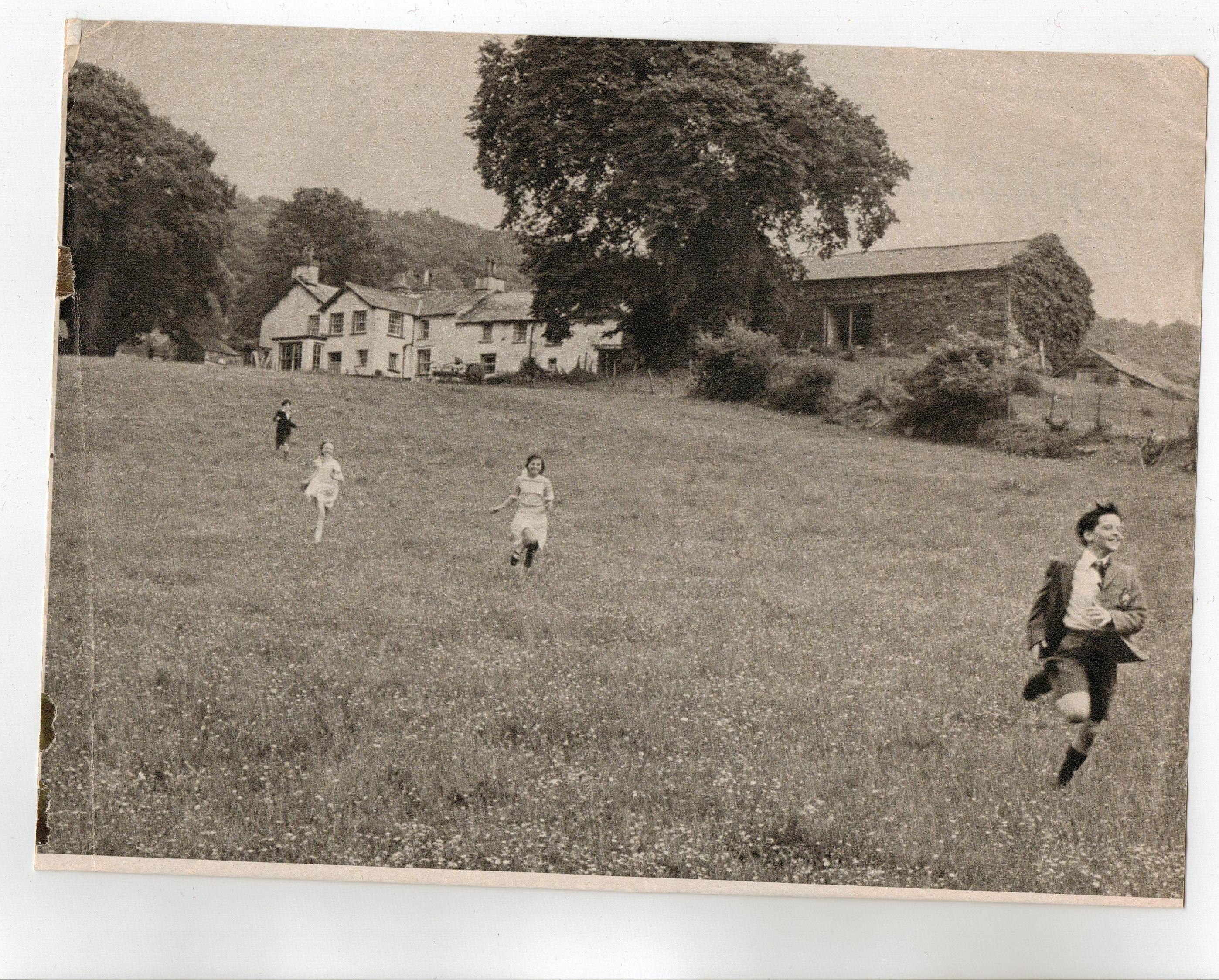
We’d  waited and waited and waited. It got later and later. When Suzanna’s taxi finally arrived, I was so excited to see her that I encouraged her to run down to the lake as we once had as children.

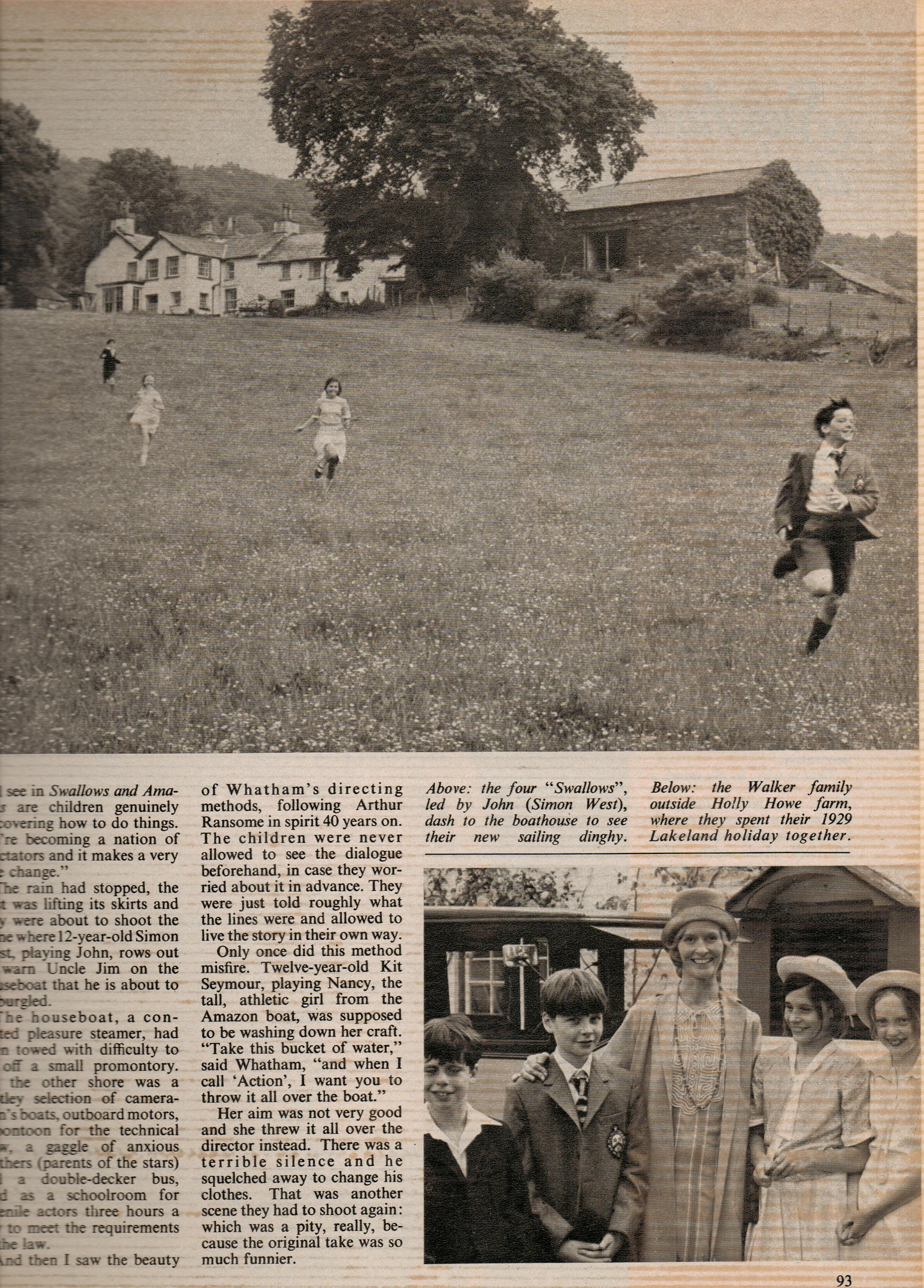
Homes and Gardens April 1974
Sten Grendon, Simon West, Virginia McKenna, Suzanna Hamilton and Sophie Neville on location at Bank Ground Farm in 1973

The Countryfile director must have been at her wit’s end. Ben Fogle came down to fetch us. My excuse was that Suzanna needed a stretch after her a long journey from London.

CountryfileThe Westmorland Gazette captured the three of us plodding back up the field.I did the whole interview holding a bottle of grog, given to me by Arthur Ransome fans who were staying at the farm. You can see it in the photographs if you look closely. I don’t think Ben knew what it was.

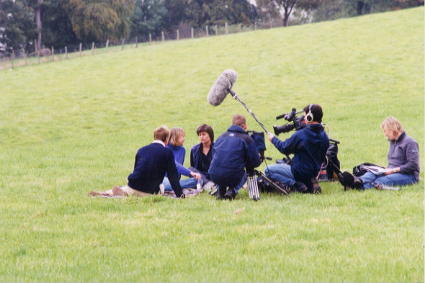
Ben Fogle, Sophie Neville, Suzanna Hamilton and the BBC crew recording Countryfile at Bank Ground Farm in October 2002

My father’s 16mm home movie footage of the making of Swallows and Amazons was cut into this interview with such success that the documentary was re-shown on Big Screen Britain  along with other landscape movies such as Whistle Down the Wind and The Dambusters.

You can find out more in the paperback ‘The Making of Swallows and Amazons’ or here on Kindle where the first section can be read for free:

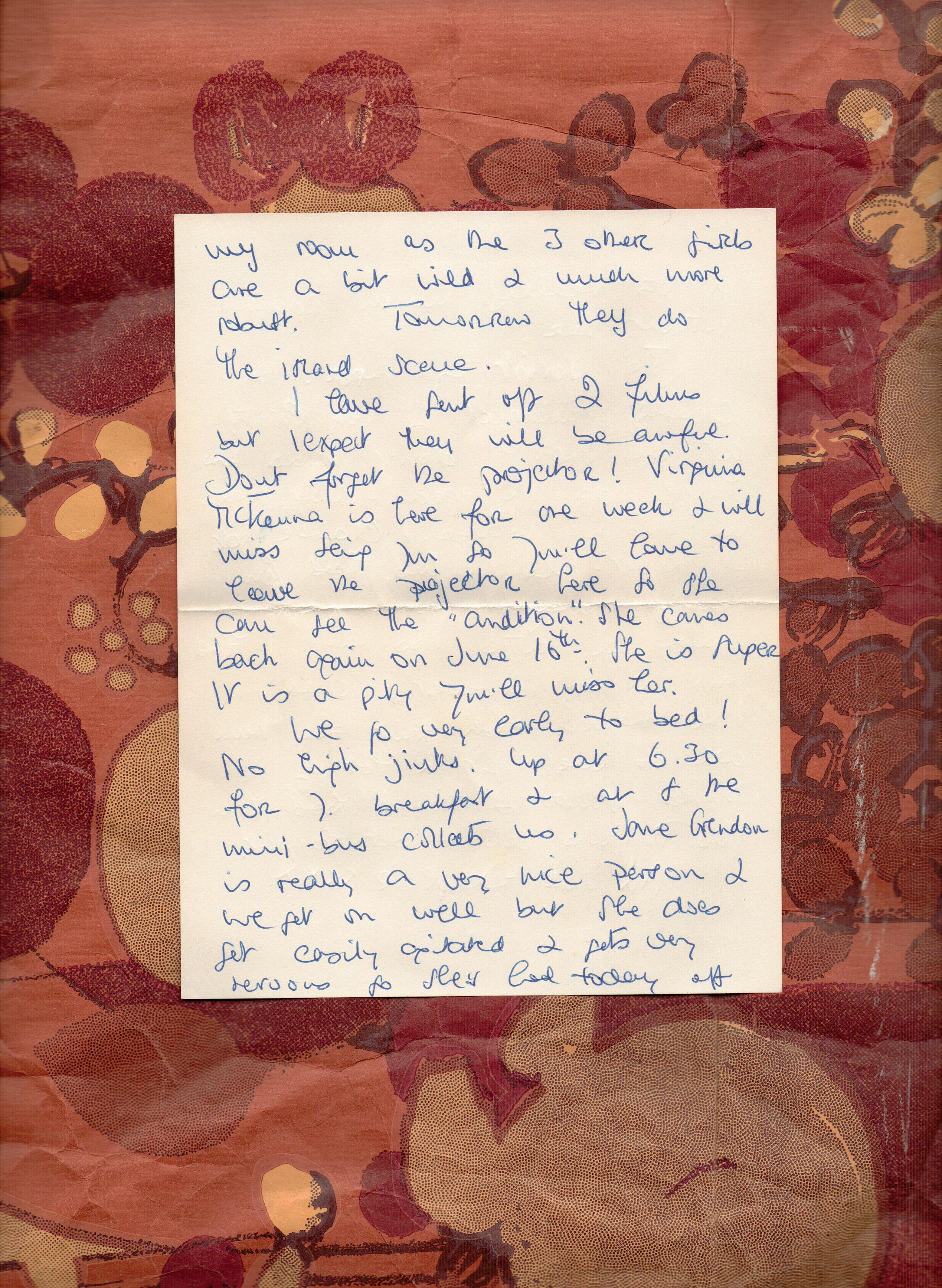
A letter from behind the scenes on the third day of filming ‘Swallows and Amazons’ in 1973

16th May 1973, was the third day of filming the original movie ‘Swallows and Amazons’. My mother wrote a letter to my father who was at home in Gloucestershire with my two younger sisters.

Mum kept all her letters, my diaries and scrapbooks in a smart carrier bag. It once contained an expensive velvet dress bought for me in Carnaby Street when we met Claude Whatham, the director of Swallows and Amazons back in April 1973

1970’s English food ~

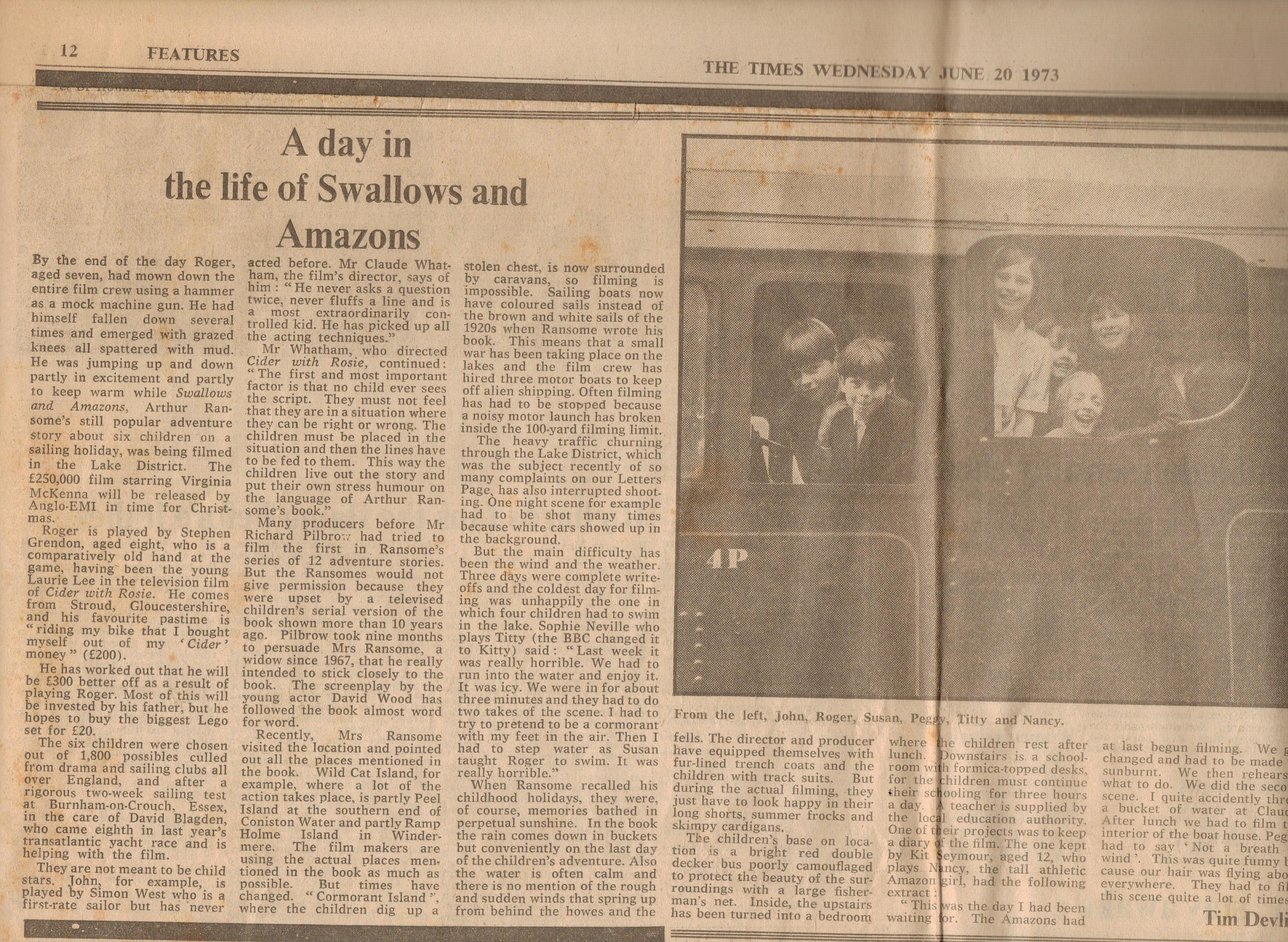
The food at our guesthouse was talking its toll. It was not a good idea to feed children on packet soups and baked beans in the days when 35mm film stock was so extremely expensive.  No one realised why, but the ingredients made Sten hyper-active, or as my mother put it, ‘causing a little hoo hah.’ A visiting  journalist wrote, ‘By the end of the day Roger, aged seven, had mown down the entire film crew using a hammer as a mock machine gun. He had fallen down several times and emerged with grazed knees all splattered with mud.’

Location catering ~

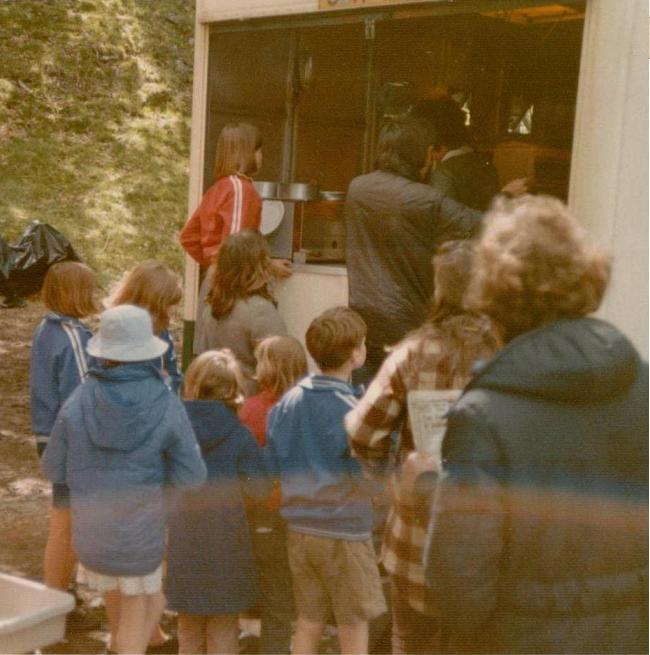
Suzanna Hamilton, who was playing Susan, simply refused to eat the revolting food.  Mum said,  “I couldn’t get her to eat anything.” Location catering is excellent now but back in the early 1970’s it could be pretty basic canteen food produced from a ‘chuck wagon’. We’d queue up for a tray of meat and two veg, which was usually consumed in a red London double-decker converted into a dining bus.  There were no salads, no fruit, just a working man’s lunch with coffee in plastic cups and paste sandwiches provided later with tea. The tea was good.

Pinewood location catering ~ Suzanna Hamilton pearing into the chuck wagon ~ photo: Daphne Neville

The fruit bowl in our bus ~

Mum started to order fruit and we relished it. Back then, it was a huge treat to have bananas or melon, oranges and grapes. A bowl sat in our bus where we were given lessons on Formica tables downstairs. The upper deck was used by Terry the Wardrobe Master as as our changing room. It was furnished with bunk beds, which Mum made me rest on after lunch. I don’t think she could pin down the Amazons and I objected at first but I must have needed to lie down and rest properly, especially when it was cold.

Daphne Neville with Richard Pilbrow1
Molly and Richard Pilbrow in 1973

Molly and Richard Pilbrow on location with the two red London Double Decker buses where coffee was being served ~ photo: Daphne Neville

The film crew ~

Apart from Sue Merry, the ‘Continuity Girl’, the film crew consisted entirely of men, forty-five of them. I include the Hair and Make-up Designers, the Wardrobe Master, the Art Director, Set Dresser, Prop Master and Carpenter, Sound Recordist and Boom Operator, the Director of Photography, Camera Operator, Focus Puller and Grips with the Electricians from Lee Electric who looked after the lights and generators, Lorry Drivers and Sailing Director, the Director, three Assistant Directors and the Production Associate and Producer. I think there might have been a Film Accountant and Location Manager. Being a feature film financed by EMI Films we had a permanent Stills Photographer and a Publicity Manager.  And this was a small crew as Terry seemed to cope without Wardrobe Assistants or Dressers. They all knew each other pretty well from being on previous movies. I have a list of where they had digs in Ambleside. It’s quite interesting to see who shared with who.

Whenever we needed boats, six local boatmen could also join the queue for the chuck wagon – and the mobile loos.  Mum wouldn’t let me use them. They were looked after by a ratty looking chap who later managed to persuade one of the Ambleside girls that he was the film’s Producer.

Neville  Thompson, who was effectively the on-line Producer, had a production secretary called Sally Shewing, but she must have been stuck in the office as we never saw her.  Molly Friedel, Richard Pilbrow’s girlfriend and assistant, was often on location. We adored her. She was American, tall with long brown hair and always had time for us. I remember her working on the lighting design for the next Rolling Stones Concert by the shore of Coniston Water whilst we milled about, playing on the rocks.

We had our tutor, Mrs Causey and a wonderful mini-bus driver called Jean McGill. She had been a top air steward but had returned to Cumbria to look after her ailing mother and drove us around the area to keep busy. As soon as we found out that she was also a qualified nursing sister, Mum made sure that Jean was taken on as the official location nurse. This was great as it meant she could be around the whole time and we never had to wait for the bus. We found we soon needed a nurse too. Someone was always hurting themselves.

Jean McGill, our driver and location nurse, operating the radio with Sophie Neville ~ photo:Martin Neville

So in all, with our chaperones there were usually about six women around as well as journalists, friends and relatives who came to watch. It was a huge circus with often eighty people milling about. Certainly the Call Sheet asks the caterers to provide lunch for seventy on normal days. It would be much more when we had crowd scenes such as when we explored Rio.

The male:female ratio on crews is very different today. There are often more women than men, perhaps not on movie sets, but certainly on BBC drama crews. It was already different by 1983 when Richard and Molly Pilbrow came to visit us on the location of  Coot Club in Norfolk, when there were about equal numbers of men and women on location. It made for a better, family atmosphere, certainly more appropriate with so many children involved. Since he still held the rights to Arthur Ransome’s series of Swallows and Amazons books, Richard Pilbrow was the Executive Producer on the BBC serial Joe Waters produced. It was so good to see him again. I gather he is still going strong having just been awarded the Knights of Illumination Lifetime Recognition Award for more than fifty years of work in theatre lighting.

You can read more about ‘The Making of Swallows and Amazons’, now available as an audiobook.

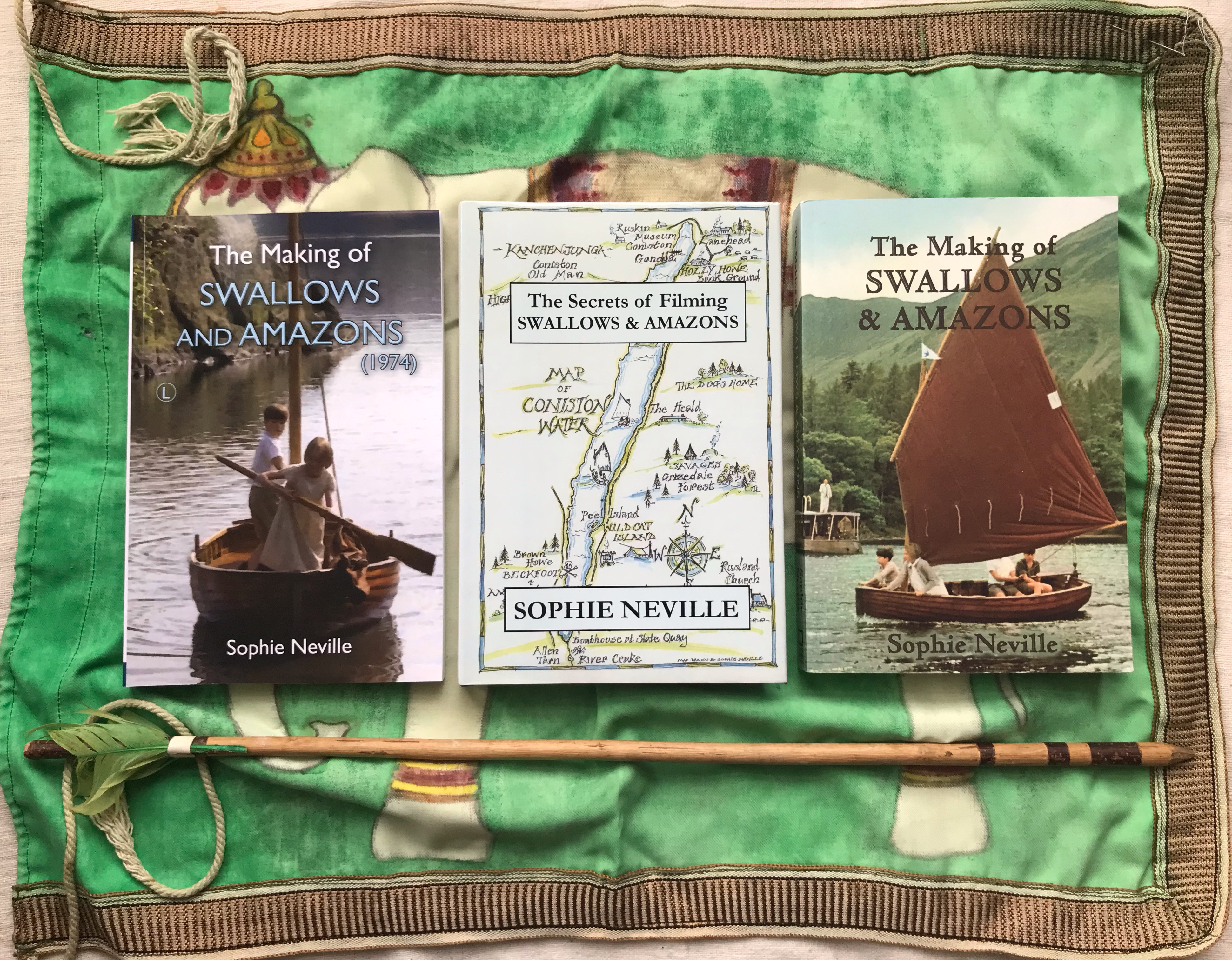
'The Making of Swallows and Amazons (1974) by Sophie Neville'
Different editions of ‘The Making of Swallows and Amazons (1974) by Sophie Neville’

The third day of filming ‘Swallows and Amazons’ in the Lake District in 1973

My diary kept fifty years  ago ~

Day 3 of the diary


Day 3 of the diary  page 2

The Amazon’s time had come. In the script, the short scene where Nancy and Peggy careen their dinghy is set in the Amazon boathouse, but Claude Whatham shot them scrubbing its underside by the lake with Beckfoot beyond, showing their background. Nancy threw a bucket of water over him for his pains. It was a complete accident.  She actually chucked the water onto the bottom of the boat but it splashed back.  He was squatting below the camera to the right and got soaked by what must have been cold lake water. Kit Seymour flung back her head and roared with laughter. He took in it good spirit, but only up to a point. I don’t think he had anything else to wear.

David Blagden the sailing director, David Cadwallader the grip, and David Bracknell the first assistant looking at the Amazon’s bottom with DPO Denis Lewiston with the 35mm Panavision

Kit Seymour wrote in her diary:

‘This is the day I had been waiting for. The Amazons had at last begun filming. We got changed and had to be made up sunburnt. We then rehearsed what to do. We did the second scene. I quite accidently threw a bucket of water at Claude. After lunch we had to film the interior of the boat house. Peggy had to say, ‘Not a breath of wind.’ This was quite funny becasue our hair was flying about everywhere. They had to film this scene quite a lot of times.’   She was quote in The Times newspaper, spelling mistakes and all.

I was a conscientious child and keen not to fall behind with my school work.  Children under the age of sixteen have to be issued with a licence by their local education authority before they can act in films. Mum, who was our legal chaperone on location, decided it would be quite fine if we did fifteen schooling hours a week rather than a minimum of three hours a day, as stipulated in the rule book. I spent my time catching up in our school bus as I had done little the day before as I had been acting with Virginia McKenna.

Mum was equally fluid about the time we spent on set – or indeed on location. Sten Grendon, who played Roger, was aged nine. I now know he was meant to go home every day at 4.30pm but we all returned together whenever it was deemed practical. However, Sten’s mother Jane was with him and if ever there was a child who needed to expend energy it was he. Sending him back to the Oaklands Guest House early could have endangered the people of Ambleside.  It did us a lot of good to work hard, and cope with real, if channelled, responsibility. We were all busting with energy, so much that I grazed my leg badly climbing a tree at lunch time that day. Claude put a stop to any more dangerous activities as a result. He couldn’t risk any of us getting injured.

My sister Tamzin Neville broke her ankle when she was in the middle of playing Anthea, the leading role in a BBC serialisation of E.Nesbit’s  The Phoenix and the Carpet. It could have been a disaster but she wore long Edwardian dresses with petticoats that covered up her splint. My legs were fully on display in Swallows and Amazons. If I hadn’t have been wearing dungarees when I climbed that tree the world would have seen the scratch.

I can remember admiring the large house featured as Beckfoot, the Blackett’s house on the lakeside, and wandering past towering the rhododendrons in the garden, but I have no idea where is is.  Christina Hardyment felt that Arthur Ransome must have modelled Beckfoot on Lanehead, the Collingwoods’ house on the East of Lake road above Coniston, but the film required a big house with lawns going down to a lake. John Ward has written in to say that we used Brown Howe House on the western Shore of Coniston Water south of Peel Island. The boathouse is also there on the edge of the lake.

Here we are at lunchtime, captured on Dad’s cine camera:

You can read more here:

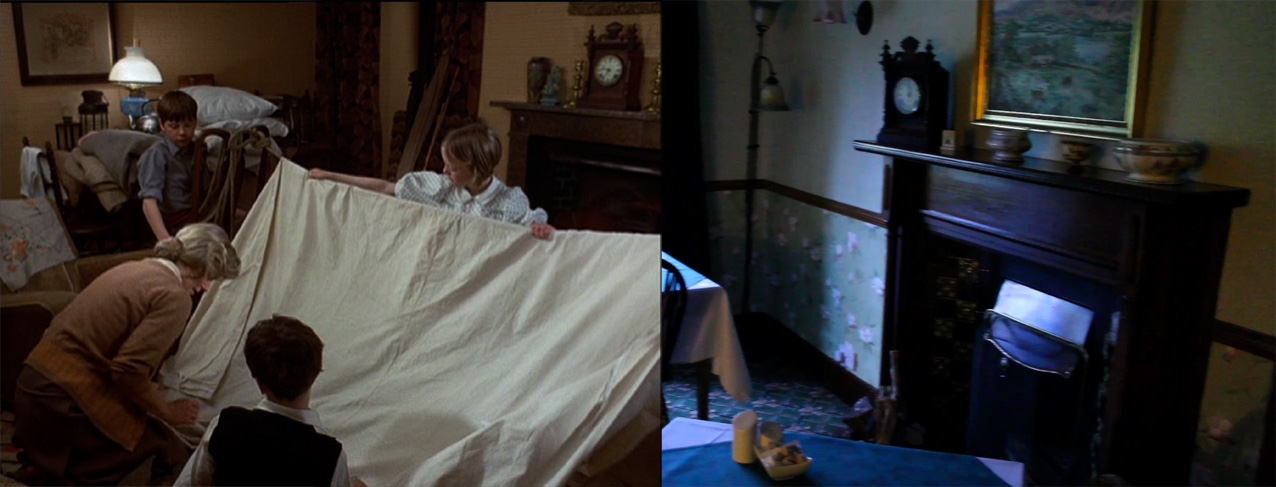
The clock is, indeed, still on the mantelpiece at Bank Ground Farm

It is aways wonderful to hear how the film of Swallows and Amazons has effected people’s lives.  I have just had such an interesting e-mail from Australia. I only wish that Claude Whatham was alive to read it.

Did anyone else know about the the clock on the mantelpiece at Bank Ground Farm?

In the film – and in real life
Dear Sophie,
      I can not tell you how much I am enjoying your website. I’ve searched for scraps of material regarding the making of Swallows and Amazons for decades, but you post more information in one day than I gleaned in a lifetime. It’s a fabulous insight, and one I really appreciate.
      I became a film-maker largely because of Swallows and Amazons. I’ve written a small piece about this, which is going to be published in a promo for one of my film-making books. As a nine year old, I stumbled across Wild Cat Island just days after seeing the film. I was so thrilled to be standing where the film had been made, and so excited to see how clever use of the camera could exaggerate the feeling of a location and capture the magic of performance, that I set out to discover everything I could about film. It was a life-changing moment.
      My daughters (5 and 7) adore Titty, and we are all impressed by your acting. I’ve directed my girls in a couple of things, and I know they gained confidence from having seen you perform. When Tabitha, my eldest daughter, saw the film for the first time, she burst into tears at the end. It was a release of pure joy, and is testament to the quality of the film.
      I live in Australia now, but returned to the island in 2010 with Tabitha and Harriet (rowing all the way from the other end of the lake). We stayed at Bank Ground Farm. This months we went back and were lucky enough to sail Swallow into the Secret Harbour. It was a windy October day, and quite a frantic sail, but I can honestly say it was one of the highlights of my life.
      When reading your recent post about set dressing at Bank Ground Farm, I wondered if you’d noticed that the clock on the mantlepiece is still there. It’s on the other mantlepiece, I believe, but it is still there. I have no idea whether it is a prop that was left behind, or whether the film-makers used the clock that belonged to the farm.
Thanks again.
Best wishes,
Chris
Christopher Kenworthy

Art Director Simon Holland
Art Director Simon Holland painting labels for cans of Pemican on Mrs Batty’s lawn at Bank Ground Farm in 1973 ~ photo: Daphne Neville

    Our set designer or ‘Art Director’ on Swallows and Amazons was Simon Holland. He worked tirelessly with his assistant Ian Whittaker and team of prop men, making every effort to use absolutely authentic props and set dressing. It must have involved quite a bit of research. Holly Howe, for instance would not have had mains electricity or back in 1929, so he made sure oil lamps were on set. These would have been modified by the Sparks so that it looked as if they lit the room in those evening scenes when we were busy packing.
    The people of the Lake District still remember Simon asking if he could buy old tins of food. It seemed such an unusual request. When it came to making labels for the cans of ‘Pemmican’ he painted them himself ~
      Simon had worked as the set dresser on the thriller Callan starring Edward Woodward, that we all saw in 1974. He had earlier been the Art Director on Bartleby, which featured Paul Scholfield with John McEnery in the title role Swallows and Amazons must have been one of his first features. He was only thirty-two that summer of 1973.
      Simon Holland went to to work on well known movies such as Equus, Greystoke, Quadrophenia, The Sleeping Dictionary set in Sarawakand Tales of the Riverbank which starred Stephen Fry as the Owl and Miranda Hart as Miss March. He sadly died in 2010 at the age of 70 but will be remembered fondly by us all.
      I have found the entry that Suzanna wrote in her diary at this time when we were filming at Bank Ground Farm. She drew a picture of the blue and white checked dress she wore and described an interview with a reporter.

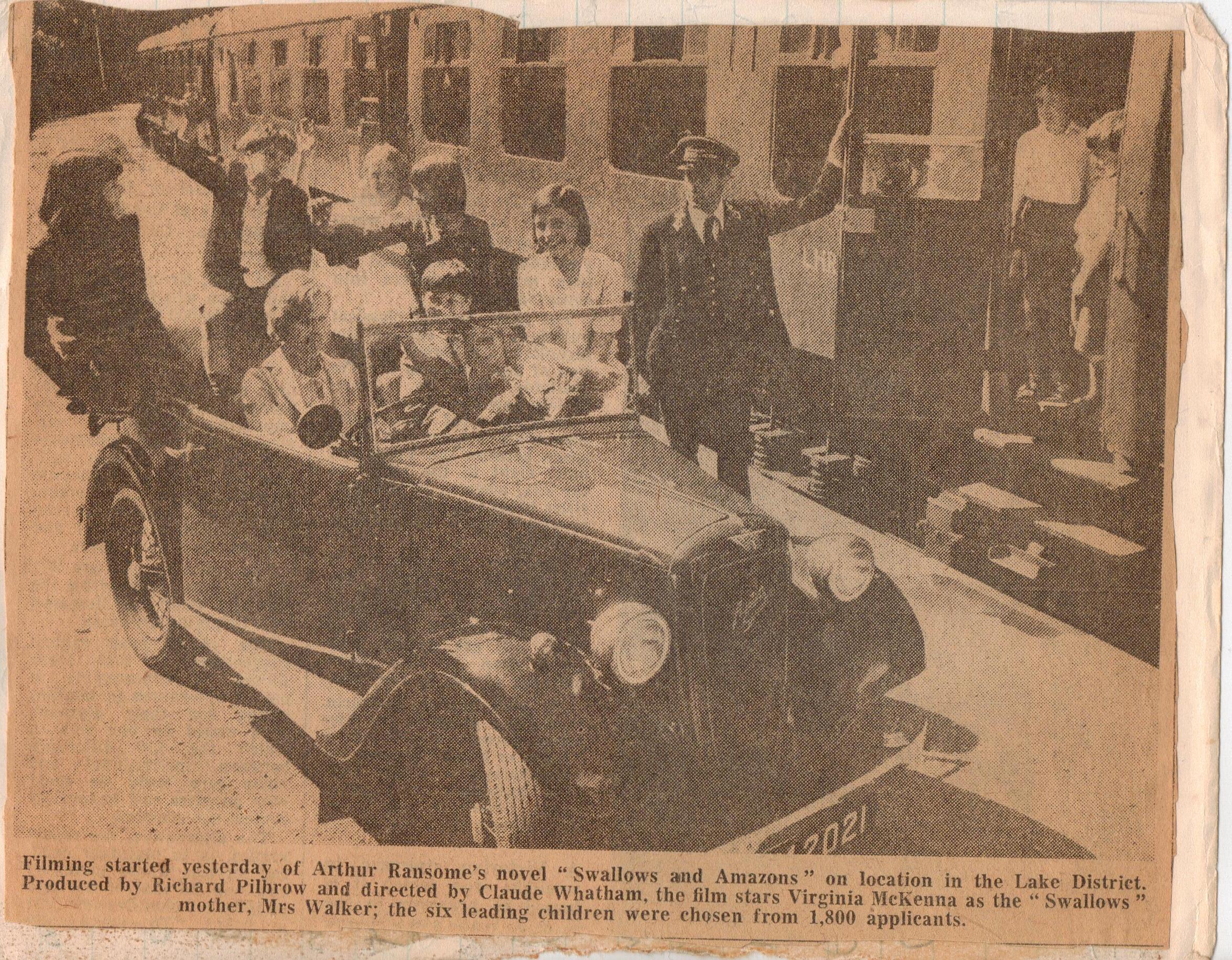
This is the newspaper clipping that Suzanna stuck in her dairy that featured Virginia McKenna and the six of us children in one of the old motors that Simon Holland found to dress the Railway Platform set at Haverthwaite Station on the first day of filming.

A clipping from The Guardian Newspaper 15th May 1973

You can read more here:

Filming ‘Swallows and Amazons’ at Bank Ground Farm in Cumbria in 1973

If you take the East of the Lake road along Coniston Water you will find Bank Ground Farm. It lies between Brantwood,  John Ruskin’s former home, and Lanehead where Arthur Ransome’s friends the Collingwoods lived. Ransome was particularly good friends of Dora Collingwood, who married an Irish-Armenian doctor keen on sailing called Ernest Altounyan. They went to live in Syria but every five years or so would bring their children to visit their Grandparents for the holidays, once staying at Bank Ground Farm next door. Ernest bought two 14 foot sailing dinghies called Swallow and Mavis in which his family learnt to sail.

It was for the five Altounyan children, Taqui, Susie, Titty , Roger – and Bridget, the ships’s baby, that Arthur Ransome wrote Swallows and Amazons after they gave him a pair of bright scarlet Turkish slippers as a birthday present. I don’t think I knew that Titty was a real girl when I played her in the film, but I did know her character in the books and felt rather bad that I didn’t have her thick dark hair evident in Ransome’s illustrations.

Arriving at Holly Howe
Claude Whatham with Virginia McKenna ~ photo: Daphne Neville

Bank Ground Farm is much smarter now. Lucy Batty, who let us take over her home in 1973, has passed on but the farm is run by her grandson Jonathan. You can stay in the main house, where there is a lovely corner bedroom with views down Langdale, or take a self-catering flat, since they have been able to convert the barn and stables into further accommodation.

Bank Ground Farm the location used for Holly Howe

I’ve just received post from Peter Willis of The Nancy Blackett Trust who said, “I stayed at Bank Ground in the summer – it was utterly lovely, exactly as it ought to be – Jonathan Batty and his wife are really hospitable, and one of the great pleasures was the friendliness and interstingness of the other guests, who included a Japanese Ransome fan. Do have dinner if they’re doing it. Food’s great, but so’s the sociable atmosphere.”

16th May 1973

15th May 1973

Int: Holly Howe ~ Bank Ground Farm near Coniston

It was grey and raining in the Lake District on 15th May 1973. Instead of filming the scene when Roger tacks up the field, Denis Lewiston, the Director of Photography, lit Mrs Batty’s living room at Bank Ground Farm for an evening scene. Simon Holland, the art director, had dressed the room in the style of a Cumbrian farmhouse in the 192os with working oil lamps. Bob Hedges, the prop master, brought in all the camping gear we were to be packing while Virginia McKenna was having her hair done up and we had lessons in our red double-decker bus. Then we recorded a scene, the dialogue of which was never used in the finished film.

Int/Ext: Holly Howe

Int/Ext Holly Howe
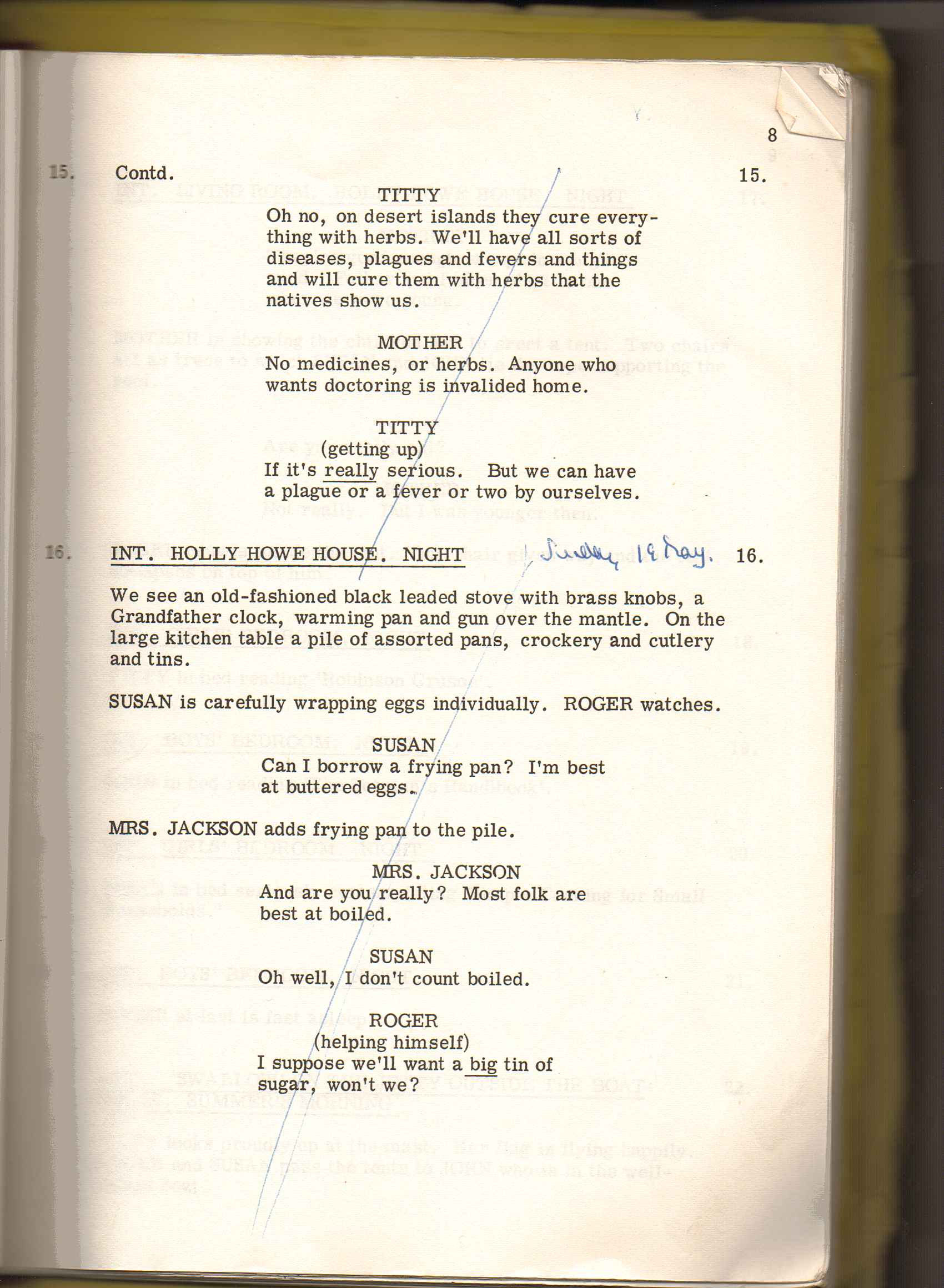
The Screenplay: David Wood’s adaptation of Arthur Ransome’s book ‘Swallows and Amazons’

You do see Susan packing bars of soap and me making heavy weather of sewing our flag, my hair pinned back in a hideous way, with rather a modern reel of white cotton lying on the desk.  John packed the telescope in a biscuit tin, which now seems a mistake as we used it on the voyage, very much not in a tin, but then one always re-packs many times before an important trip.

Virginia McKenna with Sophie Neville in 1973
Virginia McKenna, as Mary Walker with Sophie Neville playing her daughter Titty Walker busy stiching Swallow’s new flag in preparation for the voyage to the island

After lunch, we shot the scene when Mother is teaching us how to erect a tent on rocky ground, as she did with Father when they were young. Titty asks if she is really old.

‘Not really. But I was younger then,’ Virginia McKenna replied looking dubious.

This is rather how I feel now, all these years later, especially when I walk into a room when people are expecting me as Titty. I’m not really old, but I do look different from when I was only twelve. This always happens when I return to Bank Ground Farm. Everyone is a bit taken back by my height but say I sound just the same. And I am married now with a family of my own. It is a bit like when Peter Pan flew back to see Wendy and found she looked just like her mother – not least because in the play the adult Wendy is always played by the actress who formerly takes the role of Mrs Darling.

Sophie Neville
Simon West, Sophie Neville and Suzanna Hamilton in the 1974 film of ‘Swallows and Amazons’

I was standing outside the front door of Bank Ground once, talking to Lucy Batty, when two Japanese girls arrived to stay at the farm. Fans of the film, they looked up at me and declared, ‘Ooo Titty!’ clasping their hands together in greeting. They had come from the other side of the world and yet recognised me immediately. Perhaps I haven’t changed that much after all.

The Walker family finding Swallow at Holly Howe

The weather must have cleared up a bit by teatime on 15th May as we recorded the scenes in the boat house when John discovers Swallow, brings her out to the stone jetty and steps the mast. They must have had to take the generator down to the lakeside as I’m pretty sure that the sunlight comes from an arc-lamp. Suzanna got her shorts wet as she pushed out the clinker-built dinghy but we loved being by the water.

You can read more in ‘The Making of Swallows and Amazons’ available online and to order from bookshops and libraries. It is now available as an audiobook.

'The Making of Swallows and Amazons (1974) by Sophie Neville'
Different editions of ‘The Making of Swallows and Amazons (1974) by Sophie Neville’

‘Swallows and Amazons’ (1974) the opening locations of the classic film

14th May 1973 – and it was the first day of making the original movie ‘Swallows & Amazons’ on location in the Lake District. A huge effort had been made to ‘dress’ Haverthwaite Railway Station, at the southern end of Windermere. The aim was to bring across the feel of a bustling holiday destination in the summer of 1929. Local people had been fitted with costumes in the Ambleside Church Hall, there was a horse and cart, porters’ trolleys laden with trunks and a number of old bikes, which were all of great interest to us.

Sten Grendon, Suzanna Hamilton and Sophie Neville

Having stepped down from the steam locomotive, where the Times photographer must have taken this shot (below) before we children were piled into an open-topped period vehicle, for further photographs.
An article in The Times 1973
A photograph taken for The Times of us all aboard the steam train at Haverthwaite

I thought the publicity photographs taken that day were silly, especially since Kit Seymour and Lesley Bennett, who played the Amazons, were wearing ordinary clothes rather than period costumes, but the results were later published far-afield from The Guardian to Woman’s Realm.

Viewers ask how old we were at the time. Sten Grendon, who played Roger was aged 8, Simon West (John) was aged 11. Although Titty is described as being aged 9 in the books, I was 12, as were Suzanna Hamilton (Susan) and Kit Seymour (Nancy). Lesley Bennett (Peggy) was 13, but looked younger. Virginia McKenna, who played my mother, has just been awarded a DBE – not before time!

With Virginia McKenna on the first day of filming
A publicity shot featuring Virginia McKenna, with Kit Seymour, Steven Grendon, Sophie Neville, Lesley Bennett, Simon West and Suzanna Hamilton, taken on the first day of filming and published in the Guardian and other newspapers

The yellow motor used in the film for our taxi was superb. Would a real Lakeland taxi have been so grand? I recorded in my diary that Sten, playing Roger, hung out of the window as the director, Claude Whatham, ‘filmed us driving out of the station, along the platform at top speed.’

Once this shot was ‘in the can’ Virginia McKenna was interviewed by journalists while we were hurried away to get on with our lessons. Our tutor taught us Art. I drew the a picture of the motor car.

Director Claude Whatham talking to Virginia McKenna

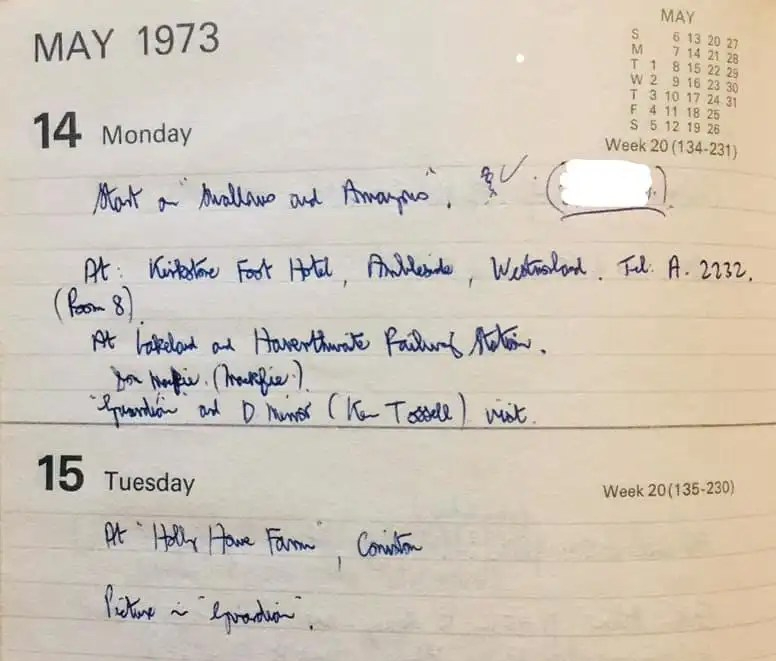
Journalists from the Times, Guardian and Daily Mirror were looked after by our publicist, Brian Doyle, whose diary was a little more functional than mine. I’m now struck by the telephone number for the unit hotel: Ambleside 2232

Brian Doyles Diary of Swallows and Amazons
Dairy kept by Brian Doyle, the publicist on ‘Swallows and Amazons’

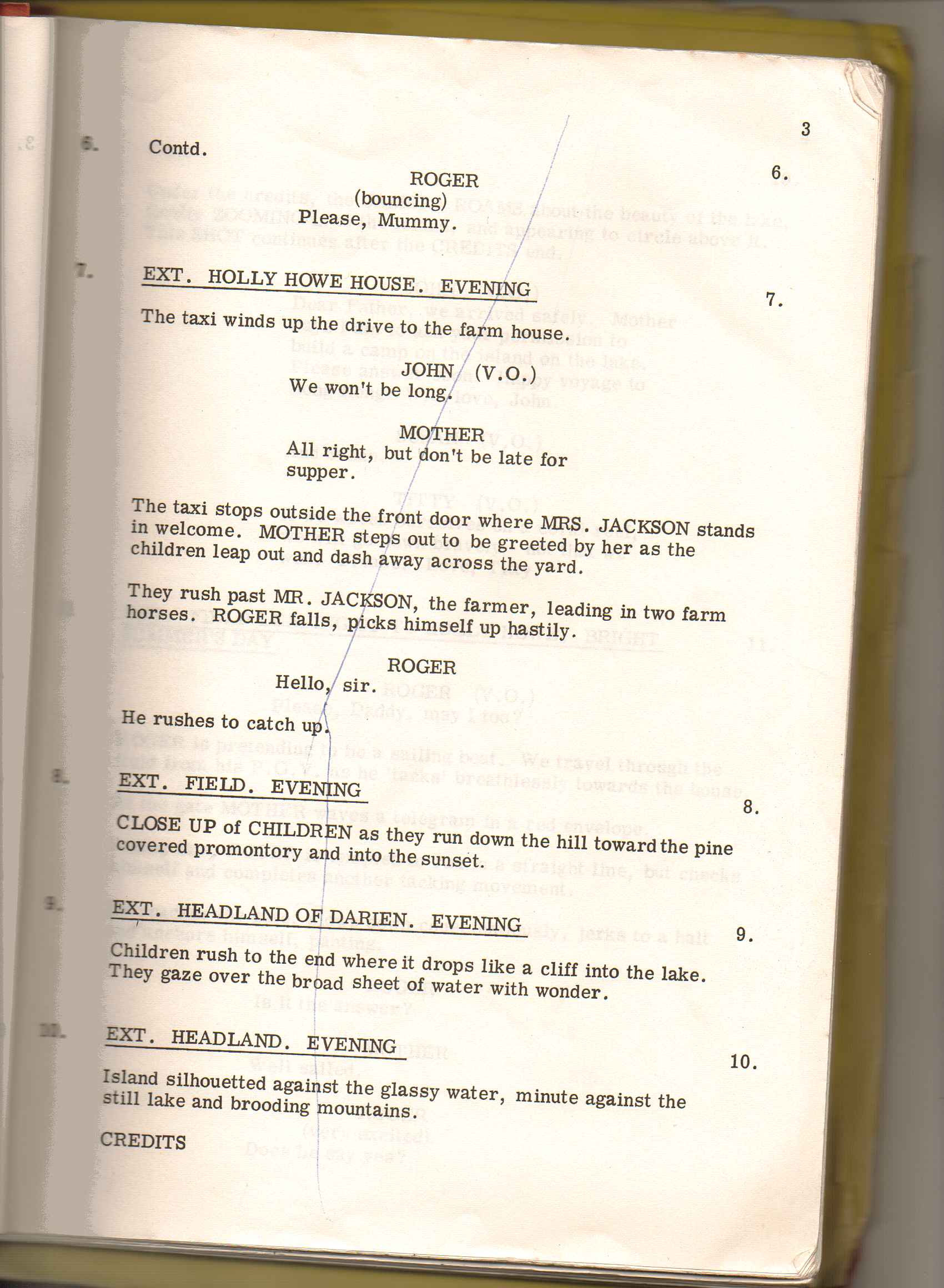
Arriving at Holly Howe in the taxi was truly exciting. It was not filmed the next day, as I think rain had set in. Claude waited for good evening light. But I remember the thrill of drawing up outside the farmhouse in the old car and pulling on my hat as we spilled out and ran past the big farm horses Mr Jackson was leading into the yard. Our OOV (out of vision) dialogue was added later.

The screenplay of the 1973 film ‘Swallows and Amazons’ adapted from Arthur Ransome’s book by David Wood

If you ever go to Bank Ground Farm near Coniston, named Holly Howe by Arthur Ransome in his books, you must run down the field to the lake as we did. As soon as you arrive. And at top speed. And you will be filled by the same feeling of elation as we were when we played the Walker children.

Bankground Farm
Steven Grendon, Sophie Neville, Suzanna Hamilton and Simon West at Bankground Farm above Coniston Water in the Lake District

The slope, formed by glacial scouring and subsequent deposits long ago, is steeper than you might think.  We became adept at the art of glaumphing, advocated by Ransome in the book.

What struck me when I returned to Bank Ground Farm one Spring, was that sadly the great trees have gone from around the old farm gate and the boatsheds down by the lake.  They must simply have reached the end of their lives, but their glory was captured on celluloid to be remembered forever.

Sten Grendon, Sophie Neville and Simon West with Mr Jackson at Holly Howe~ photo: Daphne Neville

Most Arthur Ransome devotees will know that the Peak at Darien, where once stood stout Cortez, is familiar to readers as it appears in two of the illustrations in the book. Sadly it can not be found below the farm in real life. Mrs Ransome said that you could find the headland on Windermere. In April 2011, when I was on an early recce with Nick Barton, CEO of Harbour Picture Productions, we did pass one promising spot. However Richard Pilbrow and Claude Whatham chose Friar’s Crag on Derwent Water for the location. I didn’t know it but Christina Hardyment writes in her excellent book, Arthur Ransome and Captain Flint’s Trunk, that they had found the very place Ransome had in mind, “without the slightest idea that they were quite right to be doing so.”  She found that Ransome had marked up postcard of Friar’s Peak for his illustrator Clifford Webb to work from in 1930. It feels completely right when you are there, with the iconic view of an island under the towering mountains. It was over a shot of this that the opening titles were added.

Sout Cortez was not around. Neither were we children. By the time we had been transported from Coniston to Derwent Water for this scheduled scene the sun was going down.  We’d been delayed by the make-up artist who was determined to tone down the tans we had developed.  This took ages as he used a very small sponge. My mother was frustrated, as she thought that this would never have shown up, but he put his foot down with the result that we were ‘late on set’ for the evening shots. Mum grabbed this photo but it was a disaster. Claude Whatham was very annoyed.

Sophie Neville as Titty arriving too late in the day to film at Friar’s Crag on Derwent Water. The island portrayed as Wildcat Island can be seen in the distance ~ photo: Daphne Neville

One of the big secrets of the film is that the sequence when we run up to the Peak at Darien and first set eyes on the island in the lake was shot under an oak tree in Runnymede, near the River Thames. We were not an island at all.  It must have been an expensive ‘pick-up shot’ but Claude had made an effort to gather together the same crew members and I was back in my lovely silk dress once more. We knew how to act by then and the joy of being together again shows on our faces.  The result was a scene to set the film off on the right foot.  We were jubilant and so excited, that, like swallows, we could have taken flight.

Sophie Neville, Claude Whatham and Simon West with Richard Pilbrow, right ~photo:Daphne Neville

I would have to check with Richard Pilbrow to be certain, but I think that Simon Holland, the Art Director, penned the SWALLOWS and AMAZONS graphics for the opening titles.  I remember a discussion about the font type. A very fashionable script used on the poster of the film was favoured. I said that they ought to use the handwritten capitals that Clifford Webb had penned on the map in the opening cover of the book, which were copied by Simon Holland (and me) on our chart. This was chosen.

Swallows and Amazons (1974)

A snazzy Seventies’ font, had been used for the titles of  Lionel Jefferey’s movie The Railway Children and the poster of Swallows & Amazons. For sometime a DVD has been available which gives you both movies released by EMI Films.

Click on this image to see the poster of the film

As a viewer I felt that this soon dated it, whilst Swallows and Amazons sailed onto our television screens in the 1980’s and 1990’s, without being spoilt by what became most unfashionable graphics. Of course that particular retro font is now all the rage.

'The Making of Swallows and Amazons (1974)'

You can read more about the trials of producing the classic film in ‘The Making of Swallows and Amazons’ published by the Lutterworth Press, available online, at all good bookshops and to order from libraries.

The remastered DVD with subtitles and an Extras package is available online.

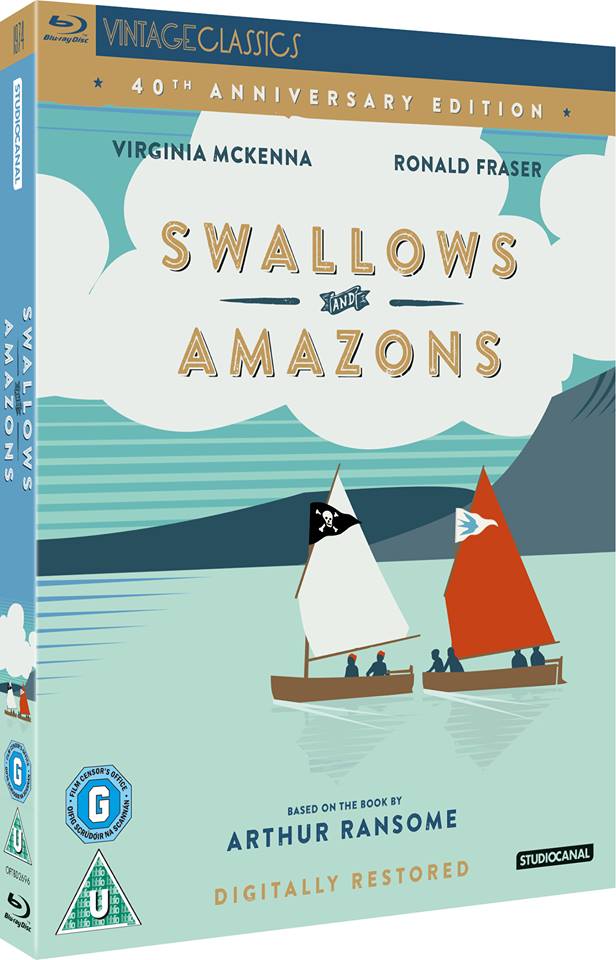
StudioCanal DVD cover

‘Swallows and Amazons’ the screenplay of the 1973 film, adapted from Arthur Ransome’s book by David Wood

The screenplay~

Arthur Ransome’s book was adapted for the big screen by David Wood.  The first time I saw this script was early in 2011 when my mother pulled it from the back of a wardrobe. It’s really only now that I fully appreciate how beautifully it was crafted.

The opening scenes ~

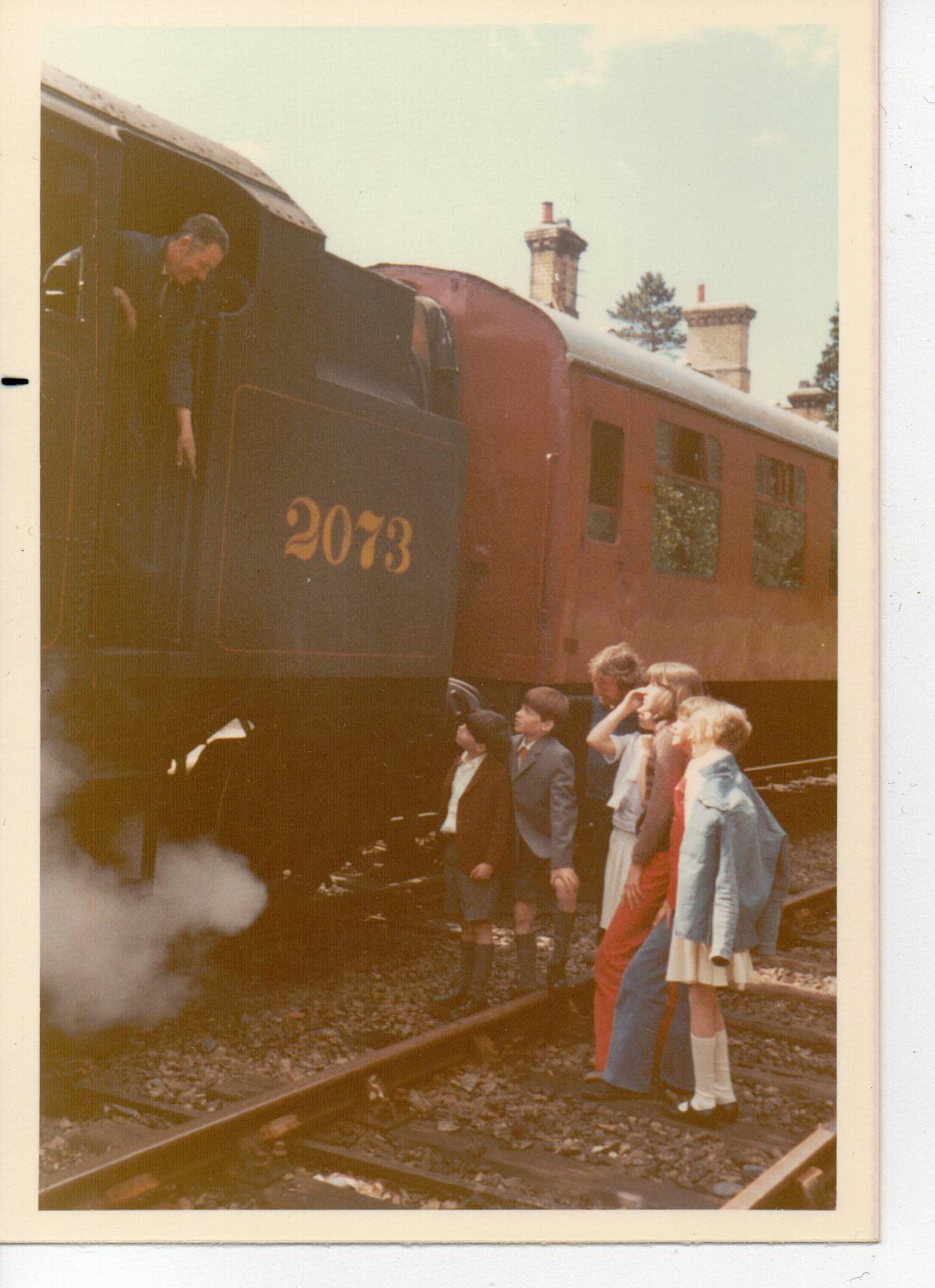
Talking to the engine driver at the Haverthwaite Railway Station on the first day of filming 'Swallows and Amazons' in 1973 (Photo: Daphne Neville)
Talking to the engine driver at the Haverthwaite Railway Station on the first day of filming ‘Swallows and Amazons’ in 1973 ~ photo: Daphne Neville

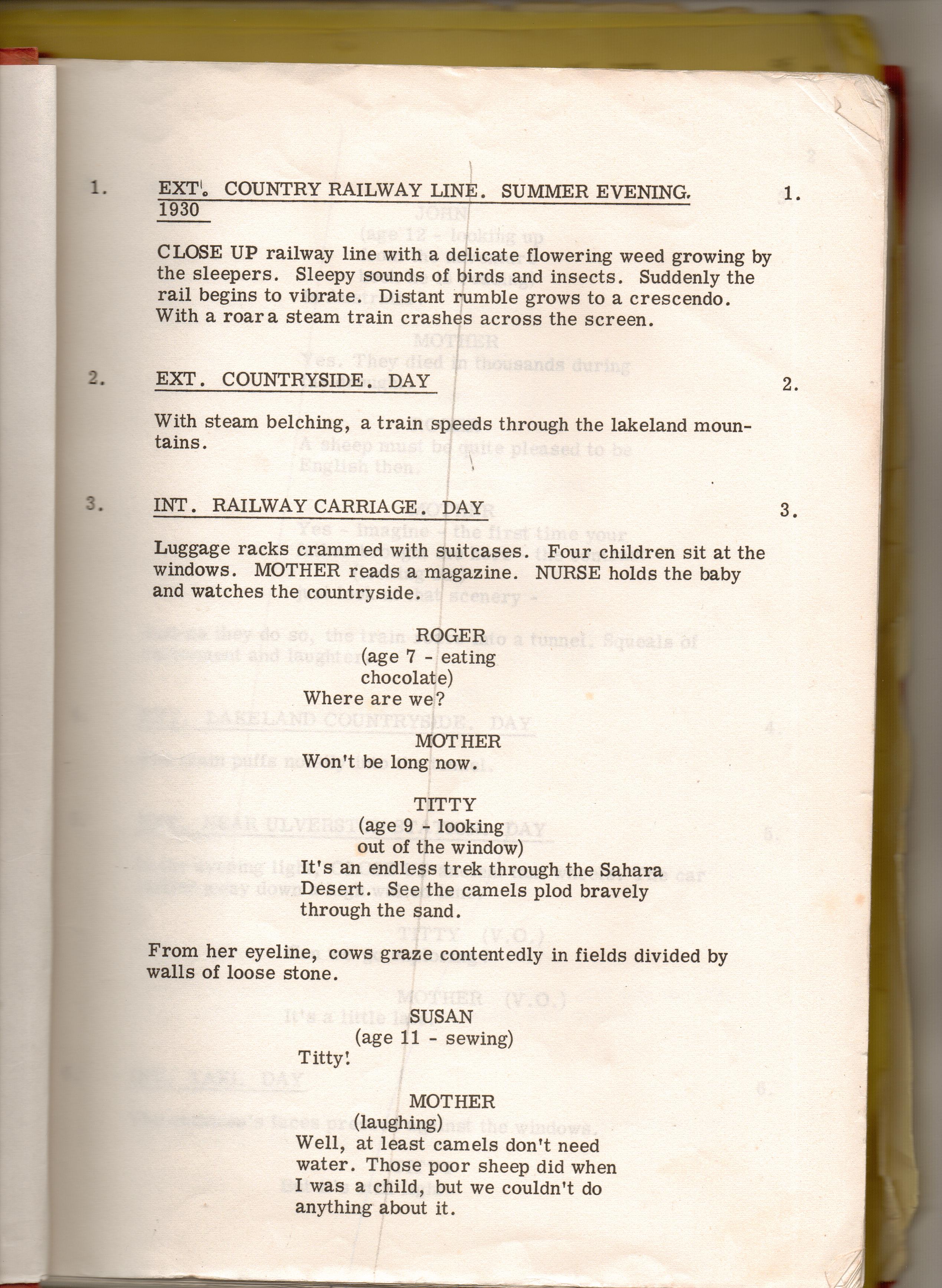
The film opens with a shot of a steam train passing through Cumbria. This does not feature in the book but was a powerful first image and good way of introducing the Walker family, setting the period and the very Englishness of travelling up to the Lake District for the summer holidays. It was a wonder that this was possible; The Lakeside and Haverthwaite Railway , with it’s restored steam train, had only been open and running for two weeks ~ on 2nd May 1973 to be precise. It was a private concern run by a bunch of enthusiasts on the old Furness Railway branch line. The engine was a Fairburn 2-6-4 tank locomotive of 84 tons, of approximately 1930s vintage, standard gauge and coloured black-berry black

Swallows Script page 1
The original screenplay of ‘Swallows and Amazons’ adapted from Arthur Ransome’s immortal book by David Wood in 1973

~ The crossings out were made by my mother, in the tradition of marking a scene that has been recorded ~

Swallows Script page 2
The original screenplay of ‘Swallows and Amazons’ adapted by David Wood for Theatre Projects in 1973

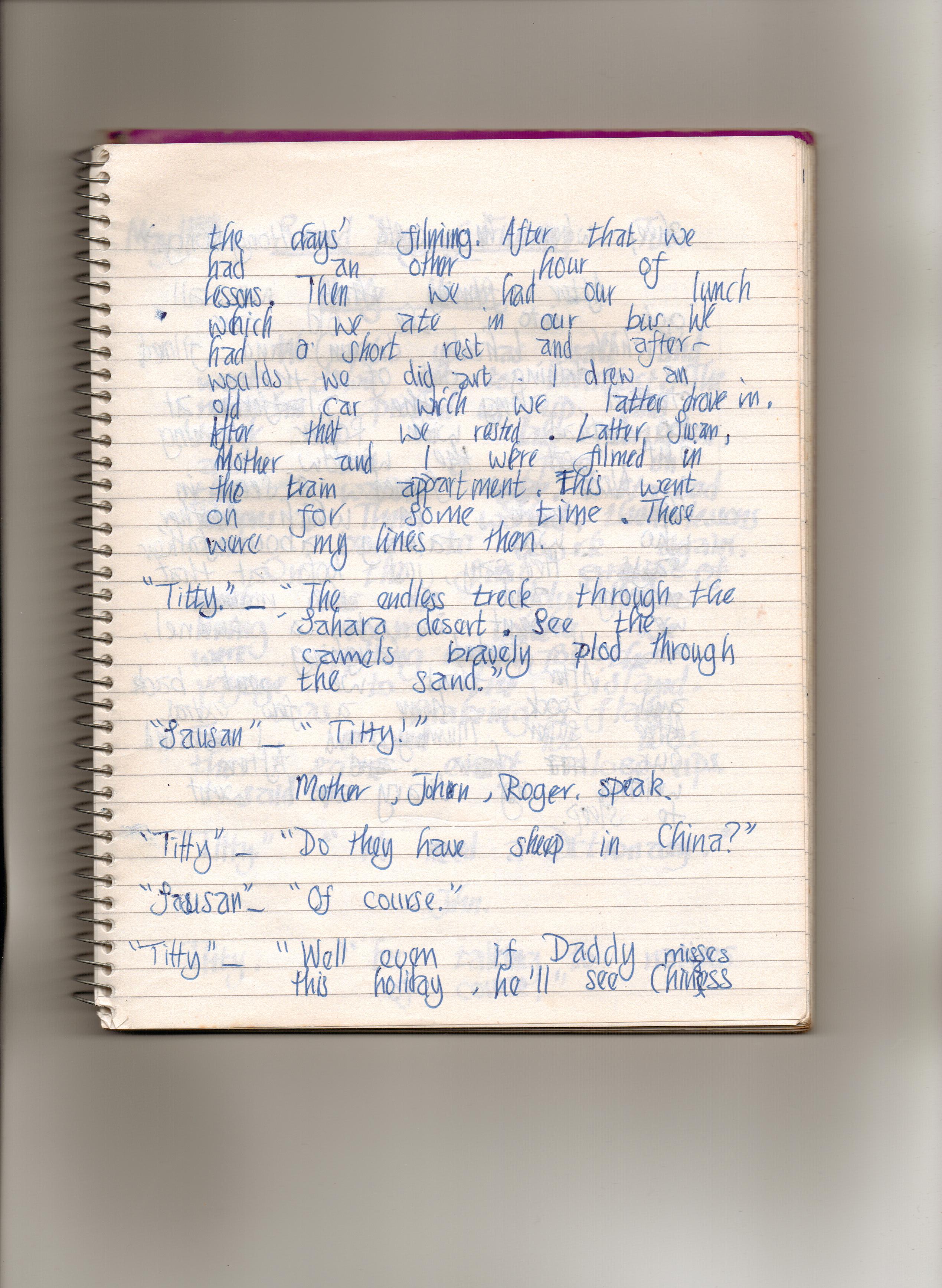
What I never knew until I read the third scene today was that we added quite a bit of dialogue. I can’t remember if it was improvised or given to me by Claude but I said quite a bit more than was scripted, and recoded the fact in my diary.

notes to the text ~ Mrs Price was the lady who owned and ran our guest house. Our tutor, Margaret Causey, taught us in a converted red London double decker bus.

Swallows Diary 14th May page two
I took note of my dialogue in the pages of my diary. Here it was supplementary to the script

Swallows Diary 14th May page three

The railway carriage ~

Claude Whatham was keen to shoot the film in ‘story order’ as much as possible as he thought this would be easiest for us to comprehend. INT.RAILWAY CARRIAGE. DAY was, however, a difficult scene to execute. Once the railway carriage contained movie lights, the director, a huge 35mm Panavision camera, the cameraman and assistant, with microphones and an assistant sound recordist there wasn’t any room for me.  When it came round to the shots of me I had to give my lines to imaginary family members. They were no longer there – the camera had taken their place. It also got extremely hot.

Virginia McKenna, Simon West, Suzanna Hamilton, Kit Seymour, Lesley Bennett and Sophie Neville at the Haverwaite Railway Station in 1973 ~ photo: Daphne Neville

Story order ~

I look back on all this now and feel our opening performances, so vital to capture the audiences attention, were understandably rather wooden. Later on, when I was directing films that featured children I tried to schedule unimportant, ‘running around scenes’, which were easy for them, so that they could get used to working with the crew before tight close-ups were required.  I found that even six year-olds were unfazed by recording scenes out of story order, in fact they were probably less disorientated than the adults.

Continuity ~

With Virginia McKenna’s magazine, our picnic and Susan’s tapestry the matter of continuity in this scene was important. We greatly enjoyed learning about this technicality, so vital if the shots that make up the scene are to cut together smoothly. Numerous Polaroid shots were involved, which was exciting as these cameras had not been around for long and we enjoyed watching the photographs develop.  We did our best to be helpful and keep an eye on the picnic, but somehow it all went wrong. The continuity in this opening scene is out. This probably because Sue Merry, the Continuity Girl could not get in –  into the railway carriage, that is. There was simply no room for her.

You can read more here:

‘Swallows and Amazons’ ~ getting used to sailing our boats in preparation for making the film back in 1973

Sunday 13th May 1973

Sailing on the lakes ~

Swallows Diary 13th May

Swallows Diary 13th May page 2

…And so we spent the Sunday before the filming began sailing. I’m afraid I can’t remember a thing about it. I imagine we sailed out from the Kirkstone Foot Hotel on Lake Windermere.

I’ve always felt the cold. Back then I only had a terrible blue nylon anorak that I don’t think enabled me to enjoy the sailing, which was a pity. I seemed to have got very cold even when sailing with the wind.

The Amazon has a centre board and was always a much faster boat than Swallow. It proved a bit of a problem during the filming as she always gained more distance when the director wanted a shot with both dinghies sailing together. But, even as old boats with very limited sail, they can go at quite a lick. I remember both were difficult to turn unless you got a bit of speed up. Swallow’s long keel makes her roomy and stable but I sailed her recently and she’s not a boat that wants to go home. I’m used to modern rudders now, whereas Swallow and Amazon have shallow ones shaped like the letter ‘b’.

Swallow photographed by Martin Neville
A photograph of Swallow in 1973 taken by Martin Neville

We had lunch with Virginia McKenna who was to play our Mother, Mrs Walker.  She was sweet and so enthusiastic about what we were doing. I remember that she made a great effort to entertain us at the hotel, instigating games of Consequences, which we adored. We roared with laughter as she read out the results.

Virginia McKenna photographed by Daphne Neville
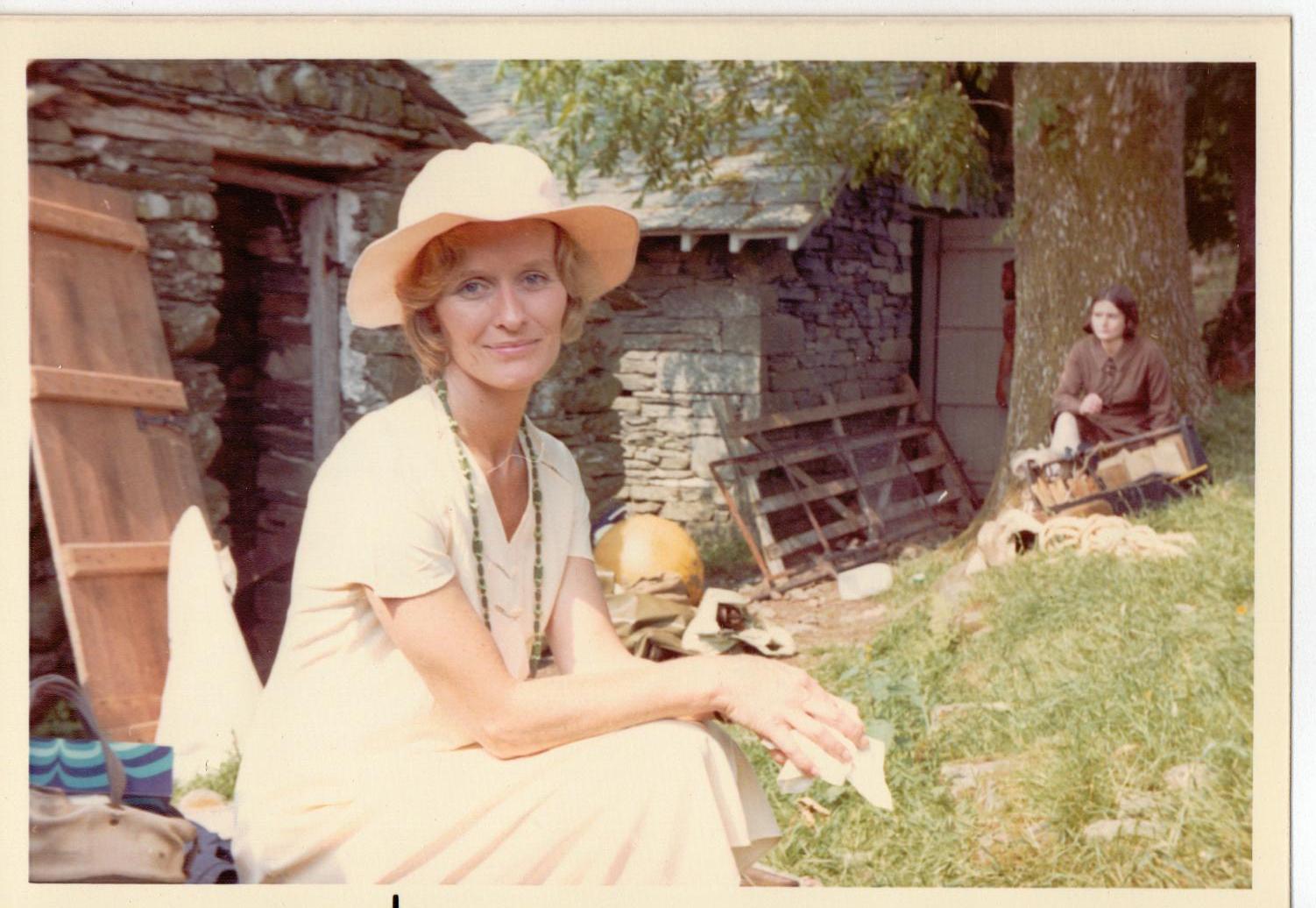
Virginia McKenna on location at Bank Ground Farm ~ photo:Daphne Neville

As my father said recently, Virginia McKenna was completely right to play the part of a Naval Commander’s wife.  A darling of the British public she is, and was, the star who carried the film. I knew her from having loved the animal movies she’d been in ~ Ring of Bright WaterAn Elephant Called Slowly, Born Free and my favorite wartime story A Town Like Alice, for which she won the BAFTA Award for Best Actress.  She was also nominated for Best Actress for her portrayal of Violette Szabo in the WWII story Carve Her Name With Pride and played Julie Hallam in The Cruel Sea, another superb wartime classic.  Married to Bill Travers she had four children of her own by the time she made Swallows and Amazons. I don’t know how she managed to do so much, all with with so much grace and time for others.

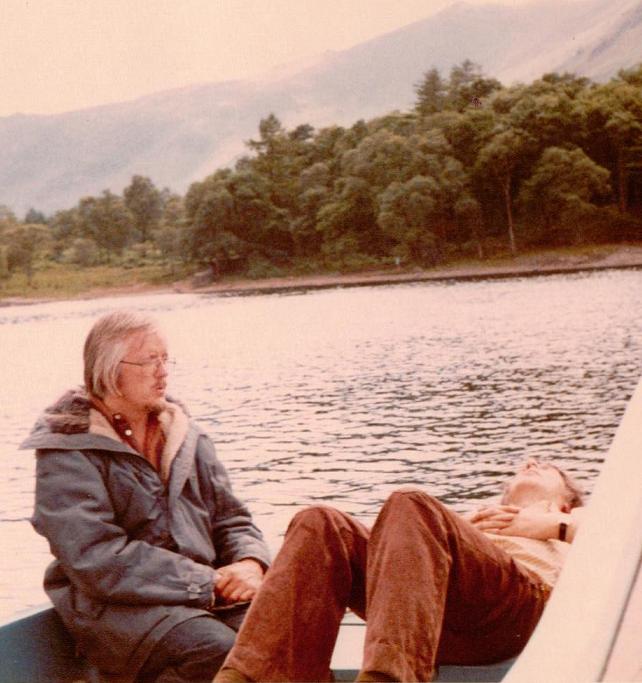
Claude Whatham by Coniston Water
Claude Whatham – photo: Daphne Neville

Claude Whatham, the director, Richard Pilbrow, the producer and David Blagden, the sailing director were with us, along with Mum and Jane Grendon, Sten’s mother who was our other chaperone. Neville Thompson, the Associate Producer who was in charge of the budget and schedule, was also with us that first weekend.  He later worked on the Mosquito Coast, Time Bandits, Sharpe’s Rifles and produced The Missionary with Michael Palin. He must have been a good man to have on board.

Richard Pilbrow and Neville Thompson ~ photo:Daphne Neville

You can read more here: