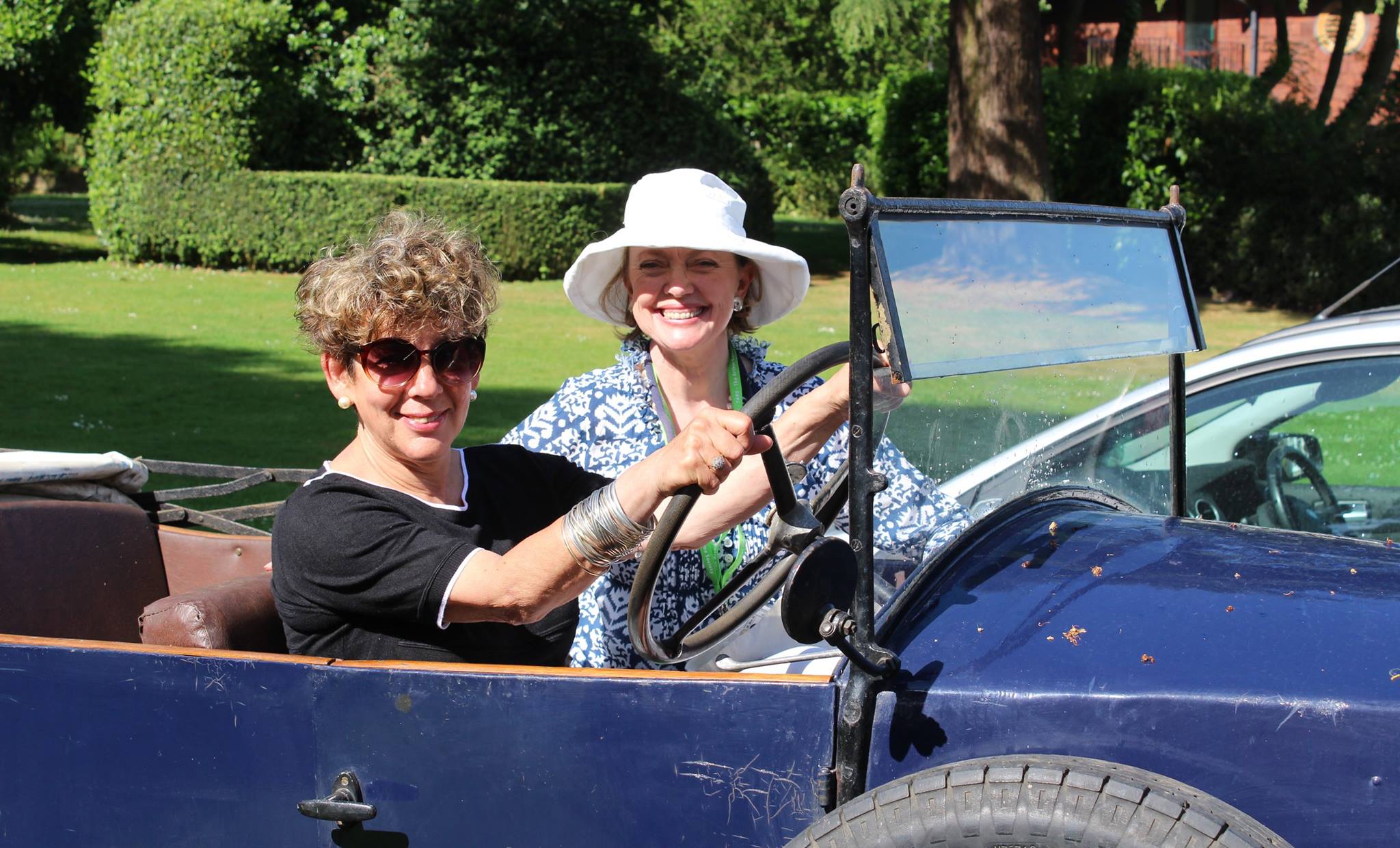
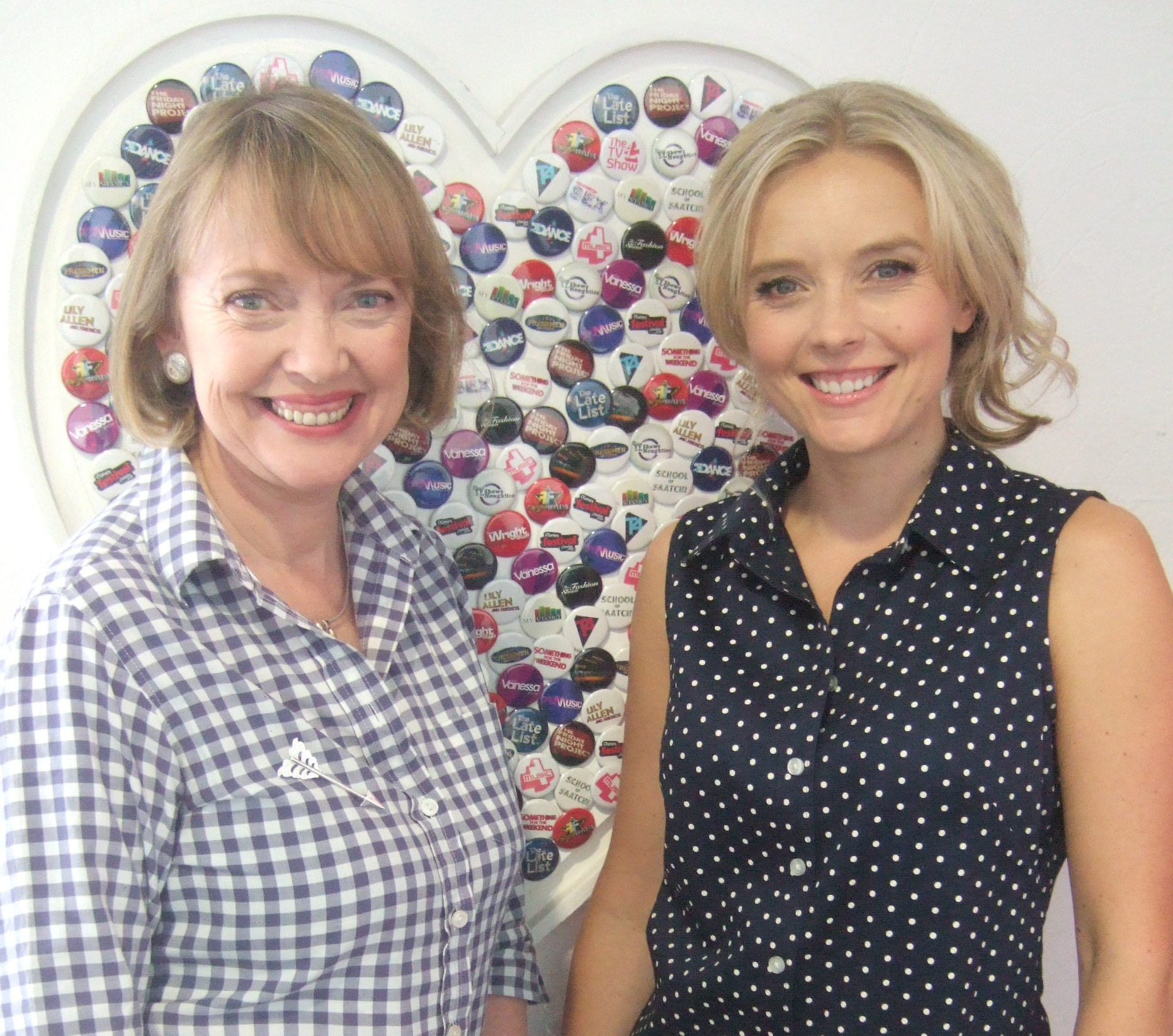
On 21st March and 28th March, the new CBBC TV show ‘Cinemaniacs’ included guest appearances from Sophie Neville and from David Wood, who wrote the screenplay for ‘Swallows & Amazons’ back in 1973.
Oli White, the vlogger and presenter of ‘Cinemaniacs’, asks a number of people involved in movies about making their first film. Others featured include Michael Sheen, Sir Ian McKellen and Matthew Lewis famous for playing Neville Longbottom in all eight Harry Potter movies.
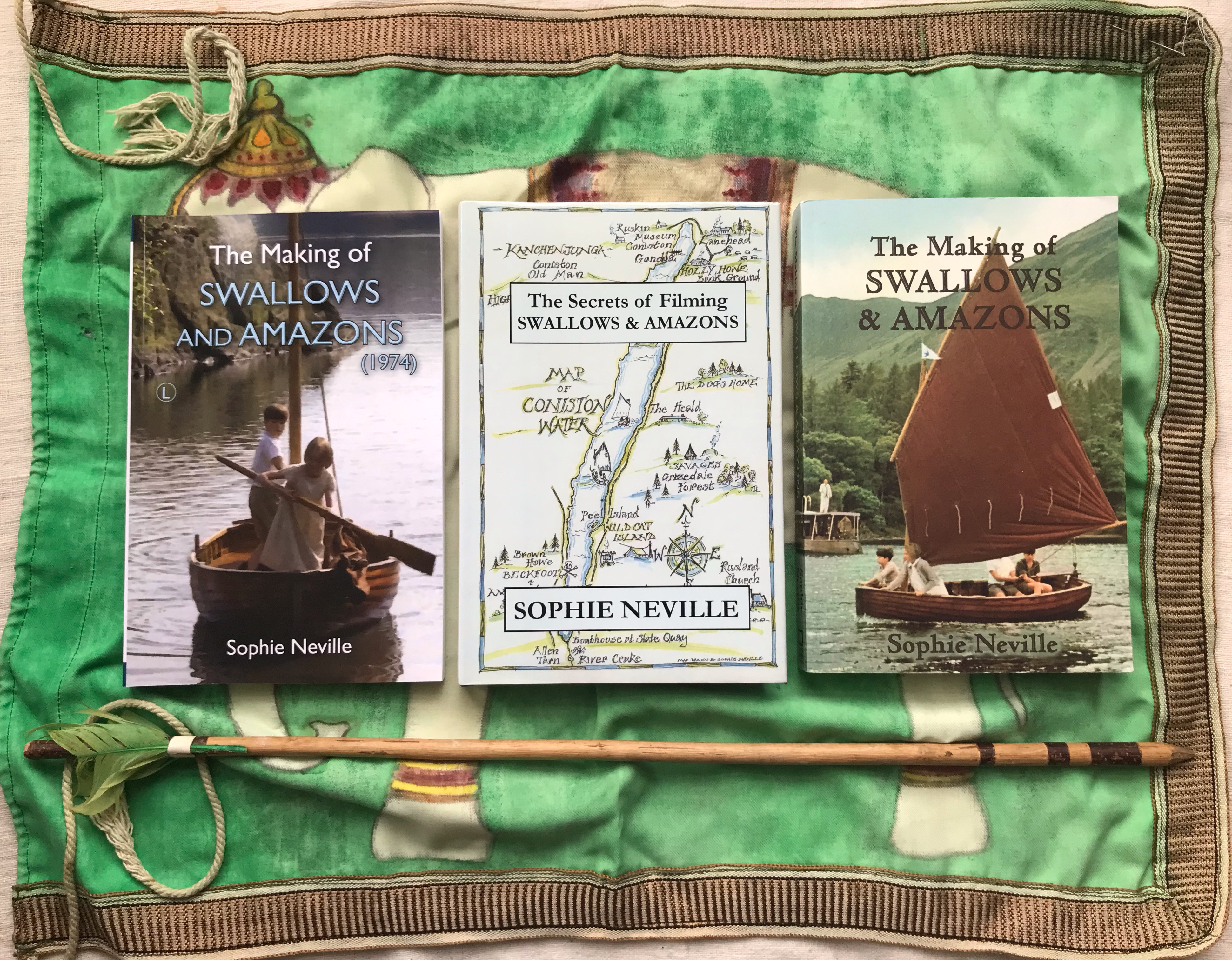
To find out more about how the film ‘Swallows & Amazons’ (1974) was made, along with how the children’s parts were cast, please see earlier posts or read the book! It includes more than 120 photographs taken on location in the Lake District.
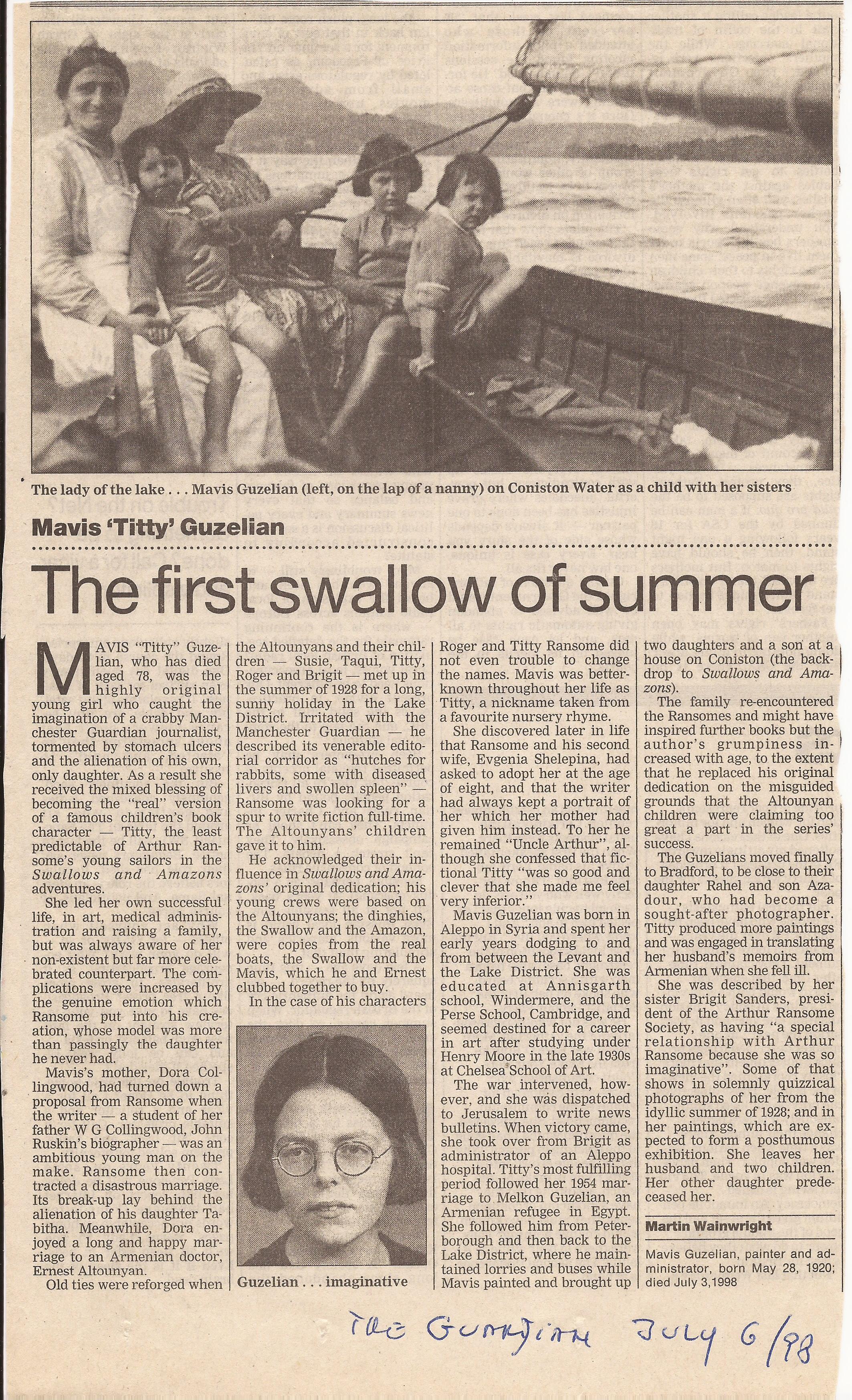
I am assured that Titty’s family will not be offended if I re-publish these news clippings. She has become well-loved by many who I know would like to learn more about her. The Times used her Christian name of Mavis, but she was always known as Titty.
Titty Altounyan was born in Aleppo on 28th May 1920, and would have been aged nine when Arthur Ransome began writing ‘Swallows and Amazons’. She died in Bradford at the age of seventy eight.
Although she was heralded as Arthur Ransome’s muse, I know that Titty Altounyan had no wish to be famous. If anything, she gradually disassociated herself with the character in the books, who struck her as being so good and clever. But Titty was her name.
It was a name I have lived with too, for I played the part of Titty in the film of Swallows & Amazons produced by Richard Pilbrow in 1973. Children and adults alike still call me Titty all these years later. One summer, when I was sailing Swallow, the dinghy used in the 1974 film, someone took this shot of me. It is as if I am still flying Titty’s inspirational flag, which I do with humility and with honour.
Sophie Neville lowering Swallow’s sail on Ullswater in 2014
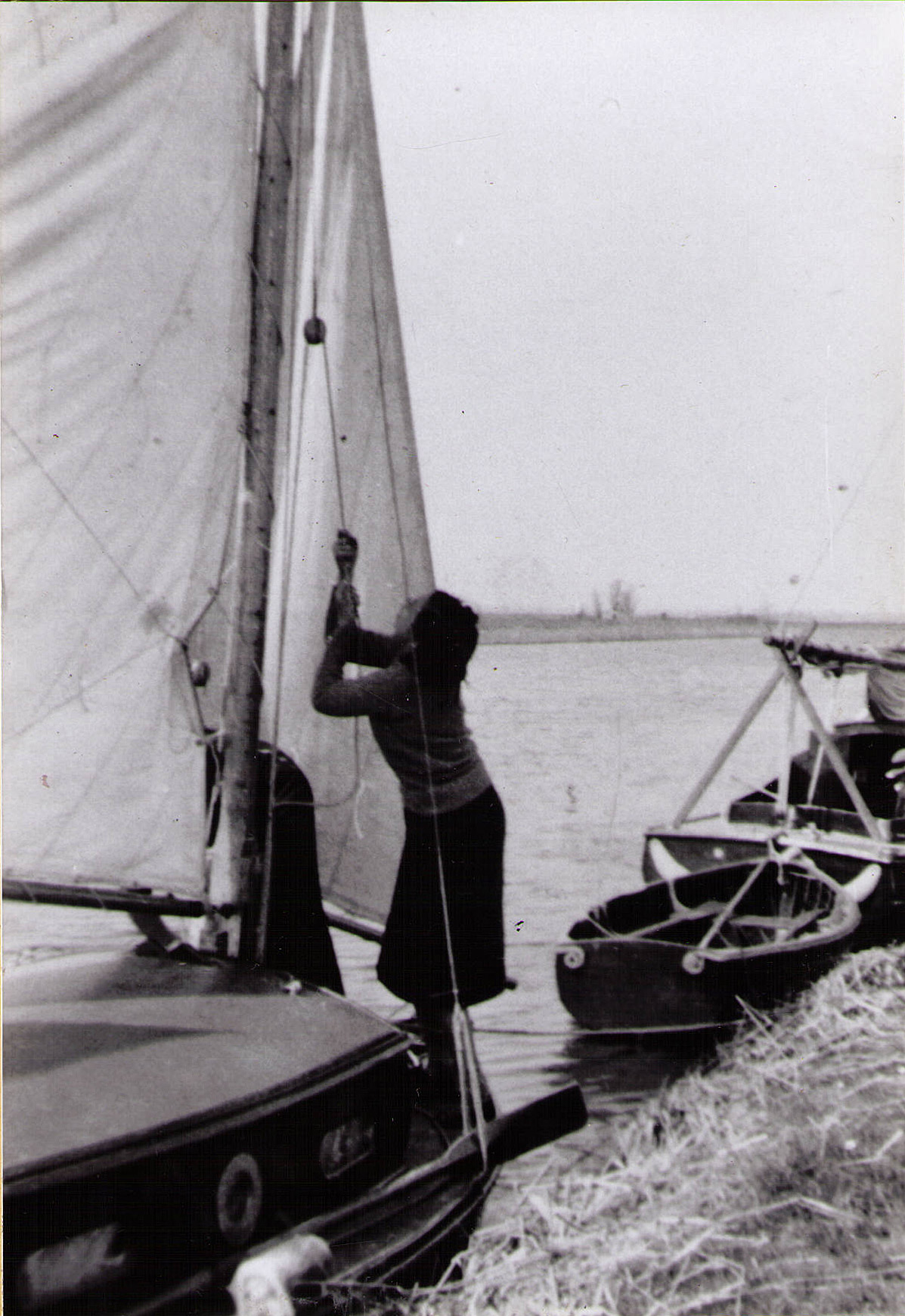
Titty Altounyan with the Ransome’s flotilla on the Norfolk Broads in 1934 (?)
Mrs Ransome wrote to Titty’s mother, Dora Altounyan, from Wroxham. This postcard was kindly shown to us by Ted Alexander who rescued it from certain destruction.
I thought I was far too fair to play Titty but Mrs Ransome approved. Despite Ransome’s book illustrations of girls with dark hair, she was most decisive about casting “An English rose” to play Titty and that the children should have British colouring. The idea was that viewers could easily associate with us. I am of Scots/English/Irish heritage, like three of Titty’s grandmothers, but have no Armenian blood. I rather wish I did. It’s nuisance having such fair skin. My second name is Rose.
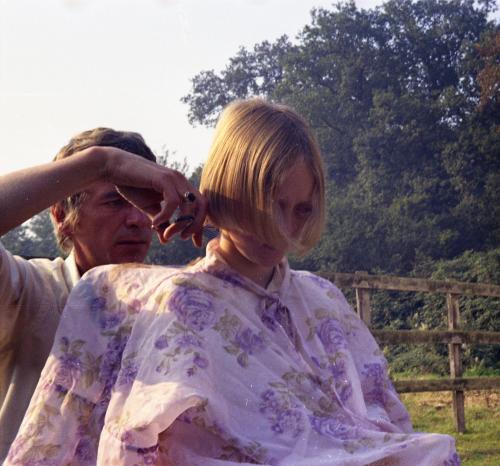
Hairstylist Ronnie Cogan giving Sophie Neville a Titty hair cut on location
I don’t know if Titty ever saw the 1974 film of ‘Swallows and Amazons’. She might have done. I only hope that we captured the sense of adventure experienced by the Altounyans when they were little and went camping on Peel Island during the weeks when they stayed with their grandparents, Mr and Mrs WG Collingwood, at Lane Head at the northern end of Coniston Water.
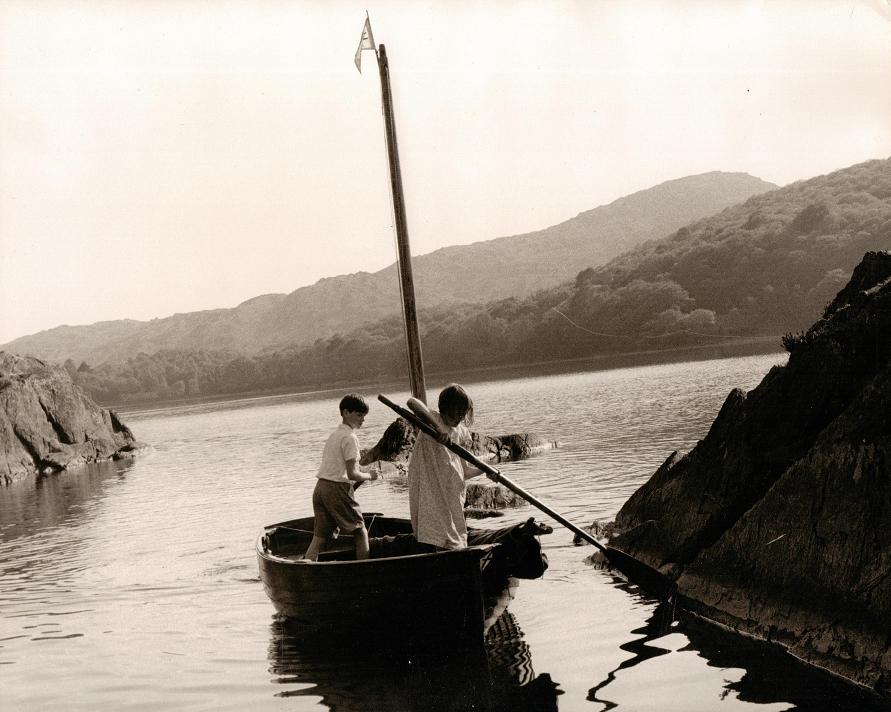
Simon West and Sophie Neville bring Swallow into the Secret Harbour on Wildcat Island (c) Studiocanal
Although they are seen wearing shorts as young children I have been told that the Altounyan girls sailed in dresses, which they tucked up into their knickers if they had to wade ashore, much as I did in the film.
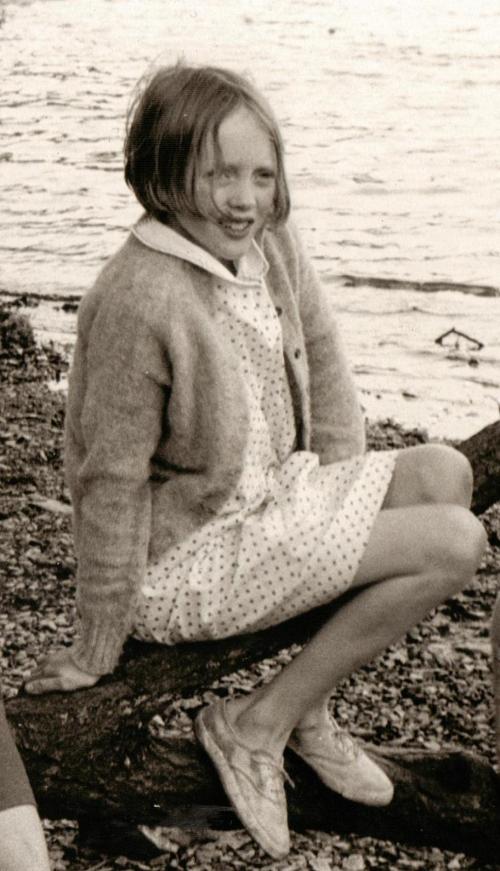
Sophie Neville as Titty (c) StudioCanal
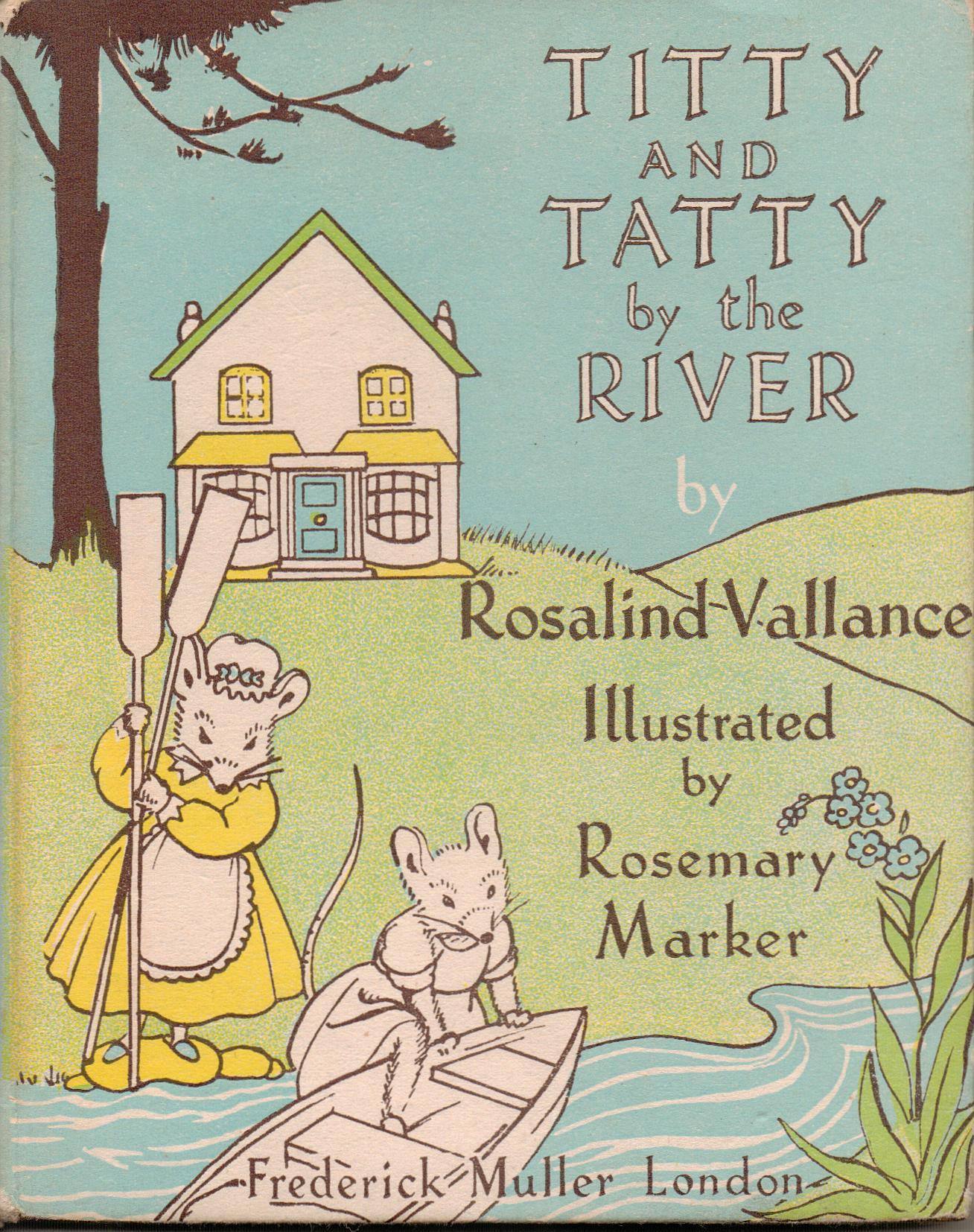
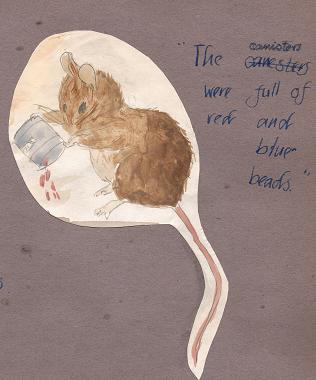
The reference to Titty’s name coming from The Tale of Mrs Tittlemouse in the article feature in The Times above is incorrect. Titty’s name was based on a character in fairy story Titty Mouse and Tatty Mouse by Joseph Jacobs published in 1890, that begins when Titty Mouse and Tatty Mouse go leasing (or gathering) corn. Here is a later edition. Titty ‘never could resist anything in print.’
With thanks to Roger Wardale who showed me the handwritten letters that Titty sent him. She had the most beautiful writing.
Titty’s niece, Barbara Altounyan, with Sophie Neville at a TARS Weekend.
If you would like to read more about the amazing time I had playing Titty in Swallows and Amazons, the first section can be leafed through, free of charge here:
We have just found another reel of 16mm home movie footage shot, not on location in the Lake District, but at Runneymede near Egham in Surrey. It captures the essence of a hot day in September 1973 when we were re-called for pick-up shots after the main body of the film of Swallows & Amazons had already been edited.
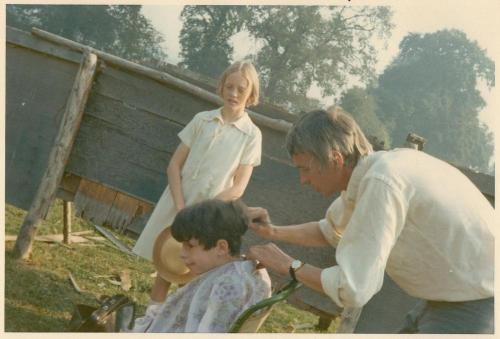
Ronnie Cogan trimming Sophie Neville’s hair for the part of Titty in September 1973
The clip opens with the film hairstylist Ronnie Cogan cutting my hair. It had been a good six weeks since I had last played Titty in front of the camera and I needed a trim to restore it to the same length it had been on 14th May when we had first started filming on the Lakeside and Haverthwaite railway. Suzanna Hamilton’s thick dark hair had grown a great deal, as had Sten Grendon’s.
Sophie Neville watching Ronnie Cogan cut Sten Grendon’s hair.
Peter Robb-King the Make-up artist had been toning down our complexions inside the same Make-up caravan we’d used while on location for seven weeks in Cumbria. I remember it had orange flowery curtains, a pattern much in vogue at the time.
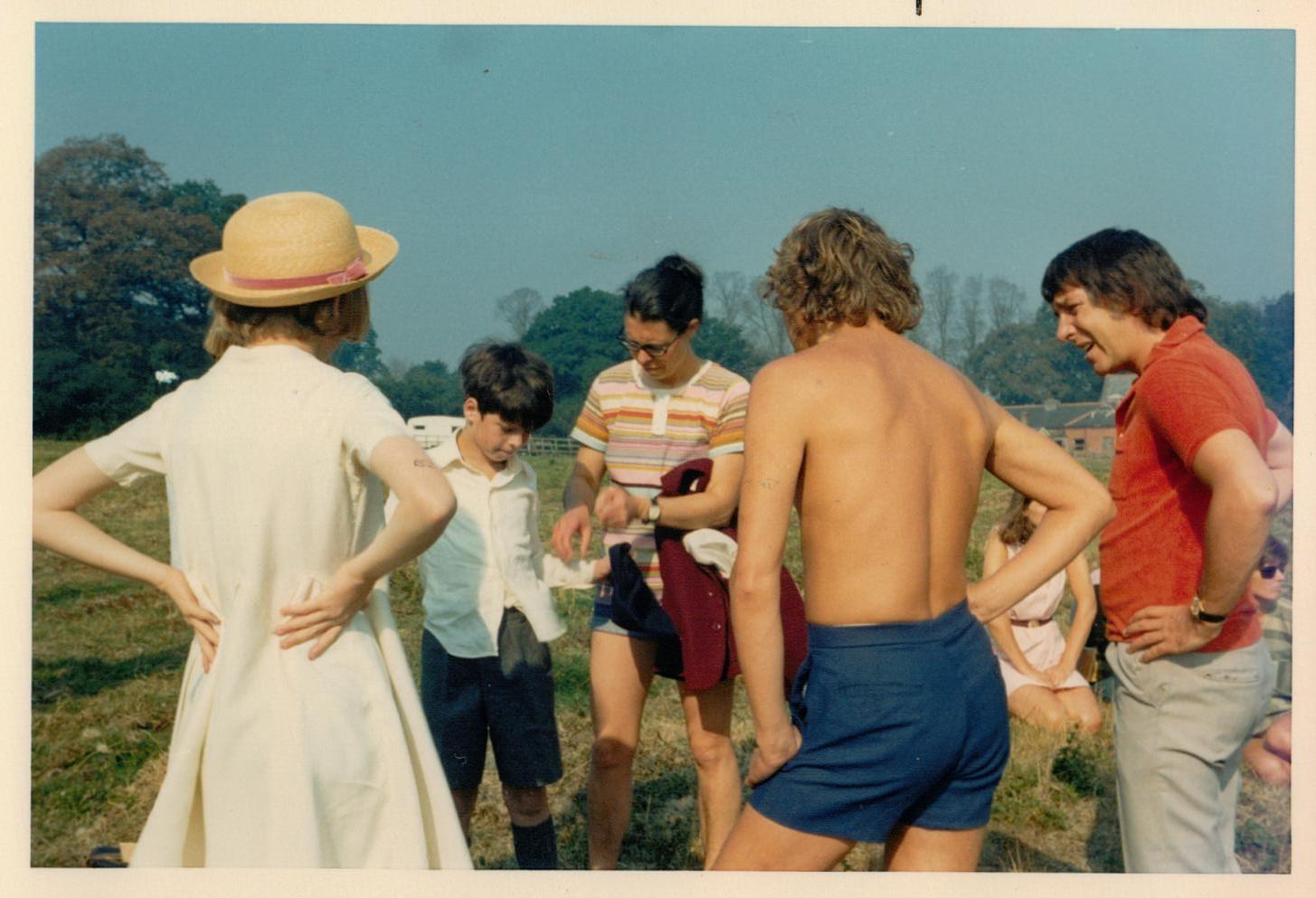
Sophie Neville looks on as Stephen Grendon organises his costume helped by Jane Grendon with Claude Whatham and Neville C Thompson.
Neville C Thompson, the Associate Producer, who was wearing a red shirt that day, seemed happy to be back on location. The film director, Claude Whatham was working, as I will always remember him, in a pair of navy blue shorts and sailing shoes. I loved putting on the school hat and silk dress I’d worn in the train but was difficult for the boys to climb into their woolen costumes on such a bright sunny day.
Richard Pilbrow, the Producer, who you can see wearing a white stripy cheese-cloth shirt so typical of the early 1970’s, seemed rather on edge. Bringing a camera crew along for what amounted to three shots must have been expensive, stretching his budget to the limit.
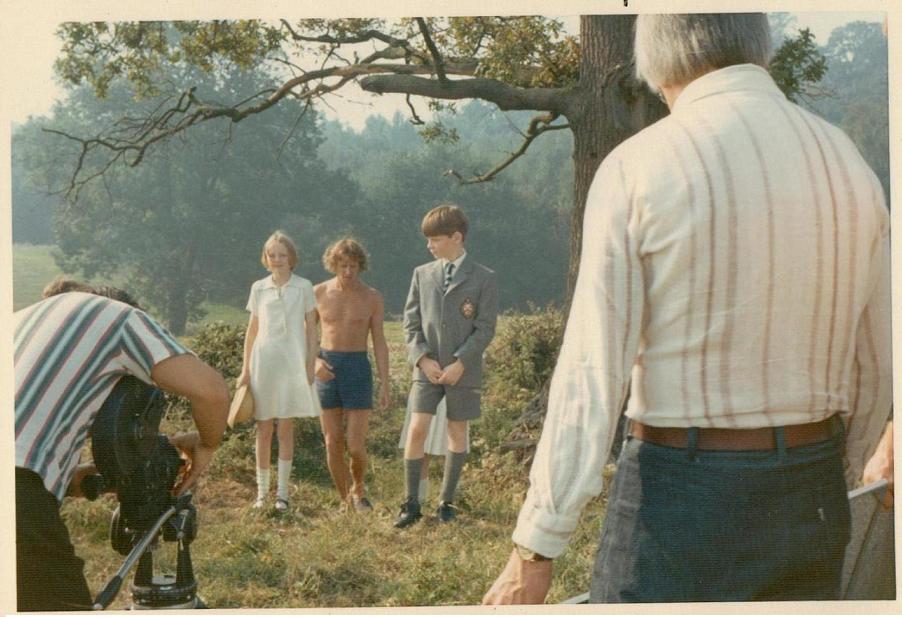
Gordon Hayman with a 35mm Ariss camera, Sophie Neville, Claude Whatham and Simon West, with Richard Pilbrow in the foreground ~photo:Daphne Neville
The oak tree, under which the 35mm Arriflex camera was set, was chosen to represent the Peak of Darien from which we looked out over an imaginary lake to an imaginary island. The finished movie cuts from the Walker children’s faces to a shot taken of Derwentwater at sunset with the opening title graphics superimposed over what is in reality Blakeholme, or Wild Cat Island as it is called in Arthur Ransome’s world.
Denis Lewiston, the Director of Photography, was working with the Cameraman Gordon Hayman, using reflector boards to light our faces. At one stage he had me standing on a cream coloured blanket to reflect light from below. You can see it in this shot:
Sophie Neville playing Titty Walker with Stephen Grendon as Roger Walker with Gordon Hayman, Denis Lewiston and Claude Whatham behind the camera
What I had forgotten was that two little girls came along that day to stand-in for us when the shot was being lined up. You can see them in the home-movie footage, one wearing a pale blouse with puffed sleeves.
Claude was very keen on running. He often took us for a short run before going for a shot to aerate our minds and freshen up our faces. In the story we had run down the hill from Holly Howe, so he had us running quite far before we landed on the marks that the cameraman had given us so that we’d be in focus. We had no dialogue, but the expressions on our faces were crucial to engaging the audience.
Denis Lewiston, Claude Whatham, Sophie Neville, Suzanna Hamilton, Simon West and the cameramen
You see a few other people on location, not least Sten’s mother, Jane Grendon, my little sister, Molly Pilbrow and a few others who were watching. My mother had been taking the footage.
Daphne Neville with Stephen Grendon, Suzanna Hamilton, Sophie Neville, Jane Grendon and Simon West
To read about this day from another angle, please click here to visit an earlier post with a few more photos.
On Friday 21st November 2014, I was invited to talk about the making of Swallows & Amazons on the CBBC movie show with David Wood, who wrote the screenplay. I’ll let you know when this will be broadcast. While I was at Novel Entertainment I met Dexter Fletcher and Bonny Langford as well as Justin Johnson from the British Film Institute who is an adviser on the series of 6 x 30 minute programmes.
You can read the whole story of making the film here:
For some time now we have been doing a variety of things to raise interest in Arthur Ransome and his books, particularly the ‘Swallows and Amazons’ series originally written for children.
Sten Grendon as Roger and Sophie Neville as Titty rowing Swallow (c)StudioCanal
SailRansome have made Swallow, the original clinker built dinghy used in the film, available for families to use there.
Swallow, the dinghy used in the 1974 film on Ullswater this summer
We’ve been using the Draper’s shallop to teach children how to row on the River Lee under the auspices of Countryside Live. We have now taught hundreds of children most of whom have never been in a boat before. The idea is to inspire them to join the Sea Scouts or a local rowing or canoeing club.
Countryside Live at Lee Valley 2014
Another boat you can sail is the Nancy Blackett portrayed as Goblin from We Didn’t Mean To Go To Sea and Secret Water.
Arthur Ransome’s cutter the Nancy Blackett sailing on the Orwell
It only costs £25 a year to join the Nancy Blackett Trust. This is wonderful for anyone living near the Orwell as Ransome once did.
Sophie Neville with Titmouse in Norfolk – photo Diana Dicker
I’ve also been promoting StudioCanal’s re-release of the 1974 film of Swallows & Amazons on Radio Cumbria, Premier Radio, Lakeland Radio and Channel 5’s live TV programme The Wright Stuff. There’s a lot going on in the media with pictorials in Country Life, The Lady, Cotswold Life and Practical Boat Owner magazine as well as newspapers and colour supplements.
Q&A with a large cinema audience in Kendal this August
We brought the original film of Swallows & Amazons back to cinemas in London, Ambleside, Kendal and to Hastings on Pirate Day. I took Captain Flint’s trunk along and wore a tricorn hat only to be told by one little boy in the audience, ‘I hate pirates. They are my enemies.’ Other children asked, ‘Did you enjoy being in the film?’ and ‘Were the spiders in your tent real?’
When we were in Kendal, the curator of the Museum of Lakeland Life gave a talk to the cinema audience bringing along the actual red slippers given to Arthur Ransome by the Altounyan children in 1929 which inspired him to write Swallows and Amazons.
An official still from the film of ‘Swallows & Amazons’ (c) StudioCanal
Some schools have Swallows and Amazons as a set book. I was invited to give a talk at Walhampton School who claim a ‘Swallows and Amazons ethos’. They aspire to giving their pupils as much of an exciting outdoor education as possible with sailing and exploring on the curriculum. School House magazine backs this up saying, ‘There is a distinct ‘Swallows and Amazons’ spirit that burns brightly here.’
Swallow sailing from Wild Cat Island (C) StudioCanal
What could you do to keep Ransome’s writing on book shop shelves?
Could you organise an event at your local sailing club? Or request a screening of newly restored version of the film at your local cinema? One is being planned in Oxford with hopefully another at Wolverstone. PictureHouse cinemas are particularly open to the idea of screening classic family films.
I am planning ‘An Arthur Ransome Day’ at my local Waterstones and another at our library. How can we make this special and attract people off the street?
Do add your ideas to the comments below.
Easy things you can do right now to help promote the books:
This post comes with a huge thank you to readers who have taken the trouble to write in, send emails or add reviews on Amazon about ‘The Making of Swallows & Amazons’
Sophie Neville and Sten Grendon filming on Peel Island in 1973
‘I very much enjoyed reading about all the background and stories of what is one of mine and my children’s favourite films.’ David Hambelton, Oxford
Kit Seymour and Lesley Bennet as the Amazon Pirates
‘…an absolutely fascinating account…about a film we all thought we knew so well. Like so many members of The Arthur Ransome Society I am an utter devotee… I’m finding the background to filming quite fascinating, and if I had thought it possible, yours is the book I have always longed for to exist. I’ve been absorbed in it ever since it arrived, forcing myself to take it slowly and not gobble it up in one go. Of course I’ll be back to it soon, dodging back and forth in tune with your narrative, indenifying particular scenes.’ Jeremy Gibson, Witney
Simon West as John and Sophie Neville as Titty in Swallow
‘If you liked the film, you MUST read this book. “Titty” is enthralling, and the story of the film is almost as exciting as the real story by Arthur Ransome. Essential reading for devotees.’ Chloe Randall, Scotland
Suzanna Hamilton and Simon West on Peel Island
Children still ask me questions that never occurred to me:
‘How did it feel to be on the island by yourself?’ Alex aged 7. The truth of course is that I was never on the island by myself. Perhaps I should have been left there for a while so I could experience it. I would have relished the chance.
DoP Denis Lewiston and Director Claude Whatham in Coniston Water
Another boy asked, ‘How did you do the water?’
This took my breath away for a second. ‘How did we do the water? The water was real, and it was very cold,’ I replied, explaining that we actually shot the film on four different lakes in Cumbria, all of which you can discover for yourself.
Have your children any questions? I’d love to hear them.
Simon West and Sophie Neville on Coniston Water
For more reviews of The Making of Swallows & Amazons on Amazon, please click here.
Very, very many thanks to all those who have taken the trouble to send in feedback about our paperback version of ‘The Making of Swallows & Amazons: Behind the scenes on the Classic Film’.
The publishers have been thrilled to hear what you think, hoping that the will appeal as a good Christmas present.
Here are a few recent comments:
‘Get a glimpse behind the scenes from Sophie Neville, who played Titty, in this gorgeous book, released to celebrate its 40th anniversary.’ Yours magazine.
‘Came home to a wonderful surprise – my copy of The Making of Swallows and Amazons! wonderful.’ Pandora Doyle ‘I love it! So excited. The photos make the book especially the coloured ones. I will be dipping into it all day!’
‘…a delightful book, which tells the behind-the-scenes story of the film. Neville’s account of exploring, sailing, and the green parrot will no doubt have readers reliving childhood memories and falling in love with the Lake District all over again.’ The Lady
‘I can’t wait to read The Making of Swallows and Amazons! My eight year old daughter is also looking forward to it – she has learned to sail on Sydney Harbour just like the Swallows’ mother did! (I learned to sail on other Ransome waters – near Pin Mill in Suffolk!). Thank you so much for sharing your memories of the experience with us – what a magical film!’ Clare Havens, author
‘I ordered two copies, one signed by yourself and one unsigned which is already becoming dog eared {my measure of a good book}.’ Arnold Mostyn
David Bamford: (Antipodes) I am in the middle of reading Sophie’s book about the Making of ‘Swallows and Amazons’ and enjoying every word of it! Now, when I see the stills, I remember her writing about how cold the weather was, and they were dressed in light summer clothes.
Loving @Sophie_Neville ‘s Making of Swallows and Amazons. Technicalities of filming with big unwieldy cameras. Plus lots #ambleside gossip. Eileen Jones @CumbriaPR
‘It was great to read an account of how filming is not as simple as people imagine! Enjoyed it very much.’ Martin Robinson
‘A sort-of layman’s perspective on filming is completely fascinating.’ Nick Archer
‘I enjoyed the book much more than I expected, if that doesn’t sound v strange.’ Tom Morgan. ‘I thought I would enjoy it but I really, really enjoyed it. I… was very impressed by the flow and ease of your writing. My inherent nosiness helped of course.’
‘Great book, I really enjoyed reading it.’ Stephen O’brien
‘Really enjoyed it. Lots of insight into/memories of 70s life (not sorry to have left that behind!!). Very interesting to learn more about your co-stars, and the other people involved in creating the film – my original discovery of your blog was having watched the film, and wondering “where are they now?” That question is comprehensively answered!! Also very interesting to learn about the process of film-making – we take so much for granted with digital video cameras these days. I guess for me the whole thing about learning about you, Suzanna, Lesley etc as people is what most interests me from a human point of view – kind of much the same as learning about the Altounyans and Collingwoods in Hardyment’s book.’ Paul Fernandez.
‘Lovely to meet you in Ambleside, It was a great evening. Book and DVD are brilliant.’ Ali Graham
‘I matched your book to the DVD and the two made a really good present, even though I say so myself!’ Barry Burles
Sophie Neville outside the school bus on location with her sister Tamzin Neville in 1973 ~ photo: Martin Neville
A reader has written in, saying: ‘Much of what one hears about life behind the scenes for younger actors has to do with schooling on set. Did you have tutors all the time or only if you were shooting during the school year? And were you able to keep up with your fellow pupils at “regular” school?
If children under the age of 16 are involved in filming they only have to keep up with their schoolwork during term time. The film company will normally comply with this by employing a tutor at the film studio or on location.
When filming Swallows & Amazons in 1973 we were often in such remote areas that a double-decker bus was hired for us to use as a mobile classroom. It could be seen wobbling along the narrow lanes of the Lake District from Bank Ground Farm at one end of Coniston Water down to Peel Island or over to Brown Howe the other side of the lake depending on instructions given the night before.
We were legally obliged to complete three hours of school work a day but my mother thought it would be OK if we managed fifteen hours a week. I am pretty sure we kept working through half term to achieve this, although I did record that we had Witsun Bank Holiday Monday as a formal Day Off. When I look back at my school work I only notice that I would have benefited from higher quality waterclours, brushes and paper.
Our tutor, a local education supply teacher called Mrs Causey, believed in dictation; masses of it:
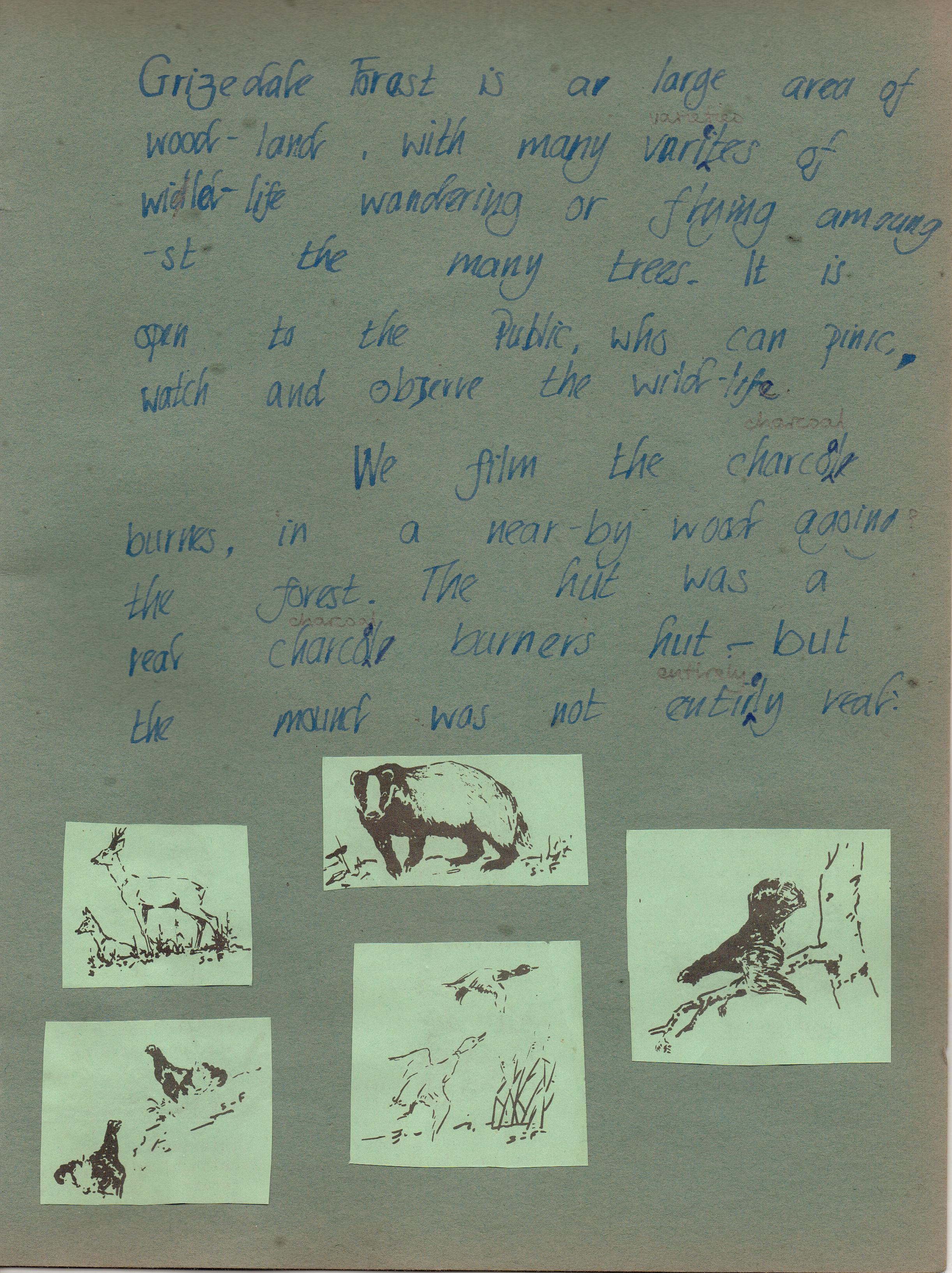
We were also taught about the history, geography and topography of the Lake District. This was worked into our own records of filming:
A sample of school work completed whilst filming in the Lake District in 1973
I certainly kept up with my friends at school. One wrote recently to say, ‘I do remember the lovely illustrated diary you wrote at the time, as you brought it back to school for us to look at.’
I only missed seven weeks of the summer term to make Swallows & Amazons. What was amazing was that I was obliged to sit the end of year exams in Ambleside. The results would not have been as good as normal, particularly in Maths and Science but I eventually caught up.
There was quite a bit of discussion about whether or not I should miss more schooling. I was only ever offered further film work during school holidays but as I went to a boarding school making arrangements to go to London for auditions could be a nuisance.
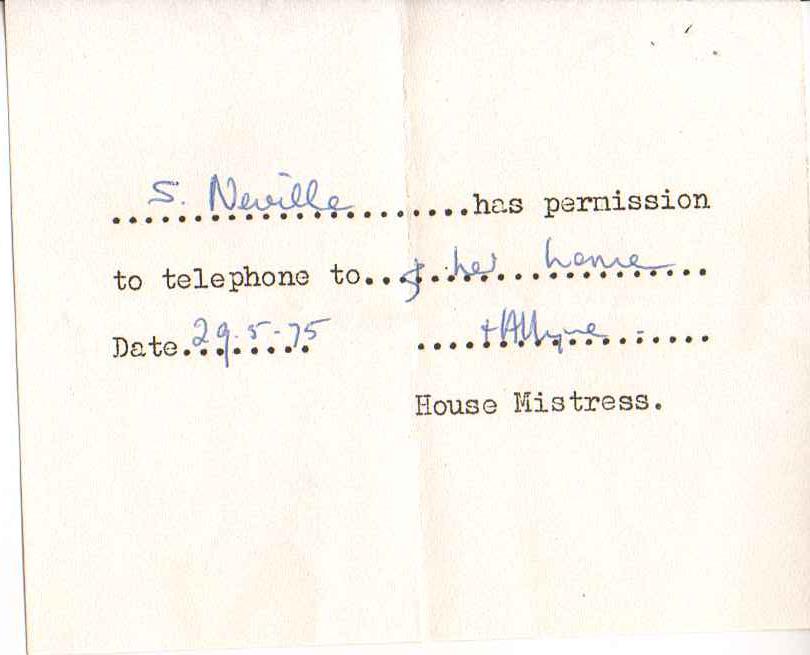
I’d get messages to phone home and letters detailing complicated plans.
This ‘picture’ turned out to be an adventure movie called ‘The Copter Kids’. Mum was obviously going off to lunch with Virginia McKenna and reading the letters on the Radio 4 programme Any Answers whilst I was busy sitting summer exams.
My sister Tamzin did a great deal more acting that I did as a child. She didn’t mind missing school altogether or having a tutor. What she hated was being sent to a large comprehensive school in London for a term so that she could rehearse in North Acton. That didn’t do her any good at all.
Lights, camera, action: working as a child in television
You can read more about ‘The making of ‘Swallows and Amazons’ (1974) on Kindle, in paperback or listen to the new audiobook, all available to purchase online.
When I appeared on Channel 5 recently Matthew Wright asked, “… if it’s possible to have a Swallows and Amazons childhood these days – and if today’s kids would actually have the skills to survive.”
I received so many interesting comments on Twitter and Facebook that I thought I should copy them here, hoping it is OK by those who took the time to write in.
“Would they survive? Hmm. Better drowned than duffers…” Fergus
“Of course it’s possible – we do it every time we are on holiday at www.lowwaterend.co.uk real Swallows and Amazons location. Our kids love it….” Kate
“I think few parents would look at a small sailboat & Coniston Water or Windermere, and give the go-ahead for children ages 12-7 to sail & camp by themselves. However, there are a lot of really wonderful parents who sail & camp WITH their children, and then allow independent exploration with help nearer at hand.” Elizabeth (USA)
“OK – so we cheat a little – in that we stay in the cottage rather than in tents on Wild Cat Island – but it has got a little busy there of late. Trying to bring a boat or canoe into the secret harbour is more like trying to park in a multi national supermarket car park, but very little has truly changed on the island and if you can see past the bright orange and red buoyancy aids of the temporary visitors, one can still imagine being the Walker children. And if you get the island to yourselves – it’s pure joy. We frequently issue the owl hoot just to let our kids know that food is ready! As for the lagoon downstream – it’s still there – our kids have taken to canoeing as far downstream as they can – wading in low water and paddling down rapids where they can. They take no mobiles, IT equipment etc – and they are gone for hours making maps of the stream and naming the shores, fallen trees etc.” Kate
“I’ve just been reading my daughter the bit in Winter Holiday where Dick rescues the cragfast sheep by inching his way along a rock ledge. “Would you be able to do that?” I asked her. “No, I’d be much too scared!” she replied. And I said “Good!”.” Valerie
“Some risks are too high, too likely to leave the child unable to enjoy a normal life afterwards. Examples: diving into rivers with rocks, driving way above the speed limit, using illegal drugs/binge drinking. There are risks that simply have too high a chance of a serious bad outcome. I like the “Roots & Wings” approach. While they are young, you teach how to make a reasonable decision about any given risk, then as they mature, let the child figure out more on their own.” Elizabeth
“It isn’t only duffers who come to grief, and even if it was, duffers deserve to be protected from their own stupidity. So, I prefer the idea of teaching children what the risks are and how to manage risk so that they can then do things that look highly risky without there being any great risk. What is wrong is to shut children’s lives down instead of teaching them how to be safe and free, and that’s the most dangerous route of all because it sets them up for empty lives which will lead them on into a prolonged and deep exploration of alcohol and drugs. Freedom is essential for good mental health and needs to be maximized, but learning about risk management is a crucial part of that. So, how do you teach risk management without it being dull? Get out there with your children and join in with the play. Point out the possible dangers along the way, not in a lecturing way, but simply by telling little stories about idiots who came to grief by making mistakes. It doesn’t take long to make a dangerous environment safe for children to play in by putting ideas in their heads as to all the easy ways to be killed or injured by the apparatus at hand. If they know what the unexpected dangers are, they will be armed against making them. If they die after that, then it will be against the odds – it would have been more dangerous not to let them out.” David
“Agree 100%. In my mind, risk-averseness is one of the great failings of my fellow modern Americans. Never be sorry for a might-have-been.” Sandy
If you have views on the subject, or want to see more on outdoor pursuits discussed on the programme, send an email to: wrightstuff@channel5.com
No matter where I am in the world, not a day goes by without someone, somewhere asking a question or sending a message in connection with my writing. I am hugely grateful for the encouragement.
In many ways, ‘The Making of Swallows & Amazons’ was written by popular request, effectively commissioned by hundreds of people who wanted to know how it felt to appear in the film, albeit forty years ago.
It has to be said that was a little apprehensive about the questions I might be asked on Matthew Wright’s show, broadcast live on Channel 5 – for two hours. If you are feeling brave, click here to see a profile on The Wright Stuff.
They wanted to know about the idea of children being allowed the freedom to take risks and enjoy their own adventures away from civilisation.
“… if it’s possible to have a Swallows and Amazons childhood these days – and if today’s kids would actually have the skills to survive. “
If you have views on the subject or want to see more on outdoor pursuits discussed on the programme email: wrightstuff@channel5.com
IF NOT DUFFERS WONT DROWN
You may need Windows 8 to watch it but the whole programme can be viewed here:
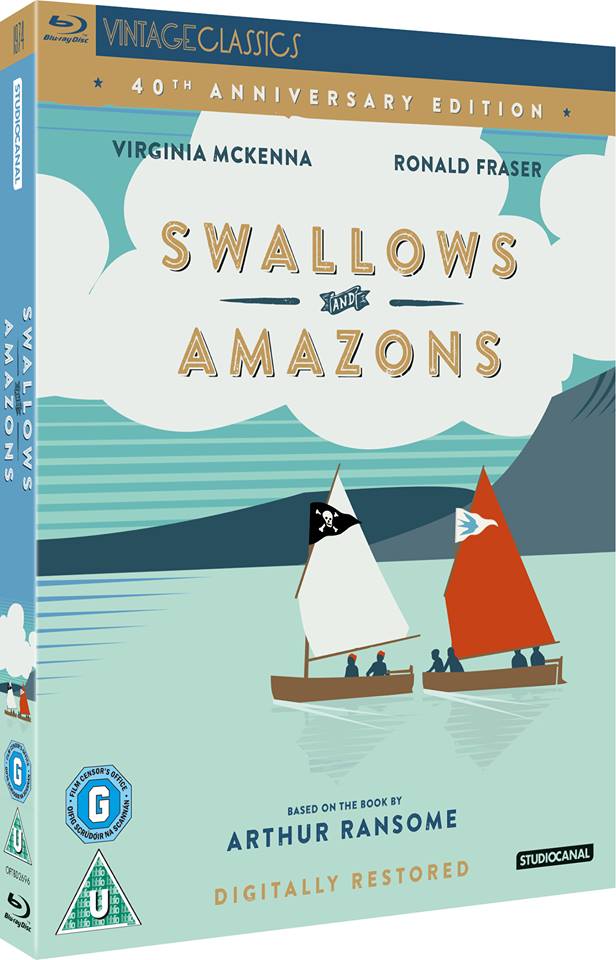
Over the next few days I am going to be giving Q&A sessions at cinemas screening StudioCanal’s newly restored version of Richard Pilbrow’s movie ‘Swallows & Amazons’ (U) to celebrate the 40th anniversary of the film’s release in 1974.
Ronald Fraser on the cover of the VHS
Sten Grendon, Simon West, Suzanna Hamilton and Sophie Neville as the Swallows making Ronald Fraser walk the plank. Where are the Amazons?
If you can come, please do bring a question. I am always very interested in those asked by the children. They can be quite difficult to answer:
‘What did it feel like to be alone on the island?’
Titty leaving her tent on Wild Cat Island
‘Where you really able to keep the parrot?’
Kit Seymour with Sophie Neville and Polly in the Houseboat
‘How long did it take to film?’ is another question I am often asked. The answer is quite complicated.
Then I ask, ‘Would you like to know about the mistake I made?’
The crew of the Swallow leaving Holly Howe
I started singing, ‘Adieu and Farewell’, when the sea shanty Spanish Ladiesis always sung: ‘Farewell and Adieu…
Farewell and adieu to you fair Spanish ladies,
Farewell and adieu to you, ladies of Spain;
For we’re under orders
For to sail to old England,
And we may ne’er see you fair ladies again.
We’ll rant and we’ll roar, like true British sailors,
We’ll range and we’ll roam all on the salt seas;
Until we strike soundings
In the Channel of old England,
From Ushant to Scilly ’tis thirty-five leagues.
Virginia McKenna watches the Swallows sail from the jetty at Bank Ground Farm on Coniston Water. Can you spot the safety officer – a frogman just visible right of shot?
I noticed that one inconsistency made by the design team was that the swallow flew down our flag whereas it always flies up Swallow’s burgee in Arthur Ransome book illustrations. I count it as a subtle differentiation that I reproduce whenever I draw the crossed flags myself.
When I was writing ‘The Making of Swallows & Amazons’ I noticed that, while the title of the book is ‘Swallows and Amazons’, the graphic designer working on the film always used an ampersand, making it SWALLOWS & AMAZONS in the 1974 film.
There is another odd thing right at the end of the film, as the credits roll. See if you can spot what it is.
There are often screenings at cinemas in Cumbria:
Royalty Cinema Bowness-on-Windermere, the Roxy Cinema Ulverston and the Alhambra in Keswick where we held a Q&A