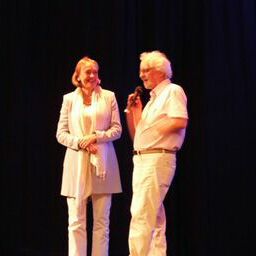
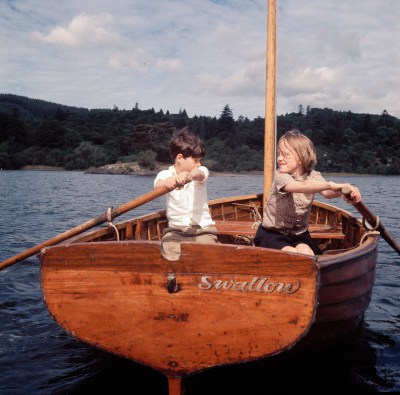
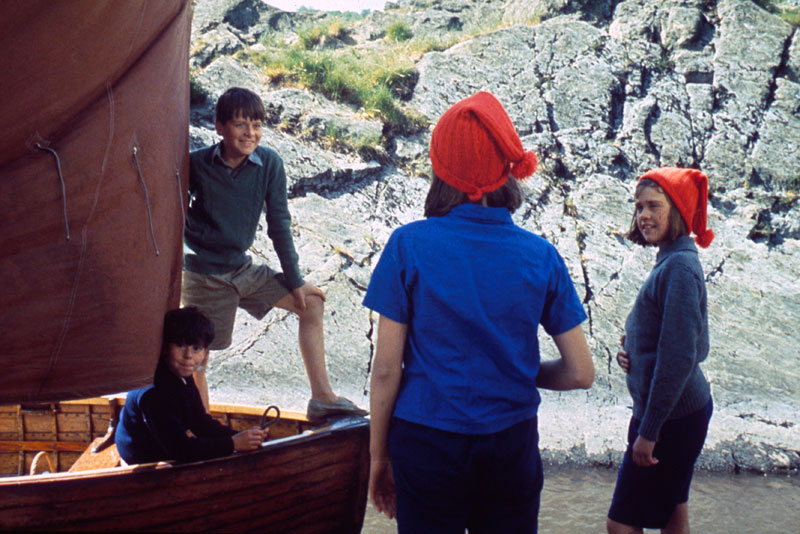
The Telegraph listed ‘Swallows & Amazons’ as Film of the Week when it was broadcast on ITV3 in the UK recently. It was also shown on GEM television in Australia last Friday. Sophie has been answering questions about making the film ‘Swallows & Amazons’ at the Curious Arts Festival. If you have one, please use the comments box below.
On 26th July Sophie Neville, spoke to Dan Damon on the BBC Radio 4 Sunday morning programme ‘Broadcasting House’ about the enduring success of the film. To read more, please click here.
‘Swallows & Amazons’ at the Belfast Film Festival ~ photo by Debbie Davidson who said, ‘We had a fab day watching the movie, reliving our childhood.’
The film ‘Swallows & Amazons’ (1974) was screened at the Belfast Film Festival. Curiously, the ‘Terms and Conditions of Entry’ specified:
CHILDREN UNDER 16 MUST BE ACCOMPANIED BY AN ADULT
NO GLASSWARE OR CANS PERMITTED ON SITE
NO BARBEQUES OR NAKED FLAMES
This was ironic since, ‘Swallows and Amazons’ is about children cooking on campfires, eating canned bully beef or ‘pemmican’ while swigging ‘grog’ out of bottles, as far as possible form adult supervision. However, the movie was shown outside – on a huge screen under the trees opposite Belfast City Hall. ‘THIS OUTDOOR EVENT’, they declared, ‘WILL HAPPEN REGARDLESS OF WEATHER CONDITIONS’. Since the story is about camping this did seem apt but as you can see from the photograph above, it was an idyllic sunny summer’s day.
.
Ronald Fraser walking the plank in ‘Swallows & Amazons’ (1974)
‘How lovely…we love seeing this wonderful film,’ Gerry Spiller said.
‘My Mother took me to see the film when it was first released, it was in a double bill with ‘Born Free’, which also had Virginia McKenna in. In those days you could just sit in the cinema and see the film again if you wanted to. We did.’ Jon Ford
‘Ok, a confession. When I was twelve I was a spoilt little brat. My parents had decided to take my brothers and I out for a surprise. I refused to go until I was told what it was as I hated surprises. My parents wouldn’t tell me so I very nearly didn’t go. I went only after being told by my big brother that if I didn’t he would hit me. The surprise? A trip to the cinema to see Swallows and Amazons! ‘ Marc Grimston, Author
‘Can’t believe how long ago it was. I remember going to see the film at the Aylesbury Odeon and loving it.’ Kate Pearson
‘… the first film I saw in a cinema, Swallows & Amazons, ABC Colchester April 1974. Cinema now a pub.’ Fabian Breckels on Twitter
‘It was on at the local cinema. My son was too young to go so I offered to take a neighbour’s child on condition that the neighbour’s older child baby-sat for me.’ Janet Mearns
‘One of my all time favourite films. Watched it just the other day in fact. I never seem tire of it. Especially after a trip to the Lakes.’ John Heath
Lesley Bennett and Kit Seymour as the Amazons when filming in 1973‘I don’t know why we missed it when it was first shown (I was six at the time)… it came back to the cinema for another showing a few years later and the place was almost empty, so it felt as if they’d put it on specially for us.’ David Cooper
‘Rather like David, missed it as a child. Which makes me rather sad in retrospect. Had no idea it existed until I discovered it through ‘Google’! a few years ago. I now have two copies of it on DVD.’ Paul Thomas
‘I was 11 when the film came out and I was already a huge S&A fan. I loved the film and you, well Titty really, she became my first ever crush. Thank you for the excellent portrayal of Titty. Thanks also on behalf of my own daughters who also fell in love with the film, probably due to my regular screenings!’ Mike Embleton
Sten Grendon and Sophie Neville on Derwentwater in 1973‘I finally got to see it while we stayed at Bank Ground Farm our first visit to England. Loved it, cried over it, was delighted to finally see it after many years of sharing a love of Swallows & Amazons books with my mother, my sisters & my children! Mrs. Batty kindly put it on for us to watch in the farmhouse living room.’ Elizabeth Rondthaler Jolley, USA
‘It was two years ago in my 36th year. I found it somewhere on internet after I have read the first (book) to my son. And then we watched together. It was perfect. In Czech republic where I live, Ransome was in my childhood one of the most favourite authors.’ Jiri Precek, Romania
‘In June 1973 I was 9 months into my 3 year teacher training course at Didsbury Teacher Training College… It was not for many years – probably 15 that I contacted Cape for info about locations – still have the reply !!’
Martin Robinson
Sten Grendon, Simon West, Kit Seymour and Lesley Bennett on Peel Island 1973‘I was 9 in 1974 and saw the film about four times that summer (I think it was shown with Born Free as a double feature) and I had a huge crush on Lesley Bennett! (Where is she now?) I read all the books several times over during the 70’s . Reading your memories made me re-read the book and watch the film for the first time since the 70’s and I have to say the film holds up very well!’ Richard Meads, Worthing, West Sussex
The DVD reviewer Stuart McLean writes: ‘The cast were pretty much the same age as me in 1973 (when it was filmed) and I remember enjoying this tremendously when it came out in 1974, forty years ago. Back then, the idea that four school-kids could take off in a boat for days at a time with no life-jackets seemed perfectly plausible. These days it would be cause for 24 hour rolling news reports.’ Please click here to read on.
Simon Hodkin first went to see Swallows & Amazons in Wales some forty years ago. He kept a scrapbook full of souvenirs, including a letter from Arthur Ransome.
Can you remember the first time you saw the film? Please add to the Comments box.
To watch a filmbeat interview about making the film please click here
This beautifully made documentary, presented by Griff Rhys Jones, examines Ransome’s life as a war correspondent in Russia from 1913 to 1919 when he was close to the action and in dialogue both with Lenin and Leon Trotsky. It raises the question as to whether he was a British spy.
Hugh Brogan, Ransome’s biographer explains that Ransome had originally ran off to Russia in 1913 to escape from his melodramatic wife, Ivy Walker. After using his time to record Russian fairy stories, that can be read today in his book, ‘Old Peter’s Russian Tales‘, he was employed by a national British newspaper to report on events leading up to the Russian Revolution. Black and white archive footage, along with photographs Ransome took himself, illustrate this well.
The BBC’s erstwhile political correspondent John Sergeant, explains the significance of certain survival strategies Ransome used, such as using ‘his practical skill to outwit people’, over extracts from the original feature film ‘Swallows & Amazons‘, produced by Richard Pilbrow in 1974.
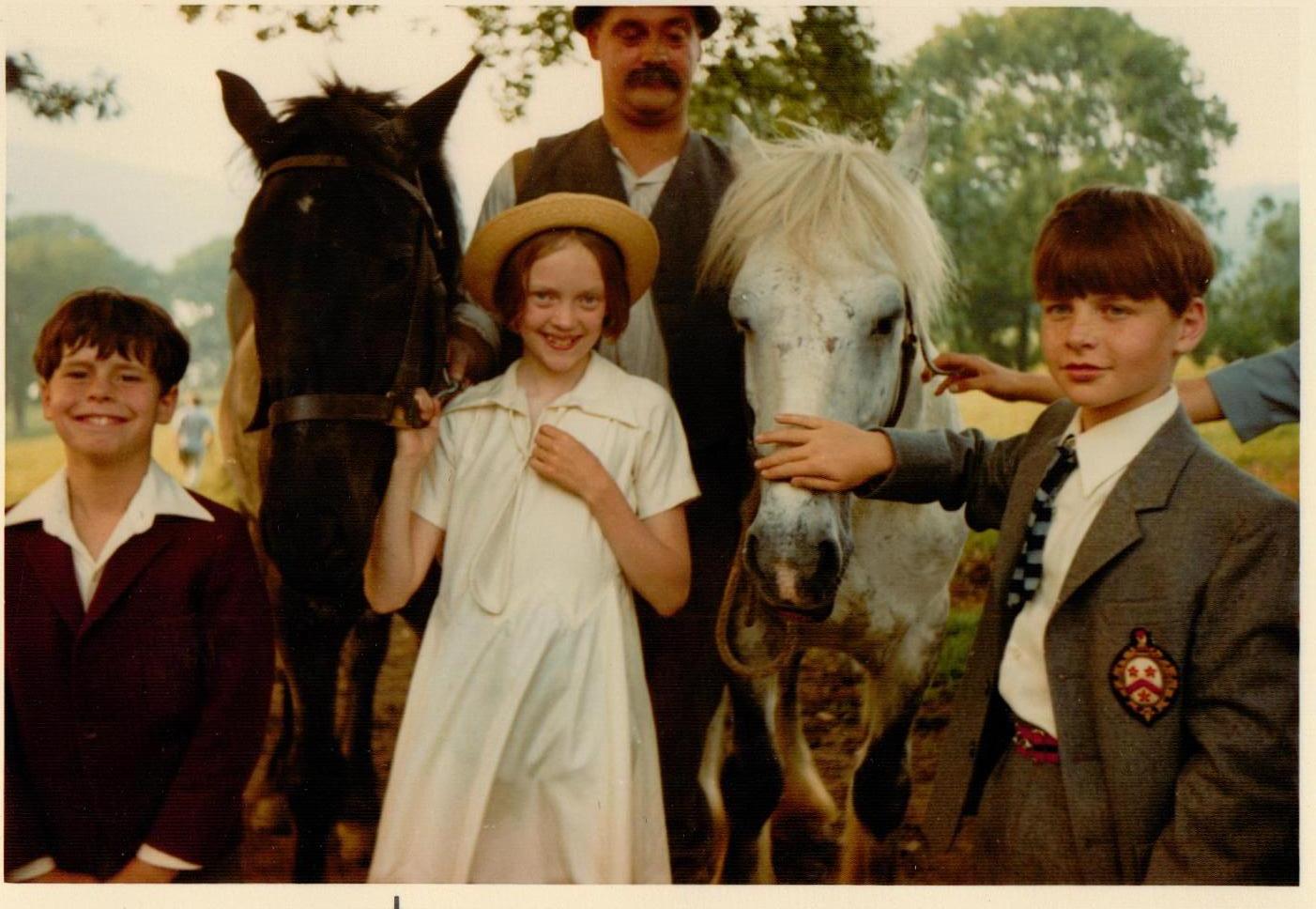
Suzannah Hamilton, Stephen Grendon, Sophie Neville and Simon West, 1974
The scenes from the movie also show how the story Ransome wrote when back in the Lake District, was in many ways an outworking of feelings accumulated while he was working in Russia. By concentrating on his writing, he neglected his own daughter just as Uncle Jim was not around for the Blackett girls.
In the dramatised documentary, the beautiful actress Alina Karmazina plays Evgenia, the girl Ransome fell in love with while he was filing reports from Petrograd. They later escaped over the border, trading her copper kettle for freedom of passage.
If the BBC had contacted Richard Pilbrow he would have been able to send them this letter. It was written to Neville Thompson, the online producer of the film, by Evgenia, who had become the second Mrs Ransome. It has never been published before. She gives the address as her retirement home near Banbury but it shows what kind of girl she was:
Page two:
When Mrs Ransome saw the finished film in 1974, her only comment was that the kettle was of the wrong period.
Was Susan a portrayal of Evgenia? Here she is played by Suzanna Hamilton.
The story of the Ransome’s escape from Russian has been told by Hugh Lupton, Arthur Ransome’s great nephew, who gave us a rendition at The Arthur Ransome Society meeting near Bungay. It can be listened to on CD, available on CD from Burning Shed.
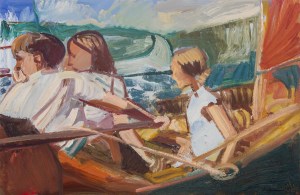
‘John, Titty & Susan on the Swallow’ by Fadi Mikhail
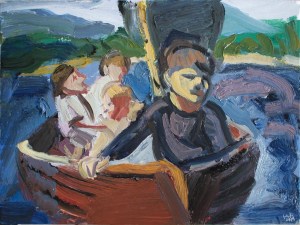
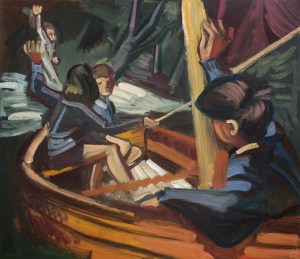
As you can see from these paintings, Fadi Mikhail, the artist famous in the UK for painting one of our Christmas stamps and being commissioned by the Prince of Wales, as well as the Duke and Duchess of Cambridge, was certainly inspired by the film of ‘Swallows & Amazons’ made in 1973. He has kindly let me publish this remarkable series of paintings.
‘Look out! Another boat’ by Fadi Mikhail
Since my last post, comments have flooded in as to why the simple story is so popular:
‘John and Susan coming about’ by Fadi Mikhail
‘…the Swallows don’t own ‘Swallow’ – they’re having a farmhouse holiday and the boat belongs to the farm, and that could just have happened to any of us. Norman Willis… used to rise up against critics who considered that children from poorer backgrounds should read books full of gritty reality related to their daily lives: he pointed out that they wanted to escape from their daily lives for a few precious hours, not always into a zone of dragons and princesses but into an alternative realistic world.’ Jill Goulder of The Arthur Ransome Society.
‘The Swallows in the boat’ by Fadi Mikhail
‘What I liked most about these stories was that the Swallows and Amazons and their friends behaved like real children, but lived in a completely different world from the one I inhabited. I’d camped with the Girl Guides, but the Swallows and Amazons had astounding freedom – camping alone on an island, going out at night and sailing wherever they liked without needing to ask permission.’ Emily Lock ‘…the books gripped my imagination forever’. Please click here to read Emily Lock’s full review.
Titty and John eating apples by Fadi Mikhail
Christopher Tuft thought the enduring success is, ‘Because it’s a wonderful adventure story, with well rounded characters, played out in a beautiful setting, reminding us of a time now gone.’
‘The Swallows in the wood’ by Faid Milhail
‘The combination of practical realism – everything that happens could happen – and the child’s viewpoint makes the story and it’s sister volumes almost unique even now,’ Andrew Craig-Bennett of The Arthur Ransome Group on Facebook.
‘John and Susan hoisting the sail’ by Fadi Mikhail
The whole series of books clearly have a worldwide following popular from one generation to another. ‘I don’t find this surprising. I got my first Arthur Ransome book (Swallowdale) as a present, in 1948. At the time it was a copper-bottomed dead cert as a present for any child, couldn’t be criticised, known to be virtuous, and incidentally known to be good. All that is still true and has been for decades. I don’t think it could fail to be up there. Children may now prefer Star Wars, Lego books or Minecraft (my grandsons certainly do), but books are still *bought* by adults.’ Peter Ceresole ‘The book has lasting appeal, particularly for children, because there is nothing in the adventures of the Swallows and Amazons that readers feel they could not do themselves. They felt they could sail a dinghy like the Swallows. I know, because when adults came aboard Ransome’s restored boat Nancy Blackett in recent years, many had tears in their eyes and said: ‘I learned to sail from the books; and Arthur Ransome was the biggest influence on my life.’ The story is not like so many others an unachievable fantasy. This must stem in part from the fact that the characters are based on real children and on Ransome’s observation of those real children. The quality of the plotting is superb. Ransome was utterly clear about the stories he wrote, sometime writing chapters in the middle of the book before writing earlier ones. His prose is spare and simple and very easy to read, and bears comparison with the writing of Jonathan Swift in Gulliver’s Travels — another writer with appeal to both children and adults.’ Michael Rines Do add your own thoughts in the Comments below.
‘The Swallows chasing the Amazons’ by Fadi Mikhail
Hugh Shelley wrote, in his Bodely Head Monograph of Arthur Ransome, that it is the joy with which the story is written that makes Swallows and Amazons a great book. In many ways it is a reflection of Arthur Ransome’s own childhood holidays with his brother and sisters on Coniston Water. And even today, children can discover the places mentioned for themselves. Holly, aged six, wrote to me recently saying, ‘My Mummy and Daddy took me to Wild Cat Island. It was my favorite day… When I am bigger I want to be like Titty.’
‘Roger ties the Swallow down’ by Fadi Mikhail
While ‘nearly all enduring books do so because of the writing,’ as another reader commented, children enjoy the camaraderie and the action that have been captured in these semi-abstract oils.
‘John, Susan and Roger waving to Titty’ 60x50cms by Fadi Mikhail depicting Sophie Neville, Suzanna Hamilton, Simon West and Sten Grendon in a scene from ‘Swallows & Amazons’ (1974)
An orange flag has been labelling the Vintage paperback edition of ‘Swallows and Amazons’ as a #1 Best Seller in the Amazon UK sales. Not bad for a book written in 1929.
I was giving a talk at the International Annual General Meeting of The Arthur Ransome Society, when I asked learned members, ‘What has made it such an enduring success?’
Is it that ‘Swallows and Amazons’ set in the Lake District where so many of us long to spend our holidays?
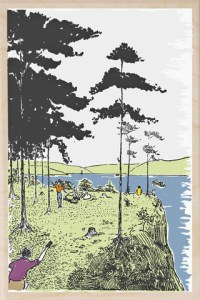
Or that we can buy a set of wooden postcards depicting Ransome’s inspirational illustrations?
Is it because the stories are driven by the characters of the children themselves, as Jill Goulder has observed, and that adults are relegated to native status, featured as little as is possible so that we enter a child’s world?
Do children relish the idea of independence and being in control of all they do, as John and Nancy seem to be? Is it that dressing up as pirates is cool?
Swallows and Amazons is about the importance of listening to children. It’s about integrity. Readers love the fact that Titty, the lowly able-seaman comes out as the unexpected hero. It was, after all, a brave thing to capture the Amazon at night and perhaps braver still to return to Cormorant Island with Roger to look for the treasure no one believed was there.
Could it be because the story is about sailing, and how to handle a simple dinghy? Claude Whatham, who directed the 1974 movie, recognised Ransome’s skill in describing how to make a camp was of huge appeal to children. Do we like to learn without the indignity of being taught?
Arthur Ransome’s style of writing is certainly vivid, drawing you into the world he created having been inspired by reading ‘Robinson Crusoe’, ‘Treasure Island’ and exotic tales himself. Martin Smith, whose comments on this strand have been endlessly interesting, has observed that there is something of ‘The Tempest’ by Shakespeare in the adventures set on Wild Cat Island.
Ransome was able to draw on years of experience as a writer before he launched the Swallows & Amazons series and this shines through. Since virtually only six children and two adults appear in his first book we get to know them well and are ready to welcome others such as Dick and Dorothea when they come along in Winter Holiday.
Is it because, ‘nothing happens in the books that couldn’t really have happened’, as Caroline Lawrence wrote recently in The Outlaw, a magazine written for children who readily identify with the characters. You can certainly enjoy looking for Ransome’s locations yourself. Those who do so are almost certain to buy the books for their own offspring.
Adults read the books, saying they bring great solace, evoking nostalgic memories and taking them back to a carefree childhood when summer days were spent devising camps and imaginary sailing adventures. Perhaps the traditional values act as an anchor in our stormy lives.
Despatches?
One thing is for certain. While many of the forty-two books Arthur Ransome wrote are now seen as obscure, his series of twelve ‘Swallows and Amazons’ novels line the shelves of almost every bookshop in Britain and are ever popular overseas. The Arthur Ransome Society has a thriving membership, enabling families to live the adventures for themselves. You can find out about joining yourself by clicking here.
The new feature film of ‘Swallows and Amazons’ starring Ralph Spall, Andrew Scott and Kelly Macdonald and released in 2016 has hopefully brought the story to the nation’s consciousness. It won awards in the USA where it was released in cinemas by Samuel Goldwyn.
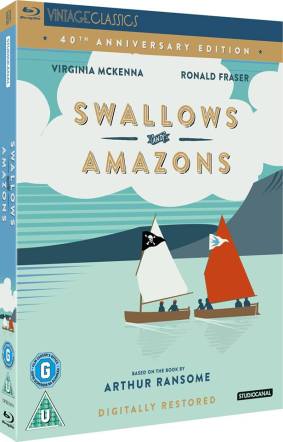
The film adaptation of ‘Swallow & Amazons’ made in 1973 and repeated on television so many times, helped to keep the flags flying. It too has been labelled as ‘a timeless classic’ and ‘an enduring success’. StudioCanal released a 40th Anniversary DVD with footage so beautifully restored that if it wasn’t for the extras package you might think it had been shot last summer.
‘The 1974 Swallows and Amazons film is a classic, and this is a really enjoyable look behind the scenes, written by the actress who (for me, at least) gave the stand-out performance as Titty Walker. If the film recaptured the lost world of 1929, then the book recaptures the lost world of 1973, when rules on child actors were strict (chaperones and schoolwork absolute requirements) but regulations on health and safety a bit more lax, even when on water. We even learn the truth behind that strange scene on the jetty in Rio where Roger is left minding Swallow. Highly recommended.’ P. Stevens, Bath, UK
‘Every now and again in cinematic history a classic is born. It doesn’t have to be a multi-billion pound blockbuster featuring legendary names, sometimes something timeless and endlessly endearing is born and this is most definitely the case with ‘Swallows and Amazons’.
‘This film has become an old friend to me; I must have watched it a thousand times and I never tire of it! It brings back memories of a summer childhood spent in wonder-filled Cumbria, in particular Windermere, Ambleside, Derwent and Coniston Water; places we’d visit as a family before the fates would, sadly intervene.
‘Sophie Neville’s excellent book recaptures again the halcyon days of youth in a summer-land of mountains, fells and shimmering lakes. She writes beautifully and with an easy style that’s a joy to read. The love for her subject is very evident, as is her passion for the work of Arthur Ransome. She takes you behind the scenes of the making of the film and the realities of filming on the water; how the director and crew worked tirelessly to bring out the best in the young actors and the splendours of the landscape. So glad I made this purchase. Pride of place on the old bookshelf.’ Allen Fairhurst
‘Sophie has lost none of her infectious enthusiasm and this shines through on every page.’ Julian Lovelock in Mixed Moss, the journal of The Arthur Ransome Society. ‘As well as using her own diary Sophie has mined the recollections and scrapbooks of a number of cast and crew.’
‘The book itself is indeed a delight. I have long been a fan of Swallows and Amazons. I am delighted with the film which was made and Sophie’s account of the making of it adds a very charming and interesting dimension. I loved the account and I fully recommend any fan of Swallows and Amazons to get a copy for themselves.’
You can read about how the original film of ‘Swallows and Amazons’ was made and find the complete collection of behind-the-scenes photos in this ebook available from Kobo, Smashwords, iTunes and on Kindle for £2.99
The screening of Swallows & Amazons (1974) on Sunday afternoon was sold out. 250 tickets. They were endlessly turning people away. ‘We should have shown it again in the 6.00pm slot,’ I told the manager. ‘Oh, we have American Snipper on then.’ It stars Bradley Cooper and Sienna Miller. ‘How many have booked to see it?’ ‘Three.’
All age groups were represented in the audience who came to the event – a fundraiser in aid of the Nancy Blackett Trust. About 70% had seen the film of Swallows & Amazons before. Some knew it well.
Everyone loved seeing the original white elephant flag flown on Captain Flint’s houseboat that had been sent to me from America by the producer.
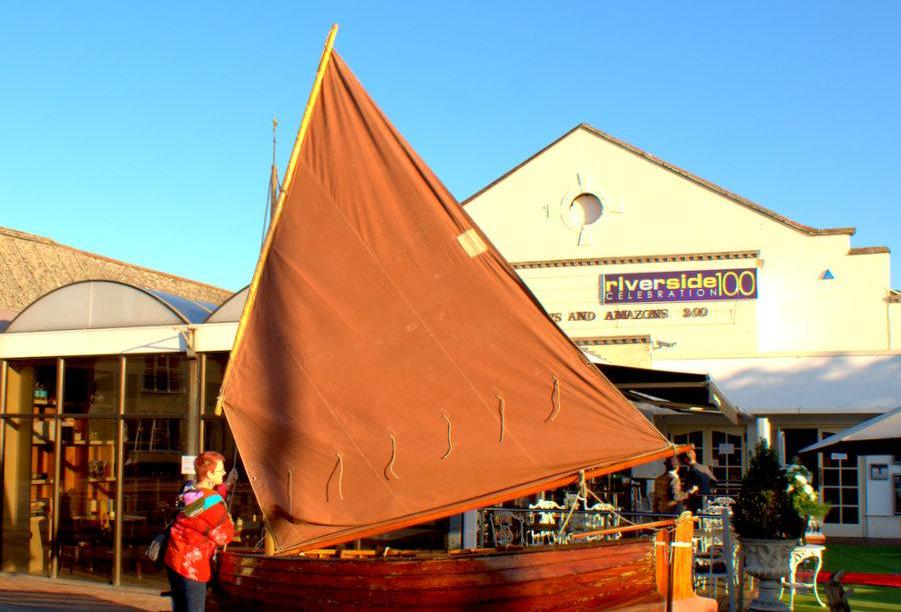
Swallow, the clinker built dinghy, originally built by William King and Sons at Burnham-on-Crouch and used in the 1974 film, was rigged up outside the cinema for everyone to meet. She has been appearing at a number of The Arthur Ransome Society’sevents in Suffolk and Essex.
We used the best photo of Swallow under sail for the cover of the paperback on how the film was made, which was on display in the cinema lobby after the film. It is now available online or from the Aldebrugh Bookshop in Suffolk.
Someone asked if we had any disasters while making the film.
‘Swallow’s mast broke, we nearly sailed under the Windermere steamer and a cow fell down a bank onto the producer’s car.’ I couldn’t think of anything utterly disastrous from my own perspective except that I lost a tooth halfway through shooting a scene with Virginia McKenna, which was embarrassing. I can list other questions asked by the audience in the next post.
The Riverside Cinema in Woodbridge are thinking of showing Swallows & Amazons again in September to help them celebrate their centenary ~ ‘100 Years of Film’. Do add a comment in the box below if you would like to organise a screening of the film at a cinema near you.
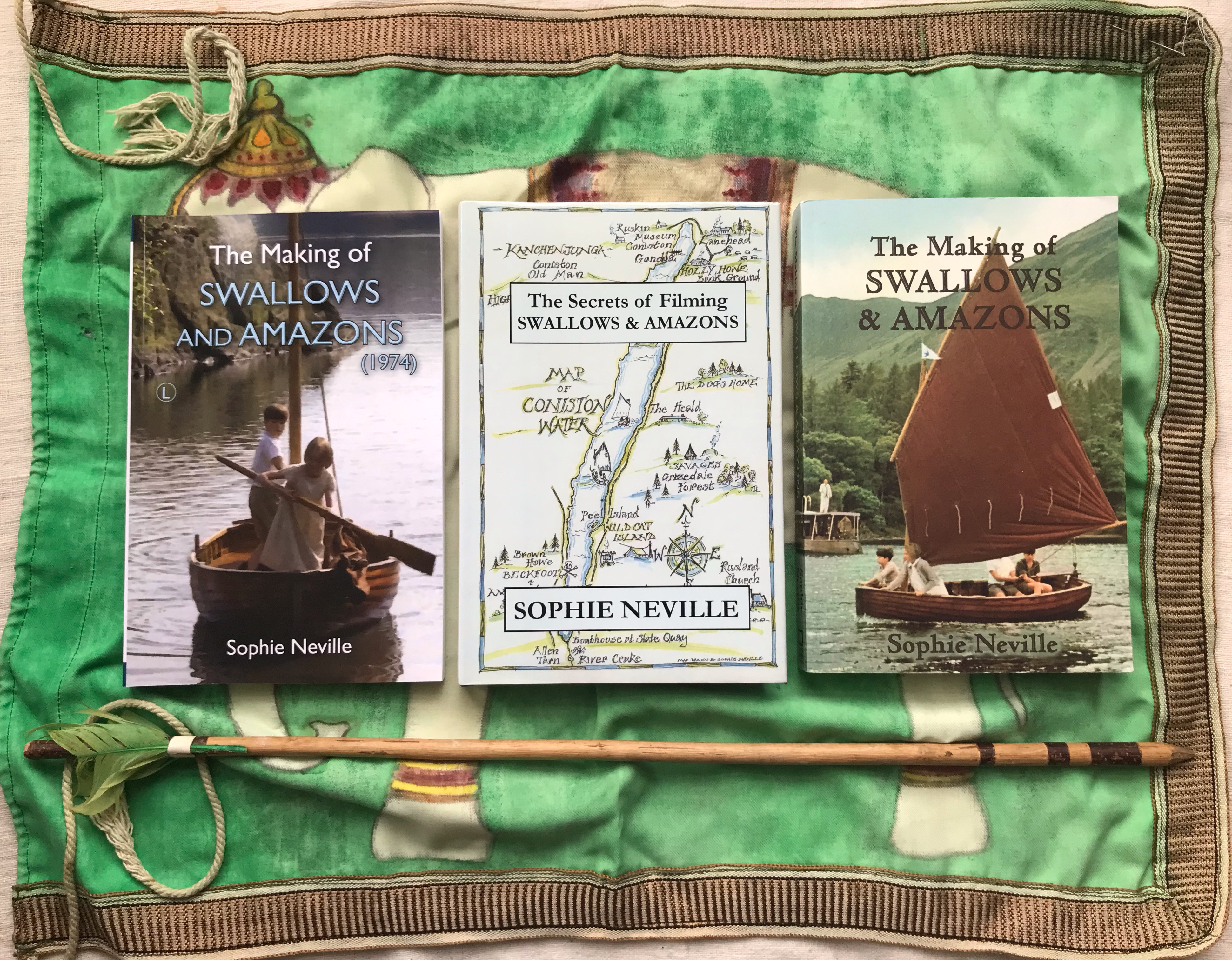
You can read about the adventures had making the original film of Swallows and Amazons in these editions available online:
Different editions of ‘The Making of Swallows and Amazons (1974) by Sophie Neville’
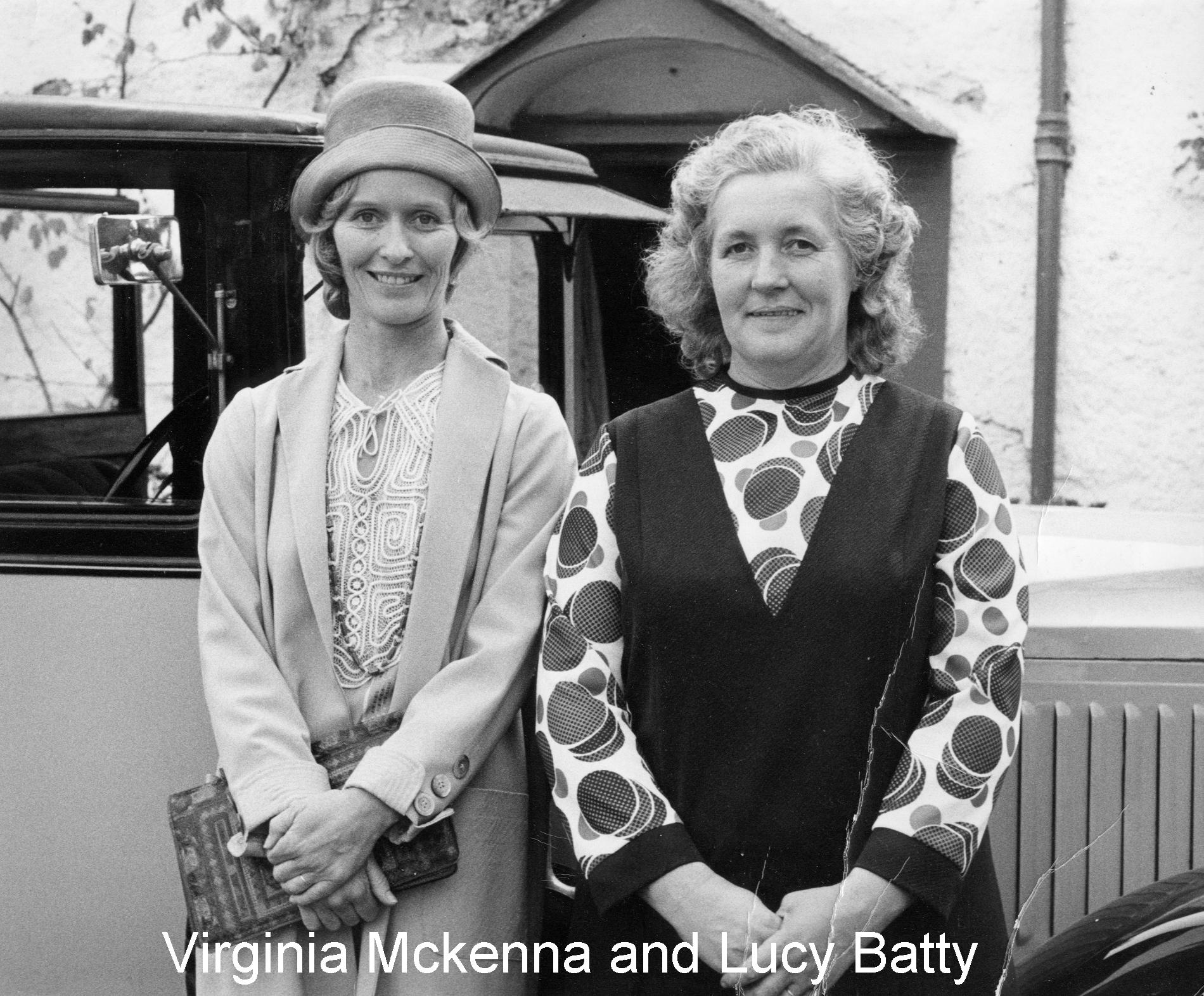
Virginia McKenna with Lucy Batty at Bank Ground Farm on 15th May 1973
We were sad to hear that Lucy Batty has passed away. She was 87. Our thoughts are with her family. She will be fondly remembered by visitors from all over the world who were made so welcome at Bank Ground Farm above Coniston Water in the Lake District, which she ran as a guest house for many years. It was also used as a film location, becoming known as ‘Holly Howe’ in Richard Pilbrow’s 1974 movie, Swallows & Amazons.
Bank Ground Farm in the Lake District
I first met Mrs Batty when we filmed in her home back in 1973 and returned to stay with her in 2003 when the BBC asked Suzanna Hamilton and myself if we would appear in Countryfile, which they were filming at Bank Ground Farm with Ben Fogle. It was then that she had time to show me her photo albums. What a life she led! She was very proud of having brought up seven children on the farm, “Two of my own and five that came with my husband,” she explained. “Getting them all off to school in the mornings was such hard work that my in-laws came to help on my first day.They all wanted bread and dripping for breakfast, with sugar sprinkled on top.”
~ Sophie Neville with Lucy Batty in 1973~
“A magistrate once asked me what running a B&B entailed. ‘It’s much like looking after cattle,’ I told him. ‘You bring ‘um in, feed ‘um, see they’re bedded down, turn ’em out and muck’um out.’ He flung back his head and roared with laughter.”
She had a great sense of humour. I have a cutting from an article in The News written by Brenda Colton and published on 25th May 1973. It reads:
‘When Mrs Lucy Batty was asked if her house could be used for the setting of the film Swallows and Amazons, with guest star Virginia McKenna, she was delighted. After all, her home, Bank Ground Farm on the east side of Coniston Water, near Brantwood, was the setting chosen by Arthur Ransome for his children’s book Swallows and Amazons.
Mrs Batty thought it a good idea that the story should be filmed in an authentic location, and she felt she should be able to put up with a few cameras and film men for a while. But she just did not realise the scale of a “medium budget” film like this one, or what the production staff could do to her house. It was not the two double-decker buses coming down the path and parking on the farm that she minded, nor the numerous vans, lorries, cars and caravans. It was not even the difficulty of having 80 men and women wandering round the farmhouse carrying equipment here, there and everywhere.But when art director Simon Holland started tearing up her lino and carpet in the kitchen to get to the bare stone floor, she did get a little annoyed. Especially when he removed all the electric sockets, lights and switches, pushed all the kitchen furniture into the larder and whitewashed the newly papered walls.
“Have you seen the kitchen?” Mrs Batty said to me. “The larder is piled high with my furniture; and you would not believe the tip my lounge is in. But they are a funny lot. I asked if I could wash the beams in the kitchen for them, and they said ‘Oh no, we want them to look old.’ I have even had to hunt out a lot of old pottery from the cellar for them.
“But I have given up now. I have just left them to it.”
What I really did not know, until I watched the BBC documentary ‘Country Tracks’, was that Mrs Batty reached the point when she locked out the crew. She explained that when she was originally asked if we could film on her property she did not quite realise the scale of operations and only asked for – or accepted – a location fee of £75. She said that she decided that £75 was not enough, padlocked her front gate and wouldn’t let them back in until they agreed to pay her £1,000. It was a lot of money, more than double the fee I received for acting in the whole movie.
To read a little more about filming of Swallows & Amazons at Bank Ground Farm, please click here.
Sten Grendon, Sophie Neville & Simon West with Mr Jackson at Holly Howe
I am sure many people reading this have their own memories of Mrs Batty who was such a great character. Please do add them to the Comments box below. I feel it would be a tribute to all the hard work and love she put into making Bank Ground available over the decades for so many to enjoy.
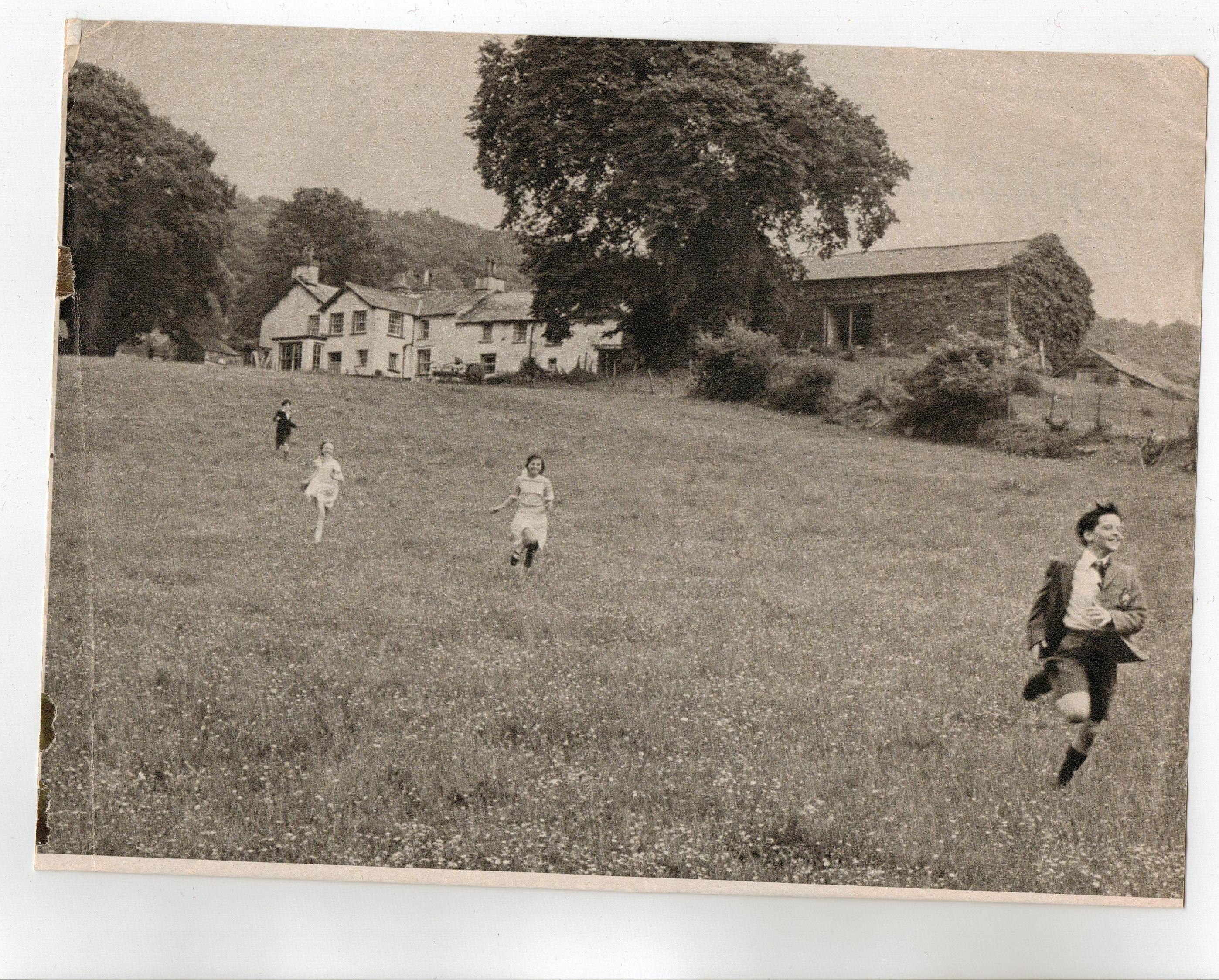
The farmhouse as Holly Howe in 1973
You can read more about the adventures we had making the original film Swallows and Amazons here:
We have just found another reel of 16mm home movie footage shot, not on location in the Lake District, but at Runneymede near Egham in Surrey. It captures the essence of a hot day in September 1973 when we were re-called for pick-up shots after the main body of the film of Swallows & Amazons had already been edited.
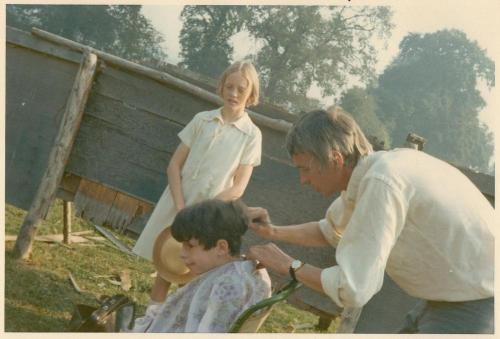
Ronnie Cogan trimming Sophie Neville’s hair for the part of Titty in September 1973
The clip opens with the film hairstylist Ronnie Cogan cutting my hair. It had been a good six weeks since I had last played Titty in front of the camera and I needed a trim to restore it to the same length it had been on 14th May when we had first started filming on the Lakeside and Haverthwaite railway. Suzanna Hamilton’s thick dark hair had grown a great deal, as had Sten Grendon’s.
Sophie Neville watching Ronnie Cogan cut Sten Grendon’s hair.
Peter Robb-King the Make-up artist had been toning down our complexions inside the same Make-up caravan we’d used while on location for seven weeks in Cumbria. I remember it had orange flowery curtains, a pattern much in vogue at the time.
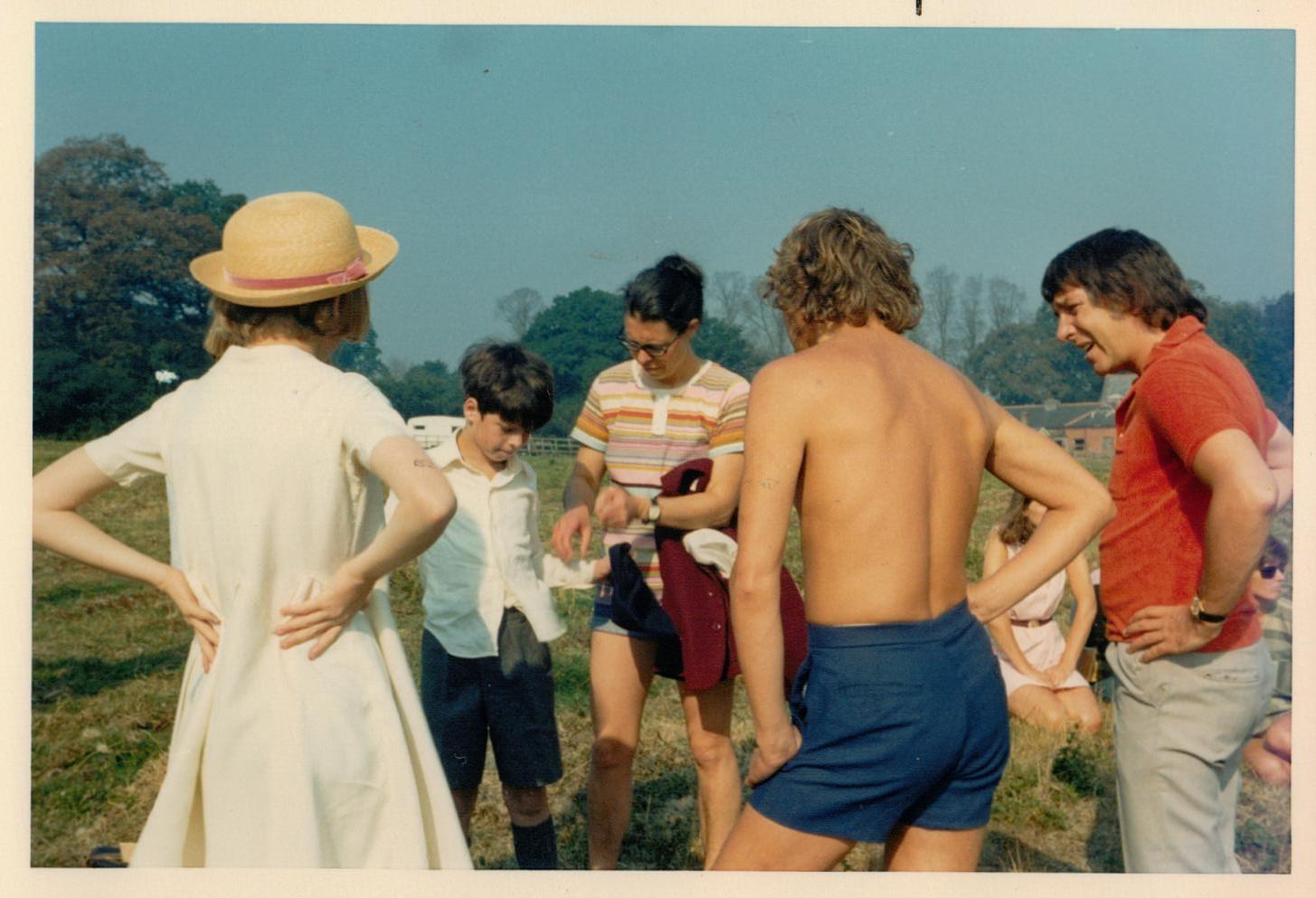
Sophie Neville looks on as Stephen Grendon organises his costume helped by Jane Grendon with Claude Whatham and Neville C Thompson.
Neville C Thompson, the Associate Producer, who was wearing a red shirt that day, seemed happy to be back on location. The film director, Claude Whatham was working, as I will always remember him, in a pair of navy blue shorts and sailing shoes. I loved putting on the school hat and silk dress I’d worn in the train but was difficult for the boys to climb into their woolen costumes on such a bright sunny day.
Richard Pilbrow, the Producer, who you can see wearing a white stripy cheese-cloth shirt so typical of the early 1970’s, seemed rather on edge. Bringing a camera crew along for what amounted to three shots must have been expensive, stretching his budget to the limit.
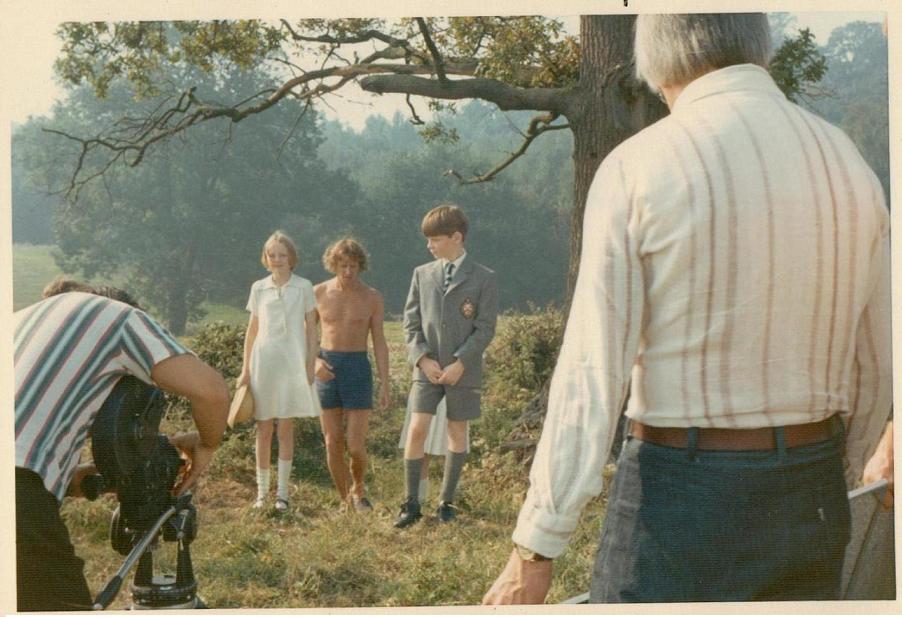
Gordon Hayman with a 35mm Ariss camera, Sophie Neville, Claude Whatham and Simon West, with Richard Pilbrow in the foreground ~photo:Daphne Neville
The oak tree, under which the 35mm Arriflex camera was set, was chosen to represent the Peak of Darien from which we looked out over an imaginary lake to an imaginary island. The finished movie cuts from the Walker children’s faces to a shot taken of Derwentwater at sunset with the opening title graphics superimposed over what is in reality Blakeholme, or Wild Cat Island as it is called in Arthur Ransome’s world.
Denis Lewiston, the Director of Photography, was working with the Cameraman Gordon Hayman, using reflector boards to light our faces. At one stage he had me standing on a cream coloured blanket to reflect light from below. You can see it in this shot:
Sophie Neville playing Titty Walker with Stephen Grendon as Roger Walker with Gordon Hayman, Denis Lewiston and Claude Whatham behind the camera
What I had forgotten was that two little girls came along that day to stand-in for us when the shot was being lined up. You can see them in the home-movie footage, one wearing a pale blouse with puffed sleeves.
Claude was very keen on running. He often took us for a short run before going for a shot to aerate our minds and freshen up our faces. In the story we had run down the hill from Holly Howe, so he had us running quite far before we landed on the marks that the cameraman had given us so that we’d be in focus. We had no dialogue, but the expressions on our faces were crucial to engaging the audience.
Denis Lewiston, Claude Whatham, Sophie Neville, Suzanna Hamilton, Simon West and the cameramen
You see a few other people on location, not least Sten’s mother, Jane Grendon, my little sister, Molly Pilbrow and a few others who were watching. My mother had been taking the footage.
Daphne Neville with Stephen Grendon, Suzanna Hamilton, Sophie Neville, Jane Grendon and Simon West
To read about this day from another angle, please click here to visit an earlier post with a few more photos.
On Friday 21st November 2014, I was invited to talk about the making of Swallows & Amazons on the CBBC movie show with David Wood, who wrote the screenplay. I’ll let you know when this will be broadcast. While I was at Novel Entertainment I met Dexter Fletcher and Bonny Langford as well as Justin Johnson from the British Film Institute who is an adviser on the series of 6 x 30 minute programmes.
You can read the whole story of making the film here:
‘Forty years after she enchanted film-goers as Titty in Swallows and Amazons, Sophie Neville has found a new audience… telling the behind-the-scenes secrets of the film of Arthur Ransome’s classic novel.’ The Daily Mail The Making of Swallows & Amazons ‘…is based on diaries, letters and old photographs which Sophie has turned into a heart-warming account of making the movie, which starred Virginia McKenna and Ronald Fraser.’
The Telegraph~ Culture: ‘Set in the Lake District in 1929, the film follows four young adventurers who sail a dinghy around Lake Coniston, cook for themselves over campfires and sleep in makeshift campsites.’
‘…The occasional chaos and terrible weather during filming contributed to the eventual popularity of the extraordinary and very much loved film.’ The Times
‘The film Swallows & Amazons is 40 years old, but thanks to its careful period evocation, its respect for Arthur Ransome’s original book and the performances of its child actors, it’s become a timeless classic. One of those children was Sophie Neville, who played Titty, and who kept a diary during the filming. That diary, with her adult recollections, is this book. It’s a fascinating insight into filming on location in the Lake District…’ Classic Boat
‘… The result is compulsive reading as she recalls that cold wet summer, while the camera crew wrapped up warm and she shivered in her skimpy dress as Able Seaman Titty Walker. Sophie brings to life all the many memorable characters who worked on the film and in particular the other children, the Director Claude Whatham who developed a great relationship with his young cast and the stars Virginia McKenna and Ronald Fraser. Nor are the other young actors forgotten for there are diary contributions from Suzanna Hamilton who played Susan, Stephen Grendon who played the Boy Roger and Kit Seymour who played Nancy Blackett. The text is supported by numerous illustrations showing life on and off the set.’ Roger Wardale, author of Arthur Ransome: Master Storytellerand other books
‘You don’t need to be a Swallows & Amazons fan to enjoy this book – it’s universal!’ Winifred Wilson, Librarian of The Arthur Ransome Society
‘This was a most unusual and interesting book. I picked it up expecting to browse through it, and found myself so drawn in to Sophie Neville’s detailed, amusing and insightful description of film making in the 1970’s that I was unable to put her book down. As Arthur Ransome fans, my family and I have always loved the film, and felt that Sophie Neville was ‘just right’ as Titty. What fun it has been to be introduced to the young twelve year old Sophie with her intelligent awareness of the challenges facing the production crew while she shivered in her cotton dresses. The many photographs and illustrations contribute richly to bringing the 1970s setting to life. Sophie recorded her experiences beautifully, and in so doing, added one more valuable book to the cultural heritage of all Arthur Ransome fans.’ Juliet Calcott, English teacher,South Africa
Lots of photos throughout the book bring the scenes to life – a delightful read.’ Celia Lewis author of An Illustrated Country Year
Sophie Neville has been chatting to Mark Forrest on The Evening Show.
The second edition of this paperback is published by The Lutterworth Press, available online here