A write up of Sophie’s talk for BookBlest – the first Stroud Christian Book Festival – on The Making of Swallows and Amazons can be found on this website here
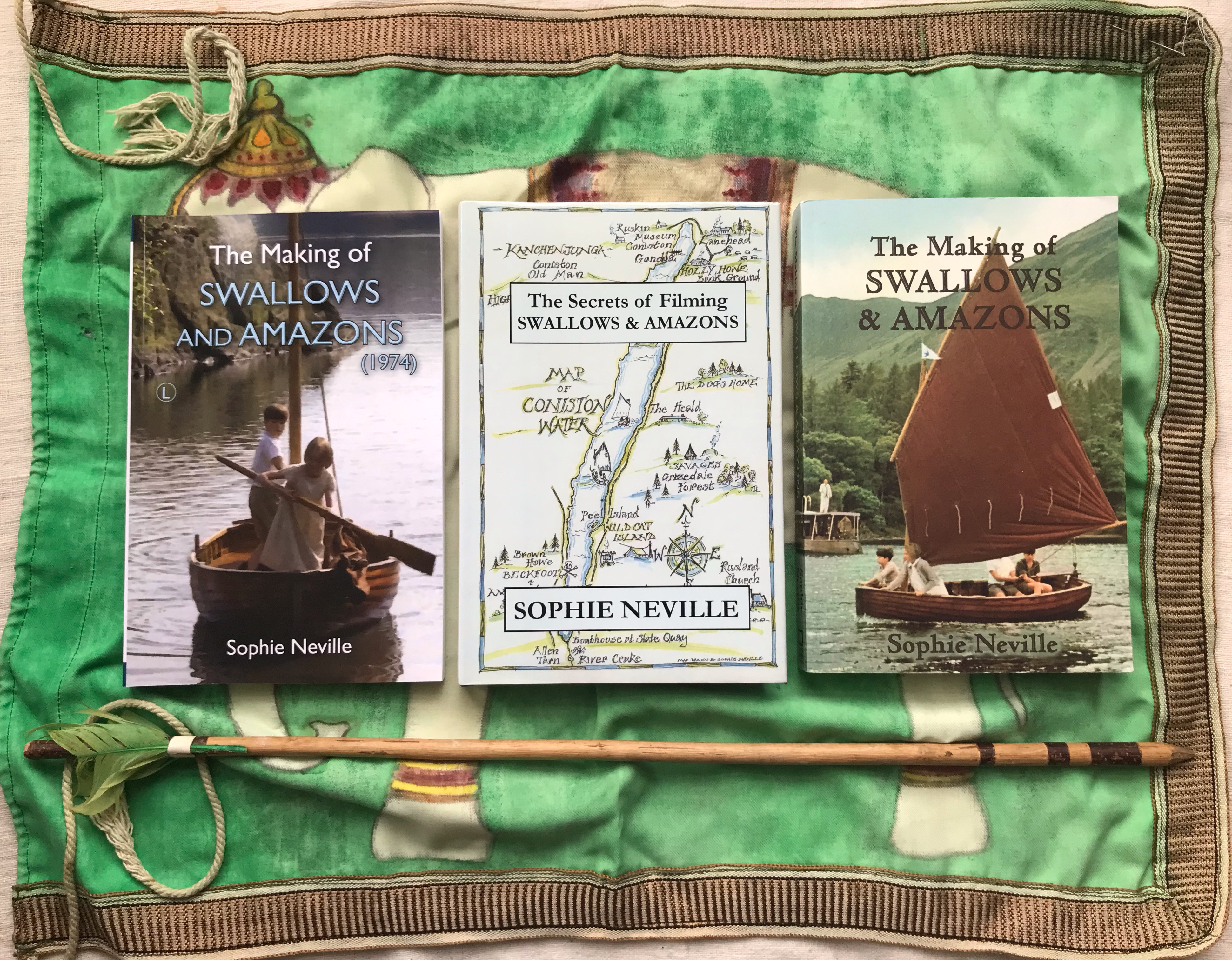
If you missed Sophie’s talk on ‘The Making of Swallows and Amazons’, you can read about her adventures in one of these editions, available online.
Different editions of ‘The Making of Swallows and Amazons (1974) by Sophie Neville’
There is a brief resume of the talk on this website, here Prepare to be taken back to the 1970s:
Why is it that film posters have become more valuable than oil paintings ?
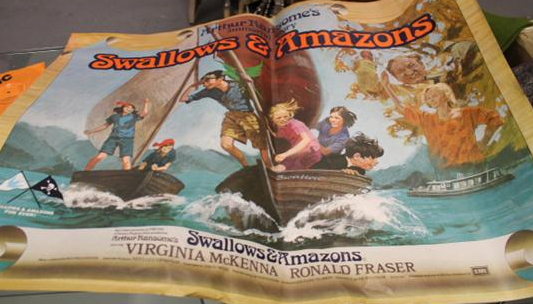
I have only just learned that the poster for the 1974 film of ‘Swallows and Amazons’ was painted by the Italian artist Arnaldo Putzu.
Thomas Connery enlightened me, writing: ‘Whether it be Space 1999, The Railway Children, The Rollers or Jaimie Sommers, he always captured likeness’ of stars faithfully and remarkably accurately.’
I agree. He portrayed Virginia McKenna well. I wonder how large the original painting was and if any of the sketches have survived.
Virginia McKenna in ‘Swallows and Amazons’ (1974)
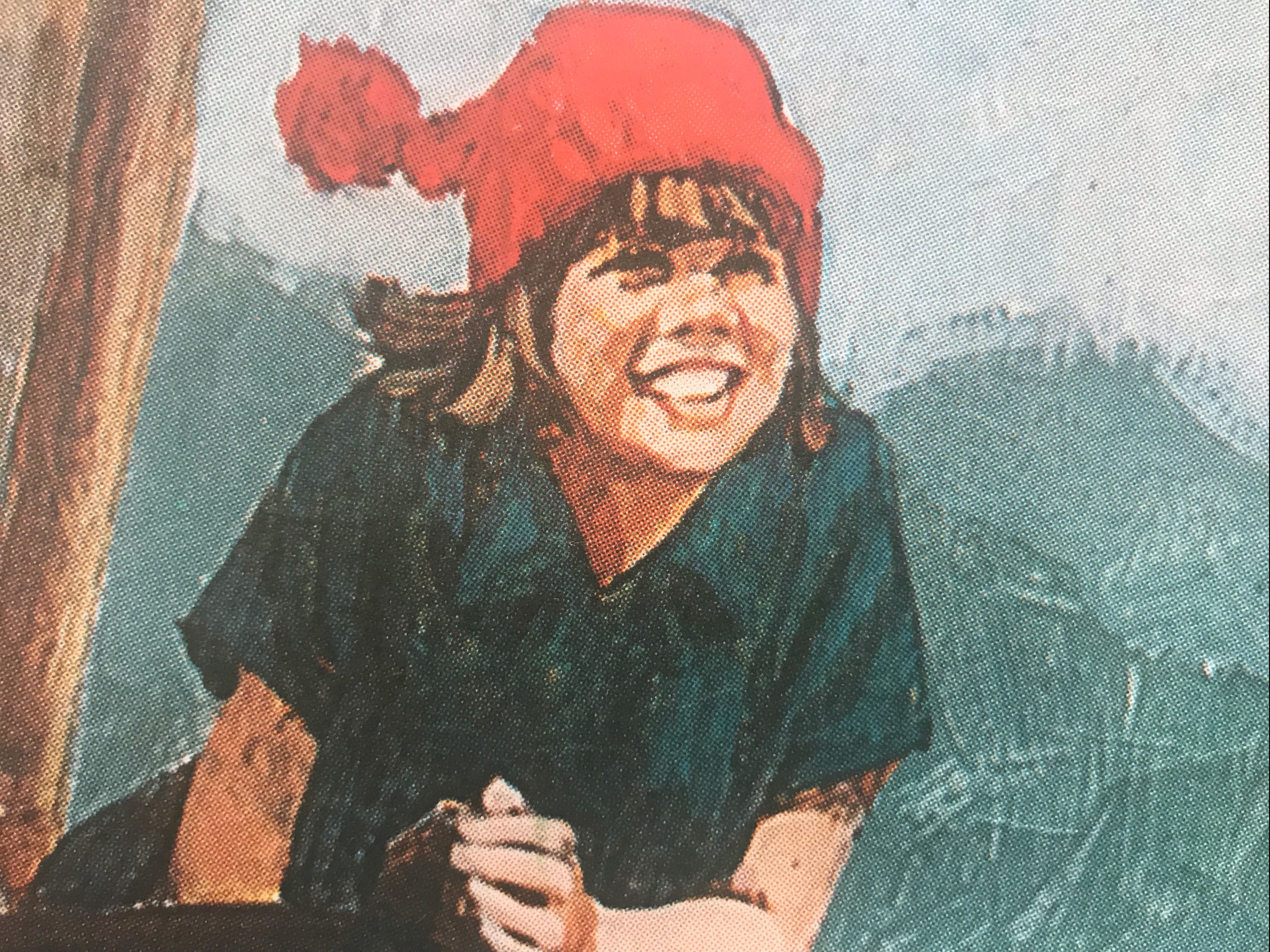
I have been given brown eyes and look a bit worried but am hugely honoured to have been featured at all. Kit Seymour looked far more cheery.
Kit Seymour as Nancy in ‘Swallows and Amazons’1974
A version of the artwork was used on cinema tickets, establishing the green parrot as one of the stars. I do like the way that Roger’s head looks out from the oval. This one gives Amazon a dark sail and shows the Amazons adopting different poses from on the poster. Nancy has folded arms and Peggy has her hands on her knees. Her stance is comic but a bit improbable. They have the wind behind them. What if the boat had gybed?
Premier ticket for the Gala of ‘Swallows and Amazons’
The ticket matched the souvenir programme for the film premier held in Shaftesbury Avenue on 4th April 1974. You can see inside this in an earlier post here.
The programme from the 1974 premier of the movie ‘Swallows and Amazons’
I also have a large sepia poster given to my mother by a cinema. I can remember being too shy to ask for it, but she persevered. I haven’t seen another since.
As children, we all asked, ‘Who was sailing the boats?’ Magnus Smith, who now looks after Swallow, says that you can tie off the mainsheet and Susan could just about be controlling Swallow’s tiller, but Amazon looks a bit precarious. I don’t expect Arnaldo had any experience sailing dinghies. Ours were on a collision course, pitched at odd angles with rather high reefing points but he added a swashbuckling spirit, and a bit of white water spray, which is always exciting.
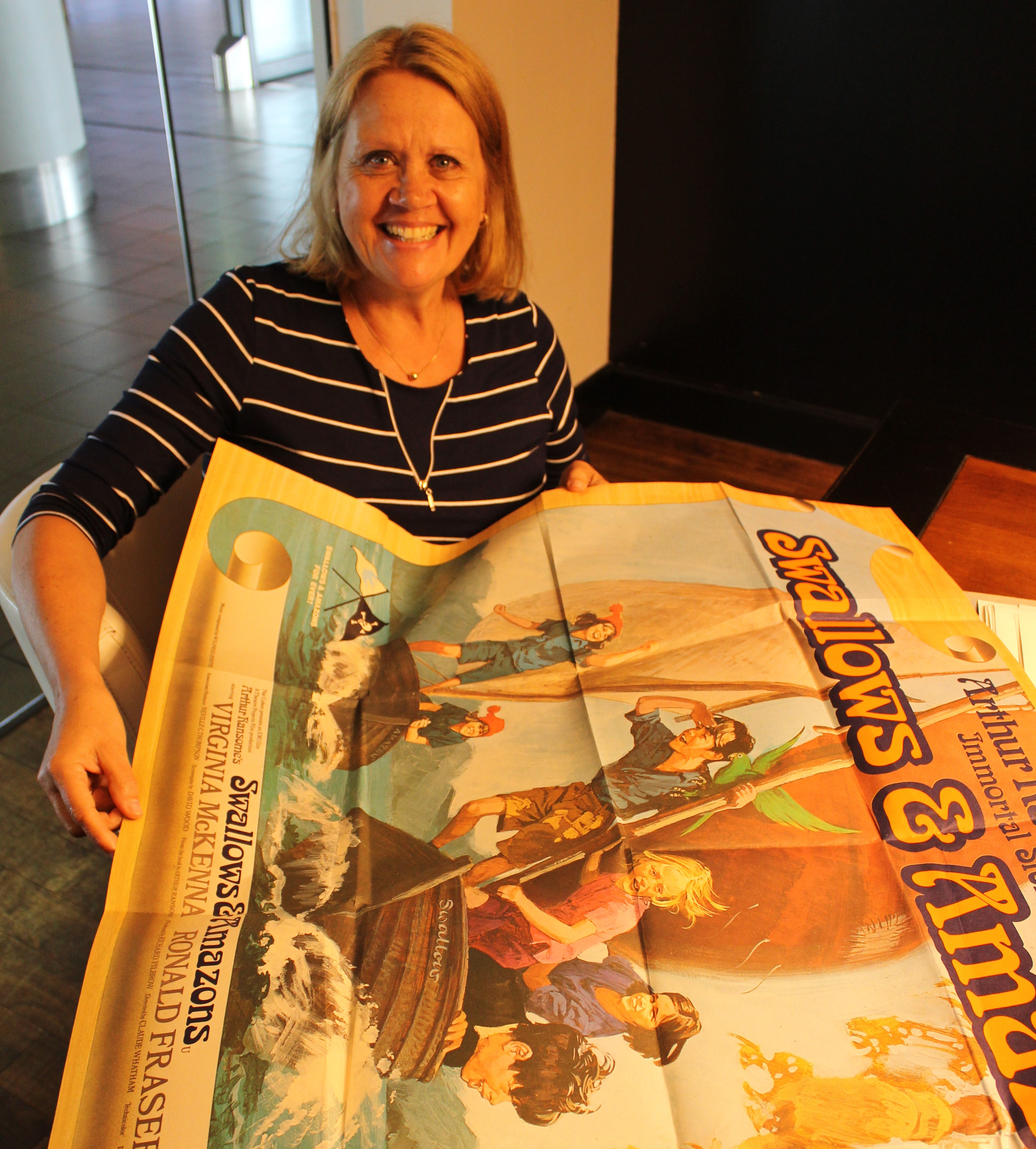
Arnaldo Putzu’s poster for the EMI film Swallows & Amazons (1974)
Arnaldo Putzu (1927-2012) began working for Rank in the 1950s and moved to London in 1967. He worked on the advertising material for many iconic movies including That’ll Be The Day, featuring David Essex and Ringo Starr, which Claude Whatham directed in 1972 prior to working on Swallows and Amazons for EMI Films. Is that the cover of the LP in the right hand corner? Claude Whatham gave me a copy. It included the song ‘Smoke Gets In Your Eyes’.
Poster design by Arnaldo Putzu
This one is bordered by fairground lights, where as ours had been given the feel of a treasure map, with the credits on the reverse, which was clever. The original lettering, trendy in the mid-seventies, faded from fashion for a while but came back on-trend for the 40th Anniversary. The painting was somehow ageless, being used for the DVD cover up by StudioCanal until 2016. They still sell it as a jigsaw puzzle or on a mug.
According to The Guardian, ‘Putzu created some of the most famous Italian film posters of the 50s and early 60s, painting such stars as Sophia Loren and Gina Lollobrigida.’ By 1973 ‘Putzu found himself the top-rated and most in-demand poster illustrator working in Britain. His output over the 1970s included oddball Hammer Horror fantasies such as Creatures the World Forgot and Legend of the 7 Golden Vampires. For the Get Carter posters he put the ruthless gangster (played by) Michael Caine into an unlikely floral jacket, demonstrating the whimsical humour that makes his best posters unforgettable.’ An original of this poster signed by Michael Caine was once valued by Sotherby’s at between £4,000 to £6,000.
Lesley Bennett, who played Peggy, still has her copy of the original film poster. She should probably get it signed by the actors. Others were pasted in London Underground stations, which I found alarming as a child.
I spied a framed poster on display at Windermere Jetty Steamboat museum, where it was featured on BBC Antiques Roadshow. There is more about the movie memorabilia, which was valued by the expert Marc Allum, here.
Sophie Neville at Windermere Jetty museum in 2020
Some originals have been for sale on this site here. Studiocanal sell various prints here.
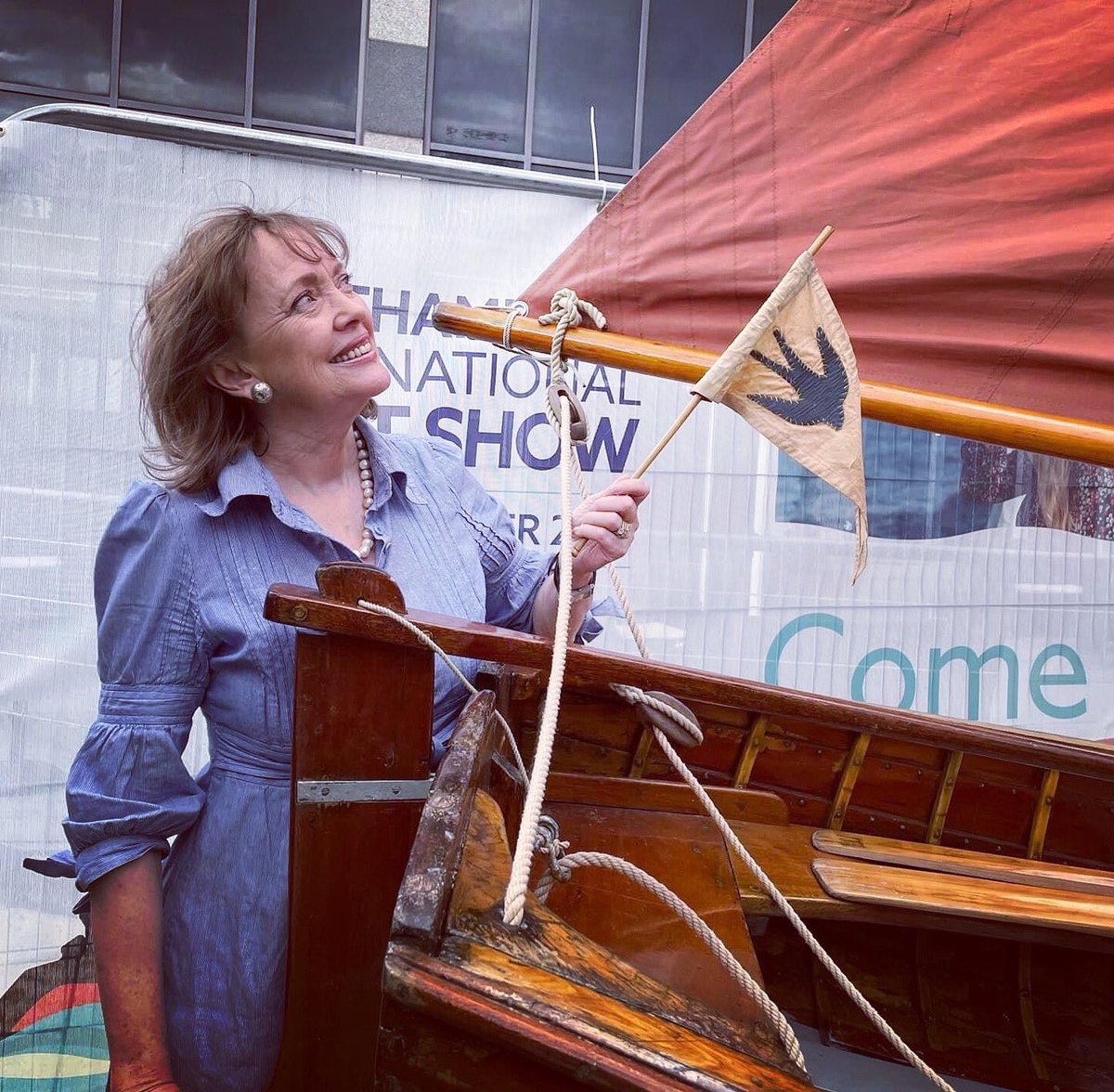
In 2022, Swallow, the dinghy that starred in the original film Swallows and Amazons was on display at the Southampton International Boat Show, greeting families as they arrive.
Sophie Neville who once played Titty Walker with her good little ship
Sophie Neville gave talks on filming afloat and the movie was made on location in the Lake District fifty years ago.
Over 103,000 people visit the show. Although busy, it did not feel crowded. There is a lot to see and do.
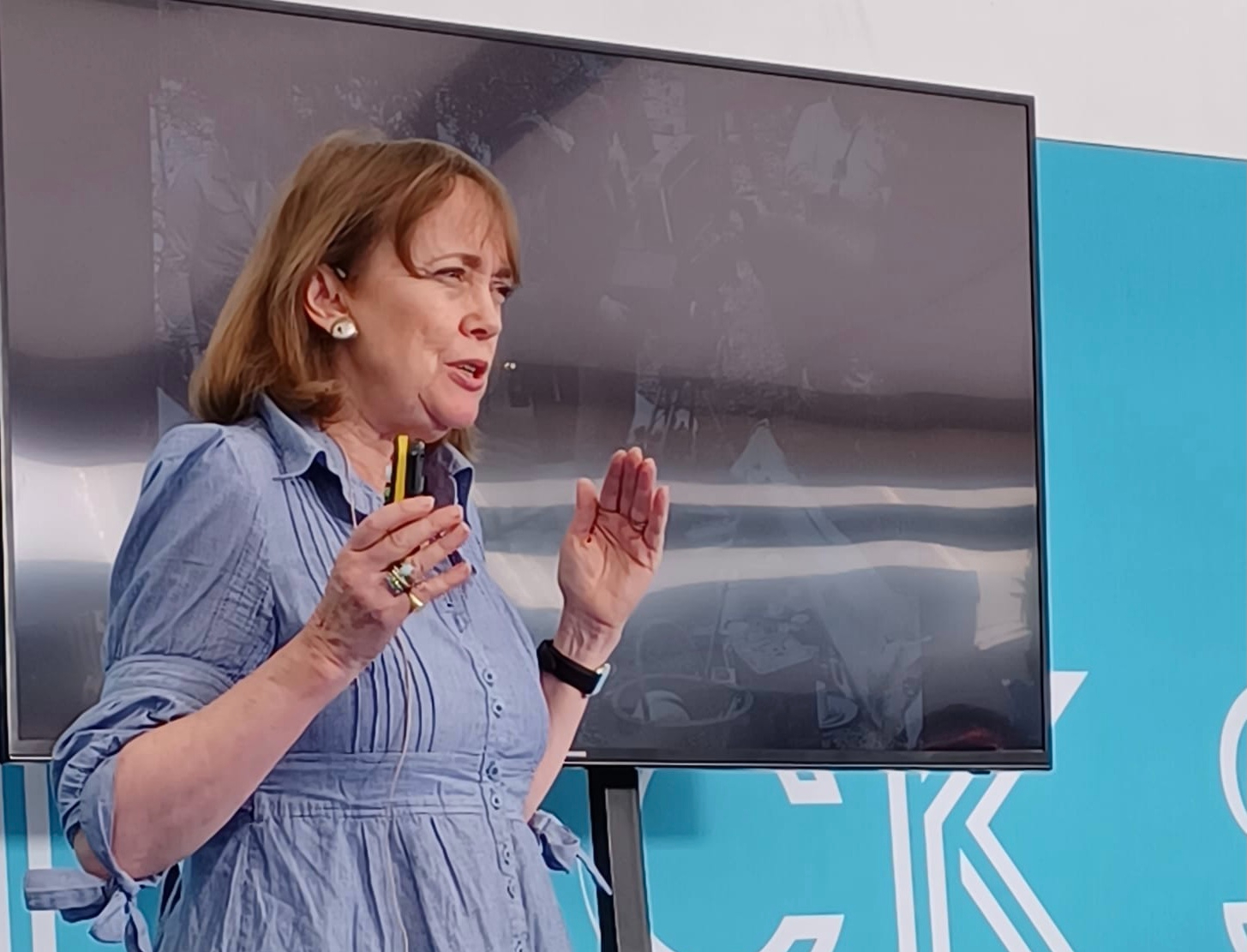
Sophie Neville speaking on the Foredeck Stage at #SIBS22
People often write to say how much they have enjoyed the original film ‘Swallows and Amazons’ (U) produced by Richard Pilbrow in 1974, which is currently streaming on Amazon Prime. Being suitable for all ages, it is often screened at outdoor festivals and is on Netflix in Europe.
‘Is it a good movie?’ people enquire of Google.
Helen Fielding mentions the DVD of Swallows & Amazons 1974 in the first edition of ‘Bridget Jones: Mad about the Boy’ claiming it to be more edifying for her children to watch than ‘Beverley Hills Chihuahua 2‘.
Dame Margaret Drabble told Claude Whatham, the director, how much she loved Titty in his filmof Swallows and Amzons, which was a huge compliment.
Sophie Neville as Titty in 1973
Elspeth Huxley CBE – author of thirty books including The Flame Trees of Thika – loved the 1974 film of Swallows and Amazons, reviewing it for The Tatler magazine under her married name, Elspeth Grant.
Simon West, Sophie Neville and Suzanna Hamilton appearing in The Tatler
There is special interest from a number of authors –
Wendy Clarke, who has set some of her psychological thrillers in the Lake District auditioned for the part if Titty in 1973. You can read her story on another post here.
When Catherine Lamont from Australia wrote on Facebook to say, “Just read a 2020 book mentioning ‘Swallows and Amazons’ (someone spotted in a bookshelf belonging to one of the main characters): The Enigma Game, by Elizabeth Wein” the author hrself, Elizabeth Wein, wrote in to say, “Not just in The Enigma Game – I namedropped Swallows & Amazons in my novel Code Name Verity, too! It was given to me by my grandmother’s best friend when I was seven and was one of my favorites. My own children, who never actually read it, were huge fans of the film”.
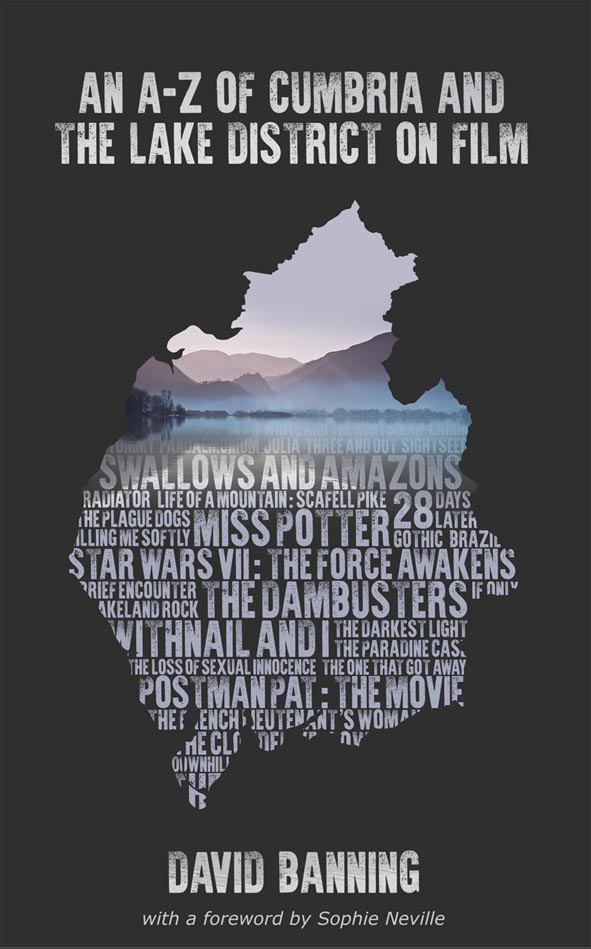
The arts curator David Banning profiled the 1974 movie of Swallows and Amazons in his book on films made in Cumbria and the Lake District, which you can see here.
Trevor Boult, who writes books on ships and sailing, is a great fan. He kindly donated the royalties from his most recent book Boats Yet Sailing to The Arthur Ransome Trust. You can order a copy direct from the publisher here.
For a list of well known people who love the Swallows and Amazons books, please click here
Do you know of any other authors who have written about the film? Please leave any information in the comments section, below.
Wilfred Joesph’s title music for ‘Swallows and Amazons'(1974)
You can read the first section about how the film was made back in 1973, for free, on the Amazon preview of the ebook here:
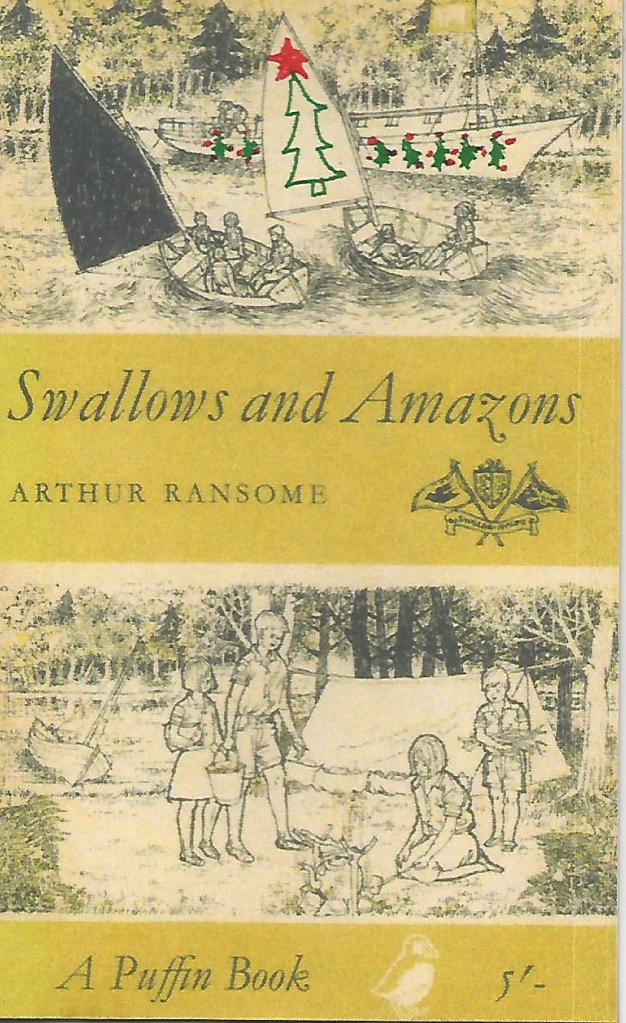
The school term is over, ‘Swallows and Amazons’ is on BBC iPlayer and Christmas missives are arriving in the post. I have just been sent this homemade card from someone who came to the premier of the original film in 1974, when I was fortunate enough to play Able seaman Titty.
~Captain Flint hanging Christmas decorations around his houseboat on a card made from a Puffin book cover~
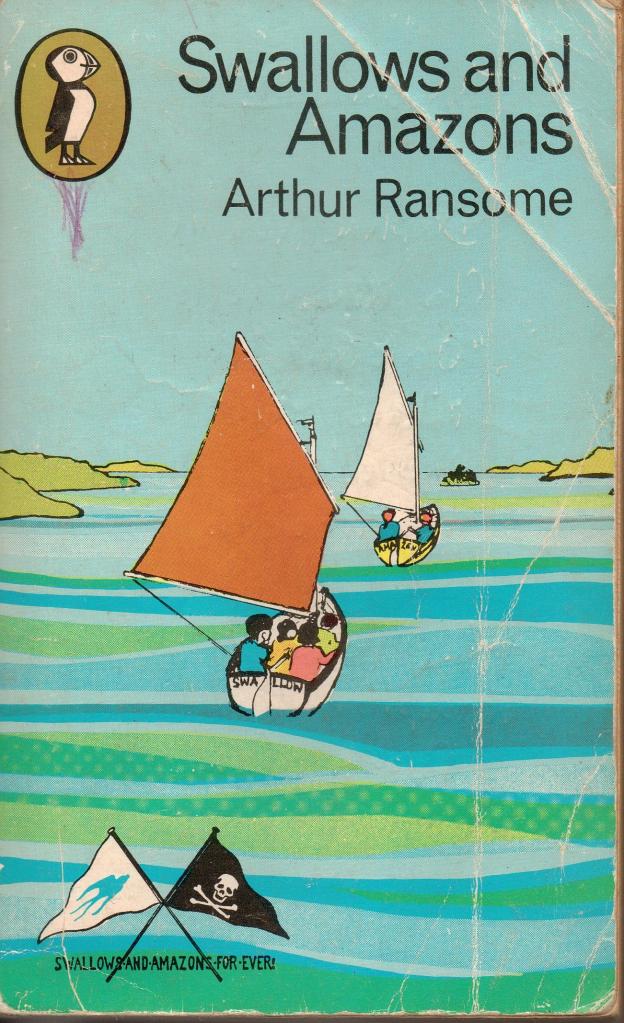
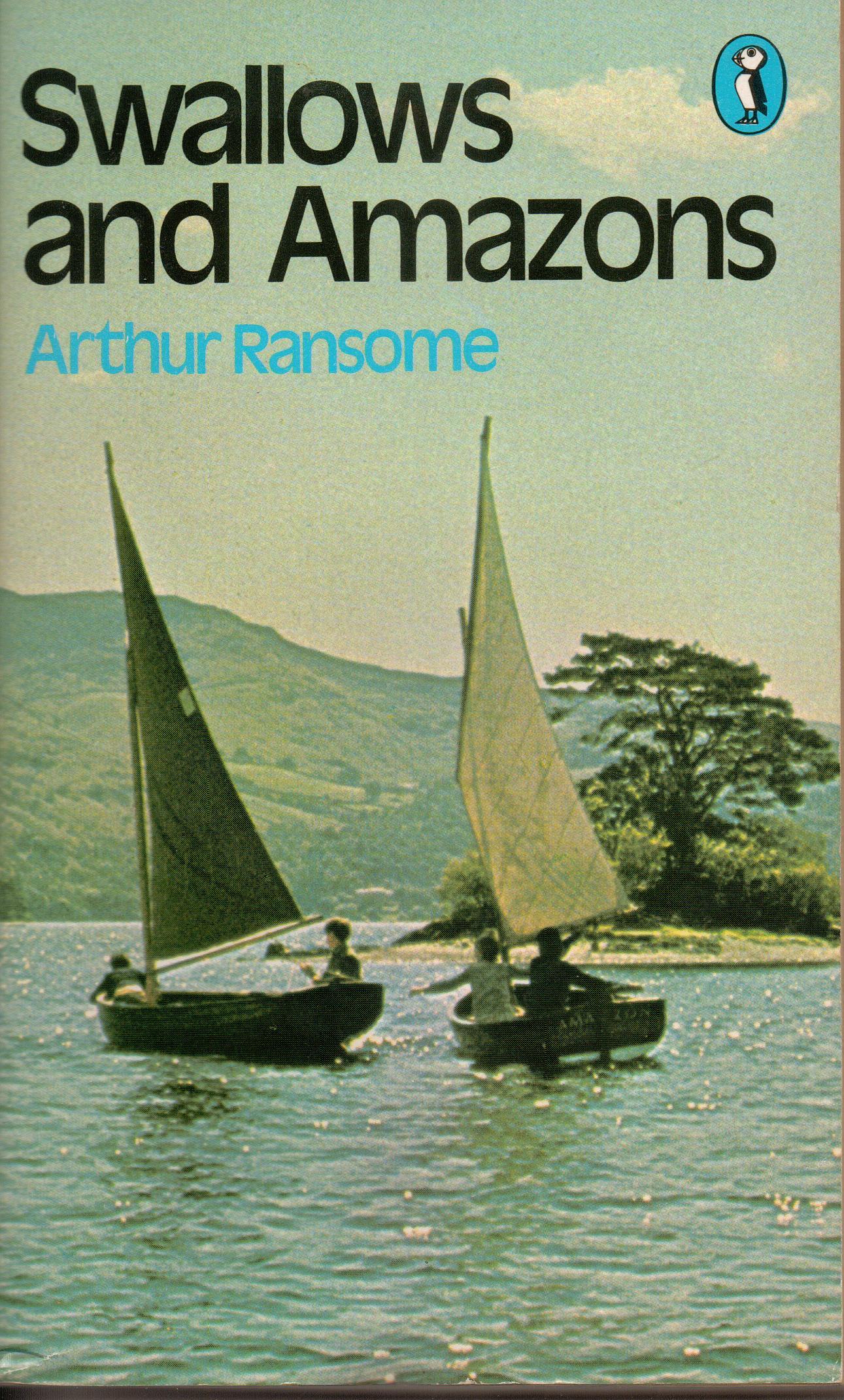
I dug out the Puffin paperback of Swallows and Amazons my father gave me when I was a girl and read avidly, along with other books in the series, by the time I was eleven years-old. It is a 1970’s edition in which I’d underlined everything Titty said. I must have re-read this copy when busy preparing for filming the 1974 movie financed by EMI.
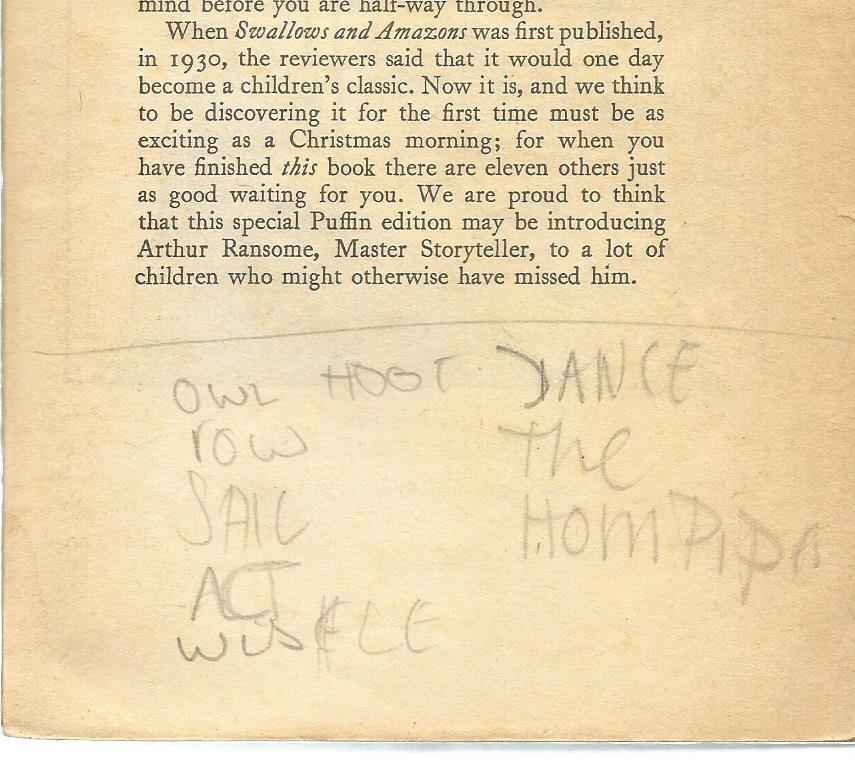
Kaye Webb, the editor, had written an introduction saying, ‘This book is about sailing, fishing, swimming, camping, and piratical exploits.’ She wanted to make it available to children, thinking that discovering Swallows and Amazons ‘for the first time must be as exciting as a Christmas morning.’
Underneath, I’d noted down the skills I would need to acquire before playing the part of Titty. ‘Owl Hoot’, was one item, ‘wisle’ (sic) another. I was somewhat apprehensive about dancing the Hornpipe but excited about ‘being a cormorant’, having no idea how cold this experience would prove.
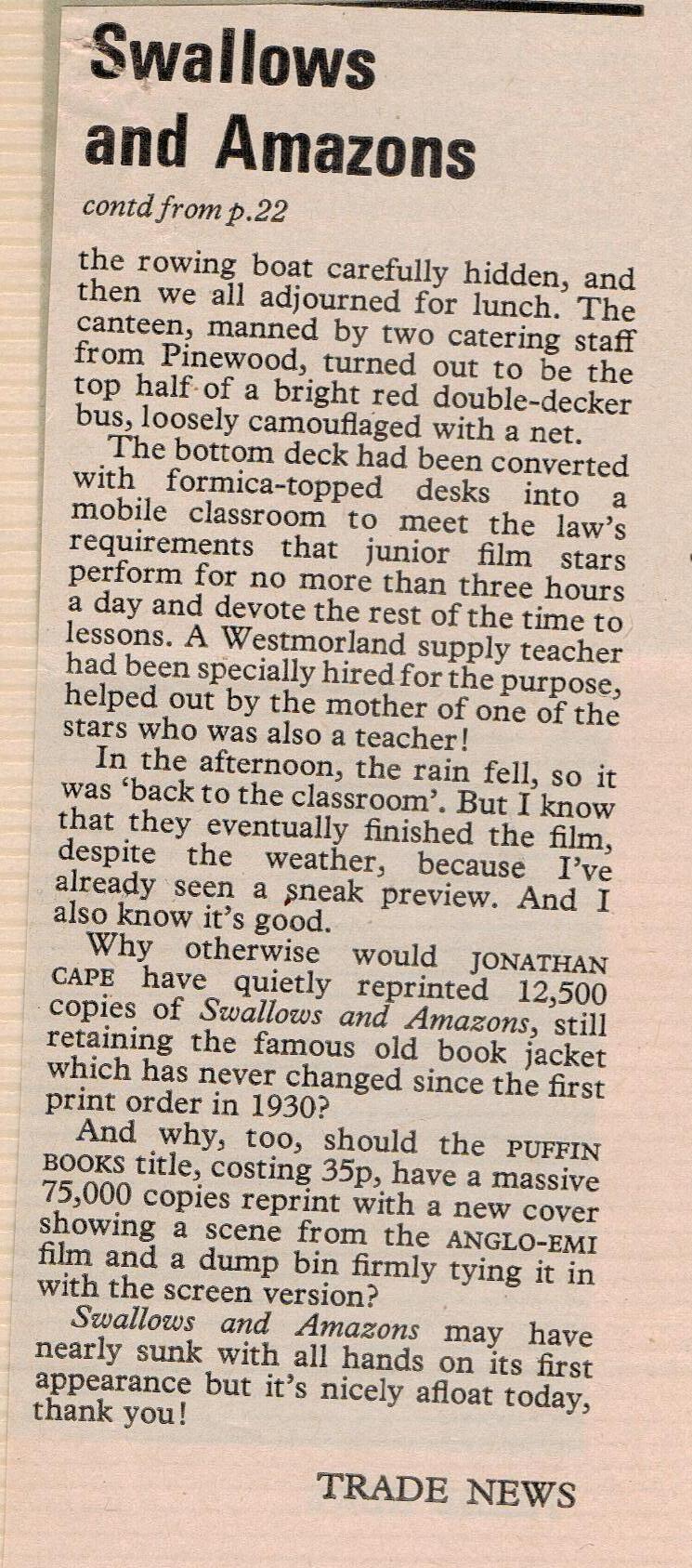
According to Trade News, 75,000 copies of a new Puffin paperback were brought out to accompany the original film. A still was used from the scene where the Swallows sail both dinghies from Cormorant Island. It retailed for 35p. Meanwhile Jonathan Cape printed 12,500 copies with the original dust jacket to accompany the release on 4th April 1974.
Today, I am most interested in Ransome’s prose, amused to find the phrase ‘X marks the spot where they ate six missionaries’ does not appear within the pages of the book. It was given to Titty in 1973 by the screenwriter David Wood. However, there are words of wisdom a-plenty that were not used in the film adaptations:
‘I like cooking,’ said mate Susan.
‘If you want to go on liking it, take my advice and get someone else to do the washing up’, is Mother’s reply. (I wonder who might have said this in reality.)
‘You can be wide awake and not see a thing when you aren’t looking’ is one of Roger’s observations.
John was able to look back to ‘a different, distant life’, which is exactly how it feels when the excitement of Ransome’s world spoils you for the ordinary. It’s true: those involved in outdoor activities develop in leaps and bounds ending up, ‘not at all what they had been.’
What is it about Arthur Ransome’s writing that captures your imagination? Rowing? Sailing? Cooking over a camp fire? Which book has most influenced your life?
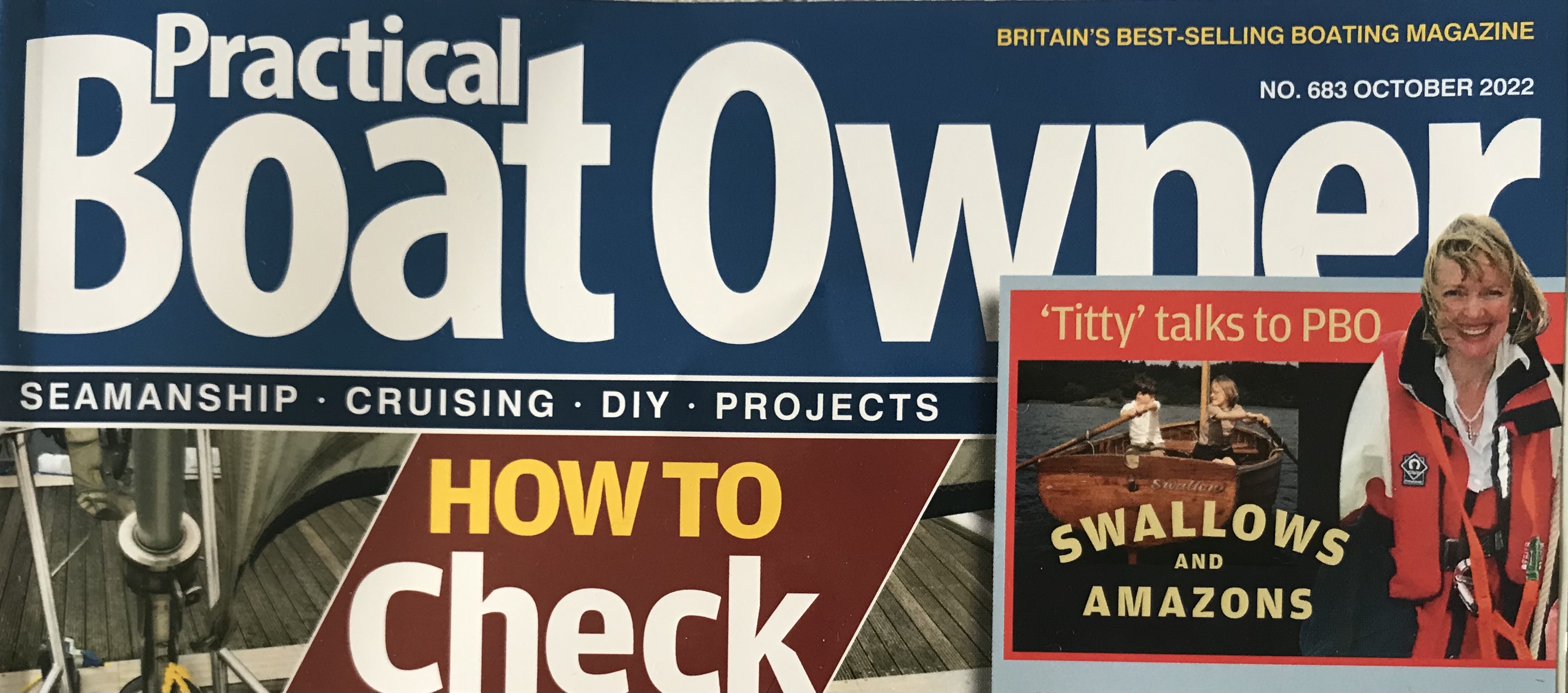
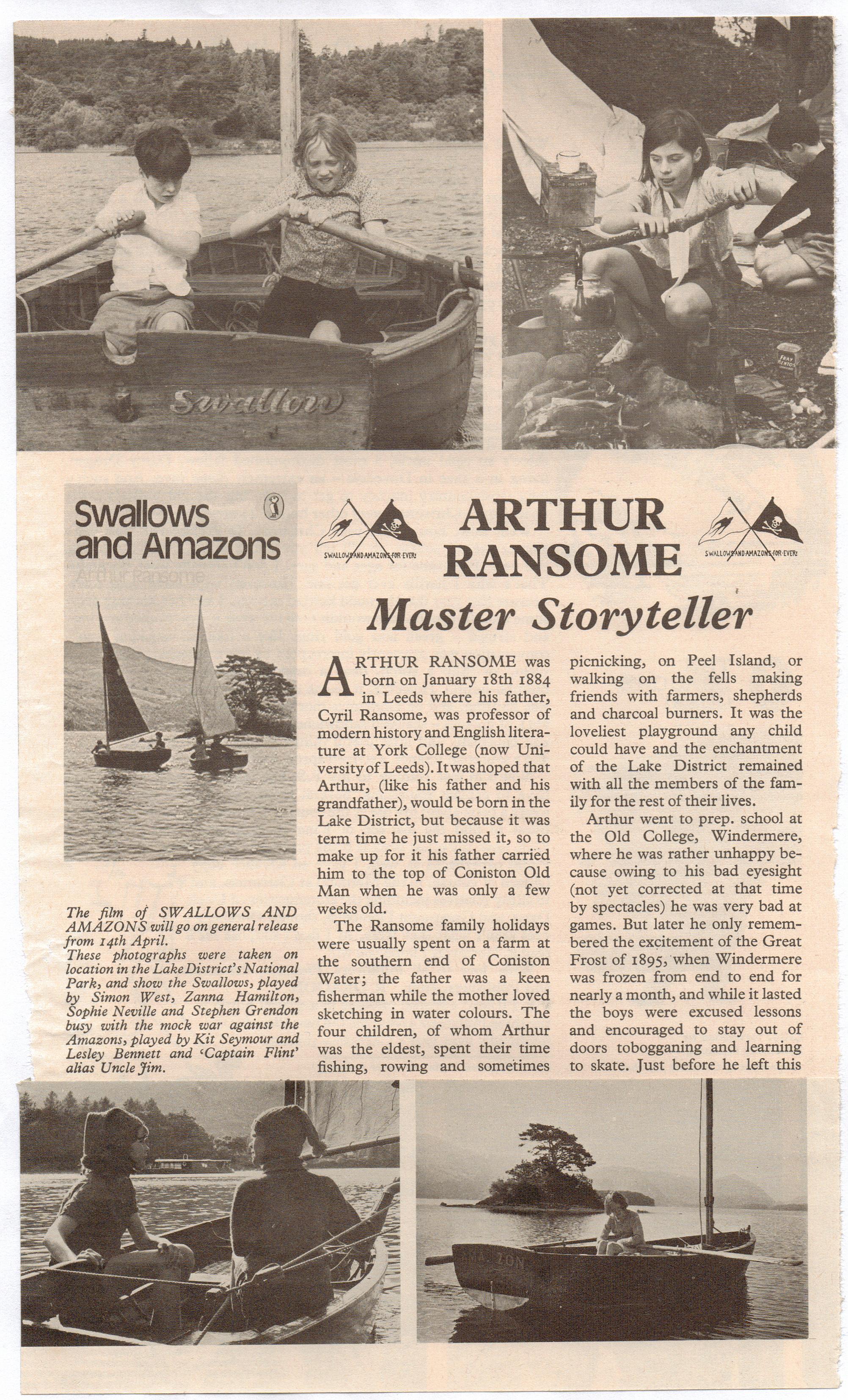
Article on Swallows and Amazons on Puffin Magazine
You can read about the adventures we had bringing out the original film in different versions of ‘The Making of Swallows and Amazons (1974)’, which is now available as an audiobook.
Different editions of ‘The Making of Swallows and Amazons (1974) by Sophie Neville’
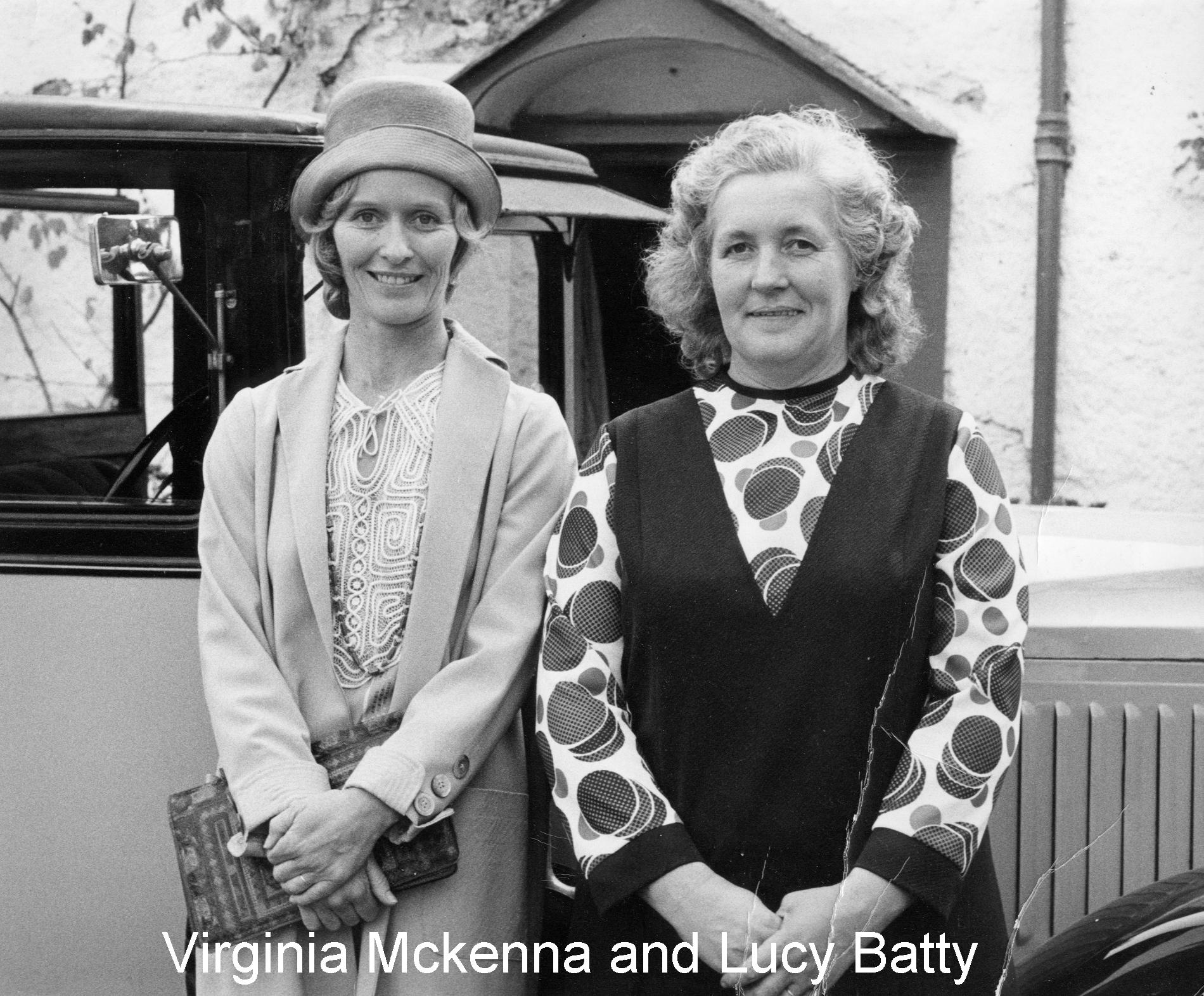
Virginia McKenna with Lucy Batty at Bank Ground Farm on 15th May 1973
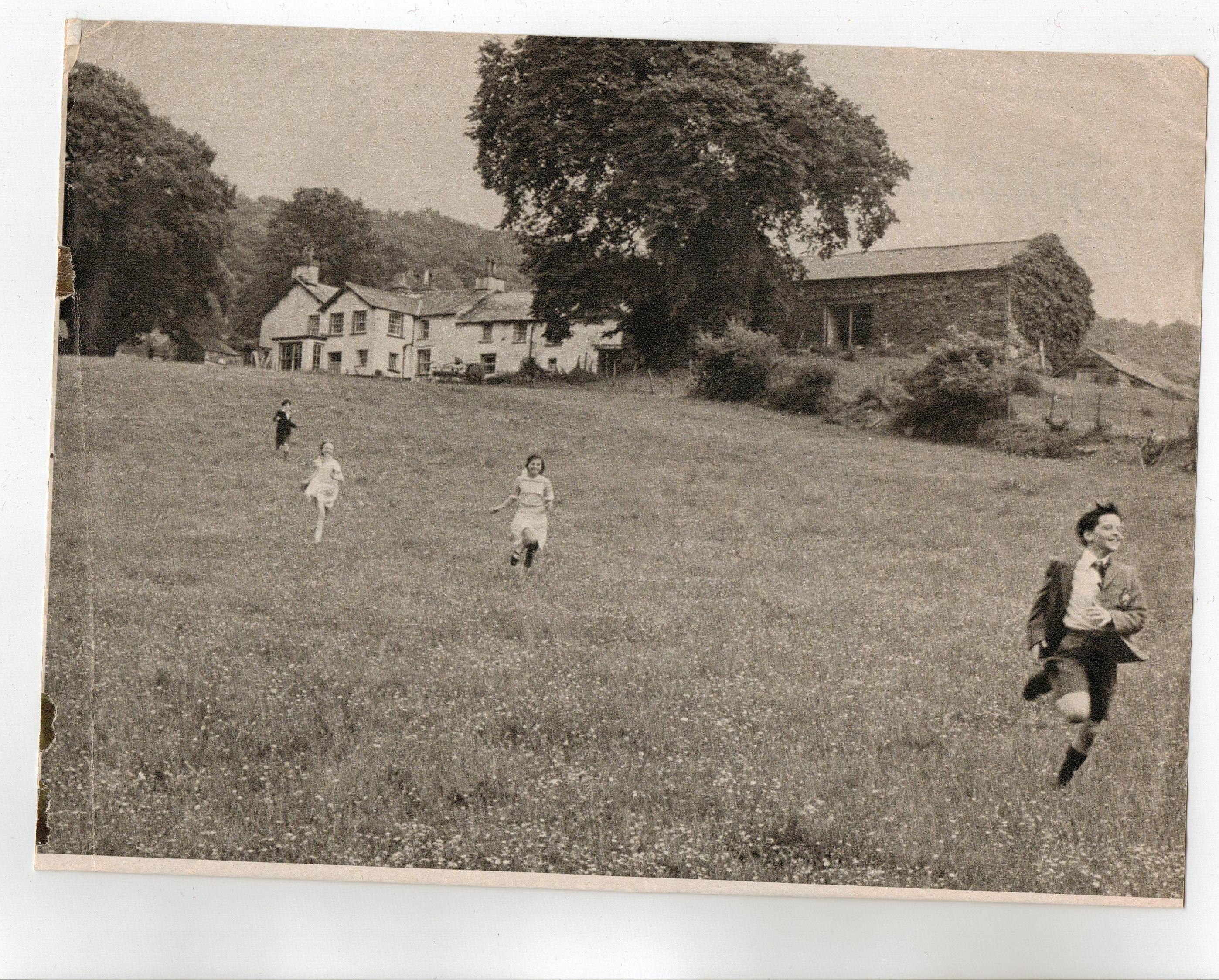
We were sad to hear that Lucy Batty has passed away. She was 87. Our thoughts are with her family. She will be fondly remembered by visitors from all over the world who were made so welcome at Bank Ground Farm above Coniston Water in the Lake District, which she ran as a guest house for many years. It was also used as a film location, becoming known as ‘Holly Howe’ in Richard Pilbrow’s 1974 movie, Swallows & Amazons.
Bank Ground Farm in the Lake District
I first met Mrs Batty when we filmed in her home back in 1973 and returned to stay with her in 2003 when the BBC asked Suzanna Hamilton and myself if we would appear in Countryfile, which they were filming at Bank Ground Farm with Ben Fogle. It was then that she had time to show me her photo albums. What a life she led! She was very proud of having brought up seven children on the farm, “Two of my own and five that came with my husband,” she explained. “Getting them all off to school in the mornings was such hard work that my in-laws came to help on my first day.They all wanted bread and dripping for breakfast, with sugar sprinkled on top.”
~ Sophie Neville with Lucy Batty in 1973~
“A magistrate once asked me what running a B&B entailed. ‘It’s much like looking after cattle,’ I told him. ‘You bring ‘um in, feed ‘um, see they’re bedded down, turn ’em out and muck’um out.’ He flung back his head and roared with laughter.”
She had a great sense of humour. I have a cutting from an article in The News written by Brenda Colton and published on 25th May 1973. It reads:
‘When Mrs Lucy Batty was asked if her house could be used for the setting of the film Swallows and Amazons, with guest star Virginia McKenna, she was delighted. After all, her home, Bank Ground Farm on the east side of Coniston Water, near Brantwood, was the setting chosen by Arthur Ransome for his children’s book Swallows and Amazons.
Mrs Batty thought it a good idea that the story should be filmed in an authentic location, and she felt she should be able to put up with a few cameras and film men for a while. But she just did not realise the scale of a “medium budget” film like this one, or what the production staff could do to her house. It was not the two double-decker buses coming down the path and parking on the farm that she minded, nor the numerous vans, lorries, cars and caravans. It was not even the difficulty of having 80 men and women wandering round the farmhouse carrying equipment here, there and everywhere.But when art director Simon Holland started tearing up her lino and carpet in the kitchen to get to the bare stone floor, she did get a little annoyed. Especially when he removed all the electric sockets, lights and switches, pushed all the kitchen furniture into the larder and whitewashed the newly papered walls.
“Have you seen the kitchen?” Mrs Batty said to me. “The larder is piled high with my furniture; and you would not believe the tip my lounge is in. But they are a funny lot. I asked if I could wash the beams in the kitchen for them, and they said ‘Oh no, we want them to look old.’ I have even had to hunt out a lot of old pottery from the cellar for them.
“But I have given up now. I have just left them to it.”
What I really did not know, until I watched the BBC documentary ‘Country Tracks’, was that Mrs Batty reached the point when she locked out the crew. She explained that when she was originally asked if we could film on her property she did not quite realise the scale of operations and only asked for – or accepted – a location fee of £75. She said that she decided that £75 was not enough, padlocked her front gate and wouldn’t let them back in until they agreed to pay her £1,000. It was a lot of money, more than double the fee I received for acting in the whole movie.
To read a little more about filming of Swallows & Amazons at Bank Ground Farm, please click here.
Sten Grendon, Sophie Neville & Simon West with Mr Jackson at Holly Howe
I am sure many people reading this have their own memories of Mrs Batty who was such a great character. Please do add them to the Comments box below. I feel it would be a tribute to all the hard work and love she put into making Bank Ground available over the decades for so many to enjoy.
The farmhouse as Holly Howe in 1973
You can read more about the adventures we had making the original film Swallows and Amazons here:
If you would like to know how the movie of Swallows & Amazons (1974) was made and know where the real locations can be found, ‘The Secrets of Filming Swallows & Amazons(1974)’ is currently available as an ebook on Amazon and Smashwords for £2.99. The paperback was launched to mark the 40th anniversary of the film’s release and is available online here.
Do you know where the Peak of Darien can be found?
The paperback, which is suitable for any age group, is based on the diary that I kept when I played the part of Titty Walker in 1973. It is illustrated with behind-the-scenes photographs and memorabilia such as one of the tickets to the Royal Gala premier in Shaftesbury Avenue held on 4th April 1974. You will also find out what the actors who played the Walker family ~ the Swallows ~ are doing now.
The joy of the ebook is that it includes a number of home-movie clips that my parents took of life behind the scenes that you can play wherever you have internet access.
A review of the ebook in Classic Boat magazine ~ Feburary 2014
If you have any questions about making the film, please add them to the comments below, and I will get back to you.
A review of ‘the Secrets of Filming Swallows & Amazons’ in Richard Kay’s column in the Daily Mail ~
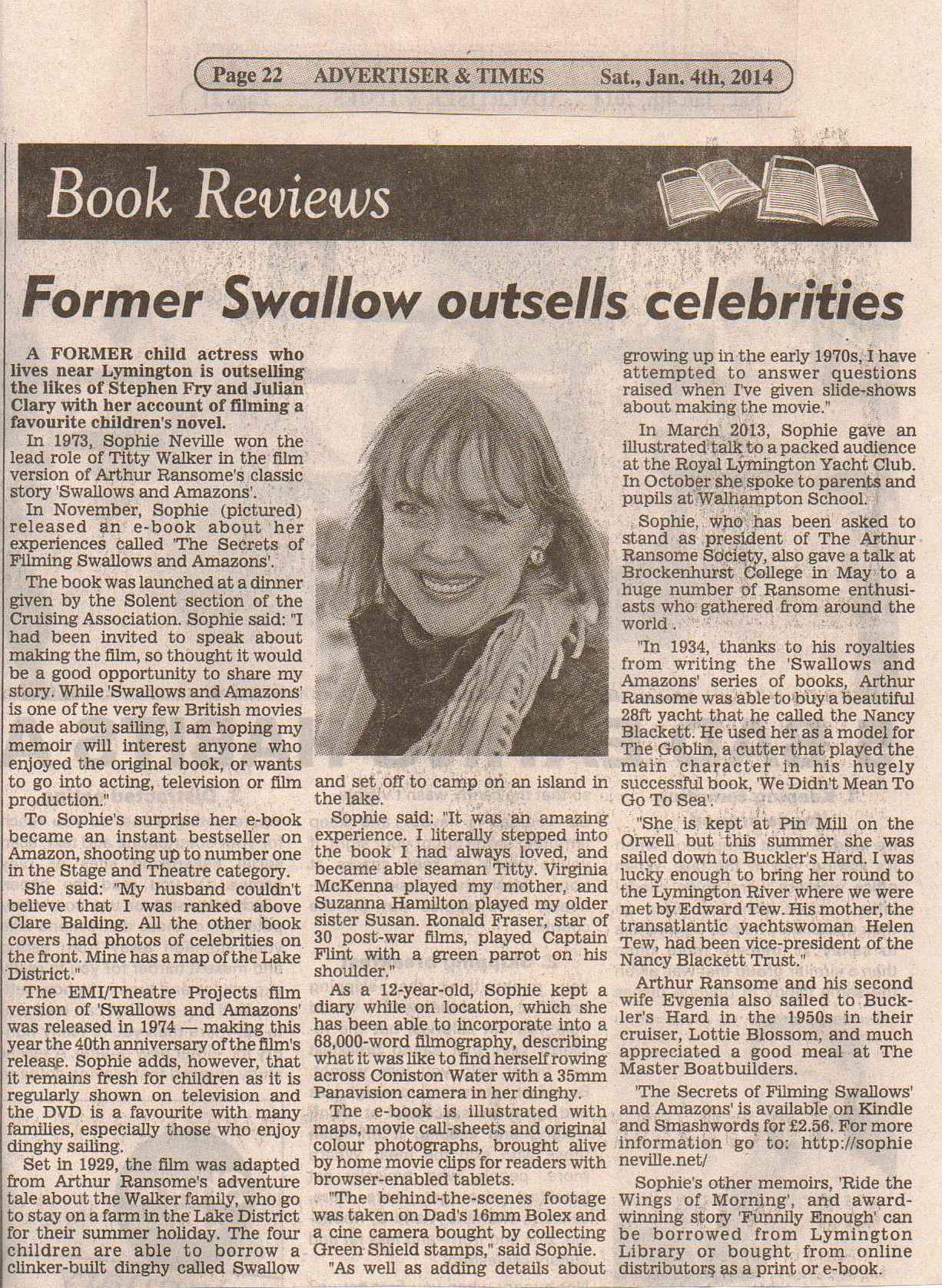
There were rather over-excited headlines in the Times and Telegraph when the ebook was launched but they only spoke of the legendary drinking of Ronald Fraser. Please don’t worry – there is nothing X-rated about the book – it is just the price one pays for half a page in a daily newspaper, especially since it came out on a Saturday.
The ebook has been doing well in the Amazon charts and hit Number 1 in the category ‘Stage and Theatre’.
A preview of what the book holds in store can be watched here:
Very many thanks to all those who have left customer reviews on Amazon. It is always exciting to find out how the book has impacted others, especially those who love the Arthur Ransome books.
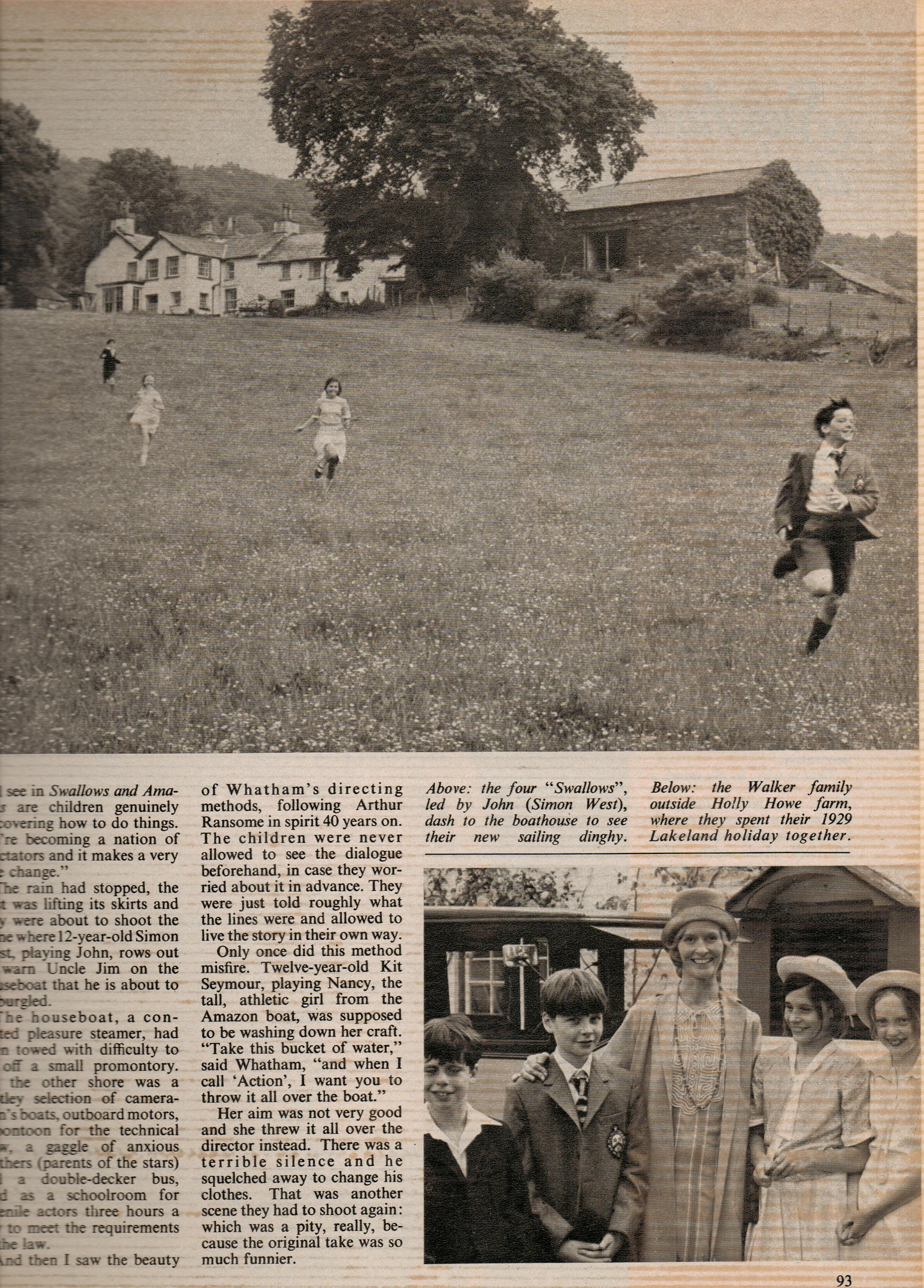
Kit Seymour, Stephen Grendon, Sophie Neville, Lesley Bennett, Virginia McKenna, Simon West Suzanna Hamilton and the station master of the Haverthwaite Steam Railway in Westmorland, appearing in the April edition of Homes and Garden 1974
Newspapers are read one day and on the kitchen floor the next. Back in 1974 they might have been used to wrap up fish and chips. Either way, an article in the ‘paper is soon forgotten. Not so a feature in a magazine. They tend to hang around in hotel foyers and doctor’s surgeries for waiting to have their pages turned for months, if not years. The judgement they cast on our movie was important.
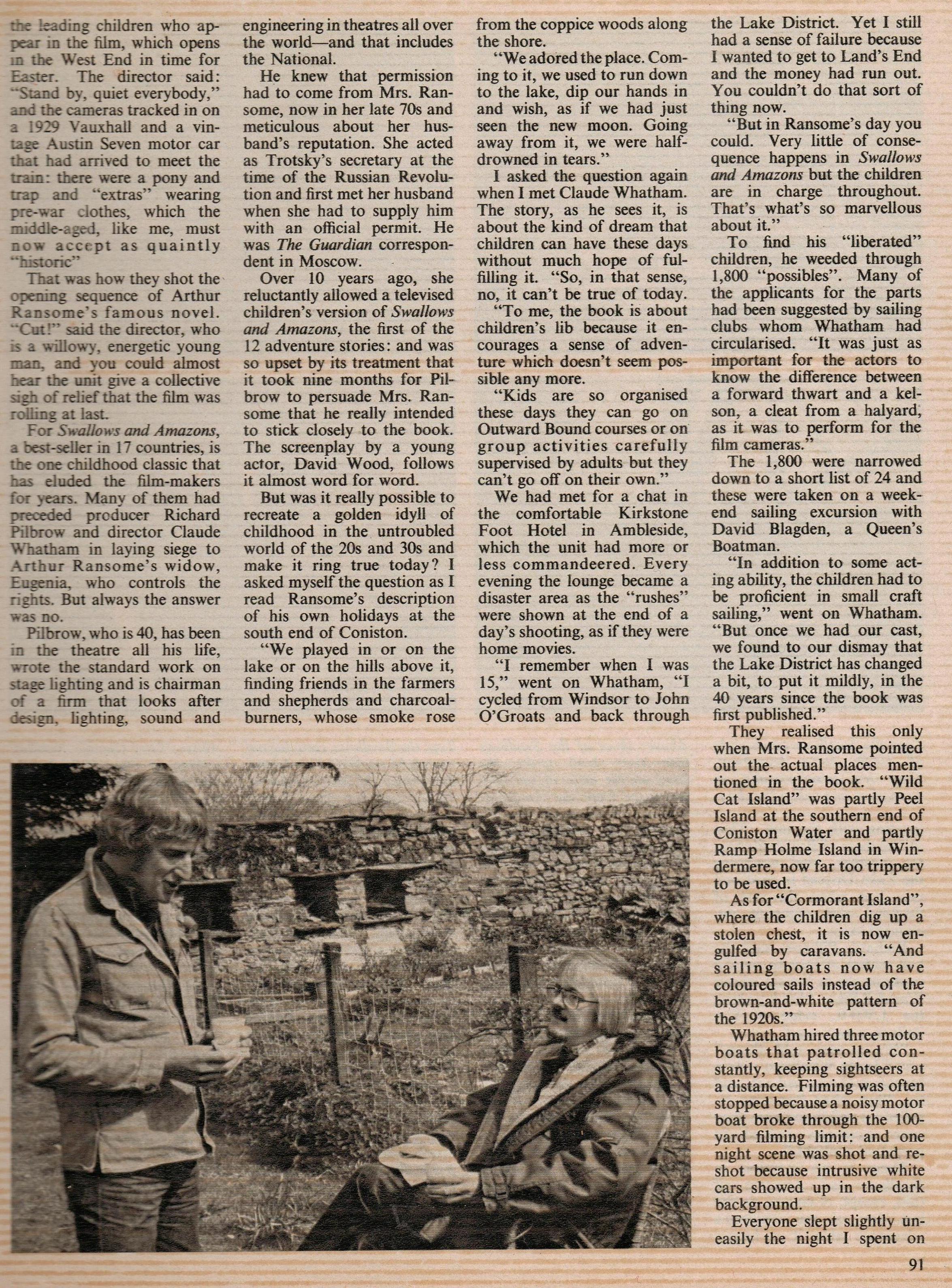
Director Claude Whatham and Producer Richard Pilbrow on location in the summer of 1973 in the Lake District
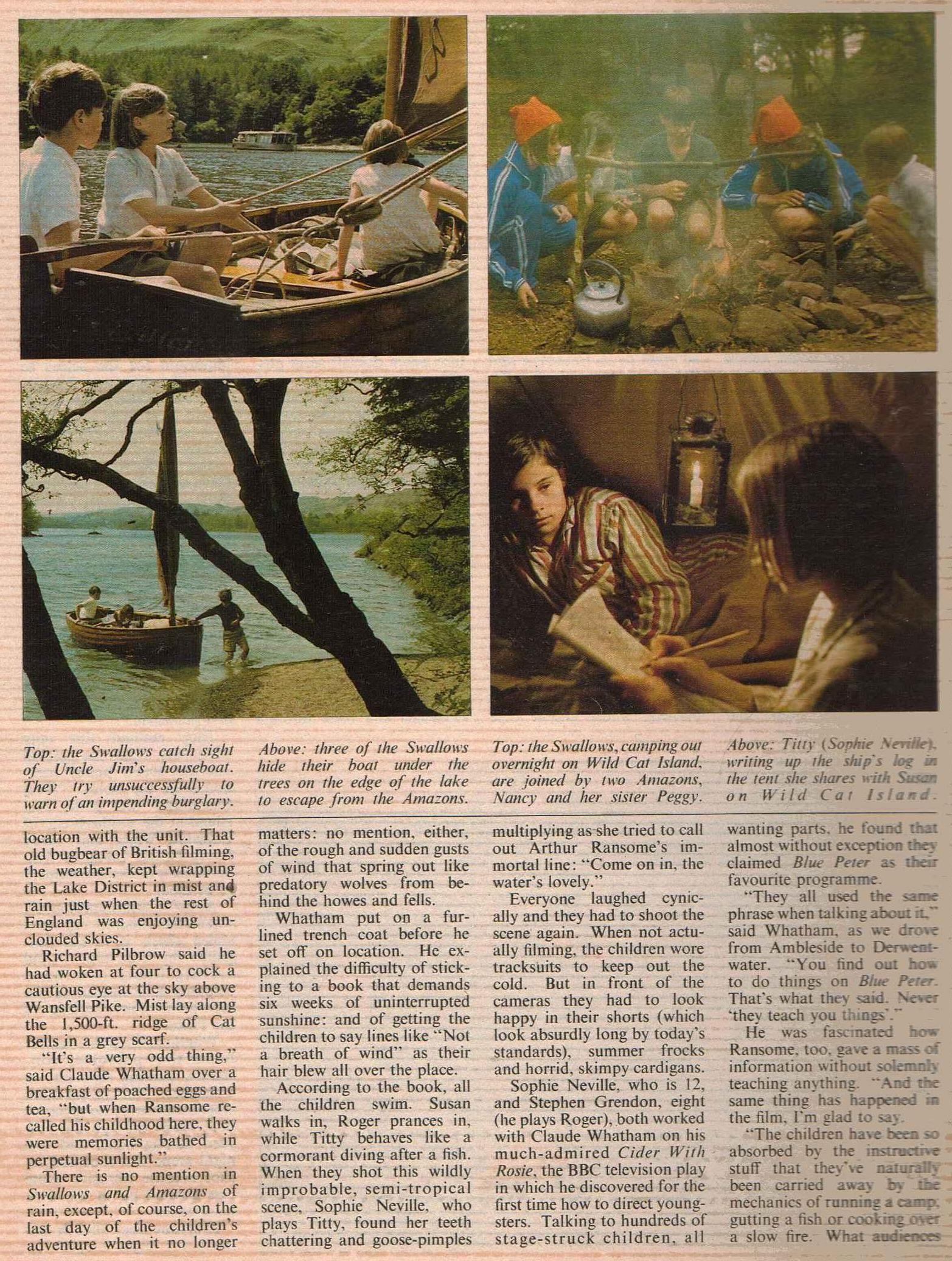
To my surprise I found an article about how we spent the summer of 1973 in ‘Homes and Garden’ magazine.
Photographs featuring Simon West, Suzanna Hamilton, Sophie Neville, Stephen Grendon, Lesley Bennett and Kit Seymour in the EMI film of ‘Swallows and Amazons’.
What amazed me was that the black and white photographs taken on the film set had been colour tinted. Please forgive my scanning – the pages were stuck in albums long ago and the images blur at the edge.
Stephen Grendon, Simon West, Virginia McKenna, Suzanna Hamilton and Sophie Neville on location at Bank Ground Farm in Cumbria
Surely she was the journalist also known by her married name of Elspeth Huxley, the author who had written The Flame Trees of Thika and so many other books? She wasn’t quite right in saying the film was shot entirely on location in the Lake District, but still. She was not to know about our day at Runnymede.
Simon West, Sophie Neville and Suzanna Hamilton appearing in The Tatler
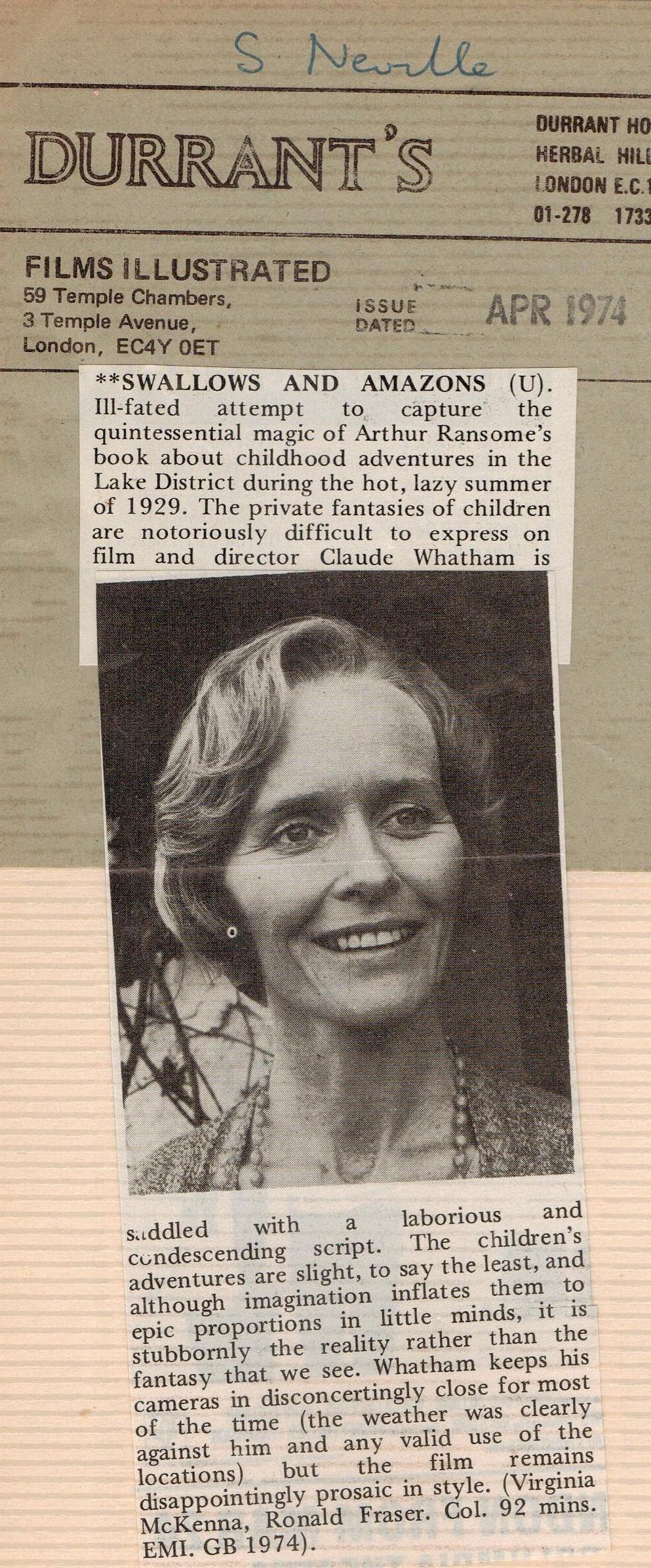
Virginia McKenna in an article in Films Illustrated, April 1974
We were in both Punch and The Sunday People. My mother saved them all, scratching lines alongside the paragraphs in which I was mentioned.
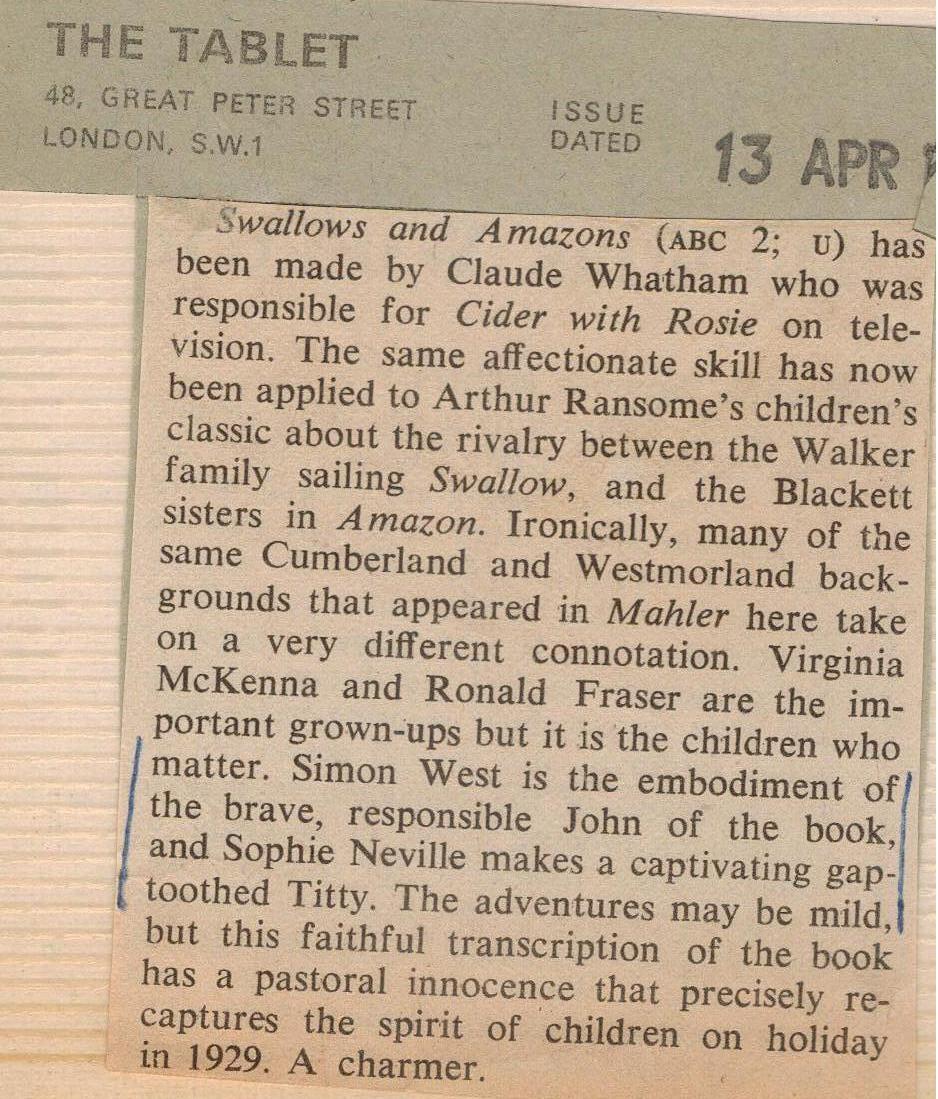
and The Tablet.
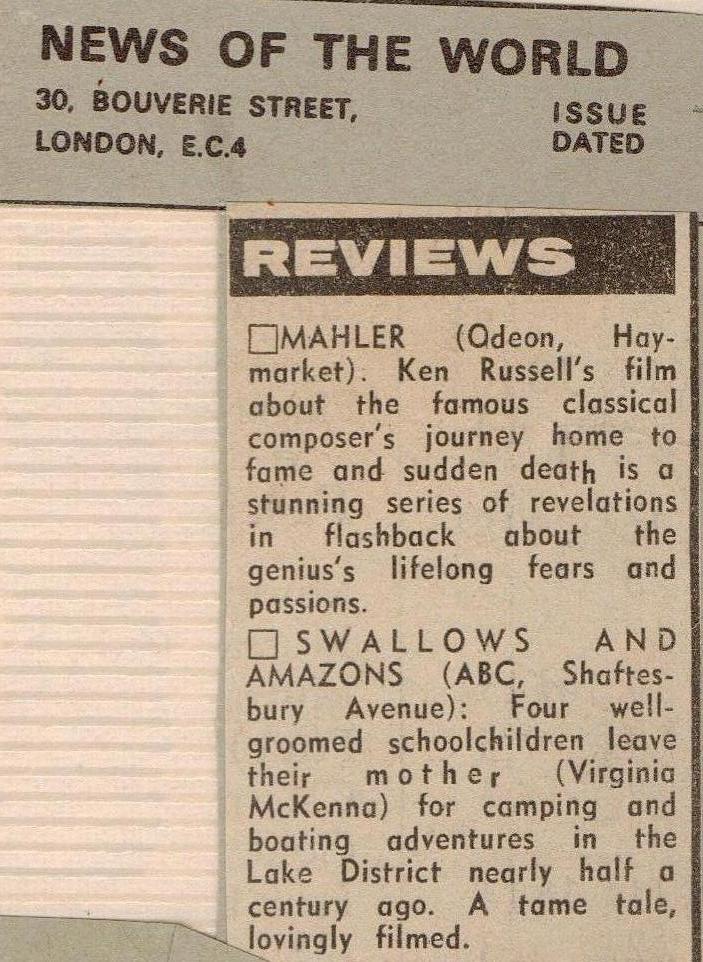
What’s On and the News of the World:
Kit Seymour and Lesley Bennett sailing Amazon on Derwentwater
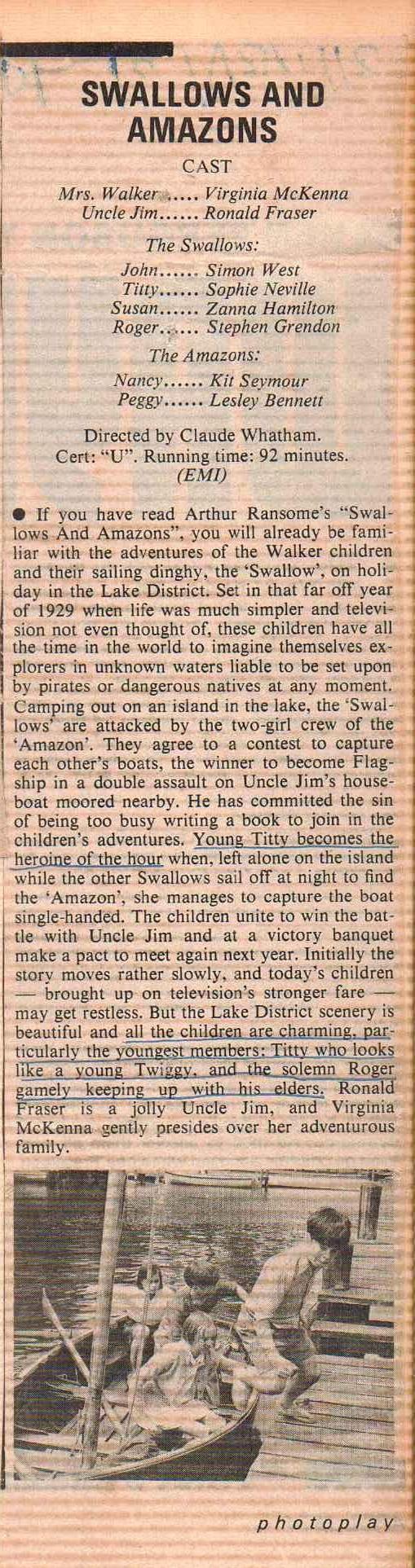
The April addition of the film fan magazine Photoplay, which featured Steve McQueen on the cover. It cost 20p in those days.
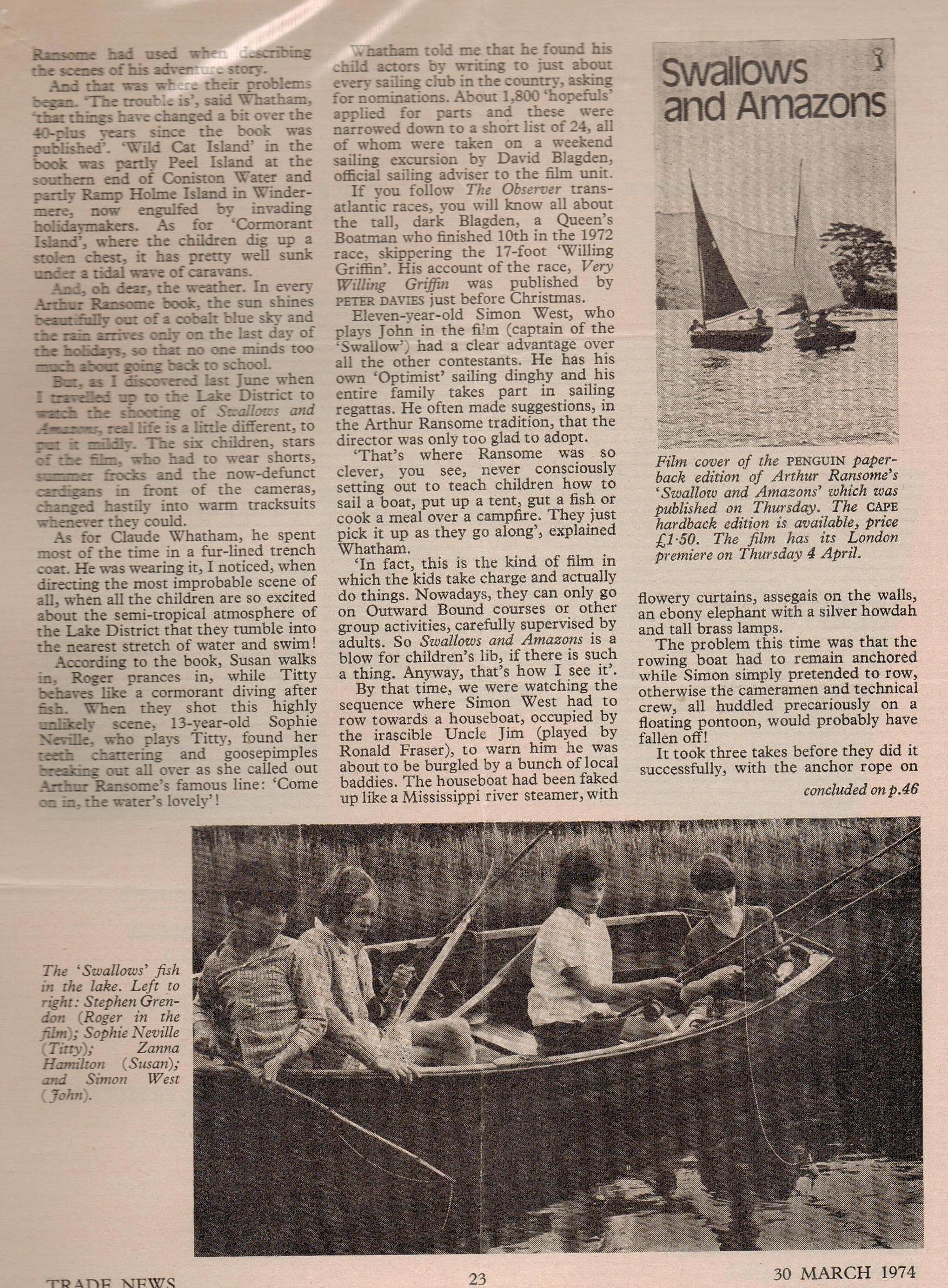
and a publishing magazine I hadn’t heard of called Smith’s Trade News ~
Virginia McKenna eating a banana with Claude Whatham outside the catering bus with quite a good photo of Swallow wired to the camera pontoon
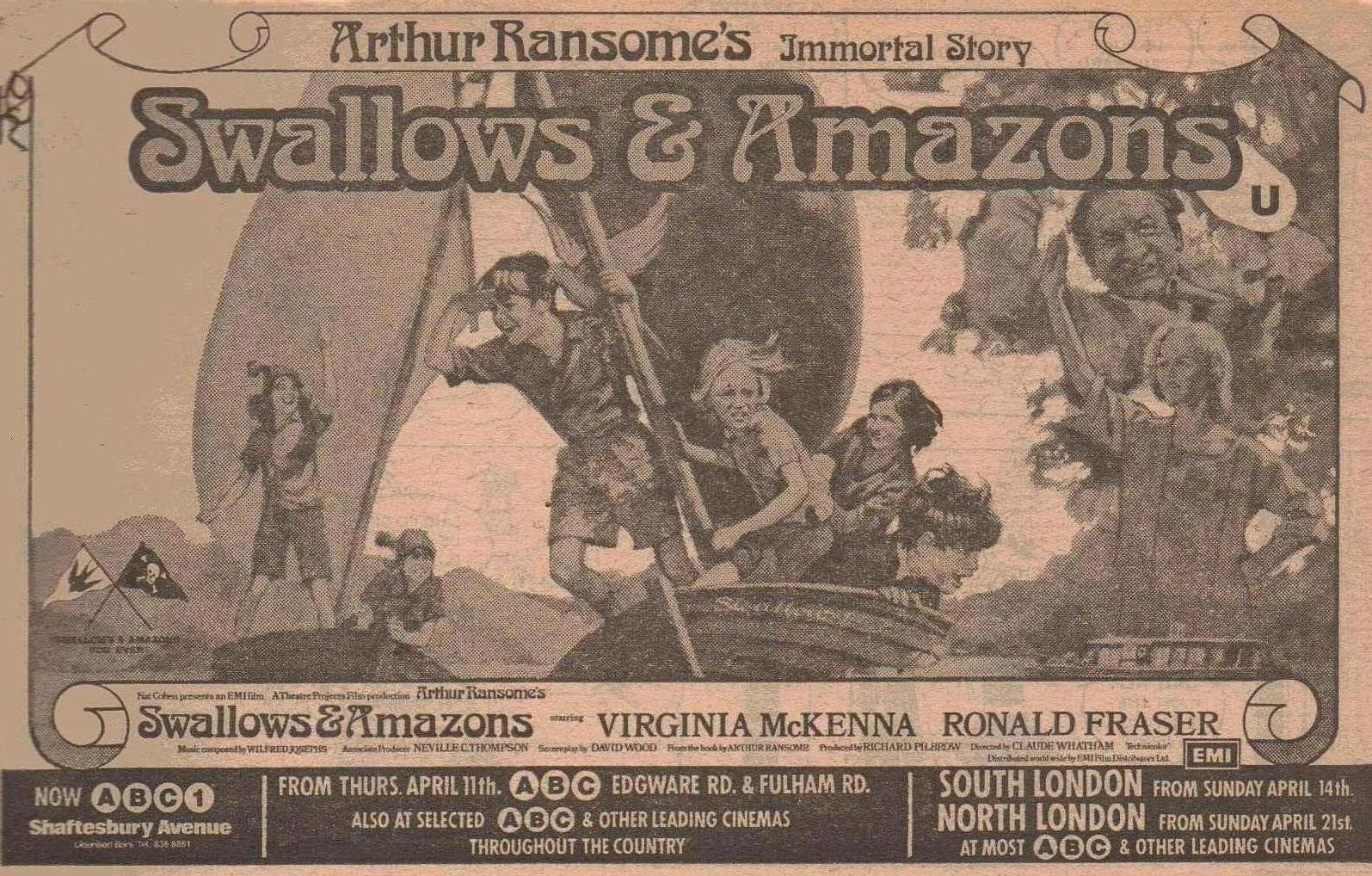
Kit Seymour, Lesley Bennett, Simon West, Sophie Neville, Stephen Grendon, Ronald Fraser and Virginia McKenna on the newspaper advertisement for ‘Swallows and Amazons’ released in April 1974
A school friend of mine sent me this advertisement. She had found it in a teenage magazine we all read at the time called Tammy and Sandy. There was a similar one in The Sunday Times newspaper – and no doubt many others. Film posters hung in the London Underground and at cinemas throughout the country. Swallows and Amazons was to come out, on general release for the Easter Holidays.
My mother subscribed to a press clippings agency called Durrant’s ~ Durrant’s of Herbal Hill London ECI ~ who, for a fee of £50, sent her all the articles written about the film. The Prince of Wales told a friend of mine that he never reads the newspapers. I know why. Reading about yourself is upsetting – or can be, especially if the facts are incorrect. My mother didn’t mind. She highlighted the bits about me, filling four albums.
After entertainingthe Daily Express so nicely in the Lake District this is what they printed about the film. I would think this is written by Ian Christie (1927-2010) the jazz clarinetist, who had formed the Christie Brothers Stompers with his brother Keith, and became a member of Humphrey Lyttelton’s band. He worked as a theater and film critic for the Daily Express for twenty-six years. Born in Blackpool and a habitue of Fleet Street pubs he held fiercely Left-wing views.
‘Kids won’t swallow this watery old tale’ was not good publicity. The same black and white photograph of me appeared on the front cover of The Daily Telegraph with the title ‘One Swallow won’t make a Summer’. Were they right? The Scotsmansaid:
The Scotsman ~ 1st July 1974
However, Russell Davies of The Observer, another jazz musician who now presents Brain of Britain on BBC Radio 4, saw that the film of Swallows and Amazons had niche. (If you click on the article it will enlarge).
Jack Woolgar, Simon West, Suzanna Hamilton, Sophie Neville and Stephen Grendon in a review by Russell Davies in The Observer 7th April 1974
Others recognised it as an innocent nostalgia trip ~
Others just loved it:
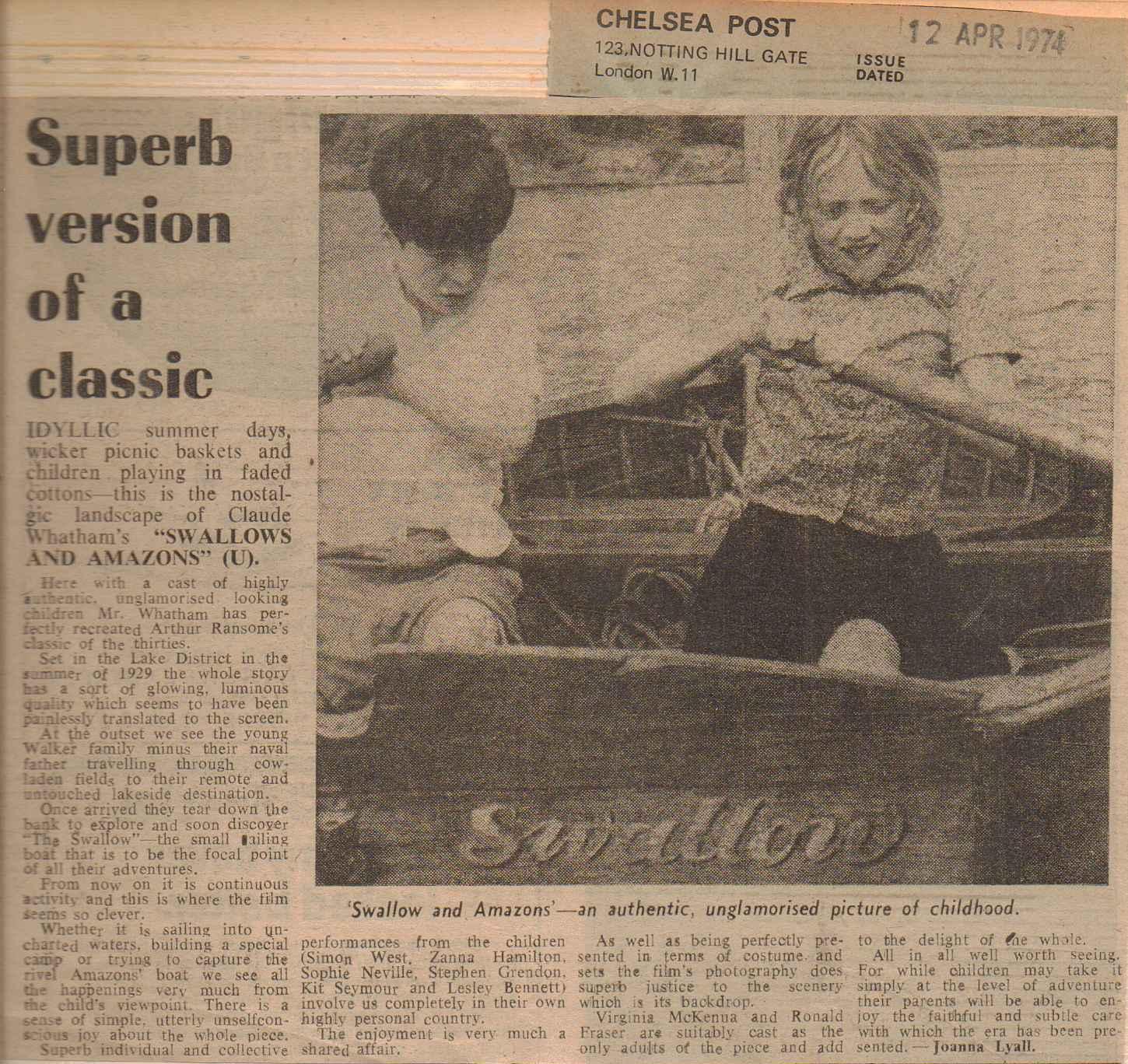
Stephen Grendon and Sophie Neville appearing in Chelsea Post 12th April 1974
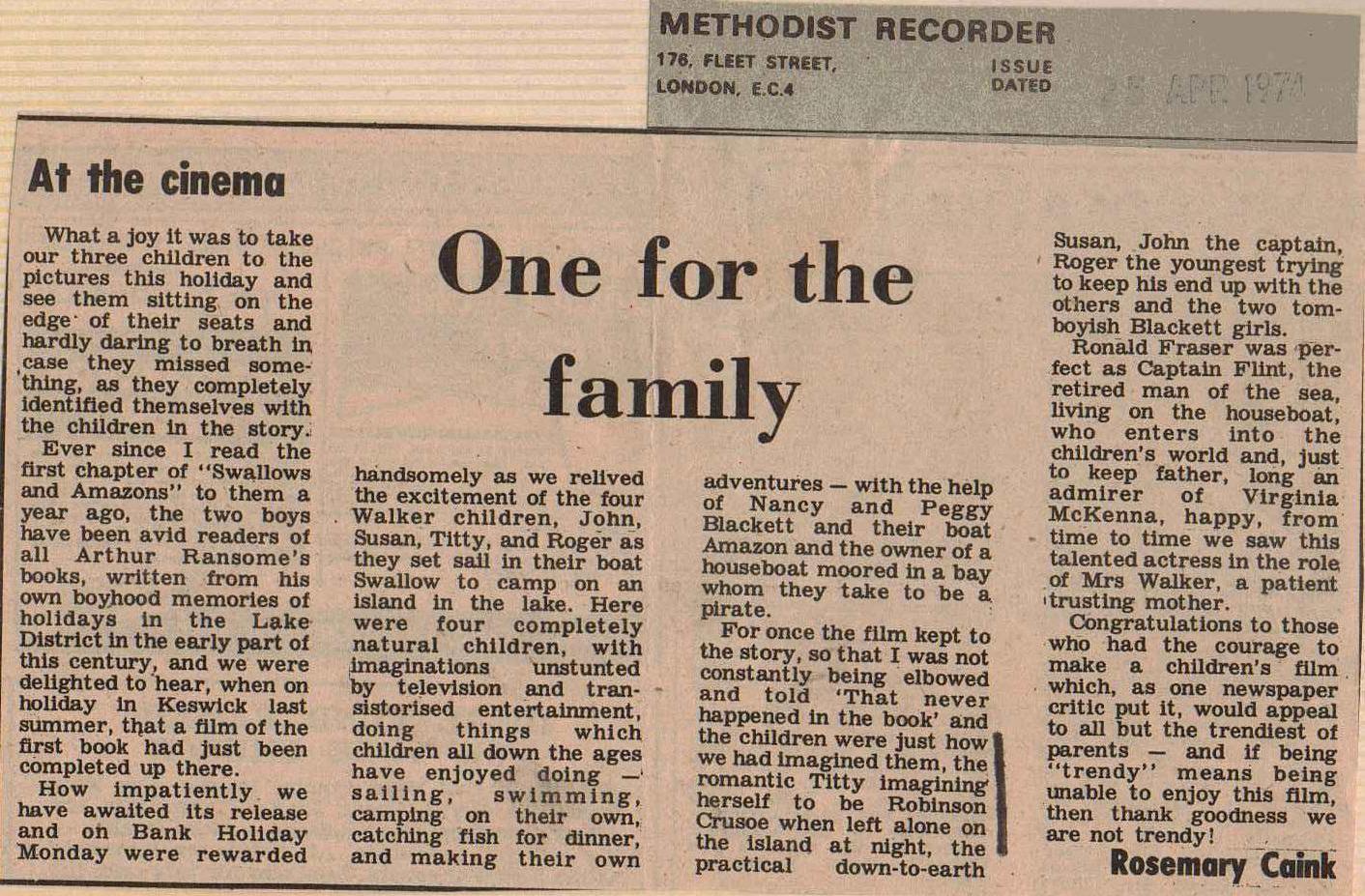
Rosemary Caink said that her three children, ‘completely identified themselves with the children in the story.’
My favorite article wasn’t found by Durrant’s. It was written in The Brownie and must have been sent to me by a fan.
Suzanna Hamilton, Stephen Grendon, Sophie Neville and Simon West, appearing in an article published in ‘The Brownie’ ~ 27th March 1974 Please click on the article to find out more about the Brownies.
I have many more articles ~ please let me know in the Comment box if you would like to see more. Otherwise I will move on to write about how the public responded and what happened next.
Suzanna Hamilton, Stephen Grendon, Leslie Bennett, Simon West and Kit Seymour sailing the streets of London on polystyrene waves.
Our first major public appearance for the promotion of ‘Swallows and Amazons’ was The Lord Mayor’s Show . For the first time since the filming we climbed into our costumes and then into Swallow who had been mounted on low-loader. Afloat on a float, we made ready to sail through the City of London.
Sophie Neville, Suzanna Hamilton and Lesley Bennett
It must have been early November and was so very cold before we set off that we needed to keep our own coats on. We were anxious this would spoil things for people. I’m sure it would not have made much difference. Did anyone know who we were? The film hadn’t come out. We were riding on the wave that Arthur Ransome and his books were so well loved by the people of our nation.
Stephen Grendon, Suzanna Hamilton, Lesley Bennett, Simon West, Kit Seymour and Sophie Neville in Swallow. What is the building behind us?
What was fun, if a little odd, was that it was the first time, indeed the only time, that the Swallows and the Amazons had been in a dinghy together. As we were taken through the streets of London passers-by started to wave at us and we waved back. Soon it was waves all round. Being Titty, I had Swallow’s flag to fly. John let Nancy take the tiller.
Kit Seymour, Sophie Neville, Simon West and Suzanna Hamilton together with huge crowds of Londoners ~ photo: Daphne Neville
We were amazed to find huge crowds of people had gathered and that it was all rather fun. I don’t know why but Sten must have joined my mother on the pavement by the time this shot was taken. I can see the back of his head in this next photograph. He is wearing the tartan hat Claude Whatham bought him at Blackpool fun-fair.
Jeremy Fisher Frog was leaping about in front of us, which was rather amazing. With him danced other representatives from the Tales of Beatrix Potter, The Royal Ballet’s wonderful feature film that also came out in 1973/4. We were marking the 35th anniversary of EMI, whilst bringing the Lake District to London Town, which is something we all could celebrate.
Tamzin Neville meeting Mrs Tittlemouse
Since we didn’t have to talk to anyone, we were able to enjoy being involved in the pageant, which included so many icons of British Life.
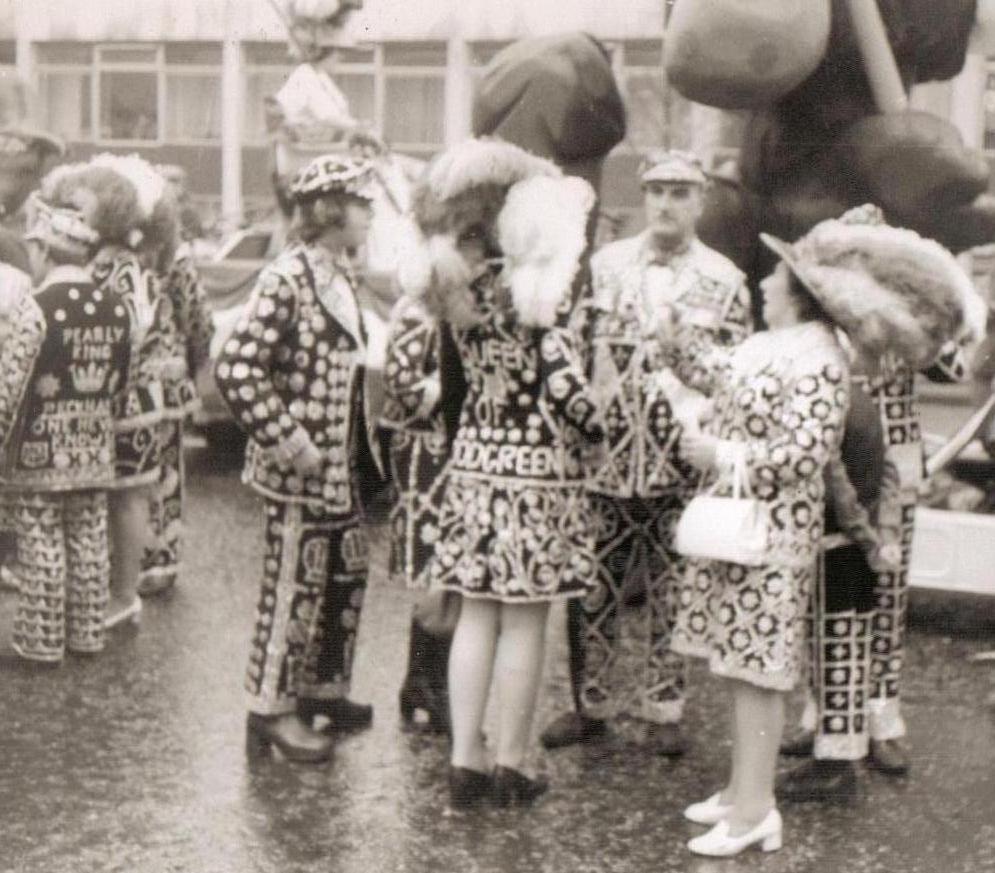
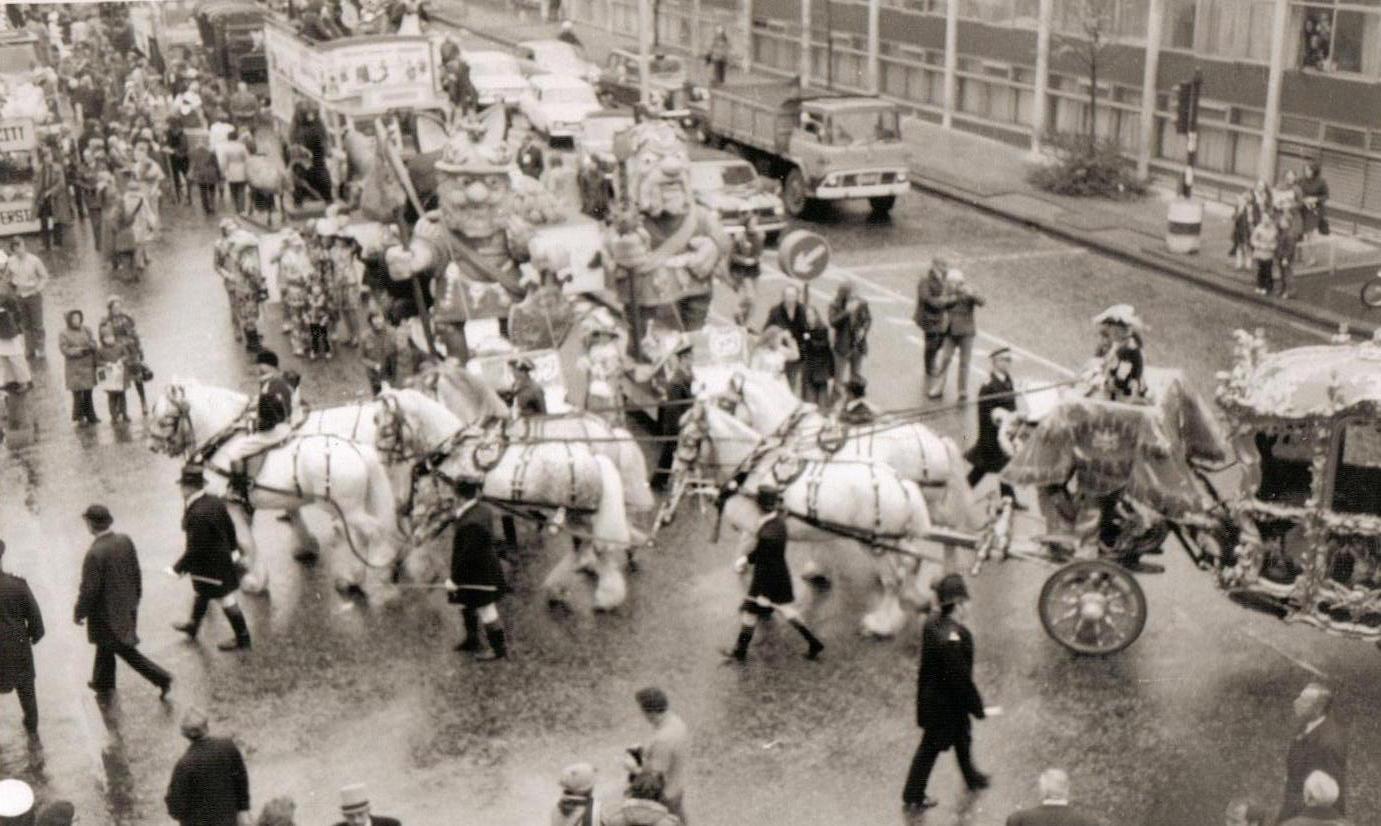
I hadn’t met a Pearly Queen before, but there was a whole clan of them in their glorious suits, lovingly embroidered with mother of pearl buttons. I resolved to collect enough to adorn my own jacket. My favorite view was of HM the Queen’s gold state coach pulled by her lovely white horses, six in hand. I’d been to see them at the Royal Mews when we came up for my first interview at Theatre Projects offices in Longacre when I first met our director Claude Whatham.
My mother took a photograph of the Queen’s Drum Horse. Much later she found that he was a stallion, on offer as part of a British Horse Society breeding improvement scheme. He was brought over to service her Irish mare Gerty. The result was a lanky skewbald called Nimrod, an enormous gelding who Andrew Parker Bowles rejected on behalf of the British Army. This proved an error. Like most heavy horses Nimrod was just slow to grow. He eventually became a national dressage champion, although not in our hands.
The Queen’s drum horse who sired our foal, Nimrod
We have one last photograph which shows that the float in front of us depicted an EMI film crew, with 2K lights, a camera and technicians. It is studing this photograph that made me feel that we were not in Swallow as the transom seems so differnet. I don’t suppose anyone else noticed.
Funnily enough I was in a boat for the Lord Mayor’s Show this year. We rowed up the Thames in the Lord Mayor’s procession on Saturday 12th November.
I am on the crew of the Drapers’ Barge, Royal Thamesis a 33 foot shallop, which I last rowed on the tideway for the re-creation of Nelson’s funeral covered by Sky TV. You may have seen her taking part as the in the Queen’s Jubilee Pageants. We have been asked to take part in the procession of boats that heralds the Lord Mayor’s Show this coming November.
The Drapers’ Barge ‘Royal Thamesis’ taking part in the Lord Mayor’s Show
This colour footage shows various aspects of the Lord Mayor’s procession in 1973 including the Queen’s Gold State Coach built in 1762 and a float with Daleks, which must represent Doctor Who, a series I worked on about ten years later when at the BBC.


























 Sophie Neville