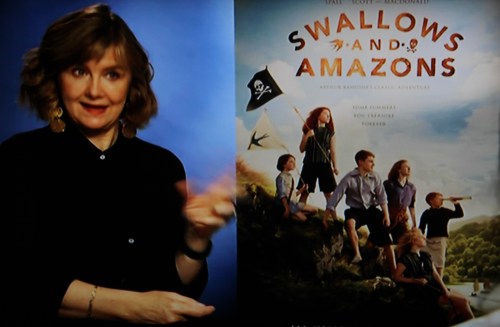
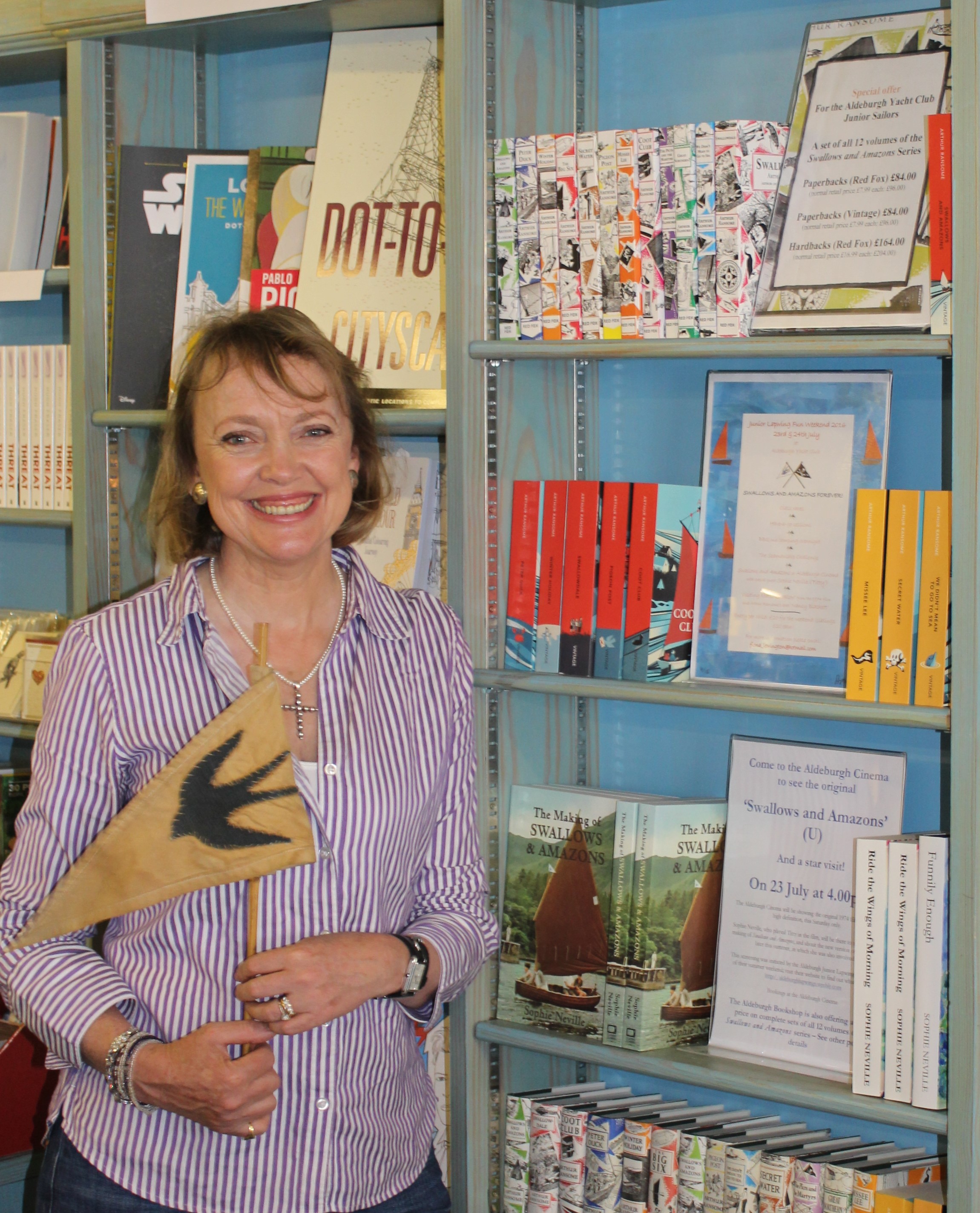
As president of The Arthur Ransome Society, I am keen to promote ‘Swallows and Amazons’, emphasizing the aspect that children today can enjoy the outdoor activities advocated by Arthur Ransome back in the 1930s.
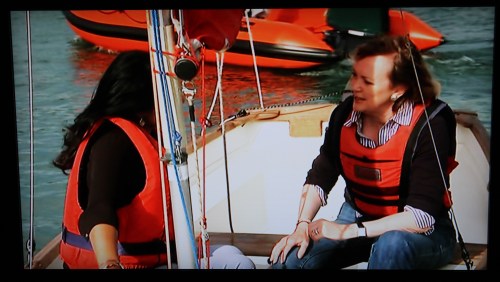
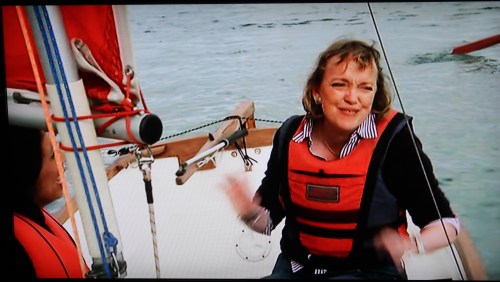
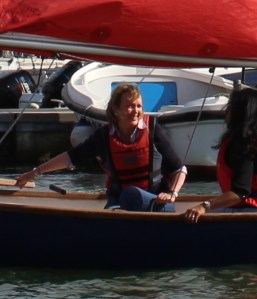
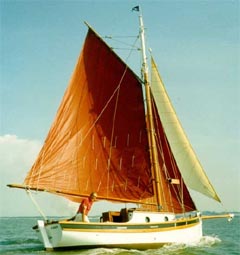
ITV reporter Nina Nannar bravely came out sailing with me in a Scow, rigged like Swallow with a balanced lug sail, to experience the excitement of letting the wind take us along at speed.
When it came to the evening News, ITV showed clips of the movie of ‘Swallows and Amazons’, launched in August 2016.
The item was also shown on the News in New Zealand. A viewer wrote in saying:
‘Great to see a full 3+ minutes about the new S&A film on NZ TV news tonight.Sophie Nevilledid a great job of promoting the value for modern kids to get out on the water or under canvas.’
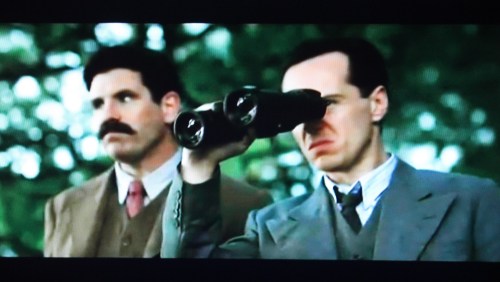
The 2016 movie stars Ralph Spall, Kelly Macdonald & Andrew Scott, seen here spying on Captain Flint.
A clip from ‘Swallows & Amazons’ (1974) starring Virginia McKenna
in which I played her daughter, Titty Walker or rather Able-seaman Titty, was also shown.
They then showed children today learning to sail, unaccompanied by adults.
Guy Willson, a reader from Papua New Guinea, has written to say: ‘I have read your book and I really liked it. I could see behind the scenes and often read between your lines as well.’
‘When you were making the movie (in 1973) I was on my way to Norfolk Island as a starting point of my adventures in the South Seas; so I never knew of the release of your film until much later when I had children of my own that had reached the age to go ‘avasting’ and ‘timber shivering’, when we were living in Rye in the 1990’s.’
‘Some years ago I restored a 13ft clinker dinghy and after adding a false keel, added a standing lugsail and trailed her up to Coniston for my children to sail…I had in mind an article from Classic Boat on the Swallow, how the Altounyan children preferred Swallow as a boat because they could stow more things in her and she could still sail well. I had noticed on a drawing in the article that Ransome had given her an extra 2 or 3 inches of false keel and this helped tremendously in reducing her leeway. I added a piece of oak to do the same thing but gave her an extra 9” aft and planed it down to a feather edge forward so the she would go about a bit easier. Well, it worked and Eaglet would have done the original Swallow proud.’
Swallow – the 12′ dinghy used in the film
‘If you would permit me a little correction: you described the rig as being gaff rig, but this is not so. Both the boats, originals and the ones you sailed were in fact luggers. The nearest thing to a gaffer among the luggers is the Gunter Rig which has jaws at the front of the yard but is hauled up by a single halyard. You can see this in the Mirror dinghy (in truth it is about halfway between the two). However the lug rig of Swallow is known as a ‘standing lug’ and it can be used to go about freely. After hauling up the sail on its traveller; the peak of the yard is raised by the downhaul line (usually attached to the bottom of the boom). This tightens the luff of the sail and lifts the outer end of the boom as well giving the best efficiency to the sail.’
A gaff rigged cutter
‘Lugsails were the working sails of England for most boats less than 60ft but they were usually rigged with a ‘dipping’ lug as the mail sail and a standing lug aft. This dipping lug had to be dropped and the yard hauled round behind the mast every time they went about. It was a powerful sail and they found their best expressions in the three masted Bisquines which used to raid British shipping in Napoleonic days. You can still see them at the classic boat events at Douarnenez and Brests, where I took the gaff schooner Soteria in 2006.’
Soteria at Douarnenez
‘If you had had a gaff rig you would most probably have needed a jib to balance it (unlike the American catboats which have their masts right up in the bow, not even a space for the Boy Roger on those! Thanks for writing a lovely book which I will pass on to my daughter.’
“X marks the spot where they ate six missionaries”
‘You did such a grand job as Titty and I am not really surprised to find that you are a bit of a wordsmith. I am a missionary (uneaten) in Papua New Guinea and we are planning to sail back there in our steel schooner see www.livingwatermission.org On our return we will be calling in at Erromanga in Vanuaatu where ‘x’ was the spot where two missionaries were eaten. Recently the descendant of one of them, John Williams, went to Erromanga for a service of reconciliation.’
If you have noticed any errors in ‘The Making of SWALLOWS & AMAZONS’ please use the Comments box to let us know so that we can make corrections! We might be able to bring out a third edition. Readers who already have a Kindle edition will be able to update it free of charge.
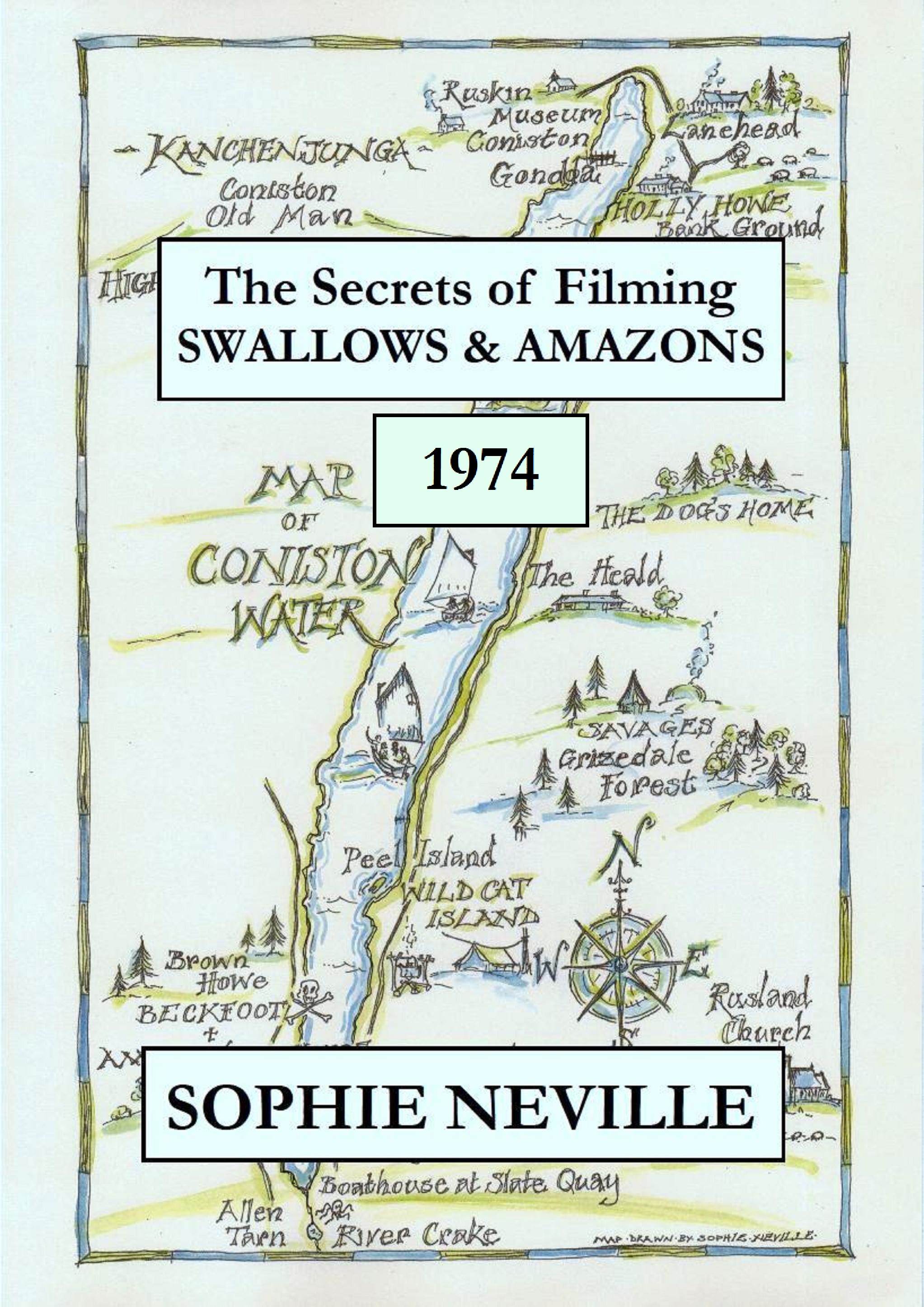
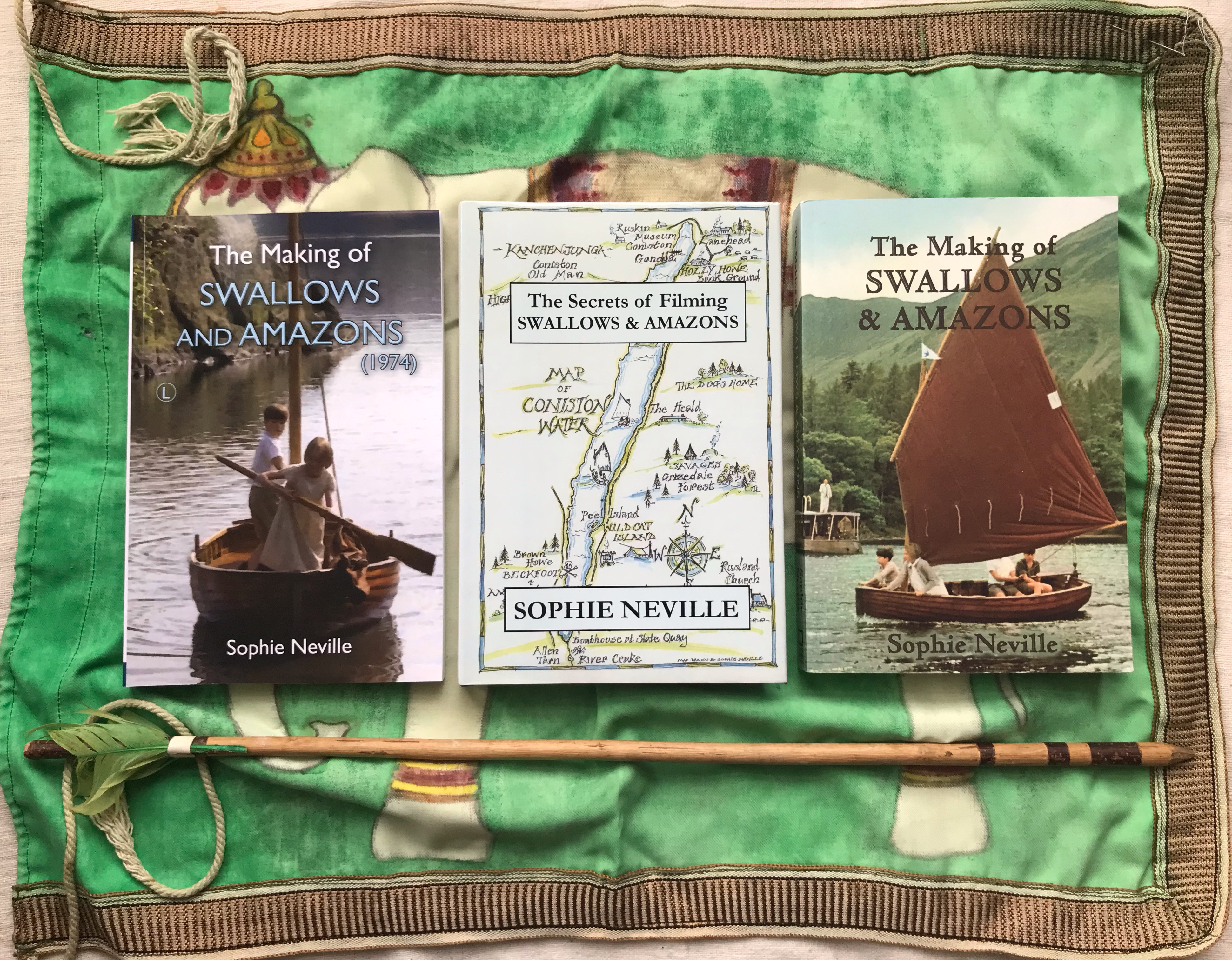
Different editions of ‘The Making of Swallows and Amazons (1974) by Sophie Neville’
‘I’ve just read this delightful ebook – thank you so much for writing it! …I hope you will deservedly enjoy hearing that I absolutely adored the film of Swallows & Amazons and learned your name, along with all of the other actors and actresses off by heart from the LP record, which I played and played.
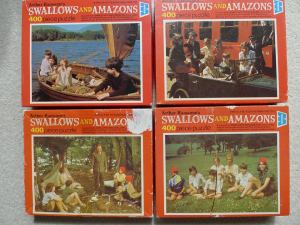
‘I also had the jigsaw of the campsite scene, which I thought was an incredible piece of merchandising (and it was, for its day).
‘I read my first Swallows & Amazons book (Swallowdale, but never mind) in the summer holidays when I was 7, and rapidly recruited my best friend Linda to being a fan. One of our mums spotted that the film was on at our local cinema in Dundee that Christmas, but the next day was the last date it was showing – so we were collected early from our school Christmas party, so that we could make it in time. We were in heaven. The next Easter, our families took us to the Lake District (staying in Coniston) for the first of many holidays there. We remember “finding” Gondola submerged in the reeds, and sailing with our dads over to Bank Ground and seeing the two dinghies named Swallow and Amazon. We soon found a favourite picnic on the shore close to Peel Island, and in later years, my dad and I rowed over to the Island in a rubber dinghy, which was tremendously exciting. Fascinating to hear about the artificial shingle beach!
I was interested to read that one of your qualifications for getting the job was that you could row, and that you’d practised at home in a Thames Skiff. Many thanks again for giving me such a delightful film to immerse myself in as a child. ‘Helena Smalman-Smith
‘We love your book and tales of filming.’ Love Ambleside – on Twitter
‘…the girls adore your film of Swallows and Amazons. In fact, I fear it is thanks to your film rather than the book that my Swallows and Amazons camping weekend was full to bursting. I also have friends in Suffolk who would happily hot foot it across the country with their three children to hear you!’ Grainne Dennison (teacher and Ransome fan).
‘My daughter is 11 today & this is her favourite present! Titty was always Moira’s favourite character from the books AND the film, she is thrilled!’
‘My daughter LOVED your book! She couldn’t help sharing gems & finished it in a few days on hols. Magic! My turn now!’
‘I have been hesitating to write, but I do want to tell you how much I enjoyed reading ‘The Making of Swallows and Amazons’. It made watching the film so much more enjoyable. I came to Arthur Ransome late in life, but I’ve read all of them, and have a complete collection of the ‘Swallows and Amazons’ adventures.’ Mark Cheng, Bedford
‘I really love the Swallows and Amazons movie. I actually went to see it at the pictures in London, with my family when it first came out, but I was only about 4 or 5 years old, so I don’t remember much about that day. But of course I have watched it many times over the years and since I have the DVD I make a point to watch it at least once every year. You are my favourite as you are so charming!!’ Robert Newland, Dorset
If you have a memory of the film, do leave a comment in the box below.
Lesley Bennett, Suzanna Hamilton, Stephen Grendon, Sophie Neville, Virginia McKenna, Simon West and Kit Seymour gathered at Bank Ground Farm above Coniston Water
You can read the first section of the memoir free of charge on Amazon here.
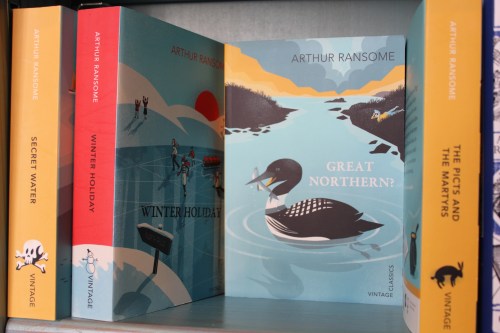
There are now three different editions available to purchase online:
Different editions of ‘The Making of Swallows and Amazons (1974) by Sophie Neville’
This question has recently been typed into the Google search engine. It has to be said the ‘Swallows and Amazons’ is a pretty abstract title. What does it mean? Is it about South America?
The national press brewed a great storm last summer when they discovered that BBC Films and the BFI had changed the lead character’s name to Tatty. When the Daily Telegraph phoned me for comment, I asked if someone had made a spelling mistake. Titty was mistakenly referred to as Tilly in The Times a year before, along with rather an over excited headline:
I’ve received letters addressed to Titty for so long that I couldn’t understand the problem until I typed the name Titty into Twitter. You do not see my face – or anybody else’s. I am not sure if it has been defined by the Oxford Dictionary yet but it seems a titty-tatty is now the term used for a certain kind of tattoo.
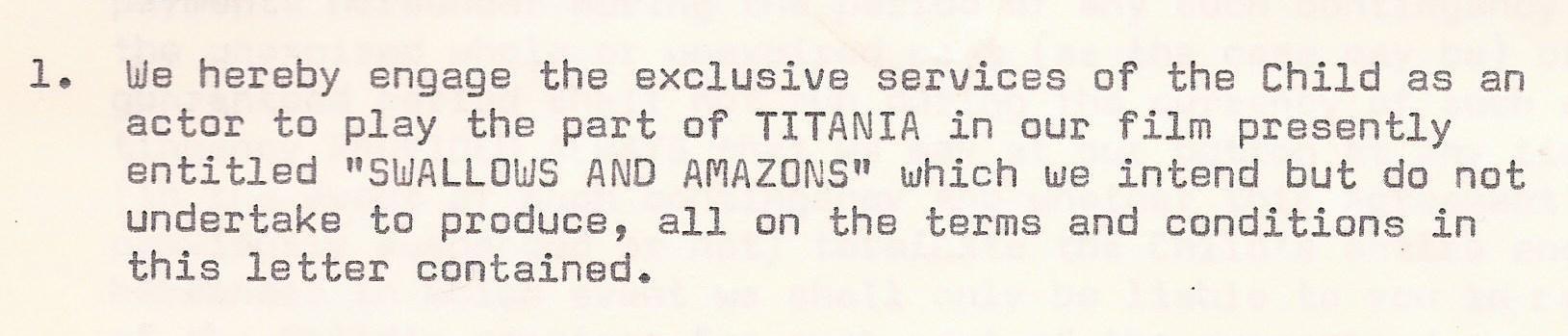
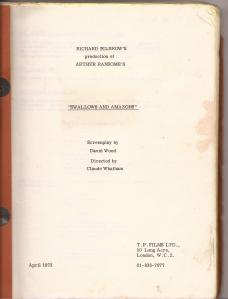
Last week I found an interesting document. It is the original contract that my father was sent in April 1973 when I was offered a part in the film of ‘Swallows & Amazons’. It doesn’t refer to Titty at all:
This was the reason why my mother suggested I wrote the name Titania Walker on the front of the ship’s log which you can see if you watch the movie closely. Why Theatre Projects used the classical name I do not know. It could be argued that ‘Swallows and Amazons’ contains traces of Shakespearean influence but Arthur Ransome insisted the name Titty wasn’t short for anything.
People often ask how much I was paid for appearing in the feature film. The contact states, ‘We…
This period refereed to the seven weeks spent filming on location. I paid another £10 a day for dubbing the film and for a pick-up day when we filmed a scene in Surrey. Although publicizing the movie was more demanding than being on location we were neither licensed or paid. I did receive a book token for promoting EMI Films at the Lord Mayor’s Show.
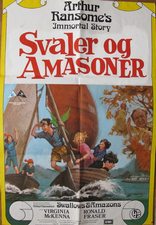
Dubbed it was – into a number of languages including French, Czech and Norwegian:
The Norwegian version ?
People imagine that we receive residuals when the film is sold abroad or broadcast on television but we actors are only due a fee if our image is used to advertise a product. This is a few years old but does it count?
Or could this? I saw the image used in a TV commercial with my own eyes, so I’d love to know.
When interviewed aboard the yacht Ransome bought with his royalties, Taqui Altounyan said that on receiving a new copy of ‘The Swallows and The Amazons’, as the first edition was titled, her family were also thrown by the abstract title, wondering if it was about South America. It could be about migrating birds.
You can see Anita Singh’s article that sparked up international debate last summer by clicking here The juxtaposition of the photos is so naughty, but brilliant of course. I’m the one with the telescope.
David Stott has written in to say, “When l got the job driving for ‘Swallows and Amazons’ l think I took over the production car when Jean McGill started driving you children around in the mini-bus.” This must have been in May 1973 when the original film of Arthur Ransome’s classic book was being made in Westmorland.
David has all sorts of memories of filming ‘Swallows & Amazons’ in the Lake District that I knew nothing about.
“Jean mentioned that she took Ronnie Fraser for an early morning glass of champagne to get him going. I remember having to take him to the Lodore Swiss Hotel in Borrowdale while filming on Derwentwater. He would order what he called, ‘A Frazer’, which was some sort of vodka cocktail.”
David was only about seventeen at the time. Driving Ronald Fraser around must have been something of an eye-opener.
“I remember bringing him back to film ‘walking the plank’ and he was very drunk at the time. Expect he needed it for the cold water. He could be a little difficult when he had had a few.”
“I was rather star struck when l was driving Virginia McKenna,” he admitted. “On one occasion I had to drive her from the farmhouse on Coniston to Grange railway station. She was telling me all about filming ‘Born Free’ with the lions and I drove a bit slowly as l was enjoying her company. We arrived rather late and l had to throw her and her luggage onto the train just as it was leaving.” I asked Virginia about this but she couldn’t remember ever being late for the train. I can only imagine that David must have coped well.
“On another occasion I think l had Richard Pilbrow in the car,” he was the producer of the film. “We were driving back from Derwentwater when a cow jumped off a bank and landed on the bonnet, causing quite a lot of damage. I was dreading going back to Browns Motors and telling Alan Faulkener the owner what had happened.” Richard is still alive and well.
David, who now owns Crossways Hotel near Glynebourne, comes from an old Cumbrian family. His grandmother lived at High Green Gate, the farm next door to Beatrice Potter at Hilltop.
“My great grandfather was Farmer Potatoes in the ‘Tale of Samuel Whiskers’. It was sketched from a photograph that my mother still has.” Indeed, there was an article in Cumbria Magazine about Beatrice Potter’s relationship with the Postlethwaite family.
One of our locations – Haverthwaite Station today
“My father was the local joiner in Ambleside. He also kept about 1000 hens and delivered eggs around the hotels at the weekends. My brother and l would often help him on a Saturday morning.” David obviously knew the roads of Cumbria well.
David explained that, although he lived in Ambleside at the time, he has not seen Jean since the filming, so enjoyed reading that I had been in touch with her. “Jean’s Mum was called Girlie and she used to run a nursing home on Lake Road. Jean had a brother who was nicknamed Blondie. We would often have a cup of tea with Girlie in the nursing home kitchen.”
“It’s Jean!” It was Jean McGill ringing from Bowness in Cumbria. She had been our driver and the unit nurse on the film of ‘Swallows & Amazons’ made in the Lake District from May to July 1973, released a year later in 1974.
Jean McGill our unit driver and location nurse with Sophie Neville ~ photo:Martin Neville
“I’ve never seen the film,” Jean declared, “but I loved your book about making it. It brought back such memories.” I urged her to tell me more. “I remember when Suzanna Hamilton cut her hand whittling wood. It was bleeding like anything. I bandaged it up nicely but the director was horrified and made me take the dressing off again.” I think this was when we were in the middle of filming on Peel Island. The accident put an end to our wood carving hobby, which was a shame. We’d been using a Swiss Army knife to make our own bows and arrows with Bob Hedges the prop man.
Ronnie Fraser outside the dining bus on location with a paper cup of champagne
” You children persuaded me to go out to dinner with Ronnie Fraser! Why I went, I haven’t the foggiest. He was a rough character – very coarse.” Ronald Fraser was the movie actor playing Captain Flint. “I used to have to drive him to the local hotel in the mornings and order champagne to sober him up.”
“How would champagne have helped to sober him?”
“I don’t know. He told me it would.”
“I think he’d been divorced for a while at the time.”
“I wouldn’t have married him in the first place,” Jean assured me.
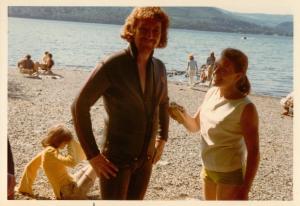
Terry Smith wearing the safety officer’s wetsuit with unit nurse and driver Jean McGill
Jean had been taken on as the unit nurse after the first nurse proved rather out of her depth. I thought she was a State Registered Nurse but she corrected me. She had 26 years experience in nursing becoming a hospital sister but was never an SRN. “I was a driver for Browns (of Ambleside)” and as such was paid to work on the film. “I wasn’t paid to be the unit nurse. It didn’t matter, I wouldn’t have missed it for the world.”
I only found out recently that my mother hadn’t been paid to be a chaperone either, despite the responsibility as well as her legal obligations. It was hardly a big budget movie. Like Jean, she was simply thanked with a bouquet of flowers at the end of the filming.
Jean was one of the few local people who worked on the film throughout the seven weeks we were on location. Her local knowledge made all the difference as she knew the roads well, took short cuts to avoid the traffic and knew the best swimming spots when the weather warmed up.
Suzanna Hamliton, Simon West, Claude Whatham Sophie Neville, Kit Seymour, Jean McGill with Daphne Neville (kneeling) Blackpool, 1973
I reminded Jean about the early 1970s – what we ate and how we dressed. ” I bought a pair of jeans for the first time in my life. It was so hot that I changed into shorts while we were on set. You children took the jeans and stitched a big red heart on the backside.” There was a craze for adding embroidered patches to denim clothing. These were expensive to buy but we persuaded to Sten Grendon’s mother to make red hearts for everyone’s jeans. “It made walking through Ambleside very embarrassing.” Jean sounded as if she was still recovering from the indignity 43 years later. “It mucked me up!”
Jean went on to drive for Mountain Goat Tours in Cumbria and worked in a doctor’s surgery before becoming a registrar for ‘hatches, matches and dispatches’. “I’m a coffin-kicker now,” Jean told me cheerfully. She never worked on another film but kept a copy of the original screenplay and other memorabilia.
Not long after I spoke to her a brown paper package arrived in the post. It contained an envelope with the writing,
FOR THE ATTENTION OF TITTY
‘Still looking for the photographs. Will send to you when I find them. 43 years old? It was this tatty when I got same! Jean.’
And this is what the envelope contained:
Here is Jean in her red top talking to my mother in her Donny Osmond hat:
Since Classic TV Press published ‘The Making of Swallows & Amazons’ in 2014, a number of facts have floated to the surface. The most amazing recollection was one that occurred to my mother.
‘The letter inviting you to come for an interview for a part in the film was addressed to your father. He was working abroad when it arrived. I never, ever opened his mail but something urged me to open that one envelope. It was a good thing I did as he was away for three weeks and we would have missed the opportunity altogether.’ She was amazed by the contents and replied at once, sending a photograph to Theatre Projects. I think it was this rather miserable one of me wearing a Laura Ashley dress.
Sophie Neville in 1972
A date was made to meet the director. I now remember that I was taken up to Long Acre in the West End to meet Claude Whatham very soon after Dad arrived back from his business trip. We walked through Soho and visited a Chinese grocery store on the way home.
Daphne Neville on HTV in 1973
‘I was never paid to work on the set as chaperone,’ Mum told me. ‘Neither was Jane. We were just happy that our expenses were covered but it ended up costing me quite a bit as I had to travel back to Bristol to work now and again.’ She was working for HTV as a television presenter alongside Jan Leeming, who is currently appearing on ‘The Real Marigold Hotel’. For the photo of them both on an HTV West show, please click here
Jean McGill said she didn’t get paid for acting as the Unit Nurse, as far as she could remember, ‘But I wouldn’t have missed it for the world.’
Kerry Darbishire playing Nurse
The most exciting thing was meeting Kerry Darbyshire, who played Vicky’s nurse, at Zeffirelli’s cinema in Ambleside for the 40th Anniversary screening of the film. I learnt to my horror that I had mis-spelt her name in the credits I gave the actors. All I had to go on was her signature in the back of my copy of the hardback book of ‘Swallows and Amazons’ where I’d collected autographs.
Kerry Darbishire’s signature
Kerry laughed, telling me, ‘I should have had more legible handwriting.’ She appeared in the film quite a bit. ‘It was a pity I wasn’t able to bring my own child. She was the exact same age and colouring as the little girl they found to play baby Vicky.’ Kerry was with us in the compartment of the train on day one of the shoot. ‘I found it very difficult to laugh with you when the train went into the tunnel.’ I couldn’t think what she meant at first but it was the laughter that followed Virginia McKenna’s line: ‘He’d say, “Just look at that scenery”.’ at the moment the train goes into a dark tunnel. ‘You children found it no problem at all, but I couldn’t laugh. I was too shy.’ Zeffirelli’s are next screening ‘Swallows & Amazons’ (1974) at 7.30pm on 2nd March.
I never knew the name of the snake wrangler – who brought the charcoal burners’ adder along, but Ken Foster wrote in recently to say it was his father, John Foster whose family farmed near Satterthwaite. He was once employed as an assistant at the fresh-water biology research establishment at Windermere and became a biological specimen supplier. You can read more about his unusual occupation here
To read more about the day the adder arrived on location, please click here.
John Foster & the charcoal burners’ adder
Simon West, who played Captain John, remembered that Claude Whatham often used to take us for a quick run before going for a take. It freshened us up and was appropriate when we had to run into shot, slightly out of breath.
One little girl wrote to tell me how she pulls her dress over her knees just as I did when I played Titty, as I got rather cold in a scene when were were first sailing Swallow to the island.
Sophie Neville with Terry Needham
George Marshall, the veteran film accountant, assured me we had a very talented film crew. Mark Birmingham, a film producer currently working on the bio-pic of Noel Coward, knew quite a few of the individuals working on ‘Swallows & Amazons’ and told me of the amazing careers they went on to lead. ‘Your Best Boy, Denis Carrigan, went on to run Sherperton Studios.’ Denis worked closely with Ridley Scott who made many great films there. ‘Sadly one of the other electricians died when he grabbed a live cable.’
Other people have written with interesting stories relating to the film locations.
‘The shop in Woodland Road was my grandfather Tom Kirkbride’s cobblers shop from 1930s to 1956,’ Brian Salisbury wrote. ‘After he retired, the wooden building became Stan Cropper’s sweet shop doing a roaring trade with the boys at St Mary’s Boys School just along the road and the newly built Droomer Estate.’ This was the shop where we bought rope for the Light House Tree that is now a barber’s in Windermere. To read more about this location and others in Windermere, please click here
Is there anything you would like to add?
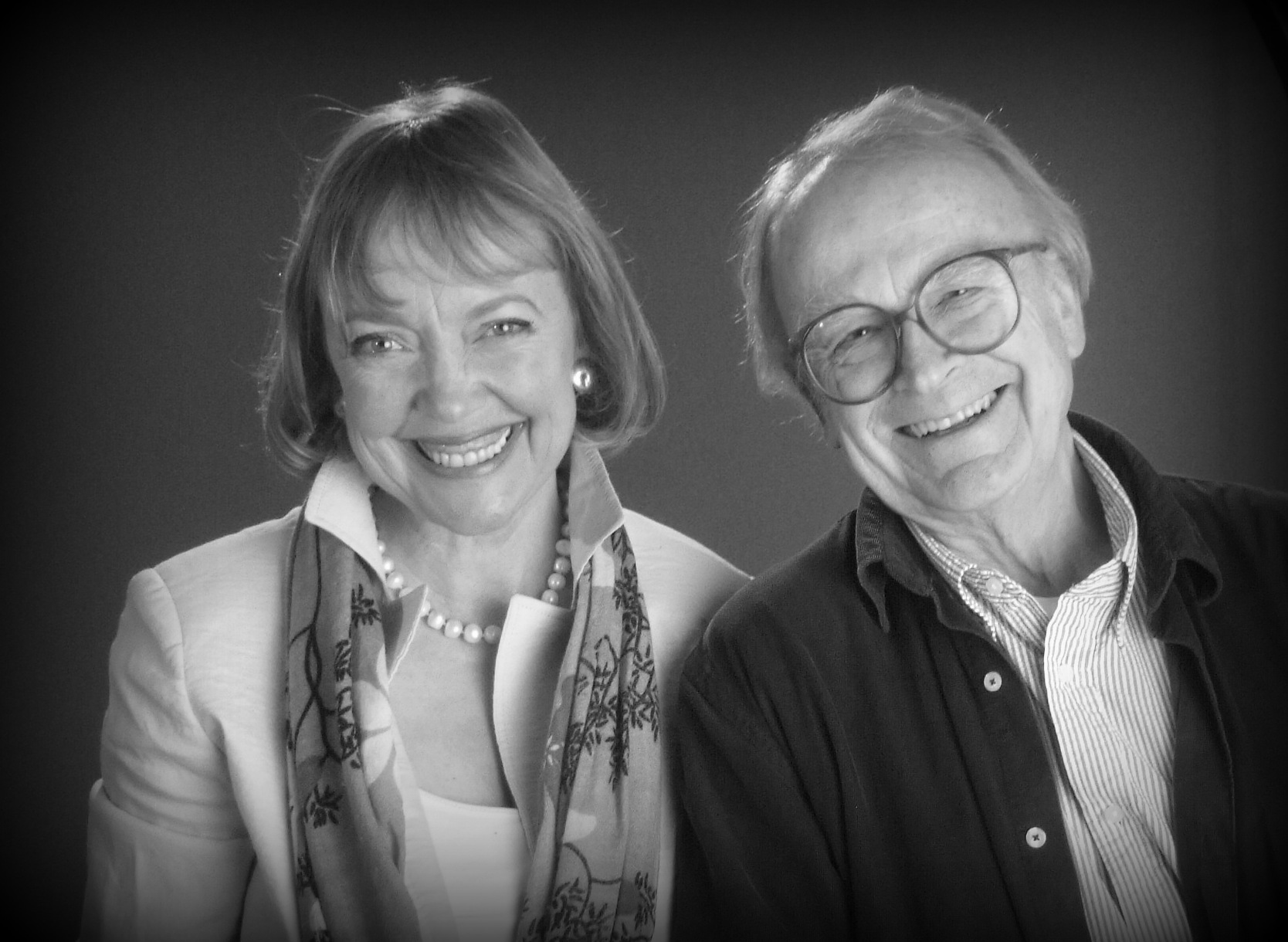
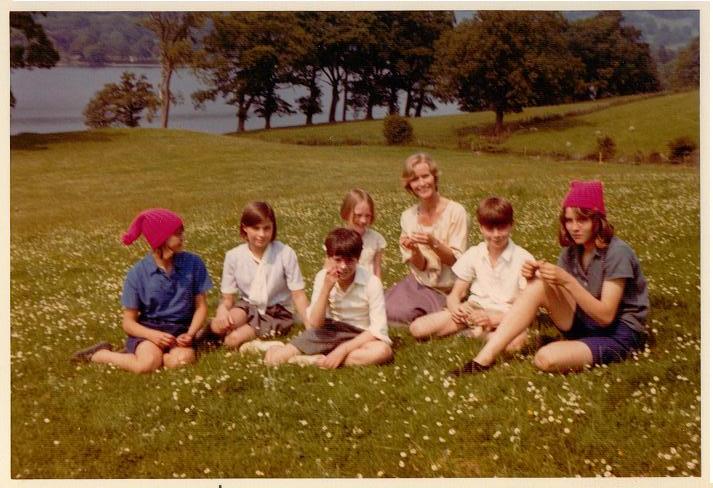
Daphne Neville, Stephen Grendon, Suzanna Hamilton, Sophie Neville, Jane Grendon and Simon West.
If you see men walking down the street with a telephone box it is probably an indication that there is a film crew nearby.
This was a distinctive director with red hair called John Prowse filming a drama serial called The Changes on location in Bristol in back 1975 when wooden tripods were used with 16mm cameras and portable monitors hadn’t been developed.
The Changes was a BBC adaptation of the books by Peter Dickinson written and produced by Anna Home. It starred Victoria Williams, Keith Ashton and Rafiq Anwar. Jack Watson was in four episodes and my mother had what one might call a cameo role as a villager. She can be seen in the photo above in the pink headscarf.
Sonia Graham appeared in this scene wearing a long red cloak. I later worked with her on the vet series One by One.
The story explored the concept of a time when machines ground to a halt and all cars became useless. Vehicles still seemed to be used as camera mounts. John Prowes is standing on top of a doramobile in this photograph.
Does anyone remember seeing the outcome of all this toil?
In 1978, my parents decided to take a holiday looking at castles in Northumberland and came across this scene:
They ended up appearing in a Walt Disney movie called Unidentified Flying Oddball. Here is the evidence:
The film’s original title had been The Spaceship and King Arthur, billed as a family adventure. It was an adaptation of A Connecticut Yankee in King Arthur’s Court and was shot at Alnwick Castle, the seat of the Duke of Northumberland where the Harry Potter films were later made.
It was released on an unsuspecting public in 1979, but was shot in the summer of 1978. I’m not sure how advanced Visual Effects were at the time but there were no Computer Generated Images. It looks to me as if this little airborne stunt was for real.
Life before the advent of CGI
Absolutely terrifying. While Kenneth Moore played King Arthur, Dad’s distant cousin John le Mesurier was Sir Gawain. Ron Moody played Merlin and Jim Dale starred as Sir Mordred with Dennis Dugan who played Tom Trimble. Rodney Bewes, who we knew as one of the Likely Lads had the role of Clarence. My father was hired for five days as a weapon bearer. This was simply so Mum had license to watch the filming.
Dennis Dugan on location in Northumberland
Pat Roach, 6’5″ tall British actor, later in all three Indiana Jones films, was Oaf. Mum hadn’t seen Jim Dale with permed hair before. She was used the lovable innocent he tended to play in Carry On films, but there he was looking fashionable on location in Northumberland, in the Duchess’s garden at that.
Jim Dale at Alnwick Castle
Jim Dale is known for the Harry Potter audiobooks in the USA, winning several high-profile awards for them, and for narrating the Harry Potter video games such as the Hogwart’s Challenge and Wizarding World. I wonder if they transported him back to Alnwick Castle?