If you enjoy ‘Swallows and Amazons’ do think of joining The Arthur Ransome Society who often visit the film locations or the Arthur Ransome Group on Facebook where you will meet like-minded people – of all ages. Most are dinghy sailors who love the books.
Lat time ‘Swallows and Amazons'(1974) was screened on BBC Two, at least one film fan held a TV party with a 1930’s theme. Others ‘stoked up the wood-burner and settled down to spend an afternoon re-living summer in the Lake District’, adding, ‘It is as if Christmas wouldn’t be Christmas without ‘Swallows and Amazons’ – a timeless classic to watch again and again.’
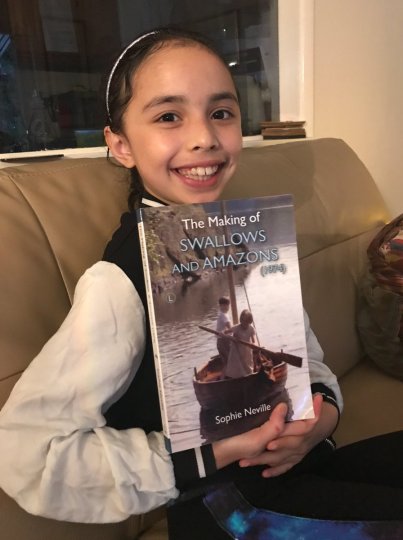
For the latest edition of the paperback on ‘The Making of Swallows and Amazons(1974)’ with details of where the film was made and what those who appeared in it are doing now, Please click here
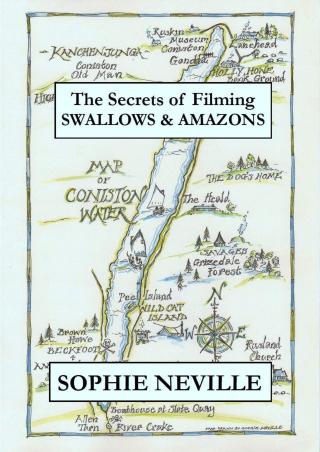
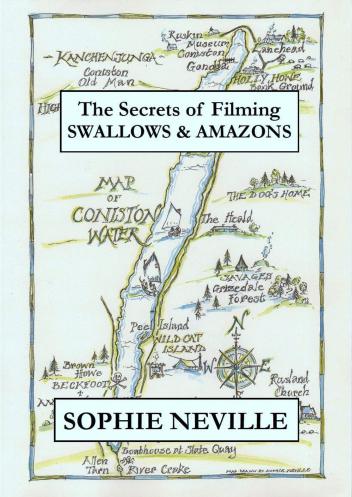
The ebook, entitled ‘The secrets of filming Swallows & Amazons (1974)’ is similar with a few more stories for adult readers and has links to behind-the-scenes cine footage. It can be downloaded from iTunes, Smashwords,Kobo and Amazon Kindle
It would be lovely to hear from anyone who saw it in the cinema when it first came out in cinemas in the summer of 1974 – more than forty-five years ago.
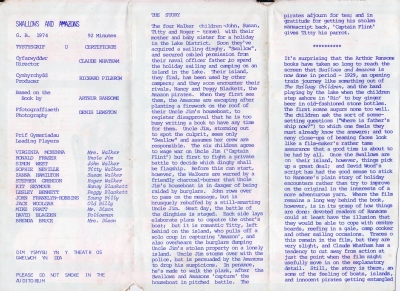
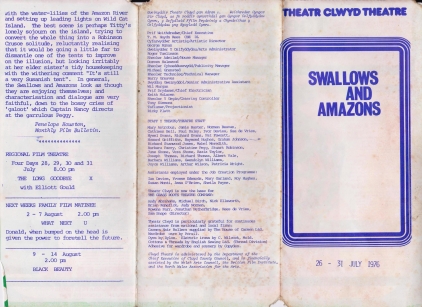
Simon Hodkin kindly sent in this cinema programme that he has kept since watching the movie when he was a boy growing up in North Wales.
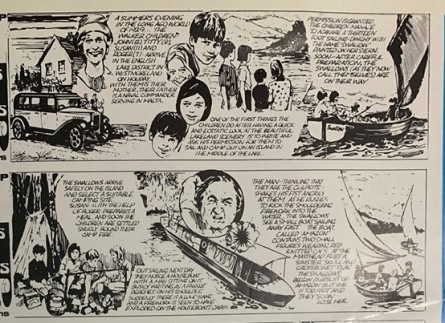
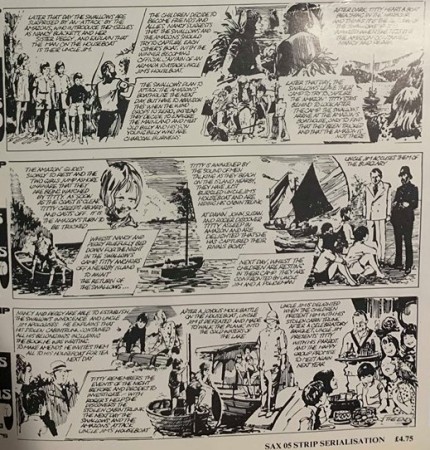
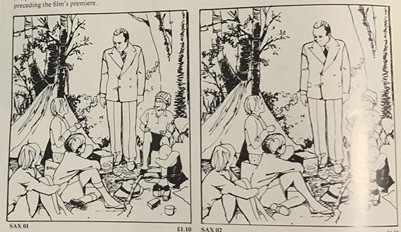
Arthur Herbertson managed to track down these rare publicity sheets for ‘Swallows and Amazons’ typical of movie games of the period:
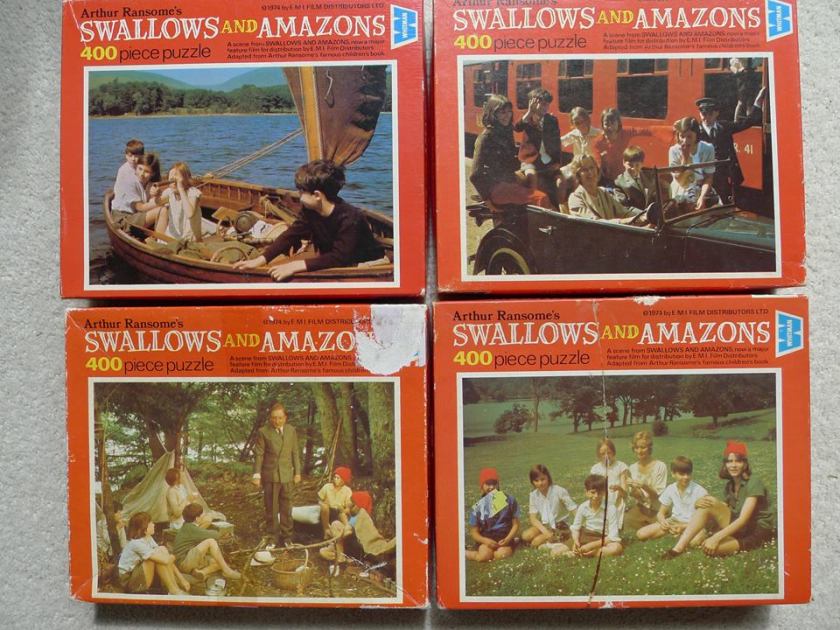
Arthur has a collection of the four jigsaw puzzles and the Puffin paperback that came out with the film.
There was a vinyl LP narrated by the screenwriter David Wood that you can still purchase.
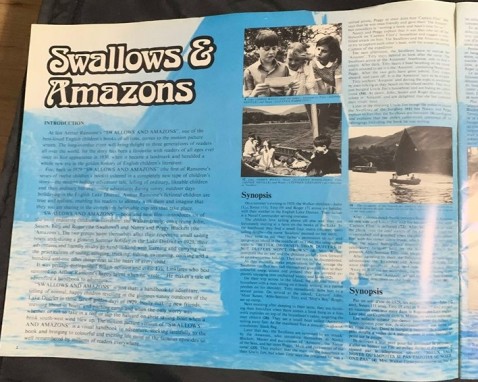
Arthur found a publicity brochure that I had never seen before.
To read comments from people who saw the film at the cinema in 1974, please click here
The original story was written by Arthur Ransome in 1929 ninety years ago, so the film hits the half-way mark between the original readers and today’s audience. It’s funny, the critics in 1974 are asking the same question as raised in the billing this week: Do ‘modern youngsters struggle to relate to such old-fashioned game playing’?
Do add your thoughts to the comments below.
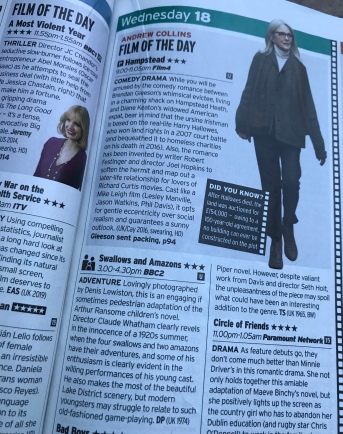
~Billing in the Christmas edition of the Radio Times 2019~
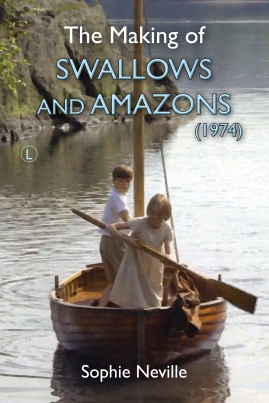
You can discover what it was like to appear in the movie, in ‘The Making of Swallows and Amazons (1974)’, an illustrated paperback published by the Lutterworth Press. Although written for adults, it is suitable for all ages and quite fun for anyone interested in acting or keen on visiting the Lake District. It can be ordered online, from good bookshops or your local library. If you already have a copy, do add a review to the online sites or email a photo – it is always great to hear from readers.
The second edition of the ebook, entitled ‘The Secrets of Filming Swallows & Amazons (1974)’, is similar but includes a few more stories from the Lake District and links to behind-the-scenes cine footage. It is out on Kindle, Smashwords, iTunes, Nook/Barnes&Noble from £2.99 If you already have the first edition you can re-load the up-dated version free of charge.
Signing copies of ‘The Making of Swallows and Amazons’ in Cumbria
1 – How did you get the part of Titty?
In March 1973, a letter arrived, out of the blue, inviting me to audition for a role in ‘Swallows and Amazons’. I was twelve years old, an ordinary school girl at a convent in Berkshire. I’d read the Arthur Ransome books but had no idea I was up for the lead in a major EMI feature film intended for a universal international audience. The movie was directed by Claude Whatham. Back in 1970, he’d cast me as Eileen Brown, opposite a boy playing Laurie Lee, in the BBC’s first adaptation of ‘Cider With Rosie’. It was a role that demanded learning a piano piece so complicated it took twenty-one hours to master, but I did it. Claude must have respected my hard work. I was too tall to play Titty but, after a sailing audition at Burnham-on-Crouch, I was offered the part. He cast Sten Grendon, who’d played the young Laurie Lee, as Roger, Suzanna Hamilton was Susan and Virginia McKenna starred as our mother. She later admitted to finding her character rather dull but it was her name, in lights outside cinemas, that drew big audiences. We’ve kept in touch. She is still acting, aged 87, and has led the Born Free Foundation’s international campaign to redeem the lives of wild animals held in miserable conditions since 1998.
With Virginia McKenna on location at Bank Ground Farm near Coniston, in 1973
2 – Why was it so suitable for you?
We loved visiting the Lake District as a family. My father helped the Maryport Button Factory with their publicity and once took us to stay on a farm near Castle Craig above the River Derwent. I spent my childhood camping and messing about in boats, adding a sail made from a dust-sheet to an old rowing skiff. The great thing about the original film of ‘Swallows and Amazons’ was that Simon West, who played Captain John, was an exceptional sailor. He went on to become a national champion. Kit Seymour, who played Captain Nancy, also had a natural command of the waves. It shows on screen. They were able to handle our small boats when squalls rolled down from the fells. I didn’t have their innate understanding of the wind but it was Titty’s job to row everywhere – back from the charcoal burners and off to One Tree Island on Derwentwater. “Pull harder, Roger!” I managed to row Amazon out of Secret Harbour in one take, with the cameraman and a massive 35mm Panavision Camera on board.
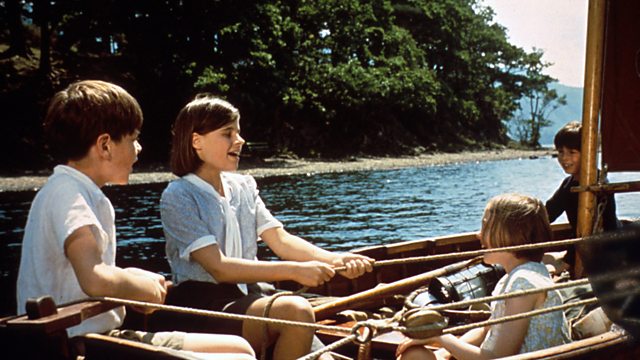
Simon West, Suzanna Hamilton and Sophie Neville in Swallow, 1973
Casting-off Swallow was more of a challenge. It doesn’t show on a small screen, but when ‘Swallows and Amazons’ is shown in cinemas, you can spot the sequence when I slip on a rock with the telescope in one hand. I was up to my waist in water but got back on my feet and battled on, waving as the others sailed up Coniston Water. I knew how difficult the shot was to achieve and was desperate to do my best for Claude Whatham.
Standing on Peel Island in a soaking wet dress while the Swallows sailed north
3 – Did it fire your wish to work in TV?
No! It was directing plays while reading Anthropology at Durham University that ignited a desire to work on television dramas. However, the experienced I’d gained acting in movies helped me win a place on the BBC TV Graduate Trainee scheme. After working on ‘The Russell Harty Show’, I grabbed the chance to cast children on the adaptation of Arthur Ransome’s books set on the Norfolk Broads: ‘Coot Club’ and ‘The Big Six’. I found Henry Dimbleby, then aged thirteen, to play the lead and spent three months on location with Julian Fellowes and Rosemary Leach – who I’d met when she played Laurie Lee’s mother. I later worked on ‘Doctor Who’, ‘Eastenders’ and ‘My Family and Other Animals’, before producing an INSET series, directing one episode at a village school in Cumbria. I began casting children in the Lake District to appear in BBC adaptations of Arthur Ransome’s Lakeland books but they were axed, which was sad, as we were all set to make ‘Swallowdale’ and ‘Pigeon Post’ on the high moors.
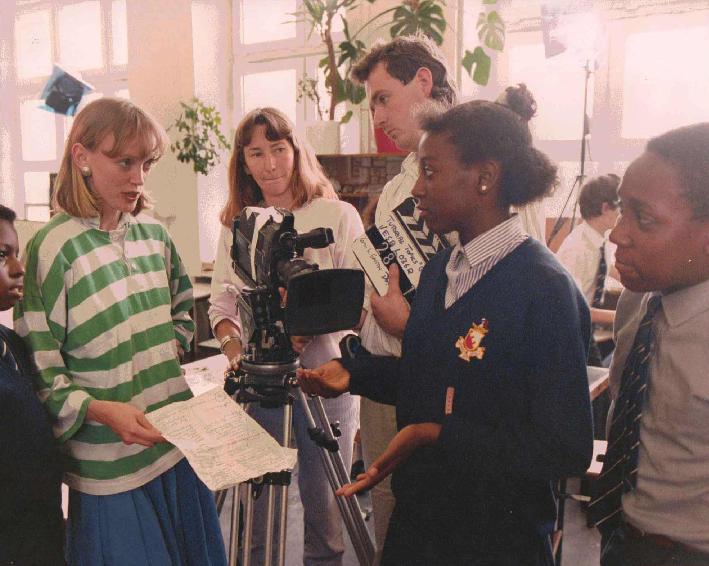
Sophie Neville directing a drama-doc with BBC cameraman Lorraine Smith
4 – What does the Lake District in general, and Keswick in particular, mean to you?
We live on the south coast but take the train north at any opportunity. I’m now President of The Arthur Ransome Society and came up for a fabulous weekend in May when we sailed from the jetty at Bank Ground Farm – Holly Howe in Ransome’s books. I gave an illustrated talk on the secrets of making ‘Swallows and Amazons’ at the Bassenthwaite Institute, using behind-the-scenes photographs taken when we were filming on Derwentwater forty-five years ago. We shot all the scenes involving Captain Flint’s Houseboat in a bay on the western shore. She was played by the Lady Derwentwater, converted for the drama by Ian Whittaker, a talented young set dresser who went on to win an Oscar for set decoration on the feature film ‘Howards End’ starring Sir Anthony Hopkins and Emma Thompson. We shot the lighthouse tree scenes near Friar’s Craig and used Lingholme or One Tree Island for Cormorant Island, where Titty finds the treasure chest. We enjoyed making Ronald Fraser, the film actor playing Captain Flint, walk the plank and sailed up Derwentwater to the strains of ‘What Shall We Do With The Drunken Sailor’, played as the end credits roll. Forty years later, Suzanna Hamilton and I were asked to lunch with Richard Pilbrow the producer of ‘Swallows and Amazons’. Buskers were singing this song outside the restaurant in Covent Garden. We couldn’t believe the coincidence.
Meeting fans of Swallows and Amazons at Keswick in July
I meet people from far and wide who tell me the 1974 film of ‘Swallows and Amazons’ inspired them to visit the Lake District. It has been broadcast on television every year for the last forty years and was last shown in Australia on Boxing Day. It has been dubbed into Czech twice and is often shown at festivals as only ‘U’ certificate movies can be screened outdoors. I just hope this has proved a blessing to the people of Keswick, which I so loved visiting as a child. I thought the 2016 film of ‘Swallows and Amazons’ – that I appear in for approximately two seconds – would overshadow the classic version but it has simply raised awareness along with DVD sales. Fan mail continues to arrive. A beautiful card came today. Arthur Ransome would have been touched. It had fish on it.
Editorial coverage and a literary award for ‘Funnily Enough’
5 – Do you want to mention mental health/physical health issues are always in the news?
I find that many of my readers are stuck in bed or battling with ill-health. I hope they are amused and uplifted in some way by stories in my books. ‘Funnily Enough’, a diary I kept after collapsing at the BBC, is about my own struggle with what I am pretty sure was a tick-bourne disease. I lost my job but recovered in Southern Africa, where I fulfilled Titty’s dream of seeing “forests full of parrots” and produced decorative maps for a living, inspired by Spurrier’s illustration on the original cover of ‘Swallows and Amazons’. I used maps and details from my sketchbook to illustrate a paperback entitled, ‘Ride the Wings of Morning’, which is out in colour as an ebook.
On the crew of the Gloriana in the Boat Race Flotilla in March featured on BBC Television
6 – What else?
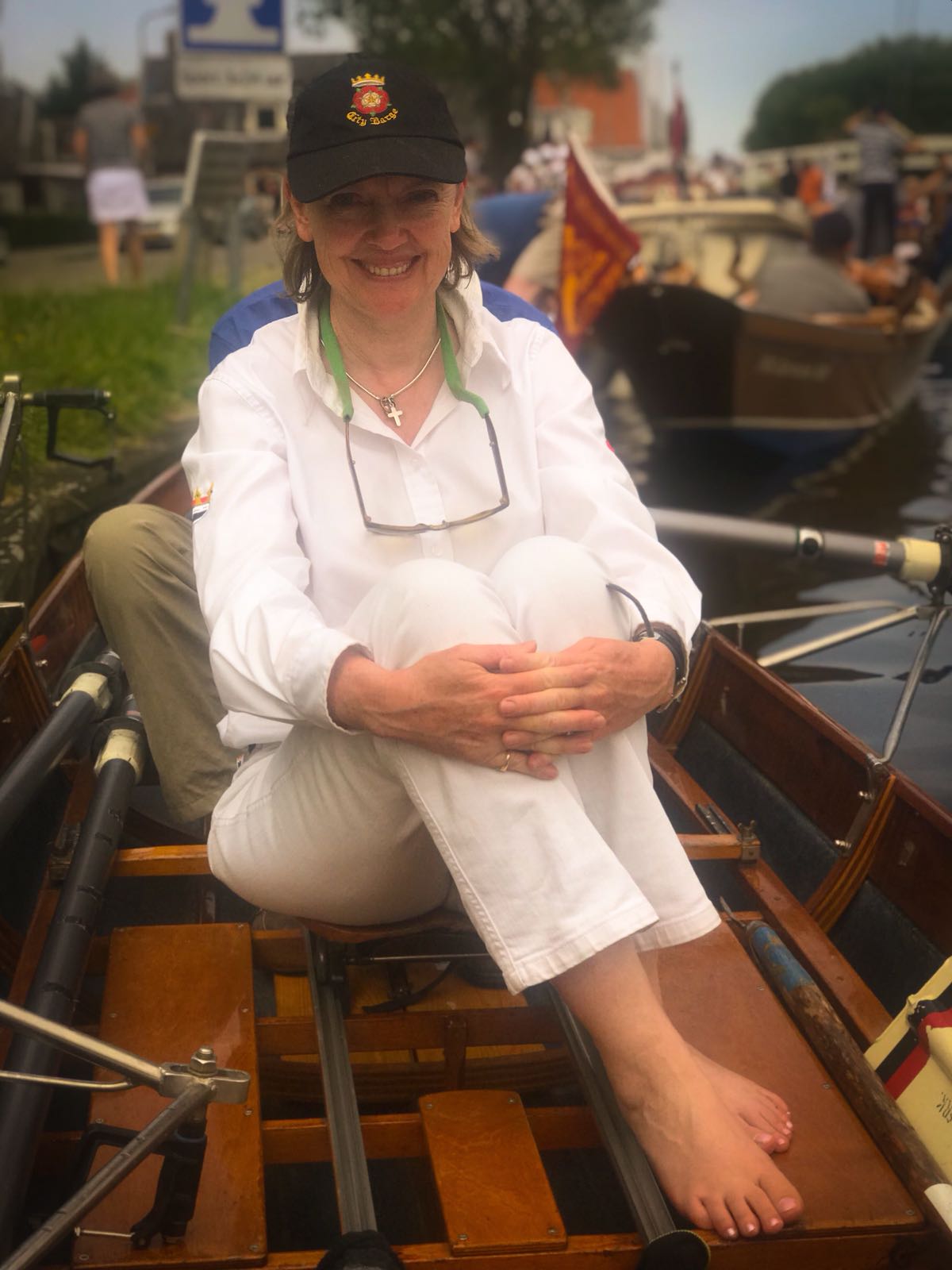
People often ask how ‘Swallows and Amazons’ influenced my life, keen to know what I am doing now. I am still keen on rowing. I completed the Voga Longa, a 32 kilometre marathon through the Venetian lagoon with Olympic gold medallist Ed Code and was on the crew of The Queen’s row barge Gloriana for the Boat Race Flotilla this year. This summer, I grabbed the chance to row through the canals of Amsterdam, which was fascinating. However, it was the Amazons bows and arrows that impacted my life. After learning to shoot on the shores of Coniston Water, I was cast as an archery champion in another movie and have since won three Ladies Championships. I met my husband at an archery match. My stepson shot for England in July, winning a tri-annual match against the Royal Company of Archers (so proud!) I gave a talk recently demonstrating how the arrows in ‘Swallows and Amazons were’ fired over my head. The shot looks so dangerous that it was cut from the TV version of the film, but is included in the re-mastered 40th Anniversary cinema Blu-ray version, which we are now able to watch on the big screen.
Rowing in from De Hoop Rowing Club in Amsterdam, July 2018
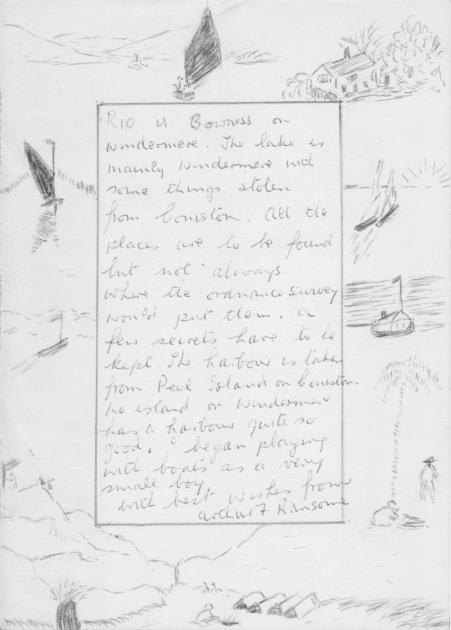
I have been sent a copy of a letter written to a reader by Arthur Ransome in June 1955 revealing where some of his ‘Swallows and Amazons’ locations can be found. I was interested to read that, ‘the lake is mainly Windermere with some things stolen from Coniston.’
One summer, we spent a long weekend with The Arthur Ransome Society when we managed to find quite a few locations around Coniston Water that are featured in Ransome’s books.
~Low Yewdale Farm, near Coniston ~
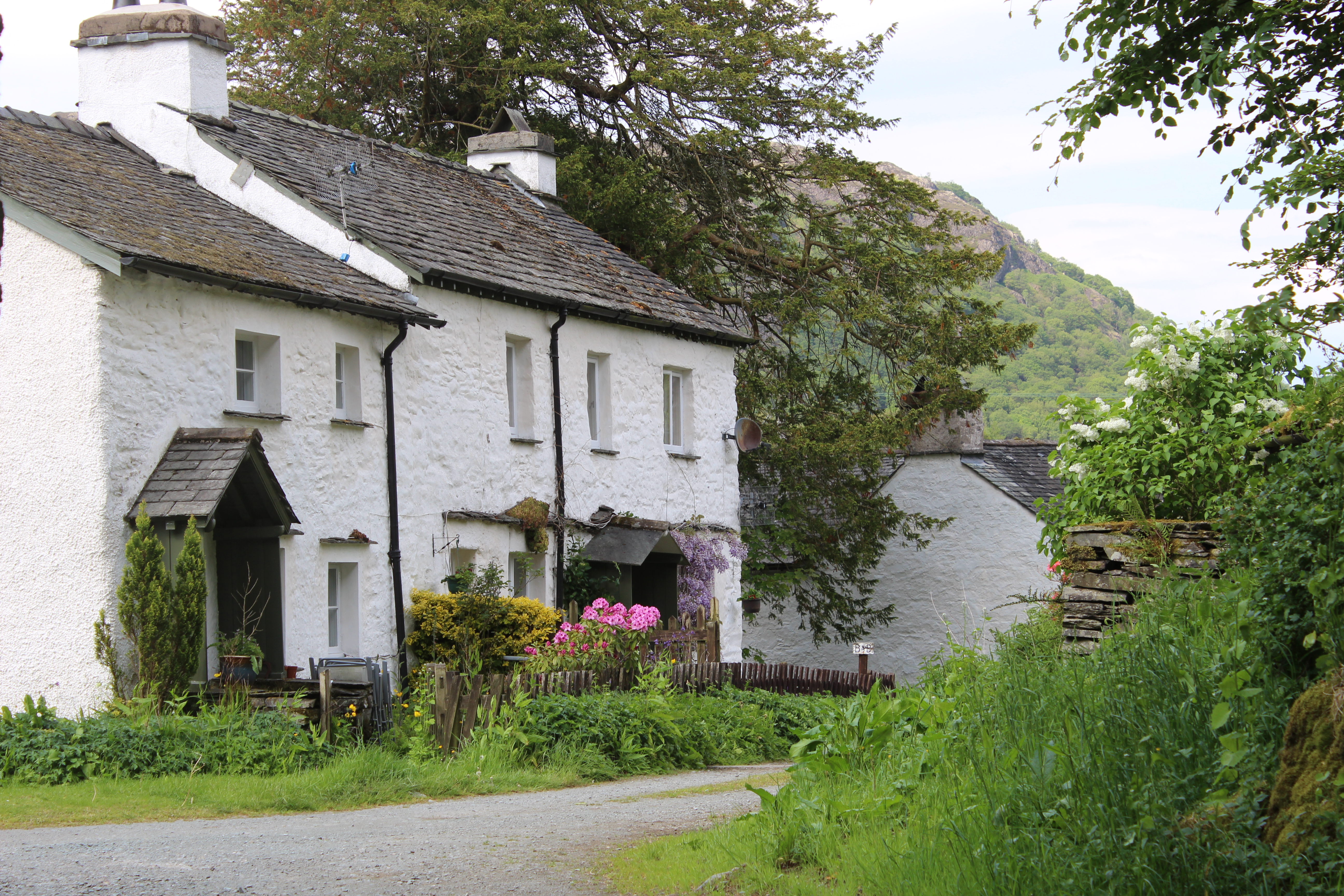
The curator of the John Ruskin Museum took us on a walk around the village of Coniston and under the Yewdale Crags towards Tarn Howes. We passed Low Yewdale Farm where Arthur Ransome stayed as a young man. It is just as I imagined Swainson’s Farm in the book ‘Swallowdale’. The footpath takes you down to the beck where Ransome fished for brown trout. I could imagine Roger attempting to tickle trout there.
If you follow the path on south, then branch left up the East of Lake Road around Coniston Water, you will find another footpath leading to Bank Ground Farm.
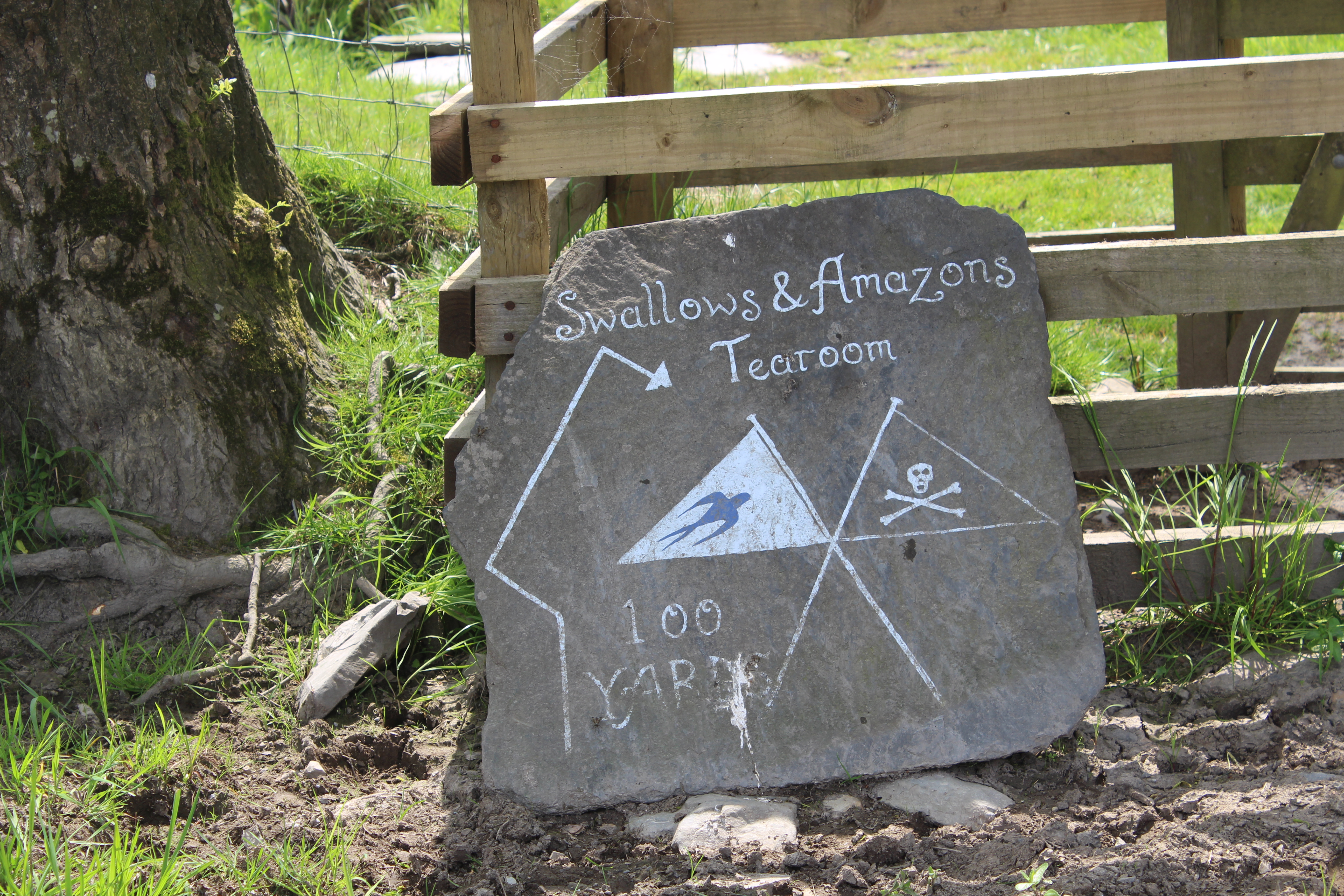
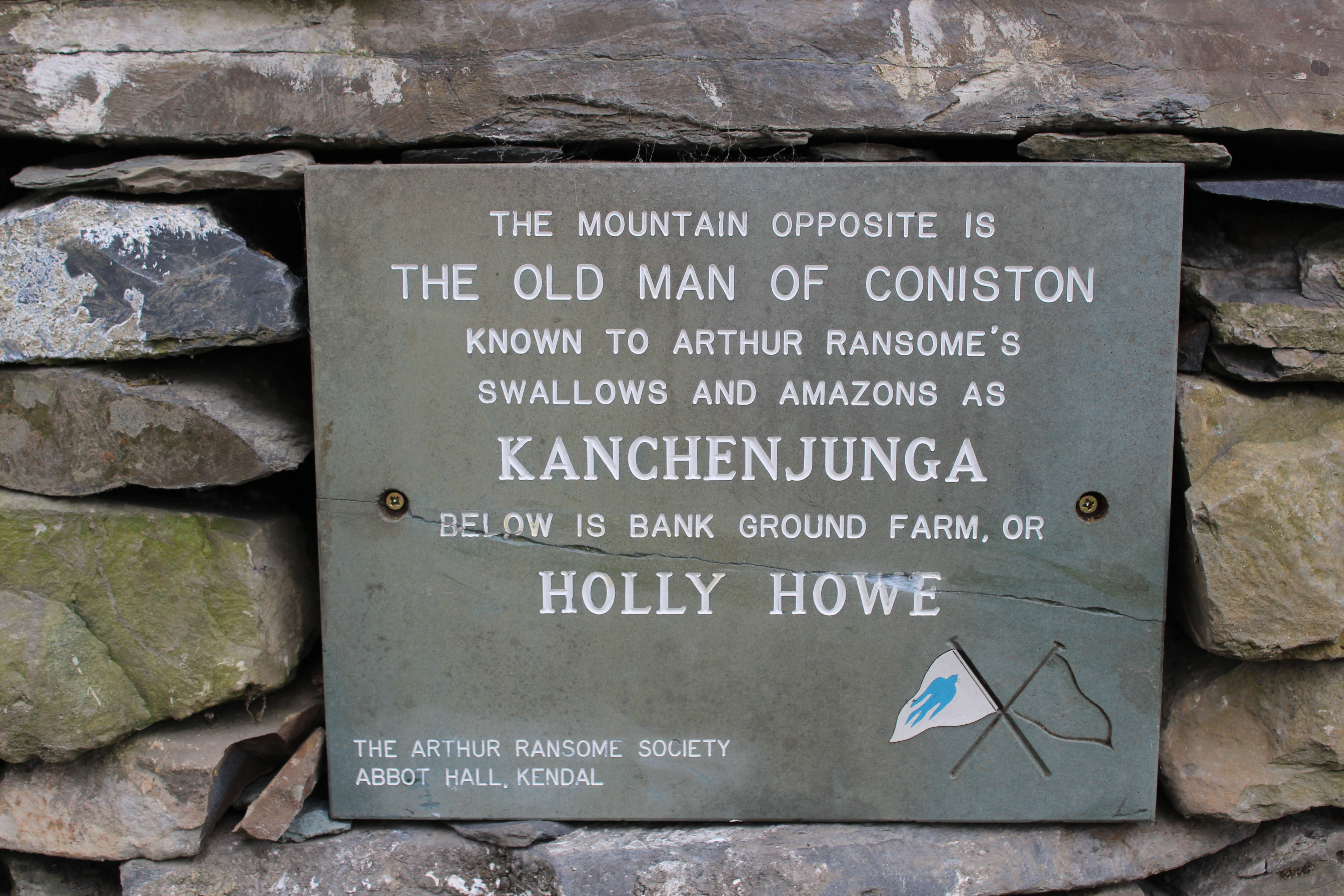
A hand-painted sign guides you through fields, where Galloway cows maybe grazing. Look up and you will literally find yourself at Holly Howe, the long white farmhouse where Mr and Mrs Jackson live in ‘Swallows and Amazons’. You can imagine the Walker children running down the meadow to the Peak of Darien.
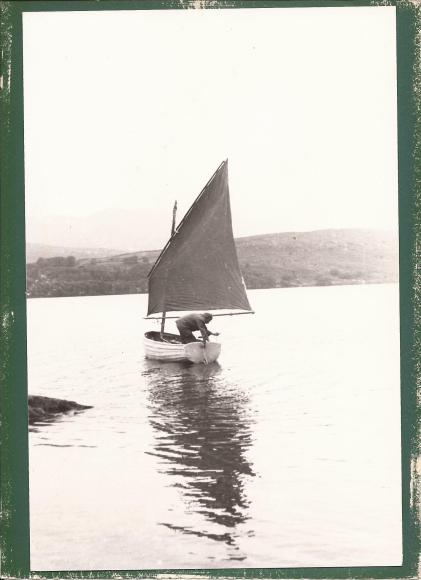
~ Dr Ernest Altounyan rigging Mavis on Coniston Water~
It was here that the Altounyan children, Taqui, Susie, Titty, Roger and Brigit spent one summer holiday in 1928, while visiting their grandparents who lived next door at Lane Head. They learned to sail on the lake in two dinghies: Swallow and Mavis, later re-named Amazon, who can be visited at the John Ruskin Museum in Coniston.
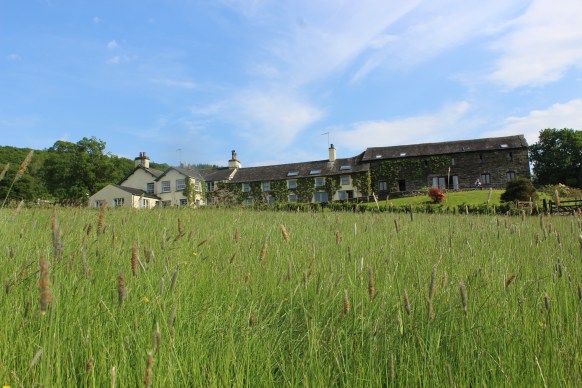
~Bank Ground Farm in Cumbria where the movie ‘Swallows and Amazons’ (1974) was made~
The barn, inside which we filmed some of the night sequences for the original movie of ‘Swallows & Amazons’, has been converted into self-catering holiday accommodation that can house a number of families quite easily. From here you can run down to the boatshed where John, Susan, Titty and Roger found Swallow and imagine them setting off on their voyage to Wild Cat Island leaving the Fair Spanish Ladies on the stone quay.
~The boatsheds below Bank Ground Farm, on Coniston Water~
Wooden jetties have been added recently and it is possible to either launch your own boat or hire a kyak from Bank Ground Farm.
~The northern end of Coniston Water~
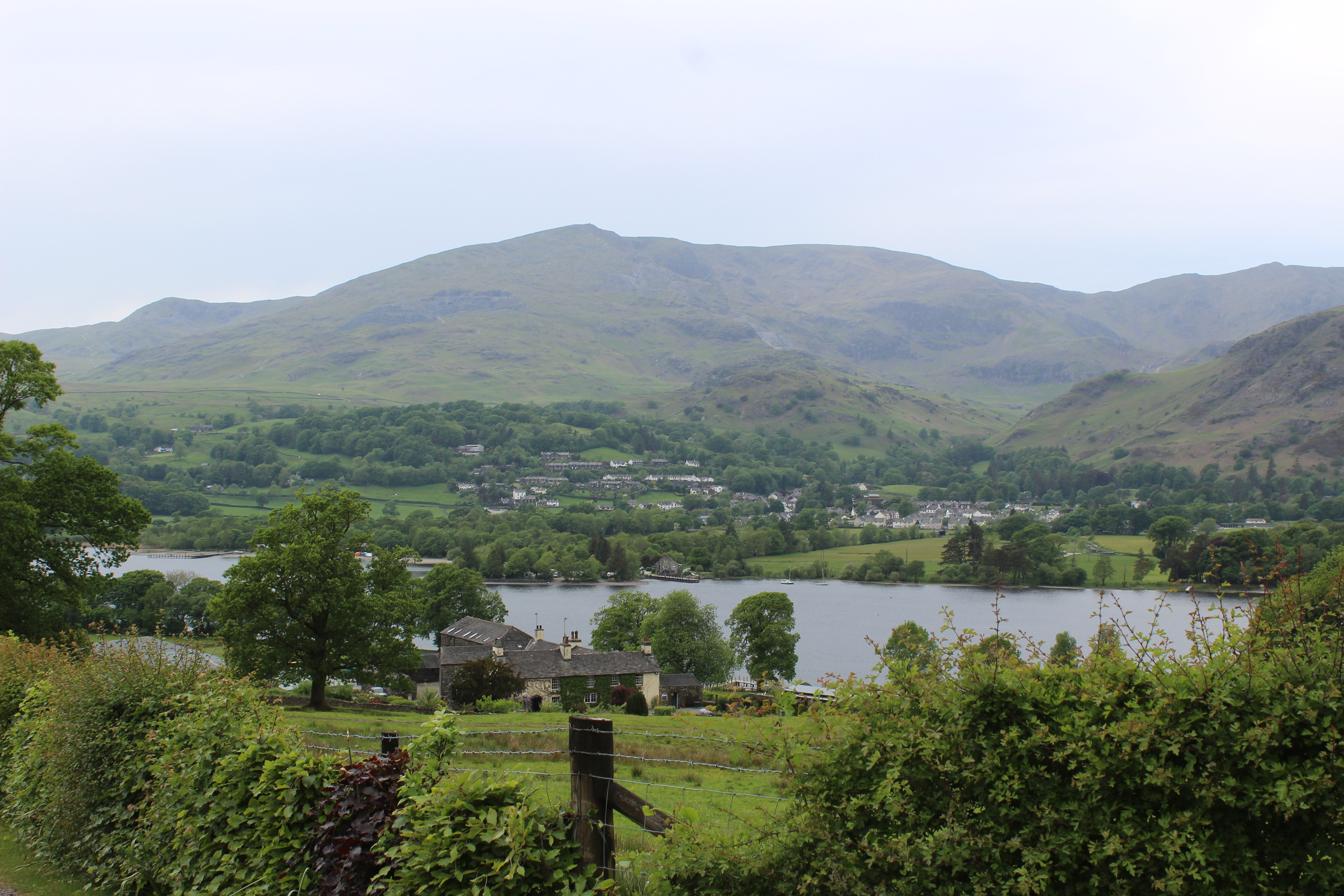
We had a bedroom in the barn that looked north towards the Langdales. If you walk up the farm drive, you can look back towards Coniston Old Man, or ‘Kanchenjunga’, as the Walkers and Blacketts call it in ‘Swallowdale’.
~Bank Ground Farm with the village of Coniston beyond~
Arthur Ransome was taken up the Old Man of Coniston as a tiny baby. You can climb it today but wear more than sand shoes. Stout walking boots are called for. The task of reaching the summit should not be underestimated.
We were able to get out on the lake to find a few more locations. This red-sailed dinghy, named Peggy Blackett, is a copy of Arthur Ransome’s Cochybundhu, used as the model for Dick and Dorothea’s boat Scarab.
~Sailing on Coniston Water towards the village of Coniston~
It is a long way down Coniston Water to Peel Island but it is there that you will spot the Secret Harbour, instantly recognisable as belonging to Wild Cat Island. We travelled there in the SL Gondola, that also now belongs to the National Trust. Ransome knew the steam launch as a boy when he made friends with the captain who let him take the helm.
~ Secret Harbour on the southern end of Peel Island, Coniston Water ~
In the cemetery of Coniston village we found the grave of Titty Altounyan, the girl who inspired Arthur Ransome’s well-loved character. I never met her but was with her niece Barbara that long weekend in Coniston, when we both thoroughly enjoyed walking, sailing and steaming along in Ransome’s footsteps.
~ Sophie Neville visiting Titty Altounyan’s grave in Coniston ~
For details of more locations at the southern end of Coniston Water that are featured in the Swallows and Amazons series of books, please click here.
Think of joining The Arthur Ransome Society and come looking for locations described in his books. You will find the details here.
There is an alternative walk in search of Arthur Ransome’s locations tying in with the Gondola’s timetable described here.
You can find illustrated maps and a chapter guiding you to some of the locations in ‘The Making of Swallows and Amazons’ and this less expensive ebook:
I spoke on BBC Radio Cumbria, asking if I could meet anyone involved in filming the original film of ‘Swallows and Amazons’ (1974). It was made on location in the Lake District with a young crew.
~Nick Newby of Nicole End Marine~
Nick Newby of Nichol End Marine in Portinscale came to find me while I was in the Keswick. As a young man in the 1970s, he provided boats for a number of films and was contacted by Graham Ford, the production manager of Swallows and Amazons in the Spring of 1973. Graham had began working with Mike Turk who had started building boats for TV and films at his family firm, Turk’s Launches, but this was based on the Thames in London. They needed help from someone in the Lake District who knew about traditional boats.
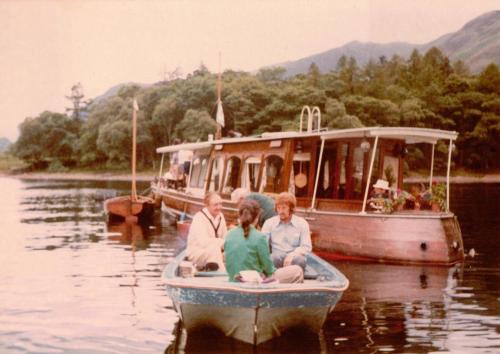
~Ronald Fraser being trransported by Dory to The Lady Derwentwater in 1973~
Arthur Ransome had clearly based Captain Flint’s houseboat on the Esperance, originally a steam launch cruising on Windermere. You can read more about her and see photos here.
‘Since she was sitting on the bottom of Whitecross Bay at the time,’ Nick told me, ‘the film crew decided to use the Lady Derwentwater.’ This was a launch licensed to carry 90 passengers that Nick had worked on and knew well. ‘She is about 58 foot long and quite a rigid boat, having four full length steel RSJs set inside her. She was built the Lakes in 1928. We moored her at Brandelhowe in Great Bay for the filming. You need to be careful getting in, as there is a rock shelf.’ Unlike the Esperance you could see the view over the lake from her large cabin windows, which enhanced interior scenes. The Lady Derwentwater, whose nick-name is Dishy, has since been re-built with a different stern, but you can book a passage and go out on the lake in her yourself.
~The Lady Derwentwater today~
Nick told me that Captain Flint’s eight foot Wright’s dinghy, the houseboat’s tender, had been made by Wright’s Brothers of Ipswich. The Jackson’s ‘native canoe’, rowed out to Peel Island by Virginia McKenna was ‘a family fourteen’ Wright’s sailing dinghy with a centre case. He knew many of the traditional boats in the Lakes. ‘I served me time as a yacht and boat builder at Shepherd’s in Bowness Bay.’ This company was based the green double-story boat sheds featured in the ‘Rio’ scenes. ‘During the winter we used to have to break the ice on the buckets of water when we were rubbing down boats. The sail lofts had a square panel in the apex so we could poke the 8 to 10 metre masts inside. A boom could go up the stairs but a mast certainly couldn’t. ‘
~Virginia McKenna with Sophie Neville and DoP Denis Lewiston~
‘Amazon belonged to a chap called Vosey who was rather reluctant to let her be used for the filming,’ Nick said. ‘We did her up a bit after the filming.’ I gather she had been used in the black and white BBC serial of Swallows and Amazons made in 1962 when Susan George played the party of Kitty.
~Swallow sailing towards the filming pontoon in 1973~
I believe Swallow had been found at Burnham-on-Crouch as she was built by Williams King and Sons. Mike Turk, who had built a shallop for the 1966 movie ‘A Man For All Seasons’, purchased her for the film and brought her up to the Lakes. She had no added buoyancy. Nick claims that being a wooden boat she would never sink but I reminded him that we came close to hitting the MV Tern on Windermere when loaded with camping gear, which was a bit scary.
~MV Tern on Windermere today~
Swallow was later used at Elstree Studios when the sound was dubbed onto the finished film. Mike kept her out of the water in his store at Chatham until SailRansome bought her at auction in 2010. She was sensitively restored by Pattersons, has a new sail, added buoyancy bags and is now available for anyone to sail in Cumbria.
~Mike Turk’s filming pontoon with Swallow attached in 1973~
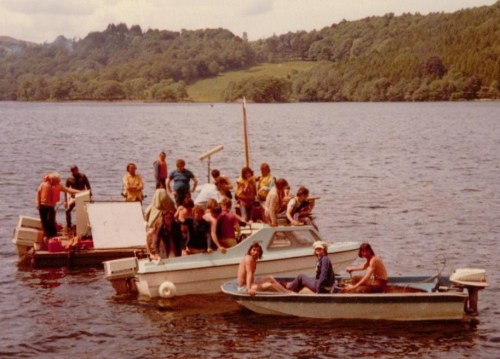
‘Mike already had the flat-bottomed filming pontoon. It had originally been used for carrying a vehicle. We added twin outboard engines and rigged scaffold under the water so that either Swallow or Amazon could be attached to it but still keel over naturally as they sailed. When the dinghy went about, I would turn one outboard and thrust the other into reverse so that the pontoon went about with them.’ I remembered that the first time they tried this Swallow’s mast footing broke. Amazon’s mast-gate broke on another occasion. Nick had to persuade a friend to let him borrow his welding workshop and managed to mend it over night, so that she could be ready on set first thing the next day.
~The camera pontoon, Capri and one of the Dorys used behind-the-scenes~
Nick went on to say the pontoon leaked a bit. ‘We would have to pump out hull every morning.’ The Capri used behind the scenes was Nick’s equivalent of a marine Land Rover. ‘It had a reinforced glass fibre hull for increased capability and a 55-horse power engine that had been used for the Olympics. We used it for Ken Russell’s film ‘Tommy‘, the rock opera with Roger Daltry and The Who. Once, when we were using it for Swallows and Amazons, Clive Stuart shoved it into gear with rather too much gusto. Someone only just managed to grab the director, Claude Whatham, before he was flung over the back. ‘Claude was spitting feathers after that.’
~Suzanna Hamilton, Simon West, Sophie Neville & Sten Grendon with David Stanger at the helm of the Dory in 1973~
Mike Turk provided two Dorys, built at his yard, to use as run-around boats. One was driven by David Stanger who is now skipper of a launch on Ullswater. It was a stable boat but you needed to watch how it was not overloaded. Water came over the bows one day giving my mother rather a shock.
‘The boating world is a small world,’ Nick assured me. This July, forty-five years after making the film, he brought his grand-daughter to watch ‘Swallows and Amazons’ at the Alhambra Cinema in Keswick and gamely came up on stage for a Q&A to explain how some of the sailing scenes were achieved.
Mike Turk, Swan Upper and Queen’s Waterman, who provided boats for numerous films from Moonraker to Hornblower, sadly passed away aged 78. You can read his obituary here. He went on to work on a number of James Bond movie. You can see his film credits here.
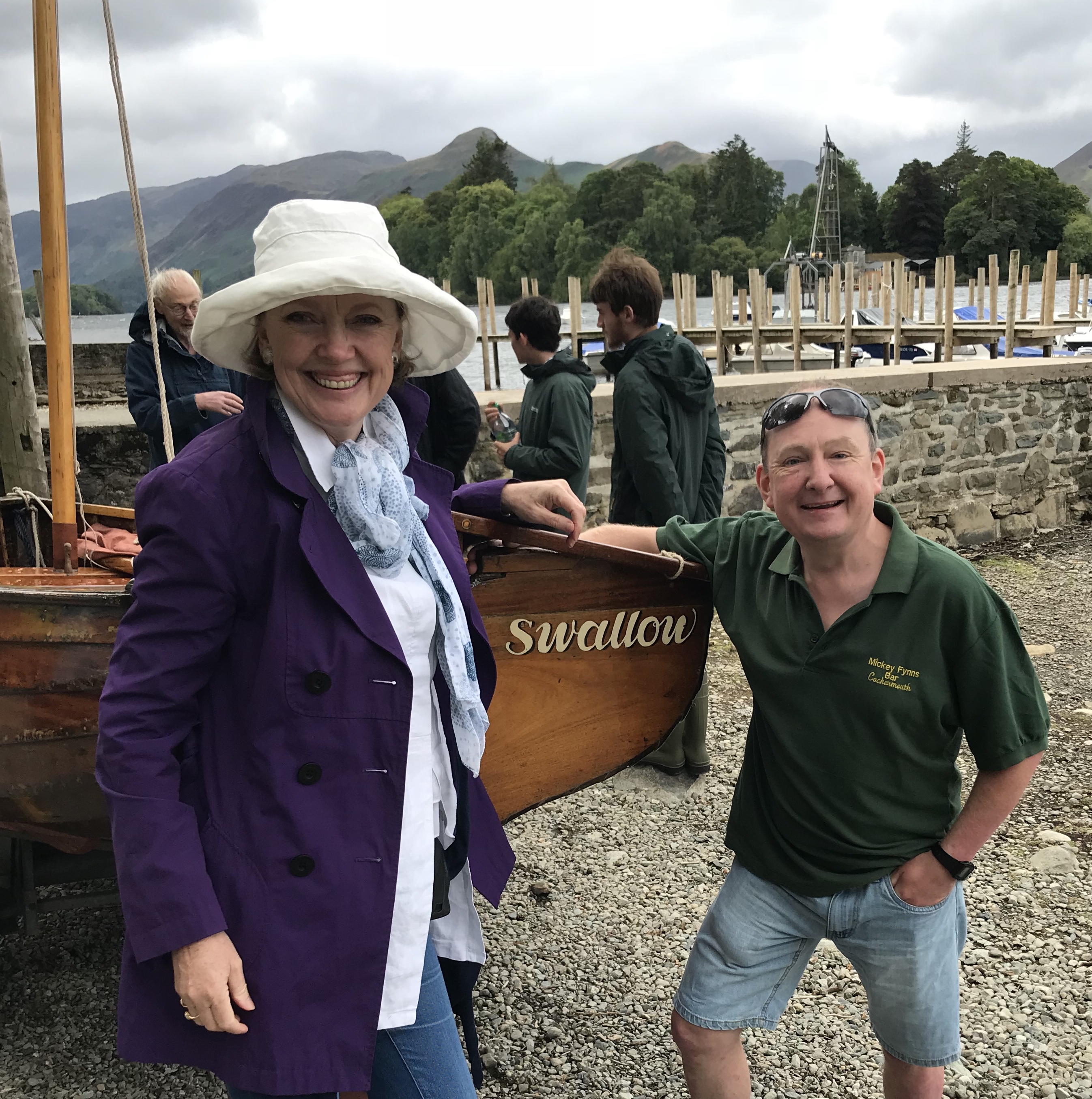
A group of Arthur Ransome enthusiasts clubbed together to buy Swallow from Mike’s collection in 2010. She is currently kept on a trailer at Kendal in the Lake District. If you would like to sail her, please visit SailRansome.com
For Nicol End Marine, about two miles outside Keswick on Derwentwater please click here
You can see Swallow – and learn of her value – on BBC Antiques Roadshow, towards the end of the first episode recorded at Windermere Jetty museum in September 2020. It is on BBC iplayer here
You can read more about making the 1974 film Swallows and Amazonshere
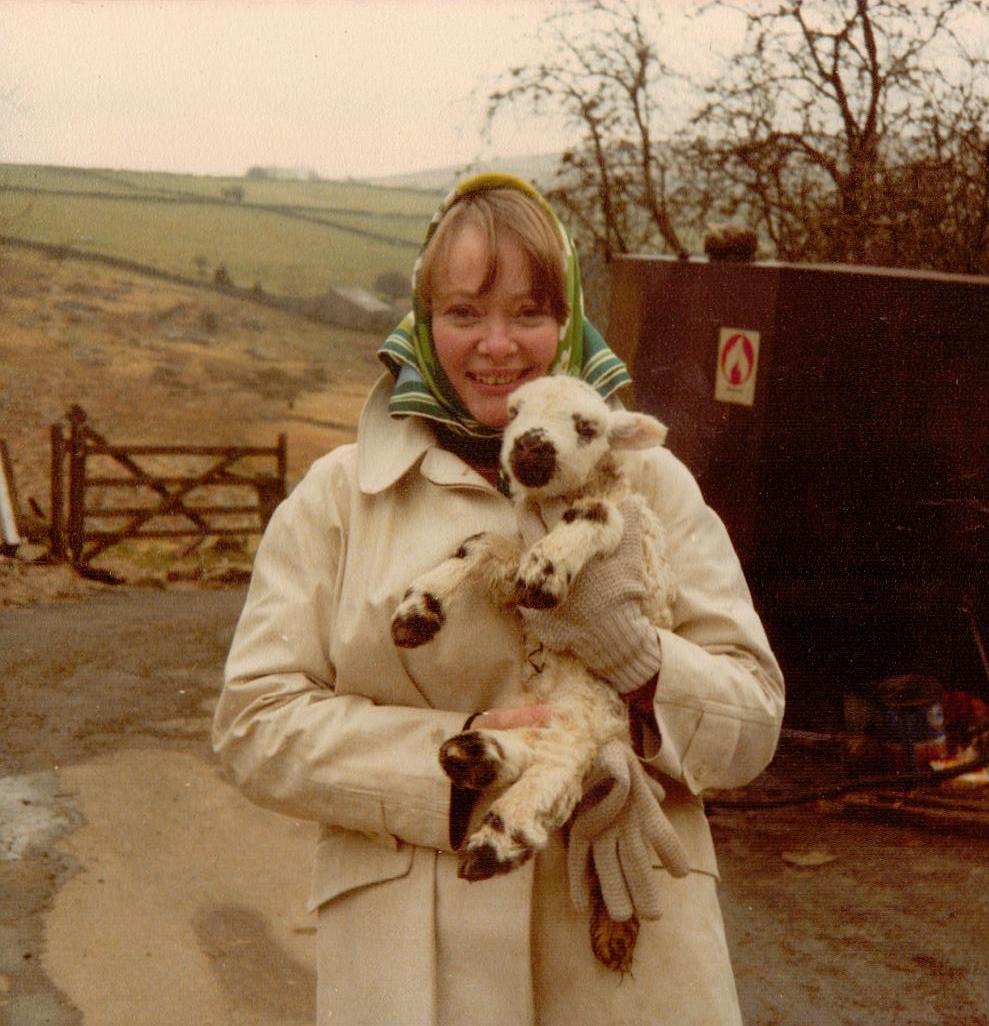
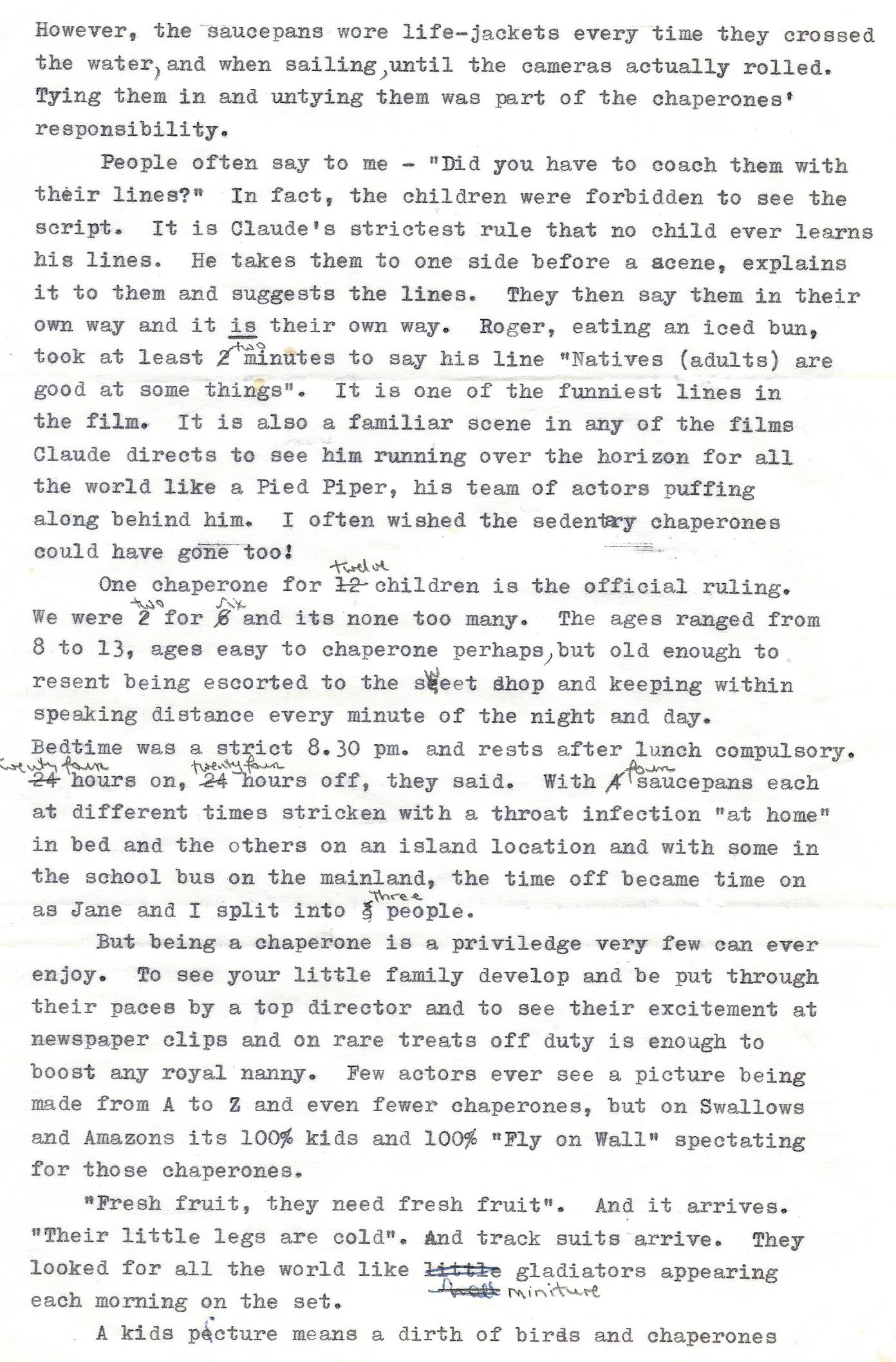
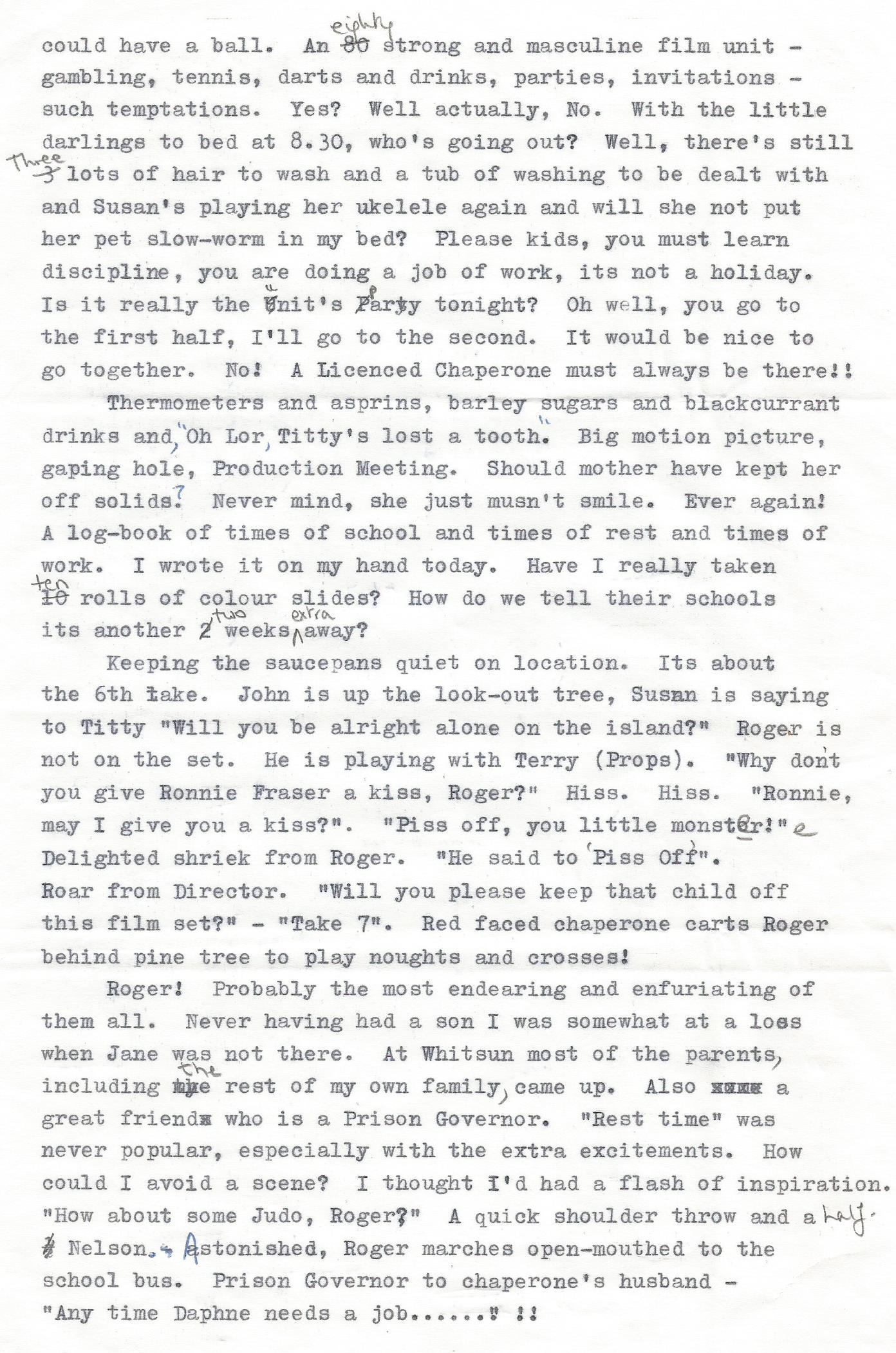
In 1974, my mother, Daphne Neville, was commissioned to write an article about working on the original film of ‘Swallows and Amazons’ for Woman magazine, which claimed to be ‘The world’s greatest weekly for women’. Here are some extracts from her type script:
Simon West, Stephen Grendon, Suzanna Hamilton and Sophie Neville playing the Walker children in ‘Swallows and Amazons’ 1973 ~photo: Daphne Neville
Daphne Neville with Sophie Neville and Simon West on Coniston Water
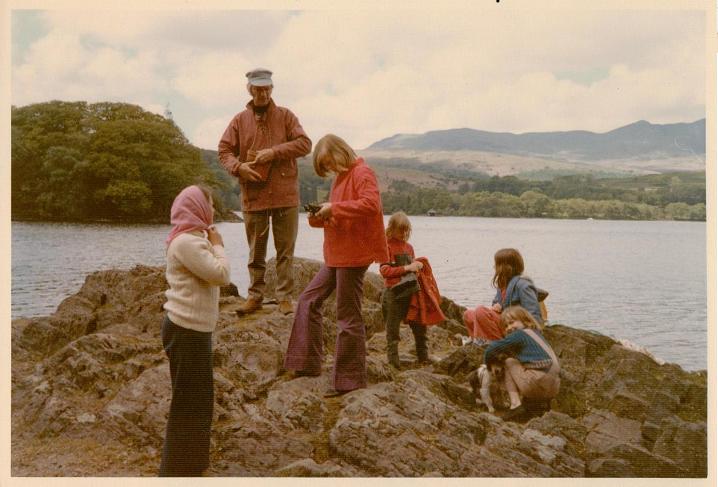
Our guests: Jane, Michael, Clare and Lucy Selby and their dog, Minnie on the shore of Conniston Water with my sisters Perry and Tamzin in 1973
I was amazed to read some of this. ‘….a dirth of birds’? Was that really how my mother spoke in the early ‘Seventies? I had no recollection that ‘Nomansland’ had been displayed on the front of our double-decker bus. I never remembered there only being bathroom at Oaklands Guesthouse or that Mum had to wash out clothes. I do remember Ronald Fraser shouting, ‘Piss off you little monster’. I have the photo:
Sten Grendon sitting on top of Ronald Fraser during a break in the filming of ‘Swallows and Amazons’ on Derwentwater ~ photo: Daphne Neville
More to follow…. If you would like to see photos of Daphne Neville appearing in movies herself, please click here
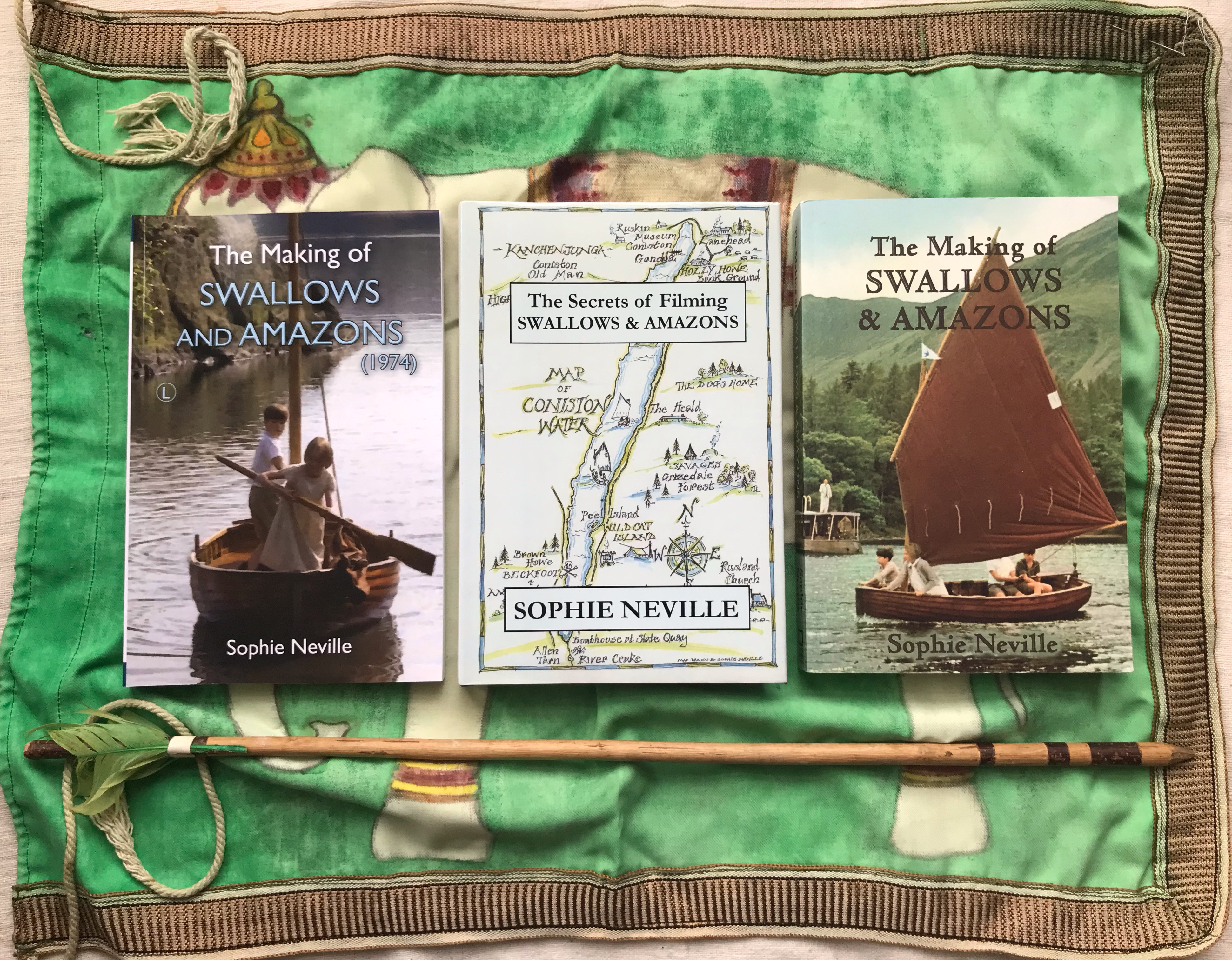
You read about how we made the original movie ‘Swallows and Amazons’ in any of these books that retail online and can be ordered from bookshops or libraries:
Different editions of ‘The Making of Swallows and Amazons (1974) by Sophie Neville’
My mother is a squirrel. She arrived at my house, not with nuts, but a large envelope. Amongst other things, this contained the transcript of a piece she wrote almost forty-nine years ago for BBC Radio Bristol, when she presented a programme called ‘Come Alive’. The four flimsy sheets of copy paper have only just been unearthed, along with a similar article for Woman magazine.
Daphne Neville was commissioned to write about her experience working on the original feature film, Swallows and Amazons, filmed on location in the Lake District in the summer of 1973 and brought to cinemas in 1974. Sold worldwide, has been broadcast on television for the last forty years and was last shown on TV in Australia on Boxing Day.
Daphne Neville with Sophie Neville while filming ‘Swallows and Amazons'(1974)
It is interesting to have Mum’s perspective. Some of the details are new to me. She timed this piece for BBC Radio as taking ‘8 minutes’ to read:
Suzanna Hamilton, Lesley Bennett, Sophie Neville, Kit Seymour and Simon West before their hair was cut for the film ‘Swallows and Amazons’ in 1973
~ On Derwentwater in 1973: Suzannah Hamilton, Kit Seymour, Daphne Neville, Sten Grendon, Simon West, Sophie Neville & Lesley Bennett ~ photo: Martin Neville
Daphne Neville with Stephen Grendon, Suzanna Hamilton, Sophie Neville, fellow chaperone, Jane Grendon and Simon West on location in 1973
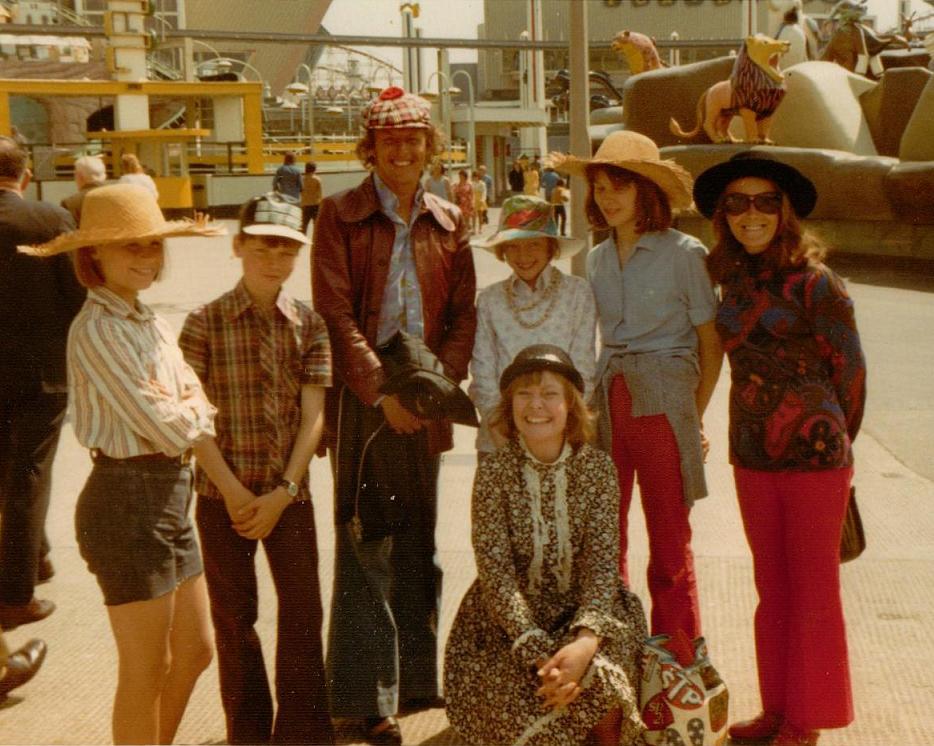
Suzanna Hamilton, Simon West, Claude Whatham Sophie Neville, Kit Seymour, Jean McGill with Daphne Neville kneeling at Blackpool fun fair in 1973
But Mum, were we ever ‘Film Stars’?
We scowled at the terminology at the time. Ten years later and I thought of us a merely puppets, marionettes of the director who carefully honed our performances. I can now see the contribution we made when I watch the film, but we were never film stars.
What do I wish? I wish that we’d been able to make a sequel and develop our work more fully. The flip-side of this would have been that any more success, or more publicity, might have stripped us of our anonymity, which is the bain of real film stars. We’d have had to go around wearing sunglasses.
The film star Ronald Fraser with Daphne Neville and Sophie Neville in 1973
If you would like to see what we were filming 49 years ago, on 1st July 1973, please click here.
Do let me know, via the comments below, if you would like to see more archive material. I have the draft of my mother’s article for Woman magazine – it’s a different version of the same but with added detail. She needed permission from Anglo EMI Film Distributors before it could be published. There is also a draft of another radio script and a number of letters. If you would like to see vintage photos of Mum appearing on television herself, please click here
If you would like to read more about our adventures filming ‘Swallows and Amazons’, please click here
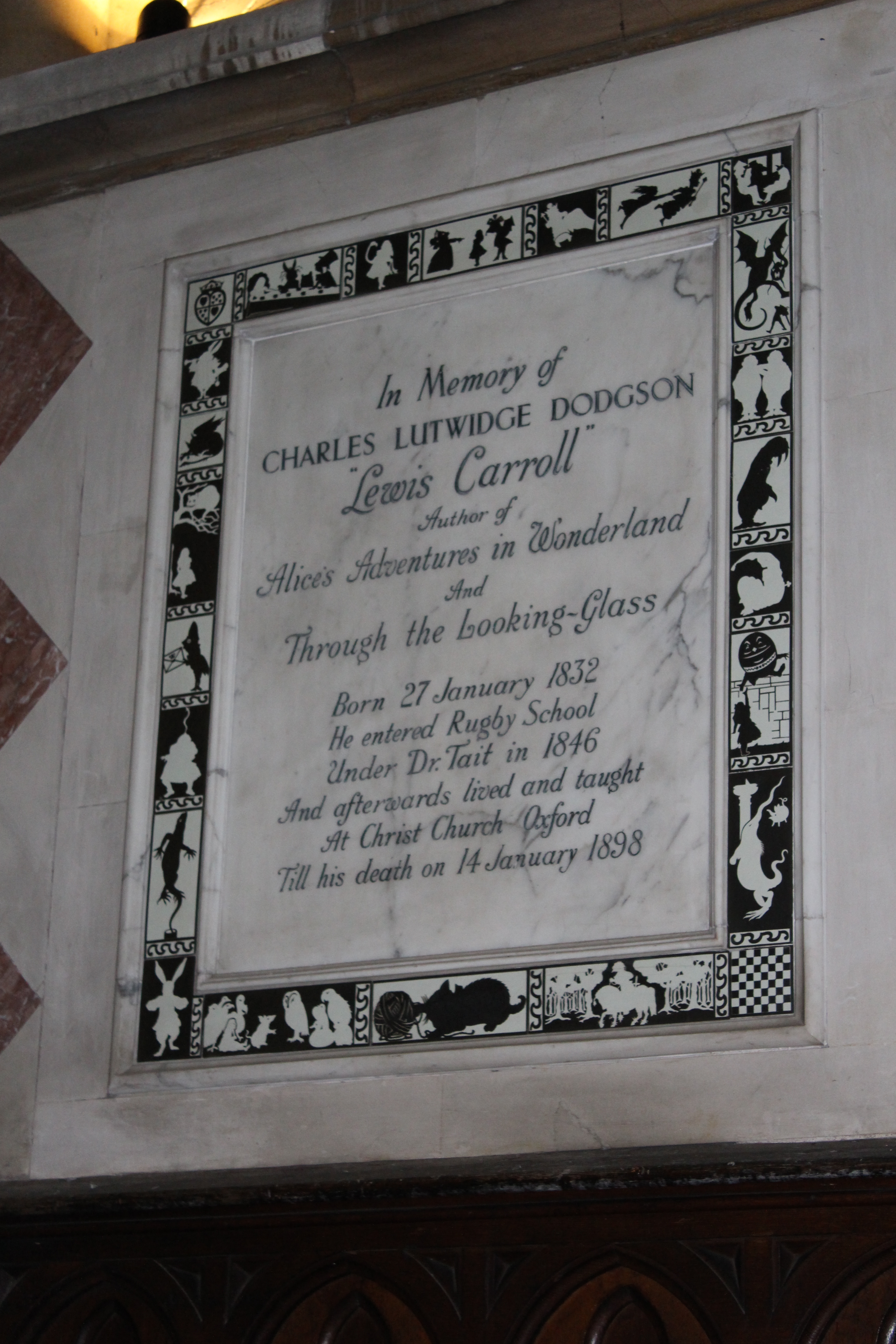
Almost as soon as we published the second edition of ‘The Making of Swallows and Amazons (1974)’ in May 2017, a number of facts and stories washed up on the incoming tide. I didn’t know that Ransome was aged twelve – Captain John’s age – when he first met the Collingwood family on Peel Island. I knew he went to Rugby School but not that he was given the study once used by the English author Lewis Carroll. I’m not sure if that inspired him to write children’s books but he certainly borrowed the term galumphing from Alice’s Adventures in Wonderland (1865).
~ Lewis Carroll’s plaque at Rugby School ~
I never knew that Rusland, where Arthur and Evgenia Ransome lie buried at St Paul’s Church, means ‘Land of the Rus’ – the name for Russia, where of course they met in what was then Petrograd when Evgenia was working as Leon Troski’s private secretary. Thanks to the feature writer Maggie Dickenson, I’ve learned that this kneeler at St Paul’s was embroidered by Jean Hopkins:
Brian Crawley has just written in to say that, in 1973, our visit to the charcoal burners was filmed less than a mile to the west of the church in Glass Knott Wood. I gather the remains of the wig-wam’s fireplace can still be seen. I didn’t know it was so close, and just assumed we had been in the Grizedale Forest. I’ll have to add it to my map!
The Russian edition of Swallows and Amazons, that can be borrowed from The Arthur Ransome Society library, has proved a great source of reference. Donated by the Gatchina Library it is the only copy in the UK. I learnt from the comments at the back that the Black Jack is a pirate flag, which I’ve always called a Jolly Roger, and that ‘in one’s mind’s eye’ is an expression used by William Shakespeare in Hamlet. “Tip us a stave” means “give us a song”, a term used in Treasure Island.
Other flotsam and jetsam on my tide-line is a wonderful quote to accompany this behind-the-scenes photograph when re-reading Winter Holiday written by Arthur Ransome in 1933:
“What’s in that box?” asked Roger.
“It’s just about big enough for you, isn’t it?” said Captain Flint.
~ Sten Grendon playing Roger in the Panavision camera box in 1974~
A member of the Arthur Ransome Group on Facebook commented on how annoying it was that Ronald Fraser made a funny face when he first sipped the tea Suzanna Hamilton offered him. Captain Flint ALWAYS enjoyed Susan’s tea.
There was some discussion amongst members of the same Arthur Ransome Group about how female characters depicted in ‘Swallows and Amazons’. Eddie Castellan wrote: ‘Ransome is remarkably non-sexist for his era and remains so by today’s standards. Mind you, most great storytellers realise that weak female characters are simply dull…great storytellers seem to give women better roles than mediocre ones.’
Fionna Grant added: ‘Arthur Ransome had a range of roles for his female characters from Nancy to Susan to Titty…. not only represented, but honoured for their contribution to the group…All the kids in Swallows and Amazons are encouraged to learn through achievement but they are also allowed to choose their own path, follow their own interests.
At a talk given about the Norwegian explorer Fridtjof Nansen given by Simon Browne, at a meeting of The Arthur Ransome Society, we were given a definition of the word Hero: one who combats adversity through integrity, bravery or strength, often sacrificing personal concerns for the greater good.
Titty was brave but all she really did was to grab a chance to swipe Amazon. It meant she had to sleep on board, which was rather uncomfortable, but what made Titty a true heroine in the film was her determination and persistence: she woke up early and persuaded Roger to help her find the treasure hidden on Cormorant Island. Like Ransome himself, she was prepared to grab a chance, take a risk – even if it meant being cold and uncomfortable for a while.
I received another lovely note on Facebook from Zena Ashberry (nee Khan) who appeared as a film extra in the Rio scenes shot at Bowness-on-Windermere when she was a little girl, despite being of half-Asian descent:
‘I was nine at the time and my sister was eight. I remember going through an audition – which was really just a panel of three or four men looking at Mum, my sister and me to see if we would be in keeping with the ‘look’ of the film. They seemed very keen on having Mum. My sister, at the time had sandy coloured hair and so was not at all problematic, however I was very dark and because they wanted Mum they said that they could hide ‘it’ by putting me in a white dress and hat! How times have changed…obviously I remember other things too, like feeding the horses which pulled the open carriage and the horse standing on my foot oouuch!, the strange awkwardness of having to act ‘naturally’ whilst being watched through a camera, having to repeatedly carry out the same activity to ensure a good shot – how many times did we throw stones into the lake? The ice-cream tricycle with real ice cream mmmm a treat … being watched by crowds of tourists gathered along the footpath and flower beds. It was a strange and unreal experience, doing what as children we would normally do but doing it in ‘dressy-up’ clothes that weren’t from our own dressy -up box and playing the game with Mum and her friends with total strangers telling us what we should do…just a bit bewildering really, but funny in retrospect.’
Please let me know if you have any points of interest that I could add to ‘The Secrets of Filming Swallows and Amazons (1974)’ that you think might of interest to readers. The great thing about ebooks is that they can be updated and re-loaded free of charge.
I’m hoping to give a number of talks on ‘The Making of Swallows and Amazons’ this summer. Please click here for details.
When the 1974 film of ‘Swallows and Amazons’ first came out in cinemas it stirred up quite a bit of interest in the media.
This script for a programme made for BBC Radio Bristol has recently been discovered in a box in my mother’s attic. Typical of the early ‘seventies, it is a carbon copy, so is rather feint, but it a little bit of media history in itself:
It’s intriguing. What did we say in the interviews that they ran in?
Sadly, two of the first newspaper reviews of the movie were not complimentary. Last year, when interviewed by Tim Fenton at Pin Mill on the Orwell, Professor Hugh Brogan said that one of these articles was so ignorant and so angered him that he resolved to write the truth about Ransome’s distinguished career. This involved years of research but resulted in his biography, ‘The Life of Arthur Ransome’.
I haven’t been able to find the article Hugh read but he remembered it being ignorant of Arthur Ransome’s politics rather than the film. His beautifully written book sparked an enormous amount of additional research and television documentaries, including ‘The Secret Life of Arthur Ransome’, which can be viewed on iPlayer.
Since The Lutterworth Press published the seconded edition of ‘The Making of Swallows and Amazons’ in May last year, a number of other stories and facts have reached me. I’ve learned that the creamy yellow taxi in which the Walker family arrived at Holly Howe was a Vauxhall 20/60 R type saloon, 1928 – 1930 model hired for the film by the property buyer Ron Baker, whose name I must add to the credits. When the Altounyan children stayed at the same farmhouse, which in reality is called Bank Ground Farm, their hostess was called Mrs Jolly. Apparently her husband, Mr Jolly, did not live up to his name.
The lady in blue who waved from the deck of MV Tern after the Swallow’s near miss was played by Lorna Khan. Here she is with her daughter Zena and a yellow Austin Heavy 12/4 tourer, after they appeared in the Rio scenes. You can see other film extras and supporting artists in 1929 costume, patiently sitting in the Browns of Ambleside coach behind them.
Photograph (c) Zena Ashbury
Did you know that missionaries in Africa used semaphore? Until I read a Russian edition of ‘Swallows and Amazons’ I’m afraid I didn’t know that Darien was the former name of the Isthmus of Panama, that the Rio Grande flows from South Colorado to the Gulf of Mexico or that ‘Shiver my timbers’ was a curse used by R. L Stephenson in Treasure Island.
Nick Owen had been living at Elterwater for seventeen years before he learnt the fishing scene from ‘Swallows and Amazons(1974)’ was shot there.
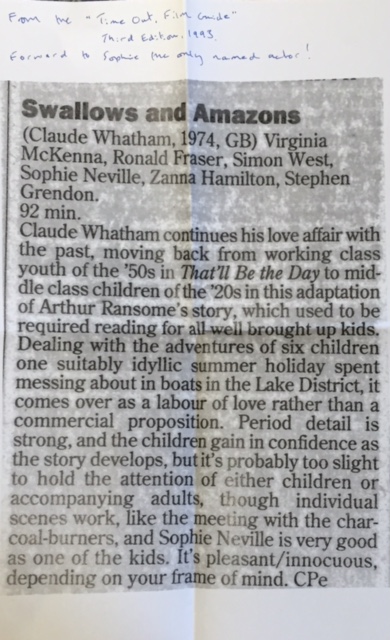
It had not occurred to me that the film was recorded in the annals until I was sent this excerpt from the third edition of ‘Time Out Film Guide’ (1993). Perhaps I should bring out a third edition of ‘The Secrets of Filming Swallows and Amazons’.
Please let me know if you would like to see more archive material from the attic.
To read more about Cider With Rosie (1971) directed by Claude Whatham, starring Sten Grendon as Laurie Lee please click here
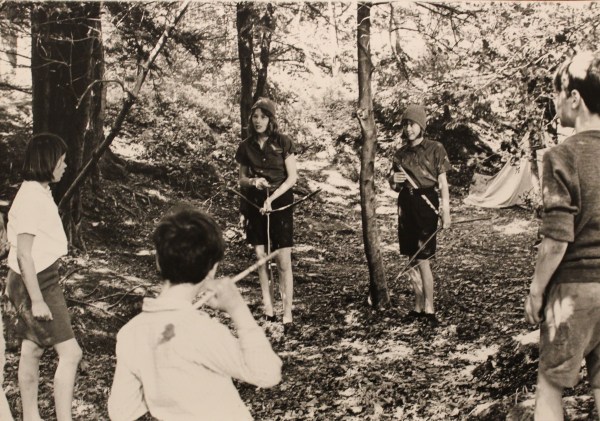
The Amazons confronting the Swallows on Peel Island in the movie ‘Swallows and Amazons’ (1974)
In the feature film ‘Swallows and Amazons'(1974) the part of Peggy Blackett was played by Lesley Bennett. She was an experienced dingy sailor and enjoyed the scenes on the houseboat although she told me she didn’t want the parrot to flap onto her shoulder, which was understandable. Its claws dug into mine.
~Sophie Neville as Titty with the green parrot and Lesley Bennett as Peggy~
When I met up with Lesley in the Netherlands this summer, we looked though the photographs she’d been given by the producer and kept for posterity.
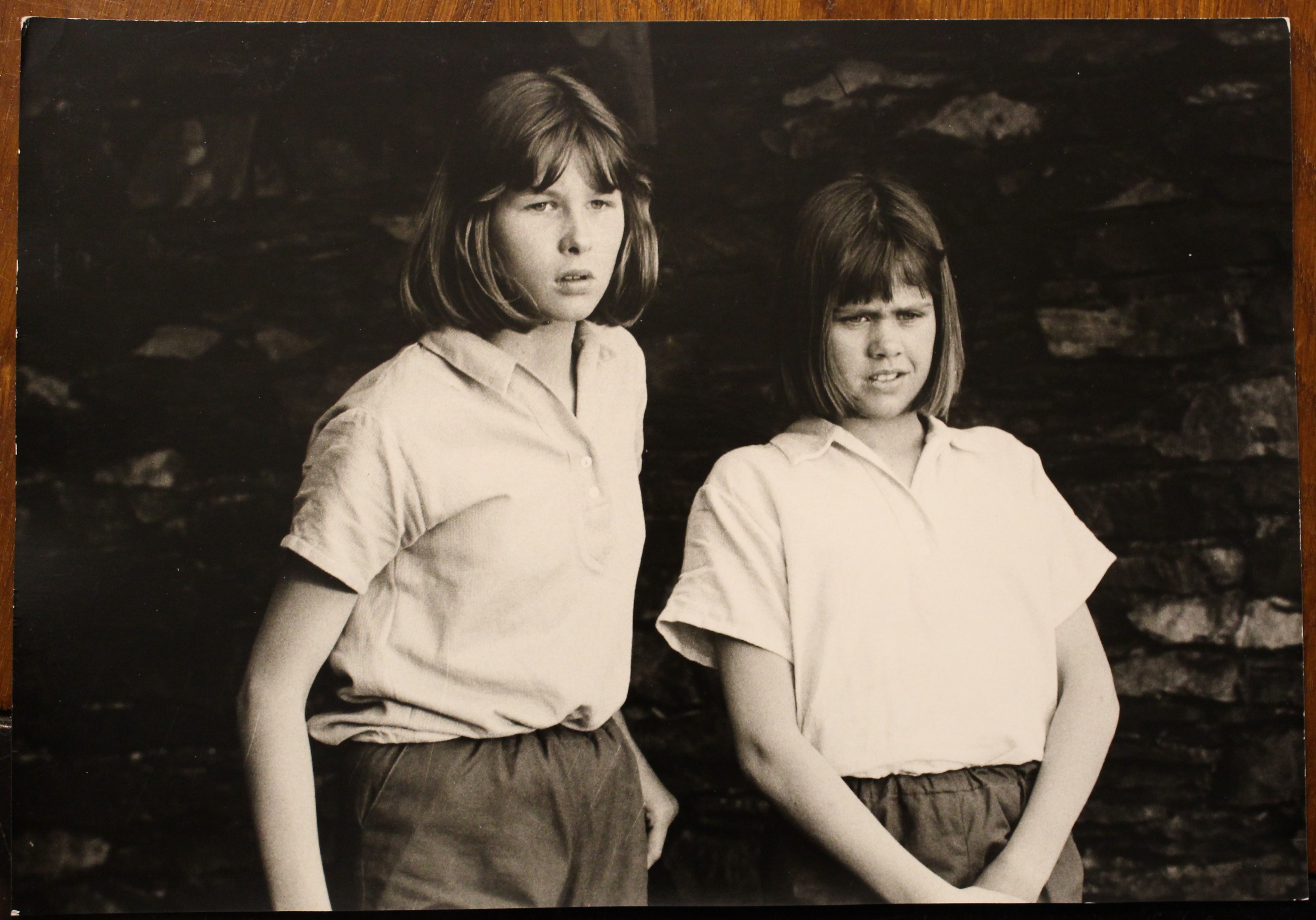
Kit Seymour and Lesley Bennett at Brown Howe boathouse on Coniston Water in 1973
If you don’t recognise the scene above it is because, although the shot was taken at Brown Howe, where the Amazon boathouse can be found, they were rehearsing the scene at Secret Harbour on Peel Island when the Blacketts find their boat has been captured. ‘She can’t have drifted against the wind.’ This was the first I knew of this. Perhaps they were waiting around for the camera to be set up or for a decision to be made about their red hats, which they were not wearing. This was rare. They wore them in every other scene.
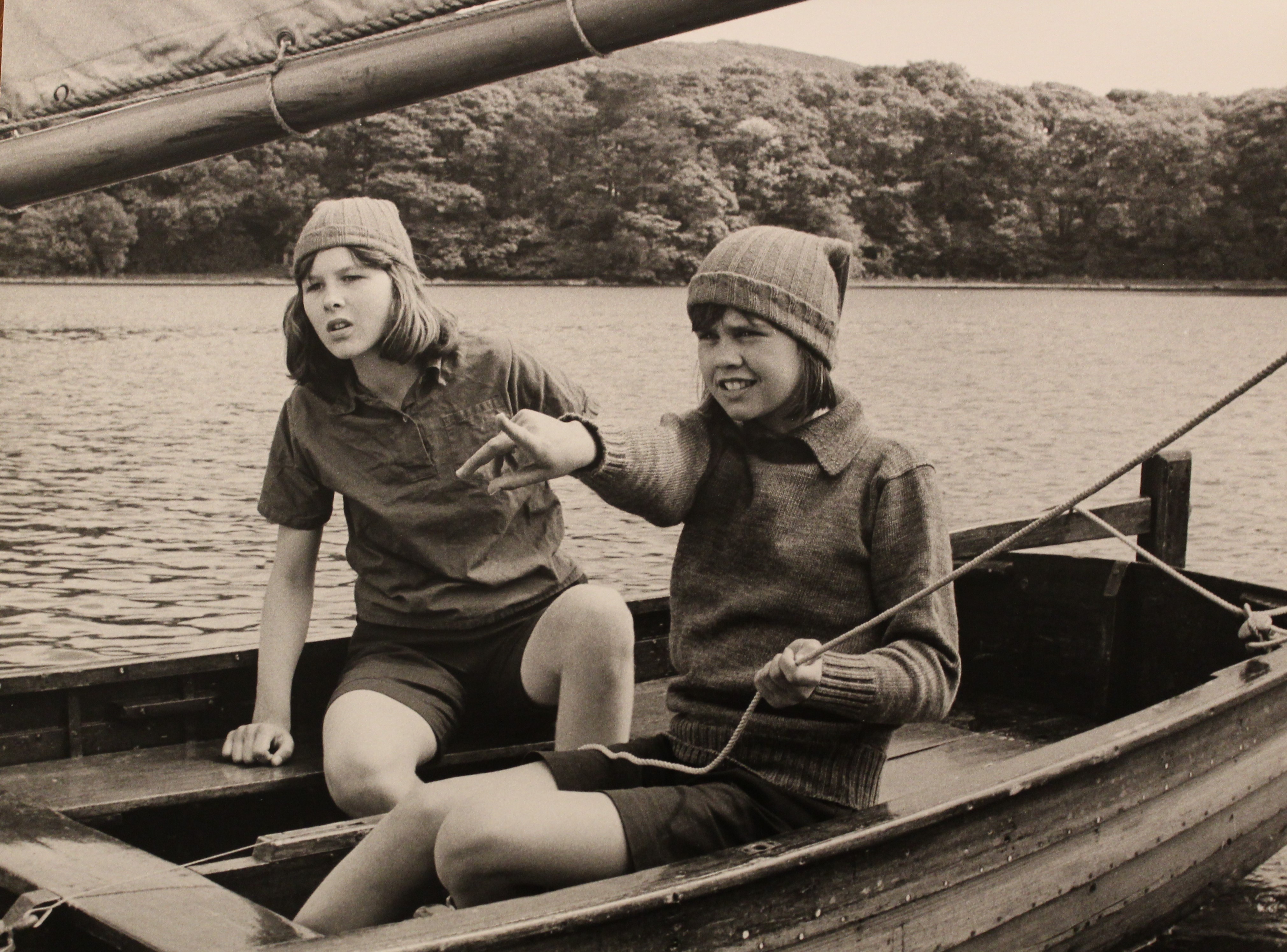
The Amazons sailing on Derwentwater
Lesley didn’t have much time for Ronald Fraser, who played her Uncle Jim, renamed by Titty as Captain Flint. “He wasn’t very nice to us. I think he regarded us as a bit of a nuisance but as soon as the cameras were on him, he’d change!”
Ronald Fraser with Lesley Bennett and Kit Seymour on Peel Island, Coniston Water in 1973
Lesley, who grew up in Kent, remembered my mother taking her shopping in Ambleside on one of our rare days off. “She had an appreciation of how important it is to buy a good top, explaining that she needed a selection for her work as a television presenter. I remember her waiting for ages while I tried on one after another.” I was amazed when I heard this. My mother only ever took me shopping once or twice when the first Laura Ashley shop opened in Cheltenham. This was deeply exciting but a rare treat. It was my poor father who was dragged from one shoe shop to another. It was difficult to find decent shoes in the ‘seventies.
Leaving London for the Lake District in May 1973 – photo Evening Standard
It was difficult to find decent clothes, that didn’t cost a fortune. There was a reason why dressmaking was so popular – we had to make our own garments. At the age of twelve I made a navy blue skirt for school so that it had a fashionably broad waist band. Flared dungarees were all the rage, worn with a stripy polo-neck or blouse with a large collar. Kit, Lesley and I all wore these, although sadly my brushed-cotton dungarees grew rather short during the filming.
Lesley signing autographs at the Chiddingstone School Book Fair in 1974
Lesley managed to find what I’d thought was the ideal outfit for our afternoon film premiere, which I’m pretty sure she is wearing in the shot above. Although we were almost obsessed with clothes, they were not a subject people discussed with new acquaintances, which was a pity as it would have provided us something neutral to discuss with the press.
“I remember the journalists at the hotel in the Lake District,” Lesley said, “and Claude saying, ‘Be careful what you say to journalists because they will turn it against you.'” However, when it came to film publicity Lesley was both enthusiastic and gracious turning up at a local school book fair and posing for newspaper photographers. I can see that tank-tops had come in by this time and it was possible to blow-dry your own hair.
Lesley enjoyed drama at school and looked into going to RADA, but after auditioning for one film decided the acting profession was too precarious. I think we were both interviewed for parts, possibly the same part in the same film. It was set in Wales and involved rock climbing. I said I wasn’t scared of heights, which was a lie! Sadly it was never made. I told her that Ronald Faser wanted us both to appear in another movie but that the funding fell through. She wasn’t disappointed. I was able to tell her that there was an actress called Lesley Bennett of about our age who once had a part in the long-running soap opera ‘Coronation Street’ but she confirmed that this was not her.
Lesley always loved meeting people wanted to travel, so went into marketing, working for Unilever on the first ‘Just one Cornetto’ campaign. She later branched out into international event management, which took her all over the world. She married a tall Dutchman and has two grown sons. They have a policy of visiting a different place each holiday, there by exploring different places, and they lived in Dubai for a while before returning to the Netherlands where she has been based since the early 1980s.
The cast of Swallows and Amazons with Virginia McKenna at Bank Ground Farm in 1973
Lesley looks back fondly on what she calls “The Swallows and Amazons era”, appreciating what recollections mean to those who have grown up with the movie and enjoy Arthur Ransome’s books. “Innocent films like ‘Swallows and Amazons’ (1974) appeal to those who know exactly how the books were written.” One thing she kept was the original film poster. Here she is with it more than forty-three years after the release. And she hasn’t changed a bit.
Lesley today, with her original film poster of ‘Swallows and Amazons’ (1974)






















 ~ Sten Grendon playing Roger in the Panavision camera box in 1974~





 Sophie Neville