‘I’d like to go to Africa,’ I declared as a little girl, ‘and see forests full of parrots.’ This I did. Everything I had ever hoped to see was spread out before me and the experience left a profound impression.
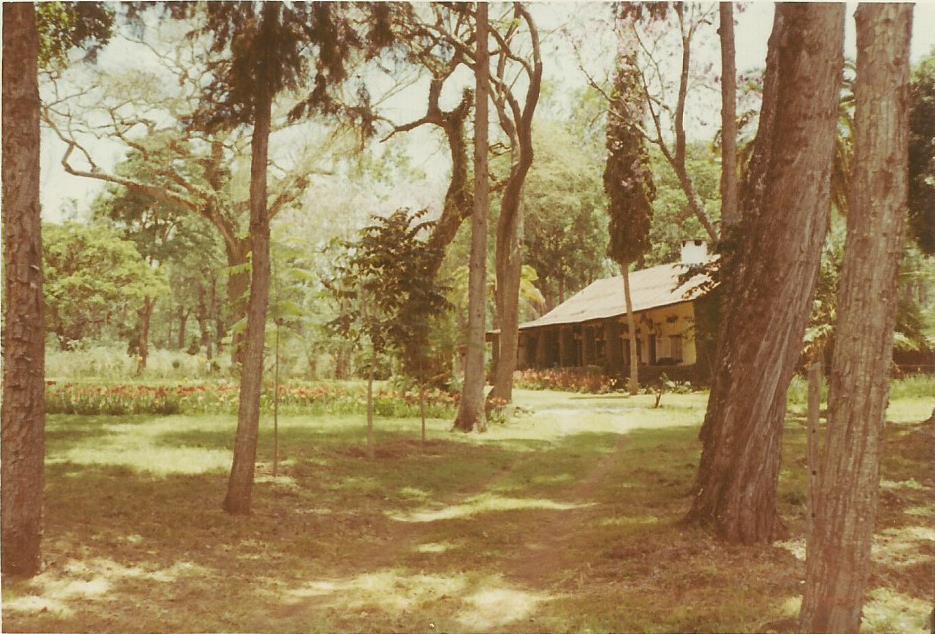
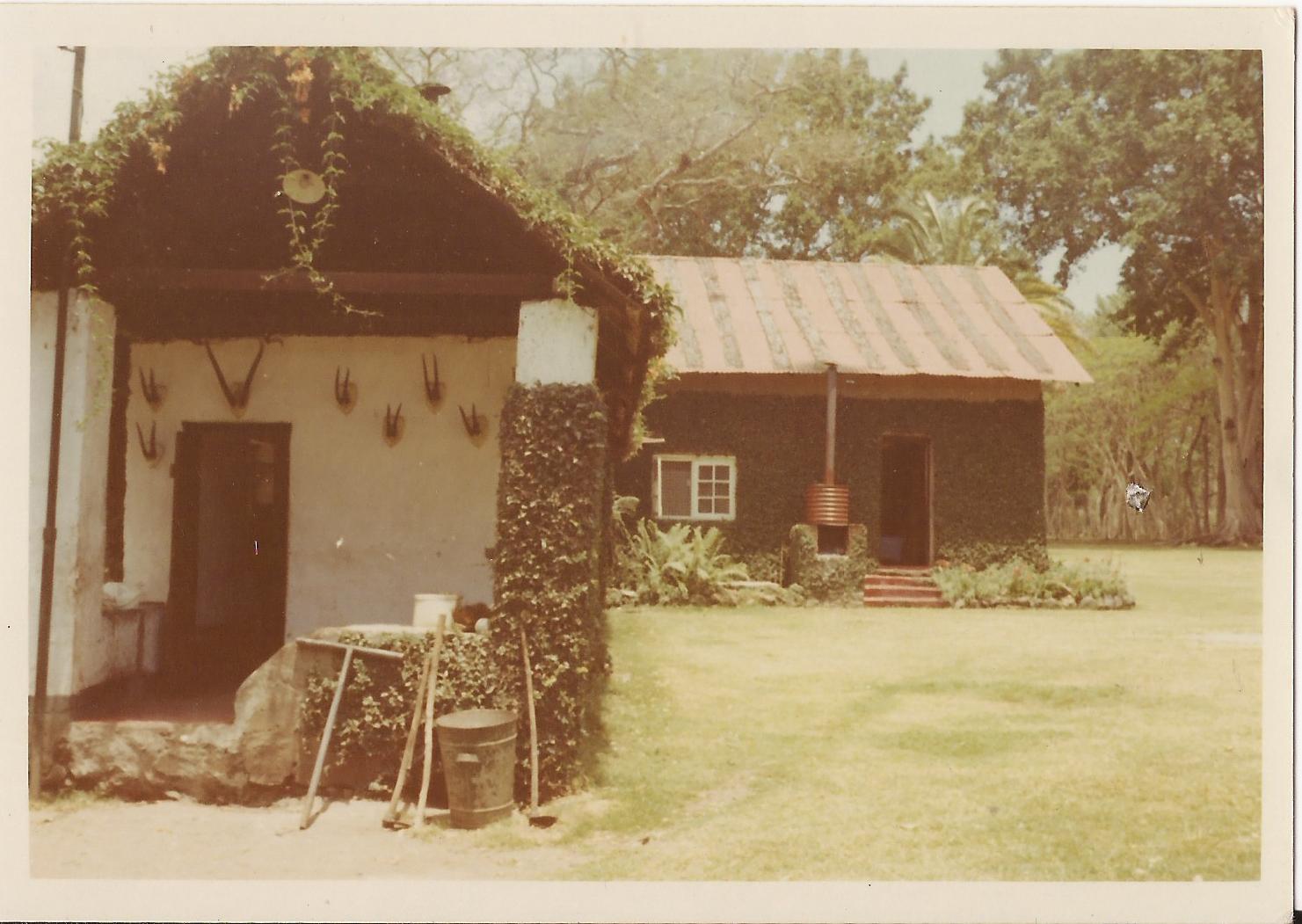
My great-grandparents began farming at Usa River, just west of Arusha in 1919. I first arrived in northern Tanzania in 1972, when my mother took these photographs of the house and garden where her family lived for fifty years. I longed to climb the ancient fig tree in the garden but was told a cobra lived there. It was probably on the lookout for parrots coming anywhere near it.
By the early seventies the family were busy farming coffee and often had visitors to stay. My great-uncle Tony used the farm as a base for his safaris and served as an honourary game warden having worked for many years in the Kenyan Police Force and Game Department. He was well-connected and once took Bing Crosby bird shooting, although this fact was kept secret until 2015.
I loved the outdoor way of life, was intrigued by the kitchen that was seperate from the main house, and amused by the hot water system that consisted of small cylindrical tanks known as ‘donkeys’. Everything smelt of wood smoke. The best thing was that I was able to sleep in a safari tent set up in the garden, in true ‘Swallows and Amazons’ style. It felt as if I was being swept along in an adventure portrayed in the film ‘Born Free’ when Virginia McKenna played the artist Joy Adamson who became well known for bringing up a lion cub called Elsa, eventually releasing her into the wild.
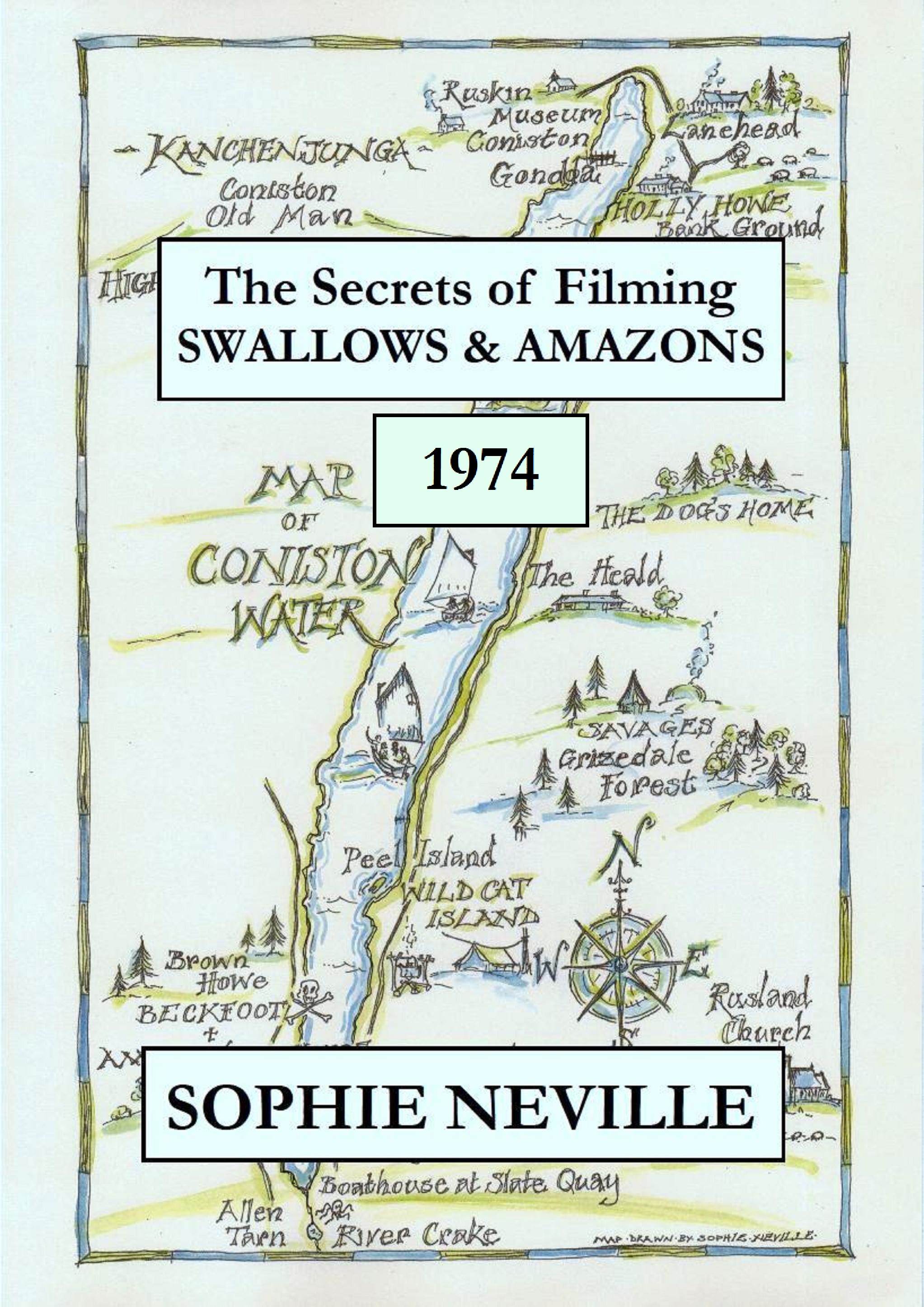
A second edition of the ebook ‘The Secrets of Filming ‘SWALLOWS & AMAZONS'(1974) is now available on Amazon Kindle, Smashwords, itunes, Kobo, and Nook for £2.99 . You can download this free of charge if you already own the first edition.
If you would like a copy but don’t have a Kindle, worry not. We have added a link whereby you can download a free Kindle app. Please go to my Book Page and scroll down for the details.
If you already have a copy of the ebook, contact a Customer Advisor and ask for a free update. You just need to give Kindle the ebook’s ASIN number. The ISBN for all online editions except Kindle is: ISBN 9781311761927
Since being contacted by others who were involved in the filming, I have been able to add a few more anecdotes and images, including this beautiful shot of Virginia McKenna in 1973 kindly sent in by the photographer Philip Hatfield.
I found a copy of my original contract for the film and when Jean McGill rang from Bowness, a few more secrets floated to the surface.
CBBCTV’s Cinemaniacs interviewed the screenwriter David Wood and myself on how the original movie of Arthur Ransome’s ‘Swallows and Amazons’ was made back in the summer of 1973. The idea was to use 30 second clips, so please excuse my over-the-top reactions, but you can watch the whole recording below.
‘This has to be one of the most delightful interviews in my recent memory.’ Tim Lewis, USA
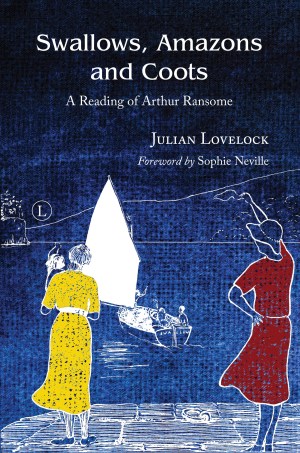
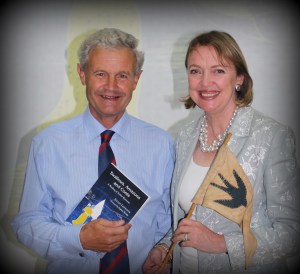
‘Swallows, Amazons and Coots’ by Julian Lovelock, with a forward by Sophie Neville, was launched on 23rd September at The Radcliffe Centre at the University of Buckingham. Published by the Lutterworth Press, it is a companion for anyone who loves Arthur Ransome’s series of ‘Swallows and Amazons’ books.
To read more and enter a competition to win a copy please click here
‘In 1929, Arthur Ransome (1884-1967), a journalist and war correspondent on the books of MI5, now widely regarded as one of the most influential children’s writers of the twentieth century, turned his hand to writing adventure stories for children. The result was Swallows and Amazons and eleven more wonderful books beyond, spanning in publication the turbulent years from 1930 to 1947. They changed the course of children’s literature and have never been out of print since, beloved for the author’s ability to create a world of escape so close to reality that it is utterly believable, in which things always turn out right in the end. Yet to be properly appreciated today, the novels must be read as products of their era, inextricably bound up with Ransome’s life and times as he bore witness to the end of Empire and the dark days of the Second World War.
‘In the first critical book devoted wholly to the series, Julian Lovelock explores each novel in turn to offer an erudite assessment of Ransome’s creative process and narrative technique, highlighting reflections of his experiences and contradictory politics, colonial imagery, the spectre of war and of course his remarkable skill as a story-teller as he constructed a fictional refuge for himself and his readers. Thus Lovelock convincingly demonstrates that, despite first appearances, the novels challenge as much as reinforce the pervading attitudes of their time. Elegantly written, Swallows, Amazons and Coots is both up-to-date and nostalgic. It will appeal to anyone who has enjoyed the world of Swallows and Amazons, and there is plenty here to challenge the Ransome enthusiast and the student as well.’
Endorsements
Virginia McKenna wrote: ‘There is always more in life than meets the eye. The delightful and unique Arthur Ransome stories from Swallows and Amazons to Great Northern? have delighted us over the years. But now we learn, thanks to this fascinating book, that there are more aspects and depths to the stories than we ever imagined. In no way does this diminish them – on the contrary. By giving us a more profound understanding of the author, the adventures and exploits of his characters take on an extra depth and dimension. These are stories for children that no adult should miss.’
‘An admirable introduction for newcomers to the Swallows and Amazons novels, written with detailed and expert knowledge. Julian Lovelock clearly has a deep affection and admiration for Ransome’s writing, and places the books in a rich and complex context. This is an elegant and leisurely guide through the books in the company of an amiable and well-informed companion.’ Peter Hunt, Emeritus Professor of Children’s Literature, Cardiff University, and co-author of How Did Long John Silver Lose His Leg? (2013)
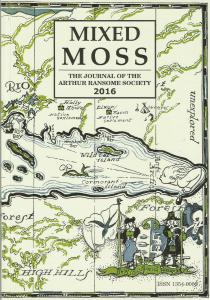
Julian Lovelock is the editor of Mixed Moss,2016, the journal of The Arthur Ransome Society, which includes an article by Sophie Neville who is President of the literary society.
I graduated from the University of Durham with a degree in anthropology and went straight into the mayhem of the BBC. I worked on a number of drama serials, filming on location in London, Paris and Corfu, and produced INSET programmes for Schools Television before setting up documentaries for the Natural History Unit and ‘Blue Peter’ in Southern Africa. I was based on a game reserve where we ran horse safaris. Disaster struck when I broke my pelvis but I used my time on crutches to turn professional as a wildlife artist. My sketches proved useful to illustrate my first books. I now live on the south coast of England where I use my spare time to raise funds for charitable projects in South Africa.
How did you get started writing?
I began by writing for television. It was a matter of putting my own programmes together and working with BBC Books to bring out accompanying literature. I seemed to be forever submitting blurbs for the Radio Times. It wasn’t until the year 2000 that I started writing books. I self-published ‘Funnily Enough’, that won an international book award, and ‘Ride the Wings of Morning’, made up of the letters I sent home from Africa about riding horses through the wilderness.
Can you tell readers about your latest book?
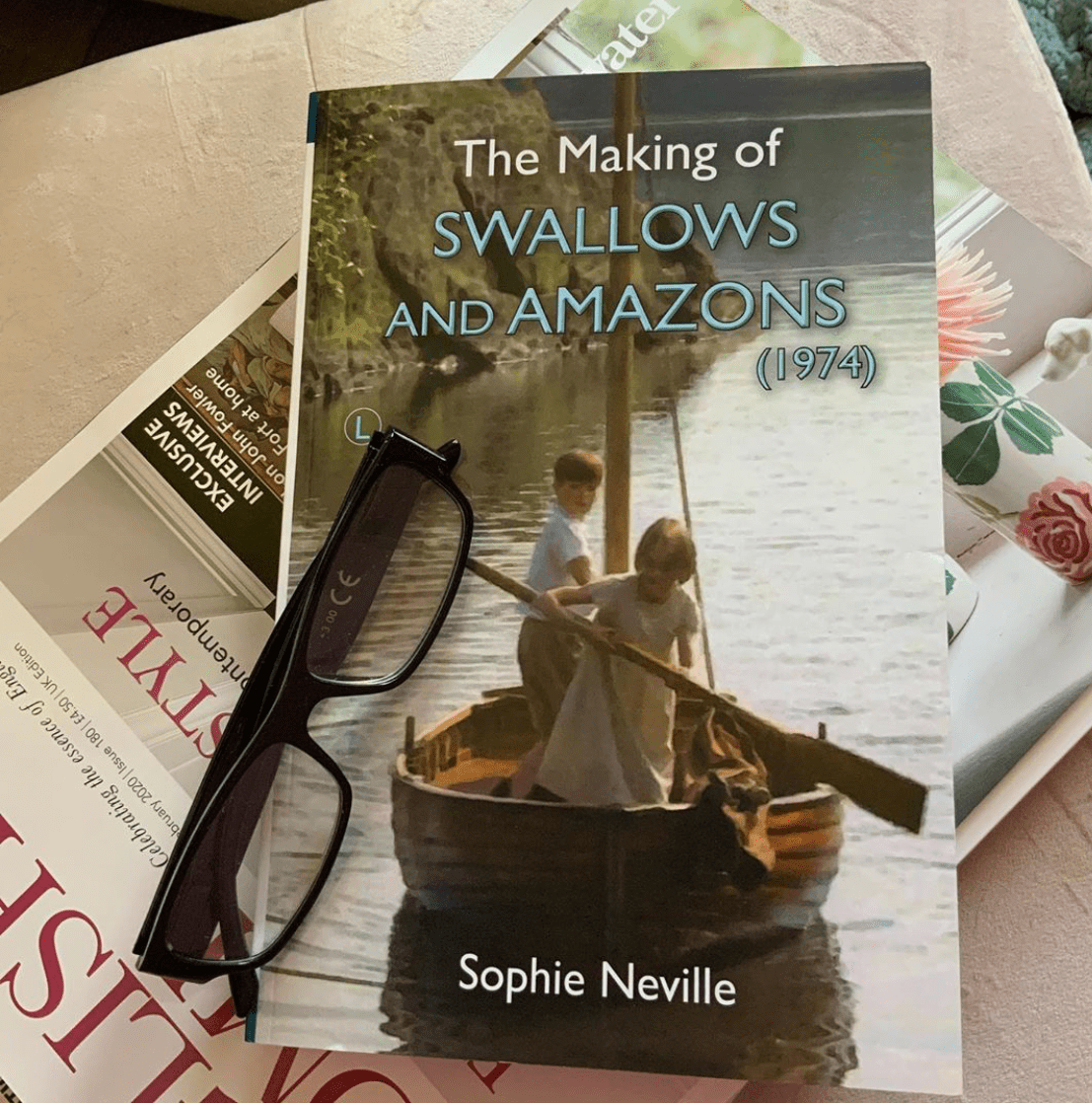
The publishers Classic TV Press asked if they could bring out a paperback version of ‘The Making of SWALLOWS & AMAZONS’, a memoir I’d launched as an ebook under a similar title. As a child I played Titty Walker in the classic movie of Arthur Ransome’s book, shot on location in the Lake District in 1973. I used the daily account I kept as a 12 year-old to guide the narrative, adding anecdotes as to how disaster was averted. It has appeal for anyone who grew up in the ‘seventies or enjoys light-hearted biographies.
What else have you written recently?
I am just finishing a novel based on a true story from WWII entitled ‘Makorongo’s War’. I’ve recently written Forwards to ‘An A-Z: Cumbria and the Lake District on Film’ for Hayloft Publishing and ‘Swallowdale’ by Arthur Ransome for Albatros Media in the Czech Republic. I’m currently working on a Forward to ‘Swallows, Amazons and Coots’ by Julian Lovelock soon to be published by Lutterworth Press. Revelation Films asked me to write material for the DVD Extras of ‘Swallows and Amazons Forever!’ and since ‘Funnily Enough’ was serialised in a magazine I’ve had feature articles in Cotswold Life, Country Life, Classic Sailor and Word in Action.
Have you got a favourite genre to read? If so why?
I get totally engrossed in the memoirs I use for research but my book club keep me reading popular literary fiction.
Which writer or writers has had the most influence on your own writing?
Since I write true-life stories, I would say Monica Dickens, Helene Hanff and CS Lewis. I was hugely influenced in my youth by Gerald Durrell and James Herriot, both of whom I met when I was working in television and was impacted by how well their memoirs translated to the screen.
Where is your favourite place to write?
A thatched cottage deep in the African bush, where I can escape everyday life. I use two rooms at home on the south coast of England – one for admin and one for books.
Pen or keyboard?
Laptop, I’m afraid. It’s not good for the posture. The original material for my last three books was handwritten but had to be typed up. My prehistoric computer sadly died when I was writing my first book in South Africa and I couldn’t afford to buy a new one. Miraculously, a brand new PC was donated to the local primary school. The teachers had no idea how to use it, so I introduced them to Microsoft Word in exchange for being able to work on my book while they were busy in the classroom. I sat at a low desk on one of those tiny red plastic school chairs until I had 100,000 words and the headmistress gained computer literacy.
How would you describe your writing regime?
The ideal would be to escape to South Africa for a couple of months to get my first draft on paper so I can assimilate research material or type all day long. I would then work on the structure and keeping adding material every afternoon back at home. I find my mornings are occupied with marketing. Since I was appointed President of The Arthur Ransome Society, which is the second biggest literary society in the UK, I spend quite a few weekends giving talks.
It is always great to receive feedback from readers, especially when they are familiar with the locations described in a book. Comments on ‘The Making of Swallows & Amazons (1974)’ keep coming in:
‘Thrilled with the book….We looked at all the photos in your book at bedtime and Eleanor was transfixed – we are loving it already. We talk a great deal about the houseboat feast’ – Miranda Gore Browne, author
‘Beautifully written book that really seems to capture the time and place. Made me want to re-watch the film and re-read all the books immediately.’ Jago Silver, book illustrator
‘I loved reading your book on the making of the film too – just lent it to a friend who is a big fan.’ Clare Mitchell on Twitter. ‘I have the paperback – ebook sounds gr8. Love the memories of a 70s childhood as well as the S&A background.’
To read more reviews of ‘The Making of Swallows & Amazons’ please see the Amazon UK page here.
‘Where are they now – the cast of ‘Swallows and Amazons’?’
I can see from my admin page that this question is often typed into search engines – three times before 8am this morning. An awful lot of people seem to want to know what the children who played the Swallows and the Amazons back in 1974 are doing now they are all grown up. For this little Swallow it really has been ‘Swallows and Amazons Forever’. I’m still wading out to the island.
‘Titty the Isrealite’ photo of Sophie Neville taken by Hilary Weston
Now a writer, I am officially President of The Arthur Ransome Society, one of the largest literary societies in the United Kingdom with six branches and quite a number of overseas members. They even have association with the Arthur Ransome Club in Japan.
This year we held our International AGM weekend in Dumfries in the lowlands of Scotland, when we much enjoyed walking along the Solway and across the wade to Rough Island, just as Titty walked out across the mud in Arthur Ransome’s book ‘Secret Water’. There seems little difference except that I have a dog called Flint rather than a kitten called Simbad.
Sophie Neville who in 1973 played Titty Walker in the EMI movie of ‘Swallows & Amazons’ dressed up to face the Scottish weather
The great excitement at our IAGM this year was that Nick Barton, the CEO of Harbour Pictures came up to Dumfries with his screenwriter Angela Gibb to tell us about their new adaption of ‘Swallows and Amazons’ released in cinemas on 19th August 2016. I helped him to carry a huge plasma screen up to the hotel where the conference was taking place so that members could watch the thrilling new promo. We were sworn to secrecy, but you can read all Nick told us in a feature article in the Saturday Telegraph. This online version has more photos than the print version and mentions The Arthur Ransome Society. There is additional comment in the Sunday Telegraph.
You can read more about how we made the original 1974 film of Swallows and Amazons here
Different editions of ‘The Making of Swallows and Amazons (1974) by Sophie Neville’
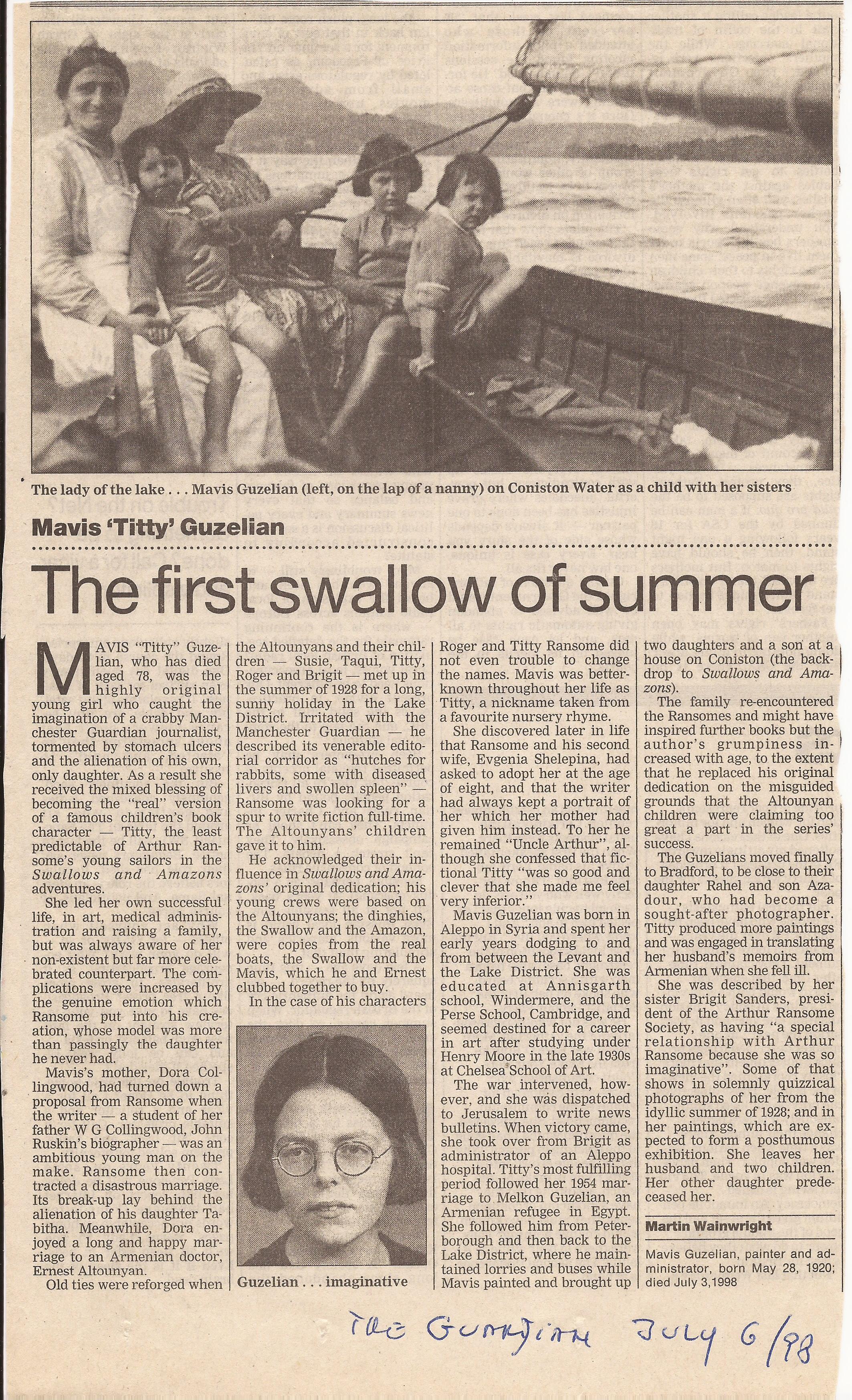
Titty was the name of an imaginative and ‘highly original’ little girl who Arthur Ransome first got to know in the Lake District when she was aged eight. When I met her niece Barbara Altounyan, she was most amused to hear that I had once played her Auntie Titty.
~Sophie Neville playing Titty Altounyan in the 1974 film ‘Swallows & Amazons’. Official photograph taken a Bank Ground Farm above Coniston Water copyright: StudioCanal~
I’d brought Barbara some long lost family photographs that included some of Titty’s wedding in Aleppo. They are beautiful.
Titty on the arm of her father, Dr Ernest Altounyan in Aleppo, 1954
Titty on her wedding day with her husband Melkon Guzelian, her sister-in-law, her father Ernest Altounyan, her mother Dora and brother Roger, far right. You can also see Roger, Ernest and Dora below, with Roger’s wife standing far right.
There is also a more informal shot.
‘Don’t you want to know about Titty?’ Barbara asked me. ‘She was a very detailed person and quite a perfectionist.’ I knew she was a wonderful artist who had studied under Henry Moore at the Chealsea School of Art. Although she produced a lot of colourful art, she was unwilling to ever attempt to sell her work. I was also told she also had long legs. I only hope that I have represented her well.
Titty and her siblings had dark hair, but I was told that Mrs Ransome wanted the children playing the Swallows to have have blonde hair. She insisted that Titty was played by ‘an English Rose.’
Titty Altounyan at her sister Brigit’s wedding to John Sanders in 1953
(NB: Ransome did not write ‘Swallows and Amazons’ while on holiday on Coniston Water as was stated in the programme. To see a photograph of Low Ludderburn, the house above Windermere where Arthur Ransome lived and wrote ‘Swallows and Amazons’ please click here and scroll down.)
You can read about what it was like to play the part of Able Seaman Titty in the original film of ‘Swallows and Amazons’ in this illustrated paperback, available online or to order from libraries worldwide:
David Stott has written in to say, “When l got the job driving for ‘Swallows and Amazons’ l think I took over the production car when Jean McGill started driving you children around in the mini-bus.” This must have been in May 1973 when the original film of Arthur Ransome’s classic book was being made in Westmorland.
David has all sorts of memories of filming ‘Swallows & Amazons’ in the Lake District that I knew nothing about.
“Jean mentioned that she took Ronnie Fraser for an early morning glass of champagne to get him going. I remember having to take him to the Lodore Swiss Hotel in Borrowdale while filming on Derwentwater. He would order what he called, ‘A Frazer’, which was some sort of vodka cocktail.”
David was only about seventeen at the time. Driving Ronald Fraser around must have been something of an eye-opener.
“I remember bringing him back to film ‘walking the plank’ and he was very drunk at the time. Expect he needed it for the cold water. He could be a little difficult when he had had a few.”
“I was rather star struck when l was driving Virginia McKenna,” he admitted. “On one occasion I had to drive her from the farmhouse on Coniston to Grange railway station. She was telling me all about filming ‘Born Free’ with the lions and I drove a bit slowly as l was enjoying her company. We arrived rather late and l had to throw her and her luggage onto the train just as it was leaving.” I asked Virginia about this but she couldn’t remember ever being late for the train. I can only imagine that David must have coped well.
“On another occasion I think l had Richard Pilbrow in the car,” he was the producer of the film. “We were driving back from Derwentwater when a cow jumped off a bank and landed on the bonnet, causing quite a lot of damage. I was dreading going back to Browns Motors and telling Alan Faulkener the owner what had happened.” Richard is still alive and well.
David, who now owns Crossways Hotel near Glynebourne, comes from an old Cumbrian family. His grandmother lived at High Green Gate, the farm next door to Beatrice Potter at Hilltop.
“My great grandfather was Farmer Potatoes in the ‘Tale of Samuel Whiskers’. It was sketched from a photograph that my mother still has.” Indeed, there was an article in Cumbria Magazine about Beatrice Potter’s relationship with the Postlethwaite family.
One of our locations – Haverthwaite Station today
“My father was the local joiner in Ambleside. He also kept about 1000 hens and delivered eggs around the hotels at the weekends. My brother and l would often help him on a Saturday morning.” David obviously knew the roads of Cumbria well.
David explained that, although he lived in Ambleside at the time, he has not seen Jean since the filming, so enjoyed reading that I had been in touch with her. “Jean’s Mum was called Girlie and she used to run a nursing home on Lake Road. Jean had a brother who was nicknamed Blondie. We would often have a cup of tea with Girlie in the nursing home kitchen.”
“It’s Jean!” It was Jean McGill ringing from Bowness in Cumbria. She had been our driver and the unit nurse on the film of ‘Swallows & Amazons’ made in the Lake District from May to July 1973, released a year later in 1974.
Jean McGill our unit driver and location nurse with Sophie Neville ~ photo:Martin Neville
“I’ve never seen the film,” Jean declared, “but I loved your book about making it. It brought back such memories.” I urged her to tell me more. “I remember when Suzanna Hamilton cut her hand whittling wood. It was bleeding like anything. I bandaged it up nicely but the director was horrified and made me take the dressing off again.” I think this was when we were in the middle of filming on Peel Island. The accident put an end to our wood carving hobby, which was a shame. We’d been using a Swiss Army knife to make our own bows and arrows with Bob Hedges the prop man.
Ronnie Fraser outside the dining bus on location with a paper cup of champagne
” You children persuaded me to go out to dinner with Ronnie Fraser! Why I went, I haven’t the foggiest. He was a rough character – very coarse.” Ronald Fraser was the movie actor playing Captain Flint. “I used to have to drive him to the local hotel in the mornings and order champagne to sober him up.”
“How would champagne have helped to sober him?”
“I don’t know. He told me it would.”
“I think he’d been divorced for a while at the time.”
“I wouldn’t have married him in the first place,” Jean assured me.
Terry Smith wearing the safety officer’s wetsuit with unit nurse and driver Jean McGill
Jean had been taken on as the unit nurse after the first nurse proved rather out of her depth. I thought she was a State Registered Nurse but she corrected me. She had 26 years experience in nursing becoming a hospital sister but was never an SRN. “I was a driver for Browns (of Ambleside)” and as such was paid to work on the film. “I wasn’t paid to be the unit nurse. It didn’t matter, I wouldn’t have missed it for the world.”
I only found out recently that my mother hadn’t been paid to be a chaperone either, despite the responsibility as well as her legal obligations. It was hardly a big budget movie. Like Jean, she was simply thanked with a bouquet of flowers at the end of the filming.
Jean was one of the few local people who worked on the film throughout the seven weeks we were on location. Her local knowledge made all the difference as she knew the roads well, took short cuts to avoid the traffic and knew the best swimming spots when the weather warmed up.
Suzanna Hamliton, Simon West, Claude Whatham Sophie Neville, Kit Seymour, Jean McGill with Daphne Neville (kneeling) Blackpool, 1973
I reminded Jean about the early 1970s – what we ate and how we dressed. ” I bought a pair of jeans for the first time in my life. It was so hot that I changed into shorts while we were on set. You children took the jeans and stitched a big red heart on the backside.” There was a craze for adding embroidered patches to denim clothing. These were expensive to buy but we persuaded to Sten Grendon’s mother to make red hearts for everyone’s jeans. “It made walking through Ambleside very embarrassing.” Jean sounded as if she was still recovering from the indignity 43 years later. “It mucked me up!”
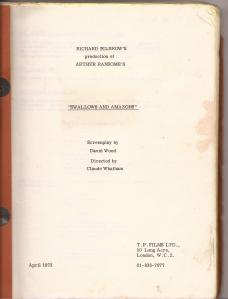
Jean went on to drive for Mountain Goat Tours in Cumbria and worked in a doctor’s surgery before becoming a registrar for ‘hatches, matches and dispatches’. “I’m a coffin-kicker now,” Jean told me cheerfully. She never worked on another film but kept a copy of the original screenplay and other memorabilia.
Not long after I spoke to her a brown paper package arrived in the post. It contained an envelope with the writing,
FOR THE ATTENTION OF TITTY
‘Still looking for the photographs. Will send to you when I find them. 43 years old? It was this tatty when I got same! Jean.’
And this is what the envelope contained:
Here is Jean in her red top talking to my mother in her Donny Osmond hat:







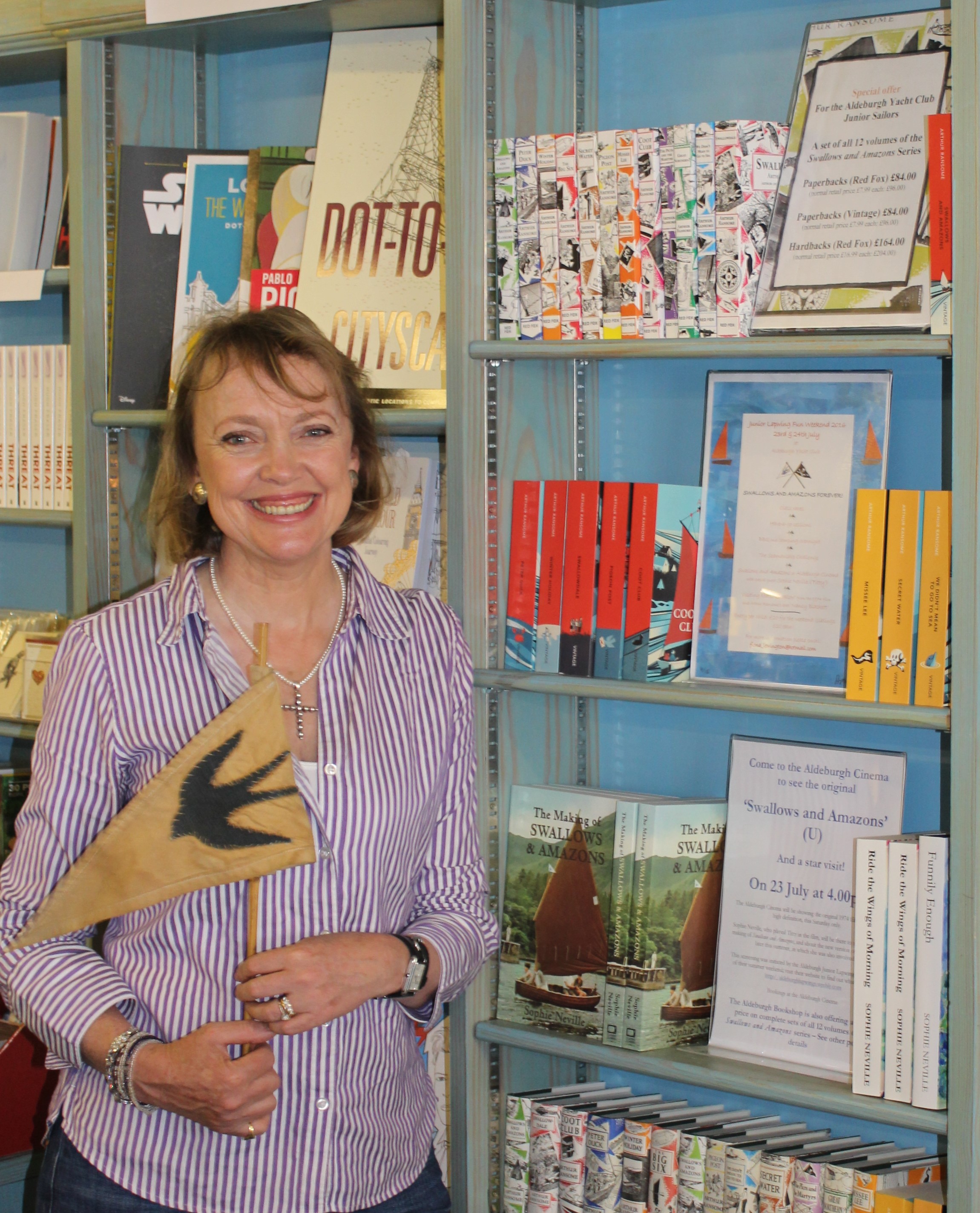

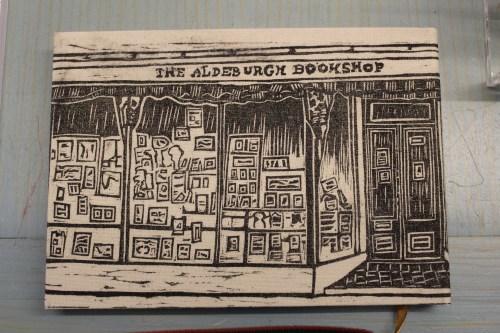
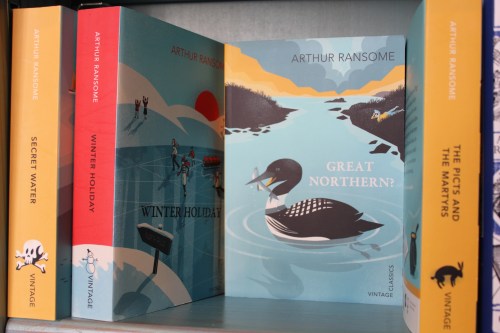 adorn the shelves of the award-wining Aldeburgh Bookshop
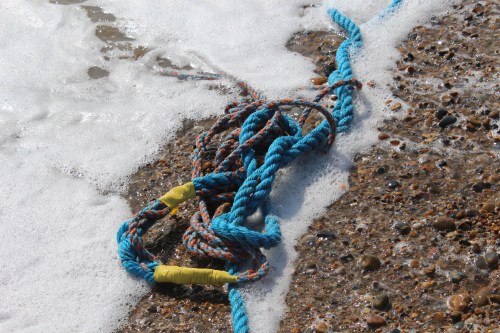
 The sun shone and holiday makers enjoyed the beach




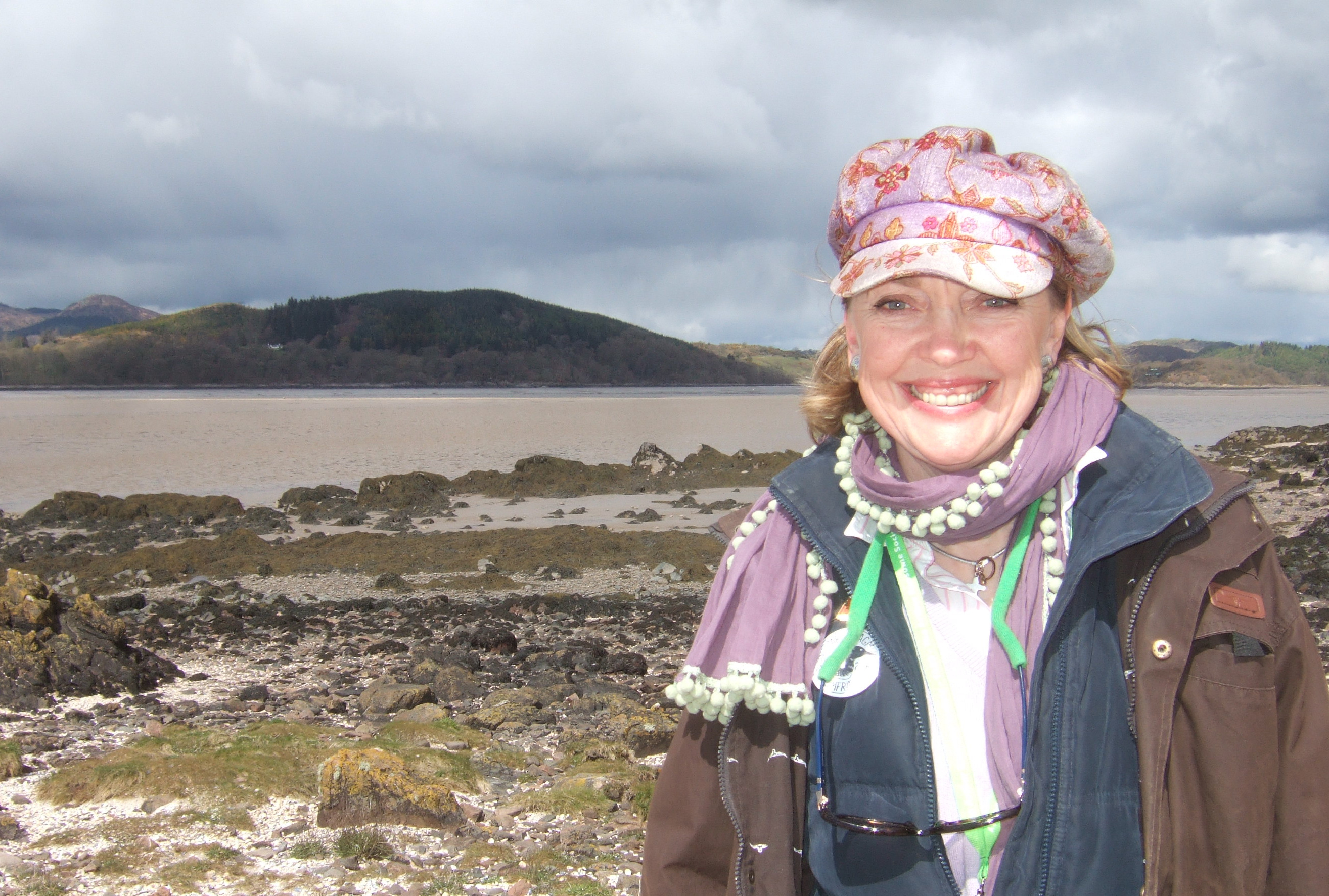 Sophie Neville who in 1973 played Titty Walker in the EMI movie of ‘Swallows & Amazons’ dressed up to face the Scottish weather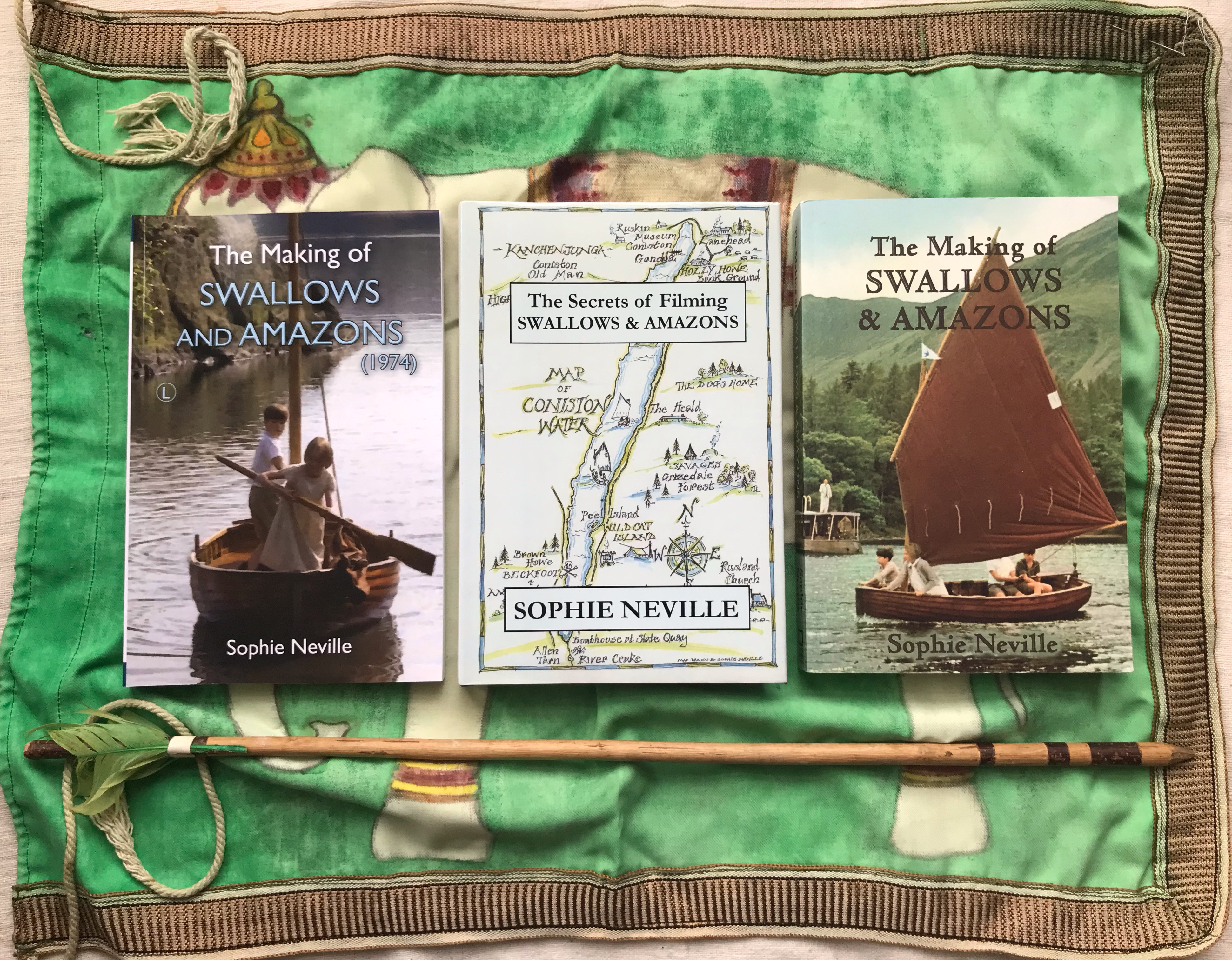


 David has all sorts of memories of filming ‘Swallows & Amazons’ in the Lake District that I knew nothing about.



 Sophie Neville