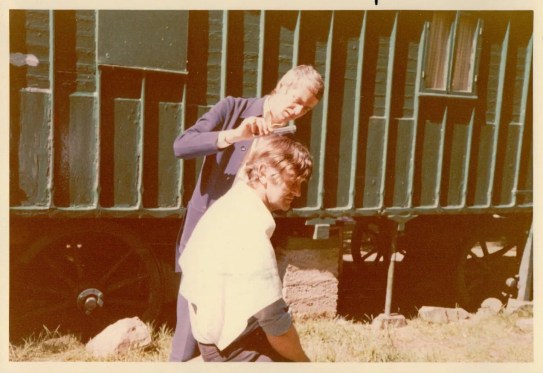
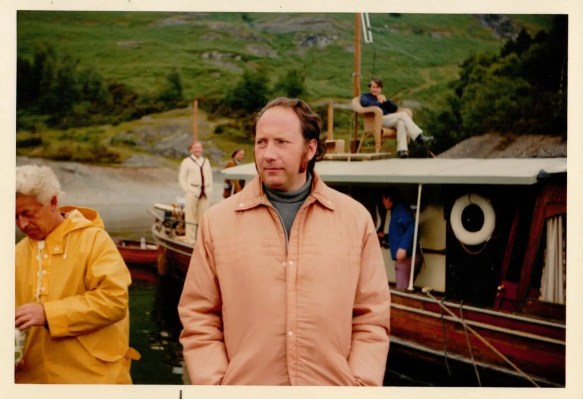
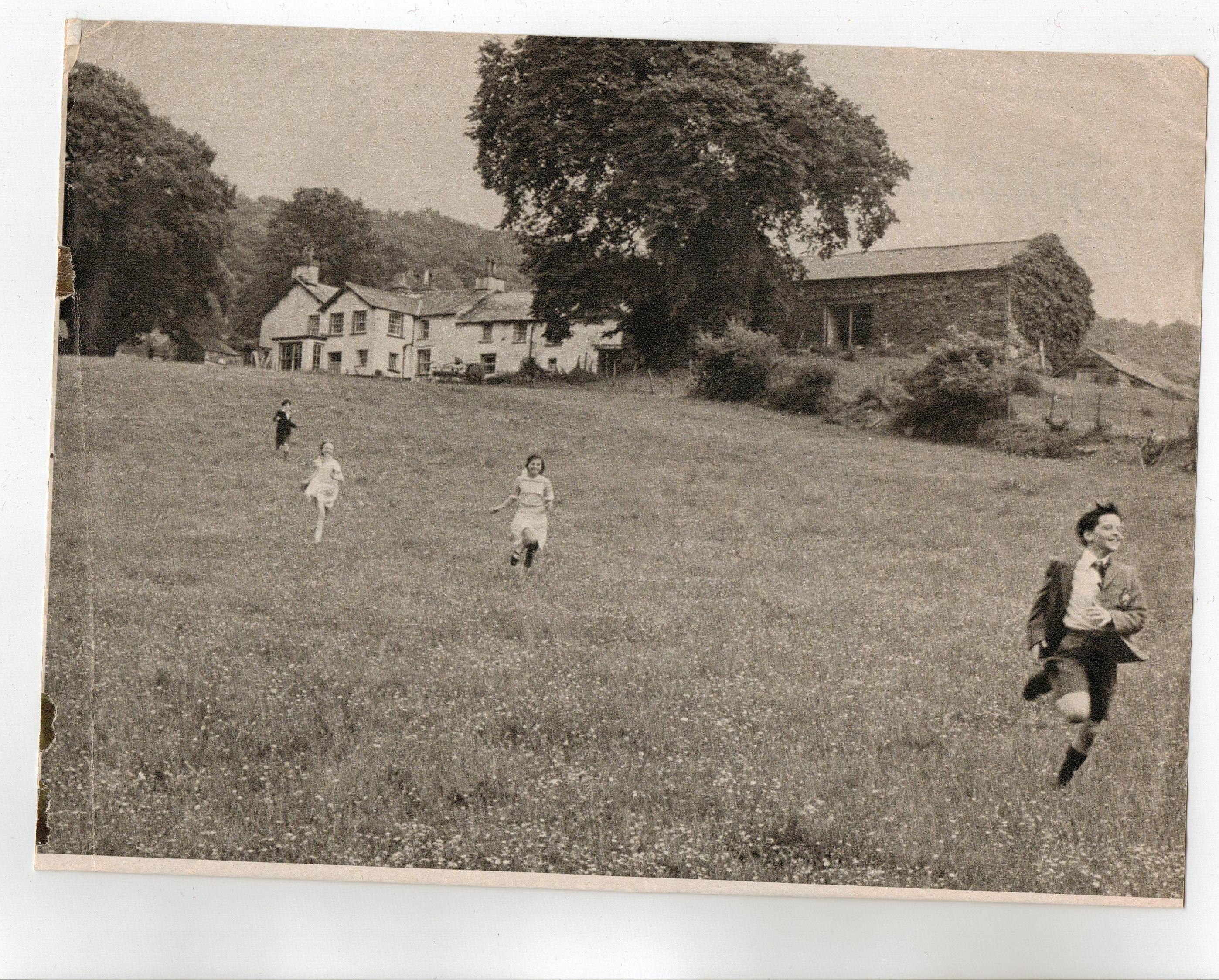
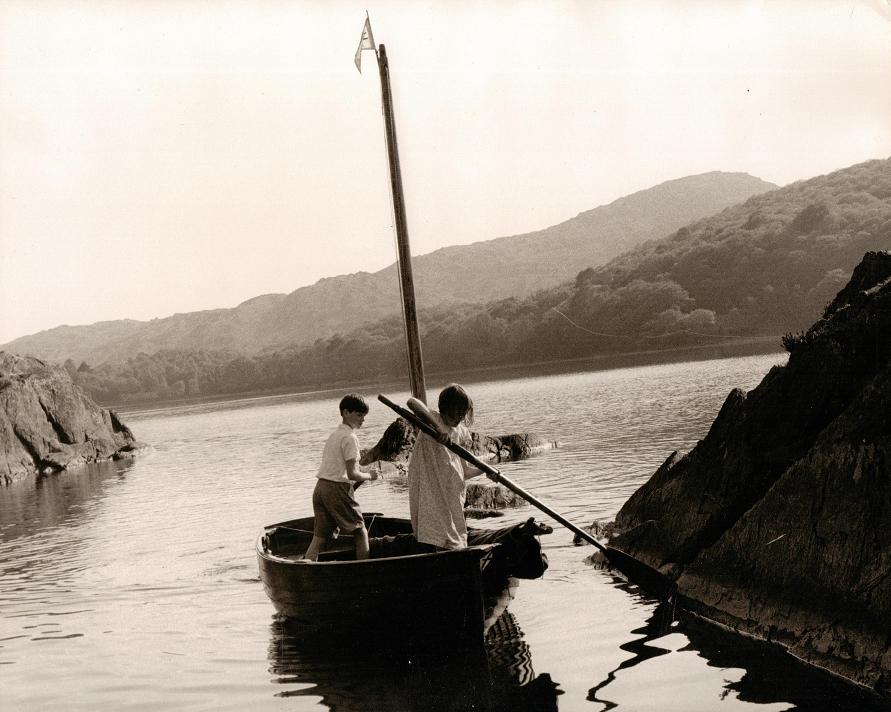
The Guardian published this photograph, taken on the set of ‘Swallows & Amazons’ when the original film of Arthur Ransome’s well-known book was being shot at Bowness-on-Windermere in the Lake District on 7th June 1973.
The story was set in 1929. The production team battled to find local men to appear as film extras. None of them wanted a short-back-and-sides hair cut. The ladies of the Lake District found this most amusing. Many of them wore their hair shorter than the men.
To see more photographs and footage taken behind-the-scenes on this day, with diary extracts, please click here
Ronnie Cogan cutting Martin Neville’s hair for ‘Swallows and Amazons’
For more photographs and a description of what happened please click here
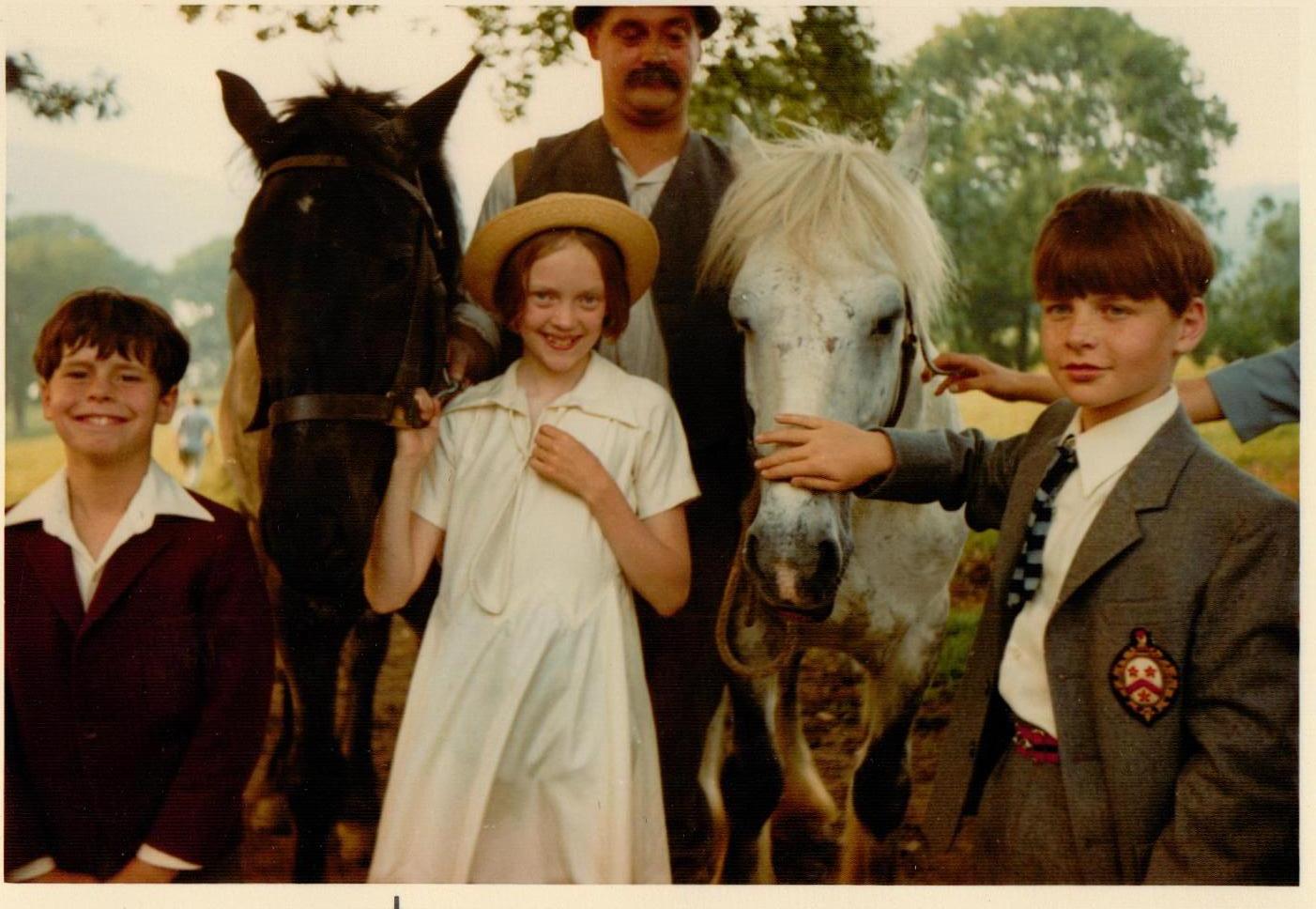
Jane Price, Perry Neville, Jane Grendon, Tamzin Neville and Pandora Doyle in 1929 costumes at Bowness in 1973
It was Pandora Doyle, seen in this photo as a little girl in a blue dress on the right, who sent me the newspaper clipping from the Guardian pasted above. Her father Brian Doyle was the Publicity Manager on the film. She kept all his files with notes from all the film stars he’d worked with. Do leave a comment below to let us know what you were doing in June 1973.
Brian Doyle, the film publicist on ‘Swallows and Amazons’ (1974)
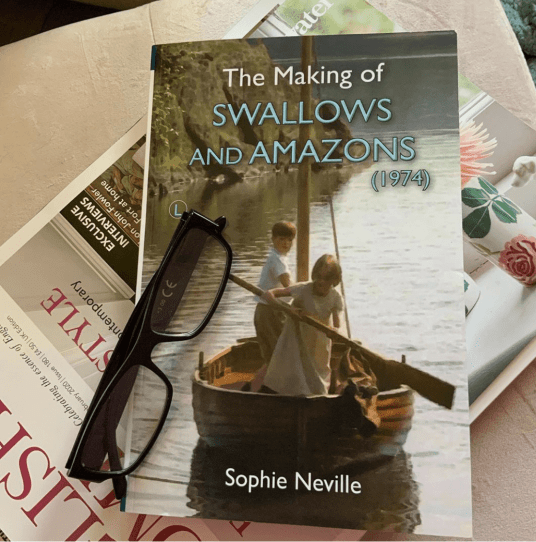
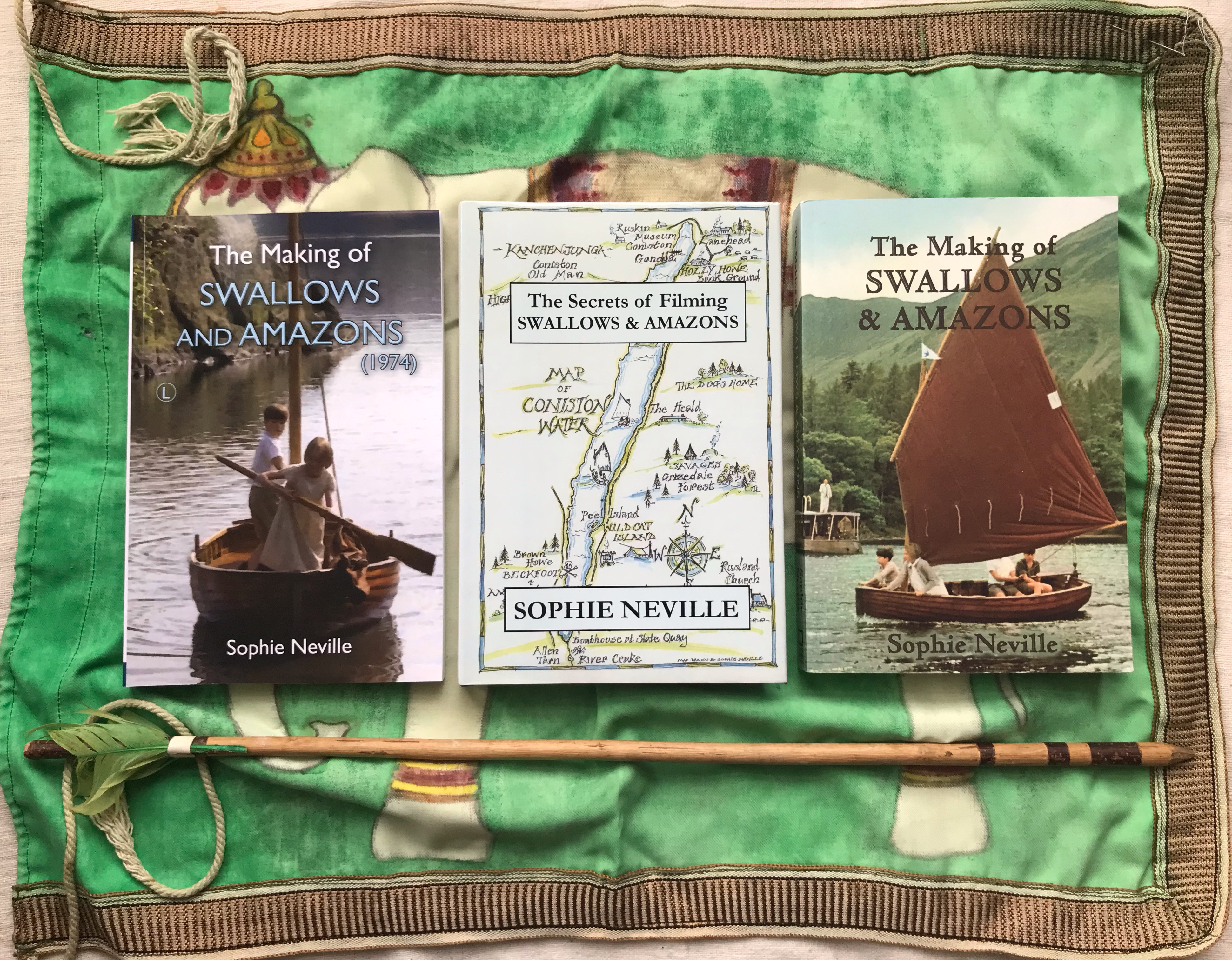
You can read the whole story about how the film was made in Cumbria in ‘The Making of Swallows and Amazons (1974)’ available to order from libraries or online retailers worldwide.
An orange flag has been labelling the Vintage paperback edition of ‘Swallows and Amazons’ as a #1 Best Seller in the Amazon UK sales. Not bad for a book written in 1929.
I was giving a talk at the International Annual General Meeting of The Arthur Ransome Society, when I asked learned members, ‘What has made it such an enduring success?’
Is it that ‘Swallows and Amazons’ set in the Lake District where so many of us long to spend our holidays?
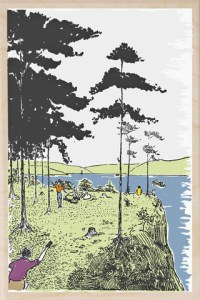
Or that we can buy a set of wooden postcards depicting Ransome’s inspirational illustrations?
Is it because the stories are driven by the characters of the children themselves, as Jill Goulder has observed, and that adults are relegated to native status, featured as little as is possible so that we enter a child’s world?
Do children relish the idea of independence and being in control of all they do, as John and Nancy seem to be? Is it that dressing up as pirates is cool?
Swallows and Amazons is about the importance of listening to children. It’s about integrity. Readers love the fact that Titty, the lowly able-seaman comes out as the unexpected hero. It was, after all, a brave thing to capture the Amazon at night and perhaps braver still to return to Cormorant Island with Roger to look for the treasure no one believed was there.
Could it be because the story is about sailing, and how to handle a simple dinghy? Claude Whatham, who directed the 1974 movie, recognised Ransome’s skill in describing how to make a camp was of huge appeal to children. Do we like to learn without the indignity of being taught?
Arthur Ransome’s style of writing is certainly vivid, drawing you into the world he created having been inspired by reading ‘Robinson Crusoe’, ‘Treasure Island’ and exotic tales himself. Martin Smith, whose comments on this strand have been endlessly interesting, has observed that there is something of ‘The Tempest’ by Shakespeare in the adventures set on Wild Cat Island.
Ransome was able to draw on years of experience as a writer before he launched the Swallows & Amazons series and this shines through. Since virtually only six children and two adults appear in his first book we get to know them well and are ready to welcome others such as Dick and Dorothea when they come along in Winter Holiday.
Is it because, ‘nothing happens in the books that couldn’t really have happened’, as Caroline Lawrence wrote recently in The Outlaw, a magazine written for children who readily identify with the characters. You can certainly enjoy looking for Ransome’s locations yourself. Those who do so are almost certain to buy the books for their own offspring.
Adults read the books, saying they bring great solace, evoking nostalgic memories and taking them back to a carefree childhood when summer days were spent devising camps and imaginary sailing adventures. Perhaps the traditional values act as an anchor in our stormy lives.
Despatches?
One thing is for certain. While many of the forty-two books Arthur Ransome wrote are now seen as obscure, his series of twelve ‘Swallows and Amazons’ novels line the shelves of almost every bookshop in Britain and are ever popular overseas. The Arthur Ransome Society has a thriving membership, enabling families to live the adventures for themselves. You can find out about joining yourself by clicking here.
The new feature film of ‘Swallows and Amazons’ starring Ralph Spall, Andrew Scott and Kelly Macdonald and released in 2016 has hopefully brought the story to the nation’s consciousness. It won awards in the USA where it was released in cinemas by Samuel Goldwyn.
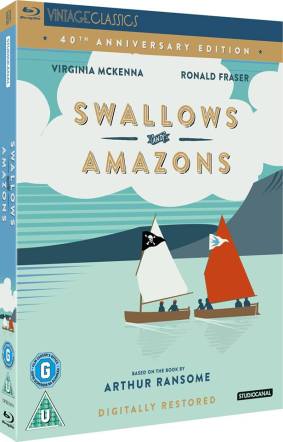
The film adaptation of ‘Swallow & Amazons’ made in 1973 and repeated on television so many times, helped to keep the flags flying. It too has been labelled as ‘a timeless classic’ and ‘an enduring success’. StudioCanal released a 40th Anniversary DVD with footage so beautifully restored that if it wasn’t for the extras package you might think it had been shot last summer.
‘The 1974 Swallows and Amazons film is a classic, and this is a really enjoyable look behind the scenes, written by the actress who (for me, at least) gave the stand-out performance as Titty Walker. If the film recaptured the lost world of 1929, then the book recaptures the lost world of 1973, when rules on child actors were strict (chaperones and schoolwork absolute requirements) but regulations on health and safety a bit more lax, even when on water. We even learn the truth behind that strange scene on the jetty in Rio where Roger is left minding Swallow. Highly recommended.’ P. Stevens, Bath, UK
‘Every now and again in cinematic history a classic is born. It doesn’t have to be a multi-billion pound blockbuster featuring legendary names, sometimes something timeless and endlessly endearing is born and this is most definitely the case with ‘Swallows and Amazons’.
‘This film has become an old friend to me; I must have watched it a thousand times and I never tire of it! It brings back memories of a summer childhood spent in wonder-filled Cumbria, in particular Windermere, Ambleside, Derwent and Coniston Water; places we’d visit as a family before the fates would, sadly intervene.
‘Sophie Neville’s excellent book recaptures again the halcyon days of youth in a summer-land of mountains, fells and shimmering lakes. She writes beautifully and with an easy style that’s a joy to read. The love for her subject is very evident, as is her passion for the work of Arthur Ransome. She takes you behind the scenes of the making of the film and the realities of filming on the water; how the director and crew worked tirelessly to bring out the best in the young actors and the splendours of the landscape. So glad I made this purchase. Pride of place on the old bookshelf.’ Allen Fairhurst
‘Sophie has lost none of her infectious enthusiasm and this shines through on every page.’ Julian Lovelock in Mixed Moss, the journal of The Arthur Ransome Society. ‘As well as using her own diary Sophie has mined the recollections and scrapbooks of a number of cast and crew.’
‘The book itself is indeed a delight. I have long been a fan of Swallows and Amazons. I am delighted with the film which was made and Sophie’s account of the making of it adds a very charming and interesting dimension. I loved the account and I fully recommend any fan of Swallows and Amazons to get a copy for themselves.’
You can read about how the original film of ‘Swallows and Amazons’ was made and find the complete collection of behind-the-scenes photos in this ebook available from Kobo, Smashwords, iTunes and on Kindle for £2.99
The screening of Swallows & Amazons (1974) on Sunday afternoon was sold out. 250 tickets. They were endlessly turning people away. ‘We should have shown it again in the 6.00pm slot,’ I told the manager. ‘Oh, we have American Snipper on then.’ It stars Bradley Cooper and Sienna Miller. ‘How many have booked to see it?’ ‘Three.’
All age groups were represented in the audience who came to the event – a fundraiser in aid of the Nancy Blackett Trust. About 70% had seen the film of Swallows & Amazons before. Some knew it well.
Everyone loved seeing the original white elephant flag flown on Captain Flint’s houseboat that had been sent to me from America by the producer.
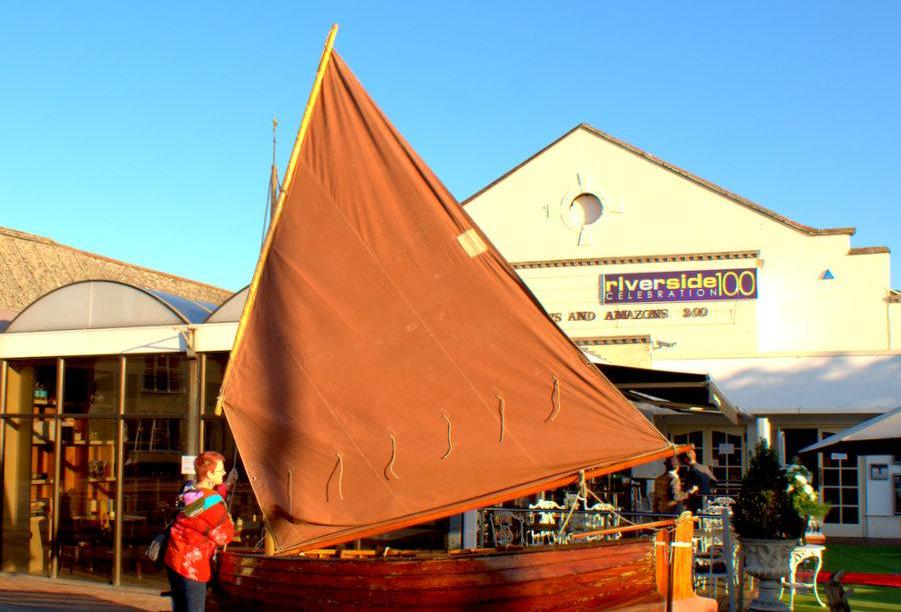
Swallow, the clinker built dinghy, originally built by William King and Sons at Burnham-on-Crouch and used in the 1974 film, was rigged up outside the cinema for everyone to meet. She has been appearing at a number of The Arthur Ransome Society’sevents in Suffolk and Essex.
We used the best photo of Swallow under sail for the cover of the paperback on how the film was made, which was on display in the cinema lobby after the film. It is now available online or from the Aldebrugh Bookshop in Suffolk.
Someone asked if we had any disasters while making the film.
‘Swallow’s mast broke, we nearly sailed under the Windermere steamer and a cow fell down a bank onto the producer’s car.’ I couldn’t think of anything utterly disastrous from my own perspective except that I lost a tooth halfway through shooting a scene with Virginia McKenna, which was embarrassing. I can list other questions asked by the audience in the next post.
The Riverside Cinema in Woodbridge are thinking of showing Swallows & Amazons again in September to help them celebrate their centenary ~ ‘100 Years of Film’. Do add a comment in the box below if you would like to organise a screening of the film at a cinema near you.
You can read about the adventures had making the original film of Swallows and Amazons in these editions available online:
Different editions of ‘The Making of Swallows and Amazons (1974) by Sophie Neville’
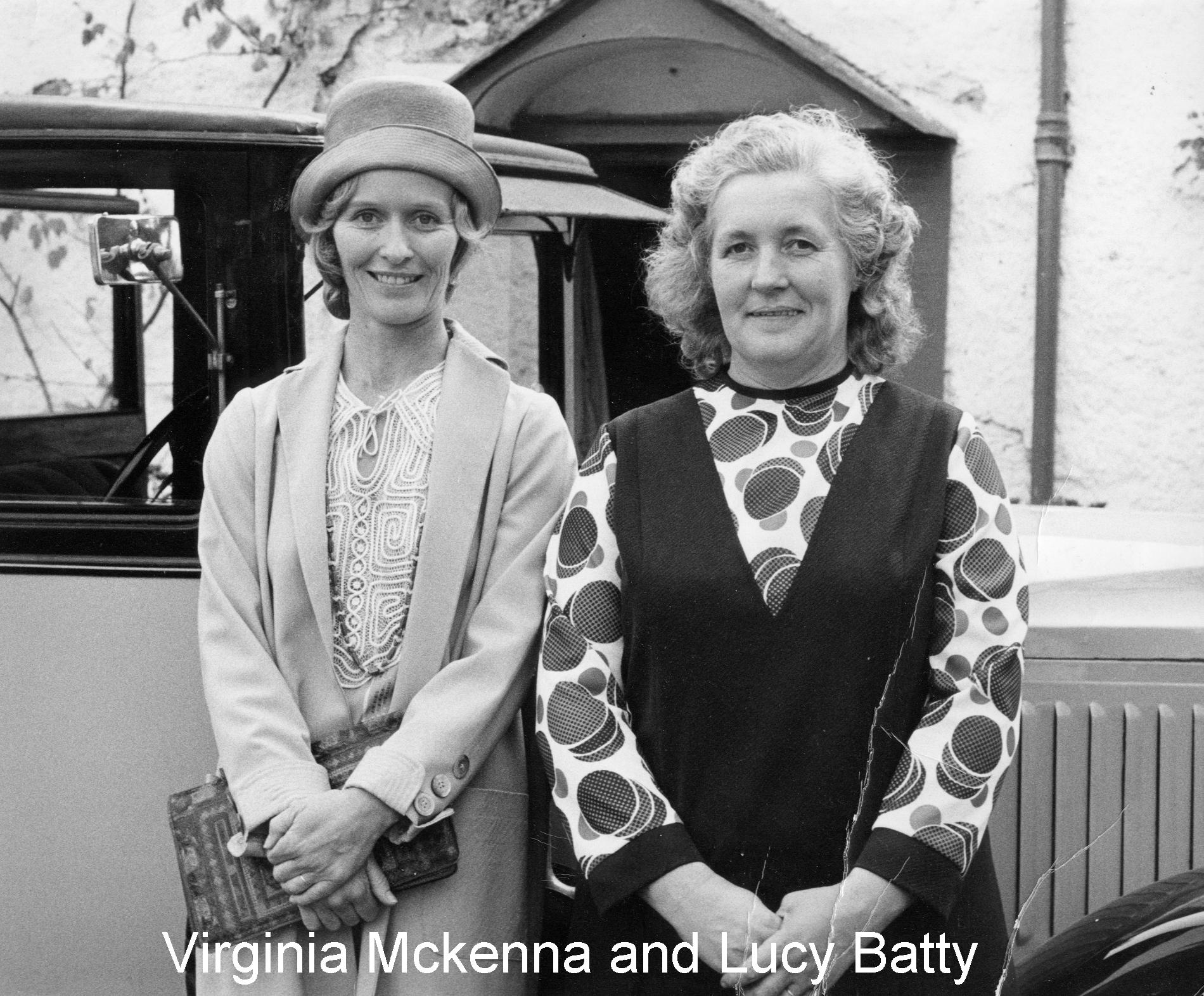
Virginia McKenna with Lucy Batty at Bank Ground Farm on 15th May 1973
We were sad to hear that Lucy Batty has passed away. She was 87. Our thoughts are with her family. She will be fondly remembered by visitors from all over the world who were made so welcome at Bank Ground Farm above Coniston Water in the Lake District, which she ran as a guest house for many years. It was also used as a film location, becoming known as ‘Holly Howe’ in Richard Pilbrow’s 1974 movie, Swallows & Amazons.
Bank Ground Farm in the Lake District
I first met Mrs Batty when we filmed in her home back in 1973 and returned to stay with her in 2003 when the BBC asked Suzanna Hamilton and myself if we would appear in Countryfile, which they were filming at Bank Ground Farm with Ben Fogle. It was then that she had time to show me her photo albums. What a life she led! She was very proud of having brought up seven children on the farm, “Two of my own and five that came with my husband,” she explained. “Getting them all off to school in the mornings was such hard work that my in-laws came to help on my first day.They all wanted bread and dripping for breakfast, with sugar sprinkled on top.”
~ Sophie Neville with Lucy Batty in 1973~
“A magistrate once asked me what running a B&B entailed. ‘It’s much like looking after cattle,’ I told him. ‘You bring ‘um in, feed ‘um, see they’re bedded down, turn ’em out and muck’um out.’ He flung back his head and roared with laughter.”
She had a great sense of humour. I have a cutting from an article in The News written by Brenda Colton and published on 25th May 1973. It reads:
‘When Mrs Lucy Batty was asked if her house could be used for the setting of the film Swallows and Amazons, with guest star Virginia McKenna, she was delighted. After all, her home, Bank Ground Farm on the east side of Coniston Water, near Brantwood, was the setting chosen by Arthur Ransome for his children’s book Swallows and Amazons.
Mrs Batty thought it a good idea that the story should be filmed in an authentic location, and she felt she should be able to put up with a few cameras and film men for a while. But she just did not realise the scale of a “medium budget” film like this one, or what the production staff could do to her house. It was not the two double-decker buses coming down the path and parking on the farm that she minded, nor the numerous vans, lorries, cars and caravans. It was not even the difficulty of having 80 men and women wandering round the farmhouse carrying equipment here, there and everywhere.But when art director Simon Holland started tearing up her lino and carpet in the kitchen to get to the bare stone floor, she did get a little annoyed. Especially when he removed all the electric sockets, lights and switches, pushed all the kitchen furniture into the larder and whitewashed the newly papered walls.
“Have you seen the kitchen?” Mrs Batty said to me. “The larder is piled high with my furniture; and you would not believe the tip my lounge is in. But they are a funny lot. I asked if I could wash the beams in the kitchen for them, and they said ‘Oh no, we want them to look old.’ I have even had to hunt out a lot of old pottery from the cellar for them.
“But I have given up now. I have just left them to it.”
What I really did not know, until I watched the BBC documentary ‘Country Tracks’, was that Mrs Batty reached the point when she locked out the crew. She explained that when she was originally asked if we could film on her property she did not quite realise the scale of operations and only asked for – or accepted – a location fee of £75. She said that she decided that £75 was not enough, padlocked her front gate and wouldn’t let them back in until they agreed to pay her £1,000. It was a lot of money, more than double the fee I received for acting in the whole movie.
To read a little more about filming of Swallows & Amazons at Bank Ground Farm, please click here.
Sten Grendon, Sophie Neville & Simon West with Mr Jackson at Holly Howe
I am sure many people reading this have their own memories of Mrs Batty who was such a great character. Please do add them to the Comments box below. I feel it would be a tribute to all the hard work and love she put into making Bank Ground available over the decades for so many to enjoy.
The farmhouse as Holly Howe in 1973
You can read more about the adventures we had making the original film Swallows and Amazons here:
On 21st March and 28th March, the new CBBC TV show ‘Cinemaniacs’ included guest appearances from Sophie Neville and from David Wood, who wrote the screenplay for ‘Swallows & Amazons’ back in 1973.
Oli White, the vlogger and presenter of ‘Cinemaniacs’, asks a number of people involved in movies about making their first film. Others featured include Michael Sheen, Sir Ian McKellen and Matthew Lewis famous for playing Neville Longbottom in all eight Harry Potter movies.
To find out more about how the film ‘Swallows & Amazons’ (1974) was made, along with how the children’s parts were cast, please see earlier posts or read the book! It includes more than 120 photographs taken on location in the Lake District.
Amazon, originally known as Mavis, now residing at the Coniston Museum
People come from all over the world to visit Mavis, the traditional gaff-rigged dinghy known to all those who love the Arthur Ransome books as Amazon. She has been lovingly renovated but, still being a bit leaky, is on permanent display at the Coniston Museum in the Lake District. It was in this clinker-built dinghy and another little ship named Swallow that the Altounyan children learnt to sail on Coniston Water in the late 1920s.
In later life they used Mavis to teach their own children and grandchildren to sail. She was kept in Brigit Sander’s (ne Altounyan) boathouse at Slate Quay, which so resembles Ransome’s illustrations of the Amazon boathouse.
Suzie, Taqui and Brigit Altounyan
One of the secrets of ‘Swallows and Amazons’ is that the character of Captain John, was, if anything, loosely based on a the eldest girl in the family. Arthur Ransome obviously needed to balance genders and have two boys and three girls instead of only one boy, as in real life. Taqui Altounyan seemed to take this in her stride, giving him what advice she could. She has detailed this in her memoirs of the family’s lives: In Allepo Once and Chimes from a Wooden Bell – excellent books that have become much sort after.
Roger Wardale, author of many books about Arthur Ransome and the locations he used in his stories, kindly sent me these photographs of Taqui that he took when she was showing him some of the places where she played as a girl.
Taqui Altounyan on Peel Island, Coniston Water
The Lake District, where her Collingwood Grandparents lived, was obviously a special place for her.
Taqui Altounyan pointing to the rocks from which they would jump into Trout (Beacon) Tarn.
These photographs of Roger’s show her walking back in time,
visit Mavis in Coniston Museum
Taqui Altounyan looking at Mavis, who was later renamed Amazon
and go aboard SL Esperance on Windermere,
‘You can sweep up’ Taqui Altounyan in Esperance
soaking up the atmosphere in her cabin.
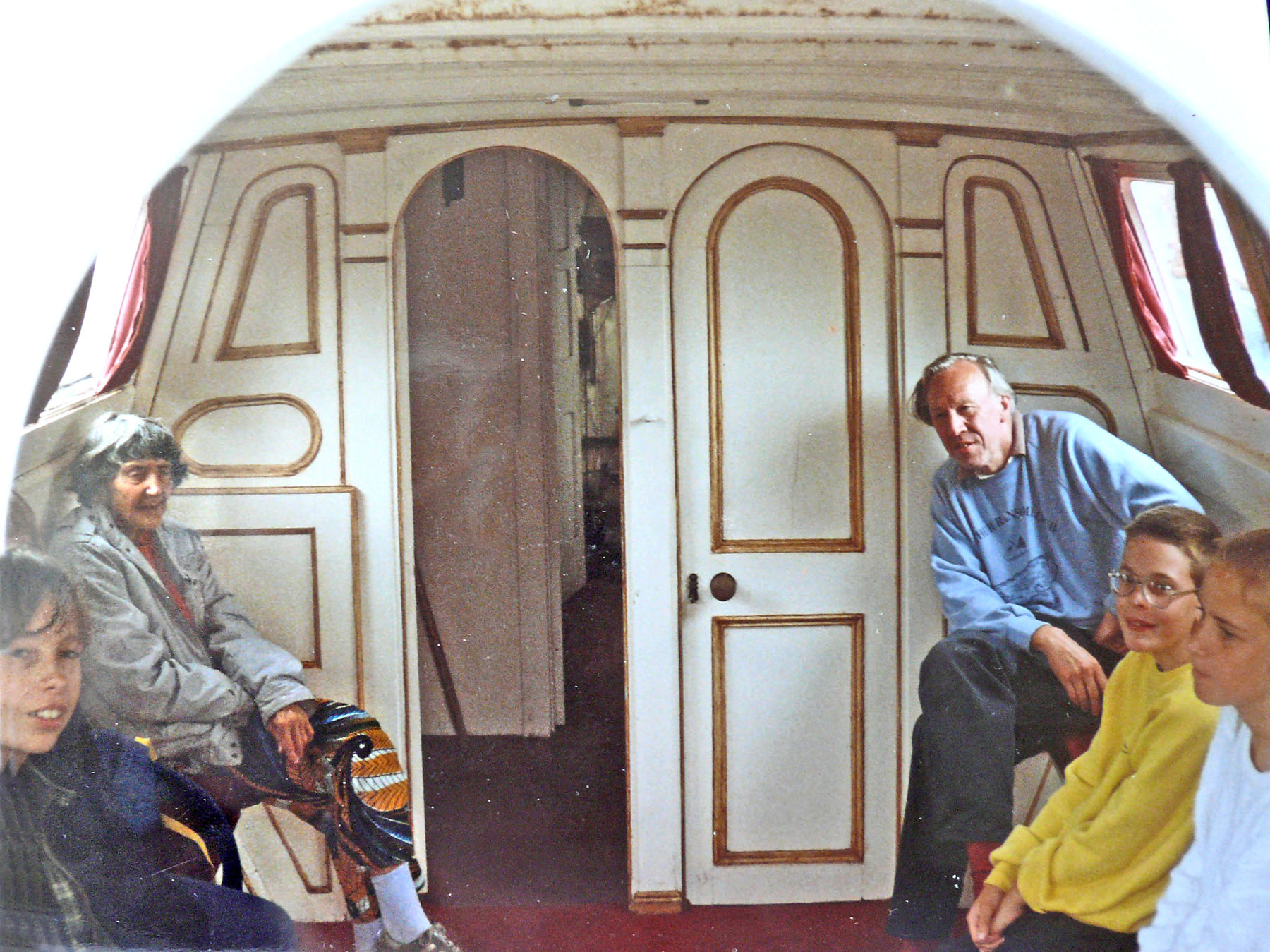
Taqui Altounyan with Roger Wardale and some of his former pupils inside the Esperance, which was the model for Captain Flint’s houseboat
Very many thanks to Roger Wardale, whose own books can be found listed here.
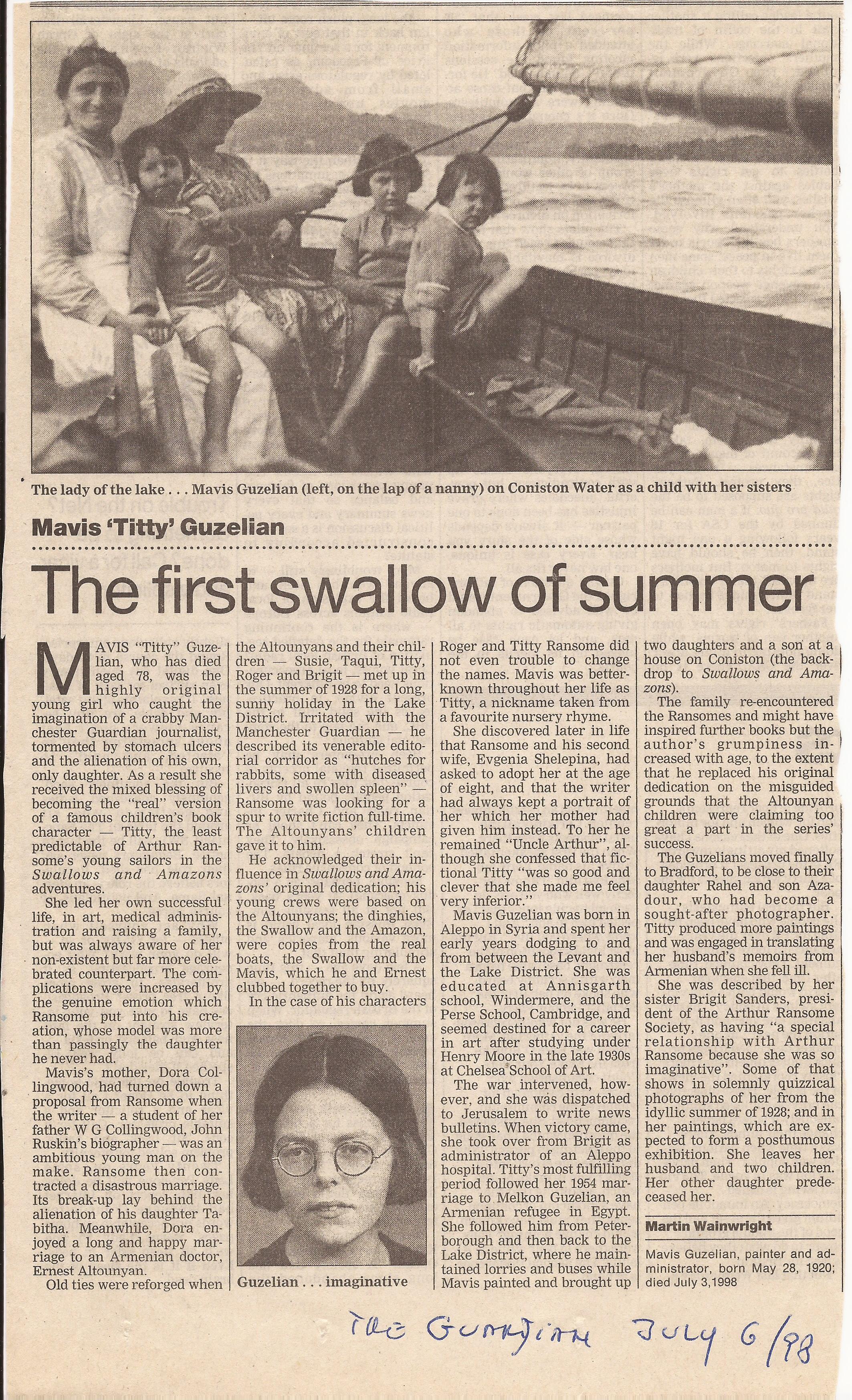
I am assured that Titty’s family will not be offended if I re-publish these news clippings. She has become well-loved by many who I know would like to learn more about her. The Times used her Christian name of Mavis, but she was always known as Titty.
Titty Altounyan was born in Aleppo on 28th May 1920, and would have been aged nine when Arthur Ransome began writing ‘Swallows and Amazons’. She died in Bradford at the age of seventy eight.
Although she was heralded as Arthur Ransome’s muse, I know that Titty Altounyan had no wish to be famous. If anything, she gradually disassociated herself with the character in the books, who struck her as being so good and clever. But Titty was her name.
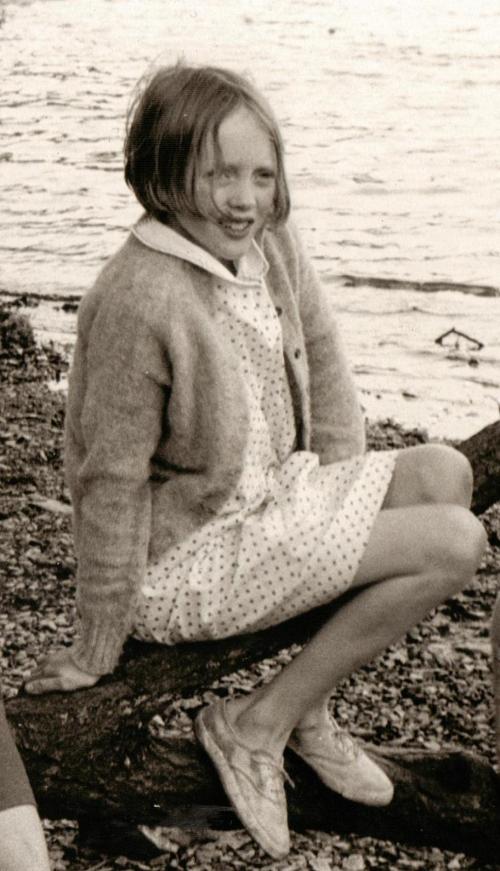
It was a name I have lived with too, for I played the part of Titty in the film of Swallows & Amazons produced by Richard Pilbrow in 1973. Children and adults alike still call me Titty all these years later. One summer, when I was sailing Swallow, the dinghy used in the 1974 film, someone took this shot of me. It is as if I am still flying Titty’s inspirational flag, which I do with humility and with honour.
Sophie Neville lowering Swallow’s sail on Ullswater in 2014
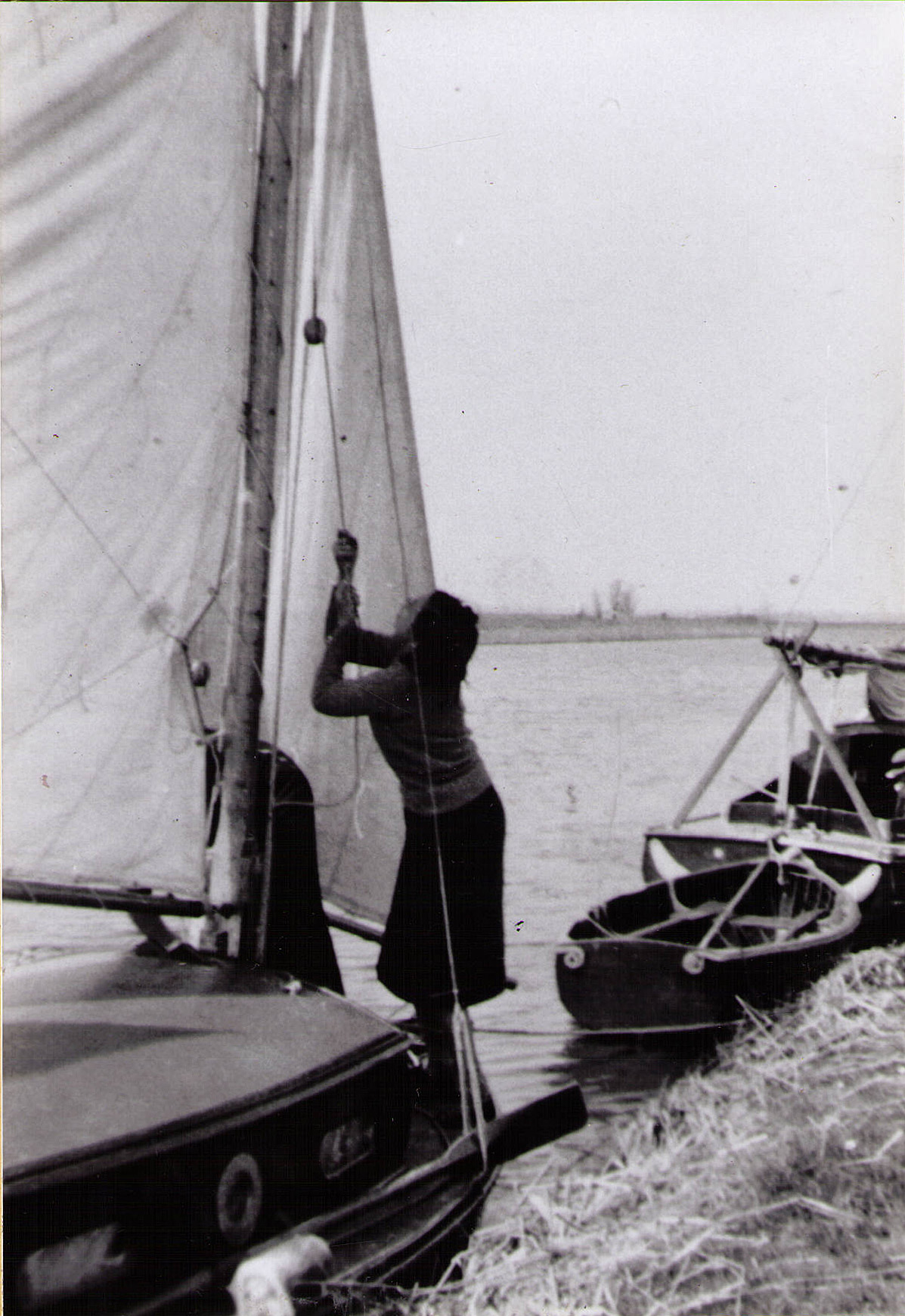
Titty Altounyan with the Ransome’s flotilla on the Norfolk Broads in 1934 (?)
Mrs Ransome wrote to Titty’s mother, Dora Altounyan, from Wroxham. This postcard was kindly shown to us by Ted Alexander who rescued it from certain destruction.
I thought I was far too fair to play Titty but Mrs Ransome approved. Despite Ransome’s book illustrations of girls with dark hair, she was most decisive about casting “An English rose” to play Titty and that the children should have British colouring. The idea was that viewers could easily associate with us. I am of Scots/English/Irish heritage, like three of Titty’s grandmothers, but have no Armenian blood. I rather wish I did. It’s nuisance having such fair skin. My second name is Rose.
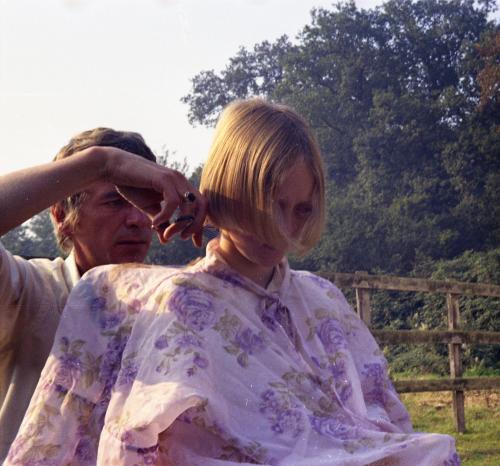
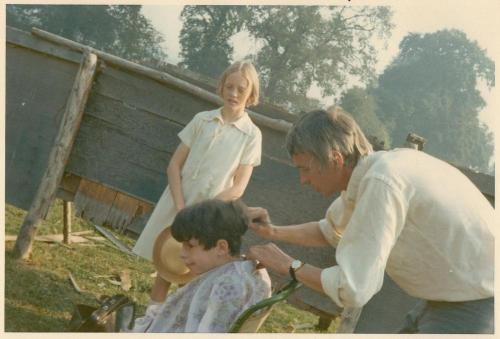
Hairstylist Ronnie Cogan giving Sophie Neville a Titty hair cut on location
I don’t know if Titty ever saw the 1974 film of ‘Swallows and Amazons’. She might have done. I only hope that we captured the sense of adventure experienced by the Altounyans when they were little and went camping on Peel Island during the weeks when they stayed with their grandparents, Mr and Mrs WG Collingwood, at Lane Head at the northern end of Coniston Water.
Simon West and Sophie Neville bring Swallow into the Secret Harbour on Wildcat Island (c) Studiocanal
Although they are seen wearing shorts as young children I have been told that the Altounyan girls sailed in dresses, which they tucked up into their knickers if they had to wade ashore, much as I did in the film.
Sophie Neville as Titty (c) StudioCanal
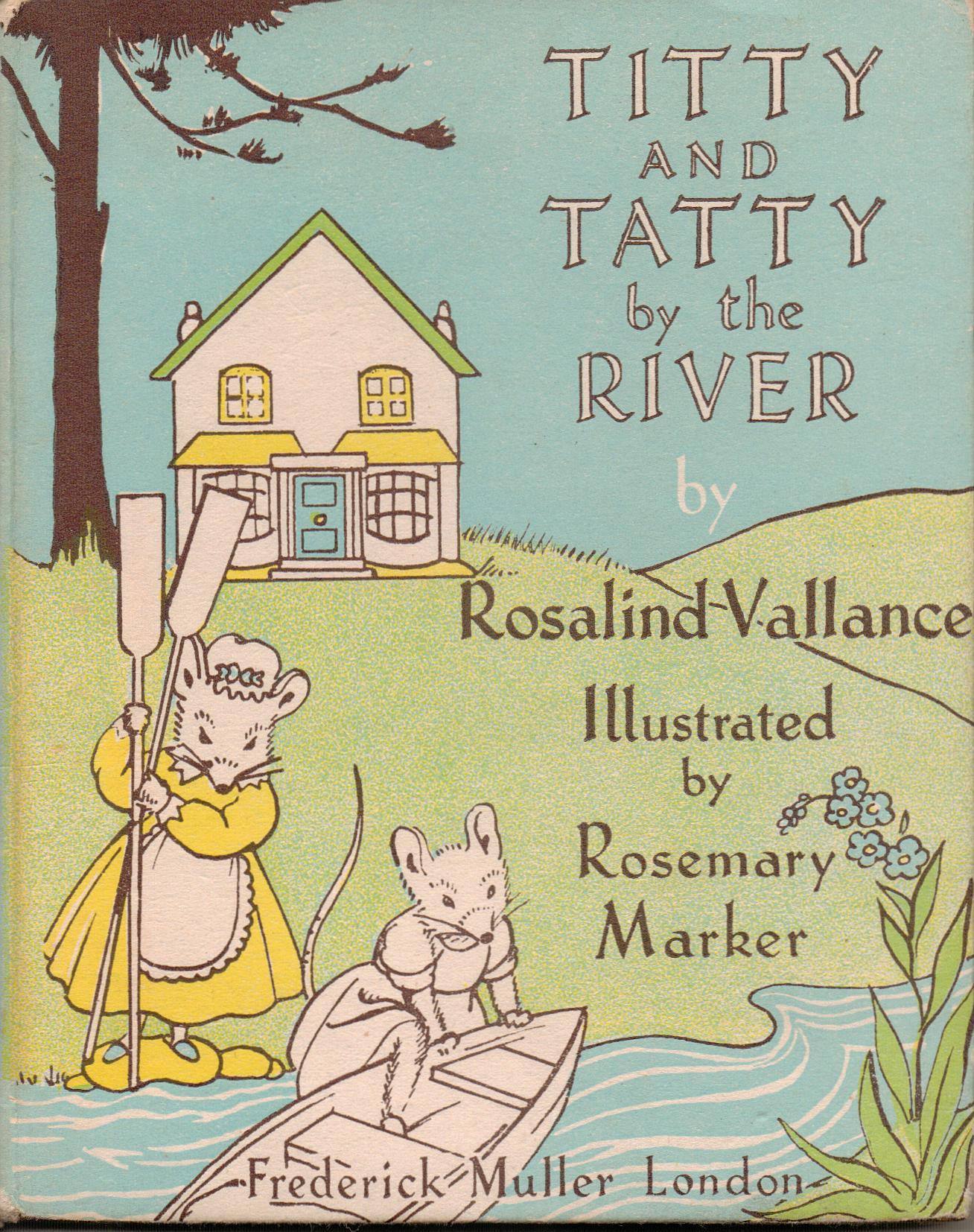
The reference to Titty’s name coming from The Tale of Mrs Tittlemouse in the article feature in The Times above is incorrect. Titty’s name was based on a character in fairy story Titty Mouse and Tatty Mouse by Joseph Jacobs published in 1890, that begins when Titty Mouse and Tatty Mouse go leasing (or gathering) corn. Here is a later edition. Titty ‘never could resist anything in print.’
With thanks to Roger Wardale who showed me the handwritten letters that Titty sent him. She had the most beautiful writing.
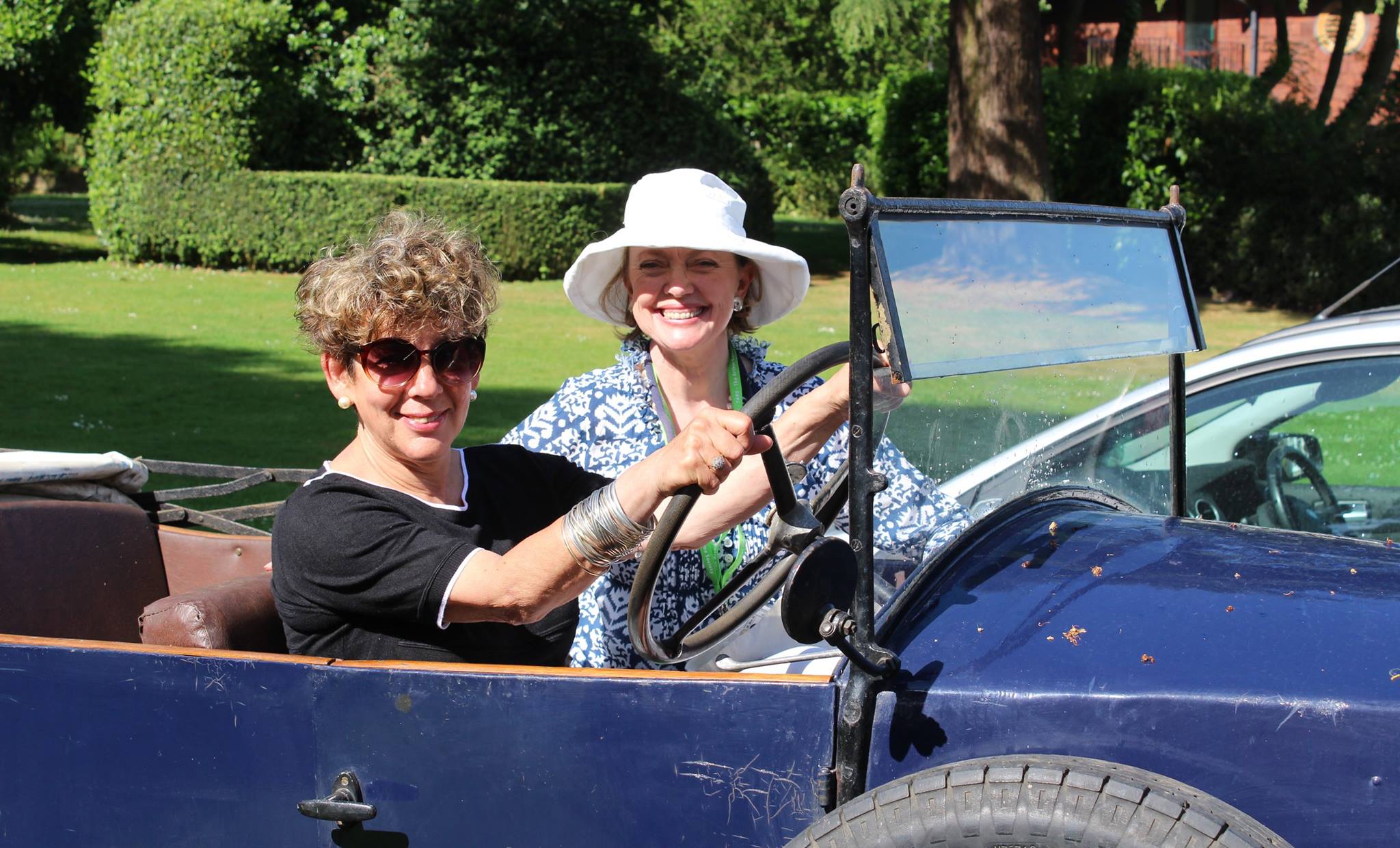
Titty’s niece, Barbara Altounyan, with Sophie Neville at a TARS Weekend.
If you would like to read more about the amazing time I had playing Titty in Swallows and Amazons, the first section can be leafed through, free of charge here:
I have been deliberating upon points where fiction touches reality. The most significant in my own life is the story behind my fictional brother, Roger Walker, one of the lead characters in ‘Swallows and Amazons’. The real Boy Roger was responsible for saving me from acute misery. Whilst I was asthmatic as a child, Dr Roger Altounyan was behind the invention of the Intal spin inhaler, which bought me instant relief.
About ten years ago I met Dr Bill Frankland, a former POW to the Japanese who became a Harley Street allergist and president of the British Allergy Association, now the British Society for Allergy and Clinical Immunology. Bill told me that Roger Altounyan had been a good friend ever since they worked together on the Intal project. Roger introduced him to his sister Titty who, as a child had been in the inspiration for the character I played in the film ofSwallows & Amazons.
I’d had known that Roger Altounyan had been in the RAF during World War II, but not that he had qualified as a doctor and become an allergist. Bill told me that he used his knowledge of propellers to develop the Intal spin-inhaler and effectively treat asthma.
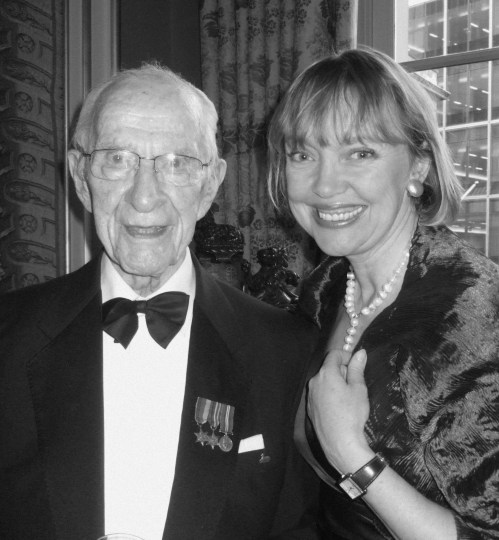
Dr Bill Frankland celebrating his 100th Birthday in 2012 with Sophie Neville
Dr Frankland gave me a set of photos taken at Roger Altounyan’s going-away party in Cumbria when he took his family and friends up Coniston Water on the Gondola. He said that Roger insisted on smoking a pipe even though he was reliant on oxygen and explained that the experimentation was partly responsible for his early death in 1987.
I will explain the connection in further depth.
The well-loved book Swallows and Amazons was written by Arthur Ransome for the children of friends of his after they brought him a pair of red slippers for his forty-fifth birthday in January 1929. He based his main characters, the crew of the Swallow, on these five real Altounyan children who had been staying at Bank Ground Farm in the Lake District,
The character Roger Walker, known when he first started sailing as the Boy Roger, was inspired by Roger Altounyan then about six years old. As a consequence he was obliged to live out his school days under Swallow’s flag, as it where. This may have become tedious, although it was much the same for Sten Grendon who played the part of Roger in the 1974 film.
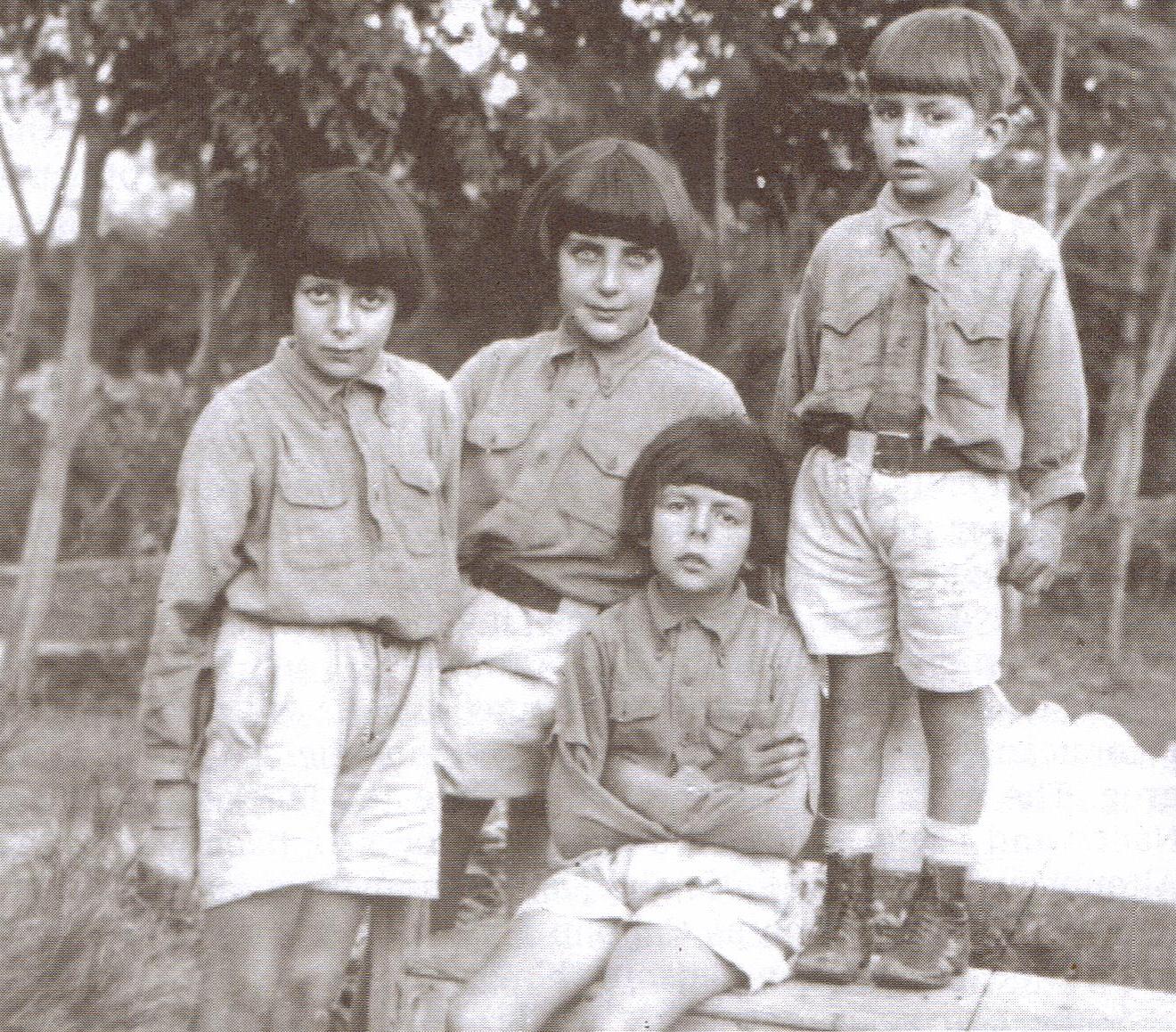
The well-known photograph of the four eldest Altounyan children – Susie, Taqui, Titty (seated) and Roger (copyright ???)
Roger is seen here with three of his four sisters, and below as a boy along with Arthur Ransome obviously playing tennis (copyright: Brotherton Library, Leeds). The story of his family is told by Jeremy Collingwood in his recent book, A Lakeland Saga.
Did we depict Roger Walker accurately in the film? May be not! Richard Pilbrow, the producer of Swallows & Amazons told me that Mrs Ransome was furious that Claude Whatham had cast a boy with dark hair, but she never explained why. She did not like the photograph she had been sent but it was taken before Sten’s received a short back-and-sides.
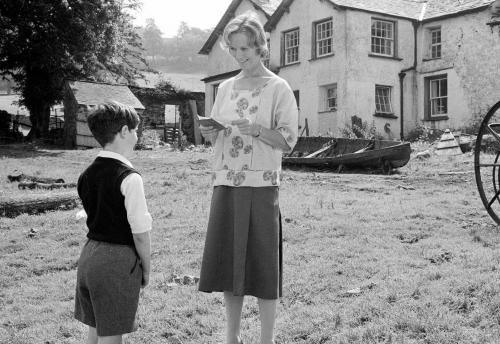
Sten Grendon as Roger Walker with Virginia McKenna playing his mother
Luckily, when Evgenia Ransome visited the location and actually saw Sten running around at Bank Ground Farm she seemed happy enough and said nothing more. Perhaps Virginia McKenna somehow managed to make everything alright.
What I didn’t know until recently was that Roger Altounyan was an asthmatic himself.
Roger was specifically allergic to guinea pigs and would routinely experiment on himself. He would not have been allowed to do this by today’s regulations, which some say would have held back the testing indefinitely. I gather from reading Rodney Dingle’s biography that the model inhaler that he made with a piece of hose pipe worked well, whilst the prototype made professionally did not. If you use an inhaler you will hear that the propeller has to be able wiggle in order for the medication to be successfully diffused into the patient’s mouth and lungs. The discovery was portrayed by David Suchet in a documentary entitled Hair Soup.
I was allergic to feathers, not parrot’s feathers, but old pillows and eider-downs. I may owe my life to Roger and his spin-inhaler. The medication certainly helped me enormously and has always given me the peace of mind that it will give me relief if I do get wheezy.
Further reading: Roger: The Life and Distinguished Achievements of Dr Roger Altounyan, by Rodney Dingle. It is difficult to get hold of but Kirkland Books in Kendal have a copy.
We have just found another reel of 16mm home movie footage shot, not on location in the Lake District, but at Runneymede near Egham in Surrey. It captures the essence of a hot day in September 1973 when we were re-called for pick-up shots after the main body of the film of Swallows & Amazons had already been edited.
Ronnie Cogan trimming Sophie Neville’s hair for the part of Titty in September 1973
The clip opens with the film hairstylist Ronnie Cogan cutting my hair. It had been a good six weeks since I had last played Titty in front of the camera and I needed a trim to restore it to the same length it had been on 14th May when we had first started filming on the Lakeside and Haverthwaite railway. Suzanna Hamilton’s thick dark hair had grown a great deal, as had Sten Grendon’s.
Sophie Neville watching Ronnie Cogan cut Sten Grendon’s hair.
Peter Robb-King the Make-up artist had been toning down our complexions inside the same Make-up caravan we’d used while on location for seven weeks in Cumbria. I remember it had orange flowery curtains, a pattern much in vogue at the time.
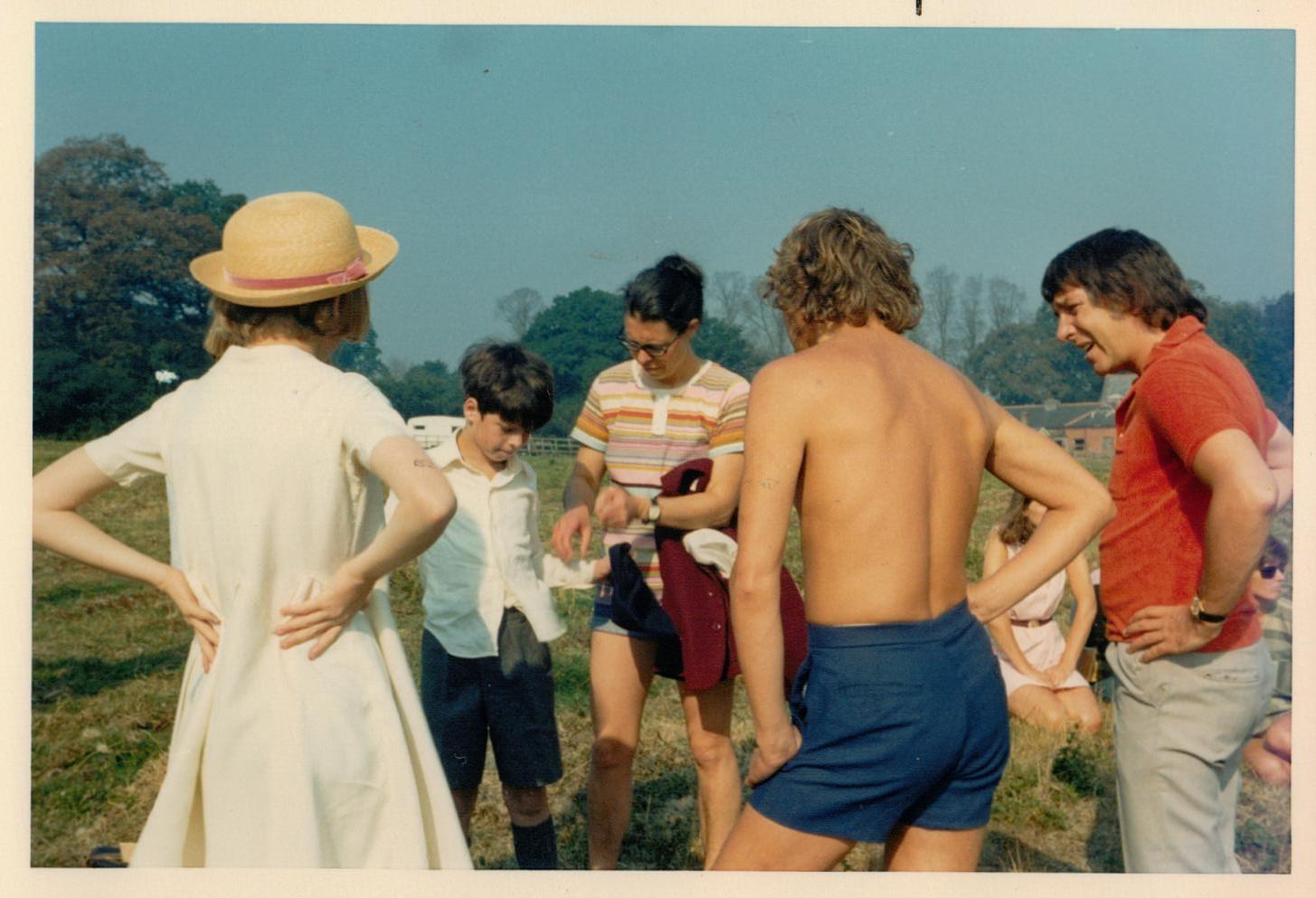
Sophie Neville looks on as Stephen Grendon organises his costume helped by Jane Grendon with Claude Whatham and Neville C Thompson.
Neville C Thompson, the Associate Producer, who was wearing a red shirt that day, seemed happy to be back on location. The film director, Claude Whatham was working, as I will always remember him, in a pair of navy blue shorts and sailing shoes. I loved putting on the school hat and silk dress I’d worn in the train but was difficult for the boys to climb into their woolen costumes on such a bright sunny day.
Richard Pilbrow, the Producer, who you can see wearing a white stripy cheese-cloth shirt so typical of the early 1970’s, seemed rather on edge. Bringing a camera crew along for what amounted to three shots must have been expensive, stretching his budget to the limit.
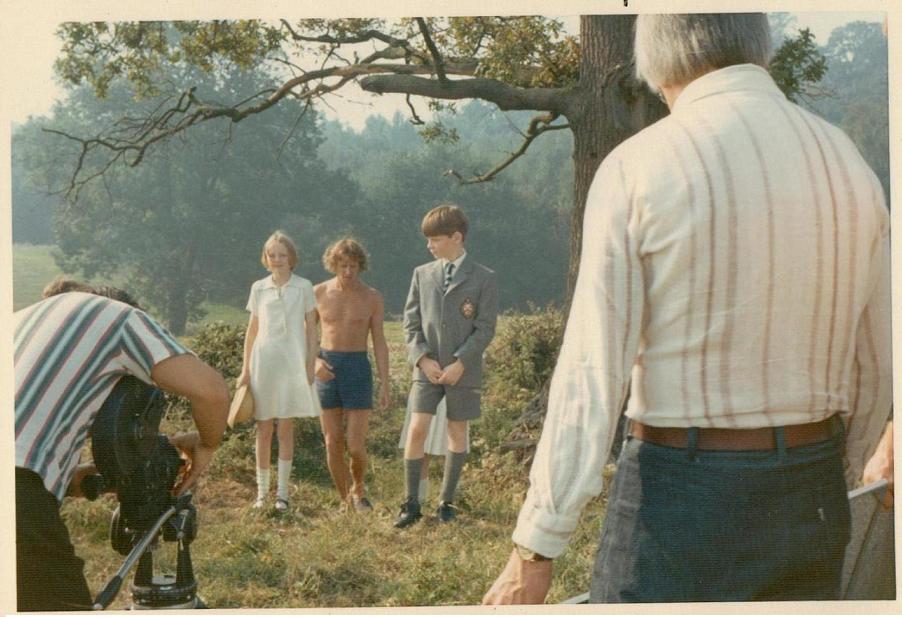
Gordon Hayman with a 35mm Ariss camera, Sophie Neville, Claude Whatham and Simon West, with Richard Pilbrow in the foreground ~photo:Daphne Neville
The oak tree, under which the 35mm Arriflex camera was set, was chosen to represent the Peak of Darien from which we looked out over an imaginary lake to an imaginary island. The finished movie cuts from the Walker children’s faces to a shot taken of Derwentwater at sunset with the opening title graphics superimposed over what is in reality Blakeholme, or Wild Cat Island as it is called in Arthur Ransome’s world.
Denis Lewiston, the Director of Photography, was working with the Cameraman Gordon Hayman, using reflector boards to light our faces. At one stage he had me standing on a cream coloured blanket to reflect light from below. You can see it in this shot:
Sophie Neville playing Titty Walker with Stephen Grendon as Roger Walker with Gordon Hayman, Denis Lewiston and Claude Whatham behind the camera
What I had forgotten was that two little girls came along that day to stand-in for us when the shot was being lined up. You can see them in the home-movie footage, one wearing a pale blouse with puffed sleeves.
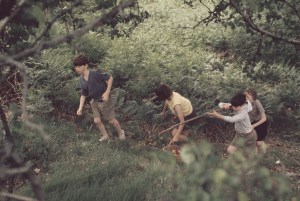
Claude was very keen on running. He often took us for a short run before going for a shot to aerate our minds and freshen up our faces. In the story we had run down the hill from Holly Howe, so he had us running quite far before we landed on the marks that the cameraman had given us so that we’d be in focus. We had no dialogue, but the expressions on our faces were crucial to engaging the audience.
Denis Lewiston, Claude Whatham, Sophie Neville, Suzanna Hamilton, Simon West and the cameramen
You see a few other people on location, not least Sten’s mother, Jane Grendon, my little sister, Molly Pilbrow and a few others who were watching. My mother had been taking the footage.
Daphne Neville with Stephen Grendon, Suzanna Hamilton, Sophie Neville, Jane Grendon and Simon West
To read about this day from another angle, please click here to visit an earlier post with a few more photos.
On Friday 21st November 2014, I was invited to talk about the making of Swallows & Amazons on the CBBC movie show with David Wood, who wrote the screenplay. I’ll let you know when this will be broadcast. While I was at Novel Entertainment I met Dexter Fletcher and Bonny Langford as well as Justin Johnson from the British Film Institute who is an adviser on the series of 6 x 30 minute programmes.
You can read the whole story of making the film here:
 The Guardian published this photograph, taken on the set of ‘Swallows & Amazons’ when the original film of Arthur Ransome’s well-known book was being shot at Bowness-on-Windermere in the Lake District on 7th June 1973.