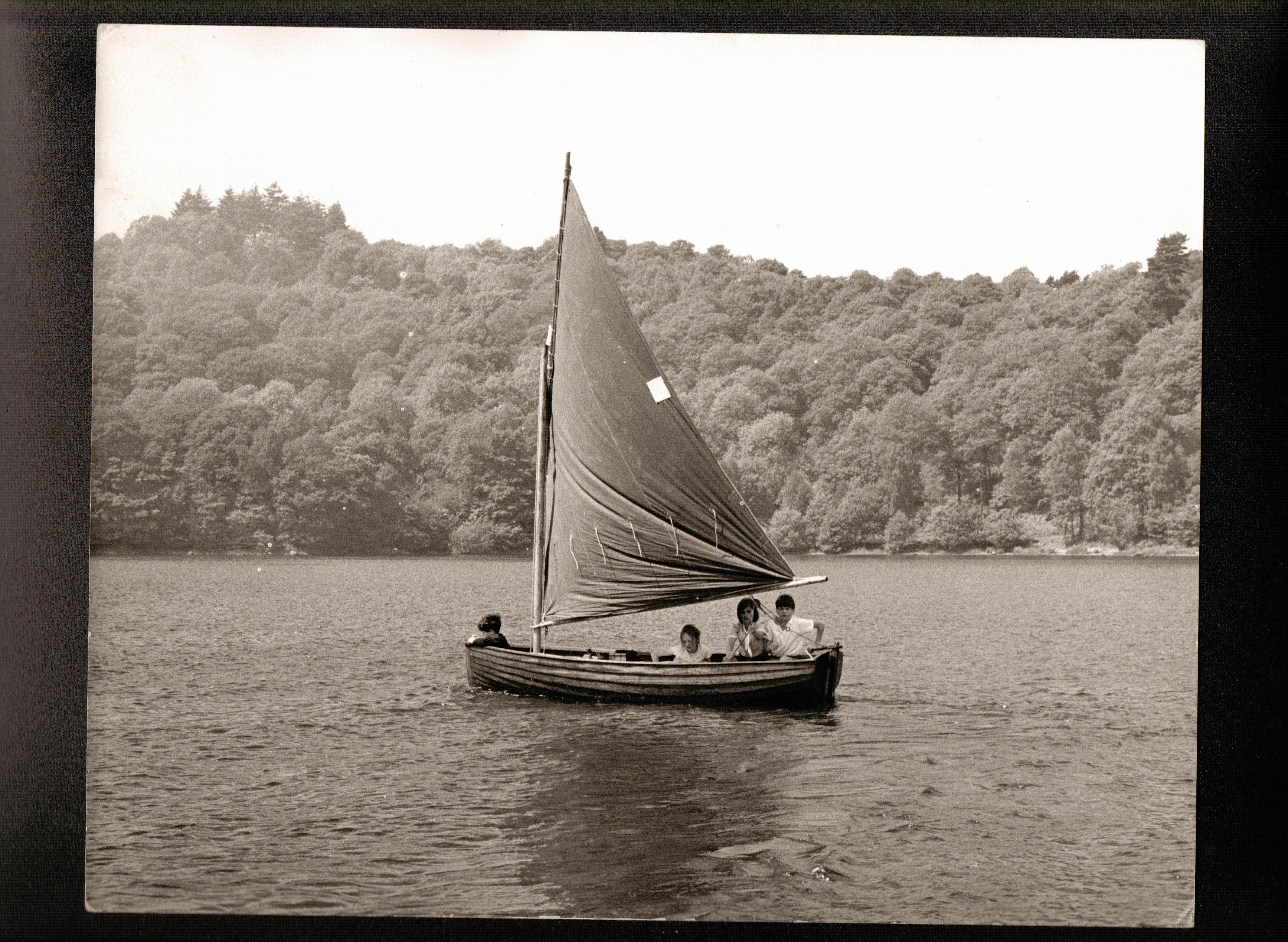
The Amazons Attack ~ filming ‘Swallows and Amazons’ on Peel Island ~ 29th May 1973

BW Sophie Neville in Secret Harbour‘But John’s our Captain.’Swallows and Amazons 1974

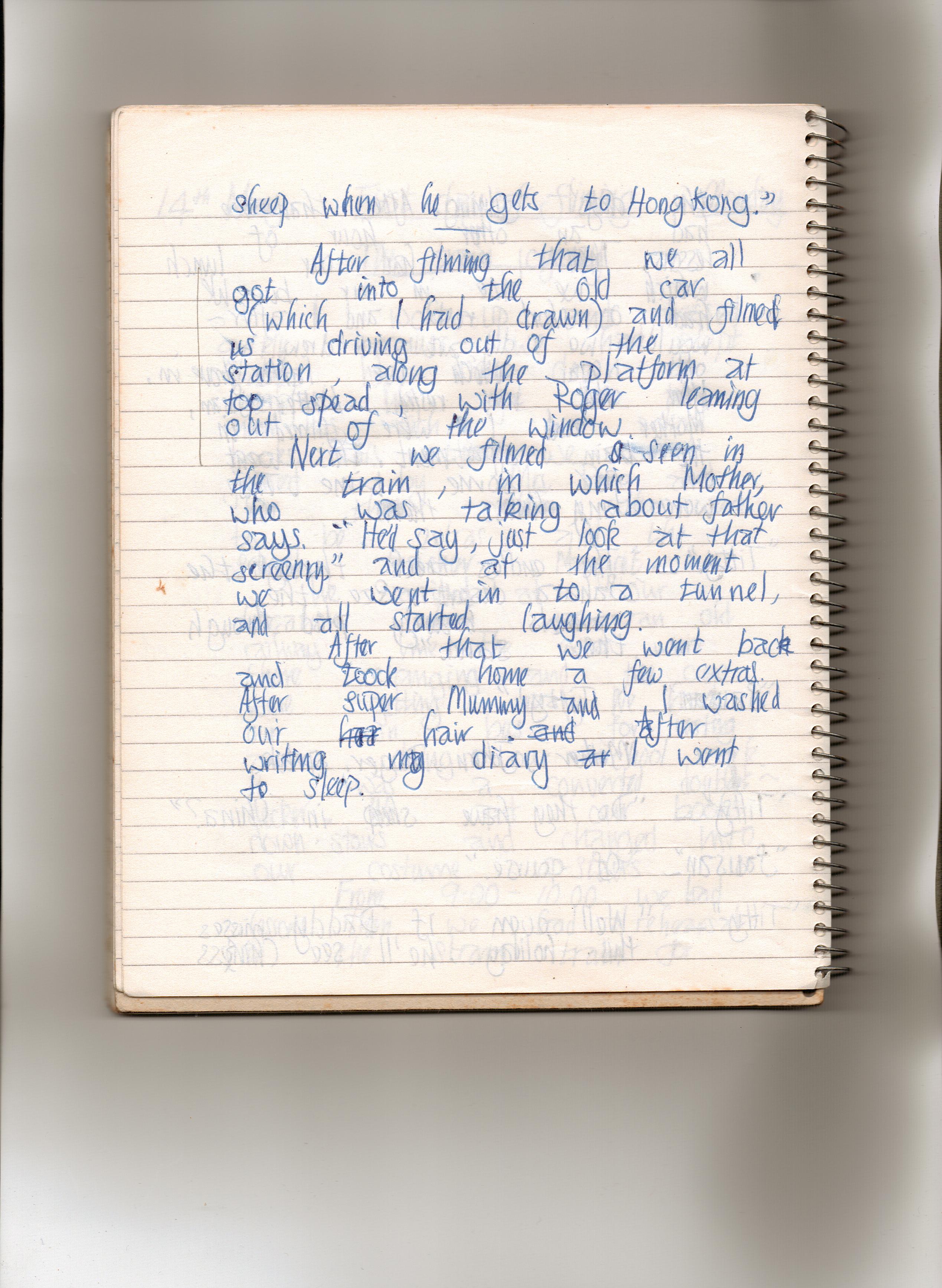
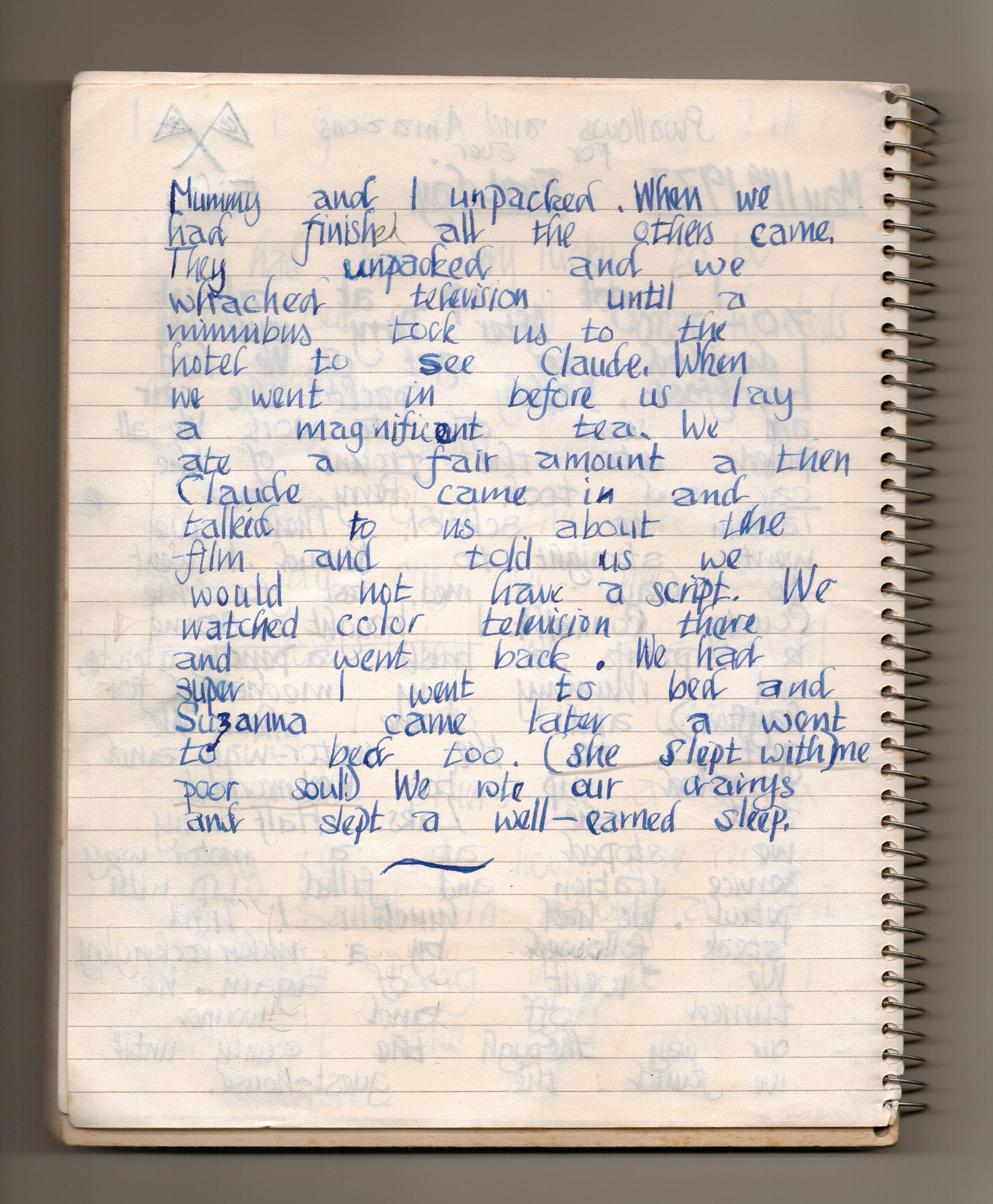
Sophie Neville's diary written on location while making 'Swallows and Amazons' in 1974

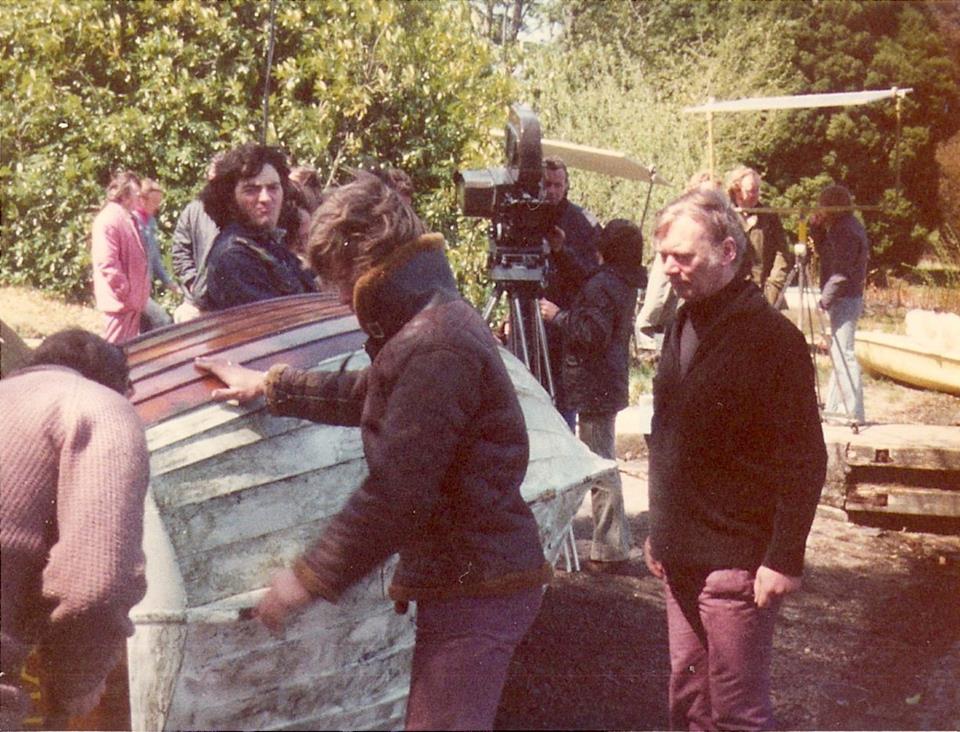
My father said that his first impression of the film crew was, ‘What an awful mess of trucks and weird people!’  He’d just come from his office in the electronics industry where everybody wore suits and ties.  It’s true.  One of the Arthur Ransome Society members took one look at the footage Dad took of the making of Swallows and Amazons and said, ‘It looks like Woodstock.’ Woodstock on wheels. Dad couldn’t bear the notion of hanging around all day but he bought some paints with him to do what he never normally had time for while looking after us.

Daphne Neville's publicity photograph c.1973
Daphne Neville ~ presenter on HTV

My mother, Daphne Neville, had to leave that Tuesday to spend four days at the Bath and West Show ~ a long term commitment that could not be cancelled. By this time she had been working for Harlech Television or HTV, as the station became known, for about four years. She’d started as an ‘In Vision Announcer’, reading the News with Martyn Lewis from the old Harlech Television studio in Cardiff, before moving on to present her own children’s programmes such as It’s Time for Me.
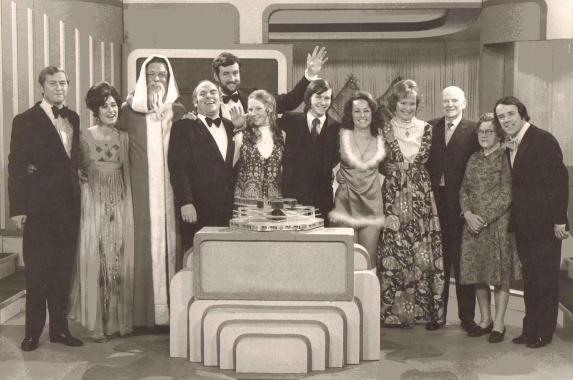
Bruce Hocking, Jan Leeming and Daphne Neville with contestants appearing on an HTV Christmas Special

By 1973, Mum was presenting a women’s afternoon series made in Bristol called Women Only, with Jan Leeming.  No doubt they had to host the HTV stand at the Bath and West agricultural show. These are big events in rural Britain. My parents went on to have stands at about ten or twelve of them every year when they went on to work as wildlife conservationists.
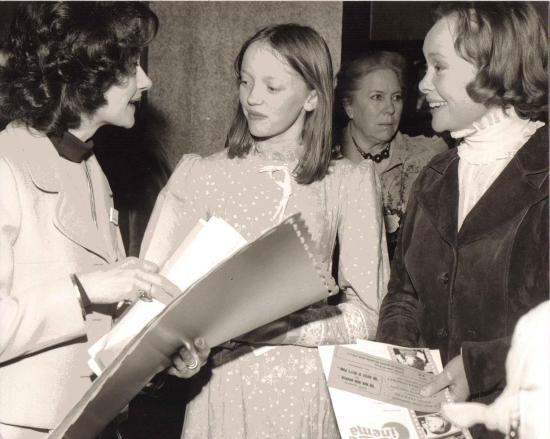
Jan Leeming, Sophie Neville and Daphne Neville
With Jan Leeming and Mum when I was a little older

I have a horrible feeling that in the Woodstock-like atmosphere of our set, I might have taken on my mother’s role and got a little bit too bossy in the school bus. The result was a head-on attack from Sten, who must have been  offended. He not only fought me but would not let go. Perhaps this was a good sign in that we had become like a real family. Perhaps it was because the balance had been tipped by our real families turning up. Sten’s father had arrived with his little sister, my little sisters were playing outside and yet we were not being given time off lessons for half-term. Perhaps it had something to do with the red and yellow sweets we had started eating on the bus. Mum said that Sten was always picking fights. He was an eight-year-old boy.

Sophie Neville in her BOAC life jacket with her sister Tamzin about to leave for the set of ‘Swallows and Amazons’ on Peel Island. Sten Grendon’s father and little sister are in the background ~ photo: Martin Neville

Luckily for Claude, the director, we were filming the scenes on Wildcat Island where the Amazons attack.  ‘When we fell flat on our faces and the Amazons’ arrows flew over our heads.’ We loved this scene and it was great that Nancy and Peggy had at last arrived on Wildcat Island.

Sophie Neville and Suzanna Hamilton in 1973
Sophie Neville and Suzanna Hamilton confronting the Amazon Pirates

I don’t know if Mum had still been around to oversee that particular act of aggression. She had taught the Amazons to shoot.  The photographs I have of her doing so  show her giving Nancy and Peggy archery lessons in the field outside the bus.

Practicing with bows and arrows

They were just using hazel bows made for them on site by Bobby the Property Master, but my parents did know how to use the long bow. When they were first married they joined the Worcestershire Archery Society and went on to win quite a few prizes. I know all about this because the Chairman of that society was to become my father-in-law. I too learnt to shoot and ended up marrying his son, another member of the Worcestershire Archery Society.
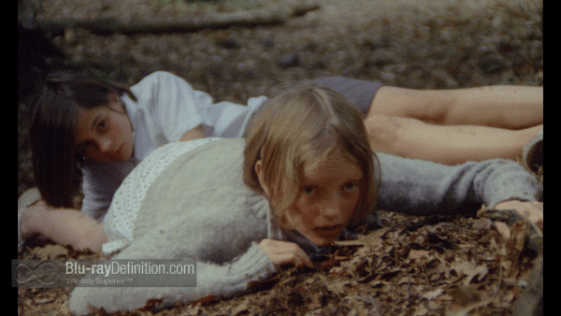
Sophie Neville with Suzanna Hamilton

It  looks pretty scary when those arrows, fletched with green parrot feathers, fly over us.  Much to Nancy’s disappointment, these were actually fired by two prop men. They strung up fishing line and attached nylon loops to the arrows to ensure that we would not actually get hit, but it was quite thrilling – and still quite risky.

BW Amazons with bows
Kit Seymour and Lesley Bennet as the Amazon Pirates

I never forgot the trick. When I became a BBC director myself I took much joy in using totally inexpensive visual effects, such as extended use of fishing line. I learnt how to use reflections from a skilled director called Moira Armstrong and picked up on just how much could be achieved by juddering the camera when I worked on Doctor Who.  All that dramatic and complicated-looking Tardis malfunction was achieved simply by vibrating a studio camera.  However,  fishing line was the only visual effect used in the 1973 version of Swallows and Amazons.

Kit Seymour with Claude Whatham, 1973

After being on location for more than two weeks this was the second day that Kit Seymour and Lesley Bennett had appeared in front of the camera. The hanging around must have been pretty frustrating. In 1983, when we were planning to make adaptations of the Arthur Ransome books at the BBC, I was hoping to cast the Amazons – if not all the children – from schools up in the Lake District. I don’t expect Claude had had the time to do that.  Luckily for me.

Kit Seymour (Nancy) and Lesley Bennett (Peggy) on Peel Island 1973

You can read more in ‘The Making of Swallows and Amazons’ on this ebook:

The third day of filming ‘Swallows and Amazons’ in the Lake District in 1973

My diary kept fifty years  ago ~

Day 3 of the diary


Day 3 of the diary  page 2

The Amazon’s time had come. In the script, the short scene where Nancy and Peggy careen their dinghy is set in the Amazon boathouse, but Claude Whatham shot them scrubbing its underside by the lake with Beckfoot beyond, showing their background. Nancy threw a bucket of water over him for his pains. It was a complete accident.  She actually chucked the water onto the bottom of the boat but it splashed back.  He was squatting below the camera to the right and got soaked by what must have been cold lake water. Kit Seymour flung back her head and roared with laughter. He took in it good spirit, but only up to a point. I don’t think he had anything else to wear.

David Blagden the sailing director, David Cadwallader the grip, and David Bracknell the first assistant looking at the Amazon’s bottom with DPO Denis Lewiston with the 35mm Panavision

Kit Seymour wrote in her diary:

‘This is the day I had been waiting for. The Amazons had at last begun filming. We got changed and had to be made up sunburnt. We then rehearsed what to do. We did the second scene. I quite accidently threw a bucket of water at Claude. After lunch we had to film the interior of the boat house. Peggy had to say, ‘Not a breath of wind.’ This was quite funny becasue our hair was flying about everywhere. They had to film this scene quite a lot of times.’   She was quote in The Times newspaper, spelling mistakes and all.

I was a conscientious child and keen not to fall behind with my school work.  Children under the age of sixteen have to be issued with a licence by their local education authority before they can act in films. Mum, who was our legal chaperone on location, decided it would be quite fine if we did fifteen schooling hours a week rather than a minimum of three hours a day, as stipulated in the rule book. I spent my time catching up in our school bus as I had done little the day before as I had been acting with Virginia McKenna.

Mum was equally fluid about the time we spent on set – or indeed on location. Sten Grendon, who played Roger, was aged nine. I now know he was meant to go home every day at 4.30pm but we all returned together whenever it was deemed practical. However, Sten’s mother Jane was with him and if ever there was a child who needed to expend energy it was he. Sending him back to the Oaklands Guest House early could have endangered the people of Ambleside.  It did us a lot of good to work hard, and cope with real, if channelled, responsibility. We were all busting with energy, so much that I grazed my leg badly climbing a tree at lunch time that day. Claude put a stop to any more dangerous activities as a result. He couldn’t risk any of us getting injured.

My sister Tamzin Neville broke her ankle when she was in the middle of playing Anthea, the leading role in a BBC serialisation of E.Nesbit’s  The Phoenix and the Carpet. It could have been a disaster but she wore long Edwardian dresses with petticoats that covered up her splint. My legs were fully on display in Swallows and Amazons. If I hadn’t have been wearing dungarees when I climbed that tree the world would have seen the scratch.

I can remember admiring the large house featured as Beckfoot, the Blackett’s house on the lakeside, and wandering past towering the rhododendrons in the garden, but I have no idea where is is.  Christina Hardyment felt that Arthur Ransome must have modelled Beckfoot on Lanehead, the Collingwoods’ house on the East of Lake road above Coniston, but the film required a big house with lawns going down to a lake. John Ward has written in to say that we used Brown Howe House on the western Shore of Coniston Water south of Peel Island. The boathouse is also there on the edge of the lake.

Here we are at lunchtime, captured on Dad’s cine camera:

You can read more here:

‘Swallows and Amazons’ the screenplay of the 1973 film, adapted from Arthur Ransome’s book by David Wood

The screenplay~

Arthur Ransome’s book was adapted for the big screen by David Wood.  The first time I saw this script was early in 2011 when my mother pulled it from the back of a wardrobe. It’s really only now that I fully appreciate how beautifully it was crafted.

The opening scenes ~

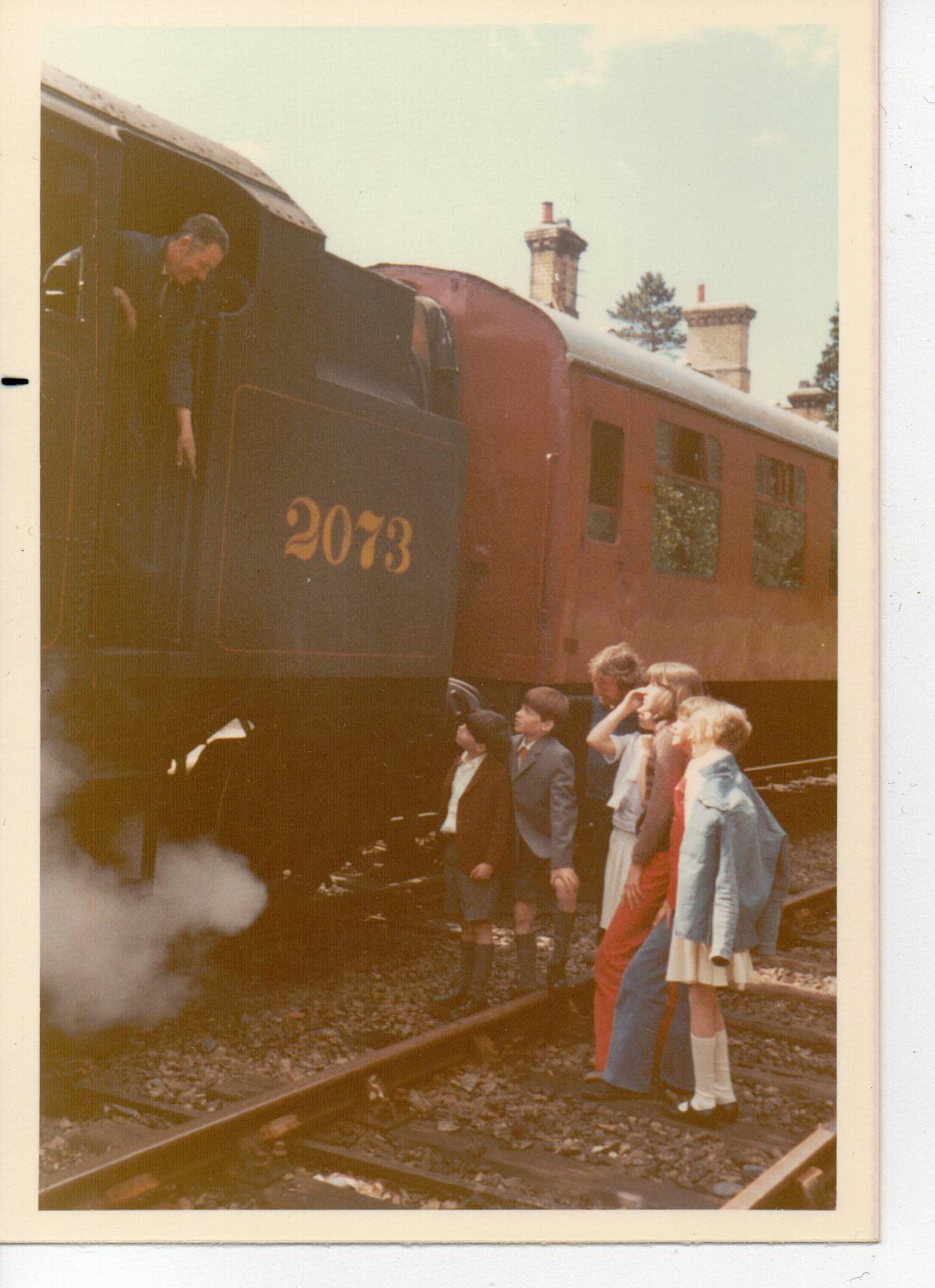
Talking to the engine driver at the Haverthwaite Railway Station on the first day of filming 'Swallows and Amazons' in 1973 (Photo: Daphne Neville)
Talking to the engine driver at the Haverthwaite Railway Station on the first day of filming ‘Swallows and Amazons’ in 1973 ~ photo: Daphne Neville

The film opens with a shot of a steam train passing through Cumbria. This does not feature in the book but was a powerful first image and good way of introducing the Walker family, setting the period and the very Englishness of travelling up to the Lake District for the summer holidays. It was a wonder that this was possible; The Lakeside and Haverthwaite Railway , with it’s restored steam train, had only been open and running for two weeks ~ on 2nd May 1973 to be precise. It was a private concern run by a bunch of enthusiasts on the old Furness Railway branch line. The engine was a Fairburn 2-6-4 tank locomotive of 84 tons, of approximately 1930s vintage, standard gauge and coloured black-berry black

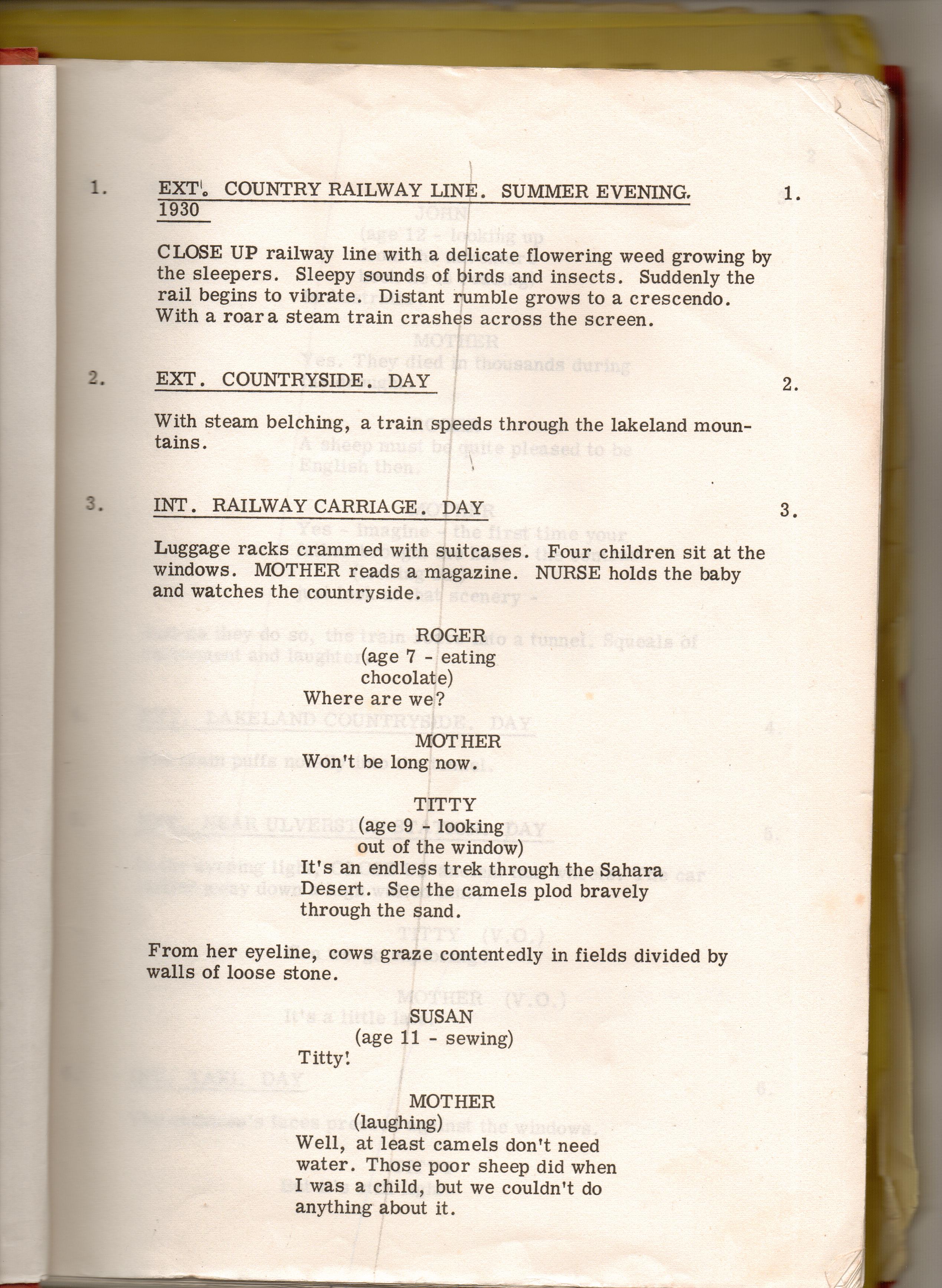
Swallows Script page 1
The original screenplay of ‘Swallows and Amazons’ adapted from Arthur Ransome’s immortal book by David Wood in 1973

~ The crossings out were made by my mother, in the tradition of marking a scene that has been recorded ~

Swallows Script page 2
The original screenplay of ‘Swallows and Amazons’ adapted by David Wood for Theatre Projects in 1973

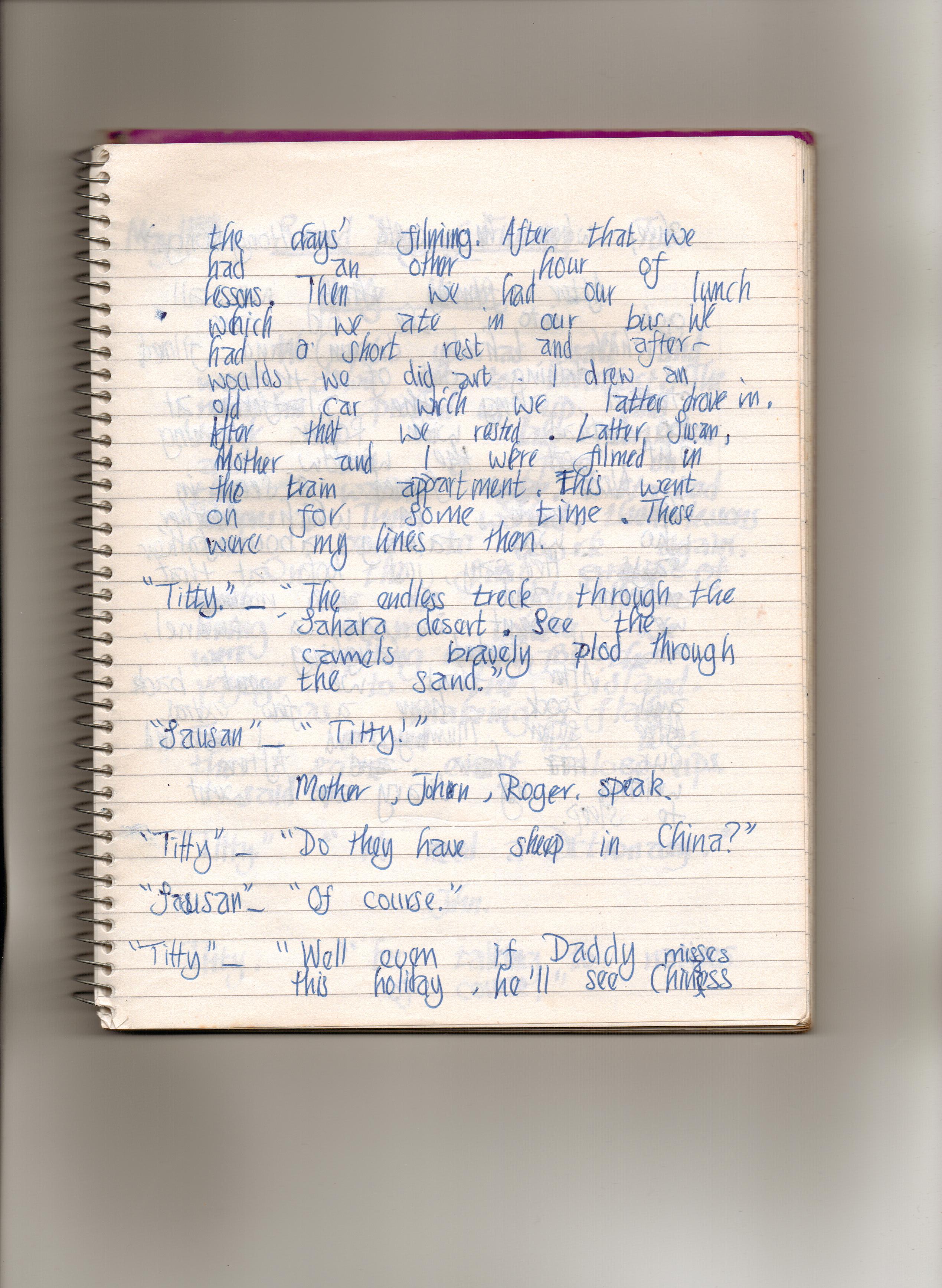
What I never knew until I read the third scene today was that we added quite a bit of dialogue. I can’t remember if it was improvised or given to me by Claude but I said quite a bit more than was scripted, and recoded the fact in my diary.

notes to the text ~ Mrs Price was the lady who owned and ran our guest house. Our tutor, Margaret Causey, taught us in a converted red London double decker bus.

Swallows Diary 14th May page two
I took note of my dialogue in the pages of my diary. Here it was supplementary to the script

Swallows Diary 14th May page three

The railway carriage ~

Claude Whatham was keen to shoot the film in ‘story order’ as much as possible as he thought this would be easiest for us to comprehend. INT.RAILWAY CARRIAGE. DAY was, however, a difficult scene to execute. Once the railway carriage contained movie lights, the director, a huge 35mm Panavision camera, the cameraman and assistant, with microphones and an assistant sound recordist there wasn’t any room for me.  When it came round to the shots of me I had to give my lines to imaginary family members. They were no longer there – the camera had taken their place. It also got extremely hot.

Virginia McKenna, Simon West, Suzanna Hamilton, Kit Seymour, Lesley Bennett and Sophie Neville at the Haverwaite Railway Station in 1973 ~ photo: Daphne Neville

Story order ~

I look back on all this now and feel our opening performances, so vital to capture the audiences attention, were understandably rather wooden. Later on, when I was directing films that featured children I tried to schedule unimportant, ‘running around scenes’, which were easy for them, so that they could get used to working with the crew before tight close-ups were required.  I found that even six year-olds were unfazed by recording scenes out of story order, in fact they were probably less disorientated than the adults.

Continuity ~

With Virginia McKenna’s magazine, our picnic and Susan’s tapestry the matter of continuity in this scene was important. We greatly enjoyed learning about this technicality, so vital if the shots that make up the scene are to cut together smoothly. Numerous Polaroid shots were involved, which was exciting as these cameras had not been around for long and we enjoyed watching the photographs develop.  We did our best to be helpful and keep an eye on the picnic, but somehow it all went wrong. The continuity in this opening scene is out. This probably because Sue Merry, the Continuity Girl could not get in –  into the railway carriage, that is. There was simply no room for her.

You can read more here:

‘Swallows and Amazons’ ~ haircuts and other preparations for the film back in 1973

Saturday 12th May 1973

Haircuts ~

In the early ’70s most people had long hair.  Ours had to be cut and bobbed to match the 1929 hair styles in Arthur Ransome’s well-known illustrations. I wrote in my diary that, ‘Sten went first and came out looking much older with all his locks cut off!

Simon was next. He looked much the same, except with his ears showing.’  We thought they looked so much better with short-back-and-sides. Mum said that Sten really did have long, flowing hair, which looked extraordianry on a nine year old boy.

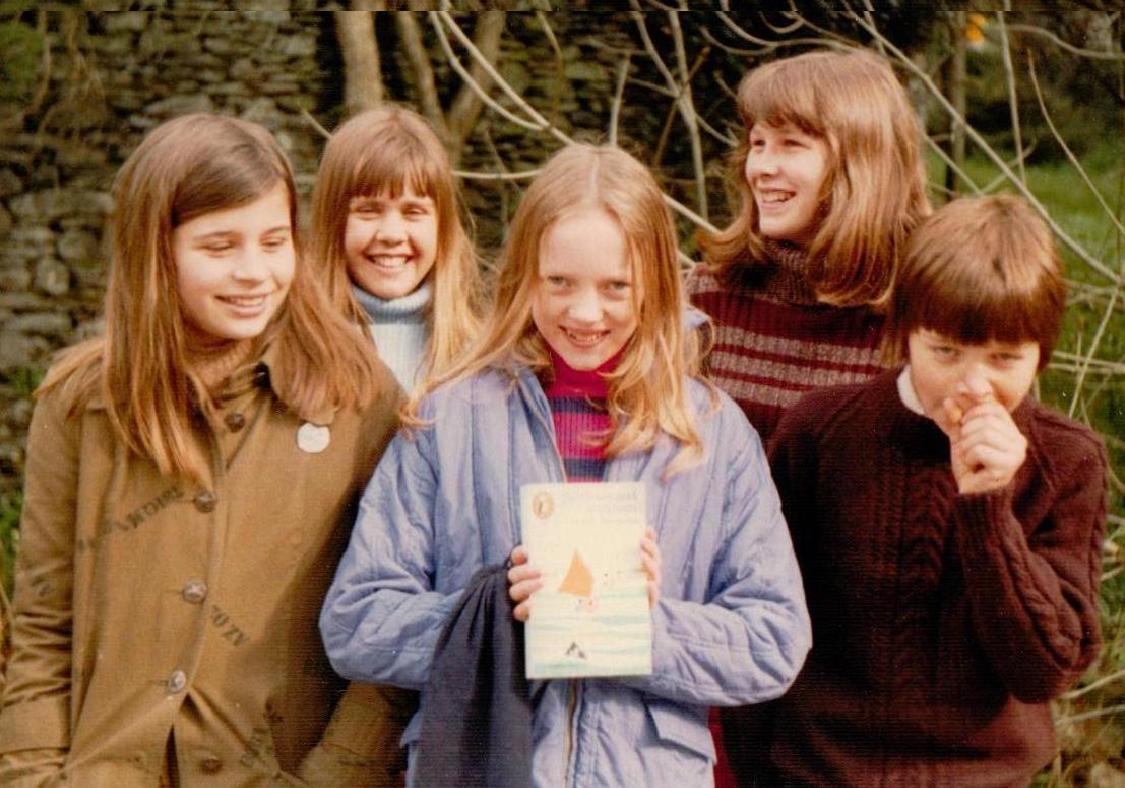
Suzanna Hamilton, Lesley Bennett, Sophie Neville, Kit Seymour and Simon West before their hair was cut for ‘Swallows and Amazons’ in 1973. photo~ Daphne Neville

I’ve just been reminded that the production company really struggled to find male Extras to be in Swallows and Amazons because no one wanted this cut. The actors were the same. Mike Pratt, who played Mr Dixon the diary farmer, couldn’t have his hair cut as he was in the middle of filming a television series, The Adventures of Black Beauty, set in the Victorian era – a good excuse to avoid being shorn.  His hair had to be pinned up under a flat cap, which looked weird on the big screen.  You could see the kirby grips.

My mother had huge reservations about my straggly blonde hair being chopped off and said she nearly refused to let them.  I am very glad she didn’t.  It was wonderful having short hair.  My haircut proved such a great success that I believe it set a fashion for having a graduated bob or ‘Titty Haircut’.

Swallows and Amazons preparations for filming

The dentist ~

I am sure that as well as having our teeth cleaned that they were checked over before they caused a problem.  As it was I lost a fairly conspicuous milk tooth during the filming at a time when it caused havoc with the continuity. The director was not pleased but there was nothing he could do.  Because the film could not always be shot in sequence you’ll see a full set of teeth in one shot and one missing in another. People still comment on it today.

The sailing director ~

Because Claude Whatham, the film director, was not a sailor himself he appointed a sailing instructor or ‘Sailing Director’,  David Blagden who took us sailing in both Swallow and Amazon before the filming, as my diary relates.

David Blagden and my mother, Daphne Neville ~ photo: Richard Pilbrow

We needed to get used to handling the dinghies, was great fun. David made it fun. He was a tall, dark, good looking actor who had been in Kidnapped and was given the part of the Sammy the Policeman, which he did very well. ‘Now then, Miss Nancy.’  Having his hair-cut was such a big thing that he took off his helmet during scene to make the most of it, displaying his very short hair to the the world. We all adored David, who was well known for having sailed across the Atlantic. He had come in tenth, out of fifty-nine competitors, in the 1972 Observer Single-handed Transatlantic Race. He made the crossing in Willing Griffin a Hunter 19, the smallest yacht ever to offically participate in a transatlantic race. I’m afraid that my father thought that he over estimated his abilities. He was of the opinion that crossing the ocean was not quite the experience needed for clinker built sailing dinghies, which could jibe viciously without warning when wind blustered down from the fells, and didn’t rate him highly for the job.  Dad was concerned about our safety.  After the film David attempted to cross the Atlantic once more.  He was never seen again.

Daphne Neville with Richard Pilbrow1
Molly and Richard Pilbrow in 1973

Richard Pilbrow and the other boats ~

Richard Pilbrow, who was producing Swallows and Amazons loved boats and was often out on the water with us. It seemed that he came on on this day with us in a motor boat – it was one of those typical glass-fibre ones with a small cabin that were thought quite snazzy at the time.  Along with the gaff-rigged dinghies, Swallow and Amazon there were quite a number of other period boats used during the filming – not least Captain Flint’s Houseboat, one of the Windermere Steamers and the Holly Howe rowing boat, or native canoe, in which Virginia McKenna so gallantly rowed out to the island when as Mother she came to visit her children only to find Robinson Crusoe (me) in residence. Richard loved them all. So did we.

You can read more in the ebook that retails at £2.99

‘Swallows and Amazons’ ~ preparations for the 1973 film

Swallows and Amazons the film diary
My diary entry ~ Friday 11th May 1973

My mother and I reached Ambleside in the Lake District in what must have been Mum’s Renault 5. I know it was packed to the gills. We found the Oaklands Guest House, a solid stone Edwadian house that the film company had booked us into, along with the other children in the cast.

Sophie Neville playing Titty Walker in the film Swallows and Amazons
Sophie Neville playing Titty Walker in the film Swallows and Amazons with her mother Daphne Neville

The cast ~A striking girl called Kit Seymour, who came from London, was playing Nancy Blackett, ‘Captain of the Amazon and terror of the seas.’  Her sister, Peggy Blackett, was played by Lesley Bennett.  Simon West, who was playing my brother John Walker, came from Abingdon. He held a National Optimist title and was an excellent sailor. Suzanna Hamilton, who came from Islington where she went to Anna Scher’s theatre group, took the role of  the very practical Susan. The part of our younger brother Roger had been given to  Sten Grendon, who had played the young Laurie Lee in the BBC Play Cider with Rosie, which I had also been in.  He came up from Gloucestershire with his mother Jane, who was to chaperone us with Mum.

The director ~As my diary relates, were were taken for tea at the Kirkstone Foot Hotel to meet Claude Whatham, who was directing the movie.  He was a small man, habitually clad in jeans, with a denim jacket.  He seemed young and trendy for an adult.  Sten and I had worked for him two years previously on Cider with Rosie  and the others already knew him from the weekend sailing audition.   Claude had just finished making his first feature film, That’ll be the Day, starring David Essex and Ringo Star. He went on to become a revered and prolific director with a long list of credits including the TV mini-series Disreali, Play for Today, Tales of the Unexpected, C.A.T.S. Eyes and the adaptation of  Mary Wesley’s book Jumping the Queue. Mum took me to Yorkshire to watch him making the moive of James Herriots’ vet story All Creatures Great and Small, starring Anthony Hopkins and Simon Ward. He went on to make the feature films Hoodwink (for which he was nominated for an AFI Award), Murder Made Easy and Buddy’s Song, but for all that, Cider with Rosie  (for which he received a BAFTA Nomination) and Swallows and Amazons remain his best known works, with terrific DVD sales. Somehow they never felt dated.

David Wood's screenplay of Swallows and Amazons

I can only think that we were thrilled to hear that we would not be learning lines, never realising it was Claude’s key to gaining natural performances out of us.  His other secret was that he never allowed us to see the ‘rushes’ – film that had just been recored – as  he thought it might make us self concious.  I learnt later in life that he was quite right.  We were also encouraged to start using our character names, which is something we enjoyed. I knew from my parents that Claude had wanted to cast children who didn’t go to stage schools.  I think he chose us for our spiritedness as much as anything else.

The producer had been keen that we could all sail and swim well and  Claude looked for children who were members of sailing clubs. I don’t think he realised until we were out on the lakes in gusty weather how deeply he valued the confidence in sailing dinghies held by the children playing John and Nancy.  They were so good that there were times when they told him what to do.  That amused him.

One thing that amused me intensly was watching the large colour television at the hotel. I’m not sure if I had seen one before.  They were hugely expensive in 1973 and considered a great luxury. The set, which had a wooden veneer, stood on legs and showed all three channels – BBC One, BBC Two and ITV.  We all thought it was amazing. That dates me and the period, doesn’t it?

You can read more here:

Swallows and Puffins ~ The film, the paperback and the publicity

The Swallows at Egham
Daphne Neville with Stephen Grendon, Suzanna Hamilton, Sophie Neville, Jane Grendon and Simon West

I was asked about the promotion of the 1974 feature film of  Swallows and Amazons:

‘I remember going to the Puffin Club exhibition in London around the time of the film release and some of the cast were there with one of the boats.  There was a quiz about S & A and you could win a copy of the book – which I did!  Sophie, were you there?  And do you know if the boat was ‘Swallow’ or ‘Amazon’?’

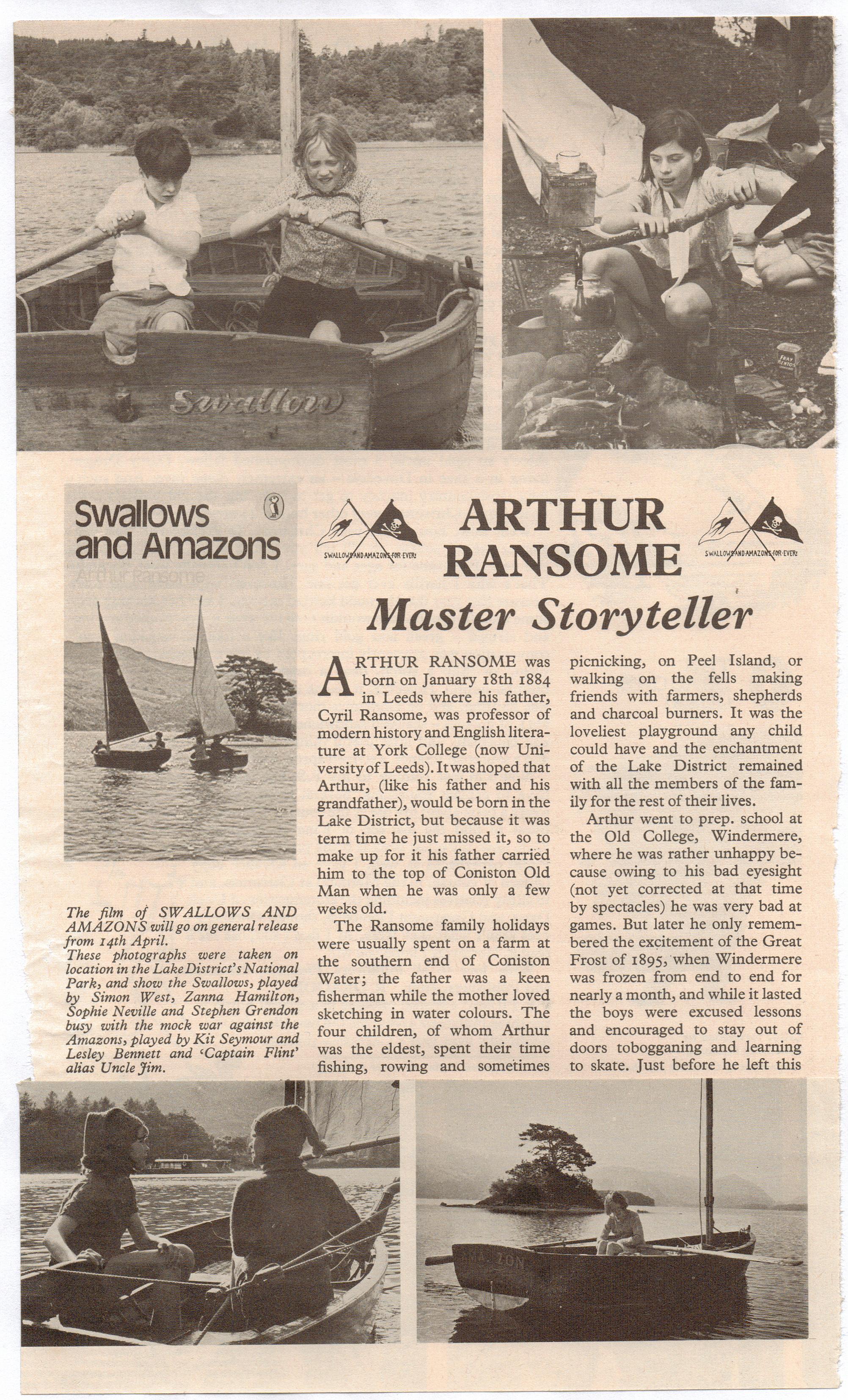
I do remember going to the Puffin Club. They published a very good article about Arthur Ransome and the film using the black and white stills in a better way than any other magazine. I still have the clipping:

Article on Swallows and Amazons in Puffin Magazine

We were very excited because the publishers had just brought out a copy of Swallows and Amazons with a photograph of the two little ships near Cormorant Island on the cover.  You can’t see us clearly but it was from the scene after Titty had just captured Amazon and both dinghies were being victoriously sailed back to Wild Cat Island by John and Roger, Titty and Susan. On the back of the book was a photograph of the Amazons in their red knitted caps waiting in the reeds at the mouth of the Amazon River. What I didn’t realise was that 75,000 copies were printed.

Kaye Webb, famous for her successful book launches, had us up to London to promote it:

About ten years later Puffin also bought out a copy of Coot Club and The Big Six, the series I worked on behind the camera at the BBC. I can remember getting the cast together for the shot of them on the Death and Glory – an old black boat. It was a happy time.

Swallows and Amazons book cover Coot Club and The Big Six book cover
My two book covers for Puffin

I had forgotten that we had one of the dinghies at the Puffin Club event but remember going to the Commonwealth Institute. I found appearing on television could be rather more daunting than public appearances. We were once taken to the BBC television studios to appear, live, on Points West, the regional news programme that came under the Nationwide banner at the time.  The designer had gone to a great effort and made a camp fire in the studio, but it felt weird sitting around it in our own clothes. I think the problem had been that the presenters had not actually read the book so were not in touch with the subject matter. Before we knew it, the item was over and we were whisked off again, home to bed no doubt. Being interviewed on the radio was less scary although I broke into French once when being interviewed on Woman’s Hour. That scarred the presenter.

By far the most enjoyable programme to be in was Animal Magic, which was presented in those days by Johnny Morris. The Assistant Producer Robin Hellier came with a small crew to film me at home with my own boat and my green parrot, Chico.

Appearing in ‘Animal Magic’, with my sisters and Chico our own green parrot

I was deeply impressed by Robin as a director and I thought him far more talented than Claude Whatham, who had directed the movie. More than twenty years later I met up with Robin when I was working on a BBC natural history programme in South Africa called Global Sunrise. He arrived at Johannesburg International Airport having flown from the Kruger Park in a small passenger plane. They had been delayed by a terrible storm and I had ten minutes to get him onto the Friday night scheduled flight to Cape Town. It was a good thing I knew him. I saw him at a distance and shouted, ‘Quick, Robin! Run.’ And we just made it through the gate in time, laughing about Animal Magic. He told me that the film he made at our house with me and my parrot was the very first he had ever directed. I never knew.

screen-shot-2022-09-02-at-12.39.56-pm

Forty years later, we made a little montage of ‘The Secrets of Filming  Swallows and Amazons (1974)’ to accompany the ebook, now in its 2nd edition and available here. The audiobook of ‘The Making of Swallows and Amazons’ is now also available.

Secret Waters ~ or Swallows and Amazons Forever!

Sophie Neville speaking after dinner at a literary weekend
Sophie Neville speaking about ‘Swallows and Amazons’

‘When you went to see the charcoal burners, did Susan really leave her basket behind?’

‘Yes, she did!’  I’d totally forgotten, but she left it behind by mistake.

I was invited to speak after dinner at the 11th Arthur Ransome Society Literary Weekend held at Willis Hall, Bristol University. It was a joy and delight to meet the organisers and delegates, of which there were about 150. All seemed interested in learning more about the making of Swallows and Amazons, the feature film of Arthur Ransome’s book produced  in 1973 by Richard Pilbrow of Theatre Projects and distributed by EMI in 1974.

The 1974 film Swallows and Amazons

Director Claude Whatham with his cast of Swallows and their basket

‘How old were you all?’ I was asked.

‘Ahh, that is rather a secret,’ I had to admit. When the filming began I was twelve, yet playing the part of Titty who was meant to be only nine. I managed to pretend to be much younger but the reality was that, although skinny, I was a tall child with long legs, so tall that in some shots you can see that I am taller than my elder brother John.  Claude Whatham, the director, seemed unconcerned but had either holes dug for me or a box produced for John to stand on when were side by side. At other times he simply had John in a higher position.

Sophie Neville and Simon West in Swallows and Amazons 1973
Titty appearing to be much shorter than her elder brother John

John was played by Simon West, who even aged eleven was a true leader and excellent sailor. He became a National Optimist champion in 1975. Suzanna Hamilton, who played my elder sister Susan, was aged twelve. Lesley Bennett, who played Peggy was actually the eldest aged thirteen, and Kit Seymour turned thirteen during the filming. But, unlike at school, it didn’t seemed to matter to us. We all felt the same age and got on well as a result. Sten Grendon, who played the seven-year-old Roger was actually aged nine. He couldn’t swim well, but somehow survived.

Biographies of those who appeared in Swallows and Amazons

I do remember that Roger received more danger money than any of us. Claude would compensate us for getting scratched by brambles – as poor Roger was – by handing out extra pocket money. I think we earned £2 each for enduring the icy waters of Coniston when the swimming scene was shot on a grey day in May. The water was so cold that it was agony and the money hard earned.  Titty, who was keen on imitating cormorants, had to dive underwater. I nearly passed out.  I am not very good at being wet and cold or when it comes to heights either, so it was encouraging to be rewarded after climbing trees, ‘For fear of ravenous beats.’ 

When you watch the film you can see that Susan inadvertently burnt Roger with the large flat frying pan, which she’d just taken off the camp fire. He flinches and she muttered ‘Sorry’, before ploughing on with the scene. The moment was captured in the film.

The Swallows camp on Wildcat Island
The frying pan that burnt Roger

One problem encountered when filming with children is that they can unexpectedly lose their milk teeth. I did. People still comment on this today.  I lost an eye tooth.  In some scenes it is there, then it will suddenly vanish only to re-appear again.  

Sophie Neville playing Titty in 1974
Titty’s tooth is obviously missing on the voyage to the island.


Claude was not very pleased that his continuity was blown and there was definitely no tooth fairy. He wasn’t very pleased when I grazed my leg falling off a swing at lunch time either. Suzanna cut her hand whittling wood. Bobby, the Props man seemed so happy and absorbed making bows and arrows for the Amazons, out of local hazel saplings, that we all wanted to try for ourselves and started carving. I bought a penknife with my danger money and made a bow, which I still have today. This occupation kept us all quiet until of course Suzanna nearly chopped a finger off and ended up with such a big bandage that Claude howled with dismay. We were banned from whittling after that, but I did learn to shoot with the bow and arrow. This proved providential since I gained the part of an archery champion in the next feature film I appeared in. Years later I met the man who became my husband at an archery event. He was chairman of the society. I might never have met him if I hadn’t learnt to shoot for the feature films.

The Swallows on their voyage to Wildcat Island

‘Here we are, intrepid explorers, making the first ever voyage into uncharted waters. What mysteries will they hold for us?  What dark secrets shall be revealed?’ Titty uttered dramatically as she looked out towards Wildcat Island. In fact we weren’t that intrepid. Our dinghy was wired to a pontoon on which was a 35mm Panasonic camera, a few yards of track and an entire film crew: sound, camera, lighting, wardrobe g et al.

The Swallow and the pontoon
The Swallow wired to the camera pontoon. Here we are rehearsing the scene where Titty and Roger row to Cormorant Island

The little bit of extra money Claude gave us was indeed compensation for encountering grave danger on one occasion. I don’t remember there being anything about it in Arthur Ransome’s book, but in the film there is a sequence when the Swallows nearly collide with the Tern, an elegant steamer that has taken tourists up and down Windermere since 1891. There is rather a large difference between the shot of the dinghy with the Tern coming towards her when Susan calls, ‘Look John! Steamer ahead!’  which was shot when Swallow was attached to the floating pontoon, and the next shot, a top shot, which was taken from the steamer when we were sailing free.

That is when things went wrong. The Tern turned, John lost his wind in the lee of the larger vessel and we four children came perilously close to ending up in a very Duffer-ish state.  Swallow had no centre board, only a keel and a shallow rudder, so she was difficult to turn at the best of times. We were acutely aware that Roger couldn’t swim, we had no buoyancy and I was perched on a pile of heavy old camping equipment. My father, who is a good dinghy sailor with years of experience racing in the Solent, was watching from the deck of the steamer, helpless. He could foresee the problem and yet was able to do nothing. Although we just managed to avoid a true collision he was so shaken someone had to find him a glass of whisky.

MV Tern on Windermere today

You can read more about the making of ‘Swallows and Amazons’ (1974) here: