‘Swallows and Amazons’ ~ preparations for the 1973 film

Swallows and Amazons the film diary
My diary entry ~ Friday 11th May 1973

My mother and I reached Ambleside in the Lake District in what must have been Mum’s Renault 5. I know it was packed to the gills. We found the Oaklands Guest House, a solid stone Edwadian house that the film company had booked us into, along with the other children in the cast.

Sophie Neville playing Titty Walker in the film Swallows and Amazons
Sophie Neville playing Titty Walker in the film Swallows and Amazons with her mother Daphne Neville

The cast ~A striking girl called Kit Seymour, who came from London, was playing Nancy Blackett, ‘Captain of the Amazon and terror of the seas.’  Her sister, Peggy Blackett, was played by Lesley Bennett.  Simon West, who was playing my brother John Walker, came from Abingdon. He held a National Optimist title and was an excellent sailor. Suzanna Hamilton, who came from Islington where she went to Anna Scher’s theatre group, took the role of  the very practical Susan. The part of our younger brother Roger had been given to  Sten Grendon, who had played the young Laurie Lee in the BBC Play Cider with Rosie, which I had also been in.  He came up from Gloucestershire with his mother Jane, who was to chaperone us with Mum.

The director ~As my diary relates, were were taken for tea at the Kirkstone Foot Hotel to meet Claude Whatham, who was directing the movie.  He was a small man, habitually clad in jeans, with a denim jacket.  He seemed young and trendy for an adult.  Sten and I had worked for him two years previously on Cider with Rosie  and the others already knew him from the weekend sailing audition.   Claude had just finished making his first feature film, That’ll be the Day, starring David Essex and Ringo Star. He went on to become a revered and prolific director with a long list of credits including the TV mini-series Disreali, Play for Today, Tales of the Unexpected, C.A.T.S. Eyes and the adaptation of  Mary Wesley’s book Jumping the Queue. Mum took me to Yorkshire to watch him making the moive of James Herriots’ vet story All Creatures Great and Small, starring Anthony Hopkins and Simon Ward. He went on to make the feature films Hoodwink (for which he was nominated for an AFI Award), Murder Made Easy and Buddy’s Song, but for all that, Cider with Rosie  (for which he received a BAFTA Nomination) and Swallows and Amazons remain his best known works, with terrific DVD sales. Somehow they never felt dated.

David Wood's screenplay of Swallows and Amazons

I can only think that we were thrilled to hear that we would not be learning lines, never realising it was Claude’s key to gaining natural performances out of us.  His other secret was that he never allowed us to see the ‘rushes’ – film that had just been recored – as  he thought it might make us self concious.  I learnt later in life that he was quite right.  We were also encouraged to start using our character names, which is something we enjoyed. I knew from my parents that Claude had wanted to cast children who didn’t go to stage schools.  I think he chose us for our spiritedness as much as anything else.

The producer had been keen that we could all sail and swim well and  Claude looked for children who were members of sailing clubs. I don’t think he realised until we were out on the lakes in gusty weather how deeply he valued the confidence in sailing dinghies held by the children playing John and Nancy.  They were so good that there were times when they told him what to do.  That amused him.

One thing that amused me intensly was watching the large colour television at the hotel. I’m not sure if I had seen one before.  They were hugely expensive in 1973 and considered a great luxury. The set, which had a wooden veneer, stood on legs and showed all three channels – BBC One, BBC Two and ITV.  We all thought it was amazing. That dates me and the period, doesn’t it?

You can read more here:
Swallows and Puffins ~ The film, the paperback and the publicity

The Swallows at Egham
Daphne Neville with Stephen Grendon, Suzanna Hamilton, Sophie Neville, Jane Grendon and Simon West

I was asked about the promotion of the 1974 feature film of  Swallows and Amazons:

‘I remember going to the Puffin Club exhibition in London around the time of the film release and some of the cast were there with one of the boats.  There was a quiz about S & A and you could win a copy of the book – which I did!  Sophie, were you there?  And do you know if the boat was ‘Swallow’ or ‘Amazon’?’

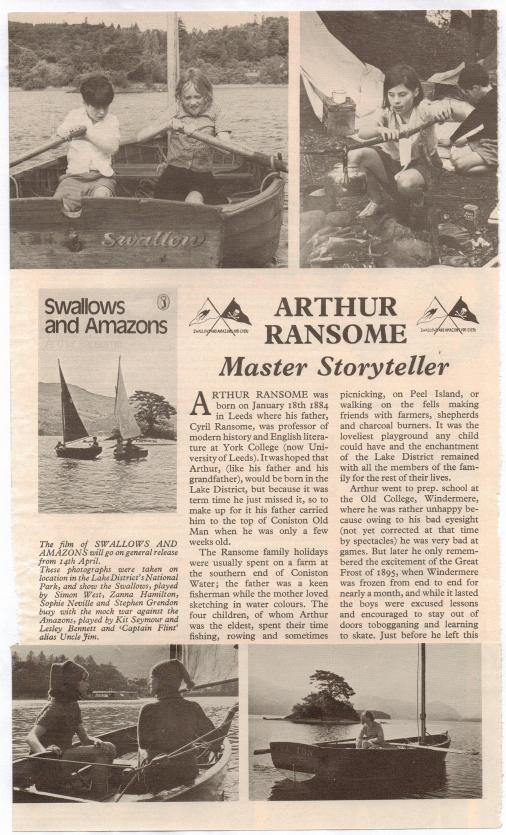
I do remember going to the Puffin Club. They published a very good article about Arthur Ransome and the film using the black and white stills in a better way than any other magazine. I still have the clipping:

Article on Swallows and Amazons in Puffin Magazine

We were very excited because the publishers had just brought out a copy of Swallows and Amazons with a photograph of the two little ships near Cormorant Island on the cover.  You can’t see us clearly but it was from the scene after Titty had just captured Amazon and both dinghies were being victoriously sailed back to Wild Cat Island by John and Roger, Titty and Susan. On the back of the book was a photograph of the Amazons in their red knitted caps waiting in the reeds at the mouth of the Amazon River. What I didn’t realise was that 75,000 copies were printed.

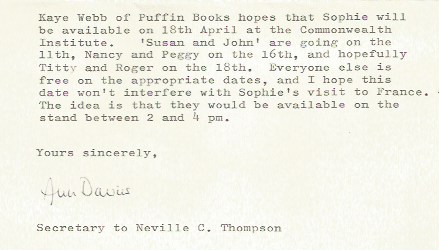
Kaye Webb, famous for her successful book launches, had us up to London to promote it:

About ten years later Puffin also bought out a copy of Coot Club and The Big Six, the series I worked on behind the camera at the BBC. I can remember getting the cast together for the shot of them on the Death and Glory – an old black boat. It was a happy time.

Swallows and Amazons book cover Coot Club and The Big Six book cover
My two book covers for Puffin

I had forgotten that we had one of the dinghies at the Puffin Club event but remember going to the Commonwealth Institute. I found appearing on television could be rather more daunting than public appearances. We were once taken to the BBC television studios to appear, live, on Points West, the regional news programme that came under the Nationwide banner at the time.  The designer had gone to a great effort and made a camp fire in the studio, but it felt weird sitting around it in our own clothes. I think the problem had been that the presenters had not actually read the book so were not in touch with the subject matter. Before we knew it, the item was over and we were whisked off again, home to bed no doubt. Being interviewed on the radio was less scary although I broke into French once when being interviewed on Woman’s Hour. That scarred the presenter.

By far the most enjoyable programme to be in was Animal Magic, which was presented in those days by Johnny Morris. The Assistant Producer Robin Hellier came with a small crew to film me at home with my own boat and my green parrot, Chico.

Appearing in ‘Animal Magic’, with my sisters and Chico our own green parrot

I was deeply impressed by Robin as a director and I thought him far more talented than Claude Whatham, who had directed the movie. More than twenty years later I met up with Robin when I was working on a BBC natural history programme in South Africa called Global Sunrise. He arrived at Johannesburg International Airport having flown from the Kruger Park in a small passenger plane. They had been delayed by a terrible storm and I had ten minutes to get him onto the Friday night scheduled flight to Cape Town. It was a good thing I knew him. I saw him at a distance and shouted, ‘Quick, Robin! Run.’ And we just made it through the gate in time, laughing about Animal Magic. He told me that the film he made at our house with me and my parrot was the very first he had ever directed. I never knew.

screen-shot-2022-09-02-at-12.39.56-pm

Forty years later, we made a little montage of ‘The Secrets of Filming  Swallows and Amazons (1974)’ to accompany the ebook, now in its 2nd edition and available here. The audiobook of ‘The Making of Swallows and Amazons’ is now also available.

Secret Waters ~ or Swallows and Amazons Forever!

Sophie Neville speaking after dinner at a literary weekend
Sophie Neville speaking about ‘Swallows and Amazons’

‘When you went to see the charcoal burners, did Susan really leave her basket behind?’

‘Yes, she did!’  I’d totally forgotten, but she left it behind by mistake.

I was invited to speak after dinner at the 11th Arthur Ransome Society Literary Weekend held at Willis Hall, Bristol University. It was a joy and delight to meet the organisers and delegates, of which there were about 150. All seemed interested in learning more about the making of Swallows and Amazons, the feature film of Arthur Ransome’s book produced  in 1973 by Richard Pilbrow of Theatre Projects and distributed by EMI in 1974.

The 1974 film Swallows and Amazons

Director Claude Whatham with his cast of Swallows and their basket

‘How old were you all?’ I was asked.

‘Ahh, that is rather a secret,’ I had to admit. When the filming began I was twelve, yet playing the part of Titty who was meant to be only nine. I managed to pretend to be much younger but the reality was that, although skinny, I was a tall child with long legs, so tall that in some shots you can see that I am taller than my elder brother John.  Claude Whatham, the director, seemed unconcerned but had either holes dug for me or a box produced for John to stand on when were side by side. At other times he simply had John in a higher position.

Sophie Neville and Simon West in Swallows and Amazons 1973
Titty appearing to be much shorter than her elder brother John

John was played by Simon West, who even aged eleven was a true leader and excellent sailor. He became a National Optimist champion in 1975. Suzanna Hamilton, who played my elder sister Susan, was aged twelve. Lesley Bennett, who played Peggy was actually the eldest aged thirteen, and Kit Seymour turned thirteen during the filming. But, unlike at school, it didn’t seemed to matter to us. We all felt the same age and got on well as a result. Sten Grendon, who played the seven-year-old Roger was actually aged nine. He couldn’t swim well, but somehow survived.

Biographies of those who appeared in Swallows and Amazons

I do remember that Roger received more danger money than any of us. Claude would compensate us for getting scratched by brambles – as poor Roger was – by handing out extra pocket money. I think we earned £2 each for enduring the icy waters of Coniston when the swimming scene was shot on a grey day in May. The water was so cold that it was agony and the money hard earned.  Titty, who was keen on imitating cormorants, had to dive underwater. I nearly passed out.  I am not very good at being wet and cold or when it comes to heights either, so it was encouraging to be rewarded after climbing trees, ‘For fear of ravenous beats.’ 

When you watch the film you can see that Susan inadvertently burnt Roger with the large flat frying pan, which she’d just taken off the camp fire. He flinches and she muttered ‘Sorry’, before ploughing on with the scene. The moment was captured in the film.

The Swallows camp on Wildcat Island
The frying pan that burnt Roger

One problem encountered when filming with children is that they can unexpectedly lose their milk teeth. I did. People still comment on this today.  I lost an eye tooth.  In some scenes it is there, then it will suddenly vanish only to re-appear again.  

Sophie Neville playing Titty in 1974
Titty’s tooth is obviously missing on the voyage to the island.


Claude was not very pleased that his continuity was blown and there was definitely no tooth fairy. He wasn’t very pleased when I grazed my leg falling off a swing at lunch time either. Suzanna cut her hand whittling wood. Bobby, the Props man seemed so happy and absorbed making bows and arrows for the Amazons, out of local hazel saplings, that we all wanted to try for ourselves and started carving. I bought a penknife with my danger money and made a bow, which I still have today. This occupation kept us all quiet until of course Suzanna nearly chopped a finger off and ended up with such a big bandage that Claude howled with dismay. We were banned from whittling after that, but I did learn to shoot with the bow and arrow. This proved providential since I gained the part of an archery champion in the next feature film I appeared in. Years later I met the man who became my husband at an archery event. He was chairman of the society. I might never have met him if I hadn’t learnt to shoot for the feature films.

The Swallows on their voyage to Wildcat Island

‘Here we are, intrepid explorers, making the first ever voyage into uncharted waters. What mysteries will they hold for us?  What dark secrets shall be revealed?’ Titty uttered dramatically as she looked out towards Wildcat Island. In fact we weren’t that intrepid. Our dinghy was wired to a pontoon on which was a 35mm Panasonic camera, a few yards of track and an entire film crew: sound, camera, lighting, wardrobe g et al.

The Swallow and the pontoon
The Swallow wired to the camera pontoon. Here we are rehearsing the scene where Titty and Roger row to Cormorant Island

The little bit of extra money Claude gave us was indeed compensation for encountering grave danger on one occasion. I don’t remember there being anything about it in Arthur Ransome’s book, but in the film there is a sequence when the Swallows nearly collide with the Tern, an elegant steamer that has taken tourists up and down Windermere since 1891. There is rather a large difference between the shot of the dinghy with the Tern coming towards her when Susan calls, ‘Look John! Steamer ahead!’  which was shot when Swallow was attached to the floating pontoon, and the next shot, a top shot, which was taken from the steamer when we were sailing free.

That is when things went wrong. The Tern turned, John lost his wind in the lee of the larger vessel and we four children came perilously close to ending up in a very Duffer-ish state.  Swallow had no centre board, only a keel and a shallow rudder, so she was difficult to turn at the best of times. We were acutely aware that Roger couldn’t swim, we had no buoyancy and I was perched on a pile of heavy old camping equipment. My father, who is a good dinghy sailor with years of experience racing in the Solent, was watching from the deck of the steamer, helpless. He could foresee the problem and yet was able to do nothing. Although we just managed to avoid a true collision he was so shaken someone had to find him a glass of whisky.

MV Tern on Windermere today

You can read more about the making of ‘Swallows and Amazons’ (1974) here:

‘Swallows and Amazons’ but no life jackets

Sophie Neville appearing on the cover of Swallows and Amazons published by the Daily Mail

When Harbour Pictures, in association with BBC Films, announced at the Cannes Film Festival that they were planing to re-make Swallows and Amazons based on Arthur Ransome’s iconic book that was written in 1929, a debate broke out as to whether the characters should wear life jackets.

Ironically Sophie Neville, who played Titty in the 1974 feature film of Swallows and Amazons nearly drowned one Easter because she was wearing a buoyancy aid. ‘My sister insisted I wore a big old fashioned life-jacket as an example to her children. When I capsized it trapped me inside my canoe. I’d lost my paddle and hung upside down, in the cold water, unable to get out. I was literally plugged inside and couldn’t get free.’

The EMI film of Arthur Ransome’s book Swallows and Amazons was made entirely on location in the Lake District 1973. ‘It can get quite gusty on Coniston Water but we never fell in,’ Sophie remembers. ‘We had a wonderful time.’

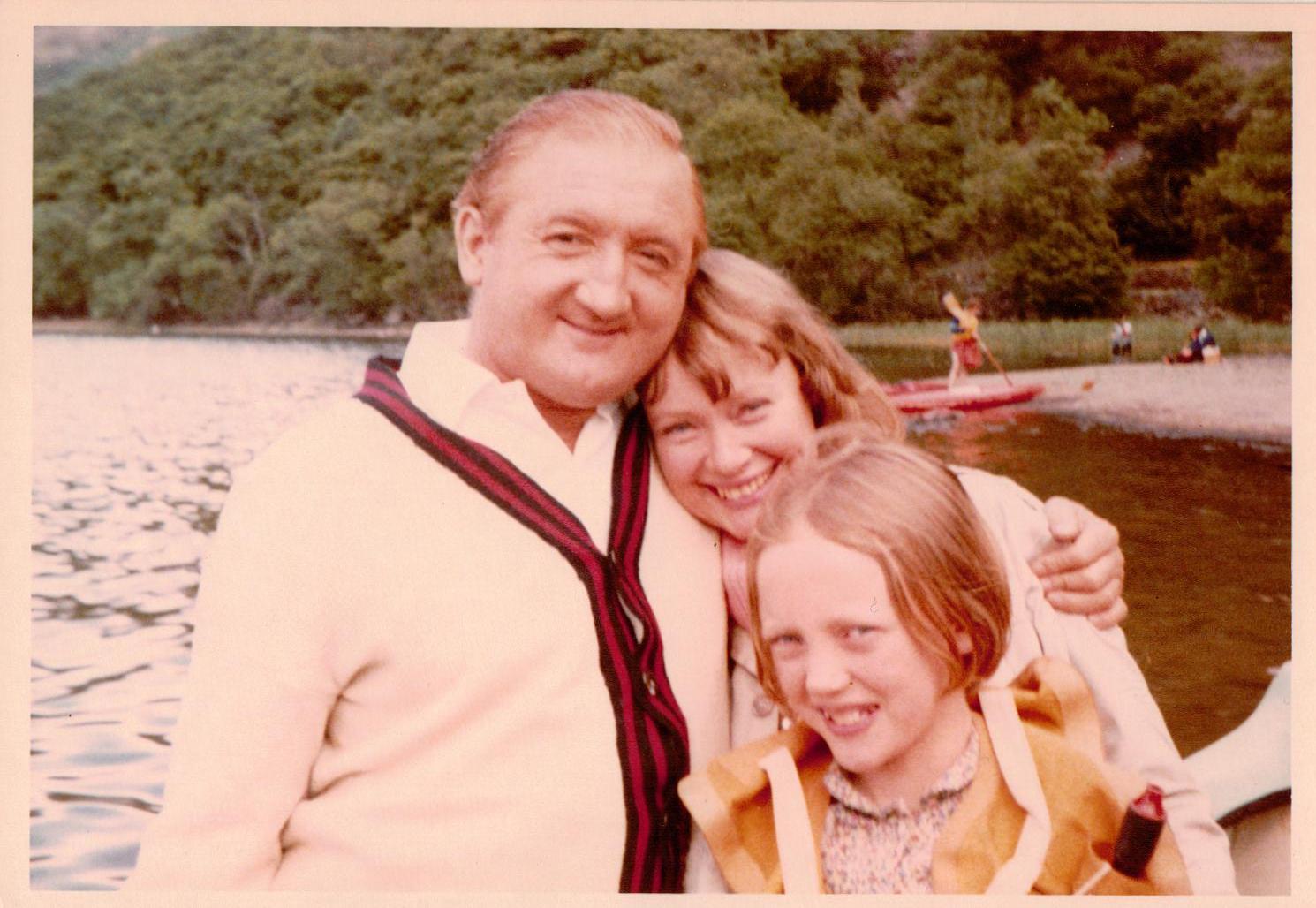
Ronald Fraser as Captain Flint with Daphne Neville and Sophie Neville playing Titty Walker on Derwentwater in 1973
Ronald Fraser as Captain Flint with Daphne Neville and Sophie Neville playing Titty Walker 

Ten years later the BBC made the drama series Swallows and Amazons Forever! an adaptation of Ransome’s later books Coot Club and The Big Six, which are set on the Norfolk Boards. Julian Fellows featured as a Hullabaloo, an enraged tourist driving a motor cruiser.

In both the film and television series the decision was made to be true the 1930s period in which the books are set and let characters – adults and children alike (plus pug dog), go out on the water without life vests. They carried knives, lit fires and sailed at night without lights in boats that had no buoyancy aids.

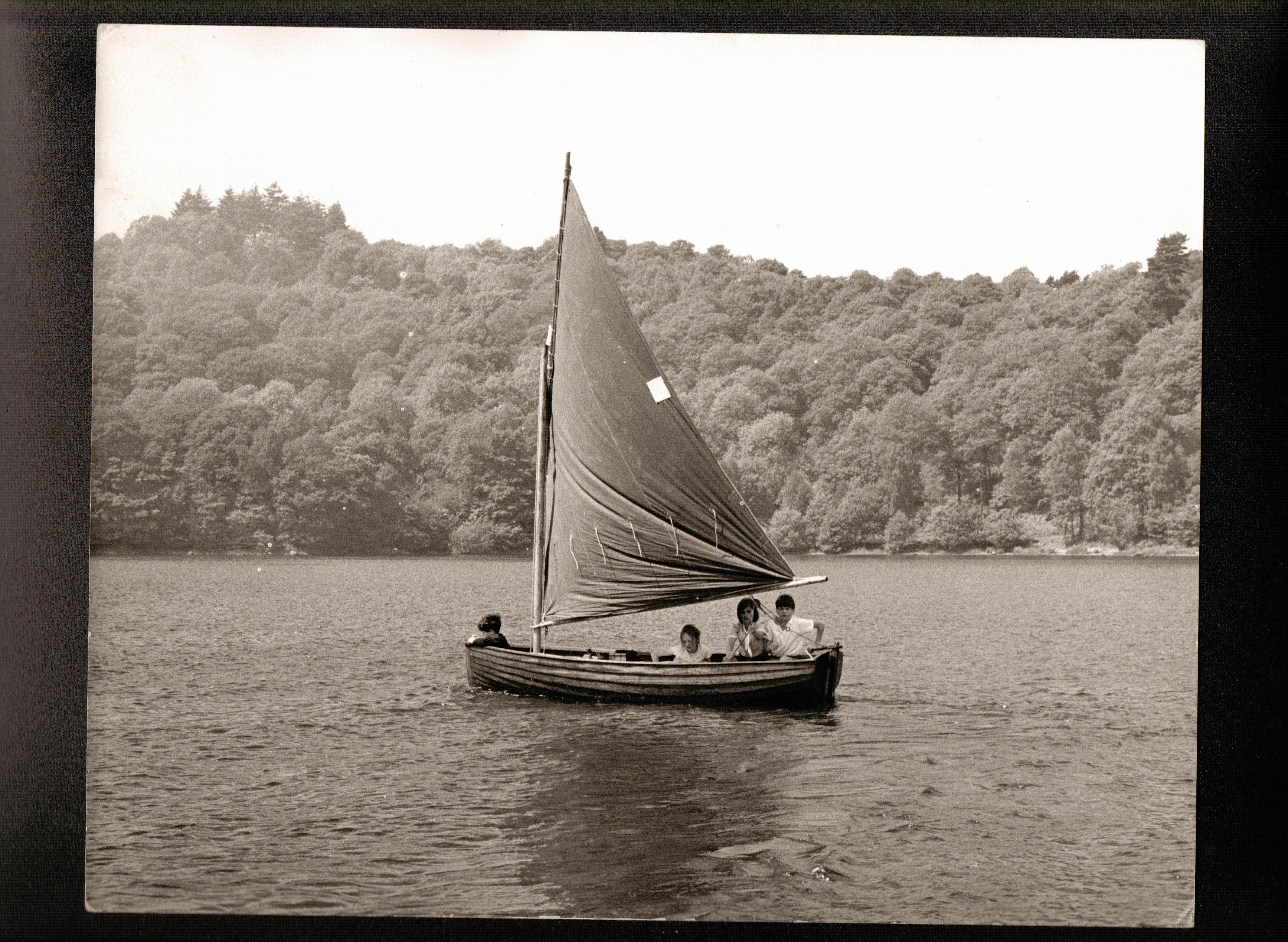
Swallow on Coniston

Lanterns were hung in tents and arrows were fired at other children. The boys in Norfolk also rode bikes without helmets, but that is how life was led in the 1930s. No one had safety belts in cars. Not much safety gear had been invented. ‘You wouldn’t film Elizabeth the Golden Years with Cate Blanchett in a BHS riding hat, or Russell Crow playing Robin Hood in a jockey’s helmet. No one moans about that. When filming Swallows and Amazons we wore life jackets when setting up shots and had a lifeguard in a zoomy rubber boat on constant stand-by when filming, but you wear period costumes in a period film and that is it.’

BW Wearing Life Jackets in the Safety Boat - trimmed
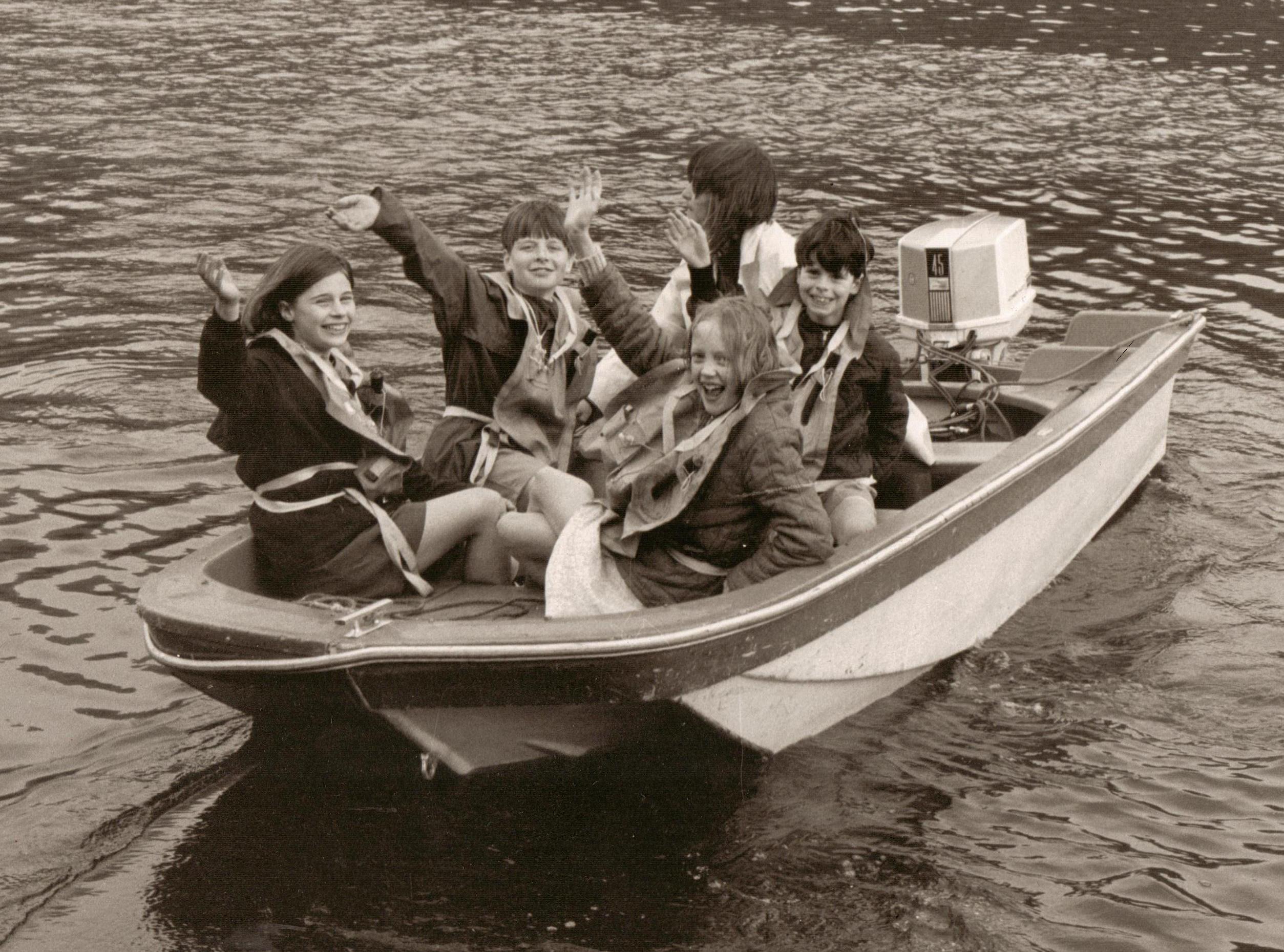
Suzanna Hamilton, Simon West, Sophie Neville and Sten Grendon wearing BOAC lifejackets in 1973

Sophie worked for the BBC behind the camera on the crew of Coot Club and The Big Six. She said what concerned her in Norfolk was the thought of someone getting trapped between a moored boat and the staithe wall or getting bashed when boats passed under the famously low bridges. ‘This situation won’t exist in the Lake District when Swallows and Amazons is made into a film again. They will have a wonderful – inspirational – time.’

Meanwhile if you are planning on going canoeing – sign up for a safety course first and wear the proper gear. This is the year 2015 and buoyancy aids are available…

Sophie Neville with Swallow

Sophie Neville with Swallow by Coniston Water, holding an original publicity still from the EMI feature film of Swallows and Amazons. Photo credit: Kitty Faulkner ©Sophie Neville

You can read more about how the original film of ‘Swallows and Amazons’ was made on location here:

the-making-of-swallows-and-amazons-1974-by-sophie-neville