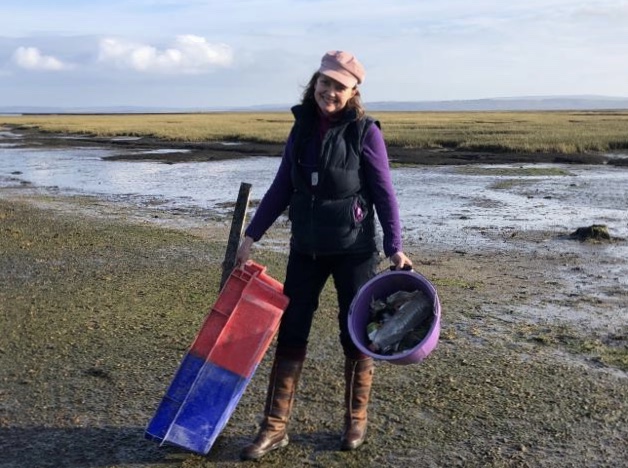
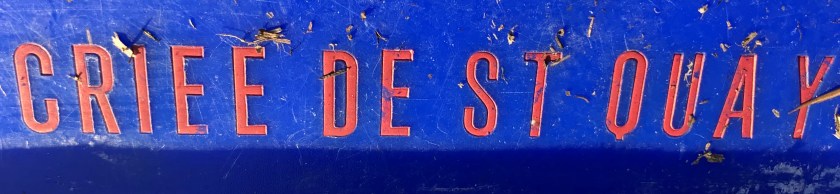
I’m often ask what are the most extraordinary things I’ve found on a beach clean. This year, I came across a crate washed up on Solent shores that originated in Brittany, nearly 400 kilometres across the English Chanel.
My bucket fills with lost toys and discarded litter as I clear plastic debris brought in on the tide. There is often a piece of Lego and nearly always an old cigarette lighter. How do they get into the sea?
Plastic and PVC string gets entangled in oak trees brought down in the storms.
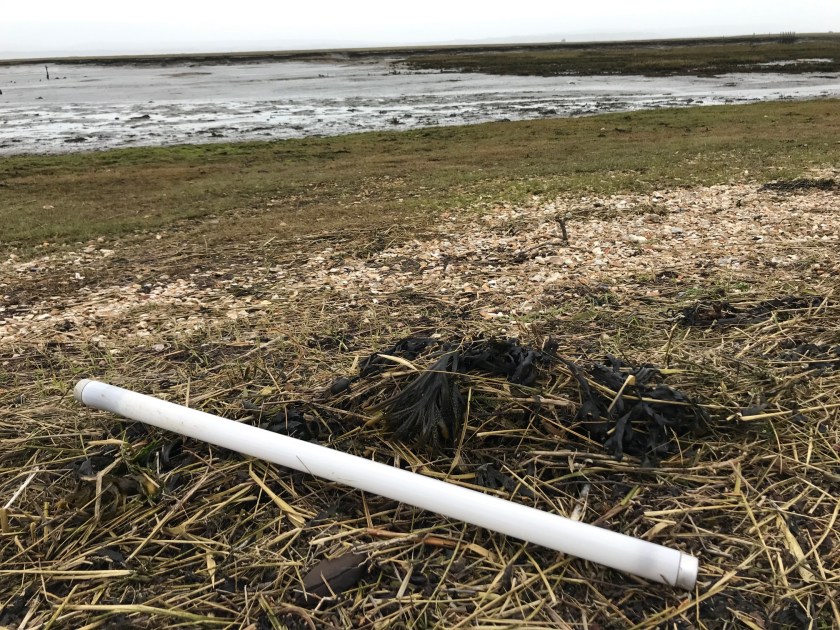
But, perhaps the strangest things are three unbroken fluorescent light bulbs washed up in the same place at different times.
There is always plenty to collect from tidal margins including a fair bit of rope. Most pieces are tiny. Plastic gardening waste is common.
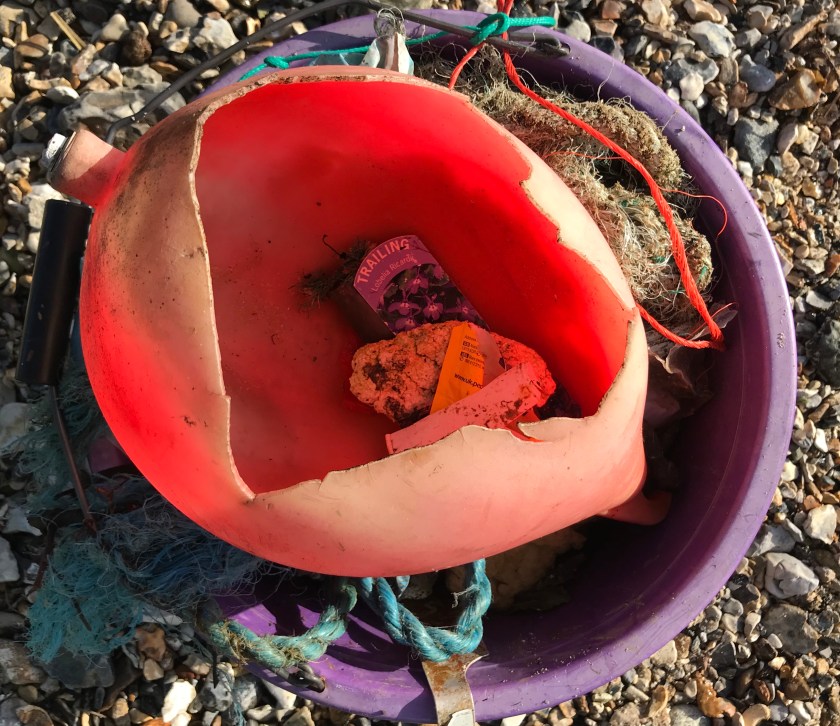
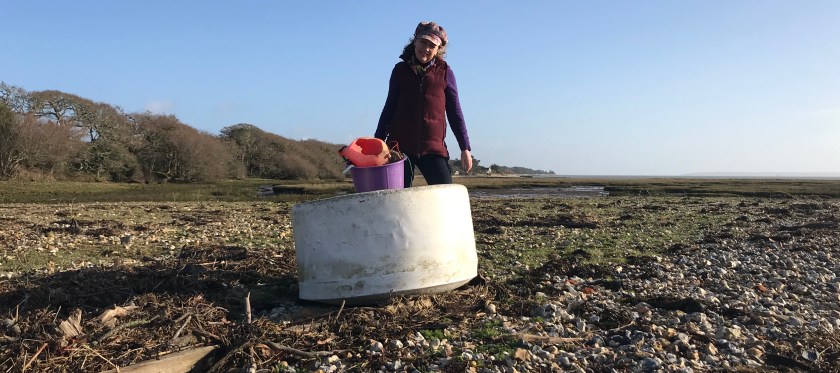
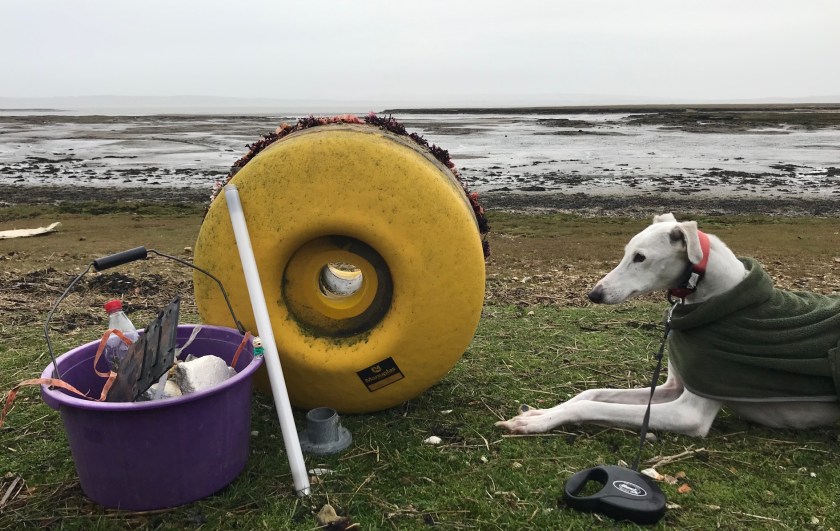
Some of it defeats me. I couldn’t shift this marker buoy. It is difficult to imagine how it will ever be removed from such a remote spot with no vehicle access.
British mud flats, so important for wildfowl, constitute one of our last wildernesses. I long to check the whole area but birds will be breeding on the low lying islands soon.
Instead, I go inland, clearing plastic bottles and wrappers that have blown off the Solent into coastal fields where they risk being a hazard to livestock. I often find pieces of plastic that have passed through the guts of New Forest ponies. Some items have obviously been dumped by overloaded hikers such as this brand new camping gear.
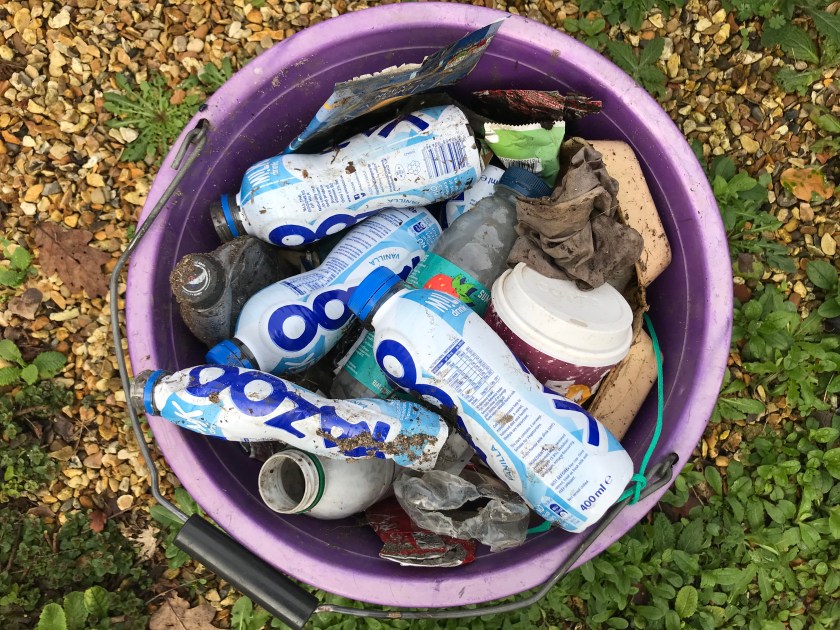
Meanwhile, the Lymington river estuary seems to be regarded as a litter bin by someone who drinks Tazoo everyday. I collect what I can from the banks before the rubbish attracts even more.
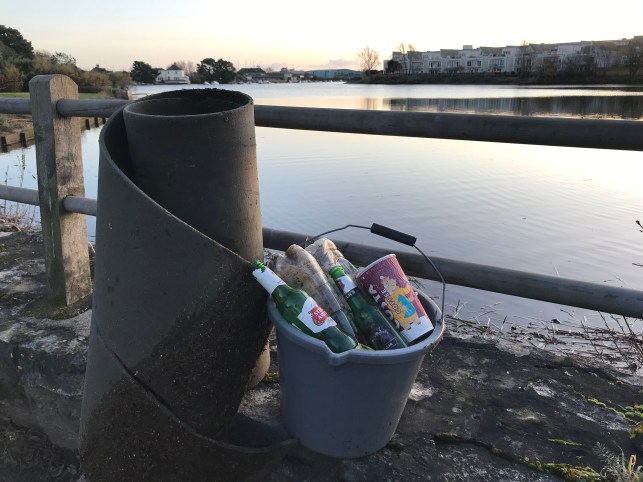
The nearest McDonalds is a 25 minute drive away and yet countless people wait until they reach the bridge before tossing their cups into the tidal river. Why do they do this?
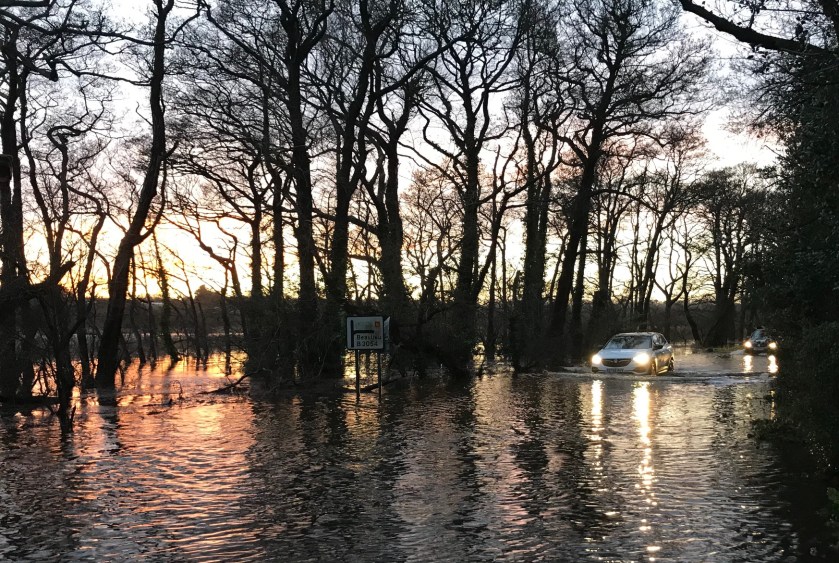
I didn’t clear nearly enough. The road flooded taking all the litter chucked onto the verge into the sea.
The shore I usually clean-up was not too bad after the storms but this is because others have begun to clear up debris.
After storm Ciara I found three old cigarette lighters at once along with other indicators of how bad things are. I learnt that one person had found 105 old lighters up on the Mersey. For a list of things found while beach cleaning in 2019, please click here.
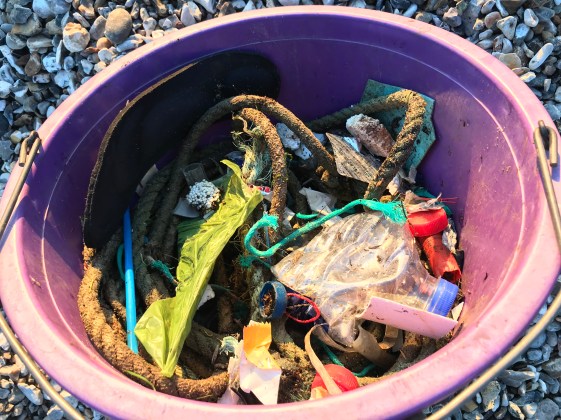
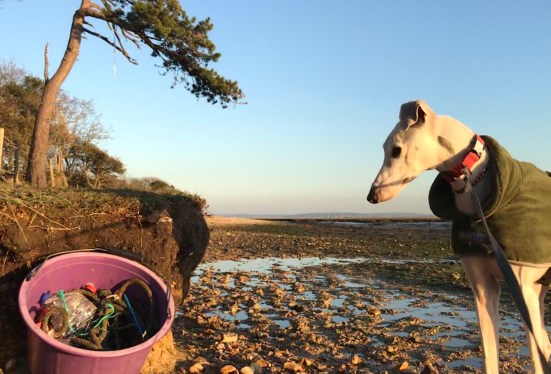
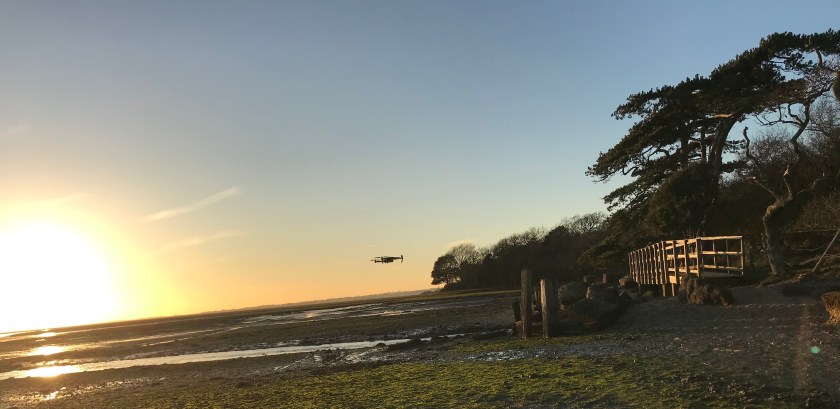
I returned to the shingle beach at Tanner’s Lane on the Solent at low tide to see what had washed up after a week of stormy weather. You can see me and my dog wrapped up against the cold weather in the bottom left hand corner of this aerial photograph taken as we searched for rubbish along the shore. We found a predominance of PVC fishing net and rope, along with plastic straws and cotton bud stalks, bottle tops and micro plastics.
I was obliged to leave a car tyre and a quantity of rope that was too deeply buried to extract without a crowbar but it had been too cold for picnicers. There was no litter. It is not difficult to imagine that plastic pollution can endanger people. The yards of loose mooring rope I did retrieve could easily have become entangled in the propeller of someone’s boat and left them stranded in shipping lanes.
I joined ‘Paws on Plastic’ on Facebook who encourage dog walkers to return with one piece of rubbish a day. One piece is better than noting. I picked up a can discarded by the sign greeting people to our town and took it home for re-cycling with the mantra, ‘rubbish attracts more rubbish’ swirling around my mind.
The next time I took my hound for a walk in the New Forest, I came across two carrier bags of litter hanging from a tree. I’m rather hoping their owner will return for them since I had already collected a bucketful.
I continued to collect tins and plastic bottles throughout the week, if only two or three a day. What amazes me is how often I find unopened cans or bottles of drink chucked in the bushes. Were they originally stolen? Why are they thrown into the woods? To read more, please click here
I hate sorting the litter when I reach home but getting out into the wild can be amazing.
I returned to the shingle beach at Tanner’s Lane on the Solent with my friend, also called Sophie, who took care of the dog while I collected plastic pollution. Having cleaned the same beach seven days ago, all I found was a black plastic lid washed up with a number of micro plastics. I plan to return in another week and begin counting the pieces as an indication of what is being washed up on a 500 metre stretch of the Solent. I guess the amount will depend on whether we have another storm or winter picnic-ers.
We then walked half a mile up the only lane to the beach. I filled my feed bucket with about 5Kgs of crisp packets, cups, flowerpots, a tin and two glass bottles. My friend was interested in how much more rubbish we spotted on our way back to the car. Litter picking is like that. You see into ditches from a different perspective. Cyclists visiting the New Forest were interested to see how much had been thrown onto the verges of the National Park and were horrified to see how much we collected.
9th January
We drove through the New Forest the next day, taking note of the verge-side litter. Where does it come from? What kind of motorist can ignore the fact they are driving through a National Park? Cyclists must notice every piece.
I later extracted three items from the Lymington River. Two were cups with plastic lids and plastic straws from McDonalds. The nearest is a 25 minute drive away, yet I often find their packaging. Is it dropped by commuters, visitors or delivery people?
11th January
I found an old carrier bag, put on gloves and collected a bag full of litter on my way into town, finding old things like a neck brace left in the street. The bag is deposited in a municipal bin, as advised. What distressed me was looking over the flood barrier to see so much rubbish dumped in the Nature Reserve.
I walked the dog around Bradbury Rings Iron Age Fort in the afternoon, collecting about 20 items of litter. Although ancient rubbish is the life-blood of archaeologists, I think we can spare them Coke tins.
12th January
I spent 40 minutes collecting litter, walking through the park and along the Solent Way, passing the Yacht Haven. There seemed to be more litter on the ground than a council operative was collecting from the plentiful municipal bins. I found a brand new bag-for-life before picking up two canisters of laughing gas by the Yacht Club. What can I do but re-cycle them?
15th January
Storm Brendan hit us hard for two days but the skies finally cleared and enabled me to get down to the coast to collect plastic bottles and wrappers along with two fishing buoys that had blown in from the Solent. It was a joy to be out in the New Forest National Park and felt good to be doing something worthwhile but can I make a difference?
For a list of things I take on a Solent beach clean, please click here
Sophie Neville in Portugal on the 150th beach/river clean of 2019
Wednesday 1st January 2020
“Hello Sophie,” a passing driver called out. “Are you still collecting plastic?”
“My first beach clean of the year!”
I managed 150 beach or riverside litter collections last year. My aim is to make it 200 for 2020. As someone wrote to ask why I stopped my last‘Diary of a lone litter-picker’ back in April, I thought I’d start it up again. It may not be that consistent but I am fuelled by rage. The first thing I picked up toady was a deflated helium balloon found on the road to the Solent shore. Isn’t helium a finite resource? Don’t we need it for medical procedures?
I came across two ‘disposable’ barbecues lying abandoned on the beach.
“Do you think someone will return for these?” I asked the only other person about on New Year’s Day.
“Doubt it.”
I added the aluminium trays to the purple bucket I use to collect litter. Only one drinks can graced it’s depths today but I stopped repeatedly to pick up cotton bud stalks along with small pieces of PVC fishing twine and red, white or blue micro- plastics washed up by winter tides.
A runner ran past. Will all this bending keep me fit, I wonder. There was a little polystyrene and four boxes of fireworks left beside the municipal bin.
It was a mild but misty morning. I walked along with my dog listening to cries of seabirds. How many of them have plastic in their gullets?
On returning home, I looked up the Marine Conservation Society and see from their 2019 report that they have a number of different classifications for items such as ‘Sewage related debris’. They need more data to campaign and change Government policies. I decide to join.
Thursday 2nd January
It was windy with rain threatening, so I decided to take my dog down a lane running alongside the river marking the boundary of the Lymington Reedbeds Nature Reserve in the New forest National Park. This is just above the high tide level and prone to flooding. I cleaned the area two months ago. In about 500 yards I collected:
3 x glass booze bottles, 3 x booze cans, 3 x drink cans, 7 x plastic drinks bottles, 5 x cigarette packets and 30 x crisp/sweet wrappers. This weighed 3kgs. Apart from one sandwich the contents of the packaging could not be described as health-giving.
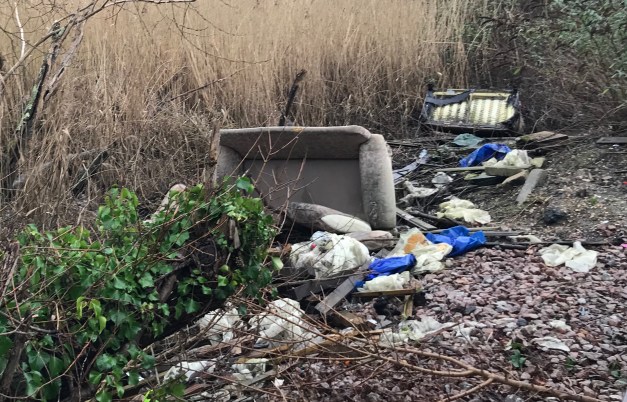
I had to leave a discarded boiler, a rusting wheelbarrow, a length of soggy carpet and a number of bottles lying out of my reach. This fly-tipping has languished in the ditches here for sometime but I need to commandeer help and a suitable vehicle.
Friday 3rd January
A lovely sunny day when I cleared litter from the rest of the lane running along the river. What do people expect will happen to the cans and plastic flung into the reserve? One tin was dated 2011. Four of the wrappers had been neatly knotted before being chucked in the ditch. From the evidence collected, I strongly suspect their owner to be drink-driving on his or her way to work every day.
Sadly, I will need to return with a long-poled grabber for plastic bottles chucked deep into the brambles. I need a vehicle to collect a large car part, a plastic tub and a number of ‘Bags for Life’ stuffed with litter lying abandoned near the footpath to the pub. It could be worse. I found nine different items of stolen property along this lane last year – iPhones, lap tops, two empty jewellery boxes and a handbag in which a mouse had made its nest.
It was my friend’s birthday, so I took her a card, walking along the estuary with a bucket to collect the inevitable litter. What should I do with parts that have obviously fallen off cars? I hung one up in case its grateful owner comes along along. I also hung a soggy sweatshirt from the railing, although I doubt if it will be claimed.
I was down by the water, fishing out plastic bottles when a car passed belching clouds of choking white smoke. After extracting an old carry-mat from the reeds I found two puzzled men looking under the bonnet of their car. Their glamorous passenger stood shivering by the estuary. I pointed them in the direction of the local garage but feel I should have left the mat in case they needed it.
Saturday 4th January
In an effort to record data, I sort yesterday’s litter into re-cyling bags full of tins and plastic bottles. Glass bottles go in an outside sink for washing, wrappers into my domestic rubbish bags. They should go into Council litter bins or litter bags.
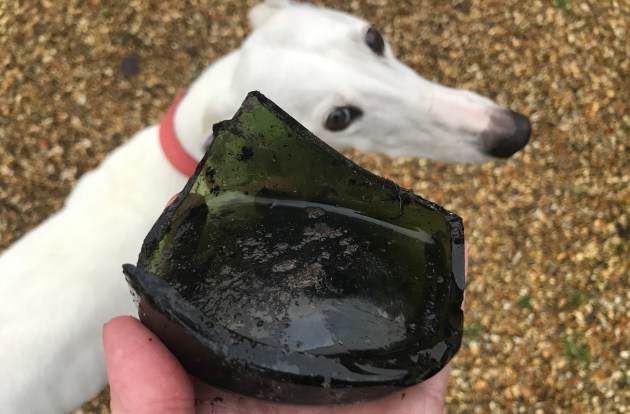
I returned to the Solent and began collecting plastic deposited by winter tides. When I first moved to this area fifteen years ago, the foreshore was multi-coloured with debris. The coast now looks clean at first glance but I picked up about 200 tiny pieces of fishing twine and micro-plastics in a few hundred yards. There were quite a few spent shot-gun cartridges left by wild-fowlers. I found a baby’s dummy and a used cigarette lighter. There is often one. New Forest ponies roam here and yet I have retrieved buckets of broken glass in the past and find a jagged bottle base that could easily lame a horse. It has obviously been there for years.
Sunday 5th January
A stereo speaker was washed up on the shore this afternoon. I wouldn’t want to hit one at sea. I spied a Corona bottle, the bobbly ‘every bubble’s passed its FIZZical!’ type that we yearned for as children in the 1960s. How old would it be? 50 years-old? Could I still redeem the deposit? Hopefully soon.
Monday 6th January
I walked back from town, unable to pass litter lying on the causeway over the Lymington River. I had no bucket with me but where there is rubbish there is usually something you can use as a container. I found a broken umbrella, filling its folds with plastic cup lids, bottle tops, and assorted trash including a Pepsi Cola tin that would have otherwise rolled into the tidal river.
Tuesday 7th January
I should have rushed out early when we had two minutes of sunshine but I was distracted and the rain set in. Instead, I read through litter-picking posts on Facebook, absorbing information on bottle return schemes and the call for an end to single use plastics. I reckon we need to support anyone who is doing anything before the world is swamped in rubbish and the food chain poisoned. Do let me know what you are doing in the comments box below.
For a list of things found on Solent Beachcleans last year, please click here
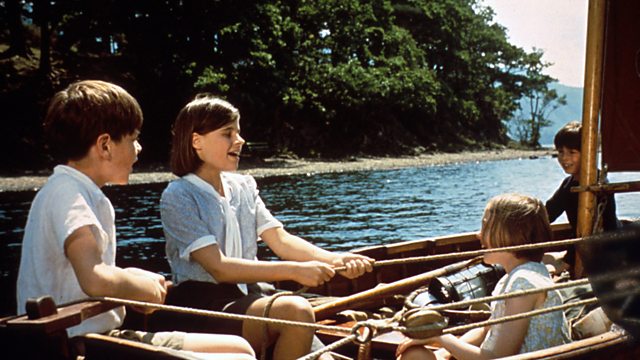
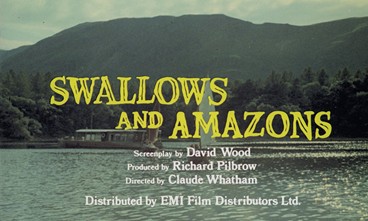
The school term is over, ‘Swallows and Amazons’ is on BBC iPlayer and Christmas missives are arriving in the post. I have just been sent this homemade card from someone who came to the premier of the original film in 1974, when I was fortunate enough to play Able seaman Titty.
~Captain Flint hanging Christmas decorations around his houseboat on a card made from a Puffin book cover~
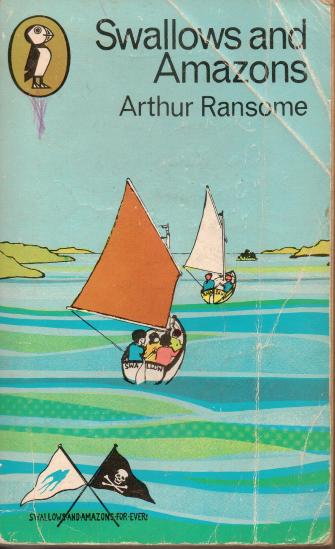
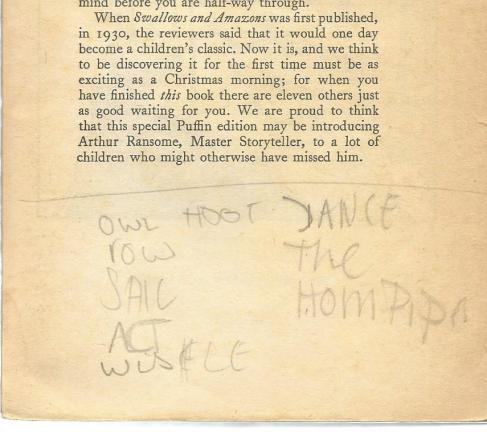
I dug out the Puffin paperback of Swallows and Amazons my father gave me when I was a girl and read avidly, along with other books in the series, by the time I was eleven years-old. It is a 1970’s edition in which I’d underlined everything Titty said. I must have re-read this copy when busy preparing for filming the 1974 movie financed by EMI.
Kaye Webb, the editor, had written an introduction saying, ‘This book is about sailing, fishing, swimming, camping, and piratical exploits.’ She wanted to make it available to children, thinking that discovering Swallows and Amazons ‘for the first time must be as exciting as a Christmas morning.’
Underneath, I’d noted down the skills I would need to acquire before playing the part of Titty. ‘Owl Hoot’, was one item, ‘wisle’ (sic) another. I was somewhat apprehensive about dancing the Hornpipe but excited about ‘being a cormorant’, having no idea how cold this experience would prove.
According to Trade News, 75,000 copies of a new Puffin paperback were brought out to accompany the original film. A still was used from the scene where the Swallows sail both dinghies from Cormorant Island. It retailed for 35p. Meanwhile Jonathan Cape printed 12,500 copies with the original dust jacket to accompany the release on 4th April 1974.
Today, I am most interested in Ransome’s prose, amused to find the phrase ‘X marks the spot where they ate six missionaries’ does not appear within the pages of the book. It was given to Titty in 1973 by the screenwriter David Wood. However, there are words of wisdom a-plenty that were not used in the film adaptations:
‘I like cooking,’ said mate Susan.
‘If you want to go on liking it, take my advice and get someone else to do the washing up’, is Mother’s reply. (I wonder who might have said this in reality.)
‘You can be wide awake and not see a thing when you aren’t looking’ is one of Roger’s observations.
John was able to look back to ‘a different, distant life’, which is exactly how it feels when the excitement of Ransome’s world spoils you for the ordinary. It’s true: those involved in outdoor activities develop in leaps and bounds ending up, ‘not at all what they had been.’
What is it about Arthur Ransome’s writing that captures your imagination? Rowing? Sailing? Cooking over a camp fire? Which book has most influenced your life?
Article on Swallows and Amazons on Puffin Magazine
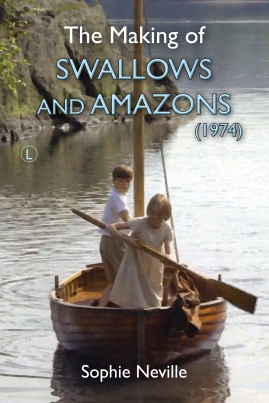
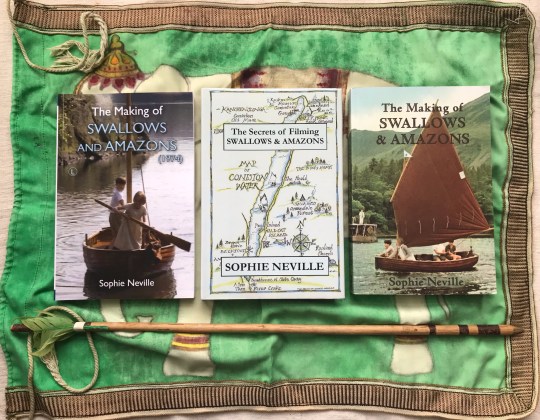
You can read about the adventures we had bringing out the original film in different versions of ‘The Making of Swallows and Amazons (1974)’, which is now available as an audiobook.
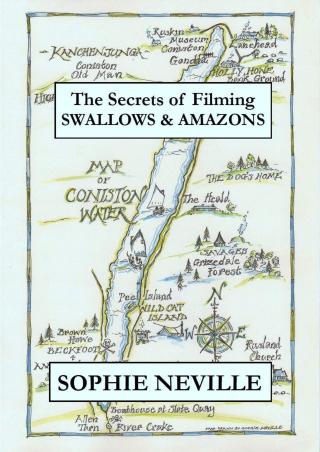
Different editions of ‘The Making of Swallows and Amazons (1974) by Sophie Neville’
If you enjoy ‘Swallows and Amazons’ do think of joining The Arthur Ransome Society who often visit the film locations or the Arthur Ransome Group on Facebook where you will meet like-minded people – of all ages. Most are dinghy sailors who love the books.
Lat time ‘Swallows and Amazons'(1974) was screened on BBC Two, at least one film fan held a TV party with a 1930’s theme. Others ‘stoked up the wood-burner and settled down to spend an afternoon re-living summer in the Lake District’, adding, ‘It is as if Christmas wouldn’t be Christmas without ‘Swallows and Amazons’ – a timeless classic to watch again and again.’
For the latest edition of the paperback on ‘The Making of Swallows and Amazons(1974)’ with details of where the film was made and what those who appeared in it are doing now, Please click here
The ebook, entitled ‘The secrets of filming Swallows & Amazons (1974)’ is similar with a few more stories for adult readers and has links to behind-the-scenes cine footage. It can be downloaded from iTunes, Smashwords,Kobo and Amazon Kindle
It would be lovely to hear from anyone who saw it in the cinema when it first came out in cinemas in the summer of 1974 – more than forty-five years ago.
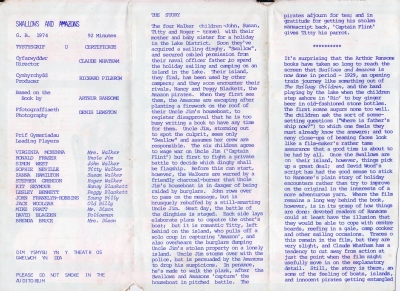
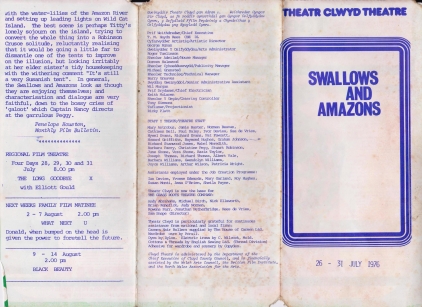
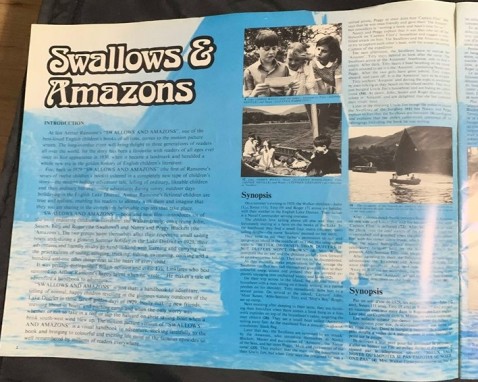
Simon Hodkin kindly sent in this cinema programme that he has kept since watching the movie when he was a boy growing up in North Wales.
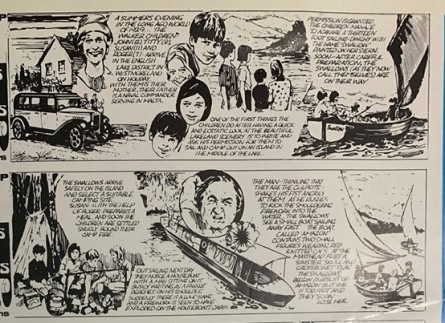
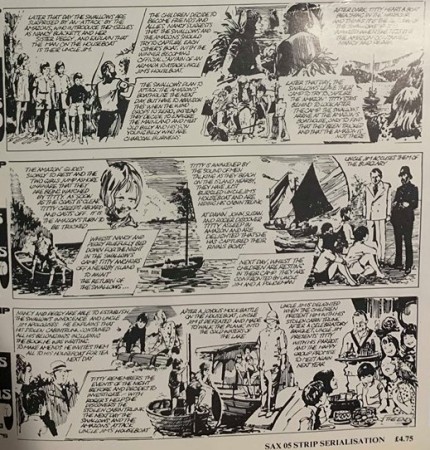
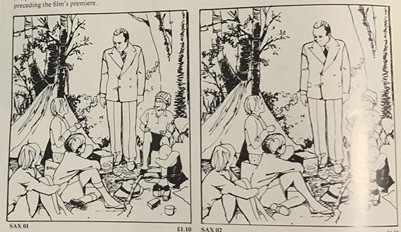
Arthur Herbertson managed to track down these rare publicity sheets for ‘Swallows and Amazons’ typical of movie games of the period:
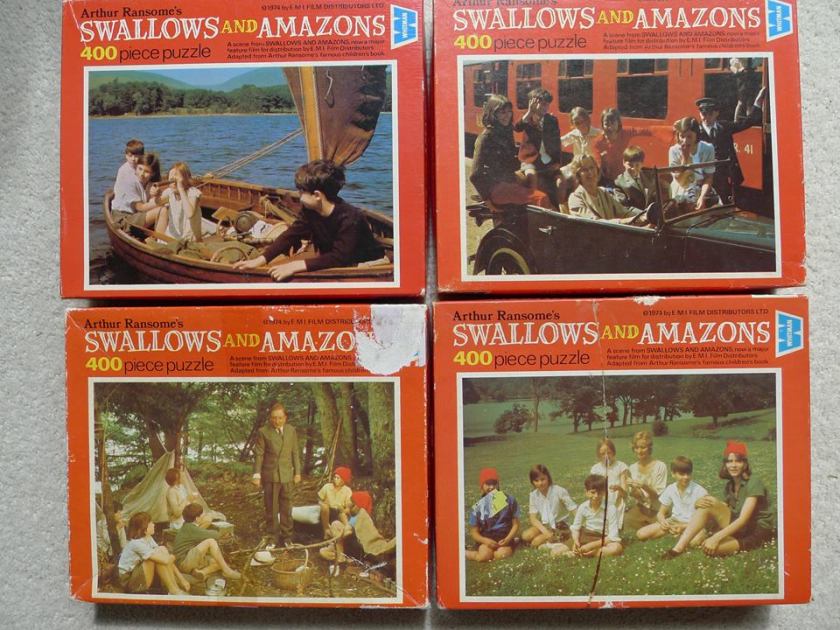
Arthur has a collection of the four jigsaw puzzles and the Puffin paperback that came out with the film.
There was a vinyl LP narrated by the screenwriter David Wood that you can still purchase.
Arthur found a publicity brochure that I had never seen before.
To read comments from people who saw the film at the cinema in 1974, please click here
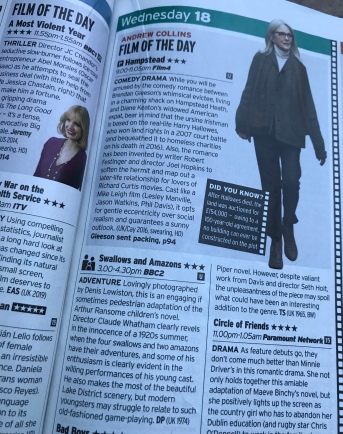
The original story was written by Arthur Ransome in 1929 ninety years ago, so the film hits the half-way mark between the original readers and today’s audience. It’s funny, the critics in 1974 are asking the same question as raised in the billing this week: Do ‘modern youngsters struggle to relate to such old-fashioned game playing’?
Do add your thoughts to the comments below.
~Billing in the Christmas edition of the Radio Times 2019~
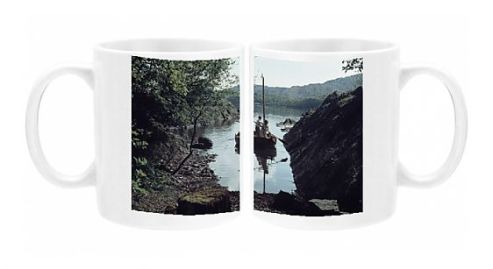
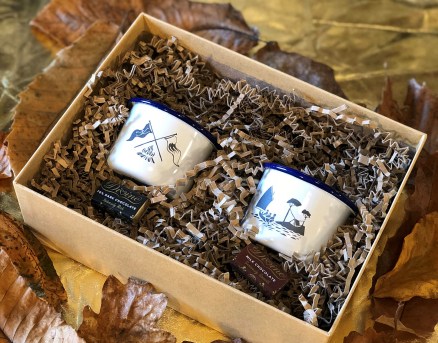
Everyone uses mugs – if only to store pens and pencils. These bone china cups depicting Ransome’s yachts Peter Duck and the Nancy Blackett should be available from The Nancy Blackett Trust. They cost £19.99 for a pair. The trust also sells a selection of books, audio books and videos for Arthur Ransome enthusiasts with any profits going towards the upkeep of the historic vessel.
Here are some of their other useful mugs that could be bought as a set of three, easily sent through the post:
– Mugs depicting scenes from the 1974 film ‘Swallows and Amazons’ –
Some of my favourite things the Nancy Blackett Trust stock in their online shop are tea towels, including this one that depicts Spurrier’s map of the lake in the north
Claudia Myatt’s design featuring three of Arthur Ransome’s yachts called, ‘I saw three ships’, makes a good gift. Mugs and tea towels make great presents for sailors.
The Little Boathouse can make up coastal map cufflinks, personalised especially for you.
We have designs for cakes and party ideas with a few gifts here. And then there are books. Here are different editions of one I wrote, available on eBay and Amazon or to order from Waterstones:
Different editions of ‘The Making of Swallows and Amazons (1974) by Sophie Neville’
An article first published in Mixed Moss, the journal of The Arthur Ransome Society:
Sophie Neville who played Titty Walker in ‘Swallows and Amazons’ (1974)
‘I can’t see it.’ The man was standing in the rain outside the cinema. ‘You said Swallows and Amazons has parallels to missionary life but I don’t get it.’ He was a vicar, camping with his family in the Lake District. After spending a week at the Keswick Convention, he’d brought his children to see the original film Swallows and Amazons (1974) at the Alhambra cinema where I was giving a Q&A after a screening of the movie.
‘I once went on a short-term mission to Australia,’ I told him. ‘People would ask me if I was going to convert the natives.’ The archaic idea of berating aboriginal people almost filled me with horror but use of the word ‘natives’ reminded me of Swallows and Amazons. This led me to consider how deeply Arthur Ransome was influenced by missionary journeys of the early 1900s. As the author, Julian Lovelock points out, ‘exploring, trading and being a missionary were, in Victorian times, all shades of the same colonial activity. Dr Livingstone is often described as an ‘explorer-missionary’. This is the 80th Anniversary year of the publication of Secret Water where ‘missionaries’ enter Ransome’s world in their ‘mission ship’ Lapwing.
‘Would’t Titty like this?’
Linda Hendry, of The Arthur Ransome Society (TARS), observed that as a boy of ten, Arthur envied his Aunt Edith and Aunt Jessie who were going off to China as missionaries. Did this idea of adventures last with him?
Although his father, Cyril Ransome, came from a clerical background and ensured Arthur received a biblical education in Windermere, Margaret Ratcliffe of TARS reports that ‘there is never a hint of spirituality’ in his letters and diaries. ‘Arthur and Genia were not of an active religious persuasion; Christmas and Easter were ordinary days for them.’ The only time he went to church on a regular basis was when he lived in Finsthwaite and his closest fishing friend was the vicar, the Rev. Roland Pedder. ‘Arthur Ransome never mentions that they discuss spiritual matters, rather hooks, bait and water levels.’ I agree with Margaret’s view that any analogy ‘would have been subliminal on his part, rather than conscious’ but it is embedded in the story, all the more interesting for being unintended.
The reality of going on overseas missions does have parallels with Swallows and Amazons. You tend to set off as a group or family, like the Walker children, and usually end up helping people who need a bit of support, even if it is not what you might expect. Those once wounded often make the best doctors.
One of the key themes, perhaps driving force behind Swallows and Amazons is fatherlessness. Is the story an out-working of Arthur Ransome’s grief for his own father, who died when Arthur was thirteen? Was he desperate to prove himself as reliable and resourceful as Captain John, planning the expedition while Commander Walker was in Malta preparing to sail to Hong Kong? As it is, the Swallows gain Daddy’s permission while remaining under the umbrella of their mother’s care, making sensible preparations before setting sail. This is very like missionary groups who usually need permission from the church with back-up and support from their mission organisation.
Peter Wright, chairman of The Arthur Ransome Society, added, ‘The Amazons seek out the Swallows in much the same way as indigenous people came to find out about early explorers.’ Any number of missionaries have had arrows fired at them. The Swallows discover that Nancy and Peggy not only prove to be the same age but share their terminology and outlook on life. They too have no father around and have recently been rejected by their uncle who is busy writing. As a result, they are being rebellious and let off a firework on the roof of his houseboat. The Swallows make friends with the Amazons and end up helping Uncle Jim to see sense.
Everyone’s moral values are tested in Swallows and Amazons. Uncle Jim realises he has been neglecting his relationship with his nieces and sees what ‘a cross-grained curmudgeonly idiot’ he’d been to ever doubt John Walker’s integrity. Although this casts a shadow on idyllic island days, it almost visibly builds John’s character before his leadership skills are stretched by challenges set by Nancy. The other characters use their gifts to the full, Susan becoming the practical facilitator and Roger learning to be helpful. Titty is the one keen on diving for fish like a cormorant. She keeps the journal or ‘ship’s log’ and takes guidance from the Christian novel Robinson Crusoe that, ‘tells you what to do on an island’, being well-aware that missionaries could be eaten by cannibals. Although her active imagination is undervalued at first, she comes up with ideas that prove vital.
When the Swallows meet indigenous people of the area such as the charcoal burners, they are both polite and respectful, taking an interest in traditional beliefs, such as keeping an adder under the bed for luck. Although Roger makes a bit of a gaff, saying Old Billy ‘doesn’t look much like a son’, the others take an interest in ‘savage’ language and culture.
The Swallow’s mother looks out for them constantly. She reprimands John and sets rules when he goes too far, ‘No more sailing at night’, but continually ensures they are provisioned and their needs met. It might not be expected, but there are battles to be won on the mission field. They are usually tricky, demanding timely action and often involving discomfort akin to sleeping in a dinghy moored by Cormorant Island. Interestingly, it is Titty, the littlest girl, who finds the strength and courage to also unearth the buried treasure and bring restitution.
‘What did the burglars do when they found the treasure had gone?’ one little girl at the cinema asked?
Quick as a flash, Marc Grimston of TARS EAST, who was in the audience, said, ‘Captain Flint carves a fish for them to find instead of the trunk.’ Repentant and forgiven himself, Jim Turner opts to convince the thieves of their guilt rather than report the burglars to the police.
The great thing is, that whilst fishing from boats and weathering the storm, firm friendships are forged that take the Swallows and the Amazons on further adventures, even to the ends of the Earth. There is something inspirational about these that stories lead others to extend themselves, hoist their sails and live life to the full.
~ Sophie Neville supporting an adult literacy programme in rural China ~
You can’t go out as a missionary expecting to convert the natives. You need to come alongside people who are hurting, find the key to their needs and help them use their God-given ability to fulfil their dreams. It can be scary and things won’t always go smoothly but you are usually warned of danger. There will be a need for strong leadership when times become testing but it should be fun. If you can gain people’s trust and hold on to the unity there will be celebration and feasting in the end.
~ Sophie Neville on a Bible Society mission of encouragement to China ~
The vicar, standing in the rain beside his bicycle, began to appreciate the parallels. You may find more. One thing is certain: there is something about the Swallows and Amazons series of books that enables adults to enjoy them as much as children. We can escape pressures of contemporary life and are inspired to fulfill our dreams, becoming all the good Lord wants us to be, doing all the things He has prepared us to do.
You may disagree completely, you may can find parallels in other Arthur Ransome books. Please write in, using the comments box below.
Duncan Hall of the Arthur Ransome Group on Facebook wrote: ‘Of course, throughout (the series of Swallows and Amazons books) there are references to fictional and non-fictional adventures of exploration and discovery which historically sat with Empire, missions and trade as well as with piracy, etc. They do contrast with a political outlook that is clearly oppositional to those traditions. We always end up being impressed by savages (in the Lakes or the Walton backwaters) rather than hoping to civilise them. In Missee Lee, we obviously want to protect the location of the Three Islands, rather than send Daddy’s gunboats over there (despite the pretty monstrous business that Miss Lee presided over, we are convinced that the Brits destroying their way of life would be more monstrous still).
The Arthur Ransome Society invited me to speak at their bi-annual Literary Weekend held recently at the Royal Agricultural University. The college is situated outside Cirencester in Gloucestershire, a ten minute drive from the Golden Valley where I grew up next to the Thames and Severn Canal. I spent my A’Level years at Cirencester College just down the road. Just before leaving school, we were invited to a formal dinner at what was then the Royal Agricultural College, in the Gothic hall where The Arthur Ransome Society dinned. I remember gazing up at the high ceiling with its carvings of bunches of carrots and other vegetables. My father was asked to be the after-dinner speaker that night. A quiet man, he did not relish the idea of public speaking but he delivered the most inspiring talk on travel. It gave me the confidence to launch out into the deep.
In the early 20th century, by embarking on a career as a foreign correspondent for the Daily News and Manchester Guardian, Arthur Ransome was able to travel to Cairo, China and through Russia. He sailed home from the Baltic in his own yacht and kept on sailing, taking a small dinghy with him to visit the Altounyan family in Syria. These adventures inspired his writing for us to relive. Our own travels can be guided by walking in his footsteps, even to half-imagined places such as Swallowdale above some great lake in the north.
While Arthur Ransome transported us to snowy lands by re-telling Old Peter’s Russian Tales, his series of Swallows and Amazons books have the attraction of almost being within our grasp. We could reach most of the locations he describes in our own holidays. Theses twelve novels are essentially about travel of a kind that engages the imagination. Gathering enough food and gear to survive on an island is bound to get you thinking. ‘Are you sure you haven’t forgotten anything?’ By including books such as Robinson Crusoe that stimulated Ransome’s own imagination, as well as frequent references to South America, he takes us on a literary journey, inspiring us further.
Our imagination helps us to examine possibilities and predict danger, anticipate the enemy, access risk: Packing, alone, forces one to focus on what might happen. When you set sail in a small boat you need to be alert: ‘At the end of Darien there might be rocks.’ You learn to trust your decisions based on projections and possible outcomes, becoming a better leader, much like Captain John.
We use our imaginations to plan ahead. Nancy’s tactical schemes include anticipation of how others would probably behave.
Our imagination generates ideas, helps us solve problems or conflict: ‘If anyone was sailing after dark, we could hoist a lantern up there.’ Ultimately it is Titty, the youngest girl with the most active imagination who dreams up back stories for strangers, renames places, draws, writes, casts herself as Robinson Crusoe and wins the war for the Swallows.
Imaginative stories help us remember things.
By imagining how others might feel we gain the gift of empathy, which enhances our social skills, engaging unity of purpose. Providing children camping on an island in the Lake District with gooseberry tart and buckets of hot porridge is an obvious example, leaving carved fish for burglars to unearth is slightly more cryptic.
Imagination expands our perception and enhances our lives, making us more resourceful: ‘Everything had grown smaller except the lake, and that had never seemed so large before.’ The hay bags were being brought to the island by Mr Jackson.
Humour demands subtle forms of imagining, lifting us above the mundane, making the prosaic bearable. Titty turns Lakeland farmers into natives, her mother into Good Queen Bess.
Our imagination lifts us above the necessary enables our minds to travel. Ransome himself must have longed to voyage further afield. His novels are drenched in references to South America, Africa and ‘the Caribees’. We have the ability to dream big dreams and find a way of achieving them.
There are dangers – we can be wrong. Titty was not at the camp as John and Susan imagined. She was alone in a clinker-built dinghy, without a blanket, out on the lake, witnessing a criminal behaviour. My Granny’s imagination descended into worry, which became rather irritating. I can only hope her pessimistic imagination fuelled ardent prayers for our safety.
An over-active imagine can raise expectations too high. Titty’s own imagination was liable to go over the top but she retained her sense of humour: ‘Might be a tidal wave’. Some poor souls become delusional fantasists. Broken dreams can plunge us into despair. Ransome’s own dreams crashed from time to time and probably drove him overseas. Russia was the one place he could escape his first wife. It ended up being the place where he met his second.
I quote from the Jonathan Cape edition of Swallows and Amazons. Re-reading this is a voyage in itself. I discover something I never noticed before every time.
CR Milne, wrote of his father, AA Milne saying: ‘A writer is a craftsman and a designer. Another man might have made things with his hands; he made things with his imagination.’ It is clear that Arthur Ransome travelled in his imagination and reported on what it was like.
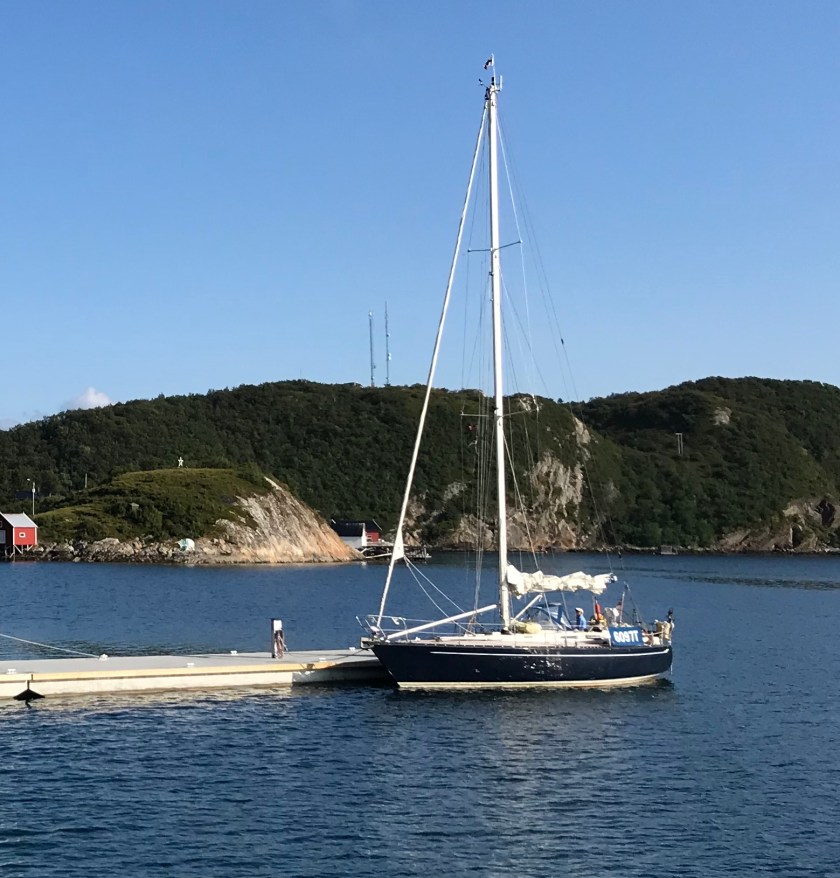
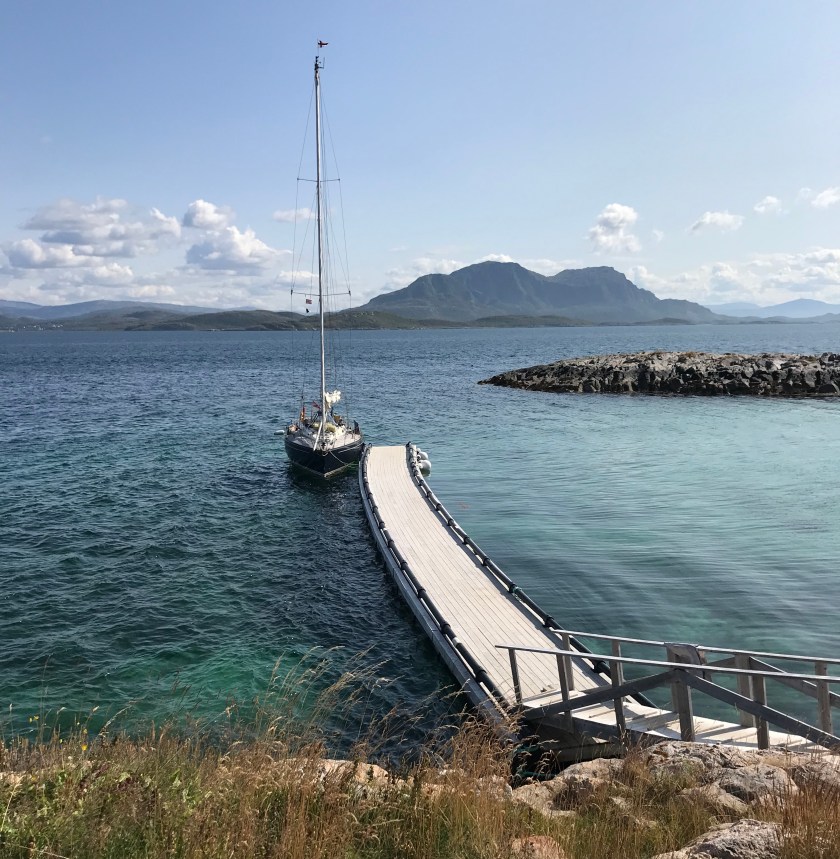
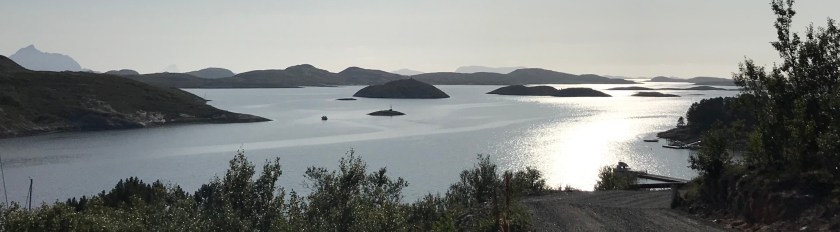
This summer I joined friends to sail up the Norwegian coast to Bodo above the Arctic Circle. I packed with some trepidation, imagining it could get cold and very wet but we enjoyed excellent, clear conditions. Our enjoyment was enhanced by the reality of sunny Summer day, after sunny Summer day, as if floating through the pages of a storybook. It was a dream fulfilled.
Travel and you are stretched, spoilt for the ordinary. ‘Of course, really we are going the other way,’ said Susan, ‘but it doesn’t matter.’ I know why my father wanted us to travel after leaving school. He knew it would increase our self confidence, extend our ability and help build skills beyond those stretched by taking A’levels. ‘Just pack a bag and go,’ he said. ‘There will always be a way. You’ll find there’s a bus that will link to a boat. Don’t worry about getting stuck – you’ll find something will turn up.’
~Sophie Neville off the coast of Norway, sailing across the Arctic Circle, 2019~
My father appreciated the fact travel is expensive but he always managed to work something out, taking advantage of his military travel pass to take a train to the Outer Hebrides and used his annual leave to sail on the Norfolk Broads in the 1940’s. He found a factory in Maryport to visit as part of his job with BIP. This enabled him to drive around the Lake District in the 1950’s. He worked in exports through the sixties and seventies so that he could fly worldwide. Marketing cable-ties and electronic components enabled him to take the QEII to America and planes to places as far afield as South Africa and Japan. These were the days when agents and customers would take him on tours of their country as part of a trade mission. Such journeys would otherwise have been prohibitively expensive. After retiring, my father sold his collection of early sailing books to cruise the Baltic. The question I now ask is: who inspired him? One major influence was the author Arthur Ransome.
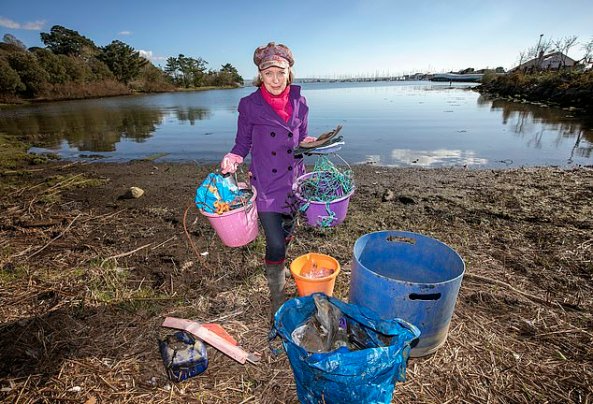
Sophie Neville on a beach clean – photo copyright Daily Mail
Why litter? It is illegal. Why is rubbish chucked out of vehicles passing through an area like the Lake District, where jobs and businesses depend on the beauty of the surroundings?
Is littering an instinctive reaction? Do we, as humans, improve our chances of survival by discarding unwanted items that weigh us down? Early man must have dropped what he didn’t need without a second thought. Hunter-gatherers are active agents of seed dispersal, spitting out seeds and chucking vegetable matter away as they walk about.
My peers counter this. In answer to my question, they say:
‘I care for the environment. It angers me when people don’t do the same!’
‘Pure laziness. Litter throwers think, ‘Oh well, the local authorities employ someone to clear up behind me and throw rubbish out of vehicles as they drive along while on their mobiles.’
‘Smokers mindlessly drop the cellophane, then the butt, then the packet…’
‘Selfishness and laziness, with no love for nature.’
‘They feel entitled.’
‘No respect for the environment, other people or themselves.’
‘Smokers are by far away the worst. Cigarette butts are litter.’
‘Bitterness. They feel let down by society and have given up caring.’
‘Combo of laziness and the belief that somebody else will be around to pick up after them. My father once threw a candy wrapper on the ground on my college campus. I picked it up and stuck it in my pocket for later disposal. He saw me and asked, “Did you pick that up?!” I said, “Yes.” And I never saw him throw trash on the ground again.’
‘Mindless behaviour. Education is needed: education, education.’
Littering – or taking responsibility for rubbish – is a learned activity.
Keep Britain Tidy’s litter ambassador Jim Honeychuck quotes an academic paper: ‘There’s a kind of scale. On the one end you get mindless littering by those with little or no mind like junkies, drunks, and toddlers. At the other end you see deliberate, bloody-minded littering, as in holding litter until there is a clean area to foul. That’s a sign of hatred for the community, and perhaps for oneself. (“This is how I see my life, a mess…”) The behaviour at those two ends of the scale can’t be influenced much. In between are those who have always used the floor as a bin, those who would use a bin if there were one, those who use “virtual” litter bins, like planters, walls, the top of shrubbery… That is where improvement can occur.’
‘Some people need a lead; the more good examples set, the better it will be.’
Producers could help by using bio-degradable wrapping.
Now that plastic pollution has become a worldwide problem, endangering wildlife and threatening marine fish stocks, we need to guard against litter and pick it up. Every year the RSPCA is called out to rescue thousands of animals caught in rubbish. One cigarette stub will pollute seven litres of water. While collecting litter costs millions of pounds a year, it costs us nothing to bend down and collect a few items a day.
Could you collect litter or go on a beach clean? It can be fun! You get to keep fit, walk the dog and make a huge difference. The finds often prove interesting. I have quite a collection of tennis balls and come across lost or stolen items that have been returned to grateful owners. Keep Britain Tidy have advice on safety and useful kit here: www.keepbritaintidy.org
To see a list of 20 reasons why is it good to collect litter, please click here




























![Grab A Chance Greetings Card by Claudia Myatt[4614]](https://sophieneville.net/wp-content/uploads/2019/11/grab-a-chance-greetings-card-by-claudia-myatt4614.png?w=251&h=350)










 Sophie Neville