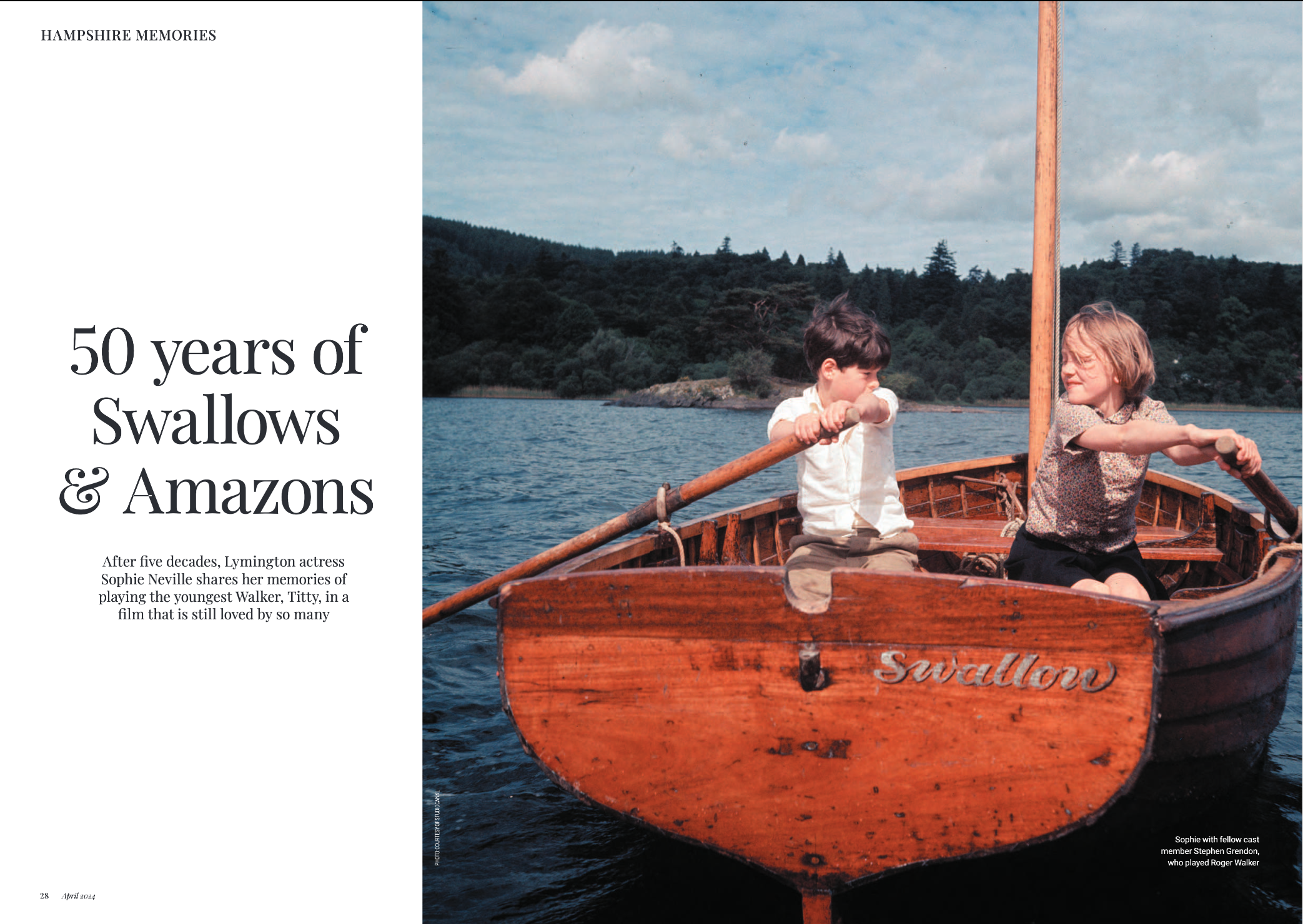
The April issue of Hampshire Life magazine has a four-page feature celebrating the 50th Anniversary of the release of the original movie ‘Swallows & Amazons’ (1974) in cinemas, which you can now read online here.
The link with Hampshire is that my father grew up in Lymington and learnt to sail on the Solent. I met my husband Simon at an archery match in Worcestershire and was amazed to hear he lived on the Lymington River. I came down to the South Coast just before we got engaged but didn’t move in until after we returned from our honeymoon in Spain.
I’ve lived in Hampshire for twenty years now, give talks at the Southampton Boat Show and meet the Nancy Blackett when she sails down to Buckler’s Hard on the Beaulieu River where my parents spent their honeymoon.
It feels odd being described as an actress, but it’s good to get a front page byline.
I spoke on BBC Radio Cumbria, asking if I could meet anyone involved in filming the original film of ‘Swallows and Amazons’ (1974). It was made on location in the Lake District with a young crew.
~Nick Newby of Nicole End Marine~
Nick Newby of Nichol End Marine in Portinscale came to find me while I was in the Keswick. As a young man in the 1970s, he provided boats for a number of films and was contacted by Graham Ford, the production manager of Swallows and Amazons in the Spring of 1973. Graham had began working with Mike Turk who had started building boats for TV and films at his family firm, Turk’s Launches, but this was based on the Thames in London. They needed help from someone in the Lake District who knew about traditional boats.
~Ronald Fraser being trransported by Dory to The Lady Derwentwater in 1973~
Arthur Ransome had clearly based Captain Flint’s houseboat on the Esperance, originally a steam launch cruising on Windermere. You can read more about her and see photos here.
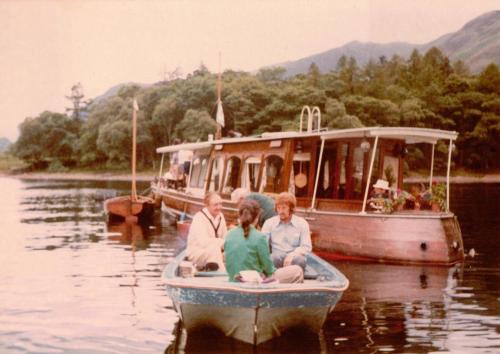
‘Since she was sitting on the bottom of Whitecross Bay at the time,’ Nick told me, ‘the film crew decided to use the Lady Derwentwater.’ This was a launch licensed to carry 90 passengers that Nick had worked on and knew well. ‘She is about 58 foot long and quite a rigid boat, having four full length steel RSJs set inside her. She was built the Lakes in 1928. We moored her at Brandelhowe in Great Bay for the filming. You need to be careful getting in, as there is a rock shelf.’ Unlike the Esperance you could see the view over the lake from her large cabin windows, which enhanced interior scenes. The Lady Derwentwater, whose nick-name is Dishy, has since been re-built with a different stern, but you can book a passage and go out on the lake in her yourself.
~The Lady Derwentwater today~
Nick told me that Captain Flint’s eight foot Wright’s dinghy, the houseboat’s tender, had been made by Wright’s Brothers of Ipswich. The Jackson’s ‘native canoe’, rowed out to Peel Island by Virginia McKenna was ‘a family fourteen’ Wright’s sailing dinghy with a centre case. He knew many of the traditional boats in the Lakes. ‘I served me time as a yacht and boat builder at Shepherd’s in Bowness Bay.’ This company was based the green double-story boat sheds featured in the ‘Rio’ scenes. ‘During the winter we used to have to break the ice on the buckets of water when we were rubbing down boats. The sail lofts had a square panel in the apex so we could poke the 8 to 10 metre masts inside. A boom could go up the stairs but a mast certainly couldn’t. ‘
~Virginia McKenna with Sophie Neville and DoP Denis Lewiston~
‘Amazon belonged to a chap called Vosey who was rather reluctant to let her be used for the filming,’ Nick said. ‘We did her up a bit after the filming.’ I gather she had been used in the black and white BBC serial of Swallows and Amazons made in 1962 when Susan George played the party of Kitty.
~Swallow sailing towards the filming pontoon in 1973~
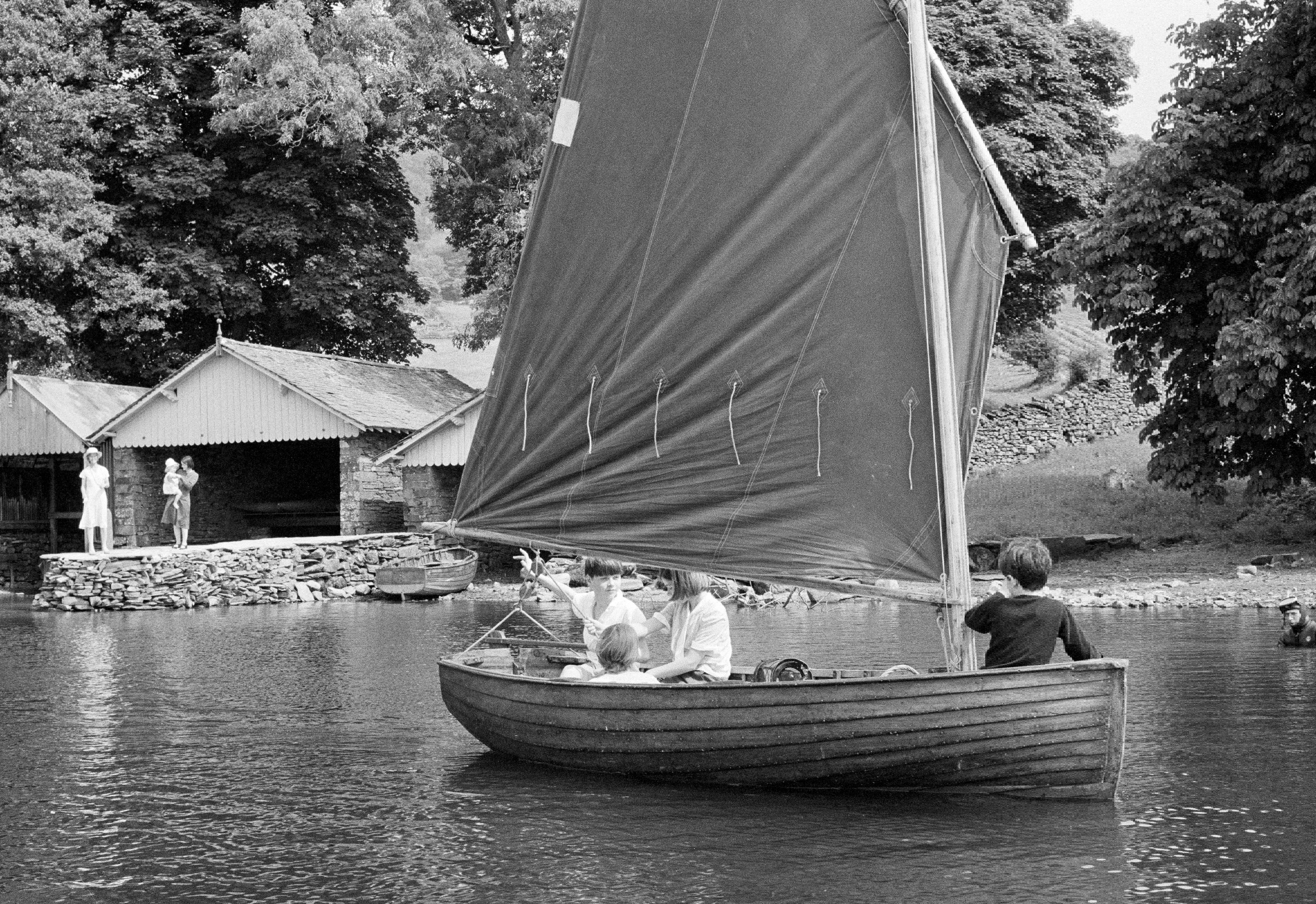
I believe Swallow had been found at Burnham-on-Crouch as she was built by Williams King and Sons. Mike Turk, who had built a shallop for the 1966 movie ‘A Man For All Seasons’, purchased her for the film and brought her up to the Lakes. She had no added buoyancy. Nick claims that being a wooden boat she would never sink but I reminded him that we came close to hitting the MV Tern on Windermere when loaded with camping gear, which was a bit scary.
~MV Tern on Windermere today~
Swallow was later used at Elstree Studios when the sound was dubbed onto the finished film. Mike kept her out of the water in his store at Chatham until SailRansome bought her at auction in 2010. She was sensitively restored by Pattersons, has a new sail, added buoyancy bags and is now available for anyone to sail in Cumbria.
~Mike Turk’s filming pontoon with Swallow attached in 1973~
‘Mike already had the flat-bottomed filming pontoon. It had originally been used for carrying a vehicle. We added twin outboard engines and rigged scaffold under the water so that either Swallow or Amazon could be attached to it but still keel over naturally as they sailed. When the dinghy went about, I would turn one outboard and thrust the other into reverse so that the pontoon went about with them.’ I remembered that the first time they tried this Swallow’s mast footing broke. Amazon’s mast-gate broke on another occasion. Nick had to persuade a friend to let him borrow his welding workshop and managed to mend it over night, so that she could be ready on set first thing the next day.
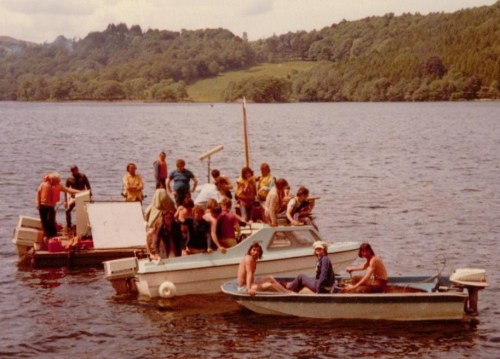
~The camera pontoon, Capri and one of the Dorys used behind-the-scenes~
Nick went on to say the pontoon leaked a bit. ‘We would have to pump out hull every morning.’ The Capri used behind the scenes was Nick’s equivalent of a marine Land Rover. ‘It had a reinforced glass fibre hull for increased capability and a 55-horse power engine that had been used for the Olympics. We used it for Ken Russell’s film ‘Tommy‘, the rock opera with Roger Daltry and The Who. Once, when we were using it for Swallows and Amazons, Clive Stuart shoved it into gear with rather too much gusto. Someone only just managed to grab the director, Claude Whatham, before he was flung over the back. ‘Claude was spitting feathers after that.’
~Suzanna Hamilton, Simon West, Sophie Neville & Sten Grendon with David Stanger at the helm of the Dory in 1973~
Mike Turk provided two Dorys, built at his yard, to use as run-around boats. One was driven by David Stanger who is now skipper of a launch on Ullswater. It was a stable boat but you needed to watch how it was not overloaded. Water came over the bows one day giving my mother rather a shock.
‘The boating world is a small world,’ Nick assured me. This July, forty-five years after making the film, he brought his grand-daughter to watch ‘Swallows and Amazons’ at the Alhambra Cinema in Keswick and gamely came up on stage for a Q&A to explain how some of the sailing scenes were achieved.
Mike Turk, Swan Upper and Queen’s Waterman, who provided boats for numerous films from Moonraker to Hornblower, sadly passed away aged 78. You can read his obituary here. He went on to work on a number of James Bond movie. You can see his film credits here.
A group of Arthur Ransome enthusiasts clubbed together to buy Swallow from Mike’s collection in 2010. She is currently kept on a trailer at Kendal in the Lake District. If you would like to sail her, please visit SailRansome.com
For Nicol End Marine, about two miles outside Keswick on Derwentwater please click here
You can see Swallow – and learn of her value – on BBC Antiques Roadshow, towards the end of the first episode recorded at Windermere Jetty museum in September 2020. It is on BBC iplayer here
You can read more about making the 1974 film Swallows and Amazonshere
One viewer has observed that, in the BBC serialisation of Coot Club and The Big Six, we had not one but two Doctors in the cast, Time Lords at that. This is true. We arrived on location one morning to find that Patrick Troughton had transmogrified into Harry Bangate the Eel Man.
Patrick Troughton playing The Eel Man in ‘The Big Six’, 1983
He had led the most fascinating life. A Naval Officer during World War II, and the first actor to play Robin Hood on television, Patrick Troughton played The Doctor in 128 episodes of Doctor Who. But would he be drawn? If we asked him about his life he just started talking about eels in a broad Norfolk accent. He’d worked for our director Andrew Morgan on Kings Royal and for Joe Waters on Z Cars, but for us, in the summer of 1983, he was the eel man.
Jake Coppard playing Pete at the eel man’s hut
Colin Baker first appeared in Doctor Who (a story entitled Arc of Infinity) in the role of Commander Maxil, when he actually shot the 5th Time Lord, who was being played by Peter Davison. It was not until after he arrived in Norfolk to play Arthur Ransome’s tweed-clad Dr Dudgeon, that he realised his full destiny and donned a multi-coloured dream coat to take on the 6th incarnation of The Doctor in the long-running BBC science fiction series. I went on to work as an Assistant Floor Manager on a two-part story called Vengeance on Varos when the Tardis had to make an emergency landing on a most unattractive planet. Once established at the North Acton rehearsal rooms I persuaded Colin to teach me all the correct jargon about transmogrifiers but it has since washed from my brain.
Colin Baker as Dr Dudgeon amusing us by smoking grass
I can’t remember whether Colin Baker was cast as Dr Dudgeon in Coot Club before or after Henry Dimbleby was given the part of his son Tom Dudgeon, but he did not look unlike Henry’s real father back then.
David Dimbelby with us on location in Norfolk, 1983
There were various other members of our film crew who were also familiar with the Tardis. (We were meant to refer to it as ‘T.A.R.D.I.S.’ short for ‘Time And Relative Dimension In Space’). John Woodvine ,who played PC Tedder, had preciously taken the role of the Marshall in ‘The Armageddon Factor’, opposite Tom Baker and Mary Tamm in 1979.
John Gill who we knew as Old Bob of the Comealong had the part of Oak in Fury from the Deep, made in Patrick Troughton’s time. Alan Lake played Herrick in four episodes entitled Underworld first broadcast in 1978. Andrew Burt played Valgard in Terminus during Peter Davison’s era and Tim Barlow, the distinctive looking actor who played the old man at the Roaring Donkey was Tyssan in Destiny of the Daleks. Sam Kelly, our Captain of the Catchalot appeared in the audio dramas of Doctor Who titled The Holy Terror and Return to the Web Planet.
Andrew Morgan directed both Time and the Rani and Remembrance of the Daleks. Tariq Anwar our film editor on Coot Club, worked on two stories while Andy Lazell, the visual effects designer responsible for creating so much fake fog on Breydon Water had worked on ‘The Leisure Hive’ and ‘Snakedance’, eight episodes of Doctor Who first broadcast in the early 1980s. I went on to work on Vengeance on Varos when Colin Baker played The Doctor. I’ve a feeling he learnt that he’s been cast in the role while he was on location with us in Norfolk. Andrew was thrilled for him and opened the champagne.
Colin March, our sound recordist worked on the film sound or ‘Planet of Evil’ in 1975 and ‘The Two Doctors’, with both Colin Baker and Patrick Troughton. It was broadcast in 1985. Liz Mace, had been the production manager on ‘Time-Flight’. Diana Brookes, our script supervisor – or production assistant as the job was then known – had worked with Colin Baker on the four-part Doctor Who story ‘Arc of Infinity’ in 1982/3. Perhaps it was she who thought of him for Dr Dudgeon. I have just learnt that she sadly died in New Zealand 2024.
Di Brookes in Beccles with Richard Walton who played Dick in ‘Coot Club’
The part of the tall and elegant Hullabaloo, Livy, was played by Sarah Crowden. Her father, the actor Graham Crowden who I always think of as Tom Ballard in his Sit-com Waiting For God, was offered the part of the fourth Doctor Who , after Jon Pertwee but he turned down the opportunity as it was such a commitment. Instead he played Soldeed in The Horns of Nimon in 1980 after Tom Baker had being playing the fourth Doctor for some time.
The person working on our series who had had a huge input on Doctor Who was Mervyn Haisman, our Script Editor. He’d written at least seventeen episodes including the series entitled The Dominators, writing under the name Norman Ashby. Mervyn never appeared on location but it was he who steered the adaptation of Arthur Ransome’s novels, breaking them down into four episodes each, whilst remaining faithful to the original stories.
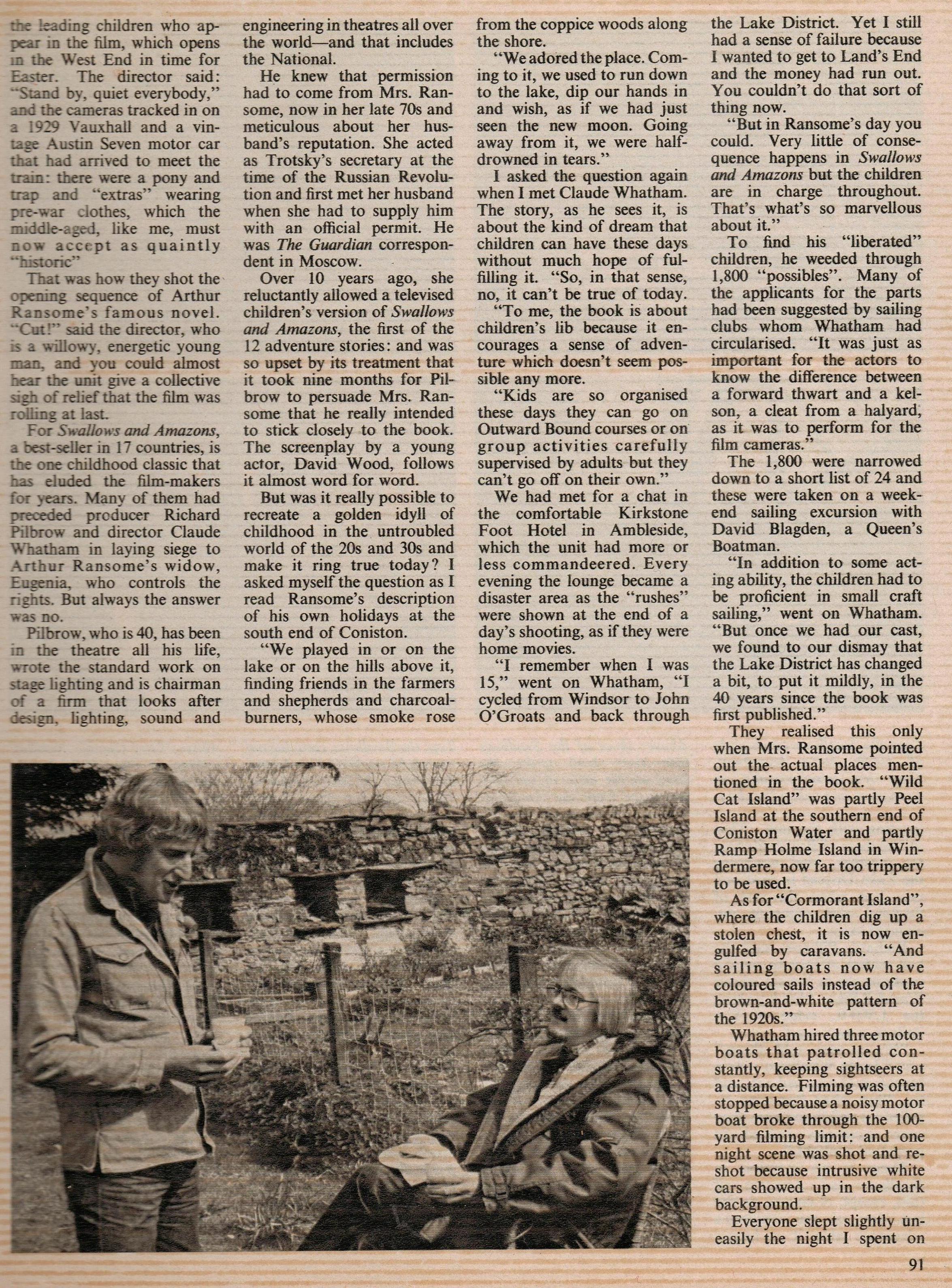
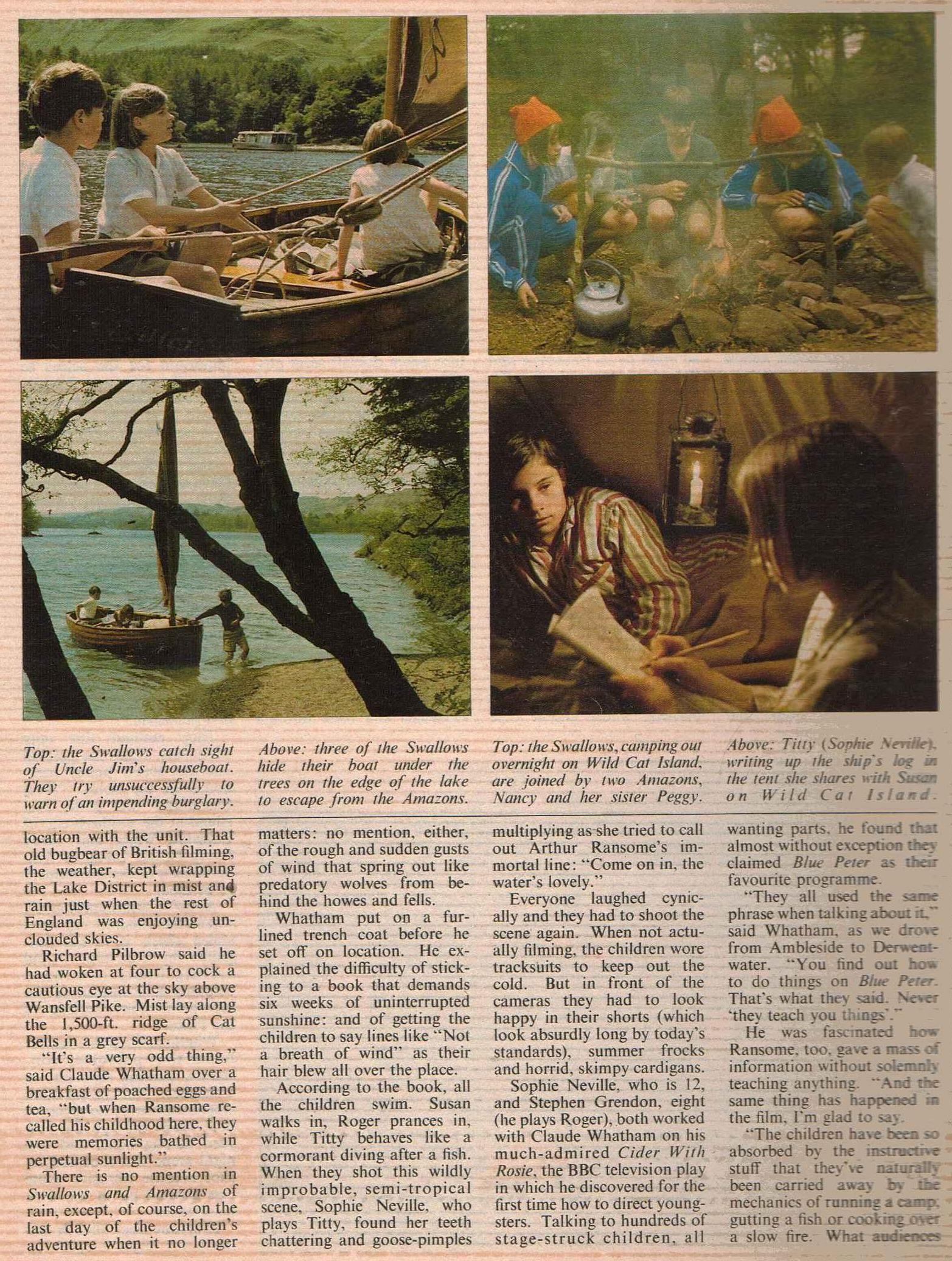
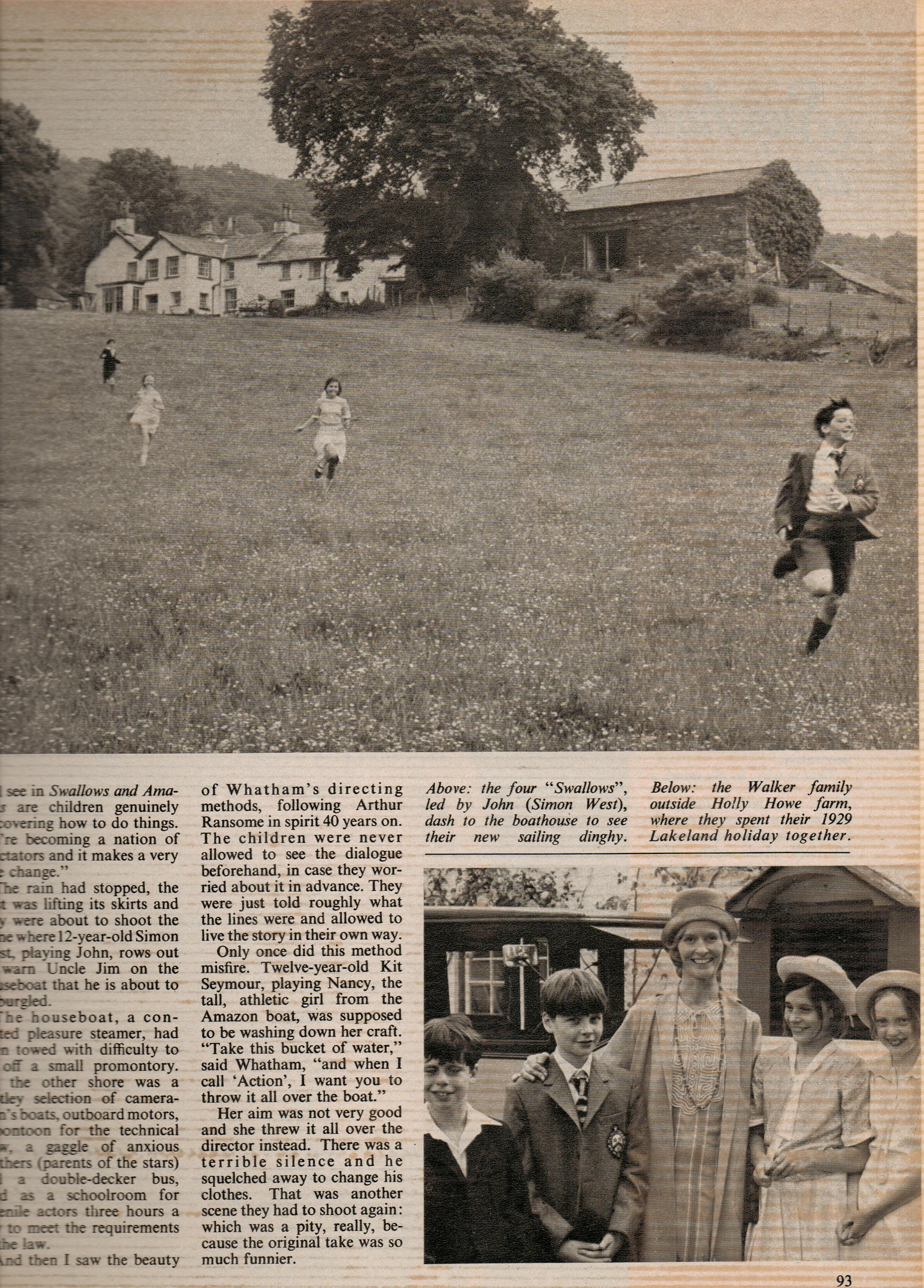
Kit Seymour, Stephen Grendon, Sophie Neville, Lesley Bennett, Virginia McKenna, Simon West Suzanna Hamilton and the station master of the Haverthwaite Steam Railway in Westmorland, appearing in the April edition of Homes and Garden 1974
Newspapers are read one day and on the kitchen floor the next. Back in 1974 they might have been used to wrap up fish and chips. Either way, an article in the ‘paper is soon forgotten. Not so a feature in a magazine. They tend to hang around in hotel foyers and doctor’s surgeries for waiting to have their pages turned for months, if not years. The judgement they cast on our movie was important.
Director Claude Whatham and Producer Richard Pilbrow on location in the summer of 1973 in the Lake District
To my surprise I found an article about how we spent the summer of 1973 in ‘Homes and Garden’ magazine.
Photographs featuring Simon West, Suzanna Hamilton, Sophie Neville, Stephen Grendon, Lesley Bennett and Kit Seymour in the EMI film of ‘Swallows and Amazons’.
What amazed me was that the black and white photographs taken on the film set had been colour tinted. Please forgive my scanning – the pages were stuck in albums long ago and the images blur at the edge.
Stephen Grendon, Simon West, Virginia McKenna, Suzanna Hamilton and Sophie Neville on location at Bank Ground Farm in Cumbria
Surely she was the journalist also known by her married name of Elspeth Huxley, the author who had written The Flame Trees of Thika and so many other books? She wasn’t quite right in saying the film was shot entirely on location in the Lake District, but still. She was not to know about our day at Runnymede.
Simon West, Sophie Neville and Suzanna Hamilton appearing in The Tatler
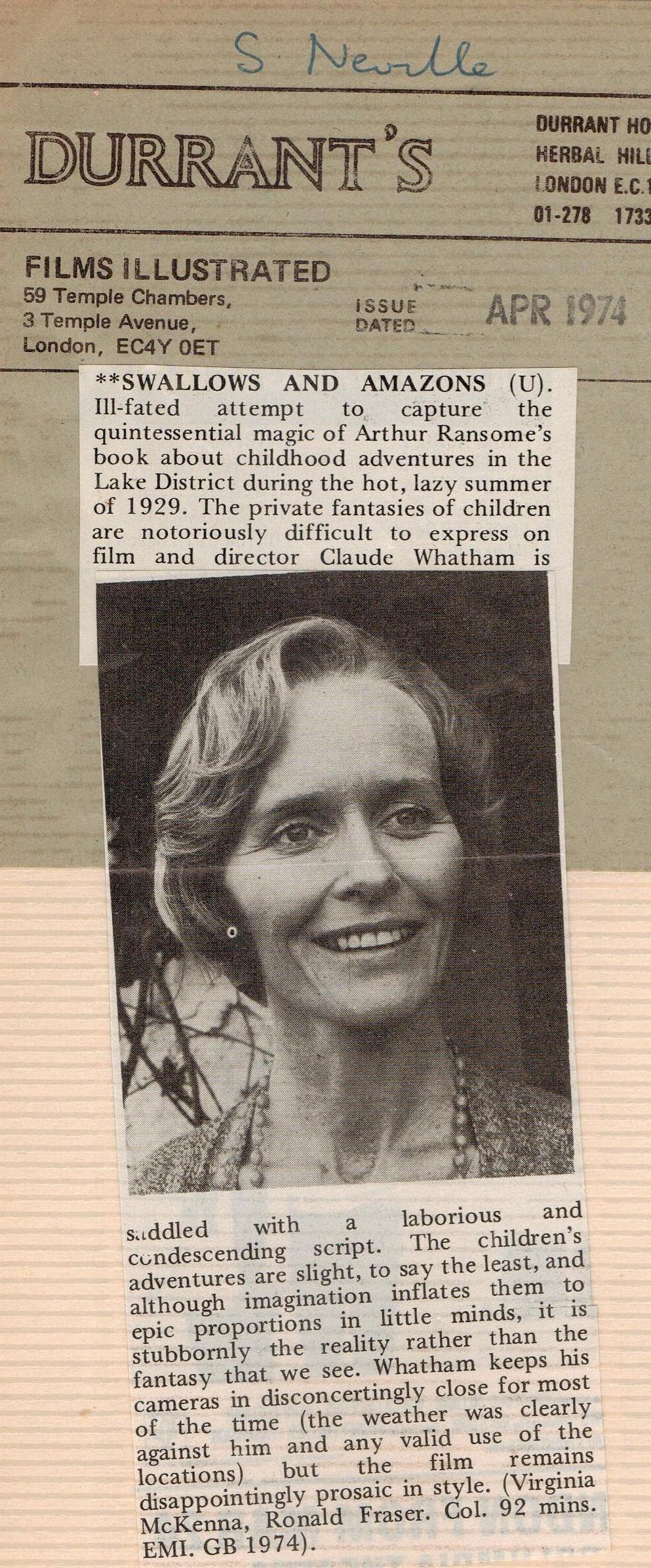
Virginia McKenna in an article in Films Illustrated, April 1974
We were in both Punch and The Sunday People. My mother saved them all, scratching lines alongside the paragraphs in which I was mentioned.
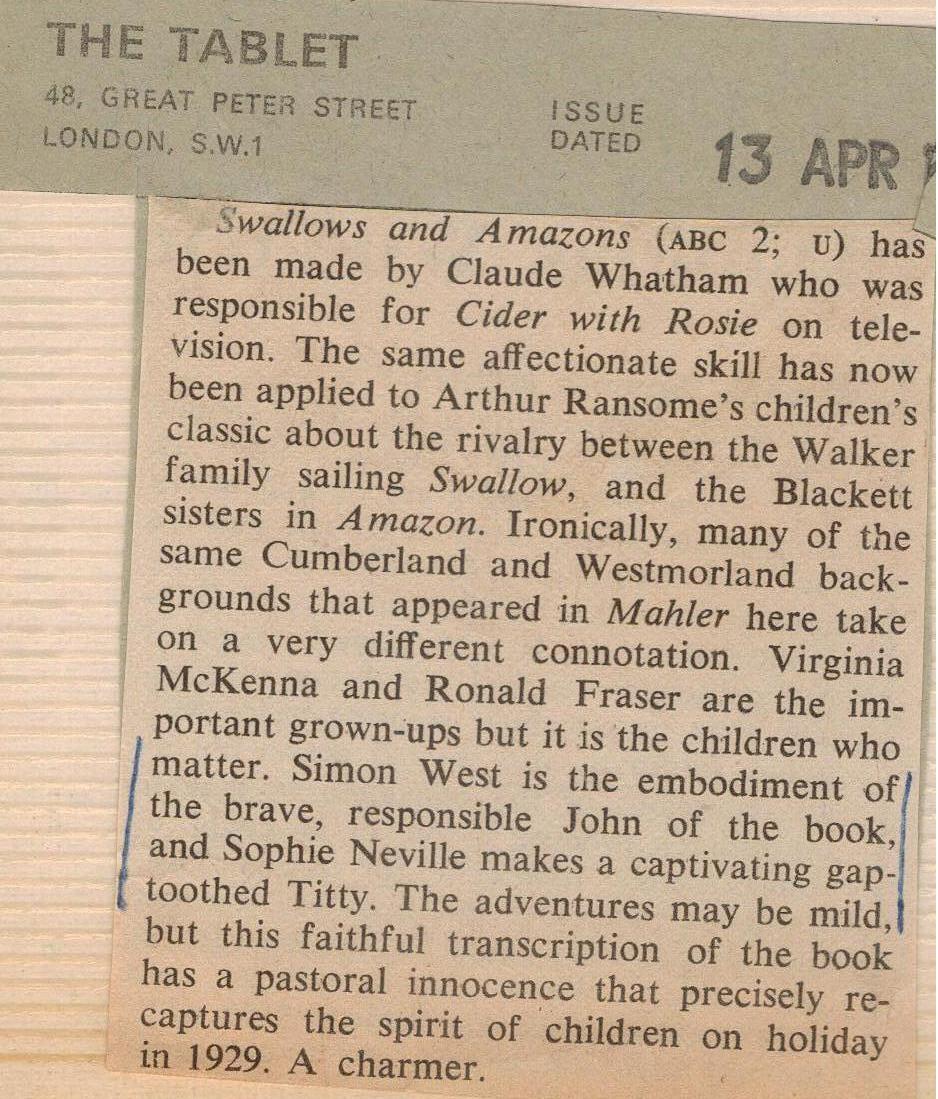
and The Tablet.
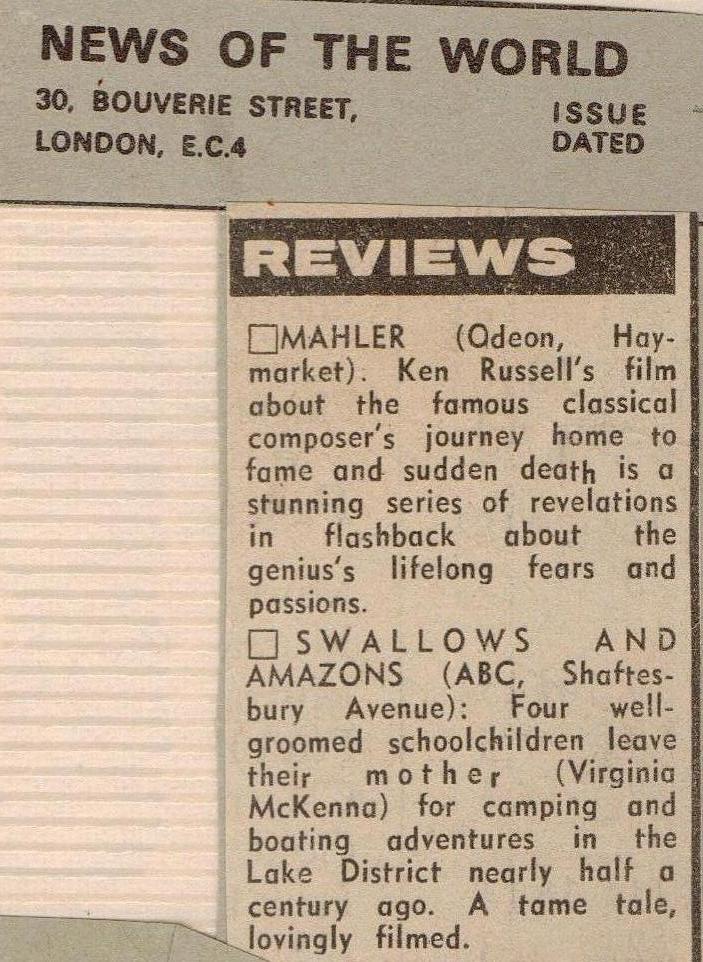
What’s On and the News of the World:
Kit Seymour and Lesley Bennett sailing Amazon on Derwentwater
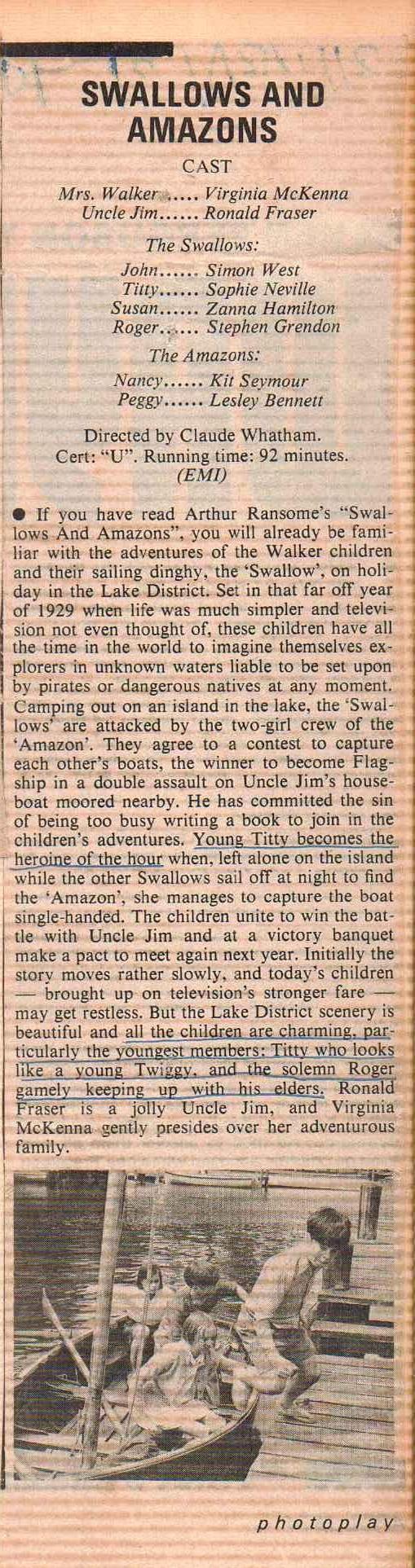
The April addition of the film fan magazine Photoplay, which featured Steve McQueen on the cover. It cost 20p in those days.
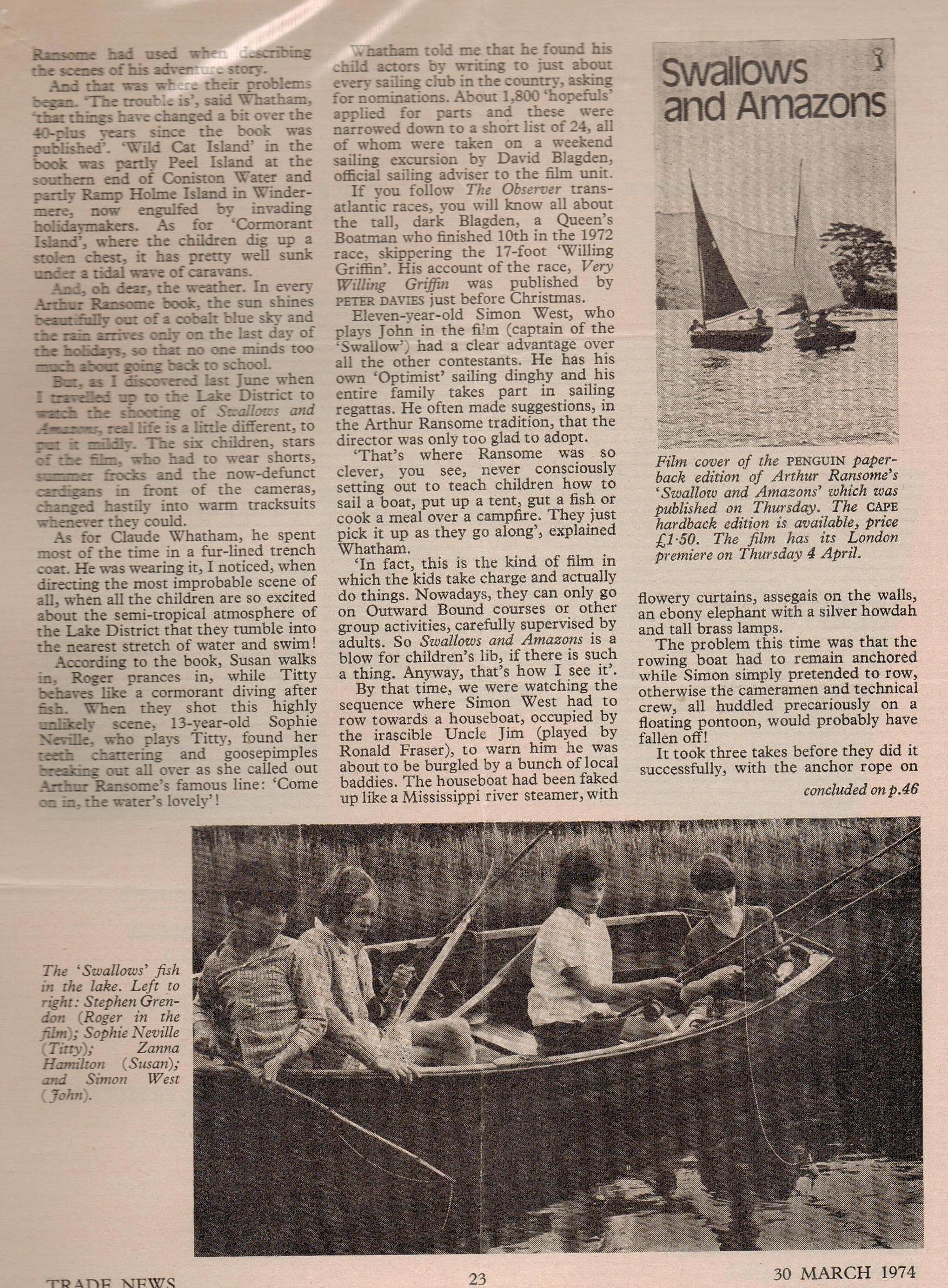
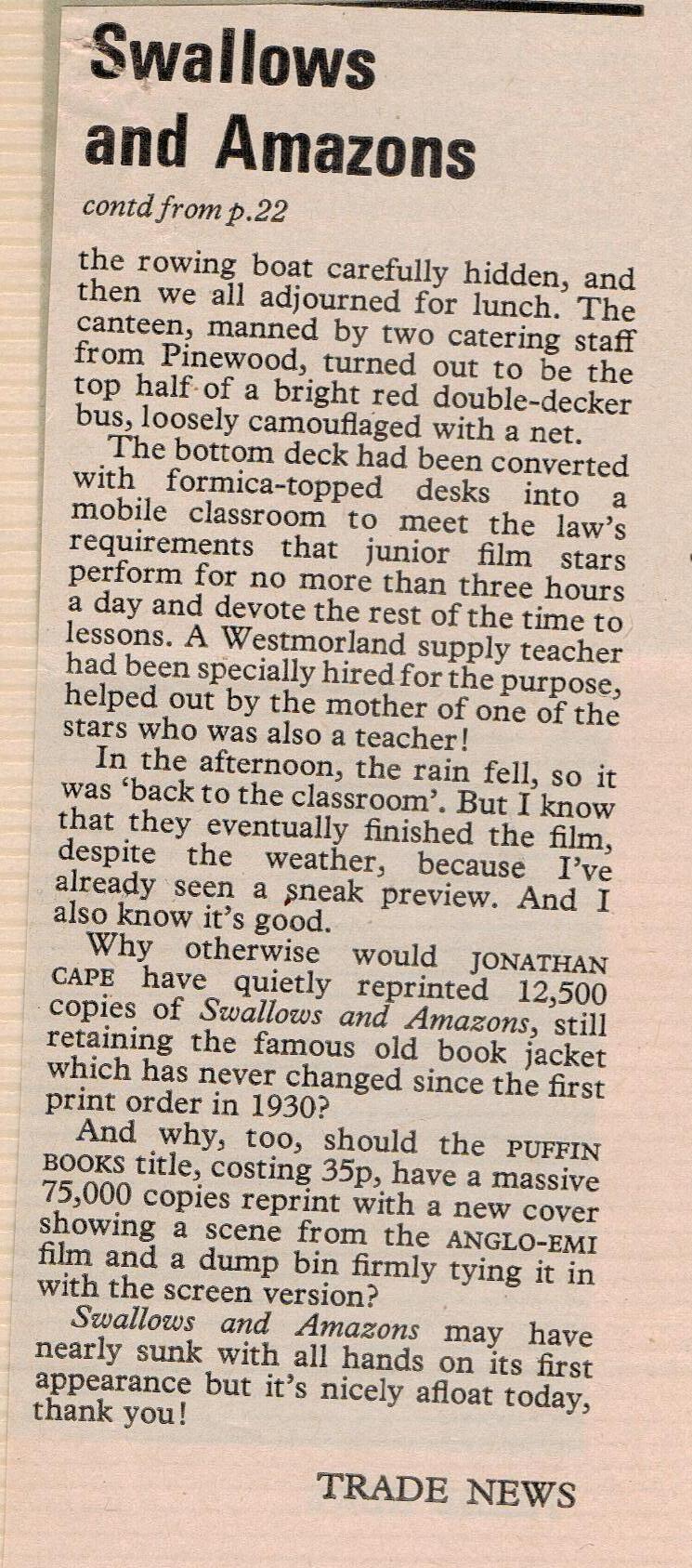
and a publishing magazine I hadn’t heard of called Smith’s Trade News ~
Virginia McKenna eating a banana with Claude Whatham outside the catering bus with quite a good photo of Swallow wired to the camera pontoon
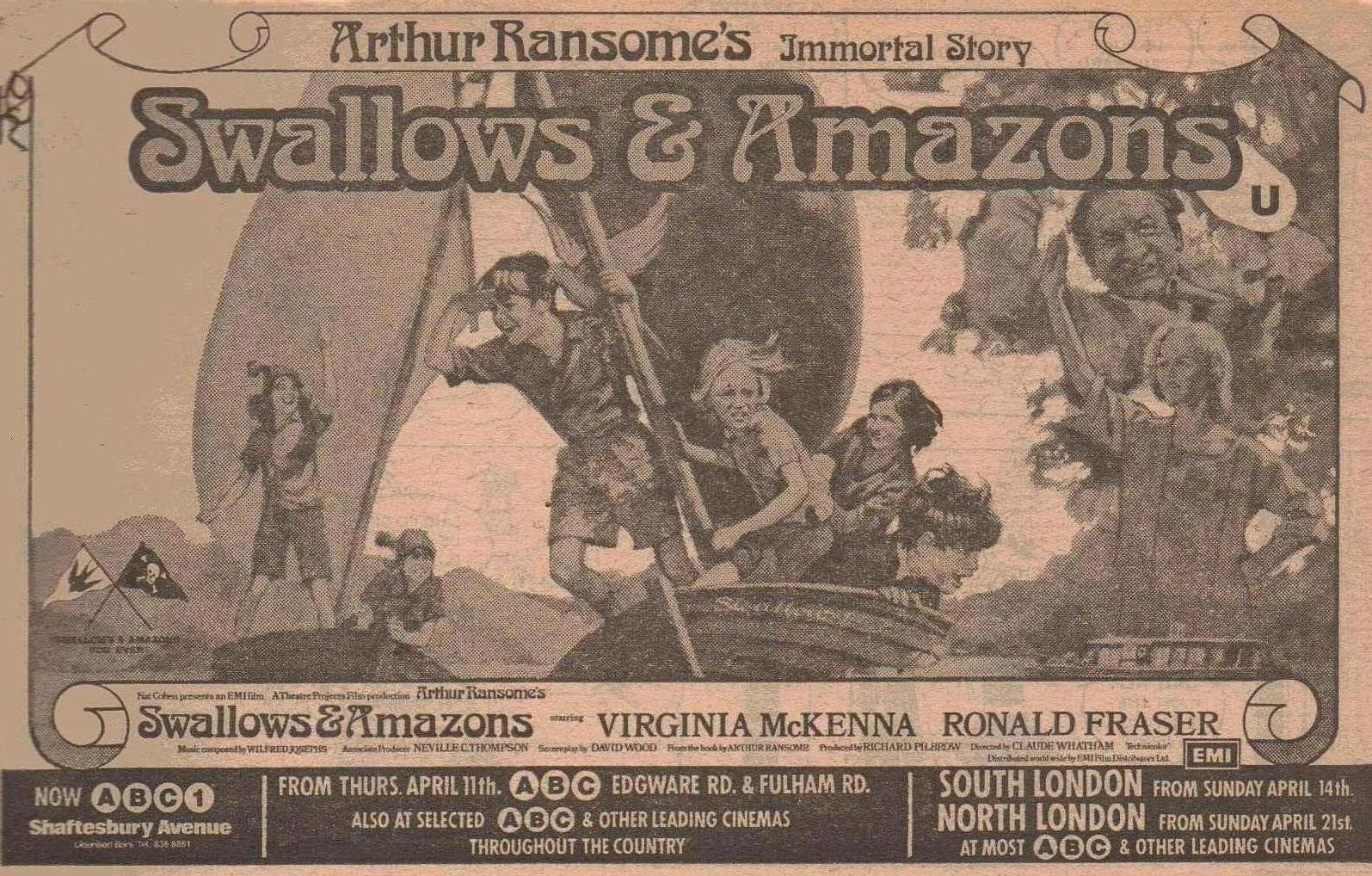
Kit Seymour, Lesley Bennett, Simon West, Sophie Neville, Stephen Grendon, Ronald Fraser and Virginia McKenna on the newspaper advertisement for ‘Swallows and Amazons’ released in April 1974
A school friend of mine sent me this advertisement. She had found it in a teenage magazine we all read at the time called Tammy and Sandy. There was a similar one in The Sunday Times newspaper – and no doubt many others. Film posters hung in the London Underground and at cinemas throughout the country. Swallows and Amazons was to come out, on general release for the Easter Holidays.
My mother subscribed to a press clippings agency called Durrant’s ~ Durrant’s of Herbal Hill London ECI ~ who, for a fee of £50, sent her all the articles written about the film. The Prince of Wales told a friend of mine that he never reads the newspapers. I know why. Reading about yourself is upsetting – or can be, especially if the facts are incorrect. My mother didn’t mind. She highlighted the bits about me, filling four albums.
After entertainingthe Daily Express so nicely in the Lake District this is what they printed about the film. I would think this is written by Ian Christie (1927-2010) the jazz clarinetist, who had formed the Christie Brothers Stompers with his brother Keith, and became a member of Humphrey Lyttelton’s band. He worked as a theater and film critic for the Daily Express for twenty-six years. Born in Blackpool and a habitue of Fleet Street pubs he held fiercely Left-wing views.
‘Kids won’t swallow this watery old tale’ was not good publicity. The same black and white photograph of me appeared on the front cover of The Daily Telegraph with the title ‘One Swallow won’t make a Summer’. Were they right? The Scotsmansaid:
The Scotsman ~ 1st July 1974
However, Russell Davies of The Observer, another jazz musician who now presents Brain of Britain on BBC Radio 4, saw that the film of Swallows and Amazons had niche. (If you click on the article it will enlarge).
Jack Woolgar, Simon West, Suzanna Hamilton, Sophie Neville and Stephen Grendon in a review by Russell Davies in The Observer 7th April 1974
Others recognised it as an innocent nostalgia trip ~
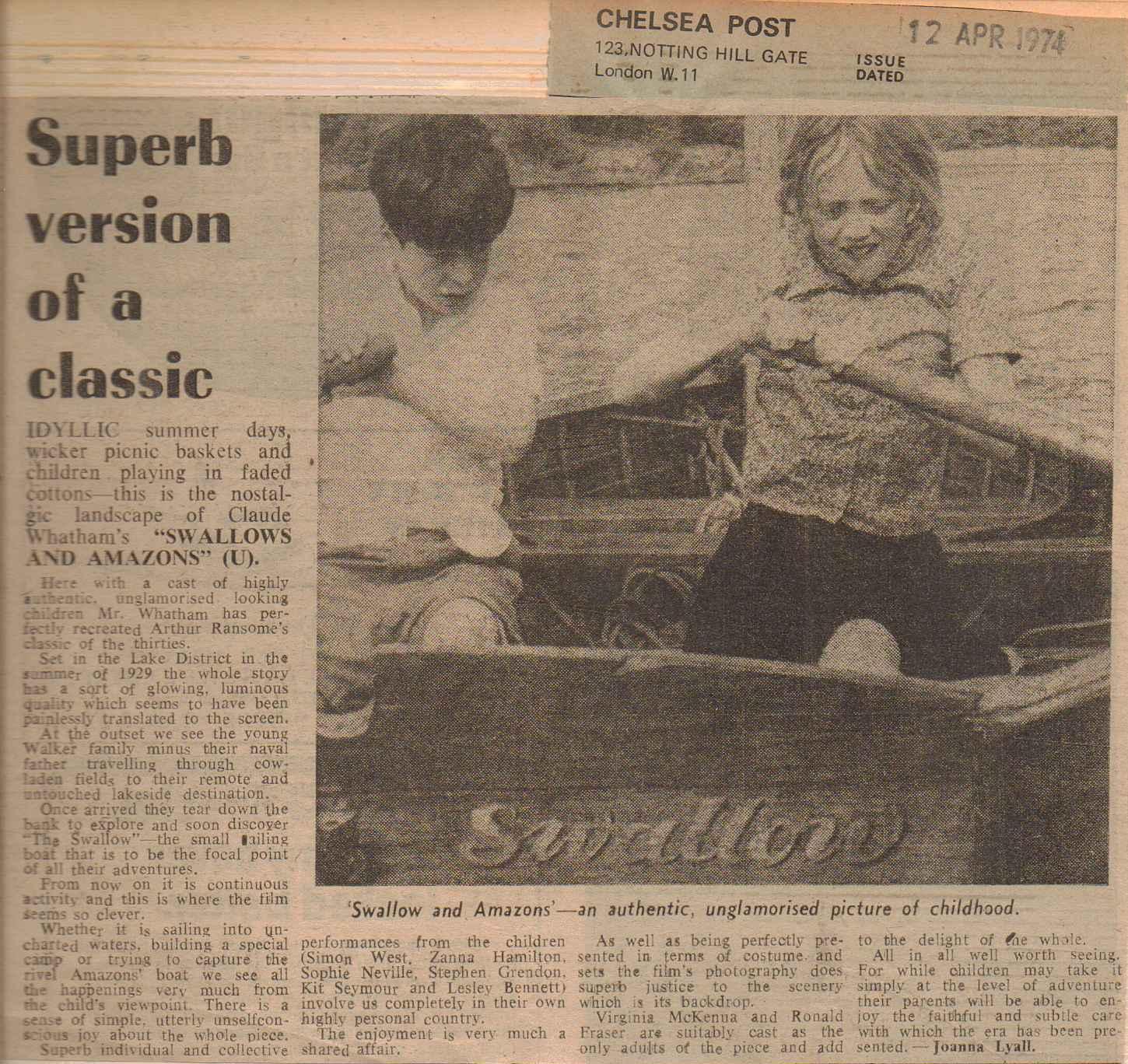
Others just loved it:
Stephen Grendon and Sophie Neville appearing in Chelsea Post 12th April 1974
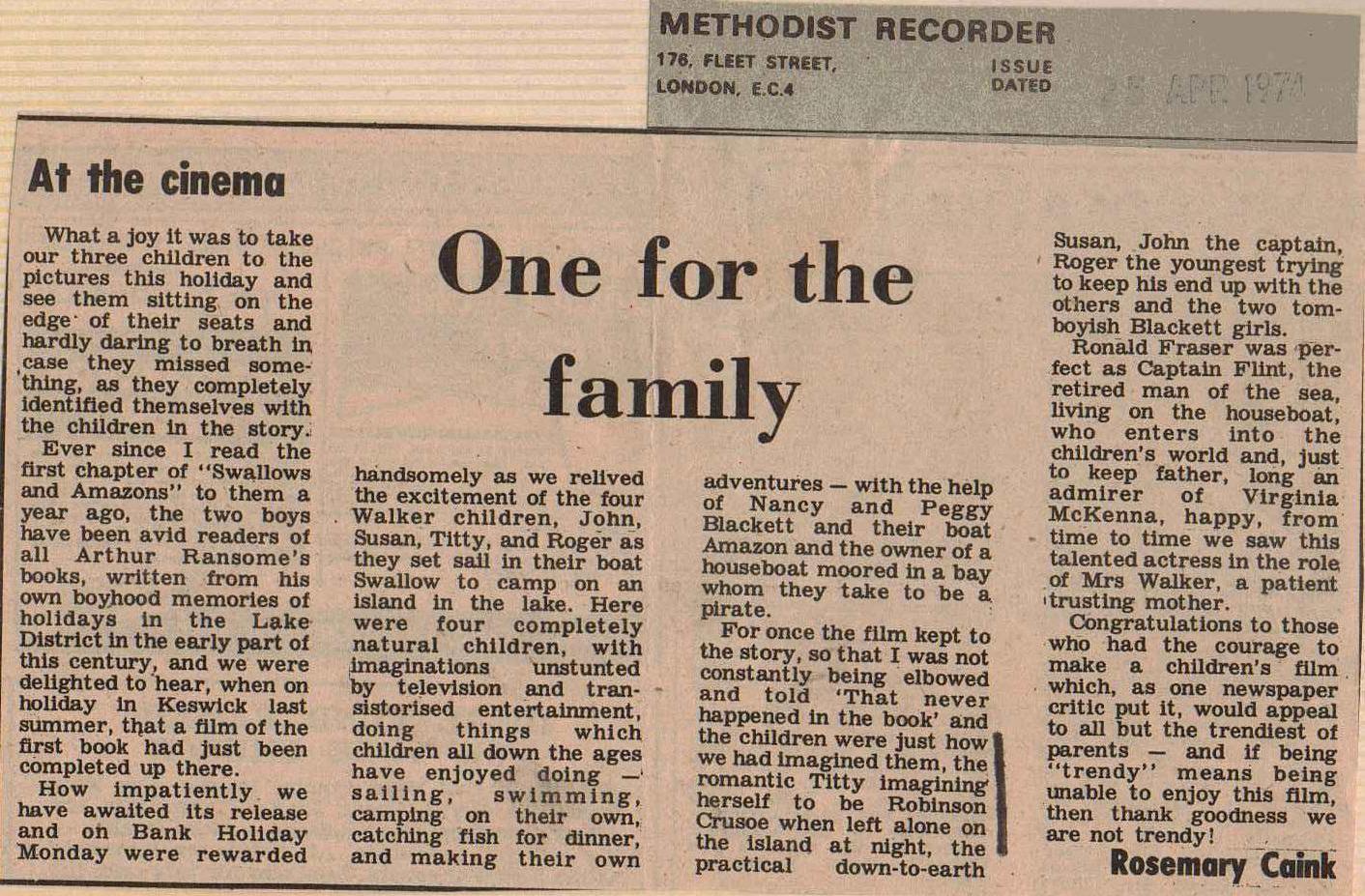
Rosemary Caink said that her three children, ‘completely identified themselves with the children in the story.’
My favorite article wasn’t found by Durrant’s. It was written in The Brownie and must have been sent to me by a fan.
Suzanna Hamilton, Stephen Grendon, Sophie Neville and Simon West, appearing in an article published in ‘The Brownie’ ~ 27th March 1974 Please click on the article to find out more about the Brownies.
I have many more articles ~ please let me know in the Comment box if you would like to see more. Otherwise I will move on to write about how the public responded and what happened next.
The process of editing a film can be terrifying for a director. There is always the prospect of finding a sequence that will not cut together. But working with a good film editor is hugely creative and fulfilling. Problems do arise but great things can happen. Richard Pilbrow says in his new book, A Theatre Project that he was completely captivated by the process. ‘Moving a few frames from here to there, could change the whole emphasis of a scene.’ On the whole editing is an exciting, yet more relaxing time for the director than having to lead a massive crew out on location. And the actors are never around.
Sadly I never met Michael Bradsell who edited Swallows and Amazons. Like many others on our film crew he’d worked with Claude Whatham before on the movieThat’ll be the Day. He went to on edit many great movies; Local Hero for Bill Forsyth and David Puttman, Henry V for Kenneth Branagh and Wilde, which starred Stephen Fry. Oh, to think that he hauled my image over his Steenbeck.
I remember that when I saw Henry V at the Curzon Cinema in Mayfair, in 1989, there was something terribly wrong with the projection. The lip-sync was out. Kenneth Branagh’s voice was delivered after his lips started moving. It was most off-putting. I knew all about lip-sync because I had been involved in dubbing movies since I was twelve. For, it was back in 1973, when Claude Whatham was working on the sound track for Swallows and Amazons that, rather unusually, I was summons to the EMI Elstreee Studios.
Sophie Neville at the EMI Elstree Studios on Friday 20th July 1973
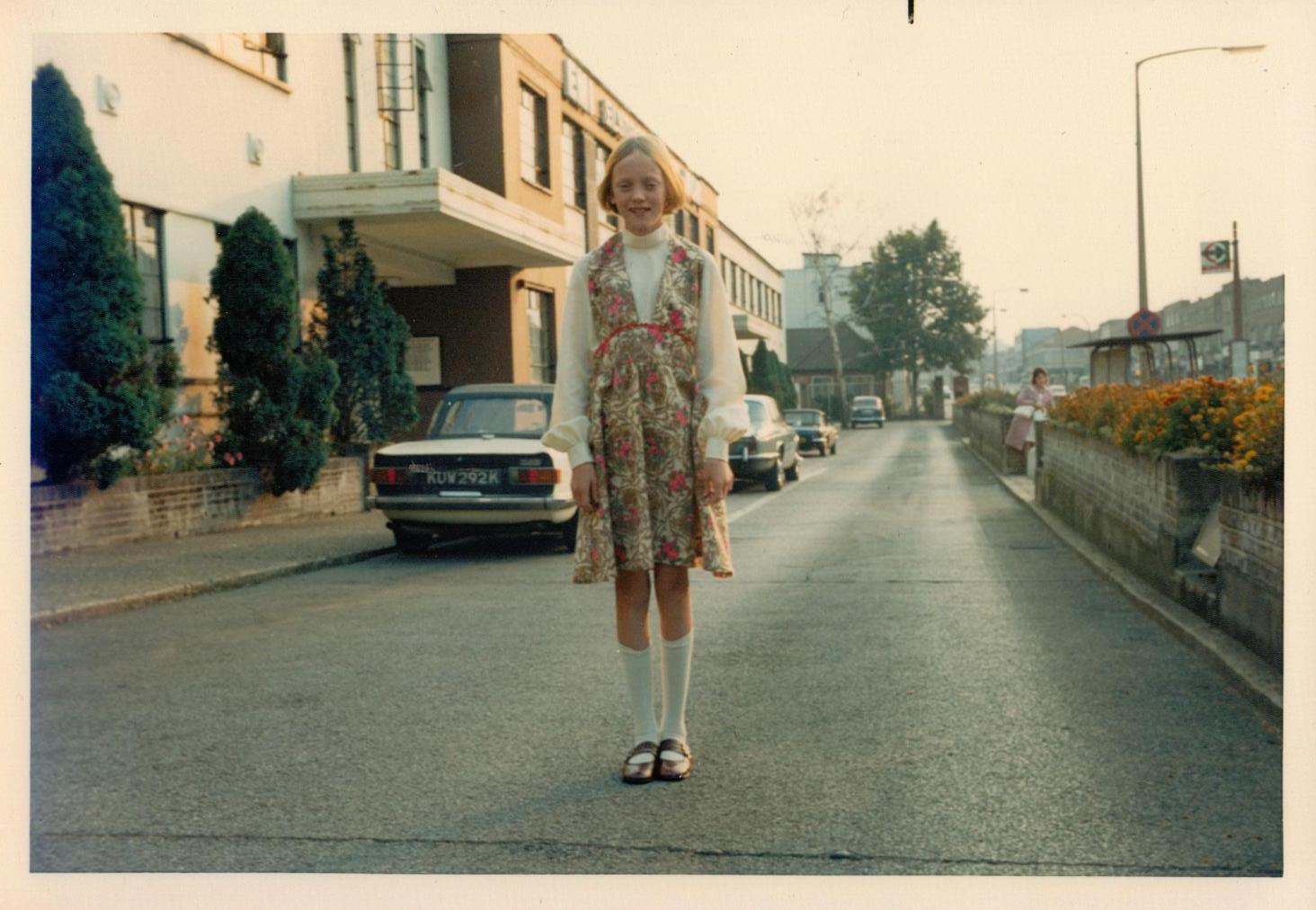
Visiting Elstree Studios was exciting. I remember meeting the Dubbing Mixer and being there with the other Swallows, but I don’t think we saw anyone else in the cast. Suzanna came along with her nine-year-old cousin who was called Seymour – a very bright boy who was wearing stripey canvas trousers like a deck chair. Mummy had bought me a smart new dress that was the height of fashion. Looking at the photograph I rather wish she hadn’t bothered.
We were led into a huge dubbing theater hung with long black drapes around a high white screen. Claude explained that he needed to re-record our dialogue for various sequences. This was because the original soundtrack had been spoilt by the sound of motorboats, car horns or simply the wind. At first we were handed dubbing scripts, but it was difficult to look at them as well as the screen. As we could still remember our lines we didn’t need them. Instead, we stood in front of microphones on spindly stands and sung out the words we knew as sections of the film were projected. To help up a thick black cue-line would pass across the scene. When it hit one side it was time to start speaking. This was to ensure that our voices would be in sync with out lips. It could help, it could be off-putting. In the end we just went for it naturally. After each ‘take’ the film would be re-wound and we would go-again. There is a scene in at the Amazon Boathouse when John scrunches up the Amazon’s message and throws it in the water. It amused us to see this in reverse.
The post-syncing was a chance to improve on our performances and diction. Some time was spent in re-recording our sea shanty, Adieu and Farewell to you Fair Spanish Ladies. I made a mistake here that I have always regretted. Instead of singing sweetly and true I went for volume, which was not only unnecessary, but disastrous. It is acceptable on the film when you can see I am singing out on the water but sounds horrid on the LP. We had no idea at the time that EMI were going to bring out an album to accompany the movie, but they did.
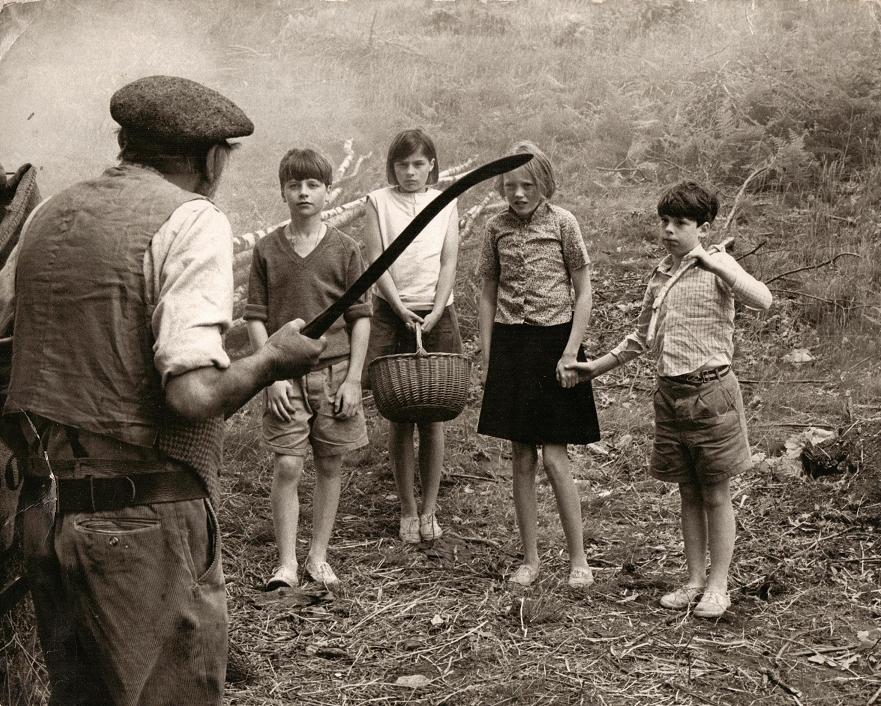
Jack Woolgar as Old Billy confronting Simon West, Suzanna Hamilton, Sophie Neville and Stephen Grendon as the Swallows who were visiting the charcoal burners.
The one line that I simply could not replicate was the dialogue Titty delivered when saying goodbye to the charcoal burners: ‘Thank you so much for letting us see your lovely serpent.’ We went over it again and again, but Jack Woolgar wasn’t at the dubbing studio and I couldn’t do it without looking at him. The charm and sincerity of the moment was not something I could reproduce. In the end Claude said he just had to use the original despite the sound of the roaring wind.
I remember being at Elstree for a week. Mum has 20th July, 2nd and 3rd August (although that looks crossed out,) then EMI 6th and 7th August, marked in her diary. At lunch time we were shown around the back lot, where Sten refused to leave the wreckage of a WWII plane and the film stages. David Niven was playing Count Dracula in Vimpira, literally kissing the lovely actress Teresa Graves in the coffin as we watched from the edge of the set.
After we had left Elstree, sound effects would have been added. Richard Pilbrow said that, ‘Bill Rowe was our masterful sound mixer, working magic with birdsong, a rustle of leaves, a broken twig – all the tiniest details that went into making the story spring to life.’ When I watch the film of Swallows and Amazons now I so admire the technique of using sound to illustrate the soaring of Titty’s imagination. The storm bell on Robinson Crusoe’s ship heralds the roaring wind and lends reality to scene when I play the shipwrecked sailor, dragging my parched body towards the island campsite. You can hear parrots and monkeys in the palm trees. I am sure Arthur Ransome would have approved.
Bill Rowe, I read, was the director of Post Production and Sound at Elstree Studios until he died at the age of sixty in 1992. He’d worked on an amazing number of movies winning an Oscar for The Last Emperor and BAFTAs for The Killing Fields, The French Lieutenant’s Woman and Alien with nominations for Chariots of Fire, A Clockwork Orange, The Mission and Batman. And to think, we had been playing Hide and Seek behind his sound drapes.
Simon West and Suzanna Hamilton at the helm of Swallow with Stephen Grendon in the bows, while Sophie Neville looks on from the shore of Peel Island, where she has been left alone with the telescope. Sound of Swallow’s moving parts was added later by the dubbing editor Bill Rowe at Elstree Studios.
One thing that really worried me was that I saw Swallow lying outside Elstree Studios. She looked forlorn, a ship out of water. Looking back on it they must have needed her to record sound effects. I was concerned that we would not see her again, but we did. The next time we Swallows gathered was to publicize the film. We found ourselves climbing aboard Swallows again, albeit in a very different location from the Lake District. And this I will write about in my next post.
Not at 10 Downing Street but on the Lot at Elstree Studios for the BBC Drama Directors’ studio course. I am wearing green.
Later in life, when I worked in television production, I spent many months at Elstree Studios at Borehamwood. However these were the BBC Studios on the other side of the road where we recorded endless episodes of Eastenders and the wartime romance Bluebell, programmes that were never post-synced.
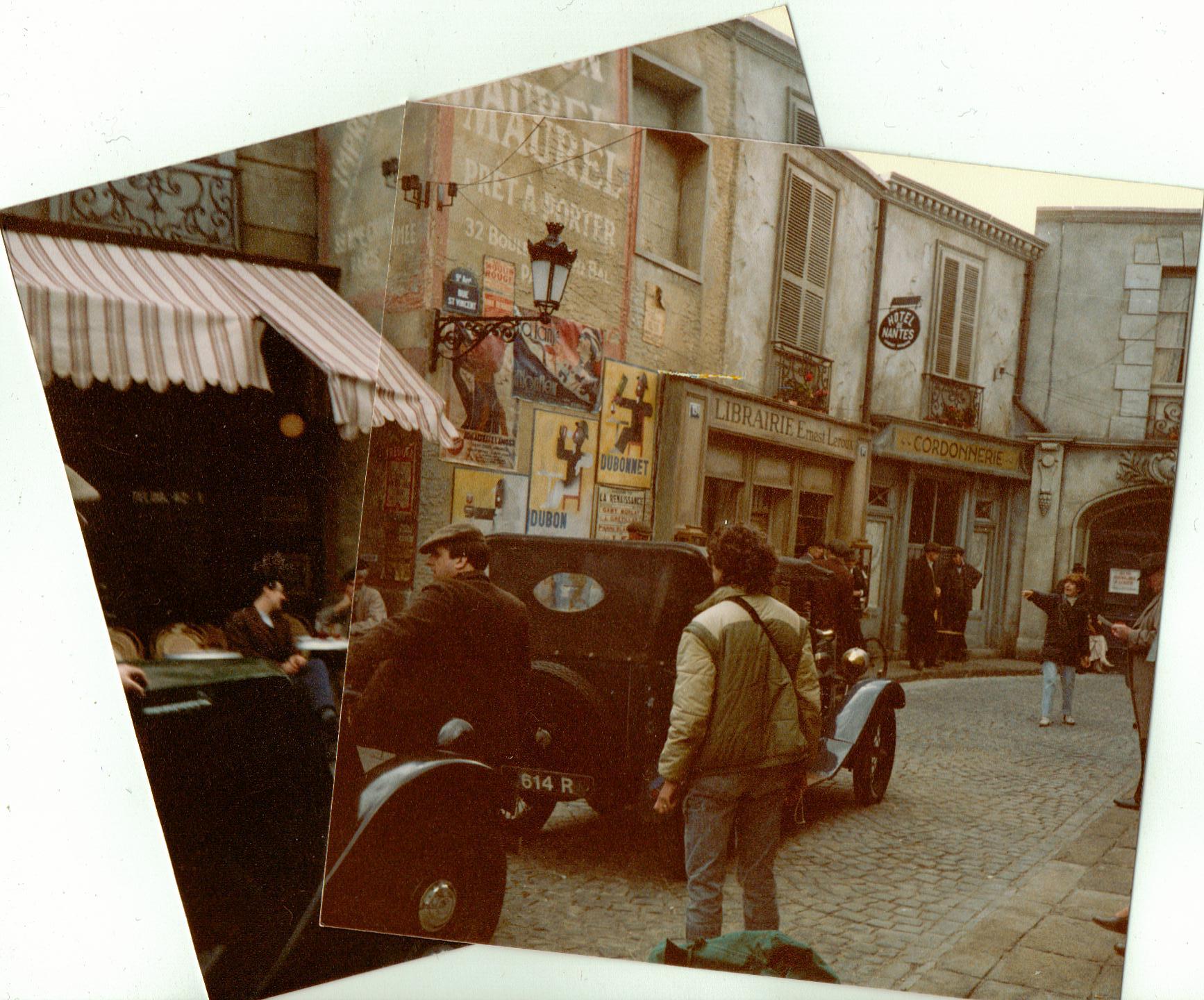
Working on the Parisian set of ‘Bluebell’ constructed on the lot at Elstree.
I’d drive past the old EMI/ATV Studios and never breathe a word that I’d worked there once as an actress.
Sophie Neville, in striped top, on the BBC Studio Director’s Course at the BBC Elstree Studios, Borehamwood in 1990
Sophie’s books about working in film and television are available online.
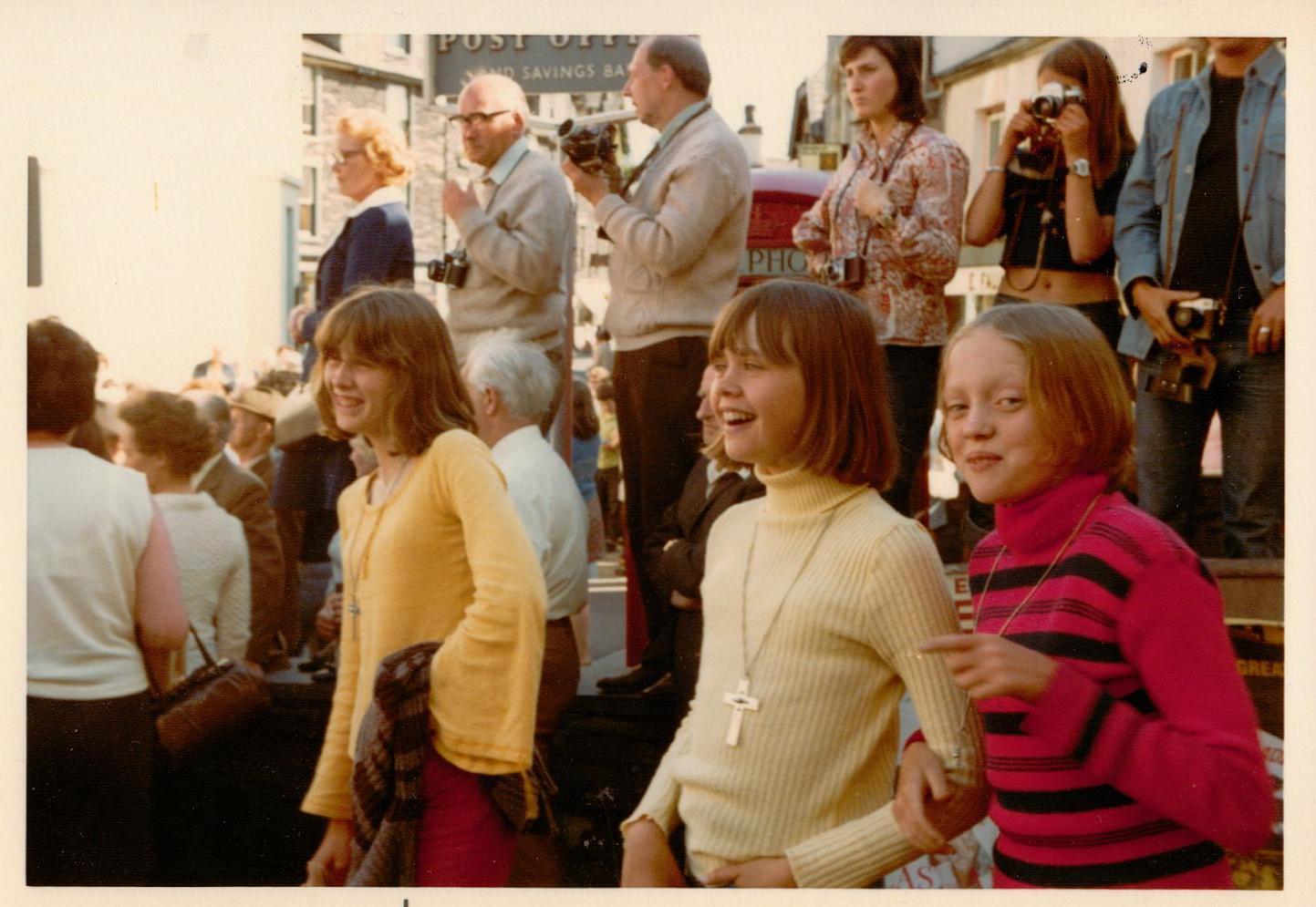
Kit Seymour, Lesley Bennett and Sophie Neville at the Ambleside Rushbearing Festival on 7th July 1973 ~ photo: Daphne Neville
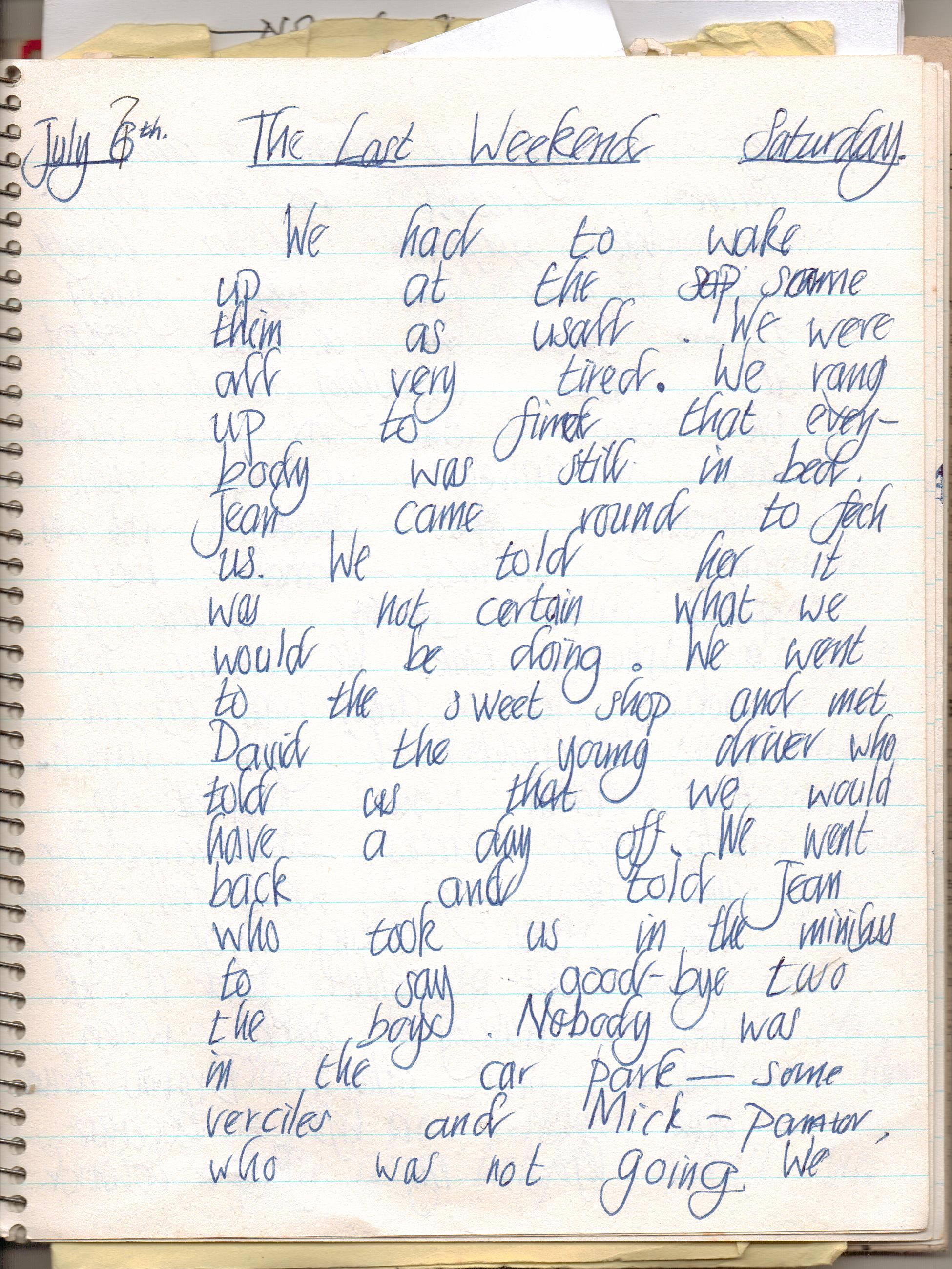
The filming of Swallows and Amazons was coming to a close but what with all the buckets of water being flung about the day before, Mummy had lost Lesley’s ring. It was a gold ring. Since it would not have been appropriate for an Amazon Pirate of 1929, Lesley couldn’t wear it with her costume. Mum slid it onto her little finger to keep it safe for her. It slid off. We looked and looked, but couldn’t find it anywhere.
And what with all the nocturnal pushings-in, Graham Ford our production manager, had broken his ankle. Although we were up and about on the morning of 7th July, it became clear that the entire film crew were comatose after the wrap party held at the Langdale Chase Hotel. There was certainly no sign of the director. Since it was also raining, an unexpected day off from filming was called.
Instead of heading for Derwentwater we went exploring the Lake District – in different ways. I made a discovery about Rio, or at least the origin of its name.
It seemed normal to have lunch at the Waterhead Hotel. It would be a great treat now. We split up into two groups for the afternoon, which is how I came to explore Rio with the Amazon pirates.
It was very kind of Gareth and Jean to give us presents. I wonder what happened to the pendant with the cross? It would be the height of fashion now. I remember Jean explaining that she wanted to give us a little bit of the Lake District to take home. This came in the form of a bedside lamp made out of a chunk of slate. Mine soon had a pink shade on top. I used it for years.
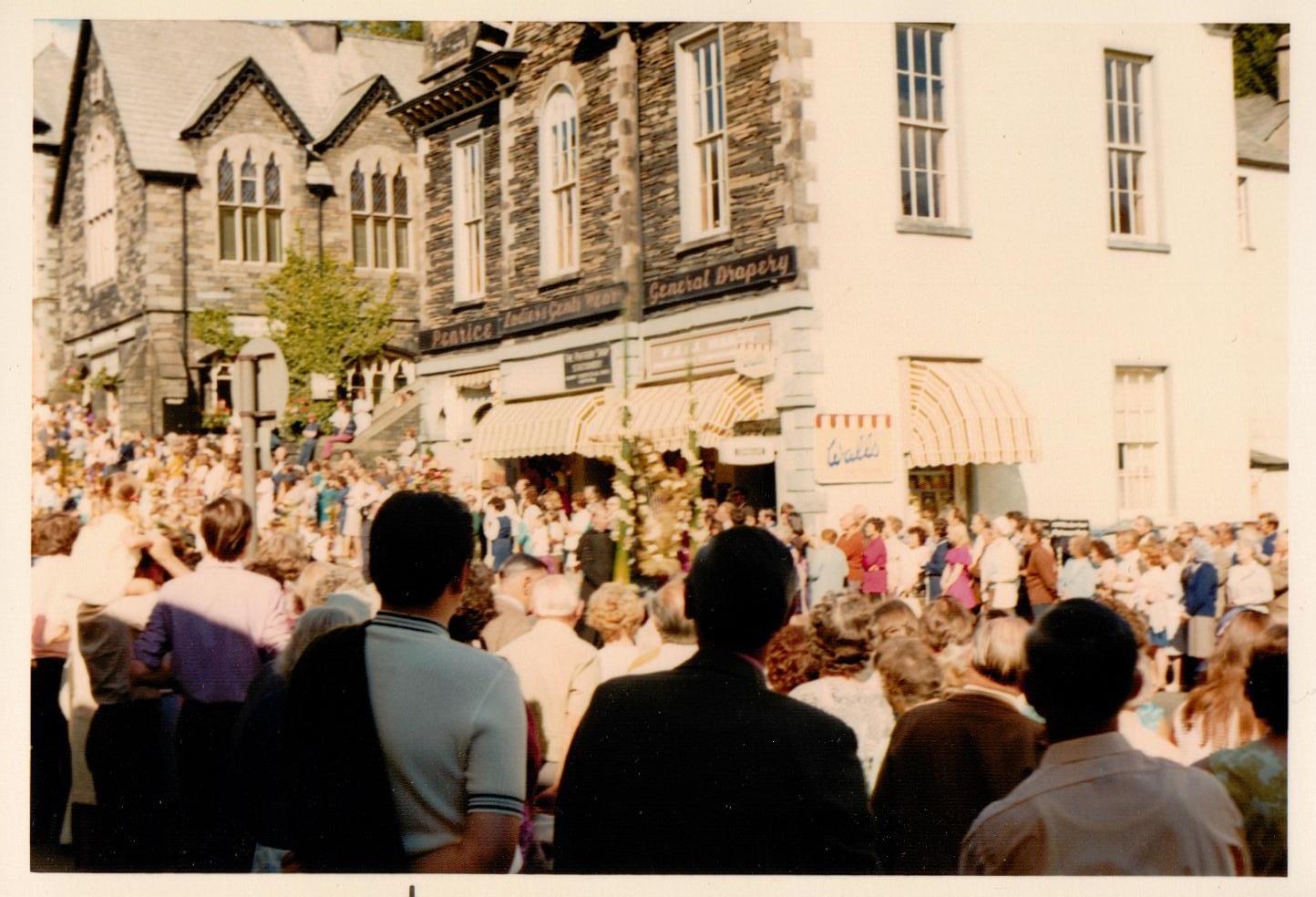
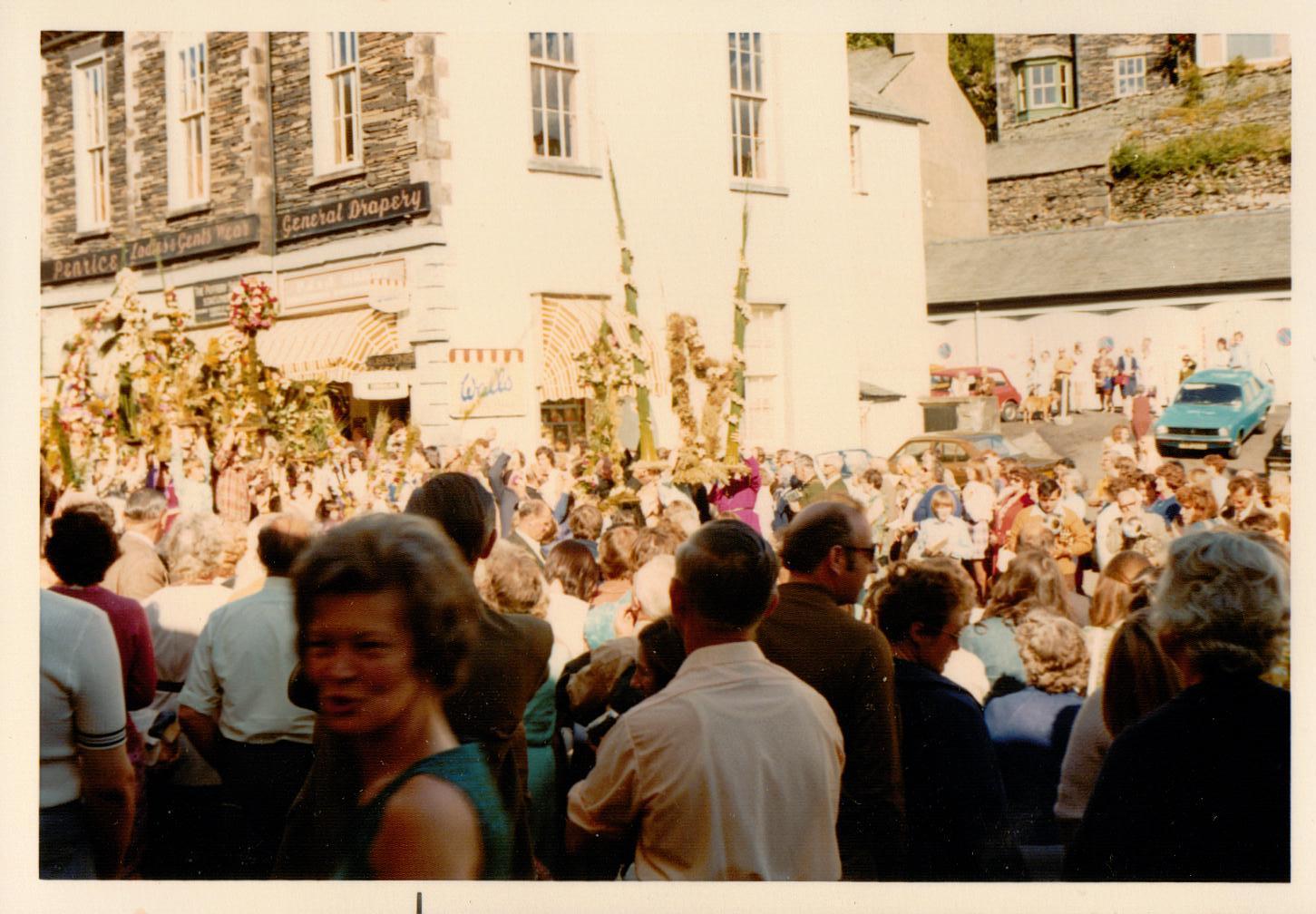
The Ambelside Rushbearing Parade in 1973 ~ photo: Daphne Neville
The Ambleside Rushbearing Parade was amazing. I can see exactly why Arthur Ransome thought of Rio as the town on Titty’s chart. The festival was like a colourful Rio carnival. Crowds came out to watch as the procession came down the hill. If you click on the snapshot Mum took above, you will find photographs of what it must have looked like when Ransome was a boy and everyone was out in their best hats as they walked down to St Mary’s Church, accompanied by a brass band.
Again, if you click on the shot above, you will find details of what happens today. The wonderful photographs on the Visit Cumbria site show rushbearing ceremonies are held on saint’s days at different churches in Cumbria throughout the summer.
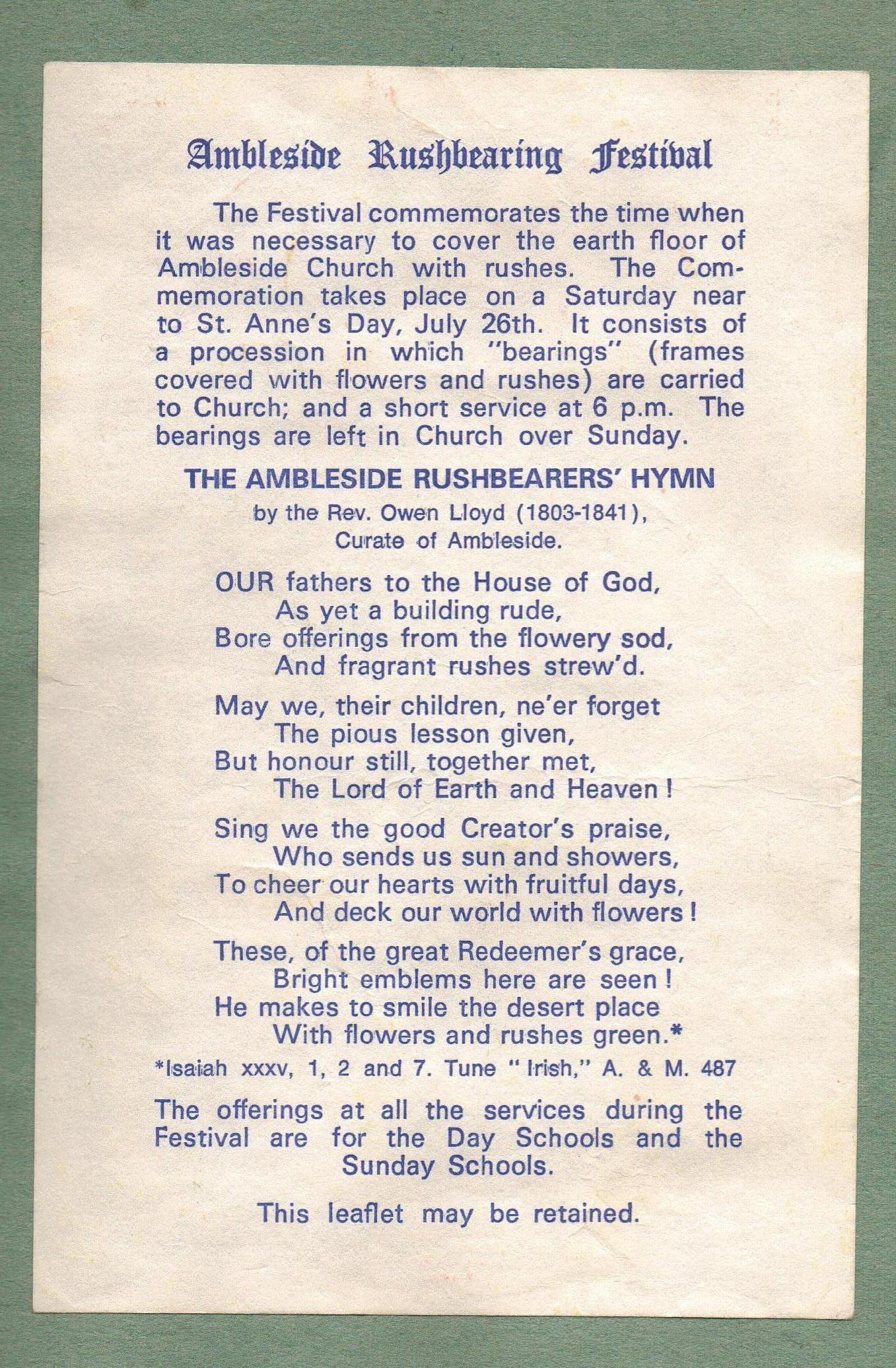
Traditionally, the children of Ambleside are given a piece of homemade gingerbread if they have carried one of the rushes. We hadn’t done this but we did join in with the hymn and the kind neighbours living next door to the Oakland Guesthouse gave us some gingerbread for tea.
This leaflet was indeed ‘retained’, pasted into my scrapbook
We met the Price family at the festival. The two girls where both carrying dressed reeds. You may recognise Mr Price. He appeared in Swallows and Amazons as the Native who came up to Roger at the jetty in Rio and said, ‘That’s a nice little boat you have there.’ Roger said, ‘Yes.’
Mr Price who played the part of the Native in Rio with his family in Ambleside. They ran Oakland’s Guesthouse where we stayed for 9 weeks ~ photo: Daphne Neville
Mrs Price must have worked so hard. She had three children ~ a little boy as well as the girls ~ and a number of students from the Charlotte Mason College of Education staying at “Oaklands” guesthouse while cooking our breakfast and high tea. The telephone in the hall must have rung the whole time. Her number was Ambleside 2170.
I expect the demands of the filming, what with drivers coming and going, was a little more that she had originally imagined. No one knew what would be happening next. Although most of the crew were leaving ~ going ‘away from Rio’ ~ we knew we had to be back on location the next day.
Here is a snippet of footage Mum took of the festival. Blink and you’ll miss me ~
Director Claude Whatham and Bobby Sitwell with Suzanna Hamilton playing Susan Walker and Ronald Fraser as Jim Turner aka Captain Flint in 1973
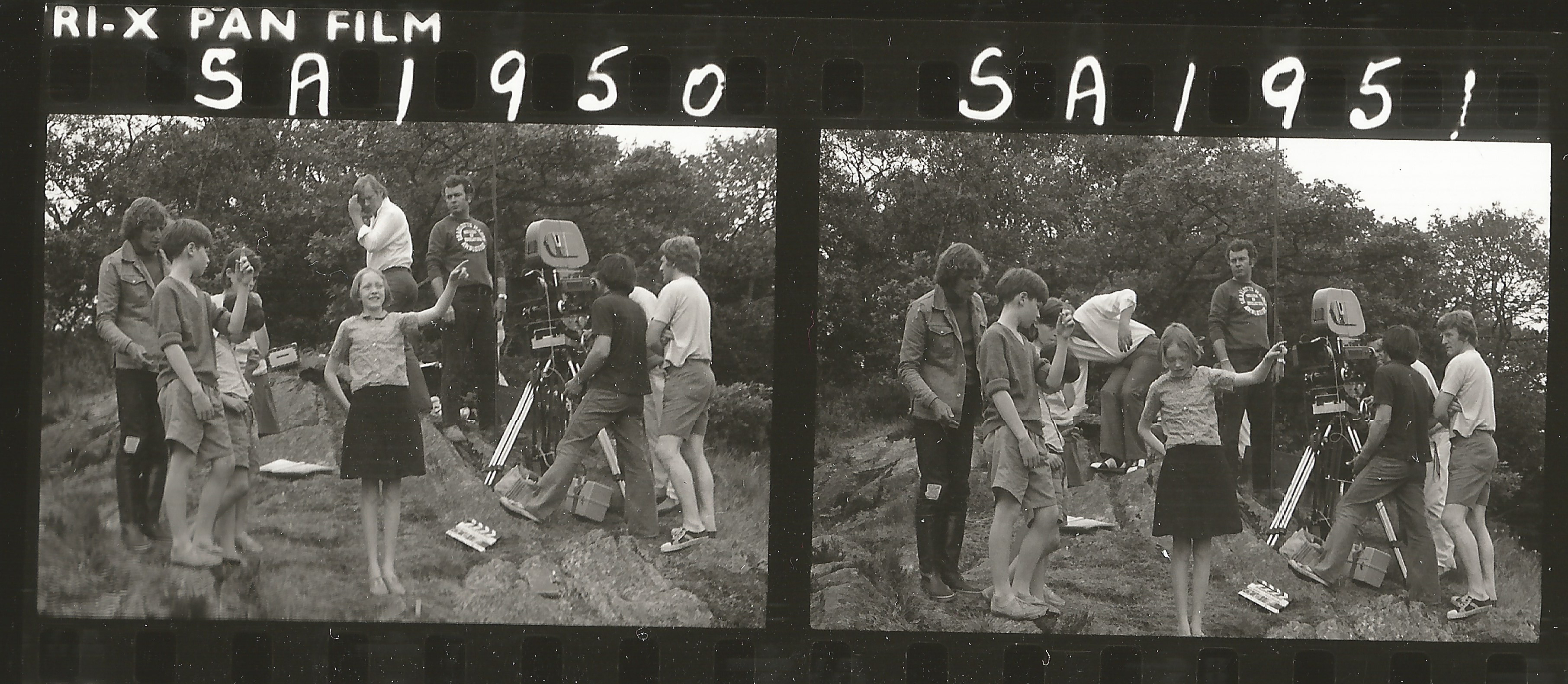
I love this photograph of Suzanna with Claude Whatham and the Bobby the focus puller. It somehow captures the atmosphere of filming on Peel Island back in 1973. I was meant to be sitting on the biscuit tin where I have left my empty cup, but Claude must have been reading my lines as he took Suzanna Hamilton’s close-ups. I was never sure about the blouse she is wearing. We hadn’t heard of Margaret Thatcher at the time but it now seems to be edging a little too close to her style. I doubt if she took inspiration from us but, along with the gym shoes, it’s very much in style now.
‘It was quite a nice day weather-wise,’ one of the others had noted, but obviously not the solid sunshine needed for the big scenes yet to be shot out on the lakes. However our sailing director David Blagden was back with us, his hair cut short in order to appear in vision as Sammy the Policeman, a part he played beautifully. Although there is a cheerful photograph of him taken straight after he gained a short-back-and-sides we can only find rather a distant and visually confused one of him in uniform at the camp site on Wild Cat Island. He was so desolate to have had his hair cut short that he took off his helmet during the scene to prove that he really had been shorn.
David Blagden as Sammy the Policeman
We were excited that David was on the set, in costume. He’d always been behind the camera before. But he made a very serious Policemen and didn’t let the persona of his character fall whilst he was in uniform.
David Blagden as Sammy the Policeman
What works best in the film is the edit. ‘No more trouble of any kind, ‘ Virginia McKenna insists – and the shot cuts to the boots of a Policemen arriving in camp.
David Blagden who played Sammy the Policman ~ photo: Daphne Neville
It looks as if this was one long scene – but the section where the content of Uncle Jim’s book was discussed while we sipped tea had been shot a week previously when Ronald Frazer first arrived in the Lake District.
The clapper-loader, Sophie Neville and David Blagden as the Policeman on Peel Island ~ photo: Daphne Neville
Director Claude Whatham having lunch with his leading ladies, Suzanna Hamilton and Lesley Bennett ~ photo: Daphne Neville
It was a long day, but a happy one. Any secrets? It was really in the scene when John declares ‘a dead calm’ and we decide to visit the charcoal burners that it became apparent that I was taller than my elder brother played by Simon West.
A box was provided for him to stand on so that I look shorter when I run into shot. It was a shot I remember we did in one take – despite being fairly complicated. Everyone was amazed that we moved on so quickly. We needed to.
The Swallows on Wild Cat Island
The pre-occupation of the producer was that, since the bad weather had caused delays, we still had an awful lot to film. We must have been about a week behind schedule – a huge worry for Richard Pilbrow. The next day we just had to get out on the water come what may.
The huge sadness was that David Blagden, so vibrant and good looking with so much to live for, lost his life to the sea in the late 1970s.
David Blagden, the Sailing Director before he had his hair cut to play the Policeman, and my mother Daphne Neville, Chaperone to the six children acting in ‘Swallows and Amazons’
After Swallows and Amazons he presented an ITV series broadcast on Sundays called ‘Plain Sailing’. It featured Willing Griffin the 19′ Hunter in which he’d crossed the Atlantic despite horrific weather in 1972 and the survey of a 39′ wooden boat I think he intended to take on another crossing. Apparently he set off in this yawl from Alderney in a Force 11 gale and was never seen again. The harbour master had begged him not to go. They found his girlfriend’s body and parts of the boat but there was no trace David.
The cover of ‘Very Willing Griffin’ by David Blagden. ‘An exciting adventure of pursuing and living a dream against many odds’, this sort after book was reviewed in The Journal of Navigation. His obituary in a school magazine is desperately sad. It was posted on the Arthur Ransome Group Facebook page.
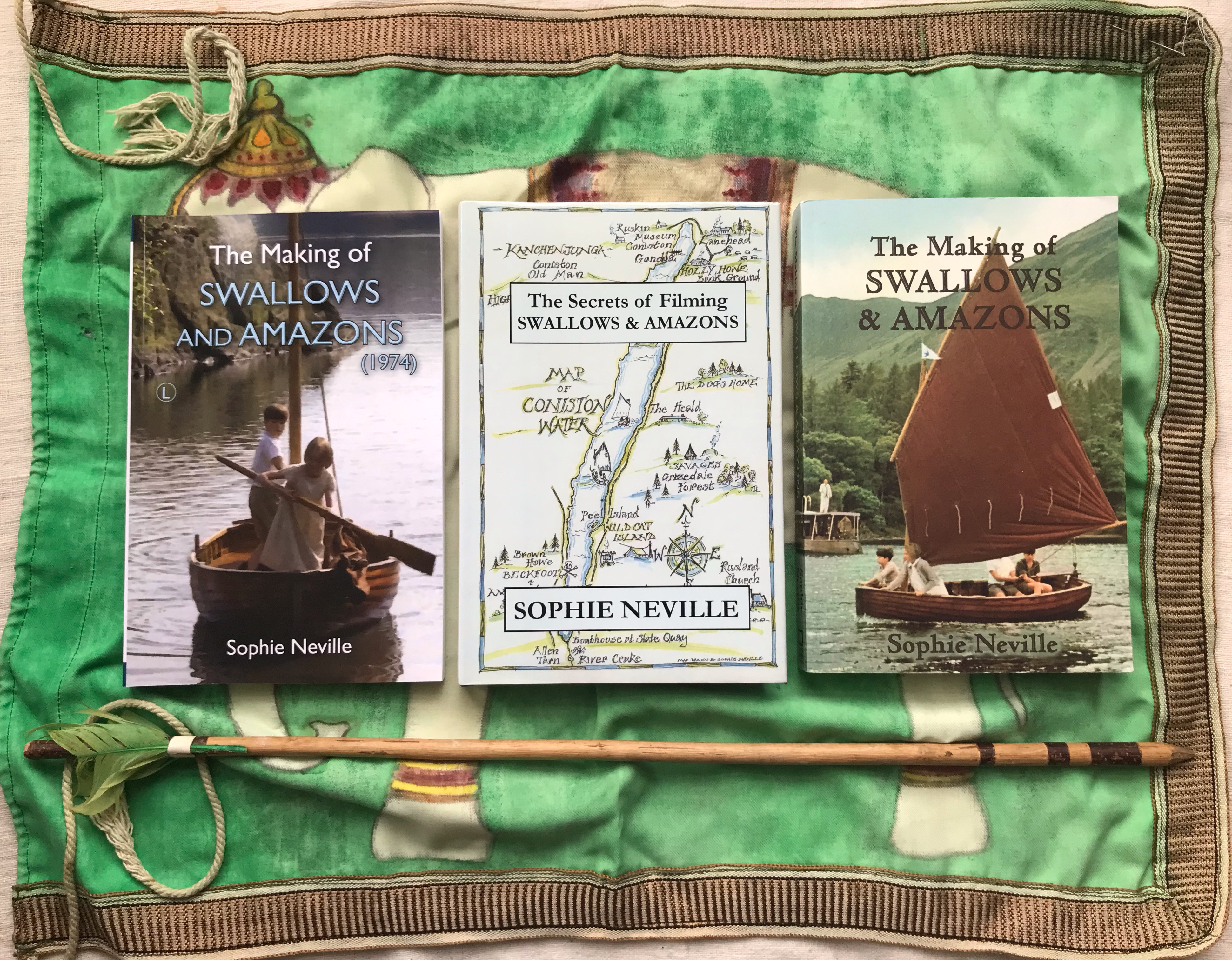
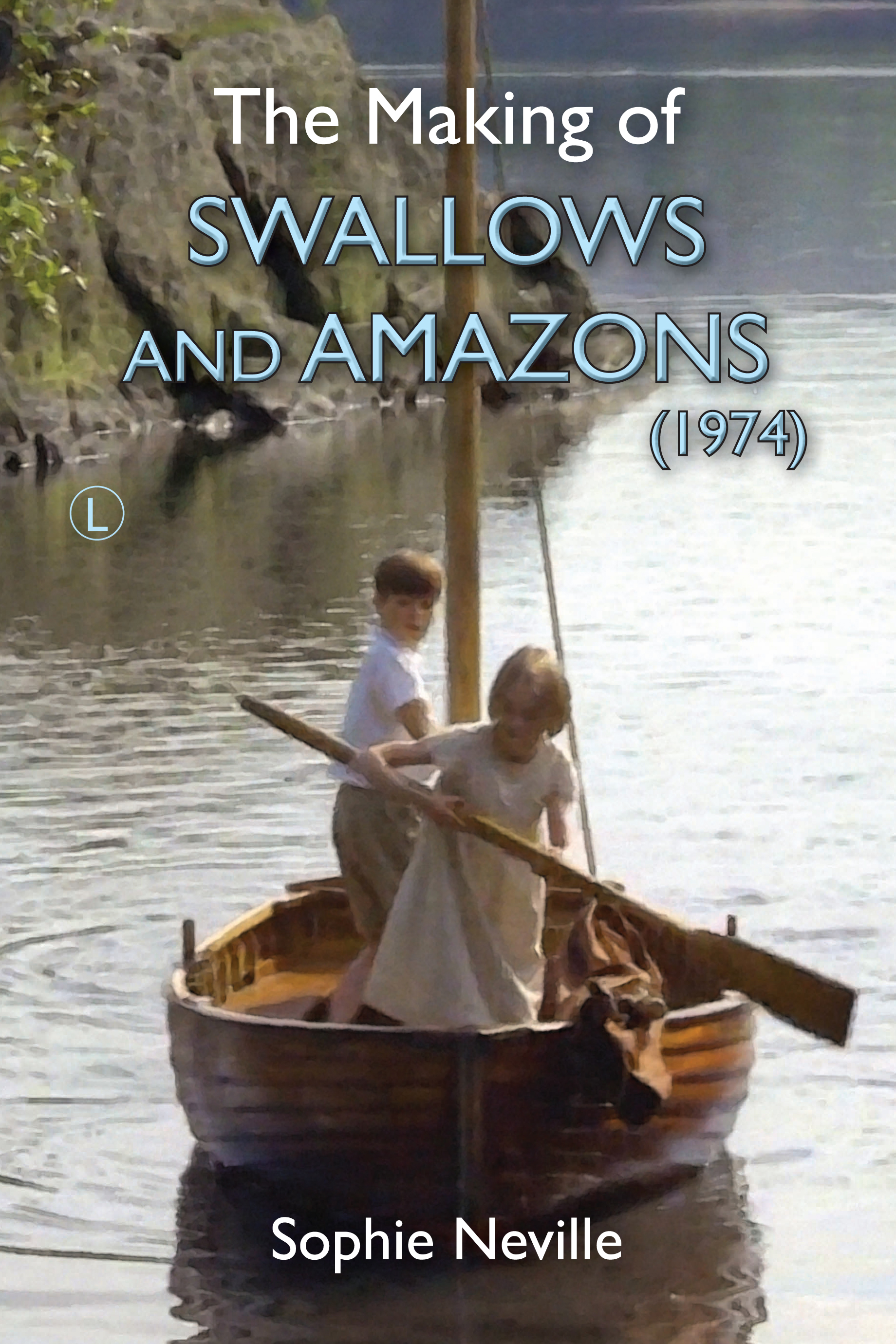
You can read more in ‘The making of Swallows and Amazons’ published by The Lutterworth Press and available online or from Waterstones
Fifty one years ago this day, we were filming with Dame Virginia McKenna at the location used for Arthur Ransome’s Holly Howe above Coniston Water. It was a day of days – the sunshiny day that we had all be waiting for.
Dame Virginia McKenna at the other side of the boat houses at Bank Ground Farm in 1973 ~ photo: Daphne Neville (c)
First Assistant Director David Bracknell standing-in (or kneeling-in) for Roger with Dame Virginia McKenna at Bank Ground Farm. The great trees in the background are sadly no longer there ~ photo: Daphne Neville (c)
The gift of a day when buttercups and daisies were still out in the field that flows from Holly Howe to the lake. Roger was able to tack up the meadow to receive the ‘despatches’ from Mrs Walker, described in the opening pages of Arthur Ransome’s book.
Dame Virginia McKenna reading the IF NOT DUFFERS telegram to Sten Grendon as Roger
‘…Each crossing of the field brought him nearer to the farm. The wind was against him, and he was tacking up against it to the farm, where at the gate his patient mother was awaiting him.’
Dame Virginia McKenna having her hair adjusted by Ronnie Cogan ~ photo:Daphne Neville (c)
I don’t think you can tell that this section of the scene was recorded seven whole days later than the sequence that runs directly on from this when the Boy Roger delivers the very same ‘If not duffers’ telegram to Captain John.
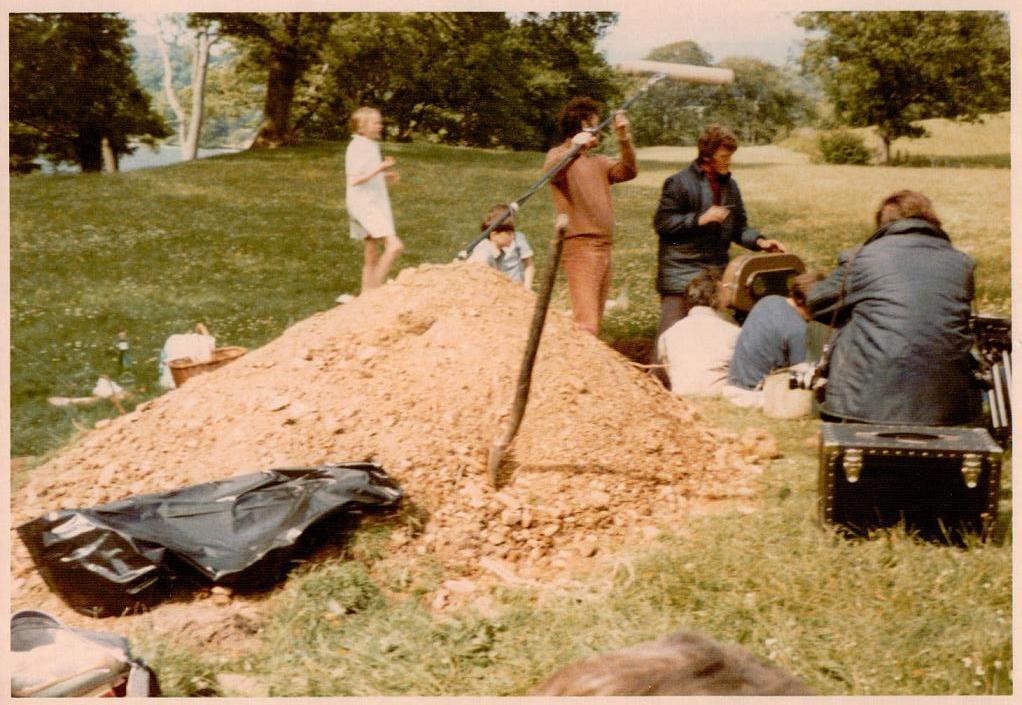
The hole that had been dug for the camera alongside our picnic had been filled in. You can see this from Mother’s perspective when I was milling about near the lake looking towards the island I couldn’t actually see.
Dame Virginia McKenna on location at Bank Ground Farm (Holly Howe) in the Lake District. Property Master Bob Hedges is working in the foreground. Lee Electric lighting assistants stand-by with reflector boards while Assistant Sound Recordist Gay Lawley-Wakelin waits on a box with the boom ~ photo: Daphne Neville (c)
Poor Sten, he had to run up the field on what proved to be our hottest day in a sleeveless sweater. I remember Jean McGill, the Unit Nurse ministering cool drinks and a flannel soaked in cool eau de Cologne to make sure he did not get dehydrated. We all wanted a go with the cool cloth on the back of our necks at lunch time.
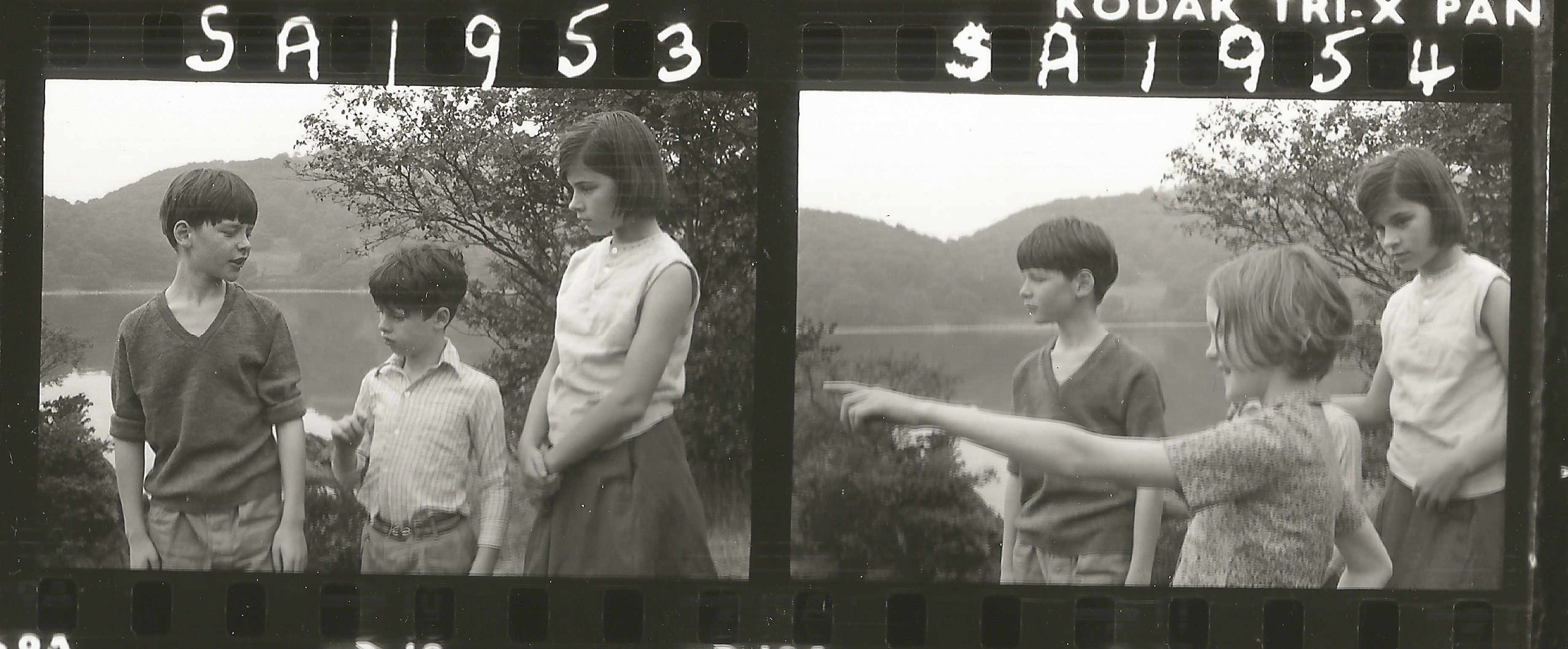
The Walker Family ~ Suzanna Hamilton playing Susan, Stephen Grendon as Roger, Sophie Neville as Titty, Dame Virginia McKenna as Mother and Simon West as John. photo: Daphne Neville (c)
It was good to escape the heat by getting out on the water. We shot the scene set on the old stone jetty at the boat houses below the farm when Titty leads ‘Good Queen Bess’ down to the harbour to inspect her ship. I didn’t realise she had a large box of matches in her hand. Virginia kept it a surprise from us in real life. I was excited to find out that Simon Holland, the Designer had painted the branded cover by hand.
Farewell and adieu to you fair Spanish ladies
As the call sheet specifies, our dinghy Swallow had been loaded with all the tents and camping equipment that had been on Peel Island the day before. I didn’t realise at the time quite how often the design team had struck camp and made it up again. I just sat on top of the equipment singing Adieu and Farewell, not very well, as we sailed out onto Coniston Water, waving goodbye to our Fair Spanish Ladies.
Claude Whatham with Dame Virginia McKenna. Mrs Jackson stands patinetly at the door ~ photo: Daphne Neville (c)
I am sure that we had already recorded the scene in David Wood’s screenplay when the Walker family arrive at Holly Howe, but Claude decided to take advantage of the golden light and shoot it again. I am sure this was a good decision. It had been a long day and we were tired but the excitement of our arrival is tangible.
Director Claude Whatham, in a 1970s yellow long-sleeved t-shirt, watching the taxi drive up to Mrs Jackson’s front door in 1929. DoP Dennis Lewiston sets up the shot with Focus-puller Bobby Sitwell ~ photo: Daphne Neville (c)
Nurse with Baby Vicky, the ship’s baby at Holly Howe ~ photo: Daphne Neville(c)
My mother observed that Mrs and Mrs Jackson, Mrs Walker’s nurse and Vicky the ship’s baby, who were listed as Extras on the call sheet, were particularly well cast. Kerry Darbishire, who played the nurse, told me later that she had a daughter of the same age as Tiffany Smith seen here as Vicky. She could have brought her along. It was important they were there, playing ‘The stay-at-homes.’ Vicky anchored Mrs Walker to the farm, making it impossible for her to sail to the island with the Swallows.
Stephen Grendon, Sophie Neville and Simon West with Mr Jackson at Holly Howe~ photo: Daphne Neville
It must have been a long day for the little girl. It was a long hot day for all of us, but a happy day.
Simon West, Stephen Grendon, Suzanna Hamilton & Sophie Neville playing the Walker children in ‘Swallows and Amazons’ 1973 ~photo: Daphne Neville(c)
The women who had been taken on as our stand-ins the day before did not seem to be around to help limit the hours we spent on set. David Bracknell, the first assistant director stood in for Roger. One of the women later claimed that she played Virginia McKenna in long-shots but the only long shot was taken of the Spanish Ladies on the jetty and I’m pretty sure that is Dame Virginia herself.
Stephen Grendon, Simon West, Dame Virginia McKenna, Suzanna Hamilton and Sophie Neville, trying not to look as tall as she was in 1973 ~ photo: Daphne Neville(c)
What I really did not know, until I watched the documentary broadcast last Sunday, was that Mrs Batty, who held the lease on Bank Ground Farm, had locked out the crew. She explained that when she was originally asked if we could film on her property she did not quite realise the scale of operations and only asked for – or accepted – a location fee of £75.
Lesley Bennett’s photo of the double decker buses at Bank Ground Farm in 1973
The arrival of the two red double-decker buses, the Lee Electric van, the generator and other lorries, not to mention the Make-up caravan rather daunted her, as did the furniture moving activities involved at the start of the filming when we shot the interior scenes. The idea that the film would bless her Bed & Breakfast and Tearoom business for the next fifty years alluded her. She said that she decided that £75 was not enough, padlocked her front gate and wouldn’t let the crew back in until they agreed to pay her £1,000. It was a lot of money, more than double the fee I received.
Sophie Neville with Lucy Batty at Bank Ground Farm in 1973 ~ photo: Daphne Neville(c)
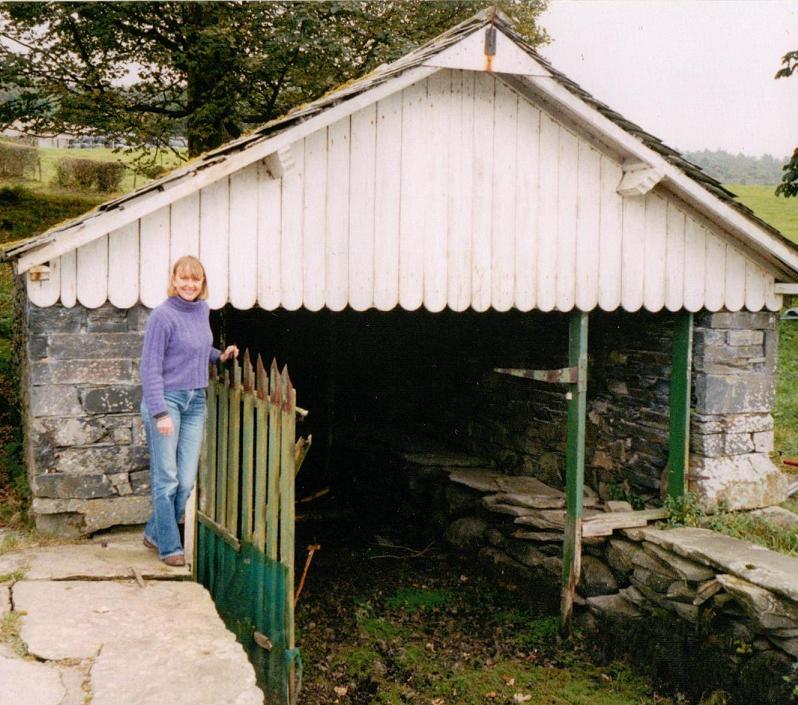
You may have seen the BBC documentary about the making of Swallows and Amazons, when Ben Fogle interviewed Suzanna Hamiltonand myself at Bank Ground Farm for ‘Big Screen Britain’. This was re-packaged on a programme called Country Tracks. My father’s 16mm footage had been skillfully inter-cut with an interview with our Director, Claude Whatham.I did not know that it was being broadcast but was able to watch on-line.~The Author Sophie Neville at the boatshed in 2013~
If you would like to read more, ‘The Secrets of Filming Swallows and Amazons (1974)’ is available on Amazon Kindle and all ebook platforms and the paperback on ‘The Making of Swallows and Amazons’ can be found in Waterstones from all online stockists.
Claude Whatham had no Peak of Darien at Bank Ground Farm, Arthur Ransome’s location for Holly Howe. But he did have buttercups and daisies, the flowers so evocative of childhood summers spent in the English countryside. The field that runs down to Coniston Water looked glorious that sunny day in June 1973. It was glowing.
Claude had used wild flowers to good effect when he made Laurie Lee’s memoir Cider with Rosie for the BBC in May 1971. It had been one of those months of endless sunny days in Gloucestershire but we were in Westmorland now, where buttercups bloomed later in the year and sunny days were cherished. This was Claude’s afternoon for low angle shots.
The view from Bank Ground Farm over Lake Coniston as it was in 1973
We arrived to find that a huge hole had been dug in the meadow for the camera, with a picnic for us spread out the other side of it. We thought this was very exciting. I’m not sure whether Mrs Batty felt quite the same joy about the excavations in her field. I was sad that we didn’t have a fire with a kettle, as they do in the book of Swallows and Amazons, but that was kept as a feature of island life and camping yet to come.
Sophie Neville, Simon West, Suzanna Hamilton, Gay Lawley Waklin, Bobby Sitwell, Dennis Lewiston, Albert Clark: photo~ Daphne Neville
Roger came sailing down clutching the telegram from our father, reaching out to deliver it over the hole. I understand that this was based on the cryptic telegrams that Ernest Altounyan sent his children Taqui, Susie, Titty and Roger, the children who acted as models for the Swallows. It has become the iconic response to Health and Safety ever since.
Claude Watham having just spoken to Stephen Grendon playing Roger at Bank Ground Farm. Who is in the foregound? : photo~ Daphne Neville
What we ended up saying altered slightly from David Wood’s original screenplay. ‘Dispatches?’ – Ransome spells the word ‘Despatches’ but apparently both spellings are correct.
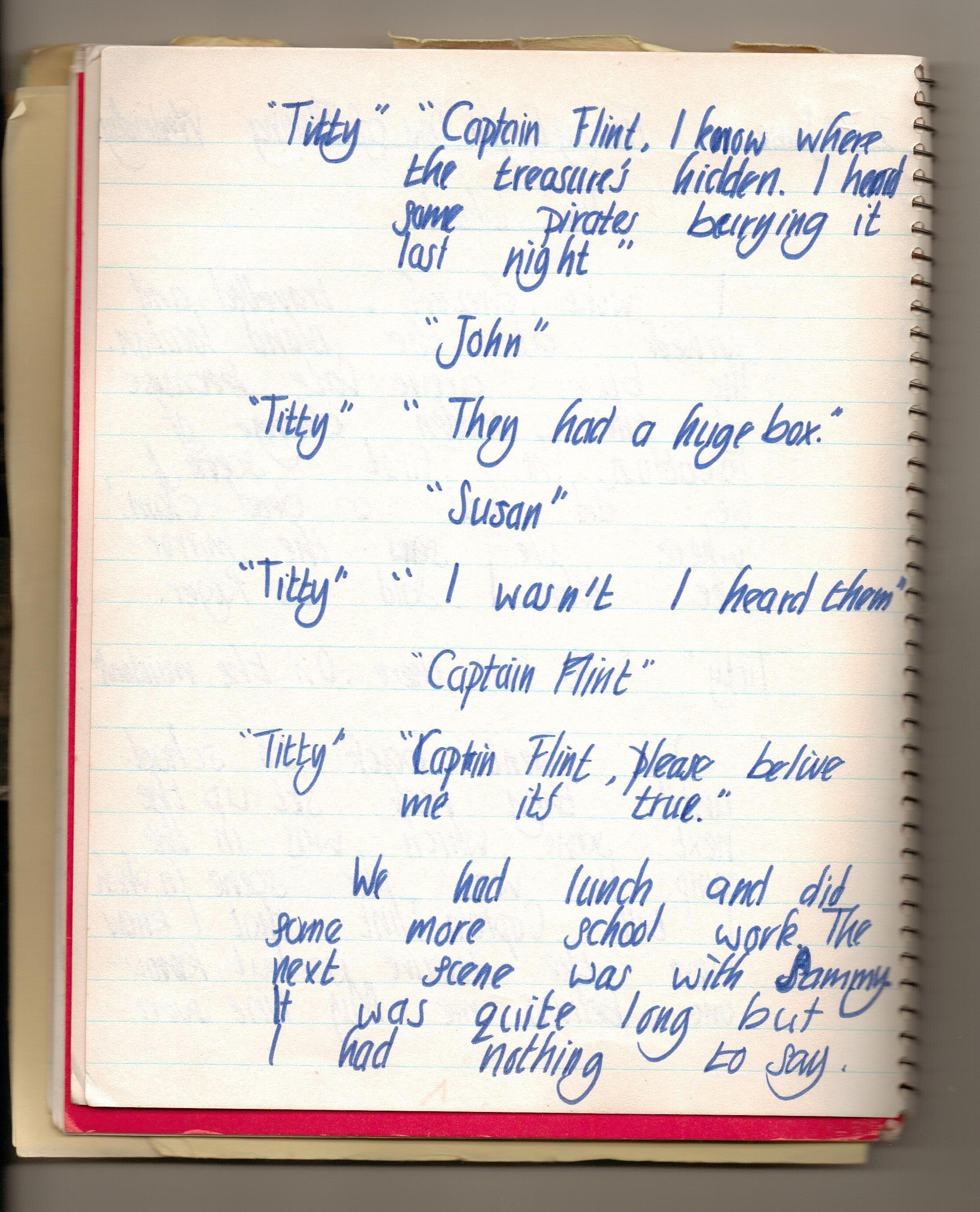
John referred to Daddy as ‘Father’. I’m not sure why. He did so in his letter. It is daddy in the book, but perhaps Claude considered ‘Father’ as having a more period feel. I stuck more to Ransome’s dialogue, as you can see if you compare the film script with my diary entry above. This was because I knew his book so well, and never saw the script. The acting credit must go to Simon West who sat holding the telegram, graciously absorbing my bossiness, whilst I grappled with the words.
David Wood’s original screenplay of ‘Swallows and Amazons’
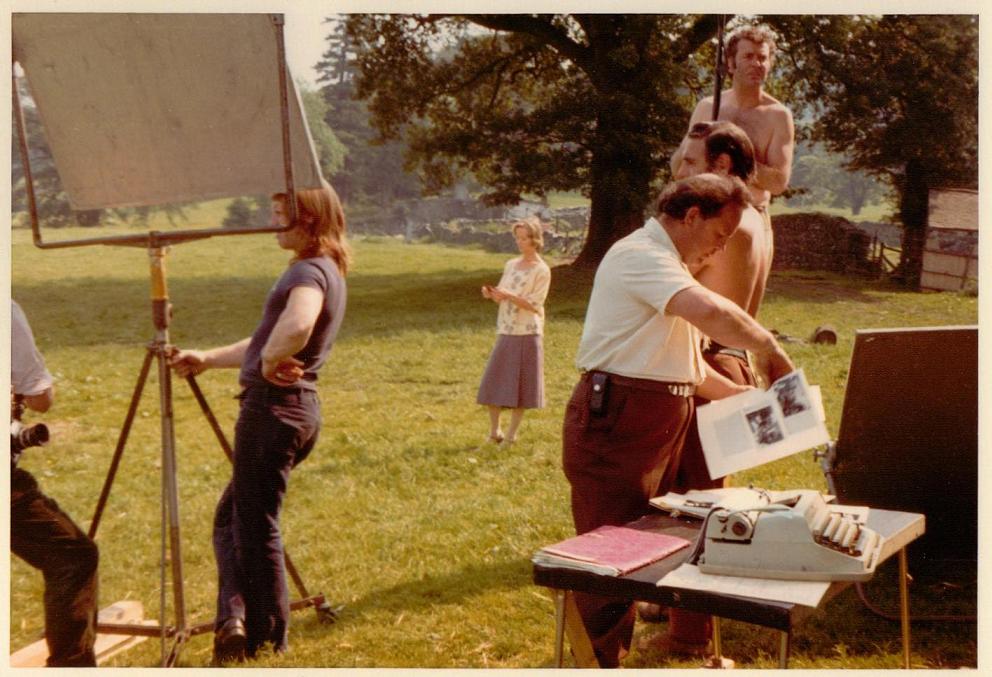
Sue Merry typing up continuity notes on location at Bank Ground Farm: photo ~ Daphne Neville
Back in 1973 it was the job of the ‘Continuity Girl’ to take notes on any changes made to the script. Sue Merry, ever present in her dark coat, took on this role. Today she would probably be known as a ‘Script Supervisor’ but her Aviator sunglasses and black polo-necked jersey would be the height of fashion. Sue also took notes technical notes for the film editor and director, indicating which Takes were favoured and which had been spoilt, giving the reason. In those days we had no monitors. The camera lens would be unscrewed after each take and checked carefully. If any fluff was found, Bobby Sitwell the camera assistant would call out, ‘Hair in the gate!’ Sue would quietly note this down and David Bracknell, the first assistant, would call out, ‘Set up to go again’. And we’d go again.
Sue was also responsible for the continuity, and would take numerous Polaroid photographs as an aide-memoir. This scene followed the one of Mother giving Roger the telegram, which had not yet been shot. Virginia McKenna hadn’t arrived back in Cumbria. Looking back, this seems a huge gamble. Would they ever get another sunny day while the buttercups were still blooming, a day to match – exactly – the weather of 14th June?
Sue would sit and type up her notes on location, using a portable typewriter that sometimes was set up for her on a spindly picnic table. This method of working was different from the BBC, when a ‘production assistant’ would type up her notes at the end of each day. Would it have been so that one copy of her notes, typed on triplicate paper, could be sent to the laboratory with the exposed film? It meant that her evenings were free.
We were allowed to help fill in the hole at the end of the day.
Sue Merry had worked for Neville C. Thompson before on The Boyfriend, Ken Russell’s movie that starred Twiggy with Tommy Tune, Barbara Windsor and Glenda Jackson. She later worked on The Wicker Man, Anthony Shaffer’s harrowing film directed by Robin Hardy that featured Edward Woodward, Christopher Lee and Diane Cliento, Britt Ekland and Ingrid Pitt. She went on to work with Dennis Lewiston and other members of our crew on The Rocky Horror Picture Show, the movie that starred Tim Curry, Susan Sarandon and such unexpected artists such as Meatloaf, Christopher Biggins and Prince Andrew’s old flame Koo Stark, who played a bridesmaid. Sue also did the continuity for Nicolas Roeg on The Man Who Fell to Earth, starring David Bowie, before moving into television to work on The Professionals and The Comic Strip Presents… All quite fun!
But on that day in June 1973, she was the girl with the daisies in her hair, wearing a coat thick enough to indicate that although sunny it was still quite chilly in the Lake District.
You can read more in ‘The Secrets of Filming Swallows and Amazons (1974)’





































 ~The Author Sophie Neville at the boatshed in 2013~





 Sophie Neville